
What If the Christ Child Had Been Born in the American Police State?

By John W. Whitehead

Source: The Rutherford Institute

“When the song of the angels is stilled, when the star in the sky is gone, when the kings and princes are home, when the shepherds are back with their flocks, the work of Christmas begins: to find the lost, to heal the broken, to feed the hungry, to release the prisoner, to rebuild the nations, to bring peace among the people, to make music in the heart.” ― Howard Thurman

The Christmas story of a baby born in a manger is a familiar one.

The Roman Empire, a police state in its own right, had ordered that a census be conducted. Joseph and his pregnant wife Mary traveled to the little town of Bethlehem so that they could be counted. There being no room for the couple at any of the inns, they stayed in a stable (a barn), where Mary gave birth to a baby boy, Jesus. Warned that the government planned to kill the baby, Jesus’ family fled with him to Egypt until it was safe to return to their native land.

Yet what if Jesus had been born 2,000 years later?

What if, instead of being born into the Roman police state, Jesus had been born at this moment in time? What kind of reception would Jesus and his family be given? Would we recognize the Christ child’s humanity, let alone his divinity? Would we treat him any differently than he was treated by the Roman Empire? If his family were forced to flee violence in their native country and sought refuge and asylum within our borders, what sanctuary would we offer them?

A singular number of churches across the country have asked those very questions in recent years, and their conclusions were depicted with unnerving accuracy by nativity scenes in which Jesus and his family are separated, segregated and caged in individual chain-link pens, topped by barbed wire fencing.

Those nativity scenes were a pointed attempt to remind the modern world that the narrative about the birth of Jesus is one that speaks on multiple fronts to a world that has allowed the life, teachings and crucifixion of Jesus to be drowned out by partisan politics, secularism, materialism and war, all driven by a manipulative shadow government called the Deep State.

The modern-day church has largely shied away from applying Jesus’ teachings to modern problems such as war, poverty, immigration, etc., but thankfully there have been individuals throughout history who ask themselves and the world: what would Jesus do?

What would Jesus—the baby born in Bethlehem who grew into an itinerant preacher and revolutionary activist, who not only died challenging the police state of his day (namely, the Roman Empire) but spent his adult life speaking truth to power, challenging the status quo of his day, and pushing back against the abuses of the Roman Empire—do about the injustices of our  modern age?

Dietrich Bonhoeffer asked himself what Jesus would have done about the horrors perpetrated by Hitler and his assassins. The answer: Bonhoeffer was executed by Hitler for attempting to undermine the tyranny at the heart of Nazi Germany.

Aleksandr Solzhenitsyn asked himself what Jesus would have done about the soul-destroying gulags and labor camps of the Soviet Union. The answer: Solzhenitsyn found his voice and used it to speak out about government oppression and brutality.

Martin Luther King Jr. asked himself what Jesus would have done about America’s warmongering. The answer: declaring “my conscience leaves me no other choice,” King risked widespread condemnation when he publicly opposed the Vietnam War on moral and economic grounds.

Even now, despite the popularity of the phrase “What Would Jesus Do?” (WWJD) in Christian circles, there remains a disconnect in the modern church between the teachings of Christ and the suffering of what Jesus in Matthew 25 refers to as the “least of these.”

Yet this is not a theological gray area: Jesus was unequivocal about his views on many things, not the least of which was charity, compassion, war, tyranny and love.

After all, Jesus—the revered preacher, teacher, radical and prophet—was born into a police state not unlike the growing menace of the American police state. When he grew up, he had powerful, profound things to say, things that would change how we view people, alter government policies and change the world. “Blessed are the merciful,” “Blessed are the peacemakers,” and “Love your enemies” are just a few examples of his most profound and revolutionary teachings.

When confronted by those in authority, Jesus did not shy away from speaking truth to power. Indeed, his teachings undermined the political and religious establishment of his day. It cost him his life. He was eventually crucified as a warning to others not to challenge the powers-that-be.

Can you imagine what Jesus’ life would have been like if, instead of being born into the Roman police state, he had been born and raised in the American police state?

Consider the following if you will.

Had Jesus been born in the era of the America police state, rather than traveling to Bethlehem for a census, Jesus’ parents would have been mailed a 28-page American Community Survey, a mandatory government questionnaire documenting their habits, household inhabitants, work schedule, how many toilets are in your home, etc. The penalty for not responding to this invasive survey can go as high as $5,000.

Instead of being born in a manger, Jesus might have been born at home. Rather than wise men and shepherds bringing gifts, however, the baby’s parents might have been forced to ward off visits from state social workers intent on prosecuting them for the home birth. One couple in Washington had all three of their children removed after social services objected to the two youngest being birthed in an unassisted home delivery.

Had Jesus been born in a hospital, his blood and DNA would have been taken without his parents’ knowledge or consent and entered into a government biobank. While most states require newborn screening, a growing number are holding onto that genetic material long-term for research, analysis and purposes yet to be disclosed.

Then again, had Jesus’ parents been undocumented immigrants, they and the newborn baby might have been shuffled to a profit-driven, private prison for illegals where they first would have been separated from each other, the children detained in make-shift cages, and the parents eventually turned into cheap, forced laborers for corporations such as Starbucks, Microsoft, Walmart, and Victoria’s Secret. There’s quite a lot of money to be made from imprisoning immigrants, especially when taxpayers are footing the bill.

From the time he was old enough to attend school, Jesus would have been drilled in lessons of compliance and obedience to government authorities, while learning little about his own rights. Had he been daring enough to speak out against injustice while still in school, he might have found himself tasered or beaten by a school resource officer, or at the very least suspended under a school zero tolerance policy that punishes minor infractions as harshly as more serious offenses.

Had Jesus disappeared for a few hours let alone days as a 12-year-old, his parents would have been handcuffed, arrested and jailed for parental negligence. Parents across the country have been arrested for far less “offenses” such as allowing their children to walk to the park unaccompanied and play in their front yard alone.

Rather than disappearing from the history books from his early teenaged years to adulthood, Jesus’ movements and personal data—including his biometrics—would have been documented, tracked, monitored and filed by governmental agencies and corporations such as Google and Microsoft. Incredibly, 95 percent of school districts share their student records with outside companies that are contracted to manage data, which they then use to market products to us.

From the moment Jesus made contact with an “extremist” such as John the Baptist, he would have been flagged for surveillance because of his association with a prominent activist, peaceful or otherwise. Since 9/11, the FBI has actively carried out surveillance and intelligence-gathering operations on a broad range of activist groups, from animal rights groups to poverty relief, anti-war groups and other such “extremist” organizations.

Jesus’ anti-government views would certainly have resulted in him being labeled a domestic extremist. Law enforcement agencies are being trained to recognize signs of anti-government extremism during interactions with potential extremists who share a “belief in the approaching collapse of government and the economy.”

While traveling from community to community, Jesus might have been reported to government officials as “suspicious” under the Department of Homeland Security’s “See Something, Say Something” programs. Many states, including New York, are providing individuals with phone apps that allow them to take photos of suspicious activity and report them to their state Intelligence Center, where they are reviewed and forwarded to law-enforcement agencies.

Rather than being permitted to live as an itinerant preacher, Jesus might have found himself threatened with arrest for daring to live off the grid or sleeping outside. In fact, the number of cities that have resorted to criminalizing homelessness by enacting bans on camping, sleeping in vehicles, loitering and begging in public has doubled.

Viewed by the government as a dissident and a potential threat to its power, Jesus might have had government spies planted among his followers to monitor his activities, report on his movements, and entrap him into breaking the law. Such Judases today—called informants—often receive hefty paychecks from the government for their treachery.

Had Jesus used the internet to spread his radical message of peace and love, he might have found his blog posts infiltrated by government spies attempting to undermine his integrity, discredit him or plant incriminating information online about him. At the very least, he would have had his website hacked and his email monitored.

Had Jesus attempted to feed large crowds of people, he would have been threatened with arrest for violating various ordinances prohibiting the distribution of food without a permit. Florida officials arrested a 90-year-old man for feeding the homeless on a public beach.

Had Jesus spoken publicly about his 40 days in the desert and his conversations with the devil, he might have been labeled mentally ill and detained in a psych ward against his will for a mandatory involuntary psychiatric hold with no access to family or friends. One Virginia man was arrested, strip searched, handcuffed to a table, diagnosed as having “mental health issues,” and locked up for five days in a mental health facility against his will apparently because of his slurred speech and unsteady gait.

Without a doubt, had Jesus attempted to overturn tables in a Jewish temple and rage against the materialism of religious institutions, he would have been charged with a hate crime. Currently, 45 states and the federal government have hate crime laws on the books.

Had anyone reported Jesus to the police as being potentially dangerous, he might have found himself confronted—and killed—by police officers for whom any perceived act of non-compliance (a twitch, a question, a frown) can result in them shooting first and asking questions later.

Rather than having armed guards capture Jesus in a public place, government officials would have ordered that a SWAT team carry out a raid on Jesus and his followers, complete with flash-bang grenades and military equipment. There are upwards of 80,000 such SWAT team raids carried out every year, many on unsuspecting Americans who have no defense against such government invaders, even when such raids are done in error.

Instead of being detained by Roman guards, Jesus might have been made to “disappear” into a secret government detention center where he would have been interrogated, tortured and subjected to all manner of abuses. Chicago police have “disappeared” more than 7,000 people into a secret, off-the-books interrogation warehouse at Homan Square.

Charged with treason and labeled a domestic terrorist, Jesus might have been sentenced to a life-term in a private prison where he would have been forced to provide slave labor for corporations or put to death by way of the electric chair or a lethal mixture of drugs.

Indeed, as I show in my book Battlefield America: The War on the American People, given the nature of government then and now, it is painfully evident that whether Jesus had been born in our modern age or his own, he still would have died at the hands of a police state.

Thus, as we draw near to Christmas with its celebrations and gift-giving, we would do well to remember that what happened on that starry night in Bethlehem is only part of the story. That baby in the manger grew up to be a man who did not turn away from evil but instead spoke out against it, and we must do no less.

Tears in Rain: ‘Blade Runner’ and Philip K. Dick’s Legacy in Film

Blade Runner, and the work of Philip K. Dick, continues to find its way into our cinemas and minds. How did the visions of a paranoid loner become the most relevant science fiction of our time?

By Sean Bell

Source: PopMatters

You are an unusual man, Mr. Asher,” the cop beside him said. “Crazy or not, whatever it is that has gone wrong with you, you are one of a kind.”– Philip K. Dick, Flow My Tears, The Policeman Said.
“I’ve seen things you people wouldn’t believe…”
— Roy Batty, Blade Runner.

Los Angeles, 2019. The script simply reads: “Ext. Hades – Dusk”. Chemical flame bursts into the perpetual, post-nuclear Los Angeles gloom from skyscraping smokestacks, rising out of an industrial landscape Hieronymus Bosch might have envisaged. Flying cars flit through the darkness like fireflies. The camera moves slowly over impossible architecture with the immensity and decaying grandeur of ancient Egypt; a phantasmagorical megalopolis strung with necklaces of neon. The music rises.

The last war is over and nobody won. The Earth is living on borrowed time. Science has destroyed all boundaries between the real and unreal except those we choose to impose. Policemen are murderers, androids are lovers, nobody can be trusted, and everybody dies. Welcome back to the world of Blade Runner. Every time we return, it becomes more recognisable. Perhaps we never left.

Santa Ana, 1981. By now, Philip K. Dick — author, religious visionary and possible schizophrenic, who once said “You would have to kill me and prop me up in the seat of my car with a smile painted on my face to get me to go near Hollywood” — has read and approved the shooting script for Blade Runner by Hampton Fancher and David Peoples, as well as viewed a test reel of the movie’s groundbreaking special effects. In an effusive letter to Jeff Walker, the man in charge of the film’s marketing. Dick makes his prophetic opinion clear.

“Let me sum it up this way,” he wrote. “Science fiction has slowly and ineluctably settled into a monotonous death: it has become inbred, derivative, stale. Suddenly you people come in, some of the greatest talents currently in existence, and now we have a new life, a new start. As for my own role in the BLADE RUNNER project, I can only say that I did not know that a work of mine or a set of ideas of mine could be escalated into such stunning dimensions. My life and creative work are justified and completed by BLADE RUNNER… It will prove invincible.” (‘Letter to Jeff Walker regarding Blade Runner on Philip K Dick.com)

Dick, with a writer’s knack, chose the right words. Blade Runner has survived everything that could be thrown at it, including its initial critical reception, successive unsatisfactory edits, and dilution by both the science fiction genre and the film industry, which would plagiarise its vision with varying degrees of shamelessness for the next three decades. Yet nothing has been able to replicate its unique synthesis of elements, melding equal parts noir, action, romance, cyberpunk, dystopia and a meditation on what it means to be human. Whether praised or disparaged, ignored or overexposed, it has seen off all critics and challengers. Blade Runner‘s invincibility endures.

Unfortunately, the inimitable artistic fortitude of Ridley Scott‘s best work also allowed Hollywood to practice its favourite hobby of missing the point. The novels (or rather, in the film industry netherworld, ‘properties’) of Philip K. Dick — a writer largely unappreciated in his own lifetime who, at his lowest, claimed he he could not afford the late fee for a library book and infamously sustained himself on horse meat from a local pet store — have become highly prized and sought-after by studios eager to import intelligent ideas, rather than go through the hassle of conceiving their own. In the (twisted) spirit of Dick’s short story “We Can Remember It For You Wholesale“, no need for originality, we can develop it for you wholesale.

Question the nature of identity with Colin Farrell’s Douglas Quaid /Hauser as he flees the futuristic gunfire in the remake of Len Wiseman’s Total Recall (2012, an adaptation of an adaptation, as it were). Consider the limitations of free will with Tom Cruise’s Chief John Anderton (a well-known fan of unstable science fiction writers) in Steven Spielberg’s Minority Report (2012) while wondering how short he really is. Watch Jon Woo’s Paycheck (2003) and wonder how much Ben Affleck is actually being paid to appear in this piece of shit.

The names change, but the formula remains the same. Each summer, there must be blockbusters, and to fill the gaps in between the explosions with the barest bones of a Phil Dick story is, to the studio mindset, to buy instant, ready-made philosophical depth and artistic worth. Just add CGI!

Improbably, with 11 films based on his work and more in the pipeline, Dick has become the most adapted science fiction author in cinema history… And I’m not sure that’s a good thing.

“It’s a film about whether or not you can have a meaningful relationship with your toaster.” — Harrison Ford on Blade Runner in an interview with The Washington Post, 11 September 1992

That Scott is a director second only to George Lucas in his determination to tinker with a bygone masterwork until it meets his ultimate, exacting satisfaction (at last count, there are seven different versions of Blade Runner floating around the ether, finally culminating in Scott’s so-called ‘final cut’ in 2007), when a startling new interpretation of the film appeared online this June to wild acclaim, he had nothing to do with it. Instead, it was the work of the artist Anders Ramsell, who painstakingly recreated every frame of the movie’s opening 13 minutes with 3,285 gorgeous, haunting, impressionistic watercolours.

Dick, with a writer’s knack, chose the right words. Blade Runner has survived everything that could be thrown at it, including its initial critical reception, successive unsatisfactory edits, and dilution by both the science fiction genre and the film industry, which would plagiarise its vision with varying degrees of shamelessness for the next three decades. Yet nothing has been able to replicate its unique synthesis of elements, melding equal parts noir, action, romance, cyberpunk, dystopia and a meditation on what it means to be human. Whether praised or disparaged, ignored or overexposed, it has seen off all critics and challengers. Blade Runner‘s invincibility endures.

Unfortunately, the inimitable artistic fortitude of Ridley Scott‘s best work also allowed Hollywood to practice its favourite hobby of missing the point. The novels (or rather, in the film industry netherworld, ‘properties’) of Philip K. Dick — a writer largely unappreciated in his own lifetime who, at his lowest, claimed he he could not afford the late fee for a library book and infamously sustained himself on horse meat from a local pet store — have become highly prized and sought-after by studios eager to import intelligent ideas, rather than go through the hassle of conceiving their own. In the (twisted) spirit of Dick’s short story “We Can Remember It For You Wholesale“, no need for originality, we can develop it for you wholesale.

Question the nature of identity with Colin Farrell’s Douglas Quaid /Hauser as he flees the futuristic gunfire in the remake of Len Wiseman’s Total Recall (2012, an adaptation of an adaptation, as it were). Consider the limitations of free will with Tom Cruise’s Chief John Anderton (a well-known fan of unstable science fiction writers) in Steven Spielberg’s Minority Report (2012) while wondering how short he really is. Watch Jon Woo’s Paycheck (2003) and wonder how much Ben Affleck is actually being paid to appear in this piece of shit.

The names change, but the formula remains the same. Each summer, there must be blockbusters, and to fill the gaps in between the explosions with the barest bones of a Phil Dick story is, to the studio mindset, to buy instant, ready-made philosophical depth and artistic worth. Just add CGI!

Improbably, with 11 films based on his work and more in the pipeline, Dick has become the most adapted science fiction author in cinema history… And I’m not sure that’s a good thing.

“It’s a film about whether or not you can have a meaningful relationship with your toaster.” — Harrison Ford on Blade Runner in an interview with The Washington Post, 11 September 1992

That Scott is a director second only to George Lucas in his determination to tinker with a bygone masterwork until it meets his ultimate, exacting satisfaction (at last count, there are seven different versions of Blade Runner floating around the ether, finally culminating in Scott’s so-called ‘final cut’ in 2007), when a startling new interpretation of the film appeared online this June to wild acclaim, he had nothing to do with it. Instead, it was the work of the artist Anders Ramsell, who painstakingly recreated every frame of the movie’s opening 13 minutes with 3,285 gorgeous, haunting, impressionistic watercolours.

The painting technique employed to create this effect is known as aquarelle, which also acts as a sly commentary on Blade Runner‘s repeatedly-rejiggered legacy: because of its transparency, with aquarelle nothing can be painted over — once a mistake has been made, it has to be lived with. But as I watched what Ramsell called his ‘paraphrase’ of the movie, the familiar scenes and faces and voices emerging from the flickering, sensuous wash of colour, it seemed all the more appropriate. Other than Derek Jarman’s Caravaggio, I can think of no other film that so looks like a painting without paint — a piece of art that evokes other art, and yet remains entirely itself.

This is all a long way of saying that Blade Runner is beautiful, in almost every way possible. This has, ridiculously, sometimes been described as being to its detriment: Roger Ebert, one of the film’s more famous naysayers, wrote in a contemporary review in the Chicago Sun-Times that “It looks fabulous… but it is thin in its human story,” (11 September 1992) an oddly myopic remark to make about a parable on the nature of humanity. True, Blade Runner has an embarrassment of style, but never at the expense of substance, much like the best examples of the Cinema du look movement, which was just emerging in French cinema at the time of Blade Runner‘s release. Indeed, in appearance and atmosphere, Blade Runner is so distinct that it changed the aesthetic of science fiction, and new subgenres have since been invented simply to describe it — ‘future noir’, coined by the critic and filmmaker Paul M. Sammon, being the most enduring.

To those who have yet to experience the film, I wonder what to say that has not been said elsewhere. Based on Philip K. Dick’s 1968 novel Do Androids Dream of Electric Sheep?, Blade Runner somehow manages to be simultaneously the truest adaptation of Dick’s work yet produced — in spirit, if not plot — and also the freest in its interpretation of the material.

The central premise remains in both book and film; Rick Deckard (Harrison Ford), halfway between policeman and bounty hunter, makes his living by tracking and killing androids that are almost entirely indistinguishable from humans, living amongst us under false identities. The supposed test for distinguishing real from unreal humans is that of empathy, but as Deckard methodically adds to his ‘artificial’ bodycount, he begins to question who is really the unemotional machine.

Blade Runner dumps much of the novel’s narrative furniture — Scott justified this to Dick by saying: “You know you’re so dense, mate, that by page 32, there’s about 17 storylines” — in a way that, in almost any other adaptation, would be considered sacrilege. Most noticeably, in the novel, Deckard is trapped in a barely functional marriage, while in the movie, Harrison Ford’s laconic protagonist is the classic bachelor gumshoe.

Also prominent in the book are ‘Mercerism’, the religion based around its followers’ empathy for a man whom others were throwing rocks at, and the ‘Mood Organ’, the household device which stimulates any mood the user wishes to experience, and which much of the population now depends on in order to face another bleak, post-apocalyptic day — two tragicomic creations typical of Dick, but too wry to fit with the Blade Runner‘s overall tone. Despite such changes, Dick’s reading of the screenplay convinced him that this film could express his ideas in a way he had not thought possible.

The production could hardly be called smooth. Even before its release, troubling rumours had begun circulating, and as Paul M Sammon wrote ,”by the time BR (Blade Runner) officially completed principle photography in July on 1981, the gossip has become more specific — BR‘s workload had been horrendous, its shooting conditions miserable, and its director, difficult. Moreover, the whispers went, BR’s moneymen were unhappy, its leading man had clashed with his director, and the crew had been near revolt.” Some of these stories were indeed true, but one should bear in mind that movie moneymen are nearly always unhappy, and Harrison Ford will always be the man who told George Lucas that “you can type this shit, but you sure as hell can’t say it.”

Paranoia Runs Through Blade Runner Like a Knife Edge

When Blade Runner was first released, the reviews ran from lukewarm to underwhelmed to baffled, a fact that many critics have been doing their best to forget in the intervening years, polishing the film’s legend in a frantic effort to make up for missing the boat first time round. Considered today, in our gleaming plastic future of bad credit and worse politics, where we are reliant not on humanised robots but dehumanising gadgets, and where much of the movie’s retro-futurism appears as quaint as it does prescient, what is left to say about Blade Runner?

Should I recite the plaudits that have become ritualistic? Should I point out the Roy Batty’s (Rutger Hauer) ‘tears in rain’ monologue is among the most moving and eloquent ever written or performed? Or that Vangelis revolutionised jazz, electronic music and film scoring simultaneously in one of the best soundtracks ever composed? Is it really necessary to highlight the acting of all involved; Harrison Ford as one of the best soulful detectives to grace noir of any kind, an understated and heartbreaking Sean Young (as Rachael), a dangerous but innocent Daryl Hannah (as Pris), or Rutger Hauer’s mixture of the psychotic and the Shakespearean? Do I need to praise the costumes, the set design, or the script which balances so many themes, so many hidden or implied meanings, with such grace and economy?

Well, yes. You want a criticism of Blade Runner? I would’ve liked more of Edward James Olmos’ Gaff. He’s cool. I also want Deckard’s coat.

But we need to be reminded of these things, every now and again, as each new generation discovers the film afresh, and especially when the next logical question becomes: how did Blade Runner get it so right, more so than any other adaptation of Dick’s work since? What did it understand that they did not? To try and answer that, we have to go back to the source.

“Phil acknowledged that his talk sometimes sounded like “religious nonsense & occult nonsense” — but somewhere in it all was the truth. And he would never find it. God himself had assured him of that.” — Lawrence Sutin, Divine Invasions: A Life of Philip K. Dick.

In 2000, at the one and only Disinfo Con — a friendly gathering of millennial deviants concerning all things ‘counterculture’ — Grant Morrison, a writer who could arguably be counted as one of Dick’s prodigious bastard literary offspring, opened his keynote speech marvelling at the fact he spent his youth reading Robert Anton Wilson and now, all these years later, “we’re standing here, we’re talking about this shit and it’s real.”

Fans of Philip K. Dick have been feeling like that since at least the ’70s, when the dark realities on the other side of the Drug Revolution and the true possibilities of an all-powerful Nixonian surveillance state were becoming painfully apparent. Then as now, we use Dick’s paranoia to express our own.

Dick once commented that, with the making of Blade Runner, what had once been a private world that only he inhabited was now open to all; they would live in its murky depths, just as he did every day. At first, one might think that a paranoid and delusional visionary — and I use the word in its most literal sense — would want nothing more than for others to see and experience what he does. But perhaps Dick didn’t want anyone in his world. Maybe he didn’t think his world should be suffered by anyone else.

The fantastic, tortured mind of Philip K. Dick has been discussed, analysed and treated like an object of supreme curiosity since his death in 1982 (a few months shy of Blade Runner‘s release) and before. He had eked out an impoverished existence writing science fiction since the ’50s, when it was less a genre than a ghetto, and could only make a living by producing at a furious pace which he fuelled with huge amounts of amphetamines, at one point producing 12 novels over the course of two years.

But Dick was ever a seeker of truth, which made him, strangely, something of an oddity in science fiction. Within these novels, beneath the aliens and spaceships, moon colonies and interstellar wars, was arguably the best satire being done in science fiction on American life outside of Kurt Vonnegut‘s oeuvre, the philosophical undertones and untrammelled, often gothic imagination of which called to mind Jorge Luis Borges more than Isaac Asimov. The uniting thread that runs through his work — and, eventually, his life — is the notion that reality, as we know it, is fundamentally untrustworthy.

As the ’60s wore on, Dick’s involvement with the drug culture increased, adding a psychedelic aspect to both his ever-evolving philosophy and his ever-present paranoia. In 1971, Dick experienced a defining moment: his home was broken into, his safe blown open, and many of his personal papers burglerized. He never discovered who was responsible, though he had many suspects — local drug addicts, Black Panthers, the police, the FBI, the Soviets, or any of these, pretending to be one of the others.

The effect it left on Dick was to give him proof, unexplained and terrifying, that his paranoia was somehow justified. There had been comfort in simply telling himself he was crazy. But after years of grappling with his mental health, someone, it seemed, truly was out to get him.

“I mean,” he told the Aquarian magazine in a 1974 interview, “it’s a very frightening thing when the head of a police department tells you that you better leave the county because you have enemies, and you don’t know who these enemies are or why you’ve incurred their wrath.”

When one is peripherally aware of one’s own tenuous psychological condition (which we must be, we tell ourselves, if we have any hope of overcoming it), the uninitiated cannot imagine the sheer anguish, the self-doubt, the fear that follows when you know you cannot trust your own mind, and you cannot trust anyone to help you. The luckiest paranoids are also egotists, or better yet, megalomaniacs; they face the lurking forces of imagined persecution with a defiant roar or a knowing smirk.

Dick, on the other hand, was a sensitive, fragile, frightened soul, as well as a possible undiagnosed schizophrenic. His subsequent religious experiences — a series of hallucinations in which a beam of pink light connected him with a “transcendentally rational mind” — may have been his brain’s attempt to soothe his paranoia, or merely the next stage of his mental instability. In either case, as always, it provided inspiration for another novel.

Critics and biographers often talk about Dick’s paranoia and delusions like they were shocking fashion statements or extreme political opinions — just another interesting aspect to the bizarro image of a literary titan. What they don’t say, although the evidence is all around us, is that Dick’s paranoia is ours, as well. Ours may not have such colourful outlets or dramatic results, but we shall always carry our paranoia with us. It cannot be blotted out. There will forever be dark fears lurking in the deeper pools of our mind about our untrustworthy friends, co-workers, policemen, criminals, the FBI, the CIA, the Communists, the aliens, or God himself… and beyond. Existence will always be open to question, forever taunting us with its uncertainty. We can’t trust reality, but we have to live there.

This paranoia runs through Blade Runner like a knife edge. You cannot trust others, or yourself. You cannot trust your memories, your past, or your future. The entire world may be against you, even if it doesn’t appear to be. Then again, you don’t have to like it.

The heroes and villains of Blade Runner do not like, or accept, the oppression of the paranoid worldview. Deckard fights a series of seemingly impossible battles, even against what he thought was true, and finds romance where it should be impossible. Roy Batty, the leader of the renegade replicants, fights against death itself, seeking to extend and outlive his designer-mandated expiration date. The inhuman fights to become human, so humans must prove their humanity. This is the message at Blade Runner‘s core, and it has never been replicated.

Near the end of Dick’s 1976 novel Radio Free Albemuth, the protagonist, an author surrogate for Dick who also writes pulp science fiction, is faced by a gloating representative of the government conspiracy that the writer has become entangled with, who coolly informs him they will continue to put out books under his name — lurid trash scattered with a few of the author’s trademark concepts to keep it recognisable for his fans, but encoded with non-too-subtle propaganda messages designed to keep its readers afraid and unenlightened.

At our most cynical, it’s sometimes difficult not to think of Hollywood the same way: trading on Dick’s name and style and core ideas, but discarding the message and the mind behind them.

Authors often have to face a string of misfires and misinterpretations before their work gets the cinematic treatment it deserves; Dick, on the other hand, got a masterpiece on the first go. And it remains ours to enjoy: Blade Runner, as Dick wrote, is invincible.

Maybe it’s finally time for Hollywood to leave the legacy of Philip K. Dick at the local bookstore, where it belongs.

“What matters to me is the writing, the act of manufacturing the novel, because while I am doing it, at that particular moment, I am in the world I am writing about. It is real to me, completely and utterly. Then, when I’m finished, and I have to stop, withdraw from that world forever — that destroys me… I promise myself: I will never write another novel. I will never again imagine people from whom I will eventually be cut off. I tell myself this… and, secretly and cautiously, I begin another book.” — Philip K. Dick, “Notes Made Late At Night By A Weary SF Writer”, 1968.

Generation Numb: How Losing My Phone Exposed Me to the Pain of My Peers

This terrible void of which everyone stays pleasantly unobservant is the unofficial sickness of Gen Z.

By Ben Scheer

Source: ScheerPost

I hadn’t planned to give up my smartphone. After all, I was starting my sophomore year of college and I had not met a single adult who lives without one and definitely no other 19-year-old. If you haven’t noticed, it is part of the culture. A few weeks into the semester, I forgot my phone (a Google Pixel 2, for all you phone nerds) in the backseat of an Uber on my way back from shopping off campus. This would lead to an opening to consider a break from the phone and everything that comes with it.

I remember feeling frustrated at myself for being so absentminded and immediately rushed to track it down, anxiously calling the driver from a friend’s phone. While I listened to the open ringing on the line I began to think about this one technology’s central role in my life.

That gateway to other worlds.

Over the next few days I continued to hope my phone would come back to me and also thought further into its role in my relationships. I felt how hindering it was in communicating with the people I love.

How it had required me to be always ready to pluck it from my pocket, pull my focus and as a result, never be truly present. I saw in that reflection the possibility for healthier relationships, less dependent on constant digital connection.

More free, less reliant.

Sure, there were a thousand things that would be made more challenging and tedious, but it would be worth it if I could be more present for my own life.

Days later, after I had given up hope of seeing it again, I used a friend’s phone to call my dad to tell him.

“I will get you another one, what kind do you want?” was the first thing he said.

“Actually I think I’m good,” I responded, to his surprise. “I can write you and my mom by email. If we want to talk, I can call you from my computer.”

Quickly, I started to feel the change. My mood and habits became clearer; I felt happier, more grounded, less looming anxiety, feeling more alone and with myself, more conscious of my space and those in it.

Being alone led to more opportunities for reflection and boredom. I felt calmer, and my walking and pace of day actually slowed down. It is hard to describe how it changed the patterns in my brain but I could feel it readjusting, as it does if you spend a week in the woods or on a beach. One thing I felt was that my days were longer and more connected from one moment to the next.

I also became more aware of the moods and feelings of others around me and was suddenly terrified to see how dependent my peers were on all their screens, and, looking back just a bit, how consumed I, too, had been.

Something else bubbled up from my unconscious: My expectations of college differed from what I was seeing. Between talking to older relatives and seeing college life on TV and in the movies, I was expecting a . . . BIT MORE JOY! Young souls, free minds, positive energy, community. I was seeking some bright spark in the people around me, yet all too often what I saw was dull, void, distractible, unthinking, unfeeling people enveloped in the world of their screens instead of being in community and conversing with the people around them.

Yes, that is harsh. It is also what I see.

So much lost human potential.

I want something or someone to blame, but maybe what I should really be blaming is myself for expecting something else. The truth is, though, I feel right in blaming the phones.

It has been over a year since I gave up my smartphone, but I remember vividly when looking at my phone for hours a day seemed normal to me. I was content to stare at the screen for hours, doing the same thing: Watching mildly entertaining videos or mashing game buttons, swiping on Tinder, scrolling on IG, surfing memes and YouTube videos. In many ways, it’s a drug too good to give up, seemingly a harmless drug, but no. We have opened Pandora’s box of marvels and there is no way to close it now.

We are continually wanting what we do not yet have, an innate motivation amplified and rerouted by capitalism’s hyperdrive marketing engines. A good fix for this constant yearning, or any discomfort is to drown it out with distractions. Feeling an uncontrollable emotion? Existential itch? Low-grade anxiety? No problem: Try scrolling on the social of your choice for a bit, trust me, it takes the edge off.

Trauma or poverty, pain or loneliness, all manner of worry, we have a cure! Or at least the emotional response can be staved off long enough for you to find the next thing to click.

This terrible void of which  everyone stays pleasantly unobservant is a part of me as well, the unofficial sickness of my generation. (COVID-19 will be the official one, memorialized in our virtual yearbooks.) This hole, this pit, that is created from not knowing one’s self, not trusting one’s self, or not allowing feelings. So distracted that these insecurities that we act on every day are a mystery. That you cannot see how fundamentally OK everything actually is because you have music constantly in your ear and a fear that, in silence, your own thoughts would be too scary. The sickening thought that your true feelings for someone were no more than an act of comfort-seeking desperation and that “love” is a lifesaver from yourself.

I can’t blame anyone though. The distractions surround us, they surround the people we are with. The collective unfeeling is so great, so vast, it cracked me open, actually made me cry often once I allowed myself to experience it. I felt like I was losing my footing in the world in which I had grown up. Disconnected from my past and unsure of where we were going.

(Side note: If you haven’t yet watched The Social Dilemma, go do that, it’s worth it.)

Walking into a small college class to see no one looking at each other or chatting, the blank vacant stares. The soft glow. It felt … confusing? Why were so many interesting young people ignoring one another? What was a classroom like before these tools were available and allowed everywhere? Why were the screens so celebrated?

Then my confusion grew, and from it rage and pain. These emotions danced together, fueled me and crushed me. I saw, for the first time, the real power that the phones held. Yes, a power we had given them, but a power nonetheless. The power to keep people who were 500 miles apart tethered to one another, or keep people sitting right next to each other brutally apart.

Who can I blame? It is just the world I have been born into, and the technology- and profit-driven changes are coming faster every year. We live in the future with brain equivalents in our pockets and a web that contains all of our collective knowledge but reveals the worst of what we are and so little of the love we contain and of which we are capable.

Is the internet a good idea? Are phones good for humans? These are not questions we have answered or even barely thought to ask in the mainstream of our culture. Of course they are, what else could they be? Progress! Faster communication! More knowledge! More speed! More fun! We will all be more efficient and entertained, and from that we will live better lives.

NO! Stop, slow down. Please. These gadgets, these everywhere-anytime screens, are ruining the minds of the people who have been mesmerized since they were only little children.

To clarify: not ruining, in that people are made stupid (although it definitely does not help develop our attention span), but rather ruining our emotional capacity and spiritual selves. And these limits fetter us as we are already so strained by the pain we are able to see through our little windows; we don’t have a moment to feel, to feel our own pain, or that of our friends.

Or, for that matter, the pain of the world, or the impact of our constant consumption, or where all this STUFF comes from and where it ends up, or the pain of our history and centuries of exploitation of other humans and nature from which all this wealth originally was derived.

Being human is objectively great. We can use language and words to describe how we feel. We can feel the sun on our face and take in the taste of a thousand foods, dance to every song. Feel great pain and great happiness. Yet, all the time I see this discomfort, unrest and fear in my most distracted friends. It is coming from the disconnection from what they are feeling, a disconnection from being.

This is the worst theft of modern-day, first-world life: the theft of being present.

The phones and distractions and speed create this disconnection from the simple fact that you are actually OK, better then OK — you are alive and can feel and that is a gift to cherish.

Worse than the days of sadness are the days of not feeling anything. Some people are depressed not because anything is wrong but because they are numb to their feelings, too distracted and avoidant to feel them; avoidant, and scared of what might happen if they let themselves feel.

Try this: Really study those you love, let their face become new to you, again, and become fascinated in the way they move. Feel the wonder of being with another human.

After more than a year without a smartphone, I am more hopeful than I was in those first few months. Not to say that everything is all right, far from it. Here in the United States our technology has allowed for multiple realities to coexist alongside one another and I don’t see a clear path out of that problem. Distraction and narrow self-interest prevent us from seeing and grappling with the apocalyptic future climate change can bring in a much shorter time frame than even most globally aware people are willing to accept.

However, I do know that change is a constant and I am healed by looking past my own lifetime and by all the simple beauties of life and living. In the end, these technologies do NOT define us. We can work together to change how we coexist.


Postscript: For those who are interested in also letting go of your smartphone, I would recommend downgrading to a flip-phone or phone of a similar level. I now walk around the world with a thick, red brick through which I can communicate with my work and family in case of emergencies. 

Welcome To The Interregnum

Your unease has a name: Zozobra

By Chris Martensen

Source: Peak Prosperity

We’re between things.  It’s an uncomfortable place.

We are transitioning from an old story into a new one and that has folks feeling anxious.   By “we” I mean everyone on the planet.  If you find yourself with a deep sense of unease, yet unable to quite pin it down, you will find this article extremely helpful.

The old story of endless growth on a finite planet is winding down.  Whatever replaces it won’t be a continuation of the past.  Things are going to have to change, whether we like it or not.

Put more bluntly: the easy times are over, and a period of disruption has begun.

It may be many years or even decades before thing truly settle into a new equilibrium (of sorts – there really isn’t any such thing in this ever-changing universe).  The old will fall away even before the new has arrived. That process has already begun, hence the nervousness, anger, and fear.

My day job is serving as an information scout, an ambassador of the unknown, and because of that I’m acutely aware of the degree to which people are already worn down, burnt out, and unable to process any more.

Folks are so exhausted by the trials and tribulations dished up by the crazy-making machine fondly referred to as “2020,” that many are paralyzed.  Unable to take new actions because they are overwhelmed.

Yet, as I wrote recently, no choice IS a choice.  When so much is changing and so much is on the line, remaining frozen with anxiety is as much a determinant of your future prospects as taking swift action – each sets one down different paths promising different outcomes.

Truthfully, there is much that can be done that will contribute to a more resilient future for yourself and for the world.  But first we have to know where we are.  We have to sketch out the map as best we can, even if the edges remain blanks with little more than “there be monsters” scribed at the borders.

To orient properly, you must be aware of the idea that the Age of Growth is over.  We are now entering a Post-Growth era. Our task now is to settle into a very different existence – one with fewer ‘things’ and less ‘stuff’, but also offering more meaning and worthy challenges.

Like any good adventure, a little danger is involved.  But nothing quite so dangerous to your soul’s journey as wasting your life on trivial pursuits.

The Interregnum

The gap between reigns when the old king has died but the new successor has yet to be decided is called an interregnum.  It can also refer to the gap between first learning of something and then finally understanding its deeper significance:

in·ter·reg·num, noun

a period when normal government is suspended, especially between successive reigns or regimes.

– an interval or pause between two periods of office or other things. “the interregnum between the discovery of radioactivity and its detailed understanding”

I love this word because it perfectly matches our current state.

One feature of an interregnum, where power hangs in the balance, is that it’s a very uncertain time.  Anxiety rules the day because nobody knows how things might land.  It could be good for them personally, or very bad.  The old king was good.  His successor son is an already hated petty tyrant.  Perhaps a different, better successor will somehow manage to claim the throne instead…

This sort of uncertainty is a potent source of anxiety. Which is why an interregnum is the cradle of people’s most deep-seated fears.

The old king is gone.  Nobody knows who or what is in charge right now.  Is it humanity’s deep technological prowess or is it Mother Nature herself?

Does our destiny lie in our own hands or have the die already been cast and we’re simply awaiting to see how unfortunate of a roll it’s going to be?

Is there still time to sort out a decent solution to our many predicaments and problems, or have those moments already been wasted?

Nobody knows at this moment.  But the uncertainty is hanging thick.  Corrosive.  Emotional.  Explosive.

Welcome to the interregnum.  May the odds ever be in your favor.

Demoralization

Now while the above may sound depressing, as I’ve written before the better term is demoralizing, and there’s a very important distinction between the two terms.

Depression is a reaction to current circumstances. It can be treated with talk therapy to resolve an inner conflict, or temporary chemical rebalancing.

Demoralization, on the other hand, is what you experience when your cognitive map no longer aligns with the actual circumstances of life:

Rather than a depressive disorder, demoralization is a type of existential disorder associated with the breakdown of a person’s ‘cognitive map’. It is an overarching psycho-spiritual crisis in which victims feel generally disoriented and unable to locate meaning, purpose or sources of need fulfilment.

The world loses its credibility, and former beliefs and convictions dissolve into doubt, uncertainty and loss of direction.

Frustration, anger and bitterness are usual accompaniments, as well as an underlying sense of being part of a lost cause or losing battle. The label ‘existential depression’ is not appropriate since, unlike most forms of depression, demoralization is a realistic response to the circumstances impinging on the person’s life.

(Source)

Did you catch that? Demoralization is actually a realistic response under certain conditions.

Those conditions are manifesting themselves now. Which means that the waves of dispiriting statistics we’re seeing are not ‘bad’; they are telling us something important.

People are right to be deeply disturbed by the ways in which the main narrative of their culture no longer maps to reality.  Worse, the Endless Growth narrative is killing life on this planet and therefore harming each of us in ways both overt and subtle.

More and more people are detecting that, and that’s a good thing. Because that’s the necessary first step in crafting a new narrative and adopting a different model that hopefully serves us better.

We often say here at Peak Prosperity that if you’re feeling anxiety (or demoralization), it means that there’s a gap between what you know and what you’re doing.  Since you can’t unlearn something, your best course of action is to change your behavior.

To take action to better align what you know with what you do.

I totally get the frustration, anger and bitterness on display in politics all across the West right now, but these are almost universally misdirected at the wrong targets.  Whether by intent or accident, this is usually the case and heavily supported by a media system that actually promotes divisiveness over unity, and isolation over connection.

(Source – PeakProsperity – The End of Growth)

Bottom line: If you are demoralized there’s nothing wrong with you.  But there is definitely something wrong with the larger situation.

If you know someone who is demoralized, don’t try to ‘fix’ them by helping them fit back into their old lives better.  The problem isn’t with their ability to adapt.  The problem is they are already adapting to what is coming.  They’re ahead of the curve, not behind it.  They just see the new curve before you do.

With that critical framing for the word demoralization, we can now go a bit deeper.  But first, I want to introduce an important term relating to demoralization: Zozobra.  It describes a potent sensation one might experience during an interregnum, especially if demoralization is in play.

Zozobra

I came across this article very recently and have now read it a few times. It’s pitch perfect.

It neatly captures the context of demoralization.  By naming it we can begin to understand it, know its presence, and reduce its unconscious hold on us:

There’s a word for your overwhelming anxiety, and it’s “zozobra”

Nov 3rd, 2020

Ever had the feeling that you can’t make sense of what’s happening? One moment everything seems normal, then suddenly the frame shifts to reveal a world on fire, struggling with pandemic, recession, climate change, and political upheaval.

That’s “zozobra,” the peculiar form of anxiety that comes from being unable to settle into a single point of view, leaving you with questions like: Is it a lovely autumn day, or an alarming moment of converging historical catastrophes?

The word “zozobra” is an ordinary Spanish term for “anxiety” but with connotations that call to mind the wobbling of a ship about to capsize. The term emerged as a key concept among Mexican intellectuals in the early 20th century to describe the sense of having no stable ground and feeling out of place in the world.

This feeling of zozobra is commonly experienced by people who visit or immigrate to a foreign country: the rhythms of life, the way people interact, everything just seems “off” – unfamiliar, disorienting and vaguely alienating.

According to the philosopher Emilio Uranga (1921-1988), the telltale sign of zozobra is wobbling and toggling between perspectives, being unable to relax into a single framework to make sense of things. As Uranga describes it in his 1952 book “Analysis of Mexican Being”:

“Zozobra refers to a mode of being that incessantly oscillates between two possibilities, between two affects, without knowing which one of those to depend on … indiscriminately dismissing one extreme in favor of the other. In this to and fro the soul suffers, it feels torn and wounded.”

What makes zozobra so difficult to address is that its source is intangible. It is a soul-sickness not caused by any personal failing, nor by any of the particular events that we can point to.

Instead, it comes from cracks in the frameworks of meaning that we rely on to make sense of our world — the shared understanding of what is real and who is trustworthy, what risks we face and how to meet them, what basic decency requires of us and what ideals our nation aspires to.

(Source)

What ‘cracks in the framework of meaning’ could be more profound than facing the collapse of – well – everything?  Our many predicaments exist at all levels from top to bottom.  There’s no safe level on which to ride out the coming storm.  There’s nowhere to run.  There’s only right where you are.

When everything seems “off” – unfamiliar, disorienting and vaguely alienating, then you’re in some sort of foreign land.  You are out of bounds, off all of your known maps.  There’s no sense of place, nowhere to settle down. Zozobra.

When everything is wobbling and up for grabs, you wouldn’t be entirely human if you weren’t experiencing some sort of emotional unease.  AS with the adjustment reaction, an emotional arc is simply a part of the process.  Both unavoidable and necessary.

Those who navigate uncertainty best are those who process the quickest.  As always, having a good mental map, and the right terms, is helpful to that process.

Conclusion

If you are feeling nervous, angry or fearful – congratulations! – there’s nothing at all wrong with you.  In fact, your senses are operating normally, and your cognition is on the mark.  You are having an adjustment reaction, your cognitive map has a better grasp on reality than your culture, and zozobra is par for the course.

The most valuable part of naming and understanding these things is that they lose their ability to paralyze you with dread.

Our emotions are not “the truth”, but rather uncomfortable sensations that serve as an early warning system.  They are like a quantum processor able to parse through massively complex systems and situations way before our cortex can offer any guidance.

There’s also a comfort – a relief – that comes from understanding that our reactions are both perfectly normal and perfectly healthy.

There’s nothing that requires treatment. Nothing that requires medication. Nothing at all to be done about any of it.  Except knowing what it is, getting past whatever paralysis might exist as rapidly as possible, and then taking action.

Because you alone can’t alter the larger trends of ecological destruction, monetary printing, insane political responses, etc. and so forth, all that truly remains is for you to align your actions with what you know to be true.

And there’s so much to be done.  Soils need to be rebuilt.  Waste streams reformed into nutrient loops.  Energy efficiency to be built into the next generation of – everything.

The lists are as endless as they are exciting. And you can play a role, both at the individual level as well as contributing positively at the collective one.

Yes, there’s a “great reset” coming.  Whether it will be controlled and precise or a nature-driven chaotic mess remains to be seen.

But right now, you need to make a choice: You can either actively shape your future or wait to be shaped by it.

I’m all about controlling what I can and leaving the rest behind.  Maybe you are, too.

If so, then you’re part of our tribe here at Peak Prosperity.  We’re busying preparing for what is increasingly likely to consist of more macro chaos than control.

You know, to avoid being demoralized with an overwhelming sense of zozobra during this interregnum.

RUDOLF STEINER DESCRIBES THE HOSTILE SPIRITUAL BEINGS WHO FEED OFF YOUR FEAR AND ANXIETY

By Dylan Charles

Source: Waking Times

Anxiety, depression, and fear ravage so many today, but few pause to consider that in addition to the material influences in our lives, we may be also under the influence of beings which exist in dimensions outside of our ordinary perception.

But there is much more to reality than what we can see. feel, hear, taste and touch. In fact, an accounting of the matter that makes up the universe reveals that some 73% of it is made up of dark energy, and another 23% is made up of dark matter, neither of which can we see, nor understand. Furthermore, the human eye is only capable of seeing around .0035% of the entire spectrum of electromagnetic (EM) radiation. When we look into the heavens, 96% of it is invisible to us. Include in this the spiritual realms and there is an entire universe of possibilities which exists beyond our five senses.

Very few scientists today are willing to explore metaphysics to examine life beyond ordinary perception in order to make a connection between the seen and the unseen.

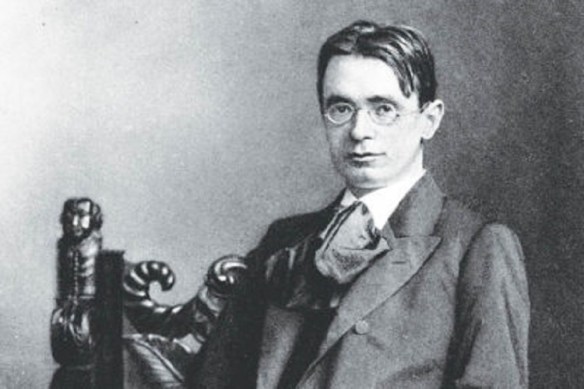
Rudolf Steiner, though, one of the most prolific and gifted scientists, philosophers, and esotericists of his time, devoted much of his work to the task of peering behind the veil, sharing his insight into the deeper nature of life and of the world beyond.

Regarding anxiety and depression, Steiner spoke of hostile beings in the spiritual world which influence and feed off of human emotion; a concept flatly rejected by most today. Yet this also analysis holds true for shamans and others who access the spiritual dimensions in order to alleviate mental suffering for their patients.

Many are familiar with the notion of energy vampires, or people who suck your energy and feed off your negative emotions. On the existence of similar entities which exist in other dimensions, Steiner wrote:

“There are beings in the spiritual realms for whom anxiety and fear emanating from human beings offer welcome food. When humans have no anxiety and fear, then these creatures starve. People not yet sufficiently convinced of this statement could understand it to be meant comparatively only. But for those who are familiar with this phenomenon, it is a reality. If fear and anxiety radiates from people and they break out in panic, then these creatures find welcome nutrition and they become more and more powerful. These beings are hostile towards humanity.

Everything that feeds on negative feelings, on anxiety, fear and superstition, despair or doubt, are in reality hostile forces in supersensible worlds, launching cruel attacks on human beings, while they are being fed. Therefore, it is above all necessary to begin with that the person who enters the spiritual world overcomes fear, feelings of helplessness, despair and anxiety. But these are exactly the feelings that belong to contemporary culture and materialism; because it estranges people from the spiritual world, it is especially suited to evoke hopelessness and fear of the unknown in people, thereby calling up the above mentioned hostile forces against them.” ~Rudolf Steiner

Negative emotions are food for inimical spirits. 

A concept such as this isn’t readily accepted into the everyday conversation steered by rigid skepticism and scientific materialism. The traditions of today have sought to expel ancient metaphysical wisdom and its practical application from our lives, and though scientific inquiry is exceptionally valuable, spiritual perception has always been a part of our experience.

“And yet, despite the cynical skepticism, all of the ancient mystery schools, true shamanic insights, and esoteric teachings (much of which have been suppressed and/or distorted over thousands of years for obvious reasons) have conveyed this truth for ‘the ones with eyes to see and ears to hear’, using their own language and symbolism, be it “The General Law” (Esoteric Christianity), Archons (Gnostics), “Lords of Destiny” (Hermeticism), Predator/Fliers – “The topic of all topics” (Shamanism, Castaneda), “The Evil Magician” (Gurdjieff), The Shaitans (Sufism), The Jinn (Arabian mythology), Wetiko (Native American Spirituality), Occult Hostile Forces (Sri Aurobindo & The Mother, The Integral Yoga), etc.” ~Bernhard Guenther

Dealings with extra-sensory or hyper-dimensional beings have long been a part of our history, and are directly accessible to any of us when proper practice and attention is given to the matter. I know this to be true from my experiences with plant medicine shamanism where it is entirely possible to enter into states of consciousness where entire cosmologies of life exist and are available to interact with.

Finding oneself in the rut of spiraling negative self-talk, depression, crippling anxiety, or uncontrollable, irrational fear, is a sign, as Steiner points out, of a disconnection from our true spiritual nature, exacerbated by beings who operate in the spiritual realms. This is why some consider disorders like this to be spiritual illnesses, and until the rift is healed with proper attention given to the development of spirit, the feelings tend to exacerbate and drive one further into distress.

“When humans have no anxiety and fear, then these creatures starve.” ~Rudolph Steiner

Why Do Most People Believe Propaganda and False Flag Attacks?

By Robert J. Burrowes

In his 1995 book The Demon-Haunted World Carl Sagan lamented as follows:

I have a foreboding of [a] time when… awesome technological powers are in the hands of a very few, and no one representing the public interest can even grasp the issues; when the people have lost the ability to set their own agendas or knowledgeably question those in authority; when, clutching our crystals and nervously consulting our horoscopes, our critical faculties in decline, unable to distinguish between what feels good and what’s true, we slide, almost without noticing, back into superstition and darkness.

The dumbing down… is most evident in the slow decay of substantive content in the enormously influential media… but especially a kind of celebration of ignorance…. The plain lesson is that study and learning – not just of science, but of anything – are avoidable, even undesirable.

We’ve arranged a global civilization in which most crucial elements… profoundly depend on science and technology. We have also arranged things so that almost no one understands science and technology. This is a prescription for disaster. We might get away with it for a while, but sooner or later this combustible mixture of ignorance and power is going to blow up in our faces. See The Demon-Haunted World: Science as a Candle in the Dark.

While it is 25 years since these words of Sagan’s were published a year before his death, one can only lament the ongoing decline of what might simply be labeled the capacity for critical thinking, whether in relation to society and politics, or the science and technology that so concerned Sagan.

At a time in human history when so much is at stake, why is it so difficult to engage most people in anything resembling a thoughtful investigation, consideration and analysis of what is taking place? Why is it that more people do not question what they are told, what they read and what they are shown? In short, why is it that most people do not seek out the evidence for themselves rather than simply believing what is presented to them?

In one sense, the answer to this question might seem simple. People are daily bombarded with ‘information’, in various guises, and a lifetime of submissively accepting what they are told leaves few with any inclination, or energy, to question anything. But let me offer a fuller explanation given the critical importance of this issue if we are to mobilize an effective response to the challenges confronting humanity.

So first: What is propaganda? A false flag attack? Why do most people simply believe what they are told without investigating, carefully, for themselves? And why are those who challenge the elite-driven narrative often labeled ‘conspiracy theorists’ or, depending on the issue, some other pejorative such as ‘peddling debunked science’, ‘anti-vaxxer’ or ‘anti-semitic’ for example?

What is Propaganda?

Propaganda is the deliberate and systematic effort, using a variety of means, to manipulate people into believing and behaving in accordance with something that is not true. For one comprehensive explanation of how this is done, see Trust Us, We’re Experts! How Industry Manipulates Science and Gambles with Your Future, a book which Robert F. Kennedy Jr. observes ‘shows how giant corporations employ sophisticated psychiatric techniques, unscrupulous public figures, junk science, tainted studies and clever PR mercenaries in a relentless effort to market products that routinely kill, maim, deform and poison consumers and our environment’. See ‘Trust Us, We’re Experts!: How Industry Manipulates Science and Gambles with Your Future’.

While some people argue that propaganda can be used for good, the fact is that something that is simply true should appeal to people anyway, even if it is unpleasant. This is because the truth is the only powerful place from which to start to address any circumstance, including unpleasant and difficult ones.

Propaganda is delivered by a variety of means. Aside from that issued, in various ways, by governments and corporations, propaganda is delivered by education systems as ‘knowledge’, by the corporate media as ‘news’ and by the entertainment industry as films, television programs, video games, music, literature and in other forms. But all propaganda is designed to instill and reinforce a limited set of fears, approved beliefs and endorsed behaviours so that the ‘individual’ responds submissively within the carefully managed system of elite political, social and economic control.

For example, education is designed to teach the individual a limited range of technical functions intended to help create, maintain but essentially serve the emerging technocratic tyranny (as it supersedes the existing version of industrial capitalism), make the individual a passive consumer and politically submissive, while ensuring that an intelligent mind capable of seeking out relevant evidence for themselves, critiquing society and responding powerfully does not develop. See ‘Do We Want School or Education?’

What is a False Flag Attack?

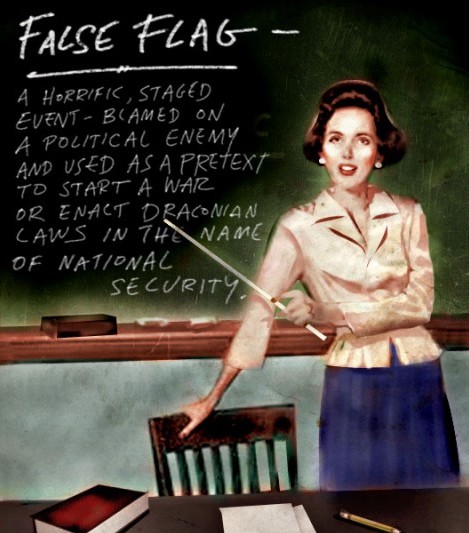
A false flag attack occurs when a government carries out a terror attack against its own population and then falsely blames an enemy to justify a political course of action, such as going to war against the country or countries it blames. While, again, those who question false flag attacks are often denounced by elite propagandists as ‘conspiracy theorists’, in fact the documentation of false flag attacks that have later been admitted is quite long. For one list, see ‘53 Admitted False Flag Attacks’. Of course, plenty of false flag attacks have not been admitted, even when the evidence is overwhelming, as in the case of 9/11 for example.

So Why Do Most People Believe Propaganda?

In an early book on propaganda written in 1928 by Sigmund Freud’s nephew, Edward Bernays, he opened with this paragraph:

The conscious and intelligent manipulation of the organized habits and opinions of the masses is an

important element in democratic society. Those who manipulate this unseen mechanism of society constitute an invisible government which is the true ruling power of our country. See Propaganda.

As Bernays makes clear from the outset, his preoccupation is the manipulation of people to do the bidding of others: clearly, a debased and cynical view of the human individual on which many of humanity’s less morally committed characters have capitalized since Bernays wrote the book.

For example, Joseph Goebbels, Nazi Minister of Propaganda from 1933 to 1945 and an avid reader of Bernays’ work, observed that ‘Propaganda works best when those who are being manipulated are confident they are acting on their own free will.’

But to understand why the approach of Bernays and his disciples such as Goebbels even works, we need to consider why it is that most people are so gullible in the first place. Why don’t more people ask deeper questions about what is taking place rather than simply accepting, without serious question, whatever is presented to them (whether by parents, teachers, religious figures, doctors, propagandists, marketing agents, governments or the corporate media)?

The fundamental problem is simply this: parents, teachers, religious figures and other significant adults in the child’s life require obedience. And obedience means that the child not only behaves as directed by the adult but also that the child believes what the adult believes. This latter point is easily overlooked but is actually the key issue. Why? Because a child who does not believe what the adult believes might think and behave in a way that scares the adult. And demanding obedience is essentially about eliminating beliefs (and their consequent behaviours) that would frighten the parent, teacher or other adult.

Parents require obedience virtually from the moment of birth, doing everything from comforting a child to stop them crying – see ‘Comforting a Baby is Violent’ – to punishing them for acting contrary to parental will once they start moving independently. Of course, once the child starts to think or believe differently, especially if this ‘difference’ is too far from a belief of the child’s parents, teachers or religious leaders (or a widely-accepted belief within their society), the child is quickly pulled back into line with some combination of inducements and/or violence. See ‘Punishment is Violent and Counterproductive’.

Despite legal conventions meaninglessly affirming versions of it – such as the Universal Declaration of Human Rights Article 18 declaring ‘Everyone has the right to freedom of thought…’ – the freedom to think for oneself is not a human right in any meaningful sense of the term and, even if it were, it would really only mean the freedom to think for oneself within certain clearly defined and narrow parameters. And only if you are an adult.

This is why, for example, a child who decides not to go to school does not emerge. Such a possibility would be frightening to virtually every parent, so no child is given that option, let alone allowed the opportunity to come up with, consider and act on that option for themself. Why? Because attendance at school, wherever it exists, is legally compulsory (meaning punishment will be inflicted for failure to comply), and only the rarest parent has the vaguest concept of freedom themselves, let alone the courage to defend their child’s freedom, including the freedom to choose how they spend the bulk of their time for the 8-13 years of ‘school age’.

Consequently, the freedom to think for oneself and act accordingly is strangled at a very young age and certainly by the time a child is compelled to attend a prison for children, also known as ‘school’. As a result the child’s concept of freedom, should they ever come across the notion, can only be a parody of the real thing. And the adult who emerges from this childhood is simply incapable of comprehending what freedom might mean for the obvious reason that to be meaningfully understood, freedom must be experienced.

Of course, is it not just parental authority and school that denies any child the experience of liberty. As Jean-Jacques Rousseau noted in his treatise The Social Contract in 1762, ‘Man is born free; and everywhere he is in chains’. Every institution in society is designed to circumscribe freedom, one way or another. It is just that a childhood spent living under the control of their parents and then teachers and religious figures leaves all children devoid of the experience of freedom and so any subsequent limits are not even noticed. In fact, they are expected and ‘taken for granted’.

So with parents, teachers and religious figures endlessly inflicting ‘visible’, ‘invisible’ and ‘utterly invisible’ violence on the child in the name of ‘socialization’ (which includes requiring obedience under threat of violence for non-compliance), the child progressively and rapidly loses several innate capacities, notably including a sense of their own Self-will, the capacities to think and feel for themselves, as well as conscience. See ‘Why Violence?’ and ‘Fearless Psychology and Fearful Psychology: Principles and Practice’. Anything that is too far from the dominant narrative simply becomes ‘unthinkable’ because the child’s innate capacity to perceive the truth is suppressed along with other mental capacities.

But soon it is not just parents, teachers and religious leaders that are the accepted ‘authority figures’ in the child’s life. No longer able to seriously question the imperatives of parents, teachers and religious figures because they have been terrorized out of doing so, the child has also unconsciously ‘learned’ that virtually any information with which they are presented must be true, even when the source is simply a government or corporate media outlet presenting elite propaganda. For the vast bulk of adult humans, the idea of questioning a dominant narrative does not even occur to them and it is certainly not something they can do with any intelligence, persistent research effort or courage.

So just as Hitler, ably supported by his Propaganda Minister Joseph Goebbels, was able to direct most Germans prior to and into World War II, it is quite straightforward for the global elite to be able to direct the bulk of the human population to believe, for example, that President John F. Kennedy was assassinated by the ‘lone gunman’ Lee Harvey Oswald, that the ‘Gulf of Tonkin incident’ justified the United States war on Vietnam, that a ‘virus’ labeled HIV caused a ‘disease’ labeled AIDS, that the three buildings 1,2 and 7 of the World Trade Center were destroyed by two aircraft flown by novice pilots into the top stories of the Twin Towers and justified the subsequently launched US ‘War on Terror’, that a ‘virus’ labeled SARS-Cov-2 exists and causes a ‘disease’ labeled Covid-19 that has justified the destruction of everything from a range of human rights to the global economy while accelerating four distinct paths to human extinction, that we live in a democracy in which each adult has a say in how they are governed, or even that ongoing effort is being made to bring a greater degree of shared prosperity to the people of the world.

For just a taste of the extensive evidence to debunk each of these propaganda-driven delusions, see these respective analyses of what the evidence actually demonstrates: On the Trail of the Assassins: One Man’s Quest to Solve the Murder of President Kennedy, the Pentagon PapersAIDS Inc.: Scandal of the CenturyArchitects & Engineers for 9/11 Truth‘Unmasking the Lies Around COVID-19: Facts vs Fiction of the Coronavirus Pandemic’‘The Elite’s COVID-19 Coup to Destroy Humanity that is also Fast-Tracking Four Paths to Human Extinction’‘America After the Election: A Few Hard Truths About the Things That Won’t Change’ and ‘The Federal Reserve Cartel: The Eight Families’.

In essence: my point is that is it is not the power of the propaganda, increasingly sophisticated though it has become, that makes people believe it, but a ‘socialization’ model designed to produce submissively obedient ‘individuals’ who gullibly interpret what is happening, and even their own ‘experience’, in terms of the information or scenario (that is, propaganda) with which they are presented. And because of the deeply-seated and unconscious fear of holding a divergent view, most people simply believe the widely-promulgated propaganda narrative with which they become familiar and, hence, comfortable. Moreover, those who challenge the elite-driven narrative frighten them, particularly when elite agents in government and the corporate media label them ‘conspiracy theorists’. For one explanation of why the term ‘conspiracy theorist’ emerged to denigrate those who challenge elite orthodoxy, see ‘In defence of conspiracy theories (and why the term is a misnomer)’.

And so this combination of dysfunctional parenting, education and religious exposure leaves the child devoid of their intuitive ‘truth register’ as well as the other mental faculties that would make them question explanations that obviously lack credibility while investigating and analyzing the evidence for themself. In fact, the idea of doing so never even occurs to them. Hence, a terrorized, gullible and easily manipulated individual enters adulthood. And, as the elite intends, galvanizing an effective response by such people to the truth hidden behind the propaganda is very difficult.

Resisting Propaganda

There is no point hoping that the global elite will discontinue their use of propaganda to shape the course of human events. This is largely because the global elite is insane. See ‘The Global Elite is Insane Revisited’. Moreover, attempts to curb the use of propaganda must inevitably run into the institutions and organizations that the elite controls. And while we can strategically resist these if we choose, the most powerful defence we have against elite propaganda is the human mind that can perceive and critique it. Hence, as a priority, I would profoundly alter our parenting model to achieve this outcome. See ‘My Promise to Children’.

If you are uncertain of your own capacity to critique propaganda, you can expand your capacity to do so by feeling the fear (to release it) that limits your mental faculties. See ‘Putting Feelings First’.

If you are interested in planning or participating in a strategy to achieve a peace, environmental or social justice outcome (particularly in relation to those issues that threaten human extinction), or to resist the elite coup currently taking place under cover of Covid-19, you can read sets of strategic goals for doing so in Campaign Strategic Aims or Coup Strategic Aims.

Moreover, if you wish to tackle the environmental threats to human existence while also strengthening your self-reliant capacity to resist the latest elite onslaught to take (much) greater control of your life, consider participating in ‘The Flame Tree Project to Save Life on Earth’. The greater your dependence on elite systems and processes of any kind, the less power you will have to resist as the noose tightens.

If you are interested in participating in the worldwide effort to resist elite and other violence, you are also welcome to sign the online pledge of ‘The People’s Charter to Create a Nonviolent World’.

More simply, if you like, you might consider committing to:

The Earth Pledge

Out of love for the Earth and all of its creatures, and my respect for their needs, from this day onwards I pledge that:

  1. I will listen deeply to children. See ‘Nisteling: The Art of Deep Listening’.
  2. I will not travel by plane
  3. I will not travel by car
  4. I will not eat meat and fish
  5. I will only eat organically/biodynamically grown food
  6. I will minimize the amount of fresh water I use, including by minimizing my ownership and use of electronic devices
  7. I will not own or use a mobile (cell) phone
  8. I will not buy rainforest timber
  9. I will not buy or use single-use plastic, such as bags, bottles, containers, cups and straws
  10. I will not use banks, superannuation (pension) funds or insurance companies that provide any service to corporations involved in fossil fuels, nuclear power and/or weapons
  11. I will not accept employment from, or invest in, any organization that supports or participates in the exploitation of fellow human beings or profits from killing and/or destruction of the biosphere
  12. I will not get news from the corporate media (mainstream newspapers, television, radio, Google, Facebook, Twitter…)
  13. I will make the effort to learn a skill, such as food gardening or sewing, that makes me more self-reliant
  14. I will gently encourage my family and friends to consider signing this pledge.

Conclusion

The world is complex: it is difficult to understand and requires enormous effort.

Propaganda is designed to give people information that is easy to understand (and sometimes frightening) while distracting them from the truth and offering a simple ‘choice’ (or command) designed to mobilize action in support of an elite-driven narrative.

For example, by telling people they are threatened by a virus, most will be scared into focusing their attention on the ‘virus’. They will pay no attention to the many more complex and dangerous things that are taking place under cover of the ‘virus’: a technocratic/transhumanist coup that is utterly transforming the very essence of human society, economy and even the human individual. See ‘Beware the Transhumanists: How “Being Human” is being Re-engineered by the Elite’s Covid-19 Coup’ and ‘Klaus Schwab and His Great Fascist Reset’.

Only a tiny proportion of the human population has even the vaguest idea of how the world actually works. But not even a tiny proportion of these people recognize that terrorizing children into obedience is the fundamental explanation of why the world works in the way that it does.

Unless we can mobilize greater recognition of our responsibility for giving the global elite the control over us that it has, and tackle this problem at its core – by fundamentally revising existing parenting and education models so that we produce powerful individuals – it will continue to be enormously difficult to mobilize sufficient strategic response to the challenges that confront humanity.

And while we are now fast-tracking four distinct paths to human extinction, there is an urgency about our predicament that accelerates daily.


Biodata: Robert J. Burrowes has a lifetime commitment to understanding and ending human violence. He has done extensive research since 1966 in an effort to understand why human beings are violent and has been a nonviolent activist since 1981. He is the author of ‘Why Violence?’ His email address is flametree@riseup.net and his website is here.

Working to End Human Violence in the Time of Covid-19

By Robert J. Burrowes

At what is arguably the most important time in human history, with Homo Sapiens confronted by an enormous range of violent challenges that threaten our very survival, the only question of any genuine importance is this:

Can we craft and implement a strategy to end the violence, particularly in each and all of its extinction-threatening dimensions, to ensure that humanity has a chance to thrive on planet Earth indefinitely into the future?

But few are asking that question.

And, unfortunately, if one candidly considers the evidence in several critical domains – notably the threat of nuclear war, the deployment of 5G technology, the collapse of biodiversity and the climate catastrophe – there is little genuine room for optimism. This, of course, is not a reflection on the efforts of those committed to the attempt but it is a measure of the enormity of the task given the almost endless violence perpetrated by so many human inhabitants of Earth.

Moreover, of course, for most of 2020, the ongoing efforts by those committed to working to end violence in one context or another have not only been substantially impeded by the official response – including lockdowns, curfews, social distancing and mask-wearing – to the supposed Covid-19 pandemic, they have also witnessed an explosion of additional violence of many types and in many contexts – see ‘The Elite’s COVID-19 Coup against a Terrified Humanity: Resisting Powerfully’ – that have exacerbated the violence dramatically.

In addition, the combined impacts of the official response have (presumably inadvertently) accelerated the four primary paths to human extinction. See ‘The Elite’s COVID-19 Coup to Destroy Humanity that is also Fast-Tracking Four Paths to Human Extinction’.

Despite the unusual level of impediments, many people have remained steadfast in their efforts to raise awareness of what is at stake, to mobilize an effective response and/or to take action themselves to end the violence in one context or another. This includes individuals and organizations that have committed themselves to this effort by signing the online pledge of ‘The People’s Charter to Create a Nonviolent World’ which has signatories in 105 countries around the world and organizational endorsements in 39 countries.

These committed individuals and organizations include those few briefly discussed below, with some of them particularly focused on averting one of the paths to imminent human extinction.

Jennifer Wood is an architect and writer who developed near fatal toxic shock from the antibiotic Ciprofloxin and over-exposure to 2G wireless radiation when cell tower services were switched from analog to digital technology in 1996-1997. At this time, cell phone sales skyrocketed globally as did radiation and many public health problems according to epidemiologists. Although Jennifer had never used cell phones, she had spent long hours on a computer (surrounded by unnoticed cell towers) writing for the film director, Oliver Stone who had taken an interest in her novel. She has nearly died at a weight of 77 pounds from microwave radiation poisoning three times since that time. Each torturous period has coincided with exposure to upgrades in wireless technologies. During her third bout with death in 2010-2011, she moved to a radio quiet zone near a radio astronomy observatory that bans cell phone towers. Here Jennifer built by hand, without help, a tiny non-electric cabin without running water in the woods where she lived alone, with minimal suffering, for four years, gaining weight and becoming semi-functional.

Since 2011, she has been reviewing thousands of science studies on the health effects of human-generated electromagnetic radiation (EMR) while doing advocacy work. Prior to her illness, Jennifer lived and worked as an architect in Nepal for many years in the 1980s where she married and had two children. Her condition has forced her to live far away from most of her family much of the time since 1996. You can watch Jennifer in this film ‘Wi-Fi Refugees: Nowhere to run: Electrosensitive people try to escape wireless technology’, read about her struggle and see a photo of her cabin in ‘Search for a Golden Cage’, read about a success in having Wifi technology banned in schools in Israel in ‘Israel Wi-Fi Breakthroughs: TV Documentary, School Ban’ and watch videos of a protest rally at the US Supreme Court she co-organized: ‘The Public Has a Right To Know About the Health Risks of 5G Wireless, Cell Phones and the Internet of Things (IoT)’.

Prominent environmental journalist Robert Hunziker, noted for his capacity to track and report truthfully on the ecological health of planet Earth, recently wrote a sobering article highlighting key elements of the recent Living Planet Report 2020 which records ‘an average 68% decrease in population sizes of mammals, birds, amphibians, reptiles and fish between 1970 and 2016 [with a] 94% decline… for the tropical subregions of the Americas.’ With its ‘eye-popping description of the forces of humanity versus life in nature’, Robert noted ‘the report should really be entitled the Dying Planet Report 2020 because that’s what’s happening in the real world. Not much remains alive.’ For some of the detail of this disastrous state of affairs, read ‘The Dying Planet Report 2020’. For another of Robert’s reports on planetary ill-health, see ‘Boundless Dying Trees’. But if you are not horrified already, you should read Robert’s article ‘10C Above Baseline’ to get a clearer sense of where Earth’s climate is headed with extinction for humans at 4C above baseline.

Starting in February 2020, Joana Aboagyewaa of the Splendors of Dawn Poetry Foundation in Ghana reports making valuable contributions to schools in the eastern region through their work as poets and educators under the Foundation’s ‘SUN Project’. This educational project was undertaken in Abirem, Achiase, St Roses Senior High (Akwatia) and Akim Swedru Secondary Schools where teachers taught poetry and art, ‘that is deeply human to secondary school students’, for positive change. ‘In April, The Splendors Performance Team held their National Poetry Month activities to celebrate the importance of poets and poetry in our society and culture.’ Splendors’ ‘Poetry Exchange Day’, with poems wrapped as gifts and mailed to classmates and friends, was held in basic schools in the Greater Accra Region. In addition, Splendors’ ‘Poets in Schools’ project ‘was a huge success because we enrolled a high number of poets in secondary schools, through the poetry awareness campaign, to encourage students to write and read.’ The Covid-19 pandemic ‘has necessitated our coming up with the Splendors of Dawn online “Poets Read out” series. Splendors of Dawn Poetry Foundation, Ghana believes that we can change the world and contribute our quota for its development through poetry.’

The indefatigable Steve Varatharajan, the Vice President but, more importantly, for many years the heart and driving force behind the International Association of Educators for World Peace (IAEWP), headquartered in Malaysia, has recently announced that, at year’s end, he will ‘be stepping down from all my positions in IAEWP as I am having [serious health] problems… [related to] the aggressive 5G telecommunications network building.’ For those who don’t know Steve, it is unlikely that many people have served any global network with the talent, commitment and productivity that Steve has demonstrated within the IAEWP.

Steve has also recently announced the appointment of Dr. Alfredo Sfeir Younis – the Chilean economist, spiritual leader and healer who had a 29-year career at the World Bank including as its first environmental economist – as Executive Vice President of the IAEWP.  In that capacity, Alfredo has already proposed a visionary program to advance IAEWP aims. Separately from this, Dr. Priyaranjan Trivedi, the IAEWP Senior Vice President for Continental Asia and IAEWP Director General of Education, advises that their continental association has just launched a free online buffet of 31 courses. For details, see ‘Online Peace Education, Reconstruction, Accord, Non-Violence and Disarmament Initiative’. These courses are available online for India and the rest of the world.

Liz McAlister and Martha Hennessy are two of seven Catholic nuclear disarmament activists known as the Kings Bay Plowshares 7. The plowshares activists entered Kings Bay Naval Submarine Base in St. Mary’s, Georgia, USA on 4 April 2018, the 50th anniversary of the assassination of Rev. Dr. Martin Luther King Jr. Carrying hammers and baby bottles of their own blood, the seven attempted to convert weapons of mass destruction to make real the prophet Isaiah’s command to ‘beat swords into plowshares’. Apart from impeding the ever-heightening threat of nuclear armageddon as the world’s international legal infrastructure against nuclear war rapidly unravels, they also hoped to call attention to the ways in which nuclear weapons kill every day by their mere existence and maintenance.

The nonviolent activists were subsequently ‘found guilty of trespass, conspiracy and destruction of federal property’ in October 2019. After spending time in prison, on 8 June 2020 Liz – the widow of Phil Berrigan – was sentenced to ‘time served, three years supervised release and for a portion of the restitution for the seven of just over $30,000’. Martha – a granddaugher of Dorothy Day – is due to be sentenced in November. You can read a detailed account of their action, an inspiring biography of each activist and follow the court outcome for Martha and the others at the website above. You can also see an evocative interview of Martha at ‘Martha Hennessy Interview’.

Professor Bishnu Pathak in Nepal continues his substantial research output on a variety of subjects, most notably in the past month on subjects related to the fundamental question of whether international law can be used as an instrument to achieve peace. For insightful commentary on two issues in this field, see ‘Can Former Child Soldiers File a Complaint at the International Court against Nepal’s Maoist Leaders?’ and ‘Nuremberg Tribunal: A Precedent for Victor’s Justice’.

What Can You Do?

If you would like to join those individuals and organizations in 105 countries who have made the commitment to work to end human violence, you can do so by signing the online pledge of ‘The People’s Charter to Create a Nonviolent World’.

If you understand the critical importance of reducing human consumption as the core element of any strategy to preserve a habitable biosphere – encapsulated in Gandhi’s observation that ‘Earth provides enough to satisfy every person’s need, but not every person’s greed’ – then you might consider participating in ‘The Flame Tree Project to Save Life on Earth’ which he inspired as well.

If you would like to nurture children to become Self-aware individuals who are capable of responding powerfully to the challenges in life while reducing violence in the process, consider making ‘My Promise to Children’. For a deeper understanding of the cause and pervasiveness of human violence, see ‘Why Violence?’ and ‘Fearless Psychology and Fearful Psychology: Principles and Practice’.

And if you wish to use nonviolent strategy, as Gandhi developed and employed it, for your campaign or liberation struggle, you will be given clear guidance on how to do so on these websites that draw heavily on his work: Nonviolent Campaign Strategy and Nonviolent Defense/Liberation Strategy.

More simply, if you like, you might consider committing to:

The Earth Pledge

Out of love for the Earth and all of its creatures, and my respect for their needs, from this day onwards I pledge that:

  1. I will listen deeply to children. See ‘Nisteling: The Art of Deep Listening’.
  2. I will not travel by plane
  3. I will not travel by car
  4. I will not eat meat and fish
  5. I will only eat organically/biodynamically grown food
  6. I will minimize the amount of fresh water I use, including by minimizing my ownership and use of electronic devices
  7. I will not own or use a mobile (cell) phone
  8. I will not buy rainforest timber
  9. I will not buy or use single-use plastic, such as bags, bottles, containers, cups and straws
  10. I will not use banks, superannuation (pension) funds or insurance companies that provide any service to corporations involved in fossil fuels, nuclear power and/or weapons
  11. I will not accept employment from, or invest in, any organization that supports or participates in the exploitation of fellow human beings or profits from killing and/or destruction of the biosphere
  12. I will not get news from the corporate media (mainstream newspapers, television, radio, Google, Facebook, Twitter…)
  13. I will make the effort to learn a skill, such as food gardening or sewing, that makes me more self-reliant
  14. I will gently encourage my family and friends to consider signing this pledge.

Conclusion

While most human inhabitants of Earth remain oblivious to the pervasive violence that is destroying us and our world, including the advanced nature of the four primary threats to human existence, there is nevertheless a worldwide network of people deeply aware of this situation who are acting to address these threats.

‘Doomed to fail’, you might believe. ‘Impossible’ even. And perhaps you are right. In fact, there is considerable evidence to support these beliefs.

But as Gandhi noted: ‘Hesitating to act because the whole vision might not be achieved, or because others do not yet share it, is an attitude that only hinders progress.’

Given that some of us, including the people above, are already working to end human violence, the main question remaining is ‘What about you?’


Biodata: Robert J. Burrowes has a lifetime commitment to understanding and ending human violence. He has done extensive research since 1966 in an effort to understand why human beings are violent and has been a nonviolent activist since 1981. He is the author of Why Violence? His email address is flametree@riseup.net and his website is here.

RETURN OF THE WARRIOR

By Elva Thompson

Source: Waking Times

“It may be that some little root of the sacred tree still lives.
Nourish it then
That it may leaf
And bloom
And fill with singing birds!

Hear me, that the people may once again
Find the good road
And the shielding tree.”  – Black Elk

Dystopic reality

Are you wondering what the HELL is going on in this shit show reality? The sheer insanity of world events and the palpable madness of our spiritually unplugged leaders is spectacularly obvious even though the masses cannot see it. Floods and fires ravage the planet leaving disaster in their wake. Seventy percent of wildlife has been destroyed in the last decade. Hundreds of thousands of birds are dropping lifeless from the sky, dead fish line many coast lines and whales are beaching and dying.

So what is going on?

The end of a grand cycle

We are men and our lot in life is to learn and to be hurled into inconceivable new worlds.”― Carlos Castaneda,

Planetary cycles within cycles are all ending in crescendo. December 21st 2012 was the marker for the end of the twenty six thousand year period known as the Grand Cosmic Year. And, the Old Year has to die before the New Year can begin. Everything is about to change…. and we will be literally hurled into an inconceivable new world. The signs are already here for those who can see beyond the narrative pedaled by the matrix hive mind.

As we speak, there is a magnetic pole reversal in event mode. Two north poles battling it out and playing havoc with the jet stream. The magnetosphere is weakening and as cosmic rays increase we can expect many challenges in the days and years to come. Catastrophe is served up not only by the evil that runs this world but the cosmos in its cycles of creation and destruction. It is time to choose our path amid the chaos that is erupting all around us. We can either ride the mental fear train into oblivion or we can return to the wisdom of our ancestral way of life and find inner peace.

Becoming brave

“We don’t need anyone to teach us sorcery, because there is really nothing to learn. What we need is a teacher to convince us that there is incalculable power at our fingertips. What a strange paradox!”― Carlos Castaneda

Strange paradox, indeed! For we do have incalculable power at our fingertips. The question is how do we find it?

There is much truth in the old adages: “Knock and the door will open.” “Ask and you will receive.” Visualise and knock on the spiritual door. The gate that leads to a re-connection with archetypal aspects of Self. Our eagle nature, wolf nature, bear nature, fox nature, hare nature, deer nature, etc. – our natures both predator and prey. Shaman’s of the older days understood that all things in the outer world were One in inner space and everything that exists is contactable.

All tribal once

Do not forget that we were all tribal once before evil overtook us. It is no accident that our shamans and healers were taken by the government to lunatic asylums many in a ball and chain and later murdered. No accident that sonic language – the language of the spirits was banned along with sacred ceremonies and spirit calling. Indigenous children all over the world were brutalized by the bible toting invaders for speaking their native language.

What was the invading evil so afraid of?

Could it be our spiritual power and the realities attached to them?

The spirit realm

Shamans know that man is two beings. One is physical flesh and earth bound, and the other is his energetic or non physical counterpart…a realm of unlimited possibility. Man also has two minds: the physical rational thinking mind called intellect which constantly talks and argues with itself – and the quiet mind that is connected to the spiritual reality of Source – the mysterious force that vitalises all living things with the energy that we call ‘life’.

I live with Native People. My husband is a ‘medicine man’ in the Sundance way of life. I have had the honour of being taught many things and to become cognizant that all physical life is energetic in essence.

“In the life of the Indian there was only one inevitable duty, – the duty of prayer – the daily recognition of the Unseen and Eternal. His daily devotions were more necessary to him than daily food. He wakes at day break, puts on his moccasins and steps down to the water’s edge. Here he throws handfuls of clear, cold water into his face, or plunges in bodily. After the bath, he stands erect before the advancing dawn, facing the sun as it dances upon the horizon, and offers his unspoken orison. His mate may precede or follow him in his devotions, but never accompanies him. Each soul must meet the morning sun, the new sweet earth and the Great Silence alone!” – Ohiyesa

Indigenous shamans knew that reality consisted of two parallel worlds that in the Yaqui tradition are known as the tonal(physical) and the nagual(the non physical). Because their spiritual power points were not atrophied as ours are today, the shamans of old knew that all life was infused with the spiritual power of Source, and that this invisible realm penetrated every aspect of our being. And, that under certain conditions this power could be contacted and even become visible.

Spirit helpers or allies

To focus power, a shaman needs allies in spiritual reality – this helper can be an animal, bird, reptile, insect, a wanagi (ghost) or any inanimate object such as stones or power infused objects. The allies being non physical beings can in fact take any form they like.The mystical mind of the shaman can fuse with all of life and become it. He can shapeshift into a crow, a wolf  or start a fire with his fingers! See my article https://www.heartstarbooks.com/a-thunder-being-nation/

Making contact

If you are reading these words, the chances are you will have already experienced magic moments of connection. A space where time, the I and the world disappears and, for a brief moment we are in the joyous state of connection to Source. This can happen during a walk in the forest surrounded by the beautiful, patient energy of the trees. Earthing with bare feet on the ground. Drumming to the heartbeat of the planet. Working with plants in the garden is a wonderful opportunity to commune with the standing nations.

For me, sun gazing is the ultimate spiritual experience. A practice that allows me through visualisation to intentionally connect the little sun in my solar plexus to the outside sun in the sky… and the inner sun at the centre of the earth. One sun is positive, the other negative and we are the third estate. The children of the two suns and the apex of the triangle. The tetrahedron of the third dimension

Touching base

Research the old religion of your ancestors and even though you might not know how to proceed with ceremonies of your own, if you open your heart and are ready to commit to Source with no agenda, no strings attached, then synchronicity will guide you. Do not be afraid to sail uncharted seas for when we restore our natural energetic balance magic happens. You will soon become aware that everything in the natural world is listening. When we ask questions of spiritual reality the answer can suddenly appear within our mind. This response can be immediate or may take days and even weeks but reply they will.

The obstacle

Have no doubt, there is a spiritual war raging on this planet, and we need to get up to speed. The first obstacle we have to overcome on the road to freedom is our thinking mind, the little ‘I’ that primps and postulates. Somehow we have to shut it up!

I recommend ritual, a reptilian trait that we can use to our advantage. Ritual is ceremonial repetition or mantra and can help us stop the infernal chattering of the ego’s frightened mind. We need a ceremonial direction in our lives as a stepping stone to mastery of ourselves.

Contact

If human beings and nature are a holistic living whole, then we should be able to contact planetary intelligence and awareness directly, and furthermore, we should have the spiritual ability to make changes in physical reality by the use of focused spiritual attention. This is the Art of causing change to occur in conformity with will, and births the sacred magician in ourselves.

This reality we call life, is an all pervading matrix of electromagnetic charge and no matter where we are, whether it be in our front room, prison cell, hospital bed, or high rise block of flats in the middle of the city, our thoughts can with intent, affect the energetic reality of Earth, i.e. physical events can take place ‘outside of ourselves’ without us actually being present. A directed loving spiritual action can have a physical response at any point on the planet. Long distance doctoring and absent healings work on the same principle.

If we are the planet, and everything that exists, think of the energy that would be available to us, if we can overcome the deliberately designed and re-enforced illusion of separation. If we focused our spiritual attention and intent without emotion, on a polluted site or waterway, a politician, or an individual that holds the purse strings of the world…think what might be possible.

This is a very exciting time to be alive. The Rainbow Warriors have returned and like a silent wave waits for the appointed time to rise above the third world and wield the spiritual power so long denied us.

Get together with like minded people, find each other and pray for this world. All you need is love in your heart and the desire to be of service to the planet. You will get your answers and you will intuitively know how to proceed.

Be sure to listen to Wolf Totem by the Mongolian band The Hu.

Until next time, stay strong in spiritual reality.