The end of childhood play

By Brian Kaller

Source: resilience

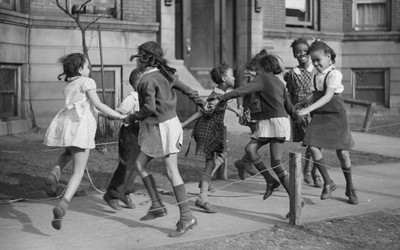
Recorded history is the history of adults–generals, statesmen, explorers and scientists–but all of those adults began their path as children. And running beneath this official history is the unofficial history of childhood games and rituals, many of which were passed down for generations; children inhabited a separate universe of traditions, contests, solemn rituals and codes of honour, like a Viking horde living in your house unnoticed. It was in this world that every future general first learned to lead, every future scientist first turned over logs to delight in the tiny nightmares underneath, and every future explorer first plucked up the courage to enter the haunted woods. Elderly people here in Ireland, who grew up without electricity or many cars, still remember the feral exploration and creative play that was once the birthright of every child.

“Children today don’t have to think much about games given to them – we made up our own,” said one elder. “We played spin the top, marbles, hoop the hoop, hop scotch, conkers, kick the can, scut the whip, jackstones, and box the fox. Hop scotch has survived to some extent, but only among girls … Even when the dark evenings closed in we played ‘Battle In, Battle Out,’ and ‘Jack jack show the light.’”

The games varied widely from person to person; villages only a few miles away could apparently have very different game-traditions. City streets, perhaps because they drew families from so many rural villages, seem to have been a vast melting pot of such games; when British novelist Norman Douglas published his whimsical overview of the children’s games of London in 1916, he spent dozens of pages–most of the book–just listing games. Not dozens of games, mind you–dozens of pages of lists of games, any of which could be as complex as any video game today and most of which were known to most children.

The games, rhymes, and rituals children invented were so ubiquitous, and so often out of sight of adults, that they were little remarked upon or recorded, and only now, when they have almost disappeared, can we look back and see how remarkable they were. In the 1950s the husband-and-wife team of Peter and Iona Opie interviewed children on playgrounds around the UK and found that, instead of being silly and spontaneous, children’s rhymes and stories actually preserved historical traditions their parents had lost.

“Boys continue to crack jokes that Swift collected from his friends in Queen Anne’s time,” Opie wrote. “They ask riddles which were posed when Henry VIII was a boy. . . . They learn to cure warts . . . after the manner which Francis Bacon learned when he was young. . . . They rebuke one of their number who seeks back a gift with a couplet known in Shakespeare’s day. . . . and they are [perpetuating stories] which were gossip in Elizabethan times.” They re-discovered the observation of Queen Anne’s physician John Arbuthnot, who said that “nowhere was tradition preserved pure and uncorrupt but amongst school-boys, whose games and plays are delivered down invariably from one generation to another.”

This is especially remarkable since most of these rituals were not taught by parents or grandparents, who might have learned them decades earlier, but by other children who could only have known them for a few years. Since they were re-transmitted over years rather than decades, their transmission signal should have decayed more quickly. Instead, the children proved stronger at retaining historical knowledge than most adults–not in the sense of reciting facts, but in treasuring their past.

Some of their superstitions, like a blister as proof of lying, date back at least to the 1500s, and they chanted a rhyme that apparently dates back to the era of France’s Henry IV in 1610. Most interestingly, country children still wore oak leaves or an acorn in their button-holes on 29 May to remember the return of Charles II in 1651–and could explain why they did so–at a time when few adults remembered the date.

Keep in mind, also, that few people were writing in the 1500s, most writing was not about children’s games, and much of what was written then has been lost–so if a ritual was first recorded in the 1500s, it could well be much older. Oral traditions can endure for thousands or even tens of thousands of years; Australian Aborigines have traditions about the sea level changing that seem to date from the last Ice Age. No one knows if any children’s rhymes and games date back so far, but Douglas believed that one chant stretched back to the time of Nero, and the Opies seemed to agree.

Their games and rituals were still very local, even in the 1950s when mass media was already washing away the local cultures of villages and neighbourhoods. “While some children roll eggs at Easter,” the Opies wrote, “or nettle the legs of classmates on the 29th of May, or leave little gifts on people’s doorsteps on St. Valentine’s Day, or act under the delusion that they are above the law on a night in November, other children, sometimes living only the other side of a hill, will have no knowledge of these activities.”

Here, too, Ireland held onto this heritage later than most countries, and a radio documentary of children playing in a Dublin school-yard in 1977 showed them using their own complicated musical chants. They weren’t all local traditions–one chant cited Shirley Temple, “the girl with the curly hair”–but even that showed the staying power of these songs, as this was two generations after she had been famous.

The Opies also noted that children spontaneously adopted a “code of oral legislation”–cultural institutions for testing truthfulness, swearing affirmation, making bets and bargains, and determining the ownership of property–the adult legal code in miniature. These codes universally included a practice absent from adult law, however–that of asking for respite, what we recognize as “calling time out,” and what today’s children reportedly call “pause,” a usage imported from video games.

“Throughout history, bands of children gathered and roamed city streets and countrysides, forming their own societies each with its own customs, legal rules and procedures, parodies, politics, beliefs, and art,” the blog Carcinisation pointed out. “With their rhymes, songs, and symbols, they created and elaborated the meaning of their local landscape and culture, practicing for the adult work of the same nature. We are left with only remnants and echoes of a once-magnificent network of children’s cultures, capable of impressive feats of coordination.”

This seems to have been true of all human cultures–anthropologists report it in hunter-gather tribes, and Zechariah 8:5 said that “the streets of the city shall be full of boys and girls playing.” Certainly it was true among people I knew in Ireland or the USA in living memory. To see how recently outdoor play was assumed, look at a map of most American cities; anything built before World War II is typically a grid for easy transport, but post-war suburban streets curl like tossed spaghetti and end in cul-de-sacs in order to do the opposite, to slow and discourage traffic to be “safe for families.” The sprawl that covers much of America looks the way it does because it was made to be safe for children to play in the street–which in 1945 was exactly what they would be doing.

If the returning GIs who first moved into these homes could be transported to the present day, however, they would be puzzled. Aside from the fact that the future never happened–no flying cars or robot butlers–the most glaring difference would be the absence of any children. To a time traveler it would seem like the beginning of a Twilight Zone episode, and they’d would demand to know what happened–was there a plague? An alien invasion? Are the children grown from pods now? Are they marched to an altar and sacrificed to a dark god? Or is this some horrific science-fiction future where children grow up staring at glowing rectangles, and are drugged when they get restless?

“Even the idea of a children’s game seems to be slipping from our grasp,” Neil Postman wrote in 1982. “A children’s game, as we used to think of it, requires no instructors or umpires or spectators; it uses whatever space and equipment are at hand; it is played for no other reason than pleasure. . . . Who has seen anyone over the age of nine playing Jacks, Johnny on the Pony, Blindman’s Buff, or ball-bouncing rhymes? . . . Even Hide-and-Seek, which was played in Periclean Athens more than two thousand years ago, has now almost completely disappeared from the repertoire of self-organized children’s amusements. Children’s games, in a phrase, are an endangered species.”

The decline began a few generations ago, when television steamrolled over children’s cultural traditions, and that screen has now multiplied into a billion hand-held ones. When children everywhere carry all the world’s pornography in their pocket, as well as electronic games psychologically designed to addict people as powerfully as heroin, few future leaders will organise their mates, and few budding scientists will turn over any logs. Moreover, children today grow up under effective house arrest, as local ordinances, paranoid neighbours and police conspire to prohibit children from venturing far outside. They grow up learning no lessons, organising no peers, and exploring no territory, unless it be shifting electrons around a screen, and the screen becomes their world.

This unnatural state takes all the power of modern society to maintain, and it does not have to be inevitable or permanent; even now some parents keep their children unplugged and gather with other parents who do the same. If they don’t live near the country themselves, they might visit family who do. They teach small children some games from old books, and let the children take it from there. How this guerrilla action proceeds will depend on the situation, but it needs to be done. Otherwise, today’s children will live in a country filled with the most dependent and least self-sufficient humans who ever lived, polarised and paralysed by their screens, and facing a difficult future. We will need a new generation of people who can strategise, negotiate, and work together again, and to do that we need children to experience childhood once more.

THE THRESHOLD OF EXHAUSTION: OUR TIME FOR REGATHERING & RECALIBRATION

By Kingsley L. Dennis

Source: Waking Times

Decades of expansionist practices and beliefs have brought us to a new threshold. It is not yet the threshold between human and spirit, as some would have preferred, but a threshold of exhaustion.

The modern age of post-industrialization has been feeding an acceleration cycle that is built upon continual expansion and consumption. These expansionist policies are mostly a result of the neo-capitalist thirst for ever increasing profits. And these ever-increasing returns have been predicated upon continuous wars, expanded trading (e.g. globalization), and the ongoing patterns of consumption. Modern world expansion has plundered and exhausted the world’s physical resources and has exploited the nervous system of humanity, bringing it to a psycho-fragility and biological burnout. The global brain is entering a state of dementia at the same time it is encountering competition from the automated global brain. This current human, and yet inhumane, thrust have brought the present generations to a threshold of exhaustion. We have saturated our limits of attention and are becoming quickly overwhelmed by the smallest of impacts. The human psyche is becoming over-sensitive to environmental stimuli that is now bombarding us from every media channel we can cram onto our devices. Humanity has forged a new environment for itself within the last century – and especially in the last decades – that pushes us further away from a natural context and towards an artificial, unnatural construct. Many people, or at least those within industrialized cultures, are now perceiving reality from within a bubble of stimulation. An overload of images, sounds, pixels, digitization, and the real-time ‘always on’ lifestyles that now wrap around us have created an unprecedented level of electromagnetic smog. We have slipped into an electronic ecosystem without being consciously aware of what was happening until we were already embedded deeply within it. This new electrocuted environment shifts humans from a state of self-perception into a mode of info-stimulation. Our minds and bodies are being re-tuned and recalibrated to exist within a state of permanent excitement.

Human life is now for many people an experience of hyper-expression. The human inner life is being pulled out of us and sprawled upon the external chaotic mediascape. No wonder we are witnessing so many cases of nervous system exhaustion. Our nervous systems are being exploited until the point of near explosion. The sad part here is that a medical industry has been established to cater to this by profit-centred chemicalization of our bodies and minds. It is no longer the jagged pill we should be cautious of but the plethora of smooth pills we are constantly offered that many people are only too willing to pop. The human nervous system (the body-mind) has reached a point of saturation: too much noise, too many nervous stimulations, too much vibrational dissonance: people are quite literally cracking up. There is a subtle state of traumatization that has entered as a low-level hum within our global vibration. Many people have become entrained into this hum. It is creating an underlying sense of anxiety, unease, uncertainty, and restless nervousness. Something is afoot. Many of us feel this, and yet cannot quite place it. There is a presence in the room – yet it is out of visible sight. A moment of regathering is now required.

A moment of regathering is necessary as individually and collectively we are becoming out-of-synch with our vibrational alignment. Technology has created some of this dissonance, although not all. Over the years, humanity has been given nudges to assist its re-alignment. But now, something stronger is required: ‘you have not been inclined to feel that nudge. Now, it has to be more so of a blow rather than a nudge.’[i] As a species we are not yet sufficiently unified, or connected, to be making the best use from technology. We can see this clearly from the behaviour we witness online and in social media. We are still too splintered for our technologies to be of most use to us. If we are not aligned, then there is the danger that any technologies we develop will create further dissonance and dysfunction. Humanity needs to respond to this situation, but by awareness and vibrational re-alignment, and not by taking itself further away from life: ‘it is never about ridding life of yourselves: sitting upon a hilltop void of self, void of world, no.’[ii] What we need is to strip it all away – to strip back our socially constructed lives into a way of living that is closer to the essential. We need to allow the expansive vibrational essence to flow through us: ‘allow this vibrational essence to flow through your being, birthing a new vibrational signature – a non-splintered one, a unified one.’[iii] Humanity needs to take off its bandages and to allow its wounds to heal. It is time to shift into a more harmonized species vibration; this is crucial now. A more aligned and vibrationally resonant humanity can emerge from this – ‘one consciousness at a time, one vibrational alignment at a time.’ And this is where human beings can be of purpose, both physically in their everyday lives and in alignment with the resonance of pure consciousness.

Human life is also about the expanding of our field of consciousness; to allow pure consciousness to manifest through the physical human being. The physical being is biologically encased, yet this does not mean that we should be encased in our limitations of consciousness. Humanity has already explored far and wide. We have gone deep into the oceans, far across the Earth, and high up into the atmosphere and into orbit. Yet if we don’t explore and reach ourselves first, then we shall have found nothing: ‘You can only ever but find yourselves. But if so coming from a splintered mind, you are finding everything else but yourselves.’[iv] It is time to unclose the closed; to reveal the unrevealed. How can we be going towards the “post-human” if we have not yet arrived at the fully human? By coming back to our essential selves, new pathways shall open up for us – a new resonance shall be gained. A new sight shall be revealed: ‘they will be new to the eyes that have not yet been open but old news to those that have been awake.’[v] The human is both within being and becoming – between stillness and movement. This is the flow of evolution and has always been so. Consciousness has always been in flow through humanity, yet it manifests in relation to the pathways that have been created. It is now time for new pathways to be established, so that pure consciousness can flow more abundantly. It is time now for a genuine human recalibration into a consciousness vibration – not into an artificial electro-smog vibration.

By recalibrating and re-wiring, then we are also dropping old patterns (patterning) and habits. As connections and patterns are internally shifted, so too will this affect our outer lives. To shift the outer, we must first shift the inner: ‘opening up for new pathways to be formed which are more of resonation to your being and to that of which is trying to manifest in form.’[vi] This is our moment for regathering and recalibration. It is the time for a readjustment and return to humanity’s home resonance. It is time for all of us to find The Way Back Home. We have been taught to be in a constant struggle of extremes; to be thrust between spurts of action and sudden, constant rest. In this way, we are actually flat-lining life: ‘You are straightening it out, and also it goes for the other end of constant rest. It has to be of resonance – of movement, of rest, of breath.’[vii] The energy is always there, available for us, only that it needs to be in resonance to the ‘mechanism or organism that is receiving such vibrations.’ And right now, the human organism requires some recalibration so that more expanded energy, consciousness, and awareness, can come forth through us. If a person is in dissonance, out of balance with themselves, rather than align with the energies of expanded consciousness they will more likely be sucked into the ecosystem of electro-energies. These energies are sub-nature. They are part of living existence, yet they are a lower form of life vibration. Electricity, said Rudolf Steiner, is light in a sub-material state. That is, it is a form of light that has fallen below the level of nature and has become what he termed ‘sub-nature.’ It is because of this that Steiner warned humankind to be cautious not to build cultures dependent or based on electricity. An electro-ecosystem will only serve to draw us away from our natural eco-system and into a lower vibrational state of sub-nature.

Modern living, as we can bear witness to, has de-sensitized many of us to natural energies of Nature. And the shift into increased digitization has only emphasized this. To attune ourselves to natural, vital life-forces we need to become closer to our natural environments. We need to spend more time outside, being in touch with the soil – to let our hands and feet be grounded by earthly energies. We shouldn’t be afraid of earthly dirt or the bacteria in the soil; not to be squeamish at the stains of bugs. What we need is an openness to a state of receptivity and rebalance. We have to make time for allowance – to allow ourselves to Be, to be present, and to be receptive to life’s vital forces. In this way, we can begin to overcome our collective de-sensitization and to allow the finer vibrational energies of the vital life-forces to flow through us into this beautiful world we have the privilege of experiencing.

By reaching the threshold of exhaustion, we can now take this opportunity to cross over into a different threshold – a threshold into a new phase where the human being merges with the vital life-forces of pure consciousness. A new phase is incoming. We only have to be balanced, stable, and in-synch for this new allowance.

Endnotes

All citations (listed below) were taken from the ABE communications as published in my previous book UNIFIED: Cosmos, Life, Purpose – Communicating with the Unified Source Field & How This Can Guide Our Lives and The Way Back Home: The ABE Conversations (Vol.1). The reference notes refer to Section 5 and the Question number.

[i] (S.5.Q11)

[ii] (S.5.Q11)

[iii] (S.5.Q11)

[iv] (S.5.Q14)

[v] (S.5.Q15)

[vi]  (S.5.Q19)

[vii] (S.5.Q23)

Opening image: Pedro Duran – http://piedrasenequilibrio.com/

THE ESTABLISHMENT OF MASS PSYCHOLOGY & FALSE SOLIDARITY

View of crowd covering ears

By Kingsley L. Dennis

Source: Waking Times

It is always necessary to critically question our assumptions and the information that informs our social behaviour. In this light, I intend to cast a glance over current social manifestations regarding how the pandemic has been redefining our social patterns and relations. I will also be examining these patterns from the perspectives of mass psychology, mental intoxication, and a reprogrammed solidarity. According to Prof. Mattias Desmet,[i] the four conditions that allow mass formation – popularly referred to as crowd psychology – to emerge are: a lack of social bonds; people experiencing life as meaningless or senseless; free-floating anxiety; and free-floating frustration and aggression. In recent years, going back decades, these conditions have been building up within our modern societies. As I mentioned in a previous essay,[ii] social anxiety and psychological suffering were already growing exponentially even before the pandemic outbreak of 2020. The foundations for establishing a mass psychology were existent in many, if not most, of our industrialized societies and cultures before the traumatic experience of the current pandemic. At such junctures of psychological vulnerability, a shift of attachment – that is, a transference of identification – can be achieved rapidly. What has likely occurred within the past 18 months has been a widescale process of reprogrammed solidarity.

Prof. Mattias Desmet believes the world has experienced a huge, global ritual that has established a new form (a recalibrated form) of social bonding. Desmet also states that this newly arrived mass psychology is a manner of compensation for many years of extreme individualism where people felt they needed to seek out new and different collective bonds of solidarity. This new solidarity frees people from their prior isolationism and atomization. It is a socially programmed and managed method of social re-gathering. And it is being accomplished on a worldwide scale. Also, it is being brought into being through a form of ritual. Rituals are not only for religious or sacred circumstances. By definition, a ritual is ‘a sequence of activities involving gestures, words, actions, or objects, performed according to a set sequence.’[iii] That is, they are a range of actions performed according to a prescribed order. And that ‘prescribed order’ can come through agreement or imposition – or a mixture of both. Participation in rituals also develop a degree of loyalty to the group/grouping through adherence to and the performing of acts that support the main narratives. These acts of obedience (behaviour sets) can be regarded as rituals, similar to how more familiar religious rituals are performed to denote loyalty to a specific religious faith. When social acts are performed through an emotional attachment of ritual, a form of ‘hypnotic allegiance’ is established that is then extremely hard to break away from. This can then lead to a form of misplaced ethics that can cause people to engage in acts of self-sacrifice in order to uphold what they have been led to believe is their ethical position. People caught up within the mass hypnosis are made to sincerely believe that the mainstream narratives are correct and that they are right to be following and supporting them – even when the evidence points to the contrary. In other words, such people strongly believe in the moral rightness of their position, and this gives them a more powerful sense of solidarity and justification. Similarly, during the Crusades each side felt they were doing ‘God’s work’ by engaging in mass slaughter. What we see here is a condition of misplaced ethics.

People swept up within a mass or crowd psychology tend to protect and maintain it whether consciously or unconsciously. This is why they are most likely to reject any contrary information when it is presented to them; or will reject even the chance for such information to be presented. This amounts to a state of mild induced hypnosis which has shifted from an external identification to a self-maintained state. That is, people engage in the process of their own induced hypnosis. This may sound implausible to some people, yet we need to observe the conditions that were present to allow such states of hypnosis. Part reason for this is that many of the people who accepted the slippage into the formation of a mass psychology were already experiencing psychological discontent. This could come from perceiving a lack of life purpose and meaning; a dislike of their jobs; general restlessness and anxiety; and similar issues related with their previous life status. In such cases, the way to break the hypnosis is not by trying to persuade such people to return to their ‘old normal’ ways, which they were not happy with previously, but by searching out ways to alleviate the source of their psychological discontent. And this suggests a radical transformation in our social and cultural systems and ways of living. Furthermore, it points to a shift away from increasing materialism, automation, and technological dependency into a path that celebrates more the beauty and meaning in being human.

Mass Hypnosis of Solidarity

Persons susceptible to mass psychology are less likely to be responsive or sensitive to rational argument and debate. It is because they did not fall into line with the main narrative through reasoning but rather through a form of ‘mental intoxication’ that triggered a transference of social bonding to the newly established mass solidarity. Such triggers are generally most effective when they are presented through emotional states – these are often based upon fear; (in)securities; and mortality. When such fear-related triggers are heightened and expanded through widescale media coverage, then most, if not all, alternative narratives are discredited, discarded, and ignored. When within such heightened emotional states, cognitive decisions become overruled by inter-personal circumstances. Importantly, the state-supported narrative (the new consensus) gives people an object to connect their anxiety with. They have a mental representation of what is the cause of their anxiety. Their previous condition of free-floating anxiety has now become anchored, and people feel they are then better able to control their frustrations. To take away their belief in the dominantly imposed narrative would confront the person with their initial unease and psychological discontent. For this reason, it is difficult to break or stop such collective psychological formations once they have been established. Once the psychological patterning and emotional identification has been constructed it is then difficult to deconstruct – a significant collective solidarity has been established that imprints the mass mind.

Another factor that strengthens the mass psychology is that the imposed mainstream narratives appear to speak in one collective voice. They are clearer in what they represent and appear to come from a place of unified agreement (i.e., all state actors and state-affiliated actors are showing public agreement). It is important that there is no public disagreement on the narratives. This sense of external clarity further strengthens the issue as a ritualistic act – a hypnotic formation. The other voices that speak out against the dominant imposed narratives are not regarded or seen as coherent because they speak in many, varied voices. This is usually because they come from many and varied sources that have liberty to say things in different ways. Yet this seeming lack of narrative coherency is weaker at confronting or opposing the hypnotic collective. Those people who remain uncertain and not yet fully decided are then more liable to choose the ‘crowd narrative’ because the mass storyline falsely appears as more solid. Those people caught within the mass programming believe themselves to be expressing their own opinions when in fact there has been a clever sleight-of-hand in that they have been provided with a set of pre-formed ‘opinion bundles’ that they can then put forward as their own. Such people are therefore not expressing personal opinions arrived at through individual critical questioning but rather conditioned ‘thought bundles’ provided through the programming techniques built into the establishment of the psychological collective mass. The mass hypnosis of solidarity comes with a pre-prepared collection of opinion sets for bulk dispersal. However entrenched this situation appears, there is always the possibility for counteracting the collective hypnosis.

Regathering our Unity

It is important that those people who see, perceive, and understand the contradictions and falsity in the mass narratives continue to speak out. Hypnosis can be lessened or weakened through continual exposure to rational information, even when that information opposes the narratives of the mass psychology.

The first step in countering the mass psychosis is to disconnect people’s anxiety from the ‘object’ that people were persuaded to transfer their identification to. This can be understandably difficult when the mainstream media is not at your availability but is working to maintain the hypnotic imprinting of the mass narratives. One way, however, that works to make this disconnect is by presenting a scenario – an ‘object threat’ – that may be greater than the one used in the original collective imprinting. For example, if people realized that the current ‘health crisis’ could lead to a condition of totalitarianism, then this realization could be sufficient to awaken people from their hypnosis as they still have the cognitive capacity to grasp that the social condition of totalitarianism is a graver threat than a biological agent with low mortality rate.

The real issues, and the one that creates a fertile ground for inducing a mass psychology in the first place, is the lack of social bonding in our societies and a perceived lack of meaning. This perceived lack of meaning and purpose in everyday life is what produces the feeling of ‘free-floating’ anxiety. The danger here is that a populace under the sway of mass psychology – mass induced hypnosis – is more likely to support or go along with a totalitarian regime that maintains this mass hypnosis. This was one of the reasons why Germany’s National Socialism (the Nazi regime) was so successful in its aims.

The people who were less susceptible to hypnosis of mass psychology tended to be those who disagreed with the ideology behind it or had more experience in using critical analysis of social phenomena, and/or were more aware of the processes of social conditioning and the uses of mainstream propaganda. They were much more capable of spotting from the onset how the narratives of the mass psychology were treating people as mere biological units to be moved around the board. The question that now needs to be asked is: how can those people who stand apart from the mass hypnosis be able to unify? Those who can speak out against the mass hypnosis need to connect together. And their advantage is that they are unified through an understanding whilst remaining diverse in their backgrounds, belief structures, identities, etc. Such people can find cohesion in perspectives whilst remaining as diverse and independent individuals. This diversity and individual independence bring greater strength than a collective mass that has been unified through the programming of a false solidarity.

It is important that those people with perceptive cognition recognize that a global ritual has been set into motion that has as its goal the ‘retraining’ of the populace into welcoming upon them a new civilizational model. The willing compliance to adopt this new model of order, at the local, regional, national and global level, will sever humanity from its own biological and constitutional roots. In order to move forward as human beings, we will likely need to reject certain materialistic futures offered to us. These offers will come with promises of comfort and convenience; yet they will hide an underbelly of human disconnect and the loss of the human spirit. If a deal is made with the devil, then we can be sure that our souls will be collected without delay. And the great truth that gives humanity its strength is that the human soul and spirit can never be taken without our willing compliance. In that, by denying them our willing compliance we strengthen our unity by default. The unity established through conscious awareness is always greater energetically than the perceived unity through unconscious programming. If the fewer are aware, and conscious of what is being attempted by the mass hypnosis, then this shall energetically give us a stronger unity. And the way to break the mass hypnosis is by aligning with a greater truth that shall gradually resynch and recalibrate the energetic vibration of the collective.

THE WAY OF THE MASTER: LIFE AS APPRENTICESHIP

By Gary Z McGee

Source: Waking Times

“It is the height of selfishness to merely consume what others create and to retreat into a shell of limited goals and immediate pleasures. Alienating yourself from your inclinations can only lead to pain and disappointment in the long run, and a sense that you have wasted something unique.” ~Robert Greene

How do you become a prime mover? How do you become more self-determined, more self-aware, more responsible for your lot in life? How do you become your own boss, fully volitional, fully responsible, fully engaged, with more creativity, more adaptability, and more courage? How do you become a master?

It begins with self-apprenticeship. You must create your own momentum. Don’t be afraid of becoming an autodidact. Read a lot. Connect the dots. Seek out the shoulders of giants, not just to learn, but to see further than they did. Seek help, expertise, guidance, and wisdom from others, but then you must take responsibility for your own improvement. Take a leap of courage out of faith. Create a scaffold of knowledge. Its foundation is curiosity. Stay curious. Be Curiosity. As Joseph Campbell said, “follow your bliss.”

Mobilize your mind:

“Those who cannot change their minds cannot change anything.” ~George Bernard Shaw

The immobilized mindset is a handicap. Living a full life requires movement. What does not move is dead. Let the mind move, let the mind flow, let the mind grow.

Don’t let your mind settle. A settled mind is a closed mind. A settled mind tricks you into believing that you have figured things out. It inadvertently sacrifices reason for anti-reason. It uses anti-reason to buttress itself against new knowledge.

Remember: knowledge is always your master. Don’t let your ego fool you. One does not master knowledge; one only learns it. The mind is simply too fallible, too inflexible, too imperfect to become a master of knowledge. True self-mastery is understanding that knowledge will always be your master.

Which is all the more reason to keep your mind active, fluid, flexible, and mobile. Don’t get comfortable. Take risks. Embrace change. It’s when you fight against change, when you deny it, repress it, ignore it, or rage against it that you suffer unnecessarily. When you embrace change, however, you’re in flow with it, dancing, flexible, and empowered, even when it hurts. Especially when it hurts. Because you know, pain is information. Pain is a teacher. Pain is a guide. Pain is merely procrastinating power. In the long run it will make you stronger.

The ability to loosen your mind, to alter your perspective, to reimagine imagination is one of the most amazing powers you have as a human being. Cultivate it through mindfulness. Activate it through No-mind. Avoid fixation. Avoid attachment. Avoid belief. Ponder what is absent to create a flexible open-mindedness that can persistently overcome itself.

As Jeremy Hammond said, “Your mind is programmable—and if you’re not programming it then someone else will program it for you.”

Embrace the almighty metaphor:

“As our eyes grow accustomed to sight, they armor themselves against wonder.” ~Leonard Cohen

Reality is a great mystery. Honor it. Let it continually fill you with awe. Don’t seek certainty. Just seek. Be with the curiosity. Be hunger. Be love. Be on the edge of your seat, flabbergasted and entranced, astounded and gobsmacked, dumbfounded and engaged, detached and aloof with the interconnectedness of all things.

Certainty is the creativity killer. Certainty murders mystery. Certainty cripples mastery. Avoid it at all costs. Being certain gets you nowhere but stuck in a box, closed off in a mental paradigm, stifled by a tiny comfort zone, or blocked by an inflexible boundary. It puts eye guards on when peripheral vision is needed.

Employ strategies of awe. Plant a maze in your mind and watch it grow into a labyrinth. Explore it. Transform your eyes into Over Eyes, your mind into No-mind, your soul into Soul Craft. Transform your life into a Hero’s Journey. Confront threshold guardians. And when your mind becomes fixed and settled, strategically plant a minefield in the mind field. Then sit back and enjoy the explosion, as your mind is blown into new ways of seeing the world.

Everything in life is Metaphor. From shapeshifting comes worldmaking. Life becomes art, and art becomes life. Forget genes. Forget memes. Carry mythemes and astonish the world.

Embolden what makes you unique:

“I would rather be a man of paradoxes than a man of prejudices.” ~Rousseau

Carl Jung stressed that an individual’s proper goal is wholeness, not perfection. You will never be perfect, but you will always be unique. Let notions of perfection roll off you like water off a duck’s back. Then double down on your uniqueness.

Real power is emboldened uniqueness. Uniqueness is true power. Everything else is moonshine. Everything else is smoke and mirrors. Focus on what makes you unique, what makes you come alive. Split the smoke. Shatter the mirrors. Let your authenticity boldly blast through it all.

You are a slice of Fate. You might be made up of the same ingredients as other slices of Fate, but your slice is arranged in a way that has never occurred before nor will it ever be repeated. You are a one-time phenomenon. You are beyond a force of Nature. You are a force of Fate. Use it. Fuel yourself with it. Be the tip of the spear and pierce through your life with purpose and meaning.

Becoming who you really are is shedding the skin of who you were conditioned to be by culture and then embracing the new skin of your reconditioning. It’s shaving away the superfluous and embracing the numinous.

When you are able to do this, you unleash your calling, your inner voice, your primal howl. This voice is intuitive, inquisitive, and hungry to be heard. If you listen intently, you will feel your own potential and your deepest longing to create and express your own uniqueness. This uniqueness is your life’s purpose. But it isn’t there for a reason. You must give it a reason to empower you.

Use probability to stay ahead of the curve:

“Consider nothing impossible, then treat possibilities as probabilities.” ~Charles Dickens

Truth or delusion is both a tripwire and a balancing wire. Either way you go, it is precarious. One man’s truth is another man’s delusion. Fortunately, there is validity and probability that you can use as a benchmark, as a way to measure what is more likely to be true.

A good rule of thumb, when faced with potential invalidity, is to ask: “Sure, it’s possible, but is it probable?” True mastery comes more from embracing and being fascinated by mystery and less from intellectualizing and labeling it. It’s more of a detached obliteration of “baskets” than a codependent clinging to them.

The key is to keep your eggs free of all baskets. Don’t settle on any single bedrock of thought. As Aristotle said, “It is the mark of an educated mind to be able to entertain a thought without accepting it.” Just flow through it all. Keep questioning. Keep swimming. Keep searching. Use probability as your Occam’s Razor.

Because nobody is off the hook for being wrong. The best we can do is get better at recognizing the hook for what it is so that we are less likely to get dragged away by it. By developing and practicing disciplined strategies for cutting the line and negotiating the hook before the Fisherman of Closemindedness can reel us into his Boat of Dogmatism.

Real mastery sharpens itself against probability. Keep using the sound tools of logic, reasoning, and probability. Keep deflating self-important seriousness into authentic sincerity. Have fun with it. Laugh at it. Play with it. Tease it. Dance with it. Reimagine it in ways that shock your soul into heightened awareness. Shoot yourself in the foot before someone else does, or before the passage of time deems your work outdated or uncouth.

Ever tried. Ever wrong. No matter. Try again. Be wrong again. Be wrong better. This will keep you ahead of the curve. It will keep you sharp against entropy. As it turns out, you are more likely to be right by admitting that you are more likely wrong than by declaring that you are absolutely right.

Allow healthy skepticism and an intimacy with probability to become your shifting bedrock, your foundational quicksand, your liberated measuring tool. This is the apprenticeship. When you are free to swim in the waters of uncertainty rather than remain chained to the pillars of certitude, you are more likely to achieve mastery.

REVISIONING JUNG’S IDEA OF SYNCHRONICITY

By Paul Levy

Source: Waking Times

Synchronicity is considered to be one of the most important ideas emerging out of the twentieth century. Jung coined the term synchronicity to describe a category of experience that defied and had an altogether different logic than the widely accepted and virtually unquestioned logic of linear sequential causality (in which a cause precedes an effect in linear time), which was generally thought to be the only kind of causality operating in the universe at the time. Bringing forth the notion of synchronicity was a bold and heretical act by Jung that was a radical departure from and challenged one of the most inviolable, sacrosanct, and seemingly unassailable foundations of the modern scientific materialistic worldview. In his idea of synchronicity Jung was proposing a completely different kind of organizing principle at play in the universe that was quite alien to the widely accepted western worldview of how the universe worked.

In order to break free from and distinguish synchronicity from the limiting logic of linear causality, Jung chose the word “acausal” (calling synchronicities an “acausal connecting principle”) in order to characterize how synchronicities didn’t have to do with causality as it had been generally understood. There was an unforeseen problem, however, that had to do with Jung’s choice of the word “acausal”—and what he meant by this—that has caused a rift and created conflict among a number of theorists, researchers, scientists and psychologists in their accepting Jung’s idea of synchronicity. Some people have even dismissed Jung’s work on synchronicity, thinking his conception of synchronicity is incoherent or flawed.

To cite one example, J. B. Rhine, who is widely considered to be the father of parapsychology, and was one of Jung’s inspirations for his work on synchronicity, couldn’t accept Jung’s idea of synchronicity being “acausal,” and thereby rejected Jung’s understanding of synchronicity. Jung thereby lost an important potential ally in helping him bring forth his concept of synchronicity to the world.

The dictionary definition of the word acausal is “not involving causation or arising from a cause; not causal. Synonym: noncausal.” For example, in describing synchronicities, Jung writes that they are “a modality without a cause, an ‘acausal orderedness.’” Being called an acausal connecting principle therefore implies that there is no causality operating in a synchronicity. Jung was of the opinion that it is our strongly “ingrained belief in the sovereign power of causality” that makes it seem unthinkable that “causeless events” could ever happen. But if events without a cause actually do exist, Jung regarded them as “creative acts” that are “not derivable from any known antecedents.” The type of causation we are dealing with in synchronicities were totally unfamiliar and unknown to the prevailing western scientific mindset of his day. In his theory of synchronicity, Jung was trying to articulate a radically new vision of reality—a new worldview—that was completely out of the box and off the radar of the existing scientific materialistic paradigm.

In his conception of synchronicities as being acausal, it is entirely conceivable that Jung was way ahead of his time and was tapping into, perceiving and pointing at the underlying unified quantum field which is openly hidden (from our spatio-temporally conditioned, dualistic human perception) within the very midst of our physical world. In this unified nonlocal field there is no separation whatsoever, as there are no independent “things” that interact with and hence, have causal effects upon each other. These separate parts are merely mental constructs, just ideas in our mind, human overlays or projections of our own inner state of fragmentation onto an ultimately indivisible field of reality that we then mistakenly take to be made up of separate things. In an undivided realm such as this—that is simultaneously immanent and transcendent—there can be no causality because causality implies separate entities that influence and have effects upon each other.

To illustrate this same point, quantum theorist David Bohm uses the following example: Imagine a fish swimming in a fish tank, with two video cameras at right angles to each other filming the fish’s movements, which are then transmitted to and shown on two different monitors in another room in a way that makes us think we are looking at two different fish. The fish’s movements on these two screens clearly seem related to each other, but we can’t say that the fish’s movement on one of the screens “caused” or influenced in any way the corresponding movement on the other screen. This is because the different images on the two screens are not pictures of independently existing entities that are interacting, but are in reality two images (from different perspectives) of one and the same entity. It would be an error to try to establish a causal relationship between these two images, as the notion of causality simply does not apply in this circumstance. It would therefore make sense to say that the “connecting principle” between the two different images of this single fish (representing the deeper indivisible nature of reality) is acausal. Thus, in describing the nature of a quantum universe such as ours, Bohm characterizes it as having a “non-causal” connection between its elements.

Jung’s usage of the word acausality may therefore have been intentionally referring to this intrinsically unified field which admits no separation. In any case, his choice of the word acausal has nevertheless created a lot of misunderstanding that continues to persist up through our present day that needs to be remedied.

Do synchronicities arise, as Jung seems to suggest, without a cause? Or, is there in synchronistic experiences an unfamiliar kind of causality that is operating in the world in which cause and effect are not taking place over linear sequential time, maybe not even taking place within time itself? If it does exist, how is this unknown type of causality a “connecting principle” between the inner and outer dimensions of our experience?

To address this problem, I thus propose coining and bringing forth the word “simulcausality” as an alternative term to more accurately describe the kind of atemporal causality that might be happening in synchronicities. The notion of ‘simulcausality’ remedies the confusion around the word ‘acausal’ by acknowledging, rather than a linear-sequential or temporal form of causality—or no causality at all—that a new and different kind of simultaneous causality which acts as a ‘connecting principle’ is taking place in synchronicities.

This unfamiliar kind of causality that mysteriously links the inner and outer contents of our experience together is brought into focus through the notion of simulcausality. In synchronicities, these two realms—the inner (subjective) and the outer (objective)—are connected in a way that is not sequentially causal but simulcausal. These two realms—the internal and the external—are what synchronicities act as a connecting principle between. Simulcausality implies that there is a different kind of causality operating than we are accustomed to, but this other kind of causality occurs between the two seemingly distinct realms of mind and matter while taking place outside of time, in no time—i.e., simultaneously!

Introducing the word simulcausal involves, of course, more than the mere changing of a word. Replacing the word acausal with simulcausal is symbolic of shifting into a new, more expansive mode of seeing that previously was unavailable to us because of our unconscious conditioning. With this new kind of vision comes a new way of understanding ourselves and the world that helps us to see how our self-reflecting and potentially self-reflective universe actually operates, rather than how we had been hallucinating that it operates while being conditioned and blinded by the spell of linear time and its natural correlate, linear causality.

We can now redefine synchronicity as “a simulcausal connecting principle” in which causality happens vertically (simultaneously) rather than horizontally (over linear time). Vertical causality refers to a kind of causality that occurs between different dimensions or domains of our experience that are inseparably embedded and inter-nested within each other in the same moment. This perfectly describes the interdimensional relationship between the inner subjective world within us, which takes place in a higher dimension (‘in’ is ‘up’ dimensionally), compared to the lowerdimensions of the seemingly outer 3D world of matter, time and our physical sense perceptions (commonly known as the spacetime continuum).

The higher dimension and the lower dimensions of our experience interpenetrate each other so fully such that there’s an intrinsic connectivity between them—through the simulcausal connecting principle—that allows these two realms to instantaneously influence each other interdimensionally in no time at all. Because this is an interdimensional connection, this process happens simultaneously—in the present now moment—without time being involved whatsoever. Mind and matter are thus connected through a simulcausal interdimensional communication link which takes place outside of and independent from linear time.

These different dimensions (of mind and matter) that are conceived of as influencing each other interdimensionally are, ultimately speaking, not two separate dimensions that are interacting with each other, but rather, a multidimensional continuum that is inseparably one. To recognize this is to begin to see the dreamlike nature of our universe where, just like our dreams at night, the physical world we are experiencing is not separate nor separable from our consciousness.

Synchronicities thus operate through an instantaneous simulcausal resonance or interdimensional coordination between the contents of our inner (higher dimensional) life—our minds—and the outer events taking place in the (lower dimensional) 3D physical universe. These two domains—our inner “subjective” and outer “objective” life—are conventionally thought to be distinct and non-interacting but are in fact inseparably interconnected parts of a unified multidimensional whole system. These two domains—mind and matter—which since Descartes have been traditionally understood in the West to be operating independently and separately from each other are, in synchronicities, revealed to have a mysterious correlation that clearly defies the strict Cartesian dualism that requires mind and matter, the subjective and objective realms, to remain separate and non-interacting.

The coordination between these realms takes place instantaneously in the implicit interdimensional simulcausal dynamics constituting each and every moment of our experience. This accounts for the uncanny correspondences between the inner and the outer worlds that are the central and most notable feature of synchronistic phenomena. Because simulcausality operates instantly, outside of time—in the realm of “no time”—its very existence is easy to miss, which is why it has been left out of the western scientific materialistic worldview, which is more outwardly focused and not as introspective as the eastern worldview.

From the materialistic point of view, synchronicities are inexplicable not only because their cause is unknown, but because, presupposing third-dimensional space and time as being objectively real, their cause, to use Jung’s word, is “unthinkable.” This is to say that we can’t comprehend the unfamiliar type of causality involved in synchronicities if we are stuck in our thinking mind. In other words, synchronicities force us out of our (cognitive, conceptualizing) minds.

Our experience of the world—composed of a combination of both linear causality and simulcausality—can be represented by a symmetric cross that can be called “The Cross of Linear and Simultaneous Causality.” In this image, the horizontal axis of the cross represents the realm of linear time and linear sequential causality in which cause precedes effect, which then becomes the cause of a subsequent effect and so on and so forth. This is the common and conventionally understood “timeline” in which the flow of sequential time moves from left to right with the “past” or earlier events being to the left, the present moment of a linear “now” is a single point in the center and then the “future” lies to the right or ahead of the single point representing the now or present moment. This represents the process of horizontal (linear) causality.

The vertical axis represents the timeless now moment in which there is no linear sequential (horizontal) time occurring, but rather, is the domain in which a timelessly operating simulcausality is at work in a way that connects the inner (higher) and outer (lower) dimensions through a kind of instantaneous interdimensional resonance. Each point on the horizontal timeline has a vertical line (representing the interdimensional axis) that can be drawn perpendicular to it. Each and every point of intersection between the two axes represents a specific moment in linear time that is being influenced by—and is an expression of—the connection between the higher and lower dimensions of our experience (via the simulcausal connecting principle that is operating outside of time through each and every moment).

These two modes of causality—the linear causal and simulcausal—co-exist and interpenetrate in an elegantly integrated harmony that is an expression of the wholeness of our universe (as well as reflecting our own intrinsic wholeness as multidimensional beings).

In suggesting the notion of simulcausality I am merely offering a new possible way of contemplating the nature of synchronistic phenomena that has some novel features and some significant conceptual advantages that bypass the set of problems that Jung’s notion of acausality and “acausal orderedness” brought with them. The notion of simulcausality enables us to describe the way that synchronicities operate in a new way that opens up fresh possibilities for us to envision the nature of our universe (as well as our own nature).

One of the key aspects of this revisioning of our scientific conception of reality is the recognition that reality as a whole is a profoundly nonlinear affair with linear dynamics only comprising a small subset of the total dynamics that make up the cosmos. Since the time that Jung introduced the concept of synchronicity there has been an explosion of new scientific theories and creative maps and models of reality that push our understanding far beyond the logic of linear causality. These new insights have moved the scientific imagination of the world into vast new realms of nonlinearity that are now recognized to be fundamental and essential features of the nature of nature, of the universe and of reality itself. For example, nonlinear whole systems sciences like Chaos Theory—more accurately described as the science of nonlinear order—and Complexity Theory have made many groundbreaking inroads into the nonlinear frontier that have changed our scientific picture of our world and of our understanding of reality in extremely profound and fundamental ways.

Simulcausality is, however, not really anything new at all. It is referred to in multiple esoteric, wisdom traditions across the world throughout recorded history. For example, simulcausality is equivalent to what in Buddhism is called “the simultaneity of cause and effect.” At the very heart of the Buddha’s teachings, the simultaneity of cause and effect points to the dynamic in which we are creating our experience of the seemingly outer world (which is not separate from ourselves), while—at the same time—being influenced by our creation in a reciprocally co-creative feedback loop. Contrary to linear cybernetics, in which feedback loops take place through space and over time, simulcausality is characterized by a process of synchronistic cybernetics in which the feedback loops are beginningless, circular, instantaneous, and timeless.

The principle of simulcausality does not negate the possibility of linear causality, nor does linear causality disallow simulcausality. These two fundamentally different types of causality naturally co-exist with each other. This is reflected in the Buddhist understanding of how the simultaneity of cause and effect (instant karma) does not negate but harmoniously co-exists with linear cause and effect (karma that unfolds over time). Their co-existence produces a much more complete view of reality that recognizes and embraces both types of causality.

The Buddhist teaching of “As Viewed, So Appears” is another example of simulcausality. As Viewed, So Appears can be thought of as the mystic law or a mystic equation describing how we formulate and cocreate reality instantaneously within—and with—our dreamlike universe. Think about the nature of a night dream: it is a reflection—a projection—of the mind that is observing it. In a dream, the very moment we connect the dots on the inkblot of the dream (interpreting and placing meaning on it), the dream has no choice—instantaneously, in no time whatsoever—but to reflect back to us our perception/interpretation (for a dream is nothing other than a reflection of the mind that is dreaming), which then confirms to us the “objective” truth of whatever we happen to be seeing (as we now have all the evidence we need to “prove” that what we are seeing is “true”).

This becomes a self-confirming and (potentially) never-ending instantaneous feedback loop that is self-referential and self-generated by our own mind that (since it is happening in no time and unfolding over time at the same time) continually feeds back into itself until it is seen through. Not seeing how simulcausality operates in our moment to moment lives is one of the main reasons why we are prone to get stuck in insidiously self-reinforcing feedback loops that seemingly trap us in all sorts of self-limiting double binds, self-bewitching spells, infinite regressions and dead ends within our own minds. Becoming conscious of the simulcausality principle that is continually at work crafting our experience (of both ourselves and the world) can prevent us from falling under these maddening self-created spells while, at the same time, immediately puts immeasurable, otherwise unavailable creativity at our disposal.

In essence, we have entranced/hypnotized ourselves—putting ourselves under a spell—through our own creative genius of how we are participating in creating our dream (sleeping or waking). This dynamic—which can be clearly seen in our night dreams—is reflecting and teaching us something about how simulcausality acts as a connecting principle between the inner and outer dimensions of our experience that is intrinsic to how we dream up (and create) not only our sleeping dreams, but our waking life as well.

In our universe everything is simultaneously intercausing (causing and being caused by) everything else in a cybernetic chain that recursively loops back on itself in no time. Everything that manifests is reciprocally co-arising with everything else in a nonlinear and nonlocally coordinated way in the one singular and eternal “now” moment. In Buddhism this process of intercausality (a third type of causality) is called “dependent co-arising” (also known as “interdependent co-origination”), which is considered to be the fundamental dynamic by which empirical reality is continually reconstituted in each and every moment.

At the heart of the Buddha’s realization, the notion of dependent co-arising helps us to awaken from the spell of linear causality and enables us to see how our experience of the world—and ourselves—actually arises (via the process of intercausality) in the present now moment while (at the same time) giving the very convincing appearance that it is unfolding in a linear sequential way. Each new configuration of the outer universe as well as of our inner subjective life in each moment (which is always happening in the same eternal now moment) is thought to be—and subjectively experienced as—another (separate) moment, which gives birth to the idea of a linear sequence of distinct moments that arise one after the other (like a conveyor belt). Emerging out of this way of looking at things is our (illusory) conception of linear sequential time, which as physics has pointed out, is in essence nothing other than a construct(ion)—a creation—of our minds. Jung suggests that what happens successively in and over linear time could be conceived of as occurring simultaneously—all at once—in the mind of God. In fact, based on our experience, we always find ourselves in the one and the same singular unchanging now moment, which is a realization that can’t help but to transform the very consciousness that has realized this.

An expression of the interconnectedness, interdependence and undivided wholeness of the universe (where not only there is no separate self to be found, but no separate things of any sort as well), dependent co-arising is operative all throughout space at any given moment in time as well as in each moment. Simulcausality, on the other hand, operates in a realm outside of time, in that it connects the different dimensions of our experience, such as inner (mind) and outer (matter) in a way that does not take place over time. Transcending linear causality, both intercausality (happening throughout space in any and every moment in time), and simulcausality (happening outside of time altogether) mysteriously come together in a timeless embrace, as they reveal themselves in a singular synchronistic moment in time.

There are a number of phenomena that seem to defy our ordinary sense of spacetime based logic—such as, for example, nonlocality (quantum entanglement), dependent co-arising (intercausality), simulcausality, synchronistic phenomena, and psi phenomena. Because they all appear to violate the third-dimensional laws of space and time, these phenomena tend to mistakenly be conflated as being equivalent, which results in confusion and misunderstanding. They are all somehow related, as they are interconnected aspects of the sentient dreamlike universe that we inhabit, but exactly how they are related has yet to be fully established.

Bringing more and more consciousness to the experience of simulcausality enables us to deepen our understanding of how we are playing a key role in creating ourselves and our experience of the universe in each and every (now) moment. This process is similar to how a dream (in which the seemingly inner and outer realities are unified) is constructed. Dreams are literally revealing to us that the primary dynamic of how we co-create the reality we experience is simulcausal in nature. Sequential (linear) causation can be recognized to be a secondary dynamic that builds upon, extends and transforms through and over time that which has already—and always is—being instantaneously simulcausally created.

The tragic and unnecessary self-confinement of our minds to a linear-sequential logic can be seen as a parallel or symbolic reflection of what has happened to much of humanity as a whole with its fall into an overly rationalistic materialist paradigm. Although granting humanity immense power over the physical universe, our entrainment into the scientific materialistic point of view has sadly also brought about an atrophy of the immensely powerful inner psychic/spiritual faculties of humanity, making many of us into misshapen, one-sided and imbalanced creatures.

Similar to how the unconscious compensates a one-sidedness in us by sending us dreams, Jung considered synchronicity to be an indispensable counterpart to linear causality that is compensatory in nature. As a connecting principle, synchronicity can thus help us to connect back with ourselves and our own creative power. The compensation for the one-sidedness of humanity as a whole must come through the reawakening of these atrophied and dormant inner faculties of our minds.

HOW HYPNOTISTS (AND MASS MEDIA) HACK YOUR MIND TO CONTROL YOUR BEHAVIOR

By Dylan Charles

Source: Waking Times

I’m a committed advocate of freedom, personal liberty, pharmaceutical free health, bodily autonomy, and free-thinking, which, apparently, puts me at odds with the majority. As shocking as it is, these basic standards of a good life, which have governed humans for centuries, are suddenly being portrayed as selfish and even dangerous.

How does an individual come to view personal sovereignty as a detriment to themselves and to society, especially when that society is so obviously sick and dysfunctional? How does one come to see their own body as a threat to the world at large, and a playground for experimental science?

People ask me these questions all the time, and the best way to explain what’s happening is to look at how mind control, social engineering, propaganda, and hypnosis affect the mind and steer the individual away from individualistic and self-governing behavior. The hysteria so prevalent today only makes sense when you recognize that most people are truly not thinking for themselves, but are instead programmed to run scripts and programs that have been prepared for mass consumption.

By looking at how hypnotism works, for example, you can begin to understand what’s really happening today, and more importantly you can begin to understand how your own life is affected by the environment we’re in.

Here’s a look at how hypnosis (and mass media) hack your mind to control your behavior.

First of all, let’s acknowledge the power of hypnosis. Therapeutic hypnosis is widely used clinically for the management of pain, depression, anxiety, stress, phobias, and habit disorders, such as smoking.

Stage hypnotists are well-known for inducing some extraordinarily illogical and ridiculous behavior in their subjects. In a matter of minutes, an accomplished stage hypnotists can get complete strangers to do absurd things like believe their hands are glued together, forget their own name, lose the ability to drink water, to be unable to see a person or object right in front of their face, to jump up and yell something bizarre when they hear a code word, and on and on.

Hypnotism is real, and anyone is susceptible to it, in varying degrees. In the following clip, hypontist Keith Barry explains what it takes to hypnotize a person… any person. He explains that a subject needs to be intelligent, as a key requirement for hypnotism is the ability to focus on the imagery, speech and commands of the hypnotist. He gives us a simple exercise to show that certain people can be more or less susceptible to hypnosis.

YouTuber Derek Banas explains the process of how to hypnotize someone. Firstly, you must hold the belief that hypnosis is real and that it will work, then you must build a rapport with the subject, have them place their full attention on you, completely focusing at all levels on one thing. When their attention is completely focused, the subject is ready to be led into trance, which involves giving repeated simple commands and suggestions, until they are told to close their eyes and fully relax.

There are variations of this, including different techniques, although the process is essentially uniform.

You act with authority and confidence. You direct all of their attention on to one thing, You repeatedly tell the subject that they are being hypnotized. You lead them into trance with repetitive language and directives, while directing the movements of their eyes.

As the subject undergoes this process they are making a series of micro-agreements along the way, essentially giving the hypnotist deeper access to consent. The attention is focused along with repetitive and downwards inflecting suggestions while their eyes are trained on a specific object, like a swinging watch, for example. Doing this brings the subjects brainwaves closer and closer to an alpha state, the most hypnotic brainwave state.

The confidence and rapport of the hypnotist serves to bypass what is known as the critical factor, which is considered the gateway between the conscious and subconscious mind. It is believed that 95+% of our behavior is governed by the subconscious mind, and bypassing the critical factor moves the subject from analytical thinking toward emotional and unconscious thinking, forgoing logic and reason. Essentially, the subject’s nervous system is either overloaded, or made to completely relax, and high emotions such as lust or fear are the most effective emotional energies to bypass the critical factor. A hypnotist does this by presenting with authority and certainty, thereby giving the subject the freedom to relax into a subconscious or automatic mode of behavior.

The physical signs of hypnosis include dilated pupils, relaxed breathing, eyes wanting to close, skin flushes and other subtle physiological signs. When a person is deep in an alpha brainwave state, a hypnotic state, their conscious, rational mind is effectively switched off, and they become incredibly open to suggestion, making it possible to implant ideas and behaviors into them, which the subject will adopt without critical thinking.

Hypnotherapist Marc Marshall explains this in more detail and in the context of our global situation, discussing how the amygdala is also hijacked to bypass the critical factor, taking over a person’s fight or flight responses.

“Let me pull back the curtain a bit on how this process works and show you what has happened and is continuing to happen in this current emergency. Many of you have witnessed what hypnotists call an instant or shock induction. These are the dramatic inductions that many stage and street hypnotists use to induce a trance state (hypnosis) in their volunteers. It literally takes just a few seconds for this to happen. What the hypnotist typically does is cause a firing of that portion of the brain known as the amygdala. We literally hijack the amygdala which is responsible for the “fight/flight/freeze” mechanism of our bodies. It is in this split second of time, that the subconscious mind is looking for a program that will provide an appropriate response. Nancy Moyer, MD., describes it as When stress makes you feel strong anger, aggression, or fear, the fight-or-flight response is activated. … It happens when a situation causes your amygdala to hijack control of your response to stress. The amygdala disables the frontal lobes and activates the fight-or-flight response.” It is this most basic of instinctual responses that is responsible for our survival as a species. It is caused by the release of cortisol, a powerful stress hormone.

There are several extremely critical parts of this phenomena of amygdala hijack that are the essence of what I am seeing and which concerns me. As stated above, the amygdala disables the frontal lobe of our brains. The frontal lobe is the part of the brain that controls important cognitive skills in humans, such as emotional expression, problem solving, memory, language, judgment, and sexual behaviors. It is, in essence, the “control panel” of our personality and our ability to communicate. We lose our ability to make rational judgements, our stress increases and dramatic physical changes take place in our bodies. Most importantly, we become and remain highly suggestible in this highly aroused state. Our subconscious minds are seeking to find that “program” that will free us from this threat and we take that cue from the perceived leaders.” ~Marc Marshall

That’s a short synopsis of how a hypnotist brings someone into a suggestive trance, and here’s an excellent video of this process, and a demonstration of what a hypnotist can influence a person to unconsciously do.

The keys to the process of inducing hypnosis are the projection of confidence and authority, capturing the full attention of the subject, using repeated trance inducing language and repeated suggestions, bypassing the critical factor, and inducing an alpha brainwave trance.

Confidence, authority, repetition, suggestion and trance induction.

Now, back to how mass media uses this very skillset to induce mass hypnosis and generate widespread unconscious and controllable behavior.

Firstly, the primary medium for blasting non-stop cable news into your brain is TV. Television itself is well-known to rapidly induce alpha brain wave states in the viewer, bringing them into a hypnotic trance automatically, typically affecting the function of the frontal lobe within an astonishing 90 seconds, and bypassing critical thinking.

“If you’ve ever experienced a mind fog after watching television, you’re not alone.

The brain has four modes that it operates in, and four brain wave patterns. Delta is when you’re deep asleep, Theta is when you’re in light sleep, Alpha is awake but relaxed, it’s the mode of thinking that you are in when you’re in the most heightened state of suggestibility, and then there’s Beta, the highest functioning mode like when you’re reading a book or you’re having a very stimulating conversation.” ~Pseudology: The Art of Lying

This presentation explains this in greater detail.

Furthermore, the graphic design elements commonly used in news presentations serves the purpose of capturing one’s full attention and jarring the nervous system into an overloaded state. Think about the various moving parts and messages the screen at any given moment during a regular broadcast. While the anchor is speaking about one thing, you’ll see side-scrolling text at the bottom talking about an entirely different issue, with evolving background graphics, typically emphasizing the colors red and blue, which are subconsciously regarded as the colors of authority and trust.

Also, they commonly use swirling spheres and circles, graphics are used much in the same way that hypnotist uses a watch or a pen as a point of eye fixation to capture the full attention of the viewer.

Here’s a perfect example:

Now, if you look at marketing in general, it is a confidence game. That is, marketers will attempt to sell you anything at all while pretending it is the most amazing and life-changing thing ever. TV infomercials come to mind.

Mass media is a confidence game (con-game), meaning that the anchors, reporters, experts and pundits are adept at presenting any information with absolute and total confidence. Colin Powell did this when he showed up at the UN with a vial of white powder and told everyone in the room that Saddam Hussein was going to kill everyone. It’s difficult to disbelieve someone who presents with such confidence, and psychopaths are the best at this, and know to exploit their victims’ trust by over exaggerating confidence.

The top news anchors will never let their confidence down, and they’re marketed in such a way as to manufacture rapport with the audience. They’re seen in heart-warming town hall segments relating to the common man, out in nature celebrating life, and out on the town kissing babies. Here’s everyone’s favorite, Anderson Cooper, being portrayed as a humanitarian. Such a likable guy!

Finally there is the detail of suggesting and commanding the viewer to believe or to do certain things. In hypnosis, when the critical factor is bypassed, it allows access to the subconscious mind where what are known as ‘pillars of belief’ are implanted. Below the rational, critical thinking part of the mind is a deep sea of beliefs which govern most behavior. Once a subject is in an induced trance, the news repeats ideas, suggestions and beliefs, ad nauseam until the viewer basically becomes a parrot and information repeater. You see these people everywhere today.

Final Thoughts

More than ever before, those of you who believe in freedom, as I do, are called to gather your strength, sovereignty and power to stand up for these timeless moral values. It is of critical importance to recognize that the world has been deliberately lulled into a hypnotic state and fed beliefs and ideas about how things should be or how we should address crisis.

If you understand what is happening, and if you understand how all of this plays a role in shaping your own life, beliefs, and behaviors, you’r better equipped to take back control of your life.

Don’t Give Up on the Blessings of Freedom

By John W. Whitehead & Nisha Whitehead

Source: The Rutherford Institute

“All we are saying is give peace a chance.”—John Lennon

How do you give thanks for freedoms that are constantly being eroded?

How do you express gratitude for one’s safety when the perils posed by the American police state grow more treacherous by the day?

How do you come together as a nation in thanksgiving when the powers-that-be continue to polarize and divide us into warring factions?

Every year finds us struggling to reconcile our hope for a better, freer, more just world with the soul-sucking reality of a world in which greed, meanness and war continue to triumph.

Fifty years ago, John Lennon released “Imagine” and exhorted us to “Imagine all the people livin’ life in peace.” That same year, Lennon released “Happy Xmas (War Is Over)” as part of a major anti-war campaign. Lennon—a musical genius, anti-war activist, and a high-profile example of the lengths to which the Deep State will go to persecute those who dare to challenge its authority—made clear that the only way to achieve an end to hunger, violence, war, and tyranny is to want it badly enough and work towards it.

Fifty years later, we clearly don’t want those things badly enough.

Peace remains out of reach. Activists and whistleblowers continue to be prosecuted for challenging the government’s authority. Militarism is on the rise, all the while the governmental war machine continues to wreak havoc on innocent lives.

For those of us who joined with John Lennon to imagine a world of peace, it’s getting harder to reconcile that dream with the reality of the American police state. And those who do dare to speak up about government corruption (such as Julian Assange) are labeled dissidents, troublemakers, terrorists, lunatics, or mentally ill and tagged for surveillance, censorship or, worse, involuntary detention.

All the while, people still keep looking to the government to “fix” what’s wrong with this country. You’d think we’d have learned—after 20 years of heavy-handed government authoritarianism that started with the 9/11 attacks and has continued through to the present-day COVID-19 tyranny—that the only thing the government can be trusted to do is make things worse.

Now we find ourselves approaching that time of year when, as George Washington and Abraham Lincoln proclaimed, we’re supposed to give thanks as a nation and as individuals for our safety and our freedoms.

It’s not an easy undertaking.

Thinking good thoughts, being grateful, counting your blessings and adopting a glass-half-full mindset are fine and good, but that’s not enough. This world requires doers, men and women (and children) who will put those good thoughts into action.

Remember, evil prevails when good men and women do nothing.

Here’s what I suggest: this year, do yourselves a favor and turn off the talking heads, shut down the screen devices, tune out the politicians, take a deep breath, then do something to pay your blessings forward.

Refuse to remain silent. Take a stand. Speak up. Speak out. Recognize injustice. Don’t turn away from suffering.

Find something to be thankful for about the things and people in your community for which you might have the least tolerance or appreciation. Instead of just rattling off a list of things you’re thankful for that sound good, dig a little deeper and acknowledge the good in those you may have underappreciated or feared.

When it comes time to giving thanks for your good fortune, put your gratitude into action: pay your blessings forward with deeds that spread a little kindness, lighten someone’s burden, and brighten some dark corner.

Engage in acts of kindness. Smile more. Fight less. Build bridges. Refuse to let toxic politics define your relationships. Focus on the things that unite instead of that which divides.

Do your part to push back against the meanness of our culture with conscious compassion and humanity. Moods are contagious, the good and the bad. They can be passed from person to person. So can the actions associated with those moods, the good and the bad.

Be a hero, whether or not anyone ever notices.

Acts of benevolence, no matter how inconsequential they might seem, can spark a movement.

All it takes is one person to start a chain reaction.

For instance, a few years ago in Florida, a family of six—four adults and two young boys—were swept out to sea by a powerful rip current in Panama City Beach. There was no lifeguard on duty. The police were standing by, waiting for a rescue boat. And the few people who had tried to help ended up stranded, as well.

Those on shore grouped together and formed a human chain. What started with five volunteers grew to 15, then 80 people, some of whom couldn’t swim.

One by one, they linked hands and stretched as far as their chain would go. The strongest of the volunteers swam out beyond the chain and began passing the stranded victims of the rip current down the chain.

One by one, they rescued those in trouble and pulled each other in.

There’s a moral here for what needs to happen in this country if we only can band together and prevail against the riptides that threaten to overwhelm us.

As I make clear in my book Battlefield America: The War on the American People and in its fictional counterpart The Erik Blair Diaries, there may not be much we can do to avoid the dismal reality of the police state in the long term—not so long as the powers-that-be continue to call the shots and allow profit margins to take precedence over the needs of people—but in the short term, there are things we can all do right now to make this world (or at least our small corners of it) a little bit kinder, a lot less hostile and more just.

It’s never too late to start making things right in the world.

John Lennon tried to imagine a world in which we all lived in peace. He was a beautiful dreamer whose life ended with an assassin’s bullet on December 8, 1980.

Still, that doesn’t mean the dream has to die, too.

There’s something to be said for working to make that dream a reality. As Lennon reminded his listeners, “War is over, if you want it.”

The choice is ours, if we want it.

RESISTING TYRANNY DEPENDS ON THE COURAGE TO NOT CONFORM

By Barry Brownstein

Source: Waking Times

Social psychologist Roy Baumeister begins his book Evil: Inside Human Violence and Cruelty, with a proposition that will be counterintuitive to many: “Evil usually enters the world unrecognized by the people who open the door and let it in. Most people who perpetrate evil do not see what they are doing as evil.”

Dismissing evildoers as “insane” is an attempt to absolve both them and you of responsibility. Baumeister observes, “People do become extremely upset and abandon self-control, with violent results, but this is not insanity.” If only “insane” people commit “evil” acts, you might reason there is no need to strengthen spiritual and moral muscles. You might skip the reflection, study, and practice that builds spiritual and moral strength.

Would you, Baumeister asks, “obey orders to kill innocent civilians? Would you help torture someone? Would you stand by passively while the secret police hauled your neighbors off to concentration camps?” Baumeister writes, “Most people say no. But when such events actually happen, the reality is quite different.” Today, to the point, will you obey orders to fire upon people who refuse to comply with mandates?

In one of the most instructive books about Nazi Germany, Ordinary Men: Reserve Police Battalion 101 and the Final Solution in Poland, historian Christopher Browning explores why most people say yes and commit heinous acts even when given latitude to say no.

The men of Police Battalion 101 were not specially selected psychopathic killers. Initially, the Battalion was set up to enforce Nazi rule in occupied Poland. Eventually, their mission changed, bringing them to be the genocidal murderers of Jews they were charged with rounding up. Browning explains, “The bulk of the killers were not specially selected but drawn at random from a cross-section of German society, and they did not kill because they were coerced by the threat of dire punishment for refusing.” Mostly they were “middle-aged reserve policemen.” Battle had not driven these men to depravity, “they had not been fired on nor had they lost comrades.”

Browning explores one of their initial murderous actions, “shooting some 1,500 Jews in the Polish village of Józefów in the summer of 1942.” Major Wilhelm Trapp addressed his men before the shooting began: “Pale and nervous, with choking voice and tears in his eyes, Trapp visibly fought to control himself as he spoke. The Battalion, he said plaintively, had to perform a frightfully unpleasant task. This assignment was not to his liking; indeed, it was highly regrettable, but the orders came from the highest authorities.”

Trapp provided a “justification” for the coming slaughter—Jews were damaging Germany and threatening German troops—but then Trapp “made an extraordinary offer: if any of the older men among them did not feel up to the task that lay before him, he could step out.” The task, Trapp outlined, was the immediate killing of all women, children, and the elderly.

Only twelve of the approximately 500 in the Battalion initially took Trapp’s offer to “step out.” Browning estimated “10 to 20 percent of those actually assigned to the firing squads” extricated themselves “by less conspicuous methods or asked to be released from the firing squads once the shooting had begun.” Yet for most of the police, killing became second nature: “Many reserve policemen who were horrified in the woods outside Józefów… subsequently became casual volunteers for numerous firing squads and ‘Jew hunts.’”

Browning’s research provides insights into the mindsets that fueled obedience: “Who would have ‘dared,’ one policeman declared emphatically, to ‘lose face’ before the assembled troops.” Another said, “No one wants to be thought a coward.”

Not all who followed orders lacked moral consciousness: “Another policeman—more aware of what truly required courage—said quite simply, ‘I was cowardly.’”

Some rationalized their atrocities: “It was possible for me to shoot only children. My neighbor then shot the mother and I shot the child that belonged to her, because I reasoned with myself that after all without its mother the child could not live any longer.”

To escape moral culpability, others offered the excuse of what difference could they make: “Without me [shooting] the Jews were not going to escape their fate anyway.” How many managers are saying today, what difference can I make? If I don’t fire the unvaccinated, someone else will.

Browning explains, “The men’s concern for their standing in the eyes of their comrades was not matched by any sense of human ties with their victims. The Jews stood outside their circle of human obligation and responsibility.” Today, hospital administrators are firing workers with robust natural immunity who faithfully served during the pandemic and refuse the vaccine. Like the men in the Battalion, these administrators are just following orders.

What would have happened that terrible day in 1942 if more policemen recognized the humanity of the “other” and had the courage to not conform? Today, what would happen if more businesses, like In-N-Out Burger, refuse to obey government edicts? In October, Stephen Davis, a Florida fire battalion chief, “was fired for refusing to discipline department employees listed as unvaccinated.” What would happen if more managers had the courage of Chief Davis? Without obedience, tyranny fails.

During this time of Covid, we can learn lessons from Browning’s book about how we treat people who make choices different from our own. We can notice when we fail to see the humanity in others. We can become aware when we justify an us vs. them mindset. We can question our perceptions. To wait for Biden or Fauci to change first is to ignore our power of choice.

Lessons Learned

Browning reflects on the actions of the Battalion and asks, “If obedience to orders out of fear of dire punishment is not a valid explanation, what about ‘obedience to authority’ in the more general sense used by Stanley Milgram?”

Browning wonders if there is “a ’deeply ingrained behavior tendency’ to comply with the directives of those positioned hierarchically above, even to the point of performing repugnant actions in violation of ‘universally accepted’ moral norms.” Browning explains,

The notions of ‘loyalty, duty, discipline,’ requiring competent performance in the eyes of authority, become moral imperatives overriding any identification with the victim. Normal individuals enter an ‘agentic state’ in which they are the instrument of another’s will. In such a state, they no longer feel personally responsible for the content of their actions but only for how well they perform.

Browning recounts, “Milgram made direct reference to the similarities between human behavior in his experiments and under the Nazi regime. He concluded, ‘Men are led to kill with little difficulty.’”

Importantly, “Milgram himself notes that people far more frequently invoke authority than conformity to explain their behavior, for only the former seems to absolve them of personal responsibility.” Yet, in the Battalion case, “Many policemen admitted responding to the pressures of conformity—how would they be seen in the eyes of their comrades?—not authority.” Based on his research, Browning concludes, “Conformity assumes a more central role than authority at Józefów.”

The Covidocracy demands we all conform and shames those who make different choices. Browning explains the dangers of a culture of shame: “The shame culture, making conformity a prime virtue, impelled ordinary Germans in uniform to commit terrible crimes rather than suffer the stigma of cowardice and weakness and the ‘social death’ of isolation and alienation vis-à-vis their comrades.”

The segregation of Jews was an enabler of evil actions. Browning points to pervasive banishment of Jews from German society “and the resulting exclusion of the Jewish victims from any common ground with the perpetrators made it all the easier for the majority of the policemen to conform to the norms of their immediate community (the battalion) and their society at large (Nazi Germany).”

For some policemen who did not shoot, their commercial ties shaped their view of human beings. One said, “Through my business experience, especially because it extended abroad, I had gained a better overview of things. Moreover, through my earlier business activities I already knew many Jews.”

Harvard social psychologist Gordon Allport developed his famed contact hypothesis in the 1940s: “Increasing exposure to out-group members will improve attitudes toward that group and decrease prejudice and stereotyping.” Commercial ties bring people together.

Today, politicians work overtime demonizing, mocking, and punishing “out-group members” who won’t obey their dictates.

A Story of Nonconformity

Recently Tim, a reader and business owner from New Zealand, sent me his powerful testimony in an email:

Fifty odd years ago, as a young child I went to Ranui Primary School in suburban Auckland. There were two Māori boys in my class of 9-year-olds. Sometimes through the day they would make short comments to each other in Māori.

If the teacher heard them do it, he would keep our entire class in detention after school for 15 to 30 minutes. I always hated it because one of the boys was my friend, and a regular playmate of mine after school. The other one, used to walk home from school with me too, they were my friends.

But most of the class blamed these two Māori boys for us all being locked in after school. The majority of the kids disliked and bullied them in my class.

I couldn’t do it; I couldn’t dislike them because they were my friends. Perhaps even then as a boy I could see what our teacher was doing.

Our teacher was using the rest of the class as a weapon against those two young boys by encouraging the spiteful and discriminating attitudes towards them.

Tim’s choice to not conform to social pressure made all the difference to his Māori friends. Did Tim’s ability to see the humanity in others help him become a successful entrepreneur? After all, entrepreneurs succeed when they help serve the needs of others.

Tim continued his testimony:

Today, 50 years later, I am again feeling the same way as I did back in my Ranui Primary School class. The teacher is telling us all that we will continue to be locked in until 90% (or whatever) of the country is vaccinated. And further, we are told that it is the fault of the 20% (or so) that have so far chosen not to accept the two shots in the arm.

As a country, we are all encouraged to heap blame and hate towards anyone who has decided to not vaccinate.

Regardless of my own vaccination status, I have friends and family who I refuse to hate or blame.

I lay the blame exactly where it belongs. At the feet of my Primary School teacher for our detentions, not my two boyhood friends.

And at the feet of our Prime Minister for her lockdown rules, not my friends and family who have chosen to decline an injection that they don’t trust, rightly or wrongly.

Be like Tim. Be like the 10-20% of Battalion 101 who didn’t conform. Our scorn should be towards those who demand our obedience and split America into an in-group and an out-group. Become more aware when you allow your thinking to be hijacked by propaganda.

Many in the Battalion didn’t understand their crimes until decades after the war ended. Don’t wait to reflect until a future historian writes a book about how you supported tyranny by placing conformity above human rights.

Today Charles Eisenstein points out, “Many people trust the authorities and willingly comply with their rules. They face no dilemma, no initiatory moment, no self-defining world-creating choice point, not yet.”

Conforming, lacking courage, will not spare you from choices that life will demand of you. Eisenstein challenges us: “As the authorities’ narratives devolve into absurdity and their rules devolve into oppression, more and more of us face this choice: … To do what you know is right, or to cave in to the pressure, consoling yourself with words you don’t believe. ‘I had no choice.’”

We all have a personal responsibility for preserving freedom. The price of abdicating our responsibility is high. As Browning puts it, Germans paid a high price for “placing uncritical trust in the ‘firm leadership’ of seemingly well-intentioned political authority between 1933 and 1945.”