Don’t Bow Down to a Dictatorial Government. America Is a Prison Disguised as Paradise

By John & Nisha Whitehead

Source: The Rutherford Institute

“If all that Americans want is security, they can go to prison. They’ll have enough to eat, a bed and a roof over their heads. But if an American wants to preserve his dignity and his equality as a human being, he must not bow his neck to any dictatorial government.”— President Dwight D. Eisenhower

The government wants us to bow down to its dictates.

It wants us to buy into the fantasy that we are living the dream, when in fact, we are trapped in an endless nightmare of servitude and oppression.

Indeed, with every passing day, life in the American Police State increasingly resembles life in the dystopian television series The Prisoner.

First broadcast 55 years ago in the U.S., The Prisonerdescribed as “James Bond meets George Orwell filtered through Franz Kafka”—confronted societal themes that are still relevant today: the rise of a police state, the loss of freedom, round-the-clock surveillance, the corruption of government, totalitarianism, weaponization, group think, mass marketing, and the tendency of human beings to meekly accept their lot in life as prisoners in a prison of their own making.

Perhaps the best visual debate ever on individuality and freedom, The Prisoner centers around a British secret agent who abruptly resigns only to find himself imprisoned in a virtual prison disguised as a seaside paradise with parks and green fields, recreational activities and even a butler.

While luxurious, the Village’s inhabitants have no true freedom, they cannot leave the Village, they are under constant surveillance, all of their movements tracked by militarized drones, and stripped of their individuality so that they are identified only by numbers.

“I am not a number. I am a free man,” is the mantra chanted in each episode of The Prisoner, which was largely written and directed by Patrick McGoohan, who also played the title role of Number Six, the imprisoned government agent.

Throughout the series, Number Six is subjected to interrogation tactics, torture, hallucinogenic drugs, identity theft, mind control, dream manipulation, and various forms of social indoctrination and physical coercion in order to “persuade” him to comply, give up, give in and subjugate himself to the will of the powers-that-be.

Number Six refuses to comply.

In every episode, Number Six resists the Village’s indoctrination methods, struggles to maintain his own identity, and attempts to escape his captors. “I will not make any deals with you,” he pointedly remarks to Number Two, the Village administrator a.k.a. prison warden. “I’ve resigned. I will not be pushed, filed, stamped, indexed, debriefed or numbered. My life is my own.”

Yet no matter how far Number Six manages to get in his efforts to escape, it’s never far enough.

Watched by surveillance cameras and other devices, Number Six’s attempts to escape are continuously thwarted by ominous white balloon-like spheres known as “rovers.”

Still, he refuses to give up.

“Unlike me,” he says to his fellow prisoners, “many of you have accepted the situation of your imprisonment, and will die here like rotten cabbages.”

Number Six’s escapes become a surreal exercise in futility, each episode an unfunny, unsettling Groundhog’s Day that builds to the same frustrating denouement: there is no escape.

As journalist Scott Thill concludes for Wired, “Rebellion always comes at a price. During the acclaimed run of The Prisoner, Number Six is tortured, battered and even body-snatched: In the episode ‘Do Not Forsake Me Oh My Darling,’ his mind is transplanted to another man’s body. Number Six repeatedly escapes The Village only to be returned to it in the end, trapped like an animal, overcome by a restless energy he cannot expend, and betrayed by nearly everyone around him.”

The series is a chilling lesson about how difficult it is to gain one’s freedom in a society in which prison walls are disguised within the seemingly benevolent trappings of technological and scientific progress, national security and the need to guard against terrorists, pandemics, civil unrest, etc.

As Thill noted, “The Prisoner was an allegory of the individual, aiming to find peace and freedom in a dystopia masquerading as a utopia.”

The Prisoner’s Village is also an apt allegory for the American Police State, which is rapidly transitioning into a full-fledged Surveillance State: it gives the illusion of freedom while functioning all the while like a prison: controlled, watchful, inflexible, punitive, deadly and inescapable.

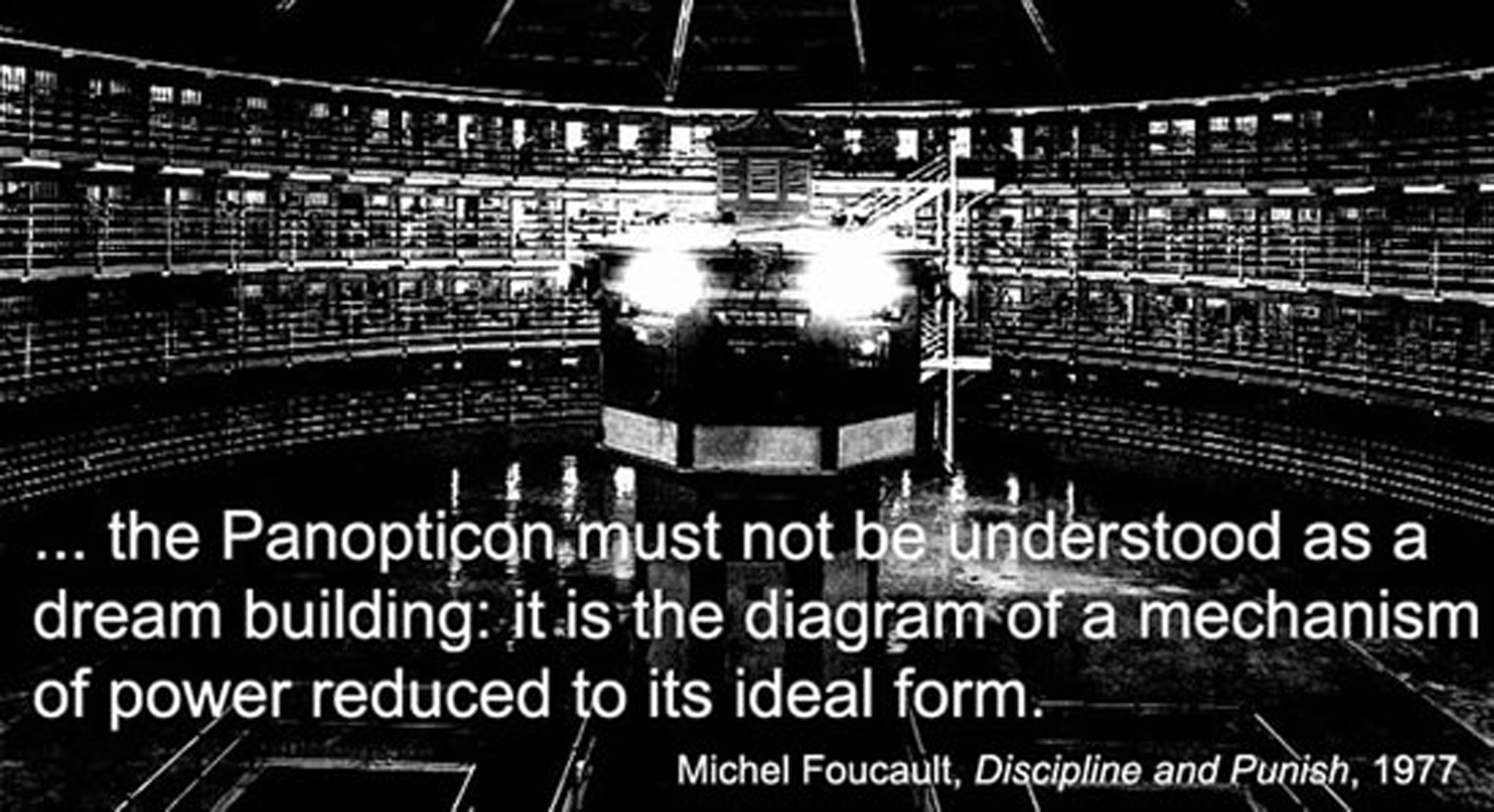
The American Surveillance State, much like The Prisoner’s Village, is a metaphorical panopticon, a circular prison in which the inmates are monitored by a single watchman situated in a central tower. Because the inmates cannot see the watchman, they are unable to tell whether or not they are being watched at any given time and must proceed under the assumption that they are always being watched.

Eighteenth century social theorist Jeremy Bentham envisioned the panopticon prison to be a cheaper and more effective means of “obtaining power of mind over mind, in a quantity hitherto without example.”

Bentham’s panopticon, in which the prisoners are used as a source of cheap, menial labor, has become a model for the modern surveillance state in which the populace is constantly being watched, controlled and managed by the powers-that-be while funding its existence.

Nowhere to run and nowhere to hide: this is the mantra of the architects of the Surveillance State and their corporate collaborators.

Government eyes are watching you.

They see your every move: what you read, how much you spend, where you go, with whom you interact, when you wake up in the morning, what you’re watching on television and reading on the internet.

Every move you make is being monitored, mined for data, crunched, and tabulated in order to amass a profile of who you are, what makes you tick, and how best to control you when and if it becomes necessary to bring you in line.

When the government sees all and knows all and has an abundance of laws to render even the most seemingly upstanding citizen a criminal and lawbreaker, then the old adage that you’ve got nothing to worry about if you’ve got nothing to hide no longer applies.

Apart from the obvious dangers posed by a government that feels justified and empowered to spy on its people and use its ever-expanding arsenal of weapons and technology to monitor and control them, we’re approaching a time in which we will be forced to choose between bowing down in obedience to the dictates of the government—i.e., the law, or whatever a government official deems the law to be—and maintaining our individuality, integrity and independence.

When people talk about privacy, they mistakenly assume it protects only that which is hidden behind a wall or under one’s clothing. The courts have fostered this misunderstanding with their constantly shifting delineation of what constitutes an “expectation of privacy.” And technology has furthered muddied the waters.

However, privacy is so much more than what you do or say behind locked doors. It is a way of living one’s life firm in the belief that you are the master of your life, and barring any immediate danger to another person (which is far different from the carefully crafted threats to national security the government uses to justify its actions), it’s no one’s business what you read, what you say, where you go, whom you spend your time with, and how you spend your money.

Unfortunately, George Orwell’s 1984—where “you had to live—did live, from habit that became instinct—in the assumption that every sound you made was overheard, and, except in darkness, every movement scrutinized”—has now become our reality.

We now find ourselves in the unenviable position of being monitored, managed, corralled and controlled by technologies that answer to government and corporate rulers.

Consider that on any given day, the average American going about his daily business will be monitored, surveilled, spied on and tracked in more than 20 different ways, by both government and corporate eyes and ears.

A byproduct of this new age in which we live, whether you’re walking through a store, driving your car, checking email, or talking to friends and family on the phone, you can be sure that some government agency is listening in and tracking your behavior.

This doesn’t even begin to touch on the corporate trackers that monitor your purchases, web browsing, Facebook posts and other activities taking place in the cyber sphere.

Stingray devices mounted on police cars to warrantlessly track cell phones, Doppler radar devices that can detect human breathing and movement within in a home, license plate readers that can record up to 1800 license plates per minutesidewalk and “public space” cameras coupled with facial recognition and behavior-sensing technology that lay the groundwork for police “pre-crime” programspolice body cameras that turn police officers into roving surveillance cameras, the internet of things: all of these technologies (and more) add up to a society in which there’s little room for indiscretions, imperfections, or acts of independence—especially not when the government can listen in on your phone calls, read your emails, monitor your driving habits, track your movements, scrutinize your purchases and peer through the walls of your home.

As French philosopher Michel Foucault concluded in his 1975 book Discipline and Punish, “Visibility is a trap.”

This is the electronic concentration camp—the panopticon prison—the Village—in which we are now caged.

It is a prison from which there will be no escape. Certainly not if the government and its corporate allies have anything to say about it.

As Glenn Greenwald notes:

“The way things are supposed to work is that we’re supposed to know virtually everything about what [government officials] do: that’s why they’re called public servants. They’re supposed to know virtually nothing about what we do: that’s why we’re called private individuals. This dynamic – the hallmark of a healthy and free society – has been radically reversed. Now, they know everything about what we do, and are constantly building systems to know more. Meanwhile, we know less and less about what they do, as they build walls of secrecy behind which they function. That’s the imbalance that needs to come to an end. No democracy can be healthy and functional if the most consequential acts of those who wield political power are completely unknown to those to whom they are supposed to be accountable.”

None of this will change, no matter which party controls Congress or the White House, because despite all of the work being done to help us buy into the fantasy that things will change if we just elect the right candidate, we’ll still be prisoners of the Village.

So how do you escape? For starters, resist the urge to conform to a group mind and the tyranny of mob-think as controlled by the Deep State.

Think for yourself. Be an individual.

As McGoohan commented in 1968, “At this moment individuals are being drained of their personalities and being brainwashed into slaves… As long as people feel something, that’s the great thing. It’s when they are walking around not thinking and not feeling, that’s tough. When you get a mob like that, you can turn them into the sort of gang that Hitler had.”

You want to be free? Remove the blindfold that blinds you to the Deep State’s con game, stop doping yourself with government propaganda, and break free of the political chokehold that has got you marching in lockstep with tyrants and dictators.

As I make clear in my book Battlefield America: The War on the American People and in its fictional counterpart The Erik Blair Diaries, until you come to terms with the fact that the government is the problem (no matter which party dominates), you’ll never stop being prisoners.

Saturday Matinee: The Prisoner: Arrival

Perfect Pilots: The Prisoner “Arrival”

By John Bernardy

Source: 25 Years Later

A man resigns from his previous post. He is followed and taken captive into a surreal resort town. He tries his best to escape over and over but the location proves inescapable. But the man never backs down from the challenge. He will not conform to his prison. He will escape it.

This is The Prisoner. And this is its pilot.

The adversaries in the Village want the main character to answer this question: “Why did you resign?” They’re not interested in facts and statistics because they have plenty of those. They’re interested in the reasons behind the events—the hard-to-quantify process an individual goes through as they make decisions.

We learn the main character—most often referred to as Number Six—draws this line in the sand: “I will not be pushed, filed, stamped, indexed, briefed, debriefed, or numbered. My life is my own.”

That, ladies and gentleman, is The Prisoner’s main conflict. Six thinks in terms of conformity versus individualism. The Village thinks in terms of security and power at all cost versus breach of security.

In this pilot episode we are introduced to the Village—its physical boundaries and its social ecosystem—and we learn how long Six could be trapped in it. We meet some of the people who run it and why they’re interested in keeping Number Six under their thumb. We see an escape plan and we see that the main villain, Number Two, is easily replaceable with different actors. We also see how the other villagers are pawns for whatever the Village wants of them. There is a lot of world-building necessary to understand The Prisoner’s high-concept premise yet it does so organically, with minimal words, and all within 49 minutes.

By the end of this pilot episode, it’s hard to decide if Number Six should trust anyone. It’s even difficult to know for sure if Number Six deserves our trust, but compared to how inhumanely the Village treats people with its ends-justify-the-means methods, Six sure behaves like one of the good guys. The one thing that you do understand, however, is Six’s situation. Fight at all costs and escape. Remain an individual. The Prisoner is a moody show about big ideas such as privacy and surveillance, and you understand this struggle well after just one episode.

That is an achievement all by itself, yet the camera work is worthy of its own discussion. It is visually stunning and surreal. When Six is disconcerted and making his first escape, we see rapid camera cuts between him moving through a “garden” and statues turning as Six moves past them.

There’s similar frantic camera work as Six looks around the #6 apartment for the source of the omnipresent classical music filling his room. You could tell how necessary it was for Six to have the option to turn that radio on and off himself. The show regularly makes the viewer feel the interior space of its characters without saying a word.

The show is purposely quiet. We don’t get a word of dialogue (counting the opening credits sequence) until four minutes in. Every chance it gets, The Prisoner shows rather than tells. Its ethos is baked into every stage of the show, and I’m glad that holds true with its dialogue.

I’ll show you with my subheadings how organically information is revealed to us over the course of this episode.

The Main Character Resigns

Each week, the show opens with the main character—played by auteur show-creator Patrick McGoohan—driving his Lotus into a parking garage. He walks down a hallway and announces something to a man behind a desk. There are no words in this sequence but the character is grandstanding—emphatic and demanding. Then he storms out and drives away while a file with his picture is being typed over with “X”s. The word “resigned” is shown. The main character heads home and begins to pack quickly, but a man in a top hat has been following him and gasses the main character’s apartment. The next thing we see is McGoohan’s character waking up in the new location.

The Village Gets Its Name

The room looks identical to the flat in London, except the view outside the window is of the eccentric buildings found in Portmeirion, Wales. Not that we knew that at the time; the resort town was not listed by name until The Prisoner’s final episode. Not even viewers knew where this location was.

We get a minute and a half of the disoriented main character searching for people he’d seen off in the distance. We finally get dialogue when he comes across a woman setting up an outdoor café. After being rebuffed a few times for his question, “where is this place?” she finally tells him, “the Village.”   

Local Service Only For This Multinational Operation

The café worker tells the main character where to find a phone but he can’t use the service without a number. He takes a taxi, which is basically a golf cart, and the driver speaks to the main character in English and French, proving they deal with multiple nationalities there. She also tells him that she only does local service inside the Village, just like the phone system. She takes him to a general store where he tries to buy a map. The small map looks like this:

The larger map is the same image, only bigger and in color. There is no way to pinpoint where The Village is in relation to the rest of the known world.

An Announcement System Tells You How to Feel about the Day and Doors Tell You to Enter Them

The main character leaves the store and a nearby speaker broadcasts (in Fenella Fielding’s voice, as always) about how today is another beautiful day. He returns to the room he woke up in. There is a “6” on its sign and the door opens automatically for him, beckoning him to enter.

The main character looks out his window and sees a maid walking away from the place. Absolutely nothing is left to the individual’s responsibility in the Village, and this is told to us with action rather than exposition.

Six Gets His Title and Number Two Is the Adversary

The phone rings and a man’s voice declares him “Number Six” and that he should stop by to get acquainted. “Number Two, Green Dome,” the man says.

“Pop Goes the Weasel” is a musical cue referenced in the soundtrack as the main character heads to the Green Dome. This cue will be referenced regularly and, in my interpretation, seems to be related to the logical conclusion of the Village’s method of ruling.

When the main character arrives, the unnamed butler (Angelo Muscat) opens the door and takes him into Number Two’s chamber.

Intimidation by Breakfast: The Village Knows Everything about Their Prisoners

Number Two asks Six what he’d like for breakfast. As Six answers him, the butler immediately uncovers the exact choices as asked for. The Village keeps track of the most normal behaviors and shows that they know how predictable people are.

Yet Number Two does not know why Six resigned. The information inside Six’s head makes him a valuable commodity to many different parties. This tells us that Six knows important secrets. The Village needs to protect these secrets from falling into the wrong hands. We do not, however, learn the Village’s allegiances.

This is the entire crux of the show’s conflict. If Six reveals his motives, the Village will get what they want. If Six does not reveal his secrets and escapes, he maintains his individuality and achieves his goal.

Over the course of Six and Two’s battle of words and wills, we are shown that the Village has multiple pictures of Six’s littlest decisions from before his capture. They surveyed every part of his life before he was captured.

A Helicopter Tour Reveals the Time Frame of a Sentence

In addition to Six revealing why he resigned, Number Two wants him to conform to the Village’s rule. It will help them break him. To that end, they take a helicopter tour of the Village grounds. It serves as exposition for viewers, but it’s organic and there’s a bite to it. There’s a council building where villagers put on amateur theatrics, implying that the villagers are expected to be there a while—but how long? Number Two points out that they have their own graveyard. It sounds like a standard town detail, but the threat is clear.

People Make the Choice to Conform or Face Rover

After the characters land, Six walks around the village and notices how extremely happy everyone appears. He has a conversation with Number Two, even though Two is across the square from Six using a bullhorn and everyone is listening. Yet the villagers appear completely oblivious until Two says “be still!”

Everyone freezes in place except for one man who freaks out. He is then chased by a creepy white bubble. We learn later that its name is Rover but when Six asks, “what’s that?” Number Two only says, “That would be telling.” The Village thinks it holds all the cards. They need not reveal anything, but they must know everything.

These people in the village square had a choice to come around to Number Two’s way of thinking: the choice to survive through conformity or die as a free thinker.

Six Refuses to Conform and First Speaks of Escape

Two takes Six to the labor exchange where they test Six to conform him to a role within the community. Inside we see creepy signs on the wall such as this one: “Questions are burdens to others. Answers a prison to oneself.”

True to form, Six refuses to answer the overly invasive questions asked of him. Therefore, he is not assigned a job; instead, he goes home.

He kicks the maid out because he doesn’t want the Village doing anything for him. He also searches everywhere for the music filling his house. He did not turn it on himself, therefore it must go. An announcement call for radio repair happens just as Six destroyed his radio speaker, showing the extent to which he is under surveillance.

The maid then returns and Six begins to grill her about whether anyone has ever escaped the Village. She is visibly uncomfortable with this. She also pleads with Six to tell her his secrets so she can get what she wants in return. It’s official: all the villagers work for the Village on all levels. It’s also official that Six is always being watched. This scene is being broadcast on a giant screen in the creepy camera room where both the unnamed director and Number Two are watching it play out.

This reinforces that Six is an important person with particularly special information in his head. Only necessary force is sanctioned, nothing extreme.

The Hospital Reveals the Extent of the Village’s Methods for Conforming

Six leaves his apartment and sneaks through the garden with the unnerving statues I described earlier. He sneaks past Rover, but the director is calling Station 14 to collect Number Six before his escape is finalized. Two men catch up with him on the beach and Six wins a round of fisticuffs. It takes Rover to stop him.

Six wakes up in a hospital with a creepily pleasant woman watching over him. When she leaves to get the doctor, Six notices an old colleague, Cobb, a few beds down. Then men exchange a few sentences and it’s revealed that Cobb is in the same boat as Six. But before anything else can be said, the doctor collects Six for his physical.

On the way, Six witnesses what group therapy looks like in the Village:

We hear Number Two conversing on the phone with an unknown party about Six’s progress, and we also learn that Six’s old clothes have been burned. The only clothes he has now are from the Village. Also, Cobb is declared dead after having jumped out a window, taking away an avenue of answers for Six.

The first thing Six does as he leaves the hospital is ditch the hat and his number badge. Then he makes an abrupt visit to the Green Dome.

The First New Number Two

Six wants answers from Number Two, but instead all he learns is that a different man wears the badge and sits in the office now. He announces himself as the new Number Two.

In the first episode, we learn that the power of the office is more important than the power of the individual in that office. You have to applaud the Village for message consistency.

The face may change, but the goal remains the same. The new Number Two is all business and matter-of-factly says, “I need facts.”

Six’s First Escape Plan

Back at his apartment, Six sees Cobb’s funeral procession and meets a villager woman who appears conflicted about the whole thing. They talk about Cobb, and how she and Cobb had a plan to escape but the Village got to him before they could enact it. In the episode’s final 12 minutes, she decides to help Six escape in the same manner.

Six sees her leave the Green Dome later on but he doesn’t know he wasn’t her assignment before then. She wants to help him anyway and tells Six they’re onto him so they have to move fast. He trusts her enough to try the plan. She gives him the device that will activate a helicopter. He moves past a suspicious Rover, gets in the helicopter, and takes off.

It looks like it’s going to work—at first—but then a villager tells the woman that she should learn to play chess, “because we’re all pawns, m’dear.” It looks like the woman was trustworthy after all. She was just playing a game rigged against her.

At that moment, the Director uses a remote control to bring Six’s helicopter right back to where it started.

Escape Is Predetermined to Fail

It turns out that Cobb was part of a plan to manipulate Six into revealing his secret. Send in someone he trusts from outside. Make Six feel that they’re in the same situation. Let them commiserate. What are you in for? Same thing you are, what secret are you holding onto?

But it didn’t work, and Cobb is not surprised by this. He says as much to the new Number Two, declaring Six a challenge for the Village. Not only do we know Six is seen as important, now we know he is seen as a formidable opponent.

Yet the episode still ends with the face of Six coming towards the screen, before prison bars slam shut on him before he can get to us. He did not escape, but they did not break him. Stalemate. This is the kind of victory we get in The Prisoner.

Who Is Number Six?

There are clues to this question’s answer: McGoohan played spy John Drake on his previous show, Danger Man. Most people think this is that character continuing into a new story. Another clue: when Six tells Number Two his birthday, the shot is of Patrick McGoohan right in front of the camera, telling us his own birthday. Is this show that meta? I would believe it.

We don’t know what occupation Six held in his previous life. He could be a spy, a politician, a scientist. He could have some other kind of job entirely, maybe in the military. We understand well the world he is in now, but we don’t know who he is or, for that matter, who his captors are. As Cobb—the only person with a spoken name—left the show for other masters, there’s a distinct feeling that names don’t belong on this show and they get ushered out the second we learn one.

Even though we may never know the names of characters, we understand the high concept and dynamic of Six’s struggle fairly well. This is a major victory of The Prisoner’s pilot, especially considering how out-there this concept was when it debuted in 1967.

What is the pilot’s other victory? It makes you need to watch the other 16 episodes. Get on it!

The 2020 Election Bamboozle: We Are All Victims of the Deep State’s Con Game

By John W. Whitehead

Source: The Rutherford Institute

“We’re run by the Pentagon, we’re run by Madison Avenue, we’re run by television, and as long as we accept those things and don’t revolt we’ll have to go along with the stream to the eventual avalanche…. As long as we go out and buy stuff, we’re at their mercy… We all live in a little Village. Your Village may be different from other people’s Villages, but we are all prisoners.”— Patrick McGoohan

This is not an election.

This is a con game, a scam, a grift, a hustle, a bunko, a swindle, a flimflam, a gaffle, and a bamboozle.

In this carefully choreographed scheme to strip the American citizenry of our power and our rights, “we the people” are nothing more than marks, suckers, stooges, mugs, rubes, or gulls.

We are victims of the Deep State’s confidence game.

Every confidence game has six essential stages: 1) the foundation to lay the groundwork for the illusion; 2) the approach whereby the victim is contacted; 3) the build-up to make the victim feel like they’ve got a vested interest in the outcome; 4) the corroboration (aided by third-party conspirators) to legitimize that the scammers are, in fact, on the up-and-up; 5) the pay-off, in which the victim gets to experience some small early “wins”; and 6) the “hurrah”— a sudden manufactured crisis or change of events that creates a sense of urgency.  

In this particular con game, every candidate dangled before us as some form of political savior—including Donald Trump and Joe Biden—is part of a long-running, elaborate scam intended to persuade us that, despite all appearances to the contrary, we live in a constitutional republic.

In this way, the voters are the dupes, the candidates are the shills, and as usual, it’s the Deep State rigging the outcome.

Terrorist attacks, pandemics, civil unrest: these are all manipulated crises that add to the sense of urgency and help us feel invested in the outcome of the various elections, but it doesn’t change much in the long term.

No matter who wins this election, we’ll all still be prisoners of the Deep State.

We just haven’t learned to recognize our prison walls as such.

It’s like that old British television series The Prisoner, which takes place in a mysterious, self-contained, cosmopolitan, seemingly idyllic retirement community known only as The Village.

Perhaps the best visual debate ever on individuality and freedom, The Prisoner (17 episodes in all) centers around a British secret agent who abruptly resigns only to find himself imprisoned, monitored by militarized drones, and interrogated in The Village, a beautiful resort with parks and green fields, recreational activities and even a butler.

While luxurious, the Village is a virtual prison disguised as a seaside paradise: its inhabitants have no true freedom, they cannot leave the Village, they are under constant surveillance, all of their movements tracked. Residents of the Village are stripped of their individuality and identified only by numbers.

First broadcast in Great Britain 50-some years ago, The Prisoner dystopian television series —described as “James Bond meets George Orwell filtered through Franz Kafka”—confronted societal themes that are still relevant today: the rise of a police state, the loss of freedom, round-the-clock surveillance, the corruption of government, totalitarianism, weaponization, group think, mass marketing, and the tendency of human beings to meekly accept their lot in life as prisoners in a prison of their own making.

The series’ protagonist, played by Patrick McGoohan is Number Six.

Number Two, the Village administrator, acts as an agent for the unseen and all-powerful Number One, whose identity is not revealed until the final episode.

“I am not a number. I am a free man,” was the mantra chanted on each episode of The Prisoner, which was largely written and directed by Patrick McGoohan, who also played the title role.

In the opening episode (“The Arrival”), Number Six meets Number Two, who explains to him that he is in The Village because information stored “inside” his head has made him too valuable to be allowed to roam free “outside.”

Throughout the series, Number Six is subjected to interrogation tactics, torture, hallucinogenic drugs, identity theft, mind control, dream manipulation, and various forms of social indoctrination and physical coercion in order to “persuade” him to comply, give up, give in and subjugate himself to the will of the powers-that-be.

Number Six refuses to comply.

In every episode, Number Six resists the Village’s indoctrination methods, struggles to maintain his own identity, and attempts to escape his captors. “I will not make any deals with you,” he pointedly remarks to Number Two. “I’ve resigned. I will not be pushed, filed, stamped, indexed, debriefed or numbered. My life is my own.”

Yet no matter how far Number Six manages to get in his efforts to escape, it’s never far enough.

Watched by surveillance cameras and other devices, Number Six’s attempts to escape are continuously thwarted by ominous white balloon-like spheres known as “rovers.” Still, he refuses to give up. “Unlike me,” he says to his fellow prisoners, “many of you have accepted the situation of your imprisonment, and will die here like rotten cabbages.”

Number Six’s escapes become a surreal exercise in futility, each episode an unfunny, unsettling Groundhog’s Day that builds to the same frustrating denouement: there is no escape.

As journalist Scott Thill concludes for Wired, “Rebellion always comes at a price. During the acclaimed run of The Prisoner, Number Six is tortured, battered and even body-snatched: In the episode ‘Do Not Forsake Me Oh My Darling,’ his mind is transplanted to another man’s body. Number Six repeatedly escapes The Village only to be returned to it in the end, trapped like an animal, overcome by a restless energy he cannot expend, and betrayed by nearly everyone around him.”

The series is a chilling lesson about how difficult it is to gain one’s freedom in a society in which prison walls are disguised within the seemingly benevolent trappings of technological and scientific progress, national security and the need to guard against terrorists, pandemics, civil unrest, etc.

As Thill noted, “The Prisoner was an allegory of the individual, aiming to find peace and freedom in a dystopia masquerading as a utopia.”

The Prisoner’s Village is also an apt allegory for the American Police State: it gives the illusion of freedom while functioning all the while like a prison: controlled, watchful, inflexible, punitive, deadly and inescapable.

The American Police State, much like The Prisoner’s Village, is a metaphorical panopticon, a circular prison in which the inmates are monitored by a single watchman situated in a central tower. Because the inmates cannot see the watchman, they are unable to tell whether or not they are being watched at any given time and must proceed under the assumption that they are always being watched.

Eighteenth century social theorist Jeremy Bentham envisioned the panopticon prison to be a cheaper and more effective means of “obtaining power of mind over mind, in a quantity hitherto without example.”

Bentham’s panopticon, in which the prisoners are used as a source of cheap, menial labor, has become a model for the modern surveillance state in which the populace is constantly being watched, controlled and managed by the powers-that-be while funding its existence.

Nowhere to run and nowhere to hide: this is the new mantra of the architects of the Deep State and their corporate collaborators (Facebook, Amazon, Netflix, Google, Instagram, etc.).

Government eyes are watching you.

They see your every move: what you read, how much you spend, where you go, with whom you interact, when you wake up in the morning, what you’re watching on television and reading on the internet.

Every move you make is being monitored, mined for data, crunched, and tabulated in order to amass a profile of who you are, what makes you tick, and how best to control you when and if it becomes necessary to bring you in line.

When the government sees all and knows all and has an abundance of laws to render even the most seemingly upstanding citizen a criminal and lawbreaker, then the old adage that you’ve got nothing to worry about if you’ve got nothing to hide no longer applies.

Apart from the obvious dangers posed by a government that feels justified and empowered to spy on its people and use its ever-expanding arsenal of weapons and technology to monitor and control them, we’re approaching a time in which we will be forced to choose between obeying the dictates of the government—i.e., the law, or whatever a government official deems the law to be—and maintaining our individuality, integrity and independence.

When people talk about privacy, they mistakenly assume it protects only that which is hidden behind a wall or under one’s clothing. The courts have fostered this misunderstanding with their constantly shifting delineation of what constitutes an “expectation of privacy.” And technology has furthered muddied the waters.

However, privacy is so much more than what you do or say behind locked doors. It is a way of living one’s life firm in the belief that you are the master of your life, and barring any immediate danger to another person (which is far different from the carefully crafted threats to national security the government uses to justify its actions), it’s no one’s business what you read, what you say, where you go, whom you spend your time with, and how you spend your money.

Unfortunately, George Orwell’s 1984—where “you had to live—did live, from habit that became instinct—in the assumption that every sound you made was overheard, and, except in darkness, every movement scrutinized”—has now become our reality.

We now find ourselves in the unenviable position of being monitored, managed, corralled and controlled by technologies that answer to government and corporate rulers.

Consider that on any given day, the average American going about his daily business will be monitored, surveilled, spied on and tracked in more than 20 different ways, by both government and corporate eyes and ears.

A byproduct of this new age in which we live, whether you’re walking through a store, driving your car, checking email, or talking to friends and family on the phone, you can be sure that some government agency, whether the NSA or some other entity, is listening in and tracking your behavior.

This doesn’t even begin to touch on the corporate trackers that monitor your purchases, web browsing, Facebook posts and other activities taking place in the cyber sphere.

Stingray devices mounted on police cars to warrantlessly track cell phones, Doppler radar devices that can detect human breathing and movement within in a home, license plate readers that can record up to 1800 license plates per minutesidewalk and “public space” cameras coupled with facial recognition and behavior-sensing technology that lay the groundwork for police “pre-crime” programspolice body cameras that turn police officers into roving surveillance cameras, the internet of things: all of these technologies (and more) add up to a society in which there’s little room for indiscretions, imperfections, or acts of independence—especially not when the government can listen in on your phone calls, read your emails, monitor your driving habits, track your movements, scrutinize your purchases and peer through the walls of your home.

As French philosopher Michel Foucault concluded in his 1975 book Discipline and Punish, “Visibility is a trap.”

This is the electronic concentration camp—the panopticon prison—the Village—in which we are now caged.

It is a prison from which there will be no escape. Certainly not if the government and its corporate allies have anything to say about it.

As Glenn Greenwald notes:

“The way things are supposed to work is that we’re supposed to know virtually everything about what [government officials] do: that’s why they’re called public servants. They’re supposed to know virtually nothing about what we do: that’s why we’re called private individuals. This dynamic – the hallmark of a healthy and free society – has been radically reversed. Now, they know everything about what we do, and are constantly building systems to know more. Meanwhile, we know less and less about what they do, as they build walls of secrecy behind which they function. That’s the imbalance that needs to come to an end. No democracy can be healthy and functional if the most consequential acts of those who wield political power are completely unknown to those to whom they are supposed to be accountable.”

None of this will change, no matter who wins this upcoming presidential election.

And that’s the hustle, you see: because despite all of the work being done to help us buy into the fantasy that things will change if we just elect the right candidate, the day after a new president is sworn in, we’ll still find ourselves prisoners of the Village.

This should come as no surprise to those who haven’t been taking the escapist blue pill, who haven’t fallen for the Deep State’s phony rhetoric, who haven’t been lured in by the promise of a political savior: we never stopped being prisoners.

So how do you escape? For starters, resist the urge to conform to a group mind and the tyranny of mob-think as controlled by the Deep State.

Think for yourself. Be an individual. As McGoohan commented in 1968, “At this moment individuals are being drained of their personalities and being brainwashed into slaves… As long as people feel something, that’s the great thing. It’s when they are walking around not thinking and not feeling, that’s tough. When you get a mob like that, you can turn them into the sort of gang that Hitler had.”

You want to be free? Remove the blindfold that blinds you to the Deep State’s con game, stop doping yourself with government propaganda, and break free of the political chokehold that has got you marching in lockstep with tyrants and dictators.

As I make clear in my book Battlefield America: The War on the American People, until you come to terms with the fact that the government is the problem (no matter which party dominates), you’ll never be free.

Minority Report (2002) Esoteric Analysis

By Jay Dyer

Source: Jay’s Analysis

Spielberg’s Minority Report is now an important film to revisit.  Based on the short story by visionary science fiction author Phillip K. Dick, Spielberg’s film version implements an important number of predictive programming elements not found in Dick.  Both are worth a look, but the film is important for JaysAnalysis, since now 13 years later, we are actually seeing the implementation of the total technocratic takeover, including pre-crime tracking systems.

Although the film and the short story present the precognition as a metaphysical mystery by telepathic individuals who can see into the aether, the real pre-crime systems are based on A.I. and the digitizing of all records under total information awareness.  And as I’ve said, this was DARPA’s plan for the Internet all along.

In fact, a good friend of mine worked for a few years digitizing mass medical records, and while most are aware of Google’s attempts to digitize all books, most do not know why.  I’ve warned for several years now the end goal of all this digitization is not for “efficiency” and trendy techy cool iWatches to monitor heart rates and location.  The ultimate goal is total mind control, loss of free will and the complete rewrite of all past reality.

Consider, for example, the power the system will wield with the ability to “delete” all past versions of literature – religious texts, Shakespeare, 1984, nothing will be sacred and unable to be “revised.”  Remember that in 2009 Amazon erased Orwell’s 1984.  Your own past may even be deleted, subject to revision or altered to make you the next villain!  All this is revealed in detail in Minority Report.  Thus, while the public adopts “Kindles,” print itself is assigned the doom of the kindled fire – like Farenheit 451, as Richard Grove has said.

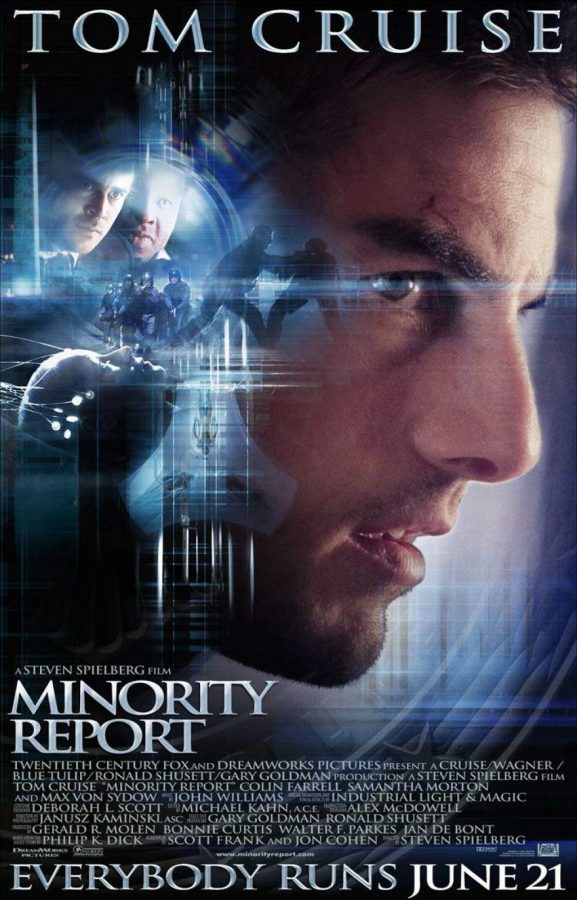
Minority Report’s setting is a 2055 dystopic D.C., where Agent John Anderton (Tom Cruise) is framed for two murders from within his own PreCrime Corporation ranks by the CEO, Lamar Burgess (Max Von Sydow). (Note: The existing system appears to be a merger of private and government sectors.)   I’m sure most readers have seen the film, so I’ll spare you detailed plot recaps and hit the highlights for the sake of our purposes.

The film’s PreCrime alerts a private corporation to a predetermined murder event ahead of time, giving the Agents of the corporation time to save victims.  Hailed as a perfect system, the infallibility of PreCrime has made D.C. the safest city in the world, with no murders for several years.  As a result, the PreCrime test requires a total surveillance society, something akin to complete panopticism.  In fact, the advertising in D.C. is user specific, targeting pedestrian’s personal desires based on retina scans – and all travel requires retinal scanning and mass microchipping.

We are now on the verge of the implementation of retinal scanning, as the U.S. military has engaged in retinal scanning in occupied territories for several years now.  It is important to understand that the action of the military abroad are often a test ground for the implementation of such surveillance and tracking technology at “home.”  In October 2010, the Guardian reported of U.S. troops stationed in Afghanistan:

“With each iris and fingertip scanned, the device gave the operator a steadily rising percentage chance that the goat herder was on an electronic “watch list” of suspects. Although it never reached 100%, it was enough for the man to be taken to the nearest US outpost for interrogation.

Since the Guardian witnessed that incident, which occurred near the southern city of Kandahar earlier this year, US soldiers have been dramatically increasing the vast database of biometric information collected from Afghans living in the most war-torn parts of southern and eastern Afghanistan. The US army now has information on 800,000 people, while another database developed by the country’s interior ministry has records on 250,000 people.”

Wired Magazine reported millions were the goal.  The goal is not millions, but the entire globe, where any and all information is now currency for “big data.”  This is exactly the world Minority Report foresaw, and for those curious about Phillip K. Dick, whispers are his foresight was due to being well-connected with the Silicon Valley elites.  This is how Ubik foresaw the “Internet of Things” I’ve written about many times, and probably in part why Dick went insane (or was targeted).  Slate writes of Ubik:

“Samsung, the world’s largest manufacturer of televisions, tells customers in its privacy policy that “personal or other sensitive” conversations “will be among the data captured and transmitted to a third party” through the TV’s voice-recognition software. Welcome to the Internet of Things.

Sci-fi great Philip K. Dick warned us about this decades ago. In his classic 1969 novel Ubik, the characters have to negotiate the way they move and how they communicate with inanimate objects that monitor them, lock them out, and force payments.”

Just as the predictive algorithm in Asimov’s Foundation was able to track mass movements, so now the same algorithmic tracking is in place across the “web of things” that are capable of being recorded and tracked – and that’s most things.  The Pentagon has a virtual “you” in a realtime 3D interface that updates its data consistently from everything done on the web.  The Register reported in 2009 about this simulated warfare and predictive software:

“Defense analysts can understand the repercussions of their proposed recommendations for policy options or military actions by interacting with a virtual world environment,” write the researchers.

“They can propose a policy option and walk skeptical commanders through a virtual world where the commander can literally ‘see’ how things might play out. This process gives the commander a view of the most likely strengths and weaknesses of any particular course of action.”

It’s not telepathic Samantha Morton’s in a tub of goo, it’s Google and DARPA developing highly advanced technology along the lines of what William Binney exposed, as a former NSA employee.  Think here of War Games (1983), where the A.I. bot was able to war game future scenarios of global thermonuclear war, but thankfully Ferris Bueller was there to save us.  If this was displayed in 1983 in pop culture, imagine how far that technology has come 30 years later.  Lest anyone think the “precrime” is merely for security and weekend Xbox enjoyment, recall what I wrote two years back:

“Capitalism, communism, nationalism, 401ks, blah blah blah, all of these things are basically obsolete. Why?  Because of the nature of the real secret high-tech and plans for mega SmartCities that are to come.  You see, you think you are getting ahead and climbing the scum social ladder, and you aren’t even aware that the CEO of IBM Ginni Rommety gives lectures about SmartCities where everything you do will be rationed, tracked and traced by the central supercomputers, with pre-crime determining whether you are guilty of crimethink.  So everything you are trusting in is already obsolete.  You think I’m exaggerating?  On the contrary, you and your children’s futures are determined (you don’t have a future), and if you are allowed to live past the great culling, you will essentially be boxed into a giant WalmartTargetGameStopUniversity City that will literally be run by a supercomputer. Watch for yourself:”

And lest anyone think PreCrime is a thing of the future, consider that it has been used for two years in the U.K.  The New Scientist and 21stCenturyWire report:

“That’s the hope of police in the US, who have begun using advanced software to analyse crime data in conjunction with emails, text messages, chat files and CCTV recordings acquired by law enforcement. The system, developed by Wynyard, a firm based in Auckland, New Zealand, could even look at social media in real time in an attempt to predict where the gang might strike next.

“We’re trying to get to the source of the mastermind behind the criminal activity, that’s why we’re setting up a database so everybody can provide the necessary information and help us get higher up the chain,” says Craig Blanton of the Marion County Sheriff’s Office in Indiana. Because Felony Lane Gang members move from state to state to stay one step ahead, the centralised database is primed to aggregate historical information on the group and search for patterns in their movements, Blanton says.

“We know where they’ve been, where they are currently and where they may go in the future,” he says. “I think had we not taken on this challenge, we along with the other 110 impacted agencies would be doing our own thing without better knowledge of how this group operates.”

It’s not the only system that police forces have at their disposal. PredPol, which was developed by mathematician George Mohler at Santa Clara University in California, has been widely adopted in the US and the UK. The software analyses recorded crimes based on date, place and category of offence. It then generates daily suggestions for locations that should be patrolled by officers, depending on where it calculates criminal activity is most likely to occur.”

Returning to the film, an interesting tidbit occurs about three times that I noticed.  Any time Anderton or his fellow Agents access the “Temple,” the holding site of the telepathic PreCogs, the sound made is distinctly the iPhone power on sound.  The first iPod premiered in 2001, so I’m assuming it’s the same sound for turning on, but readers can correct me.  I find it curious if not, since the sound would likely be chosen for a reason. This puts the infamous 1984 Apple ad in a new, ominous light.

If you’ve seen the important Spike Jonze film, Her, you’ll see why.  In Her, lead character Theodore (Joaquin Phoenix) falls in love with an iOS – his operating system.  The iOS of his future is an intelligent software system with capability for learning (like the A.I. in War Games), and ultimately transcends its own limitations.

I bring this up because Minority Report is distinctly dominated by eye imagery.  While seemingly insignificant, it is my opinion that Siri and Apple in particular are crucial in the implementation of the coming new order.  Apple ads have contained a distinctly esoteric and significant cultural referent.  This is not to say Microsoft or any of the other tech giants are insignificant, on the contrary, I believe they are all arms of one entity and the appearance of competition is largely illusory.

There is only one military industrial complex, and DARPA and Google and Apple and Microsoft are all its children.  The façade of competition is enough to advance the technology by the tech nerds that serve it, but in the end, it all serves the same system.  My point here is that the iPhone is much more than an iPhone. It is actually an EYEphone, functioning as the eye of Sauron himself, as A.I. reconnaissance before the takeover.

I have mentioned before the whispers are the iPhone of the next few years will contain a Siri that communicates with you like a personal assistant.  I have finally found an article on this here, which describes it directly in connection to Her, like I said here.  “Viv” will do the following:

“On the other hand, not only will Viv recognize disparate requests, she will also be able to put them together. Basically, Viv is Siri with the ability to learn. The project is being kept heavily under wraps, but the guys at Viv have hinted that they’re working towards creating a “global brain,” a shared source of artificial intelligence that’s as readily accessible as heat or electricity.  It’s unclear how soon a breakthrough of this magnitude can happen. But if this team made Siri, you can bet their next project is going to blow the tech world to pieces.”

In order to endear the public to that idea, a prototype Siri had to be offered.  While this may be a rumor, it will eventually come.  And the dystopic scenario presented in Her will meet the nightmare of Minority Report.  For now, it all seems harmless (though we are seeing a generation of youth destroyed by screens and pads – Steve Jobs didn’t let his own kids play with an iPad!), but the end goal I assure is nefarious.

The dominant ideology of these tech giants is pure and total dysgenics (not eugenics).  In order for the total rewrite to come, the existing structure must be destroyed.  The “old way” of doing things will be scapegoated as the technocracy replaces it, offering utopia and salvation, but the synthetic rewrite is a Trojan horse.  Humanity will be enslaved in the same virtual Matrix Anderton is enslaved in, in the film.

The film’s tag line, which pops up numerous times in the story, is about running.  “Everybody runs,” and John spends most of the film on the run from the very system he operated.  The film asks the question multiple times, “Can you see?” and when we think of this on a deeper level in terms of predictive programming, I think we are intended to look beyond the immediate narrative.  There are also numerous hat tips to Blade Runner, where again the “running” imagery comes to the fore.  Can we run from the panopticon?  Do we have eyes to see the iEYES that are “infallibly” surveilling us perpetually?

Neoliberal Defenestration and the Overton Window

By Stephen Martin

Source: CounterPunch

‘It is difficult to get Artificial Intelligence to understand something, when the Research and Development funding it depends upon its not understanding it’

Paraphrase of Upton Sinclair.

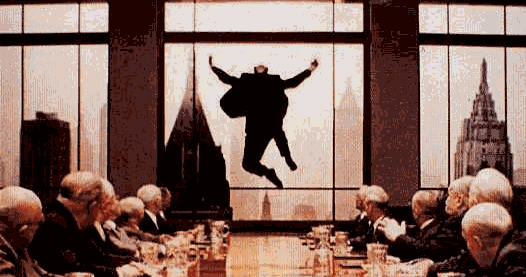
defenestration  (diːˌfɛnɪˈstreɪʃən)

n

the act of throwing a person or thing  out of a window

[C17: from New Latin dēfenestrātiō, from Latin de- + fenestra window

The freedictionary.com

‘If there is such a phenomenon as absolute evil, it consists of treating another human being as a thing

John Brunner ‘The Shockwave Rider

This small article a polemic against neoliberal hegemony; in particular the emerging issue of ‘surplus population’ as related to technological displacement in context of a free market, an issue purposive to such hegemony which as an ‘elephant growing in the panopticon’  i.e. not to be mentioned?

The central premise is that Artificial Intelligence (AI) + Robotics  comprise a nefarious as formulaic temptation to the elite of the ‘Technetronic era’ as Zbigniew Brzezinski put it: this consistent with a determinism as stems ontologically from ‘Empiricism’  form of a  ‘One Dimensionality’ as Marcuse phrased it over five Decades ago; and which thru being but mere simulacra, AI and Robotics represent an ontological imperative  potentially expropriated under pathology to denial of Kant’s concept of ‘categorical imperative’?  (That Kant did not subscribe to determinism is acknowledged). The neoliberal concepts of ‘Corporatism’ and ‘free market’ are powerful examples of this ‘one dimensionality’ which is clearly pathological, a topic notably explored by Joel Bakan concerning the pursuit of profit within a Corporatist framework.

– ‘One dimensionality in, one dimensionality out’– so it goes ontologically as to some  paraphrase of GIGO as trending alas way of ‘technological determinism’ towards an ‘Epitaph for Biodiversity’  as would be – way of ‘Garbage’ or ‘Junk’ un apperceived as much as ‘retrospection’ non occurrent indeed -and where ‘Farewell to the Working Class’ as André Gorz conceived to assume an entirely new meaning: -this to some denouement of  ‘Dystopian Nightmare’ as opposed to  ‘Utopian Dream’, alas; such the ‘Age of Leisure’  as ‘beckoning’ to be not for the majority or ‘Demos’,but rather  for the ‘technetronic elite’ and  their ‘AI’ and Robotics – such ‘leisure’ being as to a ‘freedom’ pathological and facilitated  by the absence of conscience as much as morality; such the ‘farewell’; such the defenestration of ‘surplus’ , such the ‘Age’ we ‘live’ within as to ‘expropriation’ and ‘arrogation’  to amount to  ‘Death by Panopticon’ such the ‘apotheosis’?

It is being so cheerful which keeps these small quarters going.

But digression.

–  It is a relatively small step from ‘the death of thought’ to ‘the death of Life’under Neoliberal Orthodoxy as proving to be the most toxic ideology ever knownsuch the hegemony as a deliberative, shift of the ‘ Overton Window’ currently occurring as to trend deterministic; such the mere necrotrophy as a ‘defenestration’ – and the ‘one percent’ but a deadly collective of parasitic orifice? For what is ‘Empiricism’ when implemented thru  AI and Robotic Technology in a Corporatist economy as but a ‘selective investment’  as to Research and Development by elite ‘private interests’,  which to a determinism so evidently entailing a whole raft of ‘consequence’ ; such the means, such the production, such the ‘phenomenology’ as ‘owned’ indeed? Under pathology, selectivity is impaired to point of ‘militarization’?

But foremost amongst said ‘raft’ of consequence – the concept of ‘classification’ as incorporates methodological reduction of the particular to a composite of generalities so typical of ‘Science’ as expropriated; the fruition thereof replicated not least thru ‘Consumerism’ – and ‘Lifestyle’ – as much as ‘Life’ reduced as much as abrogated to but correlation way  of ‘possession’ of ‘things’: this  as said replication expressed as much ‘thru’ Linnaeus as Marx  concerning ‘class’- and as results in concepts’ Incorporated’ such as the ‘Overton Window’ – as will be explored by way of ‘extrapolation’ below? The debasing of identity as a correlate of possessions as a necessary ‘abrogation’ by way of engineered ‘bio hack’ is only furthered, such the loss of dimensionality as a potential, by such as social media? An excellent multimedia illustration of such loss is found here.

It’s to be noted that for Empiricism the concept of ‘good’ and ‘evil’ entails an extra dimensionality  as ‘metaphysical’ – and that ‘Politics’ so deconstructed despite abuse under orthodoxy as to ‘mitigation’ remains as  ‘Moral Economics’ – this despite the  mitigative contention of neoliberal orthodoxy that there no morality in the ‘synonymy’; to a pragmatic as ‘Utilitarian’ point of a ‘Killing the Host’ prevailing at paradigmatic as much as Geopolitical level as but explicative of a ‘necrotrophy’; as much as the ‘defenestration’ as euphemism herein proposed this small article  would explicate?

Kudos to Michael Hudson for exposing, and continuing to expose, the ‘death of thought’ which Neoliberalism as an orthodoxy as but a mere ‘racket’ of ‘transfer of resources’ represents.

– Are we ‘on a roll’ here as much as ‘off the leash’ – such the rebellion ‘psycho political’; such the ‘CounterPunch’ by way of digital pamphleteering as ‘restricted code’ rejected evidenced by way of ‘alternative’?

‘Politics’ should mean a diversity biological as much as phenomenological; it should mean more than Empirical ‘utility’, by way of the extra dimensionality which Metaphysics represents; this, as much as ‘Democracy’ demands diversity; ‘thought permitted’ as evidencing same as much as questions allowed to be asked; while Corporatism as antithesis demands ‘line’, a homogeneity, a uniformity, an abrogation as to a contingency?

Whether ‘Empiricism’ as to Philosophy is ‘Essentialist’ or ‘Instrumentalist’ is as of much political relevance as the Medieval question ‘how many angels can dance upon the head of a needle?‘ – the tragic fact remaining in ‘Oceania’  become to Corporatism  is that the economic impact of (AI + Robotics) constitutes a ‘technological displacement’ which under a ‘one dimensionality’ as ‘Orthodox’  is as a ‘political impact’ at a quintessential or axiomatic level, such the ‘formulae’ as (=Ecocide) ‘completes’ under a determinism of hegemony as demands ‘whoredom’? AI and Robotics destroy the symbiotic relationship between production and consumption thru reducing the requirement for human labor as waged in the productive process; AI and Robotics thereby impact upon the distribution of resources as wage based. The fairy tale of compensatory employment opportunities is at best wishful thinking, at worst it is a purposively contrived propaganda?

‘Biodiversity’, alas, becoming more limited to a ‘Thanatos‘ of ‘Military Industrial Corporatist Complex’  as explicates the ‘Age of the Anthropocene’as of the ‘1%’ as funders of ‘hegemony’ such the transfer of resources?

‘As ‘we’ view the world so it becomes’, indeed – this as much as how ‘Others’, through hegemony as ‘Utilitarian’, would have it viewed – and that such a large part of ‘Currency’ as ‘it’  to the permit of ‘Hegemony’ which would control and issue views – such the window as ‘Overtonian’ as can be shifted?

How long before the ‘collateral damage’ concerning premature fatality and reduced life expectancy as evidenced in homelessness, withdrawal of social welfare, militarization of policing, drug abuse, including prescription of synthetic opioids, incarceration all as obscenities explicating the ‘cheapening of life’  becomes ‘formalised’ under neoliberal orthodoxy as euthanasia? To such an Overton Window would it at first be ‘voluntary’?

It was ‘Utilitarianism’ as gave the World the concept of ‘Panopticon’ back in the Eighteenth Century.

Apropos to such ‘Thanatos‘ identified:

Wherefore art thou ‘Eros’: as represented by checkout operator, bank teller, driver, warehouseman, barista, cook, secretary, journalist, lawyer, receptionist, ‘ human voice at the end of the line’ – such the insidious inroads being made consequent the advance of Empirical based Technology?

The ‘Litany’ of such ‘displacement/defenestration’ could go on, as it undoubtedly shall under prevailing Hegemony ‘Western’ as ‘Oceanic’ as much orthodox as ‘deadly’, such the invasive penetration of ‘one dimensionality’ as ‘technological displacement’ evidenced under neoliberal orthodoxy as entailing a transfer of resources to mere ‘Stateless Bastards’, such the point of a determinism as would prevail woeful?

Ponerological questions such as would not be asked commensurate:

Is the ultimate ‘stateless bastard’ satan?

Can ‘synonymy seen’ be’ revolutionary’?

‘Technological displacement’ under an ontology of ‘One Dimensionality’ aka‘Corporatism’ but a euphemism for ‘surplus population’; this as much as ‘Corporatism’ promotes the illusion of ‘Democracy’ by way of ‘mental cheating’; such the synonymy as ‘simulacra’ an ‘illusion’ denied – but ‘real’ under ‘doublethink’?

‘Trickle down economics’ is as real as much as ‘technological displacement’ to be compensated for in the ‘opening up of a whole new vista of opportunity’, such the death of thought as neoliberal orthodoxy represents some parallel of tales told by such as Horatio Alger to point of ‘illusion’ encouraged?

These small quarters would ‘rip a new one’ in Neoliberal Orthodoxy by way of polemic.

It remains a ‘big’ question under contemplation of the genius of Orwell and the highly perspicacious ratio of ‘1/15/84’ (hence the ‘one percent’) as to why, within an undoubtedly comprehensive as prescient Dystopian vision where ‘oligarchic collective’ a synonym of ‘technetronic elite’, he ‘permitted the currency’ of the ‘Prole’ as ‘84%’ to prevail as a presence rather than but a memory disappeared by way of ‘memory hole’?

Under neoliberal orthodoxy the political utility of the ‘Proles’ and in particular the ‘Lumpenproletariat’, alas, is as to but fear as a ‘stick’; a basis of control and manipulation same sense as Upton Sinclair explicated ‘carrot’ contingent by way of synonym seen: to wit;  accept control and manipulation as ‘rewarded’ or be ‘expelled’; be but as a ‘Prole’ subsisting and awaiting death, such the economic incarceration as ‘CAFO’ epitomises the cheapening of life under a hegemony as has corollary of alienation, marginalization and impoverishment wielded under Dystopian imperative; this to a ‘transfer of resources’ from ‘Eros‘ to ‘Thanatos‘ reinforced thru contingency of profit such the ‘ponerology’ of ‘Biodiversity’ reduced by way of paradigm Geopolitical?

To love Life is to loathe the deadly; such the philanthropy as would only be evidenced, such the irony, by the ‘ragged trousered’ as so reduced, such the divide et imperaevidenced?

-And so to ‘defenestration’ as ongoing 21stC. by way of ‘surplus population’ generated deterministically as to be dealt with ‘Utilitarian’ as much as the elimination of ‘Biodiversity’ such the ‘technetronic era’ as much as of Dystopia for Humanity as opposed to a Utopia for (AI + Robotics)?

In the annals of International Finance, in which ‘usury’ figures large as polymorphous(?), the power of (AI + Robotics) ‘growing’ as ‘metastasising’ –  as evidenced by the concept of ‘Dark Pools’, and in political manipulation to point of control and issue of currency  by algorithms, such as  infamously deployed by the now defunct Cambridge Analytica using data ‘supplied’ by Facebook are on the rise – such the ‘technetronic era’ furthered?

When neoliberal orthodoxy states Say hello to my little friend!‘ way of the militarization of ‘AI +Robotics” then a ‘defenestration’ form of ‘take all to hell’ will occur, such the shift of the ‘Overton Window’ in progress?

As to the ‘Overton Window’ as in title this small article; a fellow ‘CounterPuncher ‘sees thru it’ most apposite:

Overton described the evolution to broad public acceptance as a process that develops by degrees: “Unthinkable; Radical; Acceptable; Sensible; Popular; Policy.” The right used this model and stuck with it for 30 years to achieve its current dominance. Ideas like slashing unemployment insurance and welfare, privatizing crown corporations, gutting taxes on the wealthy, making huge cuts to social programs and signing “trade” deals that give corporations more power, were all “unthinkable” or “radical” in the beginning. But after 30 years of relentless promotion and the courting of politicians, all of these ideas are now public policy.

Murray Dobbin

– You see it is really quite ‘simple’ when boiled down, such the reductioad absurdumas ‘one dimensionality’ the result of Empiricism embraced to an exclusion of alternative, as ‘Evolution’ circumscribes as much as theoretically delineates?

‘The Talking Heads’ got it right regarding the consequences of neoliberal orthodoxy as concerns the masses and the ‘death of thought’ whereby a ‘Road to Nowhere’  becoming more ‘incorporative’?

Thru Empiricism as an ‘Ontology’, Man in process of nurturing a necrotrophy, such the orifice as existing to be stuffed to a ‘friction of the finitude’. Each ‘Billionaire’ as become so Empirically quantifiable as under such ‘neoliberal jungle’ such the paradigm of abrogation is as to to an obscene ‘transfer of resources’ whereby egocentricity a ‘Thanatos‘ as opposed to ‘Eros‘, and whereby in such land of the blind as a ‘Kingdom’, the ‘one eyed’ as ‘one dimensional’ as much as Empiricism lack any sense of empathy let alone mercy, and which AI and Robotics to epitomise?

Under such ‘paradigm’ of necrotrophy as debasement as much as abrogation it is as blessed to be a Prole? As Martin Luther so humorously said:

‘So our Lord God commonly gives riches to those gross asses to whom He vouchsafes nothing else’

The rationale for composing this small article is not to be pessimistic, rather such the pretension it is as to be a ‘gadfly’ against the manifestly ongoing cheapening of life thru which such a small minority profit from, and which yet remains mutable, as future submissions shall propose.

Freedom Is a Myth: We Are All Prisoners of the Police State’s Panopticon Village

“We’re run by the Pentagon, we’re run by Madison Avenue, we’re run by television, and as long as we accept those things and don’t revolt we’ll have to go along with the stream to the eventual avalanche…. As long as we go out and buy stuff, we’re at their mercy… We all live in a little Village. Your Village may be different from other people’s Villages, but we are all prisoners.”— Patrick McGoohan

By John W. Whitehead

Source: The Rutherford Institute

First broadcast in Great Britain 50 years ago, The Prisoner—a dystopian television series described as “James Bond meets George Orwell filtered through Franz Kafka”—confronted societal themes that are still relevant today: the rise of a police state, the freedom of the individual, round-the-clock surveillance, the corruption of government, totalitarianism, weaponization, group think, mass marketing, and the tendency of humankind to meekly accept their lot in life as a prisoner in a prison of their own making.

Perhaps the best visual debate ever on individuality and freedom, The Prisoner (17 episodes in all) centers around a British secret agent who abruptly resigns only to find himself imprisoned, monitored by militarized drones, and interrogated in a mysterious, self-contained, cosmopolitan, seemingly tranquil retirement community known only as the Village. The Village is an idyllic setting with parks and green fields, recreational activities and even a butler.

While luxurious and resort-like, the Village is a virtual prison disguised as a seaside paradise: its inhabitants have no true freedom, they cannot leave the Village, they are under constant surveillance, their movements are tracked by surveillance drones, and they are stripped of their individuality and identified only by numbers.

The series’ protagonist, played by Patrick McGoohan, is Number Six.

Number Two, the Village administrator, acts as an agent for the unseen and all-powerful Number One, whose identity is not revealed until the final episode.

“I am not a number. I am a free man,” was the mantra chanted on each episode of The Prisoner, which was largely written and directed by McGoohan.

In the opening episode (“The Arrival”), Number Six meets Number Two, who explains to him that he is in The Village because information stored “inside” his head has made him too valuable to be allowed to roam free “outside.”

Throughout the series, Number Six is subjected to interrogation tactics, torture, hallucinogenic drugs, identity theft, mind control, dream manipulation, and various forms of social indoctrination and physical coercion in order to “persuade” him to comply, give up, give in and subjugate himself to the will of the powers-that-be.

Number Six refuses to comply.

In every episode, Number Six resists the Village’s indoctrination methods, struggles to maintain his own identity, and attempts to escape his captors. “I will not make any deals with you,” he pointedly remarks to Number Two. “I’ve resigned. I will not be pushed, filed, stamped, indexed, debriefed or numbered. My life is my own.”

Yet no matter how far Number Six manages to get in his efforts to escape, it’s never far enough.

Watched by surveillance cameras and other devices, Number Six’s getaways are continuously thwarted by ominous white balloon-like spheres known as “rovers.” Still, he refuses to give up. “Unlike me,” he says to his fellow prisoners, “many of you have accepted the situation of your imprisonment, and will die here like rotten cabbages.”

Number Six’s escapes become a surreal exercise in futility, each episode an unfunny, unsettling Groundhog’s Day that builds to the same frustrating denouement: there is no escape.

As journalist Scott Thill concludes for Wired, “Rebellion always comes at a price. During the acclaimed run of The Prisoner, Number Six is tortured, battered and even body-snatched: In the episode ‘Do Not Forsake Me Oh My Darling,’ his mind is transplanted to another man’s body. Number Six repeatedly escapes The Village only to be returned to it in the end, trapped like an animal, overcome by a restless energy he cannot expend, and betrayed by nearly everyone around him.”

The series is a chilling lesson about how difficult it is to gain one’s freedom in a society in which prison walls are disguised within the trappings of technological and scientific progress, national security and so-called democracy.

As Thill noted when McGoohan died in 2009, “The Prisoner was an allegory of the individual, aiming to find peace and freedom in a dystopia masquerading as a utopia.”

The Prisoner’s Village is also an apt allegory for the American Police State: it gives the illusion of freedom while functioning all the while like a prison: controlled, watchful, inflexible, punitive, deadly and inescapable.

The American Police State, much like The Prisoner’s Village, is a metaphorical panopticon, a circular prison in which the inmates are monitored by a single watchman situated in a central tower. Because the inmates cannot see the watchman, they are unable to tell whether or not they are being watched at any given time and must proceed under the assumption that they are always being watched.

Eighteenth century social theorist Jeremy Bentham envisioned the panopticon prison to be a cheaper and more effective means of “obtaining power of mind over mind, in a quantity hitherto without example.”

Bentham’s panopticon, in which the prisoners are used as a source of cheap, menial labor, has become a model for the modern surveillance state in which the populace is constantly being watched, controlled and managed by the powers-that-be and funding its existence.

Nowhere to run and nowhere to hide: this is the new mantra of the architects of the police state and their corporate collaborators (Facebook, Amazon, Netflix, Google, Instagram, etc.).

Government eyes are watching you.

They see your every move: what you read, how much you spend, where you go, with whom you interact, when you wake up in the morning, what you’re watching on television and reading on the internet.

Every move you make is being monitored, mined for data, crunched, and tabulated in order to form a picture of who you are, what makes you tick, and how best to control you when and if it becomes necessary to bring you in line.

When the government sees all and knows all and has an abundance of laws to render even the most seemingly upstanding citizen a criminal and lawbreaker, then the old adage that you’ve got nothing to worry about if you’ve got nothing to hide no longer applies.

Apart from the obvious dangers posed by a government that feels justified and empowered to spy on its people and use its ever-expanding arsenal of weapons and technology to monitor and control them, we’re approaching a time in which we will be forced to choose between obeying the dictates of the government—i.e., the law, or whatever a government official deems the law to be—and maintaining our individuality, integrity and independence.

When people talk about privacy, they mistakenly assume it protects only that which is hidden behind a wall or under one’s clothing. The courts have fostered this misunderstanding with their constantly shifting delineation of what constitutes an “expectation of privacy.” And technology has furthered muddied the waters.

However, privacy is so much more than what you do or say behind locked doors. It is a way of living one’s life firm in the belief that you are the master of your life, and barring any immediate danger to another person (which is far different from the carefully crafted threats to national security the government uses to justify its actions), it’s no one’s business what you read, what you say, where you go, whom you spend your time with, and how you spend your money.

Unfortunately, George Orwell’s 1984—where “you had to live—did live, from habit that became instinct—in the assumption that every sound you made was overheard, and, except in darkness, every movement scrutinized”—has now become our reality.

We now find ourselves in the unenviable position of being monitored, managed and controlled by our technology, which answers not to us but to our government and corporate rulers.

Consider that on any given day, the average American going about his daily business will be monitored, surveilled, spied on and tracked in more than 20 different ways, by both government and corporate eyes and ears.

A byproduct of this new age in which we live, whether you’re walking through a store, driving your car, checking email, or talking to friends and family on the phone, you can be sure that some government agency, whether the NSA or some other entity, is listening in and tracking your behavior.

This doesn’t even begin to touch on the corporate trackers that monitor your purchases, web browsing, Facebook posts and other activities taking place in the cyber sphere.

Stingray devices mounted on police cars to warrantlessly track cell phones, Doppler radar devices that can detect human breathing and movement within in a home, license plate readers that can record up to 1800 license plates per minute, sidewalk and “public space” cameras coupled with facial recognition and behavior-sensing technology that lay the groundwork for police “pre-crime” programs, police body cameras that turn police officers into roving surveillance cameras, the internet of things: all of these technologies add up to a society in which there’s little room for indiscretions, imperfections, or acts of independence—especially not when the government can listen in on your phone calls, monitor your driving habits, track your movements, scrutinize your purchases and peer through the walls of your home.

As French philosopher Michel Foucault concluded in his 1975 book Discipline and Punish, “Visibility is a trap.”

This is the electronic concentration camp—the panopticon prison—the Village—in which we are now caged.

It is a prison from which there will be no escape if the government gets it way.

As Glenn Greenwald notes:

“The way things are supposed to work is that we’re supposed to know virtually everything about what [government officials] do: that’s why they’re called public servants. They’re supposed to know virtually nothing about what we do: that’s why we’re called private individuals. This dynamic – the hallmark of a healthy and free society – has been radically reversed. Now, they know everything about what we do, and are constantly building systems to know more. Meanwhile, we know less and less about what they do, as they build walls of secrecy behind which they function. That’s the imbalance that needs to come to an end. No democracy can be healthy and functional if the most consequential acts of those who wield political power are completely unknown to those to whom they are supposed to be accountable.”

Even now, the Trump Administration is working to make some of the National Security Agency’s vast spying powers permanent.

In fact, Attorney General Jeff Sessions is pushing for Congress to permanently renew Section 702 of the Foreign Intelligence Surveillance Act, which allows government snoops to warrantlessly comb through and harvest vast quantities of our communications.

And just like that, we’re back in the Village, our escape plans foiled, our future bleak.

Except this is no surprise ending: for those who haven’t been taking the escapist blue pill, who haven’t fallen for the Deep State’s phony rhetoric, who haven’t been lured in by the promise of a political savior, we never stopped being prisoners.

So how do we break out?

For starters, wake up. Resist the urge to comply.

The struggle to remain “oneself in a society increasingly obsessed with conformity to mass consumerism,” writes Steven Paul Davies, means that superficiality and image trump truth and the individual. The result is the group mind and the tyranny of mob-think.

Think for yourself. Be an individual. As McGoohan commented in 1968, “At this moment individuals are being drained of their personalities and being brainwashed into slaves… As long as people feel something, that’s the great thing. It’s when they are walking around not thinking and not feeling, that’s tough. When you get a mob like that, you can turn them into the sort of gang that Hitler had.”

In a media-dominated age in which the lines between entertainment, politics and news reporting are blurred, it is extremely difficult to distinguish fact from fiction. We are so bombarded with images, dictates, rules and punishments and stamped with numbers from the day we are born that it is a wonder we ever ponder a concept such as freedom. As McGoohan declared, “Freedom is a myth.”

In the end, as I make clear in my book Battlefield America: The War on the American People, we are all prisoners of our own mind.

In fact, it is in the mind that prisons are created for us. And in the lockdown of political correctness, it becomes extremely difficult to speak or act individually without being ostracized. Thus, so often we are forced to retreat inwardly into our minds, a prison without bars from which we cannot escape, and into the world of video games and television and the Internet.

We have come full circle from Bentham’s Panopticon to McGoohan’s Village to Huxley’s Brave New World.

As cultural theorist Neil Postman observed:

What Orwell feared were those who would ban books. What Huxley feared was that there would be no reason to ban a book, for there would be no one who wanted to read one. Orwell feared those who would deprive us of information. Huxley feared those who would give us so much that we would be reduced to passivity and egoism. Orwell feared we would become a captive audience. Huxley feared the truth would be drowned in a sea of irrelevance. Orwell feared that we would become a captive culture. Huxley feared we would become a trivial culture, preoccupied with some equivalent of the feelies, the orgy porgy, and the centrifugal bumblepuppy. As Huxley remarked in Brave New World Revisited, the civil libertarians and rationalists who are ever on the alert to oppose tyranny “failed to take into account man’s almost infinite appetite for distractions.” In Brave New World, they are controlled by inflicting pleasure. In short, Orwell feared that what we hate would ruin us. Huxley feared that what we love will ruin us.

You want to be free? Break out of the circle.

Zucktown, USA

Facebook, Amazon, and Google are reviving the ill-fated “company towns” of the Gilded Age

By Julianne Tveten

Source: The Baffler

EARLIER THIS YEAR IN SILICON VALLEY, a phalanx of six-figure-earning Facebook engineers confronted Mark Zuckerberg about subsidizing their extortionate rents. Meanwhile, the contract laborers who serve them bacon kimchi dogs and duck confit found themselves cordoned off from the affordable housing market—where salaries approaching $74,000 qualify—and began converting their garages into homes. Still, if these events point to a dire situation, they’re but the latest stirrings of the hulking leviathan that is the region’s housing crisis—an issue that has peppered the headlines of news outlets great and small for nearly a decade.

Thanks in part to this accretion of bad press, Zuckerberg and his fellow cyborgian billionaires have sprung into action as property developers. In July, Facebook announced plans to create “Willow Campus,” an aggressively rectilinear, Rem Koolhaas-designed rebrand of a Menlo Park office complex it purchased in 2015. The expansion of its headquarters will boast fifteen hundred units of housing, 15 percent of which it claims will be “offered at below-market rates.” If that isn’t sufficiently microcosmic, the company promises to dedicate 125,000 square feet to commercial space, promising a grocery store, pharmacy, and the cryptically worded “additional community-facing retail.”

Equally if not more responsible for crafting California’s bloodsucking geometric crapscape is Google, whose newfangled parent company Alphabet has vowed to provide temporary housing, in the form of modular dwellings, for three hundred of its employees in its home city of Mountain View. For years, Google has been seeking to wrest control of the city from its government; last year, it gained over 370,000 square feet of office space along with the right to develop 1.4 million square feet in the North Bayshore neighborhood after vying with LinkedIn to furnish the territory with a new police station, road improvements, and college scholarships. (The modular homes will be constructed on a former NASA air base, which the company signed an agreement to lease for sixty years.)


We’re witnessing, in these schemes, a revival of the company town. An oft-recurring feature of the Western capitalist imaginary, the company town’s American variety dates back to the nineteenth century; railroad industrialist George Pullman’s eponymous city in Illinois provides one of the more illustrative examples. Pullman characterized his town, completed in 1884, as a lucrative, pro-business utopia filled with satisfied participants, employee and investor alike. Its veneer was indeed shiny: the amenities it promised—yards, indoor plumbing, gas, trash removal—were rare for industrial workers of the time, and its ultra-formal gardens and shopping center, which equipped them with a barbershop, dentist’s offices, a bank, and a slew of overpriced retail, offered a vanguard capitalist’s dabbling in luxury.

There was a catch: paternalistic and omnipresent capitalism. Immaculately manicured trees were merely curtains obscuring a panopticon, one that kept workers behaviorally economized. (White workers, that is—the town expressly excluded black people.) “[Pullman] wanted to create a company town where everybody would be . . . content with their place in the capitalist system,” Jane Eva Baxter explained to Paleofuture. Workers were forced to rent—with no option to buy—the uniform row houses that corralled them, and from which they worried over persistent inspection and imminent eviction. Their employers likewise controlled which books filled their libraries and which performances took place in their theaters, and a ban precluded them from congregating at saloons or holding town meetings unless sanctioned by the Pullman Company, lest they entertain the notion of unionizing.

The forced exchange not just of labor, but of personal autonomy, for the tenuous ability to buy bread or light one’s stove is, in a word, inhumane, and in three, cause for revolt. Pullman workers had organized several strikes throughout the 1880s, but none were so monumental as the one in 1894. In response to the prior year’s economic depression, Pullman opted to slash workers’ wages; rents, however, remained steadfastly fixed, enriching the company’s reported worth of $62 million while leaving workers with as little as two cents (after paying for housing costs). In partnership with the American Railway Union, four thousand Pullman workers, galvanized and desperate, withheld their labor, and legions of workers throughout the nation would soon join them. Yet the strike collapsed when the Cleveland administration, in a violent display of authoritarianism, deployed federal troops and imprisoned labor leaders. Not long after, by Illinois Supreme Court order, the town was forced to sell everything not used expressly for “industry.”

Still, Pullman’s fiasco didn’t discourage other magnates. In 1900, chocolatier Milton Hershey began construction on a factory complex near a collection of dairy farms in rural Pennsylvania, where he declared there’d be “no poverty, no nuisances, no evil”—a Delphic precursor to Google’s now infamous and defunct slogan, “Don’t be evil.” To attract workers, Hershey reclaimed many of Pullman’s gilded comforts: indoor plumbing, pristine lawns, central heating, garbage pickup, and eventually, the theaters and sports venues any company town worth its salt would host.

What was designed as a wholesome advertisement for the company quickly morphed into a miserly surveillance state. Hershey, who served as the town’s mayor, constable, and fire chief, patrolled neighborhoods to survey the maintenance of houses and hired private detectives to monitor employees’ after-hours alcohol consumption. While the town managed to stage a sort of idyllic capitalist performance for onlookers, by the 1930s its employees resented their binding environs and the Depression-era layoffs they endured from a company earning ten times its annual payroll in after-tax profits. A crippled attempt to unionize with the Congress of Industrial Organizations (CIO) bred a 1937 sit-down strike; days later, farmers and company cheerleaders armed with rocks and pitchforks bloodied and ejected the dissidents, destabilizing for good another corporate-civic lark. Hershey’s vast estate, however, remains unscathed to this day.


If Facebook and Google have begun to revive the company town, Amazon has already given it a futuristic luster. California’s inchoate company towns pale in comparison to their northern counterpart, which occupies 19 percent of Seattle’s office space and a farcical 8.1 million square feet. (Its CEO and founder, Jeff Bezos, has vowed to acquire four million more over the next five years, a muscular move meant to complement his midlife-crisis physique.) Touting its sponsorship of local engineering and sustainability programs, Amazon crows about such “investments” as its dog park, playing fields, art installations, and Buckyball-reminiscent domical gardens. Of course, with Bezos’s colonizing aspirations comes yet another bellicose rental market—the very conditions Facebook and Google claim to be combatting. When considered alongside its recent purchase of Whole Foods, Amazon’s dream of tethering its employees to their jobs—by way of homogenized cubes for rent and lightly discounted quinoa chips—is fast becoming a reality.

Like George Pullman and Milton Hershey, the tech industry’s elites take all prisoners in their respective campaigns to expand, absorb, and dominate. The tech company town, that most contemporary of neofeudalist wangles, is the next step in West Coast corporate behemoths’ quest to lure employees into a twenty-four-hour working existence—the totalizing successor to bottomless Indian food spreads, on-site bike-repair shops, and Frank Gehrized habitats. Its premise deviates not at all from that of its antecedents: a genial, painstakingly aestheticized service to workers, where beneficent corporate hands take the reins of the public good  for the well-being of the community. This time around, though, that community will be bridled with unionbusting and data-harvesting apparatuses sure to make even the most paranoid techno-tyrant salivate.

Certainly, the megalomaniacs who aim to populate municipal fixtures with registered-trademark logos will expect cities to genuflect at every turn. Bezos has exemplified this in Seattle, whose recent measure to “tax the rich” drove him to seek another location in which to build Amazon’s second headquarters. While residents of its hometown grapple with a commandeering leech that “suck[s] up our resources and refus[es] to participate in daily upkeep,” Amazon will soon attempt to prime another city to be sapped. Meanwhile, the smooth-faced metallic vampires of California have just begun to cosplay as frontiersmen, raring to follow Bezos’s lead. Drunk on glib TED Talk propagandizing, and accustomed to dismissing the civic inconveniences of corporate regulations and poor neighborhoods, our technosettlers feel little need to heed the lessons of the past when their chief interest is to monopolize the future. Taxing the techie billionaires is a start, but only when cities refuse to be their hosts will they cease to be their parasites.


Julianne Tveten writes about the technology industry’s relationship with socioeconomics and culture. Her work has appeared in Current Affairs, Hazlitt, In These Times, The Outline, and elsewhere.

Globalisation: Hyperstition, Surveillance, and the Empire of Reason

By S.C. Hickman

Source: Techno Occulture

Edmund Berger in his essay Underground Streams speaking of various tactics used by the Situationists, Autonomia, and the Carnivalesque:

“Like the Situationists the Autonomia would engage with the tradition of the Carnivalesque alongside a Marxist political analysis. Bakhtin had described the carnival as “political drama without footlights,” where the dividing line between “symbol and reality” was extremely vague, and the Autonomia had embodied this approach through their media-oriented tactics of detournement. But under a regime of emergency laws a great portion of the Autonomia was sent to prison or into exile, leaving its legacy through an extensive network of radical punk and anarchist squats and social centers.”

One of the things we notice is that the Autonomia movement actually struck a nerve at the heart of Power and forced their hand, which obligingly reacted and used their power over and dominion of the Security System to screen out, lock up, and exclude this threat. That’s the actual problem that will have to be faced by any emancipatory movement in the present and future: How to create a movement that can be subversive of the system, and yet chameleon like not rouse the reactionary forces to the point of invoking annihilation or exclusionary measures?

A movement toward bottom-up world building, hyperstition, and exit from this Statist system will have to do it on the sly utilizing a mirror world strategy that can counter the State and Public Security and Surveillance strategies.  Such Counter-Worlds of Exit and Hyperstitional instigation will need to work the shadow climes of the energetic unconscious, triggering a global movement from the shadows rather than in direct opposition.

In many ways as I think we need a politics of distortion, allure, and sincerity, one that invents a hyperstitional hyperobject among the various multidimensional levels of our socio-cultural systems, calling forth the energetic forces at the heart of human desire and intellect, bypassing the State and Corporate filters and Security Systems of power and control. Such a path will entail knowing more about the deep State’s secret Security apparatus and Surveillance methodologies, technologies, and tactics than most thinkers are willing to acknowledge or even apprehend. Like the Hacker movements of the 90’s up to Anonymous one will need to build shadow worlds that mimic the stealth weapons of the State and Corporate Global apparatus and assemblages; but with one caveat – these weapons are non-violent “weapons of the mind”, and go unseen and unrecognized by the State Security Systems at Local and Global levels.

A global system of mass, warrantless, government surveillance now imperils privacy and other civil liberties essential to sustaining the free world. This project to unilaterally, totally control information flow is a product of complex, ongoing interplay between technological, political, legal, corporate, economic, and social factors, including research and development of advanced, digital technologies; an unremitting “war on terror”; relaxed surveillance laws; government alliances with information technology companies; mass media manipulation; and corporate globalism. One might say it as the Googling of the World.

The United Stats internally hosts 17 intelligence agencies under the umbrella known as the Security Industrial Complex. They are also known for redundancy, complexities, mismanagement and waste. This “secret state” occupies 10,000 facilities across the U.S. Over the past five years the total funding budget exceeded half a trillion dollars. The notion of globalization which has its roots in the so called universalist discourses of the Enlightenment had as its goal one thing: to impose a transparent and manageable design over unruly and uncontrollable chaos: to bring the world of humans, hitherto vexingly opaque, bafflingly unpredictable and infuriatingly disobedient and oblivious to human wishes and objectives, into order: a complete, incontestable and unchallenged order. Order under the indomitable rule of Reason.1

This Empire of Reason spreads its tentacles across the known world through networks and statecraft, markets and tradecraft, war and secrecy, drugs and pharmakon.  The rise of the shadow state during Truman’s era began a process that had already been a part of the Corporate worldview for decades. The monopoly and regulation of a mass consumption society was and always will be the goal of capitalist market economies. In our time the slow and methodical spread of the American surveillance state and apparatus has shaped the globalist agenda. Because of it the reactionary forces of other state based control systems such as Russia and China are exerting their own power and surveillance systems as counters to Euro-American hegemony.

Surveillance is a growing feature of daily news, reflecting its rapid rise to prominence in many life spheres. But in fact surveillance has been expanding quietly for many decades and is a basic feature of the modern world. As that world has transformed itself through successive generations, so surveillance takes on an ever changing character. Today, modern societies seem so fluid that it makes sense to think of them being in what Bauman terms a ‘liquid’ phase. Always on the move, but often lacking certainty and lasting bonds, today’s citizens, workers, consumers and travelers also find that their movements are monitored, tracked and traced. Surveillance slips into a liquid state.

As Bauman relates it liquid surveillance helps us grasp what is happening in the world of monitoring, tracking, tracing, sorting, checking and systematic watching that we call surveillance. Such a state of affairs engages with both historical debates over the panopticon design for surveillance as well as contemporary developments in a globalized gaze that seems to leave nowhere to hide, and simultaneously is welcomed as such. But it also stretches outwards to touch large questions sometimes unreached by debates over surveillance. It is a conversation in which each participant contributes more or less equally to the whole. (Bauman)

Our network society has installed its own “superpanopticon” (Mark Poster). Such a system is ubiquitous and invisible to the mass of users. As Poster states it “The unwanted surveillance of one’s personal choice becomes a discursive reality through the willing participation of the surveilled individual. In this instance the play of power and discourse is uniquely configured. The one being surveilled provides the information necessary.” For Poster, this supply of self-surveillance is provided through consumer transactions stored and immediately retrievable via databases in their constitution of the subject as a “sum of the information in the fields of the record that applies to that name.” The database compiles the subject as a composite of his or her online choices and activities as tracked by IFS. This compilation is fixed on media objects (images, text, MP3s, Web pages, IPs, URLs) across the deluge of code that can be intercepted through keyword pattern recognition and private lists of “threatening” URLs.2

Our so called neoliberal society has erased the Public Sphere for the atomized world of total competition in a self-regulated market economy devoid of politics except as stage-craft. As authors in the Italian autonomist movements have argued for the past fifty and more years, this “total subsumption” of capital upon the life-sphere has been accomplished through “material” and “immaterial” means.  According to these authors, capital in late capitalism and neoliberalism has attempted to progressively colonize the entire life-sphere. Resistance, they argue, comes through the “reserves” to capital that remain as the social and intellectual foundation from which capital draws, including through “immaterial labor” using digital means. Gradually during modernity, such theorists have argued, life itself has been taken as a target for capitalist subsumption, through the cooptation of communication, sexual and familial relationships (Fortunati 1995), education, and every other sphere of human activity, with economic exchange and survival as the ultimate justification for all relationships.3

Capital’s “apparatus of capture” has become increasingly efficient and broad in its appropriation of selves as subjects of its political economy through the combination of appropriating governmental functions such as: buying off political actors and agencies, cutting public funding to modernist institutions and infrastructures, redefining the agenda of education and other cultural institutions toward capitalist values, owning and narrowing the focus of the media, forcing family structures and individuals to adapt to scarcity economies, and using government police and surveillance forces and economic pressures to crush resistance. In short, it is said that neoliberalism has advanced by the totalitarian institutionalization of national and international capitalism, one nation after another, using domestic means to force compliance in domestic markets and using international pressures (economic, military, cultural) to do the same to other countries, cultures, and peoples. (Day, pp. 126-127)

The increased accuracy (or believed accuracy) of increased surveillance and feedback targeting through the collection of social big data and its analyses and social and political uses (ranging from drone predators to state surveillance in both democratic and communist/ authoritarian governments to consumer targeting— for example, the targeting done by Target Corporation, as described in a 2012 New York Times article [Duhigg 2012])— belong to a conjoined mechanism of cybernetic and neoliberal governmentality, which crosses governmental and corporate databases and organizations. Social big data seeks to demarcate trends, which then directly or indirectly act as norms, which further consolidate individual and group action within market-determined norms (Rouvroy 2013). People are forced into competition, into a “freedom” that is monitored and checked within systems of feedback control. As Norbert Weiner suggested in the Cold War period (Wiener 1954, 1961), communicative control can be used toward a discourse of “rationality”; a rationality that is seen as proper to a given political economy. The documentary indexing of the subject provides the codes for the subject’s social positioning and expressions by others and by itself. Thanks to networked, mobile devices, the subject can attempt to continuously propose him- or herself to the world as the subject of documentary representation. (Day, pp. 132-133)

Those of us in the West who use mobile devices are becoming hooked into an elaborate datasociety in which every aspect of our lives is conditioned to enforce a self-regulatory system of choices and taboos. The surveillance is done at the level of individuals, who are monitored and whose actions are predicted throughout key moments of their consumption or production, marking changes in trends and phase states, and recalculating the trajectory of entities according to these new parameters and relationships. Our algorithmic society is splicing us all into a grid of total control systems from which it will become increasingly difficult to extricate ourselves.

As Douglas Rushkoff said recently digital technology is programmed. This makes it biased toward those with the capacity to write the code. In a digital age, we must learn how to make the software, or risk becoming the software. It is not too difficult or too late to learn the code behind the things we use—or at least to understand that there is code behind their interfaces. Otherwise, we are at the mercy of those who do the programming, the people paying them, or even the technology itself.4 More and more our mass society is being programmed through an immaterial grid of datafied compliance and surveillance that captures our desires and regulates our choices. In some ways we’ve become the mindless generation, unable to stand back from the immersive worlds of our technosphere in which we live and breath. We’ve become enamored with our Mediatainment Industrial Complex that encompasses us to the point that those being born now will not know there ever was a word without gadgets. In fact we’ve all become gadgets in a market world of science fiction, our desires captured by the very gadgets we once thought would free us from the drudgery of time. Instead we’ve been locked within a world without time, a timeless realm in which the very truth of history has been sucked out of it and instead we live in a mythic time of no time, prisoners of a cartoon world of endless entertainment and false desires. In such a world the virtual has become actual, we wander through life caught in the mesh of a fake world of commodity cartoons, citizens of a dreamland turned nightmare. Shall we ever wake up?

Modern radical thought has always seen subjectivation as an energetic process: mobilization, social desire and political activism, expression, participation have been the modes of conscious collective subjectivation in the age of the revolutions. But in our age, energy is running out and desire, which has given modern social dynamics their soul, is absorbed in the black hole of virtualization and financial games, as Jean Baudrillard argues in his 1976 book, Symbolic Exchange and Death. In this book, Baudrillard analyzes the hyperrealistic stage of capitalism, and the instauration of the logic of simulation.

The end of the spectacle brings with it the collapse of reality into hyperrealism, the meticulous reduplication of the real, preferably through another reproductive medium such as advertising or photography. Through reproduction from one medium into another the real becomes volatile, it becomes the allegory of death, but it also draws strength from its own destruction, becoming the real for its own sake, a fetishism of the lost object which is no longer the object of representation, but the ecstasy of denegation and its own ritual extermination: the hyperreal. […]

The reality principle corresponds to a certain stage of the law of value. Today the whole system is swamped by indeterminacy, and every reality is absorbed by the hyperreality of the code and simulation. The principle of simulation governs us now, rather that the outdated reality principle. We feed on those forms whose finalities have disappeared. No more ideology, only simulacra. We must therefore reconstruct the entire genealogy of the law of value and its simulacra in order to grasp the hegemony and the enchantment of the current system. A structural revolution of value. This genealogy must cover political economy, where it will appear as a second-order simulacrum, just like all those that stake everything on the real: the real of production, the real of signification, whether conscious or unconscious.

Capital no longer belongs to the order of political economy: it operates with political economy as its simulated model. The entire apparatus of the commodity law of value is absorbed and recycled in the larger apparatus of the structural law of value, this becoming part of the third order of simulacra. Political economy is thus assured a second life, an eternity, within the confines of an apparatus in which it has lost all its strict determinacy, but maintains an effective presence as a system of reference for simulation. (Baudrillard 1993a: 71-72, 2).5

We’ve all become simulations now. It’s not our bodies that matter in this digital universe of data, but rather the dividual traces we leave across the virtualized world that can be manipulated to produce profit. In the sphere of semiocapitalism, financial signs are not only signifiers pointing to particular referents. The distinction between sign and referent is over. The sign is the thing, the product, the process. The “real” economy and financial expectations are no longer distinct spheres. In the past, when riches were created in the sphere of industrial production, when finance was only a tool for the mobilization of capital investment in the field of material production, recovery could not be limited to the financial sphere. It also took employment and demand. Industrial capitalism could not grow if society did not grow. Nowadays, we must accept the idea that financial capitalism can recover and thrive without social recovery. Social life has become residual, redundant, irrelevant. (Bifo)

Those of us of an older generation still remember what existed the other side of the virtual screen, but the mass of young being born now will not have that luxury and their minds will be completely immersed in this new virtual actuality with no sense of the Outside.

While those on the Left still ponder outmoded political worlds the world of capital has abandoned both the political and the social. It’s time to wake up … I wanted to say, “before it’s too late”. My problem, my despair is that it is already too late. And, yet, I continue throwing out my little posts in hopes that someone is listening, that someone will awaken from their dogmatic slumber and act… is that you?


  1. Bauman, Zygmunt; Lyon, David. Liquid Surveillance: A Conversation (PCVS-Polity Conversations Series) (pp. 79-80). Wiley. Kindle Edition.
  2. Raiford Guins. Edited Clean Version: Technology and the Culture of Control (Kindle Locations 1304-1308). Kindle Edition.
  3. Day, Ronald E.. Indexing It All: The Subject in the Age of Documentation, Information, and Data (History and Foundations of Information Science) (p. 126). The MIT Press. Kindle Edition.
  4. Douglas Rushkoff. Program or Be Programmed (Kindle Locations 1363-1367). Kindle Edition.
  5. Berardi, Franco Bifo. After the Future (Kindle Locations 2276-2294). AK Press. Kindle Edition.