Fascism Trumps Democracy: America, A State of Impunity

what-corporate-america-wants

By

Source: CounterPunch

Notwithstanding my title’s oblique reference to Trump, he is not the greater of the dangers now facing America, but an entirely known factor, representing a gut incipient fascism grounded primarily in capital accumulation, a nymphomaniac drive for ownership, deal-making, undisguised prestige—in short, the very traits becoming to American’s wish for wealth, power, and status on which its system of capitalism is based. Ethnocentrism gives it a psychological heart, sheer ignorance of humane sensibility, a soul, indifference to the humiliation and destruction of others because of capitalism’s workings, a modal personality and societal mental set. We’ve had many examples of The Donald up-and-down the line, from the 10%, 5%, 1%, down to the bottom of the social-class scale, that being how effective false consciousness has been disseminated downward through the American value system. He presently vibrates with what appears to be a significant portion of the working class. So be it; at least the portents and record are there for fighting back.

Not so the Obamas and Clintons in our midst, largely free from serious criticism by a supine, homogenized radicalism, chanting the “lesser-of-two-evils” song on the way, not to the gas chambers (not even Trump has, as yet, gone this far), but a manifestation and structure of liberal fascism, possibly more militaristic, more ensconced deeply in a Cold War mental set, talking a good game on immigration while actively promoting a class-state of monopolism equal to anything Trump favors. We have then a condition of growing fascistization with little internal checks and differentiate primarily by rhetorical flourishes. Obama is the point man, exceeding his predecessors, in global counterrevolution, intervention, regime change, and the steady pressures toward confrontation with, above all, China, but also Russia. Meanwhile, Clinton fits the bill, perhaps more viscerally combative, with Russia, rather than China, the chief ADVERSARY. (Caps. are necessary, because the US cannot exist, much less thrive, without an enemy, whether for the mammoth defense industry, an hegemonic foreign policy, or the social discipline at home, to keep the internal market going, ferret out dissent on policy, favor the already enriched and favored.)

Stealth destroyers, appropriation $4B+, already noticed in today’s Times; the safety net grows more outmoded, environmental degradation and pollution continue apace, the murder rate in Chicago and other major cities climbs, but imperialism is, literally, business-as-usual. And business itself is business as usual: Bank of America last week’s poster boy of questionable behavior. “You break it, you own it” might be the slogan in a small business souvenir shop, but what of the bigger picture? American business, notably, railroads and banking, by the mid-19th century, had already broken the promise of democracy, and fixing the system on democratic lines has grown more remote with time. That is where “fascism” is not an expletive, but reality: the interpenetration of business and government, capitalism and the State, the cozy amalgam of wealth, power, the military, which even the strongest chisel could not pry them apart.

Germany had its form, Italy, its, Japan, its, all signifying cultural and linguistic differences, but not systemic ones, capitalism in each case, and the social structure of hierarchy it created, the determinative factor in shaping the polity and its purposes of Order, deservedly the dirtiest word in the political lexicon. Everyone knows his/her place in a fascist social order. Substantive protest is muted, whether through repression or indoctrination. America now joins the 20th century’s historical Big Three of fascist persuasion, relying more on indoctrination than explicit, overt repression. Fly-over military jets at football games is the Pavlovian reminder of requisite patriotism to be considered, and consider oneself, the Good American. (Trump merely echoes the man-in-the-street, his difference being a silk shirt for a denim work shirt.) But it is Clinton who deserves, and has earned the respect, of all right-thinking Americans, parroting the vitriol of the defense intellectuals, propaganda masters (even Axelrod in today’s paper seems to have become critical), her controlled shrillness, backed by her husband’s man-of-destiny complex, posing more serious risks for putting nails into the coffin of democracy.

Why choose either, Trump or Clinton? Elections are rigged, not by corruption, but, more profoundly, by the political culture and class structure of the society, the candidates merely the façade for several centuries of political-economic-ideological development, cumulative, self-renewing, above all, hubristic, i.e., exaggerated pride, the Chosen, backed by the military force to cram it down the throats of all and sundry, where “friends and allies” become, for these purposes of unilateral global dominance, indistinguishable from adversaries and enemies in successfully maintaining claims of leadership and greatness.


Norman Pollack Ph.D. Harvard, Guggenheim Fellow, early writings on American Populism as a radical movement, prof., activist.. His interests are social theory and the structural analysis of capitalism and fascism. He can be reached at pollackn@msu.edu.

Democracy Is Dead

democracydictatormini_pic

Source: News Junkie Post

From the west to the east, and the south to the north of our global horizon, it is the same tableau: the horrendous killing fields of disaster capitalism where its cohorts of 18-wheelers, heavy road machinery and police patrol cars roam the landscape continuously and are turning us and the better principles of our humanity into countless road kills. Hell on Earth is to be our common fate, and we might have already reached a point of no return. The corporate hyenas and political vultures that generally constitute the global elite are joyfully feeding on the carcasses of justice and morality; rationality and empathy; common sense and the notion of public good; sound governance without corruption and equality before the law; and last but not least, freedom and fair governance through democracy.

Comparing this small group of depraved elite sociopaths, with not a trace of compassion or even consciousness to the scavengers of the natural world, is actually unfair to vultures and hyenas. Scavengers in nature have an important function in the ecosystem for their role of recycling waste. On the other hand, the few thousand rulers of global corporate imperialism are parasites weakening our common life force. If vultures are the useful garbage collectors of the natural world, the corrupt rulers of globalization are tics and leeches gorging on our blood. The British exit vote from the European Union, known as Brexit, has to be understood in the context of rejection of globalization. The global corporate world order has only worked for its masters but certainly not for the vast majority of the people, who are becoming the serfs of a new feudalism.

Calling the vote in favor of Brexit xenophobic doesn’t address the issues at stake. Cheap labor coming from Eastern Europe has served the interests of corporations and the rich very well, but it has had a negative impact on the welfare of British-born workers. This problem is general across the EU. The purpose of the EU was never to be a capitalist paradise where a free circulation of people, money, goods, and services would cater to the needs of multinational corporations, and where people ultimately would be uprooted to become the slaves of the so-called free market. The EU project was not centered on economic considerations but instead on cultural and social-value notions. It was a way out of the nightmare eras of World War I and World War II for founding members France and Germany. The formation of the EU was about a resolute rejection of war to embrace lasting peace. Other countries might follow the British people in their intention of leaving supra-national entities such as the EU. Paradoxically, the United Kingdom itself might disintegrate with the independence of Scotland, Wales, and Northern Ireland.

Globalists of all stripes are calling this nationalist revival narrow-minded and obscurantist. Their leading argument is that global problems such as climate change, overpopulation, and poverty require institutions with global authority. But what they should keep in mind is that those various supra-national institutions or entities, which started with stated good intentions, such as the United Nations, the World Bank, and the International Monetary Fund (IMF), not only have failed to solve any global problems but have, by their corrupt nature made them worse. In the case of the supra-national North Atlantic Treaty Organization (NATO), there is no pretense of being a do-gooder. The armed fist of the Orwellian empire is in the business of globalization of war with decisions made in Washington, DC.  In Orwellian times, many supra-national organizations behave like corporations under humanitarian pretenses, when they are in fact parasitic organisms depleting our strength. Meanwhile, no one represents We The People at all. In the world of humanitarianism for profit, public servants have vanished and been replaced by corrupt incompetent groups operating like crime families.

All members of the fake left advocate that the system must be changed progressively from within and that a collapse would be mainly a disaster for the poor and weak. This notion is as valid as to claim that a building destroyed by an earthquake is in need of some fresh window dressing. Regardless of the global elite’s arrogance, a systemic collapse is on its way and will exponentially take hold of the planet within two or three decades. The super-rich will eventually have nowhere to run or hide, and no private armies to protect them from the wrath of nature. Forcefully resisting the brand of globalization imposed on us by the thugs and slave drivers of disaster capitalism is a moral obligation all world citizens should embrace. When people in power live in the castle of their own lies, it is time to dismantle the fortress. When governance has lost all moral ground and reason, it is time to call for a revolution.

If, as human beings, we could understand that We The People should be all of us, regardless of geographic location, then perhaps the concept of globalization would serve a purpose and be beneficial. No workers in Europe and the United States should tolerate that people in places like Haiti, Vietnam, Bangladesh, and Honduras be paid slave wages; otherwise, down the line they will either lose their jobs or be exploited by the same corporations. Under the globalization of the plantation owners, the people are living in chains. Once upon a time, words like freedom, liberty, and democracy had meaning. They have largely been gutted out and are just empty shells, ghosts in a play of smoke and mirrors animated by the sinister masters of ceremony of the universal rat race. A first necessary step to take would be for all people still able to exercise free will and critical thinking to understand that what government and political representation has become is precisely the opposite of democracy. Voting under these kinds of circumstances is as delusional as giving substance to the figments of our own imaginations. When democracy is dead, it is time to boycott elections.


Gilbert Mercier is the author of The Orwellian Empire.

The Secret Global Court – Why Corporate Criminals and Corrupt Politicians Desperately Want the TPP

profits-over-people

By Michael Krieger

Source: Liberty Blitzkrieg

Obama needs to ensure he gets well compensated after leaving office for a job well done protecting, defending and further enriching the global oligarch class. This is precisely why he’s so adamant about passing the TPP during the upcoming lame duck session of Congress, when he knows “representatives” who no longer face reelection can be coerced or bribed into voting for this monumental public betrayal.

The Trans-Pacific Partnership (TPP) ins’t really a free trade deal, it’s a way for global oligarchs to consolidate, grow and protect their enormous wealth. The investor-state dispute settlement system (ISDS) is perhaps the most nefarious and objectionable aspect of the deal, with this shadowy court system being used to accomplish the following for the super rich and powerful:

1) Eliminate sovereign risk from their investments.

2) Earn money by scouring the world for potential ISDS “opportunities” and then speculating on them.

3) Escape prosecution from criminality on a global basis.

The whole thing is absolutely disgusting and epitomizes all that is wrong and unethical about the world today. As such, stopping the TPP from passage is probably the most important near-term challenge ahead for all of us who want to make the world a better place (or at least prevent it from getting much, much worse).

Before getting into today’s article, I want to commend Chris Hamby and BuzzFeed for publishing this extremely timely and important work. We can only hope that it will inform millions of Americans sufficiently to create the needed pushback to prevent the TPP from ever becoming law.

So without further ado, let’s get on with it. What follows are excerpts from Part 1 of a four part investigative series. My snippets don’t do this work the justice it deserves; as such, I strongly encourage you to read the entire piece and share it with everyone you know.

Now, from the blockbuster piece, The Court That Rules the World:

Imagine a private, global super court that empowers corporations to bend countries to their will.

Say a nation tries to prosecute a corrupt CEO or ban dangerous pollution. Imagine that a company could turn to this super court and sue the whole country for daring to interfere with its profits, demanding hundreds of millions or even billions of dollars as retribution.

Imagine that this court is so powerful that nations often must heed its rulings as if they came from their own supreme courts, with no meaningful way to appeal. That it operates unconstrained by precedent or any significant public oversight, often keeping its proceedings and sometimes even its decisions secret. That the people who decide its cases are largely elite Western corporate attorneys who have a vested interest in expanding the court’s authority because they profit from it directly, arguing cases one day and then sitting in judgment another. That some of them half-jokingly refer to themselves as “The Club” or “The Mafia.”

And imagine that the penalties this court has imposed have been so crushing — and its decisions so unpredictable — that some nations dare not risk a trial, responding to the mere threat of a lawsuit by offering vast concessions, such as rolling back their own laws or even wiping away the punishments of convicted criminals.

This system is already in place, operating behind closed doors in office buildings and conference rooms in cities around the world. Known as investor-state dispute settlement, or ISDS, it is written into a vast network of treaties that govern international trade and investment, including NAFTA and the Trans-Pacific Partnership, which Congress must soon decide whether to ratify.

The BuzzFeed News investigation explores four different aspects of ISDS. In coming days, it will show how the mere threat of an ISDS case can intimidate a nation into gutting its own laws, how some financial firms have transformed what was intended to be a system of justice into an engine of profit, and how America is surprisingly vulnerable to suits from foreign companies.

The series starts today with perhaps the least known and most jarring revelation: Companies and executives accused or even convicted of crimes have escaped punishment by turning to this special forum. Based on exclusive reporting from the Middle East, Central America, and Asia, BuzzFeed News has found the following:

  • A Dubai real estate mogul and former business partner of Donald Trump was sentenced to prison for collaborating on a deal that would swindle the Egyptian people out of millions of dollars — but then he turned to ISDS and got his prison sentence wiped away.
  • In El Salvador, a court found that a factory had poisoned a village — including dozens of children — with lead, failing for years to take government-ordered steps to prevent the toxic metal from seeping out. But the factory owners’ lawyers used ISDS to help the company dodge a criminal conviction and the responsibility for cleaning up the area and providing needed medical care.
  • Two financiers convicted of embezzling more than $300 million from an Indonesian bank used an ISDS finding to fend off Interpol, shield their assets, and effectively nullify their punishment.

When the US Congress votes on whether to give final approval to the sprawling Trans-Pacific Partnership, which President Barack Obama staunchly supports, it will be deciding on a massive expansion of ISDS. Donald Trump and Hillary Clinton oppose the overall treaty, but they have focused mainly on what they say would be the loss of American jobs. Clinton’s running mate, Tim Kaine, has voiced concern about ISDS in particular, and Sen. Elizabeth Warren has lambasted it. Last year, members of both houses of Congress tried to keep it out of the Pacific trade deal. They failed.

I wonder why they failed. Perhaps the following will provide some insight: New Report from Princeton and Northwestern Proves It: The U.S. is an Oligarchy 

ISDS is basically binding arbitration on a global scale, designed to settle disputes between countries and foreign companies that do business within their borders. Different treaties can mandate slightly different rules, but the system is broadly the same. When companies sue, their cases are usually heard in front of a tribunal of three arbitrators, often private attorneys. The business appoints one arbitrator and the country another, then both sides usually decide on the third together.

“It works,” said Charles Brower, a longtime ISDS arbitrator. “Like any system of law, there will be disappointments; you’re dealing with human systems. But this system fundamentally produces as good justice as the federal courts of the United States.”

I mean, it takes some nerve to make a statement like that.

But over the last two decades, ISDS has morphed from a rarely used last resort, designed for egregious cases of state theft or blatant discrimination, into a powerful tool that corporations brandish ever more frequently, often against broad public policies that they claim crimp profits.

Because the system is so secretive, it is not possible to know the total number of ISDS cases, but lawyers in the field say it is skyrocketing. Indeed, of the almost 700 publicly known cases across the last half century, more than a tenth were filed just last year.

Bull market in oligarch thievery continues unabated:

Driving this expansion are the lawyers themselves. They have devised new and creative ways to deploy ISDS, and in the process bill millions to both the businesses and the governments they represent. At posh locales around the globe, members of The Club meet to swap strategies and drum up potential clients, some of which are household names, such as ExxonMobil or Eli Lilly, but many more of which are much lower profile. In specialty publications, the lawyers suggest novel ways to use ISDS as leverage against governments. It’s a sort of sophisticated, international version of the plaintiff’s attorney TV ad or billboard: Has your business been harmed by an increase in mining royalties in Mali? Our experienced team of lawyers may be able to help.

In a little-noticed 2014 dissent, US Chief Justice John Roberts warned that ISDS arbitration panels hold the alarming power to review a nation’s laws and “effectively annul the authoritative acts of its legislature, executive, and judiciary.” ISDS arbitrators, he continued, “can meet literally anywhere in the world” and “sit in judgment” on a nation’s “sovereign acts.”

Some entrepreneurial lawyers scout for ways to make money from ISDS. Selvyn Seidel, an attorney who represented clients in ISDS suits, now runs a specialty firm, one that finds investors willing to fund promising suits for a cut of the eventual award. Some lawyers, he said, monitor governments around the world in search of proposed laws and regulations that might spark objections from foreign companies. “You know it’s coming down the road,” he said, “so, in that year before it’s actually changed, you can line up the right claimants and the right law firms to bring a number of cases.”

Can you believe this? Outside of technology, pretty much all the big money being made these days is from purely parasitic, extractive activities.

Opposition to ISDS is spreading across the political spectrum, with groups on the left and right attacking the system. Around the world, a growing number of countries are pushing for reforms or pulling out entirely. But most of the alarm has been focused on the potential use of ISDS by corporations to roll back public-interest laws, such as those banning the use of hazardous chemicals or raising the minimum wage. The system’s usefulness as a shield for the criminal and the corrupt has remained virtually unknown.

This is why Obama will try to pass it when the fewest members of government can be held accountable.

Most of the 35-plus cases are still ongoing. But in at least eight of the cases, bringing an ISDS claim got results for the accused wrongdoers, including a multimillion-dollar award, a dropped criminal investigation, and dropped criminal charges. In another, the tribunal has directed the government to halt a criminal case while the arbitration is pending.

One lawyer who regularly represents governments said he’s seen evidence of corporate criminality that he “couldn’t believe.” Speaking on the condition that he not be named because he’s currently handling ISDS cases, he said, “You have a lot of scuzzy sort-of thieves for whom this is a way to hit the jackpot.

Now here’s an example of ISDS abuse from Egypt.

But, though Mubarak was gone, he had left behind a gift for investors like Sajwani: one of the world’s largest networks of investment treaties — twice the size of the United States’ — that allowed foreign businesses to file ISDS claims against Egypt. Within a week of Sajwani’s conviction over the Red Sea deal, Damac invoked one of these treaties and sued Egypt before the international arbitration arm of the World Bank.

This argument — that the government at the time gave its blessing, so the sweetheart deal couldn’t be criminal — became the template for other businesses facing similar accusations.

By filing an ISDS claim, Sajwani took his case out of the Egyptian court system and placed it in the hands of three private lawyers convening in Paris. For the arbitrator he was entitled to choose, Sajwani appointed a prominent American lawyer who had often represented businesses in ISDS cases. And to press his case, Sajwani hired some of the world’s best ISDS attorneys.

For Egypt, the potential losses were big and would come as the country struggled to revive its floundering economy.

It decided to settle.

But the key benefit for Sajwani, according to all three: In exchange for dropping his ISDS case, Egypt would wipe away his five-year prison sentence and close out the probes of the other deals. The man who had been convicted of collaborating on a deal that would bilk the Egyptian people out of millions of dollars was now free and clear.

“Damac, followed by multiple other cases filed, made them say, ‘You know what, no; there should be another way,’” said Girgis Abd el-Shahid, a lawyer who represents corporate clients and assisted with Sajwani’s arbitration claim. “I believe that, after Damac, Egypt learned its lesson.”

Virtually across the board, the government began trying to settle.

In one case, an Egyptian court had declared a foreign company’s purchase of a factory corrupt and nullified the deal, court records show. But after the company filed an ISDS claim, the government agreed to pay $54 million in a settlement — roughly twice the price the company had paid for the factory just a few years earlier, according to news reports and documents reviewed by BuzzFeed News. A lawyer for the company said that his client had not been found guilty of a crime and that the company had made “significant investments” in the factory after acquiring it.

In another case, a second Dubai developer was under investigation — until he threatened an ISDS claim, according to the Cairo lawyer Hani Sarie-Eldin, who has represented the company. Instead of a criminal trial, the government opted for a settlement, and the mogul’s company went forward with its project, Sarie-Eldin said.

Meanwhile, the government has changed its laws, stripping public-interest lawyers and average citizens of the right to file court challenges to dubious public contracts, such as the sale of public land to a developer like Sajwani.

Heba Khalil, a researcher at an Egyptian human rights organization, recently recalled the chaotic but hopeful days after the fall of Mubarak. “No one knew what Egypt would be like,” she said. “International investors were kind of scared that the kind of deals that they did with the Mubarak regime wouldn’t be possible anymore.”

Then came the ISDS claims. “I think the impact of international arbitration,” Khalil said, was that Egyptians “started knowing that, ‘Oops, if we try to expose corruption, then those investors will take us to court internationally, and we will lose the case. Which means we had better just shut up and let the wrongs of Mubarak continue the way they are.’”

Here’s an example from El Salvador.

Not long after the battery factory set up shop on the edge of Sitio del Niño in 1998, people began noticing clouds of ash floating over from their new neighbor, descending on fields where children played soccer and seeping into their homes at night. It burned people’s throats and sent them into coughing fits.

Eventually, people started connecting the ash with the persistent headaches, dizziness, extreme fatigue, and constant bone and joint pain that children in particular were suffering. In 2004, a committee of local citizens began petitioning leaders for help, writing the town’s mayor, national government ministries, and eventually even other nations’ embassies and international aid organizations. For years, their efforts came to naught.

Then lead started showing up at potentially dangerous levels in the blood of the town’s children. Testing in 2006 and 2007 found that dozens of children, some as young as 3, had been contaminated.

In the midst of the trial, the prosecution agreed to settle. Prosecutors declined to comment on the role ISDS played, but the settlement document lays out the terms. The company agreed to pay for a limited cleanup of only the factory site, far short of the much more expansive cleanup the government has said is needed, and to establish a medical clinic in the village, albeit one that would provide only basic care and be funded for only three years. The company would also pay for some of the costs associated with the prosecution and make small donations to the community. And it agreed to drop its threat and not pursue an ISDS case.

Ultimately, the court concluded that the factory had contaminated the village. But that same court acquitted the three lower-level managers, so, it reasoned, it had no choice but to exonerate the company, too.

A force that helped persuade the judges, said Girón, the company’s lawyer, was the ISDS threat and its potential to slam the government with huge compensatory damages.

The failure to hold the factory accountable is an open wound for the impoverished residents of Sitio del Niño — a village whose very name, “Place of the Child,” is now a cruel joke. For six years, their community has been designated an “environmental emergency” by the government, which has warned them not to eat anything grown in the town’s contaminated soil. But many of them have no other option.

When NAFTA, the North American Free Trade Agreement, took effect in 1994, some lawyers at top firms took notice of ISDS for the first time. One heralded “a new territory” where some pioneering attorneys had ventured and “prepared maps showing a vast continent beyond.” What they saw was the opportunity to expand and reshape ISDS to their benefit, and the previously dormant system changed forever.

“A whole industry grew up,” said Muthucumaraswamy Sornarajah, an international lawyer and ISDS arbitrator who argued that the system is now being misused. Large law firms, he said, see ISDS “as a lucrative area of practice, so what happens is they think up new ways of bringing cases before the arbitration tribunals.”

A key service offered by the ISDS legal industry goes by various euphemisms: “corporate structuring,” “re-domiciling,” “nationality planning.” Critics have a different term: “treaty shopping.” It amounts to helping businesses figure out which countries’ treaties afford the most leeway for bringing ISDS claims, then setting up a holding company there — sometimes little more than some space in an office building — from which to launch attacks.

ISDS lawyers also grow the market for their services by advocating for new treaties, and some of the most outspoken are beneficiaries of the revolving door between the US government and top law firms.

Now meet a particularly nefarious cretin, Daniel Price.

Daniel M. Price negotiated the section of NAFTA containing ISDS when he was a lawyer at the Office of the US Trade Representative. He later served as a top international trade official in the George W. Bush White House.

In between these government stints, he worked as a private lawyer helping clients in ISDS cases. Twice he used the treaty he himself had helped negotiate to help US-based businesses pursue claims against Mexico.

He founded and chaired the unit handling ISDS claims at Sidley Austin, a leading global law firm. Today, he promotes his services as an arbitrator and, along with a powerhouse team that includes other former government lawyers, sells international expertise on ISDS and related matters.

Price, who at first agreed to an interview but later stopped responding to messages, is only one of a number of private lawyers who have exerted outsize influence on American policy on ISDS.

Yes, America. This is your government.

Finally, companies can gain advantages by bringing an ISDS suit, even if they don’t expect to win the case. Krzysztof Pelc, an associate professor at McGill University, found that there has been a proliferation of frivolous cases primarily intended not to win compensation but rather to bully the government — and other nations that want to avoid a similar suit — into dropping public-interest regulations. These new cases, Pelc found, represent a fundamental transformation of ISDS: The system was designed to deal primarily with theft by autocrats, but, in the majority of cases today, businesses are suing democracies for enacting regulations.

Finally, here’s the third example of how ISDS allows powerful people convicted of crimes to escape justice.

The British financial guru Rafat Ali Rizvi had a big problem: In Indonesia, where he’d plied his trade, he and a business partner had been convicted of embezzling more than $300 million from one of the country’s banks. The government there had to bail out the bank — sparking enraged protests that police tried to quell with tear gas and water cannons — and Indonesian authorities were pursuing him and the money they said he’d stashed in accounts around the world.

Ensconced overseas, Rizvi was beyond the reach of the Indonesian authorities. But the conviction came with an Interpol “red notice,” meaning he risked extradition if he traveled abroad. Some of his bank accounts were frozen. And with this stain on his record, he was largely cut off from the world of global finance he’d played in for years.

Rizvi’s topflight criminal lawyer had threatened to sue Interpol if the agency didn’t delete the alert, but so far it hadn’t worked. What Rizvi needed was an entirely different type of lawyer. Someone like George Burn.

Burn had spent years representing businesses in corporate disputes, but, like many of his colleagues, he was drawn to ISDS as the system began to flourish in the 1990s. Now, he said, ISDS cases make up the majority of his work as a London-based partner at the U.S. firm Vinson & Elkins.

The strategy he crafted for Rizvi epitomizes the ingenuity of elite ISDS lawyers and the willingness of arbitrators — many of whom are also attorneys who argue ISDS cases — to expand their own authority. It is a stark example of how canny and audacious lawyers can work the system, crafting a win even when they technically lose. The only real losers: a nation of taxpayers.

As usual.

First, Burn needed to find a treaty that would apply to this case. His team discovered an obscure agreement among predominantly Islamic nations, including Indonesia, where the case was unfolding, and Saudi Arabia, where al-Warraq was a citizen. There was no record of anyone using that pact to file an ISDS claim before, but Burn audaciously forged ahead.

In fact, an official present at the creation of that treaty 30 years earlier told the tribunal that the agreement was not supposed to allow ISDS cases at all. The arbitrators waved off this objection as “irrelevant.”

The key argument that Burn planned to make was that the criminal trial in Jakarta had violated al-Warraq’s right to fair treatment as a foreign investor. This protection is now commonplace in investment treaties and trade deals, and it has become one of the most controversial aspects of ISDS.

Guaranteeing foreign businesses “fair and equitable treatment” sounds like common sense. But many treaties don’t say what exactly that means, so arbitrators have found that governments have acted unfairly even when they regulated the price of water or merely complied with European Union law. Critics argue that such judgments have transformed a system that was supposed to uphold the rule of law into one that places foreign businesses above the law, able to get out of obeying almost any statute or regulation, no matter how worthwhile, that cuts into profits.

Many scholars and activists say the “fair and equitable treatment” provision, which is included in the Trans-Pacific Partnership now being considered by Congress, is the most widely abused element of treaties containing ISDS. Numbers from the UN’s trade and development body show that arbitrators find violations of this controversial provision far more than any other.

As it happened, though, the treaty Burn had invoked didn’t include that clause. But the agreement did have another common and often controversial clause, which requires a government to treat foreign businesses covered under one treaty at least as well as businesses covered under any of its other treaties.

So Burn plucked the fair-treatment provision from another agreement and applied it to the Islamic nations pact. In effect, he constructed his own super-treaty.

And the ISDS arbitrators allowed it, giving themselves the authority to rule on the actual merits of the case.

Martha took that crucial finding and presented it to his former employer. He argued that, unless Interpol dropped its red alerts against Rizvi and al-Warraq, the international cops themselves would be violating international law. Interpol obliged, deleting the red notices.

“Unprecedented Concessions by Interpol,” trumpeted a press release put out on behalf of Martha’s firm. The international cops also had agreed to delete information about the two convicts from its files and to send letters to certain risk profiling and due diligence agencies, as well as the roughly 190 Interpol member countries, according to the release.

“As a result, Mr. Rizvi and Mr. Al-Warraq will be able to travel and conduct business without restriction,” the release boasted. “Such results have never been obtained before from INTERPOL.” Reached by BuzzFeed News, Martha at first agreed to an interview but didn’t respond to subsequent messages.

So gross.

Now the legal team is trying to use the ISDS decision to block Indonesia from seizing the men’s foreign bank accounts. Initially, Indonesian authorities had won a small victory when a Hong Kong court granted them access to a $4 million account. But that’s been put in doubt…

If all of this enraged you as much as it did me, please share this post as widely as possible and consider sending a message to Chris (chris.hamby@buzzfeed.com) thanking him for his work. Also, do whatever you possibly can to push back against Obama’s plan to pass this monstrosity after the election.

Finally, if all that wasn’t enough for you, I suggest reading the following article written by David Dayen a few days ago titled: The Big Problem With The Trans-Pacific Partnership’s Super Court That We’re Not Talking About.

Related Article: The Most Brazen Corporate Power Grab in American History by Chris Hedges


An Open Letter to the People of Brazil

dilma-jpg_1718483346

By Robert J. Burrowes

As I read of the latest coup in Brazil, once again removing a democratically elected leader from power, my anger surged. Not again! However, as I see and read about the ongoing massive protests, as well as calls by prominent community leaders to mobilize in defense of your country’s democracy, I feel great hope for Brazil. Having been a nonviolent activist for many years, I would like to support Brazilian activists to develop a nonviolent strategy that will increase your chances of success.

On 31 August 2016, the Brazilian elite executed a political coup to remove your democratically elected president Dilma Rousseff from office in a desperate attempt to halt corruption investigations in which they are clearly implicated. See ‘Democracy Is Dead in Brazil‘ and ‘The Real Reason Brazil’s Democratically Elected Dilma Rousseff Was Impeached‘.

Behind the scenes, of course, the United States elite was heavily involved. With vast quantities of highly profitable fossil fuels, mineral and forest resources, as well as fresh water at stake, the US elite (and its allied elites) is not going to stand aside while Brazil
and BRICS endeavour to create a more just world for at least some of its human inhabitants. See ‘Impeachment of Dilma Rousseff: Brazil’s Parliamentary Coup and the “Progressive Media”‘.

Despite what has happened and as your ongoing street protests demonstrate, you know that you do not have to accept this outcome. You also know that you do not have to wait until the 2018 election to register your disapproval of this coup.

In fact, you can reverse this coup and restore the president you first elected in 2010 to finish her current term so that her party can face your judgment in 2018. And this is what Joao Pedro Stedile, a founder and leader of the Landless Workers’ Movement in Brazil has called on you to do. See ‘MST: Social Movements Must Rise up Against Coup Govt in Brazil‘.

If you do this, you will also have widespread support among your solidarity allies around the world as indicated in this letter: ‘Noam Chomsky, Oliver Stone Sign Letter Against Brazil’s Coup‘.

Given my own support for your right to elect any president of your choice (and to remove them if necessary at a subsequent election), I invite you to consider planning and implementing a nonviolent strategy to remove the coupmakers in your country and restore the president that you elected.

If you are interested in doing so, I have outlined a strategy for removing coupmakers on the website Nonviolent Defense/Liberation Strategy which is a straightforward presentation of the more detailed explanation offered in the book ‘The Strategy of Nonviolent Defense: A Gandhian Approach‘.

If you want an idea of the twelve components of strategy that you will need to plan, you can see them on the Nonviolent Strategy Wheel. If you want a taste of how this strategy works (at the tactical level), you will get it by reading ‘The Political Objective and Strategic Goal of Nonviolent Actions‘.

Vitally, the strategic goals need to include mobilizing people in strategically focused ways and causing the police and military to withdraw their support for the coupmakers. It will usefully include causing key local and foreign corporations to withdraw their support too. This would usually include corporations involved in the weapons industry, the mainstream media, banks and the resource extraction of fossil fuels, strategic minerals, forest products and fresh water. To make it clear, I have listed a provisional set of strategic goals that you might consider modifying as appropriate below.

Of course, as suggested above, you will need a comprehensive strategy and it might take some time to plan and then fully implement.

However, if you do plan and implement a comprehensive strategy, you have every chance of reversing this coup with minimal loss of life. For example, the article ‘Nonviolent Action: Minimizing the Risk of Violent Repression‘ identifies 20 things that you can do to minimize the risk that your mobilizations will be violently repressed. This article was written after a careful study, throughout history, of nonviolent mobilizations that were met with extreme violence.

Suggested Strategic Goals in a Nonviolent Strategy to Liberate Brazil

Strategic goals that would usually be appropriate for resisting a political or military coup include those listed below although, it should be noted, the list would be considerably longer as individual organizations should be specified separately.

Of course, individual groups resisting the coup would usually accept responsibility for focusing their work on achieving just one or two of the strategic goals. It is the responsibility of the struggle’s strategic leadership to ensure that each of the strategic goals, which should be identified and prioritized according to your precise understanding of the circumstances in Brazil, is being addressed.

(1) To cause the women in [women’s organizations WO1, WO2, WO…] in
Brazil to join the liberation strategy by participating in [your
nominated nonviolent action(s)/campaign(s) and/or constructive program
activities]. For example, simple nonviolent actions would be to wear a
national symbol (such as a badge of your national flag or ribbons in the
national colors), to boycott all corporate media outlets supporting the
coup and/or to withdraw all funds from banks supporting the coup. For
this item and many items hereafter, see the list of possible actions you
can take here: ‘198 Tactics of Nonviolent Action’.
https://nonviolentliberationstrategy.wordpress.com/strategywheel/tactics-and-peacekeeping/198-tactics-of-nonviolent-action/

(2) To cause the workers in [trade unions or labor organizations T1, T2,
T…] in Brazil to join the liberation strategy by participating in [your
nominated nonviolent action(s)/campaign(s) and/or constructive program
activities]. For example, this might include withdrawing their labor
from an elite-controlled or foreign-owned bank/corporation operating in
Brazil.

(3) To cause the small farmers and farmworkers in [organizations F1, F2,
F…] in Brazil to join the liberation strategy by participating in
[your nominated nonviolent action(s)/campaign(s) and/or constructive
program activities].

(4) To cause the members of [religious denominations R1, R2, R…] in
Brazil to join the liberation strategy by participating in [your
nominated nonviolent action(s)/campaign(s) and/or constructive program
activities].

(5) To cause the members of [ethnic communities EC1, EC2, EC…] in Brazil
to join the liberation strategy by participating in [your nominated
nonviolent action(s)/campaign(s) and/or constructive program
activities].

(6) To cause the activists, artists, musicians, intellectuals and other
key social groups in [organizations O1, O2, O…] in Brazil to join the
liberation strategy by participating in [your nominated nonviolent
action(s)/campaign(s) and/or constructive program activities].

(7) To cause the students in [student organizations S1, S2, S…] in
Brazil to join the liberation strategy by participating in [your
nominated nonviolent action(s)/campaign(s) and/or constructive program
activities].

(8) To cause the soldiers in [military units M1, M2, M…] to refuse to
obey orders from the coupmakers to arrest, assault, torture and shoot
nonviolent activists and the other citizens of Brazil.

(9) To cause the police in [police units P1, P2, P…] to refuse to obey
orders from the coupmakers to arrest, assault, torture and shoot
nonviolent activists and the other citizens of Brazil.

(10) To cause businesspeople who conduct small businesses in
[organizations SB1, SB2, SB…] in Brazil to refuse to cooperate with the
coupmakers by participating in [your nominated nonviolent
action(s)/campaign(s) and/or constructive program activities].

(11) To cause businesspeople who operate multinational franchises in
[organizations MF1, MF2, MF…] in Brazil to refuse to cooperate with the
coupmakers by participating in [your nominated nonviolent
action(s)/campaign(s) and/or constructive program activities].

(12) To cause businesspeople who manage local branches of large
multinational corporations in [organizations MNC1, MNC2, MNC…] in Brazil
to refuse to cooperate with the coupmakers by participating in [your
nominated nonviolent action(s)/campaign(s) and/or constructive program
activities].

(13) To cause large farmers and ranchers in [organizations FO1, FO2,
FO…] in Brazil to refuse to cooperate with the coupmakers by
participating in [your nominated nonviolent action(s)/campaign(s) and/or
constructive program activities].

(14) To cause the foreign managers and technical workers [working for
resource extraction corporations X1, X2, X…] who are from [the United
States and other relevant countries where the elite supports the
coupmakers in Brazil] to withdraw from Brazil.

(15) To cause the workers [in trade union or labor organizations T4, T5,
T…] in [the United States and other relevant countries where the elite
supports the coupmakers in Brazil] to interrupt the supply of military
weapons to Brazil.

(16) To cause the workers in [trade unions or labor organizations T7,
T8, T…] in [the United States and other relevant countries where the
elite supports the coupmakers in Brazil] to interrupt the transport of
[military personnel/military weapons] to Brazil.

(17) To cause the workers in [trade unions or labor organizations T10,
T11, T…] in [the United States and other relevant countries where the
elite supports the coupmakers in Brazil] to support your liberation
struggle by refusing to handle [a particular resource] extracted and
exported from Brazil.

(18) To cause the workers [in trade unions or labor organizations T13,
T14, T…] working in [the United States and other relevant countries
where the elite supports the coupmakers in Brazil] to support your
liberation struggle by participating in [your nominated nonviolent
action(s)/campaign(s) and/or constructive program activities].

(19) To cause the women in [women’s organizations WO4, WO5, WO…] in [the
United States and other relevant countries where the elite supports the
coupmakers in Brazil] to support your liberation struggle by
participating in [your nominated nonviolent action(s)/campaign(s) and/or
constructive program activities].

(20) To cause the members of [religious denominations R4,R5, R…] in [the
United States and other relevant countries where the elite supports the
coupmakers in Brazil] to support your liberation struggle by
participating in [your nominated nonviolent action(s)/campaign(s) and/or
constructive program activities].

(21) To cause the solidarity activists in [activist organizations A1,
A2, A…] in [the United States and other relevant countries where the
elite supports the coupmakers in Brazil] to support your liberation
struggle by participating in [your nominated nonviolent
action(s)/campaign(s) and/or constructive program activities].

(22) To cause the members of [your exile communities E1, E2, E…] in [the
United States and other relevant countries where the elite supports the
coupmakers in Brazil] to support your liberation struggle by
participating in [your nominated nonviolent action(s)/campaign(s) and/or
constructive program activities].

(23) To cause the students in [students organizations S4, S5, S…] in
[the United States and other relevant countries where the elite supports
the coupmakers in Brazil] to support your liberation struggle by
participating in [your nominated nonviolent action(s)/campaign(s) and/or
constructive program activities].

In the struggle to make this world the place of peace, justice and environmental sustainability that it could be, the people of Brazil have been playing an inspirational role. You do not need to let this coup be more than a temporary setback. You also have solidarity allies around the world and many of us are willing to assist you, if you decide to let us play a role too.

For the liberation of Brazil,

Robert

Biodata: Robert J. Burrowes has a lifetime commitment to understanding
and ending human violence. He has done extensive research since 1966 in
an effort to understand why human beings are violent and has been a
nonviolent activist since 1981. He is the author of ‘Why Violence?‘ His email address is flametree@riseup.net and his website is here.

Websites:
http://thepeoplesnonviolencecharter.wordpress.com (Nonviolence Charter)
http://tinyurl.com/flametree (Flame Tree Project to Save Life on Earth)
http://tinyurl.com/whyviolence (‘Why Violence?’)
https://nonviolentstrategy.wordpress.com/ (Nonviolent Campaign Strategy)
https://nonviolentliberationstrategy.wordpress.com/ (Nonviolent Defense/Liberation Strategy)
http://anitamckone.wordpress.com (Anita: Songs of Nonviolence)
http://robertjburrowes.wordpress.com (Robert)
https://globalnonviolencenetwork.wordpress.com/ (Global Nonviolence Network)

Oligarchs, Bankers, and Swindlers

us-imperialism-latin-america-racism12

Washington’s “New Managers” in Latin America

By James Petras

Source: Dissident Voice

Amid raging corruption, social pathologies and outright political thuggery, a new gang of vassal regimes has taken-over Latin America. The new rulers are strictly recruited as the protégé’s of US financial and banking institutions. Hence the financial press refers to them as the “new managers” – of Wall Street.

The US financial media has once again provided a political cover for the vilest crimes committed by the ‘new managers’ as they launch their offensive against labor and in favor of the foreign and domestic financiers.

To understand the dynamics of the empire’s new vassal managers we will proceed by identifying (1) the illicit power grab (2) the neo-liberal policies they have pursued (3) the impact of their program on the class structure (4) their economic performance and future socio-political perspectives.

Vassals as Managers of Empire

Latin America’s current vassalage elite is of longer and shorter duration.

The regimes of longer duration with a historical legacy of submission, corruption and criminality include Mexico and Colombia where oligarchs , government officials and death squads cohabitate in close association with the US military, business and banking elites.

Over the past decades 100,000 citizens were murdered in Mexico and over 4 million peasants were dispossessed in Colombia. In both regimes over ten million acres of farmland and mining terrain were transferred to US and EU multinationals.

Hundreds of billions of illicit narco earnings were laundered by the Colombian and Mexican oligarchy to their US accounts via private banks.

The current political managers, Peña in Mexico and Santos in Colombia are rapidly de-nationalizing strategic oil and energy sectors, while savaging dynamic social movements – hundreds of students and teachers in Mexico and thousands of peasants and human rights activists in Colombia have been murdered.

The new wave of imperial vassals has seized power throughout most of Latin America with the direct and indirect intervention of the US. In 2009, Honduras President Manuel Zelaya was ousted by a military coup backed by Secretary of State Hillary Clinton. Zelaya’s program of agrarian reform, regional integration (with Venezuela) and constitutional elections was abolished. Zelaya was replaced by a US vassal, Roberto Micheletti who proceeded to murder several hundred landless rural workers and indigenous activists.

Washington moved to organize a constitutional cover by promoting a highly malleable landowner, Porfirio Lobo Sosa to the presidency.

The State Department next ousted Paraguyan President Francisco Lugo who governed between 2008-2012. Lugo promoted a moderate agrarian reform and a centrist regional integration agenda.

With the backing of Secretary of State Clinton, the Paraguayan oligarchy in Congress seized power, fabricated an impeachment decree and ousted President Lugo. He was briefly replaced by Vice President Federico Franco (2012-2013).

In 2013, Washington backed the capital Asuncion’s, notorious crime boss for President, one Horacio Castes – convicted for currency fraud in 1989, drug running in 1990, and most recently (2010) money laundering.

The Honduras and Paraguayan coups established (in miniature) the precedent for a new wave of ‘big country’ political vassals. The State Department moved toward the acceleration of banking takeovers in Brazil, Argentina and Peru.

In rapid succession, between December 2015 and April 2016 vassal managers seized power in Argentina and Brazil. In Argentina millionaire Mauricio Macri ruled by decree, by-passing constitutional legality. Macri fired scores of thousands of public service workers, closed social agencies and appointed judges and prosecutors without Congressional vote. He arbitrarily arrested social movement leaders – violating democratic procedures.

Macri’s Economic and Finance Ministers gained millions of dollars by ‘buying into’ multinational oil companies just prior to handing over private options on public enterprises.

The all-encompassing swindles and fraud carried out by the ‘new managers’ were covered up by the US media,who praised Macri’s professional team.

Moreover, Macri’s economic performance was a disaster. Exorbitant user fees on utilities and transport for consumers and business enterprises, increased three to ten-fold, forcing bankruptcy rates to soar and households to suffer light and gas closures.

Wall Street vulture funds received seven billion dollar payment from Macri’s managers, for defaulted loans purchased for pennies over a dollar, twenty-fold greater then the original lenders.

Data based on standard economic indicators,highlights the worst economic performance in a decade and a half.

Price inflation exceeds 40%; public debt increased by twenty percent in six months. Living standards and employment sharply declined. Growth and investment data was negative. Mismanagement, official corruption, and arbitrary governance did not induce confidence among local small and medium size businesses.

The respectable media, led by the New York Times, the Financial Times, the Wall Street Journal, and the Washington Post falsified every aspect of Macri’s regime. Failed economic policies implemented by bankers turned cabinet ministers were dubbed long-term successes; crude ideologically driven policies promoting foreign investor profiteering were re-invented as business incentives.

Political thugs dismantled and replaced civil service agencies were labelled ‘a new management team’ by the vulgar propaganda scribes of the financial press.

In Brazil, a phony political power grab by Congressional opportunists ousted elected President Dilma Rousseff. She was replaced by a Washinton approved serial swindler and notorious bribe taker, Michel Temer.

The new economic managers were predictably controlled by Wall Street, World Bank and IMF bankers. They rushed measures to slash wages, pensions and other social expenditures, to lower business taxes and privatize the most lucrative public enterprises in transport, infrastructure, landholdings, oil and scores of other activities.

Even as the prostitute press lauded Brazil’s new managers’, prosecutors and judges arrested three newly appointed cabinet ministers for fraud and money laundering. ‘President’ Temer is next in line for prosecution for his role in the mega Petrobras oil contracts scandal for bribes and payola.

The economic agenda by the new managers are not designed to attract new productive investments. Most inflows are short-term speculative ventures. Markets, especially in commodities, show no upward growth, much to the chagrin of the free market technocrats. Industry and commerce are depressed as a result of the decline in consumer credit, employment, and public spending induced by ‘the managers’ austerity policies.

Even as the US and Europe embrace free market austerity, it evokes a continent wide revolt. Nevertheless, Latin America’s wave of vassal regimes remain deeply embedded in decimating the welfare state and pillaging public treasuries led by a narrow elite of bankers and serial swindlers.

Conclusion

As Washington and the prostitute press hail their ‘new managers’ in Latin America, the celebration is abruptly given way to mass rage over corruption and demands for a shift to the political left.

In Brazil, “President” Temer rushes to implement big business measures, as his time in office is limited to weeks not months. His time out of jail is nearing a deadline. His cabinet of ‘technocrats’ prepare their luggage to follow.

Maurico Macri may survive a wave of strikes and protests and finish the year in office. But the plunging economy and pillage of the treasury is leading business to bankruptcy, the middle class to empty bank accounts and the dispossessed to spontaneous mass upheavals.

Washington’s new managers in Latin America cannot cope with an unruly citizenry and a failing free market economy.

Coups have been tried and work for grabbing power but do not establish effective rulership. Political shift to the right are gyrating out of Washington’s orbit and find no new counter-balance in the break-up of the European Union.

Vassal capitalist takeovers in Latin America generated publicist anesthesia and Wall Street euphoria; only to be rudely shocked to reality by economic pathologies.

Washington and Wall Street and their Latin America managers sought a false reality of unrestrained profits and pillaged wealth. The reality principle now forces them to recognize that their failures are inducing rage today and uprisings tomorrow.


James Petras is author of The End of the Republic and the Delusion of Empire, Extractive Imperialism in the Americas: Capitalism’s New Frontier (with Henry Veltmeyer), and The Politics of Empire: The US, Israel and the Middle East. Read other articles by James, or visit James’s website.

The Real Reason Brazil’s Democratically Elected Dilma Rousseff Was Impeached

images

By Graham Vanbergen

Source: TruePublica

The real reason for the democratically elected leader of the largest country in South America being ‘impeached’ was not alleged corruption by its socialist president Dilma Rousseff, but more about Brazil’s elite power class and their media oligarchs who have failed time and time again to be democratically elected.

This by David Miranda from Brazil, The Guardian – “Slowly, the outside world has begun to see past the pleasing, two-dimensional caricature manufactured by its domestic press, and to recognise who will be empowered once Rousseff is removed. It has now become clear that corruption is not the cause of the effort to oust Brazil’s twice-elected president; rather, corruption is merely the pretext.

The story of Brazil’s political crisis, and the rapidly changing global perception of it, begins with its national media. The country’s dominant broadcast and print outlets are owned by a tiny handful of Brazil’s richest families, and are steadfastly conservative. For decades, those media outlets have been used to agitate for the Brazilian rich, ensuring that severe wealth inequality (and the political inequality that results) remains firmly in place.

But what most outside Brazil did not see was that the country’s plutocratic media had spent months inciting protests (while pretending merely to “cover” them). The protesters were not remotely representative of Brazil’s population. They were, instead, disproportionately white and wealthy: the very same people who have opposed the PT and its anti-poverty programmes for two decades.”

A New York Times article last week reported that “60% of the 594 members of Brazil’s Congress” – the ones voting to impeach Rousseff – “face serious charges like bribery, electoral fraud, illegal deforestation, kidnapping and homicide”. By contrast, said the article, Rousseff “is something of a rarity among Brazil’s major political figures: she has not been accused of stealing for herself”.

And from TruePublica columnist Stephen Lendman“President Dilma Rousseff’s ouster was orchestrated in Washington, complicit with corrupted Brazilian fascists – usurping power by removing her. Her impeachment was certain once the nation’s corruption-ridden Senate suspended her in May on trumped up budget-manipulation charges.

On August 31, it became official. Tyranny replaced Brazilian democracy. Telesur reported 49 senators voting for Rousseff’s impeachment “are themselves targets of criminal inquiries.” She committed no crimes. Nothing justified her removal. Allegations against her were fabricated. 

Wednesday’s vote combined tragedy and farce – annulling 54 million votes electing her, returning the country to fascist rule, a sad moment for millions of Brazilians deserving better.”

Back in May this year The Guardian also headlined with “Brazil minister ousted after secret tape reveals plot to topple President Rousseff” in which “The credibility of Brazil’s interim government was rocked on Monday when a senior minister was forced to step aside amid further revelations about the machiavellian plot to impeach president Dilma Rousseff.

Just 10 days after taking office, the planning minister, Romero Jucá, announced that he would “go on leave” following the release of a secretly taped telephone conversation in which he said Rousseff needed to be removed to quash a vast corruption investigation that implicated him and other members of the country’s political elite.”

A plot was hatched to put into power one Michel Temer. He has since been implicated by corruption allegations himself following the release of a plea-bargain testimony implicating him in an enormous scandal centered on the country’s state oil company that included funds being illegally diverted to his party.

Perhaps it should be of no surprise then that as The Wall Street Journal said “It was the first time Mr. Temer has been directly implicated in the blockbuster corruption investigation known as Operation Car Wash, which has ensnared dozens of high-profile business and political figures, including leading members of Mr. Temer’s Brazilian Democratic Movement Party, or PMDB.”

At the time of the WSJ report in June this year, Mr. Temer was leading a government with an 11.3% approval rating – woeful by any estimation. Even George W. Bush had an approval rating of 22% at the end of his disastrous tenure as President of the USA.

And ZeroHedge was clearly taking no prisoners with its headline Another US-Sponsored Coup? Brazil’s New President Was An Embassy Informant For US Intelligence – “the Temer presidency may be nothing more than the latest manifestation of the US state department’s implementation of yet another puppet government. We know this because earlier today, Wikileaks released evidence via a declassified cable that Brazil’s new interim president was an embassy informant for US intelligence and military.”

The ousting of Brazil’s democratically elected President is yet more evidence that money and power leads to corruption on a grand scale. A propaganda war was waged against the electorate by a tiny elite who own the media and are a part of what is now a plutocratic regime. Yet again, we see another ‘scalp’ for America’s neocon lust and blood campaign for global domination as the evidence suggests CIA involvement and government support.

Lament for Humanity: A 50 Year Reflection

Beryl & James Burrowes 1942 & 2016

Beryl & James Burrowes 1942 & 2016

By Robert J. Burrowes

Source: RINF

Deeply affected by the death of my two uncles in World War II, on 1 July 1966, the 24th anniversary of the USS Sturgeon sinking of the Japanese prisoner-of-war ship Montevideo Maru which killed the man after whom I am named, I decided that I would devote my life to working out why human beings are violent and then developing a strategy to end it.

The good news about this commitment was that it was made when I was nearly 14 so, it seemed, anything was possible. Now I am not so sure.

Here is my report on 50 years of concerted effort to understand and end human violence.

In 1966 one of my immediate preoccupations was war. The US genocidal war on Vietnam was raging and, as a sycophantic ally of the United States, Australia had been drawn into it some years previously. Trying to understand what this war was really about was challenging, particularly given the limited (mainstream) sources of information available to me at the time.

But I was deeply troubled by another problem too. I had seen a photo of a starving African child in the newspaper when I was ten and I found this most disturbing. Why did adults let children starve? I wondered. And trying to make sense of this by reading newspaper reports or asking those around me was utterly unenlightening.

By the early 1970s the environmental crisis was starting to impact on my awareness too, including through environmental campaigns I heard about and the ‘limits to growth’ literature published by the Club of Rome, which I read at University.

So where are we today?

Well, the most casual perusal of the state of our world reveals the ongoing (and recently heightened) threat of nuclear war and obliteration (on top of the ongoing and rapidly spreading radioactive contamination generated by Fukushima and the use of Depleted Uranium weapons), ongoing phenomenal levels of military spending and the endless push from corporate and other elite interests for more wars. Hence, we are witness to and, through our taxes, active supporters of an endless sequence of wars, military invasions, occupations and coups, virtually all of them instigated by the US elite and its allies, as well as a sequence of ‘local’ wars, also instigated by western elites and supplied with weapons by western corporations.

The global economy teeters on the brink of collapse and, of course, from the viewpoint of those 100,000 people in Africa, Asia and Central/South America who starve to death each day or those one billion people who live in a state of semi-starvation and abject poverty in many parts of the world, it has already ‘collapsed’. This all happens at the instigation of insane elites who continue to accumulate and hoard their wealth, much of it in illegal offshore tax havens. Given the enormous psychological damage that individual members of the elite have suffered, millions or even billions can never be enough.

And the environmental crisis has only become vastly worse with the synergistic impact of our combined assaults on the environment causing human extinction-threatening strain on the biosphere. These devastating assaults include those inflicted by military violence (often leaving vast areas uninhabitable), the emission of vast quantities of carbon dioxide, methane and nitrous oxide into the atmosphere, rainforest destruction, industrial farming, mining, commercial fishing and spreading radioactive contamination.

We are also systematically destroying the limited supply of fresh water on the planet and inducing the collapse of hydrological systems. Human activity drives 200 species of life (birds, animals, fish, insects, reptiles, amphibians, plants) to extinction each day and 80% of the world’s forests and over 90% of the large fish in the ocean are already gone.

Despite this readily available information, governments continue to prioritize spending $US2,000,000,000 each day on military violence, the sole purpose of which is to terrorize and kill fellow human beings, now or in the future.

In addition, you might have noticed the ongoing attacks on everything from our civil liberties and right to privacy to our right to eat healthy food that has not been poisoned and/or genetically mutilated.

So why does all of this happen? Well, 50 years of research and decades of nonviolent activism have had some rewards and particularly the research that Anita McKone and I conducted during our 14 years in seclusion (1996-2010) which fully explained why human beings are violent. In essence, it is an outcome of the visible, ‘invisible’ and ‘utterly invisible’ violence inflicted by adults on children. See ‘Why Violence?’ and ‘Fearless Psychology and Fearful Psychology: Principles and Practice’.

Moreover, this research also gave us enormous insight into the insanity of the global elite and those who serve them in order to maintain this worldwide system of violence and exploitation that is killing us all while destroying the biosphere. Whether it be the politicians who implement elite policies, the academics who ‘justify’ or remain silent about this violence and exploitation, the business people who manage it, the judges, magistrates, lawyers and prosecutors who defend and ultimately enforce it, the teachers and media personnel who teach and promote (or distract us from) it, or the soldiers, private military contractors, police and prison officers who inflict its most direct violence, the global elite is served by a ready stream of witting or unwitting people, many of whom are paid by your taxes to do its bidding. See ‘The Global Elite is Insane’.

And just to ensure that you are endlessly frightened into accepting this worldwide system of violence and exploitation, and to support its further encroachment into your life, the global elite conducts an ongoing terrorist campaign against you. See ‘Terrorism: Ultimate Weapon of the Global Elite’ and ‘Why Elites Love Drones’.

But there is another huge problem too: Lack of solidarity.

Elites know that they can divide us and that enables them to conquer us. Despite our efforts to build solidarity over recent decades, elites keep finding new ways to emphasize our ‘differences’. We need to start thinking of our selves as ‘We are all each other’. Does it matter if the ‘big’ difference between us is our gender, our race, our class, our religion, our nationality or something else (or even all of these)?

While elites can easily manipulate us, especially via education systems and the corporate media, into projecting our fear and self-hatred onto others who are ‘different’ and then inflicting violence on, or even killing, each other because, in effect, ‘I am an adult and you are a child’, ‘I am a man and you are a woman’, ‘I am non-indigenous and you are indigenous’, ‘I am a Christian/Jew/Hindu/Buddhist and you are a Muslim’, ‘I am working class and you are middle class’, ‘I am white and you are not’, ‘I am straight and you are LGBTQIA’, ‘I am one nationality and you are another’, ‘I am a feminist and you are a socialist’, or even ‘I am human and you are a bird/animal/fish/insect/reptile/amphibian/plant’ then we haven’t even begun to realize that the real issue is that we are all living beings and this insane elite is willing to do anything they can to exploit and, if necessary, kill us all.

Isn’t it time we started to see what makes us the same – victims of violence and exploitation – rather than focusing on what, after all, are the rather less significant differences in our bodily characteristics, in our beliefs or even the causes of our exploitation (which is not meant to diminish the significance of the outcomes of direct and structural violence which undoubtedly have variable impact)? Fear divides us.

One interesting personal outcome of this lifetime of effort, apart from the many arrests, terms of imprisonment (including once in a psychiatric ward where I was forcibly injected with ‘antipsychotic’ drugs), bankruptcy and seizure of my passport that have been direct results of my nonviolent activism, is that Anita and I have been homeless since 1999: conscience has its costs. Moreover, a worldwide search has failed to identify more than a handful of individuals (but pre-eminently my parents, James and Beryl, both veterans of World War II and now 93) or an organization of any kind that is willing to fund our research or our work to end human violence. Of course, there is a psychological explanation for this as well. See ‘Why Don’t We Try to Understand and End Human Violence?’

So what of human prospects? Not good. With an insane elite controlling the US (and other) military/nuclear arsenals and the highly exploitative global economy (with the secret corporate governance deals, such as the Trans-Pacific Partnership and the Transatlantic Trade and Investment Partnership, designed to further consolidate corporate control of our world), as well as the dominant discourse via the education systems and corporate media, very few people have the emotional and intellectual capacities to critique this world order and then strategically and nonviolently resist the rush to extinction in which we now find ourselves. In short, most human beings are utterly (unconsciously) terrified and remain politically inert despite time and opportunities slipping rapidly away.

And those who do courageously resist this violent world order face a phalanx of violent institutions, ranging from psychiatry – see ‘Defeating the Violence of Psychiatry’ – and the pharmaceutical – see ‘Bad Pharma: How Drug Companies Mislead Doctors and Harm Patients’ – and agribusiness – see ‘Monsanto, America’s Monster’ – industries to the corporate media – see ‘Propaganda & Engineering Consent for Empire’ – and the police, legal and prison systems – see ‘The Rule of Law: Unjust and Violent’ – designed to neutralize or stop us, one way or another.

So what do I suggest? Well, with the scientific evidence now indicating that near term human extinction is the most likely outcome – see ‘Why is Near Term Human Extinction Inevitable?’ – it is increasingly clear that if we are to end human violence in all of its many and complex manifestations, and prevent human extinction, then we need an integrated and comprehensive strategy for doing so that also provides many meaningful avenues for involvement by individuals and organizations who wish to respond powerfully: token gestures have no value. Over many years I have endeavoured to create this overarching strategy and I invite you to participate in it by doing one or more of the following.

If you are an adult, you might consider dramatically modifying your treatment of children in accordance with ‘My Promise to Children’. You might also find this article useful in better understanding how to do so: ‘Nisteling: The Art of Deep Listening’.

If these suggestions seem beyond you, then perhaps your own emotional healing should be your priority. Despite its title, this article explains what you need to do: ‘An Open Letter to Soldiers with “Mental Health” Issues’. And remember this: if you don’t believe that you are ‘important’ enough to spend time learning to know yourself more deeply, I disagree. You are important.

Separately from the above, you might like to join those participating in ‘The Flame Tree Project to Save Life on Earth’. You might also consider signing the online pledge of ‘The People’s Charter to Create a Nonviolent World’.

And if you would like to learn how to make your nonviolent action campaign for a peace, environmental or social justice outcome more strategically effective, you can do so here: ‘Nonviolent Campaign Strategy’. To nonviolently defend against coups and invasions, remove a dictatorship or conduct a liberation struggle, check out ‘Nonviolent Defense/Liberation Strategy’.

I am not going to get another 50 years to try to create the world of peace, justice and sustainability for which many of us strive but I am going to use every single moment of the time I have left.

Why? Because I love the Earth and everything on it. And you?


Robert J. Burrowes has a lifetime commitment to understanding and ending human violence. He has done extensive research since 1966 in an effort to understand why human beings are violent and has been a nonviolent activist since 1981. He is the author of ‘Why Violence?’ His email address is flametree@riseup.net and his website is here.


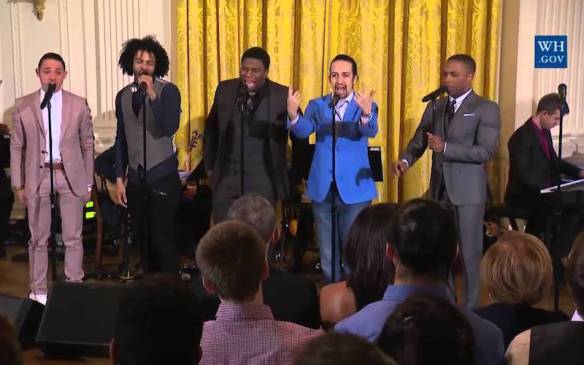
You Should Be Terrified That People Who Like “Hamilton” Run Our Country

maxresdefault

The American elite can’t get enough of a musical that flatters their political sensibilities and avoids discomforting truths.

By

Source: Current Affairs

In 2012, Captain Dan and his Scurvy Crew, a four-man hip-hop ensemble trying to cement “pirate rap” as a tenable subgenre, appeared on America’s Got Talent. The quartet had clearly put some thought, or at least effort, into the act; their pirate costumes might even have passed historical muster were it not for the leftmost crewmember’s Ray-Bans and Dan’s meticulously groomed chinstrap beard.

The routine itself went precisely in the direction one might have expected:

Captain Dan: When I say yo, you say ho. Yo!

Scurvy Crew: HO!

Captain Dan: YO!

Scurvy Crew: HO!

The group managed to rattle off two-and-a-half stilted lines before the judges began sounding their buzzers. Howard Stern was the last to give them the red “X,” preferring to let the audience’s boos come to a crescendo before he cut the Scurvy Crew off. Stern seemed to take great pleasure in calling the group “stupid,” “moronic,” “idiotic,” and “pathetic” on a national stage (Captain Dan grimaced through his humiliating dressing-down while his bandmates laughed it off, exposing a gap in emotional investment in the project between captain and crew, one that likely led to some intra-group tension during the post-show commiseration drinks).

Howie Mandel: They have restaurants like this—like Medieval Times—where you go and you get a pirates thing and you get a chicken dinner. We didn’t get a chicken dinner with this.

In 2012, everyone (save for Captain Dan himself, along with people whose tastes range from “music from video games” to “music about video games”) was in agreement that performing high-school-history-project rap in Colonial Williamsburg garb was culturally unconscionable. Right?

Wrong. The world in which we live now includes Hamilton, a wildly successful “hip-hop musical” about the first Secretary of the Treasury of the United States of America.

Now, perhaps the America’s Got Talent audience isn’t an accurate sample of the American population as a whole. Perhaps they actually thought “when I say yo, you say ho” was clever , but were directed to boo by an off-screen neon sign. Or perhaps something happened in the past four years that made everyone really stupid.

But what if the American public’s taste hasn’t devolved? What if Hamilton’s success is the result of something else altogether?

Brian Eno once said that the Velvet Underground’s debut album only sold a few thousand copies, but everyone who bought it started a band. The same principle likely applies to Hamilton: only a few thousand people could afford to see it, but everyone who did happened to work for a prominent New York/D.C. publication.

The media gushing over Hamilton has been downright torrential. “I am loath to tell people to mortgage their houses and lease their children to acquire tickets to a hit Broadway show,” wrote Ben Brantley of the New York Times. “But Hamilton… might just about be worth it.” The hyperbolic headlines poured forth unceasingly: “Is Hamilton the Musical the Most Addicting Album Ever?” Hamilton is the most important musical of our time.” Hamilton Haters Are Why We Can’t Have Nice Things.” The media then got high on their own supply, diagnosing all of America with a harrowing ailment called “Hamilton mania.” The work was “astonishing,” “sublime,” the “cultural event of our time.” Clarence Page of the Chicago Tribune said the musical was “even better than the hype.” Given the tenor of the hype, one can only imagine the pure, overpowering ecstasy that must comprise the Hamilton-viewing experience. The musical even somehow won a Pulitzer Prize this year, alongside Nicholas Kristof and that book by Ta-Nehisi Coates you bought but never read.

One of the publications to enter swooning raptures over Hamilton was BuzzFeed, which called it the smash musical “that everyone you know has been quoting for months.” (Literally nobody has ever quoted Hamilton in my presence.) BuzzFeed’s workplace obsession with the musical led to the birthing of the phrase “BuzzFeed Hamilton Slack.” That three-word monstrosity, incomprehensible to anyone outside the narrowest circle of listicle-churning media elites, describes a room on the corporate messaging platform “Slack” used exclusively by BuzzFeed employees to discuss Hamilton. J.R.R. Tolkien said that “cellar door” was the most beautiful phonetic phrase the English language could produce. “BuzzFeed Hamilton Slack,” by contrast, may be the most repellent arrangement of words in any tongue.

Those of us unfortunate enough not to work media jobs can never be privy to what goes on in a “BuzzFeed Hamilton Slack.” But the Twitter emissions of the Slack’s denizens suggest a swamp into which no man should tread. A tellingly ominous and thoroughly representative Tweet:

“When the Buzzfeed #Hamilton slack room has a heated debate about which Hogwarts houses the characters belong to” —@Arielle07

“Nerdcore” music (Wikipedia: “a genre of hip hop music characterized by themes and subject matter considered to be of general interest to nerds”) has always had trouble getting off the ground. The “first lady of nerdcore,” rapper MC Router (responsible for the song “Trekkie Pride”), never achieved the critical success for which she had seemed destined, instead ending up on the Dr. Phil show after an acrimonious dispute with her family over her unexpected conversion to Islam. Similarly, the YouTube series “Epic Rap Battles of History,” however numerous its subscribers may have been, has consistently been unjustly robbed of the Pulitzer. Now, finally, nerd rap has apparently found in Hamilton its own Sgt. Pepper, a lofty, expansive work that wins the hearts and minds of previously skeptical elite critics.

One should have no doubt that “expensively-staged nerdcore” is a perfectly accurate, even generous description of Hamilton. Doubters need only examine a brief lyrical snippet. Consider this, from “The Election of 1800”:

Madison: It’s a tie! …

Jefferson: It’s up to the delegates!…

Jefferson/Madison: It’s up to Hamilton!

Hamilton: Yo.

The people are asking to hear my voice ..

For the country is facing a difficult choice.

And if you were to ask me who I’d promote …

Jefferson has my vote.

Perhaps marginally less embarrassing than “when I say yo, you say ho.” But only ever so marginally.

One could question the fairness of appraising a musical before putting one’s self through its full three-hour theatrical experience. But if nobody could criticize Hamilton without having seen it, then nobody could criticize Hamilton. One of the strangest aspects of the whole “Hamiltonmania” public relations spectacle is that hardly anyone in the country has actually attended the musical to begin with. The show is exclusive to Broadway and has spent most of its run completely sold out, seemingly playing to an audience comprised entirely of people who write breathless BuzzFeed headlines. (Fortunately, when you can get off the waitlist it only costs $1,200 a ticket—so long as you can stand bad seats.) Hamilton is the “nationwide sensation” that only .001% of the nation has even witnessed.

There’s something revealing in the disjunction between Hamilton’s popularity in the world of online media and Hamilton’s popularity in the world of actual human persons. After all, here we have a cultural product whose appeal essentially consists of a broad coalition of the worst people in America: New York Times writers, 15-year-olds who aspire to answer the phone in Chuck Schumer’s office, people who want to get into steampunk but have a copper sensitivity, and “wonks.” Yet because a large fraction of these people are elite taste-makers, Hamilton becomes a topic of disproportionate interest, discussed at unendurable length in The New Yorker and Slate and The New York Times Magazine, yet totally inaccessible to anyone besides the writers and members of their close social networks. When The New Yorker writes about a book that nobody in America wants to read, at least they could theoretically go out and purchase it. But Hamilton theatergoing is solely the provenance of Hamilton thinkpiece-writers. The endless swirl of online Hamilton-buzz shows the comical extreme of cultural insularity in the New York and D.C. media. The “cultural event of our time” is totally unknown to nearly all who actually live in our time.

Given that Hamilton is essentially Captain Dan with an American Studies minor, one might wonder how it became so inordinately adored by the blathering class. How did a ten-million-dollar 8th Grade U.S. History skit become “the great work of art of the 21st century” (as the New Yorker’s Adam Gopnik says those in his circle have been calling it)?

To judge from the reviews, most of the appeal seems to rest with the forced diversity of its cast and the novelty concept of a “hip-hop musical.” Those who write about Hamilton often dwell primarily on its “groundbreaking” use of rap and its “bold” choice to cast an assemblage of black, Asian, and Latino actors as the Founding Fathers. Indeed, Hamilton exists more as a corporate HR department’s wet dream than as a biographical work.

The most obvious historical aberration is the portrayal of Washington and Jefferson as black men, a somewhat audacious choice given that both men are strongly associated with owning, and in the case of the latter, raping and impregnating slaves. Changing the races allows these men to appear far more sympathetic than they would otherwise be. Hamilton creator Lin-Manuel Miranda says he did this intentionally, to make the cast “look like America today,” and that having black actors play the roles “allow[s] you to leave whatever cultural baggage you have about the founding fathers at the door.” (“Cultural baggage” is an odd way of describing “feeling discomfort at warm portrayals of slaveowners.”) Thus Hamilton’s superficial diversity lets its almost entirely white audience feel good about watching it: no guilt for seeing dead white men in a positive light required. Now, The New York Times can delight in the novel incongruousness of “a Thomas Jefferson who swaggers like the Time’s Morris Day, sings like Cab Calloway and drawls like a Dirty South trap-rapper.” Indeed, it does take some getting used to, because the actual Thomas Jefferson raped slaves.

“Casting black and Latino actors as the founders effectively writes nonwhite people into the story, in ways that audiences have powerfully responded to,” said the New York Times. But fixing history makes it seem less objectionable than it actually was. We might call it a kind of, well, “blackwashing,” making something that was heinous seem somehow palatable by retroactively injecting diversity into it.

Besides, you don’t actually need to “write nonwhite people into the story.” As historians have pointed out, there were plenty of nonwhite people around at the time, people who already had fully-developed stories and identities. But none of these people appears in the play. As some have quietly noted, the vast majority of African American cast members simply portray nameless dancing founders in breeches and cravats, and “not a single enslaved or free person of color exists as a character in this play.” (Although Jefferson’s slave and mistress Sally Hemings gets a brief shout-out.)

Slavery is left out of the play almost completely. Historian Lyra Monteiro observes that “Unless one listens carefully to the lyrics—which do mention slavery a handful of times—one could easily assume that slavery did not exist in this world.” The foundation of the 18th century economic system, the vicious practice that defined the lives of countless black men and women, is confined to the odd lyrical flourish here and there.

Miranda did consider adding a slavery number. But he cut it from the show, as he explains:

There was a rap battle about slavery, where it was Hamilton and Jefferson and Madison knocking it from all sides of the issue. Jefferson being like, “Hey, I wrote about this, and no one wanted to touch it!” And Hamilton being very self-righteous, like, “You’re having an affair with one of your slaves!” And Madison hits him with a “You want to talk about affairs?” And in the end, no one does anything. Which is what happened in reality! So we realized we were bringing our show to a halt on something that none of them really did enough on.

Miranda found that by trying to write a song about his main characters’ attitudes toward slavery, he ran into the inconvenient fact that all of them willfully tolerated or participated in it. That made it difficult to square with the upbeat portrayals he was going for, and so slavery had to go. Besides, dwelling on it could “bring the show to a halt.” And as cast member Christopher Jackson, who plays George Washington, notes: ‘‘The Broadway audience doesn’t like to be preached to.” Who would want to spoil the fun?

Instead, Hamilton’s Hamilton is what Slate called simply “lovable—a product of the play’s humanizing focus on Hamilton’s vulnerabilities and ambitions.” The play avoids depicting his unabashed elitism and more repellent personal characteristics. And in the brief references that are made to slavery, the play even generously portrays Hamilton as far more committed to the cause of freedom than he actually was. In this way, Hamilton carefully makes sure its audience is neither challenged nor discomforted, and can leave the theater without having to confront any unpleasant truths.

Just as Hamilton ducks the question of slavery, much of the actual substance of Alexander Hamilton’s politics is ignored, in favor of a story that stresses his origins as a Horatio Alger immigrant and his rivalry with Aaron Burr. But while Hamilton may have favored opening America’s doors to immigration, he also proposed a degree of economic protectionism that would terrify today’s free market establishment.

Hamilton believed that free trade was never equal, and worried about the ability of European manufacturers (who got a head start on the Industrial Revolution) to sell goods at lower prices than their American counterparts. In Hamilton’s 1791 Report on Manufactures, he spoke of the harms to American industry that came with our reliance on products from overseas. The Report sheds light on many of the concerns Americans in the 21st century have about outsourcing, sweatshops, and the increasing trade deficit, albeit in a different context. Hamilton said that for the U.S., “constant and increasing necessity, on their part, for the commodities of Europe, and only a partial and occasional demand for their own, in return, could not but expose them to a state of impoverishment, compared with the opulence to which their political and natural advantages authorise them to aspire.” For Hamilton, the solution was high tariffs on imports of manufactured goods, and intensive government intervention in the economy. The prohibitive importation costs imposed by tariffs would allow newer American manufacturers to undersell Europe’s established industrial framework, leading to an increase in non-agricultural employment. As he wrote: “all the duties imposed on imported articles… wear a beneficent aspect towards the manufacturers of the country.”

Does any of this sound familiar? It certainly went unmentioned at the White House, where a custom performance of Hamilton was held for the Obamas. The livestreamed presidential Hamilton spectacular at one point featured Obama and Miranda performing historically-themed freestyle rap in the Rose Garden.

The Obamas have been supporters of Hamilton since its embryonic days as the “Hamilton Mixtape song cycle.” By the time the fully-fledged musical arrived in Washington, Michelle Obama called it the “best piece of art in any form that I have ever seen in my life,” raising disquieting questions about the level of cultural exposure offered in the Princeton undergraduate curriculum.

In introducing the White House performance, Barack Obama gave an effusive speech worthy of the BuzzFeed Hamilton Slack:

[Miranda] identified a quintessentially American story in the character of Hamilton — a striving immigrant who escaped poverty, made his way to the New World, climbed to the top by sheer force of will and pluck and determination… And in the Hamilton that Lin-Manuel and his incredible cast and crew bring to life — a man who is “just like his country, young, scrappy, and hungry” — we recognize the improbable story of America, and the spirit that has sustained our nation for over 240 years… In this telling, rap is the language of revolution. Hip-hop is the backbeat. … And with a cast as diverse as America itself, including the outstandingly talented women — (applause) — the show reminds us that this nation was built by more than just a few great men — and that it is an inheritance that belongs to all of us.

Strangely enough, President Obama failed to mention anything Alexander Hamilton actually did during his long career in American politics, perhaps because the Obama Administration’s unwavering support of free trade and the tariff-easing Trans-Pacific Partnership goes against everything Hamilton believed. Instead, Obama’s Hamilton speech stresses just two takeaways from the musical: that America is a place where the poor (through “sheer force of will” and little else) can rise to prominence, and that Hamilton has diversity in it. (Plus it contains hip-hop, an edgy, up-and-coming genre with only 37 years of mainstream exposure.)

The Obamas were not the only members of the political establishment to come down with a ghastly case of Hamiltonmania. Nearly every figure in D.C. has apparently been to see the show, in many cases being invited for a warm backstage schmooze with Miranda. Biden saw it. Mitt Romney saw it. The Bush daughters saw it. Rahm Emanuel saw it the day after the Chicago teachers’ strike over budget cuts and school closures. Hillary Clinton went to see the musical in the evening after having been interviewed by the FBI in the morning. The Clinton campaign has also been fundraising by hawking Hamilton tickets; for $100,000 you can watch a performance alongside Clinton herself.

Unsurprisingly, the New York Times reports that “conservatives were particularly smitten” with Hamilton. “Fabulous show,” tweeted Rupert Murdoch, calling it “historically accurate.” Obama concluded that “I’m pretty sure this is the only thing that Dick Cheney and I have agreed on—during my entire political career.” (That is, of course, false. Other points of agreement include drone strikes, Guantanamo, the NSA, and mass deportation.)

The conservative-liberal D.C. consensus on Hamilton makes perfect sense. The musical flatters both right and left sensibilities. Conservatives get to see their beloved Founding Fathers exonerated for their horrendous crimes, and liberals get to have nationalism packaged in a feel-good multicultural form. The more troubling questions about the country’s origins are instantly vanished, as an era built on racist forced labor is transformed into a colorful, culturally progressive, and politically unobjectionable extravaganza.

As the director of the Hamilton theater said, “It has liberated a lot of people who might feel ambivalent about the American experiment to feel patriotic.” “Ambivalence,” here, means being bothered by the country’s collective idol-worship of men who participated in the slave trade, one of the greatest crimes in human history. To be “liberated” from this means never having to think about it.

In that respect, Hamilton probably is the “musical of the Obama era,” as The New Yorker called it. Contemporary progressivism has come to mean papering over material inequality with representational diversity. The president will continue to expand the national security state at the same rate as his predecessor, but at least he will be black. Predatory lending will drain the wealth from African American communities, but the board of Goldman Sachs will have several black members. Inequality will be rampant and worsening, but the 1% will at least “look like America.” The actual racial injustices of our time will continue unabated, but the power structure will be diversified so that nobody feels quite so bad about it. Hamilton is simply this tendency’s cultural-historical equivalent; instead of worrying ourselves about the brutal origins of the American state, and the lasting economic effects of those early inequities, we can simply turn the Founding Fathers black and enjoy the show.

Kings George I and II of England could barely speak intelligible English and spent more time dealing with their own failed sons than ruling the Empire —but they gave patronage to Handel. Ludwig II of Bavaria was believed to be insane and went into debt compulsively building castles — but he gave patronage to Wagner. Barack Obama deported more immigrants than any other president and expanded the drone program in order to kill almost 3,500 people — but he gave patronage to a neoliberal nerdcore musical. God bless this great land.

Related Article:

 The Hardest Politics to Catch: Lin-Manuel Comes to Puerto Rico