3 Characteristics of a True Political Awakening

By Sigmund Fraud

Source: Waking Times

History is written by the winners, or so they say, but there is an agreed upon version of our story that is taught to us in school and reinforced in everyday life by the media and government propagandists. Coasting through life haphazardly believing in this standardized version of reality is a form of consciousness, a contemporary way of relating to a world where the individual is consumed by the group, and truth becomes evermore out of reach.

The typical level of political awareness in our society is fairly basic, simplified and incomplete, but it serves as a functional trap for the mind and the imagination, pigeon-holing individuals into a conformist. This psychological trap preys upon two basic human traits: conservatism and progressivism. And because these traits are biologically hardwired into the human psyche, they are exploited as a fissure to create disharmony and division amongst the public.

Many people only rise to a level of political consciousness which allows them to understand their predisposition to one or the other of these traits. Awareness often ends here, with extreme devotion to one side of the publicized political spectrum.

The truth is that human societies have always needed an even distribution of people with each of these ideological tendencies in order to achieve a balance between our need for external and internal control, protection and care. Political awakening involves rising above the prescribed psychology of division, into a position of appreciation of the qualities which unite us all.

This idea is enumerated in the following three characteristics of true political awakening.

Trust in the Statist System Collapses

To continue to trust and support a consistently abusive master is often referred to as Stockholm Syndrome. When a person experiences a true and deep political awakening, it is not longer possible to excuse any of the crushing affronts to human rights and human dignity that are intrinsic to state power.

State power is historically abusive. The manipulation of our money supply, endless wars, wasting of public resources, corruption, permitting the destruction of the natural world, terrorizing citizens with abusive police and punitive tax codes, and limiting prosperity with regulatory overkill are all standard operating procedure for the state.

In a statist world, the awakening individual is tasked with the challenge of seeing through all of this in order to free the mind and see the greater possibilities for freedom and cooperation in the human story.

So-Called Leaders Are Seen as Puppets of Division

Watching the pendulum of public opinion and discourse swing violently back and forth between the merits of two political parties is comical once you’ve recognized just how predictable and destructive it is. We are goaded into engaging in the divisiveness, encouraged by the rhetoric of the political establishment.

It is our unity they fear most. Falling into the trap of politically dogmatic ideological fortifications is more dangerous to our society than just about anything else, and the truly politically awake fly above the argumentative mentality of those who are trapped in the two-party paradigm.

The Recognition that Politics is Heavily Influenced by Powerful Forces

If politics is the arena of government, and government is clearly influenced by corporate interests, intelligence agencies and deep state operators, and supranational organizations, then it makes no sense to pretend that we have power in the political system.  It makes no sense to pretend as though politicians are acting in the true interest of actual people. It makes no sense to pretend that we can save ourselves by calling on members of the state to represent us in their corrupt scene.

It is commonly known that politicians are beholden to special interests, and while they never talk openly about this influence, so many people carry on with the charade that politicians can wield  power over these organization, for the benefit of the plebs. They cannot, for these forces are beyond their control. The politically awakened understand that the plots against humanity extend way beyond the political scene.

Final Thoughts

Unity is the one thing that any political elite has always feared the most. Without smashing down the perceived barriers in contemporary political consciousness we can only expect our society to become more fractured, chaotic and dangerous. Trust in that which deceives and harms us is simply not possible for the truly politically awakened.

Slaves and Bulldozers, Plutocrats and Widgets

By Kristine Mattis

Source: CounterPunch

There is not an industrial company on earth, not an institution of any kind – not mine, not yours, not anyone’s – that is sustainable. I stand convicted by me, myself alone, not by anyone else, as a plunderer of the earth. But not by our civilization’s definition. By our civilization’s definition, I’m a captain of industry and in the eyes of many, a kind of modern-day hero.

— Ray Anderson, (1934-2011) CEO of Interface, Inc.

We are living a collective illusion known as the civilized world. We feign concern for our horrendous conditions of poverty, socioeconomic inequality, deteriorating public health, and severe environmental degradation (to which climate change is merely one factor), but everything we do belies that distress. These issues comprise the largest risks to the survival of the human species, as well as the most significant amoral atrocities on the planet. Both individually and as a species, our health, safety, and ability the live a decent, dignified life have always been imperiled by these predicaments. Yet, we continue along with complete cognitive dissonance in that the crux of our lives – our jobs, our consumer culture – all contribute to, perpetuate, and exacerbate the unsustainable and morally reprehensible conditions of our existence. But while we are all marginally responsible for the multitude of calamities befalling us, the one group who bears the brunt of the blame for our social and ecological decay is the wealthy.

Have you looked around and seen just what humanity has done to our stunning Earth? We’ve bulldozed the beauty for bucks. Far too much of what was once a glorious paradise is now a complete disaster of unfathomable proportions. A disaster wholly of our own making. In America, and in most places around the world, from the moment we are born we are preparing for a future career, and  more specifically, for the lifelong goal of making money. But on the whole, most of the jobs we do end up being more detrimental than beneficial to society and the environment. We characterize work through measures of productivity, but producing more and more unnecessary, meaningless, and often useless products compromises our physical environment, which in turn, compromises the health of humans, other beings, and our entire planetary ecosystem.

So many of the things that form the basis of our civilization should not, and perhaps cannot, exist in a just and sustainable world. Items like arms and artillery, synthetic chemicalsconcentrated animal feeding operationsplasticsmartphones and other electronic gadgetrydo not feed a sustainable and equitable world but create more needless havoc. The irony, though, is that the very people who run the systems that incessantly construct and promulgate these harmful, redundant, or unnecessary products are the richest and most successful people on earth.

We define success in our society almost exclusively in terms of wealth, with its attendant power and sometimes, fame. Rich people are the recipients of adulation and reverence for nothing more than their accumulation of wealth and material products. We like to think that riches come by way of great intellect, talent, skill, and a strong work ethic, but in reality, monetary success is more a matter of inherited socioeconomic status, ambition, and determination, rather than ability and aptitude. Most of all, to achieve wealth means to have a myopic resolve, not only to look away from how the sausage is made, but to not care how the sausage is made.

The wealthy in our society then become the people with the most power and influence. While ironically, they are the people least deserving of our respect. They are the exact people whom we should look upon with the utmost skepticism and even disdain. They should not be in the position to make decisions about our collective lives and the workings of our society, because their financial success is completely antithetical to societal justice and sustainability.

It doesn’t take great acumen or diligence to make a lot of money; it takes a narrow-minded, insular, immoral, sometimes psychopathic view of life, in which personal pleasure and profit are the primary variables. It’s quite easy to do well financially and find personal satisfaction if the exploitation of humans, other animals, and the entire biosphere is left outside of the realm of your career consciousness. As Ray Anderson, CEO of Interface Carpet admitted,“For 21 yearsI never gave a thought to what we were taking from the earth or doing to the earth in the making of our products.” He built his fortune without consideration to the effects of his enterprise until someone brought the deleterious consequences to his attention.

We like to believe the cream rises to the top, but the truth is that the top is actually full of scum. We have seen in recent weeks, if we did not know already, that entertainment, politics, and indeed, all of the wealthiest industries are cesspools of moral depravity, especially at the apex.

There may be some exceptions, but scum is the rule. Some might call these people ambitious, some might call them razor-focused, others would call them sociopathic. It takes a careful regimen of willful  ignorance and/or denial to not consider all the harms that directly and indirectly result from avenues toward career achievements in the process of our normal lives – harms such as exploitation of labor, torture of animals, and toxic contamination and of food, water, and natural resources.

Material success requires rape and pillage, figuratively and literally. Donald Trump bragged that when you have the kind of wealth he has, you can treat women as objects and just “grab ’em by the pussy.” You can also exploit resources, exploit labor, befoul the environment, and endanger public health with few or no consequences. On a purely moral basis, only scum could have the hubris to consider others as mere playthings for their own enjoyment, to feel superior enough to warrant their extreme wealth which they did not earn but stole from the commons, and to believe that they deserve obscene riches when the majority of others do not even have basic life necessities.

How often have you heard the phrases “not that there is anything wrong with being rich,” or “I don’t begrudge him his wealth”? Wealth should be considered reprehensible. Wealth has always been in the hands of the few to the detriment of the many, and one’s access to it has always been almost wholly correlated with one’s socioeconomic status at birth. Yet we rationalize this immoral situation and pretend that the proverbial “pie,” of which we all need a slice, is infinite in size and that wealth is accessible to anyone. We assume that being rich is not only acceptable but aspirational. It is neither in a just and sustainable world.

On a finite planet every excess dollar, every excess material good, every extra home, car, garment, trinket, piece of food, or beverage that one person possesses essentially correlates to an item that another person does not have. When we normalize one person having more than he/she needs in a world where billions have far less than the bare minimum required to meet their basic needs, then we are obliged to rethink our morality. When a simple handbag can cost between $12K and $300K and we as a society see nothing wrong with that kind of excess in the face of poverty, hunger, homelessness, and disease, we are not only completely socially corrupt, we are spelling our own doom. Poverty only exists because excessive wealth exists and neither is compatible with a sustainable and humane civilization.

To achieve a sustainable world, we must relinquish our use of non-renewable resources, we must utilize renewable resources at a level in which they have the time and ability to replenish, and we must leave no waste that is not regenerative. To achieve an equitable world, we must relinquish our greed and desire for opulence, excess, and disproportionate influence. In fact, sustainability is also a function of equity. However, our current society is predicated on the antithesis of all such requirements.

Wealthy people gain their successes because they have tunnel vision. They are singularly focused on themselves, their careers, and/or on money. They do not take into consideration the externalities involved in their actions. They pay little mind to the exploitation involved in their pursuits. Ethics never supersedes ambition. Therefore, these are the exact people who should not be in charge of making policies for the benefit of society and should not be in charge of civic ventures. To be able to be so wealthy without shame, guilt, or acknowledgement that your own wealth impedes the lives of others is to be either ignorant or indifferent. We are facing global ecological and economic collapse. Who made this happen? The wealthiest people of the world. If you are rich you do not have the solution. You are the problem.

The world is run on slave labor, indentured servitude, animal and natural resource exploitation, and endless generation of waste and contamination. Material success comes with adopting a shortsighted view of the world – closing yourself off to your own connection to global anthropogenic climate change, toxification, and inequality.

So many of the wealthy who consider themselves socially and environmentally aware perceive no connection between their own wealth accumulation and the causes they claim to champion. Instead of curtailing their materialism, they rationalize it. Instead of acknowledging that their consumerism intensifies global resource extraction, they produce more products (often erroneously labeled “green”) to sustain their riches. When the wealthy are not hawking products for their for-profit activities, they have the audacity to solicit for charitable organizations that are only necessitated by the economic system that produces poverty and environmental devastation in the wake of their extravagant wealth. They ask donations from the majority of citizens who are barely making ends meet, when they themselves could surrender probably 90% of their accumulated wealth and not notice a marked change in their material status whatsoever. The elites who are not in denial about the problems we face want scientific and technological solutions – solutions that they can throw their money at and have others solve so they do not have to think about their own contribution to the problems.

But there are no silver bullets to end inequality and environmental destruction, while continuing with business as usual in civilized society. Science cannot save us. Scientific research itself relies on the same unsustainable production, consumption, use of resources, and waste as every other industry.

Technology mavens always tout the great social or biological service that their new technology will provide. Their innovations comes under the guise of helping the world, but the majority of the time, their creations are frivolous and do not do much more than use natural resources, create waste, and earn them exorbitant profit. At the university where I earned my doctoral degree there is a masters program in biotechnology and there’s a reason why their curriculum extends beyond just science, containing at least two required business courses. Of course, business is fundamental to their instruction because the principle purpose of our education, of our careers, is profit.

All of the harmful products and practices in our civilization – military arms, sweatshops, low wages, pesticides, plastics, throw-away items, excess of products, animal cruelty, overuse of medicine and surgery – only exist to increase revenue for the rich. None are fair or just or equitable or sustainable. Our societal justification of the above items just marks our collective delusion. These products and practices persist in the name of profit, and we rationalize their continuation just as we rationalize extravagant wealth.

When Senator Bernie Sanders was on TV decrying President Barack Obama’s half-million dollar speaking engagements on Wall Street, the anchors of the program said to him, “Wouldn’t you do it if you could?” Bernie replied, “I wouldn’t be asked.” Rather, he should have explained that anyone with integrity would not accept money they do not need for some sort of quid pro quo from a destructive and corrupt institution. The hosts of the show surmised that everyone would jump at the opportunity to earn money if they had the chance. It is precisely that sort of mindset that enables these broadcasters to inhabit their influential positions on a national television program and to earn millions of dollars. They demonstrate what unethical opportunists they, and most of the rich, actually are. Their lack of ethics is internalized and taken for granted by not only them, but most of the rest of our society. They are more than willing to be bought at whatever price for whatever service. “Just doing my job” does not serve as an excuse for immorality.

Nevertheless, there are people who have chosen lives based on conviction rather than money. Former Uruguayan President Jose Mujica and Seattle City Council member Kashama Sawant chose to earn the local average income for their official positions and donate the remainder of their salaries toward social justice work. Biologist and writer Sandra Steingraber donated a portion of her $100K Heinz Award prize toward the fight against hydraulic fracturing (fracking) rather than spend it on personal treats. Likewise, teacher Jesse Hagopian donated his $100K settlement for being unjustly attacked with pepper-spray by Seattle police toward social justice action. Not everyone is looking to cash in, and not everyone is seeking the next, biggest profit-making endeavor.

Living with integrity and simplicity is difficult. People do not choose to live this way because their personal sacrifice will change the world. They do so because it is the right thing to do. They do so because having too much means others don’t have enough. They do so because living by example allows others who care to see that a life of wealth and consumerism augments inequality and unsustainability; it is not the only way to live and need not be. They live this way because only by walking the walk rather than talking the talk will we ever start to achieve justice and sustainability to help preserve the future of our species.

In recent years there have been waves and wave of protests throughout the country and the world in response to myriad societal maladies. The best protest we can do in America now is to reject the bourgeois life – reject excessive wealth and the material components that come with it, reject profligate consumption, reject consumerism, reject wasteful holidays, reject wasteful trinkets,  reject all that is incompatible with what we purport to champion. For example, retired talk-show host David Letterman appears sincere in his dedication toward helping combat climate change, while at the same time, he remains co-owner of an auto racing team. In the world in which we currently live, auto racing is completely incongruent with climate change mitigation. We can’t pretend to value matters like justice and sustainability unless the way we live upholds those values. We can’t decouple our livelihoods from our lives.

The rich tend to ensconce themselves in their well-manicured communities, shop with abandon, and disregard the abject poverty, environmental degradation, and injustices all around them. They are in the process of spending small portions of their vast fortunes building survival bunkers to withstand either the revolutionary upheaval that may soon come as a result of immeasurable socioeconomic inequality, or the catastrophic ecological collapse that may result from reckless resource extraction and expenditure. How misguided or cynical are they to not realize that by renouncing their extreme wealth, they would need no such provisions and could play a large part in salvaging our civilization?

Need I even explain how the current tax scam pending on Capitol Hill will serve to enhance all of the socioeconomic, environmental, and public health calamities that are arising ever more rapidly and in quick succession? Need I elaborate on how our escalating climate-related weather catastrophes only reach the cataclysmic proportions they do because of the wealth disparities involved and because of the high-risk industrial components therein, that exist mainly to enrich the elite? Would these natural disasters be so disastrous if more people had the economic resilience that they deserve and if society took more precaution against the hazards of multibillion-dollar industries that manufacture products of questionable value while generating tremendous wealth to a select few?

We live n a time of unprecedented social disarray, ecological disrepair, public health decay, and moral depravity. Nearly every aspect of the way we live in modern industrial societies is completely unsustainable. Even if we were to transition to 100% solar energy tomorrow throughout the planet, the worst effects of climate change might be averted, but the plastic pollution that permeates the most far-reaching depths of the oceans would still remain, the persistent organic pollutants (POPs) and endocrine disrupting compounds (EDCs) that harm our own health and the health of the entire global ecosystem remain. Not only do they remain, but they continue to be produced, not out of necessity, but for the financial profit of the privileged few. The production of, consumption of, and waste stream from our global industrial society continues unabated. This is the system that forms the foundation of all of our lives in the civilized world, and this is the system that bestows excessive wealth to some while leaving others fighting for survival.

While it is indeed the system of capitalism that generates and sustains our societal injustice and ecological degradation, the system is comprised of people – people who could abdicate their fictional obligation to happiness via indefinitely-increasing earnings, people who can choose better, Without a preponderance of such people, no countervailing just and sustainable system can ever compete.

In 1964, Uruguayan journalist Eduardo Galeano interviewed the famous Argentinean hero of the Cuban revolution Ernesto “Che” Guevara. In the midst of a comprehensive conversation, Che stated to Galeano, ” I don’t want every Cuban to wish he were a Rockefeller.” To be sure, if we are remotely interested in a sustainable and equitable world, the attainment of wealth must be transformed from admirable to contemptible. With regard to the multitude of obstacles we face, Ralph Nader once wrote “only the super-rich can save us.” He’s right. They can save us by not existing.

Saturday Matinee: 97% Owned

From TopDocumentaryFilms.com

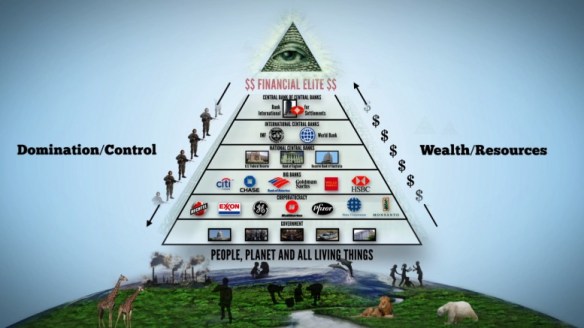
97% owned present serious research and verifiable evidence on our economic and financial system. This is the first documentary to tackle this issue from a UK-perspective and explains the inner workings of Central Banks and the Money creation process.

When money drives almost all activity on the planet, it’s essential that we understand it. Yet simple questions often get overlooked, questions like; where does money come from? Who creates it? Who decides how it gets used? And what does this mean for the millions of ordinary people who suffer when the monetary, and financial system, breaks down?

Political philosopher John Gray, commented, “We’re not moving to a world in which crises will never happen or will happen less and less. We are in a world in which they happen several times during a given human lifetime and I think that will continue to be the case.”

If you have decided that crisis as a result of the monetary system is not an event you want to keep revisiting in your life-time then this documentary will equip you with the knowledge you need, what you do with it is up to you.

3 Questions You’re Not Supposed to Ask About Life in a Sick Society

By Sigmund Fraud

Source: Waking Times

“It is no measure of health to be well adjusted to a profoundly sick society.” ~J. Krishnamurti

Society is directed by a never-ending mainstream narrative which is always evolving, and always reaching new dramatic peaks in sensationalism and hype. They fill your mind with topics they select, they keep your attention on these topics, and they invite and encourage you to argue amongst each other about these topics. In this way our collective attention is permanently commandeered, preventing us from diving too deeply into matters which have more than a superficial impact on day-today life.

Free-thinking is the ability and willingness to explore of ideas and areas of the mind which are yet undiscovered or are off-limits. It is a vanishing art that is deliberately being stamped out by a control system which demands conformity, acquiescence and obedience of body, mind, and spirit.

For your consideration, here are three questions you’re not supposed to ask about life in our profoundly sick society.

1. Who owns the money supply, and the world’s debt?

Pretty much the entire world is in financial debt, an insidious form of slavery which enables the exploitation of human beings and of all things in nature. It’s maddening when you think about it. The United States alone supposedly owes some $20 trillion, while the world at large owes a shocking $215 trillion?

But to whom, precisely?

Money is just a medium of exchange which facilitates transactions between people. In and of itself it has no intrinsic value as we could just as easily use sea shells instead of dollar bills and still be able to get things done. But today’s money is the property of private third-parties who rent it out to national governments, who then use the labor of their citizens as collateral against these loans. This is a highly refined form of slavery, which has already put future unborn generations of human beings in debt.

But who, exactly does the human race owe? Who are our debt-slave masters?

2. Who owns your body?

Ownership means having the explicit right to use, control and dispose of something in the manner of your choosing. The one thing you are born with that you take with you to your death is your own body, but do you own it? If not you, then who does own your body?

If this question were already settled in our society then there wouldn’t be ever-increasing pressure on those who choose to refuse vaccines. Children battling cancer and other serious illnesses wouldn’t be forced to take chemo and radiation under penalty of law and under threat of being taken from their parents. Water wouldn’t be fluoridated without our consent. Natural medicines wouldn’t be outlawed under threat of fines and prison time.

We are rapidly approaching a time when people will be required by law to take psychotropic medications as citizens were in Aldous Huxley’s dystopian classic, Brave New World.

Do you own your body, or does it belong to the state?


On the Process of Awakening

lifestyle

By Charles Hugh Smith

Source: Of Two Minds

We cannot help but feel a hunger for authenticity, honesty, spiritual solace and human connection, but these are precisely what is scarce in our social and economic structure.

There is a tremendous amount of pain in our society. There are many sources of this pain: the emotional desertification of dysfunctional families, the knowledge that we don’t fit in and never will, a widening disconnect between the narratives we’re told are true and our experience, and a social and economic structure that tosses many of us on the trash heap.

The lifestyle we’re told we need to be happy is unattainable to many, and disconcertingly unsatisfactory to the top 10% who reach it.

We cannot help but feel a hunger for authenticity, honesty, spiritual solace and human connection, but these are precisely what is scarce in our social and economic structure.

The process of awakening has many paths. For some, the path starts with the incoherence of official explanations and narratives. For others, it’s the inner search for truth via psychotherapy or spiritual practice.

For some, it’s an investigation into the way our economic and political hierarchy function. For others, art is the starting point: a film, a novel, a comic, a song.

For many of us, it begins with this simple but devastating realization: I don’t fit in. I don’t fit in, have never fit in and never will fit in. I play along because it’s easier on me and everyone I interact with to do so, and I value my independence which means I have to find a way to support myself. That is difficult, as what I like to do has little to no value in our economy.

What interests me is how the epidemic of pain and alienation that characterizes our society is the direct result of how our economy and social order is structured. Incoherence, self-destruction, pain and alienation are the only possible outputs of the system we inhabit.

I have explored this dynamic in my books, starting with Survival+ in 2009 and working forward to my latest book, Why Our Status Quo Failed and Is Beyond Reform. (My other books are: A Radically Beneficial World: Automation, Technology and Creating Jobs for All; Get a Job, Build a Real Career and Defy a Bewildering Economy; The Nearly Free University and the Emerging Economy: The Revolution in Higher Education; Resistance, Revolution, Liberation: A Model for Positive Change; Why Things Are Falling Apart and What We Can Do About It and An Unconventional Guide to Investing in Troubled Times.)

I recently had an amazing free-form 1:50 hour conversation on these topics with New Zealand talk-show host Vinny Eastwood. Any conversation that stretches from the erosion of community to loneliness to Daniel Ellsberg to Marx to Taoism to alienation to Michelangelo Antonioni and on to the process of awakening is amazing in my view.

Here’s Vinny’s page with listening/viewing/downloading options, and the program on Youtube (please ignore my goofy expressions): The magic of bitcoin and cryptocurrencies (1:49:54)

My conclusion may strike many as radical, but to me it is self-evident: the primary source of the rot, insecurity, inequality and alienation of our society is the way we create and distribute money, which is the conduit for creating and distributing political power.

I explain why this is so in my books A Radically Beneficial World: Automation, Technology and Creating Jobs for All and Why Our Status Quo Failed and Is Beyond Reform.

If we don’t change the way money is created and distributed, we change nothing. Money = power. If we don’t devise a form of money that is beyond the reach of central banks and states, all “reform” is just window-dressing, simulacra of “change” that simply solidifies the system’s bogus claim of being reformable.

Cryptocurrencies are in their infancy. There will be many more iterations of Cryptocurrencies beyond bitcoin and Ethereum; recall that bitcoin went public in 2009.

There are security challenges with cryptocurrencies, and the potential for central-state meddling via backdoors in computer operating systems. But once we understand that community and the potential for a less toxic society and economy are crippled by the centralized structure of the state and its money, then there is no way forward but to develop structures of money, work, community, purpose and meaning that are outside the direct control of the state and central bank.

This sort of “crazy talk” is unwelcome. As I noted earlier this week on my chart of the Ministry of Propaganda, in the status quo, skepticism is always a conspiracy or a hoax.

So instead we consider an exploding opiate epidemic, an epidemic of obesity and metabolic illnesses, a discourse of inchoate rage and a Grand Canyon-sized gap between what we’re told is true and what we experience as true “normal.” These things are not normal; they are manifestations of a system that can only generate one output: self-destruction.

We Don’t Need A Government, We Need A Purpose

psychedelic-trippy-abstract-art-poster-soul-universe-time-cameron-gray-font-b-spiritual-b-font-art

By Lance Schuttler

Source: The Mind Unleashed

What truly motivates a person? Years ago I would have answered, “well, money of course. Money helps to to be able to pay for our food, shelter, some entertainment and allows us to (sometimes) further our education.”

While that answer is true in ways, today I would take it further and say that a purpose is what motivates us. It is not that money itself it motivating for us, but it is the security money can provide by allowing us to pay for our basic needs like food, shelter and clothing.

From our childhood, we have been conditioned to believe that it is necessary to have money and the institutions that direct the flow of money to the greater populace. However, if we analyze that deep enough, we see that it is a fact that such a means of rationing resources (which money does) and the institutions that control the rationing are not necessary, but are by choice.

Sure, in some ways government has served it’s purpose. It has allowed us to build an infrastructure on this planet where we can travel pretty much wherever we would like. It has also built schools, hospitals and allowed for the creation of all sorts of public services as well as public entertainment. However, what is important to remember is that it wasn’t governments who built these things. It was people. People made the choice each and every morning to wake up and go to their job to help create whatever it was they were working on.

Though money was almost certainly and incentive for many of these people, I believe that we human beings have an innate desire to help serve a greater cause. Perhaps for many of these people, an additional incentive for doing their work was that they knew on a deeper level, that this was in some way, big or small, to allow our civilization to develop and grow in a positive direction.

In today’s world, with the internet, 3-D printing and the ability to harness unlimited energy for the entire world in the forms of solar, wind, tidal and geothermal, not to mention the numerous patented “free energy” devices which are currently suppressed, the need for money and government has passed us. We no longer need money as a way to ration resources when we have the technology to create unlimited abundance for everyone on the planet. With no longer needing money, we no longer need a system such as governance who acts as the hub of rationing these resources through the means of money. 

While I do not think that immediately stopping the usage of money and governance simultaneously around the world would be a wise or even positive decision in the short-term, I do believe that we could easily begin the process of scaling these back tremendously with the intention of completely ridding them of our reality. 

It is no secret that many people today do not like their jobs or the work they do. However, people realize that the money that is paid to them allows them to pay for a place to live and for food to eat, which in turn allows them to continue their life. In a very real way, many people are working a job they couldn’t care less about, just in order to stay alive. Some say, “well, that’s life. Get used to it.” Or, “You have to work. Stop complaining.”

I say, “with the technology we have today that could easily provide abundance in all forms for every person on this planet, it is counter-productive to use our time doing things we do not enjoy doing.” If you knew that if we as a planet really want to, we can cleanly power the entire world, which will allow us to grow the food and resources needed to feed, house and clothe everyone. This in turn will allow the basic needs of everyone to be met. From there, we will stop doing the work we’ve been doing to earn the money, which in turns allows us to pay for our basic needs.

At that point, we will start doing things that are passionate about. We will move away from the need of a government and move into finding what is of purpose for us. Perhaps at that point we can move from competition to cooperation. We can begin to heal ourselves, our family and friends. We can then begin to heal our pets, the water and land of the Earth. We can create a truly peaceful paradise.

For those arguing, “this sounds like communism,” I say, “this has nothing to do with politics or money and is several levels evolved past such barbaric methods.” Remember, communism is a political system who also has been enslaved via the monetary system, just as every other political system has been, whether that is capitalism, feudalism, communism or fascism.

Again, powering, feeding, clothing and housing the entire world has nothing to do with politics. It does, however, have everything to do with the human spirit and the deservability that each person naturally has. Remember, we are human beings living on a planet that is flying through our solar system, who receives it’s warmth from a massive ball of gas known as the Sun. We are human beings. We are each a miracle. This planet’s existence is a miracle. We needn’t do a thing but simply exist to deserve the abundance this Earth can and one day will easily provide to all of us.

With that, I ask you: What is it that you can do, whether as a “job” or as a hobby that allows you feel a sense of purpose? What do you get passionate about? Maybe you are already in your purpose.

I do believe strongly that with the advancements we have made and continue to make technologically, but most importantly emotionally/spiritually, we are beginning the transition away from a monetary world and into a world where abundance, peace and purpose are the norm. What can you do to help add to this momentum?

The Reason You Work So Hard to Participate in the Rat Race

6a01116888abb7970c01a3fd366b75970b-800wi-800x425

By M.J. Higby

Source: Waking Times

Ralph Waldo Emerson once said, “A man in debt is so far a slave.” Money has no intrinsic value yet we spend our days damaging our health and spirit in order to obtain it. Why do we sacrifice our well-being for it? Is it the cliché that “we just want to provide a better life for our kids than we had?” Is it just way of the civilized world? The most important question to ask, however, is what power do we have to change this way of thinking and living? The reality is simple: money is a vehicle for social control. Debt makes us good, obedient workers and citizens.

The traditional workweek started in 1908 at The New England Cotton Mill in order to allow followers of the Jewish religion to adhere to Sabbath.  With the passage of The Fair Labor Standards Act in 1938, the 40-hour workweek became the norm. Data from the 2013 American Community Survey showed that the average commute time in America is about 26 minutes each way. According to a Gallup poll, the average workweek in America is 34.4 hours, however, when only taking into account full time workers, that average shoots up to 47, or 9.4 hours per day during a 5-day workweek. Keeping averages in mind then, between commuting, working and figuring in an hour for lunch (usually less), that puts us at approximately 11 hours and 40 minutes for the average full time worker. If you have a family with young kids, just add in another few hours for homework, baths, etc.

When the day is done, how much time do you have for yourself? To exercise, meditate or otherwise unwind the way that all the healthy living gurus preach? And how much of yourself, your presence of mind, is left to devote to family? We give the company the heat of our most intense mental fire while our families get the smoke. Yet Jeb Bush, the 2016 GOP presidential hopeful, says we need to work more.

The answer to why we put ourselves through this daily grind is multifaceted. The most pervasive reason is workplace and societal pressures. We are raised in a matrix of sorts. The cycle starts around the age of five when we are expected to adhere to a regimented 8-hour day of school. At this age, we don’t have the intellect to question why, so we mechanistically follow the path that’s laid out. This daily path becomes engraved in our minds and becomes as automatic as the sun’s daily journey. Our school system is adept at churning out working class individuals en masse.  We are taught along the way not to question authority, again adhering to the working class mentality.

On the opposite end of the spectrum are those in power. They are the ones that like to color outside the lines. Many books abound with titles such as The Wisdom of Psychopaths that illustrate how people with psychopathic traits, ones who don’t tend to follow rules, are often found in managerial roles such as CEOs all the way up to presidents of countries. With these rare manipulative, coldhearted personalities in place and the rest of us following like good sheeple without questioning, the stage is set for compliance.

If you have been in the working world long enough, then the following statement should ring true: if you work extra hours, you are a great worker; if you decline, you’re useless and apathetic. In the work world, there’s typically no in between. The pressure to succeed for the pride and benefit of the company unfortunately supersedes that of the pressure to be a good parent, sibling, son or daughter. According to a study done by the economic policy institute, between 1948 and 2013, productivity has grown 240% while income for non-managerial workers has grown by 108%. To make up for this discordance, pride of doing what’s best for the company has been employed as a motivational tactic. This tactic has been used as a sharp IV needle that’s been inserted into our veins and we have willingly ingested the contents that are injected through it. Pressure to conform toward achieving the company’s goals has overcome our will to be compensated accordingly.

The other side of this pressure comes from society as a whole outside the education/workplace. A close friend of mine works for a state court and makes about $40K/year. He is also a self-employed business owner on the off hours. I estimate that he works about 70-80 hours a week. He owns a home in a well-to do neighborhood and he drives a seventy thousand dollar luxury car. This crystallizes the saying ‘big hat, no cattle.’ But when a lie is told over and over, the lie becomes the truth.

When we look at someone who drives a luxury car and lives in an upscale part of town, we see this as success because of how often that visual of it has been pounded tirelessly into our minds. We fail to see that these are nothing but symbols of success and false ones at that. They appear real because as a society, we have been conditioned to see them this way by the advertising industry. In the book, The Millionaire Next Door, the authors annihilate this illusion. Numbers don’t lie and the statistics show that most true millionaires, those with a net worth of over one million dollars, do not own those luxuries that we typically associate with success and wealth. They view them as the reality of what they are: a depreciating liability. According to the book, the typical millionaire owns a home in the two to three hundred thousand dollar-range and a non-luxury automobile. If something goes wrong with either, they have the cash reserves to fix it. On the other hand, the commonplace owner of the luxury home and car can’t afford the roof and the tires respectively without going deeper into debt if they should need replacing.

Ownership of these symbols of wealth becomes a self-perpetuating illusion to satisfy the psychological need for acceptance. Unfortunately, human behavior dictates that emotional needs often override logical thinking. It’s been said that the borrower is slave to the debt-owner and with luxury items, debt is the rule, not the exception. Debt is healthy for those in power and contributes to a needy and thus obligated worker.

The current wisdom of slave, spend and save for retirement has only one destiny. That destiny can be summed up in three sentences. Spend your healthiest and most productive years working to support a life of materials and thus illusions of success while elevated stress damage your health. During this time, be sure to save enough money for retirement so you can enjoy those years of the subsequent poor health. And lastly, do it in the name of pride for your company and country.

I take pride in being American, as I’m sure most Americans do, however, if you’re reading this you’re likely smart enough to see the holes in the daily grind. It saps our creative potential and our physical, as well as our spiritual energy. We don’t need any studies to tell us how stressed we are and subsequently, how unhealthy we are. The physical manifestations of stress such as obesity, hypertension, heart disease, increased risk of cancer, depression, anxiety and many others tell us all we need to know. They tell us that we need a better work/life balance. They tell us that the pendulum has swung too much in the direction of work and away from life. Fortunately, there’s a way that we can take it back.

The most important way to restore this balance is to realize the power that we, as consumers, hold. Tyler Durden, the protagonist in the film, Fight Club said it best…

“…advertising has us chasing cars and clothes, working jobs we hate so we can buy shit we don’t need.”

The marketing and advertising industry know, more than anyone else, what motivates the human mind and how to tap into those instinctual drives. To defend against this industries seductiveness, we need to journey within ourselves and bring to light what’s really important to us. What most of us will find is that experiences and time well spent, not materials, are what makes us happy. In the book, aptly titled Well Being, the authors Tom Rath and Jim Harter discuss how experiences have been proven to make us happier than material posessions.

We revel in the anticipation of the experience, we enjoy the experience itself and we look back on it fondly for as long as we live. We do this while the expensive car or house that we borrowed money long ago to obtain falls apart causing us to borrow more money. If we live according to the rule that everything we purchase, with the exception of a home, is acquired by cash, then we fail to become slaves to debt and by extension, work. We no longer relinquish our power to creditors.

Oscar Wilde was famously quoted as saying that anyone who lives within their means suffers from a lack of imagination. Materialistically speaking, living by this notion will bind us with shackles to a life of debt servitude. When we rip those shackles of debt from our wrists, our minds become clear and we see what truly makes us happy. We spend more time with friends and family. We focus on our passions and hobbies. In essence, we get back to the foundation of what it means to be human. After all, none of us will ever arrive upon the mountain of our last moments of existence wishing we spent more time at the office. We will instead arrive wishing we completed that book, that painting or that experience with those we love most. For those can be purchased not with debt, but with time. And there is no more cunning, covert and deceitful thief of time as that villain we call debt.


About the Author

M.J. Higby practices medicine in Phoenix, AZ. He is passionate about martial arts, most notably Brazilian Jiu Jitsu. He enjoys writing about mental, spiritual and physical well being and questioning the methods by which we attain it. You can reach him on Facebook and Twitter @MJHigby

The true value of money

index

Economics needs a revolution.

By David Orrell

Source: Adbusters

This sentiment has been expressed by people from the physicist turned hedge-fund manager Jean-Philippe Bouchaud (in a 2008 paper), to the Bank of England’s Andrew Haldane (in a 2014 foreword for Manchester’s student-run Post-Crash Economics), to activist groups such as Kick It Over. So what would such a revolution look like?

Perhaps the archetypal model for a scientific revolution is the quantum revolution that shocked the world at the turn of the last century. In the space of a few short years, almost everything that was known about the nature of matter was overturned. The Newtonian view of the world as a predictable machine crumbled with it.

Except, that is, in economics – which continues to base its models on quasi-Newtonian economic laws.

A peculiar feature of orthodox economics is that money is treated as an inert medium of exchange, with no special properties of its own. As a result, money is largely excluded from macroeconomic models, which is one reason the financial crisis of 2007/8 was not predicted (it involved money). In many respects, when viewed through the lens of quantum physics, money behaves a lot like matter – and acknowledging that behavior promises to do to economics what quanta did for physics.

The main insight of quantum physics is that matter is composed of entities which behave in some ways as waves and in other ways as particles. This novel insight countered the Newtonian view that billiard ball-like atoms behaved independently of each other. A beam of light, for example, is an electromagnetic wave but it is also a stream of particles known as photons. At a quantum level, matter is fundamentally dualistic: neither the particle nor the wave description is complete by itself.

The same can be said of money, which turns out to have quantum properties of its own. Money is strange stuff, when you think about it – but because it has been around for millennia we rarely do. Consider for example a U.S. dollar bill. On the one hand it represents a number – in this case the number one. On the other hand it is a physical thing which can be possessed, exchanged and above all valued (even lusted after, if there are enough of them). It therefore lives partly in the abstract world of numbers and mathematics and partly in the real world of things, people and value.

The same is true of any money object that we use for payment. Here “object” could refer either to a physical object – such as a coin – or a virtual object, such as 1.2107 bitcoin (BTC) sent from a phone. What makes such objects special is that they have a fixed, defined value in currency units.

While seeing money objects as things with a fixed monetary value might appear trivial, it turns out to have complex and contradictory properties that feed into the economy as a whole. In particular, they combine two aspects, abstract number and real world value, which are as different as waves and particles.

For example numbers are subject to mathematical laws – such as compound interest – and can grow without limits, while in the real world natural processes tend to be subject to bounds. In 1850 an American lawyer did the math and calculated that five English pennies invested at 5 percent compound interest since 0 AD would have accumulated to 32 billion spheres of pure gold, each equal in size to the Earth. This is a useful exercise for anyone who thinks that gross domestic product (GDP) can grow forever.

Numbers can be negative, as in debts, but (as the English physicist-turned-economist Frederick Soddy pointed out) there is no such thing as a negative number of objects. You might be underwater on your mortgage but you can’t own a negative house. Throughout history the frightening ability of negative debt to grow without bounds has been responsible for forcing people into economic slavery.

Numbers are hard and precise, like the particle aspect of matter. Real-world concepts such as value are diffuse and fuzzy, like the wave aspect of matter. By combining these two aspects in a single package, money objects are our contribution to the quantum universe.

The dualistic nature of money explains its frequently paradoxical behavior. In the early 2000s, cheap credit in the United States meant that even low-income people could afford their own homes. Some cashed in and sold their houses at the top of the market. For them the money was real – they could go to the bank and withdraw dollar bills. But when the credit crunch kicked in most of the new money disappeared into the ether, as if it had never existed. Money seemed to be both real and unreal at the same time – a sensation familiar to anyone who has studied quantum physics.

Just as quantum physics overturned Newtonian physics, so a reexamination of money promises to disrupt economics. The reason that critics are calling for fundamental change is that neoclassical economics has failed to provide answers to problems such as wealth inequality, financial crises and environmental degradation – which is unsurprising if it treats money as nothing more than an inert, Newtonian medium of exchange. The tendency of money to clump and accumulate with a small group of creditors, or for financial markets to be inherently unstable, or for GDP growth to be valued over the environment, becomes clearer when we acknowledge the vital, active role of money and the tension and discrepancy between numbers and the real world that drives it.

Of course, one should not underestimate the resistance of economists to adopting new ideas, however the worldwide student movement calling for change is unlikely to go away. Economics is primed for a quantum revolution of its own.

— David Orrell is a mathematician and author. His latest book, Truth or Beauty: Science and The Quest for Order, explores the role of aesthetics in science. He is currently working on a book about money.