Spaciousness: How to Free Your Mind and Stop Living Reactively

By Jordan Bates

Source: High Existence

“Between stimulus and response there is a space. In that space is our power to choose our response. In our response lies our growth and our freedom.”

— Viktor Frankl

‘Spaciousness’ is a Buddhist concept that has been profoundly useful and liberating for me.

Perhaps it will prove nourishing for you as well.

Spaciousness feels like having more space in your mind. 

It feels like widening the space between stimulus and response, such that you can stop living in reaction and begin responding skillfully to reality.


David Chapman on Spacious Freedom

A couple years ago while perusing David Chapman’s remarkable work, I happened upon an intriguing post on ‘Spacious Freedom.’ [1]

Reading it, I was struck by the clarity and conciseness with which David articulated the powerfully liberating Buddhist concept of ‘spaciousness.’

The post was one of the most concentrated doses of wisdom I’ve ever absorbed, and I’d like to share its essence with you.

I’ll let David take over:

“‘Spaciousness’ is freedom from fixed meanings. Spaciousness liberates you from automatic interpretations, and from habitual responses.

Lacking spaciousness, here is the pattern of life:

  1. Something happens
  2. You perceive the event
  3. You immediately interpret it, based on some familiar framework of meaning-making
  4. An emotion arises in response to the meaning you have given
  5. The energy of the emotion demands action
  6. You do something that seems mandatory based on the emotional interpretation

This is unnecessarily limited at steps 3 and 6:

  • There may be other ways to interpret the event. And it may not be helpful to interpret it at all.
  • There may be other ways to react to the emotional energy. And it may not be helpful to react at all.

Spaciousness is an attitude: the willingness to suspend the process of meaning-making. Spaciousness is the willingness to allow unknowing, uncertainty, confusion, ambiguity, meaninglessness.

Spaciousness values astonishment, perplexity, and groundlessness. Spaciousness gives experience a quality of freshness: every situation appears unique, not merely as another instance of a familiar category.”

Spaciousness is closely related to cultivating a Beginner’s Mind: a mind that is wide open, non-rigid, non-dogmatic, ready to receive the raw, vivid reality of each moment without immediately judging, filtering, and categorizing it based on preexisting beliefs.

Non-reactive spacious awareness is freedom. The experience of gaining spaciousness is the experience of increasingly feeling that you can choose how to interpret events and choose how to respond to emotional energy, rather than being a slave to habitual patterns.

It is not easy to attain a state of wide-open spaciousness, but it is easy to begin walking the path of cultivating more spaciousness.

You can do this simply by beginning to observe yourself closely. Observe how your automatic reactions and habitual interpretations create your reality. Observe how it would be possible to create a different reality by loosening your grip on your default reactions.

A Story: Flat Tire

Let’s say a person’s car suddenly gets a flat tire.

A person deep in self-pity and resentment will reactively start telling themselves a story like: “God dammit, why does this shit always happen to me? I swear this universe just fucking hates me. Everything is out to get me. Fuck, fuck, fuck. Nothing goes my way.” 

This will reinforce their habitual response to reality—that of viewing themselves as a pitiable victim and scanning their environment for evidence to confirm this story.

A spacious, awakened, deeply peaceful person, on the other hand, might respond internally like this: “Ah, I see that this is happening now. Okay. I’ll have to change the tire and will be running a bit later than expected. This could be a fine chance to get some fresh air, appreciate the setting sun, maybe meditate a little. Perhaps this change of timing will have some happy results; we never know what things are good for, after all.”

This simple example illustrates how our state of being and mode of perception create our reality. The very same situation can be experienced as night-and-day different by two people in dramatically different states of being.

This points to the possibility of liberation; it suggests the massive quantity of suffering we can transcend by cultivating a spacious way of being.


Stop Creating “Good” and “Bad”

“… the very search for pleasure is the cause of pain.”

— Sri Nisargadatta Maharaj, I Am That

A wise woman told me that the root of all our problems is the mental process of judging some experiences as “good” and others as “bad,” some as desirable and others as undesirable.

This dichotomy becomes a torture chamber.

To cultivate spaciousness, I find it useful to practice not judging events, experiences, emotions as ‘good’ or ‘bad,’ desirable or undesirable. 

Practice seeing whatever is happening as simply ‘what is happening now,’ and trust that whatever is happening is workable, manageable, and likely contains hidden lessons or gemstones.

“Accept — then act. Whatever the present moment contains, accept it as if you had chosen it. Always work with it, not against it. Make it your friend and ally, not your enemy. This will miraculously transform your whole life.”

— Eckhart Tolle, The Power of Now

As you begin to practice this, you’ll find that it’s very difficult, as we’re heavily conditioned to dichotomize the content of our reality into that which is desirable and that which is undesirable.

When we do this, though, we suffer. A lot. If one feels anger, fear, or guilt, yet remains neutral about these things and simply experiences them, they wouldn’t be so difficult. They may even be useful; they may teach us about ourselves. There is nothing wrong with experiencing negativity; this is a universal aspect of the human experience.

But when we experience such things and immediately condemn ourselves for experiencing them, grit our teeth and resist them, and concoct a self-judging story about them that we keep replaying in our minds, we pour kerosene on the fire and make everything feel exponentially worse.

A spacious person will still experience pain in life, as this is unavoidable; but they will suffer far less by responding more skillfully to their pain. 


Stop Thinking and End Your Problems

Nothing is inherently a problem; the mind makes it so. 

This is why, 2,500 years ago, Lao Tzu wrote in the Tao Te Ching“Stop thinking and end your problems.” 

To be sure, we need to think sometimes, but the vast majority of humanity’s mental activity is not helpful; it’s often downright insidious.

When you begin to watch closely, you increasingly notice how the mind is the source of all “problems.”

When you drop your narratives about reality and focus on the sensory data of this moment, “problems” dissolve.

The essence of meditation is to come into a state of deep presence and see clearly the traps of the monkey mind by observing its neurotic movements with openness, gentleness, non-judgment, compassion, and humor. This practice increases spaciousness.

One can do this through forms of sitting meditation, such as focus meditation: Dropping one’s mental stories about reality and simply following the breath, or repeating a mantra, or focusing on the energy of aliveness coursing through the body. The mind will doubtlessly try to pull you away; this is perfectly okay; this is how you learn to see its funny tricks; you simply smile at it then return to the breath, mantra, the aliveness of the body, or another object of focus.

Or, you can practice choiceless awareness: Simply sitting in open awareness, watching thoughts, feelings, phenomena arise but not clinging to them, not choosing one thing over another, allowing all things to drift past like leaves on the breeze. This becomes easier when you begin to see that you are not your thoughts.

One can also practice cultivating spaciousness at any time in day to day life, by observing closely how your conditioned mental-emotional system reacts to reality, conjures up over-dramatic stories about it, and gets you in trouble by ‘hooking’ you into this drama.

You can then practice dropping your stories and simply feeling the energy in your body, allowing it to be just what it is without judging it, and watching it gradually run its course and dissolve. Through this process you begin to un-learn your automatic interpretations/reactions. A lighter way of being becomes possible. 


Parting Words: Spacious Flow

“Flow with whatever may happen, and let your mind be free: Stay centered by accepting whatever you are doing. This is the ultimate.”

— Chuang Tzu

Much more could be said about spaciousness, but hopefully this introduction has been useful and curiosity-inducing for you.

Meditation—gently observing the mind and non-judgmentally feeling whatever you are feeling—is the key to unlocking ever greater degrees of spaciousness.

If you feel drawn to dive deeper into meditation, I highly recommend reading The Power of Now by Eckhart Tolle; Letting Go by David Hawkins; and taking our self-liberation course, 30 Challenges to Enlightenment

I’ll leave you with one of my favorite Zen stories. I have a tattoo on my arm that says “we’ll see,” a reference to this story. Ponder how the protagonist in this story embodies spaciousness:

A farmer had only one horse. One day, his horse ran away.

His neighbors said, “I’m so sorry. This is such bad news. You must be so upset.”

The man just said, “We’ll see.”

A few days later, his horse came back with twenty wild horses following. The man and his son corralled all twenty-one horses.

His neighbors said, “Congratulations! This is such good news. You must be so happy!”

The man just said, “We’ll see.”

One of the wild horses kicked the man’s only son, breaking both his legs.

His neighbors said, “I’m so sorry. This is such bad news. You must be so upset.”

The man just said, “We’ll see.”

The country went to war, and every able-bodied young man was drafted to fight. The war was terrible and killed every young man, but the farmer’s son was spared, since his broken legs prevented him from being drafted.

His neighbors said, “Congratulations! This is such good news. You must be so happy!”

The man just said, “We’ll see.”

Cheers to non-reactive spacious awareness.

Cheers to freedom.

Cheers to flow.

Cheers to peace.

Go forth and be spacious.

Why you might consider the Buddha’s proposal

By Jack Balkwill

Source: Intrepid Report

The Buddha was said to have predicted the day he would die. When that day approached, his followers, weeping, asked him to stay with them. “I’ve told you that life is about suffering,” he reminded them, “would you have me continue suffering?” With that, his followers let go and allowed their beloved teacher to die in peace.

A thousand years after the Buddha’s death, a monk known as Bodhidharma is said to have brought a version of the Buddha’s philosophy from India to China, where it became known as Ch-an. There is no scientific evidence that Bodhidharma ever existed, but I believe he did, the evidence being the existence of Ch-an, which spread to Korea as Sen, and later to Japan as Zen.

Bodhidharma emphasized the Buddhist opposition to what they call the three poisons—hatred, greed and delusion—defining in three words everything which holds mankind back from constructing a heaven on earth. Understanding this enables adherents to define the causes of suffering and address them.

The Buddha had set out as a young man to discover the cause of suffering, and how to end it. Decades of failed attempts did not deter him. He tried to bring about suffering on himself, but told followers this did not work. Finally, he discovered that intense meditation was the answer to that which he was seeking.

Buddhism is said to have a hundred-thousand sects, but Bodhidharma’s philosophy is one of “Northern School” Buddhism, or “Mahayana” Buddhism, and is about living one’s life to make a better world by opposing hatred, greed and delusion with the goal of ending the suffering of others.

The Buddha was said to have laughed when a follower asked him if he were a god or prophet come to teach them, admitting only that “I am awake.” His Mahayana followers believe he was an enlightened person, with no supernatural powers. The Buddha said that anyone may become so enlightened, primarily through deep meditation, in which one comes in contact with the inherent wisdom of the universe.

Within this philosophy of opposing hatred, greed and delusion to perfect one’s world, there is a teaching that all of us have a role to play should we become aware (the first spark of enlightenment). The belief is that if one meditates long enough, one will discover that role. There is no perfect purpose, nor one better than another, so one person realizes a need to feed the hungry, another furthering the cause of world peace—there are countless ways to relieve suffering in the world.

In this philosophy one recognizes that we are here to make a better world in some way, not to accumulate wealth, or power, or fame, which are seen as delusions by Buddhists.

And so it is that we live in a world where there are thousands of heroes who go unrecognized, driven by a need to make this world a better place. Many may be unaware that they are practicing this engaged form of Zen. They are in the shadows, away from the spotlight of mainstream media. Much of what they do is anathema to the teachings of the establishment.

War, for example, is glorified by the establishment’s mainstream media, because the powers behind mainstream media—its owners, board members and advertisers—make a lot of money from war (through their expanded financial portfolios), and wealth is all that concerns our ruling plutocrats. Guests invited on the cable news networks to discuss wars are often retired generals, many of them on the boards of “defense” companies which profit from war. One does not see peace activists giving the other side, only one side is allowed on all of the TV networks, the side promoting war, guiding the beliefs of the masses.

Watching cable news channels for months one is not likely to see a story about world hunger, a daily problem around the globe. The hungry do not buy products, so are of no interest to the TV “news” networks, existing as they do to profit from the sale of products.

There is a massive amount of work to do in easing suffering that lies outside of mainstream media’s viewpoint.

In my meditation classes I finish my basic course with a discussion about “engaged meditation,” said by many meditation masters of the East to be the highest form of meditation. One meditates on one’s chosen role, sometimes for months, until one discovers one’s chosen role in contributing toward making a better world—free of hatred, greed and delusion.

One student asked me if her work at a battered women’s shelter was a good choice. I replied, of course, if that is what you need to do. Another asked if working at an animal shelter was worthwhile, it seemed to her that it might somehow be a lesser cause than working to end human rights [abuses] or some of the other causes. I replied that of course it is a worthy cause—anything that eases suffering in the world.

We live in a laissez faire capitalist empire in which hatred, greed and delusion are emphasized as ideals. One is told by one’s TV news to hate the Russians, Chinese, Iranians, Venezuelans and North Koreans. One is told that to be successful, all that matters is that one acquires large sums of money at any cost to the public interest. One is told that one’s taxes should go to supporting a worldwide empire which serves the plutocrats against the interests of the masses.

The Buddha would have laughed at all of this, pointing out that following the messages of the mainstream press is delusional. Instead, he would tell you that you have a purpose, and you can find it by meditating deeply on what your role should be in making a better world. Imagine the world we could have if more people did this, united in making a civilization dedicated to ending suffering.

Disarming the Weapons of Mass Distraction

By Madeleine Bunting

Source: Rise Up Times

“Are you paying attention?” The phrase still resonates with a particular sharpness in my mind. It takes me straight back to my boarding school, aged thirteen, when my eyes would drift out the window to the woods beyond the classroom. The voice was that of the math teacher, the very dedicated but dull Miss Ploughman, whose furrowed grimace I can still picture.

We’re taught early that attention is a currency—we “pay” attention—and much of the discipline of the classroom is aimed at marshaling the attention of children, with very mixed results. We all have a history here, of how we did or did not learn to pay attention and all the praise or blame that came with that. It used to be that such patterns of childhood experience faded into irrelevance. As we reached adulthood, how we paid attention, and to what, was a personal matter and akin to breathing—as if it were automatic.

Today, though, as we grapple with a pervasive new digital culture, attention has become an issue of pressing social concern. Technology provides us with new tools to grab people’s attention. These innovations are dismantling traditional boundaries of private and public, home and office, work and leisure. Emails and tweets can reach us almost anywhere, anytime. There are no cracks left in which the mind can idle, rest, and recuperate. A taxi ad offers free wifi so that you can remain “productive” on a cab journey.

Even those spare moments of time in our day—waiting for a bus, standing in a queue at the supermarket—can now be “harvested,” says the writer Tim Wu in his book The Attention Merchants. In this quest to pursue “those slivers of our unharvested awareness,” digital technology has provided consumer capitalism with its most powerful tools yet. And our attention fuels it. As Matthew Crawford notes in The World Beyond Your Head, “when some people treat the minds of other people as a resource, this is not ‘creating wealth,’ it is transferring it.”

There’s a whiff of panic around the subject: the story that our attention spans are now shorter than a goldfish’s attracted millions of readers on the web; it’s still frequently cited, despite its questionable veracity. Rates of diagnosis attention deficit hyperactivity disorder in children have soared, creating an $11 billion global market for pharmaceutical companies. Every glance of our eyes is now tracked for commercial gain as ever more ingenious ways are devised to capture our attention, if only momentarily. Our eyeballs are now described as capitalism’s most valuable real estate. Both our attention and its deficits are turned into lucrative markets.

There is also a domestic economy of attention; within every family, some get it and some give it. We’re all born needing the attention of others—our parents’, especially—and from the outset, our social skills are honed to attract the attention we need for our care. Attention is woven into all forms of human encounter from the most brief and transitory to the most intimate. It also becomes deeply political: who pays attention to whom?

Social psychologists have researched how the powerful tend to tune out the less powerful. One study with college students showed that even in five minutes of friendly chat, wealthier students showed fewer signs of engagement when in conversation with their less wealthy counterparts: less eye contact, fewer nods, and more checking the time, doodling, and fidgeting. Discrimination of race and gender, too, plays out through attention. Anyone who’s spent any time in an organization will be aware of how attention is at the heart of office politics. A suggestion is ignored in a meeting, but is then seized upon as a brilliant solution when repeated by another person.

What is political is also ethical. Matthew Crawford argues that this is the essential characteristic of urban living: a basic recognition of others.

And then there’s an even more fundamental dimension to the politics of attention. At a primary level, all interactions in public space require a very minimal form of attention, an awareness of the presence and movement of others. Without it, we would bump into each other, frequently.

I had a vivid demonstration of this point on a recent commute: I live in East London and regularly use the narrow canal paths for cycling. It was the canal rush hour—lots of walkers with dogs, families with children, joggers as well as cyclists heading home. We were all sharing the towpath with the usual mixture of give and take, slowing to allow passing, swerving around and between each other. Only this time, a woman was walking down the center of the path with her eyes glued to her phone, impervious to all around her. This went well beyond a moment of distraction. Everyone had to duck and weave to avoid her. She’d abandoned the unspoken contract that avoiding collision is a mutual obligation.

This scene is now a daily occurrence for many of us, in shopping centers, station concourses, or on busy streets. Attention is the essential lubricant of urban life, and without it, we’re denying our co-existence in that moment and place. The novelist and philosopher, Iris Murdoch, writes that the most basic requirement for being good is that a person “must know certain things about his surroundings, most obviously the existence of other people and their claims.”

Attention is what draws us out of ourselves to experience and engage in the world. The word is often accompanied by a verb—attention needs to be grabbed, captured, mobilized, attracted, or galvanized. Reflected in such language is an acknowledgement of how attention is the essential precursor to action. The founding father of psychology William James provided what is still one of the best working definitions:

It is the taking possession by the mind, in clear and vivid form, of one out of what seem several simultaneously possible objects or trains of thought. Focalization, concentration, of consciousness are of its essence. It implies withdrawal from some things in order to deal effectively with others.

Attention is a limited resource and has to be allocated: to pay attention to one thing requires us to withdraw it from others. There are two well-known dimensions to attention, explains Willem Kuyken, a professor of psychology at Oxford. The first is “alerting”— an automatic form of attention, hardwired into our brains, that warns us of threats to our survival. Think of when you’re driving a car in a busy city: you’re aware of the movement of other cars, pedestrians, cyclists, and road signs, while advertising tries to grab any spare morsel of your attention. Notice how quickly you can swerve or brake when you spot a car suddenly emerging from a side street. There’s no time for a complicated cognitive process of decision making. This attention is beyond voluntary control.

The second form of attention is known as “executive”—the process by which our brain selects what to foreground and focus on, so that there can be other information in the background—such as music when you’re cooking—but one can still accomplish a complex task. Crucially, our capacity for executive attention is limited. Contrary to what some people claim, none of us can multitask complex activities effectively. The next time you write an email while talking on the phone, notice how many typing mistakes you make or how much you remember from the call. Executive attention can be trained, and needs to be for any complex activity. This was the point James made when he wrote: “there is no such thing as voluntary attention sustained for more than a few seconds at a time… what is called sustained voluntary attention is a repetition of successive efforts which bring back the topic to the mind.”

Attention is a complex interaction between memory and perception, in which we continually select what to notice, thus finding the material which correlates in some way with past experience. In this way, patterns develop in the mind. We are always making meaning from the overwhelming raw data. As James put it, “my experience is what I agree to attend to. Only those items which I notice shape my mind—without selective interest, experience is an utter chaos.”

And we are constantly engaged in organizing that chaos, as we interpret our experience. This is clear in the famous Gorilla Experiment in which viewers were told to watch a video of two teams of students passing a ball between them. They had to count the number of passes made by the team in white shirts and ignore those of the team in black shirts. The experiment is deceptively complex because it involves three forms of attention: first, scanning the whole group; second, ignoring the black T-shirt team to keep focus on the white T-shirt team (a form of inhibiting attention); and third, remembering to count. In the middle of the experiment, someone in a gorilla suit ambles through the group. Afterward, half the viewers when asked hadn’t spotted the gorilla and couldn’t even believe it had been there. We can be blind not only to the obvious, but to our blindness.

There is another point in this experiment which is less often emphasized. Ignoring something—such as the black T-shirt team in this experiment—requires a form of attention. It costs us attention to ignore something. Many of us live and work in environments that require us to ignore a huge amount of information—that flashing advert, a bouncing icon or pop-up.

In another famous psychology experiment, Walter Mischel’s Marshmallow Test, four-year-olds had a choice of eating a marshmallow immediately or two in fifteen minutes. While filmed, each child was put in a room alone in front of the plate with a marshmallow. They squirmed and fidgeted, poked the marshmallow and stared at the ceiling. A third of the children couldn’t resist the marshmallow and gobbled it up, a third nibbled cautiously, but the last third figured out how to distract themselves. They looked under the table, sang… did anything but look at the sweet. It’s a demonstration of the capacity to reallocate attention. In a follow-up study some years later, those who’d been able to wait for the second marshmallow had better life outcomes, such as academic achievement and health. One New Zealand study of 1,000 children found that this form of self-regulation was a more reliable predictor of future success and wellbeing than even a good IQ or comfortable economic status.

What, then, are the implications of how digital technologies are transforming our patterns of attention? In the current political anxiety about social mobility and inequality, more weight needs to be put on this most crucial and basic skill: sustaining attention.

*

I learned to concentrate as a child. Being a bookworm helped. I’d be completely absorbed in my reading as the noise of my busy family swirled around me. It was good training for working in newsrooms; when I started as a journalist, they were very noisy places with the clatter of keyboards, telephones ringing and fascinating conversations on every side. What has proved much harder to block out is email and text messages.

The digital tech companies know a lot about this widespread habit; many of them have built a business model around it. They’ve drawn on the work of the psychologist B.F. Skinner who identified back in the Thirties how, in animal behavior, an action can be encouraged with a positive consequence and discouraged by a negative one. In one experiment, he gave a pigeon a food pellet whenever it pecked at a button and the result, as predicted, was that the pigeon kept pecking. Subsequent research established that the most effective way to keep the pigeon pecking was “variable-ratio reinforcement.” Give the pigeon a food pellet sometimes, and you have it well and truly hooked.

We’re just like the pigeon pecking at the button when we check our email or phone. It’s a humiliating thought. Variable reinforcement ensures that the customer will keep coming back. It’s the principle behind one of the most lucrative US industries: slot machines, which generate more profit than baseball, films, and theme parks combined. Gambling was once tightly restricted for its addictive potential, but most of us now have the attentional equivalent of a slot machine in our pocket, beside our plate at mealtimes, and by our pillow at night. Even during a meal out, a play at the theater, a film, or a tennis match. Almost nothing is now experienced uninterrupted.

Anxiety about the exponential rise of our gadget addiction and how it is fragmenting our attention is sometimes dismissed as a Luddite reaction to a technological revolution. But that misses the point. The problem is not the technology per se, but the commercial imperatives that drive the new technologies and, unrestrained, colonize our attention by fundamentally changing our experience of time and space, saturating both in information.

In much public space, wherever your eye lands—from the back of the toilet door, to the handrail on the escalator, or the hotel key card—an ad is trying to grab your attention, and does so by triggering the oldest instincts of the human mind: fear, sex, and food. Public places become dominated by people trying to sell you something. In his tirade against this commercialization, Crawford cites advertisements on the backs of school report cards and on debit machines where you swipe your card. Before you enter your PIN, that gap of a few seconds is now used to show adverts. He describes silence and ad-free experience as “luxury goods” that only the wealthy can afford. Crawford has invented the concept of the “attentional commons,” free public spaces that allow us to choose where to place our attention. He draws the analogy with environmental goods that belong to all of us, such as clean air or clean water.

Some legal theorists are beginning to conceive of our own attention as a human right. One former Google employee warned that “there are a thousand people on the other side of the screen whose job it is to break down the self-regulation you have.” They use the insights into human behavior derived from social psychology—the need for approval, the need to reciprocate others’ gestures, the fear of missing out. Your attention ceases to be your own, pulled and pushed by algorithms. Attention is referred to as the real currency of the future.

*

In 2013, I embarked on a risky experiment in attention: I left my job. In the previous two years, it had crept up on me. I could no longer read beyond a few paragraphs. My eyes would glaze over and, even more disastrously for someone who had spent their career writing, I seemed unable to string together my thoughts, let alone write anything longer than a few sentences. When I try to explain the impact, I can only offer a metaphor: it felt like my imagination and use of language were vacuum packed, like a slab of meat coated in plastic. I had lost the ability to turn ideas around, see them from different perspectives. I could no longer draw connections between disparate ideas.

At the time, I was working in media strategy. It was a culture of back-to-back meetings from 8:30 AM to 6 PM, and there were plenty of advantages to be gained from continuing late into the evening if you had the stamina. Commitment was measured by emails with a pertinent weblink. Meetings were sometimes as brief as thirty minutes and frequently ran through lunch. Meanwhile, everyone was sneaking time to battle with the constant emails, eyes flickering to their phone screens in every conversation. The result was a kind of crazy fog, a mishmash of inconclusive discussions.

At first, it was exhilarating, like being on those crazy rides in a theme park. By the end, the effect was disastrous. I was almost continuously ill, battling migraines and unidentifiable viruses. When I finally made the drastic decision to leave, my income collapsed to a fraction of its previous level and my family’s lifestyle had to change accordingly. I had no idea what I was going to do; I had lost all faith in my ability to write. I told friends I would have to return the advance I’d received to write a book. I had to try to get back to the skills of reflection and focus that had once been ingrained in me.

The first step was to teach myself to read again. I sometimes went to a café, leaving my phone and computer behind. I had to slow down the racing incoherence of my mind so that it could settle on the text and its gradual development of an argument or narrative thread. The turning point in my recovery was a five weeks’ research trip to the Scottish Outer Hebrides. On the journey north of Glasgow, my mobile phone lost its Internet connection. I had cut myself loose with only the occasional text or call to family back home. Somewhere on the long Atlantic beaches of these wild and dramatic islands, I rediscovered my ability to write.

I attribute that in part to a stunning exhibition I came across in the small harbor town of Lochboisdale, on the island of South Uist. Vija Celmins is an acclaimed Latvian-American artist whose work is famous for its astonishing patience. She can take a year or more to make a woodcut that portrays in minute detail the surface of the sea. A postcard of her work now sits above my desk, a reminder of the power of slow thinking.

Just as we’ve had a slow eating movement, we need a slow thinking campaign. Its manifesto could be the German poet Rainer Maria Rilke’s beautiful “Letters to a Young Poet”:

To let every impression and the germ of every feeling come to completion inside, in the dark, in the unsayable, the unconscious, in what is unattainable to one’s own intellect, and to wait with deep humility and patience for the hour when a new clarity is delivered.

Many great thinkers attest that they have their best insights in moments of relaxation, the proverbial brainwave in the bath. We actually need what we most fear: boredom.

When I left my job (and I was lucky that I could), friends and colleagues were bewildered. Why give up a good job? But I felt that here was an experiment worth trying. Crawford frames it well as “intellectual biodiversity.” At a time of crisis, we need people thinking in different ways. If we all jump to the tune of Facebook or Instagram and allow ourselves to be primed by Twitter, the danger is that we lose the “trained powers of concentration” that allow us, in Crawford’s words, “to recognize that independence of thought and feeling is a fragile thing, and requires certain conditions.”

I also took to heart the insights of the historian Timothy Snyder, who concluded from his studies of twentieth-century European totalitarianism that the way to fend off tyranny is to read books, make an effort to separate yourself from the Internet, and “be kind to our language… Think up your own way of speaking.” Dropping out and going offline enabled me to get back to reading, voraciously, and to writing; beyond that, it’s too early to announce the results of my experiment with attention. As Rilke said, “These things cannot be measured by time, a year has no meaning, and ten years are nothing.”

*

A recent column in The New Yorker cheekily suggests that all the fuss about the impact of digital technologies on our attention is nothing more than writers’ worrying about their own working habits. Is all this anxiety about our fragmenting minds a moral panic akin to those that swept Victorian Britain about sexual behavior? Patterns of attention are changing, but perhaps it doesn’t much matter?

My teenage children read much less than I did. One son used to play chess online with a friend, text on his phone, and do his homework all at the same time. I was horrified, but he got a place at Oxford. At his interview, he met a third-year history undergraduate who told him he hadn’t yet read any books in his time at university. But my kids are considerably more knowledgeable about a vast range of subjects than I was at their age. There’s a small voice suggesting that the forms of attention I was brought up with could be a thing of the past; the sustained concentration required to read a whole book will become an obscure niche hobby.

And yet, I’m haunted by a reflection: the magnificent illuminations of the eighth-century Book of Kells has intricate patterning that no one has ever been able to copy, such is the fineness of the tight spirals. Lines are a millimeter apart. They indicate a steadiness of hand and mind—a capability most of us have long since lost. Could we be trading in capacities for focus in exchange for a breadth of reference? Some might argue that’s not a bad trade. But we would lose depth: artist Paul Klee wrote that he would spend a day in silent contemplation of something before he painted it. Paul Cézanne was similarly known for his trance like attention on his subject. Madame Cézanne recollected how her husband would gaze at the landscape, and told her, “The landscape thinks itself in me, and I am its consciousness.” The philosopher Maurice Merleau-Ponty describes a contemplative attention in which one steps outside of oneself and immerses oneself in the object of attention.

It’s not just artists who require such depth of attention. Nearly two decades ago, a doctor teaching medical students at Yale was frustrated at their inability to distinguish between types of skin lesions. Their gaze seemed restless and careless. He took his students to an art gallery and told them to look at a picture for fifteen minutes. The program is now used in dozens of US medical schools.

Some argue that losing the capacity for deep attention presages catastrophe. It is the building block of “intimacy, wisdom, and cultural progress,” argues Maggie Jackson in her book Distracted, in which she warns that “as our attentional skills are squandered, we are plunging into a culture of mistrust, skimming, and a dehumanizing merging between man and machine.” Significantly, her research began with a curiosity about why so many Americans were deeply dissatisfied with life. She argues that losing the capacity for deep attention makes it harder to make sense of experience and to find meaning—from which comes wonder and fulfillment. She fears a new “dark age” in which we forget what makes us truly happy.

Strikingly, the epicenter of this wave of anxiety over our attention is the US. All the authors I’ve cited are American. It’s been argued that this debate represents an existential crisis for America because it exposes the flawed nature of its greatest ideal, individual freedom. The commonly accepted notion is that to be free is to make choices, and no one can challenge that expression of autonomy. But if our choices are actually engineered by thousands of very clever, well-paid digital developers, are we free? The former Google employee Tristan Harris confessed in an article in 2016 that technology “gives people the illusion of free choice while architecting the menu so that [tech giants] win, no matter what you choose.”

Despite my children’s multitasking, I maintain that vital human capacities—depth of insight, emotional connection, and creativity—are at risk. I’m intrigued as to what the resistance might look like. There are stirrings of protest with the recent establishment of initiatives such as the Time Well Spent movement, founded by tech industry insiders who have become alarmed at the efforts invested in keeping people hooked. But collective action is elusive; the emphasis is repeatedly on the individual to develop the necessary self-regulation, but if that is precisely what is being eroded, we could be caught in a self-reinforcing loop.

One of the most interesting responses to our distraction epidemic is mindfulness. Its popularity is evidence that people are trying to find a way to protect and nourish their minds. Jon Kabat-Zinn, who pioneered the development of secular mindfulness, draws an analogy with jogging: just as keeping your body fit is now well understood, people will come to realize the importance of looking after their minds.

I’ve meditated regularly for twenty years, but curious as to how this is becoming mainstream, I went to an event in the heart of high-tech Shoreditch in London. In a hipster workspaces with funky architecture, excellent coffee, and an impressive range of beards, a soft-spoken retired Oxford professor of psychology, Mark Williams, was talking about how multitasking has a switching cost in focus and concentration. Our unique human ability to remember the past and to think ahead brings a cost; we lose the present. To counter this, he advocated a daily practice of mindfulness: bringing attention back to the body—the physical sensations of the breath, the hands, the feet. Williams explained how fear and anxiety inhibit creativity. In time, the practice of mindfulness enables you to acknowledge fear calmly and even to investigate it with curiosity. You learn to place your attention in the moment, noticing details such as the sunlight or the taste of the coffee.

On a recent retreat, I was beside a river early one morning and a rower passed. I watched the boat slip by and enjoyed the beauty in a radically new way. The moment was sufficient; there was nothing I wanted to add or take away—no thought of how I wanted to do this every day, or how I wanted to learn to row, or how I wished I was in the boat. Nothing but the pleasure of witnessing it. The busy-ness of the mind had stilled. Mindfulness can be a remarkable bid to reclaim our attention and to claim real freedom, the freedom from our habitual reactivity that makes us easy prey for manipulation.

But I worry that the integrity of mindfulness is fragile, vulnerable both to commercialization by employers who see it as a form of mental performance enhancement and to consumer commodification, rather than contributing to the formation of ethical character. Mindfulness as a meditation practice originates in Buddhism, and without that tradition’s ethics, there is a high risk of it being hijacked and misrepresented.

Back in the Sixties, the countercultural psychologist Timothy Leary rebelled against the conformity of the new mass media age and called for, in Crawford’s words, an “attentional revolution.” Leary urged people to take control of the media they consumed as a crucial act of self-determination; pay attention to where you place your attention, he declared. The social critic Herbert Marcuse believed Leary was fighting the struggle for the ultimate form of freedom, which Marcuse defined as the ability “to live without anxiety.” These were radical prophets whose words have an uncanny resonance today. Distraction has become a commercial and political strategy, and it amounts to a form of emotional violence that cripples people, leaving them unable to gather their thoughts and overwhelmed by a sense of inadequacy. It’s a powerful form of oppression dressed up in the language of individual choice.

The stakes could hardly be higher, as William James knew a century ago: “The faculty of voluntarily bringing back a wandering attention, over and over again, is the very root of judgment, character, and will.” And what are we humans without these three?

Upgrade to the Next Level of Now

By High Vibe Tribe

Source: Waking Times

All things are new. The old systems and paradigms are crumbling before our eyes and minds. Outdated mechanisms of knowledge and understanding have shifted and are passing. For those who are open and ready, it’s an amazing time for letting go.

It can be conceived as timeline or dimensional shifts and bleed-throughs if you like. For those experiencing and tracking these changes you will understand, others may sense something fundamentally different but are having a more difficult time just yet, but all will continue to progress. For those wanting to move with this energetic shift it will come, and more understanding as well as awareness will seep in. It can be subtle, or sometimes one psychic or transdimensional experience can trigger a big leap forward.

While we have so much in common we are all on unique paths. There’s no “one way” but there are commonalities that we all experience.

This energetic shift simply requires letting go into it, because it just is. As sure as we’re alive and Source eternally exists, our progression is assured one way or the other. The move “forward” is always there if we’re willing to move into it, but even if we hang back the overall field is moving anyway. This gets to the crux of our learning experience here, as there are several paradoxical aspects to all of this.

Those who’ve been seeking and learning and growing and working to bring about a better world as well as a more realized self expression have gone through much. While our most profound realizations are incredibly simple, all we’ve gone through to get there has been essential. Each of our paths are distinctly individual, yet we are a form of collective soul at the same time, each yearning for mastery of our being with the best possible outcome for all. This obviously does not apply to all those we share the planet with at this point, but the opportunity is available to all.

While many of us have striven to bring truth and openness to a deliberately darkened world, we’ve gone through many stages in the process. We’ve been the dreaming child, the system slave, the dropout, the student, the philosopher, the hungry researcher, the activist, the warrior, the preacher, the pundit, the angry cynic, the tired observer, the insider, the outcast, etc. The list is long, but these stages, whatever they’ve been, were essential to our development.

We eventually learn we cannot impose receiving the truth on anyone, only offer what we individually have learned, and it’s up to others what they do with it. Increased communication has been one of the driving forces for this recent acceleration of awareness that’s sweeping the planet, in addition to other unseen influences. For those engaged in these activities it’s right at whatever level they’ve chosen, but we must be aware of being drawn back into their vibrational level.  We need to help in whatever effective way possible but we can’t force it or interfere with free will, despite the fact that the matrix operates this way.

It operates on a judgmental frequency. Source does not.

Whatever our outlook, a rising tide lifts all boats.

And the tide is rising.

The Dissolving Past

Not only is the external structure collapsing, albeit somewhat violently, old manners and frameworks of perception are dissipating. How much each old system is sustained depends on how many cling to these often self-projected or believed paradigms, as nothing can override our choice to progress or hold on to the status quo. This is causing a separation of worlds in many respects, as realities split apart, much like worlds or timelines.

This is real.

This is not always obviously manifested externally, certainly not to the satisfaction of the skeptic or naysayer. It is evident, however, in changed lives, raised and lowered vibrations, new discoveries and ideas surfacing, and new social trends taking hold. In fact, it’s quite remarkable once you can perceive them.

A Place Called Now

For the sincere seekers, our search has been for meaning, for the full experience of living, and the Truth that permeates all things. We look for answers to the fundamental questions of life and eventually come to realize we’ve contained them all along in our heart of hearts . We have a knowing about a Source that emanates from within and without and have always been set out to connect with it.

It appears in the timeless state of Now. We get glimpses of it; our feelings draw us towards it, and our hearts long to experience more of it. A certain amount of information helps us along the way, but the reality we seek is beyond it, as what we perceive through this limitation only provides arrows pointing towards the unspeakable which we experience in moments outside of time.

This has long been known, yet even this experience is transcending the old concepts and belief systems. We’ve accumulated many helpful understandings from past teachings, yet in the light of this truly new energetic shift even those are outdated in many respects. Reference points can be anchors if we’re not fully conscious, which is clearly seen in the fullness of a truly fresh Now experience.

The Now is a portal. It’s always there, it’s always here. The Now is the ever present zero point everyone is striving for, yet it is always with us. It exists – over and over, yet timelessly. It’s we who have the difficulty in turning into it fully. Again the paradox, finding no time while inhabiting a world seemingly bound by time.

The Now just is, yet we struggle to find it, to understand it, as it slips through our fingers. Or so we think. In fact we’re flickering in and out of it continuously. Sometimes we can feel its ecstasy, sometimes not. We know we should live in it, yet time sweeps us along like the current of a mighty river, only allowing temporary glimpses of the majestic Now. Our minds then scurry to understand what only the heart can perceive, our ever present conundrum in this denser world of duality.

How do we escape time and explore this amazing realm of Now? It’s not always easy, yet it happens spontaneously with little or no effort. Mind gets in the way to make work of it, or identify when it is happening. Filtration mechanisms working overtime dull our nowness. Concerns and habits shroud our sensibilities. Circumstances and physical conditions blind the senses. Ever new as well as old ephemeral belief systems cloak our awareness.

Yet inspiration opens the door continually. Imagination lights the way. Each of our developmental stages were paving stones that led up to now, and they will continue, albeit in continued transformational manifestations. Yet those too must be let go of in deep energetic and forgiving ways in so many respects so as not to hold us back from previous perceptions.

Everything Is New

The truth is we can all be more in the Now than we are, but the inspiring realization is we’re there a lot more than we think we are. Besides always being in it whether we’re fully conscious of it or not, our lives are filled with breakthrough Now experiences.

Techniques such as meditation and more quiet time and deep experience in nature enhance this, while moments of emotional release, insights and creative imagination and inspiration abound in our lives, often spontaneously, resulting in the same. Making room for more of all of these aspects being a higher priority than ever in our lives soon goes without saying, once we’re really serious about this transition personally as well as for all of humanity and our planetary condition.

Therein lies a commitment to be made.

The Letting Go

We each experience a great falling away of many things in this process. Old unfruitful relationships, locations, living conditions, modes of expression and cherished belief systems. All of these shift or evaporate altogether. Let them pass. The new will manifest almost immediately and in many cases concurrently.

While we may experience times of isolation and solitude, it’s all a wonderful growing opportunity. It can be quite an emotional journey facing ourselves honestly and seeing former close acquaintances or beliefs fade from our lives. The beauty here is that our true friends and family become manifest.

And we are many.

Depending on our rate of acceleration as well as preparation, this shifting process can be a bit disconcerting. While our previous efforts may appear to have been off course or pointless in light of what we learn down the road, they weren’t. Many ideas and concepts and viewpoints will prove to have been quite off course in relation to what we come to learn is true, but they were what helped get us here. It’s seeing that and letting the old go that are at issue.

It’s easy if we’re malleable and trusting. Call it faith in the divine nature of it all, but that is something we can all be securely confident of, despite the seemingly bizarre nature and consequences of many of the choices that have taken place on this evolving planet.

There are no mistakes. There is no condemnation except what we personally ascribe to. Outside of us everything is beautifully neutral. There is no judgement. We invent and comply with that, in accordance with separation. When we realize all is One in different facets and stages and in the process of expansion we don’t judge, we accept, and in love, seeing the wonder of Creation both seen and unseen.

The Paradox of Three Dimensional Life

Yet paradoxically there is the part we are each here to do, most of all to truly awaken and raise in conscious awareness and enduring unconditional love. The ultimate solution. Nothing to wait for. Just be it. The rest will follow as we let go of old triggers toward less fruitful endeavors. It’s very tempting to get into the fray and all things reactive and fight it out in our minds or on the streets or in the staged informational platform at their low density level, but it’s to no avail and only muddies the waters.

Steer clear. Don’t feed the miasma. Be aware of it but don’t even touch it. It’s a tar baby designed to short circuit our connectivity to Source and who we truly, deeply are. That’s what they fear. Not our activism or exposure, although that’s all part of it. It’s us getting the real understanding of our true power as well as what energizes them and keeps them in business, which we then refuse to supply as we rise to a higher vibration with much more effectiveness.

That’s non-compliance.

Get free. Stay free. Help raise the planetary vibration. Share love, speak truth, live in the true joy of real Knowing that transcends these tricks and traps and manifestations of ignorance. Live according to your passion. The world is starving for love, kindness, gentleness, hope and happiness. We’re awash in it if we look around. Don’t let them drag us down to their level.

Let’s rise up and be the living solution. All is well and right in the grand scheme of things, the BIG picture.

Creation keeps expanding and learning, and we are an amazing and integral part of it all!

What a wonder!

Media, Mind-Control, & Meditation: Plato’s E-Cave Panopticon and Beyond

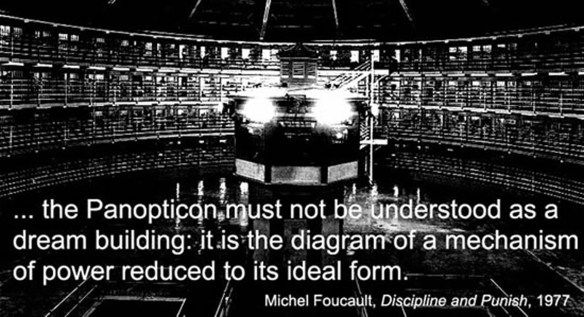
panopticon-image

By Mankh (Walter E. Harris III)

Source: Axis of Logic

“Relax,” said the night man,
”We are programmed to receive.
You can check-out any time you like, 
But you can never leave!”

 – The Eagles, from “Hotel California”

In Plato’s Allegory of the Cave, people saw a shadow play on the wall and perceived it as reality. Today that Cave has morphed to provide umpteen TV channels and mini-screen gadgets; and the once sanctified living room cave has expanded into a free-range bubble of consciousness – heads bowed before an electronic altar, seemingly oblivious to the outside world.

“The “panopticon” refers to an experimental laboratory of power in which behaviour could be modified, and Foucault viewed the panopticon as a symbol of the disciplinary society of surveillance.”[1]

In Plato’s E-Cave, not only are the people watching a shadow play, they, and the shadows they watch, are being watched.

HyperNormalization
With a veneer of calm aplomb, the masses communicate 24-7, often in a frenetic urgency of the mundane, hence one interpretation of HyperNormalization. In all the years of overhearing cell-phone conversations in public, I can’t recall one snippet of philosophy or practical advice, rather stuff like, ‘yeah OMG I’ll get the chips!’ and ‘I’ll be there in like 30 seconds!’; if you’re old enough, you’d remember the days when, you got there when you got there! That said, a cell-phone can be a helpful even life-saving device.

The USEmpire election appears to have both proven and disproven the main theory of Adam Curtis’ fascinating new documentary “HyperNormalization.”

“Curtis argues that since the 1970s, governments, financiers, and technological utopians have given up on the complex “real world” and built a simple “fake world” that is run by corporations and kept stable by politicians.”[2]

The California cyber-tech-boom was a love-child of LSD-consciousness that found refuge in E-wizardy all the while looking to escape repressive politics. In his book “2030” Pepe Escobar describes it as: “Digital network capitalism would then shape post-modern globalization, from the New Economy before the end of the millennium to every digital wall to be broken beyond. California cosmology forged our world.”

According to Wikipedia:

“The term “hypernormalisation” is taken from Alexei Yurchak’s 2006 book Everything was Forever, Until it was No More: The Last Soviet Generation, about the paradoxes of life in the Soviet Union during the 20 years before it collapsed. A professor of anthropology at the University of California, Berkeley, he argues that everyone knew the system was failing, but as no one could imagine any alternative to the status quo, politicians and citizens were resigned to maintaining a pretence of a functioning society. Over time, this delusion became a self-fulfilling prophecy and the “fakeness” was accepted by everyone as real, an effect which Yurchak termed “hypernormalisation”.”[3]

First off, I see HyperNormalization as a half-truth because while the self-referential, gossipy world is fake, it is a veneer for a very real world of resource extraction and the violence perpetrated to maintain the status quo – and that is what the fakers ignore. As far as the election, many expected the Clinton dynasty to prevail as the corrupt, business as usual lesser of two evils. Breaking snooze: Where’s  the headline news that Melania Trump plans to focus on helping women and children?; I saw that mentioned on CNN’s Anderson Cooper 360, such a perfect antidote for Hillary’s loss and The Donald’s anti-feminist track record.

Even though WikiLeaks revealed the DNC (Democratic National Convention) was rigged against Sanders and leaks of Podesta/Clinton e-mails may have been proverbial straws for Hillary’s campaign camel, the prevailing media sentiment was that she would win – despite the fact that the day before the election some polls indicated a shrinking 3-4 point lead, thus with the typical margin of error, it was, in effect, tied. Yet the mass hyper-surprise!; and all that after the corporate media and comedy shows had simultaneously bashed Trump and given him more air-time than a kite on a windy day – both disdaining and elevating him, a media-mindfuck if ever there was one.

And there was little uproar when Gary Johnson and Jill Stein were excluded from debates and virtually banned from all corporate news, thus proving (if you didn’t know already) that it’s not a truly democratic election. Yet carry on we must and do the best we can with what we got, was the general sentiment, in other words, “the “fakeness” was accepted by everyone as real” aka HyperNormalization.

Yet the non-coastal, poor and middle America White working class (with sides of KKK and minorities!), which reportedly was the key demographic for The Don’s victory, was voting out of bare-bones needs; in effect they were not HyperNormalized. Then again, if Trump, who promises to challenge the status quo, caves-in to Deep State pressure, we will have an answer to an interesting article’s titular question: “President Trump: big liar going to Washington or Tribune of the People?”[4] And if that answer is the former, then the mostly White working poor will also have been duped/HyperNormalized.

You see, it’s hard to know what’s what; which all seems to prove HyperNormalization as the dominant societal charade; which screen is real, if any?

What you perceive is what you get
Another key phrase in Curtis’ documentary is “managed perception” – akin to Chomsky and Herman’s  “Manufacturing Consent: The Political Economy of the Mass Media” (1988) which showed how opinions and desensitized agreement to the status quo became a product to be mined and marketed. Witness CBS Chairman Les Moonves’ comment from February 2016:

“Man, who would have expected the ride we’re all having right now? … The money’s rolling in and this is fun. I’ve never seen anything like this, and this [is] going to be a very good year for us. Sorry. It’s a terrible thing to say. But, bring it on, Donald. Keep going.” [5] And, if i might satirically add, like an orangey topped Duracell battery, The Don does seem to have a lot of energy.

HyperNormalization is also akin to Sheldon Wolin’s theory  of “inverted totalitarianism,” where the faceless corporate machine wields so much entertainment and bureaucratic power that the people barely notice they are being played hook, line, and sinking feelings.

Some of Curtis’ info, however, is inaccurate or questionable. For examples, he blames the demise of the Occupy Movement on lack of vision and planning yet neglects to mention the FBI coordinated systemic crackdown on the ‘camps’ across the country. [6]

About Syria he says that President Bashar al-Assad retaliated with a “vengeful fury,” whereas Assad has defended his actions as self-defense for his people; numerous journalists back the Syrian President’s claim.

Post-election, I wonder: Why were so many liberals, lefties, and women more surprised that Trump won than that the DNC/HRC rigged it against Sanders? Were they simply feeling impotent due to HyperNormalized shadow play? Whatever the case, his victory revealed a crack in the smooth screen of HyperNormalization.

According to Patrick Caddell’s survey before the election, the populace seems to be hip to what’s happening:

“Powerful interests from Wall Street banks to corporations, unions and political interest groups have used campaign and lobbying money to rig the system for them. They are looting the national treasury of billions of dollars at the expense of every man, woman and child. AGREE = 81%; DISAGREE = 13%…

“The country is run by an alliance of incumbent politicians, media pundits, lobbyists and other powerful money interests for their own gain at the expense of the American people. AGREE = 87%; DISAGREE = 10%

The real struggle for America is not between Democrats and Republicans but between mainstream American and the ruling political elites. AGREE = 67%; DISAGREE = 24%.” [7]

This makes it seem it is the ‘how-to bring about change’ that is the deeper conundrum of the HyperNormalized world. Then again, people too often seem to have only their own best interests at heart. Approximately 90% of Americans want their food labeled so as to know if they contain GMOs etc. or not, yet hardly a peep out of anyone that climate change or the “environment” aka Mother Earth & Nature-beings were deliberately excluded as a main topic of the presidential debates. This makes it seem that, in general, Americans want clean food for themselves, they want a clean environment so they can go ‘play in the park’ by themselves. And that brings us to the Great Disconnect and Standing Rock.

Flow like water, be steady as a rock
Part of HyperNormalization is a disconnect from Nature and from being self- and community-guided, and therefore disconnected from the Original Peoples of Turtle Island. While many people are certainly aware of what’s happening with Standing Rock, the corporate media’s lack of attention, let alone empathy, fosters lack of concern for the outcome, lack of being outraged by the violent and racist treatment of those in prayer and peacefully protecting the main source of water for the Standing Rock Sioux and other Natives as well as approximately 17-million people downstream. The real-fake outrage is over the outcome of a fake election.

For many Native reservations where poverty and PTSD are prevalent, the people are anything but HyperNormalized; they are struggling to survive – as with Standing Rock, they are not asking for much: clean water and the space to live their lives with ancient traditions timelessly connected with the land, the water, the stones…

Plato, imagining a prisoner getting outside of the Cave, wrote: “Slowly, his eyes adjust to the light of the sun. First he can only see shadows. Gradually he can see the reflections of people and things in water and then later see the people and things themselves. Eventually, he is able to look at the stars and moon at night until finally he can look upon the sun itself .” [8]

Standing Rock is bringing people together, raising consciousness at many levels. As one example from a little over a week ago:

“In a “historic” show of interfaith solidarity, 500 clergy members prayed along the banks of North Dakota’s Cannonball River on Thursday where they “bore witness with the Standing Rock Sioux Nation,” which has faced intimidation, violence, and arrests for protecting their sacred land and water supply from the threats of a massive oil pipeline. According to the Episcopal News Service, “The interfaith group spent more than five hours on site, marching, singing hymns, sharing testimony, and calling others to join them in standing with the more than [300] tribes who have committed their support to the Sioux Nation as they protest the route of the Dakota Access Pipeline (DAPL).” [9]

This solidarity is in stark contrast with the election where a typically 51/49 system determines an outcome for a society literally programmed for exciting close-call winners – think sporting events,
reality shows, awards ceremonies.

Outside in and inside out
There are many ways to get outside the Cave. One of those is by going within. When I first started to meditate, as is common, I became aware of the constant chatter in my head and soon realized that the mind left unattended will rattle on endlessly. Meditation then showed me that once the chatter quiets, one then has access to other frequencies, other ‘channels’ – what happens then is a very personal matter yet also impersonal because one becomes connected with another source of thinking-seeing-feeling. Chatter, like cell-phones, has it’s usefulness, say, if you forgot to turn the stove off. My point to the personal anecdote is that the corporate media is too much chatter, endlessly looping itself. The gadgets, too, though useful, seem hard-wired for HyperNormalization.

Some of the chatter we must live with, yet by learning to follow our intuitions, listening to and connecting with Nature, talking with elders and little children we can better tune-out from the shadow-play, we can find new and ancient ways for more people – and that includes trees, rivers, etc. –  “to look at the stars and moon at night” and “look upon the sun itself.”

“Sin filo ya y derrotada se quejó: Soy más fuerte que ella, pero no le puedo hacer daño y ella a mi, sin pelear. me ha vencido.’”

“Without sharpness and defeated, it [the sword] complained: ‘I am stronger than the water, but I cannot harm her. And the water, without fighting, has conquered me.’” [10]

NOTES:
1.    Panopticism here and here.
2.    Ibid.
3.    HyperNormalization
4.    See here.
5.    “Les Moonves: Trump’s run is ‘damn good for CBS’”. See here.
6.    “Revealed: how the FBI coordinated the crackdown on Occupy
7.    “Patrick Caddell; The Pollster Who ‘Got it Right’
8.    “Allegory of the Cave
9.    “A Prayer for People and Planet: 500 Clergy Hold ‘Historic’ Mass Gathering for Standing Rock
10.    “Questions & Swords: Folktales of the Zapatista Revolution” as told by Subcomandante Marcos, Cino Puntos Press, El Paso, Texas, 2001, p.82.

To watch “HyperNormalization”, click here.

Mankh (Walter E. Harris III) is an essayist and resident poet on Axis of Logic. In addition to his work as a writer, he is a small press publisher and Turtle Islander. His new book of genre-bending poetic-nonfiction is “Musings With The Golden Sparrow.” You can contact him via his literary website.


Enlightenment and Cosmic Citizenship: The Divine in mundane life

By rahkyt

Source: Sacred Space in Time

What is Enlightenment?

Is it practical spirituality? Personal, soul-oriented growth and evolution?

Could these formats be experiences? Are those who claim such experiences in a constant state of otherworldly sensate immersion within worlds beyond the ken of most?

All the time? In every moment of every day?

If you peruse the teachings of the universal sages such as Jesus or Buddha, or any of the modern gurus like Adyashanti, Mooji, Amma or Tolle, you find a denial of this continuous state of experiential immersal within Mystery.

Rather, they say that life is comprised of the moments we each live and that transcendence of that moment is in experiential fullness. Of being Present in each moment of the Now, rather than being lost in contemplations of the past and future. And that this perceptual quality is cultivated consciously over time and practice, alongside a certain element of Grace and divine bestowal.

Until the point at which the Now becomes perceptually continuous. And the body, a steady-state, resonant conduit of the Divine in every lived expression.

There are many who aspire to such Nowness who preach and crow their accomplishments to the world, seeking fame and fortune. This path is inimical to the real expression of enlightenment because it is indicative of covetousness and narcissistic self-aggrandizement.

And yet, true teachers and experiencers are also compelled to share their knowing and to seek to open doorways for those yet mired within the swirling sandstorm of Maya manifest.

How does one tell the difference? How do you know when someone has had real, transcendental experiences and have internalized the wisdom gained therein?

Many have experienced alternative perceptual realities by way of plant teachers, artificial drugs and real and synthetic brain chemicals such as DMT. These experiences are valid but also prone to misinterpretation and overestimation of their importance in the context of spiritual enlightenment. Because you’ve seen the world shift during an acid or shroom trip does not mean you have then become Enlightened, in other words.

Experiencing things the mind and soul are not ready for is also dangerous. Those who seek to raise kundalini who have not done the soul work necessary at each chakra to raise their level of consciousness can achieve higher spiritual experiences, but can also do long-lasting psychic, mental and even physical damage to themselves. If serious enough, this damage can last a lifetime or longer.

The sidhis – or powers – such as telepathy, bilocation, telekinesis and astral travel are tools with very specific psychic requirements that can be accessed with practice by some, not all. Most yogis and gurus warn against their specific cultivation as doing so is indicative of growth yet to achieve along the road to spiritual wisdom.

Sidhis occur spontaneously amongst those who travel the Pathless Path seeking the highest expression of Cosmic Citizenship. To express them carelessly or selfishly is to cultivate negative karma and to step sideways along the path. Which is the reason why true teachers do no such thing.

Empaths can tell when they are in the presence of true sages, gurus, teachers. They can just feel the auric emanations of love, compassion and expansiveness. The words of such individuals speak to empathic souls, whisper intimations of innerstanding to their deepest levels of conscious beingness.

The expression of these teachers are consciously cultivated to align with that of their chosen audiences. They can be, therefore, crass or saintly, inscrutable or vivacious, sensual or austere. One thing they all share in common is a lack of adherence to societal norms and taboos as these are primarily human laws and mores and not divine in origin.

Enlightenment does not look like what most people think it looks like. When you have been to the Mountaintop, experienced Kenshō, have been a student in Shambhala, have visited Nirvana, that boundless, infinite and eternal space of beingness within the very heart of love and consciousness manifest, you are not supposed to stay there. That looks like death to the physical body.

You must return.

To life. To the world. To the Marketplace of human involvement. And seek the enlightenment of ALL sentient beings.

By any means necessary.

The Enlightened are, at heart, trickster spirits. Irreverent and undefined. Willing to appear any way to achieve the end of breaking down personal and societal boundaries to reveal aspects of the ineffable to those mired in the mundane minutia of the daily grind.

You never know who you’re talking to.

Especially if you’re not paying close attention because you are caught up in yourself. But you don’t encounter the Enlightened within the span of a lifetime unless you are, in some form or fashion, ready to grow and evolve past the limitations of the unexamined life. Ready to take the next step in your own personal, spiritual evolution.

So pay attention. Let the synchronicities lead you. Meditate. Cultivate the Now.

By doing so, you might discover that your crazy sister or brother, cousin, friend or acquaintance might be something other than you thought.

And wouldn’t that be something?


Buddhism and the Brain

741-hz-consciousness-expansion-is-bes-airl-hear-the-messages-of-the-universe-in-your-mind

Many of Buddhism’s core tenets significantly overlap with findings from modern neurology and neuroscience. So how did Buddhism come close to getting the brain right?

By David Weisman

Source: Seed Magazine

Over the last few decades many Buddhists and quite a few neuroscientists have examined Buddhism and neuroscience, with both groups reporting overlap. I’m sorry to say I have been privately dismissive. One hears this sort of thing all the time, from any religion, and I was sure in this case it would break down upon closer scrutiny. When a scientific discovery seems to support any religious teaching, you can expect members of that religion to become strict empiricists, telling themselves and the world that their belief is grounded in reality. They are always less happy to accept scientific data they feel contradicts their preconceived beliefs. No surprise here; no human likes to be wrong.

But science isn’t supposed to care about preconceived notions. Science, at least good science, tells us about the world as it is, not as some wish it to be. Sometimes what science finds is consistent with a particular religion’s wishes. But usually not.

Despite my doubts, neurology and neuroscience do not appear to profoundly contradict Buddhist thought. Neuroscience tells us the thing we take as our unified mind is an illusion, that our mind is not unified and can barely be said to “exist” at all. Our feeling of unity and control is a post-hoc confabulation and is easily fractured into separate parts. As revealed by scientific inquiry, what we call a mind (or a self, or a soul) is actually something that changes so much and is so uncertain that our pre-scientific language struggles to find meaning.

Buddhists say pretty much the same thing. They believe in an impermanent and illusory self made of shifting parts. They’ve even come up with language to address the problem between perception and belief. Their word for self is anatta, which is usually translated as ‘non self.’  One might try to refer to the self, but the word cleverly reminds one’s self that there is no such thing.

When considering a Buddhist contemplating his soul, one is immediately struck by a disconnect between religious teaching and perception. While meditating in the temple, the self is an illusion. But when the Buddhist goes shopping he feels like we all do: unified, in control, and unchanged from moment to moment. The way things feel becomes suspect. And that’s pretty close to what neurologists deal with every day, like the case of Mr. Logosh.

Mr. Logosh was 37 years old when he suffered a stroke. It was a month after knee surgery and we never found a real reason other than trivially high cholesterol and smoking. Sometimes medicine is like that: bad things happen, seemingly without sufficient reasons. In the ER I found him aphasic, able to understand perfectly but unable to get a single word out, and with no movement of the right face, arm, and leg. We gave him the only treatment available for stroke, tissue plasminogen activator, but there was no improvement. He went to the ICU unchanged. A follow up CT scan showed that the dead brain tissue had filled up with blood. As the body digested the dead brain tissue, later scans showed a large hole in the left hemisphere.

Although I despaired, I comforted myself by looking at the overlying cortex. Here the damage was minimal and many neurons still survived. Still, I mostly despaired. It is a tragedy for an 80-year-old to spend life’s remainder as an aphasic hemiplegic. The tragedy grows when a young man looks towards decades of mute immobility. But you can never tell with early brain injuries to the young. I was yoked to optimism. After all, I’d treated him.

The next day Mr. Logosh woke up and started talking. Not much at first, just ‘yes’ and ‘no.’ Then ‘water,’ ‘thanks,’ ‘sure,’ and ‘me.’ We eventually sent him to rehab, barely able to speak, still able to understand.

One year later he came back to the office with an odd request. He was applying to become a driver and needed my clearance, which was a formality. He walked with only a slight limp, his right foot a bit unsure of itself. His voice had a slight hitch, as though he were choosing his words carefully.

When we consider our language, it seems unified and indivisible. We hear a word, attach meaning to it, and use other words to reply. It’s effortless. It seems part of the same unified language sphere. How easily we are tricked! Mr. Logosh shows us that unity of language is an illusion. The seeming unity of language is really the work of different parts of the brain, which shift and change over time, and which fracture into receptive and expressive parts.

Consider how easily Buddhism accepts what happened to Mr. Logosh. Anatta is not a unified, unchanging self. It is more like a concert, constantly changing emotions, perceptions, and thoughts. Our minds are fragmented and impermanent. A change occurred in the band, so it follows that one expects a change in the music.

Both Buddhism and neuroscience converge on a similar point of view: The way it feels isn’t how it is. There is no permanent, constant soul in the background. Even our language about ourselves is to be distrusted (requiring the tortured negation of anatta). In the broadest strokes then, neuroscience and Buddhism agree.

How did Buddhism get so much right? I speak here as an outsider, but it seems to me that Buddhism started with a bit of empiricism. Perhaps the founders of Buddhism were pre-scientific, but they did use empirical data. They noted the natural world: the sun sets, the wind blows into a field, one insect eats another. There is constant change, shifting parts, and impermanence. They called this impermanence anicca, and it forms a central dogma of Buddhism.

This seems appropriate as far as the natural world is concerned. Buddhists don’t apply this notion to mathematical truths or moral certainties, but sometimes, cleverly, apply it to their own dogmas. Buddhism has had millennia to work out seeming contradictions, and it is only someone who was not indoctrinated who finds any of it strange. (Or at least any stranger than, say, believing God literally breathed a soul into the first human.)

Early on, Buddhism grasped the nature of worldly change and divided parts, and then applied it to the human mind. The key step was overcoming egocentrism and recognizing the connection between the world and humans. We are part of the natural world; its processes apply themselves equally to rocks, trees, insects, and humans. Perhaps building on its heritage, early Buddhism simply did not allow room for human exceptionalism.

I should note my refusal to accept that they simply got this much right by accident, which I find improbable. Why would accident bring them to such a counterintuitive belief? Truth from subjective religious rapture is also highly suspect. Firstly, those who enter religious raptures tend to see what they already know. Secondly, if the self is an illusion, then aren’t subjective insights from meditation illusory as well?

I don’t mean to dismiss or gloss over the areas where Buddhism and neuroscience diverge. Some Buddhist dogmas deviate from what we know about the brain. Buddhism posits an immaterial thing that survives the brain’s death and is reincarnated. After a person’s death, the consciousness reincarnates. If you buy into the idea of a constantly changing immaterial soul, this isn’t as tricky and insane as it seems to the non-indoctrinated. During life, consciousness changes as mental states replace one another, so each moment can be considered a reincarnation from the moment before. The waves lap, the sand shifts. If you’re good, they might one day lap upon a nicer beach, a higher plane of existence. If you’re not, well, someone’s waves need to supply the baseline awareness of insects, worms, and other creepy-crawlies.

The problem is that there’s no evidence for an immaterial thing that gets reincarnated after death. In fact, there’s even evidence against it. Reincarnation would require an entity (even the vague, impermanent one called anatta) to exist independently of brain function. But brain function has been so closely tied to every mental function (every bit of consciousness, perception, emotion, everything self and non-self about you) that there appears to be no remainder. Reincarnation is not a trivial part of most forms of Buddhism. For example, the Dalai Lama’s followers chose him because they believe him to be the living reincarnation of a long line of respected teachers.

Why have the dominant Western religious traditions gotten their permanent, independent souls so wrong? Taking note of change was not limited to Buddhism. The same sort of thinking pops up in Western thought as well. The pre-Socratic Heraclitus said, “Nothing endures but change.” But that observation didn’t really go anywhere. It wasn’t adopted by monotheistic religions or held up as a central natural truth. Instead, pure Platonic ideals won out, perhaps because they seemed more divine.

Western thought is hardly monolithic or simple, but monotheistic religions made a simple misstep when they didn’t apply naturalism to themselves and their notions of their souls. Time and again, their prominent scholars and philosophers rendered the human soul exceptional and otherworldly, falsely elevating our species above and beyond nature. We see the effects today. When Judeo-Christian belief conflicts with science, it nearly always concerns science removing humans from a putative pedestal, a central place in creation. Yet science has shown us that we reside on the fringes of our galaxy, which itself doesn’t seem to hold a particularly precious location in the universe. Our species came from common ape-like ancestors, many of which in all likelihood possessed brains capable of experiencing and manifesting some of our most precious “human” sentiments and traits. Our own brains produce the thing we call a mind, which is not a soul. Human exceptionalism increasingly seems a vain fantasy. In its modest rejection of that vanity, Buddhism exhibits less error and less original sin, this one of pride.

How well will any religion apply the lessons of neuroscience to the soul? Mr. Logosh, like every person who’s brain lesion changes their mind, challenges the Western religions. An immaterial soul cannot easily account for even a stroke associated with aphasia. Will monotheistic religions change their idea of the soul to accommodate data? Will they even try? It is doubtful. The rigid human exceptionalism is cemented firmly into dogma.

Will Buddhists allow neuroscience to render their idea of reincarnation obsolete? This is akin to asking if the Dalai Lama and his followers will decide he’s only the symbolic reincarnation of past teachers. This is also doubtful, but Buddhism’s first steps at least made it possible. Unrelated to neuroscience and neurology, in 1969 the Dalai Lama said his “office was an institution created to benefit others. It is possible that it will soon have outlived its usefulness.” Impermanence and shifting parts entail constant change, so perhaps it is no surprise that he’s lately said he may choose the next office holder before his death.

Buddhism’s success was to apply the world’s impermanence to humans and their souls. The results have carried this religion from ancient antiquity into modernity, an impressive distance. With no fear of impermanent beliefs or constant change, how far will they go?

6 Things You Should Know When Buying and Consuming Legal Marijuana

IMG_5168

Whether you haven’t toked since the 70’s, or you’re entirely new to the experience — here’s the starting place.

By Jeremy Daw

Source: Alternet

I distinctly remember the first time I bought weed. Nervous out of my mind, I dialed the beeper (this was 2003 in New York City – every step required discretion). Two minutes later, someone called me back. I gave them my address, then waited two hours (I didn’t yet have the experience necessary to appreciate how fast that was). Then I answered the knock on the door and opened up my home to a complete stranger who never gave his name. He opened up a briefcase full of five different strains, ranging, he explained, from $50 to $80 per eighth. “What’s an eighth?” I asked. He rolled his eyes. Noob.

Determined that the God-knows-how-many curious tourists flocking to Colorado to purchase legal cannabis today should never suffer the same indignities as I did over a decade ago, I present here the sum total of my experience as a pot smoker, distilled into 6 easy maxims. You can thank me later.

1. Stay on the grass.

New tokers, or anyone who hasn’t lit up since the 70’s, will likely find the dizzying array of pot products for sale at the package store a little confusing. BHO (butane hash oil), ice water, something called ‘shatter’ – the wide selection of products on offer stand testament to just how far the industry has come in 40 years. If you have no tolerance built up already, take my advice and steer well clear of all of these. Just the grass – dried flowers – by itself will be plenty potent enough to get you high, believe me. The main exceptions to this principle, however, are the edibles. Today’s edible products have evolved far beyond mere brownies; many chocolate infusers mold their products to break off easily into precisely measured ‘doses’, so the newbie who doesn’t want to irritate her throat can break off a small square and feel a moderate effect. Just be careful – sugar can trick your brain into thinking it needs more sugar, so you must stalwartly resist the urge to take that extra bite until you’ve given the first dose time to work – up to 1.5 hours for most people.

2. Vaping is healthier.

Another development which has taken the cannabis industry by storm lately is the proliferation of portable vaporizers. While the reliable Volcano still remains the equipment of choice for the home-bound aficionado, new portable models have opened up possibilities to take one’s vape on the go. These handy devices can drastically reduce any potentially harmful chemicals in marijuana smoke and can avoid irritating the throat (they still will make you cough, however, because of the expectorant properties of cannabinoids). But make sure you pair the right vape with the right product. Some are designed to handle ‘shake’ (dried flowers, ground up), some only work with hashish and some only work with the highest-grade extracts. Perhaps the best choice for the new marijuana user is the O.pen or similar model, because they come with pre-mixed extracts in glycerin, providing an experience familiar to anyone who has tried an e-cigarette. In any case, remember to take just 1-2 puffs at first, then wait at least five minutes to measure the effects before vaping again. It’s easy to get too high on this stuff.

3. Train your brain.

As strange as this may sound, everyone has to learn how to get high before they can experience it; this is why many marijuana newbies report feeling no effects the first time they smoke pot. Marijuana intoxication is unlike any other feeling in the world, and until your brain knows what to expect it can be difficult to get there. If, after taking a couple hits, you don’t feel any different, try this meditation to deepen the experience. First, relax; close your eyes. Listen to the sounds to your left. Listen to the sounds to your right. Pay attention to how your body feels – is there tightness anywhere? If so, don’t judge – just breathe into the parts of your body which hold the tension, and allow your breath to exhale out. Let go of all judgmental thoughts, all questions of “am I doing it right?” Just float downstream instead.

After a few minutes of mindful breathing, don’t be surprised to suddenly feel noticeably different. Your body may feel lighter; colors may appear more fascinating. Music will open up with more depth than you have ever felt before. And pretty soon, you may start to feel pretty hungry.

4. Come down with CBD.

There are many wonderful reasons why marijuana intoxication is more pleasant than, say, alcohol (no hangover, for one). Even so, the experience isn’t enjoyable for everyone. If you find yourself feeling paranoid, anxious or nauseous – first of all, relax. Remind yourself that no one in history has ever had a fatal overdose of marijuana, and that everything will pass. Breathe deeply.

Just in case that isn’t enough, make sure to keep some special marijuana handy, called “high-CBD.” Such bud is so called because it contains unusually high levels of cannabidiol, or CBD for short, a non-psychoactive cannabinoid which has been shown to mitigate the effects of THC. Many first-time users who found they accidentally took too much have found relief by smoking (or vaping) a few hits of high-CBD bud; within minutes, the CBD will “bring them back down.” If you’re new to cannabis, or you haven’t ever had anything truly high-grade, asking your vendor for a gram of high-CBD bud can be a good idea, just in case.

5. Savor the flavors.

For everyone who has never tried it, or anyone who has relied on the same bud from the same dealer for years, the myriad diversity of scents and flavors on selection in Denver will be a revelation. Some taste like pine; others, mango; still others, lavender. Take the time to sample the scents on offer before making your selection.

When you’re ready to consume, use practices which preserve the flavor. Vape, if possible; the low-temp sublimation process preserves the maximum amount of terpenes – the organic chemicals which provide the pot’s flavors. If you’re smoking instead, use a hemp wick. These beeswax-coated twines are wound with hemp fiber, so they neither add to nor take away from the bud’s exotic flavors. Lighters cover up too much with the taste of butane.

6. Get a grinder.

Regardless of whether you’re rolling joints, packing bowls or loading vapes, a good grinder makes everything easier. Even many experienced tokers often forget to grind up their cannabis before consuming; stuffing whole nugs in pipes can lead to a frustrating experience. But when the bud is ground up ahead of time, it allows smooth airflow which in turn leads to smoother, more flavorful hits.

This is not an exhaustive list, but it will get you started. Apply these principles, and the new year will bring more than just new laws – it will also deliver a healthier way to recreationally relax.


Jeremy Daw is the editor of TheLeafOnline.com and Cannabis Now Magazine, and the author of Weed the People: From Founding Fiber to Forbidden Fruit (2012).