Mass Media Delusions

By Dmitry, Orlov

Source: Club Orlov

For anyone who lives in the West (the US, the EU and its various adjuncts such as Australia, New Zealand) and wants to know what really goes on in the world, a major hindrance is the powerful filter imposed on reality by Western mass media. It uses two methods to prevent reality from leaking through to the public, one active, one passive.

The passive method uses omission and obfuscation: certain events and facts are simply not reported. Some are willfully suppressed, others carefully underemphasized, yet others are presented in a context designed to disguise their significance. For example, anybody attentive enough could have easily ascertained that Robert Mueller is senile and in no way shape or form was ever capable of running any sort of investigation or writing a report. And yet this salient fact was not reported at all; that’s willful suppression.

But now that Mueller has provided six hours of congressional testimony to prove this fact before anyone who cared to watch, outright suppression has become impossible and context substitution has come into play: those who draw attention to Mueller’s obvious senility are accused of being right-wing extremists. But how can a readily observable medical fact be dismissed as political bias? How could he have failed to recall important details from a report he supposedly wrote (or at least read)? Mind you, I am just using the Mueller disaster as a handy example. As I have explained many times, it doesn’t matter who is president and the entire ridiculous witch-hunt is an instance of fiddling while Rome burns.

The active method is to label all those who try to circumvent their filter as “conspiracy theorists”—a derogatory term that is easy to apply, although making it stick is rather tricky. It is easy to fall into the trap by insisting on a certain version of events without being in possession of specific physical proof. But it is equally easy to act as an independent collector and connoisseur of conspiracy theories (which are popular because they are interesting) in which case your accusers must be on par with you in their depth of knowledge of conspiracies or else be ready to forfeit their position as preeminent authorities on all things conspiratorial.

If none of the major Western news outlets reported a certain salient fact that can be readily exposed and attested by multiple sources by some people who, each one separately, do a bit of research, then how are these people conspiring, and how is that a theory? It can perhaps be argued that there is indeed a conspiracy—on the part of the major Western news outlets—to suppress this salient fact. That would indeed be a theory, but a difficult one to prove, and so why would anyone care to argue this point? Why not just let the salient fact speak for itself?

In short, the trick for avoiding the label of “conspiracy theorist” when reporting an unreported or underreported fact is to always couch it in the form of a question—“Here’s some evidence of something quite important, but Western mass media has failed to cover it; why?”—and leave Western mass media with the burden of proof that they didn’t conspire to suppress the coverage. Of course, no mass media outlet would ever accept such a challenge. Alternative responses include stony silence and, when that tactic starts looking ridiculous, resorting to ad hominem attacks and name-calling. But that leads to an inevitable loss of face because it automatically reduces to the childish game of “I know you are, but what am I?” As, for instance, in “Is refusing to report on Mueller’s obvious senility a sign of political extremism?”

Western mass media malfeasance doesn’t stop at suppression of facts; there is also its massive failing to provide any sort of meaningful analysis, or even to form rather obvious conjectures that we can then consider on their merits. For example, I might wildly conjecture that Robert Mueller was chosen as a senile stooge behind whose back Hillary Clinton’s political operatives conspired to unseat Donald Trump by a combination of falsified and coerced evidence, entrapment and various other forms of prosecutorial misconduct.

Again, I don’t have a dog in this race because I believe the US is in the process of flushing itself down the same golden toilet no matter who is its president. I have no particular love of “Donny, Putin’s man in Washington” (that’s a joke; Russians find it hilarious), but I do enjoy the comedic elements of watching this “Art of the Deal” president fail to close a single deal with anyone. In any case, I am perfectly happy to wait until the truth of the matter comes out. Sure, maybe it was Putin’s clever plan to make Americans spend four years beating each other up over an orange-haired buffoon who, as ordered by Putin, has been working tirelessly to wreck the relationship between the US and China and to ease China into an alliance with Russia, and also to wreck the relationship between the US and Europe, leaving a weakened and faltering US stranded all alone on the wrong side of the planet, but that’s just a conspiracy theory, isn’t it?


Saturday Matinee: Evidence

Evidence, Godfrey Reggio’s Short Film on What TV Does to Kids’ Brains

By DC

Source: Open Culture

Between 1982 and 2002, director Godfrey Reggio shot his well known Qatsi trilogy – Koyaanisqatsi, Powaqqatsi, and Naqoyqatsi. Somewhere between the 2nd and 3rd installment, Reggio took a little detour and directed a short eight minute film called Evidence. The main characters? Kids watching cartoons (Dumbo, actually) and looking “drugged,” “like the patients of a mental hospital,” he writes on his web site.

The villain? “Television technology,” which “is eating the subjects who sit before its gaze.” The weapon? Television again. That “radiation gun aimed at the viewer” “holds its subjects in total control.” A little house of horrors, to be sure. We have added Koyaanisqatsi (featuring the music of Philip Glass) and Evidence to our collection of Free Movies Online.

Globalisation: Hyperstition, Surveillance, and the Empire of Reason

By S.C. Hickman

Source: Techno Occulture

Edmund Berger in his essay Underground Streams speaking of various tactics used by the Situationists, Autonomia, and the Carnivalesque:

“Like the Situationists the Autonomia would engage with the tradition of the Carnivalesque alongside a Marxist political analysis. Bakhtin had described the carnival as “political drama without footlights,” where the dividing line between “symbol and reality” was extremely vague, and the Autonomia had embodied this approach through their media-oriented tactics of detournement. But under a regime of emergency laws a great portion of the Autonomia was sent to prison or into exile, leaving its legacy through an extensive network of radical punk and anarchist squats and social centers.”

One of the things we notice is that the Autonomia movement actually struck a nerve at the heart of Power and forced their hand, which obligingly reacted and used their power over and dominion of the Security System to screen out, lock up, and exclude this threat. That’s the actual problem that will have to be faced by any emancipatory movement in the present and future: How to create a movement that can be subversive of the system, and yet chameleon like not rouse the reactionary forces to the point of invoking annihilation or exclusionary measures?

A movement toward bottom-up world building, hyperstition, and exit from this Statist system will have to do it on the sly utilizing a mirror world strategy that can counter the State and Public Security and Surveillance strategies.  Such Counter-Worlds of Exit and Hyperstitional instigation will need to work the shadow climes of the energetic unconscious, triggering a global movement from the shadows rather than in direct opposition.

In many ways as I think we need a politics of distortion, allure, and sincerity, one that invents a hyperstitional hyperobject among the various multidimensional levels of our socio-cultural systems, calling forth the energetic forces at the heart of human desire and intellect, bypassing the State and Corporate filters and Security Systems of power and control. Such a path will entail knowing more about the deep State’s secret Security apparatus and Surveillance methodologies, technologies, and tactics than most thinkers are willing to acknowledge or even apprehend. Like the Hacker movements of the 90’s up to Anonymous one will need to build shadow worlds that mimic the stealth weapons of the State and Corporate Global apparatus and assemblages; but with one caveat – these weapons are non-violent “weapons of the mind”, and go unseen and unrecognized by the State Security Systems at Local and Global levels.

A global system of mass, warrantless, government surveillance now imperils privacy and other civil liberties essential to sustaining the free world. This project to unilaterally, totally control information flow is a product of complex, ongoing interplay between technological, political, legal, corporate, economic, and social factors, including research and development of advanced, digital technologies; an unremitting “war on terror”; relaxed surveillance laws; government alliances with information technology companies; mass media manipulation; and corporate globalism. One might say it as the Googling of the World.

The United Stats internally hosts 17 intelligence agencies under the umbrella known as the Security Industrial Complex. They are also known for redundancy, complexities, mismanagement and waste. This “secret state” occupies 10,000 facilities across the U.S. Over the past five years the total funding budget exceeded half a trillion dollars. The notion of globalization which has its roots in the so called universalist discourses of the Enlightenment had as its goal one thing: to impose a transparent and manageable design over unruly and uncontrollable chaos: to bring the world of humans, hitherto vexingly opaque, bafflingly unpredictable and infuriatingly disobedient and oblivious to human wishes and objectives, into order: a complete, incontestable and unchallenged order. Order under the indomitable rule of Reason.1

This Empire of Reason spreads its tentacles across the known world through networks and statecraft, markets and tradecraft, war and secrecy, drugs and pharmakon.  The rise of the shadow state during Truman’s era began a process that had already been a part of the Corporate worldview for decades. The monopoly and regulation of a mass consumption society was and always will be the goal of capitalist market economies. In our time the slow and methodical spread of the American surveillance state and apparatus has shaped the globalist agenda. Because of it the reactionary forces of other state based control systems such as Russia and China are exerting their own power and surveillance systems as counters to Euro-American hegemony.

Surveillance is a growing feature of daily news, reflecting its rapid rise to prominence in many life spheres. But in fact surveillance has been expanding quietly for many decades and is a basic feature of the modern world. As that world has transformed itself through successive generations, so surveillance takes on an ever changing character. Today, modern societies seem so fluid that it makes sense to think of them being in what Bauman terms a ‘liquid’ phase. Always on the move, but often lacking certainty and lasting bonds, today’s citizens, workers, consumers and travelers also find that their movements are monitored, tracked and traced. Surveillance slips into a liquid state.

As Bauman relates it liquid surveillance helps us grasp what is happening in the world of monitoring, tracking, tracing, sorting, checking and systematic watching that we call surveillance. Such a state of affairs engages with both historical debates over the panopticon design for surveillance as well as contemporary developments in a globalized gaze that seems to leave nowhere to hide, and simultaneously is welcomed as such. But it also stretches outwards to touch large questions sometimes unreached by debates over surveillance. It is a conversation in which each participant contributes more or less equally to the whole. (Bauman)

Our network society has installed its own “superpanopticon” (Mark Poster). Such a system is ubiquitous and invisible to the mass of users. As Poster states it “The unwanted surveillance of one’s personal choice becomes a discursive reality through the willing participation of the surveilled individual. In this instance the play of power and discourse is uniquely configured. The one being surveilled provides the information necessary.” For Poster, this supply of self-surveillance is provided through consumer transactions stored and immediately retrievable via databases in their constitution of the subject as a “sum of the information in the fields of the record that applies to that name.” The database compiles the subject as a composite of his or her online choices and activities as tracked by IFS. This compilation is fixed on media objects (images, text, MP3s, Web pages, IPs, URLs) across the deluge of code that can be intercepted through keyword pattern recognition and private lists of “threatening” URLs.2

Our so called neoliberal society has erased the Public Sphere for the atomized world of total competition in a self-regulated market economy devoid of politics except as stage-craft. As authors in the Italian autonomist movements have argued for the past fifty and more years, this “total subsumption” of capital upon the life-sphere has been accomplished through “material” and “immaterial” means.  According to these authors, capital in late capitalism and neoliberalism has attempted to progressively colonize the entire life-sphere. Resistance, they argue, comes through the “reserves” to capital that remain as the social and intellectual foundation from which capital draws, including through “immaterial labor” using digital means. Gradually during modernity, such theorists have argued, life itself has been taken as a target for capitalist subsumption, through the cooptation of communication, sexual and familial relationships (Fortunati 1995), education, and every other sphere of human activity, with economic exchange and survival as the ultimate justification for all relationships.3

Capital’s “apparatus of capture” has become increasingly efficient and broad in its appropriation of selves as subjects of its political economy through the combination of appropriating governmental functions such as: buying off political actors and agencies, cutting public funding to modernist institutions and infrastructures, redefining the agenda of education and other cultural institutions toward capitalist values, owning and narrowing the focus of the media, forcing family structures and individuals to adapt to scarcity economies, and using government police and surveillance forces and economic pressures to crush resistance. In short, it is said that neoliberalism has advanced by the totalitarian institutionalization of national and international capitalism, one nation after another, using domestic means to force compliance in domestic markets and using international pressures (economic, military, cultural) to do the same to other countries, cultures, and peoples. (Day, pp. 126-127)

The increased accuracy (or believed accuracy) of increased surveillance and feedback targeting through the collection of social big data and its analyses and social and political uses (ranging from drone predators to state surveillance in both democratic and communist/ authoritarian governments to consumer targeting— for example, the targeting done by Target Corporation, as described in a 2012 New York Times article [Duhigg 2012])— belong to a conjoined mechanism of cybernetic and neoliberal governmentality, which crosses governmental and corporate databases and organizations. Social big data seeks to demarcate trends, which then directly or indirectly act as norms, which further consolidate individual and group action within market-determined norms (Rouvroy 2013). People are forced into competition, into a “freedom” that is monitored and checked within systems of feedback control. As Norbert Weiner suggested in the Cold War period (Wiener 1954, 1961), communicative control can be used toward a discourse of “rationality”; a rationality that is seen as proper to a given political economy. The documentary indexing of the subject provides the codes for the subject’s social positioning and expressions by others and by itself. Thanks to networked, mobile devices, the subject can attempt to continuously propose him- or herself to the world as the subject of documentary representation. (Day, pp. 132-133)

Those of us in the West who use mobile devices are becoming hooked into an elaborate datasociety in which every aspect of our lives is conditioned to enforce a self-regulatory system of choices and taboos. The surveillance is done at the level of individuals, who are monitored and whose actions are predicted throughout key moments of their consumption or production, marking changes in trends and phase states, and recalculating the trajectory of entities according to these new parameters and relationships. Our algorithmic society is splicing us all into a grid of total control systems from which it will become increasingly difficult to extricate ourselves.

As Douglas Rushkoff said recently digital technology is programmed. This makes it biased toward those with the capacity to write the code. In a digital age, we must learn how to make the software, or risk becoming the software. It is not too difficult or too late to learn the code behind the things we use—or at least to understand that there is code behind their interfaces. Otherwise, we are at the mercy of those who do the programming, the people paying them, or even the technology itself.4 More and more our mass society is being programmed through an immaterial grid of datafied compliance and surveillance that captures our desires and regulates our choices. In some ways we’ve become the mindless generation, unable to stand back from the immersive worlds of our technosphere in which we live and breath. We’ve become enamored with our Mediatainment Industrial Complex that encompasses us to the point that those being born now will not know there ever was a word without gadgets. In fact we’ve all become gadgets in a market world of science fiction, our desires captured by the very gadgets we once thought would free us from the drudgery of time. Instead we’ve been locked within a world without time, a timeless realm in which the very truth of history has been sucked out of it and instead we live in a mythic time of no time, prisoners of a cartoon world of endless entertainment and false desires. In such a world the virtual has become actual, we wander through life caught in the mesh of a fake world of commodity cartoons, citizens of a dreamland turned nightmare. Shall we ever wake up?

Modern radical thought has always seen subjectivation as an energetic process: mobilization, social desire and political activism, expression, participation have been the modes of conscious collective subjectivation in the age of the revolutions. But in our age, energy is running out and desire, which has given modern social dynamics their soul, is absorbed in the black hole of virtualization and financial games, as Jean Baudrillard argues in his 1976 book, Symbolic Exchange and Death. In this book, Baudrillard analyzes the hyperrealistic stage of capitalism, and the instauration of the logic of simulation.

The end of the spectacle brings with it the collapse of reality into hyperrealism, the meticulous reduplication of the real, preferably through another reproductive medium such as advertising or photography. Through reproduction from one medium into another the real becomes volatile, it becomes the allegory of death, but it also draws strength from its own destruction, becoming the real for its own sake, a fetishism of the lost object which is no longer the object of representation, but the ecstasy of denegation and its own ritual extermination: the hyperreal. […]

The reality principle corresponds to a certain stage of the law of value. Today the whole system is swamped by indeterminacy, and every reality is absorbed by the hyperreality of the code and simulation. The principle of simulation governs us now, rather that the outdated reality principle. We feed on those forms whose finalities have disappeared. No more ideology, only simulacra. We must therefore reconstruct the entire genealogy of the law of value and its simulacra in order to grasp the hegemony and the enchantment of the current system. A structural revolution of value. This genealogy must cover political economy, where it will appear as a second-order simulacrum, just like all those that stake everything on the real: the real of production, the real of signification, whether conscious or unconscious.

Capital no longer belongs to the order of political economy: it operates with political economy as its simulated model. The entire apparatus of the commodity law of value is absorbed and recycled in the larger apparatus of the structural law of value, this becoming part of the third order of simulacra. Political economy is thus assured a second life, an eternity, within the confines of an apparatus in which it has lost all its strict determinacy, but maintains an effective presence as a system of reference for simulation. (Baudrillard 1993a: 71-72, 2).5

We’ve all become simulations now. It’s not our bodies that matter in this digital universe of data, but rather the dividual traces we leave across the virtualized world that can be manipulated to produce profit. In the sphere of semiocapitalism, financial signs are not only signifiers pointing to particular referents. The distinction between sign and referent is over. The sign is the thing, the product, the process. The “real” economy and financial expectations are no longer distinct spheres. In the past, when riches were created in the sphere of industrial production, when finance was only a tool for the mobilization of capital investment in the field of material production, recovery could not be limited to the financial sphere. It also took employment and demand. Industrial capitalism could not grow if society did not grow. Nowadays, we must accept the idea that financial capitalism can recover and thrive without social recovery. Social life has become residual, redundant, irrelevant. (Bifo)

Those of us of an older generation still remember what existed the other side of the virtual screen, but the mass of young being born now will not have that luxury and their minds will be completely immersed in this new virtual actuality with no sense of the Outside.

While those on the Left still ponder outmoded political worlds the world of capital has abandoned both the political and the social. It’s time to wake up … I wanted to say, “before it’s too late”. My problem, my despair is that it is already too late. And, yet, I continue throwing out my little posts in hopes that someone is listening, that someone will awaken from their dogmatic slumber and act… is that you?


  1. Bauman, Zygmunt; Lyon, David. Liquid Surveillance: A Conversation (PCVS-Polity Conversations Series) (pp. 79-80). Wiley. Kindle Edition.
  2. Raiford Guins. Edited Clean Version: Technology and the Culture of Control (Kindle Locations 1304-1308). Kindle Edition.
  3. Day, Ronald E.. Indexing It All: The Subject in the Age of Documentation, Information, and Data (History and Foundations of Information Science) (p. 126). The MIT Press. Kindle Edition.
  4. Douglas Rushkoff. Program or Be Programmed (Kindle Locations 1363-1367). Kindle Edition.
  5. Berardi, Franco Bifo. After the Future (Kindle Locations 2276-2294). AK Press. Kindle Edition.

The Value of Everything

By James Howard Kunstler

Source: Kunstler.com

We are looking more and more like France on the eve of its revolution in 1789. Our classes are distributed differently, but the inequity is just as sharp. America’s “aristocracy,” once based strictly on bank accounts, acts increasingly hereditary as the vapid offspring and relations of “stars” (in politics, showbiz, business, and the arts) assert their prerogatives to fame, power, and riches — think the voters didn’t grok the sinister import of Hillary’s “it’s my turn” message?

What’s especially striking in similarity to the court of the Bourbons is the utter cluelessness of America’s entitled power elite to the agony of the moiling masses below them and mainly away from the coastal cities. Just about everything meaningful has been taken away from them, even though many of the material trappings of existence remain: a roof, stuff that resembles food, cars, and screens of various sizes.

But the places they are supposed to call home are either wrecked — the original small towns and cities of America — or replaced by new “developments” so devoid of artistry, history, thought, care, and charm that they don’t add up to communities, and are so obviously unworthy of affection, that the very idea of “home” becomes a cruel joke.

These places were bad enough in the 1960s and 70s, when the people who lived in them at least were able to report to paying jobs assembling products and managing their distribution. Now those people don’t have that to give a little meaning to their existence, or cover the costs of it. Public space was never designed into the automobile suburbs, and the sad remnants of it were replaced by ersatz substitutes, like the now-dying malls. Everything else of a public and human associational nature has been shoved into some kind of computerized box with a screen on it.

The floundering non-elite masses have not learned the harsh lesson of our time that the virtual is not an adequate substitute for the authentic, while the elites who create all this vicious crap spend millions to consort face-to-face in the Hamptons and Martha’s Vineyard telling each other how wonderful they are for providing all the artificial social programming and glitzy hardware for their paying customers.

The effect of this dynamic relationship so far has been powerfully soporific. You can deprive people of a true home for a while, and give them virtual friends on TV to project their emotions onto, and arrange to give them cars via some financing scam or other to keep them moving mindlessly around an utterly desecrated landscape under the false impression that they’re going somewhere — but we’re now at the point where ordinary people can’t even carry the costs of keeping themselves hostage to these degrading conditions.

The next big entertainment for them will be the financial implosion of the elites themselves as the governing forces of physics finally overcome all the ruses and stratagems of the elites who have been playing games with money. Professional observers never tires of saying that the government can’t run out of money (because they can always print more of it) but they can certainly destroy the value of that money and shred the consensual confidence that allows it to operate as money.

That’s exactly what is about to commence at the end of the summer when the government runs out of cash-on-hand and congress finds itself utterly paralyzed by party animus to patch the debt ceiling problem that disables new borrowing. The elites may be home from the Hamptons and the Vineyard by then, but summers may never be the same for them again.

The Deep State may win its war against the pathetic President Trump, but it won’t win any war against the imperatives of the universe and the way that expresses itself in the true valuation of things. And when the moment of clarification arrives — the instant of cosmic price discovery — the clueless elites will have to really and truly worry about the value of their heads.


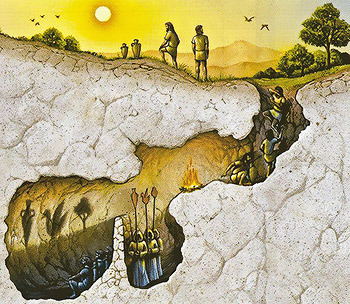
We’ve Been Sold a Lie – Time to Stop Watching the Show

platonic_cave

By Julian Rose

Source: Waking Times

‘The show must go on’ as they say in the theatre. And indeed, so it would appear. Only this particular show seems to have no beginning or end. The curtain never comes down; there isn’t even an interval in which to draw breath and stretch one’s legs.

It’s a 24/7 bonanza, and the cost of a seat is almost certain to put you out-of-pocket. In spite of which, the auditorium is full of expectant faces staring up at the unfolding scenes and drinking in the drama being staged for their consumption.

So few actors, so many spectators. Yet the actors hold the attention and the spectators soon forget that they are in a theatre and have paid for their seats.

We are all at this performance. Its setting is planet Earth. The actors strut around feigning importance, playing the role ascribed to them by the writer of the script and the director of ‘the show’. You know who they are – you see them everyday on TV screens and newspapers. A few are quite convincing, and like most actors they feign true sincerity and then pause for the applause.

The director remains largely invisible, but in the background he has fixed the agenda and set the scene. The script writer also remains largely incognito. However, his words on the page provide the narrative without which the actors would not be able to perform their predesignated roles.

The cast of todays crowd pulling drama have names like May, Merkel and Trump. The play in which they are currently performing is entitled ‘If I Ruled the World’, and there are many other roles for aspiring lesser performers and even for some retired leading-lights of yesteryear.

New scripts continuously emerge so as ‘to keep the show on the road’. A recent hit, for example, was ‘Brexit’, a play in four acts, featuring a strong line-up of music hall performers as well as some fine orators, one of whom cut his teeth in the great performing venues of Continental Europe.

But look, these marionettes of the political charade called ‘democracy’ can only be where they are, and do what they do, because we give them centre stage. We let ourselves become embroiled in their show and convince ourselves that it’s the only show in town. But it’s not, and in spite of being big and noisy, it’s actually a facade designed and orchestrated by the hidden hands who pull the strings that tweak the marionettes into action. Very occasionally a true leader emerges. An individual who stands out for their empathy with a struggling humanity.

But for decades now, it is ‘the show’ that has contrived to dominate. A show kept in place by stage managers who ensure all the rules, regulations and disciplines are operating as they should. But it is we the people who elect the cast of this play. A cast who promise to reflect and represent our needs on the national stage. To bring change where change is needed and to stand firm in the role that they are given.

So you see, we are complicit in the maintenance of ‘the rules of the game’ that keep the control system under which we suffer, alive and well.

Those who we elect mostly fall at the first hurdle – and all their promises go with them. ‘The system’ is in charge, after all, and our elected representatives quickly fall under the spell of its mechanics and become victims of its sinister agenda. An agenda played-out on the global stage with the help of powerful centralized banks, mega corporations and a heavily funded military. Yes, this is the show we have paid to bring to town.

But we have been sold a lie. We have bought into a chimera, a charade, and the biggest part of the problem is that we fail to recognize this fact. We actually believe it is a bona fide happening, without which we would all be thrown into chaos and despair.

So it is that we cling on to this outworn model of ‘democracy’, fearful of what might happen if it were dismantled and consigned it to history. Fearful maybe, of what might emerge in its place.

But that’s no good, and you know it. Because what stands in front of us is a choice; to remain a slave to a system which cannot survive without slaves – or to break free and give form to something altogether different.

Are you ready to take such a step?

So what might bringing about something altogether different actually involve? We must have a go at answering this, because it is the most critical question of this era, one we all face today – whether we realize it or not.

What we are talking about is taking back control of our destinies, not giving responsibility for them to someone else. Try to conceive what this might be like.. Well, for a start, out goes ‘the politician’ and with him/her the central control system called ‘parliament’. By the way, parliament did once represent the venue for an ideal in the making. An aspiration to give voice to those who never had a voice and to introduce collective justice where only the will of a monarch had previously prevailed.

But such a situation has long been redundant, because parliament was hijacked decades ago by the hidden hand of centralised control, and the politician became a stooge for the banking, military and corporate power cartels seemingly beyond his control. That is why this ‘corrupted beyond repair’ model has to go.

There’s a new lightness in the air at the sheer mention of such an action! What is mainstream media going to talk about without the mock democracy to fill its airwaves? Where will attention be turned once the charade of politics is removed from its pompous pedestal? What would we like to see fill the vacant place?

Think about it, because almost nobody is, and that is in large part the reason why it hasn’t yet happened.

It is at around this point that something valuable starts stirring within, and the seeds of a fresh vision put forth their first shoots. The low vibratory rate of energy to which we have adapted, shifts upward a gear. The fog starts to clear. We can see more clearly what we couldn’t see at all before we dared dispense with the old lie.

The new perception looks and feels something like this: we are here on this world having something called ‘a life’. It might last seven or eight decades, or more, or less; but as far as we know, it’s the only one we’ve got. How did we acquire this special gift? What are we going to do with it? Since it’s special and quite unique – isn’t it logical that we would want to do something special and unique with it?

Once we see we’ve been sold a lie, our next logical realization is to recognize that it’s a massive waste of this one life we have, to pretend we can ignore reality. It is then that the possibility of something altogether different entering the arena, makes its unexpected debut.

“My God” it says “I want to live!” “I want to confront this lie head-on and cease running away from it!” And that is a truly revolutionary happening; one which can – in an instant – change our entire outlook on life. For although it’s only a beginning, it’s a real beginning, one full of promise for what might follow.

Looking back at the crazed and confused scenes taking place on the world stage, shifting like tides between high melodrama and low bestiality, we can now see that it is no use trying to paper-over the cracks and pretend that we can go on living life ‘as usual’. The cracks are the dominant factor and what lies in between is so insubstantial as to be of no practical use.

Our only way forward is to invent a new future. Open a fresh page in the book of life. Not ignoring the past, but getting to grips with understanding it – and then bringing it with us on the great new journey upon which one has embarked. Let a new found passion lead the way. Let intuition be your guide. Let awareness be your tool box.

If you had identified yourself with any facet of the crumbling status quo, you will soon find yourself untethered, because there is nothing left able to hold a stake to which you can attach yourself.

There is nowhere left to turn except into your own inner resources. For it is from this region that the new vision emerges. That place where truth still resides, untrammelled by the ways of the world.

And then, on peering ever deeper within, one can begin to see the emerging presence of another world altogether. A world awaiting birth. Longing for birth. Waiting to be born. A world shimmering with expectation and excitement. A world lit-up by luminous energies.

Men and women alike give birth to this great entity. It does not require a womb or a phallus, although it’s composition embraces the essence of female and male, finally liberated to give full focus to the building of the new society which it is our imperative to create.

Now is the time to set aside all that would try to close the window on our true destinies.

Here is where we will find the footings, the solid ground, from which we can start building the World to Come. A place to carry us through the storm which cannot be by-passed. That is our true work from now on.

The mad actors who strut the world stage today do not realize that they are playing-out the final scene of an apocalyptic epic. A drama devised and directed by the architects of control. Criminals, whose full exposure is ever closer at hand.

We are moving into an auspicious time. A time in which mankind frees itself from the prison that has for so long-held it hostage. An event which will break the cords of fear-induced captivity and finally bring down the curtain on this devious age of deception.

The Eye of the Beholder: There is Never Anything New

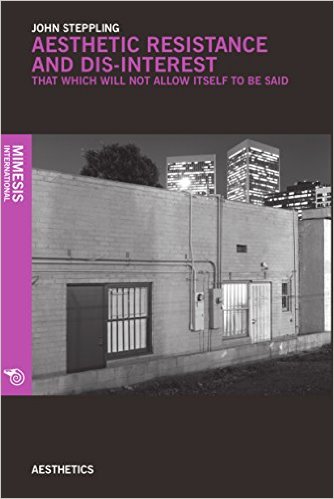
414JCSYLsPL._SX332_BO1,204,203,200_

A review of John Steppling’s new book, Aesthetic Resistance and Dis-Interest

By Paul Haeder

Source: Dissident Voice

it is through mimesis, (identification with the mirror image) that one gains a sense of unity, self-containment and mastery over the body. If that was all that there was to it, humanity would be condemned to dwell forever entombed in the hell of mirrors. However, the identification with an Other in the mirror opens out the possibility for symbolic thought.

— John Desmond, author, thinker, who is interested in the history of marketing; construction of knowledge in marketing; consuming culture; morality and marketing; advertising and public policy

The beauty of ideas and words and sculpting frames and philosophical groundings is that we in Western culture having nothing more challenging than the numbness of a consumer-wrecked world where crass hucksterism and financial voodoo wizardry – even with its nuclear tipped propaganda, surveillance and missile dragnet technological orgasm science serves up – pales in comparison to any tried and tested narrative grammar of idea wizards.

Yet, dealing with words now, we see, as one noted playwright and thinker attests, involves PR packaged thinking, possibly a flagrant fascism tied to what can be written (thought) and what cannot be (said).

The title to his book says it all, sometimes – Aesthetic Resistance and Dis-Interest – That Which Will Not Allow Itself to be Said. This is just out in 2016, by playwright, raconteur and philosopher, John Steppling, from the organization, Mimesis International. The book is a compilation of some of his blog postings, and not to denigrate the word “blog” to mean anyone and their uncle expressing anything out there on the world wide web.

Like stepping stones into Steppling’s mind, each essay is a revving reverberating call to mental action, as each essay follows the Introduction with more nitrous oxide pumped into each cylinder of the 12 cylinder motor of his mind: one, Narrative & Empathy; two, Magical Thinking; three, Pedagogy; four, Nothing is Art; five, The Impossible Playwright; six, Someone to Watch Over Me; seven, The Political Uncanny; eight, That Which Will Not Allow Itself to be Said; nine, The Hidden Narrative.

Here, Steppling drills down into the cortex of the American – European, white, patriarchal, Puritan and Elitist – brain, sort of the flash mob mentality we are downloading determinedly. He plugs holes in the tinny junk thinking and pseudo intellectualism hovering around academia, the So Called Liberal Media, the Corporate boardrooms, the waiting rooms at TED Talks 3.0, and the ER’s resuscitating the pop culture that doubles in the minds of the masters of consumption as true art (sic). It’s a violent country, the art is anti-art, and the world of the Imperialist, right-wing or leftie, is predicated on a Heart of Darkness destruction that Steppling decants into the incantation:

The unfinished and fragmentary now emerge as comments all by themselves. When the worst aggressions in society today are often those paraded as benign, or self branded as innocent, even curative, the default response must be one of disconnection. The age of marketing, fueled by Imperialist Capital, has obliterated ideas of belief. Ideas of evidence and trust in our own feelings are all the time under duress and coercion. Aesthetic coercion is the staple of a system of image and narrative control the erases the individual while unrelentingly trumpeting his triumph.

Mimesis conceptually and psychoanalytically is something Theodore Adorno, Robert Hullor-Kentor and Fabo Akcelrud Durao study as they break into the mind of the human condition under the duress of capitalism-hucksterism-market competition-cultural posturing in order to understand how we as thinkers and believers re-narrate when we read a novel or watch a film, as well as engage with poetry and theater. Steppling is looking at this sirocco of thought tied to art, and it’s only that, art, if it changes us somehow. Art can mean buildings, parks, ways entire city blocks and towns are laid out and made to be something more than a mess against nature or utilitarian. Or practical in the Puritanical way. Looking at the Palaeolithic rock paintings around the world, Steppling posits that these sophisticated and voluminous paintings are “exclusively mimetic participation in a magical object .. and that Neolithic artifacts represent a significant change of consciousness, and of the human relationship to the group.”

This short book delves into the heart of what it is to be human, what Pierre Janet (L’Evolution de la Memoire) says how we become the very beingness of “I” – Narration created humanity. This book is just a small sluice into the larger wetlands that spread across the more rarefied postulations of Steppling’s thoughts and comments, here, at this blog: John Steppling – The Practice of Writing – Theatre Film Culture).

Ironically, his most recent post talks about his youth, when he was born in 1951, Laguna Beach, where his mother worked at Woolsworth and father acted in community theater. Steppling looks at Charles Olson and his work in the Yucatan, the same year, 65 years ago, and in that looking back, Steppling unfragments the fragments of memory, youth, childhood, origin, which all boils down to a Western culture seeded with capitalism that is moved by destruction and the boom in the bust:

When Olson dug into the dirt of the Yucatan hills, my parents had moved to Laguna Beach. My mother worked at Woolworths as a counter girl. My father acted in the community theatre there. It was a sleepy beautiful barely touched village, really. It lay off the old Highway — the old PCH. In those years nobody thought about the destruction of entire pine forest in the San Bernadino mountains. Olson didn’t dream of tourist high rises, resorts for white people, all across the Yucatan peninsula.

A half century has been spent in the West destroying things, and destroying people, and destroying beauty. A post apocalyptic treeless suburb, that is the inner circle of hell. Having to live next to affluent white men who bitch about Jews, and then look to play a round of golf at one of the thousands of courses in drought ravaged California. While in far off corners of the globe U.S. made bombs explode and kill and maim. These same guys, over drinks, might discuss topics like ‘reverse racism’. Fifty solid years of this. — John Steppling’s blog

Imagine in this crass, Hollywood-drenched, Chosen Few World of high financial and structural violence and rape and rapine, resource wars, total cultural and physical annihilation of the tribes, and we have Steppling surfing these monster 100-foot waves seeking what it means to be in the present reading the footprints of the past, histories written and rewritten, and into the eye of the poet, which is the vortex of our cultural wars: “The sedimentation of terror into language, specifically into the naming of things, is that magical element in spoken text that differentiates it from reading to oneself silently. Both can be mimetic, but the range of the frightening is greater when it happens on stage.”

Steppling dis-interns the graveyards of humanity and philosophy in a process of eliminating vis-a-vis this modern, scientific and technocratic metallic world the magic, the thoughtful, the greater good of humanity to express, as poets and as the players, actors, in this life theater. He ties this into those who have fought to erase memory, to dominate:

The domination of nature coincided with the neutralizing of Language. Shorn of terror, the cry became the concept, Dionysian energy was expelled, superstition replaced by logic. This was the force of Enlightenment thinking, and the correctives were real, but less observed, the cleansing of that which allowed for the tragic to reveal itself. The tragic as a sensibility; and without that sensibility, the infinite domination, unchecked rational horror grow on the underside of the image and word.

He’s looking at class in most of his work, and Steppling discovers that corporate interests have eliminated the outsider, helped to cull the very idea of class and what the artist’s role is in “the great Spectacle today.” We see threaded like glacial melt Steppling’s look at how we in this punishment society put down the poor, forcing the poor into some crazy reformulaton in our theater or film.

Housebreak them. Make them heel. Make them sentimental. This is the paternalism of ‘encouragement.’ I’ve always felt insulted when anyone wanted to encourage me. Encouragement is the sadism of the ownership class, the good plantation owner, those who enjoy the power that comes from encouragement. I’ve said before, grants and the writing of applications for grants is a form of psychological servitude.

Art, politics, education, and creativity, the word, the intersection of a neoliberalism, a fake Left, all those ideas come into the mental landscape of Steppling, who is a studied playwright, living in a world of intellectual conceptualizations, and he sees the bright line of mimesis as how Adorno formulated it – “as a way out from under the crushing conformity and standardization of mass culture, to trace authentic artworks and to trace the path of their occurrence,” John writes.

I’ve been experiencing first-hand this deadening of culture, ideas, words, poetry, in the education systems I have taught in, and the echo of William Burroughs who called school “the Job” is a place where Steppling and I and so many others see as penal colonies where “the spontaneous fantasies of children are literally beaten out of them . . . the business of extinguishing that fantasy and creativity.”

Mimesis is a form of expression, not a Xerox copier in the head. – John Steppling

This book is a slice on the microscope slide looking at the DNA of modern American psychosis – and the truth is in the antithesis of human and narrative truth, Steppling has discovered in his six decades on the planet:

The only truth now is bureaucratic, administrative, or data based. The fixedness of both ideas and beliefs in those ideas, has disappeared from the contemporary life. One feels that people, in general, deal with quantifications, with administrative rules and regulations. The age of regulations. They do not explore the nature of meaning.

I can digress here, which is one of Steppling’s favorite pastimes writing — entering and exiting the rabbit hole. Punishment, retribution, class war, patriarchal bullshit. Check this out — state of ever-Blue Politics of Washington State:

Division of child support services killing the parent (mostly men) big time if some part of child support has not been paid:

a warning — driver’s license will be suspended; no commercial driver’s license shall be gotten; all Fish and Wildlife licenses issued suspended (can’t fish, hunt, or trap); can’t gather seaweed or shellfish; you won’t be able to maintain insurance coverage; doing business in the state of WA will be affected; your ability to practice your licensed profession, occupation, or trade in WA will be suspended; you shall be held in contempt of court by the state of WA.

In so many ways, Steppling speaks to my own struggle with education and social work and social justice in this state or anywhere. Imagine, you fuck up and don’t pay child support, so, the state goes after you with vengeance. Ahh, then you end up in Haeder’s casebook, homeless, strung out, lost, abandoned. It does happen, these laws and punishments, this retributive society, one that is spittle from Hollywood and the leadership (sic) class that is bent on eviscerating the poor. Steppling says there are no writers, poets, musicians, artists, philosophers really chipping away at the pedantic or the narrow self-important angles to get a real narrative of what sort of fascism that is here now and has been here for decades. Again, time and time again, I talk to these Democrats, these people voting for same sex marriage, same sex adoption, goofy ideas about girls and women in war, all the shitty PC and broken diversity crap, and, alas, we are in a time of collective abandonment, a psyche that is cleaved by trauma, because really very few care to know the cause of so much class hate, class pain.

The bedrock of this lack of thinking and struggle to see meaning as the universal pathway to thought is a society transforming nature and the inclination of the human to work within self outward, working to be original and the same at the time, but now we are a culture denuded of agency, split into identities created by marketing and advertising, and transfixed into a “giant apparatus of policing.” The checks and balances are those so-called culture purveyors, those gesticulating freaks that are unwilling to see a life, live a life, outside of Capital Imperialism, Neoliberalism, Fascism of Privatization.

Steppling doesn’t delve deeply in some of the neo-tribalist thinkers in any of his work; I’ve always been able to make that leap by thinking about the ideas of tribalism cocooned in the philosopher Daniel Quinn’s brain, who calls this a period of remembering, dislodging the great forgetting around what it is to be human outside the narrow constraints of 12,000 or 8,000 years of totalitarian agriculture. John does see tribes of the past living in relatively stable settings. The elimination of so many tribes around the world in the name of capital, manifest destiny, whiteness, is a testament to Western societies slurping up the coin of the realm at a price: “ . . . contemporary societies of the West have perfected a kind of industrial level violence and irrational lust for conquest, and a fetid clenched jaw blindness that has no rival in history. It is the culmination of something that went very wrong.”

Steppling looks at theater, architecture, post-modernism, Freudian and Jungian psychology, the art scene, fine art, photography, Hollywood, propaganda, education, all the lower forms of capitalism, all those devolving collective dendrites of a culture preened by cultural gatekeepers and the models of each generation’s tragically hip pseudo thinkers, all those posing intellectuals.

The crucible of Steppling’s galvanizing thinking is tied to what is authentic artwork, what is the concrete thing that is the spontaneous creative gravity pulling forth this flash-point of the highly creative, which is at the same instance a series of contradictions that make the process magic and concrete.

Edward Said calls this the undefined time and place. Steppling adds, “These are the contours of the imagination. We hear, we invent, we are deaf – but all of it is engaged with, and absorbed.”

In the larger frame of Steppling’s looming and far-ranging essays on/at/in his blog, we are taken into a minefield of the depraved minds of those cultural and propaganda spinners who have not only co-opted liberalism and urbanity . . . but what it means to be a writer, someone telling stories versus someone marketing stories, spinning and PR-lobbing things that are not accurate. This world Steppling covers extensively in his writing, calling to task the posings/posturing and the denaturing of figurative art into something set in a ghost-land of misled identities, narratives and characters.

We get to the data driven shit world of today, all the bureaucracies, this punishment culture, this one driven by a war machine run by USA, Israel, the G-7, the wicked stinger of the scorpion called capitalism. There is a critique of the whiteness of this imperialism, depraved and puritan all in one heave, and there is gentrification of the land and culture and arts, as well as this art-loving haute bourgeoisie class that has denuded meaning and hard work from education, learning, and thinking. This is the class warfare that provides the fodder for ever more Draconian and pervasive punishment and retribution and financial recriminations.

A world people by bearded Duck Dynasty creeps and nerds stuck in Ikea-furnished prisons. It all comes down to lacking curiosity and dependence on technocratic dogma. Titrating back into this deadening tool of marketing and generic history and measured thinking. Steppling calls for open schools which “must offend, must drive some off, must never be bland or generic. Better to be wrong.”

Paulo Freire’s pedagogy, “teaching people to see and hear is the first thing. And then to stimulate the mimetic in relation to all of it. To relearn narrative and story. That is the beginning.”

What Freire posits – He who thinks and does not learn is in great danger.

The vocabulary of our times is not up to snuff in Steppling’s view. It’s torn from our collective memory, reshaped as a kind of amnesia, what Russell Jacoby calls “… the general loss of memory is not to be explained solely psychological . . . . Rather it is social amnesia – memory driven out of mind by the social and economic dynamics of this society.” In the critical mass of the mind in this human condition is what we might like to consider true artwork, a type of “force of negativing the madness of society, the waste and abuse, and this is the negative dialectic; negate the negation, for that is the reality today.”

Daily I toil teaching people around me – younger – to live with resistance and refusal as the underpinning of any life in this hijacked capitalism, the drone warfare of consumerism bombarding us every nano second. Steppling is a friend of Henry Giroux, and in this short book pulls from one of his books, The Violence of Organized Forgetting (2014):

Students are now taught to ignore human suffering and to focus mainly on their own self-interests and by doing so they are being educated to exist in a political and moral vacuum. Education under neoliberalism is a form of radical depoliticization, one that kills the radical imagination and the hope for a world that is more just, equal, and democratic.

This insight Steppling brings to art, unraveling the fabric of mass media, his microscope on those attempts at art in TV, and his dog-earing philosophy-psychology-the dark arts of culture. For him, there is a real sense of lamentation in America, longing for some imagined or pre-invented past where there was “order” or some sense of commonly held beliefs.

We are in a time of conformity, Steppling poses, even in our supposed non-conforming perception, and in that broken covenant this society has a  “narcissistic desire . . . self aggrandizement . . . splitting and projection of our bad selves onto the Other.”

He ventures back to how much we have changed in America, how culture is tied to an infantile psyche, “ever afraid of being found out in its incompleteness, in turn cannot afford to gaze too long at certain things.”

I see it everyday, working in Chinatown, Portland, serving as a case manager for homeless, recovering addicts, early release prisoners, veterans, families. This gaze, this head down society looking at those flip after flip pages of self-loathing and self-aggrandizement, well, it is madness to see the broken people living on pavement, actually in the doorways of fancy restaurants and hip shoe stores. Raging lunacy, pickled brains, entire families and their dogs out there, in the oh so hip Portlandia represents what Steppling pinpoints in his work.

I stop and talk to those really down and out, on my way to my office where I serve people who have at least gotten teeth yanked, bellies checked, and are in temporary housing and tied to the recovery model of Narcotics Anonymous, Heroin Anonymous, Alcoholics Anonymous, you name it, all those sponsors and other case managers. These people on the streets have their stories too, amazing ones, torn from the psychological hell that people create for their children, spouses, friends, lovers.

“The purpose of Western capitalist society is to erase ALL stories and replace them with commercials, or, in other words, with anti-stories,” he writes. This is the crux of what Steppling uncovers throughout his musings and philosophical ministerial show. Until the story we have in 21st America is one where the working stiffs, including social workers and teachers like me, imagine we may be moving up some ladder, to be the kings and queens of our castles, to have those two week trips to Machu Pichu, or wherever, any fantasy that has been peddled in the crap we consume — TV, drama, movies, news, magazines, the WWW, education.

I find it more and more difficult to find empathy coming from these people, and even supposedly successful folk with jobs and mortgages and some flimsy undergraduate degrees can spew some of the most hateful fascist craps — “Way too many people on earth. Seven-point-one billion, so someone has to go. I have no problem putting the needle in the arm of some loser druggies shooting or snorting up. They should be the first to go.”

This propaganda consumed by these suburbanites, calling for eugenics and mass slaughter against those we love to stigmatize. You know, people who were once loved or held as babies, now on the streets, struggling, lunatics panhandling, voices in their heads, forever driven to show us how close we are to disaster. Ourselves.

Steppling cites Arno Gruen, how hatred is fueled to destroy empathy. “Sometimes we blame the victims. They make us feel very uncomfortable; we are ashamed of our empathy because we hate the victim ourselves.” (The Betrayal of the Self, 2007)

This is what Steppling unseals in this hermetically coffined society where the stories of struggle — real struggle, the hardscrabble struggle of barely knowing who we are, let alone the struggle of the streets, this school to prison pipeline and cradle to grave social system that has been set up by Capitalism  — are never written about with depth and empathy and understanding, and the victims grow, and nothing Hollywood or literary-wood or drama-wood produces even is close to the reality of struggle, near death, Dickensian and Kafka-esque, all of the stories that need to be told, never get told.

Just cut-outs, the reality of people who do not exist in the minds of the controllers, those gate-keepers, those plied with money artists and editors and MFA instructors and super-star Oprah Book of the Month folk.

His look at the death of agency and the death of independent thought, the killing of questioning minds and the suffocation of the soul speak loudly in this book and on/in/at his blog.

Just today . . . . Thinking about Steppling’s look at this failure of the punishment state, the war on drugs, the war on people, I ran into story after story on my caseload — people the triple victim of a penality-corrupt legal-penal system. Older women, now clean and sober, in stable housing my organization provides, with some hands up, and yet, story after story of obscene legal bills being busted for possession, spending 75 days in the clinker and coming out with $3000 bills for the court costs and the fees and such, and, then, two years later, after homelessness, after living on the streets, dumpster diving, scrapping, anything but dealing with letter and summons and warrnats, bam, the $3000 is now $5000, and then the driver’s license is suspended, another $1500 owed there for penalities.

Imagine, trying to get these people minimum wage jobs, and then all these fees and retributions and pounds of flesh held against them, in the tens of thousands per person. Former homeless people, who were not worrying about US Postal deliveries or summons or the long arm of the law creating debtors’ fees, prison, etc. These are not the stories of the elite, the vaunted value-added ones educated at Harvard or UCLA. The stories of my people are on the police blotters or are ripped to shreds by the middle class Speilbergs or anyone with hearts of stone and brains channeled for the One Percent, to tell stories that are both lies and false memories.

Imagine this entire gambit broken down as a way to push more propaganda and the dark arts of vilifying and blaming the victim.

Foreclosure after couch surfing after stolen children after endless payments to the ferryman and the financial philanderers.

This is the way Steppling points his readers to, as the underskin of his work:

And one sees it today in corporate news coverage. The control by the state of “message.” The “message” of the Olympics is Russia is bad, and full of stupid people. You see terms like “cassocks” used a lot. You see the control in what is covered and what is NOT covered. Your see it in the idiotic disinformation on the planned covert destabilizing of Venezuela (as an example). . . . The media distorts Israeli violence and apartheid. It treats all dissent in the US as either terrorism or kooks. And most of all, the control is exercised via ” entertainment.” The constant, CONSTANT, outpouring of stupidity.

So we are here, where disagreements with the law, the financial rules, all those bankers’ games, everything that culls any sense of common sense, that is somehow suspect. There is madness in what Steppling points to, and this is a country that is in possession of a stone (stoic) heart of a killer, as D.H, Lawrence wrote.

The struggle to understand and value art that “knows something that we do not know” is a constant theme in John Steppling’s work-world.

The Golden Era Of Knowledge Resistance Is Upon Us

freedom-mental-slavery2

By Bernie Suarez

Source: Truth and Art TV

With the recent Virginia shooting false flag incident now blown wide open it occurred to me recently that humanity is in the middle of an era of all-time highest abundance of knowledge and information.  We are swimming in knowledge thanks to the internet and technology. This knowledge is easily available to almost anyone in a moderately developed country. Even children have access to this abundance of knowledge. Used properly, the technology and information available to us today gives humanity the tools it needs to overcome and even replace the dying new world order empire seeking control of it.

That’s the good side of today’s technology, knowledge-sharing and information available to humanity. Here’s the dark side of the story however. With much knowledge comes much responsibility and intellectual expectation from the species. Given how much knowledge there is available to humanity, we must face objectively what is transpiring before our very eyes. A large percentage of humans are still blinded by the controllers because they are deliberately resisting this otherwise easily available knowledge and this almost unique first-of-its-kind level of resistance seems to be at an all-time high.

I say “resistance” because more than ever before in the history of mankind humans can rapidly educate themselves about almost anything. Anyone can easily get past the information bottleneck of mainstream media and do their research and discover how real the globalist new world order plans are. After all, they are not even hiding their intentions. Ask yourself why would they publish the Project for a new American Century BEFORE 9/11 telling the world what their intentions would be? How is it that we have access to ‘Operation Northwood‘ documents clearly outlining the controller’s plans for staging false flag terror attacks throughout the U.S. to use as a pretext for war, yet people still think this is not possible? They’ve admitted Vietnam was a war based on a lie but does anyone care? Crisis actors are now regularly being used to stage sloppy staged shootings but many refuse to look into this too deep for fear of what this new knowledge will require of them. Thus today it requires more mental energy to fend off the knowledge that is easily available at everyone’s fingertips. People are apparently willing to put lots of energy into resisting this knowledge just to preserve their paradigms.

Consider that today’s generation has easier access to concrete proof of false flags faster and more accurately than at any point in history. Much of this information can be obtained in almost real-time. Today, unlike any point in history, people who are privileged to this surreal flow of amazing information simply ignore the information like its not there. This unique engineered modern day complacency and resistance to easily available knowledge I believe is very special and must be pointed out to understand where we are and what possible solutions will work best.

Think about that next time you hear people still clinging on to government engineered “official story” lies, false flag events, planned agendas and propaganda. One of the reasons people cling to government lies and resist easily available truth and knowledge is because people don’t want to believe things are that bad. They would rather believe that government is looking out for the greater good of the people. They don’t want to believe anything that will compromise their view of the world and their paradigm about life. Paradigms are very real and many refuse to change how they think to accommodate a new paradigm. They will ignore logic, avoid tough questions, even ridicule the messenger to protect their belief systems and all of these examples are forms of resistance to knowledge.

Cognitive dissonance is at an all-time high. More than ever, people prefer to keep the conversation light. They just don’t want to discuss “conspiracies” or government corruption for fear of getting into an unwanted debate. So in order to avoid a debate or conflict over a political issue it’s better to avoid the topic. Today many work places expect their employees to avoid discussions about controversial topics because it’s not good for the work place. This is an institutionalized resistance to knowledge and it’s all deliberate and engineered. This resistance is cognitive dissonance at a mass scale.

So, although many people are waking up to the nature and true meaning of current and political events both domestically and globally, there is a great sifting going on and more than ever people are resisting simple truth that would have easily persuaded and awakened the average person many centuries ago if they had the same available information in their time. Thus, I believe this is widening the knowledge gap within the species and this knowledge gap widening is part of an intellectual and consciousness extinction phenomenon that I believe is happening. Sadly, many humans are deeply mentally tangled in the matrix of lies and will likely die in the matrix never having understood how or why they died. Like sheep led to the slaughter.

You may wonder, how did we get here? Perhaps due to several factors including that today, propaganda is much more sophisticated and thus more effective. We have sophisticated sensationalized mass media, advertisements, billboards, radio, TV, Hollywood movies, video games, news papers, magazines, social media, cell phone apps and more. All of these sources of information are well equipped to manipulate the human mind especially knowing that today people are subjected to these devices and distractions every day.

Solutions

You may be thinking, what can we do about this mass resistance to knowledge seen today. For one, keep the information awareness circulating. Don’t get too worked up every time they execute another false flag. Instead see the false flag from the point of view of the usual script blueprint they implement almost every time and do your best to share the information with those who are still living in the matrix of lies. Then move on and continue focusing on viable solutions for the problems we face.

Still running into people clinging on to government “official stories” on one false flag event after another? Realize who you are. Remind yourself that truth exists on its own and it’s not up to you to convince anyone, just show them the truth and let them recognize it for themselves. Realize we are living in an era of unusual resistance to knowledge because this resistance is engineered. Realize that it’s not about you winning an argument or convincing others of your personal point of view. It’s about putting out the objective truth and hoping people see the bigger picture for their own survival benefit. You can lead a horse to water but you cannot make it drink.

I believe understanding this engineered resistance to common knowledge we see today is a big part of the puzzle in terms of staying mentally healthy and staying focused on solutions. It’s all about keeping things in the right perspective and maintaining your own personal mental, emotional, spiritual and physiological balance.

Realize that for as much as people resist knowledge and information freely and widely available to humanity today, there is a constant hope and positive outlook that is burning in our hearts that reminds us that we may be part of an inevitable and important mass human awakening phenomenon.

Also lets consider that this knowledge resistance is equivalent to the diver who is too afraid to jump from the high diving board for fear of what will happen if he does. All those people who are afraid of giving up their current paradigms wouldn’t be if they were assured that everything was going to be all right.

Finally, realize that as things get worse many more people will be inclined to want to change their paradigms for a better one. That is why we need to offer hope to others. It’s not enough to point out false flags and focus on the fear and government corruption. We must answer back with some kind of solution and hopeful strategizing. Deliberate knowledge resistance is best met with the fewest amounts of words. Show someone the truth don’t debate with them so much. Allow them to believe whatever they want and move on after telling them what they need to hear. It’s not about convincing these people or winning an argument, it’s about being mentally stronger, more assured and wiser as you expose the other person to objective truth. It’s about staying focused on the bigger picture not about burning energy to fix someone else’s resistance to truth.

Bernie Suarez
Creator of Truth and Art TV Project

Bernie is a revolutionary writer with a background in medicine, psychology, and information technology. He has written numerous articles over the years about freedom, government corruption and conspiracies, and solutions. A former host of the 9/11 Freefall radio show, Bernie is also the creator of the Truth and Art TV project where he shares articles and videos about issues that raise our consciousness and offer solutions to our current problems. His efforts are designed to encourage others to joyfully stand for truth, to expose government tactics of propaganda, fear and deception, and to address the psychology of dealing with the rising new world order. He is also a former U.S. Marine who believes it is our duty to stand for and defend the U.S. Constitution against all enemies foreign and domestic. A peace activist, he believes information and awareness is the first step toward being free from enslavement from the globalist control system which now threatens humanity. He believes love conquers all fear and it is up to each and every one of us to manifest the solutions and the change that you want to see in this world, because doing this is the very thing that will ensure victory and restoration of the human race from the rising global enslavement system, and will offer hope to future generations.

Game Over

Political_Studies_3798278

The Jargon of Game Theory

By

Source: Soul of the East

While suffering under the information barrage wrought by mass media, a question arises in one’s mind: exactly how many words are there in the media vocabulary? For, when it comes to treatment of serious subjects like the economy and politics, the words in use are reduced to surprisingly few, so that even purported media analysis or commentary comes to resemble a mantra or nursery rhyme. Furthermore, it is notable that this “linguistic drain” occurs precisely at the moment when “serious” matters come into focus, and in spite of all the loftiness of the talking heads – our designated hierophants and media oracles – we are bombarded with rather frivolous terminology. One can only be perplexed at why, for instance, economic and political agents are called players? Why does the philosophy professor speak about the strategy of Nietzsche’s arguments? What exactly does it mean to have a cultural strategy? On what grounds does the literally critic assume that James Joyce employed a narrative strategy?

Why are all those serious things spoken about as if they were some kind of game?

On the face of it, the answer is surprisingly easy to deduce. Game or game-play jargon originates in global epistemic dominance of thought models derived from mathematical game theory. Its various abstract and complex forms (so called ‘models’ or ‘modules’), as well as their global application to all aspects of life, build the spiritual framework of our time to a significant extent, although they are rarely discussed outside of academia. However, game theory is not merely a mathematician’s plaything. If we bear in mind that the world stage – with all those global players – is also the home to all sorts of people who are well aware that they are being played, but have no idea of true nature of those playing them, then it is clear that the fundamentals of game theory should be subjected to critical scrutiny. The task is all the more urgent – and all the easier – if we bear in mind that the peculiarity of game theory, in contrast to other mathematical models, lies in the fact that it is founded on all-encompassing and simultaneously incredibly simple – one could say simple as in ‘dim witted’ – explanation of man and the world in general.

Game theory is a metaphysical doctrine, i.e. its ambition is to encompass everything, both the nature of man and the nature of universe. And there is a one special rule to every game of metaphysics, namely this: when the abstract and esoteric professional language of science is put aside, the game is potentially understandable to all parties – both those who are playing and those who are being played. It is an unspoken rule, an ancient assumption of all world-view con-games: in order for half-truth to hold sway over everybody, it must be spoken in common language. So let us examine, aided by some elementary concepts, what game theory is exactly and what it means for someone who is not a player, only played.

At its core, though, game theory is an explanatory model of decision making. It defines its subject as rational activity whose purpose is an increase in well-being of the deliberating individual or collective. Any behavior seemingly pursuing different purpose is only a roundabout way to achieve this goal more rationally, or it is simply “irrational.” Tertium non datur. Obviously, we are dealing with, broadly speaking, a “liberal” definition of man, although it is in fact the legacy of Ancient Greek Sophists. Bearing in mind that an individual is always in the midst of other individuals and that in order to achieve its goals it must collaborate or come into conflict with them, society must be rationally modelled in order to minimize conflict. That old bogeyman of political philosophy, Thomas Hobbes, conceived such a thing as possible only through the absolute sovereignty of the State, for was convinced that all those self-centered atoms were more prone to play at some iteration of Total War than that of Sims.

Proponents of game theory try to evade this fairly consistent inference of universal war or use it to prove something else: atomized individuals do not strive toward all-out conflict but towards equilibrium. The term denotes a state of conflict turned latent, in the sense of permanent threat or warning, but having ceased to be destructive; it is, in a word, a rational conflict, a war that grew cold. Namely, rational behavior is primarily strategic, i.e. it endeavors to accomplish its objective despite possible resistance by anticipating the strategies of that resistance. The healthy society is the one in which unavoidable conflicts are being channeled into relative harmony, regulated by the rules of the game, because the players realized that relative equality is more expedient than playing an ‘all or nothing’ game. Hence, game theory has a notably militaristic nature, affirmed by its history: it flourished inside military think tanks during the first years of the Cold war, only to be later unleashed on civil societies throughout the West.

The Prisoner’s Dilemma

At this level, some peculiarities are also notable. The term ‘game’ is made distinct but is not clearly defined, i.e. it is obviously artificially narrowed. For instance: since when does the game have to be competitive? Moreover, it is usually understood as a leisure activity, an escape from labor and conflict. Game by its nature doesn’t require winners and losers. It can be – and it usually is – a completely self-sufficient activity. In that sense, dances, visual and linguistic creative activities, fine or liberal arts, are all forms of playing a game. Those are all activities that, deprived of any calculated purpose outside themselves, remain autonomous and, therefore, free. However, game theory, without further clarification, presumes that games are always forms of competition implying conflict, binary division on winners and losers, elements of chance and power relations, domination and submission. So game theory is concerned with power plays. This is best illustrated in that most famous of game theory modules, the “Prisoner’s Dilemma.”

The Prisoner’s Dilemma is an imagined situation that game theoreticians apply to reality, and it has many variations with according levels of complexity. It can be described, using the so-called static model, in the following way:

Two criminals are brought to a police station for questioning. They committed the crime, but if the police fail to get the confession from one or either of them, they’ll walk. They are put in separate rooms and isolated from one another. A confession is demanded from each one. A situation develops in which the rules of the game provide them with a limited number of possible strategies: each one could or could not confess. If both confess, their pay-off is equally small, but if only one confesses, his pay-off is small, but bigger than the pay-off of his accomplice. If neither confesses, the pay-off is equally big for both of them, yet so is the risk of losing everything. Two key factors are in play: the prisoners are completely isolated from one another – they only know the game’s rules and the pay-offs by which they model their respective strategies, and each one only wants to maximize his own pay-off. The game-theory endeavor to use this module to explain real-life situations and foresee the decisions to be made by opponents (for instance, by Soviets in the Cold-War era) or to offer the best course of deliberation to its users. In the dynamic model of The Prisoner’s Dilemma, the main difference is in access to information, because players are allowed to confer before they are isolated.

A striking feature of such models must be noted. More often than not, the agents of decision-making in game theory modules are described as criminals. Sometimes they are jewel thieves, sometimes it’s a fugitive escaping the posse, and one encyclopedia’s game theory module is illustrated by the act of tossing the incapacitated opponent into precipice. It is interesting that the author uses the pronoun he for the victim while the criminal in the dilemma is denoted as she, in strict obeisance to the rules of political correctness. Bearing in mind that victimhood, imaginary or not, proves to gain a rather abundant pay-off, it seems that even the game theoretician is faced with a Prisoner’s Dilemma.

The Game Myth

This feature leads us to key weak point of game theory, i.e. its flimsy definition of rationality. Namely, the “big players”, of whose moving and shaking the media hierophants inform us unceasingly, are implicitly denounced as criminal organizations, and not by the frustrated and confused public – the notion appears incorporated into the very definition of their enterprises. Every player seeks exclusively his own maximal gain, and that which is considered to be “one’s own,” therefore rationally desirable, seemingly private, comes dangerously close to being privative. Bearing in mind that such exclusive economic players are prone to merge with their playmates in politics – which is, after all, the elementary definition of fascism – one must reach the conclusion that in the foundations of seemingly supra-private bodies, be it corporations or governments, not only private but also privative interests are embedded, and that the very process of democracy can be seen as a means of accomplishing this.

In that sense, it is no wonder that what is now called liberalism is a form of strange metaphysics. Namely, it appeals to ‘human nature’ and ‘natural rights’, but has in fact always been infected with an urge for escapism, clearly visible in so-called “state of nature” and “social contract” theories, mythical stories about a historical event that never happened in a historical age that never was, which man escaped by a decision he never made. Game theory metaphysics transforms this myth and enriches it, but it certainly doesn’t dispel it. The myth is sold, against all reason and the wealth of human imagination, as the veritable image of truth, i.e. a valid world-view, the prism through which the entire contemporary landscape is transmitted before our eyes. However, this picture, no matter how coherent and self-sufficient, is in fact rather fragile.

The persuasive power of the myth is proportional to the verity of its images of truth, while the persuasive power of the lie stems from its appellation to weaknesses of thought – to an inertia delighted with the ease of passing flippant judgment. The mythology of the rational playground falls precisely into this second category, because it assumes the pretense of a necessary and all-applicable system, thereby subverting the transcendental, robbing it of its very possibility while replacing it with a simulacrum. However, in moments of crisis – etymologically equal to moments of judgment – its frailty is all the more obvious, and its ability to maintain the illusion ever more inadequate to the task. The notion of man as a ‘selfish information processor’ is in fact a careless distortion of the classical understanding of elementary human solidarity, founded on love of one’s own transferred to another, best explained in Aristotle’s Book VIII of Nicomachean Ethics, where it is defined as ‘friendship’ (filia) in the broadest sense. The progressive concentration of power in the hands of players, at the expense of those who are played is more likely to push the losing side into the irrational decision of giving up on selfishness, of declaring: “I will not play anymore.”

Ghosts in the Machine 

We face the following eventuality: the choice of irrational decision sheds more light on a crucial system error in the definition of man and game that this pseudo-metaphysics imposes on us. The term ‘irrational’ is never really defined in the framework of game theory. And rationality fared only slightly better, though at least it can serve as a foothold for via negativa deduction of what is not irrationality. For the game theoretician, irrational behavior is not behavior at all; it is a pseudo-behavior deprived of deliberation. Bearing in mind that game theory yields a considerable pay-off in microbiology, where genes are conceived as rational players in the game of survival of the fittest, we can’t even say that irrational players are making monkeys of themselves. So how, using this sophisticated net, does one catch this elusive mutant who won’t play games, strategize, steal, or bow to political religion?

Let’s define him. This “ghost in the machine” could be someone whose moral sentiment forces him to irrationally decline profitable professions or profitable occasions, such as employing his talents in mass propaganda or advertising. Furthermore, in order to achieve his objective, perhaps writing a novel penetrating the depths of human condition, for example, he irrationally decides to always be close to death, because only then he can really reach the heart of his subject, while at the same time he knows that the pay-off will probably come after he is long gone. Is there any conceivable rational agent who can assume that he rationally planned all this? Or are all those “whistleblowers” really rational players; people who rationally decided to confront corruption, and now enjoy the pay-off by being unemployed or jailed, crucified between responsibility towards their conscience and their families?

After all, were the lines you now read calibrated for a payoff? “Irrationality” is what you were seeking the entire time.

Game theory views the irrational as its own confinement; the razor wire lining the playground fence or an unforeseen eventuality breaking the rules of game-play, its strict order. Bearing in mind that we are talking about world order – and world-encircling razor wire – the deprecation of the irrational is absolute inasmuch as the myth of the rational is absolute. Endemic, logically indescribable specimens are reduced to occasional noise in communication channels between players. Yet those endemic specimens are in fact the majority of our respectably populated planet, and so the noise grows to permeate our societies. It even begins to obstruct the tranquility of academic think tanks, and we know that devising complex and abstract logical, not to mention mathematical, models demands focus, a certain withdrawal from the world in the isolation of one’s paneled office – that parody of the monk’s cloister. Could it be that the hum of the irrational is evolving into an unpredictable, unbearable roar of chaos whose source is too powerful for even the valiant forces of campus security to subdue?

Is it only rational to predict that a creature of grand scale is much too big for nets weaved from a flimsy conceptual framework, unfit for catching even butterflies? What happens when the net breaks? Because the enemy is irrational, and therefore unthinkable. It is the great Unknown, something equal to an extraterrestrial invasion. Can the controllers’ sorcery of half-truth, half-philosophy, half-culture, and half-living keep our eyes wide shut for much longer? Among the faceless and unprepossessing shall awaken the beast of the irrational, its inner abyss suspending man between the angelic and the infernal. Game over.

See all of Branko Malic’s writings on philosophy, culture, and deep politics at Kali Tribune.