Facebook escalates censorship of left-wing, anti-war organizations

By Andre Damon

Source: WSWS.org

One year ago this week, the World Socialist Web Site published an open letter to search monopoly Google demanding that it end its censorship of the internet.

The letter documented that a change in Google’s search algorithms that the company claimed was aimed at promoting “authoritative” news sources had led to a substantial decline in search traffic to left-wing, socialist and anti-war sites. Google, the letter from WSWS International Editorial Board Chairperson David North stated, was “engaged in political censorship of the Internet.”

One year later, it is clear that the allegations against Google were both correct and extremely prescient. The measures taken by Google initiated a sweeping system of corporate-state censorship adopted by all the US technology monopolies, including Facebook and Twitter. A campaign that began under the pretext of combatting “Russian meddling” and “fake news” is ever more openly targeting left-wing views.

The latest and most extreme attack on democratic rights came Tuesday, when Facebook announced that it has removed hundreds of user accounts and pages, many opposing the crimes of the American, Saudi, and Israeli governments in the Middle East, claiming they were the result of “influence campaigns” by Iran and Russia.

Some of the accounts purported to be “American liberals supportive of US Senator Bernie Sanders,” who expressed “support for Palestinians and opposition to Israel,” according to FireEye, the cybersecurity firm, heavily staffed by former intelligence operatives, with whom Facebook coordinated the deletions.

The press went even further in linking left-wing viewpoints with “foreign influence” operations. The Financial Times declared, “In the US, FireEye found accounts purporting to support Bernie Sanders, the US senator, and a fake organisation called Rise Against the Right. In the UK, the company discovered fabricated organisations called British Left and the British Progressive Front posting in support of Jeremy Corbyn, leader of the Labour Party.”

Virginia Democrat Mark Warner, who is leading the campaign for censorship, made clear that the internet giants’ moves to censor the internet are far broader than the original pretext of Russian “meddling” in the 2016 election. “There’s no way the problem of social media manipulation is limited to a single troll farm in St. Petersburg, and that fact is now beyond a doubt.” He added, “Iranians are now following the Kremlin’s playbook from 2016.”

Tellingly, FireEye said that it had only “moderate confidence that this activity originates from Iranian actors.” The company added that the possibility exists that “the activity could originate from elsewhere” or includes “authentic online behavior.”

Wherever the accounts originate, it is not up to Facebook to determine whether they are “authentic” or not. Tellingly, Facebook CEO Mark Zuckerberg, in a conference call with reporters, added that some of the accounts removed came from “a set of people the U.S. government and others have linked to Russia.” Given that dominant sections of the US state have sought to brand anyone who opposes US foreign policy as an agent of the Kremlin, such a broad definition could extend to any public critic of the US political establishment.

On the same day that Facebook removed pages and accounts it said were “linked to Iran,” it terminated the longstanding Facebook account of a WSWS contributor writing under a pseudonym, declaring that it would only reinstate the account if he provided government identification proving his identity.

Were such a standard to apply across the board, social media posts by contemporary authors Richard Bachman (who writes as Stephen King), Anne Rampling (who writes as Anne Rice) and countless others would be “inauthentic” if they were to use the names by which are known to by millions of people. Some of the most famous figures in the revolutionary movement, including Vladimir Lenin and Leon Trotsky, were known exclusively by their pen names. And of course, the American Federalist Papers and Anti-Federalist papers were all drafted by writers using pseudonyms.

Facebook, acting in coordination with government entities, serves as judge, jury and executioner in deciding who is granted the freedom of expression guaranteed under the First Amendment and international civil rights laws. It claims the right, with no trial, no appeal, and providing no information, to declare statements to be “inauthentic” and remove accounts making them.

Last month, Facebook deleted the official page of the left-wing counter-protest to this month’s fascist “Unite the Right 2” demonstration in Washington, which was endorsed by prominent left-wing political activists, including Whistleblower Chelsea Manning. Its rationale was that one account connected to the event page displayed “coordinated inauthentic behavior.”

This week, the Washington Post reported that Facebook operates an internal ranking system to determine “the trustworthiness of its users on a scale from zero to 1.” Those labeled “untrustworthy” will evidently be liable or deletion.

What is being introduced, piece by piece, is the mechanism for US technology monopolies to silence anyone, at any time, for any reason, by claiming their statements and views are “inauthentic” and “divisive.”

Such a mechanism, tested and implemented in the privately-controlled social media ecosystems, will then, with the ending of net neutrality, be used by internet service providers to block access to sites on the public internet and through email, claiming the “responsibility” to police their privately-owned networks.

In other words, one year after the WSWS published its open letter, all the mechanism have been created for Google, Facebook, Twitter and leading internet service providers to ban and silence anyone, with no legal recourse, oversight or public knowledge.

But in the year since the publication of the open letter, another process has emerged. The working class all over the world has entered into struggle, beginning with a wave of teachers’ strikes in the US earlier this year, and continuing with strikes by heavy industry workers in Germany, airline pilots throughout Europe at Ryanair, and a growing opposition and anger among UPS workers, autoworkers, Amazon workers and other sections of the working class.

The moves to intensify censorship are aimed above all at blocking the intersection of this growing movement of the working class with a socialist program.

But this movement of the working class also creates the political basis for the struggle against censorship. As workers clash with their employers and their union collaborators, they must inscribe on their banners opposition to political censorship and must fight for the expropriation of the social media monopolies under public control as a key component of the fight for socialism.

In January of this year, the World Socialist Web Site issued an open letter calling for “socialist, anti-war, left-wing and progressive websites, organizations and activists” to join “an international coalition to fight Internet censorship.” This appeal is more relevant than ever. We urge everyone seeking to fight the grip of the technology monopolies and intelligence agencies over the internet to contact us and join the fight against censorship!


Jeff Bezos’ Paper Tells You Not to Worry About Those Billionaires

By Dean Baker

Source: FAIR

Just when you thought economic commentary in the Washington Post couldn’t get any more insipid, Roger Lowenstein proves otherwise. In a business section “perspective” (7/20/18), he tells readers:

But what if inequality is the wrong metric. Herewith a modest proposition: economic inequality is not the best yardstick. What we should be paying attention to is social mobility.

Wow, what a novel idea, as though right-wingers have not been pushing this line since the dawn of time: “Don’t worry that your standard of living is awful, the important thing is that your kids will be able to get rich.” (It doesn’t help his story that his poster child for the rich being good is Lloyd Blankfein, who made his fortune shuffling financial assets at Goldman Sachs, and benefited from a massive government bailout.)

But let’s be generous, and try to take Lowenstein’s story seriously. He goes on: “Rising inequality, although a fact, is also very hard to find a culprit for. Not that economists haven’t tried.”

Really? There are plenty of really good explanations for rising inequality, many of which are in my (free) book Rigged. I suppose in the Age of Trump, it is appropriate that the Post has a business columnist determined to flaunt his ignorance.

But then we get the real payday:

It’s also far from proved—to me, it’s not even intuitive—that high incomes on Wall Street and elsewhere are the reason for, say, flatter wages in manufacturing. The fact that Mark Zuckerberg is so rich is annoying, and his separateness from Main Street may not be a great thing socially, but in an economic sense, his fortune did not “come from” the paychecks of ordinary workers.

OK, let’s explain this one so that even someone profoundly ignorant of economics can understand. Suppose that someone, we’ll call them Jeff Bezos or Mark Zuckerberg, were really good at printing counterfeit bills. Imagine that they printed up trillions of these counterfeit bills. This would make them incredibly rich, if they could get away with it. But, as Lowenstein says, how does this make anyone else worse off?

While Lowenstein doesn’t see any problem with our incredibly rich counterfeiters, in the real world, we have the problem that they are creating demand for goods and services with their consumption. If the economy is below full employment, this would be good news, since any source of demand will generate more output and jobs. However, if we are near full employment, or the Federal Reserve Board thinks we are near full employment, then this demand comes at the expense of the paychecks of ordinary workers.

Prices like house prices and rents are driven up by our counterfeiters and the demand created by their servants. The Fed raises interest rates to slow growth and employment, and lessen the ability of ordinary workers to get pay increases, since the labor market will be weaker.

Now, folks may object that Bezos and Zuckerberg are not like counterfeiters; they actually generate value for the economy. While this undoubtedly partly true, it is also the case that much of Bezos’ wealth came from avoiding the requirement that retailers collect state and local sales taxes. Zuckerberg’s wealth came from control of a monopoly platform, and Blankfein’s wealth came from running a too-big-to-fail institution with friends in high places.

Insofar as people get incredibly wealthy from being successful in earning rents at the expense of others in the economy, rather than generating wealth, they are very much like counterfeiters. Furthermore, since productivity has been growing at an incredibly slow rate for the last dozen years (just over 1.0 percent annually), it seems in aggregate that these incredibly rich folks are much better at generating wealth for themselves than for the economy as a whole. This makes the rent-seeker story look very plausible.

While Lowenstein’s plea for greater mobility is about as old as capitalism and has been incredibly unsuccessful, let me propose something considerably more original that you probably won’t see in the Washington Post. Since we have so completely bombed at providing anything like equal opportunity, and no serious person can think this is about to change in the decades ahead, how about we structure our economy so that it makes less difference whether someone ends up at the top end, like Jeff Bezos, or at the bottom, earning the minimum wage?

That one is almost certainly far too simple for the great minds to ever consider.

Billionaires Want Poor Children’s Brains to Work Better

By Gerald Coles

Source: CounterPunch

Why are many poor children not learning and succeeding in school? For billionaire Bill Gates, who funded the start-up of the failed Common Core Curriculum Standards, and has been bankrolling the failing charter schools movement, and Facebook’s Mark Zuckerberg, it’s time to look for another answer, this one at the neurological level. Poor children’s malfunctioning brains, particularly their brains’ “executive functioning”–that is, the brain’s working memory, cognitive flexibility, and inhibitory control–must be the reason why their academic performance isn’t better.

Proposing to fund research on the issue, the billionaires reason that not only can executive malfunctioning cause substantial classroom learning problems and school failure, it also can adversely affect socio-economic status, physical health, drug problems, and criminal convictions in adulthood. Consequently, if teachers of poor students know how to improve executive function, their students will do well academically and reap future “real-world benefits.” For Gates, who is always looking for “the next big thing,” this can be it in education.

Most people looking at this reasoning would likely think, “If executive functioning is poorer in poor children, why not eliminate the apparent cause of the deficiency, i.e., poverty?” Not so for the billionaires. For them, the “adverse life situations” of poor students are the can’t-be-changed-givens. Neither can instructional conditions that cost more money provide an answer. For example, considerable research on small class size teaching has demonstrated its substantially positive academic benefits, especially for poor children, from grammar school through high school and college. Gates claims to know about this instructional reform, but money-minded as he is, he insists these findings amount to nothing more than a “belief” whose worst impact has been to drive “school budget increases for more than 50 years.”

Cash–rather, the lack of it–that’s the issue: “You can’t fund reforms without money and there is no more money,” he insists. Of course, nowhere in Gates’ rebuke of excessive school spending does he mention corporate tax dodging of state income taxes, which robs schools of billions of dollars. Microsoft, for example, in which Gates continues to play a prominent role as “founder and technology advisor” on the company’s Board of Directors would provide almost $29.6 billion in taxes that could fund schools were its billions stashed offshore repatriated.

In a detailed example of Microsoft’s calculated tax scheming and dodging that would provide material for a good classroom geography lesson, Seattle Times reporter, Matt Day, outlined one of the transcontinental routes taken by a dollar spent for a Microsoft product in Seattle. Immediately after the purchase, the dollar takes a short trip to Microsoft’s company headquarters in nearby Redmond, Washington, after which it moves to a Microsoft sales subsidiary in Nevada. Following a brief rest, the dollar breathlessly zigzags from one offshore tax haven to another, finally arriving in sunny Bermuda where it joins $108 billion of Microsoft’s other dollars. Zuckerberg’s Facebook has similarly kept its earnings away from U.S. school budgets.

By blaming poor children’s school learning failure on their brains, the billionaires are continuing a long pseudoscientific charade extending back to 19th century “craniology,” which used head shape-and-size to explain the intellectual inferiority of “lesser” groups, such as southern Europeans and blacks. When craniology finally was debunked in the early 20thcentury, psychologists devised the IQ test, which sustained the mental classification business. Purportedly a more scientific instrument, it was heavily used not only to continue craniology’s identification of intellectually inferior ethnic and racial groups, but also to “explain” the educational underachievement of black and poor-white students.

After decades of use, IQ tests were substantially debunked from the 1960s onward, but new, more neurologically complex, so-called brain-based explanations emerged for differing educational outcomes. These explanations conceived of the overall brain as normal, but contended that brain glitches impeded school learning and success. Thus entered “learning disabilities,” “dyslexia,”and “attention deficit hyperactivity disorder (ADHD)” as major neuropsychological concepts to (1) explain school failure, particularly for poor children, although the labels also extended to many middle-class students; and (2) serve as “scientific” justification for scripted, narrow, pedagogy in which teachers seemingly reigned in the classroom, but in fact, were themselves controlled by the prefabricated curricula.

In the forefront of this pedagogy was the No Child Left Behind legislation (NCLB), with its lock-step instruction, created under George W. Bush and continued by Barack Obama. Supposedly “scientifically-based,” federal funds supported research on “brain-based” teaching that would be in tune with the mental make-up of poor children, thereby serving to substitute for policy that would address poverty’s influence on educational outcomes. My review of the initial evidence supposedly justifying the launching of this diversionary pedagogy revealed it had no empirical support. However, for the students this instruction targeted, a decade had to pass before national test results confirmed its failure.

The history of “scientific brain-based” pedagogy for poor children has invariably been a dodge from addressing obvious social-class influences. In its newest iteration– improve poor children’s  executive functioning–billionaires Gates and Zuckerberg will gladly put some cash into promoting a new neurological fix for poor children, thereby helping (and hoping) to divert the thinking of education policy-makers, teachers and parents. Never mind that over three years ago, a review of research on executive functioning and academic achievement failed to find “compelling evidence that a causal association between the two exists.” What’s critical for these billionaires and the class they represent is that the nation continues to concoct policy that does not deplete the wealth of the rich and helps explain away continued poverty. Just because research on improving executive functioning in poor children has not been found to be a solution for their educational underachievement, doesn’t mean it can’t be!

Now that’s slick executive functioning!


Gerald Coles is an educational psychologist who has written extensively on the psychology, policy and politics of education. He is the author of Miseducating for the Global Economy: How Corporate Power Damages Education and Subverts Students’ Futures (Monthly Review Press).

Social Media Behemoths Sweep Alternative News into the Memory Hole

By Kurt Nimmo

Source: Another Day in the Empire

The squabbling between self-identified progressives and conservatives continues as social media transforms itself into a news, information, and opinion gatekeeper.

All information that contradicts the establishment narrative will either be downgraded into obscurity or excluded outright on social media.

Take for instance ThinkProgress, the Soros-financed news website, a project of the Center for American Progress Action Fund welded to the infrastructure of the Democrat party. On May 2, it complained that a bias study at Facebook will be run by conservatives, that is to say establishment Republicans, notably former Arizona Congress critter Jon Kyl.

ThinkProgress believes there is no such thing as bias aimed at conservatives—it’s the liberals who are routinely downgraded at Facebook while so-called conservatives are free to post what progressives characterize as an evil and poisonous ideology.

According to Libby Watson at Splinter News, conservatives are involved in “grift,” flimflamming poor Mark Zuckerberg with untrue claims of bias against the likes of Breitbart News.

It’s all part of a never ending and hugely counterproductive “culture war” that has raged between the ostensible right and left going on thirty years now. Ms. Watson manages to squeeze identity politics into her screed.

“The conservative movement has done a remarkable job over the last half century to bellow and bully its way into having its most ridiculous and reality-divorced concerns taken seriously,” she writes. “It lies about and distorts everything: about tax cuts, about Benghazi and her emails, about immigration, about healthcare, about Diamond and Silk. The further Facebook descends down the path of letting that screaming white face of faux outrage dictate how they run their platform, the harder it’s going to be for them to get away from them.”

The progressive news website Common Dreams complains it has weathered “significant drops in traffic since Google and Facebook began changing algorithms and talking openly about their new attempts to control the kind of news content users see. According to internal data and Google Analytics, traffic to Common Dreams from Google searches fell by 34 percent after the powerful search giant unveiled its new search protocol in April 2017.”

Meanwhile, on the other side of the yawning divide, Brent Bozell, founder of the Media Research Center, rallied around 60 conservatives and fired off an open letter to the social media giants demanding transparency, clarity on the definition of hate speech, equality for conservatives, and respect for the First Amendment.

“Social media censorship and online restriction of conservatives and their organizations have reached a crisis level,” the open letter states. “Facebook CEO Mark Zuckerberg’s hearings on Capitol Hill only served to draw attention to how widespread this problem has become. Conservative leaders now have banded together to call for equal treatment on tech and social media.”

Both liberals and conservatives are missing the point.

Facebook and Google will continue and enlarge the effort to gatekeep information that does not jive with the establishment narrative, be it from the right or left.

The internet and web upended the establishment’s carefully constructed propaganda machine—the CIA’s “Mighty Wurlitzer” under its Operation Mockingbird beginning in the early 1950s—deeply embedded within corporate media.

Beginning with Friendster, MySpace, and like projects in the early 2000s and eventually morphing into the corporate behemoths Facebook, YouTube, and Twitter, social media platforms have extended the reach of alternative media, much to the displeasure of the establishment. Its preferred propaganda conduits have withered and this has seriously hampered its ability to control the narrative.

Both the right and left need to nurture their own social media platforms and drive traffic there.

Of course, this will not be as effective as plugging into the massive matrix of social connectivity provided by the corporate tech giants, but the alternative is to be marginalized and eventually swept into the memory hole as the context of “extremism” narrows and constricts expression, excluding all but the most token disagreement with the establishment narrative.

However, I’m not sure we’re up to it.

The elite has done a remarkable job of using the time tested divide and conquer concept, endlessly pitting the so-called right against the amorphously defined left and vice versa. Liberals and conservatives continue to fight over frivolous ideological points as the funny money asset-driven economy prepares to implode and the mission of infinity war expands to the point where it endangers life on planet Earth.

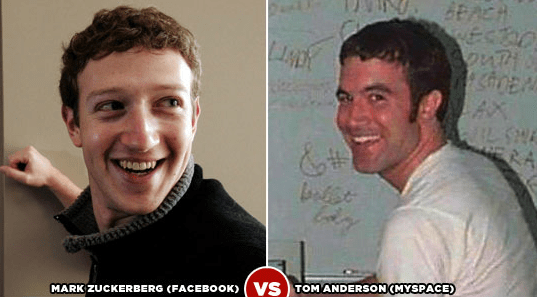
MySpace Tom beat Facebook in the long run

Wouldn’t you rather be a rich nobody than whatever Mark Zuckerberg is?

By Jeremy Gordon

Source: The Outline

My MySpace profile was abandoned when, at the ripe age of 18, I decided it was just a little too juvenile — the glittering GIFs affixed to every page, the garish customized designs, the pressure on maintaining your top 8. By 2006, Facebook offered a cleaner social experience; by 2009, Twitter offered a more casual one. MySpace was a complete relic by this point, even though only a few years had passed since its launch.

Back in 2005, though, long before MySpace burned out, its founder, Tom Anderson — whose grinning face greeted every new user as their first “friend” — sold the site for $580 million to Rupert Murdoch’s News Corporation. While his site was becoming a punchline during the rise of Facebook, Twitter, Instagram, and the other social media networks we now use everyday, Anderson disappeared entirely from the tech scene. Now, he travels the world, documenting his visits to exotic locations.

Contrast that with what’s currently happening to Facebook’s Mark Zuckerberg, who’s on day two of being grilled by a Senate committee for Facebook’s role in haphazardly collecting all of our personal data, and possibly swinging the 2016 presidential election toward Donald Trump. What was supposed to be a basic networking tool has now become one of the chief mediators of how people interact with each other and the world around them, and how information is absorbed and disseminated on the internet. It’s now apparent that Facebook and Zuckerberg didn’t really consider any of this when aggressively pursuing growth, and now we’re all screwed as we try to untangle the consequences.

MySpace Tom? His most recent Instagram post from seven days ago is a giveaway for a stay at an Iceland hotel. He doesn’t have to issue any terse statements about his company’s commitment to fostering a healthy society; he doesn’t have to sit on a booster seat for seven hours and take dipshit questions from a procession of Senate ghouls. He isn’t worth as much money as Zuckerberg, of course, but unless you’re an oil baron, $580 million is enough to tide you over for the length of your lifetime, and your children’s lifetime, and your children’s children’s lifetime, and so on. (Even after taxes!) And yes, yes, being that rich is good for nobody, but without getting into an argument about the perils of capitalism, we can agree that personally speaking, Anderson is having a much better go of things.

It puts MySpace’s failure to evolve in a new light, as perhaps the healthy thing is for a platform to die and for everyone to move on. Its aesthetic and form, back when everyone had emo bangs and listened to Hawthorne Heights, couldn’t change without altering the meaning of the site altogether, and by that time, everyone was gone. Had Facebook not gotten too good at inserting itself between human users, there’s no way it would’ve run into their current problems at such a wide scope. The suspicious CEO is not the one who cashes out; it’s the one who sticks around and creates a behemoth.

Zuckerberg could have sold off his share and avoided becoming literally one of the most disliked people in the present moment. I never thought we’d declare MySpace the winner over Facebook, but then again, I never thought a lot of things about the moment we’re in.


Zucktown, USA

Facebook, Amazon, and Google are reviving the ill-fated “company towns” of the Gilded Age

By Julianne Tveten

Source: The Baffler

EARLIER THIS YEAR IN SILICON VALLEY, a phalanx of six-figure-earning Facebook engineers confronted Mark Zuckerberg about subsidizing their extortionate rents. Meanwhile, the contract laborers who serve them bacon kimchi dogs and duck confit found themselves cordoned off from the affordable housing market—where salaries approaching $74,000 qualify—and began converting their garages into homes. Still, if these events point to a dire situation, they’re but the latest stirrings of the hulking leviathan that is the region’s housing crisis—an issue that has peppered the headlines of news outlets great and small for nearly a decade.

Thanks in part to this accretion of bad press, Zuckerberg and his fellow cyborgian billionaires have sprung into action as property developers. In July, Facebook announced plans to create “Willow Campus,” an aggressively rectilinear, Rem Koolhaas-designed rebrand of a Menlo Park office complex it purchased in 2015. The expansion of its headquarters will boast fifteen hundred units of housing, 15 percent of which it claims will be “offered at below-market rates.” If that isn’t sufficiently microcosmic, the company promises to dedicate 125,000 square feet to commercial space, promising a grocery store, pharmacy, and the cryptically worded “additional community-facing retail.”

Equally if not more responsible for crafting California’s bloodsucking geometric crapscape is Google, whose newfangled parent company Alphabet has vowed to provide temporary housing, in the form of modular dwellings, for three hundred of its employees in its home city of Mountain View. For years, Google has been seeking to wrest control of the city from its government; last year, it gained over 370,000 square feet of office space along with the right to develop 1.4 million square feet in the North Bayshore neighborhood after vying with LinkedIn to furnish the territory with a new police station, road improvements, and college scholarships. (The modular homes will be constructed on a former NASA air base, which the company signed an agreement to lease for sixty years.)


We’re witnessing, in these schemes, a revival of the company town. An oft-recurring feature of the Western capitalist imaginary, the company town’s American variety dates back to the nineteenth century; railroad industrialist George Pullman’s eponymous city in Illinois provides one of the more illustrative examples. Pullman characterized his town, completed in 1884, as a lucrative, pro-business utopia filled with satisfied participants, employee and investor alike. Its veneer was indeed shiny: the amenities it promised—yards, indoor plumbing, gas, trash removal—were rare for industrial workers of the time, and its ultra-formal gardens and shopping center, which equipped them with a barbershop, dentist’s offices, a bank, and a slew of overpriced retail, offered a vanguard capitalist’s dabbling in luxury.

There was a catch: paternalistic and omnipresent capitalism. Immaculately manicured trees were merely curtains obscuring a panopticon, one that kept workers behaviorally economized. (White workers, that is—the town expressly excluded black people.) “[Pullman] wanted to create a company town where everybody would be . . . content with their place in the capitalist system,” Jane Eva Baxter explained to Paleofuture. Workers were forced to rent—with no option to buy—the uniform row houses that corralled them, and from which they worried over persistent inspection and imminent eviction. Their employers likewise controlled which books filled their libraries and which performances took place in their theaters, and a ban precluded them from congregating at saloons or holding town meetings unless sanctioned by the Pullman Company, lest they entertain the notion of unionizing.

The forced exchange not just of labor, but of personal autonomy, for the tenuous ability to buy bread or light one’s stove is, in a word, inhumane, and in three, cause for revolt. Pullman workers had organized several strikes throughout the 1880s, but none were so monumental as the one in 1894. In response to the prior year’s economic depression, Pullman opted to slash workers’ wages; rents, however, remained steadfastly fixed, enriching the company’s reported worth of $62 million while leaving workers with as little as two cents (after paying for housing costs). In partnership with the American Railway Union, four thousand Pullman workers, galvanized and desperate, withheld their labor, and legions of workers throughout the nation would soon join them. Yet the strike collapsed when the Cleveland administration, in a violent display of authoritarianism, deployed federal troops and imprisoned labor leaders. Not long after, by Illinois Supreme Court order, the town was forced to sell everything not used expressly for “industry.”

Still, Pullman’s fiasco didn’t discourage other magnates. In 1900, chocolatier Milton Hershey began construction on a factory complex near a collection of dairy farms in rural Pennsylvania, where he declared there’d be “no poverty, no nuisances, no evil”—a Delphic precursor to Google’s now infamous and defunct slogan, “Don’t be evil.” To attract workers, Hershey reclaimed many of Pullman’s gilded comforts: indoor plumbing, pristine lawns, central heating, garbage pickup, and eventually, the theaters and sports venues any company town worth its salt would host.

What was designed as a wholesome advertisement for the company quickly morphed into a miserly surveillance state. Hershey, who served as the town’s mayor, constable, and fire chief, patrolled neighborhoods to survey the maintenance of houses and hired private detectives to monitor employees’ after-hours alcohol consumption. While the town managed to stage a sort of idyllic capitalist performance for onlookers, by the 1930s its employees resented their binding environs and the Depression-era layoffs they endured from a company earning ten times its annual payroll in after-tax profits. A crippled attempt to unionize with the Congress of Industrial Organizations (CIO) bred a 1937 sit-down strike; days later, farmers and company cheerleaders armed with rocks and pitchforks bloodied and ejected the dissidents, destabilizing for good another corporate-civic lark. Hershey’s vast estate, however, remains unscathed to this day.


If Facebook and Google have begun to revive the company town, Amazon has already given it a futuristic luster. California’s inchoate company towns pale in comparison to their northern counterpart, which occupies 19 percent of Seattle’s office space and a farcical 8.1 million square feet. (Its CEO and founder, Jeff Bezos, has vowed to acquire four million more over the next five years, a muscular move meant to complement his midlife-crisis physique.) Touting its sponsorship of local engineering and sustainability programs, Amazon crows about such “investments” as its dog park, playing fields, art installations, and Buckyball-reminiscent domical gardens. Of course, with Bezos’s colonizing aspirations comes yet another bellicose rental market—the very conditions Facebook and Google claim to be combatting. When considered alongside its recent purchase of Whole Foods, Amazon’s dream of tethering its employees to their jobs—by way of homogenized cubes for rent and lightly discounted quinoa chips—is fast becoming a reality.

Like George Pullman and Milton Hershey, the tech industry’s elites take all prisoners in their respective campaigns to expand, absorb, and dominate. The tech company town, that most contemporary of neofeudalist wangles, is the next step in West Coast corporate behemoths’ quest to lure employees into a twenty-four-hour working existence—the totalizing successor to bottomless Indian food spreads, on-site bike-repair shops, and Frank Gehrized habitats. Its premise deviates not at all from that of its antecedents: a genial, painstakingly aestheticized service to workers, where beneficent corporate hands take the reins of the public good  for the well-being of the community. This time around, though, that community will be bridled with unionbusting and data-harvesting apparatuses sure to make even the most paranoid techno-tyrant salivate.

Certainly, the megalomaniacs who aim to populate municipal fixtures with registered-trademark logos will expect cities to genuflect at every turn. Bezos has exemplified this in Seattle, whose recent measure to “tax the rich” drove him to seek another location in which to build Amazon’s second headquarters. While residents of its hometown grapple with a commandeering leech that “suck[s] up our resources and refus[es] to participate in daily upkeep,” Amazon will soon attempt to prime another city to be sapped. Meanwhile, the smooth-faced metallic vampires of California have just begun to cosplay as frontiersmen, raring to follow Bezos’s lead. Drunk on glib TED Talk propagandizing, and accustomed to dismissing the civic inconveniences of corporate regulations and poor neighborhoods, our technosettlers feel little need to heed the lessons of the past when their chief interest is to monopolize the future. Taxing the techie billionaires is a start, but only when cities refuse to be their hosts will they cease to be their parasites.


Julianne Tveten writes about the technology industry’s relationship with socioeconomics and culture. Her work has appeared in Current Affairs, Hazlitt, In These Times, The Outline, and elsewhere.

I’ve Been Banned From Facebook For Sharing An Article About False Flags

By Caitlin Johnstone

Source: OpEdNews.com

My personal Facebook account, which has the maximum 5,000 friends and an additional 5,000+ followers, has been blocked from posting for three days. My page hasn’t been blocked yet, but we’ll see; I shared the article there, too.

The reason given for this ban by the little pop-up boxes when I logged on just now was that a couple months ago I had shared an article about admitted false flag operations perpetrated by governments around the world. I don’t know what happened that made Facebook’s system decide to crack down on me now all of a sudden, but I do know I’ve been a bit naughtier than usual in my last couple of articles.

The article I got the banhammer for sharing is titled For Those Who Don’t ‘Believe’ In ‘Conspiracies’ Here Are 58 Admitted False Flag Attacks. According to the site’s ticker it has 50,667 shares as of this writing. It’s laden with hyperlinks for further reading, and lists only instances of false flag operations that insiders are on the record as having admitted to themselves. It’s a good compilation of important information. People should be allowed to share it.

The notifications say I can be permanently banned if I continue posting that sort of material. I’ve had that account since 2007.

So. Who wants to see my Barbra Streisand impression?

(Image by Caitlin Johnstone)

(Image by Caitlin Johnstone)

In a corporatist system of government, corporate censorship is state censorship. When there’s no meaningful space between corporate power and government power, it doesn’t make much difference whether the guy silencing your dissent is Mark Zuckerberg or Jeff Sessions. America most definitely has such a system.

If they’re going to get us locked down and propagandized into their vapid brain boxes, this will be how they’ll do it. Not by government censorship, but by corporate censorship. Government can’t make an overt attempt to stop a dissenting voice from speaking, but the corporations who own the venue of their speech can.

In a recent Senate Judiciary Committee hearing, plutocrat-sponsored senators spoke with top legal and security officials for Facebook, Twitter and Google in a very disturbing way about the need to silence dissenting voices.

Democratic Senator Mazie Hirono of Hawaii demanded that the companies adopt a “mission statement” declaring their commitment “to prevent the fomenting of discord.”

A former FBI agent Clint Watts kicked it up even further, saying, “Civil wars don’t start with gunshots, they start with words. America’s war with itself has already begun. We all must act now on the social media battlefield to quell information rebellions that can quickly lead to violent confrontations and easily transform us into the Divided States of America.”

“Stopping the false information artillery barrage landing on social media users comes only when those outlets distributing bogus stories are silenced”—“-silence the guns and the barrage will end,” he added.

This was on the Senate floor. Officials were speaking about the need to censor social media to prevent people from sharing dissenting ideas on the Senate floor.

World Socialist Web Site said of the hearing,

That such a statement could be made in a congressional hearing, entirely without objection, is an expression of the terminal decay of American democracy. There is no faction of the ruling class that maintains any commitment to basic democratic rights.

None of the Democrats in the committee raised any of the constitutional issues involved in asking massive technology companies to censor political speech on the Internet. Only one Republican raised concerns over censorship, but only to allege that Google had a liberal bias.

Former FBI agent says tech companies must “silence” sources of “rebellion”
US Congressional hearing: By Andre Damon 1 November 2017 Top legal and security officials for Facebook, Twitter and” www.wsws.org

I’ll admit right now that this really scares me. Ever the optimist, I’ve been reassuring my readers that the corporatocracy would never risk taking off the black hole sun mask of corporate cheerfulness and move into regular, overt totalitarianism. I’ve contended that they must remain covert in order to keep successfully manufacture consent.

But, here we are. Through a studious application of psy-ops they have their censorship and they have their consent. Remember, in the book “Fahrenheit 451” the public wasn’t unhappy about the book burnings. They cheered them on, and that’s what we have now. The herd is mindlessly clapping their approval at censorship and even volunteering to report naughty behavior like good little hall monitors for the oligarchy. I’m sure that even some of my close friends and family will silently approve of my banning and will meet my distress with the pursed lips of a church lady secretly pleased at my comeuppance.

I tried joining Gab when I saw this coming, but it’s really alt-righty there and the energy there is just gross. Finding a new social media outlet might not even matter anyway, since these creeps just target any place people gather in large numbers.

I don’t know. I always freak out a bit when the eye of corporate censorship focuses on me. I’ve recently been told by a number of people that they’ve been banned for sharing my articles, and now it’s hitting me.

I’m babbling. This is weird. I just really, really don’t want humanity to become what these people are trying to turn it into, you know? Help me make some noise about this stuff, please. Manipulators can’t do their job when there’s a big spotlight pointed at them.

______

Hey you, thanks for reading! My work is entirely reader-funded so if you enjoyed this piece please consider sharing it around, liking me on Facebook, following me on Twitter, and maybe throwing some money into my hat on Patreon or Paypal.

Now Just Five Men Own Almost as Much Wealth as Half the World’s Population

By Paul Buchheit

Source: CommonDreams

Last year it was 8 men, then down to 6, and now almost 5.

While Americans fixate on Trump, the super-rich are absconding with our wealth, and the plague of inequality continues to grow. An analysis of 2016 data found that the poorest five deciles of the world population own about $410 billion in total wealth. As of 06/08/17, the world’s richest five men owned over $400 billion in wealth. Thus, on average, each man owns nearly as much as 750 million people.

Why Do We Let a Few People Shift Great Portions of the World’s Wealth to Themselves? 

Most of the super-super-rich are Americans. We the American people created the Internet, developed and funded Artificial Intelligence, and built a massive transportation infrastructure, yet we let just a few individuals take almost all the credit, along with hundreds of billions of dollars.

Defenders of the out-of-control wealth gap insist that all is OK, because, after all, America is a ‘meritocracy’ in which the super-wealthy have ‘earned’ all they have. They heed the words of Warren Buffett: “The genius of the American economy, our emphasis on a meritocracy and a market system and a rule of law has enabled generation after generation to live better than their parents did.”

But it’s not a meritocracy. Children are no longer living better than their parents did. In the eight years since the recession the Wilshire Total Market valuation has more than TRIPLED, rising from a little over $8 trillion to nearly $25 trillion. The great majority of it has gone to the very richest Americans. In 2016 alone, the richest 1% effectively shifted nearly $4 trillion in wealth away from the rest of the nation to themselves, with nearly half of the wealth transfer ($1.94 trillion) coming from the nation’s poorest 90%—the middle and lower classes. That’s over $17,000 in housing and savings per lower-to-middle-class household lost to the super-rich.

A meritocracy? Bill Gates, Mark Zuckerberg, and Jeff Bezos have done little that wouldn’t have happened anyway. ALL modern U.S. technology started with—and to a great extent continues with—our tax dollars and our research institutes and our subsidies to corporations.

Why Do We Let Unqualified Rich People Tell Us How To Live? Especially Bill Gates! 

In 1975, at the age of 20, Bill Gates founded Microsoft with high school buddy Paul Allen. At the time Gary Kildall’s CP/M operating system was the industry standard. Even Gates’ company used it. But Kildall was an innovator, not a businessman, and when IBM came calling for an OS for the new IBM PC, his delays drove the big mainframe company to Gates. Even though the newly established Microsoft company couldn’t fill IBM’s needs, Gates and Allen saw an opportunity, and so they hurriedly bought the rights to another local company’s OS — which was based on Kildall’s CP/M system. Kildall wanted to sue, but intellectual property law for software had not yet been established. Kildall was a maker who got taken.

So Bill Gates took from others to become the richest man in the world. And now, because of his great wealth and the meritocracy myth, MANY PEOPLE LOOK TO HIM FOR SOLUTIONS IN VITAL AREAS OF HUMAN NEED, such as education and global food production.

—Gates on Education: He has promoted galvanic skin response monitors to measure the biological reactions of students, and the videotaping of teachers to evaluate their performances. About schools he said, “The best results have come in cities where the mayor is in charge of the school system. So you have one executive, and the school board isn’t as powerful.”

—Gates on Africa: With investments in or deals with MonsantoCargill, and Merck, Gates has demonstrated his preference for corporate control over poor countries deemed unable to help themselves. But no problem—according to Gates, “By 2035, there will be almost no poor countries left in the world.”

Warren Buffett: Demanding To Be Taxed at a Higher Rate (As Long As His Own Company Doesn’t Have To Pay) 

Warren Buffett has advocated for higher taxes on the rich and a reasonable estate tax. But his company Berkshire Hathaway has used “hypothetical amounts” to ‘pay’ its taxes while actually deferring $77 billion in real taxes.

Jeff Bezos: $50 Billion in Less Than Two Years, and Fighting Taxes All the Way 

Since the end of 2015 Jeff Bezos has accumulated enough wealth to cover the entire $50 billion U.S. housing budget, which serves five million Americans. Bezos, who has profited greatly from the Internet and the infrastructure built up over many years by many people with many of our tax dollars, has used tax havens and high-priced lobbyists to avoid the taxes owed by his company.

Mark Zuckerberg (6th Richest in World, 4th Richest in America) 

While Zuckerberg was developing his version of social networking at Harvard, Columbia University students Adam Goldberg and Wayne Ting built a system called Campus Network, which was much more sophisticated than the early versions of Facebook. But Zuckerberg had the Harvard name and better financial support. It was also alleged that Zuckerberg hacked into competitors’ computers to compromise user data.

Now with his billions he has created a ‘charitable’ foundation, which in reality is a tax-exempt limited liability company, leaving him free to make political donations or sell his holdings, all without paying taxes.

Everything has fallen into place for young Zuckerberg. Nothing left to do but run for president.

The False Promise of Philanthropy 

Many super-rich individuals have pledged the majority of their fortunes to philanthropic causes. That’s very generous, if they keep their promises. But that’s not really the point.

American billionaires all made their money because of the research and innovation and infrastructure that make up the foundation of our modern technologies. They have taken credit, along with their massive fortunes, for successes that derive from society rather than from a few individuals. It should not be any one person’s decision about the proper use of that wealth. Instead a significant portion of annual national wealth gains should be promised to education, housing, health research, and infrastructure. That is what Americans and their parents and grandparents have earned after a half-century of hard work and productivity.