‘Al-Aqsa Storm’ Operation: Far-reaching Geopolitical Implications

By Lucas Leiroz de Almeida

Source: GlobalResearch.ca

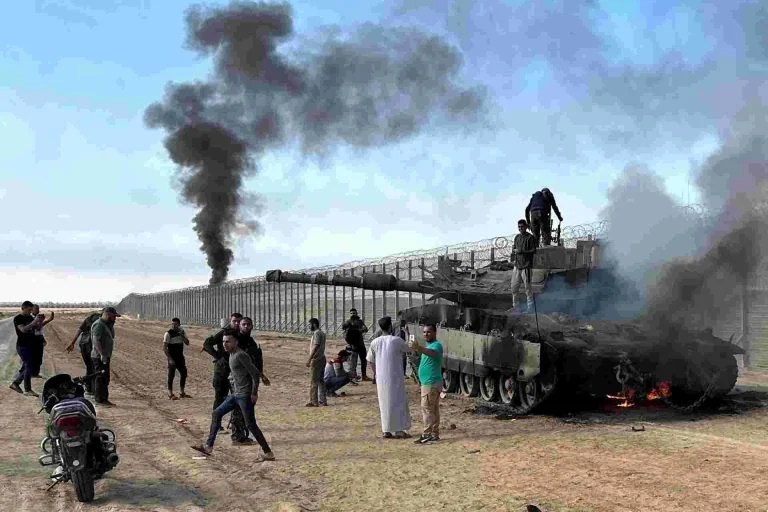
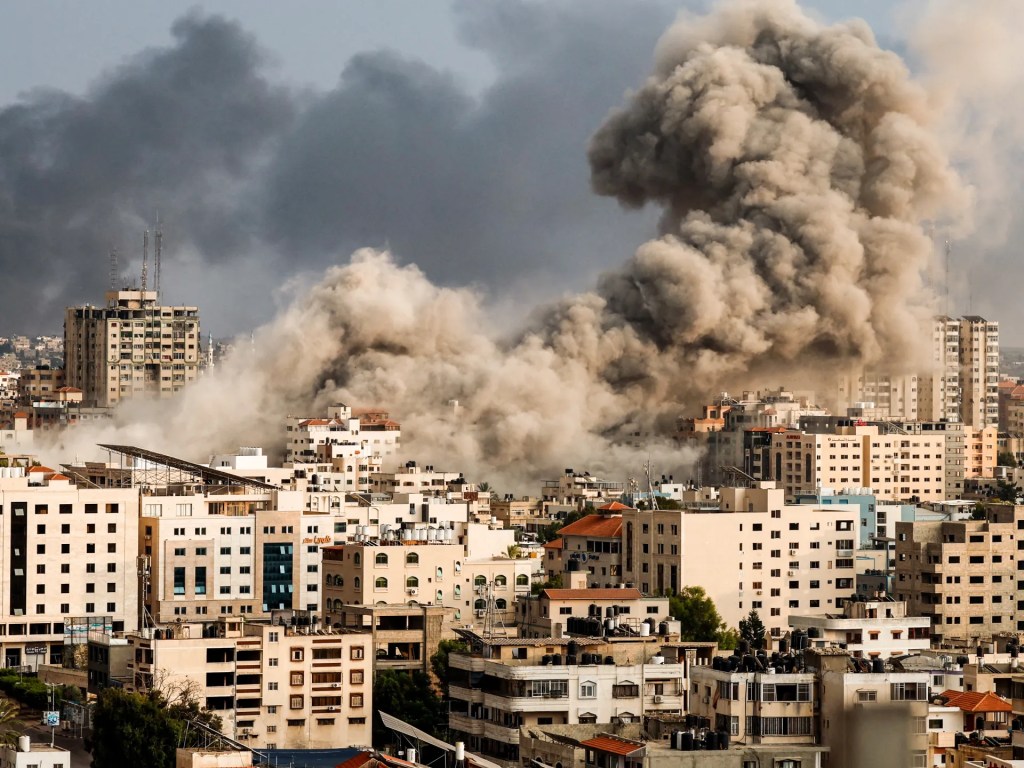
A major conflict is beginning in Palestine. On October 7, Hamas launched a military operation against the Israeli occupation forces. Using missiles, drones and paragliders, Palestinian soldiers managed to surprisingly attack Israeli troops and advance through occupied territory, liberating many areas. Tel Aviv responded with a declaration of war and several brutal attacks on civilian areas in Gaza, however, the Jewish State’s forces still appear unable to expel Palestinian soldiers from their occupied territory, with Hamas advancing rapidly.

In addition to territorial disputes, the attack seems to have direct religious reasons. Palestinians call the assault “Al-Aqsa Storm Operation“, referring to the famous Al-Aqsa Mosque, an important Islamic holy site. Jewish militants have frequently attacked the site and extremist religious groups have pressured the state to demolish the Mosque and build a Jewish temple in the region. The constant desecration of Al-Aqsa appears to have been a red line for Palestinian Muslims.

The surprise effect of the Hamas attack shocked Israeli authorities and Tel Aviv’s supporters around the world. Hamas’ ability to destroy the illegal siege imposed by Zionist forces was seen as a historic defeat for Israel. Furthermore, many experts are criticizing the intelligence capabilities of the Jewish State after the start of the battle, as the country’s spy forces were inefficient in predicting Palestinian moves and taking preventive measures against Hamas, which is a militia, not a regular national army, therefore having much more limited resources than Israeli Defense Forces.

Immediately after the start of hostilities, many videos and images began to be shared on social media showing the violence of the clashes. Many of these images are spread out of context, mainly by the Western pro-Zionist propaganda machine. Anti-Palestine activists accuse Hamas of murdering civilians, while anti-Zionists claim [erronously] that all those killed are military targets – even though some of them are unarmed. It is important to remember that in Israel military service is mandatory for almost all citizens (including women), with most of the Gaza borders’ settlers being actually military, even if they were eventually killed or captured while off duty.

Israel’s reactions were harsh. Netanyahu declared a state of war and ordered a series of bombings against the Gaza Strip.

Hundreds of Palestinian civilians died, non-military facilities were destroyed, and a severe blockade is being imposed on any type of food, energy or water supply. The retaliation, did not prevent Hamas’ advance into the occupation zone. There is still a strong presence of Palestinian troops and an absolute Israeli inability to expel them. Furthermore, thousands of Israeli citizens are leaving the country, creating an unprecedented crisis.

Around the world, reactions to the escalation were as expected. Most Arab and Islamic countries have expressed support for the Palestinian resistance, but without committing to direct military cooperation. The Collective West has voiced support for Israel, with the US, EU, UK and their allies harshly criticizing Hamas, which they consider a “terrorist group”. On the other hand, Russia and China called for an immediate ceasefire and emphasized the importance of recognizing a Palestinian State as an existential condition for peace in the Middle East.

Washington is moving significant extra military aid to Tel Aviv. The Jewish State already receives 3 billion dollars in military assistance annually from the US, but with the escalation of hostilities, the tendency is for this assistance to increase substantially. Obviously, this will have a severe impact on the proxy war against Russia, as it will be impossible for the US to continue backing two high-intensity conflicts at the same time. The pro-Israel agenda is unanimous among American politicians, bringing together Republicans and Democrats much more cohesively than Ukraine, which many conservative politicians dislike. So, it is most likely that Kiev will be progressively “abandoned” by Washington as the crisis in Palestine worsens.

However, it is unlikely that American aid will automatically be a “game-changer” for Israel. There will be many local reprisals as Iran will certainly exponentially boost its participation in the conflict and send weapons and irregular troops to help the Palestinians. Furthermore, Hezbollah from Lebanon and some Syrian military units are also on combat readiness and could openly enter the conflict if it escalates. Iran also controls Houthi dissidents in Yemen, who could also take part in hostilities. So, instead of an “easy” military effort, with systematic killing of civilians and territorial expansionism (as seen on other occasions), this time, Israel may be facing a serious security crisis, putting its very existence at risk.

To avoid this disastrous scenario, the right thing to do for Tel Aviv is to stop territorial expansionism and the illegal occupation of Palestinian territories. The Jewish State needs to respect international law and start thinking seriously about returning its borders to the limits of the 1948 UN plan – with possible changes, as long as they are negotiated with the Arabs under mutually beneficial circumstances. Aggressive policies of apartheid and territorial annexation, as well as desecration of Islamic religious sites, will only result in more conflicts.

However, Tel Aviv seems not only committed to the most extreme wings of Zionism but also shows a willingness to act as an American proxy against Iran in the Middle East, which brings very negative expectations. If Israel chooses the path of war, it could become a “new Ukraine”.

Did Hamas Attack Civilians or Fanatical Zionist Settlers?

Israel’s fanatical settlers are responsible for countless attacks on Palestinian civilians.

By Kurt Nimmo

Source: Kurt Nimmo on Geopolitics

Now that the USG will help Israeli with its long-anticipated attack on Iran—the Secretary of War, Lloyd Austin, has ordered the USS Gerald R. Ford Carrier Strike Group to the Eastern Mediterranean—we can expect “Iraq has WMDs” style propaganda in surfeit.

For instance, the “influencer” Hananya Naftali. According to his website, “Hananya has been working for Prime Minister Netanyahu in his digital team for the past 5 years.” He also “served” in the IDF and “fought Hamas during the Gaza War in 2014.”

As an “influencer,” Mr. Naftali needs your attention, thus absurd hyperbole.

“More than 700 Israelis were murdered. So much blood of innocent civilians has been spilled. May God avenge their blood. #IsraelUnderAttack,” he tweeted.

The tweet included a graphic that declares, “More Jews were murdered on October 7th, 2023, than on any other single day since the Holocaust.”

Of course, there is no information beyond Israeli war propaganda to confirm or dispute this claim. It should be a given that a state preparing for war will manufacture outrageous propaganda to make its case, no matter how fallacious and untrue.

The settlements said to be targeted by Hamas include:

Kissufim. This is a kibbutz, part of the so-called Shalom bloc. It was established by a Zionist youth movement in 1951. It is a gateway to the Gush Katif collection of illegal Zionist settlements.

Nahal Oz. Originally a military base, this “settlement” was established by Israeli Nahal soldiers, as part of an effort to establish illegal Zionist settlements.

Re’im. This settlement was established in 1949 by the Israel Boy and Girl Scouts Federation, part of the Palmach (Pelugot Hamahatz), a terrorist organization aligned with the Irgun, the Lehi, and the Haganah, all perpetrators of Zionist violence and terror. Irgun was run by Revisionist Zionism founder Ze’ev Jabotinsky, an admirer of Mussolini and fascism.

Sderot. The Palestinian village of Najd was wiped off the map to make way for this city of Zionist colonialists. More than 30,000 Israelis live there.

In addition, several other kibbutzim and settlements established on ethnically cleansed Palestinian land were overtaken by Hamas.

In the tidal wave of pro-Israel news following the Hamas “invasion,” there is virtually no mention of the fact these settlements violate Article 49 of the Fourth Geneva Convention and a long list of United Nations resolutions.

Israel’s fanatical settlers are responsible for countless attacks against Palestinian civilians. The violence is especially acute in the West Bank.

In 2021, Michael Lynk, Special Rapporteur on the situation of human rights in the Palestinian Territory occupied since 1967, said that settler violence was “ideologically motivated and primarily designed to take over land but also to intimidate and terrorize Palestinians.”

In Jerusalem, under orders of an ultra-nationalistic Israeli government, numerous Palestinian homes have been demolished to make way for settlers. The Netanyahu regime declared illegal West Bank settlements are a “top priority.”

In other words, Hamas was “invading” illegal settlements where armed settlers live and enjoy impunity from prosecution for crimes of violence against Palestinians. This has been Israeli policy, under Labor and Likud regimes, for some time.

But if you watch or read war propaganda news, you are told Hamas are “animals” killing and terrorizing innocent Israeli citizens. The fact of the matter is, right or wrong (and violence against unarmed civilians is always wrong), Hamas was in effect attacking armed vigilantes condoned and supported by the Israeli government.

Neocons and Other Malignancies in the American Body Politic

They will never give up until we’re all dead

By Philip Giraldi

Source: The Unz Review

It is interesting to observe how, over the past twenty-five years, the United States has become not only a participant in wars in various places on the planet but has also evolved into being the prime initiator of most of the armed conflict. Going back to the Balkans in the nineteen-nineties and moving forward in Afghanistan, Iraq, Libya, Syria, Lebanon and Somalia there is almost always an American leading role where there is bombing and killing. And where there is no actual war, there are threats and sanctions intended to make other nations come to heel, be they in Latin America like Venezuela, or Iran in the Middle East, or North Korea in Asia. And then there is the completely senseless act of turning major competitors like Russia and China, as we are now seeing, into enemies, with a proxy war raging in Ukraine, threats over Taiwan, and the world moving one step closer to a nuclear disaster.

It seems to me that the transition from an America bumbling its way into war and the current situation where wars are pursued as a matter of course coincides with a certain political development in the United States, which is the rise of neoconservatives as the foreign and national security policy makers in both major parties. This has developed together with the evolution of the view that the United States can do no wrong by definition, indeed, that it has a unique and God-given right to establish and police the globe through something that it invented, exploits and has dubbed the “rules based international order.”

Who would have thought that a bunch of Jewish student-activists, mostly leftists, originally conspiring in a corner of the cafeteria in the City College of New York would create a cult type following that now aspires to rule the world? The neocons became politically most active in the 1960s and eventually some of them attached themselves to the Republican Party under Ronald Reagan, declaring their evolution had come about because they were “liberals mugged by reality.” The neoconservative label was first used to describe their political philosophy in 1973. Since that time, they have diversified and succeeded in selling their view to a bipartisan audience that the US should embrace an aggressive interventionist foreign policy and must be the world hegemon. To be sure their desire for overwhelming military power has been strongly shaped by their tribal cohesion which has fed a compulsion to have Washington serve as the eternal protector of Israel, but the hegemonistic approach has inevitably led to expanding conflict all over the world and a willingness to challenge, confront and defeat other existing great powers. Hence the support for a needless and pointless war in Ukraine to “weaken Russia” and a growing conflict with China over Taiwan to do the same in Asia. To make sure that the Republicans do not waver on that mission, leading neocon Bill Kristol has recently raised $2 million to do some heavy lobbying to make sure that they stay on track to confront the Kremlin in Europe.

One of the leading neocon families is the Kagans, who have successfully penetrated and come to dominate the establishment foreign policy centers in both the Republican and Democratic Parties. Victoria Nuland nee Nudelman, the wife of Robert Kagan, is entrenched at the State Department where she is now the Deputy Secretary, the number two position. Up until recently, she was one of the top three officials at State, all of whom were and are Jewish Zionists. Indeed, under Joe Biden Zionist Jews dominate the national security structure, to include the top level of the State Department, the head of Homeland Security, the Attorney General, the National Security Adviser, the Director of National Intelligence, the President’s Chief of Staff, and the Deputy Director of the Central Intelligence Agency. Nuland’s hawkish appeal is apparently bipartisan as she has served in senior positions under Bill Clinton, Dick Cheney, George W. Bush, Barack Obama and now Joe Biden. As adviser to Cheney, she was a leading advocate of war with Iraq, working with other Jewish neocons Doug Feith and Paul Wolfowitz at Defense and also Scooter Libby in the Vice President’s office. As there was no actual threat to the US from Saddam Hussein she and her colleagues invented one, the WMD that they sold to the media and to idiots like Secretary of State Condoleezza Rice. Nuland is also considered to be close to Hillary Clinton and the recently deceased ghastly former Secretary of State Madeleine Albright. All of her government assignments have included either invading or severely sanctioning some country considered by her and her colleagues to be unfriendly. She particularly hates the Russians and anyone who is hostile to Israel.

Apparently, Nuland’s record of being seriously wrong in the policies she promoted has only served to improve her resume in Washington’s hawkish foreign policy establishment and when Biden came into the presidency she found herself appointed to the number three position at the State Department as the Under Secretary of State for Political Affairs. Her return to power with the Democrats might also be due in part to the activism of her husband Robert, currently a senior fellow at the Brookings Institute, who was one of the first neocons to get on the NeverTrump band wagon back in 2016 when he endorsed Hillary Clinton for president and spoke at a Washington fundraiser for her, complaining about the “isolationist” tendency in the Republican Party exemplified by Trump. Robert famously has never seen a war he disapproved of and, while urging Europe to do more defense spending, commented that “When it comes to use of military force “Americans are from Mars, and Europeans are from Venus.” Robert’s brother Frederick, a Senior Fellow at the neocon American Enterprise Institute, and Frederick’s wife Kimberly, who heads the bizarrely named Institute for the Study of War, are also regarded as neocon royalty.

Nuland is particularly well known for her being the driving force behind the regime change in Ukraine in 2014 that replaced the fairly-elected but friendly-to-Russia President Viktor Yanukovych with a selected candidate more accommodating to the US and Western Europe. Ukraine, the most corrupt country in Europe, has been unstable ever since and the current war, also initiated by interference from the US and UK, has brought about the deaths and wounding of an estimated half million Ukrainians and Russians.

Nuland was recently in Africa, stirring up developments in Niger, which has experienced a recent military coup that removed a president who was corrupt but also a friend of the US and France, both of which have troops stationed in the country. As I write this, a number of African nations (ECOWAS) friendly to US and French interests in the region are gathering together their own military force to reverse the coup, but there is little enthusiasm for the project. We will see how that turns out, but predictably Nuland is advertising a possible intervention as a “restoration of democracy.”

And there is more over the horizon with neocons like Secretary of State Antony Blinken and Nuland in charge of US foreign policy and supported by most of congress and a Jewish dominated media and entertainment industry. Joe Biden is too weak and too much under the thumb of the Israel Lobby to pursue any policies that would be beneficial to the American people in general, so the course will be set by the current crop of zealots, just as Donald Trump was guided by his Christian Zionist advisers.

If you want to understand just how what remains of our republic is in a bus being driven over the cliff by a group that has no regard for most of the citizens of the country that they reside in, one only has to read some of what passes for neocon analysis of what must be done to make America “safe.” Not surprisingly, it also involves Israel and a war on behalf of the Jewish state.

One astonishingly audacious article that appeared on August 13th in The Hill entitled “If Israel strikes Iran over its nuclear program, the US must have its back,” gives Israel the option of starting a war for any or no reason with the United States compelled to join in in support. It was written Michael Makovsky, a well-known Jewish neocon, and Chuck Wald. Makovsky is President and CEO of the Jewish Institute for National Security of America (JINSA) while Wald is a former general who also is affiliated with that group as a “distinguished fellow,” which means he is getting paid generously to serve as a mouthpiece providing credibility for the group. For those unfamiliar with The Hill, it is an inside the beltway defense contractor funded online magazine that pretends to be serious but which is actually an integral part of the status quo Zionist and war-on-demand network. That the Jewish Institute for National Security is “of America” is, of course, a characteristically clever euphemism.

The article begins with “The Biden administration should learn from its unpreparedness for the Russia-Ukraine war and begin to prepare for a major Israel-Iran conflict. The administration needs to set aside its differences with the Israeli government, overcome its aversion to conflict with Iran, and begin to work closely with Jerusalem to prepare for the growing likelihood that Israel will feel it has no choice but to initiate a military campaign against Iran’s nuclear program. In ‘No Daylight,’ a new report from the Jewish Institute for National Security of America (JINSA)…retired senior military officers and national security experts explain that whatever differences the US might now have with Israel over Iran policy, our two countries’ interests will be aligned after an Israeli strike. Consequently, in preparing its response, the U.S. guiding principle should be ‘no daylight with Israel,’ to ensure Israeli military success, mitigate Iranian retaliation and limit the scope of the conflict — vital interests for both countries.”

That war with Iran is a “vital interest” for the United States is, of course, not really explained as the point is to let Israel to decide on the issue of war and peace for the United States. The article then trots out the old “credibility” argument, i.e. that if we don’t go to war no one will ever trust our security guarantees: “A US betrayal of its close Israeli ally, at a time of great peril for the Jewish state, would be ‘one of the greatest catastrophes ever,’ an Arab leader told us privately recently. Because Israel is widely perceived as a close American ally, the US stance as Israel risks thousands of casualties in defense of its very existence, will resound broadly. Strong American support will reassure allies from Warsaw to Abu Dhabi and Taipei; American equivocation will shred Washington’s credibility and embolden adversaries from Tehran to Moscow and Beijing.”

One would love to know who the anonymous Arab leader so concerned about Israel is and, of course, the Jewish state is not in fact an American ally apart from in the fertile imaginations of congressmen, the media and the White House. And Israel will, of course, need more weapons and money from the US taxpayer to include “expediting delivery to Israel of KC-46A tankers, precision-guided munitions, F-15 and F-35 aircraft, and air and missile defenses…. Washington should accelerate building integrated regional air, missile and maritime defenses against persistent Iranian threats.” And America must be prepared to expand the war: “Privately, Iranian and Hezbollah leadership should be warned that heavy retaliation against Israel…will prompt severe Israeli and/or American responses that could threaten their very grasp on power. Upon commencement of an Israeli strike, the United States should promptly resupply Israel with Iron Dome interceptors, precision-guided munitions, ammunition and spare parts, and deploy Patriot air defenses to Israel…”

So the United States must be prepared to turn over its national security to Israel in exchange for what gain for Americans? In part it would apparently involve “finding a permanent solution to Iran’s illegal nuclear weapons program” which is based on a lie even if Prime Minister Benjamin Netanyahu has been repeating for over 20 years that Iran is only six months away from a weapon. Both the CIA and Mossad have confirmed that Iran has no such program while Israel does have a secret illegal nuclear arsenal built using enriched uranium and nuclear triggers stolen from the US. The article concludes with another reference to the non-existing program, claiming “the most effective way to address Iran’s nuclear program already has been articulated by President Biden and communicated by America’s ambassador in Jerusalem: ‘Israel can and should do whatever they need to deal with it, and we’ve got their back.’”

Supporting Israeli war crimes is not the way to go. As Chris Hedges puts it correctly, there is no compelling American interest in damaging itself by supporting Israel blindly, quite the contrary: “The long nightmare of oppression of Palestinians is not a tangential issue. It is a black and white issue of a settler-colonial state imposing a military occupation, horrific violence and apartheidbacked by billions of US dollars, on the indigenous population of Palestine. It is the all powerful against the all powerless. Israel uses its modern weaponry against a captive population that has no army, no navy, no air force, no mechanized military units, no command and control and no heavy artillery, while pretending intermittent acts of wholesale slaughter are wars.”

And, of course, while Israel engages in slaughter and torture it always portrays itself as the victim only engaged in fighting against “terrorists.” I have a better idea for where we should go with all of this. President Joe Biden should be impeached for ignoring war powers legislation and indicating that he is willing to sacrifice US interests and kill American soldiers, few or plausibly none of whom will actually be Jewish since it is not an occupation that attracts them, to please and support a manifestly evil foreign government. And Donald Trump should also be punished for having done much the same type of pandering to a foreign country while in office. Meanwhile, haul Makovsky and Wald together with their buddies at the American-Israel Public Affairs Committee (AIPAC) and the Anti-Defamation League (ADL) down to the Justice Department and put them in jail for violation of the Foreign Agents Registration Act of 1938 (FARA) in that they are willfully acting as agents of a foreign government and are operating corruptly to serve the interests of that government. The criminals at AIPAC are already using their associated PACs to oust targeted members of Congress up for re-election in 2024 who have in any way been critical of Israel or pro-Palestinian. And while you’re at it Mr. Attorney General Merrick Garland nee Garfinkel, please have Mr. Blinken and Ms. Nuland pop by for a chat just for starters and see how far you can make the laws apply to those in power. There is some confusion evident here as Israel is not part of the United States, no matter how politically dominant and wealthy its lobby might be. Time to put an end to this nonsense and call it out for what it is – it is treason.

Unraveling the Epstein-Chomsky Relationship

Recent revelations that the renowned linguist and political activist met with Jeffrey Epstein several times have surprised and confused many. Why was Epstein interested in meeting with Noam Chomsky? And why did Chomsky agree to meet him despite his past? The answer may surprise you.

By Whitney Webb

Source: Unlimited Hangout

On Sunday, the Wall Street Journal published a report detailing information contained within a “trove” of previously unreported documents of the deceased sex trafficker Jeffrey Epstein. Those documents, which have not been publicly released and appear to have been passed solely to the Journal, included Epstein’s private calendar and meeting schedules. The documents, per the Journal, contain “thousands of pages of emails and schedules from 2013 to 2017” and – as the report notes – detail Epstein’s dealings with several prominent individuals whose names were not on his flight logs or his infamous “little black book” of contacts. One of these individuals is the renowned linguist, political commentator and critic of capitalism and empire, Noam Chomsky.

Chomsky, who has previously discussed the Epstein case in interviews and who has maintained that Epstein’s ties to intelligence agencies should be considered a “conspiracy theory,” had not previously disclosed these meetings. Chomsky, when confronted by Journal reporters, was evasive, but ultimately admitted to meeting and knowing Jeffrey Epstein. 

Many, largely on the left, have expressed dismay and confusion as to why someone with the political views of Chomsky would willingly meet, not once but several times, with someone like Jeffrey Epstein, particularly well after Epstein’s notoriety as a sex trafficker and pedophile. As this report will show, Epstein appeared to view Chomsky as another intellectual who could help guide his decisions when it came to his scientific obsessions – namely, transhumanism and eugenics. What Chomsky gained in return from meeting with Epstein isn’t as clear.

Why Did Chomsky Meet with Epstein?

According to the Journal, Chomsky’s meetings with Epstein took place during the years 2015 and 2016, while Chomsky taught at the Massachusetts Institute of Technology, or MIT. Chomsky told the Journal that he met with Epstein to discuss topics like neuroscience with other academics, like Harvard’s Martin Nowak (who was heavily funded by Epstein). On a separate occasion, Chomsky again met with Epstein alongside former Israeli Prime Minister, Ehud Barak, allegedly to discuss “Israel’s policies with regard to Palestinian issues and the international arena.” A separate date saw Chomsky and his wife invited by Epstein to have dinner with him, Woody Allen and Allen’s wife Soon-Yi Previn. When asked about the dinner date with Woody Allen and Epstein, Chomsky referred to the occasion as “an evening spent with a great artist.”

When confronted with this evidence, Chomsky initially told the Journal that his meetings and relationship with Epstein were “none of your business. Or anyone’s.” He then added that “I knew him [Epstein] and we met occasionally.”

Before continuing further, it is important to note that aside from Epstein, both Ehud Barak and Woody Allen have been accused of having inappropriate sexual relationships with minors. For instance, Barak was a frequent visitor to Epstein’s residences in New York, so often that The Daily Beast reported that numerous residents of an apartment building linked to Epstein “had seen Barak in the building multiple times over the last few years, and nearly half a dozen more described running into his security detail,” adding that “the building is majority-owned by Epstein’s younger brother, Mark, and has been tied to the financier’s alleged New York trafficking ring.”

Specifically, several apartments in the building were “being used to house underage girls from South America, Europe and the former Soviet Union,” according to a former bookkeeper employed by one of Epstein’s main procurers of underage girls, Jean Luc Brunel. Barak is also known to have spent the night at one of Epstein’s residences at least once, was photographed leaving Epstein’s residence as recently as 2016, and has admitted to visiting Epstein’s island, which has sported nicknames including “Pedo Island,” “Lolita Island” and “Orgy Island.” In 2004, Barak received $2.5 million from Leslie Wexner’s Wexner Foundation, where Epstein was a trustee as well as one of the foundation’s top donors, officially for unspecified “consulting services” and “research” on the foundation’s behalf. Several years later, Barak put Harvey Weinstein in contact with the Israeli private intelligence outfit Black Cube, which employs former Mossad agents and Israeli military intelligence operatives, as Weinstein sought to intimidate the women who had accused him of sexual assault and sexual harassment.

In addition, Barak previously chaired and invested in Carbyne911, a controversial Israeli emergency services start-up that has expanded around the world and has become particularly entrenched in the United States. Barak had directed Epstein to invest $1 million into that company, which has been criticized as a potential tool for warrantless mass surveillance. Leslie Wexner also invested millions in the company.

In Woody Allen’s case, he has been accused of sexually assaulting his adopted daughter Dylan Farrow when she was 7 years old. That abuse claim has been corroborated by witnesses and other evidence. Furthermore, Allen refused to take a polygraph administered by state police in connection with the investigation and lost four exhaustive court battles related to child custody and his abuse of Dylan Farrow. One of the judge’s in the case described Allen’s behavior towards Dylan as “grossly inappropriate and that measures must be taken to protect her.” Actress Mia Farrow, Dylan’s mother, alleged in court that Allen took a sexual interest in her adopted daughter when she was between the ages of two and three years old.

Allen subsequently “seduced” and later married another adopted daughter of Farrow’s, Soon-Yi Previn, whom Allen first met when Previn was a child. However, Previn has stated that her first “friendly” interaction with Allen took place when she was a teenager. In 1992, Mia Farrow found nude photos of Previn in Allen’s home and has stated that this was her motive for ending her relationship with Allen.

In the case of Allen and Epstein, and potentially Barak as well, their sexual proclivities and scandals were well known by the time Chomsky met with these men, making a strong suggestion that this type of behavior was not seen by Chomsky as taboo or as a barrier to socialization. It is more likely than not that there was some other major draw that led Chomsky to overlook this type of horrendous behavior toward vulnerable minors.

In terms of reaching a deeper understanding about why Epstein would have been interested in Chomsky – and vice versa, it is important to review – not just the information recently reported by the Wall Street Journal, but also what Epstein himself said of Chomsky before his 2019 death. According to an interview conducted in 2017, but later published in 2019 when Epstein was a major news topic, Epstein openly stated that he had invited Chomsky to his townhouse and he also explicitly stated why he had done so. Oddly, this early acknowledgement of Epstein’s regarding his relationship with Chomsky was left out of the Journal’s recent report.

In that interview, which was conducted by Jeffrey Mervis and later published in Science, Epstein stated that following about Chomsky:

[…] Epstein readily admitted to asking prominent members of the scientific establishment to assess the potential contribution of these so-called outcasts [i.e. MIT students Epstein described as being “on the spectrum”].

“So, I had Jim Watson to the house, and I asked Watson, what does he think about this idea,” a proposal to study how the cellular mechanisms of plants might be relevant to human cancer. Watson is a Nobel laureate and co-discoverer of the structure of DNA. “Likewise with [Noam] Chomsky on artificial intelligence,” he said, referring to one of the pioneers in the field.

In fact, Epstein expressed great respect for the opinions of these elder statesmen. “It’s funny to watch Noam Chomsky rip apart these young boys who talk about having a thinking machine,” Epstein noted. “He takes out a dagger and slices them, very kindly, into little shreds.”

Thus, per Epstein, his interest in inviting Chomsky to his house was explicitly related to the “artificial intelligence,” which was a major scientific interest of Epstein’s. This also provides a major clue as to how Chomsky and Epstein might have first been introduced.

Chomsky, Epstein and MIT

Chomsky is most widely viewed as a famous linguist, political commentator and critic of modern capitalism and imperialism. So, why did Epstein seek to meet with him instead on Artificial Intelligence matters?

Well, an admitted “friend” of both Chomsky’s and Epstein’s was the AI pioneer Marvin Minsky. Like Chomsky, Minsky was a long-time professor and academic at MIT. It is very possible that Minsky connected the two men, especially considering the fact that Epstein was a major donor to MIT. Epstein described himself as being “very close” to Minsky, who died in 2016, roughly a year after Epstein began meeting with Chomsky. Epstein also financed some of Minsky’s projects and Minsky, like Ehud Barak, was accused of sexually abusing the minors Epstein trafficked.

Chomsky’s views on linguistics and cognition, for those who don’t know, is based very much on evolutionary biology. Chomsky was also a pioneer in cognitive science, described as “a field aimed at uncovering the mental representations and rules that underlie our perceptual and cognitive abilities.” Some have described Chomsky’s concept of language as based on “the complexity of internal representation, encoded in the genome, and their maturation in light of the right data into a sophisticated computational system, one that cannot be usefully broken down into a set of associations.” A person’s “language faculty”, per Chomsky, should be seen as “part of the organism’s genetic endowment, much like the visual system, the immune system and the circulatory system, and we ought to approach it just as we approach these other more down-to-earth biological systems.”

Despite their friendship, Minsky greatly diverged with Chomsky in this view, with Minsky describing Chomsky’s views on linguistics and cognition as largely superficial and irrelevant. Chomsky later criticized the widely used approach with AI that focuses on statistical learning techniques to mine and predict data, which Chomsky argued was “unlikely to yield general principles about the nature of intelligent beings or about cognition.”

However, Chomsky’s views linking evolutionary biology/genetics with linguistics/cognition were notably praised by the aforementioned Martin Nowak, who had attended one of the meetings Epstein had with Chomsky. Nowak, a professor of biology and mathematics and head of the Program for Evolutionary Dynamics at Harvard, later stated that he had “once broke out a blackboard during dinner with Epstein and, for two hours, gave a mathematical description of how language works,” further revealing that Epstein was interested in aspects of linguistics. It is unclear if this particular meeting was the same that Chomsky had attended alongside Nowak to discuss “neuroscience” and other topics.

However, given the importance of evolutionary biology and genetics to Chomsky’s theories, it is hardly surprising that Jeffrey Epstein would have gravitated more towards his views on AI than those of Minsky. Epstein was fascinated by genetics and, even per mainstream sources, was also deeply interested eugenics. Take for example the following from an article published in The Guardian in 2019:

Epstein was apparently fixated on “transhumanism”, the belief that the human species can be deliberately advanced through technological breakthroughs, such as genetic engineering and artificial intelligence.

At its most benign, transhumanism is a belief that humanity’s problems can be improved, upgraded even, through such technology as cybernetics and artificial intelligence – at its most malignant though, transhumanism lines up uncomfortably well with eugenics.


Thus, Epstein’s interest in AI, genetics, and more was tied into his documented obsession with “transhumanism,” which – as several Unlimited Hangout reports have noted – is essentially a rebranding of eugenics. Indeed, the term transhumanism itself was first coined by Julian Huxley, the former president of the British Eugenics Society and the first head of UNESCO who called to make “the unthinkable thinkable again” with regards to eugenics.

Aside from transhumanism, Epstein also had an avowed interest in “strengthening” the human gene pool, in part by impregnating as many women as possible with his “seed” in order to widely disperse his genes. These views may also explain Epstein’s interest in associating himself with people like James (Jim) Watson. As noted earlier in this article, Epstein stated in 2017 that he had invited both Watson and Chomsky to his home on separate occasions.

Watson has been a controversial figures for years, particularly after he openly stated that people of African descent are genetically inferior and less intelligent than their European counterparts. He also previously promoted the idea that women should abort babies that carried a “gay gene,” were such a gene ever discovered. He also felt that gene editing should be used to make all women “prettier” and to eradicate “stupidity”. Notably, Watson made all of these comments well before Epstein invited him to his home.

Watson was also praised, controversially, after these same comments by another Epstein-funded scientist, Eric Lander. Lander, who was recently Biden’s top science advisor, was forced to resign from that post last year after being accused of harassing those who worked under him in the Biden administration’s Office of Science and Technology. Prior to joining the Biden administration, Lander had collaborated with Watson on the Human Genome Project and later ran the Broad Institute, a non-profit born out of collaboration between MIT and Harvard.

Returning to Chomsky, though he may not have been aware of Epstein’s interests in eugenics and transhumanism, it has since become clear that Epstein’s main interest in Artificial Intelligence – his stated purpose for courting Chomsky – was intimately tied to these controversial disciplines. However, Chomsky did know of Epstein’s past, and likely also knew of Woody Allen’s similar past before meeting him as well. He turned a blind eye on those matters, telling the Journal that Epstein had “served his sentence” and, as a result, had been granted a “clean slate”. In saying this, Chomsky is apparently unaware of Epstein’s controversial “sweetheart deal” that resulted in an extremely lenient sentence and non-prosecution agreement. That “deal” was signed off on by then-US Attorney Alex Acosta because Acosta was told to “back off” Epstein because Epstein “belonged to intelligence.” Chomsky had previously told several people, including an Unlimited Hangout reader, that an Epstein-intelligence agency connection is a “conspiracy theory.”

Given Chomsky’s odd views on Epstein’s past and the fact that Epstein frequently discussed transhumanism and eugenics around other prominent scientists, it is possible, though unproven, that Chomsky may have known more about Epstein’s true interests in AI and genetics.

Would Chomsky have been willing to overlook these ethical conundrums? Given his political views on capitalism and foreign policy, many would likely say that he would not. However, finding ways to circumvent these ethical conundrums with respect to AI may have been one of Epstein’s main reasons for heavily funding MIT, particularly its Media Lab. Epstein, in addition to his own donations, also funneled millions of dollars from Bill Gates and Leon Black to the Media Lab.

According to former Media Lab employee Rodrigo Ochigame, writing in The Intercept, Joi Ito of MIT’s Media Lab – who took lots of donations from Epstein and attempted to hide Epstein’s name on official records – was focused on developing “ethics” for AI that were “aligned strategically with a Silicon Valley effort seeking to avoid legally enforceable restrictions of controversial technologies.” Ito later resigned his post at the Media Lab due to fallout from the Epstein scandal.

Ochigame writes:

A key group behind this effort, with the lab as a member, made policy recommendations in California that contradicted the conclusions of research I conducted with several lab colleagues, research that led us to oppose the use of computer algorithms in deciding whether to jail people pending trial. Ito himself would eventually complain, in private meetings with financial and tech executives, that the group’s recommendations amounted to “whitewashing” a thorny ethical issue. “They water down stuff we try to say to prevent the use of algorithms that don’t seem to work well” in detention decisions, he confided to one billionaire.

I also watched MIT help the U.S. military brush aside the moral complexities of drone warfare, hosting a superficial talk on AI and ethics by Henry Kissinger, the former secretary of state and notorious war criminal, and giving input on the U.S. Department of Defense’s “AI Ethics Principles” for warfare, which embraced “permissibly biased” algorithms and which avoided using the word “fairness” because the Pentagon believes “that fights should not be fair.”

Ochigame also cites Media Lab colleagues who say that Marvin Minsky, who worked with the Lab before his death, was known to say that “an ethicist is someone who has a problem with whatever you have in your mind.” Also troubling is the fact that Ito, and by extension the Media Lab, played a role in shaping White House policy with respect to AI. For instance, Obama called Ito an “expert” on AI and ethics during an interview with him in 2016. Ito, on his conversation with Obama, said the following: “[…] the role of the Media Lab is to be a connective tissue between computer science, and the social sciences, and the lawyers, and the philosophers […] What’s cool is that President Obama gets that.”

If you are Jeffrey Epstein, with a history of illegal and criminal activity, and interested in avoiding the regulation of controversial technologies you feel are necessary to advance your vision of transhumanism/eugenics, financing groups that greatly influence “ethics” policies that helps limit the regulation of those technologies would obviously benefit you.

Ochigame goes on to write:

Thus, Silicon Valley’s vigorous promotion of “ethical AI” has constituted a strategic lobbying effort, one that has enrolled academia to legitimize itself. Ito played a key role in this corporate-academic fraternizing, meeting regularly with tech executives. The MIT-Harvard fund’s initial director was the former “global public policy lead” for AI at Google. Through the fund, Ito and his associates sponsored many projects, including the creation of a prominent conference on “Fairness, Accountability, and Transparency” in computer science; other sponsors of the conference included Google, Facebook, and Microsoft.

Notably, Epstein was tied into these same circles. He was very, very close, not just with Bill Gates, but with several other top Microsoft executives and was also known to have a close relationship with Google’s Sergey Brin, who has recently been subpoenaed in the Epstein-JPMorgan case, as well as Facebook/Meta’s Mark Zuckerberg. Notably, many of these same companies are currently pioneering transhumanist technologies, particularly in healthcare, and are deeply tied to either the military or intelligence, if not both.

The MIT-AI-Military Connection

Chomsky is just one of several prominent academics and intellectuals who were courted by Epstein in an attempt to supercharge the development of technologies that could help bring his controversial obsessions to fruition. Notably, many of these characters, including Chomsky, have had their work – at one point or another – funded by the U.S. military, which has itself long been a major driver of AI research.

For example, Minsky and Danny Hillis, a close associate of Epstein’s in his own right, co-created a DARPA contractor and supercomputer firm called Thinking Machines, which was aimed at creating a “truly intelligent machine. One that can see and hear and speak. A machine that will be proud of us,” according to one company brochure. Minsky was Hillis’ mentor at MIT and the pair sought out Sheryl Handler, who worked for a genetic-engineering start-up at Harvard called the Genetics Institute, to help them create their supercomputer firm.

Thinking Machines, which made poor business decisions routinely from the beginning, was only able to function for as long as it did due to multi-million dollar contracts it had secured from the Pentagon’s DARPA. With the close of Cold War, DARPA sought to use its clout with Thinking Machines to push the company to develop a product that could deal with things like modeling the global climate, mapping the human genome and predicting earthquakes. Subsequent reporting from the Wall Street Journal showed that the agency had been “playing favorites” and Thinking Machine’s “gravy train” abruptly ended due to the bad publicity, subsequently leading to the collapse of the company.

Hillis, around this time, met Jeffrey Epstein. The introduction may have been brokered by former Microsoft’s Chief Technology Officer Nathan Myhrvold, a friend of Hillis’ who grew close to Epstein in the 1990s and even took Epstein on an official Microsoft trip to Russia. Myhrvold, who was also named as an abuser of the minors Epstein trafficked, was one of the other top Microsoft officials who was close to Epstein beginning in the 1990s. Another was Linda Stone, who later connected Jeffrey Epstein to Joi Ito of MIT’s Media Lab. As previously mentioned, Epstein would later direct the long-time head of Microsoft, Bill Gates, to donate millions to the Media Lab.

Chomsky’s own history at MIT brought him into contact with the military. For instance, during the early 1960s, Chomsky received funding from the Air Force, which aimed to program a computer with Chomsky’s insights about grammar in an attempt to endow it “with the ability to recognize instructions imparted to it in perfectly ordinary English, thereby eliminating a necessity for highly specialized languages that intervene between a man and a computer.” Chomsky later stated of the military funding of his early career that “I was in a military lab. If you take a look at my early publications, they all say something about Air Force, Navy, and so on, because I was in a military lab, the Research Lab for Electronics.”

Chomsky has since denied that military funding shaped his linguistics work in any significant way and has claimed that the military is used by the government “as a kind of a funnel by which taxpayer money was being used to create the hi-tech economy of the future.” However, reports have noted that this particular project was very much tied to military applications. In addition, the man who first recruited Chomsky to MIT in the mid-1950s, Jerome Wiesner, went on to be Chomsky’s boss at MIT for over 20 years as well as “America’s most powerful military scientist.”

To Chomsky’s credit, after this program ended, he became fully, and publicly, committed to anti-war activism. This activism led him, at one point, to consider resigning from MIT, which he declined to do – likely because he was rather quickly granted professorship. As Chris Knight writes, “this meant that instead of resigning, Chomsky’s choice was to launch himself as an outspoken anti-militarist activist even while remaining in one of the US’s most prestigious military labs.”

By staying at MIT, Chomsky chose to maintain his career, in relative proximity to the centers of power he would later become an icon for denouncing. However, it shows that Chomsky, from this time onward, began to make some choices that undermined his radicalism to an extent. Chomsky may have rationalized his decision to stay at MIT in the 1960s because it gave him a better platform from which to espouse his political and anti-war views. It is not unheard of for prominent public figures to make such compromises. However, in light of the recent Epstein revelations and what they appear to signal, it seems that Chomsky, particularly in his later years, may have become too comfortable and too willing to make these types of compromises – ones that a much younger Chomsky would have surely rejected.

USAID Board Member Says ‘New World Order’ will Continue Despite a Rising Multipolar World

By Timothy Alexander Guzman

Source: Silent Crow News

That same old American institution called the United States Agency for International Development (USAID) who supports regime change and wars across the world has a board member who wrote an opinion piece for The Hill, a liberal online news organization on the relevance of the rules-based order and how much the world needs it.  Harley Lippman, a board member for USAID wrote about how the rules-based order (New World Order) will continue despite the challenges of a multipolar world and the peace dividends it has brought to the table thus far.  Lippman’s claims about where the rules-based order stands in this new world of geopolitics is propaganda at its best, so you might already know where this article is going since the liberal media is absolutely pro-establishment and pro-war.  

Lippman wrote an opinion piece called ‘The rules-based order will endure, despite ‘shifting sands’ based on Russia and China’s achievements that includes establishing a diplomatic solution between Iran and Saudi Arabia and bringing back Syria into the fold with the rest of the Middle East which is a big deal, but to Lippman, it “rings hollow”, its insincere:

Russia and China recently have attempted to act as chief mediators on the international stage. Russia reportedly facilitated meetings between Saudi Arabia and Syria to restore ties and reopen their respective consular services, and China played peacemaker between Saudi Arabia and Iran. More recently, Saudi Arabia’s Cabinet approved a decision to join the Shanghai Cooperation Organization (SCO) as a dialogue partner. The SCO was created to counter U.S. economic hegemony and includes longtime adversaries and partners of our country. These recent developments have been described by some as evidence of the decline of the U.S.-led rules-based order.

Despite the clamoring of pundits to bemoan America’s decline, Moscow and Beijing’s attempts at diplomatic relevance ring hollow as the U.S. shores up the post-World War II international order by reinvigorating existing strategic alliances that underpin various security architectures

Lippman says that the US-led rules-based order is in decline but at the same time, it is working on replenishing its old alliances as a counterweight to Russia and China even though they were able to forge a peaceful solution among nations who were at odds against each other at one time or another.  However, Russia and China are trying to establish real peaceful solutions among nations and that should be welcomed by the international community.  Lippman says that “the U.S. values its alliance with Japan and South Korea in the Asia-Pacific to serve as a counterweight to an increasingly belligerent China.”  A belligerent China?  How many military bases does the US have around the world?  In fact, how many of these bases surround China?  China’s peace initiatives should be welcomed at all costs.  Bringing peace is a good thing while the US and its Western allies (and Israel) has brought endless wars and chaos on almost every continent on the planet, in fact the US war machine has killed more than 20 million people since World War II.  In other words, when Lippman says that the US “values” its alliance with Japan and South Korea, he is talking about the continuation of selling them military hardware and keeping the same US bases in place to counter China’s growing influence in the region so that the US war machine can keep antagonizing China in the South Pacific sea at all costs even if it means starting a war.   

Lippman also takes aim at Russia, “Correspondingly, America’s role in NATO is pivotal to the West’s efforts to face off an aggressive Russia that threatens the security of Europe and the Balkans.”  Seriously?  Wasn’t Ukraine’s continuous bombardment of the Eastern Donbass region for more than 8 years killing at least 8,000 Ukrainian people who spoke Russian an aggressive action that was and still is supported by the US-NATO alliance? 

The US has used its alliances to counter Russia and China as part of the old rules-based order strategy of divide and conquer in Asia and Eastern Europe.  In other words, he wants Washington to keep the same policies of funding and arming one-side against another to advance the US war machine and continue the rules-based order to establish their Great Reset agenda.  

Concerning the Middle East, Russia and China also have a wide range of interests with Iran, therefore that arrangement angers the US political establishment and their bosses who are based in Israel, and that’s the other problem for Lippman:

In contrast to America’s values-based approach to allies and partners, engagement with Russia and China offers only a transactional and interest-based relationship that rests on economic ties both countries share equally with such aggressors as Iran and Iran’s proxies 

Russia and China’s strategic partnership with Iran, Syria and now Saudi Arabia bypasses US interests in the region so for most of the people in the Middle East, it’s a new development that is welcomed in a region that has only experienced regime change and endless wars that the US and its closest ally, Israel sponsored and at times participated in since the end of World War II:   

Riyadh’s decision to restore diplomatic relations with Tehran via China is an attempt to reduce regional tensions with an aggressive neighbor committed to militant Islam and regional hegemony. In the near term, Tehran will likely seek to avoid actions that threaten this new relationship. However, absent an Iranian decision to radically redefine its foreign policy and abolish the Revolutionary Guards, this rapprochement is likely to collapse in the wake of fresh Iranian violence

First, let me start by saying that Iran is not looking to expand into a hegemonic footprint in the Middle East, it is Israel who is looking to expand its territorial ambitions by hoping to destroy all its Arab neighbors’ piece by piece and carry-out Oded Yinon’s plan or what is known as the “Greater Israel” project.  Rabbi Fischmann, a member of the Jewish Agency for Palestine testified to the U.N. Special Committee of Enquiry on July 9th, 1947, said that “the Promised Land extends from the River of Egypt up to the Euphrates, it includes parts of Syria and Lebanon.” But Iran is the aggressor?  The rules-based order will continue if the U.S. Central Command (CENTCOM) focuses on its security commitments according to Lippman:

America’s security commitment to the region must be paramount. U.S. Central Command (CENTCOM) remains the foundation of the region’s security architecture that protects trade and energy arteries critical to global economic stability. The Biden administration should ensure that CENTCOM remains well-resourced and focused on building regional partnerships. Furthermore, economic ties must be strengthened. American firms view the region with enthusiasm. The Biden administration must be more vocal in its support for trade and expedite approvals for technology sharing on 5G and 6G communications, green energy, and space. Furthermore, increased cabinet-level visits to the region would demonstrate the U.S.’s commitment to the region. While this will not offset the inevitable commercial relationships between the Gulf States and China, it will assert America’s ability to compete in this strategic region

Using the Sunni-Shiite argument is propaganda to further instigate that there is a sectarian divide in the Arab world for thousands of years’, and the threat of a nuclear-armed Iran and because of that, the US security structure under CENTCOM will remain in place since the US and Saudi Arabia has a long-standing relationship.  China’s peace deal between Iran and Saudi Arabia is what he calls “cosmetic”, and that China has no place for its peace initiative in the Middle East:

Despite the region’s “shifting sands” of ever-changing relationships, the Sunni-Shiite tensions are over a thousand years old and Iran’s advancement toward nuclear status has every U.S. partner in the Middle East on alert. The traditional security architecture underpinned by U.S.-Saudi strategic ties will remain intact. As a result, future Chinese transactional neutrality is likely to be cosmetic, devoid of any significant strategic substance. 

The U.S. and its allies can best sustain the rules-based order established after WWII through robust engagement with allies and partners in which we show that we understand and support their core economic and security interests in the same way that we expect they will do the same for American interests

Tell that to the families of the 20 million people that US and its NATO allies killed since the end of World War II.  The old rules-based order has collapsed in the face of a new multipolar world, as for Harley Lippman’s vision for the US and its globalist cabal to continue its hegemonic agenda in this new world of ours, is just wishful thinking.       

Never Let A Good Crisis Go to Waste

Relentless Ukraine reporting helps conceal other conflicts

By Philip Giraldi

Source: Information Clearing House

It is astonishing how many observers of war in Ukraine who should know better have been inclined to take at face value the assertions of “sources” that clearly originate among the various governments that are involved in the conflict. Those leaders who are engaged in the inexorable march by the US and its allies to turn the Ukraine crisis into World War 3 surely have learned the lesson that managing the narrative of what is taking place is the greatest weapon that the war hawks have in their possession. One recalls how post-9/11 and leading up to the Iraq War the George W. Bush White House and the neocons in the Pentagon lied about nearly everything to convince the public that Saddam Hussein was a terrorist supporting megalomaniac armed with weapons of mass destruction, inevitably describing him as a man in some ways comparable to Adolf Hitler. Nevertheless, many observers of what was occurring were not fooled and there were large scale demonstrations in a number of cities prior to the invasion in March 2003, which, of course, were rarely reported in the mainstream media in order to control the message.

Iraq in some ways was a learning experience for those in government and also for those in the media who did the heavy lifting by propagating the deception to a largely unsuspecting public. What we are seeing now relating to Ukraine and Russia, however, makes the Iraq experience look like child’s play in terms of the sheer audacity of the alleged information that makes it, or does not make it, into the news. I note particularly the recent terrorist car bombing of Russian activist journalist Dalya Dugina by a Ukrainian assassin made the news for roughly forty-eight hours before disappearing, but not before the lie that Prime Minister Vladimir Putin was responsible was firmly planted in a number of places in the mainstream media.

Now that Joe Biden is about to designate a two or three star general to head the Ukraine campaign and has pledged billions of dollars more in aid, Ukraine will be all the news all the time. The US involvement will also feature a catchy name. I would suggest Operation Empty Wallets, which is what Americans will soon be experiencing due to government bailouts and other profligate spending, or maybe Operation Give Me a Break. And it will also create a new dimension to the narrative-shaping in that Ukraine reporting’s domination of what comes out of the newsrooms already is effectively killing much of what else might otherwise be appearing on TV or in the newspapers. That selective management of information provides cover for neglecting stories that might prove embarrassing for those in power. It in effect means that there has been plenty of room for the usual players to engage in business as usual with hardly any scrutiny by the public over what is going on outside Ukraine in secondary theaters like the Middle East and Africa.

All of which leads one to examine what the two countries that have unilaterally declared themselves to be rules makers and enforcers have been up to. Those two countries are perhaps not surprisingly the United States and Israel. The US is, in fact, increasing its combat role in Africa featuring airstrikes in Somalia, all of which have taken place since US President Joe Biden approved the redeployment of hundreds of special forces troops to that country in May, reversing a decision by former President Donald Trump to reduce troop levels in AFRICOM. The two latest attacks killed at least twenty Somalis, all of whom were of course described as “terrorists” by the US command. Independent sources state that US forces have bombed Somalia at least 16 times under Biden, killing between 465 and 545 alleged al-Shabaab militants, including no less than 200 individuals in a single drone plus ground forces strike on March 13th.

Describing the paucity of reporting on the issue, Kelley Beaucar Vlahos, a senior adviser at the Quincy Institute for Responsible Statecraft, observed “If you were unaware that we were bombing Somalia, don’t feel bad, this is a completely under-the-radar news story, one that was curiously absent from the headlines in all of the major newspapers…”

And then there is Syria, where a paucity of information in the media reflects White House policy. The United States, which has possibly as many as a dozen illegal bases in Syria, has a major airbase located in the al-Omar oil field in Syria’s northeastern Deir Ezzor province. Several weeks ago, three US soldiers were reportedly slightly wounded in rocket attacks directed at the base by alleged “Iranian-backed militants.” The US responded to the claimed attacks by launching strikes from Apache helicopters against three vehicles belonging to an Afghan Shia militia, killing between six and ten “militants,” and there are reports that more tit-for-tat exchanges of fire are likely. CENTCOM afterwards claimed that President Joe Biden personally ordered the strikes in “self-defense” and justified them by citing Article II of the US Constitution. But the Constitution was never intended to cover illegal activity in a foreign land where US forces are occupying a country with which it is not at war and which has a functioning government that opposes the American presence. The US reportedly has its illegal bases mostly located in the oil producing and agricultural bread basket of the country. Both the grain and oil are routinely stolen by the US and much of the oil winds up in Israel.

So, one inevitably comes to Israel, which has used the cover provided by Ukraine not only to bomb Syria frequently but also to kill Palestinians both in Gaza and on the occupied West Bank. Recently the pace has accelerated with the Israeli Army and police killing on average several Palestinians every day, very little of which is reported in the US media, a fatality rate five times higher than that which prevailed in 2021. It is clearly a deliberate policy to step up the pressure on the Palestinians and a vital part of the process is to let it happen with minimal scrutiny by the media and public, so Israel is widely publicizing the support it is giving to Ukraine to draw attention away from what it does locally.

In short, Israel is increasing efforts to make the historic Palestine Palestinian-free by rendering life so miserable that many Arabs will decide to leave. The use of selective violence and constant harassment is all part of that effort and Palestinians have found that describing Israel as an “apartheid” state does not accurately describe the intensity of the indiscriminate punishments and killings by soldiers which have become all too common.

Israel meanwhile is also doing its best to delegitimize Palestinian national identity by labeling Arab human rights groups as “terrorists.” Israeli police recently raided the offices of seven such groups, confiscated their office equipment and communications, and ordered the premises to be shut down completely. Ironically, a CIA assessment of the groups determined that they were not in any way terrorist linked. The Joe Biden administration characteristically responded to the development by indicating that it was “concerned” but did not condemn the Israeli action.

So, if you open a newspaper or turn on the television and watch or read the international news, you will be told what to think about what is going on in Ukraine. And it will be from the Ukrainian/US government point of view. If you are interested in what the US and Israel are up to in the Middle East, you will most often be out of luck as “defending democracy” in Ukraine while also demonizing Russia is providing cover for Washington and Jerusalem to get into all kinds of mischief. It is a reality derived from how the media and government work collectively to shape policies that in no way benefit the American public. Instead, powerful interest groups with plenty of cash drive the process and are the ones who gain still more power and money through it. It is the sad reality of what has happened to our “land of the free and home of the brave.”

NATO prolongs the Ukraine proxy war, and global havoc

With diplomacy thwarted, the US and its allies plan for “open-ended” military and economic warfare against Russia, no matter the costs at home and abroad.

(US Dept. of Defense)

By Aaron Maté

Source: Aaron Mate Substack

Russia has announced plans to mobilize an additional 300,000 troops for the war in Ukraine. In his speech unveiling the expanded war effort, Vladimir Putin vowed to achieve his main goal of the “liberation of Donbas,” and issued a thinly veiled nuclear threat in the process. The move comes days ahead of planned referendums in breakaway Ukrainian areas to formalize Russian annexation.

Russia’s escalation ensures that the fighting is entering an even more dangerous phase. While Russia bears legal and moral responsibility for its invasion, recent developments underscore that NATO leaders have shunned opportunities to prevent further catastrophe and chosen instead to fuel it.

Putin’s announcement comes just after the Ukrainian military’s routing of Russian forces from Kharkiv, which relied extensively on US planning, weaponry and intelligence, sparked triumphant declarations that the tide has turned.

According to The Atlantic’s Anne Applebaum, “Americans and Europeans need to prepare for a Ukrainian victory,” one so overwhelming that it may well bring “about the end of Putin’s regime.”

Beyond the chorus of emboldened neoconservatives, Western officials are less sanguine.

“Certainly it’s a military setback” for Russia, a US official said of the Kharkiv retreat to the Washington Post. “I don’t know if I could call it a major strategic loss at this point.” Germany’s defense chief, General Eberhard Zorn, said that while Ukraine “can win back places or individual areas of the frontlines,” overall, its forces can “not push Russia back over a broad front.”

Whether or not it marked a major strategic loss for Russia, the battle in Kharkiv is already a major victory for NATO leaders seeking to prolong their proxy war in Ukraine and economic warfare next door.

Ukraine’s expulsion of Russian forces in the northeast, the New York Times reports, has “amplified voices in the West demanding that more weapons be sent to Ukraine so that it could win.”

“Despite Ukrainian forces’ startling gains in the war against Russia,” the Washington Post adds, “the Biden administration anticipates months of intense fighting with wins and losses for each side, spurring U.S. plans for an open-ended campaign with no prospect for a negotiated end in sight.”

As has been apparent since the Ukraine crisis erupted, US planning for open-ended proxy warfare against Russia has led it to sabotage any prospect of a negotiated end.

The US rejection of diplomacy around Ukraine has been newly substantiated by former White House Russia expert Fiona Hill. Citing “multiple former senior U.S. officials,” Hill reports that in April of this year “Russian and Ukrainian negotiators appeared to have tentatively agreed on the outlines of a negotiated interim settlement.” Under this framework, Russia would withdraw to its pre-invasion position, while Ukraine would pledge not to join NATO “and instead receive security guarantees from a number of countries.”

In confirming that US officials were aware of this tentative agreement, Hill bolsters previous news that Washington’s junior partner in London was enlisted to thwart it. As Ukrainian media reported, citing sources close to Ukrainian President Volodymyr Zelensky, UK Prime Minister Boris Johnson traveled to Kiev in April and relayed the message that Russia “should be pressured, not negotiated with.” Johnson also informed Zelensky that “even if Ukraine is ready to sign some agreements on [security] guarantees with Putin,” his Western patrons “are not.” The talks promptly collapsed.

In his speech announcing the expanded war effort, Putin invoked this episode. After the invasion began, he said, Ukrainian officials “reacted very positively to our proposals… After certain compromises were reached, Kyiv was actually given a direct order to disrupt all agreements.”

Having undermined the prospect of a negotiated peace in the war’s early weeks, proxy warriors in Washington are openly celebrating their success.

“I like the structural path we’re on here,” Republican Senator Lindsey Graham recently declared. “As long as we help Ukraine with the weapons they need and the economic support, they will fight to the last person.”

Graham’s avowed willingness to expend every “last person” in Ukraine to fight Russia is in line with a broader US strategy that views the entire world as subordinate to its war aims. As the Washington Post reported in June, the White House is willing to “countenance even a global recession and mounting hunger” in order to hand Russia a costly defeat. In Ukraine, this now means also countenancing the threat of nuclear disaster, as the crisis surrounding the Zaporizhzhia nuclear power plant has laid bare.

The prevailing willingness to sacrifice civilian well-being extends to the US public, as National Security Advisor Jake Sullivan has newly made clear. Appearing at the Aspen Security Conference, Sullivan was asked if he is worried about the “American people’s staying power” on the Ukraine proxy war, amid “criticism that we’re spending billions and billions to support Ukraine, and not spending it here.”

 “Fundamentally not,” Sullivan responded. “It’s very important for Putin to understand what exactly he’s up against from the point of view of the United States’ staying power.” That staying power, Sullivan explained, was cemented in the $40 billion war funding measure overwhelmingly approved by Congress (including every self-identified progressive Democrat) in May.

“That can go on, just on the basis of what we have already had allocated to us and resources for a considerable period of time,” Sullivan vowed. “And then, I strongly believe that there will be bipartisan support in the Congress to re-up those resources should it become necessary.”

To policymakers like Sullivan, there is not only an endless pool of money to “re-up” the war, but a “fundamentally” indifferent posture toward the taxpayers footing the bill.

Despite Biden’s reported scolding of Defense Secretary Lloyd Austin for admitting that the US goal in Ukraine is to leave Russia “weakened,” Sullivan – speaking before a friendly Beltway crowd — also forgot to stick to the script.

The US “strategic objective” in Ukraine, Sullivan explained, is to “ensure that Russia’s invasion of Ukraine… is a strategic failure for Putin,” and that “Russia pay a longer-term price in terms of the elements of its national power.” This would teach a “lesson,” he added, “to would-be aggressors elsewhere.”

By “would-be aggressors elsewhere”, Sullivan naturally precludes the US and its allies, whose aggression is not only permitted but promoted under the US-led “rules-based international order.”

President Biden has made that clear by abandoning his pledge to make Saudi Arabia a “pariah” state, notwithstanding its murderous (US-backed) aggression in Yemen. The regular aggression by US ally Israel against Gaza and Syria also continues unabated. The United Nations just reported that an Israeli strike on the Damascus international airport in June – one of hundreds of Israeli bombings on Syria that go largely ignored — “led to considerable damage to infrastructure” and “meant the suspension of U.N. deliveries of humanitarian assistance” to Syrians in need for nearly two weeks. As of this writing, the latest Israeli strike killed five Syrian soldiers, eliciting no Western media and political protest. It is more accurate to describe Israeli aggression on Syria as a joint Israeli-US effort, given that the US reviews and approves the strikes.

Allied NATO leaders are also vocally countenancing the Ukraine proxy war’s costs on their domestic populations. In response to the European sanctions, Russia has now halted gas deliveries to the EU via the key Nord Stream 1 pipeline. Having previously relied on Russia for close to 40 percent of its gas needs, European industries are facing layoffs, factory closures, and higher energy bills that “are pushing consumers to near poverty,” the Financial Times reports.

“People want to end the war because they cannot bear the consequences, the costs,” the EU’s Josep Borell observed this month. While ending the war might appeal to some, it does not interest the EU’s top diplomat. “This mentality must be overcome,” Borell declared. “The offensive on the northeastern front helps with that.”

Europe, NATO chief Jens Stoltenberg recently wrote, may even face “civil unrest,” as economies contract and temperatures drop, but “for Ukraine’s future and for ours, we must prepare for the winter war and stay the course.”

“No matter what my German voters think, I want to deliver to the people of Ukraine,” Germany’s Foreign Minister Annalena Baerbock told a conference in Prague last month. During the upcoming winter, Baerbock acknowledged, “we will be challenged as democratic politicians. People will go in the street and say ‘We cannot pay our energy prices’.” While pledging to help people “with social measures,” Baerbock insisted that the European Union’s sanctions on Russia will remain. “The sanctions will stay also in wintertime, even if it gets really tough for politicians,” she said.

Whereas Western leaders appear confident they can manage civil unrest at home, they face additional resistance abroad. In Africa, a leaked report from the European Union’s envoy to the continent warns that African nations are blaming the EU’s Russia sanctions for food shortages. The report also cautions that “the EU is seen as fueling the conflict,” in Ukraine, “not as a peace facilitator.”

Rather than address these African concerns, the envoy’s office proposes a “more transactional… approach” in which the EU makes “clear” that its “willingness” to “maintain higher levels” of foreign aid “will depend on working based on common values and a joint vision,” – in short, on Africa falling in line.

That is undoubtedly the US policy, as UN Ambassador Linda Thomas-Greenfield made clear last month. After promising a “listening tour,” Thomas-Greenfield instead came to Africa with a dictate and an outright threat. “Countries can buy Russian agricultural products, including fertilizer and wheat,” she decreed. But “if a country decides to engage with Russia” and break US sanctions, “they stand the chance of having actions taken against them.” That Africa faces a food security crisis, with hundreds of millions going hungry, is apparently of lower importance.

While Western sanctions on Russia wreak havoc worldwide, the architects in Washington seem only perturbed by their failure, so far, to inflict the intended levels of suffering on Russian civilians. “We were expecting” that US sanctions “would totally crater the Russian economy” by now, a disappointed senior US official told CNN.

Other US officials are leaving room for hope. “There’s going to be long-term damage done to the Russian economy and to generations of Russians as a result of this,” CIA Director William Burns told a cybersecurity conference this month. Burns’ long-term forecast of harming “generations of Russians” is based on extensive planning. As one US official explained it to CNN, when the sanctions were designed, Biden officials not only “wanted to keep pressure on Russia over the long term as it waged war on Ukraine,” but also “wanted to degrade Russia’s economic and industrial capabilities.” Accordingly, “we’ve always seen this as a long-term game.”

The “long-term game” of trying to destroy Russia’s economy and immiserate “generations” of its citizens is accompanied by increasing plans for a long-term fight. The Biden administration plans to formally name the US military mission in Ukraine – such as in prior campaigns like Operation Desert Storm — while also appointing a general to oversee the effort. The naming, the Wall Street Journal observes, is “significant bureaucratically, as it typically entails long-term, dedicated funding.”

The US plan for a long-term military and economic campaign against Russia is being implemented despite the awareness that Ukraine could face far worse.

“Some American officials express concern that the most dangerous moments are yet to come,” the New York Times reports. To date, “Putin has avoided escalating the war in ways that have, at times, baffled Western officials.” Unlike US military campaigns in Iraq, Russia “has made only limited attempts to destroy critical infrastructure or to target Ukrainian government buildings.”

“The current moment draws attention to a tension that underlies America’s strategy for the war,” the Washington Post observes, “as officials channel massive military support to Ukraine, fueling a war with global consequences, while attempting to remain agnostic about when and how Kyiv might strike a deal to end it.”

These rare admissions not only contradict the typical portrayal of a genocidal Russia that is used to justify the proxy war, but capture the underlying policy driving it. More than six months in, US officials are aware that Russia has “avoided escalating the war” and targeting “critical infrastructure,” – to the point where these same officials are “baffled” by Russian restraint. Despite this, their policy centers on “fueling” this same war, while remaining “agnostic” about ending it.

War being fluid – and US-led military support for Ukraine ever-expanding – it is of course possible that Ukraine will continue to defy expectations and drive out the invading Russian forces.

What the latest developments on and off the battlefield make undoubtedly clear is that NATO states are willing to use Ukraine for as long as it takes to achieve the stated aim of leaving Russia “weakened” or even achieving regime change, no matter the damage knowingly inflicted on Ukrainians, Russians, the Global South, and their own citizens.

Forget liberating Ukraine – We first need to liberate our minds

Because we in the West are the strongest tribe on the planet, we are also the most deluded, the most propagandized, and the most dangerous

By Jonathan Cook

Source: Jonathan Cook Blog

Nothing should better qualify me to write about world affairs at the moment – and Western meddling in Ukraine – than the fact that I have intimately followed the twists and turns of Israeli politics for two decades.

We will turn to the wider picture in a moment. But before that, let us consider developments in Israel, as its “historic”, year-old government – which included for the very first time a party representing a section of Israel’s minority of Palestinian citizens – teeters on the brink of collapse.

Crisis struck, as everyone knew it would sooner or later, because the Israeli parliament had to vote on a major issue relating to the occupation: renewing a temporary law that for decades has regularly extended Israel’s legal system outside its territory, applying it to Jewish settlers living on stolen Palestinian land in the West Bank.

That law lies at the heart of an Israeli political system that the world’s leading human rights groups, both in Israel and abroad, now belatedly admit has always constituted apartheid. The law ensures that Jewish settlers living in the West Bank in violation of international law receive rights different from, and far superior to, those of the Palestinians that are ruled over by Israel’s occupying military authorities.

The law enshrines the principle of Jim Crow-style inequality, creating two different systems of law in the West Bank: one for Jewish settlers and another for Palestinians. But it does more. Those superior rights, and their enforcement by Israel’s army, have for decades allowed Jewish settlers to rampage against Palestinian rural communities with absolute impunity and steal their land – to the point that Palestinians are now confined to tiny, choked slivers of their own homeland.

In international law, that process is called “forcible transfer,” or what we would think of as ethnic cleansing. It’s a major reason that the settlements are a war crime – a fact that the International Criminal Court in the Hague is finding it very hard to ignore. Israel’s leading politicians and generals would all be tried for war crimes if we lived in a fair, and sane, world.

So what happened when this law came before the parliament for a vote on its renewal? The “historic” government, supposedly a rainbow coalition of leftwing and rightwing Jewish parties joined by a religiously conservative Palestinian party, split on entirely predictable ethnic lines.

Members of the Palestinian party either voted against the law or absented themselves from the vote. All the Jewish parties in the government voted for it. The law failed – and the government is now in trouble – because the rightwing Likud Party of former Prime Minister Benjamin Netanyahu joined the Palestinian parties in voting against the law, in the hope of bringing the government down, even though his legislators are completely committed to the apartheid system it upholds.

Upholding apartheid

What is most significant about the vote is that it has revealed something far uglier about Israel’s Jewish tribalism than most Westerners appreciate. It shows that all of Israel’s Jewish parties – even the “nice ones” that are termed leftwing or liberal – are in essence racist.

Most Westerners understand Zionism to be split into two broad camps: the right, including the far-right, and the liberal-left camp.

Today this so-called liberal-left camp is tiny and represented by the Israeli Labour and Meretz parties. Israel’s Labour Party is considered so respectable that Britain’s Labour leader, Sir Keir Starmer, publicly celebrated the recent restoration of ties after the Israeli party severed connections during the term of Starmer’s predecessor, Jeremy Corbyn.

But note this. Not only have the Labour and Meretz parties been sitting for a year in a government led by Naftali Bennett, whose party represents the illegal settlements, they have just voted for the very apartheid law that ensures the settlers get superior rights over Palestinians, including the right to ethnically cleanse Palestinians from their land.

In the case of the Israeli Labour Party, that is hardly surprising. Labour founded the first settlements and, apart from a brief period in the late 1990s when it paid lip service to a peace process, always backed to the hilt the apartheid system that enabled the settlements to expand. None of that ever troubled Britain’s Labour Party, apart from when it was led by Corbyn, a genuinely dedicated anti-racist.

But by contrast to Labour, Meretz is an avowedly anti-occupation party. That was the very reason it was founded in the early 1990s. Opposition to the occupation and the settlements is supposedly hardwired into its DNA. So how did it vote for the very apartheid law underpinning the settlements?

Utter hypocrisy

The naïve, or mischievous, will tell you Meretz had no choice because the alternative was Bennett’s government losing the vote – which in fact happened anyway – and reviving the chances of Netanyahu returning to power. Meretz’s hands were supposedly tied.

This argument – of pragmatic necessity – is one we often hear when groups professing to believe one thing act in ways that damage the very thing they say they hold dear.

But Israeli commentator Gideon Levy makes a very telling point that applies far beyond this particular Israeli case.

He notes that Meretz would never have been seen to vote for the apartheid law – whatever the consequences – if the issue had been about transgressing the rights of Israel’s LGBTQ community rather than transgressing Palestinian rights. Meretz, whose leader is gay, has LGBTQ rights at the top of its agenda.

Levy writes: “Two justice systems in the same territory, one for straight people and another for gay people? Is there any circumstance in which this would happen? A single political constellation that could bring it about?”

The same could be said of Labour, even if we believe, as Starmer apparently does, that it is a leftwing party. Its leader, Merav Michaeli, is an ardent feminist.

Would Labour, Levy writes, “ever raise its hand for apartheid laws against [Israeli] women in the West Bank? Two separate legal systems, one for men and another for women? Never. Absolutely not.”

Levy’s point is that even for the so-called Zionist left, Palestinians are inherently inferior by virtue of the fact that they are Palestinian. The Palestinian gay community and Palestinian women are just as affected by the Israel’s apartheid law favoring Jewish settlers as Palestinian men are. So in voting for it, Meretz and Labour showed that they do not care about the rights of Palestinian women or members of the Palestinian LGBTQ community. Their support for women and the gay community is dependent on the ethnicity of those belonging to these groups.

It should not need highlighting how close such a distinction on racial grounds is to the views espoused by the traditional supporters of Jim Crow in the U.S. or apartheid’s supporters in South Africa.

So what makes Meretz and Labour legislators capable of not just utter hypocrisy but such flagrant racism? The answer is Zionism.

Zionism is a form of ideological tribalism that prioritizes Jewish privilege in the legal, military and political realms. However leftwing you consider yourself, if you subscribe to Zionism you regard your ethnic tribalism as supremely important – and for that reason alone, you are racist.

You may not be conscious of your racism, you may not wish to be racist, but by default you are. Ultimately, when push comes to shove, when you perceive your own Jewish tribalism to be under threat from another tribalism, you will revert to type. Your racism will come to fore, just as surely as Meretz’s just did.

Deceptive solidarity

But of course, there is nothing exceptional about most Israeli Jews or Israel’s Zionist supporters abroad, whether Jewish or not. Tribalism is endemic to the way most of us view the world, and rapidly comes to the surface whenever we perceive our tribe to be in danger.

Most of us can quickly become extreme tribalists. When tribalism relates to more trivial matters, such as supporting a sports team, it mostly manifests in less dangerous forms, such as boorish or aggressive behavior. But if it relates to an ethnic or national group, it encourages a host of more dangerous behaviors: jingoism, racism, discrimination, segregation and warmongering.

As sensitive as Meretz is to its own tribal identities, whether the Jewish one or a solidarity with the LGBTQ community, its sensitivity to the tribal concerns of others can quickly dissolve when that other identity is presented as threatening. Which is why Meretz, in prioritizing its Jewish identity, lacks any meaningful solidarity with Palestinians or even the Palestinian LGBTQ community.

Instead, Meretz’s opposition to the occupation and the settlements often appears more rooted in the sentiment that they are bad for Israel and its relations with the West than that they are a crime against Palestinians.

This inconsistency means we can easily be fooled about who our real allies are. Just because we share a commitment to one thing, such as ending the occupation, it doesn’t necessarily mean we do so for the same reasons – or we attach the same importance to our commitment.

It is easy, for example, for less experienced Palestinian solidarity activists to assume when they hear Meretz politicians that the party will help advance the Palestinian cause. But failing to understand Meretz’s tribal priorities is a recipe for constant disappointment – and futile activism on behalf of Palestinians.

The Oslo “peace” process remained credible in the West for so long only because Westerners misunderstood how it fitted with the tribal priorities of Israelis. Most were ready to back peace in the abstract so long as it did not entail any practical loss of their tribal privileges.

Yitzhak Rabin, the West’s Israeli partner in the Oslo process, showed what such tribalism entailed in the wake of a gun rampage by a settler, Baruch Goldstein, in 1994 that killed and wounded more than 100 Palestinians at worship in the Palestinian city of Hebron.

Rather than using the murder spree as the justification to implement his commitment to remove the small colonies of extreme settlers from Hebron, Rabin put Hebron’s Palestinians under curfew for many months. Those restrictions have never been fully lifted for many of Hebron’s Palestinians and have allowed Jewish settlers to expand their colonies ever since.

Hierarchy of tribalisms

There is a further point that needs underscoring, and that the Israel-Palestine case illustrates well. Not all tribalisms are equal, or equally dangerous. Palestinians are quite capable of being tribal too. Just look at the self-righteous posturing of some Hamas leaders, for example.

But whatever delusions Zionists subscribe to, Palestinian tribalism is clearly far less dangerous to Israel than Jewish tribalism is to Palestinians.

Israel, the state representing Jewish tribalists, has the support of all Western governments and major media outlets, as well as most Arab governments, and at the very least the complicity of global institutions. Israel has an army, navy and air force, all of which can rely on the latest, most powerful weaponry, itself heavily subsidized by the U.S. Israel also enjoys special trading status with the West, which has made its economy one of the strongest on the planet.

The idea that Israeli Jews have a greater reason to fear the Palestinians (or in a further delusion, the Arab world) than Palestinians have to fear Israel is easily refuted. Simply consider how many Israeli Jews would wish to exchange places with a Palestinian – whether in Gaza, the West Bank, East Jerusalem or from the minority living inside Israel.

The lesson is that there is a hierarchy of tribalisms, and that a tribalism is more dangerous if it enjoys more power. Empowered tribalisms have the ability to cause much greater harm than disempowered tribalisms. Not all tribalisms are equally destructive.

But there is a more significant point. An empowered tribalism necessarily provokes, accentuates and deepens a disempowered tribalism. Zionists often claim that Palestinians are a made-up or imaginary people because they did not identify as Palestinians until after the state of Israel was created. Former Israeli Prime Minister Golda Meir famously suggested the Palestinians were an invented people.

This was, of course, self-serving nonsense. But it has a kernel of truth that makes it sound plausible. Palestinian identity clarified and intensified as a result of the threat posed by Jewish immigrants arriving from Europe, claiming the Palestinian homeland as their own.

As the saying goes, you don’t always fully appreciate what you have until you face losing it. Palestinians had to sharpen their national identity, and their national ambitions, faced with the threat that someone else was claiming what they had always assumed belonged to them.

Superior values

So how does all this help us understand our own tribalism in the West?

Not least, whatever the anxieties being encouraged in the West over the supposed threat posed by Russia and China, the reality is that the West’s tribalism – sometimes termed “Western civilization,” or “the rules-based order,” or “the democratic world,” or, even more ludicrously, “the international community” – is by far the most powerful of all tribalisms on the planet. And so also the most dangerous.

Israel’s tribal power, for example, derives almost exclusively from the West’s tribal power. It is an adjunct, an extension, of Western tribal power.

But we need to be a little more specific in our thinking. You and I subscribe to Western tribalism – either consciously or less so, depending on whether we see ourselves as on the right or the left of the political spectrum – because it has been cultivated in us over a lifetime through parenting, schools and the corporate media.

We think West is best. None of us would want to be Russian or Chinese, any more than Israeli Jews would choose to be Palestinian. We implicitly understand that we have privileges over other tribes. And because we are tribal, we assume those privileges are justified in some way. They either derive from our own inherent superiority (a view often associated with the far right) or from a superior culture or traditions (a view usually embracing the moderate right, liberals and parts of the left).

Again, this echoes Zionist views. Israeli Jews on the right tend to believe that they have inherently superior qualities to Palestinians and Arabs, who are seen as primitive, backward or barbarian-terrorists. Overlapping with these assumptions, religious-Zionist Jews tend to imagine that they are superior because they have the one true God on their side.

By contrast, most secular Jews on the left, like the liberals of Meretz, believe that their superiority derives from some vague conception of Western “culture” or civilization that has fostered in them a greater ability to show tolerance and compassion, and act rationally, than do most Palestinians.

Meretz would like to extend that culture to Palestinians to help them benefit from the same civilizing influences. But until that can happen, they, like the Zionist right, view Palestinians primarily as a threat.

Seen in simple terms, Meretz believes they cannot easily empower the Palestinian LGBTQ community, much as they would like to, without also empowering Hamas. And they do not wish to do that because an empowered Hamas, they fear, would not only threaten the Palestinian LGBTQ community but the Israeli one too.

So liberating Palestinians from decades of Israeli military occupation and ethnic cleansing will just have to wait for a more opportune moment – however long that may take, and however many Palestinians must suffer in the meantime.

New Hitlers

The parallels with our own, Western worldview should not be hard to perceive.

We understand that our tribalism, our prioritizing of our own privileges in the West, entails suffering for others. But either we assume we are more deserving than other tribes, or we assume others – to become deserving – must first be brought up to our level through education and other civilizing influences. They will just have to suffer in the meantime.

When we read about the “white man’s burden” worldview in history books, we understand – with the benefit of distance from those times – how ugly Western colonialism was. When it is suggested that we might still harbor this kind of tribalism, we get irritated or, more likely, indignant. “Racist – me? Ridiculous!”

Further, our blindness to our own super-empowered Western tribalism makes us oblivious too to the effect our tribalism has on less empowered tribalisms. We imagine ourselves under constant threat from any other tribal group that asserts its own tribalism in the face of our more empowered tribalism.

Some of those threats can be more ideological and amorphous, particularly in recent years: like the supposed “clash of civilisations” against the Islamist extremism of al-Qaeda and Islamic State.

But our preferred enemies have a face, and all too readily can be presented as an improbable stand-in for our template of the bogeyman: Adolf Hitler.

Those new Hitlers pop up one after another, like a whack-a-mole game we can never quite win.

Iraq’s Saddam Hussein – supposedly ready to fire the WMD he didn’t actually have in our direction in less than 45 minutes.

The mad ayatollahs of Iran and their politician-puppets – seeking to build a nuclear bomb to destroy our forward outpost of Israel before presumably turning their warheads on Europe and the U.S.

And then there is the biggest, baddest monster of them all: Vladimir Putin. The mastermind threatening our way of life, our values, or civilization with his mind games, disinformation and control of social media through an army of bots.

Existential threats

Because we are as blind to our own tribalism as Meretz is to its racism towards Palestinians, we cannot understand why anyone else might fear us more than we fear them. Our “superior” civilization has cultivated in us a solipsism, a narcissism, that refuses to acknowledge our threatening presence in the world.

The Russians could never be responding to a threat – real or imagined – that we might pose by expanding our military presence right up to Russia’s borders.

The Russians could never see our NATO military alliance as primarily aggressive rather than defensive, as we claim, even though somewhere in a small, dark mental recess where things that make us uncomfortable are shoved we know that Western armies have launched a series of direct wars of aggression against countries like Iraq and Afghanistan, and via proxies in Syria, Yemen, Iran and Venezuela.

The Russians could never genuinely fear neo-Nazi groups in Ukraine – groups that until recently Western media worried were growing in power – even after those neo-Nazis were integrated into the Ukrainian military and led what amounts to a civil war against ethnic Russian communities in the country’s east.

In our view, when Putin spoke of the need to de-Nazify Ukraine, he was not amplifying Russians’ justifiable fears of Nazism on their doorstep, given their history, or the threat those groups genuinely pose to ethnic Russian communities nearby. No, he was simply proving that he and the likely majority of Russians who think as he does are insane.

More than that, his hyperbole gave us permission to bring our covert arming of these neo-Nazis groups out into the light. Now we embrace these neo-Nazis, as we do the rest of Ukraine, and send them advanced weaponry – many billions of dollars worth of advanced weaponry.

And while we do this, we self-righteously berate Putin for being a madman and for his disinformation. He is demented or a liar for viewing us as a existential threat to Russia, while we are entirely justified in viewing him as an existential threat to Western civilization.

And so we keep feeding the chimerical devil we fear. And however often our fears are exposed as self-rationalizing, we never learn.

Saddam Hussein posed an earlier existential threat. His non-existent WMDs were going to be placed in his non-existent long-range missiles to destroy us. So we had every right to destroy Iraq first, preemptively. But when those WMDs turned out not to exist, whose fault was it? Not ours, of course. It was Saddam Hussein’s. He didn’t tell us he did not have WMDs. How could we have known? In our view, Iraq ended up being destroyed because Saddam was a strongman who believed his own propaganda, a primitive Arab hoisted by his own petard.

If we paused for a moment and stood outside our own tribalism, we might realize how dangerously narcissistic – quite how mad – we sound. Saddam Hussein did not tell us he had no WMDs, that he had secretly destroyed them many years earlier, because he feared us and our uncontrollable urge to dominate the globe. He feared that, if we knew he lacked those weapons, we might have more of an incentive to attack him and Iraq, either directly or through proxies. It was we who trapped him in his own lie.

And then there is Iran. Our endless fury with the mad ayatollahs – our economic sanctions, our and Israel’s executions of Iran’s scientists, our constant chatter of invasion – are intended to stop Tehran from ever acquiring a nuclear weapon that might finally level the Middle East’s playing field with Israel, whom we helped to develop a large nuclear arsenal decades ago.

Iran must be stopped so it cannot destroy Israel and then us. Our fears of the Iranian nuclear threat are paramount. We must strike, directly or through proxies, against its allies in Lebanon, Yemen, Syria and Gaza. Our entire Middle East policy must be fashioned around the effort to prevent Iran from ever gaining the bomb.

In our madness, we cannot imagine the fears of Iranians, their realistic sense that we pose a much graver threat to them than they could ever pose to us. In the circumstances, to Iranians, a nuclear weapon might surely look like a very wise insurance policy – a deterrence – against our boundless self-righteousness.

Vicious cycle

Because we are the strongest tribe on the planet, we are also the most deluded, the most propagandized, as well as the most dangerous. We create the reality we think we oppose. We spawn the devils we fear. We force our rivals into the role of bogeyman that makes us feel good about ourselves.

In Israel, Meretz imagines it opposes the occupation. And yet it keeps conspiring in actions – supposedly to aid Israel’s security, like the apartheid law – that justifiably make Palestinians fear for their existence and believe they have no Jewish allies in Israel. Backed into a corner, Palestinians resist, either in an organized fashion, as during their intifada uprisings, or through ineffectual “lone-wolf” attacks by individuals.

But the Zionist tribalism of Meretz – as liberal, humane and caring as they are – means they can perceive only their own existential anxieties; they cannot see themselves as a threat to others or grasp the fears that they and other Zionists provoke in Palestinians. So the Palestinians must be dismissed as religious maniacs, or primitive, or barbarian-terrorists.

This kind of tribalism produces a vicious cycle – for us, as for Israel. Our behaviors based on the assumption of superiority – our greed and aggression – mean we inevitably deepen the tribalisms of others and provoke their resistance. Which in turn rationalizes our assumption that we must act even more tribally, even more greedily, even more aggressively.

Cheerleading war

We each have more than one tribal identity, of course. We are not only British, French, American, Brazilian. We are Black, Asian, Hispanic, white. We are straight, gay, trans, or something even more complex. We are conservative, liberal, left. We may support a team, or have a faith.

These tribal identities can conflict and interact in complex ways. As Meretz shows, one identity may come to the fore, and recede into the background, depending on circumstances and the perception of threat.

But perhaps most important of all, some tribalisms can be harnessed and manipulated by other, narrower, more covert tribal identities. Remember, not all tribalisms are equal.

Western elites – our politicians, corporate leaders, billionaires – have their own narrow tribalism. They prioritize their own tribe and its interests: making money and retaining power on the world stage. But given how ugly, selfish and destructive this tribe would look were it to stand before us nakedly pursuing power for its own benefit, it promotes its tribal interests in the name of the wider tribe and its “cultural” values.

This elite tribe wages its endless wars for resource control, it oppresses others, it imposes austerity, it wrecks the planet, all in the name of Western civilization.

When we cheerlead the West’s wars; when we reluctantly concede that other societies must be smashed; when we accept that poverty and food banks are an unfortunate byproduct of supposed economic realities, as is the toxifying of the planet, we conspire in advancing not our own tribal interests but someone else’s.

When we send tens of billions of dollars of weapons to Ukraine, we imagine we are being selfless, helping those in trouble, stopping an evil madman, upholding international law, listening to Ukrainians. But our understanding of why events are unfolding as they are in Ukraine, more so than how they are unfolding, has been imposed on us, just as it has on ordinary Ukrainians and ordinary Russians.

We believe we can end the war through more muscle. We assume we can terrorize Russia into withdrawal. Or even more dangerously, we fantasize that we can defeat a nuclear-armed Russia and remove its “madman” president. We cannot imagine that we are only stoking the very fears that drove Russia to invade Ukraine in the first place, the very fears that brought a strongman like Putin to power and sustain him there. We make the situation worse in assuming we are making it better.

So why do we do it?

Because our thoughts are not our own. We are dancing to a tune composed by others whose motives and interests we barely comprehend.

An endless war is not in our interests, nor in those of Ukrainians or Russians. But it might just be in the interests of Western elites that need to “weaken the enemy” to expand their dominance; that need pretexts to hoover up our money for wars that profit them alone; that need to create enemies to shore up the tribalism of Western publics so that we do not start to see things from the point of view of others or wonder whether our own tribalism really serves our interests or those of an elite.

The truth is we are being constantly manipulated, duped, propagandized to advance “values” that are not inherent in our “superior” culture but manufactured for us by the elites’ public-relations arm, the corporate media. We are made into willing co-conspirators in behavior that actually harms us, others, and the planet.

In Ukraine, our very compassion to help is being weaponized in ways that will kill Ukrainians and destroy their communities, just as Meretz’s caring liberalism has spent decades rationalizing the oppression of Palestinians in the name of ending it.

We cannot liberate Ukraine or Russia. But what we can do may, in the long term, prove far more significant: We can start liberating our minds.