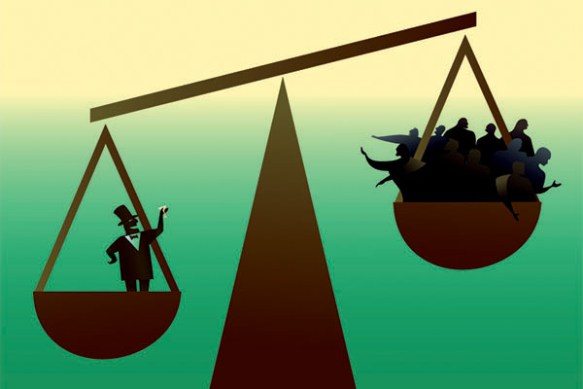
How Evil Wins: The Hypocritical Double Standards of Political Outrage

By John W. Whitehead

Source: The Rutherford Institute

“She was asked what she had learned from the Holocaust, and she said that 10 percent of any population is cruel, no matter what, and that 10 percent is merciful, no matter what, and that the remaining 80 percent could be moved in either direction.”—Kurt Vonnegut

Please spare me the media hysterics and the outrage and the hypocritical double standards of those whose moral conscience appears to be largely dictated by their political loyalties.

Anyone who believes that the injustices, cruelties and vicious callousness of the U.S. government are unique to the Trump Administration has not been paying attention.

No matter what the team colors might be at any given moment, the playbook remains the same. The leopard has not changed its spots. Scrape off the surface layers and you will find that the American police state that is continuing to wreak havoc on the rights of the people under the Trump Administration is the same police state that wreaked havoc on the rights of the people under every previous administration.

Brace yourselves.

While we squabble over which side is winning this losing battle, a tsunami approaches.

Case in point: in Charlottesville, Va.—home of Thomas Jefferson, the author of the Declaration of Independence, champion of the Bill of Rights, and the nation’s third president—city councilors in a quest for so-called “equity” have proposed eliminating Jefferson’s birthday as a city holiday (which has been on the books since 1945) and replacing it with a day that commemorates the liberation of area slaves following the arrival of Union troops under Gen. Philip Sheridan.

In this way, while the populace wages war over past injustices, injustice in the here and now continues to trample innocent lives underfoot. In Charlottesville, as in the rest of the country, little is being done to stem the tide of the institutional racism that has resulted in disproportionate numbers of black Americans being stopped, frisked, shot at, arrested and jailed.

Just recently, in fact, Phoenix police drew their guns, shouted profanities, assaulted and threatened to shoot a black couple whose 4-year-old daughter allegedly stole a doll from a dollar store. The footage of the incident—in which the cops threaten to shoot the pregnant, young mother in the head in the presence of the couple’s 1- and 4-year-old daughters—is horrifying in every way.

Tell me again why it’s more important to spend valuable political capital debating the birthdays of dead presidents rather than proactively working to put a stop to a government mindset that teaches cops it’s okay to treat citizens of any color with brutality and a blatant disregard for their rights?

It doesn’t matter that Phoenix and Charlottesville are 2100 miles apart. The lethal practices of the American police state are the same all over.

No amount of dissembling can shield us from the harsh reality that the danger in our midst is posed by an entrenched government bureaucracy that has no regard for the Constitution, Congress, the courts or the citizenry.

We’ve got to get our priorities straight if we are to ever have any hope of maintaining any sense of freedom in America. As long as we allow ourselves to be distracted, diverted, occasionally outraged, always polarized and content to view each other—rather than the government—as the enemy, we’ll never manage to present a unified front against tyranny (or government corruption and ineptitude) in any form.

Mind you, by “government,” I’m not referring to the highly partisan, two-party bureaucracy of the Republicans and Democrats. Rather, I’m referring to “government” with a capital “G,” the entrenched Deep State that is unaffected by elections, unaltered by populist movements, and has set itself beyond the reach of the law.

This is the hidden face of a government that has no respect for the freedoms of its citizenry.

So stop with all of the excuses and the hedging and the finger-pointing and the pissing contests to see which side can out-shout, out-blame and out-spew the other. Enough already with the short- and long-term amnesia that allows political sycophants to conveniently forget the duplicity, complicity and mendacity of their own party while casting blame on everyone else.

This is how evil wins.

This is how freedom falls and tyranny rises.

This is how good, generally decent people—having allowed themselves to be distracted with manufactured crises, polarizing politics, and fighting that divides the populace into warring us vs. them camps—fail to take note of the looming danger that threatens to wipe freedom from the map and place us all in chains.

Anytime you have an entire nation so mesmerized by the antics of the political ruling class that they are oblivious to all else, you’d better beware. Anytime you have a government that operates in the shadows, speaks in a language of force, and rules by fiat, you’d better beware. And anytime you have a government so far removed from its people as to ensure that they are never seen, heard or heeded by those elected to represent them, you’d better beware.

The world has been down this road before.

As historian Milton Mayer recounts in his seminal book on Hitler’s rise to power, They Thought They Were Free:

Most of us did not want to think about fundamental things and never had. There was no need to. Nazism gave us some dreadful, fundamental things to think about—we were decent people‑—and kept us so busy with continuous changes and ‘crises’ and so fascinated, yes, fascinated, by the machinations of the ‘national enemies’, without and within, that we had no time to think about these dreadful things that were growing, little by little, all around us.

We are no longer living the American Dream. We’re living the American Lie.

Indeed, Americans have been lied to so sincerely, so incessantly, and for so long by politicians of all stripes—who lie compulsively and without any seeming remorse—that they’ve almost come to prefer the lies trotted out by those in government over less-palatable truths.

The American people have become compulsive believers: left-leaning Americans are determined to believe that the world has become a far more dangerous place under Trump, while right-leaning Americans are equally convinced that Trump has set us on a path to prosperity and security.

Nothing has changed.

The police state is still winning. We the people are still losing.

In fact, the American police state has continued to advance at the same costly, intrusive, privacy-sapping, Constitution-defying, heartbreaking, soul-scorching, relentless pace under the current Tyrant-in-Chief as it did under those who occupied the White House before him (Obama, Bush, Clinton, etc.).

Police haven’t stopped disregarding the rights of citizens. Having been given the green light to probe, poke, pinch, taser, search, seize, strip, shoot and generally manhandle anyone they see fit in almost any circumstance, all with the general blessing of the courts, America’s law enforcement officials are no longer mere servants of the people entrusted with keeping the peace. Indeed, they continue to keep the masses corralled, under control, and treated like suspects and enemies and slaves rather than citizens.

SWAT teams haven’t stopped crashing through doors and terrorizing families. Nationwide, SWAT teams continue to be employed to address an astonishingly trivial array of criminal activities or mere community nuisances including angry dogs, domestic disputes, improper paperwork filed by an orchid farmer, and misdemeanor marijuana possession. With more than 80,000 SWAT team raids carried out every year on unsuspecting Americans for relatively routine police matters and federal agencies laying claim to their own heavily armed law enforcement divisions, the incidence of botched raids and related casualties continue to rise.

The Pentagon and the Department of Homeland Security haven’t stopped militarizing and federalizing local police. Police forces continue to be transformed into heavily armed extensions of the military, complete with jackboots, helmets, shields, batons, pepper-spray, stun guns, assault rifles, body armor, miniature tanks and weaponized drones. In training police to look and act like the military and use the weapons and tactics of war against American citizens, the government continues to turn the United States into a battlefield and “we the people” into enemy combatants.

Schools haven’t stopped treating young people like hard-core prisoners. School districts continue to team up with law enforcement to create a “schoolhouse to jailhouse track” by imposing a “double dose” of punishment for childish infractions: suspension or expulsion from school, accompanied by an arrest by the police and a trip to juvenile court. In this way, the paradigm of abject compliance to the state continues to be taught by example in the schools, through school lockdowns where police and drug-sniffing dogs enter the classroom, and zero tolerance policies that punish all offenses equally and result in young people being expelled for childish behavior.

For-profit private prisons haven’t stopped locking up Americans and immigrants alike at taxpayer expense. States continue to outsource prison management to private corporations out to make a profit at taxpayer expense. And how do you make a profit in the prison industry? Have the legislatures pass laws that impose harsh penalties for the slightest noncompliance in order keep the prison cells full and corporate investors happy.

Censorship hasn’t stopped. First Amendment activities continue to be pummeled, punched, kicked, choked, chained and generally gagged all across the country. The reasons for such censorship vary widely from political correctness, safety concerns and bullying to national security and hate crimes but the end result remained the same: the complete eradication of what Benjamin Franklin referred to as the “principal pillar of a free government.”

The courts haven’t stopped marching in lockstep with the police state. The courts continue to be dominated by technicians and statists who are deferential to authority, whether government or business. Indeed, the Supreme Court’s decisions in recent years have most often been characterized by an abject deference to government authority, military and corporate interests.

Government bureaucrats haven’t stopped turning American citizens into criminals. The average American now unknowingly commits three felonies a day, thanks to an overabundance of vague laws that render otherwise innocent activity illegal, while reinforcing the power of the police state and its corporate allies.

The surveillance state hasn’t stopped spying on Americans’ communications, transactions or movements. On any given day, whether you’re walking through a store, driving your car, checking email, or talking to friends and family on the phone, you can be sure that some government agency, whether it’s your local police, a fusion center, the National Security Agency or one of the government’s many corporate partners, is still monitoring and tracking your every move.

The TSA hasn’t stopped groping or ogling travelers. Under the pretext of protecting the nation’s infrastructure (roads, mass transit systems, water and power supplies, telecommunications systems and so on) against criminal or terrorist attacks, TSA task forces (comprised of federal air marshals, surface transportation security inspectors, transportation security officers, behavior detection officers and explosive detection canine teams) continue to do random security sweeps of nexuses of transportation, including ports, railway and bus stations, airports, ferries and subways, as well as political conventions, baseball games and music concerts. Sweep tactics include the use of x-ray technology, pat-downs and drug-sniffing dogs, among other things.

Congress hasn’t stopped enacting draconian laws such as the USA Patriot Act and the NDAA. These laws—which completely circumvent the rule of law and the constitutional rights of American citizens, continue to re-orient our legal landscape in such a way as to ensure that martial law, rather than the rule of law, our U.S. Constitution, becomes the map by which we navigate life in the United States.

The Department of Homeland Security hasn’t stopped being a “wasteful, growing, fear-mongering beast.” Indeed, this is the agency that is notorious for militarizing the police and SWAT teams; spying on activists, dissidents and veterans; stockpiling ammunition; distributing license plate readers; contracting to build detention camps; tracking cell-phones with Stingray devices; carrying out military drills and lockdowns in American cities; using the TSA as an advance guard; conducting virtual strip searches with full-body scanners; carrying out soft target checkpoints; directing government workers to spy on Americans; conducting widespread spying networks using fusion centers; carrying out Constitution-free border control searches; funding city-wide surveillance cameras; and utilizing drones and other spybots.

The military industrial complex hasn’t stopped profiting from endless wars abroad. America’s expanding military empire continues to bleed the country dry at a rate of more than $15 billion a month (or $20 million an hour). The Pentagon spends more on war than all 50 states combined spend on health, education, welfare, and safety. Yet what most Americans fail to recognize is that these ongoing wars have little to do with keeping the country safe and everything to do with enriching the military industrial complex at taxpayer expense.

The Deep State’s shadow government hasn’t stopped calling the shots behind the scenes. Comprised of unelected government bureaucrats, corporations, contractors, paper-pushers, and button-pushers who are actually calling the shots behind the scenes, this government within a government continues to be the real reason “we the people” have no real control over our so-called representatives. It’s every facet of a government that is no longer friendly to freedom and is working overtime to trample the Constitution underfoot and render the citizenry powerless in the face of the government’s power grabs, corruption and abusive tactics.

And the American people haven’t stopped acting like gullible sheep. In fact, many Americans have been so carried away by their blind rank-and-file partisan devotion to their respective political gods that they have lost sight of the one thing that has remained constant in recent years: our freedoms are steadily declining. And it doesn’t really matter whether it’s a Democrat or a Republican at the helm, because the bureaucratic mindset on both sides of the aisle now seems to embody the same philosophy of authoritarian government.

So you can try to persuade yourself that you are free, that you still live in a country that values freedom, and that it is not too late to make America great again, but to anyone who has been paying attention to America’s decline over the past 50 years, it will be just another lie.

The German people chose to ignore the truth and believe the lie.

They were not oblivious to the horrors taking place around them. As historian Robert Gellately points out, “[A]nyone in Nazi Germany who wanted to find out about the Gestapo, the concentration camps, and the campaigns of discrimination and persecutions need only read the newspapers.”

The warning signs were definitely there, blinking incessantly like large neon signs.

“Still,” Gellately writes, “the vast majority voted in favor of Nazism, and in spite of what they could read in the press and hear by word of mouth about the secret police, the concentration camps, official anti-Semitism, and so on. . . . [T]here is no getting away from the fact that at that moment, ‘the vast majority of the German people backed him.’”

Half a century later, the wife of a prominent German historian, neither of whom were members of the Nazi party, opined: “[O]n the whole, everyone felt well. . . . And there were certainly eighty percent who lived productively and positively throughout the time. . . . We also had good years. We had wonderful years.”

In other words, as long as their creature comforts remained undiminished, as long as their bank accounts remained flush, as long as they weren’t being discriminated against, persecuted, starved, beaten, shot, stripped, jailed and turned into slave labor, life was good.

Life is good in America, too.

Life is good in America as long as you’re not one of the hundreds of migrant children (including infants, toddlers, preschoolers) being detained in unsanitary conditions by U.S. Border Patrol without proper access to food and water, made to sleep on concrete floors, go without a shower for weeks on end, and only allowed to brush your teeth once every 10 days.

Life is good in America as long as you don’t have to come face to face with a trigger-happy cop hyped up on the power of the badge, trained to shoot first and ask questions later, and disposed to view people of color as a suspect class.

Life is good in America as long as you’re able to keep sleep-walking through life, cocooning yourself in political fantasies that depict a world in which your party is always right and everyone else is wrong, and distracting yourself with bread-and-circus entertainment that bears no resemblance to reality.

Life is good in America as long as you’ve got enough money to spare that you don’t mind being made to pay through the nose for the government’s endless wars, subsidization of foreign nations, military empire, welfare state, roads to nowhere, bloated workforce, secret agencies, fusion centers, private prisons, biometric databases, invasive technologies, arsenal of weapons, and every other budgetary line item that is contributing to the fast-growing wealth of the corporate elite at the expense of those who are barely making ends meet—that is, we the 99%.

Life is good in America for the privileged few, but as I make clear in my book Battlefield America: The War on the American People, it’s getting worse by the day for the rest of us.

Inequality Social Dysfunction and Misery

By Graham Peebles

Source: Dissident Voice

Year on year the economic divisions and sub-divisions in the world deepen, the associated social ills increase: The rich, comfortable, and the very extremely rich keep getting richer, and the rest, well, whilst some may be raised up out of crippling poverty into relative poverty, the majority of people continue to live under a blanket of economic insecurity and largely remain where they are.

Straddling the global ladder of economic and social division sit the Multi-Billionaires (there are now 2,208 billionaires), 42 of whom (down from 61 in 2016), according to a recent report by Oxfam, own the same amount of wealth as the poorest half of humanity combined. Together with their lesser cohorts this coterie of Trillionaires sucked up “eighty-two percent of the wealth generated [in the world] last year…while the 3.7 billion people who make up the poorest half of the world saw no increase in their wealth.”

The defining challenge of our time

Income and wealth inequality is not simply a monetary issue, it is a complex social crisis that supports and strengthens notions of superiority and inferiority, and was described by President Barak Obama in 2013 as “the defining challenge of our time.”

Today’s obscene levels of inequality are the result of the Neo-Liberal economic system. This extreme form of capitalism took hold first in America and Britain in the early 1980s when Reagan and Thatcher ruled, workers’ rights were trampled on, ‘society’ was a dirty word and community responsibility was abandoned to selfishness and greed. With the aid of the World Bank and the IMF, Neoliberalism swiftly spread throughout the world, polluting life in every city, town and village with its divisive, cruel ideology. Commercialization and competition are key principles and have infiltrated every area of contemporary life; everything and everyone is seen as a commodity, and the size of ones bank account determines the level of health care, education and housing available, as well as one’s access to culture and freedom to travel.

Social injustice is inherent in the system, as is inequality, which is itself a major form of injustice. Inequality strengthens deep-seated social imbalances based on class and social standing, and in a world where everything is classified, commercialized and priced; i.e., attributed value, external wealth and position have become the common criteria for determining the internal worth of a human being. Comparison and imitation follow, individuality is perverted and fear fostered; fear of inadequacy, fear of failure, fear of not being loved, because not ‘deserving’ love, not being able to ‘afford’ love. Resentment, anger and self-loathing are fed, leading to a range of mental health issues, including anxiety, depression and drug and alcohol addiction.

Happiness and inequality

The impact of financial inequality on the health and well being of society has been extensively studied by Richard Wilkinson; British co-author of Spirit Level, Professor Emeritus of Social Epidemiology at the University of Nottingham. In order to establish national levels of inequality Wilkinson and his team used a benchmark based on how much richer the top 20% is to the bottom 20%: Japan and Scandinavia (Finland, Norway, Sweden, Denmark) came out most equal, and now, Slovenia and the Czech Republic have moved towards this group. Israel, New Zealand, Australia, Britain, Portugal and USA were found to have the greatest levels of inequality, and by some margin. Recent data suggests that Russia, South Africa and Turkey should now be added to the most unequal pile. Germany, Spain and Switzerland sit somewhere in the middle.

Data relating to a range of social issues was examined: The most unequal countries were found to have lower life expectancy than more equal societies, higher infant mortality, many more homicides, larger prison populations (by 10-15 times), applied longer sentences; had higher teenage pregnancies, lower mathematic/literacy levels, more obesity, less social mobility, and, according to The World Value Survey, a great deal less trust. In more equal countries, like Sweden and Norway, around 65% of people trust others, whereas in unequal societies like America a mere 15% admitted to trusting their fellow citizens.

In all areas, countries with high levels of inequality did worse, in many cases much worse, than more equal nations. Mental health, for example, (figures from the World Health Organization): In Japan around 8% of the population suffers from some form of mental health issue, compared to 30% in America. Children are considerably healthier in more equal countries – based on UNICEF’s Index of Child Well-Being – and feel a good deal happier. Wilkinson concludes, “What we’re looking at is general social dysfunction related to inequality. It’s not just one or two things that go wrong, it’s most things.”

Look to Scandinavia

If one of the primary purposes of any socio-economic system is to create environments in which human beings can grow and live happily together, then the nations suffering under the shadow of inequality need to learn from Sweden, Norway, Denmark and Finland, which are not just the least unequal, they are also the happiest countries in the world. Throughout Scandinavia public services – education (which is probably the best in the world), health care and housing, are valued, and taxes levied in order to fund them properly; there are greater levels of social justice, this allows for trust to develop, and where there is trust relationships flower. The extremes of staggering wealth and stifling poverty don’t exist as they do in the more unequal parts of the world; social mobility is greater and the dream of betterment more realistic, as Richard Wilkinson says, “if Americans want to live the ‘American dream’ they should go and live in Denmark.”

The first duty of government is to protect the people; this involves not only dealing with terrorism and the like, but requires the development of socio-economic policies that contribute to the creation of a healthy harmonious environment. By supporting extreme inequality (which has been shown to fuel a range of social issues) governments in the more unequal countries are totally failing in this fundamental duty. Politicians, who in many cases rely on big business and wealthy benefactors for their funding, are either blind to, or negligent of, the inherent faults of the current system, and the unhealthy, negative way of life it supports.

The case for fundamental change in the economic order, and a shift away from the destructive values it promotes is becoming irrefutable; however, change occurs only gradually and resistance is great. In the meantime, governments (particularly in the most unequal states) need to acknowledge the connection between the dysfunction and disease within society and their socio-economic methodology, which is literally making people ill, as well and poisoning the natural world. They need to invest properly in public services, address wage differences, ban bonuses, introduce progressive tax reform, and, unlike America and France which are taking retrograde steps by designing tax codes which will fuel inequality, look to the Scandinavian countries and learn from their example.

For too long socio-economic systems have been designed and maintained to cater to the desires and interests of a privileged few, while the majority live inhibited lives under the shadow of financial uncertainty. For harmonious societies to evolve this long-standing injustice needs to be addressed and a degree of balance found. This requires that those whose table is full to overflowing share some of their bounty, so that all may have enough, not excess, enough.

As a wise man has said, “The rich must give up what they want, so that the poor can have what they need.” What the rich and comfortable must give up is greed (another car, another house, more designer clothes, etc.), what the rest need is freedom from economic insecurity and the fear of destitution, freedom from exploitation and dependency; secure, comfortable, and well-designed accommodation, and access to good education, health care and culture. Such essential needs are the rights of all; when made manifest they go a long way towards establishing social justice, and where there is social justice, functional, compassionate communities do evolve, conflict is reduced and collective harmony is cultivated.

Time To Make Life Hard For The Rich

By Hamilton Nolan

Source: Splinter

It is time for polite, respectable, rational people to start saying what has become painfully obvious: It is time to stop respecting the rich, and start stealing from them. In earnest.

Inequality is eating America alive. It has been growing for decades. To say that “the American dream is dead” is no longer a poetic exaggeration—it is an accurate description of 40 years of wage stagnation and declining economic mobility that has produced a generation that cannot expect to live better than their parents did. Not because of devastating war or plague, but because of a very specific set of rules governing a very specific economic system that encourages the accumulation of great wealth among a tiny portion of the population, to the detriment of the vast majority of people. Our political and business leaders have chosen to embrace a system that favors capital over labor. A system in which the more you already have, the more you make, and the less you have, the harder it is to build wealth. It is a system designed to increase inequality. It is functioning exactly as designed. And now, it is about to get worse.

How long are people supposed to tolerate being smacked in the face? By the rich? Who already have more than enough? It is not as though the fact that inequality is a crisis is a fact that snuck up on anyone. Economists have seen the trend for decades, and the general public has been well aware of it since at least the financial crisis. Obama called it “the defining challenge of our time.” Thomas Piketty became a rock star by writing a very dry book about it. It’s not an underground thing. It is well known and well understood by the people in control of the institutions with the power to change it. The response to this dire situation by the Republican Party, which a wholly owned subsidiary of the American capital-holding class, has been to pass a tax bill that will horribly exacerbate economic inequality in this country. It is a considered decision to make a bad situation worse. It is a deliberate choice—during a time when the rich already have too much—to take from the poor in order to give the rich (including members of Congress and the President) more. That is not a metaphor. That is the reality. That is what the Republican party is about to accomplish on behalf of the donor class, calling it “middle class tax relief” in the face of mathematical proof to the contrary. Even to my cynical ass, the sheer fuck you-ness of this action towards the majority of the country is breathtaking. This is not just a failure to solve a severe problem; it is the expenditure of vast amounts of political capital to make the severe problem worse so that a tiny handful of people will get wealthier than anyone needs to be.

Ideally, in a democracy, elected leaders reflecting the interests of the people would pass taxes and regulations to reverse the growing inequality here. For that to happen, we would need to end gerrymandering and reform campaign finance and probably abolish the Senate and the Electoral College, and that’s just for starters. It is not imminent, in other words. Our broken political system, which is designed to reward money with political power, is actually moving in the opposite direction of a solution. Who is suffering because of this? Most Americans. Certainly the bottom 50% are acutely suffering—money that would have been in their paychecks has been instead funneled upwards into the pockets of the rich. Every desperate family that has found themselves coming up short for rent or food or medicine, every American who has downgraded her dreams and aspirations because they became financially implausible, has been directly harmed by the political and economic class war perpetuated by the rich, even if they cannot see the perpetrators with their own eyes. I think that people have been more than patient in the face of this slow-moving crisis. In 2009, when the markets crashed and millions were laid off, nobody rioted and kidnapped the financiers and burned their homes. The outcome of that lack of direct action is the situation we find ourselves in today.

Violence against people is morally wrong and a bad way to solve problems. But capital is different. One thing that would help to create the political environment conducive to solving the inequality problem would be to make the cost of accumulating all that capital too high to be worth it. In other words, to create a downside to being too rich. I have personally stood in a room full of hedge fund titans and billionaire investors warning one another explicitly that inequality must be addressed lest the U.S. become a place like Latin America, where rich people are forced to live behind walls, surrounded by armed guards, because of the very real risks from the rage of the poor. Rich people in this country do not want to live like that. If they see that they must stop being so greedy in order to enjoy their own freedom, they will stop being so greedy. Those conditions have to be created by people who want justice.

Our situation is absurd. Not since the Gilded Age has it been more clear that a few people have too much. Furthermore, the people with too much are investing in political clout to give themselves more. It’s just wrong. If the government won’t help, we have to help ourselves. Sticking up a billionaire on the street for $100 is not going to do it. But one can imagine other ways that angry Americans might express their dissatisfaction with our current division of wealth: A large-scale online attack against the holdings of the very rich; yachts sunk in harbors; unoccupied vacation homes in the Hamptons mysteriously burned to the ground. Sotheby’s auctions swarmed by vandals, Art Basel attacked by spraypaint-wielding mobs, protests on the doorsteps of right-wing think tanks, venomous words directed at millionaires as they dine in fancy restaurants. People have a right to life and safety, but property does not. A life spent screwing the little people so that you can acquire lots of stuff loses its allure when you know that all that stuff will be smashed to pieces by angry little people. It is not hard to put together a list of those who should be targeted—Forbes publishes it every year. Likewise, public campaign finance records give us a pretty good idea of exactly who is funding the politicians who are perpetuating this economic war on behalf of the rich.

It is nice to imagine a grand, well-targeted computer hack that would neatly transfer billions of dollars out of the accounts of, say, the Walton family and into a charity account that would disburse the money to the poor in untraceable ways. That seems far-fetched. Realistically, what people can do now is to start thinking about ways to make it uncomfortable to be too rich. Socially uncomfortable and otherwise. When the accumulation of great wealth ceases to be a praiseworthy endeavor and instead becomes viewed as a sick, greedy pastime whose only reward is the hatred of your fellow citizens and the inability to live comfortably without fear of your excessive property being destroyed, rich people will rethink their goals. Until then, inequality will keep rising, and everything, for most people, will continue to slowly, slowly get worse.

The social and economic roots of the attack on democratic rights

Inequality and the American oligarchy

By Eric London

Source: WSWS.org

A report published September 27 by the US Federal Reserve, the Survey of Consumer Finances, shows that the top 10 percent of Americans now own 77 percent of all wealth. The top 1 percent increased its share of wealth from 35.5 percent in 2013 to 38.5 in 2016. The share of the bottom 90 percent declined from 25 percent to 22.9 percent over the same period.

These percentages show a transfer of trillions of dollars from the working class to the rich and affluent in just three years.

The bottom three quarters of the population, some 240 million people, now own less than 10 percent of the wealth. That is, if the United States were a 10-storey apartment building with 100 people, the richest person would be living on the top four floors, the nine next wealthiest people on the next four floors, fifteen on the second floor, and 75 people cramped at the bottom level.

Wealth share by wealth decile, Credit: People’s Policy Project

The Federal Reserve data demonstrates, in empirical terms, profound changes in social relations that affect hundreds of millions of people, touching all aspects of political, cultural and intellectual life. The US is an oligarchy in which the government, trade unions, media, universities, and major political parties are instruments used by the ruling class to manipulate the population, mask its own wealth, and crush social opposition from below.

The figures expose the material basis for the emergence of a campaign in the ruling class to block access to the World Socialist Web Site and other left-wing sites in the guise of combatting “Russian aggression.”

In an oligarchy, social inequality is incompatible with democratic rights. Incapable of and unwilling to address the social needs of the masses of people, the government turns to censorship, surveillance, blacklisting, and violence as its preferred methods for defending unprecedented levels of wealth monopolized by the ruling class.

The data shows that the main dividing line is between the top 10 percent and the bottom 90 percent that comprise the working class. The Federal Reserve figures expose as lies the claims by politicians and media pundits that the bulk of the US population belongs to the “middle class.”

Below the aristocracy and the affluent—concentrated in certain neighborhoods of major centers like New York, the San Francisco Bay Area, Los Angeles, Chicago, Houston, and other cities—the United States is a country dominated by tremendous economic hardship. The data shows that while different strata of the population face economic insecurity at different levels of urgency, decades of social counterrevolutionary policies by both parties are bringing them closer together, marking all with the same scars of class exploitation.

The poorest ten percent of the population, some 32 million people, possess negative wealth. They include the homeless and the hopelessly in debt. For this section of the population, roughly equal to the populations of Texas and New York combined, life expectancy, disease rates, and living standards resemble third world conditions.

The next poorest ten percent have no wealth, between $0 and $5,000 per family, less than the value of a 10-year-old used car. The combined wealth possessed by this layer is not significant as a proportion of overall wealth.

Roughly the lower-middle third of the population, from the 20th to 50th percentile, control just 1.6 percent of total wealth. A family of four with two parents working full-time at the minimum wage with one average-priced vehicle and no other assets would fall in the middle of this broad category of workers.

The 64 million people in the 50 to 70 percent range control just 5.1 percent of the wealth. A family with a below average-priced home worth $150,000, plus a vehicle and $0 in savings would be above the 60th percentile in wealth. A family with two working adults making between $40,000 and $50,000 each would find itself in the 70 to 80 percentile, perhaps possessing two cars, a home valued just above the national average of $175,000, a life insurance policy and $10,000 in savings.

The 80 to 90th percentile owns 11.2 percent of the wealth. Two skilled workers with incomes of $60,000 to $80,000 each, one pension, a $300,000 home, and two vehicles would find themselves in this decile. This section is slightly more comfortable, but by no means financially secure.

The chasm separating the top 10 percent from the working class has widened in recent years. From 2004 to 2016, the working class saw its wealth decline precipitously across all strata. The median family in the poorest fifth lost 29.5 percent of its wealth over this period, followed by 24.7 percent for the median family in the 20th-39th percentile, 10.8 percent in the 40th-59th percentile, 17.3 percent in the 60th-79th percentile, and 1.3 percent in the 80th-89th percentile. This wealth went to the top 10 percent, where median family wealth rose by 38.7 percent over the same period.

As a result of this massive transfer of wealth, median family wealth in the top 10 percent is nearly triple that of the 80 to 90 percent, 20 times greater than a family in the 50th percentile, and 254 times more than the median family net worth in the poorest 20 percent.

The political establishment that has overseen this transfer systematically ignores and aggravates the urgent social problems confronting the vast majority of the population.

Footage of Trump flipping paper towel rolls to victims of the storm in Puerto Rico epitomizes the callous and insulting response of the oligarchy to the problems of the working class. But sanctimonious claims by Democrats that Trump’s actions were “insensitive” ignore the fact that the entire ruling class is responsible for the social catastrophe. After all, it was Barack Obama who travelled to Flint, Michigan and told a crowd of people to “drink the water.” Nobody in the Democratic or Republican parties has made any real effort to address the opioid crisis, homelessness, declining life expectancy, storm protection and disaster infrastructure, skyrocketing student debt and the health care crisis.

The three branches of government, largely comprised of millionaires and billionaires, focus exclusively on the interests and social demands of the top 1, and, more broadly, the top 10 percent of society. A key concern of the affluent 10 percent is blocking the growth of social opposition and protecting their own wealth and privileges. In recent years, the American ruling class has become more aware of the growth of social opposition within the population to war, inequality and poverty.

Fearful that the technological advances of the Internet and social media platforms can increase access to alternative political viewpoints, the oligarchy has initiated a campaign to censor left-wing websites and crack down on social media platforms in the name of blocking “Russian interference” in the US political system. Without a shred of credible evidence to back their claims, newspaper editors, TV talking heads, Senate and House committee members, corporate executives, trade union leaders and academics are engaged in a mad rush to censor the Internet and protect the population from “fake news.”

The anti-fake news censorship and blacklisting initiative is an escalation of a years-long campaign by the ruling class to create the framework for police state methods of rule. At the same time, the growth of social inequality revealed in the Federal Reserve figures points to the inexorable intensification of social and class conflict in the United States, the objective foundation for socialist revolution.

Are We (Collectively) Depressed?

By Charles Hugh Smith

Source: Of Two Minds

We need to encourage honesty above optimism. Once we can speak honestly, there is a foundation for optimism.

Psychoanalysis teaches that one cause of depression is repressed anger.

The rising tide of collective anger is visible in many places: road rage, violent street clashes between groups seething for a fight, the destruction of friendships for holding the “incorrect” ideological views, and so on. I Think We Can Safely Say The American Culture War Has Been Taken As Far As It Can Go.

A coarsening of the entire social order is increasingly visible: The Age of Rudeness.

This raises a larger question: are we as a society becoming depressed as we repress our righteous anger and our sense of powerlessness as economic and social inequality rises?

Depression is a complex phenomenon, but it typically includes a loss of hope and vitality, absence of goals, the reinforcement of negative internal dialogs, and anhedonia, the loss of the joy of living (joie de vivre).

Depressive thoughts (and the emotions they generate) tend to be self-reinforcing, and this is why it’s so difficult to break out of depression once in its grip.

One part of the healing process is to expose the sources of anger that we are repressing. As psychiatrist Karen Horney explained in her 1950 masterwork, Neurosis and Human Growth: The Struggle Towards Self-Realization, anger at ourselves sometimes arises from our failure to live up to the many “shoulds” we’ve internalized, and the idealized track we’ve laid out for ourselves and our lives.

The recent article, The American Dream Is Killing Us does a good job of explaining how our failure to obtain the expected rewards of “doing all the right things” (getting a college degree, working hard, etc.) breeds resentment and despair.

Since we did the “right things,” the system “should” deliver the financial rewards and security we expected. This systemic failure to deliver the promised rewards is eroding social mobility and the social contract while generating frustration, anger, etc.

We are increasingly angry at the system, but we reserve some anger for ourselves, because the mass-media trumpets how well the economy is doing and how some people are doing extremely well. Naturally, we wonder, why them and not us? The failure is thus internalized.

One response to this sense that the system no longer works as advertised is to seek the relative comfort of echo chambers–places we can go to hear confirmation that this systemic stagnation is the opposing political party’s fault.

We don’t just self-sort ourselves into political “tribes” online–we congregate in increasingly segregated communities and states: The Simple Reason Why A Second American Civil War May Be Inevitable.

Americans are moving to communities that align more with their politics. Liberals are moving to liberal areas, and conservatives are moving to conservative communities. It’s been going on for decades. When Jimmy Carter was elected in 1976, 26.8% of Americans lived in landslide counties; that is counties where the president won or lost by 20% of the vote.

By 2004, 48.3% of the population lived in these counties. This trend continues to worsen. As Americans move to their preferred geographic bubbles, they face less exposure to opposing viewpoints, and their own opinions become more extreme. This trend is at the heart of why politics have become so polarizing in America.

We’re self-sorting at every level. Because of this, Americans are only going to grow more extreme in their beliefs, and see people on the other side of the political spectrum as more alien.”

Part of the American Exceptionalism we hear so much about is a can-do optimism: set your mind to it and everything is possible.

The failure to prosper as anticipated is generating a range of negative emotions that are “un-American”: complaining that you didn’t get a high-paying secure job despite having a college degree (or advanced degree) sounds like sour-grapes: the message is you didn’t work hard enough, you didn’t get the right diploma, etc.

It can’t be the system that’s failed, right? I discuss this in my book Why Our Status Quo Failed and Is Beyond Reform: the top 10% who are benefiting mightily dominate politics and the media, and their assumption is: the system is working great for me, so it must be working for everyone. That’s the implicit narrative parroted by status quo mouthpieces.

The inability to express our despair and anger generates depression. Some people will redouble their efforts, others will seek to lay the blame on “the other” (some external group) and others will give up. What few people will do is look at the sources of systemic injustice.

Perhaps we need a national dialog about declining expectations, rising inequality and the failure of the status quo that avoids the blame-game and the internalization trap (i.e. it’s your own fault you’re not well-off).

We need ways to express our resentment, anger, despair, etc. that are directed at the source, the complex system we inhabit, not “the other.” We need to encourage honesty above optimism. Once we can speak honestly, there is a foundation for optimism.


The 1% Versus the 99%: Realignment, Repression or Revolution

640px-Standard_oil_octopus_loc_color

Wealth Inequality Is Putting the US on Course for a Showdown

By Klaus Marre

Source: WhoWhatWhy.org

The richest 20 Americans now own as much wealth as the country’s poorest 152 million people combined.

That is just one of the findings of noted inequality scholar and author Chuck Collins’s most recent report, “Billionaire Bonanza, The Forbes 400 and the Rest of Us.”

In a wide-ranging interview, which will be available in its entirety as a podcast tomorrow, Collins likened the current situation to the “Gilded Age,” the time just before the turn of the 20th century, when there was a similar accumulation of wealth at the top and political power was concentrated in the hands of a few rich men.

And Americans are slowly realizing that the extreme accumulation of wealth at the very top is hurting their own prospects.  But grassroots efforts to redress economic inequality must contend with the political power that comes with great wealth.

This is an unstable situation. With pressure building for change but potent forces stacked against it, there are only three options, Collins told WhoWhatWhy: “Realignment, revolution or repression.”

Rules Rigged, and the Rich Get Richer

Back in the Gilded Age, the country managed to convert the pressure that was building from the bottom up into meaningful changes that resulted in a realignment of political power and the rise of the middle class. Those gains, however, are now being reversed. In fact, a new report found that, for the first time in decades, the middle class no longer constitutes the economic majority in the United States.

The shift toward increasing inequality began in the 1970s. At that time, Collins says (and research shows), “we stopped being an economy in which most people grew together” and instead became a “society that is dramatically pulled apart.”

Wages have now been stagnant for three decades and the median wealth of Americans has actually declined since 1990. At the same time, the rich have gotten richer. A lot richer.

Like the Great Depression in the early 1930s, the economic crisis of 2008 has been a wake-up call for the country. Polls historically have shown that people are indifferent to great wealth as long as they feel the rules are fair and that they at least have the option of moving up the ladder. But for many, the latest crash is changing that perception.

“In the economic meltdown of 2008, people realized the rules are rigged, that the big financial industry people … are tipping the scale in their favor,” Collins said. This has led to a perception that upward mobility in America is stalled — a perception supported by statistical data.

Collins believes that this sentiment has helped boost the candidacies of presidential hopefuls as diverse as Donald Trump and Bernie Sanders.

The collapsing middle class, including groups like recent college students whose prospects are blighted by crushing debt burdens, represents an “angry and mobilized constituency.” These are the people whose dissatisfactions are articulated by populists like Trump.

At the other end of the spectrum, the success of self-avowed “democratic socialist” Sanders shows how fluid the situation is. Collins pointed out that the Vermont senator has been saying the same things for 30 years — but only now are they resonating with a larger proportion of the electorate.

Collins pointed out that Sanders is the only major candidate who does not need a billionaire bankrolling his primary campaign to do well in the polls.

One bloc of voters who can cause a tectonic shift in the near future are millennials, many of whom are resentful of the obstacles they face in pursuing the American dream while paying off their college loans. With 40 million households shouldering a burden of $1.2 trillion in college debt, Collins believes that if this segment of the population were to organize, they could force significant change.

“Otherwise, the machinery of inequality will just keep chugging along as it currently is and it will get more concentrated,” Collins said. In any case, all of the ingredients are there for a major political realignment.

“We’re headed for a showdown.”

[audio http://www.whowhatwhy.org/files/Chuck%20Collins%20WWW%20Final.mp3 ]

http://www.whowhatwhy.org/files/Chuck%20Collins%20WWW%20Final.mp3

Forget Techno-Optimism: We Can’t Innovate Our Way Out of Inequality

thediplomat_2015-07-10_09-53-42-386x255

By Chris Lehmann

Source: In These Times

Toward the end of his 250-page hymn to digital-age innovation, The Industries of the Future, Alec Ross pauses to offer a rare cautionary note. Silicon Valley may have incubated all the wonders and conveniences one can imagine—and oh, so many more! But for the international business elites looking to remake their emerging market economies in the Valley’s gleaming, khaki-clad image, there’s some bad news: It can no longer be done. A “decades-long head start” has granted too great a competitive advantage to the charmed peninsula along the Northern California coast.

Not to worry, though! On-the-make tech globalists can still make a go of it, provided they’re prepared to embrace “specific cultural and labor market characteristics that can contradict both a society’s norms and the more controlling impulses of government leaders.”

Stripped of the vague and glowing techno-babble, this is a prescription for good old-fashioned neoliberal market discipline. Everywhere Ross looks across the radically transformed world of digital commerce, the benign logic of market triumphalism wins the day. When Terry Gou—the Taiwanese CEO of Foxconn, the vast Chinese electronics sweatshop that doubles as an incubator for worker suicides—plans to eliminate the headache of supervising an unstable human workforce by replacing it with “the first fully automated plant” in manufacturing history, why, he’s simply “responding to pure market forces”: i.e., an increase in Chinese wages that cuts into Foxconn’s ridiculously broad profit margins. And you and I might see the so-called sharing economy as a means to casualize service workers into nonunion, benefit-free gigs that transfer economic value on a massive scale to a rentier class of Silicon Valley app marketers. But bouncy New Economy cheerleaders like Ross see “a way of making a market out of anything, and a microentrepreneur out of anyone.”

When confronted with the spiraling of income inequality in the digital age, Ross, like countless other prophets of better living through software, sagely counsels that “rapid progress often comes with greater instability.” Sure, the “wealthy generally benefit over the short term,” but remember, kids: “Innovations have the potential to become cheaper over time and spread throughout the greater population.”

Ross first stormed into political prominence as an architect of Barack Obama’s “technology and innovation plan” during his 2008 presidential campaign, and he has spent four years captaining his own charmed, closed circle of tech triumphalism as the White House’s “senior advisor for innovation” under Secretary of State Hillary Clinton. This renders The Industries of the Future something more than another breathless, Tom Friedman-style tour of the wonderments being hatched in startups, trade confabs and gadget factories. Ross’ book is also a tech-policy playbook for the likely Democratic presidential nominee, who has spared no effort in soliciting the policy input—and landing the campaign donations—of the Silicon Valley mogul set. As such, it should give any Hillary-curious supporter of economic justice considerable pause.

To be sure, Ross raises some vague concerns about how, for example, the runaway growth of the sharing economy drains workers of job security, healthcare benefits, pensions and the like. He avers that “as the sharing economy grows … the safety net needs to grow with it,” but, much like his politically savvy boss, he offers nothing in the way of policy specifics besides the inarguable yet unactionable truism that if the sharing economy “generates enormous amounts of wealth for the platform owners, then the platform owners can and should help pay for added costs to society.”

The larger point for Ross, in any event, is that the innovative megafirms of tomorrow will come to spontaneously serve the public good. Not to mention that many IPO investors “are pension funds,” Ross coos, which “manage the retirement funds for people in the working class like teachers, police officers, and other civil servants.” Never mind, of course, that the neoliberal logic of the Uber model means that we’re creating a workforce that’s unlikely ever to come within shouting distance of a pension benefit again.

This kind of terminal Silicon Valley myopia also accounts for the vast economic and political blindspots that continually undermine Ross’ relentlessly chipper TED patter. To take just one instructive instance, in a book that devotes considerable real estate to the innovations of “fintech” (the streamlining of global digital currency exchanges and investment transactions) nowhere does the author acknowledge the pivotal role that tech-savvy Wall Street analysts—the “quants” as they’re known in Street argot—played in stoking the early-aughts housing bubble that led to the near-meltdown of the global economy.

That’s because it’s an axiomatic faith for this brand of techno-prophecy that innovation can never actually make anything worse—in just the same fashion that the quants were insisting, right up until the end, that there could never be a downturn in the national housing market. If this is the kind of wisdom Hillary Clinton relied on to promote her global innovation agenda at the State Department, one shudders to think of how it might run riot through the White House come next January.

Related Video:

The Vindication of Daniel Ortega

0,,4477394_4,00

By toni solo

Source: Axis of Logic

North American and European economies continue to be stuck with intractable, if for the moment moderate, stagflation. Prices for most household purchases steadily increase while majority incomes stagnate. By contrast, corporate incomes increase, subsidized by Western government and Central Bank policy. The resulting increase in inequality is clearly a deliberate policy outcome responding to the weakening of Western economies relative to global counterparts led by China and Russia.

Among those counterparts, Latin America, for long one of the world’s most unequal regions, is playing a leading role demonstrating how to reduce inequality. That is true to some extent in Brazil and Argentina, but it is particularly the case in the bloc of countries grouped in the Bolivarian Alternative for the Americas (ALBA). Western governments and corporate media regularly criticise the governments of ALBA members like Venezuela, Bolivia, Ecuador and Nicaragua while omitting the solidity and consistency of those countries’ economic and social success over the last seven or eight years. Nicaragua is a perfect example of that pattern, having achieved the highest regional decline in inequality along with Bolivia and Ecuador.

A July 2013 World Bank paper “Deconstructing the Decline in Inequality in Latin America” shows that ALBA members Bolivia, Ecuador and Nicaragua are the countries that had most reduced inequality as of 2011. Nicaragua had the highest average GINI coefficient year-on-year fall of  2.6% between 2000 and 2011. The figures for Bolivia and Ecuador are 2.05 and 1.99 respectively. In terms of an overall decline in the GINI coefficient in the region the figures for the period covered by the World Bank report are that Bolivia’s dropped 15.5%, followed by Nicaragua (12.2%), Argentina (10.7%), Peru (8.7%) and Venezuela (8.5%). (The figure for Ecuador is absent because data prior to 2003 were unavailable.)

Nicaragua in macro
Nicaragua is a Central American and Caribbean country with a population now of over 6 million. For decades it was the second poorest country in the Americas. Devastated by a US government contrived war in the 1980s, from 1990 to 2007 the country was governed on neoliberal principles dictated by foreign donor governments and multilateral financial institutions like the World Bank and the International Monetary Fund. In January 2007, President Daniel Ortega took office leading the second democratically elected government of the Frente Sandinista de Liberación Nacional.

2007 was the year in which global economic crisis followed the collapse of the Western financial system. Despite Western propaganda to the contrary, the effects of that crisis clearly persist. Even so, over the last five years, in that highly adverse international economic environment, Nicaragua has maintained better growth than its Central American neighbours, averaging over 5% a year. That success is the result of socialist inspired policies, responsive to the country’s emphatically Christian culture, based on the fundamental principles of solidarity and shared responsibility in all areas of national life.

The 2013 report of the United Nation’s Economic Commission for Latin America and the Caribbean (ECLAC) places Nicaragua among the more successful regional economies on a variety of indicators. For example, between 2010 and 2013, foreign direct investment more than doubled from US$491m to US$1004m, representing a much greater percentage improvement than in Costa Rica (43.5%), Honduras (8.7%) and Guatemala (40.5%). In El Salvador, the same indicator almost doubled, but at a much lower level from US$117m to US$224m.

Nicaragua’s international trade is now well over twice the value of its exports in 2005. In Latin America and the Caribbean in 2013, only Peru had higher fixed capital growth than Nicaragua as a percentage of GDP. Nicaragua’s figure of 29.2% is about 7% greater than Costa Rica and Honduras and over double that of El Salvador or Guatemala. Price inflation has held at around 7% for the last three years. Foreign external debt is around 31% of GDP. Foreign reserves are over twice those of 2006. In August 2013, two years after Nicaragua exited its last IMF programme, the IMF’s deputy director for the western hemisphere declared Nicaragua’s economy to be solid and stable.

Global context
The current crisis in the West suggests similarities with the prolonged economic crisis in North America and Europe from 1873 to 1896. The Western powers resolved that crisis through a virulent burst of imperialist aggression, setting the stage for the global wars of the 20th Century. Since the end of World War 2 in 1945, the appearance of democracy in the West has depended on externalizing onto the majority world the costs of mitigating and managing inequality in Europe and North America.

A key witness to that fact is former French President Jacques Chirac who in the 2008 documentary “10 mai Africaphonie” stated, with uncharacteristic honesty, “We forget one thing…namely that much of the money in our wallets comes precisely from the exploitatation over centuries of Africa. Not completely, but a lot of it comes from the exploitation of Africa. So we have to show a bit of common sense. I won’t say generosity, but common sense, some justice to render to Africans… you might say ….what was taken from them. As much as necessary, if we want to avoid the worst convulsions or difficulties with the political consequences these might bring in the near future.”

As the West’s neocolonial options recede, most clearly in Asia and Latin America, the United States and its European allies embrace more than ever the logic of fascism, the alliance of corporate interests and coercive government. Domestically, their policies protect wealthy elites while cutting back on provision for education, health care and social security. Overseas, to intimidate Iran, destroy Libya and attack Syria, NATO country governments have allied themselves with feudal tyrannies like Saudi Arabia and Qatar and with Al Qaeda and other terrorist groups.

To intimidate Russia, they have funded, trained and supported murderous neonazi groups in Ukraine while deploying military resources including missile systems around Russia’s borders. To intimidate China, they harrass North Korea, encourage Japanese nationalism and increase military deployments in the Pacific. Extensive military deployment is also a key element of Western efforts to reset their countries’ neocolonial control in Africa in response to China’s growing influence there.

The perfidious dollar
Underlying these developments is the end of global dollar hegemony and the steady emergence of multipolar alternatives. China, Russia and various countries in Asia and Latin America are conducting trade more and more in their own currencies or even, in the Latin American and Caribbean ALBA framework, in kind. As Western economic dominance declines, especially relative to Russia and China, the United States and the European Union compensate increasingly overseas with terrorist subversion and outright military aggression. Their corrupt political and economic system staggers like a zombie from one crisis to the next.

The Western powers cling to vestiges of their former global power by continuing to dominate the world’s financial system and through ruthless military barbarism. Their financial dominance persists in large part because commodity prices, especially oil and gas are denominated internationally in dollars. In 1971, the US government floated the dollar in order more freely to fund the Vietnam War and its broader imperialist foreign policy. Since then, in effect, only the United States has been able to use its own credit to fund economic growth and finance deficit spending.

Every other country has needed dollars in order to ensure their people’s economic development, mainly to guarantee energy needs and attract foreign investment. Even the wealthy Eurozone countries and Japan are subject to that dollar hegemony. The US Federal Reserve and its Primary Dealer network manage dollar liquidity in the global financial system. The Primary Dealers are all subsidiaries of crooked, giant North American, European and Japanese global financial corporations, too big to fail and too big to jail. They act in close collusion with the Federal Reserve and the other Western Central Banks, monitoring and managing international financial, currency and commodities markets.

Low wages and deregulation
The various mechanisms of dollar hegemony necessarily promote deep inequality around the world because international competition to earn dollars via exports encourages low wages, restricting domestic demand in the exporting countries. Ever since the 1980s the pernicious low wage effects of dollar hegemony have been progressively compounded by neoliberal propaganda for radical deregulation, urging low taxes, attacking organized labour and dismantling financial and commercial controls, especially of international capital flows. Incomes in the West began to stagnate as the rate of profit for Western corporations slowed and former well paid jobs were outsourced overseas.

The demise of the Soviet Union signalled a deregulation boom. In Europe and North America, mergers and acquisitions increasingly concentrated corporate power, strengthening the drive for deregulation. The resulting fraudulent financial innovation and free transfer of capital across the world lead to the Long Term Capital Management debacle and the Mexican, Russian and Asian currency crises of the 1990s. Despite these disastrous outcomes and the subsequent Enron and Worldcom scandals, deregulation continued to drive asset bubbles and easy credit so as to compensate for stagnant incomes, especially in the United States, leading directly to the crisis of 2007.

Poverty reduction in Nicaragua
This dead hand of decrepit neoliberal corporate capitalism was choking the Central American economies when Daniel Ortega took office as President of Nicaragua’s second democratically elected Sandinista government in January 2007. In such a dismal international economic context, poverty reduction represented a monumental challenge. Even so, President Ortega’s Sandinista government quickly set out in an extremely determined way to reduce poverty with a policy program whose many components are worth listing, if only because they show what can be done by an extremely poor country despite largely adverse international conditions. Extreme poverty in Nicaragua has been cut from over 17%  in 2006 to just over 5% now.

Addressing intractable balance of payments difficulties, the government sought to broaden Nicaragua’s trade with Latin America, the Russian Federation, Asia  and elswhere. Similarly, the government diversified its development cooperation, maintaining links with traditional partners in North America, Europe and Asia but also deepening its relationships with Venezuela, Cuba, Mexico and Brazil. Attracting greater foreign investment was also a key policy objective. Joining the ALBA framework, led by Venezuela and Cuba, freed up around US$500 million a year to invest primarily in production but also in major social programs.

To give Nicaragua’s overwhemingly agricultural economy much needed domestic stimulus, government programmes have prioritized small and medium producers of basic grains, cattle and coffee. The cooperative sector received support and resources to develop existing production cooperatives and form new ones. Small and medium sized businesses benefited from greater access to credit. The government has prioritized tourism, ensuring that it integrates closely with other sectors of the economy, especially small and medium sized businesses.

Economic democracy
This democratization of the Nicaraguan economy has radically transformed the position of women. Flagship programmes like Zero Hunger and Zero Usury, as well as property titling programmes and social housing are all directed at women beneficiaries. President Daniel Ortega’s insistence on genuine democracy and national reconciliation made possible tripartite agreement on a minimum wage framework between government, labour unions and employers organizations. Since 2010, that framework has ensured an annual increase in the minimum wage several percentage points greater than the rate of inflation.

In the last three years, those domestic stimulus measure were accompanied by administrative measures relating to equitable tax and social security reform which have helped significantly increase government revenue and stabilize the social security system for the foreseeable future. As Nicaragua’s economy generates progressively more formal employment, both tax revenue and social security income benefit. ECLAC reports that while formal employment has declined throughout the rest of the region, in Nicaragua it has grown steadily through 2012 and 2013

One key mechanism reducing inequality has been to use subsidies in the most sensitive areas affecting ordinary families’ costs. Apart from free health care and education, the government subsidizes the cost of public transport. Bus companies in the capital Managua receive preferential prices for fuel, oil, tyres and spare parts in exchange for pegging fares at 10 US cents. Taxis in Managua as well as inter-urban and acuatic transport in the rest of the country also receive similar benefits enabling the Transport Ministry and local municipalities to negotiate favourable fare tariffs for transport users.

Low income families benefit from subsidized electricity for consumers using under 150Kw a month. The government also operates a retail network offering basic food stuffs at preferential prices through local general stores. Over 58,000 families have benefited from subsidized or free housing. Low-income families nationwide have benefited from a free construction materials program enabling impoverished families to repair defective roofs.

Other social investment programs include assistance for people, especially children, with disability as well as food support for vulnerable groups such as the elderly. The Amor para los más Chiquitos programme has helped around 32,000 very young children at risk, ensuring they enjoy care, education and attention rather than ending up on the streets. That programme has worked with over 420,000 families providing advice and guidance in the care of young children under 6 years old. The government’s efforts to promote social stability also encompass property titling programs that have issued over 180,000 title deeds bringing security of tenure to over 800,000 people.

Health, education, infrastructure
Health and education are crucial expenses for most families in Nicaragua as everywhere else. The availability of free public health care has made a massive difference to low income families who cannot afford private care. The government is steadily equipping the public health system with the resources it needs to improve its services year by year. Emphasising preventive health care, government vaccination programs applied over 4,100,000 doses in 2013. The Casa Materna programme, almost tripling facilities to assist expectant mothers in rural areas, has helped the government reduce maternal mortality, which fell 35% from 2007 to 50 deaths per 100,000 live births in 2012.

Likewise in education, government expenditure improving infrastructure is accompanied by a range of programmes supporting low income families. The Merienda Escolar programme for adequate nutrition for primary school children, ensures provision of meals for over 1,000,000 pre-school and primary school children. Low income families also get help with schooling inputs. Apart from regular primary and secondary education, the government has invested heavily in vocational technical training for young people and improved access to education in rural areas. Follow up to the successful literacy programs of the government’s early years is consolidating the eradication of illiteracy. Education programmes for children with special needs include the integration of children with slight disability into the regular school system as well as dedicated programmes for children whose disability is more severe.

The transformation of government social and economic policy is physically much more obvious in terms of energy and infrastructure. National road, port and airport infrastructure has been almost completely renovated. Construction is on schedule of the new oil refinery being built near León with the Venezuelan State oil company PDVSA. Dependence on oil fired thermal generating stations has dropped from over 80% to less than 50% of the country’s generating capacity thanks to investment in renewable energy sources. Work on the long delayed Brazilian financed Tumarin hydroelectric project on Nicaragua’s Caribbean Coast should begin later this year. Also by the end of this year the results of the feasibility studies for the Interoceanic Canal will permit work to begin on that epoch making project and its sub-projects. These include an interoceanic rail link and pipeline, new airports and two deep water ports on the country’s Pacific and Caribbean coasts.

Confidence, security, democracy
Domestic and international confidence has been fundamental in making all this transformational social and economic investment happen. Despite a comparative lack of resources, Nicaragua’s police and army are acknowledged to have the best record in the region combating narcotics and other organized crime. Overseas, Nicaragua’s community oriented policing is recognized as a model, largely because the country has prevented the spread of the gang culture prevalent in neighbouring El Salvador and Honduras. While common delinquency remains a persistent problem, enhanced security in rural areas has been crucial in encouraging the small and medium farm production that has transformed Nicaragua’s agricultural economy since 2006.

The success of the Sandinista government’s economic policies has resulted from consensus-building  with private business organizations and labour unions by means of constant consultation with all sectors of the national economy. Similarly, government social policy has been developed in close collaboration with the country’s municipal authorities. Many resources and implementation of much social and economic policy have been channelled through the country’s 153 local authorities. The positive impact of that strategic partnership is most obvious from investment in improved municipal infrastructure, in sports facilities for young people and in support for local small and medium sized businesses.

Another fundamental component in the success of President Ortega’s social and economic strategy  has been the deliberate and active promotion of the role of women. Previously, women in Nicaragua were in effect structurally excluded from both economic and political life, denied their legitimate role in decision making and as economic agents. Nicaragua is now acknowledged among the world leaders in guaranteeing political representation for women. Less well known is the transformational role of women in Nicaragua’s economy through access to resources via government programs like Zero Hunger and Zero Usury and ensuring property titles to families previously without secure tenure. All those programs prioritize women beneficiaries.

More specific to Nicaragua has been the consolidation of the country’s Caribbean Coast into the national economy. That process has been a continuation of the historic autonomy project for Nicaragua’s Caribbean coast initiated under the first Sandinista government in the 1980s. In the next five to ten years, the economy of the Caribbean coast is likely to change radically. It has become an ever more popular tourist destination. The recovery in 2012 of Nicaragua’s maritime territory, usurped for decades by Colombia, has opened up new commercial opportunities. The Interoceanic Canal and its sub-projects will definitively end the area’s historic and geographic separation from Nicaragua’s Pacific coast.

Daniel Ortega – Central America’s leading regional statesman

Based on broad consultation and consensus, President Daniel Ortega has implemented strategic policies through a ministerial team led operationally by Rosario Murillo, successfully managing all the various complex factors in relation to social investment, the macro and domestic aspects of economic policy, infrastructure development and energy policy, fiscal and administrative reform, trade and agricultural renewal and security. He has done so constrained by the continuing international economic crisis and in the face of relentless, vicious national and international disinformation campaigns. But the results speak for themselves and explain why Nicaragua’s political opposition have been unable to muster more than 10% support nationally for well over a year, while support for President Ortega is consistently well over 60%.

Aside from the incomparable figure of Fidel Castro, Daniel Ortega is the most outstanding statesman of Central America and the Caribbean of the last thirty years. Rosario Murillo stands with Dilma Rousseff and Cristina Kirchner among Latin America’s women leaders transforming the region’s societies and economies. Under the leadership of Daniel Ortega and Rosario Murillo, Nicaragua’s government team has proved by any measure to be among the most effective in Latin America and the Caribbean. Many Western government officials will acknowledge that in private. Multilateral organizations have recognized it publicly for years now. It is long past time for the Western corporate and alternative media to recognize it too.