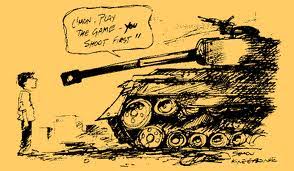
The Public Are All Alone: Understanding How the Enemy of Your Enemy Is Not Your Friend

By Eric Zuesse

Source: Strategic Culture Foundation

In political matters, the public are taught to believe that some political Party is ‘good’, and that the others are “bad”; but the reality in recent times, at least in the United States, has instead been that both Parties are rotten to the core (as will be clear from the linked documentation provided here).

Belief in this myth (that the opposition between Parties is between ‘good’ ‘friend’ versus ‘bad’ ‘enemy’) is based upon the common adage that “The enemy of my enemy is my friend.” One side is believed, and ones that contradict it are disbelieved — considered to be lying, distorting: bad. But, maybe, both (or all) Parties are deceiving; maybe all of them are enemies of the public, but just in different ways; maybe each of them is trying to control the country in the interests of (and so to obtain the most financial support from) the aristocracy, while all of them are actually against the public.

Can it really be false that “The enemy of my enemy is my friend?” Not only can be, but often is. And no one is able to vote intelligently without recognizing this fundamental political fact.

It’s true between entire nations, too — not only within nations.

For example: Hitler and Stalin were enemies of each other, but neither of them was a friend of America (except that Stalin did more than anyone else to defeat Hitler, and thereby saved the world, though the U.S. — far less a factor than the U.S.S.R. was in defeating Hitler — still refuses to acknowledge the fact that Stalin did more than anyone else did to prevent the entire world’s becoming dictatorships; so, whatever democracy exists today, is a result of that dictator, Stalin, even more than it’s a result of either FDR or Churchill).

What about internally, then?

Hillary Clinton and Donald Trump became enemies of each other, but neither of them had ever really been a friend of the American public: both of them were instead liars who would, and did, do everything they could to grab control (on the aristocracy’s behalf, who financed their respective campaigns) over what is supposed to be our Government, in a democracy. That’s just a sad fact about reality, which both of America’s political Parties deny (because they both need those voters, not merely those mega-donations; they need the public to believe that the Party cares about them).

Most of the American public have been successfully deceived by the ‘news’media, and by the ‘history’-books (likewise published by agents for the aristocracy), to believe that the U.S. Government serves the public-interest, and not the interest of the centi-millionaires and especially billionaires, who finance political campaigns. But it’s no truer than it’s true that the enemy of your enemy is necessarily your friend: both enemies of each other can be your enemies, too. The difference here is that the enmity between the aristocracy and the public is basically intrinsic, whereas the enmities between (Republican versus Democratic, or any other divisions between) aristocrats, are basically personal — these are matters of business, instead of matters of state. They are, in a sense, different business-plans — competing business-plans. But they are all assisting the aristocracy, to control the public, so as to advance the interests of the aristocracy. They’re all competing for the aristocracy’s support, and deceiving for the public’s support. Two blatant recent examples displaying this were America’s invasion in 2003 that destroyed Iraq, and America’s invasion in 2011 that destroyed Libya. Did either of those invasions advance the interests of the American public? But the owners of Lockheed Martin and other ‘defense’ contractors blossomed after 9/11. In fact: U.S. arms-exports are at record highs.

The now-proven reality in America is that the U.S. Government really does represent those billionaires and centi-millionaires, and not the public. It’s a now-proven reality, that the U.S. isn’t a democracy but a dictatorship — albeit, a two-Party one, with a real competition between billionaire and centi-millionaire Republicans on the one hand, versus billionaire and centi-millionaire Democrats on the other. But all billionaires and centi-millionaires are takers (that’s how they came to be super-rich, even the ones who didn’t inherit it from their parents), who (notwithstanding any ‘charity’ they may establish to avoid taxes while extending their control) receive from the public far more than they give to the public; and, so, there is actually an intrinsic class-war — not at all like Karl Marx famously said, between the bourgeoisie (including small-business owners) versus the proletariat (including some centi-millionaires and billionaires who became super-wealthy from being movie-stars or athletic stars and who don’t necessarily actually control any business at all, and so they’re “proletariats”), but instead between the aristocracy versus the public: the ancient and permanent class-conflict. It’s the entire aristocracy-of-wealth (which is maybe half of the nation’s wealth) that’s arrayed against the public (the poorer 99+% of the people). (In fact, Marx — the promoter of the view that the bourgeoisie are the public’s enemies — had aristocratic sponsors, and he would have remained obscure and died poor, if he had instead blamed the aristocracy, not “the bourgeoisie” — which is mainly the middle class — as being the exploiting-class. Marx, too, was an agent of aristocracy. He succeeded and became famous because he had aristocratic sponsors. Otherwise, his name would have simply been forgotten.)

Anyway, the American public are now alone. No Government represents our interests. It’s now been proven that America’s Government doesn’t represent us; and it’s not even the business of any other Government in the world to represent us; so, no foreign government does, either. No Government represents us.

In order to understand any aristocracy, one must understand what gives rise to almost all wars, because almost all wars throughout history have been between contending aristocracies — between the aristocracies of different nations. Each aristocracy needs to be able to fool its national public, to believe that they’re fighting against the foreign public, when, in fact, they’re fighting against the foreign aristocracy, and they’re fighting for the home-nation’s aristocracy — they are, almost always, fighting for one aristocracy, against another aristocracy. Any public who would know that this is the reality, would just as soon commit a democratic revolution, against the local aristocracy, as go to war for the local one, against the foreign ones. This is the reason why, in every dictatorship, the local centi-millionaires and billionaires buy up all of the ‘news’media that inform, or (on essential matters) misinform, their audiences about international relations, and about who did what to whom and why. They hire only ‘reporters’ who comply with whatever deceptions the owners feel to be necessary, in order to be able to attract sponsorships from other aristocrats’ corporations and ‘charities’. But, the aristocrats themselves are actually all in this together, because their mutually shared enemy is the public. Without deceiving the public about essential matters, no national news-medium would be able to attract the sponsorships it needs in order to grow, or even to survive.

The public thinks it’s fighting an international war, when, in fact, they’re fighting for the local aristocracy (and its allied aristocracies), against foreign aristocracies (and their allied aristocracies). This has been true since the dawn of human civilization. Only the weapons are bigger now, and the alliances (in the World Wars) are now global. (But, of course, if there is another World War, then all of human civilization will immediately end, and not long thereafter, all human and most other forms of life will also end.)

An excellent example of the real class-war, and of its international nature, is James Bamford’s 3 April 2012 masterful and pioneering article in Wired, “Shady Companies With Ties to Israel Wiretap the U.S. for the NSA”. He documented that even very high-up people in America’s NSA were kept out of the loop when joint U.S.-and-Israeli intelligence-agencies and private corporations were creating the present 1984-ish, “Big Brother” reality, in (at least) those countries (but, actually, the Sauds, and probably a few others, were also on the inside — the aristocracies not merely of those two countries, U.S. and Israel, are in the alliance).

The “Deep State” isn’t merely one nation’s aristocracy and its agents; it is basically a form of actually international gang-warfare. That’s what got us into invading and destroying Iraq 2003, Libya 2011, Syria 2012-, Ukraine (by coup 2014), and so many other nations. It wasn’t done in order to serve the American public’s interests. That’s just the standard lie — and it keeps going on, and on. Maybe until we invade Russia.

The Age of Ego

By Dan Corjescu

Source: CounterPunch

Hegel’s conception of history taught us that the meaning of history was the liberation of the individual through his or her recognition as a fully autonomous rational person.

Indeed, since the French Revolution, the Age of the Individual has expanded apace even if not always in a straight line.

Today, more than ever, our politics, economics, culture, and society are all, at least nominally, directed at the well being and full recognition of each and everyone of us.

If this is so, then why are so many people still frustrated and unhappy in their daily life?

In part, this state of affairs might be due to our neglecting of the second part of the Hegelian equation: the individual’s place and relationship to others mediated by the State.

The State, according to Hegel, is the representation of universal rationality. Put in another way, the state is the structure which allows individuals to be recognized as full individuals through their participation in it. Each and every individual has a role to play within the state. The fulfillment of that role satisfies our need for recognizing one another and the constant realization that we are not and cannot be just for ourselves but for each other.

A culture, such as ours, which celebrates the socially untethered individual is propagating a fundamental lie. Individuals cannot be fully realized without the cooperation of all other individuals; an essential activity which, in the modern world, is mediated by the state.

Yet, what is the state in the modern world? What has it become? Is it a universalist, rationalist tool for the realization of the greater good?

Certainly not.

Today, the modern state is a tool of elites to ensure their total domination and power over all other classes and groups. It does not matter if the state calls itself “democratic” or a “one party state”. In effect, all states today are “one party” states controlled by their respective elites who are often tied to one another transnationally. We are, all of us, under the thumb of a new global elite who dictates the nature of our social being. “Global Empire” is not an all too fanciful term for the present situation.

And like the Roman Empire before it, it is not a coincidence that many people are turning spiritually inward toward personalistic philosophies of self-help and care. Ironically, even the philosophy of ancient Stoicism is making somewhat of a comeback.

None of this is surprising.

The individual cannot be truly satisfied if he or she is not a participating and consequent member of a polity; of a state. The elites of this world have carefully and calculatedly castrated our social and economic potentialities to do so.

The root of our gnawing unhappiness in our brave new world is simply this: consequential inter-personal participation in the sphere of the political has been vanishing for decades. The ability to effect collective change from below has been diminishing. True collectivity has been consistently denied.

The disassociation of the individual from the polity; in effect the non-existence anywhere of true democracy has led to a hollowing out of the human personality. It is only in concrete social action that we materialize fully as human beings. It is as members of a community who are able to truly guide that community that we find a deep human purpose.

Once again, recalling Hegel and the Greeks before him, it is not enough to exist as economic man symbolically feigning electoral freedom every two or four years ; one must directly participate in the polis.

Killing the Biosphere to Fast-track Human Extinction

By Robert J. Burrowes

Several years ago in Cameroon, a country in West Africa, a Western Black Rhinoceros was killed. It was the last of its kind on Earth.

Hence, the Western Black Rhinoceros, the largest subspecies of rhinoceros which had lived for millions of years and was the second largest land mammal on Earth, no longer exists.

But while you have probably heard of the Western Black Rhinoceros, and may even have known of its extinction, did you know that on the same day that it became extinct, another 200 species of life on Earth also became extinct?

This is because the sixth mass extinction event in Earth’s history is now accelerating at an unprecedented rate with 200 species of plants, birds, animals, fish, amphibians, insects and reptiles being driven to extinction on a daily basis. And the odds are high that you have never even heard of any of them. For example, have you heard of the Christmas Island Pipistrelle, recently declared extinct? See ‘Christmas Island Pipistrelle declared extinct by IUCN’.

Apart from the 200 species extinctions each day however, and just to emphasize the catastrophic extent of this crisis, myriad local populations of many species are driven to extinction daily and millions of individual lifeforms are also killed. See ‘Biological annihilation via the ongoing sixth mass extinction signaled by vertebrate population losses and declines’.

For a taste of the vast literature on this subject touching only on impacts in relation to insects, see ‘Death and Extinction of the Bees’, ‘Insectageddon: farming is more catastrophic than climate breakdown’ and ‘“Decimated”: Germany’s birds disappear as insect abundance plummets 76%’.

Is anything being done to end this omnicide (the destruction of all life)?

Not really, although there is plenty of rhetoric and limited action in some contexts as all bar a few committed individuals and organizations ignore this onslaught while even fewer take action that addresses the underlying cause and/or fundamental drivers of this killing. Unfortunately, most effort is still wasted on lobbying elites.

For example, in the latest example of the foolishness of lobbying elites to take action in our struggle to defend Earth’s biosphere, the European Union has again just renewed Monsanto’s licence to keep poisoning (and otherwise destroying) our world – see ‘German vote swings EU decision on 5-year glyphosate renewal’ – despite the already overwhelming evidence of the catastrophic consequences of doing so. See, for example, ‘Killing Us Softly – Glyphosate Herbicide or Genocide?’ and GM Food Crops Illegally Growing in India: The Criminal Plan to Change the Genetic Core of the Nation’s Food System’.

Of course, massive poisoning of the biosphere is only one way to destroy it and while elites and their agents drive most of this destruction they nevertheless often rely on our complicity. To itemize just a few of these many techniques for destroying our biosphere in most of which we are complicit, consider the following. We destroy rainforests – see Cycles of Wealth in Brazil’s Amazon: Gold, Lumber, Cattle and Now, Energy’ – we contaminate and privatize the fresh water – see Groundwater drunk by BILLIONS of people may be contaminated by radioactive material spread across the world by nuclear testing in the 1950s’ and ‘Nestlé CEO Denies That Water is an Essential Human Right’ – we overfish and pollute the oceans – see New UN report finds marine debris harming more than 800 species, costing countries millions’ – we eat meat despite the devastating impact of animal agriculture on Earth’s biosphere – see ‘The True Environmental Cost of Eating Meat’ – we destroy the soil – see ‘Only 60 Years of Farming Left If Soil Degradation Continues’ – and we use our cars and air travel (along with our meat-eating) as key weapons in our destruction of Earth’s atmosphere and climate with atmospheric carbon dioxide, methane and nitrous oxide levels all breaking new records in 2016. See ‘Greenhouse Gas Bulletin’.

But if you think that is bad enough, did you know about the out-of-control methane releases into the atmosphere that we have triggered – see ‘7,000 underground gas bubbles poised to “explode” in Arctic’ and ‘Release of Arctic Methane “May Be Apocalyptic,” Study Warns’ – and did you know that scientists at the University of Leicester warn that we are destroying the Earth’s oxygen? See ‘Global warming disaster could suffocate life on planet Earth, research shows’ and ‘The Extinction Event Gains Momentum’.

In addition, relying on our ignorance and our complicity, elites kill vast areas of Earth’s biosphere through war and other military violence (without even considering the unique, and possibly life-ending, devastation if the recently and repeatedly threatened nuclear war eventuates) – see, for example, the Toxic Remnants of War Project and the film ‘Scarred Lands & Wounded Lives’ – subject it to uncontrolled releases of radioactive contamination – see Fukushima Radiation Has Contaminated The Entire Pacific Ocean And It’s Going To Get Worse’ – and use geoengineering to wage war on its climate, environment and ultimately ourselves. See, for example, ‘Engineered Climate Cataclysm: Hurricane Harvey’, ‘Planetary Weapons and Military Weather Modification: Chemtrails, Atmospheric Geoengineering and Environmental Warfare’, ‘Chemtrails: Aerosol and Electromagnetic Weapons in the Age of Nuclear War’ and ‘The Ultimate Weapon of Mass Destruction: “Owning the Weather” for Military Use’.

Of course, all of this is done at immediate cost to human beings, particularly indigenous peoples – see, for example, Five ways climate change harms indigenous people’ –  and those who are in the worst position to resist – see Global Poverty: How the Rich Eat the Poor and the World: The Big Lies’ – but elites know they can ignore our lobbying and occasional, tokenistic and disorganized protests while relying on the fear and powerlessness of most of us to ensure that we do nothing strategic to fight back.

And given the unrelenting criminal onslaught of the insane global elite – see ‘The Global Elite is Insane’  – directed against Earth’s biosphere, together with the elite’s many sycophantic academic, bureaucratic, business, legal, media, military, political and scientific servants who deny science and threaten human survival in the interests of short-term personal privilege, corporate profit and social control, it is long past time when those of us who are genuinely concerned should be developing and implementing a strategy that recognises the elite and its many agents as opponents to be resisted with a careful and powerful strategy.

So, in essence, the problem is this: Human beings are destroying the biosphere and driving countless lifeforms, including ourselves, to extinction. And there is little strategic resistance to this onslaught.

There is, of course, an explanation for this and this explanation needs to be understood if we are to implement a strategy to successfully halt our omnicidal assault on Earth’s biosphere in time to save ourselves and as many other species as possible in a viable ecological setting.

This is because if you want to solve a problem or resolve a conflict, then it is imperative to know and act on the truth. Otherwise you are simply acting on a delusion and whatever you do can have no desirable outcome for yourself, others, the Earth or its multitude of creatures. Of course, most people are content to live in delusion: it averts the need to courageously, intelligently and conscientiously analyse what is truly happening and respond to it powerfully. In short: it makes life ‘easier’ (that is, less frightening) even if problems keep recurring and conflicts are suppressed, to flare up periodically, rather than resolved.

And, of course, this is how elites want it. They do not want powerful individuals or organizations interfering with their scheme to (now rapidly) consolidate their militarized control over the world’s populations and resources.

This is why, for example, elites love ‘democracy’: it ensures disempowerment of the population. How so? you might ask. The fundamental flaw of democracy is that people have been deceived into surrendering their personal power to act responsibly – in relation to the important social, political, economic, environment and climate issues of the day – to elected ‘representatives’ in government who then fearfully represent the elites who actually control them (whether through financial incentives, electoral support or other means), assuming they aren’t members of the elite themselves and simply represent elite priorities out of shared interest (as does Donald Trump).

And because we delegate responsibility to those powerless politicians who fearfully (or out of shared interest) act in response to elite bidding, the best scientific information in relation to the state of the Earth is simply ignored or rejected while conservative ‘scientific warnings’ advocating ‘strategies’ that must fail are widely circulated. See, for example, ‘World Scientists’ Warning to Humanity: A Second Notice’.

So this widespread failure to respond thoughtfully and powerfully is a fundamental reason that we are killing the biosphere and destroying life on Earth. Too few humans are willing to accept personal responsibility to understand why the violence is occurring and to participate in a carefully designed strategy to avert our own extinction, let alone save countless other species from premature entry into the fossil record. It is easier to leave responsibility to others. See ‘The Delusion “I Am Not Responsible”’.

And, clearly, time is running out, unless you are gullible enough to believe the elite-sponsored delusion that promotes inaction, and maximizes corporate profits in the meantime, because we are supposed to have until ‘the end of the century’. Far from it, however. As some courageous scientists, invariably denied access to mainstream news outlets, explain it: near-term human extinction is now the most likely outcome.

One of these scientists is Professor Guy McPherson who offers compelling evidence that human beings will be extinct by 2030. For a summary of the evidence of this, which emphasizes the usually neglected synergistic impacts of many of these destructive trends (some of which are noted above) and cites many references, listen to the lecture by Professor McPherson on ‘Climate Collapse and Near Term Human Extinction’.

Why 2030? Because, according to McPherson, the ‘perfect storm’ of environmental assaults that we are now inflicting on the Earth, including the 28 self-reinforcing climate feedback loops that have already been triggered, is so far beyond the Earth’s capacity to absorb, that there will be an ongoing succession of terminal breakdowns of key ecological systems and processes – that is, habitat loss – over the next decade that it will precipitate the demise of homo sapiens sapiens.

In relation to the climate alone, another scientist, Professor Kevin Anderson, who is Deputy Director of the UK’s premier climate modelling institution, the Tyndall Centre for Climate Change Research, has warned that emissions are now out of control and we are heading for a world that is 6 degrees hotter; he pointed out that even the International Energy Agency, and conservative organisations like it, are warning that we are on track for a 4 degree increase (on the pre-industrial level) by 2040. He also accused too many climate scientists of keeping quiet about the unrealistic assessments put out by governments. See ‘What They Won’t Tell You About Climate Catastrophe’.

So be wary of putting any credence on ‘official’ explanations, targets and ‘action-plans’ in relation to the climate that are approved by large gatherings, whether governmental or scientific. Few people have the courage to tell the truth when it guarantees unpopularity and can readily manifest as career-extinction and social and scientific marginalization.

As an aside, it is perhaps worth mentioning that most people have long forgotten that a decade ago (when the global temperature was .8 degrees above the pre-industrial level) it had been suggested that a decrease in global temperature to not more than .5 degrees above the pre-industrial level was actually necessary to achieve a safe climate, with the Arctic intact (although there was no clear feasible method for humans to reduce the global temperature to this level with any speed). Sadly we have made little progress in the past decade apart from to keep raising the ‘acceptable’ limit (whether to 2 degrees or ‘only’ 1.5). Most humans love to delude themselves to avoid dealing with the truth.

Hence, for those of us committed to responding powerfully to this crisis, the fundamental question is this: Why, precisely, are human beings destroying life on Earth? Without an accurate answer to this question, any strategy to address this crisis must be based on either guesswork or ideology.

So let us briefly consider some possible answers to this question.

Some people argue that it is genetic: human beings are innately violent and, hence, destructive behaviors towards themselves, others and the Earth are ‘built-in’ to the human organism; for that reason, violence cannot be prevented or controlled and humans must endlessly destroy.

However, any argument that human beings are genetically-predisposed to inflict violence is easily refuted by the overwhelming evidence of human cooperation throughout the millennia and there are endless examples, ranging from the interpersonal to the international, of humans cooperating to resolve conflict without violence, even when these conflicts involve complex issues and powerful vested interests. There are also plentiful examples of humans, particularly indigenous communities, living in harmony with, rather than destroying, nature.

Other analysts argue that human violence and destructiveness are manifestations of political, economic and/or social structures – such as patriarchy, capitalism and the state, depending on the perspective – and while I agree that (massive) structural violence actually occurs, I do not believe that these structures, by themselves, constitute an adequate explanation of the cause of violence.

This is simply because any structural explanation cannot account for violence in all contexts (including the violence that led to creation of the structure in the first place) or explain why it doesn’t happen in some contexts where a particular perspective indicates that it should.

So is there another plausible explanation for human violence? And can we do anything about it? Let me offer an explanation and a way forward that also takes advantage of the insights of those traditions that have critiqued structural violence in its many forms.

I have been researching why human beings are violent since 1966 and the evidence has convinced me that the origin of all human violence is the violence inflicted by adults on children under the guise of what sociologists call ‘socialization’. This violence takes many forms – what I call ‘visible’, ‘invisible’ and ‘utterly invisible’ violence – and it creates enormously damaged individuals who then personally inflict violence on themselves, those around them (including their own children) and the Earth, while creating, participating in, defending and/or benefiting from structures of violence and exploitation. For a full explanation of this point, see Why Violence?’ and Fearless Psychology and Fearful Psychology: Principles and Practice.

Hence, in my view, the evidence is overwhelming that if we want to end human violence, whether inflicted on ourselves, others or the Earth, then the central feature of our strategy must be to end adult violence against children. See ‘My Promise to Children’. I claim that this must be ‘the central feature of our strategy’ for the simple reason that each damaged child grows up to become a willing and active perpetrator of violence when, if they were not so damaged, they would be powerful agents of peace, justice and sustainability committed to resisting violence and exploitation in all contexts until it is eliminated.

This profound evolutionary inheritance – to be an individual of integrity who consciously chooses and lives out their own unique, powerful and nonviolent life path – has been denied to virtually all of us because humans endlessly terrorize their children into mindless obedience and social conformity, leaving them powerless to access and live out their conscience.

And this makes it very easy for elites: By then using a combination of our existing fear, indoctrination (via the education system, corporate media and religion) and intimidation (via the police, legal and prison systems), sometimes sweetened with a few toys and trinkets, national elites maintain social control and maximize corporate profits by coercing the rest of us to waste our lives doing meaningless work, in denial of our Selfhood, in the corporate-controlled economy.

As I implied above, however, we need not be content with just working to end violence against children. We can also work to end all other manifestations of violence – including violence against women, indigenous peoples, people of color, Islamic and working class people, and violence against the Earth – but recognize that if we tackle this violence without simultaneously tackling violence at its source, we fundamentally undermine our effort to tackle these other manifestations of violence too.

Moreover, tackling structural violence (such as capitalism) by using direct violence cannot work either. Because violence always feeds off fear it will always proliferate and remanifest, whether as direct, structural, cultural or ecological violence, however beneficial any short-term outcome may appear.

Importantly then, apart from understanding and addressing the fundamental cause of this crisis, we must implement a comprehensive strategy that takes into account and addresses each and every component of it. There is no point working to achieve a single objective that might address one problem no matter how important that particular problem might be. The crisis is too far advanced to settle for piecemeal action.

Hence, if you wish to tackle all of this violence simultaneously, you might consider joining those participating in the comprehensive strategy simply explained in The Flame Tree Project to Save Life on Earth. If you wish to tackle violence in a particular context, direct, structural or otherwise, consider using the strategic approach outlined in Nonviolent Campaign Strategy or Nonviolent Defense/Liberation Strategy.

And if you would like to publicly commit yourself to participate in the effort to end all human violence, you can do so by signing the online pledge of The Peoples Charter to Create a Nonviolent World.

Killing the biosphere is the most effective way to destroy life on Earth because it destroys the ecological foundation – the vast array of incredibly diverse and interrelated habitats – on which organisms depend for their survival. And we are now very good at this killing which is why averting human extinction is already going to be extraordinarily difficult.

Hence, unless and until you make a conscious personal decision to participate strategically in the struggle to save life on Earth, you will be one of those individuals who kills the biosphere as a byproduct of living without awareness and commitment: A person who simply over-consumes their way to extinction.

So next time you ponder the fate of humanity, which is inextricably tied to the fate of the Earth, it might be worth considering the unparalleled beauty of what Earth has generated. See, for example, Two White Giraffes Seen in Kenyan Conservation Area’.

And as you do this, ask yourself how hard you are willing to fight to save life on Earth.


Biodata: Robert J. Burrowes has a lifetime commitment to understanding and ending human violence. He has done extensive research since 1966 in an effort to understand why human beings are violent and has been a nonviolent activist since 1981. He is the author of Why Violence? His email address is flametree@riseup.net and his website is here.


Robert J. Burrowes
P.O. Box 68
Daylesford
Victoria 3460
Australia

Email: flametree@riseup.net

Websites:

https://thepeoplesnonviolencecharter.wordpress.com/ (Nonviolence Charter) https://tinyurl.com/flametree (Flame Tree Project to Save Life on Earth) https://tinyurl.com/whyviolence (‘Why Violence?’) https://feelingsfirstblog.wordpress.com/ (Feelings First) https://nonviolentstrategy.wordpress.com/ (Nonviolent Campaign Strategy) https://nonviolentliberationstrategy.wordpress.com/ (Nonviolent Defense/Liberation Strategy) https://anitamckone.wordpress.com (Anita: Songs of Nonviolence) https://robertjburrowes.wordpress.com/ (Robert) https://globalnonviolencenetwork.wordpress.com/ (Global Nonviolence Network)

The Conception of Nonviolence

By Robert J. Burrowes

Around the world activists who are strategic thinkers face a daunting challenge to effectively tackle the multitude of violent conflicts, including the threat of human extinction, confronting human society in the early 21st century.

I wrote that ‘activists who are strategic thinkers face a daunting challenge’ because there is no point deluding ourselves that the insane global elite – see ‘The Global Elite is Insane’ – with its compliant international organizations (such as the UN) and national governments following orders as directed, is going to respond appropriately and powerfully to the multifaceted crisis that it has been progressively generating since long before the industrial revolution.

For reasons that are readily explained psychologically – see Love Denied: The Psychology of Materialism, Violence and War’ and, for more detail, see Why Violence? and Fearless Psychology and Fearful Psychology: Principles and Practice – this insanity focuses their attention on securing control of the world’s remaining resources while marginalizing the bulk of the human population in ghettos, or just killing them outright with military violence or economic exploitation (or the climate/ecological consequences of their violence and exploitation).

If you doubt what I have written above, then consider the history of any progressive political, social, economic and environmental change in the past few centuries and you will find a long record of activist planning, organizing and action preceding any worthwhile change which was invariably required to overcome enormous elite opposition. In short, if you can identify one progressive outcome that was initiated and supported by the global elite, I would be surprised to hear about it.

Moreover, we are not going to get out of this crisis – which must include ending violence, exploitation and war, halting the destruction of Earth’s biosphere and ongoing violent assaults on indigenous peoples, ending slavery, liberating occupied countries such as Palestine, Tibet and West Papua, removing dictatorships such as those in Cambodia and Saudi Arabia, ending genocidal assaults such as those currently being directed against the people of Yemen and the Rohingya in Myanmar, and defending the rights of a people, such as those in Catalonia, to secede from one state and form another – without both understanding the deep drivers of conflict as well as the local drivers in each case, and then developing and implementing sound and comprehensive strategies, based on this dual-faceted analysis of each conflict.

In addition, if like Mohandas K. Gandhi, many others and me you accept the evidence that violence is inherently counterproductive and has no countervailing desirability in any context – expressed most simply by the Reverend Martin Luther King Jr. when he stated ‘the enemy is violence’ –  then we must be intelligent, courageous and resourceful enough to commit ourselves to planning, developing and implementing strategies that are both exclusively nonviolent and powerfully effective against extraordinarily insane and ruthlessly violent opponents, such as the US government.

Equally importantly, however, it is not just the violence of the global elite that we must address if extinction is to be averted. We must also tackle the violence that each of us inflicts on ourselves, our children, each other and the Earth too. And, sadly, this violence takes an extraordinary variety of forms having originated no later than the Neolithic Revolution 12,000 years ago. See ‘A Critique of Human Society since the Neolithic Revolution’.

Is all of this possible?

When I first became interested in nonviolent strategy in the early 1980s, I read widely. I particularly sought out the literature on nonviolence but, as my interest deepened and I tried to apply what I was reading in the nonviolence literature to the many nonviolent action campaigns in which I was involved, I kept noticing how inadequate these so-called ‘strategies’ in the literature actually were, largely because they did not explain precisely what to do, even though they superficially purported to do so by offering ‘principles’, ‘guidelines’, sets of tactics or even ‘stages of a campaign’.

I found this shortcoming in the literature most instructive and, because I am committed to succeeding when I engage as a nonviolent activist, I started to read the work of Mohandas K. Gandhi and even the literature on military strategy. By the mid-1980s I had decided to research and write a book on nonviolent strategy because, by then, I had become aware that the individual who understood strategy, whether nonviolent or military, was rare.

Moreover, there were many conceptions of military strategy, written over more than 2,000 years, and an increasing number of conceptions of what was presented as ‘nonviolent strategy’, in one form or another, were becoming available as the 1980s progressed. But the flaws in these were increasingly and readily apparent to me as I considered their inadequate theoretical foundations or tried to apply them in nonviolent action campaigns.

The more I struggled with this problem, the more I found myself reading The Collected Works of Mahatma Gandhi in a library basement. After all, Gandhi had led a successful 30 year nonviolent liberation struggle to end the British occupation of India so it made sense that he had considerable insight regarding strategy. Unfortunately, he never wrote it down simply in one place.

A complicating but related problem was that among those military authors who professed to present some version of ‘strategic theory’, in fact, most simply presented an approach to strategic planning (such as using a set of principles or a particular operational pattern) or an incomplete theory of strategy (such as ‘maritime theory’, ‘air theory’ or ‘guerrilla theory’) and (often largely unwittingly) passed these off as ‘strategic theory’, which they are not. And it was only when I read Carl von Clausewitz’s infuriatingly convoluted and tortuously lengthy book On War that I started to fully understand strategic theory. This is because Clausewitz actually presented (not in a simple form, I hasten to admit) a strategic theory and then a military strategy that worked in accordance with his strategic theory. ‘Could this strategic theory work in guiding a nonviolent strategy?’ I wondered.

Remarkably, the more I read Gandhi (and compared him with other activists and scholars in the field), the more it became apparent to me that Gandhi was the only nonviolent strategist who (intuitively) understood strategic theory. Although, to be fair, it was an incredibly rare military strategist who understood strategic theory either with Mao Zedong a standout exception and other Marxist strategists like Vladimir Lenin and Võ Nguyên Giáp understanding far more than western military strategists which is why, for example, the US and its allies were defeated in their war on Vietnam, Laos and Cambodia.

Some years later, after grappling at length with this problem of using strategic theory to guide nonviolent strategy and reading a great deal more of Gandhi, while studying many nonviolent struggles and participating in many nonviolent campaigns myself, I wrote The Strategy of Nonviolent Defense: A Gandhian Approach. I wrote this book by synthesizing the work of Gandhi with some modified insights of Clausewitz and learning of my own drawn from the experience and study just mentioned. I have recently simplified and summarized the presentation of this book on two websites: Nonviolent Campaign Strategy and Nonviolent Defense/Liberation Strategy.

Let me outline, very simply, nonviolent strategy, without touching on strategic theory, as I have developed and presented it in the book and on the websites.

Nonviolent Strategy

You will see on the diagram of the Nonviolent Strategy Wheel that there are four primary components of strategy in the center of the wheel and eight components of strategy that are planned in accordance with these four central components. I will briefly describe the four primary components.

Before doing so, however, it is worth noting that, by using this Nonviolent Strategy Wheel, it is a straightforward task to analyze why so many activist movements and (nonviolent) liberation struggles fail: they simply do not understand the need to plan and implement a comprehensive strategy, entailing all twelve components, if they are to succeed.

So, to choose some examples almost at random, despite substantial (and sometimes widespread) popular support, particularly in some countries, the antiwar movement, the climate justice movement and the Palestinian and Tibetan liberation struggles are each devoid of a comprehensive strategy to deploy their resources for strategic impact and so they languish instead of precipitating the outcomes to which they aspire, which are quite possible.

Having said that a sound and comprehensive strategy must pay attention to all twelve components of strategy it is very occasionally true that campaigns succeed without doing so. This simply demonstrates that nonviolence, in itself, is extraordinarily powerful. But it is unwise to rely on the power of nonviolence alone, without planning and implementing a comprehensive strategy, especially when you are taking on a powerful and entrenched opponent who has much to lose (even if their conception of what they believe they will ‘lose’ is delusional) and may be ruthlessly violent if challenged.

For the purpose of this article, the term strategy refers to a planned series of actions (including campaigns) that are designed to achieve the two strategic aims (see below).

The Political Purpose and the Political Demands

If you are going to conduct a nonviolent struggle, whether to achieve a peace, environmental or social justice outcome, or even a defense or liberation outcome, the best place to start is to define the political purpose of your struggle. The political purpose is a statement of ‘what you want’. For example, this might be one of the following (but there are many possibilities depending on the context):

* To secure a treaty acknowledging indigenous sovereignty between [name of indigenous people] and the settler population in [name of land/country] over the area known as [name of land/country].

* To stop violence against [children and/or women] in [name of the town/city/state/country].

* To end discrimination and violence against the racial/religious minority of [name of group] in [name of the town/city/state/country].

* To end forest destruction in [your specified area/country/region].

* To end climate-destroying activities in [name of the town/city/state/country].

* To halt military production by [name of weapons corporation] in [name of the town/city/state/country].

* To prevent/halt [name of corporation] exploiting the [name of fossil fuel resource].

* To defend [name of the country] against the political/military coup by [identity of coup perpetrators].

* To defend [name of the country] against the foreign military invasion by [name of invading country].

* To defend the [name of targeted group] against the genocidal assault by the [identity of genocidal entity].

* To establish the independent entity/state of [name of proposed entity/state] by removing the foreign occupying state of [name of occupying state].

* To establish a democratic state in [name of country] by removing the dictatorship.
This political purpose ‘anchors’ your campaign: it tells people what you are concerned about so that you can clearly identify allies, opponents and third parties. Your political purpose is a statement of what you will have achieved when you have successfully completed your strategy.

In practice, your political purpose may be publicized in the form of a political program or as a list of demands. You can read the five criteria that should guide the formulation of these political demands on one of the nonviolent strategy websites cited above.

The Political and Strategic Assessment

Strategic planning requires an accurate and thorough political and strategic assessment (although ongoing evaluation will enable refinement of this assessment if new information emerges during the implementation of the strategy).

In essence, this political and strategic assessment requires four things. Notably this includes knowledge of the vital details about the issue (e.g. why has it happened? who benefits from it? how, precisely, do they benefit? who is exploited?) and a structural analysis and understanding of the causes behind it, including an awareness of the deep emotional (especially the fear) and cultural imperatives that exist in the minds of those individuals (and their organizations) who engage in the destructive behavior.

So, for example, if you do not understand, precisely, what each of your various groups of opponents is scared of losing/suffering (whether or not this fear is rational), you cannot design your strategy taking this vital knowledge into account so that you can mitigate their fear effectively and free their mind to thoughtfully consider alternatives. It is poor strategy (and contrary to the essence of Gandhian nonviolence) to reinforce your opponents’ fear and lock them into a defensive reaction.

Strategic Aims and Strategic Goals

Having defined your political purpose, it is easy to identify the two strategic aims of your struggle. This is because every campaign or liberation struggle has two strategic aims and they are always the same:

  1. To increase support for your campaign by developing a network of groups who can assist you.
  2. To alter the will and undermine the power of those groups who support the problem.

Now you just need to define your strategic goals for both mobilizing support for your campaign and for undermining support for the problem. From your political and strategic assessment:

  1. Identify the key social groups that can be mobilized to support and participate in your strategy (and then write these groups into the ‘bubbles’ on the left side of the campaign strategy diagram that can be downloaded from the strategy websites), and
  2. identify the key social groups (corporation/s, police/military, government, workers, consumers etc.) whose support for the problem (e.g. the climate catastrophe, war, the discrimination/violence against a particular group, forest destruction, resource extraction, genocide, occupation) is vital (and then write these groups into the columns on the right side of the campaign strategy diagram).

These key social groups become the primary targets in your campaign. Hence, the derivative set of specific strategic goals, which are unique to your campaign, should then be devised and each written in accordance with the formula explained in the article ‘The Political Objective and Strategic Goal of Nonviolent Actions’. That is: ‘To cause a [specified group of people] to act in the [specified way].’

As the title of this article suggests, it also explains the vital distinction between the political objective and the strategic goal of any nonviolent action. This distinction is rarely understood and applied and explains why most ‘direct actions’ have no strategic impact.

You can read appropriate sets of strategic goals for ending war, ending the climate catastrophe, ending a military occupation, removing a dictatorship and halting a genocide on one or the other of these two sites: Nonviolent Campaign Strategic Aims and Nonviolent Defense/Liberation Strategic Aims.

The Conception of Nonviolence

There are four primary conceptions of nonviolence which have been illustrated on the Matrix of Nonviolence. Because of this, your strategic plan should:

  1. identify the particular conception of nonviolence that your campaign will utilize;
  2. identify the specific ways in which your commitment to nonviolence will be conveyed to all parties so that the benefits of adopting a nonviolent strategy are maximized; and
  3. identify how the level of discipline required to implement your nonviolent strategy will be developed. This includes defining the ‘action agreements’ (code of nonviolent discipline) that will guide activist behaviour.

It is important to make a deliberate strategic choice regarding the conception of nonviolence that will underpin your strategy. If your intention is to utilize the strategic framework outlined here, it is vitally important to recognize that this framework is based on the Gandhian (principled/revolutionary) conception of nonviolence.

This is because Gandhi’s nonviolence is based on certain premises, including the importance of the truth, the sanctity and unity of all life, and the unity of means and end, so his strategy is always conducted within the framework of his desired political, social, economic and ecological vision for society as a whole and not limited to the purpose of any immediate campaign. It is for this reason that Gandhi’s approach to strategy is so important. He is always taking into account the ultimate end of all nonviolent struggle – a just, peaceful and ecologically sustainable society of self-realized human beings – not just the outcome of this campaign. He wants each campaign to contribute to the ultimate aim, not undermine vital elements of the long-term and overarching struggle to create a world without violence.

This does not mean, however, that each person participating in the strategy must share this commitment; they may participate simply because it is expedient for them to do so. This is not a problem as long as they are willing to commit to the ‘code of nonviolent discipline’ while participating in the campaign.

Hopefully, however, their participation on this basis will nurture their own personal journey to embrace the sanctity and unity of all life so that, subsequently, they can more fully participate in the co-creation of a nonviolent world.

Other Components of Strategy

Once you have identified the political purpose, strategic aims and conception of nonviolence that will guide your struggle, and undertaken a thorough political and strategic assessment, you are free to consider the other components of your strategy: organization, leadership, communication, preparations, constructive program, strategic timeframe, tactics and peacekeeping, and evaluation.

For example, a vital component of any constructive program ideally includes each individual traveling their own personal journey to self-realization – see ‘Putting Feelings First’ – considering making ‘My Promise to Children’ to eliminate violence at its source and participating in ‘The Flame Tree Project to Save Life on Earth’ to preserve Earth’s biosphere.

Needless to say, each of these components of strategy must also be carefully planned. They are explained in turn on the nonviolent strategy websites mentioned above.

In addition to these components, the websites also include articles, photos, videos, diagrams and case studies that discuss and illustrate many essential elements of sound nonviolent strategy. These include the value of police/military liaison, issues in relation to tactical selection, the importance of avoiding secrecy and sabotage, how to respond to arrest, how to undertake peacekeeping and the 20 points to consider when planning to minimize the risk of violent police/military repression when this is a possibility.

Conclusion

The global elite and many other people are too insane to ‘walk away’ from the enormous violence they inflict on life.

Consequently, we are not going to end violence in all of its forms – including violence against women, children, indigenous and working peoples, violence against people because of their race or religion, war, slavery, the climate catastrophe, rainforest destruction, military occupations, dictatorships and genocides – and create a world of peace, justice and ecological sustainability for all of us without sound and comprehensive nonviolent strategies that tackle each issue at its core while complementing and reinforcing gains made in parallel struggles.

If you wish to declare your participation in this worldwide effort, you are welcome to sign the online pledge of ‘The People’s Charter to Create a Nonviolent World’.

Given the overwhelming violence that we must tackle, can we succeed? I do not know but I intend to fight, strategically, to the last breath. I hope that you will too.


Biodata: Robert J. Burrowes has a lifetime commitment to understanding and ending human violence. He has done extensive research since 1966 in an effort to understand why human beings are violent and has been a nonviolent activist since 1981. He is the author of Why Violence? His email address is flametree@riseup.net and his website is here.


Robert J. Burrowes
P.O. Box 68
Daylesford
Victoria 3460
Australia
Email: flametree@riseup.net

Websites:
Nonviolence Charter
Flame Tree Project to Save Life on Earth
‘Why Violence?’
Nonviolent Campaign Strategy
Nonviolent Defense/Liberation Strategy
Anita: Songs of Nonviolence
Robert Burrowes
Global Nonviolence Network

America’s Oligarchs Will Control 70% Of National Wealth By 2021

By Whitney Webb

Source: AntiMedia

America’s rich just won’t quit getting richer, according to a new study released in mid-June by the Boston Consulting Group (BCG), a global management consulting firm. The study, which seeks to analyze the global wealth management industry, as well as the evolution of private wealth, uncovered some startling statistics that suggest that global financial inequality will grow significantly by the year 2021.

The firm found that the already massive gap between the world’s wealthy elite – the approximately 18 million households that hold at least more than $1 million in assets – and everyone else is continuing to widen at a remarkable rate. The estimated 70 million people who make up these households were found to control 45 percent of the world’s $166.5 trillion in wealth. And in just four more years, it is estimated that they will control more than half of the world’s wealth, despite representing less than 1 percent of the world’s current population.

However, while rising inequality is a global phenomenon, it is especially pronounced in the United States. While wealth inequality in the U.S. is by no means an unknown phenomenon, the U.S. is significantly more unequal than most other countries, with the nation’s elite currently holding 63 percent of the private wealth. The U.S. elite’s share of national wealth is also growing much faster than the global average, with millionaires and billionaires expected to control an estimated 70 percent of the nation’s wealth by 2021.

The U.S.’ high wealth inequality largely owes to post-World War II government policies that have seen almost a quarter of all national income go to its wealthiest residents. Meanwhile, wages for the majority of Americans have remained stagnant for decades – in contrast to the richest Americans, their future economic outlook is incredibly bleak by comparison.

The U.S. is also home to more billionaires and millionaires than anywhere else in the world, which partly explains how U.S. policy has come to favor them over the years. According to Bloomberg, two out of five millionaires and billionaires live in the United States – and their ranks are growing.

While the world’s richest citizens may be pleased by the results of BCG’s recent study, there is plenty for them to be worried about if history is any indicator. Indeed, history shows that societies with drastic wealth inequality are much more unstable and more likely to experience drastic economic failure or outright societal collapse.

For instance, a 2014 study conducted by the National Socio-Environmental Synthesis Center noted that over-consumption and wealth inequality have occurred in the collapse of every civilization over the last 5,000 years. That same study also warned that rising inequality could easily lead to an unsustainable use of resources and the “irreversible collapse” of global industrial civilization.

This warning seems particularly prescient, given that wealth inequality in the U.S. is well above that of past civilizations that eventually collapsed as a result of these factors. For example, at the time of the collapse of the Roman Empire, the top 1 percent of the Roman elite controlled just 16 percent of the society’s wealth, a measly figure compared to the percentage commanded by the 1-percenters of the U.S.

While the BCG study paints a rosy picture for the world’s millionaires and billionaires, particularly in the United States, they should be gravely concerned that their growing accumulation of wealth could have drastic consequences – not just for those poorer than them, but for everyone.

Former World Bank Staffer Explains How Neoliberalism Is Destroying The World

neoliberal

By Dylan Charles

Source: Waking Times

More destructive than bombs, money has become the weapon of choice for the global elite, for the hidden hand of finance can plunder and conquer entire nations, assimilate whole cultures, exploit resources and rape the earth while forcing billions into poverty, all with the surprising stealth of pen-strokes and business contracts.

Neoliberalism is the economic and political philosophic driving force in the world today. It suggests that human progress is the result of competition, best expressed by an extremist version of unfettered capitalism, where privatization of profits and socialization of losses are acceptable ethics, regardless of human and environmental costs incurred along the way.

Neoliberalism is the killer plague of the 21st century. Neoliberalism is economic fascism. It is a criminal doctrine. Globalized neoliberalism privatizes public goods for private profit. Neoliberalism led by Washington with the shameful complicity of Europe has in the last fifteen years killed between 12 and 15 million people by wars, famine, deprived health services… forced refugees. Today a small world elite of corporate and Wall Street CEOs and selected politicians call the shots. ~Peter Koenig

First defined in 1938, its global implementation today is the product of the Washington Consensus of 1989 which describes a set of economic prescriptions for developing and crisis-wracked nations created by the World Bank, the International Monetary Fund and the U.S. Treasury Department. It is a policy which relies on the creation of social and financial crises to distract and soften target nations and peoples, creating problems while providing the ‘solutions.’

At present, Mexico is on the brink of revolution, a direct result of the fallout of three decades of neoliberal policy.

It [Neoliberalism] finds that representative democracy has been perverted through fear, putting central political decisions in the hands of power groups with special interests.The social impact of this process has been devastating, with a polarized income distribution, falling wages, increased precarious jobs, rising inequality, and extreme violence. Health conditions have also deteriorated and disorders associated with violence, chronic stress, and a changing nutritional culture have become dominating. [Source]

Journalist George Monbiot describes neoliberalism as follows:

Neoliberalism sees competition as the defining characteristic of human relations. It redefines citizens as consumers, whose democratic choices are best exercised by buying and selling, a process that rewards merit and punishes inefficiency. It maintains that “the market” delivers benefits that could never be achieved by planning.

Attempts to limit competition are treated as inimical to liberty. Tax and regulation should be minimised, public services should be privatised. The organisation of labour and collective bargaining by trade unions are portrayed as market distortions that impede the formation of a natural hierarchy of winners and losers. Inequality is recast as virtuous: a reward for utility and a generator of wealth, which trickles down to enrich everyone. Efforts to create a more equal society are both counterproductive and morally corrosive. The market ensures that everyone gets what they deserve. ~[Source]

Economic hitman turned whistleblower, John Perkins, wrote in detail of his ‘boots-on-the-ground’ experiences in conquering third-world nations through economic aid and infrastructure financing in his seminal classic, Confessions of an Economic Hitman. He’s since been on a world crusade to expose the madness of neoliberalism, seeking redemption by connecting with many of the indigenous cultures he previously had worked to enslave and oppress.

In recent years, Greece has become a more visible victim of this policy as the IMF and the European Union have forced the people of this ancient culture into austerity and starvation as part of a plan of economic restructuring to force repayment of illegitimate debts to international bankers.

Speaking at The Delphi Initiative in 2015, economist, geopolitical analyst, and former World Bank staffer, Peter Koenig, explained the scourge of this political and economic philosophy and how it is destroying our world today.

What we are confronted with today is the globalization, and the globalization basically that we are living is like a fetish of the neoliberals. The neoliberals who want to reduce the world to one culture, to one set of values, all based on greed consumption and maximizing profits. ~Peter Koenig

Koenig also speaks of neoliberalism as the root of the type of endless global conflict we see today, including wars of occupation and their resulting terrorism, noting that the U.S. economy is now so dependent on military spending that if peace were to break out, our economy would collapse.

Although from 2015, Koenig’s message is critically important today as the world continues to wake up to the reality that our lives are in the hands of a small exploitative group of inhumane corporations and governments who will stop at nothing to control the resources which make life possible, including water, destroying any civilization that stands in its way.


Aristocracy Deceives Public about the Deep State

deep_state_gears_1088x725

By Eric Zuesse

Source: Strategic Culture Foundation

The «deep state» is the aristocracy and its agents. Wikispooks defines it as follows:

The deep state (loosely synonymous with the shadow government or permanent government) is in contrast to the public structures which appear to be directing individual nation states. The deep state is an intensely secretive, informal, fluid network of deep politicians who conspire to amplify their influence over national governments through a variety of deep state milieux. The term «deep state» derives from the Turkish »derin devlet», which emerged after the 1996 Susurluk incident so dramatically unmasked the Turkish deep state.

Their article is so honest that it continues from there, directly to:

Official Narrative

The official narrative of deep states used to be that they simply do not exist. This position was modified in the last few years to the claim that they don’t exist here. In 2013 the New York Times defined the deep state as «a hard-to-perceive level of government or super-control that exists regardless of elections and that may thwart popular movements or radical change. Some have said that Egypt is being manipulated by its deep state». [1] Since the Times (like the rest of the commercially-controlled media) is more or less a under the control of the deep state, such a mention is very interesting.

However, one of the deep state’s many agents, Marc Ambinder, came out with a book in 2013, Deep State: Inside the Government Secrecy Industry, much praised by others of the deep state’s agents, such as Martha Raddatz, Jeremy Scahill, and Peter Bergen; and it pretends that the ‘deep state’ is only within the official government, not above it and controlling it — not what has been called by some «the money power,» and by others «the aristocracy» (or the «oligarchy» as it was termed — though even that, only indirectly — by the only people who have scientifically established that it exists in America and controls this country: to acknowledge publicly that the U.S. is controlled by an «aristocracy» is prohibited in scholarly publications; it’s too ‘radical’ a truth to allow in print; it is samizdat).

On its third page, Ambinder’s piece of propaganda make clear what he means by ‘deep state’:

This book is about government secrets — how they are created, why they get leaked, and what the government is currently hiding. We will delve into the key elements of the American secrecy apparatus, based on research and unprecedented access to lawmakers, intelligence agency heads, White House officials, and program managers. …

That piece of trash failed even to discuss George W. Bush’s lies in which Bush stated during 2002 and 2003 that he possessed conclusive proof that Saddam Hussein was reconstituting his WMD (weapons of mass destruction) program — what America’s aristocratically controlled ‘news’ media attributed instead to ‘failures of intelligence’ by the Bush Administration — which had supposedly caused the Bush regime to invade Iraq in 2003. That was supposedly an enormous ‘failure of intelligence’, but Ambinder’s book ignored it entirely — and yet there are still suckers who buy that and the aristocracy’s other propaganda (and so who misunderstand even such a basic concept as «the deep state» or «the aristocracy»).

One of the biggest indicators that one is reading propaganda from the deep state is that the government’s lies are not being called »lies» (unless the deep state is losing control over the government, which rarely happens). Instead, they are called by such phrases as ‘failures of intelligence’. But what about when the people who control the government misrepresent what their ‘intelligence’ actually shows and doesn’t show? Lying is attributed, in the ‘news’ media, only to the aristocracy’s enemies. After all: the aristocracy’s enemies can be acknowledged to exist, even if the existence of an aristocracy isn’t being acknowledged.

Another mouthpiece of the deep state is (like virtually all magazines) The Nation magazine, which headlined on 17 February 2017, «What Is the Deep State? Even if we assume the concept is valid, surely it’s not useful to think of the competing interests it represents as monolithic.» Their propagandist, Greg Grandin, asked «What is the ‘deep state’?» and he ignored what wikispooks said, and he asserted, instead, «The problem with the phrase ‘deep state’ is that it is used to suggest that dishonorable individuals are subverting the virtuous state for their private ambitions.» Aside from propagandist Grandin’s having merely assumed there ‘the virtuous state’, which might not even exist at all, in this country, or perhaps in any other, he was trying to, as he said, get «beyond the binds of conspiracy theory,» as if any hierarchical social structure, corporate or otherwise, doesn’t necessarily and routinely function by means of conspiracies — some of which are nothing more than entirely acceptable competitive strategies, often entirely legal. He wants to get beyond accepting that reality? Why would anyone wish to read such absurd, anti-factual, writings as that? Why would anyone hire such deceptive writers as that? Perhaps the answer to the latter question (which raises the problem here to being one about the aristocracy, since this is about the ‘news’ media, which in every aristocratically controlled country are controlled by its aristocracy) is that only writers such as that will pump their propaganda, and will hide such realities as are here being discussed (and, via links, documented).

Nothing that’s alleged here is denying that there are divisions within the aristocracy (or «deep state»). Nothing is alleging that the aristocracy are «monolithic.» It’s instead asserting that, to the extent the aristocracy are united around a particular objective, that given objective will likely become instituted, both legally and otherwise, by the government — and that, otherwise, it simply won’t be instituted at all. This is what the only scientific analysis that has ever been done of whether or not the U.S. is controlled by an aristocracy found definitely to be the case in the U.S.

(And, of course, that’s also the reason why this momentous study was ignored by America’s ‘news’ media, except for the first news-report on it, mine at the obscure site Common Dreams, which had 414 reader-comments within just its first four months, and then the UPI’s report on it, which, like mine, was widely distributed to the major ‘news’ media and rejected by them all — UPI’s report was published only by UPI itself, and elicited only two reader-comments there. Then came the New Yorker’s pooh-poohing the study, by alleging «the politicians all know this, and we know it, too. The only debate is about how far this process has gone, and whether we should refer to it as oligarchy or as something else.» Their propagandist ignored the researchers’ having noted, in their paper, that though their findings were extremely inconsistent with America’s being a democracy, the problem was almost certainly being understated in their findings: «The failure of theories of Majoritarian Electoral Democracy is all the more striking because it goes against the likely effects of the limitations of our data,» and, especially, «our ‘affluent’ proxy is admittedly imperfect,» and so, «interest groups and economic elites actually wield more policy influence than our estimates indicate.»

In fact, their «elite» had consisted not of the top 0.1% as compared to the bottom 50%, but instead of the top 10% as compared to the bottom 50%, and all empirical evidence shows that the more narrowly one defines «the aristocracy,» the more lopsidedly dominant is the ‘elite’s relative impact upon public policies. Then, a month after the press-release on their study was issued, the co-authors were so disappointed with the paltry coverage of it that had occurred in America’s ‘news’ media, so that they submitted, to the Washington Post, a reply to their study’s academic critics, «Critics argued with our analysis of U.S. political inequality. Here are 5 ways they’re wrong.» It was promptly published online-only, as obscurely as possible, so that there are also — as of the present date — only two reader-comments to that public exposure. This is typical news-suppression in America: essentially total suppression of samizdat information — not merely suppression of the officially top-secret information, such as propagandists like Ambinder focus upon. It’s deeper than the state: it is the deep state, including far more than just the official government.)

Another matter that America’s press has covered-up is the extreme extent to which the only scientific analysis of whether America is a democracy or instead an aristocracy, had found it to be an aristocracy; so, here in closing will be directly quoted the least-obscurantist statement of this fact, in the study itself:

The picture changes markedly when all three independent variables are included in the multivariate Model 4 and are tested against each other. The estimated impact of average citizens’ preferences drops precipitously, to a non-significant, near-zero level. Clearly the median citizen or «median voter» at the heart of theories of Majoritarian Electoral Democracy does not do well when put up against economic elites and organized interest groups. The chief predictions of pure theories of Majoritarian Electoral Democracy can be decisively rejected. Not only do ordinary citizens not have uniquely substantial power over policy decisions; they have little or no independent influence on policy at all.

By contrast, economic elites are estimated to have a quite substantial, highly significant, independent impact on policy.

They weren’t allowed to say «aristocracy», nor even directly to say «oligarchy», but they were allowed to say this. So: now, you’ve seen it. But the secret is still a secret; what’s samizdat, stays samizdat (so long as the government isn’t overthrown and replaced — and maybe even after the existing regime does become replaced).

How 90% of American Households Lost an Average of $17,000 in Wealth to the Plutocrats in 2016

By Paul Buchheit

Source: Information Clearing House

America has always been great for the richest 1%, and it’s rapidly becoming greater. Confirmation comes from recent work by Thomas Piketty, Emmanuel Saez, and Gabriel Zucman; and from the 2015-2016 Credit Suisse Global Wealth Databooks (GWD). The data relevant to this report is summarized here.

The Richest 1% Extracted Wealth from Every Other Segment of Society 

These multi-millionaires effectively shifted nearly $4 trillion in wealth away from the rest of the nation to themselves in 2016. While there’s no need to offer condolences to the rest of the top 10%, who still have an average net worth of $1.3 million, nearly half of the wealth transfer ($1.94 trillion) came from the nation’s poorest 90% — the middle and lower classes, according to Piketty and Saez and Zucman. That’s over $17,000 in housing and savings per lower-to-middle-class household lost to the super-rich.

Put another way, the average 1% household took an additional $3 million of our national wealth in one year while education and infrastructure went largely unfunded.

It Gets Worse: Each MIDDLE-CLASS Household Lost $35,000 to the 1% 

According to Piketty and Saez and Zucman, the true middle class is “the group of adults with income between the median and the 90th percentile.” This group of 50 million households lost $1.76 trillion of their wealth in 2016, or over $35,000 each. That’s a $35,000 decline in housing and financial assets, with possibly increased debt, for every middle-class household.

Housing Wealth for the 90% Has Been Converted into Investment Wealth for the Plutocrats

In the 1980s, the housing wealth of the bottom 90% made up about 15 percent of total household wealth (Figure 8 here and Page 41 here).

In the 1980s, the corporate equities owned by the richest .01% made up about 1.2 percent of total household wealth (Figure 8 here).

Housing was 12 times greater than super-rich stock holdings back then. Now they’re nearly equal. The home values of 112,000,000 households have been reduced to just over 5 percent of total wealth, while the stocks and securities of the richest 12,000 households are approaching 5 percent of total wealth. Our homes have turned to dust, and the plutocrats have turned the dust into gold.

Even the Wages of the Poorest Americans Have Been Transferred to the Plutocrats 

It’s bad enough that the poorest 50% of America have no appreciable wealth, but their income has not increased in 40 years (see Table 1 here). More evidence comes from Pew Research.

As Piketty, Saez, and Zucman note, the richest 1% and the poorest 50% “have basically switched their income shares.” They explain, “We observe a complete collapse of the bottom 50% income share in the US between 1978 and 2015, from 20% to 12% of total income, while the top 1% income share rose from 11% to 20%.”

Making America Great for 1% of Us 

In his book, Glass House: The 1% Economy and the Shattering of the All-American Town, Brian Alexander describes today’s America through the lens of his hometown of Lancaster, Ohio, which had been a leading glasswares manufacturer. But the town started falling apart in the 1980s. A major glasswares company was bought up with borrowed money by private equity firms, which then cut jobs and wages, allowed manufacturing facilities to fall into disrepair, stopped contributing to pensions, moved company headquarters out of state, and demanded tax breaks to keep the glassware plant in Lancaster.

Capitalism as usual. Yet 59 percent of Lancaster’s county voted for Trump. Alexander explains that the people of Lancaster “remained captured by an ultra-conservative, anti-tax philosophy that prevented them from raising funds to repair the crumbling streets..”

Delusions persist about the power of the market and the dangers of governing ourselves. The business media has conditioned us to fear the words ‘social’ and ‘public,’ as if they connote evil or ineptitude or anti-Americanism. But the public good depends on cooperation. Society fosters individual accomplishment, not the other way around.

The obscene transfer of wealth and income to the plutocrats won’t end until we demand a return to the Commons, where we work as a society rather than allow predatory plutocratic individuals to control us. There are 112 million households in America that are giving thousands of their hard-earned dollars to the 1%, and we have finally begun to fight back, together, as a massive force of Americans who refuse to let the theft continue.


Paul Buchheit is a writer for progressive publications, and the founder and developer of social justice and educational websites, including: UsAgainstGreed.org, PayUpNow.org, and RappingHistory.org. This article was first published at Common Dreams