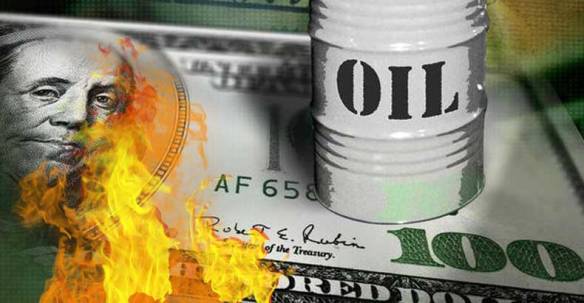
Demise Of The Petrodollar Has The Potential To Reshape The Geopolitical World

By James ONeill

Source: New Eastern Outlook

In the early 1970s President Richard Nixon instigated two changes that had profound effects. The first of these was taking United States off the gold standard; i.e. henceforth US dollars would no longer be convertible to Gold. Ordinarily this might have been expected to have significant ramifications for the value of the US dollar.

Deleterious effects however, were avoided by another equally profound change. Nixon’s National Security Adviser Henry Kissinger negotiated an agreement with Saudi Arabia that henceforth all oil(initially from Saudi Arabia but rapidly extended to all OPEC) countries would be traded only in US dollars, the birth of the so called petrodollar.

It was a classic mafia style arrangement. In exchange for Saudi Arabia’s agreement to the sole use of the dollar for oil transactions, the US underwrote Saudi Arabia’s security thereby ensuring the continuity of one of the world’s most corrupt and repressive regimes.

Also unknown at the time, the US and Saudi Arabia entered an arrangement whereby Islamist terrorist groups (as long as they were Sunni) would be financed by Saudi Arabia and armed by the Americans and then used in pursuit of US geopolitical goals. Operation Cyclone, begun under the Carter administration in the 1970s was an early forerunner of this tactic, but it has been refined and utilized in different formats in a wide number of countries ever since.

The objective was always fundamentally the same: to undermine and if necessary replace governments that were insufficiently compliant with US geopolitical aims. As and when necessary, US troops and their “coalition” allies would be inserted into the target countries. The destruction of Afghanistan (2001 and continuing) Iraq (2003 and continuing) Libya (2011 and continuing) are only three of the better-known examples.

The huge financial cost of these military and geopolitical ventures did not impose a proper price upon the US because of the hegemonic role of the US dollar. The US, in effect, had their multiple wars of choice paid for by other countries as the dollar’s role in world trade created a constant demand for US Treasury bonds.

The role of the US dollar also permitted the US to impose sanctions on recalcitrant countries. The selective nature of the sanctions, always directed toward a US geopolitical or commercial advantage, were clearly an instrument of repressive power. Notwithstanding claims that they were to “punish” the alleged misconduct of the specified country, their actually use betrayed their geopolitical purpose.

Sanctions against Russia for its” invasion” of Ukraine “annexation” of Crimea, and against Iran for its “nuclear program” are two of the better known illustrations of sanctions being justified on spurious grounds..

The use and abuse of the dollar’s power is clearly unacceptable, but the capacity to invoke countermeasures was until quite recently severely limited. The single most important countervailing force is the rise of China as the economic powerhouse of the world, and importantly, the creation of alternative structures in trade, finance and security, that translate China’s economic power into a force for major change.

That change is assisted by the number of collateral developments. In 1990, the G7 nations (Canada, France, Germany, Italy, Japan, the US and UK) had a combined GDP approximately six times greater then the seven economically most important emerging nations (Brazil, China, India, Indonesia, Mexico, Russia and South Korea).

By 2013 the “emerging seven” had surpassed the G7’s GDP total and according to the IMF’s estimates for 2017, the GDP of the two groups will be $47 .5 trillion and $37.8 trillion for the emerging seven and the G7 respectively. Turkey, which is growing at 5% per annum, has replaced Mexico in the top emerging seven.

BRICS, which contains four of the emerging seven nations and the Shanghai Corporation Organisation (SCO), which includes China, India and Russia, are working together on the architecture of a monetary alternative to the dollar. The SCO alone contains 42% of the world’s population.

India’s role in BRICS and the SCO is one reason it is being assiduously cultivated by Australia, Japan and the United States in an attempt to set up a “quadrilateral four” to slow and undermine the role of China and Russia in creating an alternative to longstanding western domination and exploitation.

It was in this context that Russia’s President Putin at the recent BRICS meeting in Xiamen, China said that

“Russia shares the BRICS countries concerns over the unfairness of the global financial and economic architecture, which does not give due regard to the growing weight of the emerging economies.”

This speech developed a theme that Putin had developed in an article published prior to the BRICS meeting. Putin bluntly vowed to destroy the US led financial system, aiming to reform a system that gives excessive domination to a limited number of reserve (i.e. predominantly western) currencies.

China has developed a new Cross Border Interbank Payments System (CIPS) to replace the US dominated SWIFT system, itself used as a tool for financial bullying by the US. Russia has also taken steps to insulate itself from the ill effects of being excluded from SWIFT.

Other major changes are also occurring. Venezuela, with the world’s largest known oil reserves, has ceased accepting payment in US dollars. In the past US retaliation through regime change would have been immediate as happened to Libya’s Gaddafi (confirmed by Clinton’s leaked emails) and the Iraq’s Saddam Hussein who had announced that he would henceforth accept payment in euros and not dollars.

China and Qatar recently concluded a $50 billion deal denominated in Yuan. There were immediate threats and absurd demands from Saudi Arabia, undoubtedly acting as the voice of the US administration, but nothing more serious. The lack of military intervention or attempted regime change was probably attributable to Turkey’s military intervention, a series of agreements with Iran, and the probable implied threat of Chinese intervention should the Saudis further demonstrate their military incompetence (as in Yemen) by anything as rash as direct military moves against Qatar.

Saudi Arabia is rapidly reaching a crunch point in its relationship with China, a huge purchaser of Saudi Arabia’s oil. It is widely known that China wants future oil contracts denominated in Yuan. The attraction for Saudi Arabia is that the Chinese guarantee their Yuan with gold traded on the Hong Kong and Shanghai exchanges. Ironically, this puts China in the same position as the United States prior to Nixon’s withdrawal from the gold backed dollar.

The dilemma for the Saudis is that if they comply with the Chinese demands they risk losing the Americans underwriting their security. US instigated regime change in Saudi Arabia is a very real possibility and the recent maneuverings by Mohammad bin Salman to consolidate his power can be interpreted as a response to that possibility.

Typically, the western media focused on relative trivialities, such as women being able to drive motor vehicles from 2018 (in limited circumstances), rather than examining the underlying geopolitical power struggle.

The other major development worth mentioning in this context is the rapid increase in the number of countries doing deals with China using the Yuan or their own national currencies as the medium of exchange. China’s Belt and Road Initiative, currently involving 65 nations, will undoubtedly accelerate this trend. Russia and China are already each other’s critically important trading partners and all agreements between them are being denominated in either Yuan or Rubles.

It would be naïve to assume that this is all going to occur without a massive rearguard action by the Americans who know full well that their ability to defy economic logic is only possible because of the dollar’s unique role, allowing in turn military interventions to prop up their now rapidly declining power.

The United States’ aggressive and provocative actions in the South China Sea, North Korea, Ukraine, Syria and elsewhere our best interpreted as the flailing’s of a declining empire. The real question is will the United States accept the disappearance of the unique power that it has wielded since the Bretton Woods agreement of 1944 and adjust its policies accordingly, or destroy us all in their attempts to recapture a lost world.

Perpetual Prosperity And The ‘Strategy of Tension’

By Graham Vanbergen

Source: TruePublica

Marco Rubio, the American politician, attorney and former Speaker of the Florida House of Representatives once said; “Every nation on the Earth that embraces market economics and the free enterprise system is pulling millions of its people out of poverty. The free enterprise system creates prosperity, not denies it.”

Statements such as these are common amongst politicians, especially wealthy ones who hold wealth driven values. But one man’s prosperity is another man’s misery in a world blighted by an economic model that demands eternal growth.

The only one constant that sits well with this model is that world population continues to increase, but even that is tailing off. Global population currently sits at 7.5 billion and rising at a rate of 80 million per year. The rate of population increase was 2.19 percent at its peak in 1963, which has now halved.

Concerns of the Fourth Industrial Revolution fusing the physical, digital and biological worlds, and impacting all disciplines, economies and industries emanate from the corporations who now see their future declining revenue potential being rescued through reduced reliance on human labour.

Get Briefed, Get Weekly Intelligence Reports – Essential Weekend Reading – Safe Subscribe

Subscribe!

To keep prosperity on a perpetual upward trajectory in the backdrop of a continually shrinking and less well off consumer base, the most politically influential now work in concert with the corporate behemoths – the new rulers of the world.

The strategies adopted to keep the ball rolling over the last few decades centre around a financial architecture that requires drastic anti-democratic political support. As Noam Chomsky warns “The very design of neoliberal principles is a direct attack on democracy.

One does not have to look far to see these principles at work. Trillions of desperately needed taxes to support a decaying system of civil society are illegally offshored by household named corporations and individuals. Unfortunately, this form of extreme neoliberalism still isn’t enough to keep the ball rolling.

Naomi Klein’s 2007 book ‘Shock Doctrine, the rise of Disaster Capitalism’ exploded the myth that the global free market triumphed democratically. Klein highlights how the “puppet strings behind the world-changing crises and wars of the last four decades is the real story of how America’s “free market” policies came to dominate the world, through the exploitation of disaster-shocked people and countries.”

Then, one year later, Klein’s prognosis saw the 2008 financial crisis offering up more disaster shocked peoples at the global level as neoliberalism wriggled free from the remnants of regulation to reach a new pinnacle for the few and a created an even greater crisis of daily life for the hundreds of millions left behind.

This erroneous ideology delivered little more than world economic stagnation, crippling austerity, peak inequality, a global environmental crisis, the slowest economic recovery in history and monumental debt of every country it infected. This was no mistake, no unforeseen event, that we were told stunned our leaders and their captains.

The problem always existed that extreme wealth was never going to come from a global post-war peace through globalisation – so a ‘strategy of tension’, an Anglo/American innovation, was invented to keep the exploitation model alive.

The actual definition of this strategy is that “Western governments during the Cold War used tactics that aimed to divide, manipulate and control public opinion using fear, propaganda, disinformation, psychological warfare, agents provocateurs, and terrorist actions in order to achieve their strategic aims.

Amongst many, one of those aims was financial domination.

During the closing days of the Cold War, the UK, US and other western governments along with the secret services colluded to engineer terrorist attacks inside Western Europe, to be blamed on Russia. This is now so well documented it needs no elaboration here (1).

However, the objective was always clear. By mobilising public opinion against left-wing parties (and their policies) and legitimising war, capitalism was to be forever invigorated. Ultimately though, this required the denying of national independence movements, mainly in the third world, to fund new forms of Western wealth.

The Cold War, stoked and fuelled by a deliberate strategy of tension gave us ‘Red Russia’ and the potential for nuclear Armageddon. When that ran its course, imaginary foes such as Saddam Hussein and Gaddafi were invented. The war on terror was used as a means to an end. Today, Red Russia is back on the agenda once again.

Dr Nafeez Ahmed, the award winning investigative journalist wrote about this Strategy of Tension:

The immense fear and chaos generated by the impact of this phenomenon throughout Western Europe was instrumental in legitimising the interventionist policies of the Anglo-American alliance throughout the Cold War period. The number of people killed across the third world as a consequence of this militarisation process is shocking, its implications genuinely difficult to absorb.” (2)

Ahmed goes on to say that 12 to 15 million people since WW2 have been sacrificed for this strategy with many millions more suffering as their economies were destroyed and denied the right to restructure whilst Western corporations made fortunes at their ultimate expense.

Dr Daniele Ganser, a Swiss historian who specialises in contemporary history, international politics, covert warfare, resource wars and geo-strategy confirms that this strategy is very much alive and in use to this day.

“What you may have, if you translate our experience from the Cold War to the current day situation, is that a strategy of tension is still being implemented, but this time against Muslims,” Ganser says. “We all know that the west is dependent upon oil, and a pretext is needed to develop more operations in Iran, Iraq etc. We can’t just go there and invade them, so we have to have this idea that they’re trying to kill us, then it’s possible, or at least imaginable that a strategy of tension in which the Muslims are playing the role that the communists played in the Cold War, is happening.”

The result is that the world is facing a new desperate multi-faceted game of thrones – as it morphs into something even more destructive.

Conflict and change is now the new norm. Global peace and domestic security is fading as the world order spirals out of control. This engineered spiral is going to prove to be a disaster for everyone, in what looks a lot like a coming global collapse on every front.

Civil society is now shrouded in a cycle of fear, terrorism, surveillance and experiencing a perpetual loss of rights and liberties as the world order disintegrates.

Today, we are now unable to make reasonable predictions of our near future as war, lawlessness, terrorism and now threats of nuclear annihilation become ever more real.

Even hope is diminishing. People of the West are now so afraid they want to stop perceived threats from foreigners, they want them expelled. Manufactured geo-political tensions have created a migration of people in the 21st century even greater than mankind’s greatest tragedy – the last world war. This is no mistake, no unforeseen event either.

China was once the greatest economic power on earth, followed by India, Britain and then America. Not once has the continent of Africa produced a global GDP exceeding 5% in its history, with 16% of the world’s population.

Having deprived this entire continent any possible chance of progression, a migrant surge is now destabilising the very regions responsible for pillaging it.

Alongside all of these pressures, environmental collapse seems inevitable when extreme capitalism sees natural catastrophic events such as the oil industry viewing melting ice caps as nothing more than an investment opportunity.

America is still fighting wars in the Middle East, threatening China, Iran, Korea, India, and even the European Union. The EU is breaking down into four distinct regions as the fifty-year unity project is visibly disintegrating. Is this just a fight for dwindling resources or something else?

Total global debt is now $227 trillion – or 327 percent of global GDP and something like 45 percent higher than the 2008 apex of the financial meltdown.

The Bank of International Settlements urged just two months ago that policymakers need to press on with rate rises notwithstanding the financial market turbulence it will cause.

The world’s six largest pension saving systems – the US, UK, Japan, Netherlands, Canada and Australia – are expected to reach a $224 trillion gap by 2050, a new study by the World Economic Forum shows. Implosion is its only obvious trajectory as there is nowhere near than amount of money anywhere in the world to plug such a gap as that (3).

Total US household debt surged by $460 billion last year, the sharpest one-year rise ever, with an eye-watering $13 trillion outstanding (4). Britain’s household debt is rising at 10 percent per year, five times the rate of earnings growth and has just surpassed the 2008 level of debt as households struggle to keep afloat (5).

The World Economic Forum has also determined that unemployment, an energy price shock, fiscal crisis, failure of national governance and profound social instability makes up the top five global risks to economic performance (6).

To rid the world of its debt’s, kick-start the world economy and take advantage of the shifting global chess board, some believe conflict is the only consequential route left. NATO’s threats to Russia supported by mass media hysteria only adds to the WEF global risks list.

We have a lot to be fearful of. The fact that any combination of the risk list could happen at the same time in today’s world is no longer the conspiratorial thinking of doom-mongers but the architecture of a strategy that the world has seen before.

Public intellectual Tariq Ali wrote a warning in his 2010 book “The Obama Syndrome: Surrender at Home, War Abroad:

This is the permanent tension that lies at the heart of a capitalist democracy and is exacerbated in times of crisis. In order to ensure the survival of the richest, it is democracy that has to be heavily regulated rather than capitalism.”

Seven years after Ali’s book we are experiencing a never-ending relay of crisis after crisis; democracy under threat, capitalism out of control and the very real threat of facing another human catastrophe.

In his sobering analysis, Professor Ugo Bardi, a professor in Physical Chemistry at the University of Florence and president of the Association for the Study of Peak Oil (ASPO), dissects historical statistics on war to unpick the patterns of the violence of the past. He warns that statistical data suggests we are on the brink of heading into another round of major wars resulting, potentially, in mass deaths on a scale that could rival what we have seen in the early 20th century. This is confirmation indeed that a ‘Strategy of Tension’, controlled or not, is heading towards its ultimate apogee. At this juncture, it is reasonable to conclude we are all in trouble.


(1) Operation Gladio (see Post war creation) https://en.wikipedia.org/wiki/Operation_Gladio

(2) Nafeez Ahmed – Strategy of Tension: http://www.nafeezahmed.com/2007/05/strategy-of-tension.html

( 3 ) Global pension funding gap: https://www.weforum.org/press/2017/05/global-pension-timebomb-funding-gap-set-to-dwarf-world-gdp/

(4) US household debt: https://www.wsws.org/en/articles/2017/02/20/debt-f20.html

(5) UK household debt: http://www.telegraph.co.uk/business/2017/07/31/growing-risk-uk-household-debts-warns-moodys-amid-lending-boom/

(6) World Economic Forum – Global Risks: http://reports.weforum.org/global-risks-2017/global-risks-of-highest-concern-for-doing-business-2017/

An Unreal Existence

By Richard Fernandez

Source: The Burning Platform

At the end of the 20th century people believed in the truth. While they had several truths, — liberalism, conservativism, classic Communism of the kind once espoused by Che Guevara and in places a naive form of apocalyptic Islam — at least each believed the world’s problems could be solved if their truth should triumph over the rest.

The clash of civilizations since September 11, 2001 has left every culture wounded and guilty in its own way. Western civilization, dominant through the modern era appears to be destroying itself in self-hatred, literally choosing extinction. “In 2015, all European Union countries had a sub-replacement fertility rate.” With the replacement fertility at 2.33, the average for the EU was 1.58. At the same time Islam was tearing itself apart in a global civil war while the United States was riven by discord.

No one seems to have the answers any more. Technological warfare only seems to increase entropy rather than reduce it. Yemen, Libya, Afghanistan are stories of one set of villains replacing another. So many Black Swans have appeared that they are no longer novelties. The old status quo faces the possibility that Brexit, Trump, Catalonia and the North Korean nuclear breakout far from being exceptions to the rule are harbingers of things to come.

What seems to have changed is our mental furniture though we don’t quite understand how it happened. Globalization has allowed drastic mutations that biologist Ernst Mayr notes often originates “in a relatively small and isolated population” to propagate very rapidly into a new normal. The new normal in Europe is depopulation, don’t ask how because the periphery can now become the center with surprising speed. The New York Times report that “major liberal donors, posing an insurgent challenge to some of the left’s most venerable institutions — and the Democratic Party itself” are no longer funding politicians like Hillary but the Resistance itself should come as no surprise.

“We’re in a disruptive period, and when we get through it, the progressive infrastructure landscape may look different,” said Gara LaMarche, president of the Democracy Alliance, a club of wealthy liberals who donate at least $200,000 a year to recommended groups.

The new variability is overwhelming the old political elite. As the World Wars and the Black Death demonstrated upheaval can produce wild mood swings in a populace. “The tremendous emotional shock [of the Black Death] … created a state of … depression and sometimes even panic” which turned people to fanaticism as others sought scapegoats for their troubles or lost themselves in a debauchery made famous by Poe’s Masque of the Red Death and the wild abandon of Weimar.

The underlying disruption is creating a similar volatility today. Currently we are obsessed with 71 genders but a nuclear or biological disaster can can flip decades of political correctness and deference to technology into their opposite. Considering all the freedoms and privacy the West has already given up to preserve the status quo the mantra “we can’t let it change us” is mockingly ironic. It is change, not changelessness which is characteristic of the present.

Perhaps the world is living through history’s first information epidemic and like the medievals who fell to unseen pathogens we can scarcely understand the catastrophe befalling us. Many are at a loss to explain entropy and anomie on a scale never seen before. But we cannot respond effectively to chaos without realizing the threat is not merely physical but an information corruption challenge.

At least Hillary’s call for more censorship on social media shows the old establishment is belatedly waking up to the informational nature of the threat without fully understanding it. “This is a new kind of Cold War — and it is just getting started,” Clinton said in a speech at Stanford University, using the language of 1945 to describe 2017.  Clinton seems to regard the machinery of manipulation per se as acceptable as long as it does not fall into the wrong hands and is probably counting on it to restore order.  She fails to see that manipulation itself — the Narrative — is the root problem and that the Narrative is likely to master her rather than the other way round.

Human sanity was long anchored in reality. Religions might have been flawed but they usually tried to explain things in the light of contemporary knowledge. Common people spent the greater part of their day in contact with society and family in a smartphone-free world that seems to be lost forever. They were innoculated against much craziness. That world had a self-centering property that is now missing.

Today we have live in an environment where whole populations are immersed in an ocean of deliberate lies. People can believe anything — and often do. The Narrative is malware corroding our sense of humanity and reality. Instead of increasing privacy so data miners cannot engage in the targeted lying which makes “fake news” so effective we decrease it the better to help the manipulators. We’ve reached the point where having real human networks instead of social ones is slightly suspicious. “Fear the man,” we are told when pondering Steven Paddock, “with no digital footprint.”

Perhaps humanity was better off with rival truths rather than rival lies. In retrospect the status quo got bitten by its own creation in 2016 after Putin wrested a surprising chunk of the Narrative from the Gatekeepers. But the politicians far from learning their lesson want the handlers to take a firmer grip on the snake instead of defanging it. It will bite them again and more venomously next time.

FIGHTING FOR OKINAWA — MY HOME, NOT A MILITARY BASE

By Moé Yonamine

Source: Rethinking Schools

My family moved to the United States from Okinawa when I was 7. But Okinawa is still home — and I’m hurt and angered at how the United States and Japan continue to treat Okinawa as little more than a colonial outpost. As a teacher, I’m even more dismayed at how the conventional school curriculum keeps young people in this country ignorant about the abuse, but also about the resistance, in my home islands.

“They are burying our beautiful ocean,” read the recent message from my mother in Okinawa, as though she was grieving the loss of a loved one. After decades of protest by Okinawan people to completely get rid of all U.S. military bases that occupy a fifth of the Ryukyu Island chain, the United States and Japan signed a treaty to evacuate one of the most contested bases located in the center of the main island, Futenma Marine Corps (MCAS) base. In exchange for the removal, both governments announced that they would construct a floating military base off the northeast coast of Henoko. Okinawans expressed vehement opposition, with a majority voting in a referendum for the complete removal of all bases. Still the construction continued and the people persisted in protest — marching for miles down main streets, creating human chains for peace, linking arms around military bases, elders repeatedly lying down in front of bulldozers. Governor Takeshi Onaga demanded the Japanese government terminate the heliport construction and city mayors prevented access of U.S. military construction vehicles through their districts — later overturned by federal court order last December sought by the Japanese federal government.

Today, the concrete seawalls are finished, and soon, rocks will be crushed and sand will pile high, burying the tropical, clear waters. The Japanese government and U.S. military continue to pursue the construction of the runway, despite community complaints of environmental damage and pollution, endangerment to sea life, harm to the fishing and tourism industry, as well as the ongoing threat to cultural survival and island sovereignty. On July 6th the Ryukyu Shimpo announced that the Japanese government would not return the land occupied by MCAS Futenma to the Okinawan people. The U.S. and Japan added a condition to the promise for Futenma’s removal: The Naha International Airport must be made available for the U.S. military any time they declare an emergency. When Governor Onaga rejected this demand, the U.S. military withdrew its promise to remove Futenma. Japanese Defense Minister Tomomi Inada stated, “If the requisite conditions for the return of Futenma are not met, it will not be returned.” In a surge of anger, pain and frustration, word spread quickly in Okinawa across social media.

Devastated at the sacrifice of my home, I turned to the news here in the United States, and there was not one story about Okinawa on any major network. Frustrated, I recalled my conversation with an elderly grandmother I met at a peace rally in my neighborhood when I went home last summer. When I told her I was a teacher in the United States, she told me that the best thing we as teachers can do is to teach kids about what’s happening in Okinawa and how we want a world without war. She said, “They need to know our story so they can stand up with us.”

But when I turn to a typical U.S. textbook, I see how students are ill-equipped to understand what’s happening in Okinawa. For example, in Holt McDougal’s widely used The Americans, there are a mere three paragraphs about Okinawa under the section, “The Atomic Bomb Ends the War.”

Discussion of Okinawa begins and ends with a skewed description of the Battle of Okinawa during WWII: “In April 1945, U.S. Marines invaded Okinawa,” it begins. “By the time the fighting ended on June 21, 1945, more than 7,600 Americans had died. But the Japanese paid an even greater price — 110,000 lives — in defending Okinawa.” Okinawans are completely invisible in this account of the war, the bloodiest battle in the history of the Pacific, where our islands were used as a battleground between the United States and Japan. The highest cost was in Okinawan lives, where more than a third of the population was killed within three months — almost 150,000 — and more than 92 percent were left homeless. The majority of today’s families — including mine — have experienced grief and loss of loved ones.What The Americans does not teach is that Okinawa was once an independent kingdom, was colonized by Japan, then controlled by the United States for 27 years, and finally became a Japanese prefecture. At the end of the war, the U.S. military stripped Japan of its constitution and replaced it with one that took away Japan’s right to have an offensive military. Henceforth, the United States would “protect” Japan, and create bases throughout Japanese territory. However, three-quarters of all U.S. bases on Japanese territory are on Okinawa, even though Okinawa makes up only .6 percent of Japan’s total landmass. Okinawa’s main island is just 62 miles long; and its width averages one mile.

MCAS Futenma was constructed in the middle of our skinny island — creating environmental destruction, air pollution and noise pollution, blocking direct access to roads in a densely populated community, and exposing survivors and families to the sights and sounds of war. Frequent violent crimes against women and children continue to bring hundreds of thousands of protesters together demanding justice and humanity — and the complete removal of U.S. military bases.

Not only do commercial textbooks fail to equip students to understand what’s happening in Okinawa, the mainstream school curriculum does not help students understand issues affecting island people more broadly. I have seen time and time again the shock when my high school students in Portland, Oregon, learn about the U.S. military’s long-standing nuclear testing in the Marshall Islands, the environmental damage to Vieques in Puerto Rico, or the history of U.S. military trainings on indigenous Hawaiian soil. Many of my students are confused when they learn that Guam is a “U.S. territory,” has the highest per capita U.S. military enlistment, has a huge U.S. base presence, but its people have no right to vote in U.S. elections. When I talk about the International Women’s Network Against Militarism, students wonder why women from places with high U.S. military presence — the Philippines, South Korea, Hawai’i, Puerto Rico, Guam and Okinawa — gather regularly to talk and organize.

When people say to me, “Why are Okinawans complaining? We’re there to protect you,” I want them to learn our whole history and to know our colonized story. When people ask, “Why don’t Okinawans complain to the Japanese government?” I want them to know about the history of our people’s movements to demand our rights. When people say, “So what? It’s just one little island,” I want them to know this is my home; it’s sacred — these are my loved ones. What’s more, our story of struggle today represents issues affecting so many island people.

The elderly grandmother from the peace rally told me that we must teach the children “that we have been fighting because we have always wanted peace but now we need the world to fight with us. Go back and tell our story.” Our story though, is much more than three short paragraphs in a textbook. It is a story about a people’s determination for sovereignty in the face of imperialism, resilience in midst of colonization, and perseverance for peace as survivors of war. Our story is urgent and it is a call for global action in the name of peace and justice. The history of Okinawa is a story of resistance but also a call to the world.


Moé Yonamine (moe@rethinkingschools.org) teaches at Roosevelt High School in Portland, Oregon, and is an editor of Rethinking Schools magazine. Yonamine is part of a network of Zinn Education Project teachers developing original people’s history curriculum. She is the author of “The Other Internment: Teaching the Hidden Story of Japanese Latin Americans During WWII,” “‘ANPO: Art X War’: A Film Tackles the U.S. Occupation of Japan,” a film review with teaching activities of “ANPO: Art X War,” a documentary about visual resistance to U.S. military bases in Japan, and “Uchinaaguchi: The Language of My Heart.”

The Informant Cometh

By James Howard Kunstler

Source: Kunstler.com

When you consider all the shadowy creatures scuttling around the backstage interstices of the Deep State, it’s a little wondrous that someone like this hasn’t stepped into the light before. Apparently now, a person whose name will soon be plastered across the pixel-verse, has been given clearance by the Justice Department to come forth and sing to the various house and senate committees about a fishy deal involving Russia and the Clinton dynasty.

The broad outlines of Uranium-Gate are already loaded like a platter of nachos grandes with piquant tidbits of suspicious detail. The informant worked for a DC Swamp lobbying firm that was hired by Tenex, a subsidiary of the Russian government-owned company Rosatom, to grease the skids for a deal to buy a Canadian company, Uranium One, which had substantial mining operations in the USA. According to The Hill website, the deal put about 20 percent of US uranium into the hands of the Russian company.

The informant recognized evidence of criminal behavior in the dealings he witnessed and voluntarily went to the FBI with it. The Hill report goes on:

     His work helped the Justice Department secure convictions against Russia’s top commercial nuclear executive in the United States, a Russian financier in New Jersey, and the head of a U.S. uranium trucking company in what prosecutors said was a long-running racketeering scheme involving bribery, kickbacks, extortion and money laundering.

Those charges, based on evidence gathered in 2009, were not taken to court until 2014. And that was supposed to be the end of it.

Now, it also happens that the deal for Tenex to buy Uranium One had to be approved by nine federal agencies and signed off on by Secretary of State Hillary Clinton, which she did shortly after her husband Bill Clinton was paid $500,000 to give a speech in Moscow sponsored by a Russian bank. The Clinton Foundation also received millions of dollars in “charitable” donations from parties with an interest in the Tenex / Uranium One deal. It happened, too, that the CEO of Uranium One at the time of the Tenex sale, Frank Guistra, was one of eleven board members of the Clinton Foundation.

The informant remained undercover for the FBI for five years. None of the Clinton involvement was included in the previously mentioned federal bribery and racketeering prosecutions. Meanwhile, the informant had signed a nondisclosure agreement with the Obama Justice Department, only just lifted last week.

As of this morning, the story is absent from The New York Times, formerly the nation’s newspaper of record. The FBI’s credibility is at stake in this case. Robert Mueller, who was Director of the agency during the Tenex /Uranium One deal, with all its Clintonian-Russian undertones is in the peculiar position now as special prosecutor for the Russian election “meddling” alleged to involve President Trump. Whatever that investigation has turned up is not known publicly yet, but the massive leaking from government employees that turned the story into roughly 80 percent of mainstream legacy news coverage the past year, has ceased — either because Mueller has imposed Draconian restraints on his own staff, or because there is nothing there.

The FBI has a lot to answer for in overlooking the Clinton connection to the Uranium One deal. The informant, soon to be attached to a name and a face, is coming in from the cold, to the warm, wainscoted chambers of the house and senate committees. I wonder if Mr. Trump, or his lawyers, will find grounds to attempt to dismiss Special Prosecutor Mueller, given what looks like Mueller’s compromised position vis-à-vis Trump’s election opponent, HRC. It’s hard to not see this thing going a long way — at the same time that financial markets and geopolitical matters are heading south. Keep your hats on.

Financialization, precarity and reactionary authoritarianism

By increasing global competition, the precariousness wrought by financialization has laid the foundations for reactionary authoritarianism around the world.

By Max Haiven

Source: ROAR

Financialization: Fictitious Capital in Popular Culture and Everyday Life, released last month in paperback from Palgrave Macmillan. The book argues that financialization is not just the increasing power and authority of speculative capital over the global economy, but also the way the it seems into and is reflected in politics, social institutions and the realm of cultural meaning.

This section comes at the end of a chapter on the ways financialization both drives onward and depends on the increasing precariousness of workers, putting us into global competition with one another and also infecting our sense of value and success. Haiven argues that this situation produces a tendency towards reactionary authoritarianism based on a “forgetting” and a loathing of our shared human condition of precariousness. He concludes by asking us to consider other models for thinking about debt and precarity that stress radical interdependence.

It is followed by a brief authors’ note reflecting on the piece four years since it was first penned in 2013.


Precarious fear and loathing

Today precariousness is the norm, not the exception. Our current precarious moment, one dominated by market and financial forces and manifesting itself as a violent form of hyper-neoliberal austerity (which is producing ever more and deeper economic precariousness), is only one particularly pernicious manifestation of an underlying ontological condition. It is worse than many such manifestations precisely because it is so successful in privatizing precariousness through the logic of individualism and competition.

We come to blame ourselves, rather than the system, for our precariousness, in part because, unlike some rigid caste-based system or a slave society, we are (most of us) legally and technically free to escape precariousness (though, ironically, to escape by embracing precarity, by using every skill, talent and asset we might possess to leverage ourselves into fabled prosperity). It is a system that works by promising that we can, each of us, alone, escape our existential condition of precariousness by getting rich, by obeying the system’s axiomatic dictates and playing our role.

The constant barrage of images and tales of the lifestyles of the rich and famous, of celebrities and of others who have “made it” do not exist (as they did in a previous era) to show us the right social order and the natural superiority of certain sorts of people. Rather, these ubiquitous dream-images promise each of us a life without precariousness or, more accurately (if we think about the cinematic depictions of the Wall Street predator) a life where precariousness is mastered and leveraged.

This helps explain the virulent disdain that grows and grows towards the poor, the refugee, the  (almost always racialized) populations deemed to be “at risk.” To the extent that we succeed in leveraging ourselves out of the total liquidation of our lives by building up a life of financial prosperity and (the illusion of) security, we are compelled to close ourselves off to what Judith Butler, drawing on the work of Emmanuel Levinas, calls the “face” of the other: the empathetic image of existential suffering. In fact, to the extent participation in financialization has come afford us the privilege of forgetting our inherent shared condition of precariousness, we come to loathe the face of precarity, loathe the way it calls us back into a fellow precarious human body.

The colors of risk

As a result, we should not expect that the almost universal adoption of the free market will lead to any sort of peace or cosmopolitanism in the world, as neoliberal thinkers like Fredrich Hayek or Francis Fukayama believed. Nor should we assume that the financialized age of austerity will prompt such a wave of popular discontent that radical social transformation is inevitable. To the extent that we are made more and more precarious, we brew an existential anger, a self-loathing that can easily be displaced onto convenient others.

Ironically, it is not easily displaced onto the architects and beneficiaries of financialized capitalism, but instead gravitates towards the more precarious, the more abject: they who call us back into the shared precarious what Marx called our “species being,” our shared precarious condition as imaginative cooperative animals dependent on one another for joy and survival. While this may or may not manifest itself in the form of new nationalisms, it will manifest itself in the form of hatred towards the homeless, towards refugees, towards welfare recipients and towards others.

It is vital to note that, in North America and Europe, and in different ways elsewhere, this precarious vitriol cannot be separated from the history of race and racism. Older modes of racial enslavement, apartheid and segregation served the same function, similarly allowing those read as “white” to posit a superior form of humanity which both occluded a shared precariousness and elevated the material wealth and security of whites at the expense of immiserated, exploited and impoverished non-whites (in different ways, in different times and places).

Indeed, earlier moments of capitalism explicitly mobilized whiteness and its real and perceived benefits vis-a-vis precariousness to divide workers along color lines, a condition that fed, and was fed by, the existential precariousness of non-whites who, as second-class citizens, slaves, migrant laborers or perpetual “outsiders,” were not afforded the same personal safety or security (neither de jure nor de facto).

The current reigning assumption is that we have entered a “post-racial” moment, that racism is merely a marginal anachronism, and that racialized people face no systemic barriers to achieving a non-precarious life like “everyone else” — in other words, they are as free to enter the market as anyone else, and the market does not “see” race. The opposite is, in fact, the case: racism and racial inequality towards non-white people persist and, in some ways, are even worse thanks to the mechanisms of financialized market which also works to make those inequalities functionally invisible.

Banking on resentment

On another level, we might speculate that precariousness, in both image and concept, is already racialized, that our understandings of what it means to be precarious, and the negative associations with which this term resonates, are already coded as non-white and call up a legacy and a present of racialized images of abjection, destitution, subservience and shiftlessness. Indeed, we might ask to what extent political systems in the West base their legitimacy on the invisiblized darkness of precariousness. The politically expedient citation of the disappearance of “hard-working Americans” and “the middle class” (both of which are imagined as white) into a dark miasma of economic depression is indelibly associated with popular depictions of ghettos and menial racialized workers.

Suffice it for now to say that we can certainly see these trends as played out in largely white backlash movements which have arisen to confront non-white peoples’ or groups’ claims to social and economic justice. From anti-Muslim organizing in Western Europe (framed in terms of defending a white national heritage and white workers), to anti-Black “whitelash” in the United States (from the Detroit Riots to Rodney King to Trevon Martin), to the anti-Indigenous vitriol in my home country of Canada, these seemingly spontaneous “social movements” speak not only to the politics of ignorance and fear, but also to the socio-economic conditions of precariousness, as well as the perceived failure of the state to live up to its promises to prevent precariousness for white people, all coupled with a history that locates precariousness along the axes of race and racialization.

This deeper existential and ontological crisis and anger is joined by another: the crisis of the middle class. Those professional or semi-professional workers who have been taught to expect middle-class incomes and job security are quickly finding themselves disposable in a vast pool of precarious workers, leading highly indebted, precarious lives with little hope for reprieve. In the coming years, increasingly fascistic political powers will gain ground by offering hollow promises to rebuild the middle class and to end precarity, through neocolonial geopolitical adventure or by creating or maintaining localized under-classes of hyper-precarious migrant or abject workers.

The cult of risk management

What would a politics look like that promised not to end but to embrace precariousness, not as an inescapable economic “reality” (which is what our current system of financialized austerity pledges) but as a socio-ontological sine qua non?

The answer is yet to be determined. But, ironically, an answer may be emerging out of the financialized paradigm that has driven precariousness to a new level of universality and acuity. The speculative ethos that animates financialization is one intimately and irreducibly acquainted with the ontological realities of precariousness. “Risk” and “risk management” are, underneath all their trappings of quantitative and scientistic rigour, mythological constructs for engaging with, navigating through and manipulating the cultural fabric of precariousness. Investments are, at a certain abstract level, attempts to leverage precarious life into more advantageous out- comes.

Finance, as a broad sphere of activities, is a mechanism by which individuals and society at-large seek to gain agency over the precariousness and contingency of the future. It is a particularly perverse mechanism, and one whose logic and mechanisms are either occluded from sight, or so complex, rapid or vast to be fully grasped, even by their primary engineers and agents in hedge funds and investment banks. Yet finance reproduces itself by cultivating and mobilizing the energies, creativity and hope of almost everyone in their attempts to thwart or diminish precarity, and aggregates all these individual and institutional actions into a system which, tragically, only drives greater and greater precariousness.

Generative debts?

The silver lining is perhaps this: what financialization reveals is the inherent futurity of precariousness. The word itself derives from the Latin prex or prayer, with strong connotations of begging or soliciting: yearning for future outcomes, throwing oneself on the mercy of fate or divine provenance. What our financialized moment might reveal is that our shared precariousness, which is the condition both of disastrous authoritarianism (including the disorganized and diffuse totalitarianism of finance capital itself) and of solidarity, does not only emerge from our shared material and ontological conditions; it is also a horizon of shared futurity. That is, precariousness carries encrypted within it a shared relationship with the future.

In this sense, nascent anti-debt organizing in the United States and elsewhere bears a great deal of potential. As Richard Dienst, David Graeber and Andrew Ross all affirm, the politics of debt, if they are to be a radical challenge to the financialized empire, cannot simply be a demand for some libertarian fantasy of complete individual freedom. Rather, they must embrace a broader, more capacious concept of the ontological wealth of social bonds that make life possible, that render all of us precariously reliant on one another. In this sense, they, each in their own way, encourage us to envision an expanded notion of (non-monetary) debt beyond as a grounds for crafting and building common futures through the entanglement of our social relationships.

Likewise, Angela Mitropoulos insists on the importance of moving beyond the limited concepts of financial debt and “debt servitude,” which depend upon and exalt the ideal of the individuated (white, masculine) self, the esteemed, contract-making personage at the heart of Western liberal political and economic philosophy and law. She notes that behind today’s politics of debt there reside the unacknowledged debts germane to the worlds of social reproduction and affective labor on which we all rely, which today are increasingly commodified in the so-called service sector. Indeed, the growth of precarious, feminized service-based labor over the past few decades cannot be separated from the rise of debt as a means to discipline workers and extract surplus value. Beyond the hollow promise of an ideal state of freedom from all obligations, radical potentialities might emerge from the affirmation and recognition of shared interdependency, of the shared need for what today is misrecognized as “service.” As she puts it:

The question it seems to me is not whether our debts can be erased, but what the lines of indebtedness are, how debt is defined, whether it takes the form of a financial obligation or some other consideration of relational inter-dependence, of the forms of life that the routine accounting of debts lets flourish or those that it obscures behind propositions of a seemingly more natural order of individuation, dependence, and obligation.

Beyond the colonial bond?

Glen Coulthard articulates a radical Indigenous reenvisioning of obligation that goes well beyond the Western philosophical canon:

Consider the following example from my people, the Dene Nations of what is now the Northwest Territories, Canada. In the Yellowknives Dene (or Weledeh) dialect of Dogrib, land (or dè) is translated in relational terms as that which encompasses not only the land (understood here as material), but also people and ani- mals, rocks and trees, lakes and rivers, and so on. Seen in this light, we are as much a part of the land as any other element. Furthermore, within this system of relations human beings are not the only constituent believed to embody spirit or agency. Ethically, this meant that humans held certain obligations to the land, animals, plants, and lakes in much the same way that we hold obligations to other people. And if these obligations were met, then the land, animals, plants and lakes would reciprocate and meet their obligations to humans, thus ensuring the survival and well-being of all over time.

Coulthard’s articulation of a broader field of grounded land-based obligation, reciprocity and care demonstrates the radical potentialities that might emerge from a reconsideration of the bonds of debt and the conditions of shared precarity, were we open to re-envision their meanings beyond the hollow promises of security proffered by capital and the state.


Since the publication of Cultures of Financialization I have felt unhappily vindicated in my suspicion that financialization would give right to revanchist authoritarianism. But were I to approach the topic of this excerpt again, I would take more care to locate the origins of the loathing of precariousness within the specific histories of anti-Black racism. I would approach this by making more explicit the origins of finance capital in the trans-Atlantic slave trade and slave economies in the Americas. I would follow this tendency through to the present-day ways that anti-Black racism and white-supremacy, as the template and operating condition of all forms of modern racism, is manifested again and again in the machinations of the financial empire, from the continued neocolonial pillage of Africa to the racialized dimension of the sub-prime loan crisis which led to the single largest theft of Black family wealth since Reconstruction.

Were I to approach this topic again I would also stress more centrally the ways in which settler colonialism destroys and denigrates a cooperative relationship with land, most horrifically by seeking the systematic elimination of autonomous Indigenous presence and power on land. I would seek to understand (as I have elsewhere) how settler colonialism has always been a financialized project, and how financialization has, historically and in the present, been enabled by settler colonialism.

I think that only with these in mind can we seek to understand how financialization has given rise not only to new forms of authoritarianism that promise (white people) respite from the precarity financialization has created, but which are fundamentally based on the acceleration and intensification of white supremacy and settler colonialism.

Finally, were I to approach this chapter again I would caution myself against a conclusion that could appear to call for a kind of new universalist embrace of shared precarity. I would have concerned myself with the way such a universalism, while noble in a certain abstract sense, can work to erase precisely the continued centrality of (anti-Black) racism and settler colonialism. Instead, I would have stressed that overcoming financialized precarity and these systems of oppression and exploitation will be based not only on high-minded virtues but meaningful relationships of militant solidarity and the collective invention of new forms of power, new institutions of care and new frames and practices of revolutionary thought and action.

U.S. WARS AND HOSTILE ACTIONS: A LIST

By David Swanson

Source: Let’s Try Democracy

There is a reason that most countries polled in December 2013 by Gallup called the United States the greatest threat to peace in the world, and why Pew found that viewpoint increased in 2017.

But it is a reason that eludes that strain of U.S. academia that first defines war as something that nations and groups other than the United States do, and then concludes that war has nearly vanished from the earth.

Since World War II, during a supposed golden age of peace, the United States military has killed some 20 million people, overthrown at least 36 governments, interfered in at least 82 foreign elections, attempted to assassinate over 50 foreign leaders, and dropped bombs on people in over 30 countries. The United States is responsible for the deaths of 5 million people in Vietnam, Laos, and Cambodia, and over 1 million just since 2003 in Iraq.

For the past almost 16 years, the United States has been systematically destroying a region of the globe, bombing Afghanistan, Iraq, Pakistan, Libya, Somalia, Yemen, and Syria, not to mention the Philippines. The United States has “special forces” operating in two-thirds of the world’s countries and non-special forces in three-quarters of them.

In an attempt to quantify U.S. warmaking, I’ve copied below lists from these sources:

>> William Blum: America’s Deadliest Export: Democracy
>> Dr. Zoltan Grossman: A Century of U.S. Military Interventions
>> 
James Lucas: U.S. Has Killed More Than 20 Million People

The supreme international crime according to 2017 U.S. media reporting is interferring nonviolently in a democratic election — at least if Russia does it. William Blum, in his book Rogue State, lists over 30 times that the United States has done that. Another study, however, says 81 elections in 47 countries. France 2017 makes that total at least 82.

In a reality-based assessment of U.S. crimes, the serious offenses begin beyond that threshold. Here’s Blum’s list of over 50 foreign leaders whom the United States has attempted to assassinate:

  • 1949 – Kim Koo, Korean opposition leader
  • 1950s – CIA/Neo-Nazi hit list of more than 200 political figures in West Germany to be “put out of the way” in the event of a Soviet invasion
  • 1950s – Chou En-lai, Prime minister of China, several attempts on his life
  • 1950s, 1962 – Sukarno, President of Indonesia
  • 1951 – Kim Il Sung, Premier of North Korea
  • 1953 – Mohammed Mossadegh, Prime Minister of Iran
  • 1950s (mid) – Claro M. Recto, Philippines opposition leader
  • 1955 – Jawaharlal Nehru, Prime Minister of India
  • 1957 – Gamal Abdul Nasser, President of Egypt
  • 1959, 1963, 1969 – Norodom Sihanouk, leader of Cambodia
  • 1960 – Brig. Gen. Abdul Karim Kassem, leader of Iraq
  • 1950s-70s – José Figueres, President of Costa Rica, two attempts on his life
  • 1961 – Francois “Papa Doc” Duvalier, leader of Haiti
  • 1961 – Patrice Lumumba, Prime Minister of the Congo (Zaire)
  • 1961 – Gen. Rafael Trujillo, leader of Dominican Republic
  • 1963 – Ngo Dinh Diem, President of South Vietnam
  • 1960s-70s – Fidel Castro, President of Cuba, many attempts on his life
  • 1960s – Raúl Castro, high official in government of Cuba
  • 1965 – Francisco Caamaño, Dominican Republic opposition leader
  • 1965-6 – Charles de Gaulle, President of France
  • 1967 – Che Guevara, Cuban leader
  • 1970 – Salvador Allende, President of Chile
  • 1970 – Gen. Rene Schneider, Commander-in-Chief of Army, Chile
  • 1970s, 1981 – General Omar Torrijos, leader of Panama
  • 1972 – General Manuel Noriega, Chief of Panama Intelligence
  • 1975 – Mobutu Sese Seko, President of Zaire
  • 1976 – Michael Manley, Prime Minister of Jamaica
  • 1980-1986 – Muammar Qaddafi, leader of Libya, several plots and attempts upon his life
  • 1982 – Ayatollah Khomeini, leader of Iran
  • 1983 – Gen. Ahmed Dlimi, Moroccan Army commander
  • 1983 – Miguel d’Escoto, Foreign Minister of Nicaragua
  • 1984 – The nine comandantes of the Sandinista National Directorate
  • 1985 – Sheikh Mohammed Hussein Fadlallah, Lebanese Shiite leader (80 people killed in the attempt)
  • 1991 – Saddam Hussein, leader of Iraq
  • 1993 – Mohamed Farah Aideed, prominent clan leader of Somalia
  • 1998, 2001-2 – Osama bin Laden, leading Islamic militant
  • 1999 – Slobodan Milosevic, President of Yugoslavia
  • 2002 – Gulbuddin Hekmatyar, Afghan Islamic leader and warlord
  • 2003 – Saddam Hussein and his two sons
  • 2011 – Muammar Qaddafi, leader of Libya

Let me know of any updates or corrections, and I’ll add them.
Thanks to Said Zulficar for pointing out the need to add Jaime Roldos, President of Ecuador, assassinated May 1981.

Here is Blum’s list of U.S. attempts to overthrow governments (* indicates success):

  • China 1949 to early 1960s
  • Albania 1949-53
  • East Germany 1950s
  • Iran 1953 *
  • Guatemala 1954 *
  • Costa Rica mid-1950s
  • Syria 1956-7
  • Egypt 1957
  • Indonesia 1957-8
  • British Guiana 1953-64 *
  • Iraq 1963 *
  • North Vietnam 1945-73
  • Cambodia 1955-70 *
  • Laos 1958 *, 1959 *, 1960 *
  • Ecuador 1960-63 *
  • Congo 1960 *
  • France 1965
  • Brazil 1962-64 *
  • Dominican Republic 1963 *
  • Cuba 1959 to present
  • Bolivia 1964 *
  • Indonesia 1965 *
  • Ghana 1966 *
  • Chile 1964-73 *
  • Greece 1967 *
  • Costa Rica 1970-71
  • Bolivia 1971 *
  • Australia 1973-75 *
  • Angola 1975, 1980s
  • Zaire 1975
  • Portugal 1974-76 *
  • Jamaica 1976-80 *
  • Seychelles 1979-81
  • Chad 1981-82 *
  • Grenada 1983 *
  • South Yemen 1982-84
  • Suriname 1982-84
  • Fiji 1987 *
  • Libya 1980s
  • Nicaragua 1981-90 *
  • Panama 1989 *
  • Bulgaria 1990 *
  • Albania 1991 *
  • Iraq 1991
  • Afghanistan 1980s *
  • Somalia 1993
  • Yugoslavia 1999-2000 *
  • Ecuador 2000 *
  • Afghanistan 2001 *
  • Venezuela 2002 *
  • Iraq 2003 *
  • Haiti 2004 *
  • Somalia 2007 to present
  • Honduras 2009
  • Libya 2011 *
  • Syria 2012
  • Ukraine 2014 *
    [arguably, Syria 1949 needs to be added to this list. –DS]

The above list does not include numerous coups by U.S.-trained fighters, such as (other than Honduras) those discussed here: “from Isaac Zida of Burkina Faso, Haiti’s Philippe Biamby, and Yahya Jammeh of The Gambia to Egypt’s Abdel-Fattah el-Sisi, Mohammad Zia-ul-Haq of Pakistan, and the IMET-educated leaders of the 2009 coup in Honduras, not to mention Mali’s Amadou Sanogo.” These are just in very recent years, by no means a complete list, though the Haiti coup referenced here was earlier than the one included in the list above.

Here is Blum’s list of nations bombed by the United States:

  • Korea and China 1950-53 (Korean War)
  • Guatemala 1954
  • Indonesia 1958
  • Cuba 1959-1961
  • Guatemala 1960
  • Congo 1964
  • Laos 1964-73
  • Vietnam 1961-73
  • Cambodia 1969-70
  • Guatemala 1967-69
  • Grenada 1983
  • Lebanon 1983, 1984 (both Lebanese and Syrian targets)
  • Libya 1986
  • El Salvador 1980s
  • Nicaragua 1980s
  • Iran 1987
  • Panama 1989
  • Iraq 1991 (Persian Gulf War)
  • Kuwait 1991
  • Somalia 1993
  • Bosnia 1994, 1995
  • Sudan 1998
  • Afghanistan 1998
  • Yugoslavia 1999
  • Yemen 2002
  • Iraq 1991-2003 (US/UK on regular basis)
  • Iraq 2003-2015
  • Afghanistan 2001-2015
  • Pakistan 2007-2015
  • Somalia 2007-8, 2011
  • Yemen 2009, 2011
  • Libya 2011, 2015
  • Syria 2014-2016

[Drone strikes in the Philippines should be added to this list. As perhaps should be all the islands and territories destroyed by test bombings. –DS]

Blum adds these further bombings:

Iran, April 2003 – hit by US missiles during bombing of Iraq, killing at least one person

Pakistan, 2002-03 – bombed by US planes several times as part of combat against the Taliban and other opponents of the US occupation of Afghanistan

China, 1999 – its heavily bombed embassy in Belgrade is legally Chinese territory, and it appears rather certain that the bombing was no accident (see chapter 25 of Rogue State)

France, 1986 – After the French government refused the use of its air space to US warplanes headed for a bombing raid on Libya, the planes were forced to take another, longer route; when they reached Libya they bombed so close to the French embassy that the building was damaged and all communication links knocked out.

Philadelphia, Pennsylvania, May 13, 1985 – A bomb dropped by a police helicopter burned down an entire block, some 60 homes destroyed, 11 dead, including several small children. The police, the mayor’s office, and the FBI were all involved in this effort to evict a black organization called MOVE from the house they lived in.

If we add in other missing instances and go back to and prior to WWII the list starts to look like this:

Dominican Republic 1915 – 1935
Haiti 1915 – 1934
Logan County, West Virginia 1921
Tulsa, Oklahoma 1921
Honduras 1924, 1925
Nicaragua 1927 – 1933
Algeria, Austria, Belgium, Bulgaria, China, Crete, Czechoslovakia, France, Germany, Greece, Guam, Hungary, Indonesia, Italy, Japan, Libya, Luxembourg, Morocco, Myanmar (Burma), Netherlands, New Guinea and the Solomon Islands, Okinawa, Philippines, Poland, Romania, Saipan, Taiwan (Formosa), Thailand, Tinian, Tunisia, Vietnam (French Indochina), Yugoslavia 1941 – 1945
Marshall Islands, Republic of Kiribati, Alaska, Nevada, Colorado, Mississippi, New Mexico nuclear testing 1945 – 1962
Korea and China 1950 – 1953
Guatemala 1954
Indonesia 1958
Cuba 1959 – 1961
Guatemala 1960
Congo 1964
Laos 1964 – 1973
Vietnam 1961 – 1973
Cambodia 1969 – 1970
Guatemala 1967 – 1969
El Salvador 1980s
Nicaragua 1980s
Grenada 1983
Lebanon 1983, 1984
Libya 1986
Philadelphia, Pennsylvania 1985
Iran 1987
Panama 1989
Kuwait 1991
Iraq 1991 – 2017
Somalia 1993
Bosnia 1994, 1995
Sudan 1998
Afghanistan 1998
Yugoslavia 1999
Afghanistan 2001 – 2017
Yemen 2002
Pakistan 2002 – 2003
Iran 2003
Pakistan 2007 – 2017
Somalia 2007 – 2008, 2011
Yemen 2009, 2011, 2016-2017
Libya 2011, 2015 – 2017
Philippines 2012
Syria 2014 – 2017

Then there’s Blum’s list of instances of the United States attempting to suppress a populist or nationalist movement (* indicates success):

  • China – 1945-49
  • France – 1947 *
  • Italy – 1947-1970s *
  • Greece – 1947-49 *
  • Philippines – 1945-53 *
  • Korea – 1945-53 *
  • Haiti – 1959 *
  • Laos – 1957-73
  • Vietnam – 1961-73
  • Thailand – 1965-73 *
  • Peru – 1965 *
  • Dominican Republic – 1965 *
  • Uruguay – 1969-72 *
  • South Africa – 1960s-1980s
  • East Timor – 1975-1999 *
  • Philippines – 1970s-1990s *
  • El Salvador – 1980-92 *
  • Colombia – 1990s to early 2000s *
  • Peru – 1997 *
  • Iraq – 2003 to present *

Zoltan Grossman provides the following list of all variety of hostile actions:

IRAN 1946, Nuclear threat, Soviet troops told to leave north.
YUGOSLAVIA 1946, Nuclear threat, naval Response to shoot-down of U.S. plane.
URUGUAY 1947, Nuclear threat, Bombers deployed as show of strength.
GREECE 1947-49, Command operation, U.S. directs extreme-right in civil war.
GERMANY 1948, Nuclear Threat, Atomic-capable bombers guard Berlin Airlift.
CHINA 1948-49, Troops/Marines evacuate Americans before Communist victory.
PHILIPPINES 1948-54, Command operation, CIA directs war against Huk Rebellion.
PUERTO RICO 1950, Command operation, Independence rebellion crushed in Ponce.
KOREA 1951-53 (-?), Troops, naval, bombing , nuclear threats, U.S./So. Korea fights China/No. Korea to stalemate; A-bomb threat in 1950, and against China in 1953. Still have bases.
IRAN 1953, Command Operation, CIA overthrows democracy, installs Shah.
VIETNAM 1954, Nuclear threat, French offered bombs to use against seige.
GUATEMALA 1954, Command operation, bombing, nuclear threat CIA directs exile invasion after new gov’t nationalized U.S. company lands; bombers based in Nicaragua.
EGYPT 1956, Nuclear threat, troops Soviets told to keep out of Suez crisis; Marines evacuate foreigners.
LEBANON l958, Troops, naval Army & Marine occupation against rebels.
IRAQ 1958, Nuclear threat, Iraq warned against invading Kuwait.
CHINA l958 Nuclear threat, China told not to move on Taiwan isles.
PANAMA 1958 Troops, Flag protests erupt into confrontation.
VIETNAM l960-75 Troops, naval, bombing, nuclear threats Fought South Vietnam revolt & North Vietnam, one million killed in longest U.S. war; atomic bomb threats in l968 and l969.
CUBA l961 Command operation, CIA-directed exile invasion fails.
GERMANY l961 Nuclear threat, Alert during Berlin Wall crisis.
LAOS 1962 Command operation, Military buildup during guerrilla war.
CUBA l962 Nuclear threat, naval Blockade during missile crisis; near-war with Soviet Union.
IRAQ 1963 Command operation, CIA organizes coup that killed president, brings Ba’ath Party to power, and Saddam Hussein back from exile to be head of the secret service.
PANAMA l964, Troops Panamanians shot for urging canal’s return.
INDONESIA l965, Command operation, Million killed in CIA-assisted army coup.
DOMINICAN REPUBLIC 1965-66, Troops, bombing Army & Marines land during election campaign.
GUATEMALA l966-67, Command operation, Green Berets intervene against rebels.
DETROIT l967, Troops, Army battles African Americans, 43 killed.
UNITED STATES l968 Troops After King is shot; over 21,000 soldiers in cities.
CAMBODIA l969-75, Bombing, troops, naval Up to 2 million killed in decade of bombing, starvation, and political chaos.
OMAN l970, Command operation, U.S. directs Iranian marine invasion.
LAOS l971-73, Command operation, bombing U.S. directs South Vietnamese invasion; “carpet-bombs” countryside.
SOUTH DAKOTA,  l973 Command operation, Army directs Wounded Knee siege of Lakotas.
MIDEAST 1973, Nuclear threat, World-wide alert during Mideast War.
CHILE 1973, Command operation, CIA-backed coup ousts elected marxist president.
CAMBODIA l975, Troops, bombing Gassing of captured ship Mayagüez, 28 troops die when copter shot down.
ANGOLA l976-9,2 Command operation, CIA assists South African-backed rebels.
IRAN l980 Troops, nuclear threat, aborted bombing Raid to rescue Embassy hostages; 8 troops die in copter-plane crash. Soviets warned not to get involved in revolution.
LIBYA l981, Naval jets Two Libyan jets shot down in maneuvers.
EL SALVADOR l981-92 , Command operation, troops Advisors, overflights aid anti-rebel war, soldiers briefly involved in hostage clash.
NICARAGUA l981-90, Command operation, naval CIA directs exile (Contra) invasions, plants harbor mines against revolution.
LEBANON l982-84, Naval, bombing, troops Marines expel PLO and back Phalangists, Navy bombs and shells Muslim positions. 241 Marines killed when Shi’a rebel bombs barracks.
GRENADA l983-84, Troops, bombing Invasion four years after revolution.
HONDURAS, l983-89, Troops, Maneuvers help build bases near borders.
IRAN, l984 Jets, Two Iranian jets shot down over Persian Gulf.
LIBYA l986 Bombing, naval Air strikes to topple Qaddafi gov’t.
BOLIVIA 1986 Troops, Army assists raids on cocaine region.
IRAN l987-88 Naval bombing, US intervenes on side of Iraq in war, defending reflagged tankers and shooting down civilian jet.
LIBYA 1989, Naval jets, Two Libyan jets shot down.
VIRGIN ISLANDS 1989, Troops, St. Croix Black unrest after storm.
PHILIPPINES 1989, Jets Air, cover provided for government against coup.
PANAMA 1989, Troops, bombing,  Nationalist government ousted by 27,000 soldiers, leaders arrested, 2000+ killed.
LIBERIA 1990, Troops, Foreigners evacuated during civil war.
SAUDI ARABIA, 1990-91, Troops, jets Iraq countered after invading Kuwait. 540,000 troops also stationed in Oman, Qatar, Bahrain, UAE, Israel.
IRAQ 1990-91 Bombing, troops, naval Blockade of Iraqi and Jordanian ports, air strikes; 200,000+ killed in invasion of Iraq and Kuwait; large-scale destruction of Iraqi military.
KUWAIT 1991 Naval, bombing, troops Kuwait royal family returned to throne.
IRAQ 1991-2003 Bombing, naval No-fly zone over Kurdish north, Shiite south; constant air strikes and naval-enforced economic sanctions
LOS ANGELES 1992 Troops Army, Marines deployed against anti-police uprising.
SOMALIA 1992-94 Troops, naval, bombing U.S.-led United Nations occupation during civil war; raids against one Mogadishu faction.
YUGOSLAVIA 1992-94 Naval NATO blockade of Serbia and Montenegro.
BOSNIA 1993-? Jets, bombing No-fly zone patrolled in civil war; downed jets, bombed Serbs.
HAITI 1994 Troops, naval Blockade against military government; troops restore President Aristide to office three years after coup.
ZAIRE (CONGO) 1996-97 Troops Troops at Rwandan Hutu refugee camps, in area where Congo revolution begins.
LIBERIA 1997 Troops Soldiers under fire during evacuation of foreigners.
ALBANIA 1997 Troops Soldiers under fire during evacuation of foreigners.
SUDAN 1998 Missiles Attack on pharmaceutical plant alleged to be “terrorist” nerve gas plant.
AFGHANISTAN 1998 Missiles Attack on former CIA training camps used by Islamic fundamentalist groups alleged to have attacked embassies.
IRAQ 1998 Bombing, Missiles Four days of intensive air strikes after weapons inspectors allege Iraqi obstructions.
YUGOSLAVIA 1999 Bombing, Missiles Heavy NATO air strikes after Serbia declines to withdraw from Kosovo. NATO occupation of Kosovo.
YEMEN 2000 Naval USS Cole, docked in Aden, bombed.
MACEDONIA 2001 Troops NATO forces deployed to move and disarm Albanian rebels.
UNITED STATES 2001 Jets, naval Reaction to hijacker attacks on New York, DC
AFGHANISTAN 2001-? Troops, bombing, missiles Massive U.S. mobilization to overthrow Taliban, hunt Al Qaeda fighters, install Karzai regime, and battle Taliban insurgency. More than 30,000 U.S. troops and numerous private security contractors carry our occupation.
YEMEN 2002 Missiles Predator drone missile attack on Al Qaeda, including a US citizen.
PHILIPPINES 2002-? Troops, naval Training mission for Philippine military fighting Abu Sayyaf rebels evolves into combat missions in Sulu Archipelago, west of Mindanao.
COLOMBIA 2003-? Troops US special forces sent to rebel zone to back up Colombian military protecting oil pipeline.
IRAQ 2003-11 Troops, naval, bombing, missiles Saddam regime toppled in Baghdad. More than 250,000 U.S. personnel participate in invasion. US and UK forces occupy country and battle Sunni and Shi’ite insurgencies. More than 160,000 troops and numerous private contractors carry out occupation and build large permanent bases.
LIBERIA 2003 Troops Brief involvement in peacekeeping force as rebels drove out leader.
HAITI 2004-05 Troops, naval Marines & Army land after right-wing rebels oust elected President Aristide, who was advised to leave by Washington.
PAKISTAN 2005-? Missiles, bombing, covert operation CIA missile and air strikes and Special Forces raids on alleged Al Qaeda and Taliban refuge villages kill multiple civilians. Drone attacks also on Pakistani Mehsud network.
SOMALIA 2006-? Missiles, naval, troops, command operation Special Forces advise Ethiopian invasion that topples Islamist government; AC-130 strikes, Cruise missile attacks and helicopter raids against Islamist rebels; naval blockade against “pirates” and insurgents.
SYRIA 2008 Troops Special Forces in helicopter raid 5 miles from Iraq kill 8 Syrian civilians
YEMEN 2009-? Missiles, command operation Cruise missile attack on Al Qaeda kills 49 civilians; Yemeni military assaults on rebels
LIBYA 2011-? Bombing, missiles, troops, command operation NATO coordinates air strikes and missile attacks against Qaddafi government during uprising by rebel army. Periodic Special Forces raids against Islamist insurgents.
IRAQ 2014-? Bombing, missiles, troops, command operation

Air strikes and Special Forces intervene against Islamic State insurgents; training Iraqi and Kurdish troops.
SYRIA 2014-? Bombing, missiles, troops, command operation

Air strikes and Special Forces intervene against Islamic State insurgents; training other Syrian insurgents. Missile strikes against Syrian military begin April 2017.


Now, here’s James Lucas’ list of victims of U.S. wars
(His footnotes are here.)

37 VICTIM NATIONS

Afghanistan

The U.S. is responsible for between 1 and 1.8 million deaths during the war between the Soviet Union and Afghanistan, by luring the Soviet Union into invading that nation. (1,2,3,4)

The Soviet Union had friendly relations its neighbor, Afghanistan, which had a secular government. The Soviets feared that if that government became fundamentalist this change could spill over into the Soviet Union.

In 1998, in an interview with the Parisian publication Le Novel Observateur, Zbigniew Brzezinski, adviser to President Carter, admitted that he had been responsible for instigating aid to the Mujahadeen in Afghanistan which caused the Soviets to invade. In his own words:

According to the official version of history, CIA aid to the Mujahadeen began during 1980, that is to say, after the Soviet army invaded Afghanistan on 24 December 1979. But the reality, secretly guarded until now, is completely otherwise. Indeed, it was July 3, 1979 that President Carter signed the first directive for secret aid to the opponents of the pro-Soviet regime in Kabul. And that very day, I wrote a note to the President in which I explained to him that in my opinion this aid was going to induce a Soviet military intervention. (5,1,6)

Brzezinski justified laying this trap, since he said it gave the Soviet Union its Vietnam and caused the breakup of the Soviet Union. “Regret what?” he said. “That secret operation was an excellent idea. It had the effect of drawing the Russians into the Afghan trap and you want me to regret it?” (7)

The CIA spent 5 to 6 billion dollars on its operation in Afghanistan in order to bleed the Soviet Union. (1,2,3) When that 10-year war ended over a million people were dead and Afghan heroin had captured 60% of the U.S. market. (4)

The U.S. has been responsible directly for about 12,000 deaths in Afghanistan many of which resulted from bombing in retaliation for the attacks on U.S. property on September 11, 2001. Subsequently U.S. troops invaded that country. (4)

Angola

An indigenous armed struggle against Portuguese rule in Angola began in 1961. In 1977 an Angolan government was recognized by the U.N., although the U.S. was one of the few nations that opposed this action. In 1986 Uncle Sam approved material assistance to UNITA, a group that was trying to overthrow the government. Even today this struggle, which has involved many nations at times, continues.

U.S. intervention was justified to the U.S. public as a reaction to the intervention of 50,000 Cuban troops in Angola. However, according to Piero Gleijeses, a history professor at Johns Hopkins University the reverse was true. The Cuban intervention came as a result of a CIA – financed covert invasion via neighboring Zaire and a drive on the Angolan capital by the U.S. ally, South Africa1,2,3). (Three estimates of deaths range from 300,000 to 750,000 (4,5,6)

Argentina: See South America: Operation Condor

Bangladesh: See Pakistan

Bolivia

Hugo Banzer was the leader of a repressive regime in Bolivia in the 1970s. The U.S. had been disturbed when a previous leader nationalized the tin mines and distributed land to Indian peasants. Later that action to benefit the poor was reversed.

Banzer, who was trained at the U.S.-operated School of the Americas in Panama and later at Fort Hood, Texas, came back from exile frequently to confer with U.S. Air Force Major Robert Lundin. In 1971 he staged a successful coup with the help of the U.S. Air Force radio system. In the first years of his dictatorship he received twice as military assistance from the U.S. as in the previous dozen years together.

A few years later the Catholic Church denounced an army massacre of striking tin workers in 1975, Banzer, assisted by information provided by the CIA, was able to target and locate leftist priests and nuns. His anti-clergy strategy, known as the Banzer Plan, was adopted by nine other Latin American dictatorships in 1977. (2) He has been accused of being responsible for 400 deaths during his tenure. (1)

Also see: See South America: Operation Condor

Brazil: See South America: Operation Condor

Cambodia

U.S. bombing of Cambodia had already been underway for several years in secret under the Johnson and Nixon administrations, but when President Nixon openly began bombing in preparation for a land assault on Cambodia it caused major protests in the U.S. against the Vietnam War.

There is little awareness today of the scope of these bombings and the human suffering involved.

Immense damage was done to the villages and cities of Cambodia, causing refugees and internal displacement of the population. This unstable situation enabled the Khmer Rouge, a small political party led by Pol Pot, to assume power. Over the years we have repeatedly heard about the Khmer Rouge’s role in the deaths of millions in Cambodia without any acknowledgement being made this mass killing was made possible by the the U.S. bombing of that nation which destabilized it by death , injuries, hunger and dislocation of its people.

So the U.S. bears responsibility not only for the deaths from the bombings but also for those resulting from the activities of the Khmer Rouge – a total of about 2.5 million people. Even when Vietnam latrer invaded Cambodia in 1979 the CIA was still supporting the Khmer Rouge. (1,2,3)

Also see Vietnam

Chad

An estimated 40,000 people in Chad were killed and as many as 200,000 tortured by a government, headed by Hissen Habre who was brought to power in June, 1982 with the help of CIA money and arms. He remained in power for eight years. (1,2)

Human Rights Watch claimed that Habre was responsible for thousands of killings. In 2001, while living in Senegal, he was almost tried for crimes committed by him in Chad. However, a court there blocked these proceedings. Then human rights people decided to pursue the case in Belgium, because some of Habre’s torture victims lived there. The U.S., in June 2003, told Belgium that it risked losing its status as host to NATO’s headquarters if it allowed such a legal proceeding to happen. So the result was that the law that allowed victims to file complaints in Belgium for atrocities committed abroad was repealed. However, two months later a new law was passed which made special provision for the continuation of the case against Habre.

Chile

The CIA intervened in Chile’s 1958 and 1964 elections. In 1970 a socialist candidate, Salvador Allende, was elected president. The CIA wanted to incite a military coup to prevent his inauguration, but the Chilean army’s chief of staff, General Rene Schneider, opposed this action. The CIA then planned, along with some people in the Chilean military, to assassinate Schneider. This plot failed and Allende took office. President Nixon was not to be dissuaded and he ordered the CIA to create a coup climate: “Make the economy scream,” he said.

What followed were guerilla warfare, arson, bombing, sabotage and terror. ITT and other U.S. corporations with Chilean holdings sponsored demonstrations and strikes. Finally, on September 11, 1973 Allende died either by suicide or by assassination. At that time Henry Kissinger, U.S. Secretary of State, said the following regarding Chile: “I don’t see why we need to stand by and watch a country go communist because of the irresponsibility of its own people.” (1)

During 17 years of terror under Allende’s successor, General Augusto Pinochet, an estimated 3,000 Chileans were killed and many others were tortured or “disappeared.” (2,3,4,5)

Also see South America: Operation Condor

China An estimated 900,000 Chinese died during the Korean War.

For more information, See: Korea.

Colombia

One estimate is that 67,000 deaths have occurred from the 1960s to recent years due to support by the U.S. of Colombian state terrorism. (1)

According to a 1994 Amnesty International report, more than 20,000 people were killed for political reasons in Colombia since 1986, mainly by the military and its paramilitary allies. Amnesty alleged that “U.S.- supplied military equipment, ostensibly delivered for use against narcotics traffickers, was being used by the Colombian military to commit abuses in the name of “counter-insurgency.” (2) In 2002 another estimate was made that 3,500 people die each year in a U.S. funded civilian war in Colombia. (3)

In 1996 Human Rights Watch issued a report “Assassination Squads in Colombia” which revealed that CIA agents went to Colombia in 1991 to help the military to train undercover agents in anti-subversive activity. (4,5)

In recent years the U.S. government has provided assistance under Plan Colombia. The Colombian government has been charged with using most of the funds for destruction of crops and support of the paramilitary group.

Cuba

In the Bay of Pigs invasion of Cuba on April 18, 1961 which ended after 3 days, 114 of the invading force were killed, 1,189 were taken prisoners and a few escaped to waiting U.S. ships. (1) The captured exiles were quickly tried, a few executed and the rest sentenced to thirty years in prison for treason. These exiles were released after 20 months in exchange for $53 million in food and medicine.

Some people estimate that the number of Cuban forces killed range from 2,000, to 4,000. Another estimate is that 1,800 Cuban forces were killed on an open highway by napalm. This appears to have been a precursor of the Highway of Death in Iraq in 1991 when U.S. forces mercilessly annihilated large numbers of Iraqis on a highway. (2)

Democratic Republic of Congo (formerly Zaire)

The beginning of massive violence was instigated in this country in 1879 by its colonizer King Leopold of Belgium. The Congo’s population was reduced by 10 million people over a period of 20 years which some have referred to as “Leopold’s Genocide.” (1) The U.S. has been responsible for about a third of that many deaths in that nation in the more recent past. (2)

In 1960 the Congo became an independent state with Patrice Lumumba being its first prime minister. He was assassinated with the CIA being implicated, although some say that his murder was actually the responsibility of Belgium. (3) But nevertheless, the CIA was planning to kill him. (4) Before his assassination the CIA sent one of its scientists, Dr. Sidney Gottlieb, to the Congo carrying “lethal biological material” intended for use in Lumumba’s assassination. This virus would have been able to produce a fatal disease indigenous to the Congo area of Africa and was transported in a diplomatic pouch.

Much of the time in recent years there has been a civil war within the Democratic Republic of Congo, fomented often by the U.S. and other nations, including neighboring nations. (5)

In April 1977, Newsday reported that the CIA was secretly supporting efforts to recruit several hundred mercenaries in the U.S. and Great Britain to serve alongside Zaire’s army. In that same year the U.S. provided $15 million of military supplies to the Zairian President Mobutu to fend off an invasion by a rival group operating in Angola. (6)

In May 1979, the U.S. sent several million dollars of aid to Mobutu who had been condemned 3 months earlier by the U.S. State Department for human rights violations. (7) During the Cold War the U.S. funneled over 300 million dollars in weapons into Zaire (8,9) $100 million in military training was provided to him. (2) In 2001 it was reported to a U.S. congressional committee that American companies, including one linked to former President George Bush Sr., were stoking the Congo for monetary gains. There is an international battle over resources in that country with over 125 companies and individuals being implicated. One of these substances is coltan, which is used in the manufacture of cell phones. (2)

Dominican Republic

In 1962, Juan Bosch became president of the Dominican Republic. He advocated such programs as land reform and public works programs. This did not bode well for his future relationship with the U.S., and after only 7 months in office, he was deposed by a CIA coup. In 1965 when a group was trying to reinstall him to his office President Johnson said, “This Bosch is no good.” Assistant Secretary of State Thomas Mann replied “He’s no good at all. If we don’t get a decent government in there, Mr. President, we get another Bosch. It’s just going to be another sinkhole.” Two days later a U.S. invasion started and 22,000 soldiers and marines entered the Dominican Republic and about 3,000 Dominicans died during the fighting. The cover excuse for doing this was that this was done to protect foreigners there. (1,2,3,4)

East Timor

In December 1975, Indonesia invaded East Timor. This incursion was launched the day after U.S. President Gerald Ford and Secretary of State Henry Kissinger had left Indonesia where they had given President Suharto permission to use American arms, which under U.S. law, could not be used for aggression. Daniel Moynihan, U.S. ambassador to the UN. said that the U.S. wanted “things to turn out as they did.” (1,2) The result was an estimated 200,000 dead out of a population of 700,000. (1,2)

Sixteen years later, on November 12, 1991, two hundred and seventeen East Timorese protesters in Dili, many of them children, marching from a memorial service, were gunned down by Indonesian Kopassus shock troops who were headed by U.S.- trained commanders Prabowo Subianto (son in law of General Suharto) and Kiki Syahnakri. Trucks were seen dumping bodies into the sea. (5)

El Salvador

The civil war from 1981 to1992 in El Salvador was financed by $6 billion in U.S. aid given to support the government in its efforts to crush a movement to bring social justice to the people in that nation of about 8 million people. (1)
During that time U.S. military advisers demonstrated methods of torture on teenage prisoners, according to an interview with a deserter from the Salvadoran army published in the New York Times. This former member of the Salvadoran National Guard testified that he was a member of a squad of twelve who found people who they were told were guerillas and tortured them. Part of the training he received was in torture at a U.S. location somewhere in Panama. (2)

About 900 villagers were massacred in the village of El Mozote in 1981. Ten of the twelve El Salvadoran government soldiers cited as participating in this act were graduates of the School of the Americas operated by the U.S. (2) They were only a small part of about 75,000 people killed during that civil war. (1)

According to a 1993 United Nations’ Truth Commission report, over 96 % of the human rights violations carried out during the war were committed by the Salvadoran army or the paramilitary deaths squads associated with the Salvadoran army. (3)

That commission linked graduates of the School of the Americas to many notorious killings. The New York Times and the Washington Post followed with scathing articles. In 1996, the White House Oversight Board issued a report that supported many of the charges against that school made by Rev. Roy Bourgeois, head of the School of the Americas Watch. That same year the Pentagon released formerly classified reports indicating that graduates were trained in killing, extortion, and physical abuse for interrogations, false imprisonment and other methods of control. (4)

Grenada

The CIA began to destabilize Grenada in 1979 after Maurice Bishop became president, partially because he refused to join the quarantine of Cuba. The campaign against him resulted in his overthrow and the invasion by the U.S. of Grenada on October 25, 1983, with about 277 people dying. (1,2) It was fallaciously charged that an airport was being built in Grenada that could be used to attack the U.S. and it was also erroneously claimed that the lives of American medical students on that island were in danger.

Guatemala

In 1951 Jacobo Arbenz was elected president of Guatemala. He appropriated some unused land operated by the United Fruit Company and compensated the company. (1,2) That company then started a campaign to paint Arbenz as a tool of an international conspiracy and hired about 300 mercenaries who sabotaged oil supplies and trains. (3) In 1954 a CIA-orchestrated coup put him out of office and he left the country. During the next 40 years various regimes killed thousands of people.

In 1999 the Washington Post reported that an Historical Clarification Commission concluded that over 200,000 people had been killed during the civil war and that there had been 42,000 individual human rights violations, 29,000 of them fatal, 92% of which were committed by the army. The commission further reported that the U.S. government and the CIA had pressured the Guatemalan government into suppressing the guerilla movement by ruthless means. (4,5)

According to the Commission between 1981 and 1983 the military government of Guatemala – financed and supported by the U.S. government – destroyed some four hundred Mayan villages in a campaign of genocide. (4)
One of the documents made available to the commission was a 1966 memo from a U.S. State Department official, which described how a “safe house” was set up in the palace for use by Guatemalan security agents and their U.S. contacts. This was the headquarters for the Guatemalan “dirty war” against leftist insurgents and suspected allies. (2)

Haiti

From 1957 to 1986 Haiti was ruled by Papa Doc Duvalier and later by his son. During that time their private terrorist force killed between 30,000 and 100,000 people. (1) Millions of dollars in CIA subsidies flowed into Haiti during that time, mainly to suppress popular movements, (2) although most American military aid to the country, according to William Blum, was covertly channeled through Israel.

Reportedly, governments after the second Duvalier reign were responsible for an even larger number of fatalities, and the influence on Haiti by the U.S., particularly through the CIA, has continued. The U.S. later forced out of the presidential office a black Catholic priest, Jean Bertrand Aristide, even though he was elected with 67% of the vote in the early 1990s. The wealthy white class in Haiti opposed him in this predominantly black nation, because of his social programs designed to help the poor and end corruption. (3) Later he returned to office, but that did not last long. He was forced by the U.S. to leave office and now lives in South Africa.

Honduras

In the 1980s the CIA supported Battalion 316 in Honduras, which kidnapped, tortured and killed hundreds of its citizens. Torture equipment and manuals were provided by CIA Argentinean personnel who worked with U.S. agents in the training of the Hondurans. Approximately 400 people lost their lives. (1,2) This is another instance of torture in the world sponsored by the U.S. (3)

Battalion 316 used shock and suffocation devices in interrogations in the 1980s. Prisoners often were kept naked and, when no longer useful, killed and buried in unmarked graves. Declassified documents and other sources show that the CIA and the U.S. Embassy knew of numerous crimes, including murder and torture, yet continued to support Battalion 316 and collaborate with its leaders.” (4)

Honduras was a staging ground in the early 1980s for the Contras who were trying to overthrow the socialist Sandinista government in Nicaragua. John D. Negroponte, currently Deputy Secretary of State, was our embassador when our military aid to Honduras rose from $4 million to $77.4 million per year. Negroponte denies having had any knowledge of these atrocities during his tenure. However, his predecessor in that position, Jack R. Binns, had reported in 1981 that he was deeply concerned at increasing evidence of officially sponsored/sanctioned assassinations. (5)

Hungary

In 1956 Hungary, a Soviet satellite nation, revolted against the Soviet Union. During the uprising broadcasts by the U.S. Radio Free Europe into Hungary sometimes took on an aggressive tone, encouraging the rebels to believe that Western support was imminent, and even giving tactical advice on how to fight the Soviets. Their hopes were raised then dashed by these broadcasts which cast an even darker shadow over the Hungarian tragedy.“ (1) The Hungarian and Soviet death toll was about 3,000 and the revolution was crushed. (2)

Indonesia

In 1965, in Indonesia, a coup replaced General Sukarno with General Suharto as leader. The U.S. played a role in that change of government. Robert Martens,a former officer in the U.S. embassy in Indonesia, described how U.S. diplomats and CIA officers provided up to 5,000 names to Indonesian Army death squads in 1965 and checked them off as they were killed or captured. Martens admitted that “I probably have a lot of blood on my hands, but that’s not all bad. There’s a time when you have to strike hard at a decisive moment.” (1,2,3) Estimates of the number of deaths range from 500,000 to 3 million. (4,5,6)
From 1993 to 1997 the U.S. provided Jakarta with almost $400 million in economic aid and sold tens of million of dollars of weaponry to that nation. U.S. Green Berets provided training for the Indonesia’s elite force which was responsible for many of atrocities in East Timor. (3)

Iran

Iran lost about 262,000 people in the war against Iraq from 1980 to 1988. (1) See Iraq for more information about that war.

On July 3, 1988 the U.S. Navy ship, the Vincennes, was operating withing Iranian waters providing military support for Iraq during the Iran-Iraq war. During a battle against Iranian gunboats it fired two missiles at an Iranian Airbus, which was on a routine civilian flight. All 290 civilian on board were killed. (2,3)

Iraq

A. The Iraq-Iran War lasted from 1980 to 1988 and during that time there were about 105,000 Iraqi deaths according to the Washington Post. (1,2)

According to Howard Teicher, a former National Security Council official, the U.S. provided the Iraqis with billions of dollars in credits and helped Iraq in other ways such as making sure that Iraq had military equipment including biological agents This surge of help for Iraq came as Iran seemed to be winning the war and was close to Basra. (1) The U.S. was not adverse to both countries weakening themselves as a result of the war, but it did not appear to want either side to win.

B: The U.S.-Iraq War and the Sanctions Against Iraq extended from 1990 to 2003.

Iraq invaded Kuwait on August 2, 1990 and the U.S. responded by demanding that Iraq withdraw, and four days later the U.N. levied international sanctions.

Iraq had reason to believe that the U.S. would not object to its invasion of Kuwait, since U.S. Ambassador to Iraq, April Glaspie, had told Saddam Hussein that the U.S. had no position on the dispute that his country had with Kuwait. So the green light was given, but it seemed to be more of a trap.

As a part of the public relations strategy to energize the American public into supporting an attack against Iraq the daughter of the Kuwaiti ambassador to the U.S. falsely testified before Congress that Iraqi troops were pulling the plugs on incubators in Iraqi hospitals. (1) This contributed to a war frenzy in the U.S.

The U.S. air assault started on January 17, 1991 and it lasted for 42 days. On February 23 President H.W. Bush ordered the U.S. ground assault to begin. The invasion took place with much needless killing of Iraqi military personnel. Only about 150 American military personnel died compared to about 200,000 Iraqis. Some of the Iraqis were mercilessly killed on the Highway of Death and about 400 tons of depleted uranium were left in that nation by the U.S. (2,3)

Other deaths later were from delayed deaths due to wounds, civilians killed, those killed by effects of damage of the Iraqi water treatment facilities and other aspects of its damaged infrastructure and by the sanctions.

In 1995 the Food and Agriculture Organization of the U.N. reported that U.N sanctions against on Iraq had been responsible for the deaths of more than 560,000 children since 1990. (5)

Leslie Stahl on the TV Program 60 Minutes in 1996 mentioned to Madeleine Albright, U.S. Ambassador to the U.N. “We have heard that a half million children have died. I mean, that’s more children than died in Hiroshima. And – and you know, is the price worth it?” Albright replied “I think this is a very hard choice, but the price – we think is worth it.” (4)

In 1999 UNICEF reported that 5,000 children died each month as a result of the sanction and the War with the U.S. (6)

Richard Garfield later estimated that the more likely number of excess deaths among children under five years of age from 1990 through March 1998 to be 227,000 – double those of the previous decade. Garfield estimated that the numbers to be 350,000 through 2000 (based in part on result of another study). (7)

However, there are limitations to his study. His figures were not updated for the remaining three years of the sanctions. Also, two other somewhat vulnerable age groups were not studied: young children above the age of five and the elderly.

All of these reports were considerable indicators of massive numbers of deaths which the U.S. was aware of and which was a part of its strategy to cause enough pain and terror among Iraqis to cause them to revolt against their government.

C: Iraq-U.S. War started in 2003 and has not been concluded

Just as the end of the Cold War emboldened the U.S. to attack Iraq in 1991 so the attacks of September 11, 2001 laid the groundwork for the U.S. to launch the current war against Iraq. While in some other wars we learned much later about the lies that were used to deceive us, some of the deceptions that were used to get us into this war became known almost as soon as they were uttered. There were no weapons of mass destruction, we were not trying to promote democracy, we were not trying to save the Iraqi people from a dictator.

The total number of Iraqi deaths that are a result of our current Iraq against Iraq War is 654,000, of which 600,000 are attributed to acts of violence, according to Johns Hopkins researchers. (1,2)

Since these deaths are a result of the U.S. invasion, our leaders must accept responsibility for them.

[For a more up-to-date look at studies of deaths in Iraq, see http://davidswanson.org/iraq      –DS]

Israeli-Palestinian War

About 100,000 to 200,000 Israelis and Palestinians, but mostly the latter, have been killed in the struggle between those two groups. The U.S. has been a strong supporter of Israel, providing billions of dollars in aid and supporting its possession of nuclear weapons. (1,2)

Korea, North and South

The Korean War started in 1950 when, according to the Truman administration, North Korea invaded South Korea on June 25th. However, since then another explanation has emerged which maintains that the attack by North Korea came during a time of many border incursions by both sides. South Korea initiated most of the border clashes with North Korea beginning in 1948. The North Korea government claimed that by 1949 the South Korean army committed 2,617 armed incursions. It was a myth that the Soviet Union ordered North Korea to attack South Korea. (1,2)

The U.S. started its attack before a U.N. resolution was passed supporting our nation’s intervention, and our military forces added to the mayhem in the war by introducing the use of napalm. (1)

During the war the bulk of the deaths were South Koreans, North Koreans and Chinese. Four sources give deaths counts ranging from 1.8 to 4.5 million. (3,4,5,6) Another source gives a total of 4 million but does not identify to which nation they belonged. (7)

John H. Kim, a U.S. Army veteran and the Chair of the Korea Committee of Veterans for Peace, stated in an article that during the Korean War “the U.S. Army, Air Force and Navy were directly involved in the killing of about three million civilians – both South and North Koreans – at many locations throughout Korea…It is reported that the U.S. dropped some 650,000 tons of bombs, including 43,000 tons of napalm bombs, during the Korean War.” It is presumed that this total does not include Chinese casualties.

Another source states a total of about 500,000 who were Koreans and presumably only military. (8,9)

Laos

From 1965 to 1973 during the Vietnam War the U.S. dropped over two million tons of bombs on Laos – more than was dropped in WWII by both sides. Over a quarter of the population became refugees. This was later called a “secret war,” since it occurred at the same time as the Vietnam War, but got little press. Hundreds of thousands were killed. Branfman make the only estimate that I am aware of , stating that hundreds of thousands died. This can be interpeted to mean that at least 200,000 died. (1,2,3)

U.S. military intervention in Laos actually began much earlier. A civil war started in the 1950s when the U.S. recruited a force of 40,000 Laotians to oppose the Pathet Lao, a leftist political party that ultimately took power in 1975.

Also See Vietnam

Nepal

Between 8,000 and 12,000 Nepalese have died since a civil war broke out in 1996. The death rate, according to Foreign Policy in Focus, sharply increased with the arrival of almost 8,400 American M-16 submachine guns (950 rpm) and U.S. advisers. Nepal is 85 percent rural and badly in need of land reform. Not surprisingly 42 % of its people live below the poverty level. (1,2)

In 2002, after another civil war erupted, President George W. Bush pushed a bill through Congress authorizing $20 million in military aid to the Nepalese government. (3)

Nicaragua

In 1981 the Sandinistas overthrew the Somoza government in Nicaragua, (1) and until 1990 about 25,000 Nicaraguans were killed in an armed struggle between the Sandinista government and Contra rebels who were formed from the remnants of Somoza’s national government. The use of assassination manuals by the Contras surfaced in 1984. (2,3)

The U.S. supported the victorious government regime by providing covert military aid to the Contras (anti-communist guerillas) starting in November, 1981. But when Congress discovered that the CIA had supervised acts of sabotage in Nicaragua without notifying Congress, it passed the Boland Amendment in 1983 which prohibited the CIA, Defense Department and any other government agency from providing any further covert military assistance. (4)

But ways were found to get around this prohibition. The National Security Council, which was not explicitly covered by the law, raised private and foreign funds for the Contras. In addition, arms were sold to Iran and the proceeds were diverted from those sales to the Contras engaged in the insurgency against the Sandinista government. (5) Finally, the Sandinistas were voted out of office in 1990 by voters who thought that a change in leadership would placate the U.S., which was causing misery to Nicaragua’s citizenry by it support of the Contras.

Pakistan

In 1971 West Pakistan, an authoritarian state supported by the U.S., brutally invaded East Pakistan. The war ended after India, whose economy was staggering after admitting about 10 million refugees, invaded East Pakistan (now Bangladesh) and defeated the West Pakistani forces. (1)

Millions of people died during that brutal struggle, referred to by some as genocide committed by West Pakistan. That country had long been an ally of the U.S., starting with $411 million provided to establish its armed forces which spent 80% of its budget on its military. $15 million in arms flowed into W. Pakistan during the war. (2,3,4)

Three sources estimate that 3 million people died and (5,2,6) one source estimates 1.5 million. (3)

Panama

In December, 1989 U.S. troops invaded Panama, ostensibly to arrest Manuel Noriega, that nation’s president. This was an example of the U.S. view that it is the master of the world and can arrest anyone it wants to. For a number of years before that he had worked for the CIA, but fell out of favor partially because he was not an opponent of the Sandinistas in Nicaragua. (1) It has been estimated that between 500 and 4,000 people died. (2,3,4)

Paraguay: See South America: Operation Condor

Philippines

The Philippines were under the control of the U.S. for over a hundred years. In about the last 50 to 60 years the U.S. has funded and otherwise helped various Philippine governments which sought to suppress the activities of groups working for the welfare of its people. In 1969 the Symington Committee in the U.S. Congress revealed how war material was sent there for a counter-insurgency campaign. U.S. Special Forces and Marines were active in some combat operations. The estimated number of persons that were executed and disappeared under President Fernando Marcos was over 100,000. (1,2)

South America: Operation Condor

This was a joint operation of 6 despotic South American governments (Argentina, Bolivia, Brazil, Chile, Paraguay and Uruguay) to share information about their political opponents. An estimated 13,000 people were killed under this plan. (1)

It was established on November 25, 1975 in Chile by an act of the Interamerican Reunion on Military Intelligence. According to U.S. embassy political officer, John Tipton, the CIA and the Chilean Secret Police were working together, although the CIA did not set up the operation to make this collaboration work. Reportedly, it ended in 1983. (2)

On March 6, 2001 the New York Times reported the existence of a recently declassified State Department document revealing that the United States facilitated communications for Operation Condor. (3)

Sudan

Since 1955, when it gained its independence, Sudan has been involved most of the time in a civil war. Until about 2003 approximately 2 million people had been killed. It not known if the death toll in Darfur is part of that total.

Human rights groups have complained that U.S. policies have helped to prolong the Sudanese civil war by supporting efforts to overthrow the central government in Khartoum. In 1999 U.S. Secretary of State Madeleine Albright met with the leader of the Sudan People’s Liberation Army (SPLA) who said that she offered him food supplies if he would reject a peace plan sponsored by Egypt and Libya.

In 1978 the vastness of Sudan’s oil reservers was discovered and within two years it became the sixth largest recipient of U.S, military aid. It’s reasonable to assume that if the U.S. aid a government to come to power it will feel obligated to give the U.S. part of the oil pie.

A British group, Christian Aid, has accused foreign oil companies of complicity in the depopulation of villages. These companies – not American – receive government protection and in turn allow the government use of its airstrips and roads.

In August 1998 the U.S. bombed Khartoum, Sudan with 75 cruise míssiles. Our government said that the target was a chemical weapons factory owned by Osama bin Laden. Actually, bin Laden was no longer the owner, and the plant had been the sole supplier of pharmaceutical supplies for that poor nation. As a result of the bombing tens of thousands may have died because of the lack of medicines to treat malaria, tuberculosis and other diseases. The U.S. settled a lawsuit filed by the factory’s owner. (1,2)

Uruguay: See South America: Operation Condor

Vietnam

In Vietnam, under an agreement several decades ago, there was supposed to be an election for a unified North and South Vietnam. The U.S. opposed this and supported the Diem government in South Vietnam. In August, 1964 the CIA and others helped fabricate a phony Vietnamese attack on a U.S. ship in the Gulf of Tonkin and this was used as a pretext for greater U.S. involvement in Vietnam. (1)

During that war an American assassination operation,called Operation Phoenix, terrorized the South Vietnamese people, and during the war American troops were responsible in 1968 for the mass slaughter of the people in the village of My Lai.

According to a Vietnamese government statement in 1995 the number of deaths of civilians and military personnel during the Vietnam War was 5.1 million. (2)

Since deaths in Cambodia and Laos were about 2.7 million (See Cambodia and Laos) the estimated total for the Vietnam War is 7.8 million.

The Virtual Truth Commission provides a total for the war of 5 million, (3) and Robert McNamara, former Secretary Defense, according to the New York Times Magazine says that the number of Vietnamese dead is 3.4 million. (4,5)

[I would add that the latest study from Harvard puts deaths in Vietnam at 3.8 million, which Nick Turse argues in Kill Anything That Movesis a significant understatement. –DS]

Yugoslavia

Yugoslavia was a socialist federation of several republics. Since it refused to be closely tied to the Soviet Union during the Cold War, it gained some suport from the U.S. But when the Soviet Union dissolved, Yugoslavia’s usefulness to the U.S. ended, and the U.S and Germany worked to convert its socialist economy to a capitalist one by a process primarily of dividing and conquering. There were ethnic and religious differences between various parts of Yugoslavia which were manipulated by the U.S. to cause several wars which resulted in the dissolution of that country.

From the early 1990s until now Yugoslavia split into several independent nations whose lowered income, along with CIA connivance, has made it a pawn in the hands of capitalist countries. (1) The dissolution of Yugoslavia was caused primarily by the U.S. (2)

Here are estimates of some, if not all, of the internal wars in Yugoslavia. All wars: 107,000; (3,4)

Bosnia and Krajina: 250,000; (5) Bosnia: 20,000 to 30,000; (5) Croatia: 15,000; (6) and

Kosovo: 500 to 5,000. (7)

##

Thanks to David Vine’s book and other sources, I’ve started making a list of instances of the United States conquering territory:

During World War II the U.S. Navy seized the small Hawaiian island of Koho’alawe for a weapons testing range and ordered its inhabitants to leave. The island has been devastated. In 1942, the U.S. Navy displaced Aleutian Islanders. Those practices did not end in 1928 or in 1945. President Harry Truman made up his mind that the 170 native inhabitants of Bikini Atoll had no right to their island in 1946. He had them evicted in February and March of 1946, and dumped as refugees on other islands without means of support or a social structure in place. In the coming years, the United States would remove 147 people from Enewetak Atoll and all the people on Lib Island. U.S. atomic and hydrogen bomb testing rendered various depopulated and still-populated islands uninhabitable, leading to further displacements. Up through the 1960s, the U.S. military displaced hundreds of people from Kwajalein Atoll. A super-densely populated ghetto was created on Ebeye.

On Vieques, off Puerto Rico, the U.S. Navy displaced thousands of inhabitants between 1941 and 1947, announced plans to evict the remaining 8,000 in 1961, but was forced to back off and — in 2003 — to stop bombing the island. On nearby Culebra, the Navy displaced thousands between 1948 and 1950 and attempted to remove those remaining up through the 1970s. The Navy is right now looking at the island of Pagan as a possible replacement for Vieques, the population already having been removed by a volcanic eruption. Of course, any possibility of return would be greatly diminished.

Beginning during World War II but continuing right through the 1950s, the U.S. military displaced a quarter million Okinawans, or half the population, from their land, forcing people into refugee camps and shipping thousands of them off to Bolivia — where land and money were promised but not delivered.

In 1953, the United States made a deal with Denmark to remove 150 Inughuit people from Thule, Greenland, giving them four days to get out or face bulldozers. They are being denied the right to return.

Between 1968 and 1973, the United States and Great Britain exiled all 1,500 to 2,000 inhabitants of Diego Garcia, rounding people up and forcing them onto boats while killing their dogs in a gas chamber and seizing possession of their entire homeland for the use of the U.S. military.

The South Korean government, which evicted people for U.S. base expansion on the mainland in 2006, has, at the behest of the U.S. Navy, in recent years been devastating a village, its coast, and 130 acres of farmland on Jeju Island in order to provide the United States with another massive military base.


Use of U.S. Military Within U.S.

See “Internal Military Intervention in the United States,” by David Adams in Journal of Peace Research, Vol. 32, No. 2 (May, 1995), pp. 197-211, Published by: Sage Publications, Ltd.


One final list.

Here is a complete list of those actions compiled from all the lists above that have been successful and made the world a better place:


##

And empires die

Source: Intrepid Report

Nothing ever seems to last, everybody changes oh so fast,
promises made promises lost and pride is kept at any cost,
And flowers die, and children cry, and lonely people carry on.
—Palermo & Farruggio 1970

That was from the song And Flowers Die, by prolific composer Michael Palermo and this writer as lyricist. How appropriate to compare this song with the ‘death song’ of our Military-Industrial Amerikan Empire, now in only its 72nd year of prominence. How great and powerful our empire was for so long. We controlled the economies and governments of so many countries, even continents. Now it is the autumn of our status as Number One. The Asian rim, as many refer to it, being led by China and all those other nations in that region, will become the future economic powerhouse of this planet.

This writer will leave it to the many progressive scholars out there for the explanation of the how and why of this equation. Let me just say that we all, from grade school on, have been fed the pabulum of America as a democracy, benevolent to the entire world. Many sadly still believe that lie, and that strengthens the reason why this empire is in freefall.

Since we became the preeminent world empire at the end of WW2, two things held the greedy ones who run things in we’ll say half check: The progressive federal tax rate and the union movement. The top tax rate from 1953 to 1963 was 91%. Now, we know that the super rich did not pay at that rate, but even after their accountants sharpened a few pencils, many still had to pay at least 50%, for argument sake. Today’s top rate is 39.6%, meaning that folks like mega millionaire Mitt Romney pay at around 15%-20%. Do the math and see how much more went into the treasury then as opposed to now. The second factor that held this empire in half check was the stronger union movement in the ‘50s, ‘60s and ‘70s. In the 1950s, about 35% of American workers belonged to unions. In 1983, it went down to around 20%. Now, the percentage is around 12%. So, that means that three times more working stiffs in the recent past had the protection of a union, however weak or compliant that union may have been. Today, this empire can breathe easily as fewer and fewer working stiffs even have a union!

To this writer, with all the many factors that have contributed to the demise of our nation via this Military-Industrial Empire, the number one factor is our foreign policy. When over half of your spending goes for military reasons, how can a nation sustain itself at home? When you have over 1,000 military bases in over 100 countries, and you consistently are involved in these phony wars, the home front must feel the strain. Our myriad of domestic bleeding is so obvious . . . yet so few here will acknowledge it. Our infrastructure is crumbling, our health care is a mess, too many mediocre paying jobs (with too many being part time with NO benefits), our political system is controlled by Big Money, our media is controlled by the same Big Money . . . and the fools still fight amongst each other over the Two Party/One Party con job.

Let’s face it: All the major industrialized nations are controlled by their super rich. There are really few exceptions. Sadly, with over 99+ % of the populace in all these countries being just simple working stiffs, it is time for a change of mindset. The mindset must be simple: The super rich need to go back to paying their fair share, and government needs to become what Mark Twain prescribed: ‘To protect us from the crooks and scoundrels.’