A Nonviolent Strategy to Defeat the US Coup Attempt in Venezuela

By Robert J. Burrowes

To the People of Venezuela

Yet again, the United States elite has decided to attempt to impose its will on the people of another nation, in this case, and not for the first time either, your country Venezuela.

On 23 January 2019, following careful secret planning in the preceding weeks and a late night telephone call the previous day from US Vice President Mike Pence – see ‘Pence Pledged U.S. Backing Before Venezuela Opposition Leader’s Move’ and ‘Venezuela – Trump’s Coup Plan Has Big Flaws’ – the US initiated a coup against your President, Nicolás Maduro, and his Government, whom you democratically re-elected to represent you on 20 May 2018. See ‘The Case for the Legitimacy of Maduro’s Second Term’.

By organizing, recognizing and supporting as ‘interim president’ the US puppet trained for the purpose over the past decade – see ‘The Making of Juan Guaidó: How the US Regime Change Laboratory Created Venezuela’s Coup Leader’ – the United States government has simply brought into clearer focus and now precipitated its long-standing plan to seize control of Venezuela’s huge oil, gas, gold, water and other natural resources, with the oil and gas conveniently close to Texan refineries. In relation to gold, for example, see ‘Bank of England refused to return $1.2bn in gold to Venezuela – reports’ and then ‘Bank Of England Urged To Hand Over Venezuela’s Gold To Guaidó’.

Of course, this coup is perfectly consistent with US foreign policy for the past two centuries, the essential focus of which has been to secure control over key geostrategic areas of the world and to steal the resources of foreign nations. For a list of only the ‘most notable U.S. interventions’ in Central/South America over that period, see ‘Before Venezuela: The long history of U.S. intervention in Latin America’. But you can also read a more complete list of US interventions overseas (only since 1945) in William Blum’s ‘Overthrowing other people’s governments: The Master List’.

Needless to say, this latest attempt at ‘regime change’ is in clear violation of international law on so many counts it is difficult to document them concisely. First, the ongoing US intervention over an extended period has always been a violation of international law, including Chapter IV, Article 19 of the Charter of the Organization of American States. Second, sanctions are illegal under so many treaties it is sickening. See ‘Practice Relating to Rule 103. Collective Punishments’. And third, the coup is a violation of Venezuela’s constitution. See ‘The Failure of Guaido’s Constitutional Claim to the Presidency of Venezuela’.

Unfortunately, international law (like domestic law) is simply used as another means to inflict violence on those outside the elite circle and, as casual observation of the record demonstrates, is routinely ignored by elites in the US and elsewhere when their geopolitical, economic and/or other interests ‘require’ it.

As usual, there is no remotely reasonable pretext for this coup, despite the usual alphabet of sycophantic US allies such as Australia, Britain, Canada, France, Germany, Israel…. – see, for example, ‘Australia recognises Juan Guaidó as Venezuela president’ and ‘Emmanuel Macron, Pedro Sanchez, Angela Merkel and Theresa May Have No Right to Issue an Ultimatum to Venezuela’ – as well as the elite-controlled corporate media, lying that there is such pretext. Mind you, given the flagging domestic support for many of these political leaders in light of their obvious incompetence in dealing with issues of critical import to their own constituencies – is this where we mention words like ‘Brexit’ and ‘Yellow Vests’, for example? – it is little wonder that the distraction offered by events elsewhere is also used to provide some relief from the glare focused on their own ineptitude.

Of course, Luis Almagro, the submissive head of the Organization of American States (OAS), recognized Guaidó in violation of both the OAS Charter and a majority vote of that organization – see ‘Message of the OAS Secretary General on Venezuela’ and ‘Caricom to Almagro: “You Don’t Speak For The Entire OAS”’ – and the cowardly European Union (EU), also kneeling in the face of US pressure to ignore international law, simply add to the picture of a global system devoid of moral compass and the rule of law, let alone courage.

It is true, as most of you are well aware, that Venezuela has been experiencing dire economic circumstances but, as most of you also know, these circumstances have been caused by ‘outside intervention, internal sabotage and the decline in oil prices’, particularly including the deepening economic sanctions imposed by the United States in recent years. For solid accounts of what has taken place in Venezuela in recent times, particularly the external factors causing these dire economic circumstances, see the report on behalf of the United Nations Human Rights Council written by Alfred de Zayas ‘Report of the Independent Expert on the promotion of a democratic and equitable international order on his mission to the Bolivarian Republic of Venezuela and Ecuador’ which identified the crisis the US ‘economic warfare’ was precipitating – see ‘Former UN Rapporteur: US Sanctions Against Venezuela Causing Economic and Humanitarian Crisis’ – as well as the research reported in ‘Opposition Protests In Venezuela Rooted In Falsehoods’, ‘Trump’s Sanctions Make Economic Recovery in Venezuela Nearly Impossible’, ‘US Regime Change in Venezuela: The Documented Evidence’ and ‘Venezuela: What Activists Need To Know About The US-Led Coup’.

But lest some people think this US coup is only about resources, geopolitical control is also vital. As noted by Garikai Chengu: ‘America seeks control of Venezuela because it sits atop the strategic intersection of the Caribbean, South and Central American worlds. Control of the nation, has always been a remarkably effective way to project power into these three regions and beyond.’ See ‘Sanctions of Mass Destruction: America’s War on Venezuela’.

Of course, even though the outstanding problems in Venezuela have been primarily caused by the ongoing illegal US inteference, the eminently reasonable government of your country remains willing to engage in dialogue to resolve these problems. See, for example, ‘Venezuela leader Nicolas Maduro seeks talks with Obama’ and ‘Maduro Reaffirms Willingness For Dialogue’. However, this willingness for dialogue does not interest the US elite or its sycophantic western and local (both within Central/South America and within Venezuela) allies who, as noted above, are intent on usurping control from the people of Venezuela and stealing your resources.

In any case, and most importantly, for those of us paying attention to the truth, rather than the garbage reported in the elite-controlled corporate media – see, for example, ‘Can Venezuela Have a Peaceful Transition?’ but outlined more fully in ‘“Resistance” Media Side With Trump to Promote Coup in Venezuela’ – we are well aware of what you all think about this. Because, according to recent polling, you are heavily against US and other outside intervention in any form. See 86% of Venezuelans Oppose Military Intervention, 81% Are Against U.S. Sanctions, Local Polling Shows’.

Fortunately, of course, you have many solidarity allies including countries such as Russia, China, Cuba and Turkey who acknowledge your right to live with the government you elected and do not wish to steal your resources. Moreover, at an ‘emergency’ meeting of the UN Security Council on 26 January 2019, called by the United States to seek authorization for interference in Venezuela, the Council was divided as China, Equatorial Guinea, Russia and South Africa opposed the move, with Côte d’Ivoire and Indonesia abstaining. See ‘UN political chief calls for dialogue to ease tensions in Venezuela; Security Council divided over path to end crisis’.

And there is a vast number of people, including prominent public intellectuals, former diplomats and ordinary people who are solidly on your side as you defend yourselves from the latest bout of western imperialism. For example, Professor Noam Chomsky and other prominent individuals have publicly declared their support – see ‘Open Letter by Over 70 Scholars and Experts Condemns US-Backed Coup Attempt in Venezuela’ – and former UK ambassador Craig Murray has argued that ‘The Coup in Venezuela Must Be Resisted’.

Anyway, given your existing and ongoing resistance to the coup in defense of your elected government, I would like to offer another avenue of support for you to consider. My support, if you like, to plan and implement a comprehensive nonviolent strategy to defeat the coup.

So what is required?

I have explained in detail how to formulate and implement a strategy for defeating coup attempts such as this in the book The Strategy of Nonviolent Defense: A Gandhian Approach.

However, I have also outlined the essential points of this strategy on the website Nonviolent Defense/Liberation Strategy. The pages of this website provide clear guidance on how to easily plan and then implement the twelve components of this strategy.

If you like, you can see a diagrammatic representation of this strategy by looking at the Nonviolent Strategy Wheel.

And on the Strategic Aims page you can see the basic list of 23 strategic goals necessary to defeat a coup of the type you are resisting at the moment. These strategic goals can easily be adopted, modified and/or added to if necessary, in accordance with your precise circumstances as you decide.

If you want to read a straightforward account of how to plan and conduct a nonviolent tactic so that it has strategic impact, you can do so here: ‘Nonviolent Action: Why and How it Works’.

This will require awareness of the difference between ‘The Political Objective and Strategic Goal of Nonviolent Actions’.

And, to ensure that your courage is most powerfully utilized, you are welcome to consider the 20 points designed to ensure that you are ‘Minimizing the Risk of Violent Repression’ whenever you take nonviolent action where repression is a risk. The information is useful for both neutralizing violent provocateurs but also in the event that sections of the police or army defect to support the US puppet Guaidó in the days or weeks ahead, as often happens in contexts such as these.

In essence, your ongoing resistance to the coup is essential if you are to defeat the coupmakers and defend your elected government. But the chances of success are vastly enhanced if your struggle, and that of your solidarity allies around the world, is focused for maximum strategic impact and designed to spread the cost of doing so.

Remember, it is you who will decide the fate of Venezuela. Not the US elite and not even your President and government.

Of course, whether or not you decide to consider and/or adopt my proposed strategy, you have my solidarity.


Biodata: Robert J. Burrowes has a lifetime commitment to understanding and ending human violence. He has done extensive research since 1966 in an effort to understand why human beings are violent and has been a nonviolent activist since 1981. He is the author of Why Violence? His email address is flametree@riseup.net and his website is here.

Robert J. Burrowes
P.O. Box 68
Daylesford, Victoria 3460
Australia

Email: flametree@riseup.net

Websites:
Nonviolence Charter
Flame Tree Project to Save Life on Earth
‘Why Violence?’
Feelings First
Nonviolent Campaign Strategy
Nonviolent Defense/Liberation Strategy
Anita: Songs of Nonviolence
Robert Burrowes
Global Nonviolence Network
Wall Street, Banks, and Angry Citizens

The Inequality Gap on a Planet Growing More Extreme

By Nomi Prins

Source: TomDispatch.com

As we head into 2019, leaving the chaos of this year behind, a major question remains unanswered when it comes to the state of Main Street, not just here but across the planet. If the global economy really is booming, as many politicians claim, why are leaders and their parties around the world continuing to get booted out of office in such a sweeping fashion?

One obvious answer: the post-Great Recession economic “recovery” was largely reserved for the few who could participate in the rising financial markets of those years, not the majority who continued to work longer hours, sometimes at multiple jobs, to stay afloat. In other words, the good times have left out so many people, like those struggling to keep even a few hundred dollars in their bank accounts to cover an emergency or the 80% of American workers who live paycheck to paycheck.

In today’s global economy, financial security is increasingly the property of the 1%. No surprise, then, that, as a sense of economic instability continued to grow over the past decade, angst turned to anger, a transition that — from the U.S. to the Philippines, Hungary to Brazil, Poland to Mexico — has provoked a plethora of voter upheavals. In the process, a 1930s-style brew of rising nationalism and blaming the “other” — whether that other was an immigrant, a religious group, a country, or the rest of the world — emerged.

This phenomenon offered a series of Trumpian figures, including of course The Donald himself, an opening to ride a wave of “populism” to the heights of the political system. That the backgrounds and records of none of them — whether you’re talking about Donald Trump, Viktor Orbán, Rodrigo Duterte, or Jair Bolsonaro (among others) — reflected the daily concerns of the “common people,” as the classic definition of populism might have it, hardly mattered. Even a billionaire could, it turned out, exploit economic insecurity effectively and use it to rise to ultimate power.

Ironically, as that American master at evoking the fears of apprentices everywhere showed, to assume the highest office in the land was only to begin a process of creating yet more fear and insecurity. Trump’s trade wars, for instance, have typically infused the world with increased anxiety and distrust toward the U.S., even as they thwarted the ability of domestic business leaders and ordinary people to plan for the future. Meanwhile, just under the surface of the reputed good times, the damage to that future only intensified. In other words, the groundwork has already been laid for what could be a frightening transformation, both domestically and globally.

That Old Financial Crisis

To understand how we got here, let’s take a step back. Only a decade ago, the world experienced a genuine global financial crisis, a meltdown of the first order. Economic growth ended; shrinking economies threatened to collapse; countless jobs were cut; homes were foreclosed upon and lives wrecked. For regular people, access to credit suddenly disappeared. No wonder fears rose. No wonder for so many a brighter tomorrow ceased to exist.

The details of just why the Great Recession happened have since been glossed over by time and partisan spin. This September, when the 10th anniversary of the collapse of the global financial services firm Lehman Brothers came around, major business news channels considered whether the world might be at risk of another such crisis. However, coverage of such fears, like so many other topics, was quickly tossed aside in favor of paying yet more attention to Donald Trump’s latest tweets, complaints, insults, and lies. Why? Because such a crisis was so 2008 in a year in which, it was claimed, we were enjoying a first class economic high and edging toward the longest bull-market in Wall Street history. When it came to “boom versus gloom,” boom won hands down.

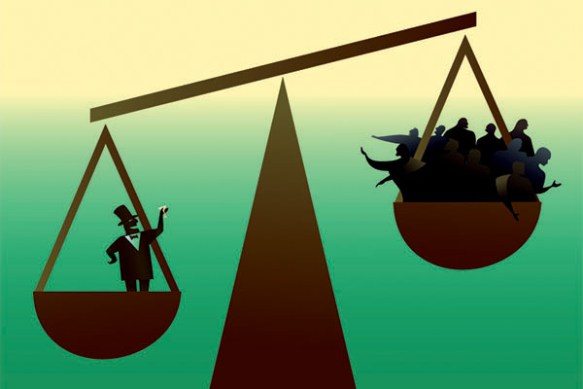
None of that changed one thing, though: most people still feel left behind both in the U.S. and globally. Thanks to the massive accumulation of wealth by a 1% skilled at gaming the system, the roots of a crisis that didn’t end with the end of the Great Recession have spread across the planet, while the dividing line between the “have-nots” and the “have-a-lots” only sharpened and widened.

Though the media hasn’t been paying much attention to the resulting inequality, the statistics (when you see them) on that ever-widening wealth gap are mind-boggling. According to Inequality.org, for instance, those with at least $30 million in wealth globally had the fastest growth rate of any group between 2016 and 2017. The size of that club rose by 25.5% during those years, to 174,800 members. Or if you really want to grasp what’s been happening, consider that, between 2009 and 2017, the number of billionaires whose combined wealth was greater than that of the world’s poorest 50% fell from 380 to just eight. And by the way, despite claims by the president that every other country is screwing America, the U.S. leads the pack when it comes to the growth of inequality. As Inequality.org notes, it has “much greater shares of national wealth and income going to the richest 1% than any other country.”

That, in part, is due to an institution many in the U.S. normally pay little attention to: the U.S. central bank, the Federal Reserve. It helped spark that increase in wealth disparity domestically and globally by adopting a post-crisis monetary policy in which electronically fabricated money (via a program called quantitative easing, or QE) was offered to banks and corporations at significantly cheaper rates than to ordinary Americans.

Pumped into financial markets, that money sent stock prices soaring, which naturally ballooned the wealth of the small percentage of the population that actually owned stocks. According to economist Stephen Roach, considering the Fed’s Survey of Consumer Finances, “It is hardly a stretch to conclude that QE exacerbated America’s already severe income disparities.”

Wall Street, Central Banks, and Everyday People

What has since taken place around the world seems right out of the 1930s. At that time, as the world was emerging from the Great Depression, a sense of broad economic security was slow to return. Instead, fascism and other forms of nationalism only gained steam as people turned on the usual cast of politicians, on other countries, and on each other. (If that sounds faintly Trumpian to you, it should.)

In our post-2008 era, people have witnessed trillions of dollars flowing into bank bailouts and other financial subsidies, not just from governments but from the world’s major central banks. Theoretically, private banks, as a result, would have more money and pay less interest to get it. They would then lend that money to Main Street. Businesses, big and small, would tap into those funds and, in turn, produce real economic growth through expansion, hiring sprees, and wage increases. People would then have more dollars in their pockets and, feeling more financially secure, would spend that money driving the economy to new heights — and all, of course, would then be well.

That fairy tale was pitched around the globe. In fact, cheap money also pushed debt to epic levels, while the share prices of banks rose, as did those of all sorts of other firms, to record-shattering heights.

Even in the U.S., however, where a magnificent recovery was supposed to have been in place for years, actual economic growth simply didn’t materialize at the levels promised. At 2% per year, the average growth of the American gross domestic product over the past decade, for instance, has been half the average of 4% before the 2008 crisis. Similar numbers were repeated throughout the developed world and most emerging markets. In the meantime, total global debt hit $247 trillion in the first quarter of 2018. As the Institute of International Finance found, countries were, on average, borrowing about three dollars for every dollar of goods or services created.

Global Consequences

What the Fed (along with central banks from Europe to Japan) ignited, in fact, was a disproportionate rise in the stock and bond markets with the money they created. That capital sought higher and faster returns than could be achieved in crucial infrastructure or social strengthening projects like building roads, high-speed railways, hospitals, or schools.

What followed was anything but fair. As former Federal Reserve Chair Janet Yellen noted four years ago, “It is no secret that the past few decades of widening inequality can be summed up as significant income and wealth gains for those at the very top and stagnant living standards for the majority.” And, of course, continuing to pour money into the highest levels of the private banking system was anything but a formula for walking that back.

Instead, as more citizens fell behind, a sense of disenfranchisement and bitterness with existing governments only grew. In the U.S., that meant Donald Trump. In the United Kingdom, similar discontent was reflected in the June 2016 Brexit vote to leave the European Union (EU), which those who felt economically squeezed to death clearly meant as a slap at both the establishment domestically and EU leaders abroad.

Since then, multiple governments in the European Union, too, have shifted toward the populist right. In Germany, recent elections swung both right and left just six years after, in July 2012, European Central Bank (ECB) head Mario Draghi exuded optimism over the ability of such banks to protect the financial system, the Euro, and generally hold things together.

Like the Fed in the U.S., the ECB went on to manufacture money, adding another $3 trillion to its books that would be deployed to buy bonds from favored countries and companies. That artificial stimulus, too, only increased inequality within and between countries in Europe. Meanwhile, Brexit negotiations remain ruinously divisive, threatening to rip Great Britain apart.

Nor was such a story the captive of the North Atlantic. In Brazil, where left-wing president Dilma Rouseff was ousted from power in 2016, her successor Michel Temer oversaw plummeting economic growth and escalating unemployment. That, in turn, led to the election of that country’s own Donald Trump, nationalistic far-right candidate Jair Bolsonaro who won a striking 55.2% of the vote against a backdrop of popular discontent. In true Trumpian style, he is disposed against both the very idea of climate change and multilateral trade agreements.

In Mexico, dissatisfied voters similarly rejected the political known, but by swinging left for the first time in 70 years. New president Andrés Manuel López Obrador, popularly known by his initials AMLO, promised to put the needs of ordinary Mexicans first. However, he has the U.S. — and the whims of Donald Trump and his “great wall” — to contend with, which could hamper those efforts.

As AMLO took office on December 1st, the G20 summit of world leaders was unfolding in Argentina. There, amid a glittering backdrop of power and influence, the trade war between the U.S. and the world’s rising superpower, China, came even more clearly into focus. While its president, Xi Jinping, having fully consolidated power amid a wave of Chinese nationalism, could become his country’s longest serving leader, he faces an international landscape that would have amazed and befuddled Mao Zedong.

Though Trump declared his meeting with Xi a success because the two sides agreed on a 90-day tariff truce, his prompt appointment of an anti-Chinese hardliner, Robert Lighthizer, to head negotiations, a tweet in which he referred to himself in superhero fashion as a “Tariff Man,” and news that the U.S. had requested that Canada arrest and extradite an executive of a key Chinese tech company, caused the Dow to take its fourth largest plunge in history and then fluctuate wildly as economic fears of a future “Great Something” rose. More uncertainty and distrust were the true product of that meeting.

In fact, we are now in a world whose key leaders, especially the president of the United States, remain willfully oblivious to its long-term problems, putting policies like deregulation, fake nationalist solutions, and profits for the already grotesquely wealthy ahead of the future lives of the mass of citizens. Consider the yellow-vest protests that have broken out in France, where protestors identifying with left and right political parties are calling for the resignation of neoliberal French President Emmanuel Macron. Many of them, from financially starved provincial towns, are angry that their purchasing power has dropped so low they can barely make ends meet.

Ultimately, what transcends geography and geopolitics is an underlying level of economic discontent sparked by twenty-first-century economics and a resulting Grand Canyon-sized global inequality gap that is still widening. Whether the protests go left or right, what continues to lie at the heart of the matter is the way failed policies and stop-gap measures put in place around the world are no longer working, not when it comes to the non-1% anyway. People from Washington to Paris, London to Beijing, increasingly grasp that their economic circumstances are not getting better and are not likely to in any presently imaginable future, given those now in power.

A Dangerous Recipe

The financial crisis of 2008 initially fostered a policy of bailing out banks with cheap money that went not into Main Street economies but into markets enriching the few. As a result, large numbers of people increasingly felt that they were being left behind and so turned against their leaders and sometimes each other as well.

This situation was then exploited by a set of self-appointed politicians of the people, including a billionaire TV personality who capitalized on an increasingly widespread fear of a future at risk. Their promises of economic prosperity were wrapped in populist platitudes, normally (but not always) of a right-wing sort. Lost in this shift away from previously dominant political parties and the systems that went with them was a true form of populism, which would genuinely put the needs of the majority of people over the elite few, build real things including infrastructure, foster organic wealth distribution, and stabilize economies above financial markets.

In the meantime, what we have is, of course, a recipe for an increasingly unstable and vicious world.

How the West eats its children

By Thierry Meyssan

Source: VoltaireNet.org

The cause of Western recession

International relations experienced a profound change with the paralysis of the Soviet Union in 1986, when the State was unable to control the civilian nuclear incident in Tchernobyl [1], then with the revocation of the Warsaw Pact in 1989, when the East German Communist Party [2] destroyed the Berlin Wall, and finally, with the dissolution of the USSR in 1991.

At that time, the President of the United States, George Bush Sr., decided to demobilise one million soldiers and devote the efforts of his country to its own prosperity. He wanted to transform US hegemony within its zone of influence, and expand it into that of the leader of the world, the guarantor of world stability. With that, he laid the foundations for a « New World Order », first of all in the speech he gave side by side with British Prime Minister Margaret Thatcher, at the Aspen Institute (2 August 1990), then during his speech to Congress (11 September 1990), announcing operation « Desert Storm » [3].

The world of the après-Soviet Union is one of free circulation, not only of merchandise, but also world capital, under the unique control of the United States. In other words, the passage from capitalism to financialisation – not the triumphant culmination of free exchange, but an exacerbated form of colonial exploitation of the whole world, including the West. Within the space of a quarter of a century, the major US fortunes have multiplied many times, and the global wealth of the world has increased considerably.

By allowing capitalism to run wild, President Bush Sr. hoped to extend prosperity to the world. But capitalism is not a political project, it is simply a system of logic designed for creating profit. The logic of the US multinationals was to increase their profits by delocalising production to China, where it is now possible, and where workers are the lowest paid in the world.

Those who were prepared to measure the cost of this advance for the West were few and far between. New middle classes began to appear in the third world, and although they were, of course, far less wealthy than those in the West, they enabled new, mainly Asian states, to play a rôle on the world stage. But simultaneously, Western middle classes began to disappear [4], meaning that it became impossible for the democratic institutions they built to survive. Above all, the populations of entire regions were to be entirely crushed, starting with those of the African Great Lakes. This first regional war caused 6 million deaths, in Angola, Burundi, Namibia, Uganda, the Democratic Republic of Congo, Rwanda and Zimbabwe, and was met with general incomprehension and indifference. The aim was to continue to seize the natural resources of these countries, but to pay less and less for them, which meant dealing with gangs rather than with the States who had to feed their populations.

The sociological transformation of the world is happening very fast and is clearly without precedent, although we do not have the statistical tools available today to evaluate it with precision. However, everyone can witness the increase in power of Eurasia, (not in the Gaullist sense of « Brest to Vladivostok », but that of Russia and Asia without Western and Central Europe), which seeks liberty and prosperity, while the Western powers, including the United States, are slowly and progressively declining, limiting individual freedom and ejecting half of their population into zones of poverty.

Today, the percentage of imprisonment in China is four times inferior to that of the United States,while their purchasing power is slightly higher. Objectively therefore, with all its faults, Chine has become a freer and more prosperous country than the United States.

This process was predictable from the beginning. Its application was studied for a long time. So, on 1 September 1987, a US forty-year-old published a page of counter-current publicity in the New York Times, the Washington Post and the Boston Globe. He warned his compatriots about the rôle that President Bush Sr. was planning to allocate to the United States – to assume and finance out of their own pockets the responsibility for the developing « New World Order ». People read it and laughed. The author of these texts was real estate promoter, Donald Trump.

The application of the economic model to international relations

One month after the attacks of 11 September 2001, US Secretary of Defense Donald Rumsfeld nominated his friend Admiral Arthur Cebrowski as Director of the new Office of Force Transformation. He was tasked with changing the culture of the entire US military in order to enable it to respond to a complete change in its mission

There was no longer question of using US armies to defend principles or interests, but to use them for a reorganisation of the world by dividing it into two parts – one one side the states integrated into the globalised economy, and on the other, the others [5]. The Pentagon would no longer fight wars in order to steal natural resources, but to control access to those resources by the globalised nations. A division directly inspired by the process of globalisation which had already trashed half of the Western populations. This time, it was half of the world’s population which was to be excluded [6].

The reorganisation of the world began in the political zone known as the « Greater Middle East », that is to say stretching from Afghanistan to Morocco, with the exception of Israël, Lebanon and Jordan. This brought about the alleged epidemic of civil wars in Afghanistan, Iraq, Sudan, Libya, Syria and Yemen, which has already caused several million deaths.

Like a monster eating its own children, the global financial system based in the United States faced its first crisis in 2008, when the subprime bubble burst. Contrary to a commonly-held belief, this was absolutely not a global crisis, but a Western problem. For the first time, the NATO states experienced the first consequences of the policy they were supporting. Yet the upper Western classes changed nothing in their behaviour, as they witnessed with compassion the wreck of the middle classes. The only notable modification was the adoption of the « Volcker rule » [7], which forbade banks from profiting from information obtained from their clients in order to speculate against their interests. But while conflicts of interest enabled a number of crooks to get rich fast, they are not the root of the problem, which is far more wide-reaching.

The revolt of the Western populations

The revolt of the Western middle and working classes against the globalised upper class began two years ago.

Aware of the Western recession as compared with Asia, the people of the United Kingdom were the first to attempt to save its life-style by leaving the European Union and turning to China and the Commonwealth (referendum of 23 June 2016) [8]. Unfortunately, the leaders of the United Kingdom were unable to conclude the agreement they hoped for with China and experienced great difficulty in reactivating their links with the Commonwealth.

Then, witnessing the collapse of their civil industries, a part of the United States voted, on 8 November 2016, for the only Presidential candidate who was opposed to the New World Order, Donald Trump. He spoke of a return to the « American dream ». Unfortunately for his voters, although Donald Trump began to question the rules of globalised commerce, he had no team with him apart from his family, and was only able to modify, but not change, the military strategy of his country. Almost all of the general officers had adopted the Rumsfeld-Cebrowski ideology, and could no longer imagine themselves in any other role than defenders of financial globalisation.

Aware of the collapse of their national industry, and certain that they would be betrayed by their upper class, the Italians voted, on 4 March 2018, for an anti-system party composed of the Ligue and the 5-star Movement. These parties built an alliance in order to implement social policies. Unfortunately, they were rejected by the European Union [9]. In France, tens of thousands of SME’s (small and medium-sized enterprises), subcontractors of industry, had gone bankrupt over the last ten years, but their compulsory tax deductions, already among the highest in the world, increased by 30 % over the same period.

Several hundreds of thousands of French people suddenly took to the streets to demonstrate against abusive financial measures. Unfortunately for them, the French upper classes have been contaminated by the very idea that was rejected by the United States, and therefore did their best to adapt their policies to the popular revolt, but not to change its basic causes.

If we look at each of these four countries separately, we will find four different explanations for what is happening there. But if we analyse the situation as a single phenomenon affecting different cultures, we will discover the same mechanisms across the board. In these four countries, consecutive with the end of capitalism, the middle classes disappeared more or less rapidly, and with them the political system that they incarnated – Democracy.

So either the Western leaders abandon the financial system they have developed and return to the productive capitalism of the Cold War, or they will have to invent a different organisation that no-one has so far been able imagine. Failing that, the West, which has directed the world for five centuries, will sink into a long period of internal chaos.

The Syrians were the first non-globalised People capable of surviving and resisting the destruction of Rumsfeld-Cebrowski’s infra-world. The French were the first globalised people to rise up against the destruction of the West, even if they are not aware that they are fighting the same unique enemy of all of humanity. President Emmanuel Macron is not the man for the situation, not because he has any responsibility for the system that preceded him, but because he is pure product of that system. In response to the riots in his country, he spoke from the G20 in Buenos-Aires, declaring that the meeting was a success in his eyes, (which it was not), and that he intended to advance more efficiently than his predecessors – in the wrong direction.

How to save privilege

It appears that the British ruling class has its solution – if London in particular and the Western nations in general are no longer capable of ruling the world, it will be necessary to cut one’s losses and divide the world into two distinct zones. This is the policy implemented by Obama in the final months of his presidency [10], then by Theresa May, and now by Donald Trump, with their refusal to cooperate and their ready-made accusations, first of all against Russia and now against China.

It also seems that Russia and China, despite their historical rivalry, are aware that they will never be able to ally themselves with these Westerners who have never ceased trying to carve them up. This is the source of their project, the « Eurasian Economic Union » – if the world must be split in two, each participant will have to organise its own. In concrete terms, for Beijing, this means abandoning half of its « Silk Road » project and its redeployment with Moscow only in Greater Eurasia.

How to determine the line of demarcation

For the West and Greater Eurasia, it will be necessary to determine the split line as fast as possible. For example, what side will Ukraine choose? The construction by Russia of the Kertch bridge was aimed at separating the country, absorbing the Donbass and the Azov Sea basin, then Odessa and Transnistria. On the contrary, the incident at Kertch, organised by the Western powers, is aimed at enrolling all of Ukraine into NATO before the country fractures.

Since the ship of financial globalisation is sinking, many people are beginning to save their personal interests without any care for others. For example this is the source of the tension between the European Union and the United States. As far as this game is concerned, the Zionist movement has always had a length’s lead, which explains the mutation of Israëli strategy, which has abandoned Syria to Russia, and turned to both the Gulf States and East Africa.

Perspectives

Taking into account what is at play here, it is obvious that the insurrection in France is only the beginning of a much wider process which is going to spread to other Western countries.

It would be absurd to believe that at a time of financial globalisation, a government, whatever it might be, could resolve the problems of its country without first of all questioning international relations and at the same time regaining its capacity for action. But precisely, foreign policy has been kept on the sidelines of the democratic field since the dissolution of the Soviet Union. It is both necessary and urgent to resign from almost all of the treaties and engagements of the last thirty years. Only the states which are able to re-affirm their sovereignty can hope to recover.

Translation
Pete Kimberley

[1] According to Michaïl Gorbatchev, this was the event that made possible the dissolution of the Warsaw Pact and the Soviet Union in so far as it delegitimised the State.

[2] Contrary to a commonly-held belief in the West, it was the nationalists from the East-German Communist Party (and the Lutheran churches), and not the anti-Communists (and pro-US movements), who broke down the symbol of Soviet domination, the Wall.

[3] The main purpose of the invasion of Iraq was not to liberate Kuwaït, but to use this affair to build the strongest coalition possible under US command, including the USSR.

[4] Global Inequality. A New Approach for the Age of Globalization, Branko Milanovic, Harvard University Press, 2016.

[5] “The US military project for the world”, by Thierry Meyssan, Translation Pete Kimberley, Voltaire Network, 22 August 2017.

[6] It is obvious that the wars of Bush Jr. and Obama were never intended to expand the Empire. First of all because by definition, democracy can only come from the People, not imposed by bombs. And then because the United States was already a plutocracy.

[7] The ex-president of the US Federal Reserve, Paul Volcker, is on the other hand, one of the architects of global financialisation. It is Volcker who took legal action on behalf of the UNO against the people and entities who had helped Iraq to bypass the UN embargo (the « oil for food » affair). Volcker is one of the principal personalities of the Pilgrim’s Society, the trans-Atlantic club presided by Queen Elizabeth II. As such, he became the main economic advisor to President Barack Obama, and organised part of his cabinet.

[8] “The new British Foreign Policy”, by Thierry Meyssan, Translation Pete Kimberley, Voltaire Network, 4 July 2016.

[9] Replacing the European Common Market, which was originally a system for cooperation between states, the European Union, as defined by the Treaty of Maastricht, is a supranational

[10] “Two separate worlds”, by Thierry Meyssan, Translation Pete Kimberley, Al-Watan (Syria) , Voltaire Network, 8 November 2016.

The Bayer-Monsanto Merger Is Bad News for the Planet

By Ellen Brown

Source: Truthdig

Two new studies from Europe show that the number of birds in agricultural areas of France has crashed by a third in just 15 years, with some species being almost eradicated. The collapse in the bird population mirrors the discovery last October that more than three quarters of all flying insects in Germany have vanished in just three decades. Insects are the staple food source of birds, the pollinators of fruits and the aerators of the soil.

The chief suspect in this mass extinction is the aggressive use of neonicotinoid pesticides, particularly imidacloprid and clothianidin, both made by the Germany-based chemical giant Bayer. These pesticides, along with toxic glyphosate herbicides such as Roundup, have delivered a one-two punch to monarch butterflies, honeybees and birds. But rather than banning these toxic chemicals, on March 21 the EU approved the $66 billion merger of Bayer and Monsanto, the U.S. agribusiness giant that produces Roundup and the genetically modified (GMO) seeds that have reduced seed diversity globally. The merger will make the Bayer-Monsanto conglomerate the largest seed and pesticide company in the world, giving it enormous power to control farm practices, putting private profits over the public interest.

As Massachusetts Sen. Elizabeth Warren noted in a speech in December at the Open Markets Institute, massive companies are merging into market-dominating entities that invest a share of their profits in lobbying and financing political campaigns, shaping the political system to their own ends. She called on the Trump administration to veto the Bayer-Monsanto merger, which is still under antitrust scrutiny and has yet to be approved in the U.S.

A 2016 survey of Trump’s voter base found that more than half disapproved of the Monsanto-Bayer merger, fearing it would result in higher food prices and higher costs for farmers. Before 1990, there were 600 or more small, independent seed businesses globally, many of them family-owned. By 2009, only about 100 survived, and seed prices had more than doubled. But reining in these powerful conglomerates is more than just a question of economics. It may be a question of the survival of life on this planet.

While Bayer’s neonicotinoid pesticides wipe out insects and birds, Monsanto’s glyphosate has been linked to more than 40 human diseases, including cancer. Its seeds have been genetically modified to survive this toxic herbicide, but the plants absorb it into their tissues. In the humans who eat the plants, glyphosate disrupts the endocrine system and the balance of gut bacteria, damages DNA and is a driver of cancerous mutations. Researchers summarizing a 2014 study of glyphosates in the Journal of Organic Systems linked them to the huge increase in chronic diseases in the United States, with the percentage of GMO corn and soy planted in the U.S. showing highly significant correlations with hypertension, stroke, diabetes, obesity, lipoprotein metabolism disorder, Alzheimer’s, Parkinson’s, multiple sclerosis, hepatitis C, end stage renal disease, acute kidney failure, cancers of the thyroid, liver, bladder, pancreas, kidney and myeloid leukaemia. But regulators have turned a blind eye, captured by corporate lobbyists and a political agenda that has more to do with power and control them protecting the health of the people.

The Trump administration has already approved a merger between former rivals Dow and DuPont, and has signed off on the takeover of Swiss pesticide giant Syngenta by ChemChina. If Monsanto-Bayer gets approved as well, just three corporations will dominate the majority of the world’s seed and pesticide markets, giving them enormous power to continue poisoning the planet at the expense of its inhabitants.

The Shady History of Bayer and the Petrochemical Cartel

To understand the magnitude of this threat, it is necessary to delve into some history. This is not the first time Monsanto and Bayer have joined forces. In both world wars, they made explosives and poisonous gases using shared technologies that they sold to both sides. After World War II, they united as MOBAY (MonsantoBayer) and supplied the ingredients for Agent Orange in the Vietnam War.

In fact, corporate mergers and cartels have played a central role in Bayer’s history. In 1904, it joined with German giants BASF and AGFA to form the first chemical cartel. After World War I, Germany’s entire chemical industry merged to become I.G. Farben. By the beginning of World War II, I.G. Farben was the largest industrial corporation in Europe, the largest chemical company in the world, and part of the most gigantic and powerful cartel in all history.

A cartel is a grouping of companies bound by agreements designed to restrict competition and keep prices high. The dark history of the I.G. Farben cartel was detailed in a 1974 book titled “World Without Cancer,” by G. Edward Griffin, who also wrote the best-selling “Creature from Jekyll Island,” on the shady history of the Federal Reserve. Griffin quoted from a book titled “Treason’s Peace,” by Howard Ambruster, an American chemical engineer who had studied the close relations between the German chemical trust and certain American corporations. Ambruster warned:

Farben is no mere industrial enterprise conducted by Germans for the extraction of profits at home and abroad. Rather, it is and must be recognized as a cabalistic organization which, through foreign subsidiaries and secret tie-ups, operates a far-flung and highly efficient espionage machine—the ultimate purpose being world conquest … and a world superstate directed by Farben.

The I.G. Farben cartel arose out of the international oil industry. Coal tar or crude oil is the source material for most commercial chemical products, including those used in drugs and explosives. I.G. Farben established cartel agreements with hundreds of American companies. They had little choice but to capitulate after the Rockefeller empire, represented by Standard Oil of New Jersey, did so, because they could not hope to compete with the Rockefeller-I.G. combination.

The Rockefeller group’s greatest influence was exerted through international finance and investment banking, putting them in control of a wide spectrum of industry. Their influence was particularly heavy in pharmaceuticals. The directors of the American I.G. Chemical Company included Paul Warburg, brother of a director of the parent company in Germany and a chief architect of the Federal Reserve system.

The I.G. Farben cartel was technically disbanded at the Nuremberg trials following World War II, but in fact it merely split into three new companies—Bayer, Hoescht and BASF—which remain pharmaceutical giants today. To conceal its checkered history, Bayer orchestrated a merger with Monsanto in 1954, giving rise to the MOBAY Corp. In 1964, the U.S. Justice Department filed an antitrust lawsuit against MOBAY and insisted that it be broken up, but the companies continued to work together unofficially.

In “Seeds of Destruction: The Hidden Agenda of Genetic Manipulation” (2007), William Engdahl states that global food control and depopulation became U.S. strategic policy under Rockefeller protégé Henry Kissinger, who was secretary of state in the 1970s. Along with oil geopolitics, these policies were to be the new “solution” to the threats to U.S. global power and continued U.S. access to cheap raw materials from the developing world. “Control oil and you control nations,” Kissinger notoriously declared. “Control food and you control the people.”

Global food control has nearly been achieved, by reducing seed diversity and establishing proprietary control with GMO seeds distributed by only a few transnational corporations, led by Monsanto; and by a massive, taxpayer-subsidized propaganda campaign in support of GMO seeds and neurotoxic pesticides. A de facto cartel of giant chemical, drug, oil, banking and insurance companies connected by interlocking directorates reaps the profits at both ends, by waging a very lucrative pharmaceutical assault on the diseases created by their toxic agricultural chemicals.

Going Organic: The Russian Approach

In the end, the Green Revolution engineered by Kissinger to control markets and ensure U.S. economic dominance may be our nemesis. While the U.S. struggles to maintain its hegemony by economic coercion and military force, Russia is winning the battle for the health of the people and the environment. Russian President Vladimir Putin has banned GMOs and has set out to make Russia the world’s leading supplier of organic food.

Russian families are showing what can be done with permaculture methods on simple garden plots. In 2011, 40 percent of Russia’s food was grown on dachas (cottage gardens or allotments), predominantly organically. Dacha gardens produced more than 80 percent of the country’s fruit and berries, more than 66 percent of the vegetables, almost 80 percent of the potatoes and nearly 50 percent of the nation’s milk, much of it consumed raw. Russian author Vladimir Megre comments:

Essentially, what Russian gardeners do is demonstrate that gardeners can feed the world—and you do not need any GMOs, industrial farms, or any other technological gimmicks to guarantee everybody’s got enough food to eat. Bear in mind that Russia only has 110 days of growing season per year—so in the US, for example, gardeners’ output could be substantially greater. Today, however, the area taken up by lawns in the US is two times greater than that of Russia’s gardens—and it produces nothing but a multi-billion-dollar lawn care industry.

In the U.S., only about 0.6 percent of the total agricultural area is devoted to organic farming. Most farmland is soaked in pesticides and herbicides. But the need for these toxic chemicals is a myth. In an October 2017 article in The Guardian, columnist George Monbiot cited studies showing that reducing the use of neonicotinoid pesticides actually increases production, because the pesticides harm or kill the pollinators on which crops depend. Rather than an international trade agreement that would enable giant transnational corporations to dictate to governments, he argues that we need a global treaty to regulate pesticides and require environmental impact assessments for farming. He writes:

Farmers and governments have been comprehensively conned by the global pesticide industry. It has ensured its products should not be properly regulated or even, in real-world conditions, properly assessed. … The profits of these companies depend on ecocide. Do we allow them to hold the world to ransom, or do we acknowledge that the survival of the living world is more important than returns to their shareholders?

President Trump has boasted of winning awards for environmental protection. If he is sincere about championing the environment, he needs to block the merger of Bayer and Monsanto, two agribusiness giants bent on destroying the ecosystem for private profit.


Ellen Brown is an attorney, chairman of the Public Banking Institute, and author of twelve books including “Web of Debt” and “The Public Bank Solution.”

The Age of Disintegration

images

Neoliberalism, Interventionism, the Resource Curse, and a Fragmenting World

By Patrick Cockburn

Source: TomDispatch.com

We live in an age of disintegration. Nowhere is this more evident than in the Greater Middle East and Africa. Across the vast swath of territory between Pakistan and Nigeria, there are at least seven ongoing wars — in Afghanistan, Iraq, Syria, Yemen, Libya, Somalia, and South Sudan. These conflicts are extraordinarily destructive. They are tearing apart the countries in which they are taking place in ways that make it doubtful they will ever recover. Cities like Aleppo in Syria, Ramadi in Iraq, Taiz in Yemen, and Benghazi in Libya have been partly or entirely reduced to ruins. There are also at least three other serious insurgencies: in southeast Turkey, where Kurdish guerrillas are fighting the Turkish army, in Egypt’s Sinai Peninsula where a little-reported but ferocious guerrilla conflict is underway, and in northeast Nigeria and neighboring countries where Boko Haram continues to launch murderous attacks.

All of these have a number of things in common: they are endless and seem never to produce definitive winners or losers. (Afghanistan has effectively been at war since 1979, Somalia since 1991.) They involve the destruction or dismemberment of unified nations, their de facto partition amid mass population movements and upheavals — well publicized in the case of Syria and Iraq, less so in places like South Sudan where more than 2.4 million people have been displaced in recent years.

Add in one more similarity, no less crucial for being obvious: in most of these countries, where Islam is the dominant religion, extreme Salafi-Jihadi movements, including the Islamic State (IS), al-Qaeda, and the Taliban are essentially the only available vehicles for protest and rebellion. By now, they have completely replaced the socialist and nationalist movements that predominated in the twentieth century; these years have, that is, seen a remarkable reversion to religious, ethnic, and tribal identity, to movements that seek to establish their own exclusive territory by the persecution and expulsion of minorities.

In the process and under the pressure of outside military intervention, a vast region of the planet seems to be cracking open. Yet there is very little understanding of these processes in Washington. This was recently well illustrated by the protest of 51 State Department diplomats against President Obama’s Syrian policy and their suggestion that air strikes be launched targeting Syrian regime forces in the belief that President Bashar al-Assad would then abide by a ceasefire. The diplomats’ approach remains typically simpleminded in this most complex of conflicts, assuming as it does that the Syrian government’s barrel-bombing of civilians and other grim acts are the “root cause of the instability that continues to grip Syria and the broader region.”

It is as if the minds of these diplomats were still in the Cold War era, as if they were still fighting the Soviet Union and its allies. Against all the evidence of the last five years, there is an assumption that a barely extant moderate Syrian opposition would benefit from the fall of Assad, and a lack of understanding that the armed opposition in Syria is entirely dominated by the Islamic State and al-Qaeda clones.

Though the invasion of Iraq in 2003 is now widely admitted to have been a mistake (even by those who supported it at the time), no real lessons have been learned about why direct or indirect military interventions by the U.S. and its allies in the Middle East over the last quarter century have all only exacerbated violence and accelerated state failure.

A Mass Extinction of Independent States

The Islamic State, just celebrating its second anniversary, is the grotesque outcome of this era of chaos and conflict. That such a monstrous cult exists at all is a symptom of the deep dislocation societies throughout that region, ruled by corrupt and discredited elites, have suffered. Its rise — and that of various Taliban and al-Qaeda-style clones — is a measure of the weakness of its opponents.

The Iraqi army and security forces, for example, had 350,000 soldiers and 660,000 police on the books in June 2014 when a few thousand Islamic State fighters captured Mosul, the country’s second largest city, which they still hold. Today the Iraqi army, security services, and about 20,000 Shia paramilitaries backed by the massive firepower of the United States and allied air forces have fought their way into the city of Fallujah, 40 miles west of Baghdad, against the resistance of IS fighters who may have numbered as few as 900. In Afghanistan, the resurgence of the Taliban, supposedly decisively defeated in 2001, came about less because of the popularity of that movement than the contempt with which Afghans came to regard their corrupt government in Kabul.

Everywhere nation states are enfeebled or collapsing, as authoritarian leaders battle for survival in the face of mounting external and internal pressures. This is hardly the way the region was expected to develop. Countries that had escaped from colonial rule in the second half of the twentieth century were supposed to become more, not less, unified as time passed.

Between 1950 and 1975, nationalist leaders came to power in much of the previously colonized world. They promised to achieve national self-determination by creating powerful independent states through the concentration of whatever political, military, and economic resources were at hand. Instead, over the decades, many of these regimes transmuted into police states controlled by small numbers of staggeringly wealthy families and a coterie of businessmen dependent on their connections to such leaders as Hosni Mubarak in Egypt or Bashar al-Assad in Syria.

In recent years, such countries were also opened up to the economic whirlwind of neoliberalism, which destroyed any crude social contract that existed between rulers and ruled. Take Syria. There, rural towns and villages that had once supported the Baathist regime of the al-Assad family because it provided jobs and kept the prices of necessities low were, after 2000, abandoned to market forces skewed in favor of those in power. These places would become the backbone of the post-2011 uprising. At the same time, institutions like the Organization of Petroleum Exporting Countries (OPEC) that had done so much to enhance the wealth and power of regional oil producers in the 1970s have lost their capacity for united action.

The question for our moment: Why is a “mass extinction” of independent states taking place in the Middle East, North Africa, and beyond? Western politicians and media often refer to such countries as “failed states.” The implication embedded in that term is that the process is a self-destructive one. But several of the states now labeled “failed” like Libya only became so after Western-backed opposition movements seized power with the support and military intervention of Washington and NATO, and proved too weak to impose their own central governments and so a monopoly of violence within the national territory.

In many ways, this process began with the intervention of a U.S.-led coalition in Iraq in 2003 leading to the overthrow of Saddam Hussein, the shutting down of his Baathist Party, and the disbanding of his military. Whatever their faults, Saddam and Libya’s autocratic ruler Muammar Gaddafi were clearly demonized and blamed for all ethnic, sectarian, and regional differences in the countries they ruled, forces that were, in fact, set loose in grim ways upon their deaths.

A question remains, however: Why did the opposition to autocracy and to Western intervention take on an Islamic form and why were the Islamic movements that came to dominate the armed resistance in Iraq and Syria in particular so violent, regressive, and sectarian? Put another way, how could such groups find so many people willing to die for their causes, while their opponents found so few? When IS battle groups were sweeping through northern Iraq in the summer of 2014, soldiers who had thrown aside their uniforms and weapons and deserted that country’s northern cities would justify their flight by saying derisively: “Die for [then-Prime Minister Nouri] al-Maliki? Never!”

A common explanation for the rise of Islamic resistance movements is that the socialist, secularist, and nationalist opposition had been crushed by the old regimes’ security forces, while the Islamists were not. In countries like Libya and Syria, however, Islamists were savagely persecuted, too, and they still came to dominate the opposition. And yet, while these religious movements were strong enough to oppose governments, they generally have not proven strong enough to replace them.

Too Weak to Win, But Too Strong to Lose

Though there are clearly many reasons for the present disintegration of states and they differ somewhat from place to place, one thing is beyond question: the phenomenon itself is becoming the norm across vast reaches of the planet.

If you’re looking for the causes of state failure in our time, the place to start is undoubtedly with the end of the Cold War a quarter-century ago. Once it was over, neither the U.S. nor the new Russia that emerged from the Soviet Union’s implosion had a significant interest in continuing to prop up “failed states,” as each had for so long, fearing that the rival superpower and its local proxies would otherwise take over. Previously, national leaders in places like the Greater Middle East had been able to maintain a degree of independence for their countries by balancing between Moscow and Washington. With the break-up of the Soviet Union, this was no longer feasible.

In addition, the triumph of neoliberal free-market economics in the wake of the Soviet Union’s collapse added a critical element to the mix. It would prove far more destabilizing than it looked at the time.

Again, consider Syria. The expansion of the free market in a country where there was neither democratic accountability nor the rule of law meant one thing above all: plutocrats linked to the nation’s ruling family took anything that seemed potentially profitable. In the process, they grew staggeringly wealthy, while the denizens of Syria’s impoverished villages, country towns, and city slums, who had once looked to the state for jobs and cheap food, suffered. It should have surprised no one that those places became the strongholds of the Syrian uprising after 2011. In the capital, Damascus, as the reign of neoliberalism spread, even the lesser members of the mukhabarat, or secret police, found themselves living on only $200 to $300 a month, while the state became a machine for thievery.

This sort of thievery and the auctioning off of the nation’s patrimony spread across the region in these years. The new Egyptian ruler, General Abdel Fattah al-Sisi, merciless toward any sign of domestic dissent, was typical. In a country that once had been a standard bearer for nationalist regimes the world over, he didn’t hesitate this April to try to hand over two islands in the Red Sea to Saudi Arabia on whose funding and aid his regime is dependent. (To the surprise of everyone, an Egyptian court recently overruled Sisi’s decision.)

That gesture, deeply unpopular among increasingly impoverished Egyptians, was symbolic of a larger change in the balance of power in the Middle East: once the most powerful states in the region — Egypt, Syria, and Iraq — had been secular nationalists and a genuine counterbalance to Saudi Arabia and the Persian Gulf monarchies. As those secular autocracies weakened, however, the power and influence of the Sunni fundamentalist monarchies only increased. If 2011 saw rebellion and revolution spread across the Greater Middle East as the Arab Spring briefly blossomed, it also saw counterrevolution spread, funded by those oil-rich absolute Gulf monarchies, which were never going to tolerate democratic secular regime change in Syria or Libya.

Add in one more process at work making such states ever more fragile: the production and sale of natural resources — oil, gas, and minerals — and the kleptomania that goes with it. Such countries often suffer from what has become known as “the resources curse”: states increasingly dependent for revenues on the sale of their natural resources — enough to theoretically provide the whole population with a reasonably decent standard of living — turn instead into grotesquely corrupt dictatorships. In them, the yachts of local billionaires with crucial connections to the regime of the moment bob in harbors surrounded by slums running with raw sewage. In such nations, politics tends to focus on elites battling and maneuvering to steal state revenues and transfer them as rapidly as possible out of the country.

This has been the pattern of economic and political life in much of sub-Saharan Africa from Angola to Nigeria. In the Middle East and North Africa, however, a somewhat different system exists, one usually misunderstood by the outside world. There is similarly great inequality in Iraq or Saudi Arabia with similarly kleptocratic elites. They have, however, ruled over patronage states in which a significant part of the population is offered jobs in the public sector in return for political passivity or support for the kleptocrats.

In Iraq with a population of 33 million people, for instance, no less than seven million of them are on the government payroll, thanks to salaries or pensions that cost the government $4 billion a month. This crude way of distributing oil revenues to the people has often been denounced by Western commentators and economists as corruption. They, in turn, generally recommend cutting the number of these jobs, but this would mean that all, rather than just part, of the state’s resource revenues would be stolen by the elite. This, in fact, is increasingly the case in such lands as oil prices bottom out and even the Saudi royals begin to cut back on state support for the populace.

Neoliberalism was once believed to be the path to secular democracy and free-market economies. In practice, it has been anything but. Instead, in conjunction with the resource curse, as well as repeated military interventions by Washington and its allies, free-market economics has profoundly destabilized the Greater Middle East. Encouraged by Washington and Brussels, twenty-first-century neoliberalism has made unequal societies ever more unequal and helped transform already corrupt regimes into looting machines. This is also, of course, a formula for the success of the Islamic State or any other radical alternative to the status quo. Such movements are bound to find support in impoverished or neglected regions like eastern Syria or eastern Libya.

Note, however, that this process of destabilization is by no means confined to the Greater Middle East and North Africa. We are indeed in the age of destabilization, a phenomenon that is on the rise globally and at present spreading into the Balkans and Eastern Europe (with the European Union ever less able to influence events there). People no longer speak of European integration, but of how to prevent the complete break-up of the European Union in the wake of the British vote to leave.

The reasons why a narrow majority of Britons voted for Brexit have parallels with the Middle East: the free-market economic policies pursued by governments since Margaret Thatcher was prime minister have widened the gap between rich and poor and between wealthy cities and much of the rest of the country. Britain might be doing well, but millions of Britons did not share in the prosperity. The referendum about continued membership in the European Union, the option almost universally advocated by the British establishment, became the catalyst for protest against the status quo. The anger of the “Leave” voters has much in common with that of Donald Trump supporters in the United States.

The U.S. remains a superpower, but is no longer as powerful as it once was. It, too, is feeling the strains of this global moment, in which it and its local allies are powerful enough to imagine they can get rid of regimes they do not like, but either they do not quite succeed, as in Syria, or succeed but cannot replace what they have destroyed, as in Libya. An Iraqi politician once said that the problem in his country was that parties and movements were “too weak to win, but too strong to lose.” This is increasingly the pattern for the whole region and is spreading elsewhere. It carries with it the possibility of an endless cycle of indecisive wars and an era of instability that has already begun.


Patrick Cockburn is a Middle East correspondent for the Independent of London and the author of five books on the Middle East, the latest of which isChaos and Caliphate: Jihadis and the West in the Struggle for the Middle East(OR Books).

Democracy Is Dead

democracydictatormini_pic

Source: News Junkie Post

From the west to the east, and the south to the north of our global horizon, it is the same tableau: the horrendous killing fields of disaster capitalism where its cohorts of 18-wheelers, heavy road machinery and police patrol cars roam the landscape continuously and are turning us and the better principles of our humanity into countless road kills. Hell on Earth is to be our common fate, and we might have already reached a point of no return. The corporate hyenas and political vultures that generally constitute the global elite are joyfully feeding on the carcasses of justice and morality; rationality and empathy; common sense and the notion of public good; sound governance without corruption and equality before the law; and last but not least, freedom and fair governance through democracy.

Comparing this small group of depraved elite sociopaths, with not a trace of compassion or even consciousness to the scavengers of the natural world, is actually unfair to vultures and hyenas. Scavengers in nature have an important function in the ecosystem for their role of recycling waste. On the other hand, the few thousand rulers of global corporate imperialism are parasites weakening our common life force. If vultures are the useful garbage collectors of the natural world, the corrupt rulers of globalization are tics and leeches gorging on our blood. The British exit vote from the European Union, known as Brexit, has to be understood in the context of rejection of globalization. The global corporate world order has only worked for its masters but certainly not for the vast majority of the people, who are becoming the serfs of a new feudalism.

Calling the vote in favor of Brexit xenophobic doesn’t address the issues at stake. Cheap labor coming from Eastern Europe has served the interests of corporations and the rich very well, but it has had a negative impact on the welfare of British-born workers. This problem is general across the EU. The purpose of the EU was never to be a capitalist paradise where a free circulation of people, money, goods, and services would cater to the needs of multinational corporations, and where people ultimately would be uprooted to become the slaves of the so-called free market. The EU project was not centered on economic considerations but instead on cultural and social-value notions. It was a way out of the nightmare eras of World War I and World War II for founding members France and Germany. The formation of the EU was about a resolute rejection of war to embrace lasting peace. Other countries might follow the British people in their intention of leaving supra-national entities such as the EU. Paradoxically, the United Kingdom itself might disintegrate with the independence of Scotland, Wales, and Northern Ireland.

Globalists of all stripes are calling this nationalist revival narrow-minded and obscurantist. Their leading argument is that global problems such as climate change, overpopulation, and poverty require institutions with global authority. But what they should keep in mind is that those various supra-national institutions or entities, which started with stated good intentions, such as the United Nations, the World Bank, and the International Monetary Fund (IMF), not only have failed to solve any global problems but have, by their corrupt nature made them worse. In the case of the supra-national North Atlantic Treaty Organization (NATO), there is no pretense of being a do-gooder. The armed fist of the Orwellian empire is in the business of globalization of war with decisions made in Washington, DC.  In Orwellian times, many supra-national organizations behave like corporations under humanitarian pretenses, when they are in fact parasitic organisms depleting our strength. Meanwhile, no one represents We The People at all. In the world of humanitarianism for profit, public servants have vanished and been replaced by corrupt incompetent groups operating like crime families.

All members of the fake left advocate that the system must be changed progressively from within and that a collapse would be mainly a disaster for the poor and weak. This notion is as valid as to claim that a building destroyed by an earthquake is in need of some fresh window dressing. Regardless of the global elite’s arrogance, a systemic collapse is on its way and will exponentially take hold of the planet within two or three decades. The super-rich will eventually have nowhere to run or hide, and no private armies to protect them from the wrath of nature. Forcefully resisting the brand of globalization imposed on us by the thugs and slave drivers of disaster capitalism is a moral obligation all world citizens should embrace. When people in power live in the castle of their own lies, it is time to dismantle the fortress. When governance has lost all moral ground and reason, it is time to call for a revolution.

If, as human beings, we could understand that We The People should be all of us, regardless of geographic location, then perhaps the concept of globalization would serve a purpose and be beneficial. No workers in Europe and the United States should tolerate that people in places like Haiti, Vietnam, Bangladesh, and Honduras be paid slave wages; otherwise, down the line they will either lose their jobs or be exploited by the same corporations. Under the globalization of the plantation owners, the people are living in chains. Once upon a time, words like freedom, liberty, and democracy had meaning. They have largely been gutted out and are just empty shells, ghosts in a play of smoke and mirrors animated by the sinister masters of ceremony of the universal rat race. A first necessary step to take would be for all people still able to exercise free will and critical thinking to understand that what government and political representation has become is precisely the opposite of democracy. Voting under these kinds of circumstances is as delusional as giving substance to the figments of our own imaginations. When democracy is dead, it is time to boycott elections.


Gilbert Mercier is the author of The Orwellian Empire.

#Brexit confirms: the neoliberal center cannot hold

eu-broken1-701x351

By Jerome Roos

Source: ROAR Magazine

The post-Brexit pandemonium has less to do with Britain’s relationship to Europe than it has with elites losing control over the monsters they have created.

Britain finds itself in a general state of pandemonium. The UK is in the midst of a full-blown constitutional crisis, Prime Minister David Cameron has resigned, and both the country’s governing party and the opposition are in the throngs of a fierce internal power struggle.

As the cheerleaders of the leave campaign dither with no clear plan on how to move forward, the financial consequences continue to ripple through the City: within days, the pound collapsed to its lowest level since 1985, the government’s credit rating was slashed by two full points, and world markets were sent into a tailspin, with a record $3 trillion shaved off stock values on Friday and Monday alone. As if things could not get any worse, recent days have also seen reports of an epidemic of hate crimes spreading across the UK.

Reading the headlines, one could easily be forgiven for experiencing the creeping sensation of living through the postmodern equivalent of the apocalypse: the financial press is providing minute-to-minute coverage of the “battering” of world markets; liberal establishment columnists repeatedly declare this to be Britain’s and Europe’s “worst crisis” since the Second World War; and the New York Times has already held Brexit up as the telltale sign of a world order that is slowly falling apart.

To top it all off, a hysterical Tony Blair took to the same pages last weekend to make a desperate plea in defense of globalization and for more of his failed Third Way recipe, proclaiming in characteristic platitudes that “the center must hold” ­— as if Yeats’ “blood-dimmed tide” and “mere anarchy” were about to be loosed upon the world once more.

The immediate cause for all the commotion is clear: Cameron’s risky bet to hold a referendum on Britain’s EU membership has backfired disastrously. The unexpected victory for the leave camp has shaken both Unions to their very core, dividing left and right on either side of the Channel and burning all bridges between them. There is no denying the historic nature of these developments; the world is a different place after last Thursday, and it is clear that Europe and Britain now find themselves in uncharted territory.

Yet the unspeakable truth is that, at a deeper level, the financial fallout and political pandemonium of recent days has less to do with Britain’s place in Europe than it has with the widening gulf between political elites and European citizens more generally. While racism and anti-immigrant sentiment have been central to the leave campaign from the very start, it is difficult to believe that all 52 percent of Britons who voted leave are committed fascists. Many of these people are ordinary working class folks who are simply fed up with the erosion of their living standards, the disintegration of their communities, and the lack of responsiveness of their political representatives and the unaccountable technocracy that has “taken control” over their lives. Brexit was first and foremost a political statement by the dispossessed and disempowered.

The reason this statement has proven so explosive is because the referendum happened to sit on the convergence point of a number of profoundly unstable social and political fault-lines, all of which were shaking well before Brexit, all of which would have trembled even in the absence of Brexit, and all of which will continue to quake and thunder for a very long time after Brexit. It is highly unlikely that a victory for remain would have produced a very different outcome in the long run — it would certainly not have stemmed any of the discontent, pacified any of the social tensions, or resolved any of the political conflicts that underlie the referendum’s shock outcome.

While Brexit clearly hands victory to the bigots of UKIP and the Tory right, a victory for remain would simply have perpetuated the anti-democratic neoliberal masochism that produced the motivation for people to align themselves with these bigots in the first place. In this light, we have to stop seeing the rabid nationalism of the far-right and the neoliberal cosmopolitanism of the pro-EU camp as polar opposites — in reality, the former is the logical outgrowth of the latter; its deformed Siamese twin in flesh and blood. The only thing the pro-EU camp was able to offer British voters was a continuation of the structural conditions that led to Brexit, combined with fanatical fear-mongering over the consequences of that outcome.

Ultimately, the British vote to leave the EU, whether it eventually materializes or not (and there is no guarantee that it will), is symptomatic of a much deeper and much more debilitating crisis: a structural crisis of democratic capitalism that has in recent years evolved from a global financial crisis into a deepening legitimation crisis of the political establishment, which is now in turn exploding into a full-blown crisis of governability of the existing social and political order. The fault-lines currently opening up in British and European politics would have eventually laid waste to the stability of the continent’s postwar order regardless of the outcome of this particular referendum. Brexit will simply speed up that ongoing process of political decomposition.

It is important to remember in this respect that David Cameron did not call this referendum because he truly cared about the opinion of ordinary people on the EU. Like Alexis Tsipras last year, he called the referendum in a risky and desperate gambit to keep his flailing party together — to silence the Tories’ eurosceptic right wing, disarm the constant backbencher challenges to his leadership, and inoculate the government against future defections to UKIP. This vote was never really about the EU; it was about one of the figureheads of Europe’s crumbling neoliberal center trying to reassert his hold over a party that was once the stable bedrock of the UK’s landed aristocracy and its metropolitan bourgeoisie, but that is now rapidly disintegrating in the face of a resurgent reactionary right.

The ongoing coup against Jeremy Corbyn similarly has little to do with Europe. As an article in the Telegraph from June 13 confirms, Labour MPs and the Blairite wing of the party have been plotting an anti-Corbyn revolt for weeks, if not months, aiming to bring down their leftist leader in “a 24-hour blitz” after the referendum, regardless of its outcome. Again, this is not about the EU; it is about the incompetent lackeys of a crumbling neoliberal center trying to reclaim their hold over a party that was once Europe’s most enthusiastic cheerleader of neoliberalism, financialization and overseas military intervention, but that is now rapidly disintegrating — or realigning itself — in the face of an insurgent “hard” left.

In this respect, Blair’s apocalyptic reference to Yeats in his New York Times opinion piece was awkwardly on point: things are falling apart; the center cannot hold. This is the crux of the matter, and it helps explain the hysterical doomsday discourse of the centrist establishment: their globalized post-democratic fantasy world is crumbling before their very eyes, as their once-passive voter-cum-consumer base is suddenly gobbled up and mobilized by a motley crew of “angry populists” who thrive on the electoral spoils of a crippling legitimation crisis and feast on the popular discontent sowed by years of austerity and decades of neoliberal restructuring.

The answer to the steady disintegration of the established political order clearly cannot be more of the same. Against Blair’s hopeless cries that “the center must hold”, and against the thinly-veiled conspiracies of his neoliberal acolytes in Parliament — who are now closing in on Jeremy Corbyn in a last-ditch attempt to reclaim the Labour Party and destroy from within, once and for all, the only political force that could possibly pose an electoral counterweight to the far-right in this defining moment in British history — against all of these turncoats, the left must stand firm and insist: the center will fall.

But to avoid ceding the resulting void to the racists and reactionaries, the weakened and dispersed forces of the left will need to rally in face of the historic battles now coming their way. Despair as one may, this means the choice is now fairly straightforward: it’s Corbyn or nothing. Not because the embattled Labour leader will bring democratic socialism or fully automated luxury communism to a newly independent Britain, but because this decent, principled leftist is now the only bulwark still standing between ordinary working people of all colors, and the monsters that are about to be unleashed on them.

About the author:

Jerome Roos is the founder and editor of ROAR Magazine, and a researcher in International Political Economy at the European University Institute. For more on his research and writings, visit jeromeroos.com.

Brexit Is What Happens When the Pie Is Shrinking

brexit-uk-leaving-eu

By Charles Hugh Smith

Source: Of Two Minds

This process of withdrawal into the relative safety of internally cohesive groups and group identities is intrinsically messy in globalized, multicultural societies.

A great many narratives are drifting around the Brexit pool: a return to sovereignty, class war, “controlled demolition,” nothing-but-another-political-Kabuki- spectacle, end of the European Union, etc.

I think it boils down to something much simpler: the pie is shrinking, and the illusion that it’s about to start growing has been shattered. For many communities in the developed world, the pie started shrinking in the 1970s, and has been shrinking (despite the narrative of “45 years of strong growth”) since then.

Labor’s share of the GDP has been declining for 45 years. Occasional blips higher during debt-fueled bubbles quickly fade when the bubble du jour pops, and the decline of labor’s share of the economy resumes its trendline decline.

wages-GDP5-16a

Since 2008, the only group who feels the pie is growing is the class that has benefited from the unparalleled expansion of debt and leverage, financialization, globalization and central planning–roughly 20% of the work force, with the top 5% gathering most of the gains in income and wealth, and the top .1% gathering most of the increase in wealth. (See chart below)

For seven long years, the citizenry has been told the economy is expanding and therefore they’re “doing better.” But this narrative is not supported by their actual lived experience. Inflation is woefully under-reported by official statistics, and the rosy “rising employment” narrative is based largely on part-time jobs in hospitality and food services (bartenders, waiters, etc.) that are highly contingent on the spending of the top 10%.

While supporters of the status quo are quick to deride supporters of Brexit, the cold reality is the economic pie is shrinking, and Brexit is a direct result of that reality.

A shrinking economic pie generates widespread insecurity that pressures every status quo arrangement as people circle the wagons in an attempt to protect their remaining slice of the pie from others’ claims for a larger piece of the dwindling pie.

The general media line is that the Brexit vote arose out of anger with the status quo’s inequalities and asymmetries of wealth and power. While this is largely self-evident, it isn’t the most fundamental dynamic at work. I see Brexit as a reflection of our naturally-selected defensive response to insecurity and instability: circle the wagons.

By circle the wagons, I mean our tendency to withdraw into an internally cohesive group with defined membership and boundaries.

The largest such political group is the nation-state, and so it is natural for people with strong national identities to circle the wagons around their national identity.

We can also expect people to circle the wagons around ethnic, religious, localized and economic-social class identities. (Some people might feel more kinship with other fans of Manchester United than they do with any religion, ethnicity or state.)

As people identify themselves as members of the class that has not benefited from neoliberal/globalized crony capitalism, the ruling Elites become the “other,” i.e. “foreigners” with whom we have little contact, people who “aren’t like us”– in effect, an “enemy class” that is inherently opposed to our self-interests.

This process of withdrawal into the relative safety of internally cohesive groups and group identities is intrinsically messy in globalized, multicultural societies. No wonder populations are dividing into camps of increasingly angry people with little interest in compromise. Our instinct is to seek clear delineations of “us” and “them” and to seek the relative comfort of “us,” which in a multicultural nation, can contain quite a mixed bag of people who nonetheless feel a shared identity.

Much to the chagrin of political parties whose success is based solely on “identity politics,” the emerging group identities are not conforming to the political classes’ conventional fault lines. “Us” for many people includes everyone who isn’t a protected insider of the status quo, and “the enemy” is any protected insider of the status quo.

That includes virtually the entire political class, the entire class of state nomenklatura/technocrats, the entire banking sector and the wealthy class that’s benefited so handsomely from the globalized, debt-leverage bubbles and state / central bank support that characterize this era of neoliberal/globalized crony capitalism.

wage-inequality3-16a

wealth-distribution10-15a

A Radically Beneficial World: Automation, Technology and Creating Jobs for All is now available as an Audible audio book.