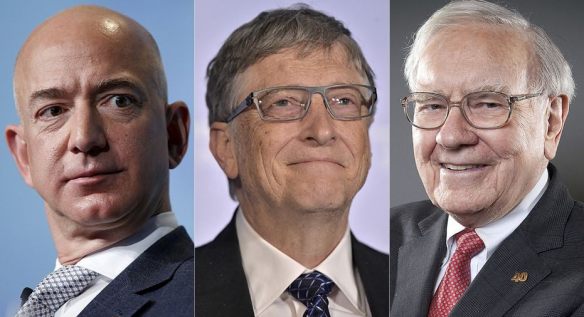
America’s Super-Rich See Their Wealth Rise by $282 Billion in Three Weeks of Pandemic

America’s billionaires have accrued more wealth in the past three weeks alone than they made in total prior to 1980.

Source: Mint Press News

A new report from the Institute for Policy Studies found that, while tens of millions of Americans have lost their jobs during the coronavirus pandemic, America’s ultra-wealthy elite have seen their net worth surge by $282 billion in just 23 days. This is despite the fact that the economy is expected to contract by 40 percent this quarter. The report also noted that between 1980 and 2020 the tax obligations of America’s billionaires, measured as a percentage of their wealth, decreased by 79 percent. In the last 30 years, U.S. billionaire wealth soared by over 1100 percent while median household wealth increased by barely five percent. In 1990, the total wealth held by America’s billionaire class was $240 billion; today that number stands at $2.95 trillion. Thus, America’s billionaires accrued more wealth in just the past three weeks than they made in total prior to 1980. As a result, just three people ­– Amazon CEO Jeff Bezos, Microsoft co-founder Bill Gates and Berkshire Hathaway’s Warren Buffet – own as much wealth as the bottom half of all U.S. households combined.

The Institute for Policy Studies’ report paints a picture of a modern day oligarchy, where the super-rich have captured legislative and executive power, controlling what laws are passed. The report discusses what it labels a new “wealth defense industry” – where “billionaires are paying millions to dodge billions in taxes,” with teams of accountants, lawyers, lobbyists and asset managers helping them conceal their vast fortunes in tax havens and so-called charitable trusts. The result has been crippled social programs and a decrease in living standards and even a sustained drop in life expectancy – something rarely seen in history outside of major wars or famines. Few Americans believe their children will be better off than they were. Statistics suggest they are right.

Billionaires very theatrically donate a fraction of what they used to give back in taxes, making sure to generate maximum publicity for their actions. And they secure positive coverage of themselves by stepping in to keep influential news organizations afloat. A December investigation by MintPress found that Gates had donated over $9 million to The Guardian, over $3 million to NBC Universal, over $4.5 million to NPR, $1 million to Al-Jazeera, and a staggering $49 million to the BBC’s Media Action program. Some, like Bezos, prefer to simply outright purchase news organizations themselves, changing the editorial stance to unquestioning loyalty to their new owners.

The spike in billionaire wealth comes amid an unprecedented economic crash; 26.5 million Americans have filed for unemployment over the last five weeks, and that number is expected to continue to rise dramatically. While the super-rich are holed up in their mansions and yachts, the 49-62 million Americans designated as “essential workers” must continue to risk their lives to keep society functioning, even as many of them do not even earn as much as the $600 weekly increase in unemployment benefits the CARES act stipulates. Many low paid workers, such as grocery store employees, have already fallen sick and died. The mother of one 27-year-old Maryland worker who contracted COVID-19 and died received her daughter’s last paycheck. It amounted to $20.64.

Amazon staff, directly employed by Bezos, also risk their lives for measly pay. One third of all Amazon workers in Arizona, for example, are enrolled in the food stamps program, their wages so low that they cannot afford to pay for food. The vast contrast in the effect that COVID-19 has had on the super wealthy versus the rest of us has many concluding that billionaires’ wealth and the poverty of the rest of the world are two sides of the same coin: that the reason people working full-time still cannot afford a house or even to eat is the same reason people like Bezos control more wealth than many countries. Bezos’ solution to his employees’ hunger has been to set up a charity and ask for public donations to help his desperate workers.

The majority of millennials, most of them shut out from attaining the American dream, already prefer socialism to capitalism, taking a dim view of the latter. The latest news that the billionaire class is laughing all the way to the bank during a period of intense economic suffering is unlikely to improve their disposition.


Alan MacLeod is a Staff Writer for MintPress News. After completing his PhD in 2017 he published two books: Bad News From Venezuela: Twenty Years of Fake News and Misreporting and Propaganda in the Information Age: Still Manufacturing Consent. He has also contributed to Fairness and Accuracy in Reporting, The Guardian, Salon, The Grayzone, Jacobin Magazine, Common Dreams the American Herald Tribune and The Canary.

Corporate Looting as ‘Rescue Plan,’ Robber Barons as ‘Saviors’

By Joshua Cho

Source: FAIR.org

For a perfect illustration of how corporate media function as ruling class propaganda, watch how they spin a titanic upward redistribution of wealth as a “rescue plan” for the US economy, and paint a robber baron like US Treasury Secretary Steve Mnuchin as a “savior” of the American public.

In discussions of the (officially) estimated $2.2 trillion Coronavirus Aid, Relief and Economic Security (CARES) Act—the largest government spending program in US history—before it was signed into law on March 27, corporate media largely abandoned the pretense of serving as watchdogs on behalf of the public in order to advocate for protecting and enriching the fortunes of their owners.

Instead of scrutinizing the bill as the robbery in progress that it is—as an understandable story with identifiable victims and victimizers—corporate media sold the CARES Act as an urgent necessity required to combat the coronavirus pandemic for everyone. Like the previous corporate bailout during the Great Recession (Extra!, 1/09), corporate media avoided raising questions about the necessity of having the government bail out large corporations, or whether the bill could be restructured to serve people rather than profits.

According to the Committee for a Responsible Budget, while the CARES Act dedicated $290 billion in direct payments to people and $260 billion in expanded unemployment benefits, it dedicated $300 billion in tax breaks and $875 billion in loans to big and small businesses—more than two dollars for corporations for every dollar for people, in other words.

When corporate media reported on negotiations and deliberations over the CARES Act, they either hailed it as a bipartisan achievement, or else shamed politicians who accurately pointed out that it overwhelmingly benefited corporations at the expense of workers. On the day the CARES Act was signed into law, NPR (3/27/20) praised the bill as “the largest rescue package in American history and a major bipartisan victory for Congress.”

Reporting in real-time, the Washington Post (3/24/20) spun the CARES Act as an attempt to “address the coronavirus crisis,” with the aim of “flooding the economy with capital to revive businesses and households.” When there was Democratic pushback over the Senate GOP bill for being “disproportionately tilted toward helping companies,” the Post described this as “partisan rancor and posturing on Capitol Hill” that blocked “the rescue bill.” The Post concern-trolled those who supported better legislation, and derided House Democrats’ putative attempts to chart their own “competing piece of legislation,” because “it could take even longer to arrive at a bipartisan consensus that can pass both chambers and get signed into law.”

The New York Times (3/22/20) made it clear that protecting workers and imposing conditions on handing out trillions in taxpayer dollars were frivolous reasons to oppose the legislation, as the Times cast Senate Democrats as villains for ostensibly opposing the bill because it “failed to adequately protect workers or impose strict enough restrictions on bailed-out businesses.” The Times described the “party-line vote” as a “stunning setback” for both the Trump administration’s “ambitious timeline” and “the rescue package,” and warned Democrats that they “risked a political backlash” if “they are seen as obstructing progress on a measure that is widely regarded as crucial to aid desperate Americans and buttress a flagging economy.”

The Times also drew parallels to the “spectacle in 2008,” when the House defeated a “$700 billion Wall Street bailout that aimed to stabilize the financial system amid a global meltdown.” Even in 2020, the Times is still spinning the upward redistribution of wealth from taxpayers to the big banks that caused the crisis as an ostensible success that saved what corporate media consider to be “the economy” (Extra!, 10/10).

Days later, the Times’ “As Coronavirus Spread, Largest Stimulus in History United a Polarized Senate” (3/26/20) spun the 96-to-0 Senate vote in favor of the bill as a heroic bipartisan compromise on legislation “intended to get the nation through the crippling economic and health disruptions being inflicted on the world by the coronavirus.” The Times leaned into corporate media’s civility fetish designed to demobilize opposition to the Trump regime (FAIR.org, 8/1/18, 12/22/19) when it depicted Democratic opposition to Senate Republicans’ “corporate giveaway” legislation as politically reckless and harmful to the country’s interests:

It was a shocking and politically perilous decision in the middle of a paralyzing national crisis, a moment when lawmakers are traditionally expected to put aside differences for the good of the country, or face a political backlash.

By contrast, in the false balance endemic in news coverage in the Trump era, the Times portrayed Senate Republicans as reasonable leaders who were “willing to momentarily abandon their small-government zeal” in the interest of “sealing a quick deal with Democrats” (GQ, 12/10/19; Washington Post, 4/27/12). Though the legislation didn’t include a necessary suspension of rent, utility and mortgage payments, or guarantee monthly payments, as advised by many economists, the Times spun it as a legislative victory for Senate Democrats:

In the end, Democrats won what they saw as significant improvements in the measure through their resistance, including added funding for healthcare and unemployment, along with more direct money to states. A key addition was tougher oversight on the corporate bailout fund, including an inspector general and congressionally appointed board to monitor it, disclosure requirements for businesses that benefited, and a prohibition on any of the money going to Mr. Trump’s family or his properties — although they could still potentially benefit from other provisions.

The problem with this triumphant Democratic ResistanceTM narrative is that it happens to be false. Politico’s report (3/26/20) on the negotiations over what it also hailed as a “rescue package” revealed that the final bill largely reflected the Senate Republicans’ “unemployment insurance and direct payments schemes” as “originally outlined,” with Sen. Mitch McConnell claiming that the CARES Act was a bill that was “largely, not entirely but largely, produced by Republicans in consultation with the Democratic minority.”

The Democratic leadership’s lack of concern with proper oversight of the bailout funds was also exposed when Speaker Nancy Pelosi chose her first-term congressmember friend Donna Shalala as part of the five-member oversight panel, despite her numerous conflicts of interest, evident lack of expertise or reported interest in the job (American Prospect, 4/18/20).

The American Prospect’s David Dayen has done some of the best reporting on the CARES Act, and he’s observed (3/25/20) how means-testing the $1,200 stimulus payments by basing it off IRS data in 2018 and 2019 was designed to limit the number of Americans who can receive it. The miserly one-time $1,200 stimulus payment will primarily reach Americans who already have direct deposit information on file with the IRS, with the unbanked (who happen to be the poorest) having to wait up to four months for paper checks, and who will be lucky to remain at the same address during that time without a suspension of rent payments.

While Democratic leaders like Pelosi opposed emergency universal basic income—and delayed payments to set up a bureaucracy ostensibly dedicated to make sure wealthy Americans don’t get anything—the richest Americans are in fact receiving an average stimulus payment of $1.7 million in the form of a millionaire tax cut.

Dayen has noted how the official “$500 billion” provided by the CARES Act to bailout large corporations is actually underreporting the enormity of the federal government’s corporate giveaway, as Trump regime officials like Larry Kudlow and Steve Mnuchin admitted their intent to leverage the Federal Reserve’s emergency lending authority to turn $500 billion into a $4.5 trillion money cannon aimed at large corporations.

What was in actuality a $6 trillion spending package had few conditions attached to the largesse given to large corporations, as the money can still go to mergers, executive compensation and paying dividends to shareholders, with no requirement that they keep employing workers to receive this handout.

It’s hard to overstate the injustice and scale of this upward redistribution of wealth. Commenting on 2008’s bailout, economist Richard Wolff (Guardian, 11/4/13) pointed out how funding the bailout through borrowing money effectively transfers wealth upward from regular taxpayers to rich bondholders, because the government is borrowing money from—and paying interest to—large corporations and the rich that it could have taxed them for instead. Rather than letting shareholders be wiped out first, according to the ostensible rules of capitalism—where they are supposed to bear the risk, instead of the government—the government is shoveling money to tax-dodging corporations like Boeing who admit to not needing these funds.

By borrowing the money for a program that prioritizes saving the rich, rather than printing money to fund an emergency universal basic income for the people like Rep. Rashida Tlaib’s proposal, the government is effectively paying the rich for saving them. The fact that these viable alternative stimulus proposals weren’t enacted is inexcusable. Especially when the Federal Reserve is hinting its willingness to increase the money supply by buying unlimited debt to fund the CARES Act, the fact that the necessary funds magically appear to fund corporate bailouts instead of necessary social programs (like Medicare for All) exposes the “How are you going to pay for it?” talking point as a fraud (Extra!, 6/12).

Pam and Russ Martens of Wall Street on Parade (3/26/20) observed how the CARES Act also allows the Fed to create “Special Purpose Vehicles” and hide this money from their balance sheets, allowing them to avoid the FOIA requests used to the expose the enormity of the $29 trillion bailout from 2008, in addition to repealing public meeting and recordkeeping requirements for Fed-related programs. This allows the Fed to evade transparency and accountability by holding meetings in secret.

But when corporate media aren’t busy spinning massive corporate robbery of taxpayer money as a rescue package for “the economy,” they’re busy spinning robber barons like Mnuchin as heroic “saviors” instead. Reuters’ “This Is No 2008: Mnuchin Borrows From Paulson’s Economic Crisis Playbook” (3/20/20) depicted Mnuchin as an unlikely hero thrust into the role of solving the US’ economic woes, as they reported:

US Treasury Secretary Steven Mnuchin has stepped into the breach as the Trump administration’s point man to rescue the economy from coronavirus devastation, taking on the role his former Goldman Sachs boss, Hank Paulson, played over a decade ago.

Mnuchin has closely followed the financial crisis playbook used by Paulson when he led the Treasury Department in 2008, reactivating Federal Reserve credit market backstops and asking Congress for $1 trillion to prop up companies and consumers as the economy grinds to a halt due to the spread of the virus.

Apparently, for Reuters, there is only one “playbook” to be followed for all economic crises: massive taxpayer-funded giveaways to large corporations, and crumbs for everyone else. The report contained praise from official sources praising Mnuchin for being “pragmatic” and “rising to the occasion,” with few questions beyond whether he can succeed in his noble mission, as Reuters wondered whether Mnuchin can “strong-arm executives or influence President Donald Trump to take the drastic steps the unprecedented crisis may demand.” Whether Mnuchin and the Trump regime are actually trying to “rescue the economy” is apparently unquestionable, even though Mnuchin would dismiss record-breaking levels of unemployment as “not relevant” only a few days later (Common Dreams, 3/26/20).

The Wall Street Journal’s “How Mnuchin Became Washington’s Indispensable Crisis Manager” (3/31/20) also peddled this fictitious savior narrative when it reported that “Mnuchin has become Washington’s indispensable deal-maker in trying to keep the crisis from throwing the world’s largest economy into the deepest downturn since the Great Depression,” while shepherding “a pair of rescue bills through Congress.”

The Journal depicted Mnuchin’s ability to retain Trump’s confidence while working with Democrats as something that will be “all the more needed in the weeks ahead as the pandemic is expected to worsen,” in order to “get things done in partisan Washington.” Those “skills” didn’t seem to manifest when additional funding for state and local governments, and expanded food stamp benefits needed to rescue people, were left out of the “Phase 3.5” coronavirus legislation last week (Intercept, 4/22/20).

The Washington Post’s “The Dealmaker’s Dealmaker: Mnuchin Steps In as Trump’s Negotiator, but President’s Doubts Linger With Economy in Crisis” (3/27/20) also praised Mnuchin’s efforts to “bridge divides” and forge bipartisan “agreements.” While to the Post’s credit, the piece noted how the “Treasury Department’s demands have often appeared to represent the interests of big business rather than workers,” its overall thrust was encapsulated by its subhead: “Can his economic rescue plan quickly stabilize an economy headed toward calamity?”

The New York Times’ “How Powell and Mnuchin Became the Duo in Charge of Saving the Economy” (3/31/20) reported on Mnuchin’s “vital partnership” with Fed chair Jerome Powell, echoed the “unlikely hero” narrative, and described their efforts as “critical not only to workers and businesses,” but also to Trump’s “re-election” chances:

The coronavirus poses the most significant economic threat since at least 2008, thrusting Mr. Mnuchin and Mr. Powell into key roles in determining whether the United States economy suffers a short, manageable slowdown or enters a deep and painful recession.

When the Times briefly acknowledged concerns about the massive concentration in power and newfound influence in Powell and Mnuchin’s hands, and questions about the integrity of the “oversight” process, it treated the CARES Act favoring big corporations over workers as a hypothetical scenario, rather than a plain fact.

In a unique situation where workers and small business owners have the shared interest in not being wiped out by the pandemic, how else does one characterize the disproportionately stricter conditions placed on small businesses to retain workers to receive bailout money—while big corporations have no such limitations—except as a plan to save big corporations over workers? The Times’ later reports (4/22/20, 4/26/20) on big corporations receiving bailout money intended for small businesses, and receiving concierge service for coronavirus aid at their expense, should’ve been predictable—as it was to some observers in real time (American Prospect, 3/25/20).

Throughout this coverage, it’s quite telling who counts as “the economy” and what measures are considered “necessary” or “adequate,” because it reveals who corporate media consider to be disposable (working class America), and who needs “saving” (large corporations and the American oligarchy). With the CARES Act, corporate media reversed the narrative in a truly Orwellian fashion, portraying corporate looting of the Treasury as necessary to “rescue the economy,” while the main questions regarding “savior” officials like Mnuchin are whether his plans to “save the economy” can succeed. When 26 million Americans lost their jobs between March 18 and April 22, while the wealth of US billionaires increased by $308 billion (more than 10%), there’s no other way to look at corporate media spin as anything but ruling class propaganda to legitimize saving capital while letting people die (In These Times, 4/6/20).

No, This Is Not Another 1929, 1973, 1987, 2000, or 2008

By Charles Hugh Smith

Source: Of Two Minds

Basing one’s decisions on analogs from the past is entering a fool’s paradise of folly.

Like addicts who cannot control their cravings, financial analysts cannot stop themselves from seeking some analog situation in the past which will clarify the swirling chaos in their crystal balls. So we’ve been swamped with charts overlaying recent stock market action over 1929, 1987,2000 and 2008–though the closest analogy is actually the Oil Shock of 1973, an exogenous shock to a weakening, fragile economy.

But the reality is there is no analogous situation in the past to the present, and so all the predictions based on past performance will be misleading. The chartists and analysts claim that all markets act on the same patterns, which are reflections of human nature, and so seeking correlations of volatility and valuation that “worked” in the past will work in 2020.

Does anyone really believe the correlations of the past decade or two are high-probability predictors of the future as the entire brittle construct of fictional capital and extremes of globalization and financialization all unravel at once?

Here are a few of the many consequential differences between all previous recessions and the current situation:

1. Households have never been so dependent on debt as a substitute for stagnating wages.

2. Real earnings (adjusted for inflation) have never been so stagnant for the bottom 90% for so long.

3. Corporations have never been so dependent on debt (selling bonds or taking on loans) to fund money-losing operations (see Netflix) or stock buybacks designed to saddle the company with debt service expenses to enrich insiders.

4. The stock market has never been so dependent on what amounts to fraud–stock buybacks–to push valuations higher.

5. The economy has never been so dependent on absurdly overvalued stock valuations to prop up pension funds and the spending of the top 10% who own 85% of all stocks, i.e. “the wealth effect.”

6. The economy and the stock market have never been so dependent on central bank free money for financiers and corporations, money creation for the few at the expense of the many, what amounts to an embezzlement scheme.

7. Federal statistics have never been so gamed, rigged or distorted to support a neofeudal agenda of claiming a level of wide-spread prosperity that is entirely fictitious.

8. Major sectors of the economy have never been such rackets, i.e. cartels and quasi-monopolies that use obscure pricing and manipulation of government mandates to maximize profits while the quality and quantity of the goods and services they produce declines.

9. The economy has never been in such thrall to sociopaths who have mastered the exploitation of the letter of the law while completely overturning the spirit of the law.

10. Households and companies have never been so dependent on “free money” gained from asset appreciation based on speculation, not an actual increase in productivity or value.

11. The ascendancy of self-interest as the one organizing directive in politics and finance has never been so complete, and the resulting moral rot never more pervasive.

12. The dependence on fictitious capital masquerading as “wealth” has never been greater.

13. The dependence on simulacra, simulations and false fronts to hide the decay of trust, credibility, transparency and accountability has never been so pervasive and complete.

14. The corrupt linkage of political power, media ownership, “national security” agencies and corporate power has never been so widely accepted as “normal” and “unavoidable.”

15. Primary institutions such as higher education, healthcare and national defense have never been so dysfunctional, ineffective, sclerotic, resistant to reform or costly.

16. The economy has never been so dependent on constant central bank manipulation of the stock and housing markets.

17. The economy has never been so fragile or brittle, and so dependent on convenient fictions to stave off a crash in asset valuations.

18. Never before in U.S. history have the most valuable corporations all been engaged in selling goods and services that actively reduce productivity and human happiness.

This is only a selection of a much longer list, but you get the idea. Basing one’s decisions on analogs from the past is entering a fool’s paradise of folly.

Charlie Chaplin and Truly Modern Times

Still of Charlie Chaplin [b. April 16, 1889] from “Modern Times”

By Daniel Warner

Source: CounterPunch

Acrobat, musician, composer, clown, mime, movie star, director and producer, Academy Award winner for lifetime achievement, but still driven from the United States for his backing of the Soviet Union, Charlie Chaplin should need little introduction, except perhaps for Millennials and other late alphabet generations. He was the global star in the crossover from silent films to talkies, making an astonishing $10,000 a week during the Depression, with $150,000 in signing bonuses. Knighted by the Queen, Charlot was universally loved and admired.

But is he relevant today beyond his reputation as a comic icon?

During a recent visit to the magnificent Manoir de Ban near Lausanne, Switzerland, which was his home from 1952 until his death in 1977 and now houses a museum in his honor, I was impressed how his films were political, and how they speak to today’s human rights agenda.

In 1954 Chaplin was awarded the International Peace Prize by the World Peace Council for his outstanding contribution to the cause of peace and friendship among nations. Who can forget his mocking of Hitler in The Dictator when he spins a globe and dances with the world at his fingertips?)

Two examples from his classics show how his films relate to human rights:

The 1921 production The Kid is the story of an unwed, down-and-out mother who abandons her child because she cannot afford to look after him. She places him in an expensive car with a note to the owner to take care of him. After some intrigue, a tramp, Charlie Chaplin, finds the boy and raises and loves him like his own, cementing the idea of the kindness of the fellow impoverished. The tramp and the kid work together against the moneyed class; the kid breaking windows and the tramp repairing them.

The kid is eventually taken away from the tramp by the authorities – border police separating children from their loved ones on the U.S. southern border? – to be returned to his mother. In the end, the kid, the tramp and the mother are re-united.

The Kid was chosen to be preserved in the Library of Congress’s National Film Registry in 2011. It was praised as “an artful melding of touching drama, social commentary and inventive comedy.” The social commentary is what today we would call human rights: the right to a decent life for the mother when she is poor; the right for the mother to have minimum support to raise her boy and not to have to abandon him; the right of the tramp to have a decent wage for his job so he would be able to live properly without having to use illegal means to earn a living; the right to have proper housing for the tramp and the kid; the right to have affordable medical care; the right for the boy to stay with the tramp instead of being sent to an orphanage.

All of these we would call basic social, economic and cultural rights. They are at the heart of Chaplin’s advocacy; they are what make the film so endearing and why we are so relieved when the tramp, kid and mother unite at the end to live happily together. According to Chaplin, and The Kid, there is justice in this world. The good guys overcome injustices and the cruel indifference of the rich with their expensive cars (a foreboding of the 1%?). Although the mother became a rich actress, she takes in the tramp to form a supportive family for the kid, re-uniting him with her son (without the son’s losing the support of the foster father who had raised him, a win-win situation that no family judge could have better decided).

And how does Modern Times, Chaplin’s critique of industrialization, relate to human rights and our modern times of numeric technology? The tramp in Modern Times is a factory worker slaving away on mechanical assembly line. Is this different from today’s information workers tied to their computer screens, forced to work at accelerated speeds as the information flow gets faster and faster, like the quickening assembly line? The hero suffers a nervous breakdown after which he is unemployed, again suffering from having no unemployment insurance or other benefits to carry him over. He is mistakenly arrested with no legal recourse but wishes to stay in jail since he has had no vocational training and is living better in jail than in the street.

The remainder of the film deals with his romance with a fellow hobo who is fleeing punishment because she stole a single loaf of bread (proportional justice?). The film recounts the couple’s various adventures to escape poverty and the desperation of those with no guaranteed income, no right to food or right to housing. Whenever authorities are presented, they are unsympathetic. The poor have no recourse to representation and are left to their own devices to survive. The police – the authorities – are constantly trying to arrest the downtrodden who must seek refuge outside the authoritative system. There is no hope for them within the system; they are left to their own devices in a world with no guaranteed rights.

There is little justice in Modern Times in terms of a happy ending where the heroes overcome injustices. At the end, there is only the love between Chaplin and Ellen. But in the film, as in The Kid, struggles of the underclass represent all the injustices that the 99% of the world today must endure. While economic inequality continues to grow, Chaplin’s films have an important lesson of the struggles of the disenfranchised if one can view the horrors of industrialization and the Depression in our modern context. When 26 individuals are worth as much as 50% of the world’s population, Chaplin’s comic/tragic hero is a pertinent reminder of what it means to live in poverty.

The Manoir de Ban is a beautiful domaine with a lovely park and spectacular view of Lake Geneva. Chaplin died a very rich man. His vision of and advocacy for the poor should remain his greatest legacy. A visit to his museum is a reminder of the schism between the haves and have nots and how a talented, rich genius was able to give such a profound representation of all those who couldn’t afford to live in Vevey and to have the human rights he and many of us enjoy.


America’s Despair

By Vladimir Odintsov

Source: New Eastern Outlook

More and more people in the United States are feeling let down by American capitalism, and the population is being plunged into depression. This was the alarming conclusion reached by two researchers from Princeton University, Anne Case and winner of the Nobel Prize in Economics Angus Deaton. Over the past fifty years, many have been left feeling disillusioned with the American economic model, hyped up extensively within the United States, which even affects life expectancy in America: it has been declining for three consecutive years, a very unusual trend for a developed country. There has been a marked increase in the mortality rate among the white population in particular since the beginning of the new millennium. The number of suicides, as well as deaths from drug and alcohol abuse has increased dramatically.

These are the bleak findings of the research on the situation in the USA conducted by well-known American economists Anne Case and Angus Deaton, who carried out a detailed analysis of the suicide and mortality epidemic that has engulfed America, noting that the United States has been experiencing a “deaths of despair” epidemic since the mid 1990s. The researchers point out that life expectancy for Americans declined for three consecutive years, from 2015 through 2017, something that had not happened since World War One, when the world was gripped by the Spanish influenza pandemic. Among the many different root causes leading to deaths of despair, the study highlights a significant fall in American wages in recent years and a dearth of good jobs, which is weakening core institutions of American life, such as marriage, faith and community. Social spending and housing-related expenses are an increasingly heavy burden for ordinary Americans.

This is despite the fact that the United States had once led the way as the number-one country in the world in terms of reducing mortality rates and increasing life expectancy in the 20th century, and many important discoveries and achievements in medicine have come from the United States.

However, the United States is now leading the way in the opposite direction.

Numerous US researchers believe that the Great Recession which began with the 2008 financial crisis is to blame for today’s greatest woes in America. However, the Great Recession was not what provoked the deaths of despair epidemic among ordinary Americans, although it did lead to the deterioration of living conditions for many people, which provoked anger and division in the United States. The deep-rooted causes of this epidemic can be traced back to a feeling of dissatisfaction with living conditions among Americans which has been there for a long time, and when inequality began to grow, young Americans began realizing that they would never be able to live the lives their parents could afford, while young people without highly professional skills have fallen even further behind.

America’s health care system which has been prescribing more and more opioids is also on the list of “culprits” responsible for the situation America has found itself in today. According to US research, one out of every two unemployed men in the US take painkillers on a daily basis, and these are usually addictive opioids. The national health-care crisis associated with substance abuse has plagued Americans for decades. The opioid epidemic in the United States is largely a failure of regulation and control. This is an area where pharmaceutical companies wield great political influence.

In recent years, there has been a sharp increase in the number of patients reporting pain, difficulties with communication, and depression. Pharmaceutical companies and distributors have taken advantage of people’s growing desperation, seeing an opportunity to promote and ramp up the sales of opioid pain medication such as OxyContin, a legal drug approved by the US Food and Drug Administration even though it is essentially no different to heroin. Between 1999 and 2018, more than 200,000 Americans died of opioid overdoses. Doctors are seeing the increasing amount of harm being caused by these drugs, and have begun prescribing them on a less frequent basis, but these opioids have opened the gateway to illegal drugs: heroin from Mexico, as well as fentanyl from China in more recent years, which is far deadlier. These drugs are causing a huge amount of damage and killing a lot of people. However, when ordinary Americans are faced with hardship and suffering, when there is social upheaval, and people begin to feel that their lives are meaningless, these drugs fill the void, and the number of deaths from drug overdoses goes up, adding to the number of suicides and alcohol-related deaths.

Alcohol-related deaths in American society today are simply ballooning out of control. According to a series of studies, “Alcohol-related deaths” have more than doubled in the last two decades. This is well ahead of the population growth rate over the same period. A study conducted over a twenty-year period found that alcohol had been the cause of more than one million deaths! Apart from people who simply drank themselves “to death”, half of the alcohol-related deaths were due to liver disease and drug overdoses from substances taken together with alcohol. Nine states — Maine, Indiana, Idaho, Montana, New Jersey, New York, North Dakota, Ohio and Virginia — have recorded a significant increase in the number of Americans binge drinking dangerous amounts of alcohol, which can lead to fatal car crashes and other fatal accidents, according to a report recently published by the CDC (The Centers for Disease Control and Prevention). Americans almost all over the country who are trying to “drown their sorrows in alcohol” are already addicted to these hard drinks, and have began drinking more heavily and more often, with a 12% increase seen in the last five years alone.

Historically, there have always been more “deaths of despair” among men than women. However, a study published in the journal Alcoholism: Clinical and Experimental Research, found that the largest annual increase in alcohol-related deaths in recent years was seen among non-Hispanic white women.

But these are not the only scourges of today’s American society. According to the January report published by the National Center for Homeless Education funded by the US Department of Education, over 1.5 million schoolchildren experienced homelessness in the 2017-2018 school year. 100,000 (7%) of these homeless schoolchildren spent the night in the open air and slept wherever they could, 7% slept in motels, 12% stayed in homeless shelters, and 74% stayed at a friend’s. And these are only the most modest estimates, but take figures from the American Institutes for Research, for example, which recorded that 2.5 million children had experienced homelessness in the year 2013. This could almost be considered some sort of historical “record”, with one in thirty American children experiencing homelessness! Criminal gangs, drug dealers, pimps and pedophiles are waiting for these children on the streets. In this context, does it really come as any surprise that crime is on the rise in the United States (especially juvenile crime)?

This grim situation in the US is hardly surprising if you look at the draft $4.8 trillion federal budget that US President Donald Trump is going to propose and use to pave the way for his re-election. After all, this budget is a continuation of a trend that has already been observed in federal budgets drafted in the United States, as we’ll see more big safety-net cuts and increased spending on defense, which even the Wall Street Journal has called out.

All of the Trump administration’s wall-to-wall “America First!” slogans cannot hide the glaringly ugly face of American reality we can see today.

Of Course Billionaires Shouldn’t Exist

By HipCrime Vocab

There’s apparently a row over whether billionaires should exist. That is, whether or not billionaires should be a thing in our society.

What a stupid question. Of course billionaires shouldn’t exist! But the reason has nothing to do with Socialism.

Rather, under a properly-functioning free-market capitalist system, billionaires shouldn’t exist. And that would have also been the opinion of the “Classical Liberals” so favored by the Right these days: Adam Smith, David Ricardo. Thomas Malthus, John Stuart Mill, and so on.

Billionaires are a sign of market failure.

Let me say that again: billionaires are a form of market failure! You cannot simultaneously be both pro-Market and pro-billionaire.

I’m amazed at how few people get this!

In a truly competitive market, excess profits would be competed away. Someone would come along and undercut outsize profits. That’s exactly how the Classical Liberals assumed free markets would work. In this, they saw markets as instruments of greater equality, not inequality, and certainly not as a way to construct a new and improved aristocracy even more powerful than the old one.

The Classical Liberals wrote in opposition to the main power centers of their day: aristocratic government and chartered monopolies like the East India Company. They didn’t see the purpose of their writings as defending privilege and power. One can dispute the end results, but that was not their goal. Quite the contrary. The idea that a single, solitary individuals would possess more wealth than the kings and pharaohs of old under a functioning free market system would have been unthinkable to them.

In their time, much of the national wealth was monopolized by a landed aristocracy who gained their wealth through disproportionate ownership of the country’s productive land. The other major source of wealth came from large joint-stock companies that were granted royal monopolies due to their political connections. Yet another source of unearned wealth came from the holders of bonds (gilts)—essentially loaning money to the state and getting the government’s tax revenues funneled to them via interest payments.

Classical English Liberals felt that competitive markets would do away with a good portion of the unearned and unproductive wealth common in Great Britain at the time. They believed that “free and open” markets would channel wealth and activity to more productive ends. That is, they would break up large pools of wealth and unproductive money. The kind of obscene fortunes that they saw in their day would no longer be possible thanks to competition, they assumed, and that British society would become more equal than it was under landed aristocracy, not less. We can dispute their logic (and I have issues with it), but I think we can safely say that this is what they believed, rightly or wrongly.

An inherent part of their conception of free markets is the possibility of failure. Unproductive or inefficient businesses would be competed away, they assumed, and the fortunes earned through such activities would disappear. But that is not the case today. Billionaires have so much money they can literally never lose it! That’s not capitalism, that’s aristocracy. I read recently that someone like Bill Gates literally cannot give away money to his pet causes fast enough to reduce his fortune even if he tried. In fact, he’s grown wealthier even while giving away billions.

The important point about [Adam] Smith’s system, on the other hand, is that it precluded steep inequalities not out of a normative concern with equality but by virtue of the design that aimed to maximize wealth. Once we put the building blocks of his system together, concentration of wealth simply cannot emerge.

In Smith, profits should be low and labor wages high, legislation in favor of the worker is “always just and equitable,” land should be distributed widely and evenly, inheritance laws should partition fortunes, taxation can be high if it is equitable, and the science of the legislator is necessary to thwart rentiers and manipulators.

Political theorists and economists have highlighted some of these points, but the counterfactual “what would the distribution of wealth be if all the building blocks were ever in place?” has not been posed. Doing so encourages us to question why steep inequality is accepted as a fact, instead of a pathology that the market economy was not supposed to generate in the first place.

Contrary to popular and academic belief, Adam Smith did not accept inequality as a necessary trade-off for a more prosperous economy (LSE Blogs)

Yet today the people who call themselves the heirs to “Classical English Liberals” emphatically defend the existence of billionaires and extreme inequality at every turn. Such people are not pro-market or pro-capitalism as they like to portray themselves; they are simply pro-wealth, or—to use a less complementary term—bootlickers. They are not defending capitalism or Markets; what they really are defending is oligarchy, power, privilege, and hierarchy. As Corey Robin opined, “The priority of conservative political argument has been the maintenance of private regimes of power,” with all the soaring rhetoric about markets and freedom being just a smokescreen and a cover for defending hierarchies and power imbalances. Their defense of billionaires is proof positive of this. This is true of presidential candidates as well.

The existence of obscene fortunes and extreme inequality are not a sign of capitalism’s success; they are a sign of capitalism’s failure.

This is pointed out by Chris Dillow:

“I don’t think anyone in this country should be a billionaire” said Labour’s Lloyd Russell-Moyle yesterday, at which the BBC’s Emma Barnett took umbrage. The exchange is curious, because from one perspective it should be conservative supporters of a free market who don’t want there to be billionaires.

I say so because in a healthy market economy there should be almost no extremely wealthy people simply because profits should be bid away by competition. In the textbook case of perfect competition there are no super-normal profits, and in the more realistic case of Schumpeterian creative destruction, high profits should be competed away quickly.

From this perspective, every billionaire is a market failure – a sign that competition has failed. The Duke of Westminster is rich because there’s a monopoly of prime land in central London. Would Ineos’ Jim Ratcliffe be so rich if pollution were properly priced, or if his firm faced more competition?

The Right’s Mega-Rich Problem (Stumbling and Mumbling)

How is this rectified? How do they square their supposed love of fair competition and free and open markets with the presence of outsize fortunes?

They don’t.

And the sad thing is how many people buy into their nonsense. Everyone seems to think that a defense of billionaires is a defense of capitalism.

It’s not. It’s the opposite.

What is a billionaire?

Billionaires are only made possible through monopolies and tollbooths. Period. And such monopolies are more possible than ever before thanks to technology.

This is argued by Matt Stoller, an expert on monopolies, in a post entitled, What Is A Billionaire?:

Most people think a billionaire is someone with a lot of money, a sort of Scrooge McDuck who goes swimming in a pool of gold coins. And why wouldn’t we? The name billionaire has the word billion contained within it, so clearly it means having a net worth of at least ten figures. And in a sense, that is technically true. But if you look at the top ranks of the Bloomberg billionaire index, you’ll notice that nearly all of the leaders are people who own a corporation with substantial amounts of market power in one or more markets.

Billionaires use market power to extract revenue the way that a tollbooth operator does.
 If you want to drive on a road, you have to pay for the privilege. It costs the tollbooth operator nothing, he/she just has a strategic chokepoint for extraction. Billionaire Warren Buffett, for instance, has such a ‘tollbooth’ strategy for investing, though he uses the term ‘moat’ because it sounds charming and quirky rather than rapacious.

Put another way, the Bloomberg billionaire index isn’t a list of the most important Scrooge McDuck’s, it’s a list of the biggest tollbooth operators in the world.

What he’s saying is that one becomes a billionaire only by short-circuiting the competitive market economy. Then their profits cannot be competed away. Only by gaming the system can one “earn” over a billion dollars. No one person is that valuable.

Stoller goes on to elucidate the operational tactics used by both Bill Gates and by his predecessor John D. Rockefeller, and finds that even though the industries are radically different, the techniques of short-circuiting and circumventing market competition are the same. Whether it’s horizontal and vertical integration, or using market influence to price out rivals, or exclusive contracts, the techniques are the same regardless of industry or time period:

In 1976 and 1980, Congress allowed the copyrighting of software. IBM had been under aggressive antitrust investigation and litigation since 1967, so when it built a personal computer, it outsourced the operating system – MS-DOS – to Gates’s company and allowed Gates to license it to other equipment makers. (Gates’s upbringing didn’t hurt; the CEO of IBM at the the time knew his mother.) Such a relationship with a vendor was a shocking change for IBM, which had traditionally made everything in-house or tightly controlled its suppliers. But IBM treated Microsoft differently, transferring large amounts of programming knowledge to the small corporation. IBM also did this with the microprocessor company Intel, which IBM protected from Japanese competition.

And yet, in 1982, the Department of Justice dropped the antitrust suit against IBM, signaling a new pro-concentration framework. Bill Baxter, Reagan’s antitrust chief, did not want to bring monopolization suits, and did not. The new fast-growing technology space of personal computers would be a monopolized industry. But it would not be monopolized by IBM, which had kept control of the computing industry since the 1950s, because IBM’s corporate structure was now skittish about the raw use of power. And it would not be monopolized by AT&T, which was kept out of the computing industry by a 1956 consent decree that lasted until 1984. Gates, in many ways, had a greenfield, an environment friendly to monopoly but one in which all the old monopolists had been cleared out by antitrust actions.

In the case of Amazon, even though it theoretically has competition, through vertical and horizontal integration it can effectively control online e-commerce to a large degree. The result is a fortune greater than that of entire nation-states controlled by a single individual. One hardly imagines that Adam Smith would approve.

I read an interesting concept, and I forget where it came from. It was that networks are natural monopolies. This explains things like Facebook, Apple, Amazon, etc. It’s entirely possible that the online world, due to features inherent in the technology, simply cannot be regulated by normal competition the way the market for goods and services can. Yet all our theories pretend that it can. It’s delusional.

Under these scenarios,’ profits’ are really a form of tribute (or perhaps plunder). In fact, we really shouldn’t even use the word ‘profits’ to describe them (just like we shouldn’t use ‘trade’ to describe global wage arbitrage).

And there are many more examples of competition being limited by deliberate legal policy. Much of Microsoft’s profits come from the fact that other people can’t copy their software—which they’ve arbitrarily labeled “piracy”—without facing legal repercussions enforced by the state and its legal system. In that sense, outsized fortunes are a consequence of laws, and not a feature inherent to technology:

…inequality is not in fact driven by technology, it is driven by our policy on technology, specifically patent and copyright monopolies. These forms of protection do not stem from the technology, they are policies created by a Congress which is disproportionately controlled by billionaires.

If the importance of these government granted monopolies is not clear, ask yourself how rich Bill Gates would be if any start-up computer manufacturer could produce millions of computers with Windows and other Microsoft software and not send the company a penny. The same story holds true with most other types of technology. The billionaires get rich from it, not because of the technology but because the government will arrest people who use it without the patent or copyright holder’s permission.

This point is central to the debate on the value of billionaires. If we could get the same or better technological progress without making some people ridiculously rich, then we certainly don’t need billionaires. But in any discussion of the merits of billionaires, it is important to understand that they got their wealth because we wrote rules that allowed it. Their immense wealth was not a natural result of the development of technology.

Farhad Manjoo promotes billionaire ideology in proposal to get rid of billionaires (Dean Baker, Real World Economic Review)

Baker has also pointed out that outsized salaries in many fields are determined by limiting competition though things like wildly expensive education and licensing requirements, which are ultimately determined by the government. Doctors and lawyers do not have compete against the wage rates in India or China thanks to the legal system, for example. Everyone else, however, is required to compete against the entire world for jobs.

On a global level, most billionaires are not the result of “hard work” or doing things beneficial for their society:

The vast majority of the world’s billionaires have not become rich through anything approaching ‘productive’ investment. Oxfam has showed that, approximately one third of global billionaire wealth comes from inheritance, whilst another third comes from ‘crony connections to government and monopoly’.

Why on Earth Shouldn’t People Be Able to Be Billionaires? (Novara Media)

And the monopolies that allow billionaires to exist are not good for the economy as a whole. In fact, they are highly detrimental, as Chris Dillow further points out:

What’s more, monopoly pricing is a form of tax – a tax which often falls upon other, smaller businesses…In this sense, not only are billionaires a symptom of an absence of a healthy competitive economy, but they are also a cause of it: their taxes on other firms restrict growth and entrepreneurship…

Tories are wrong, therefore, to portray attacks on the mega-rich as the politics of envy. It’s not. The existence of billionaires is a sign and cause of a dysfunctional economy…

In fact, logically, it is rightists who should be most concerned by the concentration of wealth. We lefties can point to it as evidence that the system is rigged. But Tories should worry that it undermines the legitimacy of the existing order not only because people don’t like inequality, but because it slows down economic growth and so encourages demands for change.

Furthermore, their existence is detrimental politically:

Controlling society’s wealth effectively gives the wealthy the right to plan economic activity. Billionaires – and the people who manage their money – determine which governments can access borrowing, which companies deserve to grow, and which ideas should be researched. This gives them an immense amount of political, as well as economic, power – allowing billionaires to provide favours to those politicians who helped them get rich in the first place.

Ultimately, the monopolisation of society’s resources by a tiny, closed-off elite means that most of society’s resources are used for dirty, unsustainable and unproductive speculation.

Why on Earth Shouldn’t People Be Able to Be Billionaires? (Novara Media)

In fact, the proliferation of billionaires in the developed world has accompanied a period of slow growth and stagnation, not rapid growth. As has been pointed out ad nauseum, yet still fails to sink in, America’s fastest period of growth came when there were fewer billionaires and tax rates ranged from 50 to 90 percent. There is no evidence that the proliferation of billionaires has benefited society as whole. And now, billionaires are attempting to buy political offices outright, making a joke of democracy.

People defending billionaires are only defending raw power, not capitalism, not democracy, and certainly not free markets.

Stoller concludes:

[Billionaires] are not people with a bunch of dollar bills stacked to the moon, they are (largely) men with a strategic position of power protected by public laws and rules. They aren’t better or smarter than anyone else, they are simply politically adept and in the right place at the right time. There’s no reason we have to enable such people to run our culture. At the end of the day, tollbooths are nothing but bottlenecks on a road on which we would otherwise travel faster and more freely.

What is a Billionaire? (Matt Stoller)

So, should there be billionaires? The answer is no. And you should believe that if you consider yourself a libertarian free marketeer or a democratic socialist. Anyone asserting anything else is just a bootlicker or a toady.

Addendum:

Here’s a good piece explaining how billionaires are basically mad kings:

…one of civilization’s great challenges stems from millionaire rhyming with billionaire. In holding them in the same linguistic corner of our minds, we conflate them, yet they’re so mathematically distinct as to be unrelated. A millionaire can, with some dedicated carelessness, lose those millions. Billionaires can be as profligate and eccentric as they wish, can acquire, without making a dent, all the homes and jets and islands and causes and thoroughbreds and Van Goghs and submarines and weird Beatles memorabilia they please. Unless they’re engaging in fraud or making extremely large and risky investments, they’re simply no match for the mathematical and economic forces—the compounding of interest, the long-term imperatives of markets—that make money beget more money. They can do pretty much whatever they want in this life, and therein lies the distinction. A millionaire enjoys a profoundly lucky economic condition. A billionaire is an existential state.

This helps explain the cosmic reverence draped over so many billionaires, their most banal notions about innovation and vision repackaged as inspirational memes, their insights on markets and customers spun into best sellers. Their extravagances are so over the top as to inspire legend more often than revolution…

The Gospel of Wealth According to Marc Benioff (Wired)

One of the most potent demonstrations that the modern-day rich are mad kings, comes form the story of Adam Neumann of WeWork. This is the impression I got from the Behind the Bastards podcast on Neumann: The Idiot Who Made, and Destoryed, WeWork (Podtail)

Coronavirus reminds us we are organisms in an environment

By Kurt Cobb

Source: Resilience

A close friend of mine, a professor of English literature, has been researching American philosopher John Dewey, whose book Quest for Certainty captivated me so much many years ago that I read it again right after I had finished it the first time. My friend has been reminding me why I found Dewey so profound while shedding new light on the philosopher’s thinking.

Dewey, it turns out, is one of the few thinkers in American life who absorbed the true import of the work of Charles Darwin. Dewey reminds us that, quite simply, Darwin posited that we humans are organisms in an environment just like every other organism. Dewey’s star faded after World War II.  American and world society have since lapsed into a narrative that puts humans above and outside nature, protected by technological advancements that supposedly shield us from nature’s demands and vicissitudes. The general narrative is that we are heading into a push-button, voice-activated technocratic paradise. (I think of the various Star Trek television series as popular cultural reflections of this view.)

But, the first pandemic in a century is forcefully and sadly reminding all of us that Darwin was right about our place in the natural world, more specifically, that we will never be outside of it.

That the world is “wildly unprepared” for this pandemic is in part a result of our belief the we are on a separate journey from the rest of the natural world, headed toward a perfected existence in which nature obeys all of our commands and bothers us not at all. Why prepare for something that is merely a product of nature? We have the technology to overcome it, don’t we? There must be a pill, right? Actually, wrong.

Those who understand human vulnerabilities have been sounding the alarm for years. But the idea that our entire way of life could be dramatically disrupted worldwide simultaneously simply was not on the radar of most governments—at least not enough to get them to stockpile even the most basic medical supplies; face masks come to mind.

There is much talk of creating a vaccine and doing it quickly. But such an endeavor can take more than a year and even more time to manufacture and distribute. There is less talk about the unhealthy lifestyles and chronic disease such as heart disease and diabetes that result from that lifestyle which might need to be addressed if we are going to cope better with the world of microorganisms we inhabit. There is even less talk that those at the bottom of the economic ladder are the most vulnerable and that the wealth gap and the gap in access to health care it implies are actually a huge public health problem for all of us.

The very way in which we live—constantly pressing on the edge of wilderness to develop it and exploit it—puts humans potentially in contact with millions of viruses from which will come the next pandemic. And, the next one will likely come much sooner than 100 years from now.

If we continue to think of health as the absence of illness, of illness as something that is prevented by a pill or a shot—and if not ultimately prevented, treated by a pill or a shot—we humans won’t make the necessary changes as a global society to better withstand more frequent pandemics.

Robust health, not techofixes, is the best way to confront the biological perils of the natural world in which we participate. Such a focus would, however, take a complete rethinking of who we humans are, namely, organisms in an environment. Will the coronavirus awaken any more of us to this fact?

Bloomberg Was Stopped, Frisked and Bruised at Debate

Democratic Debate February 19, 2020 (Left to Right: Michael Bloomberg, Senator Elizabeth Warren, Senator Bernie Sanders, former Vice President Joe Biden, Pete Buttigieg, Senator Amy Klobuchar.)

By Pam Martens and Russ Martens

Source: Wall Street on Parade

Michael Bloomberg reaffirmed for those who have turned off the news since January 20, 2017 that no one, not even his own mock debate team, dares to tell a powerful billionaire what he doesn’t want to hear. And that’s one of the key reasons that billionaires are so dangerous to high public office – they hear only their own voice.

Bloomberg’s performance on the Democratic Debate stage last night was painfully embarrassing. It was like watching an overly-hyped downhill skier, in his first appearance at the U.S. Olympics, trip on his skies getting off the chair lift and slide down the mountain on his belly – making a few awkward groans on the way down.

Voters across the country who had been inundated with Bloomberg’s $409 million in advertisements (ten times what Senator Bernie Sanders has spent) were likely shaking their heads in amazement that such an amateur had made it onto the debate stage with three U.S. Senators and a former Vice President.

To give you a broader assessment of just how lacking in charisma and oratory skills the former Mayor of New York City was last night, Politico Magazine asked 14 political experts for their views on the debate. This is a sampling of what they had to say about Bloomberg:

Alan Schroeder, Professor, School of Journalism at Northeastern University in Boston: “In his ubiquitous TV ads, Bloomberg depicts himself as an Obama-like progressive with the passion and know-how to set the country on a correction course. But in his first debate, Bloomberg came off as something quite different: a bland, clueless billionaire with feet of clay. Despite extensive preparation, Bloomberg was totally unready for the rough-and-tumble of a presidential primary debate, unready even for issues he must certainly have known would come up. Democratic voters hoping that Bloomberg might swoop in and grab the nomination on the basis of charisma and superior performance skills instead ended up with one more name to cross off their list.”

Michelle Bernard, political analyst, lawyer, author, president and CEO of the Bernard Center for Women, Politics & Public Policy: “After 10 weeks of hype, millions of dollars spent on ads, endorsements from highly respected members of the African American community and a double-digit surge in the polls, we learned that Bloomberg does not deserve any of the African American support he has received to date. From stop and frisk to overt and unapologetic sexism, the former mayor appears to be nothing more than Trump bathed in blue.”

Larry J. Sabato, founder and Director of the University of Virginia’s Center for Politics and contributing editor at Politico Magazine. “Bloomberg was the foremost loser. To be blunt, he was terrible. It’s been about a dozen years since his last debate, so I didn’t suppose he’d shine. But I never expected him to look timid and act nervous….”

John Neffinger, speaker coach, lecturer on political communication at Georgetown University and Columbia Business School, and former communications director of the Democratic National Committee: “Bloomberg, who had a case to make but was not prepared to take incoming fire, didn’t make a strong case for his progressive credentials and showed no charisma or spark—suggesting that it might be a dreary four years with him on our screens and radios every day.”

Jennifer Lawless, Professor of Politics at the University of Virginia: “To say that Bloomberg underperformed is to understate how poor the former mayor’s performance really was. He was disengaged, ill-prepared to respond to questions he was sure to be asked—from allegations of sexism to racism to classism—and seemingly unaware that he needed to convince Democrats that he could defeat Trump. He exhibited neither the fiery energy embodied in his recent tweets nor the acumen of a politician who needs to seal a deal.”

Read the full analysis at Politico here.

The worst moment of the night for Bloomberg came from Senator Elizabeth Warren who stunned the audience with this:

“I’d like to talk about who we’re running against: a billionaire who calls women ‘fat broads’ and ‘horse-faced lesbians.’ And, no, I’m not talking about Donald Trump. I’m talking about Mayor Bloomberg. Democrats are not going to win if we have a nominee who has a history of hiding his tax returns, of harassing women and of supporting racist policies like redlining and stop and frisk. Look, I’ll support whoever the Democratic nominee is, but understand this, Democrats take a huge risk if we just substitute one arrogant billionaire for another. This country has worked for the rich for a long time and left everyone else in the dirt. It is time to have a President who will be on the side of working families and be willing to get out there and fight for them. That is why I am in this race and that is how I will beat Donald Trump.”

Bloomberg has, without exaggeration, been attempting to buy his seat in the Oval Office by funding his own campaign out of his $61.5 billion net worth – the bulk of which came from leasing data terminals to Wall Street banks’ trading floors around the globe. (Curiously, the chat rooms on those Bloomberg terminals were the venue of choice for Wall Street traders engaged in rigging markets.) On Monday we reported on the questionable ways that Bloomberg is using his cash to tip the scales in his favor. (See Bloomberg Has Built a Star Wars Machine to Try to Steal the Democratic Nomination.) On Wednesday, the Wall Street Journal reported that Bloomberg was paying hundreds of social-media influencers $2500 per month to “post regularly on their personal social-media accounts in support of the candidate and send text messages to their friends about him.”

After last’s night performance, it has become quite clear why Bloomberg needs to pay people to “like” him and call him cool.