End of Nuclearism or the End of the World: Utopian Dreams, Dystopian Nightmares

By Richard Falk

Source: Global Justice in the 21st Century

We are living amid contradictions whether we like it or not, driving expectations about the future toward opposite extremes. Increasingly plausible are fears that the ‘sixth extinction’ will encompass the human species, or at least, throw human society back to a technology of sticks and stones, with a habitat limited to caves and forests. This dark vision is countered by gene editing designer promises of virtual immortality and super-wise beings programming super-intelligent machines, enabling a life of leisure, luxury, and security for all. Whether the reality of such a scientistic future would be also dark is a matter of conjecture, but from a survival perspective, it offers an optimistic scenario.

On political levels, a similar set of polar scenarios are gaining ground in the moral imagination, producing national leaders who seem comfortable embracing an apocalyptic telos without a second thought. The peoples of the world, entrapped in a predatory phase of global capitalism, are using their democratic prerogative to shut down dissent, rationality, and science. On one side, 122 governments pledge a legal commitment to the prohibition of nuclear weapons as an unprecedented prelude to the abolition of the weaponry; on the other side, all nine nuclear weapons states, and their closest allies, oppose the prohibition and opt for modernizing their nuclear weapons arsenals even devising strategic plans for their possible use, prompting an urgent search for counter measures.

John Pilger issues a solemn reminder that Nevile Shute’s On the Beach depicting a post-nuclear human future that is now more resonant than when it was published in 1957. Leaders that could bluff their way to shared catastrophe bellow forth in Washington and Pyongyang, each deluded by the belief that military options even with nuclear weapons are the only geopolitical security blanket worth relying upon, projecting a reckless obliviousness to the risk of losing their balance while engaging in inflammatory rhetorical posturing alarmingly close to the nuclear precipice.

As Pilger also points out, the liberal opposition to this right wing populism in the West is also dangerously disposed toward warmongering. Donald Trump is being pilloried by a bipartisan anti-Russian hysteria that imposes harsh sanctions, seemingly intent on driving Putin’s Kremlin into a corner from which there is no retreat except by way of confrontation, and possibly war.

We read of record heat waves, extreme weather events, extended droughts, and wild fires as common as clouds in the sky without blinking. The newspapers report that climate scientists are ready to push the panic button in reaction to the latest studies of grim global warning trends, while the Trump factor renews coal mining and treats denial a political virtue.

While these alarming realities dim the light of hope for many of us, the American stock market, a barometer of capitalist expectations by the shrewdest investors, achieves record heights. At the same time famine warnings have been officially endorsed for a series of long suffering populations: Syria, Yemen, South Sudan, northern Nigeria, Gaza. The entire Middle East is being turned into a war and conflict zone, with an anti-Iran warmongering coalition pressuring Iran to choose between nuclear deterrence and sectarian warfare inflamed by militarist Israeli/U.S. grand strategy that appears to be motivated by a regional vision of geopolitical pacification.

How best to endure in the face of such fatalistic dualisms? That may be the question of our time, dodged for the sake of sanity by almost all of us, at least most of the time. Business as usual, while living with therapeutic forms of cultural blindness, the opioids of those fortunate enough to live for now in gated communities, whether on the scale of private dwellings or walled off countries.

Recently a lively young woman told me that many of her friends had decided not to have children because they are so fearful of the storm clouds of the future, and refuse to wait around for liberating rainbows. At the other extreme, today’s International Edition of the New York Times contains a front page ad of enticement encouraging attendance at an International Luxury Conference to be held in Brussels, November 13-14, on the demeaning theme of “What’s Next: Luxury in a Turbulent World.” My somewhat impatient response—‘whatever turns out to be next, it will not be and should not be luxury!’ More likely, those grown accustomed to luxury will shift their residences to those underground homes built by Silicon Valley billionaires on vast tracts of lands in the New Zealand countryside as the ultimate hedge against an imminent global catastrophe. It could be that the NYT conference will devote its attention to this form of post-apocalyptic luxury living! Yet that assumes a quite unlikely focus on how the world of luxury is adapting to the unpleasant realities of the Sixth Extinction.

End-times for humanity


Humanity is more technologically powerful than ever before, and yet we feel ourselves to be increasingly fragile. Why?

By Claire Colebrook

Source: Aeon

The end of the world is a growth industry. You can almost feel Armageddon in the air: from survivalist and ‘prepper’ websites (survivopedia.com, doomandbloom.net, prepforshtf.com) to new academic disciplines (‘disaster studies’, ‘Anthropocene studies’, ‘extinction studies’), human vulnerability is in vogue.

The panic isn’t merely about civilisational threats, but existential ones. Beyond doomsday proclamations about mass extinction, climate change, viral pandemics, global systemic collapse and resource depletion, we seem to be seized by an anxiety about losing the qualities that make us human. Social media, we’re told, threatens our capacity for empathy and genuine connection. Then there’s the disaster porn and apocalyptic cinema, in which zombies, vampires, genetic mutants, artificial intelligence and alien invaders are oh-so-nearly human that they cast doubt on the value and essence of the category itself.

How did we arrive at this moment in history, in which humanity is more technologically powerful than ever before, and yet we feel ourselves to be increasingly fragile? The answer lies in the long history of how we’ve understood the quintessence of ‘the human’, and the way this category has fortified itself by feeding on the fantasy of its own collapse. Fears about the frailty of human wisdom go back at least as far as Ancient Greece and the fable of Plato’s cave, in which humans are held captive and can only glimpse the shadows of true forms flickering on the stone walls. We prisoners struggle to turn towards the light and see the source (or truth) of images, and we resist doing so. In another Platonic dialogue, the Phaedrus, Socrates worries that the very medium of knowledge – writing – might discourage us from memorising and thinking for ourselves. It’s as though the faculty of reason that defines us is also something we’re constantly in danger of losing, and even tend to avoid.

This paradoxical logic of loss – in which we value that which we’re at the greatest risk of forsaking – is at work in how we’re dealing with our current predicament. It’s only by confronting how close we are to destruction that we might finally do something; it’s only by embracing the vulnerability of humanity itself that we have any hope of establishing a just future. Or so say the sages of pop culture, political theory and contemporary philosophy. Ecological destruction is what will finally force us to act on the violence of capitalism, according to Naomi Klein in This Changes Everything: Capitalism vs the Climate (2014). The philosopher Martha Nussbaum has long argued that an attempt to secure humans from fragility and vulnerability explains the origins of political hierarchies from Plato to the present; it is only if we appreciate our own precarious bodily life, and the emotions and fears that attach to being human animals, that we can understand and overcome racism, sexism and other irrational hatreds. Disorder and potential destruction are actually opportunities to become more robust, argues Nassim Nicholas Taleb in Antifragile (2012) – and in Thank You for Being Late (2016), the New York Times’ columnist Thomas Friedman claims that the current, overwhelming ‘age of accelerations’ is an opportunity to take a pause. Meanwhile, Oxford University’s Future of Humanity Institute pursues research focused on avoiding existential catastrophes, at the same time as working on technological maturity and ‘superintelligence’.

It’s here that one can discern a tight knit between fragility and virility. ‘Humanity’ is a hardened concept, but a brittle one. History suggests that the more we define ‘the human’ as a subject of intellect, mastery and progress – the more ‘we’ insist on global unity under the umbrella of a supposedly universal kinship – the less possible it becomes to imagine any other mode of existence as human. The apocalypse is typically depicted as humanity reduced to mere life, fragile, exposed to all forms of exploitation and the arbitrary exercise of power. But these dystopian future scenarios are nothing worse than the conditions in which most humans live as their day-to-day reality. By ‘end of the world’, we usually mean the end of our world. What we don’t tend to ask is who gets included in the ‘we’, what it cost to attain our world, and whether we were entitled to such a world in the first place.

Stories about the end of time have a long history, from biblical eschatology to medieval plague narratives. But our fear of a peculiarly ‘human’ apocalypse really begins with the 18th-century Enlightenment. This was the intellectual birthplace of the modern notion of ‘humanity’, a community of fellow beings united by shared endowments of reason and rights. This humanist ideal continues to inform progressive activism and democratic discourse to this day. However, it’s worth taking a moment to go back to René Descartes’s earlier declaration of ‘I think, therefore I am’, and ask how it was possible for an isolated self to detach their person from the world, and devote writing, reading and persuasion to the task of defending an isolated and pure ego. Or fast-forward a few centuries to 1792, and consider how Mary Wollstonecraft had the time to read about the rights of man, and then demand the rights of woman.

The novelist Amitav Ghosh provides a compelling answer in his study of global warming, The Great Derangement (2017). Colonisation, empire and climate change are inextricably intertwined as practices, he says. The resources of what would become the Third World were crucial in creating the comfortable middle-class existences of the modern era, but those resources could not be made available to all: ‘the patterns of life that modernity engenders can only be practised by a small minority … Every family in the world cannot have two cars, a washing machine and a refrigerator – not because of technical or economic limitations but because humanity would asphyxiate in the process.’

Ghosh disputes one crucial aspect of the story of humanity: that it should involve increasing progress and inclusion until we all reap the benefits. But I’d add a further strand to this dissenting narrative: the Enlightenment conception of rights, freedom and the pursuit of happiness simply wouldn’t have been imaginable if the West had not enjoyed a leisured ease and technological sophistication that allowed for an increasingly liberal middle class. The affirmation of basic human freedoms could become widespread moral concerns only because modern humans were increasingly comfortable at a material level – in large part thanks to the economic benefits afforded by the conquest, colonisation and enslavement of others. So it wasn’t possible to be against slavery and servitude (in the literal and immediate sense) until large portions of the globe had been subjected to the industries of energy-extraction. The rights due to ‘us all’, then, relied on ignoring the fact that these favourable conditions had been purchased at the expense of the lives of other humans and non-humans. A truly universal entitlement to security, dignity and rights came about only because the beneficiaries of ‘humanity’ had secured their own comfort and status by rendering those they deemed less than human even more fragile.

What’s interesting about the emergence of this 18th-century humanism isn’t only that it required a prior history of the abjection it later rejected. It’s also that the idea of ‘humanity’ continued to have an ongoing relation to that same abjection. After living off the wealth extracted from the bodies and territories of ‘others’, Western thought began to extend the category of ‘humanity’ to capture more and more of these once-excluded individuals, via abolitionism, women’s suffrage and movements to expand the franchise. In a strange way these shifts resemble the pronouncements of today’s tech billionaires, who, having extracted unimaginable amounts of value from the mechanics of global capitalism, are now calling for Universal Basic Income to offset the impacts of automation and artificial intelligence. Mastery can afford to correct itself only from a position of leisured ease, after all.

But there’s a twist. While everyone’s ‘humanity’ had become inherent and unalienable, certain people still got to be more fully ‘realised’ as humans than others. As the circle of humanity grew to capture the vulnerable, the risk that ‘we’ would slip back into a semi-human or non-human state seemed more present than before – and so justified demands for an ever more elevated and robust conception of ‘the human’.

One can see this dynamic at work in the 18th-century discussions about slavery. By then the practice itself had become morally repugnant, not only because it dehumanised slaves, but because the very possibility of enslavement – of some humans not realising their potential as rational subjects – was considered pernicious for humanity as a whole. In A Vindication of the Rights of Woman (1792), for example, Wollstonecraft compared women to slaves, but insisted that slavery would allow no one to be a true master. ‘We’ are all rendered more brutal and base by enslaving others, she said. ‘[Women] may be convenient slaves,’ Wollstonecraft wrote, ‘but slavery will have its constant effect, degrading the master and the abject dependent.’

These statements assumed that an entitlement to freedom was the natural condition of the ‘human’, and that real slavery and servitude were no longer genuine threats to ‘us’. When Jean-Jacques Rousseau argued in The Social Contract (1762) that ‘man is born free, and everywhere he is in chains’, he was certainly not most concerned about those who were literally in chains; likewise William Blake’s notion of ‘mind-forg’d manacles’ implies that the true horror is not physical entrapment but a capacity to enslave oneself by failing to think. It’s thus at the very moment of abolition, when slavery is reduced to a mere symbol of fragility, that it becomes a condition that imperils the potency of humanity from within.

I’m certainly not suggesting that there is something natural or inevitable about slavery. What I’m arguing is that the very writers who argued against slavery, who argued that slavery was not fitting for humans in their very nature, nevertheless saw the unnatural and monstrous potential for slavery as far too proximate to humans in their proper state. Yet rather than adopt a benevolence towards the world in light of this vulnerability in oneself, the opposite has tended to be the case. It is because humans can fail to reach their rational potential and be ‘everywhere in chains’ that they must ever more vigilantly secure their future. ‘Humanity’ was to be cherished and protected precisely because it was so precariously elevated above mere life. The risk of debasement to ‘the human’ turned into a force that solidified and extended the category itself. And so slavery was not conceived as a historical condition for some humans, subjected by ruthless, inhuman and overpowering others; it was an ongoing insider threat, a spectre of fragility that has justified the drive for power.

How different are the stories we tell ourselves today? Movies are an interesting barometer of the cultural mood. In the 1970s, cinematic disaster tales routinely featured parochial horrors such as shipwrecks (The Poseidon Adventure, 1972), burning skyscrapers (The Towering Inferno, 1974), and man-eating sharks (Jaws, 1975). Now, they concern the whole of humanity. What threatens us today are not localised incidents, but humans. The wasteland of Interstellar (2014) is one of resource depletion following human over-consumption; the world reduced to enslaved existence in Elysium (2013) is a result of species-bifurcation, as some humans seize the only resources left, while those left on Earth enjoy a life of indentured labour. That the world will end (soon) seems to be so much a part of the cultural imagination that we entertain ourselves by imagining how, not whether, it will play out.

But if you look closely, you’ll see that most ‘end of the world’ narratives end up becoming ‘save the world’ narratives. Popular culture might heighten the scale and intensity of catastrophe, but it does so with the payoff of a more robust and final triumph. Interstellar pits the frontier spirit of space exploration over a miserly and merely survivalist bureaucracy, culminating with a retired astronaut risking it all to save the world. Even the desolate cinematic version (2009) of Cormac McCarthy’s novel The Road (2006) concludes with a young boy joining a family. The most reduced, enslaved, depleted and lifeless terrains are still opportunities for ‘humanity’ to confront the possibility of non-existence in order to achieve a more resilient future.

Such films hint at a desire for new ways of being. In Avatar (2009), a militaristic and plundering West invades the moon Pandora in order to mine ‘unobtanium’; they are ultimately thwarted by the indigenous Na’vi, whose attitude to nature is not one of acquisition but of symbiotic harmony. Native ecological wisdom and attunement is what ultimately leads to victory over the instrumental reason of the self-interested invaders. In Mad Max: Fury Road (2015), a resource-depleted future world is controlled by a rapacious, parasitic, and wasteful elite. But salvation comes from the revolutionary return of a group of ecologically attuned and other-directed women, all blessed with a mythic wisdom that enables ultimate triumph over the violent self-interest of the literally blood-sucking tyrant family. These stories rely on quasi-indigenous and feminist images of community to offer alternatives to Western hyper-extraction; both resolve their disaster narratives with the triumph of intuitive and holistic modes of existence over imperialism and militarism. They not only depict the post-post-apocalyptic future in joyous terms, but do so by appealing to a more benevolent and ecologically attuned humanity.

These films whisper: take a second glance at the present, and what looks like a desperate situation might actually be an occasion for enhancement. The very world that appears to be at the brink of destruction is really a world of opportunity. Once again, the self-declared universal humanity of the Enlightenment – that same humanity that enslaved and colonised on the grounds that ‘we’ would all benefit from the march of reason and progress – has started to appear as both fragile and capable of ethical redemption. It’s our own weakness, we seem to say, that endows humanity with a right to ultimate mastery.

What contemporary post-apocalyptic culture fears isn’t the end of ‘the world’ so much as the end of ‘a world’ – the rich, white, leisured, affluent one. Western lifestyles are reliant on what the French philosopher Bruno Latour has referred to as a ‘slowly built set of irreversibilities’, requiring the rest of the world to live in conditions that ‘humanity’ regards as unliveable. And nothing could be more precarious than a species that contracts itself to a small portion of the Earth, draws its resources from elsewhere, transfers its waste and violence, and then declares that its mode of existence is humanity as such.

To define humanity as such by this specific form of humanity is to see the end of that humanity as the end of the world. If everything that defines ‘us’ relies upon such a complex, exploitative and appropriative mode of existence, then of course any diminution of this hyper-humanity is deemed to be an apocalyptic event. ‘We’ have lost our world of security, we seem to be telling ourselves, and will soon be living like all those peoples on whom we have relied to bear the true cost of what it means for ‘us’ to be ‘human’.

The lesson that I take from this analysis is that the ethical direction of fragility must be reversed. The more invulnerable and resilient humanity insists on trying to become, the more vulnerable it must necessarily be. But rather than looking at the apocalypse as an inhuman horror show that might befall ‘us’, we should recognise that what presents itself as ‘humanity’ has always outsourced its fragility to others. ‘We’ have experienced an epoch of universal ‘human’ benevolence, a globe of justice and security as an aspiration for all, only by intensifying and generating utterly fragile modes of life for other humans. So the supposedly galvanising catastrophes that should prompt ‘us’ to secure our stability are not only things that many humans have already lived through, but perhaps shouldn’t be excluded from how we imagine our own future.

This is why contemporary disaster scenarios still depict a world and humans, but this world is not ‘the world’, and the humans who are left are not ‘humanity’. The ‘we’ of humanity, the ‘we’ that imagines itself to be blessed with favourable conditions that ought to extend to all, is actually the most fragile of historical events. If today ‘humanity’ has started to express a sense of unprecedented fragility, this is not because a life of precarious, exposed and vulnerable existence has suddenly and accidentally interrupted a history of stability. Rather, it reveals that the thing calling itself ‘humanity’ is better seen as a hiatus and an intensification of an essential and transcendental fragility.

Globalisation: Hyperstition, Surveillance, and the Empire of Reason

By S.C. Hickman

Source: Techno Occulture

Edmund Berger in his essay Underground Streams speaking of various tactics used by the Situationists, Autonomia, and the Carnivalesque:

“Like the Situationists the Autonomia would engage with the tradition of the Carnivalesque alongside a Marxist political analysis. Bakhtin had described the carnival as “political drama without footlights,” where the dividing line between “symbol and reality” was extremely vague, and the Autonomia had embodied this approach through their media-oriented tactics of detournement. But under a regime of emergency laws a great portion of the Autonomia was sent to prison or into exile, leaving its legacy through an extensive network of radical punk and anarchist squats and social centers.”

One of the things we notice is that the Autonomia movement actually struck a nerve at the heart of Power and forced their hand, which obligingly reacted and used their power over and dominion of the Security System to screen out, lock up, and exclude this threat. That’s the actual problem that will have to be faced by any emancipatory movement in the present and future: How to create a movement that can be subversive of the system, and yet chameleon like not rouse the reactionary forces to the point of invoking annihilation or exclusionary measures?

A movement toward bottom-up world building, hyperstition, and exit from this Statist system will have to do it on the sly utilizing a mirror world strategy that can counter the State and Public Security and Surveillance strategies.  Such Counter-Worlds of Exit and Hyperstitional instigation will need to work the shadow climes of the energetic unconscious, triggering a global movement from the shadows rather than in direct opposition.

In many ways as I think we need a politics of distortion, allure, and sincerity, one that invents a hyperstitional hyperobject among the various multidimensional levels of our socio-cultural systems, calling forth the energetic forces at the heart of human desire and intellect, bypassing the State and Corporate filters and Security Systems of power and control. Such a path will entail knowing more about the deep State’s secret Security apparatus and Surveillance methodologies, technologies, and tactics than most thinkers are willing to acknowledge or even apprehend. Like the Hacker movements of the 90’s up to Anonymous one will need to build shadow worlds that mimic the stealth weapons of the State and Corporate Global apparatus and assemblages; but with one caveat – these weapons are non-violent “weapons of the mind”, and go unseen and unrecognized by the State Security Systems at Local and Global levels.

A global system of mass, warrantless, government surveillance now imperils privacy and other civil liberties essential to sustaining the free world. This project to unilaterally, totally control information flow is a product of complex, ongoing interplay between technological, political, legal, corporate, economic, and social factors, including research and development of advanced, digital technologies; an unremitting “war on terror”; relaxed surveillance laws; government alliances with information technology companies; mass media manipulation; and corporate globalism. One might say it as the Googling of the World.

The United Stats internally hosts 17 intelligence agencies under the umbrella known as the Security Industrial Complex. They are also known for redundancy, complexities, mismanagement and waste. This “secret state” occupies 10,000 facilities across the U.S. Over the past five years the total funding budget exceeded half a trillion dollars. The notion of globalization which has its roots in the so called universalist discourses of the Enlightenment had as its goal one thing: to impose a transparent and manageable design over unruly and uncontrollable chaos: to bring the world of humans, hitherto vexingly opaque, bafflingly unpredictable and infuriatingly disobedient and oblivious to human wishes and objectives, into order: a complete, incontestable and unchallenged order. Order under the indomitable rule of Reason.1

This Empire of Reason spreads its tentacles across the known world through networks and statecraft, markets and tradecraft, war and secrecy, drugs and pharmakon.  The rise of the shadow state during Truman’s era began a process that had already been a part of the Corporate worldview for decades. The monopoly and regulation of a mass consumption society was and always will be the goal of capitalist market economies. In our time the slow and methodical spread of the American surveillance state and apparatus has shaped the globalist agenda. Because of it the reactionary forces of other state based control systems such as Russia and China are exerting their own power and surveillance systems as counters to Euro-American hegemony.

Surveillance is a growing feature of daily news, reflecting its rapid rise to prominence in many life spheres. But in fact surveillance has been expanding quietly for many decades and is a basic feature of the modern world. As that world has transformed itself through successive generations, so surveillance takes on an ever changing character. Today, modern societies seem so fluid that it makes sense to think of them being in what Bauman terms a ‘liquid’ phase. Always on the move, but often lacking certainty and lasting bonds, today’s citizens, workers, consumers and travelers also find that their movements are monitored, tracked and traced. Surveillance slips into a liquid state.

As Bauman relates it liquid surveillance helps us grasp what is happening in the world of monitoring, tracking, tracing, sorting, checking and systematic watching that we call surveillance. Such a state of affairs engages with both historical debates over the panopticon design for surveillance as well as contemporary developments in a globalized gaze that seems to leave nowhere to hide, and simultaneously is welcomed as such. But it also stretches outwards to touch large questions sometimes unreached by debates over surveillance. It is a conversation in which each participant contributes more or less equally to the whole. (Bauman)

Our network society has installed its own “superpanopticon” (Mark Poster). Such a system is ubiquitous and invisible to the mass of users. As Poster states it “The unwanted surveillance of one’s personal choice becomes a discursive reality through the willing participation of the surveilled individual. In this instance the play of power and discourse is uniquely configured. The one being surveilled provides the information necessary.” For Poster, this supply of self-surveillance is provided through consumer transactions stored and immediately retrievable via databases in their constitution of the subject as a “sum of the information in the fields of the record that applies to that name.” The database compiles the subject as a composite of his or her online choices and activities as tracked by IFS. This compilation is fixed on media objects (images, text, MP3s, Web pages, IPs, URLs) across the deluge of code that can be intercepted through keyword pattern recognition and private lists of “threatening” URLs.2

Our so called neoliberal society has erased the Public Sphere for the atomized world of total competition in a self-regulated market economy devoid of politics except as stage-craft. As authors in the Italian autonomist movements have argued for the past fifty and more years, this “total subsumption” of capital upon the life-sphere has been accomplished through “material” and “immaterial” means.  According to these authors, capital in late capitalism and neoliberalism has attempted to progressively colonize the entire life-sphere. Resistance, they argue, comes through the “reserves” to capital that remain as the social and intellectual foundation from which capital draws, including through “immaterial labor” using digital means. Gradually during modernity, such theorists have argued, life itself has been taken as a target for capitalist subsumption, through the cooptation of communication, sexual and familial relationships (Fortunati 1995), education, and every other sphere of human activity, with economic exchange and survival as the ultimate justification for all relationships.3

Capital’s “apparatus of capture” has become increasingly efficient and broad in its appropriation of selves as subjects of its political economy through the combination of appropriating governmental functions such as: buying off political actors and agencies, cutting public funding to modernist institutions and infrastructures, redefining the agenda of education and other cultural institutions toward capitalist values, owning and narrowing the focus of the media, forcing family structures and individuals to adapt to scarcity economies, and using government police and surveillance forces and economic pressures to crush resistance. In short, it is said that neoliberalism has advanced by the totalitarian institutionalization of national and international capitalism, one nation after another, using domestic means to force compliance in domestic markets and using international pressures (economic, military, cultural) to do the same to other countries, cultures, and peoples. (Day, pp. 126-127)

The increased accuracy (or believed accuracy) of increased surveillance and feedback targeting through the collection of social big data and its analyses and social and political uses (ranging from drone predators to state surveillance in both democratic and communist/ authoritarian governments to consumer targeting— for example, the targeting done by Target Corporation, as described in a 2012 New York Times article [Duhigg 2012])— belong to a conjoined mechanism of cybernetic and neoliberal governmentality, which crosses governmental and corporate databases and organizations. Social big data seeks to demarcate trends, which then directly or indirectly act as norms, which further consolidate individual and group action within market-determined norms (Rouvroy 2013). People are forced into competition, into a “freedom” that is monitored and checked within systems of feedback control. As Norbert Weiner suggested in the Cold War period (Wiener 1954, 1961), communicative control can be used toward a discourse of “rationality”; a rationality that is seen as proper to a given political economy. The documentary indexing of the subject provides the codes for the subject’s social positioning and expressions by others and by itself. Thanks to networked, mobile devices, the subject can attempt to continuously propose him- or herself to the world as the subject of documentary representation. (Day, pp. 132-133)

Those of us in the West who use mobile devices are becoming hooked into an elaborate datasociety in which every aspect of our lives is conditioned to enforce a self-regulatory system of choices and taboos. The surveillance is done at the level of individuals, who are monitored and whose actions are predicted throughout key moments of their consumption or production, marking changes in trends and phase states, and recalculating the trajectory of entities according to these new parameters and relationships. Our algorithmic society is splicing us all into a grid of total control systems from which it will become increasingly difficult to extricate ourselves.

As Douglas Rushkoff said recently digital technology is programmed. This makes it biased toward those with the capacity to write the code. In a digital age, we must learn how to make the software, or risk becoming the software. It is not too difficult or too late to learn the code behind the things we use—or at least to understand that there is code behind their interfaces. Otherwise, we are at the mercy of those who do the programming, the people paying them, or even the technology itself.4 More and more our mass society is being programmed through an immaterial grid of datafied compliance and surveillance that captures our desires and regulates our choices. In some ways we’ve become the mindless generation, unable to stand back from the immersive worlds of our technosphere in which we live and breath. We’ve become enamored with our Mediatainment Industrial Complex that encompasses us to the point that those being born now will not know there ever was a word without gadgets. In fact we’ve all become gadgets in a market world of science fiction, our desires captured by the very gadgets we once thought would free us from the drudgery of time. Instead we’ve been locked within a world without time, a timeless realm in which the very truth of history has been sucked out of it and instead we live in a mythic time of no time, prisoners of a cartoon world of endless entertainment and false desires. In such a world the virtual has become actual, we wander through life caught in the mesh of a fake world of commodity cartoons, citizens of a dreamland turned nightmare. Shall we ever wake up?

Modern radical thought has always seen subjectivation as an energetic process: mobilization, social desire and political activism, expression, participation have been the modes of conscious collective subjectivation in the age of the revolutions. But in our age, energy is running out and desire, which has given modern social dynamics their soul, is absorbed in the black hole of virtualization and financial games, as Jean Baudrillard argues in his 1976 book, Symbolic Exchange and Death. In this book, Baudrillard analyzes the hyperrealistic stage of capitalism, and the instauration of the logic of simulation.

The end of the spectacle brings with it the collapse of reality into hyperrealism, the meticulous reduplication of the real, preferably through another reproductive medium such as advertising or photography. Through reproduction from one medium into another the real becomes volatile, it becomes the allegory of death, but it also draws strength from its own destruction, becoming the real for its own sake, a fetishism of the lost object which is no longer the object of representation, but the ecstasy of denegation and its own ritual extermination: the hyperreal. […]

The reality principle corresponds to a certain stage of the law of value. Today the whole system is swamped by indeterminacy, and every reality is absorbed by the hyperreality of the code and simulation. The principle of simulation governs us now, rather that the outdated reality principle. We feed on those forms whose finalities have disappeared. No more ideology, only simulacra. We must therefore reconstruct the entire genealogy of the law of value and its simulacra in order to grasp the hegemony and the enchantment of the current system. A structural revolution of value. This genealogy must cover political economy, where it will appear as a second-order simulacrum, just like all those that stake everything on the real: the real of production, the real of signification, whether conscious or unconscious.

Capital no longer belongs to the order of political economy: it operates with political economy as its simulated model. The entire apparatus of the commodity law of value is absorbed and recycled in the larger apparatus of the structural law of value, this becoming part of the third order of simulacra. Political economy is thus assured a second life, an eternity, within the confines of an apparatus in which it has lost all its strict determinacy, but maintains an effective presence as a system of reference for simulation. (Baudrillard 1993a: 71-72, 2).5

We’ve all become simulations now. It’s not our bodies that matter in this digital universe of data, but rather the dividual traces we leave across the virtualized world that can be manipulated to produce profit. In the sphere of semiocapitalism, financial signs are not only signifiers pointing to particular referents. The distinction between sign and referent is over. The sign is the thing, the product, the process. The “real” economy and financial expectations are no longer distinct spheres. In the past, when riches were created in the sphere of industrial production, when finance was only a tool for the mobilization of capital investment in the field of material production, recovery could not be limited to the financial sphere. It also took employment and demand. Industrial capitalism could not grow if society did not grow. Nowadays, we must accept the idea that financial capitalism can recover and thrive without social recovery. Social life has become residual, redundant, irrelevant. (Bifo)

Those of us of an older generation still remember what existed the other side of the virtual screen, but the mass of young being born now will not have that luxury and their minds will be completely immersed in this new virtual actuality with no sense of the Outside.

While those on the Left still ponder outmoded political worlds the world of capital has abandoned both the political and the social. It’s time to wake up … I wanted to say, “before it’s too late”. My problem, my despair is that it is already too late. And, yet, I continue throwing out my little posts in hopes that someone is listening, that someone will awaken from their dogmatic slumber and act… is that you?


  1. Bauman, Zygmunt; Lyon, David. Liquid Surveillance: A Conversation (PCVS-Polity Conversations Series) (pp. 79-80). Wiley. Kindle Edition.
  2. Raiford Guins. Edited Clean Version: Technology and the Culture of Control (Kindle Locations 1304-1308). Kindle Edition.
  3. Day, Ronald E.. Indexing It All: The Subject in the Age of Documentation, Information, and Data (History and Foundations of Information Science) (p. 126). The MIT Press. Kindle Edition.
  4. Douglas Rushkoff. Program or Be Programmed (Kindle Locations 1363-1367). Kindle Edition.
  5. Berardi, Franco Bifo. After the Future (Kindle Locations 2276-2294). AK Press. Kindle Edition.

Policing for Profit: Jeff Sessions & Co.’s Thinly Veiled Plot to Rob Us Blind

By John W. Whitehead

Source: The Rutherford Institute

“Laws are no longer made by a rational process of public discussion; they are made by a process of blackmail and intimidation, and they are executed in the same manner. The typical lawmaker of today is a man wholly devoid of principle — a mere counter in a grotesque and knavish game. If the right pressure could be applied to him, he would be cheerfully in favor of polygamy, astrology or cannibalism. It is the aim of the Bill of Rights, if it has any remaining aim at all, to curb such prehensile gentry. Its function is to set a limitation upon their power to harry and oppress us to their own private profit.”— H.L. Mencken

Let’s not mince words.

Jeff Sessions, the nation’s top law enforcement official, would not recognize the Constitution if he ran right smack into it.

Whether the head of the Trump Administration’s Justice Department enjoys being the architect of a police state or is just painfully, criminally clueless, Sessions has done a great job thus far of sidestepping the Constitution at every turn.

Most recently, under the guise of “fighting crime,” Sessions gave police the green light to rob, pilfer, steal, thieve, swipe, purloin, filch and liberate American taxpayers of even more of their hard-earned valuables (especially if it happens to be significant amounts of cash) using any means, fair or foul.

In this case, the foul method favored by Sessions & Co. is civil asset forfeiture, which allows police and prosecutors to “seize your car or other property, sell it and use the proceeds to fund agency budgets—all without so much as charging you with a crime.”

Under a federal equitable sharing program, police turn asset forfeiture cases over to federal agents who process seizures and then return 80% of the proceeds to the police. (In Michigan, police actually get to keep up to 100% of forfeited property.)

This incentive-driven excuse for stealing from the citizenry is more accurately referred to as “policing for profit” or “theft by cop.”

Despite the fact that 80 percent of these asset forfeiture cases result in no charge against the property owner, challenging these “takings” in court can cost the owner more than the value of the confiscated property itself. As a result, most property owners either give up the fight or chalk the confiscation up to government corruption, leaving the police and other government officials to reap the benefits.

And boy, do they reap the benefits.

Police agencies have used their ill-gotten gains “to buy guns, armored cars and electronic surveillance gear,” reports The Washington Post. “They have also spent money on luxury vehicles, travel and a clown named Sparkles.”

Incredibly, these asset forfeiture scams have become so profitable for the government that, according to The Washington Post, “in 2014, law enforcement took more stuff from people than burglars did.” As the Post notes, “the Treasury and Justice departments deposited more than $5 billion into their respective asset forfeiture funds. That same year, the FBI reports that burglary losses topped out at $3.5 billion.”

In 2015, the federal government seized nearly $2.6 billion worth of airplanes, houses, cash, jewelry, cars and other items under the guise of civil asset forfeiture.

According to USA Today, “Anecdotal evidence suggests that allowing departments to keep forfeiture proceeds may tempt them to use the funds unwisely. For example, consider a 2015 scandal in Romulus, Michigan, where police officers used funds forfeited from illicit drug and prostitution stings to pay for …  illicit drugs and prostitutes.”

Memo to the rest of my fellow indentured servants who are living through this dark era of government corruption, incompetence and general ineptitude: this is not how justice in America is supposed to work.

We are now ruled by a government so consumed with squeezing every last penny out of the population that they are completely unconcerned if essential freedoms are trampled in the process.

Our freedoms aren’t just being trampled, however. They’re being eviscerated.

At every turn, “We the People” are getting swindled, cheated, conned, robbed, raided, pickpocketed, mugged, deceived, defrauded, double-crossed and fleeced by governmental and corporate shareholders of the American police state out to make a profit at taxpayer expense.

Americans no longer have to be guilty to be stripped of their property, rights and liberties. All you have to be is in possession of something the government wants. And if you happen to have something the government wants badly enough, trust me, their agents will go to any lengths to get it.

If the government can arbitrarily freeze, seize or lay claim to your property (money, land or possessions) under government asset forfeiture schemes, you have no true rights.

Here’s how the whole ugly business works in a nutshell.

First, government agents (usually the police) use a broad array of tactics to profile, identify, target and arrange to encounter (in a traffic stop, on a train, in an airport, in public, or on private property) those  individuals who might be traveling with a significant amount of cash or possess property of value. Second, these government agents—empowered by the courts and the legislatures—seize private property (cash, jewelry, cars, homes and other valuables) they “suspect” may be connected to criminal activity.

Then—and here’s the kicker—whether or not any crime is actually proven to have taken place, without any charges being levied against the property owner, or any real due process afforded the unlucky victim, the property is seized by the government, which often divvies it up with the local police who helped with the initial seizure.

In a Kafkaesque turn of the screw, the burden of proof falls on the unfortunate citizenry who must mount a long, complicated, expensive legal campaign to prove their innocence in order to persuade the government that it should return the funds they stole. Not surprisingly, very few funds ever get returned.

It’s a new, twisted form of guilt by association, only it’s not the citizenry being accused of wrongdoing, just their money.

Motorists have been particularly vulnerable to this modern-day form of highway robbery.

For instance, police stole $201,000 in cash from Lisa Leonard because the money—which Leonard planned to use to buy a house for her son—was being transported on a public highway also used by drug traffickers. Despite the fact that Leonard was innocent of wrongdoing, the U.S. Supreme Court upheld the theft on a technicality.

Police stole $50,000 in cash from Amanee Busbee—which she planned to use to complete the purchase of a restaurant—and threatened to hand her child over to CPS if she resisted. She’s one of the few to win most of her money back in court.

Police stole $22,000 in cash from Jerome Chennault—which he planned to use as the down payment on a home—simply because a drug dog had alerted police to its presence in his car. After challenging the seizure in court, Chennault eventually succeeded in having most of his money returned, although the state refused to compensate him for his legal and travel expenses.

Police stole $8,500 in cash and jewelry from Roderick Daniels—which he planned to use to purchase a new car—and threatened him with jail and money-laundering charges if he didn’t sign a waiver forfeiting his property.

Police stole $6,000 in cash from Jennifer Boatright and Ron Henderson and threatened to turn their young children over to Child Protective Services if they resisted.

Tenaha, Texas, is a particular hotbed of highway forfeiture activity, so much so that police officers keep pre-signed, pre-notarized documents on hand so they can fill in what property they are seizing.

As the Huffington Post explains, these police forfeiture operations have become little more than criminal shakedowns:

Police in some jurisdictions have run forfeiture operations that would be difficult to distinguish from criminal shakedowns. Police can pull motorists over, find some amount of cash or other property of value, claim some vague connection to illegal drug activity and then present the motorists with a choice: If they hand over the property, they can be on their way. Otherwise, they face arrest, seizure of property, a drug charge, a probable night in jail, the hassle of multiple return trips to the state or city where they were pulled over, and the cost of hiring a lawyer to fight both the seizure and the criminal charge. It isn’t hard to see why even an innocent motorist would opt to simply hand over the cash and move on.

Unsurprisingly, these asset forfeiture scams have become so profitable for the government that they have expanded their reach beyond the nation’s highways.

According to USA Today, the U.S. Department of Justice received $2.01 billion in forfeited items in 2013, and since 2008 local and state law enforcement nationwide has raked in some $3 billion in forfeitures through the federal “equitable sharing” program.

So now it’s not just drivers who have to worry about getting the shakedown.

Any American unwise enough to travel with cash is fair game for the government pickpockets.

In fact, the Drug Enforcement Administration (DEA) has been colluding with the Transportation Security Administration (TSA) and local police departments to seize a small fortune in cash from American travelers using the very tools—scanners, spies and surveillance devices—they claimed were necessary to catch terrorists.

Mind you, TSA agents already have a reputation for stealing from travelers, but clearly the government is not concerned about protecting the citizenry from its own wolfish tendencies.

No, the government bureaucrats aren’t looking to catch criminals. (If so, they should be arresting themselves.)

They’re just out to rob you of your cold, hard cash.

Think about it for a moment. You pay a hefty fee just to be able to walk free. It’s called income tax. As former presidential candidate Ron Paul recognizes, “The Founding Fathers never intended a nation where citizens would pay nearly half of everything they earn to the government.” And if you refuse to pay any of that so-called income tax, you’ll be severely fined and/or arrested and put in jail.

One more thing: you don’t really own your property. That is, your house or your land. Even when you pay off the mortgage, if you fail to pay your property taxes, government agents will evict you and take your home.

This is not freedom.

There was a time in our history when our forebears said “enough is enough” and stopped paying taxes (a pittance compared to what we are forced to shell out in taxes today) to what they considered an illegitimate government. They stood their ground and refused to support a system that was slowly choking out any attempts at self-governance, and which refused to be held accountable for its crimes against the people. Their resistance sowed the seeds for the revolution that would follow.

Unfortunately, in the 200-plus years since we established our own government, we’ve let the corporate elite and number-crunching bureaucrats pilfer our bank accounts to such an extent that we’re back where we started.

Once again, we’ve got a despotic regime with an imperial ruler doing as it pleases.

But what if we didn’t just pull out our pocketbooks and pony up to the federal government’s outrageous demands for more money? What if we didn’t just line up to drop our hard-earned dollars into the corporate collection bucket, no questions asked about how it will be spent? What if, instead of meekly tolerating the government’s ongoing efforts to rob us blind, we did something about it?

As I make clear in my book Battlefield America: The War on the American People, if the government can just take from you what they want, when they want, and then use it however they want, you can’t claim to be anything more than a serf in a land they think of as theirs.

It’s up to “We the People” to demand reform.

These injustices will continue as long as we remain silent.

As American journalist H.L. Mencken observed:

The American of today, in fact, probably enjoys less personal liberty than any other man of Christendom, and even his political liberty is fast succumbing to the new dogma that certain theories of government are virtuous and lawful, and others abhorrent and felonious. Laws limiting the radius of his free activity multiply year by year: It is now practically impossible for him to exhibit anything describable as genuine individuality, either in action or in thought, without running afoul of some harsh and unintelligible penalty. It would surprise no impartial observer if … the goddess of liberty were taken off the silver dollars to make room for a bas-relief of a policeman in a spiked helmet. Moreover, this gradual (and, of late, rapidly progressive) decay of freedom goes almost without challenge; the American has grown so accustomed to the denial of his constitutional rights and to the minute regulation of his conduct by swarms of spies, letter-openers, informers and agents provocateurs that he no longer makes any serious protest.

In other words, make them hear you.

And if they won’t listen, then I suggest it’s time for what Martin Luther King Jr. called for when government doesn’t listen: “militant nonviolent resistance.”

Saturday Matinee: Good Morning Mr. Orwell

PETER GABRIEL, LAURIE ANDERSON, OINGO BOINGO, ALLEN GINSBERG, JOHN CAGE & OTHERS USHER IN 1984

By Martin Schneider

Source: Dangerous Minds

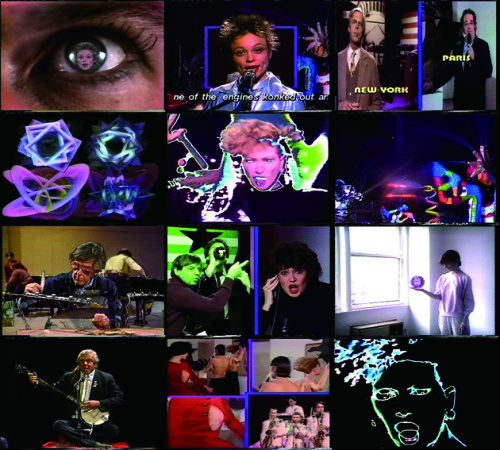
George Orwell’s sinister novel Nineteen Eighty-Four made it inevitable that the arrival of his eponymous year would be a media event. Decades after his death, Orwell made it onto the cover of Time magazine in late 1983, but on the big day itself—January 1, 1984—TV visionary Nam June Paik ushered in the year with an ambitious international video program called Good Morning, Mr. Orwell that was broadcast live simultaneously from New York (WNET public television), Paris, and San Francisco, with broadcasters in Germany and South Korea also carrying the transmissions if not contributing content.

According to Plimpton, Paik aptly referred to the project as a “global disco.” As the title suggested, Paik’s take on 1984 was considerably rosier than that of Orwell. In the spirit of Fluxus and/or technological optimism, as you please, Paik gathered a roster of artists with less inclination to lean on bleak themes such as Peter Gabriel, Laurie Anderson, John Cage, Allen Ginsberg, Merce Cunningham, Salvador Dalí, Oingo Boingo and many others for a stimulating showcase of art, music, theater, and video manipulation. One might imagine a band like DEVO being invited but it’s difficult to imagine Mark Mothersbaugh and Jerry Casale mustering up any enthusiasm for a project in which it was unironically asserted that technology is a boon to mankind.

The show was hosted by George Plimpton—the John Hodgman of his day, kind of—with assistance from the Centre Pompidou in Paris. In a move you can’t imagine happening today, Plimpton enthusiastically names the satellite—Bright Star—assisting with the remote sync-up. We would consider that akin to singling out the dedicated server permitting YouTube to bring you a video.

Among the performances: Gabriel and Anderson combine on a duet called “Excellent Birds”; a fitfully amusing comedy sketch called “Cavalcade of Intellectuals” in which a transatlantic discussion devolves into an interpersonal spat (a gag that worked better in Airplane! using airport PA announcers); a sprightly song by Yves Montand; John Cage plays “amplified cacti and plant materials” with a feather (so great); Oingo Boingo perform a song called “Wake Up (It’s 1984)”; Allen Ginsberg and Peter Orlovsky sing a little ditty about meditation to the cello stylings of Arthur Russell; and much more.


America’s Oligarchs Will Control 70% Of National Wealth By 2021

By Whitney Webb

Source: AntiMedia

America’s rich just won’t quit getting richer, according to a new study released in mid-June by the Boston Consulting Group (BCG), a global management consulting firm. The study, which seeks to analyze the global wealth management industry, as well as the evolution of private wealth, uncovered some startling statistics that suggest that global financial inequality will grow significantly by the year 2021.

The firm found that the already massive gap between the world’s wealthy elite – the approximately 18 million households that hold at least more than $1 million in assets – and everyone else is continuing to widen at a remarkable rate. The estimated 70 million people who make up these households were found to control 45 percent of the world’s $166.5 trillion in wealth. And in just four more years, it is estimated that they will control more than half of the world’s wealth, despite representing less than 1 percent of the world’s current population.

However, while rising inequality is a global phenomenon, it is especially pronounced in the United States. While wealth inequality in the U.S. is by no means an unknown phenomenon, the U.S. is significantly more unequal than most other countries, with the nation’s elite currently holding 63 percent of the private wealth. The U.S. elite’s share of national wealth is also growing much faster than the global average, with millionaires and billionaires expected to control an estimated 70 percent of the nation’s wealth by 2021.

The U.S.’ high wealth inequality largely owes to post-World War II government policies that have seen almost a quarter of all national income go to its wealthiest residents. Meanwhile, wages for the majority of Americans have remained stagnant for decades – in contrast to the richest Americans, their future economic outlook is incredibly bleak by comparison.

The U.S. is also home to more billionaires and millionaires than anywhere else in the world, which partly explains how U.S. policy has come to favor them over the years. According to Bloomberg, two out of five millionaires and billionaires live in the United States – and their ranks are growing.

While the world’s richest citizens may be pleased by the results of BCG’s recent study, there is plenty for them to be worried about if history is any indicator. Indeed, history shows that societies with drastic wealth inequality are much more unstable and more likely to experience drastic economic failure or outright societal collapse.

For instance, a 2014 study conducted by the National Socio-Environmental Synthesis Center noted that over-consumption and wealth inequality have occurred in the collapse of every civilization over the last 5,000 years. That same study also warned that rising inequality could easily lead to an unsustainable use of resources and the “irreversible collapse” of global industrial civilization.

This warning seems particularly prescient, given that wealth inequality in the U.S. is well above that of past civilizations that eventually collapsed as a result of these factors. For example, at the time of the collapse of the Roman Empire, the top 1 percent of the Roman elite controlled just 16 percent of the society’s wealth, a measly figure compared to the percentage commanded by the 1-percenters of the U.S.

While the BCG study paints a rosy picture for the world’s millionaires and billionaires, particularly in the United States, they should be gravely concerned that their growing accumulation of wealth could have drastic consequences – not just for those poorer than them, but for everyone.

Saturday Matinee: Rollerball (1975)

The Science Fiction of Rollerball Is Nothing Compared to the Facts of Real Life Control

By Rich Monetti

Source: Omni

If you’ve never seen Rollerball, stop what you’re doing and dial up the DVD for this 1975 Science Fiction Movie classic. Set in the year 2024, this dystopia puts Bread and Circuses on a violent whirlwind that’s engineered to keep the world’s corporate overlords out of the crosshairs. As such, revolving door heroes are amply provided and give the population cause to question the saccharin surroundings they live in. That is until each warrior meets their predetermined end and complacency has no other choice but to comply. Great Science Fiction but real control is so much easier.

Nonetheless, the backdrop of this dark world takes place after the “Corporate Wars” have bankrupted the world’s nations. In the void left behind, the corporations employ and govern. This leaves the public free of concerning themselves with important decisions, which are better left to “the few” in this standout among dystopian movies.

The Privileged Few

They also enjoy the privilege – even at the expense of Jonathan E. (James Caan). In the hero class of distraction, E. lost his wife to an executive who wanted her for himself.  Paid off to leave him, the accompanying villa in Rome was no match for the rugged, introspect of the world renowned figure.

In this, we are given the vehicle to dig into underbelly as we digest the glory of the game and all its bloodletting. Obviously discontented, Jonathan questions the tradeoff between the material preeminence his position affords and freedom. One of his hanger’s on who serves among the privilege Jonathan reaps doesn’t have such depth and toes the line the system forges like the mindless drone she is. “But comfort is freedom,” reasons Ella.

Enough of the citizenry bought off with nice things, the oversight does not even consider those who may reap much less, because this set up is sure to have losers on a far greater scale. This all sends E. off to determine how people have been so effectively siphoned off as sheep.

Information is Power

Expectedly, the information is scarce – or better yet – properly edited. Summaries of important works are readily available, and in case 24-7 of the game on telescreen gives way to inquiry, the overlords will reset any doubt in the comfort of your own easy chair.  “What do you want books for?,” Jonathan’s teammate, Moon Pie asks  “Look Johnny, if you wanna learn somethin’, just get a Corporate Teacher to come and teach it to ya’.

Jonathan defers and goes to Geneva to visit a computerized archive.  The prospects are quickly eradicated as the librarian is little help, and the system even less. Leaving E at a loss, the willing agent reveals that “the whole of the 13th Century is gone.”

All still escapes Ella with Jonathan coming to a crossroad. “Why don’t you do what the executives want – especially since you’ll be paid handsomely,” she doesn’t get it.

Specifically, they want him to retire. His survival defies the preset odds and disturbs the complacency. Or in chilling John Houseman-speak, the game was created to demonstrate “the futility of individuality.”

Real Control is much Easier

Your mind is officially blown. But a simple look at voter turnout or the tune out that hundreds of TV stations afford us and control takes on the form of despondency. Most significantly, a two party system in which the same elites support both sides, and the important decisions gives the many the illusion of choice.

Even so with the two party gaming clearly at our disposal, we are still sold on the stark differences, and coalesce into our corners over less substantial issues. So while we all don’t like American jobs shipped overseas of elite born trade policy, hate money in politics, the never ending improprieties of the big banks and inefficient delivery of healthcare, we are unable to find crossover or a leader able to unite across party lines.

Instead, our only common place involves a shared sense that the other side is mired in stupidity. This even as we see enough smarts among them that they are also able to navigate survival against such a stacked deck. Blinded by the many fictional divides, who really needs to pick up spilled guts or dislodged eyeballs when the powerlessness our elites have created is so much easier to clean up.

All the News That’s Fit to Print

Of course, the chance to narrow the divides can be a function of the availability of information. In the Science Fiction of Rollerball, this is diminished by keeping information controlled by offering tidbits or official accounts. But secrets only give rise to the desire to seek out what you’re not supposed to know.

It’s far more efficient to let people think they have a free press, and now with the internet and cable news, sources that rise to the top are the ones providing fictitious entertainment in place of facts.

In addition, the unseen hand of Google elevating disinformation now rivals the wall between advertising and content, which doesn’t really exist, and has always acted as editors to protect the elite.

Of course, we do have our distractions, and the cult-like mass following of the NFL can’t help but be seen as a parallel to Rollerball. The circus though is subtle and smarter than 2024.

Whoever has the most Toys

Putting aside violence on the decline, a no one left standing approach has been replaced with parity where everyone has a chance to win. Far more effective for viewership, and the Sunday, Monday, Thursday cascade plays right into the American consumerism that one ups Rollerball’s ability to feign comfort for the masses.  Or why give people stuff to keep them complacent when you can make them ever in pursuit of the next gadget that is sure to bring unending happiness.

As Brad Pitt says in Fight Club, “the things you own, they ending up owning you.” For example, when Apple outsources production to a Chinese factory where nets keep workers from jumping out the windows, stock options go a long way to allaying the guilt and getting you that Lexus you can’t do without.

But who knows, Rollerball might have emerged because people figured out how to beat the system, and the powerful went back to the basics that the Romans perfected.  Maybe, we should be content, and let the elites have their ball so they go don’t go home and take it with them.  You know, before they return with something worse, and we’re left rolling over dead instead of despondent.


Watch the full film here.

(To switch off subtitles, click the “cc” button on the bottom left corner of the video window.)