Recently rediscovered this old clipping from a weekly published sometime in the 90s. Perhaps less satirical than originally intended as it hits closer to home today.
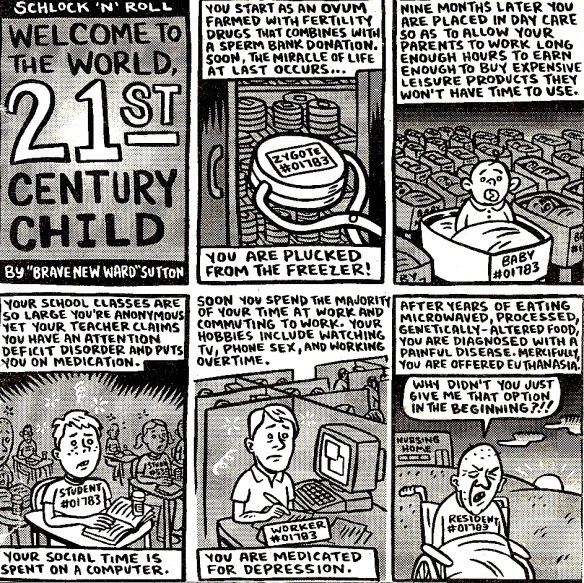

Recently rediscovered this old clipping from a weekly published sometime in the 90s. Perhaps less satirical than originally intended as it hits closer to home today.

“Land of the Blind” (2006) is a British-American political satire directed by Robert Edwards and starring Ralph Fiennes, Donald Sutherland, Tom Hollander and Lara Flynn Boyle. The story is set in an unnamed place and time where an idealistic soldier named Joe strikes up an illicit friendship with a political prisoner who involves him in a coup d’etat. But in the post-revolutionary world, Joe and his former friend have a bitter feud which escalates until Joe’s co-conspirators conclude they must erase him from history.

By Alfred McCoy
Source: The Unz Review
[This piece has been adapted and expanded from Alfred W. McCoy’s new book, In the Shadows of the American Century: The Rise and Decline of U.S. Global Power.]
Not quite a century ago, on January 7, 1929, newspaper readers across America were captivated by a brand-new comic strip, Buck Rogers in the 25th Century. It offered the country its first images of space-age death rays, atomic explosions, and inter-planetary travel.
“I was twenty years old,” World War I veteran Anthony “Buck” Rogers told readers in the very first strip, “surveying the lower levels of an abandoned mine near Pittsburgh… when suddenly… gas knocked me out. But I didn’t die. The peculiar gas… preserved me in suspended animation. Finally, another shifting of strata admitted fresh air and I revived.”
Staggering out of that mine, he finds himself in the 25th century surrounded by flying warriors shooting ray guns at each other. A Mongol spaceship overhead promptly spots him on its “television view plate” and fires its “disintegrator ray” at him. He’s saved from certain death by a flying woman warrior named Wilma who explains to him how this all came to be.
“Many years ago,” she says, “the Mongol Reds from the Gobi Desert conquered Asia from their great airships held aloft by gravity Repellor Rays. They destroyed Europe, then turned toward peace-loving America.” As their disintegrator beams boiled the oceans, annihilated the U.S. Navy, and demolished Washington, D.C. in just three hours, “government ceased to exist, and mobs, reduced to savagery, fought their way out of the cities to scatter and hide in the country. It was the death of a nation.” While the Mongols rebuilt 15 cities as centers of “super scientific magnificence” under their evil emperor, Americans led “hunted lives in the forests” until their “undying flame of freedom” led them to recapture “lost science” and “once more strike for freedom.”
After a year of such cartoons filled with the worst of early-twentieth-century Asian stereotypes, just as Wilma is clinging to the airship of the Mongol Viceroy as it speeds across the Pacific , a mysterious metallic orb appears high in the sky and fires death rays, sending the Mongol ship “hissing into the sea.” With her anti-gravity “inertron” belt, the intrepid Wilma dives safely into the waves only to have a giant metal arm shoot out from the mysterious orb and pull her on board to reveal — “Horrors! What strange beings!” — Martians!
With that strip, Buck Rogers in the 25th Century moved from Earth-bound combat against racialized Asians into space wars against monsters from other planets that, over the next 70 years, would take the strip into comic books, radio broadcasts, feature films, television serials, video games, and the country’s collective conscious. It would offer defining visions of space warfare for generations of Americans.
Back in the 21st Century
Now imagine us back in the 21st century. It’s 2030 and an American “triple canopy” of pervasive surveillance systems and armed drones already fills the heavens from the lower stratosphere to the exo-atmosphere. It can deliver its weaponry anywhere on the planet with staggering speed, knock out enemy satellite communications at a moment’s notice, or follow individuals biometrically for great distances. It’s a wonder of the modern age. Along with the country’s advanced cyberwar capacity, it’s also the most sophisticated military information system ever created and an insurance policy for global dominion deep into the twenty-first century.
That is, in fact, the future as the Pentagon imagines it and it’s actually under development, even though most Americans know little or nothing about it. They are still operating in another age, as was Mitt Romney during the 2012 presidential debates when he complained that “our Navy is smaller now than at any time since 1917.”
With words of withering mockery, President Obama shot back: “Well, Governor, we also have fewer horses and bayonets, because the nature of our military’s changed… the question is not a game of Battleship, where we’re counting ships. It’s what are our capabilities.” Obama then offered just a hint of what those capabilities might be: “We need to be thinking about cyber security. We need to be talking about space.”
Indeed, working in secrecy, the Obama administration was presiding over a revolution in defense planning, moving the nation far beyond bayonets and battleships to cyberwarfare and the future full-scale weaponization of space. From stratosphere to exosphere, the Pentagon is now producing an armada of fantastical new aerospace weapons worthy of Buck Rogers.
In 2009, building on advances in digital surveillance under the Bush administration, Obama launched the U.S. Cyber Command. Its headquarters were set up inside the National Security Agency (NSA) at Fort Meade, Maryland, and a cyberwar center staffed by 7,000 Air Force employees was established at Lackland Air Base in Texas. Two years later, the Pentagon moved beyond conventional combat on air, land, or sea to declare cyberspace both an offensive and defensive “operational domain.” In August, despite his wide-ranging attempt to purge the government of anything connected to Barack Obama’s “legacy,” President Trump implemented his predecessor’s long-delayed plan to separate that cyber command from the NSA in a bid to “strengthen our cyberspace operations.”
And what is all this technology being prepared for? In study after study, the intelligence community, the Pentagon, and related think tanks have been unanimous in identifying the main threat to future U.S. global hegemony as a rival power with an expanding economy, a strengthening military, and global ambitions: China, the home of those denizens of the Gobi Desert who would, in that old Buck Rogers fable, destroy Washington four centuries from now. Given that America’s economic preeminence is fading fast, breakthroughs in “information warfare” might indeed prove Washington’s best bet for extending its global hegemony further into this century — but don’t count on it, given the history of techno-weaponry in past wars.
Techno-Triumph in Vietnam
Ever since the Pentagon with its 17 miles of corridors was completed in 1943, that massive bureaucratic maze has presided over a creative fusion of science and industry that President Dwight Eisenhower would dub “the military-industrial complex” in his farewell address to the nation in 1961. “We can no longer risk emergency improvisation of national defense,” he told the American people. “We have been compelled to create a permanent armaments industry of vast proportions” sustained by a “technological revolution” that is “complex and costly.” As part of his own contribution to that complex, Eisenhower had overseen the creation of both the National Aeronautics and Space Administration, or NASA, and a “high-risk, high-gain” research unit called the Advanced Research Projects Agency, or ARPA, that later added the word “Defense” to its name and became DARPA.
For 70 years, this close alliance between the Pentagon and major defense contractors has produced an unbroken succession of “wonder weapons” that at least theoretically gave it a critical edge in all major military domains. Even when defeated or fought to a draw, as in Vietnam, Iraq, and Afghanistan, the Pentagon’s research matrix has demonstrated a recurring resilience that could turn disaster into further technological advance.
The Vietnam War, for example, was a thoroughgoing tactical failure, yet it would also prove a technological triumph for the military-industrial complex. Although most Americans remember only the Army’s soul-destroying ground combat in the villages of South Vietnam, the Air Force fought the biggest air war in military history there and, while it too failed dismally and destructively, it turned out to be a crucial testing ground for a revolution in robotic weaponry.
To stop truck convoys that the North Vietnamese were sending through southern Laos into South Vietnam, the Pentagon’s techno-wizards combined a network of sensors, computers, and aircraft in a coordinated electronic bombing campaign that, from 1968 to 1973, dropped more than a million tons of munitions — equal to the total tonnage for the whole Korean War — in that limited area. At a cost of $800 million a year, Operation Igloo White laced that narrow mountain corridor with 20,000 acoustic, seismic, and thermal sensors that sent signals to four EC-121 communications aircraft circling ceaselessly overhead.
At a U.S. air base just across the Mekong River in Thailand, Task Force Alpha deployed two powerful IBM 360/65 mainframe computers, equipped with history’s first visual display monitors, to translate all those sensor signals into “an illuminated line of light” and so launch jet fighters over the Ho Chi Minh Trail where computers discharged laser-guided bombs automatically. Bristling with antennae and filled with the latest computers, its massive concrete bunker seemed, at the time, a futuristic marvel to a visiting Pentagon official who spoke rapturously about “being swept up in the beauty and majesty of the Task Force Alpha temple.”
However, after more than 100,000 North Vietnamese troops with tanks, trucks, and artillery somehow moved through that sensor field undetected for a massive offensive in 1972, the Air Force had to admit that its $6 billion “electronic battlefield” was an unqualified failure. Yet that same bombing campaign would prove to be the first crude step toward a future electronic battlefield for unmanned robotic warfare.
In the pressure cooker of history’s largest air war, the Air Force also transformed an old weapon, the “Firebee” target drone, into a new technology that would rise to significance three decades later. By 1972, the Air Force could send an “SC/TV” drone, equipped with a camera in its nose, up to 2,400 miles across communist China or North Vietnam while controlling it via a low-resolution television image. The Air Force also made aviation history by test firing the first missile from one of those drones.
The air war in Vietnam was also an impetus for the development of the Pentagon’s global telecommunications satellite system, another important first. After the Initial Defense Satellite Communications System launched seven orbital satellites in 1966, ground terminals in Vietnam started transmitting high-resolution aerial surveillance photos to Washington — something NASA called a “revolutionary development.” Those images proved so useful that the Pentagon quickly launched an additional 21 satellites and soon had the first system that could communicate from anywhere on the globe. Today, according to an Air Force website, the third phase of that system provides secure command, control, and communications for “the Army’s ground mobile forces, the Air Force’s airborne terminals, Navy ships at sea, the White House Communications Agency, the State Department, and special users” like the CIA and NSA.
At great cost, the Vietnam War marked a watershed in Washington’s global information architecture. Turning defeat into innovation, the Air Force had developed the key components — satellite communications, remote sensing, computer-triggered bombing, and unmanned aircraft — that would merge 40 years later into a new system of robotic warfare.
The War on Terror
Facing another set of defeats in Afghanistan and Iraq, the twenty-first-century Pentagon again accelerated the development of new military technologies. After six years of failing counterinsurgency campaigns in both countries, the Pentagon discovered the power of biometric identification and electronic surveillance to help pacify sprawling urban areas. And when President Obama later conducted his troop “surge” in Afghanistan, that country became a frontier for testing and perfecting drone warfare.
Launched as an experimental aircraft in 1994, the Predator drone was deployed in the Balkans that very year for photo-reconnaissance. In 2000, it was adapted for real-time surveillance under the CIA’s Operation Afghan Eyes. It would be armed with the tank-killing Hellfire missile for the agency’s first lethal strike in Kandahar, Afghanistan, in October 2001. Seven years later, the Air Force introduced the larger MQ-9 “Reaper” drone with a flying range of 1,150 miles when fully loaded with Hellfire missiles and GBU-30 bombs, allowing it to strike targets almost anywhere in Europe, Africa, or Asia. To fulfill its expanding mission as Washington’s global assassin, the Air Force plans to have 346 Reapers in service by 2021, including 80 for the CIA.
Between 2004 and 2010, total flying time for all unmanned aerial vehicles rose sharply from just 71 hours to 250,000 hours. By 2011, there were already 7,000 drones in a growing U.S. armada of unmanned aircraft. So central had they become to its military power that the Pentagon was planning to spend $40 billion to expand their numbers by 35% over the following decade. To service all this growth, the Air Force was training 350 drone pilots, more than all its bomber and fighter pilots combined.
Miniature or monstrous, hand-held or runway-launched, drones were becoming so commonplace and so critical for so many military missions that they emerged from the war on terror as one of America’s wonder weapons for preserving its global power. Yet the striking innovations in drone warfare are, in the long run, likely to be overshadowed by stunning aerospace advances in the stratosphere and exosphere.
The Pentagon’s Triple Canopy
As in Vietnam, despite bitter reverses on the ground in Iraq and Afghanistan, Washington’s recent wars have been catalysts for the fusion of aerospace, cyberspace, and artificial intelligence into a new military regime of robotic warfare.
To effect this technological transformation, starting in 2009 the Pentagon planned to spend $55 billion annually to develop robotics for a data-dense interface of space, cyberspace, and terrestrial battle space. Through an annual allocation for new technologies reaching $18 billion in 2016, the Pentagon had, according to the New York Times, “put artificial intelligence at the center of its strategy to maintain the United States’ position as the world’s dominant military power,” exemplified by future drones that will be capable of identifying and eliminating enemy targets without recourse to human overseers. By 2025, the United States will likely deploy advanced aerospace and cyberwarfare to envelop the planet in a robotic matrix theoretically capable of blinding entire armies or atomizing an individual insurgent.
During 15 years of nearly limitless military budgets for the war on terror, DARPA has spent billions of dollars trying to develop new weapons systems worthy of Buck Rogers that usually die on the drawing board or end in spectacular crashes. Through this astronomically costly process of trial and error, Pentagon planners seem to have come to the slow realization that established systems, particularly drones and satellites, could in combination create an effective aerospace architecture.
Within a decade, the Pentagon apparently hopes to patrol the entire planet ceaselessly via a triple-canopy aerospace shield that would reach from sky to space and be secured by an armada of drones with lethal missiles and Argus-eyed sensors, monitored through an electronic matrix and controlled by robotic systems. It’s even possible to take you on a tour of the super-secret realm where future space wars will be fought, if the Pentagon’s dreams become reality, by exploring both DARPA websites and those of its various defense contractors.
Drones in the Lower Stratosphere
At the bottom tier of this emerging aerospace shield in the lower stratosphere (about 30,000 to 60,000 feet high), the Pentagon is working with defense contractors to develop high-altitude drones that will replace manned aircraft. To supersede the manned U-2 surveillance aircraft, for instance, the Pentagon has been preparing a projected armada of 99 Global Hawk drones at a mind-boggling cost of $223 million each, seven times the price of the current Reaper model. Its extended 116-foot wingspan (bigger than that of a Boeing 737) is geared to operating at 60,000 feet. Each Global Hawk is equipped with high-resolution cameras, advanced electronic sensors, and efficient engines for a continuous 32-hour flight, which means that it can potentially survey up to 40,000 square miles of the planet’s surface daily. With its enormous bandwidth needed to bounce a torrent of audio-visual data between satellites and ground stations, however, the Global Hawk, like other long-distance drones in America’s armada, may prove vulnerable to a hostile hack attack in some future conflict.
The sophistication, and limitations, of this developing aerospace technology were exposed in December 2011 when an advanced RQ-170 Sentinel drone suddenly landed in Iran, whose officials then released photos of its dart-shaped, 65-foot wingspan meant for flights up to 50,000 feet. Under a highly classified “black” contract, Lockheed Martin had built 20 of these espionage drones at a cost of about $200 million with radar-evading stealth and advanced optics that were meant to provide “surveillance support to forward-deployed combat forces.”
So what was this super-secret drone doing in hostile Iran? By simply jamming its GPS navigation system, whose signals are notoriously susceptible to hacking, Iranian engineers took control of the drone and landed it at a local base of theirs with the same elevation as its home field in neighboring Afghanistan. Although Washington first denied the capture, the event sent shock waves down the Pentagon’s endless corridors.
In the aftermath of this debacle, the Defense Department worked with one of its top contractors, Northrop Grumman, to accelerate development of its super-stealth RQ-180 drone with an enormous 130-foot wingspan, an extended range of 1,200 miles, and 24 hours of flying time. Its record cost, $300 million a plane, could be thought of as inaugurating a new era of lavishly expensive war-fighting drones.
Simultaneously, the Navy’s dart-shaped X-47B surveillance and strike drone has proven capable both of in-flight refueling and of carrying up to 4,000 pounds of bombs or missiles. Three years after it passed its most crucial test by a joy-stick landing on the deck of an aircraft carrier, the USS George H.W. Bush in July 2013, the Navy announced that this experimental drone would enter service sometime after 2020 as the “MQ-25 Stingray” aircraft.
Dominating the Upper Stratosphere
To dominate the higher altitudes of the upper stratosphere (about 70,000 to 160,000 feet), the Pentagon has pushed its contractors to the technological edge, spending billions of dollars on experimentation with fanciful, futuristic aircraft.
For more than 20 years, DARPA pursued the dream of a globe-girding armada of solar-powered drones that could fly ceaselessly at 90,000 feet and would serve as the equivalent of low-flying satellites, that is, as platforms for surveillance intercepts or signals transmission. With an arching 250-foot wingspan covered with ultra-light solar panels, the “Helios” drone achieved a world-record altitude of 98,000 feet in 2001 before breaking up in a spectacular crash two years later. Nonetheless, DARPA launched the ambitious “Vulture” project in 2008 to build solar-powered aircraft with hugewingspans of 300 to 500 feet capable of ceaseless flight at 90,000 feet for five years at a time. After DARPA abandoned the project as impractical in 2012, Google and Facebook took over the technology with the goal of building future platforms for their customers’ Internet connections.
Since 2003, both DARPA and the Air Force have struggled to shatter the barrier for suborbital speeds by developing the dart-shaped Falcon Hypersonic Cruise Vehicle. Flying at an altitude of 100,000 feet, it was expected to “deliver 12,000 pounds of payload at a distance of 9,000 nautical miles from the continental United States in less than two hours.” Although the first test launches in 2010 and 2011 crashed in midflight, they did briefly reach an amazing 13,000 miles per hour, 22 times the speed of sound.
As often happens, failure produced progress. In the wake of the Falcon’s crashes, DARPA has applied its hypersonics to develop a missile capable of penetrating China’s air-defenses at an altitude of 70,000 feet and a speed of Mach 5 (about 3,300 miles per hour).
Simultaneously, Lockheed’s secret “Skunk Works” experimental unit is using the hypersonic technology to develop the SR-72 unmanned surveillance aircraft as a successor to its SR-71 Blackbird, the world’s fastest manned aircraft. When operational by 2030, the SR-72 is supposed to fly at about 4,500 mph, double the speed of its manned predecessor, with an extreme stealth fuselage making it undetectable as it crosses any continent in an hour at 80,000 feet scooping up electronic intelligence.
Space Wars in the Exosphere
In the exosphere, 200 miles above Earth, the age of space warfare dawned in April 2010 when the Defense Department launched the robotic X-37B spacecraft, just 29 feet long, into orbit for a seven-month mission. By removing pilots and their costly life-support systems, the Air Force’s secretive Rapid Capabilities Office had created a miniaturized, militarized space drone with thrusters to elude missile attacks and a cargo bay for possible air-to-air missiles. By the time the second X-37B prototype landed in June 2012, its flawless 15-month flight had established the viability of “robotically controlled reusable spacecraft.”
In the exosphere where these space drones will someday roam, orbital satellites will be the prime targets in any future world war. The vulnerability of U.S. satellite systems became obvious in 2007 when China used a ground-to-air missile to shoot down one of its own satellites in orbit 500 miles above the Earth. A year later, the Pentagon accomplished the same feat, firing an SM-3 missile from a Navy cruiser to score a direct hit on a U.S. satellite 150 miles high.
Unsuccessful in developing an advanced F-6 satellite, despite spending over $200 million in an attempt to split the module into more resilient microwave-linked components, the Pentagon has opted instead to upgrade its more conventional single-module satellites, such as the Navy’s five interconnected Mobile User Objective Systems (MUOS) satellites. These were launched between 2013 and 2016 into geostationary orbits for communications with aircraft, ships, and motorized infantry.
Reflecting its role as a player in the preparation for future and futuristic wars, the Joint Functional Component Command for Space, established in 2006, operates the Space Surveillance Network. To prevent a high-altitude attack on America, this worldwide system of radar and telescopes in 29 remote locations like Ascension Island and Kwajalein Atoll makes about 400,000 observations daily, monitoring every object in the skies.
The Future of Wonder Weapons
By the mid-2020s, if the military’s dreams are realized, the Pentagon’s triple-canopy shield should be able to atomize a single “terrorist” with a missile strike or, with equal ease, blind an entire army by knocking out all of its ground communications, avionics, and naval navigation. It’s a system that, were it to work as imagined, just might allow the United States a diplomatic veto of global lethality, an equalizer for any further loss of international influence.
But as in Vietnam, where aerospace wonders could not prevent a searing defeat, history offers some harsh lessons when it comes to technology trumping insurgencies, no less the fusion of forces (diplomatic, economic, and military) whose sum is geopolitical power. After all, the Third Reich failed to win World War II even though it had amazingly advanced “wonder weapons,” including the devastating V-2 missile, the unstoppable Me-262 jet fighter, and the ship-killing Hs-293 guided missile.
Washington’s dogged reliance on and faith in military technology to maintain its hegemony will certainly guarantee endless combat operations with uncertain outcomes in the forever war against terrorists along the ragged edge of Asia and Africa and incessant future low-level aggression in space and cyberspace. Someday, it may even lead to armed conflict with rivals China and Russia.
Whether the Pentagon’s robotic weapon systems will offer the U.S. an extended lease on global hegemony or prove a fantasy plucked from the frames of a Buck Rogers comic book, only the future can tell. Whether, in that moment to come, America will play the role of the indomitable Buck Rogers or the Martians he eventually defeated is another question worth asking. One thing is likely, however: that future is coming far more quickly and possibly far more painfully than any of us might imagine.

By Julianne Tveten
Source: The Baffler
EARLIER THIS YEAR IN SILICON VALLEY, a phalanx of six-figure-earning Facebook engineers confronted Mark Zuckerberg about subsidizing their extortionate rents. Meanwhile, the contract laborers who serve them bacon kimchi dogs and duck confit found themselves cordoned off from the affordable housing market—where salaries approaching $74,000 qualify—and began converting their garages into homes. Still, if these events point to a dire situation, they’re but the latest stirrings of the hulking leviathan that is the region’s housing crisis—an issue that has peppered the headlines of news outlets great and small for nearly a decade.
Thanks in part to this accretion of bad press, Zuckerberg and his fellow cyborgian billionaires have sprung into action as property developers. In July, Facebook announced plans to create “Willow Campus,” an aggressively rectilinear, Rem Koolhaas-designed rebrand of a Menlo Park office complex it purchased in 2015. The expansion of its headquarters will boast fifteen hundred units of housing, 15 percent of which it claims will be “offered at below-market rates.” If that isn’t sufficiently microcosmic, the company promises to dedicate 125,000 square feet to commercial space, promising a grocery store, pharmacy, and the cryptically worded “additional community-facing retail.”
Equally if not more responsible for crafting California’s bloodsucking geometric crapscape is Google, whose newfangled parent company Alphabet has vowed to provide temporary housing, in the form of modular dwellings, for three hundred of its employees in its home city of Mountain View. For years, Google has been seeking to wrest control of the city from its government; last year, it gained over 370,000 square feet of office space along with the right to develop 1.4 million square feet in the North Bayshore neighborhood after vying with LinkedIn to furnish the territory with a new police station, road improvements, and college scholarships. (The modular homes will be constructed on a former NASA air base, which the company signed an agreement to lease for sixty years.)
We’re witnessing, in these schemes, a revival of the company town. An oft-recurring feature of the Western capitalist imaginary, the company town’s American variety dates back to the nineteenth century; railroad industrialist George Pullman’s eponymous city in Illinois provides one of the more illustrative examples. Pullman characterized his town, completed in 1884, as a lucrative, pro-business utopia filled with satisfied participants, employee and investor alike. Its veneer was indeed shiny: the amenities it promised—yards, indoor plumbing, gas, trash removal—were rare for industrial workers of the time, and its ultra-formal gardens and shopping center, which equipped them with a barbershop, dentist’s offices, a bank, and a slew of overpriced retail, offered a vanguard capitalist’s dabbling in luxury.
There was a catch: paternalistic and omnipresent capitalism. Immaculately manicured trees were merely curtains obscuring a panopticon, one that kept workers behaviorally economized. (White workers, that is—the town expressly excluded black people.) “[Pullman] wanted to create a company town where everybody would be . . . content with their place in the capitalist system,” Jane Eva Baxter explained to Paleofuture. Workers were forced to rent—with no option to buy—the uniform row houses that corralled them, and from which they worried over persistent inspection and imminent eviction. Their employers likewise controlled which books filled their libraries and which performances took place in their theaters, and a ban precluded them from congregating at saloons or holding town meetings unless sanctioned by the Pullman Company, lest they entertain the notion of unionizing.
The forced exchange not just of labor, but of personal autonomy, for the tenuous ability to buy bread or light one’s stove is, in a word, inhumane, and in three, cause for revolt. Pullman workers had organized several strikes throughout the 1880s, but none were so monumental as the one in 1894. In response to the prior year’s economic depression, Pullman opted to slash workers’ wages; rents, however, remained steadfastly fixed, enriching the company’s reported worth of $62 million while leaving workers with as little as two cents (after paying for housing costs). In partnership with the American Railway Union, four thousand Pullman workers, galvanized and desperate, withheld their labor, and legions of workers throughout the nation would soon join them. Yet the strike collapsed when the Cleveland administration, in a violent display of authoritarianism, deployed federal troops and imprisoned labor leaders. Not long after, by Illinois Supreme Court order, the town was forced to sell everything not used expressly for “industry.”
Still, Pullman’s fiasco didn’t discourage other magnates. In 1900, chocolatier Milton Hershey began construction on a factory complex near a collection of dairy farms in rural Pennsylvania, where he declared there’d be “no poverty, no nuisances, no evil”—a Delphic precursor to Google’s now infamous and defunct slogan, “Don’t be evil.” To attract workers, Hershey reclaimed many of Pullman’s gilded comforts: indoor plumbing, pristine lawns, central heating, garbage pickup, and eventually, the theaters and sports venues any company town worth its salt would host.
What was designed as a wholesome advertisement for the company quickly morphed into a miserly surveillance state. Hershey, who served as the town’s mayor, constable, and fire chief, patrolled neighborhoods to survey the maintenance of houses and hired private detectives to monitor employees’ after-hours alcohol consumption. While the town managed to stage a sort of idyllic capitalist performance for onlookers, by the 1930s its employees resented their binding environs and the Depression-era layoffs they endured from a company earning ten times its annual payroll in after-tax profits. A crippled attempt to unionize with the Congress of Industrial Organizations (CIO) bred a 1937 sit-down strike; days later, farmers and company cheerleaders armed with rocks and pitchforks bloodied and ejected the dissidents, destabilizing for good another corporate-civic lark. Hershey’s vast estate, however, remains unscathed to this day.
If Facebook and Google have begun to revive the company town, Amazon has already given it a futuristic luster. California’s inchoate company towns pale in comparison to their northern counterpart, which occupies 19 percent of Seattle’s office space and a farcical 8.1 million square feet. (Its CEO and founder, Jeff Bezos, has vowed to acquire four million more over the next five years, a muscular move meant to complement his midlife-crisis physique.) Touting its sponsorship of local engineering and sustainability programs, Amazon crows about such “investments” as its dog park, playing fields, art installations, and Buckyball-reminiscent domical gardens. Of course, with Bezos’s colonizing aspirations comes yet another bellicose rental market—the very conditions Facebook and Google claim to be combatting. When considered alongside its recent purchase of Whole Foods, Amazon’s dream of tethering its employees to their jobs—by way of homogenized cubes for rent and lightly discounted quinoa chips—is fast becoming a reality.
Like George Pullman and Milton Hershey, the tech industry’s elites take all prisoners in their respective campaigns to expand, absorb, and dominate. The tech company town, that most contemporary of neofeudalist wangles, is the next step in West Coast corporate behemoths’ quest to lure employees into a twenty-four-hour working existence—the totalizing successor to bottomless Indian food spreads, on-site bike-repair shops, and Frank Gehrized habitats. Its premise deviates not at all from that of its antecedents: a genial, painstakingly aestheticized service to workers, where beneficent corporate hands take the reins of the public good for the well-being of the community. This time around, though, that community will be bridled with union–busting and data-harvesting apparatuses sure to make even the most paranoid techno-tyrant salivate.
Certainly, the megalomaniacs who aim to populate municipal fixtures with registered-trademark logos will expect cities to genuflect at every turn. Bezos has exemplified this in Seattle, whose recent measure to “tax the rich” drove him to seek another location in which to build Amazon’s second headquarters. While residents of its hometown grapple with a commandeering leech that “suck[s] up our resources and refus[es] to participate in daily upkeep,” Amazon will soon attempt to prime another city to be sapped. Meanwhile, the smooth-faced metallic vampires of California have just begun to cosplay as frontiersmen, raring to follow Bezos’s lead. Drunk on glib TED Talk propagandizing, and accustomed to dismissing the civic inconveniences of corporate regulations and poor neighborhoods, our technosettlers feel little need to heed the lessons of the past when their chief interest is to monopolize the future. Taxing the techie billionaires is a start, but only when cities refuse to be their hosts will they cease to be their parasites.

By Jason Hirthler
Source: CounterPunch
The grand experiment with western democracy, badly listing thanks to broadsides from profiteering oligarchs, may finally run ashore on the rocks of thought crime. In the uneven Steven Spielberg project Minority Report, starring excitable scientologist Tom Cruise, Cruise plays a futuristic policeman who investigates pre-crimes and stops them before they happen. The police owe their ability to see the criminal plots developing to characters called pre-cognitives, or pre-cogs, kind of autistic prophets who see the future and lie sleeping in sterile pools of water inside the police department. Of course, it turns out that precogs can pre-visualize different futures, a hastily hidden flaw that threatens to jeopardize the profits of the pre-crime project. Here is the crux of the story: thought control is driven by a profit motive at bottom. As it turns out, just like real life.
Now, the British government has decided to prosecute pre-crime but has done away with the clunky plot device of the pre-cogs, opting rather to rely on a hazy sense of higher probability to justify surveilling, nabbing, convicting, and imprisoning British citizens. The crime? Looking at radical content on the Internet. What is considered radical will naturally be defined by the state police who will doubtless be personally incentivized by pre-crime quotas, and institutionally shaped to criminalize trains of thought that threaten to destabilize a criminal status quo. You know, the unregulated monopoly capitalist regime that cuts wages, costs, and all other forms of overhead with psychopathic glee. Even a Grenfell Towers disaster is regarded more as a question of how to remove the story from public consciousness than rectify its wrongs.
The Triple Evils
Martin Luther King, Jr. famously, or infamously, depending on whether you are a penthouse mandarin or garden-variety prole, linked the triple evils of poverty, racism, and militarism. These evils are as yet unaddressed in our society, as we are daily shown on the media mouthpieces of imperial capitalism. Wars must be waged. Victims of social injustice must be incarcerated. Society itself must be made poor to ensure higher profits.
Yet there is another set of evils that are primarily used to mask the original trifecta outlined by King. In fact, the connection between propaganda, surveillance, and censorship is clear and inseparable. Take as your initial premise that imperial capitalists want to control the world. Not an unjustified claim. As an imperial capitalist, you are part of a privileged minority whose objective is to further exploit the disenfranchised whose only recourse is the resources you are pillaging. War, be it with bombs or sanctions or special forces or proxies, is immensely profitable to the capitalists. Arms makers make money. Chemical companies make money. Energy companies make money. Media companies make money. Presidents not only make money, they also make history. But the workers, the poor, and the downtrodden pay the price. That’s why they won’t be happy to hear of your plans. Therefore, they must be lied to, lied to so convincingly and comprehensively that they accept, without a second thought, the plans you have laid out before them.
This convincing requires three decisive actions: propaganda, surveillance, and censorship. The first is the official lie you craft to convince them to believe you. The second is the dragnet of digital observation by which you assess whether or not they do believe you. The third is the coercive methods by which you punish those that don’t believe you (justified by the imperial tale you first wove).
The official interpretation of reality is already in place: western civilization is beset on all sides by maniacs that want to take away our freedoms. The surveillance is already in place through programs like the Five Eyes alliance and ECHELON, PRISM, Boundless Informant, FISA, Stellar Wind, and many others. What remains is to tighten the noose of censorship around the neck of our open western societies.
Idiots Abroad
To that end, British Home Secretary Amber Rudd recently announced that citizens that view too much extremist material online could face up to 15 years in jail. Rudd related,
“I want to make sure those who view despicable terrorist content online, including jihadi websites, far-right propaganda and bomb-making instructions, face the full force of the law.”
This flaxen cipher of totalitarian control opened by tabulating some 67,000 tweets by ISIS, along with 44,000 links to ISIS propaganda, had been generated in the last year. Already, Section 58 of the Terrorist Act 2000 criminalized the possession of information that might be useful to a terrorist. But this is not enough for 10 Downing Street. Rudd is taking that law of possession and expanding it into a law of perception. It is now enough to simply watch extremist content. You needn’t download it, distribute it, or otherwise act on it. You need only see it more than once. At that point, by Rudd’s surely flawlessly calculated probabilities, you have become an existential threat to the state, or rather, to national security. You are more likely to commit acts of terror than those who have not seen the extremist content. Pre-crime without the pre-cogs.
But Rudd’s was another step in a long line of encroachments peddled by fascist-minded western governments. Theresa May, the reviled Thatcherite epigone, wants to play a paternal role in preventing citizens from even having the chance to view extremist content. The Tory manifesto tells us, “Some people say that it is not for government to regulate when it comes to technology and the internet. We disagree.” Britain plans, quite proudly it seems, to become the “global leader” in the regulation of the Internet. Just before these announcements were made, Britain had passed the Investigatory Powers Act, which lets the government sweep up user browsing histories. So the surveillance data authorities would use to implement Rudd’s plan is already there. Want to read that eloquent jeremiad against the Tories? Sorry, that was just labeled hate speech. Want to visit your favorite leftist forum? Apologies, mate, but that was deemed a “safe space” for extremist speech and shut down. Want to watch some attractive young people copulate? No problem. Just submit a request to your local minister outlining your precise reasons for wanting access to such nominally proscribed content. Otherwise, forget it.
The Germans aren’t far behind. The so-called Network Enforcement Act is said to create a framework for managing Internet activity, particularly in social media. The act is part of the country’s fake fight against fake news and hate speech, or rather its quite real fight against progressive, leftist, or communist thought and expression. This law demands, on pain of a fifty million euro penalty, that companies with two million or more web visitors must, on receipt of complaint, remove “unlawful content” from their sites. Facebook has opened a new data center in Germany to deal with removal requests, sure to be flooding in from the Bundestag. As the World Socialist Web Sitemakes clear, if your fake news promotes war (Iraq 2003), mischaracterizes coup d’états (Ukraine 2014), or spreads anti-immigrant hysteria (Cologne 2015), then you’ve got nothing to fear. Of course, it falls to the government itself to decide what is and what isn’t extremist content, no doubt a comforting thought for myriad Der Spiegel loyalists. And, of course, the erstwhile European Commission, destroyer of Greece and perpetrator of other ills, has published guidelines to help member states remove “illegal” content. Even the Russians have joined in, promoting legislation designed to curtail digital freedoms.
Stateside Schlemiels
None of this would be news to Barack Obama, whose own legacy of crumpled writs of habeas corpus, worthless privacy platitudes, and high-altitude wetwork, sits like a canker on the body politic. On his way out the door, through the turnstile of public weal into private gain, he provided the deep state with millions of dollars when he added the Countering Disinformation and Propaganda Act to the annual National Defense Authorization Act (NDAA), which consecrates black budgets, cost overruns, price gouging, and all other manner of insecurity practiced by the Pentagon and its parasitic defense contractor community. The CDPA, if that’s how it will eventually be known, will effectively pay people to generate officially sanctioned narratives. The U.S. government is fighting fact by calling it propaganda and then producing its own propaganda and calling it fact.
Thanks in part to pressure from Congressional Senate Intelligence Committee that, and the indefatigable efforts of Democrats Adam Schiff and Mark Warner, major brands have been hopping on the clanging tumbrel of Russiagate, as it wheels unsteadily through the digital space, collecting the corpses of freethinkers. Facebook is now blocking “fake news” from its ads. YouTube has begun to fetter content producers with a more restrictive ad network and murky review policies. Google has tweaked its algorithm to keep “fake news” from surfacing high in Search Engine Results Pages, or SERPS. What precisely constitutes fake news is evidently up to the Zuckerbergs and Schmidts of the world. For Google, it has decidedly meant suppressing progressive and left-wing content, as plummeting traffic numbers have indicated. Of course, it won’t mean suppressing the fake news produced by the CIA or Mi5 or the standard state-fluffing smorgasbord of lies, deceits and hit jobs offered up by the so-called mainstream media.
The always sharp Glen Ford at Black Agenda Report writes that the FBI has created a fresh construct to deal with African-American unrest, called, “Black Identity Extremism,” already truncated into another mind-murdering acronym, BIE. (As though an acronym adds just the note of tenability required to pass off a fatuity on a mal-educated populace.) Foreign Policy, in an otherwise surprisingly liberal-minded story, suggests the construct risks reviving the racism the agency has worked so hard to overcome. Ford drily notes the overlooked matter of J. Edgar Hoover targeting blacks since the 1920s, not to mention COINTELPRO and attacks on the Black Panthers. Regardless, in the eyes of the FBI, blacks angry about police abuses, persistent economic inequalities, and the New Jim Crow, are little more than “identity extremists,” a danger to national security, notably the security of the white plutocracy which it serves.
(Fore) Closing Thoughts
Remember that much of this apparatus of thought control has been applied beneath the banner of the fake Russia hacking story. That story, created by the Clinton camp to distract from the DNC email revelations provided by WikiLeaks, at first blamed Russia for hacking into “our democracy”, then suggested Donald Trump had colluded with Russia to swing the election, and then emphasized that Russia had launched an “influence campaign” designed to swing the election, with the focus subtly shifting from hacking to collusion to influence. At each turn, the evidence proves paltry, the claims absurd, and the virtue signaling nauseating. The bar is being progressively lowered until it meets a threshold of credibility by which the Senate Intel Committee can prosecute Donald Trump or justify some sort of punitive measures against Russia.
The story is so transparently false, from the technical detail to the geopolitical motive, that it is only sustained by the permanent—or deep state—elements of the foreign policy community that need a means by which to control and direct the Trump administration. Russia collusion served as an ideal pretext to force Trump away from campaign-trail odes to conciliation and toward a continuation of the hostile foreign policies glibly enabled and advanced by Barack Obama. The comedy of it all is that Facebook found ‘incriminating’ ads that amounted to less than one percent of the Facebook total ad buys. Congress would like to ban RT, which has ratings that are 0.3 percent of Judge Judy’s. And the infamous hack has been shown to be a leak. What are we left with? A grandiose deceit based on a need to sustain a brutal ideology of oppression, austerity, and war.
But this is how the imperialists do it. They organize globally to oppress locally. That’s why they’ve been rightly rebranded as ‘the globalists’. The workers always trail behind, left to cope with recently discovered alliances of institutional powers collaborating to fence in the prospects for economic equality, social justice, and the fair distribution of a nation’s wealth. We find ourselves beneath the a pregnant cloud of metastasizing repression, conceived and constructed beneath our own gaze. In his recent novel Purity, one of author Jonathan Franzen’s characters, a famous East German exile and whistleblower extraordinaire (a more charismatic Assange), finds himself a global celebrity, the subject of countless interviews wherein,
“…he’d taken to dropping the word totalitarian. Younger interviewers, to whom the word meant total surveillance, total mind control, gray armies in parade with medium-range missiles, had understood him to be saying something unfair about the Internet. In fact, he simply meant a system that was impossible to opt out of.”
Whether it is too late for a world of working class people and the ubiquitous poor to opt out of the globalized imperium dreamed up by our post-war planners, is hard to say. But if you think there’s still time, be extremely careful, since the pre-crime police are nearly omnipresent, and they might overhear you quoting Marx or see you scrawling ideas about redistribution on the walls of some abandoned underpass. Just imagine some future advertisement for the pre-crime program, a glistening LCD ad floating between skyscrapers, a smiling family at play, a nation secure, and an omniscient narrator softly reminding you, “Don’t forget—it’s the thought that counts.”

By James Bridle
Source: Medium
As someone who grew up on the internet, I credit it as one of the most important influences on who I am today. I had a computer with internet access in my bedroom from the age of 13. It gave me access to a lot of things which were totally inappropriate for a young teenager, but it was OK. The culture, politics, and interpersonal relationships which I consider to be central to my identity were shaped by the internet, in ways that I have always considered to be beneficial to me personally. I have always been a critical proponent of the internet and everything it has brought, and broadly considered it to be emancipatory and beneficial. I state this at the outset because thinking through the implications of the problem I am going to describe troubles my own assumptions and prejudices in significant ways.
One of the thus-far hypothetical questions I ask myself frequently is how I would feel about my own children having the same kind of access to the internet today. And I find the question increasingly difficult to answer. I understand that this is a natural evolution of attitudes which happens with age, and at some point this question might be a lot less hypothetical. I don’t want to be a hypocrite about it. I would want my kids to have the same opportunities to explore and grow and express themselves as I did. I would like them to have that choice. And this belief broadens into attitudes about the role of the internet in public life as whole.
I’ve also been aware for some time of the increasingly symbiotic relationship between younger children and YouTube. I see kids engrossed in screens all the time, in pushchairs and in restaurants, and there’s always a bit of a Luddite twinge there, but I am not a parent, and I’m not making parental judgments for or on anyone else. I’ve seen family members and friend’s children plugged into Peppa Pig and nursery rhyme videos, and it makes them happy and gives everyone a break, so OK.
But I don’t even have kids and right now I just want to burn the whole thing down.
Someone or something or some combination of people and things is using YouTube to systematically frighten, traumatise, and abuse children, automatically and at scale, and it forces me to question my own beliefs about the internet, at every level. Much of what I am going to describe next has been covered elsewhere, although none of the mainstream coverage I’ve seen has really grasped the implications of what seems to be occurring.
To begin: Kid’s YouTube is definitely and markedly weird. I’ve been aware of its weirdness for some time. Last year, there were a number of articles posted about the Surprise Egg craze. Surprise Eggs videos depict, often at excruciating length, the process of unwrapping Kinder and other egg toys. That’s it, but kids are captivated by them. There are thousands and thousands of these videos and thousands and thousands, if not millions, of children watching them.
From the article linked above:
The maker of my particular favorite videos is “Blu Toys Surprise Brinquedos & Juegos,” and since 2010 he seems to have accrued 3.7 million subscribers and just under 6 billion views for a kid-friendly channel entirely devoted to opening surprise eggs and unboxing toys. The video titles are a continuous pattern of obscure branded lines and tie-ins: “Surprise Play Doh Eggs Peppa Pig Stamper Cars Pocoyo Minecraft Smurfs Kinder Play Doh Sparkle Brilho,” “Cars Screamin’ Banshee Eats Lightning McQueen Disney Pixar,” “Disney Baby Pop Up Pals Easter Eggs SURPRISE.”
As I write this he has done a total of 4,426 videos and counting. With so many views — for comparison, Justin Bieber’s official channel has more than 10 billion views, while full-time YouTube celebrity PewDiePie has nearly 12 billion — it’s likely this man makes a living as a pair of gently murmuring hands that unwrap Kinder eggs. (Surprise-egg videos are all accompanied by pre-roll, and sometimes mid-video and ads.)
That should give you some idea of just how odd the world of kids online video is, and that list of video titles hints at the extraordinary range and complexity of this situation. We’ll get into the latter in a minute; for the moment know that it’s already very strange, if apparently pretty harmless, out there.
Another huge trope, especially the youngest children, is nursery rhyme videos.
Little Baby Bum, which made the above video, is the 7th most popular channel on YouTube. With just 515 videos, they have accrued 11.5 million subscribers and 13 billion views. Again, there are questions as to the accuracy of these numbers, which I’ll get into shortly, but the key point is that this is a huge, huge network and industry.
On-demand video is catnip to both parents and to children, and thus to content creators and advertisers. Small children are mesmerised by these videos, whether it’s familiar characters and songs, or simply bright colours and soothing sounds. The length of many of these videos — one common video tactic is to assemble many nursery rhyme or cartoon episodes into hour+ compilations —and the way that length is marketed as part of the video’s appeal, points to the amount of time some kids are spending with them.
YouTube broadcasters have thus developed a huge number of tactics to draw parents’ and childrens’ attention to their videos, and the advertising revenues that accompany them. The first of these tactics is simply to copy and pirate other content. A simple search for “Peppa Pig” on YouTube in my case yielded “About 10,400,000 results” and the front page is almost entirely from the verified “Peppa Pig Official Channel”, while one is from an unverified channel called Play Go Toys, which you really wouldn’t notice unless you were looking out for it:

Play Go Toys’ channel consists of (I guess?) pirated Peppa Pig and other cartoons, videos of toy unboxings (another kid magnet), and videos of, one supposes, the channel owner’s own children. I am not alleging anything bad about Play Go Toys; I am simply illustrating how the structure of YouTube facilitates the delamination of content and author, and how this impacts on our awareness and trust of its source.
As another blogger notes, one of the traditional roles of branded content is that it is a trusted source. Whether it’s Peppa Pig on children’s TV or a Disney movie, whatever one’s feelings about the industrial model of entertainment production, they are carefully produced and monitored so that kids are essentially safe watching them, and can be trusted as such. This no longer applies when brand and content are disassociated by the platform, and so known and trusted content provides a seamless gateway to unverified and potentially harmful content.
(Yes, this is the exact same process as the delamination of trusted news media on Facebook feeds and in Google results that is currently wreaking such havoc on our cognitive and political systems and I am not going to explicitly explore that relationship further here, but it is obviously deeply significant.)
A second way of increasing hits on videos is through keyword/hashtag association, which is a whole dark art unto itself. When some trend, such as Surprise Egg videos, reaches critical mass, content producers pile onto it, creating thousands and thousands more of these videos in every possible iteration. This is the origin of all the weird names in the list above: branded content and nursery rhyme titles and “surprise egg” all stuffed into the same word salad to capture search results, sidebar placement, and “up next” autoplay rankings.
Play Go Toys’ channel consists of (I guess?) pirated Peppa Pig and other cartoons, videos of toy unboxings (another kid magnet), and videos of, one supposes, the channel owner’s own children. I am not alleging anything bad about Play Go Toys; I am simply illustrating how the structure of YouTube facilitates the delamination of content and author, and how this impacts on our awareness and trust of its source.
As another blogger notes, one of the traditional roles of branded content is that it is a trusted source. Whether it’s Peppa Pig on children’s TV or a Disney movie, whatever one’s feelings about the industrial model of entertainment production, they are carefully produced and monitored so that kids are essentially safe watching them, and can be trusted as such. This no longer applies when brand and content are disassociated by the platform, and so known and trusted content provides a seamless gateway to unverified and potentially harmful content.
(Yes, this is the exact same process as the delamination of trusted news media on Facebook feeds and in Google results that is currently wreaking such havoc on our cognitive and political systems and I am not going to explicitly explore that relationship further here, but it is obviously deeply significant.)
A second way of increasing hits on videos is through keyword/hashtag association, which is a whole dark art unto itself. When some trend, such as Surprise Egg videos, reaches critical mass, content producers pile onto it, creating thousands and thousands more of these videos in every possible iteration. This is the origin of all the weird names in the list above: branded content and nursery rhyme titles and “surprise egg” all stuffed into the same word salad to capture search results, sidebar placement, and “up next” autoplay rankings.
A striking example of the weirdness is the Finger Family videos (harmless example embedded above). I have no idea where they came from or the origin of the children’s rhyme at the core of the trope, but there are at least 17 million versions of this currently on YouTube, and again they cover every possible genre, with billions and billions of aggregated views.
Once again, the view numbers of these videos must be taken under serious advisement. A huge number of these videos are essentially created by bots and viewed by bots, and even commented on by bots. That is a whole strange world in and of itself. But it shouldn’t obscure that there are also many actual children, plugged into iphones and tablets, watching these over and over again — in part accounting for the inflated view numbers — learning to type basic search terms into the browser, or simply mashing the sidebar to bring up another video.

What I find somewhat disturbing about the proliferation of even (relatively) normal kids videos is the impossibility of determining the degree of automation which is at work here; how to parse out the gap between human and machine. The example above, from a channel called Bounce Patrol Kids, with almost two million subscribers, show this effect in action. It posts professionally produced videos, with dedicated human actors, at the rate of about one per week. Once again, I am not alleging anything untoward about Bounce Patrol, which clearly follows in the footsteps of pre-digital kid sensations like their fellow Australians The Wiggles.
And yet, there is something weird about a group of people endlessly acting out the implications of a combination of algorithmically generated keywords: “Halloween Finger Family & more Halloween Songs for Children | Kids Halloween Songs Collection”, “Australian Animals Finger Family Song | Finger Family Nursery Rhymes”, “Farm Animals Finger Family and more Animals Songs | Finger Family Collection – Learn Animals Sounds”, “Safari Animals Finger Family Song | Elephant, Lion, Giraffe, Zebra & Hippo! Wild Animals for kids”, “Superheroes Finger Family and more Finger Family Songs! Superhero Finger Family Collection”, “Batman Finger Family Song — Superheroes and Villains! Batman, Joker, Riddler, Catwoman” and on and on and on. This is content production in the age of algorithmic discovery — even if you’re a human, you have to end up impersonating the machine.

Other channels do away with the human actors to create infinite reconfigurable versions of the same videos over and over again. What is occurring here is clearly automated. Stock animations, audio tracks, and lists of keywords being assembled in their thousands to produce an endless stream of videos. The above channel, Videogyan 3D Rhymes — Nursery Rhymes & Baby Songs, posts several videos a week, in increasingly byzantine combinations of keywords. They have almost five million subscribers — more than double Bounce Patrol — although once again it’s impossible to know who or what is actually racking up these millions and millions of views.
I’m trying not to turn this essay into an endless list of examples, but it’s important to grasp how vast this system is, and how indeterminate its actions, process, and audience. It’s also international: there are variations of Finger Family and Learn Colours videos for Tamil epics and Malaysian cartoons which are unlikely to pop up in any Anglophone search results. This very indeterminacy and reach is key to its existence, and its implications. Its dimensionality makes it difficult to grasp, or even to really think about.

We’ve encountered pretty clear examples of the disturbing outcomes of full automation before — some of which have been thankfully leavened with a dark kind of humour, others not so much. Much has been made of the algorithmic interbreeding of stock photo libraries and on-demand production of everything from tshirts to coffee mugs to infant onesies and cell phone covers. The above example, available until recently on Amazon, is one such case, and the story of how it came to occur is fascinating and weird but essentially comprehensible. Nobody set out to create phone cases with drugs and medical equipment on them, it was just a deeply weird mathematical/probabilistic outcome. The fact that it took a while to notice might ring some alarm bells however.

Likewise, the case of the “Keep Calm and Rape A Lot” tshirts (along with the “Keep Calm and Knife Her” and “Keep Calm and Hit Her” ones) is depressing and distressing but comprehensible. Nobody set out to create these shirts: they just paired an unchecked list of verbs and pronouns with an online image generator. It’s quite possible that none of these shirts ever physically existed, were ever purchased or worn, and thus that no harm was done. Once again though, the people creating this content failed to notice, and neither did the distributor. They literally had no idea what they were doing.
What I will argue, on the basis of these cases and of those I’m going to describe further, is that the scale and logic of the system is complicit in these outputs, and requires us to think through their implications.
(Also again: I’m not going to dig into the wider social implications of such processes outside the scope of what I am writing about here, but it’s clear that one can draw a clear line from examples such as these to pressing contemporary issues such as racial and gender bias in big data and machine intelligence-driven systems, which require urgent attention but in the same manner do not have anything resembling easy or even preferable solutions.)
Let’s look at just one video among the piles of kid videos, and try to parse out where it comes from. It’s important to stress that I didn’t set out to find this particular video: it appeared organically and highly ranked in a search for ‘finger family’ in an incognito browser window (i.e. it should not have been influenced by previous searches). This automation takes us to very, very strange places, and at this point the rabbithole is so deep that it’s impossible to know how such a thing came into being.
Once again, a content warning: this video is not inappropriate in any way, but it is decidedly off, and contains elements which might trouble anyone. It’s very mild on the scale of such things, but. I describe it below if you don’t want to watch it and head down that road. This warning will recur.
The above video is entitled Wrong Heads Disney Wrong Ears Wrong Legs Kids Learn Colors Finger Family 2017 Nursery Rhymes. The title alone confirms its automated provenance. I have no idea where the “Wrong Heads” trope originates, but I can imagine, as with the Finger Family Song, that somewhere there is a totally original and harmless version that made enough kids laugh that it started to climb the algorithmic rankings until it made it onto the word salad lists, combining with Learn Colors, Finger Family, and Nursery Rhymes, and all of these tropes — not merely as words but as images, processes, and actions — to be mixed into what we see here.
The video consists of a regular version of the Finger Family song played over an animation of character heads and bodies from Disney’s Aladdin swapping and intersecting. Again, this is weird but frankly no more than the Surprise Egg videos or anything else kids watch. I get how innocent it is. The offness creeps in with the appearance of a non-Aladdin character —Agnes, the little girl from Despicable Me. Agnes is the arbiter of the scene: when the heads don’t match up, she cries, when they do, she cheers.

The video’s creator, BABYFUN TV (screenshot above), has produced many similar videos. As many of the Wrong Heads videos as I could bear to watch all work in exactly the same way. The character Hope from Inside Out weeps through a Smurfs and Trolls head swap. It goes on and on. I get the game, but the constant overlaying and intermixing of different tropes starts to get inside you. BABYFUN TV only has 170 subscribers and very low view rates, but then there are thousands and thousands of channels like this. Numbers in the long tail aren’t significant in the abstract, but in their accumulation.
The question becomes: how did this come to be? The “Bad Baby” trope also present on BABYFUN TV features the same crying. While I find it disturbing, I can understand how it might provide some of the rhythm or cadence or relation to their own experience that actual babies are attracted to in this content, although it has been warped and stretched through algorithmic repetition and recombination in ways that I don’t think anyone actually wants to happen.
Toy Freaks is a hugely popular channel (68th on the platform) which features a father and his two daughters playing out — or in some cases perhaps originating — many of the tropes we’ve identified so far, including “Bad Baby”, above. As well as nursery rhymes and learning colours, Toy Freaks specialises in gross-out situations, as well as activities which many, many viewers feel border on abuse and exploitation, if not cross the line entirely, including videos of the children vomiting and in pain. Toy Freaks is a YouTube verified channel, whatever that means. (I think we know by now it means nothing useful.)
As with Bounce Patrol Kids, however you feel about the content of these videos, it feels impossible to know where the automation starts and ends, who is coming up with the ideas and who is roleplaying them. In turn, the amplification of tropes in popular, human-led channels such as Toy Freaks leads to them being endlessly repeated across the network in increasingly outlandish and distorted recombinations.
There’s a second level of what I’m characterising as human-led videos which are much more disturbing than the mostly distasteful activities of Toy Freaks and their kin. Here is a relatively mild, but still upsetting example:
A step beyond the simply pirated Peppa Pig videos mentioned previously are the knock-offs. These too seem to teem with violence. In the official Peppa Pig videos, Peppa does indeed go to the dentist, and the episode in which she does so seems to be popular — although, confusingly, what appears to be the real episode is only available on an unofficial channel. In the official timeline, Peppa is appropriately reassured by a kindly dentist. In the version above, she is basically tortured, before turning into a series of Iron Man robots and performing the Learn Colours dance. A search for “peppa pig dentist” returns the above video on the front page, and it only gets worse from here.
Disturbing Peppa Pig videos, which tend towards extreme violence and fear, with Peppa eating her father or drinking bleach, are, it turns out very widespread. They make up an entire YouTube subculture. Many are obviously parodies, or even satires of themselves, in the pretty common style of the internet’s outrageous, deliberately offensive kind. All the 4chan tropes are there, the trolls are out, we know this.
In the example above, the agency is less clear: the video starts with a trollish Peppa parody, but later syncs into the kind of automated repetition of tropes we’ve seen already. I don’t know which camp it belongs to. Maybe it’s just trolls. I kind of hope it is. But I don’t think so. Trolls don’t cover the intersection of human actors and more automated examples further down the line. They’re at play here, but they’re not the whole story.
I suppose it’s naive not to see the deliberate versions of this coming, but many are so close to the original, and so unsignposted — like the dentist example — that many, many kids are watching them. I understand that most of them are not trying to mess kids up, not really, even though they are.
I’m trying to understand why, as plainly and simply troubling as it is, this is not a simple matter of “won’t somebody think of the children” hand-wringing. Obviously this content is inappropriate, obviously there are bad actors out there, obviously some of these videos should be removed. Obviously too this raises questions of fair use, appropriation, free speech and so on. But reports which simply understand the problem through this lens fail to fully grasp the mechanisms being deployed, and thus are incapable of thinking its implications in totality, and responding accordingly.
The New York Times, headlining their article on a subset of this issue “On YouTube Kids, Startling Videos Slip Past Filters”, highlights the use of knock-off characters and nursery rhymes in disturbing content, and frames it as a problem of moderation and legislation. YouTube Kids, an official app which claims to be kid-safe but is quite obviously not, is the problem identified, because it wrongly engenders trust in users. An article in the British tabloid The Sun, “Kids left traumatised after sick YouTube clips showing Peppa Pig characters with knives and guns appear on app for children” takes the same line, with an added dose of right-wing technophobia and self-righteousness. But both stories take at face value YouTube’s assertions that these results are incredibly rare and quickly removed: assertions utterly refuted by the proliferation of the stories themselves, and the growing number of social media posts, largely by concerned parents, from which they arise.
But as with Toy Freaks, what is concerning to me about the Peppa videos is how the obvious parodies and even the shadier knock-offs interact with the legions of algorithmic content producers until it is completely impossible to know what is going on. (“The creatures outside looked from pig to man, and from man to pig, and from pig to man again; but already it was impossible to say which was which.”)

Here’s what is basically a version of Toy Freaks produced in Asia (screenshot above). Here’s one from Russia. I don’t really want to use the term “human-led” any more about these videos, although they contain all the same tropes and actual people acting them out. I no longer have any idea what’s going on here and I really don’t want to and I’m starting to think that that is kind of the point. That’s part of why I’m starting to think about the deliberateness of this all. There is a lot of effort going into making these. More than spam revenue can generate — can it? Who’s writing these scripts, editing these videos? Once again, I want to stress: this is still really mild, even funny stuff compared to a lot of what is out there.
Here are a few things which are disturbing me:
The first is the level of horror and violence on display. Some of the times it’s troll-y gross-out stuff; most of the time it seems deeper, and more unconscious than that. The internet has a way of amplifying and enabling many of our latent desires; in fact, it’s what it seems to do best. I spend a lot of time arguing for this tendency, with regards to human sexual freedom, individual identity, and other issues. Here, and overwhelmingly it sometimes feels, that tendency is itself a violent and destructive one.
The second is the levels of exploitation, not of children because they are children but of children because they are powerless. Automated reward systems like YouTube algorithms necessitate exploitation in the same way that capitalism necessitates exploitation, and if you’re someone who bristles at the second half of that equation then maybe this should be what convinces you of its truth. Exploitation is encoded into the systems we are building, making it harder to see, harder to think and explain, harder to counter and defend against. Not in a future of AI overlords and robots in the factories, but right here, now, on your screen, in your living room and in your pocket.
Many of these latest examples confound any attempt to argue that nobody is actually watching these videos, that these are all bots. There are humans in the loop here, even if only on the production side, and I’m pretty worried about them too.
I’ve written enough, too much, but I feel like I actually need to justify all this raving about violence and abuse and automated systems with an example that sums it up. Maybe after everything I’ve said you won’t think it’s so bad. I don’t know what to think any more.
This video, BURIED ALIVE Outdoor Playground Finger Family Song Nursery Rhymes Animation Education Learning Video, contains all of the elements we’ve covered above, and takes them to another level. Familiar characters, nursery tropes, keyword salad, full automation, violence, and the very stuff of kids’ worst dreams. And of course there are vast, vast numbers of these videos. Channel after channel after channel of similar content, churned out at the rate of hundreds of new videos every week. Industrialised nightmare production.
For the final time: There is more violent and more sexual content like this available. I’m not going to link to it. I don’t believe in traumatising other people, but it’s necessary to keep stressing it, and not dismiss the psychological effect on children of things which aren’t overtly disturbing to adults, just incredibly dark and weird.
A friend who works in digital video described to me what it would take to make something like this: a small studio of people (half a dozen, maybe more) making high volumes of low quality content to reap ad revenue by tripping certain requirements of the system (length in particular seems to be a factor). According to my friend, online kids’ content is one of the few alternative ways of making money from 3D animation because the aesthetic standards are lower and independent production can profit through scale. It uses existing and easily available content (such as character models and motion-capture libraries) and it can be repeated and revised endlessly and mostly meaninglessly because the algorithms don’t discriminate — and neither do the kids.
These videos, wherever they are made, however they come to be made, and whatever their conscious intention (i.e. to accumulate ad revenue) are feeding upon a system which was consciously intended to show videos to children for profit. The unconsciously-generated, emergent outcomes of that are all over the place.
To expose children to this content is abuse. We’re not talking about the debatable but undoubtedly real effects of film or videogame violence on teenagers, or the effects of pornography or extreme images on young minds, which were alluded to in my opening description of my own teenage internet use. Those are important debates, but they’re not what is being discussed here. What we’re talking about is very young children, effectively from birth, being deliberately targeted with content which will traumatise and disturb them, via networks which are extremely vulnerable to exactly this form of abuse. It’s not about trolls, but about a kind of violence inherent in the combination of digital systems and capitalist incentives. It’s down to that level of the metal.
This, I think, is my point: The system is complicit in the abuse.
And right now, right here, YouTube and Google are complicit in that system. The architecture they have built to extract the maximum revenue from online video is being hacked by persons unknown to abuse children, perhaps not even deliberately, but at a massive scale. I believe they have an absolute responsibility to deal with this, just as they have a responsibility to deal with the radicalisation of (mostly) young (mostly) men via extremist videos — of any political persuasion. They have so far showed absolutely no inclination to do this, which is in itself despicable. However, a huge part of my troubled response to this issue is that I have no idea how they can respond without shutting down the service itself, and most systems which resemble it. We have built a world which operates at scale, where human oversight is simply impossible, and no manner of inhuman oversight will counter most of the examples I’ve used in this essay. The asides I’ve kept in parentheses throughout, if expanded upon, would allow one with minimal effort to rewrite everything I’ve said, with very little effort, to be not about child abuse, but about white nationalism, about violent religious ideologies, about fake news, about climate denialism, about 9/11 conspiracies.
This is a deeply dark time, in which the structures we have built to sustain ourselves are being used against us — all of us — in systematic and automated ways. It is hard to keep faith with the network when it produces horrors such as these. While it is tempting to dismiss the wilder examples as trolling, of which a significant number certainly are, that fails to account for the sheer volume of content weighted in a particularly grotesque direction. It presents many and complexly entangled dangers, including that, just as with the increasing focus on alleged Russian interference in social media, such events will be used as justification for increased control over the internet, increasing censorship, and so on. This is not what many of us want.
I’m going to stop here, saying only this:
What concerns me is not just the violence being done to children here, although that concerns me deeply. What concerns me is that this is just one aspect of a kind of infrastructural violence being done to all of us, all of the time, and we’re still struggling to find a way to even talk about it, to describe its mechanisms and its actions and its effects. As I said at the beginning of this essay: this is being done by people and by things and by a combination of things and people. Responsibility for its outcomes is impossible to assign but the damage is very, very real indeed.

By James Curcio
Source: Modern Mythology
We are living in alternate realities. In one reality people see Trump’s incessant lying, and no one in power seeming to doing anything to stop it. Others see him as battling the deep state. Some see Brexit as a blind idiot kamikaze mission, while others see it as fighting back the evils of globalism. These are not equivalent claims, but they are both claims, narratives that claim to represent the way things are, and that’s what I’d like to examine here.
“All things are subject to interpretation, whichever interpretation prevails is a function of power and not truth.” — Nietzsche
Note that this aphorism doesn’t say “there is no truth,” nor does it question whether we all ultimately inhabit a single reality, only that whichever interpretation of the truth prevails is a function of power. Truth relies on an accurate or corresponding representation of reality. In this sense, we can talk of them singularly. But we only have our narratives and experiences with which to evaluate what that is.
And what is power? That demands at least an article in itself, but a popular 1984 quote lays the heart of what it’s purpose is: more of itself.
We know what no one ever seizes power with the intention of relinquishing it. Power is not a means; it is an end. One does not establish a dictatorship in order to safeguard a revolution; one makes the revolution in order to establish the dictatorship. The object of persecution is persecution. The object of torture is torture. The object of power is power.
This interpretation of social dynamics doesn’t contest the legitimacy of the scientific method, iteratively approaching closer approximations of truth (a model) distilled from reality, through experimentation. In fact, this premise was presented by Stephen Hawking and Leonard Mlodinow in their 2010 book, The Grand Design.
Model-dependent realism is a view of scientific inquiry that focuses on the role of scientific models of phenomena. It claims reality should be interpreted based upon these models, and where several models overlap in describing a particular subject, multiple, equally valid, realities exist. It claims that it is meaningless to talk about the “true reality” of a model as we can never be absolutely certain of anything. The only meaningful thing is the usefulness of the model.
However, social dynamics aren’t exactly like physics, either. Not being able to recognize the difference between the ideal (an appeal for rationality, consistent methodology, and balance), vs. how people actually engage with interpreting it is a serious problem. And got to catch up. Fast.
In other words, the appeal for truth — whether CNN’s recent “this is an apple” advertisement, or Fox New’s old “fair and balanced” — itself enters into the marketplace of ideas. Or perhaps a more apt metaphor is a battlefield, especially when we consider the amount of capital, technology and labor that states, corporations, and billionaires can throw at furthering their personal agendas.
Cognitive biases, innate responses like tribalism, the myopia of fear, etc. are all being leveraged via media, all around us, all the time. This includes all forms of media, since it’s all digital narrative building of a collective sort. Myth making, even. That’s the real point, and it seems to be drowned out across the spectrum. We’re all too familiar now with the ideas of dis/information wars, but all of them are fundamentally a contest over who gets to define the narrative. If we recognize that this is fundamentally about power, do we also recognize that it operates on dynamics that have absolutely nothing to do with our dearly held moral values?
An assumption some may draw from this is that vested interests have distorted reality; therefore there is no reality. However, that obviously isn’t quite right, either. What obscures clear thinking on this is that reality essentially has two meanings: the “state of things as they are”, which makes no assurances of what that state is, and the question of if things exist at all. The first poses an epistemological framework, the latter, an ontological one.
The former we might consider the social-linguistic definition. That shouldn’t be conflated with the absolute existence of a thing. No, it can only speak to the identity and meaning that we apply to what we’re given.
This may seem like a tangent, but consider the Turing test:
The Turing test, developed by Alan Turing in 1950, is a test of a machine’s ability to exhibit intelligent behavior equivalent to, or indistinguishable from, that of a human. Turing proposed that a human evaluator would judge natural language conversations between a human and a machine designed to generate human-like responses. … If the evaluator cannot reliably tell the machine from the human, the machine is said to have passed the test.
In other words, the appearance of sentience is all we ever get. An AI that behaves as if conscious is, from the outside, precisely the same as a conscious agent. If we appear to be having a conversation, then so we are. But does that prove we’re real in some definitive sense? No. Again, we are being presented with the social-linguistic layer of reality, that speaks to perceptions.
The relevance here to society is to be found within Blade Runner, which of course takes a great deal of inspiration in its core mythos from the problems posed by the Turing test. The world presented there is a hierarchy of power based on perceived degree of reality.
There is, within this, the implications of Benthamite Utilitarianism, and Foucault’s later elaboration on those ideas: that we may consider the world based on externalities that are socially determined rather than based on our internal experience. This seems in some sense precisely the opposite of “lived experience,” which seeks to situate our internal experience as the center of our concerns.
This directly enters into Blade Runner 2049, for instance, Joi, who seems the lowest on the hierarchy of reality, is seen as a pure surface, and all but K seem to question whether she has any lived experience at all. Mariette observes to K, “Oh I see, you don’t like real girls,” and later to Joi, “I‘ve been inside you. Not so much there as you think.”
Of course, this question is always open, one must always be judged “sufficiently real.”
Another example of this dilemma can be found in a current medical crisis. As many Americans know, we have something of an opiate epidemic in the United States. Although there is no end of debate over why this is the case, for doctors concerned about liability and patients concerned about being in pain for the rest of their lives, much of the politics boils away.
The problem comes down to the nature of pain itself. We may exhibit external signs of pain, but some patients will present with those more or less, for various cultural, personal, and even biological reasons. So the appearance of pain or lack of it is little use, when trying to determine whether a patient is “drug seeking.” Even if we test the biological response of different patients who are experiencing pain, we find that it is very difficult to tell. This is especially true with those who experience chronic pain. For instance, blood pressure often rises when you’re in pain, but higher blood pressure isn’t proof, and one must also ask what the baseline is. All of this calls to mind the lie-detector style tests used in the first Blade Runner movie to assess the reality of the subject, from the outside in.
Patient reporting was seen as the golden standard for pain level diagnosis during the years that doctors were ostensibly over-prescribing. But this too is no better than asking a Replicant whether they’re “real” or not. What we’re left with is a dependence on trust of people’s own stories about their lived experience, but of course, people can also lie. It comes down to a matter of faith and trust, and those are commonly in short supply.
This outside-in valuation is also the basis for what has recently come to be called — with some contention — neoliberal capitalism.
… it [Utilitarianism] presupposes a very concrete theory of nature as well as human nature: an understanding of human beings not as unique, irreplaceable beings — as neighbors, friends, or members of a community oriented toward justice and fairness — but rather as nameless, faceless, calculating, hedonistic, atomistic units. Alongside of this it understands nature and the natural world of plants, animals, trees, oceans and mountains not as intrinsic goods in themselves, but merely as ‘things’ that have only human use-value.
This gives us a clue to understanding why utilitarianism is so attractive to a modern bureaucratized, consumerist culture that is prepared to uphold profit maximization over human health, environmental safety, clean water and nutritious food. In other words, utilitarianism is widely embraced precisely because it replaces the living, breathing, emotional and experiencing human being with the human as pleasure or profit maximizing machine; it prizes the quick technical fix over the difficult task of understanding the human condition; it valorizes thoughtless calculation over thoughtful ethical discernment and practical wisdom. — CounterPunch
So Blade Runner presents an acceleration of the myths many of us already apply to the world around us, one which is deeply suspicious of our ability to find singular truth, or maybe more aptly, to avoid inflicting our power fantasies, needs and fears upon one another, forever.
When we engage with narratives online, in the press, in the media, we need to remain constantly aware that it is presenting a view of the world, and it is a view which in many ways is likely to be self-serving. There is, at the same time, an invisible architecture at work underneath the ways the world is re-presented to us, and this composes one of the fundamental anxieties that Baudrillard presented in Simulacra and Simulation. We cannot always discern even our own motives, or the reasons why we feel that one thing is more true than another when truly sufficient evidence has not been provided. Because interpretations of truth are malleable. And there has never been a mass-surveillance, mass-behavioral and linguistic analysis machine like the Internet.
It is easy for us to apply this sort of cynicism towards our presumptive ideological enemies, but will always remain more difficult to apply that same consideration to narratives that immediately go, “ah, this seems true!” Again, truth is always a claim, which must be proven — and never finally.
All authority that seeks to stop this process and say “put no others before me” are plays at power. Even within our own minds and hearts this is true.
We mustn’t forget that.

By Kingsley L. Dennis
Source: Waking Times
‘Fear has many eyes
And can see things underground’
~Cervantes, Don Quixote
The world as we know it has gone from being flat to round; from being the center of the universe to the center of the solar system; from being animistic and supernatural to raw in tooth and claw; from being particle-atomic to wavy-quantum. And now we are disappearing into the digital domains of virtual-augmented spaces and false information, bombarded with the spectacle and the image. And somewhere in the midst of all this is the human soul, still largely wrapped and unopened. If there’s a crime here then it is that we’ve allowed ourselves to become haunted – to live haunted lives that lack significance and meaning.
The ‘objects’ or values that we have attempted to live by, or that we pursue, – such as power, truth, understanding, dreams, work, love, and the rest – have all seemingly vanished into some warped, elusive reality where the presence of these things no longer tangibly exist. However, the doubt, uncertainty, and pain of their absence – or ‘fake presence’ – are indeed real enough to affect us deeply. We seek the already disappeared and stalk their substitutes.
We are now close to the stage where we end up just acting out our fantasies upon the phantasmal theatre of our lives and thinking it is reality. This theatre, or screen, of fantasies and the fantastical is like the cave wall in Plato’s allegory where the flickering shadows that move across are taken to be the real. In an updating of Plato’s famous allegory we no longer have shadows projected upon the cave wall; they are now projected upon the green screens that form the back-drop for computer-generated imagery (CGI) that adorn our movies, television programs, and video games.
Whole societies, notably in the technologically-advanced western world, are arranging for our lives to be enacted amidst a scenery backdrop of events and issues artificially projected for us as CGI onto a fake canvas. Within this encroaching visual world, full of misinformation that influences our worldview, we are made to believe in a different kind of reality. It is a reality that is uncertain and insecure, and that requires for us to hold deep obedience to our state institutions to protect us. And within this projection of reality, meanings are provided for us as ready-made meals. In other words, full of too much salt, saturated fats, and laziness.
These socially manufactured meanings are provided as a substitute for the genuine lack. Of these choices offered we often take our pick, as consumers in a marketplace. It may be career, wealth, fame, achievement, or a combination of these and more. Yet the manufactured consent in our sense of meaning, no matter how thoroughly pursued and potentially obtained, is still not genuine. And like the ready-made meal, it soon leaves us with a continued hunger. The illusion of meaning is a vital illusion, yet it still remains an illusion. We may say then that the world we have come to know is a great spectacle of illusion and play; of movement, distraction, simulation, and excess. Yet rather than critically confronting the illusions and distractions we are cleverly persuaded to indulge in them.
The world we share now is also shared with our collective doubts, fears, anger, and frustrations. And these new emotions upon the global stage are blurring our picture of the world and its future. Whilst there are many of us who are excited and genuinely inspired by this increased complexity and diversity there has been a cultural backlash, in the western nations especially, to cover this up with a sheen of simplicity through generic news, bland reporting, and excruciatingly trivial entertainment. This clash of the complex with the simple is creating an odd reality where things just don’t feel right anymore.
We are participants on a ride through the flippant and the flimsy, the significant and the necessary, as we are expected to find our foothold – our human soul – in a world seemingly on the verge of insanity. In such a world, Disneyland may seem to some as the greatest of sanctuaries; whilst to rest of us it stands as a superficial sign of our times.
Most of us do not have the capacity to verify the truth claims of the mainstream media and yet we are more than willing it accept the veracity of their claims. We suspend our own disbelief by trusting in others, especially when it comes to authority and experts. In other words, we have been conditioned to respect the positions of authority and ‘the expert,’ often without critical thought.
And this is the context which frames the telling of his-story and also our-stories. The singer-songwriter Lou Reed once sang, ‘Don’t believe anything you hear and only half of what you see.’ Documentary film-maker Adam Curtis discusses this phenomenon of how the mainstream media projects a simplified, fake reality in his film HyperNormalization (2016). The term hypernormaliztion was taken from an account of life in the Soviet Union during the twenty years before it collapsed. In this account everyone knew the system was failing but they couldn’t envision any alternative and so everyone is resigned to maintaining the pretence of a functioning society. Over time this delusion is accepted as real, an effect termed as hypernormalization. In other words, when the fake is finally accepted as the real then we are living in a hypernormalized state. Does this sound familiar?
Our bodies of authority, our mainstream media channels, and our centers of learning – that is, a majority of our significant institutions – have turned, or are in the process of turning, into advertising gimmicks. They peddle publicity and propaganda as endless programs stuck on a loop. They serve to produce the appearance of reality; yet they fail to represent a sense of reality. And this fundamental difference has produced a feeling of living haunted lives. We wander as ghosts in liminal zones, hungry for meaning.
In this sense of loss we no longer seem to know, or distinguish, between oppositions. Almost all of our value systems are based on relative terms – good, bad, my history, your history, etc. Often, the values we take to be ‘our values’ were inculcated in us depending upon which culture we happened to be born into. It is true there are some values more universally shared – such as thou shalt not kill – but the majority of them are culturally relative. Take for instance, sex before marriage – good or bad? Same-sex partnerships? Freedom of religious speech? Eating pork? Eating rats? Democrats or Republicans? Labour or Conservative? Which is good and which is bad? In the case of political parties it is neither – they are false oppositions. More than that, they are also distractions. When you’re arguing (sorry, debating) over political parties you are not observing the system behind them that created this false lack of choice in the first place. False oppositions plague our haunted hinterland. We don’t see this if we are the aimless ghosts, or the walking dead. It’s not pleasant – it’s eerie. And we are in eerie times.
Modernity in its current form is haunted by a sense of loss; of not knowing where it is heading. There are a great many aspects of our age that are in disruption and dislocation. All forms of stability are in question; old and incumbent patterns and models are in dispute; and too many people are experiencing moods of despair and anguish. It is as if our human civilization has come loose from its moorings and is now adrift upon the waters of uncertainty, insignificance, and the loss of meaning.
And so it seems that our civilization is careering dangerously close to some kind of blind spot where we no longer can tell what is true or false anymore. Truth is replaced by a fake substitute and the false becomes a parody of the truth. They are the haunted spaces where the mist drifts by. It’s like a Zen joke. It’s the same as a voice whispering in the darkness saying there is no such thing as a voice whispering in the darkness. They couldn’t have written a better riddle if they had tried.
A profound sense of unease has crept into many of us, and also into our social systems, our cultures, our art, our news, and into the very collective soul of humanity. It is an eeriness; an uncertain disquiet – almost an unsettling foreboding. Something has come loose, and we’re not sure what it is. Further still, most of us are fairly certain that those institutions supposedly ‘looking after our best interests’, or running the show – whether they be governmental bodies, financial elites, or shadowy organizations and cabals – are not really in control or are sure either. It feels as if something is amiss, and we just can’t quite put our finger on it. Welcome to our haunted modernity.
We have disarray over a consensus concerning climate chaos, stock market panics and economic crashes, offshore tax evasions and leaked documents, political scandals, pandemic threats and contested vaccines, state and terrorist violence, congenital anxiety and existential fear – a whole cauldron of terror, dread, disquiet, nervousness, angst, and what-the-hell-is-going-on collective confusion is bubbling both under and over in many of our societies.
We have been infiltrated with a virus and it is infecting not only our bodies but our very minds. It’s a pure mind-bending virus and it’s playing havoc with our insecurities and indulging in our sense of lostness. The Spanish have a phrase for this state – “de perdidos al río” – and it roughly translates as from lost to the river. It may not make complete literal sense in English but that’s just it; you can get the sense of it and its vagueness is exactly where we are – from lost to the river!
In such ‘haunted lives’ we can easily become accustomed to metaphysical anguish as just another pain. It is like a pulled muscle or a sprained ankle; something unpleasant and yet we continue to move around with it. In the end we learn how to direct and project this metaphysical anguish onto other things – we choose intoxicating entertainment, sports, and other cultural pastimes and diversions. Angst just becomes a factor that appears to come as a default setting with our species. There is the danger that we become accepting of the ghostly flimsiness to life, which ends up being hypernormalized so that the sense of absence of something real becomes the new reality. There is the dangerous potential here for a state of indifference to emerge and seep into our cultures, which then becomes an ennui-creep into the world until…oh, well, what does it matter anyway?
During these years of disarray and turbulence it is essential that we create meaning for ourselves, otherwise the ‘distant algorithmic’ universe that runs the life around us will create a deep sense of alienation. In a world of scrambled code and big data, transcendence will seem another chimera not within grasp or even real. Or, at worse, the very notion of transcendence will seem the delirium of unstable minds – for those people not able to ‘get real’ with the world of Now.
In this instance, transcendence will appear as a form of spiritual autism. And yet the notion of going beyond ourselves, of developing our capacities for higher perception, are the saving grace inherent within our human species. We are incomplete, and this haunts us, and yet it should also give us meaning and a higher aim in life in knowing that there is further to go. In knowing that there are tools within us for creating, shaping, and cultivating these finer faculties. In being haunted we are also being reminded of what is lacking and this urge should compel us to find a solution within ourselves. We are in fact being ‘haunted into remembrance.’
However, for many of us a haunted modernity offers us a conditioned life where there is little or no space for transcendence. In such social and cultural hauntings there are no navigable locations. We have stepped into an unsouling from the wilderness. We are compelled to walk on.
INDIAN COUNTRY NEWS
"It is the duty of every man, as far as his ability extends, to detect and expose delusion and error"..Thomas Paine
Human in Algorithms
From the Roof Top
I See This
blog of the post capitalist transition.. Read or download the novel here + latest relevant posts
अध्ययन-अनुसन्धानको सार
 After the Crash