Saturday Matinee: Seam

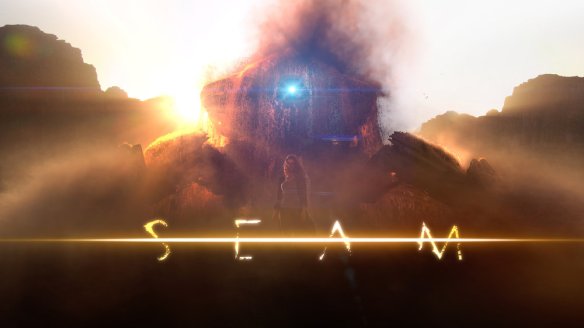
A Synthetic Human Fights to Survive in Visually Stunning Scifi Short Seam 

By Cheryl Eddy

Source: io9

In the not-too-distant future, a tenuous peace between humans and remarkably humanlike “machines”—some don’t even know they’re not real—is tested when synthetics begin spontaneously exploding. A military-led search for these unwitting suicide bombers begins, sending a terrified machine woman and her human partner on the run.

Seam—named for a volatile border area sandwiched between the designated machine containment zone and the human world—borrows from some excellent inspirations, including Blade Runner. But the 20-minute short, made by twin brothers Rajeev and Elan Dassani, makes its mark with outstanding special effects and well-chosen location shooting. Though the film begins in sleek Hong Kong, its visual style is most unique when it contrasts the futuristic tech used by its characters with ancient settings, including a chase scene that winds through the narrow streets of Salt, Jordan. The climactic sequence takes place in Wadi Rum, the otherworldly desert last seen playing Jedha in Rogue One.

Why America is the World’s First Poor Rich Country

Or, How American Collapse is Made of a New Kind of Poverty

By Umair Haque

Source: Eudaimonia

Consider the following statistics. The average American can’t scrape together $500 for an emergency. A third of Americans can’t afford food, shelter, and healthcare. Healthcare for a family now costs $28k — about half of median income, which is $60k.

By themselves, of course, statistics say little. But together these facts speak volumes. The story they are beginning to tell is this.

America, it seems, is becoming something like the world’s first poor rich country. And that is the elephant in the room we aren’t quite grasping. After all, authoritarianism and extremism don’t arise in prosperous societies — but in troubled ones, which are growing impoverished, like America is today. What do I mean by all that?

Let’s begin with what I don’t mean. I don’t mean absolute poverty. Americans are not living on a few dollars a day, by and large, like people in, for example, Somalia or Bangladesh. America’s median income is still that of a rich country, around $50k, depending on how it’s counted. Nor do I really mean relative poverty — people living below median income. While that’s a growing problem in America, because the middle class is imploding, that is not really the true problem these numbers hint at, either.

America appears to be pioneering a new kind of poverty altogether. One for which we do not yet have a name. It is something like living at the knife’s edge, constantly being on the brink of ruin, one small step away from catastrophe and disaster, ever at the risk of falling through the cracks. It has two components — massive inflation for the basics of life, coupled with crushing, asymmetrical risk. I’ll come to what those mean shortly.

The average American has a relatively high income, that of a person in a nominally rich country. Only his income does not go very far. Most of it is eaten up by attempting to afford the basics of life. We’ve already seen how steep healthcare costs are. But then there is education. There is transport. There is interest and rent. There is media and communications. There is childcare and elderly care. All these things reduce the average American to constantly living right at the edge of ruin — one paycheck away from penury, one emergency away from losing it all.

But this isn’t true for America’s peers. In Europe, Canada, and even Australia, society invests in all these things — and the costs of basic necessities societies don’t provide are regulated. For example, I pay $50 dollars for broadband and TV in London — but $200 for the same thing in New York — yet in London, I get vastly more and better media for my money (even including, yes, American junk like Ancient Aliens). That’s regulation at work. And when basic goods like healthcare or elderly care or education are provided and managed at a social scale, that is when they are cheapest, and often of the best quality, too. Hence, healthcare costs far less in London, Paris, or Geneva — and life expectancy is longer, too.

So if you are earning $50k in America, it is a very different thing than earning $50k in France, Germany, or Sweden — in America, you must pay steeply for the basics of life, for basic necessities. Thus, incomes stretch much further in other countries, which enjoy a vastly higher quality of life, even though people there earn roughly the same amount, because they pay vastly less for basic necessities. Americans are rich, but only nominally — their money doesn’t buy nearly as much as their peers does, where it matters and counts most, for the basics of life.

What happens when societies don’t understand all the above? Well, a strange thing has happened to the American economy. While it’s true that things like TVs and Playstations have gotten cheaper, the costs of the basics of life have skyrocketed. All the things that really elevate people’s quality of life — healthcare, finance, education, transport, housing, and so on — have come to consume such a large share of the average household’s income that they have little left to save, invest, or spend on anything else. And what’s worse, while the basics of life have seen massive inflation, wages and incomes (not to mention savings and benefits and safety nets and opportunities) for most have stagnated. The result is an economy — and a society — that’s collapsing.

Yet all that is the straightforward effect of giving, for example, hedge funds control over drugs, or speculators control over housing, healthcare, and education — they will of course maximize profits, whereas investing in these things socially, or at least regulating them, minimizes real costs, and maximizes accessibility, affordability, and quality.

So the average American, who is left high and dry, must borrow, borrow, borrow, just to maintain a decent quality of life — because handing capitalism control of the basics of life has caused massive, skyrocketing inflation in necessities, while flatlining his income. Healthcare didn’t used to cost half of median income even a decade ago, after all — but now it does. So what happens when, in a decade or two, healthcare costs all of median income? How can an economy — let alone a society — function that way?

Well, what happens if the average American steps over the line? Misses a mortgage payment, gets ill and is unable to pay a few bills on time, can’t pay the costs of healthcare? Then they are punished severely and mercilessly. Their “credit rating” (note how banks and hedge funds don’t have them) is ruined. They can easily find themselves out on the street, without finance, without a second chance, without access to any kind of redress or support . And then they are rejected, shunned, and ostracized. They might not have an address anymore — so who will hire them? They are no longer a part of society — they have fallen through the cracks, and finding one’s way back is often next to impossible. Asymmetrical risk — corporations and lobbies and banks bear no risk at all, precisely because the average American bears them all now.

So Americans aren’t just absolutely or relatively poor, but poor in a new way entirely. First, the basics of life exploded in price, to the point that they are now unaffordable for many, maybe most, households. Second, Americans bear the risks of paying those unaffordable costs to an extreme degree, bearing the risks that institutions should, and so those risks are now ruinously high. A bank or hedge fund or corporation might go bankrupt, and liquidate its assets, and its owners stay rich — but if an American’s credit rating is ruined, loses his job, cannot pay his bills, or even if he declares bankruptcy, he falls through the cracks, hounded, embattled, institutionally black-marked. He finds himself outside society, with little way to get back in. Little wonder then that Americans work so much harder than anywhere else — they are always one step away from losing it all, from genuine ruin, but their peers in truly rich countries aren’t.

Marx probably would have called this immiseration. Neo-Marxist theorists call it precarity. And while there’s truth in both those ideas and perspectives, I think they miss three vital points.

We don’t see America as a poor country, but we should begin to. Americans live fairly abysmal lives — short, lonely, unhappy, full of work and stress and despair, compared to their peers. That is because they cannot afford better ones — predatory capitalism coupled with total economic mismanagement of social investments has made the basics of life ruinously unaffordable. In this way, it’s effectively a poor country — yes, there’s a tiny number of ultra-rich, but they are outliers now, off the map of the normal. Because it’s not just any kind of poverty, yesterday’s poverty, or even poverty as we are used to thinking about it.

America is pioneering a new kind of poverty. The kind of poverty that’s developed in America isn’t just bizarre and gruesome — it’s novel and unseen. It isn’t something that we understand well, economists, intellectuals, thinkers, because we have no good framework to think about it. It’s not absolute poverty like Somalia, and it’s not just relative poverty, like in gilded banana republics. It’s a uniquely American creation. It’s extreme capitalism meets Social Darwinism by way of rugged self-reliance crossed with puritanical cruelty.

The kind of poverty America’s pioneering today isn’t absolute, or even relative , but something more like perfectly tuned poverty, strategic poverty, basic poverty— nominally well-off people whose money doesn’t go far enough to make them actually live well, constantly living at the edge of ruin, and thus forced to choke down their bitter anger and serve the very systems which oppress and subjugate with more and more indignity and fear and servility by the year.

America’s still an innovator today. Unfortunately, what it’s innovating now is a new kind of poverty. Yet poverty is poverty. What happens in societies where poverty is growing? Authoritarianism rises, as people lose faith in democracy, which can’t seem to offer them working social contracts. Authoritarian soon enough becomes fascism — “this country, this land, its harvest — it is only for the true volk!”, the cry goes up, when there is not enough to go around. And the rest of the dark and grim story of the fall into the abyss you should know well enough by now. It ends in words we do not say.

Still, history, laughing, has told this tale to us many times. And it is telling it to tomorrow, again, in the tale of American collapse.

The Coming Collapse

By Chris Hedges

Source: Occupy.com

The Trump administration did not rise, prima facie, like Venus on a half shell from the sea. Donald Trump is the result of a long process of political, cultural and social decay. He is a product of our failed democracy. The longer we perpetuate the fiction that we live in a functioning democracy, that Trump and the political mutations around him are somehow an aberrant deviation that can be vanquished in the next election, the more we will hurtle toward tyranny. The problem is not Trump. It is a political system, dominated by corporate power and the mandarins of the two major political parties, in which we don’t count. We will wrest back political control by dismantling the corporate state, and this means massive and sustained civil disobedience, like that demonstrated by teachers around the country this year. If we do not stand up we will enter a new dark age.

The Democratic Party, which helped build our system of inverted totalitarianism, is once again held up by many on the left as the savior. Yet the party steadfastly refuses to address the social inequality that led to the election of Trump and the insurgency by Bernie Sanders. It is deaf, dumb and blind to the very real economic suffering that plagues over half the country. It will not fight to pay workers a living wage. It will not defy the pharmaceutical and insurance industries to provide Medicare for all. It will not curb the voracious appetite of the military that is disemboweling the country and promoting the prosecution of futile and costly foreign wars.

It will not restore our lost civil liberties, including the right to privacy, freedom from government surveillance, and due process. It will not get corporate and dark money out of politics. It will not demilitarize our police and reform a prison system that has 25 percent of the world’s prisoners although the United States has only 5 percent of the world’s population. It plays to the margins, especially in election seasons, refusing to address substantive political and social problems and instead focusing on narrow cultural issues like gay rights, abortion and gun control in our peculiar species of anti-politics.

This is a doomed tactic, but one that is understandable. The leadership of the party, the Clintons, Nancy Pelosi, Chuck Schumer, Tom Perez, are creations of corporate America. In an open and democratic political process, one not dominated by party elites and corporate money, these people would not hold political power. They know this. They would rather implode the entire system than give up their positions of privilege. And that, I fear, is what will happen. The idea that the Democratic Party is in any way a bulwark against despotism defies the last three decades of its political activity. It is the guarantor of despotism.

Trump has tapped into the hatred that huge segments of the American public have for a political and economic system that has betrayed them. He may be inept, degenerate, dishonest and a narcissist, but he adeptly ridicules the system they despise. His cruel and demeaning taunts directed at government agencies, laws and the established elites resonate with people for whom these agencies, laws and elites have become hostile forces. And for many who see no shift in the political landscape to alleviate their suffering, Trump’s cruelty and invective are at least cathartic.

Trump, like all despots, has no ethical core. He chooses his allies and appointees based on their personal loyalty and fawning obsequiousness to him. He will sell anyone out. He is corrupt, amassing money for himself—he made $40 million from his Washington, D.C., hotel alone last year—and his corporate allies. He is dismantling government institutions that once provided some regulation and oversight. He is an enemy of the open society. This makes him dangerous. His turbocharged assault on the last vestiges of democratic institutions and norms means there will soon be nothing, even in name, to protect us from corporate totalitarianism.

But the warnings from the architects of our failed democracy against creeping fascism, Madeleine Albright among them, are risible. They show how disconnected the elites have become from the zeitgeist. None of these elites have credibility. They built the edifice of lies, deceit and corporate pillage that made Trump possible. And the more Trump demeans these elites, and the more they cry out like Cassandras, the more he salvages his disastrous presidency and enables the kleptocrats pillaging the country as it swiftly disintegrates.

The press is one of the principal pillars of Trump’s despotism. It chatters endlessly like 18th-century courtiers at the court of Versailles about the foibles of the monarch while the peasants lack bread. It drones on and on and on about empty topics such as Russian meddling and a payoff to a porn actress that have nothing to do with the daily hell that, for many, defines life in America. It refuses to critique or investigate the abuses by corporate power, which has destroyed our democracy and economy and orchestrated the largest transfer of wealth upward in American history.

The corporate press is a decayed relic that, in exchange for money and access, committed cultural suicide. And when Trump attacks it over “fake news,” he expresses, once again, the deep hatred of all those the press ignores. The press worships the idol of Mammon as slavishly as Trump does. It loves the reality-show presidency. The press, especially the cable news shows, keeps the lights on and the cameras rolling so viewers will be glued to a 21st-century version of “The Cabinet of Dr. Caligari.” It is good for ratings. It is good for profits. But it accelerates the decline.

All this will soon be compounded by financial collapse. Wall Street banks have been handed $16 trillion in bailouts and other subsidies by the Federal Reserve and Congress at nearly zero percent interest since the 2008 financial collapse. They have used this money, as well as the money saved through the huge tax cuts imposed last year, to buy back their own stock, raising the compensation and bonuses of their managers and thrusting the society deeper into untenable debt peonage. Sheldon Adelson’s casino operations alone got a $670 million tax break under the 2017 legislation. The ratio of CEO to worker pay now averages 339 to 1, with the highest gap approaching 5,000 to 1.

This circular use of money to make and hoard money is what Karl Marx called “fictitious capital.” The steady increase in public debt, corporate debt, credit card debt and student loan debt will ultimately lead, as Nomi Prins writes, to “a tipping point—when money coming in to furnish that debt, or available to borrow, simply won’t cover the interest payments. Then debt bubbles will pop, beginning with higher yielding bonds.”

An economy reliant on debt for its growth causes our interest rate to jump to 28 percent when we are late on a credit card payment. It is why our wages are stagnant or have declined in real terms—if we earned a sustainable income we would not have to borrow money to survive. It is why a university education, houses, medical bills and utilities cost so much. The system is designed so we can never free ourselves from debt.

However, the next financial crash, as Prins points out in her book “Collusion: How Central Bankers Rigged the World,” won’t be like the last one. This is because, as she says, “there is no Plan B.” Interest rates can’t go any lower. There has been no growth in the real economy. The next time, there will be no way out. Once the economy crashes and the rage across the country explodes into a firestorm, the political freaks will appear, ones that will make Trump look sagacious and benign.

And so, to quote Vladimir Lenin, what must be done?

We must invest our energy in building parallel, popular institutions to protect ourselves and to pit power against power. These parallel institutions, including unions, community development organizations, local currencies, alternative political parties and food cooperatives, will have to be constructed town by town. The elites in a time of distress will retreat to their gated compounds and leave us to fend for ourselves. Basic services, from garbage collection to public transportation, food distribution and health care, will collapse. Massive unemployment and underemployment, triggering social unrest, will be dealt with not through government job creation but the brutality of militarized police and a complete suspension of civil liberties.

Critics of the system, already pushed to the margins, will be silenced and attacked as enemies of the state. The last vestiges of labor unions will be targeted for abolition, a process that will soon be accelerated given the expected ruling in a case before the Supreme Court that will cripple the ability of public-sector unions to represent workers. The dollar will stop being the world’s reserve currency, causing a steep devaluation. Banks will close. Global warming will extract heavier and heavier costs, especially on the coastal populations, farming and the infrastructure, costs that the depleted state will be unable to address. The corporate press, like the ruling elites, will go from burlesque to absurdism, its rhetoric so patently fictitious it will, as in all totalitarian states, be unmoored from reality. The media outlets will all sound as fatuous as Trump. And, to quote W.H. Auden, “the little children will die in the streets.”

As a foreign correspondent I covered collapsed societies, including the former Yugoslavia. It is impossible for any doomed population to grasp how fragile the decayed financial, social and political system is on the eve of implosion. All the harbingers of collapse are visible: crumbling infrastructure; chronic underemployment and unemployment; the indiscriminate use of lethal force by police; political paralysis and stagnation; an economy built on the scaffolding of debt; nihilistic mass shootings in schools, universities, workplaces, malls, concert venues and movie theaters; opioid overdoses that kill some 64,000 people a year; an epidemic of suicides; unsustainable military expansion; gambling as a desperate tool of economic development and government revenue; the capture of power by a tiny, corrupt clique; censorship; the physical diminishing of public institutions ranging from schools and libraries to courts and medical facilities; the incessant bombardment by electronic hallucinations to divert us from the depressing sight that has become America and keep us trapped in illusions. We suffer the usual pathologies of impending death. I would be happy to be wrong. But I have seen this before. I know the warning signs. All I can say is get ready.

Superpowers and Concrete Towers: Katsuhiro Otomo’s ‘Domu: A Child’s Dream’

By Patrick Haddad

Source: We Are the Mutants

In 1989, almost a year after it was released in Japan, the Western world was given its first cinematic taste of anime with the sci-fi epic Akira. Acclaimed writer Katsuhiro Otomo’s vision of a post-apocalyptic Neo-Tokyo, a sea of concrete edifices laid waste by war, was adapted from the manga of the same name, serialized in Japan from 1982 to 1990. Religious fanatics, biker gangs, and shadowy government figures all vie for control of children with superhuman powers, while the truth behind World War III teases just out of reach. But before Akira, Otomo penned and illustrated a shorter piece of raw, dystopian horror: Domu: A Child’s Dream. Set in a government housing complex where a series of inexplicable deaths are taking place, Domu (serialized between 1980-1981) is resolved through a conflict between an old man and a young girl, both of whom secretly possess extrasensory powers.

While Domu foreshadowed Akira in many ways, it is a much more intimate story with fewer characters and just one location, the Tsutsumi Housing Complex. The residents of Tsutsumi are a forgotten, surplus community. Dreams left unfulfilled, private sufferings gone unchecked, and the struggle for identity in the monotonous wash of concrete go some way to explain the rash of suicides plaguing the complex, yet the police are at a loss to explain exactly how many of these deaths occurred. From the beginning, Otomo sets out to introduce the overwhelming, modernist structure as a character in and of itself. Full panel shots of the building in high detail and high contrast are found throughout, and are often employed as bookends to each chapter. Its circular layout insists upon dreary introspection for half of the residents it houses: there is no looking out to the city, to a potentially brighter future. Many prisons, schools, and hospitals also follow a similar template. The circular design—reminiscent of the Panopticon—allows for both greater visibility and fewer places to hide, and is often accompanied by a raised central observation point. Tsutsumi is monotonous in its aspect as well as its makeup: hard concrete, hard lines; no facade, no flair. Behind this impassive exterior lie grimy, cramped apartments hidden among a labyrinth of iron and concrete hallways. It isn’t much of a stretch to imagine Tsutsumi as the backdrop to one of Freddy Krueger’s nightmarish rampages, and Otomo almost certainly drew upon similar feelings of unease regarding the homogeneous modernization of postwar Japan as did Shinya Tsukamoto, who created the shocking cult horror film Tetsuo: The Iron Man (1989).

As the story progresses, it becomes clear—to the reader at least—that the mysterious deaths can be traced back to Old Cho, an apparently senile old man who is in fact using his telekinetic powers to cause fatal accidents or, as in the iconic scene featuring a depressed young man with a craft knife, forcing residents to commit suicide. Old Cho frequently kills from the background, unseen by his victims, his twisted revelry seeming to come from the building itself. Old Cho is not the only resident with special gifts. He finds an adversary in the form of a young girl called Etsuko. They clash the very moment Etsuko and her family move into the tower block, when she uses her abilities to catch the plummeting baby Cho, using his psychic powers, had snatched and dropped from the balcony.

As the story progresses, Cho’s and Etsuko’s confrontations escalate, as the tally of innocent victims climbs. The final act of Domu marks a stark departure from earlier passages, as the static panels showing the impassive monolith and its cowed inhabitants are replaced by dynamic and violent scenes, splashed with blood and fueled by emotion. By the end of the book, it is hard to tell who really won or what a victory would even mean, but it is clear that most of the violence was down to random malice, or misguided fear and rage. It is ironic, then, that the reduction of human beings to just pure function results in senseless, unproductive violence.

Many modernist, and particularly Brutalist, social housing structures were built after World War II in order to show that “A dwelling can be standardized to meet the needs of men whose lives are standardized,” according to urban design pioneer Le Corbusier. Projects such as Les Damiers in Paris, Robin Hood Gardens in London, Habitat 67 in Montreal, and the Unité d’habitation in Berlin are iconic examples of an architectural style that would dominate social housing well into the 1970s. However, the utopian vision set out by modernist architects—to create socially progressive and egalitarian housing—became twisted by time and by the reality of the project’s application. Affordable social housing turned into isolated ghettos, while the idea of social progress became just a gear, an empty promise, in the great Soviet machine. The modular, repetitive nature allowed for quick and cheap rebuilding, but, perhaps in part due to its success, it also aided in the dissolution of identity. Each building, each home, was just a copy of the last, with nothing substantial to distinguish each from each: an existence stripped of form, each building nothing but raw function. And so too its occupants.

In contrast to the urbanization implied by modernist housing, America saw large numbers of people, many of them returning veterans, flee the cities after World War II in favor of suburban living. Combining the power of assembly-line mass production with the G.I. Bill’s loan assistance saw entire communities of cookie-cutter homes spring up in a remarkably short space of time. Spreading out in a grid, rather than towering above, suburbia very often entailed a similar rationalization of living spaces. The mass produced sprawl, built to the same specifications and filled with the same stylish appliances, fits nicely into Le Corbusier’s definition of homes as “machines for living in.”

Things were much grimmer in Japan, of course. Suffering atomic bomb strikes that wiped two of its cities clean off the map, as well as the death of an Empire, caused a national crisis of identity. The country was then occupied by and rebuilt in the image of its conquerors: centuries of culture burned to the ground or consumed by industry and replaced with bloodless, uniform architecture. Tower blocks went up where pagodas once stood, no longer hewn from stone and wood but erected with concrete and rebar. British author Theodore Dalrymple describes modernist architecture as “inherently totalitarian… [it] delights to overwhelm and humiliate what went before it by its size and prepotency.” The seeds of modernism in Japan were planted before their defeat during World War II, however. Le Corbusier worked with two prominent Japanese architects during the 1930s, Kunio Maekawa and Junzo Sakakura. During this time, a synergy was found between Le Corbusier’s visions for flexible, open plan buildings filled with natural light and the traditional Japanese house, called Sukiya-zukuri. This synergy would be expanded upon in the later Metabolism movement, which sought to bring inspiration from organic, biological structures to modernist architecture during the 1960s.

In Domu, we find a manifestation of this dehumanizing monolith in the form of the Tsutsumi Housing Complex and it’s magpie avatar, Old Cho. For each of his victims, Cho claims a glittering prize, a personal token: a badge, a hat, a gun. Before being forced over the precipice of their hopelessness, literally and figuratively, a piece of their identity is stolen before being secreted away somewhere in the bowels of the building.

While it is unlikely that Otomo wrote Domu as an explicit attack on modernism in Japan, the influence of the displacement and anxiety it caused is clear in his work. In Domu, we see Otomo start to develop two of the principle themes that went on to make Akira a timeless classic: young people with exceptional, inherent power, and a dystopian vision of Neo-Tokyo as a failed totalitarianism, an endless landscape of monstrous and towering concrete. These themes went on to define an era of storytelling in manga and anime characterized by pervasively bleak visions of the future.

The loss of privacy and individualism caused by massive modernist social housing estates is also explored in J.G. Ballard’s High Rise (1975), in which tenants of a self-contained tower block in London degenerate into primal tribes, warring over territory and resources while normal city life continues outside. In High Rise, the dehumanizing power of Brutalism leads people to lose their “civilized” behavior and let base urges drive their lives, while in Domu we get a greater sense of the despondency that comes from being a lifeless industrial worker in a lifeless industrial landscape. It is as though living in this monochromatic, function-centric environment leaves us with only two potential identities: the animal, or the machine.

Regardless of whether you read Domu for its gripping and pioneering storytelling, for what it tells us about the role played by modernist architecture in postwar Japan, or purely for its wonderful aesthetic, it is a work that easily stands on its own two legs, despite often being overlooked as some sort of practice run for the Akira epic. Rather than the abstract, existentialist sprawl that is the latter, in Domu we have a more concise and personal tale, with a sense of looming oppression that bleeds from every page. The bare honesty found in some of Cho’s victims shines a light on the real lives lived quietly the world over, their deep fatigue resonating in profound echoes. The next time your morning commute takes you past some austere, concrete tower block, remember: somewhere inside may be a young girl who blows things up with her mind.


Read Domu for free here.

Amazon, Microsoft and Google compete for Pentagon Cloud warfighter project

By Will Morrow

Source: WSWS.org

Amazon, Microsoft and Google are competing to secure a multi-billion-dollar Department of Defense contract to build and oversee the US military’s Cloud computing infrastructure, which will be used to control every aspect of the Pentagon’s global operations.

The Joint Enterprise Defense Infrastructure (JEDI) project will transfer the large number of separate data control centers currently being run by the Pentagon into a centralized Cloud network that will be administered by one of the technology giants. The contract is reported to be worth up to $10 billion over the next decade, potentially making it the Department of Defense’s single largest acquisition ever. The winning bidder is expected to be announced in September.

The company that secures the contract will be completely integrated into all of the US military’s fighting operations. According to Nextgov, Brigadier General David Krumm, the deputy director for requirements for the Joint Chiefs of Staff, described JEDI as a “global fabric” that will connect the headquarters with active combat forces, from an F-35 fighter jet pilot to a Pacific submarine captain to an Army platoon leader. “This is going to make a difference like few things have to get information to our warfighters,” Krumm said.

The Department of Defense hosted an industry conference on the project on March 7 in Arlington, Virginia, attended by technology companies, including representatives from Amazon and Microsoft. Krumm told the audience that JEDI would “change the way that this nation, its soldiers, its sailors, its Marines and its airmen fight and win our nation’s wars.”

The Cloud network will be required to hold data at all security classification levels, meaning security officials with top secret security clearances will be working at the facilities.

On May 16, Bloomberg Government published images of the advertisements produced by Amazon and Microsoft on electronic billboards in the Pentagon railway station about how their companies’ technology could support the military in battle.

Microsoft’s ad featured an image of a special operations soldier and the caption, “The cloud gets actionable insight while the action is still unfolding.” An Amazon Web Services ad included the statement, “Time to launch: months minutes,” to underscore that the cloud infrastructure will help coordinate missile launches.

The JEDI program was first announced in September 2017, a month after Trump’s Defence Secretary James Mattis carried out a tour of Silicon Valley boardrooms. Mattis met with Google’s Founder Sergey Brin and CEO Sundar Pichai, as well as executives at Facebook and Amazon, to discuss further integrating their technologies into the US armed forces.

The Defense One website reported on April 12 that “Brin in particular was eager to showcase how much Google was learning every day about AI and cloud implementation,” citing an anonymous senior Defense Department official. Mattis “returned to Washington, D.C., convinced that the US military had to move much of its data to a commercial cloud provider—not just to manage files, email, and paperwork but to push mission-critical information to front-line operators,” the article noted.

Significantly, the article notes that while Amazon and Microsoft have publicly expressed their desire to secure the contract, Google has “kept its own interest … out of the press. Company leaders have even hidden the pursuit from its own workers, according to Google employees Defense One reached.”

Google’s integration into the military’s operations has triggered widespread opposition among its employees. A letter published in April written to Google’s CEO Pichai and signed by more than 3,000 Google workers, demanded that the company cease its collaboration with the Pentagon.

The letter was a response to Google admitting in March that it is providing the military with artificial intelligence software that can be used to detect objects in video surveillance footage, under what is called Project Maven. This technology can be directly used to develop automatic targeting for the US drone murder operations in the Middle East and North Africa.

The Defense One article stated that “Maven is more than either Google or the Defense Department has admitted publicly, according to the senior defense official who called it a ‘pathfinder’ project, a starting point for future collaboration between the Pentagon and Google.”

Media reports indicate that the company most likely to secure the JEDI contract is Amazon. The company is considered to have an edge because it is already operating a Cloud network for the US intelligence agencies, under a $600 million contract reached in 2013.

Since September 2016, Amazon has been providing facial recognition technology called Rekognition to police forces and private intelligence contractors. Rekognition is able to process video footage from police body cameras, surveillance cameras and CCTV to “identify persons of interest against a collection of millions of faces in real-time, enabling timely and accurate crime prevention” (see: “Amazon providing facial recognition technology to police agencies for mass surveillance”).

The distinction between the technology corporations and the state has become almost entirely blurred as they become ever-more integrated into the military-intelligence apparatus. This takes place as Washington is working to outpace its major geostrategic rivals, above all China and Russia, in the arena of advanced warfare technology and artificial intelligence, in preparation for a catastrophic war that would inevitably involve the use of nuclear weapons.

As they integrate themselves into the American military build-up, the technology giants are collaborating in mass political censorship of left-wing and anti-war websites, above all the World Socialist Web Site, in order to suppress mass opposition to war. Since April 2017, Google has altered its search result algorithms in order to censor the WSWS and other left-wing and anti-war websites.


The author also recommends:

Google, drone murder and the military-intelligence-censorship complex
[19 May 2018]

No Need To Wait – Dystopia Is Almost Upon Us

Source: TruePublica

Microsoft’s CEO has warned the technology industry against creating a dystopian future, the likes of which have been predicted by authors including George Orwell and Aldous Huxley. Satya Nadella kicked off the the company’s 2017 Build conference with a keynote that was as unexpected as it was powerful. He told the developers in attendance that they have a huge responsibility, and that the choices they make could have enormous implications.

They won’t listen of course. The collection of big data along with management, selling and distribution and the systems architecture to control it is now worth exactly double global military defence expenditure. In fact, this year, the big data industry overtook the worlds most valuable traded commodity – oil.

The truth is that the tech giants have already captured us all. We are already living in the beginnings of a truly dystopian world.

Leaving aside the endemic surveillance society our government has chosen on our behalf with no debate, politically or otherwise, we already have proof of the now and where it is leading. With fingerprint scanning, facial recognition, various virtual wallets to pay for deliveries, some would say your identity is as good as stolen. If it isn’t, it soon will be. That’s because the hacking industry, already worth a mind blowing $1trillion annually is expected to reach $2.1 trillion in just 14 months time.

The reality of not being able to take public transportation, hire a car, buy a book, or a coffee – requiring full personal identification is almost upon us. Britain even had an intention to be completely cashless by 2025 – postponed only by the impact of Brexit.

Alexa, the Amazon home assistant listens to everything said in the house. It is known to record conversations. Recently, police in Arkansas, USA demanded that Amazon turn over information collected from a murder suspect’s Echo — the speaker that controls Alexa, because they already knew what information could be extracted from it.

32M is the first company in the US that provides a human chip, allowing employees “to make purchases in their break-room micro market, open doors, login to computers, use the copy machine.” 3M also confirmed what the chip could really do – telling employees to “use it as your passport, public transit and all purchasing opportunities.”

Various Apps now locate people you may know and your own location can be shared amongst others without your knowledge and we’ve known for years that governments and private corporations have access to this data, whether you like it not.

Other countries are providing even scarier technologies.  Hypebeast Magazine reports that  Aadhaar is a 12-digit identity number issued to all Indian residents based on their biometric and demographic data. “This data must be linked to their bank account or else they’ll face the risk of losing access to their account. Folks have until the end of the year to do this, with phone numbers soon to be connected through the 12 digits by February. Failure to do so will deactivate the service. ” The technology has the ability to refuse access to state supplied services such as healthcare.

Our article “Insurance Industry Leads The Way in Social Credit Systems” also highlights what the fusion of technology and data is likely to end up doing for us. An astonishing 96 per cent of insurers think that ecosystems or applications made by autonomous organisations are having a major impact on the insurance industry. The use of social credit mechanisms is being developed, some already implemented, which will determine our future behaviour, which will affect us all – both individually and negatively.”

The Chinese government plans to launch its Social Credit System in 2020. Already being piloted on 12 million of its citizens, the aim is to judge the trustworthiness – or otherwise – of its 1.3 billion residents. Something as innocuous as a person’s shopping habits become a measure of character. But the system not only investigates behaviour – it shapes it. It “nudges” citizens away from purchases and behaviours the government does not like. Friends are considered as well and individual credit scores fall depending on their trustworthiness. It’s not possible to imagine how far this will go in the end.

However to get us all there, to that situation, we need to be distracted from what is going on in the background. Some, are already concerned.


Distraction – detaching us from truth and reality

The Guardian wrote an interesting piece recently which highlighted some of the concerns of those with expert insider knowledge of the tech industry. For instance, Justin Rosenstein, the former Google and Facebook engineer who helped build the ‘like’ button –  is concerned. He believes there is a case for state regulation of smartphone technology because it is “psychologically manipulative advertising”, saying the moral impetus is comparable to taking action against fossil fuel or tobacco companies.

If we only care about profit maximisation,” he says, “we will go rapidly into dystopia.” Rosenstien also makes the observation that after Brexit and the election of Trump, digital forces have completely upended the political system and, left unchecked, could render democracy as we know it obsolete.

Carole Cadwalladre’s recent Exposé in the Observer/Guardian proved beyond doubt that democracy has already departed.  Here we learn about a shadowy global operation involving big data and billionaires who influenced the result of the EU referendum. Britain’s future place in the world has been altered by technology.

Nir Eyal 39, the author of Hooked: How to Build Habit-Forming Products writes: “The technologies we use have turned into compulsions, if not full-fledged addictions.” Eyal continues: “It’s the impulse to check a message notification. It’s the pull to visit YouTube, Facebook, or Twitter for just a few minutes, only to find yourself still tapping and scrolling an hour later.” None of this is an accident, he writes. It is all “just as their designers intended”.

Eyal feels the threat and protects his own family by cutting off the internet completely at a set time every day. “The idea is to remember that we are not powerless,” he said. “We are in control.”

The truth is we are no longer in control and have not been since we learned that our government was lying to us with the Snowden revelations back in 2013.

Tristan Harris, a 33-year-old former Google employee turned vocal critic of the tech industry agrees about the lack of control. “All of us are jacked into this system,” he says. “All of our minds can be hijacked. Our choices are not as free as we think they are.” Harris insists that billions of people have little choice over whether they use these now ubiquitous technologies, and are largely unaware of the invisible ways in which a small number of people in Silicon Valley are shaping their lives.

Harris is a tech whistleblower. He is lifting the lid on the vast powers accumulated by technology companies and the ways they are abusing the influence they have at their fingertips – literally.

“A handful of people, working at a handful of technology companies, through their choices will steer what a billion people are thinking today.”

The techniques these companies use such as social reciprocity, autoplay and the like are not always generic: they can be algorithmically tailored to each person. An internal Facebook report leaked this year, ultimately revealed that the company can identify when teenagers feel “worthless or “insecure.” Harris adds, that this is “a perfect model of what buttons you can push in a particular person”.

Chris Marcellino, 33, a former Apple engineer is now in the final stages of retraining to be a neurosurgeon and notes that these types of technologies can affect the same neurological pathways as gambling and drug use. “These are the same circuits that make people seek out food, comfort, heat, sex,” he says.

Roger McNamee, a venture capitalist who benefited from hugely profitable investments in Google and Facebook, has grown disenchanted with both of the tech giants. “Facebook and Google assert with merit that they are giving users what they want,” McNamee says. “The same can be said about tobacco companies and drug dealers.”

James Williams ex-Google strategist who built the metrics system for the company’s global search advertising business, says Google now has the “largest, most standardised and most centralised form of attentional control in human history”. “Eighty-seven percent of people wake up and go to sleep with their smartphones,” he says. The entire world now has a new prism through which to understand politics, and Williams worries the consequences are profound.

Williams also takes the view that if the attention economy erodes our ability to remember, to reason, to make decisions for ourselves – faculties that are essential to self-governance – what hope is there for democracy itself?

“The dynamics of the attention economy are structurally set up to undermine the human will,” he says. “If politics is an expression of our human will, on individual and collective levels, then the attention economy is directly undermining the assumptions that democracy rests on. If Apple, Facebook, Google, Twitter, Instagram and Snapchat are gradually chipping away at our ability to control our own minds, could there come a point, I ask, at which democracy no longer functions?”

“Will we be able to recognise it, if and when it happens?” Williams says. “And if we can’t, then how do we know it hasn’t happened already?”


The dystopian arrival

Within ten years, some are speculating that many of us will be wearing eye lenses. Coupled with social media, we’ll be able to identify strangers and work out that a particular individual, in say a bar, has a low friend compatibility, and data shows you will likely not have a fruitful conversation. This idea is literally scratching the surface of the information overload en-route right now.

It is not at all foolish to think that in that same bar a patron is shouting at the bartender, who refuses to serve him another drink because the glass he was holding measured his blood-alcohol level through the sweat in his fingers. He’ll have to wait at least 45 minutes before he’ll be permitted to order another scotch. You might even think that is a good idea – it isn’t.

Google’s Quantum Artificial Intelligence  Lab, already works with other organisations associated with NASA. Google’s boss sits on the Board of the Pentagon with links plugged directly into the surveillance architecture of the NSA in the USA and GCHQ in Britain. This world, where artificial intelligence makes its mark, as Williams mentions earlier, will deliberately undermine the ability to think for yourself.

In the scenario of the eye lenses, you might even have the ability to command your eyewear to shut down. But when you do, suddenly you are confronted with an un-Googled world. It appears drab and colourless in comparison. The people before you are bland, washed out and unattractive. The art, plants, wall paint, lighting and decorations had all been shaped by your own preferences, and without the distortion field your wearable eyewear provided, the world appears as a grey, lifeless template.

You find it difficult to last without the assistance of your self imposed augmented life, and accompanied by nervous laughter you switch it back on. The world you view through the prism of your computer eyewear has become your default setting. You know you have free will, but don’t feel like you need it. As Marcellino says the same neurological pathways as gambling and drug use drive how you choose to see the world.

This type of technology will be available and these types of scenario’s will become real, sooner than you think.

Our governments, allied with the tech giants are coercing us into a place of withering obedience with the use of 360 degree state surveillance. New technology, which is somehow seen as the road to liberty, contentment and prosperity, is really our future being shaped by a system that will destroy our civil liberties, crush our human rights and it will eventually ensnare and trap us all. This much they are already attempting in China and Japan with social credit mechanisms and pre-crime technology which is a truly frightening prospect. Without debate or our knowledge, here in western democracies, these technologies are already in use.


America’s Dystopian Future

By

Source: CounterPunch

Imagine a privatized America where rugged individualism reigns supreme within a vast network of corporate America, Inc., similar to 19th century wild west lifestyle, no social security, no Medicare, no Medicaid, no public law enforcement as individuals stand their own ground. Read all about it in Scott Erickson’s History of the Decline and Fall of America (Azaria Press, 2018).

Erickson’s newly released semi-fictional satire of American history and subsequent decline into deepening pits of despair is a sure-fire treasure trove of Americana, at its best. It’s a page-turner par excellence, rich in accurate textured American history and jam-packed with imagery of a dystopian future that is simply unavoidable based upon America’s character and development over the past two centuries. The dye was cast long before onset of dystopian existence.

The History of the Decline and Fall of America highlights and exposes inherent limitations of democratic capitalism whilst explaining in full living color a future American dystopia that is fully expected based upon America’s beginnings from the time of Captain John Smith at historic Jamestown (1607). The history lesson therein is superb, not missing a beat of what shaped America up to the final tipping point of neoliberal dogma and beyond into a deep dark world order.

This beautifully written and conceived historical fiction is a witty tour de force of America past, present, and future, weaving together all of the historical elements into one coherent story from the widely accepted version of American “business success ” of the early period, but over time wistfully morphing into abject failure!

That process of failure, the root causes, is what intrigues, for example, “Americans were not only inventing a country but inventing what it meant to be an American.” Indeed, America came into being as a brand new experiment in capitalistic democracy. Within that quest for a new way forward, inclusive of equality and fraternity amongst equals, Erickson discovers and reveals unique American traits that belie that mission, leading to a neoliberal/privatization hellhole that goes horribly wrong.

That fascinating pathway is explained via enchanting quips, for example, de Tocqueville’s remarkably astute comment: “ I know of no country, indeed, where the move of money has taken a stronger hold on the affections of men.” This one isolated statement from the 1830s tells a tale of American character molded by artificiality of wealth creation simply for the sake of possessing it. America’s pursuit of happiness was the “pursuit of affluence” and remained its dominant trait for the “remaining 200-plus years of American history.”

Indeed, those predominant American character traits are flushed-out and analyzed in the context of eventual failure, of a dystopian world order emanating out of America’s clumsy experimentation with empire-building and constantly striving for the pot at the end of the rainbow, meaning economic growth above all else. It was a frontier spirit that fed into elusive goals of preeminence: “The frontier resulted in Americans being doers rather than thinkers….”

Real scenes of real American cocksuredness, as well as the clumsiness associated with raw ignorance, come to life, e.g., during the presidential race between Ike and Adlai Stevenson in 1954: “A revealing incident occurred while Stevenson was campaigning for president. A citizen shouted to Stevenson that he ‘had the vote of every thinking person.’Stevenson replied, ‘That’s not enough. We need a majority!”
This is excellent history, comparable to a textbook, as well as a peek into the future shaped via trends rooted throughout Americana. Erickson’s lessons in American history are genuine and accurate, which gives the book depth and a powerful sense of significance well beyond similar treatises that try to lay the challenging groundwork leading to how a nation turns sour into a dystopian society.

He weaves the path of Manifest Destiny all the way from 1840s to the planting of the American flag on the surface of the moon. Until the 1970s when American pre-eminence tipped downward, humiliated in Vietnam in what future generations came to know as The Vietnam Syndrome,” the psychological attempt to live with the unacceptable reality that it was possible for America to not win.

Not only was America no longer a winner in war, its “unparalleled level of affluence… began to decline.” The 1970s marked the high point, forever downward into a bottomless septic tank, a cloaca of messy foul shit earmarking America’s final destiny, third world status within a realm of excessive, pretense of wealth glistening behind spiked electronic gates.

The signs of decline were easy to spot by the early-mid 2000s: “… the situation had declined dramatically. According to statistics from 2015, among industrialized nations, America was notable for having the highest poverty rate, the lowest score on the UN index of ‘material well-being of children,’ the highest health care expenditures, the highest infant mortality rate, the highest prevalence of mental health problems, the highest obesity rate, the highest consumption of antidepressants per capita, the highest homicide rate, and the largest prison population per capita. By international standards, the rural counties of southern West Virginia and eastern Kentucky qualified as developing countries, as did large sections of American cities such as Detroit, Cleveland, Gary, and many others.” (Pg. 112)

Thereafter, America’s youth no longer embraced the long-standing belief that they would have more than their parents. No, they knew it would be less and less. America entered a “permanent recession” cycle.
By the late 2030s American experienced a series of extreme crises. A number of cities declared bankruptcy. Houston, America’s 4th largest city goes bankrupt. Cleveland goes bankrupt. The head of the Federal Reserve quits and becomes a banjo player in a bluegrass group. America’s banking system collapses under the weight of fishy loans and massive crazed derivatives all permitted by increasingly hands-off regulations. The brutal hand of libertarianism smears a once proud republic.

Regular citizens, entire families carry torches surrounding Wall Street in protest of loss savings, ATMs not functioning, banks closed. An economic death spiral unleashed. The Save America Act followed, consisting of pure right wing neoliberal fix-its to save corporate America, to save Wall Street, turning to America, Inc. as the only answer to all that ails.

And, as the financial markets unravel in the face of nationwide bankruptcies, the government convincingly informs the public: “We need to defy the Constitution in order to preserve it… Americans were so thoroughly confused about the relationship between government and economics that most of them thought that the terms democracy, free-enterprise, and capitalism were the same thing.” (Pg. 165)

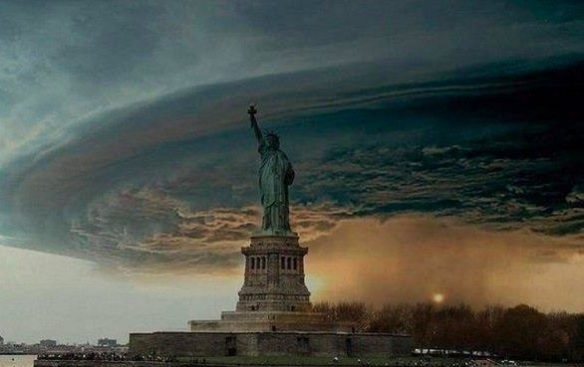
As time progresses, America’s Labor Day is changed to Management Day, and the Catholic Church is permitted to re-name the Statue of Liberty as “Our Lady of Perpetual Economic Growth.” America the nation turns into America, Inc. It is the only way the establishment knows to drive the country out of its doldrums. As such, The Star Spangled Banner is changed to The Free Market Ramble.

Privatization of the entire country in harmony with massive tax cuts alongside elimination of Social Security, Medicare, Medicaid, public education, law enforcement, postal service, and maintenance of roads and infrastructure, thereafter, people take care of themselves from birth to the death, alone with family backing. Self-directed medical care becomes a beacon of survival of the fittest of the fittest. Those that participated as y0ungsters in Boy/Girl Scouts have a leg up in a society that increasingly places emphasis on rugged individualism. However, the many, many weaklings stumble in rows after rows of slimy gutters.

In the end, and similar to America’s 2008-09 financial collapse, which was only a warm up for much bigger things to come: “The decisive trigger, the one that pushed America beyond the point of no return, was the total collapse of the economy. It had been something of a miracle that the doomed economy had not collapsed long before. Toward the end it had been sustained by little more than momentum, since according to all economic indicators it should not have been functioning at all. The economic system based on infinite growth had reached the point where it could grow no more. American banks could not pay off previous debt by making further loans to generate more money. The pyramid scheme was over… An eerie calm descended upon all those involved in economics and finance.”

“One Long Discomfort”: The Legacy and Future of David Lindsay’s ‘A Voyage to Arcturus’

By Ben Schwartz

Source: We Are the Mutants

Ballantine “Adult Fantasy” edition, 1973, with cover art by Bob Pepper

David Lindsay’s masterpiece A Voyage to Arcturus was first published in London in 1920 by Methuen & Co. It came dressed in a simple red cloth cover; no dust jacket, just the title and author’s name debossed into the front. This first printing sold less than 600 copies, and so Arcturus didn’t come to the US until Macmillan brought it out in 1964. In 1968, Ballantine picked it up after the massive success of the publisher’s Lord of the Rings paperbacks, and, for the first time ever, the cover featured bespoke art, painted by Bob Pepper. The printing predated Ballantine’s influential Adult Fantasy series, edited by Lin Carter, but was eventually given honorary membership, with later printings carrying the unicorn stamp and benefiting from the cachet the series possessed.

With the late-1960s Lord of the Rings phenomenon leading the charge, speculative fiction, and Arcturus with it, rode into the public consciousness on about as high a tide as it has ever had. Lindsay’s biographer Bernard Sellin notes that Ballantine’s edition “[had]… overtaken all the accumulated efforts of forty years” in terms of circulating Lindsay’s first novel. But he’s quick to point out that Lindsay’s audience is still limited, and that “The average, sensual reader is in serious danger of being disappointed in Lindsay.” Sellin wrote this in 1981 and, with a weird choice of words, envisions a “‘superior race’ of readers, anxious to go beyond the plot” of Arcturus and grasp what it’s really about. Today, in 2018, Lindsay’s potential audience, superior or otherwise, struggles against a vanishing text.

In the UK, Gollancz brought out an Arcturus reissue in the ’40s (the “novel… is regarded by some of those who have read it as a work of genius,” the cover read), which was subsequently routed into their “Rare Works of Imaginative Fiction” reissues in the early ’60s. Today, the label keeps it alive in its “Fantasy Masterworks” series as an affordable paperback. A high quality limited edition from Savoy Books was the high point of its publication history, but that small batch is fifteen years gone now.

In the states, the novel languishes in Print on Demand Hell. Most readily available copies are ill-starred editions from nebulous outfits bearing names like CreateSpace and Wilder Publications, featuring non sequitur cover images that look like refugees from a Windows ME screensaver folder: a field of wheat, a macro of autumn leaves, an anonymous, slightly-out-of-focus Roman ruin. Even outside of PoD territory there are some seriously janky efforts, leprous with typos: the first printing of Arcturus from Bison Press misspelled the word “Commemorative” on its own cover, and newer printings still contain fistfuls of errors.

And this is a book that counts Clive Barker, Alan Moore, Michael Moorcock, and Jeff Vandermeer among its admirers. C.S. Lewis called it the “real father” of his Space Trilogy. Pathological anti-genre lit critic Harold Bloom’s sole piece of published fiction—ever—is a pseudo-sequel to Arcturus called A Voyage to Lucifer. Colin Wilson, who became a literary sensation with publication of his The Outsider in 1956, put it in his curriculum while teaching and wrote multiple essays about Lindsay. These and other enthusiasts have tended the flame over the years, keeping the book visible to the small cadre of readers that are likely to respond to it. But will Arcturus ever grow beyond that niche audience?

It may be helpful to explain what readers find when they pick up the novel. On a superficial level, A Voyage to Arcturus is a spacefaring adventure of a strong, competent hero, same as you’d find in any number of time-yellowed pulp paperbacks. After a few strange chapters spent on earth, our hero, Maskull, and his two companions, Nightspore and Krag, journey to Tormance, a planet orbiting Arcturus, which in the book is a binary star with two suns, Branchspell and Alppain. Maskull wakes alone in a fantastical desert on Tormance, and quickly becomes embroiled in this new world. There are rocket ships, tentacle arms, dreamlike landscapes—Tormance is prodigious when it comes to landscapes: like Ifdawn Marest, a place of crags and mountains that are constantly sinking and shooting up in fatal, vertiginous thousand-foot shifts; or Matterplay, a valley so replete with life energy that new beings literally pop into existence, fully formed; or the Sinking Sea, whose water varies in density from place to place and which Maskull navigates by riding a giant, semi-living treelike creature. The evocative names of places and people have a distinctly Amazing Stories vibe: Disscourn, Panawe, Corpang, the Lusion Plain.

Maskull sets out ostensibly looking for Nightspore and Krag. But as he proceeds, it becomes clear that his purpose on Tormance is tied to that of a being called Surtur, who draws Maskull northward with a slow, insistent drumbeat that only he can hear. Every chapter sees Maskull enter a new region of Tormance, each with its own particular landscape and specific philosophical culture—a sort of Gulliver’s Travels recast as a troubling, darkly symbolic dream. Ifdawn Marest lives violently, crudely, simply—its residents engage in contests of mind control to dominate, torture, and kill one another. The land of Sant houses vain ascetics who have renounced all the physical pleasures of the world. In Matterplay, Maskull encounters the last of the phaen, an ancient race composed not of men or women but a third, primordial gender. Names of other supreme beings are revealed: some mention Muspel, but many talk of Crystalman, possibly another god, or maybe just another name for Surtur—the Tormancians’ accounts vary. But when people die on Tormance, their faces twist into a nauseating smile known as Crystalman’s grin. The precise cosmology always remains just out of focus, however, and this refusal to resolve comes to drive Maskull forward more than the thought of finding his companions. And through this driving impetus, Maskull finds each place, each philosophy, exposed as limited, false, incomplete. This falseness usually results in an explosion of ugly violence, and Maskull, often as not, is perpetrating it.

And so the book proceeds, like some dark, cosmic picaresque, until Maskull reaches Surtur’s Ocean, the northernmost ocean of Tormance. He reunites with Krag, who seems to be expecting him. Krag takes the physically failing Maskull on a raft out to sea, on a journey to Muspel, which Maskull learns is the name of the “true world,” the world outside the corruption of illusory things. As they sail along, Maskull, exhausted and spent, dies, which somehow releases Nightspore back into being. Then Krag lets Nightspore off at a lone edifice in the sea. As he ascends through it, Nightspore stops at a succession of windows that show him the nature of reality: there is Muspel, Surtur’s world, the impartial, pure, true world that most are prevented from seeing by the illusory world of Crystalman, who is not an aspect of Surtur but an embodiment of deceit and distraction. Violence, art, love, talk, work, play—all of these are tools Crystalman uses to ensnare the spark of Muspel contained in each living thing, preventing that life from returning to the world it came from. All the inhabitants of Tormance and their multifarious philosophies were blinded to this truth by Crystalman—and that’s why, when they died, their faces contorted into Crystalman’s Grin, the signature of his triumph over their souls.

Arcturus ends with the resurrected/transmogrified/newborn Nightspore descending the tower and meeting up with Krag again, who reveals that he is Surtur, and that his name on earth is Pain. Nightspore steps back onto the raft and the two sail away into the darkness, presumably to continue their struggle against Crystalman, on earth or elsewhere. It’s a powerful, striking, triumphless ending—a metaphysical cliffhanger that opens up long avenues of thought.

Anybody reading with their internal aerial up and receiving would have noticed something going on with Arcturus before the final chapters, but they are only the biggest among many clues that make it clear the novel is more than a weightless adventure yarn. Maskull is an off-putting protagonist. He’s animated less by personality and more by some psychic decree outside of his control (authorial or otherwise). He’s got the wrong proportions for a standard hero: Lindsay describes him as “a kind of giant, but of broader and more robust physique than most giants,” with a full beard, short bristling hair, and features that are “thick and heavy, coarsely modeled, like those of a wooden carving”—and yet with eyes sparkling with “intelligence and audacity.” He’s impulsive, driven, and violent—and key to the dark energy that propels Arcturus away from genre pulp into deeper, thornier territory.

Much early speculative fiction created vistas of longing; they showed better worlds, nobler peoples, purer ways of living. The Lord of the Rings set the standard in this regard but it was hardly alone, and not the first. The Worm Ouroboros, Lud-in-the-Mist, Time and the Gods are others—all committed to beauty and magic and bravery as antidotes to our own world. They didn’t deny their correlation to accepted reality, but they actively opposed aspects of that reality by showing us better versions. Arcturus, rather than look outward over the hills of faerie, turns inward, drills down until it exposes its fundamental vision of existence, and that vision is a searing one. Its aspect is fire, and whereas most speculative fiction is aspirational, Arcturus is agonized; reality is, like the unearthly wound Maskull receives from Krag, “one long discomfort,” a galaxy of damnation:

Millions of grotesque, vulgar, ridiculous, sweetened individuals – once Spirit – were calling out from their degradation and agony for salvation from Muspel…

Arcturus the planet isn’t meant to be “real” like Minas Tirith or Lud-in-the-Mist or Witchland are meant to be real. Instead of creating another world, Lindsay showed us our own; refracted through the alien metaphors of Tormance, yes, but nevertheless recognizable. As anthropologist Loren Eiseley notes in his introduction to the Ballantine edition, Arcturus is really “a long earth journey.” There’s a dystopia in Lindsay’s novel, though the dystopia is not political or societal, but metaphysical. It’s not a nightmare city, but a nightmare world; not a corrupt government, but a corrupt soul. Maskull’s vicious, driving nature allows him to open that final door for readers.

Naturally, this dark, anguished, philosophical heart impacted Arcturus’ initial sales. In 1920, science fiction seemed impossibly far from literary “respectability.” There was a strong undercurrent of literary speculative fiction at the time, but it wasn’t universally popular and certainly not accepted by the establishment. Arcturus came blazing fully-formed into the world, subverting tropes that had barely been established. And you can imagine potential readers either avoiding Arcturus because of those tropes, or dropping it because it didn’t thoroughly conform to nascent genre conventions. Arcturus did itself no commercial favors by tapping SF in the name of art. It made itself a black sheep among black sheep.

Sellin ends his ’81 overview of Linday’s life and work as all essays on Arcturus and Lindsay end: with hope for a wider readership in the future. But I predict Arcturus will continue to be preserved by a small but vocal readership—no more. I think it has already assumed the strange, somewhat sour mantle of an “influential” classic, one whose most visible legacy will always be the way it presaged so much that came after. Once you read Arcturus, you’re always finding chunks of it here and there, like burning fragments of an exploded spaceship smoldering in a field. Its Mariana Trench pessimism turns up in Harlan Ellison and, with a paranoiac twist, in Philip K. Dick. Its deep exploration of reality through violence and sexuality bring to mind A Clockwork Orange, Dhalgren; and Maskull’s surrender into a metaphysical system vaster than himself hits on core conceits in much of Pynchon. And most obviously, science fiction as metaphor for our own world, our own souls, was a shocking and (to some) ugly experiment in Arcturus—but today it’s as common as grass.

I think the novel’s admirers want recognition for Arcturus because Lindsay’s life is always painted as one of frustration, where recognition for his accomplishments was continually withheld. And that’s true. But he also created a masterwork, and it seems weird to quibble with immortality, no matter how it comes. Even today, Lindsay’s first novel stands out in any literary landscape, casting a long shadow: an architecture phased in from a parallel dimension both alien and familiar.