In his last “evil” act as head of the Justice Department under President Donald Trump, Jeff Sessions reminded “everyone yet again why he’s been the worst attorney general in modern history” and drastically limited the ability of federal officials to use court-enforced deals to require reforms at police departments that are found systematically violating people’s civil rights.
Sessions, on his way out the door, reminds everyone yet again why he’s been the worst attorney general in modern history. https://t.co/W9MQpRhTxG
Shortly before Trump forced Sessions to resign on Wednesday—and appointed a temporary replacement who is hostile toward Special Counsel Robert Mueller’s investigation—Sessions signed a memorandum (pdf), as the New York Times reports, “sharply curtailing the use of so-called consent decrees, court-approved deals between the Justice Department and local governments that create a road map of changes for law enforcement and other institutions,” by imposing “three stringent requirements for the agreements.”
The decrees were, as the Times noted, “used aggressively by Obama-era Justice Department officials to fight police abuses,” but soon after Sessions took office, he had signaled he would scale back their use and “ordered a review of the existing agreements, including with police departments in Baltimore, Chicago, and Ferguson, Mo., enacted amid a national outcry over the deaths of black men at the hands of officers.”
Sessions’ last-minute final act was met with widespread outrage, but not surprise—rather, as many critics quickly pointed out, it fit with the patterns of Sessions’ moves throughout his tenure as attorney general.
“From day one, former Attorney General Jeff Sessions expressed open and naked hostility to the use of consent decrees, especially in the civil rights context,” said Kristen Clarke of the Lawyers’ Committee for Civil Rights Under Law. “This action by Sessions, on his way out the door, seals his legacy as an obstructionist when it comes to advancing justice and protecting rights in our country.”
It’s like Sessions thought, “What’s one more, big thing I can do to make sure governments across the country can get away with racist violence?” And then quietly snuck it into federal law just as the movers showed up. Good riddance. https://t.co/f8YeOE8ZTn
I would never expect Sessions to be anything other than an unrepentant civil rights foe until the very last minute,” tweeted Sherrilyn Ifill, president and director-counsel of the NAACP Legal Defense Fund.
On his way out the door, Sessions issued guidelines to limit scope, duration & effectiveness of consent decrees which are used in all types of civil rights cases, including those addressing police abuse & misconduct. Sessions was true to form until bitter end. https://t.co/oIvWR5WDT2
“He was a racist when appointed, a racist while serving, and a racist to the very end,” Josh Moon of the Alabama Reporter said of his state’s former senator. “There is no redeeming quality to Jeff Sessions. He’s a horrible racist at his core.”
The New Republic‘s Matt Ford concluded simply, “He is who we thought he was.”
Although Sessions, much to Trump’s frustration, recused himself from the Mueller probe, while serving as attorney general, he made several moves—including canceling Deferred Action for Childhood Arrivals (DACA) and implementing the “zero-tolerance” policy that tore migrant children away from their parents—that had civil and human rights advocates constantly raising alarm about “the Trump/Sessions white supremacist agenda.”
Even before news broke about his memo to curb the use of consent decrees, social justice advocates began to document Sessions’ record as he departed.
“Jeff Sessions was the worst attorney general in modern American history. Period,” the ACLU charged in a series of tweets on Wednesday that, among other things, noted his discrimination against trans people, enthusiastic enforcement of racist drug laws, and use of religion to attack women’s reproductive rights.
Sessions allowed the DOJ to function as the political arm of the Trump administration to undo fundamental rights, disregarding years of legal precedent.
The Senate must demand that any nominee for attorney general commit to not interfere in the special counsel investigation.
One of the most prominent parts of Sessions’ legacy is the immigration crisis he leaves behind, as Julia Preston outlined for The Marshall Project on Wednesday. Acknowledging Preston’s report, the Lawyers’ Committee for Civil Rights Under Law summarized on Twitter, “On President Trump’s favorite issue, the departing attorney general leaves behind record-breaking backlogs of cases, onerous constraints on judges, and a bulwark of punitive attitudes toward families seeking asylum.”
On President Trump's favorite issue, the departing attorney general leaves behind record-breaking backlogs of cases, onerous constraints on judges, and a bulwark of punitive attitudes toward families seeking asylum. https://t.co/SkncryfyBM
— Lawyers' Committee ☎️866-OUR-VOTE (@LawyersComm) November 8, 2018
Two years have passed since the 2016 presidential election. Allegations that foreign interference had influenced the result, perhaps decisively, began to surface even as the last ballots were being counted. Against all odds underdog Donald J. Trump had been elected president and the Establishment, which denigrated him throughout the campaign, had to find a scapegoat to explain their failure to elect the preferred candidate. The scapegoat turned out to be Russia.
The Robert Mueller led inquiry into the election has been running since May 2017. It has been tasked with determining whether the Trump campaign colluded corruptly with the Russian government to influence the outcome of the election. It has worked hard to delegitimize the president without that being its stated objective and has had a certain measure of success in doing just that.
But apart from a couple of low-level convictions for perjury, Mueller has come up with nothing that convincingly demonstrates that Moscow had some kind of plan to disrupt the elections and thereby damage American democracy. There was, to be sure, some Russian government sponsored probing and what might be described as attempted influencing, but that is what intelligence agencies do to justify their existence. The worst culprit when it comes to election interference worldwide is undoubtedly America’s own Central Intelligence Agency, which has been doing just that since 1947. But apart from some low-level activity, there has been nothing to suggest some kind of grand design orchestrated by Russian President Vladimir Putin to overthrow or cast into confusion the American government.
No one should ever let a good story line go to waste, so the U.S. mainstream media has bought into the proposition that Russia did both interfere in and influence the result of the election based on the assumption that where there is smoke there must be fire with little in the way of evidence being provided. Some media outlets have maintained that the margin of victory for Trump was actually “made in Russia,” meaning that he is ipso facto Moscow’s puppet. It should be noted that this is the same media that embraced Saddam Hussein’s weapons of mass destruction and transatlantic gliders back in 2002 and the Syrian use of chemical weapons more recently, suggesting that the relationship between demonstrated facts and what comes out in the reporting is very tenuous.
To keep the story fresh, both government and the media have now been suggesting that there has already been an attempt by Russia to interfere in the 2018 midterm election which will take place on Tuesday. The New York Times describes an “elaborate campaign of ‘information warfare’ to interfere.” On October 19th, federal prosecutors charged Elena Alekseevna Khusyaynova of St. Petersburg Russia, a woman whom they labeled the project’s “chief accountant.” She allegedly managed a budget to “sow division and discord” in the lead-up to the voting. The Times goes on to describe how “She bought internet domain names and Facebook and Instagram ads and spent money on building out Twitter accounts and paying to promote divisive posts on social media.”
And the list of culprits has also been expanded to include China and Iran, if one goes by PBS’s coverage of the story. One would not be surprised to see North Korea added to the list, as it is convenient to keep all of one’s enemies in one place, all on the march to destroy American democracy and its political institutions before the GOP and Democrats finally get around to doing it.
One might easily regard the never ending Russiagate saga as a bit of an amusement, but there are actually real-life consequences to corrupting the popular sentiment in a large and powerful nuclear armed nation like the United States by constantly discovering new enemies to stimulate the selling of newspapers and television ad time. At a minimum, phony threat accusations create paranoia and also mistrust in the institutions that are supposed to be protecting the country.
And there are also other less tangible consequences, namely that the constant crying wolf over the Russians and Chinese corrupting America’s political system actually does tell the voters that their vote does not matter as outside forces beyond their control will determine the result anyway.
Stephen Cohen, professor of Russian studies at Princeton University, has been arguing for some time that the pursuit of Russiagate and the various delusions that have become attached to it is doing grave damage not only to the bilateral relationship between Moscow and Washington but also to perceptions of the state of the U.S. political system. His latest article in The Nation entitled Who is really undermining American democracy? has as a sub-heading “Allegations that Russia is still ‘attacking’ US elections, now again in November, could delegitimize our democratic institutions.”
Cohen argues plausibly how the “undermine American democracy” meme may itself erode confidence in U.S. political institutions because if the trick of claiming outside interference can to be used successfully once it will be used again even after Trump is gone. If there are claims by losing candidates that Russia or some other foreign power interfered in the midterm this week it will inevitably jumpstart a witch hunt to find those congressmen who were “helped.” The legitimacy of congress itself will be in question.
Cohen also argues that “Russiagate has revealed the low esteem that many U.S. political-media elites have for American voters—for their ability to make discerning, rational electoral decisions, which is the bedrock assumption of representative democracy… Presumably this is a factor behind the current proliferation of programs—official, corporate, and private—to introduce elements of censorship in the nation’s ‘media space’ in order to filter out ‘Kremlin propaganda.’ Here, it also seems, elites will decide what constitutes such ‘propaganda.’”
It is the ultimate irony that the most powerful and least threatened country in the world – the United States of America-runs on fear. The obsession with possible foreign interference in U.S. elections reflects the fundamental insecurity of the elites that actually manipulate the system to benefit themselves and their constituencies. If the midterm results do not satisfy the Establishment and the “foreign menace” again is surfaced as causative it will, in truth, be the beginning of the end for American democracy as mistrust of the integrity of the government institutions will continued to be eroded. The alternative? Tell Robert Mueller to put his cards on the table and prove what is being generally accepted as true regarding Russia or fold up his tent and go home because he is no longer need.
The Democrats and their fake “left” allies held war-mongering demonstrations in a number of cities on Thursday in defense of the fired far-right attorney general, Jeff Sessions, and the anti-Russia investigation being conducted by Special Counsel Robert Mueller.
Wednesday’s ouster of Sessions and his replacement by Trump ally Matthew G. Whitaker has brought forth a wave of condemnation from Democratic Party figures and their media allies, including the New York Times and Washington Post, asserting that the move is the prelude to Trump’s closing down of the Justice Department probe into allegations of Russian “meddling” in the 2016 elections and possible collusion by the Trump campaign.
Trump had repeatedly denounced Sessions for having recused himself from the Russia investigation in March of 2017, leaving Deputy Attorney General Rod Rosenstein, a defender of the investigation, in overall charge of its conduct. Whitaker, a former US attorney and now acting attorney general and therefore responsible for overseeing the Mueller probe, is on record criticizing Mueller and suggesting that the Justice Department could cut off funding for his office.
Mueller’s investigation has been at the center of a McCarthyite-style campaign against Russia spearheaded by the intelligence agencies and the Democratic Party, based on fabricated claims that Russian President Vladimir Putin interfered in the presidential election to undermine the candidacy of Democrat Hillary Clinton and boost Trump. It has been used as a weapon in the drive by the Democrats and sections of the military/intelligence establishment to force Trump to adopt a more aggressive posture against Moscow and in the war for regime-change in Syria.
To the extent that the Democrats oppose the right-wing Trump administration, it is on this entirely reactionary basis. In the lead-up to Tuesday’s midterm elections, they not only called no demonstrations, they were entirely silent on Trump’s fascistic attacks on immigrants, his deployment of troops to the border against the caravan of Central American asylum seekers, and his pledge to overturn the 14th Amendment guarantee of birthright citizenship—a cornerstone of the Bill of Rights.
Following the election, in which the Democrats won control of the House of Representatives, the party leadership called repeatedly for bipartisan unity and collaboration with Trump, underscoring their essential agreement with his policies of war, austerity and repression. It was only when Trump fired Sessions, a right-wing anti-immigrant zealot, that they swung into action, reviving their denunciations of Trump as a stooge of Putin.
The aim of shifting the Trump administration to a war footing against Russia has been achieved to the extent that there is now a substantial risk of nuclear conflict between the US and the second-leading nuclear power. War could quickly erupt in a number of flash points, especially Syria, where Russian soldiers, sailors and airmen carry out combat operations within miles of their American counterparts, as well as US-allied Islamist proxies armed by Saudi Arabia.
Though promoted in the media and sponsored by over 50 Democratic Party-linked organizations, including MoveOn.org, the rallies on Tuesday were small, reflecting the lack of support in the general population for the anti-Russia crusade. The protests were notable primarily for their unvarnished right-wing and neo-McCarthyite character.
Two of the largest were in Washington DC and New York City, which each drew roughly 1,000 demonstrators, many of whom held hammer and cycle posters with Putin’s image. Sessions began his career as a segregationist in Jim Crow Alabama and went on to become a right-wing Republican senator from the state. Mueller, for his part, was director of the FBI from 2001 to 2013, during which time he helped institute mass domestic surveillance and other sweeping attacks on democratic rights linked to the so-called “war on terror.”
At the Washington demonstration, Democratic Congressman Jamie Raskin led those in attendance in a round of applause for Sessions. Randi Weingarten, president of the American Federation of Teachers, appealed to the military against Trump, declaring, “You are the defenders of our democracy,” and led a chant of “protect Mueller.”
In defending Sessions, the Democrats and their allies are rallying around the most right–wingattorneygeneral in American history, who, prior to joining the Trump cabinet, had won a well-earned reputation as a bitter opponent of civil rights. As attorney general, Sessions will primarily be remembered for the persecution of immigrants, most notably the separation of immigrant children from their parents and their imprisonment in detention camps built in the desert.
The task of spearheading the attack on immigrants and democratic rights will now fall, pending the installation of a permanent attorney general, to Whitaker, who has boasted that he interprets the Constitution from a biblical standpoint. His very first act as head of the Department of Justice was to issue, in conjunction with the Department of Homeland Security, a directive stripping the right to asylum from anyone who enters the US over the Mexican border and has not first gained legal status—a move that is tantamount to abolishing the right to asylum, which is guaranteed under international and US law.
This move, a new landmark in the attack on immigrants, due process and basic democratic rights, has been virtually ignored by the media and the Democratic Party. It was not mentioned in the press release calling Thursday’s demonstration, nor by speakers at the demonstrations in Washington and New York.
In my recent essay, I argued that power in our societies resides in structure, ideology and narratives – supporting what we might loosely term our current “neoliberal order” – rather than in individuals. Significantly, our political and media classes, who are of course deeply embedded in this neoliberal structure, are key promoters of the very opposite idea: that individuals or like-minded groups of people hold power; that they should, at least in theory, be held accountable for the use and misuse of that power; and that meaningful change involves replacing these individuals rather than fundamentally altering the power-structure they operate within.
In other words, our political and media debates reduce to who should be held to account for problems in the economy, the health and education systems, or the conduct of a war. What is never discussed is whether flawed policies are the fleeting responsibility of individuals and political parties or symptoms of the current neoliberal malaise – manifestations of an ideology that necessarily has goals, such as the pursuit of maximised profit and endless economic growth, that are indifferent to other considerations, such as the damage being done to life on our planet.
The focus on individuals happens for a reason. It is designed to ensure that the structure and ideological foundations of our societies remain invisible to us, the public. The neoliberal order goes unquestioned – presumed, against the evidence of history, to be permanent, fixed, unchallengeable.
So deep is this misdirection that even efforts to talk about real power become treacherous. My words above and below might suggest that power is rather like a person, that it has intention and will, that maybe it likes to deceive or play tricks. But none of that is true either.
Big and little power
My difficulty conveying precisely what I mean, my need to resort to metaphor, reveals the limitations of language and the necessarily narrow ideological horizons it imposes on anyone who uses it. Intelligible language is not designed adequately to describe structure or power. It prefers to particularise, to humanise, to specify, to individualise in ways that make thinking in bigger, more critical ways near-impossible.
Language is on the side of those, like politicians and corporate journalists, who conceal structure, who deal in narratives of the small-power of individuals rather than of the big-power of structure and ideology. In what passes for news, the media offer a large stage for powerful individuals to fight elections, pass legislation, take over businesses, start wars, and a small stage for these same individuals to get their come-uppance, caught committing crimes, lying, having affairs, getting drunk, and more generally embarrassing themselves.
These minor narratives conceal the fact that such individuals are groomed before they ever gain access to power. Business leaders, senior politicians and agenda-setting journalists reach their positions after proving themselves over and over again – not consciously but through their unthinking compliance to the power-structure of our societies. They are selected through their performances in exams at school and university, through training programmes and indentures. They rise to the top because they are the most talented examples of those who are blind or submissive to power, those who can think most cleverly without thinking critically. Those who reliably deploy their skills where they are directed to do so.
Their large and small dramas constitute what we call public life, whether politics, world affairs or entertainment. To suggest that there are deeper processes at work, that the largest of these dramas is not really large enough for us to gain insight into how power operates, is to instantly be dismissed as paranoid, a fantasist, and – most damningly of all – a conspiracy theorist.
These terms also serve the deception. They are intended to stop all thought about real power. They are scare words used to prevent us, in a metaphor used in my previous post, from stepping back from the screen. They are there to force us to stand so close we see only the pixels, not the bigger picture.
Media makeover
The story of Britain’s Labour party is a case in point, and was illustrated even before Jeremy Corbyn became leader. Back in the 1990s Tony Blair reinvented the party as New Labour, jettisoning ideas of socialism and class war, and inventing instead a “Third Way”.
The idea that gained him access to power – personified in the media narrative of the time as his meeting with Rupert Murdoch on the mogul’s Hayman Island – was that New Labour would triangulate, find a middle way between the 1 per cent and the 99 per cent. The fact that the meeting took place with Murdoch rather than anyone else signalled something significant: that the power-structure needed a media makeover. It needed to be dressed in new garb.
In reality, Blair made Labour useful to power by re-styling the turbo-charged neoliberalism Margaret Thatcher’s Conservative party of the rich had unleashed. He made it look compatible with social democracy. Blair put a gentler, kinder mask on neoliberalism’s aggressive pursuit of planet-destroying power – much as Barack Obama would do in the United States a decade later, after the horrors of the Iraq invasion. Neither Blair nor Obama changed the substance of our economic and political systems, but they did make them look deceptively attractive by tinkering with social policy.
Were the neoliberal order laid bare – were the emperor to allow himself to be stripped of his clothes – no one apart from a small psychopathic elite would vote for neoliberalism’s maintenance. So power is forced to repeatedly reinvent itself. It is like the shape-shifting Mystique of the X-Men films, constantly altering its appearance to lull us into a false sense of security. Power’s goal is to keep looking like it has become something new, something innovative. Because the power-structure does not want change, it has to find front-men and women who can personify a transformation that is, in truth, entirely hollow.
Power can perform this stunt, as Blair did, by repackaging the same product – neoliberalism – in prettier ideological wrapping. Or it can, as has happened in the US of late, try a baser approach by adding a dash of identity politics. A black presidential candidate (Obama) can offer hope, and a woman candidate (Hillary Clinton) can cast herself as mother-saviour.
With this model in place, elections become an illusory contest between more transparent and more opaque iterations of neoliberal power. In failing the 99 per cent, Obama so woefully voided this strategy that large sections of voters turned their back on his intended successor, the new makeover candidate Hillary Clinton. They saw through the role-playing. They preferred, even if only reluctantly, the honest vulgarity of naked power represented by Trump over the pretensions of Clinton’s fakely compassionate politics.
Unstable politics
Despite its best efforts, neoliberalism is increasingly discredited in the eyes of large sections of the electorate in the US and UK. Its attempts at concealment have grown jaded, its strategy exhausted. It has reached the end-game, and that is why politics now looks so unstable. “Insurgency” candidates in different guises are prospering.
Neoliberal power is distinctive because it seeks absolute power, and can achieve that end only through global domination. Globalisation, the world as a plaything for a tiny elite to asset-strip, is both its means and its end. Insurgents are therefore those who seek to reverse the trend towards globalisation – or at least claim to. There are insurgents on both the left and right.
If neoliberalism has to choose, it typically prefers an insurgent on the right to the left. A Trump figure can usefully serve power too, because he dons the clothes of an insurgent while doing little to actually change the structure.
Nonetheless, Trump is a potential problem for the neoliberal order for two reasons.
First, unlike an Obama or a Clinton, he too clearly illuminates what is really at stake for power – wealth maximisation at any cost – and thereby risks unmasking the deception. And second, he is a retrograde step for the globalising power-structure.
Neoliberalism has dragged capitalism out its nineteenth-century dependency on nation-states into a twenty-first ideology that demands a global reach. Trump and other nativist leaders seek a return to a supposed golden era of state-based capitalism, one that prefers to send our children up chimneys if it prevents children from far-off lands arriving on our shores to do the same.
The neoliberal order prefers a Trump to a Bernie Sanders because the nativist insurgents are so much easier to tame. A Trump can be allowed to strut on his Twitter stage while the global power-structure constrains and undermines any promised moves that might threaten it. Trump the candidate was indifferent to Israel and wanted the US out of Syria. Trump the president has become Israel’s biggest cheerleader and has launched US missiles at Syria.
Faustian pacts
The current power-structure is much more frightened of a left insurgency of the kind represented by Corbyn in the UK. He and his supporters are trying to reverse the accommodations with power made by Blair. And that is why he finds himself relentlessly assaulted from every direction – from his political opponents; from his supposed political allies, including most of his own parliamentary party; and most especially from the state-corporate media, including its bogus left-liberal elements like the Guardian and the BBC.
The past three years of attacks on Corbyn are how power manifests itself, shows its hand, when it is losing. It is a strategy of last resort. A Blair or an Obama arrive in power having already made so many compromises behind the scenes that their original policies are largely toothless. They have made Faustian pacts as a condition for being granted access to power. This is variously described as pragmatism, moderation, realism. More accurately, it should be characterised as betrayal.
It does not stop when they reach high office. Obama made a series of early errors, thinking he would have room to manoeuvre in the Middle East. He made a speech in Cairo about a “New Beginning” for the region. A short time later he would help to snuff out the Egyptian Arab Spring that erupted close by, in Tahrir Square. Egypt’s military, long subsidised by Washington, were allowed to take back power.
Obama won the 2009 Nobel peace prize, before he had time to do anything, for his international diplomacy. And yet he stepped up the war on terror, oversaw the rapid expansion of a policy of extrajudicial assassinations by drone, and presided over the extension of the Iraq regime-change operation to Libya and Syria.
And he threatened penalties for Israel over its illegal settlements policy – a five-decade war crime that has gone completely unpunished by the international community. But in practice his inaction allowed Israel to entrench its settlements to the point where annexation of parts of the West Bank is now imminent.
Tame or destroy
Neoliberalism is now so entrenched, so rapacious that even a moderate socialist like Corbyn is seen as a major threat. And unlike a Blair, Obama or Trump, Corbyn is much harder to tame because he has a grassroots movement behind him and to which he is ultimately accountable.
In the US, the neoliberal wing of the Democratic party prevented the left-insurgent candidate, Bernie Sanders, from contesting the presidency by rigging the system to keep him off the ballot paper. In the UK, Corbyn got past those structural defences by accident. He scraped into the leadership race as the token “loony-left” candidate, indulged by the Labour party bureaucracy as a way to demonstrate that the election was inclusive and fair. He was never expected to win.
Once he was installed as leader, the power-structure had two choices: to tame him like Blair, or destroy him before he stood a chance of reaching high office. For those with short memories, it is worth recalling how those alternatives were weighed in Corbyn’s first months.
On the one hand, he was derided across the media for being shabbily dressed, for being unpatriotic, for threatening national security, for being sexist. This was the campaign to tame him. On the other, the Murdoch-owned Times newspaper, the house journal of the neoliberal elite, gave a platform to an anonymous army general to warn that the British military would never allow Corbyn to reach office. There would be an army-led coup before he ever got near 10 Downing Street.
In a sign of how ineffectual these power-structures now are, none of this made much difference to Corbyn’s fortunes with the public. A truly insurgent candidate cannot be damaged by attacks from the power-elite. That’s why he is where he is, after all.
So those wedded to the power-structure among his own MPs tried to wage a second leadership contest to unseat him. As a wave of new members signed up to bolster his ranks of supporters, and thereby turned the party into the largest in Europe, Labour party bureaucrats stripped as many as possible of their right to vote in the hope Corbyn could be made to lose. They failed again. He won with an even bigger majority.
Redefining words
It was in this context that the neoliberal order has had to play its most high-stakes card of all. It has accused Corbyn, a lifelong anti-racism activist, of being an anti-semite for supporting the Palestinian cause, for preferring Palestinian rights over brutal Israeli occupation. To make this charge plausible, words have had to be redefined: “anti-semitism” no longer means simply a hatred of Jews, but includes criticism of Israel; “Zionist” no longer refers to a political movement that prioritises the rights of Jews over the native Palestinian population, but supposedly stands as sinister code for all Jews. Corbyn’s own party has been forced under relentless pressure to adopt these malicious reformulations of meaning.
How anti-semitism is being weaponised, not to protect Jews but to protect the neoliberal order, was made starkly clear this week when Corbyn criticised the financial elite that brought the west to the brink of economic ruin a decade ago, and will soon do so again unless stringent new regulations are introduced. Useful idiots like Stephen Pollard, editor of the rightwing Jewish Chronicle, saw a chance to revive the anti-semitism canard once again, accusing Corbyn of secretly meaning “Jews” when he actually spoke of bankers. It is a logic intended to make the neoliberal elite untouchable, cloaking them in a security blanket relying on the anti-semitism taboo.
Almost the entire Westminister political class and the entire corporate media class, including the most prominent journalists in the left-liberal media, have reached the same preposterous conclusion about Corbyn. Whatever the evidence in front of their and our eyes, he is now roundly declared an anti-semite. Up is now down, and day is night.
High-stakes strategy
This strategy is high stakes and dangerous for two reasons.
First, it risks creating the very problem it claims to be defending against. By crying wolf continuously about Corbyn’s supposed anti-semitism without any tangible evidence for it, and by making an unfounded charge of anti-semitism the yardstick for judging Corbyn’s competence for office rather than any of his stated policies, the real anti-semite’s argument begins to sound more plausible.
In what could become self-fulfilling prophecy, the anti-semitic right’s long-standing ideas about Jewish cabals controlling the media and pulling levers behind the scenes could start to resonate with an increasingly disillusioned and frustrated public. The weaponising of anti-semitism by the neoliberal order to protect its power risks turning Jews into collateral damage. It makes them another small or bigger drama in the increasingly desperate attempt to create a narrative that deflects attention from the real power-structure.
And second, the effort to stitch together a narrative of Corbyn’s anti-semitism out of non-existent cloth is likely to encourage more and more people to take a step back from the screen so that those unintelligible pixels can more easily be discerned as a smoking gun. The very preposterousness of the allegations, and the fact that they are taken so seriously by a political and media class selected for their submissiveness to the neoliberal order, accelerates the process by which these opinion-formers discredit themselves. Their authority wanes by the day, and as a result their usefulness to the power-structure rapidly diminishes.
This is where we are now: in the final stages of a busted system that is clinging on to credibility by its fingernails. Sooner or later, its grip will be lost and it will plunge into the abyss. We will wonder how we ever fell for any of its deceptions.
In the meantime, we must get on with the urgent task of liberating our minds, of undoing the toxic mental and emotional training we were subjected to, of critiquing and deriding those whose job is to enforce the corrupt orthodoxy, and of replotting a course towards a future that saves the human species from impending extinction.
On 15 September 2008, the giant financial services firm Lehman Brothers filed for bankruptcy, starting a chain reaction that saw the global economy spiralling toward total collapse. The global financial crisis that ensued revealed just how fragile and unstable the world economic order really was. If there was ever a time that neoliberal capitalism should have faced a legitimation crisis, this was it.
One only needs to think back to December 2008 when the then US president Barack Obama scolded the heads of the largest US auto firms for flying to Washington in private jets to ask for financial bailouts. As one Democratic Party representative added: ‘Couldn’t you all have downgraded to first class or jet-pooled or something to get here? It would have at least sent a message that you do get it.’
For a short time after the crash, those on the top of the corporate ladder seemed as powerless as those on the bottom. The failure demonstrated that neither chief executive officers (CEOs) nor their financial advisors had much of an idea of how the market worked or how to control it. All that was left for modern citizens was to brace themselves as a runaway global free market fell off the proverbial cliff. The CEO suddenly appeared like a fall guy for the crash rather than as a hero.
Fast-forward 10 years, and it’s hard to believe that the economic and political supremacy of the CEO could have even been put into radical question the way it was in 2008. CEOs never really lost their stride and, now more than ever, they are considered to be visionaries and idealised as leaders. Nor did they lose their corporate jets. Other than for a brief symbolic belt-tightening immediately after the crisis, CEOs were soon flying high again on company planes.
Today, business founders such as Elon Musk, Mark Zuckerberg or even Larry Fink epitomise a new class of celebrity CEOs, seen by so many as personal heroes who can save the world, and the same goes for the larger array of employee CEOs such as Jamie Dimon at JPMorgan Chase or Tim Cook at Apple. Yet all the while, CEOs participate in a world economy wracked by increasing inequality, as epitomised by the kind of obscene CEO remuneration that sees the likes of Amazon’s boss Jeff Bezos earning almost a million times that of the workers in his warehouses.
More ominously, millions of Americans voted for an ostentatiously super-rich CEO, electing Donald Trump as their president. In his acceptance speech, Trump praised his own business acumen as being key to his political success: ‘I’ve spent my entire life in business, looking at the untapped potential in projects and in people all over the world. That is now what I want to do for our country.’
The barely interrupted veneration of the CEO as a hero, marked most expressively by the Trump presidency, has brought us to a point today where CEOs are not just valued for their skills in business but have become role models in all walks of life. We now live in what we call a ‘CEO society’: a society where corporate leadership has become the model for transforming not just business, but all human activity, where everyone from politicians to jobseekers to even those seeking love are expected to imitate the qualities of the lionised corporate executive.
The contemporary adulation and admiration of CEOs raises the question of what enabled their continued idolisation, given what could well have been their fall from grace 10 years ago? At the time, many hoped that the sad devastation of the crisis might open the door for an economic and political paradigm shift that would usher in a fairer, more equal and just society. It’s not that this promise of change has not arrived, it’s that it seems farther away than ever.
After 2008, for a brief time, people clamoured for CEOs to be held accountable and be prosecuted. This was, not least, a practical matter. With jobs being lost, shop fronts being boarded up, and politicians crying austerity, what people wanted above all else was economic recovery. Yet with the world’s top executives in disgrace, who could lead such a dramatic economic revival?
What arose from peril was a novel fantasy of executive-led recovery that allowed the shattered reputation of the CEO to stage a prompt, if not miraculous, comeback. This played into an appealing crisis narrative. With such a narrative, all faith must be invested in the recuperation of an imaginary golden past that existed before the upheaval. Most recently, this has manifested in Brexit’s investment in the promise of a renewed British sovereignty, as well as in populist political rallying cries such as ‘Make America Great Again’.
These desires for recovery and return are of course perfectly understandable, and they clearly shed light on why ideologies of free-market heroism thrived again after crisis. But this still only scratches the surface of why CEOs continue to be idolised by so many. Whereas individual executives from Martin Shkreli of Turing Pharmaceuticals to Harvey Weinstein of Miramax might be reviled for their greed, corruption or abuse of power, the CEO – as an ideal – has been reinstated with a solid-gold allure.
The financial crisis pointed to a deep insecurity rested in the fear that it was futile for humans to control the economic world that we had created, and this reverberated with a more general fear that we lack agency more widely. Suddenly, people were pushed into facing the possibility that their lives were lost to the whims and unpredictable fate of a supernatural market. Where since the advent of the 20th century it had been righteously condemned that ‘money is the secular God of the world’, now it was feared that finance had become an even more reckless God, one who cared little for the humans who worshiped at his gilded altar.
The quick rehabilitation of the image of the CEO in the popular imagination was not just a practical matter of wanting to hold on to the material benefits afforded by neoliberal capitalism. It was a psychic measure needed to counteract the fear of dehumanisation at the hands of a runaway Frankenstein economy. In other words, we just wanted to pretend that someone was in control, even if all the facts and evidence were telling us that this wasn’t the case. Everything could be forgiven if hope could be returned.
The retention of the CEO myth was an assertion of the power of individuals to shape events and control their destiny. To achieve this meant holding on to the heroic character of the CEO such that people might regain a sense of control over their own lives too.
Maintaining faith in the CEO was less a matter of empirical fact and more a symptom of a human need to find something to believe in at the end of a hard-earned day; with the reality too hard to bear, the fantasy had to return. Held out was the promise that everyone could receive grace if only he accepted the modern CEO gospel. This is the very same faith that allows people to believe that the business acumen of an impetuous, loud-mouthed, misogynist bully is able to lead America to greatness. When Trump said that he would run the US like a business project, ‘under budget and ahead of schedule’, enough people believed him to pave his way to the White House.
CEOs represent the ability to be in control of a market that appears uncontrollable and uncaring of its profound human costs. This desire for control belies the reality for too many people of being on the wrong side of the rising tide of inequality, and of being subjected to the tyranny of a new singleminded political authoritarian intolerance. Let’s hope that with the next crisis we learn that we need to let go of the fantasy of the CEO.
Jamie Fly, a former high-ranking Bush era neocon, believes you shouldn’t have the right to post on social media.
“Fly went on to complain that ‘all you need is an email’ to set up a Facebook or Twitter account, lamenting the sites’ accessibility to members of the general public. He predicted a long struggle on a global scale to fix the situation, and pointed out that to do so would require constant vigilance,” writeJeb Sprague and Max Blumenthal.
This attitude shouldn’t come as a surprise. Neocons believe they are a special breed, the chosen few of an intellectual crème de la crème, and the rest of us are merely bread and circus spectators on the sidelines as they forge our collective history (and increasingly possible ruin).
Fly is a research associate at the Council on Foreign Relations. He “served” in the National Security Council and the Defense Department during the Bush presidency. He also worked at the Claremont Institute and the American Enterprise Institute. Fly tutored presumptive presidential candidate Marco Rubio on foreign policy and he is the former director of the Foreign Policy Initiative, a staunch neocon advocacy group founded by arch neocons William Kristol, Robert Kagan, and Dan Senor.
He is now a senior fellow and director of the Asia program at the German Marshall Fund, an organization funded by the US government and NATO. The German Marshall Fund organized the Alliance for Securing Democracy and its Hamilton 68 effort to destroy alternative media under the false (and largely debunked) claim it is a cutout for Russia and Vladimir Putin who are, we are reminded daily, dedicated to destroying democracy and taking down the exceptional and indispensable nation.
Jamie Fly and his coconspirators Laura Rosenberger and J.M. Berger know the Russians aren’t responsible for thousands of alternate media websites and social media accounts. They know this phenomenon, which began with the birth of the World Wide Web in the mid-1990s, is homespun and has absolutely nothing to do with Russia. It is their mission to make sure the establishment is free to promulgate its lies and war propaganda without counterbalance and the interruption of truth.
These folks are digital book burners on par with Nazis who burned books in Berlin on the Opernplatz in May of 1933. Like the Nazis, they want to silence those who counter the narrative. For the Nazis, the targets were communists, socialists, anarchists, and all who opposed fascism, while our new book burners—liquidators of heresy against the ruling elite—are focused on groups and individuals challenging the lies and half-truths of the state regardless of ideology.
For the elite, populism and nationalism represent a twin threat to the emerging globalist scheme of a one-world government and currency directed by a cadre of unelected bureaucrats and ideologues.
Donald Trump portrayed himself as a patriot and nationalist—Make America Great Again—however after the election the same old crowd of CFR operatives, Goldman Sachs alumni, and hardcore neocons staffed his administration, thus making the realization of his campaign promises virtually impossible.
The ruling elite, their functionaries and proxies have declared war on “alternative facts,” that is to say information contrary and even hostile to the narrative. While it is true the corporate media has lost some influence, it still projects a powerful influence on public opinion, especially in the current highly polarized political climate.
For instance, it is now assumed a Trump supporter send bombs to Democrats, and this has become a trending topic on social media. There is zero evidence a Trump supporter had anything to do with this incident, and yet the hashtag “MAGABomber” has gone viral on social media, demonstrating how easily it is to sell lies and fabrications to a polarized public.
Fly and his digital book burning associates will not stop until the last vestiges of the alternative media are wiped out. This process is underway now with a number of popular alternative media websites losing significant traffic following removal from social media.
As Mr. Fly says, this is only the beginning. They will not stop until the challenge is defeated and the digital information landscape is once again completely in control of the psychopaths at the top and their well-paid minions pushing the idiotic lie that Putin and the Russians are responsible.
The corporate media cry crocodile tears over the apparent murder of an elite, CIA-connected “dissident,” while papering over US complicity in Saudi war crimes in Yemen.
“The Saudis may kill 50 Yemeni children on a school bus and get only a few mild rebukes, but killing a prominent man is another story entirely.”
The disappearance and presumed murder of Jamal Khashoggiputs the corrupt relationship between Saudi Arabia and the United States in high relief. The two countries have been partners in crime over many years. Together they used jihadist proxies to make wars in Afghanistan, Libya and Syria that furthered U.S. interests. The brutal Saudi attack on neighboring Yemen could not happen without U.S. diplomatic and logistical support. The Donald Trump presidency has brought the two even closer. The relationship is now a true love affair complete with personal dealings between Saudi royals and the Trumps.
Khashoggi was a member of a prominent Saudi family with strong ties to the royal house. His uncle, Adnan Khashoggi, was an arms dealer involved in the Iran-Contra and BCCI scandals. But Jamal Khashoggi had a parting of the ways with crown prince Mohammed Bin Salman, the de facto ruler, and he left Saudi Arabia in 2017. He was a long time Saudi spokesman, CIA asset and a Washington Post journalist. All of those credentials made him an elite insider in the United States too.
“His uncle, Adnan Khashoggi, was an arms dealer involved in the Iran-Contra and BCCI scandals.”
Khashoggi entered a Saudi consulate in Istanbul, Turkey on October 2ndand was never seen again. According to media reports the Turkish government has audio and video proof that he was murdered and that his body was dismembered and disposed of elsewhere. The Saudis may kill 50 Yemeni children on a school bus and get only a few mild rebukes. But killing a prominent man who has all the right political and intelligence agency connections is another story entirely.
Ordinarily compliant American senators are now going through the motions of asking questions and proposing sanctions or other punishments against the kingdom. Corporate media like the New York Times, Financial Times, CNN and CNBC have dropped out of the Future Investment Initiative meeting which is known as Davos in the desert. The plight of starving Yemenis gets little attention, but a hit job committed openly and without fear of recourse is too much. Liberal sensibilities were offended by the crassness of the act and by the position of the victim.
“The plight of starving Yemenis gets little attention, but a hit job committed openly and without fear of recourse is too much.”
The outrage is coming long after the Saudis began their war crime against Yemen. They have been bombing and starving that country since 2014 and are responsible for an estimated 50,000 deaths. They have blockaded ports and denied access to food and medicine. Yemen is in the midst of a cholera outbreak and millions are displaced refugees.
These atrocities were not enough to put Saudi Arabia on the list of infamy where it belongs. Barack Obama, darling of the liberal imperialists, was only slightly less subservient to the kingdom than Trump is today. The Yemen attack began during his term in office. He continued the tradition of $100 billion defense deals with the feudal monarchy and made the relationship a top priority. He cut short a 2015 visit to India in order to meet the newly crowned King Salman and brought along a who’s who entourageincluding Condi Rice, James Baker, John McCain and Nancy Pelosi. Saudi Arabia was and is a key partner in U.S. imperialism.
Trump differs from Obama and other presidents only in his inability to be diplomatic. When first asked about a possible response to Khashoggi’s disappearance he made it clear that he would do nothing to threaten war contractor profits. In defending the crown prince he mentioned Boeing, Raytheon and Lockheedby name as he dismissed any talk of sanctions.
“Barack Obama was only slightly less subservient to the kingdom than Trump is today.”
Of course Trump style politics provides further complications. Presidential son-in-law Jared Kushner has formed a close friendshipwith Mohammed bin Salman. Kushner’s security clearance gave him access to information which he gave to the crown prince. Kushner is the likely source who turned in Saudi royals, also connected to the CIA, who opposed the de facto ruler. These people were imprisoned, at least one was killed, their assets were seized and many now live under house arrest. Trump publicly supported the move in one of his famous twitter messages.
It is easy to find yet another reason to look askance at Trump and his vulgar and incompetent family but Saudi Arabia will be a U.S. partner in wrong doing no matter who is in the White House. Prince Bandar bin Sultan was known as “Bandar Bush” because of his close relationship with two presidents and their confidantes.
The nuances of keeping friends on a short leash are lost on Trump. Media reports say that the Trump administration was aware that Khashoggi was in danger of being detained but didn’t protect a man who had worked with and for past administrations since the 1990s. The Saudis started a near war with Qatar in 2017 and were supported by Trump in the effort. Qatar is a close ally of Turkey, the country where they chose to disappear Khashoggi. They would not have acted so recklessly unless they were certain of U.S. compliance.
“The Saudis would not have acted so recklessly unless they were certain of U.S. compliance.”
Trump again tears away the veneer of U.S. foreign policy. He is not smart enough to hide the dirty dealings. He doesn’t know when to reign in friends and he encourages rash behavior. But that doesn’t really make him worse than his predecessors. He is just less savvy and incapable of behaving within the norms laid down by tradition.
The hypocrisy doesn’t end with Trump and Kushner. It can be seen in the corporate media who cover for a war crime against Yemen. They are easily bought off by a prince who opens movie theaters and allows women to drive. But they also know who funds the think tanks and who has the connections with their bosses. They may despise Trump but it isn’t for the reasons they ought to dislike him. They are a party to the hypocrisy, as much as the foreign despots or their presidential partners. There are no heroes in this story. There is only a missing man and corruption in high places in two nations.
Margaret Kimberley’s Freedom Rider column appears weekly in BAR, and is widely reprinted elsewhere. She maintains a frequently updated blog as well at http://freedomrider.blogspot.com . Ms. Kimberley lives in New York City, and can be reached via e-Mail at Margaret.Kimberley(at)BlackAgendaReport.com.
Society should not do the wrong thing for the right reason, even though it frequently does the right thing for the wrong reason.
History has shown us what happens when you try to make society too civilized, or do too good a job of eliminating undesirable elements. It also shows the tragic fallacy in the belief that the destruction of democratic institutions will cause better ones to arise in their place.
An obscure Texas political consultant named Bill Miller once said “politics is show business for ugly people”. It’s true for the most part, aside from the consequences. This is because the theatrics of politicians result in policies that affect the lives of others; often against the will of the governed. In books and movies, however, the characters are much ado about nothing. Until, that is, life imitates art.
So it is with the futuristic dystopian story of “A Clockwork Orange”. Both the book, by the author Anthony Burgess, and the film by director Stanley Kubrick, serve as moral dilemmas and cautionary tales plumbing such considerations as free will, the duality of mankind, societal anarchy, and the ascendancy of an all-powerful state.
A 1973 review written in Sight and Sound Magazine, stated: “Kubrick has appropriated theme, character, narrative and dialogue from Anthony Burgess’ novel, but the film is more than a literal translation of a construct of language into dramatic-visual form”. Therefore, for that reason, and for others described later, the film will remain this article’s primary focus.
As any perfunctory internet research will show, Stanley Kubrick is known as a visionary artist and director, but also as the subject of multiple conspiracies. In addition to A Clockwork Orange, Kubrick’s oeuvre includes avant-garde films such as Dr. Strangelove, The Shining, 2001 A Space Odyssey, and Eyes Wide Shut; to name a few. Just as these movies demonstrate the inner workings of mankind operating through the disparate threads which bind reality, so do some claim that a larger picture is presented as well. The big picture, of course, is said to include conspiratorial clues and undertones in Kubrick’s films ranging from Freemasonry, to America’s alleged faked moon landing, to an occultist global financial elite, and the terrorist attacks of 911 being planned as a world transformational event.
There exist multiple published writings, both online and in print, describing the secret meanings hidden in Kubrick’s movies. Furthermore, it has been argued that Kubrick’s “somewhat surreal films” appeal to the viewer’s subconscious and, therefore, “lend themselves to this sort of interpretation”.
That is another reason why Kubrick’s film will remain the focus of this essay, as opposed to the novel: Either these alleged conspiracies are imagined in the minds of the viewers, or Kubrick deliberately inserted these elements into his creations. Given Kubrick’s reputation for perfectionism, one can only conclude the symbolism was specifically placed and for exact reasons.
In his other films, like 2001 A Space Odyssey, it has been argued the strategic placement of the sun, or other circular lights, were utilized by Kubrick as symbolic movie projectors of sorts, whereby time and events unwind before the audience like a clock. Additionally, even in movies not directed by Kubrick, there are those who say mirrors are used to demonstrate mind control. It is a fact both of these visualizations are present in A Clockwork Orange.
Once again, and for all of the reasons delineated heretofore, the following presentation will analyze Kubrick’s film as opposed to the novel from which it derived. The story, and Kubrick’s alchemy, will then be analyzed through the lens of three separate realities followed by some concluding comments at the very end.
THE UNWINDING
In Kubrick’s A Clockwork Orange, the viewers witness the tragic life and circumstances of a teenager named Alex DeLarge navigating a decadent post-modern world. In the film, Alex is played by the actor Malcolm McDowell. The story unfolds against the backdrop of a futuristic dystopian society that has descended into anarchy and violence; especially within the younger generation.
The very first scene focuses on the evil-eyed Alex adorned with a black fedora and sunray eyeliner beneath his right eye. As the camera pulls back, the boy is shown with three of his young friends identified in the narrative as “droogs”. The youths are shown sitting in the Korova Milk Bar where they imbibe “Milk Plus”; or milk laced with recreational drugs of various types.
Upon leaving the bar, the boys come across a drunk lying in an alley and singing what Alex calls the songs of the drunk man’s “fathers”. This implies a line of separation between the previous time and the new; between the old and the young. This separation of time is actually confirmed when the drunk tells the young hooligans he no longer wants to live in this “stinking world” because there’s “no law and order anymore”, where the young “get onto the old”, and “it’s no world for an old man any longer”.
The boys commence to beat the old boozer senseless.
In the next scene, Alex and his droogs come across a group of five other boys who, on an abandoned theatrical stage, are attempting to rape a young woman. Seemingly, the stage implies the violence unfolding as melodrama, causing this viewer to question if the descent into societal violence was staged as well? The boys assaulting the woman were wearing military-style camo clothing and adorned with Nazi accoutrements. Alex taunted them in a near Shakespearean manner, and the rival gangs went to war. The battle also appeared as theatrically choreographed and was set in sync to Giaochino Rossini’s La Gazza Ladra overture.
In the next scene, we see Alex and his gang fleeing to the countryside in a red sports car, looking very much like four demons racing towards hell.
Chaos ensued until Alex eventually ended up in prison and, thus, in possession of the state.
In prison, Alex sat before an open Bible and fantasized he was a Roman soldier whipping the back of Jesus Christ. His voiceover narration said he didn’t like the New Testament’s “preachy talking” as much as the Old Testament’s violence and sex. He furthermore envisioned slicing open the throats of ancient enemies and later eating grapes fed to him by the naked wives and handmaidens of his vanquished foes.
In the privacy of the facility’s library, Alex petitioned the prison chaplain regarding a new treatment that could help him secure his freedom. The chaplain informed Alex the new treatment was called the Ludovico Technique and that it was dangerous. The boy then tells the priest that in spite of any potential danger, he wanted “for the rest of his life to be one act of goodness”.
In response, the chaplain tells Alex that “goodness is chosen” and “when a man cannot choose, he ceases to be a man”.
The next scenes showed a group of prisoners walking outside around a circle on the ground. Before the men are lined up for inspection, a cadre of dignitaries exit from a long hallway, and walk before the prisoners. In so doing, one man tells the others that, soon, the “prisons will be full of political prisoners” and that the “petty criminals need faster reconditioning”. Standing in line, Alex speaks up and the man selects Alex from the group. The viewer later discovers the man was actually the new Minister of the Interior who was visiting the prison that day.
Soon, Alex is admitted into the Ludovico Treatment Center and begins his reconditioning. He is strapped to a chair with brackets forcing both of his eyes open so they can’t be closed. He then watches violent videos of which he greatly enjoys at first. When a man begins to bleed on screen, Alex’s bloodlust is quenched, and speaking in the Nadsat lingo (a combination of Cockney English and Russian), he says: “It’s funny how the colors of the real world only seem really real when you viddy them on a screen”.
After the first video, another film is shown where a woman in a red wig is being gang-raped. Due to the drugs being injected into Alex’s bloodstream, he begins to feel ill, but he can’t avert his gaze due to the brackets on his eyes. Even trying to move his eyes away, he says: “I still could not get out of the line of fire of this picture”.
In another scene, Alex views another session which consists of Nazis marching, paratroopers jumping, bombs falling, and all to the light and airy melody of Beethoven’s “Ninth Symphony, Fourth Movement”. When Alex realizes the soundtrack is Beethoven, he begins to scream pitifully, begging the doctors to stop the treatment; because he once enjoyed that music as a free man.
Certainly one of the most challenging and difficult social problems we face today is, how can the State maintain the necessary degree of control over society without becoming repressive, and how can it achieve this in the face of an increasingly impatient electorate who are beginning to regard legal and political solutions as too slow? The State sees the spectre looming ahead of terrorism and anarchy, and this increases the risk of its over-reaction and a reduction in our freedom. As with everything else in life, it is a matter of groping for the right balance, and a certain amount of luck.
His treatment complete, Alex is then presented to a group of onlookers as the Ministry of Interior addresses the audience. The man tells them his political party promised Law and Order and “to make the streets safe for ordinary peace-loving citizens“.
In a demonstration that ensues on a raised dais, or stage, in front of the group, Alex is verbally and physically bullied while remaining unable to fight back. As the bully exits the stage, an overhead spotlight, appearing very much like a film projector, or the sun, follows the man as he bows and waves to the audience.
Next, Alex was presented with a gorgeous, nicely tanned, platinum blonde who stands topless before him wearing only a pair of cotton panties. As Alex, on his knees, reaches upward to touch her breasts, he becomes sick once again. The blonde then exits the stage similar to the bully, waving and bowing in dramatic fashion.
As the minister touts the new and improved Alex, the boy’s old prison chaplain rises up to challenge him, claiming Alex had been deprived of choice, and that his “reformation is insincere” because his conditioning requires “self-interest merely to avoid pain”. The chaplain then says: “He ceases to be a wrongdoer, he ceases also to be a creature capable of moral choice”.
In response, the Minister exclaims: “We’re not concerned with motives, with the higher ethics; we are concerned only with cutting down on crime and with relieving the ghastly congestions within our prisons”. He then added:
“He will be your true Christian, ready to turn the other cheek. Ready to be crucified rather than crucify. Sick to the very heart at the thought of even killing a fly. Reclamation. Joy before the angels of God! The point is that it works!”
The State had set Alex free. Literally. More chaos ensued; but, this time, it is all directed against the boy. As Alex eventually returns to his old self, and the State even apologizes for not knowing any better, it remains clear the government still views Alex as a political pawn to be played in its next theatrical production.
The viewer is left with the impression of the cycle continuing; or merely more of the same as the sun rises and sets over the spinning world.
Alex is characterised not only by his actions against society, but in the actions of the State against Alex. The two are equated in the film, his charm reproduced in its durance, the principal difference – a perhaps considerable one – in the State’s coarsely institutional and indiscriminately committed immoralities that Alex can only practise on a restricted scale.
[A clockwork orange is] an organic entity, full of juice and sweetness and agreeable odor, being turned into an automaton.
– Burgess, Anthony. 1987 prefatory note to “A Clockwork Orange: A Play With Music”
…the attempt to impose upon man, a creature of growth and capable of sweetness, to ooze juicily at the last round the bearded lips of God, to attempt to impose, I say, laws and conditions appropriate to a mechanical creation, against this, I raise my swordpen–”
– Burgess, Anthony. The character F. Alexander, “A Clockwork Orange”, p. 25
Through the Lens of Psychology and Violence, Chemically Enhanced
When I was a young man at college more than three decades ago, I asked one of my friends what he thought of the film A Clockwork Orange. Now, this guy had a high IQ. When younger, he was identified as a gifted child who then became member of Mensa, and later the dean of the psychology department at a large American university. I’ve never forgotten his answer. He said: “The future is sex and violence”.
Obviously, both he and Kubrick were proven correct.
Over the past four decades, global academia has made ignorant the youth in Western Societies. Whereas emphasis was once placed on critical thinking, logic, classic literature, science, and math, today’s schools now prioritize identity politics while the youth, especially boys, fall through society’s cracks mesmerized by television, violent video games, and drugs; prescribed or otherwise.
In A Clockwork Orange, Alex and his gang of droogs demonstrated awareness and cleverness, but simultaneously lacked compassion and empathy in ways that were near reptilian. Moreover, Alex’s parents were goofy enablers; the mother in particular, who had purple hair and seemed blind to her son’s evil. They were, in fact, perfect representations of the modern real-world parents who go on television, after their child murders and maims, to say: “He seemed like such a nice boy. We never saw it coming”.
This has remained true since the Columbine shooters through the most current of events in even the bucolic U.S. Midwestern state of Iowa, where two separate girls were recently brutally assaulted and murdered in as many months. Both the killers of Mollie Tibbets and Celia Barquin Arozamena were young men in their early twenties. In the latter case, the murderer, Collin Daniel Richards, admitted he had “an urge to rape and kill a woman” and the meme for his Facebook cover page said: “Let’s go commit a murder”.
Obviously, we no longer live in a Norman Rockwell world. Even so, we can’t say we weren’t warned by Kubrick in A Clockwork Orange.
The famous psychologist, Sigmund Freud, presented the idea that humans operate by means of a trinity of cognitive processes as follows: The Id (instincts), Ego (reality) and Superego (morality). Freud furthermore speculated these three systems (i.e. tripartite) developed at different stages of life.
In the case of Alex in Kubrick’s film, he was representative of the Id, acting out of his desire for childish satisfaction. It is therefore possible the Ego in the film was represented by the modifying presence of the prison chaplain, and with the State acting as the Superego taming Alex’s Id by means of chemically conditioned censorshipof action.
The Id, Ego, and Superego could also be perceived as manifested in the body (impulse), mind/soul (cognitive) and spirit (conscious /law).
As both the film, A Clockwork Orange, and present reality indicate: When balance is lacking, chaos follows in the form of hell on earth. But, on the other hand, if proper balance can be restored, then both individuals and society are better off.
But what is the proper balance and who decides? The State? Or, is there another way to unify mankind into peace and harmony?
By definition, a human being is endowed with free will. He can use this to choose between good and evil. If he can only perform good or only perform evil, then he is a clockwork orange–meaning he has the appearance of an organism lovely with colour and juice but is in fact only a clockwork toy to be wound up by God or the Devil or (since this is increasingly replacing both) the Almighty State. It is as inhumane to be totally good as it is to be totally evil. The important thing is moral choice. Evil has to exist along with good, in order that moral choice may operate. Life is sustained by the grinding opposition of moral entities.
– Burgess, Anthony. 1986 introduction to “A Clockwork Orange”
I think this suggests the failure of culture to have any morally refining effect on society. Hitler loved good music and many top Nazis were cultured and sophisticated men but it didn’t do them, or anyone else, much good.
Through the Lens of the Occult, Sun Worship, and Ancient Knowledge
Again, a simple internet search of “Stanley Kubrick occult” will yield a number of online links and even a book on the topic entitled “Kubrick’s Code: An Examination of Illuminati & Occult Symbolism in Stanley Kubrick’s Films”. In A Clockwork Orange, specifically, there are those who contend “subliminals”are present therein, including references to MK Ultra/mind control, Freemasonry, Sun/Solar worship, Templar/Iron Cross, Black Sun, the Eye of Horus, and more.
Having personally seen the movie, and recently, I will say these elements are definitely incorporated into the film. I was intrigued by the “Clockwork Orange as Sun” angle but, upon viewing the movie again, it appeared to me the solar aspect was presented (similar to Kubrick’s other films) as more of a film projector of sorts; whereby the viewers could nearly perceive themselves as projections in the screen, along with the fictional characters, as the story unwound.
A Clockwork Orange. Mechanical. Circles. Time.
It is also said the sun can affect people’s moods; as does film.
In the earliest written creation epic, the “Enuma Elish”, claimed by some scholars to have influenced the Bible’s Book of Genesis, Marduk is the Babylonian god who defeats the female water god, Tiamat. Marduk is then awarded fifty other names. In Mesopotamia and Sumeria, Marduk is known as the sun gods Shamash and Anu (Utu), respectively. In Egypt he was worshipped as Ra.
In the scriptures of Judaism and Christianity, Marduk and Tiamat were first identified as the humans Nimrod (In Genesis, chapter 10, called “a mighty hunter before the Lord”) and his wife Semiramis (later known as the mythological Queen of Heaven).
There are those who say it was Nimrod who established the first state religion by unifying mankind and building a tower in the Tigris/Euphrates region of antiquity. However, after he incorporated, and then diversified, he went public:
Did it all start on the plains of Shinar after a great flood, when the malesun overcame femalewater?
In A Clockwork Orange, Alex and his droogs were certainly warlike and sought to ravage the females in their paths. Moreover, perhaps as another clue, one of the songs on the film’s soundtrack is titled “Overture to the Sun”.
In the scene previously described, when the rival gang was in the act of melodramatically wrestling a woman in order to rape her on a stage, it did appear Kubrick incorporated elements of the “Enuma Elish” into his film: namely the expanse of sky above and a winged sun god overlooking acts of sex and violence (Chaos) below.
Within the occult, there are those identifying the Sun as being a symbol of Lucifer the Light Bringer and with the accompanying “illuminating rays of knowledge”; all supposedly essential to the ancient sun worship cult called “The Illuminati”.
Furthermore, others have connected both Freemasonry and the Illuminati as having originated in ancient Egypt:
Popular history texts and encyclopedias generally paint the Illuminati as having its origins in 1776 Bavaria. However, the origins go back much further. The Illuminati are tied directly through masonry to the sun and Isis cults of ancient Egypt.
In truth, Kubrick’s A Clockwork Orange has more occult symbols than even a U.S. dollar bill; along with specific parallels to Freemasonry. All of these visuals, like the Eye of Horus right on the money, are hidden in plain sight:
The checkered pattern is found in Freemason lodges and is known as “Moses Pavement” which symbolizes the duality of man. Of course, the Eye of Horus, snakes, and phalluses, are all symbols of the occult as well.
Why would Kubrick have included these in A Clockwork Orange and, also, in his other films?
Coincidence? Art? Conspiracy?
Let the readers, and viewers, decide.
Additionally, as addressed before, Kubrick’s film does include some peculiar references to Christianity. Complementing Alex’s aforementioned prison fantasy of being a Roman soldier in the act of whipping Christ, there was an earlier scene in his room where he fondles his pet snake before the snake appeared to act as a phallus between the legs of a naked woman pictured on his wall. The buttocks of the woman looked to have been held up by the raised arms of four naked Jesus Christ figurines; complete with crowns of thorns. Then, as a rapturous Alex enjoyed the music of Beethoven in a near masturbatory manner, he envisioned himself a vampire and saw a woman in a white (wedding?) dress being hung by rope, along with fiery explosions and men being crushed by rocks.
These examples, along with the symbols of Alex’s pet snake and the Eye of Horus on his right sleeve and right eye, leave the viewer with the impression the boy’s worldview was nothing short of Luciferian.
Moreover, just as western holidays like Christmas (Sol) and Easter (Ishtar) have their originations in ancient sun worship and female pagan fertility deities, so too, it seems, does A Clockwork Orange. In another example, one of the droogs in the Korova Milk Bar, with sun/projector overhead, drew milk from the breasts of a replica nymph that he called “Lucy”.
Are all of these occult references designed to point the viewer’s attention towards Lucifer? Was Kubrick trying to warn his audience that the future for both individual and state belonged to Satan? Or, is it possible the director was actually advocating for such?
Through the Lens of the Established State, Modern Politics , Time, and the Circular Cycles of Man
There are those who have tied Donald Trump to Kubrick’s A Clockwork Orange:
And, paradoxically, it now appears the Satanists are even threatened by The Orange Jesus as they seek to convert the younger generation.
Founded in 2012, The Satanic Temple (not to be confused with the Church of Satan) is a non-theistic organization that has gained prominence since President Trump’s election. The group reported it gained “thousands of new members” after Trump won the presidential race.
…Since the election, The Satanic Temple has launched multiple campaigns aimed at challenging Christian influence in the political sphere. One example is their After School Satan Clubs.
Obviously those on the Political Left, and some in the middle, view Trump as similar to the right-wing, authoritarian (law and order) party in Kubrick’s film; who brainwashed naive dupes into supporting misguided policies. Yet, to the other half of the audience watching the political theater on their screens, it appears that Trump is more comparable to Alex; who, after creating carnage in the proverbial political swamp, is now undergoing reeducation by the Established State right before their very eyes.
Could Kubrick have foreseen the inevitability of time’s passage delivering an Orange Reality TV Star to the world stage? It’s doubtful, because he didn’t write the book. Even so, is it still possible that Trump is a clockwork man, arriving right on schedule?
Since the times of the first songs, the elite have cynically oppressed the proles while telling them it’s for their own good; for their safety, or for the good of Mankind overall. That is the commonality of gangsters, thugs, neocons, corrupt politicians, fascists, and tyrannical collectivists. They abrogate timeless moral principles for their own benefit and tell us it’s for ours.
In the narrative of A Clockwork Orange, there is a contrarian to the current government, an author, who played dual roles in the film’s plot. Towards the end, he argues on the telephone with an unseen coconspirator that “the common people must not sell liberty for a quieter life”.
Yet, isn’t that what we’ve done today in the once free nations of the western world?
In many ways, A Clockwork Orange is a mirrored representation of modern America. In the movie, a right-wing party is the established power suppressing the rights of commoners in order to sustain its continuity of control; and the media, and opposition party, were fighting on the side of liberty.
Paradoxically, in the real world currently, the media, the Political Left, and lukewarm conservatives, are in singularity with the Established State; as Trump and his Deplorables wreak havoc before the global towers of power.
Based upon raw intuition, instinct, and Tweets, Trump is the political manifestation of Freud’s Id. Therefore, he and his gang of supporters must be reformed via electronic programming and conditioning (punishment and reward) by the state as it seeks to secure its everlasting continuity.
Play ball and society will experience harmony, but only on the state’s terms. Disobey at your own peril. This is one of the themes in A Clockwork Orange. Other undertones of the film speak to secrecy, smoke, mirrors, and mind control, where the state vanquishes the violent urges of its citizens by creating a new reality via cyclical, or looped, feedback. Consensus will be manufactured and contrarian views need not apply. Not acceptable? No problem. The state has a pill for that.
As humans, we have free will, and that is a right that cannot be denied to us. The Ludovico Technique represents the government’s, or any authority figure’s, interference with our personal liberties, and the dangers of these interferences. The battle of good versus evil is presented an innumerable amount of times in literature and cinema–but A Clockwork Orange puts a twist on this common theme. Which is worse, chosen evil or forced good? According to A Clockwork Orange, chosen evil is the lesser evil, because it demonstrates it allows us a choice. If humans lose moral choice, they become machines. Free will to choose between good and evil is the central theme and message in A Clockwork Orange.
Whether or not Trump is real or just an actor, like in Kubrick’s films, he has revealed certainrealities. The fact remains the state does not now endorse free will and it has, instead, resorted to electronic conditioning to form its new reality.
This will work until it doesn’t. Then the process begins again, just has it always has throughout history; as predictable as seasons, or the sun crossing the sky.
Conclusion
In researching this article, and Stanley Kubrick’s life’s work, I discovered many websites that were a strange combination of profoundly perceptive insights, unique observations, and batshit craziness. But one interesting theme presented in Kubrick’s storytelling is the idea of mankind’s Odyssey: Seeking meaning through faith, action, and fortune, upon the world stage; overcoming base instincts, then rising on a tide of reason and rationality, before the cycle rounds another bend and mankind falls again.
When watching A Clockwork Orange, the viewer is forced to consider the ironies of individual and state. In turn, this blogger now questions if both entities are not merely two parallel paths to hell on earth.
The sun rises and sets on individuals and nations alike. Yet, throughout history, Man’s Id was successfully moderated at times by his Ego and Superego thus allowing, for the most part, periods of equilibrium and justice; even if only for a season.
Fate or free will? That is the question. Given the cycles of history, where does hope now reside? Why would anyone have optimism at all?
In A Clockwork Orange, the Ludovico Technique was meant to fix dystopia’s problems. Today, in the real world, it is media narratives that are meant to address what ails us. Unfortunately, however, these are twin movies unspooling separately and all at once. In turn, it means certain worldviews must be reprogrammed, as it were.
This explains why social media companies are purging “incorrect thinkers” on their respective platforms. They are viewed as subversive moles, and petty criminals, damaging the fertile ground of the new world order.
It’s also why a bogus Russian dossier was utilized to derail the Orange Criminal. One wonders if he was wound up as part of a plan to place asunder the old ways; like the tide rolling out before the dawn of a new day.
The lesson learned from A Clockwork Orange is to beware the algorithmic hammers of conformity; always watching, ever ready, and waiting to shine down from on high; ceaselessly smiling, shaking hands, and kissing babies on the way.
Before new experiments and orthodoxies can be tried, there must be good reasons to do so. For out of chaos comes creation. The circle runs like clockwork and always on time.
The Id of Man will be tempered by a new religion; or perhaps an old one by another name.



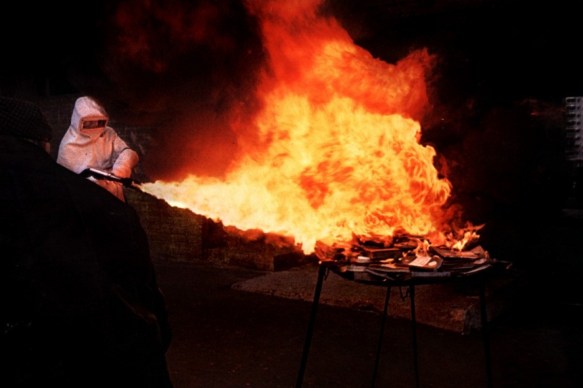





 After the Crash
