Why America’s Major News-Media Must Change Their Thinking

By Eric Zuesse

Source: Strategic Culture Foundation

America’s ‘news’-media possess the mentality that characterizes a dictatorship, not a democracy. This will be documented in the linked-to empirical data which will be subsequently discussed. But, first, here is what will be documented by those data, and which will make sense of these data:

In a democracy, the public perceive their country to be improving, in accord with that nation’s values and priorities. Consequently, they trust their government, and especially they approve of the job-performance of their nation’s leader. In a dictatorship, they don’t. In a dictatorship, the government doesn’t really represent them, at all. It represents the rulers, typically a national oligarchy, an aristocracy of the richest 0.1% or even of only the richest 0.01%. No matter how much the government ‘represents’ the public in law (or “on paper”), it’s not representing them in reality; and, so, the public don’t trust their government, and the public’s job-rating of their national leader, the head-of-state, is poor, perhaps even more disapproval than approval. So, whereas in a democracy, the public widely approve of both the government and the head-of-state; in a dictatorship, they don’t.

In a dictatorship, the ‘news’-media hide reality from the public, in order to serve the government — not the public. But the quality of government that the regime delivers to its public cannot be hidden as the lies continually pile up, and as the promises remain unfulfilled, and as the public find that despite all of the rosy promises, things are no better than before, or are even becoming worse. Trust in such a government falls, no matter how much the government lies and its media hide the fact that it has been lying. Though a ‘democratic’ election might not retain in power the same leaders, it retains in power the same regime (be it the richest 0.1%, or the richest 0.01%, or The Party, or whatever the dictatorship happens to be). That’s because it’s a dictatorship: it represents the same elite of power-holding insiders, no matter what. It does not represent the public. That elite — whatever it is — is referred to as the “Deep State,” and the same Deep State can control more than one country, in which case there is an empire, which nominally is headed by the head-of-state of its leading country (this used to be called an “Emperor”), but which actually consists of an alliance between the aristocracies within all these countries; and, sometimes, the nominal leading country is actually being led, in its foreign policies, by wealthier aristocrats in the supposedly vassal nations. But no empire can be a democracy, because the residents in no country want to be governed by any foreign power: the public, in every land, want their nation to be free — they want democracy, no dictatorship at all, especially no dictatorship from abroad.

In order for the elite to change, a revolution is required, even if it’s only to a different elite, instead of to a democracy. So, if there is no revolution, then certainly it’s the same dictatorship as before. The elite has changed (and this happens at least as often as generations change), but the dictatorship has not. And in order to change from a dictatorship to a democracy, a revolution also is required, but it will have to be a revolution that totally removes from power the elite (and all their agents) who had been ruling. If this elite had been the nation’s billionaires and its centi-millionaires who had also been billionaire-class donors to political campaigns (such as has been proven to be the case in the United States), then those people, who until the revolution had been behind the scenes producing the bad government, need to be dispossessed of their assets, because their assets were being used as their weapons against the public, and those weapons need (if there is to be a democracy) to be transferred to the public as represented by the new and authentically democratic government. If instead the elite had been a party, then all of those individuals need to be banned from every sort of political activity in the future. But, in either case, there will need to be a new constitution, and a consequent new body of laws, because the old order (the dictatorship) no longer reigns — it’s no longer in force after a revolution. That’s what “revolution” means. It doesn’t necessarily mean “democratic,” but sometimes it does produce a democracy where there wasn’t one before. The idea that every revolution is democratic is ridiculous, though it’s often assumed in ‘news’-reports. In fact, coups (which the U.S. Government specializes in like no other) often are a revolution that replaces a democracy by a dictatorship (such as the U.S. Government did to Ukraine in 2014, for example, and most famously before that, did to Iran in 1953). (Any country that perpetrates a coup anywhere is a dictatorship over the residents there, just the same as is the case when any invasion and occupation of a country are perpetrated upon a country. The imposed stooges are stooges, just the same. No country that imposes coups and/or invasions/occupations upon any government that has not posed an existential threat against the residents of that perpetrating country, supports democracy; to the exact contrary, that country unjustifiably imposes dictatorships; it spreads its own dictatorship, which is of the imperialistic type, and any government that spreads its dictatorship is evil and needs to be replaced — revolution is certainly justified there.)

This is how to identify which countries are democracies, and which ones are not: In a democracy, the public are served by the government, and thus are experiencing improvement in their lives and consequently approve of the job-performance of their head-of-state, and they trust the government. But in a dictatorship, none of these things is true.

In 2014, a Japanese international marketing-research firm polled citizens in each of ten countries asking whether they approve or disapprove of the job-performance of their nation’s head-of-state, and Harvard then provided an English-translated version online for a few years, then eliminated that translation from its website; but, fortunately, the translation had been web-archived and so is permanent here (with no information however regarding methodology or sampling); and it shows the following percentages who approved of the job-performance of their President or other head-of-state in each of the given countries, at that time:

China (Xi)          90%

Russia (Putin)      87%

India (Modi)        86%

South Africa (Zuma) 70%

Germany (Merkel)    67%

Brazil (Roussef)    63%

U.S. (Obama)        62%

Japan (Abe)         60%

UK (Cameron)        55%

France (Hollande)   48%

In January 2018, the global PR firm Edelman came out with the latest in their annual series of scientifically polled surveys in more than two dozen countries throughout the world, tapping into, actually, some of the major criteria within each nation indicating whether or not the given nation is more toward the dictatorship model, or more toward the democracy model. The 2018 Edelman Trust Barometer survey showed that “Trust in Government” (scored and ranked on page 39) was 44% in Russia, and is only 33% in the United States. Trust in Government is the highest in China: 84%. The U.S. and Russia are the nuclear super-powers; and the U.S. and China are the two economic super-powers; so, these are the world’s three leading powers; and, on that single measure of whether or not a country is democratic, China is the global leader (#1 of 28), Russia is in the middle (#13 of 28), and U.S. ranks at the bottom of the three, and near the bottom of the entire lot (#21 of 28). (#28 of 28 is South Africa, which, thus — clearly in retrospect — had a failed revolution when it transitioned out of its apartheid dictatorship. That’s just a fact, which cannot reasonably be denied, given this extreme finding. Though the nation’s leader, Zuma, was, according to the 2014 Japanese study, widely approved by South Africans, his Government was overwhelmingly distrusted. This distrust indicates that the public don’t believe that the head-of-state actually represents the Government. If the head-of-state doesn’t represent the Government, the country cannot possibly be a democracy: the leader might represent the people, but the Government doesn’t.)

When the government is trusted but the head-of-state is not, or vice-versa, there cannot be a functioning democracy. In other words: if either the head-of-state, or the Government, is widely distrusted, there’s a dictatorship at that time, and the only real question regarding it, is: What type of dictatorship is this?

These figures — the numbers reported here — contradict the ordinary propaganda; and, so, Edelman’s trust-barometer on each nation’s ‘news’-media (which are scored and ranked on page 40) might also be considered, because the natural question now is whether unreliable news-media might have caused this counter-intuitive (in Western countries) rank-order. However, a major reason why this media-trust-question is actually of only dubious relevance to whether or not the given nation is a democracy, is that to assume that it is, presumes that trust in the government can be that easily manipulated — it actually can’t. Media and PR can’t do that; they can’t achieve it. Here is a widespread misconception: Trust in government results not from the media but from a government’s having fulfilled its promises, and from the public’s experiencing and seeing all around themselves that they clearly have been fulfilled; and lying ‘news’-media can’t cover-up that reality, which is constantly and directly being experienced by the public.

However, even if trust in the ‘news’-media isn’t really such a thing as might be commonly hypothesized regarding trust in the government, here are those Edelman findings regarding the media, for whatever they’re worth regarding the question of democracy-versus-dictatorship: Trust in Media is the highest, #1, in China, 71%; and is 42% in #15 U.S.; and is 35% in #20 Russia. (A July 2017 Marist poll however found that only 30% of Americans trust the media. That’s a stunning 12% lower than the Edelman survey found.) In other words: Chinese people experience that what they encounter in their news-media becomes borne-out in retrospect as having been true, but only half of that percentage of Russians experience this; and U.S. scores nearer to Russia than to China on this matter. (Interestingly, Turkey, which scores #7 on trust-in-government, scores #28 on trust-in-media. Evidently, Turks find that their government delivers well on its promises, but that their ‘news’-media often deceive them. A contrast this extreme within the Edelman findings is unique. Turkey is a special case, regarding this.)

I have elsewhere reported regarding other key findings in that 2018 Edelman study.

According to all of these empirical findings, the United States is clearly not more of a democracy than it is a dictatorship. This particular finding from these studies has already been overwhelmingly (and even more so) confirmed in the world’s only in-depth empirical scientific study of whether or not a given country is or is not a “democracy”: This study (the classic Gilens and Page study) found, incontrovertibly, that the U.S. is a dictatorship — specifically an aristocracy, otherwise commonly called an “oligarchy,” and that it’s specifically a dictatorship by the richest, against the public.

Consequently, whenever the U.S. Government argues that it intends to “spread democracy” (such as it claims in regards to Syria, and to Ukraine), it is most-flagrantly lying — and any ‘news’-medium that reports such a claim without documenting (such as by linking to this article) its clear and already-proven falsehood (which is more fully documented here than has yet been done anywhere, since the Gilens and Page study is here being further proven by these international data), is no real ‘news’-medium at all, but is, instead, a propaganda-vehicle for the U.S. Government, a propaganda-arm of a dictatorship — a nation that has been overwhelmingly proven to be a dictatorship, not a democracy.

To Liberate Cambodia

By Robert J. Burrowes

A long-standing French protectorate briefly occupied by Japan during World War II, Cambodia became independent in 1953 as the French finally withdrew from Indochina. Under the leadership of Prince Norodom Sihanouk, Cambodia remained officially neutral, including during the subsequent US war on Indochina. However, by the mid-1960s, parts of the eastern provinces of Cambodia were bases for North Vietnamese Army and National Liberation Front (NVA/NLF) forces operating against South Vietnam and this resulted in nearly a decade of bombing by the United States from 4 October 1965. See ‘Bombs Over Cambodia: New Light on US Air War’.

In 1970 Sihanouk was ousted in a US-supported coup led by General Lon Nol. See ‘A Special Supplement: Cambodia’. The following few years were characterized by an internal power struggle between Cambodian elites and war involving several foreign countries, but particularly including continuation of the recently commenced ‘carpet bombing’ of Cambodia by the US Air Force.

On 17 April 1975 the Communist Party of Kampuchea (CPK), otherwise known as the Khmer Rouge, took control of Cambodia. Following four years of ruthless rule by the Chinese-supported Khmer Rouge, initially under Pol Pot, they were defeated by the Vietnamese army in 1979 and the Vietnamese occupation authorities established the People’s Republic of Kampuchea (PRK), installing Heng Samrin and other pro-Vietnamese Communist politicians as leaders of the new government. Heng was succeeded by Chan Sy as Prime Minister in 1981.

Following the death of Chan Sy, Hun Sen became Prime Minister of Cambodia in 1985 and, despite a facade of democracy, he and the Cambodian People’s Party (CPP) have been in power ever since. This period has notably included using the army to purge a feared rival in a bloody coup conducted in 1997. Hun Sen’s co-Prime Minister, Prince Norodom Ranariddh, was ousted and fled to Paris while his supporters were arrested, tortured and some were summarily executed.

The current main opposition party, the Cambodia National Rescue Party (CNRP) was founded in 2012 by merging the Sam Rainsy Party and the Human Rights Party. Emblematic of Cambodia’s ‘democratic’ status, more than two dozen opposition members and critics have been locked up in the past year alone and the CNRP leader, Kem Sokha, known for his nonviolent, politically tolerant views, is currently imprisoned at a detention centre in Tboung Khmum Province following his arrest on 3 September 2017 under allegations of treason, espionage and for orchestrating anti-government demonstrations in 2013-2014. These demonstrations were triggered by widespread allegations of electoral fraud during the Cambodian general election of 2013. See ‘Sokha arrested for “treason”, is accused of colluding with US to topple the government’.

On 16 November 2017 the CNRP was dissolved by Cambodia’s highest court and 118 of its members, including Sokha and exiled former leader Sam Rainsy, were banned from politics for five years.


Cambodian Society

Socially, Cambodia is primarily Khmer with ethnic populations of Chinese, Vietnamese, Cham, Thai and Lao. It has a population of 16 million people. The pre-eminent religion is Buddhism. The adult literacy rate is 75%; few Cambodians speak a European language limiting access to western literature. Most students complete 12 years of (low quality public) school but tertiary enrollment is limited. As in all countries, education (reinforced by state propaganda through the media) serves to intimidate and indoctrinate students into obedience of elites. Discussion of national politics in a school class is taboo and such discussions are rare at tertiary level. This manifests in the narrow range of concerns that mobilize student action: personal outcomes such as employment opportunities. Issues such as those in relation to peace, the environment and refugees do not have a significant profile. In short, the student population generally is neither well informed nor politically engaged.

However, many other issues engage at least some Cambodians, with demonstrations, strikes and street blockades being popular tactics, although the lack of strategy means that outcomes are usually limited and, despite commendable nonviolent discipline in many cases, violent repression is not effectively resisted. Issues of concern to workers, particularly low wages in a country with no minimum wage law, galvanize some response. See, for example, ‘Protests, Strikes Continue in Cambodia: Though their occupations differ, Cambodian workers are united in their push for a living wage’. Garment workers are a significant force because their sector is important to the national economy. Land grabbing and lack of housing mobilize many people but usually fail to attract support beyond those effected. See, for example, ‘Housing Activists Clash With Police in Street Protest’. Environmental issues, such as deforestation and natural resource depletion, fail to mobilize the support they need to be effective.

Having noted that, however, Cambodian activists require enormous courage to take nonviolent action as the possibility of violent state repression in response to popular mobilization is a real one, as illustrated above and documented in the Amnesty International report ‘Taking to the streets: Freedom of peaceful assembly in Cambodia’ from 2015.

Perhaps understandably, given their circumstances, international issues, such as events in the Middle East, North Korea and the plight of the Rohingya in neighbouring Myanmar are beyond the concern of most Cambodians.

Economically, Cambodians produce traditional goods for small local households with industrial production remaining low in a country that is still industrializing. Building on agriculture (especially rice), tourism and particularly the garment industry, which provided the basis for the Cambodian export sector in recent decades, the dictatorship has been encouraging light manufacturing, such as of electronics and auto-parts, by establishing ‘special economic zones’ that allow cheap Cambodian labour to be exploited. Most of the manufacturers are Japanese and despite poor infrastructure (such as lack of roads and port facilities), poor production management, poor literacy and numeracy among the workers, corruption and unreliable energy supplies, Cambodian factory production is slowly rising to play a part in Japan’s regional supply chain. In addition, Chinese investment in the construction sector has grown enormously in recent years and Cambodia is experiencing the common problem of development being geared to serve elite commercial interests and tourists rather than the needs (such as affordable housing) of ordinary people or the environment. See ‘China’s construction bubble may leave Cambodia’s next generation without a home’.

Environmentally, Cambodia does little to conserve its natural resources. For example, between 1990 and 2010, Cambodia lost 22% of its forest cover, or nearly 3,000,000 hectares, largely to logging. There is no commitment to gauging environmental impact before construction projects begin and the $US800m Lower Sesan 2 Dam, in the northeast of the country, has been widely accused of being constructed with little thought given to local residents (who will be evicted or lose their livelihood when the dam reservoir fills) or the project’s environmental impact.

Beyond deforestation (through both legal and illegal logging) then, environmental destruction in Cambodia occurs as a result of large scale construction and agricultural projects which destroy important wildlife habitats, but also through massive (legal and illegal) sand mining – see ‘Shifting Sand: How Singapore’s demand for Cambodian sand threatens ecosystems and undermines good governance’ – poaching of endangered and endemic species, with Cambodian businesses and political authorities, as well as foreign criminal syndicates and many transnational corporations from all over the world implicated in the various aspects of this corruptly-approved and executed destruction.

In the words of Cambodian researcher Tay Sovannarun: ‘The government just keeps doing business as usual while the rich cliques keep extracting natural resources and externalizing the cost to the rest of society.’ Moreover, three members of the NGO Mother Nature – Sun Mala, Try Sovikea and Sim Somnang – recently served nearly a year in prison for their efforts to defend the environment and the group was dissolved by the government in September 2017. See ‘Environmental NGO Mother Nature dissolved’.


Cambodian Politics

Politically, Cambodians are largely naïve with most believing that they live in a ‘democracy’ despite the absence of its most obvious hallmarks such as civil and political rights, the separation of powers including an independent judiciary, free and fair elections, the right of assembly and freedom of the press (with the English-language newspaper The Cambodia Daily recently closed down along with some radio stations). And this is an accurate assessment of most members of the political leadership of the CNRP as well.

Despite a 30-year record of political manipulation by Hun Sen and the CPP – during which ‘Hun Sen has made it clear that he does not respect the concept of free and fair elections’: see ‘30 Years of Hun Sen: Violence, Repression, and Corruption in Cambodia’ – which has included obvious corruption of elections through vote-rigging but also an outright coup in 1997 and the imprisonment or exile of opposition leaders since then, most Cambodians and their opposition leaders still participate in the charade that they live in a ‘democracy’ which could result in the defeat of Hun Sen and the CPP at a ‘free and fair’ election. Of course, there are exceptions to this naïveté, as a 2014 article written by Mu Sochua, veteran Cambodian politician and former minister of women’s affairs in a Hun Sen government, demonstrates. See ‘Crackdown in Cambodia’.

Moreover, as Sovannarun has noted: most Cambodians ‘still think international pressure is effective in keeping the CPP from disrespecting democratic principles which they have violated up until this day. Right now they wait for US and EU sanctions in the hope that the CPP will step back.’ See, for example, ‘The Birth of a Dictator’. He asks: ‘Even assuming it works, when will Cambodians learn to rely on themselves when the ruling party causes the same troubles again? Are they going to ask for external help like this every time and expect their country to be successfully democratized?’

The problem, Sovannarun argues, is that ‘Cambodians in general do not really understand what democracy is. Their views are very narrow. For them, democracy is just an election. Many news reports refer to people as “voters” but in Khmer, this literally translates as “vote owners” as if people cannot express their rights or power beside voting.’

Fortunately, recent actions by the CPP have led to opposition leaders and some NGOs finally declaring the Hun Sen dictatorship for what it is. See, for example, ‘The Birth of a Dictator’. But for Sovannarun, ‘democratization ended in 1997. The country should be regarded as a dictatorship since then. The party that lost the election in 1993 still controlled the national military, the police and security force, and the public administration, eventually using military force to establish absolute control in 1997. How is Cambodia still a democracy?’

However, recent comprehensive research undertaken by Global Witness goes even further. Their report Hostile Takeover ‘sheds light on a huge network of secret deal-making and corruption that has underpinned Hun Sen’s 30-year dictatorial reign of murder, torture and the imprisonment of his political opponents’. See ‘Hostile Takeover: The corporate empire of Cambodia’s ruling family’ and ‘Probe: Companies Worth $200M Linked to Cambodian PM’s Family’.

So what are the prospects of liberating Cambodia from its dictatorship?

To begin, there is little evidence to suggest that leadership for any movement to do so will come from within formal political ranks. Following the court-ordered dissolution of the CNRP on 16 November 2017 – see ‘Cambodia top court dissolves main opposition CNRP party’ – at the behest of Hun Sen, ‘half of their 55 members of parliament fled the country’. And this dissolution was preceded by actions that had effectively neutralized the opposition, with two dozen opposition members (including CNRP leader Kem Sokha) and critics imprisoned in the past year alone, as reported above, and the rapid flight of Opposition Deputy President Mu Sochua on 3 October after allegedly being notified by a senior official that her arrest was imminent. See ‘Breaking: CNRP’s Mu Sochua flees country following “warning” of arrest’. But while Mu Sochua called for a protest gathering after she had fled, understandably, nobody dared to protest: ‘Who dares to protest if their leader runs for their life?’ Sovannarun asks.

Of course, civil society leadership is fraught with danger too. Prominent political commentator and activist Kem Ley, known for his trenchant criticism of the Hun Sen dictatorship, was assassinated on 10 July 2016 in Phnom Penh. See ‘Shooting Death of Popular Activist Roils Cambodia’ and ‘Q&A With Kem Ley: Transparency on Hun Sen Family’s Business Interests is Vital’. Ley was the third notable activist to be killed following the union leader Chea Vichea in 2004 – see ‘Who Killed Chea Vichea?’ – and environmental activist Wutty Chut in 2012. See ‘Cambodian Environmental Activist Is Slain’. But they are not the only activists to suffer this fate.

In addition, plenty of politicians, journalists and activists have been viciously assaulted by the security forces and members of Hun Sen’s bodyguard unit – see, for example, ‘Dragged and Beaten: The Cambodian Government’s Role in the October 2015 Attack on Opposition Politicians’ – and/or imprisoned by the dictatorship. See ‘Cambodia: Quash Case Against 11 Opposition Activists: No Legal Basis for Trumped-Up Charges, Convictions, and Long Sentences’. In fact, Radio Free Asia keeps a record of ‘Cambodian Opposition Politicians and Activists Behind Bars’ for activities that the dictatorship does not like, including defending human rights, land rights and the natural environment.

Moreover, in another recent measure of the blatant brutality of the dictatorship, Hun Sen publicly suggested that opposition politicians Sam Rainsy and Kem Sokha ‘would already be dead’ had he known they were promising to ‘organise a new government’ in the aftermath of the highly disputed 2013 national election result. See ‘Rainsy and Sokha “would already be dead”: PM’. He also used a government-produced video to link the CNRP with US groups in fomenting a ‘colour revolution’ in Cambodia. See ‘Government ups plot accusations with new video linking CNRP and US groups to “colour revolutions”’.

In one response to Hun Sen’s ‘would already be dead’ statement, British human rights lawyer Richard Rogers, who had filed a complaint asking the International Criminal Court (ICC) to investigate the Cambodian ruling elite for widespread human rights violations in 2014, commented that it was simply more evidence of the government’s willingness to persecute political dissidents. ‘It shows that he is willing to order the murder of his own people if they challenge his rule’. Moreover: ‘These are not the words of a modern leader who claims to lead a democracy.’ See ‘Rainsy and Sokha “would already be dead”: PM’. Whether Hun Sen is even sane is a question that no-one asks.

So what can Cambodians do? Fortunately, there is a long history of repressive regimes being overthrown by nonviolent grassroots movements. And nonviolent action has proven powerfully effective in Cambodia as the Buddhist monk Maha Gosananda, and his supporters demonstrated on their 19-day peace walk from Siem Reap to Phnom Penh through war ravaged Khmer Rouge territory in Cambodia in May 1993, defying the expectations of the United Nations Transitional Authority in Cambodia (UNTAC) coordinators at the time that they would be killed by the Khmer Rouge. See ‘Maha Gosananda, a true peace maker’. However, for the Hun Sen dictatorship to be removed, Cambodians will be well served by a thoughtful and comprehensive strategy that takes particular account of their unique circumstances.

A framework to plan and implement a strategy to remove the dictatorship is explained in Nonviolent Defense/Liberation Strategy with Sovannarun’s Khmer translation of this strategy here.

This strategic framework explains what is necessary to remove the dictatorship and, among consideration of many vital issues, elaborates what is necessary to maintain strategic coordination when leaders are at high risk of assassination, minimize the risk of violent repression while also ensuring that the movement is not hijacked by government or foreign provocateurs whose purpose is to subvert the movement by destroying its nonviolent character – see, for example, ‘Nonviolent Action: Minimizing the Risk of Violent Repression’ – as well as deal with foreign governments (such as those of China, the European Union, Japan and the USA) who (categorically or by inaction) support the dictatorship, sometimes by supplying military weapons suitable for use against the domestic population.

Sovannarun is not optimistic about the short-term prospects for his country: Too many mistakes have been repeated too often. But he is committed to the nonviolent struggle to liberate Cambodia from its dictatorship and recognizes that the corrupt electoral process cannot restore democracy or enable Cambodians to meaningfully address the vast range of social, political, economic and environmental challenges they face.


Biodata: Robert J. Burrowes has a lifetime commitment to understanding and ending human violence. He has done extensive research since 1966 in an effort to understand why human beings are violent and has been a nonviolent activist since 1981. He is the author of ‘Why Violence?’ His email address is flametree@riseup.net and his website is here.

Websites:
Nonviolence Charter
Flame Tree Project to Save Life on Earth
‘Why Violence?’
Feelings First
Nonviolent Campaign Strategy
Nonviolent Defense/Liberation Strategy
Anita: Songs of Nonviolence
Robert Burrowes
Global Nonviolence Network

The Imperial President’s Toolbox of Terror: A Dictatorship Waiting to Happen


pimps-inc-improved_presidential_seal_by_sharpwriter-d486y6m_zps3hnflawe

By John W. Whitehead

Source: Waking Times

“When the President does it, that means that it is not illegal.”~Richard Nixon

Presidents don’t give up power.

Executive orders don’t expire at the end of each presidential term.

And every successive occupant of the Oval Office since George Washington, who issued the first executive order, has expanded the reach and power of the presidency.

The Constitution invests the President with very specific, limited powers: to serve as Commander-in-Chief of the military, grant pardons, make treaties (with the approval of Congress), appoint ambassadors and federal judges (again with Congress’ blessing), and veto legislation.

In recent years, however, American presidents have anointed themselves with the power to wage war, unilaterally kill Americans, torture prisoners, strip citizens of their rights, arrest and detain citizens indefinitely, carry out warrantless spying on Americans, and erect their own secretive, shadow government.

These are the powers that will be inherited by the next heir to the throne, and it won’t make a difference whether it’s a President Trump or a President Clinton occupying the Oval Office.

The powers amassed by each successive president through the negligence of Congress and the courts—powers which add up to a toolbox of terror for an imperial ruler—empower whomever occupies the Oval Office to act as a dictator, above the law and beyond any real accountability.

Consider some of the presidential powers—which have been acquired through the use of executive orders, decrees, memorandums, proclamations, national security directives and legislative signing statements and can be activated by any sitting president—that have allowed past presidents to operate above the law and beyond the reach of the Constitution.

The power to kill. As the New York Times concluded, “President Obama, who came to office promising transparency and adherence to the rule of law, has become the first president to claim the legal authority to order an American citizen killed without judicial involvement, real oversight or public accountability.” Obama’s kill lists—signature drone strikes handpicked by the president—have been justified by the Justice Department as lawful because they are subject to internal deliberations by the executive branch. “In other words,” writes Amy Davidson for the New Yorker, “it’s due process if the President thinks about it.”

The power to wage war. Ever since Congress granted George W. Bush the authorization to use military force in the wake of 9/11, the United States has been in a state of endless war without Congress ever having declared one. Having pledged to end Bush’s wars, Barack Obama has extended them. As the New York Times notes, “He has now been at war longer than Mr. Bush, or any other American president… he will leave behind an improbable legacy as the only president in American history to serve two complete terms with the nation at war.” More than that, as the Atlantic makes clear, “Obama is inaugurating an era of unbridled war-making by the commander in chief, without any of the checks and balances contemplated by the American constitutional system.”

The power to torture. Despite the fact that the Bush Administration’s use of waterboarding as a torture tactic was soundly criticized by Obama, the Obama Administration refused to hold anyone accountable for participating in the rendition and torture programs. In the absence of any finding of criminality, the authorization of such torture tactics remain part of the president’s domain—should he or she ever choose to revive it.

The power to spy on American citizens. In the wake of the 9/11 terror attacks, President Bush secretly authorized the National Security Agency to carry out surveillance on Americans’ phone calls and emails. The Bush Administration claimed that the Constitution gives the president inherent powers to protect national security. The covert surveillance has continued under Obama.

The power to indefinitely detain American citizens. In 1942, President Franklin D. Roosevelt issued an executive order requiring that all Japanese-Americans be held in internment camps. While that order was later rescinded, the U.S. Supreme Court declared it to be constitutional. The ruling has never been overturned. Pointing out that such blatantly illegal detentions could happen again—with the blessing of the courts—Justice Scalia warned, “In times of war, the laws fall silent.” In fact, each National Defense Authorization Act enacted since 2012 has included a provision that permits the military to detain individuals—including Americans citizens—indefinitely without trial.

The power to strip American citizens of their constitutional rights. The Bush Administration claimed it could strip American citizens of their constitutional rights, imprison them indefinitely, and deny them legal representation simply by labeling them as enemy combatants. While the Obama Administration jettisoned the use of the term “enemy combatant,” it has persisted in defending the president’s unilateral and global right to detain anyone suspected of supporting terrorist activities.

The power to secretly rewrite or sidestep the laws of the country. Secret courts, secret orders, and secret budgets have become standard operating procedure for presidential administrations in recent years. A good case in point is Presidential Policy Directive 20, a secret order signed by President Obama as a means of thwarting cyberattacks. Based on what little information was leaked to the press about the clandestine directive, it appears that the president essentially put the military in charge of warding off a possible cyberattack. A FOIA request by the Electronic Privacy Information Center (EPIC) seeking more details on the directive was allegedly denied because doing so could cause “exceptionally grave damage to the national security.” However, EPIC believes the order allows for military deployment within the United States, including the ability to shut off communications with the outside world if the military believes it is necessary.

The power to transform the police into extensions of the military and indirectly institute martial law. What began in the 1960s as a war on drugs transitioned into an all-out campaign to transform America’s police forces into extensions of the military. Every successive president since Nixon has added to the police’s arsenal, tactics and authority. In fact, the Obama Administration has accelerated police militarization by distributing military weapons and equipment to police and incentivizing SWAT team raids and heavy-handed police tactics through the use of federal grants and asset forfeiture schemes.

The power to command the largest military and intelligence capabilities in the world and, in turn, “wag the dog.”As law professor William P. Marshall points out:

In his roles as Commander-in-Chief and head of the Executive Branch, the President directly controls the most powerful military in the world and directs clandestine agencies such as the Central Intelligence Agency and National Security Agency. That control provides the President with immensely effective, non-transparent capabilities to further his political agenda and/or diminish the political abilities of his opponents. Whether a President would cynically use such power solely for his political advantage has, of course, been the subject of political thrillers and the occasional political attack. President Clinton, for one, was accused of ordering the bombing of terrorist bases in Afghanistan to distract the nation from the Lewinsky scandal, and President Nixon purportedly used the Federal Bureau of Investigation to investigate his political enemies. But regardless whether such abuses actually occurred, there is no doubt that control of covert agencies provides ample opportunity for political mischief, particularly since the inherently secretive nature of these agencies means their actions often are hidden from public view. And as the capabilities of these agencies increase through technological advances in surveillance and other methods of investigation, so does the power of the President.

Thus, it doesn’t matter what the pundits predict, the candidates promise, and the people decree.

It doesn’t even matter whether the people elect Trump or Clinton. After all, politicians sing a different tune once elected. For instance, the Chicago Tribune editorial board observed that although Barack Obama opposed the imperial tendencies of George W. Bush, once in office, Obama “wound up behaving as if he had a scepter and throne.”

What matters is that the damage has already been done.

As Professor Marshall explains, “every extraordinary use of power by one President expands the availability of executive branch power for use by future Presidents.” Moreover, it doesn’t even matter whether other presidents have chosen not to take advantage of any particular power, because “it is a President’s action in using power, rather than forsaking its use, that has the precedential significance.”

In other words, each successive president continues to add to his office’s list of extraordinary orders and directives, granting him- or herself near dictatorial powers.

So let’s not have any more talk of which candidate would be more dangerous with these powers.

The fact that any individual—or branch of government—is empowered to act like a dictator is danger enough.

This abuse of presidential powers has been going on for so long that it has become the norm and it will continue no matter which corporate puppet wins the election. The Constitution be damned.

The government of laws idealized by John Adams has fallen prey to a government of men.

As a result, we no longer have a system of checks and balances.

“The system of checks and balances that the Framers envisioned now lacks effective checks and is no longer in balance,”concludes Marshall. “The implications of this are serious. The Framers designed a system of separation of powers to combat government excess and abuse and to curb incompetence. They also believed that, in the absence of an effective separation-of-powers structure, such ills would inevitably follow. Unfortunately, however, power once taken is not easily surrendered.”

The solution is far from simple but it’s time, as Marshall suggests, to recalibrate the balance of power. This will mean putting an end to the use of executive orders, decrees, memorandums, proclamations, national security directives and legislative signing statements as a means of getting around Congress and the courts. It will mean that Americans will have to stop letting their politics blind them to government wrongdoing. And it will mean holding all three branches of government accountable to the Constitution (i.e., if they abuse their powers, vote them out of office).

Thus far, Congress, with little spine, less integrity and too busy running for re-election, has offered little attempt at oversight, enabling the president to ride roughshod over the Constitution. The media—the perfect accomplice in this stealthy, bloodless coup—continues to inundate us with the latest celebrity scandal, says virtually nothing about these burgeoning powers. All the while, most Americans continue to operate in blissful near-ignorance, unaware or uncaring that the republic is about to fall.

Yet as I point out in my book Battlefield America: The War on the American People, it will be “we the people”—not the president, the politicians, the corporate elite or the media—who will suffer the consequences when freedom falls and tyranny rises. They may justify violating our freedoms in the name of whatever phantom menace-of-the-month threatens “national security,” but we will always be the ones to pay the price.


America, the World’s Most Dangerous Dictatorship

american-imperialism-39-638

By Gordon Duff

Source: New Eastern Outlook

Though Russia doesn’t consider herself a superpower, other than the US, and just perhaps China, Russia is as close as we come. A very real problem is that Russia has a very poor understanding of America, how politics work, what Americans think and, more than anything else, Russia still thinks America is a democracy.

You see, at the same time America was tearing the Soviet Union apart, the same thing was being done to America. Neither nation survived, it wasn’t just the Soviet Union that fell to the New World Order, it was America as well. Let me explain as succinctly as possible.

During the Clinton years, powerful Nazi inspired elements in America plotted what has been the successful overthrow of America’s constitution. The movement was led by rogue “industrialist” John Mellon Scaife and lawyers Antonio Scalia and Newt Gingrich. Financing them all was the Rothschild owned and controlled Federal Reserve Corporation.

A secret society hidden in plain sight was set up called the Federalist Society. This Nazi controlled group, backed by the powerful Israel lobby, moved into every law school in America, recruiting top candidates based on skill sets needed.

This program was devised by the CIA and recruited thousands of budding sociopathic personality types, recruiting them into the Federalist Society and channeling them into top law firms or government agencies.

Adding to these recruits were senior lawyers with ties to organized and corporate crime, thousands of them in a major CIA operation.

There, they were pushed forward and after a decade ran the US Department of Justice, nearly every court in the nation, controlled the law schools, controlled the American Bar Association, the FBI and had put over 150 of their members into the Congress of the United States.

They also controlled every regulatory agency, environment, banking and finance, food and drug safety, you can see where this is going.

They also controlled 5 justices of the Supreme Court of the United States.

During the Clinton Administration, they managed to temporarily get control of the US House of Representatives through the help of the Contract with America and Newt Gingrich, financed by Zionist “black propaganda” moneyman Rupert Murdoch. In payment for this, “Newt” gave Murdoch an American broadcast network, Fox, though illegal. You see, non-Americans can’t control networks, or couldn’t. That’s ok, Gingrich eventually gave Murdoch illegal American citizenship as well.

Murdoch only had to publish Newt’s useless books and give his wife, and Newt traded them in with regularity, a highly paid “do nothing job” as a bribe.

Where things really paid off was 2000. During the Clinton administration, Scaife hired lawyer Ken Starr to investigate Clinton and get himself nominated as Special Prosecutor. Scaife paid Starr by naming him President of Pepperdine University, which Scaife controlled, for those who care about facts.

Clinton backer George Soros hired a former CIA agent named Steve Kangas to get dirt on Scaife. Kangas amassed enough evidence on Scaife and his deal with Starr to send them both to the electric chair. Scaife, Scalia and the Federalists had Kangas kidnapped and murdered in order to save Ken Starr who had been promised a seat on the US Supreme Court. Look into it.

The deal really came to life in 2000. The CIA and Diebold Corporation had contracted with a computer guru named Michael Connell who developed software that would simply flip votes done on electronic voting machines. Targeted would be the states of Ohio, Florida and Virginia only, piling up votes in key precincts just enough to guarantee control of the Electoral College.

Without this it is impossible for the Republican Party to get a president elected without staging an international incident such as the kidnapping of US diplomats in Tehran. We aren’t going to say the Ayatollah was an MI6 agent and was sent to Iran for exactly this purpose, even though it is true and we can prove it.

In 2000, even with millions of votes flipped, exit polls support Bush losing by 5 million votes, the election couldn’t be saved. Here, the Federalists stepped in and had their 5 Supreme Court justices step in and overthrow both the areas of equal protection and states’ rights of the US Constitution to place Bush in office.

2000 was important. This was a presidential election that also took place on a census year. You see, the census is a rationale for redistricting the US House of Representatives using State legislatures, which were largely taken over by the Federalist Society. Bribes and payoffs at state level are hard to control and organized crime easily got control of enough states to allow redistricting.

Here, the CIA developed a program for designing odd shaped congressional districts that would pile union workers and minorities into bizarre and often discontiguous shapes, taking districts away from democrats by joining them together and creating new republican only districts, often with almost no people living in them.

Additionally, problem representatives like Ohio’s Dennis Kucinich were eliminated entirely, their districts were simply erased, all of this, and it is called gerrymandering, is illegal.

By 2004 there were no more free elections for the House of Representatives, giving this house free rein to investigate anyone, any time and to quell any investigation as well, such as 9/11.

By 2005, by a 5/4 vote, the Supreme Court in the Citizens United case overturned for all time limitations on foreign and corporate spending on American elections, citing an end to democracy in America.

Mike Connell, GOP “guru” died in a mysterious plane crash in Ohio just before testifying about his role in CIA “vote flipping.”

This is as short and sweet as it could be put. For those who fail to understand the Federalist Society and the hold organized crime through the Republican Party has gained over American government, the new Cold War and the threat of a hot war as well is a total surprise.

For those who pay attention, we saw it coming all along.

Can We Please Get Rid of the Pledge?

112congress_tx700

By Mike Whitney

Source: CounterPunch

The Pledge of Allegiance is not an expression of patriotism. It is a loyalty oath that one normally associates with totalitarian regimes. People who love freedom, should be appalled by the idea our children are being coerced to stand and declare their support for the state. This is the worst form of indoctrination and it is completely anathema to the principals articulated in the US Constitution and the Bill of Rights. I cannot imagine outspoken libertarians like Thomas Jefferson or Tom Paine ever proclaiming their loyalty to the state when they correctly saw the state as the greatest threat to individual freedom. Which it is.

Now I know that many people think the Pledge is simply an affirmation of their respect for the flag, their love for the country, and their gratitude to the men and women who fought in America’s wars. But that’s not what it is. The Pledge is an attempt to impose conformity on the masses and compel them to click their heels and proclaim their devotion to the Fatherland. That’s not how it’s supposed to work in a democracy. In a democracy, the representatives of the state are supposed to pledge their loyalty to the people and to the laws that protect them. That’s the correct relationship between the state and the people. The Pledge turns that whole concept on its head.

Now I’d have no problem if our schoolchildren recited the Preamble to the Declaration of Independence before class every day:

“We hold these truths to be self-evident, that all men are created equal, that they are endowed by their Creator with certain unalienable Rights, that among these are Life, Liberty and the pursuit of Happiness.

That to secure these rights, Governments are instituted among Men, deriving their just powers from the consent of the governed, That whenever any Form of Government becomes destructive of these ends, it is the Right of the People to alter or to abolish it, and to institute new Government, laying its foundation on such principles and organizing its powers in such form, as to them shall seem most likely to effect their Safety and Happiness.”

That’s great stuff, unfortunately, the people who run this country would never allow it. They’d never allow our kids to recite an incendiary, revolutionary document like that every day for fear it would incite violence against the state. What they want is “good Germans”, not revolutionaries, not freedom-loving populists, and not well-informed, critical thinking individuals who can see through the sham of their jingoistic propaganda. They want people who are going to follow the rules, do what they’re told, fight the wars, and perform their worktime drudgery for 30 or 40 years until they’re carted off to the glue factory. That’s what they want. Reciting the Pledge fits perfectly with this dumbed-down version of permanent indentured servitude. It provides the ideological foundation for bovine acquiescence to the demands of the state and the crooks who run it behind the tri-color banner.

The fact that institutions like the Pledge are never challenged in a public format, points to deeper problems with the media and the way our kids are being educated. And while I don’t have time to talk about that now, it makes me wonder where are the people to question these silly recitations that undermine democracy and personal liberty? Why are their voices never heard?

I can’t answer that, but when I see the state deliberately eviscerating habeas corpus and locking away terror suspects for life with no evidence, no witnesses, no due process, no presumption of innocence, no way to defend themselves or claim their innocence in a court of law or before a jury of their peers–when I see the US state assuming the same unchecked, tyrannical powers as all of the dictatorships that went before them– I grow increasingly concerned that this lack of critical thinking is costing the country quite dearly. We are on the verge of losing what-little democracy we have left because people are incapable of looking around and asking ‘what the hell is going on?’

Pulling your head out of the sand and asking questions is not a sign of disloyalty. It’s a sign of intelligence, the kind of intelligence this country needs to stop the bloody wars and get back on track.

So next time you’re in a situation where you’re asked to stand up and recite the pledge, just pause for a minute and ask yourself what it really means. Is it really an expression of “love of country” or a is it a vacuous and demeaning exercise in nationalism that should be done away with ASAP?

I’d say, it’s the latter.


MIKE WHITNEY lives in Washington state. He is a contributor to Hopeless: Barack Obama and the Politics of Illusion (AK Press). Hopeless is also available in a Kindle edition. He can be reached at fergiewhitney@msn.com.

Related Article: The Truth About the Pledge of Allegiance: Indoctrination & Obedience

Related Videos:

Mad About Rigged Elections? Mainstream Media Says YOU Are the Problem

CiincRGVAAAPuJf

By Claire Bernish

Source: AntiMedia

Mainstream headlines constantly decry Bernie Sanders supporters for disrupting events in outrage, as if their protests and demonstrations somehow illustrate the devolution of the elections. But that focus by the corporate media utterly negates the consistent and continual reports of fraud and disenfranchisement fueling their ire.

And it’s getting ridiculous.

Newsweek, though far from alone, offered a prime example of the obfuscation of the election fraud and questionable campaign tactics by Hillary Clinton in its skewering of Sanders’ supporters.

Get Control, Senator Sanders, or Get Out,” Newsweek’s Kurt Eichenwald titled his op-ed — which thoroughly blasts the Vermont senator — as if he were somehow responsible for both the electoral chaos and the actions of an irate voting public.

“So, Senator Sanders,” Eichenwald writes [with emphasis added], “either get control of what is becoming your increasingly unhinged cult, or get out of the race. Whatever respect sane liberals had for you is rapidly dwindling, and the damage being inflicted on your reputation may be unfixable. If you can’t even manage the vicious thugs who act in your name, you can’t be trusted to run a convenience store, much less the country.”

Really?

Because what Eichenwald obviates most readily in his attack is the inability to understand why those protests might be occurring in the first place. Judging by the timing of his article, it’s likely Eichenwald wrote it after chaos broke out at the Nevada Democratic Convention on Saturday — chaos that transpired after the party took it upon itself to ignore thousands who rightly believed Sanders delegates had been excluded unfairly from the caucus proceedings.

Despite the call for a recount, party officials refused to follow necessary procedure and abruptly adjourned the convention, leaving thousands of voters in the lurch — and hotel security and local law enforcement to deal with the aftermath. When things seem suspicious, apparently Eichenwald feels voters should not only have no recourse, they should be happy about it.

“Sanders has increasingly signaled that he is in this race for Sanders,” he continues, “and day after day shows himself to be a whining crybaby with little interest in a broader movement.”

It would be nice if Eichenwald’s hit piece were as much a joke as it comes across, but clearly he’s missed the point — and the vast movement supporting not only Sanders, but electoral justice. Worse, he didn’t stop there:

“Signs are emerging that the Sanders campaign is transmogrifying into the type of movement through which tyrants are born.

“The ugly was on display” at the aforementioned Nevada convention, Eichenwald adds, “where Hillary Clinton won more delegates than Sanders.”

No kidding. That would be precisely the issue that “cult” expressed fury about — Clinton managed to put yet another state under her belt under highly questionable circumstances. In fact, suspect happenings at nearly every primary and caucus so far oddly favor the former secretary of state — and Nevada stood as further testament to why voters are practically up in arms over what appears to be electoral favoritism.

But Eichenwald wasn’t alone in overlooking those concerns — or in blatantly mischaracterizing both that bias and its consequential thwarting of the wishes of a hefty segment of the voting public.

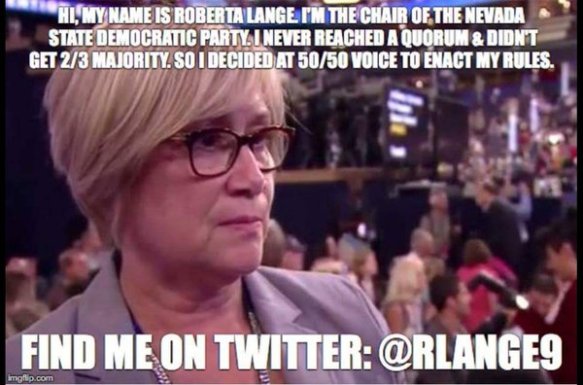
In the New York Times, Alan Rappeport also took the chance to strike at Sanders’ followers by citing Roberta Lange, Nevada State Democratic Party Chairwoman, who adjourned the convention early — earning the wrath of Nevada’s voters.

“‘It’s been vile,’ said Ms. Lange, who riled Sanders supporters by refusing their requests for rule changes at the event in Las Vegas,” Rappeport notes, adding, “The vicious response comes as millions of new voters, many of whom felt excluded by establishment politicians, have flocked to the insurgent campaigns of Mr. Sanders and Mr. Trump.”

Though he at least presented that aspect of the elections fairly, his description of what Lange actually did in Nevada misses the mark — that rules change had originally occurred prior to the convention, and Lange’s hasty and subjective decision on a contentious voice vote to permanently install the change arguably created the eruption of anger. But a number of Times staff have contributed sizeable amounts to Hillary’s campaign — and a Clinton family organization also donated $100,000 to the Times’ charitable organization the same year it endorsed her. Funny how bias thus peppers its reporting.

But the media roasting of Sanders and his supporters also appeared in the Sacramento Bee — where the editorial board also called the senator to task for the Nevada incident in lieu of calling out the controversial elections. According to the Bee,

“The episode had the reek of Trump rallies, where threats, insults, and sucker punches to defend the presumptive Republican nominee have been common. Yet looking back at the hundreds of Sanders supporters who descended on a Clinton rally in East Los Angeles earlier this month to intimidate her supporters, making one little girl cry, it now seems inevitable that the same kind of violent eruption would afflict those ‘feeling the Bern.’”

Seriously?

While the protest in L.A. certainly rattled Clinton supporters, violence didn’t pepper the event. One Sanders supporter — sporting a Free Hugs tee-shirt, no less — even assisted Clinton-supporting families with teary-eyed children in tow navigate through the crowd. While reports that someone ripped apart a young girl’s pro-Hillary sign might be valid, it would stand as the exception to what amounted to a boisterous demonstration over justifiable grievances. And, again, this obfuscation forgets entirely the need for demonstrations, which Hillary Clinton — in repeated lies, controversial policy proposals, and a campaign replete with fraud complaints — has clearly helped create.

Perhaps corporate, mainstream media — instead of targeting the symptom — should attempt to report its root cause.

Perhaps enormous swaths of voters being dropped from the rolls in New York; Clinton’s inexplicably astronomical luck in coin tosses in Iowa; inexcusably untrained elections volunteers and their equally inexcusable tendency allowing Clinton supporters to participate in caucuses without first being registered; or any number of other examples from the mountain of ever-growing evidence the elections are, indeed, rigged, are infinitely more deserving of headlines than hit pieces against those protesting such affronts to the American electoral process.

Or perhaps we should all just do as Eichenwald suggests — swallow our pride and our desire for a less corrupt and fairer system — and turn tail.

Or not. Because this system is rigged — and the corporate media helps pull the strings. But as long as independent media reports what the mainstream refuses, and as long as fraud inundates the 2016 election, there will be protests — regardless of whether or not Newsweek and the Times and the rest of their ilk ever grasp accuracy in reporting.

Hillary Clinton Breaks the Irony Meter

By Kevin Carson

Source: Center for a Stateless Society

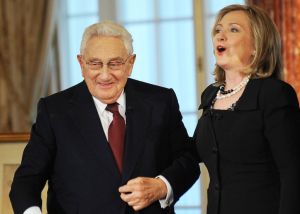
At the March 9 Democratic debate, Hillary Clinton had this to say about competitor Bernie Sanders’s favorable comments on Castro’s Cuba and the Sandinista regime in the ’80s:  “if the values are that you oppress people, you disappear people, imprison people or even kill people for expressing their opinions…, that is not the kind of revolution of values that I ever want to see anywhere.” This, coming from a former Secretary of State who backed a right-wing coup in Honduras and proudly name-drops Henry Kissinger — Henry Kissinger! — as a close friend and mentor, is the kind of thing the Onion can’t compete with.

If Kissinger was known for anything in his years as National Security Adviser and Secretary of State, it was installing dictators who oppressed, disappeared and imprisoned people. He oversaw a wave of coups that swept South America in the late ’60s and ’70s, installing right-wing military regimes that tortured, murdered or disappeared dissidents by the thousands, and where a common fate for labor and peasant activists was to be found in a ditch with their faces hacked off. Under Kissinger the U.S. actively supported Operation Condor — the program by which these South American dictators used torture and murder to suppress opposition — with military aid and technical assistance. He gave the green light to Indonesia’s genocidal invasion of East Timor.

Clinton has a long history of close personal friendship with this monster, and indeed touts herself as something of a protege. According to both Hillary and Bill, Kissinger praised her for running the State Department better than anybody in decades. And well might he praise her, because she’s followed in his footsteps in many ways. As Secretary of State, she oversaw the sale of millions of dollars worth of arms to despotic regimes that oppressed, disappeared and imprisoned people for expressing their opinions — many of which regimes were also large donors to the Clinton Foundation. And while we’re on the subject of people being murdered and disappeared, how about Berta Caceres — an activist murdered by the right-wing Honduran regime whose seizure of power Clinton backed in 2009?

As senator, Clinton voted to authorize George Bush’s criminal war of aggression on Iraq, which has resulted in hundreds of thousands of Iraqi deaths since 2003. She says now it was “a mistake.” It was a mistake all right. She mistakenly believed the vote would make her more viable as a future presidential candidate. She mistakenly predicted the way the political winds would be blowing when she decided to run for president.

And don’t forget Clinton’s support for the Obama administration’s indiscriminate use of drones for extrajudicial killing. Many of the victims were civilians, and hundreds of them were actually children.

If you add it all up, Hillary Clinton still isn’t quite the war criminal her old friend and mentor Henry Kissinger is. Those are some big, bloody shoes to fill. But if she’s elected she’ll grow into them.

They Live, We Sleep: A Dictatorship Disguised as a Democracy

leadtheylive1

By John W. Whitehead

Source: The Rutherford Institute

“You see them on the street. You watch them on TV. You might even vote for one this fall. You think they’re people just like you. You’re wrong. Dead wrong.”—They Live

We’re living in two worlds, you and I.

There’s the world we see (or are made to see) and then there’s the one we sense (and occasionally catch a glimpse of), the latter of which is a far cry from the propaganda-driven reality manufactured by the government and its corporate sponsors, including the media.

Indeed, what most Americans perceive as life in America—privileged, progressive and free—is a far cry from reality, where economic inequality is growing, real agendas and real power are buried beneath layers of Orwellian doublespeak and corporate obfuscation, and “freedom,” such that it is, is meted out in small, legalistic doses by militarized police armed to the teeth.

All is not as it seems.

This is the premise of John Carpenter’s film They Live (1988), in which two migrant workers discover that the world’s population is actually being controlled and exploited by aliens working in partnership with an oligarchic elite. All the while, the populace—blissfully unaware of the real agenda at work in their lives—has been lulled into complacency, indoctrinated into compliance, bombarded with media distractions, and hypnotized by subliminal messages beamed out of television and various electronic devices, billboards and the like.

It is only when homeless drifter John Nada (played to the hilt by the late Roddy Piper) discovers a pair of doctored sunglasses—Hoffman lenses—that Nada sees what lies beneath the elite’s fabricated reality: control and bondage.

When viewed through the lens of truth, the elite, who appear human until stripped of their disguises, are shown to be monsters who have enslaved the citizenry in order to prey on them. Likewise, billboards blare out hidden, authoritative messages: a bikini-clad woman in one ad is actually ordering viewers to “MARRY AND REPRODUCE.” Magazine racks scream “CONSUME” and “OBEY.” A wad of dollar bills in a vendor’s hand proclaims, “THIS IS YOUR GOD.”

When viewed through Nada’s Hoffman lenses, some of the other hidden messages being drummed into the people’s subconscious include: NO INDEPENDENT THOUGHT, CONFORM, SUBMIT, STAY ASLEEP, BUY, WATCH TV, NO IMAGINATION, and DO NOT QUESTION AUTHORITY.

This indoctrination campaign engineered by the elite in They Live is painfully familiar to anyone who has studied the decline of American culture. A citizenry that does not think for themselves, obeys without question, is submissive, does not challenge authority, does not think outside the box, and is content to sit back and be entertained is a citizenry that can be easily controlled.

In this way, the subtle message of They Live provides an apt analogy of our own distorted vision of life in the American police state, what philosopher Slavoj Žižek refers to as dictatorship in democracy, “the invisible order which sustains your apparent freedom.”

We’re being fed a series of carefully contrived fictions that bear no resemblance to reality. The powers-that-be want us to feel threatened by forces beyond our control (terrorists, shooters, bombers). They want us afraid and dependent on the government and its militarized armies for our safety and well-being. They want us distrustful of each other, divided by our prejudices, and at each other’s throats. Most of all, they want us to continue to march in lockstep with their dictates.

Tune out the government’s attempts to distract, divert and befuddle us and tune into what’s really going on in this country, and you’ll run headlong into an unmistakable, unpalatable truth: the moneyed elite who rule us view us as expendable resources to be used, abused and discarded.

In fact, a 2014 study conducted by Princeton and Northwestern University concluded that the U.S. government does not represent the majority of American citizens. Instead, the study found that the government is ruled by the rich and powerful, or the so-called “economic elite.” Moreover, the researchers concluded that policies enacted by this governmental elite nearly always favor special interests and lobbying groups.

In other words, we are being ruled by an oligarchy disguised as a democracy, and arguably on our way towards fascism—a form of government where private corporate interests rule, money calls the shots, and the people are seen as mere subjects to be controlled.

Consider this: it is estimated that the 2016 presidential election could cost as much as $5 billion, more than double what was spent getting Obama re-elected in 2012.

Not only do you have to be rich—or beholden to the rich—to get elected these days, but getting elected is also a surefire way to get rich. As CBS News reports, “Once in office, members of Congress enjoy access to connections and information they can use to increase their wealth, in ways that are unparalleled in the private sector. And once politicians leave office, their connections allow them to profit even further.”

In denouncing this blatant corruption of America’s political system, former president Jimmy Carter blasted the process of getting elected—to the White House, governor’s mansion, Congress or state legislatures—as “unlimited political bribery… a subversion of our political system as a payoff to major contributors, who want and expect, and sometimes get, favors for themselves after the election is over.”

Rest assured that when and if fascism finally takes hold in America, the basic forms of government will remain. As I point out in my book Battlefield America: The War on the American People, fascism will appear to be friendly. The legislators will be in session. There will be elections, and the news media will continue to cover the entertainment and political trivia. Consent of the governed, however, will no longer apply. Actual control will have finally passed to the oligarchic elite controlling the government behind the scenes.

By creating the illusion that it preserves democratic traditions, fascism creeps slowly until it consumes the political system. And in times of “crisis,” expediency is upheld as the central principle—that is, in order to keep us safe and secure, the government must militarize the police, strip us of basic constitutional rights, criminalize virtually every form of behavior, and build enough private prisons to house all of us nonviolent criminals.

Clearly, we are now ruled by an oligarchic elite of governmental and corporate interests. We have moved into “corporatism” (favored by Benito Mussolini), which is a halfway point on the road to full-blown fascism.

Vast sectors of the economy, government and politics are managed by private business concerns, otherwise referred to as “privatization” by various government politicians. Just study modern government policies. “Every industry is regulated. Every profession is classified and organized,” writes economic analyst Jeffrey Tucker. “Every good or service is taxed. Endless debt accumulation is preserved. Immense doesn’t begin to describe the bureaucracy. Military preparedness never stops, and war with some evil foreign foe, remains a daily prospect.”

In other words, the government in America today does whatever it wants.

Corporatism is where the few moneyed interests—not elected by the citizenry—rule over the many. In this way, it is not a democracy or a republican form of government, which is what the American government was established to be. It is a top-down form of government and one which has a terrifying history typified by the developments that occurred in totalitarian regimes of the past: police states where everyone is watched and spied on, rounded up for minor infractions by government agents, placed under police control, and placed in detention (a.k.a. concentration) camps.

For the final hammer of fascism to fall, it will require the most crucial ingredient: the majority of the people will have to agree that it’s not only expedient but necessary. But why would a people agree to such an oppressive regime? The answer is the same in every age: fear.

Fear makes people stupid.

Fear is the method most often used by politicians to increase the power of government. And, as most social commentators recognize, an atmosphere of fear permeates modern America: fear of terrorism, fear of the police, fear of our neighbors and so on.

The propaganda of fear has been used quite effectively by those who want to gain control, and it is working on the American populace.

Despite the fact that we are 17,600 times more likely to die from heart disease than from a terrorist attack; 11,000 times more likely to die from an airplane accident than from a terrorist plot involving an airplane; 1,048 times more likely to die from a car accident than a terrorist attack, and 8 times more likely to be killed by a police officer than by a terrorist, we have handed over control of our lives to government officials who treat us as a means to an end—the source of money and power.

We have allowed ourselves to become fearful, controlled, pacified zombies.

In this regard, we’re not so different from the oppressed citizens in They Live. Most everyone keeps their heads down these days while staring zombie-like into an electronic screen, even when they’re crossing the street. Families sit in restaurants with their heads down, separated by their screen devices and unaware of what’s going on around them. Young people especially seem dominated by the devices they hold in their hands, oblivious to the fact that they can simply push a button, turn the thing off and walk away.

Indeed, there is no larger group activity than that connected with those who watch screens—that is, television, lap tops, personal computers, cell phones and so on. In fact, a Nielsen study reports that American screen viewing is at an all-time high. For example, the average American watches approximately 151 hours of television per month.

The question, of course, is what effect does such screen consumption have on one’s mind?

Psychologically it is similar to drug addiction. Researchers found that “almost immediately after turning on the TV, subjects reported feeling more relaxed, and because this occurs so quickly and the tension returns so rapidly after the TV is turned off, people are conditioned to associate TV viewing with a lack of tension.” Research also shows that regardless of the programming, viewers’ brain waves slow down, thus transforming them into a more passive, nonresistant state.

Historically, television has been used by those in authority to quiet discontent and pacify disruptive people. “Faced with severe overcrowding and limited budgets for rehabilitation and counseling, more and more prison officials are using TV to keep inmates quiet,” according to Newsweek.

Given that the majority of what Americans watch on television is provided through channels controlled by six mega corporations, what we watch is now controlled by a corporate elite and, if that elite needs to foster a particular viewpoint or pacify its viewers, it can do so on a large scale.

If we’re watching, we’re not doing.

The powers-that-be understand this. As television journalist Edward R. Murrow warned in a 1958 speech:

We are currently wealthy, fat, comfortable and complacent. We have currently a built-in allergy to unpleasant or disturbing information. Our mass media reflect this. But unless we get up off our fat surpluses and recognize that television in the main is being used to distract, delude, amuse, and insulate us, then television and those who finance it, those who look at it, and those who work at it, may see a totally different picture too late.

This brings me back to They Live, in which the real zombies are not the aliens calling the shots but the populace who are content to remain controlled.

When all is said and done, the world of They Live is not so different from our own. As one of the characters points out, “The poor and the underclass are growing. Racial justice and human rights are nonexistent. They have created a repressive society and we are their unwitting accomplices. Their intention to rule rests with the annihilation of consciousness. We have been lulled into a trance. They have made us indifferent to ourselves, to others. We are focused only on our own gain.”

We, too, are focused only on our own pleasures, prejudices and gains. Our poor and underclasses are also growing. Racial injustice is growing. Human rights is nearly nonexistent. We too have been lulled into a trance, indifferent to others.

Oblivious to what lies ahead, we’ve been manipulated into believing that if we continue to consume, obey, and have faith, things will work out. But that’s never been true of emerging regimes. And by the time we feel the hammer coming down upon us, it will be too late.