Sometimes you wake up from a dream to realize it is telling you to pay close attention to the depth of its message, especially when it is linked to what you have been thinking about for days. I have just come up from a dream in which I went down to the cellar of the house I grew up in because the basement light was on and the back cellar door had been opened by a mysterious man who stood outside.
I will spare you additional details or an interpretation, except to say that my daytime thoughts concerned the media spectacle surrounding the Titan submersible that imploded two miles down in the ocean’s cellar while trying to give its passengers a view of the wreck of the Titanic, the “unsinkable” ship nicknamed “the Millionaire’s Special.” The ship that no one could sink except an ice cube in the drink that swallowed it.
Cellar dreams are well-known as the place where we as individuals and societies can face the flickering shadows that we refuse to face in conscious life. Carl Jung called it “the shadow.” Such shadows, when unacknowledged and repressed, have a tendency to autonomously surface and erupt, not only leading to personal self-destruction but that of whole societies. History is replete with examples. My dream’s mysterious stranger had lit my way through some dark thoughts and opened the door to a possible escape. He got me thinking about what all of us tend to want to deny or avoid because its implications are so monstrous.
The obsession with the alleged marvels of technology together with naming them after ancient Greek and Roman gods are fixations of elite technologues who have lost what Spengler called “living inner religiousness” but wish to show they know the classical names even though they miss the meaning of these myths. Such myths tell the stories of things that never happened but always are. Appropriating the ancient names without irony – such as naming a boat Titanic or a submersible Titan – unveils the hubristic ignorance of people who have never descended to the underworld to learn its lessons. Relinquishing their sense of god-like power doesn’t occur to them, nor does the shadow side of their Faustian dreams.
They will never name some machine Nemesis, for that would expose the fact that they have exceeded the eternal limits with their maniacal technological extremism, and, to paraphrase Camus, dark Furies will swoop down to destroy them.
Nietzsche termed the result nihilism. Once people have killed God, machines are a handy replacement in societies that worship the illusion of technique and are scared to death of death and the machines that they invented to administer it.
The latter is not a matter fit to print since it must remain in the dark basement of the public’s consciousness. If it were publicized, the game of nihilistic death-dealing would be exposed. Because power, money, and technology are the ruling deities today, the mass media revolve around publicizing their marvels in spectacular fashion, and when “accidents” occur, they never point out the myth of the machines, or what Lewis Mumford called “The Pentagon of Power.” Tragedies occur, they tell us, but they are minor by-products of the marvels of technology.
But if these media would take us down to see the truth beneath the oceans’ surfaces, we would see not false monsters such as the Titanic or Moby Dick or cartoon fictions such as Disney’s Monstro the whale, but the handiwork of thousands of mad Captain Ahabs who have attached the technologues “greatest” invention – nuclear weapons – to nuclear-powered ballistic submarines.
Trident submarines. First strike submarines, such as the USS Ohio.
These Trident subs live and breathe in the cellars of our minds where few dare descend. They are controlled by jackals in Washington and the Pentagon with polished faces in well-appointed offices with coffee machines and tasty snacks. Madmen. They hum through the deep waters ready to strike and destroy the world. Few hear them, almost none see them, most prefer not to know of them.
But wait, what’s the buzz, tell me what’s happening: the Titan and the Titanic, wealthy voyeurs intent on getting a glance into the sepulchre of those long dead, while six hundred or so desperate migrants drown in the Mediterranean sea from which the ancient gods were born. These are the priorities of a society that worships the wealthy; a society of the spectacle that entertains and distracts while the end of the world cruises below consciousness.
The United States alone has fourteen such submarines armed with Trident missiles constantly prowling the ocean depths, while the British have four. Named for the three-pronged weapon of the Greek and Roman sea gods, Poseidon and Neptune respectively, these submarine-launched ballistic missiles, manufactured by Lockheed Martin (“We deliver innovative solutions to the world’s toughest challenges”), can destroy the world in a flash. Destroy it many times over. A final solution.
While the United States has abrogated all treaties that offered some protection from their use and has declared their right of first use, it has consistently pushed toward a nuclear confrontation with Russia and China. Today – 2023 June – we stand on the precipice of nuclear annihilation as never before.
A single Trident submarine has 20 Trident missiles, each carrying 12 independently targeted warheads for a total of 240 warheads, with each warhead approximately 40 times more destructive than the Hiroshima bomb. Fourteen submarines times 240 equals 3,360 nuclear warheads times 40 equals 134,400 Hiroshimas. Such are the lessons of mathematics in absurd times.
James W. Douglass, the author of the renown JFK and the Unspeakable and a longtime activist against the Tridents at Ground Zero Center for Non-Violent Action outside the Bangor Submarine Base in Washington state, put it this way in 2015 when asked about Robert Aldridge, the heroic Lockheed Trident missile designer who resigned his position in an act of conscience and became an inspirational force for the campaign against the Tridents and nuclear weapons:
Question: “What did the Nuremberg attorneys say about war crimes that had such a deep impact on Robert Aldridge?”
Douglass: “They said that first-strike weapons and weapons that directly target a civilian population were war crimes in violation of the Nuremberg principles. Those Nuremberg principles, which are the foundations of international law, are violated by both by electronic warfare – which is why we poured blood on the files for electronic warfare [at the base] – and also by the Trident missile system, which is what Robert Aldridge was building.”
Robert Aldridge saw his shadow side. He went to the cellar of his darkest dreams. He refused to turn away. He became an inspiration for James and Shelley Douglass and so many others. He was a man in and of the system, who saw the truth of his complicity in radical evil and underwent a metanoia. It is possible.
If those missiles are ever launched from the monsters that carry them through the hidden recesses of the world’s oceans, there will never be another Nuremberg Trial to judge the guilty, for the innocent and the guilty will all be dead.
We will have failed to shed light on our darkest shadows.
Writing in another context that pertains to today’s high-flying nuclear madmen whose mythic Greek forbear Icarus would not listen, the poet W. H. Auden put it this way in “Musée des Beaux Arts”:
About suffering they were never wrong, The Old Masters: how well they understood Its human position; how it takes place While someone else is eating or opening a window or just walking dully along
How, when the aged are reverently, passionately waiting For the miraculous birth, there always must be Children who did not specially want it to happen, skating On a pond at the edge of the wood: They never forgot That even the dreadful martyrdom must run its course Anyhow in a corner, some untidy spot Where the dogs go on with their doggy life and the torturer’s horse Scratches its innocent behind on a tree.
In Brueghel’s Icarus, for instance: how everything turns away Quite leisurely from the disaster; the ploughman may Have heard the splash, the forsaken cry, But for him it was not an important failure; the sun shone As it had to on the white legs disappearing into the green Water; and the expensive delicate ship that must have seen Something amazing, a boy falling out of the sky Had somewhere to get to and sailed calmly on.
We can win this thing and create a healthy, harmonious world, and the work each of us does to help bring this about makes a real difference. The more I observe and learn about human behavior, the more convinced of this I become.
Let me explain.
Every positive change in human behavior is always preceded by an expansion of consciousness. This is true whether you’re talking about positive behavioral changes in an individual or in a collective.
By “expansion of consciousness” I mean an increase in awareness — someone or a group of someones becoming more aware of something than they previously were:
Someone gaining a new perspective on the forces within themselves which drive them to seek out dysfunctional relationships.
An addict becoming more conscious of the inner dynamics that compel them to use.
A victim of abuse realizing that abuse is happening, and that a better life is possible, and that they deserve it.
A community becoming aware that their clergy have been sexually abusing children.
The US civil rights movement making Americans more aware of the injustice and destructiveness of racism.
Increased literacy and a greater ability to distribute the written word giving society a greater hunger for freedom and democracy and less tolerance for overt tyranny.
Etc.
Conditions don’t get better until the forces which give rise to them are clearly seen and understood. This movement from the darkness of unconsciousness into the light of awareness can create the illusion that things are getting worse, because they turn up so much ugliness.
After the 1955 lynching of Emmett Till, his mother made the decision to hold an open-casket funeral to expose the world to the cruelty that black Americans were being subjected to by showing his mutilated body to the public. In that moment it looked like the world was being made more ugly, because an ugliness that had previously gone unseen by many people was being published in papers across the country. But it was later said that “The open-coffin funeral held by Mamie Till Bradley exposed the world to more than her son Emmett Till’s bloated, mutilated body. Her decision focused attention on not only American racism and the barbarism of lynching but also the limitations and vulnerabilities of American democracy.”
Similarly, the dawn of the internet has turned up a tremendous amount of ugliness and cruelty that had previously gone unseen and unknown to most people. This can lead to the mistaken impression that the internet itself is making people more cruel and ugly than they previously were, but it isn’t. It’s just turning up humanity’s longstanding inner demons that had previously functioned solely in the dark.
It looks ugly, it moves in a sloppy, clumsy, two-steps-forward-one-step-back shamble, but human consciousness is undeniably expanding. We’re getting so much better at sharing ideas and information with each other that we’ve arguably changed more as a species in the last thirty years than we did in the previous thirty centuries. We might outwardly look similar to the way we looked in our grandparents’ time, but billions of human brains connected to each other through the internet is something that is wildly unprecedented in the entire history of our species. Nothing like this has ever happened before.
So humanity is indisputably becoming more conscious, as awkward and sloppy as our situation looks right now. We’re becoming more and more aware of the problems our species faces, and our rulers are having to do more and more work to pull the wool over our eyes and keep us marching in a way that is convenient to them.
Police brutality. The abuses of Israeli apartheid. The agony of poverty. The ravages of ecocide. The ways we’ve been deceived and manipulated by the mass media. People are becoming more and more aware of these things than they used to be, because the truth about them is suddenly vastly more visible now than it previously was.
And what’s exciting is that we all have the ability to participate in, and facilitate, this expansion of consciousness. We each have the ability to help humanity become more conscious in our own small way, thereby bringing us that much closer to a positive shift in our collective behavior.
Anything you can do to help make humanity a little more aware of the abusive nature of the systems which drive the problems we now face makes a difference, even if it’s a difference as small as making one single person a little bit more aware of one specific aspect of the tyranny we’re being subjected to. It doesn’t make a huge difference, but it does make a difference. And as long as it makes the slightest bit of difference, it is worth doing, because a lot of slight differences adds up to a massive difference. And there are a whole lot of people who have the ability to do this.
What this means is that we each have the ability to directly and meaningfully participate in the creation of a healthy world, because we are each able to directly and meaningfully advance the only factor that ever leads to positive changes in human behavior. We can do this through the new technologies which have expanded humanity’s ability to share ideas and information like videos, blogs, podcasts, tweets and memes, and we can do this through older means like holding demonstrations, creating art, distributing literature, writing messages on walls, and just having conversations.
Anything you can do to help people become more aware of injustice, abuses, propaganda and tyranny, whether in your own community or in the world, makes a difference. Does this mean you will single-handedly save the day like the protagonist in a Hollywood movie? No. That’s not how real change happens, and it never has been. Real change is the result of sustained efforts of many, many people whose individual actions could never achieve much on their own.
I think the protagonist-driven storytelling models humanity uses in its legends, folk tales, novels and films often plays an unwholesome role in distorting people’s expectations about the efficaciousness of their own individual actions. Those storytelling models are designed to appeal to the human ego, which gets a tremendous amount of energy and attention in this particular slice of spacetime, but they are not accurate representations of the way real change actually happens in real life. In real life, change happens because a great many people put their shoulders up against the change that was needed and shoved in the required direction.
So that’s what we can all do: we can all lean our shoulders into the expansion of human consciousness and shove. Spread awareness of what’s going on in the world, make people more aware that we’re all being deceived and manipulated at mass scale, and help people to see that a better world is possible. The more people open their eyes to what’s happening, the more shoulders there are to help join in our collective shove toward consciousness.
Ultimately what we’re looking at is humanity’s journey toward becoming a conscious species. One that’s no longer driven by unconscious animal impulses and the flailings of illusory egoic constructs in our psyches, and is instead driven by a lucid perception of reality and a desire for the greater good of all beings.
We can all play a role in this achievement, both by expanding our own consciousness as far as it can go by bringing clarity to our own minds, our own worldviews and our own inner processes, and by helping others to become more aware of the world around them. It won’t often unfold in a way that is elegant and linear and egoically pleasing, but it will unfold. And if it unfolds enough, positive change becomes inevitable.
“The most dangerous man to any government is the man who is able to think things out for himself, without regard to the prevailing superstitions and taboos. Almost inevitably he comes to the conclusion that the government he lives under is dishonest, insane and intolerable.”—H.L. Mencken
And so it continues.
This entire fiasco—indicting Donald Trump for allegedly violating both the Espionage Act and obstructing justice by improperly handling classified records—is merely the latest in a never-ending series of distractions, distortions, and political theater aimed at diverting the public’s attention from the sinister advances of the American Deep State.
Don’t allow yourselves to be distracted, diverted or mesmerized by the cheap theater tricks.
This indictment spectacle is Shakespearean in its scope: full of sound and fury, signifying nothing.
Nothing is the key word here.
Despite the wall-to-wall media coverage, this is all just smoke and mirrors.
Mark my words: the government is as corrupt and self-serving as ever, dominated by two political factions that pretend to be at odds with each other all the while moving in lockstep to maintain the status quo.
If you really want to talk about who’s guilty of treason, set your sights higher: indict the government for overstepping its authority, abusing its power, disregarding the rule of law, and betraying the American people.
When we refer to the “rule of law,” that’s constitutional shorthand for the idea that everyone is treated the same under the law, everyone is held equally accountable to abiding by the law, and no one is given a free pass based on their politics, their connections, their wealth, their status or any other bright line test used to confer special treatment on the elite.
When the government and its agents no longer respect the rule of law—the Constitution—or believe that it applies to them, then the very contract on which this relationship is based becomes invalid.
There are hundreds—make that thousands—of government bureaucrats who are getting away with murder (in many cases, literally) simply because the legislatures, courts and the citizenry can’t be bothered to make them play by the rules of the Constitution.
Unless something changes in the way we deal with these ongoing, egregious abuses of power, the predators of the police state will continue to wreak havoc on our freedoms, our communities, and our lives.
For too long now, the American people have played politics with their principles and turned a blind eye to all manner of wrongdoing when it was politically expedient, allowing the government to wreak havoc with their freedoms and act in violation of the rule of law.
“We the people” are paying the price for it now.
We are paying the price every day that we allow the government to continue to wage its war on the American People, a war that is being fought on many fronts: with bullets and tasers, with surveillance cameras and license readers, with intimidation and propaganda, with court rulings and legislation, with the collusion of every bureaucrat who dances to the tune of corporate handouts while on the government’s payroll, and most effectively of all, with the complicity of the American people, who continue to allow themselves to be easily manipulated by their politics, distracted by their pastimes, and acclimated to a world in which government corruption is the norm.
We’ve been losing our freedoms so incrementally for so long—sold to us in the name of national security and global peace, maintained by way of martial law disguised as law and order, and enforced by a standing army of militarized police and a political elite determined to maintain their powers at all costs—that it’s hard to pinpoint exactly when it all started going downhill, but we’re certainly on that downward trajectory now, and things are moving fast.
The republic has fallen.
The Deep State’s plot to take over America has succeeded.
The American system of representative government has been overthrown by a profit-driven, militaristic, corporate oligarchy bent on total control and global domination through the imposition of martial law here at home and by fomenting wars abroad.
Even now, we are being pushed and prodded towards a civil war, not because the American people are so divided but because that’s how corrupt governments control a populace (i.e., divide and conquer).
These are dangerous times.
These are indeed dangerous times but not because of violent crime or terrorism or illegal immigration.
No, the real danger that we face comes from none other than the U.S. government and the powers it has granted to its standing armies to rob, steal, cheat, harass, detain, brutalize, terrorize, torture and kill American citizens with immunity.
The danger “we the people” face comes from masked invaders on the government payroll who crash through our doors in the dark of night, shoot our dogs, and terrorize our families.
This danger comes from militarized henchmen on the government payroll who demand absolute obedience, instill abject fear, and shoot first and ask questions later.
This danger comes from greedy, power-hungry bureaucrats on the government payroll who have little to no understanding of their constitutional limits.
This danger comes from greedy politicians and corporations for whom profit trumps principle.
Consider, if you will, all of the dastardly, devious, diabolical, dangerous, debilitating, deceitful, dehumanizing, demonic, depraved, dishonorable, disillusioning, discriminatory, dictatorial schemes inflicted on “we the people” by a bureaucratic, totalitarian regime that has long since ceased to be “a government of the people, by the people and for the people.”
Americans have no protection against police abuse.
Americans are little more than pocketbooks to fund the police state.
Americans are no longer innocent until proven guilty.
Americans no longer have a right to private property.
Americans no longer have a say about what their children are exposed to in school.
Americans are powerless in the face of militarized police.
Americans no longer have a right to bodily integrity.
Americans no longer have a right to the expectation of privacy.
Americans can no longer rely on the courts to mete out justice.
Americans no longer have a representative government.
I haven’t even touched on the corporate state, the military industrial complex, SWAT team raids, invasive surveillance technology, zero tolerance policies in the schools, overcriminalization, or privatized prisons, to name just a few, but what I have touched on should be enough to show that the landscape of our freedoms has already changed dramatically from what it once was and will no doubt continue to deteriorate unless Americans can find a way to wrest back control of their government and reclaim their freedoms.
Indictments, impeachments and elections will not save us.
History may show that from this point forward, we will have left behind any semblance of constitutional government and entered into a totalitarian state where all citizens are suspects and security trumps freedom.
Even with its constantly shifting terrain, this topsy-turvy travesty of law and government has become America’s new normal.
From Clinton to Bush, then Obama to Trump and now Biden, it’s as if we’re caught in a time loop, forced to re-live the same thing over and over again: the same assaults on our freedoms, the same disregard for the rule of law, the same subservience to the Deep State, and the same corrupt, self-serving government that exists only to amass power, enrich its shareholders and ensure its continued domination.
There can be no denying that the world is indeed a dangerous place, but it’s the government that poses the gravest threat to our freedoms and way of life, and no amount of politicking, parsing or pandering will change that.
It is easy to be diverted, distracted and amused by political circuses and entertainment spectacles.
What is far more difficult to face up to is the reality of life in America, where “we the people” are at a distinct disadvantage in the face of the government elite’s power grabs, greed and firepower.
The Constitution doesn’t stand a chance against a federalized, globalized standing army protected by legislative, judicial and executive branches that are all on the same side.
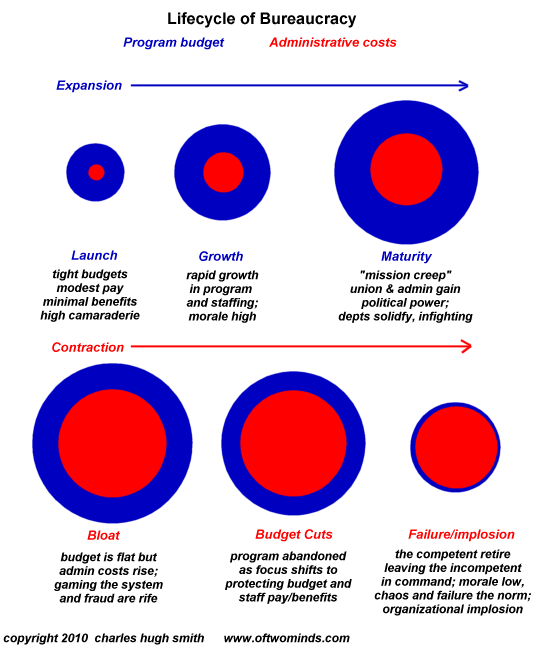
By this terminal stage, the competent have been driven out, quit or burned out.
What happens with the competent retire, burn out or opt out? It’s a question few bother to ask because the base assumption is that there is an essentially limitless pool of competent people who can be tapped or trained to replace those who retire, burn out or opt out, i.e. quit in favor of a lifestyle that doesn’t require much in the way of income or stress.
These assumptions are no longer valid. A great many essential services that are tightly bound to other essential services are cracking as the competent decide (or realize) they’re done with the rat-race.
The drivers of the Competent Opting Out are obvious yet difficult to quantify. Those retiring, burning out and opting out will deny they’re leaving for these reasons because it’s not politic to be so honest and direct. They will offer time-honored dodges such as “pursue other opportunities” or “family obligations.”
1. The steady increase in workloads, paperwork, compliance and make-work (i.e. work that has nothing to do with the institution’s actual purpose and mission) that lead to burnout. There is only so much we can accomplish, and if we’re burdened with ever-increasing demands for paperwork, compliance, useless meetings, training sessions, etc., then we no longer have the time or energy to perform our productive work.
I wrote a short book on my experience of Burnout. I believe it is increasingly common in jobs that demand responsibility and accountability yet don’t provide the tools and time to fulfill these demands. Once you’ve burned out, you cannot continue. That option no longer exists.
For others, the meager rewards simply aren’t worth the sacrifices required. The theme song playing in the background is the Johnny Paycheck classic Take this job and shove it.
Healthcare workloads, paperwork and compliance are one example of many. Failure to complete all the make-work can have dire consequences, so it becomes necessary to do less “real work” in order to complete all the work that has little or nothing to do with actual patient care. Alternatively, the workload expands to the point that it breaks the competent and they leave.
2. Loss of autonomy, control, belonging, rewards, accomplishment and fairness. Professor Christina Malasch pioneered research on the causes of burnout, which can be summarized as any work environment that reduces autonomy, control, belonging, rewards, accomplishment and fairness. Despite a near-infinite avalanche of corporate happy-talk (“we’re all family,”–oh, barf) this describes a great many work environments in the US: in a word, depersonalized. Everyone is a replaceable cog in a great impersonal machine optimized to maximize profits for shareholders.
3. The politicization of the work environment. Let’s begin by distinguishing between policies enforcing equal opportunity, pay, standards and accountability, policies required to fulfill the legal promises embedded in the nation’s social contract, and politicization, which demands allegiance and declarations of loyalty to political ideologies that have nothing to do with the work being done or the standards of accountability necessary to the operation of the complex institution or enterprise.
The problem with politicization is that it is 1) intrinsically inauthentic and 2) it substitutes the ideologically pure for the competent. Rigid, top-down hierarchies (including not just Communist regimes but corporations and institutions) demand expressions of fealty (the equivalent of loyalty oaths) and compliance to ideological demands (check the right boxes of party indoctrination, “self-criticism,” “struggle sessions,” etc.).
The correct verbiage and ideological enthusiasm become the basis of advancement rather than accountability to standards of competence. The competent are thus replaced with the politically savvy. Since competence is no longer being selected for, it’s replaced by what is being selected for, political compliance.
It doesn’t matter what flavor of ideological purity holds sway–conservative, progressive, communist or religious–all fatally erode competence by selecting for ideological compliance. Everyone knows the enthusiasm is inauthentic and only for show, but artifice and inauthenticity are perfectly adequate for the politicization taskmasters.
4. The competent must cover for the incompetent. As the competent tire of the artifice and make-work and quit, the remaining competent must work harder to keep everything glued together. Their commitment to high standards and accountability are their undoing, as the slack-masters and incompetent either don’t care (“I’m just here to qualify for my pension”) or they’ve mastered the processes of masking their incompetence, often by blaming the competent or the innocent for their own failings.
This additional workload crushes the remaining competent who then burn out and quit, go on disability or opt out, changing their lifestyle to get by on far less income, work, responsibility and far less exposure to the toxic work environments created by depersonalization, politicization and the elevation of the incompetent.
5. As the competent leadership leaves, the incompetent takes the reins, blind to their own incompetence. It all looked so easy when the competent were at the helm, but reality is a cruel taskmaster, and all the excuses that worked as an underling wear thin once the incompetent are in leadership roles.
By this terminal stage, the competent have been driven out, quit or burned out. There’s only slack-masters and incompetent left, and the toxic work environment has been institutionalized, so no competent individual will even bother applying, much less take a job doomed to burnout and failure.
This is why systems are breaking down before our eyes and why the breakdowns will spread with alarming rapidity due the tightly bound structure of complex systems.
There are many thousands of groups that have formed themselves around the need to stand against the globalist attack on life on earth. There are thousands more presenting alternative vision/suggestions for a better future. And there are a small number who are doing both; declaring that one must commit to stopping the worst while simultaneously nurturing into life a new template for human and ecological emancipation.
It is the latter action which I subscribe to, because it strikes me that we have no choice other than to fight-off the most immediate threats to our fundamental life values; yet equally have no choice other than to recognise the obvious shortcomings of the day to day way of life that constitutes the accepted norm of most post industrial societies today.
Given this state of affairs, one finds oneself committed to taking a deeper look into both the causal factors behind the degradation of human values and what will form the key ingredients of a new society. That which emerges out of the darkness and leads the way beyond repetitions of the divisive trends destroying humanity’s integrity.
Quite recently I came across the term ‘Truth Movement’ and discovered that it stands for a broadly connected body of individuals all having a similar goal: the defeat of the globalists. This seemed to hark back to the term ‘truthers’ as applied to those ready to expose the 9/11 fraud.
What, I asked myself, would this ‘Truth Movement’ do if it were to actually succeed in fulfilling its ambition?
What would ensure that such a movement did not implode once faced by the responsibility for building a future purged of the ‘rotten apple’ factors that so often bring-down otherwise promising movements and visions?
By ‘rotten apple’ factor, I mean the tendency for jealousy, excessive ego, lack of importance given to trust, power complexes, political ambition and – I would add – the group psychology of demanding ‘consensus’ in decision making, thereby pulling down individual aspirations and ending-up with abdication to the lowest common denominator as the only way ‘to keep the peace’.
Within socio-economic structures which largely reject the notion of ‘leadership by the wise’, a palpable void opens-up when important/controversial decisions have to be taken which require more than a superficial five sense appraisal of the way forward.
When our Truth Movement is confronted by the need to decide the composition of ‘the new template for the new society’ it is to usher into reality, many different convictions are likely to be put forward.
For example: an end to racial discrimination; the common ownership of land; the dissolution of the banking industry and widespread redistribution of wealth; no more ‘government’; the rise of ‘rule by the people’; free green energy for all; organic food and farming being adopted as the prime means of food production.
So as to bring the dilemma presented by this situation to life in a ‘real time’ way, I’m going to paint my envisioned picture of how events might unfold.
As ideas pour in, a committee is established to find a pragmatic way to turn these ideals into political reality. A reality which reflects the broad banner heading ‘Truth Movement’, whose idealistic rhetoric has finally garnered enough support to overcome the long dominant globalist control system.
On this committee are the leading proponents of the various ideals deemed most essential for laying the foundation of the promised New Society.
However, the daunting task of turning this pool of individual potential into a unified body of pragmatic ground-breakers, leads to the realisation that some critically important ingredients have been neglected. Internal frictions start to come to the surface causing fractures in the once seeming unity.
Disagreements eventually come to a head and in a highly revealing and heated exchange, it emerges that the deeper significance of the word ‘truth’ has never been explored or even debated. Never understood as primarily a spiritual value, an inner commitment to the evolution of higher values, not just to outer changes in the functioning of society.
In an attempt to prevent the situation deteriorating into chaos, a respected analyst is brought to the table to put a few fundamental questions to the committee leaders:
How aligned are you in your personal lives with what you call upon others to do in order to solve the crisis in values you see around you?
How truthful are you to yourselves and to others, if you don’t consider it important to lead by example – but nevertheless expect others to live the changes you claim must be brought-about?
How committed are you to raising your own levels of consciousness? To gaining a higher level of awareness concerning your own ambitions and shortcomings?
Are you actually committed to ‘a path of truth’ in your own lives? To following disciplines that quieten the ego and develop your relationship with the deeper spiritual values that are, in practice, the only real expression of truth?
How determined are you not to be a hypocrite? To avoid turning-out like the very politicians you so readily condemn?
As leaders of ‘the truth movement’ can you honestly say that you are committed to uphold the highest standards of responsibility, integrity and trust in your dealings with others?
What specific qualities are necessary in order to lead your supporters wisely, honestly and effectively?
Faced by this penetrating examination, the room became strangely quiet.
Being asked to address an inner commitment to truth, as opposed to its relatively surface oriented outer manifestation, has led to the need for a traumatic reappraisal of ‘the order of values’. And has called for a new level of consciousness to be put at the very top of the agenda of what is most essential for the building of the new society.
I tell this tale so as to highlight the task which stands in front of all of us, as ‘activists’ and campaigners for a better world. For should the neo-liberal control system collapse or even be finally defeated, we will find ourselves at the forefront of a global situation in which the great majority are subjected to an uncharted sense of insecurity and loss of direction.
A life of slavery to task masters carries with it a kind of insurance policy of not having to deal with – or be responsible to – the wider world or one’s own inner quest for liberation.
Suddenly, or relatively suddenly, being placed in a position where the expectation of the majority is for those most vocal in exposing the wrong – to now step forward and establish ‘the right’- presents a formidable challenge.
At the centre of this challenge is a burning question which we should all be addressing now rather than waiting until the hour of need is thrust upon us.
The question centres around a very fundamental precept: is the decision making process – essential to establishing the new desired template – to be based on ‘leadership by the wise’ or by ‘group consensus’?
By a ‘committee of the wise and the good’ or by a continuation of ‘democratic representative governance’ and quasi-consensus decision making?
To put it a little more bluntly: a benign, wise dictatorship or an elected common denominator form of governance which has no base in wisdom or vision and which is very easily exploited by the power hungry?
Within the constitution of the British Isles and many other countries, there exists something called Natural Law/Common Law, which goes back a long way.
It states that there is only one indomitable law and that is the law of God. God’s law. A form of decree based upon universal truth and justice, founded upon the supreme wisdom of our Creator.
In a world overcome by rank injustice, the complete absence of truth, and no sign of wisdom, Common/Natural Law shines out as the light at the end of a very dark tunnel.
The emergence of an earthly law that reflects universal law can only be brought forward by a committee of the wise and true. Indeed, God’s laws can be described as emanating from ‘the Supreme Benign Dictator.’
At the most basic level, they are reflected in the laws of nature and the predilection for an ever expanding biodiversity of plant, animal and insect life.
At the human level, they represent the (age old) quest for truth, love and full emancipation of the soul of man. Even when individuals do not consciously know it, this is what all are longing for – and now is the time to go public about it.
We have passed the point of no return for ‘democracy’ or anything resembling it, so we may choose to call what will really open our minds and hearts: a ‘Veritocracy’.
Veritocracy from ‘veritas’ the Latin for truth. ‘Way of Truth’.
Going face to face with a cult regime based on darkness and division, demands a steadfast commitment to the opposite. Truth, as the unrestrained manifestation of the call of our souls.
This is the one force that will disintegrate the forces of darkness and disempower the globalist control system, once and for all.
It is the one force that can unite all of humanity and provide the dynamic foundation for true leadership and true trusteeship of the planet.
Let us commit now. Let us be properly prepared to lead the world beyond ruination and into rebirth.
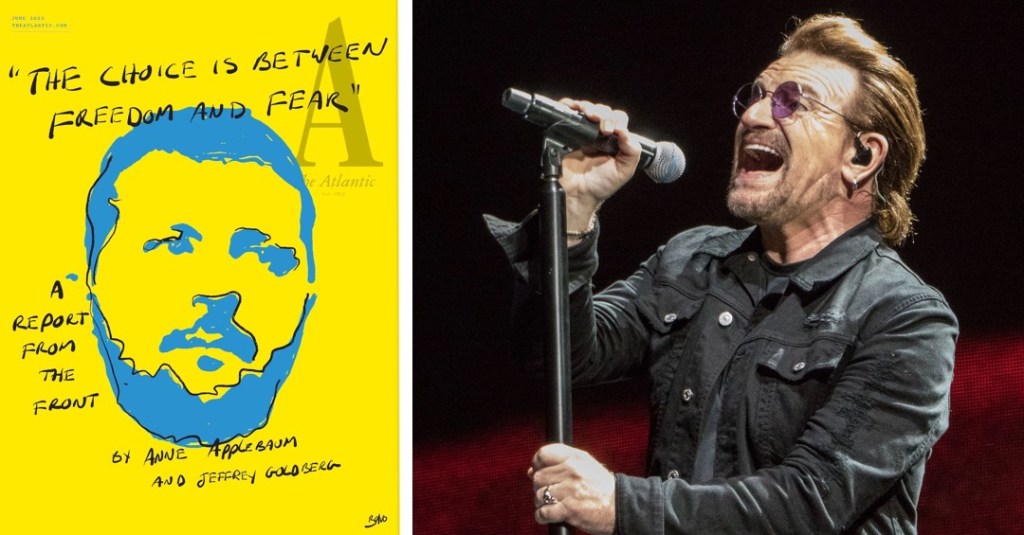
So U2 singer Bono is literally just doing illustrations for the imperialist propaganda rag The Atlantic now, because that’s the sort of thing that happens in a dystopian civilization during the death throes of a globe-spanning empire.
A Washington Post article titled “Bono likes to sketch Atlantic covers, so the magazine hired him” reports that “Bono is into Atlantic cover fanfic — so much so that he was invited to illustrate the magazine’s June cover featuring Ukrainian President Volodymyr Zelensky.”
Here’s a paragraph from Applebaum and Goldberg’s article, just to give you a taste of the infantile “Good Guys vs Bad Guys” framing that western liberals are being fed by mass media war propagandists these days:
“Sometimes, the war is described as a battle between autocracy and democracy, or between dictatorship and freedom. In truth, the differences between the two opponents are not merely ideological, but also sociological. Ukraine’s struggle against Russia pits a heterarchy against a hierarchy. An open, networked, flexible society—one that is both stronger at the grassroots level and more deeply integrated with Washington, Brussels, and Silicon Valley than anyone realized—is fighting a very large, very corrupt, top-down state. On one side, farmers defend their land and 20‑something engineers build eyes in the sky, using tools that would be familiar to 20‑something engineers anywhere else. On the other side, commanders send waves of poorly armed conscripts to be slaughtered—just as Stalin once sent shtrafbats, penal battalions, against the Nazis—under the leadership of a dictator obsessed with ancient bones. ‘The choice,’ Zelensky told us, ‘is between freedom and fear.’”
Many westerners felt their first stirrings of youthful rebellious passions while listening to U2 songs like “Sunday Bloody Sunday” and “Pride (In the Name of Love)”, but nowadays Bono’s voice is heard saying that he has “grown very fond” of war criminal George W Bush, praising capitalism at the World Economic Forum, teaming up with warmonger Lindsey Graham to promote US empire narratives about Syria, and singing “Stand by Ukraine” in support of US empire narratives in a Kyiv subway. And just when it looks like he can’t become any more of a tool of the empire, he gets hired by one of the world’s worst militarist smut rags to draw a cover image of Zelensky.
Because that’s just how things go in a highly controlled society where mainstream culture is designed to serve the powerful. A society where the minds of the public are continually being shaped by mass-scale psychological manipulation to ensure that they keep thinking, speaking, working, consuming and voting in ways which serve the rich and powerful. Everything that gets elevated to the top of mainstream attention facilitates this agenda (or is at least harmless to it), and as soon as it becomes potentially threatening to this agenda it is either corrected or marginalized away from mainstream attention.
This fall, DC denizens will be treated to the world premiere of “Grounded,” an opera following an Air Force ace named Jess whose unexpected pregnancy forces her to leave behind her beloved F-16 and join the “chair force.”
Throughout the show, the “hot shot” pilot wrestles with the mental impact of firing rockets from a drone in Afghanistan from a trailer in Las Vegas. “As Jess tracks terrorists by day and rocks her daughter to sleep by night, the boundary between her worlds becomes dangerously permeable,” an ad tells us.
The production is brought to you by presenting sponsor General Dynamics, one of the world’s largest weapons companies (and, wouldn’t you know it, the maker of Jess’s favorite plane). Playwright George Brant wrote the libretto, which will be brought to life by mezzo-soprano Emily D’Angelo and Tony-winning composer Jeanine Tesori.
Great to hear from Basma & Jad about the new friends they’re making in Iraq through Ahlan Simsim—a @USAID & @SesameWorkshop early learning activity that promotes inclusion, respect, and understanding by showing children from all different backgrounds coming together. pic.twitter.com/BtFfDH6So9
You see things like this all the time under the shadow of the US empire, and individually they don’t look like much, but once you start noticing them you come to recognize them as symptoms of the profoundly diseased civilization that we are living in. One where our heart strings are pulled in the most obnoxious ways imaginable to get us to support capitalism, empire and oligarchy, where we are manipulated into espousing values systems which benefit powerful sociopaths under the cover of noble-sounding causes. Where we are trained like rats to support systems that are driving our species toward extinction because our rulers gave lip service to humanitarianism and waved a rainbow flag.
This is what dystopia looks like. Like a bunch of thought-controlled automatons mindlessly marching toward ecocide and omnicide to a beat played out by screens who tell them every day and in every way that there is no higher purpose than this. Like military industrial complex-funded feminist rock operas about drone operators and Cookie Monster helping Samantha Power psychologically colonize Iraqi children. Like Bono coming home from singing a heartfelt number about the assassination of Martin Luther King Jr to illustrate a cover for a war propaganda piece in The Atlantic.
It’s like they’re pouring concrete over our hearts. Sewing blindfolds over our souls. Numbing us, distracting us, sedating us, so that the local riff raff won’t interfere in the workings of the imperial machine. They’re killing off something beautiful and sacred in humanity, and they’re doing it to roll out some of the ugliest visions this planet has ever seen.
I’d like to pose a question I’ve been dancing around for the last couple of posts: Is the United States a failed society?
That may seem overly dramatic, but please hear me out.
Recently, it has once again come to the attention of the news media that Americans are an order of magnitude more likely to die at every age than citizens of other advanced, wealthy, industrialized nations.
This was most recently expounded by a Financial Times correspondent named John Burn-Murdoch. The article itself is paywalled, but this Twitter thread contains all the relevant information:
It makes for sobering reading. A lot of times the discussion just focuses on total life expectancy, that is, the number on the death certificate. That’s fallen too, but not as dramatically. But life expectancy differs at various ages. Yet, what the numbers invariably show is that, at every single age Americans are more likely to die than their counterparts in other wealthy industrialized nations.
For example, one in 25 five-year-olds in the United States will not live to see their fortieth birthday. That means a lot of parents are going to have to bury their children. But at every age, whether you’re twenty-five or fifty, your chances of dying are much higher in the United States than anywhere else. By age 29, the average American is four times more likely to die than a 29 year-old in another country. I’ve heard plenty of stories from people in their twenties and thirties talking about their high-school years like military veterans recounting their service during wartime (“fifteen in my class didn’t make it out.”). And those are just ordinary citizens!
In other words, growing up in the United States is extraordinarily deadly.
In fact, the social outcomes for the average American are worse than the most socially deprived areas of the United Kingdom like Blackpool—an area synonymous with industrial decline. At every single point along the income distribution, Americans are more likely to be hurt, injured, or killed than their peers in other wealthy, developed nations.
Furthermore, these trends are exclusively confined to the United States. Even Cuba, a relatively poor country under continuous sanctions by the United States since the nineteen-sixties, now has better health outcomes (e.g. life expectancy, infant mortality, chronic diseases). So, too, does China, which has overtaken the U.S. in a number of health metrics despite being the largest country in terms of total population.
The Atlantic’s Derek Thompson has called the United States “The Rich World’s Death Trap.” He interviews John Burn-Murdock here:
The bottom line is this: in many ways, your life chances are much, much lower in the United States than in any other wealthy, industrialized nation in the world. This is simply undeniable.
Which leads me to pose the question I asked above.
Peer Countries
Because this is such a fraught topic, it’s worthwhile to get some things out of the way. Certainly your life chances in the United States are better than many other parts of the world at the moment.
Some places are run by military dictatorships like North Korea or Myanmar. Some places are in outright civil war like Syria, Libya or Sudan. Some areas are in an active shooting war like Ukraine and Russia. Some countries have huge areas of absolute deprivation like sub-Saharan Africa, India, the Philippines or Afghanistan. Some countries have lost control over parts of their territory to drug gangs like Mexico, El Salvador, Peru and Ecuador. You’re certainly better off here than in many of those other countries.
So let’s just acknowledge that right off the bat. Of course, this raises questions about just how supposedly wonderful the current state of our world actually is, but that’s a topic for another time.
But I think it’s absolutely invalid to invoke those countries as a justification for the abysmal statistics listed above. Here’s why: the United States is at the absolute apex of the global economy, and has been since World War Two. We issue the world’s reserve currency. We have more billionaires than anywhere else. We are home to the largest and most powerful corporations in the world. No country in the world is more wealthy or powerful than the United States at the present moment.
This is the concept of peer nations. Those are the ones we should be judging ourselves against. You can use a number of indicators for this. The United States is a member of both the OECD and the G-7. In fact, it is the key member of these organizations. It is at peacetime. It is an electoral democracy. It has the world’s largest GDP. It is surrounded by the world’s two largest oceans and has benign neighbors to the north and the south. It has not had a war on its home soil since the 1860s.
Simply put, the United States has more resources at its disposal and more wherewithal to tackle social problems than anywhere else in the world.
So, unlike many other countries around the world, the United States has no excuse whatsoever for the sorry state of its citizenry, and comparing the United States to non-peer countries is no more than pathetic excuse-making in the face of damning evidence that the U.S. government simply chooses to ignore burgeoning social problems and leaves the majority of its citizens to fend for themselves.
What Else Is New?
Reading these facts, I’m wondering why any of this this is news to people. As far back as 2013 I noted the following:
Americans die younger and experience more injury and illness than people in other rich nations, despite spending almost twice as much per person on health care.
That was the startling conclusion of a major report released earlier this year by the U.S. National Research Council and the Institute of Medicine. It received widespread attention. The New York Times concluded: “It is now shockingly clear that poor health is a much broader and deeper problem than past studies have suggested.”
It received widespread attention all right, and then was promptly forgotten. But even earlier, in 2012, there was this report from The Lancet:
American teenagers have the highest rates of drug and alcohol abuse in the developed world. And they are far more likely to be killed by violence than peers in Europe. This lost generation, whose unemployment rate is 20 percent, leads the modern world in some of the most dangerous and irresponsible behaviors, according to a new study released by the Lancet medical journal.
In 2019, husband-and-wife economists Angus Deaton and Anne Case coined the term “deaths of despair,” and noted that these were exclusively confined to the United States. In 2020, they published a book chronicling their grim studies with that same title. It, too, received a brief burst of attention in the media and then promptly disappeared down the memory hole just like everything else.
So this is old news. As Burn-Murdock’s article notes, the divergence between the U.S. and its peers has been continuously growing since around 1990, and has been getting even more acute in recent years.
The above podcast touts how “rich” we are compared with other nations using metrics like dollar income. But what does a high salary even mean when you are less likely to survive than other places? What are you supposed to do with that money, anyway—fill your oversized house with crap? As the saying goes, “you can’t take it with you.” This also belies the insanely high cost of everything in America, especially housing, which leads to 70 percent of Americans feeling financially stressed according to CNBC, despite how “rich” we supposedly are. According to Brookings, 44 percent of Americans earn low wages in this allegedly “rich” country.
And, as economist Dean Baker has noted, people in many other countries choose to take their additional “income” as leisure time, which may be another reason why they are so much healthier than we are. Americans work longer hours than anyone else, and at unusual times. The United States has a lousy work culture, with much less vacation or family leave time than other countries. Americans also take less vacation, work longer days, and retire later. Citizens of other countries also don’t have to pay for as many things out of their own pocket—from transportation, to retirement, to health care—due to a misguided fear of “socialism,” making income comparisons misleading. What sense does it make to earn a lot of money if you are lonely and isolated and have no time off to enjoy it? And much of that extra income is dedicated to cushioning ourselves from the fallout of a society decaying around us and positional goods to compete with everyone else.
My question is this: if the United States is not a failed society, then by what criteria should we judge success? Are context-free income statistics, GDP, and the number of billionaires really the appropriate measure for a good society rather than the well-being of the average citizen? People like to tout America’s so-called “innovation,” but one area we don’t seem to be innovating very much in is keeping our citizens healthy and alive.
The symptoms versus the disease
The reasons given for the above statistics are the usual ones: gun violence, drug overdoses, suicides, car crashes, metabolic diseases, and lack of access to basic and preventative health care compared to other nations.
But I want to distinguish the symptoms from the disease.
In medicine, doctors are taught to separate the symptoms from the disease. If a patient is suffering from a fever, jaundice, and swelling, for example; the fever, jaundice, and swelling aren’t what is making them ill. Instead, these are all symptoms caused by the disease which the patient is afflicted with, and it is the doctor’s job to determine what the disease is from the symptoms and try to cure it.
If that is the case, then what is the disease we are suffering from in this instance? In my opinion, it is this: American society is fundamentally rotten to the core.
We have effectively restructured our entire society as a lottery. Under this system, you’re entitled to precisely nothing except what you can claw free from the impersonal market casino rigged in favor the House. American society been transformed into a brutal winner-take-all tournament in the name of “meritocracy,” and most Americans seem to be okay with that.
At every point on their hierarchy, from the highest perch to the lowest, everyone is desperately trying to maintain their current position, hyperattuned to status, fearful of falling into the abyss, clawing each other’s eyes out to hold onto their small piece of the pie in a crabs-in-a-bucket scenario. “There is no such thing as society” has been elevated from a political statement to a a central guiding tenet where it’s every man for himself and the devil take the hindmost.
While other nations at least try to look after the welfare of all of their citizens, in America if you are not rich, successful or an entrepreneur, then your life is worth nothing. If you aren’t good enough, or don’t measure up, then you deserve to suffer. We actively hate the poor and think they should die. We talk about them like animals. Average is over. The rich get richer. Winners take all.
Cutthroat capitalism is the order of the day. Your only task when you get up every morning is to get as much of the other guy’s money as possible into your own bank account by any means necessary for the next twenty-four hours and do it all over again the next day. There is no higher purpose. “Freedom” is defined as the ability for the rich to do whatever they like to the rest of us without consequence or sanction. It’s a world of predator and prey where you can either be one or the other—there is no other option.
Unlike in other countries, in the United States the government does not exist to help its citizens; rather, its primary role is to funnel money to a series of well-connected insiders feeding at various troughs. The rest of us are on our own. No one is on your side.
In every country, you need to educate your citizenry and keep them safe and healthy. That is the most basic task of any government, anywhere. In the United States, these tasks are delegated to predatory institutions designed to extract as much money as possible so that sticky-fingered middlemen can siphon off as vast amounts to feather their nests. A small sliver of executives in finance, education and health care get obscenely rich while the rest of the population struggles and is mired in debt, assuming they can even access those services at all. As a result, Americans pay wildly inflated prices for just about everything, from health care, to education, to energy, to entertainment and telecommunications. And the system cannot be changed because those insiders and middlemen fund the political campaigns and spend billions on highly effective propaganda. The rich people at the apex cynically strip-mine society for their benefit, while there are fewer paths than ever to a middle class lifestyle for the average person.
“Everything for myself and my immediate offspring; nothing for other people,” is the pervasive ethos: “I dont want pay for someone else’s (health care, education, fill-in-the blank).” But once that attitude becomes endemic, you no longer have anything even resembling a society anymore; you have only collection of individuals fending for themselves. As the title of a post from a few years back put it, “I don’t know how to explain to you that you should care about other people.”
It is a nation of sociopaths where fellow citizens are seen as either enemies or competitors. The simple warmth of human kindness has been abolished. Americans walk around in a constant state of fear and high alertness like the prey animals they have become. Or else they have the thousand-yard-stare grazing in the aisles at Walmart. I’ve mentioned before how many Americans seem to be crazed and deranged, or zonked out on drugs, and don’t know how to behave around other people or show basic decency. People seem more and more desperate. I personally have witnessed many more acts of erratic behavior and dangerous driving lately, and have heard similar stories from other people. American society seems to be under more pressure than ever before, and people are cracking up left and right. It feels like a lot of people—even the supposedly “successful” ones—have basically checked out and are simply going through the motions.
The United States is a plantation society to the core. At a basic, fundamental level, American society is not set up not to deliver a good quality of life to it citizens, but rather for a small segment of hard, hard men to get unfathomably rich beyond the dreams of avarice, with the rest of us no more than insects to be stepped on in pursuit of that goal. And if some people happen to enjoy good lives anyway under that system, well, it’s more of an unintentional side-effect than a deliberate outcome. Perhaps you’re one of those hard men (or women), or hope to be. Good for you, I guess.
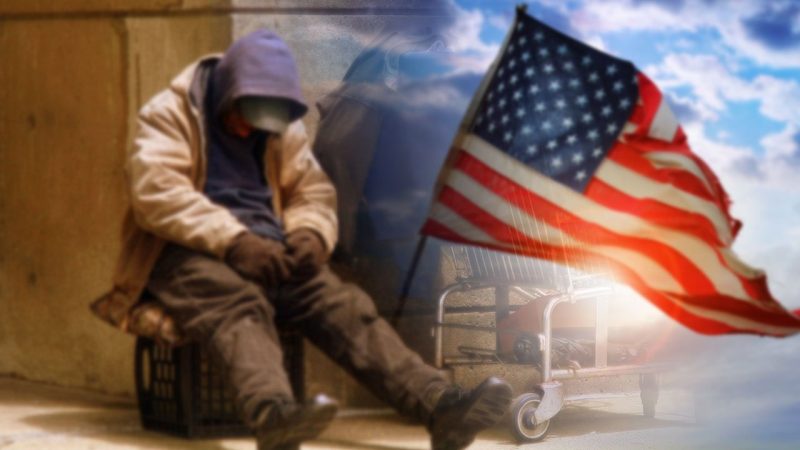
So I think that’s the fundamental reason for all of the above. That’s the disease, and everything else is merely a symptom—our refusal to properly fund universal health care; our built environment designed exclusively around cars and lack of public transportation; our fat and sugar-laden diets; our overcrowded prisons; our opioid-addicted homeless; our frayed social safety nets; our violent, trigger-happy cops; our extortionate education costs; our predatory financial institutions; our refusal to build affordable housing; and our propensity to shoot one another. American society is rotten to the core.
For example, even though our weekly mass shootings make international headlines, they don’t really have that much of an impact on life expectancy when you compare them against the size of the world’s third most populous nation, despite troubling statistics like these:
Last year (2022), two people died from gun violence in the United States every hour. In 2023, there have been at least 160 mass shootings across the US so far this year. There are 120 guns for every 100 Americans. No other nation has more civilian guns than people. About 44% of US adults live in a household with a gun, and about one-third personally own one.
But that’s not the question we should be asking. The question we should be asking is this: what does this level of gun massacres and homicidal mania say about the nature of American society itself?
What does it say about American society that so many people have to turn to alcohol, opioids and other addictive drugs just to cope?
What does it say about America that it produces so many mentally-ill and broken people?
What does it say that Americans are so much fatter and sicker than people in other countries?
What does it say that we lock up more of our citizens than anywhere else in the world?
Americans are prickly and thin-skinned. They can’t bear any criticism of their nation, and will absolutely lose their minds at even the implication that they do not live in the best country on earth, despite mountains of evidence to the contrary (unless you are very wealthy). They will rationalize away all of the statistics listed above. Or else they will resort to immigrants as a way to shore up their fragile egos: “Everyone wants to move here!!!” Interestingly, according to the podcast above (-14:39), U.S. immigrants seem to live about as long as anyone else in the world. Perhaps it’s because immigrant communities tend to look after each other and manage to keep the toxic, every-man-for-himself individualism of mainstream American culture at arm’s length. Too bad for the rest of us, though.
In the end, the facts speak for themselves: By the standards that actually matter for the average individual, compared to peer nations, the United States is an objective failure.
Why is it like this? Some pessimists say that it’s been like this from day one and there’s nothing we can do about it. Perhaps they’re right. But the facts tell a different story. According to the data, it’s really only since 1990 that this yawning chasm in social outcomes has opened up in between the United States and the rest of the world. During the New Deal era, for instance, these gaps didn’t exist or actually favored Americans. The United States was able to accomplish big things like building the Hoover Dam and putting a man on the moon, and people didn’t hate and fear their own government. The U.S. was perceived very differently abroad.
Here’s what I think happened. Starting in the 1970s a small group of sociopathic men at the top of the hierarchy acquired the means and the tools to reshape the United States in their own image. They founded think-tanks. They funded economics departments and political campaigns. They bought up the media. They started television networks to promote their agenda. They packed the courts. They used the latest cutting-edge psychological research and techniques that had been developed in the service of advertising to remold the society like putty in their hands. Throughout the decade of the 1980s under Reagan, their plans ultimately came to fruition, and the transformation was compete by 1990 which is why the changes became apparent after then. Ever since, we’ve been living in the society that they have created. I’m skeptical that Americans were always inherently more sociopathic and antisocial than people everywhere else—I think to a large extent we’ve been made to be this way.
So we’re all living in the end result of that. And now that it has been accomplished, we see the ugly results everywhere around us, including increasing political radicalization and strife as the failure of this vision of society is becoming increasingly apparent but we seem to be incapable of envisioning an alternative or are too fearful of change. Instead, we seem to be doubling down. I fear it’s already too late to turn things around, and this is just the way American society will be forever now and things will just continue to get worse and worse for the vast majority of us. We will remain the (not so) rich world’s death trap, permanently.
I’ll conclude with this passage which I read years ago:
If I could paint the country in one broad stroke, I would say it’s a place where one concept of freedom – used to lobby for private interests and free markets – is at odds with another kind: the ability to lead a life you enjoy. Fewer and fewer seem privileged with this second kind. Not Trayvon Martin, who was a victim of a certain kind of racism which had, as its root, private property anxiety. Not the natural gas employee who has consigned himself to a life of doing something that he feels ought not to be done. Even I – who have managed to escape from time to time – always find, upon return, a cordial invitation to fall in line.
“Philosophical thinking that doesn’t do violence to one’s settled mind is no philosophical thinking at all.” ~Rebecca Goldstein
Comfort zones are a curious thing. So warm and secure. So safe and reassuring. So satisfying and certain. Beliefs have a similar effect on us. Especially the core beliefs that we take for granted. But beliefs are comfort zones with reinforced invulnerability; or, at least, the illusion of it.
Such reinforcements are like prison bars that most of us are not even aware of. We’re so completely indoctrinated, so utterly pre-programmed, that we don’t even know that we don’t know that we’ve been conditioned to blindly believe in something simply because enough people convinced us it was true.
The problem with reinforced comfort zones is that there is no growth. A regular comfort zone, you can stretch. A reinforced comfort zone, you’re usually not even aware it needs to be stretched. A regular comfort zone allows for trial and error, it allows for questioning, and so there is at least potential for self-improvement and self-overcoming. But a reinforced comfort zone does not allow for trial and error. It doesn’t allow for “blasphemous” questioning, because it is taken for granted as already perfect or “simply the way it is.”
Regular comfort zones can be healthy, giving us a safe haven, a place where we can heal and lick our wounds. But reinforced comfort zones are unnecessary safety nets based upon fear (of God, the Unknown, Death) placation, and self-pity. It’s a place where cognitive dissonance rules and any notion of attempting to think outside the box is met with: You simply need to have faith in the “box”.
The Battle Against Bewitchment:
Philosophy is a battle against the bewitchment of our intelligence by means of language.” ~Ludwig Wittgenstein
Self-Inflicted Philosophy is at the forefront of the battle against bewitchment. Self-inflicted philosophy is about upsetting settled minds. It’s about toppling the reinforced comfort zones of blind belief. It’s about flattening the “box” that everyone talks a big game about thinking outside of but when it really comes down to it, they cling to the “box” out of fear of the unknown or out of faith in what they believe they know.
Foremost, self-inflicted philosophy is about questioning the self to the nth degree through self-interrogation. But you can only get so far in such questioning before you are met with the reinforced comfort zone of a blind belief. So, self-inflicted philosophy is also about questioning the layer-upon-layer of cultural, political, and religious indoctrination that led to that reinforced comfort zone to begin with.
When you don the cloak of a self-inflicted philosopher, no belief, no matter how true it may seem, is off the hook for being questioned with ruthless skepticism and unwavering circumspection. In the battle against bewitchment, the destruction of a belief, no matter how powerful, is mere collateral damage to the Occam’s razor of universal truth. Hell, even “universal truth” is not beyond questioning.
When you don the cloak of a self-inflicted philosopher, the concept of belief is nixed from your interpretation of the universe. There is no place for belief here, only thought, only deep inquiry, only imaginative curiosity. You replace all usage of “belief” or “believe” with “thought” or “think”. You don’t believe that you certainly exist, you “think” that you “probably” exist. But you could be wrong. So you remain circumspect, for even your interpretation of your own existence could be an illusion, no matter how “true” it may feel.
There will be those who will say, “You are merely believing that you don’t believe.” But that is patently false, because you are not “believing” in non-belief, you are “thinking/inquiring/imagining” through non-belief, with the understanding, the flexibility that your thinking “could” be wrong. And that’s the rub: it is much easier to alter a thought than a belief. It is almost impossible to alter a belief. You are more likely to question a thought than you are a belief. And so, rather than get trapped in a reinforced comfort zone, you stay ahead of the curve by thinking rather than believing, and then by questioning what you think so that you don’t accidentally begin to believe it.
In the spirit of upsetting settled minds, you don’t believe in having an unsettled mind, you think that having an unsettled mind is more productive, more progressive, and more open-minded than having a settled mind (an unquestioning belief). You realize that belief in general is counterproductive, because you understand that the human mind is a delusion-generator rather than a truth-generator. It pumps out delusions like a spider pumps out webs. But, unlike the spider, it tends to get caught in them. Thereby, you understand that the only window to truth is through a questioning, circumspect, and a skeptical mindset, rather than through an unquestioning, dogmatic, and certain mindset.
The only solution to a delusion-generator is a question-generator. Luckily, the human brain is both. As a self-inflicted philosopher, you don’t believe that this is certainly true; rather, you think that this is probably true. And you’re willing to question everything to “prove” it. Indeed, you’ve transformed Descartes’ “I think therefore I am” into I think, therefore I question.
Tapping into the question-generator:
“It is far better to grasp the universe as it really is than to persist in delusion, however satisfying and reassuring.” ~Carl Sagan
The problem with the human brain is that is never knows when it has been duped by a delusion, so it is almost always better to not believe anything just in case it’s a delusion. A kind of reverse Pascal’s Wager. It’s almost always better to, as Aristotle suggested, “entertain a thought without accepting it.” Just take it all into consideration and let it pass through the sieve of probability. Then, whatever doesn’t insult your soul, think about it, dissect it, inquire about it. Be curious about it. Just don’t make the mistake of believing it.
You are more likely to grasp the universe “as it really is” by questioning it than by believing it. You don’t believe the universe is certainly a certain way; rather, you think the universe may be a certain way, but you’re willing to question further so as to get you closer to the way the universe “really is”. If you cling to a particular belief of how the universe is, then you block yourself from ever getting closer to the universe “as it really is.” Better to simply not have a belief in the first place. Better to simply think and keep the motor running on the question-generator so as to keep the delusion-generator in check.
The opposite of belief is neither disbelief nor doubt, but clarity of a thought. Without beliefs reinforcing the comfort zone, you are liberated to stretch it. You are clear enough to think outside it, you are courageous enough to question it. When the reinforcements fall away, the comfort zone becomes a sacred rather than stagnant place. It is free to grow through self-improvement rather than remain stuck in self-reassurance. Indeed, without beliefs cluttering the mindset, you’re finally able to drop the “set” and move into “mind.”
Free of the “mindset” of a settled mind, you move into the mindfulness of a questioning mind. You become a walking, talking, question-generator, able to consistently counter-balance the delusion-generator of the human condition. You’re ahead of the curve, surfing Aslam’s Infinite Circle on the surfboard of Occam’s razor. In absolute awe over the beautiful unfolding of an ultimately unknowable universe. On the edge of your own curiosity, questioning all “answers” countering all beliefs, elusive of all delusions. You’re a self-inflicted philosopher, and not even God is safe from your ruthless inquiry.






 After the Crash