The Age of Ego

By Dan Corjescu

Source: CounterPunch

Hegel’s conception of history taught us that the meaning of history was the liberation of the individual through his or her recognition as a fully autonomous rational person.

Indeed, since the French Revolution, the Age of the Individual has expanded apace even if not always in a straight line.

Today, more than ever, our politics, economics, culture, and society are all, at least nominally, directed at the well being and full recognition of each and everyone of us.

If this is so, then why are so many people still frustrated and unhappy in their daily life?

In part, this state of affairs might be due to our neglecting of the second part of the Hegelian equation: the individual’s place and relationship to others mediated by the State.

The State, according to Hegel, is the representation of universal rationality. Put in another way, the state is the structure which allows individuals to be recognized as full individuals through their participation in it. Each and every individual has a role to play within the state. The fulfillment of that role satisfies our need for recognizing one another and the constant realization that we are not and cannot be just for ourselves but for each other.

A culture, such as ours, which celebrates the socially untethered individual is propagating a fundamental lie. Individuals cannot be fully realized without the cooperation of all other individuals; an essential activity which, in the modern world, is mediated by the state.

Yet, what is the state in the modern world? What has it become? Is it a universalist, rationalist tool for the realization of the greater good?

Certainly not.

Today, the modern state is a tool of elites to ensure their total domination and power over all other classes and groups. It does not matter if the state calls itself “democratic” or a “one party state”. In effect, all states today are “one party” states controlled by their respective elites who are often tied to one another transnationally. We are, all of us, under the thumb of a new global elite who dictates the nature of our social being. “Global Empire” is not an all too fanciful term for the present situation.

And like the Roman Empire before it, it is not a coincidence that many people are turning spiritually inward toward personalistic philosophies of self-help and care. Ironically, even the philosophy of ancient Stoicism is making somewhat of a comeback.

None of this is surprising.

The individual cannot be truly satisfied if he or she is not a participating and consequent member of a polity; of a state. The elites of this world have carefully and calculatedly castrated our social and economic potentialities to do so.

The root of our gnawing unhappiness in our brave new world is simply this: consequential inter-personal participation in the sphere of the political has been vanishing for decades. The ability to effect collective change from below has been diminishing. True collectivity has been consistently denied.

The disassociation of the individual from the polity; in effect the non-existence anywhere of true democracy has led to a hollowing out of the human personality. It is only in concrete social action that we materialize fully as human beings. It is as members of a community who are able to truly guide that community that we find a deep human purpose.

Once again, recalling Hegel and the Greeks before him, it is not enough to exist as economic man symbolically feigning electoral freedom every two or four years ; one must directly participate in the polis.

Reviving the Spirit of Existential Rebellion in a World of Propaganda, Lies, and Self Deception

By Edward Curtin

Source: Dissident Voice

Search for nothing anymore, nothing except truth.
Be very still and try to get at the truth.
And the first question to ask yourself is:
How great a liar am I?
— D. H. Lawrence, Search For Truth

Like existential freedom, honesty and truth-seeking demand a perpetually renewed commitment. No one ever fully arrives, and all of us are blown off course on the journey.  Even when we think we have reached our destination, we are often startled by the enigma of arrival, and must set sail again.  We are all in the same boat. The search for truth is a process, an experiment, an essay – a trying without end.

Yet surely it is not an exaggeration to say that most people are liars and self-deceivers.  Honesty, while touted as a virtue, is practiced far less than it is praised.  There is almost nothing that people are less honest about than their attitudes toward honesty.  Few think of themselves as dishonest, and even to hint that someone is so is received as a great insult that usually elicits an angry response.  So most people follow the advice of the character Jean-Baptiste Clamence from Albert Camus’ The Fall: “Promise to tell the truth and then lie as best you can.”  In that way you satisfy your own and others’ secret desires for deception and play-acting, and other people will love you for it.

However, it is widely accepted that political leaders and the mass media lie and dissemble regularly, which, of course, they do. That is their job in an oligarchy.  Today we are subjected to almost total, unrelenting media and government propaganda. Depending on their political leanings, people direct their anger toward politicians of parties they oppose and media they believe slant their coverage to favor the opposition.  Trump is a liar.  No, Obama is a liar.  And Hillary Clinton.  No, Fox News. Ridiculous! – it’s CNN or NBC.  And so on and so forth in this theatre of the absurd that plays out within a megaplex of mainstream media (MSM) propaganda, where there are many shows but one producer, whose overall aim is to engineer the consent of all who enter while setting the different audiences against each other.  It is a very successful charade that evokes name-calling from all quarters.

In other words, for many people their opponents lie, as do other people, but not them. This is as true in personal as well as public life. Here the personal and the political converge, despite protestations to the contrary.

Sartre and Bad Faith

Lying and dissembling are ubiquitous.  Being lied to by the MSM is mirrored in people’s personal lives.  People lie and want to be deceived. They choose to play dumb, to avoid a confrontation with truth.  They want to be nice (Latin, nescire, not to know, to be ignorant) and to be liked.  They want to tuck themselves into a safe social and cultural framework where they imagine they will be safe. They choose to live in what Jean Paul Sartre called bad faith (mauvaise foi).  He put it as follows:

In bad faith it is from myself that I am hiding the truth. But with this “lie” to myself, the one to whom the lie is told and the one who lies are one and the same person, which means  that I must know in my capacity as deceiver the truth which is hidden from me in my capacity as the one deceived.

Such bad faith allows people to fabricate a second act of bad faith: that they are not responsible for their ignorance of the truths behind the government’s and corporate media’s lies and propaganda, even as the shades of the prison house ominously close around us and the world edges toward global death that could arrive in an instant with nuclear war or limp along for years of increasing suffering.

Those of us who write about the U.S.-led demented wars and provocations around the world and the complementary death of democracy at home are constantly flabbergasted and discouraged by the willed ignorance of so many Americans.  For while the mainstream media does the bidding of the power elite, there is ample alternative news and analyses available on the internet from fine journalists and writers committed to truth, not propaganda. There is actually far too much truth available, which poses another problem. But it doesn’t take a genius to learn how to research important issues and to learn how to distinguish between bogus and genuine information.  It takes a bit of effort, and, more importantly, the desire to compare multiple, opposing viewpoints and untangle the webs the Web weaves.  We are awash in information (and disinformation) and both good and bad reporting, but it is still available to the caring inquirer.

The problem is the will to know.  But why, why the refusal to investigate and question; why the indifference? Stupidity?  Okay, there is that.  Ignorance?  That too.  Willful ignorance, ditto.  Laziness, indeed. Careerism and ideology?  For certain.  Upton Sinclair put it mildly when he said, “It is difficult to get a man to understand something, when his salary depends on not understanding it.” Difficult?  No, it’s almost impossible.

But then there are many very intelligent people who have nothing to lose and yet adamantly refuse to entertain alternative possibilities to the reigning orthodoxies that have them in their grip.

As do many others, I know many such people who will yes me to death and then never fully research issues. They will remain in limbo or else wink to themselves that what may be true couldn’t be true.  They close down. This is a great dilemma and frustration faced by those who seek to convince people to take an active part in understanding what is really going on in the world today, especially as the United States wages war across the globe, threatens Russia and China, among others, as it expands and modernizes its nuclear weapons capabilities.

Jacques Ellul on Propaganda

The French sociologist, Jacques Ellul, has argued  convincingly that modern propaganda in a technological mass society is more complicated than the state and media lying and deceiving the population.  He argues that propaganda meets certain needs of modern people and therefore the process of deceit is reciprocal.  The modern person feels lost, powerless, and empty. Ellul says, “He realizes that he depends on decisions over which he has no control, and that realization drives him to despair.”  But he can’t live in despair; desires that life be meaningful; and wants to feel he lives in a world that makes sense.  He wants to participate and have opinions that suggest he grasps the flow of events.  He doesn’t so much want information, but value judgments and preconceived positions that provide him with a framework for living.  Ellul wrote the following in 1965 in his classic book Propaganda:

The majority prefers expressing stupidities to not expressing any opinion: this gives them the feeling of participation.  For they need simple thoughts, elementary explanations, a ‘key’ that will permit them to take a position, and even readymade opinions….The man who keeps himself informed needs a framework….the more complicated the problems are, the more simple the explanations must be; the more fragmented the canvas, the simpler the pattern; the more difficult the question, the more all-embracing the solution; the more menacing the reduction of his own worth, the greater the need for boosting his ego.  All this propaganda – and only propaganda – can give him.

Another way of saying this is that people want to be provided with myths to direct them to the “truth.”  But such so-called truth has been preconceived within the overarching myth provided by propaganda, and while it satisfies people’s emotional need for coherence, it also allows them to think of themselves as free individuals arriving at their own conclusions, which is a basic function of good propaganda.  In today’s mass technological society, it is essential that people be convinced that they are free-thinking individuals acting in good faith. Then they can feel good about themselves as they lie and act in bad faith.

The Spirit of Existential Rebellion 

In the wake of World War II and the complete shattering of any illusion about the human capacity for evil, there arose in Western Europe, particularly in France and Germany a “philosophy” called existentialism. More an attitude towards life rather than a formal philosophy, and with its roots going back at least as far as Kierkegaard and Nietzsche in the 19th century, existentialism emphasized individual freedom, authenticity, personal responsibility, and the need to confront the unimaginable horrors of World War II and the absurd situation in which human beings had created nuclear weapons that could obliterate the planet in a flash, as the United States had used to incinerate Hiroshima and Nagasaki.  How to respond to the birth of global state nuclear terrorism became a task for the existential imagination.

The traditional belief that an all-powerful God could bring the world to an end had now been replaced by the idolatry of nuclear madmen who had hubristically violated the limits that the Greeks had long ago warned us not to exceed by making themselves into gods. Having unleashed the Furies, these false gods have created a world in which the droning sound of nuclear intercontinental missiles haunts the secret nightmares of the world. We have been living with this unspeakable and unspoken truth for more than seventy years.

Opposition to the nuclear standoff and its accompanying proxy wars has waxed and waned over the years. Dissident minorities and sometimes many millions across the globe have mobilized to oppose not only nuclear weapons but the war makers who have waged continuous wars of aggression throughout the world and have created the national-security warfare state, seemingly intent on world destruction.

However, today the sound of silence fills the empty streets, as passivity has overtaken those who oppose the growing nuclear threat and the ongoing U.S.- led wars throughout the world. The spirit of resistance has gone to sleep. The German writer Karl Kraus understood this in the days of Hitler’s rise during the 1930s when he said, “The real end of the world is the destruction of the spirit; the other kind depends on the insignificant attempt to see whether after such destruction the world can go on.”

We need to somehow resurrect the spirit of resistance that will bring together millions of people across the world who oppose the death dealers. I think it is time to recall the power and possibility implicit in the spirit of existential thought.

The existential emphasis on individual responsibility and authentic truth telling in the works of various writers, including Jean Paul Sartre, Simone de Beauvoir, Gabriel Marcel, and Albert Camus (who didn’t consider himself an existentialist but whose work emphasized many of the same themes), inspired large numbers of people in the late’ 50s into the mid-to-late ’60s, including the international anti-nuclear movement and young American anti-war activists. Contrary to popular understanding, existentialism is not about navel gazing and hopelessness, but is about responding freely and authentically to the situations people find themselves in, which today, is the end- time that is a time when the fate of the world lies in the hands of nuclear madmen.

But by the end of the 1960s this existential spirit of rebellion started to dissipate. Academic gibberish replaced this rebellious spirit with the introduction of ideas, such as post structuralism, leading eventually to postmodernist nonsense that not only refuted the need for personal responsibility, but eliminated the person altogether. By 1999 a leading exponent of postmodern rhetoric, Jean Baudrillard, was dismissing everything the existentialists emphasized. He said, “No one needs this kind of ‘existential garb’ any more. Who cares about freedom, bad faith, and authenticity today?”

If such words were just the ranting of an intellectual lost in a fantasy world of abstractions, that would be one thing. But they are a form of propaganda echoed throughout western societies, particularly the United States, through the repeated emphases over the decades that people are not free but are the products of biological brain processes, etc. Deterministic memes have become dominant in cultural mind control. Such postmodern abstractions have denied everything that makes possible the fight against nuclear annihilation and the warfare states’ domination of western Europe and NATO, led by the United States.

The self is an illusion. Freedom is an illusion. Responsibility is an illusion. Guilt is an illusion. Everything is an illusion. A kaleidoscopic mad world in which no on exists and nothing really matters. This deterministic and nihilistic message has become the main current in western cultural propaganda since the late 1960s and has reached a crescendo in the present day. It is responsible for the growth of passivity and denial that dominates contemporary public consciousness. It underlies the refusal of so many otherwise intelligent people to engage themselves in the search for truth that would lead to their joining forces with others to create a mass anti-war movement.

While many people think of existentialism as only an atheistic approach to existence, this is incorrect. There are atheist and agnostic existentialists, yes, but existentialism’s core emphases have deep roots in the various religious traditions, such as Judaism and Christianity, etc. That is because freedom, authenticity, truth telling, and social responsibility, while often buried within the institutional structures of these faiths, lie at their core. So if we are going to resurrect the spirit of rebellion necessary to transform today’s world, we need to renew the virtues that the existentialists emphasize.

The first step in this process is to ask with D.H.Lawrence the question, “How great a liar am I?”

Anti-war activist and author of the indispensable book JFK and the Unspeakable: Why He Died and Why It Matters, James Douglass, made an intriguing suggestion in another book, Lightning East To West, when he said:

The exact opposite of the H bomb’s destructive purpose, but psychic equivalent of its energy, is the Kingdom of Reality which would be the final victory of Truth in history –a force of truth and love powerful enough to fuse billions of individual psyches into a global realization of essential oneness. There is no reason why the same psyche which, when turned outward, was able to create the condition for a self-acting force of over 100 million degrees of heat, thus realizing an inconceivable thermonuclear fusion, cannot someday turn sufficiently inward to create the condition for an equally inconceivable (but nature balancing) fusion in its own psychic or spiritual reality. An end-time can also be a beginning. Gandhi said: ‘When the practice of the law becomes universal, God will reign on the earth as God does in heaven. Earth and heaven are in us. We know the earth, and we are strangers to the heaven within us.

While Gandhi’s words are couched in religious language, their meaning can resonate with secular-minded people as well. These words speak to the power implicit in the human spirit as a whole. That power begins and builds when people of all persuasions are convinced that they must freely pursue the truth at all costs. As the poet Theodore Roethke wrote, “In a dark time, the eye begins to see.”

In these very dark times – these end- times created by nuclear weapons – seeing the truth is dependent on the will to truth, and the will to truth only arises when people believe they are free to alter the circumstances in which they find themselves. This belief in freedom is at the core of all existential thought and is why we need to resurrect it today.

Seeking Happiness Beyond Neo-Liberal Consumerism

(Photo by Chris Hondros/Getty Images)

By Graham Peebles

Source: Dissident Voice

Irrespective of nationality, religion, race, or gender; whether stinking rich, desperately poor, or somewhere in between, happiness is the one thing everyone is seeking – consciously or not.

The architects of the socio-economic system in which we live have devised a system that promises to satisfy this yearning. But instead of building a society at ease with itself, full of peaceful, happy people, collective discontent is fed, resulting in a range of mental health issues, and in some cases, suicide.

Happiness, according to the duplicitous devotees of Neo-Liberalism, is to be found in the homogenous shopping centers of the world, the sterile holiday resorts and brash casinos. In things, in products and services that stimulate and excite: Happiness in this perverse paradigm has been replaced by pleasure, love exchanged for desire, choice substituted for freedom.

Echoes of happiness

Happiness that lasts is what we yearn for, not a transient state in which one feels the tingle of happiness for a moment or so, only to see it evaporate as the source of our happiness loses its appeal, or is exhausted — the holiday comes to an end, a relationship breaks up, the gamble doesn’t pay off, a new I-Phone or handbag hits the high street making the old one redundant etc., etc. We sense that a state of lasting happiness is possible but know not where it is or how to find it. The mistake commonly made, and one we are constantly encouraged to make, is to search for happiness within the sensory world where all experiences, pleasant or unpleasant, are facile and transient. The inevitable consequence of such shallow encounters with happiness is discontent and frustration.

Despite being repeatedly confronted with disappointment, instead of refraining from this never-ending quest, the searcher becomes increasingly desperate; a new relationship may be sought, a change of job or new home, more shopping outings, dinners planned, alcohol and drugs taken and so on into the darker reaches of sensory satisfaction and hedonistic indulgence.

Of course, it is important to enjoy life, and, yes, something resembling happiness is experienced on these excursions, but it is a happiness dependent on something, other people, and on certain elements being in place: take these away and the “happiness” very quickly evaporates. Such happiness is a mere echo of ‘True Happiness’, and one that carries with it conflict, fear and anxiety; this taste of happiness, functioning via the desire principle and the medium of the senses is relentlessly stoked by the exponents of neo-liberal idealism.

The success of their divisive project; i.e., profitability, growth, development, progress, call it what you will, is totally contingent on consumerism and the act of consuming relies on, and is the result of, perpetual desire. To their utter shame, despite having a responsibility to create the conditions in which ‘True Happiness’, can be experienced, most, if not all governments collude with corporate man/woman to promote the unhealthy, materialistic values that are the source of unhappiness.

Desire is constantly agitated through advertising, television, film and print media; fantastical, sentimental, idealized images, of not just where happiness lies, but what love looks like, are pumped around the world every minute of every day. The aim of this extravagant pantomime is to manipulate people into believing they need the stuff that the corporate-state is selling in order to be happy. But happiness cannot be found within the world of sensations, pleasure yes, but not happiness, and pleasure will never fill the internal void that exists and is perpetuated through this movement into materiality. Pleasure is not happiness, nor does it bring lasting happiness, at best it creates a false sense of relief from unhappiness and inner conflict, a momentary escape before dissatisfaction and desire bubble up again.

Cycles of discontent

Nothing but discontent is to be found within this endless cycle of desire, temporary satisfaction, and continued longing. It is an insatiable, inherently painful pattern that moves the ‘Seeker of Happiness’ further and further away from the treasure he or she is searching for, creating disharmony and conflict, for the individual and society. Add to this polluted landscape competition and inequality and a cocktail of division and chaos emerges: Competition between individuals and nations separates and divides, working against humanity’s natural inclination towards cooperation, sharing and tolerance; qualities that were crucial in the survival of early man.

Competition fosters ideas of superiority and inferiority, and together with conformity, an image of ‘success’ and ‘failure’, of beauty, and what it means to be a man or a woman, particularly a young man or young, is projected and thrust into the minds of everyone from birth. One of the effects of this is the tendency towards comparison, leading to personal dissatisfaction (with myriad symptoms from self-harming to addiction and depression), and the desire, or pressure, to conform to the presented ideal.

At the root of these interconnected patterns of discontent and misery, lies desire. Desire not just for pleasure, but desire for things to be other than they are; it is this constant movement of desire that creates unhappiness and deep dissatisfaction. If desire is the obstacle to happiness, then all desire needs to be negated, including the desire for happiness. Perhaps the question to be addressed then is not what will bring lasting happiness, but how to be free of unhappiness and discontent.

In ancient Greece, where life was hard and happiness was widely believed to be reserved for those rare individuals whom the Gods favoured, Socrates (470 BC – 399 BC) proposed that happiness could be attained by everyone by controlling their hedonistic desires, turning their attention towards the soul and by living a moral life. His view finds its root in the teachings of the Buddha, who, almost 100 years earlier had made clear in the Second Noble Truth, that far from bringing happiness, desire is, in fact, the cause of all suffering, and further, that freedom from suffering and unhappiness is brought about when desire is overcome.

True Happiness is an aspect of our natural self. It will not be found within the world of pleasure and material satisfaction, comfort and indulgence. It is an inherent part of who and what we are, and in principle at least, the possibility of unshakable happiness exists for everyone, everywhere, irrespective of circumstances.

The Collapse of Major Media

By John Rappoport

Source: NoMoreFakeNews.com

As I indicated in a recent article, the B-team, or even the C-team, is now heading up the national evening news in America. These anchors’ faces and voices (Muir, Glor, and Holt) are not even faint reminders of the so-called Golden Age, when father figures like Cronkite and Reasoner fed official truth into the brains of viewers. The new C-team is vague gloss from a paint job on a used car. This is an ominous sign for the news bosses in the upstairs suites. They can’t find adequate hypnotists anymore.

What happened?

Many things—among them, the father figures left the fold. They decided to sell real estate or take corporate work in PR. They saw the handwriting on the wall: the networks were fostering a youth movement, seeking younger and prettier talent. Why? Because Madison Avenue was convinced the younger viewer demographic was the important one, in terms of consumer buying power. Therefore, on-air news faces had to be younger as well. This sounded right, but it overlooked one vital fact. The young news anchors couldn’t pull off the appropriate level of mind control. They were merely bland robots. Friendly, nice, literate to the point of being able read copy. (Lester Holt at NBC is a bit older, but he comes across as a corpse someone dug up at a cemetery for a role in a Frankenstein remake.)

There is another gross miscalculation. The commercials, between news segments, are overwhelmingly pharmaceutical. Those drugs aren’t intended for the youth demographic. They’re for the middle-aged and the seniors, who want to toxify themselves for the rest of their lives.

So the commercials are playing to the older crowd, while the faces of the news are supposedly attracting younger viewers. It’s a mess. The news execs and programmers really have no idea what they’re doing.

They’re basically hoping their game somehow lasts until they can retire.

There’s more.

Terrified by “visionary” Ted Turner, who started CNN as a 24/7 cable news outlet in 1980, NBC decided they had to spin off their own cable news channel. This move, on its own, splintered the unitary hypnotic effect of having one anchor deliver one version of the news to one audience. Suddenly, there were several hypnotists on stage, all talking at once. It was a disaster in the making.

Then you had the various financial news channels, and FOX, and the sports channels, and the weather channel, and Bloomberg, and C-SPAN, etc. Plus all the local news outlets.

This fragmentation began to erode the programmed mind of the viewer. If, hoping to retreat to an earlier time, he sought out one face and one voice and one great father figure on ANY of these channels, he came up empty. The archetype was gone.

In a pinch, a viewer on the political right might opt for Bill O’Reilly, and a viewer on the Globalist left might choose Charlie Rose. But they’re both out of the picture now.

Enter, from stage left, the goo-goo behemoth, the CIA- connected Facebook, which, amidst building a tower of likes for infantile posts, is trying to convince its adherents that it IS the Internet and a source of tailored news that is sufficient unto the day. Unanchored news. No single voice or face.

Big media, in all its forms, has lost the mind control war.

It has lost it from inside itself.

Into the vacuum have swept the million voices of independent media. I’ve written about that revolution at length, and won’t recap it here.

Instead, consider the Youth Phenomenon. You could peg it at the Beatles’ US invasion of 1964.

Why? Because that was the moment when children began to be entertained by other children. Seriously, deeply, religiously.

Add in the drugs, and other factors, and you had the groundswell of the 1960s.

Stay young forever. Never grow up. Adults are dull dolts.

These children eventually became parents, and their children became parents…and you have the whole generation-to-generation, societal, eternal-youth package. “I want to be young. I want to be happy forever.”

How do you sell these people the news?

You put a nice face on it.

And you lose the hypnosis.

You still have all the lies and cover-ups and diversions and omissions…but the trance element at the core grows weaker over time.

Like the snowfall from a great blizzard, the aftermath shows patches of snow disappearing, piece by piece.

This is happening, and the news titans can do nothing to stop it.

It’s a long-term trend, and it’s called good news.

Tomorrow Belongs to the Corporatocracy

By C.J. Hopkins

Source: The Unz Review

Back in October of 2016, I wrote a somewhat divisive essay in which I suggested that political dissent is being systematically pathologized. In fact, this process has been ongoing for decades, but it has been significantly accelerated since the Brexit referendum and the Rise of Trump (or, rather, the Fall of Hillary Clinton, as it was Americans’ lack of enthusiasm for eight more years of corporatocracy with a sugar coating of identity politics, and not their enthusiasm for Trump, that mostly put the clown in office.)

In the twelve months since I wrote that piece, we have been subjected to a concerted campaign of corporate media propaganda for which there is no historical precedent. Virtually every major organ of the Western media apparatus (the most powerful propaganda machine in the annals of powerful propaganda machines) has been relentlessly churning out variations on a new official ideological narrative designed to generate and enforce conformity. The gist of this propaganda campaign is that “Western democracy” is under attack by a confederacy of Russians and white supremacists, as well as “the terrorists” and other “extremists” it’s been under attack by for the last sixteen years.

I’ve been writing about this campaign for a year now, so I’m not going to rehash all the details. Suffice to say we’ve gone from Russian operatives hacking the American elections to “Russia-linked” persons “apparently” setting up “illegitimate” Facebook accounts, “likely operated out of Russia,” and publishing ads that are “indistinguishable from legitimate political speech” on the Internet. This is what the corporate media is presenting as evidence of “an unprecedented foreign invasion of American democracy,” a handful of political ads on Facebook. In addition to the Russian hacker propaganda, since August, we have also been treated to relentless white supremacist hysteria and daily reminders from the corporate media that “white nationalism is destroying the West.” The negligible American neo-Nazi subculture has been blown up into a biblical Behemoth inexorably slouching its way towards the White House to officially launch the Trumpian Reich.

At the same time, government and corporate entities have been aggressively restricting (and in many cases eliminating) fundamental civil liberties such as freedom of expression, freedom of the press, the right of assembly, the right to privacy, and the right to due process under the law. The justification for this curtailment of rights (which started in earnest in 2001, following the September 11 attacks) is protecting the public from the threat of “terrorism,” which apparently shows no signs of abating. As of now, the United States has been in a State of Emergency for over sixteen years. The UK is in a virtual State of Emergency. France is now in the process of enshrining its permanent State of Emergency into law. Draconian counter-terrorism measures have been implemented throughout the EU. Not just the notorious American police but police throughout the West have been militarized. Every other day we learn of some new emergency security measuredesigned to keep us safe from “the terrorists,” the “lone wolf shooters,” and other “extremists.”

Conveniently, since the Brexit referendum and unexpected election of Trump (which is when the capitalist ruling classes first recognized that they had a widespread nationalist backlash on their hands), the definition of “terrorism” (or, more broadly, “extremism”) has been expanded to include not just Al Qaeda, or ISIS, or whoever we’re calling “the terrorists” these days, but anyone else the ruling classes decide they need to label “extremists.” The FBI has designated Black Lives Matter “Black Identity Extremists.” The FBI and the DHS have designated Antifa “domestic terrorists.” Hosting corporations have shut down several white supremacist and neo-Nazi websites, along with their access to online fundraising. Google is algorithmically burying leftist news and opinion sources such as Alternet, Counterpunch, Global Research, Consortium News, and Truthout, among others. Twitter, Facebook, and Google have teamed up to cleanse the Internet of “extremist content,” “hate speech,” and whatever else they arbitrarily decide is inappropriate. YouTube, with assistance from the ADL (which deems pro-Palestinian activists and other critics of Israel “extremists”) is censoring “extremist” and “controversial” videos, in an effort to “fight terrorist content online.” Facebook is also collaborating with Israel to thwart “extremism,” “incitement of violence,” and whatever else Israel decides is “inflammatory.” In the UK, simply reading “terrorist content” is punishable by fifteen years in prison. Over three thousand people were arrested last year for publishing “offensive” and “menacing” material.

Whatever your opinion of these organizations and “extremist” persons is beside the point. I’m not a big fan of neo-Nazis, personally, but neither am I a fan of Antifa. I don’t have much use for conspiracy theories, or a lot of the nonsense one finds on the Internet, but I consume a fair amount of alternative media, and I publish in CounterPunch, The Unz Review, ColdType, and other non-corporate journals. I consider myself a leftist, basically, but my political essays are often reposted by right-wing and, yes, even pro-Russia blogs. I get mail from former Sanders supporters, Trump supporters, anarchists, socialists, former 1960s radicals, anti-Semites, and other human beings, some of whom I passionately agree with, others of whom I passionately disagree with. As far as I can tell from the emails, none of these readers voted for Clinton, or Macron, or supported the TPP, or the debt-enslavement and looting of Greece, or the ongoing restructuring of the Greater Middle East (and all the lovely knock-on effects that has brought us), or believe that Trump is a Russian operative, or that Obama is Martin Luther Jesus-on-a-stick. What they share, despite their opposing views, is a general awareness that the locus of power in our post-Cold War age is primarily corporate, or global capitalist, and neoliberal in nature. They also recognize that they are being subjected to a massive propaganda campaign designed to lump them all together (again, despite their opposing views) into an intentionally vague and undefinable category comprising anyone and everyone, everywhere, opposing the hegemony of global capitalism, and its non-ideological ideology (the nature of which I’ll get into in a moment).

As I wrote in that essay a year ago, “a line is being drawn in the ideological sand.” This line cuts across both Left and Right, dividing what the capitalist ruling classes designate “normal” from what they label “extremist.” The traditional ideologicalparadigm, Left versus Right, is disappearing (except as a kind of minstrel show), and is being replaced, or overwritten, by a pathological paradigm based upon the concept of “extremism.”

* * *

Although the term has been around since the Fifth Century BC, the concept of “extremism” as we know it today developed in the late Twentieth Century and has come into vogue in the last three decades. During the Cold War, the preferred exonymics were “subversive,” “radical,” or just plain old “communist,” all of which terms referred to an actual ideological adversary. In the early 1990s, as the U.S.S.R. disintegrated, and globalized Western capitalism became the unrivaled global-hegemonic ideological system that it is today, a new concept was needed to represent the official enemy and its ideology. The concept of “extremism” does that perfectly, as it connotes, not an external enemy with a definable ideological goal, but rather, a deviation from the norm. The nature of the deviation (e.g., right-wing, left-wing, faith-based, and so on) is secondary, almost incidental. The deviation itself is the point. The “terrorist,” the “extremist,” the “white supremacist,” the “religious fanatic,” the “violent anarchist” … these figures are not rational actors whose ideas we need to intellectually engage with in order to debate or debunk. They are pathological deviations, mutant cells within the body of “normality,” which we need to identify and eliminate, not for ideological reasons, but purely in order to maintain “security.”

A truly global-hegemonic system like contemporary global capitalism (the first of this kind in human history), technically, has no ideology. “Normality” is its ideology … an ideology which erases itself and substitutes the concept of what’s “normal,” or, in other words, “just the way it is.” The specific characteristics of “normality,” although not quite arbitrary, are ever-changing. In the West, for example, thirty years ago, smoking was normal. Now, it’s abnormal. Being gay was abnormal. Now, it’s normal. Being transgender is becoming normal, although we’re still in the early stages of the process. Racism has become abnormal. Body hair is currently abnormal. Walking down the street in a semi-fugue state robotically thumbing the screen of a smartphone that you just finished thumbing a minute ago is “normal.” Capitalism has no qualms with these constant revisions to what is considered normal, because none of them are threats to capitalism. On the contrary, as far as values are concerned, the more flexible and commodifiable the better.

See, despite what intersectionalists will tell you, capitalism has no interest in racism, misogyny, homophobia, xenophobia, or any other despotic values (though it has no problem working with these values when they serve its broader strategic purposes). Capitalism is an economic system, which we have elevated to a social system. It only has one fundamental value, exchange value, which isn’t much of a value, at least not in terms of organizing society or maintaining any sort of human culture or reverence for the natural world it exists in. In capitalist society, everything, everyone, every object and sentient being, every concept and human emotion, is worth exactly what the market will bear … no more, no less, than its market price. There is no other measure of value.

Yes, we all want there to be other values, and we pretend there are, but there aren’t, not really. Although we’re free to enjoy parochial subcultures based on alternative values (i.e., religious bodies, the arts, and so on), these subcultures operate within capitalist society, and ultimately conform to its rules. In the arts, for example, works are either commercial products, like any other commodity, or they are subsidized by what could be called “the simulated aristocracy,” the ivy league-educated leisure classes (and lower class artists aspiring thereto) who need to pretend that they still have “culture” in order to feel superior to the masses. In the latter case, this feeling of superiority is the upscale product being sold. In the former, it is entertainment, distraction from the depressing realities of living, not in a society at all, but in a marketplace with no real human values. (In the absence of any real cultural values, there is no qualitative difference between Gerhard Richter and Adam Sandler, for example. They’re both successful capitalist artists. They’re just selling their products in different markets.)

The fact that it has no human values is the evil genius of global capitalist society. Unlike the despotic societies it replaced, it has no allegiance to any cultural identities, or traditions, or anything other than money. It can accommodate any form of government, as long as it plays ball with global capitalism. Thus, the window dressing of “normality” is markedly different from country to country, but the essence of “normality” remains the same. Even in countries with state religions (like Iran) or state ideologies (like China), the governments play by the rules of global capitalism like everyone else. If they don’t, they can expect to receive a visit from global capitalism’s Regime Change Department (i.e., the US military and its assorted partners).

Which is why, despite the “Russiagate” hysteria the media have been barraging us with, the West is not going to war with Russia. Nor are we going to war with China. Russia and China are developed countries, whose economies are entirely dependent on global capitalism, as are Western economies. The economies of every developed nation on the planet are inextricably linked. This is the nature of the global hegemony I’ve been referring to throughout this essay. Not American hegemony, but global capitalist hegemony. Systemic, supranational hegemony (which I like to prefer “the Corporatocracy,” as it sounds more poetic and less post-structural).

We haven’t really got our minds around it yet, because we’re still in the early stages of it, but we have entered an epoch in which historical events are primarily being driven, and societies reshaped, not by sovereign nation states acting in their national interests but by supranational corporations acting in their corporate interests. Paramount among these corporate interests is the maintenance and expansion of global capitalism, and the elimination of any impediments thereto. Forget about the United States (i.e., the actual nation state) for a moment, and look at what’s been happening since the early 1990s. The US military’s “disastrous misadventures” in Iraq, Libya, Afghanistan, Syria, and the former Yugoslavia, among other exotic places (which have obviously had nothing to do with the welfare or security of any actual Americans), begin to make a lot more sense. Global capitalism, since the end of the Cold War (i.e, immediately after the end of the Cold War), has been conducting a global clean-up operation, eliminating actual and potential insurgencies, mostly in the Middle East, but also in its Western markets. Having won the last ideological war, like any other victorious force, it has been “clear-and-holding” the conquered territory, which in this case happens to be the whole planet. Just for fun, get out a map, and look at the history of invasions, bombings, and other “interventions” conducted by the West and its assorted client states since 1990. Also, once you’re done with that, consider how, over the last fifteen years, most Western societies have been militarized, their citizens placed under constant surveillance, and an overall atmosphere of “emergency” fostered, and paranoia about “the threat of extremism” propagated by the corporate media.

I’m not suggesting there’s a bunch of capitalists sitting around in a room somewhere in their shiny black top hats planning all of this. I’m talking about systemic development, which is a little more complex than that, and much more difficult to intelligently discuss because we’re used to perceiving historico-political events in the context of competing nation states, rather than competing ideological systems … or non-competing ideological systems, for capitalism has no competition. What it has, instead, is a variety of insurgencies, the faith-based Islamic fundamentalist insurgency and the neo-nationalist insurgency chief among them. There will certainly be others throughout the near future as global capitalism consolidates control and restructures societies according to its values. None of these insurgencies will be successful.

Short some sort of cataclysm, like an asteroid strike or the zombie apocalypse, or, you know, violent revolution, global capitalism will continue to restructure the planet to conform to its ruthless interests. The world will become increasingly “normal.” The scourge of “extremism” and “terrorism” will persist, as will the general atmosphere of “emergency.” There will be no more Trumps, Brexit referendums, revolts against the banks, and so on. Identity politics will continue to flourish, providing a forum for leftist activist types (and others with an unhealthy interest in politics), who otherwise might become a nuisance, but any and all forms of actual dissent from global capitalist ideology will be systematically marginalized and pathologized.

This won’t happen right away, of course. Things are liable to get ugly first (as if they weren’t ugly enough already), but probably not in the way we’re expecting, or being trained to expect by the corporate media. Look, I’ll give you a dollar if it turns out I’m wrong, and the Russians, terrorists, white supremacists, and other “extremists” do bring down “democracy” and launch their Islamic, white supremacist, Russo-Nazi Reich, or whatever, but from where I sit it looks pretty clear … tomorrow belongs to the Corporatocracy.

‘Violence Against Women: Why the UN Secretary-General Got it Wrong’

By Robert J. Burrowes

In his remarks on the recent International Day for the Elimination of Violence Against Women – see ‘Violence Against Women is Fundamentally About Power’ – United Nations Secretary-General António Guterres inadvertantly demonstrated why well-meaning efforts being undertaken globally to reduce violence against women fail to make any progress in addressing this pervasive crisis.

Hence, while the UN might be ‘committed to addressing violence against women in all its forms’ as he claimed, and the UN might have launched a range of initiatives over the past twenty years, including awarding $129 million to 463 civil society initiatives in 139 countries and territories through the UN Trust Fund to End Violence against women, his own article acknowledges that ‘Attacks on women are common to developed and developing countries. Despite attempts to cover them up, they are a daily reality for many women and girls around the world.’

And, without realizing it, the Secretary-General effectively nominated (by omission) why so little progress has been made on this vital issue: ‘As Prime Minister of Portugal, one of my most difficult battles was to win recognition that family violence and especially against women was a serious issue’. The omission here is appalling and yet few reading the line will be able to identify it.

While I want to acknowledge the commitment of those within and outside the UN who work on this critical issue, it is simply the case that if we do not understand the cause of violence against women then any ‘strategy’ to address the problem must fail, as the record in recent decades (since the issue gained a significant profile in response to feminist agitation) demonstrates.

In fact, of course, if we do not understand the fundamental cause of violence, then attempts to address it in any context must either fail outright or meet with only limited success.

So what is the cause of violence, including violence against women?

Perpetrators of violence learn their craft in childhood. If you inflict violence on a child, they learn to inflict violence on others. The terrorist suffered violence as a child. The political leader who wages war suffered violence as a child. The man who inflicts violence on women suffered violence as a child. The corporate executive who exploits working class people and/or those who live in Africa, Asia or Central/South America suffered violence as a child. The racist or religious bigot suffered violence as a child. The individual who perpetrates violence in the home, in the schoolyard or on the street suffered violence as a child.

If we want to end violence against women then we must finally end our longest and greatest war: the adult war on children. And here is an additional incentive: if we do not tackle the fundamental cause of violence, then our combined and unrelenting efforts to tackle all of its other symptoms must ultimately fail. And extinction at our own hand is inevitable.

How can I claim that violence against children is the fundamental cause of all other violence? Consider this. There is universal acceptance that behaviour is shaped by childhood experience. If it was not, we would not put such effort into education and other efforts to socialize children to fit into society. And this is why many psychologists have argued that exposure to war toys and violent video games shapes attitudes and behaviours in relation to violence.

But it is far more complex than this and, strange though it may seem, it is not just the ‘visible’ violence (such as hitting, screaming at and sexually abusing) that we normally label ‘violence’ that causes the main damage, although this is extremely damaging. The largest component of damage arises from the ‘invisible’ and ‘utterly invisible’ violence that we adults unconsciously inflict on children during the ordinary course of the day. Tragically, the bulk of this violence occurs in the family home and at school. See ‘Why Violence?’ and Fearless Psychology and Fearful Psychology: Principles and Practice.

So what is ‘invisible’ violence? It is the ‘little things’ we do every day, partly because we are just ‘too busy’. For example, when we do not allow time to listen to, and value, a child’s thoughts and feelings, the child learns to not listen to themSelf thus destroying their internal communication system. When we do not let a child say what they want (or ignore them when they do), the child develops communication and behavioral dysfunctionalities as they keep trying to meet their own needs (which, as a basic survival strategy, they are genetically programmed to do).

When we blame, condemn, insult, mock, embarrass, shame, humiliate, taunt, goad, guilt-trip, deceive, lie to, bribe, blackmail, moralize with and/or judge a child, we both undermine their sense of Self-worth and teach them to blame, condemn, insult, mock, embarrass, shame, humiliate, taunt, goad, guilt-trip, deceive, lie, bribe, blackmail, moralize and/or judge.

The fundamental outcome of being bombarded throughout their childhood by this ‘invisible’ violence is that the child is utterly overwhelmed by feelings of fear, pain, anger and sadness (among many others). However, mothers, fathers, teachers and other adults also actively interfere with the expression of these feelings and the behavioral responses that are naturally generated by them and it is this ‘utterly invisible’ violence that explains why the dysfunctional behavioral outcomes actually occur.

For example, by ignoring a child when they express their feelings, by comforting, reassuring or distracting a child when they express their feelings, by laughing at or ridiculing their feelings, by terrorizing a child into not expressing their feelings (e.g. by screaming at them when they cry or get angry), and/or by violently controlling a behavior that is generated by their feelings (e.g. by hitting them, restraining them or locking them into a room), the child has no choice but to unconsciously suppress their awareness of these feelings.

However, once a child has been terrorized into suppressing their awareness of their feelings (rather than being allowed to have their feelings and to act on them) the child has also unconsciously suppressed their awareness of the reality that caused these feelings. This has many outcomes that are disastrous for the individual, for society and for nature because the individual will now easily suppress their awareness of the feelings that would tell them how to act most functionally in any given circumstance and they will progressively acquire a phenomenal variety of dysfunctional behaviors, including some that are violent towards themself, others and/or the Earth.

From the above, it should also now be apparent that punishment should never be used. ‘Punishment’, of course, is one of the words we use to obscure our awareness of the fact that we are using violence. Violence, even when we label it ‘punishment’, scares children and adults alike and cannot elicit a functional behavioural response. See ‘Punishment is Violent and Counterproductive’.

If someone behaves dysfunctionally, they need to be listened to, deeply, so that they can start to become consciously aware of the feelings (which will always include fear and, often, terror) that drove the dysfunctional behaviour in the first place. They then need to feel and express these feelings (including any anger) in a safe way. Only then will behavioural change in the direction of functionality be possible. See ‘Nisteling: The Art of Deep Listening’.

‘But these adult behaviors you have described don’t seem that bad. Can the outcome be as disastrous as you claim?’ you might ask. The problem is that there are hundreds of these ‘ordinary’, everyday behaviors that destroy the Selfhood of the child. It is ‘death by a thousand cuts’ and most children simply do not survive as Self-aware individuals. And why do we do this? We do it so that each child will fit into our model of ‘the perfect citizen’: that is, obedient and hardworking student, reliable and pliant employee/soldier, and submissive law-abiding citizen.

Moreover, once we destroy the Selfhood of a child, it has many flow-on effects. For example, once you terrorise a child into accepting certain information about themself, other people or the state of the world, the child becomes unconsciously fearful of dealing with new information, especially if this information is contradictory to what they have been terrorized into believing. As a result, the child will unconsciously dismiss new information out of hand.

In short, the child has been terrorized in such a way that they are no longer capable of learning (or their learning capacity is seriously diminished by excluding any information that is not a simple extension of what they already ‘know’). If you imagine any of the bigots you know, you are imagining someone who is utterly terrified. But it’s not just the bigots; virtually all people are affected in this manner making them incapable of responding adequately to new (or even important) information. This is one explanation why some people are ‘climate deniers’ and most others do nothing in response to the climate catastrophe.

Of course, each person’s experience of violence during childhood is unique and this is why each perpetrator becomes violent in their own particular combination of ways. This explains, for example, why the violence of some men against women manifests as sexual violence, including rape.

So what is happening psychologically for the rapist when they commit the act of rape? In essence, they are projecting the (unconsciously suppressed) feelings of their own victimhood onto their rape victim. That is, their fear, self-hatred and powerlessness, for example, are projected onto the victim so that they can gain temporary relief from these feelings. Their fear, temporarily, is more deeply suppressed. Their self-hatred is projected as hatred of their victim. Their powerlessness is temporarily relieved by a sense of being in control, which they were never allowed to be, and feel, as a child. And similarly with their other suppressed feelings. For example, a rapist might blame their victim for their dress: a sure sign that the rapist was endlessly, and unjustly, blamed as a child and is (unconsciously) angry about that.

The central point in understanding violence is that it is psychological in origin and hence any effective response must enable both the perpetrator’s and the victim’s suppressed feelings (which will include enormous fear about, and rage at, the violence they have suffered) to be safely expressed. For an explanation of what is required, see ‘Nisteling: The Art of Deep Listening’.

Unfortunately, this nisteling cannot be provided by a psychiatrist or psychologist whose training is based on a delusionary understanding of how the human mind functions. See ‘Defeating the Violence of Psychiatry’. Nisteling will enable those who have suffered from trauma to heal fully and completely, but it will take time.

So if we want to end violence against women, we must tackle the fundamental cause. Primarily, this means giving everyone, child and adult alike, all of the space they need to feel, deeply, what they want to do, and to then let them do it (or to have the feelings they naturally have if they are prevented from doing so). See ‘Putting Feelings First’. In the short term, this will have some dysfunctional outcomes. But it will lead to an infinitely better overall outcome than the system of emotional suppression, control and punishment which has generated the incredibly violent world in which we now find ourselves.

This all sounds pretty unpalatable doesn’t it? So each of us has a choice. We can suppress our awareness of what is unpalatable, as we have been terrorized into doing as a child, or we can feel the various feelings that we have in response to this information and then ponder ways forward.

If feelings are felt and expressed then our responses can be shaped by the conscious and integrated functioning of thoughts and feelings, as evolution intended, and we can plan intelligently. The alternative is to have our unconscious fear controlling our thinking and deluding us that we are acting rationally.

It is time to end the adult war on children so that all of the other violence that emerges from this cause can end too.

So what do we do?

Well, if you are willing, you can make the commitment outlined in ‘My Promise to Children’. If you need to do some healing of your own to be able to nurture children in this way, then consider the information provided in the article ‘Putting Feelings First’.

You might also deeply consider, and act in response to, the extraordinary damage inflicted on children by sending them to school. See ‘Do We Want School or Education?’

Why are these so important? Because if you want a boy (or girl) who is nonviolent, truthful, compassionate, considerate, patient, thoughtful, respectful, generous, loving of themself and others, trustworthy, honest, dignified, determined, courageous and powerful, then the boy (or girl) must be treated with – and experience – nonviolence, truth, compassion, consideration, patience, thoughtfulness, respect, generosity, love, trust, honesty, dignity, determination, courage and power.

So each one of us has an important choice. We can acknowledge the painful truth that we inflict enormous violence on our children (which then manifests in all directions) and respond powerfully to that truth. Or we can keep deluding ourselves and continue to observe, powerlessly, as the violence in our world proliferates until human beings are extinct.

In addition to addressing this violence, you are also welcome to consider participating in ‘The Flame Tree Project to Save Life on Earth’ which maps out a fifteen-year strategy for creating a peaceful, just and sustainable world community so that everyone has an ecologically viable planet on which to live. And, if you like, you can join the worldwide movement to end all violence by signing online ‘The People’s Charter to Create a Nonviolent World’.

In essence, if you want a man who doesn’t inflict violence on women, then his mother and father should not inflict (visible, invisible and utterly invisible) violence on him as a boy.


Biodata: Robert J. Burrowes has a lifetime commitment to understanding and ending human violence. He has done extensive research since 1966 in an effort to understand why human beings are violent and has been a nonviolent activist since 1981. He is the author of ‘Why Violence?’ His email address is flametree@riseup.net and his website is here.


Robert J. Burrowes
P.O. Box 68
Daylesford
Victoria 3460
Australia

Email: flametree@riseup.net

Websites:

https://thepeoplesnonviolencecharter.wordpress.com/ (Nonviolence Charter) https://tinyurl.com/flametree (Flame Tree Project to Save Life on Earth) https://tinyurl.com/whyviolence (‘Why Violence?’) https://feelingsfirstblog.wordpress.com/ (Feelings First) https://nonviolentstrategy.wordpress.com/ (Nonviolent Campaign Strategy) https://nonviolentliberationstrategy.wordpress.com/ (Nonviolent Defense/Liberation Strategy) https://anitamckone.wordpress.com (Anita: Songs of Nonviolence) https://robertjburrowes.wordpress.com/ (Robert) https://globalnonviolencenetwork.wordpress.com/ (Global Nonviolence Network)

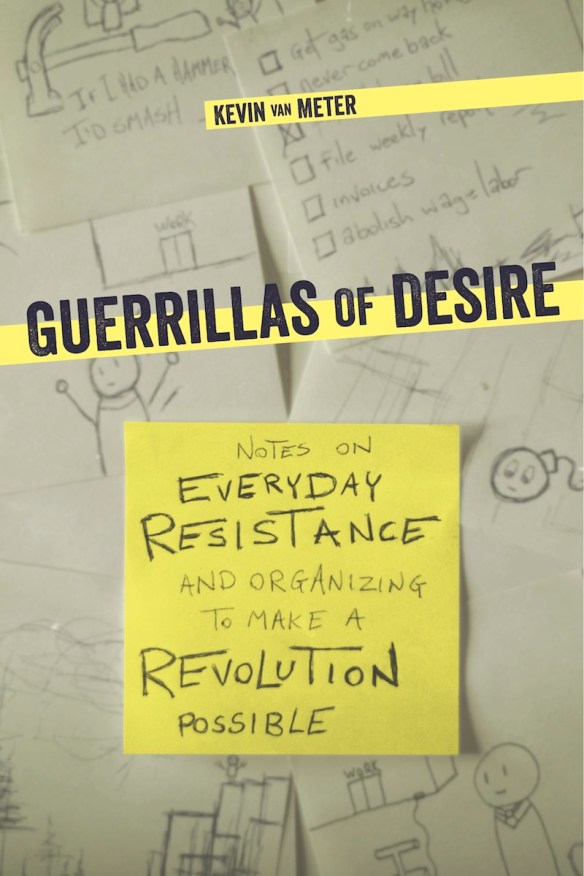
The Seeds of Anti-Capitalist Revolt Found in Everyday Resistance: A Review of Guerrillas of Desire – Notes on Everyday Resistance and Organizing to Make a Revolution Possible by Kevin Van Meter (AK Press, 2017)

By Scott Campbell

Source: Institute for Anarchist Studies

Back when I first began selling my labor for a wage in the wasteland of suburbia’s strip malls, I can recall the tedium of stocking shelves, summoning up insincere courtesy in the face of entitled customers and obnoxious bosses, comparing the stacks of money counted at the end of the day with the totals on our paychecks, and feigning adherence to whatever motivational façade management cooked up to mask the reality of our exploitation.

Yet I also remember, much more vividly and fondly, the latent and occasionally eruptive defiance among my co-workers. This included the constant collective complaining about the job, taking more and longer-than-approved breaks, working as little as possible, fudging time sheets, stealing, and the intermittent screaming matches with the boss in the middle of the store. Underpinning all these actions was an unspoken but broadly understood code of silence when it came to such transgressions and, when appropriate, expressions of support for them.

At the time, I didn’t think much about this, it was just how things happened and I’ve encountered similar experiences to varying degrees in every workplace since. Our actions weren’t guided by a political framework nor was there any attempt to organize them in a directed manner. It was more a spontaneous, innate reaction to experiencing the coercion of capitalism. I had cause to reflect upon this anew while reading Kevin Van Meter’s new book, Guerrillas of Desire: Notes on Everyday Resistance and Organizing to Make a Revolution Possible, published by AK Press and the Institute for Anarchist Studies.

In the preface, Van Meter observes that the question motivating him is not “What is to be done?” but “How do people become what they are?” Throughout the course of the book he seeks to provide an answer by locating power in the resistance of workers, apart from any political ideology or organization. Whether and how that inherently anti-capitalist refusal of work develops into revolt or rebellion are the questions he compellingly urges us to reflect and act upon.

To reach that point, Guerrillas of Desire ambitiously takes on multiple tasks that feed into and build on one another. Van Meter initiates a dialogue between anarchism and Autonomist Marxism that leads to a reconceptualization of the working class, bolstered in part by a historical accounting of workplace actions such as the ones I recounted. He labels these “everyday resistance,” committed by “guerrillas of desire,” and proposes a focus on those deeds as the entry point for organizing revolutionary resistance to capitalism. The impetus for this initiative, concisely carried out in under 160 pages, is his proposal that the current approach to organizing is conceptually flawed and therefore destined to fail. “Guerrillas of Desire offers a contentious hypothesis: the fundamental assumption underlying Left and radical organizing, including many strains of anarchism, is wrong. I do not mean organizationally dishonest, ideologically inappropriate, or immoral. I mean empirically incorrect” (13). The incorrect basis for current organizing is the assumption that the poor and working classes are unorganized and passive and that it therefore rests upon activists and organizations to educate and mobilize them for their own sakes. Van Meter instead proposes that there is in fact informal organization and resistance occurring, it is just of a sort that does not fit within the Left’s organizing vision and therefore goes unseen, unrecognized, and unincorporated into political theories, analysis, and action.

To provide a political frame for understanding the “everyday resistance” of the working class, Van Meter draws upon anarchism’s mutual aid – the material and emotional cooperation and reciprocal support that exists in societies – with Autonomist Marxism’s self-valorization – autonomous working class action that counters the state and capitalism, primarily the refusal of work in its myriad forms. Combined together and reinforcing one another, mutual aid and the refusal of work comprise the “everyday resistance” of the working class.

These phenomena also give definition to what is meant by “working class,” which Van Meter defines as “autonomous from both capitalism and the official organization of the Left, broadly including all those who work under capitalism, based in relationships between workers rather than as a structural component of the economy or sociological category” (32). Rather than being premised on income, occupation, or union membership, the working class under Van Meter’s formulation is made up of all those who must perform work under capitalism – be it waged or unwaged, in the factory, home, office, bedroom, affective, or social spheres. However, when they are not taking action in response to their subjugation under capitalism, these people are just workers. They become a class through the process of struggling against the conditions imposed upon them by capitalism. This struggle initially takes the form of everyday resistance based on mutual aid and the refusal of work. It is everyday resistance that unites individual workers as a class because such resistance, even when performed by one person, requires at a bare minimum the tacit complicity of co-workers and preferably their active collaboration.These acts and the social relationships they create and depend on lay the groundwork for the broader and overt organizing against capitalism more commonly interpreted as working class struggle. Using this framework as offered by Van Meter, we can understand the working class as composed of the relationships forged among workers actively in resistance against capitalism.Without anti-capitalist struggle, the working class does not exist.

After laying this theoretical groundwork, the bulk of the book traces the various forms of resistance by slaves, peasants, and workers in the industrial and social factories (the expansion of capitalist logic from the factory into society at large, in particular in service, immaterial, and reproductive work), creating a lineage and legacy of working class resistance against the various formations of capitalism that spans centuries. “Viewing the working class broadly to include slaves and peasants as well as students, homemakers, immigrants, and factory and office workers reveals the breadth of struggle and generalized revolt against work that continues to be imposed” (128). In doing so, Van Meter further builds the framework of the working class as being formed through its self-activity against the demands and deprivations of capitalism.

The historical survey brings the discussion into the present, where Van Meter offers a proposal to address his initial hypothesis that the Left is carrying out its organizing work in an incorrect way. His suggestion is for the organizers of today and in the future to begin their work by “reading the struggles” already underway in the form of everyday resistance. Through investigation and documentation by organizers, new relationships may be fostered with guerillas of desire that allow everyday resistance to expand into larger and more overt forms of autonomous anti-capitalist struggle. He proposes that the seeds of the new, liberatory worlds sought by anarchism and Autonomist Marxism are to be found in the everyday resistances that are already occurring rather than in the latest organizing manual or official Left strategy document..

While impressed after reading through this formulation, I was left with lingering questions. It remained unclear how, for instance, everyday resistance morphed into more overt, organized resistance and the part organizers positioning themselves as readers of struggle played in such a development. The personal anecdotes he provided on stepping back from ideological assumptions and reorienting towards the collective experiences of communities during his work in Long Island were helpful. It brought to mind the story of Marxist-Leninist intellectuals heading off to the Chiapan jungle with grand plans of starting a peasant guerrilla force. Only when they arrived, they found the population had no time or interest in their grandiose ideology. It was only when they dropped their assumptions and worked within the community to understand its needs, concerns and own history of resistance that the Zapatistas emerged. That, however, is a rather specific and exceptional example. I feel Van Meter’s proposal to begin organizing from within everyday resistance based on the notion that it will lead to more overt resistance could benefit from further articulation and direction.

Similarly, the focus on work as existing solely within the capitalist sphere left me curious as to his vision of the place of non-leisure activity under capitalism or even after capitalism. The refusal of the work that maintains capitalism is indispensable. Yet I would not advocate the refusal of work that maintains communal and personal well-being or builds autonomous organization, or writes books reviews in spare time, for example. Certainly, Van Meter would not advocate that either, but it remains a matter necessitating clarification and one that I believe extends beyond an issue of semantics.

Despite those questions, Guerrillas of Desire is aspirational in its scope and contains ideas and proposals worthy of consideration by radicals reflecting on how to engage in the current moment. In a time when mobilizing and organizing around class has fallen off the radar of many, it is a welcome reminder of the importance of paying attention to the working class and the integral role working class struggle plays in resistance to capitalism, alongside the currently more prevalent resistances to capitalist white supremacy, heteropatriarchy, colonization, environmental destruction and more.

Van Meter assists in this advocacy by accessibly presenting an updated Autonomist Marxist perspective of the working class, expanding it, breathing life into, and imbuing it with its own power, separate from both capitalism and the official Left. As such, he allows readers who may toil in a variety of ways under capitalism to see themselves within the working class, conceptualize their activities as part of a broader resistance with a rich history, and inspire them to build on that legacy.


Scott Campbell is a radical writer and translator based in California. He is part of the collectives that publish the websites El Enemigo Común and It’s Going Down. His personal site is fallingintoincandescence.com

Guerrillas of Desire is available here!


Live Free or Die: The Psychology of Rebellion & Dissent

By Gary ‘Z’ McGee

Source: Waking Times

“I rebel—therefore we exist.” ~Albert Camus, The Rebel

Dissent is a tricky subject. The need to rebel against atrocity is deeply ingrained in the human condition. Even if most of us don’t act on it, the impulse is still there, churning our guts with disgust, getting our hearts pumping, moving us to spit curse words in lathered fury and shout in angry defiance. The problem is that most of us don’t know what to do with this powerful and sometimes overwhelming energy.

Most of us were raised in violent societies that use violence to keep the culture churning in a diabolical conquer-control-consume-repeat cycle. So, most of us tend to use violence to channel our deep and powerful need for dissent, thus perpetuating more violence. When the culture is jamming violence down our throat as a solution to its problems, are we really that surprised when our acts of rebellion turn out to be violent? Something’s got to give if we want to break this cycle of violence deeply imbedded in our culture.

In his book, The Rebel: An Essay on Man in Revolt, Albert Camus wrote about the “true rebel.”The true rebel is in revolt against oppression, violence, slavery and tyranny for the sake of others through constructive and life-affirming action. The true rebel protests out of love, so that others may be free. Intent is everything. True rebellion, Camus argues, is an act motivated but concerned with the common good rather than by self-interest. The rebel in revolt out of selfishness, greed, or need for power, eventually becomes a tyrant. The rebel in revolt for the sake of others, becomes a hero.

Whether you are alt-right or alt-left, republican’t or democan’t, voluntarist or anarchist, if you are seeking power over others for your own selfish and greedy ends, your revolution means fuck-all. You’re just another would-be-tyrant getting churned out of the meat-mill of violence begetting violence. It doesn’t matter how noble or important you think your cause is; if you need to use violence to persuade others to follow it, your cause is fundamentally flawed and immoral. Acting violently in a violent culture only perpetuates violence. Similarly, acting immorally in an immoral society just perpetuates immorality. Unhealthy acts beget unhealthy acts. Like Gandhi said, “An eye for an eye makes the whole world blind.”

Lest we all go blind, we must rebel so that others may freely exist. This requires our dissent to be based in freedom for everyone, even those we don’t agree with. A kind of metamorality arises from this kind of thinking, like Joshua Greene writes about in his book, Moral Tribes. But, and here’s the rub, any freedom which seeks to violate the nonaggression principle must not be tolerated. Violence is where the line must be drawn. As someone once said, “Your freedom to swing your fist ends an inch from my nose” (unknown). In such cases, self-defense is paramount. As Gandhi also advised, “When there is only a choice between cowardice and violence, I would advise violence.”

A true rebel doesn’t seek out rebellion for the sake of rebellion, or just as an excuse to act out violently. No. A true rebel passionately seeks a healthy environment (physically, culturally, and psychologically) and they rebel against anything that stands in the way of that healthy environment. As Camus said, “Rebellion, though apparently negative, since it creates nothing, is profoundly positive in that it reveals the part of man which must always be defended.” And that’s what it comes down to: self-defense, self-preservation, and survival. Not just personal survival, but the survival of the species.

That’s where life-affirming action comes in. When our rebellion is life-affirming, freedom-affirming, and based on nonviolence, it is healthy (heroic). When our rebellion is life-denying, freedom-denying, and based on violence, it is unhealthy (tyrannical). The hero is free, and uses that freedom with the soul intent to free others. The tyrant (or would be tyrant) is also free, but uses that freedom with the soul intent to rule others. We escape tyranny when we seek to free others through our own freedom. Liberty coincides with heroism when we’re able to go from asking, ‘free from what?’ to asking, ‘free for what?’

At the end of the day, the history of our culture of violence is only fruitful through a vigilant rebellion against it. This means a vigilant rebellion against oppression, hate, violence, and slavery of all kinds. Those who dedicate themselves to this culture of violence dedicate themselves to nothing and, in turn, are nothing. But those who dedicate themselves to life, freedom, and health, despite the culture of violence, dedicate themselves to survival and reap from it the harvest that sows its seed in the progressive evolution of our species.

A species hellbent on violence against itself is unhealthy and eventually destroys itself. A species determined to be healthy only ever uses violence as a last resort in self-defense and for the preservation of the species itself. From the former, the defiant tyrant juts his ugly head, declaring himself free at the expense of the freedom of others. From the latter, the defiant hero rises up, denying the tyrant’s violent oppression, and affirming freedom through the freedom of us all. That’s what Camus meant when he wrote: “I rebel –therefore we exist.”