Saturday Matinee: Kin-dza-dza!

In praise of Kin-dza-dza! – the best sci-fi film you’ve never heard of


Mad Max meets Monty Python is the best way of describing this strange Soviet gem.

By Joel Blackledge

Source: Little White Lies

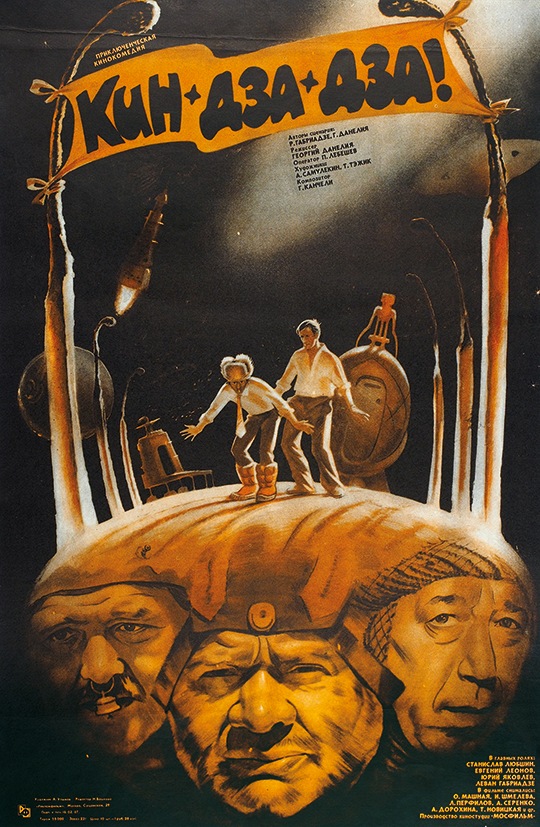
Originally released in 1986, Georgiy Daneliya’s Kin-dza-dza! is possibly the most underrated science fiction film of the past 50 years. A Soviet space odyssey across an alien landscape, it is packed with comic nuance and absurdist charm, yet it is rarely screened or even seen outside Russia. With 2016 marking its 30th anniversary, this deadpan oddity deserves a reappraisal for its wit, imagination and stunning design.

The story begins with Vladimir, a Moscow construction worker, popping out for some macaroni. He is stopped in the street by Gedevan, a young student who needs help with a seemingly insane man claiming to be on the wrong planet. The man needs Earth’s coordinates so he can use his teleportation device to go home. Impatiently humouring him, Vladimir presses a button on the device. Instantly, he and Gedevan are transported to the desert planet Pluke in the galaxy of Kin-dza-dza.

Before long, they meet Bi and Wef, two wandering performers whose speech is largely limited to the word ‘koo’ or its vulgar equivalent ‘kyu’. The Earthlings haggle over the terms of their rescue, though the performers are loath to give something for nothing. Just as the performers are about to leave, they notice that Vladimir has a box of matches – one of the most valuable commodities on Pluke. The four establish a shaky alliance and set in off in a ramshackle aircraft to find a way back to Earth. Vladimir and Gedevan discover that the entire planet operates on a ruthless economy of scavenger barter, and nothing is off limits to the market. The deserts were once seas, but the water was greedily converted into engine fuel. Of course, now the only way to collect drinking water is to extract it back from that fuel.

Kin-dza-dza!’s salvage punk aesthetic – which might best be described as Mad Max meets Monty Python by way of Tarkovsky – hints at this rich, tragic and very stupid history. A collapsed Ferris wheel provides a home for destitute desert dwellers. Graves are marked by balloons containing the deceased’s final breath. The colour of your trousers signifies social status, so they are powerful barter items.

The planet’s inhabitants are primitive in their hardheartedness, yet they also fiercely insist upon maintaining arbitrary social conventions. People are separated into two castes: “Chatlian” and “Patsak”. The subordinate Patsaks must wear bells on their noses and squat before Chatlians. The only way to determine if an individual is a Patsak or a Chatlian is to see if a purpose-built machine emits a green or orange light when pointed at them. The Earthling visitors decry this as racism of the most inane kind, but Plukanians fail to see the problem. When Bi asks with genuine puzzlement how people on Earth determine who is subservient to whom, Vladimir dryly responds, ‘Oh, just by eye.’ Hearing this, Wef dismisses Earthlings as savages. Advanced technology does not a civilised culture make.

What elevates Kin-dza-dza! beyond a simple procession of snipes is the careful attention paid to countless details within its alien world. Even Giya Kancheli’s comic score sounds like it’s from another world – an ungainly, melancholic dirge that conjures up the hopeless bafflement of absurdism. All of this rich world building puts the film into a literary branch of satirical sci-fi occupied by the likes of Kurt Vonnegut, Douglas Adams, and even Franz Kafka. There is no convoluted plot, but instead a convoluted universe, and its incredulous victims ready to point out the farcicality therein. They find a planet that demands a mix of callous entrepreneurial savvy and fearful deference to the status quo familiar to any Earthling living in the 21st century.

Kin-dza-dza!’s sideways look at the barbarities of everyday oppression remains pertinent 30 years on. It’s a must-see for anyone interested in the cosmic potentials of science fiction.


Watch Kin-dza-dza! on Kanopy here: https://www.kanopy.com/en/product/14715372

Saturday Matinee: The Boxer’s Omen

“The Boxer’s Omen” (1983) is a gonzo Hong Kong horror film directed by Kuei Chih-Hung and produced by the Shaw Brothers. Phillip Ko stars as Fei Kao, a boxer whose brother is nearly killed in a match by a rival from Thailand (played by Bolo Yeung). To get revenge, Fei travels to Thailand where he discovers he happens to be a spiritual twin of a revered Buddhist monk whose temple is under siege from a black magic cult. In a series of spiritual battles, the protagonist and his fellow monks must overcome demonic bats, spiders, snakes and caterpillars, floating human heads, animated crocodile skulls and statues, and a she-devil among other obstacles. While some of the puppetry work may seem amateurish by today’s standards, the often strikingly bizarre visuals evoke psychedelic fare such as Altered States and The Holy Mountain as well as aspects of giallo cinema or the supernatural genre films produced by Tsui Hark.

Saturday Matinee: The Case of the Grinning Cat

Synopsis from Icarus Films:

In his newest film, French documentarian and cinema-essayist Chris Marker reflects on French and international politics, art and culture at the start of the new millennium. In November 2001, the filmmaker became intrigued, as did many other Parisians, by the sudden appearance of alluring portraits of grinning yellow cats on buildings, Metro walls and other public surfaces. Marker’s cinematic efforts to document the mysterious materializations of this charming feline throughout Paris are a recurring theme of THE CASE OF THE GRINNING CAT.

This engaging record of Marker’s cinematic peregrinations throughout the city, visually energized by his free-association montage style, chronicles strikes, demonstrations, memorials, election campaigns, celebrity scandals, international political incidents, and a seemingly endless variety of political protests (against the Iraq War, against China’s occupation of Tibet, against the government’s ban on the wearing of Muslim headscarves). The personalized commentary running throughout THE CASE OF THE GRINNING CAT offers the simultaneously learned and witty reflections of the filmmaker, now in his early eighties, on both the contemporary and historical implications of these varied events and personalities.

The mysterious grinning yellow cats soon begin to appear amidst the banners and signs in some of the political demonstrations. Eventually, the creator of the grinning cats is revealed to be an art collective known as Mr. Cat, whose members are shown painting a massive representation of their mascot on the plaza before the Pompidou Center. The filmmaker’s own famous cat caricature soon allies with Mr. Cat, as Marker speculates on the political possibilities of such a feline association.

Chris Marker concludes THE CASE OF THE GRINNING CAT with thoughts on the vital importance of such expressions of imagination in our public lives, echoing the May ’68 slogan that “La poésie est dans la rue” (“Poetry is in the street”).

Revolutionary Terror: Mark Steven’s ‘Splatter Capital’

By Michael Grasso

Source: We Are the Mutants

Splatter Capital: The Political Economy of Gore Films
By Mark Steven
Repeater Books, 2017

“Splatter confirms and redoubles our very worst fears. It reminds us of what capital is doing to all of us, all of the time—of how predators are consuming our life-substances; of how we are gravely vulnerable against the machinery of production and the matrices of exchange; and of how, as participants of an internecine conflict, our lives are always already precarious.”

—from the Introduction to Splatter Capital

Political readings or interpretations of horror films are nothing new. But in Mark Steven’s 2017 study, Splatter Capital, an explicit connection is made between the bloody gore of what Steven terms “splatter” horror films and the dehumanizing, mutilative forces of global capitalism. Moreover, Steven posits the artistic motivation behind splatter horror as an explicit repudiation of this system: “It is politically committed and its commitment tends toward the anti-capitalist left.” In splatter films, Steven tells us, the images of gory dismemberment do double duty. They both offer a clear metaphor for capitalism’s cruelty, and act as a cathartic revenge in which the bloody legacy of capitalist exploitation is often visited upon its perpetrators and profiteers among the bourgeoisie.

Some definitions are in order here, given that Steven’s schema of genres—“splatter,” “slasher,” “extreme horror”—draws distinctions that might not be apparent even to horror fans. Splatter horror, according to Steven, is all about the violence that can be visited upon the human body and all the abjection that follows. It is machinery tearing apart flesh, blood, and guts: the moment a human body becomes meat. It differs from the personalized and often sexualized “hunt” of the slasher flick. The protagonist in a slasher movie is an individual (often female) resisting violent death at the hands of another individual (often male). In victory against Jason, Freddy, or Michael Myers, this protagonist, in Steven’s words, “restores a social order, which is all too regularly white, middle-class, and suburban.” Splatter horror not only expands the horizons of mutilation and violence allowable in a horror film but systematizes it. The splatter enemy is an implacable, impersonal force, full of shock and awe; its grudge is not personal, but instead overwhelming, inescapable, and, most importantly, class-based.

The language of violence and horror has been with Marxist thought from the beginning. Steven gives us a good précis of Marx’s use of explicitly Gothic (along with bloody and cannibalistic) imagery throughout his works, as well as a splatter-tastic explanation of the exploitation behind surplus value, using an imaginary case study in the manufacturing of chainsaws and knives. The October Revolution in Russia is viewed as a reaction to the inhuman mechanized slaughter of the first World War; Eisenstein’s early filmic paeans to the necessity of revolution such as Strike (1925) demonstrate, thanks to Eisenstein’s pioneering use of montage, capitalism’s role as butcher. Steven also discusses avowed leftist filmmakers from outside the Soviet Union such as Godard, Makavejev, and Pasolini—specifically their use of gore to embody the cruelty of the ruling classes.

As we enter the world of Hollywood film in Chapter Three, Steven examines splatter film as a specifically American reaction to the constant churning crisis of capitalism. Specifically, Steven looks at the two peaks of gore-flecked horror—the mid ’60s through the early ’80s, and the post-Cold War “torture porn” trend of the early ’00s—as expressions of two very important economic and political shifts. The first splatter peak in the ’70s is seen as a clear reaction to the slow, inexorable widening of neoliberal and globalist postindustrial economics and its impact on the American industrial worker. (The aftermath of this trend continues into the 1980s with the evaporation of industry and the establishment of a new information-and-finance-based economy.) The splatter/torture porn trend of the ’00s and beyond is a reaction to the crises of capitalism under a new world order of neocolonialist conflict: the War on Terror, the final disestablishment of the Western industrial base in favor of cheap labor in the developing world, and the new interconnected, networked world’s rulership by speculative capital in the form of the finance sector.

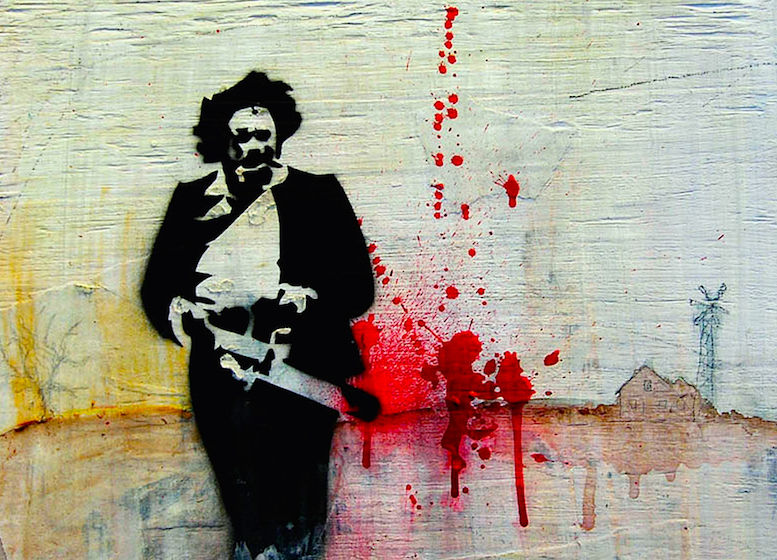
Steven cites too many splatter movies to cover in this review, but central to his thesis is the seminal 1974 Tobe Hooper film, The Texas Chain Saw Massacre. The death of local industry leads Leatherface and family to keep their slaughterhouse traditions alive by carving up and eating young people. These young people, Steven is quick to point out, are only here at all because they were unable to get gas for their car (thanks to the first of two 1970s oil crises). American decline is everywhere; betrayal by global economic forces are central to the trap that’s being laid by the cannibals. (Of course, the carnage of the Vietnam War can’t be overlooked here either, given the visual language of ambush, capture, and torture; Hooper himself has cited this in subsequent interviews.) Steven notes that the victims in The Texas Chain Saw Massacre are representative of a bourgeoisie who don’t know how the sausage is made. It’s important and vital, Steven says, that the cannibalistic side of splatter involves the bourgeoisie being forced to eat members of their own class. It’s Burroughs’s famous “naked lunch“: “the frozen moment when everyone sees what is at the end of every fork.”

As the neoliberal takeover of the world economy begins in earnest in the 1980s, as complex and largely ephemeral systems of mass media and finance take the place of the visceral, grinding monomania of industrial capitalism, splatter horror follows suit. Steven’s analysis of David Cronenberg’s Videodrome (1983) is especially sharp, examining the links between the body horror of the film and the Deleuzian body without organs. Max Renn’s body becomes an endlessly modular media node, able to accommodate video cassettes, to generate and fuse with phallic weapons (used to assassinate and destroy the media forces who’ve made him this way), to mesh and mold and mix with the hard plastic edges of media technology. By the end of the film, Renn is a weapon reprogrammed and re-trained on the very media-industrial complex that made him. More body horror: the cult classic Society (1989) and its shocking conclusion posits the ruling class as a cancerous monster, an amorphous leviathan straight out of a Gilded Age political cartoon, eating and fucking and vomiting, red in tooth and claw and pseudopod. Barriers between bodies break down; the system begins swallowing up all alternate possibilities.

By the time the Cold War is finished, the era of post-9/11 eternal war, of Abu Ghraib and Guantanamo, led to the popular new splatter sub-genre of “torture porn.” Steven identifies the genre’s distinguishing aesthetic feature: the indisputable, systematic, and worldwide victory of capitalism and the hypnotic Spectacle that accompanies it. In this era, there are no longer any alternatives. Everyone, rich and poor, is trapped in the system, and the system reintegrates torture into a worldwide video spectacle. This is embodied in both the global conspiracies of the wealthy in Roth’s Hostel series and in the Jigsaw Killer’s industrially-themed Rube Goldberg devices in the Saw franchise—devices of dismemberment explicitly linked to moral quandaries reminiscent of capitalism’s impossible everyday Hobson’s choices for the working class. The system will go on consuming you, whether you’re unlucky enough to be a splatter film’s victim, or “lucky” enough to wield the power to splatter (for example, Hostel: Part II‘s reversal of fate on the ultra-wealthy hunters, or the Jigsaw Killer’s death from cancer in Saw III—ultimately due to… a lack of health insurance).

Possibly the most intriguing aspect of this already very good book is Steven’s interspersing of personal anecdotes on when and where he discovered some of his favorite horror and genre films. By placing his personal and psychological experience of splatter films front and center, and linking it to his personal growth and increasing political maturity, he demonstrates the personal impact of the political, and the necessity of personal epiphany, mediated by culture, to achieve political awareness. Splatter Capital ultimately is not a book for the already-convinced and committed leftist, the Marxian thinker already well-versed in theory. (Another of Splatter Capital‘s very strong points is how Steven largely eschews jargon and obscurantism for an approachable tone and topic that laypeople can dive into easily.) It is for the fans of these films who’ve always wondered about the ineluctable appeal of visceral, shocking violence on screen, and perhaps why it all feels so strangely familiar.

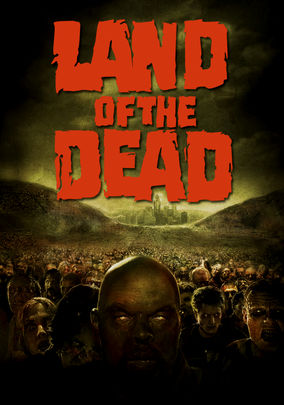
Saturday Matinee: Land of the Dead

3768363“Land of the Dead” (2005) is writer/director George Romero’s fourth film in his “Night of the Living Dead” series and  is possibly the most underrated installment so far. The film offers a variety of new twists to the series such as the development of basic problem solving skills among zombies and the not-too-subtle symbolism of a walled city ruled by a dictator from the top of a luxury high rise. It continues and heightens the social commentary most apparent in the second film of the series, “Dawn of the Dead” while steering it in surprising directions. While the film is not without it’s share of plot holes, it’s screenplay is satisfying nevertheless, and features good performances from Dennis Hopper, Simon Baker, John Leguizamo, Asia Argento and Eugene Clark (with surprise cameos by Shaun of the Dead’s Simon Pegg and Edgar Wright).

http://www.dailymotion.com/video/x2ja94s

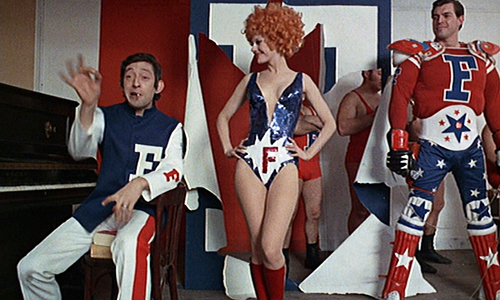
Saturday Matinee: Mr. Freedom

tumblr_l0uzlsUIuW1qaw1oyo1_500

“Mr. Freedom” (1969) is a surreal polemic directed by William Klein skewering patriotism, imperialism and cold war scare-mongering by chronicling the idiotic exploits of an all-American superhero. What it lacks in plot and subtle acting it makes up for in audacious visuals and sadly still relevant yet deserving political jabs. The film is also notable for it’s soundtrack and cameo appearance by the great Serge Gainsbourg.

http://www.dailymotion.com/video/xq8l5g_mr-freedom_shortfilms

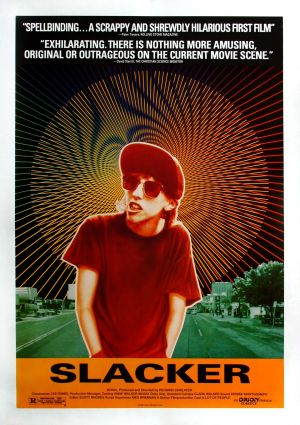
Saturday Matinee: Slacker

Slackerposter

Synopsis by Criterion Collection:

Slacker, directed by Richard Linklater, presents a day in the life of a loose-knit Austin, Texas, subculture populated by eccentric and overeducated young people. Shooting on 16 mm for a mere $3,000, writer-producer-director Linklater and his crew of friends threw out any idea of a traditional plot, choosing instead to create a tapestry of over a hundred characters, each as compelling as the last. Slacker is a prescient look at an emerging generation of aggressive nonparticipants, and one of the key films of the American independent film movement of the 1990s.

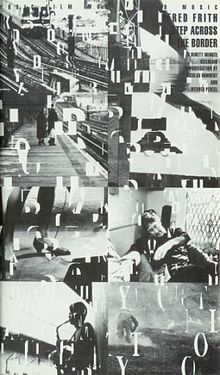
Saturday Matinee: Step Across the Border

220px-FredFrith_VHScover_StepAcrossTheBorder

Synopsis from CineNomad:

In “Step Across the Border” two forms of artistic expression, improvised music and cinema direct, are interrelated. In both forms it is the moment that counts, the intuitive sense for what is happening in a space. Music and film come into existence out of an intense perception of the moment, not from the transformation of a preordained plan. In improvisation the plan is revealed only at the end. One finds it. The other connection concerns the work method: the film team as band. Much as musicians communicate via the music, our work, too, was realized within a very small and flexible team of equals. What mattered was exchange. And movement. Sometimes we started filming in the middle of the night, responding to a new idea that had arisen only minutes before. We had a fundamental feeling for what we wanted to do, for what kind of film this should be. And we followed that feeling. It was all very instinctive…


Do you know a white rabbit who, playing trumpet, circles the world on his flying carpet?
May be you have met him somewhere already, in Zurich, London, Leipzig, Tokyo or New York. That at least was about the route we took and what resulted from it was the black-and-white wink of an eye at the symphonic connection between subways, storms and electric guitars.
An American critic wrote: ‘Fred Frith’s music makes your jaw drop, your feet dance, and your neighbours move.’
Also starring: several telephones, puddles, scarecrows, saxophones, orchestrated cities and motors.
A music film.