Aristocracy Deceives Public about the Deep State

deep_state_gears_1088x725

By Eric Zuesse

Source: Strategic Culture Foundation

The «deep state» is the aristocracy and its agents. Wikispooks defines it as follows:

The deep state (loosely synonymous with the shadow government or permanent government) is in contrast to the public structures which appear to be directing individual nation states. The deep state is an intensely secretive, informal, fluid network of deep politicians who conspire to amplify their influence over national governments through a variety of deep state milieux. The term «deep state» derives from the Turkish »derin devlet», which emerged after the 1996 Susurluk incident so dramatically unmasked the Turkish deep state.

Their article is so honest that it continues from there, directly to:

Official Narrative

The official narrative of deep states used to be that they simply do not exist. This position was modified in the last few years to the claim that they don’t exist here. In 2013 the New York Times defined the deep state as «a hard-to-perceive level of government or super-control that exists regardless of elections and that may thwart popular movements or radical change. Some have said that Egypt is being manipulated by its deep state». [1] Since the Times (like the rest of the commercially-controlled media) is more or less a under the control of the deep state, such a mention is very interesting.

However, one of the deep state’s many agents, Marc Ambinder, came out with a book in 2013, Deep State: Inside the Government Secrecy Industry, much praised by others of the deep state’s agents, such as Martha Raddatz, Jeremy Scahill, and Peter Bergen; and it pretends that the ‘deep state’ is only within the official government, not above it and controlling it — not what has been called by some «the money power,» and by others «the aristocracy» (or the «oligarchy» as it was termed — though even that, only indirectly — by the only people who have scientifically established that it exists in America and controls this country: to acknowledge publicly that the U.S. is controlled by an «aristocracy» is prohibited in scholarly publications; it’s too ‘radical’ a truth to allow in print; it is samizdat).

On its third page, Ambinder’s piece of propaganda make clear what he means by ‘deep state’:

This book is about government secrets — how they are created, why they get leaked, and what the government is currently hiding. We will delve into the key elements of the American secrecy apparatus, based on research and unprecedented access to lawmakers, intelligence agency heads, White House officials, and program managers. …

That piece of trash failed even to discuss George W. Bush’s lies in which Bush stated during 2002 and 2003 that he possessed conclusive proof that Saddam Hussein was reconstituting his WMD (weapons of mass destruction) program — what America’s aristocratically controlled ‘news’ media attributed instead to ‘failures of intelligence’ by the Bush Administration — which had supposedly caused the Bush regime to invade Iraq in 2003. That was supposedly an enormous ‘failure of intelligence’, but Ambinder’s book ignored it entirely — and yet there are still suckers who buy that and the aristocracy’s other propaganda (and so who misunderstand even such a basic concept as «the deep state» or «the aristocracy»).

One of the biggest indicators that one is reading propaganda from the deep state is that the government’s lies are not being called »lies» (unless the deep state is losing control over the government, which rarely happens). Instead, they are called by such phrases as ‘failures of intelligence’. But what about when the people who control the government misrepresent what their ‘intelligence’ actually shows and doesn’t show? Lying is attributed, in the ‘news’ media, only to the aristocracy’s enemies. After all: the aristocracy’s enemies can be acknowledged to exist, even if the existence of an aristocracy isn’t being acknowledged.

Another mouthpiece of the deep state is (like virtually all magazines) The Nation magazine, which headlined on 17 February 2017, «What Is the Deep State? Even if we assume the concept is valid, surely it’s not useful to think of the competing interests it represents as monolithic.» Their propagandist, Greg Grandin, asked «What is the ‘deep state’?» and he ignored what wikispooks said, and he asserted, instead, «The problem with the phrase ‘deep state’ is that it is used to suggest that dishonorable individuals are subverting the virtuous state for their private ambitions.» Aside from propagandist Grandin’s having merely assumed there ‘the virtuous state’, which might not even exist at all, in this country, or perhaps in any other, he was trying to, as he said, get «beyond the binds of conspiracy theory,» as if any hierarchical social structure, corporate or otherwise, doesn’t necessarily and routinely function by means of conspiracies — some of which are nothing more than entirely acceptable competitive strategies, often entirely legal. He wants to get beyond accepting that reality? Why would anyone wish to read such absurd, anti-factual, writings as that? Why would anyone hire such deceptive writers as that? Perhaps the answer to the latter question (which raises the problem here to being one about the aristocracy, since this is about the ‘news’ media, which in every aristocratically controlled country are controlled by its aristocracy) is that only writers such as that will pump their propaganda, and will hide such realities as are here being discussed (and, via links, documented).

Nothing that’s alleged here is denying that there are divisions within the aristocracy (or «deep state»). Nothing is alleging that the aristocracy are «monolithic.» It’s instead asserting that, to the extent the aristocracy are united around a particular objective, that given objective will likely become instituted, both legally and otherwise, by the government — and that, otherwise, it simply won’t be instituted at all. This is what the only scientific analysis that has ever been done of whether or not the U.S. is controlled by an aristocracy found definitely to be the case in the U.S.

(And, of course, that’s also the reason why this momentous study was ignored by America’s ‘news’ media, except for the first news-report on it, mine at the obscure site Common Dreams, which had 414 reader-comments within just its first four months, and then the UPI’s report on it, which, like mine, was widely distributed to the major ‘news’ media and rejected by them all — UPI’s report was published only by UPI itself, and elicited only two reader-comments there. Then came the New Yorker’s pooh-poohing the study, by alleging «the politicians all know this, and we know it, too. The only debate is about how far this process has gone, and whether we should refer to it as oligarchy or as something else.» Their propagandist ignored the researchers’ having noted, in their paper, that though their findings were extremely inconsistent with America’s being a democracy, the problem was almost certainly being understated in their findings: «The failure of theories of Majoritarian Electoral Democracy is all the more striking because it goes against the likely effects of the limitations of our data,» and, especially, «our ‘affluent’ proxy is admittedly imperfect,» and so, «interest groups and economic elites actually wield more policy influence than our estimates indicate.»

In fact, their «elite» had consisted not of the top 0.1% as compared to the bottom 50%, but instead of the top 10% as compared to the bottom 50%, and all empirical evidence shows that the more narrowly one defines «the aristocracy,» the more lopsidedly dominant is the ‘elite’s relative impact upon public policies. Then, a month after the press-release on their study was issued, the co-authors were so disappointed with the paltry coverage of it that had occurred in America’s ‘news’ media, so that they submitted, to the Washington Post, a reply to their study’s academic critics, «Critics argued with our analysis of U.S. political inequality. Here are 5 ways they’re wrong.» It was promptly published online-only, as obscurely as possible, so that there are also — as of the present date — only two reader-comments to that public exposure. This is typical news-suppression in America: essentially total suppression of samizdat information — not merely suppression of the officially top-secret information, such as propagandists like Ambinder focus upon. It’s deeper than the state: it is the deep state, including far more than just the official government.)

Another matter that America’s press has covered-up is the extreme extent to which the only scientific analysis of whether America is a democracy or instead an aristocracy, had found it to be an aristocracy; so, here in closing will be directly quoted the least-obscurantist statement of this fact, in the study itself:

The picture changes markedly when all three independent variables are included in the multivariate Model 4 and are tested against each other. The estimated impact of average citizens’ preferences drops precipitously, to a non-significant, near-zero level. Clearly the median citizen or «median voter» at the heart of theories of Majoritarian Electoral Democracy does not do well when put up against economic elites and organized interest groups. The chief predictions of pure theories of Majoritarian Electoral Democracy can be decisively rejected. Not only do ordinary citizens not have uniquely substantial power over policy decisions; they have little or no independent influence on policy at all.

By contrast, economic elites are estimated to have a quite substantial, highly significant, independent impact on policy.

They weren’t allowed to say «aristocracy», nor even directly to say «oligarchy», but they were allowed to say this. So: now, you’ve seen it. But the secret is still a secret; what’s samizdat, stays samizdat (so long as the government isn’t overthrown and replaced — and maybe even after the existing regime does become replaced).

Mainstream Media’s ‘Victimhood’

aa-corporate-media-very-good-poster

By Robert Parry

Source: Consortium News

It’s heartwarming that The New York Times and The Washington Post are troubled that President Trump is loosely throwing around accusations of “fake news.” It’s nice and that they now realize that truth does not reliably come from the mouth of every senior government official or from every official report.

The Times is even taking out full-page ads in its own pages to offer truisms about truth: “The truth is hard. The truth is hidden. The truth must be pursued. The truth is hard to hear. The truth is rarely simple. The truth isn’t so obvious. …”  On Sunday, those truth truisms ran opposite an alarmist column by Jim Rutenberg entitled, “Will the Real Democracy Lovers Please Stand Up?” Meanwhile, The Washington Post launched its own melodramatic slogan, “Democracy Dies in Darkness.”

Yet, it was only weeks ago when the Post and Times were eagerly promoting plans for silencing or blacklisting independent news sites that didn’t toe the line on what the U.S. government and its allies were claiming was true.

On Nov. 20, the Times published a lead editorial calling on Facebook and other technology giants to devise algorithms that could eliminate stories that the Times deemed to be “fake.” The Times and other mainstream news outlets – along with a few favored Internet sites – joined a special Google-sponsored task force, called the First Draft Coalition, to decide what is true and what is not. If the Times’ editorial recommendations were followed, the disfavored stories and the sites publishing them would no longer be accessible through popular search engines and platforms, essentially blocking the public’s access to them. [See Consortiumnews.com’s “What to Do About ‘Fake News.’”]

On Thanksgiving Day, the Post ran a front-page story citing an anonymous group, called PropOrNot, blacklisting 200 Web sites, including Consortiumnews.com and other important sources of independent journalism, because we supposedly promoted “Russian propaganda.”

Although PropOrNot and the Post didn’t bother to cite any actual examples or to ask the accused for comment, the point was clear: If you didn’t march in lockstep behind the Official Narrative on, say, the Ukraine crisis or the war in Syria, you were to be isolated, demonized and effectively silenced. In the article, the Post blurred the lines between “fake news” – stories that are simply made up – and what was deemed “propaganda,” in effect, information that didn’t jibe with what the U.S. State Department was saying.

Back then, in November, the big newspapers believed that the truth was easy, simple, obvious, requiring only access to some well-placed government official or a quick reading of the executive summary from some official report. Over the last quarter century or so, the Times, in particular, has made a fetish out of embracing pretty much whatever Officialdom declared to be true. After all, such well-dressed folks with those important-sounding titles couldn’t possibly be lying.

That gullibility went from the serious, such as rejecting overwhelming evidence that Ronald Reagan’s Nicaraguan Contra rebels were deeply involved in drug trafficking, to the silly, trusting the NFL’s absurd Deflategate allegations against Tom Brady. In those “old” days, which apparently ended a few weeks ago, the Times could have run full-page ads, saying “Truth is whatever those in authority say it is.”

In 2002, when the George W. Bush administration was vouching for a motley crew of Iraqi “defectors” describing Saddam Hussein’s hidden WMDs, Iraq’s purchase of some “aluminum tubes” must have been for building nuclear bombs. In 2003, when Secretary of State Colin Powell showed some artist drawings of “mobile chemical weapons labs,” they must really exist – and anyone who doubted Powell’s “slam-dunk” testimony deserved only contempt and ridicule.

When the Obama administration issued a “government assessment” blaming the Syrian military for the sarin gas attack outside Damascus on Aug. 21, 2013, there was no need to scrutinize its dubious assertions or ask for actual proof. To do so made you an “Assad apologist.”

When a bunch of U.S. allies under the effective control of Ukraine’s unsavory SBU intelligence service presented some videos with computer-generated graphics showing Russians supplying the Buk missile that shot down Malaysia Airlines Flight 17 over eastern Ukraine on July 17, 2014, there was no need to examine the holes in the evidence or note that the realistic-looking graphics were fictional and based on dubious assumptions. To do so made you a “Moscow stooge.”

In other words, when the U.S. government was gluing black hats on an “enemy” and white hats on a U.S. “ally,” the Times never seemed to object. Nor did pretty much anyone else in the mainstream media. No one seemed to note that both sides usually deserved gray hats. With very few exceptions – when the State Department or other U.S. agencies were making the charges – the Times and its cohorts simply stopped applying responsible journalistic skepticism.

Of course, there is a problem with “fake news,” i.e., stories that are consciously made up for the purpose of making money from lots of clicks. There are also fact-free conspiracy theories that operate without evidence or in defiance of it. No one hates such bogus stories more than I do — and they have long been a bane of serious journalism, dating back centuries, not just to the last election.

But what the Times, the Post and the rest of the mainstream media have typically ignored is that there are many situations in which the facts are not clear or when there are alternative explanations that could reasonably explain a set of facts. There are even times when the evidence goes firmly against what the U.S. government is claiming. At those moments, skepticism and courage are necessary to challenge false or dubious Official Narratives. You might even say, “The truth is rarely simple. The truth isn’t so obvious…”

A Tough Transition

During the transition from the Obama administration to the Trump team, the Times, the Post and other mainstream media outlets got caught in their own transition from trusting whatever the outgoing officials said to distrusting whatever the incoming officials said. In those final days, big media accepted what President Obama’s intelligence agencies asserted about Russia supposedly interfering in the U.S. election despite the lack of publicly available evidence that could be scrutinized and tested.

Even something as squirrelly as the attack on Trump’s National Security Adviser Michael Flynn – with Obama holdovers citing the never-prosecuted Logan Act from 1799 as the pretext for ginning up some kind of criminal-sounding case that scared Trump into firing Flynn – was treated as legitimate, without serious questions asked. Since Obama officials were doing the feeding, the no-skepticism rule applied to the eating. But whatever statements came from Trump, even his few lucid moments explaining why war with nuclear-armed Russia wasn’t such a great idea, were treated as dangerous nonsense.

When Trump scolded the mainstream press for engaging in “fake news” and then applied the phrase “enemy of the people,” the Times, the Post and the rest went into full victimization-mode. When a few news companies were excluded from a White House news briefing, they all rushed to the barricades to defend freedom of the press. Then, Trump went even further – he rejected his invitation to the White House Correspondents Dinner, the black-tie/evening-gown event where mainstream media stars compete to attract the hottest celebrity guests and hobnob with important government officials, a walking-talking conflict-of-interest-filled evening, an orgy of self-importance.

So, the Times, the Post and their mainstream-media friends now feel under attack. Whereas just weeks ago they were demanding that Google, Facebook and other powerful information platforms throttle those of us who showed professional skepticism toward dubious claims from the U.S. government, now the Times, the Post and the others are insisting that we all rally around them, to defend their journalistic freedom. In another full-page ad on Sunday, the Times wrote: “Truth. It’s more important now than ever.”

I would argue that truth is always important, but especially so when government officials are leading countries toward war, when lives are at stake, whether in Iraq or Syria or Ukraine or the many other global hotspots. At those moments in the recent past, the Times did not treat truth – in all its subtlety and nuance – as important at all.

I would argue, too, that the stakes are raised even higher when propagandists and ideologues are risking the prospect of nuclear war that could kill billions and effectively end human civilization. However, in that case, the American people have seen little truly professional journalism nor a real commitment to the truth. Instead, it’s been much more fun to demonize Russian President Vladimir Putin and paint black-and-white pictures of the evil Russians.

At such moments, those New York Times’ truisms about truth are forgotten: “The truth is rarely simple. The truth isn’t so obvious. …”

Investigative reporter Robert Parry broke many of the Iran-Contra stories for The Associated Press and Newsweek in the 1980s. You can buy his latest book, America’s Stolen Narrative, either in print here or as an e-book (from Amazon and barnesandnoble.com).

WAPO Hires John Podesta as a Columnist, Flushing Last Remaining Credibility Down the Toilet

 john-podesta-2016-election-hillary-clinton-e1476298459966

By Lily Dane

Source: The Daily Sheeple

It’s almost like The Washington Post is trying to become as in-your-face corrupt and biased as possible and is determined to lose any shred of credibility it may have left.

Last Thursday, the paper announced that John Podesta, the scandal-plagued chairman of Hillary Clinton’s 2016 scandal-plagued presidential campaign, has joined their team:

Podesta, former chairman of the 2016 Hillary Clinton campaign, will provide commentary and analysis on the intersection of politics and policy, the Trump administration and the future of the Democratic Party.

“No one knows more about how Washington works, how the White House operates, and how policy ideas are translated into reality than John Podesta,” said Editorial Page Editor Fred Hiatt. “His long experience in Congress, inside two Democratic White Houses and on the front lines of numerous presidential campaigns, will offer readers vital insight into Washington and politics at the start of a new era.”

As of the time of this writing, there were only a few reader comments on the announcement on the news outlet’s website, but all expressed disapproval. Here is a sampling:

“I would just like to thank the Washington Post for dropping all pretense and proving they are now just as willing as Fox News to invite questionable sources to contribute.”

“A mistake. We want agents of change, not those who cling to the past. Podesta’s a proven failure and uninteresting.”

“Not a good choice. Time for new voices, come on, WaPo, you can do much better.”

“John Podesta, friend of Dennis Hastert the child molester. Many people complain the the Russians hacked the DNC, but Podesta gave them his gmail account on a silver platter. Podesta’s password was the word password, not very creative. Read his emails and you find some strange code words, lots of talk about pizza and hotdogs which has caused a buzz on the internet dubbed pizzagate. I am sure Podesta knows his way around DC, maybe the wrong parts of DC.”

“Yeah democracy among the libs is very dark. More dark is how Compost has made a deal with devil by hiring this Satanist. You will reap what you sow.”

If WAPO wanted to choose a more controversial figure to write for their outlet, it would be difficult. Podesta was the central figure of a massive email scandal in late 2016 when WikiLeaks published 58,375 emails from his private Gmail account. Many of the emails contained material regarding Clinton’s positions and campaign strategy, her collusion with the mainstream media, her cozy relationship with bankers, pay-to-play schemes, hints of Podesta’s possible involvement in a nefarious-sounding activity called “Spirit Cooking”, and of course, the infamous #Pizzagate scandal.

Earlier Democratic National Committee (DNC) email leaks exposed a plot to sabotage Bernie Sanders and documents on Hillary Clinton and the Clinton Foundation. Those leaks led to the resignation of at least four DNC officials, including former chair Debbie Wasserman Schultz. They also revealed that interim DNC chair Donna Brazile obtained questions to a Bernie Sanders vs. Hillary CNN/TV One town hall and fed them to Hillary’s campaign people in advance.

Like the DNC and Podesta, The Washington Post isn’t a stranger to scandal.

In the article LIST: Washington Post’s Josh Rogin Has a BIG Fake News Problem, John Nolte explains how Washington Post reporter Josh Rogin recently blew three major stories in grand fashion.

Last week, WAPO, owned by Jeff (Bilderberger, CIA Contractor, and owner of Amazon), stated it is their mission to “defend democracy,” and adopted a dramatic new slogan which it claims was not in any way inspired by President Trump: “Democracy Dies in Darkness”.

In January, the paper was forced to retract an unfounded story scaremongering that Russian hackers penetrated the US electric grid.

Late last year, WAPO cited a list of over 200 supposed Russian propaganda sites (The Daily Sheeple was included on the list) produced by the shadowy PropOrNot organization in a report titled, “Russian propaganda effort helped spread ‘fake news’ during election, experts say.” Melissa Dykes reported on this back in November:

Washington Post wrote a hit piece on all the sites included on ProporNot’s list, claiming the site is literally run by “experts” — without any due diligence or a shred of proof other than the site’s own claims.

Titled, “Russian propaganda effort helped spread ‘fake news’ during election, experts say,” the WAPO story not only upholds the claims of a random, anonymous, and relatively new website, but a website that is formally calling on the FBI to investigate us and other alt news sites on the list for espionage.

In early December, after facing unprecedented blowback for its ridiculous report, WAPO added a lengthy editor’s note to the top of the original article in which the editor not only distances the paper from the “experts” quoted in the original article whose “work” served as the basis for the entire article, but also admits the Post could not “vouch for the validity of PropOrNot’s finding regarding any individual media outlet.”

Podesta, his political party, and WAPO have something significant in common. All seem to be in denial about the huge mistakes they have made which greatly contributed to their loss of credibility. They will likely repeat those mistakes. Perhaps this new relationship is appropriate after all.

Oh, and a bit of friendly advice for WAPO: Be sure to give Podesta a very, very secure email account.

Twitter users had quite a bit to say about Podesta’s new job.

https://twitter.com/correctthemedia/status/834815653857095681

https://twitter.com/zachhaller/status/834855115521552384

https://twitter.com/55true4u/status/835662006879420417

https://twitter.com/HAGOODMANAUTHOR/status/835640562904506368

https://twitter.com/HAGOODMANAUTHOR/status/834927633972371456

Media, Mind-Control, & Meditation: Plato’s E-Cave Panopticon and Beyond

panopticon-image

By Mankh (Walter E. Harris III)

Source: Axis of Logic

“Relax,” said the night man,
”We are programmed to receive.
You can check-out any time you like, 
But you can never leave!”

 – The Eagles, from “Hotel California”

In Plato’s Allegory of the Cave, people saw a shadow play on the wall and perceived it as reality. Today that Cave has morphed to provide umpteen TV channels and mini-screen gadgets; and the once sanctified living room cave has expanded into a free-range bubble of consciousness – heads bowed before an electronic altar, seemingly oblivious to the outside world.

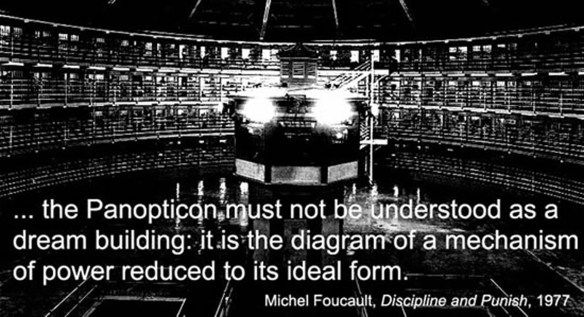
“The “panopticon” refers to an experimental laboratory of power in which behaviour could be modified, and Foucault viewed the panopticon as a symbol of the disciplinary society of surveillance.”[1]

In Plato’s E-Cave, not only are the people watching a shadow play, they, and the shadows they watch, are being watched.

HyperNormalization
With a veneer of calm aplomb, the masses communicate 24-7, often in a frenetic urgency of the mundane, hence one interpretation of HyperNormalization. In all the years of overhearing cell-phone conversations in public, I can’t recall one snippet of philosophy or practical advice, rather stuff like, ‘yeah OMG I’ll get the chips!’ and ‘I’ll be there in like 30 seconds!’; if you’re old enough, you’d remember the days when, you got there when you got there! That said, a cell-phone can be a helpful even life-saving device.

The USEmpire election appears to have both proven and disproven the main theory of Adam Curtis’ fascinating new documentary “HyperNormalization.”

“Curtis argues that since the 1970s, governments, financiers, and technological utopians have given up on the complex “real world” and built a simple “fake world” that is run by corporations and kept stable by politicians.”[2]

The California cyber-tech-boom was a love-child of LSD-consciousness that found refuge in E-wizardy all the while looking to escape repressive politics. In his book “2030” Pepe Escobar describes it as: “Digital network capitalism would then shape post-modern globalization, from the New Economy before the end of the millennium to every digital wall to be broken beyond. California cosmology forged our world.”

According to Wikipedia:

“The term “hypernormalisation” is taken from Alexei Yurchak’s 2006 book Everything was Forever, Until it was No More: The Last Soviet Generation, about the paradoxes of life in the Soviet Union during the 20 years before it collapsed. A professor of anthropology at the University of California, Berkeley, he argues that everyone knew the system was failing, but as no one could imagine any alternative to the status quo, politicians and citizens were resigned to maintaining a pretence of a functioning society. Over time, this delusion became a self-fulfilling prophecy and the “fakeness” was accepted by everyone as real, an effect which Yurchak termed “hypernormalisation”.”[3]

First off, I see HyperNormalization as a half-truth because while the self-referential, gossipy world is fake, it is a veneer for a very real world of resource extraction and the violence perpetrated to maintain the status quo – and that is what the fakers ignore. As far as the election, many expected the Clinton dynasty to prevail as the corrupt, business as usual lesser of two evils. Breaking snooze: Where’s  the headline news that Melania Trump plans to focus on helping women and children?; I saw that mentioned on CNN’s Anderson Cooper 360, such a perfect antidote for Hillary’s loss and The Donald’s anti-feminist track record.

Even though WikiLeaks revealed the DNC (Democratic National Convention) was rigged against Sanders and leaks of Podesta/Clinton e-mails may have been proverbial straws for Hillary’s campaign camel, the prevailing media sentiment was that she would win – despite the fact that the day before the election some polls indicated a shrinking 3-4 point lead, thus with the typical margin of error, it was, in effect, tied. Yet the mass hyper-surprise!; and all that after the corporate media and comedy shows had simultaneously bashed Trump and given him more air-time than a kite on a windy day – both disdaining and elevating him, a media-mindfuck if ever there was one.

And there was little uproar when Gary Johnson and Jill Stein were excluded from debates and virtually banned from all corporate news, thus proving (if you didn’t know already) that it’s not a truly democratic election. Yet carry on we must and do the best we can with what we got, was the general sentiment, in other words, “the “fakeness” was accepted by everyone as real” aka HyperNormalization.

Yet the non-coastal, poor and middle America White working class (with sides of KKK and minorities!), which reportedly was the key demographic for The Don’s victory, was voting out of bare-bones needs; in effect they were not HyperNormalized. Then again, if Trump, who promises to challenge the status quo, caves-in to Deep State pressure, we will have an answer to an interesting article’s titular question: “President Trump: big liar going to Washington or Tribune of the People?”[4] And if that answer is the former, then the mostly White working poor will also have been duped/HyperNormalized.

You see, it’s hard to know what’s what; which all seems to prove HyperNormalization as the dominant societal charade; which screen is real, if any?

What you perceive is what you get
Another key phrase in Curtis’ documentary is “managed perception” – akin to Chomsky and Herman’s  “Manufacturing Consent: The Political Economy of the Mass Media” (1988) which showed how opinions and desensitized agreement to the status quo became a product to be mined and marketed. Witness CBS Chairman Les Moonves’ comment from February 2016:

“Man, who would have expected the ride we’re all having right now? … The money’s rolling in and this is fun. I’ve never seen anything like this, and this [is] going to be a very good year for us. Sorry. It’s a terrible thing to say. But, bring it on, Donald. Keep going.” [5] And, if i might satirically add, like an orangey topped Duracell battery, The Don does seem to have a lot of energy.

HyperNormalization is also akin to Sheldon Wolin’s theory  of “inverted totalitarianism,” where the faceless corporate machine wields so much entertainment and bureaucratic power that the people barely notice they are being played hook, line, and sinking feelings.

Some of Curtis’ info, however, is inaccurate or questionable. For examples, he blames the demise of the Occupy Movement on lack of vision and planning yet neglects to mention the FBI coordinated systemic crackdown on the ‘camps’ across the country. [6]

About Syria he says that President Bashar al-Assad retaliated with a “vengeful fury,” whereas Assad has defended his actions as self-defense for his people; numerous journalists back the Syrian President’s claim.

Post-election, I wonder: Why were so many liberals, lefties, and women more surprised that Trump won than that the DNC/HRC rigged it against Sanders? Were they simply feeling impotent due to HyperNormalized shadow play? Whatever the case, his victory revealed a crack in the smooth screen of HyperNormalization.

According to Patrick Caddell’s survey before the election, the populace seems to be hip to what’s happening:

“Powerful interests from Wall Street banks to corporations, unions and political interest groups have used campaign and lobbying money to rig the system for them. They are looting the national treasury of billions of dollars at the expense of every man, woman and child. AGREE = 81%; DISAGREE = 13%…

“The country is run by an alliance of incumbent politicians, media pundits, lobbyists and other powerful money interests for their own gain at the expense of the American people. AGREE = 87%; DISAGREE = 10%

The real struggle for America is not between Democrats and Republicans but between mainstream American and the ruling political elites. AGREE = 67%; DISAGREE = 24%.” [7]

This makes it seem it is the ‘how-to bring about change’ that is the deeper conundrum of the HyperNormalized world. Then again, people too often seem to have only their own best interests at heart. Approximately 90% of Americans want their food labeled so as to know if they contain GMOs etc. or not, yet hardly a peep out of anyone that climate change or the “environment” aka Mother Earth & Nature-beings were deliberately excluded as a main topic of the presidential debates. This makes it seem that, in general, Americans want clean food for themselves, they want a clean environment so they can go ‘play in the park’ by themselves. And that brings us to the Great Disconnect and Standing Rock.

Flow like water, be steady as a rock
Part of HyperNormalization is a disconnect from Nature and from being self- and community-guided, and therefore disconnected from the Original Peoples of Turtle Island. While many people are certainly aware of what’s happening with Standing Rock, the corporate media’s lack of attention, let alone empathy, fosters lack of concern for the outcome, lack of being outraged by the violent and racist treatment of those in prayer and peacefully protecting the main source of water for the Standing Rock Sioux and other Natives as well as approximately 17-million people downstream. The real-fake outrage is over the outcome of a fake election.

For many Native reservations where poverty and PTSD are prevalent, the people are anything but HyperNormalized; they are struggling to survive – as with Standing Rock, they are not asking for much: clean water and the space to live their lives with ancient traditions timelessly connected with the land, the water, the stones…

Plato, imagining a prisoner getting outside of the Cave, wrote: “Slowly, his eyes adjust to the light of the sun. First he can only see shadows. Gradually he can see the reflections of people and things in water and then later see the people and things themselves. Eventually, he is able to look at the stars and moon at night until finally he can look upon the sun itself .” [8]

Standing Rock is bringing people together, raising consciousness at many levels. As one example from a little over a week ago:

“In a “historic” show of interfaith solidarity, 500 clergy members prayed along the banks of North Dakota’s Cannonball River on Thursday where they “bore witness with the Standing Rock Sioux Nation,” which has faced intimidation, violence, and arrests for protecting their sacred land and water supply from the threats of a massive oil pipeline. According to the Episcopal News Service, “The interfaith group spent more than five hours on site, marching, singing hymns, sharing testimony, and calling others to join them in standing with the more than [300] tribes who have committed their support to the Sioux Nation as they protest the route of the Dakota Access Pipeline (DAPL).” [9]

This solidarity is in stark contrast with the election where a typically 51/49 system determines an outcome for a society literally programmed for exciting close-call winners – think sporting events,
reality shows, awards ceremonies.

Outside in and inside out
There are many ways to get outside the Cave. One of those is by going within. When I first started to meditate, as is common, I became aware of the constant chatter in my head and soon realized that the mind left unattended will rattle on endlessly. Meditation then showed me that once the chatter quiets, one then has access to other frequencies, other ‘channels’ – what happens then is a very personal matter yet also impersonal because one becomes connected with another source of thinking-seeing-feeling. Chatter, like cell-phones, has it’s usefulness, say, if you forgot to turn the stove off. My point to the personal anecdote is that the corporate media is too much chatter, endlessly looping itself. The gadgets, too, though useful, seem hard-wired for HyperNormalization.

Some of the chatter we must live with, yet by learning to follow our intuitions, listening to and connecting with Nature, talking with elders and little children we can better tune-out from the shadow-play, we can find new and ancient ways for more people – and that includes trees, rivers, etc. –  “to look at the stars and moon at night” and “look upon the sun itself.”

“Sin filo ya y derrotada se quejó: Soy más fuerte que ella, pero no le puedo hacer daño y ella a mi, sin pelear. me ha vencido.’”

“Without sharpness and defeated, it [the sword] complained: ‘I am stronger than the water, but I cannot harm her. And the water, without fighting, has conquered me.’” [10]

NOTES:
1.    Panopticism here and here.
2.    Ibid.
3.    HyperNormalization
4.    See here.
5.    “Les Moonves: Trump’s run is ‘damn good for CBS’”. See here.
6.    “Revealed: how the FBI coordinated the crackdown on Occupy
7.    “Patrick Caddell; The Pollster Who ‘Got it Right’
8.    “Allegory of the Cave
9.    “A Prayer for People and Planet: 500 Clergy Hold ‘Historic’ Mass Gathering for Standing Rock
10.    “Questions & Swords: Folktales of the Zapatista Revolution” as told by Subcomandante Marcos, Cino Puntos Press, El Paso, Texas, 2001, p.82.

To watch “HyperNormalization”, click here.

Mankh (Walter E. Harris III) is an essayist and resident poet on Axis of Logic. In addition to his work as a writer, he is a small press publisher and Turtle Islander. His new book of genre-bending poetic-nonfiction is “Musings With The Golden Sparrow.” You can contact him via his literary website.


Fort Lauderdale Shooting: FBI Involvement in Another Act of Violence

4-2-640x426

By James Henry

Source: Who.What.Why.

Two months before Esteban Santiago opened fire with a semi-automatic pistol at Fort Lauderdale’s airport Friday, killing five and injuring six, he underwent an “assessment” by the Federal Bureau of Investigation (FBI).

This procedure, which can involve intrusive investigations and interrogation, ended with the Bureau finding that Santiago had committed no crimes and had no ties to terrorism.

A growing number of these incidents exhibit the same disturbing feature: the FBI and/or other federal agencies had prior knowledge of the perpetrators. And there’s another common thread: the FBI’s ex post facto explanations of those interactions do not make a lot of sense. What is never raised is the possibility that the government’s actions are actually pushing already unstable people over the edge.

The phenomenon has become so common that even mainstream outlets like Fox News have taken to calling people like Santiago “Known Wolves.” However, the problem is usually framed as one of law-enforcement agencies “hamstrung” by “politically correct” culture and outdated “civil liberties” limits placed upon investigators. Issues of who should and who should not be given access to guns inevitably tops the discussion.

Despite all the focus on “known wolves” like Santiago, one line of questioning is seldom pursued: What exactly took place during their interactions with government investigators, and how likely is it that these government actions made violence more probable in the future?

Soon after the shooting, the FBI told reporters that two months earlier Santiago had walked into the Anchorage FBI office and made “disturbing” remarks about hearing voices, and being forced to watch ISIS videos. He seemed “agitated and incoherent,” while maintaining “that his mind was being controlled by a US intelligence agency.” They confiscated his gun, which was registered to him.

The FBI, after deciding he had broken no laws and had no terrorist ties, turned him over to the local police who had him hospitalized briefly.

Anchorage police Chief Chris Tolley said “Santiago was having terroristic thoughts and believe he was being influenced by ISIS.”  Nevertheless, after undergoing some sort of psychiatric evaluation, he “was not adjudicated mentally ill” — and they returned to him his 9mm Walther.

Federal law-enforcement sources told NBC News that they believe it was the same gun he allegedly used in the airport shootings.

After the FBI’s “assessment” was complete, Santiago flew from Anchorage last week, ultimately ending his trip at the Fort Lauderdale, Florida, airport.

Mind Control

While the very mention of “mind control” being conducted by a “US intelligence agency” conjures images of wild-eyed paranoia, and is thus discounted out of hand, there is in fact a long and sordid history of efforts by national security agencies to manipulate individuals for various reasons. “Psychological manipulation” may be a more apt term.

Indeed, there appears to be a pattern emerging: more and more disturbed individuals who commit mass atrocities had many prior interactions with national security agents.

Ted Kaczynski, infamously known as the “UnaBomber,” was the victim of a CIA-funded MK-ULTRA psychological experiment when he was an undergraduate at Harvard University. Part of the experiment involved abusive and humiliating interrogations. Understandably, many familiar with the case have wondered whether this abuse led him to later commit acts of anonymous terror.

Similarly, is it possible that Santiago’s interactions with the FBI or some other federal agency pushed him to the tipping point?

The record shows that various federal agencies have taken investigative interest in Santiago over the last few years. He was investigated by “Homeland Security Investigations” for child pornography in either 2011 or 2012, law-enforcement sources told a local CBS affiliate in Miami. Three weapons and a computer were seized, but there was not enough evidence to prosecute.

A “US military official” also told NBC Nightly News that Santiago, a veteran who served during the war in Iraq, was “being tracked” by Army Criminal Investigation Command because of “psychological issues.”

The FBI, for its part, claims to have conducted an “assessment” of him after its interaction with Santiago in Anchorage in November.

We don’t know — and likely never will know — what those investigations looked like. The agencies involved almost never divulge “sources and methods.” We do know that as a result of his interaction with the FBI, Santiago was sent to an as yet unnamed mental health facility where he underwent some kind of “psychological treatment.” Since he was an Army veteran, it’s likely the Veterans Administration was involved.

An assessment, usually cited by the FBI as the “least intrusive” level of investigation done by the Bureau, can nonetheless be very intrusive. According to an ACLU fact sheet, FBI assessments can include:

collecting information from online sources, including commercial databases.

recruiting and tasking informants to gather information about you.

using FBI agents to surreptitiously gather information from you or your friends and neighbors without revealing their true identity or true purpose for asking questions.

having FBI agents follow you day and night for as long as they want.

The FBI can also conduct an assessment on an individual just to see if he or she would make a good informant — regardless of whether that person is suspected of a crime.

Could these government intrusions push an already unstable person further into paranoia or delusion? Conscientious investigators would surely take care not to “set off” paranoid individuals who have been targeted for investigation. But it is not hard to imagine careless or unscrupulous investigators pushing too hard — particularly if the investigation involved anything touching on “national security.”

Assessing What, Exactly?

It’s worth noting that the FBI had also conducted an assessment of Tamerlan Tsarnaev, the “mastermind” behind the Boston Marathon bombing who died in a gunfight with police.

Attorneys for his younger brother, Dzhokhar, who was convicted and sentenced to death in 2015, wrote in court documents that Tamerlan Tsarnaev’s interactions with the Bureau “were among the precipitating events for Tamerlan’s actions during the week of April 15, 2013.” Family members and “other sources” told Dzhokhar’s defense team that the FBI tried to pressure Tamerlan into becoming an informant.

Dzhokhar’s lawyers suggested that Tamerlan Tsarnaev’s interactions with the Bureau could have “increased his paranoia and distrust.”

We also know that an undercover FBI agent goaded Elton Simpson to “tear up Texas” shortly before he and his roommate, Nadir Soofi, shot up a “Draw Mohammed” contest in Garland, Texas, on May 3, 2015. Hours before the event, the FBI sent a bulletin to local police warning that Simpson was “interested in the event.”

Even more troubling, there was an undercover FBI agent at the event communicating about security measures with a third individual, whom agents knew had been in contact with one of the shooters.

All this information was only made public because some of the agent’s text messages were quoted in court documents.

Arun Kundnani, lecturer on terrorism studies at New York University, told The Intercept about the incident:

The FBI uses informants and undercover agents to pressure suspected ISIS sympathizers into committing acts of violence, so that they can then be prosecuted. The Garland shooter case is the most striking illustration yet of the dangers of this approach. Essentially, it suggests the government may be manufacturing the very threat it is supposed to be countering.

The list goes on: Omar Mateen, the Pulse nightclub shooter; Ahmad Khan Rahimi, the NY/NJ bomber; Usaama Rahim, shot dead after he went after police with a knife in Boston; Army Maj. Nidal Hasan, the Fort Hood shooter; and Wasil Farooqui, who attacked two random people with a knife in Virginia  — all had interactions with the Bureau before seemingly going berserk.

FBI CYA

“The FBI failed there… The federal government already knew about [Santiago’s claim that the CIA was making him watch ISIS videos] for months, they had been evaluating him for a while, but they didn’t do anything,” the accused shooter’s brother Bryan Santiago told the Associated Press.

In what has become almost a boilerplate description of these assessments, the FBI told reporters that the FBI investigated Santiago, conducted “interagency checks” and did “database reviews.”

“During our initial investigation we found no ties to terrorism,” Special Agent Ritzman told reporters. “He broke no laws when he came into our [Anchorage] office making disjointed comments about mind control.”

But as we’ve seen time and again, it’s the FBI’s statements about its interactions with a soon-to-be-violent perpetrator that are disjointed. (Read this for an in-depth analysis and comparison of the FBI’s explanation of its interactions with one of the “Boston bombers” and the more recent “NY/NJ Bomber.”)

Note the specific reference to terrorism in the FBI statement. The implication is that Santiago could not have been investigated further because no direct link to terrorism was found. But he told them he had been watching ISIS videos, so there was a link.

In fact, the FBI routinely goes after people for similar activity. Since 9/11 the Bureau has been repeatedly accused of creating elaborate, time-consuming stings to entrap individuals who, the agency believes,,might commit an act of violence in the future — on no more evidence than social media rants and the like.

Another curious discrepancy in the FBI report: the agency claims that Santiago said in November he didn’t want to hurt anyone, but since he had recently been arrested for domestic violence, there was reason to suspect he was capable of such action.

Maybe “mind control” is too strong a term to describe what these individuals experienced at the hands of government investigators. But whatever is going on in the shadows, it is not ending well for the rest of us.

How Pure is Your Hate?

trump-obama

By Paul Street

Source: CounterPunch

Fellow workers and citizens, how pure is your hatred? It’s easy to hate on openly authoritarian, loathsome, right-wing political personalities and institutions like Ronald Reagan, George W. Bush, Donald Trump, the Koch brothers, Paul Ryan, the Republican Party, the Heritage Foundation, the American Enterprise Institute, Breitbart News, and FOX News. There’s no serious mystery over what those malicious people and entities are about: the ever upward distribution of wealth and power.

The bigger tests are supposedly liberal and progressive personalities and institutions like Barack Obama, the Clintons, Nancy Pelosi, the Democratic Party, George Soros, the Brookings Institution, the Center for American Progress, the “Public” Broadcasting System (“P”BS), the Washington Post, MSNBC, and the New York Times.

These people and organizations are no less committed than the nation’s more transparently right-wing counterparts to the nation’s unelected deep state dictatorships of money, empire, and white-supremacy, but their allegiance and service to the nation’s reigning oppression structures and ideologies is cloaked by outwardly multicultural, liberal, and even progressive concern for the poor and nonwhite.

“What’s the Something Much Better?”

I was reminded of this distinction for the five thousandth time last Thursday while watching Council of Foreign Relations (CFR) member and PBS NewsHour host Judy Woodruff interview the longtime Senior Obama Advisor and intimate Obama family mentor and confidant Valerie Jarrett.

Read the following passage from the interview last week and then tell me, please, to quote  Alexander Cockburn, “is your hate pure?”

Judy Woodruff, CFR and “P”BS:  Just last night, the United States Senate took another step toward repeal of Obamacare, the Affordable Care Act. There was a budget vote, which is going to lead to other steps, which will lead to repeal. Just yesterday, the president-elect called Obamacare a complete and total disaster.

Valerie Jarrett, White House: I think it’s very easy to say repeal and replace, but we have been encouraging the Republicans, since the president first started embarking on this effort, to put in place a plan for affordable care to come up with their best ideas. And they have had, what, 50, 60 votes to repeal, and not a single replacement plan. So…

Woodruff: Well, they say that’s what they’re going to do. They’re going to get rid of what’s there now and replace it with something much better.

Jarrett: Well, what’s the something much better? That’s my question. That’s the question the president has been asking for eight years right now. So, if there is a something better, let’s hear it. What’s the secret?

Obama, 2003: “What I’d Like to See”

After this exchange, Woodruff moved off the health care topic, with no follow up. That was a statement in itself.  Surely any reasonably informed “public” media journalist would be aware that national Canadian-style single-payer health insurance – Improved Medicare for All – has long been backed by most Americans.  Such a journalist would know that single-payer would provide comprehensive coverage to all the nation’s many millions of uninsured and under-insured while retaining free choice in doctor selection and being the most cost-effective way to go thanks to the elimination of private for-profit insurance corporations’ parasitic control over the system.

A knowledgeable “public” journalist might even know that then state senator Barack Obama endorsed single payer on these very grounds as late as the summer of 2003, when he said the following to the Illinois AFL-CIO:

“I happen to be a proponent of a single payer universal health care program I see no reason why the United States of America, the wealthiest country in the history of the world, spending 14 percent of its Gross National Product on health care cannot provide basic health insurance to everybody. And that’s what Jim is talking about when he says everybody in, nobody out. A single payer health care plan, a universal health care plan. And that’s what I’d like to see.”

Obama would quickly drop those sentiments in the interest of getting campaign backing from the nation’s giant insurance and drug companies and their Wall Street investors on his path to the U.S. Senate and the presidency.

Right after he entered the White House Obama set up a health care reform task force chock full of big insurance company representatives.  Not one of the more than 80 U.S. House of Representative members who had endorsed single payer – not even the veteran Black Congressman John Conyers, author of a House single payer bill – was invited to participate.

A Sicko Game

The outcome was the so-called Affordable Care Act (later dubbed “Obamacare”), a complicated and corporatist bill based on a Republican plan drawn up by the right-wing Heritage Foundation.  Since it left the price- and premium-gouging and profit-taking power of the big insurance and drug syndicates intact, the ACA condemned a vast swath of the nation to continuing inadequate and unaffordable coverage – this while the right-wing noise machine has absurdly railed against “socialized health care.”

Along the way, the new neoliberal president played a sicko (yes, Michael Moore) game to sell his Heritage Foundation bill, promising citizens that his plan would include a public option while having already traded that policy away to get for-profit hospitals to back the ACA. As Miles Moguiescu reported on Huffington Post and as the New York Times confirmed,  “Obama made a backroom deal…with the for-profit hospital lobby that he would make sure there would be no national public option in the final health reform legislation…Even while President Obama was saying that he thought a public option was a good idea and encouraging supporters to believe his healthcare plan would include one,” Moguiescu noted, “he had promised for-profit hospital lobbyists that there would be no public option in the final bill.”

We can be certain that the veteran agent of neoliberal mendacity Valerie Jarrett advised Obama to take this deeply duplicitous path.

The Memory Hole

It’s quite remarkable how completely the dominant “mainstream” media-politics culture manages to throw majority-supported social-democratic policy proposals down George Orwell’s memory hole.

Listening to the Woodruff-Jarrett conversation, you’d think Bernie Sanders had never spoken to giant and enthusiastic crowds on behalf of single payer last year.

You’d think Conyers had never drafted single-payer legislation backed by a considerable number of U.S. Congressman.

You’d think that Canada and most of the industrialized world had never successfully implemented a widely popular nation-wide systems of universal governmental health insurance.

You’d think single-payer didn’t have millions of citizen backers – including many thousands of doctors and National Nurses United – from coast to coast.

You wouldn’t imagine that even Donald Trump has mused that single-payer might be the best way to fund health insurance for all.

So, if there is a something better, let’s hear it. What’s the secret?”

Unreal.

It reminds me of Hillary Clinton’s response as head of newly elected U.S. President Bill Clinton’s health care task force when Dr. David Himmelstien, the head of Physicians for a National Health Program, told her about the incredible possibilities of a comprehensive, single payer “Canadian style” health plan, supported by more than two-thirds of the U.S. public and certified by the Congressional Budget Office as “the most cost-effective plan on offer.”

“David,” Hillary (Michael Moore’s heart throb) commented with fading patience before sending him away in 1993, “tell me something interesting.”

That’s right: tell me something interesting.

Along with the big insurance companies the Clintons deceptively railed against, the co-presidents Bill and Hill decided from the start to exclude the popular health care alternative – single payer – from the national health care “discussion.”  What she advanced instead of the system that bored her was a hopelessly complex and secretly developed program called “managed competition.” Interesting. Obama would have more success with his Heritage Foundation-developed update in 2009 and 2010.

And they wonder why Trump won.

Paul Street’s latest book is They Rule: The 1% v. Democracy (Paradigm, 2014)

Phantom Democracy in the Age of the Internet

trumpandflag

By Nozomi Hayase

Source: Dissident Voice

After the Electoral College vote, the Trump presidency is now official. As denial and blame games continue, it becomes clear this was not a foreign government coup d’état. The truth is that democracy in America has been rotten to the core for decades. It is meddled with by corporate lobbyists, Big Pharma, Big Oil and Wall Street –those who are addicted to money and power.

American democracy is hollowed out, veiled with a loud media echo chamber, bringing feigned solidity to its emptiness. Out of this vacuum emerges a madness for power. U.S. politics is a contest of those who are driven by insatiable hunger – the most callous, cunning and manipulative people in society.

In this system, only people who lack empathy and advance self-serving agendas without concerns for others can rise to the top. The results of this year’s presidential election may mean that this person who many saw as ‘unfit to be president’ was better suited to play this dirty game than his opponent, Hillary Clinton.

Ascent of Trump

Donald Trump, a perceived outsider, seemed to appear out of nowhere. The former producer of the American game show The Apprentice sniffed the vulnerability of disfranchised Americans who are continually betrayed by the establishment. He then quickly moved in for the kill, turning the electoral arena into a new Reality TV show.

With social media as a hunting ground, this new Republican contender made direct connection with his audience, pouring out charm and grooming them with fake promises. By deploying words as weapons of control, he managed to garner favorable reactions from his followers. His language cast a magic spell where contradictory remarks and lies bypassed critical examination. Emotions triumphed over reason and under the grip of irrational logic, facts no longer seemed to matter. With a chameleon-like ability to shape-shift and say whatever voters wanted to hear, he was able to create a mirage and ensnare the populace into a grandiose fantasy.

What was the press, as a supposed watchdog of power doing during this Trump’s uncanny rise in popularity? Mainstream media did nothing to prevent it and instead facilitated this process. His bombastic comments hit jackpot high ratings in the corporate media and rhetoric not bound by facts was not only tolerated, but actively promoted with their shortsighted mentality of profit at any cost.

WikiLeaks and the Democratizing Power of the Internet

This same corporate media also buried a few important facts regarding the 2016 U.S. presidential election. This year’s election was an unprecedented phenomenon. This is not only because the lesser evil game was fought between two of the historically most disliked candidates, but also because of the role played by a new actor from outside of the U.S. electoral arena. Days before the election, a Forbes article acknowledged the significance of WikiLeaksDNC emails, calling them a “Holy Grail of understanding of U.S. electoral politics.” It noted how “few understand the importance of WikiLeaks in the eventual writing of the history of presidential politics.”

WikiLeaks has shown how elections in the existence of a truly free press will never be the same as before. U.S. politics sponsored by corporate masters creates a milieu of deception, lies and fraud that is fraught with corruption. These power driven politicians can only thrive in secrecy. When their actions are exposed, like Hillary’s highly paid Goldman Sachs speeches, crafted public images that suck the masses into their illusions of grandeur tend to shatter. Contrary to hysterical rants of ‘Russia hacked the election!’, the defeat of the Clinton dynasty was a testimony to the power of transparency.

WikiLeaks, the world’s first global 4th estate, which operates outside of any government was birthed on the Internet. It showed a potential for emancipation unleashed by this Net. Much of the force of democratization on the Internet is being subverted to create mass surveillance and censorship. Yet at the same time, its effect of empowering ordinary people cannot be denied.

In fact, Bernie Sander’s campaign was built on social media’s grassroots organizing. With independent campaign funding, this virtually unknown senator from Vermont successfully sparked the idea of socialism and raised issues of Wall Street corruption, economic injustice and poverty at a national level. Sander’s largest support came from millennials. It was these natives of the Internet that galvanized his political revolution.

Fake News and Fake Authority

Democrats appear to be disconnected with this new reality of the Internet’s bottom up spontaneous crowd gathering or even worse were adversaries to it. This was shown in their reaction to the corruption revealed in the DNC email database and Trump’s winning of the election.

On the second day of the Democratic National Convention, hundreds of Sanders delegates who learned about DNC’s rigging of the primary walked out in protest. Chanting “This is what Democracy looks like!”, they vowed not to go with Hillary. This crisis of the American political system opened up an opportunity for real democracy. But then, Bernie turned away, urging his supporters to nominate Hillary and sided with the corrupted Democratic Party. His failure to seize this historical moment helped throw the election to Trump, who the Clinton campaign had portrayed as a ‘pied piper candidate’.

After all this came the Fake News explosion. Some established liberal media, freaked out by the country quickly turning red in this Republican takeover, created a new red scare. On November 24, an article in The Washington Postmade wild accusations that Russia was engaging in propaganda during the election to spread ‘fake news’ in favor of Trump. The anonymous site that claimed to have identified these fake news sites that the author cited in the article, was shown to be nothing but a black list that labels anyone who challenges the official narrative as untrustworthy or even insinuating them to be Russian agents, spies or traitors.

Despite U.S. Intelligence Chief James Clapper’s claim that intelligence agencies lacked strong evidence for WikiLeaks’ connection with an alleged Russian cyberattack, it was way easier for progressives to ignore facts and spread paranoia, blaming the loss of Clinton on anyone but themselves.

In the age of the Internet, fake news can easily be manufactured and spread. Yet, at the same time it can also be shut down with countering views that surround them. Also, in this new environment, traditional media is losing its monopolizing power to disseminate information. They no longer can claim to be the sole purveyor of truth. In the case of the Washington Post‘s fake news scandal, The Intercept and Matt Taibbi of Rolling Stone quickly denounced and challenged its claim, halting this report on ‘fake news’. Social media networks also countered the gatekeepers who tried to dictate what is real through filtering views that challenge the official narrative. In the end, this fake news article was debunked, with Wapo issuing a correction on that story shortly after its publication. What this has shown is the publisher’s false authority and the establishment’s desperate attempt to reassert their shrinking legitimacy to keep people under their sphere of influence.

From Regime Change to Game Changer

The election is over and liberals’ hope to stop the rise of demagoguery is fading. The president elect began recruiting his rich buddies into his cabinet. Recently, he convened a group of Silicon Valley tech leaders to invite them into his new ‘construction project to rebuild America’. As this void of American democracy is being filled with more blatant patronage networks, new insurgencies of civic power are also arising. The potent and creative power of the Internet is already here. Those who have experienced it will not easily succumb to the reality being handed down to them from the teetering Trump Tower.

Just as the power of the Internet can be used by the oligarchic class to corral the masses, it can also be used to empower the people, through its open network. When the liberating force of a free net is claimed by citizens to create movements across borders, linking diverse struggles, it can give all a chance to not only change a regime, but to change the game altogether.

One game changer is WikiLeaks. With the creative use of technology, this Internet of the media built a robust network that is resistant to censorship, making it possible for the organization to be free from state and corporate influence, allowing it to truly serve the interests of the people. It has gained its own credibility through a perfect record of authentication of documents and rigorous scientific journalism that publishes full and verifiable archives. Despite corporate media’s smearing of the organization, public opinion polls indicate that Americans strongly approve WikiLeaks’ Podesta leaks.

Another democratic tool that is available to people everywhere is cryptocurrency like Bitcoin. With this new invention, ordinary people now have power to create their own money and peer-to-peer networks that are not intermediated by any governments, banks or corporations. Just as WikiLeaks distributes free speech beyond borders and lets truth be discovered through each individual’s participation, with Bitcoin, free speech becomes an app that can be downloaded from anywhere by anyone and values are created through people transacting freely, verified by a consensus of equal peers.

In Their Nothingness, We Find Our Power

On January, 20 2017, Trump will be sworn in with the Oath of Office. The White House will become his new executive boardroom. With this United States Incorporated, the Constitution may be slowly shredded off from his business contract. With the president elect’s proposal on Twitter to give penalties, including jail time or loss of citizenship for burning the American flag, coupled with his recent call for the expansion of nuclear weapons, many are rightfully fearful of the future.

Yet, wars and destruction of civil society are already happening around the world. Crackdowns on cash and schemes of demonetization are taking place in countries like Venezuela and India. When faced with the reality of their national currencies quickly disappearing or losing value, people are waking up to the fact that these claimed values are fake and that they are not backed by real economic activity or anything of true value. More and more people are seeing bubbles pumped up by toxic assets and fraud of financial engineering that rent-seeks earnings of hard working people and creates money out of thin air.

In his speech “Currency Wars and Bitcoin’s Neutrality”, technologist and author Andreas Antonopoulos spoke of how “cash is being eradicated around the world as a scourge.” He then pointed out how governments are waging currency wars against other countries and their own people in order to benefit from a crisis they artificially created. He emphasized how governments and central banks can’t win this game, because “cash is something that we can create, electronic cash, self sovereign cash, digital cash – Bitcoin.” He then noted how this math-based ‘Internet of money’ offers an exit from this old world of currency wars. He alerted the Bitcoin community that as the battle intensifies, those who create a new infrastructure as an exit from nation-state gated economies, and those who point to this exit will be called traitors, criminals, thug and terrorists.

This war on cash and censorship with Fake News memes are attacks on our fundamental freedoms. It is a battle for truth, involving the question of who will define our human reality. This war is now full on, yet mostly brewing beneath the radar. Just before Christmas, President Obama quietly signed into law the 2017 National Defense Authorization Act. This included the ‘Countering Disinformation and Propaganda Act’, which was presented to help counter foreign enemy propaganda, yet is actually a McCarthy era-style censorship law.

We live in a time when traditional authority and leaders have failed us and there is vacuousness in this space where a center used to hold. In the story of Faust, Goethe wrote about a universal man following his thirst for knowledge. In this journey, Dr. Faust meets Mephisto (the devil) who tried to trick and tempt him to come under his control. In the scene A Dark Gallery, Faust told Mephisto, “In your Nothingness I hope to find my All”. He then took the key and entered into this mysterious unknown.

Our quest for real democracy invokes this thirst for knowledge. It invites us all to enter into the realm of Nothingness. We no longer want to believe; we want to know. We no longer blindly accept a world conceived by a few elites. Now, in this chaos and abyss we are descending into, we may be able to find the real source of our own legitimacy. With knowledge that springs from deep within, we are able to penetrate the deception of those who seek to control us and recognize their actual emptiness. In their nothingness, we can find the creative power that has always been there, power that can bring life back to this phantom of democracy.


Nozomi Hayase, Ph.D., is a writer who has been covering issues of freedom of speech, transparency, and decentralized movements. Her work is featured in many publications. Find her on twitter @nozomimagine. Read other articles by Nozomi.

How the Government is Manipulating America’s Youth

anti_public_education_propaganda_by_8manderz8-d5xz1cj

By Ryan Christian

Source: Waking Times

Few would disagree that this country’s school system is, at best, behind the times; at worst, stifling unique perspectives and creativity, and effectively the future. With all that we have discovered about the way the mind works, and how each child learns in their own specific way, in their own time, it should be clear to all that each child has a special unique way of seeing the world that should be celebrated instead of suppressed or controlled. Yet our school system continues to use standardized testing and conformation techniques designed to mold each distinct and thriving individual into yet another perfectly conformed subservient consumer.

To some, this may seem outlandish, because why would the government desire to stifle the growing minds of its people and force what could be the next Einstein, the next Michelangelo or Bob Dylan to see the world their way; the next outside the box thinker who breaks the mold and leads this struggling society toward salvation? Why would they desire to take that potential “mold-breaker” and place them squarely back inside the box, destined for life in retail sales, or something else as benign and in service of the Empire’s “greater good?”

There are many answers that could be given to that question, yet the ultimate end-goal is always control. A docile, unified populace, all conformed and aligned in their perspectives, is much easier to manipulate toward a specific agenda than those such as independent journalists or other critical thinkers who will question the choices of the nation’s leaders, as was the hope of the founding fathers when envisioning the American republic that never came to pass. The success of the nation is something no doubt desired by the majority of Americans, but not at the deceptive and forceful expense of our children’s creativity; their future.

Make no mistake, true innovation has always come from those pushing the boundaries; those widely considered “crazy” by the masses, until it is realized that they were trailblazers, creators, true pioneers of the human mind and what it could be capable of. Sadly, this realization all to often happens after one is long dead, and those who once chose to cast stones, now enjoy the fruits of their struggles.

Today’s school system effectively puts an end to any such “unauthorized” thinking. It dictates how each child thinks, acts and sees the world, and it is very much by design. The government has made no secret about the fact that they consider one of their largest problems to be “conspiracy theorists” or what some are actively attempting to label the “Alt-Right” despite the fact that much of the alternative media no longer identifies with any of their faux political parties. It has even gone as far as to label “bloggers” or independent journalists such as Luke Rudkowski from We Are Change, as “domestic terrorists,” for simply exercising his constitutional rights, and providing the American people with the Truth about this country’s less than honorable foreign policy.

Even if one disagrees with his perspective of the truth, it is still his right as an American to speak out. Yet in today’s police state, the Truth can be a very dangerous thing, and that is made all the more clear with every attempt to cast doubt on what the rest of the world now knows to be true; to cast doubt on anyone spreading that Truth. Those choosing to seek answers for the people in this society of questions, should be the embodiment of what this country used to stand for, and what is now a word that has been so diluted and overused that is has largely lost its meaning in today’s America: freedom.

It is all too easy to put the issue of our failing school system on the back-burner, while this country ‘s news feed is dominated with police shootings, the US government’s ISIS boogeyman, and a circus of an election that has become a world-wide laughingstock. Yet it is important to realize that this is the next generation of Americans that are being carefully constructed like some kind of “build-your-own-American” program. Much of what is seen in the news could very well be designed to keep everyone focused elsewhere while the nation’s youth is programmed to compliance.

As unsettling as it might be to consider that one’s government might be conducting such a sinister operation, two things must be considered: First, is that this country has a very clearly documented history of conducting exactly this type of mind-altering control experimentation on those willing and unwilling alike; it’s just that we like to think that the worst of our checkered past is somehow from a different America that we have grown away from. Yet sadly, deep down, most know that is not the case. Secondly, many of those conducting such invasive experiments, to some degree, have convinced themselves that what they are doing is for the greater good of the American people. The question we all must ask ourselves, is at what point did this arbitrary idea of the “greater good” begin to supersede our rights as Americans, and as human beings?


Ryan Cristian is the author of website, The Last American Vagabond.