The National Endowment for Democracy: Not National and Not for Democracy

ned

By Tony Cartalucci

Source: New Eastern Outlook

Using a front to hide illegal or immoral activities has been a feature of human criminality since the beginning of human civilization itself. Facades, both ideological and economical, have helped criminal enterprises conceal the true nature of their activities for centuries.
In ages past, organized religion would often take systems of legitimate philosophy and spirituality, and transform them into a means of organizing the masses for the benefit of an elite few, often those heading empires, kingdoms, or nation-states. More recently, patriotism and now the notion of “democracy” have been used successfully by similar cadres of special interests to conceal their self-serving agendas behind notions likely to recruit support from large segments of a population that would otherwise be disinterested.

There is no example of this more transparent than that of the US National Endowment for Democracy (NED). According to its own website, it claims:

The National Endowment for Democracy (NED) is a private, nonprofit foundation dedicated to the growth and strengthening of democratic institutions around the world. Each year, NED makes more than 1,200 grants to support the projects of non-governmental groups abroad who are working for democratic goals in more than 90 countries.

“The growth and strengthening  of democratic institutions around the world” sounds noble enough. One would expect, then, that the NED would be led by a collection of some of the most notable activists involved in the empowerment of “the people.” Instead, upon NED’s board of directors, we find people representing corporate-financier interests notorious for instead, exploiting and subjugating “the people.”

Unfortunately, for those receiving the millions upon millions of dollars the NED hands out annually to “nongovernmental organizations” (NGOs) around the world, few bother to actually check who it is underwriting their daily activities, and fewer still have the integrity to both turn down the money let alone inform the people they claim to represent just who is attempting to reach into their respective nations and subvert their political systems, and to what end.

Quite literally, each and every member of the NED’s board of directors represents Fortune 500 corporations, insidious corporate-financier funded policy think-tanks, and a wide variety of other obvious conflicts of interest unbecoming of an organization truly interested in, “the growth and strengthening of democratic institutions around the world.” 

NED: Who’s Who

The worst part of NED’s activities worldwide and the fact that allegedly liberal progressive NGOs are taking money from them and aiding and abetting their agenda, is the fact that the background of NED’s board of directors is posted directly on NED’s own website. This means recipients of NED cash either recklessly didn’t bother to look into the organization sponsoring them, or simply do not care about the compromised nature of their sponsors.

For example, Marilyn Carlson Nelson (NED secretary) is co-CEO of one of the largest privately held companies in the world, Carlson Holdings operating hotels around the world. She also serves on the board of Exxon Mobil and chairs the U.S. Travel and Tourism Advisory Board. She alone represents such a tangled web of compromising and conflicting interests, it calls into question the integrity and true agenda of NED.

Carlson Nelson’s company, Carlson Holdings, deals in hotels, yet she concurrently sits on a government board under the International Trade Administration which makes decisions and policies on behalf of the US that directly benefits private industry specifically like that of Carlson Holdings. Her position upon Exxon Mobil’s board of directors is also troublesome. Exxon, a gargantuan multinational corporation, conducts business around the world and by necessity, requires political (and military) interventions to enter into and overwhelm those few remaining markets it has yet to dominate.

Carlson Nelson’s role in the NED, then, could be (and is) easily abused to subvert foreign governments that pose barriers to Carlson Holdings or Exxon, and put into power opposition parties that would deal in favor of such multinations – all under the guise of “the growth and strengthening of democratic institutions around the world.” 

Other NED board members representing compromising corporate-financier special interests include Marne Levine (Facebook, Coo, Instagram), Mark Ordan (WP Glimcher – real estate), and with Carl Gershman, Princeton Lyman, Stephen Sestanovich, and Melanne Verveer serving as members of the Council on Foreign Relations (CFR) – a corporate-financier funded think-tank representing the collective economic and geopolitical ambitions of Wall Street, London, and Brussels’ most powerful special interests.
The CFR’s corporate sponsors include Bank of America, Chevron, Citi, Exxon, Goldman Sachs, JP Morgan, PepsiCo, Shell Oil, Coca-Cola, BP, Google, Lockheed Martin, AT&T, Boeing, Facebook, DynCorp, Northrop Grumman, Pfizer, Raytheon, Microsoft, and Merck – a virtual who’s who of abusive special interests plaguing the world with socioeconomic disparity, compromising “free trade” deals, and driving conflicts ranging from “color revolutions” and proxy wars to full-scale invasions and decade-long occupations.

NED – which poses as a liberal-progressive organization – includes a surprising number of right-wing Neoconservatives (Neocons). This includes Vin Weber, a Bush-era Neocon who strongly advocated the invasion and occupation of Iraq – a war now revealed to have been predicated on an intentional lie regarding Iraq’s supposed chemical and biological weapons program.

Weber is a partner at the public strategy firm, Mercury. There, he consults and lobbies for multinational corporations, governments, and corporate-funded foundations including Microsoft, Visa, Pfizer, AT&T, Ebay, the Ford Foundation, pharmaceutical firm Gilead, NBC, the government of Qatar, and many others.

For what reason would NED include a pro-war corporate lobbyist on its board of directors if not for the fact that NED itself is but a facade for carrying out pro-corporate-financier agendas under the guise of promoting “democracy” around the world?

Other Neocons populating NED’s board of directors includes Elliot Abrams, Francis Fukuyama, Zalmay Khalilzad,  and Will Marshall. One pro-war Neocon could have been an anomaly – five begins to fit a pattern. It should be noted that NED’s subsidiary, Freedom House, also hosts corporate lobbyists and pro-war Neocons as well, including Kenneth Adelman.

NED Funds Your Local “Pro-Democracy Activists,” But Who Funds NED? 

One of NED’s subsidiaries, Freedom House, is admittedly funded by multinational corporations including AT&T, defense contractors BAE Systems and Northrop Grumman, industrial equipment exporter Caterpillar, tech-giants Google and Facebook, and financiers including Goldman Sachs.

NED itself – according to a 2013 disclosure (.pdf) – is funded by among others, Chevron, Coca-Cola, Goldman Sachs, Google, Microsoft, and the US Chamber of Commerce.

What do these corporations have to do with “the growth and strengthening of democratic institutions around the world?” 

The US Chamber of Commerce in particular is also heavily involved in post-regime change operations carried out by the US government either through direct military conflict or proxy wars and “color revolutions,” being the first to appear in front of new proxy governments to establish Western corporate-financier hegemony over newly “opened” market space.

NED’s individual donors also are telling. They include Frank Carlucci of the notorious Bush-family linked equity firm, the Carlyle Group. There is also former NED board member Kenneth Duberstein, a board member of defense contractor Boeing, big oil’s ConocoPhillips, and the Mack-Cali Realty Corporation. Duberstein also served as a director of Fannie Mae until 2007. He too is a CFR member as are two of the companies he chairs, Boeing and ConocoPhillips.

Also listed as an individual donor to NED is Neocon Paula Dobriansky – a trustee at NED’s subsidiary Freedom House, as well as former US Secretary of State Condoleezza Rice who served during the Bush administration.

Supposedly liberal-progress NGOs around the world taking money from corporate-financiers, warmongers, and right-wing ideologues embodies perfectly the notion of a fraudulent front used to conceal criminal intentions under the guise of a noble cause.

How it Works: A Case Study 

The Southeast Asian state of Thailand is currently gripped by a long-running political crisis centered around Thailand’s indigenous institutions and political order, and that of US-backed proxy Thaksin Shinawatra. Shinawatra himself was – like NED individual donor Frank Carlucci, a member of the Carlyle Group. Before becoming prime minister in 2001, Shinawatra would pledge to his friends in the US business community that he would use his office to serve as a “matchmaker” between Wall Street and Thailand’s people and resources.

Upon taking office, he would carry out a series of abusive and unpopular moves including the commitment of  Thai troops to America’s illegal invasion and occupation of Iraq, the hosting of the CIA’s abhorrent rendition program on Thai soil, and an attempt to ram through a US-Thai free trade agreement in 2004 without parliamentary approval.

In 2006, Shinawatra would ultimately be ousted from power by the Thai military. Since then, he has been represented by some of the largest lobbying firms in Washington, including by the above mentioned Freedom House trustee Kenneth Adelman. However, that is not the limit to which the NED has helped prop up Shinawatra’s political front in Thailand.

The NED also funds a myriad of “NGOs” in Thailand aimed specifically at undermining Thailand’s institutions – most notably the military, monarchy, courts, and even the economy itself. These are included on a long list on NED’s own website and include:

  • Thai Poor Act;
  • Thai Civil Rights and Investigative Journalism;
  • Thai Volunteer Service;
  • Makhampom Foundation;
  • Cafe Democracy;
  • Media Inside Out Group;
  • ENLAWTHAI Foundation;
  • Human Rights Lawyers Association and;
  • Foundation for Community Educational Media

It should be noted that in recent years, NED has become as ambiguous as possible about listing which NGOs it specifically funds – while NGOs in Thailand receiving NED funding regularly attempt to conceal NED funding and have been caught on several occasions outright lying about it.

For instance, while NED lists “Foundation for Community Educational Media,” it actually includes organizations like Thai Netizen and Prachatai – two entwined media fronts who have habitually covered up their foreign funding all while asking for donations locally.

Such behavior indicates that NGOs like Thai Netizen and Prachatai are fully aware of the impropriety they are a party to.

Each and every NED-funded NGO in Thailand is currently engaged in daily attacks against the current government, and serves a direct supporting role in bolstering opposition fronts directly tied to the ousted regime of Thaksin Shinawatra. “Human rights lawyers” underwritten by NED regularly represent US-backed agitators rounded and charged for various crimes while media fronts like Prachatai churn out a daily tidal wave of disinformation in support of US interests both in Thailand and across Asia.

Legitimate grassroots campaigns such as opposition to foreign multinational agribusiness and attempts to impose genetically modified organisms (GMOs) upon Thai agriculture receive little to no support from this milieu of US-funded fronts. Likewise, pragmatic and constructive opposition to current government policies done within a framework of cooperating with government agencies to arrive at compromises are also ignored entirely by NED’s networks.

NED’s various fronts are solely focused on pressuring the government into arranging elections and giving America’s proxies, Thaksin Shinawatra and his political allies, another opportunity at seizing power.

Shinawata, once back in power, and after sufficiently diminishing the power of Thailand’s existing political order, would return to destructive pro-US policies ranging from “free trade” with Wall Street special interests to supporting America’s unending wars worldwide. His regime would also likely mobilize Thailand’s population and resources on behalf of Washington’s proxy war with China – costing Thailand a valuable trade and military partner along with peace and stability across Asia.

When political instability surfaces around the world – opposition forces mobilizing in the streets and over the airwaves must be carefully scrutinized. Determining from where they receive their funding and political support is essential in determining whether these opposition forces are legitimate or the manufactured pawns of Western corporate-financier special interests being funded through fronts like the National Endowment for Democracy – a front that is private – not national, and that is for corporate-financier special interests – only under the guise as being “for democracy.”


The Rise of the Corporatocracy

#Brexit confirms: the neoliberal center cannot hold

eu-broken1-701x351

By Jerome Roos

Source: ROAR Magazine

The post-Brexit pandemonium has less to do with Britain’s relationship to Europe than it has with elites losing control over the monsters they have created.

Britain finds itself in a general state of pandemonium. The UK is in the midst of a full-blown constitutional crisis, Prime Minister David Cameron has resigned, and both the country’s governing party and the opposition are in the throngs of a fierce internal power struggle.

As the cheerleaders of the leave campaign dither with no clear plan on how to move forward, the financial consequences continue to ripple through the City: within days, the pound collapsed to its lowest level since 1985, the government’s credit rating was slashed by two full points, and world markets were sent into a tailspin, with a record $3 trillion shaved off stock values on Friday and Monday alone. As if things could not get any worse, recent days have also seen reports of an epidemic of hate crimes spreading across the UK.

Reading the headlines, one could easily be forgiven for experiencing the creeping sensation of living through the postmodern equivalent of the apocalypse: the financial press is providing minute-to-minute coverage of the “battering” of world markets; liberal establishment columnists repeatedly declare this to be Britain’s and Europe’s “worst crisis” since the Second World War; and the New York Times has already held Brexit up as the telltale sign of a world order that is slowly falling apart.

To top it all off, a hysterical Tony Blair took to the same pages last weekend to make a desperate plea in defense of globalization and for more of his failed Third Way recipe, proclaiming in characteristic platitudes that “the center must hold” ­— as if Yeats’ “blood-dimmed tide” and “mere anarchy” were about to be loosed upon the world once more.

The immediate cause for all the commotion is clear: Cameron’s risky bet to hold a referendum on Britain’s EU membership has backfired disastrously. The unexpected victory for the leave camp has shaken both Unions to their very core, dividing left and right on either side of the Channel and burning all bridges between them. There is no denying the historic nature of these developments; the world is a different place after last Thursday, and it is clear that Europe and Britain now find themselves in uncharted territory.

Yet the unspeakable truth is that, at a deeper level, the financial fallout and political pandemonium of recent days has less to do with Britain’s place in Europe than it has with the widening gulf between political elites and European citizens more generally. While racism and anti-immigrant sentiment have been central to the leave campaign from the very start, it is difficult to believe that all 52 percent of Britons who voted leave are committed fascists. Many of these people are ordinary working class folks who are simply fed up with the erosion of their living standards, the disintegration of their communities, and the lack of responsiveness of their political representatives and the unaccountable technocracy that has “taken control” over their lives. Brexit was first and foremost a political statement by the dispossessed and disempowered.

The reason this statement has proven so explosive is because the referendum happened to sit on the convergence point of a number of profoundly unstable social and political fault-lines, all of which were shaking well before Brexit, all of which would have trembled even in the absence of Brexit, and all of which will continue to quake and thunder for a very long time after Brexit. It is highly unlikely that a victory for remain would have produced a very different outcome in the long run — it would certainly not have stemmed any of the discontent, pacified any of the social tensions, or resolved any of the political conflicts that underlie the referendum’s shock outcome.

While Brexit clearly hands victory to the bigots of UKIP and the Tory right, a victory for remain would simply have perpetuated the anti-democratic neoliberal masochism that produced the motivation for people to align themselves with these bigots in the first place. In this light, we have to stop seeing the rabid nationalism of the far-right and the neoliberal cosmopolitanism of the pro-EU camp as polar opposites — in reality, the former is the logical outgrowth of the latter; its deformed Siamese twin in flesh and blood. The only thing the pro-EU camp was able to offer British voters was a continuation of the structural conditions that led to Brexit, combined with fanatical fear-mongering over the consequences of that outcome.

Ultimately, the British vote to leave the EU, whether it eventually materializes or not (and there is no guarantee that it will), is symptomatic of a much deeper and much more debilitating crisis: a structural crisis of democratic capitalism that has in recent years evolved from a global financial crisis into a deepening legitimation crisis of the political establishment, which is now in turn exploding into a full-blown crisis of governability of the existing social and political order. The fault-lines currently opening up in British and European politics would have eventually laid waste to the stability of the continent’s postwar order regardless of the outcome of this particular referendum. Brexit will simply speed up that ongoing process of political decomposition.

It is important to remember in this respect that David Cameron did not call this referendum because he truly cared about the opinion of ordinary people on the EU. Like Alexis Tsipras last year, he called the referendum in a risky and desperate gambit to keep his flailing party together — to silence the Tories’ eurosceptic right wing, disarm the constant backbencher challenges to his leadership, and inoculate the government against future defections to UKIP. This vote was never really about the EU; it was about one of the figureheads of Europe’s crumbling neoliberal center trying to reassert his hold over a party that was once the stable bedrock of the UK’s landed aristocracy and its metropolitan bourgeoisie, but that is now rapidly disintegrating in the face of a resurgent reactionary right.

The ongoing coup against Jeremy Corbyn similarly has little to do with Europe. As an article in the Telegraph from June 13 confirms, Labour MPs and the Blairite wing of the party have been plotting an anti-Corbyn revolt for weeks, if not months, aiming to bring down their leftist leader in “a 24-hour blitz” after the referendum, regardless of its outcome. Again, this is not about the EU; it is about the incompetent lackeys of a crumbling neoliberal center trying to reclaim their hold over a party that was once Europe’s most enthusiastic cheerleader of neoliberalism, financialization and overseas military intervention, but that is now rapidly disintegrating — or realigning itself — in the face of an insurgent “hard” left.

In this respect, Blair’s apocalyptic reference to Yeats in his New York Times opinion piece was awkwardly on point: things are falling apart; the center cannot hold. This is the crux of the matter, and it helps explain the hysterical doomsday discourse of the centrist establishment: their globalized post-democratic fantasy world is crumbling before their very eyes, as their once-passive voter-cum-consumer base is suddenly gobbled up and mobilized by a motley crew of “angry populists” who thrive on the electoral spoils of a crippling legitimation crisis and feast on the popular discontent sowed by years of austerity and decades of neoliberal restructuring.

The answer to the steady disintegration of the established political order clearly cannot be more of the same. Against Blair’s hopeless cries that “the center must hold”, and against the thinly-veiled conspiracies of his neoliberal acolytes in Parliament — who are now closing in on Jeremy Corbyn in a last-ditch attempt to reclaim the Labour Party and destroy from within, once and for all, the only political force that could possibly pose an electoral counterweight to the far-right in this defining moment in British history — against all of these turncoats, the left must stand firm and insist: the center will fall.

But to avoid ceding the resulting void to the racists and reactionaries, the weakened and dispersed forces of the left will need to rally in face of the historic battles now coming their way. Despair as one may, this means the choice is now fairly straightforward: it’s Corbyn or nothing. Not because the embattled Labour leader will bring democratic socialism or fully automated luxury communism to a newly independent Britain, but because this decent, principled leftist is now the only bulwark still standing between ordinary working people of all colors, and the monsters that are about to be unleashed on them.

About the author:

Jerome Roos is the founder and editor of ROAR Magazine, and a researcher in International Political Economy at the European University Institute. For more on his research and writings, visit jeromeroos.com.

LONDON CALLING! The DNC in England on ‘hols’

By Daniel Hopsicker

Source: MadCowNews

Primaries polished off, the Democratic National Committee has apparently decided to pop over to swinging London on holiday.  Because what’s happening right now in Great Britain explains how Bernie Sanders somehow “lost” the California Democratic primary to a candidate who couldn’t fill a high school auditorium there without trucking in busloads of middle-aged white women wearing boxy pantsuits and smug smiles.

What’s happening in London puts what happened in California in the context of globalization.

hols

Voting in the “Brisket” Referendum

They were voting on “Brisket,” the surprisingly highly-contested election about choosing the Best BBQ in the UK.

In the end, newspaper columnists were shocked by the voter’s bad taste. Members of the commentariat were said to be absolutely appalled, especially at a few sneers and dirty looks conflated into a rise in racist and anti-immigrant hate crimes, like the non-existent chairs that weren’t thrown after the Nevada Democratic convention.

Disinformation acknowledges no borders, knows no terrestrial bounds!

“The Brexit vote has precipitated the deepest political crisis in Britain in a generation. The nation is divided and the climate is lurching dangerously towards the far right. At this critical moment for the future of the country, the Blairites have opportunistically mounted an anti-Corbyn coup. They have been incubating this coup from day one despite Corbyn’s overwhelming mandate.”

Some guy Americans have never heard of—or if they’ve heard of him don’t know how to pronounce his name— named Jeremy Corbyn, head of the Labor Party (only they spell it “Labour,” like teen-aged girls spelling their names cute: “That Cyndy! She’s special!”

Dozens of Labour Members of Parliament (confusing, don’t they know “MP’” stands for Military Police?) want this Corbyn guy to resign.

It seems they never liked him from the get-go, and would have shrugged him off long before now, except he won a massive victory from the Party’s rank-and-file in an election.

And now he won’t go!

mod

I thought, OMG! He’s just like Bernie!

And that’s when everything began to make sense.

The ‘objective correlative’ 

Remember how just after the California primary everything looked very “Through the Looking Glass? Remember? Bernie Sanders drawing monster crowds all up and down California… and then going on to “defeat” in the Democratic Presidential primary?

Losing to a candidate who couldn’t fill a third-grade classroom without sprinkling the crowd with California Democratic officials?

hill

Sure ya do, mate.


“Mister Peabody Almost Goes to Washington”

We’ve all seen the movie. A candidate barnstorms across the state. Draws multitudes. Enthusiastic slogans chanted all around.

11

Election night is always the next scene in the montage. Basking in the approval of an excited crowd at a victory party roaring in celebration. The candidate waves for quiet (who are they kidding? Everyone knows they don’t mean it.)

But not this time. Not in California. Lucy picked up the football, took it home. It was DEFLATE-GATE  writ large.


Romeo wakes up, sees Juliet dead, tears all around. 

Many thought, “I must be dreamin’. This can’t be real.” Because there was no “objective correlative” to help bring sense to the experience. No recognizable human moment, as in “Romeo wakes up, sees Juliet dead, tears all around.”

bb

On Youtube, a baby struggles to stand; we all smile. Watch a toddler stumble across a room, swaying side to side like a drunk on a gambling cruise unexpectedly caught in high seas.

We silently urge the drooling little thing on. “Trust your tiny gyroscope, diapered one. In your forehead. Behind your Third Eye.”

There was no recognizable human moment in California, nor many of the other Democratic primaries.

Just a sinking feeling that—once again—we’ve been had.


Hey! That sinking feeling! Stay outta London 

But the jury’s still out on London.

“A massive show of support for Jeremy Corbyn has left the coup coalition of media pundits and disgruntled MPs with their jaws to the floor. With only 24 hours notice, over 10,000 people marched on parliament square to reinforce the Labour leader’s unprecedented democratic mandate.”

sup

Being Britain, things quickly got snarky.

gotime


We wish them well. They’re a plucky bunch. Some have even had their lips surgically removed, which must be a pretty painful procedure.

lip

Brexit Is What Happens When the Pie Is Shrinking

brexit-uk-leaving-eu

By Charles Hugh Smith

Source: Of Two Minds

This process of withdrawal into the relative safety of internally cohesive groups and group identities is intrinsically messy in globalized, multicultural societies.

A great many narratives are drifting around the Brexit pool: a return to sovereignty, class war, “controlled demolition,” nothing-but-another-political-Kabuki- spectacle, end of the European Union, etc.

I think it boils down to something much simpler: the pie is shrinking, and the illusion that it’s about to start growing has been shattered. For many communities in the developed world, the pie started shrinking in the 1970s, and has been shrinking (despite the narrative of “45 years of strong growth”) since then.

Labor’s share of the GDP has been declining for 45 years. Occasional blips higher during debt-fueled bubbles quickly fade when the bubble du jour pops, and the decline of labor’s share of the economy resumes its trendline decline.

wages-GDP5-16a

Since 2008, the only group who feels the pie is growing is the class that has benefited from the unparalleled expansion of debt and leverage, financialization, globalization and central planning–roughly 20% of the work force, with the top 5% gathering most of the gains in income and wealth, and the top .1% gathering most of the increase in wealth. (See chart below)

For seven long years, the citizenry has been told the economy is expanding and therefore they’re “doing better.” But this narrative is not supported by their actual lived experience. Inflation is woefully under-reported by official statistics, and the rosy “rising employment” narrative is based largely on part-time jobs in hospitality and food services (bartenders, waiters, etc.) that are highly contingent on the spending of the top 10%.

While supporters of the status quo are quick to deride supporters of Brexit, the cold reality is the economic pie is shrinking, and Brexit is a direct result of that reality.

A shrinking economic pie generates widespread insecurity that pressures every status quo arrangement as people circle the wagons in an attempt to protect their remaining slice of the pie from others’ claims for a larger piece of the dwindling pie.

The general media line is that the Brexit vote arose out of anger with the status quo’s inequalities and asymmetries of wealth and power. While this is largely self-evident, it isn’t the most fundamental dynamic at work. I see Brexit as a reflection of our naturally-selected defensive response to insecurity and instability: circle the wagons.

By circle the wagons, I mean our tendency to withdraw into an internally cohesive group with defined membership and boundaries.

The largest such political group is the nation-state, and so it is natural for people with strong national identities to circle the wagons around their national identity.

We can also expect people to circle the wagons around ethnic, religious, localized and economic-social class identities. (Some people might feel more kinship with other fans of Manchester United than they do with any religion, ethnicity or state.)

As people identify themselves as members of the class that has not benefited from neoliberal/globalized crony capitalism, the ruling Elites become the “other,” i.e. “foreigners” with whom we have little contact, people who “aren’t like us”– in effect, an “enemy class” that is inherently opposed to our self-interests.

This process of withdrawal into the relative safety of internally cohesive groups and group identities is intrinsically messy in globalized, multicultural societies. No wonder populations are dividing into camps of increasingly angry people with little interest in compromise. Our instinct is to seek clear delineations of “us” and “them” and to seek the relative comfort of “us,” which in a multicultural nation, can contain quite a mixed bag of people who nonetheless feel a shared identity.

Much to the chagrin of political parties whose success is based solely on “identity politics,” the emerging group identities are not conforming to the political classes’ conventional fault lines. “Us” for many people includes everyone who isn’t a protected insider of the status quo, and “the enemy” is any protected insider of the status quo.

That includes virtually the entire political class, the entire class of state nomenklatura/technocrats, the entire banking sector and the wealthy class that’s benefited so handsomely from the globalized, debt-leverage bubbles and state / central bank support that characterize this era of neoliberal/globalized crony capitalism.

wage-inequality3-16a

wealth-distribution10-15a

A Radically Beneficial World: Automation, Technology and Creating Jobs for All is now available as an Audible audio book.


This Is Our Neoliberal Nightmare: Hillary Clinton, Donald Trump, and Why the Market and the Wealthy Win Every Time

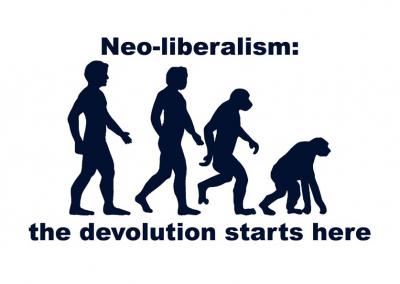
neo_liberalism_devolution_via_permanentculturenow.com_

The rage driving our politics stems from cruelty of capitalism. So why do we vote for those who worship the market?

By Anis Shivani

Source: AlterNet

Over the last fifteen years, editors often asked me not to mention the word “neoliberalism,” because I was told readers wouldn’t comprehend the “jargon.” This has begun to change recently, as the terminology has come into wider usage, though it remains shrouded in great mystery.

People throw the term around loosely, as they do with “fascism,” with the same confounding results. Imagine living under fascism or communism, or earlier, classical liberalism, and not being allowed to acknowledge that particular frame of reference to understand economic and social issues. Imagine living under Stalin and never using the communist framework but focusing only on personality clashes between his lieutenants, or likewise for Hitler or Mussolini or Mao or Franco and their ideological systems! But this curious silence, this looking away from ideology, is exactly what has been happening for a quarter century, since neoliberalism, already under way since the early 1970s, got turbocharged by the Democratic party under the Democratic Leadership Council (DLC) and Bill Clinton. We live under an ideology that has not been widely named or defined!

Absent the neoliberal framework, we simply cannot grasp what is good or bad for citizens under Cruz versus Trump, or Clinton versus Sanders, or Clinton versus Trump, away from the distraction of personalities. To what extent does each of them agree or disagree with neoliberalism? Are there important differences? How much is Sanders a deviation? Can we still rely on conventional distinctions like liberal versus conservative, or Democrat versus Republican, to understand what is going on? How do we grasp movements like the Tea Party, Occupy, and now the Trump and Sanders insurgencies?

Neoliberalism has been more successful than most past ideologies in redefining subjectivity, in making people alter their sense of themselves, their personhood, their identities, their hopes and expectations and dreams and idealizations. Classical liberalism was successful too, for two and a half centuries, in people’s self-definition, although communism and fascism succeeded less well in realizing the “new man.”

It cannot be emphasized enough that neoliberalism is not classical liberalism, or a return to a purer version of it, as is commonly misunderstood; it is a new thing, because the market, for one thing, is not at all free and untethered and dynamic in the sense that classical liberalism idealized it. Neoliberalism presumes a strong state, working only for the benefit of the wealthy, and as such it has little pretence to neutrality and universality, unlike the classical liberal state.

I would go so far as to say that neoliberalism is the final completion of capitalism’s long-nascent project, in that the desire to transform everything—every object, every living thing, every fact on the planet—in its image had not been realized to the same extent by any preceding ideology. Neoliberalism happens to be the ideology—unlike the three major forerunners in the last 250 years—that has the fortune of coinciding with technological change on a scale that makes its complete penetration into every realm of being a possibility for the first time in human history.

From the early 1930s, when the Great Depression threatened the classical liberal consensus (the idea that markets were self-regulating, and the state should play no more than a night-watchman role), until the early 1970s, when global instability including currency chaos unraveled it, the democratic world lived under the Keynesian paradigm: markets were understood to be inherently unstable, and the interventionist hand of government, in the form of countercyclical policy, was necessary to make capitalism work, otherwise the economy had a tendency to get out of whack and crash.

It’s an interesting question if it was the stagflation of the 1970s, following the unhitching of the United States from the gold standard and the arrival of the oil embargo, that brought on the neoliberal revolution, with Milton Friedman discrediting fiscal policy and advocating a by-the-numbers monetarist policy, or if it was neoliberalism itself, in the form of Friedmanite ideas that the Nixon administration was already pursuing, that made stagflation and the end of Keynesianism inevitable.

It should be said that neoliberalism thrives on prompting crisis after crisis, and has proven more adept than previous ideologies at exploiting these crises to its benefit, which then makes the situation worse, so that each succeeding crisis only erodes the power of the working class and makes the wealthy wealthier. There is a certain self-fulfilling aura to neoliberalism, couched in the jargon of economic orthodoxy, that has remained immune from political criticism, because of the dogma that was perpetuated—by Margaret Thatcher and her acolytes—that There Is No Alternative (TINA).

Neoliberalism is excused for the crises it repeatedly brings on—one can think of a regular cycle of debt and speculation-fueled emergencies in the last forty years, such as the developing country debt overhang of the 1970s, the savings and loan crisis of the 1980s, the Asian currency crisis of the 1990s, and the subprime mortgage crisis of the 2000s—better than any ideology I know of. This is partly because its very existence as ruling ideology is not even noted by the population at large, which continues to derive some residual benefits from the welfare state inaugurated by Keynesianism but has been led to believe by neoliberal ideologues to think of their reliance on government as worthy of provoking guilt, shame, and melancholy, rather than something to which they have legitimate claim.

It is not surprising to find neoliberal multiculturalists—comfortably established in the academy—likewise demonizing, or othering, not Muslims, Mexicans, or African Americans, but working-class whites (the quintessential Trump proletariat) who have a difficult time accepting the fluidity of self-definition that goes well with neoliberalism, something that we might call the market capitalization of the self.

George W. Bush’s useful function was to introduce necessary crisis into a system that had grown too stable for its own good; he injected desirable panic, which served as fuel to the fire of the neoliberal revolution. Trump is an apostate—at least until now—in desiring chaos on terms that do not sound neoliberal, which is unacceptable; hence Jeb Bush’s characterization of him as the “candidate of chaos.” Neoliberalism loves chaos, that has been its modus operandi since the early 1970s, but only the kind of chaos it can direct and control.

To go back to origins, the Great Depression only ended conclusively with the onset of the second world war, after which Keynesianism had the upper hand for thirty-five years. But just as the global institutions of Keynesianism, specifically the IMF and the World Bank, were being founded at the New Hampshire resort of Bretton Woods in 1944, the founders of the neoliberal revolution, namely Friedrich Hayek, Ludwig von Mises, Milton Friedman, and others were forming the Mount Pelerin Society (MPS) at the eponymous Swiss resort in 1947, creating the ideology which eventually defeated Keynesianism and gained the upper hand during the 1970s.

So what exactly is neoliberalism, and how is it different from classical liberalism, whose final manifestation came under Keynesianism?

Neoliberalism believes that markets are self-sufficient unto themselves, that they do not need regulation, and that they are the best guarantors of human welfare. Everything that promotes the market, i.e., privatization, deregulation, mobility of finance and capital, abandonment of government-provided social welfare, and the reconception of human beings as human capital, needs to be encouraged, while everything that supposedly diminishes the market, i.e., government services, regulation, restrictions on finance and capital, and conceptualization of human beings in transcendent terms, is to be discouraged.

When Hillary Clinton frequently retorts—in response to demands for reregulation of finance, for instance—that we have to abide by “the rule of law,” this reflects a particular understanding of the law, the law as embodying the sense of the market, the law after it has undergone a revolution of reinterpretation in purely economic terms. In this revolution of the law persons have no status compared to corporations, nation-states are on their way out, and everything in turn dissolves before the abstraction called the market.

One way to sum up neoliberalism is to say that everything—everything—is to be made over in the image of the market, including the state, civil society, and of course human beings. Democracy becomes reinterpreted as the market, and politics succumbs to neoliberal economic theory, so we are speaking of the end of democratic politics as we have known it for two and a half centuries. As the market becomes an abstraction, so does democracy, but the real playing field is somewhere else, in the realm of actual economic exchange—which isnot, however, the market. We may say that all exchange takes place on the neoliberal surface.

Neoliberalism is often described—and this creates a lot of confusion—as “market fundamentalism,” and while this may be true for neoliberal’s self-promotion and self-presentation, i.e., the market as the ultimate and only myth, as were the gods of the past, I would argue that in neoliberalism there is no such thing as the market as we have understood it from previous ideologies.

The neoliberal state—actually, to utter the word state seems insufficient here, I would claim that a new entity is being created, which is not the state as we have known it, but an existence that incorporates potentially all the states in the world and is something that exceeds their sum—is all-powerful, it seeks to leave no space for individual self-conception in the way that classical liberalism, and even communism and fascism to some degree, were willing to allow.

There are competing understandings of neoliberal globalization, when it comes to the question of whether the state is strong or weak compared to the primary agent of globalization, i.e., the corporation, but I am taking this logic further, I am suggesting that the issue is not how strong the state is in the service of neoliberalism, but whether there is anything left over beyond the new definition of the state. Another way to say it is that the state has become the market, the market has become the state, and therefore both have ceased to exist in the form we have classically understood them.

Of course the word hasn’t gotten around to the people yet, hence all the confusion about whether Hillary Clinton is more neoliberal than Barack Obama, or whether Donald Trump will be less neoliberal than Hillary Clinton. The project of neoliberalism—i.e., the redefinition of the state, the institutions of society, and the self—has come so far along that neoliberalism is almost beyond the need of individual entities to make or break its case. Its penetration has gone too deep, and none of the democratic figureheads that come forward can fundamentally question its efficacy.

I said almost. The reason why Bernie Sanders, self-declared democratic socialist, is so threatening to neoliberalism is that he has articulated a conception of the state, civil society, and the self that is not founded in the efficacy and rationality of the market. He does not believe—unlike Hillary Clinton—that the market can tackle climate change or income inequality or unfair health and education outcomes or racial injustice, all of which Clinton propagates. Clinton’s impending “victory” (whatever machinations were involved in engineering it) will only strengthen neoliberalism, as the force that couldn’t be defeated even when the movement was as large and transcendent as Sanders’s. Although Sanders doesn’t specify “neoliberalism” as the antagonist, his entire discourse presumes it.

Likewise, while Trump supporters want to take their rebellion in a fascist direction, their discomfort with the logic of the market is as pervasive as the Sanders camp, and is an advance, I believe, over the debt and unemployment melancholy of the Tea Party, the shame that was associated with that movement’s loss of identity as bourgeois capitalists in an age of neoliberal globalization. The Trump supporters, I believe, are no longer driven by shame, as was true of the Tea Party, and as has been true of the various dissenting movements within the Republican party, evangelical or otherwise, in the recent past. Rather, they have taken the shackles off and are ready for a no-holds barred “politically incorrect” fight with all others: they want to be “winners,” even at the cost of exterminating others, and that is not the neoliberal way, which doesn’t acknowledge that there can be winners and losers in the neoliberal hyperspace.

In the current election campaign, Hillary Clinton has been the most perfect embodiment of neoliberalism among all the candidates, she is almost its all-time ideal avatar, and I believe this explains, even if not articulated this way, the widespread discomfort among the populace toward her ascendancy. People can perceive that her ideology is founded on a conception of human beings striving relentlessly to become human capital (as her opening campaign commercialso overtly depicted), which means that those who fail to come within the purview of neoliberalism should be rigorously ostracized, punished, and excluded.

This is the dark side of neoliberalism’s ideological arm (a multiculturalism founded on human beings as capital), which is why this project has become increasingly associated with suppression of free speech and intolerance of those who refuse to go along with the kind of identity politics neoliberalism promotes.

And this explains why the 1990s saw the simultaneous and absolutely parallel rise, under the Clintons, of both neoliberal globalization and various regimes of neoliberal disciplining, such as the shaming and exclusion of former welfare recipients (every able-bodied person should be able to find work, therefore under TANF welfare was converted to a performance management system designed to enroll everyone in the workforce, even if it meant below-subsistence wages or the loss of parental responsibilities, all of it couched in the jargon of marketplace incentives).

The actual cost to the state of the AFDC program was minimal, but its symbolism was incalculable. The end of welfare went hand in hand with the disciplinary “crime bill” pushed by the Clintons, leading to an epidemic of mass incarceration. Neoliberalism, unlike classical liberalism, does not permit a fluidity of self-expression as an occasional participant in the market, and posits prison as the only available alternative for anyone not willing to conceive of themselves as being present fully and always in the market.

I believe that the generation of people—in their forties or older—supporting Hillary have already internalized neoliberal subjectivity, which they like to frame as realism or pragmatism, refusing for instance to accept that free college or health care are even theoretical possibilities. After all, they have maintained a measure of success in the past three or four decades after conceptualizing themselves as marketplace agents. Just as the Tea Party supporters found it intolerable that government should help irresponsible homeowners by bailing them out of unsustainable debt, the Clinton supporters hold essentially the same set of beliefs toward those who dare to think of themselves outside the discipline of the market.

I spoke of the myth of the market, as something that has no existence in reality, because none of the elements that would have to exist for a market to work are actually in place; this is even more true for neoliberalism than it was for the self-conscious annihilation of the market by communism, because at least in that system the market, surreptitiously, as in various Eastern European countries, kept making an appearance. But when the market takes neoliberal shape, i.e., the classical conceptions of the buyer and seller as free agents are gone, then radical inequality is the natural outcome. And inequality in the last four decades, as statistics for the U.S. and everywhere neoliberalism has made inroads prove beyond a doubt, has exploded, thereby invalidating neoliberalism’s greatest claim to legitimacy, that it brings about a general increase in welfare. So neoliberalism, to the extent that the inequality discourse has made itself manifest recently, must insist all the more vocally on forms of social recognition, what Clinton, for example, likes to call the “fall of barriers.”

Neoliberalism likes to focus on public debt—in the Clinton years debt reduction became a mania, though George W. Bush promptly spent all the accumulated surpluses on tax cuts for the wealthy and on wars of choice—rather than inequality, because the only way to address inequality is through a different understanding of public debt; inequality can only be addressed through higher taxation, which has by now been excluded from the realm of acceptable discourse—except when Sanders, Trump, or Jeremy Corbyn in England go off script.

So to recapitulate neoliberalism’s comprehensive success, let us note that we have gone from a liberal, Keynesian, welfare state to a neoliberal, market-compliant, disciplinary state.

Neoliberalism expects—and education at every level has been redesigned to promote this—that economic decision-making will be applied to all areas of life (parenthood, intimacy, sexuality, and identity in any of its forms), and that those who do not do so will be subject to discipline. Everyone must invest in their own future, and not pose a burden to the state or anyone else, otherwise they will be refused recognition as human beings.

This supposed economic “rationality” (though it is the greatest form of irrationality) applies to civil society as much as the state, so that none of the ideals of classical liberalism, or previous ideologies rooted in humanism, are valid any longer, the only value is the iteration of the market (as myth, not reality); in other words, neoliberalism, unlike the elevation of the individual in classical liberalism or the state in fascism or the collectivity in communism, has erected something, the market, that has no real existence, as the only god to serve! And it is just like a god, with an ethereal, unchallengeable, irrefutable, ubiquitous presence. Whatever in state policy does not serve market-conformity is to be banned and banished from memory (the secular scriptures are to be rewritten), which explains neoliberalism’s radical narrowing of public discourse, including the severance of identity politics from any class foundation.

Neoliberalism will continue to perpetuate reduced opportunity, because one of its characteristics—as in any system that wants to thrive on the world stage—is to constantly refine the field upon which the human subject can operate.

As such, those displaced workers who have suffered the most from the erosion of the old industries in the former manufacturing centers of the world are not even factors to contend with, they are invisible and cannot be part of the policy equation. To the extent that their actual presence is reckoned with, the economy can be said to have crashed; but the problem doesn’t arise because of the management of unemployment or underemployment statistics, unlike a housing crash which is palpable and cannot escape statistical definition.

The danger for neoliberalism—as is clear from the support of millions of displaced human beings for Trump—is that with each crisis neoliberalism sheds more workers, makes individuals and firms more “disciplined,” narrows the scope of opportunity even further. At times, the disciplining of the non-neoliberal other—as with the killing of Michael Brown or Eric Garner—explodes to surface consciousness in an unsavory way, so an expert manager like Clinton or Obama is required to tamp down the emotions of such unruly entities as Black Lives Matter which arise in response. If climate change, according to Clinton and her cohort, can and should have market solutions, then surely racial disparity, or police violence, should also have market solutions and no others; it is here that neoliberal multiculturalism, operating in the academy, is so insidious, because at the elite level it functions to validate market discourse, it does not step outside it.

The present breakdown of both major political parties can be explained by the frustration that has built up in the body politic over the past decade, because after the crash there was no sustained intellectual movement to question the myth of the market. The substitution of economic justice with identity politics is something Ralph Nader, Howard Dean, and now Bernie Sanders have contested in a humane manner, while the same process is at work, admittedly in an inhumane way, in the Trump phenomenon.

Thus, also, Hillary Clinton’s animus against free college education; that form of expansion of opportunity, which was a reality from the 1950s to the 1980s, cannot be allowed to return, human beings are supposed to invest in their own future earnings potential, they are not entitled to a transcendent experience without barriers manifesting in discipline and self-correction. Education, like everything else, including one’s own health, becomes an expensive consumer good, not a right, no longer an experience that might lead to a consciousness beyond the market but something that should be fully encapsulated by the market. If one is a capable market player, education as we have classically understood it becomes redundant.

Unlike the interregnum between 1945-1973, the rising tide—no matter the befuddlements Arthur Laffer and his fellow Reaganite ideologues proffered—does not lift all boats today, it is outside the logic of neoliberalism that it do so, so the idea of reforming neoliberalism, or what is often called “globalization with a human face,” is a rhetorical distraction. All of the policy innovations—interpreted as “socialism” by the Tea Partiers—offered by Barack Obama fall within the purview of neoliberalism, above all the Affordable Care Act, whose genesis was hatched in neoliberal think tanks decades ago.

It is important to note that neoliberal economic restructuring necessarily means social restructuring, i.e., a movement toward disciplinarity and away from liberalism; the disciplinarity can take a Bushian, Clintonian, or Trumpian form, but these are manifestations of the same tendency.

When wage growth is decoupled from economic growth (as it has been since Friedman and others inaugurated the revolution in the early 1970s), this means that the human subject is ripe for discipline. Furthermore, wage fairness cannot be rationally discussed (hence the obfuscation surrounding the $15 minimum wage orchestrated by Clinton and others) because the concept of the market has been disembedded from society; the market as abstraction, not a concrete reality, makes any notion of reform or restructuring impossible. Like the minimum wage, something like free child care also remains outside the bounds of discourse, because public policy cannot accommodate discussions that do not take the self-regulating market as unassailable myth.

What neoliberalism can accommodate is relentless tax cuts (Trump has already offered his huge tax cut plan, as Bush did as his first order of business), which only exacerbate the problem, leading to increasing concentrations of wealth. It has to be said, though, that Ted Cruz more comfortably fit the neoliberal paradigm, with his familiar calls for lower taxes along with reduced regulation and further limits on social welfare, whereas Trump shows, for now, some elements of apostasy. If neoliberalism were to get a Cruz, it would have no problem working with him, or rather, Cruz would have had no problem executing neoliberalism, beyond the surface dissimilarities from Hillary Clinton.

As Sanders has consistently noted, economic inequality leads to political inequality, which means that democracy, after a certain point, becomes only theoretical (viz. Citizens United and the electoral influence of such powerful entities as the Koch brothers). Both processes—economic inequality and political inequality—have accelerated after each downturn in the forty-five-year history of neoliberalism, therefore a downturn is always exciting, and even preordained, for a Bush, a Trump, or a Clinton. Again, economic inequality and political polarity (polarity is simply a manifestation of democracy having become dysfunctional) strongly correlate, and both have come to a head in this election.

Neoliberalism’s task, from this point on, is to mask and manage the increasing inequalities that are likely to befall humanity, especially as the planet reaches a crisis point in its health. In a way, George W. Bush threw a wrench—he was a perverted Keynesian in a way, believing in war to prime the pump, or inflating unsustainable bubbles, or spending exorbitantly on grandiose gestures—into the process of neoliberal globalization that was going very smoothly indeed under Bill Clinton and would likely have flourished under Al Gore as well. With Hillary Clinton, the movement will be toward further privatization of social welfare, “reforming” it along market principles, as has been true of every neoliberal avatar, whether it was Bill Clinton’s incentives to work in the performance management makeover of welfare, George Bush’s proposed private social security accounts, Mitt Romney’s proposed private health care accounts, or the school vouchers that tempt all of them from time to time.

What remains to be seen is the extent to which the millennial generation might be capable of thinking outside the neoliberal paradigm, i.e., they don’t just want more of what neoliberal promises to give them yet fails to deliver, but want things that neoliberalism does not or cannot promise. On this rests the near-term future of the neoliberal project.

Beyond Sanders himself, the key question is the ability of the millennial generation to conceive of themselves outside the neoliberal subjectivity they have been pushed to internalize. They have been encouraged to think of themselves as capital producers, turning their intellectuality into social media popularity for the benefit of capital, in the service of the same abstract market that has no place, no role, no definition beyond the fallen liberal calculus. Does the millennial generation believe, even about its most intimate core, that everything has been privatized?

I am not necessarily making a pessimistic prediction. I am merely outlining the strength of an opponent that has refused to be named for forty-five years, although it has been the ruling ideology that long! In defining neoliberalism, I have sought to distance myself from the distraction of personalities, and tried to expose the dark side of our politics which we can only see when we name and understand the ideology as such. We are up against a system that is so strong that it has survived, for the most part, the last crash, as citizens couldn’t get their heads around the idea of nationalizing banks or health care.

It is existentially imperative to ponder what happens beyond Sanders, because neoliberalism has its end-game in sight, letting inequality continue to escalate past the crash point (meaning the point where the economy works for most people), past any tolerable degradation of the planet (which is being reconceptualized in the shape of the market).

What, indeed, does happen beyond Sanders, because as we have seen Hillary Clinton is one of the founders of neoliberal globalization, one of its central historical figures (having accelerated the warehousing of the poor, the attack on trade unions, and the end of welfare and of regulatory prowess), while Trump is an authoritarian figure whose conceptions of the state and of human beings within the state are inconsistent with the surface frictionlessness neoliberalism desires? To go back to Hillary Clinton’s opening campaign commercial, to what extent will Americans continue to believe that the self must be entrepreneurially leveraged toward maximum market gains, molded into mobile human capital ever ready to serve the highest bidder?

As to whether a non-neoliberal globalization is possible and what that might look like on the international stage after a quarter-century of Clinton, Bush, and Obama—which is essentially the frustration Trump is tapping into—I’ll take that up in a follow-up essay, which will further clarify the differences between Sanders versus Clinton, and Trump versus Clinton.

I would suggest that it is not that globalization causes or has caused neoliberalism, but that neoliberalism has pushed a certain form of globalization that suits its interests. This is a crucial distinction, on which everything else hinges. The neoliberal market doesn’t actually exist; at the moment it is pure abstraction; what is actually filling up economic and political space can only be discussed when we step away from this abstraction, as Sanders has so ably done, and as the Occupy and Black Lives Matter movements tentatively set in motion.

 

Anis Shivani is the author of several books of fiction, poetry, and criticism, including, most recently, My Tranquil War and Other Poems. His novel Karachi Raj (HarperCollins/Fourth Estate) was released this summer. His next book is the poetry collection Whatever Speaks on Behalf of Hashish, out in October.

John Perkins: The New Confessions of an Economic Hitman

apologiesofaneconomichitman

Reposted below is the introduction and sample chapter from John Perkin’s “The New Confessions of an Economic Hitman” (also available in pdf form on his site here).

Introduction

The New Confessions

I’m haunted every day by what I did as an economic hit man (EHM). I’m haunted by the lies I told back then about the World Bank. I’m haunted by the ways in which that bank, its sister organizations, and I empowered US corporations to spread their cancerous tentacles across the planet. I’m haunted by the payoffs to the leaders of poor countries, the blackmail, and the threats that if they resisted, if they refused to accept loans that would enslave their countries in debt, the CIA’s jackals would overthrow or assassinate them.

I wake up sometimes to the horrifying images of heads of state, friends of mine, who died violent deaths because they refused to betray their people. Like Shakespeare’s Lady Macbeth, I try to scrub the blood from my hands.

But the blood is merely a symptom.

The treacherous cancer beneath the surface, which was revealed in the original Confessions of an Economic Hit Man, has metastasized. It has spread from the economically developing countries to the United States and the rest of the world; it attacks the very foundations of democracy and the planet’s life-support systems.

All the EHM and jackal tools—false economics, false promises, threats, bribes, extortion, debt, deception, coups, assassinations, unbridled military power—are used around the world today,even more than during the era I exposed more than a decade ago. Although this cancer has spread widely and deeply, most people still aren’t aware of it; yet all of us are impacted by the collapse it has caused. It has become the dominant system of economics, government, and society today.

Fear and debt drive this system. We are hammered with messages that terrify us into believing that we must pay any price,assume any debt, to stop the enemies who, we are told, lurk at our doorsteps. The problem comes from somewhere else. Insurgents. Terrorists. “Them.” And its solution requires spending massive amounts of money on goods and services produced by what I call the corporatocracy—vast networks of corporations, banks, colluding governments, and the rich and powerful people tied to them. We go deeply into debt; our country and its financial henchmen at the World Bank and its sister institutions coerce other countries to go deeply into debt; debt enslaves us and it enslaves those countries.

These strategies have created a “death economy”—one based on wars or the threat of war, debt, and the rape of the earth’s resources. It is an unsustainable economy that depletes at ever-increasing rates the very resources upon which it depends and at the same time poisons the air we breathe, the water we drink, and the foods we eat. Although the death economy is built on a form of capitalism, it is important to note that the word capitalism refers to an economic and political system in which trade and industry are controlled by private owners rather than the state. It includes local farmers’ markets as well as this very dangerous form of global corporate capitalism, controlled by the corporatocracy, which is predatory by nature, has created a death economy, and ultimately is self-destructive.

I decided to write The New Confessions of an Economic Hit Man because things have changed so much during this past decade. The cancer has spread throughout the United States as well as the rest of the world. The rich have gotten richer and everyone else has got-ten poorer in real terms.

A powerful propaganda machine owned or controlled by the corporatocracy has spun its stories to convince us to accept a dogma that serves its interests, not ours. These stories contrive to convince us that we must embrace a system based on fear and debt, accumulating stuff, and dividing and conquering everyone who isn’t “us.” The stories have sold us the lie that the EHM system will provide security and make us happy.

Some would blame our current problems on an organized global conspiracy. I wish it were so simple. Although, as I point out later,there are hundreds of conspiracies—not just one grand conspiracy—that affect all of us, this EHM system is fueled by something far more dangerous than a global conspiracy. It is driven by concepts that have become accepted as gospel. We believe that all economic growth benefits humankind and that the greater the growth, the more widespread the benefits. Similarly, we believe that those people who excel at stoking the fires of economic growth should be exalted and rewarded, while those born at the fringes are available for exploitation. And we believe that any means—including those used by today’s EHMs and jackals—are justified to promote economic growth; preserve our comfortable, affluent Western way of life; and wage war against anyone (such as Islamic terrorists) who might threaten our economic well-being, comfort, and security.

In response to readers’ requests, I have added many new details and accounts of how we did our work during my time as an EHM, and I have clarified some points in the previously published chapters. More importantly, I have added an entirely new part 5, which explains how the EHM game is played today—who today’s economic hit men are, who today’s jackals are, and how their deceptions and tools are more far-reaching and enslaving now than ever.

Also in response to readers’ requests, part 5 includes new chapters that reveal what it will take to overthrow the EHM system, and specific tactics for doing so.

The book ends with a section titled “Documentation of EHM Activity, 2004–2015,” which complements my personal story by offering detailed information for readers who want further proof of the issues covered in this book or who want to pursue these subjects in more depth.

Despite all the bad news and the attempts of modern-day robber barons to steal our democracy and our planet, I am filled with hope. I know that when enough of us perceive the true workings of this EHM system, we will take the individual and collective actions necessary to control the cancer and restore our health. The New Confessions of an Economic Hit Man reveals how the system works today and what you and I—all of us—can do to change it.

Tom Paine inspired American revolutionaries when he wrote,“If there must be trouble, let it be in my day, that my child may have peace.” Those words are as important today as they were in 1776. My goal in this new book is nothing less than Paine’s: to inspire and empower us all to do whatever it takes to lead the way to peace for our children.


CHAPTER 34

Conspiracy: Was I Poisoned?

The situation has gotten much worse since Confessions of an Economic Hit Man was first published. Twelve years ago, I expected that books like mine would wake people up and inspire them to turn things around. The facts were obvious. I and others like me had created an EHM system that supported the corporatocracy. Together, the EHMs, corporate magnates, Wall Street robber barons, governments and jackals, and all their networks around the world have created a global economy that fails everyone. It is based on war or the threat of war, debt, an extreme form of materialism that pillages the earth’s resources and is consuming itself into extinction. In the end, even the very rich will fall victim to this death economy.

Most of us have bought into it in a big way; we are collaborators—often unconscious ones. Now it is time to change. I had hoped that exposing these facts, making people conscious, would inspire a movement that, by 2016, would have resulted in a new vision, anew story.

People were in fact shaken awake. Activities in so many parts of the world, including localized ones such as the Occupy movements,national ones in places as diverse as Iceland, Ecuador, and Greece, and regional ones such as the Arab Spring and Latin America’s Bolivarian Alliance for the Peoples of Our America (ALBA), have demonstrated that we understand our world is collapsing.

What I had not anticipated was the flexibility in the EHM system or its absolute determination to defend and promote the death economy. I had not anticipated the rise of an entirely new class of EHMs and jackals.

I made it clear in the original book that I did not believe the EHM system was driven by some nefarious, illegal, secret plan devised by a small group of people determined to control the world; in other words, I did not believe in some unified “grand conspiracy.”

Then something strange happened.

In late March 2005, less than five months after publication of the book, I flew to New York City on a Monday. I was scheduled to speak at the United Nations the next day. I was in perfect health,as far as I knew. A man who identified himself only as a free-lance journalist had been hounding my publicist for an interview. Because his credentials were sketchy and I was receiving a lot of press at that time, she kept putting him off. But when he suggested picking me up at LaGuardia Airport, taking me to lunch, and driving me to the apartment where I was staying with a friend, she consulted with me and I acquiesced. He was waiting for me when I exited the airport. He took me to a small cafe, told me how much he admired my book, asked some of what had become rather standard questions about my life as an EHM, and then drove me to my friend’s apartment on the Upper West Side.

I never saw that man again, and meeting him would have been an unmemorable event—except that a couple hours later I suffered severe internal bleeding. I lost about half the blood in my body,went into shock, and was rushed to Lenox Hill Hospital. I ended up spending two weeks there and having more than 70 percent of my large intestine removed.

As I lay recovering in that hospital bed, I thought that perhaps my illness was a message to slow down, that my body was over-taxed and I needed to cut back on writing and the speaking tours.

The New York gastroenterologist told me that I’d suffered from complications due to a severe case of diverticulosis. I was shocked to hear this, because I’d recently had a colonoscopy. My Florida doctor had assured me that there were no signs of cancer, which had been my main concern. He mentioned that I had some diverticula, “like most people your age,” and ended by advising me to come back in five years.

Of course, my UN speech was canceled, as were numerous other media events. Word of my operation got out very quickly, and soon I was receiving lots of e-mails. Most supported me and expressed concern for my well-being. Some e-mails came from people who accused me of being a traitor to my country. Several assured me that I’d been poisoned.

When I asked my gastroenterologist, he responded that he was“quite certain” I hadn’t been poisoned, but that he’d also learned“never to say never.” In any case, all of it got me to thinking and reading more about conspiracies.

I still do not believe in the grand conspiracy theory. In my experience, there is no secret club of individuals who get together to plot illegal, world-dominating strategies. However, I do know that part of the power of the EHM system is that it foments many small conspiracies. By “small,” I mean that they are focused on specific objectives. Such conspiracies—secret actions to accomplish illegal goals—happened when I was just beginning school, such as the CIA coup that replaced the democratically elected Iranian prime minister, Mossadegh, with the shah, in 1953. They continued during my high school years; consider the CIA-supported Bay of Pigs invasion of Cuba, in 1963. But I became most aware of them when I was an EHM and the CIA arranged the assassinations of my two clients, Ecuador’s Roldós and Panama’s Torrijos, in 1981. Then, as I began writing the original of this book in 2002, there was the US-led conspiracy to overthrow Venezuela’s president, Hugo Chávez. After that came the conspiratorial lie about weapons of mass destruction in Iraq. This was followed by a flurry of conspiracies against leaders and governments in the Middle East and Africa.

While I was an EHM, the goals of most conspiracies were to further US and corporate interests in the economically developing countries—to do whatever it took, including overthrowing or killing government leaders, to enable our companies to exploit resources. After my colon operation, as I lounged around my home reading various reports, it became obvious that the tools I had used in Indonesia, Panama, Egypt, Iran, Saudi Arabia, and other countries were now being applied in Europe and the United States. Fortified by the so-called threat of global terrorism after 9/11, these conspiracies have given excessive power to the very wealthy individuals who control global corporations. Among the most striking are conspiracies to implement “free” trade agreements such as NAFTA and CAFTA, and the more recent Trans-Pacific Partnership (TPP) and the Transatlantic Trade and Investment Partnership (TTIP), which empower corporations to assume defacto sovereignty over governments in countries around the world; to convince politicians to pass laws that permit the rich to avoid paying taxes, to control the media, and to use media to influence politics; and to terrify US citizens into fighting endless wars.

These and many other conspiracies took the EHM system far beyond where it had been in the 1970s. Despite all that I had writ-ten, I had to admit that I’d missed much of what had been going on beneath the surface. The old tools had been sharpened and new ones invented. The heart of this system remained the same: an economic and political ideology based on enslavement through debt and enforced by paralyzing people with fear. In my day, it had convinced the majority of Americans and much of the rest of the world that all actions were justified if they protected us from Communist subversives; the fear had now switched to Muslim terrorists,immigrants, and anyone threatening to rein in corporations. The dogma was similar, but the impact was now much greater.

Recuperating from that operation also sent me into the dark abyss of guilt. I’d wake up in the middle of the night haunted by memories of leaders I’d bribed and threatened. I had not yet come to terms with my EHM past.

I asked myself why I’d stayed in that job for ten long years. And then I realized how difficult it had been to escape. It wasn’t just the seduction of money, flying first class, staying in the best hotels, and all the other perks. Nor was it the pressure exerted by my bosses and fellow employees at MAIN. It was also the aura of the job, my title—the very story of my culture. I was doing what I’d been schooled to do, what I’d been told was the right thing to do. I was educated as an American whose job it was to sell America and to believe and convince everyone else that Communist regimes were out to destroy us.

One day, a friend e-mailed me a photograph of a poster like one that had hung on the wall of the boys’ bathroom in my elementary school. It depicted a sinister-looking man who asked, “Is your washroom breeding Bolsheviks?” It was an ad for Scott paper towels, and the subtitle read, “Employees lose respect for a company that fails to provide decent facilities for their comfort.” It sent a strong message that not buying American was akin to treason.

That photograph got me thinking about those most formative years in my life. After the Soviet Union launched Sputnik, the first satellite, we all became convinced that nuclear warheads were on the way. The chilling scream of sirens sent us scampering under our desks in weekly drills, to hide from imagined Soviet missiles. Movies and TV shows like I Led Three Lives, a gripping drama based on the memoir of an FBI agent who infiltrated a Communist cell in the United States, warned us to be vigilant; Red provocateurs, like the evil Bolshevik in the poster, lurked among us, ready to pounce.

By the time I entered the EHM ranks, it had become apparent that we were losing in Vietnam, a nation portrayed as a Sino-Soviet puppet. We were told that there would be a “domino effect”—that Indonesia would go next, then Thailand, South Korea, the Philip-pines, and on and on. It wouldn’t be long before the Red tide would sweep Europe and then engulf the United States. Democracy and capitalism were doomed—unless we halted the onslaught. And that meant doing whatever it would take to promote companies such as Scott, which portrayed themselves as bulwarks against communism.

Delving into my feelings of guilt helped me see the ease with which I had deceived myself in those years. It opened my mind to understanding that millions of people are in positions similar to mine. They are no longer taught to fear communism, but they still fear Russia, China, and North Korea, in addition to al-Qaeda and other terrorists. They may not travel to foreign lands and confront, face-to-face, the consequences of what their companies do. They may not personally stand beside oil spills in the Amazon or see the hovels where sweatshop workers sleep. Instead, they anesthetize themselves with TV. They succumb to assurances by their schools, banks, human relations experts, and government officials that they are contributing to progress. But in their hearts they know other-wise. Deep down, they—we—realize that the stories misrepresent. And now it is time to admit to our complicity.

On a trip to Boston, not long after my operation, I reconnected with my former Boston University professor and the author of A People’s History of the United States, Howard Zinn. Now in his eighties, he was still actively campaigning to reform a system he saw as an experiment that hadn’t worked. When I shared with him the guilt that so often threatened to overwhelm me, he urged me to keep opening to it.

“Don’t be afraid of it,” he said. “You are guilty. We’re all guilty. We have to admit that although the big corporations own the propaganda machine, we allow ourselves to be duped. You can set an example. Show people that the way out, redemption, comes from changing it.”

I told him that I often thought of middle-class Americans as being like the medieval bourgeoisie—the majority of the people, who lived in the bourgs outside the castle walls. “We pay our taxes so soldiers and jackals will defend us from the knights in the neighboring castles.”

“Exactly,” he said, with that smile of his that had enchanted and inspired so many students. “We will do anything to maintain a system that has failed us.”

I came to understand, during those days following my operation and in discussions with Howard, that my most important lesson since the publication of Confessions of an Economic Hit Man was similar to the one I had learned as a Peace Corps volunteer working with Andean brick makers: the only reason the EHM system works is because the rest of us give it permission to work. At best, we look the other way; at worst, we actively support it. One of the things that most bothered me was having to admit to myself that I not only had looked the other way but also had convinced many people to actively support that system. I made a commitment to myself that I’d be more diligent; I’d watch more closely what was going on in my own community, my country, and the world.

Although I was determined to follow Howard’s advice, I also found myself envying another man, who did not struggle with his conscience—a friend who became an immense support during my physical recuperation in Florida and who seemed to have no problem justifying his own violent actions. He was a jackal, taking a short leave of absence from the Middle East.

ABOUT THE AUTHOR

As Chief Economist at a major international consulting firm, John Perkins advised the World Bank, United Nations, IMF, U.S.Treasury Department, Fortune 500 corporations, and leaders of countries in Africa, Asia, Latin America, and the Middle East.

The New Confessions of an Economic Hit Man(2016), a follow-up to John’s classic New York Times bestseller, brings the story of economic hit men and jackal assassins up to date and chillingly home to the U.S. It goes on to provide practical strategies to transform the failing global death economy into a regenerative life economy. Confessions of an Economic Hit Man(70 weeks on the New York Times bestseller list, 32 languages), The Secret History of the American Empire(New York Times bestseller) and Hoodwinked were ground-breaking exposés of the clandestine operations that created the current global crises; they set the stage for the revelations and strategies detailed in The New Confessions of an Economic Hit Man.

John is a founder and board member of Dream Change and The Pachamama Alliance, nonprofit organizations devoted to establishing a world future generations will want to inherit, has lectured at Harvard, Oxford, and more than 50 other universities around the world, and is the author of books on indigenous cultures and transformation, including Shapeshifting, The World Is As You Dream It, Psychonavigation, Spirit of the Shuar, and The Stress-Free Habit. He has been featured on ABC, NBC, CNN, CNBC, NPR, A&E, the History Channel, Time, The New York Times, The Washington Post,Cosmopolitan, Elle, Der Spiegel, and many other publications, as well as in numerous documentaries including The End of Poverty?, Zeitgeist Addendum, and Apology of an Economic Hit Man. He was awarded the Lennon Ono Grant for Peace 2012, and Rainforest Action Network Challenging Business As Usual Award, 2006.


Death In Honduras: The Coup, Hillary Clinton And The Killing Of Berta Cáceres

dt.common.streams.StreamServer.cls

By Media Lens

Source: Dissident Voice

On February 28, Hillary Clinton told an audience from the pulpit of a Memphis church: ‘we need more love and kindness in America’. This was something she felt ‘from the bottom of my heart’.

These benevolent sentiments recalled the national ‘purpose’ identified by President George H.W. Bush in 1989, shortly before he flattened Iraq. It was, he said, ‘to make kinder the face of the nation and gentler the face of the world’.

Clinton, of course, meant North America, specifically the United States. But other places in America are short on love and kindness, too. Consider Honduras, for example.

On June 28, 2009, the Honduran President Manuel Zelaya was kidnapped at gunpoint by masked soldiers and forced into exile. Since the ousting, the country ‘has been descending deeper into a human rights and security abyss’ as the military coup ‘threw open the doors to a huge increase in drug trafficking and violence, and… unleashed a continuing wave of state-sponsored repression’. In 2012, Honduras had a murder rate of 90.4 per 100,000 population, then the highest rate in the world. In 2006, three years before the coup, the murder rate had stood at 46.2 per 100,000.

The years since 2009 have seen ‘an explosive growth in environmentally destructive megaprojects that would displace indigenous communities. Almost 30 percent of the country’s land was earmarked for mining concessions, creating a demand for cheap energy to power future mining operations. To meet this need, the government approved hundreds of dam projects around the country, privatizing rivers, land, and uprooting communities.’ In 2015, Global Witness reported that Honduras was ‘the most dangerous country to be an environmental defender’.COPINH

Berta Cáceres, a mother of four children, was co-founder and general coordinator of the COPINH (Consejo Cívico de Organizaciones Populares e Indígenas de Honduras) group opposing this state-corporate exploitation. Last year, Cáceres was awarded the Goldman Environmental Prize, the world’s leading award recognising grassroots environmental activists, for her work opposing a major dam project. Many of COPINH’s leaders have been murdered in recent years. In 2013, Cáceres said:

The army has an assassination list of 18 wanted human rights fighters with my name at the top. I want to live, there are many things I still want to do in this world. I take precautions, but in the end, in this country where there is total impunity I am vulnerable. When they want to kill me, they will do it.

Last week, on the night of March 3, armed men burst through the back door of Cáceres’s house and shot her four times, killing her in her bed. US media watch site Fairness and Accuracy in Reporting (FAIR) commented:

There was widespread outcry and grief over her death, and the story was covered by major media in the United States. But there was a glaring problem with the coverage: Almost none of it mentioned that the brutal regime that likely killed Cáceres came to power in a 2009 coup d’état supported by the United States, under President Barack Obama and then-Secretary of State Hillary.

Confidential – The Embassy Perspective

Following the 2009 coup, the United Nations, the Organization of American States (OAS) and the European Union all condemned Zelaya’s removal as a military coup. A confidential US Embassy cable, later published by Wikileaks, commented:

The Embassy perspective is that there is no doubt that the military, Supreme Court and National Congress conspired on June 28 in what constituted an illegal and unconstitutional coup against the Executive Branch… There is equally no doubt from our perspective that Roberto Micheletti’s assumption of power was illegitimate.

That was behind closed doors. In public, fifteen US House Democrats urged the US regime to ‘fully acknowledge that a military coup has taken place and… follow through with the total suspension of non-humanitarian aid, as required by law’. Writing for the Common Dreams website, Alexander Main supplied some detail:

Ann-Marie Slaughter, then director of Policy Planning at the State Department, sent an email to [Secretary of State] Clinton on August 16 [2009] strongly urging her to “take bold action” and to “find that [the] coup was a ‘military coup’ under U.S. law,” a move that would have immediately triggered the suspension of all non-humanitarian U.S. assistance to Honduras.

This, Hillary Clinton’s State Department refused to do, thus implicitly recognising the military takeover. As FAIR noted, Clinton makes clear in her memoirs that she had no intention of restoring President Zelaya to power:

In the subsequent days [after the coup] I spoke with my counterparts around the hemisphere, including Secretary Espinosa in Mexico. We strategized on a plan to restore order in Honduras and ensure that free and fair elections could be held quickly and legitimately, which would render the question of Zelaya moot.

In September 2009, US State Department officials blocked the OAS from adopting a resolution that would have rejected the legitimacy of Honduran elections carried out under the dictatorship, thus giving the coup the final US seal of approval.

Ousted former president, Manuel Zelaya, said last year:

Secretary Clinton had many contacts with us. She is a very capable woman, intelligent, but she is very weak in the face of pressures from groups that hold power in the United States, the most extremist right-wing sectors of the U.S. government, known as the hawks of Washington. She bowed to those pressures. And that led U.S. policy to Honduras to be ambiguous and mistaken.

Zelaya added:

President Obama has not wanted to hear our peoples. He has turned a deaf ear on the cry of the people. First we protested in the opposition. A few months ago, they physically removed me from the Congress, the National Congress, because our party mounted a peaceful protest. The military removed us, using tear gas in the Congress. They expelled us, beating us with batons, beating us into the street. This is the government that President Obama supports, a government that is repressive, a government that violates human rights, as has been shown by the very Inter-American Commission on Human Rights of the Organization of American States. It has shown this to be the case.

Alexander Main concluded:

A careful reading of the Clinton emails and Wikileaked U.S. diplomatic cables from the beginning of her tenure, expose a Latin America policy that is often guided by efforts to isolate and remove left-wing governments in the region.

An assertion supported by the increase in US military assistance to Honduras even as state-corporate violence has massively escalated. Noam Chomsky explained the logic:

Zelaya was moving somewhat tentatively towards the kinds of social reforms that the United States has always opposed and will try to stop if it can.

A Local Matter – The Media Response

Corporate politics and media, of course, never tire of proclaiming the West’s ‘responsibility to protect’ in places like Iraq, Libya and Syria. So how did these same humanitarians respond to the murder of a compassionate, respected and awesomely courageous activist in Honduras? FAIR commented on the overwhelming evidence of US support for the coup:

One wouldn’t know any of this reading US reports of Cáceres’ death. The coup, and its subsequent purging of environmental, LGBT and indigenous activists, is treated as an entirely local matter… The Washington Post, Guardian, NBC, CNN and NPR didn’t mention the 2009 coup that brought to power Cáceres’ likely murderers, let alone the US’s tacit involvement in the coup.

On the same day FAIR’s report was published, the first and only reference to these hidden truths in the UK press recorded by the Nexis media database was supplied by Jonathan Watts in the Guardian:

But Washington’s role is also controversial because the US backed the current government, which took power after a 2009 coup that ousted the democratically elected president Manuel Zelaya. The US is now providing fund [sic] for the Honduran police force.

Watts quoted International Rivers, an NGO that worked with Cáceres:

We must note that during the 2009 military coup in Honduras, the US government, with Hillary Clinton as secretary of state, worked behind the scenes to keep Honduras’ elected government from being reinstated. Additionally, the US government continues to fund the Honduran military, despite the sharp rise in the homicide rate, political repression, and the murders of political opposition and peasant activists.

While hardly exhaustive, this is the only mention of these issues we have found in the UK corporate press. A more recent piece by the Guardian’s Washington correspondent, David Smith, mentioned the coup but not US involvement. With touching naivety, Smith observed that ‘the US, determined to stop the flow of illegal immigrants from Central America, has been pouring money into Honduras’s security apparatus’.

The Times – so vocal in promoting Western ‘intervention’ to ‘protect’ human rights from Official Enemies – printed 68 words on the killing penned by the Associated Press. The Telegraph gave the story a single mention. In the Independent, Phil Davison wrote of Cáceres:

As if anyone needed reminding, her murder brought back to Honduras the dark days of the 1980s Central American guerrilla wars, in which they and their neighbours fought to rid themselves of dictators backed by the US.

But in stark contrast to the courage of Cáceres and so many others in Honduras, Davison was not able to bring himself to mention that the tyranny in Honduras is today being backed by the region’s great superpower. Also in the Independent, Caroline Mortimer made no mention of US complicity in the coup. Nor, unsurprisingly, did the BBC in two pieces here and here on the killing.

As ever, ‘mainstream’ ‘compassion’ turns out to be rooted in rather more ‘pragmatic’ concerns. If an Official Enemy had been responsible for Cáceres’s death, the cries of outrage, horror and denunciation would have blazed from our corporate front pages and TV screens. Action would have been demanded, perhaps even ‘intervention’. But when the horror is committed by a faithfully corrupt and brutal servant of Empire aided and abetted by the ‘Leader of the Free World’, none of the buttons on the vast, high-tech propaganda machine are pressed and the story is quickly buried along with the victim.

Needless to say, awareness of the kind offered here threatens to jam a spanner in the conditionally ‘compassionate’ propaganda waterworks and must be scrupulously ignored or, at best, ridiculed.


Media Lens is a UK-based media watchdog group headed by David Edwards and David Cromwell. The second Media Lens book, Newspeak: In the 21st Century by David Edwards and David Cromwell, was published in 2009 by Pluto Press. Read other articles by Media Lens, or visit Media Lens’s website.

Related Article: Before Her Assassination, Berta Cáceres Singled Out Hillary Clinton for Backing Honduran Coup (Democracy Now)