Saturday Matinee: Fight Club

Fight Club: A philosophical analysis

Alter ego, consumerism, identity, anarchy, masculinity, order and chaos.

By DM

Source: blastingnews

Based on Chuck Palahniuk’s novel of the same name, a film that was initially a commercial failure is now widely considered a cult classic and a philosophical marvel. Fight Club is one of the most important films of its generation and one of Fincher’s best. This thought-provoking masterpiece scratches the surface of various philosophical concepts and makes its audience think.

It is still as relevant as ever, perhaps even more so than before. Emasculation, Consumerism, beauty standards, identity, chaos vs order — these philosophical concepts are perhaps even more topical today than they’ve ever been.

Philosophically radical, this is a film that condemns the society of consumerism. As Edward Norton’s character says: “It’s just, when you buy furniture, you tell yourself, that’s it.

That’s the last sofa I’m gonna need. Whatever else happens, I’ve got that sofa problem handled.”

Fight Club also takes a critical look at beauty standards for men and women both and at advertisements that are served to us through mass media. Identity and alter-ego are philosophical concepts on which Fight Club is based on. Tyler Durden (Brad Pitt’s character) is what the narrator (Edward Norton’s character) wants to be.

The ideal alpha male. A leader of men. Tyler Durden gradually appears throughout the movie, emerging from the narrator’s subconscious and almost destroying him in the process.

Order vs chaos

Order, anarchy and chaos are perhaps the most prominent theme of Fight Club. At one point, Tyler Durden says: “It’s only after we’ve lost everything that we’re free to do anything.” Although primarily a critique of consumerism, this is a rejection of order and an acceptance of chaos.

When the underground fight club evolves into Project Mayhem and starts pouring into the outside world, members of it begin to dismantle every societal concept, causing controlled, deliberate and channeled chaos. Installing anarchy and rejecting every societal norm that had turned them into slaves. This is how they attempt to set themselves free, but the main protagonist loses himself in the chaos, initially merging with his alter-ego and then rejecting it.

In today’s America, where controlled chaos is caused by the media and fed to the panicked public, Fight Club resembles a warped house of mirrors in which the reflection of today’s America is seen.


The Limited Mind: Why Fear is Driving Humanity to Extinction

By Robert J. Burrowes

I have previously written many articles describing one or more aspects of the dysfunctional nature of the typical human mind, together with an explanation of how this came about and what we can do about it. See, for example, many of the articles republished in ‘Key Articles’ and the source documents Why Violence?’ and Fearless Psychology and Fearful Psychology: Principles and Practice.

I have also explained that it is this dysfunctional psychological foundation that generated the behaviors, as well as the political, economic, legal and social institutions (such as capitalism), that are driving the multifaceted and existential crisis in which humanity now finds itself.

Moreover, on that basis, my own focus has significantly evolved from the research and nonviolent activism that occupied me for several decades to now include an ongoing effort to have this psychological dysfunctionality addressed as a central feature of our efforts to understand and transform dysfunctional political, economic, legal and social institutions as well as to understand and end war (including the threat of nuclear war), the environmental crisis (including the climate catastrophe) and all other ongoing conflicts that bedevil humanity.

You may believe that psychology is unimportant to your understanding of conflict or that it is the realm of specialists but, in fact, it is crucial to any deeper and complete understanding of the origin and unfolding of our crisis and it is far from complicated simply because any psychological dysfunctionality can be explained in straightforward language which is readily understood by most people. For a sample, try ‘The Disintegrated Mind: The Greatest Threat to Human Survival on Earth’.

But because only the rarest psychologist and psychiatrist understands human psychology – as I have explained in ‘Defeating the Violence of Psychiatry’ – most of the literature on psychology and psychiatry is virtually incomprehensible, not to mention inaccurate. This lack of understanding has four immediate and disastrous outcomes.

First, it leads to groups of psychological symptoms being linked together and then given an arbitrary label (so that the fields of psychology/psychiatry can sound as if they know what they are talking about while excluding those who do not comprehend their jargon).

Second, it provides cover for the pharmaceutical industry to profit massively from the manufacture and sale of drugs that theoretically suppress key symptoms of, rather than cure, the psychological dysfunction that has been ‘diagnosed’.

Third, it precludes accurate diagnosis and treatment of any dysfunction: obviously, if a problem is not understood it cannot be responded to powerfully so that the issue is resolved. (Of course, it is more profitable for practitioners and the pharmaceutical industry if any dysfunction is not resolved but simply requires ongoing – that is, endless – ‘therapy’/drugs.)

Fourth and most fundamentally of all, it limits the domain of what is considered psychological dysfunctionality to those with ‘identifiable’ mental illnesses. But psychological dysfunctionality goes well beyond those considered to have a mental illness and is simply an outcome of the fact that mental health, like physical health, has many dimensions that require appropriate attention for the human organism to function optimally.

So, beyond the many examples I have offered previously in the articles I cited above (and others not cited but also available on the ‘Feelings First’ website), I would now like to describe further common examples of psychological dysfunctionality that are impeding both activists and those they are trying to mobilize in the effort to save Earth’s biosphere and avert human extinction, particularly given the timeframe in which this must now happen. See ‘Human Extinction by 2026? A Last Ditch Strategy to Fight for Human Survival’.

As a result of the ‘socialization’ (more accurately labeled ‘terrorization’) to which all children are subjected throughout their childhood and adolescence (which involves inflicting unending ‘visible’, ‘invisible’ and ‘utterly invisible’ violence on them during these periods) – see Why Violence?’ – the typical young human being obediently (or, often enough, unconsciously) acquires the set of attitudes, beliefs and values (as well as the consequent behaviors) that are approved by the significant adults (and predominant institutions) in their life. These attitudes, beliefs and values, however, are often so deeply entrenched by the (unconscious) fear that holds them in place that they are never subjected to serious scrutiny by the individual: whether functional or otherwise, they are accepted without question and, over time, acquire the status of ‘incontrovertible fact’ (as the individual perceives them).

The most obvious (and highly negative) consequence of being terrorized into accepting the attitudes, beliefs and values of the significant adults (and predominant institutions) around them is that the capacities to analyze a problem or conflict (often including its roots in the nature of their society), to seek out relevant (and perhaps complex) evidence to understand the issues arising from it, to plan a strategy so that underlying drivers of the problem or conflict are addressed in depth and to then behave strategically (often in concert with others) to achieve this outcome are simply never developed beyond the most superficial levels (sufficient, say, for a socially approved career, whether trade or professional).

As a result, the typical human being is simply going through the routine of ‘growing up’ (which also critically involves being further terrorized into becoming a submissive citizen and worker/soldier at school for a decade or more: see ‘Do We Want School or Education?’), choosing post-secondary education and/or an approved job doing what someone else tells you, and then doing that job (or an equivalent) for decades (usually having a partner and children in the process and perhaps some hobby as well).

Fundamentally, humans are terrorized into taking on the ‘socially-constructed delusional identity’ that their society imposes on them and then calling it ‘me’. Their personal life journey is now so utterly obliterated from their awareness that the idea of seeking out their own unique destiny never even occurs to them. Of course, some people (in industrialized societies at least) are compensated for their sacrifice: wages, entertainment, travel and other trinkets. But, for most, these trinkets are given in sparing quantities and for many others around the world (in deliberately ‘underdeveloped’ countries), not at all.

Terrorized into believing that this is all that life has to offer, only the rarest individual aspires to more. Endless consumption of goods and services (no matter the quality, beauty or functionality) – see ‘Love Denied: The Psychology of Materialism, Violence and War’ – at the expense of the Earth, becomes the reason for living. Because life itself no longer has meaning.

So here we are, a human population that is so devoid of self and planetary awareness that we are on the brink of precipitating our own extinction. Do you really believe that this is where we would be if we were all psychologically functional? Manipulated and controlled by an unaccountable global elite that is utterly insane – see ‘The Global Elite is Insane Revisited’ – using its many agents, including governments, to easily deceive us into consuming ever more in pursuit of capitalism’s ‘God’ – endless economic growth (that is, corporate profit, power and privilege) – the bulk of the human population submissively unaware (except of the latest scandal or sports result) and most activists (who purport to be trying to do something about the perilous state of the world) incapable of thinking, planning and acting strategically to struggle for outcomes that are so desperately needed. See, for example, ‘Why Activists Fail’.

So what can we do?

Well, given that the enormous psychological dysfunctionality of most humans is the primary driver of our accelerating rush to extinction – again, see ‘Human Extinction by 2026? A Last Ditch Strategy to Fight for Human Survival’ – I encourage you to seriously consider incorporating strategies to address this dysfunctionality into any effort you make to improve our world.

For most people, this will include starting with yourself. See ‘Putting Feelings First’.

For virtually all adults, it will include reviewing your relationship with children and, ideally, making ‘My Promise to Children’. Critically, this will include learning the skill of nisteling. See ‘Nisteling: The Art of Deep Listening’.

For those who feel psychologically capable, consider campaigning strategically to achieve the outcomes we need. See Nonviolent Campaign Strategy or Nonviolent Defense/Liberation Strategy. The global elite is deeply entrenched – fighting its wars, exploiting people, destroying the biosphere, invading/occupying resource-rich countries – and not about to give way without a concerted effort by many of us campaigning strategically on several key fronts.

If you recognize the pervasiveness of the fear-driven violence in our world, consider joining the global network of people resisting it by signing the online pledge of The Peoples Charter to Create a Nonviolent World.

But if you do nothing else while understanding the simple point that Earth’s biosphere cannot sustain a human population of this magnitude of whom more than half endlessly over-consume, then consider accelerated participation in the strategy outlined in The Flame Tree Project to Save Life on Earth.

Or, if this feels too complicated, consider committing to:

The Earth Pledge

Out of love for the Earth and all of its creatures, and my respect for their needs, from this day onwards I pledge that:

  1. I will listen deeply to children (see explanation above)
  2. I will not travel by plane
  3. I will not travel by car
  4. I will not eat meat and fish
  5. I will only eat organically/biodynamically grown food
  6. I will minimize the amount of fresh water I use, including by minimizing my ownership and use of electronic devices
  7. I will not buy rainforest timber
  8. I will not buy or use single-use plastic, such as bags, bottles, containers, cups and straws
  9. I will not use banks, superannuation (pension) funds or insurance companies that provide any service to corporations involved in fossil fuels, nuclear power and/or weapons
  10. I will not accept employment from, or invest in, any organization that supports or participates in the exploitation of fellow human beings or profits from killing and/or destruction of the biosphere
  11. I will not get news from the corporate media (mainstream newspapers, television, radio, Google, Facebook, Twitter…)
  12. I will make the effort to learn a skill, such as food gardening or sewing, that makes me more self-reliant
  13. I will gently encourage my family and friends to consider signing this pledge.


Conclusion

There is a great deal wrong with our world, which continues to get worse every day. And, as should be obvious from my argument above, if we as a species do not start to remove the (largely unconscious) fear that limits our minds and governs our behavior, we will continue contributing to this predicament rather than resolving it.

I am well aware that this point is not where the typical individual wants to start and that is assuming the point is even understood. After all, because most fear is unconscious, it is easy for people to fail to identify their own dysfunctional behavior (or to rationalize it by believing in the ‘importance’ of what they do). So while you may like to believe that we do not have to ‘start’ with this point, collectively speaking, we cannot ignore it either, if human survival is our aim.

The key issue is that for our strategy to mobilize people in this great struggle for survival to be effective, we must also be mobilizing parents, teachers, religious leaders and other adults to reconsider and profoundly revise their relationship with children. This is because every child who is not dysfunctionalized becomes a powerful agent for change. If we do not do this, we will continue to undermine the overall struggle, even if we precipitate some interim victories along the way.

My own preoccupation is ending violence, averting human extinction and building anew and sustainably our relationships with the Earth and each other. What about you?


Biodata: Robert J. Burrowes has a lifetime commitment to understanding and ending human violence. He has done extensive research since 1966 in an effort to understand why human beings are violent and has been a nonviolent activist since 1981. He is the author of Why Violence? His email address is flametree@riseup.net and his website is here.

HOW THE AMERICAN CULTURE OF CONVENIENCE IS KILLING US

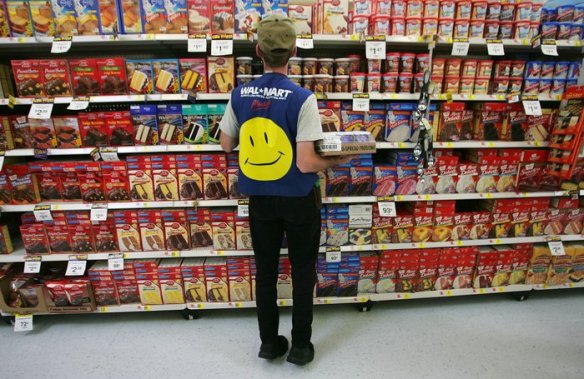
TROY, OH – MAY 11: An employee restocks a shelf in the grocery section of a Wal-Mart Supercenter May 11, 2005 in Troy, Ohio. Wal-Mart, America’s largest retailer and the largest company in the world based on revenue, has evolved into a giant economic force for the U.S. economy. With growth, the company continues to weather criticism of low wages, anti-union policies as well as accusations that it has homogenized America’s retail economy and driven traditional stores and shops out of business. (Photo by Chris Hondros/Getty Images)

By Daisy Luther

Source: Waking Times

In the United States, we are lucky to have massive convenience at our fingertips. I was talking to one of the instructors for the urban survival course, who is from Sweden, on a car ride. He was blown away by some of the things I told him about the levels of convenience and comfort in the United States. Things I completely took for granted don’t even exist there. I thought some of you might be interested in hearing about some of the insights we discussed.

Before I left for the course, I was walking my dogs a mile or two every day with my dogs, but that was about it. I thought it was enough but I learned during the field exercises that it wasn’t even close to the physicality required during an SHTF situation. But I digress. Let’s get back to convenience.

A caveat before people respond indignantly and tell me about all the inconvenience with which they deal every day: this is an opinion piece. Obviously many people in America still work out hard and have manual jobs. But when two-thirds of American adults and 30% of American children are overweight or obese, you have to see that you are not in the majority.

And it’s the majority here that I’m discussing. Between a combination of low-quality food and extremely sedentary lifestyles, the majority are killing themselves with convenience.

The American Culture of Convenience

The first thing that struck me when I landed in the Balkans was how different their lifestyle is from ours in the United States. But the longer I’ve been here, the more obvious it has become.

In the United States, depending on where you live, everything is dropped in your lap.

Food can be quickly acquired by shouting your order into a microphone and driving around a building, all without you having to leave your car. And if you live in a larger town or city, with the advent of services like GrubHub and DoorDash, the food delivered to your home is no longer the domain of pizza chains. You can have your choice of practically any restaurant in town brought right to your door within 45 minutes.

But it isn’t just about food. Instacart offers pick-up services from a wide variety of stores, including places like chain grocers, Wal-Mart, and Target. All you have to do is drive up, let them know by phone that you’ve arrived, and pop your trunk. Poof. Your shopping is done. In some cities, you can even use services like Instacart to have these things brought to your door.

Amazon has brought us practically anything else we could want with two-day shipping, regardless of where you live in the country. Gone are the days of scouring half a dozen stores to locate the whatchamacallit you needed. A quick search on Amazon and One-Click ordering and it’s yours within 48 hours and you never moved off your comfy chair.

If you need to go somewhere you don’t even have to drive yourself or take public transit. Uber or Lyft will happily send somebody to pick you up and drive you anywhere you need to go for a reasonable price, and you can watch the approach of your driver from the convenience of your phone.

Entire billion dollar industries are evolving to make our lives more convenient and easy every single day. Imagine how stunned our hunter-gatherer ancestors would be to discover we don’t even have to leave the house to be clothed and fed in epic abundance.

We don’t walk much, either.

And speaking of drive-thrus and driving to the store to get your Instacart packages, we drive everywhere. Part of this is because of the way suburbia is developed. It’s rare to live in a neighborhood where you can walk to the market, the bakery, and the wine store. So instead of walking to get our goods, we drive there, dash in, and get back in our cars. Those in big cities probably walk far more than those in suburbia, and for those in the country, it depends if they actually have a place to walk and whether they’re taking care of a large property.

And if we’re not walking to run our errands, we’re not carrying stuff. We get as close as possible with our cars if heavy groceries need to be lugged in and we carry as little as we can if we’re heading somewhere. When you walk the dogs, you might take your phone and some poop bags but you’re generally not taking it as a training opportunity and strapping on a pack.

Then there are the stairs.

Even two-story buildings in the United States have elevators much of the time because everything, by law, has to be easily accessible to every person. (And no, I’m not saying that people in wheelchairs need to try to haul themselves up the stairs. I’m discussing a trend.) But it goes even further than that. Adding elevators to your home is a growing trend in both the United States and Canada. New home builders are including elevators in the original design of some homes.

On the other hand, in Europe, they don’t have elevators in many buildings with fewer than five floors. I walked up and down more stairs in the past month than I have in the past year at home combined, and I live in a three-story house.

And the list of conveniences that would blow the minds of people I met in the Balkans goes on.

It’s an agoraphobic’s paradise in the United States.

You can get all sorts of mobile services that come to your door – everything from hairstyling to dog grooming. Other people mow our lawns, clean our homes, service our vehicles, and take care of us in general. There are even people who hire others to walk their dogs. Some people definitely need help with physical tasks but able-bodied people should be able to do a little yard work, shouldn’t we? Especially if we’re preparing for some kind of apocalypse.

In many areas, things are perfectly level, the sidewalks are carefully maintained (because who wants to ask for trouble in our litigious society), and a slight incline is considered a “hill” that people avoid to make their dog walk a little easier.

You can get meal kits brought to your door with every single ingredient you need to make a gourmet meal, right down to the seasonings accurately doled out in little packages. You can have fresh fruits and vegetables dropped off at your door by your local CSA. You can get subscription services of all types with the delivery of things like cosmetics, fitness gear, food from exotic locales, wine, candy, home decor items, socks, and dog paraphernalia.

Looking at it from the perspective of the area where I’ve been spending time, it’s simply mind-boggling that all of these riches are brought to you at the click of a button.

And it’s killing us.

As I mentioned earlier in this article, the obesity rate in the United States is staggering. A lot of it is our food. Thanks to subsidization by the USDA, many of the foods that are cheap are highly processed with low-quality ingredients. The NY Times reports:

At a time when almost three-quarters of the country is overweight or obese, it comes as no surprise that junk foods are the largest source of calories in the American diet. Topping the list are grain-based desserts like cookies, doughnuts and granola bars. (Yes, granola bars are dessert.)

That’s according to data from the federal government, which says that breads, sugary drinks, pizza, pasta dishes and “dairy desserts” like ice cream are also among Americans’ top 10 sources of calories.

What do these foods have in common? They are largely the products of seven crops and farm foods — corn, soybeans, wheat, rice, sorghum, milk and meat — that are heavily subsidized by the federal government, ensuring that junk foods are cheap and plentiful, experts say.

Between 1995 and 2010, the government doled out $170 billion in agricultural subsidies to finance the production of these foods, the latter two in part through subsidies on feed grains. While many of these foods are not inherently unhealthy, only a small percentage of them are eaten as is. Most are used as feed for livestock, turned into biofuels or converted to cheap products and additives like corn sweeteners, industrial oils, processed meats and refined carbohydrates. (source)

And even when we try to clean up our diets, foods are genetically modified, produce is doused in pesticides, and it’s packaged in all sorts of hormone-disrupting material that leaches in when you heat it up.

But it’s not just the crappy food. A lot of folks in the United States just do not get off their butts. And – I hate to say it – but I’m talking to a lot of people in the survival and preparedness world. Sitting at a keyboard or phone typing all day while Netflix plays in the background is sedentary to a deadly degree. On average Americans sit for 8.2 hours per day and this does not include the average 7-ish hours a day we’re sleeping.  And when we’re not sitting, it doesn’t mean we’re doing things that are good for us. We spend a great deal of time standing in line and driving in our cars. And the trend toward inactivity is only increasing.

Meanwhile, obesity contributes to many diseases such as:

  • High blood glucose (sugar) or diabetes.
  • High blood pressure (hypertension).
  • High blood cholesterol and triglycerides (dyslipidemia, or high blood fats).
  • Heart attacks due to coronary heart disease, heart failure, and stroke.
  • Bone and joint problems, more weight puts pressure on the bones and joints. This can lead to osteoarthritis, a disease that causes joint pain and stiffness.
  • Stopping breathing during sleep (sleep apnea). This can cause daytime fatigue or sleepiness, poor attention, and problems at work.
  • Gallstones and liver problems.
  • Some cancers.

The National Institute of Health is incredibly concerned about the future of overweight, sedentary Americans.

More recent evidence points to differential roles for body fat distribution patterns, in addition to excess overall adiposity, in elevating risk of many major chronic diseases. The large numbers of children entering adulthood overweight, together with increased weight gain in adulthood, portend an enormous burden in terms of human suffering, lost productivity, and health care expenditure in the coming decades. (source)

And – since it’s the purview of this website – imagine if the SHTF and you were too overweight and sedentary to go out and acquire the supplies you need to survive. Imagine what will happen when your medication runs out and you have a preventable disease brought on by your sedentary lifestyle. Imagine how your family will feel watching you suffer.

You need to add more movement to your life.

Unless you are among the 23% of Americans who meet the national exercise guidelines, you need to add more movement to your life. I suspect that there are a lot of people who believe they are disabled because getting started on a movement program is hard. It really does hurt, I know. But there’s a very good chance as you begin to move more it will become far easier. Don’t give in to it if your doctor says, “Oh, you’re disabled” and hands you a sticker for your car unless you really, truly are. If there’s even a glimmer of doubt in your mind, try to move just a few more steps each day. Instead of using the scooter to shop, push a cart to give yourself something to lean on. You aren’t training for a marathon – 10 extra steps a day will add up if you keep on pushing. But, MOVE.

The best way to increase movement is to decrease convenience. I don’t mean that you need to suddenly become a hunter-gatherer but you need to get off your duff. (To get started, check out this article or Bug Out Boot Camp and of course, always contact your doctor before beginning an exercise program. Blah, blah, blah.)

You need to carry heavy things instead of getting them delivered. You need to climb the stairs instead of taking the elevator or escalator. You need to actually go inside the store to do your shopping instead of sitting in your car, waiting for stuff to get loaded into your trunk. Park at the back of the parking lot, or better yet, at a store further away. Quit ordering from Amazon and buy things locally so you can walk around the store. Look for the hills and walk up and down them instead of avoiding them. If you want to eat restaurant food, go to the dad-gum restaurant. Find a place to walk to every day – maybe the post office, a coffee shop, or the dog park – and make it part of your routine.

It’s not unusual in other parts of the world to walk 8, 10, or even more miles, every single day. You don’t need to start there but maybe you should strive to get there. Once you’re in your groove, it should only take an hour or so to walk 4 miles. Using your feet as transportation is one of the healthiest things you can do.


Surgical Totalitarianism

By Dan Corjescu

Source: Dissident Voice

You don’t have to control everything to be in total control.

In the modern world this seeming paradox is a systemic reality.

In the past, classic totalitarian governments sought to literally control every aspect of biopower.

As it turned out, this was a very inefficient and self-defeating way to maintain and increase scientific knowledge and technology, capital accumulation, and total effective power over the long term.

Modern totalitarian arrangements are far more culturally efficacious, superficially unobtrusive, stylistically democratic, and, most importantly, surgically precise.

In addition, modern totalitarian elites not only demand de facto control over society as such, but they also desire, as part of their inner ideological ethos, the exercise of that power to reproduce itself under maximum conditions of ease, pleasure, and comfort. Thus, the creation and maintenance of a consumerist society both materially and ideologically aids in the reproduction of neo-totalitarian power.

A consumerist society is to a large extent a self regulating mechanism for the constant pursuit of public spectacle and private stimulation. The senses and general life instincts are caught in a web of the pursuance of small pleasures. In this way, pleasure itself becomes an insidiously saccharine form of domination. Yet, from time to time, consumerist relations must be guided, reinforced, and given new goals and reflationary impetus from above.

The political structure in modern, surgical totalitarianism is set up in such a way as to give the appearance of active participation, psychological inclusion, and periodic mass mobilization. However, all consequential decision-making takes place behind this fraudulent structure and represents the true “commanding heights” of power. The political superstructure serves, at best, as perennial decoy and public delusion.

The modern “commanding heights” of power require massive amounts of data. It is through the acquisition, manipulation, and active forward interpretation of information that surgical totalitarianism is able to pick and choose its battles. At its most extreme, new “realities” are creatively and cynically constructed from its daily catch of strategic knowledge. The goal is always the same: distract, delude, deflate any possible challenge to the system through active suppression, co-optation (the preferred method), and, or, complete elimination.

In this way, any possible threats can be foreseen relatively far in advance and organizational strategies can be conceived for either their containment and/or elimination. The surgical nature of these methods allows for the relative negative freedom of civil society to generally evolve and reproduce itself in partial self-awareness in so far as it continues to demonstrate no substantive subversive tendencies to liquidate either the material reality and/or ideological superstructure of its own dependency on neo-totalitarian forms of power.

In the end, the system presents itself as perversely elegant, efficient, self-perpetuating, and, even, on a physical level, pleasant.

All bodily pleasures are on offer. Entertainment becomes incarceration. All is seemingly permitted while nothing is truly allowed. Power is diaphanous as it is all consuming. Critical dissent is tolerated because the mechanisms of mass blindness are secure.

It would be and has been a crucial mistake for Marxists of all kinds to think that capitalism is the root cause of the modern day pursuit of total power. On the contrary, surgical totalitarianism utilizes capitalism as just another source of power but not its ultimate ground. Power precedes capitalism. Hierarchy encodes the means and forces of production no matter what they are just as hierarchy projects a self-sustaining superstructure to deceive and deflect its potential challengers. Capitalism is but a modern day tool of hierarchical power. The real enemy is not capital but surreptitious hierarchy.

The true source of this state of affairs is the lust for control under any societal forms. Its origins are without doubt evolutionary. Aristotle famously defined human beings as “Zoon Politikon” or “social animal”. Yes, we are indeed social. But the “Zoon” or animal part of that equation warps that sociality into the insatiable desire to control and to dominate others. Ultimately, the Hobbesian origins of mankind from an age long state of “nastiness and brutishness” is, in part, to blame that man persists in being as a wolf to other men: Homo homini lupus est.

Why Activists Fail

By Robert J. Burrowes

Despite enormous ongoing effort over more than a thousand years, during and since the formation and shaping of the modern world, and as the number of issues being contested has steadily increased, activists of many types have made insufficient progress on key issues, particularly in relation to ending violence and war (and the threat of nuclear war), stopping the exploitation of many peoples and halting the endless assaults on Earth’s biosphere.

Of course, in order for those of us who identify as activists to have any prospect of success in these and other endeavors, we need to understand how the world works and to develop an interrelated set of nonviolent strategies that are being effectively implemented to address each of the key aspects of this crisis.

This is because there is a great deal wrong with how the human world functions and a staggering amount that needs to be done if we are to fix it and preserve the planetary biosphere in doing so, particularly given that the primary threats are now so serious that human extinction is likely to occur within a few years. See ‘Human Extinction by 2026? A Last Ditch Strategy to Fight for Human Survival’.

Of course, if human governance systems, ranging from international organizations like the United Nations and its various agencies to national, provincial and local governments functioned effectively, then we might expect these agencies, which theoretically function on our behalf, to have addressed these problems a long time ago. Or to do so now.

However, for reasons that are readily identifiable, these agencies have little power and routinely malfunction (from the viewpoints of ordinary people and the planetary biosphere).

So let me start by briefly explaining how the world works and then elaborating a few key points about strategy so that you can choose, if you wish (and, problematically, assuming there is still time), to play a more active and effective role, in one or more ways, in the struggle to make our world one of peace, justice and sustainability.

How the World Works: A Brief History

The formal human governance systems on Earth – that is, governments and intergovernmental organizations such as the United Nations – are controlled by the global elite which is invisible to, and hence not considered by, most people including activists. This, of course, is how the elite wants it and one can still readily find accounts that ask if the elite (by whatever name it is given) actually exists and even ascribe it a mystical quality. If the idea is not simply written off as a ‘conspiracy theory’.

Well the global elite exists and its membership can be readily identified. But let me start by briefly outlining how the global elite acquired its extraordinary control over world affairs.

Following the Neolithic revolution 12,000 years ago, agriculture allowed human settlement to supersede the hunter-gatherer economy. However, while the Neolithic revolution occurred spontaneously in several parts of the world, some of the Neolithic societies that emerged in Asia, Europe, Central America and South America resorted to increasing degrees of social control in order to achieve a variety of social and economic outcomes, including increased efficiency in food production.

Civilizations emerged just over 5,000 years ago and, utilizing this higher degree of social control, were characterized by towns or cities, efficient food production allowing a large minority of the community to be engaged in more specialized activities, a centralized bureaucracy and the practice of skilled warfare. See ‘A Critique of Human Society since the Neolithic Revolution’.

With the emergence of civilization, elites of a local nature (such as the Pharoahs of Egypt), elites with imperial reach (including Roman emperors), elites of a religious nature (such as Popes and officials of the Vatican), elites of an economic character (particularly the City of London Corporation) and elites of a ‘national’ type (especially the monarchies of Europe) progressively emerged, essentially to manage the administration associated with maintaining and expanding their realms (political, financial and/or religious).

Following the Peace of Westphalia in 1648, which formally established the nation-state system, national elites, increasingly of an economic nature as capitalism progressively developed and rapidly expanded, consolidated their hold over national societies and, as these elites internationalized their reach in the following centuries, by the second half of the C20th, a truly global elite had consolidated its control over the world.

Awareness of elites in earlier eras has been noted by some authors. For example, in his 1775 book An Inquiry into the Nature and Causes of the Wealth of Nations, Adam Smith noted that ‘All for ourselves, and nothing for other people, seems, in every age of the world, to have been the vile maxim of the masters of mankind’.

But the work of C. Wright Mills in his 1956 classic The Power Elite is the original scholarly effort of the post-World War II era to document the nature of this elite, how it functions and why it had total control over US national society. Of course, despite scholarship of this nature, which has been added to routinely ever since, most people still believe the elite-sponsored delusion that international organizations, such as the United Nations, and national governments actually have some significant say in world affairs.

To jump to the present then, for the best recent account of how the global elite manifests today, see the book by Professor Peter Phillips titled Giants: The Global Power Elite. In this book, Phillips identifies the world’s top seventeen asset management firms, such as BlackRock and J.P Morgan Chase, that collectively manage more than $US41.1 trillion in a self-invested network of interlocking capital that spans the globe. The seventeen Giants operate in nearly every country in the world and are ‘the central institutions of the financial capital that powers the global economic system’. They invest in anything considered profitable, ranging from ‘agricultural lands on which indigenous farmers are replaced by power elite investors’ to public assets (such as energy and water utilities), to fossil fuels, nuclear power and war.

More precisely, Phillips identifies the 199 individual directors of the seventeen global financial Giants and the importance of those transnational institutions that serve a unifying function – including the World Bank, International Monetary Fund, G20, G7, World Trade Organization (WTO), World Economic Forum (WEF), Trilateral Commission, Bilderberg Group, Bank for International Settlements and Council on Foreign Relations – and particularly two very important global elite policy-planning organizations: the Group of Thirty (which has 32 members) and the extended executive committee of the Trilateral Commission (which has 55 members).

And Phillips carefully explains why and how the global elite defends its power, profits and privilege against rebellion by the ‘unruly exploited masses’: ‘the Global Power Elite uses NATO and the US military empire for its worldwide security. This is part of an expanding strategy of US military domination around the world, whereby the US/ NATO military empire, advised by the power elite’s Atlantic Council, operates in service to the Transnational Corporate Class for the protection of international capital everywhere in the world’.

‘The US military empire stands on hundreds of years of colonial exploitation and continues to support repressive, exploitative governments that cooperate with global capital’s imperial agenda. Governments that accept external capital investment, whereby a small segment of a country’s elite benefits, do so knowing that capital inevitably requires a return on investment that entails using up resources and people for economic gain. The whole system continues wealth concentration for elites and expanded wretched inequality for the masses….

‘Understanding permanent war as an economic relief valve for surplus capital is a vital part of comprehending capitalism in the world today. War provides investment opportunity for the Giants and Transnational Corporate Class elites and a guaranteed return on capital. War also serves a repressive function of keeping the suffering masses of humanity afraid and compliant.’

If you would like to read other books which also give a clear sense of elites and their agents operating beyond the law to the extraordinary detriment of humanity and the Earth, then I strongly recommend William Blum’s classic Killing Hope: U.S. Military and CIA Interventions Since World War II and Paul L. Williams’ eye-opening account of Operation Gladio: The Unholy Alliance between the Vatican, the CIA and the Mafia.

In plain language then: The global elite manages human governance systems for its benefit with no concern for ordinary people – who are considered unworthy – or the planetary biosphere. And the most important function that international agencies and governments perform, from the elite perspective, is that they appear to have control over certain jurisdictions and matters so that relevant constituencies focus their efforts, for example, on ‘changing government policy’ or changing the party in government. By having activist effort focused on lobbying governments or changing the party in government, this effort is absorbed and dissipated; hence, nothing of consequence changes because the elite has significant control over all major political processes, parties and their policies.

Of course, I should add that the elite is smart enough to make it look like something has changed occasionally, perhaps by allowing a small concession after years of effort (invariably on a ‘social’ issue, such as gay marriage, that doesn’t adversely impact their power, profits and privilege), so that most activist effort remains focused on governments and international governmental agencies. The elite also allows a ‘genuinely progressive’ candidate to emerge regularly so that activists are again suckered into putting effort into electoral outcomes rather than building movements for broad-based social transformation based on grassroots organizing.

In managing their already vast and endlessly accumulating wealth the global elite siphons a staggering amount of financial resources out of the global economy every day and channels these resources through secretive tax havens to evade tax. Globally, $US10billion of wealth produced by the labor of ordinary people is ‘lost’ each week in this way and more than 10% of global financial wealth (which doesn’t include non-financial wealth ranging from racehorses and yachts to artworks and gold bars) is now hidden in these secrecy jurisdictions. See ‘Elite Banking at Your Expense: How Secretive Tax Havens are Used to Steal Your Money’.

A small proportion (but nevertheless significant amount) of elite wealth is used to create and manage the dominant narrative in relation to the state of the world by financing production of this narrative, generated by elite think tanks, and then distributed through education systems, the entertainment industry and the corporate media. In short, we are bombarded with elite propaganda, given names such as ‘education’, ‘entertainment’ and ‘news’, that hopelessly distorts popular perception of what is taking place.

So why does all of the above happen?

In essence: global elite control of formal human governance systems for its own benefit is an outcome of the global elite’s insanity, as well as the insanity of those who serve it. ‘So what is sanity?’ you might ask.

Sanity is defined as the capacity to consider a set of circumstances, to carefully analyze the evidence pertaining to those circumstances, to identify the cause of any conflict or problem, and to respond appropriately and strategically, both emotionally and intellectually, to that conflict or problem with the intention of resolving it, preferably at a higher level of need satisfaction for all parties (including those of the Earth and all of its living creatures). For a fuller explanation, see ‘The Global Elite is Insane Revisited’ with a lot more detail in ‘Why Violence?’ and ‘Fearless Psychology and Fearful Psychology: Principles and Practice’. In brief, individuals who are not incredibly psychologically damaged, do not behave as described above.

In essence then, while the description of how the world works offered above is accurate, it is driven by an insane elite – endlessly and compulsively accumulating profit, power and privilege at the expense of ordinary people and the biosphere – and the insanity of those who serve the elite, such as virtually all politicians and businesspeople, bankers and accountants, judges and lawyers, academics and corporate media personnel.

Hence, struggles for peace, justice, sustainability and liberation (from military occupation, dictatorship, genocidal assault, coups and invasions), by various means (including those which are nonviolent), fail far too often. But not just because of the enormous power of the global elite. They fail because activists do not understand how the world works, including how the elite exercises its power and, in the case of those who use nonviolent action explicitly, they fail when activists do not understand the psychology, politics and strategy of nonviolent struggle. And while these subjects are not complicated, they do require time to learn.

To reiterate then, the answer to the question ‘Why do activists fail?’ is this: Virtually all activists do not understand strategy and so they do not campaign strategically. This means that anything done – whether a decision in a meeting, a phone call or email, an action or event planned and executed – simply fails to have the impact it could have. Let me elaborate this explanation using just three basic components (out of twelve) of sound nonviolent strategy.

Before doing so I should emphasize that I am talking about those who identify as ‘activists’. I am not talking about lobbyists (or those who use activism in the service of lobbying). Moreover, I am assuming that all activists are using some version of what they understand as ‘nonviolent action’, whether or not they claim to be doing so or even realize they are, simply because no other tradition of activism offers the comprehensive strategic guidance that the literature on nonviolence offers.

So what should activists do so that their efforts have strategic impact?

Strategic Analysis

The foundation of any sound strategy – particularly if campaigning on major issues such as to end war, to end the climate catastrophe, to halt destruction of the fresh water supply and the rainforests, to defeat a coup, occupation or invasion nonviolently, to transform the global economy, to bring down the global elite… – is a thorough understanding of the conflict.

This means, most importantly, having a clear sense of the ‘big picture’ (including those overarching structures and actors in far-off places that maintain/perpetrate the local manifestations of violence and exploitation), not just the detail of the issue on which you focus. Fundamentally, this requires an astute understanding of the global power structure. If we do not understand how power works in society, particularly structurally, including in relation to the conflict we seek to resolve, then we cannot plan and implement a strategy that will work. As the historical record tragically demonstrates.

But it also requires our analysis to include a reasonable understanding of how key issues (such as war, destruction of the climate and environment, and exploitation of women, working people and indigenous peoples) intersect and reinforce each other. If we do not understand something of these relationships then we cannot plan strategy that takes these relationships into account and thus adequately account for all variables driving a conflict. Again, as the historical record painfully demonstrates.

So, for example, the failure of most climate and environmental activists to adequately consider the role of war (and military activity and violence generally) in destroying the climate and environment means that a primary driver of these two conflicts is barely mentioned let alone discussed and then actually tackled strategically – ideally by working in tandem with antiwar activists – by activists working to end the climate catastrophe and defend the environment as a whole.

But this failure to consider the ‘big picture’ is also the reason why most climate activists are focused on switching (from fossils fuels and nuclear power) to renewable energy and miss the fundamental point that we are destroying the entire global environment – including the fresh water, rainforests and oceans – and unless we dramatically reduce, by about 80%, our consumption in all key areas involving both energy and resources of every kind – water, household energy, transport fuels, metals, meat, paper and plastic – and immediately cease driving, flying and eating meat for starters, we have no chance of averting human extinction. See ‘Will humans be extinct by 2026?’ and ‘Climate-Change Summary and Update’.

Which is also why simple, structured approaches to this reduction of consumption, while dramatically expanding our individual and community self-reliance so that all environmental concerns are effectively addressed, must be part of any effective strategy to address the climate/environment catastrophe. See ‘The Flame Tree Project to Save Life on Earth’.

In one simple sentence: We cannot save the climate without saving the rainforests too, and ending war.

Having written all of the above, it is important to acknowledge that there are plenty of fine sources of accurate information on specific issues produced by independent think tanks and activist scholars and researchers. For example, you will find plenty of information about weapons corporations and weapons expenditure (still rising) on the website of the Stockholm International Peace Research Institute and the climate movement produces some rigorous research, with the latest report meticulously documenting that bank financing of fossil fuels is still rising despite the Paris climate ‘agreement’ in 2015. See ‘Banking on Climate Change: Fossil Fuel Finance Report Card 2019’.

Strategic Focus

If we do not thoroughly analyze the conflict, it is impossible to identify the appropriate strategic focus for action and to then plan tactics that address that focus. This inevitably means that we are essentially guessing what to do, not knowing in advance, as we should, that the action we take will have strategic impact.

Moreover, guessing what action to take, usually on the basis of what is familiar or what feels good – perhaps because we get out with a bunch of ‘good people’ – virtually inevitably leads to poor choices like organizing a large demonstration. Demonstrations are notoriously ineffective, as world history’s largest demonstration on 15 February 2003 – involving demonstrations in more than 600 cities around the world, involving up to 30,000,000 people, against the imminent US-led war on Iraq – see ‘The World Says No to War: Demonstrations against the War on Iraq’ – illustrated yet again. Single actions and numbers are not determinative; strategy is determinative. Obviously, large demonstrations could be effective, if they were strategically focused – never on governments though – but only a rare activist understands this with the recent worldwide ‘School Strike 4 Climate Action’ demonstrations on 15 March and the ‘Hands off Venezuela’ demonstrations on 16 March graphically illustrating this lack of understanding and thus wasting opportunities to make a strategic difference.

Let me explain this notion of strategic focus with a simple example, and then invite you to consider it in a little more detail.

Given the critical role that airline flights, travel by car and eating meat, for example, play in destroying the climate and, in the case of the first two, driving US-led wars for control of fossil fuels, imagine if all of those students attending the School Strike 4 Climate rallies had used the day to sign a personal pledge – the Earth Pledge? – which read something like this:

Out of love for the Earth and all of its inhabitants, and my respect for their needs, from this day onwards I pledge that:

  1. I will not travel by plane
  2. I will not travel by car
  3. I will not eat meat and fish
  4. I will only eat organically/biodynamically grown food
  5. I will minimize the amount of fresh water I use
  6. I will not buy rainforest timber
  7. I will not buy or use single-use plastic, such as bags, bottles, containers, cups and straws
  8. I will not use banks that provide any service to corporations involved in fossil fuels, nuclear power and/or weapons
  9. I will not get news from the corporate media (mainstream newspapers, television, radio, Facebook…)
  10. I will make the effort to learn a skill, such as food gardening or sewing, that makes me more self-reliant
  11. I will gently encourage my family and friends to consider signing this pledge.

Imagine if at all future climate rallies, participants were given the opportunity to sign such a pledge.

And imagine if at every demonstration against war, every participant was given the opportunity to sign such a pledge. There is little point yelling (or displaying a sign that reads) ‘No war for oil’ when you are the one using the oil. Surely, that would be hypocritical, wouldn’t it?

If it seems too difficult for now, would you sign the pledge after crossing out one or two items that you might reconsider later?

Perhaps, we can even mark 2 October 2019, the 150th anniversary of Gandhi’s birth, and the International Day of Nonviolence, as a day of world commitment with local ceremonies, small or large, around the world so that people can attend an event to make a public pledge of this nature too.

With the Earth under siege, would you sign such a pledge? What would you need to reorganize about your life to make it manageable?

The point then is this: It is easy to ask someone else to change their behaviour. It is more effective to change your own. And, if we do, we functionally undermine the cause of problems that concern so many of us.

Anyway, somewhat more elaborately, if you want strategic focus in your campaign strategy to end war or the climate catastrophe, for example, check out the two strategic aims and the basic list of strategic goals in ‘Campaign Strategic Aims’. And for the two strategic aims and the basic list of strategic goals to defend against a range of military threats, see ‘Defense Strategic Aims’.

This requires, vitally importantly, that the tactic in any given circumstance is thoughtfully crafted to achieve the strategic goal carefully identified as appropriate for this stage of the campaign. See the relationship and distinction between ‘The Political Objective and Strategic Goal of Nonviolent Actions’.

And for a better understanding of the power of nonviolent action and how to frame it for maximum strategic impact, see also ‘Nonviolent Action: Why and How it Works’.

Strategic Timeframe

Inadequate analysis, perhaps because you simply believe, without investigation, what the global elite is telling you via its many channels, such as its captive mainstream processes (including education systems and the corporate media), might lead you to work to a wholly unrealistic timeframe.

Unfortunately, this is precisely what is happening with the climate catastrophe. Unquestioningly following the elite-controlled discourse on this issue leads most people, including climate activists, to work to an ‘end of century’ timeframe or to believe, for example, that we have until 2030 to end our use of coal. And yet even some mainstream sources, such as the UN, are already reporting the catastrophic consequences of having set the utterly inadequate goal of limiting the global temperature increase to 2° (or 1.5°) celsius above the preindustrial norm. See, for example, ‘Global Linkages – A graphic look at the changing Arctic’ and ‘3-5°C temperature rise is now “locked-in” for the Arctic’.

So it is imperative that activists use their analysis (based on truthful sources) to make a realistic assessment of the timeframe. It might not be convenient to have less time than we think is necessary to precipitate the changes we want but our responsibility as activists includes the need to tell unpalatable truths (which the global elite and its agents will never do).

Fundamentally then, tell the truth. If there is a choice between being popular and telling the truth, I encourage you to always tell the truth. Deluding ourselves that we are doing a fine job and affirming each other for minor gains won’t avert human extinction or save those countless lifeforms, human and otherwise, who die each day as a result of our incredibly dysfunctional and violent world. Nor will it help those who are living under occupation, dictatorship or military assault.

Of course, telling the truth will scare many people. But it is still sounder strategy to trust people to hear the truth well, no matter how unpalatable it might be. Besides if we do not tell the truth and trust people, we have no prospect of mobilizing them strategically in the time we have left.

Needless to say, if you are going to tell the truth to others, you need to be courageous enough to perceive it yourself first. And to act on it.

Summary

In the above three sections, I explained the importance of a sound analysis, strategic focus and an appropriate timeframe as well as the importance of telling the truth, in developing and implementing an effective nonviolent strategy. This applies whatever the nature of the struggle: a peace, justice or environmental campaign or a defense or liberation struggle.

But effective strategy requires more than these three components and each of these components must also be soundly understood and rigorously implemented.

So if becoming more strategic appeals to you, check out either of these websites: Nonviolent Campaign Strategy or Nonviolent Defense/Liberation Strategy.

Or, for a quick overall look at the twelve components of nonviolent strategy, check out the Nonviolent Strategy Wheel on each site, such as this one.

In addition, if you want to focus on parenting children so that they are powerfully able to deal with reality and not get suckered into the widespread addictions of over-consumption and militarism – see ‘Love Denied: The Psychology of Materialism, Violence and War’ – or into believing that lobbying governments is the way to precipitate change, then you are welcome to consider making ‘My Promise to Children’ and learning the art of nisteling. See ‘Nisteling: The Art of Deep Listening’.

Of course, if you have problems reducing your consumption or questioning the efficacy of military violence, then consider addressing the unconscious psychological impediments to this. See ‘Putting Feelings First’.

If you like, you can also join the worldwide movement to end all violence by signing the online pledge of ‘The People’s Charter to Create a Nonviolent World’.

A Final Word

Some corporate economists are concerned that the global economy is facing a ‘downturn’ and, possibly, even entering a recession. As a result, they are arguing for measures to boost economic growth.

The reality, however, is that industrial civilization is already steadily and rapidly breaking down – with an endless sequence of climate and environmental catastrophes now taking place: for one of the latest, see ‘Death toll jumps in Mozambique storm as 15,000 await rescue’ – and will collapse completely within a few years. Why? Because the Earth has very little left to give without a staggering amount of regenerative inputs (some of which we can supply but others that require geological time).

But you do not need to believe me.

Consider the evidence for yourself.

If, after reading the lengthy list of documents, scientific and otherwise, cited in the key articles about near-term human extinction mentioned above, you can search out compelling evidence to refute the argument for near-term human extinction that is presented, then I hope you will share this evidence widely so that we can all be relieved that we have more time than an increasing number of courageous scientists are warning at risk to their livelihoods and professional appointments.

But if you cannot refute the evidence cited above or find the evidence that does it to your satisfaction, I invite you to respond thoughtfully and powerfully by taking immediate action to start systematically and substantially reducing your personal consumption while systematically increasing your personal and community self-reliance, in 16 areas, at the same time. Again, see ‘The Flame Tree Project to Save Life on Earth’.

I can assure you that if we ‘step down’ the global economy systematically while increasing our self-reliance at a (much) lower level of consumption (which will also demonetize economic activity), then all of those corporations – such as those producing fossil fuels, mining strategic minerals and destroying rainforests – will cease producing products for which there is no market. They will simply have no financial incentive to do so. And this will functionally and ongoingly undermine the power of the global elite to manipulate us into surrendering our power by lobbying governments and surrendering our labor and resources to buy their products to increase their power and profits. Moreover, elites will have less incentive to start and fight the wars to steal the resources necessary to make the products our over-consumption currently requires.

As you probably realize, it is your own action that gives you credibility (and moral authority) to then encourage others to follow your example, and for you to campaign for others to change their behaviour too. One hundred years ago, Mohandas K. Gandhi – perhaps anticipating the latest UN report: ‘UN Alliance For Sustainable Fashion addresses damage of “fast fashion”’ – was reminding us that ‘Earth provides enough to satisfy every person’s needs, but not every person’s greed.’ And he modeled the minimal consumption he asked of others in his own life first. At his death, he owned two outfits of handspun cotton, which he made himself on a spinning wheel, and a pair of sandals.

We do not have to be as frugal as Gandhi but we do need to substantially reduce our consumption and increase our self-reliance if we are to have any chance of preserving a biosphere that will sustain life for viable populations of all species.

Activists need to have the courage to act this out and then spread this message to everyone (particularly in the industrialized world): not waste their time asking elite agents, like governments, to support the switch to renewable energy or stop fighting wars to steal resources.

If we are to fight effectively to preserve the biosphere, we must do it strategically.


Biodata: Robert J. Burrowes has a lifetime commitment to understanding and ending human violence. He has done extensive research since 1966 in an effort to understand why human beings are violent and has been a nonviolent activist since 1981. He is the author of ‘Why Violence?’ His email address is flametree@riseup.net and his website is here.

Robert J. Burrowes
P.O. Box 68
Daylesford, Victoria 3460
Australia

Email: flametree@riseup.net

Websites:
Nonviolence Charter
Flame Tree Project to Save Life on Earth
‘Why Violence?’
Feelings First
Nonviolent Campaign Strategy
Nonviolent Defense/Liberation Strategy
Anita: Songs of Nonviolence
Robert Burrowes
Global Nonviolence Network

Degrowth: closing the global wealth divide

Contradicting the dominant paradigm that economic growth equals development, degrowth theorists argue that serious cutbacks are crucial to protect life on our planet.

By Riccardo Mastini

Source: ROAR

Today, some 4.3 billion people — more than 60 percent of the world’s population — live in debilitating poverty, struggling to survive on less than the equivalent of $5 per day (which is the mean average of all the national poverty lines in the Global South). Half do not have access to enough food. And these numbers have been growing steadily over the past few decades.

With these data, Jason Hickel, an anthropology professor and global development expert, starts his controversial book, The Divide: A Brief Guide to Global Inequality and Its Solutions, in which he meticulously and convincingly debunks the narrative told by the UN and the likes of Bill Gates and Steven Pinker. In fact, while the good-news story leads us to believe that poverty has been decreasing around the world, in reality the only places this holds true are in China and East Asia. And these are some of the only places in the world where free-market capitalism was not forcibly imposed by the World Bank and the IMF, allowing these governments to pursue state-led development policies and gradually liberalize their economies on their own terms.

Development agencies, NGOs and the world’s most powerful governments explain that the plight of poor countries is a technical problem — one that can be solved by adopting the right institutions and the right economic policies, by working hard and accepting a bit of help. As Hickel writes: “It is a familiar story, and a comforting one. It is one that we have all, at one time or another, believed and supported. It maintains an industry worth billions of dollars and an army of NGOs, charities and foundations seeking to end poverty through aid and charity.” But it’s against this narrative that Hickel takes aim.

ECONOMIC UNEQUAL EXCHANGE OVER THE CENTURIES

The main argument presented in the book is that the discourse of aid distracts us from seeing the broader picture. It hides the patterns of extraction that are actively causing the impoverishment of the Global South today and actively impeding meaningful development. “The charity paradigm obscures the real issues at stake: it makes it seem as though the West is ‘developing’ the Global South, when in reality the opposite is true. Rich countries aren’t developing poor countries; poor countries are effectively developing rich countries — and they have been since the late 15th century,” argues Hickel.

In the book it is laid bare for all to see that underdevelopment in the Global South is not a natural condition, but a consequence of the way Western powers have organized the world economic system.

It’s not that the $128 billion in aid disbursements that the West gives to the Global South every year doesn’t exist — it does. But if we broaden our view and look at it in context, we see that it is vastly outstripped by the financial resources that flow in the opposite direction.

If all of the financial resources that get transferred between rich and poor countries each year are tallied up, we find that in 2012, the last year of recorded data, developing countries received a little over $2 trillion, including all aid, investment and income from abroad. But more than twice that amount, some $5 trillion, flowed out of them in the same year. In other words, developing countries “sent” $3 trillion more to the rest of the world than they received.

What do these large outflows from the Global South consist of? “Well, some of it is payments on debt. Today, poor countries pay over $200 billion each year in interest alone to foreign creditors, much of it on old loans that have already been paid off many times over, and some of it on loans accumulated by greedy dictators,” states Hickel. Another major contributor is the income that foreigners make on their investments in developing countries and then repatriate. Think of all the profits that Shell extracts from Nigeria’s oil reserves, for example, or that Anglo American pulls out of South Africa’s gold mines.

But by far the biggest chunk of outflows has to do with capital flight. A big proportion of this takes place through “leakages” in the balance of payments between countries. Another takes place through an illegal practice known as “trade misinvoicing.” Basically, corporations report false prices on their trade invoices in order to spirit money out of developing countries directly into tax havens and secrecy jurisdictions. A similarly large amount flows out annually through “abusive transfer pricing”, a mechanism that multinational companies use to steal money from developing countries by shifting profits illegally between their own subsidiaries in different countries. But perhaps the most significant loss has to do with exploitation through trade.

Hickel explains that “from the onset of colonialism through to globalization, the main objective of the North has been to force down the cost of labor and goods bought from the South. In the past, colonial powers were able to dictate terms directly to their colonies. Today, while trade is technically “free,” rich countries are able to get their way because they have much greater bargaining power.” On top of this, trade agreements often prevent poor countries from protecting their workers in ways that rich countries do. And because multinational corporations now have the ability to scour the planet in search of the cheapest labor and goods, poor countries are forced to compete to drive costs down. As a result of all this, there is a yawning gap between the “real value” of the labor and goods that poor countries sell and the prices they are actually paid for them. This is what economists call “unequal exchange.”

Since the 1980s, countries of the West have been using their power as creditors to dictate economic and trade policies to indebted countries in the South, effectively governing them by remote control, without the need for bloody interventions. “Leveraging debt,” argues Hickel, “they imposed “structural adjustment programs” that reversed all the economic reforms that Global South countries had painstakingly enacted in the previous two decades. In the process, the West went so far as to ban the very protectionist and Keynesian policies that it had used for its own development, effectively kicking away the ladder to success.”

DEGROWTH FOR SUSTAINABLE AND FAIR LIVELIHOODS

Hickel then ponders over how — if these unfair trade and business practices were amended — poor countries could actually go about developing their economies following the same path as the one embraced by the Global North over the past two centuries. He references a study by the economist David Woodward in which the latter shows that given our existing economic model, poverty eradication can’t happen. Not that it probably won’t happen, but that it physically can’t. It is a structural impossibility.

He explains that:

Right now, the main strategy for eliminating poverty is to increase global GDP growth. The idea is that the yields of growth will gradually trickle down to improve the lives of the world’s poorest people. But all the data we have shows quite clearly that GDP growth doesn’t really benefit the poor. While global GDP per capita has grown by 65 percent since 1990, the number of people living on less than $5 a day has increased by more than 370 million. Why does growth not help reduce poverty? Because the yields of growth are very unevenly distributed. The poorest 60 percent of humanity receive only 5 percent of all new income generated by global growth. The other 95 percent of the new income goes to the richest 40 percent of people. And that’s under best-case-scenario conditions.

Given this distribution ratio, Woodward calculates that it will take more than 100 years to eradicate absolute poverty at $1.25 a day. At the more accurate level of $5 a day, eradicating poverty will take 207 years. To eradicate poverty at $5 a day, global GDP would have to increase to 175 times its present size. In other words, we need to extract, produce and consume 175 times more commodities than we presently do. It is worth pausing for a second to think about what this means. Even if such outlandish growth were possible, the consequences would be disastrous. We would quickly chew through our planet’s ecosystems, destroying the forests, the soils and, most importantly, the climate.

According to data compiled by researchers at the Global Footprint Network in Oakland, our planet only has enough ecological capacity for each of us to consume 1.8 “global hectares” annually — a standardized unit that accounts for resource use, waste, pollution and emissions. Anything over this means a degree of resource consumption that the Earth cannot replenish, or waste that it cannot absorb; in other words, it locks us into a pathway of progressive degradation. The figure of 1.8 global hectares is roughly what the average person in Ghana or Guatemala consumes.

By contrast, Europeans consume 4.7 global hectares per person, while in the US and Canada the average person consumes 8 — many times their fair share. To get a sense of how extreme this overconsumption is: if we were all to live like the average citizen of the average high-income country, we would require the ecological capacity equivalent to 3.4 Earths. Hickel elaborates:

Scientists tell us that even at existing levels of aggregate global consumption we are already overshooting our planet’s ecological capacity by about 60 percent each year. And all of this is just at our existing levels of aggregate economic activity — with the existing levels of consumption in rich and poor countries. If poor countries increase their consumption, which they will have to do to some extent in order to eradicate poverty, they will only tip us further towards disaster. Unless, that is, rich countries begin to consume less.

If we want to have a chance of keeping within the 2°C threshold — which the Paris Agreement on climate change sets as an absolute cap — we can emit no more than another 805 gigatons of CO2 at the global level. Now, let’s accept that poor countries will need to use a portion of this carbon budget in order to grow their incomes enough to eradicate poverty; after all, we know that for poor countries human development requires an increase in emissions, at least up to a relatively lowish point. This principle is already widely accepted in international agreements, which recognize that all countries have a “common but differentiated responsibility” to reduce emissions. Because poor countries did not contribute much to historical emissions, they have a right to use more of the carbon budget than rich countries do — at least enough to fulfill basic development goals (as I also argue in this article). This means that rich countries have to figure out how to make do with the remaining portion of the budget.

Professor Kevin Anderson, one of Britain’s leading climate scientists, has been devising potential scenarios for how to make this work. If we want to have a 50 percent chance of staying under 2°C, there’s basically only one feasible way to do it — assuming, of course, that negative emissions technologies is not a real option. In this scenario, poor countries can continue to grow their economies at the present rate until 2025, using up a disproportionate share of the global carbon budget. That’s not a very long time, so this strategy will only work to eradicate poverty if the gains from growth are distributed with a heavy bias towards the poor.

As Hickel writes: “The only way for rich countries to keep within what’s left of the carbon budget is to cut emissions aggressively, by about 10 percent per year. Efficiency improvements and clean energy technologies will contribute to reducing emissions by at most 4 percent per year, which gets them part of the way there. But to bridge the rest of the gap, rich countries are going to have to downscale production and consumption by around 6 percent each year. And poor countries are going to have to follow suit after 2025, downscaling economic activity by about 3 percent per year.” This strategy of downscaling the production and consumption of a country is called “degrowth.”

Hickel describes this visionary idea as follows: “All it means is easing the intensity of our economy, cutting the excesses of the very richest, sharing what we have instead of plundering the Earth for more, and liberating ourselves from the frenetic consumerism that we all know does nothing to improve our wellbeing or happiness.” And since the book first came out in 2017, Hickel has been developing an increasingly clearer position on how we can go about making such changes happen.

His thinking on degrowth was recently encapsulated in a captivating blog exchange he had with Branko Milanović, another global development expert. But Milanović still maintains that economic growth should be at the core of poverty relief. Paraphrasing a passage from Kate Raworth’s Doughnut Economics, we could summarize Milanović’s position as “economic growth is still necessary, and so it must be possible,” while Hickel argues that “economic growth is no longer possible, and so it cannot be necessary.” I side with the latter, simply because the laws of physics trump the laws of economics.

In light of this, perhaps we should regard countries like Costa Rica not as underdeveloped, but rather as appropriately developed. We should look at societies where people live long and happy lives at low levels of income and consumption not as backwaters that need to be developed according to Western models, but as exemplars of efficient living — and begin to call on rich countries to cut their excess consumption.

Saturday Matinee: Happiness (Short Film)

Happiness – by Steve Cutts

Can we buy happiness? Are we really trapped? An economic textbook about our contemporary society

By Chiara Pascali

Source: GoodShortFilms

Try to google the word Happiness, the first (sponsored) result of your search will be shophappiness.com. Happiness can be bought. This is a plus point for the British animator and artist Steve Cutts, director of the short film Happiness.

Cutts imagines humanity as a horde of rats, adored by the marketing god, bewitched by Black Friday or Cyber ​​Monday. Loose cannon looking for the last offer. Happiness is the penny that is always missing at the prices of super discount products.  Happiness is a commodity exchange of the new capitalism.

Happiness, by definition, is the moment in which all one’s desires are satisfied, but humanity always wants more. Like so many rats, we are looking for compulsive crumbs of happiness. Producers sow these crumbs on online and offline advertisements.

There are products that answer any type of question, even for the inability to endure frustration of being constantly dissatisfied.

This limitless race is rendered in an excellent way by the images of Happiness, full of details and oversized information. Chaos. Steve Cutts describes the irrepressible frenzy of modern society, the compulsive and often illogical search to possess new objects, and lastly, the money, motor that moves the world.

Happiness is a short economic textbook and an explicit critique of contemporary society. The final question does not spare anyone – are we trapped?

The Dystopian Future of Facebook

By Mark Kernan

Source: CounterPunch

This year Facebook filed two very interesting patents in the US. One was a patent for emotion recognition technology; which recognises human emotions through facial expressions and so can therefore assess what mood we are in at any given time-happy or anxious for example. This can be done either by a webcam or through a phone cam. The technology is relatively straight forward. Artificially intelligent driven algorithms analyses and then deciphers facial expressions, it then matches the duration and intensity of the expression with a corresponding emotion. Take contempt for example. Measured by a range of values from 0 to 100, an expression of contempt could be measured by a smirking smile, a furrowed brow and a wrinkled nose. An emotion can then be extrapolated from the data linking it to your dominant personality traits: openness, introverted, neurotic, say.

The accuracy of the match may not be perfect, its always good to be sceptical about what is being claimed, but as AI (Artificial Intelligence) learns exponentially and the technology gets much better; it is already much, much quicker than human intelligence.

Recently at Columbia University a competition was set up between human lawyers and their AI counterparts. Both read a series of non-disclosure agreements with loopholes in them. AI found 95% compared to 88% by humans. The human lawyers took 90 minutes to read them; AI took 22 seconds. More incredibly still, last year Google’s AlphaZero beat Stockfish 8 in chess. Stockfish 8 is an open-sourced chess engine with access to centuries of human chess experience. Yet AlphaZero taught itself using machine learning principles, free of human instruction, beating Stockfish 8 28 times and drawing 72 out of 100. It took AlphaZero four hours to independently teach itself chess. Four hours from blank slate to genius.

A common misconception about algorithms is that they can be easily controlled, rather they can learn, change and run themselves-a process known as deep “neural” learning. In other words, they run on self-improving feed back loops. Much of this is positive of course, unthought of solutions by humans to collective problems like climate change are more possible in the future. The social payoffs could be huge too. But what of the use of AI for other means more nefarious. What if, as Yuval Noah Hariri says, AI becomes just another tool to be used by elites to consolidate their power even further in the 21stcentury. History teaches us that it isn’t luddite to ask this question, nor is it merely indulging in catastrophic thinking about the future. Rapidly evolving technology ending up in the hands of just a few mega companies, unregulated and uncontrolled, should seriously concern us all.

Algorithms, as Jamie Bartlett the author of The People Vs Tech puts it, are “the keys to the magic kingdom” of understanding deep seated human psychology: they filter, predict, correlate, target & learn. They also manipulate. We would be naive in the extreme to think they already don’t, and even more naive to think the manipulation is done only by commercial entities. After all, it’s not as if there aren’t lots of online tribes, some manufactured and some not, to be manipulated into and out of political viewpoints, our fleeced of their money.

In 2017 Facebook said they could detect teenagers’ moods and emotions such as feeling nervous and insecure by their entries, a claim they denied later, adding we do not, “offer tools to target people based on their emotional state”. The internal report was written by two Australian executives-Andy Sinn and David Fernandez. The report according to The Guardian was written for a large bank and said that, “the company has a database of its young users – 1.9 million high schoolers, 1.5 million tertiary students and 3 million young workers”.

Going one better still, Affectiva, a Boston company, claims to be able to detect and decode complex emotional and cognitive data from your face, voice and physiological state using emotion recognition technology (ECT)-amassing 12 billion “emotion data points” across gender, age & ethnicity.  Its founder has declared that Affectiva’s ECT can read your heart rate from a webcam without the you wearing any sensors, simply by using the reflection of your face which highlights blood flow-a reflection of your blood pressure. Next time you’re listening to Newstalk’s breakfast show, think of that.

Affectiva’s ultimate goal of course, when you get past all the feel-good optimistic guff about “social connectivity”, “awesome innovation”, and worst of all “empowering” is, to use their own words, to “enable media creators to optimize their content”. Profiting from decoding our emotional states in other words.

Maybe Facebook (and Google) would use this technology wisely for our benefit, then again maybe not. It isn’t such a stretch to imagine how it could be used unethically too. To microtarget customised ads and messages at us depending on our state of mind at given time, say, and allowing Cambridge Analytica to harvest the personal data of 87 million Facebook users to subvert democracy with Brexit & Trump. Facebook claims they weren’t aware of this though.  Well, maybe, maybe not, and in spite of their protests in recent years they are still not especially transparent or accountable given their enormous cultural and social power in our lives. Curiouser and Curiouser you might think, and you’d be right.

The second Facebook patent is even more interesting, if that’s the right word, or dystopian if you prefer. Patented this June, published under the code US20180167677 (with the abstract title of Broadcast Content View Analysis Based on Ambient Audio Recording, application no: 15/376,515) illustrates a process by which secret messages- ‘ambient audio fingerprints’ in the jargon-embedded in TV ads, would trigger your smart technology (phone or TV) to record you while the ad was playing. Presumably to gauge your reaction to the product being advertised at you through, perhaps, voice biometrics (i.e. the identification and recognition of the pitch and tone of your voice).

As the patent explains in near impenetrable but just about understandable jargon this is done by first, detecting one or more broadcasting signals (the advertisement) of a content item. Second, ambient audio of the content item is recorded, and then the audio feature is extracted “from the recorded ambient audio to generate an ambient fingerprint” and finally, wait for it, “ the ambient audio fingerprint, time information of the recorded ambient audio, and an identifier of an individual associated with a client device (you and your phone or smart TV) recording the ambient audio” is sent, “to an online system for determining whether there was an impression of the content by the individual.” It goes on to say that “the impression of the identified content item by the identified individual” is logged in a “data store of the online system”.

It goes on to state that “content providers have a vested interest in knowing who have listened and/or viewed their content” and that the feature described in the patent are not exhaustive, and that “many additional features and advantages will be apparent to one of ordinary skill in the art…”.

It is already obvious we don’t know how much Facebook and other big tech platforms monitor us, neither do we know how much data they hold on us individually and collectively and, critically, who has access to that data and how they could use it.

If you can sell consumer goods by such manipulation why not whole ideologies, chipping away at our human agency one dystopian tech innovation at a time, paving the way for the morphing of late stage capitalism into authoritarian capitalism; one efficiency gain at a time.

If put into place such “innovations” are designed to monitor our emotional states for monetary gain. In essence, it is a type of online mood tracking where we are the digital lab rats.  Facebook is already valued at half a trillion US dollars giving it huge economic and cultural power.

According to Private Eye magazine, Facebook’s legal team say the patent was filed “to prevent aggression from other companies”, and that “patents tend to focus on future-looking technology that is often speculative in nature and could be commercialised by other companies”. As Private Eye pointed out though, it’s not as if Facebook has been completely transparent about such secretive issues in the past or present. The fact that Facebook generates billions by manipulating our emotions is not a surprise us, their business model is based on it, but how they intend to do it in the future should surprise, and alert us. We are after all the product. Over 90% of their revenues comes from selling adverts. They have the market incentive.

How will all this play out in the future? It isn’t difficult to build a picture of a commercialised and rapacious big tech dystopia, the very opposite of the freedoms and civil liberties envisaged by the original pioneers of the internet, and the opposite of how they currently perceive themselves.

Verint, a leading multinational analytics & biometric corporation, with an office in Ireland, has been known to install and sell, “intrusive mass surveillance systems worldwide including to authoritarian governments”, according to Privacy International. Governments that routinely commit human rights abuses on their own citizens.

China, a world leader in surveillance capitalism, recently declared that by 2020 a national video surveillance network, Xueliang, will be fully operationable, Sharp Eyes in English-Kafka and Orwell must be smirking knowingly somewhere. The term sharp eyes harks back to the post war slogan in communist China of “The people have sharp eyes”, when neighbours were encouraged to spy and tell on other neighbours of counter revolutionary or defeatist gossip about the 1949 revolution.

Democracies too have built overarching systems of surveillance. Edward Snowden told us in 2013 that the NSA was given secret direct access to the servers of big tech companies (Facebook, YouTube, Google and others) to collect private communications. As Glenn Greenwald said, the NSA’s unofficial “motto of omniscience” is: Know it all, Collect it all, Process it all.

Jaron Lanier, pioneer of virtual reality technology and a tech renegade, and an apostate to some, recently called the likes of Facebook and Google “behaviour manipulation empires”. Their pervasive surveillance and subtle manipulation through “weaponised advertising” he argues debases democracy by polarising debate at a scale unthinkable even just five or ten years ago, and it’s not only advertising that can be weaponised. Facebook, Google, Twitter and Instagram all have “manipulation engines” (algorithms we know little about) running in the background Lanier says, designed specifically by thousands of psychological & “emotional engineers” (“choice architects” or “product philosophers” to use the inane corporate gobbledygook). Their job is to keep you addicted to what’s now known as the “attention economy”-and attention equals profit. A better description still might be the attention/anxiety economy. Twitter has for instance a 3 second time delay between the page loading and notification loading, Facebook something similar-and always red for urgent. They are known in psychology as intermittent variable rewards, negative reinforcement in this context which keep behaviour going by the hope of maybe being rewarded, with a like or a follower. This builds anticipation and releases feel good neurotransmitters, and taps into your need to belong, and to be heard-we’re intensely social creatures. The downside is the opposite of course,where we can be thrown into an emotional rollercoaster if the expected dopamine hit doesn’t come.

The goal is addiction into a consumption frenzy of socially approved validation. Big Tech’s social media universe is, as one reformed “choice architect” put it, “an attention seeking gravitational wormhole” that sucks you into their profit seeking universe. If you don’t think so, check how many times you look at your phone every day. The average person checks 150 times. Most of that is social media. We’re all in an attention arms race now.

There is a great German word: Zukunftsangst. It means translated, roughly, future-anxiety. Maybe it should be renamed Zuckerbergangst instead.