
For Whom the Bell Tolls: A Report on the State of Planet Earth at Year’s End 2020

By Robert J. Burrowes

In 1624, English poet John Donne penned his famous poem ‘No Man Is an Island’, sublimely evoking the reality of human unity: ‘Any man’s death diminishes me, because I am involved in mankind.’ Therefore, he concluded his poem, ‘never send to know for whom the bell tolls; It tolls for thee.’

This report does two things.

First, in the hope of generating greater consideration of the human condition and the state of the planet, I have presented in straightforward language and point form, a reasonable summary of the nature and extent of our predicament as well as citing the relevant scientific and/or other evidence that explains each problem in more detail.

And second, the article outlines a powerful series of actions and strategies that individuals as well as community groups, neighborhoods and action groups can take as part of a global effort to restore agency to human individuals as well as to fight to avert human extinction.

Introduction

Tragically, in 2020, the bell tolled for all of humanity, in more ways than one, as we suffered the greatest political, economic, social and environmental upheaval in human history when the global elite initiated its long-planned coup – presented by the World Economic Forum as ‘The Great Reset’ – to take complete control of the entire human population in order to reduce it to techno-slavery in service of elite ends.

See ‘Planned Surveillance and Control by Global Technocrats: A Big-Picture Look at the Current Pandemic Beneficiaries’Big Brother in Disguise: The Rise of a New, Technological World Order‘Beware the Transhumanists: How “Being Human” is being Re-engineered by the Elite’s Covid-19 Coup’ and watch the interview of Catherine Austin Fitts for the film ‘Planet Lockdown’.

This was done under cover of the threat supposedly posed by a virus – labeled SARS-CoV-2 – which has not been scientifically demonstrated to exist, as a lengthening list of scholars were pointing out throughout the year. See ‘ZERO Evidence that COVID Fulfills Koch’s 4 Germ Theory Postulates – Dr. Andrew Kaufman & Sayer Ji’ and, for the latest explanation, COVID-19: The virus does not exist – it is confirmed!’

Unfortunately but as planned, the elite-directed response to the so-called ‘pandemic’ subsequently declared by the World Health Organization (WHO) on 11 March 2020, caused virtually all national governments to immediately shut down their national economies, imprison their populations in their homes (variously under ‘lockdown’, quarantine and curfew policies) and implement other politically, socially, economically and environmentally destructive practices which are killing millions of people, inflicting enormous suffering on billions more, and accelerating the four primary paths to human extinction: nuclear war, biodiversity collapse, the deployment of 5G and the climate catastrophe. See ‘The Elite’s COVID-19 Coup to Destroy Humanity that is also Fast-Tracking Four Paths to Human Extinction’.

Of course, there are other possible paths to human extinction in the near term, particularly when considered in conjunction with the four threats just mentioned. These include the cascading impacts triggered by destruction of the Amazon rainforest (which is now imminent) particularly given its critical role in the global hydrological cycle, the rapidly spreading radioactive contamination of Earth, and geoengineering for military purposes (which has been occurring for decades and continues).

Far worse, however, is the path to extinction that looms before us when we consider the impact of all seven of these paths in combination with the vast range of other threats noted below.

These interrelated threats have generated a shocking series of ‘points of no return’ (‘tipping points’) that we have already crossed, the mutually reinforcing set of negative feedback loops that we have already triggered (and which we will continue to trigger) which cannot be reversed in the short-term, as well as the ongoing synergistic impact of the various ‘extinction drivers’ (such as ongoing extinctions because dependent species have lost their resource species) we have set in motion and which cannot be halted irrespective of any remedial action we might take. Hence, taking into account all of the above factors, the prospects of averting human extinction are now remote, at best.

One acknowledgment of the depth of our crisis, which takes into account just two variables and preceded declaration of the Covid-19 pandemic precipitating the elite coup putting us on the path to technotyranny, was the fact that the Doomsday Clock of the Bulletin of the Atomic Scientists was moved to 100 seconds to midnight in January 2020, the closest it has ever been to ‘doomsday’ (and more severe than both the previous year and in 1953 when the Soviet Union first exploded a thermonuclear weapon matching the US capacity and raising the spectre of nuclear war). See ‘It is Now 100 Seconds to Midnight’.

Of course, as implied above, information about the deeper strands of what is taking place and strategies to address these, only have utility in one context. They depend, fundamentally, on how one perceives what is happening and this is shaped by one’s perception of how the world in which we live actually works. If, on the one hand, someone is inclined to perceive the world as it has been traditionally presented via elite agents, then the ‘virus’ is a serious threat to individual lives for the reasons presented by governments and the corporate media and we must respond as directed.

If, on the other hand, someone has a critique of the global elite and the way in which current events are just the latest manoeuver in a centuries-long series of events designed to consolidate elite control at the expense of the rest of us, then it is the deeper agenda behind what is happening that is the focus of attention.

Given that the evidence in support of the latter position is overwhelming, and that the forces arrayed against us are very powerful, humanity faces the greatest challenge to its existence since Homo sapiens first walked the Earth.

So let me identify some of the more crucial backward steps humanity took during 2020 and what we can do about them.

Some Key Lowlights of 2020

1. As briefly reported above, the global elite implemented its long-planned coup to take complete control of human life in order to eliminate or marginalize a substantial proportion of the population while perverting the identity and will of the rest of us to serve elite ends. While there is significant resistance to this coup, strategic resistance to it in any meaningful form is yet to emerge.

Given that most people have fallen victim to the elite propaganda – see ‘The Psychology of the COVID-19 Coup: The Elite, their Victims and those who Resist’ and ‘Why Do Most People Believe Propaganda and False Flag Attacks? – as well as being distracted by sideshows (such as the ‘fight’ over the outcome of the US presidential election: see ‘What to Expect in 2021: Madness, Mayhem, Manipulation and More Tyranny’) and are also not considering the massive ‘collateral damage’ that is taking place under cover of Covid-19, the resistance that is occurring (dismissed, one way or another, by those supporting the elite coup) remains insufficient if humanity is to successfully defend human identity, freedom, dignity and volition and, even more vitally, to avert our own extinction.

As James Corbett noted in a recent video:

‘If you are advocating for lockdowns, you are complicit in tearing families apart. You are complicit in inflicting untold suffering on millions of people around the world. You are complicit in casting the poorest and most vulnerable in our societies into even further grinding poverty. You are complicit in murder.’ Watch What NO ONE is Saying About The Lockdowns.

To highlight just a few of the severe economic impacts, official responses supposedly to Covid-19 have vastly exacerbated poverty and starvation (leading to millions of deaths), destroyed millions of small businesses, dramatically increased unemployment, enabled a monumental wealth transfer from poor to rich (with the wealth of US billionaires increasing by nearly a trillion dollars during the year, and the world’s 2,189 billionaires – obviously excluding the immensely wealthier Rothschilds and Rockefellers – amassing fortunes totaling around $US10.2 trillion) and is leading to the greatest and most rapid rise in homelessness in world history.

See, for example, WFP chief warns of “hunger pandemic” as Global Food Crises Report launched’‘Why Lockdowns Don’t Work and Hurt the Most Vulnerable. Bankruptcies, Poverty, Despair’‘US Unemployed Rising, Evictions, Mortgages Crisis Brewing, Small Business Collapsing: Economic Consequences of a 2nd “Mitigation” Bill’‘Planned Surveillance and Control by Global Technocrats: A Big-Picture Look at the Current Pandemic Beneficiaries’‘Net Worth of US Billionaires Has Soared by $1 Trillion to Total of $4 Trillion Since Pandemic Began’‘Riding the storm: Market turbulence accelerates diverging fortunes’ and ‘Windfall profits and deadly risks: How the biggest retail companies are compensating essential workers during the COVID-19 pandemic’.

Key threats posed by the elite coup include the fact that, if it comes to pass, the ‘compulsory’ vaccination along with the digital certificate that will go with it will leave us as nothing more than robotized organisms monitored and controlled by the elite’s agents.

For example, Robert F. Kennedy Jr has explained in ‘Gates’ Globalist Vaccine Agenda: A Win-Win for Pharma and Mandatory Vaccination’:

Vaccines, for Bill Gates, are a strategic philanthropy that feed his many vaccine-related businesses (including Microsoft’s ambition to control a global vaccination ID enterprise) and give him dictatorial control of global health policy.

Gates’ obsession with vaccines seems to be fueled by a conviction to save the world with technology.

But even more importantly, Professor Vandana Shiva has evocatively explained why the world patent granted by the World Intellectual Property Organisation (WIPO) to Microsoft on 26 March 2020 titled ‘1. WO2020060606 – Cryptocurrency System Using Body Activity Data’, has given Microsoft (that is, Bill Gates) extraordinary power over our lives and is ‘robbing us of our deep humanity’. In essence:

The patent is dramatically changing the meaning of being human…. It is redefining us as ‘mines’ for data – robbing us of our autonomy, our sovereignty, and control over our bodies and minds…. It is erasing our humanity – as sovereign, living beings, spiritual, conscious, intelligent beings, making our decisions and choices with wisdom and ethical values about the impacts of our actions on the natural and social world of which we are a part; and to which we are inextricably related. We are being reduced to being ‘users’ of tasks assigned to us by the extractive digital mega machine. A ‘user’ is a consumer without choice in the digital empire. Human creativity and consciousness disappear in the world imagined in #patent060606.’ See ‘My Earth Journey in defence of Biodiversity, Life and Freedom over 5 decades’.

Separately from this, the adverse physical and psychological health impacts of official responses to Covid-19 have been heavily documented as well, including by the United Nations and World Health Organization, despite their complicity in the coup. For example, there has been a dramatic increase in the violence inflicted within the family home, especially by men and women against children – see Why Violence?’ – and by the more usually acknowledged men against women. See UN chief calls for domestic violence “ceasefire” amid “horrifying global surge”.

In addition, there has been official acknowledgment of the elevated levels and rates of fear (usually labeled ‘stress’ or ‘anxiety’) and the increased levels of loneliness, depression, harmful alcohol and drug use, and self-harm along with suicides – see ‘Mental health and COVID-19’ – although they have been officially underestimated to conceal the true extent of the harm being done which was, of course, planned as part of the strategy to preoccupy the population and weaken resistance to the coup.

In some cases below, I have made reference to how the elite-generated responses to the non-existent virus and fake pandemic have exacerbated existing adverse circumstances and, for example, led to the ‘sitting duck’ murder of indigenous activists trapped in their homes by lockdown restrictions.

2. The global elite, using key elite fora such as the Group of 30, the Trilateral Commission, the Bilderberg Group and the World Economic Forum, and despite much rhetoric to the contrary, continued to plan, generate and exacerbate the many ongoing wars, deepening exploitation within the global economy, climate and environmental destruction, and the killing and exploitation of fellow human beings in a multitude of contexts, in pursuit of greater elite profit, power and privilege. See, for example, ‘Who Is Really in Control of US Foreign Policy?’Giants: The Global Power Elite and ‘The Global Elite is Insane Revisited’.

3. International organizations (such as the United Nations, the World Bank and International Monetary Fund) and national governments and corporations used military forces, legal systems, police forces and prison systems – see ‘The Rule of Law: Unjust and Violent’ – around the world to serve the global elite by defending its interests against the bulk of the human population, including those individuals and organizations courageous enough to challenge elite profit, power and privilege who are being killed in record numbers. (See more in point 39 below).

4. $US1.92 trillion was officially spent worldwide on military weapons to kill fellow human beings and other lifeforms, and to destroy the biosphere. This is the highest official (because the figures are taken from ‘open sources’) annual military expenditure ever recorded and the third consecutive year in which an increase occurred. Spending $732 billion, the United States accounted for more than one-third of global military expenditure. See ‘SIPRI Yearbook 2020: Armaments, Disarmament and International Security; Summary’.

In addition to direct military spending, national governments spent billions more on such items as interest on national debt accrued through military expenditure, and medical, hospital, housing and other costs associated with rehabilitation of injured, and support of incapacitated, veterans.

Apart from military spending, weapons transfers worldwide remained high, key weapons control agreements such as that to limit strategic nuclear weapons (‘New START’) were rapidly approaching expiry with attempts to renew them stalled by the US, and there were many other regional and national military conflicts including new ones such as those in Nagorno-Karabakh and Ethiopia. See ‘Fate Of Armenian-Azerbaijani War Is Being Decided In Battle Of Shusha’ and ‘Alarm as Ethiopia’s Tigray conflict becomes internationalised’.

In relation to the military spending of the United States, as noted previously, so out-of-control is this spending that the US government has now spent at least $US21trillion on its military in the past 20 years for which it cannot even account! That’s right, $US1trillion each year above the official US national budget for killing is ‘lost’. See Army General Fund Adjustments Not Adequately Documented or Supported‘Has Our Government Spent $21 Trillion Of Our Money Without Telling Us?’ and ‘The Pentagon Can’t Account for $21 Trillion (That’s Not a Typo)’.

There has been no progress reported in accounting for this ‘lost’ expenditure during the past year.

5. Under the direction of the global elite (as explained above), the United States government and its NATO allies continued their perpetual war across the planet wreaking devastation on many countries and regions, particularly in the Middle East and Africa, at staggering cost in terms of civilian and military lives lost, refugees displaced, national heritage destroyed, financial expenditure and environmental damage. See, for example, The United States of War: A Global History of America’s Endless Conflicts, From Columbus to the Islamic StateTowards a World War III Scenario: The Dangers of Nuclear WarDirty Wars: The World is a BattlefieldCosts of War and ‘Understanding NATO, Ending War’.

As a result, whether in the US-sponsored and supplied Saudi Arabian war against Yemen where the UNHCR reports ‘Yemen is facing a humanitarian catastrophe…. Civilians bear the brunt of the crisis, with 22.2 million Yemenis now in need of humanitarian assistance’ – see ‘The world cannot afford to let Yemen slip into the abyss’ – the result of the US use of depleted uranium on top of its other extraordinary military destruction of Iraq over the past 30 years – see ‘Depleted Uranium and Radioactive Contamination in Iraq: An Overview’ – the complete dismemberment of Libya as a result of NATO’s bombing of that country and the subsequent assassination of its leader Muammar Gaddafi in 2011 – see ‘Endless War and Chaos in Libya’ – the systematic killing of children by CIA-trained death squads in Afghanistan as just one feature of the US war on that country – see ‘The CIA’s Afghan Death Squads: A U.S.-Backed Militia That Kills Children May Be America’s Exit Strategy From Its Longest War’ – or the ongoing US occupation of Syrian territory and control of its resources – see ‘Endless US Rape, Occupation and Plunder of Syria’ – the United States and its NATO allies have continued their efforts to destroy entire countries at staggering cost to their populations and environments, not because these countries posed a threat to security outside their borders but in order to maintain geopolitical control and to facilitate the theft of their resources (including oil) at great profit to the global elite. See, for example, ‘Hillary Emails Reveal NATO Killed Gaddafi to Stop Libyan Creation of Gold-Backed Currency’.

Moreover, of course, the perpetually-profitable perpetual war, by definition, has no end. But the elite has no problem frightening most people into supporting its perpetual wars using manufactured excuses that are dutifully promulgated by its corporate media. And, with a gullibly terrified human population disinclined to question authority, this isn’t a problem. See ‘The Disintegrated Mind: The Greatest Threat to Human Survival on Earth’. The same unconvincing formula invariably works each time. For a fuller and insightful explanation of this point, see Edward Curtin’s article ‘The war hoax redux’.

Additional costs associated with war and military spending include the simple fact that by deliberately exaggerating the risk posed by the threat of war, additional expenditure is endlessly ‘justified’ to an unsuspecting and gullible public – see ‘Scary “R” Us: The Exaggerated Threat of Weapons of Mass Destruction (WMD). Part 7 of “Elephants in the room” series’ – they impose a staggering cost on the global environment – see The Ecological Impact of Militarism’ – and they destroy human rights and freedoms including, obviously, the right to life of those individuals killed.

Additional dangers associated with perpetual war by the US include the risk of accidental nuclear war, nuclear war triggered by a cyber attack – see Nuclear weapons agency breached amid massive cyber onslaught’ – and ‘simply’ that endless confrontation with, and provocation of, other major powers Russia and China will, one day, explode into a high-tech ‘world’ war. See Trump’s Pernicious Military Legacy: From the Forever Wars to the Cataclysmic Wars’.

6. Not content with the devastating impact of the military violence it is inflicting already, during 2020 the global elite continued to plan and develop ways to cause more destruction in future. This included ongoing work by US military agencies such as the Defense Advanced Research Projects Agency (DARPA), accelerated by initiatives in relation to the elite coup, to advance mind-controlled weapons – see ‘The Government Is Serious About Creating Mind-Controlled Weapons’ – autonomous systems and artificial intelligence technologies that will undermine nuclear deterrence and increase the likelihood of nuclear escalation – see ‘A Stable Nuclear Future? The Impact of Autonomous Systems and Artificial Intelligence’ – and further development by the United States to create its Space Force, a sixth branch of the US military forces, just three manifestations of this. See ‘The Big Push for Nukes in Space’. In addition, DARPA continues to sponsor research on ‘extinction gene drive’ technology for use against an ‘enemy’ race as explained in item 35 below.

In its turn, Russian military advances include development and deployment of a hypersonic weapon that travels at Mach 27 and which makes the US missile defense installations in Europe ‘obsolete’. See Avangard changes everything: What Russia’s hypersonic warhead deployment means for the global arms race.

And, according to US sources, China now has the largest navy in the world while expanding its arsenal of ground-based conventional ballistic and cruise missiles and planning to double its nuclear arsenal. See Military and Security Developments Involving the People’s Republic of China 2020 and Pentagon Releases Annual China Military Power Report’.

But other initiatives receiving renewed attention – ‘hypervelocity guns, particle beams and laser weapons onboard orbiting battle platforms with onboard nuclear reactors or “super” plutonium systems providing the power for the weapons’ – also enhance the threat that ‘Modern society would go dark’ in the words of Apollo astronaut Edgar Mitchell. Why? Because ‘any war in space would be the one and only. By destroying satellites in space massive amounts of space debris would be created that would cause a cascading effect and even the billion-dollar International Space Station would likely be broken into tiny bits. So much space junk would be created… that we’d never be able to get a rocket off the planet again because of the minefield of debris orbiting the Earth at 15,000 mph’. See ‘Trump Signs Measure Enabling Establishment of a U.S. Space Force’.

Of course, technological ‘advances’ in weaponry reflect retrograde steps in policy with the US Air Force Global Strike Command (AFGSC) – which includes 20 B-2 stealth bombers, 76 B-52 bombers and 450 Minuteman III intercontinental ballistic missiles together capable of delivering thousands of nuclear warheads – along with the U.S. Navy’s submarine-launched Trident ballistic missiles, now ‘capable of extinguishing essentially all life on Earth within a matter of hours.’ See ‘The Air Force’s Global Strike Command Is Preparing For A Delivery Of New Nuclear Weapons’.

7. Following the US withdrawal from the Anti-Ballistic Missile (ABM) treaty in 2002 and after withdrawing from the Joint Comprehensive Plan of Action (the ‘Iran nuclear deal’) and the Intermediate Nuclear Forces (INF) Treaty (which limited the deployment of intermediate range nuclear weapons) in 2018, the US government further and unilaterally signaled its intention to dismantle the little that remained of attempts during the Cold War and since that time to contain the threat of nuclear war by further acting in violation of the Outer Space Treaty of 1967 – see ‘Treaty on Principles Governing the Activities of States in the Exploration and Use of Outer Space, including the Moon and Other Celestial Bodies’ and ‘US Weaponizing Space in Bid to Launch Arms Race’ – and demonstrating its disinterest in extending New START: the sole remaining restraint on U.S.-Russian nuclear arsenals that caps deployed offensive strategic nuclear weapons to no more than 1,550 each. See ‘US, Russia Trade Blame for Failed New START Negotiations’. There is some prospect that the incoming US president will seek to renew the treaty which expires on 5 February 2021.

If you are in any doubt regarding the devastating consequences of nuclear war, you will find Professor Steven Starr’s thoughts – see ‘Nuclear Darkness, Global Climate Change and Nuclear Famine: The Deadly Consequences of Nuclear War’ – illuminating. In addition, the description by Lynn Eden in ‘City on Fire’ (based on her book Whole World on Fire: Organizations, Knowledge, and Nuclear Weapons Devastation) is compelling.

8. Another substantial proportion of global private financial wealth – conservatively estimated by the Tax Justice Network in 2010 to already total between $US21 and $US32 trillion – has been invested virtually tax-free through the world’s still-expanding black hole of more than 80 ‘offshore’ tax havens (such as the City of London Corporation, Jersey, Guernsey, the Isle of Man, Bermuda, the Cayman Islands, Hong Kong, Nauru, St. Kitts, Antigua, Tortola, Switzerland, the Channel Islands, Monaco, Cyprus, Gibraltar and Liechtenstein).

Tax havens, or ‘secrecy jurisdictions’, are locations around the world where wealthy individuals, criminals and terrorists, as well as governments and government agencies (such as the CIA), banks, corporations, hedge funds, international organizations (such as the Vatican) and crime syndicates (such as the Mafia), can stash their money so that they can avoid laws, regulation and oversight and, very often, evade tax. See ‘Elite Banking at Your Expense: How Secretive Tax Havens are Used to Steal Your Money’.

‘Countries are losing over $427 billion in tax each year to international corporate tax abuse and private tax evasion.’ $245 billion is lost through corporate tax abuse and $182 billion is lost as wealthy individuals evade tax. While wealthier countries lost more tax it was only equal to 8% of their annual health budgets; for lower income countries the losses were equal to more than half their health budgets. See $427bn lost to tax havens every year: landmark study reveals countries’ losses and worst offenders.

As the latest report of the Tax Justice Network ‘The State of Tax Justice 2020’ concluded: ‘A global tax system that loses over $427 billion a year isn’t a broken system, it’s a system programmed to fail.’

Controlled by the global elite, Wall Street and other major banks manage this monstrous diversion of wealth under Government protection. (This means that any effort to contain this diversion by introducing robustly-enforced tax laws, including wealth and excess taxes, are thwarted.) ‘Their business is fraud and grand theft.’ But tax havens offer more than tax avoidance. ‘Almost anything goes on.’ It includes ‘bribery, illegal gambling, money laundering, human and sex trafficking, arms dealing, toxic waste dumping, conflict diamonds and endangered species trafficking, bootlegged software, and endless other lawless practices.’ See ‘Trillions Stashed in Offshore Tax Havens’.

Moreover, the losses noted above are just financial wealth. Additionally, a large share of the real estate, yachts, racehorses, gold bricks and many other assets that count as non-financial wealth are also owned via offshore structures that make it impossible to identify their owners. See Tax Justice Network.

9. The world’s major corporations continued to inflict enormous ongoing violence (in a myriad of ways) in their pursuit of endless profit at the expense of living beings (human and otherwise) and Earth’s biosphere by producing and marketing a wide range of life-destroying products ranging from nuclear weapons and nuclear power to fossil fuels, junk food, pharmaceutical drugs (including health-destroying and sometimes life-destroying vaccinations: see, for example, ‘Vaxxed-Unvaxxed – The Science’), synthetic poisons and genetically mutilated organisms (GMOs).

These corporations include the following: weapons manufacturers, major banks and their ‘industry groups’ like the International Monetary Conference, asset management firms, investment companies, financial services companies, fossil fuel (coal, oil and gas) corporations, technology corporations, media corporations, major marketing and public relations corporations, agrochemical (pesticides, seeds, fertilizers) giants, pharmaceutical corporations (with their handmaidens in the medical and psychiatric industries: see ‘Defeating the Violence in Our Food and Medicine’ and ‘Defeating the Violence of Psychiatry’), biotechnology (genetic mutilation) corporations, mining corporations, nuclear power corporations, food multinationals and water corporations. You can see a list of the major corporations in this article: ‘The Global Elite is Insane Revisited’.

10. More than two billion people continued to live under military occupation (such as the people of Kashmir, Kurdistan, Palestine, Tibet, West Papua and Western Sahara), dictatorship (such as the people of Cambodia, China, the Democratic Republic of the Congo, Myanmar, North Korea and Saudi Arabia) or threat of genocidal assault (such as the Rohingya of Myanmar) invariably with the global elite sponsoring the oppressive local elite that exercises power. For details of just one of a great many examples, see ‘500 Years is Long Enough! Human Depravity in the Congo’.

11. 36,000,000 human beings (mainly in Africa, Asia and Central/South America) were starved to death in 2020. That is, more than one person each second died because they did not have enough eat. See ‘How Many People Die from Hunger Each Year’.

Are we serious about ending these totally unnecessary deaths? Not even remotely, as thoughtfully explained by Professor George Kent in his report as deputy editor of World Nutrition. See ‘Are We Serious About Ending Hunger?’

As Professor Kent notes: currently, around the world, ‘around 800 million people suffer from hunger’ and that ‘global efforts to end hunger have not been serious’: There has been ‘no substantial commitment of resources, no management group to control the process, no realistic timeline, and no means for mid-course corrections on the way to the goal. There [have been] no contracts with agencies that would work toward achievement of the goal…. hoping for the end of hunger won’t work. Hope is not a strategy.’ Moreover, ‘The UN system offers little more than vague aspirations.’

‘Over the decades, the stated global goal of ending hunger was not achieved, repeatedly. Instead of strengthening the effort, the response has been to reduce the aspirations. That is a clear indicator of the lack of seriousness.’

By one estimate: ‘World hunger can be eliminated with an additional $265 billion per year.’ See ‘How Many People Die from Hunger Each Year’. That is, redirecting 13.8% of official current military spending would end world hunger and starvation on Earth.

But complicated by official responses to Covid-19 (that is, the elite coup), earlier in the year World Food Programme (WFP) Executive Director David Beasley warned of one outcome:

If we don’t prepare and act now to secure access, to avoid funding shortfalls and disruptions to trade, we could be facing multiple famines of biblical proportions within a short few months… our analysis shows that 300,000 people could starve to death every single day over a three-month period. See WFP chief warns of “hunger pandemic” as Global Food Crises Report launched’.

Beyond this, food availability for many vulnerable people was exacerbated by locust infestations in parts of Africa, the Middle East and South Asia as yet another manifestation of ongoing climate and environmental degradation. See ‘360 Billion Locusts And Growing – A Plague Of “Biblical Proportions” Is Destroying Crops Across The Middle East And Africa’.

While this crisis was partly averted, it was done at great cost to the environment: at least 834,000 litres of pesticide and 12,675kg of bio-pesticide were procured and administered through the Food and Agricultural Organization (FAO) alone. See ‘Desert locust crisis’.

Of course, spraying pesticides on ‘more than 1.3 million hectares of locust infestations… across ten countries this year’ didn’t solve the problem with the threat to ‘agricultural livelihoods and the food security of millions of people’ simply re-emerging late in the year. See Desert Locust “re-invasion” threatens millions across Horn of Africa.

This was inevitable as humans endlessly try to ‘patch up’ symptoms of damage to the environment and climate that has been inflicted over decades and now requires integrated solutions that violate the endless demand for corporate profit.

12. 18,250,000 children were killed by adults in wars, by starving them to death, by denying them clean drinking water, as a result of gun deaths, and in a large variety of other ways.

13. 8,000,000 children were trafficked into sexual slavery; executed in sacrificial killings after being kidnapped; bred to be sold as a ‘cash crop’ for sexual violation, to produce child pornography (‘kiddie porn’) and ‘snuff’ movies (in which children are killed during the filming); ritually tortured and murdered as well as raped by dogs trained for the purpose. See ‘Humanity’s “Dirty Little Secret”: Starving, Enslaving, Raping, Torturing and Killing our Children’.

14. Hundreds of thousands of individuals were kidnapped or tricked into slavery, which now denies 46,000,000 human beings (more than at any time in human history) the right to live the life of their choice, condemning many individuals – especially women and children – to lives of sexual slavery (perhaps in a forced ‘marriage’), forced labor or as child soldiers. Needless to say, the global elite continues to expand this highly profitable business while its compliant governments do no more than mouth an occasional objection to the practice while doing nothing effective to actually end it, as is patently evident following disclosures about the involvement of high-profile public figures and major industries in the slave trade.

See The Global Slavery Index’. For one recent account of the life of a modern slave, see ‘My Family’s Slave’. For an account of the involvement of public figures in sex slavery, see ‘Prince Andrew and Jeffrey Epstein: what you need to know’ and the other articles listed at the end of this one. And for an account of the fashion industry’s complicity in the slave trade (which ranks second after computers and mobile phones for industry involvement), see ‘Fashion identified as one of five key industries implicated in modern slavery’.

15. Well over 100,000 people (particularly Falun Gong practitioners) in China, where an extensive state-controlled program is conducted, were subjected to forced organ removal for the trade in human organs. Watch ‘Hard to Believe’ and Fighting China’s Forced Organ Harvesting and see Bloody Harvest and The Slaughter.

16. 8,700,000 people were displaced by war, persecution or famine. There are now 79,500,000 people – 1% of the world population – who have been forcibly displaced worldwide and remain precariously unsettled, usually in adverse circumstances. 40% of those who are displaced are children, and more than 4,000,000 displaced people are stateless. 17 people in the world are forcibly displaced every minute. Notably, official responses to the supposed ‘pandemic’ in 2020 seriously exacerbated the adverse circumstances of displaced people further reducing their capacity to meet basic needs. See ‘Figures at a Glance’ and ‘UNHCR releases supplementary COVID-19 appeal to meet exceptional refugee needs in 2021’.

17. Millions of people were made homeless in their own country as a result of war, persecution, ‘natural’ disasters (many of which, including hurricanes/cyclones and wildfires, were actually generated by dysfunctional human behavior rather than nature), internal conflict, poverty or as a result of elite-driven national economic policies. The last time a global survey was attempted – by the United Nations back in 2005 – an estimated 100 million people were homeless worldwide. In addition, as many as 1.6 billion people lack adequate housing (living in slums, for example). See ‘Global Homelessness Statistics’.

18. Highlighting the unheralded biodiversity crisis on Earth, as a result of habitat destruction and degradation as well as a multitude of other threats, 73,000 species of life (plants, birds, animals, fish, amphibians, insects, reptiles and microbes) on Earth were driven to extinction with the worldwide loss of many of these species now at catastrophic levels. Tragically, many additional species are now trapped in a feedback loop which will inevitably precipitate their extinction as well because of the way in which ‘co-extinctions’, ‘localized extinctions’ and ‘extinction cascades’ work once initiated and as has already occurred in almost all ecosystem contexts. See the (so far) six-part series ‘Our Vanishing World’. Have you seen a flock of birds of any size recently? A butterfly?

19. Separately from species extinctions, Earth continued to experience ‘a huge episode of population declines and extirpations, which will have negative cascading consequences on ecosystem functioning and services vital to sustaining civilization. We describe this as a “biological annihilation” to highlight the current magnitude of Earth’s ongoing sixth major extinction event.’ Moreover, local population extinctions ‘are orders of magnitude more frequent than species extinctions. Population extinctions, however, are a prelude to species extinctions, so Earth’s sixth mass extinction episode has proceeded further than most assume.’ See ‘Biological annihilation via the ongoing sixth mass extinction signaled by vertebrate population losses and declines’ and ‘Our Vanishing World: Wildlife’.

20. Wildlife trafficking, worth up to $20 billion in 2020, is pushing many endangered species to the brink of extinction. Illegal wildlife products include jewelry, traditional medicine, clothing, furniture, and souvenirs, as well as some exotic pets, most of which are sold to unaware/unconcerned consumers in the West although China is heavily implicated too. For just one example: every 15 minutes an elephant is killed for its tusks. See Stop Wildlife Trafficking.

21. 6.5 million hectares of pristine forest were cut or burnt down for purposes such as the following: acquiring timbers used in construction, clearing land to establish cattle farms so that many people can eat cheap hamburgers, clearing land to establish palm oil plantations so that many people can eat processed (including junk) foods based on this oil, clearing land to establish palm oil and soybean plantations so that some people can delude themselves that they are using a ‘green biofuel’ in their car (when, in fact, these fuels generate a far greater carbon footprint than fossil fuels), mining (much of it illegal) for a variety of minerals (such as gold, silver, copper, coltan, cassiterite and diamonds), logging to produce woodchips so that some people can buy cheap paper (including cheap toilet paper), oil drilling, dam construction, tourism and clothing. Separately from this, the climate catastrophe is destroying forests, as are fires.

See ‘Our Vanishing World: Rainforests’‘Estimating the global conservation status of more than 15,000 Amazonian tree species’‘Tropical forests’ lost decade: the 2010s’‘How much rainforest is being destroyed?’Global Forest Watch and New data show world lost a Switzerland-size area of primary rainforest in 2019.

One outcome of this destruction is that 40,000 tropical tree species are now threatened with extinction. In addition, rainforest destruction is also the key driver of species extinctions globally with one million species of life on Earth threatened with extinction, as reported in the recent ‘Global Assessment Report on Biodiversity and Ecosystem Services’.

Another outcome is that ‘the precious Amazon is teetering on the edge of functional destruction and, with it, so are we’. How long do we have? ‘The tipping point is here, it is now.’ Professor Thomas E. Lovejoy and his fellow researcher Carlos Nobre elaborate this point: ‘Bluntly put, the Amazon not only cannot withstand further deforestation but also now requires rebuilding as the underpinning base of the hydrological cycle if the Amazon is to continue to serve as a flywheel of continental climate for the planet and an essential part of the global carbon cycle.’ See ‘Amazon Tipping Point: Last Chance for Action’.

22. Vast quantities of soil were washed away as we destroyed the rainforests, and enormous quantities of both inorganic constituents (such as heavy metals like cadmium, chromium, lead, mercury, nickel and zinc) and organic pollutants (particularly synthetic chemicals in the form of fertilizers, pesticides and herbicides) were dumped into the soil as well, thus reducing its nutrients and killing the microbes and earthworms within it. We also contaminated enormous quantities of soil with radioactive waste. See Soil-net‘Glyphosate effects on soil rhizosphere-associated bacterial communities’ and ‘Disposing of Nuclear Waste is a Challenge for Humanity’.

To briefly elaborate the evidence in relation to earthworms: Given ‘recent reports of critical declines of microbes, plants, insects and other invertebrates, birds and other vertebrates, the situation pertaining to neglected earthworms’ was evaluated in an extensive investigation recently undertaken by Robert J. Blakemore. His research demonstrated an 83.3 percent decline in earthworms in agrichemical farms – that is, those that use pesticides, herbicides and synthetic fertilizers – compared with farms utilizing organic methods. Why? Because ‘it is impossible to replace or artificially engineer the myriad beneficial processes and services freely provided by earthworms’ which includes extensive burrows in pastures enriched with soil organic matter that allow ingress of air & water and provide living space for other soil organisms. Moreover, given that ecological services overall have been given a median value of US$135 trillion per year, which is almost double the global economic GDP of around $75 trillion – see ‘Changes in the global value of ecosystem services’ and ‘Valuing nature and the hidden costs of biodiversity loss’ – Blakemore reaches an obvious conclusion: ‘Persistence with failing chemical agriculture makes neither ecological nor economic sense.’ See ‘Critical Decline of Earthworms from Organic Origins under Intensive, Humic SOM-Depleting Agriculture’.

Given that this multifaceted destruction of the soil fundamentally threatens the global grain supply, when the ability to grow, store and distribute grains at scale is a defining element of civilization, as Professor Guy McPherson eloquently explains it: ‘A significant decline in grain harvest will surely drive this version of civilization to the abyss and beyond.’ See ‘Seven Distinct Paths to Loss of Habitat for Humans’.

23. When nuclear power plants were first being constructed, they were envisaged to have a maximum lifespan of 40 years because the radioactive emissions made the metal parts of the plant brittle causing safety problems. However, Professor Karl Grossman explains, with the passage of time the U.S. Nuclear Regulatory Commission ‘has extended the operating licenses of nuclear power plants from 40 years to 60 years and then 80 years, and is now considering 100 years’. Crazy? As Robert Alvarez notes: It is ‘an act of desperation in response to the collapse of the nuclear program in this country and the rest of the world’. See ‘Inviting Nuclear Disaster’.

Despite the lower cost, far greater safety and lack of radioactive waste products from renewable energy, nuclear power corporations continue their efforts to resist closure of their industry, in various ways. These range from developing ‘floating mini-nukes’, towed to and anchored off coastlines ‘for up to 24 years’ to power developing nations – see ‘Floating “mini-nukes” could power countries by 2025, says startup’ – using nuclear power as the energy source to support ‘a sustained lunar presence and allow Mars to be more easily explored’ but, of course, with resource mining planned and production of nuclear weapons a possibility – see ‘U.S. Plans to Build a Nuclear Plant on the Moon Is a Major Challenge to Other Great Powers’ – and using nuclear power to travel to Mars quickly (partly to minimize astronaut exposure to extraordinary cosmic radiation) and then using it for various purposes once there but, essentially, to ‘allow humans to live for long periods in harsh space environments’. See ‘The Thermal Nuclear Engine That Could Get Us to Mars in Just 3 Months’ and ‘US Eyes Building Nuclear Power Plants for Moon and Mars’.

Of course, the hazards (and insanity) of doing this are monumental, as Professor Grossman has documented. See ‘The Big Push for Nukes in Space’ and The Case Against Nuclear Power: The U.S. Space Force and the dangers of nuclear power and nuclear war in space. And there is more information on this and related subjects on the website of the Global Network Against Weapons and Nuclear Power in Space.

Moreover, apart from their obvious problems as mentioned above and illustrated in the next item below as well, nuclear power plants are vulnerable to cyber attack too. See ‘6 Things to Know about the 2020 Cyberattack and Nuclear Power Plants’.

24. Despite an extensive and ongoing coverup by the Japanese government and nuclear corporations, as well as the International Atomic Energy Agency (IAEA), vast amounts of radioactive waste were dumped into the biosphere from the TEPCO nuclear power plant at Fukushima in Japan including by discharge into the Pacific Ocean. This is killing an incalculable number of fish and other marine organisms and indefinitely contaminating expanding areas of that ocean. See ‘Fukushima: A Nuclear War without a War: The Unspoken Crisis of Worldwide Nuclear Radiation’‘2019 Annual Report – Fukushima 8th Anniversary’‘Eight years after triple nuclear meltdown, Fukushima No. 1’s water woes show no signs of ebbing’ and ‘Fukushima’s Three Nuclear Meltdowns Are “Under Control” – That’s a Lie’.

But the challenges to be overcome in safely handling and, ultimately, safely storing the radiation hazards (such as the three melted nuclear reactors and the spent fuel rods) and the radioactive waste from the Fukushima disaster are monumental, as touched on in this article outlining the 40-year plan that the Japanese government hopes will delude us into believing will deal with the many components of this perpetual radioactive nightmare. See Japan revises Fukushima cleanup plan, delays key steps.

In addition, one critical legacy of the US military’s 67 secretive and lethal nuclear weapons tests on the Marshall Islands between 1946 and 1958 is the ‘eternally’ radioactive garbage left behind and now leaking into the Pacific Ocean. See ‘The Pentagon’s Disastrous Radioactive Waste Dump in the Drowning Marshall Islands is Leaking into the Pacific Ocean’.

Is other nuclear waste safely stored? Of course not! See, for example, ‘NRC admits San Onofre Holtec nuclear waste canisters are all damaged’‘USA’s Hanford nuclear site could suffer the same fate as Russia’s Mayak – or worse’ and, for a more comprehensive report, ‘The World Nuclear Waste Report 2019: Focus Europe’.

Of course, the Chernobyl nuclear catastrophe in 1986 continues to inflict extensive damage on the biosphere which you can learn more about from the research by Professor Kate Brown, author of Manual for Survival: A Chernobyl Guide to the Future – see ‘Chernobyl Radiation Cover-Ups & Deadly Truth’‘UN and Western countries covered up the facts on the huge health toll of Chernobyl radiation’ and ‘Unreported Deaths, Child Cancer & Radioactive Meat: The Untold Story of Chernobyl’ – as well as the investigatory work of Alison Katz of Independent WHO: ‘Chernobyl Health Cover-Up, Lies by UN/WHO Exposed’.

In addition, there are up to 70 ‘still functional’ nuclear weapons as well as nine nuclear reactors lying on the ocean floor as a result of accidents involving nuclear warships and submarines. These are leaking an unknown amount of radiation into the oceans. See ‘Naval Nuclear Accidents: The Secret Story’‘A Nuclear Needle in a Haystack: The Cold War’s Missing Atom Bombs’ and, for one specific example (the former Soviet submarine Komsomolets), see ‘Soviet nuclear submarine emitting radiation “100,000 times normal level” into sea, scientists find’.

But not content with the existing radioactive threats to life, in 2020 the US approved the use of radioactive materials in roadbuilding! See Phosphogypsum Use in Roadbuilding Previously Prohibited Due to Risks of Cancer, Genetic Damage.

25. Despite largely successful efforts by the elite-controlled IPCC to delude people into believing that the global mean temperature has increased by only 1°C, in fact, since the pre-industrial era (prior to 1750) greenhouse gas (GHG) emissions have already caused the global temperature to rise by more than 2°C above this baseline (in February 2020). This occurred despite the Paris climate agreement in 2015 when politicians pledged to hold the global temperature rise to well below 2°C above the pre-industrial level and pledged to try to limit the temperature rise to 1.5°C above this level. See ‘2°C crossed’.

Among a lengthy list of adverse outcomes, this has caused the melting of Arctic permafrost and undersea methane ice clathrates resulting in an incalculable quantity of methane (CH₄) being uncontrollably released into the atmosphere, including during 2020, with the quantity being released getting ever closer to ‘exploding’. According to one study, ‘Global warming triggered by the massive release of carbon dioxide may be catastrophic, but the release of methane from hydrate may be apocalyptic.’ See ‘Methane Hydrate: Killer cause of Earth’s greatest mass extinction’ and also ‘Anomalies of methane in the atmosphere over the East Siberian shelf: Is there any sign of methane leakage from shallow shelf hydrates?’‘7,000 underground gas bubbles poised to “explode” in Arctic’‘Release of Arctic Methane “May Be Apocalyptic,” Study Warns’ and ‘Understanding the Permafrost-Hydrate System and Associated Methane Releases in the East Siberian Arctic Shelf’.

Highlighting some other manifestations in 2020 of this accelerating climate catastrophe, Dr Jeff Masters and Dana Nuccitelli noted that it was the wildest Atlantic hurricane season on record (doubling the average), an ‘apocalyptic wildfire season’ (that ran all year), that the most expensive disaster was a $US32billion flood in China, and that 2020 is likely to be the hottest year in human history. See ‘The top 10 weather and climate events of a record-setting year’.

Complicating efforts to tackle this catastrophe are factors not normally considered impacting the climate, such as the jetwash from aircraft. According to Wesley Schouw and Professor Gunter Pauli, the climate catastrophe ‘is also driven by shifts in the patterns of global atmospheric circulation which are influenced by persistent, large-scale vortices caused by the wake turbulence left by commercial air traffic. Because this traffic is highly concentrated along the most frequently traveled routes, the vortices aircraft create have transformed into semi-permanent atmospheric circulation which have widespread effects on how the atmosphere traps and releases heat. It is also possible that these changes alter the loss of water from the atmosphere. This would endanger all life on earth, not just the human population.’ See ‘Jetwash-induced vortices and climate change’.

Anyway, the combined impact of all drivers of the climate catastrophe have led to a situation in which humans in particular locations are already being increasingly forced to contend with heat and humidity beyond human tolerance. This is precipitating increasing levels of heat-induced stress, organ failure and therefore deaths, contrary to models indicating that such impacts lie decades in the future. See The emergence of heat and humidity too severe for human tolerance.

Tragically, however, as noted by Dr Andrew Glikson, with climate projections now ‘disturbingly consistent’ in indicating a ‘shift in state of the climate toward +4 degrees and even +6 degrees Celsius above pre-industrial levels’, climate scientists are caught in a quandary: ‘In private conversations, many scientists express far greater concern at the trend of global warming than they do in public. However, faced with social and psychological barriers, as well as threats of losing positions and jobs, in business, public service and academia, a majority keeps silent.’ This is especially tragic, given that ‘The pace of current global warming exceeds those of the last 2.6 million years by an order of magnitude, with calamitous consequences for biological systems.’ See An Orwellian climate while Rome burns’.

And noting that ‘We currently occupy the warmest Earth with Homo sapiens present beyond the much-vaunted 2°C “guardrail” above the 1750 baseline’, Professor Guy McPherson reports that ‘There is no known way to stabilize or reduce the global-average temperature of Earth.’ He goes on to describe ‘a few means by which Earth could lose all habitat for Homo sapiens, a process that is already under way’. And concludes that ‘Human extinction likely was triggered when Earth exceeded 2°C above the 1750 baseline.’ For the details, see ‘Near-Term Loss of Habitat for Homo sapiens’.

Moreover, given ill-informed elite responses to the fake pandemic, the extinction of all life on Earth (not just human life) may have already been precipitated: ‘The rapidity of change associated with loss of aerosol masking [due to the industrial shutdown] precludes retention of habitat for human animals anywhere on Earth. In addition, the catastrophic meltdown of the world’s nuclear power facilities poses an additional threat to all life on Earth.’ See ‘The Means by Which COVID-19 Could Cause Extinction of All Life on Earth’.

Of course, as Professor McPherson concedes, he may be wrong. It’s just that the evidence offered by an increasing number of scientists on different aspects of the crisis now indicates that it will be many scientists who will need to be wrong for near-term extinction not to occur. Watch Edge of Extinction: Maybe I’m Wrong.

26. Human use of fossil fuels to power aircraft, shipping and vehicles as well as for industrial production and to generate electricity (among other purposes) released 34 billion metric tons (34 gigatons) of carbon dioxide into Earth’s biosphere, a 7% decrease on 2019 due to the elite shutdown of the global economy. The biggest reductions occurred in the USA and Europe with China’s monstrous CO₂ emissions only marginally less than 2019. See Global Carbon Project’.

Of course carbon dioxide was also released in response to certain ‘land-use changes’, such as rainforest destruction which led to 16 billion tonnes of CO₂ emissions, and human-caused tragedies such as extensive wildfires during the year. Taking into account CO₂ removals, primarily from vegetation regrowth due to abandonment of agricultural lands, total CO₂ emissions from human activities (from fossil CO₂ and land-use change) were about 40 billion tonnes in 2020, compared to 43 billion tonnes in 2019. Hence, the expected growth rate in atmospheric CO₂ concentration in 2020 (2.5 ppm) is near the 2019 growth rate, despite slightly lower anthropogenic emissions due to elite-driven policies slowing the global economy.

According to the observatory at Mauna Loa, the monthly average atmospheric CO₂ concentration had reached 413ppm by year’s end. See ‘Monthly Average Mauna Loa CO₂.

So while the land and ocean sinks absorbed 54% of CO₂ emissions from the atmosphere in 2020, exacerbating ocean acidification among other problems, atmospheric CO₂ concentrations in 2020 are now 50% above the pre-industrial (1750) level of 275ppm.

As one measure of their contempt for the utterly inadequate goals of the Paris climate agreement in 2015, and with government approval, ‘437 of the 935 companies featured in the [Global Coal Exit List] are planning either new coal plants, new coal mines or new coal transport infrastructure’. Since 2015, ‘the world’s installed coal-fired capacity has increased by 137 GW, an amount equal to the operating coal plant fleets of Germany, Russia and Japan combined. And over 500 GW of new coal-fired capacity is still in the pipeline’ with more than half of that in China. See ‘NGOs Release the 2020 Global Coal Exit List: 935 Companies that Banks, Investors and Insurers Need to avoid’.

27. 72 billion land animals (mainly chickens, ducks, pigs, rabbits, geese, turkeys, sheep, goats and beef cattle) were killed for food. In addition, between 37 and 120 billion fish were killed on commercial farms with another 2.7 trillion fish caught and killed in the wild. See ‘How Many Animals Are Killed for Food Every Day?’

In addition, according to Humane Society International, about 100 million animals (particularly mink, foxes, raccoon dogs and rabbits) were bred and slaughtered in fur farms geared to supplying the fashion industry. In addition to farming, millions of wild animals were trapped and killed for fur, as were hundreds of thousands of seals. See ‘How Many Animals Do Humans Kill Each Year?’

Apart from that, more than 100 million animals were killed for laboratory purposes in the United States alone and there were other animal deaths in shelters, zoos and in blood sports. See ‘How Many Animals Are Killed Each Year?’

Obviously, the primary ‘blood sport’ is hunting. In the United States, over 100 million animals are reported killed by hunters each year. See ‘Facts – Wildlife’. ‘This figure does not include millions of animals killed illegally by poachers, animals who are injured, escape, and die later, or orphaned animals who die after their mothers are killed.’ See ‘How Many Animals Do Humans Kill Each Year?’ But, worldwide, killing of animals and birds hunted for the purpose exacts a staggering toll on wildlife. For another example, see ‘Our Vanishing World: Birds’.

But there are many other ‘blood sports’, such as cockfighting and bullfighting, often involving gambling, each of which exacts a shocking death and injury toll on the unfortunate birds and animals forced to ‘fight’.

While practiced in many countries, in the Philippines the practice is 6,000 years old and legal, with cockfighting having the status of a national sport, generating billions of dollars annually and killing 30 million roosters each year. See ‘Cockfighting in the Philippines: The billion dollar industry and national obsession’.

In relation to another ancient practice – bullfighting – ‘thousands of bulls are barbarically slaughtered in bullrings around the world’ each year. As one would expect, centuries of the practice have enabled ‘bullfighters’ to learn countless ways to rig the fight in their favor and this is done shamelessly. See ‘Bullfighting’. Particularly popular in Spain and Mexico, bullfighting is still practiced in many countries despite activist efforts inducing a declining popularity in some places.

28. Farming of animals for human consumption released 7.1 gigatons of CO₂-equivalent into Earth’s atmosphere; this represented 14.5% of all anthropogenic greenhouse gas emissions. About 44% of livestock emissions were in the form of methane (which was 44% of anthropogenic CH₄ emissions), 29% as Nitrous Oxide (which was 53% of anthropogenic N₂O emissions) and 27% as Carbon Dioxide (which was 5% of anthropogenic CO₂ emissions). See ‘GHG Emissions by Livestock’.

29. Human use of fossil fuels and farming of crops and animals released more than 3.2 million metric tons of (CO₂ equivalent) nitrous oxide (N₂O) into Earth’s atmosphere. See ‘Nitrous oxide emissions’. Each year, more than 100 million tonnes of nitrogen is spread on crops in the form of synthetic fertilizer. See ‘Fertilizers by Nutrient’. Along with an equivalent amount of livestock manure, this releases a colossal amount of N₂O into the atmosphere, accounting for almost 70% of N₂O emissions. See A comprehensive quantification of global nitrous oxide sources and sinks.

While N₂O is ‘only’ the third most important greenhouse gas after CO₂ (which lasts up to thousands of years in the atmosphere) and CH₄, N₂O has 300 times the warming potential of carbon dioxide (CO₂) and stays in the atmosphere for an average 116 years. Atmospheric concentrations of N₂O have now exceeded 331 parts per billion, 22% above the level in 1750, before the industrial era began. See ‘United in Science 2020: A multi-organization high-level compilation of the latest climate science information’ and ‘New research: nitrous oxide emissions 300 times more powerful than CO₂ are jeopardising Earth’s future’.

30. Glaciers and mountain ice fields – whether located in Greenland or other regions of the far north, the Himalaya, at the Equator, in southern latitudes or Antarctica – are all melting at unprecedented and accelerating rates, losing billions of tonnes of ice in 2020. For a discussion of the details and the implications of this, see ‘Our Vanishing World: Glaciers’.

31. The ongoing destruction of Earth’s oceans continued unabated and accelerated in key areas.

In summary, the oceans are warming, acidifying and deoxygenating; being contaminated with nuclear radiation, by offshore oil and gas drilling as well as oil spills; being damaged by deep sea mining; being polluted by industrial (including chemical) and farming wastes which are generating ocean ‘dead zones’; being polluted by nitrogen and discharges from warships, commercial shipping and cruise ships as well as monumental amounts of plastic; being overfished and illegally fished; being subjected to destructive fishing practices such as bottom trawling, blast fishing, cyanide fishing, ghost fishing and aquaculture; being damaged by sand mining, port and harbor dredging, the increasing spread of invasive species, the live trade in fish and coral for the aquarium industry, the increasing level of noise pollution, and even by wildfires.

In essence then: the oceans are under siege on a vast range of fronts and are effectively ‘dying’. They are being stripped of everything of value to humans (ranging from its many creatures, such as fish and whales, to products such as sand, oil and minerals) while having a monumental range and quantity of garbage and pollutants (ranging from household to radioactive waste) dumped into them. All these shifts taken together, however, result in a rapid and serious decline in ocean health and this, in turn, adversely impacts all species dependent on the ocean including fish, mammals and seabirds as well as ocean plant and microscopic life.

For a comprehensive 18-point summary and extensive documentation, see ‘Our Vanishing World: Oceans’.

32. Earth’s fresh water and ground water was further depleted and contaminated. And whether in streams, rivers, lakes, wetlands or aquifers, water is being ongoingly polluted as contaminants find their way into fresh water sources wherever they occur. Moreover, once contaminated, a water source may be unusable for thousands of years. See ‘Water Pollution: Everything You Need to Know’.

The depletion of fresh water is a primary outcome of the ongoing deforestation of the planet and is manifesting in several ways including as localized droughts, which are becoming increasingly common as a number of cities and regions around the world can attest. According to the World Resources Institute, half of the surface water in some countries – mainly in Central Asia and the Middle East – was depleted between 1984 and 2015, with agriculture using an average of 70% of the water. 36 countries are ‘extremely water-stressed’ and water is now a major factor in conflict in at least 45 countries. See ‘7 Graphics Explain the State of the World’s Water’.

Separately from depletion, fresh water was contaminated by bacteria, viruses and household chemicals from faulty septic systems; hazardous wastes from abandoned and uncontrolled hazardous waste sites (of which there are over 20,000 in the USA alone); leaks from landfill items such as car battery acid, paint and household cleaners; the pesticides, herbicides and other poisons used on farms and home gardens; radioactive waste from nuclear tests (some of it stored in glaciers that are now melting); and the chemical contamination caused by hydraulic fracturing (fracking) in search of shale gas, for which about 750 chemicals and components, some extremely toxic and carcinogenic like lead and benzene, have been used. See ‘Groundwater contamination’‘Groundwater drunk by BILLIONS of people may be contaminated by radioactive material spread across the world by nuclear testing in the 1950s’ and ‘Fracking chemicals’.

In relation to thermal and hydroelectric power generation, all versions of which are highly dependent on huge quantities of fresh water to function, 47 percent of the world’s thermal power plant capacity – mostly coal, natural gas and nuclear – and 11 percent of hydroelectric capacity are located in highly water-stressed areas. See ‘Water Stress Threatens Nearly Half the World’s Thermal Power Plant Capacity’.

The good news is that renewable energy is less water-expensive, by orders of magnitude, and constitutes another compelling reason for switching to renewables. See ‘Renewable Energy Saves Water and Creates Jobs’.

Given that less than 1% of fresh water is readily available for human consumption and must be shared with the natural environment (because most fresh water is stored in glaciers, for example), and that official estimates indicate that a person needs at least 50 to 100 liters of water per day for consumption and basic hygiene and that between 2,000 and 5,000 liters of water are needed to produce a person’s daily food – see ‘7 Graphics Explain the State of the World’s Water’ – the ongoing depletion and contamination of fresh water in the context of an expanding human population constitutes a serious threat to human well-being as well as the ecological health of Earth’s biosphere.

This is particularly the case given that the production of our consumer goods – and particularly electronic items such as computers, mobile phones, cars… – uses staggering amounts of fresh water to produce each item and so curtailing individual and global demand for electronic items particularly is a crucial part of any strategy to conserve water. For example, it takes 147,971 liters to make a car and up to 30 liters of water to make a single chip for a laptop or smartphone. See ‘Thirsty business: How the tech industry is bracing for a water-scarce future’ and ‘How Many Gallons of Water Does It Take to Make…’.

And in the latest disaster and defeat for humanity and the biosphere in relation to water, on 7 December 2020 ‘blue gold’ was traded for the first time as a commodity on the Chicago Stock Exchange. See ‘Water, “The Ultimate Commodity”, (*) Has Entered the Stock Market. Poor water!’

33. The longstanding covert military use of geoengineering – spraying tens of millions of tons of highly toxic metals (including aluminium, barium and strontium) and toxic coal fly ash nanoparticulates (containing arsenic, chromium, thallium, chlorine, bromine, fluorine, iodine, mercury and radioactive elements) into the atmosphere from jet aircraft to weaponize the atmosphere and weather – in order to enhance elite control of human populations, continued unchecked. Geoengineering is systematically destroying Earth’s ozone layer – which blocks the deadly portion of solar radiation, UV-C and most UV-B, from reaching Earth’s surface – as well as adversely altering Earth’s weather patterns and polluting its air, water and soil at incredible cost to the health and well-being of living organisms and the biosphere. See ‘Geoengineering Watch’, including ‘Engineered Climate Cataclysm: Hurricane Harvey’.

For a discussion of the military implications of geoengineering, see ‘The Ultimate Weapon of Mass Destruction: “Owning the Weather” for Military Use’.

And for discussions of the research, and implications of it, by Dr. Dietrich Klinghardt and Dr. Stephenie Seneff (Senior Research Scientist at MIT), which considers damage to the biosphere and human health caused by the geoengineering release of a synthesized compound of nanonized aluminium and the poison glyphosate that creates a ‘supertoxin’ that is generating ‘a crisis of neurological diseases’, see ‘World-Renowned Doctor Addresses Climate Engineering Dangers’Dr Stephenie Seneff‘Autism Explained: Synergistic Poisoning from Aluminum and Glyphosate’ and ‘Extinction is Stalking Humanity: The Threats to Human Survival Accumulate’.

34. The incredibly destructive 5G technology, which a vast number of scientists – currently totaling more than 314,000 individuals and organizations from 214 nations and territories: see ‘International Appeal to Stop 5G on Earth and in Space’ https://www.5gspaceappeal.org/the-appeal – are warning will have catastrophic consequences for life on Earth, is now being rapidly introduced without informed public consultation and despite ongoing protests around the world. For a straightforward account of the enormity of what is at stake, see the recently revised and updated edition of The Invisible Rainbow: A History of Electricity and Life or read a review of the book: ‘Deadly Rainbow: Will 5G Precipitate the Extinction of All Life on Earth?’

The following articles and videos will also give you a solid understanding of key issues from the viewpoint of human and planetary well-being. See ‘5G Satellites: A Threat to all Life’‘5G Danger: 13 Reasons 5G Wireless Technology Will Be a Catastrophe for Humanity’‘5G Technology is Coming – Linked to Cancer, Heart Disease, Diabetes, Alzheimer’s, and Death’‘20,000 Satellites for 5G to be Launched Sending Focused Beams of Intense Microwave Radiation Over Entire Earth’‘Will 5G Cell Phone Technology Lead To Dramatic Population Reduction As Large Numbers Of Men Become Sterile?’‘The 5G Revolution: Millions of “Human Guinea Pigs” in Big Telecom’s Global Experiment’ and ‘5G Apocalypse – The Extinction Event’.

35. Genetic engineering continued in 2020, with genetically mutilated organisms (GMOs) being ongoingly released into the natural environment despite extensively documented adverse impacts, such as contamination of non-GM crops by GM crops. See, for example, ‘The GM Contamination Register: a review of recorded contamination incidents associated with genetically modified organisms (GMOs), 1997–2013’.

But the social and economic costs of GM crops have been catastrophic for many, as explained years ago by Professor Vandana Shiva in relation to the ‘epidemic of farmers’ suicides in India’ resulting from the 95% control by Monsanto (since merged with Bayer) over cotton seed supply. This meant that instead of putting aside some seed from each year’s harvest for planting the following season (as had been practiced for millennia), farmers were compelled to buy a new supply of (pesticide-dependent) GM seed – the ‘intellectual property’ of Monsanto – to plant each new crop.

Of course, among the many other problems with GMO seeds, they can only be planted as monocultures rather than as part of a mixed farming regime (particularly important for small family farmers who traditionally grow their own food) and ‘GMOs are failing to control pests and weeds, and have instead led to the emergence of superpests and superweeds.’ Since the introduction of expensive GMO seeds into India, suicides by Indian farmers have become an annual ‘epidemic’ with thousands occurring each year due to accumulated debts that are impossible to repay. As Shiva evocatively puts it: ‘No GMO seeds, no debt, no suicides.’

In essence, genetic engineering is a highly profitable means ‘to control seed and the food system through patents and intellectual property rights’. See ‘The Seeds Of Suicide: How Monsanto Destroys Farming’.

But it goes well beyond that with control of nature the ultimate goal.

Notwithstanding the massive problems generated by GMOs just explained, the monstrous control exercised by the major agrochemical and biotech corporations has ensured that governments are ongoingly approving one disastrous move after another. For example, approval has recently been given to release 750 million GMO mosquitoes – created to ‘eradicate mosquito populations’ – into the wild to destroy the mosquito population in the Florida Keys in the USA. Apart from its obvious adverse impact on the food supply of insect-eating birds and amphibians, this will generate a host of other problems. See More than 750 million GMO mosquitoes to be released over Florida Keys – what could go wrong?’

Of course, government approval is not difficult to obtain. In fact: ‘The GMO agritech industry’s strategy has been to first spread seeds illegally or contaminate supplies and then obtain regulatory approval.’ See ‘GM Food Crops Illegally Growing in India: The Criminal Plan to Change the Genetic Core of the Nation’s Food System’.

And if you thought that the mosquito experiment just mentioned is extreme, consider the implications of ‘gene drives’. So what are gene drives? ‘Imagine that by releasing a single fly into the wild you could genetically alter all the flies on the planet – causing them all to turn yellow, carry a toxin, or go extinct. This is the terrifyingly powerful premise behind gene drives: a new and controversial genetic engineering technology that can permanently alter an entire species by releasing one bioengineered individual.’

How effective are they? ‘Gene drives can entirely re-engineer ecosystems, create fast spreading extinctions, and intervene in living systems at a scale far beyond anything ever imagined.’ For example, if gene drives are engineered into a fast-reproducing species ‘they could alter their populations within short timeframes, from months to a few years, and rapidly cause extinction.’ This radical new technology, also called a ‘mutagenic chain reaction’, combines the extreme genetic engineering of synthetic biology and new gene editing techniques with the idea ‘that humans can and should use such powerful unlimited tools to control nature. Gene drives will change the fundamental relationship between humanity and the natural world forever.’

The implications for the environment, food security, peace, and even social stability are breathtaking, particularly given that existing ‘government regulations for the use of genetic engineering in agriculture have allowed widespread genetic contamination of the food supply and the environment.’ See ‘Reckless Driving: Gene drives and the end of nature’.

Consistent with their track records of sponsoring, promoting and using hi-tech atrocities against life, the ‘Gene Drive Files’ reveal that the US military (that is, the U.S. Defense Advanced Research Projects Agency) – which ‘appears to be the largest single funder of gene drive research on the planet’ – and individuals such as Bill Gates have been heavily involved in financing research, development and promotion of this grotesque technology. See ‘Military Revealed as Top Funder of Gene Drives; Gates Foundation paid $1.6 million to influence UN on gene drives’ and the ‘Gene Drive Files’.

‘Why would the US military be interested?’ you might ask. Well, imagine what could be done to an ‘enemy’ race with an extinction gene drive.

36. Incalculable amounts of waste of every conceivable kind – including antibiotic waste, military waste, nuclear waste, nanowaste and genetically engineered organisms, including ‘gene drives’ (or ‘mutagenic chain reactions’) – were released into Earth’s biosphere, with an endless series of adverse consequences for life. See ‘Junk Planet: Is Earth the Largest Garbage Dump in the Universe?’

Not content to dump our junk on Earth, an incalculable amount of junk was also dumped in Space which already contains 100 trillion items of orbiting junk. See ‘Junk Planet: Is Earth the Largest Garbage Dump in the Universe?’ and ‘Space Junk: Tracking & Removing Orbital Debris’.

37. As one outcome of our dysfunctional parenting model and political systems, fascism continued to rise around the world. See ‘The Psychology of Fascism’.

38. Despite the belief that we have ‘the right to privacy’, privacy (in any sense of the word) was ongoingly eroded in 2020 and, as reported last year, is now effectively non-existent, particularly thanks to Alphabet (owner of Google). Taken together, ‘Uber, Amazon, Facebook, eBay, Tinder, Apple, Lyft, Foursquare, Airbnb, Spotify, Instagram, Twitter, Angry Birds… have turned our computers and phones into bugs that are plugged in to a vast corporate-owned surveillance network. Where we go, what we do, what we talk about, who we talk to, and who we see – everything is recorded and, at some point, leveraged for value.’

Moreover, given Google’s integrated relationship with the US government, the US military, the CIA, and major US weapons manufacturers, there isn’t really anything you can do that isn’t known by those who want to know it. In essence, Google is ‘a powerful global corporation with its own political agenda and a mission to maximise profits for shareholders’ and it partly achieves this by expanding the surveillance programs of the national security state at the direction of the global elite. But Google isn’t alone and it isn’t just happening in the USA. See ‘Everybody’s Watching You: The Intercept’s 2019 Technology Coverage’‘Google’s Earth: How the Tech Giant Is Helping the State Spy on Us’, the articles by John W. Whitehead on ‘Surveillance’ and the documentary ‘The Modern Surveillance State’.

39. The right to free speech, accurate information and conscience-based nonviolent activism was dramatically eroded in 2020 as agents of the global elite (such as national governments, the medical industry and major corporations such as those in the pharmaceutical, tech and media industries), under ‘cover’ of the non-existent Covid-19 pandemic, routinely censored efforts to publish the truth, dramatically expanded official output of propaganda (particularly in relation to the non-existent SARS-CoV-2) and clamped down on political action.

Moreover, both in direct response to and separately from the elite coup, ‘governments around the world have been taking a wave of measures to close down the space for peaceful protest’: censorship, restrictions on access or violent acts directed against those whose views or actions were seen as dangerous or wrong in many contexts continued. Global Witness, Human Rights Watch and other organizations documented an endless series of setbacks for free speech and political activity in a wide variety of countries around the world with individuals suffering smear campaigns or being subjected to spurious criminal charges to silence them, activists and journalists being imprisoned for telling the truth, nonviolent activists being assaulted and killed, critics being silenced by defamation laws or ‘disappearance’, and the closure of newspapers, television stations and the internet to prevent rapid promulgation of information, among other infringements. See, for example, ‘Free Speech’‘The supply chain of violence’ and ‘Defending Tomorrow’.

In addition, according to Global Witness, a record number of people (40% of whom were indigenous) were killed last year, averaging four each week, for defending their land and environment particularly against extractive industries. Predictably: ‘The COVID-19 pandemic and lockdown have intensified the problems land and environmental defenders face. Governments around the world – from the US to Brazil and Colombia to the Philippines – have used the crisis to strengthen draconian measures to control citizens and roll back hard-fought environmental regulations.’ See ‘Defending Tomorrow’. There is also ‘growing evidence of opportunistic killings during the Covid-19 lockdown in which activists were left as “sitting ducks” in their own homes’. See ‘Record Land and Environmental Activists Killed Last Year’.

Of course, the most public evisceration of human rights in 2020 was that inflicted on Julian Assange whose only ‘crime’ was to expose the truth about elite atrocities and war crimes inflicted by US military forces in Afghanistan and Iraq, among other truths. See Wikileaks‘Assange wins. The cost: Press freedom is crushed, and dissent labelled mental illness’ and ‘The US and UK may not will Assange’s death, but everything they are doing makes it more likely’.

40. Ongoing ‘visible’, ‘invisible’ and ‘utterly invisible’ violence against children – see Why Violence? and Fearless Psychology and Fearful Psychology: Principles and Practice – ensured that more people will grow up accepting (and quite powerless to challenge) our dysfunctional and violent world, as described above.

41. The global elite’s corporate media, schooling and film/television industries continued to distract vast numbers of people from reality with an endless barrage of propaganda respectively labeled, depending on the context, ‘news’, ‘education’ and ‘entertainment’ ensuring that most people remain oblivious to our predicament, devoid of the capacities to investigate, comprehend and analyze this predicament as well as their own role in it, and to respond to this predicament powerfully. See, for example, Media’s Deafening Silence on Latest from WikiLeaks about the Organisation for the Prohibition of Chemical Weapons Fake Douma Report Blaming Syria‘Do We Want School or Education?’ and ‘Why Do Most People Believe Propaganda and False Flag Attacks?’

42. Finally, as a direct outcome of these last two points but most tragically of all, virtually all of the individuals who self-identify as ‘activists’ continued to waste their time begging the global elite (or their government agents) to fix one or other of our crises, despite the overwhelming evidence that the global elite will not take action to ‘fix’ any of these crises. See ‘Why Activists Fail’. And, for more detail in two key contexts, see ‘The Global Climate Movement is Failing: Why?’ and ‘The War to End War 100 Years On: An Evaluation and Reorientation of our Resistance to War’.

Moreover, even if it was inclined, the elite is now powerless to avert extinction given that, if we are to have any chance given the advanced nature of the crisis and the incredibly short timeframe, we must plan intelligently to mobilize a substantial proportion of the human population in a strategically-focused effort. Nothing else can work.

Highlights of 2020

But so that the picture is clear and ‘balanced’: were there any gains made against the onslaught outlined above, particularly given we were driven inexorably closer to extinction?

Of course, there was considerable effort made to improve the state of the world. See, for example, ‘What went right in 2020: the top 20 good news stories of the year’‘World: Positive news in the difficult year of the pandemic’ and ‘We Won’.

Separately from this, there have been some minor activist gains: for example, some western banks and insurance companies are no longer financially supporting the expansion of the western weapons industry and the western coal industry, some superannuation (pension) funds have divested from weapons and fossil fuels, some rainforest groups have managed to save portions of Earth’s rainforest heritage, and activist groups continue to work on a variety of issues sometimes making modest gains.

Moreover, there are many ongoing struggles, notably including efforts to resist the elite coup – see, for example, the ‘World Freedom Alliance’ – and local campaigns such as that by India’s farmers and their allies to secure justice against the draconian measures being implemented by the Modi national government. See ‘The year that was… India’s people fight back a hostile government’.

However, none of these (limited) gains or ongoing campaigns have directly addressed elite power. That is, none of these initiatives seriously considered how the global elite has spent centuries consolidating its power and is now very close to acquiring the worldwide control it has long worked to achieve. Therefore, of course, none of these groups has developed strategies to functionally undermine elite power; a serious shortcoming given that the global elite’s technotyranny is now imminent.

Responding Powerfully

If we are to defeat the elite coup, effectively tackle other manifestations of violence and avert the primary paths to human extinction, we must do many things.

Importantly, if you would like to be part of the campaign to undermine elite power, defeat the elite coup and prevent implementation of the transhumanist agenda, see the list of strategic goals necessary to achieve these outcomes here: Coup Strategic Aims. Other pages of this website outline how to develop and implement a comprehensive nonviolent strategy to achieve these outcomes (which can be readily adapted for local campaigns).

If you wish to nurture children to become powerful individuals capable of acting strategically to prevent and respond to violence while able to critique society and elite propaganda, see ‘My Promise to Children’.

If you wish to focus on strategically resisting one of the primary threats to human existence – nuclear war, the deployment of 5G, the collapse of biodiversity and/or the climate catastrophe – you can read about nonviolent strategy, including strategic goals to focus your campaigns, from here: Campaign Strategic Aims.

Importantly, as well, you can both resist the above ‘extinction threats’ while also reducing your vulnerability to elite control by joining those who recognize the critical importance of reduced consumption and greater self-reliance by participating in The Flame Tree Project to Save Life on Earth. In addition, you are welcome to consider signing the online pledge of The Peoples Charter to Create a Nonviolent World.

Finally, if you want a better fundamental understanding of how we reached this point, see Why Violence?Fearless Psychology and Fearful Psychology: Principles and Practice and ‘The Global Elite is Insane Revisited’.

Or, if the options above seem too complicated, consider committing to:

The Earth Pledge

Out of love for the Earth and all of its creatures, and my respect for their needs, from this day onwards I pledge that:

1. I will listen deeply to children. See ‘Nisteling: The Art of Deep Listening’.

2. I will not travel by plane

3. I will not travel by car

4. I will not eat meat and fish

5. I will only eat organically/biodynamically grown food

6. I will minimize the amount of fresh water I use, including by minimizing my ownership and use of electronic devices

7. I will not own or use a mobile (cell) phone

8. I will not buy rainforest timber

9. I will not buy or use single-use plastic, such as bags, bottles, containers, cups and straws

10. I will not use banks, superannuation (pension) funds or insurance companies that provide any service to corporations involved in fossil fuels, nuclear power and/or weapons

11. I will not accept employment from, or invest in, any organization that supports or participates in the exploitation of fellow human beings or profits from killing and/or destruction of the biosphere

12. I will not get news from the corporate media (mainstream newspapers, television, radio, Google, Facebook, Twitter…)

13. I will make the effort to learn a skill, such as food gardening or sewing, that makes me more self-reliant

14. I will gently encourage my family and friends to consider signing this pledge.

Conclusion

To summarize the evidence presented above: as a result of the elite coup being conducted against humanity, human beings stand on the verge of becoming ‘techno-slaves’ devoid of their unique identity, stripped of the human rights to privacy as well as freedom of speech, assembly and movement (among others), and minus the free will to act out their own volition and conscience.

Moreover, cumulative actions by the global elite over past centuries combined with the submissive complicity of most of the human population, have enabled a vast list of violent atrocities in many forms (but touched on above) to destroy or impair the lives of most human beings and largely destroy Earth’s biosphere.

In addition, key actions taken by the global elite in 2020 have accelerated the four primary paths to human extinction.

Hence, very soon now, the overwhelming evidence is that Homo sapiens will join other species that only exist as part of the fossil record.

Our chance of escaping this fate is now remote, essentially for two reasons. Most people have been terrorized into not seeking out the evidence for themselves (and into simply believing what elite agents, such as governments and the corporate media, tell them) and most of those struggling to resist our fate (in one context or another) do not act to strategically undermine elite power (both now and in the future).

Therefore, the global elite continues to exercise enormous power to determine our fate and only a strategic response, encompassing the various components noted above, has any genuine prospect of defeating the elite coup to defend our identity, freedom and volition, while averting each of the primary paths to human extinction.

‘Never send to know for whom the bell tolls.’


Biodata: Robert J. Burrowes has a lifetime commitment to understanding and ending human violence. He has done extensive research since 1966 in an effort to understand why human beings are violent and has been a nonviolent activist since 1981. He is the author of ‘Why Violence?’ His email address is flametree@riseup.net and his website is here.
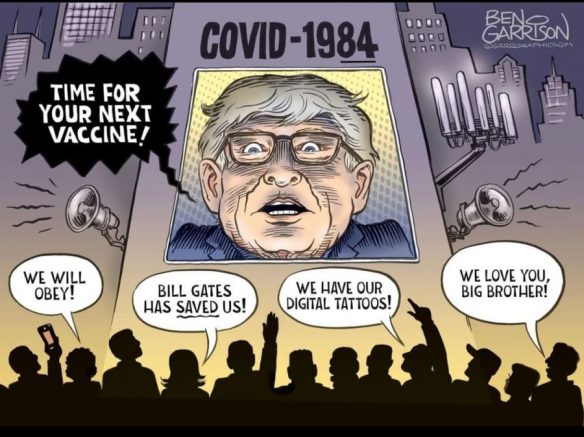
The Elite’s COVID-19 Coup to Destroy Humanity that is also Fast-Tracking Four Paths to Human Extinction

By Robert J. Burrowes

The global elite is conducting a coup that is designed to destroy all of the key elements of human society. It is doing this by destroying the essence of what it means to be human, by destroying the nature of existing human relationships, and by destroying the political, economic and social institutions of nation states.

Intentionally or otherwise, the elite coup is also fast-tracking four paths to human extinction.

If this coup succeeds, the human individual will have been reduced to a digitized identity who lives in a ‘techno tyranny’ serving the global elite or Homo Sapiens will be extinct. There is no third option unless we can defeat the coup and stop key structures and processes being put into place.

Do we have long? According to some scholars, as explained below, Homo Sapiens is already ‘functionally extinct’. If this is the case, only a monumental global effort can give us even a remote chance of surviving.

Sound implausible? Preposterous even? Let me offer you the evidence to support the scenario presented above with some brief reiteration to begin followed by more elaborate explanation of the paths to extinction.

And, if you are up for the fight to try to avert this outcome, I have outlined a range of options, designed to have strategic impact, for your involvement.

Destroying the Human Individual

Many authors have explained how vital rights and freedoms that our predecessors fought for decades or even centuries to win have been wiped away in one fell swoop by government responses to COVID-19 – for a summary, see ‘The Elite’s COVID-19 Coup Against a Terrified Humanity: Resisting Powerfully’ – and how, if it comes to pass, the compulsory vaccination along with the digital certificate that will go with it will leave us as nothing more than robotized organisms monitored and controlled by the elite’s agents.

For example, Robert F. Kennedy Jr has explained in ‘Gates’ Globalist Vaccine Agenda: A Win-Win for Pharma and Mandatory Vaccination’:

Vaccines, for Bill Gates, are a strategic philanthropy that feed his many vaccine-related businesses (including Microsoft’s ambition to control a global vaccination ID enterprise) and give him dictatorial control of global health policy.

Gates’ obsession with vaccines seems to be fueled by a conviction to save the world with technology.

Former World Bank economist Peter Koenig in The Farce and Diabolical Agenda of A “Universal Lockdown” identifies some parts of the program:

A massive vaccination program, probably through compulsory vaccination – Bill Gates’ dream and brainchild is vaccinating 7 billion people.

Massive population reduction, a eugenics plan – in part through vaccination and other means:… Bill Gates, ‘if we are doing a real good job vaccinating, we may reduce the world population by 10% to 15%’. See ‘Innovating to Zero!’….

An electronic ID for every person on the planet – in the form of a nano chip, possibly injected along with the mandatory vaccination. This nano-chip could be remotely uploaded with all personal data.

But even more importantly, in a recent article Professor Vandana Shiva evocatively explains why the world patent granted by the World Intellectual Property Organisation (WIPO) to Microsoft on 26 March 2020 titled ‘1. WO2020060606 – Cryptocurrency System Using Body Activity Data’, gives Microsoft (that is, Bill Gates) extraordinary power over our lives and is ‘robbing us of our deep humanity’. In essence:

‘The patent is dramatically changing the meaning of being human…. It is redefining us as ‘mines’ for data – robbing us of our autonomy, our sovereignty, and control over our bodies and minds…. It is erasing our humanity – as sovereign, living beings, spiritual, conscious, intelligent beings, making our decisions and choices with wisdom and ethical values about the impacts of our actions on the natural and social world of which we are a part; and to which we are inextricably related. We are being reduced to being ‘users’ of tasks assigned to us by the extractive digital mega machine. A ‘user’ is a consumer without choice in the digital empire. Human creativity and consciousness disappear in the world imagined in #patent060606.’ See ‘My Earth Journey in defence of Biodiversity, Life and Freedom over 5 decades’.

Destroying Human Society

Simultaneously with the destruction of the human individual, however, many authors have described how the nature of human relationships is being transformed and the political, economic and social structures and processes previously characteristic of national societies are being removed in favor of versions that enable a vastly greater degree of elite control.

Here is a sample of how astute authors describe what is happening politically, economically and/or socially based on the compelling evidence they provide.

Chris Hedges in ‘The Treason of the Ruling Class’:

The ruling elites no longer have legitimacy. They have destroyed our capitalist democracy and replaced it with a mafia state. What the Roman philosopher Cicero called a commonwealth, a res publica, a ‘public thing’ or the ‘property of a people,’ has been transformed into an instrument of naked pillage and repression on behalf of a global corporate oligarchy. We are serfs ruled by obscenely rich, omnipotent masters who loot the U.S. Treasury, pay little or no taxes and have perverted the judiciary, the media and the legislative branches of government to strip us of civil liberties and give them the freedom to commit financial fraud and theft.

Professor Michel Chossudovsky in ‘Global Capitalism, “World Government” and the Corona Crisis’:

The World is being misled concerning the causes and consequences of the corona crisis. The COVID-19 crisis… is being used as a pretext and a justification to triggering a Worldwide process of economic, social and political restructuring. Social engineering is being applied…. What is happening is unprecedented in World history.

A new stage in the evolution of global capitalism is unfolding…. National governments become subordinate to “Global Governance”. The Global Governance scenario imposes a totalitarian agenda of social engineering and economic compliance… It consists in scrapping ‘national autodetermination’ and constructing a Worldwide nexus of pro-US proxy regimes controlled by a ‘supranational sovereignty’ (World Government) composed of leading financial institutions, billionaires and their philanthropic foundations.

The crisis redefines the structure of the global economic landscape. Let’s be clear. This is an imperial agenda. What do the global financial elites want? To privatize the State? To own and privatize the entire planet?

Whitney Webb in Techno-Tyranny: How The US National Security State Is Using Coronavirus To Fulfill An Orwellian Vision examines a great deal of evidence to draw her conclusion:

Like major crises of the past, the national security state appears to be using the chaos and fear to promote and implement initiatives that would be normally rejected by [citizens] and, if history is any indicator, these new changes will remain long after the coronavirus crisis fades from the news cycle. It is essential that these so-called “solutions” be recognized for what they are and that we consider what type of world they will end up creating – an authoritarian technocracy.

And, since the brutal police killing of George Floyd in the United States on 25 May, US constitutional attorney and author of Battlefield America: The War On the American People, John W. Whitehead has warned in ‘This Is Not a Revolution. It’s a Blueprint for Locking Down the Nation’:

The looting, the burning, the rioting, the violence: this is an anti-revolution. The protesters are playing right into the government’s hands, because the powers-that-be want this. They want an excuse to lockdown the nation and throw the switch to all-out martial law. They want a reason to make the police state stronger. It’s happening faster than we can keep up.

Kurt Nimmo in his article George Floyd Endgame: Martial Law and a Police State: COVID was the first act’ notes that:

Rampaging ‘anarchists’ – many undoubtedly agent provocateurs – are not interested in justice, fairness, nonviolence, and peaceful dialogue. They are providing a pretext to usher in a fascist police state.

This state of affairs will be exploited to call for a clampdown on political dissent. COVID ‘contact tracing’ is now being used to track down activists and those associated with them. Facial recognition is used to find targeted individuals in crowds. From the start, I said this supposed public safety gimmick would be used to isolate and destroy peaceful activism. 

If the chaos continues, there will be citizen demands for law and order…. Officials will argue that the ongoing destruction and violence can only be contained by the military.

Moreover, as Shenali D. Waduge pointed out in her article ‘George Floyd Murder Enflames US. America Is a Failed State’:

The death has also brought to the focus and exposed the double standards of the UNHRC/international human rights organizations and other righteous mouthpieces who remain mum…. 5 days since the murder of George Floyd and not a single statement or condemnation by international entities.

Having noted the above however, it is worth pointing out that most of the people protesting the police murder of George Floyd have been nonviolent (about which I will write more below). But if you would like to better understand the psychology of racist violence, see ‘Why are all those Racists so Terrified?’ and for psychological insight into the pervasive police violence in the United States, see ‘Why are Police in the USA so Terrified?’

But while the global elite is intent on destroying us as individuals as well as destroying the societies in which we have lived, the coup has also accelerated each of the four primary paths to human extinction.

Fast-Tracking the Four Paths to Human Extinction

I have previously explained the four distinct paths to imminent human extinction (that is, within five years), making laughable the elite-driven narrative that we have until 2030 or even 2050 to avert it. I have also explained the three other possible paths to extinction in the near term, particularly when considered in conjunction with the four primary threats, as well as the path to extinction that looms before us when we consider the impact of all seven of these paths in combination with the vast range of other threats to Earth’s biosphere. See ‘Human Extinction Now Imminent and Inevitable? A Report on the State of Planet Earth’.

These interrelated threats have generated a shocking series of ‘points of no return’ (‘tipping points’) that we have already crossed, a mutually reinforcing set of negative feedback loops that we have already triggered (and which we will continue to trigger) which cannot be reversed in the short-term, as well as the ongoing synergistic impact of the various ‘extinction drivers’ (such as ongoing extinctions because dependent species have lost their resource species) we have set in motion and which cannot be halted irrespective of any remedial action we might take. Hence, taking into account all of the above factors, the prospects of averting human extinction are now remote, at best.

Given these ongoing threats, coupled with the latest threats to our essential humanity and political freedom posed by measures being taken during the elite coup, I have also explained the vital importance of defending our humanity and this political freedom from these latest threats if we are to have any prospect of even fighting for our own survival. See ‘The Elite’s COVID-19 Coup: Fighting for Our Humanity, Our Liberty and Our Future’.

In essence then, the elite coup being conducted under ‘cover’ of the fake virus known as COVID-19 – see ‘Unmasking the Lies Around COVID-19: Facts vs Fiction of the Coronavirus Pandemic’ – has not only facilitated a dramatic acceleration in the process of destroying what remains of the human individual and society, it has also fast-tracked each of the four primary paths to imminent human extinction. Let me briefly elaborate this and explain why it is happening.

Nuclear War

In his 2017 book The Doomsday Machine: Confessions of a Nuclear War Planner, former US nuclear war planner Daniel Ellsberg described the architecture of the nuclear doomsday machine. It is not just the horrifically destructive fission and fusion weapons but the entire framework of the arsenal, from fallible and institutionalized human beings in ‘command’ to antiquated computer systems built in the 1970s and 1980s with thousands of these weapons on hair-trigger alert.

The formal reason, which doesn’t account for the informal reasons such as luck or clear thinking in a panicked situation – see ‘“I was just doing my job”: Soviet officer who averted nuclear war dies at age 77’ – that these weapons have not been used is the nuclear arms control regime that was laboriously built during the Cold War but from which the US has progressively retreated, successively withdrawing from the Anti-Ballistic Missile (ABM) treaty in 2002, the Joint Comprehensive Plan of Action (the ‘Iran nuclear deal’) and the Intermediate Nuclear Forces (INF) Treaty (which limited the deployment of intermediate range nuclear weapons) in 2018.

The US government has also unilaterally signaled its intention to further dismantle treaties that contain the threat of nuclear war by acting in violation of the Outer Space Treaty of 1967 by establishing its ‘Space Force’ as a new branch of the US military – see ‘US Making Outer Space the Next Battle Zone – Karl Grossman’ – and demonstrating its disinterest in extending New START: the sole remaining restraint on U.S.-Russian nuclear arsenals that caps deployed offensive strategic nuclear weapons to no more than 1,550 each. See ‘Global Zero Urges Trump to Accept Putin’s Offer on Nuclear Treaty’.

Not content with progressively increasing the risk of nuclear war in recent years, the US government has used the COVID-19 coup as an opportunity to ‘sabre (that is, nuclear weapons) rattle’ with Russia and China by considering detonating a nuclear weapon, which would be the first such ‘test’ by the US since 1992. See Trump the Peace Candidate? This President Abhors International Treaties and ‘Trump apparently wants a nuclear test. It could be bad for your health’.

In another provocation, the US government has also announced it will withdraw from the Open Skies Treaty, signed in 1992. See ‘The Open Skies Treaty at a Glance’ and ‘Pompeo Announces Open Skies Withdrawal’.

And demonstrating it is not passive in response to these initiatives, the Russian government has declared it will now consider using nuclear weapons in response to a conventional attack in particular circumstances including a conventional strike targeting the nation’s critical government and military infrastructure. See ‘Russia OKs Use of Nukes in Response to Non-Nuclear Attacks’.

If you believe that nuclear war is ‘unthinkable’, earlier this year (and taking into account the climate catastrophe), the Bulletin of the Atomic Scientists moved their Doomsday Clock to 100 seconds to midnight, closer to midnight than it was even during the height of the Cold War. See ‘Closer than ever: It is 100 seconds to midnight’.

So three developments that elevate the risk of nuclear war that each took place with less scrutiny than might have occurred otherwise – the discussed detonation of a US nuclear weapon, US withdrawal from the Open Skies Treaty and the Russian decision to respond to a conventional attack on certain infrastructure with nuclear weapons – have all occurred under cover of the COVID-19 coup.

If you would like a reminder of the frequency with which we have already subjected Earth and its species to radioactive contamination by exploding nuclear weapons, watch Isao Hashimoto’s ‘A Time-Lapse Map of Every Nuclear Explosion Since 1945’.

Deployment of 5G

Also under cover of the COVID-19 coup, the extinction-threatening 5G is now being rapidly deployed in many parts of the world although there is considerable resistance to it by those who are aware of its dangers. This resistance ranges from nonviolent actions (starting with people giving up their mobile phones) to international appeals and legal challenges to its deployment.

If you are not familiar with the danger of microwave radiation to human and planetary health, you can read an explanation by Arthur Firstenberg in ‘Planetary Emergency’ or a more detailed explanation in his book The Invisible Rainbow: A History of Electricity and Life.

In brief, however: the global electrical circuit, which sustains all life, is now being seriously disturbed.

What is the global electrical circuit? How is it being disturbed? Here is a brief explanation:

The global electrical circuit flows through the earth, up to the sky in thunderstorms, through the ionosphere, and back down to earth through the atmosphere and through our bodies. See ‘Planetary Emergency’.

All animals and plants are polarized positive to negative from head to feet, or from leaves to roots. An electric current of picowatt per square meter amplitude flows from the positively charged sky to the negatively charged earth in fair weather, courses through the earth beneath our feet, and returns to the sky via lightning bolts during thunderstorms. Every living thing is part of this circuit. The current enters our heads from the sky, circulates through our meridians, and enters the earth through the soles of our feet. This current provides the energy for growth, healing, and life itself. We do not live by bread alone, but by the energy provided to us by the biosphere. Oriental medicine calls it qi or ki, Ayurvedic medicine calls it prana, and atmospheric physicists call it electricity. It provides us energy for life, and information that organizes our bodies. If you pollute this circuit with billions of digital pulsations, you will destroy all life. See ‘Putting the Earth Inside a High-Speed Computer’.

The strength of the atmospheric electrical current is between 1 and 10 picoamperes (trillionths of an ampere) per square meter. Dr. Robert Becker found that 1 picoampere is all the current that is necessary to stimulate healing in frogs…. It is these tiny currents that keep us alive and healthy. See ‘Planetary Emergency’.

Despite its enormous health hazards and implications for intrusive surveillance, which are extensively documented – for recent articles which also cite some of the wider evidence, see 5G: “The End of All Things”. The Health Impacts of Electromagnetic Radiation and How Big Wireless Lobbied Governments to Build 5G for Citizen Data Collection and Surveillance – the deployment of 5G has now started. For example, the Elon Musk corporation SpaceX has already launched 600 ‘first generation’ (‘Gen1’) satellites into Space and is planning to launch another 60 every two weeks into the ionosphere. Again: ‘The ionosphere is a source of high voltage that controls the global electric circuit, which in turn provides the energy for life.’ However, on 26 May 2020, SpaceX filed an application with the Federal Communications Commission in the United States for 30,000 ‘next-generation’ (‘Gen2’) satellites.

‘If and when Starlink signs up millions of paying customers, it is possible that nothing will survive – no humans, no animals, and no insects. It is likely that it will be blamed on COVID-19, unless this world wakes up in time.’

On 23 March 2020, the ‘Secure 5G and Beyond Act of 2020’ became law in the United States. See Secure 5G and Beyond Act of 2020. It’s purpose?

To require the President [within 180 days] to develop a strategy to ensure the security of next generation mobile telecommunications systems and infrastructure in the United States and to assist allies and strategic partners in maximizing the security of next generation mobile telecommunications systems, infrastructure, and software, and for other purposes.

Given the military and surveillance implications of 5G, if you think that governments are particularly concerned to investigate and consider the extensive evidence of the enormous hazards of 5G, you might find it sobering to read the dismissive three paragraphs given to the subject in the European Parliament’s official report on 5G. See 5G Deployment: State of Play in Europe, USA and Asia’.

Nevertheless, the resistance to 5G is rapidly gaining pace. For example, you can see a ‘List of Cities, Towns, Councils and Countries that have Banned 5G’.

And if you wish to join those resisting the deployment of 5G, options include signing the International Appeal: Stop 5G on Earth and in Space, supporting legal challenges such as this one in Denmark – see ‘State of Play and Danish Suing FiveG Network’ – and simply getting rid of your mobile (cell) phone. See ‘Cancel Your Cellphone Account Day, 20-21 June 2020’.

Biodiversity Collapse

In 2010, the secretary-general of the UN Convention on Biological Diversity, Ahmed Djoghlaf, noted that ‘What we are seeing today is a total disaster…. No country has met its targets to protect nature. We are losing biodiversity at an unprecedented rate.’ In the same year, the UN Environment Programme observed that ‘the Earth is in the midst of a mass extinction of life. Scientists estimate that 150-200 species of plant, insect, bird and mammal become extinct every 24 hours. This is nearly 1,000 times the “natural” or “background” rate.’ Moreover, according to many biologists, the extinction rate ‘is greater than anything the world has experienced since the vanishing of the dinosaurs nearly 65m years ago.’ See ‘Protect nature for world economic security, warns UN biodiversity chief’.

By 2017, Professor Gerardo Ceballos and his colleagues had extensively documented the ‘biological annihilation’ that humans were precipitating on Earth:

‘Earth’s sixth mass extinction is more severe than perceived when looking exclusively at species extinctions…. That conclusion is based on analyses of the numbers and degrees of range contraction … using a sample of 27,600 vertebrate species, and on a more detailed analysis documenting the population extinctions between 1900 and 2015 in 177 mammal species.

Their data revealed that ‘beyond global species extinctions Earth is experiencing a huge episode of population declines and extirpations, which will have negative cascading consequences on ecosystem functioning and services vital to sustaining civilization. We describe this as a “biological annihilation” to highlight the current magnitude of Earth’s ongoing sixth major extinction event.’ See ‘Biological annihilation via the ongoing sixth mass extinction signaled by vertebrate population losses and declines’.

However, in their latest paper Professor Ceballos and his colleagues provide further evidence of the ongoing biological annihilation and what it means for ecosystem functioning while documenting the complicating factors that have arisen during the COVID-19 crisis.

‘Even though only an estimated 2% of all of the species that ever lived are alive today, the absolute number of species is greater now than ever before. It was into such a biologically diverse world that we humans evolved, and such a world that we are destroying…. Millions of populations have vanished in the last 100 years…. The reason so many species are being pushed to extinction by anthropogenic causes is indicated by humans and their domesticated animals being some 30 times the living mass of all of the wild mammals that must compete with them for space and resources’. But, Dr Ceballos adds: ‘Many of the species endangered or at the brink of extinction are being decimated by the legal and illegal wildlife trade.’ See ‘Vertebrates on the brink’.

Of course, as has been extensively documented, while people in countries such as China, the United States and various European nations drive the demand for wildlife, it is filled by poverty-stricken people in Africa, Asia and Central/South America who capture wildlife to trade, eat or sell as bushmeat. And for those people for whom the COVID-19 crisis eliminated other economic survival options, capturing wildlife for trade or food was one backup survival option which simply accelerated the rush to extinction for some species.

You can watch a video of Professor Ceballos and read more about the extinction crisis at Stop Extinctions.

But, in essence, the only way to slow, and halt, the collapsing biodiversity on Earth is to substantially reduce our consumption so that the insects, animals, birds, fish, reptiles, amphibians and plants of planet Earth have the habitat they need to survive.

Climate Catastrophe

Given that Earth passed 2°C above the 1750 (preindustrial) baseline in February 2020 – see ‘Crossing the Paris Agreement thresholds’ and ‘2°C crossed’ – and that carbon dioxide emissions generate ‘maximum warming’ about one decade after the emission actually occurred – see ‘Maximum warming occurs about one decade after a carbon dioxide emission’ – ‘the full warming wrath of the carbon dioxide emissions over the past ten years is still to come’. See ‘2°C crossed’.

Moreover, given that the CO2 level in the atmosphere is already ‘higher than it has been for millions of years’ and temperatures are ‘rising at ever faster speed as the rise in greenhouse gas levels in the atmosphere is accelerating’ it is arguably the case that human beings are already ‘functionally extinct’, that is, they are ‘threatened to be wiped out by a catastrophe that appears to be both imminent and inescapable’. See ‘Arctic Ocean February 2020’.

However, while the global industrial shutdown has temporarily reduced emissions of carbon dioxide, methane and nitrous oxide, it has also significantly reduced the aerosol masking effect generated by burning fossil fuels as explained by Professor Guy McPherson in his recently-published paper ‘Will COVID-19 Trigger Extinction of All Life on Earth?’

Coincident with industrial activity adding to greenhouse gases that warm the planet, industrial activity simultaneously cools the planet by adding aerosols to the atmosphere. These aerosols block incoming sunlight, thereby keeping cool our pale blue dot. Reducing industrial activity by as little as 35 percent is expected to cause a global-average temperature rise of 1 degree Celsius within a few weeks, according to research on the aerosol masking effect…. The ongoing reduction in industrial activity as a result of COVID-19 almost certainly leads to loss of habitat for human animals, hence putting us on the fast track to human extinction.

Even worse, as Professor McPherson notes in a subsequent paper, because there is ‘no known means to rapidly stabilize or cool the temperature of Earth… [and] temperatures lethal for humans already have been reported, despite climate-change models indicating that such an event would not occur until the middle of the current century’ – see ‘The emergence of heat and humidity too severe for human tolerance’ – and because even the slow rate of temperature rise assumed by the Intergovernmental Panel on Climate Change (IPCC) outstrips the adaptive response of vertebrates by a factor of 10,000 times meaning that ‘mammals cannot evolve rapidly enough to escape the current extinction crisis’, the ‘reduction in industrial activity that resulted from the ongoing pandemic might have already reduced the aerosol masking effect sufficiently to trigger a 1 C spike in global-average temperature’ thus triggering ‘the rapid extinction of all life on Earth’. See ‘Earth is in the Midst of Abrupt, Irreversible Climate Change’.

In plain English, human extinction – and possibly the extinction of all life on Earth – might already be guaranteed.

How has this all happened?

‘How has this all happened?’ you might ask. And, unfortunately, the answer is ‘All too simply’. With an insane global elite and a human population that is, on the whole, fearfully and submissively obedient, there hasn’t even been a real fight. Hence, the global elite’s insane and longstanding conspiracy to take much greater control of our lives proceeds apace while driving us all to the brink of extinction in the process.

If you would like to read more about the origin of the fearful obedience of most humans, see ‘The Elite’s COVID-19 Coup: Fighting for Our Humanity, Our Liberty and Our Future’.

And if you would like to better understand the origin, identity and insane behaviour of the global elite, see the section headed ‘How the World Works’ in ‘Why Activists Fail’ as well as the articles ‘Exposing the Giants: The Global Power Elite’ and ‘The Global Elite is Insane Revisited’ along with the many references cited in these documents. For a deeper understanding of why elite and other human violence is so pervasive, see Why Violence?’ and Fearless Psychology and Fearful Psychology: Principles and Practice.

So what can we do about all of this?

A Nonviolent Strategy to Fight for our Humanity, Liberty and Future

Many people, including authors cited above, have decried the violence by some that has broken out in response to the police murder of African-American George Floyd (by a white policeman who has killed and gone unpunished before: see ‘As Chief Prosecutor, Klobuchar Declined to Bring Charges Against Cop that Killed George Floyd’) and which has captured most corporate media attention.

Of course, a considerable amount of this violence (both against people and property) is initiated by police and their provocateurs to discredit those people peacefully protesting against Floyd’s murder. For a thorough and documented report, see ‘Agent Provocateurs: Police at Protests All Over the Country Caught Destroying Property’.

As another commentator noted in relation to the United States: ‘It came as no surprise that local and state officials across the US reacted to largely peaceful, spontaneous mass protests against police brutality and racism by unleashing a maelstrom of militarized police violence. For a generation, the Federal government has been quietly gifting huge stocks of surplus military equipment, including tanks, to local police forces and sheriff’s offices eager to play with lethal new toys designed for counter-insurgency.’ See ‘Ten Days that May Have Changed the World’.

But some of the violence is also being instigated by those associated with groups that have a very different agenda. These range from white racist groups – see ‘Far-Right Infiltrators and Agitators in George Floyd Protests: Indicators of White Supremacists’ – to antifascist groups like Antifa – see ‘What is Antifa?’ – who, as explained above and also pointed out by Timothy Alexander Guzman, ‘has given more ammunition for the establishment to enforce a total police state.’ See ‘US Police Forces Are Trained by Israel: The Knee-On-Neck Tactic That Was Used On George Floyd Is The Same Tactic That Has Been Used on the Palestinians’.

However, whatever the political motivation for their violence, none of these racist or antifascist groups has a coherent analysis or strategy for worthwhile fundamental change in society and can only provoke a response from authorities that would achieve the opposite of what they want, whether it be an authoritarian technocracy, police state or martial law. See ‘War on Antifa: As Trump vows to declare it a “Terrorist Group”, AG Barr equates rioting to domestic terrorism’.

Moreover, we would be unwise to attribute much credit to those former and serving US military leaders, including the current Chairman of the Joint Chiefs of Staff, who are speaking in defense of ‘the right to freedom of speech and peaceful assembly’. See ‘Message to the Joint Force [re George Floyd protests]’. When it really matters, however, it is highly likely that virtually all senior military personnel will be called into line and it will depend largely on those in lower ranks to find the conscience and courage to resist their superiors in trying to contain resistance to the coup.

So if we are going to use this crisis, in all of its dimensions, as an opportunity to fight for our individuality, our society and our future, then we are going to need to do some things very differently and do them in a way that makes a strategic difference. Otherwise, we have a very bleak future or none at all.

Depending on your interests and circumstances, here is a range of suggestions that will each make an important difference.

If you wish to address your own emotional health issues preceding or arising from the COVID-19 coup and to become more powerful in the process, consider Putting Feelings First’. If you wish to support others, including children, to become more powerful, see ‘Nisteling: The Art of Deep Listening’.

Vitally importantly, you might also like to consider making ‘My Promise to Children’ which will include considering what an education for your children means to you, particularly if you want powerful individuals who can stand up to the violence being inflicted on us at the moment. See ‘Do We Want School or Education?’

In relation to the coup itself, I have identified the appropriate political purpose – obviously ‘To defend humanity against a political/military coup conducted by the global elite’ – and set out a basic list of (now) 28 strategic goals for achieving this purpose (which will also play a vital role in tackling key threats to human survival). The first thirteen of these strategic goals are as follows (and you are welcome to consider those you will do yourself and how you, either as an individual or part of a group, might help to mobilize others to do so too):

(1) To cause people and groups all around the world to join the resistance strategy by wearing a global symbol of human solidarity, such as an image of several people of different genders/races/religions/abilities/classes holding hands.

(2) To cause people and groups all around the world to join the resistance strategy by boycotting all corporate media outlets (television, radio, newspapers, Google, Facebook, Twitter…) and by seeking news from progressive news outlets committed to telling the truth.

(3) To cause people and groups all around the world to join the resistance strategy by refusing to download the COVID-19 ‘contact tracing’ surveillance app.

(4) To cause people and groups all around the world to join the resistance strategy by ending their ownership and use of a mobile (cell) phone. See ‘EchoEarth: End Cell Phones on Earth’ and ‘Cancel Your Cellphone Account Day, 20-21 June 2020’.

(5) To cause people and groups all around the world to join the resistance strategy by withdrawing all funds from the corporate banks and depositing their money in local community banks or credit unions.

(6) To cause people and groups all around the world to join the resistance strategy by boycotting the medical and pharmaceutical industries – including by conscientiously refusing to submit to vaccination – and by seeking health advice and treatment from natural therapists. (If you are unfamiliar with the different philosophies underpinning these approaches, and hence why many natural therapies are so much more effective, there is a straightforward explanation here: ‘Pasteur vs. Bechamp: An Alternative View of Infectious Disease’.)

(7) To cause people and groups all around the world to join the resistance strategy by boycotting corporate supermarkets and by supporting small and family businesses, and local markets.

(8) To cause people and groups all around the world to join the resistance strategy by participating in other locally relevant nonviolent action(s)/campaign(s) and/or constructive program activities. For this item and many subsequent, see the list of possible nonviolent actions in the document ‘198 Tactics of Nonviolent Action’.

(9) To cause the workers [in trade unions or labor organizations T1, T2, T…] all around the world to join the resistance strategy by participating in locally relevant nonviolent action(s)/campaign(s) and/or constructive program activities. For example, this might include withdrawing labor from an elite-controlled bank, media, pharmaceutical or other corporation operating in your country.

(10) To cause the small farmers and farmworkers [in organizations F1, F2, F…] all around the world to join the resistance strategy by participating in locally relevant nonviolent action(s)/campaign(s) and/or constructive program activities. For example, this might include distributing farm produce through (existing or created) grassroots networks to small and family businesses as well as local markets rather than through corporate supply chains.

(11) To cause the indigenous peoples [in organizations IP1,IP2, IP…] all around the world to join the resistance strategy by participating in locally relevant nonviolent action(s)/campaign(s) and/or constructive program activities. For example, this might include utilizing indigenous knowledge to improve local self-reliance in food production and in other ways.

(12) To cause the soldiers and military police [in army units AU1, AU2, AU… and MP1, MP2, MP…], wherever stationed around the world, to refuse to obey orders from the global elite and its agents to arrest, assault, torture and shoot nonviolent activists and the other citizens of [your country].

(13) To cause the police [in police units P1, P2, P…], wherever stationed around the world, to refuse to obey orders from the global elite and its agents to arrest, assault, torture and shoot nonviolent activists and the other citizens of [your country].

You can read all 28 of the ‘Strategic goals for defeating a political/military coup conducted by the global elite against humanity’ by scrolling down the page at ‘Strategic Aims.

Remaining pages on the website fully explain the twelve components of the strategy, as illustrated by the Nonviolent Strategy Wheel, as well as articles and videos explaining all of the vital points of strategy and tactics, such as those to help you understand ‘Nonviolent Action: Why and How it Works’.

Given the complexity of the configuration of this conflict, however, which involves the need to fight simultaneously to retain our ‘deep humanity’, defeat the elite coup and avert near-term human extinction, it is important that our tactical choices are strategically-oriented (as the examples I cite in the thirteen strategic goals above illustrate). Hence, three further considerations assume importance.

First, choose/design tactics that have strategic impact, that is, they fundamentally and permanently alter, in our favor, the power relationship between the elite and us.

Second, when tactical choices are made, focus them on undermining the elite coup, not just features of it, such as ‘social distancing’ or the lockdowns. At its most basic, this can be achieved by using tactical choices that mobilize people to act initially, as is happening, but then inviting them to consider taking further, more focused, action as well (such as those nominated in the 28 strategic goals listed or referenced above). This is important because existing actions will have little impact on key underlying measures, such as those being taken by the elite to advance the fourth industrial revolution, which includes reducing us to a ‘digital identity’.

Third, choose/design tactics that also have strategic impact on the greatest threats to human survival, including the collapsing biodiversity on Earth, the threat of nuclear war, the climate catastrophe and the deployment of 5G. Given the incredibly short timeframe in which we are now working to avert human extinction, while people are mobilizing it is important to use this opportunity to give them the chance to perceive the ‘big picture’ of what is taking place – beyond lockdowns and other measures supposedly being used to tackle COVID-19 – and to act powerfully in response.

Equally importantly, the Nonviolent Strategy website explains how to prepare, frame and conduct any nonviolent action to minimize the risk of violent repression and to contain any risk of damage to our cause by association with, or disruption by, those groups and provocateurs with a very different and possibly violent agenda. See ‘Nonviolent Action: Minimizing the Risk of Violent Repression’.

Fortunately, as more people become aware of the deeper strands of what is taking place, the energy to break the lockdowns and resist the coup will gather pace. As I have previously outlined, using a locally relevant focus, or perhaps several, for which many people would traditionally be together – a cultural, religious or sporting event, a community activity such as working to establish a community garden to increase local self-reliance, a birthday celebration and/or a return to work – we can mobilize people to collectively resist.

In addition, as I mentioned above, given the pressing (and, possibly, now uncontainable) threat of human extinction but also because becoming more self-reliant is vital to our ongoing capacity to resist elite encroachments on our rights, freedom and economic security, consider accelerated participation in The Flame Tree Project to Save Life on Earth.

And for those nonviolent activists concerned about preventing nuclear war, stopping the deployment of 5G, halting the collapse of biodiversity or the climate catastrophe, and ending other threats to human survival – including those in relation to the environment and war – you can read about nonviolent strategy, including strategic goals to focus your campaigns, from here: Strategic Aims.

Or, for those who want something simpler, consider committing to:

The Earth Pledge

Out of love for the Earth and all of its creatures, and my respect for their needs, from this day onwards I pledge that:

  1. I will listen deeply to children. See ‘Nisteling: The Art of Deep Listening’.
  2. I will not travel by plane
  3. I will not travel by car
  4. I will not eat meat and fish
  5. I will only eat organically/biodynamically grown food
  6. I will minimize the amount of fresh water I use, including by minimizing my ownership and use of electronic devices
  7. I will not own or use a mobile (cell) phone
  8. I will not buy rainforest timber
  9. I will not buy or use single-use plastic, such as bags, bottles, containers, cups and straws
  10. I will not use banks, superannuation (pension) funds or insurance companies that provide any service to corporations involved in fossil fuels, nuclear power and/or weapons
  11. I will not accept employment from, or invest in, any organization that supports or participates in the exploitation of fellow human beings or profits from killing and/or destruction of the biosphere
  12. I will not get news from the corporate media (mainstream newspapers, television, radio, Google, Facebook, Twitter…)
  13. I will make the effort to learn a skill, such as food gardening or sewing, that makes me more self-reliant
  14. I will gently encourage my family and friends to consider signing this pledge.

Conclusion

Some people will no doubt shy away from the analysis above. To those unfamiliar with elite politics, it might indeed sound preposterous. Surely, some might think, this is a ‘conspiracy theory’.

And you are right. See ‘In defence of conspiracy theories (and why the term is a misnomer)’.

This is because the evidence that there is a great deal wrong with the world, and that a select group of people, some identifiable, some less easily so, have orchestrated these events over an extended period of time is overwhelming. Even if the emotional and behavioural dysfunctionalities of most people have made it easy for them.

So I encourage you to have a ponder. There is a great deal at stake at this time. A human future, no less.


Biodata: Robert J. Burrowes has a lifetime commitment to understanding and ending human violence. He has done extensive research since 1966 in an effort to understand why human beings are violent and has been a nonviolent activist since 1981. He is the author of Why Violence? His email address is flametree@riseup.net and his website is here.


Our Vanishing World: Oceans

By Robert J. Burrowes

As the human onslaught against life on Earth accelerates, no part of the biosphere is left pristine. The simple act of consuming more than we actually need drives the world’s governments and corporations to endlessly destroy more and more of the Earth to extract the resources necessary to satisfy our insatiable desires. In fact, an initiative of the World Economic Forum has just reported that ‘For the first time in history, more than 100 billion tonnes of materials are entering the global economy every year’ – see ‘The Circularity Gap Report 2020’ – which means that, on average, every person on Earth uses more than 13 tonnes of materials each year extracted from the Earth.

As I have explained elsewhere, however, the psychological damage we have all suffered, which leaves us with unmet but critically important emotional needs (and, in many cases, the sense that our lives are meaningless), cannot be rectified by material consumption. Despite this, most of us will spend our lives engaged in a futile attempt to fill the aching void in our psyche by consuming and accumulating, at staggering cost to the Earth. Identifying when we have ‘enough’ is a capacity that most modern humans have never acquired for reasons that can be easily explained. See ‘Love Denied: The Psychology of Materialism, Violence and War’.

Hence, our world continues to vanish, as has been extensively documented. For a summary, see ‘Human Extinction Now Imminent and Inevitable? A Report on the State of Planet Earth’.

And nowhere is this more evident than in the planet’s oceans, which are being systematically destroyed and where life is being progressively extinguished.

In fact, our destruction of the oceans is now so advanced that the fish, mammals (including seals, whales, manatees, sea otters and polar bears), crustaceans (including crabs, lobsters, crayfish, shrimps, prawns, krill and barnacles), coral reefs (made up of coral polyps, marine invertebrate animals that live in colonies) and the millions of species that live in and around them (including sponges, mollusks, sea anemones, seahorses, sea turtles as well as crustaceans and an enormous variety of fish), plants (such as algae, seaweed and seagrass), microscopic organisms (residing in the ocean and on the ocean floor), invertebrates (such as sea urchins and sea slugs), birds (including better known ones such as penguins, auks, murres, razorbills, puffins, tubenoses – such as the albatross and petrels – pelicans and gulls and a great many species that are less well known), and the other lifeforms that live in and on the ocean are vanishing rapidly.

Starkly illustrating the catastrophic nature of what is taking place, one recent incident alone killed 100 million Pacific cod. See ‘Ocean heat waves like the Pacific’s deadly “Blob” could become the new normal’. But, tragically, such incidents are no longer unusual and, of course, they generate cascading impacts. See, for example, ‘Fish all gone!… Millions of small sea birds died since 2015’.

‘How can we destroy the oceans?’ you might ask. Unfortunately, far too easily when you consider the range of assaults to which they are being subjected.

So let me give you a brief 18-point outline of what we are doing that is destroying the oceans – where life on Earth originated and which remains the planet’s main life support system by dominating the processes that keep our planet habitable such as regulating the climate by absorbing excess carbon dioxide and heat – while also giving you some idea of the impacts of this on the creatures that live in and on the oceans.

As a result of human activities that generate carbon emissions, we are dumping ever-increasing amounts of carbon dioxide into the oceans which have absorbed 20–30% of total anthropogenic emissions in the last two decades. This is causing the oceans to warm, acidify and lose oxygen, among several other adverse outcomes. See ‘The Ocean and Cryosphere in a Changing Climate: A Special Report of the Intergovernmental Panel on Climate Change’. p. 450. These adverse changes, in turn, generate a range of ‘downstream’ negative impacts. However, there are other human activities unrelated to carbon emissions that are destroying the oceans too.

So here is the summary.


  1. The oceans are warming.

In relation to warming, the oceans have been heating up for several decades and, since 2005, the increase has been unchecked. Moreover, it is occurring at all ocean depths, including in the deep ocean (below 2,000 metres). In addition, the rate of warming has been increasing and the rate of ocean uptake of atmospheric CO2 has continued to strengthen in the last two decades in response to the increasing concentration of CO2 in the atmosphere. This is causing the upper ocean to stratify making the surface ocean less dense over time, compared to the deeper ocean, and inhibiting the exchange between surface and deep waters.

As one result of this ocean warming, the range of some species has expanded and, in the case of tropical species that have expanded into higher latitudes, it has led to increased grazing on some coral reefs, rocky reefs, seagrass meadows and epipelagic (near-surface) ecosystems, leading to altered ecosystem structure.

Ocean warming has also contributed to changes in the biogeography of organisms ranging from phytoplankton to marine mammals, consequently changing community composition, and in some cases, altering interactions between organisms. The net outcome is an adverse impact on marine organisms and fisheries with serious implications for human communities and food production.

Ocean warming is also manifesting in a range of diverse and unpredicted ways with one of the more catastrophic aberrations, touched on above, being the occurrence of ‘blobs’: huge patches of unusually warm ocean water that can be millions of square kilometres in size. These ‘marine heatwaves’ wreak havoc, sometimes killing millions of ocean creatures in a single incident (including by disturbing food chains), forcing others to relocate, and perhaps generating unusual blooms of toxic algae. See ‘Ocean heat waves like the Pacific’s deadly “Blob” could become the new normal’.

Among its other impacts, the warming oceans mean there is more available energy that can be converted into cyclonic winds. Research on this subject indicates that there has been ‘an increase in intense hurricane activity over the past 40 years’. See ‘Hurricanes and Climate Change’ and Changes in Tropical Cyclone Number, Duration, and Intensity in a Warming Environment. These events cause landslides, collapses in fisheries, and damage to reefs and shallow-water habitats. When they impact on coastal communities, they kill people and destroy properties, among other outcomes. See ‘The state of our oceans – The damaging effects of ocean pollution’.

Warming oceans also cause coral bleaching. This is because corals have algae that live in their tissues and these algae provide the coral with essential nutrients and give them their color. The warming oceans cause this relationship to become stressed, forcing the algae out of the coral. As a result, the coral becomes white, loses its main food source, and becomes more vulnerable to disease. See ‘Coral Bleaching’.

Warmer ocean water causes sea level rise too because warmer water has a greater volume than colder water. Of course, sea level rise also occurs because of the additional water from melting land ice and a devastating level of rise from this cause is already ‘locked in’ because of past emissions. See ‘Sea Level Rise!’

Ocean warming and increased stratification disturb ocean nutrient cycles and this is having a regionally variable (but usually adverse) impact on many species too.

And finally, ocean warming – most likely from ice loss in the Arctic – is weakening the Atlantic Meridional Overturning Circulation (AMOC) which is one of the key drivers of global ocean circulation; it includes the Gulf Stream that transports warm and salty tropical waters north to the western coasts of Europe where the warm water releases heat to the atmosphere, playing a key role in the warming of western Europe and thus its functional habitability. Once the tropical water reaches the south and east of Greenland, it cools before sinking to the base of the North Atlantic Ocean because it is saltier and thus denser than the surrounding fresh water. The water is then pushed south along the abyss of the Atlantic Ocean completing what has been, from a human viewpoint, a perpetual cycle. See Arctic sea-ice decline weakens the Atlantic Meridional Overturning Circulation and Global Ocean Circulation Appears To Be Collapsing Due To A Warming Planet’. How much longer it will be so appears to defy reliable scientific assessment. But as it breaks down, the adverse outcomes multiply rapidly.

In fact, ocean circulation generally is being impacted by the warming climate, as established by a recently concluded study:

Ocean circulation plays a vital role in regulating the weather and climate and supporting marine life…. Here, we show for the first time, independent satellite observational evidence demonstrating that the large-scale ocean gyres are moving poleward during the past four decades. Further analysis based on climate models and various other data sets reveal that the poleward shifting of the ocean gyre circulation is most likely to be a consequence of global warming, which so far has not been well recognized by the public and the scientific community…. Such changes have had disastrous consequences…. See Poleward shift of the major ocean gyres detected in a warming climate.


  1. The oceans are becoming more acidic.

In response to the increasing carbon uptake the oceans are also becoming more acidic. This has probably been the case for three-quarters of the near-surface open ocean since prior to 1950 and it is very likely that over 95% of the near surface open ocean has now been affected. See ‘The Ocean and Cryosphere in a Changing Climate: A Special Report of the Intergovernmental Panel on Climate Change’. p. 450.

In a stark warning issued by the International Programme on the State of the Ocean (IPSO) in 2013, scientists had already noted that the oceans are becoming more acidic at the fastest rate in 300m years. Why? Because of carbon dioxide emissions from burning fossil fuels. ‘This [acidification] is unprecedented in the Earth’s known history. We are entering an unknown territory of marine ecosystem change, and exposing organisms to intolerable evolutionary pressure. The next mass extinction may have already begun.’ See ‘Rate of ocean acidification due to carbon emissions is at highest for 300m years’.

In its latest report, issued in 2018, IPSO declared the following: ‘The ocean, by its breadth and depth, occupies more than 97% of the living space on Earth. It dominates the processes that keep our planet habitable…. But this protection comes at a cost as the ocean is now becoming more acidic…. For too long we have mistaken the immensity of the ocean for inviolability, but those days are gone, and we stand at a critical juncture. Cutting emissions, while essential, will not alone solve the environmental problems we face.’ See ‘Eight urgent fundamental and simultaneous steps needed to restore ocean health, and the consequences for humanity and the planet of inaction or delay’.


  1. The oceans are deoxygenating.

Oxygen in the air or water is of paramount importance to most living organisms. Unfortunately, as a recent report documents in considerable detail (and which confirms earlier research), oxygen levels are currently declining across the ocean (and not just in the more widely known ocean ‘dead zones’: see below). See ‘Ocean deoxygenation: Everyone’s problem. Causes, impacts, consequences and solutions’.

Deoxygenation of the ocean is the result of two overlying causes – eutrophication (the process by which a body of water becomes overly enriched with minerals and nutrients thus inducing excessive growth of algae which absorb the oxygen at the expense of the water body) as a result of nutrient run-off from land and deposition of nitrogen from the burning of fossil fuels, as well as the heating of ocean waters as another outcome of burning fossil fuels, primarily causing a change in ventilation with the overlying atmosphere so that the oceans hold less soluble oxygen (and which is compounded by reduced ocean mixing and changes in currents and wind patterns). Ocean deoxygenation is but the latest consequence of our activities on the ocean to be recognized and is yet another ‘major stressor’ on marine systems.

Eutrophication has been identified as a problem in 900 separate areas of the ocean, with 700 of these suffering hypoxia (low oxygen) as a result. But because ocean warming lowers oxygen directly, it is now impacting vast areas of the ocean as well. As a result, ‘the ocean has now become a source of oxygen for the atmosphere even though its oxygen inventory is only about 0.6% of that of the atmosphere’. Moreover, different analyses have concluded that global ocean oxygen content has decreased by 1-2 % since the middle of the 20th century. Given existing trends in the factors driving this change, the rate of loss must accelerate.

Obviously, the future intensification and expansion of low oxygen zones will have further adverse ecosystem and biogeochemical consequences, particularly in combination with, and sometimes synergistically with, other threats. For example, ‘ocean warming accompanied by deoxygenation will drive habitat contraction and fragmentation in regions where oxygen levels decline below metabolic requirements’.


  1. The oceans are being contaminated with nuclear radiation.

Despite an extensive and ongoing coverup by the Japanese government and nuclear corporations as well as the International Atomic Energy Agency (IAEA), vast amounts of radioactive waste are being dumped into the biosphere from the TEPCO nuclear power plant at Fukushima in Japan including by discharge into the Pacific Ocean. This is killing an incalculable number of fish and other marine organisms and indefinitely contaminating expanding areas of that ocean. See ‘Fukushima: A Nuclear War without a War: The Unspoken Crisis of Worldwide Nuclear Radiation’, ‘2019 Annual Report – Fukushima 8th Anniversary’, ‘Eight years after triple nuclear meltdown, Fukushima No. 1’s water woes show no signs of ebbing’ and ‘Fukushima’s Three Nuclear Meltdowns Are “Under Control” – That’s a Lie’.

In addition, one critical legacy of the US military’s 67 secretive and lethal nuclear weapons tests on the Marshall Islands between 1946 and 1958 is the ‘eternally’ radioactive garbage left behind and now leaking into the Pacific Ocean. See ‘The Pentagon’s Disastrous Radioactive Waste Dump in the Drowning Marshall Islands is Leaking into the Pacific Ocean’.

And, of course, there are up to 70 ‘still functional’ nuclear weapons as well as nine nuclear reactors lying on the ocean floor as a result of accidents involving nuclear warships and submarines. These are leaking an unknown amount of radiation into the oceans. See ‘Naval Nuclear Accidents: The Secret Story’, ‘A Nuclear Needle in a Haystack: The Cold War’s Missing Atom Bombs’ and, for one specific example (the former Soviet submarine Komsomolets), see ‘Soviet nuclear submarine emitting radiation “100,000 times normal level” into sea, scientists find’.


  1. The oceans are being contaminated as a result of offshore oil and gas drilling, as well as oil spills.

The complex but far-from-perfect technologies and the many environmental challenges associated with oil and gas drilling in the ocean have ensured the near-routine occurrence of often disastrous accidents which invariably lead to fossil fuels and other contaminants being discharged into the ocean, sometimes on a vast scale.

The classic case, of course, was the BP-leased Deepwater Horizon rig which had drilled a well to 35,055 feet (10 kilometers) while operating in 4,130 feet (1 kilometer) of water. The oil rig exploded and sank in the Gulf of Mexico on 20 April 2010 releasing 5 million barrels of oil into the ocean making it the worst environmental disaster in US history. It caused extensive damage to the ocean, corals and beaches and killed millions of fish, birds and marine mammals in and on the ocean. Despite a ‘clean up’, only one quarter of the oil was ever removed from the ocean. See ‘The Dangers of Offshore Drilling’.

The simple reality is that despite the industry’s safety claims, oil rig fires are commonplace. See ‘Why Is Offshore Drilling So Dangerous?’

And so are oil spills into the ocean for other reasons, including from tankers – see ‘Top 10 Worst Oil Spills’ – as the Exxon Valdez disaster in 1989 demonstrated all too graphically. See ‘The Complete Story of the Exxon Valdez Oil Spill’.

Often enough as well, oil is discharged into the ocean as a result of military activities and war. During the Gulf War in 1991, for example, vast quantities of oil were released into the Persian Gulf as a military tactic. See ‘The World’s Largest Oil Spill: The Gulf War Kuwait, 1991’ and Gulf War Oil Disaster: A Brief History’.


  1. The oceans are being damaged by deep sea mining.

Recent technological advances spurred by growing demand for minerals used in consumer electronics has led to increased interest in deep sea mining as the next frontier in resource extraction. Hailed as the new ‘global gold rush’, deep sea mining entails extracting minerals from deposits in the deep sea (approximately 400 to 6,000 meters below sea level) for use in emerging and high technology, among other sectors. Predictably, deep sea mining shares many features with past resource scrambles, including a general disregard for environmental and social impacts, and the marginalization of indigenous peoples and their rights. See ‘Broadening Common Heritage: Addressing Gaps in the Deep Sea Mining Regulatory Regime’ and ‘Deep-sea mining possibly as damaging as land mining, lawyers say’.

Beyond these adverse impacts, however, recent research makes it increasingly clear that deep sea mining poses a grave threat to vital seabed functions, including those played by hydrothermal vents and cold seeps, for example, which support remarkable biodiversity and sequester disproportionate amounts of carbon. Moreover, recent scientific breakthroughs have further revealed that most of the excess heat resulting from increased atmospheric concentrations of greenhouse gases has been absorbed by the deep ocean, thereby significantly limiting the climate catastrophe’s impacts on the ocean’s surface and on land. See ‘Deep sea ecology: hydrothermal vents and cold seeps’ and ‘Broadening Common Heritage: Addressing Gaps in the Deep Sea Mining Regulatory Regime’.

In essence, deep sea mining threatens the ‘common heritage’ the seabed provides through its substantial contributions to biodiversity, climate regulation and heat storage.


  1. The oceans are being polluted with industrial (including chemical) and farming wastes including pesticides and fertilizers which are generating ‘dead zones’, regions of the oceans that are devoid of life.

Despite the existence of the ‘Convention on the Prevention of Marine Pollution by Dumping of Wastes and other Matter’ (otherwise known as the London Dumping Convention, 1972), an international treaty ‘that created a global system to protect the marine environment from pollution caused by ocean dumping’ – and certainly including radioactive wastes, fossil fuels, some toxic wastes, biological and chemical warfare agents, and persistent synthetic materials such as plastic – and supposedly ‘ensures that the few materials that are permitted for ocean disposal are carefully evaluated to make sure that they will not pose a danger to human health or the environment’ – see ‘1972 Prevention of Marine Pollution by Dumping of Wastes and Other Matter (London Convention)’ – the Convention must be one of the least comprehensive and most violated in international law. In any case, there is no evidence that it has any restraining impact on the actions of states or corporations as the evidence above and below demonstrates.

For example, a vast runoff of industrial wastes (including heavy metals), agricultural poisons, fossil fuels and other wastes is discharged into the ocean, adversely impacting life at all ocean depths – see ‘Staggering level of toxic chemicals found in creatures at the bottom of the sea, scientists say’ – and, as noted above, generating ocean ‘dead zones’ (of which there are many hundred): regions that have too little oxygen to support marine organisms. See ‘Ocean Dead Zones Are Getting Worse Globally Due to Climate Change’ and ‘Ocean “dead zones” are spreading – and that spells disaster for fish’.


  1. The oceans are being polluted by nitrogen.

While nitrogen is vital to the health of the ocean, like everything else that makes up the ocean, it must be in balance, not fluctuating beyond very narrow parameters. See ‘Understanding nitrogen’s role in the ocean’.

But it is now well past the point when this state has been the case.

This is because nitrogen is one important element of the industrial and agricultural pollution just mentioned. It is the nitrogen component in the runoffs of these wastes (such as fertilizers and sewage) into the ocean that causes harmful algal blooms, eutrophication and ocean dead zones (hypoxia) while making marine life more vulnerable to disease, reducing biodiversity in shallow estuarine waters, degrading ocean ecosystems and contributing to global warming. ‘Algal blooms deplete dissolved oxygen, causing marine wildlife to suffer and become more vulnerable to toxins and disease. Nitrogen in the blooms also produces nitrous oxide (N20), a greenhouse gas far more potent than carbon dioxide. This contributes to global warming, which further degrades oceans by increasing acidity in the water as the oceans absorb more and more carbon.’ See ‘Stop Nitrogen Pollution of Oceans – Green Algal Slime Busters’.


  1. The oceans are being polluted with discharges from warships, commercial shipping and cruise ships: bilge water, ballast water, sewage, graywater and general rubbish.

Despite the 1973 International Convention for the Prevention of Pollution from Ships, known as the MARPOL Convention, which has been routinely added to over subsequent years and gives the impression of being comprehensive, there is obviously little interest in abiding by the terms of the Convention and little evidence that most ship crews do so. Moreover, given that many provisions of the Convention focus on minimizing discharges within 12 nautical miles of land, that leaves a great deal of ocean into which such discharges can be done legally even if disposal of plastics beyond the 12 mile limit remains illegal.

In addition, while the MARPOL Convention was theoretically designed to minimize releases by both operational and accidental causes, laws do not prevent accidents as the long list of oil tanker accidents, touched on above, such as that of the Odyssey in 1988, the Exxon Valdez in 1989 and the Haven in 1991, resulting in massive oil discharges into the ocean reminds us. See, for example, ‘Top 10 Worst Oil Spills’.

But the law is violated deliberately in any case. Bilge water – a filthy, oily mess of fresh water, seawater, chemicals, oil, sludge, and other fluids from a ship – is found at the very bottom of the ship where the two sides of the hull meet. Seawater is pumped into large ships to cool their engines and as the water moves through the cooling system it picks up loose oil and waste from the engine and this, together with oil drips from the pipes and machinery fittings, ends up in the bilge well of the ship. See ‘What is Bilge Water?’

However, despite the MARPOL Convention, across the world many oceangoing vessels break these international laws and empty their untreated bilge water into the ocean. For example, in 2016 Princess Cruises, one of 10 brands owned by Carnival Corporation, the world’s largest cruise holiday company, was fined £32million for bypassing oil treatment systems on their vessels, deliberately and illegally dumping thousands of gallons of oil and waste off the UK coast. See ‘Cruise line fined £32m for using “magic pipe” to dump oily waste into UK waters’.

And while we are on cruise ships, of which there are more than 300 carrying half a million passengers annually – see ‘2018 Worldwide Cruise Line Passenger Capacity’ – the glossy advertising brochures do not tell you the extraordinary downside of this holiday/travel option which, among many other problems, are an ecological nightmare for our oceans. Altogether, the 16 major cruise lines generate over one billion gallons of sewage each year, much of it raw or poorly treated and simply discharged into the ocean. And apart from the carbon emissions (with one cruise ship producing 13 million cars worth of CO2 each day) and the oily bilge water, grey water and various other pollutants are a concern both while at sea and docked in port. See ‘16 Things Cruise Lines Never Tell You’.

And while some shipwrecks are a source of fascination for scuba divers and treasure hunters, the vast bulk of the estimated 3 million shipwrecks, particularly more recent ones, are just more junk (or even sources of contamination) in the ocean. See ‘How Many Shipwrecks Are There?’


  1. The oceans are being used as a vast rubbish dump, resulting in such phenomena as the Great Pacific Garbage Patch.

We are making the oceans a rubbish dump for vast quantities of pollutants and contaminants, ranging from plastic, microplastics, microbeads and microfibers to toxic and radioactive wastes.

In relation to plastic, a major scientific study involving 24 expeditions conducted between 2007 and 2013, which was designed to estimate ‘the total number of plastic particles and their weight floating in the world’s oceans’ the team of scientists estimated that there was ‘a minimum of 5.25 trillion particles weighing 268,940 tons’. See ‘Plastic Pollution in the World’s Oceans: More than 5 Trillion Plastic Pieces Weighing over 250,000 Tons Afloat at Sea’ and ‘Full scale of plastic in the world’s oceans revealed for first time’.

Since then, of course, the problem has become progressively worse with vast quantities of plastic (entangled in other garbage) forming into floating garbage patches that are vast in size. See ‘Plastic Garbage Patch Bigger Than Mexico Found in Pacific’ and ‘Plastic Chokes the Seas’.

Furthermore, a recent UN report documenting marine debris – that is, rubbish in the ocean – noted the increasing number of marine species impacted by debris through ingestion and entanglement and provided further information on the types of impacts occurring, particularly with respect to microplastics and their physical and chemical effects. The report paid particular attention to ‘persistent, bio-accumulative and toxic substances’ (PBTs), noting the recent studies of the presence of toxic chemicals derived from plastics in marine taxa in a separate appendix. See ‘Marine Debris: Understanding, Preventing and Mitigating the Significant Adverse Impacts on Marine and Coastal Biodiversity’.

Another article highlights the now ubiquitous nature of the ocean garbage problem: There is rubbish everywhere, literally. See ‘How an Uninhabited Island Got the World’s Highest Density of Trash’.

‘Does it matter?’ you might ask. According to a UN report, it matters a great deal: marine debris is harming an increasing number of species, now more than 800, and previous research places the cost of pollution caused by marine debris at $13 billion annually. See ‘New UN report finds marine debris harming more than 800 species, costing countries millions’.


  1. The oceans are being overfished and illegally fished.

Apart from the destruction wrought by aquaculture, considered in the next section, the world’s oceans are being plundered mercilessly for remaining fish stocks. In 2017, a report from the United Nations Conference on Trade and Development (UNCTAD) noted that ‘The international community is harvesting fish at unsustainable biological levels. The Mediterranean Sea is about 70 per cent exploited; the Black Sea 90 per cent.’ Of course, the fact that the fishing industry is subsidized to the tune of $US35billion annually (more than one-fifth of the annual fish market of $US150billion) adds enormous additional incentive to fish the world’s oceans. Needless to say, these subsidies facilitate ‘a race to the bottom’ as fishing fleets compete to harvest increasing amounts of fish ‘at a time when seafood is already a scarce resource’. See ‘Next month’s ocean conference eyes cutting $35 billion in fisheries subsidies – UN trade officials’.

Unfortunately too, despite supposed ambitions to end illegal, unreported and unregulated (IUU) fishing methods, the annual value of fish caught these ways is estimated at $US23billion. See ‘More Plastic than Fish or How Politicians Help Ocean Destruction’.

In essence, with a global fishing fleet of 4.6 million vessels, massive government subsidies to encourage over-fishing, virtually nothing done to prevent illegal and unregulated fishing, and almost half the human population relying on fish for an adequate diet, the increasing biological unsustainability of fishing is destined, particularly when considered in conjunction with other threats mentioned above and below, to wreak ongoing havoc on fish populations (as well as species caught incidentally as ‘bycatch’) until the oceans are emptied of fish.

Moreover, given the ever-neglected synergistic impacts of the many threats discussed in this article, as well as the inevitably increasing number of incidents – such as the ‘blob’ that suddenly killed 100 million Pacific cod mentioned above – this can now happen very quickly.

Of course, it is not just fish that are being taken from the ocean. Many other species are heavily impacted too.

Whales have been hunted mercilessly for a very long time with the total number in the ocean reduced from about 5 million 500 years ago to about 1 million now. This has caused enormous damage to the ocean but also the biosphere as a whole given the prodigious capacity of whales to sequester carbon, for example. See ‘How Whales Sequester Tonnes of CO2: Our Secret Weapon against Climate Change’. Apart from the ongoing hunting – see ‘Iceland is killing fin whales for Japanese pet treats’ – whales are now killed by many other human activities ranging from entanglement in discarded fishing gear and consumption of plastic – see ‘Plastic Waste Kills Six-Ton Whale’ – to seismic airguns which are a probable cause of beach strandings – see ‘337 Dead Whales In Chile Is Worst Case Of Mass Deaths So Far’ – as explained below.

And sea otters – which play a vital role in maintaining the health of the ocean’s kelp forests by eating the sea urchins that eat the kelp – have also been mercilessly slaughtered in vast numbers for their fur pelts in the past. More recently, however, they are being hunted by killer whales which have changed their diet to include otters because their main food source, the great whale, has been almost entirely wiped out by commercial hunting. See ‘Sea Otters as Habitat Protectors’.


  1. The oceans are being subjected to destructive fishing practices, such as bottom trawling, blast fishing, cyanide fishing, ghost fishing and aquaculture.

Some fishing methods are so destructive that they cause harm to the ocean environments where fish are caught. ‘Bottom trawling’ is one such practice: it involves fishing boats dragging large, heavy nets along the ocean floor and it is practiced on a huge scale all around the world. Blast fishing involves the use of explosives and cyanide fishing uses poison.

Damage to the surrounding ocean – including corals, sponges, and other organisms living on the seabed – is inevitable ‘collateral damage’ to these types of fishing. See ‘The state of our oceans – The damaging effects of ocean pollution’.

But if you think the above fishing practices are bad, consider ‘ghost fishing’: the damage done by the (at least) 640,000 tonnes of fishing gear that is lost or abandoned in the oceans each year. Official estimates indicate that ‘ghost gear’ makes up 10% of waste in the oceans. Moreover, while it has an enormous adverse impact on ocean life, derelict gear also detrimentally alters seabed and marine environments. See ‘Our oceans are haunted: How “ghost fishing” is devastating our marine environments’ and ‘Ghost Fishing? 640,000 Tonnes of Fishing Gear Dumped in Oceans Every Year’.

And if the existing overfishing and illegal fishing are not doing enough damage to Earth’s oceans, every year 80 million tons – almost half of annual seafood consumption – is produced by ‘aquaculture’: an industry that builds floating cages for salmon, artificial ponds for prawns on the coasts, and tanks for seafood in factory buildings – that is, aquatic factory farms. Of course, aquaculture is not the solution to overfishing: it is worsening the problem. ‘Trawler fleets sweep up vast quantities of wild fish and grind them into fishmeal and fish oil to feed farmed fish. Far from being “sustainable”, this is an incredibly inefficient and wasteful process: it takes up to five kilos of edible fish such as anchovies, mackerels or sardines, for example, to produce a single kilo of salmon.’

Moreover, as traditional stocks of species used to make fishmeal and fish oil collapse, the industry becomes less discriminating in its selection of targeted species and frequently includes juveniles as well as rare and endangered species, including turtles, stingrays and sharks. Predictably investigators researching the problem ‘did not have to dig deep to uncover shocking evidence of how this industry is trashing the oceans, but the full scale of its impacts is concealed from public view’. See ‘Fishing for Catastrophe: How global aquaculture supply chains are leading to the destruction of wild fish stocks and depriving people of food in India, Vietnam and The Gambia’, ‘Stop plundering the oceans for industrial aquaculture!’ and ‘Until the Seas Run Dry: How industrial aquaculture is plundering the oceans’.

Another problem with aquaculture is the way in which disease and parasites can spread among the intensively-farmed fish with, for example, the sea louse causing enormous problems among farmed salmon in Scotland, Norway, and Canada reducing the amount of fish produced by tens of thousands of tons per year and causing increasingly drastic – that is, inhumane and environmentally harmful – responses to be attempted. See ‘Salmon farming in crisis: “We are seeing a chemical arms race in the seas”’.

But disease and parasites can spread from the intensively farmed fish to wild populations too and, for example, this is causing populations of wild salmon and trout to decrease. See ‘The state of our oceans – The damaging effects of ocean pollution’.


  1. The oceans are being damaged by sand mining.

The largest mining endeavour on Earth, accounting for 85% of all mineral extraction, is sand mining. See ‘The Hidden Environmental Toll of Mining the World’s Sand’. However, one study has suggested that existing figures ‘grossly underestimate global sand extraction and use’ because official statistics widely under-report sand use and typically ‘do not include nonconstruction purposes such as hydraulic fracturing and beach nourishment’. See ‘Global Patterns and Trends for Non‐Metallic Minerals used for Construction’ and ‘The world is facing a global sand crisis’.

More problematically than inaccurate official statistics, however, is that sand mining, of all mining activity, is ‘the least regulated, and quite possibly the most corrupt and environmentally destructive.’ See ‘The Hidden Environmental Toll of Mining the World’s Sand’.

Why is sand mined? Sand is mainly used for the concrete that goes into building but it is also a key ingredient for roads, glass and electronics. In addition, massive amounts of sand are mined for land reclamation projects, shale gas extraction and beach renourishment programs. See ‘A looming tragedy of the sand commons’ and ‘The world is facing a global sand crisis’.

Of course, not all of this sand comes from the oceans but plenty of it does. Moreover: ‘As land quarries and riverbeds become tapped out, sand miners are turning to the seas, where thousands of ships now vacuum up huge amounts of the stuff from the ocean floor.’ See ‘The Deadly Global War for Sand’.

For example, Britain now gets up to a quarter of its sand from sand banks off East Anglia in the North Sea, dredging up to 10 million tons from a region where there has been concern that the loss of sediment accelerates rampant coastal erosion, as well as damaging sea-bed communities such as crabs and starfish. See ‘A new sand and gravel map for the UK Continental Shelf to support sustainable planning’ and ‘The Hidden Environmental Toll of Mining the World’s Sand’.

But much of the sand dredged from the ocean is used for land reclamation projects, particularly in Asia. Most notoriously, Singapore has created an extra 50 square miles of land, expanding its area by 20 percent. How? It imported more than half-a-billion tons of sand, most of it from Indonesia, where at least 24 small islands have reportedly been removed from the map. But countries like the Philippines, Malaysia and China are also reclaiming vast quantities of sand, usually to expand or build coastal cities and, in China’s case, to dump on reefs and make islands to consolidate its territorial claims to the South China Sea. See ‘The Hidden Environmental Toll of Mining the World’s Sand’.

Does this cause much damage to the ocean floor? According to a United Nations Environment Program report: ‘Dredging and extraction… from the benthic (sea bottom) zone destroys organisms, habitats and ecosystems and deeply affects the composition of biodiversity, usually leading to a net decline in faunal biomass and abundance’. See ‘Sand, rarer than one thinks’.


  1. The oceans are being damaged by port and harbour dredging.

There is growing economic and social demand for the development of coastal regions all over the world. Virtually all of these activities, such as coastal construction, land reclamation, beach reclamation and port construction/maintenance, involve dredging: the ‘excavation, transportation and disposal of soft-bottom material’ such as sand and debris from the bottom of ports, harbors, and marinas usually so that facilities are kept deep enough for ships to use. Dredging is also carried out where a river or ocean currents drop lots of sediment onto the seabed, to improve water drainage from a river so that flood risk is reduced and to remove sediments on the seabed if they are contaminated with environmental pollutants.

But, of course, all of this comes at a cost to the local ecology. Notably, in many cases, dredging has contributed to the loss of coral reef habitats. This can occur directly, due to the removal or burial of reefs, or indirectly, as a consequence of stress to corals caused by elevated turbidity and sedimentation. Dredging can also affect surrounding areas in a number of ways including turbid plumes, sedimentation and the release of contaminants. See ‘Environmental impacts of dredging and other sediment disturbances on corals: A review’.

Dredging does not only adversely impact coral reefs, however. Dredging also kicks up a lot of debris into the water disturbing the resident plants and animals. And when the collected sediment is dumped at sea, it again disturbs the resident organisms.


  1. The oceans are being damaged by the increasing spread of invasive species.

Invasive species are those animals or plants from another region of the world that arrive in a new environment where they do not belong. They can be introduced to an area by ship ballast water, accidental release, ocean temperature rises allowing them to migrate, attachment to ship hulls or floating plastic, and most often, by people. Invasive species usually do not have natural predators in their new environment which means their populations can increase rapidly. They often compete with indigenous species for local resources, can permanently alter habitats, destroy biodiversity and lead to the extinction of plants and animals. See ‘What is an invasive species?’

The lionfish is an excellent example. A carnivorous fish native to the Indo-Pacific, it is now an invasive species in the Atlantic, notably the U.S. southeast and Caribbean coastal waters. Because the lionfish is a top predator, it has the capacity to harm reef ecosystems by competing for food and space with overfished native stocks such as snapper and grouper. Scientists fear that lionfish will also kill off species, such as algae-eating parrotfish, that will allow seaweed to overtake the reefs. The lionfish population is continuing to grow – a mature female releases roughly two million eggs a year – and to expand its range. With no known predators, this invasive species is causing enormous damage in its new home. See ‘What is a lionfish?’

You can read more examples of invasive species in the article ‘5 Invasive Species You Should Know’.


  1. The oceans are being damaged by the live trade in fish and coral for the aquarium industry.

Because it is difficult to breed marine fish in aquariums, they must be captured from the wild. The tropical seas around Indonesia, the Philippines, Sri Lanka, the Maldives, and the central Pacific Islands including Hawaii are particularly popular as sources for these fish but there are other sources too. Because ornamental fish are in high demand and can have a very high market value, they are being caught in ever larger numbers threatening the sustainability of the fishery and the habitat in which they are caught. For example, the Yellow Tang, which cannot be bred in captivity, is one of Hawaii’s most targeted fish with fishers taking somewhere between 2 and 10 million Yellow Tangs every year. As a result, its population has plunged in recent years. See ‘The state of our oceans – The damaging effects of ocean pollution’ and ‘The Hawaii Legislature wants to stop the aquarium fish trade. The governor has other ideas’.

Not content with reef fish alone, however, since 1990 the aquarium trade has seen a shift in consumer preference from fish-only aquariums to miniature reef ecosystems. As a result, the most recent estimates suggest that the trade targets over 150 species of stony corals, hundreds of species of non-coral invertebrates, and at least 1,472 reef fish species from 50 families.

Hence, with about 1,800 species of fish traded internationally for some 2,000,000 (private and public) aquariums worldwide – see ‘Revealing the Appetite of the Marine Aquarium Fish Trade: The Volume and Biodiversity of Fish Imported into the United States’ – and the industry worth about $5billion annually – see ‘The Hawaii Legislature wants to stop the aquarium fish trade. The governor has other ideas’ – the trade in fish and coral is now a major global enterprise.

Little, if any of it, however, is sustainable. Even worse, virtually all of the saltwater fish that are captured for aquariums are caught illegally using cyanide. This also kills non-targeted fish and coral (at the rate of one square meter per fish captured) as collateral damage. As the coral on the reef is progressively killed, reef fish, crustaceans, plants, and other animals no longer have food, shelter, and breeding grounds and these impacts ripple up the food chain affecting thousands of species. Given that reef habitats provide food for tens of millions of people and contribute to the livelihoods, through commercial fishing and tourism, of many more, capturing fish using cyanide is utterly destructive. See ‘The Horrific Way Fish Are Caught for Your Aquarium – With Cyanide’.


  1. The oceans are being damaged by the increasing level of noise pollution.

Several studies have revealed the nature and extent of the damage caused to ocean life by human activities that generate noise in the oceans. And there have been calls by scientists to protect marine life from such noise. See, for example, ‘Marine Life Needs Protection from Noise Pollution’.

The main noises are generated by nuclear explosions, ship-shock trials (explosions used by the Navy to test the structural integrity of their ships), seismic airgun arrays, military sonars, supertankers, warships, merchant vessels (of which there are now more than 53,000 in the world: see ‘Number of ships in the world merchant fleet’), fishing vessels and pleasure craft (such as speed boats and jet skis). For example, seismic airgun surveys to discover oil and gas deposits are loud enough ‘to penetrate hundreds of kilometers into the ocean floor, even after going through thousands of meters of ocean’. See ‘A Review of the Impacts of Seismic Airgun Surveys on Marine Life’.

The damage these noises cause to marine mammals include disruption of feeding and breeding habitats – see ‘Fin whale (Balaenoptera physalus) population identity in the western Mediterranean Sea’ – hearing loss – see ‘Marine seismic surveys and ocean noise: time for coordinated and prudent planning’ – physiological changes such as stress responses to trauma and a weakened immune system; behavioral alterations such as avoidance responses; a change in vocalizations or through masking (obliterating sounds of interest); interference with communications, particularly among species, such as humpback and fin whales, that communicate over distances of at least tens of kilometers; and through impacts on prey. Seismic airguns are a probable cause of whale strandings (‘beachings’) and deaths as well. See ‘A Review of the Impacts of Seismic Airgun Surveys on Marine Life’.

But studies of fish, turtles and invertebrates such as squid also reveal a range of adverse impacts to anthropogenic noise including seismic air guns. Fish have exhibited damaged ears, decreased egg viability, increased embryonic mortality and damage to brain cells. Turtles have exhibited behavioural change and hearing loss with squid suffering internal injuries with organs and ears badly damaged. See ‘A Review of the Impacts of Seismic Airgun Surveys on Marine Life’.


  1. The oceans are being damaged by wildfires.

Just because the oceans cannot burn, it does not mean that they are not adversely impacted by wildfires. Apart from the people and wildlife they kill, wildfires leave vast amounts of charred plants and ash behind which subsequent rains wash into creeks and rivers where it flows into coastal lakes, estuaries, and seagrass and seaweed beds with a range of adverse impacts on the ocean and life that occupies these areas. For a fuller explanation in one recent context, see ‘Australia’s Marine Animals Are the Fires’ Unseen Victims’.


Summary

As can be seen from the evidence presented above, the oceans are under siege on a vast range of fronts. They are being stripped of everything of value to humans (ranging from its many creatures, such as fish and whales, to products such as sand, oil and minerals) while having a monumental range and quantity of garbage and pollutants (ranging from household to radioactive waste) dumped into them.

Is anything being done? Not really. There are some tokenistic efforts to tackle the plastics problem by cleaning the occasional beach and ongoing calls to limit certain forms of resource exploitation or waste dumping but all international laws in relation to this are largely ignored with impunity. Other efforts have less than marginal impact. Of course, there is also plenty of talk, including that which will take place at the forthcoming UN Ocean Conference in June 2020 when powerful corporate interests will again ensure that nothing profound happens.

So while there is considerable but still utterly inadequate attention given to the climate catastrophe and some activists draw attention to other threats to human survival (such as the nuclear threat, the biodiversity crisis, the dangers of electromagnetic radiation and especially 5G, geoengineering, and destruction of the rainforests), the ongoing threat to the biosphere as a whole, including the oceans, attract only marginal attention and, sometimes, tokenistic responses.

And because human beings are so psychologically dysfunctional and, so far at least, incapable of responding strategically to our multifaceted crisis, the urge to consume and accumulate will continue to overwhelm serious efforts to avert our own extinction.


Saving the Earth’s Oceans

If you wish to fight powerfully to save Earth’s biosphere, including the oceans, consider joining those participating in ‘The Flame Tree Project to Save Life on Earth’ which outlines a simple program to systematically reduce your consumption and increase your self-reliance over a period of years.

Given the fear-driven violence in our world which also generates the addiction of most people in industrialized countries to the over-consumption that is destroying Earth’s biosphere – see ‘Love Denied: The Psychology of Materialism, Violence and War’ – consider addressing this directly starting with yourself – see ‘Putting Feelings First’ – and by reviewing your relationship with children. See ‘My Promise to Children’ and ‘Nisteling: The Art of Deep Listening’. For fuller explanations, see ‘Why Violence?’ and ‘Fearless Psychology and Fearful Psychology: Principles and Practice’.

If you wish to campaign strategically to defend the oceans then consider joining those working to halt the climate catastrophe, end military activities of all kinds including war, and halt all forms of resource extraction from the oceans as well. See Nonviolent Campaign Strategy which already includes a comprehensive list of the strategic goals necessary to achieve two of these outcomes in ‘Strategic Aims’.

In those cases where corrupt or even electorally unresponsive governments are leading the destruction of the oceans – by supporting, sponsoring and/or engaging in environmentally destructive practices – it might be necessary to remove these governments as part of the effort. See Nonviolent Defense/Liberation Strategy.

You might also consider joining the global network of people resisting violence in all contexts, including against the biosphere, by signing the online pledge of ‘The People’s Charter to Create a Nonviolent World’.

Or, if none of the above options appeal or they seem too complicated, consider committing to:

The Earth Pledge

Out of love for the Earth and all of its creatures, and my respect for their needs, from this day onwards I pledge that:

  1. I will listen deeply to children (see explanation above)
  2. I will not travel by plane
  3. I will not travel by car
  4. I will not eat meat and fish
  5. I will only eat organically/biodynamically grown food
  6. I will minimize the amount of fresh water I use, including by minimizing my ownership and use of electronic devices
  7. I will not buy rainforest timber
  8. I will not buy or use single-use plastic, such as bags, bottles, containers, cups and straws
  9. I will not use banks, superannuation (pension) funds or insurance companies that provide any service to corporations involved in fossil fuels, nuclear power and/or weapons
  10. I will not accept employment from, or invest in, any organization that supports or participates in the exploitation of fellow human beings or profits from killing and/or destruction of the biosphere
  11. I will not get news from the corporate media (mainstream newspapers, television, radio, Google, Facebook, Twitter…)
  12. I will make the effort to learn a skill, such as food gardening or sewing, that makes me more self-reliant
  13. I will gently encourage my family and friends to consider signing this pledge.

Do all these options sound unpalatable? Prefer something requiring less commitment? You can, if you like, do as most sources suggest: nothing (or its many tokenistic equivalents). I admit that the options I offer are for those powerful enough to comprehend and act on the truth. Why? Because there is so little time left and I have no interest in deceiving people or treating them as unintelligent and powerless. See ‘Human Extinction by 2026? A Last Ditch Strategy to Fight for Human Survival’.


Conclusion

Every person on Earth depends directly on the ocean. It covers 71% of the Earth’s surface and contains about 97% of the Earth’s water. It generates 50 percent of the oxygen we need and is home to up to 80 percent of all life.

Yet human activity is destroying it. You can make choices that make a difference. Or leave it to others.


Biodata: Robert J. Burrowes has a lifetime commitment to understanding and ending human violence. He has done extensive research since 1966 in an effort to understand why human beings are violent and has been a nonviolent activist since 1981. He is the author of ‘Why Violence?’ His email address is flametree@riseup.net and his website is here.

Human Extinction Now Imminent and Inevitable? A Report on the State of Planet Earth

By Robert J. Burrowes

There is a significant body of evidence that human extinction is now imminent; that is, it will occur within the next few years and possibly this year: 2020. There is also a significant body of evidence that human extinction is now inevitable; that is, it cannot be prevented no matter what we do.

There are at least four distinct paths to imminent (that is, within five years) human extinction: nuclear war (possibly started regionally), biodiversity collapse (already well advanced and teetering on the brink), the deployment of 5G (commenced recently) and the climate catastrophe. Needless to say, each of these four paths might unfold in a variety of ways.

In addition, it should be noted, there are other possible paths to extinction in the near term, particularly when considered in conjunction with the four threats just mentioned. These include the cascading impacts triggered by destruction of the Amazon rainforest (which is now imminent) particularly given its critical role in the global hydrological cycle, the rapidly spreading radioactive contamination of Earth, and geoengineering for military purposes (which has been going on for decades and continues).

Far worse, however, is the path to extinction that looms before us when we consider the impact of all seven of these paths in combination with the vast range of other threats noted below.

These interrelated threats have generated a shocking series of ‘points of no return’ (‘tipping points’) that we have already crossed, the mutually reinforcing set of negative feedback loops that we have already triggered (and which we will continue to trigger) which cannot be reversed in the short-term, as well as the ongoing synergistic impact of the various ‘extinction drivers’ (such as ongoing extinctions because dependent species have lost their resource species) we have set in motion and which cannot be halted irrespective of any remedial action we might take. Hence, taking into account all of the above factors, the prospects of averting human extinction are now remote, at best.

Why has this happened?

Because long-standing dysfunctional human behavior, which we have not even begun to recognize as the fundamental driver of this extinction crisis, let alone address, has now trapped us between a rock and a hard place.

On the one hand, we are trapped by our grotesquely dysfunctional parenting and education models that mass produce individuals who are terrified, self-hating and powerless (leaving them submissively obedient while unable to seek out and consider the evidence for themselves and take powerful action in response) and who, as a result of being terrorized during childhood, are now addicted to chronic over-consumption to suppress their awareness of their deep (and unconscious) emotional pain. See ‘Love Denied: The Psychology of Materialism, Violence and War’ and ‘Do We Want School or Education?’ with more detailed evidence in ‘Why Violence?’ and Fearless Psychology and Fearful Psychology: Principles and Practice’.

On the other hand, also as an outcome of our dysfunctional parenting and education models (as well as the political and economic systems these generate), we keep reproducing and remain trapped by the global elite, and its compliant international organizations (such as the United Nations), national governments and corporations, including its corporate media. This global elite is utterly insane (and, hence, devoid of such qualities as conscience, empathy, compassion and love) and intent on exploiting our desire to suppress awareness of our emotional pain by over-consuming in order to feed their insatiable desire for profit, power and privilege no matter the cost to humanity and Earth’s biosphere. See ‘The Global Elite is Insane Revisited’.

Hence, this article does two things.

First, in the hope of generating greater consideration of these two issues – imminence and inevitability of human extinction – I have presented in straightforward language and point form, a reasonable summary of the nature and extent of our predicament (which clearly indicates that we are on track for human extinction between now – January 2020 – and 2025), as well as citing the relevant scientific and/or other evidence that explains each problem in more detail.

And second, the article outlines a powerful series of actions and strategies that individuals as well as community groups, neighborhoods and action groups can take as part of a global effort to fight to avert human extinction even if, as mentioned above, it is now inevitable. See, for example, ‘Extinction Foretold, Extinction Ignored’ in which the ‘McPherson Paradox’, which explains one key reason why we are doomed to extinction, is explained.

The obvious question, which you might well ask me, is this: ‘If the overwhelming evidence that human extinction is now imminent and inevitable is incontrovertible, why are you suggesting that we “fight to avert human extinction”?’ And my answer is simply this: Because, as I have done for several decades, I am committed to trying to do this one key thing that feels worth doing. Moreover, I am also hopeful that a miracle or two might just occur if we humans commit ourselves fully to the effort. I am only too well aware that anything less than a full effort, as outlined below, will certainly fail. And we will virtually certainly fail anyway. But I would rather try, than give up. And you?

So, in noting the points below, each of which identifies one key way (or a set of related key ways) in which the Earth and its inhabitants were subjected to greater violence in 2019, it is painful to reflect that, as forecast this time last year and based on a clear understanding of the primary driver of human behavior – fear – that is generating this multifaceted crisis, 2019 was another year of vital opportunities lost when so much is at stake.

Because, in essence, whether psychologically, socially, politically, militarily, economically, financially, ecologically or in other ways, in 2019 humanity took more giant strides backwards while passing up endless opportunities to make a positive difference in our world.

Moreover, to highlight the dramatic nature of our failure, by the end of 2019, a substantial number of countries and regions of the world – notably including the Amazon basin, Australia, several countries in Central Africa, many European countries, Indonesia, Siberia and North America – had each experienced (and/or were still experiencing) a huge series of wildfires (or fires that were deliberately lit), many of them ‘out of wildfire season’ and breaking records for their ‘unprecedented’ destructive impact, demonstrating that the Earth is literally burning up. For just an overview, see NASA’s ‘Fire Information for Resource Management System’.

But this very visible symptom of our crisis masks a vast quantity of evidence, in many domains, that is virtually unknown but far more damaging.

One acknowledgment of this crisis in Earth’s biosphere was the fact that the Doomsday Clock of the Bulletin of the Atomic Scientists remains poised at just two minutes to midnight, the closest it has ever been to ‘doomsday’ (and equal to 1953 when the Soviet Union first exploded a thermonuclear weapon matching the US capacity and raising the spectre of nuclear war). See ‘It is now two minutes to midnight’.

This status reflects the perilous state of our world, particularly given the renewed threat of nuclear war and the ongoing climate catastrophe. It didn’t even mention the massive and unrelenting assault on the biosphere (apart from the climate) and the rapidly accelerating biodiversity crisis nor, of course, the ongoing monumental atrocities against fellow human beings.

So let me identify, very briefly, some of the more crucial backward steps humanity took during 2019 and, far too easily, unfortunately, forecast what will happen in 2020.

Some Key Lowlights of 2019

  1. The global elite, using key elite fora such as the Group of 30, the Trilateral Commission, the Bilderberg Group and the World Economic Forum, and despite much rhetoric to the contrary, continued to plan, generate and exacerbate the many ongoing wars, deepening exploitation within the global economy, climate and environmental destruction, and the killing and exploitation of fellow human beings in a multitude of contexts, in pursuit of greater elite profit, power and privilege. See, for example, ‘Who Is Really in Control of US Foreign Policy?’, Giants: The Global Power Elite and ‘The Global Elite is Insane Revisited’.
  2. International organizations (such as the United Nations, the World Bank and International Monetary Fund) and national governments and corporations used military forces, legal systems, police forces and prison systems – see ‘The Rule of Law: Unjust and Violent’ – around the world to serve the global elite by defending its interests against the bulk of the human population, including those individuals and organizations courageous enough to challenge elite profit, power and privilege who are being killed in record numbers. (See more in point 35 below.)
  3. $US1.8 trillion was officially spent worldwide on military weapons to kill fellow human beings and other lifeforms, and to destroy the biosphere. This is the highest official (because the figures are taken from ‘open sources’) annual military expenditure ever recorded and the second consecutive year in which an increase occurred. Apart from military spending, weapons transfers worldwide remained high and both the USA and Russia were ‘on a path of strategic nuclear renewal’. See ‘SIPRI Yearbook 2019: Armaments, Disarmament and International Security; Summary’.

However, as noted last year, so out-of-control is this spending that the United States government has now spent $US21trillion on its military in the past 20 years for which it cannot even account! That’s right, $US1trillion each year above the official US national budget for killing is ‘lost’. See Army General Fund Adjustments Not Adequately Documented or Supported, ‘Has Our Government Spent $21 Trillion Of Our Money Without Telling Us?’ and ‘The Pentagon Can’t Account for $21 Trillion (That’s Not a Typo)’.

There has been no progress reported in accounting for this ‘lost’ expenditure during the past year.

  1. Under the direction of the global elite (as explained above), the United States government and its NATO allies continued their perpetual war across the planet wreaking devastation on many countries and regions, particularly in the Middle East and Africa. See, for example, Towards a World War III Scenario: The Dangers of Nuclear War, Dirty Wars: The World is a Battlefield and ‘Understanding NATO, Ending War’.

As a result, whether in the US-sponsored and supplied Saudi Arabian war against Yemen which the UNHCR characterizes as the worst humanitarian disaster in the world – see ‘The Cost of Feeding Yemen as War Rages On’ – the result of the US use of depleted uranium on top of its other extraordinary military destruction of Iraq over the past 29 years – see ‘Depleted Uranium and Radioactive Contamination in Iraq: An Overview’ – or the complete dismemberment of Libya as a result of NATO’s bombing of that country and the subsequent assassination of its leader Muammar Gaddafi in 2011 – see ‘Endless War and Chaos in Libya’ – the United States and its NATO allies have continued their efforts to destroy entire countries (also including Afghanistan, among others), at staggering cost to their populations and environments, not because these countries posed a threat to security anywhere but in order to maintain geopolitical control and to facilitate the theft of their resources (mainly oil) at great profit to the global elite. See, for example, ‘Hillary Emails Reveal NATO Killed Gaddafi to Stop Libyan Creation of Gold-Backed Currency’.

Moreover, of course, the perpetually-profitable perpetual war, by definition, has no end. But it still isn’t quite acceptable to say, too publicly and loudly, that ‘The global elite has again used the United States military and its NATO allies to destroy Iraq/Afghanistan/Syria/… (or, as is now the case, to attack Iran) to make a profit’ so what can be passed off as an excuse must be manufactured and promulgated by the compliant corporate media. And, with a gullibly terrified human population disinclined to question authority, this isn’t a problem. The same unconvincing formula invariably works each time. For a fuller and insightful explanation of this point, see Edward Curtin’s article ‘The war hoax redux’.

Of course, Iran has long been in the crosshairs of the global elite because of its prodigious (and thus hugely profitable) oil reserves as well as the clear inclination of its leaders (both before and after the US-installed Shah) to make decisions in the interests of Iranians, including foreign policy decisions such as those related to defense and the role of nuclear weapons. Thus, the global elite ensured that the US Congress, via removal by the Senate of a provision ‘explicitly not authorizing the Pentagon to wage war against Iran or assassinate its officials’ in the recently passed National Defense Authorization Act, effectively ‘authorized’ President Trump to order the assassination of General Qassem Soleimani. See ‘America Escalates its “Democratic” Oil War in the Near East’. Soleimani was the head of Iran’s Quds Force, the foreign arm of the Islamic Revolution Guard Corps (IRGC), Iran’s elite military force. He was the key figure in the fight against terrorism in the Middle East, and his assassination was carried out in clear contempt of international law. See ‘Trump’s assassination of Soleimani: Five things to know’, ‘With Suleimani Assassination, Trump Is Doing the Bidding of Washington’s Most Vile Cabal’, ‘Why US assassinated General Qassem Soleimani’ and ‘US killing of Iran’s Qassem Soleimani “an act of war”’.

This assassination, of course, raises a heightened possibility of war – essentially, from the elite perspective, to achieve ‘regime change’ and capture control of Iran’s oil – in one or more guises possibly involving, as explained by Professor Michel Chossudovsky, the use of ‘tactical’ nuclear weapons, acts of political destabilization, confiscation of financial assets, extensive economic sanctions, electromagnetic and climatic warfare, environmental modification techniques, cyberwarfare as well as chemical and biological warfare. See ‘A Major Conventional War Against Iran Is an Impossibility. Crisis within the US Command Structure’ and ‘America, An Empire on its Last Leg: To be Kicked Out from the Middle East?’

Hence, much will depend on the Iranian response to the insanity of those attacking it, which will unfold as this article is being published. For further thoughtful analyses of this crisis, see ‘War With Iran’, ‘Iran vs. US – The Murder of General Qassem Suleimani’ and ‘On the Brink of War?’

  1. Not content with the devastating impact of the military violence it is inflicting already, during 2019 the global elite continued to plan how to cause more destruction in future. Key initiatives included ongoing work to employ advances in autonomous systems and artificial intelligence technologies that will undermine nuclear deterrence and increase the likelihood of nuclear escalation – see ‘A Stable Nuclear Future? The Impact of Autonomous Systems and Artificial Intelligence’ – and the decision in the United States to create a Space Force, a sixth branch of the US military forces, just two manifestations of this. See ‘The Very Bad Space Force Deal’ and ‘US Making Outer Space the Next Battle Zone – Karl Grossman’.

In its turn, the Russian government has developed and just deployed a hypersonic weapon that travels at Mach 27 and which makes the US missile defense installations in Europe ‘obsolete’. See ‘Avangard changes everything: What Russia’s hypersonic warhead deployment means for the global arms race’.

But other initiatives receiving renewed attention – ‘hypervelocity guns, particle beams and laser weapons onboard orbiting battle platforms with onboard nuclear reactors or “super” plutonium systems providing the power for the weapons’ – also enhance the threat that ‘Modern society would go dark’ in the words of Apollo astronaut Edgar Mitchell. Why? Because ‘any war in space would be the one and only. By destroying satellites in space massive amounts of space debris would be created that would cause a cascading effect and even the billion-dollar International Space Station would likely be broken into tiny bits. So much space junk would be created… that we’d never be able to get a rocket off the planet again because of the minefield of debris orbiting the Earth at 15,000 mph’. See ‘Trump Signs Measure Enabling Establishment of a U.S. Space Force’.

Of course, technological ‘advances’ in weaponry reflect retrograde steps in policy with the US Air Force Global Strike Command (AFGSC) – which includes 20 B-2 stealth bombers, 76 B-52 bombers and 450 Minuteman III intercontinental ballistic missiles together capable of delivering thousands of nuclear warheads – along with the U.S. Navy’s submarine-launched Trident ballistic missiles, are now ‘capable of extinguishing essentially all life on Earth within a matter of hours.’ See ‘The Air Force’s Global Strike Command Is Preparing For A Delivery Of New Nuclear Weapons’.

  1. Following the US withdrawal from the Anti-Ballistic Missile (ABM) treaty in 2002 and after withdrawing from the Joint Comprehensive Plan of Action (the ‘Iran nuclear deal’) and the Intermediate Nuclear Forces (INF) Treaty (which limited the deployment of intermediate range nuclear weapons) in 2018, the US government further and unilaterally signaled its intention to dismantle the little that remained of attempts during the Cold War and since that time to contain the threat of nuclear war by further acting in violation of the Outer Space Treaty of 1967 – see ‘Treaty on Principles Governing the Activities of States in the Exploration and Use of Outer Space, including the Moon and Other Celestial Bodies’ and ‘US Weaponizing Space in Bid to Launch Arms Race’ – as explained in the point above, and demonstrating its disinterest in extending New START: the sole remaining restraint on U.S.-Russian nuclear arsenals that caps deployed offensive strategic nuclear weapons to no more than 1,550 each. See ‘Russia says it’s already too late to replace new START treaty’ and ‘Global Zero Urges Trump to Accept Putin’s Offer on Nuclear Treaty’.

If you are in any doubt regarding the devastating consequences of nuclear war, you will find Professor Steven Starr’s thoughts – see ‘Nuclear Darkness, Global Climate Change and Nuclear Famine: The Deadly Consequences of Nuclear War’ – illuminating. In addition, the description by Lynn Eden in ‘City on Fire’ (based on her book Whole World on Fire: Organizations, Knowledge, and Nuclear Weapons Devastation) is compelling.

  1. Another substantial proportion of global private financial wealth – conservatively estimated by the Tax Justice Network in 2010 to already total between $US21 and $US32 trillion – has been invested virtually tax-free through the world’s still-expanding black hole of more than 80 ‘offshore’ tax havens (such as the City of London Corporation, Jersey, Guernsey, the Isle of Man, Bermuda, the Cayman Islands, Hong Kong, Nauru, St. Kitts, Antigua, Tortola, Switzerland, the Channel Islands, Monaco, Cyprus, Gibraltar and Liechtenstein). This is just financial wealth. Additionally, a large share of the real estate, yachts, racehorses, gold bricks and many other assets that count as non-financial wealth are also owned via offshore structures that make it impossible to identify their owners. See Tax Justice Network.

Tax havens are locations around the world where wealthy individuals, criminals and terrorists, as well as governments and government agencies (such as the CIA), banks, corporations, hedge funds, international organizations (such as the Vatican) and crime syndicates (such as the Mafia), can stash their money so that they can avoid laws, regulation and oversight and, very often, evade tax. See ‘Elite Banking at Your Expense: How Secretive Tax Havens are Used to Steal Your Money’.

Controlled by the global elite, Wall Street and other major banks manage this monstrous diversion of wealth under Government protection. ‘Their business is fraud and grand theft.’ Tax haven locations offer more than tax avoidance. ‘Almost anything goes on.’ It includes ‘bribery, illegal gambling, money laundering, human and sex trafficking, arms dealing, toxic waste dumping, conflict diamonds and endangered species trafficking, bootlegged software, and endless other lawless practices.’ See ‘Trillions Stashed in Offshore Tax Havens’.

  1. The world’s major corporations continued to inflict enormous ongoing violence (in a myriad of ways) in their pursuit of endless profit at the expense of living beings (human and otherwise) and Earth’s biosphere by producing and marketing a wide range of life-destroying products ranging from nuclear weapons and nuclear power to fossil fuels, junk food, pharmaceutical drugs (including health-destroying and sometimes life-destroying vaccinations: see, for example, ‘Vaxxed-Unvaxxed – The Science’), synthetic poisons and genetically mutilated organisms (GMOs).

These corporations include the following: weapons manufacturers, major banks and their ‘industry groups’ like the International Monetary Conference, asset management firms, investment companies, financial services companies, fossil fuel (coal, oil and gas) corporations, technology corporations, media corporations, major marketing and public relations corporations, agrochemical (pesticides, seeds, fertilizers) giants, pharmaceutical corporations (with their handmaidens in the medical and psychiatric industries: see ‘Defeating the Violence in Our Food and Medicine’ and ‘Defeating the Violence of Psychiatry’), biotechnology (genetic mutilation) corporations, mining corporations, nuclear power corporations, food multinationals and water corporations. You can see a list of the major corporations in this article: ‘The Global Elite is Insane Revisited’.

  1. More than two billion people continued to live under occupation, dictatorship or threat of genocidal assault often with the global elite sponsoring an oppressive national government or simply a local elite that exercises power irrespective of the government in office. See, for example, ‘500 Years is Long Enough! Human Depravity in the Congo’.
  2. 36,500,000 human beings (mainly in Africa, Asia and Central/South America) were starved to death in 2019.

Are we serious about ending these totally unnecessary deaths? Not even remotely, as thoughtfully explained by Professor George Kent in his article ‘Are We Serious About Ending Hunger?’

As Professor Kent notes: currently, around the world, ‘around 800 million people suffer from hunger’ and that ‘global efforts to end hunger have not been serious’: There has been ‘no substantial commitment of resources, no management group to control the process, no realistic timeline, and no means for mid-course corrections on the way to the goal. There [have been] no contracts with agencies that would work toward achievement of the goal…. hoping for the end of hunger won’t work. Hope is not a strategy.’ Moreover, ‘The UN system offers little more than vague aspirations.’

  1. 18,250,000 children were killed by adults in wars, by starving them to death, by denying them clean drinking water, and in a large variety of other ways.
  2. 8,000,000 children were trafficked into sexual slavery; executed in sacrificial killings after being kidnapped; bred to be sold as a ‘cash crop’ for sexual violation, to produce child pornography (‘kiddie porn’) and ‘snuff’ movies (in which children are killed during the filming); ritually tortured and murdered as well as raped by dogs trained for the purpose. See ‘Humanity’s “Dirty Little Secret”: Starving, Enslaving, Raping, Torturing and Killing our Children’.
  3. Hundreds of thousands of individuals were kidnapped or tricked into slavery, which now denies 46,000,000 human beings (more than at any time in human history) the right to live the life of their choice, condemning many individuals – especially women and children – to lives of sexual slavery, forced labor or as child soldiers. Needless to say, the global elite continues to expand this highly profitable business while its compliant governments do no more than mouth an occasional objection to the practice while doing nothing effective to actually end it, as was patently evident following disclosures about high-profile public figures during the year. See ‘The Global Slavery Index’. For one recent account of the life of a modern slave, see ‘My Family’s Slave’. And for an account of the involvement of public figures in sex slavery, see ‘Prince Andrew and Jeffrey Epstein: what you need to know’ and the other articles listed at the end of this one.
  4. Well over 100,000 people (particularly Falun Gong practitioners) in China, where an extensive state-controlled program is conducted, were subjected to forced organ removal for the trade in human organs. See Bloody Harvest and The Slaughter.
  5. 15,768,000 people were displaced by war, persecution or famine. There are now 70,800,000 people, more that half of whom are children and approximately 10,000,000 of whom are stateless, who have been forcibly displaced worldwide and remain precariously unsettled, usually in adverse circumstances. One person in the world is forcibly displaced every two seconds. See ‘Figures at a Glance’.
  6. Millions of people were made homeless in their own country as a result of war, persecution, ‘natural’ disasters (many of which, including hurricanes/cyclones and wildfires, were actually generated by dysfunctional human behavior rather than nature), internal conflict, poverty or as a result of elite-driven national economic policies. The last time a global survey was attempted – by the United Nations back in 2005 – an estimated 100 million people were homeless worldwide. In addition, as many as 1.6 billion people lack adequate housing (living in slums, for example). See ‘Global Homelessness Statistics’.
  7. Highlighting the unheralded biodiversity crisis on Earth, as a result of habitat destruction and degradation as well as a multitude of other threats, 73,000 species of life (plants, birds, animals, fish, amphibians, insects, reptiles and microbes) on Earth were driven to extinction with the worldwide loss of many of these species – and certainly including insects, birds, animals and fish – now at catastrophic levels. Tragically, many additional species are now trapped in a feedback loop which will inevitably precipitate their extinction as well because of the way in which ‘co-extinctions’, ‘localized extinctions’ and ‘extinction cascades’ work once initiated and as has already occurred in almost all ecosystem contexts. See the (so far) five-part series ‘Our Vanishing World’. Have you seen a flock of birds of any size recently? A butterfly?
  8. Separately from global species extinctions, Earth continued to experience ‘a huge episode of population declines and extirpations, which will have negative cascading consequences on ecosystem functioning and services vital to sustaining civilization. We describe this as a “biological annihilation” to highlight the current magnitude of Earth’s ongoing sixth major extinction event.’ Moreover, local population extinctions ‘are orders of magnitude more frequent than species extinctions. Population extinctions, however, are a prelude to species extinctions, so Earth’s sixth mass extinction episode has proceeded further than most assume.’ See ‘Biological annihilation via the ongoing sixth mass extinction signaled by vertebrate population losses and declines’ and ‘Our Vanishing World: Wildlife’.
  9. Wildlife trafficking, worth up to $20 billion in 2019, is pushing many endangered species to the brink of extinction. Illegal wildlife products include jewelry, traditional medicine, clothing, furniture, and souvenirs, as well as some exotic pets, most of which are sold to unaware/unconcerned consumers in the West although China is heavily implicated too. See, for example, Stop Wildlife Trafficking.
  10. 16,000,000 acres of pristine rainforest were cut or burnt down for purposes such as the following: acquiring timbers used in construction, clearing land to establish cattle farms so that many people can eat cheap hamburgers, clearing land to establish palm oil plantations so that many people can eat processed (including junk) foods based on this oil, clearing land to establish palm oil and soybean plantations so that some people can delude themselves that they are using a ‘green biofuel’ in their car (when, in fact, these fuels generate a far greater carbon footprint than fossil fuels), mining (much of it illegal) for a variety of minerals (such as gold, silver, copper, coltan, cassiterite and diamonds), and logging to produce woodchips so that some people can buy cheap paper, including cheap toilet paper. One outcome of this destruction is that 40,000 tropical tree species are now threatened with extinction. See ‘Our Vanishing World: Rainforests’, ‘Measuring the Daily Destruction of the World’s Rainforests’, ‘Estimating the global conservation status of more than 15,000 Amazonian tree species’ and ‘Half of Amazon Tree Species Face Extinction’.

Another outcome is that ‘the precious Amazon is teetering on the edge of functional destruction and, with it, so are we’. How long do we have? ‘The tipping point is here, it is now.’ Professor Thomas E. Lovejoy and his fellow researcher Carlos Nobre elaborate this point: ‘Bluntly put, the Amazon not only cannot withstand further deforestation but also now requires rebuilding as the underpinning base of the hydrological cycle if the Amazon is to continue to serve as a flywheel of continental climate for the planet and an essential part of the global carbon cycle.’ See ‘Amazon Tipping Point: Last Chance for Action’.

  1. Vast quantities of soil were washed away as we destroyed the rainforests, and enormous quantities of both inorganic constituents (such as heavy metals like cadmium, chromium, lead, mercury, nickel and zinc) and organic pollutants (particularly synthetic chemicals in the form of fertilizers, pesticides and herbicides) were dumped into the soil as well, thus reducing its nutrients and killing the microbes and earthworms within it. We also contaminated enormous quantities of soil with radioactive waste. See Soil-net, ‘Glyphosate effects on soil rhizosphere-associated bacterial communities’ and ‘Disposing of Nuclear Waste is a Challenge for Humanity’.

To briefly elaborate the evidence in relation to earthworms: Given ‘recent reports of critical declines of microbes, plants, insects and other invertebrates, birds and other vertebrates, the situation pertaining to neglected earthworms’ was evaluated in an extensive investigation recently undertaken by Robert J. Blakemore. His research demonstrated an 83.3 percent decline in earthworms in agrichemical farms – that is, those that use pesticides, herbicides and synthetic fertilizers – compared with farms utilizing organic methods. Why? Because ‘it is impossible to replace or artificially engineer the myriad beneficial processes and services freely provided by earthworms’ which includes extensive burrows in pastures enriched with soil organic matter that allow ingress of air & water and provide living space for other soil organisms. Moreover, given that ecological services overall have been given a median value of US$135 trillion per year, which is almost double the global economic GDP of around $75 trillion – see ‘Changes in the global value of ecosystem services’ and ‘Valuing nature and the hidden costs of biodiversity loss’ – Blakemore reaches an obvious conclusion: ‘Persistence with failing chemical agriculture makes neither ecological nor economic sense.’ See ‘Critical Decline of Earthworms from Organic Origins under Intensive, Humic SOM-Depleting Agriculture’.

Given that this multifaceted destruction of the soil fundamentally threatens the global grain supply, when the ability to grow, store and distribute grains at scale is a defining element of civilization, as Professor Guy McPherson eloquently explains it: ‘A significant decline in grain harvest will surely drive this version of civilization to the abyss and beyond.’ See ‘Seven Distinct Paths to Loss of Habitat for Humans’.

  1. Despite an extensive and ongoing coverup by the Japanese government and nuclear corporations, as well as the International Atomic Energy Agency (IAEA), vast amounts of radioactive waste were dumped into the biosphere from the TEPCO nuclear power plant at Fukushima in Japan including by discharge into the Pacific Ocean killing an incalculable number of fish and other marine organisms and indefinitely contaminating expanding areas of that ocean. See ‘Fukushima: A Nuclear War without a War: The Unspoken Crisis of Worldwide Nuclear Radiation’, ‘2019 Annual Report – Fukushima 8th Anniversary’, ‘Eight years after triple nuclear meltdown, Fukushima No. 1’s water woes show no signs of ebbing’ and ‘Fukushima’s Three Nuclear Meltdowns Are “Under Control” – That’s a Lie’.

But the challenges to be overcome in safely handling and, ultimately, safely storing the radiation hazards (such as the three melted nuclear reactors and the spent fuel rods) and the radioactive waste from the Fukushima disaster are monumental, as touched on in this article outlining the 40-year plan that the Japanese government hopes will delude us into believing will deal with the many components of this perpetual radioactive nightmare. See ‘Japan revises Fukushima cleanup plan, delays key steps’.

In addition, one critical legacy of the US military’s 67 secretive and lethal nuclear weapons tests on the Marshall Islands between 1946 and 1958 is the ‘eternally’ radioactive garbage left behind and now leaking into the Pacific Ocean. See ‘The Pentagon’s Disastrous Radioactive Waste Dump in the Drowning Marshall Islands is Leaking into the Pacific Ocean’.

Is other nuclear waste safely stored? Of course not! See, for example, ‘NRC admits San Onofre Holtec nuclear waste canisters are all damaged’, ‘USA’s Hanford nuclear site could suffer the same fate as Russia’s Mayak – or worse’ and, for a more comprehensive report, ‘The World Nuclear Waste Report 2019: Focus Europe’.

Of course, the Chernobyl nuclear catastrophe in 1986 continues to inflict extensive damage on the biosphere which you can learn more about from the research by Professor Kate Brown, author of Manual for Survival: A Chernobyl Guide to the Future‘Chernobyl Radiation Cover-Ups & Deadly Truth’, ‘UN and Western countries covered up the facts on the huge health toll of Chernobyl radiation’ and ‘Unreported Deaths, Child Cancer & Radioactive Meat: The Untold Story of Chernobyl’ – as well as the investigatory work of Alison Katz of Independent WHO: ‘Chernobyl Health Cover-Up, Lies by UN/WHO Exposed’.

  1. Human use of fossil fuels to power aircraft, shipping and vehicles as well as for industrial production and to generate electricity (among other purposes) released 10 billion metric tons (10 gigatons) of carbon dioxide into Earth’s biosphere, a 0.6% increase over 2018, with China’s monstrous CO2 emissions for 2019 totaling 2.6% greater than the previous year. See ‘Global Carbon Budget 2019’.

As one measure of their contempt for the utterly inadequate goals of the Paris climate agreement, and with government approval, ‘over 400 of the 746 companies on the Global Coal Exit List are still planning to expand their coal operations’. If built, these projects in 60 countries would add over 579 GW to the global coal plant fleet, an increase of almost 29%. See ‘Companies Driving the World’s Coal Expansion Revealed: NGOs Release New Global Coal Exit List for Finance Industry’ and ‘Proposed Coal Plants by Country’.

  1. 72 billion land animals (mainly chickens, ducks, pigs, rabbits, geese, turkeys, sheep, goats and beef cattle) were killed for food. In addition, between 37 and 120 billion fish were killed on commercial farms with another 2.7 trillion fish caught and killed in the wild. See ‘How Many Animals Are Killed for Food Every Day?’

Apart from that, more than 100 million animals were killed for laboratory purposes in the United States alone and there were other animal deaths in shelters, zoos and in blood sports. See ‘How Many Animals Are Killed Each Year?’

In addition, according to Humane Society International, about 100 million animals (particularly mink, foxes, raccoon dogs and rabbits) were bred and slaughtered in fur farms geared to supplying the fashion industry. In addition to farming, millions of wild animals were trapped and killed for fur, as were hundreds of thousands of seals. See ‘How Many Animals are Killed Each Year?’

  1. Farming of animals for human consumption released 7.1 gigatons of CO2-equivalent into Earth’s atmosphere; this represented 14.5 percent of all anthropogenic greenhouse gas emissions. About 44% of livestock emissions were in the form of methane (which was 44% of anthropogenic CH4 emissions), 29% as Nitrous Oxide (which was 53% of anthropogenic N2O emissions) and 27% as Carbon Dioxide (which was 5% of anthropogenic CO2 emissions). See ‘GHG Emissions by Livestock’.
  2. Human use of fossil fuels and farming of animals released more than 3.2 million metric tons of (CO2 equivalent) nitrous oxide (N2O) into Earth’s atmosphere. See ‘Nitrous oxide emissions’.
  3. Despite largely successful efforts by the elite-controlled IPCC to delude people into believing that the global mean temperature has increased by only 1.0 degree celsius, in fact, since the pre-industrial era (prior to 1750) greenhouse gas (GHG) emissions have already caused the global temperature to rise by about 1.73 degrees celsius. See ‘How much warmer is it now?’

Among a lengthy list of adverse outcomes, this has caused the melting of Arctic permafrost and undersea methane ice clathrates resulting in an incalculable quantity of methane being uncontrollably released into the atmosphere, including during 2019, with the quantity being released getting ever closer to ‘exploding’. See ‘Anomalies of methane in the atmosphere over the East Siberian shelf: Is there any sign of methane leakage from shallow shelf hydrates?’, ‘7,000 underground gas bubbles poised to “explode” in Arctic’, ‘Release of Arctic Methane “May Be Apocalyptic,” Study Warns’ and ‘Understanding the Permafrost-Hydrate System and Associated Methane Releases in the East Siberian Arctic Shelf’.

In fact, the methane threat is already so extreme that the forecast El Niño event for 2020 could be the catalyst to trigger huge methane releases from the Arctic Ocean precipitating human extinction this year. See ‘Very early warning signal for El Niño in 2020 with a 4 in 5 likelihood’ and ‘Extinction in 2020?’

  1. Glaciers and mountain ice fields – whether located in Greenland or other regions of the far north, the Himalaya, at the Equator, in southern latitudes or Antarctica – are all melting at unprecedented and accelerating rates, losing billions of tonnes of ice in 2019. For a discussion of the details and the implications of this, see ‘Our Vanishing World: Glaciers’.
  2. The ongoing destruction of Earth’s oceans continued unabated and accelerated in key areas.

An incalculable amount of agricultural poisons, fossil fuels and other wastes was discharged into the ocean, adversely impacting life at all ocean depths – see ‘Staggering level of toxic chemicals found in creatures at the bottom of the sea, scientists say’ – and generating ocean ‘dead zones’: regions that have too little oxygen to support marine organisms. See ‘Our Planet Is Exploding With Marine “Dead Zones”’.

In addition, however, another problem that has been getting insufficient attention is the result of the expanding impacts of the rapidly increasing levels of ocean acidification, ocean warming, ocean carbon flows and ocean plastics. Taken in isolation each of these changes clearly has negative consequences for the ocean. All these shifts taken together, however, result in a rapid and serious decline in ocean health and this, in turn, adversely impacts all species dependent on the ocean including fish, mammals and seabirds. Moreover, on top of these problems is the issue of oxygen availability given that oxygen in the air or water is of paramount importance to most living organisms. As the recently released report ‘Ocean deoxygenation: Everyone’s problem. Causes, impacts, consequences and solutions’ describes in some detail, oxygen levels are currently declining across the ocean, not just in ‘dead zones’.

And to elaborate the plastics problem briefly: at least 8 million metric tons of plastic, of which 236,000 tons were microplastics, was discharged into the ocean. So severe is the problem that there are now five massive patches of plastic in the oceans around the world covering large swaths of the ocean; the plastic patch between California and Hawaii is the size of the state of Texas. See ‘Plastic waste inputs from land into the ocean’ and ‘Plastics in the Ocean’.

  1. Earth’s fresh water and ground water was further depleted and contaminated.

The depletion is a primary outcome of the ongoing deforestation of the planet and is manifesting in several ways including as localized droughts, which are becoming increasingly common as a number of cities and regions around the world can attest. According to the World Resources Institute, half of the surface water in some countries – mainly in Central Asia and the Middle East – was depleted between 1984 and 2015, with agriculture using an average of 70% of the water. 36 countries are ‘extremely water-stressed’ and water is now a major factor in conflict in at least 45 countries. See ‘7 Graphics Explain the State of the World’s Water’.

Separately from depletion, fresh water was contaminated by bacteria, viruses and household chemicals from faulty septic systems; hazardous wastes from abandoned and uncontrolled hazardous waste sites (of which there are over 20,000 in the USA alone); leaks from landfill items such as car battery acid, paint and household cleaners; the pesticides, herbicides and other poisons used on farms and home gardens; radioactive waste from nuclear tests (some of it stored in glaciers that are now melting); and the chemical contamination caused by hydraulic fracturing (fracking) in search of shale gas, for which about 750 chemicals and components, some extremely toxic and carcinogenic like lead and benzene, have been used. See ‘Groundwater contamination’, ‘Groundwater drunk by BILLIONS of people may be contaminated by radioactive material spread across the world by nuclear testing in the 1950s’ and ‘Fracking chemicals’.

  1. The longstanding covert military use of geoengineering – spraying tens of millions of tons of highly toxic metals (including aluminium, barium and strontium) and toxic coal fly ash nanoparticulates (containing arsenic, chromium, thallium, chlorine, bromine, fluorine, iodine, mercury and radioactive elements) into the atmosphere from jet aircraft to weaponize the atmosphere and weather – in order to enhance elite control of human populations, continued unchecked. Geoengineering is systematically destroying Earth’s ozone layer – which blocks the deadly portion of solar radiation, UV-C and most UV-B, from reaching Earth’s surface – as well as adversely altering Earth’s weather patterns and polluting its air, water and soil at incredible cost to the health and well-being of living organisms and the biosphere. See ‘Geoengineering Watch’, including ‘Engineered Climate Cataclysm: Hurricane Harvey’.

For a discussion of the military implications of geoengineering, see ‘The Ultimate Weapon of Mass Destruction: “Owning the Weather” for Military Use’.

And for discussions of the research, and implications of it, by Dr. Dietrich Klinghardt and Dr. Stephenie Seneff (Senior Research Scientist at MIT), which considers damage to the biosphere and human health caused by the geoengineering release of a synthesized compound of nanonized aluminium and the poison glyphosate that creates a ‘supertoxin’ that is generating ‘a crisis of neurological diseases’, see ‘World-Renowned Doctor Addresses Climate Engineering Dangers’, Dr Stephenie Seneff, ‘Autism Explained: Synergistic Poisoning from Aluminum and Glyphosate’ and ‘Extinction is Stalking Humanity: The Threats to Human Survival Accumulate’.

  1. The incredibly destructive 5G technology, which a vast number of scientists (currently totaling more than 188,000 individuals and organizations from 203 nations and territories: see ‘International Appeal to Stop 5G on Earth and in Space’) are warning will have catastrophic consequences for life on Earth, is now being rapidly introduced without informed public consultation and despite ongoing protests around the world.

The following articles and videos will give you a solid understanding of key issues from the viewpoint of human and planetary well-being. See ‘5G Satellites: A Threat to all Life’, ‘5G Danger: 13 Reasons 5G Wireless Technology Will Be a Catastrophe for Humanity’, ‘5G Technology is Coming – Linked to Cancer, Heart Disease, Diabetes, Alzheimer’s, and Death’, ‘20,000 Satellites for 5G to be Launched Sending Focused Beams of Intense Microwave Radiation Over Entire Earth’, ‘Will 5G Cell Phone Technology Lead To Dramatic Population Reduction As Large Numbers Of Men Become Sterile?’, ‘The 5G Revolution: Millions of “Human Guinea Pigs” in Big Telecom’s Global Experiment’ and ‘5G Apocalypse – The Extinction Event’.

  1. As one outcome of our dysfunctional parenting model and political systems, fascism continued to rise around the world. See ‘The Psychology of Fascism’.
  2. Despite the belief that we have ‘the right to privacy’, privacy (in any sense of the word) was ongoingly eroded in 2019 and is now effectively non-existent, particularly thanks to Alphabet (owner of Google). Taken together, ‘Uber, Amazon, Facebook, eBay, Tinder, Apple, Lyft, Foursquare, Airbnb, Spotify, Instagram, Twitter, Angry Birds… have turned our computers and phones into bugs that are plugged in to a vast corporate-owned surveillance network. Where we go, what we do, what we talk about, who we talk to, and who we see – everything is recorded and, at some point, leveraged for value.’ Moreover, given Google’s integrated relationship with the US government, the US military, the CIA, and major US weapons manufacturers, there isn’t really anything you can do that isn’t known by those who want to know it. In essence, Google is ‘a powerful global corporation with its own political agenda and a mission to maximise profits for shareholders’ and it partly achieves this by expanding the surveillance programs of the national security state at the direction of the global elite. But Google isn’t alone and it isn’t just happening in the USA. See ‘Everybody’s Watching You: The Intercept’s 2019 Technology Coverage’, ‘Google’s Earth: How the Tech Giant Is Helping the State Spy on Us’, the articles by John W. Whitehead on ‘Surveillance’ and the documentary ‘The Modern Surveillance State’.
  3. The right to free speech, accurate information and conscience-based nonviolent activism was ongoingly eroded in 2019 as efforts, by governments and corporations particularly, to control speech, information and political action accelerated. Whether this took the form of censorship, restrictions on access or violent acts directed against those whose views or actions were seen as dangerous or wrong, Global Witness, Human Rights Watch and other organizations documented an endless series of setbacks for free speech and political activity in a wide variety of countries around the world with individuals and journalists imprisoned for telling the truth, nonviolent activists assaulted and killed, critics silenced by defamation laws or ‘disappearance’, and the closure of newspapers, television stations and the internet to prevent rapid promulgation of information, among other infringements. See, for example, ‘Free Speech’, ‘The supply chain of violence’, ‘Environmental activist murders double in 15 years’ and ‘Enemies of the State? How governments and businesses silence land and environmental defenders’.
  4. Believing that we know better than evolution, and following the birth in 2018 of the first gene-edited babies in China – see ‘Why we are not ready for genetically designed babies’ and ‘China’s Golem Babies: There is Another Agenda’ – in 2019, further human gene-editing was done as well as gene-editing experiments intended to explore possibilities for more complex gene-editing of humans. Why? According to the authors of one report: ‘To extend the frontier of genome editing and enable the radical redesign of mammalian genomes’ (emphasis added). This experiment allowed ‘for the simultaneous editing of >10,000 loci in human cells’. See ‘Enabling large-scale genome editing by reducing DNA nicking’.

Needless to say, at least some responsible scientists are well aware of the possibly horrific consequences of this technology in the hands of those without ethics and are calling for a moratorium of at least five years on heritable human gene editing to allow time ‘to engage in proactive, rather than reactive, discussions about the future of such technology’. Of course, despite the calls for caution, ‘some researchers are forging ahead’. See ‘NIH Director on Human Gene Editing: “We Must Never Allow Our Technology to Eclipse Our Humanity”’.

  1. Incalculable amounts of waste of every conceivable kind – including antibiotic waste, military waste, nuclear waste, nanowaste and genetically engineered organisms, including ‘gene drives’ (or ‘mutagenic chain reactions’) – were released into Earth’s biosphere, with an endless series of adverse consequences for life. See ‘Junk Planet: Is Earth the Largest Garbage Dump in the Universe?’

Not content to dump our junk on Earth, an incalculable amount of junk was also dumped in Space which already contains 100 trillion items of orbiting junk. See ‘Junk Planet: Is Earth the Largest Garbage Dump in the Universe?’ and ‘Space Junk: Tracking & Removing Orbital Debris’.

  1. Ongoing ‘visible’, ‘invisible’ and ‘utterly invisible’ violence against children – see Why Violence?’ and Fearless Psychology and Fearful Psychology: Principles and Practice’ – ensured that more people will grow up accepting (and quite powerless to challenge) our dysfunctional and violent world, as described above.
  2. The global elite’s corporate media, schooling and film/television industries continued to distract vast numbers of people from reality with an endless barrage of propaganda respectively labeled, depending on the context, ‘news’, ‘education’ and ‘entertainment’ ensuring that most people remain oblivious to our predicament, devoid of the capacities to investigate, comprehend and analyze this predicament as well as their own role in it, and to respond to this predicament powerfully. See, for example, ‘Media’s Deafening Silence on Latest from WikiLeaks about the Organisation for the Prohibition of Chemical Weapons Fake Douma Report Blaming Syria’, ‘Do We Want School or Education?’ and ‘The Most Important Free Press Stories of 2019’.
  3. Finally, as a direct outcome of these last two points but most tragically of all, virtually all of the individuals who self-identify as ‘activists’ continued to waste their time begging the global elite (or their agents) to fix one or other of our crises – starkly illustrated by those thousands of climate ‘activists’ who traveled to Madrid, mostly using fossil fuels, and then complained when the outcome was, predictably, pitiful: see the powerless civil society ‘Statement on COP25’ – despite the overwhelming evidence that the global elite will not take action to ‘fix’ any of these crises. See ‘Why Activists Fail’. And, for more detail in two key contexts, see ‘The Global Climate Movement is Failing: Why?’ and ‘The War to End War 100 Years On: An Evaluation and Reorientation of our Resistance to War’.

Moreover, even if it was inclined, the elite is now powerless to avert extinction given that, if we are to have any chance given the advanced nature of the crisis and the incredibly short timeframe, we must plan intelligently to mobilize a substantial proportion of the human population in a strategically-focused effort. Nothing else can work.

Highlights of 2019

But so that the picture is clear and ‘balanced’: were there any gains made against the onslaught outlined above, particularly given we were driven inexorably closer to extinction?

Considering the elite and its agents: Zero gains were made of which I am aware. I have found no record of official efforts during the year to plan for the development and implementation of a comprehensive, just and sustainable peace although there was plenty of rhetoric in some quarters, often by those without any actual power to make a difference.

Separately from this, there have been some minor activist gains: for example, some western banks and insurance companies are no longer financially supporting the expansion of the western weapons industry and the western coal industry, some superannuation (pension) funds have divested from weapons and fossil fuels, some rainforest groups have managed to save portions of Earth’s rainforest heritage, and activist groups continue to work on a variety of issues sometimes making modest gains.

In essence however, as you probably realize, many of the issues above are not even being tackled and, even when they are, activist efforts have been hampered by inadequate analysis of the forces driving conflicts and problems, limited vision (particularly unambitious aims such as those in relation to ending war and the climate catastrophe), and unsophisticated strategy (necessary to have profound impact against a deeply entrenched, highly organized and well-resourced opponent), with the endless lobbying of elite institutions, such as governments and corporations, despite this effort simply allowing the absorption and dissipation of our dissent, as is intended. As Mark Twain once noted: ‘If voting made a difference, they wouldn’t let us do it.’ Another problem was the failure to make the difficult decisions to model and promote necessary solutions that are ‘unpopular’.

Fundamentally, these ‘difficult decisions’ include the vital need to campaign for the human population, particularly in industrialized countries, to substantially reduce their consumption – by 80% – involving both energy and resources of every kind, while increasing our individual and community self-reliance, as the central feature of any strategy to curtail destruction of the environment and climate, to undermine capitalism and to eliminate the primary driver of war: violent resource acquisition from Middle Eastern and developing nations for the production of consumer goods for consumers in industrialized countries.

So here we stand at the brink of human extinction (with 200 species of life on Earth being driven to extinction daily) and most humans utterly oblivious to (or in denial of: see ‘The Psychology of Denial’) the desperate nature and timeframe of our plight. And the fundamental reason why this is the case is simple to identify: unconscious fear is making people, including activists, incapable of behaving sensibly in the crisis. Instead, people are doing what they were terrorized into doing as a child: obeying their parents, teachers, religious figures and, ultimately, the elite. Why? Because when the choice is between obedience on the one hand and punishment on the other, obedience almost invariably wins. And so now we obediently ask the elite, perhaps by lobbying one of their governments, to ‘fix’ things for us – to save the climate, to end war… – and meekly accept it when they ignore us or refuse. After all, that is what most parents and teachers do – ignore us or refuse us – and we have fearfully learned to ‘accept it’. Which is why the idea of behaving powerfully ourselves never really occurs to most people.

‘But I am not afraid’ you (or someone else) might say. Aren’t you? Your unconscious mind has had years to learn the tricks it needed when you were a child to survive the onslaught of the violent parenting and schooling you suffered – see Why Violence?’, Fearless Psychology and Fearful Psychology: Principles and Practice’ and ‘Do We Want School or Education?’ – among the many other possibilities of violence, including those of a structural nature, that you will have also suffered.

But your mind only learned these ‘tricks’ – such as the trick of suppressing awareness of your fear and hiding it behind the permitted and encouraged overconsumption: see ‘Love Denied: The Psychology of Materialism, Violence and War’ – at great cost to your functionality and it now diverts the attention from reality of most people so effectively that they cannot even pay attention to the obvious and imminent threats to human survival.

In any case, there is a simple test of whether or not you are afraid.

Responding Powerfully

If you feel able to act powerfully in response to this complex and multifaceted crisis, in a way that will have strategic impact, you are invited to join (but now using a substantially accelerated timeframe) those participating in ‘The Flame Tree Project to Save Life on Earth’, which outlines a simple plan for you to systematically reduce your consumption, by at least 80%, involving both energy and resources of every kind – water, household energy, transport fuels, metals, meat, paper and plastic – while dramatically expanding your individual and community self-reliance in 16 areas, so that all threats to the biosphere are effectively addressed.

If you are also interested in conducting or participating in a campaign to systematically address one of the issues identified above, you are welcome to consider acting strategically in the way that Mohandas K. Gandhi did. Whether you are engaged in a peace, climate, environment or social justice campaign, the 12-point strategic framework and principles are the same. See Nonviolent Campaign Strategy. And, for example, you can see a basic list of the strategic goals necessary to end war and halt the climate catastrophe in ‘Strategic Aims’.

If you want to know how to nonviolently defend against a foreign invading power or a political/military coup, to liberate your country from a dictatorship or a foreign occupation, or to defeat a genocidal assault, you will learn how to do so in ‘Nonviolent Defense/Liberation Strategy’.

If you are interested in nurturing children to live by their conscience and to gain the courage necessary to resist elite violence fearlessly, while living sustainably despite the entreaties of capitalism to over-consume, then you are welcome to make ‘My Promise to Children’.

To reiterate: capitalism, war and destruction of the biosphere are, fundamentally, outcomes of our dysfunctional parenting and education of children which distorts their intellectual and emotional capacities, destroys their conscience and courage, and actively teaches them to over-consume as compensation for having vital emotional needs denied. See ‘Love Denied: The Psychology of Materialism, Violence and War’.

This explains why Gandhi’s example, set more than 100 years ago, to minimize his own possessions and consumption as symbolized by his wearing of khadi, together with his observation ‘Earth provides enough for every person’s need, but not for every person’s greed.’ have never had the widespread impact that was needed to achieve some level of sustainability about the human presence on Earth. The dysfunctional emotional attachment to possessions and consumption is overwhelming for most people.

If your own intellectual and/or emotional functionality is the issue and you have the self-awareness to perceive that, and wish to access the conscience and courage that would enable you to act powerfully, try ‘Putting Feelings First’.

And if you want to be part of the worldwide movement committed to ending all of the violence identified above, consider signing the online pledge of ‘The People’s Charter to Create a Nonviolent World’.

In summary: if we do not rapidly, systematically and substantially reduce our consumption in several key areas and radically alter our parenting model, while resisting elite violence strategically on several fronts, Homo sapiens will enter Earth’s fossil record in 2020 or soon after. Given the fear, self-hatred and powerlessness that paralyses most humans, your choices in these regards are even more vital than you realize.

Or, if the options above seem too complicated, consider committing to:

The Earth Pledge

Out of love for the Earth and all of its creatures, and my respect for their needs, from this day onwards I pledge that:

  1. I will listen deeply to children (see explanation above)
  2. I will not travel by plane
  3. I will not travel by car
  4. I will not eat meat and fish
  5. I will only eat organically/biodynamically grown food
  6. I will minimize the amount of fresh water I use, including by minimizing my ownership and use of electronic devices
  7. I will not buy rainforest timber
  8. I will not buy or use single-use plastic, such as bags, bottles, containers, cups and straws
  9. I will not use banks, superannuation (pension) funds or insurance companies that provide any service to corporations involved in fossil fuels, nuclear power and/or weapons
  10. I will not accept employment from, or invest in, any organization that supports or participates in the exploitation of fellow human beings or profits from killing and/or destruction of the biosphere
  11. I will not get news from the corporate media (mainstream newspapers, television, radio, Google, Facebook, Twitter…)
  12. I will make the effort to learn a skill, such as food gardening or sewing, that makes me more self-reliant
  13. I will gently encourage my family and friends to consider signing this pledge.

Conclusion

Very soon now, the overwhelming evidence is that Homo sapiens will join other species that only exist as part of the fossil record. For other summaries of our predicament, see ‘Human Extinction by 2026? A Last Ditch Strategy to Fight for Human Survival’, ‘Doomsday by 2021?’ and ‘Extinction in 2020?’

Our chance of escaping this fate is now remote.

Which is why I am compelled to forecast the following: As is overwhelmingly demonstrated by any consideration of the historical evidence in relation to human behavior, fear will prevent the vast bulk of human beings considering the evidence offered above as well as that cited. Moreover, even among those who do consider it, few will have the capacity to act sensibly and powerfully in response, particularly given the comprehensive range of strategies in so many different contexts that are now necessary.

Hence, absent the intellectual and emotional capacities necessary to respond strategically to this complex and multifaceted crisis, human extinction will occur imminently.

Obviously, I hope I am wrong (and I will be doing everything I can to make it so).


Biodata: Robert J. Burrowes has a lifetime commitment to understanding and ending human violence. He has done extensive research since 1966 in an effort to understand why human beings are violent and has been a nonviolent activist since 1981. He is the author of ‘Why Violence?’ His email address is flametree@riseup.net and his website is here.

Political Collapse: The Center Cannot Hold

By Kirkpatrick Sale

Source: CounterPunch

Have you noticed? From Hong Kong to Baghdad, Paris to Tehran, 2019 is shaping up to be, as the New York Times dubbed it, “the year of the protest.” Violent—and often deadly—anti-government protests are breaking out throughout the world in an unprecedented fashion, in rich countries as well as poor, as people everywhere are expressing their anger at corrupt, inefficient, brutal, and unresponsive regimes.

But what isn’t so much in the news is worse—worse enough that they don’t want to tell you. At the moment, there are no less than 65 countries are now fighting wars—there are only 193 countries recognized by the United Nations, so that’s a third of the world. These are wars with modern weapons, organized troops, and serious casualties—five of them, like Afghanistan, Libya, Syria, Somalia, and Yemen, with 10,000 or more deaths a year, another 15 with more than 1,000 a year—all of them causing disruptions and disintegrations of all normal political and economic systems, leaving no attacked nation in a condition to protect and provide for its citizens. From 2015 to 2019 more state-based conflicts were engaged in than at any time since World War II, with an estimated 1 million deaths in all.

In addition, there are at least 638 other conflicts between various insurgent and separatist militias, armed drug bands, and terrorist organizations, increasing each year as states fail or collapse completely.

What has made the wars and internal disputes even more egregious as the years go on is that chaotic weather has a direct effect on how societies function. Agriculture, of course, is impacted by higher temperatures, lack of rain, droughts, and wildfires, and crops have failed in many places over the last five years, including North and Central Africa, the Middle East, India, Pakistan, northern China, northern Europe, Argentina, Brazil, Central America, and even parts of North America. The collapse of Syria, for example, and subsequent civil wars were made more devastating if not directly caused by the drought of 2006-2011, in which 75 per cent of the farms failed and 85 per cent of the livestock died. And an official United Nations report in 2019, by 100 experts from 52 countries, warned that things will only get worse, with the world’s land and water resources exploited at “unprecedented rates,” threatening “the ability of humanity to feed itself.”

One obvious consequence, beyond death, famine, disease and starvation, is, as the U.N. report’s lead author says, “a massive pressure for migration,” a desperate attempt to find some refuge and relief when homes have been destroyed and families are uprooted. According to the United Nations, in what I regard as a certain undercount, in 2019 there were 272 million migrants worldwide, up from 258 million in 2017, with the weather in 2019 causing more refugees even than warfare. (The unprecedented crisis at the U.S. southern border in 2019 is only one manifestation of the porous and chaotic collapse of boundaries across the Americas, Africa, and most of Asia.) And meanwhile, the International Committee of the Red Cross in 2018 estimated that more than 100,000 people are simply “missing,” a figure it admits “represents only a fraction” of those who are unaccounted for by any government or organization.

Given the turmoil over wars and immigration threats, it is not surprising that half the world is without coherent government.

Organizations that track these things say that of the 174 covered nations, 76 are in various stages of collapse—that would be 43 per cent—and that excludes a dozen smaller nations that are locked into autocracy and poverty. These include seven completely failed states—Congo-Brazzaville, Central African Republic, Syria, Yemen, Somalia, South Sudan, and Venezuela—and another seven that are on the edge—Guinea, Haiti, Iraq, Zimbabwe, Afghanistan, Chad, and the Sudan—plus 19 that are in an “alert” category, meaning that some but not all government functions have failed, 15 in Africa and 4 in Asia.

In other words, many political systems in the world have effectively collapsed, people are dispossessed and without governments, and almost everywhere else, including the U.S. and Europe, governments are severely strained and political rifts abound. The vote for Brexit in the U.K., the election of Donald Trump (and the subsequent attempts to overturn it), the turmoil that erupted in December 2018 in France and Belgium, the continued protests in Poland were all examples of the population of developed nations coming to see that the attempt to establish capitalist-led democracies in an internationalist arrangement of benefit to corporate and banking interests just was not working, and a rising segment of what were called “deplorables” in America did not want any longer to be powerless, manipulated, and disdained. These turmoils also demonstrated that the established powers in these countries, especially the U.S. and Britain, resisted all of these attempts to change the status quo and in effect ignored or tried to thwart the popular will (cf. the “impeachment” farce)—the developed world’s form of the failed state. Those fissures have widened as the years have worn on, and as one astute observer, James Kunstler, put it in 2019, “The West is enduring paroxysms of political uproar and disenchantment.”

And here’s something weird that sums it all up. It is the opinion of two recent political scientists that “the state system seems to be failing all over the world,” and they have proposed a new study called “archy” to examine how to grow, maintain, and fund states so as to avert their collapse. No better evidence of the seriousness of the world’s “uproar and disenchantment” can there be when academics need to create a discipline to overcome it.

Yeats summed it up some years ago: “The center cannot hold. Mere anarchy is loosed upon the world.”


Kirkpatrick Sale’s new book The Collapse of 2020 will be published in January.

Our Vanishing World: Birds

Illustration by Luke Seitz

By Robert J. Burrowes

At the beginning of the nineteenth century, it is estimated that the total number of passenger pigeons in the United States was about three billion birds. The bird was immensely abundant, as illustrated by this passage written by the famous ornithologist, naturalist and painter John James Audubon:

‘I dismounted, seated myself on an eminence, and began to mark with my pencil, making a dot for every flock that passed. In a short time finding the task which I had undertaken impracticable, as the birds poured in countless multitudes, I rose, and counting the dots then put down, found that 163 had been made in twenty-one minutes. I traveled on, and still met more the farther I proceeded. The air was literally filled with Pigeons; the light of noon-day was obscured as by an eclipse, the dung fell in spots, not unlike melting flakes of snow; and the continued buzz of wings had a tendency to lull my senses to repose… Before sunset I reached Louisville, distance from Hardensburgh fifty-five miles. The Pigeons were still passing in undiminished numbers, and continued to do so for three days in succession.’ See ‘Passenger Pigeon’.

So numerous was this bird that, in the nineteenth century, the passenger pigeon was one of the most abundant birds on Earth.

In 1914 it was extinct.

While new settlements kept reducing the bird’s habitat, more importantly, it was literally hunted from the sky. Shot for its meat.

So I have two questions for you? When is the last time that you saw a flock of birds so vast that ‘the light of noon-day was obscured as by an eclipse’? And when did you last see a flock of just 20 birds?

Sobering to ponder, isn’t it?

The origin of birds

Birds evolved from small carnivorous dinosaurs of the Late Jurassic and in the 65 million years since the extinction of the rest of the dinosaurs, this ancestral lineage diversified into the major groups of birds alive today. See ‘The origin of birds’.

Because they did not exist during the first five mass extinction events on Earth, birds have been spared the widespread extinctions suffered by those species that did exist in earlier eras.

Extinctions of birds in prehistory and history

Nevertheless, the fossil record tells us of the existence of prehistoric birds that became extinct before the Late Quaternary (that is, the past half to one million years) and thus occurred in the absence of significant human interference – see ‘List of fossil bird genera’ – while various sources tell us of both prehistoric and historic bird species, including flightless megafauna birds, that became extinct between 40,000 BCE and 1500 AD and ‘was coincident with the expansion of Homo sapiens beyond Africa and Eurasia, and in most cases, anthropogenic factors played a crucial part in their extinction, be it through hunting, introduced predators or habitat alteration’. See ‘List of Late Quaternary prehistoric bird species’.

Of course, there is an even wider range of evidence of bird extinctions since 1500. See ‘List of recently extinct bird species’. Most notably perhaps, given the symbolism it has since acquired, the dodo, a flightless bird of Mauritius, was driven to extinction by 1681 but not before it was carefully drawn. See ‘Dodo’.

How many bird species are there on Earth now?

While one recent estimate – see ‘Scaling laws predict global microbial diversity’ – indicates that Earth may be the home to one trillion species (the vast bulk of which are microorganisms such as bacteria, archaea and microscopic fungi), of which only an estimated 8.7 million species fall into the usual and simpler categories of plants, birds, animals, fish, amphibians, insects and reptiles, the most recent research conducted by George F. Barrowclough, Joel Cracraft, John Klicka and Robert M. Zink and published in 2016 indicated that there are just 18,043 species of birds worldwide. See ‘How Many Kinds of Birds Are There and Why Does It Matter?’

Somewhat controversially – see ‘New Study Doubles the World’s Number of Bird Species By Redefining “Species”’ – this figure is nearly twice as many as previously thought because the study focused on ‘hidden’ avian diversity: birds that look similar to one another or were thought to interbreed but are actually different species. In any case, whether there are just 10,000 species of birds, 11,000+ as estimated by the recognized international authority BirdLife International – see ‘Introducing the IUCN Red List’ – or even18,000, just like other species of life on Earth, birds are now under siege in a way they have never been before.

Killing birds in the late twentieth and early twenty-first centuries

More than 100 years have passed since the passenger pigeon became extinct. However, while one might have hoped that humans had become more adept at nurturing populations of birds, the reality is that we are continuing to drive bird populations to extinction. Moreover, we are now doing this with breathtaking efficiency, slaughtering birds by the millions in ever-shortening timeframes.

As a result, the fate of the passenger pigeon has been replicated many times over with a vast number of bird species passing through the International Union for Conservation of Nature’s eight preliminary categories – Not Evaluated, Data Deficient, Least Concern, Near Threatened, Vulnerable, Endangered, Critically Endangered, Extinct in the Wild – before reaching the ninth and final category: Extinct. See ‘IUCN Red List Categories and Criteria’. At the moment, the ‘IUCN Red List of Threatened Species’ identifies 14% of remaining bird species as ‘threatened with extinction’. Also see ‘Introducing the IUCN Red List’.

Of course, this ongoing assault on birds is well documented in the scientific literature, along with descriptions of long-standing causes as well as those that are more recent.

In recently published research on the status of birds in North America, Dr. Kenneth V. Rosenberg led an international team of scientists from seven institutions in analyzing the population trends of 529 bird species on the North American continent. Their study quantified, for the first time, the total decline in bird populations in the continental U.S. and Canada: a loss of 2.9 billion breeding adult birds, with devastating losses among birds in every biome, since 1970. Moreover, their research revealed that ‘declines are not restricted to rare and threatened species – those once considered common and widespread are also diminished’. See ‘Decline of the North American avifauna’ and ‘Vanishing: More Than 1 in 4 Birds Has Disappeared in the Last 50 Years’.

Like scholars researching dramatic declines and extinctions of other species, such as insects, Rosenberg and his colleagues stress that their results have ‘major implications for ecosystem integrity, the conservation of wildlife more broadly, and policies associated with the protection of birds and native ecosystems on which they depend’. While species extinctions ‘have defined the global biodiversity crisis’, extinction ‘begins with loss in abundance of individuals that can result in compositional and functional changes of ecosystems’. Hence, the staggering loss of bird abundance ‘signals an urgent need to address threats to avert future avifaunal collapse and associated loss of ecosystem integrity, function, and services’. See ‘Decline of the North American avifauna’.

In more blunt language ‘the most comprehensive inventory ever done for North American birds, points to ecosystems in disarray because of habitat loss and other factors that have yet to be pinned down’. See ‘Billions of North American birds have vanished’. And, yet more bluntly: ‘The scale of loss portrayed in the [Rosenberg et.al.] study is unlike anything recorded in modern natural history.’ See ‘Vanishing: More Than 1 in 4 Birds Has Disappeared in the Last 50 Years’.

Even more importantly, however, pointing out that the study results ‘transcend the world of birds’, Rosenberg explained that ‘These bird losses are a strong signal that our human-altered landscapes are losing their ability to support birdlife’ and ‘that is an indicator of a coming collapse of the overall environment.’ See ‘Vanishing: More Than 1 in 4 Birds Has Disappeared in the Last 50 Years’.

Is North America alone in its decimation of bird populations? Far from it. Other research and data have revealed that ‘farmland birds in Europe have declined by over 50 per cent collectively in the last 30 or 40 years’ according to Professor Richard Gregory, head of species monitoring and research at the Royal Society for the Protection of Birds (RSPB) in the UK where, according to Martin Harper, director of conservation at the RSPB, ‘Our beleaguered farmland birds have declined by 56 per cent between 1970 and 2015 along with declines in other wildlife linked to changes in agricultural practices, including the use of pesticides’.

And, Professor Romain Julliard, a conservation biologist at France’s National Museum of Natural History, confessed his ‘shock’ when the latest research revealed that France has lost one-third of its birds in the past 15 years in what is being labeled a ‘dramatic collapse’ and ‘ecological catastrophe’ particularly because the decline has accelerated dramatically in recent years. See ‘“Shocking” decline in birds across Europe due to pesticide use, say scientists’.

In Germany, bird populations are vanishing with scientists using words like ‘decimated’ and ‘collapse’ to describe the enormity of the problem. In a recent study of government data, the German environmental organization Nature And Biodiversity Conservation Union (NABU) estimated ‘that more than 25 million birds [15% of the country’s total bird population] disappeared from Germany over the past 12 years’. See ‘Über zwölf Millionen Vogelbrutpaare weniger in Deutschland’, ‘Insect and bird populations declining dramatically in Germany’ and ‘“Decimated”: Germany’s birds disappear as insect abundance plummets 76%’. But why?

While habitat destruction and other factors played roles, scientists have also long linked pesticide use to insect decline – a reasonable assumption given that killing insects is the purpose of pesticides – and research clearly demonstrates that pesticides are killing more than target insects. For instance, a 2008 study demonstrated low but persistent levels of a common neonicotinoid pesticide in aquatic ecosystems can kill off or reduce the growth of insects (such as mosquitoes) that have an acquatic phase. See ‘Acute and Chronic Toxicity of Imidacloprid to the Aquatic Invertebrates Chironomus tentans and Hyalella azteca under Constant- and Pulse-Exposure Conditions’ and ‘“Decimated”: Germany’s birds disappear as insect abundance plummets 76%’.

In essence, the problem is that killing the insects is tantamount to killing the birds that feed on them.

Another recent study came to the same conclusion. The study, conducted in the Lake Constance area in southern Germany, found that the population of six of the most common birds had ‘declined massively’. According to Hans-Guenther Bauer of the Max Planck Institute for Behavioral Biology: ‘These are truly shocking figures, especially when you consider that the decline in birds began decades before our first data collection in 1980.’ Why is it happening? According to Bauer, a key reason for the decline is the loss of food. ‘This confirms what we have long suspected. The death of insects caused by humans has a massive impact on our birds.’ To stem the tide of losses, scientists are calling for a rethink in agricultural and forestry policy including ‘drastic restrictions on insecticides and herbicides in agriculture, forestry, public areas and private gardens’ and significantly less fertilization. See ‘Scientists fear “collapse” of bird populations in Germany’.

As is the case elsewhere around the world, birds in Africa also face a wide variety of threats, the most significant of which are habitat fragmentation, degradation and destruction as well as direct impacts including hunting and trapping (mainly for meat and trafficking). See ‘Multiple threats are driving threatened birds towards extinction in Africa’.

But nowhere is safe with the killing of migratory birds in China – see Market trade is fuelling the killing of migratory birds in Northern China – and various factors adversely impacting penguins in Antarctica – see ‘Climate-driven reductions in krill abundance have caused Adélie penguin declines’ – just two more of many examples that could be cited.

Illegal hunting and trapping of birds

According to Birdlife International, the organization responsible for monitoring the welfare of birds for the IUCN’s Red List, ‘The illegal killing and taking of wild birds remains a major threat on a global scale’ with recent examples including the illegal poisoning of vultures in Sub-Saharan Africa, the illegal shooting of raptors in Europe and North America, the illegal trapping of passerines (perching birds) in Asia and the illegal capture for the bird trade in South America.

For example, based on extensive research over many years in relation to bird killing during migratory flights across the Mediterranean and through Northern and Central Europe and the Caucasus, BirdLife International has compiled a series of reports. These reports document massive illegal killing of birds, often in ways that constitute torture, and totaling in excess of 25 million birds annually, including birds of species that are threatened with extinction. For recent reports, see ‘The Killing 2.0: A View to a Kill’, ‘Assessing the scope and scale of illegal killing and taking of birds in the Mediterranean, and establishing a basis for systematic monitoring’ and ‘Review of illegal killing and taking of birds in Northern and Central Europe and the Caucasus’. For a more detailed scientific report on this issue, see ‘Preliminary assessment of the scope and scale of illegal killing and taking of birds in the Mediterranean’.

But if you would simply prefer to be revolted, then watch BirdLife’s one minute video: Help us STOP illegal #birdkilling’. Or read a straightforward account of how ‘innocent’ human behaviours can be deadly for birds, in this case by ‘vacuuming’ millions of sleeping birds into oblivion each year during olive harvesting at night. See ‘Millions of Birds Killed by Nighttime Harvesting in Mediterranean’.

Unfortunately, if you think the descriptions and video of birdkilling above are bad, you won’t be impressed with the sheer insanity that militarized humans can display: ‘The Farmagusta area of Cyprus comes out as the worst place for illegally killing birds in the Mediterranean, while the British Territory in Cyprus is also affected, with the Dhekelia UK military base seeing hundreds of thousands of birds killed each autumn. The Ministry of Defence has started a programme to remove illegally planted trees and shrubs in the area, which trappers use for cover and to lure birds in.’ See ‘Millions of Birds Killed in the Mediterranean’. So, instead of ordering soldiers to stop shooting birds while using a combination of education and law enforcement measures to prevent civilians doing so, they removed ‘illegally planted trees and shrubs’!

Wild Bird trafficking

Another major killer of birds is the wildlife trade. Birds are often killed as a ‘byproduct’ of the trade in exotic birds, most of which is illegal, but which is a multi-billion dollar a year industry along with human, weapons, currency and drug trafficking. Equally importantly, however, once traded, birds no longer form part of their original habitat and hence they are lost as contributing and breeding members of that ecosystem. According to the Convention on International Trade in Endangered Species of Wild Fauna and Flora (CITES), species listed in Appendix I of the Convention are considered to be threatened with extinction and are not allowed to be traded commercially. There are currently 161 bird species on Appendix I. However, birds included on Appendix II are allowed to enter international trade ‘under specific controlled circumstances’; there are 1,300 bird species on this appendix. See ‘Wild Bird Trade and CITES’ and ‘CITES Appendices I, II and III’.

In theory, state parties are obliged to develop national legislation effectively implementing the obligations of the Convention including setting sustainable quotas for Appendix II species. But I am sure that you can imagine how well this regime works given the incredibly profitable wildlife trafficking industry, in which birds are a crucial component. In fact, ‘one third (3,337) of living bird species [that is, 2,000 species more than those that are “legal”] have been recorded as traded internationally for the pet trade and other purposes’. Of these species, 266 (that is, 8% of those internationally traded) are considered globally threatened. See ‘The Red List Index for internationally traded bird species shows their deterioration in status’.

And if the domestic trade in birds is taken into account as well, then ‘Nearly 4,000 bird species involving several million individuals annually are subject to domestic or international trade with finches, weavers, parrots and raptors being some of the most heavily affected groups.’ See ‘Wild Bird Trade and CITES’.

For a candid account of bird trafficking at its origin which describes the fate of macaw chicks being stolen from their forest nests in Ecuador, see ‘Wildlife Trafficking’.

Seabirds

In relation to seabirds, one recent study found that the global population of these birds declined by 70% between 1950 and 2010 as a result of a multiplicity of threats. These threats included ‘entanglement in fishing gear, overfishing of food sources, climate change, pollution, disturbance, direct exploitation, development, energy production, and introduced species (predators such as rats and cats introduced to breeding islands that were historically free of land-based predators)’. See ‘Population Trend of the World’s Monitored Seabirds, 1950-2010’.

Another study concluded just recently, was ‘the first objective quantitative assessment of the threats to all 359 species of seabirds’ and identified the main threats to their survival while outlining priority actions for their conservation. Using the standardized ‘Threats Classification Scheme’ developed for the IUCN Red List to objectively assess threats to each species, a team of ten scientists identified the top three threats to seabirds – in terms of number of species affected and average impact – to be as follows: invasive alien species (particularly rats and cats) which affected 165 species across all of the most threatened groups; bycatch in fisheries which ‘only’ affected 100 species but with the greatest average impact; and the climate catastrophe which affected 96 species. ‘Overfishing, hunting/trapping and disturbance were also identified as major threats to seabirds.’ The study emphasized that 70% of seabirds, especially those that are globally threatened, face multiple threats. For the three most threatened groups of seabirds – albatrosses, petrels and penguins – it is essential to tackle both terrestrial and marine threats to reverse declines. See ‘Threats to seabirds: A global assessment’.

In addition, however, another problem that has been getting insufficient attention is the result of the expanding impacts of the rapidly increasing levels of ocean acidification, ocean warming, ocean carbon flows and ocean plastics. Taken in isolation each of these changes clearly has negative consequences for the ocean. All these shifts taken together, however, result in a rapid and serious decline in ocean health and this, in turn, adversely impacts all species dependent on the ocean, including seabirds. Moreover, on top of these problems is the issue of oxygen availability given that oxygen in the air or water is of paramount importance to most living organisms. As the recently released report ‘Ocean deoxygenation: Everyone’s problem. Causes, impacts, consequences and solutions’ describes in some detail, oxygen levels are currently declining across the ocean.

But to graphically illustrate just one of the threats to seabirds, consider the impact of our chronic overfishing which is depleting the oceans of fish. In November 2019, thousands of short-tailed shearwater birds migrating from Alaska were washed up dead on Sydney’s iconic beaches in Australia. Moreover, thousands more shearwaters died out at sea in clear confirmation of the incredible fish shortages in the Pacific Ocean. After spending the summer in Alaska, the shearwaters were migrating back to southern Australia to breed: a 14,000km trip over the Pacific that requires the birds to be at full strength.

Unfortunately, vast numbers died due to lack of food because the krill and other fish they feed on have vanished. But if you think the problem only occurred along or at the end of their journey, in fact there had been ‘a series of catastrophic die-offs’ before and shortly after the birds departed to head south with thousands of shearwaters (along with puffins, murres and auklets too) lying dead from starvation on the beaches of Alaska and on Russia’s Chukotka Peninsula back in mid-year as well. The overall ‘large die-off’ pattern has been repeating since 2015 with little knowledge of the full extent of the crisis because millions of the birds ‘die at sea’. See ‘Fish all gone!… Millions of small sea birds died since 2015’.

Tragically though, as touched on above, an ocean emptied of fish is not the only hazard that seabirds have no choice but to attempt to navigate. An ocean full of plastic – with concentrations up to 580,000 pieces per square kilometer – is also deceiving many seabirds into attempting to eat pieces of plastic and this only complicates efforts by seabirds to get adequate nutrition. See ‘Threat of plastic pollution to seabirds is global, pervasive, and increasing’ and ‘Nearly Every Seabird on Earth Is Eating Plastic’. This is graphically illustrated in this photo of a dead albatross – see ‘Laysan Albatrosses’ Plastic Problem’ – although, tragically, plastic is not the only non-food item that is consumed by and is killing these majestic birds, with an abandoned US military base on Midway Atoll – where 65% of the global albatross population breeds – playing a vital role too. See ‘Study shows lead-based paint is poisoning albatross chicks at Midway Atoll National Wildlife Refuge’.

But why do seabirds eat plastic instead of correctly identifying food? Well, one recent research project provided ‘the first evidence that, in addition to looking like food, plastic debris may also confuse seabirds that hunt by smell’. See ‘Marine plastic debris emits a keystone infochemical for olfactory foraging seabirds’ and ‘The oceans are full of plastic, but why do seabirds eat it?’

Other threats to birds

Another threat faced by birds in the nuclear age is the outcome of the radioactive contamination of the Earth in many places. For example, while there are ‘severe reductions in species richness and density’ in the regions surrounding the sites of the Chernobyl and Fukushima nuclear catastrophes, surviving birds display a wide range of deformities and dysfunctionalities, notably including impaired brain development as reflected by head volume with its negative implications for cognitive ability and hence viability. See Chernobyl Birds Have Smaller Brains’ and ‘Bird populations near Fukushima are more diminished than expected’.

Yet another threat to birds is posed by the deployment of 5G. ‘Typical effects of radiation from cellular communication antennas on resident, breeding, and migratory birds [include] site abandonment, feather deformation, locomotion problems, weight loss, weakness, reduced survivorship and death.’ Moreover, it can ‘blot out a bird’s perception of the earth’s field, causing the bird to fly in the wrong direction, and also disrupt a bird’s internal clock based on the sun’s changing position’. See ‘5G to Kill the Birds, Bees and Your Loved Ones?’ and ‘Western Insanity and 5G Electromagnetic Radiation’.

Finally, without elaboration, vast numbers of birds are also killed each year by warfare and other military activities – see, for example, ‘The impact of the 1991 Gulf War oil spill on bird populations in the northern Arabian Gulf – a review’ – by industrial activity and accidents – see, for example, ‘Effects of the Exxon Valdez Oil Spill on Birds: Comparisons of Pre- and Post-spill Surveys in Prince William Sound, Alaska’ – by road and air traffic, the spread of certain avian diseases to previously unaffected species – see ‘Avian diseases are spreading to impact hitherto unaffected populations’ – wind turbines, cats, windows and communication towers, with 7 million birds losing their lives each year in the United States alone to the ‘web-like traps of wire and metal’ used for communication. See ‘Communication Towers Are Death Traps for Threatened Bird Species’. Other birds are now being killed in response to conflict generated between birds. See ‘Climate Change Leading to Fatal Bird Conflicts’. And, of course, ‘domesticated’ birds such as chickens and turkeys are farmed and consumed in prodigiously huge quantities, including for Christmas.

Sadly, too, millions of birds of many species are imprisoned in cages as ‘pets’ denied the freedom that all humans crave for themselves.

So, in essence, if you were a bird, here is a survival strategy that should work. Only live in a habitat that will not be impacted, in any way, by human beings and their activities. That is, don’t live on Earth.

Saving the birds

Given the vast range of threats posed to birdlife by humans – see a straightforward summary of ‘The greatest threats facing Important Bird & Biodiversity Areas today’ which doesn’t mention all threats and those that are emerging – it is clearly going to take a monumental effort on many fronts to contain the killing of birds and avert the ongoing extinction of bird species on Earth.

And, unless you are naive enough to believe that elite-controlled governments or international organizations and processes are going to do something that is actually effective – see ‘The Global Elite is Insane Revisited’ – then it is up to us to make the difference. Of course, we can do a few things that are specific to saving birds but the bulk of what must happen is really about saving the biosphere (which includes birds) generally. The biosphere is, after all, one deeply-interconnected living entity.

This is why, according to some biologists, laws that focus on the protection of rare species miss the big picture. Joel Cracraft, for example, argues that ‘We’re losing the battle because we’re fighting over single endangered species’. Species protection tends to focus on charismatic species – beautiful birds and mammals – and doesn’t value rare ecosystems or collections of species. See ‘New Study Doubles the World’s Number of Bird Species By Redefining “Species”’. Nor does it value the biosphere as a whole.

Still, some superlative efforts have been made on behalf of birds. For example, you can read some inspirational success stories by BirdLife International: ‘10 vital bird habitats saved through conservation action’.

And for one man’s initiative 120 years ago that is having ongoing impact, see ‘How one man changed a Christmas tradition forever – to save birds’.

So you can, of course, support the efforts of Birdlife International and the local, national and other organizations like it. See Welcome to BirdLife’s Globally Threatened Bird Forums’ and, for example, ‘Stop Wildlife Trafficking’.

Separately from initiatives that focus specifically on birds, if you wish to fight powerfully to save Earth’s biosphere consider joining those participating in The Flame Tree Project to Save Life on Earth which outlines a simple program to systematically reduce your consumption and increase your local self-reliance over a period of years. Among many other beneficial environmental outcomes, this will reduce the ongoing destruction of bird habitat to produce the products we all consume.

But given the fear-driven violent parenting and education models that drive all violence in our world and which, among a multitude of other adverse outcomes, generates the addiction of most people in industrialized countries to the over-consumption that is destroying Earth’s biosphere – see ‘Love Denied: The Psychology of Materialism, Violence and War’ – then consider addressing this directly starting with yourself – see ‘Putting Feelings First’ – and by reviewing your relationship with children. See ‘My Promise to Children’ and ‘Nisteling: The Art of Deep Listening’. For fuller explanations, see Why Violence?’ and Fearless Psychology and Fearful Psychology: Principles and Practice.

If you wish to campaign strategically to defend birds against particular threats, such as the climate catastrophe, military violence or the deployment of 5G, for example, consider joining those campaigning to halt these and other threats as well. See Nonviolent Campaign Strategy which already includes a comprehensive list of strategic goals necessary to achieve these outcomes in two key contexts in ‘Strategic Aims’.

But, whatever you do, don’t fall into the trap of fearfully begging elites to act on your behalf as, for example, the antiwar and climate movements are doing (with climate ‘activists’ marginalized at the latest COP25 gathering in Madrid). If we do not focus our efforts on engaging all people who are powerful enough to do so to respond strategically, then we will fail. And our failure will not only be the result of the elite refusing to take the requisite action despite your entreaties but also because the elite, as a group, is powerless to make sufficient difference: only a massive response from the wider population can produce the outcome we now need. For explanations of this, see ‘Why Activists Fail’, ‘The Global Climate Movement is Failing: Why?’ and ‘The War to End War 100 Years On: An Evaluation and Reorientation of our Resistance to War’.

Moreover, in those cases where corrupt or even electorally unresponsive governments are leading the destruction of the biosphere – by supporting, sponsoring and/or engaging in environmentally destructive practices – it might be necessary to remove these governments as part of the effort. See Nonviolent Defense/Liberation Strategy.

You might also consider joining the global network of people resisting violence in all contexts, including against the biosphere, by signing the online pledge of The Peoples Charter to Create a Nonviolent World.

Or, if none of the above options appeal or they seem too complicated, consider committing to:

The Earth Pledge

Out of love for the Earth and all of its creatures, and my respect for their needs, from this day onwards I pledge that:

  1. I will listen deeply to children (see explanation above)
  2. I will not travel by plane
  3. I will not travel by car
  4. I will not eat meat and fish
  5. I will only eat organically/biodynamically grown food
  6. I will minimize the amount of fresh water I use, including by minimizing my ownership and use of electronic devices
  7. I will not buy rainforest timber
  8. I will not buy or use single-use plastic, such as bags, bottles, containers, cups and straws
  9. I will not use banks, superannuation (pension) funds or insurance companies that provide any service to corporations involved in fossil fuels, nuclear power and/or weapons
  10. I will not accept employment from, or invest in, any organization that supports or participates in the exploitation of fellow human beings or profits from killing and/or destruction of the biosphere
  11. I will not get news from the corporate media (mainstream newspapers, television, radio, Google, Facebook, Twitter…)
  12. I will make the effort to learn a skill, such as food gardening or sewing, that makes me more self-reliant
  13. I will gently encourage my family and friends to consider signing this pledge.

Do all these options sound unpalatable? Prefer something requiring less commitment? You can, if you like, do as most sources suggest: nothing (or its many tokenistic equivalents). I admit that the options I offer are for those powerful enough to comprehend and act on the truth. Why? Because there is so little time left and I have no interest in deceiving people or treating them as unintelligent and powerless. See ‘Human Extinction by 2026? A Last Ditch Strategy to Fight for Human Survival’ and ‘Doomsday by 2021?’

Conclusion

Birds are being killed with ruthless efficiency by human beings and their activities all over the world. Obviously, this is an unmitigated tragedy for Earth’s birds, the biosphere as a whole and those humans who love life generally. But what are the practical implications of this ongoing bird killing for us?

Well just as the death of one canary in a coal mine warned miners about their dangerous environment, the mass death of birds is yet another warning that we are destroying the planetary biosphere.

However, in this case, we are not treating the canary’s death as a warning and, even if we were, it does not mean that we can escape because there is nowhere else to go.

In short, if we don’t save the birds, we won’t save ourselves.


Biodata: Robert J. Burrowes has a lifetime commitment to understanding and ending human violence. He has done extensive research since 1966 in an effort to understand why human beings are violent and has been a nonviolent activist since 1981. He is the author of Why Violence? His email address is flametree@riseup.net and his website is here.

Our Vanishing World: Insects

By Robert J. Burrowes

About 12,000 years ago, late stone age humans precipitated the neolithic (agricultural) revolution that marked the start of the steady rise to civilization. Coincidentally, this occurred at the same time as the beginning of what is now known as the Holocene Epoch, the geological epoch in which humans still live.

However, since the industrial revolution commencing in about 1750, just 270 years ago, humans have been destroying Earth’s biosphere with such tremendous ferocity that the Earth we inherited at the beginning of the Holocene Epoch is vanishing before our eyes. And life is vanishing with it.

While this catastrophe first gained significant public attention with the publication of Rachel Carson’s book Silent Spring in 1962, efforts in response to her effort to raise the alarm, credited with inspiring the modern environmental movement, have paled in comparison to the ongoing human effort to silence Spring.

In fact, we are destroying the biosphere with such ruthless efficiency that the global extinction rate is now 200 species per day, with another million species ‘under threat’. Moreover, according to the recent Global Assessment Report on Biodiversity and Ecosystem Services researched and published by the Intergovernmental Science-Policy Platform on Biodiversity and Ecosystem Services (IPBES) – the scientific body which assesses the state of biodiversity and the ecosystem services this provides to society – ‘Nature is declining globally at rates unprecedented in human history.’

So severe is the crisis through which we are now living that the normally sober tone of scientific papers is vanishing too, with words such as ‘biological annihilation’, a ‘frightening assault on the foundations of human civilisation’ and the ‘sixth mass extinction’ event in Earth’s history are being used with increasing frequency. See, for example, ‘Biological annihilation via the ongoing sixth mass extinction signaled by vertebrate population losses and declines’.

So how extreme is the threat?

Well, despite the number of elite-controlled intergovernmental processes and corporate scientists paid to promulgate delusion about our timeframe, an increasing number of scientists are now warning that existing and accumulating evidence indicates that human extinction is likely to occur by 2026 (assuming that we can prevent nuclear war and prevent the deployment of 5G in the meantime). Unfortunately, too, the full extent of this unfolding catastrophe is readily masked if the many interrelated factors – emotional, political, economic, social, climatic, environmental, military, nuclear, geoengineering and electromagnetic – synergistically shaping this outcome are not each and all considered. See ‘Human Extinction by 2026? A Last Ditch Strategy to Fight for Human Survival’.

For example, it is poor science to measure climate impacts in isolation from the cascading impacts they generate ‘downstream’ (such as the adverse impact of temperature increases on insect populations in rainforests and what this means for the rainforest habitats they occupy) and to predict outcomes for humanity based on the climate impacts alone. If enough insects are gone – whether through destruction of habitat, extensive pesticide use, 5G electromagnetic radiation, climate impacts… or a combination of these and other factors – before we reach the critical climate ‘tipping point’, then human food chains will collapse rapidly followed by the human population whatever the state of the climate at the time.

However, rather than reiterate the comprehensive evidence in relation to the synergistic threats to human survival here, let me instead present the evidence only in relation to the decimation of the global insect population – variously given such labels as ‘insectageddon’ and ‘insect apocalypse’ in an attempt to convey the gravity of the crisis – including what is driving it and what it means.

The Importance of Insects

So how important are insects? According to one recent study conducted by Caspar A. Hallmann and eleven associates, insects are vital to ecosystem functioning:

‘Insects play a central role in a variety of processes, including pollination, herbivory and detrivory [an organism, such as a bacterium, fungus or insect, that feeds on dead plant or animal matter], nutrient cycling and providing a food source for higher trophic levels such as birds, mammals and amphibians. For example, 80% of wild plants are estimated to depend on insects for pollination, while 60% of birds rely on insects as a food source. The ecosystem services provided by wild insects have been estimated at $57 billion annually in the USA. Clearly, preserving insect abundance and diversity should constitute a prime conservation priority.’ See ‘More than 75 percent decline over 27 years in total flying insect biomass in protected areas’.

To underscore the importance of insects, in their study Bradford C. Lister & Andres Garcia simply note that ‘arthropods comprise over two-thirds of terrestrial species’. See ‘Climate-driven declines in arthropod abundance restructure a rainforest food web’. And, as Robert Hunziker observes: without insects ‘burrowing, forming new soil, aerating soil, pollinating food crops…’ and providing food for many bird species, the biosphere simply collapses. See ‘Insect Decimation Upstages Global Warming’.

However, despite their crucial role in maintaining the habitable biosphere, insects have been in decline for several decades. And the decline is accelerating.

The Decline of Insects

Any study of insect populations readily confirms their rapid decline. For example, in the recent study by Lister and Garcia, they note that ‘Arthropods, invertebrates including insects that have external skeletons, are declining at an alarming rate. While the tropics harbor the majority of arthropod species, little is known about trends in their abundance.’ Hence they compared arthropod biomass in Puerto Rico’s Luquillo rainforest with data taken by Lister back in 1976. They found that ‘biomass had fallen 10 to 60 times’ and their analyses revealed ‘synchronous declines in the lizards, frogs, and birds that eat arthropods’. Moreover, they noted, over the past 30 years forest temperatures have risen 2.0 °C and their study indicated that ‘climate warming is the driving force behind the collapse of the forest’s food web’. Ominously, they observe: ‘A number of studies indicate that tropical arthropods should be particularly vulnerable to climate warming. If these predictions are realized, climate warming may have a more profound impact on the functioning and diversity of tropical forests than currently anticipated.’ See ‘Climate-driven declines in arthropod abundance restructure a rainforest food web’ and ‘Insect collapse: “We are destroying our life support systems”’.

Why? Well although climate warming is disrupting the entire biosphere at an accelerating pace, the rate is generally slower in tropical habitats. Nevertheless, the evidence still clearly suggests that tropical ectotherms (organisms reliant on environmental heat sources) may be particularly vulnerable to the warming climate. Citing an earlier report based on research by Daniel H. Janzen – see ‘Why Mountain Passes are Higher in the Tropics’ – Lister and Garcia note that tropical species that evolved in comparatively aseasonal environments have ‘narrower thermal niches, reduced acclimation to temperature fluctuations, and exist at or near their thermal optima. Consequently, even small increments in temperature can precipitate sharp decreases in fitness and abundance. These predictions have been verified in a variety of tropical reptiles, amphibians, and invertebrates.’ See ‘Climate-driven declines in arthropod abundance restructure a rainforest food web’.

In another recent report ‘Worldwide decline of the entomofauna: A review of its drivers’, Francisco Sánchez-Bayo and Kris A.G. Wyckhuys present ‘a comprehensive review of 73 historical reports of insect declines from across the globe, and systematically assess the underlying drivers’. In essence, their research reveals ‘dramatic rates of decline’ with the main drivers being i) habitat loss and conversion to intensive agriculture and urbanization; ii) pollution, mainly by synthetic pesticides (glyphosate, neonicotinoids and others) and fertilisers; iii) biological factors, including pathogens and introduced species; and iv) the climate catastrophe. ‘The latter factor is particularly important in tropical regions, but only affects a minority of species in colder climes and mountain settings of temperate zones.’

Moreover, they note, the general studies of insect declines are ‘in line with previous reports on population declines among numerous insect taxa (i.e. butterflies, ground beetles, ladybirds, dragonflies, stoneflies and wild bees) in Europe and North America over the past decades. It appears that insect declines are substantially greater than those observed in birds or plants over the same time periods and this could trigger wide-ranging cascading effects within several of the world’s ecosystems.’

But perhaps the most alarming report is the one written following research conducted by Caspar A. Hallmann and his associates. Noting widespread concern about insect loss, they observe that ‘Loss of insect diversity and abundance is expected to provoke cascading effects on food webs and to jeopardize ecosystem services.’ Employing a standardized protocol to measure total insect biomass using Malaise traps, deployed over 27 years in 63 nature protection areas in Germany (with 96 unique location-year combinations) their analysis estimated ‘a seasonal decline of 76%, and mid-summer decline of 82% in flying insect biomass over the 27 years of study’. Moreover, the decline was apparent regardless of habitat type. ‘This yet unrecognized loss of insect biomass must be taken into account in evaluating declines in abundance of species depending on insects as a food source, and ecosystem functioning in the European landscape.’ See ‘More than 75 percent decline over 27 years in total flying insect biomass in protected areas’.

Just one cascading impact of the rapid decline of insects in Germany is the ‘decimation’ of the bird population. See ‘“Decimated”: Germany’s birds disappear as insect abundance plummets 76%’.

In summary, from the study by Sánchez-Bayo and Wyckhuys: More than 40 percent of the world’s insect species are on the fast track to extinction. See ‘Worldwide decline of the entomofauna: A review of its drivers’.

Why are insects declining?

In essence, apart from the causes of insect decline noted above, such as destruction of habitat, poisoning (using glyphosate, neonicotinoids and other pesticides) – see, for example, ‘Trump EPA OKs “Emergency” to Dump Bee-killing Pesticide on 16 Million Acres’ – and the climate catastrophe, insects are also adversely impacted by light – see ‘Light pollution a reason for insect decline’ – ingestion of plastic – see ‘Microplastic ingestion by riverine macroinvertebrates’ – wars, nuclear contamination – see, for example, ‘Fukushima butterflies highlight heavy cost of nuclear disaster’ – and will be further and horrifically impacted, along with all life on Earth, if 5G is deployed. For an earlier study identifying the existing problem of electromagnetic radiation on life, see ‘Bees, Birds and Mankind: Destroying Nature by “Electrosmog”’, but for recent updates on the extraordinary hazards of 5G to all life, see ‘5G and the Wireless Revolution: When Progress Becomes a Death Sentence’ and ‘Western Insanity and 5G Electromagnetic Radiation’.

In essence, without sufficient diversity and density of insects the existing biosphere will collapse and homo sapiens will join the fossil record. And we are rapidly approaching that particular tipping point.

Part of the problem is that far too much attention is being directed at the climate catastrophe while ignoring the vast evidence from other disciplines offering highly instructive research not only in relation to climate impacts but to other human behaviours that are negatively impacting ecosystem functioning.

This has a range of negative impacts, including that it deludes people into seeking outcomes that are hopelessly inadequate if we are to address the full extent of the crisis in our biosphere.

Is anything being done?

Not much. The elite’s corporations have enormous political power so have little trouble resisting efforts to contain their destruction of the biosphere, including of insect populations.

Hence, while scientists routinely offer fine suggestions, such as the following one, they are also routinely ignored.

‘A rethinking of current agricultural practices, in particular a serious reduction in pesticide usage and its substitution with more sustainable, ecologically-based practices, is urgently needed to slow or reverse current trends, allow the recovery of declining insect populations and safeguard the vital ecosystem services they provide. In addition, effective remediation technologies should be applied to clean polluted waters in both agricultural and urban environments.’ See ‘Worldwide decline of the entomofauna: A review of its drivers’.

But, to reiterate, it is corporations that have political power and that also control the media narrative; not scientists.

So what can we do?

Given that the insect apocalypse is deeply connected to other issues of critical importance to human survival, as always it is vital that this issue is addressed strategically from a holistic perspective. For that reason, we must approach the issue by addressing fundamental drivers but also several vital symptoms that arise from those drivers. Let me explain what I mean.

The fundamental question is this: Why are humans behaving in a way that destroys Earth’s biosphere? Surely, this is neither sensible nor even sane. And anyone capable of emotional engagement and rational thinking who seriously considers this behaviour must realize this. So why is it happening?

Fundamentally it is because our parenting and education models fail utterly to produce people of conscience, people who are emotionally functional and capable of critical analysis, people who care and who can plan and respond strategically.

Given the preoccupation of modern society with producing submissively obedient students, workers, soldiers, citizens (that is, taxpayers and voters) and consumers, the last thing society wants is powerful individuals who are each capable of searching their conscience, feeling their emotional response to events, thinking critically and behaving strategically in response. Hence our parenting and education models use a ruthless combination of visible, ‘invisible’ and ‘utterly invisible’ violence to ensure that our children become terrified, self-hating and powerless individuals like virtually all of the adults around them.

This multifaceted violence ensures that the adult who emerges from childhood and adolescence is suppressing awareness of an enormous amount of fear, pain and anger (among many other feelings) and must live in delusion to remain unaware of these suppressed feelings. This ensures that, as part of their delusion, people develop a strong sense that what they are doing already is functional and working (no matter how dysfunctional and ineffective it may actually be) while unconsciously suppressing awareness of any evidence that contradicts their delusion. See ‘Why Violence?’, ‘Fearless Psychology and Fearful Psychology: Principles and Practice’, ‘Do We Want School or Education?’ and ‘Love Denied: The Psychology of Materialism, Violence and War’.

So if we are going to address the fundamental driver of both the insect apocalypse and destruction of the biosphere generally, we must address this cause. For those adults powerful enough to do this, there is an explanation in ‘Putting Feelings First’. And for those adults committed to facilitating children’s efforts to realize their potential and become self-aware (rather than delusional), see ‘My Promise to Children’.

Beyond this cause, however, we must also resist, strategically, the insane elite corporations that are a key symptom of this crisis by manufacturing and marketing a vast range of insect (and life)-destroying products ranging from weapons (conventional and nuclear) and fossil fuels to products made by the destruction of habitat (including rainforests) and the poisoning of agricultural land (to grow the food that most people eat) while now planning the imminent worldwide deployment of 5G. See Nonviolent Campaign Strategy.

But we can also undermine this destruction, for example, by refusing to buy the products provided by the elite’s corporations (with the complicity of governments) that fight wars (to enrich weapons corporations) to steal fossil fuels (to enrich energy, aircraft and vehicle-manufacturing corporations) or those corporations that make profits by destroying rainforests or producing poisoned food, for example. We can do this by systematically reducing and altering our consumption pattern and becoming more locally self-reliant as outlined in ‘The Flame Tree Project to Save Life on Earth’ or, even more simply, by committing to The Earth Pledge (below). In a nutshell, for example, if we do not buy and eat poisoned food, corporations will stop poisoning our food and this will save vast numbers of insects (and many other life forms besides).

You can also consider joining those working to end violence in all contexts by signing the online pledge of ‘The People’s Charter to Create a Nonviolent World’.

The Earth Pledge

Out of love for the Earth and all of its creatures, and my respect for their needs, from this day onwards I pledge that:

  1. I will listen deeply to children (see explanation above)
  2. I will not travel by plane
  3. I will not travel by car
  4. I will not eat meat and fish
  5. I will only eat organically/biodynamically grown food
  6. I will minimize the amount of fresh water I use, including by minimizing my ownership and use of electronic devices
  7. I will not buy rainforest timber
  8. I will not buy or use single-use plastic, such as bags, bottles, containers, cups and straws
  9. I will not use banks, superannuation (pension) funds or insurance companies that provide any service to corporations involved in fossil fuels, nuclear power and/or weapons
  10. I will not accept employment from, or invest in, any organization that supports or participates in the exploitation of fellow human beings or profits from killing and/or destruction of the biosphere
  11. I will not get news from the corporate media (mainstream newspapers, television, radio, Google, Facebook, Twitter…)
  12. I will make the effort to learn a skill, such as food gardening or sewing, that makes me more self-reliant
  13. I will gently encourage my family and friends to consider signing this pledge.

Conclusion

In response to a range of synergistically impacting behaviours, homo sapiens is on the fast track to extinction. Just one critical and largely ignored variable in this rush to extinction is our decimation of the world insect population denying us an ever-expanding range of ecological services.

On this count alone, we have already crossed a dangerous tipping point that will cause increasing problems over time. Whether we can stop short of the ultimate tipping point depends on what you decide.


Biodata: Robert J. Burrowes has a lifetime commitment to understanding and ending human violence. He has done extensive research since 1966 in an effort to understand why human beings are violent and has been a nonviolent activist since 1981. He is the author of ‘Why Violence?’ His email address is flametree@riseup.net and his website is here.
 

The Global Climate Movement is Failing: Why?

By Robert J. Burrowes

It has been satisfying to note the significant response to two recent climate campaigns: the actions, including the recent Global Climate Strike, initiated by school students inspired by Greta Thunberg and the climate actions organized by Extinction Rebellion.

While delighted that these campaigns have finally managed to mobilize significant numbers of people around the existential threat the climate catastrophe poses to life on Earth, I would like to briefly raise some issues for consideration by each of those involved in the climate movement as well as those considering involvement.

I do this because history provides clearcut and compelling lessons on how to make such movements have the impact we need and, so far, the climate movement is not doing several vital things if we are to indeed be successful. And I would like to be successful.

So here are five key issues that I would address as soon as possible.

  1. Analyze the climate catastrophe within the context of the ongoing and broader environmental disaster that is currently taking place.
  2. Analyze the climate catastrophe and environmental disaster to better understand the political, economic and social systems and structures, as well as the individual behaviours, that are driving them.
  3. Based on these analyses, reorient the movement’s strategic focus: that is, who and what is the movement trying to change?
  4. And then identify the nature of the behavioural changes we are asking of people and their organizations, and how these will be achieved.
  5. In what timeframe?

Let me briefly elaborate why I believe these issues are so important.

  1. Earth’s biosphere is under siege, not just the climate.

There is no point mobilizing action to halt ongoing destruction of the climate while paying insufficient attention to the vast range of other threats to key ecosystems that make life on Earth possible. I understand that most movements, whether concerned with peace, the environment or social justice, for example, tend to confine their concern to one issue. Unfortunately, however, we no longer have the luxury of doing that given the multifaceted existential threats to life on Earth.

The biosphere is under siege on many fronts with military violence, radioactive contamination (from nuclear weapons testing, nuclear waste from power plants including Fukushima and Chernobyl, depleted uranium weapons…), destruction of the rainforests and oceans, contamination and depletion of Earth’s fresh water supply, geoengineering, 5G and many other assaults inflicting ongoing and uncontained damage on Earth and its species. See, for example, ‘5G and the Wireless Revolution: When Progress Becomes a Death Sentence’.

This has critical implications for the strategic goals we set ourselves in our struggle to save not only the climate but the many vital ecosystems of Earth’s biosphere. In short, if we ‘save the climate’ but rainforests are destroyed or nuclear war takes place, then saving the climate will have been a pyrrhic victory.

  1. Politicians are a ‘sideshow’ with negligible power.

Hence, it is a waste of time lobbying them to do such things as ‘declare a climate emergency’, ‘phase out all fossil fuel extraction and transform our economy to 100% renewable energy by 2030’, ‘recognize indigenous sovereignty’ and ‘implement a Green New Deal’.

The global elite, which is insane, is ‘running the show’, including the key political, economic, military and social structures and the bulk of the politicians we supposedly elect. This means that the global elite holds the levers of power over the world capitalist system, national military forces and the major international political and economic organizations such as the United Nations, the World Bank and the International Monetary Fund. For brief explanations of this, with references to many more elaborate accounts, see the section headed ‘How the World Works: A Brief History’ in ‘Why Activists Fail’, as well as ‘Exposing the Giants: The Global Power Elite’ and ‘The Global Elite is Insane Revisited’.

But separately from the role of the global elite in managing the major political, economic and social systems and structures in order to extract maximum corporate profit, individual behaviours, particularly the consumption patterns of people in industrialized countries, are also driving the destruction of Earth’s biosphere. Why? Because our parenting and teaching models are extraordinarily violent and leave the typical human living in an unconsciously terrified, self-hating and powerless state and addicted to using consumption as a key means to suppress awareness of how they feel. See ‘Love Denied: The Psychology of Materialism, Violence and War’ and ‘Do We Want School or Education?’ and, for more detail, ‘Why Violence?’ and ‘Fearless Psychology and Fearful Psychology: Principles and Practice’.

3 & 4. If we understand the above two points, we can reorient our efforts.

This means that instead of powerlessly lobbying politicians, we can change our strategic focus to maximize our strategic impact. So, on the one hand for example, we can tackle corporations profiting from the manufacture, sale and use of military weapons, the extraction and sale of fossil fuels or the manufacture and sale of the poison glyphosate (‘Roundup’), by designing and implementing thoughtful strategies of nonviolent action to end their manufacture and sale of these life-destroying products. For comprehensive guidance on campaigning strategically, see Nonviolent Campaign Strategy. For a list of the strategic goals necessary to effectively tackle the climate catastrophe or end war, for example, see ‘Strategic Aims’. And for a brief explanation of how to make a nonviolent action have maximum impact, see ‘Nonviolent Action: Why and How it Works’.

On the other hand, we can encourage responsible and systematic reductions of consumption in all key areas – water, household energy, transport fuels, metals, meat, paper and plastic – while dramatically expanding individual and community self-reliance in 16 areas in industrialized countries as outlined in ‘The Flame Tree Project to Save Life on Earth’. Or, more simply, we can encourage people to make the Earth Pledge (below).

Once enough people commit to one or the other of these two approaches (to substantially reduce consumption and increase local self-reliance), then three vital outcomes will be achieved:

  1. it will progressively reduce resource extraction from, and pollution of, Earth’s biosphere,
  2. it will functionally undermine capitalism and the ongoing industrialization process, and
  3. it will remove the fundamental driver of the global elite’s perpetual war: our collective demand for the goods and services made available by the elite’s theft of resources from countries they invade and exploit on our behalf.

I am well aware of the captivating power of turning up in a shared space with a vast bunch of other people with whom we agree. Unfortunately, while it might be a lot of fun, it is usually a waste of time strategically. Even the largest worldwide mobilization in human history (against the imminent US-led war on Iraq) on 15 February 2003, in which 30,000,000 people participated in more than 600 cities around the world, was ineffective. See ‘Why Activists Fail’.

Of course, if you still want a large public action, then you need to make sure the gathering has strategic focus. For example, instead of using it to powerlessly beg politicians to fix things for us, make it an occasion where participants can publicly commit to taking powerful action themselves by signing the Earth Pledge.

The Earth Pledge

Out of love for the Earth and all of its creatures, and my respect for their needs, from this day onwards I pledge that:

  1. I will listen deeply to children (see explanation below)
  2. I will not travel by plane
  3. I will not travel by car
  4. I will not eat meat and fish
  5. I will only eat organically/biodynamically grown food
  6. I will minimize the amount of fresh water I use, including by minimizing my ownership and use of electronic devices
  7. I will not buy rainforest timber
  8. I will not buy or use single-use plastic, such as bags, bottles, containers, cups and straws
  9. I will not use banks, superannuation (pension) funds or insurance companies that provide any service to corporations involved in fossil fuels, nuclear power and/or weapons
  10. I will not accept employment from, or invest in, any organization that supports or participates in the exploitation of fellow human beings or profits from killing and/or destruction of the biosphere
  11. I will not get news from the corporate media (mainstream newspapers, television, radio, Google, Facebook, Twitter…)
  12. I will make the effort to learn a skill, such as food gardening or sewing, that makes me more self-reliant
  13. I will gently encourage my family and friends to consider signing this pledge.

To reiterate: It is delusional to believe that we can sustain the existing levels of consumption and preserve Earth’s biosphere. Because, in the end, it is our over-consumption that is driving the destruction. As an aside, this is also why the various Green New Deal proposals being put forward are misconceived: each of the versions that I have checked is essentially a wish-list of desirable changes ‘demanded’ of governments while missing the fundamental point that if people still want to fly, drive, eat meat and fish, or food that is poisoned, use electronic devices…, they are paying the elite to maintain existing structures of violence and exploitation, to continue killing people (to steal their resources) and to destroy the biosphere. And this, of course, means that we are directly complicit in the violence, exploitation and destruction. After all, why should the elite listen to our demands for change when we spend our money supporting their existing profit-maximizing, people-killing and biosphere-destroying behaviours?

If this all seems too challenging, then I invite you to consider doing the emotional healing necessary so that you can act powerfully in response to this crisis. See ‘Putting Feelings First’. If you want to help children to do so, consider making ‘My Promise to Children’ which will require capacity in ‘Nisteling: The Art of Deep Listening’.

  1. The timeframe to which we are working is vital.

Given the ever-increasing body of evidence that suggests human extinction will occur by 2026, there is no point working to the elite-sponsored IPCC timeframe, designed to maximize corporate profits-as-usual for as long as possible. We do not have, for example, until 2030 to contain the temperature increase to 1.5 degrees celsius above the pre-industrial level or, say, mid-century to fully reign in carbon, methane and nitrous oxide emissions. We have nothing like this much time. Moreover, anyone paying attention to the state and ongoing destruction of the world’s rainforests and oceans, the ‘insect apocalypse’ and the accelerating rate of species extinctions (with one million species now under threat) should perceive this intuitively unless (unconsciously) terrified and hence delusional.

But for a fuller elaboration of the short timeframe we have left, if we take into account the synergistic psychological, sociological, political, economic, climate, ecological, military and nuclear considerations that each play a part in shaping this timeframe, see ‘Human Extinction by 2026? A Last Ditch Strategy to Fight for Human Survival’.

Conclusion

By now, of course, many people will be overwhelmed by what they have read above (if they got this far). So this is why those who feel able to grapple with the evidence presented are also the ones most likely to have the courage to join me in taking the action outlined and gently encouraging others in the movement to reconsider and reorient movement strategy too.

It also means that the climate movement and those with whom we must work, such as those in the labour, women’s, antiwar, indigenous rights and environment movements, have considerably more work to do if we are to achieve the outcomes we all want.

Unless enough of us are able to embrace the path outlined above, human extinction in the near term is inevitable because our efforts will be wasted on actions that cannot have the necessary impact given the full dimensions of the crisis.


Biodata: Robert J. Burrowes has a lifetime commitment to understanding and ending human violence. He has done extensive research since 1966 in an effort to understand why human beings are violent and has been a nonviolent activist since 1981. He is the author of ‘Why Violence?’ His email address is flametree@riseup.net and his website is here.