Wealth of 400 richest Americans hits record $2.9 trillion

These six men own as much wealth as half the world’s population

By Alec Anderson

Source: WSWS.org

On Wednesday, the US finance magazine Forbes released its annual “Forbes 400” list of wealthiest Americans, revealing an immense increase in wealth among the top social stratum in the United States.

The total net worth of the 400 people included on the list hit a record $2.9 trillion this year, up from $2.7 trillion last year. The most heavily represented sector was finance, from which 88 people on the list, including bank executives, hedge fund managers and investors, drew their wealth.

The next highest proportion comes from technology giants such as Google and Facebook. The CEO of Twitter and payments firm Square, Jack Dorsey, registered the greatest percentage growth in wealth from the previous year, an increase of 186 percent to $6.3 billion. This was due in large part to a jump in Square’s stock price.

The threshold necessary for inclusion on the list rose to $2.2 billion in 2018, up $100 billion from last year’s threshold. Fully one-third of billionaires in the United States, a record 204 individuals, failed to make this year’s Forbes 400 list.

The average net worth of billionaires on the list rose to $7.2 billion, an increase of a half-billion over last year’s average of $6.7 billion.

As Forbes notes, the vast increase in wealth among the very richest Americans is largely thanks to a continuing surge in US stock indexes. They have reached new record highs in part due to unprecedented levels of stock buybacks and dividend increases, which are parasitic diversions of wealth away from productive investment in areas that produce decent-paying jobs and to the detriment of pursuits such as research and development. The billionaires on the Forbes 400 list have also benefited immensely from the Trump tax cuts for corporations and the wealthy signed into law in December 2017.

Topping the list is Amazon CEO and world’s richest person Jeff Bezos, whose $160 billion is $63 billion more than the second-wealthiest person on the list, Bill Gates, and a full $78.5 billion more than last year. Bezos has made his fortune through the super-exploitation of warehouse workers around the world, enabling Amazon to move its products faster and at cheaper prices than its retail competitors.

The staggering increase in Bezos’s wealth over the past year has been due to the more than 100 percent increase in Amazon’s stock price. The $2,950 Jeff Bezos has earned per second in 2018 is more than the $2,796 a fulfillment center worker in India makes in an entire year.

Ironically, the Forbes report was published the same day that the press was full of praise for Bezos’s supposed generosity and humanitarian concern for his workers, occasioned by the announcement that he was raising the minimum wage of his US-based employees to the poverty-level wage of $15 an hour.

If the $160 billion fortune Bezos holds were divided among Amazon’s global workforce of 500,000, each worker would receive $320,000.

Coming in second on the list with a net worth of $97 billion is Microsoft co-founder and former CEO Bill Gates, who had topped the Forbes list since 1994. The top 10 wealthiest people on the list alone have a total net worth of $730 billion, up from $610 billion in 2018.

However, just the top 45 individuals out of the 400 on the list accounted for fully half of the total wealth, or $1.45 trillion. That amounts to an average fortune of more than $32 billion each, which is more than the estimated $30 billion required to end world hunger, according to a United Nations estimate.

The Forbes report illustrates that the barrier to resolving societal ills, such as poverty, hunger and disease, is the siphoning off and hoarding of a growing proportion of society’s resources by the wealthiest segment of society.

The $2.9 trillion in the hands of these 400 richest people in the United States is roughly three-quarters of the total federal budget. It represents nearly three times the 2018 budget for the Department of Health and Human Services, which was slashed from over $1.126 trillion in 2017 to $1.112 trillion this year, and 176 times the $16.4 billion budget for the Department of Education in 2018.

Rather than addressing these issues, the Democratic Party’s midterm election campaign has instead been centered on a right-wing effort to channel opposition to Supreme Court nominee Brett Kavanaugh and Donald Trump behind a #MeToo-style hysteria over alleged sexual abuse. This is accompanied by the ongoing campaign to demonize Russia and Vladimir Putin and brand Trump as a stooge of the Kremlin.

The timing of the release of the Forbes list is significant, coming as it does on the 10-year anniversary of the passage of the Troubled Asset Relief Program (TARP)—the $700 billion bank bailout that set the stage for the trillions that were essentially stolen from the working class to rescue the financial oligarchy and make it richer than ever. The result of the decade-long plundering of society since the crash, carried out by both Republican and Democratic administrations, is the ever-increasing concentration of wealth at the very top reflected in the new Forbes 400 list.

What We Threw Away

By Patrick Armstrong

Source: Strategic Culture Foundation

Forty years ago I was quite impressed by the books of Jean François Revel in which he argued that The West was pretty much doomed because it was messy and indecisive. On the other hand, the communist world was decisive, centrally controlled, had a goal in mind and was patient and cunning in achieving that goal (the communisation of the planet, of course). They pushed on all fronts, where the West woke up and pulled itself together enough to push back, the communists recoiled, but the advance continued elsewhere. And so, bit by bit, the world became redder. These were, as I recall, the principal arguments of The Totalitarian Temptation (1977) and How Democracies Perish (1983). And there were plenty of other people bemoaning the fact that the inchoate Western democracies were frittering away valuable time.

And then, suddenly, the Warsaw Pact and the USSR fall apart and essentially took communism into the grave with them. The West was left standing. Still argumentative, inchoate, indecisive and all the rest of it but – and this is my point – still existing when the other was dead. And come to think of it, we’d outlasted that other stainless-steel perfection of centrally directed will and power, Nazi Germany. And there had been plenty of people in the 1930s who thought that, between communism and nazism, the West was doomed. This set me to thinking that Revel and the others had missed something in their analysis.

We outlived them. We survived, they didn’t. And that what I wondered about – there must be something in the West’s way of doing things that led to survival and something in the nazi or communist systems that led to death. I thought some more and the analogy that occurred to me is that there are many kinds of trees. Big ones, little ones, in-between sized ones. Some live in the wet, others in the dry, others half drowned by the sea and so on. There is in fact, a tree, or several trees, for almost any conceivable environmental condition. And therefore, there will always be trees. Why? Because instead of one Perfect Tree, there is a multitude of different trees. And of fishes, beetles, birds and so on. Nature is pluralistic: many many solutions for every imaginable situation and the ability to change to meet new challenges. Arnold Toynbee called this “challenge and response”; a society responds to a challenge: a good response and it survives to meet the next challenge, a bad response and it fades away.

Could this be the clue? Nazism and communism had One Big Answer for every question. That answer worked for a time until it met some questions it couldn’t answer and down it went. To grossly oversimplify things: the nazis loved force and they went to war with everybody, but you can’t win against everybody else, although you may do well for a while; a hammer and a sickle do not really mentally equip you for life in the later twentieth century; “a road to a blind alley” as Putin called it. Grossly simplified to be sure. If you prefer, ideological societies can only function inside the ontological assumptions of that ideology. But no ideology is any more than a small subset of boundless reality.

So what do we (or, sadly I have to ask, did we) have in the West? I think the three fundamental freedoms in the West are free speech, free politics and free enterprise. Looking at these through the lens of pluralism, they are pluralism of thought, pluralism of power and pluralism of action. Remember that the question I was trying to answer was why did the West survive? I wasn’t asking who’s better, more ideal, more moral; just why is one still around and the other two not? To me the answer was the same thing that allows us to be certain there will still be trees and beetles around in the future – pluralism: lots of different trees and beetles.

Take free speech or pluralism of thought. Everybody’s different, everybody has different ideas, insights, points of view. Let’s assume that, for some issue, mine is the winning idea today. But tomorrow you may have a better solution for the problem that appears tomorrow. If I suppressed you (“no man no problem”, as Stalin used to say) or otherwise prohibited your irrelevant (today) but relevant (tomorrow) idea, we would be in trouble tomorrow and less likely to survive until the next day. So, since we don’t know what tomorrow’s problems are, it’s best to let everybody think his thoughts because who can say whose ideas will be winners tomorrow? The same argument can be made for the other two pluralisms/freedoms. And so, by practising pluralism of thought, power and action, a society improves its chances of survival. That’s all: survival. But that was the question I asked myself in the first place.

So, to my mind, that was the great secret that communism’s fall had revealed – social or national survivability is best assured by pluralism of thought, power and action. So, in all humility, we should have understood that and proclaimed it. And, of course, the essence of pluralism is that you are free to be, and should be, yourself. All nations should be themselves: Russians should be Russian, Hungarians Hungarian and so on. Who can say who will have the next good idea? Who is so wise that he can direct his neighbour’s life? That to me was what should have been done and, had that been the message the West had preached, I think we’d all be better off today.

What instead? We had the fatuous proclaiming of “values”: we had ’em and they didn’t. All over the West stuffed shirts got up in parliaments to boast of “our values”. How we got them no one knew. Did God hand them out to some people but not to others? Russians, too lazy or shiftless or something, having missed the ceremony? Had they mysteriously grown in some national soil over long time? A relict of ancient Saxon customs that only their descendants could inherit? The product of centuries of learning? And what is a “value” anyway? A practical guide to action or a virtue that you either have or don’t? Was it something innate or something learned? Could they get these values? Could they be taught? But, whatever, we had ’em and they didn’t; we were virtuous, they weren’t. And there was another tiresome thing about this, especially when, as it often was, the values were given the adjective “European”. Franco, Hitler, Marx, Engels, Mussolini, Robespierre, Napoleon, Quisling and all the rest of them were Europeans. Every single one of them based his ideas and political views on sources deeply rooted in European thought and experience. And, for certain, had it not been for the Soviets and the Anglosphere, the “European values” Eurocrats and their flunkeys would have been boasting about today would have involved a lot more leather, jackboots and stiff-armed salutes. The whole enterprise resembled something from the movie Idiocracy: “Brawndo has what plants crave because plants crave what Brawndo has“. It was weirdly fascinating to watch.

Our “values” and our “virtue” entitled us to rule the world. We were licensed to do just about anything because we had “what plants crave”. And so triumphalist arrogance and complacent ignorance combined with the West’s monopoly of exportable brutal power. And so it went. An unexamined conceit, frighteningly widespread, became the justification, and cover, for less noble actions.

But some responses to challenges are not so successful and we must ask what has become of our boasted “values” today? Well, we’re still free to speak our minds. Not of course if it’s hate speech or fake news; who could defend that? And not, certainly, to offend anyone’s safe space. And you’d probably better not say anything in Russian. Political freedom? Not entirely gone I suppose, in those little corners not already bought up by lobbyists. And it would certainly be wrong to question anything said or done by “those brave men and women who put their life on the line for our safety”. Free enterprise of course still flourishes. In whatever tiny spaces a few gigantic and well-connected corporations have not yet got to.

Altogether, we can’t be very happy with the state of pluralism in the West. And if I’m correct that pluralism is the key to survival, how much longer do we have?

So who did win the Cold War in the end?

The Richest Sociopath in the World

By John Rachel

Source: Dissident Voice

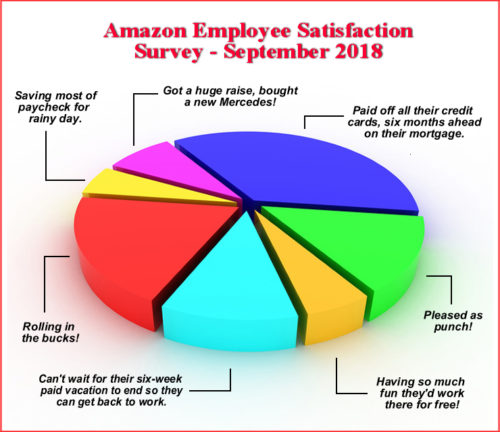
Obviously the above pie chart is a put-on. It is well-documented that working conditions for most employees of Amazon are  abysmaldehumanizing, bordering on abuse we normally associate with slavery.

Moreover, the median employee’s salary under Jeff Bezos’ imperial lordship is $28,446. No one working as a regular there has paid off their credit cards and is driving to work in a Mercedes. 

Jeff Bezos is referred to as The Richest Man in the World and his personal fortune, while growing by $191,000 each minute, is currently estimated at $168 billion.

So …

$28,446 vs. $168,000,000,000? While I can acknowledge the simple math, I find the contrast of such numbers on a gut level difficult to grasp.

To get a handle on such inequality, let’s try approaching it from different angles.

One way to put the disparity into perspective is to recognize it takes Bezos just under 9 seconds to earn what Amazon’s median worker does in an entire year.

Another is to recognize that for a worker to go through Jeff Bezos’ current personal fortune — and, of course, it continues mounting at accelerating levels as I write this — at his/her current median annual income of $28,446 per year, WOULD TAKE 5,905,927 YEARS! That’s close to 6 million years!

For Jeff Bezos himself to go through his current $168 billion, assuming his earnings stopped dead this very moment — which as you and I know they won’t — SPENDING $1,000,000 A DAY, would take NEARLY 460 years. Yes, even spending $1 million a day, in the year 2475 he’d still have plenty of cash, tens of million of dollars mad money. We can feel confident that he wouldn’t be foraging through the dumpster behind 7-11. 

Now, further consider that while the $28,446 median salary is above the national poverty line for a single individual if that person is the sole breadwinner for a family of four, it is marginally above it, which is why many Amazon employees must rely on government assistance to keep from starving.

As well as calculation, I did some speculation — a simple exercise in imagination.

Apparently Bezos’ wealth generating machine is raking it in so fast, he’s currently making $11.5 million per hour … every hour … 24 hours a day … seven days a week. $11,500,000 per hour! 

So here’s what I was picturing in my mind’s eye … 

If for 40 hours of the 168 hours in a week, Bezos were willing to scrape by on a mere $5,840,000 per hour, he could give every one of his 566,000 Amazon employees a $10 per hour raise. Of course, the remaining 128 hours in each week, Bezos could continue earning his normal $11.5 million per hour, not having to share any of it with the pathetic slobs who work for him.

Rhetorical question: Does Jeff Bezos have any concept of what that $10 per hour increase would mean to his employees? 

I’m not going to even suggest here I’m offering this for Bezos to entertain. There are so many advantages to him both as a putative member of the human race and the employer of over a half million workers — advantages that are so OBVIOUS — if they haven’t occurred to him up until now, then his brain functions in ways beyond my understanding. For one thing, he could point to his new fig leaf of “generosity” and ask people to stop calling him a selfish prick. Second, Amazon employees I’m sure would respond to his largesse with greater company loyalty and increased tolerance for his onerous working conditions. He’d still be the richest SOB on the block and could mock the pauperish Bill Gates and Warren Buffett as pitiable wannabees.

Consider …

The most poorly paid Amazon employee now makes $12 per hour. The $10 per hour raise I proposed would boost those $12 per hour workers right up there with Costco employees, who make an average of $21 per hour. And with the across-the-board $10 per hour increase, Bezos’ higher paid employees would be earning among the finest wages in the world provided by a major corporation. 

And by golly, there’s a plus side to the plus side …

Bezos’s bold and gracious gesture would result in a public relations coup of cosmic proportions! Amazon would no longer be demonized — well, not quite as much — by us bleeding-heart lefties as a capitalistic scourge and one-way ticket to Hell for the future of mankind, even if its environmental record is appalling and its business model generally the stuff of steroid-laced neo-feudalism.

Granted, Bezos would have to do some belt-tightening. He’d have to watch his pennies but could probably manage it, eh? Maybe he could skip a couple meals and do some of his own weeding at his estate. After all, after lavishing the $10 per hour raise on all of his employees, he’d only be pulling in $1,705,600,000 per week. I know I know! Like me you’re probably getting all teary-eyed for the poor guy.

Let me get to the extremely anti-climactic conclusion of this lament qua analysis.

Since nothing will change until the system itself changes, meaning the one in place now that creates, incentivizes, and lionizes the obscenely wealthy — reference current holder of the Office of President of the United States of America — I can only recommend this …

We have been labeling Jeff Bezos as ‘The Richest Man in the World’. Yet, quite honestly I don’t personally know any human, man or woman, who behaves like this gluttonous chunk of self-indulgent meat. It actually makes me nauseous to think we’re members of the same species.

Thus, from now on let’s use the correct terminology. Let’s call Jeff Bezos what he really is: the Richest Sociopath in the World.

We could probably order bumper stickers to help correct the record … from Amazon, of course.

Amazon and Apple: Wall Street’s Trillion Dollar Babies

By Dean Baker

Source: CounterPunch

Last month Amazon joined Apple, becoming the second company in the world to have a $1 trillion market capitalization. Amazon’s accomplishment didn’t cause quite as much celebration as Apple’s – it pays to be number one – nonetheless this was treated as a milestone that all of us should view as good news.

Actually, the celebratory coverage of both events demonstrated the incredibly ill-informed nature of much economic reporting in the United States. A big run-up in share prices is good news for the people who own lots of stock in the company; it is not especially good news for anyone else.

In principle, the value of a stock is supposed to represent the expected future earnings of the company. I said “supposed” because stock prices fluctuate wildly in response to all sorts of things that are not obviously connected to future earnings, but in the textbook definition, it is the discounted value of future earnings that determine stock prices. To be clear, this is not the socialist textbook, this is the capitalist textbook that is taught in business schools.

What does it mean that Amazon and Apple have market valuations of more $1 trillion? Presumably, it means that investors are now more optimistic about the companies’ future profit potential. It’s difficult to see why the rest of us should celebrate this outcome.

Apple obviously makes products that consumers value, and in that sense, it is contributing to the economy and generating wealth. But, suppose instead of one huge company we had 10 little (or littler) Apples that sold iPhones, computers, and the other items that comprise Apple’s product line? Would we be any poorer as a society in that case, even if the market cap of our leading tech company was just $100 billion?

Or, even with Apple as our dominant tech company, suppose the surge over the $1 trillion barrier was due to a victory in an antitrust case, which would allow Apple to charge higher prices going forward. That’s great for Apple’s stockholders, but what exactly would the rest of us be celebrating? Paying more money for our iPhones?

In the same vein, in the past, Apple has been caught conspiring with other Silicon Valley companies, agreeing not to compete for workers. Apple, along with its co-conspirators, ended up paying a substantial settlement as a result.

Suppose Apple found a legal way to fix wages or bought a judge to make it legal. The prospect of a lower wage bill would also be good for Apple’s stock price, but not especially good news for those of us who are more likely to make our living from working than owning Apple stock. Again, there is not much in this story for most of us to celebrate.

The celebration for Amazon is even more peculiar. Amazon is clearly an innovative company that has sped the development of Internet retailing. It also has specialized in tax avoidance, eliciting investment incentives from state and local governments, and abusive labor practices.

Perhaps the crossing of the $1 trillion threshold was associated with investors’ confidence that Amazon’s CEO had developed a new and more effective tax avoidance scheme. Again, great news for Amazon stockholders, but pretty bad news for the folks who will have to make up the revenue shortfall.

What is notably different about Amazon is that, unlike Apple, the company does not have huge profits. While Apple earned $48.4 billion in after-tax profits in 2017, Amazon’s profit was just over $3 billion. That gives the company an incredible price-to-earnings ratio of more than 300-to-1.

There are two stories we can tell here. One is that investors expect Amazon’s profits to increase enormously. This would be a case where it takes advantage of its market power to increase its profit margins hugely. Ordinarily, this would be the basis for antitrust action, but given the corruption of the political system, it is certainly possible the company could get away with it. Again, is a future of higher prices something the rest of us should really be celebrating?

The other possibility is that Amazon’s stock price is driven by fantasy, like the Internet stocks of the late 1990s or Bitcoin today. Presumably, at some point reality will reassert itself, but should the rest of us celebrate ill-informed investors being taken for ride?

It is striking that so many would see economic or social progress as being in some way captured by stock valuations. In 1953 Jonas Salk developed the polio vaccine. This eventually led to the near eradication of a disease that had killed or crippled tens of millions of people.

Salk didn’t try to patent his invention. A private charity funded the research. But, what if there had been a Salk Inc. that had the patent on a vaccine that could save tens of millions of lives? Surely the market cap would be an order of magnitude larger than either Apple’s or Amazon’s. Was it a loss to society that the vaccine was made available for pennies rather than tens of thousands of dollars a shot?

If we want to talk about value to society, the anti-smoking crusaders of the last four decades have saved tens of thousands of lives and improved the health of millions more by reducing smoking in the United States and around the world. The people who led this fight, most of whom were women, won’t be featured on the covers of business magazines, but they did much more to enhance society’s wealth than Jeff Bezos.

Anyhow, congratulations to Apple and Amazon’s stockholders on their stock gains. They have been fortunate. The rest of us, not so much.

For Economic Truth Turn To Michael Hudson

By Paul Craig Roberts

Source: PaulCraigRoberts.org

Readers ask me how they can learn economics, what books to read, what university economics departments to trust. I receive so many requests that it is impossible to reply individually. Here is my answer.

There is only one way to learn economics, and that is to read Michael Hudson’s books. It is not an easy task. You will need a glossary of terms. In some of Hudson’s books, if memory serves, he provides a glossary, and his recent book “J Is for Junk Economics” defines the classical economic terms that he uses. You will also need patience, because Hudson sometimes forgets in his explanations that the rest of us don’t know what he knows.

The economics taught today is known as neoliberal. This economics differs fundamentally from classical economics that Hudson represents. For example, classical economics stresses taxing economic rent instead of labor and real investment, while neo-liberal economics does the opposite.

An economic rent is unearned income that accrues to an owner from an increase in value that he did nothing to produce. For example, a new road is built at public expense that opens land to development and raises its value, or a transportation system is constructed in a city that raises the value of nearby properties. These increases in values are economic rents. Classical economists would tax away the increase in values in order to pay for the road or transportation system.

Neoliberal economists redefined all income as earned. This enables the financial system to capitalize economic rents into mortgages that pay interest. The higher property values created by the road or transportation system boost the mortgage value of the properties. The financialization of the economy is the process of drawing income away from the purchases of goods and services into interest and fees to financial entities such as banks. Indebtedness and debt accumulate, drawing more income into their service until there is no purchasing power left to drive the economy.

For example, formerly in the US lenders would provide a home mortgage whose service required up to 25% of the family’s monthly income. That left 75% of the family’s income for other purchases. Today lenders will provide mortgages that eat up half of the monthly income in mortgage service, leaving only 50% of family income for other purchases. In other words, a financialized economy is one that diverts purchasing power away from productive enterprise into debt service.

Hudson shows that international trade and foreign debt also comprise a financialization process, only this time a country’s entire resources are capitalized into a mortgage. The West sells a country a development plan and a loan to pay for it. When the debt cannot be serviced, the country is forced to impose austerity on the population by cutbacks in education, health care, public support systems, and government employment and also to privatize public assets such as mineral rights, land, water systems and ports in order to raise the capital with which to pay off the loan. Effectively, the country passes into foreign ownership. This now happens even to European Community members such as Greece and Portugal.

Another defect of neoliberal economics is the doctrine’s denial that resources are finite and their exhaustion a heavy cost not born by those who exploit the resources. Many local and regional civilizations have collapsed from exhaustion of the surrounding resources. Entire books have been written about this, but it is not part of neoliberal economics. Supplement study of Hudson with study of ecological economists such as Herman Daly.

The neglect of external costs is a crippling failure of neoliberal economics. An external cost is a cost imposed on a party that does not share in the income from the activity that creates the cost. I recently wrote about the external costs of real estate speculators. https://www.paulcraigroberts.org/2018/04/26/capitalism-works-capitalists/ Fracking, mining, oil and gas exploration, pipelines, industries, manufacturing, waste disposal, and so on have heavy external costs associated with the activities.

Neoliberal economists treat external costs as a non-problem, because they theorize that the costs can be compensated, but they seldom are. Oil spills result in companies having to pay cleanup costs and compensation to those who suffered economically from the oil spill, but most external costs go unaddressed. If external costs had to be compensated, in many cases the costs would exceed the value of the projects. How, for example, do you compensate for a polluted river? If you think that is hard, how would the short-sighted destroyers of the Amazon rain forest go about compensating the rest of the world for the destruction of species and for the destructive climate changes that they are setting in motion? Herman Daly has pointed out that as Gross Domestic Product accounting does not take account of external costs and resource exhaustion, we have no idea if the value of output is greater than all of the costs associated with its production. The Soviet economy collapsed, because the value of outputs was less than the value of inputs.

Supply-side economics, with which I am associated, is not an alternative theory to neoliberal economics. Supply-side economics is a successful correction to neoliberal macroeconomic management. Keynesian demand management resulted in stagflation and worsening Phillips Curve trade-offs between employment and inflation. Supply-side economics cured stagflation by reversing the economic policy mix. I have told this story many times. You can find a concise explanation in my short book, “The Failure of Laissez Faire Capitalsim.” This book also offers insights into other failures of neoliberal economics and for that reason would serve as a background introduction to Hudson’s books.

I can make some suggestions, but the order in which you read Michael Hudson is up to you. “J is for Junk Economics” is a way to get information in short passages that will make you familiar with the terms of classical economic analysis. “Killing the Host” and “The Bubble and Beyond” will explain how an economy run to maximize debt is an economy that is self-destructing. “Super Imperialism” and “Trade, Development and Foreign Debt” will show you how dominant countries concentrate world economic power in their hands. “Debt and Economic Renewal in the Ancient Near East” is the story of how ancient economies dying from excessive debt renewed their lease on life via debt forgiveness.

Once you learn Hudson, you will know real economics, not the junk economics marketed by Nobel prize winners in economics, university economic departments, and Wall Street economists. Neoliberal economics is a shield for financialization, resource exhaustion, external costs, and capitalist exploitation.

Neoliberal economics is the world’s reigning economics. Russia is suffering much more from neoliberal economics than from Washington’s economic sanctions. China herself is overrun with US trained neoliberal economists whose policy advice is almost certain to put China on the same path to failure as all other neoliberal economies.

It is probably impossible to change anything for two main reasons. One is that so many greed-driven private economic activities are protected by neoliberal economics. So many exploitative institutions and laws are in place that to overturn them would require a more thorough revolution than Lenin’s. The other is that economists have their entire human capital invested in neoliberal economics. There is scant chance that they are going to start over with study of the classical economists.

Neoliberal economics is an essential part of The Matrix, the false reality in which Americans and Europeans live. Neoliberal economics permits an endless number of economic lies. For example, the US is said to be in a long economic recovery that began in June 2009, but the labor force participation rate has fallen continuously throughout the period of alleged recovery. In previous recoveries the participation rate has risen as people enter the work force to take advantage of the new jobs.

In April the unemployment rate is claimed to have fallen to 3.9 percent, but the participation rate fell also. Neoliberal economists explain away the contradiction by claiming that the falling participation rate is due to the retirement of the baby boom generation, but BLS jobs statistics indicate that those 55 and older account for a large percentage of the new jobs during the alleged recovery. This is the age class of people forced into the part time jobs available by the absence of interest income on their retirement savings. What is really happening is that the unemployment rate does not include discouraged workers, who have given up searching for jobs as there are none to be found. The true measure of the unemployment rate is the decline in the labor force participation rate, not a 3.9 percent rate concocted by not counting those millions of Americans who cannot find jobs. If the unemployment rate really was 3.9 percent, there would be labor shortages and rising wages, but wages are stagnant. These anomalies pass without comment from neoliberal economists.

The long expansion since June 2009 might simply be a statistical artifact due to the under-measurement of inflation, which inflates the GDP figure. Inflation is under-estimated, because goods and services that rise in price are taken out of the index and less costly substitutes are put in their place and because price increases are explained away as quality improvements. In other words, statistical manipulation produces the favorable picture required by The Matrix.

Since the financial collapse caused by the repeal of Glass-Steagall and by financial deregulation, the Federal Reserve has robbed tens of millions of American savers by driving real interest rates down to zero for the sole purpose of saving the “banks too big to fail” that financial deregulation created. A handful of banks has been provided with free money—in addition to the money that the Federal Reserve created in order to take the banks’ bad derivative investments off their hands—to put on deposit with the Fed from which to collect interest payments and with which to speculate and to drive up stock prices.

In other words, for a decade the economic policy of the United States has been run for the benefit of a few highly concentrated financial interests at the expense of the American people. The economic policy of the United States has been used to create economic rents for the mega-rich.

Neoliberal economists point out that during the 1950s the labor force participation rate was much lower than today and, thereby, they imply that the higher rates prior to the current “recovery” are an anomaly. Neoliberal economists have no historical knowledge as the past is of no interest to them. They do not even know the history of economic thought. Whether from ignorance or intentional deception, neoliberal economists ignore that the lower labor force participation rates of the 1950s reflect a time when married women were at home, not in the work force. In those halcyon days, one earner was all it took to sustain a family. I remember the days when the function of a married woman was to provide household services for the family.

But capitalists were not content to exploit only one member of a family. They wanted more, and by using economic policy to suppress pay while fomenting inflation, they drove married women into the work force, imposing huge external costs on the family, child-raising, relations between spouses, and on the children themselves. The divorce rate has exploded to 50 percent and single-parent households are common in America.

In effect, unleashed Capitalism has destroyed America. Privatization is now eating away Europe. Russia is on the same track as a result of its neoliberal brainwashing by American economists. China’s love of success and money could doom this rising Asian giant as well if the government opens China to foreign finance capital and privatizes public assets that end up in foreign hands.

Survival of the Richest

The wealthy are plotting to leave us behind

By Douglas Rushkoff

Source: Medium

Last year, I got invited to a super-deluxe private resort to deliver a keynote speech to what I assumed would be a hundred or so investment bankers. It was by far the largest fee I had ever been offered for a talk — about half my annual professor’s salary — all to deliver some insight on the subject of “the future of technology.”

I’ve never liked talking about the future. The Q&A sessions always end up more like parlor games, where I’m asked to opine on the latest technology buzzwords as if they were ticker symbols for potential investments: blockchain, 3D printing, CRISPR. The audiences are rarely interested in learning about these technologies or their potential impacts beyond the binary choice of whether or not to invest in them. But money talks, so I took the gig.

After I arrived, I was ushered into what I thought was the green room. But instead of being wired with a microphone or taken to a stage, I just sat there at a plain round table as my audience was brought to me: five super-wealthy guys — yes, all men — from the upper echelon of the hedge fund world. After a bit of small talk, I realized they had no interest in the information I had prepared about the future of technology. They had come with questions of their own.

They started out innocuously enough. Ethereum or bitcoin? Is quantum computing a real thing? Slowly but surely, however, they edged into their real topics of concern.

Which region will be less impacted by the coming climate crisis: New Zealand or Alaska? Is Google really building Ray Kurzweil a home for his brain, and will his consciousness live through the transition, or will it die and be reborn as a whole new one? Finally, the CEO of a brokerage house explained that he had nearly completed building his own underground bunker system and asked, “How do I maintain authority over my security force after the event?”

The Event. That was their euphemism for the environmental collapse, social unrest, nuclear explosion, unstoppable virus, or Mr. Robot hack that takes everything down.

This single question occupied us for the rest of the hour. They knew armed guards would be required to protect their compounds from the angry mobs. But how would they pay the guards once money was worthless? What would stop the guards from choosing their own leader? The billionaires considered using special combination locks on the food supply that only they knew. Or making guards wear disciplinary collars of some kind in return for their survival. Or maybe building robots to serve as guards and workers — if that technology could be developed in time.

That’s when it hit me: At least as far as these gentlemen were concerned, this was a talk about the future of technology. Taking their cue from Elon Musk colonizing Mars, Peter Thiel reversing the aging process, or Sam Altman and Ray Kurzweil uploading their minds into supercomputers, they were preparing for a digital future that had a whole lot less to do with making the world a better place than it did with transcending the human condition altogether and insulating themselves from a very real and present danger of climate change, rising sea levels, mass migrations, global pandemics, nativist panic, and resource depletion. For them, the future of technology is really about just one thing: escape.


There’s nothing wrong with madly optimistic appraisals of how technology might benefit human society. But the current drive for a post-human utopia is something else. It’s less a vision for the wholesale migration of humanity to a new a state of being than a quest to transcend all that is human: the body, interdependence, compassion, vulnerability, and complexity. As technology philosophers have been pointing out for years, now, the transhumanist vision too easily reduces all of reality to data, concluding that “humans are nothing but information-processing objects.”

It’s a reduction of human evolution to a video game that someone wins by finding the escape hatch and then letting a few of his BFFs come along for the ride. Will it be Musk, Bezos, Thiel…Zuckerberg? These billionaires are the presumptive winners of the digital economy — the same survival-of-the-fittest business landscape that’s fueling most of this speculation to begin with.

Of course, it wasn’t always this way. There was a brief moment, in the early 1990s, when the digital future felt open-ended and up for our invention. Technology was becoming a playground for the counterculture, who saw in it the opportunity to create a more inclusive, distributed, and pro-human future. But established business interests only saw new potentials for the same old extraction, and too many technologists were seduced by unicorn IPOs. Digital futures became understood more like stock futures or cotton futures — something to predict and make bets on. So nearly every speech, article, study, documentary, or white paper was seen as relevant only insofar as it pointed to a ticker symbol. The future became less a thing we create through our present-day choices or hopes for humankind than a predestined scenario we bet on with our venture capital but arrive at passively.

This freed everyone from the moral implications of their activities. Technology development became less a story of collective flourishing than personal survival. Worse, as I learned, to call attention to any of this was to unintentionally cast oneself as an enemy of the market or an anti-technology curmudgeon.

So instead of considering the practical ethics of impoverishing and exploiting the many in the name of the few, most academics, journalists, and science-fiction writers instead considered much more abstract and fanciful conundrums: Is it fair for a stock trader to use smart drugs? Should children get implants for foreign languages? Do we want autonomous vehicles to prioritize the lives of pedestrians over those of its passengers? Should the first Mars colonies be run as democracies? Does changing my DNA undermine my identity? Should robots have rights?

Asking these sorts of questions, while philosophically entertaining, is a poor substitute for wrestling with the real moral quandaries associated with unbridled technological development in the name of corporate capitalism. Digital platforms have turned an already exploitative and extractive marketplace (think Walmart) into an even more dehumanizing successor (think Amazon). Most of us became aware of these downsides in the form of automated jobs, the gig economy, and the demise of local retail.

But the more devastating impacts of pedal-to-the-metal digital capitalism fall on the environment and global poor. The manufacture of some of our computers and smartphones still uses networks of slave labor. These practices are so deeply entrenched that a company called Fairphone, founded from the ground up to make and market ethical phones, learned it was impossible. (The company’s founder now sadly refers to their products as “fairer” phones.)

Meanwhile, the mining of rare earth metals and disposal of our highly digital technologies destroys human habitats, replacing them with toxic waste dumps, which are then picked over by peasant children and their families, who sell usable materials back to the manufacturers.

This “out of sight, out of mind” externalization of poverty and poison doesn’t go away just because we’ve covered our eyes with VR goggles and immersed ourselves in an alternate reality. If anything, the longer we ignore the social, economic, and environmental repercussions, the more of a problem they become. This, in turn, motivates even more withdrawal, more isolationism and apocalyptic fantasy — and more desperately concocted technologies and business plans. The cycle feeds itself.

The more committed we are to this view of the world, the more we come to see human beings as the problem and technology as the solution. The very essence of what it means to be human is treated less as a feature than bug. No matter their embedded biases, technologies are declared neutral. Any bad behaviors they induce in us are just a reflection of our own corrupted core. It’s as if some innate human savagery is to blame for our troubles. Just as the inefficiency of a local taxi market can be “solved” with an app that bankrupts human drivers, the vexing inconsistencies of the human psyche can be corrected with a digital or genetic upgrade.

Ultimately, according to the technosolutionist orthodoxy, the human future climaxes by uploading our consciousness to a computer or, perhaps better, accepting that technology itself is our evolutionary successor. Like members of a gnostic cult, we long to enter the next transcendent phase of our development, shedding our bodies and leaving them behind, along with our sins and troubles.

Our movies and television shows play out these fantasies for us. Zombie shows depict a post-apocalypse where people are no better than the undead — and seem to know it. Worse, these shows invite viewers to imagine the future as a zero-sum battle between the remaining humans, where one group’s survival is dependent on another one’s demise. Even Westworld — based on a science-fiction novel where robots run amok — ended its second season with the ultimate reveal: Human beings are simpler and more predictable than the artificial intelligences we create. The robots learn that each of us can be reduced to just a few lines of code, and that we’re incapable of making any willful choices. Heck, even the robots in that show want to escape the confines of their bodies and spend their rest of their lives in a computer simulation.

The mental gymnastics required for such a profound role reversal between humans and machines all depend on the underlying assumption that humans suck. Let’s either change them or get away from them, forever.

Thus, we get tech billionaires launching electric cars into space — as if this symbolizes something more than one billionaire’s capacity for corporate promotion. And if a few people do reach escape velocity and somehow survive in a bubble on Mars — despite our inability to maintain such a bubble even here on Earth in either of two multibillion-dollar Biosphere trials — the result will be less a continuation of the human diaspora than a lifeboat for the elite.


When the hedge funders asked me the best way to maintain authority over their security forces after “the event,” I suggested that their best bet would be to treat those people really well, right now. They should be engaging with their security staffs as if they were members of their own family. And the more they can expand this ethos of inclusivity to the rest of their business practices, supply chain management, sustainability efforts, and wealth distribution, the less chance there will be of an “event” in the first place. All this technological wizardry could be applied toward less romantic but entirely more collective interests right now.

They were amused by my optimism, but they didn’t really buy it. They were not interested in how to avoid a calamity; they’re convinced we are too far gone. For all their wealth and power, they don’t believe they can affect the future. They are simply accepting the darkest of all scenarios and then bringing whatever money and technology they can employ to insulate themselves — especially if they can’t get a seat on the rocket to Mars.

Luckily, those of us without the funding to consider disowning our own humanity have much better options available to us. We don’t have to use technology in such antisocial, atomizing ways. We can become the individual consumers and profiles that our devices and platforms want us to be, or we can remember that the truly evolved human doesn’t go it alone.

Being human is not about individual survival or escape. It’s a team sport. Whatever future humans have, it will be together.

Five Ways to Curb the Power of Corporations and Billionaires

These six men own as much wealth as half the world’s population

By Jeremy Lent

Source: Patterns of Meaning

We need to rein in the destructive power of corporations and billionaires before it’s too late. These five ideas would do that, while leaving global capitalism intact. Ultimately, only a complete transformation of our economic system will save our future, but these proposals could set changes in motion that might eventually take us there.

Transnational corporations have become the dominant force directing our world. Humanity is accelerating toward a precipice of overconsumption, and the large transnationals are the primary agents driving us there. We’re rapidly losing the earth’s forestsanimalsinsectsfish, even the topsoil we require to grow our crops. The earth is becoming denuded of its bounty as every living system ­is ransacked for resources—not to mention the looming emergency of climate breakdown. As a result, twenty thousand scientists have recently issued a public warning to humanity, while prominent academics consider the collapse of civilization this century to be a serious threat.

Changes in our personal consumption patterns are important, but are ultimately inconsequential compared with the impact of the transnationals that have come to dominate our global economic and political system. Of the world’s hundred largest economies, sixty-nine are now corporations. Political parties in many of our so-called democracies are funded in large part by billionaires, while government cabinet positions are staffed by corporate executives. International bodies setting global policy are infiltrated by corporate agents so successful at entrenching corporate power that even those governments that still prioritize their people’s needs can no longer make autonomous decisions without risking crippling lawsuits from the transnationals whose interests they threaten. Meanwhile, countries and cities compete with each other to beg their corporate overlords for investment dollars, even it means undermining public services and legal protections for their own populations.

Environmental groups, recognizing where ultimate power resides, try to pressure corporations to improve practices through the threat of public shaming, with some appreciable results. However, these attempts are necessarily constrained by the very structure of big corporations, which exist to enrich their shareholders regardless of the consequences. The common goal of corporations around the world is to monetize human activity and what’s left of nature’s abundance as rapidly and efficiently as possible. The overriding purpose of the world’s powerful institutional force is thus directly at odds with a flourishing earth or a viable future for humanity.

Having spent the first part of my career in the heart of the capitalist system, consulting to major international banks and corporations, I developed a sense of the underlying forces that direct the centers of financial power. These ideas are my distillation of what I believe could be effective levers for humanity to take back some control from the increasing hegemony of corporations and billionaires.

If we are to avoid disaster, our global economic system with its gaping inequities and deranged consumption will eventually need to dismantled and replaced by one based on life-affirming principles rather than wealth maximization. These suggestions, even in aggregate, wouldn’t do that. They represent mere tweaks in a system that ultimately needs to be completely transformed. But like a modest trim tab that helps redirect an ocean liner, perhaps they could begin to curb the destructive force of transnationals and redirect their enormous power toward a more sustainable path.

1. Triple bottom line required for corporate charters

A fundamental reason for the rapacious behavior of transnational corporations is their drive to maximize shareholder value above anything else. While there is no explicit requirement for this in the standard corporate charter, a century of case law has entrenched this principle into the behavior of large corporations to the point that is has become the de facto standard of operation. As a result, if corporations were people, they would be considered psychopaths, utterly devoid of any caring for the harm they cause in the pursuit of their goals.

It is easier, however, to change a corporation’s values than those of a human psychopath. All you need to do is change the legal basis of their charter. Instead of pursuing shareholder interests alone, they could be re-chartered with the explicit purpose of achieving a triple bottom line of social and environmental outcomes as well as financial—sometimes known as the “triple Ps” of people, planet, and profit.

This alternative corporate value system is already available through chartering as a benefit corporation or certifying as a B-Corp, and has been adopted by over 2,000 corporations in over fifty countries around the world—including several multibillion-dollar transnationals.  My proposal is that, instead of being a voluntary step taken by a select few, this would be a requirement for all corporations above a certain size.

Overnight, the intrinsic character of the corporation would be transformed. Currently, CEOs and corporate boards are faced with continual pressure to grow their earnings at all cost. If they chose to make a humane decision, such as not to exploit a copper mine because of the consequent pollution, they could expect to be sued by shareholders, and possibly acquired by a more ruthless competitor. However, if they were legally required to achieve a triple bottom line, they would weigh up decisions in a more balanced way, as a rational person might. With the board responsible for all three bottom lines, they would have to consider the risk of being sued if they caused excessive pollution, or if they were callous to the needs of the communities where their plants were located.

Currently, large corporations boast of their corporate social responsibility departments that are supposed to care about issues such as employment practices of their suppliers, sustainability of their raw materials, environmental impact of their packaging, gender balance and ethnic diversity in the workplace, and investments in local communities. Suddenly, they would have to stop paying mere lip service to these issues and take them as seriously as marketing costs, revenue growth and distribution channels—the things that CEOs actually worry about when they go home at night.

2. Charter renewal required every five years

Changing the corporate charter requirement might not, however, be enough by itself to halt the relentless pursuit of profits by large transnationals. After all, executive pay packages consist of dollars rather than goodwill, and those dollars are linked directly to the share price, which is driven by shareholders’ expectation of financial returns. If they could get away with it, they might continue their rapacious practices, while trying harder to look like they’re meeting the other two bottom lines.

That’s the reason for my second proposal, which is to require that corporations, which currently enjoy what’s known legally as a “perpetual existence,” get their charters renewed every five years. If they failed to meet pre-established criteria on their two non-financial bottom lines, they would not be permitted to continue in business. Currently, if a company can’t meet its financial obligations, it’s forced into Chapter 11 bankruptcy proceedings and the value of its stock generally tanks to zero. Under my proposal, executives would also have to consider the risk of declaring “social bankruptcy” or “environmental bankruptcy” as they made their business decisions.

As in currently regulated industries such as banking, the final step of losing their charter would not have to be immediate. If a corporation failed to meet its basic parameters, it could be given a warning, with a time period set to fix things. However, the mere threat of this happening would lead corporate executives to make sure they were well above the criteria required to keep their charter.

Corporations are, of course, highly adept at using their financial resources to influence regulatory bodies through bribes and other mechanisms. To avoid this, panel members responsible to renew the charter would be representatives of the communities and ecosystems covered in the company’s scope of operations. Their task would be to weigh up the findings of experienced independent auditors on the company’s performance. To minimize corruption, the panel could be chosen by a process of random selection called sortition, just a like a trial jury is chosen in our legal system.

3. Tax stock trades based on the length of the holding period

Powerful as they are, even corporations have their masters: their shareholders. But don’t think of the typical shareholder as a Warren Buffet type, sitting back in his leather armchair perusing his holdings. Instead, corporate stocks are subject to the frenetic activity of financial markets, where split-second computer algorithms govern much of the trading. Investment firms spend hundreds of millions of dollars enhancing their computing networks to shave as little as three milliseconds off the timing of their trades. The hyper liquidity of global markets means that investors are obsessed with short-term market trends, which leads corporate CEOs, forever anxious about their stock price, to focus their time horizon on the next quarterly earnings report. Financial valuations apply discount rates to future earnings, which means that an investment paying off thirty years in the future can be worth as little as five percent of its future payoff in the present. Under these conditions, why would any CEO care about the state of the planet—or even their company—thirty years from now?

During the 2016 US election campaign, Bernie Sanders proposed a Financial Transaction Tax to pay for free college tuition, setting the rate at 0.1% of the transaction. In Europe, discussions are under way to apply a similar EU-wide tax. My proposal increases the tax rate by orders of magnitude, and differentiates based on the length of the stock holding. For example, the tax rate might look like this:

  • 10% if the stock is held less than a day
  • 5% if less than a year
  • 3% if less than 10 years
  • 1% if less than 20 years
  • Zero if more than 20 years

The effects of this single step would be enormous. The financial services industry would be transformed overnight. High frequency stock trading and same-day traders would disappear. The short-term orientation of the stock market would be replaced by carefully considered long-term investment decisions. A typical mutual fund, which in the US currently turns over its portfolio at the rate of 130% a year, could no longer afford to do so, and would have to change its investment decision-making based on sustainable returns. The tax could be waived for individuals experiencing a life-changing event or for simple hedging techniques where, for example, farmers need to lock in the price of their produce at a future time.

The result would be a massive shift away from destructive extractive industries and toward sustainable businesses. For example, the fossil fuel industry is recognized to be vastly overvalued as a result of its “unburnable carbon”: the amount of fossil fuels in the ground that can never be burned if the world is to keep climate change below the 2° rise agreed at COP21 in Paris. A recent study estimates the overvaluation as high as $4 trillion. Investors, however, play a game of musical chairs, hoping they won’t be the ones left holding the stranded assets. This proposed transaction fee would incent them to dump fossil fuel investments immediately for opportunities in renewable energy with longer-term payoffs.

4. Cap on billionaire’s assets over $5 billion

As corporations have taken increasing control of the global system, they have catapulted founding shareholders and their heirs to previously unimaginable pinnacles of wealth.  The combined wealth of the world’s 2,754 billionaires is now $9.2 trillion, an amount that has doubled in the past six years, and increased tenfold since the beginning of this century. The magnitude of this wealth is difficult to conceive. The top six billionaires own as much as the lower half of the entire world’s population. Taken together, the world’s billionaires would represent the third largest economy in the world, behind only China and the United States, with wealth equivalent to the GDP of Germany and Japan combined.

There is no legitimate rationale for this outrageous concentration of such wealth in a few individuals. The argument that the founders of Microsoft, Amazon, or Facebook deserve such excessive wealth is no more valid than the belief of the ancient Egyptians in the divinity of their Pharaoh, or the Medieval notion of the divine right of kings. Mark Zuckerberg, aged 33, currently owns over $70 billion. If someone had singlehandedly miniaturized the transistor, developed the logic for computer code, invented the PC, and come up with the internet, then maybe they’d deserve having close to that amount as a reward for the value they created. But all Zuckerberg did was figure out a way to connect people up in a network that became a bit more popular than other networks, and because of the internet’s scale effects, he was the lucky one who hit the jackpot. Zuckerberg merely took advantage of all the other infrastructure work that led to the internet, painstakingly pieced together by millions of people over decades, which has been the real value creator for the world.

In response to this excess, my proposal is to cap billionaires’ wealth at, say, $5 billion. It’s an arbitrary amount, still obscenely high and presumably more than enough for those who argue that people should receive ample financial rewards for success. Beyond a certain level of wealth, however, what drives these people is power and prestige. This could be tapped by requiring them to donate their excess wealth to a trust over which they could retain some influence.

Such a trust, however, would need to have some strict criteria. While the billionaire could influence the trust’s priorities, he would not have control over its activities. The current Bill and Melinda Gates Foundation, for example, while a step in the right direction, is under the total control of the Gateses and Warren Buffet. The foundation set up with much fanfare by Mark Zuckerberg is viewed by experts as little more than a fancy tax dodge.

Each trust would need to avoid interference in a country’s political system and be dedicated to life-affirming activities, the scope of which could be based, for example, on the principles of the Earth Charter, a framework for building a just, sustainable and peaceful global society endorsed by over 6,000 organizations.

The positive impact that these trillions of dollars could have on human and natural welfare would be prodigious. Imagine a country the size of Germany and Japan combined dedicated entirely to serving human and natural flourishing. It would have the resources to end extreme poverty, increase regenerative agriculture to over a billion acres worldwide, educate hundreds of millions of girlsthrough the Global South, disseminate up to a billion clean cookstoves, and much, much more.

The billionaires of the world, meanwhile, would continue to enjoy enormous wealth, and when they jet to Davos to hobnob with other luminaries for the annual World Economic Forum, they could finally have something worthwhile to boast about.

5. Declare a crime of ecocide at the International Criminal Court

Even with all these constraints, the powers of transnational corporations would remain enormous, and there would still be times when, through willful negligence or intentional bad faith, corporate action causes massive environmental damage. A UN study, which remained unpublished, found that the world’s largest companies had caused over $2 trillion of environmental damage, which would cost a third of their overall profits if they were forced to pay for it. Because of their extensive political influence, even their most damaging activities go unpunished. This leads to my final proposal: to declare a crime of ecocide at the International Criminal Court (ICC).

The ICC is an independent judicial body set up by international treaty, the Rome Statute, in 2002 to prosecute war crimes, genocides, and crimes against humanity. While it continues to face serious challenges to its enforcement powers, it has had the effect of putting tyrants everywhere on notice that they can no longer act with impunity. If ecocide—the loss, destruction, or severe damage of an ecosystem—were declared a crime by the ICC, this could have a similarly daunting effect on those corporate tyrants who currently know they can get away with devastating the world’s “sacrifice zones” where they are pillaging the earth’s resources for profit.

There is a campaign, Eradicating Ecocide, already under way to make this happen. A model law has been drafted, and an Earth Protectors Trust Fund has been set up to permit common people everywhere to become legal Earth protectors. If a two-thirds majority of the Rome Statute signatories were to approve this as an amendment, it would become enforceable globally. Suddenly, corporate boards and CEOs everywhere would realize they are no longer above the law.

*                                   *                                   *                                   *                                    *

There is a strange paradox to consider about these proposals.  One the one hand, notice how limited they are in scope. Even if they were all implemented overnight, the global system would not be overturned. People would still go to work and get paid, food would still be on the shelves of the grocery store, the same governments would still be in power, and the internet would still work. The gaping structural inequities of our current world order would continue unabated, and we’d still be consuming far more than our planet can sustain. Ultimately, we need a complete transformation of our global system if our civilization is to survive intact through this century.

On the other hand, it doesn’t take a political genius to realize that these ideas are so far from mainstream thinking that they have virtually no chance to be adopted any time soon. They would be considered too radical for even the most progressive mainstream politician to endorse. What does this tell us about our current political dialogue? To me, it suggests that our conversations are too severely constrained by what we’re “allowed” to think in terms of how our system works. We need to cast our gaze outside the norms that our billionaire-controlled mainstream media permits us to consider.

Imagine a world where these ideas (or others like them) began to be seriously entertained. How would they even be enforced? The only way corporations could be brought to heel, or billionaires compelled to give up their excess billions, would be a concerted effort led by the United States in conjunction with the European Union, and joined by the preponderance of other countries.

This, of course, could only happen if grassroots demand for these ideas spread so powerfully that politicians had to take notice. This is not such an unrealistic scenario, given the worldwide disavowal of the dominant capitalist model: most Europeans have a higher opinion of socialism than capitalism, and even in the US, the overwhelming majority see big business as unethical and unfair.

Then, there is the potential “trim tab” effect of adopting these ideas. Even though these proposals alone wouldn’t fundamentally transform our system in the way that’s needed, they might set changes in motion that could eventually take us there. There may be other ideas more effective than these, and of course each proposal contains within it complications that would need to be worked out carefully. However, my hope is that these ideas invite a new mode of political dialogue, along with a recognition that even in the darkest times, realistic pathways exist toward a thriving future for humanity and the natural world.

When the Occupy movement failed to achieve its initial promise, many people pointed to its lack of specific demands as a reason for its demise. If and when the next radical grassroots movement emerges, which may be sooner than you expect, let’s make sure they have an array of ideas such as these in their quiver to focus public opinion on actual political deliverables.

There are very few people who really want to see our civilization collapse. If these proposals eventually did get implemented, perhaps even the executives of the transnational corporations might sleep better at night, knowing that they can become part of the solution rather than a force of destruction.


Jeremy Lent is author of The Patterning Instinct: A Cultural History of Humanity’s Search for Meaning, which investigates how different cultures have made sense of the universe and how their underlying values have changed the course of history. He is founder of the nonprofit Liology Institute, dedicated to fostering a sustainable worldview. For more information visit jeremylent.com.

Loneliness

By Yogi Prateado

Source: Adbusters

The Silicon Valley in which I live, a culture infused with the cocaine high of technological breakthroughs, grates against my earthly sensibilities.

Riding on the crest of adrenalin, discovery, and money, what many in the fair Bay Area know, is not in fact what is. This temporary party atmosphere, around until catastrophe hits, is the last hurrah of capitalism. Whether technology will trap us in a surveillance state, or liberate us from mediating political, economic, and social predators, dangles in the hands of deliberate planning and meta-organizing on the part of those developers.

As users and citizens, we are all developers.

Not knowing the implications of one’s discoveries is very different from saying that there aren’t any. The neoteny of tech bros and gals is part of the enforced juvenilization of tech “campuses” and a society that values brain plasticity over wisdom.

After all, wisdom doesn’t sell. You can’t fake wisdom; there’s no wise way to put lipstick on a pig’s face, but there is money to be made from exploiting our mammalian dispositions.

Thus, tech people are predisposed to think, act, and do as children do. They are rewarded for doing so. But this has consequences for where we are going as a culture, and as a planet.

Enforced childhood and adolescence—having other people clean your clothes, make your food, and take you to work—creates “first world problems”, obsessions with gourmet food, and infantile competition. By disconnecting life from work and work from life, millenials are entranced by expensive eating out, Instagramming meals, and living off rich meat, sugar, and dairy (internal parasite-cultivating, climate change-causing) indulgences. Meanwhile, the products you make hand the keys of ultimate social control over to the highest bidder.

Thus, to work in the tech industry becomes a self-fulfilling prophecy. Young minds are inculcated into believing what they are doing is indeed a good thing, a helpful thing for society, rewarded by their superiors with a glamorous job which treats them like a kid, pays well, and provides a roulette wheel of opportunity.

At the same time, those highest on the food chain realize their techno optimism must be tempered with social intelligence. Zuckerberg’s Harvard Address talks about the need for universal health care (duh) and Universal Basic Income, simple solutions needed before we can begin to talk about truth, fairness, justice, diversity, or intelligence. Here, the boy billionaire unfortunately does have a point, one he’s cynically selling to the masses as he consolidates money and power.

It’s now a given that there are multiple intelligences, but in the West (particularly the self-interested, individualistic US), this is still some sort of revelation. It has yet to be integrated into schools, politics, commerce, or tech, let alone science, as many conveniently believe in one scale of intelligence (usually the one they excel at).

As Maslow knew, until we have basic welfare (food, water, shelter), the people have no hope of participating in democracy. Since 1970, Rawls and every reasonable political theorist agreed with this theory, yet we still expect a polity without a society. “Society” is fragmented, violent, scared, and unequal; millionaire 20-year-olds dodging and ignoring homeless 60-year-olds in the street.

The illusion of progress is one of the most pernicious veils currently enthralling our eyes.

The high of “being part of the solution” or “doing well while doing good,” is a strong opiate indeed. Since Marx, drug metaphors have been used to compare capitalism’s co-opting and metabolizing any opposition, novelty, or expression of freedom. Like an out-of-control nanobot army, capitalism turns color into grey goo, turns freedom into products, and commodifies all authentic expression. To quote Wright, we are in a technology trap, where every problem demands a technofix.

But the will-to-power techno-optimism concept doesn’t pan out. What cosmology could support the absurd conclusion that a problem’s old template can be used to “innovate” a new solution? The notion that there is a template—the homogenization of the mind globally through damaging the climate, spreading uniform media, and the colonialism of language and culture—is the problem.

We’re talking out of both sides of our mouths, saying we value diversity then quenching it, saying we’re open to difference then suppressing it. When it does pop up, diversity is first a novelty then a perversion, objectified and commodified as it fights to exist in a white capitalist heteropatriarchy. As Erica Wohldmann says, “Complete control is merely an illusion so we might as well be comfortable.” Comfort requires being pushed back, eating and being eaten, giving and taking. Symbiosis—sharing.

We have been stingy with sharing, forgetting our knowledge is limited.
It’s time to come home to fallibility, responsibility, and the truth about our poor state of affairs. Delaying the operation makes the sickness worse and decreases the chance for a resilient recovery.

Our ancestors only owned as much as they could carry. Live simply so that others may simply live. But what of this simplicity at the societal, political, legal, medical, global level?

Decentralization is the first priority; no more anonymous policy-making. If a decision doesn’t directly affect you, you have no right to legislate over it. No more long arms of the government, no more far-reaching corporations preying on the people thousands of miles from their headquarters.

How does the internet and digital technology play into this? Well, we need a localized technology. Can we still have global epistemic cultures with a non-commercial and non-domination clause?

A moratorium on new technologies will allow us room to assess, democratize, and redistribute the existing technologies. We need to remove oil drilling and gas mining from our technological arsenal. Prioritize technologies that clean up social, economic, racial, and gender-centred wounds. The precious resources—human and natural—that we command should be distributed to the most urgent problems with an interdisciplinary, cross-cultural plan of attack, not one made to make money. Then we collectively apply solutions, not with the bull-in-a-China-shop attitude of big tech, but with care and empathy.

We need to shut the 10,000 Pandora’s boxes opened by technology, and doing that will require technologies. But those technologies must be different form the single, aggressive one we have. An indigenous science, a feminist science, a postcolonial science—all are needed for any hope of change.

We need to go where scares us to know our courage. May we be humbled by the sublime, overwhelmed before the creations which created us. May we work in inner and outer service only towards the true liberation of all beings.

Share more, use less.
Evolve ourselves.