After the Crash

Dispatches From a Long Recovery (Est. 10/2024)

After the Crash

4 Ways to Throw a Monkey Wrench into the War Machine

By Gary ‘Z’ McGee

Source: Waking Times

“When a public is stressed and confused, a big lie told repeatedly and unchallenged can become accepted truth.” ~George Orwell

One of the biggest lies told is the false notion that in order to maintain peace, we must have war. Orwellian logic.

As ridiculous as it sounds, the majority of naïve statists believe this notion to be true. This is due, in no small part, to statist conditioning and state-driven propaganda that capitalizes on a blind, patriotic whimsy. And so the war machine continues to rage on, destroying lives, while fattening the pockets of the fat cats at Lockheed Martin and Boeing, not to mention all the other companies which directly and indirectly profit from war. It’s an all-too-common tragedy. But what can you expect when living within an oligarchic plutocracy disguised as a democratic republic? Rhetorical questions aside, there must be ways in which we can, as courageous individuals, throw a monkey wrench into the war machine and thus stop it in its violent tracks.

Here are four ways to do precisely that.

1. Teach Military Members to Disobey Immoral Orders

“The surest way to corrupt a youth is to instruct him to hold in higher esteem those who think alike than those who think differently.” ~Friedrich Nietzsche

The military chain of command is an antiquated system of leadership that is, unfortunately still in use today. It’s the epitome of a human centipede. Everything just rolls downhill. Like lemmings hell-bent on going over whatever cliff the “higher ranking” lemmings tell them to, the military chain of command is a blatant case of “the blind leading the blind.” Leadership is nothing more than ad hoc authoritarianism disguising a greedy race to the next rank or pay raise. They are not trained to be true leaders who think for themselves; they are brainwashed to be obedient followers that follow orders without question. The entire system is set upon blind obedience.

One way to toss a wrench into the war machine is to teach its members how to courageously and strategically disobey orders, especially immoral ones. Teach them how to put their foot down, how to be a real leader who leads by example, which may, at times, seem like a “bad” example according to the corrupt chain of command, but a “good” example according to health, sustainability, morality, justice, liberty, and truth. Teach them how to be self-empowered human beings first and military members second. Teach them how all things are relative to the observer, especially regarding truth and power. Like Nietzsche said, “All things are subject to interpretation; whichever interpretation prevails at a given time is a function of power and not truth.”

2. Question the Statist Chain of Obedience

“Our scientific power has outrun our spiritual power. We have guided missiles and misguided men.” ~Martin Luther King, Jr. 

In today’s day and age, wars exist because of disagreeable nation states, when they could probably be resolved by reasonable men. The problem is most men are made unreasonable by being unwitting, prideful statists with nationalism and patriotism muddying their logic. As Nietzsche said, “In individuals, insanity is rare; but in groups, parties, and epochs, it is the rule.”

In order not to get caught up in the insanity that ends up leading to war, we must, as individuals, question the state-driven chain of obedience being shoved down our throats by the system. The problem is too many people blindly obey, even at the expense of their own freedom and liberty. There’s too much apathy and indifference and not enough logic and reasoning. We’re a nation of misguided statists propagandized and brainwashed to no end. It’s time to upset the rotten-apple cart. It’s time to turn the tables on insanity. It’s time to put the horse of spiritual power (morality), back in front of the cart of scientific power (military). In short: It’s time to disobey.

3. Transform Statist Patriotism into Worldly Patriotism

“Every transformation demands as it’s pre-condition the ending of a world-the collapse of an old philosophy of life.” ~Carl Jung

Patriotism is a tricky thing. It pulls at our heartstrings. It tugs at our pride like puppet strings. And before we know it, we’re a blind patriot, knee-jerk reacting to the prideful boasts of other blind patriots. And suddenly we’re at war. But there is a way out of this unthinking emotional bias: redefine patriotism itself by becoming an interdependent worldly patriot instead of a codependent statist patriot. All it takes is a little imagination, a little logic and reasoning toward the way everything is connected. Then we rise above the statist condition, think outside the statist box, and embrace the world-as-self/self-as-world dynamic as our patriotic start.

Becoming a worldly patriot is perhaps the most effective way to toss a wrench into the war machine, because the war machine feeds upon the statist patriotic whimsy of the masses; but it chokes on a worldly patriotism, which understands – war anywhere, is a war against ourselves as an interdependent whole.

4. Become An Anti-War Warrior

“The most useful piece of learning for the uses of life is to unlearn what is untrue.” ~Antisthenes

An anti-war warrior has unlearned what is untrue, and has become an anti-war activist par excellence. Anti-war warriors are peaceful warriors who know when to go Tiananman Square on the war machine. They have made an art form out of civil disobedience, strategic and intelligent with their anti-war activism. When the war machine rears it’s ugly head, anti-war warriors know how to ninjaneer inside and outside the belly of the beast, using the pen just as mightily as the sword to strategically transform statist mindsets and dismantle the machine itself.

At the end of the day, the war machine is still a very real menace that cannot be ignored. We can no longer remain silent to the atrocities of the corrupt nation states that “govern” us. Their wicked war machines have been running rampant over our precious planet for far too long. It’s time we challenged it. It’s time we countered it with logic, reasoning, and thinking outside the statist box. We do this by disobeying all immoral orders passed down from both the chain of command and the chain of obedience. We do it by becoming worldly patriots and anti-war activists with the courage it takes to change the world.

“The greatest threat to our planet is the belief that someone else will save it.” -Unknown
Four Kinds of Dystopia

welcome_to_dystopia_by_crystalryu

By Darren Allen

Source: ExpressiveEgg.org

The twentieth century saw four basic visions of hell on earth, or dystopia. These were:

Orwellian. Rule by autocratic totalitarian people, party or elite group, limitation of choice, repression of speech and repression of minorities, belief in order, routine and rational-morality. Control by enclosure, fear and explicit violence. Violent repression of dissent (via ‘the party line’). Erotic physicality and sexual freedom suppressed via control of sexual impulses. Control of thought by explicitly policing language (Orwellian Newspeak).

Huxleyan Rule by democratic totalitarian systems, excess of choice, limitation of access to speech platforms, assimilation of minorities, belief in emotional-morality, ‘imagination’ and flexibility, and control by desire, debt and implicit threat of violence. No overt control of dissent (system selects for system-friendly voices). Erotic physicality and sexual freedom suppressed via promotion of pornographic sensuality and dissolution. Control of thought by implicitly enclosing language within professional boundaries (Illichian Newspeak, or Uniquack).

Kafkaesque Rule by bureaucracy. Control of populace via putting them into writing, forcing people to spend free time on bureaucratic tasks, thereby inducing tractable stress and the schizoid, self-regulating self-consciousness (anxiety about low marks, unlikes, official judgements and the like) that bureaucratic surveillance engenders. Generation of a system which structurally rewards those who seek an indirect relationship with their fellows or who, through fear of life, seek to control it through the flow of paperwork.

Phildickian Rule by replacing reality with an abstract, ersatz virtual image of it. This technique of social control began with literacy*—and the creation of written symbols, which devalued soft conscious sensuous inspiration, fostered a private (reader-text) interaction with society, created the illusion that language is a thing, that meaning can be stored, owned and perfectly duplicated, that elite-language is standard and so on—and ended with virtuality—the conversion of classrooms, offices, prisons, shops and similar social spaces into ‘immersive’ on-line holodecks which control and reward participants through permanent, perfect surveillance, the stimulation of positive and negative emotion, offers of godlike powers, and threats to nonconformists of either narco-withdrawal or banishment to an off-line reality now so degraded by the demands of manufacturing an entire artificial universe, that only hellish production-facilities, shoddy living-units and prisons can materially function there.

The reader can decide for herself under which of above we currently struggle to eke out a life worth living. I would like to suggest that all modern societies are both Kafkaesque and Phildickian with either a Huxleyan or Orwellian overarching framework; modern, western, capitalist societies tend to be basically Huxleyan (HKP) and pre-modern, eastern, communist countries tend to be basically Orwellian (OKP).

The reason why ideological managers** (academics, film directors, journalists, etc) prefer to have two (or more) dystopian systems is that it makes us seem like the goodies and them the baddies. Communism is to blame for their foodbanks and breadlines, but capitalism has nothing to do with ours (or vice versa). Sure our masses have the same miserable lives as theirs, reel under the same bureaucratic insanity, stumble around the same shoddy unreal worlds, and witness the same catastrophic destruction of nature and beauty as theirs do, but at least we’ve got democracy! / at least our families stick together! / at least the trains run on time! / at least GTA 9 is coming out soon / at least the Olympics will cheer us up (delete as appropriate).


This is an adapted extract from The Apocalypedia.


* Obviously I’m not suggesting that literacy is inherently or completely dystopian, but it is the beginning of a dangerous and distorting process, which starts with societies demanding literacy for participation — and devaluing orality and improvised forms of expression — and ends with the complete eradication of reality. This danger and distortion increases with every step towards virtuality (print, perspective, photography, television, internet) until, by the time we reach VR, there remains no possibility of reverie, transcendence, humanity, meaning or genuine creativity, all of which become suspect.

** And of course for those who depend on their illusions.

Anarchy vs. Statism: Uncontrolled Order Over Controlled Chaos

23b9159be655ca9b54290bca42db5736

By Gary ‘Z’ McGee

Source: Waking Times

“Knowledge makes a man unfit to be a slave.” ~Frederick Douglas

Caught up, as we are, in the politics of statism, it is often extremely difficult to see the forest for the trees. We’re often so busy pretending to think outside the box that we lose track of what’s “the box” and what’s not. We’re so inured by this system of exploitation that it’s often too easy to kiss each other with lies rather than smack each other with the truth.

Meanwhile, complacency sets in and inertia takes hold. Apathy takes root and ignorance becomes “bliss.” Our lives go on and we placate each other with such cowardly platitudes as, “It’s just the way things are,” or “Why fight it? There’s nothing we can do.” Bullshit!

This is not the way things are. This unhealthy system (statism) has separated you from the way things are (natural anarchy). Why fight? Derrick Jensen said it best, “We are the governors as well as the governed. This means that all of us who care about life need to force accountability onto those who do not.” You think there’s nothing you can do about it? Well, you could begin by educating yourself on what the difference between statism and anarchy really is.

Statism is controlled chaos under the illusion of order. Anarchy is uncontrolled chaos under the delusion of chaos. That’s the difference in a nutshell. But if the nutshell doesn’t suffice, please read on.

Controlled Chaos Under the Illusion of Order (Statism)

“Chaos is what we’ve lost touch with. This is why it is given a bad name. It is feared by the dominant archetype of our world, which is Ego, which clenches because its existence is defined in terms of control.” ~Terence McKenna

Statism is bureaucratic order. When order becomes bureaucratic it becomes an abstraction of an abstraction. It loses the essence of real order because it is in the throes of an “order” pigeonholed by fallible men claiming to hold infallible truths that become ill-conceived laws that generally don’t coincide with cosmic laws. Deception becomes rampant in such an illusory state. And the innocent people who are conditioned, brainwashed, and propagandized to no-end by such an illusory bamboozlement become easily manipulated into believing that man-made laws must be followed. Sometimes even at the expense of cosmic laws that should not be avoided.

Statism is the result of an obsolete idea (that has somehow (stupidly) withstood the test of time) held by a group with outdated notions of power lording such power over an ignorant majority. The small group of individuals harboring outdated notions of power want to remain in power –no matter how misguided, immoral, or downright stupid their notion of power is. And so they manipulate the hierarchical nature of statist dogma to keep themselves entrenched in their parochial seats of power, usually at great expense (exploitation, structural violence, violent expropriation, debt slavery, andenvironmental rape) to others.

Under their deceptive controlled chaos and unhealthy illusion of order, all healthy order falls in polluted disarray. Unnecessary poverty is rampant. Avoidable wars are waged. Needless divisive racism and xenophobic jingoism is rife. Preventable pollutants destroy the land, poison the air, and toxify the oceans. All because of the idiotic statist notion of order, which is nothing more than controlled chaos, which is nothing more than an unhealthy hierarchy high on its own ignorant understanding of power, which leaves the world bleeding and dying at its feet.

It matters not the state; any state pushing its statist dogma onto otherwise free human beings is fundamentally unhealthy and is the opposite of liberty. In fact, it is disguised tyranny. Which is ten-times worse than naked tyranny, because naked tyranny is easily thwarted and thus easily denied by the majority. But the disguised tyranny of the state is not so easily thwarted, for it becomes diabolically entrenched in the mind of the majority of conditioned men, deceiving them into believing the Great Lie, as Nietzsche wisely put it, “State is the name of the coldest of all cold monsters. Coldly it lies; and this lie slips from its mouth: ‘I, the state, am the people.’” Indeed. Such a lie is not easily untold. Much cognitive dissonance must be navigated in order to dissolve it. Cognitive dissonance can cripple even the most intelligent and most open-minded of men.

If the State is the name of the coldest of all cold monsters, then Anarchy is the name of the freest of all free liberators. Anarchy slays the beast that is the state by “being so absolutely free that its very existence is an act of rebellion (Albert Camus).” Anarchy is the only way to deal with the “unfree world” erected by the disguised tyranny of the state.

Uncontrolled Order Under the Illusion of Chaos (Anarchy)

“The multitudes have a tendency to accept whoever is master. Their very mass weighs them down with apathy. A mob easily adds up to obedience. You have to stir them up, push them, treat the men rough using the very advantage of their deliverance, hurt their eyes with the truth, throw light at them in terrible handfuls.” ~Victor Hugo

Anarchy is cosmic order. When order is uncontrolled and allowed to flow, then a healthy equilibrium becomes manifests. It only seems chaotic because the majority of us have been conditioned by statism to think that a world without man-made laws is a world in chaos. Nothing could be further from the truth. On a long enough timeline most man-made laws become irrelevant. Unless they coincide with cosmic laws. As James Russell Lowell surmised, “Time makes ancient good uncouth.” This means that what once seemed right and just and lawful eventually goes out of date, and if we cannot let go of it, if we cannot update our outdated values, we become uncouth, immoral, or even downright stupid for withholding them.

Such is our plight against the heavy shadow of the state. The state is without a doubt an “ancient good” deemed uncouth by the passage of time. And it is on us as rational, healthy, and free human beings, who are attempting to progressively evolve on an ever-changing planet, to discard such parochial values. Indeed, as Eliezer Yudkowsky proclaimed, “You are personally responsible for becoming more ethical than the society you grew up in.”

As it stands, becoming more ethical than the society we grew up in means shedding the too-heavy, overreaching, unhealthy, unsustainable armor of the state and donning the anarchist cape of vulnerable courage. It means adapting to, and overcoming, a world that must continue to change in order to remain healthy. It means embracing the flexible courage of anarchy in the face of the inflexible cowardice of the state. In short, it means becoming healthier than the society we grew up in. Which is easy, really. Because the society we grew up in is fundamentally unhealthy. It means being proactive about finding a cure for the sickness within society. The sickness is statism. The cure is anarchy. It means undeceiving ourselves. It means holding those accountable who deceive, and who are still deceived. It means getting power over power by using our updated understanding of prestigious power to trump their outdated understanding of violent and exploitative power.

There is a way to have our progressive evolution and our freedom as well. It’s not a “you can’t have your cake and eat it too” situation. It’s a freedom begets freedom situation. It’s a situation of ‘I want to be free so that I have a better chance of helping others be free.’ Because with enough people free, who also honor the freedom of others, the less likely the chances are that tyranny and slavery become a problem. Alas, as Voltaire quipped, “It is difficult to free fools from the chains they revere.”

But the problem is the way power is perceived. Statism has conditioned us to think that power means having money, stockpiling possessions and gaining wealth through the violent exploitation of others in a vicious cycle of one-upmanship. Statism preaches the use of exploitative and violent power as its unhealthy dogma. Anarchy advocates the use of cooperative nonviolent power through reciprocity. Because power can be healthy. Power balanced with humility and humor is healthy. Healthy power is moral. Healthy power is prestigious. It is nonviolent. It balances itself out in healthy accord with the natural order of things. It is harmonious with Cosmic Law, The Golden Rule, The Golden Mean, The Golden Ratio, The Nonaggression Principle, and Ubuntu. Indeed. Healthy power is naturally anarchic and egalitarian.

The conclusion? The uncontrolled order of anarchy is healthier than the controlled chaos of statism. It’s healthier not only because its eco-centric freedom trumps the statist’s egocentric tyranny, but also because it frees the independent individual into a deeper freedom, into realizing his/her own interdependent nature, despite a codependent state. Interdependence is what we’ve lost touch with. Anarchy is given a bad name because of this, because interdependence is antithetical (even deemed chaotic) to the codependency of the state (which is nothing more than controlled chaos). But anarchy bridges the gap between nature and the human soul, and thus connects thesis to antithesis, which then becomes the synthesis of interdependence.

In the end, the uncontrolled order (cosmic law) will win out, whether or not our species is still around to experience it. However, if we continue to kowtow to the controlled chaos of unhealthy states, then we will not survive. But if we can learn to embrace anarchy, we will give both ourselves, and the environment that sustain us, a fighting chance at survival. Just remember, as Marcus Aurelius said, “The best revenge is not to be like your enemy.” Have no illusions. The enemy is the state.


Review: The Utopia of Rules, by David Graeber

index

By Jonathan Woolley

Source: Gods & Radicals

Reading a book about bureaucracy may not sound like an exciting way to spend a weekend off with my family. And yet, having just started David Graeber’s latest – A Utopia of Rules – when I wasn’t making tea for my elderly grandmother, I curled up in a comfy chair with this little pink book, mocked up to look like one of the forms it excoriates, and excited by each new page. Although many of the ideas Graeber presents here aren’t new, the clarity and force with which they are drawn together and set out is a rare pleasure – a contrast with turgid official paperwork that was almost certainly intentional.

Graeber – a social anthropologist, anarchist, and prominent leftist thinker, based at the London School of Economics (LSE) – develops his argument, in part, by thinking ethnographically with his own personal experiences of officialdom, beginning with a heartbreaking account of his own struggle to deal with his elderly mother’s Medicaid application. In response to this, he introduces the book as a series of short essays on different facets of what he calls “total bureaucratisation” – defined as “the gradual fusion of public and private power into a single entity, rife with rules and regulations whose ultimate purpose is to extract wealth in the form of profits”. Bureaucracy is not a simple matter of red-tape created by the state tying up private enterprise, as right-wing pundits would have us believe: Graeber points out that bureaucratic forms have become intrinsic to both private and public spheres.

While the Left has been largely unable to produce a critique of bureaucracy, the Right has such a critique – but efforts to “roll back” the state by the Right have had the opposite effect, producing even more paperwork than ever. This leads Graeber to propose what he calls “the Iron Law of Liberalism”, which states that “any market reform, any government initiative intended to reduce red tape and promote market forces will have the ultimate effect of increasing the total number of regulations, the total amount of paperwork, and the total number of bureaucrats the government employs.”

In stressing the coeval nature of the free market and an expansive state, Graeber directs his analysis away from shallow criticism of big government, towards the common institutional basis of all inequality, found at the heart of neoliberal governance. Given the extent to which the general public in the English-speaking world continue to view the expansive state and the “free” market as antithetical to one another and synonymous with the Left and the Right of politics respectively, this is an important point to make.

With the foundations laid, Graeber’s lucid prose carries the reader briskly through a sequence of stand-alone essays, each of which engages with a particular aspect of total bureaucratisation today. Each of these, Graeber claims, will need to be addressed by any critique of bureaucracy the Left might develop. Dead Zones of the Imagination utilises feminist theory of imaginative labour to develop the argument that bureaucracy – in addition to being stupid – exists to create stupidity. Its impersonal procedures, backed up by threat of violence, ensure that those in positions of authority – especially the police – are able to avoid doing the imaginative labour of empathising with others, while forcing those others to engage in imaginative labour towards the authorities, simply in order to avoid physical harm. Police insist upon being able to “define the situation” – those who contest this, rather than violent criminals, are the ones who are routinely meet with physical violence. This serves to emphasise a very basic point: don’t underestimate the importance of physical violence, even if it takes place behind a veil of paper.

In Of Flying Cars and the Declining Rate of Profit, Graeber turns his attention to the trajectory of technological development in the modern world. Why is it, he asks, that in the 1950s we were able to explore space, and expected to be surrounded by robotic servants and flying cars by now, but that this awesome potential has not been realised? The answer, he suggests, is that rather than cause social change by itself, the direction of technological innovation is directed by financial interests – so that instead of pursuing automation and space travel that could disrupt existing economic relations on Earth, major funders have prioritised less disruptive research lines, such as information technology. The greatest achievement of the late 20th century – the Internet – is revealed as decidedly chimeric; both a tool for enhanced communication, but also a means of surveillance and manipulation on an industrial scale. The promise of technology has been broken in favour of labour discipline and social control; R&D budgets have been slashed in favour of boosting executive pay and shareholder dividends. Instead of being allowed to pursue their research interests, academics are increasingly forced to spend more and more of their time doing paperwork. Rather than a driver of social change, technology is itself subject to the demands of capital.

The Utopia of Rules, or Why We Really Love Bureaucracy After All concludes the triptych, by exploring the ways in which bureaucracy can, in fact, be deeply enchanting – when it works well – providing human beings with a sense of predictability and certainty that can be deeply seductive. While the second essay uses science fiction to reflect upon the curious falling short of innovation, this essay turns to magic and fantasy fiction in an attempt to understand how the appeal of bureaucratic rationality is generated. Graeber argues that the elaborate angelic hierarchies and formulaic modes of ritual address, developed in the Rennaissance but that now enliven Western Ceremonial Magic, actually reflect a political imaginary – a vision of the chaotic, violent world of the Middle ages reordered according to a spiritualised version of the old, lost, Roman bureaucracy. Nowadays, however, this vision is inverted – fantasy fiction today constructs a pseudo-Medieval world, where bureaucracy is almost entirely absent, where creativity is directly channelled into reality via magic, and where leadership is acquired on the basis of personal virtue and conquest, rather than through impersonal qualification or graduate recruitment. However, while giving us an opportunity to vicariously enjoy a world without bureaucracy, medievalist fantasies – with their perennial sense of threat and danger – nonetheless reinforce our sense that it’s probably preferable to live with the devil we know. Just as the gruesome spectacle of Gladitorial combat both beguiled and repulsed the populace of Rome from the idea of democracy, the blood-soaked cities of Westeros instil in us a fear of a world without bureaucratic order.

Perhaps the most fascinating contestation made by Graeber – albeit, only in passing – is that bureaucratic rationality rests upon a resolutely spiritual set of commitments. The idea that numbers and their rational appraisal can help one to understand and manipulate reality, reaches back to the Pythagoreanism of ancient Greece. They, in turn, directly inspired Plato, the father of Western formalism, and in turn the Medieval angelic hierarchies mentioned above. This commitment to the power of logic and pure numbers conferred upon bureaucracy a utopian air; bureaucrats envision a world of perfect harmony, governed by well-designed, efficient institutions, and develop frameworks that attempt to make that world a reality. The fact that the complexity of the world-as-lived rarely fits these lofty ideals ensures that bureaucracy requires constant enforcement – with the force in question being the threat of violence meted out by private security, the police or the military.

But it is in the Appendix – Batman and the Problem of Constituent Power – that we find some of Graeber’s most timely observations for the present moment. In a playful analysis of the cultural and political significance of superheroes, Graeber points out that – building upon his analysis of medievalist fantasy in the previous chapter – comics teach the same kind of lesson. In pitting basically passive superheroes who seek to preserve the status quo against endlessly creative and scheming villains who wish to unseat it, comics allow the reader to vicariously enjoy the thrill of unfettered creative potential, only to enforce the idea that such potential necessarily leads to violence, and that violence is in turn the only way that it can be controlled.

In the Marvel and DC Universes, the only alternative to bureaucracy is violent creativity of villains – in short, fascism. This, in turn, allows Graeber to highlight a broad distinction between the left and the right: “Ultimately, the division between left-and right-wing sensibilities turns on one’s attitude towards the imagination. For the Left, imagination, creativity, by extension production, the power to bring new things and new social arrangements into being, is always to be celebrated. It is the source of all real value in the world. For the Right, it is dangerous; ultimately, evil. The urge to create is also a destructive urge. This kind of sensibility was rife in the popular Freudianism of the day [1950s]: where the Id was the motor of the psyche, but also amoral; if really unleashed, it would lead to an orgy of destruction. This is also what separates conservatives from fascists. Both agree that the imagination unleashed can only lead to violence and destruction. Conservatives wish to defend us against that possibility. Fascists wish to unleash it anyway. They aspire to be, as Hitler imagined himself, great artists painting with the minds, blood, and sinews of humanity.”

Following from the magistral philosophical treatise Debt: The First 5,000 years (2011), The Utopia of Rules is a more modest project. Graeber does not attempt to propose a leftist critique of total bureaucratisation within its pages, though he argues such a critique is long overdue. Nor does he advance a singular argument – his goal is simply to prompt a conversation. With the rise of the populist right, this conversation is more important than ever. The mainstream Left, Graeber points out, has for too long positioned itself on the side of state control, leaving critiques of bureaucracy to the Right. As the pro-market efforts of neoliberalism have done nothing but concentrate capital in the hands of the rentier classes, the frustration is now boiling over. And yet, in unveiling the mystical roots of stultifying modern paperwork, Graeber reveals a way forward for us – if total bureaucratisation is a spell laid over the world, that spell may be broken. We need not live out the fevered dreams of Renaissance mystics; we can awaken. Nor shall the dark blood and bone portraits of fascists necessarily hold sway over the human imagination, for the Left is just as creative as the right; indeed, unlike them, we can create without fear of creativity. The Right may aspire to break this world, but it is the birthright of the Left to make a better one.

A Universal Basic Income Is The Bipartisan Solution To Poverty We’ve Been Waiting For

 Molly Crabapple Basic Income Banner

What if the government simply paid everyone enough so that no one was poor? It’s an insane idea that’s gaining an unlikely alliance of supporters.

By Ben Schiller

Source: FastCoexist.com

There’s a simple way to end poverty: the government just gives everyone enough money, so nobody is poor. No ifs, buts, conditions, or tests. Everyone gets the minimum they need to survive, even if they already have plenty.

This, in essence, is “universal minimum income” or “guaranteed basic income”—where, instead of multiple income assistance programs, we have just one: a single payment to all citizens, regardless of background, gender, or race. It’s a policy idea that sounds crazy at first, but actually begins to make sense when you consider some recent trends.

The first is that work isn’t what it used to be. Many people now struggle through a 50-hour week and still don’t have enough to live on. There are many reasons for this—including the heartlessness of employers and the weakness of unions—but it’s a fact. Work no longer pays. The wages of most American workers have stagnated or declined since the 1970s. About 25% of workers (including 40% of those in restaurants and food service) now need public assistance to top up what they earn.

The second: it’s likely to get worse. Robots already do many menial tasks. In the future, they’ll do more sophisticated jobs as well. A study last year from Carl Frey and Michael Osborne at Oxford University found that 47% of jobs are at risk of computerization over the next two decades. That includes positions in transport and logistics, office and administration, sales and construction, and even law, financial services and medicine. Of course, it’s possible that people who lose their jobs will find others. But it’s also feasible we’re approaching an era when there will simply be less to do.

The third is that traditional welfare is both not what it used to be and not very efficient. The value of welfare for families with children is now well below what it was in the 1990s, for example. The move towards means-testing, workfare—which was signed into law by Bill Clinton in 1996—and other forms of conditionality have killed the universal benefit. And not just in the U.S. It’s now rare anywhere in the world that people get a check without having to do something in return. Whatever the rights and wrongs of this, that makes the income assistance system more complicated and expensive to manage. Up to up to 10% of the income assistance budget now goes to administrating its distribution.

For these reasons and others, the idea of a basic income for everyone is becoming increasingly popular. There has been a flurry of reports and papers about it recently, and, unusually, the idea has advocates across the political spectrum.

The libertarian right likes basic income because it hates bureaucracy and thinks people should be responsible for themselves. Rather than giving out food stamps and health care (which are in-kind services), it thinks people should get cash, because cash is fungible and you do what you like with it.

The left likes basic income because it thinks society is unequal and basic income is redistributive. It evens up the playing field for people who haven’t had good opportunities in life by establishing a floor under the poorest. The “precariat” goes from being perpetually insecure to knowing it has something to live on. That, in turn, should raise well-being and produce more productive citizens.

The technology elite, like Netscape’s Marc Andreessen, also likes the idea. “As a VC, I like the fact that a lot of the political establishment is ignoring or dismissing this idea,” Albert Wenger, of Union Square Ventures, told a TED audience recently, “because what we see in startups is that the most powerful innovative ideas are ones truly dismissed by the incumbents.” A minimum income would allow us to “embrace automation rather than be afraid of it” and let more of us participate in the era of “digital abundance,” he says.

The exact details of basic income still need to be worked out, but it might work something like this: Instead of welfare payments, subsidies for health care, and tax credits for the working poor, we would take that money and use it to cover a single payment that would give someone the chance to live reasonably. Switzerland recently held an (unsuccessful) is planning to hold a referendum on a basic income this year, though no date is set. The proposed amount is $2,800 per month.

But would it actually work? The evidence from actual experiments is limited, though it’s more positive than not. A pilot in the 1970s in Manitoba, Canada, showed that a “Mincome” not only ended poverty but also reduced hospital visits and raised high-school completion rates. There seemed to be a community-affirming effect, which showed itself in people making use of free public services more responsibly.

Meanwhile, there were eight “negative income tax” trials in the U.S. in the ’70s, where people received payments and the government clawed back most of it in taxes based on your other income. The results for those trials was more mixed. They reduced poverty, but people also worked slightly less than normal. To some, this is the major drawback of basic income: it could make people lazier than they would otherwise be. That would certainly be a problem, though it’s questionable whether, in the future, there will be as much employment anyway. The age of robots and artificial intelligence seems likely to hollow out many jobs, perhaps changing how we view notions of laziness and productivity altogether.

Experiments outside the U.S. have been more encouraging. One in Namibia cut poverty from 76% to 37%, increased non-subsidized incomes, raised education and health standards, and cut crime levels. Another involving 6,000 people in India paid people $7 month—about a third of subsistence levels. It, too, proved successful.

“The important thing is to create a floor on which people can start building some security. If the economic situation allows, you can gradually increase the income to where it meets subsistence,” says Guy Standing, a professor of development studies at the School of Oriental and African Studies, in London, who was involved with the pilot. “Even that modest amount had incredible effects on people’s savings, economic status, health, in children going to school, in the acquisition of items like school shoes, so people felt in control of their lives. The amount of work people were doing increased as well.”

Given the gridlock in Congress, it’s unlikely we’ll see basic income here for a while. Though the idea has supporters in both left and right-leaning think-tanks, it’s doubtful actual politicians could agree to redesign much of the federal government if they can’t agree on much else. But the idea could take off in poorer countries that have more of a blank slate and suffer from less polarization. Perhaps we’ll re-import the concept one day once the developing world has perfected it?

When Collapse Is Cheaper and More Effective Than Reform

a-falling-house-of-cards

By Charles Hugh Smith

Source: Of Two Minds

Collapse begins when real reform becomes impossible.

We all know why reforms fail: everyone whose share of the power and money is being crimped by reforms fights back with everything they’ve got.

Reforms that can’t be stopped by the outright purchase of politicos are watered down in committee, and loopholes wide enough for jumbo-jets of cash to fly through are inserted.

The reform quickly becomes “reform”–a simulacrum that maintains the facade of fixing what’s broken while maintaining the Status Quo. Another layer of costly bureaucracy is added, along with hundreds or thousands of pages of additional regulations, all of which add cost and friction without actually solving what was broken.

The added friction increases the system’s operating costs at multiple levels. Practitioners must stop doing actual work to fill out forms that are filed and forgotten; lobbyists milk the system to eradicate any tiny reductions in the flow of swag; attorneys probe the new regulations for weaknesses with lawsuits, and the enforcing agencies add staff to issue fines.

None of this actually fixes what was broken; all these fake-reforms add costs and reduce whatever efficiencies kept the system afloat. Recent examples include the banking regulations passed in the wake of the 2008 meltdown and the ObamaCare Affordable Care Act (ACA).

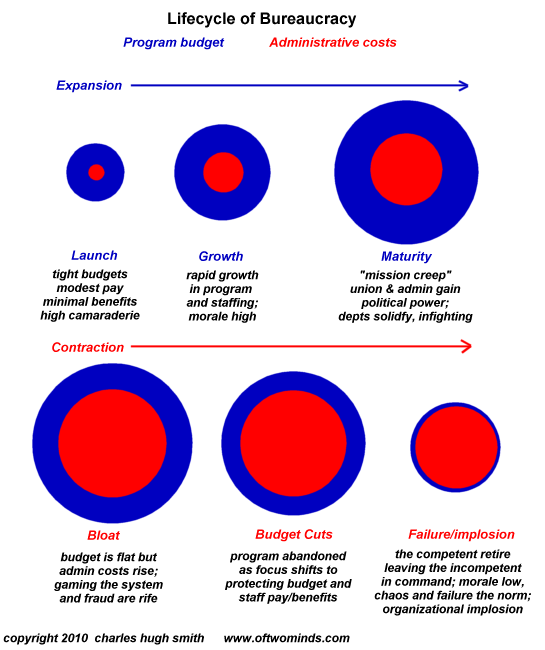
Back in 2010 I prepared this chart of The Lifecycle of Bureaucracy: as bureaucracies expand, they inevitably become less accountable, less efficient, more bloated with legacy staffing and requirements that no longer make sense, etc.

As costs soar, the bureaucracy’s budget is attacked, and the agency circles the wagons and focuses on lobbying politicos and the public to leave the budget untouched.

Since accountability has been dissipated, management becomes increasingly incompetent and larded with people who can’t be fired so they were kicked upstairs. Staff morale plummets as the competent quit/transfer out in disgust, leaving the least productive and those clinging on in order to retire with generous government benefits.

In this state of terminal decline, the agency’s original function is no longer performed adequately and the system implodes from the dead weight of its high costs, lack of accountability, gross incompetence, inability to adapt and staggering inefficiency.

lifecycle-bureaucracy

I’ve covered this dynamic a number of times:

Our Legacy Systems: Dysfunctional, Unreformable (July 1, 2013)

The Way Forward (April 25, 2013)

When Escape from a Previously Successful Model Is Impossible (November 29, 2012)

Complexity: Bureaucratic (Death Spiral) and Self-Organizing (Sustainable) (February 17, 2011)

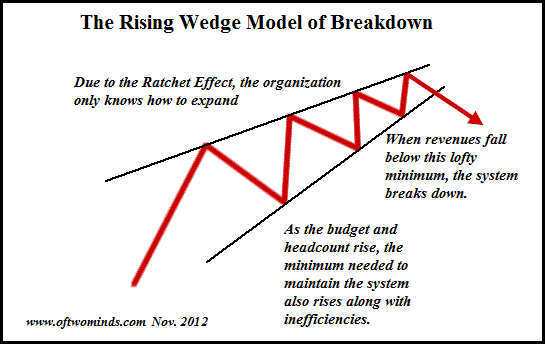
This generates a ratchet effect, where costs increase even as the bureaucracy’s output declines. The ratchet effect can also be visualized as a rising wedge, in which costs and inefficiencies continue rising until any slight decrease in funding collapses the organization.

Dislocations Ahead: The Ratchet Effect, Stick-Slip and QE3 (February 14, 2011)

The Ratchet Effect: Fiefdom Bloat and Resistance to Declining Incomes (August 23, 2010)

rising-wedge

The net result of the Ratchet Effect and the impossibility of reform is this: it’s cheaper and more effective to let the system collapse than squander time and treasure attempting reforms that are bound to fail as vested interests will fight to the death to retain every shred of power and swag.

Since the constituent parts refuse to accept any real reforms, the entire system implodes. We can look at healthcare, higher education and the National Security State as trillion-dollar examples of systems that become increasingly costly even as their performance declines or falls off the cliff.

This is the lesson of history, as described in the seminal book The Upside of Down: Catastrophe, Creativity, and the Renewal of Civilization.

Collapse does not need to be complete or sudden. Collapse tends to be a process, not an event.

Collapse begins when you can’t find any doctors willing to accept Medicaid payments, when the potholes don’t get filled even when voters approve millions of dollars in new taxes, and when kids aren’t learning anything remotely useful or practical despite the school board raising tens of millions of dollars in additional property taxes.

Collapse begins when real reform becomes impossible.

Lara Trace Hentz

INDIAN COUNTRY NEWS

In Saner Thought

"It is the duty of every man, as far as his ability extends, to detect and expose delusion and error"..Thomas Paine

ZEDJournAI

Human in Algorithms

Rooster Crows

From the Roof Top

Aisle C

I See This

The Free

blog of the post capitalist transition.. Read or download the novel here + latest relevant posts

अध्ययन-अनुसन्धान(Essential Knowledge of the Overall Subject)

अध्ययन-अनुसन्धानको सार