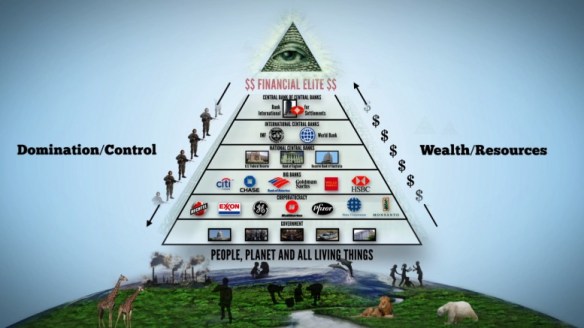

Survival of the Richest

The wealthy are plotting to leave us behind

By Douglas Rushkoff

Source: Medium

Last year, I got invited to a super-deluxe private resort to deliver a keynote speech to what I assumed would be a hundred or so investment bankers. It was by far the largest fee I had ever been offered for a talk — about half my annual professor’s salary — all to deliver some insight on the subject of “the future of technology.”

I’ve never liked talking about the future. The Q&A sessions always end up more like parlor games, where I’m asked to opine on the latest technology buzzwords as if they were ticker symbols for potential investments: blockchain, 3D printing, CRISPR. The audiences are rarely interested in learning about these technologies or their potential impacts beyond the binary choice of whether or not to invest in them. But money talks, so I took the gig.

After I arrived, I was ushered into what I thought was the green room. But instead of being wired with a microphone or taken to a stage, I just sat there at a plain round table as my audience was brought to me: five super-wealthy guys — yes, all men — from the upper echelon of the hedge fund world. After a bit of small talk, I realized they had no interest in the information I had prepared about the future of technology. They had come with questions of their own.

They started out innocuously enough. Ethereum or bitcoin? Is quantum computing a real thing? Slowly but surely, however, they edged into their real topics of concern.

Which region will be less impacted by the coming climate crisis: New Zealand or Alaska? Is Google really building Ray Kurzweil a home for his brain, and will his consciousness live through the transition, or will it die and be reborn as a whole new one? Finally, the CEO of a brokerage house explained that he had nearly completed building his own underground bunker system and asked, “How do I maintain authority over my security force after the event?”

The Event. That was their euphemism for the environmental collapse, social unrest, nuclear explosion, unstoppable virus, or Mr. Robot hack that takes everything down.

This single question occupied us for the rest of the hour. They knew armed guards would be required to protect their compounds from the angry mobs. But how would they pay the guards once money was worthless? What would stop the guards from choosing their own leader? The billionaires considered using special combination locks on the food supply that only they knew. Or making guards wear disciplinary collars of some kind in return for their survival. Or maybe building robots to serve as guards and workers — if that technology could be developed in time.

That’s when it hit me: At least as far as these gentlemen were concerned, this was a talk about the future of technology. Taking their cue from Elon Musk colonizing Mars, Peter Thiel reversing the aging process, or Sam Altman and Ray Kurzweil uploading their minds into supercomputers, they were preparing for a digital future that had a whole lot less to do with making the world a better place than it did with transcending the human condition altogether and insulating themselves from a very real and present danger of climate change, rising sea levels, mass migrations, global pandemics, nativist panic, and resource depletion. For them, the future of technology is really about just one thing: escape.


There’s nothing wrong with madly optimistic appraisals of how technology might benefit human society. But the current drive for a post-human utopia is something else. It’s less a vision for the wholesale migration of humanity to a new a state of being than a quest to transcend all that is human: the body, interdependence, compassion, vulnerability, and complexity. As technology philosophers have been pointing out for years, now, the transhumanist vision too easily reduces all of reality to data, concluding that “humans are nothing but information-processing objects.”

It’s a reduction of human evolution to a video game that someone wins by finding the escape hatch and then letting a few of his BFFs come along for the ride. Will it be Musk, Bezos, Thiel…Zuckerberg? These billionaires are the presumptive winners of the digital economy — the same survival-of-the-fittest business landscape that’s fueling most of this speculation to begin with.

Of course, it wasn’t always this way. There was a brief moment, in the early 1990s, when the digital future felt open-ended and up for our invention. Technology was becoming a playground for the counterculture, who saw in it the opportunity to create a more inclusive, distributed, and pro-human future. But established business interests only saw new potentials for the same old extraction, and too many technologists were seduced by unicorn IPOs. Digital futures became understood more like stock futures or cotton futures — something to predict and make bets on. So nearly every speech, article, study, documentary, or white paper was seen as relevant only insofar as it pointed to a ticker symbol. The future became less a thing we create through our present-day choices or hopes for humankind than a predestined scenario we bet on with our venture capital but arrive at passively.

This freed everyone from the moral implications of their activities. Technology development became less a story of collective flourishing than personal survival. Worse, as I learned, to call attention to any of this was to unintentionally cast oneself as an enemy of the market or an anti-technology curmudgeon.

So instead of considering the practical ethics of impoverishing and exploiting the many in the name of the few, most academics, journalists, and science-fiction writers instead considered much more abstract and fanciful conundrums: Is it fair for a stock trader to use smart drugs? Should children get implants for foreign languages? Do we want autonomous vehicles to prioritize the lives of pedestrians over those of its passengers? Should the first Mars colonies be run as democracies? Does changing my DNA undermine my identity? Should robots have rights?

Asking these sorts of questions, while philosophically entertaining, is a poor substitute for wrestling with the real moral quandaries associated with unbridled technological development in the name of corporate capitalism. Digital platforms have turned an already exploitative and extractive marketplace (think Walmart) into an even more dehumanizing successor (think Amazon). Most of us became aware of these downsides in the form of automated jobs, the gig economy, and the demise of local retail.

But the more devastating impacts of pedal-to-the-metal digital capitalism fall on the environment and global poor. The manufacture of some of our computers and smartphones still uses networks of slave labor. These practices are so deeply entrenched that a company called Fairphone, founded from the ground up to make and market ethical phones, learned it was impossible. (The company’s founder now sadly refers to their products as “fairer” phones.)

Meanwhile, the mining of rare earth metals and disposal of our highly digital technologies destroys human habitats, replacing them with toxic waste dumps, which are then picked over by peasant children and their families, who sell usable materials back to the manufacturers.

This “out of sight, out of mind” externalization of poverty and poison doesn’t go away just because we’ve covered our eyes with VR goggles and immersed ourselves in an alternate reality. If anything, the longer we ignore the social, economic, and environmental repercussions, the more of a problem they become. This, in turn, motivates even more withdrawal, more isolationism and apocalyptic fantasy — and more desperately concocted technologies and business plans. The cycle feeds itself.

The more committed we are to this view of the world, the more we come to see human beings as the problem and technology as the solution. The very essence of what it means to be human is treated less as a feature than bug. No matter their embedded biases, technologies are declared neutral. Any bad behaviors they induce in us are just a reflection of our own corrupted core. It’s as if some innate human savagery is to blame for our troubles. Just as the inefficiency of a local taxi market can be “solved” with an app that bankrupts human drivers, the vexing inconsistencies of the human psyche can be corrected with a digital or genetic upgrade.

Ultimately, according to the technosolutionist orthodoxy, the human future climaxes by uploading our consciousness to a computer or, perhaps better, accepting that technology itself is our evolutionary successor. Like members of a gnostic cult, we long to enter the next transcendent phase of our development, shedding our bodies and leaving them behind, along with our sins and troubles.

Our movies and television shows play out these fantasies for us. Zombie shows depict a post-apocalypse where people are no better than the undead — and seem to know it. Worse, these shows invite viewers to imagine the future as a zero-sum battle between the remaining humans, where one group’s survival is dependent on another one’s demise. Even Westworld — based on a science-fiction novel where robots run amok — ended its second season with the ultimate reveal: Human beings are simpler and more predictable than the artificial intelligences we create. The robots learn that each of us can be reduced to just a few lines of code, and that we’re incapable of making any willful choices. Heck, even the robots in that show want to escape the confines of their bodies and spend their rest of their lives in a computer simulation.

The mental gymnastics required for such a profound role reversal between humans and machines all depend on the underlying assumption that humans suck. Let’s either change them or get away from them, forever.

Thus, we get tech billionaires launching electric cars into space — as if this symbolizes something more than one billionaire’s capacity for corporate promotion. And if a few people do reach escape velocity and somehow survive in a bubble on Mars — despite our inability to maintain such a bubble even here on Earth in either of two multibillion-dollar Biosphere trials — the result will be less a continuation of the human diaspora than a lifeboat for the elite.


When the hedge funders asked me the best way to maintain authority over their security forces after “the event,” I suggested that their best bet would be to treat those people really well, right now. They should be engaging with their security staffs as if they were members of their own family. And the more they can expand this ethos of inclusivity to the rest of their business practices, supply chain management, sustainability efforts, and wealth distribution, the less chance there will be of an “event” in the first place. All this technological wizardry could be applied toward less romantic but entirely more collective interests right now.

They were amused by my optimism, but they didn’t really buy it. They were not interested in how to avoid a calamity; they’re convinced we are too far gone. For all their wealth and power, they don’t believe they can affect the future. They are simply accepting the darkest of all scenarios and then bringing whatever money and technology they can employ to insulate themselves — especially if they can’t get a seat on the rocket to Mars.

Luckily, those of us without the funding to consider disowning our own humanity have much better options available to us. We don’t have to use technology in such antisocial, atomizing ways. We can become the individual consumers and profiles that our devices and platforms want us to be, or we can remember that the truly evolved human doesn’t go it alone.

Being human is not about individual survival or escape. It’s a team sport. Whatever future humans have, it will be together.

Five Ways to Curb the Power of Corporations and Billionaires

These six men own as much wealth as half the world’s population

By Jeremy Lent

Source: Patterns of Meaning

We need to rein in the destructive power of corporations and billionaires before it’s too late. These five ideas would do that, while leaving global capitalism intact. Ultimately, only a complete transformation of our economic system will save our future, but these proposals could set changes in motion that might eventually take us there.

Transnational corporations have become the dominant force directing our world. Humanity is accelerating toward a precipice of overconsumption, and the large transnationals are the primary agents driving us there. We’re rapidly losing the earth’s forestsanimalsinsectsfish, even the topsoil we require to grow our crops. The earth is becoming denuded of its bounty as every living system ­is ransacked for resources—not to mention the looming emergency of climate breakdown. As a result, twenty thousand scientists have recently issued a public warning to humanity, while prominent academics consider the collapse of civilization this century to be a serious threat.

Changes in our personal consumption patterns are important, but are ultimately inconsequential compared with the impact of the transnationals that have come to dominate our global economic and political system. Of the world’s hundred largest economies, sixty-nine are now corporations. Political parties in many of our so-called democracies are funded in large part by billionaires, while government cabinet positions are staffed by corporate executives. International bodies setting global policy are infiltrated by corporate agents so successful at entrenching corporate power that even those governments that still prioritize their people’s needs can no longer make autonomous decisions without risking crippling lawsuits from the transnationals whose interests they threaten. Meanwhile, countries and cities compete with each other to beg their corporate overlords for investment dollars, even it means undermining public services and legal protections for their own populations.

Environmental groups, recognizing where ultimate power resides, try to pressure corporations to improve practices through the threat of public shaming, with some appreciable results. However, these attempts are necessarily constrained by the very structure of big corporations, which exist to enrich their shareholders regardless of the consequences. The common goal of corporations around the world is to monetize human activity and what’s left of nature’s abundance as rapidly and efficiently as possible. The overriding purpose of the world’s powerful institutional force is thus directly at odds with a flourishing earth or a viable future for humanity.

Having spent the first part of my career in the heart of the capitalist system, consulting to major international banks and corporations, I developed a sense of the underlying forces that direct the centers of financial power. These ideas are my distillation of what I believe could be effective levers for humanity to take back some control from the increasing hegemony of corporations and billionaires.

If we are to avoid disaster, our global economic system with its gaping inequities and deranged consumption will eventually need to dismantled and replaced by one based on life-affirming principles rather than wealth maximization. These suggestions, even in aggregate, wouldn’t do that. They represent mere tweaks in a system that ultimately needs to be completely transformed. But like a modest trim tab that helps redirect an ocean liner, perhaps they could begin to curb the destructive force of transnationals and redirect their enormous power toward a more sustainable path.

1. Triple bottom line required for corporate charters

A fundamental reason for the rapacious behavior of transnational corporations is their drive to maximize shareholder value above anything else. While there is no explicit requirement for this in the standard corporate charter, a century of case law has entrenched this principle into the behavior of large corporations to the point that is has become the de facto standard of operation. As a result, if corporations were people, they would be considered psychopaths, utterly devoid of any caring for the harm they cause in the pursuit of their goals.

It is easier, however, to change a corporation’s values than those of a human psychopath. All you need to do is change the legal basis of their charter. Instead of pursuing shareholder interests alone, they could be re-chartered with the explicit purpose of achieving a triple bottom line of social and environmental outcomes as well as financial—sometimes known as the “triple Ps” of people, planet, and profit.

This alternative corporate value system is already available through chartering as a benefit corporation or certifying as a B-Corp, and has been adopted by over 2,000 corporations in over fifty countries around the world—including several multibillion-dollar transnationals.  My proposal is that, instead of being a voluntary step taken by a select few, this would be a requirement for all corporations above a certain size.

Overnight, the intrinsic character of the corporation would be transformed. Currently, CEOs and corporate boards are faced with continual pressure to grow their earnings at all cost. If they chose to make a humane decision, such as not to exploit a copper mine because of the consequent pollution, they could expect to be sued by shareholders, and possibly acquired by a more ruthless competitor. However, if they were legally required to achieve a triple bottom line, they would weigh up decisions in a more balanced way, as a rational person might. With the board responsible for all three bottom lines, they would have to consider the risk of being sued if they caused excessive pollution, or if they were callous to the needs of the communities where their plants were located.

Currently, large corporations boast of their corporate social responsibility departments that are supposed to care about issues such as employment practices of their suppliers, sustainability of their raw materials, environmental impact of their packaging, gender balance and ethnic diversity in the workplace, and investments in local communities. Suddenly, they would have to stop paying mere lip service to these issues and take them as seriously as marketing costs, revenue growth and distribution channels—the things that CEOs actually worry about when they go home at night.

2. Charter renewal required every five years

Changing the corporate charter requirement might not, however, be enough by itself to halt the relentless pursuit of profits by large transnationals. After all, executive pay packages consist of dollars rather than goodwill, and those dollars are linked directly to the share price, which is driven by shareholders’ expectation of financial returns. If they could get away with it, they might continue their rapacious practices, while trying harder to look like they’re meeting the other two bottom lines.

That’s the reason for my second proposal, which is to require that corporations, which currently enjoy what’s known legally as a “perpetual existence,” get their charters renewed every five years. If they failed to meet pre-established criteria on their two non-financial bottom lines, they would not be permitted to continue in business. Currently, if a company can’t meet its financial obligations, it’s forced into Chapter 11 bankruptcy proceedings and the value of its stock generally tanks to zero. Under my proposal, executives would also have to consider the risk of declaring “social bankruptcy” or “environmental bankruptcy” as they made their business decisions.

As in currently regulated industries such as banking, the final step of losing their charter would not have to be immediate. If a corporation failed to meet its basic parameters, it could be given a warning, with a time period set to fix things. However, the mere threat of this happening would lead corporate executives to make sure they were well above the criteria required to keep their charter.

Corporations are, of course, highly adept at using their financial resources to influence regulatory bodies through bribes and other mechanisms. To avoid this, panel members responsible to renew the charter would be representatives of the communities and ecosystems covered in the company’s scope of operations. Their task would be to weigh up the findings of experienced independent auditors on the company’s performance. To minimize corruption, the panel could be chosen by a process of random selection called sortition, just a like a trial jury is chosen in our legal system.

3. Tax stock trades based on the length of the holding period

Powerful as they are, even corporations have their masters: their shareholders. But don’t think of the typical shareholder as a Warren Buffet type, sitting back in his leather armchair perusing his holdings. Instead, corporate stocks are subject to the frenetic activity of financial markets, where split-second computer algorithms govern much of the trading. Investment firms spend hundreds of millions of dollars enhancing their computing networks to shave as little as three milliseconds off the timing of their trades. The hyper liquidity of global markets means that investors are obsessed with short-term market trends, which leads corporate CEOs, forever anxious about their stock price, to focus their time horizon on the next quarterly earnings report. Financial valuations apply discount rates to future earnings, which means that an investment paying off thirty years in the future can be worth as little as five percent of its future payoff in the present. Under these conditions, why would any CEO care about the state of the planet—or even their company—thirty years from now?

During the 2016 US election campaign, Bernie Sanders proposed a Financial Transaction Tax to pay for free college tuition, setting the rate at 0.1% of the transaction. In Europe, discussions are under way to apply a similar EU-wide tax. My proposal increases the tax rate by orders of magnitude, and differentiates based on the length of the stock holding. For example, the tax rate might look like this:

  • 10% if the stock is held less than a day
  • 5% if less than a year
  • 3% if less than 10 years
  • 1% if less than 20 years
  • Zero if more than 20 years

The effects of this single step would be enormous. The financial services industry would be transformed overnight. High frequency stock trading and same-day traders would disappear. The short-term orientation of the stock market would be replaced by carefully considered long-term investment decisions. A typical mutual fund, which in the US currently turns over its portfolio at the rate of 130% a year, could no longer afford to do so, and would have to change its investment decision-making based on sustainable returns. The tax could be waived for individuals experiencing a life-changing event or for simple hedging techniques where, for example, farmers need to lock in the price of their produce at a future time.

The result would be a massive shift away from destructive extractive industries and toward sustainable businesses. For example, the fossil fuel industry is recognized to be vastly overvalued as a result of its “unburnable carbon”: the amount of fossil fuels in the ground that can never be burned if the world is to keep climate change below the 2° rise agreed at COP21 in Paris. A recent study estimates the overvaluation as high as $4 trillion. Investors, however, play a game of musical chairs, hoping they won’t be the ones left holding the stranded assets. This proposed transaction fee would incent them to dump fossil fuel investments immediately for opportunities in renewable energy with longer-term payoffs.

4. Cap on billionaire’s assets over $5 billion

As corporations have taken increasing control of the global system, they have catapulted founding shareholders and their heirs to previously unimaginable pinnacles of wealth.  The combined wealth of the world’s 2,754 billionaires is now $9.2 trillion, an amount that has doubled in the past six years, and increased tenfold since the beginning of this century. The magnitude of this wealth is difficult to conceive. The top six billionaires own as much as the lower half of the entire world’s population. Taken together, the world’s billionaires would represent the third largest economy in the world, behind only China and the United States, with wealth equivalent to the GDP of Germany and Japan combined.

There is no legitimate rationale for this outrageous concentration of such wealth in a few individuals. The argument that the founders of Microsoft, Amazon, or Facebook deserve such excessive wealth is no more valid than the belief of the ancient Egyptians in the divinity of their Pharaoh, or the Medieval notion of the divine right of kings. Mark Zuckerberg, aged 33, currently owns over $70 billion. If someone had singlehandedly miniaturized the transistor, developed the logic for computer code, invented the PC, and come up with the internet, then maybe they’d deserve having close to that amount as a reward for the value they created. But all Zuckerberg did was figure out a way to connect people up in a network that became a bit more popular than other networks, and because of the internet’s scale effects, he was the lucky one who hit the jackpot. Zuckerberg merely took advantage of all the other infrastructure work that led to the internet, painstakingly pieced together by millions of people over decades, which has been the real value creator for the world.

In response to this excess, my proposal is to cap billionaires’ wealth at, say, $5 billion. It’s an arbitrary amount, still obscenely high and presumably more than enough for those who argue that people should receive ample financial rewards for success. Beyond a certain level of wealth, however, what drives these people is power and prestige. This could be tapped by requiring them to donate their excess wealth to a trust over which they could retain some influence.

Such a trust, however, would need to have some strict criteria. While the billionaire could influence the trust’s priorities, he would not have control over its activities. The current Bill and Melinda Gates Foundation, for example, while a step in the right direction, is under the total control of the Gateses and Warren Buffet. The foundation set up with much fanfare by Mark Zuckerberg is viewed by experts as little more than a fancy tax dodge.

Each trust would need to avoid interference in a country’s political system and be dedicated to life-affirming activities, the scope of which could be based, for example, on the principles of the Earth Charter, a framework for building a just, sustainable and peaceful global society endorsed by over 6,000 organizations.

The positive impact that these trillions of dollars could have on human and natural welfare would be prodigious. Imagine a country the size of Germany and Japan combined dedicated entirely to serving human and natural flourishing. It would have the resources to end extreme poverty, increase regenerative agriculture to over a billion acres worldwide, educate hundreds of millions of girlsthrough the Global South, disseminate up to a billion clean cookstoves, and much, much more.

The billionaires of the world, meanwhile, would continue to enjoy enormous wealth, and when they jet to Davos to hobnob with other luminaries for the annual World Economic Forum, they could finally have something worthwhile to boast about.

5. Declare a crime of ecocide at the International Criminal Court

Even with all these constraints, the powers of transnational corporations would remain enormous, and there would still be times when, through willful negligence or intentional bad faith, corporate action causes massive environmental damage. A UN study, which remained unpublished, found that the world’s largest companies had caused over $2 trillion of environmental damage, which would cost a third of their overall profits if they were forced to pay for it. Because of their extensive political influence, even their most damaging activities go unpunished. This leads to my final proposal: to declare a crime of ecocide at the International Criminal Court (ICC).

The ICC is an independent judicial body set up by international treaty, the Rome Statute, in 2002 to prosecute war crimes, genocides, and crimes against humanity. While it continues to face serious challenges to its enforcement powers, it has had the effect of putting tyrants everywhere on notice that they can no longer act with impunity. If ecocide—the loss, destruction, or severe damage of an ecosystem—were declared a crime by the ICC, this could have a similarly daunting effect on those corporate tyrants who currently know they can get away with devastating the world’s “sacrifice zones” where they are pillaging the earth’s resources for profit.

There is a campaign, Eradicating Ecocide, already under way to make this happen. A model law has been drafted, and an Earth Protectors Trust Fund has been set up to permit common people everywhere to become legal Earth protectors. If a two-thirds majority of the Rome Statute signatories were to approve this as an amendment, it would become enforceable globally. Suddenly, corporate boards and CEOs everywhere would realize they are no longer above the law.

*                                   *                                   *                                   *                                    *

There is a strange paradox to consider about these proposals.  One the one hand, notice how limited they are in scope. Even if they were all implemented overnight, the global system would not be overturned. People would still go to work and get paid, food would still be on the shelves of the grocery store, the same governments would still be in power, and the internet would still work. The gaping structural inequities of our current world order would continue unabated, and we’d still be consuming far more than our planet can sustain. Ultimately, we need a complete transformation of our global system if our civilization is to survive intact through this century.

On the other hand, it doesn’t take a political genius to realize that these ideas are so far from mainstream thinking that they have virtually no chance to be adopted any time soon. They would be considered too radical for even the most progressive mainstream politician to endorse. What does this tell us about our current political dialogue? To me, it suggests that our conversations are too severely constrained by what we’re “allowed” to think in terms of how our system works. We need to cast our gaze outside the norms that our billionaire-controlled mainstream media permits us to consider.

Imagine a world where these ideas (or others like them) began to be seriously entertained. How would they even be enforced? The only way corporations could be brought to heel, or billionaires compelled to give up their excess billions, would be a concerted effort led by the United States in conjunction with the European Union, and joined by the preponderance of other countries.

This, of course, could only happen if grassroots demand for these ideas spread so powerfully that politicians had to take notice. This is not such an unrealistic scenario, given the worldwide disavowal of the dominant capitalist model: most Europeans have a higher opinion of socialism than capitalism, and even in the US, the overwhelming majority see big business as unethical and unfair.

Then, there is the potential “trim tab” effect of adopting these ideas. Even though these proposals alone wouldn’t fundamentally transform our system in the way that’s needed, they might set changes in motion that could eventually take us there. There may be other ideas more effective than these, and of course each proposal contains within it complications that would need to be worked out carefully. However, my hope is that these ideas invite a new mode of political dialogue, along with a recognition that even in the darkest times, realistic pathways exist toward a thriving future for humanity and the natural world.

When the Occupy movement failed to achieve its initial promise, many people pointed to its lack of specific demands as a reason for its demise. If and when the next radical grassroots movement emerges, which may be sooner than you expect, let’s make sure they have an array of ideas such as these in their quiver to focus public opinion on actual political deliverables.

There are very few people who really want to see our civilization collapse. If these proposals eventually did get implemented, perhaps even the executives of the transnational corporations might sleep better at night, knowing that they can become part of the solution rather than a force of destruction.


Jeremy Lent is author of The Patterning Instinct: A Cultural History of Humanity’s Search for Meaning, which investigates how different cultures have made sense of the universe and how their underlying values have changed the course of history. He is founder of the nonprofit Liology Institute, dedicated to fostering a sustainable worldview. For more information visit jeremylent.com.

Jeff Bezos’ Paper Tells You Not to Worry About Those Billionaires

By Dean Baker

Source: FAIR

Just when you thought economic commentary in the Washington Post couldn’t get any more insipid, Roger Lowenstein proves otherwise. In a business section “perspective” (7/20/18), he tells readers:

But what if inequality is the wrong metric. Herewith a modest proposition: economic inequality is not the best yardstick. What we should be paying attention to is social mobility.

Wow, what a novel idea, as though right-wingers have not been pushing this line since the dawn of time: “Don’t worry that your standard of living is awful, the important thing is that your kids will be able to get rich.” (It doesn’t help his story that his poster child for the rich being good is Lloyd Blankfein, who made his fortune shuffling financial assets at Goldman Sachs, and benefited from a massive government bailout.)

But let’s be generous, and try to take Lowenstein’s story seriously. He goes on: “Rising inequality, although a fact, is also very hard to find a culprit for. Not that economists haven’t tried.”

Really? There are plenty of really good explanations for rising inequality, many of which are in my (free) book Rigged. I suppose in the Age of Trump, it is appropriate that the Post has a business columnist determined to flaunt his ignorance.

But then we get the real payday:

It’s also far from proved—to me, it’s not even intuitive—that high incomes on Wall Street and elsewhere are the reason for, say, flatter wages in manufacturing. The fact that Mark Zuckerberg is so rich is annoying, and his separateness from Main Street may not be a great thing socially, but in an economic sense, his fortune did not “come from” the paychecks of ordinary workers.

OK, let’s explain this one so that even someone profoundly ignorant of economics can understand. Suppose that someone, we’ll call them Jeff Bezos or Mark Zuckerberg, were really good at printing counterfeit bills. Imagine that they printed up trillions of these counterfeit bills. This would make them incredibly rich, if they could get away with it. But, as Lowenstein says, how does this make anyone else worse off?

While Lowenstein doesn’t see any problem with our incredibly rich counterfeiters, in the real world, we have the problem that they are creating demand for goods and services with their consumption. If the economy is below full employment, this would be good news, since any source of demand will generate more output and jobs. However, if we are near full employment, or the Federal Reserve Board thinks we are near full employment, then this demand comes at the expense of the paychecks of ordinary workers.

Prices like house prices and rents are driven up by our counterfeiters and the demand created by their servants. The Fed raises interest rates to slow growth and employment, and lessen the ability of ordinary workers to get pay increases, since the labor market will be weaker.

Now, folks may object that Bezos and Zuckerberg are not like counterfeiters; they actually generate value for the economy. While this undoubtedly partly true, it is also the case that much of Bezos’ wealth came from avoiding the requirement that retailers collect state and local sales taxes. Zuckerberg’s wealth came from control of a monopoly platform, and Blankfein’s wealth came from running a too-big-to-fail institution with friends in high places.

Insofar as people get incredibly wealthy from being successful in earning rents at the expense of others in the economy, rather than generating wealth, they are very much like counterfeiters. Furthermore, since productivity has been growing at an incredibly slow rate for the last dozen years (just over 1.0 percent annually), it seems in aggregate that these incredibly rich folks are much better at generating wealth for themselves than for the economy as a whole. This makes the rent-seeker story look very plausible.

While Lowenstein’s plea for greater mobility is about as old as capitalism and has been incredibly unsuccessful, let me propose something considerably more original that you probably won’t see in the Washington Post. Since we have so completely bombed at providing anything like equal opportunity, and no serious person can think this is about to change in the decades ahead, how about we structure our economy so that it makes less difference whether someone ends up at the top end, like Jeff Bezos, or at the bottom, earning the minimum wage?

That one is almost certainly far too simple for the great minds to ever consider.

25 Families Own $1.1 Trillion Between Them as the Global Wealth Inequality Gap Grows

Using data from their list Forbes has produced a list of the top 25 richest families in the world. Together they are worth over $1.1 trillion, or the entire GDP of Indonesia.

By  Rosa Tressell and Dr. Leon Tressell

Source: SouthFront

Once a family-owned business Forbes is well known for producing their annual list of the world’s richest billionaires. Launched in 1982 the original list ranked the top 400 Americans by net worth. Only 13 billionaires were included in that list, and their combined worth was the equivalent of 2.8% of GDP. In an era where “Greed is Good”, the list became wildly popular, by 2000 the combined net worth of the top 400 equated to 12.2% of US GDP. So prestigious became the list that an ex-employee of Forbes has claimed that Donald J Trump inflated his personal wealth to be included.

This year more than 2,200 billionaires made the Forbes list with a combined value of $9.1 trillion, or half the GDP of the US. Amazon CEO, Jeff Bezos, topped the list this year as his fortune rose to £112 billion making him the first centi-billionaire. His wealth is now equal to that of 2.3 million Americans. This has allowed him to dethrone Bill Gates, founder of Microsoft, worth just $90 billion.

Using data from their list Forbes has produced a list of the top 25 richest families in the world. Together they are worth over $1.1 trillion, or the entire GDP of Indonesia. The richest clan is the Walton family who own the ubiquitous Walmart chain in America. They have a total family wealth of £152 billion and several family members are on the list of billionaires as individuals. The Koch Brothers, of Koch Industries, are ranked second with £98.7 billion. The third spot, with $90 billion to their name, is taken by another American family, the Mars family, known for their various sweet treats.

In comparison to the billionaires list this list is a measure of families who have inherited and grown their wealth over generations. The billionaires list is dominated by Americans in certain fields; technology, finance, entertainment and sport. It lauds entrepreneurism and promotes the self-made man (and small handful of women). The family fortunes list on the other hand reveals a more historical route for making money. Whilst Jeff Bezos has shot to the top of the list based largely on the astonishingly over valued share price of Amazon stock, the family fortunes are centered on the production and purveyance of goods.

Many of the families on the list started making their fortunes in the late nineteenth century. These are: Cargill Industries (agricultural conglomerate); Boehringer Ingelhelm (pharmaceuticals); Cox Enterprises (communications); Hyatt Hotels (hotels); SC Johnson (household goods); Roche (pharmaceuticals); and the Hearst Corporation (media). Meanwhile the Van Damme/De Spoelberch/De Mevius family (ranked fourth with a fortune of $54.1 billion) have been brewing quality Belgian beer, like Stella Artois, dating back centuries.

The production and purveyance of quality high end goods as a means to fortune is evident as BMW (the Quandt family), Chanel (the Wertheimer family) and Hermes (the Dumas family) find these families all ranked in the top ten.

Reliance Industries is the fist non-Western entry. A Mumbai-based energy conglomerate, it was founded by Dhirubhai Ambani in 1957 and is now worth $43.4 billion. It was his ambition to be the world’s richest man. However, following his untimely death there was a very public and acrimonious dispute between his two sons revolving around the inheritance. The widow eventually brokered a settlement and the family fortune goes on, but it does show how easily a family fortune can be dissipated.

In addition to Walmart there are two other families that have made their fortunes in retail. The Albrecht Brothers who founded Aldi are ranked 11th with a $38.8 billion fortune followed at twelfth by the Mulliez family who founded Auchan, France’s equivalent of Walmart. At thirteenth spot, with a fortune of £34 billion, is the Kwok family. They started in business as a grocery wholesaler but they really made their money when they moved into Hong Kong real estate in the 1970s. Similarly the Lee family from South Korea began as grocery exporters but have made their fortune as the worlds largest producers of smart phones with their company Samsung.

There is some methodology to the list that requires explanation. Bloomberg’s categorisation of family wealth is based on reliable, sourced documentation. They add up family members assets, including stakes in public and private companies, real estate, art and cash, and takes into account debts. It excludes first-generation fortunes and those in the hands of a single heir. It also excludes those who have derived their fortune from the state. This explains why there are no Chinese families on the list and only three from the Asian region. As newly found wealth is handed down this looks set to change.

The Forbes list also excludes members of royal families and dictators who derive their fortunes entirely as a result of their position of power. Nor do they value those holding fortunes in trust for their nations. So, despite being worth untold billions, families like the royal family of Brunei or the British monarchs are absent. Quantifying this wealth is difficult. For example, Buckingham Palace alone would be valued in excess of $5 billion, however there would certainly be conflict with Parliament if the Queen wanted to sell it!

Many billionaires positively don’t want to be on the list. They don’t want the publicity for their families with the increased risk of kidnapping, being hit up for money, questions from the tax man or even from law enforcement. Kenichi Shinoda, current Kingpin of the Yakuza, is rumoured to be worth billions but is known to keep a low financial profile. There is also plenty of Western media speculation that the President of Russia, Vladimir Putin, is actually the world’s richest man. The Bush family have amassed a vast fortune, and there are allegations that much of it has been amassed behind the political scenes in various CIA backed gun and drug running operations.

Calculations of wealth, for individuals or families, can be obfuscated by the numerous off shore arrangements that exist today. Historically, many of the world’s largest landowners are not officially registered as a result of having held title to the land for centuries. In addition trusts, foundations and “charities” allows for the ownership and management of assets in a more private manner. Wealthy families pay professionals a healthy wage to minimise their exposure to the taxman – especially avoidance of inheritance tax.

Absent from the list are the giant banking families, the Rockefellers, the Morgans and the Rothschilds; famed for being on every conspiracy theory list as powers behind the scene. The report says that their fortunes are too diffuse and diversified to correctly value. Other families suspected of wielding their riches for their own political and social agendas include the DuPonts, the Astors, the Bundys and the Freemans, to name a few. Families that like to keep their immense fortunes and their activities confidential.

To have such wealth is naturally to have much power. Certain families, like the Bushes and the Kennedys used their cash to enter politics. The Koch Brothers have already pledged $400 million to the Republicans for the 2018 mid-term elections and their support was seen as instrumental in securing Donald J Trump’s election victory. The Walmart Family Foundation is one of America’s largest political donors, and is described as a “heavy hitter” from the Centre of Responsive Politics. Economic advantage is translated into legislative favours via lobbying and campaign donations. For example, one Arkansas Congresswoman who supported the repeal of an estate tax received $83,650 from the Walton Family Foundation and  now works for them as a lobbyist. This exemplifies the corrupt relationship between economic and democratic inequality and is indicative of a system where the majority feel their voice is irrelevant.

Capitalism is built on an idea that a rising tide lifts all ships. We are supposed to look up to these rich families as examples of our betters. Underlying the lists that Forbes assembles is a worshiping of the rich. Underpinning the American dream is that its possible for anyone or any family to make it (onto the list). However, even Scrooge McDuck must be envious of the enormous fortunes of these families. As the wealth inequality gap grows within countries, especially the Western nations, there is the risk that the social fabric is coming apart at the seams. When 40% of Americans have less then $500 in savings the material basis for living the Dream is seriously compromised. Indeed, this could all turn just as easily into anger as people see that the six individual Walmart heirs alone have more wealth than the bottom 30% of the US population, and they ask themselves is this fair?

This report confirms accelerating trends towards further wealth disparity. Reports by Oxfam have shown a gaping chasm of global inequality. In 2017 3.7 billion people saw no increase in their wealth, whilst 82% of the wealth created went to the top 1%.

According to the World Inequality Report 2018:

If established trends in wealth inequality were to continue, the top 0.1% alone will own more wealth than the global middle class by 2050.

Donald Trump’s ambition to be included on the list displays his naked ambition for money, power and success. In his school of market economics, of dog eat dog, this trend is only the logic of the market. It is seen as aspirational by those at the top and by magazines like Forbes. However, even the 1% at Davos earlier this year had wealth inequality on the agenda. As the social fabric tears, political and social instability will increase. The Brexit vote, driven by the anger of the dispossessed English working class, for example, has turned the UK’s traditional stability on its head.  Anger is brewing below the surface everywhere and the probability of social and political uprisings throughout the globe are increasing.


Inequality Social Dysfunction and Misery

By Graham Peebles

Source: Dissident Voice

Year on year the economic divisions and sub-divisions in the world deepen, the associated social ills increase: The rich, comfortable, and the very extremely rich keep getting richer, and the rest, well, whilst some may be raised up out of crippling poverty into relative poverty, the majority of people continue to live under a blanket of economic insecurity and largely remain where they are.

Straddling the global ladder of economic and social division sit the Multi-Billionaires (there are now 2,208 billionaires), 42 of whom (down from 61 in 2016), according to a recent report by Oxfam, own the same amount of wealth as the poorest half of humanity combined. Together with their lesser cohorts this coterie of Trillionaires sucked up “eighty-two percent of the wealth generated [in the world] last year…while the 3.7 billion people who make up the poorest half of the world saw no increase in their wealth.”

The defining challenge of our time

Income and wealth inequality is not simply a monetary issue, it is a complex social crisis that supports and strengthens notions of superiority and inferiority, and was described by President Barak Obama in 2013 as “the defining challenge of our time.”

Today’s obscene levels of inequality are the result of the Neo-Liberal economic system. This extreme form of capitalism took hold first in America and Britain in the early 1980s when Reagan and Thatcher ruled, workers’ rights were trampled on, ‘society’ was a dirty word and community responsibility was abandoned to selfishness and greed. With the aid of the World Bank and the IMF, Neoliberalism swiftly spread throughout the world, polluting life in every city, town and village with its divisive, cruel ideology. Commercialization and competition are key principles and have infiltrated every area of contemporary life; everything and everyone is seen as a commodity, and the size of ones bank account determines the level of health care, education and housing available, as well as one’s access to culture and freedom to travel.

Social injustice is inherent in the system, as is inequality, which is itself a major form of injustice. Inequality strengthens deep-seated social imbalances based on class and social standing, and in a world where everything is classified, commercialized and priced; i.e., attributed value, external wealth and position have become the common criteria for determining the internal worth of a human being. Comparison and imitation follow, individuality is perverted and fear fostered; fear of inadequacy, fear of failure, fear of not being loved, because not ‘deserving’ love, not being able to ‘afford’ love. Resentment, anger and self-loathing are fed, leading to a range of mental health issues, including anxiety, depression and drug and alcohol addiction.

Happiness and inequality

The impact of financial inequality on the health and well being of society has been extensively studied by Richard Wilkinson; British co-author of Spirit Level, Professor Emeritus of Social Epidemiology at the University of Nottingham. In order to establish national levels of inequality Wilkinson and his team used a benchmark based on how much richer the top 20% is to the bottom 20%: Japan and Scandinavia (Finland, Norway, Sweden, Denmark) came out most equal, and now, Slovenia and the Czech Republic have moved towards this group. Israel, New Zealand, Australia, Britain, Portugal and USA were found to have the greatest levels of inequality, and by some margin. Recent data suggests that Russia, South Africa and Turkey should now be added to the most unequal pile. Germany, Spain and Switzerland sit somewhere in the middle.

Data relating to a range of social issues was examined: The most unequal countries were found to have lower life expectancy than more equal societies, higher infant mortality, many more homicides, larger prison populations (by 10-15 times), applied longer sentences; had higher teenage pregnancies, lower mathematic/literacy levels, more obesity, less social mobility, and, according to The World Value Survey, a great deal less trust. In more equal countries, like Sweden and Norway, around 65% of people trust others, whereas in unequal societies like America a mere 15% admitted to trusting their fellow citizens.

In all areas, countries with high levels of inequality did worse, in many cases much worse, than more equal nations. Mental health, for example, (figures from the World Health Organization): In Japan around 8% of the population suffers from some form of mental health issue, compared to 30% in America. Children are considerably healthier in more equal countries – based on UNICEF’s Index of Child Well-Being – and feel a good deal happier. Wilkinson concludes, “What we’re looking at is general social dysfunction related to inequality. It’s not just one or two things that go wrong, it’s most things.”

Look to Scandinavia

If one of the primary purposes of any socio-economic system is to create environments in which human beings can grow and live happily together, then the nations suffering under the shadow of inequality need to learn from Sweden, Norway, Denmark and Finland, which are not just the least unequal, they are also the happiest countries in the world. Throughout Scandinavia public services – education (which is probably the best in the world), health care and housing, are valued, and taxes levied in order to fund them properly; there are greater levels of social justice, this allows for trust to develop, and where there is trust relationships flower. The extremes of staggering wealth and stifling poverty don’t exist as they do in the more unequal parts of the world; social mobility is greater and the dream of betterment more realistic, as Richard Wilkinson says, “if Americans want to live the ‘American dream’ they should go and live in Denmark.”

The first duty of government is to protect the people; this involves not only dealing with terrorism and the like, but requires the development of socio-economic policies that contribute to the creation of a healthy harmonious environment. By supporting extreme inequality (which has been shown to fuel a range of social issues) governments in the more unequal countries are totally failing in this fundamental duty. Politicians, who in many cases rely on big business and wealthy benefactors for their funding, are either blind to, or negligent of, the inherent faults of the current system, and the unhealthy, negative way of life it supports.

The case for fundamental change in the economic order, and a shift away from the destructive values it promotes is becoming irrefutable; however, change occurs only gradually and resistance is great. In the meantime, governments (particularly in the most unequal states) need to acknowledge the connection between the dysfunction and disease within society and their socio-economic methodology, which is literally making people ill, as well and poisoning the natural world. They need to invest properly in public services, address wage differences, ban bonuses, introduce progressive tax reform, and, unlike America and France which are taking retrograde steps by designing tax codes which will fuel inequality, look to the Scandinavian countries and learn from their example.

For too long socio-economic systems have been designed and maintained to cater to the desires and interests of a privileged few, while the majority live inhibited lives under the shadow of financial uncertainty. For harmonious societies to evolve this long-standing injustice needs to be addressed and a degree of balance found. This requires that those whose table is full to overflowing share some of their bounty, so that all may have enough, not excess, enough.

As a wise man has said, “The rich must give up what they want, so that the poor can have what they need.” What the rich and comfortable must give up is greed (another car, another house, more designer clothes, etc.), what the rest need is freedom from economic insecurity and the fear of destitution, freedom from exploitation and dependency; secure, comfortable, and well-designed accommodation, and access to good education, health care and culture. Such essential needs are the rights of all; when made manifest they go a long way towards establishing social justice, and where there is social justice, functional, compassionate communities do evolve, conflict is reduced and collective harmony is cultivated.

Conflict Theory and Biosphere Annihilation

By Robert J. Burrowes

In a recent article titled Challenges for Resolving Complex Conflicts’, I pointed out that existing conflict theory pays little attention to the extinction-causing conflict being ongoingly generated by human over-consumption in the finite planetary biosphere (and, among other outcomes, currently resulting in 200 species extinctions daily). I also mentioned that this conflict is sometimes inadequately identified as a conflict caused by capitalism’s drive for unending economic growth in a finite environment.

I would like to explain the psychological origin of this biosphere-annihilating conflict and how this origin has nurtured the incredibly destructive aspects of capitalism (and socialism, for that matter) from the beginning. I would also like to explain what we can do about it.

Before I do, however, let me briefly illustrate why this particular conflict configuration is so important by offering you a taste of the most recent research evidence in relation to the climate catastrophe and biosphere annihilation and why the time to resolve this conflict is rapidly running out (assuming, problematically, that we can avert nuclear war in the meantime).

In an article reporting a recent speech by Professor James G. Anderson of Harvard University, whose research led to the Montreal Protocol in 1987 to mitigate CFC damage to the Ozone Layer, environmental journalist Robert Hunizker summarizes Anderson’s position as follows: ‘the chance of permanent ice remaining in the Arctic after 2022 is zero. Already, 80% is gone. The problem: Without an ice shield to protect frozen methane hydrates in place for millennia, the Arctic turns into a methane nightmare.’ See ‘There Is No Time Left’.

But if you think that sounds drastic, other recent research has drawn attention to the fact that the ‘alarming loss of insects will likely take down humanity before global warming hits maximum velocity…. The worldwide loss of insects is simply staggering with some reports of 75% up to 90%, happening much faster than the paleoclimate record rate of the past five major extinction events’. Without insects ‘burrowing, forming new soil, aerating soil, pollinating food crops…’ and providing food for many bird species, the biosphere simply collapses. See Insect Decimation Upstages Global Warming’.

So, if we are in the process of annihilating Earth’s biosphere, which will precipitate human extinction in the near term, why aren’t we paying much more attention to the origin of this fundamental conflict? And then developing a precisely focused strategy for transcending it?

The answer to these two questions is simply this: the origin of this conflict is particularly unpalatable and, from my careful observation, most people, including conflict theorists, aren’t anxious to focus on it.

So why are human beings over-consuming in the finite planetary biosphere? Or more accurately, why are human beings who have the opportunity to do so (which doesn’t include those impoverished people living in Africa, Asia, Central/South America or anywhere else) over-consuming in the finite planetary biosphere?

They are doing so because they were terrorized into unconsciously equating consumption with a meaningful life by parents and other adults who had already internalized this same ‘learning’.

Let me explain how this happens.

At the moment of birth, a baby is genetically programmed to feel and express their feelings in response to the stimuli, both internal and external, that the baby registers. For example, as soon after birth as a baby feels hungry, they will signal that need, usually by crying or screaming. An attentive parent (or other suitable adult) will usually respond to this need by feeding the baby and the baby will express their satisfaction with this outcome, perhaps with a facial expression, in a way that most aware parents and adults will have no difficulty identifying. Similarly, if the baby is cold, in pain or experiencing any other stimulus, the baby will express their need, probably by making a loud noise. Given that babies cannot immediately use a cultural language, they use the language that was given to them by evolution: particularly audibly expressed noise of various types that an aware adult will quickly learn to interpret.

Of course, from the initial moments after birth and throughout the next few months, a baby will experience an increasing range of stimuli – including internal stimuli such as the needs for listening, understanding and love, as well as external stimuli ranging from a wet nappy to a diverse set of parental, social, climate and environmental stimuli – and will develop a diverse and expanding range of ways, now including a wider range of emotional expression but eventually starting to include spoken language, of expressing their responses, including satisfaction and enjoyment if appropriate, to these stimuli.

At some vital point, however, and certainly within the child’s first eighteen months, the child’s parents and the other significant adults in the child’s life, will start to routinely and actively interfere with the child’s emotional expression (and thus deny them satisfaction of the unique needs being expressed in each case) in order to compel the child to do as the parent/adult wishes. Of course, this is essential if you want the child to be obedient – a socially compliant slave – rather than to follow their own Self-will.

One of the critically important ways in which this denial of emotional expression occurs seems benign enough: Children who are crying, angry or frightened are scared into not expressing their feelings and offered material items – such as food or a toy – to distract them instead. Unfortunately, the distractive items become addictive drugs. Unable to have their emotional needs met, the child learns to seek relief by acquiring the material substitutes offered by the parent. But as this emotional deprivation endlessly expands because the child has been denied the listening, understanding and love to develop the capacity to listen to, love and understand themself, so too does the ‘need’ for material acquisition endlessly expand.

As an aside, this explains why most violence is overtly directed at gaining control of material, rather than emotional, resources. The material resource becomes a dysfunctional and quite inadequate replacement for satisfaction of the emotional need. And, because the material resource cannot ‘work’ to meet an emotional need, the individual is most likely to keep using direct and/or structural violence to gain control of more material resources in an unconscious and utterly futile attempt to meet unidentified emotional needs. In essence, no amount of money and other assets can replace the love denied a child that would allow them to feel and act on their feelings.

Of course, the individual who consumes more than they need and uses direct violence, or simply takes advantage of structural violence, to do so is never aware of their deeply suppressed emotional needs and of the functional ways of having these needs met. Although, I admit, this is not easy to do given that listening, understanding and love are not readily available from others who have themselves been denied these needs. Consequently, with their emotional needs now unconsciously ‘hidden’ from the individual, they will endlessly project that the needs they want met are, in fact, material.

This is the reason why members of the Rothschild family, Jeff Bezos, Bill Gates, Warren Buffett, Amancio Ortega, Mark Zuckerberg, Carlos Slim, the Walton family and the Koch brothers, as well as the world’s other billionaires and millionaires, seek material wealth and are willing to do so by taking advantage of structures of exploitation held in place by the US military. They are certainly wealthy in the material sense; unfortunately, they are emotional voids who were never loved and do not know how to love themself or others now.

Tragically, however, this fate is not exclusive to the world’s wealthy even if they illustrate the point most graphically. As indicated above, virtually all people who live in material cultures have suffered this fate and this is readily illustrated by their ongoing excessive consumption – especially their meat-eating, fossil-fueled travel and acquisition of an endless stream of assets – in a planetary biosphere that has long been signaling ‘Enough!’

As an aside, governments that use military violence to gain control of material resources are simply governments composed of many individuals with this dysfunctionality, which is very common in industrialized countries that promote materialism. Thus, cultures that unconsciously allow and encourage this dysfunctional projection (that an emotional need is met by material acquisition) are the most violent both domestically and internationally. This also explains why industrialized (material) countries use military violence to maintain political and economic structures that allow ongoing exploitation of non-industrialized countries in Africa, Asia and Central/South America.

In summary, the individual who has all of their emotional needs met requires only the intellectual and few material resources necessary to maintain this fulfilling life: anything beyond this is not only useless, it is a burden.

If you want to read (a great deal) more detail of the explanation presented above, you will find it in Why Violence?’ and Fearless Psychology and Fearful Psychology: Principles and Practice.

So what can we do?

Well, I would start by profoundly changing our conception of sound parenting by emphasizing the importance of nisteling to children – see Nisteling: The Art of Deep Listening’ – and making ‘My Promise to Children’.

For those adults who feel incapable of nisteling or living out such a promise, I encourage you to consider doing the emotional healing necessary by ‘Putting Feelings First’.

If you already feel capable of responding powerfully to this extinction-threatening conflict between human consumption and the Earth’s biosphere, you are welcome to consider joining those who are participating in the fifteen-year strategy to reduce consumption and achieve self-reliance explained in ‘The Flame Tree Project to Save Life on Earth’ and/or to consider using sound nonviolent strategy to conduct your climate or environment campaign. See Nonviolent Campaign Strategy.

You are also welcome to consider signing the online pledge of The Peoples Charter to Create a Nonviolent World.

As the material simplicity of Mohandas K. Gandhi demonstrated: Consumption is not life.

If you are not able to emulate Gandhi (at least ‘in spirit’) by living modestly, it is your own emotional dysfunctionality – particularly unconscious fear – that is the problem that needs to be addressed.

Biodata: Robert J. Burrowes has a lifetime commitment to understanding and ending human violence. He has done extensive research since 1966 in an effort to understand why human beings are violent and has been a nonviolent activist since 1981. He is the author of ‘Why Violence?’ http://tinyurl.com/whyviolence His email address is flametree@riseup.net and his website is here. http://robertjburrowes.wordpress.com

Robert J. Burrowes
P.O. Box 68
Daylesford, Victoria 3460
Australia

Email: flametree@riseup.net

Websites:
Nonviolence Charter
Flame Tree Project to Save Life on Earth
‘Why Violence?’
Feelings First
Nonviolent Campaign Strategy
Nonviolent Defense/Liberation Strategy
Anita: Songs of Nonviolence
Robert Burrowes
Global Nonviolence Network

The Global Elite is Insane Revisited

By Robert J. Burrowes

In 2014 I wrote an article titled ‘The Global Elite is Insane’. I want to elaborate what I explained in the earlier article so that people have a clearer sense of what we are up against in our struggle to create a world of peace, justice and ecological sustainability.

Of course, as I explained previously, it is not just the global elite that is insane. All those individuals – politicians, businesspeople, academics, corporate media editors and journalists, judges and lawyers, bureaucrats…. – who serve the elite, including by not exposing and resisting it, are also insane. And it is important to understand this if we are to develop and implement effective strategies to resist elite violence, exploitation and destruction but also avert the now-imminent human extinction driven by their insane desire for endless personal privilege, corporate profit and political control whatever the cost to Earth’s biosphere and lifeforms (human and non-human alike).

But first, who constitutes the global elite? Essentially, it is those extremely wealthy individuals – notably including the Rothschild family, Jeff Bezos, Bill Gates, Warren Buffett, Amancio Ortega, Mark Zuckerberg, Carlos Slim, the Walton family and the Koch brothers – as well as the world’s other billionaires and millionaires. See ‘Bloomberg Billionaires Index’.

Testament to their secretly and long-accumulated wealth and power, a 2012 investigation concluded that rich individuals and their families have as much as $32 trillion of hidden financial assets – which excludes non-financial assets such as real estate, gold, yachts and racehorses – in offshore tax havens. See the Tax Justice Network.

If this sum was devoted to programs of social uplift then starvation, poverty, homelessness and other privations would vanish immediately and environmental restoration projects as well as research, development and implementation of visionary sustainability initiatives would flourish instantly. The idea of an ‘underdeveloped’ or ‘developing’ national economy would vanish from the literature on Africa, Asia and Central/South America.

In addition to these individuals, however, the global elite includes the major multinational corporations, particularly including the following – although, it should be noted, this list simplifies the picture considerably by ignoring the conglomerate nature of many of these corporations and not including many of the (more difficult to identify) private corporations that should be listed in any comprehensive presentation:

* the major weapons manufacturers (such as Lockheed Martin, Boeing, BAE Systems, Raytheon, Northrop Grumman and General Dynamics)

* the major banks (including Industrial & Commercial Bank of China, China Construction Bank, HSBC Holdings, JPMorgan Chase, Mitsubishi UFJ Financial Group and Bank of America) and their ‘industry groups’ like the International Monetary Conference

* the major investment companies (including BlackRock, Capital Group Companies, FMR, AXA, and JP Morgan Chase)

* the major financial services companies (including Berkshire Hathaway, AXA, Allianz and BNP Paribas)

* the major energy corporations including coal companies (such as Coal India, Adani Enterprises, China Shenhua Energy, China Coal Energy, Mechel, Exxaro Resources, Public Power, Glencore and Peabody Energy) as well as the oil and gas corporations (such as Saudi Aramco, Gazprom, Rosneft, PetroChina, ExxonMobil, Lukoil, BP, Royal Dutch Shell, Petrobras, Chevron, Novatek, Total S.A. and Eni)

* the major media corporations (including Alphabet [Google owner], Comcast, Disney, AT&T, News Corporation, Time Warner, Fox, Facebook, Bertelsmann and Baidu)

* the major marketing and public relations corporations (including Edelman, W2O Group, APCO Worldwide, Deksia, BrandTuitive, Fearless Media, and Citizen Group)

* the major agrochemical (pesticides, seeds, fertilizers) giants (including Bayer, Syngenta, Dow, Monsanto and DuPont)

* the major pharmaceutical corporations (including Johnson & Johnson, Roche, Pfizer, Novartis, Sanofi and GlaxoSmithKline)

* the major biotechnology (genetic mutilation) corporations (again including Johnson & Johnson, Roche, Pfizer and Novartis)

* the major mining corporations (including Glencore Xtrata, BHP Billiton, Rio Tinto, Vale, Anglo American, China Shenhua Energy, Freeport McMoRan Copper & Gold, and Barrick Gold)

* the major nuclear power corporations (including Areva, Rosatom, General Electric/Hitachi, Kepco, Mitsubishi, Babcock & Wilcox, BNFL, Duke Energy, McDermott International, Southern, NextEra Energy, American Electric Power, and Westinghouse)

* the major food multinationals (including Cargill, Archer Daniels Midland Company [ADM], Nestlé, PepsiCo, Coca-Cola, Unilever, Danone, General Mills, Kellogg’s, Mars, Associated British Foods and Mondelez)

* the major water corporations (including Veolia, Suez Environnement, ITT Corporation, United Utilities, Severn Trent, Thames Water, American Water Works).

Of course, the global elite also includes elite fora where various combinations of elite individuals from the corporate, political, media and academic worlds gather to plan their continuing violence against, and exploitation of, the Earth and its inhabitants. This is intended to consolidate and extend t heir control over populations, markets and resources to maximize their privilege, profit and power at the expense of the rest of us and life generally. Among intergovernmental organizations, it includes the United Nations, the World Bank and the International Monetary Fund.

A quick perusal of the agenda of such elite gatherings – including the World Economic Forum, the Bilderberg Group and the Trilateral Commission – reveals a comprehensive lack of interest, despite rhetoric and the occasional token mention, of pressing issues ranging from the threat of nuclear war and the climate catastrophe to the many ongoing wars, deepening exploitation within the global economy, extensive range of environmental threats and the refugee crisis, each of which they generated and now continue to deliberately exacerbate. See, for example, the agenda of the recent WEF meeting in Davos.

Primary servants of the global elite include political leaders in major industrialized countries (who legislate to progressively expand elite power, profit and privilege, such as Donald Trump’s recent tax cuts for the wealthy at the expense of social programs), the judges and lawyers (who defend elite power using the elite-designed and manipulated legal system: ever heard of a wealthy individual convicted in court and given any serious punishment or of any major corporation genuinely held to legal account for its exploitation of indigenous peoples or destruction of the natural environment?), as well as corporate media editors and journalists, entertainment industry personnel, academics, industry organizations (such as the European Round Table of Industrialists) that represent the interests of major corporations, so-called ‘think tanks’ (such as the Council on Foreign Relations and the Brookings Institution) and ‘philanthropic trusts’ (such as the Rockefeller, Carnegie and Ford foundations) all of which justify, ignore or divert attention from elite violence and exploitation.

Importantly too, primary servants of the global elite include those who work within elite-directed agencies, notably including those in the so-called ‘intelligence community’ (such as the US CIA, British MI6, Russian SVR RF, Chinese Ministry for State Security and Israeli Mossad), who perform elite functions in relation to spying, surveillance and secret assassinations (particularly of grassroots activists), ostensibly under the direction of national governments. But it also includes many lower-level servants such as those who work as political lobbyists or in the bureaucracy as well as the education, police and prison systems.

So why do I claim that the elite and those who serve them are insane?

Any dictionary will offer a simple definition of ‘sanity’ along the lines of ‘soundness of judgment or reason’ and ‘the ability to think and speak in a reasonable way and to behave normally’.

But if we use this definition of sanity then, obviously, ‘sanity’ must be interpreted to mean that it is ‘sound judgment, reasonable and normal’ to further perpetrate the violence and exploitation that are overwhelmingly characteristic of our world. After all, most people powerlessly accept this incredibly violent state of affairs and, if they discuss it, do so in terms of its merits, politically, economically, morally or otherwise. Few people argue, simply, that violence is just insane.

So I would like to propose a more rigorous definition of sanity: Sanity is the capacity to consider a set of circumstances, to carefully analyze the evidence pertaining to those circumstances, to identify the cause of any conflict or problem, and to respond appropriately, both emotionally and intellectually, to that conflict or problem with the intention of resolving it, preferably at a higher level of need satisfaction for all parties (including those of the Earth and all of its living creatures).

Clearly, my proposed definition of sanity is designed to imply that any conceptions we have of ‘sound judgment’, ‘reasonable’ and ‘normal’ mean that they are qualities we associate with individuals who possess the desirable capacity to improve the overall state of human affairs, whether an interpersonal relationship or geopolitically. This means, as an absolute minimum, the capacity to reduce violence or exploitation in one context or another.

You might, of course, accuse me of writing a definition of ‘sanity’ that serves my agenda to dramatically improve world order in the direction of peace, justice and sustainability. And you are right! But whose interest does it serve to have sanity defined as behavior that involves ‘sound judgment’ and is considered ‘reasonable and normal’ in the context of perpetuating extraordinary violence?

Alternatively, you might argue that my definition of insanity is too broad. Surely, you might say, we can account for many of the behaviors outlined above in terms of different belief systems, ideologies and religions. Doesn’t a person who believes in killing people to win wars (or for other reasons) just have a worldview different from those who believe that people should resolve conflict nonviolently? Doesn’t a capitalist just have a worldview different from those who believe that people should share resources equally? Doesn’t a person who believes in the unlimited accumulation of wealth just have a worldview different from those who believe in ecological sustainability?

But there is a more fundamental issue here. As I explained in my original article, cited at the beginning of this one: Do you really believe that someone who is capable of perpetrating extraordinary violence, inequity and biosphere-threatening behavior – and thus clearly incapable of experiencing and expressing the love, compassion, empathy and sympathy that would drive a nonviolent approach to the world – is sane? Given that emotional qualities such as love, compassion, empathy and sympathy are an evolutionary gift to those not seriously damaged during childhood, what happened to those individuals who do not possess them? See Why Violence?’ and Fearless Psychology and Fearful Psychology: Principles and Practice.

Or, to explain it based on my longer definition of sanity highlighted above: Casual observation of the state of our world, including the primary threat of near-term human extinction through climate catastrophe or nuclear war – see ‘On Track for Extinction: Can Humanity Survive?’ – clearly reveals that none of the elite is paying considered attention to the perilous state of our world, analyzing the evidence in relation to it, identifying the cause(s) driving it or responding powerfully to end it. Why is this?

In essence, it is because one manifestation of their insanity drives them to deny reality to make huge profits from weapons production used to kill people, the burning of climate-destroying fossil fuels, environmental destruction (through, for example, mining and rainforest logging), commercial farming based on the poisoning and genetic mutilation of foods, the mass production and sale of poisoned, processed and nutritionally-depleted foods, the consumption of health-destroying and dependency-creating drugs, and control over the sale of water, once considered a human right. Moreover, insanity makes the elite do everything in its power to maintain this highly profitable state of affairs. See ‘Profit Maximization is Easy: Invest in Violence’.

Moreover, of course, there is no evidence of committed elite engagement in efforts to end the many local wars (from which they make huge profits), end corporate exploitation of human beings (which kills, through starvation alone, 100,000 people every day but from which they make huge profits) and nonhuman beings (which drives 200 species of life to extinction daily but from which they make huge profits) or end local environmental destruction in a myriad ways (from which they make huge profits).

So, in summary, given our ongoing rush to extinction, it is clear that those who exacerbate this threat through failure to consider and act with awareness (as well as encourage aware action by others) fail to satisfy the definition of sanity that I offered above. In short: Gambling on the future of humanity is not sane.

As an aside, it should be noted: Often enough too, the elite can rely on a largely insane population to mindlessly consume the latest consumer product, no matter how unnecessary, or they can rely on their marketing and advertising agents to persuade those of us who show the slightest reluctance to buy the latest inanity.

So with an insane global elite and its many insane servants as well as a largely insane consumer population, what can those of us who have the sanity to respond powerfully to the many threats to our survival do?

Well, if you want a child who is emotionally and intellectually engaged with the world and therefore capable of responding powerfully to their circumstances (which includes being able to resist the lure of serving the elite and being suckered by its marketing), then terrorizing the child into obedience is not the way to go about it. So, you might like to consider making ‘My Promise to Children’.

If you are sane enough to investigate the evidence and to act intelligently and powerfully in response to it, I encourage you to do so. One option you have if you find the evidence in relation to one or more of the threats mentioned above compelling, is to join those participating in ‘The Flame Tree Project to Save Life on Earth’.

If you are self-aware enough to know that you are inclined to avoid ‘difficult issues’ and to take the action that these require, then perhaps you could tackle this problem at its source by ‘Putting Feelings First’. Unfortunately, as mentioned above, few of us had a childhood that nurtured our sanity.

If you want to mobilize people to campaign effectively on the climate, war, rainforest destruction or any other elite-driven violence that threatens our future, consider developing a comprehensive nonviolent strategy to do so. See Nonviolent Campaign Strategy.

And if you want to participate in the worldwide effort to end the insanity we call violence in all of its manifestations, you are welcome to consider signing the online pledge of The Peoples Charter to Create a Nonviolent World.

Elite insanity, if not stopped, will drive us out of existence. If you believe that the elite and their servants will ‘see the light’ before it is too late, I invite you to seek out the evidence to justify your belief. I have found none.

I also see no evidence that individual members of the elite will do the emotional healing necessary to be able to act sanely in response to the extinction-threatening crisis it has generated.

So it is up to those of us who can think and act sanely to stop the rush to extinction before it is too late.

Are you one of those people?


Biodata: Robert J. Burrowes has a lifetime commitment to understanding and ending human violence. He has done extensive research since 1966 in an effort to understand why human beings are violent and has been a nonviolent activist since 1981. He is the author of Why Violence? His email address is flametree@riseup.net and his website is here.

Robert J. Burrowes
P.O. Box 68
Daylesford, Victoria 3460
Australia

Email: flametree@riseup.net

Websites:
Nonviolence Charter
Flame Tree Project to Save Life on Earth
‘Why Violence?’
Feelings First
Nonviolent Campaign Strategy
Nonviolent Defense/Liberation Strategy
Anita: Songs of Nonviolence
Robert Burrowes
Global Nonviolence Network

Freedom Rider: Oligarch Jeff Bezos

By Margaret Kimberley

Source: Intrepid Report

Amazon CEO Jeff Bezos has a net worth of $105 billion and is the richest man in the world. But he is not just the richest man at this moment in history. He is the richest person who has ever lived. As of 2017 he and seven other billionaires had a collective net worth equal to that of the poorest 3.6 billion people on earth.

These figures have been in the news of late but without much useful analysis. The corporate media refuse to state what is obvious. Namely that inequality is worse around the world precisely because these super rich people demand it.

While pundits and politicians go on breathlessly about oligarchs in Russia, they seldom take a look at the wealthiest in their own backyard and the control they exert over the lives of millions of people. When Amazon announced it would choose a site for its new headquarters, cities across the country began a furious race to the bottom. Amazon is not alone in the thievery department. Major corporations like Walmart always request and receive public property and public funds in order to do business.

Some 235 cities have put themselves in the running for this dubious venture. Chicago is willing to give Amazon $1.3 billion in payroll taxes that prospective employees would ordinarily pay that city. If Chicago wins this booby prize, Amazon employees would pay taxes to their employer and not to the government. This is truly cutting out the middle man and makes real the rule of, by, and for the wealthiest.

The potential for public outrage isn’t lost on unprincipled politicians. Some cities now refuse to reveal how much they plan to give away. But the news to date is disheartening with Boston offering $75 million while Houston is willing to part with $268 million. Amazon says it will hire 50,000 people but their business model already pays employees so little that many of them qualify for public assistance, despite being employed.

The United States is as much of an oligarchy as countries it usually disparages but it is far more dishonest about its true nature. All talk of democracy is a lie as the rich get richer, by an additional $1 trillion in 2017, and wield more and more power over the lives of everyone else.

The Bezos juggernaut is not restricted to theft of public money. He is also the sole owner of the Washington Post, one of the most influential newspapers in the country. Bezos owns a newspaper that is an organ of the ruling elite and he also has a $600 million contract to provide the Central Intelligence Agency with cloud computing services.

The Washington Post was the force behind Propaganda or Not, an effort to destroy left wing voices like those at Black Agenda Report. Under the guise of fighting Russia and so-called fake news, the Bezos owned Post began the censorship campaign that has put the left’s presence on the Internet in such jeopardy.

Politicians outdo one another giving away public resources to the richest man on the planet who also owns a major newspaper and services the surveillance state. If it can be said that any one person rules the world, Bezos would be obvious choice. No one in Chicago, Boston, Houston or any of the other cities giving away the store ever voted for Jeff Bezos. All talk of democracy is a sham as long as the richest people take from the rest of humanity.

The effort to make government an irrelevance is thoroughly bipartisan. Republicans and Democrats alike are willing to turn over government coffers to Bezos and his ilk and the rights of the people be damned.

Whoever wins this tarnished brass ring ought to be consigned to political defeat. The mayor, aldermen, city council members or whoever else brings disaster to their locality should be punished for aiding and abetting the theft. If these cities can give to the richest man who ever lived, they can surely use public money to help their residents right now. But they will never do that because they are all bought off and compromised. They are either cynical or afraid to go against the real rulers of the country.

Bezos may look like the villain in a James Bond movie but there is nothing funny about him. He is deadly serious and so are his intentions. In a Bezos run world, every worker will be impoverished, every level of government will subsidize corporations, and anyone who speaks out will be discredited and under surveillance.

The last thing any city needs is a new Amazon headquarters. We need an end to billionaire rule in this country and around the world. That will be the salvation of the people, not more sweatshops run by wealthy people who steal from everyone else.


Margaret Kimberley’s Freedom Rider column appears weekly in BAR, and is widely reprinted elsewhere. She maintains a frequently updated blog as well as at freedomrider.blogspot.com. Ms. Kimberley lives in New York City, and can be reached via e-Mail at Margaret.Kimberley(at)BlackAgendaReport.com.