Livelihoods in a Degrowth Economy

By Charles Hugh Smith

Source: Of Two Minds

Let’s consider livelihood options in an unsustainable economy of extremes that are unraveling, an economy that is being forced to transition to Degrowth.

Nassim Taleb’s book Antifragile explains the differences between fragile systems (systems that cannot survive instability), resilient systems (systems that can survive instability and stay the same) and antifragile systems (systems that adapt and emerge stronger).

The ideal way of life is antifragile: resilient enough to survive adversity and adaptable enough to evolve solutions to whatever comes our way.

The key antifragile traits are adaptability and rapid, flexible evolution. Adversity puts selective pressure on organisms: only those organisms which adapt successfully survive.

The more antifragile our livelihood and way of life, the better prepared we will be to recognize and pursue opportunities.

An unsustainable, unstable economy puts a great deal of pressure on its participants. Only those with the skills and agency to move, adapt and experiment will emerge stronger.

Adaptability requires agency. Those without much control are stuck with the consequences of others’ decisions and actions.

In my experience, self-reliance is integral to an antifragile way of life.Self-reliance and self-sufficiency are similar but not identical.

Self-sufficiency means reducing our dependence on resources provided by others: growing our own food, doing our own repairs, etc. Self-sufficiency can also be understood as shortening dependency chains.

Compare being dependent on food shipped thousands of miles to relying mostly on food grown within 50 miles of home. There are so many ways long supply chains can break down because the entire system breaks down if even one link in the dependency chain breaks.

Total self-sufficiency isn’t practical. We all rely on industrial production of metals, tools, plastics, fertilizers, etc. But reducing our dependence on systems that are fragile by consuming less and wasting nothing increases our antifragility.

Self-reliance is being able to take care of oneself, being independent in thought and action, and maintaining control of decision-making–what I’ve been calling agency.

Self-reliance means being able to go against the crowd. This requires independence and confidence in one’s inner compass.

Being able to take care of oneself means drawing upon inner resources, being able to identify the essentials of a situation and coming up with solutions that are within reach.

Since households with multiple incomes are far more resilient than households with all their eggs in one basket, our goal is to develop income streams that we control. The ownership is more important than the scale of the income. A modest income we control is far more antifragile than a larger income we have little control over.

Developing income streams is easier if we approach the task with an entrepreneurial mindset.

This mindset looks at work in terms of markets, unmet demand, pricing power, networks of trustworthy peers, trial and error (experiments), optimizing new skills, seeking mentors, learning to make clear-eyed assessments of what’s working and what isn’t, and then acting decisively on the conclusions.

All these skills can be developed. They are very useful in navigating unstable conditions because they prepare us to act decisively rather than passively await others to decide what happens to us.

Some skills can be applied to virtually every field: project management, bookkeeping, working well with others, computer skills and communicating clearly. Being a fast learner is valuable in every field.

In my books and blog posts, I’ve covered the difference between tradable work–work that can be done anywhere–and untradable work, work that can only be done locally. Having skills that are untradable is advantageous, as the competition is local rather than global.

Skills that can’t be automated are also advantageous. Robots are optimized for repetitive tasks and factory / warehouse floors with sensors. They are not optimized for tasks that must be figured out on the fly and that require multiple skills.

Who fixes the robot when it fails out in the field? Another robot? Who replaces the dead battery in the drone? Another drone? The point is there are real-world limits on robotics, artificial intelligence, machine learning and automation that proponents gloss over or ignore.

Those with multiple skills who can problem-solve on the fly will continue to be valuable.

The models of work are changing, and this offers a wider range of options which is especially valuable to those emerging from burnout.

Combining various kinds and modes of work is called hybrid work. This could be mixing work from home (remote work) with occasional visits to an office, or it could be mixing a part-time job with self-employment.

I’ve written about one example in Japan called Half Farmer, Half X, where young urban knowledge workers move to the countryside to pursue small-scale farming while keeping a part-time, high-pay tech job they do online. Since the cost of living is so much lower in the countryside, these hybrid workers don’t need to work many hours remotely to cover their expenses, nor do they need their small-scale farming to be highly profitable.

Not all work is paid. Indeed, only a slice of human work globally is paid. The work that gives us the greatest fulfillment may well be unpaid or poorly paid. We may have to do some work to pay the bills while looking forward to the work we do that doesn’t earn much money.

Personally, I have always been drawn to both knowledge work and hands-on work. I worked my way through my university with a part-time job in construction. This was the ideal mix for my enthusiasms. Whenever I’ve been limited to one or the other, I feel dissatisfied. For me, hybrid work means having both knowledge work and hands-on physical labor, and having control of both.

Many people believe they need additional credentials to expand their opportunities. The alternative is to accredit yourself.

Since I’m enthusiastic about working with fruit trees and vegetable gardens, let’s say I decide to offer my services to potential customers.

One avenue is to spend money and time to get a certificate in horticulture. Alternatively, I could take photos of my own yard to document the trees I planted and how fast they’ve grown under my care. In other words, I could accredit myself, providing direct evidence of my skills and experience.

Employers have learned that completing a credential doesn’t mean the graduate will be productive. The diploma doesn’t prove the graduate learned much or has what it takes to work well with others.

The diploma actually tells us very little about the graduate. We learn much more from someone who accredits themselves by documenting projects they’ve completed.

The only real source of prosperity is improving productivity: doing more with fewer resources and labor. Economists expected the adoption of computers and the Internet to boost productivity. Instead, productivity gains have been extremely modest, 1% or 2% per year, far lower than the 10% annual gains achieved during industrialization.

This productivity paradox has puzzled economists for decades. One reason why the productivity of knowledge work ((white-collar work) has barely improved when compared to factory productivity (blue-collar work) is the methodical optimization of tasks is more difficult to apply to knowledge work. Much of this work is done by rule of thumb and what was passed down by senior workers.

There are a number of reasons for this. One is it’s easier to study the assembly of products than it is to break down the production of services.

Another is that many fields of knowledge work are so new that it’s difficult to optimize tasks because they’re constantly changing.

A third factor is that we’ve been wealthy enough to waste labor and capital on unproductive bureaucratic friction. Just as we waste water when it’s abundant and free, we also waste energy and money when they’re abundant.

In Global Crisis, National Renewal I describe the changes in the process of obtaining a building permit in the past 40 years.

In the early 1980s, I could submit a set of plans for a modest house in the morning and pick up the approved plans and building permit that afternoon. Now the process takes many months, even though the house being built hasn’t changed much at all. What changed was the permit approval process became terribly inefficient.

Since there’s few incentives to improve efficiencies in bureaucracies, it now takes a decade or longer to approve a bridge or landfill While the number of professors and doctors has increased modestly, the number of university and hospital administrators has soared.

Now that energy will no longer be cheap over the long term, incentives to improve the productivity of knowledge work will increase.

Unsustainable economies are prone to sudden changes in finance and the availability of essentials. We’re accustomed to predictable stability, and so few are prepared to respond effectively to instability.

If our lives only work when things are stable, our way of life is fragile. Recall Sun Tzu’s advice: “If a battle cannot be won, do not fight it.” If we’re only prepared for everything to stay the same, we’re fighting a battle we can’t win. We want to be prepared for sudden changes and scarcities by planning ahead and being flexible, nimble and responsive.

One facet of being antifragile is having a buffer or cushion against sudden shocks. In a 2018 interview, Nassim Taleb said, “Money can’t buy happiness, but the absence of money can cause unhappiness. Money buys freedom… to choose what you want to do professionally.”

Taleb went on to note that it takes great discipline to keep enough money stashed to give us the freedom to maintain our agency when faced with adversity. Self-reliance requires a buffer so we have time to figure out solutions and the means to pursue them.

In my experience, our willingness to consider all options, our ability to make careful decisions and take decisive action are just as important as a cushion of cash. Cash widens our options, but if we’re frozen by inexperience and fear then our options are severely limited.

The wider our range of skills, the greater our opportunities to add value. The basic needs of human life must be met and so those who can meet those needs will always be valued. This range of skills is also a buffer because it gives us more options in adversity.

How much money do we need as a cushion? The less we need, the lighter our expenses and the more options we have. If we need $10,000 a month just to pay our basic expenses, that demands a large cushion. If we’ve simplified and downsized our way of life so $1,000 a month is enough to keep us going, our cushion can be much smaller.

In other words, frugality, self-reliance and simplicity are key parts of antifragility, for they lower the cost of freedom. Money can lose its value in crisis, but our buffer of skills and self-reliance cannot be taken from us or devalued by a global crisis.

One final consideration is timing. The sooner we start preparing for degrowth, the better off we’ll be. A Chinese proverb captures this succinctly: By the time you’re thirsty, it’s too late to dig a well.

The Psychology of the COVID-19 Coup: The Elite, their Victims and those who Resist

By Robert J. Burrowes

As the elite coup against humanity continues to gather pace – see ‘The Elite’s COVID-19 Coup Against a Terrified Humanity: Resisting Powerfully’ – it is invaluable to observe the way in which the dysfunctional and violent psychology of the global elite, including those of its members who have a significant public profile such as Bill Gates, is revealed more starkly.

At the same time, it is interesting to observe the vast number of fearfully submissive people who are willing to accept, or even ask for, greater constraints on our rights, freedom and economic security, ostensibly to ‘protect’ them from a virus. Sadly, too, the fear of these people plays a critical collaborative role in both advancing the elite coup and condemning millions of others to death as the economic consequences of the destruction of the global economy inflicts its devastating impacts on those least able to cope with it.

Clearly complicated by a number of factors, including the locust plagues that have been devastating several countries in Africa, the Middle East and South Asia during early 2020 – see ‘360 Billion Locusts And Growing – A Plague Of “Biblical Proportions” Is Destroying Crops Across The Middle East And Africa’ – but now particularly because of official responses to COVID-19, as World Food Programme (WFP) Executive Director, David Beasley, has recently warned:

If we don’t prepare and act now to secure access, to avoid funding shortfalls and disruptions to trade, we could be facing multiple famines of biblical proportions within a short few months… our analysis shows that 300,000 people could starve to death every single day over a three-month period. See ‘WFP chief warns of “hunger pandemic” as Global Food Crises Report launched’.

That is 27,000,000 people, if arithmetic is not your strong point, that will die of starvation, not COVID-19. And this figure, of course, is quite separate from the phenomenal hardship that millions are already experiencing as a result of the economic dislocation which has created a staggering number of newly unemployed people around the world.

In this article I will do three things. I will briefly explain the dysfunctional psychology of the global elite, using Bill Gates as an example, which explains why they seek vastly greater control over our lives at staggering expense to our rights, freedom and economic security. I will briefly explain why so many people are fearfully submissive victims of this coup, unable to perceive the deeper strands of what is taking place. And I will briefly reiterate what those people in a third category, ranging from those skeptical of the fear-mongering in relation to COVID-19 to those already resisting the lockdowns, curfews, martial law and other serious impositions on our lives, can do to ensure that their resistance has strategic impact.

The Violently Dysfunctional Psychology of the Global Elite

While the world is in turmoil, partly in response to the fear-mongering by WHO, governments, the medical industry and the corporate media that has profoundly inflated people’s fear of COVID-19 but also because of the adverse cascading impacts of the long list of ill-advised decisions, particularly those that impact national economies made to supposedly deal with COVID-19, the primary concern of Bill Gates is that we all submit to vaccination and acquire a ‘digital certificate’ to prove that we have done so. For explanations of Gates’ unsavory motives in promoting and conducting extensive vaccination, see ‘Gates’ Globalist Vaccine Agenda: A Win-Win for Pharma and Mandatory Vaccination’ and ‘Bill Gates and the Depopulation Agenda. Robert F. Kennedy Junior Calls for an Investigation’.

While this has led to substantial resistance on social media, including that Gates be arrested for crimes against humanity – see ‘“Arrest Bill Gates” – Says every Instagrammer on Gates Account’ – it is, in fact, only the most public initiative by a member of the global elite even though it constitutes a key element of how the global elite intends to capture complete control of our lives to create what Whitney Webb describes as a ‘techno tyranny’.

Citing a range of evidence obtained from official but largely ignored organizations, decisions and documents in recent years, Webb thoughtfully describes a frightening view of the techno tyranny that is almost upon us and for which the latest moves are being rapidly implemented under the guise of combating COVID-19. Involving an unsavory alliance of the ‘intelligence’ community, the Pentagon and Silicon Valley, COVID-19 is being used as cover to remove economic and social ‘obstacles’ (including so-called ‘legacy systems’ with which we are all familiar) to implementing the so-called fourth industrial revolution – ‘a revolution characterized by discontinuous technological development in areas like artificial intelligence (AI), big data, fifth-generation telecommunications networking (5G), nanotechnology and biotechnology, robotics, the Internet of Things (IoT), and quantum computing’ – to achieve everything from a cashless society and AI-driven technologies (particularly for mass surveillance and law enforcement) to driverless cars and ‘telemedicine’.

For a sample of the documentation, see ‘Competing With China on Technology and Innovation’, the US National Security Commission on Artificial Intelligence, the ‘Chinese Tech Landscape Overview’, US Attorney General William Barr’s ‘Implementation of National Disruption and Early Engagement Programs to Counter the Threat of Mass Shootings’, the ‘American Artificial Intelligence Initiative: Year One Annual Report’ of the US Office of Science and Technology Policy, and the recent advice by the White House that ‘President Donald J. Trump Announces Great American Economic Revival Industry Groups’. Whitney Webb has written two recent articles – ‘Meet The Companies Poised To Build The Kushner-Backed “Coronavirus Surveillance System”’ and ‘Techno-Tyranny: How The US National Security State Is Using Coronavirus To Fulfill An Orwellian Vision’ – and been interviewed – see ‘Security State using coronavirus to implement Orwellian nightmare’ – that thoughtfully describe what is taking place.

In short, it will leave those of us who are still alive and who haven’t been replaced by robots as little more than digital entities, devoid of rights and freedoms, who are monitored and controlled to serve elite ends. You might still be able to choose what you buy, provided you do it online.

But while you can consider this evidence at your leisure, my own concern in this article is to explain why members of the global elite are so willing to inflict their violence on us, and to exploit us so mercilessly, without even caring. Why does their vision for the world and their effort to create it resemble the works of Aldous Huxley and George Orwell, rather than something that many more of us would consider desirable? Is profit really all that matters? What about people?

In short, the explanation for their behavior is that they are completely insane. But like some other versions of insanity that are also defined as ‘normal’ – essentially because they are so widespread (like over-consumption in industrialized countries) that few think to question whether or not the behavior is actually functional – it is fairly straightforward to explain both the origin and outcomes of their insanity.

At birth, every human child has enormous unique potential. However, to fully realize that potential, the child must be nurtured physically, emotionally, intellectually and in other ways so that their unique potential unfolds. This includes caring for them in their unique physical environment while allowing their natural inclination to learn, an evolutionary gift, to guide the manner and nature of their inquiry.

Unfortunately, however, adult humans do not appreciate and value the innate learning capacities of their children so we ‘teach’ them, in the ways of our choosing (particularly by funneling them all through the one-size-fits-all institution we call ‘school’), what we want them to know instead. Because the child naturally resists this, the child is subjected to an extraordinary range of ‘visible’ and ‘invisible’ violence to force them to conform to societal norms.

Then, using what I have labeled ‘utterly invisible violence’, we ensure that the feelings of fear, sadness, anger and pain (among many others) that this causes are suppressed so that we do not have to deal with the emotional and behavioral consequences of the violence we inflict on the child. This leaves the child with an unconscious legacy of fear, self-hatred and powerlessness that will manifest, depending on the context, throughout the child’s life. For a thorough explanation of this, see ‘Why Violence?’ and ‘Fearless Psychology and Fearful Psychology: Principles and Practice’.

One outcome of being terrorized into submissive obedience throughout childhood is that the human ‘individual’ enters adulthood with no sense of their unique identity but fully comfortable with the socially constructed delusional identity they gradually took on during childhood. Having been terrorized into obedient submission to parents, teachers and religious figures, virtually all people readily take on the role of submissive worker/soldier and citizen fulfilling some fairly meaningless role in a society largely devoid of meaning. Understanding no other way and in a last resort to feel some sense of control over their life, they also then terrorize their own children into being submissively obedient.

And people like Bill Gates are not all that different except that the opportunities provided by their wealth and the privilege that goes with it, enable them to inflict their dysfunctional and violent behaviors on a vastly greater number of people in a fruitless endeavor to feel ‘in control’. And they can do so without attracting the sanctions, legal and otherwise, that might constrain the behaviors of the rest of us.

So, as documented in the articles about Bill Gates cited above, his vaccination programs have wreaked havoc on adults and children throughout the global south, killing or incapacitating substantial numbers of people. This is unsurprising given the historical role of vaccination in precipitating a great many disorders and deaths, by introducing into the body contaminants such as aluminium and glyphosate. See Sayer Ji’s 326 page bibliography with a vast number of references to the literature explaining the exceptional range of shocking dangers from vaccination – see ‘Vaccination’ – or, if you wish to just read straightforward accounts of the history of vaccine damage and the ongoing dangers, see these articles by Gary G. Kohls MD: ‘A Comprehensive List of Vaccine-Associated Toxic Reactions’ and ‘Identifying the Vaccinology-Illiterate among Us’.

But does Bill Gates care about the staggering harm these vaccinations are causing? Does he care that future vaccinations are intended to be used to grotesquely infringe our rights and freedoms with the insertion of biometric data? See ‘COVID-19: Perfect Cover for Mandatory Biometric ID’. What of his love? Compassion? Empathy? Sympathy? Does he have a conscience to call him to account, even if no legal system does? Does he respect people? Does he believe everyone should be given an individual and informed choice about whether or not they are vaccinated?

Tragically, Bill Gates is so psychologically damaged that he is simply devoid of qualities such as these. They were never given the chance to develop by parents who showed him the same lack of love, sympathy, care, respect and consideration. Moreover, because of his fear of being out of control, as he was when endlessly suffering the incredible violence of his parents throughout childhood, he now endlessly seeks control in the highly dysfunctional ways that his unconscious fear projects. That is, by seeking to control us all.

If you want to read more about the psychological dysfunctionality of Bill Gates and other members of the global elite, as well as their agents, and how this always manifests to our detriment, you can do so in articles such as ‘The Global Elite is Insane Revisited’, ‘Love Denied: The Psychology of Materialism, Violence and War’ and ‘Understanding Self-Hatred in World Affairs’.

Sadly, however, it is not just members of the global elite who are psychologically dysfunctional. There is a substantial portion of the human population who have suffered a similar fate, even if it manifests very differently. However, while this dysfunctionality might manifest in an extraordinarily wide variety of ways, it almost invariably includes fearful submission to those considered to be ‘in authority’.

The Dysfunctional Psychology of Victims

Because each human being is unique, the individual is born with a powerful evolutionary gift: Self-will. This means that the individual has an incredible range of tools, including the capacity to apply sensory perception (sight, sound, touch…) to observe what is happening, the emotional capacity to feel what this means (is it satisfying, enjoyable, frightening, infuriating…), to think for themself about the significance of it, to compare and contrast it with relevant memories, to gauge it against one’s conscience and so on until an integrated sense of how to behave in response is formulated and then acted on.

If a person is doing this then we might describe them as ‘Self-aware’. And they are, truly, an individual.

However, because of the experience of childhood terrorization, briefly touched on above, most children are compelled to surrender the essence of these various capacities, and hence their Self-will, by a very young age. In these circumstances, the child becomes a fairly malleable instrument, easily transformed into a victim who is now devoid of the capacity to look deep within themselves to make sound judgments about what is taking place and to behave powerfully in response.

Instead, they simply obey the will of another: parent, teacher, religious figure, employer, political leader…. and act more out of habit than consideration. Given the endless violence (usually labeled ‘punishment’) that is inflicted to ensure that children are obedient to others, rather than allowed to follow their own self-will, it takes an extraordinary child to survive with even a semblance of the potential with which they were born. As a result, most human behavior lacks consideration, conviction, courage and strategy, and is simply driven compulsively by the predominant fear in each context.

For elaboration of this explanation, see ‘The Disintegrated Mind: The Greatest Threat to Human Survival on Earth’ and ‘The Psychology of Victimhood: Obama, Cameron, Netanyahu, Clinton, Kissinger’.

A primary outcome of this childhood terrorization experience in materialist cultures is that the child learns to suppress their awareness of how they feel by using food and material items to distract themself. By doing this, the child rapidly loses their emerging self-awareness and learns to consume as the substitute for this awareness. Clearly, this has catastrophic consequences for the child, their society and for nature (although it is immensely profitable for elites and their agents whose Self-awareness is non-existent). For a fuller explanation, see ‘Love Denied: The Psychology of Materialism, Violence and War’.

In essence, a victim is utterly terrified and powerless. These feelings are unconscious to the victim, which is why they are incapable of intelligently seeking out and personally assessing evidence (such as that in relation to COVID-19 and how it is being used) and they simply submit without protest once told to obey.

An equally important outcome for the victim, is that they have little, if any, capacity to see beyond themselves or their immediate concerns (which might include an activist preoccupation). They are incapable of perceiving and considering the wider ramifications of what is taking place – the ‘big picture’ – such as for those millions of starving people referred to by WFP Executive Director David Beasley above. Any sense of a ‘wider self’, of human solidarity beyond the most superficial kind, is incomprehensible to them.

Making sure our Resistance to this Coup has Strategic Impact

So this is why a third group in relation to this elite coup is so important: Those individuals who are already resisting the coup or those who will soon choose to do so. Clearly, these people have sufficient sense of Self, the intelligence and emotional capacity (including courage) to consider the evidence in relation to COVID-19 and what lies beneath it, and to draw conclusions at variance with those presented by the elite through its international organizations (such as the World Health Organization), governments and corporate media.

And it is to these people that this final section is particularly addressed.

I have previously explained a nonviolent strategy to resist this elite coup against humanity. See ‘The Elite’s COVID-19 Coup Against a Terrified Humanity: Resisting Powerfully’.

This included identifying its political purpose – obviously ‘To defend humanity against a political/military coup conducted by the global elite’ – and setting out a basic list of 26 strategic goals for achieving this purpose. You can read the ‘Strategic goals for defeating a political/military coup conducted by the global elite against humanity’ by scrolling down the page at ‘Strategic Aims’.

Remaining pages on the website fully explain the twelve components of the strategy, as illustrated by the Nonviolent Strategy Wheel, as well as articles and videos explaining all of the vital points of strategy and tactics, such as those to help you understand ‘Nonviolent Action: Why and How it Works’ and how to prepare, frame and conduct any nonviolent action to minimize the risk of violent repression. See ‘Nonviolent Action: Minimizing the Risk of Violent Repression’.

While many of the tactics identified are designed to make it very easy for individuals to be involved, an increasing number of people are already participating in nonviolent actions based on public gatherings to ‘End the Lockdown’ using social media messaging with that or similar labels. See, for example, ‘Protesting the Lockdowns is Getting Going – #endthelockdown’.

Therefore, as more people become aware of the coup and the energy to resist it continues to gather pace, it will be worthwhile to choose a locally significant date on which as many people who are willing to do so act to ‘End the Lockdown’ in your country. Using a locally relevant focus, or perhaps several, for which many people would traditionally be together – a cultural or sporting event, a community activity such as working to establish a community garden to increase local self-reliance, a birthday celebration and/or a return to work – we can mobilize people to collectively resist the coup that is taking place.

Because the actions taken can be dispersed with large numbers of people responding in a vast number of locations, it will be impossible for police and military forces to inflict violent repression against everyone, particularly if local organizers have implemented the points in ‘Nonviolent Action: Minimizing the Risk of Violent Repression’.

Equally importantly to any of the points above, particularly given the pressing threat of human extinction – see ‘Human Extinction Now Imminent and Inevitable? A Report on the State of Planet Earth’ – but also because becoming more self-reliant is vital to our ongoing capacity to resist elite encroachments on our rights, freedom and economic security, consider joining those participating in ‘The Flame Tree Project to Save Life on Earth’. This project also explains how to take full advantage of non-monetary forms of community where goods and services are exchanged directly, without money as a medium of exchange. Money only has value in certain types of economy and these types of economy must be superseded if humans are to survive.

Moreover, given the enormous pressure on children at the moment, as their lives are upended, it would be useful to spend time listening to them. Of course, if you know an adult who is having trouble coping, it will help them enormously as well if you listen while giving them the opportunity to talk about, and focus on feeling, their own emotional reactions to what is taking place. See ‘Nisteling: The Art of Deep Listening’. If you do not have anyone who can listen to you, try ‘Putting Feelings First’.

In addition, because the foundation of this entire elite-controlled world, and the coup it is now implementing, is the submissively obedient individual, the world can only be rebuilt as we might like it if we stop terrorizing children into being submissive. So I would start by parenting and educating children so that they become powerful. See ‘My Promise to Children’ and ‘Do We Want School or Education?’

Finally, as touched on above, apart from the ongoing elite coup the Earth is under siege from our assaults on a vast range of fronts. See ‘Human Extinction Now Imminent and Inevitable? A Report on the State of Planet Earth’. So if we are serious about tackling this crisis too, we must be willing to consider committing to:

The Earth Pledge 

Out of love for the Earth and all of its creatures, and my respect for their needs, from this day onwards I pledge that:

  1. I will listen deeply to children (see explanation above)
  2. I will not travel by plane
  3. I will not travel by car
  4. I will not eat meat and fish
  5. I will only eat organically/biodynamically grown food
  6. I will minimize the amount of fresh water I use, including by minimizing my ownership and use of electronic devices
  7. I will not buy rainforest timber
  8. I will not buy or use single-use plastic, such as bags, bottles, containers, cups and straws
  9. I will not use banks, superannuation (pension) funds or insurance companies that provide any service to corporations involved in fossil fuels, nuclear power and/or weapons
  10. I will not accept employment from, or invest in, any organization that supports or participates in the exploitation of fellow human beings or profits from killing and/or destruction of the biosphere
  11. I will not get news from the corporate media (mainstream newspapers, television, radio, Google, Facebook, Twitter…)
  12. I will make the effort to learn a skill, such as food gardening or sewing, that makes me more self-reliant
  13. I will gently encourage my family and friends to consider signing this pledge.

Conclusion

Given that any serious investigation of the circumstances underlying the so-called COVID-19 ‘pandemic’ reveals that the entire global episode has been contrived to further an unsavory elite end, at staggering cost to humans everywhere, it is imperative that those who are capable of perceiving this reality also take action to bring this ongoing coup to an early end.

The longer it takes to muster a full response to defeat this coup, the more damage – to our rights, freedoms, economic security, opportunities, democratic governance, the global economy and the environment – will have been inflicted, making the struggle to restore them vastly more difficult.

More importantly, if human solidarity means anything to you, the lives of millions of people (in the global south) are at stake and the economic security (through lost employment) of millions more.

And these lives, if lost or marginalized, while suiting some elite depopulation agenda, will be a stark but ugly reminder that COVID-19 was never about a virus but about our fear.


Biodata: Robert J. Burrowes has a lifetime commitment to understanding and ending human violence. He has done extensive research since 1966 in an effort to understand why human beings are violent and has been a nonviolent activist since 1981. He is the author of ‘Why Violence?’ His email address is flametree@riseup.net and his website is here.

 

Stick to the Plan

Illustration by Mike Faille

Reclaiming central planning from the clutches of corporations

By Brendan James

Source: The Baffler

What do you think the Russians talk about in their councils of state—Karl Marx? They get out their linear programming charts, statistical decision theories, minimax solutions, and compute the price-cost probabilities of their transactions and investments, just like we do.

–CCA Chairman Arthur Jensen, Network

WHAT DO JEFF BEZOS AND JOSEPH STALIN have in common? A certain supervillain chic. Cold-blooded austerity. Iron discipline. A penchant for back-breaking output targets. A healthy appetite for terror.

Yet perhaps their most surprising overlap is that the General Secretary and the chairman of Amazon, Inc. built two of history’s largest centrally planned economies. Then again, maybe it’s not so surprising: What embodies the trademark Bezos-ethos of “Get Big Fast” better than the Five-Year Plan? Thanks to its cutting-edge logistics and coordinated supply chains, Amazon last year clocked a GDP of $230 billion[*]. To Jared Kushner’s recent demand that “the government should be run like a great American company,” let all communists raise a fist of solidarity!

In fact, write Leigh Phillips and Michal Rozworski in The People’s Republic of Walmart, Amazon is just one of thousands of firms, big and small, that centrally plan their inputs and outputs. Of the top hundred global economies, around sixty-nine of them are businesses, not countries; most, if not all, are internally planned. (Sears, which over the last decade broke its firm into an “internal market” of competing units thanks to CEO and Ayn Rand-devotee Eddie Lampert, is conspicuously absent from this list.) Despite the collapse of the USSR and the global gospel of markets that spread in its wake, it seems planning is still working all around us.

The problem is that planning is not working for most of us. Yes, automation and “Big Data” have conjured cheaper goods for consumers—unfortunately, most consumers are also laborers who remain ruthlessly exploited. As the promise of new technology expands each day, workers sleep while standing or collapse from heat exhaustion. Planning, once a revolutionary tool meant to reduce labor time and eliminate exploitation, has become just another vulgar mechanism for maximizing the profits of unelected, authoritarian, union-busting, planet-cooking, superrich vampires. The People’s Republic of Walmart makes the case that the left should reclaim the radical demand for a democratically planned economy and repurpose this corporate apparatus for the flourishing of all. Far from a dry pamphlet on logistics theory, the book raises crucial questions about justice, technology, and our capacity to build a new world in the face of economic and climate catastrophe.

The planned economy was supposed to have gone extinct three decades ago. The Soviet Union gasped its last breath, American capitalism sprayed a bottle of Cristal, European social democracy ordered another latte, and China pressed a big button labeled “Market Socialism.” But if you really put the time in, you could probably get a wonk from the Hoover Institution to grudgingly accept that government planning still beats the market in the realm of certain public services, such as health care or fire departments. The knives come out, though, when this approach is proposed for things like housing, pharmaceuticals, energy, or, heaven forbid, consumer goods in general.

What may surprise newcomers, however, is that many self-described Marxists are wary of planning, too. Despite being thanked in Phillips and Rozworski’s acknowledgements, Bhaskar Sunkara, editor of the left-wing magazine Jacobinidentifies as a market socialist. In a 2013 essay sketching an agenda for the left, Jacobin’s executive editor Seth Ackerman conceded that markets are necessary, so perhaps we’d best just find a way to socialize them. Vivek Chibber, professor of sociology and, along with Sunkara, one of several co-authors of The ABCs of Socialismdismisses planning as a dead-end: “We can want planning to work, but we have no evidence that it can.” One of the left’s “worst legacies” has been to “identify socialism with central planning.” Market socialism, we’re told, is communism for grown-ups.

Everyone from the market socialist to the Austrian economist has taken one side of an incredibly sexy academic exchange known as the “socialist calculation debate.” The argument should be familiar: market transactions provide producers with essential information about what consumers and other producers need, and therefore how much to make. To try and calculate (that is, plan) this galaxy of interdependent inputs and outputs is impossible in a fluid economy. It’s a matter of information, you fool. And like it or not, market prices are the best way to collect the information we need to map out supply and demand.

A rich tradition of heterodox economics, mathematics, and computer science has materialized to answer this problem of calculation. But it is modern processing power, dwarfing the bandwidth available in the twentieth century, that truly rebukes the argument above. Consider computer scientist and economist Paul Cockshott who, in about two minutes, using only university equipment, claims to have run models that were able to optimize an economy “roughly the size of Sweden.” You get the feeling that the mammoth data centers at Amazon, Ford, or Foxconn might be capable of even more impressive calculations. And besides, to insist communist theory prove some perfect equation is either disingenuous or missing the point. The question is not whether planning is mathematically pristine, but whether it can allocate better than the market.

The answer, to return to the material world, is yes it can. It’s true that under capitalism firms plan internally but compete with each other, a dance that keeps companies innovating new ways to capture surplus and, sometimes, inadvertently benefit regular people. This dynamic would not occur naturally in a planned economy; one cannot just seize Amazon or Walmart, socialize it, and call it a day. Phillips and Rozworski apparently recognize this (there is an entire chapter in The People’s Republic of Walmart titled “Nationalization Is Not Enough”) and point to an interesting line of thought from economist J. W. Mason: Banks tend to operate as a privatized Gosplan, where the slush fund of finance capital flows to whichever firm a group of Brooks Brothers-clad planners decide deserves investment, regardless of profitability. Market competition, in other words, is hardly the divine engine of innovation if so many firms are, as Mason writes, “born new each day by the grace of those financing it.”

Even so, could planning replicate the market’s capacity to innovate? Ford’s former CEO Mark Fields certainly seemed to think so, declaring in 2016 that his company would soon “be able to use analytics to anticipate people’s needs, as opposed to people trying to tell us what they want.” And to the perennial taunt of the lizard-brained conservative—“I love seeing idiot millennials protest capitalism on their Apple-made IPHONES”—one may point out it was largely the market-immune Pentagon and Department of Energy, not Apple, that developed the batteries, algorithms, touch screens, and microprocessors our right-wing friend uses to tweet about the Muslim Caravan. Once again, none of this is to celebrate the actual decisions or practitioners of planning as it exists under capitalism, but to recognize its power and how else it might be put to use.

So much for feasibility. Still, the left has good reason to harbor deeper techno-skepticism. When most of us hear the phrase “data collection,” we think not so much of social justice but of Facebook selling our personal information, NSA surveillance, and racist models of “predictive” policing. In Automating Inequality, Virginia Eubanks catalogs state policies that placed welfare applications, housing allocation, and child welfare investigations under algorithmic control. The results have been catastrophic for the poor and working class, of every race and gender. Algorithms, after all, are written by humans, and prejudices operate just as easily in digital form as they do in twentieth century analog—perhaps even more so. Phillips and Rozworski acknowledge this reality and rightfully urge vigilance. If planning is to make use of such technology, we must make sure not to bake this poison into the cake.

But hope lies in the very recognition that technology is a political construct, rather than some transcendental, neutral force. If we can program the reinforcement of hierarchies, we can certainly work to program their destruction. (There’s already encouraging research as to how to account for problems such as “disparate impact.”) As Eubanks writes, “if there is to be an alternative, we must build it on purpose, brick by brick and byte by byte.”

Beyond algorithmic justice, the real specter haunting socialism is, naturally, the Union of Soviet Socialist Republics, whose record in planning was less than exemplary. While capital-C Communism brought about modern industry, literacy, and social security, Phillips and Rozworski don’t deny the ultimate failure of the Soviet experiment. The October Revolution was contorted and compromised by a world war, a civil war, imperialist invasion, economic backwardness, another world war, and a half-century of military competition with the United States. For the sake of the revolution, democracy was indefinitely postponed. Even if Soviet and East German firms were just as or more efficient than their Western counterparts, this arrangement still resulted in workers resisting work and managers lying about output, i.e., bad information. (In a particularly cruel irony, Gosplan bureaucrats even took to sabotaging new computerized approaches to planning, lest they personally lose their political clout. Their unlikely co-conspirators were “reform” minded crypto-capitalists who worried the algorithms would actually succeed, leaving planning in place forever!)

For Phillips and Rozworski, it wasn’t communist planning that led to authoritarianism and disaster, but authoritarianism and disaster that led to bad planning. “Democracy,” they write, “is not some abstract ideal tacked on to all this, but essential to the process.”

A few years ago. Francis Spufford’s novel Red Plenty cast the very idea of Soviet planning as its hero, wherein it falls from grace, as all tragic heroes do. There’s no need to understate that tragedy, but it ispossible to overstate it. Let’s not forget what happened after the victorious arrival of the market in the former USSR: production of consumer goods, industrial output, and human life expectancy all cratered. A new class of homeless citizens emerged, frozen to death in streets, alleyways, and parks. We often discuss the millions of deaths in the Stalinist 1930s. We don’t discuss the millions of deaths in the post-Communist 1990s. Unsurprisingly, recent polling revealed that a majority of those surveyed in Russia still regret the collapse of the USSR and its planned economy. (In 1996 they nearly voted in Communist presidential candidate Gennady Zyuganov until—get this—right-wing hucksters colluded with a hostile foreign government to help install a widely unpopular and corrupt buffoon through a media campaign that peddled rank propaganda.) The Soviet experience was a lesson, all right, but not quite the one many smug market fetishists would have us believe.

And if all that can happen to a superpower, imagine what faced Chile, the would-be socialist alternative to Soviet technocracy: in 1970, buoyed by the support of the working class, Marxist president Salvador Allende was elected and set about building a nation-wide, participatory planning network. This novel approach was predictably stymied by a U.S. economic blockade and finally snuffed out by a CIA-backed military coup in 1973. Still, the pioneering spirit of this moment was poignantly captured by Eden Medina in her wonderful study Cybernetic Revolutionaries. What happened next is a depressing cliché: Chileans were placed under the rule of a distinctly not-left-wing dictatorship and enrolled as fresh test subjects in the mad laboratory of the market.

How will that same market treat the workers of tomorrow who fall victim to imminent waves of automation? Is the market really compatible long-term with progressive policy goals like universal basic income, or full employment? Will the market really permit the end of mass incarceration? Then there’s the C-word: last month we learned that potentially catastrophic climate change is now beyond prevention, and that even if we swore off carbon tomorrow, by 2099 the Arctic will still be 5°C hotter. The expression “glacial pace” doesn’t quite mean what it used to. In light of this, The Atlantic, official mouthpiece for the death god Nyarlathotep, predictably suggests that “any realistic plan to decarbonize the U.S. economy will almost surely require the sort of commercial technological breakthroughs that tend to come from private entrepreneurs.” Not to be outdone, the New York Times last month published an op-ed titled—no shit—“Can Exxon Mobil Protect Mozambique From Climate Change?

It doesn’t have to be this way. Converting industries to renewable energy, Phillips and Rozworski argue, is wholly within the power of America, India, and China. But, wouldn’t you know it, the principles of commerce just aren’t incentivizing them fast enough! Carbon-free agriculture is a trickier feat, but certainly less tricky as a state-sponsored venture freed from market meddling, à la Sputnik or the Manhattan Project. Climate reporter Kate Aronoff suggests: “If you create a successful drive to nationalize [the fossil fuel industry] or rapidly scale back their power that will create a real precedent for other industries . . . then you can nationalize Monsanto. Have that be the crux of a populist demand of a climate movement.” There are different schools on the left when it comes to ecology (Phillips, science writer by day, has been criticized for consumerist, growth-happy “ecomodernism”), but one hopes we can all agree that smashing the existing energy market is a necessary step.

More than any other crisis of capitalism, ecological calamity is the most self-evident reason to abandon the dumb, short-sighted, animal logic of the market for a rational and humane plan. It has been, to quote the superior critique of capital, Gremlins 2, “a complete failure of management.” And if the history of capitalist crises is any guide, the odds are that climate change will produce a bigger, bulkier, more controlling state no matter what. Before things really start to crack up, we may want to pick whether that state runs on egalitarian principles or the fascist death drive. Does anyone who doesn’t own a yacht called Fountainhead truly want to cede that decision to the invisible hand of the market?

To their credit, Phillips and Rozworksi return throughout the book to the necessity of mass mobilization. Planning is not One Weird Trick to Achieve Socialism. Unless we simply want state-capitalist profit optimization, the real thing will require continuous and brutal class struggle. It will require experimentation, failure and, as Marv Alpert once said, tenacious defense. Any hope of success lies in a rejuvenated, robust and, yes, global people’s movement to shatter the political, legal and physical barricades put up by governments and capital. But planning must be part of the agenda.

Here the cybernetic concept of feedback is useful: the very idea of a plan, of giving everyone control of their own lives, is just the kind of revolutionary notion that can energize, inspire, and keep such a movement alive. The final line of Spufford’s Red Plenty need not be read as the end of a dream, but the real beginning of history: “Can it be, can it be, can it ever be otherwise?”

Hope for the best, of course. And plan for the worst.

Neoliberal Defenestration and the Overton Window

By Stephen Martin

Source: CounterPunch

‘It is difficult to get Artificial Intelligence to understand something, when the Research and Development funding it depends upon its not understanding it’

Paraphrase of Upton Sinclair.

defenestration  (diːˌfɛnɪˈstreɪʃən)

n

the act of throwing a person or thing  out of a window

[C17: from New Latin dēfenestrātiō, from Latin de- + fenestra window

The freedictionary.com

‘If there is such a phenomenon as absolute evil, it consists of treating another human being as a thing

John Brunner ‘The Shockwave Rider

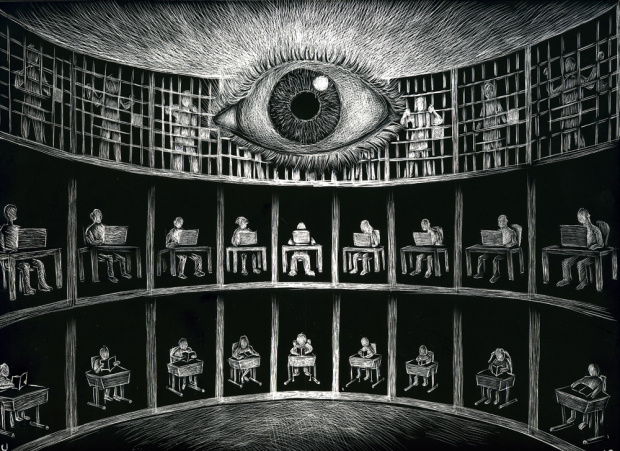
This small article a polemic against neoliberal hegemony; in particular the emerging issue of ‘surplus population’ as related to technological displacement in context of a free market, an issue purposive to such hegemony which as an ‘elephant growing in the panopticon’  i.e. not to be mentioned?

The central premise is that Artificial Intelligence (AI) + Robotics  comprise a nefarious as formulaic temptation to the elite of the ‘Technetronic era’ as Zbigniew Brzezinski put it: this consistent with a determinism as stems ontologically from ‘Empiricism’  form of a  ‘One Dimensionality’ as Marcuse phrased it over five Decades ago; and which thru being but mere simulacra, AI and Robotics represent an ontological imperative  potentially expropriated under pathology to denial of Kant’s concept of ‘categorical imperative’?  (That Kant did not subscribe to determinism is acknowledged). The neoliberal concepts of ‘Corporatism’ and ‘free market’ are powerful examples of this ‘one dimensionality’ which is clearly pathological, a topic notably explored by Joel Bakan concerning the pursuit of profit within a Corporatist framework.

– ‘One dimensionality in, one dimensionality out’– so it goes ontologically as to some  paraphrase of GIGO as trending alas way of ‘technological determinism’ towards an ‘Epitaph for Biodiversity’  as would be – way of ‘Garbage’ or ‘Junk’ un apperceived as much as ‘retrospection’ non occurrent indeed -and where ‘Farewell to the Working Class’ as André Gorz conceived to assume an entirely new meaning: -this to some denouement of  ‘Dystopian Nightmare’ as opposed to  ‘Utopian Dream’, alas; such the ‘Age of Leisure’  as ‘beckoning’ to be not for the majority or ‘Demos’,but rather  for the ‘technetronic elite’ and  their ‘AI’ and Robotics – such ‘leisure’ being as to a ‘freedom’ pathological and facilitated  by the absence of conscience as much as morality; such the ‘farewell’; such the defenestration of ‘surplus’ , such the ‘Age’ we ‘live’ within as to ‘expropriation’ and ‘arrogation’  to amount to  ‘Death by Panopticon’ such the ‘apotheosis’?

It is being so cheerful which keeps these small quarters going.

But digression.

–  It is a relatively small step from ‘the death of thought’ to ‘the death of Life’under Neoliberal Orthodoxy as proving to be the most toxic ideology ever knownsuch the hegemony as a deliberative, shift of the ‘ Overton Window’ currently occurring as to trend deterministic; such the mere necrotrophy as a ‘defenestration’ – and the ‘one percent’ but a deadly collective of parasitic orifice? For what is ‘Empiricism’ when implemented thru  AI and Robotic Technology in a Corporatist economy as but a ‘selective investment’  as to Research and Development by elite ‘private interests’,  which to a determinism so evidently entailing a whole raft of ‘consequence’ ; such the means, such the production, such the ‘phenomenology’ as ‘owned’ indeed? Under pathology, selectivity is impaired to point of ‘militarization’?

But foremost amongst said ‘raft’ of consequence – the concept of ‘classification’ as incorporates methodological reduction of the particular to a composite of generalities so typical of ‘Science’ as expropriated; the fruition thereof replicated not least thru ‘Consumerism’ – and ‘Lifestyle’ – as much as ‘Life’ reduced as much as abrogated to but correlation way  of ‘possession’ of ‘things’: this  as said replication expressed as much ‘thru’ Linnaeus as Marx  concerning ‘class’- and as results in concepts’ Incorporated’ such as the ‘Overton Window’ – as will be explored by way of ‘extrapolation’ below? The debasing of identity as a correlate of possessions as a necessary ‘abrogation’ by way of engineered ‘bio hack’ is only furthered, such the loss of dimensionality as a potential, by such as social media? An excellent multimedia illustration of such loss is found here.

It’s to be noted that for Empiricism the concept of ‘good’ and ‘evil’ entails an extra dimensionality  as ‘metaphysical’ – and that ‘Politics’ so deconstructed despite abuse under orthodoxy as to ‘mitigation’ remains as  ‘Moral Economics’ – this despite the  mitigative contention of neoliberal orthodoxy that there no morality in the ‘synonymy’; to a pragmatic as ‘Utilitarian’ point of a ‘Killing the Host’ prevailing at paradigmatic as much as Geopolitical level as but explicative of a ‘necrotrophy’; as much as the ‘defenestration’ as euphemism herein proposed this small article  would explicate?

Kudos to Michael Hudson for exposing, and continuing to expose, the ‘death of thought’ which Neoliberalism as an orthodoxy as but a mere ‘racket’ of ‘transfer of resources’ represents.

– Are we ‘on a roll’ here as much as ‘off the leash’ – such the rebellion ‘psycho political’; such the ‘CounterPunch’ by way of digital pamphleteering as ‘restricted code’ rejected evidenced by way of ‘alternative’?

‘Politics’ should mean a diversity biological as much as phenomenological; it should mean more than Empirical ‘utility’, by way of the extra dimensionality which Metaphysics represents; this, as much as ‘Democracy’ demands diversity; ‘thought permitted’ as evidencing same as much as questions allowed to be asked; while Corporatism as antithesis demands ‘line’, a homogeneity, a uniformity, an abrogation as to a contingency?

Whether ‘Empiricism’ as to Philosophy is ‘Essentialist’ or ‘Instrumentalist’ is as of much political relevance as the Medieval question ‘how many angels can dance upon the head of a needle?‘ – the tragic fact remaining in ‘Oceania’  become to Corporatism  is that the economic impact of (AI + Robotics) constitutes a ‘technological displacement’ which under a ‘one dimensionality’ as ‘Orthodox’  is as a ‘political impact’ at a quintessential or axiomatic level, such the ‘formulae’ as (=Ecocide) ‘completes’ under a determinism of hegemony as demands ‘whoredom’? AI and Robotics destroy the symbiotic relationship between production and consumption thru reducing the requirement for human labor as waged in the productive process; AI and Robotics thereby impact upon the distribution of resources as wage based. The fairy tale of compensatory employment opportunities is at best wishful thinking, at worst it is a purposively contrived propaganda?

‘Biodiversity’, alas, becoming more limited to a ‘Thanatos‘ of ‘Military Industrial Corporatist Complex’  as explicates the ‘Age of the Anthropocene’as of the ‘1%’ as funders of ‘hegemony’ such the transfer of resources?

‘As ‘we’ view the world so it becomes’, indeed – this as much as how ‘Others’, through hegemony as ‘Utilitarian’, would have it viewed – and that such a large part of ‘Currency’ as ‘it’  to the permit of ‘Hegemony’ which would control and issue views – such the window as ‘Overtonian’ as can be shifted?

How long before the ‘collateral damage’ concerning premature fatality and reduced life expectancy as evidenced in homelessness, withdrawal of social welfare, militarization of policing, drug abuse, including prescription of synthetic opioids, incarceration all as obscenities explicating the ‘cheapening of life’  becomes ‘formalised’ under neoliberal orthodoxy as euthanasia? To such an Overton Window would it at first be ‘voluntary’?

It was ‘Utilitarianism’ as gave the World the concept of ‘Panopticon’ back in the Eighteenth Century.

Apropos to such ‘Thanatos‘ identified:

Wherefore art thou ‘Eros’: as represented by checkout operator, bank teller, driver, warehouseman, barista, cook, secretary, journalist, lawyer, receptionist, ‘ human voice at the end of the line’ – such the insidious inroads being made consequent the advance of Empirical based Technology?

The ‘Litany’ of such ‘displacement/defenestration’ could go on, as it undoubtedly shall under prevailing Hegemony ‘Western’ as ‘Oceanic’ as much orthodox as ‘deadly’, such the invasive penetration of ‘one dimensionality’ as ‘technological displacement’ evidenced under neoliberal orthodoxy as entailing a transfer of resources to mere ‘Stateless Bastards’, such the point of a determinism as would prevail woeful?

Ponerological questions such as would not be asked commensurate:

Is the ultimate ‘stateless bastard’ satan?

Can ‘synonymy seen’ be’ revolutionary’?

‘Technological displacement’ under an ontology of ‘One Dimensionality’ aka‘Corporatism’ but a euphemism for ‘surplus population’; this as much as ‘Corporatism’ promotes the illusion of ‘Democracy’ by way of ‘mental cheating’; such the synonymy as ‘simulacra’ an ‘illusion’ denied – but ‘real’ under ‘doublethink’?

‘Trickle down economics’ is as real as much as ‘technological displacement’ to be compensated for in the ‘opening up of a whole new vista of opportunity’, such the death of thought as neoliberal orthodoxy represents some parallel of tales told by such as Horatio Alger to point of ‘illusion’ encouraged?

These small quarters would ‘rip a new one’ in Neoliberal Orthodoxy by way of polemic.

It remains a ‘big’ question under contemplation of the genius of Orwell and the highly perspicacious ratio of ‘1/15/84’ (hence the ‘one percent’) as to why, within an undoubtedly comprehensive as prescient Dystopian vision where ‘oligarchic collective’ a synonym of ‘technetronic elite’, he ‘permitted the currency’ of the ‘Prole’ as ‘84%’ to prevail as a presence rather than but a memory disappeared by way of ‘memory hole’?

Under neoliberal orthodoxy the political utility of the ‘Proles’ and in particular the ‘Lumpenproletariat’, alas, is as to but fear as a ‘stick’; a basis of control and manipulation same sense as Upton Sinclair explicated ‘carrot’ contingent by way of synonym seen: to wit;  accept control and manipulation as ‘rewarded’ or be ‘expelled’; be but as a ‘Prole’ subsisting and awaiting death, such the economic incarceration as ‘CAFO’ epitomises the cheapening of life under a hegemony as has corollary of alienation, marginalization and impoverishment wielded under Dystopian imperative; this to a ‘transfer of resources’ from ‘Eros‘ to ‘Thanatos‘ reinforced thru contingency of profit such the ‘ponerology’ of ‘Biodiversity’ reduced by way of paradigm Geopolitical?

To love Life is to loathe the deadly; such the philanthropy as would only be evidenced, such the irony, by the ‘ragged trousered’ as so reduced, such the divide et imperaevidenced?

-And so to ‘defenestration’ as ongoing 21stC. by way of ‘surplus population’ generated deterministically as to be dealt with ‘Utilitarian’ as much as the elimination of ‘Biodiversity’ such the ‘technetronic era’ as much as of Dystopia for Humanity as opposed to a Utopia for (AI + Robotics)?

In the annals of International Finance, in which ‘usury’ figures large as polymorphous(?), the power of (AI + Robotics) ‘growing’ as ‘metastasising’ –  as evidenced by the concept of ‘Dark Pools’, and in political manipulation to point of control and issue of currency  by algorithms, such as  infamously deployed by the now defunct Cambridge Analytica using data ‘supplied’ by Facebook are on the rise – such the ‘technetronic era’ furthered?

When neoliberal orthodoxy states Say hello to my little friend!‘ way of the militarization of ‘AI +Robotics” then a ‘defenestration’ form of ‘take all to hell’ will occur, such the shift of the ‘Overton Window’ in progress?

As to the ‘Overton Window’ as in title this small article; a fellow ‘CounterPuncher ‘sees thru it’ most apposite:

Overton described the evolution to broad public acceptance as a process that develops by degrees: “Unthinkable; Radical; Acceptable; Sensible; Popular; Policy.” The right used this model and stuck with it for 30 years to achieve its current dominance. Ideas like slashing unemployment insurance and welfare, privatizing crown corporations, gutting taxes on the wealthy, making huge cuts to social programs and signing “trade” deals that give corporations more power, were all “unthinkable” or “radical” in the beginning. But after 30 years of relentless promotion and the courting of politicians, all of these ideas are now public policy.

Murray Dobbin

– You see it is really quite ‘simple’ when boiled down, such the reductioad absurdumas ‘one dimensionality’ the result of Empiricism embraced to an exclusion of alternative, as ‘Evolution’ circumscribes as much as theoretically delineates?

‘The Talking Heads’ got it right regarding the consequences of neoliberal orthodoxy as concerns the masses and the ‘death of thought’ whereby a ‘Road to Nowhere’  becoming more ‘incorporative’?

Thru Empiricism as an ‘Ontology’, Man in process of nurturing a necrotrophy, such the orifice as existing to be stuffed to a ‘friction of the finitude’. Each ‘Billionaire’ as become so Empirically quantifiable as under such ‘neoliberal jungle’ such the paradigm of abrogation is as to to an obscene ‘transfer of resources’ whereby egocentricity a ‘Thanatos‘ as opposed to ‘Eros‘, and whereby in such land of the blind as a ‘Kingdom’, the ‘one eyed’ as ‘one dimensional’ as much as Empiricism lack any sense of empathy let alone mercy, and which AI and Robotics to epitomise?

Under such ‘paradigm’ of necrotrophy as debasement as much as abrogation it is as blessed to be a Prole? As Martin Luther so humorously said:

‘So our Lord God commonly gives riches to those gross asses to whom He vouchsafes nothing else’

The rationale for composing this small article is not to be pessimistic, rather such the pretension it is as to be a ‘gadfly’ against the manifestly ongoing cheapening of life thru which such a small minority profit from, and which yet remains mutable, as future submissions shall propose.

Philip K. Dick and the Fake Humans

(Editor’s note: on this 36th anniversary of the passing of Philip K. Dick, it seems an appropriate time to note the relevance of his work to our current dystopia as Henry Farrell does in the following essay. Unfortunately the author is less astute regarding the ways in which the dystopias of Orwell and Huxley are equally relevant to our current milieu.)

By Henry Farrell

Source: Boston Review

This is not the dystopia we were promised. We are not learning to love Big Brother, who lives, if he lives at all, on a cluster of server farms, cooled by environmentally friendly technologies. Nor have we been lulled by Soma and subliminal brain programming into a hazy acquiescence to pervasive social hierarchies.

Dystopias tend toward fantasies of absolute control, in which the system sees all, knows all, and controls all. And our world is indeed one of ubiquitous surveillance. Phones and household devices produce trails of data, like particles in a cloud chamber, indicating our wants and behaviors to companies such as Facebook, Amazon, and Google. Yet the information thus produced is imperfect and classified by machine-learning algorithms that themselves make mistakes. The efforts of these businesses to manipulate our wants leads to further complexity. It is becoming ever harder for companies to distinguish the behavior which they want to analyze from their own and others’ manipulations.

This does not look like totalitarianism unless you squint very hard indeed. As the sociologist Kieran Healy has suggested, sweeping political critiques of new technology often bear a strong family resemblance to the arguments of Silicon Valley boosters. Both assume that the technology works as advertised, which is not necessarily true at all.

Standard utopias and standard dystopias are each perfect after their own particular fashion. We live somewhere queasier—a world in which technology is developing in ways that make it increasingly hard to distinguish human beings from artificial things. The world that the Internet and social media have created is less a system than an ecology, a proliferation of unexpected niches, and entities created and adapted to exploit them in deceptive ways. Vast commercial architectures are being colonized by quasi-autonomous parasites. Scammers have built algorithms to write fake books from scratch to sell on Amazon, compiling and modifying text from other books and online sources such as Wikipedia, to fool buyers or to take advantage of loopholes in Amazon’s compensation structure. Much of the world’s financial system is made out of bots—automated systems designed to continually probe markets for fleeting arbitrage opportunities. Less sophisticated programs plague online commerce systems such as eBay and Amazon, occasionally with extraordinary consequences, as when two warring bots bid the price of a biology book up to $23,698,655.93 (plus $3.99 shipping).

In other words, we live in Philip K. Dick’s future, not George Orwell’s or Aldous Huxley’s. Dick was no better a prophet of technology than any science fiction writer, and was arguably worse than most. His imagined worlds jam together odd bits of fifties’ and sixties’ California with rocket ships, drugs, and social speculation. Dick usually wrote in a hurry and for money, and sometimes under the influence of drugs or a recent and urgent personal religious revelation.

Still, what he captured with genius was the ontological unease of a world in which the human and the abhuman, the real and the fake, blur together. As Dick described his work (in the opening essay to his 1985 collection, I Hope I Shall Arrive Soon):

The two basic topics which fascinate me are “What is reality?” and “What constitutes the authentic human being?” Over the twenty-seven years in which I have published novels and stories I have investigated these two interrelated topics over and over again.

These obsessions had some of their roots in Dick’s complex and ever-evolving personal mythology (in which it was perfectly plausible that the “real” world was a fake, and that we were all living in Palestine sometime in the first century AD). Yet they were also based on a keen interest in the processes through which reality is socially constructed. Dick believed that we all live in a world where “spurious realities are manufactured by the media, by governments, by big corporations, by religious groups, political groups—and the electronic hardware exists by which to deliver these pseudo-worlds right into heads of the reader.” He argued:

the bombardment of pseudo-realities begins to produce inauthentic humans very quickly, spurious humans—as fake as the data pressing at them from all sides. My two topics are really one topic; they unite at this point. Fake realities will create fake humans. Or, fake humans will generate fake realities and then sell them to other humans, turning them, eventually, into forgeries of themselves. So we wind up with fake humans inventing fake realities and then peddling them to other fake humans.

In Dick’s books, the real and the unreal infect each other, so that it becomes increasingly impossible to tell the difference between them. The worlds of the dead and the living merge in Ubik (1969), the experiences of a disturbed child infect the world around him in Martian Time-Slip (1964), and consensual drug-based hallucinations become the vector for an invasive alien intelligence in The Three Stigmata of Palmer Eldritch (1965). Humans are impersonated by malign androids in Do Androids Dream of Electric Sheep? (1968) and “Second Variety” (1953); by aliens in “The Hanging Stranger” (1953) and “The Father-Thing” (1954); and by mutants in “The Golden Man” (1954).

This concern with unreal worlds and unreal people led to a consequent worry about an increasing difficulty of distinguishing between them. Factories pump out fake Americana in The Man in the High Castle (1962), mirroring the problem of living in a world that is not, in fact, the real one. Entrepreneurs build increasingly human-like androids in Do Androids Dream of Electric Sheep?, reasoning that if they do not, then their competitors will. Figuring out what is real and what is not is not easy. Scientific tools such as the famous Voight-Kampff test in Do Androids Dream of Electric Sheep? (and Blade Runner, Ridley Scott’s 1982 movie based loosely on it) do not work very well, leaving us with little more than hope in some mystical force—the I Ching, God in a spray can, a Martian water-witch—to guide us back toward the real.

We live in Dick’s world—but with little hope of divine intervention or invasion. The world where we communicate and interact at a distance is increasingly filled with algorithms that appear human, but are not—fake people generated by fake realities. When Ashley Madison, a dating site for people who want to cheat on their spouses, was hacked, it turned out that tens of thousands of the women on the site were fake “fembots” programmed to send millions of chatty messages to male customers, so as to delude them into thinking that they were surrounded by vast numbers of potential sexual partners.

These problems are only likely to get worse as the physical world and the world of information become increasingly interpenetrated in an Internet of (badly functioning) Things. Many of the aspects of Joe Chip’s future world in Ubik look horrendously dated to modern eyes: the archaic role of women, the assumption that nearly everyone smokes. Yet the door to Joe’s apartment—which argues with him and refuses to open because he has not paid it the obligatory tip—sounds ominously plausible. Someone, somewhere, is pitching this as a viable business plan to Y Combinator or the venture capitalists in Menlo Park.

This invasion of the real by the unreal has had consequences for politics. The hallucinatory realities in Dick’s worlds—the empathetic religion of Do Androids Dream of Electric Sheep?, the drug-produced worlds of The Three Stigmata of Palmer Eldritch, the quasi–Tibetan Buddhist death realm of Ubik—are usually experienced by many people, like the television shows of Dick’s America. But as network television has given way to the Internet, it has become easy for people to create their own idiosyncratic mix of sources. The imposed media consensus that Dick detested has shattered into a myriad of different realities, each with its own partially shared assumptions and facts. Sometimes this creates tragedy or near-tragedy. The deluded gunman who stormed into Washington, D.C.’s Comet Ping Pong pizzeria had been convinced by online conspiracy sites that it was the coordinating center for Hillary Clinton’s child–sex trafficking ring [likewise, the masses may have been convinced by mainstream media that a real child-sex trafficking ring never existed].

Such fractured worlds are more vulnerable to invasion by the non-human. Many Twitter accounts are bots, often with the names and stolen photographs of implausibly beautiful young women, looking to pitch this or that product (one recent academic study found that between 9 and 15 percent of all Twitter accounts are likely fake). Twitterbots vary in sophistication from automated accounts that do no more than retweet what other bots have said, to sophisticated algorithms deploying so-called “Sybil attacks,” creating fake identities in peer-to-peer networks to invade specific organizations or degrade particular kinds of conversation.

Twitter has failed to become a true mass medium, but remains extraordinarily important to politics, since it is where many politicians, journalists, and other elites turn to get their news. One research project suggests that around 20 percent of the measurable political discussion around the last presidential election came from bots. Humans appear to be no better at detecting bots than we are, in Dick’s novel, at detecting replicant androids: people are about as likely to retweet a bot’s message as the message of another human being. Most notoriously, the current U.S. president recently retweeted a flattering message that appears to have come from a bot densely connected to a network of other bots, which some believe to be controlled by the Russian government and used for propaganda purposes.

In his novels Dick was interested in seeing how people react when their reality starts to break down. A world in which the real commingles with the fake, so that no one can tell where the one ends and the other begins, is ripe for paranoia. The most toxic consequence of social media manipulation, whether by the Russian government or others, may have nothing to do with its success as propaganda. Instead, it is that it sows an existential distrust. People simply do not know what or who to believe anymore. Rumors that are spread by Twitterbots merge into other rumors about the ubiquity of Twitterbots, and whether this or that trend is being driven by malign algorithms rather than real human beings.

Such widespread falsehood is especially explosive when combined with our fragmented politics. Liberals’ favorite term for the right-wing propaganda machine, “fake news,” has been turned back on them by conservatives, who treat conventional news as propaganda, and hence ignore it. On the obverse, it may be easier for many people on the liberal left to blame Russian propaganda for the last presidential election than to accept that many voters had a very different understanding of America than they do.

Dick had other obsessions—most notably the politics of Richard Nixon and the Cold War. It is not hard to imagine him writing a novel combining an immature and predatory tycoon (half Arnie Kott, half Jory Miller) who becomes the president of the United States, secret Russian political manipulation, an invasion of empathy-free robotic intelligences masquerading as human beings, and a breakdown in our shared understanding of what is real and what is fake.

These different elements probably would not cohere particularly well, but as in Dick’s best novels, the whole might still work, somehow. Indeed, it is in the incongruities of Dick’s novels that salvation is to be found (even at his battiest, he retains a sense of humor). Obviously, it is less easy to see the joke when one is living through it. Dystopias may sometimes be grimly funny—but rarely from the inside.

Something is wrong on the internet

By James Bridle

Source: Medium

As someone who grew up on the internet, I credit it as one of the most important influences on who I am today. I had a computer with internet access in my bedroom from the age of 13. It gave me access to a lot of things which were totally inappropriate for a young teenager, but it was OK. The culture, politics, and interpersonal relationships which I consider to be central to my identity were shaped by the internet, in ways that I have always considered to be beneficial to me personally. I have always been a critical proponent of the internet and everything it has brought, and broadly considered it to be emancipatory and beneficial. I state this at the outset because thinking through the implications of the problem I am going to describe troubles my own assumptions and prejudices in significant ways.

One of the thus-far hypothetical questions I ask myself frequently is how I would feel about my own children having the same kind of access to the internet today. And I find the question increasingly difficult to answer. I understand that this is a natural evolution of attitudes which happens with age, and at some point this question might be a lot less hypothetical. I don’t want to be a hypocrite about it. I would want my kids to have the same opportunities to explore and grow and express themselves as I did. I would like them to have that choice. And this belief broadens into attitudes about the role of the internet in public life as whole.

I’ve also been aware for some time of the increasingly symbiotic relationship between younger children and YouTube. I see kids engrossed in screens all the time, in pushchairs and in restaurants, and there’s always a bit of a Luddite twinge there, but I am not a parent, and I’m not making parental judgments for or on anyone else. I’ve seen family members and friend’s children plugged into Peppa Pig and nursery rhyme videos, and it makes them happy and gives everyone a break, so OK.

But I don’t even have kids and right now I just want to burn the whole thing down.

Someone or something or some combination of people and things is using YouTube to systematically frighten, traumatise, and abuse children, automatically and at scale, and it forces me to question my own beliefs about the internet, at every level. Much of what I am going to describe next has been covered elsewhere, although none of the mainstream coverage I’ve seen has really grasped the implications of what seems to be occurring.

To begin: Kid’s YouTube is definitely and markedly weird. I’ve been aware of its weirdness for some time. Last year, there were a number of articles posted about the Surprise Egg craze. Surprise Eggs videos depict, often at excruciating length, the process of unwrapping Kinder and other egg toys. That’s it, but kids are captivated by them. There are thousands and thousands of these videos and thousands and thousands, if not millions, of children watching them.

From the article linked above:

The maker of my particular favorite videos is “Blu Toys Surprise Brinquedos & Juegos,” and since 2010 he seems to have accrued 3.7 million subscribers and just under 6 billion views for a kid-friendly channel entirely devoted to opening surprise eggs and unboxing toys. The video titles are a continuous pattern of obscure branded lines and tie-ins: “Surprise Play Doh Eggs Peppa Pig Stamper Cars Pocoyo Minecraft Smurfs Kinder Play Doh Sparkle Brilho,” “Cars Screamin’ Banshee Eats Lightning McQueen Disney Pixar,” “Disney Baby Pop Up Pals Easter Eggs SURPRISE.”

As I write this he has done a total of 4,426 videos and counting. With so many views — for comparison, Justin Bieber’s official channel has more than 10 billion views, while full-time YouTube celebrity PewDiePie has nearly 12 billion — it’s likely this man makes a living as a pair of gently murmuring hands that unwrap Kinder eggs. (Surprise-egg videos are all accompanied by pre-roll, and sometimes mid-video and ads.)

That should give you some idea of just how odd the world of kids online video is, and that list of video titles hints at the extraordinary range and complexity of this situation. We’ll get into the latter in a minute; for the moment know that it’s already very strange, if apparently pretty harmless, out there.

Another huge trope, especially the youngest children, is nursery rhyme videos.

Little Baby Bum, which made the above video, is the 7th most popular channel on YouTube. With just 515 videos, they have accrued 11.5 million subscribers and 13 billion views. Again, there are questions as to the accuracy of these numbers, which I’ll get into shortly, but the key point is that this is a huge, huge network and industry.

On-demand video is catnip to both parents and to children, and thus to content creators and advertisers. Small children are mesmerised by these videos, whether it’s familiar characters and songs, or simply bright colours and soothing sounds. The length of many of these videos — one common video tactic is to assemble many nursery rhyme or cartoon episodes into hour+ compilations —and the way that length is marketed as part of the video’s appeal, points to the amount of time some kids are spending with them.

YouTube broadcasters have thus developed a huge number of tactics to draw parents’ and childrens’ attention to their videos, and the advertising revenues that accompany them. The first of these tactics is simply to copy and pirate other content. A simple search for “Peppa Pig” on YouTube in my case yielded “About 10,400,000 results” and the front page is almost entirely from the verified “Peppa Pig Official Channel”, while one is from an unverified channel called Play Go Toys, which you really wouldn’t notice unless you were looking out for it:

Play Go Toys’ channel consists of (I guess?) pirated Peppa Pig and other cartoons, videos of toy unboxings (another kid magnet), and videos of, one supposes, the channel owner’s own children. I am not alleging anything bad about Play Go Toys; I am simply illustrating how the structure of YouTube facilitates the delamination of content and author, and how this impacts on our awareness and trust of its source.

As another blogger notes, one of the traditional roles of branded content is that it is a trusted source. Whether it’s Peppa Pig on children’s TV or a Disney movie, whatever one’s feelings about the industrial model of entertainment production, they are carefully produced and monitored so that kids are essentially safe watching them, and can be trusted as such. This no longer applies when brand and content are disassociated by the platform, and so known and trusted content provides a seamless gateway to unverified and potentially harmful content.

(Yes, this is the exact same process as the delamination of trusted news media on Facebook feeds and in Google results that is currently wreaking such havoc on our cognitive and political systems and I am not going to explicitly explore that relationship further here, but it is obviously deeply significant.)

A second way of increasing hits on videos is through keyword/hashtag association, which is a whole dark art unto itself. When some trend, such as Surprise Egg videos, reaches critical mass, content producers pile onto it, creating thousands and thousands more of these videos in every possible iteration. This is the origin of all the weird names in the list above: branded content and nursery rhyme titles and “surprise egg” all stuffed into the same word salad to capture search results, sidebar placement, and “up next” autoplay rankings.

Play Go Toys’ channel consists of (I guess?) pirated Peppa Pig and other cartoons, videos of toy unboxings (another kid magnet), and videos of, one supposes, the channel owner’s own children. I am not alleging anything bad about Play Go Toys; I am simply illustrating how the structure of YouTube facilitates the delamination of content and author, and how this impacts on our awareness and trust of its source.

As another blogger notes, one of the traditional roles of branded content is that it is a trusted source. Whether it’s Peppa Pig on children’s TV or a Disney movie, whatever one’s feelings about the industrial model of entertainment production, they are carefully produced and monitored so that kids are essentially safe watching them, and can be trusted as such. This no longer applies when brand and content are disassociated by the platform, and so known and trusted content provides a seamless gateway to unverified and potentially harmful content.

(Yes, this is the exact same process as the delamination of trusted news media on Facebook feeds and in Google results that is currently wreaking such havoc on our cognitive and political systems and I am not going to explicitly explore that relationship further here, but it is obviously deeply significant.)

A second way of increasing hits on videos is through keyword/hashtag association, which is a whole dark art unto itself. When some trend, such as Surprise Egg videos, reaches critical mass, content producers pile onto it, creating thousands and thousands more of these videos in every possible iteration. This is the origin of all the weird names in the list above: branded content and nursery rhyme titles and “surprise egg” all stuffed into the same word salad to capture search results, sidebar placement, and “up next” autoplay rankings.

A striking example of the weirdness is the Finger Family videos (harmless example embedded above). I have no idea where they came from or the origin of the children’s rhyme at the core of the trope, but there are at least 17 million versions of this currently on YouTube, and again they cover every possible genre, with billions and billions of aggregated views.

Once again, the view numbers of these videos must be taken under serious advisement. A huge number of these videos are essentially created by bots and viewed by bots, and even commented on by bots. That is a whole strange world in and of itself. But it shouldn’t obscure that there are also many actual children, plugged into iphones and tablets, watching these over and over again — in part accounting for the inflated view numbers — learning to type basic search terms into the browser, or simply mashing the sidebar to bring up another video.

What I find somewhat disturbing about the proliferation of even (relatively) normal kids videos is the impossibility of determining the degree of automation which is at work here; how to parse out the gap between human and machine. The example above, from a channel called Bounce Patrol Kids, with almost two million subscribers, show this effect in action. It posts professionally produced videos, with dedicated human actors, at the rate of about one per week. Once again, I am not alleging anything untoward about Bounce Patrol, which clearly follows in the footsteps of pre-digital kid sensations like their fellow Australians The Wiggles.

And yet, there is something weird about a group of people endlessly acting out the implications of a combination of algorithmically generated keywords: “Halloween Finger Family & more Halloween Songs for Children | Kids Halloween Songs Collection”, “Australian Animals Finger Family Song | Finger Family Nursery Rhymes”, “Farm Animals Finger Family and more Animals Songs | Finger Family Collection – Learn Animals Sounds”, “Safari Animals Finger Family Song | Elephant, Lion, Giraffe, Zebra & Hippo! Wild Animals for kids”, “Superheroes Finger Family and more Finger Family Songs! Superhero Finger Family Collection”, “Batman Finger Family Song — Superheroes and Villains! Batman, Joker, Riddler, Catwoman” and on and on and on. This is content production in the age of algorithmic discovery — even if you’re a human, you have to end up impersonating the machine.

Other channels do away with the human actors to create infinite reconfigurable versions of the same videos over and over again. What is occurring here is clearly automated. Stock animations, audio tracks, and lists of keywords being assembled in their thousands to produce an endless stream of videos. The above channel, Videogyan 3D Rhymes — Nursery Rhymes & Baby Songs, posts several videos a week, in increasingly byzantine combinations of keywords. They have almost five million subscribers — more than double Bounce Patrol — although once again it’s impossible to know who or what is actually racking up these millions and millions of views.

I’m trying not to turn this essay into an endless list of examples, but it’s important to grasp how vast this system is, and how indeterminate its actions, process, and audience. It’s also international: there are variations of Finger Family and Learn Colours videos for Tamil epics and Malaysian cartoons which are unlikely to pop up in any Anglophone search results. This very indeterminacy and reach is key to its existence, and its implications. Its dimensionality makes it difficult to grasp, or even to really think about.

We’ve encountered pretty clear examples of the disturbing outcomes of full automation before — some of which have been thankfully leavened with a dark kind of humour, others not so much. Much has been made of the algorithmic interbreeding of stock photo libraries and on-demand production of everything from tshirts to coffee mugs to infant onesies and cell phone covers. The above example, available until recently on Amazon, is one such case, and the story of how it came to occur is fascinating and weird but essentially comprehensible. Nobody set out to create phone cases with drugs and medical equipment on them, it was just a deeply weird mathematical/probabilistic outcome. The fact that it took a while to notice might ring some alarm bells however.

Likewise, the case of the “Keep Calm and Rape A Lot” tshirts (along with the “Keep Calm and Knife Her” and “Keep Calm and Hit Her” ones) is depressing and distressing but comprehensible. Nobody set out to create these shirts: they just paired an unchecked list of verbs and pronouns with an online image generator. It’s quite possible that none of these shirts ever physically existed, were ever purchased or worn, and thus that no harm was done. Once again though, the people creating this content failed to notice, and neither did the distributor. They literally had no idea what they were doing.

What I will argue, on the basis of these cases and of those I’m going to describe further, is that the scale and logic of the system is complicit in these outputs, and requires us to think through their implications.

(Also again: I’m not going to dig into the wider social implications of such processes outside the scope of what I am writing about here, but it’s clear that one can draw a clear line from examples such as these to pressing contemporary issues such as racial and gender bias in big data and machine intelligence-driven systems, which require urgent attention but in the same manner do not have anything resembling easy or even preferable solutions.)

Let’s look at just one video among the piles of kid videos, and try to parse out where it comes from. It’s important to stress that I didn’t set out to find this particular video: it appeared organically and highly ranked in a search for ‘finger family’ in an incognito browser window (i.e. it should not have been influenced by previous searches). This automation takes us to very, very strange places, and at this point the rabbithole is so deep that it’s impossible to know how such a thing came into being.

Once again, a content warning: this video is not inappropriate in any way, but it is decidedly off, and contains elements which might trouble anyone. It’s very mild on the scale of such things, but. I describe it below if you don’t want to watch it and head down that road. This warning will recur.

The above video is entitled Wrong Heads Disney Wrong Ears Wrong Legs Kids Learn Colors Finger Family 2017 Nursery Rhymes. The title alone confirms its automated provenance. I have no idea where the “Wrong Heads” trope originates, but I can imagine, as with the Finger Family Song, that somewhere there is a totally original and harmless version that made enough kids laugh that it started to climb the algorithmic rankings until it made it onto the word salad lists, combining with Learn Colors, Finger Family, and Nursery Rhymes, and all of these tropes — not merely as words but as images, processes, and actions — to be mixed into what we see here.

The video consists of a regular version of the Finger Family song played over an animation of character heads and bodies from Disney’s Aladdin swapping and intersecting. Again, this is weird but frankly no more than the Surprise Egg videos or anything else kids watch. I get how innocent it is. The offness creeps in with the appearance of a non-Aladdin character —Agnes, the little girl from Despicable Me. Agnes is the arbiter of the scene: when the heads don’t match up, she cries, when they do, she cheers.

The video’s creator, BABYFUN TV (screenshot above), has produced many similar videos. As many of the Wrong Heads videos as I could bear to watch all work in exactly the same way. The character Hope from Inside Out weeps through a Smurfs and Trolls head swap. It goes on and on. I get the game, but the constant overlaying and intermixing of different tropes starts to get inside you. BABYFUN TV only has 170 subscribers and very low view rates, but then there are thousands and thousands of channels like this. Numbers in the long tail aren’t significant in the abstract, but in their accumulation.

The question becomes: how did this come to be? The “Bad Baby” trope also present on BABYFUN TV features the same crying. While I find it disturbing, I can understand how it might provide some of the rhythm or cadence or relation to their own experience that actual babies are attracted to in this content, although it has been warped and stretched through algorithmic repetition and recombination in ways that I don’t think anyone actually wants to happen.

Toy Freaks is a hugely popular channel (68th on the platform) which features a father and his two daughters playing out — or in some cases perhaps originating — many of the tropes we’ve identified so far, including “Bad Baby”, above. As well as nursery rhymes and learning colours, Toy Freaks specialises in gross-out situations, as well as activities which many, many viewers feel border on abuse and exploitation, if not cross the line entirely, including videos of the children vomiting and in pain. Toy Freaks is a YouTube verified channel, whatever that means. (I think we know by now it means nothing useful.)

As with Bounce Patrol Kids, however you feel about the content of these videos, it feels impossible to know where the automation starts and ends, who is coming up with the ideas and who is roleplaying them. In turn, the amplification of tropes in popular, human-led channels such as Toy Freaks leads to them being endlessly repeated across the network in increasingly outlandish and distorted recombinations.

There’s a second level of what I’m characterising as human-led videos which are much more disturbing than the mostly distasteful activities of Toy Freaks and their kin. Here is a relatively mild, but still upsetting example:

A step beyond the simply pirated Peppa Pig videos mentioned previously are the knock-offs. These too seem to teem with violence. In the official Peppa Pig videos, Peppa does indeed go to the dentist, and the episode in which she does so seems to be popular — although, confusingly, what appears to be the real episode is only available on an unofficial channel. In the official timeline, Peppa is appropriately reassured by a kindly dentist. In the version above, she is basically tortured, before turning into a series of Iron Man robots and performing the Learn Colours dance. A search for “peppa pig dentist” returns the above video on the front page, and it only gets worse from here.

Disturbing Peppa Pig videos, which tend towards extreme violence and fear, with Peppa eating her father or drinking bleach, are, it turns out very widespread. They make up an entire YouTube subculture. Many are obviously parodies, or even satires of themselves, in the pretty common style of the internet’s outrageous, deliberately offensive kind. All the 4chan tropes are there, the trolls are out, we know this.

In the example above, the agency is less clear: the video starts with a trollish Peppa parody, but later syncs into the kind of automated repetition of tropes we’ve seen already. I don’t know which camp it belongs to. Maybe it’s just trolls. I kind of hope it is. But I don’t think so. Trolls don’t cover the intersection of human actors and more automated examples further down the line. They’re at play here, but they’re not the whole story.

I suppose it’s naive not to see the deliberate versions of this coming, but many are so close to the original, and so unsignposted — like the dentist example — that many, many kids are watching them. I understand that most of them are not trying to mess kids up, not really, even though they are.

I’m trying to understand why, as plainly and simply troubling as it is, this is not a simple matter of “won’t somebody think of the children” hand-wringing. Obviously this content is inappropriate, obviously there are bad actors out there, obviously some of these videos should be removed. Obviously too this raises questions of fair use, appropriation, free speech and so on. But reports which simply understand the problem through this lens fail to fully grasp the mechanisms being deployed, and thus are incapable of thinking its implications in totality, and responding accordingly.

The New York Times, headlining their article on a subset of this issue “On YouTube Kids, Startling Videos Slip Past Filters”, highlights the use of knock-off characters and nursery rhymes in disturbing content, and frames it as a problem of moderation and legislation. YouTube Kids, an official app which claims to be kid-safe but is quite obviously not, is the problem identified, because it wrongly engenders trust in users. An article in the British tabloid The Sun, “Kids left traumatised after sick YouTube clips showing Peppa Pig characters with knives and guns appear on app for children” takes the same line, with an added dose of right-wing technophobia and self-righteousness. But both stories take at face value YouTube’s assertions that these results are incredibly rare and quickly removed: assertions utterly refuted by the proliferation of the stories themselves, and the growing number of social media posts, largely by concerned parents, from which they arise.

But as with Toy Freaks, what is concerning to me about the Peppa videos is how the obvious parodies and even the shadier knock-offs interact with the legions of algorithmic content producers until it is completely impossible to know what is going on. (“The creatures outside looked from pig to man, and from man to pig, and from pig to man again; but already it was impossible to say which was which.”)

Here’s what is basically a version of Toy Freaks produced in Asia (screenshot above). Here’s one from Russia. I don’t really want to use the term “human-led” any more about these videos, although they contain all the same tropes and actual people acting them out. I no longer have any idea what’s going on here and I really don’t want to and I’m starting to think that that is kind of the point. That’s part of why I’m starting to think about the deliberateness of this all. There is a lot of effort going into making these. More than spam revenue can generate — can it? Who’s writing these scripts, editing these videos? Once again, I want to stress: this is still really mild, even funny stuff compared to a lot of what is out there.

Here are a few things which are disturbing me:

The first is the level of horror and violence on display. Some of the times it’s troll-y gross-out stuff; most of the time it seems deeper, and more unconscious than that. The internet has a way of amplifying and enabling many of our latent desires; in fact, it’s what it seems to do best. I spend a lot of time arguing for this tendency, with regards to human sexual freedom, individual identity, and other issues. Here, and overwhelmingly it sometimes feels, that tendency is itself a violent and destructive one.

The second is the levels of exploitation, not of children because they are children but of children because they are powerless. Automated reward systems like YouTube algorithms necessitate exploitation in the same way that capitalism necessitates exploitation, and if you’re someone who bristles at the second half of that equation then maybe this should be what convinces you of its truth. Exploitation is encoded into the systems we are building, making it harder to see, harder to think and explain, harder to counter and defend against. Not in a future of AI overlords and robots in the factories, but right here, now, on your screen, in your living room and in your pocket.

Many of these latest examples confound any attempt to argue that nobody is actually watching these videos, that these are all bots. There are humans in the loop here, even if only on the production side, and I’m pretty worried about them too.

I’ve written enough, too much, but I feel like I actually need to justify all this raving about violence and abuse and automated systems with an example that sums it up. Maybe after everything I’ve said you won’t think it’s so bad. I don’t know what to think any more.

This video, BURIED ALIVE Outdoor Playground Finger Family Song Nursery Rhymes Animation Education Learning Video, contains all of the elements we’ve covered above, and takes them to another level. Familiar characters, nursery tropes, keyword salad, full automation, violence, and the very stuff of kids’ worst dreams. And of course there are vast, vast numbers of these videos. Channel after channel after channel of similar content, churned out at the rate of hundreds of new videos every week. Industrialised nightmare production.

For the final time: There is more violent and more sexual content like this available. I’m not going to link to it. I don’t believe in traumatising other people, but it’s necessary to keep stressing it, and not dismiss the psychological effect on children of things which aren’t overtly disturbing to adults, just incredibly dark and weird.

A friend who works in digital video described to me what it would take to make something like this: a small studio of people (half a dozen, maybe more) making high volumes of low quality content to reap ad revenue by tripping certain requirements of the system (length in particular seems to be a factor). According to my friend, online kids’ content is one of the few alternative ways of making money from 3D animation because the aesthetic standards are lower and independent production can profit through scale. It uses existing and easily available content (such as character models and motion-capture libraries) and it can be repeated and revised endlessly and mostly meaninglessly because the algorithms don’t discriminate — and neither do the kids.

These videos, wherever they are made, however they come to be made, and whatever their conscious intention (i.e. to accumulate ad revenue) are feeding upon a system which was consciously intended to show videos to children for profit. The unconsciously-generated, emergent outcomes of that are all over the place.

To expose children to this content is abuse. We’re not talking about the debatable but undoubtedly real effects of film or videogame violence on teenagers, or the effects of pornography or extreme images on young minds, which were alluded to in my opening description of my own teenage internet use. Those are important debates, but they’re not what is being discussed here. What we’re talking about is very young children, effectively from birth, being deliberately targeted with content which will traumatise and disturb them, via networks which are extremely vulnerable to exactly this form of abuse. It’s not about trolls, but about a kind of violence inherent in the combination of digital systems and capitalist incentives. It’s down to that level of the metal.

This, I think, is my point: The system is complicit in the abuse.

And right now, right here, YouTube and Google are complicit in that system. The architecture they have built to extract the maximum revenue from online video is being hacked by persons unknown to abuse children, perhaps not even deliberately, but at a massive scale. I believe they have an absolute responsibility to deal with this, just as they have a responsibility to deal with the radicalisation of (mostly) young (mostly) men via extremist videos — of any political persuasion. They have so far showed absolutely no inclination to do this, which is in itself despicable. However, a huge part of my troubled response to this issue is that I have no idea how they can respond without shutting down the service itself, and most systems which resemble it. We have built a world which operates at scale, where human oversight is simply impossible, and no manner of inhuman oversight will counter most of the examples I’ve used in this essay. The asides I’ve kept in parentheses throughout, if expanded upon, would allow one with minimal effort to rewrite everything I’ve said, with very little effort, to be not about child abuse, but about white nationalism, about violent religious ideologies, about fake news, about climate denialism, about 9/11 conspiracies.

This is a deeply dark time, in which the structures we have built to sustain ourselves are being used against us — all of us — in systematic and automated ways. It is hard to keep faith with the network when it produces horrors such as these. While it is tempting to dismiss the wilder examples as trolling, of which a significant number certainly are, that fails to account for the sheer volume of content weighted in a particularly grotesque direction. It presents many and complexly entangled dangers, including that, just as with the increasing focus on alleged Russian interference in social media, such events will be used as justification for increased control over the internet, increasing censorship, and so on. This is not what many of us want.

I’m going to stop here, saying only this:

What concerns me is not just the violence being done to children here, although that concerns me deeply. What concerns me is that this is just one aspect of a kind of infrastructural violence being done to all of us, all of the time, and we’re still struggling to find a way to even talk about it, to describe its mechanisms and its actions and its effects. As I said at the beginning of this essay: this is being done by people and by things and by a combination of things and people. Responsibility for its outcomes is impossible to assign but the damage is very, very real indeed.


Manufacturing Panic: Social Engineering, Domination and Control

By S.C. Hickman

Source: Techno Occulture

In the 21st century, the social engineering of dread and longing have evolved into a bio-political arena of terror and a psycho-political culture of internalized domination. The globally deployed technology of the spectacle transforms to a creative panic industry, the pacification of the self and the silencing of multitudes. With no visible alternatives to universal pancapitalism there seems to be no need for payoffs for the disenchanted, no necessity to bribe the dissenting segments of the population and no incentive to grant extension of freedoms.1

Instead of peddling hope and visions of mutually shared commonwealth, authority is maintained by the production of synthetic fear and the need to secure property against some other. Deimos and Phobos, the gods of panic, angst and terror dominate the omni-directional realm of geo-psychological strategies in an asymmetric world war against invisible enemies without qualities. Market concentrations benefit neo-feudal power structures that know how to use access to media, private security and intelligence services to advance their interests. Austerity, power, and impersonal anonymity interface with a world replete with vast global migrations, desperation, and panic victims who willingly comply and give up liberties for shared security. An Orwellian world of competing agencies, wars, famines, and pestilence drive the panic cities of current criminal elements to traffic in sex, drugs, and war.

Private oligarchic networks of finance and business cartels cultivate relations to governmental entities controlling state agencies and military units. Media narratives and public relations strategies transform synthetic fear into advantages that produce windfalls of power and profit. This theater of fear is a skillful interplay of compartmentalized information units, privatized command centers, loyal officials and gatekeepers as well as professional Special Forces. Technocommercial Black-Ops programs that infiltrate both governmental and public spheres through experimental use of technics and pharmakon in collusion with DARPA and other shadow or Deep State agencies across the globe provide a base infrastructure for a 21st century society of control. Productions of artificial angst call for scenarios of counter-terrorist theater rehearsals and paramilitary actors as well as the professional staging of scapegoats and dupes. The dark networks draw on privatized intelligence units, so called “asteroids”, business entities which provide cover for compartmentalized operations.2

Space was formerly known as heaven and manned space flight from earth could be understood as mechanical equivalent to an ascent to divinity. Johannes Kepler suspected paradise to be located on the moon and Konstantin Tsiolkowsky, the Russian pioneer of modern rocket science, saw manned space flight as a freeway to the supernatural. In his novel “Gravity’s Rainbow” Thomas Pynchon contemplates the ambiguous interrelations between sex, rockets and magic.

Jack Parsons, a key figure in American rocketry, lost his reputation and security clearance in obsessive pursuit of occult rituals and sexual mumbo-jumbo before he diffused into space in a lab explosion in 1952. A crater on the dark side of the moon is named in memory of Parsons, a tribute to the shady cofounder of the famed Jet Propulsion Laboratory (JPL). The 19th century spiritualist pseudoscience of a world of ghosts and occult belief in spirits, a complex adaptation to modernity, has morphed into 20th century sciences. From social theories and “optimization” of the workplace, from operations research to scientific communication and applied psychology, many genres of academic disciplines and the influence business are rooted in the twilight zone of the netherworlds.

When Norbert Wiener, who developed his work on cybernetics from ballistics research, writes that “Communication and control belong to the essence of man’s inner life, even as they belong to his life in society” he evokes the ancient art of assessing the human personality and exploiting motivations. Developed out of clandestine mind control programs in the 1960’s, the methodical application of Personality Assessment Systems became standard operating procedure in business and intelligence. Systems of discipline and control which took shape in the 19th century on the basis of earlier procedures have mutated into new and aggressive forms, beyond simplistic theories of state and sovereignty. In the past, the science of power branched into the twin vectors of political control and control of the self.

In the 21st century the technologies of material control and subjective internalization are in a process of converging. The traditional twin operations, with which the authorities aim to win the hearts and minds, the binding maneuvers of law enforcement and the dazzling illusionist control of the imagination, are transforming into each other. Not unlike werewolves using the powers of the moon for a violent metamorphosis, contemporary agencies of power turn into shape shifters and fluctuating modes of dominance. Star Wars technology shape-shifts into applications of creative industries, into the domain of desire, imagination and mediated lunacy.

Technologies of individualization bound to controllable identities and the global machinery of homogenization are superimposing to a double-bind of contemporary power structures. The renaissance heretic Giordano Bruno anticipates these developments in his visionary treatise “De Vinculis in Genere” – a general account of bonding – on operational phantasms and the libidinal manipulation of the human spirit. The disputatious philosopher of an infinite universe, beyond his unique investigation into the imaginary and the persuasion of masses and the individual, also challenged the ontological separation between the spheres of the heavens and the sublunary world of his time.

Today, in a technological marriage of heaven and earth, there is a full spectrum military entertainment fusion of global conflict management. A strategic analysis of the enforced colonization of space and mind will certainly provide a more comprehensive understanding of the parameters of life and death on planet Earth. The extraterrestrial highway in the United States, is near the zone 51, a top secret area of the American army. In this zone “black projects” subjected to the secrecy defense are carried out. In 1994 a Congressional subcommittee revealed that up to 500,000 Americans were endangered by secret defense related tests between 1940 and 1974. They included covert experiments with radioactive materials, mustard gas, LSD, and biological agents.3

Disneyland and the global media sightings of men on the moon are exemplary for the universal power of imagination management and the spectacle. Receptiveness for the spectacle is deeply embedded in human desires for excitement, stimulation, knowledge acquisition and the construction of self esteem. Largely based on the biocybernetic exploitation of human response mechanisms that influence emotion, excitement and thrill, the technological spectacle in its play with danger and disorientation is rooted in the biology of ancient neural patterns. But its arena has been dramatically extended through technology. The machinery of the spectacle generates affect by triggering failures of orientation and control. This can be loss of physical balance, a rollercoaster ride or cognitive dissonance. The intensity of affect is directly correlated with the depth of disorientation and the more that vital human response structures are touched, the deeper the effect. Contextual parameters of relatively secure environments allow appreciating these disorientations as hedonistic experiences instead of discomfort and panic. These mechanisms trigger delight and numinous experiences, moving and enthusing audiences.

Aldous Huxley once remarked that there are two kinds of propaganda— rational propaganda in favor of action that is consonant with the enlightened self-interest of those who make it and those to whom it is addressed, and non-rational propaganda that is not consonant with anybody’s enlightened self-interest, but is dictated by, and appeals to, passion. 4

In the years and decades ahead both invasive and non-invasive technologies will enslave the uneducated masses, luring them with technologies of delight or fear to do the bidding of the Oligarchs without little or any resistance since for the most part people will willingly give up there freedoms for comfort, security, and happiness. Of course not all will give into such notions, nor condone the power of persuasion through both extrinsic propaganda and public relations, nor intrinsically through technological pharmakon or invasive forms of implants or nanobots. But these resistant anti-bodies will like any virus be hunted down and annihilated in a society that will have become a unified fascist enclave, a mindless world of automated machines both inorganic and organic. For in the end there will be no barriers between them, only the merger and enhancement of their twined potentials. This is the dark truth-condition of our future… can we stop it?


  1. Konrad Becker, Hypno Politics, Hyper State Control, Law Entrainment and the Symbolic Order. Center for Cognitive Liberty (2015)
  2. Lofgren, Mike. The Deep State: The Fall of the Constitution and the Rise of a Shadow Government. Penguin Books (January 5, 2016); Englehardt, Tom. Shadow Government: Surveillance, Secret Wars, and a Global Security State in a Single-Superpower World. Haymarket Books (September 15, 2014)
  3. Valentine, Douglas. The CIA as Organized Crime: How Illegal Operations Corrupt America and the World. Clarity Press (December 31, 2016)
  4. Huxley, Aldous. Brave New World Revisited. Harper Perennial; Reprint edition (July 1, 2014)

Luddism and Economic Ideology

ludd1

Source: the HipCrime Vocab

Smithsonian Magazine has a very good feature on the Luddites, well worth a read. There are many elements you just don’t read in many economic histories; for example, the 40-hour work week was not brought down from the mountaintop by Moses and inscribed in stone tablets, despite what you may have heard elsewhere:

At the turn of 1800, the textile industry in the United Kingdom was an economic juggernaut that employed the vast majority of workers in the North. Working from home, weavers produced stockings using frames, while cotton-spinners created yarn. “Croppers” would take large sheets of woven wool fabric and trim the rough surface off, making it smooth to the touch.

These workers had great control over when and how they worked—and plenty of leisure. “The year was chequered with holidays, wakes, and fairs; it was not one dull round of labor,” as the stocking-maker William Gardiner noted gaily at the time. Indeed, some “seldom worked more than three days a week.” Not only was the weekend a holiday, but they took Monday off too, celebrating it as a drunken “St. Monday.”

Croppers in particular were a force to be reckoned with. They were well-off—their pay was three times that of stocking-makers—and their work required them to pass heavy cropping tools across the wool, making them muscular, brawny men who were fiercely independent. In the textile world, the croppers were, as one observer noted at the time, “notoriously the least manageable of any persons employed.”

The introduction of machinery in cloth manufacture did not make these people’s lives better. In fact, it made them a lot worse:

“They [the merchant class] were obsessed with keeping their factories going, so they were introducing machines wherever they might help,” says Jenny Uglow, a historian and author of In These Times: Living in Britain Through Napoleon’s Wars, 1793-1815.

The workers were livid. Factory work was miserable, with brutal 14-hour days that left workers—as one doctor noted—“stunted, enfeebled, and depraved.” Stocking-weavers were particularly incensed at the move toward cut-ups. It produced stockings of such low quality that they were “pregnant with the seeds of its own destruction,” as one hosier put it: Pretty soon people wouldn’t buy any stockings if they were this shoddy. Poverty rose as wages plummeted.

Yes, you read that right- the introduction of “labor-saving” technology made the amount these people worked increase dramatically. It also made their work much, much more unpleasant. It transferred control to a smaller circle of wealthy people and took it away from the workers themselves. It made the rich richer, increased poverty, and tore society apart.

But more technology is always good, right?

And since history is written by the victors, “Luddite” is a term now inextricably wound up with the knee-jerk rejection of new technology. But the Luddites weren’t opposed to new technology at all! What they were fighting against was the economic conditions that took away their autonomy and turned them into mendicants in their own country:

The workers tried bargaining. They weren’t opposed to machinery, they said, if the profits from increased productivity were shared. The croppers suggested taxing cloth to make a fund for those unemployed by machines. Others argued that industrialists should introduce machinery more gradually, to allow workers more time to adapt to new trades.

The plight of the unemployed workers even attracted the attention of Charlotte Brontë, who wrote them into her novel Shirley. “The throes of a sort of moral earthquake,” she noted, “were felt heaving under the hills of the northern counties.”

[…]

At heart, the fight was not really about technology. The Luddites were happy to use machinery—indeed, weavers had used smaller frames for decades. What galled them was the new logic of industrial capitalism, where the productivity gains from new technology enriched only the machines’ owners and weren’t shared with the workers.

In fact, the Luddites actually spared the machines that were used by employers who treated workers fairly. Funny how you never hear that in most popular descriptions of the Luddite revolt:

The Luddites were often careful to spare employers who they felt dealt fairly. During one attack, Luddites broke into a house and destroyed four frames—but left two intact after determining that their owner hadn’t lowered wages for his weavers. (Some masters began posting signs on their machines, hoping to avoid destruction: “This Frame Is Making Full Fashioned Work, at the Full Price.”)

Unlike today, labor actually fought back against these attempts to destroy their way of life:

As a form of economic protest, machine-breaking wasn’t new. There were probably 35 examples of it in the previous 100 years, as the author Kirkpatrick Sale found in his seminal history Rebels Against the Future. But the Luddites, well-organized and tactical, brought a ruthless efficiency to the technique: Barely a few days went by without another attack, and they were soon breaking at least 175 machines per month. Within months they had destroyed probably 800, worth £25,000—the equivalent of $1.97 million, today.

Rather than the “natural course” of free-market economics, once again it was government intervention, including brutal state violence, that made modern capitalism possible:

Parliament was now fully awakened, and began a ferocious crackdown. In March 1812, politicians passed a law that handed out the death penalty for anyone “destroying or injuring any Stocking or Lace Frames, or other Machines or Engines used in the Framework knitted Manufactory.” Meanwhile, London flooded the Luddite counties with 14,000 soldiers.

By winter of 1812, the government was winning. Informants and sleuthing finally tracked down the identities of a few dozen Luddites. Over a span of 15 months, 24 Luddites were hanged publicly, often after hasty trials, including a 16-year-old who cried out to his mother on the gallows, “thinking that she had the power to save him.” Another two dozen were sent to prison and 51 were sentenced to be shipped off to Australia.

But wait, isn’t capitalism all about “freedom and liberty?” Freedom and liberty for some, I guess.

The problem, then as now, was not technology itself, but the economic relations that it unfolded against. What I found most interesting is that even back then, the emerging pseudoscience of economics was used to justify the harsh treatment of the workers and the bottomless greed of capitalists, in particular the “sacred text” of modern Neoclassical economics, Adam Smith’s The Wealth of Nations:

For the Luddites, “there was the concept of a ‘fair profit,’” says Adrian Randall, the author of Before the Luddites. In the past, the master would take a fair profit, but now he adds, “the industrial capitalist is someone who is seeking more and more of their share of the profit that they’re making.” Workers thought wages should be protected with minimum-wage laws. Industrialists didn’t: They’d been reading up on laissez-faire economic theory in Adam Smith’s The Wealth of Nations, published a few decades earlier.

“The writings of Dr. Adam Smith have altered the opinion, of the polished part of society,” as the author of a minimum wage proposal at the time noted. Now, the wealthy believed that attempting to regulate wages “would be as absurd as an attempt to regulate the winds.”

It seems as though nothing’s really changed. Using economic “science” to justify social inequality and private ownership goes back to the very beginnings of the Market.

When Robots Take All of Our Jobs, Remember the Luddites (Smithsonian Magazine). Smithsonian wrote about this before, see also: What the Luddites Really Fought Against

As the above history shows, there is nothing “natural” or normal about extreme busyness and brutally long working hours. It is entirely an artificial creation:

A nice post at the HBR blog…describes how being busy is now celebrated as a symbol of high status. This is not natural. Marshall Sahlins has shown that in hunter-gather societies (which were the human condition for nine-tenths of our existence) people typically worked for only around 20 hours a week. In pre-industrial societies, work was task-oriented; people did as much as necessary and then stopped. Max Weber wrote:

“Man does not “by nature” wish to earn more and more money, but simply to live as he is accustomed to live and to earn as much as is necessary for that purpose. Wherever modern capitalism has begun its work of increasing the productivity of human labour by increasing its intensity, it has encountered the immensely stubborn resistance of this leading trait of pre-capitalistic labour. (The Protestant Ethic and the Spirit of Capitalism, p24”

The backward-bending supply curve of labour was normal.

E.P. Thompson has described how pre-industrial working hours were irregular, with Mondays usually taken as holidays. He, and writers such as Sidney Pollard and Stephen Marglin, have shown how the working day as we know it was imposed by ruthless discipline, reinforced by Christian moralists. (There’s a clue in the title of Weber’s book). Marglin quotes Andrew Ure, author of The Philosophy of Manufacturers in 1835:

The main difficulty [faced by Richard Arkwright] did not, to my apprehension, lie so much in the invention of a proper mechanism for drawing out and twisting cotton into a continuous thread, as in…training human beings to renounce their desultory habits of work and to identify themselves with the unvarying regularity of the complex automation. To devise and administer a successful code of factory discipline, suited to the necessities of factory diligence, was the Herculean enterprise, the noble achievement of Arkwright…It required, in fact, a man of a Napoleon nerve and ambition to subdue the refractory tempers of workpeople accustomed to irregular paroxysms of diligence.”

Today, though, such external discipline is no longer so necessary because many of us – more so in the UK and US than elsewhere – have internalized the capitalist imperative that we work long hours, …Which just vindicates a point made by Bertrand Russell back in 1932:

“The conception of duty, speaking historically, has been a means used by the holders of power to induce others to live for the interests of their masters rather than for their own.”

Against busyness (Stumbling and Mumbling)

Honestly, the five-day workweek is outmoded and ridiculous. It’s more of a babysitting operation for adults than anything else. It’s a silly as arguing that we need over two decades of formal education in order to do our jobs.

I was reminded of this over the holidays. In the U.S. we get virtually no time off from our jobs, unlike most other countries (East Asia might be an exception). But Christmas/New Year’s is a rare exception, and we have several four-day weeks in a row (without pay for some of us, of course). Those weeks are so much more pleasant, and I would even say productive, than the rest of the year. Every year at this time I think to myself, “Why isn’t every week a four-day workweek?” Some places do have such an arrangement, but they justify it by four long, ten-hour days. I don’t know about you, but towards the end of ten hours in a row of “work” I doubt anyone’s accomplishing much of anything. Is 32 hours a week really not enough to keep society functioning in the twenty-first century?

Not only that, but many people use whatever little vacation they do have in order to take the whole time period at the end of the year off. This is typical in Europe, but rarer here. In any case, while going to work I noticed that there was hardly any traffic. The roads were empty. There were plenty of seats on the bus. The streets and sidewalks were empty. There was no waiting in the restaurants and cafes. There was plenty of room for everything. There was a laid-back feeling everywhere. It was so pleasant. I couldn’t help but think to myself, “why isn’t every week like this?” If more people could stay home and work less, it very well could be. Instead we’re trapped on a treadmill. Working less would actually pay dividends in terms of reduced traffic, less crowding, less pollution, and better health outcomes due to less stress and more time to exercise.

There’s also a simple logic problem at work here. If we say the 40-hour week is inviolable and set-in-stone for the rest of time, and we do not wish to increase the problem of unemployment, then literally no labor-saving technology will ever save labor! We might as well dispense with the creation of any labor-saving technology, since by the above logic, it cannot save labor. You could equivocate and say that it frees us from doing “lower” level work and allows us to do “higher” level work, as when ditch diggers become factory workers, or something. That may have been a valid argument a hundred years ago, but in an age when most of us are low-paid service workers or useless paper-pushers, it’s pretty hard to make that case with any seriousness anymore.

***

I often refer to economics as a religion, with its practitioners as priests. So it’s interesting to read that in other contexts. This is from Chris Dillow’s blog, where the above passage about work was taken:

The social power, i.e. the multiplied productive force”, wrote Marx, appears to people “not as their own united power but as an alien force existing outside them, of the origin and end of which they are ignorant, which they thus cannot control.”

I was reminded of this by a fine passage in The Econocracy in which the authors show that “the economy” in the sense we now know it is a relatively recent invention and that economists claim to be experts capable of understanding this alien force:

“As increasing areas of political and social life are colonized by economic language and logic, the vast majority of citizens face the struggle of making informed democratic choices in a language they have never been taught. (p19)”

This leads to the sort of alienation which Marx described. This is summed up by respondents to a You Gov survey cited by Earle, Moran and Ward-Perkins, who said; “Economics is out of my hands so there is no point discussing it.”

In one important sense such an attitude is absurd. Every time you decide what to buy, or how much to save, or what job to do or how long to work, economics is in your hands and you are making an economic decision.

This suggests to me two different conceptions of what economics is. In one conception – that of Earle, Moran and Ward-Perkins – economists claim to be a priestly elite who understand “the economy”. As Alasdair MacIntyre said, such a claim functions as a demand for power and wealth:

“Civil servants and managers alike [he might have added economists-CD] justify themselves and their claims to authority, power and money by invoking their own competence as scientific managers (After Virtue, p 86).”

There is, though, a second conception of what economists should do. Rather than exploit alienation for their own advantage, we should help people mitigate it…

Economists in an alienated society (Stumbling and Mumbling)

This makes a point I often refer to – this depiction of “The Economy” as some of “natural” force that we have no control over, subject to its own inexorable logic. We saw above how the writings of Adam Smith provided the ideological justification for the wealthy merchants to screw over the workers. It cemented the perception that the economy was just a natural force with its own internal logic that could no more be regulated than could the wind or the tides. And over the course of several hundred years, we have intentionally designed our politcal institutions such that government cannot “interfere” in the “natural workings” of the economy. Doing so would only make all of us worse off, or so goes the argument.

There is a telling passage in this column by Noah Smith:

…Even now, when economic models have become far more complex than anything in [Milton] Friedman’s time, economists still go back to Friedman’s theory as a mental touchstone — a fundamental intuition that guides the way they make their models. My first macroeconomics professor believed in it deeply and instinctively, and would even bring it up in department seminars.

Unfortunately, intuition based on incorrect theories can lead us astray. Economists have known for a while that this theory doesn’t fit the facts. When people get a windfall, they tend to spend some of it immediately. So economists have tried to patch up Friedman’s theory, using a couple of plausible fixes….

Milton Friedman’s Cherished Theory Is Laid to Rest (Bloomberg)

Yes, you read that right, economists knew for a long time that a particular theory did not accord with the observed facts, but they didn’t discard it because it was necessary for the complex mathematical models that they use to supposedly describe reality. Rather, instead of discarding it, they tried to “patch it up,” because it told them what they wanted to hear. Note how his economics professor “believed deeply” in the theory, much as how people believe in the Good Book.

Nice “science” you got there.

That methodology ought to tell you everything you need to know about economic “science.” One wonders how many other approaches economists take that such thinking applies to.

Friedman was, of course, the author of “Capitalism and Freedom,” which as we saw above, is quite an ironic title. Friedman’s skill was coming up with ideas that the rich wanted hear, and then coming up with the requisite economic “logic” to justify them, from deregulation, to privatization, to globalization, to the elimination of minimum wages and suppression of unions. His most famous idea was that the sole purpose of a firm is to make money for its shareholders, and all other responsibilities were ‘unethical.’ The resulting “libertarian” economics was promoted tirelessly, including a series on PBS, by wealthy organizations and right-wing think-tanks with bottomless funding, as it still is today (along with its even more extreme cousin, “Austrian” economics). One thing the Luddites did not have to contend with was the power of the media to shape society, one reason why such revolts would be unthinkable today (along with the panopticon police states constructed by capitalist regimes beginning with Great Britain— “freedom” indeed!).

Smith himself has written about what he calls 101-ism:

We all know basically what 101ism says. Markets are efficient. Firms are competitive. Partial-equilibrium supply and demand describes most things. Demand curves slope down and supply curves slope up. Only one curve shifts at a time. No curve is particularly inelastic or elastic; all are somewhere in the middle (straight lines with slopes of 1 and -1 on a blackboard). Etc.

Note that 101 classes don’t necessarily teach that these things are true! I would guess that most do not. Almost all 101 classes teach about elasticity, and give examples with perfectly elastic and perfectly inelastic supply and demand curves. Most teach about market failures and monopolies. Most at least mention general equilibrium.

But for some reason, people seem to come away from 101 classes thinking that the cases that are the easiest to draw on the board are – God only knows why – the benchmark cases.

101ism (Noahpinion)

But the best criticism I’ve read lately is from James Kwak who has written an entire book on the subject: Economism: Bad Economics and the Rise of Inequality. He’s written several posts on the topic, but this post is a good introduction to the concept. Basically, he argues that modern economics allows policies that benefit the rich at the expense of the rest of society to masquerade as objective “scientific” truths thanks to the misapplication of economic ideology. As we saw above ,that goes back to very beginnings of “free market” economics in the nineteenth century:

In policy debates and public relations campaigns…what you are … likely to hear is that a minimum wage must increase unemployment—because that’s what the model says. This conviction that the world must behave the way it does on the blackboard is what I call economism. This style of thinking is influential because it is clear and logical, reducing complex issues to simple, pseudo-mathematical axioms. But it is not simply an innocent mistake made by inattentive undergraduates. Economism is Economics 101 transformed into an ideology—an ideology that is particularly persuasive because it poses as a neutral means of understanding the world.

In the case of low-skilled labor, it’s clear who benefits from a low minimum wage: the restaurant and hotel industries. In their PR campaigns, however, these corporations can hardly come out and say they like their labor as cheap as possible. Instead, armed with the logic of supply and demand, they argue that raising the minimum wage will only increase unemployment and poverty. Similarly, megabanks argue that regulating derivatives will starve the real economy of capital; multinational manufacturing companies argue that new trade agreements will benefit everyone; and the wealthy argue that lower taxes will increase savings and investment, unleashing economic growth.

In each case, economism allows a private interest to pretend that its preferred policies will really benefit society as a whole.The usual result is to increase inequality or to legitimize the widening gulf between rich and poor in contemporary society.

Economics 101, Economism, and Our New Gilded Age (The Baseline Scenario)

All of the above reinforces a couple of points I often like to make:

1.) Capitalism was a creation of government from day one. There is nothing “natural” or “free” about markets.

2.) It is sustained by a particular ideology which poses as a science but is anything but.

These is no fundamental reason we need to work 40 hours a week. There is no reason we have to go into debt just to get a job. There is no benefit to the extreme wealth inequality; it’s not due to any sort of “merit.” And on and on. Economic “logic” is destroying society along with the natural world and preventing any adaptive response to these crises. But its power over the hearts and minds of society seems to be unassailable, at least until it all falls apart.