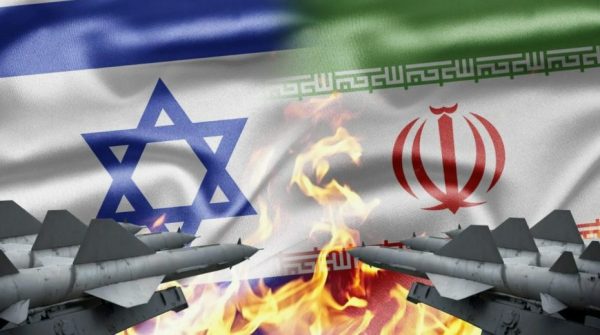
The Resistance’s Disruptive Military Innovation May Determine the Fate of Israel

By Alastair Crooke

Source: The Unz Review

Looking back to what I wrote in 2012, in the midst of the so-called Arab Spring and its aftermath, it is striking just how much the Region has shifted. It is now almost 180° re-orientated. Then, I argued,

“That the Arab Spring “Awakening” is taking a turn, very different to the excitement and promise with which it was hailed at the outset. Sired from an initial, broad popular impulse, it is becoming increasingly understood, and feared, as a nascent counter-revolutionary “cultural revolution” – a re-culturation of the region in the direction of a prescriptive canon that is emptying out those early high expectations …

“That popular impulse associated with the ‘awakening’ has now been subsumed and absorbed into three major political projects associated with this push to reassert [Sunni primacy]: a Muslim Brotherhood project, a Saudi-Qatari-Salafist project, and a [radical jihadi] project.

“No one really knows the nature of the [first project] the Brotherhood project – whether it is that of a sect; or if it is truly mainstream … What is clear, however, is that the Brotherhood tone everywhere is increasingly one of militant sectarian grievance. The joint Saudi-Salafist project was conceived as a direct counter to the Brotherhood project – and [the third] was the uncompromising Sunni radicalism [Wahhabism], funded and armed by Saudi Arabia and Qatar, that aims, not to contain, but rather, to displace traditional Sunnism with the culture of Salafism. i.e. It sought the ‘Salifisation’ of traditional Sunni Islam.

“All these projects, whilst they may overlap in some parts, are in a fundamental way competitors with each other. And [were] being fired-up in Yemen, Iraq, Syria, Lebanon, Egypt, north Africa, the Sahel, Nigeria, and the horn of Africa.

[Not surprisingly] …“Iranians increasingly interpret Saudi Arabia’s mood as a hungering for war, and Gulf statements do often have that edge of hysteria and aggression: a recent editorial in the Saudi-owned al-Hayat stated: “The climate in the GCC [Gulf Cooperation Council] indicates that matters are heading towards a GCC-Iranian-Russian confrontation on Syrian soil, similar to what took place in Afghanistan during the Cold War. To be sure, the decision has been taken to overthrow the Syrian regime, seeing as it is vital to the regional influence and hegemony of the Islamic Republic of Iran”.

Well, that was then. How different the landscape is today: The Muslim Brotherhood largely is a ‘broken reed’, compared to what it was; Saudi Arabia has effectively ‘switched off the lights’ on Salafist jihadism, and is focussed more on courting tourism, and the Kingdom now has a peace accord with Iran (brokered by China).

“The cultural shift toward re-imagining a wider Sunni Muslim polity”, as I wrote in 2012, always was an American dream, dating back to Richard Perle’s ‘Clean Break’ Policy Paper of 1996 (a report that had been commissioned by Israel’s then-PM, Netanyahu). Its roots lay with the British post-war II policy of transplanting the stalwart family notables of the Ottoman era into the Gulf as an Anglophile ruling strata catering to western oil interests.

But look what has happened —

A mini revolution: Iran has, in the interim, ‘come in from the cold’ and is firmly anchored as ‘a regional power’. It is now the strategic partner to Russia and China. And Gulf States today are more preoccupied with ‘business’ and Tech than Islamic jurisprudence. Syria, targeted by the West, and an outcast in the region, has been welcomed back into the Arab League’s Arab sphere with high ceremony, and Syria is on its way to assuming again its former standing within the Middle East.

What is interesting is that even then, hints of the coming conflict between Israel and the Palestinians were apparent; as I wrote in 2012:

“Over recent years we have heard the Israelis emphasise their demand for recognition of a specifically Jewish nation-state, rather than for an Israeli State, per se. A Jewish state that in principle, would remain open to any Jew seeking to return: the creation of a ‘Jewish umma’, as it were.

“Now, it seems we have, in the western half of the Middle East, at least, a mirror trend, asking for the reinstatement of a wider Sunni nation – representing the ‘undoing’ of the last remnants of the colonial era. Will we see the struggle increasing epitomised as a primordial struggle between Jewish and Islamic religious symbols – between al-Aqsa and the Temple Mount?

“It seems that both Israel and its surrounding terrain are marching in step toward language which takes them far away from the underlying, largely secular concepts by which this conflict traditionally has been conceptualised. What will be the consequence as the conflict, by its own logic, becomes a clash of religious poles?”

What has driven this 180° turn? One factor, assuredly, was Russia’s limited intervention into Syria to prevent a jihadi sweep. The second has been China’s appearance on the scene as a truly gargantuan business partner – and putative mediator too – precisely at a time when the U.S. had begun its withdrawal from the region (at least in terms of the attention it pays to it, if not (yet) reflected in any substantive physical departure).

The latter – U.S. military withdrawal (Iraq and Syria) – however, seems more a question of ‘when’, rather than if. All expect it.

Put plainly, we have experienced a Mackinder-style ‘pivot of history’: Russia and China – and Iran – are slowly taking control of the Asian heartland (both institutionally and economically), as the pendulum of the West swings away.

The Sunni world – ineluctably and warily – marches towards the BRICS. Effectively, the Gulf finds itself badly wrong-footed by the so-called ‘Abraham Accords’ that tied them to Israeli Tech (which, in turn, was channelling considerable Wall Street venture ‘free money’ their way). Israel’s ‘suspect genocide’ (ICJ language) in Gaza is slowly driving a stake into the heart of the Gulf ‘business model’.

But another key factor has been the smart diplomacy pursued by Iran. It is easy for western Iran-hawks to decry Iran’s politicking and influencing across the region – the Islamic Republic is after all, unrepentantly ‘non-compliant’ with the U.S. aims and pro-Israeli ambitions in the Region. What else, other than pushback, might you expect when all the encircling western ‘fire’ was so concentrated on the Islamic Republic?

Yet, Iran has pursued an astute path. It has NOT gone to war against Sunni Arab states in Syria, as was mooted in 2012. Rather, it quietly has pursued a strategy of diplomacy and joint Gulf security and trade with Gulf States. Iran too, has partly succeeded in shaking itself free from much of the effects of western sanctions. It has joined both BRICS and the SCO and has acquired a new economic and political ‘spatial depth’.

Whether the U.S. and Europe likes it or not, Iran is a major regional political player, and it sits atop, with others, the coalition of Resistance Movements and Fronts that have been woven together through shrewd diplomacy to work in close conjunction with each other.

This development has become a key strategic ‘project’: Sunni (Hamas) and Shi’i (Hizbullah) are joined with other ‘fronts’ in an anti-colonial struggle for liberation under the non-sectarian symbol of Al-Aqsa (which is neither Sunni, nor Shi’a, nor Muslim Brotherhood, nor Salafist or Wahhabi). It represents, rather, the storied tale of Islamic civilisation. Yes, it is, in its way, eschatological too.

This latter achievement has done much to limit the threat of all-out war from engulfing the region (fingers-crossed though …). The Iranian and Resistance Axis’ interest is twofold: First, to retain power to carefully calibrate the intensity of conflict – upping and lowering as appropriate; and secondly, to keep escalatory dominance as much as possible in their hands.

The second aspect encompasses strategic patience. The Resistance Movements well understand the Israeli psyche – therefore, NO Pavlovian reflexes to Israeli provocations are accepted. But rather, to wait and rely on Israel to provide the pretext to any further step up the escalatory ladder. Israel must be seen to be the instigator for escalation – and the resistance merely the responder. The ‘eye’ must be on the Washington political psyche.

Thirdly, Iran draws confidence to pursue its ‘forwardness’ by having innovated a tectonic shift in asymmetric warfare, and in deterrence against Israel and the West. The U.S. might huff and puff, but Iran felt assured throughout this period that the U.S. well knows the risks associated with trying ‘blow the house down’.

Realists in the West tend to believe that ‘power’ is a simple function of national population size and GDP. So that, given the disparity in air and firepower, no way, as an example, can Hizbullah expect to ‘come out quits’ against Israel – a much richer and more populated entity.

This blindspot is the Resistance’s silent ‘ally’. It prevents the West (mostly) from understanding this pivot in military thinking.

Iran and its allies take a different view: They regard a state’s power to rest on intangibles, rather than literal tangibles: strategic patience; ideology; discipline; innovation and the concept of military leadership defined as the ability to cast a ‘magic’ spell over men so that they would follow their commander, even unto death.

The West has (or had) airpower and unchallenged air superiority, but the Resistance Fronts have their two-stage solution. They manufacture their own AI-assisted swarm drones and smart earth-hugging missiles. This is their Air Force.

The second stage naturally would be to evolve a layered air defence system (Russian-style). Does the Resistance possess such? Like Brer Rabbit, they stay mum.

The Resistance’s underlying strategy is clear: the West is over-invested in its air dominance and in its overwhelming fire-power. It prioritises quick shock and awe thrusts, but usually quickly exhausts itself early in the encounter. They rarely can sustain such high-intensity assault for long.

In Lebanon in 2006, Hizbullah remained deep underground whilst the Israeli air assault swept overhead. The physical surface damage was huge, yet their forces were unaffected and emerged only afterwards. Then came the 33 days of Hizbullah’s missile barrage – until Israel called it quits. This patience represents the first pillar of strategy.

The second therefore, is that whereas the West has short endurance, the opposition is trained and prepared for long attritional conflict – missile and rocket barrage to the point that civil society can sustain the impact no longer. War’s aim not necessarily has killing the enemy soldiers as a prime objective; rather it is exhaustion and inculcating a sense of defeat.

And what of the opposing project?

In 2012, I wrote:

“It seems that both Israel and [the Islamic world] are marching in step toward [eschatological narratives] which is taking them far away from the underlying, largely secular concepts by which this conflict traditionally has been conceptualised. What will be the consequence as the conflict, by its own logic, becomes a clash of religious poles? ” [– Al-Aqsa versus the Temple Mount].

Well, the West remains stuck with trying to manage and contain the conflict, using precisely those ‘largely secular concepts’ by which this conflict has been conceptualised and managed (or non-managed, I would say). In so doing, and through the West’s (secular) support for one particular eschatological vision (which happens to overlap with its own) over another, it inadvertently fuels the conflict.

Too late to return to secular modes of management; the genie is out.
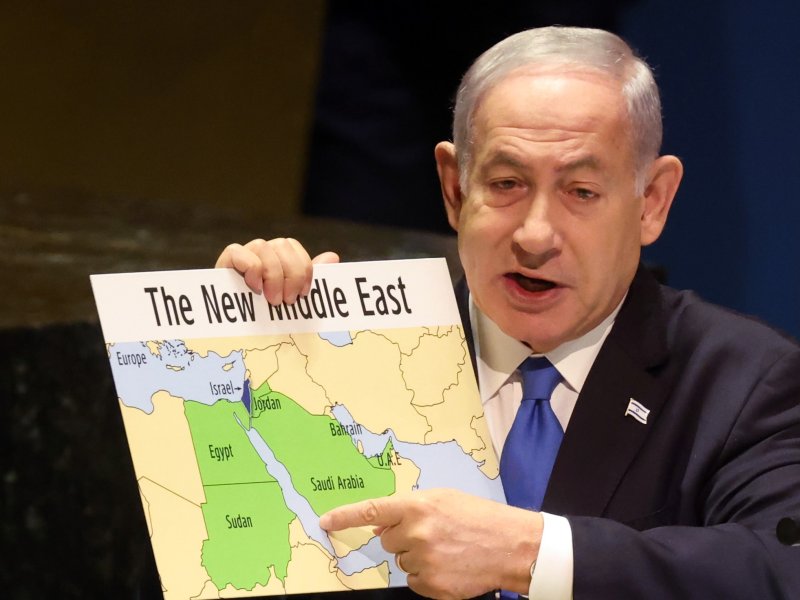
What lies behind Benjamin Netanyahu’s lies and Hamas’s evasions

On September 22, 2023, 16 days before the attack by the Palestinian Resistance, Benjamin Netanyahu spoke at the United Nations in New York. He brandished a map of the “New Middle East” on which Israel had absorbed the Palestinian Territories.

By Thierry Meyssan

Source: Voltairenet.org

We are reacting to the attack on Israel on October 7 and the massacre of Palestinian civilians in Gaza on the basis of the information available to us. However, we feel that the official version of the Israeli government and Hamas is a lie.

Seven major questions remain unanswered:

1. How did Hamas manage to dig and build 500 kilometers of tunnels at a depth of 30 meters without arousing suspicion?

 Tunnel-drilling equipment is considered to have both civilian and military uses. It is not manufactured in Gaza and cannot be brought in under any circumstances, unless there is complicity within the Israeli administration.

 The excavated earth (1 million m3) was not detected by aerial surveillance. Even supposing it had been scattered in many different places and mixed in with the soil from other construction sites, it is impossible for the Israeli intelligence services not to have detected anything for twenty years.

 Tunnel ventilation equipment is not considered to be for military use. It is possible to bring it into Gaza, but the quantity required should have attracted attention.

 The reinforced concrete needed to solidify the walls is not manufactured in Gaza. It too is not considered military equipment, but the quantity required should have attracted attention.

2. How could Hamas stockpile such an arsenal?

 Hamas, the Palestinian branch of the Muslim Brotherhood, has large quantities of rockets and handguns at its disposal. Hamas may have manufactured parts of the rockets itself, but it has managed to import thousands of handguns into Gaza, mainly from the Ukraine, despite high-performance scanners. This seems impossible without complicity within the Israeli administration.

3. Why did Benjamin Netanyahu dismissed all those who warned him?

 Egypt’s Minister of Intelligence, Kamel Abbas, personally phoned him to warn of a major Hamas attack.

 His friend, Colonel Yigal Carmon, Director of Memri, personally warned him of a major Hamas attack.

 The CIA sent Israel two intelligence reports warning of a major Hamas attack.

 Defense Minister Yoav Galland was fired in July because he warned the government of the “perfect storm” prepared by Hamas.

4. Why did Benjamin Netanyahu demobilize the security forces on the evening of October 6?

 The Prime Minister had authorized the Security Forces to stand down for the holidays of Sim’hat Torah and Shemini Atzeret. At the time of the attack, therefore, there were no personnel available to monitor the security fence around Gaza.

5. Why did security officials remain locked up at Shin Bet headquarters that morning?

 The Director of Counterintelligence (Shin Bet), Ronen Bar, had called a meeting of the heads of all the security services for 8 a.m. on October 7, to examine the second CIA report warning of a major Hamas operation in preparation.

However, the attack began at 6.30 a.m. on the same day. Security officials didn’t react until 11am. What did they do during this interminable meeting?

6. Who triggered the “Hannibal directive” in this way, and why?

 When the Security Forces began to react, the IDF was ordered to apply the “Hannibal directive”. This stipulates that enemies must not be allowed to take Israeli soldiers hostage, even if it means killing them. An Israeli police investigation confirms that the Israeli air force bombed the crowd fleeing the Supernova Rave Party. A significant proportion of those killed on October 7 were therefore not victims of Hamas, but of Israeli strategy.

 In theory, the “Hannibal directive” only applies to soldiers. Who decided to bomb a crowd of Israeli civilians, and why?
It is not possible today to determine with any certainty which Israelis were killed by the attackers and which were killed by their own army.

7. Why are Western forces threatening Israel?

 The Pentagon has deployed two naval groups, around the USS Gerald Ford and the USS Eisenhower, and a cruise missile submarine, the USS FloridaHaaretz even mentioned a third aircraft carrier. America’s allies (Saudi Arabia, Canada, Spain, France, Italy) have installed fighter-bombers in the region.

These forces are not installed to threaten Turkey, Qatar or Iran, which the Western press accuses of being involved in the Hamas attack, but off the coast of Israel, in Beirut and Hamat. They are encircling Israel. And Israel alone.

WHAT LIES BEHIND THESE MYSTERIES?

Obviously the version defended by both Hamas and Israel is false. We must consider other possible explanations so as not to be manipulated by either one or the other.

Let’s formulate a hypothesis. There is nothing to say whether it is the correct one, but it is compatible with the factual elements, which is not the case with the version shared today by everyone. So it’s better than that one. It is obviously extremely shocking, but only those who are able to answer the previous 7 questions can dismiss it.

This interpretation is based on an analysis of the complex structure of Hamas, whose rank-and-file fighters are unaware of what their leaders are up to. There it is :

The entire operation of Hamas and Israel is led by Americans, perhaps under the direction of the Straussian Eliott Abrams [1] and his Vandenberg Coalition (Think Tank which succeeded the Project for a New American Century). The Muslim Brotherhood and the Revisionist Zionists, who apparently are waging a cruel war, are in reality accomplices at the expense of the rank-and-file Hamas fighters, the Palestinian people and Israeli soldiers. Here is their plan: Hamas is presented as the only effective resistance force to the oppression of the Palestinians, but it lets Israel liquidate the hope of a Palestinian state, while the Muslim Brotherhood, crowned with the sacrifice of the Palestinians, takes power in the Arab world.

The heads of Hamas’s military and political branches are both subordinate to the Guide of the Muslim Brotherhood in Gaza, Mahmoud Al-Zahar, the successor to Sheikh Ahmed Yassin, yet nobody talks about him. From his point of view, the Brotherhood will be the big winner of the “Flood of Al-Aqsa”, even if Gaza is razed to the ground and the Palestinians driven from their land.

Hamas is now divided into two factions. The first, under the leadership of Ismaël Haniyeh, follows the Brotherhood’s line. It seeks neither to liberate Palestine from Israeli occupation, nor to found a Palestinian state, but is dedicated to building a Caliphate over all the countries of the Middle East. The second, under the leadership of Khalil Hayya, has abandoned the Brotherhood’s ideology, and is fighting to put an end to the oppression of the Palestinian people by the Israelis.

The Muslim Brotherhood is a political secret society, organized by British intelligence services on the model of the United Grand Lodge of England [2]. It was gradually taken over by the CIA to the point of being represented on the US National Security Council. After the collapse of the Islamist regimes of the Arab Spring, the Brotherhood fractured into two trends. The London Front, led by Guide Ibrahim Munir (who died a year ago), proposed a way out of the crisis by leaving the political arena and securing the release of prisoners in Egypt. The Istanbul Front, led by interim leader Mahmoud Hussein, advocates, on the contrary, changing nothing and continuing the struggle to establish a Caliphate. A third group is attempting to establish an intermediate position, putting forward the idea of abandoning politics until the prisoners have been released, only to return to it at a later date.

The Muslim Brotherhood is fighting to seize power in all Arab states, as it did in Egypt in 2012-13.
It should be remembered that, contrary to widespread opinion in the West, Mohamed Morsi was never democratically elected President of Egypt; that was General Ahmed Chafik. However, after the Brotherhood threatened to kill members of the Electoral Commission and their families, the latter, after 13 days of resistance, declared Morsi elected, despite the results of the ballot box. Subsequently, in 2013, 40 million Egyptians marched against him, calling on the army to deliver them from the Muslim Brotherhood. General Abdel Fatah Al-Sissi did just that.

Today, the Muslim Brotherhood is only in power in Tripolitania (western Libya), where it was brought to power by NATO. They are only welcome in Qatar and Turkey (which is not an Arab state). They are banned in the majority of Arab states, notably Saudi Arabia (whose monarch they tried to overthrow in 2013) and the United Arab Emirates (involving the crisis between Qatar and the other Gulf states). And above all in Syria (whose government they tried to overthrow in 1982 and to which they waged war, from 2011 to 2016, alongside Nato and Israel). They are about to do the same in Tunisia (which they ruled for a decade).

If the real objective of this massacre is not the status of Palestine, but the governance of Arab states, we can expect a wave of regime changes in the Middle East, each time to the benefit of the Brotherhood – in short, a kind of second “Arab Spring” [3].

As during the Arab Spring, the British services are responsible for the Brotherhood’s communications. We remember the way they promoted Brother Abdelhakim Belhaj in Libya [4] or the magnificent logos they designed for the host of jihadist groups in Syria. Leaks to the Foreign Office confirmed all this. This time, they created a new character, Abu Obeida, the spokesman for the fighting organization in Gaza. This man, unknown until recently, has suddenly become a star in the Muslim world, where posters of him are being snapped up. Well-trained in public speaking, he handles symbols with an ease unprecedented among Sunni leaders.

Arab governments are therefore acting cautiously, supporting the creation of a Palestinian state while keeping their distance from Hamas. While Hamas is doing everything to make the creation of a Palestinian state impossible.

Translation
Roger Lagassé

Surviving on the Battlefield in the Information War

By Tony Cartalucci

Source: New Eastern Outlook

There is undoubtedly an information war raging. There are intentional liars, people who witlessly repeat these lies, poor research, and opinions spun to look as if it is research. To sort the ever increasing amount of information from disinformation, there are a few simple methods people can use.

But above all, people must personally dedicate themselves to following the truth no matter where it brings them, having the courage to accept a reality that may not necessarily mesh with their current perception. The inability to do this will render moot all other means of determining the veracity of any given report or piece of analysis.

Find the Original Source

This is fundamental. When anyone, anywhere makes a claim, whether it is in a historical documentary or book, or regarding current events, one must find the original source. Where did this information come from? Is it a direct quote? If so, can this quote be verified? If the quote is “alleged” or “leaked” or otherwise second-hand information or the sources never revealed, it is impossible to verify and therefore impossible to consider as verified.

Often conversations relayed by second-hand sources serve as the basis of propaganda. It is essentially the process of placing words into the mouths of people who never said anything of the sort. Media that repeatedly uses quotes that are impossible to verify may be engaged in disinformation.

If the quote is confirmed, that alone does not mean that what was said was “true.” It simply means that someone made a statement – the veracity of which must be determined through other means. Finding the source of a claim often helps shatter long-held myths. This is particularly true in regards to historical matters.

Follow the Money

All protests, political movements, and armed struggles require immense amounts of resources to start, perpetuate, and most importantly to succeed.  They also require leadership. If one finds themselves reading reports of events that do not mention funding or the names of specific leaders, either those reporting on the events don’t have these facts and should make note that such information is both missing and essential to find, or misdirection and disinformation is at play.

Omitting these facts has been done intentionally across the Western media to obfuscate Western involvement particularly in “political uprisings” and “armed rebellions” that are made to appear spontaneous and indigenous but are in fact long-planned, foreign-backed conspiracies. The so-called “Arab Spring” is perhaps the most notorious example of this, where the Western media failed intentionally and repeatedly to identify the funding and individuals involved in both street protests and subsequent armed attacks on security agencies across the Middle East and North Africa (MENA) region.

Had the public carefully read through reports, and followed the money, they would have found a combination of US State Department money and the Anglo-American-backed Muslim Brotherhood behind each and every “uprising” across the Middle East, with Al Qaeda forming the subsequent armed groups that overran Libya and are currently leading attempts to overthrow the government of Syria.

Look at What People Do, Not at What They Say…

There are media reports, government press releases, op-eds, analysis, and policy papers of every kind. Many times, these various sources contradict each other. How does one go about determining which is true and which is disinformation? It is quite simple, don’t simply listen to what reporters, analysts, and policymakers say, look at what they and those they have influence over are doing.

The United States claims that it is fighting the so-called “Islamic State” (ISIS) in Syria. However, if we “follow the money” and realize that it is impossible for ISIS to sustain its fighting capacity within Syria or Iraq alone, and requires an immense amount of resources from abroad to continue its operations, we realize those resources are undoubtedly passing through territory the US and its allies in fact control.

That the US is not interdicting these vital supplies, including additional fighters, weapons, and cash, is proof that claims in the media and amid government press releases that the US is “fighting ISIS” are false.

Conversely, in veteran journalist Seymour Hersh’s 2007 New Yorker article, “The Redirection,” he stated explicitly, citing US and Saudi officials, that the West and its regional allies planned to use sectarian extremists affiliated with Al Qaeda to wage a regional proxy war against Syria and Iran. This also so happens to be precisely what is now playing out across the MENA region. Hersh’s analysis can be tracked down through his sources, by following the money – as only state-sponsorship can explain Al Qaeda and ISIS’ fighting capacity in Syria, Iraq, and beyond – and by simply looking at what is now unfolding across the region.

None of what the current corporate media or government press releases say can be verified in a similar manner, and certainly, none of what is said by the West currently, matches what is actually happening on the ground.

Finally, let us consider policy papers released by corporate-funded think tanks like the Brookings Institution. Such policy papers have repeatedly laid out plans for arming extremists, incrementally invading and occupying Syria, and eventually toppling the Syrian government. This too, is precisely what we see happening on the ground, though the Western media and Western representatives claim the cause is not a  premeditated Western conspiracy, but a series of coincidences and unfortunate turns of fate.

Final Thoughts 

The truth is hard to arrive at, not only because people intentionally seek to fool others, but because often, many unintentionally fool themselves. Reality can be unpleasant. Watching a nation be destroyed can be heartbreaking and the desire to insulate oneself from the pain through cognitive dissonance can be overwhelming. However, one of the greatest maxims in human conflict is to truly know yourself and know your enemy. Truth isn’t just a matter of virtue, it is a factor that will make the difference between victory and defeat.

If victory over the forces of greed and hegemony is truly our goal, then we must face the facts no matter how unpleasant. Our failure to do so will cost us everything – and those driven by greed and hegemony know. That is why they have invested so much in clouding reality and obfuscating the truth. We must invest more in seeing through this clouded reality, and discover the truth, no matter how unpleasant.

US plotting coups in Venezuela, Cuba and Nicaragua?

By Stephen Lendman

Source: Intrepid Report

The US wants all nations worldwide colonized, their resources looted, their people exploited as serfs, including ordinary Americans.

Sovereign independent governments everywhere are targeted for regime change—by coups d’état or wars.

That’s what imperialism is all about, a diabolical plot for unchallenged global dominance by whatever it takes for the US to achieve its aims, Republicans and undemocratic Dems allied for the same geopolitical objectives.

Humanitarian intervention, responsibility to protect, and democracy building are code words by both right wings of America’s war party for wanting fascist tyranny replacing governance of, by, and for everyone equitably everywhere—legitimate governments replaced by US-controlled puppet ones.

Post-9/11 alone, the US orchestrated coups in Haiti, Honduras, Paraguay, Brazil, Ukraine, Egypt, and elsewhere in the Middle East.

The so-called Arab spring was made in the USA. Uprisings were orchestrated. Nothing was spontaneous. CIA dirty hands were involved in replacing unpopular regimes with despotic ones considered more reliable.

Spring never bloomed, just the illusion of change for the better. It was pure deception. Everything changed in targeted countries but stayed the same.

In Egypt, Yemen and elsewhere things worsened, notably in Occupied Palestine. No spring bloomed there or anywhere else in the Middle East.

Plan Colombia was and remains all about Washington’s aim to control Latin America, eliminating opposition to regimes it controls, plotting coups against ruling authorities unwilling to bend to its will, along with pursuing anti-Sino/Russian regional policies.

Since Soviet Russia’s dissolution, the US escalated wars on humanity, using NATO as a killing machine. Republicans and Dems colluded to thirdworldize America, banana republicanize it, wrecking the economy, handing its wealth to Wall Street, war-profiteers and other corporate predators.

Both right wings of duopoly governance mock democratic values and rule of law principles they abhor, governing under a police state apparatus, hardened over time, risking global war to achieve its aims.

Venezuela, Cuba, Nicaragua, and Bolivia are the remaining sovereign independent Latin and Central American nations.

Trump regime hardliners want fascist tyranny replacing their legitimate governments. In early January, State Department deputy spokesman Robert Palladino turned truth on its head, saying the US “support[s] the people of Venezuela, Cuba and Nicaragua in restoring democratic governance and their human rights”—notions Washington abhors.

Venezuelan Bolivarian social democracy is the Trump regime’s top Latin American target for regime change. Pompeo made US intentions clear.

He turned truth on its head, saying President Nicolas Maduro is “illegitimate and the United States will continue . . . to work diligently to restore a real democracy to that country,” adding, “We are very hopeful that we can be a force for good to allow the region to come together to deliver that.”

Fact: Last May, Maduro was overwhelmingly re-elected by a two-thirds majority.

Fact: Scores of international observers from 30 countries monitored the election, judging it open, free and fair.

Fact: Venezuela’s political process is the world’s best.

Fact: It’s polar opposite America’s money-controlled system, one-party rule with two right wings, ordinary people having no say over how they’re governed.

Fact: US democracy is pure fantasy. Venezuelans have the real thing, why Republicans and Dems want its government toppled, their eyes on the prize—the world’s largest oil reserves they want handed to Big Oil.

On January 10, Maduro was inaugurated for a second six-year term, saying he’s committed to continue “fight[ing] for social and economic prosperity and to build 21st century socialism”—despite relentless US political, economic, financial, and propaganda war against the country’s social democracy.

Despite the Trump regime’s all-out efforts to mobilize international opposition to his legitimate rule, delegations from over 90 countries attended the inaugural ceremonies—including from Russia, China, Cuba, Nicaragua, Bolivia, Mexico, El Salvador, Iran, Turkey, and Ireland’s Sinn Fein.

Representatives from US colonized EU nations were absent, a spokeswoman for foreign policy chief Federica Mogherini lied saying that “the presidential elections were not free nor fair”—a falsified statement, serving US imperial interests.

Representatives from the African Union, CARICOM, the Arab League, the ALBA Bolivarian Alliance for the Peoples of Our Americas, OPEC, and the UN also attended.

In his inaugural address, Maduro said, “I tell the people. This presidential sash is yours. This power is yours. It does not belong to the oligarchy or to imperialism. It belongs to the sovereign people of Venezuela.”

He denounced the diabolical aims of “the most powerful empire in history,” urging dialogue to serve Venezuelan interests, including UN support for “peace, mutual recognition, harmony, (and) coexistence of different political visions,” adding: “I would like to sit down with the opposition, stop the sterile, useless, unnecessary conflict, talk about economic issues; with the experience of the UN we can achieve it.”

Trump regime hardliners falsely call genuine democracies dictatorships, how neocon John Bolton reacted to Maduro’s inauguration, saying the US “will not recognize” his legitimacy to rule.

The US-controlled Organization of American States (OAS), headquartered in Washington, reacted the same way. Most of its member states support longstanding US plans for regime change.

The US-controlled 13-nation Lima Group issued a statement, refusing to recognize Maduro’s legitimacy.

Caracas slammed what it called a “humiliating subordination” to US imperial interests—applying to all nations allied with Washington against Venezuela’s social democracy and sovereign independence.

On January 12, State Department deputy spokesman Palladino openly called for regime change, saying, “It is time to begin the orderly transition to a new government.”

Previous US orchestrated coup attempts failed—against Hugo Chavez and Maduro. Will the Trump regime try again in the new year?

If unable to succeed by coup d’etat, will an attempt be made to assassinate Maduro? If economic, financial, political, and other tactics fail, will military intervention be the Trump regime’s fallback option?

Will Iran be targeted the same way in the new year? Imperialism isn’t pretty.

Endless US belligerence and state-sponsored terrorism is virtually certain ahead, the way hardliners in Washington always operate—hostile to peace, stability, equity and justice at home and abroad.

The New Media World Order

By Thierry Meyssan

Source: Voltairenet.org

In only a few months, the content of the Western national and international medias has undergone profound change. We are witnessing the birth of an Entente about which we know almost nothing – neither the real initiators, nor the real objectives – but whose direct anti-democratic consequences can be noticed immediately.

The West is currently going through an unprecedented systemic change – powerful forces are progressively orienting the totality of medias in a single direction. At the same time, the content of the medias is mutating– only last year, they were still logical, and tended towards objectivity. They offered one other mutual contradiction in a spirit of healthy competition. Now they act in gangs, basing their coherence on emotions, and becoming vicious when they are facing people they condemn.

The idea of an Entente between the medias is an extension of the experience of the International Consortium for Investigative Journalism (ICIJ), which does not unite the medias, but only individual journalists. It made itself famous by publishing information stolen from the accounts of two law firms in the British Virgin Islands, and from PricewaterhouseCoopers (PwC), the bank HSBC, and the Panamanian firm Mossack Fonseca. These revelations were mainly used to discredit the Russian and Chinese leaders, but also, once in a while, to shine some light on genuine offences committed by the Westerners. Above all, under the honourable pretext of the struggle against corruption, the violation of the confidentiality of lawyers and banks seriously damaged thousands of their honest clients without any reaction from public opinion.

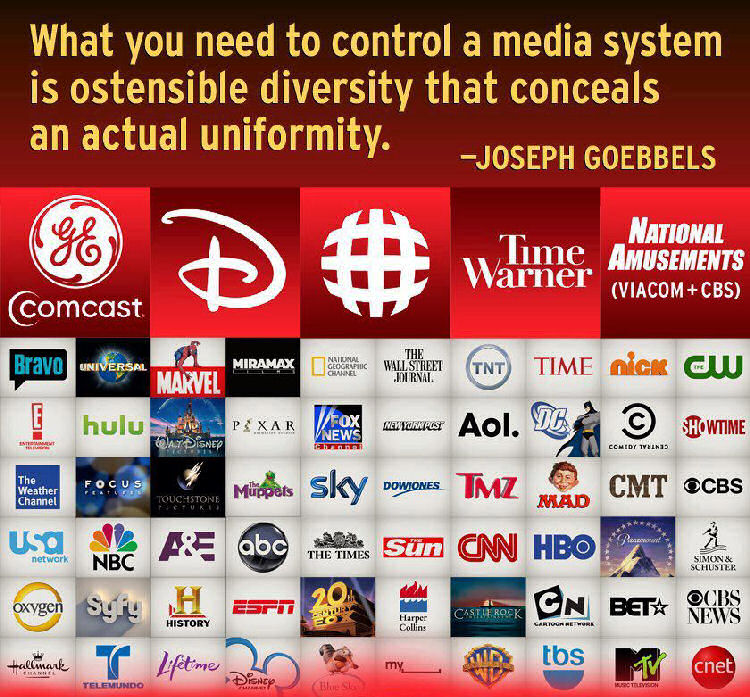
Over a period of approximately forty years, we have been witnessing the progressive grouping of medias within certain international trusts. Currently, 14 groups share more than two thirds of the western Press (21st Century Fox, Bertelsmann, CBS Corporation, Comcast, Hearst Corporation, Lagardere Group, News Corp, Organizações Globo, Sony, Televisa, The Walt Disney Company, Time Warner, Viacom, Vivendi). From now on, the alliance operated by Google Media Lab and First Draft is forging links between these groups, which already enjoyed a dominant position. The presence in this Entente of the three most important Press agencies on the planet (Associated Press, Agence France-Presse, Reuters) guarantees it hegemonic power. This is without any doubt an «illicit entente», established not with the goal of price-setting, but mind-setting, the imposition of an already dominant thought.

We may have noticed that all the members of the Google Entente – without exception – have already, over the last six years, given unequivocal visions of the events that occurred in the Greater Middle East. And yet there had been no prior agreement between them, or at least, none of which we were aware. It is intriguing to note that five of the six international television channels which participated in the NATO propaganda cell are part of this Entente (Al-Jazeera, BBC, CNN, France24, Sky, but apparently not al-Arabiya).

In the United States, France and Germany, Google and First Draft assembled the medias present locally in the countries concerned, and others present on the international scale, to check the veracity of certain arguments. Besides the fact that we do not know who is hiding behind First Draft, and what political interests may have influenced a commercial company specialised in computer science to finance this initiative, the results achieved have little to do with a return to objectivity.

First of all because the allegations are not chosen for the place they occupy in the public debate, but because they have been quoted by individuals that the media Entente intends to vilify. We might imagine that these verifications enable us to get a little closer to the truth, but that is not the case at all – they reassure the citizen in the idea that the medias are honest, while the people they are condemning are not. This approach is not aimed at better understanding the world, but at beating down the people to be sacrificed.

Next, because an unwritten rule of this media Entente stipulates that only allegations from sources outside the Entente should be checked. The members agree not to use any critical faculty in the mutual appreciation of their work. They agree to reinforce the idea that the world is divided in two – «we» who tell the truth, and «the others» who are liars. This approach is damaging for the principle of pluralism, a precondition for democracy, and opens the way to a totalitarian society. This is not a new phenomenon, because we saw it at work during the coverage of the Arab Springs and the wars against Libya and Syria. But for the first time, it is aimed at a Western line of thought.

Finally, because the allegations that have been qualified as «false» will never be envisaged as errors, but always as lies. The point is to charge the «others» with Machiavellian intentions in order to discredit them. This approach damages the presumption of innocence.

That is why the functioning of the ICIJ and the Entente created by Google and First Draft violates the Munich Charter adopted by the International Federation of Journalists (IFJ) (Title II, articles 2, 4, 5 and 9).

It is no coincidence that certain absurd legal actions have developed against the same targets as those in the sights of the media Entente. In the United States, the Hogan Law has been dragged out for use against the Trump team, despite the fact that this text has never, absolutely never, been applied since its promulgation two centuries ago. And in France, the Jolibois Law has been revived for use against the political tweets of Marine Le Pen, despite the fact that jurisprudence had limited the application of that law to the distribution of a few ultra-pornographic magazines lacking a plastic wrapping. Since the principle of the presumption of innocence for scapegoats has been eradicated, it is now possible to put anyone on trial for any legal pretext. Furthermore, the legal actions mounted against the Trump team and Marine Le Pen, in the name of the laws named above, should also be be brought against a great number of other people – but they are not.

Moreover, citizens no longer react when the media Entente itself broadcasts false allegations. Thus, in the United States, they imagined that the Russian secret services had a compromising dossier on Donald Trump and were blackmailing him. Or, in France, this Entente invented the idea that it is possible to employ a fictitious parliamentary assistant, and went on to accuse François Fillon.

In the United States, the large and small medias which are members of the Entente went after the President. They garnered their own information from the wire-tapping of the Trump team which had been illegally ordered by the Obama administration. They work in coordination with the magistrates, who are using them to block the actions of the present government. This is without doubt a Mafia system.

The same US and French medias are attacking two candidates for the French Presidential election – François Fillon and Marine Le Pen. To the general problem of the media Entente is added the false impression that these targets are victims of a Franco/French conspiracy, whereas in fact, the instigator is a US citizen. The French notice that their medias are rigged, wrongly interpret the conspiracy as being directed against the right wing, and continue erroneously seeking the manipulators in their own country.

In Germany, the Entente is not yet effective, and probably will not be until the general elections.

During Watergate, the medias claimed to represent a «Fourth Estate», after the Executive, the Legislative, and the Judiciary. They affirmed that the Press exercised a function of control over the government in the name of the People. We can ignore for a moment the fact that President Nixon was charged with a similar offense to that of President Obama – bugging his opponent. We know today that the Watergate source, «Deep Throat», far from being a «whistle-blower», was in reality the Director of the FBI, Mark Felt. The treatment of this affair was a battle between a part of the administration and the White House, in which the electors were manipulated by both sides at once.

The idea of a «Fourth Estate» supposes that we recognise the same legitimacy for the 14 corporate trusts which own the great majority of the Western medias as for the citizens. This is to affirm the substitution of an oligarchy for democracy.

The remains one point which needs clarification – how have the targets of the Entente been chosen? The only obvious link between Donald Trump, François Fillon and Marine Le Pen is that all three hope to re-establish contacts with Russia, and fight with her against the breeding ground of jihadism – the Muslim Brotherhood. Although François Fillon was the Prime Minister of the goverment implcated in these events, all three of them represent the train of thought which contests the dominant vision of the Arab Springs and the wars against Libya and against Syria.

Courage and Free Speech

img301

Throughout human history there have been individuals who have been ready to risk everything for their beliefs

By Timothy Garton Ash

Source: aeon

‘Nothing is more difficult,’ wrote the German political essayist Kurt Tucholsky in 1921, ‘and nothing requires more character, than to find yourself in open contradiction to your time and loudly to say: No.’ First of all, it is intellectually and psychologically difficult to step outside the received wisdom of your time and place. What has been called ‘the normative power of the given’ persuades us that what we see all around us, what everyone else seems to regard as normal, is in some sense also an ethical norm.

Numerous studies in behavioural psychology show how our individual conviction of what is true or right quails before the massed pressure of our peers. We are, as Mark Twain observed, ‘discreet sheep’. This is what John Stuart Mill picked up when he wrote in On Liberty (1859); that the same causes that make someone a churchman in London would have made him a Buddhist or a Confucian in Beijing. The same truth is gloriously captured in the humorous song ‘The Reluctant Cannibal’ (1960) by Michael Flanders and Donald Swann, in which a young cannibal revolts against the settled wisdom of his elders and declares that ‘eating people is wrong’. At the end of the song, one of the elders exclaims, to huge belly laughs all round: ‘Why, you might just as well go around saying: “Don’t fight people!”’ Then he and his colleagues cry in unison: ‘Ridiculous!’

Yet norms change even within a single lifetime, especially as we live longer. So as elderly disc jockeys are arrested for sexual harassment or abuse back in the 1960s, we should be uncomfortably aware that some other activity that people regard as fairly normal now might be viewed as aberrant and abhorrent 50 years hence.

To step outside the established wisdom of your time and place is difficult enough; openly to stand against it is more demanding still. In Freedom for the Thought that We Hate (2007), his fine book on the First Amendment tradition in the United States, Anthony Lewis quotes a 1927 opinion by the Supreme Court Justice Louis Brandeis, which Lewis says ‘many regard as the greatest judicial statement of the case for freedom of speech’.

The passage Lewis quotes begins: ‘Those who won our independence… believed liberty to be the secret of happiness and courage to be the secret of liberty.’ This is magnificent, although it also illustrates the somewhat self-referential, even self-reverential, character of the modern First Amendment tradition.

Lewis cites Brandeis, who credits this thought to the 18th-century founders of the US. But those founders would have been well aware that they got it straight from Pericles’ funeral oration during the Peloponnesian War of the fifth century BCE, as reported – if not invented, or at least much improved upon – by Thucydides. ‘For you now,’ Thucydides’ Pericles admonishes his ancient Athenian audience, after praising the heroic dead, ‘it remains to rival what they have done and, knowing the secret of happiness to be freedom and the secret of freedom a brave heart, not idly to stand aside from the enemy’s onset.’

More directly, the US tradition of courage in the defence of free speech draws on the heritage of the 17th-century English. People such as John Lilburne, for example. In 1638, while still in his early 20s, Lilburne was found guilty by the Star Chamber court of helping to smuggle into England a tract against bishops that had been printed in the Low Countries. He was tied to the back of a cart on a hot summer’s day and unremittingly whipped as he walked with a bare back all the way from the eastern end of Fleet Street to Westminster Palace Yard. One bystander reckoned that he received some 500 blows that, since the executioner wielded a three-thronged whip, made 1,500 stripes.

Lilburne’s untreated shoulders ‘swelled almost as big as a penny loafe with the bruses of the knotted Cords’, and he was then made to stand for two hours in the pillory in Palace Yard. Here, in spite of his wounds and the burning sunshine, he began loudly to tell his story and to rail against bishops. The crowd was reportedly delighted. After half an hour, there came ‘a fat lawyer’ – ah, plus ça change – who bid him stop. The man whom the people of London had already dubbed ‘Free-Born John’ refused to shut up. He was then gagged so roughly that blood spurted from his mouth. Undeterred, he thrust his hands into his pockets and scattered dissident pamphlets to the crowd. No other means of expression being left to him, Free-Born John then stamped his feet until the two hours were up.

As an Englishman, I find particular inspiration in the example of Free-Born John, and those of all our other free-born Johns: John Milton, John Wilkes, John Stuart Mill (and George Orwell, a free-born John in all but name). More broadly, there is no reason to understate, let alone to deny, a specifically Western tradition of courage in the advancement of free speech, one that can be traced from ancient Athens, through England, France and a host of other European countries, to the US, Canada and all the liberal democracies of today’s wider West. But it would be quite wrong to suggest that this habit of the heart is confined to the West. In fact, there have been rather few examples of such sturdy defiance in England in recent times, while we find them in other countries and cultures.

Consider, for instance, the Chinese dissident Liu Xiaobo. Liu was sentenced to 11 years’ imprisonment in 2009 for ‘subverting state power’. Both his written response to the charges against him and his final speech in court are, like many of his earlier writings, lucid and courageous affirmations of the central importance of free speech. He definitely does not draw only on Western traditions. For example, in his book No Enemies, No Hatred (2012), he quotes a traditional Chinese 24-character injunction: ‘Say all you know, in every detail; a speaker is blameless, because listeners can think; if the words are true, make your corrections; if they are not, just take note.’

After paying a moving tribute to his wife (‘Armed with your love, dear one, I can face the sentence that I’m about to receive with peace in my heart’), Liu looks forward to the day ‘when our country will be a land of free expression: a country where the words of each citizen will get equal respect, a country where different values, ideas, beliefs and political views can compete with one another even as they peacefully coexist’. The judge cut him short in court before he had finished speaking, but free-born Xiaobo, like free-born John, still got his message out. In his planned peroration, Liu wrote: ‘I hope that I will be the last victim in China’s long record of treating words as crimes. Free expression is the base of human rights, the root of human nature and the mother of truth. To kill free speech is to insult human rights, to stifle human nature and to suppress truth.’

Liu was by this time famous, and that great speech made him more so. He was awarded the Nobel Peace Prize in 2010. But perhaps the most inspiring examples of all come from people who are not famous at all: so-called ordinary people doing extraordinary things. People such as the Hamburg shipyard worker who, at the launch of a naval training vessel in 1936, refused to join all those around him in making the Hitler salute. The photograph only achieved wide circulation on the internet more than 60 years later. There he stands amid a forest of outstretched arms, with both his own firmly folded across his chest, a portrait of stubborn worker’s pride. His name was August Landmesser. He had been a Nazi party member but was later expelled from the party for marrying a Jewish woman, and then imprisoned for ‘dishonouring the race’. After his release, he was drafted to fight in the Second World War and never returned.

Again, such moments are emphatically not confined to the West. During the Arab Spring of 2011, a ‘day of rage’ was proclaimed by dissidents in Saudi Arabia. Faced with a massive police presence at the appointed location in the country’s capital Riyadh, almost nobody showed up. But one man, a strongly built, black-haired teacher called Khaled al-Johani, suddenly approached a group of foreign reporters. ‘We need to speak freely,’ he cried, with an explosion of pent-up passion. ‘No one must curb our freedom of expression.’ A BBC Arabic service film clip, which you can watch on YouTube, shows a tall secret policeman, in white robes, headdress and dark glasses, looming in the background as he snoops on al-Johani’s speech. A little further away, armed police mutter into their walkie-talkies. ‘What will happen to you now?’ asks one of the reporters, as they escort the teacher back to his car. ‘They will send me to prison,’ al-Johani says, adding ironically: ‘and I will be happy.’ He was subsequently condemned to 18 months’ imprisonment.

In many places, we can find monuments to the Unknown Soldier, but we should also erect them to the Unknown Speaker.

The enduring reality of government by wealth and some of its consequences

Plutocracy-2

By John Chuckman

Source: Intrepid Report

If you really want to understand the world in which we live—its endless wars, coups, interventions, and brutality towards great masses of people—you need to start with a correct understanding of the political machinery at work.

Talk of liberal interventions or fighting for rights, Western values, and democracy are hopelessly naïve and mostly deliberately deceptive. America’s record in such matters is one of securing everything from bananas, copper, and crude oil concessions to, at the very least, foreign governments obedient to its mandates after removing a disliked leader, whether elected or not. There is no concern for principles outside of their being featured in blowhard, insincere political speeches. The interests of America’s government do not match the interests of ordinary people, those in America or anywhere else, and, were the informed consent of the governed genuinely involved in launching bloody adventures, they likely never would happen.

The underlying reality of how people in the West are governed now compared to hundreds of years ago is surprisingly unchanged, much the way the rules governing how chemical bonds form have not changed despite a long and great parade of events and discoveries in the visible world. Despite all the revolts, revolutions, congresses, constitutions, and great movements over the centuries, we are in fact governed in the same essential way, people.

Of course to see this, you have to strip away the forms and rituals we have constructed over the centuries, forms and rituals which create impressive effects much like the green smoke and thunderous voice of the Wizard of Oz, a wizened old man who worked from his curtained control room, pulling levers and hitting buttons to create intimidating effects. Most Americans remain impressed with the smoke and thunder and cheap magic tricks, it requiring some dedicated effort to shake off well-done illusions, and, as I’ve written before, Americans work extremely hard in their jobs or live a kind of marginal life trying to scrape by on low wages or part-time work, either of which situations leaves little time or inclination to question what government is really doing and for whose benefit.

And so long as America remains under the rule of wealth, it is unlikely other states, as in Western Europe, will emerge from it because America’s establishment has such decisive influence—economic, financial, military, and political—over many of them.

What is considered as wealth changes over time and with economic development, and with those changes so do its interests as well as the practices of its power. Great deposits of copper ore or crude oil In the Middle Ages were virtually worthless. Wealth then was land for agriculture, forestry, and hunting, with the family names of owners determined by their estates. The revenue from that natural wealth was converted to great houses and jewels and the implements of war. War, too, was a source of wealth with most wars being little more than adventures for dominance and looting on a grand scale. Again, as in our own day, they were dressed up with slogans about principles or causes which had almost no meaning. The case of the “Christian” Crusades, which continued their pillaging and orgy of killing, on and off, for centuries, springs to mind. Soldiers and sailors, up until modern times, were not motivated by their paltry pay and poor supplies, it being understood as a condition of employment that they would enjoy a share of the bounty looted in any campaign.

Today, the forms wealth are as diverse and complex as is our society, and many of them are not apparent to ordinary people in the way great estates and hunting rights and obligations in war and peace to great lords were apparent in 800. Even as late as, say, 1850, wealth in the form of belching factories employing armies of people was often still quite apparent, but today’s complex banking and securities and financial institutions are not well understood by most people, although they represent immense wealth just as real in its demands and power as estates and obligations of the 9th century. Wealth today also comes from huge global manufacturing concerns of every description often with operations scattered out of sight, great shipping and transportation fleets, or electronic and communications empires. Land itself remains an important form of wealth where it can produce industrial-scale crops or contains deposits of valuable minerals or can generate flows of electricity or has been developed into great cities or resorts. War remains a source of wealth, only on a scale which could not have been imagined a few hundred years ago, but the spoils no longer go to soldiers in professional armies, they go to those responsible for the war, often in forms not easily recognized, as with special rights and concessions and secret arrangements.

As the nature of wealth evolved from the Middle Ages to the Modern Era, outward forms and rituals of government also changed. We have moved from the near-absolute power of kings and autocrats through aristocracies and republics with senates to a great variety of forms, parliaments and congresses, which appear designed to yield, to one degree or another, to the consent of the governed.

But appearances, as in the case of the Wizard of Oz, can be deceiving.

Today, a single wealthy individual cannot make the kind of demands upon ordinary people that marked arrangements in the Middle Ages—although that must be qualified as I’m sure anyone who has become involved in a dispute with a wealthy neighbor or a great corporation will be happy to explain—but the class of wealthy people can indeed make just such demands, and they do so all the time. You will be taxed to pay for the schemes that their lobbying establishes, your water and air will contain the pollution of their manufacturing and mining, your children will be sent to kill and die in their wars, the ethics or morals you were taught as a child will be trampled upon, and virtually all important legislation will deal with the rights and interests of wealth, and not those of the broad mass of people.

In America, once in four years you will be asked to choose between two names, both of which have been closely vetted by the powers that be, to elect as head of government. Not only have they been vetted, but the immense costs of their campaigns in reaching you on television, at rallies, and with opinion polls to regularly fine tune their words will be paid almost exclusively by those whose real interests are at stake in every major election, the wealthy and their important serving institutions of government. The end effect is not really all that different than the old single-candidate Soviet elections at which the press trained Americans to sneer.

Many of America’s founding fathers had dark suspicions about the existence of wealth being secure in the presence of democratic government, and that is why they created forms—mostly adapted from Britain, a place no one regarded as a democracy then—to keep wealth safe. Over a couple of centuries, the original arrangements were modified, the country moving from a tiny one percent or so privileged voters—for perspective, that’s roughly the same as the percent of voters in China’s Communist Party deciding who rules the country—to something approaching universal suffrage, but always arrangements were made to safeguard wealth against the assumed predations of democracy.

In elections for the American Senate, the legislative body with real power, authority, and privilege, you again will be asked to choose between two well-vetted and well-connected candidates. Others may run, but they will be rendered helpless by the vetted candidates’ flood of money and resources, you will never hear their voices, and America’s press—itself an empire of wealth serving wealth—will waste no time on their views. In the case of the Senate, you will be asked once in six years to vote, with the elections staggered so that only one-third of that body faces election at any time—a perfectly-conceived formula for keeping the old bunch in charge despite issues which might have generated election discontent. In fact, you can never “throw the bums out” in America. Anyway, there really isn’t much risk for senators running for re-election, with incumbents winning about 95% of the time. Senate seats are so secure they sometimes become family sinecures, handed down from father to son. After the election, unless you live in a small-population, insignificant state, you will never see or meet your senator, and you will certainly have no opportunity to lobby. Virtually all seeing, meeting, and lobbying will be done by the wealthy sponsors of the successful candidates or by their hired help.

The average American senator is said to spend two-thirds of his or her time securing funds for the next election, and such elections have now been bid-up to unbelievable amounts of money. The huge costs serve as what economists call “a barrier to entry,” a kind of high financial wall which keeps others from entering the political market, or, if somehow they do manage to enter, keeps them from effectively competing. Only the other wealth-vetted and connected candidate will have any hope of collecting a big enough pot of money to threaten an incumbent. The belief that people giving millions of dollars to candidates expect nothing in return is not even worth discussing. What they get—apart from goodies like important and prestigious appointments or valuable government contracts—is access, and access is exactly what most people never enjoy. Intimate access to politicians in high office, people always mindful of the necessity for another overflowing campaign war chest, is genuine power.

It is not impossible to have compatibility between democracy and wealth, but it requires a set of laws and regulations concerned with campaign financing, lobbying, and disestablishing a political duopoly of two privileged parties, laws which simply cannot happen in America over our lifetimes. In America, law makes corporations persons, and the highest court, packed by judges appointed to serve wealth’s interests, has ruled that campaign money is free speech. These are not things easily turned around.

The American system of campaign financing not only assures the secure power of domestic wealth, it assures also the influence of wealthy lobbies serving the interests of foreign states, Israel being the most outstanding example. Other foreign states also exploit this system to varying degrees, but no other state has more than five million American citizens in great part keen to serve its interests. And many of them are successful, affluent, and well-placed people enjoying a connected set of organizations and well-funded lobbies. Other foreign states also do not enjoy having many of their lobbyists in America being dual-citizens, free to move back and forth between the country being lobbied and the country being lobbied for, surely an ethical issue for politics and foreign affairs of the first magnitude. It is a unique situation in many respects, and it has helped create a unique set of problems in the world.

The wealthy interests of America happen to share some important interests with lobbyists for Israel, including securing the Western world’s supply of energy and not permitting the rise of states of any power in the Middle East who disagree with America’s essential views. It is important to keep in mind that “America’s essential views” are not necessarily the views of most of the American people and that many of those “essential views” have never received genuine informed consent. Elections conducted the way America’s high-level elections are conducted are incapable of bestowing meaningful consent, especially in vitally important matters.

The Israeli-American alliance is something of an unholy one because in binding America so closely to Israel, some huge and unresolvable conflicts have been created. Israel is associated with a long series of wars and abuses in the region, and, ipso facto, so is America. Israel, given the nature of its founding, expansion, and practices, is not liked by any neighboring states, although many now cooperate secretly, and sometimes even openly, in areas of mutual interest and have learned to tolerate its existence, the way generally eased by large American bribes or equally large American threats.

Traditionally, states in the Middle East are not democracies. Their often short histories have given limited opportunity for wide-spread development and prosperity creating a strong middle-class, the sine qua non for democracy. With the United States always (insincerely) praising democracy—including Israel’s grotesque contradiction of “democracy for some but not others”—it has been caught in a bind between supporting what it says it opposes and opposing what it says it supports.

Its proposed solution was a huge CIA project, nicknamed “the Arab Spring” by America’s wealth-serving and often dishonest press, a set of manufactured uprisings intended to bring a semblance of democracy to the region. It has been largely a failure, ending with some countries trapped in chaos or civil war and others, notably Egypt, briefly gaining a government Israel hated intensely, the truth being that genuine democracy in virtually any of these countries will not be friendly to Israel’s geopolitical ambitions in the region nor to those of its American promoter and protector. While the “Arab Spring” was allowed to proceed in some states, in others, where it was neither intended nor desired, such as Saudi Arabia or Bahrain, spill-over effects were deliberately and violently suppressed with American assistance. So the American-Israeli relationship now still locks the United States effectively in fighting against democracy in some countries and in supporting absolute monarchs and oligarchs in others, while in still others, such as Syria and Iraq, it is involved literally in smashing them as states, in violation of all international law and long-term good sense.

The entire situation is an ongoing disaster and is almost certainly not sustainable over the long term. How do you insist a huge country like Egypt remain a backwater without democratic rights indefinitely? How can you justify the destruction of an ancient and beautiful country like Syria? How can you justify supporting absolute monarchs and keeping their people in total political darkness? How do you continue supporting Israel in its abuse of millions, depriving them of every human right, or in its constant aggression to secure its hegemony? The drive for regional hegemony is all that is behind Israel’s constant hectoring of Iran, and how is that behavior different to the aggressive wars condemned by the Nuremburg Tribunal? It’s not, of course. Further, destructive, deliberately-induced conflicts like that in Syria, by degrading its economic advance, only slow the day for democracy’s having a real chance to emerge.

So here is America, self-proclaimed land of the free, mired in a vast situation where it works to suppress democracy, supports tyrants, and supports aggressive war because its leaders, with no genuine consent of the governed, have put it there, and this is just one of many unhealthy and destructive consequences of wealth’s rule in the United States. Wealth has no inherent interest in democracy, and it is entirely up to a people anywhere to demand respect for democracy through laws.

John Chuckman is former chief economist for a large Canadian oil company. He has many interests and is a lifelong student of history. He writes with a passionate desire for honesty, the rule of reason, and concern for human decency. John regards it as a badge of honor to have left the United States as a poor young man from the South Side of Chicago when the country embarked on the pointless murder of something like 3 million Vietnamese in their own land because they happened to embrace the wrong economic loyalties. He lives in Canada, which he is fond of calling “the peaceable kingdom.” John’s columns appear regularly on Counterpunch, Media Monitors, Politics Canada, Baltimore Chronicle, Intrepid Report, Scoop (New Zealand), Asian Tribune, Aljazeerah.info, Smirking Chimp, Dissident Voice, and many other Internet sites. He has been translated into at least ten languages and is regularly translated into Italian and Spanish. Several of his essays have been published in book collections, including two college texts. His first book has just been published, “The Decline of the American Empire and the Rise of China as a Global Power,” published by Constable and Robinson, London. Contact him at jc60649@yahoo.com.