Silencing Voices for Peace

By W.J. Astore

Source: Bracing Views

The U.S. Mainstream Media Is Almost Always Pro-War

In the “liberal” New York Times today, I saw an article on “Putin’s forever war” that has the following short synopsis: “Vladimir Putin wants to lead Russians into a civilizational conflict with the West far larger than Ukraine. Will they follow him?”

Is this true?  Does Putin truly seek a “civilizational conflict” with the West?  One that’s “far larger” than the Ukraine war?  It doesn’t seem likely.  Russian forces have struggled in Ukraine.  Already embroiled in a destructive regional war that’s become somewhat of a quagmire, why would Putin seek to widen it?  Is Putin always the aggressor, the bad guy, and the West always the aggrieved party, the good guys, holding back a “red storm rising”?  I thought the West won the Cold War more than 30 years ago.

It’s remarkable how easy it is to get alarmist articles about Russia or China published in the U.S. mainstream media (MSM).  Wars and rumors of war dominate.  The West is always portrayed as the defender of democracy; other countries such as China and Russia are portrayed as threats to civilization and its “rules-based order.”  Strictly speaking, this is simplistic, one-sided, propaganda.

Back in 2017, I wrote about how difficult it is in the MSM to read honest accounts of war.  In the runup to the Iraq War in 2003, critical voices were actively suppressed and punished.  Back then, I focused my article on MSNBC, which like the New York Times is allegedly “liberal.”  At “liberal” newspapers and networks, shouldn’t America expect at least a few critical critiques of war narratives?  The answer here is “no,” as I wrote here:

Jesse Ventura, former governor of Minnesota (1999-2003), was a hot media commodity as the Bush/Cheney administration was preparing for its invasion of Iraq in 2003. Ventura, a U.S. Navy veteran who gained notoriety as a professional wrestler before he entered politics, was both popular and outspoken. MSNBC won the bidding war for his services in 2003, signing him to a lucrative three-year contract to create his own show – until, that is, the network learned he was against the Iraq war. Ventura’s show quickly went away, even as the network paid him for three years to do nothing.

I heard this revealing story from a new podcast, the TARFU Report, hosted by Matt Taibbi and Alex Pareene. By his own account, Jesse Ventura was bought off by the network, which back then was owned by General Electric, a major defense contractor that was due to make billions of dollars off the war.

Of course, Ventura was hardly the only war critic to run afoul of GE/NBC. Phil Donahue, the famous talk show host, saw his highly rated show cancelled when he gave dissenters and anti-war voices a fair hearing. Ashleigh Banfield, a reporter who covered the Iraq war, gave a speech in late April 2003 that criticized the antiseptic coverage of the war (extracts to follow below). For her perceptiveness and her honesty, she was reassigned and marginalized, demoted and silenced.

So much for freedom of speech, as well as the press.

As Phil Donahue said, his show “wasn’t good for business.” NBC didn’t want to lose ratings by being associated with “unpatriotic” elements when the other networks were waving the flag in support of the Iraq war. In sidelining Ventura and Donahue, NBC acted to squelch any serious dissent from the push for war, and punished Ashleigh Banfield in the immediate aftermath of the war for her honesty in criticizing the coverage shown (and constructed) by the mainstream media, coverage that was facilitated by the U.S. military and rubber-stamped by corporate ownership.

Speaking of Banfield’s critique, here are some excerpts from her speech on Iraq war coverage in April 2003. Note that her critique remains telling for all U.S. media war coverage since then:

That said, what didn’t you see [in U.S. media coverage of the Iraq war]? You didn’t see where those bullets landed. You didn’t see what happened when the mortar landed. A puff of smoke is not what a mortar looks like when it explodes, believe me. There are horrors that were completely left out of this war. So was this journalism or was this coverage? There is a grand difference between journalism and coverage, and getting access does not mean you’re getting the story, it just means you’re getting one more arm or leg of the story. And that’s what we got, and it was a glorious, wonderful picture that had a lot of people watching and a lot of advertisers excited about cable news. But it wasn’t journalism, because I’m not so sure that we in America are hesitant to do this again, to fight another war, because it looked like a glorious and courageous and so successful terrific endeavor, and we got rid of a horrible leader: We got rid of a dictator, we got rid of a monster, but we didn’t see what it took to do that.

With admirable honesty, Banfield spoke of the horrific face of war at Kansas State Univ. in 2003. Soon after her speech, she was demoted (Image courtesy of KSU)

I can’t tell you how bad the civilian casualties were. I saw a couple of pictures. I saw French television pictures, I saw a few things here and there, but to truly understand what war is all about you’ve got to be on both sides…

Some of the soldiers, according to our embeds had never seen a dead body throughout the entire three-week campaign. It was like Game Boy. I think that’s amazing in two different ways. It makes you a far more successful warrior because you can just barrel right along but it takes away a lot of what war is all about, which is what I mentioned earlier. The TV technology took that away too. We couldn’t see where the bullets landed. Nobody could see the horrors of this so that we seriously revisit the concept of warfare the next time we have to deal with it.

I think there were a lot of dissenting voices before this war about the horrors of war, but I’m very concerned about this three-week TV show and how it may have changed people’s opinions. It was very sanitized.

This TV show [Iraq invasion coverage] that we just gave you was extraordinarily entertaining, and I really hope that the legacy that it leaves behind is not one that shows war as glorious, because there’s nothing more dangerous than a democracy that thinks this is a glorious thing to do.

War is ugly and it’s dangerous, and in this world the way we are discussed on the Arab street, it feeds and fuels their hatred and their desire to kill themselves to take out Americans. It’s a dangerous thing to propagate…

I’m hoping that I will have a future in news in cable, but not the way some cable news operators wrap themselves in the American flag and patriotism and go after a certain target demographic, which is very lucrative. You can already see the effects, you can already see the big hires on other networks, right wing hires to chase after this effect, and you can already see that flag waving in the corners of those cable news stations where they have exciting American music to go along with their war coverage.

Nothing has changed since Banfield’s powerful critique. Indeed, the networks have only hired more retired generals and admirals to give “unbiased” coverage of America’s military actions. And reporters and “journalists” like Brian Williams have learned too. Recall how Williams cheered the “beautiful” U.S. Tomahawk cruise missiles as they were launched against Syria earlier this year [2017].

It’s not just that U.S. media coverage actively suppresses dissent of America’s wars: it passively does so as well, which is arguably more insidious. Any young journalist with smarts recognizes the way to get ahead is to be a cheerleader for U.S. military action, a stenographer to the powerful. Being a critic leads to getting fired (like Donahue); demoted and exiled (like Banfield); and, in Ventura’s case, if you can’t be fired or demoted or otherwise punished, you can simply be denied air time.

When you consider that billions and billions of dollars are at stake, whether in weapons sales or in advertising revenue tied to ratings, none of this is that surprising. What’s surprising is that so few Americans know about how pro-authority and uncritical U.S. media coverage of war and its makers is. If anything, the narrative is often that the U.S. media is too critical of the military to the detriment of the generals. Talk about false narratives and alternative facts!

America’s greed-wars persist for many reasons, but certainly a big one is the lack of critical voices in the mainstream media. Today’s journalists, thinking about their career prospects and their salaries (and who is ultimately their boss at corporate HQ), learn to censor themselves, assuming they have any radical thoughts to begin with. Some, like Brian Williams, even learn how to stop worrying and love the beautiful bombs.

[After I wrote this in 2017, I added this comment at the site.]

One thing that troubles me is the mindset that criticism of America’s wars undermines the troops. That it could even be a form of betrayal. This mindset is very dangerous. It not only protects the decisions and actions of those at the highest levels of the military and government. It acts to prolong wars and to endanger the lives of the troops (and of their “enemies” as well).

During the Iraq war, I recall instances of U.S. troops speaking clearly and frankly against the war. Their voices were heard, yet their advice was not taken. Instead, generals like David Petraeus were trotted out to assure the American people that the war was being won, even if the gains were characterized by weasel words like “fragile” and “reversible.” And so those gains have proved — even so, Petraeus remains in demand, and is still trotted out, now in mufti, to explain how we must stay the course and continue to defer to the military.

There’s a powerful book to be written here, and it should focus in part on the silencing or marginalization of anti-war voices (even those that wear or wore the uniform), even as pro-war elements are given the main stage as the voices of probity and sanity.

Rage Against The War Machine: What Rage? ‘When Will They Ever Learn?’

By Robert J. Burrowes

In his iconic 1950s anti-war hit song ‘Where Have All the Flowers Gone?’, Pete Seeger posed the eternal question about war: ‘when will they ever learn?’ Of course, Seeger’s question was primarily directed at those individuals who choose to participate in the fighting. But it might equally have been directed at those in the ‘anti-war’ movement.

A few years later in 1963, Native Canadian Buffy Sainte-Marie penned the equally iconic ‘Universal Soldier’ to draw attention to ‘individual responsibility’ for war.

The question ‘Why war?’ has troubled human beings for millennia and individuals of conscience have long resisted it, sometimes paying a heavy price for doing so. And back in 1932, two of humanity’s giants – Albert Einstein and Sigmund Freud – grappled with the question, exchanging letters on the subject.

See ‘Why War?’

Beyond war, a great deal of effort has gone into understanding conflict and violence, including their structural and cultural components, and I have noted some of these efforts, including my own, in a wide range of documents such as these:

‘Why Violence?’,

‘Comforting a Baby is Violent’,

‘The War to End War 100 Years On: An Evaluation and Reorientation of our Resistance to War’ and

‘Einstein and Freud’s ‘Why War?’

Revisited: Why Anti-War Efforts Go Nowhere’.

Four things fundamentally missing from all previous efforts to halt a particular war or to end war generally, however, are these:

  1. a serious effort to understand the dysfunctional psychology, and what causes it, that drives human violence generally,
  2. a serious effort to analyse war as a system of power: Who is causing it, why and how? (This is important because understanding how power works in the world system as well as who, precisely, is driving what is happening, why, and how they are doing it are crucial prerequisites for developing an effective strategy to resist, or end, war.)
  3. a sophisticated nonviolent strategy based on this understanding and analysis that is thoughtfully designed to address each of the foundational components of war, and
  4. sufficient courageous people committed to implementing this strategy by participating in it themselves and mobilizing others to do so too.

Consequently, to say that anti-war efforts lack sophistication is to put it mildly in the extreme. As the very long history of ‘anti-war’ struggle clearly demonstrates.

And so it was listening to the anti-war speeches delivered in Washington DC at the Rage Against the War Machine rally on 19 February 2023. You can watch whole or abridged versions of these speeches here: Rage Against the War Machine.

Rage might give a person power in some contexts but, in itself, rage has zero strategic value. And are these people really feeling ‘rage’ about the ongoing war all over the planet or even the war in Ukraine? And acting on it? Of course not. Even if they were, as mentioned ‘rage’ is no substitute for acting powerfully (that is, strategically) to end war.

Moreover, there is a simple reason for this. Most anti-war activists do not feel rage against the war machine for the simple reason that they are terrified of it.

And this fear incapacitates them, leaving most anti-war activists too scared to seriously commit themselves to doing what is necessary to end war. Again, as the record demonstrates.

Hence, they complain powerlessly, rather than analysing, devising strategy and then acting powerfully knowing that their actions will contribute to the long-term struggle to end war once and for all.

So let me go back a step and analyze why the anti-war movement is so frightened and powerless and why it cannot learn from its own history of failure.

Why do most people complain?

In essence, this happens because when they were children, their parents interfered with their emotional expression which, in turn, stifled those innate behaviors bestowed by evolution to ensure that the baby, and later the child and then adult, acted to have their needs met. Usually by a young age, the child will learn to complain powerlessly when they do not get what they want. But complaining, rather than acting, does not meet their needs.

Thus, just as the child, endlessly thwarted by a parent who ignores the child’s genuine needs and then ignores their pleas to have these addressed, is trapped in the mode of complaining, most activists never learn that the role of politicians is to ignore them too. Of course, the value in this for those who genuinely wield power in society and whose aim is to facilitate perpetual war to achieve a variety of Elite ends (notably including the ongoing consolidation of Elite power and the maximization of corporate profits by financing both sides in any war) is that efforts of this nature, such as public protests against ‘government policies’ absorb and dissipate dissent, as intended.

And so it was on 19 February 2023 when a list of anti-war speakers echoed the eternal cries of powerlessness at one of the latest manifestations of an anti-war street protest:

‘Enough is enough! We demand change! Do the right thing! Implement ceasefire in Ukraine!’ See ‘Twenty Years after the Start of the War in Iraq, People Around the World are still Raging Against the War Machine’.

Einstein and Freud’s ‘Why War?’ Revisited: Why Anti-War Efforts Go Nowhere

Really?

As even former US Secretary of State Alexander Haig once noted about a massive anti-war demonstration: ‘Let them march all they want, as long as they continue to pay their taxes.’ See Alexander Haig. As a four-star general, Haig, not regarded as the most intelligent Secretary of State in US history, certainly understood that tactical choice is a question of strategy. Most activists have no idea.

So What Must We Do to End War?

Earlier in this article I identified four elements missing from the anti-war movement’s efforts. Let me restate them and offer my own learning in relation to these points.

  1. a serious effort to understand the dysfunctional psychology, and what causes it, that drives human violence generally.

As the final stage of more than four decades investigating the cause of violence, I spent 14 years living in seclusion with Anita McKone. You can read what I learned in the document ‘Why Violence?’, in which I explain the destructive impact of the ‘visible’, ‘invisible’ and ‘utterly invisible’ violence that adults relentlessly inflict on children – resulting in the bulk of the adult human population being unconsciously terrified, self-hating and powerless, with Anita’s description of our process in:

‘Fearless Psychology and Fearful Psychology: Principles and Practice’.

If you like, you can also read other articles I have written such as

‘The Psychology of Projection in Conflict’ and

‘Challenges for Resolving Complex Conflicts’.

  1. a serious effort to analyse war as a system of power: Who is causing it, why and how? This is important because understanding how power works in the world system as well as who, precisely, is driving what is happening, why, and how they are doing it are crucial prerequisites for developing an effective strategy to resist, or end, war.

I made considerable effort to explain this as part of a wider study identifying the Global Elite and how its power is exercised in the world system. This included explaining why the Elite has a vested interest in ensuring that war continues. For more than 200 years, members of this Elite have carefully facilitated the precipitation of war and then profited immensely from financing both sides in any war of significance as well as the rebuilding of infrastructure and the care of injured soldiers in its aftermath. Hence, preparations for war, the conduct of war and the rebuilding/healing necessary post-war is the most profitable economic venture, by far, conducted on Planet Earth and it greatly enriches Elite families, such as the Rothschilds and Rockefellers, as well as their agents.

See Historical Analysis of the Global Elite: Ransacking the World Economy Until ‘You’ll Own Nothing.’

  1. a nonviolent strategy based on this understanding and analysis that is thoughtfully designed to address each of the foundational components of war.

First, this requires a completely different approach to parenting if we want to raise powerfully nonviolent children.

See ‘My Promise to Children’ and

‘Do We Want School or Education?’

And given that strategy has long been a passion of mine and nonviolent strategy particularly, I investigated this thoroughly when I wrote The Strategy of Nonviolent Defense: A Gandhian Approach.

But for the simplest explanation of nonviolent strategy to end war, you can read it on this website starting with the list of ‘Strategic Goals for Ending War’.

  1. sufficient courageous people committed to implementing this strategy by participating in it themselves and mobilizing others to do so too. This is important because nonviolent activism to end war has a price, measured in jail terms, adverse psychological assessments from people intent on stopping you, and a myriad other penalties depending on the legal jurisdiction in which the activist operates.

But if the antiwar activist is not willing to pay the price of their nonviolent activism, then the victims of wars in other places will pay the price of war with their lives.

Clearly, identifying sufficient courageous people is a primary challenge and the obvious shortage of courageous and tenacious people committed to strategically resisting war is just another outcome of our violently dysfunctional parenting of children mentioned in the first point above.

So if we are going to mobilize sufficient people willing to act powerfully over an extended period to resist all of those foundational elements that make war possible, we must profoundly alter our parenting model to produce powerful children and offer adults a chance to heal from the violence they suffered as children as well.

See ‘Putting Feelings First’ and ‘Nisteling: The Art of Deep Listening’.

Otherwise we are condemned to watch people speak against war and march up and down in ‘anti-war’ rallies (or employ other tactics devoid of strategic impact) until the world is blown up.

An Obvious Criticism

An obvious criticism of the approach I have outlined above is that it is ‘too slow’. It offers no quick solution to deal with the immediacy of the threat we face at the current moment with the proxy war being fought by the US and NATO through Ukraine against Russia which includes the risk of the war ‘going nuclear’.

See ‘The Dire Significance of Putin’s Feb 21 Speech’.

And I am well aware of the many calls for negotiations on the one hand – see, for example, ‘The Ukraine War: Think Deeper Or We Shall All Lose’ – and long-standing US war-fighting policy on the other as routinely explained in a plethora of US Government ‘defense strategy’ documents.

See, for example, ‘2022 National Defense Strategy of The United States of America’ and a thoughtful discussion of US nuclear strategy by Professor Michel Chossudovsky in

‘“Preemptive Nuclear War”: The Historic Battle for Peace and Democracy. A Third World War Threatens the Future of Humanity’.

I am also aware of calls, such as that by Scott Ritter, for US anti-war activists to focus on nuclear arms control as the highest priority for now.

See ‘Scott Ritter on the War Machine and the Future of the Antiwar Movement’.

And other perspectives and proposals besides.

But the obvious response to the ‘too slow’ criticism of my longer-term proposals above is simple: The result of the current crisis is so far beyond the existing anti-war movement to realistically influence, it is laughable. And so, in my view – which is consistent with my research into, and analysis of, what has transpired historically:

see Historical Analysis of the Global Elite: Ransacking the World Economy Until ‘You’ll Own Nothing.’ – the war will most probably end when Russia has defeated the Ukrainian state but only after the war has been dragged on for as long as it can be conducted profitably, from an Elite perspective.

And while there is undoubtedly considerable risk of the war ‘going nuclear’ through policy or strategic miscalculation – see ‘Stanislav Petrov, “The Man Who Saved The World,” Dies At 77’ – accident – see Command and Control – or rogue local ‘initiative’, the Elite will ‘gamble’ against these possibilities while (presumably) constraining it at policy level, as has most likely occurred throughout the nuclear age.

Insane? Of course, it is insane. See ‘The Global Elite is Insane Revisited’. It’s just that, in my view, there is nothing new to observe here: Just repetition of what we have seen before, which includes being taken to the brink of nuclear war and relying on ‘unknown factors’ – including, but not exclusively, background control by the Elite – to avoid it.

Conclusion

War is brutal. The Elite perpetuates war endlessly to capture control of people and resources to maintain the existing system of world power and make monumental profits. It will not be stopped because we make fine speeches, chant anti-war slogans at rallies or call for negotiations.

The human world is a system of power. And we need to understand how that system of power works to understand, and change, the world. This applies particularly when dealing with systems, structures and processes at the heart of Elite power, such as economics and war.

But underlying even this we need to understand the psychology of human violence because this also enables us to understand why the Elite controls world affairs to precipitate war (among a vast range of other violent and exploitative outcomes) as well as why ‘ordinary’ people fight in wars and the vast bulk of people who identify as ‘anti-war’ are so powerless.

In essence, war will be ended by analysing and understanding what makes it all happen and taking action intelligently, courageously and tenaciously to change what makes it possible; that is, by resisting in strategically appropriate ways the foundational components on which the entire system of war is built.

And given the ultimate foundation of the war system is our violent parenting model that renders virtually all humans into a state of fearful submission to violence, we haven’t even started the long journey to end war yet.

Nevertheless, while my own lifetime of effort has failed to remedy anything significant about the war system, out of love for my uncles, great uncles and humanity generally – see ‘Who Am I?’ – I continue to focus my own attention on undermining its foundations as documented above. It is slow, ‘unrewarding’ work in the short term.

But my hope is that some future generations of humans, assuming we effectively resist a myriad of current and future threats notably including the vast range of threats we all face at the hands of the Elite now – see ‘We Are Being Smashed Politically, Economically, Medically and Technologically by the Elite’s “Great Reset”: Why? How Do We Fight Back Effectively?’ – will live in a world without violence and war.

Obviously, given the precarious state of the world in many respects, a tremendous amount of intelligent, strategically-oriented action will be needed for this hope to be realized.

Biodata: Robert J. Burrowes has a lifetime commitment to understanding and ending human violence. He has done extensive research since 1966 in an effort to understand why human beings are violent and has been a nonviolent activist since 1981. He is the author of ‘Why Violence?’ http://tinyurl.com/whyviolence His email address is flametree@riseup.net and his website is here. http://robertjburrowes.wordpress.com

Einstein and Freud’s ‘Why War?’ Revisited: Why Anti-War Efforts Go Nowhere

By Robert J. Burrowes

In 1932, Sigmund Freud and Albert Einstein exchanged letters, later published under the title ‘Why War?’ See ‘Why War? An exchange of letters between Freud and Einstein’.

However, whatever insight these two giants of an earlier era brought to our understanding of war, the reality is that a great deal has been learned since they corresponded.

Nevertheless, since the emergence of an identifiable, organized anti-war movement during World War I which has grown to include a diverse range of activists and organizations from across the political spectrum, as well as peace and conflict resolution scholars from various disciplines, there is little evidence that this movement, or any of the many organizations within it, has been learning from its failures by systematically undertaking or commissioning further research to understand the phenomenon of war more completely and then devising a strategy to end it based on that learning.

Hence, during its existence for more than 100 years, the organized anti-war movement – and the subsequently developed peace movement with its broader agenda – has had minimal impact in preventing or halting particular military conflicts, including wars, and zero impact in ending war generally, as the record testifies.

And so, even today, war continues in several countries in West Asia (the Middle East), Africa, elsewhere and, more recently, in Ukraine with the antiwar movement again demonstrating its ineffectiveness and, in the case of Ukraine, failing to comprehend the deeper agenda behind what is taking place in that country. See ‘The War in Ukraine: Understanding and Resisting the Global Elite’s Deeper Agenda’.

Of course, while an utterly inadequate analysis of what, fundamentally, is driving war is the critical foundation of the anti-war movement’s problems, it is still just one of the substantial range of problems it faces, some of which derive from this flawed analysis but others which a better analysis would expose. These include, for example, an understanding of why the fear of most of those within the anti-war movement is preventing the movement from mustering the commitment and courage that will be necessary if we are to undertake the many actions necessary to end war. In essence, fear makes most participants in the movement happy to complain about war but not take action themselves (or take action that has zero or minimal impact).

As Daniel Berrigan noted in his 1969 book No Bars to Manhood: ‘the waging of war, by its nature, is total – but the waging of peace, by our own cowardice, is partial.’

This cowardice means that a large proportion of the anti-war movement contents itself with a range of powerless measures – usually extending no further than signing petitions, issuing lameduck ideologically-oriented statements, writing articles, organizing conferences, issuing calls for negotiations or appeals to politicians – all invariably devoid of emotional and geopolitical reality as well as realistic measures to avert/halt the latest war.

This might include advocacy of measures, such as those developed under the guise of international humanitarian law, in relation to ‘outlawing war’ or outlawing particular weapons systems, despite the obvious observation that these legal constraints are routinely violated with impunity by any military power, starting with the United States, or non-state actor that is unconstrained by questions of legality.

Beyond this, ‘action’, when it is taken, is usually confined to conducting (notoriously ineffective) street protests or employing other tactics devoid of strategic impact in the context (of ending war). As former US Secretary of State Alexander Haig once noted about a massive anti-war demonstration: ‘Let them march all they want, as long as they continue to pay their taxes.’ See Alexander Haig. As a four-star general, Haig, not regarded as the most intelligent Secretary of State in US history, certainly understood that tactical choice is a question of strategy. Most activists have no idea.

So if we are to end war as a phenomenon in human affairs, or even meaningfully attempt to prevent or end a particular war, we need to do a number of things. Most fundamentally, we must start with a sound understanding of what causes violence to begin with because war does not emerge from a vacuum. War, when all is considered, is just another manifestation of violence, like everything from violence against women to economic exploitation to environmental destruction.

And if we are not able or willing to investigate and understand what is causing violence, and address this fundamental cause as part of our strategy, then our other efforts to end the manifestations of violence, including war, must all be in vain. Again, as the record readily testifies.

What Causes Violence?

So what is the cause of violence? Here is what 41 years (1966-2007) of concerted effort taught me.

Perpetrators of violence learn their craft in childhood. If you inflict violence on a child, they learn to inflict violence on others. The political leaders who decide to wage war, the military leaders who plan and conduct it, as well as the soldiers, sailors and aircraft personnel who fight war each suffered violence as a child. The terrorist suffered violence as a child. The neo-Nazi suffered violence as a child. The individual who inflicts violence on his (or her) partner suffered violence as a child. The corporate executive who exploits working class people and/or those who live in Africa, Asia or Central/South America suffered violence as a child. The racist or religious bigot suffered violence as a child. The individual who perpetrates violence in the home, in the schoolyard or on the street suffered violence as a child. The individual who overconsumes, or even consumes certain products and/or otherwise destroys the biosphere, suffered violence as a child.

So let me illustrate this point, in a very simplified way, by briefly explaining the parenting experience of a neo-Nazi. This individual has been terrorized by their parents and/or other significant adults in their life into projecting their fear onto particular groups of human beings and into believing that violence is a morally correct and superior way of dealing with these ‘different’ people. But for a much fuller and more nuanced explanation of this point, see the sections headed ‘The Emotional Profile of Archetype Perpetrators of Violence’ and ‘The Spectrum of the Violent Personality’ in ‘Why Violence?’

If we want to end violence in all of its manifestations, structural and otherwise, locally and globally, then we must finally end our longest and greatest war: the adult war on children. And here is an additional incentive: if we do not tackle the fundamental cause of violence, then our combined and unrelenting efforts to tackle all of its other symptoms must ultimately fail. And extinction at our own hand – by nuclear war or other means – is inevitable.

How can I claim that violence against children is the fundamental cause of all other violence? Consider this. There is universal acceptance that behaviour is shaped by childhood experience. If it was not, we would not put such effort into education and other efforts to ‘socialize’ children to ‘fit into’ their society. And this is why many psychologists have argued that exposure to war toys and violent video games shapes attitudes and behaviours in relation to violence.

But it is far more complex than this and, strange though it may seem, it is not just the ‘visible’ violence (such as hitting, screaming at and sexually abusing) that we normally label ‘violence’ that causes the main damage, although this is extremely damaging. The largest component of damage arises from the ‘invisible’ and ‘utterly invisible’ violence that we adults unconsciously inflict on children during the ordinary course of the day. Tragically, the bulk of this violence occurs in the family home and at school. See ‘Why Violence?’ and ‘Fearless Psychology and Fearful Psychology: Principles and Practice’.

So what is ‘invisible’ violence? It is the ‘little things’ we do every day, partly because we are just ‘too busy’. For example, when we do not allow time to listen to, and value, a child’s thoughts and feelings, the child learns to not listen to themSelf thus destroying their internal communication system. When we do not let a child say what they want (or ignore them when they do), the child develops communication and behavioral dysfunctionalities as they keep trying to meet their own needs (which, as a basic survival strategy, they are genetically programmed to do).

When we blame, condemn, insult, mock, embarrass, shame, humiliate, taunt, goad, guilt-trip, deceive, lie to, bribe, blackmail, moralize with and/or judge a child, we both undermine their sense of Self-worth and teach them to blame, condemn, insult, mock, embarrass, shame, humiliate, taunt, goad, guilt-trip, deceive, lie, bribe, blackmail, moralize and/or judge.

The fundamental outcome of being bombarded throughout their childhood by this ‘invisible’ violence is that the child is utterly overwhelmed by feelings of fear, pain, anger and sadness (among many others). However, mothers, fathers, teachers, religious figures and other adults also actively interfere with the expression of these feelings and the behavioral responses that are naturally generated by them and it is this ‘utterly invisible’ violence that explains why the dysfunctional behavioral outcomes actually occur.

For example, by ignoring a child when they express their feelings, by comforting, reassuring or distracting a child when they express their feelings, by laughing at or ridiculing their feelings, by terrorizing a child into not expressing their feelings (for example, by screaming at them when they cry or get angry), and/or by violently controlling a behavior that is generated by their feelings (for example, by hitting them, restraining them or locking them into a room), the child has no choice but to unconsciously suppress their awareness of these feelings.

However, once a child has been terrorized into suppressing their awareness of their feelings (rather than being allowed to have their feelings and to act on them) the child has also unconsciously suppressed their awareness of the reality that caused these feelings. This has many outcomes that are disastrous for the individual, for society and for nature because the individual will now easily suppress their awareness of the feelings that would tell them how to act most functionally in any given circumstance and they will progressively acquire a phenomenal variety of dysfunctional behaviors, including some that are violent towards themself, others and/or the Earth.

From the above, it should also now be apparent that punishment should never be used. ‘Punishment’, of course, is simply one of the words we use to obscure our awareness of the fact that we are using violence. Violence, even when we label it ‘punishment’, scares children and adults alike and cannot elicit a functional behavioural response. See ‘Punishment is Violent and Counterproductive’ and ‘The Rule of Law: Unjust and Violent’.

If someone behaves dysfunctionally, they need to be listened to, deeply, so that they can start to become consciously aware of the feelings (which will always include fear and, often, terror) that drove the dysfunctional behaviour in the first place. They then need to feel and express these feelings (including any anger) in a safe way. Only then will behavioural change in the direction of functionality be possible. See ‘Nisteling: The Art of Deep Listening’.

‘But these adult behaviors you have described don’t seem that bad. Can the outcome be as disastrous as you claim?’ you might ask. The problem is that there are hundreds of these ‘ordinary’, everyday behaviors that destroy the Selfhood of the child. It is ‘death by a thousand cuts’ and most children simply do not survive as Self-aware individuals. And why do we do this? As mentioned above, we do it so that each child will fit into our model of ‘the perfect citizen’: that is, obedient and hardworking student, reliable and pliant employee/soldier, and submissive law-abiding citizen (that is, one who pays their taxes, including those for war, and votes and/or lobbies politicians rather than acting powerfully themSelf).

The bottom line is simple: As parents, teachers, religious figures and adults generally, we want the child to be obedient to our commands, and not powerfully able to act in accord with their own Self-will. And we achieve this outcome by terrorizing the child into doing what we want rather than nurturing the child’s innate capacity to listen, deeply, to themSelf in order to follow their own will.

Moreover, once we destroy the Selfhood of a child, it has many flow-on effects. For example, once you terrorize a child into accepting certain information about themSelf, other people and the state of the world – with the bulk of this information mediated by elite agents including education systems, the entertainment industry and the corporate media – the child becomes unconsciously fearful of dealing with new information, especially if this information is contradictory to what they have been terrorized into believing. As a result, the child will unconsciously dismiss new information, no matter how truthful, out of hand.

In short, the child has been terrorized in such a way that they are no longer capable of learning (or their learning capacity is seriously diminished by excluding any information that is not a simple extension of what they already ‘know’). If you imagine any of the bigots you know, you are imagining someone who is utterly terrified. But it’s not just the bigots; virtually all people are affected in this manner making them incapable of responding adequately to new (or even important) information. This is one explanation why some people are ‘climate deniers’, most people do nothing in response to the climate catastrophe and even those people who do take action usually do so ineffectively. See ‘The Global Climate Movement is Failing: Why?’

But the same can be said for those working to end war – see ‘The War to End War 100 Years On: An Evaluation and Reorientation of our Resistance to War’ – end the nuclear weapons race or engage in other struggles, including liberation struggles, that are vital parts of the global struggle to create a more peaceful, just and sustainable human culture. See ‘Why Activists Fail’.

And to briefly put this issue in the current global context, the vast bulk of the human population, including most of those individuals whom society would regard as ‘highly intelligent’, has been readily terrorized into believing that they are threatened by a pathogenic virus (labeled ‘SARS-CoV-2’) when there is no documented, scientific proof that such an entity as a pathogenic virus even exists – see ‘Dismantling the Virus Theory – The “measles virus” as an example’ and What Really Makes You Ill? Why everything you thought you knew about disease is wrong – and certainly no documented scientific proof that a virus labeled SARS-CoV-2 exists. See ‘COVID-19: The virus does not exist – it is confirmed!’ and ‘Statement On Virus Isolation (SOVI)’. And for an account of researcher Christine Massey’s fruitless search over the course of more than a year to find evidence of an isolated virus, via Freedom of Information requests to health/science institutions all over the world, see ‘177 health/science institutions globally all failed to cite even 1 record of “SARS-COV-2” purification, by anyone, anywhere, ever’.

Despite this, the vast bulk of the human population has been terrorized into accepting a series of medical intrusions (including lockdowns, PCR tests, mask-wearing and gene-altering injectables) when, in fact, there is no documented, scientific proof that (assuming there was a ‘pathogenic virus’) lockdowns, PCR tests, mask-wearing or ‘vaccines’ even ‘work’ and/or extensive documentation of their harm. See, for example, ‘And How Are the Children? Lockdowns, Massive Fear, Deaths from Suicides and Drug Abuse’The WHO Confirms that the Covid-19 PCR Test is Flawed: Estimates of “Positive Cases” are Meaningless. The Lockdown Has No Scientific Basis’‘Conclusion Regarding Masks: They Do Not Work’‘Masks “don’t work,” are damaging health and are being used to control population: Doctors panel’‘The Truth about the Covid-19 Vaccine’A Final Warning to Humanity‘COVID Shots to “Decimate World Population,” Warns Dr. Bhakdi’ and ‘20 Facts about Vaccination Your Doctor Forgot To Tell You’.

And because the fear generated by the elite-driven ‘virus’/injectable narrative has been so debilitating and thus engendered a high level of obedience by the population at large, it is a rare individual who has investigated both the shortcomings in this narrative and the horrific agenda that this narrative is concealing, let alone identified a powerful strategy to resist it. See ‘We Are Human, We Are Free’.

So, to return to the focus of this article, let me briefly reiterate this vital point: The essence of what human beings call ‘socialization’ is the process by which each child is terrorized in such a way that they are no longer capable of learning or their learning capacity is seriously diminished. The multifaceted violence inflicted throughout childhood and adolescence ensures that the adult who emerges is suppressing awareness of an enormous amount of fear, pain, sadness and anger (among many other feelings) and must live in delusion to remain unaware of these suppressed feelings. This ensures that, as part of their delusion, the individual develops a strong sense that what they are doing already is functional and working (no matter how dysfunctional and ineffective it may actually be) while not investigating the existence of evidence that might contradict their delusion and/or unconsciously suppressing awareness of any evidence they come across that does contradict it. They do this because, unconsciously, people learn to identify obedience with ‘functional and working’ (because they do not get punished for being obedient). See ‘Why Violence?’‘Fearless Psychology and Fearful Psychology: Principles and Practice’‘Do We Want School or Education?’‘Love Denied: The Psychology of Materialism, Violence and War’ and ‘Human Intelligence or Human Awareness?’

Just one critically important outcome of this terrorization process is that a significant proportion of the human population is effectively insane, and this certainly includes the Global Elite and those primary elite agents on which it relies to generate and maintain wars. See ‘The Global Elite is Insane Revisited’.

Another critically important outcome of this terrorization process is that the international conflict resolution architecture – which is essentially a legal framework – does not take emotional factors into account. Hence it is not capable of resolving conflicts in any meaningful way. This is why negotiations often go nowhere, particularly in a timeframe that would avert adverse outcomes. And why ‘agreements’ that are reached are utterly superficial. The fundamental drivers of the conflict – invariably including suppressed terror, self-hatred and anger which are often unconsciously projected at the other party – are never addressed and will continue to manifest as violence in various forms, even if military violence is ended in a particular context. See ‘Challenges for Resolving Complex Conflicts’.

So if we want a powerfully effective anti-war movement (or peace movement, environmental movement, social justice movement….) then we need Self-aware individuals who can think, plan and act powerfully as part of strategically-oriented organizations to achieve ambitious longer-term goals. Such as ending the institution of war.

Anything less will fail. Again, as the record demonstrates.

So What Can We Do?

Ending war is possible. But it will take a courageous, sophisticated, strategic effort, given how deeply violence is embedded into the human ‘socialization’ process which makes war just one of the many approved violent behaviours in which adults are expected and encouraged to participate, beginning with paying taxes to finance it.

So while it is possible to end war, this won’t be happening any time soon.

And it can’t happen until we commit ourselves to eliminating violence against children so that human society creates adults who are psychologically whole and powerfully able to participate in conflict without resorting to violence to ‘resolve’ it.

Nevertheless, in parallel with efforts to eliminate violence against children, those powerful enough can also participate in a comprehensive strategy to end war as explained on the ‘Nonviolent Strategy’ website, starting with this list of ‘Strategic Goals to End War’. This is extrapolated from a book which explained why a strategy of nonviolent defense, understood and implemented by sufficient committed and organized individuals, is strategically superior to any military strategy. See The Strategy of Nonviolent Defense: A Gandhian Approach.

Or, if you want to participate in a strategy to end a particular war, such as that in Ukraine, particularly given the possibility of it morphing into a longer term insurgency – see ‘Ukraine And The New Al Qaeda’ – you can read how to do so here: Nonviolent Defense/Liberation Strategy.

But, as explained above, precisely because of their socialization experience during childhood, most of those who would identify as ‘anti-war’ are simply too frightened to act powerfully in resisting it. Hence, war will continue until we address its root cause: violence against children.

Biodata: Robert J. Burrowes has a lifetime commitment to understanding and ending human violence. He has done extensive research since 1966 in an effort to understand why human beings are violent and has been a nonviolent activist since 1981. He is the author of ‘Why Violence?‘ . His email address is flametree@riseup.net and his website is at http://robertjburrowes.wordpress.com

Rage Against the War Machine: An Interview with Peace Activist Cindy Sheehan

By Mnar Muhawesh

Source: Mint Press News

Some 2.7 billion dollars per day. That’s how much the U.S. government will spend next year to prop up the military and the more than 800 bases it maintains in over 70 countries. All in the name of national security. And despite that staggering figure, a majority of Americans feel that the wars in Iraq and Afghanistan were not even worth fighting, and they certainly have not made America safer.

That money is more than enough to pay for four years of college for every college student in this country, to fund food stamps and other social safety nets that help our most vulnerable, and to fund programs that would cut fossil-fuel emissions by 40 percent by 2035.

Despite this, there has been an utter failure by both the media and grassroots activists to address the growing waste and greed of the military-industrial complex.

An estimated 4 million people just took part in worldwide climate strikes that put the issue of climate breakdown at the forefront of the media conversation. Missing from this conversation, however, is an analysis of the role militarism and empire plays in driving the chaos. The U.S. military is the world’s largest polluter and emits more carbon dioxide than a hundred countries combined.

You see, America does not have a budget problem, it has a priorities problem; until we demand that our leaders prioritize our needs over those of corporations and those who profit off of war, our politicians will continue to pilfer taxpayer dollars by the trillions to fund forever wars that support building the largest empire history has seen.

Today, Donald Trump is the ugly face of the American Empire, and recently declared the country to be “locked and loaded” and ready to confront the Islamic Republic of Iran. And with conflicts in Iraq, Afghanistan and Syria (to mention only a few) ongoing, it feels like the cycle of war may never end.

The anti-war movement in the U.S., so strong under George W. Bush’s presidency, was effectively disarmed by his successor. Barack Obama put a friendly face on U.S. imperialism and, with the help of Hillary Clinton as his secretary of state, even managed to convince many so-called liberals and progressives to support devastating regime-change operations in Libya, Syria and Ukraine on humanitarian grounds. These interventions unleashed al-Qaeda and ISIS onto the Middle East and neo-Nazi rule on Russia’s borders. Obama expanded America’s wars, dropping over 25,000 bombs targeting seven different countries: Afghanistan, Iraq, Syria, Libya, Yemen, Somalia and Pakistan. He expanded drone wars, earning the nickname “Drone King,” and expanded U.S. bases across Africa under the guise of fighting the War on Terror.

While the Democratic Party and establishment-left mourned Obama’s exit from the White House, warning of a new era of fascism under President Trump, hundreds of thousands of outraged Americans took to the streets in protests against the new Republican president’s racism, misogyny, and xenophobia. This outrage gave birth to the Women’s March. But as these protests swelled, one couldn’t help wondering why there wasn’t any mobilization remotely on this scale in the previous eight years during Obama’s presidency?

This question crossed the mind of Cindy Sheehan, a longtime anti-war activist nicknamed “Peace Mom,” who contacted the organizers of the Women’s March — since one of the movement’s stated goals was to end violence against women — and asked them to make peace a central focus of the march.

But the response of a key organizer of the march showed just how little war and peace was a priority to establishment liberals: “I appreciate that war is your issue Cindy, but the Women’s March will never address the war issue as long as women aren’t free.”

Sheehan rejected the notion that women could be “free” without addressing war and empire. She countered the dismissive comment of the march organizer by stating that divorcing peace activism from women’s issues “ignored the voices of the [millions] of women of the world who are being bombed and oppressed by U.S. military occupation.”

It was clear that the anti-war movement needed to be reborn again, and who better than Sheehan herself could fit the bill?

Cindy grew up in California, where her father worked for the Lockheed corporation. A turning point in her life came in April 2004 after her son Casey was killed while on active service with the U.S. military in Iraq. She gained national attention after she staged an extended protest outside George W. Bush’s ranch in Crawford, Texas, demanding to meet him.

Since then she has tirelessly campaigned against war and violence abroad, being described as the “Rosa Parks of the peace movement.” Throughout her activism, she has taken a nonpartisan stance in speaking truth to power, calling out George W. Bush as the biggest terrorist in the world, but also traveling to Norway to protest Barack Obama’s Nobel Peace Prize. In 2012 she was the vice-presidential nominee of the Peace and Freedom Party.

Today, Cindy is the chief organizer of the upcoming Rage Against the War Machine protests in Washington, scheduled to take place on October 11.


Mnar Muhawesh is founder, CEO and editor in chief of MintPress News, and is also a regular speaker on responsible journalism, sexism, neoconservativism within the media and journalism start-ups.

The Forever War Is So Normalized That Opposing It Is “Isolationism”

By Caitlin Johnstone

Source: CaitlinJohnstone.com

After getting curb stomped on the debate stage by Tulsi Gabbard, the campaign for Tim “Who the fuck is Tim Ryan?” Ryan posted a statement decrying the Hawaii congresswoman’s desire to end a pointless 18-year military occupation as “isolationism”.

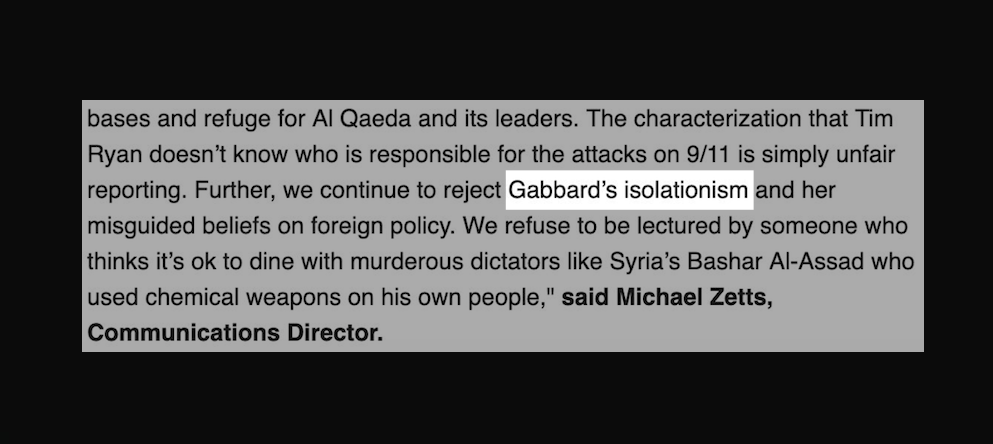
“While making a point as to why America can’t cede its international leadership and retreat from around the world, Tim was interrupted by Rep. Tulsi Gabbard,” the statement reads. “When he tried to answer her, she contorted a factual point Tim was making— about the Taliban being complicit in the 9/11 attacks by providing training, bases and refuge for Al Qaeda and its leaders. The characterization that Tim Ryan doesn’t know who is responsible for the attacks on 9/11 is simply unfair reporting. Further, we continue to reject Gabbard’s isolationism and her misguided beliefs on foreign policy. We refuse to be lectured by someone who thinks it’s ok to dine with murderous dictators like Syria’s Bashar Al-Assad who used chemical weapons on his own people.”

Ryan’s campaign is lying. During an exchange that was explicitly about the Taliban in Afghanistan, Ryan plainly said “When we weren’t in there, they started flying planes into our buildings.” At best, Ryan can argue that when he said “they” he had suddenly shifted from talking about the Taliban to talking about Al Qaeda without bothering to say so, in which case he obviously can’t legitimately claim that Gabbard “contorted” anything he had said. At worst, he was simply unaware at the time of the very clear distinction between the Afghan military and political body called the Taliban and the multinational extremist organization called Al Qaeda.

More importantly, Ryan’s campaign using the word “isolationism” to describe the simple common sense impulse to withdraw from a costly, deadly military occupation which isn’t accomplishing anything highlights an increasingly common tactic of tarring anything other than endless military expansionism as strange and aberrant instead of normal and good. Under our current Orwellian doublespeak paradigm where forever war is the new normal, the opposite of war is no longer peace, but isolationism. This removal of a desirable opposite of war from the establishment-authorised lexicon causes war to always be the desirable option.

This is entirely by design. This bit of word magic has been employed for a long time to tar any idea which deviates from the neoconservative agenda of total global unipolarity via violent imperialism as something freakish and dangerous. In his farewell address to the nation, war criminal George W Bush said the following:

“In the face of threats from abroad, it can be tempting to seek comfort by turning inward. But we must reject isolationism and its companion, protectionism. Retreating behind our borders would only invite danger. In the 21st century, security and prosperity at home depend on the expansion of liberty abroad. If America does not lead the cause of freedom, that cause will not be led.”

A few months after Bush’s address, Antiwar‘s Rich Rubino wrote an article titled “Non-Interventionism is Not Isolationism“, explaining the difference between a nation which withdraws entirely from the world and a nation which simply resists the temptation to use military aggression except in self defense.

“Isolationism dictates that a country should have no relations with the rest of the world,” Rubino explained. “In its purest form this would mean that ambassadors would not be shared with other nations, communications with foreign governments would be mainly perfunctory, and commercial relations would be non-existent.”

“A non-interventionist supports commercial relations,” Rubino contrasted. “In fact, in terms of trade, many non-interventionists share libertarian proclivities and would unilaterally obliterate all tariffs and custom duties, and would be open to trade with all willing nations. In addition, non-interventionists welcome cultural exchanges and the exchange of ambassadors with all willing nations.”

“A non-interventionist believes that the U.S. should not intercede in conflicts between other nations or conflicts within nations,” wrote Rubino. “In recent history, non-interventionists have proved prophetic in warning of the dangers of the U.S. entangling itself in alliances. The U.S. has suffered deleterious effects and effectuated enmity among other governments, citizenries, and non-state actors as a result of its overseas interventions. The U.S. interventions in both Iran and Iraq have led to cataclysmic consequences.”

Calling an aversion to endless military violence “isolationism” is the same as calling an aversion to mugging people “agoraphobia”. Yet you’ll see this ridiculous label applied to both Gabbard and Trump, neither of whom are isolationists by any stretch of the imagination, or even proper non-interventionists. Gabbard supports most US military alliances and continues to voice full support for the bogus “war on terror” implemented by the Bush administration which serves no purpose other than to facilitate endless military expansionism; Trump is openly pushing regime change interventionism in both Venezuela and Iran while declining to make good on his promises to withdraw the US military from Syria and Afghanistan.

Another dishonest label you’ll get thrown at you when debating the forever war is “pacifism”. “Some wars are bad, but I’m not a pacifist; sometimes war is necessary,” supporters of a given interventionist military action will tell you. They’ll say this while defending Trump’s potentially catastrophic Iran warmongering or promoting a moronic regime change invasion of Syria, or defending disastrous US military interventions in the past like Iraq.

This is bullshit for a couple of reasons. Firstly, virtually no one is a pure pacifist who opposes war under any and all possible circumstances; anyone who claims that they can’t imagine any possible scenario in which they’d support using some kind of coordinated violence either hasn’t imagined very hard or is fooling themselves. If your loved ones were going to be raped, tortured and killed by hostile forces unless an opposing group took up arms to defend them, for example, you would support that. Hell, you would probably join in. Secondly, equating opposition to US-led regime change interventionism, which is literally always disastrous and literally never helpful, is not even a tiny bit remotely like opposing all war under any possible circumstance.

Another common distortion you’ll see is the specious argument that a given opponent of US interventionism “isn’t anti-war” because they don’t oppose all war under any and all circumstances. This tweet by The Intercept‘s Mehdi Hasan is a perfect example, claiming that Gabbard is not anti-war because she supports Syria’s sovereign right to defend itself with the help of its allies from the violent extremist factions which overran the country with western backing. Again, virtually no one is opposed to all war under any and all circumstances; if a coalition of foreign governments had helped flood Hasan’s own country of Britain with extremist militias who’d been murdering their way across the UK with the ultimate goal of toppling London, both Tulsi Gabbard and Hasan would support fighting back against those militias.

The label “anti-war” can for these reasons be a little misleading. The term anti-interventionist or non-interventionist comes closest to describing the value system of most people who oppose the warmongering of the western empire, because they understand that calls for military interventionism which go mainstream in today’s environment are almost universally based on imperialist agendas grabbing at power, profit, and global hegemony. The label “isolationist” comes nowhere close.

It all comes down to sovereignty. An anti-interventionist believes that a country has the right to defend itself, but it doesn’t have the right to conquer, capture, infiltrate or overthrow other nations whether covertly or overtly. At the “end” of colonialism we all agreed we were done with that, except that the nationless manipulators have found far trickier ways to seize a country’s will and resources without actually planting a flag there. We need to get clearer on these distinctions and get louder about defending them as the only sane, coherent way to run foreign policy.

Climb Down From the Summit of Hostile Propaganda

Public reactions to an open letter from academics, journalists and politicians asking for co-existence with Russia show many Americans don’t buy the media’s bellicose spin, as Norman Solomon explains.

By Norman Solomon

Source: Consortium News

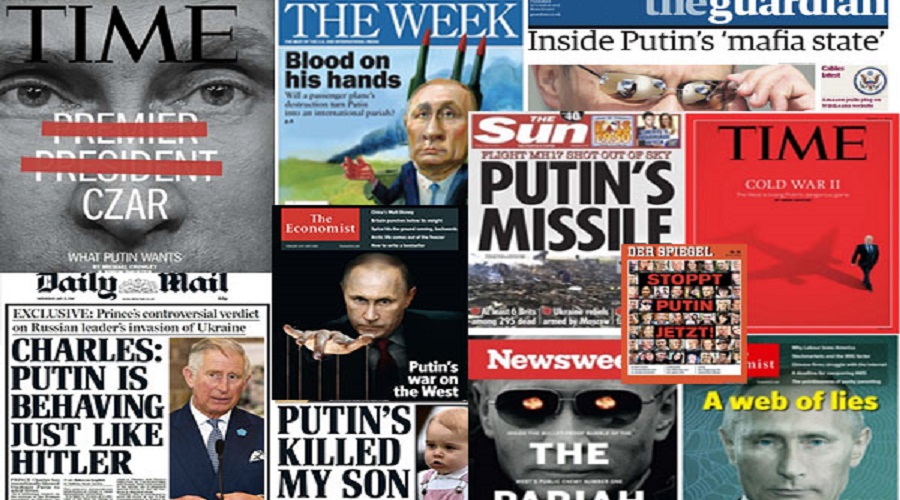
Throughout the day before the summit in Helsinki, the lead story on the New York Times home page stayed the same: “Just by Meeting With Trump, Putin Comes Out Ahead.” The Sunday headline was in harmony with the tone of U.S. news coverage overall. As for media commentary, the Washington Post was in the dominant groove as it editorialized that Russia’s President Vladimir Putin is “an implacably hostile foreign adversary.”

Contempt for diplomacy with Russia is now extreme. Mainline U.S. journalists and top Democrats often bait President Trump in zero-sum terms. No doubt Hillary Clinton thought she was sending out an applause line in her tweet Sunday night: “Question for President Trump as he meets Putin: Do you know which team you play for?”

A bellicose stance toward Russia has become so routine and widespread that we might not give it a second thought — and that makes it all the more hazardous. After President George W. Bush declared “You’re either with us or against us,” many Americans gradually realized what was wrong with a Manichean view of the world. Such an outlook is even more dangerous today.

Since early 2017, the U.S. mass media have laid it on thick with the rough political equivalent of a painting technique known as chiaroscuro — “the use of strong contrasts between light and dark, usually bold contrasts affecting a whole composition,” in the words of Wikipedia. The Russiagate frenzy is largely about punching up contrasts between the United States (angelic and victimized) and Russia (sinister and victimizer).

Countless stories with selective facts are being told that way. But other selectively fact-based stories could also be told to portray the United States as a sinister victimizer and Russia as an angelic victim. Those governments and their conformist media outlets are relentless in telling it either way. As the great journalist I.F. Stone observed long ago, “All governments lie, and nothing they say should be believed.” In other words: don’t trust, verify.

Often the biggest lies involve what remains unsaid. For instance, U.S. media rarely mention such key matters as the promise-breaking huge expansion of NATO to Russia’s borders since the fall of the Berlin Wall, or the brazen U.S. intervention in Russia’s pivotal 1996 presidential election, or the U.S. government’s 2002 withdrawal from the Anti-Ballistic Missile Treaty, or the more than 800 U.S. military bases overseas — in contrast to Russia’s nine.

An Open Letter for Sanity

For human survival on this planet, an overarching truth appears in an open letter published last week by The Nation magazine: “No political advantage, real or imagined, could possibly compensate for the consequences if even a fraction of U.S. and Russian arsenals were to be utilized in a thermonuclear exchange. The tacit pretense that the worsening of U.S.-Russian relations does not worsen the odds of survival for the next generations is profoundly false.”

The initial 26 signers of the open letter — “Common Ground: For Secure Elections and True National Security” — included Pentagon Papers whistleblower Daniel Ellsberg, writer and feminist organizer Gloria Steinem, former UN ambassador Gov. Bill Richardson, political analyst Noam Chomsky, former covert CIA operations officer Valerie Plame, activist leader Rev. Dr. William Barber II, filmmaker Michael Moore, former Nixon White House counsel John Dean, Russia scholar Stephen F. Cohen, former U.S. ambassador to the USSR Jack F. Matlock Jr., Pulitzer Prize-winning writers Alice Walker and Viet Thanh Nguyen, The Nation editor Katrina vanden Heuvel, former senator Adlai Stevenson III, and former longtime House Armed Services Committee member Patricia Schroeder. (I was also one of the initial signers.)

Since its release five days ago, the open letter has gained support from a petition already signed by 30,000 people. The petition campaign aims to amplify the call for protecting the digital infrastructure of the electoral process that is now “vulnerable to would-be hackers based anywhere” — and for taking “concrete steps… to ease tensions between the nuclear superpowers.”

We need a major shift in the U.S. approach toward Russia. Clearly the needed shift won’t be initiated by the Republican or Democratic leaders in Congress; it must come from Americans who make their voices heard. The lives — and even existence — of future generations are at stake in the relationship between Washington and Moscow.

Many of the petition’s grassroots signers have posted comments along with their names. Here are a few of my favorites:

*  From Nevada: “We all share the same planet! We better learn how to do it safely or face the consequences of blowing ourselves up!”

*  From New Mexico: “The earth will not survive a nuclear war. The weapons we have today are able to cause much more destruction than those of previous eras. We must find a way to common ground.”

*  From Massachusetts: “It is imperative that we take steps to protect the sanctity of our elections and to prevent nuclear war anywhere on the earth.”

*  From Kentucky: “Secure elections are a fundamental part of a democratic system. But this could become meaningless in the event of thermonuclear war.”

*  From California: “There is only madness and hubris in talk of belligerence toward others, especially when we have such dangerous weapons and human error has almost led to our annihilation already more than once in the past half-century.”

Yet a wide array of media outlets, notably the “Russiagate”-obsessed network MSNBC, keeps egging on progressives to climb toward peaks of anti-Russian jingoism. The line of march is often in virtual lockstep with GOP hyper-hawks like Senators John McCain and Lindsey Graham. The incessant drumbeat is in sync with what Martin Luther King Jr. called “the madness of militarism.”

Meanwhile, as Dr. King said, “We still have a choice today: nonviolent co-existence or violent co-annihilation.


Norman Solomon is the coordinator of the online activist group RootsAction.org and the executive director of the Institute for Public Accuracy. He is the author of a dozen books including “War Made Easy: How Presidents and Pundits Keep Spinning Us to Death.”

FIGHTING FOR OKINAWA — MY HOME, NOT A MILITARY BASE

By Moé Yonamine

Source: Rethinking Schools

My family moved to the United States from Okinawa when I was 7. But Okinawa is still home — and I’m hurt and angered at how the United States and Japan continue to treat Okinawa as little more than a colonial outpost. As a teacher, I’m even more dismayed at how the conventional school curriculum keeps young people in this country ignorant about the abuse, but also about the resistance, in my home islands.

“They are burying our beautiful ocean,” read the recent message from my mother in Okinawa, as though she was grieving the loss of a loved one. After decades of protest by Okinawan people to completely get rid of all U.S. military bases that occupy a fifth of the Ryukyu Island chain, the United States and Japan signed a treaty to evacuate one of the most contested bases located in the center of the main island, Futenma Marine Corps (MCAS) base. In exchange for the removal, both governments announced that they would construct a floating military base off the northeast coast of Henoko. Okinawans expressed vehement opposition, with a majority voting in a referendum for the complete removal of all bases. Still the construction continued and the people persisted in protest — marching for miles down main streets, creating human chains for peace, linking arms around military bases, elders repeatedly lying down in front of bulldozers. Governor Takeshi Onaga demanded the Japanese government terminate the heliport construction and city mayors prevented access of U.S. military construction vehicles through their districts — later overturned by federal court order last December sought by the Japanese federal government.

Today, the concrete seawalls are finished, and soon, rocks will be crushed and sand will pile high, burying the tropical, clear waters. The Japanese government and U.S. military continue to pursue the construction of the runway, despite community complaints of environmental damage and pollution, endangerment to sea life, harm to the fishing and tourism industry, as well as the ongoing threat to cultural survival and island sovereignty. On July 6th the Ryukyu Shimpo announced that the Japanese government would not return the land occupied by MCAS Futenma to the Okinawan people. The U.S. and Japan added a condition to the promise for Futenma’s removal: The Naha International Airport must be made available for the U.S. military any time they declare an emergency. When Governor Onaga rejected this demand, the U.S. military withdrew its promise to remove Futenma. Japanese Defense Minister Tomomi Inada stated, “If the requisite conditions for the return of Futenma are not met, it will not be returned.” In a surge of anger, pain and frustration, word spread quickly in Okinawa across social media.

Devastated at the sacrifice of my home, I turned to the news here in the United States, and there was not one story about Okinawa on any major network. Frustrated, I recalled my conversation with an elderly grandmother I met at a peace rally in my neighborhood when I went home last summer. When I told her I was a teacher in the United States, she told me that the best thing we as teachers can do is to teach kids about what’s happening in Okinawa and how we want a world without war. She said, “They need to know our story so they can stand up with us.”

But when I turn to a typical U.S. textbook, I see how students are ill-equipped to understand what’s happening in Okinawa. For example, in Holt McDougal’s widely used The Americans, there are a mere three paragraphs about Okinawa under the section, “The Atomic Bomb Ends the War.”

Discussion of Okinawa begins and ends with a skewed description of the Battle of Okinawa during WWII: “In April 1945, U.S. Marines invaded Okinawa,” it begins. “By the time the fighting ended on June 21, 1945, more than 7,600 Americans had died. But the Japanese paid an even greater price — 110,000 lives — in defending Okinawa.” Okinawans are completely invisible in this account of the war, the bloodiest battle in the history of the Pacific, where our islands were used as a battleground between the United States and Japan. The highest cost was in Okinawan lives, where more than a third of the population was killed within three months — almost 150,000 — and more than 92 percent were left homeless. The majority of today’s families — including mine — have experienced grief and loss of loved ones.What The Americans does not teach is that Okinawa was once an independent kingdom, was colonized by Japan, then controlled by the United States for 27 years, and finally became a Japanese prefecture. At the end of the war, the U.S. military stripped Japan of its constitution and replaced it with one that took away Japan’s right to have an offensive military. Henceforth, the United States would “protect” Japan, and create bases throughout Japanese territory. However, three-quarters of all U.S. bases on Japanese territory are on Okinawa, even though Okinawa makes up only .6 percent of Japan’s total landmass. Okinawa’s main island is just 62 miles long; and its width averages one mile.

MCAS Futenma was constructed in the middle of our skinny island — creating environmental destruction, air pollution and noise pollution, blocking direct access to roads in a densely populated community, and exposing survivors and families to the sights and sounds of war. Frequent violent crimes against women and children continue to bring hundreds of thousands of protesters together demanding justice and humanity — and the complete removal of U.S. military bases.

Not only do commercial textbooks fail to equip students to understand what’s happening in Okinawa, the mainstream school curriculum does not help students understand issues affecting island people more broadly. I have seen time and time again the shock when my high school students in Portland, Oregon, learn about the U.S. military’s long-standing nuclear testing in the Marshall Islands, the environmental damage to Vieques in Puerto Rico, or the history of U.S. military trainings on indigenous Hawaiian soil. Many of my students are confused when they learn that Guam is a “U.S. territory,” has the highest per capita U.S. military enlistment, has a huge U.S. base presence, but its people have no right to vote in U.S. elections. When I talk about the International Women’s Network Against Militarism, students wonder why women from places with high U.S. military presence — the Philippines, South Korea, Hawai’i, Puerto Rico, Guam and Okinawa — gather regularly to talk and organize.

When people say to me, “Why are Okinawans complaining? We’re there to protect you,” I want them to learn our whole history and to know our colonized story. When people ask, “Why don’t Okinawans complain to the Japanese government?” I want them to know about the history of our people’s movements to demand our rights. When people say, “So what? It’s just one little island,” I want them to know this is my home; it’s sacred — these are my loved ones. What’s more, our story of struggle today represents issues affecting so many island people.

The elderly grandmother from the peace rally told me that we must teach the children “that we have been fighting because we have always wanted peace but now we need the world to fight with us. Go back and tell our story.” Our story though, is much more than three short paragraphs in a textbook. It is a story about a people’s determination for sovereignty in the face of imperialism, resilience in midst of colonization, and perseverance for peace as survivors of war. Our story is urgent and it is a call for global action in the name of peace and justice. The history of Okinawa is a story of resistance but also a call to the world.


Moé Yonamine (moe@rethinkingschools.org) teaches at Roosevelt High School in Portland, Oregon, and is an editor of Rethinking Schools magazine. Yonamine is part of a network of Zinn Education Project teachers developing original people’s history curriculum. She is the author of “The Other Internment: Teaching the Hidden Story of Japanese Latin Americans During WWII,” “‘ANPO: Art X War’: A Film Tackles the U.S. Occupation of Japan,” a film review with teaching activities of “ANPO: Art X War,” a documentary about visual resistance to U.S. military bases in Japan, and “Uchinaaguchi: The Language of My Heart.”

The Unifying Force of War Abolition

By David Swanson

Source: Let’s Try Democracy

Remarks at United National Antiwar Coalition in Richmond, Virginia, on June 18, 2017.

It’s not unusual for an activist, focused on one of the millions of worthy causes out there, to try to recruit other activists to that particular cause. That’s not exactly what I want to do. For one thing, if we are going to succeed we are going to have to recruit millions of new people into activism who are not now active at all.

Of course I do favor types of activism that eliminate the need for more activism, such as campaigns to make voter registration automatic or to index the minimum wage to the cost of living. But for the most part I want everyone to keep doing what inspires them. Only, I think I know a way to shift our emphases and unite out movements, a way that doesn’t usually occur to us.

It’s not unusual for an activist to think that their particular field is the unifying top priority.

For example:

If we don’t get the money out of politics how can we enact or enforce any laws not favored by money? We’ve legalized bribery for godsake! What else matters until we fix that?

Or:

If we don’t create credible democratic independent media, we can’t communicate. Door knocking can’t defeat television. We only know that Cindy Sheehan went to Crawford or Occupyers went to Wall Street because corporate television chose to tell us. Why have elections if we can’t tell the truth about the candidates?

Or:

Excuse me, the earth is cooking. Our species and many others are losing their habitats. If it’s not already too late, now is the time to decide whether we will have great grandchildren at all. If we don’t have any, what will it matter what kind of elections or television networks they have?

One can go on and on in this vein, as well as in claiming that one societal evil precedes and causes another. Racism or militarism or extreme materialism is the disease and the others are the symptoms.

All of this is also not exactly what I want to do. I want us to work on everything and use every means of unifying. I want us to recognize how each problem contributes to others and vice versa. Hungry scared people can’t end climate change. A culture that puts a trillion dollars a year into mass-killing of distant dark-skinned people can’t build schools or end racism. Unless we redistribute wealth, we cannot redistribute power. We can’t create media unless we have something important to say. We can’t protect the earth’s climate while steadfastly ignoring the top consumer of petroleum on earth because criticizing the military would be inappropriate. But we will go on ignoring it if we don’t create good media. We have to do it all, and there are various ways in which we can become more united, more strategic, and potentially more effective.

The way that I think we don’t pay enough attention to lies in developing a focus on complete and total war abolition, elimination of all weapons and militaries, all bases, all aircraft carriers, missiles, armed drones, generals, colonels, and if necessary all senators from Arizona.

Why war abolition? I’ll give you 10 reasons.

  1. It actually makes sense. The reasonable position of opposing some wars and cheering for others, but cheering for the troops even in the bad wars doesn’t attract a lot of energy because it doesn’t make any sense. Jeremy Corbyn just won votes by pointing out that wars generate terrorism, they are counter-productive on their own terms, endangering us rather than protecting us. They need to be replaced with diplomacy, aid, cooperation, the rule of law, the tools of nonviolence, the skills of de-escalation of conflict. Claiming that wars are sort of good but shouldn’t be overdone makes no sense at all — what is the point of them if not to win them? And if wars make murder OK, why is torture so unacceptable? And if bombs dropped by piloted planes are OK, what’s wrong with drones? And if Anthrax is barbaric, why are White Phosphrous and Napalm civilized? None of it makes any sense, which is one reason the top killer of U.S. troops is suicide. You know how to properly love the troops, end all war and give them life options that don’t make them want to kill themselves.
  2. Nuclear apocalypse is a growing danger on a par with climate chaos and will continue to grow unless war abolition succeeds.
  3. The biggest destroyer of water, air, land, and atmosphere that we have is militarism. It’s war or planet. Time to choose.
  4. War kills first and foremost by removing resources from where they are needed, including from famines and disease epidemics created by war. Any activism that seeks funding for any human or environmental needs has to look to ending war. It is where all the money is, more money every single year than could be taken once and only once from the billionaires.
  5. War creates secrecy, surveillance, classification of public business, warrantless spying on activists, patriotic lying, and illegal actions by secret agencies.
  6. War militarizes local police, making the public into an enemy.
  7. War fuels, just as it is fueled by, racism, sexism, bigotry, hatred, and domestic violence. It teaches people to solve problems by shooting guns.
  8. War divides humanity at a time when we must unite on major projects if we are to survive or prosper.
  9. A movement to abolish all war, all weapons, and all atrocities that flow out of war can unite opponents of the crimes of one government or group with the opponents of the crimes of another. Without equating all crimes with each other, we can unite as opponents of war rather than of each other.
  10. War is the primary thing our society does, it sucks down the majority of federal discretionary spending, its promotion permeates our culture. It is the very foundation of the belief that ends can justify evil means. Taking on the myths that sell us war as necessary or inevitable or glorious is an ideal way of opening our minds to rethinking what we’re doing on this little planet.

So let’s not work for an environmentally sensitive military into which women have the equal right to be drafted against their will. Let’s not oppose the weapons that are wasteful or don’t kill well enough. Let’s build a broad multi-issue movement in which one of the unifying factors is the cause of eliminating in its entirety the institution of organized mass murder.