
The Culture of Vehicular Attacks

On the Murder of Deona Marie Erickson

By CrimethInc.

On June 13, a driver attacked a demonstration in Minneapolis, killing Deona Marie Erickson. This is the result of years of right-wing efforts to normalize—and even legalize—vehicular attacks. Now the corporate media has ceased to prioritize covering them, paving the way for more killings. In dialogue with our comrades at It’s Going Down and on the ground in Minneapolis, we have prepared the following reflections on the implications of this.


Shortly before midnight on June 13, while demonstrators gathered at Lake Street and Girard Avenue to protest the murder of Winston Smith by sheriff’s deputies and US Marshals, a man named Nicholas Kraus drove his SUV into the crowd at high speed, killing Deona Marie Erickson. One Black anti-fascist militant who was on the ground at the time of the attack reports that it was clear to those present that it was an intentional attack: “You heard his engine from three blocks away.”

According to Unicorn Riot,

“Deona Erickson’s car was parked on the side of the street in a way that would protect the people who were gathering. She was sitting down on the sidewalk about 15 feet from her car moments before the perpetrator smashed directly against her car at a very high speed. Witnesses say she was then hit by her car and sent flying. Street medics on the scene resuscitated her but she later died at the hospital.”

Deona Marie Erickson had two daughters. She worked as a program manager at a center for disabled adults. Today would have been her 32nd birthday. She gave her life to protect those who protest police murder.

Demonstrators detained the driver, Nicholas Kraus. Eyewitnesses dispute police allegations that he was “pulled from his car”; reportedly, police did not respond until after the attack, sending riot police to threaten the crowd before an ambulance could arrive. Under the circumstances, the demonstrators’ response was measured, to say the least.

https://twitter.com/aishaforward10/status/1404509174516625408


The Culture of Vehicular Attacks

Let’s put this attack in context.

Fox News and the Daily Caller circulated a video encouraging their viewers to carry out vehicular attacks against protesters months ahead of the fascist “Unite the Right” rally in Charlottesville at which a self-identified neo-Nazi did exactly that, killing Heather Heyer and injuring 35 people. Afterwards, leaked chats showed other neo-Nazis also planning to use vehicles to attack protesters.

In summer 2020, vehicular attacks surged in response to protests against the police murders of George Floyd, Breonna Taylor, and others. Over a dozen people were killed in these and other attacks on the movement.

https://twitter.com/IGD_News/status/1404699241570705408

Today, legislators around the United States are taking steps to criminalize protest activity, introducing a wide range of anti-protest bills. Foremost among them, Oklahoma and Florida lawmakers have passed laws guaranteeing civil and criminal immunity to drivers who hit demonstrators with vehicles, effectively granting vigilantes the right to crash cars into demonstrators. At the same time, Florida has introduced penalties of up to 15 years imprisonment for blocking traffic.

The message is clear enough. In short, lawmakers and police seek to crack down on pedestrians acting collectively to oppose state violence, while extending additional privileges to drivers who act individually to support state violence via their own attacks. The official institutions of the state have failed to leverage enough violence to suppress movements against police violence and white supremacy, so they are deputizing others to do so—a longstanding counterinsurgency strategy reflective of the colonial heritage of the United States.

On a fundamental level, the form of subjectivity that these lawmakers are promoting is what we might call a motorist subjectivity: consumerist, individualized, invested in the smooth functioning of the existing order, and regarding all other possibilities as threats. Structurally speaking, for the motorist, all other human beings—traffic as well as pedestrians—are obstacles, and the only imaginable journeys are dictated by the routes established by the state and the economy. The motorist wants to see the laws enforced on others, on the premise that it will reduce the ways that others might inconvenience him, but he doesn’t want the laws enforced on himself. Conceiving of our society as an entirely mapped world—the way that Google Maps does—in which all means of locomotion, all forms of agency, are individualized according to financial means, the motorist cannot imagine why people would assemble, off road or not, to challenge law enforcement itself.

As shocking as vehicular attacks are when they occur, they are an extension of the society in which they take place. They are anti-social, but they express and intensify the anti-social premises of our day-to-day relations with each other. Motorist versus pedestrian is a classic class opposition in a society in which transportation and mobility are fundamentally racialized. People who were raised on advertisements depicting jeeps off-roading across the suspiciously vacant landscape of the frontier only to find themselves sitting in bumper-to-bumper traffic on the freeway for an hour every day look around for someone to blame, and—as if by design—blame those with even less power than themselves. Road rage.
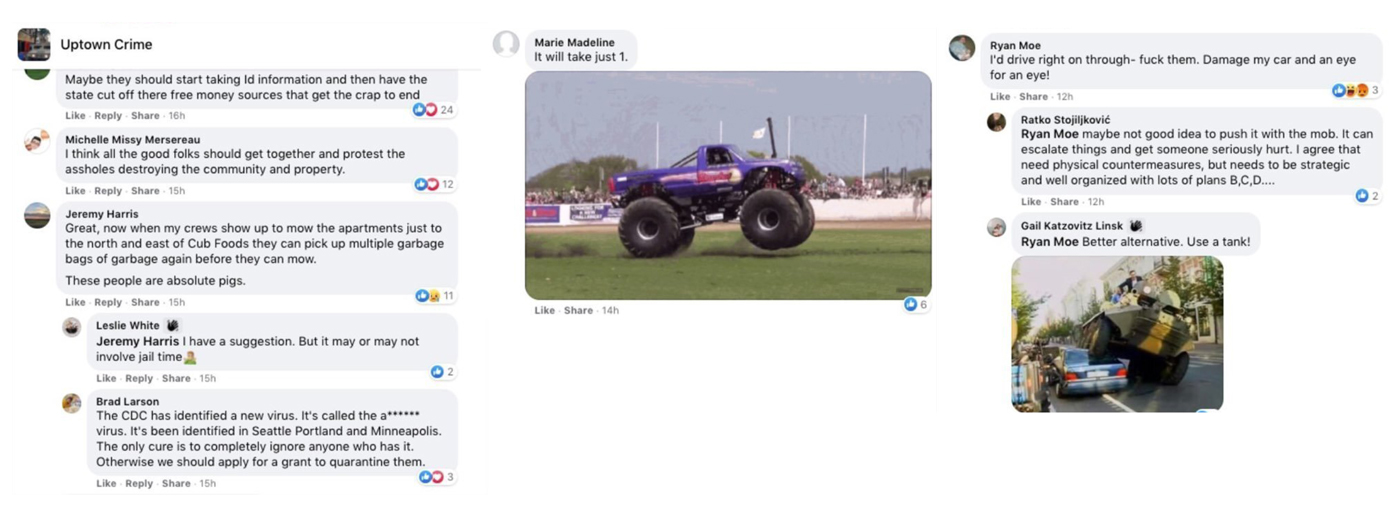
Right-wing online chatter in Minneapolis ahead of the attack that took Deona Marie Erickson’s life.

In this context, the chant “Whose streets? Our streets!” asserts another form of life, another way of relating to each other and conceiving of what our lives could be. Rather than framing vehicular attacks as aberrations from an otherwise peaceful social order—to be addressed, for example, by more policing—we have to understand them as one of the ugliest manifestations of a social structure that is fundamentally racist and anti-human, which can only be addressed via new forms of togetherness.

Honoring those whose lives have been taken by police and pro-police vigilantes is a first step towards this, and it is important that people have been doing this through shared presence in particular physical spaces. The internet—the information superhighway—tends to reinforce the motorist mentality of abstract competition and hostility. One of the most basic steps we can take towards creating a new social fabric on egalitarian terms is to encounter each other in person in ways that affirm the specificity of place.

This gives us more perspective on the ongoing efforts of city officials to evict the autonomous zone at the site where George Floyd was murdered, in order to open it up for “the free passage of traffic.” Rhetoric about “culture wars” is usually used to evoke a conflict between those on the fringe of the left and right, but here, we see centrist officials forcibly imposing a particular model for what our lives, relationships, and forms of grieving should be, even as they purport to be neutral.


Far-Right Murderers and Centrist Beneficiaries

Nicholas Kraus, a man with a history of domestic violence and abuse, is representative of the sort of dysfunctional, alienated men that far-right provocateurs aim to weaponize to carry out stochastic attacks on social movements.

This is effectively a watered-down version of the same strategy that ISIS has used in the Mideast in territories it does not control: taking advantage of the desperation, prejudice, and mental health issues of an entitled but disenfranchised population, the far right aims to disrupt popular mobilizations through consistent but deniable terror attacks. Their goal is to raise the risks of public organizing to such an extent that it becomes hard for movements to maintain momentum, in order to support state repression while opening up space for fascist groups to recruit and mobilize. In Turkey, this approach helped the despotic government of Recep Tayyip Erdoğan to crush what had been powerful social movements. The ultimate beneficiaries of this are not just far-right politicians, but also centrist capitalists who do not wish to see fundamental changes that could threaten their power.

Vigilante attacks are also advantageous for the city officials who would like to present themselves as “neutral” while suppressing the protest movements against the murders that the police they oversee regularly carry out. Vigilante attacks enable these officials to change the subject from the violence of the institutions they represent back to the question of how to “maintain order.”

“Some of these people with the megaphones, I guess their role is to get people riled up and get them in a space and march them around and educate them and tell them what their next big plans are and who they’re backing politics-wise and things like that.

“I like community, organic—no microphones, no megaphones, like right now. It’s about fifty people—but fifty people got Lake and Hennepin shut down right now, you know what I’m saying? We’re moving and grooving right now. As opposed to two or three hundred people holding signs, marching around, and then feeling accomplished, patting themselves on the back and then leaving—ain’t shit get shut down really. Police don’t even monitor the marches no more. No change will come from that.”

-Anonymous Black anti-fascist militant in Minneapolis, evening of June 15, 2021

But Who’s Paying Attention?

“You protested because it was trendy and ‘everyone was doing it.’ I protest because people are out here dying!”
-Deona Marie Erickson, June 10
In 2021, many liberals and progressives have left the streets, relying on the Biden administration to roll back the policies of the Trump administration. Consequently, the murder of Deona Marie Erickson has attracted considerably less attention than it might have just last year. This withdrawal from social struggles creates the conditions for more attacks like this to take place.
This reminds us of the situation before the murder of Heather Heyer made world news, when the far right carried out a series of murders around the United States without drawing the attention of corporate media. Corporate media outlets were only forced to cover the events in Charlottesville because it was not possible to sweep under the rug the fact that a thousand fascists had gathered in one place and killed a white woman. Because the events took news editors—though not anti-fascists—by surprise, they were not prepared to spin the story according to the preferences of their corporate backers; so for a week, fairly honest coverage of the threat represented by the far right suddenly appeared in a variety of news outlets. Subsequently, although this coverage was tempered by efforts to demonize anti-fascists, centrist media outlets continued to report on far-right attacks in order to associate them with the agenda of Donald Trump’s administration.
But now that centrists can’t leverage Deona Marie’s death against Trump, they are prepared to treat it as simply another sad facet of American life, to sweep it under the rug once more.
This coincides with widespread emotional numbness arising from several years of constant tragedies. The COVID-19 pandemic has already accustomed many people to thinking of human life as expendable. Last weekend saw multiple mass shootings across several states. Poverty has reached the highest levels since the beginning of the pandemic. These are the forces that drive desperate people to adopt far-right politics wherever there are no models for a collective pursuit of liberation, creating a feedback loop that will generate more and more tragedies.
“We keep us safe.” “We protect us.” These slogans spread far and wide in the course of the movements that burst onto the world stage in Ferguson, Missouri because it has become eminently apparent that no one else is going to protect us. Deona Marie died doing her best to keep her companions safe—to open up a space in which people can come to know each other on different terms, as part of a community premised on shared consideration for all human beings, not individualized capitalist competition. We should do the same, so that everyone like her, and like George Floyd, Breonna Taylor, and Winston Smith—might live. We should do the same, because the alternative means isolation, means eventually being treated as expendable ourselves.
“If the fascists would have run over Deona Marie and we would have not been holding space, not erected the barricades that the city just tried to tear down, then Deona Marie’s voice would be in vain. We’ve got to be out here. That fascist wins—that fascist who drove his car right here, he wins. ‘Oh, I got them off the street. They’re gone now. My fellow white supremacists can enjoy Lake Street now, because I got them fuckers off the street,’ you know what I’m saying?
“We’re out here stronger now. We have to be.”
-Anonymous Black anti-fascist militant in Minneapolis, June 15, 2021

https://twitter.com/TigerWorku/status/1404329351211016192

“Concerning Deona Marie”

From an internationalist anarchist woman in Rojava:
From half a world away, I hear about this sacrifice, this martyrdom. I use the words sacrifice and martyrdom and not the word “tragedy” because I am hearing about a woman comrade who chose to defend her community, and there are few things more beautiful and free in this world than that choice. She thought beyond herself, felt beyond her own personal safety, to defend those who struggled together side by side with her for freedom.
When a life is given and taken in struggle, it’s not an easy thing for those of us left to continue. It would dishonest for me to say this is not something heavy, but we do not have to let the weight of it become a burden—this weight can give us strength and power, and with it, we can continue her struggle.
Every martyr is another reason to continue, another example to hold ourselves up to. For every woman whose life they take, for every comrade, for every person who stands up to defend their community, whose light they try to extinguish, we can make sure that a hundred rise up in their place. The time when we could be separated on the basis of race, class and gender is coming to an end. When we sacrifice for each other in this way, as comrades, as people who share a freedom struggle, the methods of our enemies turn to dust.
This is the time for us to defend our communities like Deona did. Anything else, and we won’t have risen to her standard. Her choice to defend was a sacred act of love—let us all be led by it.
Revolutionary greetings, respect, and love from Rojava.

If the goal of those who seek to encourage vigilante attacks is to discourage movements based in direct action, this dovetails with the goals of city officials who seek to use the Non-Profit Industrial Complex to buy off a layer of activists to oppose and undermine effective strategies from within the movement. In that regard, one of the most important ways to prevent the attackers from achieving their goals is to preserve the horizontal, grassroots structure of movements against police, while continuing to emphasize systemic forms of white supremacist violence alongside vigilante attacks.

Ireland: Thoughts on Wildness and Domestication

By Renzo Connors

Source: Anarchists Worldwide

“If I decide to break the chains of domestication, I can only do so because I feel the chains and suffer the effects of domestication on my own skin.” – Alfredo Bonanno

I

While out walking or cycling at night, foxes can always be seen roaming the housing estate. The glow of their eyes in darkness, appearing from dark alleyways suddenly visible under the street lights, they move around without a sound, hardly noticed. These lovely magnificent creatures are the embodiment of wildness. Leviathan towers all around but yet these wild beings live on freely from domestication. The foxes at times live off the scraps and waste that civilization throws away, but long after civilization crumbles these creatures will live on.

These wild beings will live on long after civilization kills itself because they are not dependent on civilization to provide the means of life. They remain wild and undomesticated, still equipped with the knowledge and skills to find food, build shelter, and survive independently for themselves.

The vast majority of humans on the other hand are totally domesticated and dependent on civilization and the vast majority would not be able to survive without shops and machines. Only a tiny percentage of humans that inhabit the earth still live wild, free, and living autonomously. The rest are imprisoned within the concrete and metal structures of techno-industrial society.

Domestication begins from birth, straight away an individual is given a birth certificate and social security number. These will be needed throughout life, to be recognised by whatever state an individual happens to be born into, to go to school, to work, to open a bank account and from there to get loans to buy shit, to get a passport, to register to vote, so the state knows who you are, what taxes you have paid or owe, your credit history: to be controlled and exploited. From birth, through childhood, into adulthood,an individual is moulded and taught how to behave, what is acceptable and what is not; through force and blackmail of collective and religious moralities created by the systems and institutions that make up civilization. The end result: a domesticated and a functional obedient citizen and wage slave.

Everything within the civilized culture is geared towards this. Education, children’s stories, TV shows, movies, books, games, and even songs are all exposure to the social norms and control of civilization. The soul purpose of the individual in civilization is to produce and reproduce the social structures, authoritarian institutions and daily subservience to civilized society. There is little room for escape from behind the computer screens and consumerism.

II

Tenalach
Irish – Used to describe a relationship one has with the land, air and water, a deep connection that one literally hears the Earth sing.

I’ve always felt an affinity and closeness with wild spaces. From childhood, playing in the fields and woodlands, fishing in the lake and swimming in the rivers that were close to the housing estate I grew up in. As a kid taking day trips to the Wicklow mountains seeing all the views, beauty of the trees and plants, rugged valleys, and at times what seems like inhospitable landscape of bog land and cliff drops.

Being in such spaces conjures up and stores feelings within me I wouldnt be able to adequately describe with words. Perhaps they could be described as something spiritual.

The landscape has been left scarred by civilization. Roads built long ago by the British colonists to flush out any hiding rebels, shells and ruins of buildings left over from the dawn of industrialism scattered across the landscape, electrical dams blocking up rivers, TV and radio transmitter masts, bog land robbed and left mutilated to feed industrial “progress”, forests cut down and replaced by animal agriculture and monocrop Sitka tree plantations poisoning the land, and the mass graves from pogroms and genocide of the religious and imperalist conquerers. There isn’t a place left on this island that civilization hasn’t left its mark.

******

In my early 20’s locked up in prison for taking part in the anti-imperialist struggle, I felt these feelings for the wild more intensely.

Not seeing any plants or trees, except the ones I could see from my cell window on the horizon. The urge to walk in grass and sand in my bare feet, wanting to roam in woodland to look up at the sky through the canopy.

For the years spent incarcerated I daydreamed about being in nature, being in the mountains, being by the sea.

After four years with eight months left I was granted temporary release for Christmas.

For the first time outside the concrete walls, iron bars and razor wire of prison there was only one thing I really wanted to do and that was to go to the ocean.

The beach was a short walk from where I was staying. To get there I’d first have to walk through a park. As I walked, even though it was winter there was still a lot of colour. A lot of the big tall trees in the park are evergreen trees so they still had their colour. Going through the park my head and eyes were darting around taking in the landscape, walking under the tall trees, their canopy blocking out the sky. It was an amazing feeling being hit in the face with so many different colours, different shades of green.

Sensory stimulation from the sounds of flowing water making its way down streams, birds chirping and singing, the wind blowing long grass and branches, colors of the landscape and the various shades of browns and greens of foliage was almost overwhelming to the senses.

When I reached the beach I walked for a little bit and then sat on a sand dune for about two hours looking out into the vast ocean of green, reflecting in my thoughts and finding some solace in my mind.

Are these feelings that rush around my mind and body urging me wildness, the inner primal anarchic instinct buried by years of domestication?

Or are they an individual desire and love within me for the wild?

Saturday Matinee: Sacco and Vanzetti (2006)

SACCO AND VANZETTI brings to life the story of Nicola Sacco and Bartolomeo Vanzetti, two Italian immigrant anarchists who were accused of a murder in 1920, and executed in Boston in 1927 after a notoriously prejudiced trial. The ordeal of Sacco and Vanzetti came to symbolize the bigotry and intolerance directed at immigrants and dissenters in America. Millions of people around the world protested on their behalf, and now, 80 years later, their story continues to have great resonance, as civil liberties and the rights of immigrants are again under attack. Powerful prison writings (given voice by John Turturro and Tony Shalhoub) and passionate interviews with Howard Zinn, Arlo Guthrie and Studs Terkel are interwoven with artwork, music and film clips. Through the story of Sacco and Vanzetti, audiences will experience a universal, and very timely, tale of official injustice and human resilience.

Watch the full film here: https://christiebooks.co.uk/anarchist_films/sacco-and-vanzetti-2006-peter-miller/

The Seeds of Anti-Capitalist Revolt Found in Everyday Resistance: A Review of Guerrillas of Desire – Notes on Everyday Resistance and Organizing to Make a Revolution Possible by Kevin Van Meter (AK Press, 2017)

By Scott Campbell

Source: Institute for Anarchist Studies

Back when I first began selling my labor for a wage in the wasteland of suburbia’s strip malls, I can recall the tedium of stocking shelves, summoning up insincere courtesy in the face of entitled customers and obnoxious bosses, comparing the stacks of money counted at the end of the day with the totals on our paychecks, and feigning adherence to whatever motivational façade management cooked up to mask the reality of our exploitation.

Yet I also remember, much more vividly and fondly, the latent and occasionally eruptive defiance among my co-workers. This included the constant collective complaining about the job, taking more and longer-than-approved breaks, working as little as possible, fudging time sheets, stealing, and the intermittent screaming matches with the boss in the middle of the store. Underpinning all these actions was an unspoken but broadly understood code of silence when it came to such transgressions and, when appropriate, expressions of support for them.

At the time, I didn’t think much about this, it was just how things happened and I’ve encountered similar experiences to varying degrees in every workplace since. Our actions weren’t guided by a political framework nor was there any attempt to organize them in a directed manner. It was more a spontaneous, innate reaction to experiencing the coercion of capitalism. I had cause to reflect upon this anew while reading Kevin Van Meter’s new book, Guerrillas of Desire: Notes on Everyday Resistance and Organizing to Make a Revolution Possible, published by AK Press and the Institute for Anarchist Studies.

In the preface, Van Meter observes that the question motivating him is not “What is to be done?” but “How do people become what they are?” Throughout the course of the book he seeks to provide an answer by locating power in the resistance of workers, apart from any political ideology or organization. Whether and how that inherently anti-capitalist refusal of work develops into revolt or rebellion are the questions he compellingly urges us to reflect and act upon.

To reach that point, Guerrillas of Desire ambitiously takes on multiple tasks that feed into and build on one another. Van Meter initiates a dialogue between anarchism and Autonomist Marxism that leads to a reconceptualization of the working class, bolstered in part by a historical accounting of workplace actions such as the ones I recounted. He labels these “everyday resistance,” committed by “guerrillas of desire,” and proposes a focus on those deeds as the entry point for organizing revolutionary resistance to capitalism. The impetus for this initiative, concisely carried out in under 160 pages, is his proposal that the current approach to organizing is conceptually flawed and therefore destined to fail. “Guerrillas of Desire offers a contentious hypothesis: the fundamental assumption underlying Left and radical organizing, including many strains of anarchism, is wrong. I do not mean organizationally dishonest, ideologically inappropriate, or immoral. I mean empirically incorrect” (13). The incorrect basis for current organizing is the assumption that the poor and working classes are unorganized and passive and that it therefore rests upon activists and organizations to educate and mobilize them for their own sakes. Van Meter instead proposes that there is in fact informal organization and resistance occurring, it is just of a sort that does not fit within the Left’s organizing vision and therefore goes unseen, unrecognized, and unincorporated into political theories, analysis, and action.

To provide a political frame for understanding the “everyday resistance” of the working class, Van Meter draws upon anarchism’s mutual aid – the material and emotional cooperation and reciprocal support that exists in societies – with Autonomist Marxism’s self-valorization – autonomous working class action that counters the state and capitalism, primarily the refusal of work in its myriad forms. Combined together and reinforcing one another, mutual aid and the refusal of work comprise the “everyday resistance” of the working class.

These phenomena also give definition to what is meant by “working class,” which Van Meter defines as “autonomous from both capitalism and the official organization of the Left, broadly including all those who work under capitalism, based in relationships between workers rather than as a structural component of the economy or sociological category” (32). Rather than being premised on income, occupation, or union membership, the working class under Van Meter’s formulation is made up of all those who must perform work under capitalism – be it waged or unwaged, in the factory, home, office, bedroom, affective, or social spheres. However, when they are not taking action in response to their subjugation under capitalism, these people are just workers. They become a class through the process of struggling against the conditions imposed upon them by capitalism. This struggle initially takes the form of everyday resistance based on mutual aid and the refusal of work. It is everyday resistance that unites individual workers as a class because such resistance, even when performed by one person, requires at a bare minimum the tacit complicity of co-workers and preferably their active collaboration.These acts and the social relationships they create and depend on lay the groundwork for the broader and overt organizing against capitalism more commonly interpreted as working class struggle. Using this framework as offered by Van Meter, we can understand the working class as composed of the relationships forged among workers actively in resistance against capitalism.Without anti-capitalist struggle, the working class does not exist.

After laying this theoretical groundwork, the bulk of the book traces the various forms of resistance by slaves, peasants, and workers in the industrial and social factories (the expansion of capitalist logic from the factory into society at large, in particular in service, immaterial, and reproductive work), creating a lineage and legacy of working class resistance against the various formations of capitalism that spans centuries. “Viewing the working class broadly to include slaves and peasants as well as students, homemakers, immigrants, and factory and office workers reveals the breadth of struggle and generalized revolt against work that continues to be imposed” (128). In doing so, Van Meter further builds the framework of the working class as being formed through its self-activity against the demands and deprivations of capitalism.

The historical survey brings the discussion into the present, where Van Meter offers a proposal to address his initial hypothesis that the Left is carrying out its organizing work in an incorrect way. His suggestion is for the organizers of today and in the future to begin their work by “reading the struggles” already underway in the form of everyday resistance. Through investigation and documentation by organizers, new relationships may be fostered with guerillas of desire that allow everyday resistance to expand into larger and more overt forms of autonomous anti-capitalist struggle. He proposes that the seeds of the new, liberatory worlds sought by anarchism and Autonomist Marxism are to be found in the everyday resistances that are already occurring rather than in the latest organizing manual or official Left strategy document..

While impressed after reading through this formulation, I was left with lingering questions. It remained unclear how, for instance, everyday resistance morphed into more overt, organized resistance and the part organizers positioning themselves as readers of struggle played in such a development. The personal anecdotes he provided on stepping back from ideological assumptions and reorienting towards the collective experiences of communities during his work in Long Island were helpful. It brought to mind the story of Marxist-Leninist intellectuals heading off to the Chiapan jungle with grand plans of starting a peasant guerrilla force. Only when they arrived, they found the population had no time or interest in their grandiose ideology. It was only when they dropped their assumptions and worked within the community to understand its needs, concerns and own history of resistance that the Zapatistas emerged. That, however, is a rather specific and exceptional example. I feel Van Meter’s proposal to begin organizing from within everyday resistance based on the notion that it will lead to more overt resistance could benefit from further articulation and direction.

Similarly, the focus on work as existing solely within the capitalist sphere left me curious as to his vision of the place of non-leisure activity under capitalism or even after capitalism. The refusal of the work that maintains capitalism is indispensable. Yet I would not advocate the refusal of work that maintains communal and personal well-being or builds autonomous organization, or writes books reviews in spare time, for example. Certainly, Van Meter would not advocate that either, but it remains a matter necessitating clarification and one that I believe extends beyond an issue of semantics.

Despite those questions, Guerrillas of Desire is aspirational in its scope and contains ideas and proposals worthy of consideration by radicals reflecting on how to engage in the current moment. In a time when mobilizing and organizing around class has fallen off the radar of many, it is a welcome reminder of the importance of paying attention to the working class and the integral role working class struggle plays in resistance to capitalism, alongside the currently more prevalent resistances to capitalist white supremacy, heteropatriarchy, colonization, environmental destruction and more.

Van Meter assists in this advocacy by accessibly presenting an updated Autonomist Marxist perspective of the working class, expanding it, breathing life into, and imbuing it with its own power, separate from both capitalism and the official Left. As such, he allows readers who may toil in a variety of ways under capitalism to see themselves within the working class, conceptualize their activities as part of a broader resistance with a rich history, and inspire them to build on that legacy.


Scott Campbell is a radical writer and translator based in California. He is part of the collectives that publish the websites El Enemigo Común and It’s Going Down. His personal site is fallingintoincandescence.com

Guerrillas of Desire is available here!


Anarchy vs. Statism: Uncontrolled Order Over Controlled Chaos

23b9159be655ca9b54290bca42db5736

By Gary ‘Z’ McGee

Source: Waking Times

“Knowledge makes a man unfit to be a slave.” ~Frederick Douglas

Caught up, as we are, in the politics of statism, it is often extremely difficult to see the forest for the trees. We’re often so busy pretending to think outside the box that we lose track of what’s “the box” and what’s not. We’re so inured by this system of exploitation that it’s often too easy to kiss each other with lies rather than smack each other with the truth.

Meanwhile, complacency sets in and inertia takes hold. Apathy takes root and ignorance becomes “bliss.” Our lives go on and we placate each other with such cowardly platitudes as, “It’s just the way things are,” or “Why fight it? There’s nothing we can do.” Bullshit!

This is not the way things are. This unhealthy system (statism) has separated you from the way things are (natural anarchy). Why fight? Derrick Jensen said it best, “We are the governors as well as the governed. This means that all of us who care about life need to force accountability onto those who do not.” You think there’s nothing you can do about it? Well, you could begin by educating yourself on what the difference between statism and anarchy really is.

Statism is controlled chaos under the illusion of order. Anarchy is uncontrolled chaos under the delusion of chaos. That’s the difference in a nutshell. But if the nutshell doesn’t suffice, please read on.

Controlled Chaos Under the Illusion of Order (Statism)

“Chaos is what we’ve lost touch with. This is why it is given a bad name. It is feared by the dominant archetype of our world, which is Ego, which clenches because its existence is defined in terms of control.” ~Terence McKenna

Statism is bureaucratic order. When order becomes bureaucratic it becomes an abstraction of an abstraction. It loses the essence of real order because it is in the throes of an “order” pigeonholed by fallible men claiming to hold infallible truths that become ill-conceived laws that generally don’t coincide with cosmic laws. Deception becomes rampant in such an illusory state. And the innocent people who are conditioned, brainwashed, and propagandized to no-end by such an illusory bamboozlement become easily manipulated into believing that man-made laws must be followed. Sometimes even at the expense of cosmic laws that should not be avoided.

Statism is the result of an obsolete idea (that has somehow (stupidly) withstood the test of time) held by a group with outdated notions of power lording such power over an ignorant majority. The small group of individuals harboring outdated notions of power want to remain in power –no matter how misguided, immoral, or downright stupid their notion of power is. And so they manipulate the hierarchical nature of statist dogma to keep themselves entrenched in their parochial seats of power, usually at great expense (exploitation, structural violence, violent expropriation, debt slavery, andenvironmental rape) to others.

Under their deceptive controlled chaos and unhealthy illusion of order, all healthy order falls in polluted disarray. Unnecessary poverty is rampant. Avoidable wars are waged. Needless divisive racism and xenophobic jingoism is rife. Preventable pollutants destroy the land, poison the air, and toxify the oceans. All because of the idiotic statist notion of order, which is nothing more than controlled chaos, which is nothing more than an unhealthy hierarchy high on its own ignorant understanding of power, which leaves the world bleeding and dying at its feet.

It matters not the state; any state pushing its statist dogma onto otherwise free human beings is fundamentally unhealthy and is the opposite of liberty. In fact, it is disguised tyranny. Which is ten-times worse than naked tyranny, because naked tyranny is easily thwarted and thus easily denied by the majority. But the disguised tyranny of the state is not so easily thwarted, for it becomes diabolically entrenched in the mind of the majority of conditioned men, deceiving them into believing the Great Lie, as Nietzsche wisely put it, “State is the name of the coldest of all cold monsters. Coldly it lies; and this lie slips from its mouth: ‘I, the state, am the people.’” Indeed. Such a lie is not easily untold. Much cognitive dissonance must be navigated in order to dissolve it. Cognitive dissonance can cripple even the most intelligent and most open-minded of men.

If the State is the name of the coldest of all cold monsters, then Anarchy is the name of the freest of all free liberators. Anarchy slays the beast that is the state by “being so absolutely free that its very existence is an act of rebellion (Albert Camus).” Anarchy is the only way to deal with the “unfree world” erected by the disguised tyranny of the state.

Uncontrolled Order Under the Illusion of Chaos (Anarchy)

“The multitudes have a tendency to accept whoever is master. Their very mass weighs them down with apathy. A mob easily adds up to obedience. You have to stir them up, push them, treat the men rough using the very advantage of their deliverance, hurt their eyes with the truth, throw light at them in terrible handfuls.” ~Victor Hugo

Anarchy is cosmic order. When order is uncontrolled and allowed to flow, then a healthy equilibrium becomes manifests. It only seems chaotic because the majority of us have been conditioned by statism to think that a world without man-made laws is a world in chaos. Nothing could be further from the truth. On a long enough timeline most man-made laws become irrelevant. Unless they coincide with cosmic laws. As James Russell Lowell surmised, “Time makes ancient good uncouth.” This means that what once seemed right and just and lawful eventually goes out of date, and if we cannot let go of it, if we cannot update our outdated values, we become uncouth, immoral, or even downright stupid for withholding them.

Such is our plight against the heavy shadow of the state. The state is without a doubt an “ancient good” deemed uncouth by the passage of time. And it is on us as rational, healthy, and free human beings, who are attempting to progressively evolve on an ever-changing planet, to discard such parochial values. Indeed, as Eliezer Yudkowsky proclaimed, “You are personally responsible for becoming more ethical than the society you grew up in.”

As it stands, becoming more ethical than the society we grew up in means shedding the too-heavy, overreaching, unhealthy, unsustainable armor of the state and donning the anarchist cape of vulnerable courage. It means adapting to, and overcoming, a world that must continue to change in order to remain healthy. It means embracing the flexible courage of anarchy in the face of the inflexible cowardice of the state. In short, it means becoming healthier than the society we grew up in. Which is easy, really. Because the society we grew up in is fundamentally unhealthy. It means being proactive about finding a cure for the sickness within society. The sickness is statism. The cure is anarchy. It means undeceiving ourselves. It means holding those accountable who deceive, and who are still deceived. It means getting power over power by using our updated understanding of prestigious power to trump their outdated understanding of violent and exploitative power.

There is a way to have our progressive evolution and our freedom as well. It’s not a “you can’t have your cake and eat it too” situation. It’s a freedom begets freedom situation. It’s a situation of ‘I want to be free so that I have a better chance of helping others be free.’ Because with enough people free, who also honor the freedom of others, the less likely the chances are that tyranny and slavery become a problem. Alas, as Voltaire quipped, “It is difficult to free fools from the chains they revere.”

But the problem is the way power is perceived. Statism has conditioned us to think that power means having money, stockpiling possessions and gaining wealth through the violent exploitation of others in a vicious cycle of one-upmanship. Statism preaches the use of exploitative and violent power as its unhealthy dogma. Anarchy advocates the use of cooperative nonviolent power through reciprocity. Because power can be healthy. Power balanced with humility and humor is healthy. Healthy power is moral. Healthy power is prestigious. It is nonviolent. It balances itself out in healthy accord with the natural order of things. It is harmonious with Cosmic Law, The Golden Rule, The Golden Mean, The Golden Ratio, The Nonaggression Principle, and Ubuntu. Indeed. Healthy power is naturally anarchic and egalitarian.

The conclusion? The uncontrolled order of anarchy is healthier than the controlled chaos of statism. It’s healthier not only because its eco-centric freedom trumps the statist’s egocentric tyranny, but also because it frees the independent individual into a deeper freedom, into realizing his/her own interdependent nature, despite a codependent state. Interdependence is what we’ve lost touch with. Anarchy is given a bad name because of this, because interdependence is antithetical (even deemed chaotic) to the codependency of the state (which is nothing more than controlled chaos). But anarchy bridges the gap between nature and the human soul, and thus connects thesis to antithesis, which then becomes the synthesis of interdependence.

In the end, the uncontrolled order (cosmic law) will win out, whether or not our species is still around to experience it. However, if we continue to kowtow to the controlled chaos of unhealthy states, then we will not survive. But if we can learn to embrace anarchy, we will give both ourselves, and the environment that sustain us, a fighting chance at survival. Just remember, as Marcus Aurelius said, “The best revenge is not to be like your enemy.” Have no illusions. The enemy is the state.


Review: The Utopia of Rules, by David Graeber

index

By Jonathan Woolley

Source: Gods & Radicals

Reading a book about bureaucracy may not sound like an exciting way to spend a weekend off with my family. And yet, having just started David Graeber’s latest – A Utopia of Rules – when I wasn’t making tea for my elderly grandmother, I curled up in a comfy chair with this little pink book, mocked up to look like one of the forms it excoriates, and excited by each new page. Although many of the ideas Graeber presents here aren’t new, the clarity and force with which they are drawn together and set out is a rare pleasure – a contrast with turgid official paperwork that was almost certainly intentional.

Graeber – a social anthropologist, anarchist, and prominent leftist thinker, based at the London School of Economics (LSE) – develops his argument, in part, by thinking ethnographically with his own personal experiences of officialdom, beginning with a heartbreaking account of his own struggle to deal with his elderly mother’s Medicaid application. In response to this, he introduces the book as a series of short essays on different facets of what he calls “total bureaucratisation” – defined as “the gradual fusion of public and private power into a single entity, rife with rules and regulations whose ultimate purpose is to extract wealth in the form of profits”. Bureaucracy is not a simple matter of red-tape created by the state tying up private enterprise, as right-wing pundits would have us believe: Graeber points out that bureaucratic forms have become intrinsic to both private and public spheres.

While the Left has been largely unable to produce a critique of bureaucracy, the Right has such a critique – but efforts to “roll back” the state by the Right have had the opposite effect, producing even more paperwork than ever. This leads Graeber to propose what he calls “the Iron Law of Liberalism”, which states that “any market reform, any government initiative intended to reduce red tape and promote market forces will have the ultimate effect of increasing the total number of regulations, the total amount of paperwork, and the total number of bureaucrats the government employs.”

In stressing the coeval nature of the free market and an expansive state, Graeber directs his analysis away from shallow criticism of big government, towards the common institutional basis of all inequality, found at the heart of neoliberal governance. Given the extent to which the general public in the English-speaking world continue to view the expansive state and the “free” market as antithetical to one another and synonymous with the Left and the Right of politics respectively, this is an important point to make.

With the foundations laid, Graeber’s lucid prose carries the reader briskly through a sequence of stand-alone essays, each of which engages with a particular aspect of total bureaucratisation today. Each of these, Graeber claims, will need to be addressed by any critique of bureaucracy the Left might develop. Dead Zones of the Imagination utilises feminist theory of imaginative labour to develop the argument that bureaucracy – in addition to being stupid – exists to create stupidity. Its impersonal procedures, backed up by threat of violence, ensure that those in positions of authority – especially the police – are able to avoid doing the imaginative labour of empathising with others, while forcing those others to engage in imaginative labour towards the authorities, simply in order to avoid physical harm. Police insist upon being able to “define the situation” – those who contest this, rather than violent criminals, are the ones who are routinely meet with physical violence. This serves to emphasise a very basic point: don’t underestimate the importance of physical violence, even if it takes place behind a veil of paper.

In Of Flying Cars and the Declining Rate of Profit, Graeber turns his attention to the trajectory of technological development in the modern world. Why is it, he asks, that in the 1950s we were able to explore space, and expected to be surrounded by robotic servants and flying cars by now, but that this awesome potential has not been realised? The answer, he suggests, is that rather than cause social change by itself, the direction of technological innovation is directed by financial interests – so that instead of pursuing automation and space travel that could disrupt existing economic relations on Earth, major funders have prioritised less disruptive research lines, such as information technology. The greatest achievement of the late 20th century – the Internet – is revealed as decidedly chimeric; both a tool for enhanced communication, but also a means of surveillance and manipulation on an industrial scale. The promise of technology has been broken in favour of labour discipline and social control; R&D budgets have been slashed in favour of boosting executive pay and shareholder dividends. Instead of being allowed to pursue their research interests, academics are increasingly forced to spend more and more of their time doing paperwork. Rather than a driver of social change, technology is itself subject to the demands of capital.

The Utopia of Rules, or Why We Really Love Bureaucracy After All concludes the triptych, by exploring the ways in which bureaucracy can, in fact, be deeply enchanting – when it works well – providing human beings with a sense of predictability and certainty that can be deeply seductive. While the second essay uses science fiction to reflect upon the curious falling short of innovation, this essay turns to magic and fantasy fiction in an attempt to understand how the appeal of bureaucratic rationality is generated. Graeber argues that the elaborate angelic hierarchies and formulaic modes of ritual address, developed in the Rennaissance but that now enliven Western Ceremonial Magic, actually reflect a political imaginary – a vision of the chaotic, violent world of the Middle ages reordered according to a spiritualised version of the old, lost, Roman bureaucracy. Nowadays, however, this vision is inverted – fantasy fiction today constructs a pseudo-Medieval world, where bureaucracy is almost entirely absent, where creativity is directly channelled into reality via magic, and where leadership is acquired on the basis of personal virtue and conquest, rather than through impersonal qualification or graduate recruitment. However, while giving us an opportunity to vicariously enjoy a world without bureaucracy, medievalist fantasies – with their perennial sense of threat and danger – nonetheless reinforce our sense that it’s probably preferable to live with the devil we know. Just as the gruesome spectacle of Gladitorial combat both beguiled and repulsed the populace of Rome from the idea of democracy, the blood-soaked cities of Westeros instil in us a fear of a world without bureaucratic order.

Perhaps the most fascinating contestation made by Graeber – albeit, only in passing – is that bureaucratic rationality rests upon a resolutely spiritual set of commitments. The idea that numbers and their rational appraisal can help one to understand and manipulate reality, reaches back to the Pythagoreanism of ancient Greece. They, in turn, directly inspired Plato, the father of Western formalism, and in turn the Medieval angelic hierarchies mentioned above. This commitment to the power of logic and pure numbers conferred upon bureaucracy a utopian air; bureaucrats envision a world of perfect harmony, governed by well-designed, efficient institutions, and develop frameworks that attempt to make that world a reality. The fact that the complexity of the world-as-lived rarely fits these lofty ideals ensures that bureaucracy requires constant enforcement – with the force in question being the threat of violence meted out by private security, the police or the military.

But it is in the Appendix – Batman and the Problem of Constituent Power – that we find some of Graeber’s most timely observations for the present moment. In a playful analysis of the cultural and political significance of superheroes, Graeber points out that – building upon his analysis of medievalist fantasy in the previous chapter – comics teach the same kind of lesson. In pitting basically passive superheroes who seek to preserve the status quo against endlessly creative and scheming villains who wish to unseat it, comics allow the reader to vicariously enjoy the thrill of unfettered creative potential, only to enforce the idea that such potential necessarily leads to violence, and that violence is in turn the only way that it can be controlled.

In the Marvel and DC Universes, the only alternative to bureaucracy is violent creativity of villains – in short, fascism. This, in turn, allows Graeber to highlight a broad distinction between the left and the right: “Ultimately, the division between left-and right-wing sensibilities turns on one’s attitude towards the imagination. For the Left, imagination, creativity, by extension production, the power to bring new things and new social arrangements into being, is always to be celebrated. It is the source of all real value in the world. For the Right, it is dangerous; ultimately, evil. The urge to create is also a destructive urge. This kind of sensibility was rife in the popular Freudianism of the day [1950s]: where the Id was the motor of the psyche, but also amoral; if really unleashed, it would lead to an orgy of destruction. This is also what separates conservatives from fascists. Both agree that the imagination unleashed can only lead to violence and destruction. Conservatives wish to defend us against that possibility. Fascists wish to unleash it anyway. They aspire to be, as Hitler imagined himself, great artists painting with the minds, blood, and sinews of humanity.”

Following from the magistral philosophical treatise Debt: The First 5,000 years (2011), The Utopia of Rules is a more modest project. Graeber does not attempt to propose a leftist critique of total bureaucratisation within its pages, though he argues such a critique is long overdue. Nor does he advance a singular argument – his goal is simply to prompt a conversation. With the rise of the populist right, this conversation is more important than ever. The mainstream Left, Graeber points out, has for too long positioned itself on the side of state control, leaving critiques of bureaucracy to the Right. As the pro-market efforts of neoliberalism have done nothing but concentrate capital in the hands of the rentier classes, the frustration is now boiling over. And yet, in unveiling the mystical roots of stultifying modern paperwork, Graeber reveals a way forward for us – if total bureaucratisation is a spell laid over the world, that spell may be broken. We need not live out the fevered dreams of Renaissance mystics; we can awaken. Nor shall the dark blood and bone portraits of fascists necessarily hold sway over the human imagination, for the Left is just as creative as the right; indeed, unlike them, we can create without fear of creativity. The Right may aspire to break this world, but it is the birthright of the Left to make a better one.

Stop Pretending the Rich Care About You

meryl-streep-poses-with-the-iron-lady-billboard-pic-getty-567547143

By Dr. Bones

Source: The Conjure House

One of the terrible things about being a lone bastion of bomb-throwing, fire-starting, up-against-the-wall-fascist-killing type of Anarchism is you have to mingle and jive with the enemy. Like a Seminole off the reservation and walking into the Hard Rock Casino for the first time your nerves and mind are almost assaulted by the sheer idiocy of what we call modern living. I speak of course of the fake empathy held by rich “left” liberals and their kin.

Take for instance the Meryl Streep acceptance speech, widely being lauded as…well, nobody really seems to say what it is besides some rich lady getting up on stage and talking about somebody she doesn’t like. Everywhere I look online the words “heroic” are being used, how the speech was “everything.”

Why?

Because some Hollywood actress who supported a widely acknowledged War Criminal feels salty that her personal team of bourgeoisie didn’t win an election? Because she “bravely” stood up at a catered event in a dress that cost more than you or I make in a month to tell other rich people how “persecuted” they were?

I heard the speech, actually sat down and watched it. No where is she saying that the United States is some fascist superpower, that we’ve fucked up the world and Donald Trump is set to make it even worse; she’s merely upset it’s not bombing the ever-living shit out of Syria with silk gloves on.

These people are not your goddamn comrades, they are not far away intellectuals that only need to read “the bread book” to figure out where they’ve gone wrong. These are the same people who RALLIED around a woman that called Black children “super-predators” for godsake!

These creatures, these slimy denizens of far off nooks and crannies filled with champagne and $100,000 fundraisers are absolutely wedded to the same system that produced Donald Trump in the first place. They are not looking to rock the boat, they are not feeling sorry for foreign-born people and outsiders when they declare anything not on TV as “fake news” from spooky ole’ Russia and casually muse how many megatons it might take to wipe Moscow off the fucking map.

How about that speech to a bunch of bankers where Hillary makes clear her support for a no-fly zone over Syria would end up turning its people into hamburger meat?

“They’re getting more sophisticated thanks to Russian imports. To have a no-fly zone you have to take out all of the air defense, many of which are located in populated areas.  So our missiles, even if they are standoff missiles so we’re not putting our pilots at risk—you’re going to kill a lot of Syrians.”

Where was the concern for foreign lives then?

Hollywood “care” for the most “at risk” is merely an act, a feigned empathy that is designed to make you forget that when push comes to shove they will make sure their money in tax-free offshore accounts stays safe rather than fund homeless shelters or soup kitchens.

They are as deceitful and treacherous as their cousins on the Right are stupid and violent. They are the Athenian merchants hailing their own empire while criticizing the growth of Sparta.

“Disrespect invites disrespect. Violence incites violence,” says Meryl, clutching her pearls amid other American aristocrats whose lives depend on the ongoing exploitation of millions. I looked twice to see if the fucking Romanovs or Marie Antoinette had possessed the woman but alas, she was spirit free. She is so out of touch she seems bewildered that anybody might disagree or even dislike the esteemed patricians she’s speaking to.

From where exactly does Meryl think the rage of the Red States comes from, their desire for change at any cost? Could it be the strip-mining of American manufacturing?

“The story changed dramatically in 2000. Since then, the U.S. has shed 5 million manufacturing jobs, a fact opponents of free trade mention often…

Since the 1960s, manufacturing has always paid substantially more than the minimum wage. Even today, the manufacturing jobs that remain average $20.17 an hour. That’s nearly three times the federal minimum wage.”

The fall in American standards of living?

“Today the average worker makes $8.50/hour — more than 57% less than in 1970. And since the average wage directly determines the standard of living of our society, we can see that the average standard of living in the U.S. has plummeted by over 57% over a span of 40 years.”

The obscene growth in CEO profits while Millennials earn less than their parents did?

“U.S. CEOs of major companies earned 20 times more than a typical worker in 1965; this ratio grew to 29.9-to-1 in 1978 and 58.7-to-1 by 1989, and then it surged in the 1990s to hit 376.1-to-1 by the end of the 1990s recovery in 2000. The fall in the stock market after 2000 reduced CEO stock-related pay (e.g., options) and caused CEO compensation to tumble until 2002 and 2003. CEO compensation recovered to a level of 345.3 times worker pay by 2007, almost back to its 2000 level. The financial crisis in 2008 and accompanying stock market decline reduced CEO compensation after 2007–2008, as discussed above, and the CEO-to-worker compensation ratio fell in tandem. By 2014, the stock market had recouped all of the value it lost following the financial crisis. Similarly, CEO compensation had grown from its 2009 low, and the CEO-to-worker compensation ratio in 2014 had recovered to 303.4-to-1, a rise of 107.6 since 2009.

“Single young people are getting poorer compared to the average population even those with dependent children, with stagnating disposable income and onerous living costs pressing down on prosperity.

New data accessed by the Guardian reveals that singletons aged 25 to 29 in eight rich countries – the US, UK, Australia, Canada, Spain, Italy, France and Germany – have become poorer over the last 20 years compared with the average population, and unattached young adults are finding it harder than ever to set up on their own.”

All facts conveniently left out of Meryl’s hard-hitting critique. The Left abandoned the working class for 50 years in favor of upper-middle class kids in college who spent more time dying their hair than reading Marx or even Stirner. NAFTA, a hellish neo-liberal agreement that looted Mexico to fatten the profits of American corporations, was drawn up not by some scary Republican tyrant but the “cool” Democrat and blowjob-aficionado Bill Clinton.

“During NAFTA, Mexico has had the slowest rate of economic growth than [with] any other previous economic strategy since the 1930s. From 1994 to 2013, Mexico’s gross domestic product per capita has grown at a paltry rate of 0.89 percent per year.” Additionally, “During NAFTA, Mexico’s economy grew much slower than almost every Latin American country. So to say that NAFTA has benefited the Mexican economy is also a myth. It has boosted trade and investment, but this has not translated into meaningful growth that generates jobs. One of the problems that NAFTA has generated is basically an exporting economy for transnational corporations, not for the Mexican industry per se.”

It turns out that not only did NAFTA, “flood Mexico with imported corn and cheap grains from the United States,” but “it also destroyed Mexico’s own industries,” according to Perez-Rocha.”

Where THE FUCK was Hollywood for that? For Libya? For Fast and Furious? For literally any of the ongoing despicable behavior this godforsaken Imperium has exported to millions of innocent human beings across the globe for the last eight fucking years?

Meryl Streep, and the millions of well-to-do liberals like her, want to live in a world where every McDonald’s is turned into a Panera, where every Wal-Mart blossoms into a Target. Sure you still work there, and you have no organizing rights and your pay is shitty, BUT at least your owners give money to gay charities and recycle!

Hooray ethical consumption! Never mind the suicide nets around those factories, did you know for every shirt you buy we’ll give $5 to help feed silverback gorillas? I mean, we don’t know how it works, and we can’t really say HOW we feed them but…but you can feel good about the shirt!

These people are only allies in the sense that they discredit our other enemies. Anybody that wants to shit on Donald Trump has my blessing but to pretend that they actually desire anything close to an increase in economic quality is a farce.

They are merely rich people that don’t want to feel guilty about being rich.

Don’t worry Meryl, as the US economy continues to take a shit and standards of living race to the bottom, more and more of us will be more than happy to help you overcome your feelings of guilt.

By seizing and redistributing the excesses that vex you so.


Gonzo journalism at no cost is my gift to you. Want to help keep me from starving to death or buy me a beer? Do me a favor and make a donation of any size and I’ll promise not to haunt you when I die.

Resistance is Fertile: The Art of Having No Masters

518d2cb7d767433a327846150d5be280

By Gary ‘Z’ McGee

Source: Waking Times

“You don’t become completely free by just avoiding being a slave; you also need to avoid becoming a master.” ~Naseem Nicholas Taleb

In the midst of a hyper-violent culture blinded by the statist agenda of control, militarized cops brainwashed by the statist notion of law and order, and a bloated military with the monopoly on power through tyranny, it’s difficult for the would-be-resister to live with any confidence that their freedom will not be compromised by the violent thugs in power or by the indoctrinated statists that represent the majority.

Difficult time to be free. Made even more difficult because of the level of psychosocial statist programming causing the majority to believe that everything is okay as long as they keep voting. Caught up in their hyper-realities, going through the motions of being an abstraction of an abstraction, the ignorant statists are convinced that everything is just fine, that the authority of the state is necessary, that the militarization of the police will help keep them protected, that an obese, money-sucking, terrorist-generating military will somehow make them more secure. What is this, 1984? What’s next? War is peace? Freedom is slavery? Ignorance is strength? Sadly, in some ways, we’re already there.

The problem with statism is that everything seems okay inside the bubble, but the bubble is always about to burst. Statism is slavery by consent. It hoodwinks people into enjoying their servitude. It (brain)washes out logic and reasoning through nationalism and patriotism, thus scrambling the ignorant statist’s brain into exploitable soup. Bombarded by state-engineered symbols that the statist marries their fragile ego to, statism is by far the most dangerous religion. Made all the more dangerous because people are born and bred into being statists and cannot even imagine thinking outside its box.

But resistance is not futile. It only seems that way because we are surrounded by the Goliath that is the state. No, on a long enough timeline, resistance is fruitful. Resistance always has, and always will, lead to human flourishing. It might not always be pretty, but resistance to any and all standing orders (manmade laws), is the key to a healthy, sustainable, and progressive evolution for our species.

The art of having no masters is perfecting the science of resistance. But resistance isn’t fairytale romantic. It’s not pretend confliction. It takes effort. It takes perseverance. It takes counterintuitive ruthless compassion, usually in the face of those you care about. Definitely not for the faint of heart. But, then again, having a faint heart is for statists who imagine they need a master, not for anarchists who know they need only master themselves. Yes, resistance is fertile but, more than anything, it’s courageous, uncomfortable, and dangerous.

Let’s break it down…

Resistance is Courageous

“I’d rather attempt to do something great and fail than to attempt to do nothing and succeed.” ~Robert H. Schuller

The art of having no masters cannot be rationalized until one has the audacity to question things as they are. As Chomsky famously stated, “The general population doesn’t even know what’s happening, and it doesn’t even know that it doesn’t know.” Indeed. Until the individual stands up and dares to jut his/her head above the sea of status quo conformity, they will continue to be ruled. But being ruled, or not, is always a state of mind. Until the individual has the audacity to change their state of mind to self-rule despite those who seek to rule them, their “soft slavery” will continue.

Statism is the epitome of soft slavery. Statists are like house slaves. There just happen to be a lot more of them, and the “house” is the state. As long as the house slave (statist) doesn’t disobey the house master (the state), they live relatively comfortable and secure lives. All their needs are met. Except, of course, the need for freedom and self-ownership.

Thus, it takes a particular flavor of courage to rise above the comfort and security in order to actualize self-mastery. The statist who merely goes along with the state’s agenda, attempts nothing great, and succeeds. The anarchist who rises above the washed-out conformity of it all, attempts something great and, though he may fail, he at least gains self-authority and takes his first steps toward self-mastery and perfecting the art of having no masters.

Resistance is Uncomfortable

“To live by the dice or accept death with confidence requires a consummate self-possession, which is the essence of character. No one becomes a hero staying at home, going to the office, or attending church.” ~Michael Dirda

The art of having no masters is not a pleasant art. It is in all ways disruptive. It is completely unsettling. Much cognitive dissonance must be successfully navigated. And there are always setbacks. Because the art of having no masters means having the courage to (at least attempt to) master the individual self, despite those who seek to rule the individual’s self, it is never comfortable. Though one can glean much comfort out of owning oneself, it’s never easy. Especially in a world that thinks everything should be owned.

One is constantly outnumbered. Whether it’s the giant goliath of the state itself or the tiny goliath of the inured statist, it can be painfully and awkwardly uncomfortable. But resisting those who would rule you was never meant to be comfortable. As Brene’ Brown stated, “You can have courage or you can have comfort, but you can’t have both.”

Indeed. Those seeking to perfect the art of having no masters must embrace the discomfort that comes with rocking the boat. It’s a double-edged sword, for sure. On the one side is sweet freedom, but on the other side is taking the painful responsibility for that freedom. But the genuinely autonomous, the authentic seekers of freedom, the true anarchists, will always choose to stab themselves with that double-edged sword, no matter how uncomfortable or painful it might be. Thereby taking the next step toward self-mastery and further perfecting the art of having no masters.

Resistance is Dangerous

“The Matrix is a system, Neo. That system is our enemy. But when you’re inside, you look around, what do you see? Businessmen, teachers, lawyers, and carpenters; the very minds of the people we are trying to save. You have to understand, most of these people are not ready to be unplugged. And many of them are so inured, so hopelessly dependent upon the system, they will fight to protect it.” ~Morpheus, The Matrix

If resistance is dangerous, then the art of having no masters is doubly dangerous. Especially in a world where the majority of the people are dead-set on having masters. In a world where the majority are convinced they need a queen, or a king, or a president, it makes it problematic for those who are seeking to take responsibility for their own power and who are teaching self-leadership. It’s dangerous because people are afraid of what they don’t understand. And the majority of people simply cannot understand a world without rulers and masters. Talk about not being able to think outside the box, let alone the Matrix.

Everyone wants to give their power to an authority, never stopping to think that authority should be themselves. Everyone wants to be Neo, but nobody wants to take responsibility for their own power. Sure, give credit where credit is due (as Neo did with Morpheus), for true leadership is an honorable thing indeed, but not to the extent that your freedom is discredited and your power is taken away. Self-empowerment is the key to unlocking the door of having no masters. And it leads to authentic leadership.

With all these people giving up their power, in Stockholm-syndrome-esque proportions, it makes it difficult for the would-be self-master to work on his/her self-mastery. But work on it they should. We need more leaders who are able to resist. We need more courageous individuals who are not afraid of getting uncomfortable or facing the danger of being right when the majority of people are wrong. We need more self-empowered individuals seeking to empower others, despite a world that’s attempting to take that power away. We need more trailblazers who are not afraid to spearhead self-authority straight through the heart of state-authority. We need leaders who have the audacity to teach self-leadership and self-rule through self-empowerment, despite the state which only seeks to rule by the illusion of authority through the overreach of violent power.

In short: we need more people who care about life to resist those who do not, because life is freedom and freedom is life. That is the heart and soul of the art of having no masters. As Derrick Jensen said, “We are the governors as well as the governed. This means that all of us who care about life need to force accountability onto those who do not.”