The Acquisitive Self, Minus the Self

article-2386232-1B30C5F9000005DC-668_634x633

By Natasha Vargas-Cooper

Source: The Baffler

Los Angeles isn’t exactly the place that comes to mind when you think of decorous restraint in the display of wealth, even in the dregs of the Great Recession. Here in my hometown, possibly more than in any other outpost of faux-meritocratic privilege in our republic of getting and spending, untrammeled acquisition is understood as an expression of individual will—and more than that, a matter of taste.

Yet for all the studio money sloshing around our bright, stucco world, most of us have never encountered the miniscule stratum of humans that hovers above the rich: the pure, gilt-edged, entrenched, multigenerational wealthy. Movie star money is food stamps compared to oil money, hedge fund money, and even some of that dank old money that still floats around the haciendas of Pasadena. We might have stood kegside next to Kirsten Dunst once, but we don’t know the kinds of rich people that F. Scott Fitzgerald had in mind when he wrote that the rich “are different from you and me”: the Vanderbilts, Rothschilds, and Astors. Hell, our L.A. doesn’t even boast a new-money Midwestern poultry heiress.

We don’t see these types—let alone interact with them—because they’ve largely seceded from public view. This is the guilt-prone social formation that Paul Fussell dubbed the “top out-of-sight class,” because you typically can’t see their houses/compounds unless you have access to a helicopter. Prior to the mid-twentieth century, the top out-of-sight class had been very much in sight; Manhattan’s Fifth Avenue and Philadelphia’s Main Line mansions are still monuments to their Caligulan self-regard. But ever since the Great Depression, and its attendant booms in Social Realist art and Popular Front politics, they staged a quiet but striking mass retreat. So spooked out were the über-rich that they became almost discreet. “The situation now is very different from the one in the 1890s satirized by Thorstein Veblen in The Theory of the Leisure Class,” Fussell wrote in 1983. “In [Veblen’s] day the rich delighted to exhibit themselves conspicuously. . . . Now they hide.”

Thirty years later, this is still mostly true, but thanks to the exhibition-friendly canons of social media, the scions of excess are back and flaunting it, baby—and it’s an entirely underwhelming display. These aren’t the out-of-sight rich but their twentysomething children, flouting their parents’ wealth-whispers code of silence. With acres of unproductive time on their hands, bored rich kids are using their gold-plated iPhones to post images of their baubles of privilege, their chemical stimulants of preference, and their outlandish bar tabs on Instagram, the photo-sharing service of the moment. It’s a bit as though a Bret Easton Ellis novel has come blandly to life, without the benefit of any irony.

Predictably enough, a Tumblr photo-blog has stirred vacantly into being, to compile all these outpourings of opulence in one convenient place. Launched in 2012 by a founder who remains anonymous, Rich Kids of Instagram (RKOI for short) curates and tags photos posted on Instagram by the likes of Barron Hilton, Tiffany Trump, and other “funemployed” trust-funders. The Tumblr, which slaps a whimsical, intricately scrolled frame around each photo but adds little else, doesn’t come with a explanation or an editorial policy, other than that it purports to show you the lifestyles that the unseen rich had previously shared only with their similarly rich friends. “They have more money than you do and this is what they do,” goes the tagline.

Why should we look? The payoffs for the nonrich civilian viewer are oddly perfunctory. After all of the social mythologies we’ve lovingly constructed to envelop the delusions of the 1 percent, this is the lurid end-of-the-rainbow payoff they’ve decided to lord over the rest of us—a fistful of watches, car interiors, and European spa photos? The content of Rich Kids of Instagram is less the aftermath of an imperial Roman bacchanal than the shamefaced hangover of an especially inane and oversexed (though well-appointed!) frat party. Around about the dozenth selfie featuring a buff and/or emaciated scion nestled into a private jet with a bottle of Cristal and a $10,000 clip of cash (“Always make sure to tip your pilot and co-pilot 10k. #rulesofflyingprivate”), you can’t help but wonder, “Is that all there is?”

The Duller Image

Indeed, in strictly visual terms, the site is hard to distinguish from a luxe Sharper Image catalog—merchandised out, to be sure, but disappointingly clichéd. The rich boys of Instagram—the son of fashion mogul Roberto Cavalli, for example, and a weak-chinned fellow with the handle Lord_Steinberg—post pictures of their IWC Grande Complication Perpetual watches, multiple Lamborghinis, and six-figure bar tabs. Here, all the shiny expensive crap seems to cry out, is what I’ve done with my life in lieu of becoming an adult. The young rich ladies, such as Alexa Dell (of, you know, the Dell computers fortune), mainly document how all this pelf looks from the other side of the gender divide: they snap pics of themselves surrounded by tangerine Hermès shopping bags, eating sushi sprinkled with 24K gold flakes, and holding their American Express Centurion card minimum payment notifications (typically $40,000).

There’s not even much in the way of the makings of righteous socialist outrage. (Swazi Leaks this most definitely is not; that project, by contrast, pairs leaked photographs of Swaziland’s high-rolling absolute monarch with pictures of $1-a-day sub-subsistence conditions in the slums.) Yes, the rich kids seem determined to remind us that they have stuff the rest of us will never have. The captions they post with their photos are, at times, slyly aware of their part in inequality (cf. a picture of a private jet and a luxury car with the caption “The struggle is real”). But for all that, the kids don’t seem especially power-hungry so much as aimless and languid. Behind these faux-provocative posts lurks a desperate clamor for attention that almost verges on a cry for help—something that makes you feel a certain involuntary (and certainly undeserved) pity for these manically self-documented upper-crusters.

Nevertheless, the rich kids keep on multiplying their blandified self-inventories, and some among the rest of us, presumably, keep looking. In the beginning, few of the kids knew their Instagram feeds were being monitored by RKOI; the security detail for Alexa Dell, for one, wasn’t prepared to see some of her pictures, with recognizable details that could give away her whereabouts (usually closely guarded by her family), show up on the site. Her social media presence was quickly scrubbed. But now, many of the kids featured know they’re getting Tumblr’d, and some court the attention by submitting photos for consideration, tagged with #rkoi. Rich Kids of Instagram has earned its subjects thousands of followers for their individual feeds, and even momentarily catapulted some of the sort-of rich, perhaps splashing out on a once-a-year chartered yacht to Saint Tropez, into better company than they could ordinarily afford.

American media culture has done its part by spinning off these social-media maunderings into a full complement of incoherent dreck. Last winter, the E! cable network debuted #RichKids of Beverly Hills, a reality TV series loosely organized around the premise (if we can call it that) of the Tumblr account. (The show even features—wink, wink—an “Instagram-obsessed” cast member named Morgan Stewart, who delivers such walk-on anathemas to viewer interest as “I’ve taken so many selfies on my cell phone today it’s, like, embarrassing.” No, son, what’s embarrassing is that you’re saying this shit out loud, in front of a television camera.)

The PG-13 Class War

If an E! show wasn’t enough, this summer saw the release of a book-like object, also called The Rich Kids of Instagram, credited to the site’s anonymous founder together with a ghostwriter/collaborator named Maya Sloan. Like its “inspiration,” the book—billed for some reason as a novel—is unrelentingly dumb, though it does supply an important clue to the weird demographic marketing strategy behind the Rich Kids franchise. It’s clearly written for kids or, um, young adults, suggesting that the notion of “aspirational” reading and viewing—the grand media euphemism for the lifestyle-voyeurism genre—is ripe for retirement. Instead, this plotless, and nearly character-less, flight of fancy is something far more inert, and less interesting: an empty vessel of careless adolescent fantasy.

The book’s careful observance of PG-13 canons of teen rebellion is so pronounced as to be obtrusive. There’s little in the way of appalling or casual sex; the cussing and chronic drug use (nothing too hard, mind you: pills, weed, blow) is there mainly for box-checking shock value. In this, as well, the book is true to the real-life Tumblr; nowhere do you see anything truly threatening or transgressive, like Jordan Belfort snorting coke out of a hooker’s ass in Martin Scorsese’s The Wolf of Wall Street. No, all you encounter, in the book as on the Tumblr feed, is the sort of teen spliff smoking you’d find at an average Dave Matthews show—but in a jet, bro!!

In the same way that such scenes beg to be seen as transgressive, the Rich Kids oeuvre begs to be seen as a populist-baiting vindication of privilege for privilege’s sake: Take that, plebes! But there’s a telling sleight of hand here. The book’s main gimmick is identical to the Tumblr’s MO: the outrage is all imputed to you, the reader, in advance, by its ostensible targets or by the medium itself. This means, in turn, that the proceedings float serenely above any semblance of real-world criticism. So, not surprisingly, the book suffers from the same thing the actual rich kids of Instagram kids do, only at far more tedious length: a depressing lack of imagination. Here, for example, is one of the novel’s rich kids fuming about her maid while also clumsily name-checking her 1,200-thread-count sateen sheet set: “Woven in Italy. For what I paid, I could buy your illegal Guatemalan cousins. That is, if you weren’t from Jersey.”

There’s no pulse-pounding social tension or class resentment on offer here—unless you’re especially aroused by inarticulate dialogue. The novel doesn’t proceed in a mood of detached anthropological inquiry, the way that, say, Louis Auchincloss or John Marquand’s old-money fictions did. There’s no anger, no weight, no insight. All you have in the way of a rich-kid call-to-arms is the empty bravado of the anonymous site creator’s acknowledgements at the front of the book: “To all the RKOI kids, who are unapologetically themselves; in a world where so few people will live out loud, you guys have guts, and for that you deserve admiration.” (And yes, Rich Kid self-awareness once again stops well short of the obvious irony involved in an anonymous social media impresario’s celebration of the overclass’s bold capacity “to live out loud.”)

For “gutsy” exemplars of individual lifestyle, the kids are distressingly uniform in their motivation, behavior, and dramatic purpose. Far from emblazoning their excellent individuality upon our collective prole brainpan, the novel’s cast of characters merges into an interchangeable ensemble of predictable, privileged reflexes and half-copped attitude. Each member of this brat pack is outfitted with a suffocatingly oversignifying name and a ponderous chapter rendered in his or her voice. To save time, here’s a rundown of the main players in the book (think of it as the literary equivalent of a bar-tab selfie):

• Annalise Hoff, a high-strung media heiress who dotes on her Murdoch/Hearst mashup Daddy: “I know: Freud would have a field day with me. I don’t take the short bus, after all. I have a Bentley waiting.”

• Christian Rixen, a Denmark Royal and jewelry designer, who employs an oddly clinical diction suggesting that this is what Southern Californian rich assholes hear when Europeans speak to them: “The countess may have birthed me, but she was far from maternal.”

• Miller Crawford, a Mayflower legacy, rifle heir, and aspiring record producer—and what passes for a self-starting entrepreneur in these circles: “I made a promise long ago: I won’t be that guy. The kind who orders staff to do petty bullshit. Sure, there are emergencies. Scoring coke for an after-hours, buying last-minute condoms. As for the rest? I can get my own double latte, thanks.”

• Todd Evergreen, a Mark Zuckerberg stand-in with a suitably generic name—an upper-middle-class kid who became an overnight billionaire by captaining an overcapitalized software startup. We don’t hear from Evergreen, who is eventually driven into paranoia and Howard Hughes–like seclusion until the novel’s crashingly unpersuasive, life-affirming coda. “I liked their things,” Evergreen says of the rich kids, “don’t get me wrong. Not for the things themselves, but how excited they got about them. How their faces lit up when they talked about them. But I liked the people for other reasons. Better reasons.”

• Desdemona Goldberg, a bipolar singer/actress: “Wow, I think, that coke was awesomeness.

You don’t say. This novelization rounds out the Rich Kids trifecta: Tumblr, TV show, and book. The net effect is, fittingly enough, akin to that of another notorious plutocratic foray into cultural exhibitionism—a Damien Hirst installation. In both, we see our culture lords courting outrage in the most safely inert and vanity-fed forms of display. Both aim to provoke an aesthetic response that is little more than a fleeting revulsion, compounded by the inevitable gawking at the price tag attached to the finished product. And both make a huge deal of curating predators, whether it be champagne-squirting twentysomethings captured in photo-blog form (RKOI) or a really big shark lifelessly preserved in a bath of acid (Hirst).

Binge and Purge

For that matter, the Rich Kids franchise outdoes even Hirst, and achieves a further refinement of this recursive aesthetic of total consumption: it’s a monument to the acquisitive self minus the actual self. Sometimes the kids don’t even bother to take pictures of items they buy. Instead, they share photos of the shopping bags from whatever luxury store they just blew through. Other times, they display pictures of receipts, personal check stubs, or their names embossed on credit cards.

Capital is always on the verge of dematerializing our common world; as Marx and Engels famously warned back in the day, under the height of bourgeois domination, “all that is solid melts into the air.” Here, however, is a gloss on that crippling dynamic that the founders of socialism never could have anticipated: the children of capital are rendering their innermost selves—their critics-be-damned determination to live out loud—as a random agglomeration of nonsignifying digits. The beauty they transmit back, what they see, is nothing more than a place-holding string of credit limits where a human self, or at least a measure of use value, might once have been.

Still, there are evidently some young self-starters who are gleaning a different aspirational message from the whole enterprise. When frequent RKOI contributor Aleem Iqbal, a nineteen-year-old whose dad owns a luxury car leasing service in England, went on a recent binge of selfie-taking, some unintended consequences ensued. The younger Iqbal saturated his Instagram feed with shots of himself driving really expensive cars with the vanity plate “LORD.” On June 6 the teenager leased a $560,000 Lamborghini Aventador Roadster, and a few hours later someone set it on fire. A week after that, three more of his luxury cars, two Audi R8 Spyder supercars and a Bentley Flying Spur, were torched. This was not his understanding of the new social contract at all. Instead of a reality TV or book deal, all his self-infatuated Instagram entries had earned him was the smoldering hulks of four plute-mobiles. On his Facebook page, the aggrieved teen called the campaign of high-end vandalism “a vile act of jealously towards my business.”

Maybe so; it could be like George Orwell said, and there really are only two classes, the rich and the haters. On the other hand, a follower of some RKOI property might have thought it was high time to perform a salutary act of simple math: subtracting some small amount of indecent luxury from the torrent of inert and unproductive excess that we all, inexplicably, must endure. Vileness, after all, is in the eye of the beholder.

How the Super-Rich Will Destroy Themselves

HangTheBankers

By Paul Buchheit

Source: Nation of Change

Perhaps they believe that their underground survival bunkers with bullet-resistant doors and geothermal power and anti-chemical air filters and infrared surveillance devices and pepper spray detonators will sustain them for two or three generations.

Perhaps they feel immune from the killings in the streets, for they rarely venture into the streets anymore. They don’t care about the great masses of ordinary people, nor do they think they need us.

Or do they? There are a number of ways that the super-rich, because of their greed and lack of empathy for others, may be hastening their own demise, while taking the rest of us with them.

1. Pandemic (Because of Their Disdain for Global Health)

“A year ago the world was in a panic over Ebola. Now it’s Zika at the gate. When will it end?” –Public health expert Dr. Ali Khan.

It could end with a global pandemic that spreads with the speed of the 1918 Spanish Flu, but with a virulence that kills over half of us, rich and poor alike. Vanderbilt University’s Dr. William Schaffner warned us a decade ago, “You’ve got to really invest vast resources right now to protect us from a pandemic.” Added infectious disease specialist Dr. Stephen Baum, “There’s nobody making vaccines anymore because the profitability is low and the liability is high.”

The flu is just one of our worries. It has been estimated that less than 10 percent of the budget for health research is spent on diseases that cause 90 percent of the world’s illnesses. According to a study in The Lancet, of the 336 new drugs developed in the first decade of this century, only four of them were for diseases impacting third-world peoples. World Health Organization director Margaret Chan lamented the long decades of disregard for the African-centered effects of the Ebola virus: “Ebola has historically been confined to poor African nations. The R&D incentive is virtually non-existent. A profit-driven industry does not invest in products for markets that cannot pay.”

The super-rich had better make sure their anti-chemical air filters are also anti-viral.

2. Terrorism (Because of Global Inequality)

In The Spirit Level, Richard Wilkinson and Kate Pickett document some of the most frightening effects of inequality: higher levels of crime and violence, impacting all classes of people.

Inequality is worst at the global level, and the victims of global greed are getting more violent. The World Protests report concluded that the most recent decade represents one of the most agitated periods in modern history — comparable to pre-Civil-War days, World War 1, and the Civil Rights era. According to expert Scott Atran, terrorism primarily appeals to young men who are bored and underemployed; for them, “jihad is an egalitarian, equal-opportunity employer.”

The terrorism of the future could easily take the form of the viral killers mentioned above. As Dr. Khan notes, “A deadly microbe like smallpox — to which we no longer have immunity — can be easily recreated in a rogue laboratory.”

3. Drought (Because of Their Denial of Environmental Destruction)

National Geographic’s 2012 Greendex Survey reveals a remarkable human response to environmental damage: “[Those] demonstrating the least sustainable behavior as consumers, are least likely to feel guilty about the implications of their choices for the environment.” Citizens of Mexico, Brazil, China, and India tend to be most concerned about climate change, pollution, and species loss, while American, French, and British consumers are more concerned about the state of the economy and the cost of energy and fuel.

Even worse than denial is the outright suppression of climate-saving technologies, as, for example, by the American Legislative Exchange Council (ALEC), which wants to charge the “freeriders” who install solar panels on their roofs.

The result of this environmental contempt, according to a Columbia University study, is the prospect of “drought beyond the sub-tropics and into the Northern Hemisphere mid-latitudes, regions of globally important agricultural production.”

The super-rich can while away the hours in their underground bunkers watching videos of the good old days when the earth was cool.

4. Atrophy (Because of the Debt-Induced Collapse of Innovation)

A Small Business Administration study found that only 2% of the Millennial Generation are entrepreneurs (self-employed or business owners), compared to 6.7% of Baby Boomers and 5.4% in Generation X. According to the Kauffman Foundation, 20- to 34-year-olds made up over a third of all new business startups in 1997, but less than a quarter of them today. The super-rich have manipulated the financial system to the point that would-be entrepreneurs, many of them young and deeply in debt, are unable or unwilling to take chances on new startups.

Yet on a global scale youth entrepreneurship is on the rise. America is exceptional in its entrepreneurial decline.

5. Decay (Because of Their Disregard for Our Crumbling Infrastructure)

The corporate elite may face further business collapse if they continue to ignore the breakdown in our nation’s infrastructure. The American Society of Civil Engineers estimates that every American household is losing $3,400 per year in disposable income due to infrastructure deficiencies.

The tens of billions of dollars already being paid for additional transportation and storage costs may not kill the capitalists, but the losses to China and other fast-developing nations will surely deflate their stock prices and their egos.

How the Super-Rich Could Help Themselves

Amidst all the talk of unity and prayer and peace, a solution exists: job opportunities and affordable housing. The super-rich could prolong life for all of us, including themselves, if they recognized the need to support a strong society. If not, they’ll be ensconced in their bunkers with their children at their sides, with nowhere to go and nothing to do.

For Purely Technical Reasons

peak-oil

By Dmitry Orlov

Source: Club Orlov

It is tempting for us to think that our technological choices—whether we choose to live in a city, a suburb or out in the country; whether we want to drive a pick-up truck, a gasoline-electric hybrid or ride a bicycle; whether we take a train, drive long distances or fly—are determined by our tastes. We may flatter ourselves that we are in control, and that our choices are reflective of our enlightened, environmentally conscious values. This view rests on a foundation of circular reasoning: we behave in enlightened ways because we are enlightened, and we are enlightened because, to wit, we behave in enlightened ways. As to why what we consider enlightened is in fact enlightened rather than a question of possibly questionable personal taste—that is not to be discussed: de gustibus non est disputandum.

But there is an alternative viewpoint, which seems more realistic in many ways, because it rests on a foundation of physical, technical specifics rather than fickle and arbitrary consumer preference, whim or taste. From this viewpoint, our technology and associated lifestyle choices are dictated by the technical requirements of their underlying technologies, both physical (the operation of the energy industry, the transportation industry, etc.) and political (the operation of political machines that segregate society by net worth and income, relegating wage-earners to a global disenfranchised underclass).

A few years ago I found out that I needed to replace the diesel engine on my boat (the old one blew up definitively) and looked at a number of options, one of which was to replace it with an electric motor and a large bank of batteries. The electric option was touted as being quiet, non-polluting, and having just enough range to get in and out of the marina and to get back to dock if the wind died during a typical daysail. It turned out to be more than twice as expensive as a replacement diesel engine. As to what one might do to take such a boat any great distance (that involves many hours of motoring) the solution is to… add a diesel engine hooked up to a very large alternator, at triple the cost of just replacing the diesel. And so I just replaced the diesel.

Diesel engines have a lot of positive qualities: they can run continuously for tens of thousands of hours; they can be rebuilt many times just by replacing the bearings, the cylinder sleeves, the piston rings and the valves; they are exceptionally reliable; the fuel they use is energy-dense. For these reasons, they are found throughout freight and construction industries and are used for small-scale power generation. They can be very large: the larger ships have engines that are as big as houses, with ladders welded to their cylinder walls, so that servicemen can climb down into them to service them after the cylinder head and the piston assembly are pulled out using an overhead shop crane. Small diesel engines make a lot less sense, and the silliest of them are the ones found on small yachts. There are many aspects of their design that make them silly, but there is also an overriding reason: they use the wrong fuel.

You see, diesel is a precious commodity, used in the transportation industry (by trucks, locomotives and ships), and in construction equipment, with no alternative that is feasible. A cousin of diesel fuel is jet fuel—another petroleum distillate—that is used to power jet engines, again, with no alternative that is feasible. And then there is a fuel that is only really useful as a small engine fuel: gasoline, that is. Gasoline engines beyond a certain size become much more trouble than they are worth.

Each barrel of crude oil can be distilled and refined into a certain amount of diesel and jet fuel, a certain amount of gasoline, some tar and some far less useful substances such as naphtha. The diesel is spoken for, because it literally moves the world; but if enough small engines cannot be found to burn all the gasoline that is produced, it becomes a waste product and has to be flared off at the oil refinery, at a loss. Indeed, prior to Henry Ford coming up with the brilliant plan to build cars cheap enough for his workers to afford, gasoline was dumped into rivers just to get rid of it, because while everyone burned kerosene (a distillate, like jet fuel and diesel) in lamps, cars remained playthings of the rich, and there simply wasn’t a market for any great quantities of gasoline.

Therefore, it became very important to find ways to sell gasoline, by finding enough uses for it, no matter how superfluous they happened to be. And although some people think that the private automobile is a symbol of luxury and freedom and feel the thrill of the open road, the reason they think that is because these ideas were implanted in their heads by the people who were tasked with finding a market for gasoline. Alongside cars, great effort was put into marketing all sorts of other small engines: for lawn mowers, jet skis, motorcycles, ATVs, boat outboard motors… The only semi-industrial use of gasoline is in chainsaws, small generators and air compressors, service and delivery vehicles, and outboard engines.

And so people were sold on the idea of driving their own car, whether they needed to or not, and spending lots of time stuck in traffic—all so that they would pay for gasoline. By causing all that excess traffic congestion, they also created the need to widen roads and highways, generating demand for another borderline useless petroleum product: road tar. And since there was a problem with cramming all these cars into cities (where cars are generally not needed if the cities are laid out using proper urban design, with sufficient numbers of tram, light rail and subway lines, etc.) the solution was to move everybody out to the suburbs. And so the reason half of the US population now lives in suburbia and drives has nothing to do with their needs, and everything to do with the need to sell them gasoline.

Some people may react negatively to the idea that their suburban castle and their magic chariot are all just part of a plan to make them spend much of their life paying for the right to dispose of toxic waste in unsafe ways. Rest assured, their preprogrammed negative reaction is part of the plan. Every effort has been made to program people to think that this waste disposal job—carried out at one’s own expense—is, in fact, something that should be considered a sign of success. The most efficient way to motivate a slave to perform is to convince him that he is free. To this end, driving is celebrated in music and film and portrayed as a way of life. Calling it what it is—being a slave to a machine—is bound to cause cognitive dissonance, all the more so because driving a lot destroys one’s mind: in the immortal words of a character from the movie Repo Man, ”The more you drive, the less intelligent you become.” In this respect, most of the people living in the US are far past the point of no return, and it is pointless to attempt to impart to them any ideas that are discordant with the dead-end lifestyle into which they have been unconsciously coerced.

Getting back to electric vehicles, such as what my boat would have ended up if I were gullible and made of money: they are obviously a defective idea. Their range is limited, they take longer to charge than it takes to fill a gas tank, and they use expensive and dangerous lithium-ion batteries that need periodic replacement. There is not enough lithium available to continue making batteries for laptops and smartphones (which periodically burst into flames), never mind providing for a giant expansion of battery-building to support lots of electric cars. Perhaps most importantly, they shrink the market for gasoline. So, what’s the reason behind the push?

It certainly isn’t part of any particular effort to electrify transportation in general, because no electric solution exists for ships or planes, and electrifying rail freight is an impossibly expensive proposition. It certainly isn’t part of an effort to cut greenhouse gas emissions, because most of the ways electricity is currently generated is by burning coal and natural gas—and will be, while supplies last, because electricity is hard to store, and no matter how many solar arrays and wind farms are installed something will be needed to power the electric grid on overcast, windless days.

No, the push for electric cars is motivated by a different sort of technology—political technology. You see, the oil age is drawing to a close. Last year the oil companies only discovered 1 barrel of oil for every 10 barrels they produced; at the turn of the century it was closer to 1 for every 4. At the same time, most of the easy-to-get-at oil has already been produced, and now it takes 1 barrel’s worth of energy to produce something like 10 barrels, whereas at the dawn of the age of oil it was closer to 1 for every 100 barrels. Such a low level of net energy production is turning out to be insufficient to maintain an industrial civilization, and as a result economic growth has largely stalled out. And although large investments in oil production have succeeded in keeping large volumes of oil flowing, for now, this is turning out to be an ineffective way to invest money, with many energy companies, once so profitable, now unable to pay the interest on their debt. And even though constant injections of free money are currently keeping developed economies from cratering into bankruptcy, it has been clear for some time that each additional dollar of debt produces significantly less than a dollar’s worth of economic growth. Growing debt within a growing economy can be very nice; but if the economy isn’t growing as fast, it’s fatal.

As the oil age winds down, personal transportation, in the form of the automobile, is bound to once again become a plaything of the very rich. But then, when it comes to electric cars, it already is! And I don’t mean Tesla: the most commonly used electric vehicle worldwide is the golf cart. And who uses golf carts? Members of golf clubs; guests at resorts; residents of posh gated communities; employees at corporate and academic campuses… And what do all these people have in common? They are all members of the salaried elite; they are definitely not members of the wage-earning class. To them, the electric car offers a way of preserving a semblance of the status quo for themselves while setting themselves apart (in their own minds) from all of the gasoline-burning riffraff. Let the great unwashed in the flyover states, with their pickup trucks complete with gun racks, burn what’s left of the gasoline while overdosing on synthetic opiates while the salaried elites and individuals of high net worth, ensconced in their campuses and gated communities, will create a different future for themselves, replete with wind turbines, solar panels and electric cars (until they all get shot by all those they have disenfranchised).

Why Are There So Many Psychopaths in Positions of Power?

what-people-think-psychopaths-are-streetdemocracy

By Anna LeMind

Source: Waking Times

A 2010 study that examined a sample of 203 individuals from different companies’ management development programs revealed something interesting. It was found that about 3% of business managers scored in the psychopath range while the incidence of psychopathy in the general population is approximately 1%. So why are there so many psychopaths in senior management positions?

The Study

A more recent study, published in 2014 in the Journal of Forensic Psychiatry and Psychology, shed new light on the behavior of psychopaths, which could explain this phenomenon.

During an experiment, a group of people were given a standard test of psychopathy. At the same time, the participants were shown a series of picture aimed to test their levels of empathy. For this purpose, the researchers measured their galvanic skin response to examine their emotional reaction to the shown pictures.

The research showed that psychopaths with average or high levels of intelligence were able to control their galvanic skin response. As a result of this, their responses appeared normal. At the same time, psychopaths with low IQ exhibited abnormal test results, which are typical for individuals with psychopathic tendencies.

What the Results Mean

Psychopaths are great manipulators, and this research provides new evidence for that. The results of the study suggest that psychopaths with high IQs are able to hide their true identity, faking their emotional responses and probably personality traits as well. As a result, they often show a different picture of themselves and trick others into believing this is their real self.

Carolyn Bate, the first author of the study, said:

“The ones who are at the top of businesses are often charming and intelligent, but with emotional deficits, as opposed to psychopaths who are quite erratic and tend to commit gruesome crimes and are often caught and imprisoned.”

She also thinks that psychopaths in positions of power could be far more than 3%, because if people are aware they are psychopathic they can also lie – they are quite manipulative and lack empathy.”

These findings are quite interesting to consider and could apply to other spheres except for the business world. I’m sure that if psychologists had the opportunity to study those in positions of political power, the figure would go beyond 3%. Being manipulative and able to fake one’s emotions is a quality that certainly helps one become a successful politician. Not even to mention that in order to reach the highest levels of political power, some lack of empathy and conscience is a must.

Dr. Paul Babiak writes in his book, Snakes in Suits: When Psychopaths Go to Work:

They are masters of impression management; their insight into the psyche of others combined with a superficial – but convincing – verbal fluency allows them to change their situation skillfully as it suits the situation and their game plan.”

Doesn’t this sound like most of our politicians? They are just playing their game, tricking people into believing that their concerns about the world and society are sincere. They pretend to care while in reality, they only want more power and money. And we don’t even need a study to know this for sure.

How Can a CEO Feel Good About Being Vile?

Heather-Bresch-800x430

Is a big raise enough to make CEOs feel good about being so vile?

By Jim Hightower

Source: OpEdNews.com

Corporate price gouging is never nice. But gouging people on the price of medicines they rely on to stay alive is worse than not nice — it’s predaceously evil.

And if you think corporate morality can’t go lower than that, how about gouging people on the price of a life-saving medicine in order to jack up the personal pay of a drug maker’s CEO? That’s the bottom level of grotesque immorality where Heather Bresch dwells. She is chief executive of Mylan, a pharmaceutical profiteer that markets the EpiPen medical device, which literally is a lifesaver for people who suffer deadly anaphylaxis allergy attacks.

These allergy attacks kill nearly 200 people a year in the U.S. alone. Within seconds, something as common as peanuts or a bee sting can cause severe rash, swelling of the airways, drops in blood pressure, shock, and if not treated right away, death. So, naturally, we would want to increase access to the life-saving medicine that prevents these attacks, right?

Increasing that access is hard to do at today’s price. For years, a two-shot packet of EpiPens cost under $100, but Mylan bought the rights to the injectable drug in 2007, gained monopoly control of the market, and in 2012 suddenly began sticking dependent patients again and again with drastic price hikes. Now, the two-pack averages more than $600, with some paying above $900!

Drug makers routinely claim they must charge high prices to recoup their cost of developing their products — but Mylan didn’t develop the EpiPen, taxpayers did. The original research was initiated by the Pentagon back in 1973. Today, the device and the medicine in it cost Mylan only a few dollars to produce, and the product itself is essentially unchanged from when Mylan bought it. So the company’s only real contribution to the EpiPen has been to raise its price by more than 600 percent — a shameful act of sheer profiteering that rips off hundreds of thousands of users and endangers the lives of those families who simply can’t afford it.

Mylan’s CEO, the one responsible for this price gouge, regards herself as a self-made corporate success story — a woman who came out of hard-scrabble West Virginia and scrambled to the top of the food chain at Mylan. “There is a work ethic and grit about [West Virginia] that allows me to help make a difference,” Bresch told the New York Times.

Well, yes, grit, hard work — and having the advantage of being the daughter of the state’s former governor and current US Senator, Joe Manchin III. Take the MBA degree she got from West Virginia University, an academic credential bestowed on her 10 years after she left the school, having completed only about half of the coursework required to get a degree. The state university later conceded that Bresch was awarded this business degree… well, because her father was governor at the time, overseeing the school’s budget. It’s this sort of ethical “grit” that Mylan’s chief exec has employed to pick the pockets of thousands of vulnerable customers who rely on EpiPen.

Heather’s greed has sparked a furious public backlash, leading to congressional investigations. But, again, her “grit” might pay off, for she has bought off several top allergy-patient advocacy groups who are not backing the people. Why? Because she’s been dispensing millions of dollars to them in PR grants, making them “allies” in her blatant price-gouging scheme.

One thing that has risen higher than EpiPen’s price: CEO Heather Bresch’s paycheck. It’s up by 671 percent since 2007, and last year alone she pocketed $18.9 million! But I wonder — is that enough to make her feel good about being so vile? Of Course, Congress and the courts will do nothing to deter her and the other Big Pharma gougers — but surely the lowest level of Dante’s Inferno has rooms reserved for all of them.


Jim Hightower is an American populist, spreading his message of democratic hope via national radio commentaries, columns, books, his award-winning monthly newsletter (The Hightower Lowdown) and barnstorming tours all across America.


The Great Ponzi Scheme of the Global Economy

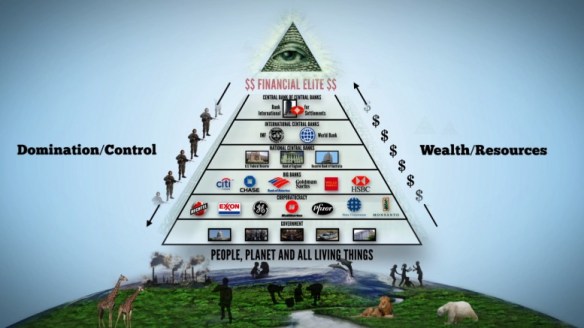
FollowTheMoney-Bank-Pyramid

By Michael Hudson and Chris Hedges

Source: CounterPunch

CHRIS HEDGES: We’re going to be discussing a great Ponzi scheme that not only defines not only the U.S. but the global economy, how we got there and where we’re going. And with me to discuss this issue is the economist Michael Hudson, author of Killing the Host: How Financial Parasites and Debt Destroy the Global Economy. A professor of economics who worked for many years on Wall Street, where you don’t succeed if you don’t grasp Marx’s dictum that capitalism is about exploitation. And he is also, I should mention, the godson of Leon Trotsky.

I want to open this discussion by reading a passage from your book, which I admire very much, which I think gets to the core of what you discuss. You write,

“Adam Smith long ago remarked that profits often are highest in nations going fastest to ruin. There are many ways to create economic suicide on a national level. The major way through history has been through indebting the economy. Debt always expands to reach a point where it cannot be paid by a large swathe of the economy. This is the point where austerity is imposed and ownership of wealth polarizes between the One Percent and the 99 Percent. Today is not the first time this has occurred in history. But it is the first time that running into debt has occurred deliberately.” Applauded. “As if most debtors can get rich by borrowing, not reduced to a condition of debt peonage.”

So let’s start with the classical economists, who certainly understood this. They were reacting of course to feudalism. And what happened to the study of economics so that it became gamed by ideologues?

HUDSON: The essence of classical economics was to reform industrial capitalism, to streamline it, and to free the European economies from the legacy of feudalism. The legacy of feudalism was landlords extracting land-rent, and living as a class that took income without producing anything. Also, banks that were not funding industry. The leading industrialists from James Watt, with his steam engine, to the railroads …

HEDGES: From your book you make the point that banks almost never funded industry.

HUDSON: That’s the point: They never have. By the time you got to Marx later in the 19th century, you had a discussion, largely in Germany, over how to make banks do something they did not do under feudalism. Right now we’re having the economic surplus being drained not by the landlords but also by banks and bondholders.

Adam Smith was very much against colonialism because that lead to wars, and wars led to public debt. He said the solution to prevent this financial class of bondholders burdening the economy by imposing more and more taxes on consumer goods every time they went to war was to finance wars on a pay-as-you-go basis. Instead of borrowing, you’d tax the people. Then, he thought, if everybody felt the burden of war in the form of paying taxes, they’d be against it. Well, it took all of the 19th century to fight for democracy and to extend the vote so that instead of landlords controlling Parliament and its law-making and tax system through the House of Lords, you’d extend the vote to labor, to women and everybody. The theory was that society as a whole would vote in its self-interest. It would vote for the 99 Percent, not for the One Percent.

By the time Marx wrote in the 1870s, he could see what was happening in Germany. German banks were trying to make money in conjunction with the government, by lending to heavy industry, largely to the military-industrial complex.

HEDGES: This was Bismarck’s kind of social – I don’t know what we’d call it. It was a form of capitalist socialism…

HUDSON: They called it State Capitalism. There was a long discussion by Engels, saying, wait a minute. We’re for Socialism. State Capitalism isn’t what we mean by socialism. There are two kinds of state-oriented–.

HEDGES: I’m going to interject that there was a kind of brilliance behind Bismarck’s policy because he created state pensions, he provided health benefits, and he directed banking toward industry, toward the industrialization of Germany which, as you point out, was very different in Britain and the United States.

HUDSON: German banking was so successful that by the time World War I broke out, there were discussions in English economic journals worrying that Germany and the Axis powers were going to win because their banks were more suited to fund industry. Without industry you can’t have really a military. But British banks only lent for foreign trade and for speculation. Their stock market was a hit-and-run operation. They wanted quick in-and-out profits, while German banks didn’t insist that their clients pay as much in dividends. German banks owned stocks as well as bonds, and there was much more of a mutual partnership.

That’s what most of the 19th century imagined was going to happen – that the world was on the way to socializing banking. And toward moving capitalism beyond the feudal level, getting rid of the landlord class, getting rid of the rent, getting rid of interest. It was going to be labor and capital, profits and wages, with profits being reinvested in more capital. You’d have an expansion of technology. By the early twentieth century most futurists imagined that we’d be living in a leisure economy by now.

HEDGES: Including Karl Marx.

HUDSON: That’s right. A ten-hour workweek. To Marx, socialism was to be an outgrowth of the reformed state of capitalism, as seemed likely at the time – if labor organized in its self-interest.

HEDGES: Isn’t what happened in large part because of the defeat of Germany in World War I? But also, because we took the understanding of economists like Adam Smith and maybe Keynes. I don’t know who you would blame for this, whether Ricardo or others, but we created a fictitious economic theory to praise a rentier or rent-derived, interest-derived capitalism that countered productive forces within the economy. Perhaps you can address that.

HUDSON: Here’s what happened. Marx traumatized classical economics by taking the concepts of Adam Smith and John Stuart Mill and others, and pushing them to their logical conclusion. Progressive capitalist advocates – Ricardian socialists such as John Stuart Mill – wanted to tax away the land or nationalize it. Marx wanted governments to take over heavy industry and build infrastructure to provide low-cost and ultimately free basic services. This was traumatizing the landlord class and the One Percent. And they fought back. They wanted to make everything part of “the market,” which functioned on credit supplied by them and paid rent to them.

None of the classical economists imagined how the feudal interests – these great vested interests that had all the land and money – actually would fight back and succeed. They thought that the future was going to belong to capital and labor. But by the late 19th century, certainly in America, people like John Bates Clark came out with a completely different theory, rejecting the classical economics of Adam Smith, the Physiocrats and John Stuart Mill.

HEDGES: Physiocrats are, you’ve tried to explain, the enlightened French economists.

HUDSON: The common denominator among all these classical economists was the distinction between earned income and unearned income. Unearned income was rent and interest. Earned incomes were wages and profits. But John Bates Clark came and said that there’s no such thing as unearned income. He said that the landlord actually earns his rent by taking the effort to provide a house and land to renters, while banks provide credit to earn their interest. Every kind of income is thus “earned,” and everybody earns their income. So everybody who accumulates wealth, by definition, according to his formulas, get rich by adding to what is now called Gross Domestic Product (GDP).

HEDGES: One of the points you make in Killing the Host which I liked was that in almost all cases, those who had the capacity to make money parasitically off interest and rent had either – if you go back to the origins – looted and seized the land by force, or inherited it.

HUDSON: That’s correct. In other words, their income is unearned. The result of this anti-classical revolution you had just before World War I was that today, almost all the economic growth in the last decade has gone to the One Percent. It’s gone to Wall Street, to real estate …

HEDGES: But you blame this on what you call Junk Economics.

HUDSON: Junk Economics is the anti-classical reaction.

HEDGES: Explain a little bit how, in essence, it’s a fictitious form of measuring the economy.

HUDSON: Well, some time ago I went to a bank, a block away from here – a Chase Manhattan bank – and I took out money from the teller. As I turned around and took a few steps, there were two pickpockets. One pushed me over and the other grabbed the money and ran out. The guard stood there and saw it. So I asked for the money back. I said, look, I was robbed in your bank, right inside. And they said, “Well, we don’t arm our guards because if they shot someone, the thief could sue us and we don’t want that.” They gave me an equivalent amount of money back.

Well, imagine if you count all this crime, all the money that’s taken, as an addition to GDP. Because now the crook has provided the service of not stabbing me. Or suppose somebody’s held up at an ATM machine and the robber says, “Your money or your life.” You say, “Okay, here’s my money.” The crook has given you the choice of your life. In a way that’s how the Gross National Product accounts are put up. It’s not so different from how Wall Street extracts money from the economy. Then also you have landlords extracting …

HEDGES: Let’s go back. They’re extracting money from the economy by debt peonage. By raising …

HUDSON: By not playing a productive role, basically.

HEDGES: Right. So it’s credit card interest, mortgage interest, car loans, student loans. That’s how they make their funds.

HUDSON: That’s right. Money is not a factor of production. But in order to have access to credit, in order to get money, in order to get an education, you have to pay the banks. At New York University here, for instance, they have Citibank. I think Citibank people were on the board of directors at NYU. You get the students, when they come here, to start at the local bank. And once you are in a bank and have monthly funds taken out of your account for electric utilities, or whatever, it’s very cumbersome to change.

So basically you have what the classical economists called the rentier class. The class that lives on economic rents. Landlords, monopolists charging more, and the banks. If you have a pharmaceutical company that raises the price of a drug from $12 a shot to $200 all of a sudden, their profits go up. Their increased price for the drug is counted in the national income accounts as if the economy is producing more. So all this presumed economic growth that has all been taken by the One Percent in the last ten years, and people say the economy is growing. But the economy isn’t growing …

HEDGES: Because it’s not reinvested.

HUDSON: That’s right. It’s not production, it’s not consumption. The wealth of the One Percent is obtained essentially by lending money to the 99 Percent and then charging interest on it, and recycling this interest at an exponentially growing rate.

HEDGES: And why is it important, as I think you point out in your book, that economic theory counts this rentier income as productive income? Explain why that’s important.

HUDSON: If you’re a rentier, you want to say that you earned your income by …

HEDGES: We’re talking about Goldman Sachs, by the way.

HUDSON: Yes, Goldman Sachs. The head of Goldman Sachs came out and said that Goldman Sachs workers are the most productive in the world. That’s why they’re paid what they are. The concept of productivity in America is income divided by labor. So if you’re Goldman Sachs and you pay yourself $20 million a year in salary and bonuses, you’re considered to have added $20 million to GDP, and that’s enormously productive. So we’re talking in a tautology. We’re talking with circular reasoning here.

So the issue is whether Goldman Sachs, Wall Street and predatory pharmaceutical firms, actually add “product” or whether they’re just exploiting other people. That’s why I used the word parasitism in my book’s title. People think of a parasite as simply taking money, taking blood out of a host or taking money out of the economy. But in nature it’s much more complicated. The parasite can’t simply come in and take something. First of all, it needs to numb the host. It has an enzyme so that the host doesn’t realize the parasite’s there. And then the parasites have another enzyme that takes over the host’s brain. It makes the host imagine that the parasite is part of its own body, actually part of itself and hence to be protected.

That’s basically what Wall Street has done. It depicts itself as part of the economy. Not as a wrapping around it, not as external to it, but actually the part that’s helping the body grow, and that actually is responsible for most of the growth. But in fact it’s the parasite that is taking over the growth.

The result is an inversion of classical economics. It turns Adam Smith upside down. It says what the classical economists said was unproductive – parasitism – actually is the real economy. And that the parasites are labor and industry that get in the way of what the parasite wants – which is to reproduce itself, not help the host, that is, labor and capital.

HEDGES: And then the classical economists like Adam Smith were quite clear that unless that rentier income, you know, the money made by things like hedge funds, was heavily taxed and put back into the economy, the economy would ultimately go into a kind of tailspin. And I think the example of that, which you point out in your book, is what’s happened in terms of large corporations with stock dividends and buybacks. And maybe you can explain that.

HUDSON: There’s an idea in superficial textbooks and the public media that if companies make a large profit, they make it by being productive. And with …

HEDGES: Which is still in textbooks, isn’t it?

HUDSON: Yes. And also that if a stock price goes up, you’re just capitalizing the profits – and the stock price reflects the productive role of the company. But that’s not what’s been happening in the last ten years. Just in the last two years, 92 percent of corporate profits in America have been spent either on buying back their own stock, or paid out as dividends to raise the price of the stock.

HEDGES: Explain why they do this.

HUDSON: About 15 years ago at Harvard, Professor Jensen said that the way to ensure that corporations are run most efficiently is to make the managers increase the price of the stock. So if you give the managers stock options, and you pay them not according to how much they’re producing or making the company bigger, or expanding production, but the price of the stock, then you’ll have the corporation run efficiently, financial style.

So the corporate managers find there are two ways that they can increase the price of the stock. The first thing is to cut back long-term investment, and use the money instead to buy back their own stock. But when you buy your own stock, that means you’re not putting the money into capital formation. You’re not building new factories. You’re not hiring more labor. You can actually increase the stock price by firing labor.

HEDGES: That strategy only works temporarily.

HUDSON: Temporarily. By using the income from past investments just to buy back stock, fire the labor force if you can, and work it more intensively. Pay it out as dividends. That basically is the corporate raider’s model. You use the money to pay off the junk bond holders at high interest. And of course, this gets the company in trouble after a while, because there is no new investment.

So markets shrink. You then go to the labor unions and say, gee, this company’s near bankruptcy, and we don’t want to have to fire you. The way that you can keep your job is if we downgrade your pensions. Instead of giving you what we promised, the defined benefit pension, we’ll turn it into a defined contribution plan. You know what you pay every month, but you don’t know what’s going to come out. Or, you wipe out the pension fund, push it on to the government’s Pension Benefit Guarantee Corporation, and use the money that you were going to pay for pensions to pay stock dividends. By then the whole economy is turning down. It’s hollowed out. It shrinks and collapses. But by that time the managers will have left the company. They will have taken their bonuses and salaries and run.

HEDGES: I want to read this quote from your book, written by David Harvey, in A Brief History of Neoliberalism, and have you comment on it.

“The main substantive achievement of neoliberalism has been to redistribute rather than to generate wealth and income. [By] ‘accumulation by dispossession’ I mean … the commodification and privatization of land, and the forceful expulsion of peasant populations; conversion of various forms of property rights (common collective state, etc.) into exclusive private property rights; suppression of rights to the commons; … colonial, neocolonial, and the imperial processes of appropriation of assets (including natural resources); … and usury, the national debt and, most devastating at all, the use of the credit system as a radical means of accumulation by dispossession. … To this list of mechanisms, we may now add a raft of techniques such as the extraction of rents from patents, and intellectual property rights (such as the diminution or erasure of various forms of common property rights, such as state pensions, paid vacations, and access to education, health care) one through a generation or more of class struggle. The proposal to privatize all state pension rights, pioneered in Chile under the dictatorship is, for example, one of the cherished objectives of the Republicans in the US.”

This explains the denouement. The final end result you speak about in your book is, in essence, allowing what you call the rentier or the speculative class to cannibalize the entire society until it collapses.

HUDSON: A property right is not a factor of production. Look at what happened in Chicago, the city where I grew up. Chicago didn’t want to raise taxes on real estate, especially on its expensive commercial real estate. So its budget ran a deficit. They needed money to pay the bondholders, so they sold off the parking rights to have meters – you know, along the curbs. The result is that they sold to Goldman Sachs 75 years of the right to put up parking meters. So now the cost of living and doing business in Chicago is raised by having to pay the parking meters. If Chicago is going to have a parade and block off traffic, it has to pay Goldman Sachs what the firm would have made if the streets wouldn’t have been closed off for a parade. All of a sudden it’s much more expensive to live in Chicago because of this.

But this added expense of having to pay parking rights to Goldman Sachs – to pay out interest to its bondholders – is counted as an increase in GDP, because you’ve created more product simply by charging more. If you sell off a road, a government or local road, and you put up a toll booth and make it into a toll road, all of a sudden GDP goes up.

If you go to war abroad, and you spend more money on the military-industrial complex, all this is counted as increased production. None of this is really part of the production system of the capital and labor building more factories and producing more things that people need to live and do business. All of this is overhead. But there’s no distinction between wealth and overhead.

Failing to draw that distinction means that the host doesn’t realize that there is a parasite there. The host economy, the industrial economy, doesn’t realize what the industrialists realized in the 19th century: If you want to be an efficient economy and be low-priced and under-sell competitors, you have to cut your prices by having the public sector provide roads freely. Medical care freely. Education freely.

If you charge for all of these, you get to the point that the U.S. economy is in today. What if American factory workers were to get all of their consumer goods for nothing. All their food, transportation, clothing, furniture, everything for nothing. They still couldn’t compete with Asians or other producers, because they have to pay up to 43% of their income for rent or mortgage interest, 10% or more of their income for student loans, credit card debt. 15% of their paycheck is automatic withholding to pay Social Security, to cut taxes on the rich or to pay for medical care.

So Americans built into the economy all this overhead. There’s no distinction between growth and overhead. It’s all made America so high-priced that we’re priced out of the market, regardless of what trade policy we have.

HEDGES: We should add that under this predatory form of economics, you game the system. So you privatize pension funds, you force them into the stock market, an overinflated stock market. But because of the way companies go public, it’s the hedge fund managers who profit. And it’s those citizens whose retirement savings are tied to the stock market who lose. Maybe we can just conclude by talking about how the system is fixed, not only in terms of burdening the citizen with debt peonage, but by forcing them into the market to fleece them again.

HUDSON: Well, we talk about an innovation economy as if that makes money. Suppose you have an innovation and a company goes public. They go to Goldman Sachs and other Wall Street investment banks to underwrite the stock to issue it at $40 a share. What’s considered a successful float is when, immediately, Goldman and the others will go to their insiders and tell them to buy this stock and make a quick killing. A “successful” flotation doubles the price in one day, so that at the end of the day the stock’s selling for $80.

HEDGES: They have the option to buy it before anyone else, knowing that by the end of the day it’ll be inflated, and then they sell it off.

HUDSON: That’s exactly right.

HEDGES: So the pension funds come in and buy it at an inflated price, and then it goes back down.

HUDSON: It may go back down, or it may be that the company just was shortchanged from the very beginning. The important thing is that the Wall Street underwriting firm, and the speculators it rounds up, get more in a single day than all the years it took to put the company together. The company gets $40. And the banks and their crony speculators also get $40.

So basically you have the financial sector ending up with much more of the gains. The name of the game if you’re on Wall Street isn’t profits. It’s capital gains. And that’s something that wasn’t even part of classical economics. They didn’t anticipate that the price of assets would go up for any other reason than earning more money and capitalizing on income. But what you have had in the last 50 years – really since World War II – has been asset-price inflation. Most middle-class families have gotten the wealth that they’ve got since 1945 not really by saving what they’ve earned by working, but by the price of their house going up. They’ve benefited by the price of the house. And they think that that’s made them rich and the whole economy rich.

The reason the price of housing has gone up is that a house is worth whatever a bank is going to lend against it. If banks made easier and easier credit, lower down payments, then you’re going to have a financial bubble. And now, you have real estate having gone up as high as it can. I don’t think it can take more than 43% of somebody’s income to buy it. But now, imagine if you’re joining the labor force. You’re not going to be able to buy a house at today’s prices, putting down a little bit of your money, and then somehow end up getting rich just on the house investment. All of this money you pay the bank is now going to be subtracted from the amount of money that you have available to spend on goods and services.

So we’ve turned the post-war economy that made America prosperous and rich inside out. Somehow most people believed they could get rich by going into debt to borrow assets that were going to rise in price. But you can’t get rich, ultimately, by going into debt. In the end the creditors always win. That’s why every society since Sumer and Babylonia have had to either cancel the debts, or you come to a society like Rome that didn’t cancel the debts, and then you have a dark age. Everything collapses.


Michael Hudson’s new book, Killing the Host is published in e-format by CounterPunch Books and in print by Islet. He can be reached via his website, mh@michael-hudson.com. Chris Hedges’s latest book is Days of Destruction, Days of Revolt, illustrated by Joe Sacco.

Mobility, Meritocracy and Other Myths

justice-fish


By Kevin Carson

Source: Center for a Stateless Society

At the American Enterprise Institute, Mark Perry (“Yes, America’s middle class has been disappearing… into higher income groups,” Dec. 17) justifies the shrinking middle class and growing economic inequality by citing the finding of a recent Pew Institute study that of the 11% shrinkage in the American middle class, 7% have gone to the top and only 4% to the bottom.

First, movement between strata doesn’t legitimize stratification if the structure itself is illegitimate. Meritocracy is a legitimizing myth created to distract people from the question of whether the system of power those meritocratic functionaries serve is just. As Chris Dillow, an unorthodox British Marxist economist, observed (“Beyond social mobility,” Stumbling and Mumbling, Dec. 19):

“Imagine a dictator were to imprison his people, but offer guard jobs to those who passed exams, and well-paid sinecures to those who did especially well. We’d have social mobility — even meritocracy and equality of opportunity. But we wouldn’t have justice, freedom or a good society. They all require that the prisons be torn down.”

Also note that what’s called the “upper class” in the study includes not only the super-rich rentier classes and people in the C-Suites with million-dollar salaries, but also most of the larger managerial stratum. There’s a good reason this stratum has expanded from 14% to 21% of the general population. As David Gordon argued in Fat and Mean, it was the neoliberal decision in the ’70s to cap real hourly wages and shift a greater share of income upwards to rentiers and cowboy CEOs that resulted in increasing internal authoritarianism in the corporation and a need for a larger class of overseers to monitor the (understandably) increasingly disgruntled work force.

And despite the increased income of the managerial classes, the great bulk of them are still salaried employees whose income depends on the ongoing approval of their superiors. That 14-21% of the population is more or less what Orwell, in 1984, called the “middle” stratum (represented in the story by the Inner Party to which Winston and Julia belonged). Here’s how Orwell described the same general type in the corporate England of his day in another novel, Coming Up for Air:  “in every one of those little stucco boxes there’s some poor bastard who’s never free except when he’s fast asleep…”

Not only do these people continue to collect their managerial salary at the good pleasure of the senior oligarchs of the corporate hierarchy, but to even have a shot at that management pay in the first place they’ve got to put themselves in a position of student debt peonage that will likely eat up a major part of that increased income for years (along with a mortgage that means they’ll really be renting their house from the bank into old age). Add to that the long hours middle management types have to work coupled with the endless bureaucratic toadyism and sycophancy required of them, and the ongoing precarity of their position.

Getting back to the issue of legitimacy, there’s also the fact that the functions exercised by most of these managerial types are illegitimate and would be unnecessary absent an exploitative class society. They are, in anarchist anthropologist David Graeber’s famous phrase, “b***s*** jobs.” They exist because the American state, in league with corporate capital, has cartelized the economy under the control of bureaucratic hierarchies many times larger than the point of declining returns in efficiency, and because the authoritarian nature of those hierarchies and the rent-seeking nature of their management creates a conflict of interest that necessitates intensified surveillance and control.

The late Joe Bageant aptly described the nature of the work these people perform: “The empire needs… about 20-25% of its population… to administrate and perpetuate itself — through lawyers, insurance managers, financial managers, college teachers, media managers, scientists, bureaucrats, managers of all types and many other professions and semi-professions.”

When workers own the firm and manage their own work, as in the recuperated enterprises of Argentina, not only can workers be trusted to use their own superior knowledge of the work process but what little coordinating costs remain are a small fraction of U.S. corporate administrative costs. In fact eliminating all those management salaries solved the unit costs problem at one stroke.

The upper quintile is growing in size and income because all the value created by actual productive workers in the lower quintiles gets extracted by those at the top. When the top classes rob everybody else, they need a lot more guard labor to keep their stolen loot secure.

And whether or not there’s been an increase in the real income of the lower four strata, production workers’ loss of control over the work force and increased precarity is even worse than that of those middle managers in the top 21%. Whether for production workers or middle management, stress correlates directly with powerlessness.

We don’t need meritocracy. We need justice.

You Should Be Terrified That People Who Like “Hamilton” Run Our Country

maxresdefault

The American elite can’t get enough of a musical that flatters their political sensibilities and avoids discomforting truths.

By

Source: Current Affairs

In 2012, Captain Dan and his Scurvy Crew, a four-man hip-hop ensemble trying to cement “pirate rap” as a tenable subgenre, appeared on America’s Got Talent. The quartet had clearly put some thought, or at least effort, into the act; their pirate costumes might even have passed historical muster were it not for the leftmost crewmember’s Ray-Bans and Dan’s meticulously groomed chinstrap beard.

The routine itself went precisely in the direction one might have expected:

Captain Dan: When I say yo, you say ho. Yo!

Scurvy Crew: HO!

Captain Dan: YO!

Scurvy Crew: HO!

The group managed to rattle off two-and-a-half stilted lines before the judges began sounding their buzzers. Howard Stern was the last to give them the red “X,” preferring to let the audience’s boos come to a crescendo before he cut the Scurvy Crew off. Stern seemed to take great pleasure in calling the group “stupid,” “moronic,” “idiotic,” and “pathetic” on a national stage (Captain Dan grimaced through his humiliating dressing-down while his bandmates laughed it off, exposing a gap in emotional investment in the project between captain and crew, one that likely led to some intra-group tension during the post-show commiseration drinks).

Howie Mandel: They have restaurants like this—like Medieval Times—where you go and you get a pirates thing and you get a chicken dinner. We didn’t get a chicken dinner with this.

In 2012, everyone (save for Captain Dan himself, along with people whose tastes range from “music from video games” to “music about video games”) was in agreement that performing high-school-history-project rap in Colonial Williamsburg garb was culturally unconscionable. Right?

Wrong. The world in which we live now includes Hamilton, a wildly successful “hip-hop musical” about the first Secretary of the Treasury of the United States of America.

Now, perhaps the America’s Got Talent audience isn’t an accurate sample of the American population as a whole. Perhaps they actually thought “when I say yo, you say ho” was clever , but were directed to boo by an off-screen neon sign. Or perhaps something happened in the past four years that made everyone really stupid.

But what if the American public’s taste hasn’t devolved? What if Hamilton’s success is the result of something else altogether?

Brian Eno once said that the Velvet Underground’s debut album only sold a few thousand copies, but everyone who bought it started a band. The same principle likely applies to Hamilton: only a few thousand people could afford to see it, but everyone who did happened to work for a prominent New York/D.C. publication.

The media gushing over Hamilton has been downright torrential. “I am loath to tell people to mortgage their houses and lease their children to acquire tickets to a hit Broadway show,” wrote Ben Brantley of the New York Times. “But Hamilton… might just about be worth it.” The hyperbolic headlines poured forth unceasingly: “Is Hamilton the Musical the Most Addicting Album Ever?” Hamilton is the most important musical of our time.” Hamilton Haters Are Why We Can’t Have Nice Things.” The media then got high on their own supply, diagnosing all of America with a harrowing ailment called “Hamilton mania.” The work was “astonishing,” “sublime,” the “cultural event of our time.” Clarence Page of the Chicago Tribune said the musical was “even better than the hype.” Given the tenor of the hype, one can only imagine the pure, overpowering ecstasy that must comprise the Hamilton-viewing experience. The musical even somehow won a Pulitzer Prize this year, alongside Nicholas Kristof and that book by Ta-Nehisi Coates you bought but never read.

One of the publications to enter swooning raptures over Hamilton was BuzzFeed, which called it the smash musical “that everyone you know has been quoting for months.” (Literally nobody has ever quoted Hamilton in my presence.) BuzzFeed’s workplace obsession with the musical led to the birthing of the phrase “BuzzFeed Hamilton Slack.” That three-word monstrosity, incomprehensible to anyone outside the narrowest circle of listicle-churning media elites, describes a room on the corporate messaging platform “Slack” used exclusively by BuzzFeed employees to discuss Hamilton. J.R.R. Tolkien said that “cellar door” was the most beautiful phonetic phrase the English language could produce. “BuzzFeed Hamilton Slack,” by contrast, may be the most repellent arrangement of words in any tongue.

Those of us unfortunate enough not to work media jobs can never be privy to what goes on in a “BuzzFeed Hamilton Slack.” But the Twitter emissions of the Slack’s denizens suggest a swamp into which no man should tread. A tellingly ominous and thoroughly representative Tweet:

“When the Buzzfeed #Hamilton slack room has a heated debate about which Hogwarts houses the characters belong to” —@Arielle07

“Nerdcore” music (Wikipedia: “a genre of hip hop music characterized by themes and subject matter considered to be of general interest to nerds”) has always had trouble getting off the ground. The “first lady of nerdcore,” rapper MC Router (responsible for the song “Trekkie Pride”), never achieved the critical success for which she had seemed destined, instead ending up on the Dr. Phil show after an acrimonious dispute with her family over her unexpected conversion to Islam. Similarly, the YouTube series “Epic Rap Battles of History,” however numerous its subscribers may have been, has consistently been unjustly robbed of the Pulitzer. Now, finally, nerd rap has apparently found in Hamilton its own Sgt. Pepper, a lofty, expansive work that wins the hearts and minds of previously skeptical elite critics.

One should have no doubt that “expensively-staged nerdcore” is a perfectly accurate, even generous description of Hamilton. Doubters need only examine a brief lyrical snippet. Consider this, from “The Election of 1800”:

Madison: It’s a tie! …

Jefferson: It’s up to the delegates!…

Jefferson/Madison: It’s up to Hamilton!

Hamilton: Yo.

The people are asking to hear my voice ..

For the country is facing a difficult choice.

And if you were to ask me who I’d promote …

Jefferson has my vote.

Perhaps marginally less embarrassing than “when I say yo, you say ho.” But only ever so marginally.

One could question the fairness of appraising a musical before putting one’s self through its full three-hour theatrical experience. But if nobody could criticize Hamilton without having seen it, then nobody could criticize Hamilton. One of the strangest aspects of the whole “Hamiltonmania” public relations spectacle is that hardly anyone in the country has actually attended the musical to begin with. The show is exclusive to Broadway and has spent most of its run completely sold out, seemingly playing to an audience comprised entirely of people who write breathless BuzzFeed headlines. (Fortunately, when you can get off the waitlist it only costs $1,200 a ticket—so long as you can stand bad seats.) Hamilton is the “nationwide sensation” that only .001% of the nation has even witnessed.

There’s something revealing in the disjunction between Hamilton’s popularity in the world of online media and Hamilton’s popularity in the world of actual human persons. After all, here we have a cultural product whose appeal essentially consists of a broad coalition of the worst people in America: New York Times writers, 15-year-olds who aspire to answer the phone in Chuck Schumer’s office, people who want to get into steampunk but have a copper sensitivity, and “wonks.” Yet because a large fraction of these people are elite taste-makers, Hamilton becomes a topic of disproportionate interest, discussed at unendurable length in The New Yorker and Slate and The New York Times Magazine, yet totally inaccessible to anyone besides the writers and members of their close social networks. When The New Yorker writes about a book that nobody in America wants to read, at least they could theoretically go out and purchase it. But Hamilton theatergoing is solely the provenance of Hamilton thinkpiece-writers. The endless swirl of online Hamilton-buzz shows the comical extreme of cultural insularity in the New York and D.C. media. The “cultural event of our time” is totally unknown to nearly all who actually live in our time.

Given that Hamilton is essentially Captain Dan with an American Studies minor, one might wonder how it became so inordinately adored by the blathering class. How did a ten-million-dollar 8th Grade U.S. History skit become “the great work of art of the 21st century” (as the New Yorker’s Adam Gopnik says those in his circle have been calling it)?

To judge from the reviews, most of the appeal seems to rest with the forced diversity of its cast and the novelty concept of a “hip-hop musical.” Those who write about Hamilton often dwell primarily on its “groundbreaking” use of rap and its “bold” choice to cast an assemblage of black, Asian, and Latino actors as the Founding Fathers. Indeed, Hamilton exists more as a corporate HR department’s wet dream than as a biographical work.

The most obvious historical aberration is the portrayal of Washington and Jefferson as black men, a somewhat audacious choice given that both men are strongly associated with owning, and in the case of the latter, raping and impregnating slaves. Changing the races allows these men to appear far more sympathetic than they would otherwise be. Hamilton creator Lin-Manuel Miranda says he did this intentionally, to make the cast “look like America today,” and that having black actors play the roles “allow[s] you to leave whatever cultural baggage you have about the founding fathers at the door.” (“Cultural baggage” is an odd way of describing “feeling discomfort at warm portrayals of slaveowners.”) Thus Hamilton’s superficial diversity lets its almost entirely white audience feel good about watching it: no guilt for seeing dead white men in a positive light required. Now, The New York Times can delight in the novel incongruousness of “a Thomas Jefferson who swaggers like the Time’s Morris Day, sings like Cab Calloway and drawls like a Dirty South trap-rapper.” Indeed, it does take some getting used to, because the actual Thomas Jefferson raped slaves.

“Casting black and Latino actors as the founders effectively writes nonwhite people into the story, in ways that audiences have powerfully responded to,” said the New York Times. But fixing history makes it seem less objectionable than it actually was. We might call it a kind of, well, “blackwashing,” making something that was heinous seem somehow palatable by retroactively injecting diversity into it.

Besides, you don’t actually need to “write nonwhite people into the story.” As historians have pointed out, there were plenty of nonwhite people around at the time, people who already had fully-developed stories and identities. But none of these people appears in the play. As some have quietly noted, the vast majority of African American cast members simply portray nameless dancing founders in breeches and cravats, and “not a single enslaved or free person of color exists as a character in this play.” (Although Jefferson’s slave and mistress Sally Hemings gets a brief shout-out.)

Slavery is left out of the play almost completely. Historian Lyra Monteiro observes that “Unless one listens carefully to the lyrics—which do mention slavery a handful of times—one could easily assume that slavery did not exist in this world.” The foundation of the 18th century economic system, the vicious practice that defined the lives of countless black men and women, is confined to the odd lyrical flourish here and there.

Miranda did consider adding a slavery number. But he cut it from the show, as he explains:

There was a rap battle about slavery, where it was Hamilton and Jefferson and Madison knocking it from all sides of the issue. Jefferson being like, “Hey, I wrote about this, and no one wanted to touch it!” And Hamilton being very self-righteous, like, “You’re having an affair with one of your slaves!” And Madison hits him with a “You want to talk about affairs?” And in the end, no one does anything. Which is what happened in reality! So we realized we were bringing our show to a halt on something that none of them really did enough on.

Miranda found that by trying to write a song about his main characters’ attitudes toward slavery, he ran into the inconvenient fact that all of them willfully tolerated or participated in it. That made it difficult to square with the upbeat portrayals he was going for, and so slavery had to go. Besides, dwelling on it could “bring the show to a halt.” And as cast member Christopher Jackson, who plays George Washington, notes: ‘‘The Broadway audience doesn’t like to be preached to.” Who would want to spoil the fun?

Instead, Hamilton’s Hamilton is what Slate called simply “lovable—a product of the play’s humanizing focus on Hamilton’s vulnerabilities and ambitions.” The play avoids depicting his unabashed elitism and more repellent personal characteristics. And in the brief references that are made to slavery, the play even generously portrays Hamilton as far more committed to the cause of freedom than he actually was. In this way, Hamilton carefully makes sure its audience is neither challenged nor discomforted, and can leave the theater without having to confront any unpleasant truths.

Just as Hamilton ducks the question of slavery, much of the actual substance of Alexander Hamilton’s politics is ignored, in favor of a story that stresses his origins as a Horatio Alger immigrant and his rivalry with Aaron Burr. But while Hamilton may have favored opening America’s doors to immigration, he also proposed a degree of economic protectionism that would terrify today’s free market establishment.

Hamilton believed that free trade was never equal, and worried about the ability of European manufacturers (who got a head start on the Industrial Revolution) to sell goods at lower prices than their American counterparts. In Hamilton’s 1791 Report on Manufactures, he spoke of the harms to American industry that came with our reliance on products from overseas. The Report sheds light on many of the concerns Americans in the 21st century have about outsourcing, sweatshops, and the increasing trade deficit, albeit in a different context. Hamilton said that for the U.S., “constant and increasing necessity, on their part, for the commodities of Europe, and only a partial and occasional demand for their own, in return, could not but expose them to a state of impoverishment, compared with the opulence to which their political and natural advantages authorise them to aspire.” For Hamilton, the solution was high tariffs on imports of manufactured goods, and intensive government intervention in the economy. The prohibitive importation costs imposed by tariffs would allow newer American manufacturers to undersell Europe’s established industrial framework, leading to an increase in non-agricultural employment. As he wrote: “all the duties imposed on imported articles… wear a beneficent aspect towards the manufacturers of the country.”

Does any of this sound familiar? It certainly went unmentioned at the White House, where a custom performance of Hamilton was held for the Obamas. The livestreamed presidential Hamilton spectacular at one point featured Obama and Miranda performing historically-themed freestyle rap in the Rose Garden.

The Obamas have been supporters of Hamilton since its embryonic days as the “Hamilton Mixtape song cycle.” By the time the fully-fledged musical arrived in Washington, Michelle Obama called it the “best piece of art in any form that I have ever seen in my life,” raising disquieting questions about the level of cultural exposure offered in the Princeton undergraduate curriculum.

In introducing the White House performance, Barack Obama gave an effusive speech worthy of the BuzzFeed Hamilton Slack:

[Miranda] identified a quintessentially American story in the character of Hamilton — a striving immigrant who escaped poverty, made his way to the New World, climbed to the top by sheer force of will and pluck and determination… And in the Hamilton that Lin-Manuel and his incredible cast and crew bring to life — a man who is “just like his country, young, scrappy, and hungry” — we recognize the improbable story of America, and the spirit that has sustained our nation for over 240 years… In this telling, rap is the language of revolution. Hip-hop is the backbeat. … And with a cast as diverse as America itself, including the outstandingly talented women — (applause) — the show reminds us that this nation was built by more than just a few great men — and that it is an inheritance that belongs to all of us.

Strangely enough, President Obama failed to mention anything Alexander Hamilton actually did during his long career in American politics, perhaps because the Obama Administration’s unwavering support of free trade and the tariff-easing Trans-Pacific Partnership goes against everything Hamilton believed. Instead, Obama’s Hamilton speech stresses just two takeaways from the musical: that America is a place where the poor (through “sheer force of will” and little else) can rise to prominence, and that Hamilton has diversity in it. (Plus it contains hip-hop, an edgy, up-and-coming genre with only 37 years of mainstream exposure.)

The Obamas were not the only members of the political establishment to come down with a ghastly case of Hamiltonmania. Nearly every figure in D.C. has apparently been to see the show, in many cases being invited for a warm backstage schmooze with Miranda. Biden saw it. Mitt Romney saw it. The Bush daughters saw it. Rahm Emanuel saw it the day after the Chicago teachers’ strike over budget cuts and school closures. Hillary Clinton went to see the musical in the evening after having been interviewed by the FBI in the morning. The Clinton campaign has also been fundraising by hawking Hamilton tickets; for $100,000 you can watch a performance alongside Clinton herself.

Unsurprisingly, the New York Times reports that “conservatives were particularly smitten” with Hamilton. “Fabulous show,” tweeted Rupert Murdoch, calling it “historically accurate.” Obama concluded that “I’m pretty sure this is the only thing that Dick Cheney and I have agreed on—during my entire political career.” (That is, of course, false. Other points of agreement include drone strikes, Guantanamo, the NSA, and mass deportation.)

The conservative-liberal D.C. consensus on Hamilton makes perfect sense. The musical flatters both right and left sensibilities. Conservatives get to see their beloved Founding Fathers exonerated for their horrendous crimes, and liberals get to have nationalism packaged in a feel-good multicultural form. The more troubling questions about the country’s origins are instantly vanished, as an era built on racist forced labor is transformed into a colorful, culturally progressive, and politically unobjectionable extravaganza.

As the director of the Hamilton theater said, “It has liberated a lot of people who might feel ambivalent about the American experiment to feel patriotic.” “Ambivalence,” here, means being bothered by the country’s collective idol-worship of men who participated in the slave trade, one of the greatest crimes in human history. To be “liberated” from this means never having to think about it.

In that respect, Hamilton probably is the “musical of the Obama era,” as The New Yorker called it. Contemporary progressivism has come to mean papering over material inequality with representational diversity. The president will continue to expand the national security state at the same rate as his predecessor, but at least he will be black. Predatory lending will drain the wealth from African American communities, but the board of Goldman Sachs will have several black members. Inequality will be rampant and worsening, but the 1% will at least “look like America.” The actual racial injustices of our time will continue unabated, but the power structure will be diversified so that nobody feels quite so bad about it. Hamilton is simply this tendency’s cultural-historical equivalent; instead of worrying ourselves about the brutal origins of the American state, and the lasting economic effects of those early inequities, we can simply turn the Founding Fathers black and enjoy the show.

Kings George I and II of England could barely speak intelligible English and spent more time dealing with their own failed sons than ruling the Empire —but they gave patronage to Handel. Ludwig II of Bavaria was believed to be insane and went into debt compulsively building castles — but he gave patronage to Wagner. Barack Obama deported more immigrants than any other president and expanded the drone program in order to kill almost 3,500 people — but he gave patronage to a neoliberal nerdcore musical. God bless this great land.

Related Article:

 The Hardest Politics to Catch: Lin-Manuel Comes to Puerto Rico