
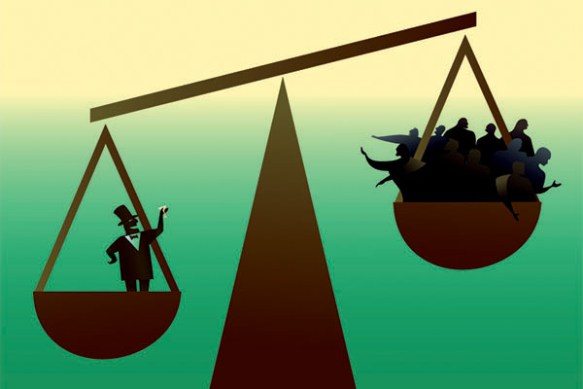
Wall Street, Banks, and Angry Citizens

The Inequality Gap on a Planet Growing More Extreme

By Nomi Prins

Source: TomDispatch.com

As we head into 2019, leaving the chaos of this year behind, a major question remains unanswered when it comes to the state of Main Street, not just here but across the planet. If the global economy really is booming, as many politicians claim, why are leaders and their parties around the world continuing to get booted out of office in such a sweeping fashion?

One obvious answer: the post-Great Recession economic “recovery” was largely reserved for the few who could participate in the rising financial markets of those years, not the majority who continued to work longer hours, sometimes at multiple jobs, to stay afloat. In other words, the good times have left out so many people, like those struggling to keep even a few hundred dollars in their bank accounts to cover an emergency or the 80% of American workers who live paycheck to paycheck.

In today’s global economy, financial security is increasingly the property of the 1%. No surprise, then, that, as a sense of economic instability continued to grow over the past decade, angst turned to anger, a transition that — from the U.S. to the Philippines, Hungary to Brazil, Poland to Mexico — has provoked a plethora of voter upheavals. In the process, a 1930s-style brew of rising nationalism and blaming the “other” — whether that other was an immigrant, a religious group, a country, or the rest of the world — emerged.

This phenomenon offered a series of Trumpian figures, including of course The Donald himself, an opening to ride a wave of “populism” to the heights of the political system. That the backgrounds and records of none of them — whether you’re talking about Donald Trump, Viktor Orbán, Rodrigo Duterte, or Jair Bolsonaro (among others) — reflected the daily concerns of the “common people,” as the classic definition of populism might have it, hardly mattered. Even a billionaire could, it turned out, exploit economic insecurity effectively and use it to rise to ultimate power.

Ironically, as that American master at evoking the fears of apprentices everywhere showed, to assume the highest office in the land was only to begin a process of creating yet more fear and insecurity. Trump’s trade wars, for instance, have typically infused the world with increased anxiety and distrust toward the U.S., even as they thwarted the ability of domestic business leaders and ordinary people to plan for the future. Meanwhile, just under the surface of the reputed good times, the damage to that future only intensified. In other words, the groundwork has already been laid for what could be a frightening transformation, both domestically and globally.

That Old Financial Crisis

To understand how we got here, let’s take a step back. Only a decade ago, the world experienced a genuine global financial crisis, a meltdown of the first order. Economic growth ended; shrinking economies threatened to collapse; countless jobs were cut; homes were foreclosed upon and lives wrecked. For regular people, access to credit suddenly disappeared. No wonder fears rose. No wonder for so many a brighter tomorrow ceased to exist.

The details of just why the Great Recession happened have since been glossed over by time and partisan spin. This September, when the 10th anniversary of the collapse of the global financial services firm Lehman Brothers came around, major business news channels considered whether the world might be at risk of another such crisis. However, coverage of such fears, like so many other topics, was quickly tossed aside in favor of paying yet more attention to Donald Trump’s latest tweets, complaints, insults, and lies. Why? Because such a crisis was so 2008 in a year in which, it was claimed, we were enjoying a first class economic high and edging toward the longest bull-market in Wall Street history. When it came to “boom versus gloom,” boom won hands down.

None of that changed one thing, though: most people still feel left behind both in the U.S. and globally. Thanks to the massive accumulation of wealth by a 1% skilled at gaming the system, the roots of a crisis that didn’t end with the end of the Great Recession have spread across the planet, while the dividing line between the “have-nots” and the “have-a-lots” only sharpened and widened.

Though the media hasn’t been paying much attention to the resulting inequality, the statistics (when you see them) on that ever-widening wealth gap are mind-boggling. According to Inequality.org, for instance, those with at least $30 million in wealth globally had the fastest growth rate of any group between 2016 and 2017. The size of that club rose by 25.5% during those years, to 174,800 members. Or if you really want to grasp what’s been happening, consider that, between 2009 and 2017, the number of billionaires whose combined wealth was greater than that of the world’s poorest 50% fell from 380 to just eight. And by the way, despite claims by the president that every other country is screwing America, the U.S. leads the pack when it comes to the growth of inequality. As Inequality.org notes, it has “much greater shares of national wealth and income going to the richest 1% than any other country.”

That, in part, is due to an institution many in the U.S. normally pay little attention to: the U.S. central bank, the Federal Reserve. It helped spark that increase in wealth disparity domestically and globally by adopting a post-crisis monetary policy in which electronically fabricated money (via a program called quantitative easing, or QE) was offered to banks and corporations at significantly cheaper rates than to ordinary Americans.

Pumped into financial markets, that money sent stock prices soaring, which naturally ballooned the wealth of the small percentage of the population that actually owned stocks. According to economist Stephen Roach, considering the Fed’s Survey of Consumer Finances, “It is hardly a stretch to conclude that QE exacerbated America’s already severe income disparities.”

Wall Street, Central Banks, and Everyday People

What has since taken place around the world seems right out of the 1930s. At that time, as the world was emerging from the Great Depression, a sense of broad economic security was slow to return. Instead, fascism and other forms of nationalism only gained steam as people turned on the usual cast of politicians, on other countries, and on each other. (If that sounds faintly Trumpian to you, it should.)

In our post-2008 era, people have witnessed trillions of dollars flowing into bank bailouts and other financial subsidies, not just from governments but from the world’s major central banks. Theoretically, private banks, as a result, would have more money and pay less interest to get it. They would then lend that money to Main Street. Businesses, big and small, would tap into those funds and, in turn, produce real economic growth through expansion, hiring sprees, and wage increases. People would then have more dollars in their pockets and, feeling more financially secure, would spend that money driving the economy to new heights — and all, of course, would then be well.

That fairy tale was pitched around the globe. In fact, cheap money also pushed debt to epic levels, while the share prices of banks rose, as did those of all sorts of other firms, to record-shattering heights.

Even in the U.S., however, where a magnificent recovery was supposed to have been in place for years, actual economic growth simply didn’t materialize at the levels promised. At 2% per year, the average growth of the American gross domestic product over the past decade, for instance, has been half the average of 4% before the 2008 crisis. Similar numbers were repeated throughout the developed world and most emerging markets. In the meantime, total global debt hit $247 trillion in the first quarter of 2018. As the Institute of International Finance found, countries were, on average, borrowing about three dollars for every dollar of goods or services created.

Global Consequences

What the Fed (along with central banks from Europe to Japan) ignited, in fact, was a disproportionate rise in the stock and bond markets with the money they created. That capital sought higher and faster returns than could be achieved in crucial infrastructure or social strengthening projects like building roads, high-speed railways, hospitals, or schools.

What followed was anything but fair. As former Federal Reserve Chair Janet Yellen noted four years ago, “It is no secret that the past few decades of widening inequality can be summed up as significant income and wealth gains for those at the very top and stagnant living standards for the majority.” And, of course, continuing to pour money into the highest levels of the private banking system was anything but a formula for walking that back.

Instead, as more citizens fell behind, a sense of disenfranchisement and bitterness with existing governments only grew. In the U.S., that meant Donald Trump. In the United Kingdom, similar discontent was reflected in the June 2016 Brexit vote to leave the European Union (EU), which those who felt economically squeezed to death clearly meant as a slap at both the establishment domestically and EU leaders abroad.

Since then, multiple governments in the European Union, too, have shifted toward the populist right. In Germany, recent elections swung both right and left just six years after, in July 2012, European Central Bank (ECB) head Mario Draghi exuded optimism over the ability of such banks to protect the financial system, the Euro, and generally hold things together.

Like the Fed in the U.S., the ECB went on to manufacture money, adding another $3 trillion to its books that would be deployed to buy bonds from favored countries and companies. That artificial stimulus, too, only increased inequality within and between countries in Europe. Meanwhile, Brexit negotiations remain ruinously divisive, threatening to rip Great Britain apart.

Nor was such a story the captive of the North Atlantic. In Brazil, where left-wing president Dilma Rouseff was ousted from power in 2016, her successor Michel Temer oversaw plummeting economic growth and escalating unemployment. That, in turn, led to the election of that country’s own Donald Trump, nationalistic far-right candidate Jair Bolsonaro who won a striking 55.2% of the vote against a backdrop of popular discontent. In true Trumpian style, he is disposed against both the very idea of climate change and multilateral trade agreements.

In Mexico, dissatisfied voters similarly rejected the political known, but by swinging left for the first time in 70 years. New president Andrés Manuel López Obrador, popularly known by his initials AMLO, promised to put the needs of ordinary Mexicans first. However, he has the U.S. — and the whims of Donald Trump and his “great wall” — to contend with, which could hamper those efforts.

As AMLO took office on December 1st, the G20 summit of world leaders was unfolding in Argentina. There, amid a glittering backdrop of power and influence, the trade war between the U.S. and the world’s rising superpower, China, came even more clearly into focus. While its president, Xi Jinping, having fully consolidated power amid a wave of Chinese nationalism, could become his country’s longest serving leader, he faces an international landscape that would have amazed and befuddled Mao Zedong.

Though Trump declared his meeting with Xi a success because the two sides agreed on a 90-day tariff truce, his prompt appointment of an anti-Chinese hardliner, Robert Lighthizer, to head negotiations, a tweet in which he referred to himself in superhero fashion as a “Tariff Man,” and news that the U.S. had requested that Canada arrest and extradite an executive of a key Chinese tech company, caused the Dow to take its fourth largest plunge in history and then fluctuate wildly as economic fears of a future “Great Something” rose. More uncertainty and distrust were the true product of that meeting.

In fact, we are now in a world whose key leaders, especially the president of the United States, remain willfully oblivious to its long-term problems, putting policies like deregulation, fake nationalist solutions, and profits for the already grotesquely wealthy ahead of the future lives of the mass of citizens. Consider the yellow-vest protests that have broken out in France, where protestors identifying with left and right political parties are calling for the resignation of neoliberal French President Emmanuel Macron. Many of them, from financially starved provincial towns, are angry that their purchasing power has dropped so low they can barely make ends meet.

Ultimately, what transcends geography and geopolitics is an underlying level of economic discontent sparked by twenty-first-century economics and a resulting Grand Canyon-sized global inequality gap that is still widening. Whether the protests go left or right, what continues to lie at the heart of the matter is the way failed policies and stop-gap measures put in place around the world are no longer working, not when it comes to the non-1% anyway. People from Washington to Paris, London to Beijing, increasingly grasp that their economic circumstances are not getting better and are not likely to in any presently imaginable future, given those now in power.

A Dangerous Recipe

The financial crisis of 2008 initially fostered a policy of bailing out banks with cheap money that went not into Main Street economies but into markets enriching the few. As a result, large numbers of people increasingly felt that they were being left behind and so turned against their leaders and sometimes each other as well.

This situation was then exploited by a set of self-appointed politicians of the people, including a billionaire TV personality who capitalized on an increasingly widespread fear of a future at risk. Their promises of economic prosperity were wrapped in populist platitudes, normally (but not always) of a right-wing sort. Lost in this shift away from previously dominant political parties and the systems that went with them was a true form of populism, which would genuinely put the needs of the majority of people over the elite few, build real things including infrastructure, foster organic wealth distribution, and stabilize economies above financial markets.

In the meantime, what we have is, of course, a recipe for an increasingly unstable and vicious world.

The Rule of the Uber-Rich Means Tyranny or Revolution

By Chris Hedges

Source: TruthDig

At the age of 10 I was sent as a scholarship student to a boarding school for the uber-rich in Massachusetts. I lived among the wealthiest Americans for the next eight years. I listened to their prejudices and saw their cloying sense of entitlement. They insisted they were privileged and wealthy because they were smarter and more talented. They had a sneering disdain for those ranked below them in material and social status, even the merely rich. Most of the uber-rich lacked the capacity for empathy and compassion. They formed elite cliques that hazed, bullied and taunted any nonconformist who defied or did not fit into their self-adulatory universe.

It was impossible to build a friendship with most of the sons of the uber-rich. Friendship for them was defined by “what’s in it for me?” They were surrounded from the moment they came out of the womb by people catering to their desires and needs. They were incapable of reaching out to others in distress—whatever petty whim or problem they had at the moment dominated their universe and took precedence over the suffering of others, even those within their own families. They knew only how to take. They could not give. They were deformed and deeply unhappy people in the grip of an unquenchable narcissism.

It is essential to understand the pathologies of the uber-rich. They have seized total political power. These pathologies inform Donald Trump, his children, the Brett Kavanaughs, and the billionaires who run his administration. The uber-rich cannot see the world from anyone’s perspective but their own. People around them, including the women whom entitled men prey upon, are objects designed to gratify momentary lusts or be manipulated. The uber-rich are almost always amoral. Right. Wrong. Truth. Lies. Justice. Injustice. These concepts are beyond them. Whatever benefits or pleases them is good. What does not must be destroyed.

The pathology of the uber-rich is what permits Trump and his callow son-in-law, Jared Kushner, to conspire with de facto Saudi ruler Mohammed bin Salman, another product of unrestrained entitlement and nepotism, to cover up the murder of the journalist Jamal Khashoggi, whom I worked with in the Middle East. The uber-rich spend their lives protected by their inherited wealth, the power it wields and an army of enablers, including other members of the fraternity of the uber-rich, along with their lawyers and publicists. There are almost never any consequences for their failures, abuses, mistreatment of others and crimes. This is why the Saudi crown prince and Kushner have bonded. They are the homunculi the uber-rich routinely spawn.

The rule of the uber-rich, for this reason, is terrifying. They know no limits. They have never abided by the norms of society and never will. We pay taxes—they don’t. We work hard to get into an elite university or get a job—they don’t. We have to pay for our failures—they don’t. We are prosecuted for our crimes—they are not.

The uber-rich live in an artificial bubble, a land called Richistan, a place of Frankenmansions and private jets, cut off from our reality. Wealth, I saw, not only perpetuates itself but is used to monopolize the new opportunities for wealth creation. Social mobility for the poor and the working class is largely a myth. The uber-rich practice the ultimate form of affirmative action, catapulting white, male mediocrities like Trump, Kushner and George W. Bush into elite schools that groom the plutocracy for positions of power. The uber-rich are never forced to grow up. They are often infantilized for life, squalling for what they want and almost always getting it. And this makes them very, very dangerous.

Political theorists, from Aristotle and Karl Marx to Sheldon Wolin, have warned against the rule of the uber-rich. Once the uber-rich take over, Aristotle writes, the only options are tyranny and revolution. They do not know how to nurture or build. They know only how to feed their bottomless greed. It’s a funny thing about the uber-rich: No matter how many billions they possess, they never have enough. They are the Hungry Ghosts of Buddhism. They seek, through the accumulation of power, money and objects, an unachievable happiness. This life of endless desire often ends badly, with the uber-rich estranged from their spouses and children, bereft of genuine friends. And when they are gone, as Charles Dickens wrote in “A Christmas Carol,” most people are glad to be rid of them.

C. Wright Mills in “The Power Elite,” one of the finest studies of the pathologies of the uber-rich, wrote:

They exploited national resources, waged economic wars among themselves, entered into combinations, made private capital out of the public domain, and used any and every method to achieve their ends. They made agreements with railroads for rebates; they purchased newspapers and bought editors; they killed off competing and independent businesses and employed lawyers of skill and statesmen of repute to sustain their rights and secure their privileges. There is something demonic about these lords of creation; it is not merely rhetoric to call them robber barons.

Corporate capitalism, which has destroyed our democracy, has given unchecked power to the uber-rich. And once we understand the pathologies of these oligarchic elites, it is easy to chart our future. The state apparatus the uber-rich controls now exclusively serves their interests. They are deaf to the cries of the dispossessed. They empower those institutions that keep us oppressed—the security and surveillance systems of domestic control, militarized police, Homeland Security and the military—and gut or degrade those institutions or programs that blunt social, economic and political inequality, among them public education, health care, welfare, Social Security, an equitable tax system, food stamps, public transportation and infrastructure, and the courts. The uber-rich extract greater and greater sums of money from those they steadily impoverish. And when citizens object or resist, they crush or kill them.

The uber-rich care inordinately about their image. They are obsessed with looking at themselves. They are the center of their own universe. They go to great lengths and expense to create fictional personas replete with nonexistent virtues and attributes. This is why the uber-rich carry out acts of well-publicized philanthropy. Philanthropy allows the uber-rich to engage in moral fragmentation. They ignore the moral squalor of their lives, often defined by the kind of degeneracy and debauchery the uber-rich insist is the curse of the poor, to present themselves through small acts of charity as caring and beneficent. Those who puncture this image, as Khashoggi did with Salman, are especially despised. And this is why Trump, like all the uber-rich, sees a critical press as the enemy. It is why Trump’s and Kushner’s eagerness to conspire to help cover up Khashoggi’s murder is ominous. Trump’s incitements to his supporters, who see in him the omnipotence they lack and yearn to achieve, to carry out acts of violence against his critics are only a few steps removed from the crown prince’s thugs dismembering Khashoggi with a bone saw. And if you think Trump is joking when he suggests the press should be dealt with violently you understand nothing about the uber-rich. He will do what he can get away with, even murder. He, like most of the uber-rich, is devoid of a conscience.

The more enlightened uber-rich, the East Hamptons and Upper East Side uber-rich, a realm in which Ivanka and Jared once cavorted, look at the president as gauche and vulgar. But this distinction is one of style, not substance. Donald Trump may be an embarrassment to the well-heeled Harvard and Princeton graduates at Goldman Sachs, but he serves the uber-rich as assiduously as Barack Obama and the Democratic Party do. This is why the Obamas, like the Clintons, have been inducted into the pantheon of the uber-rich. It is why Chelsea Clinton and Ivanka Trump were close friends. They come from the same caste.

There is no force within ruling institutions that will halt the pillage by the uber-rich of the nation and the ecosystem. The uber-rich have nothing to fear from the corporate-controlled media, the elected officials they bankroll or the judicial system they have seized. The universities are pathetic corporation appendages. They silence or banish intellectual critics who upset major donors by challenging the reigning ideology of neoliberalism, which was formulated by the uber-rich to restore class power. The uber-rich have destroyed popular movements, including labor unions, along with democratic mechanisms for reform that once allowed working people to pit power against power. The world is now their playground.

In “The Postmodern Condition” the philosopher Jean-François Lyotard painted a picture of the future neoliberal order as one in which “the temporary contract” supplants “permanent institutions in the professional, emotional, sexual, cultural, family and international domains, as well as in political affairs.” This temporal relationship to people, things, institutions and the natural world ensures collective self-annihilation. Nothing for the uber-rich has an intrinsic value. Human beings, social institutions and the natural world are commodities to exploit for personal gain until exhaustion or collapse. The common good, like the consent of the governed, is a dead concept. This temporal relationship embodies the fundamental pathology of the uber-rich.

The uber-rich, as Karl Polanyi wrote, celebrate the worst kind of freedom—the freedom “to exploit one’s fellows, or the freedom to make inordinate gains without commensurable service to the community, the freedom to keep technological inventions from being used for public benefit, or the freedom to profit from public calamities secretly engineered for private advantage.” At the same time, as Polanyi noted, the uber-rich make war on the “freedom of conscience, freedom of speech, freedom of meeting, freedom of association, freedom to choose one’s own job.”

The dark pathologies of the uber-rich, lionized by mass culture and mass media, have become our own. We have ingested their poison. We have been taught by the uber-rich to celebrate the bad freedoms and denigrate the good ones. Look at any Trump rally. Watch any reality television show. Examine the state of our planet. We will repudiate these pathologies and organize to force the uber-rich from power or they will transform us into what they already consider us to be—the help.

Why do corporate boards so overpay US CEOs?

By Sam Pizzigati

Source: Nation of Change

Back in 1999, near the dizzying height of the dot-com boom, no executive in Corporate America personified the soaring pay packages of America’s CEOs more than Jack Welch, the chief exec at General Electric. Welch took home $75 million that year.

What explained the enormity of that compensation? Welch didn’t claim any genius on his part. He credited his success, instead, to the genius of the free market.

“Is my salary too high?” mused Welch. “Somebody else will have to decide that, but this is a competitive marketplace.”

Translation: “I deserve every penny. The market says so.”

Top U.S. corporate execs today, on average, are doing even better than top execs in Welch’s heyday. In 1999, notes a just-released new report from the Economic Policy Institute, CEOs at the nation’s 350 biggest corporations pocketed 248 times the pay of average workers in their industries. Top execs last year averaged 312 times more.

What explains this growing generosity to America’s top corporate chiefs? Today’s apologists for over-the-top CEO compensation, like Jack Welch a generation ago, point to the market.

One leading critic of these apologists, the Dutch management scientist Manfred Kets de Vries, neatly summed up this market world view earlier this year: Big CEO pay packages “reflect market demands for a CEO’s unique skills and contribution to the bottom line.” Mega-million executive paychecks “merely represent the market forces of supply and demand.”

Or, as the University of Chicago’s Steven Kaplan puts it, “The market for talent puts pressure on boards to reward their top people at competitive pay levels in order to both attract and retain them.”

In the world that CEO cheerleaders like Kaplan inhabit, impartial, unbiased markets determine executive compensation. Corporate boards simply play by market rules. They pay their execs what the market says their execs deserve. If they don’t, they risk losing their executive talent.

American corporate leaders take scarcity – of CEO talent – as a given. How else, in a market economy, to explain rapidly rising CEO pay? If quality CEOs abounded, executive compensation would not be soaring. But that compensation is soaring, so qualified CEOs obviously must be few and far between – and totally deserving of whatever many millions they receive. Simple market logic.

And simply wrong. American corporations today confront no scarcity of executive talent. The numbers of people qualified to run multi-billion-dollar companies have never, in reality, been more plentiful. These numbers have been growing steadily over recent decades, in part because America’s graduate schools of business have been graduating, year after year, thousands of rigorously trained executives.

America’s first graduate school for executives, the Tuck School of Business at Dartmouth, currently boasts an alumni network over 10,000 strong. MBAs in the equally prestigious Harvard Business School alumni network total over 46,000. Add in the alumni from other widely acclaimed institutions and the available supply of executives trained at America’s top-notch business schools approaches several hundred thousand.

Just how many of these academically trained executives have the skills and experience really needed to run a Fortune 500 company? Let’s assume, conservatively, that only 1 percent of the alumni from the “best” business schools have enough skills and experience to run a big-time corporation.

That arithmetic would give Fortune 500 companies that go looking for a new CEO at least several thousand eminently qualified candidates. No supply shortage here.

Indeed, today’s business world is overflowing with eminently qualified CEO candidates, once you add in the grads from business schools abroad. INSEAD, perhaps the most prominent of these international schools, now has over 56,000 active alumni.

In the past, to be sure, American corporations seldom looked beyond the borders of the United States for executive talent. That tunnel vision made some sense. Executives inside the United States and executives outside worked in different business environments. Foreign executives could hardly be expected to succeed in an unfamiliar American marketplace, even if they did speak flawless English.

But today, in our celebrated “globalized” economy, that distinction between domestic and foreign executives no longer matters nearly as much. In dozens of foreign nations, in hundreds of foreign corporations, executives are competing in the same global marketplace as their American counterparts. They’re using the same technologies, studying the same market data, and strategizing toward the same business goals. Together, taken as a group, executives from elsewhere in the world constitute a huge new pool of talent for American corporations.

Pay consultants in the United States, for their part, do acknowledge the reality of this global marketplace for executive talent. In fact, they cite global competition as one important reason why executive pay in the United States is rising. American companies, the argument goes, now have to compete against foreign companies for executive talent, the argument goes. This competition is forcing up executive pay in the United States.

Really? What ever happened to market logic? If corporations all around the world paid their executives at comparable rates, market competition would certainly force up executive compensation worldwide. But corporations don’t all pay executives at comparable rates.

American executives take home far more compensation than their foreign counterparts, on average over triple the pay of execs in America’s peer nations. By classic market logic, any competition between highly paid American executives and equally qualified but more modestly paid international executives ought to end up lowering, not raising, the higher pay rates in the United States.

Why, after all, would an American corporation pay $50 million for an American CEO when a skilled international CEO could easily be had for one-fifth or even one-fiftieth that price?

We have here, in short, a situation that a deep, abiding faith in the “market” does not explain. In the executive talent marketplace, American corporations face plenty, not scarcity, yet the going rate for American executives keeps rising.

Has someone repealed the laws of supply and demand? How else could executive pay in the United States have ascended to such lofty levels?

Some analysts do have an alternate explanation to offer. Markets, they point out, still operate by supply and demand. But markets don’t set executive pay.

“CEOs who cheerlead for market forces wouldn’t think of having them actually applied to their own pay packages,” as commentator Matthew Miller has noted in the Los Angeles Times. “The reality is that CEO pay is set through a clubby, rigged system in which CEOs, their buddies on board compensation committees and a small cadre of lawyers and ‘compensation consultants’ are in cahoots to keep the millions coming.”

“CEO compensation,” agree Lawrence Michel and Jessica Schieder, the authors of the new Economic Policy Institute executive pay report, “appears to reflect not greater productivity of executives but the power of CEOs to extract concessions.”

If CEOs earned less, the pair add, we would see “no adverse impact on output or employment.” Instead, they go on, lower executive paychecks would mean higher rewards for corporate workers, since the huge paydays that go to CEOs today reflect “income that otherwise would have accrued to others.”

How could those “others,” the rest of us, best go about lowering CEO compensation? Michel and Schieder offer a variety of promising proposals, ranging from higher marginal income tax rates to higher corporate tax rates on companies with excessively wide CEO-to-worker compensation ratios.

And what might a reasonable CEO-to-worker pay ratio be? The new Economic Policy Institute research suggests one plausible goal. Back in 1965, Michel and Schieder calculate, America’s top execs only pulled down 20 times more pay than the nation’s average workers.

Eternity, nature, society and the absurd fantasies of the rich

Fragment of “Butcher to the World” by Sue Coe.

By Kurt Cobb

Source: Resilience

Professor and author Douglas Rushkoff recently wrote about a group of wealthy individuals who paid him to answer questions about how to manage their lives after what they believe will be the collapse of society. He only knew at the time he was engaged that the group wanted to talk about the future of technology.

Rushkoff afterwards explained that the group assumed they would need armed guards after this collapse to defend themselves. But they rightly wondered in a collapsed society how they could even control such guards. What would they pay those guards with when the normal forms of payment ceased to mean anything? Would the guards organize against them?

Rushkoff provides a compelling analysis of a group of frightened wealthy men trying to escape the troubles of this world while alive and wishing to leave a decaying body behind when the time comes and transfer their consciousness digitally into a computer. (I’ve written about consciousness and computers previously.)

Here I want to focus on what I see as the failure of these people to understand the single most salient fact about their situations: Their wealth and their identities are social constructs that depend on thousands if not millions of people who are employees; customers; employees of vendors; government workers who maintain and run the law courts, the police force, the public physical infrastructure, legislative bodies, the administrative agencies and the educational institutions—and who thereby maintain public order, public health and public support for our current systems.

Those wealthy men aren’t taking all this with them when they die. And, while they are alive, their identities will shift radically if the intellectual, social, economic and governmental infrastructure degrades to the point where their safety is no longer guaranteed by at least minimal well-being among others in society. If the hunt for diminishing food and other resources comes to their doors, no army of guards will ultimately protect them against the masses who want to survive just as badly but lack the means.

One would think that pondering this, the rich who are capable of pondering it would have an epiphany: Since their security and well-being ultimately hinges on the security and well-being of all, they ought to get started helping to create a society that provides that in the face of the immense challenges we face such as climate change, resource depletion, possible epidemics, growing inequality and other devils waiting in the wings of the modern world. (In fairness, some do understand this.)

At least one reason for the failure of this epiphany to occur is described by author and student of risk Nassim Nicholas Taleb. Taleb describes how the lives the rich become increasingly detached from the rest of society as arbiters of taste for the wealthy convince them that this detachment is the reward of wealth. The rich visit restaurants that include only people like themselves. They purchase larger and larger homes with fewer and fewer people in them until they can spend whole days without seeing another person. For the wealthiest, neighbors are a nuisance. Better to surround oneself with a depopulated forest than people next door.

The rich are convinced by this experience that they are lone heroes and at the same time lone victims, pilloried by the media as out of touch and heartless. These self-proclaimed victims may give to the Cato Institute to reinforce the idea that the individual can go it alone and should. They themselves have done it (or at least think they have). Why can’t everyone else?

The wealthier they are, the more their fear and paranoia mounts that others not so wealthy will try to take their wealth; or that impersonal forces in the marketplace will destroy it or at least diminish it significantly; or that government will be taken over by the mob and expropriate their wealth through high taxes or outright seizure. And, of course, there are the natural disasters of uncontrolled climate change and plague, just to name two.

It’s no wonder some of the super rich are buying luxury bunkers to ride out the apocalypse. These bunkers come with an array of amenities  that include a cinema, indoor pool and spa, medical first aid center, bar, rock climbing wall, gym, and library. High-speed internet is included though one wonders how it will work after the apocalypse.

But strangely, even in these luxury bunkers built in former missile silos, dependence on and trust in others cannot be avoided. The units are actually condominiums. And while they contain supplies and ammunition said to be enough for five years, it will be incumbent on the owners, whether they like it not, to become intimately acquainted with their neighbors in order to coordinate a defense of the compound should that need arise.

The irony, of course, is that this is precisely the kind of communal entanglement which their wealth is supposed to allow them to avoid. Society, it seems, is everywhere you go. You cannot avoid it even when eternity is advancing on your door. And, you cannot escape with your consciousness into a computer (assuming that will one day be possible) if there’s no stable technical society to tend to computer maintenance and no power to keep the computer on.

It turns out that we are here for a limited time and that trusting and reciprocal relationships with others are ultimately the most important possessions we have—unless we are too rich or too frightened to realize it.

Five Ways to Curb the Power of Corporations and Billionaires

These six men own as much wealth as half the world’s population

By Jeremy Lent

Source: Patterns of Meaning

We need to rein in the destructive power of corporations and billionaires before it’s too late. These five ideas would do that, while leaving global capitalism intact. Ultimately, only a complete transformation of our economic system will save our future, but these proposals could set changes in motion that might eventually take us there.

Transnational corporations have become the dominant force directing our world. Humanity is accelerating toward a precipice of overconsumption, and the large transnationals are the primary agents driving us there. We’re rapidly losing the earth’s forestsanimalsinsectsfish, even the topsoil we require to grow our crops. The earth is becoming denuded of its bounty as every living system ­is ransacked for resources—not to mention the looming emergency of climate breakdown. As a result, twenty thousand scientists have recently issued a public warning to humanity, while prominent academics consider the collapse of civilization this century to be a serious threat.

Changes in our personal consumption patterns are important, but are ultimately inconsequential compared with the impact of the transnationals that have come to dominate our global economic and political system. Of the world’s hundred largest economies, sixty-nine are now corporations. Political parties in many of our so-called democracies are funded in large part by billionaires, while government cabinet positions are staffed by corporate executives. International bodies setting global policy are infiltrated by corporate agents so successful at entrenching corporate power that even those governments that still prioritize their people’s needs can no longer make autonomous decisions without risking crippling lawsuits from the transnationals whose interests they threaten. Meanwhile, countries and cities compete with each other to beg their corporate overlords for investment dollars, even it means undermining public services and legal protections for their own populations.

Environmental groups, recognizing where ultimate power resides, try to pressure corporations to improve practices through the threat of public shaming, with some appreciable results. However, these attempts are necessarily constrained by the very structure of big corporations, which exist to enrich their shareholders regardless of the consequences. The common goal of corporations around the world is to monetize human activity and what’s left of nature’s abundance as rapidly and efficiently as possible. The overriding purpose of the world’s powerful institutional force is thus directly at odds with a flourishing earth or a viable future for humanity.

Having spent the first part of my career in the heart of the capitalist system, consulting to major international banks and corporations, I developed a sense of the underlying forces that direct the centers of financial power. These ideas are my distillation of what I believe could be effective levers for humanity to take back some control from the increasing hegemony of corporations and billionaires.

If we are to avoid disaster, our global economic system with its gaping inequities and deranged consumption will eventually need to dismantled and replaced by one based on life-affirming principles rather than wealth maximization. These suggestions, even in aggregate, wouldn’t do that. They represent mere tweaks in a system that ultimately needs to be completely transformed. But like a modest trim tab that helps redirect an ocean liner, perhaps they could begin to curb the destructive force of transnationals and redirect their enormous power toward a more sustainable path.

1. Triple bottom line required for corporate charters

A fundamental reason for the rapacious behavior of transnational corporations is their drive to maximize shareholder value above anything else. While there is no explicit requirement for this in the standard corporate charter, a century of case law has entrenched this principle into the behavior of large corporations to the point that is has become the de facto standard of operation. As a result, if corporations were people, they would be considered psychopaths, utterly devoid of any caring for the harm they cause in the pursuit of their goals.

It is easier, however, to change a corporation’s values than those of a human psychopath. All you need to do is change the legal basis of their charter. Instead of pursuing shareholder interests alone, they could be re-chartered with the explicit purpose of achieving a triple bottom line of social and environmental outcomes as well as financial—sometimes known as the “triple Ps” of people, planet, and profit.

This alternative corporate value system is already available through chartering as a benefit corporation or certifying as a B-Corp, and has been adopted by over 2,000 corporations in over fifty countries around the world—including several multibillion-dollar transnationals.  My proposal is that, instead of being a voluntary step taken by a select few, this would be a requirement for all corporations above a certain size.

Overnight, the intrinsic character of the corporation would be transformed. Currently, CEOs and corporate boards are faced with continual pressure to grow their earnings at all cost. If they chose to make a humane decision, such as not to exploit a copper mine because of the consequent pollution, they could expect to be sued by shareholders, and possibly acquired by a more ruthless competitor. However, if they were legally required to achieve a triple bottom line, they would weigh up decisions in a more balanced way, as a rational person might. With the board responsible for all three bottom lines, they would have to consider the risk of being sued if they caused excessive pollution, or if they were callous to the needs of the communities where their plants were located.

Currently, large corporations boast of their corporate social responsibility departments that are supposed to care about issues such as employment practices of their suppliers, sustainability of their raw materials, environmental impact of their packaging, gender balance and ethnic diversity in the workplace, and investments in local communities. Suddenly, they would have to stop paying mere lip service to these issues and take them as seriously as marketing costs, revenue growth and distribution channels—the things that CEOs actually worry about when they go home at night.

2. Charter renewal required every five years

Changing the corporate charter requirement might not, however, be enough by itself to halt the relentless pursuit of profits by large transnationals. After all, executive pay packages consist of dollars rather than goodwill, and those dollars are linked directly to the share price, which is driven by shareholders’ expectation of financial returns. If they could get away with it, they might continue their rapacious practices, while trying harder to look like they’re meeting the other two bottom lines.

That’s the reason for my second proposal, which is to require that corporations, which currently enjoy what’s known legally as a “perpetual existence,” get their charters renewed every five years. If they failed to meet pre-established criteria on their two non-financial bottom lines, they would not be permitted to continue in business. Currently, if a company can’t meet its financial obligations, it’s forced into Chapter 11 bankruptcy proceedings and the value of its stock generally tanks to zero. Under my proposal, executives would also have to consider the risk of declaring “social bankruptcy” or “environmental bankruptcy” as they made their business decisions.

As in currently regulated industries such as banking, the final step of losing their charter would not have to be immediate. If a corporation failed to meet its basic parameters, it could be given a warning, with a time period set to fix things. However, the mere threat of this happening would lead corporate executives to make sure they were well above the criteria required to keep their charter.

Corporations are, of course, highly adept at using their financial resources to influence regulatory bodies through bribes and other mechanisms. To avoid this, panel members responsible to renew the charter would be representatives of the communities and ecosystems covered in the company’s scope of operations. Their task would be to weigh up the findings of experienced independent auditors on the company’s performance. To minimize corruption, the panel could be chosen by a process of random selection called sortition, just a like a trial jury is chosen in our legal system.

3. Tax stock trades based on the length of the holding period

Powerful as they are, even corporations have their masters: their shareholders. But don’t think of the typical shareholder as a Warren Buffet type, sitting back in his leather armchair perusing his holdings. Instead, corporate stocks are subject to the frenetic activity of financial markets, where split-second computer algorithms govern much of the trading. Investment firms spend hundreds of millions of dollars enhancing their computing networks to shave as little as three milliseconds off the timing of their trades. The hyper liquidity of global markets means that investors are obsessed with short-term market trends, which leads corporate CEOs, forever anxious about their stock price, to focus their time horizon on the next quarterly earnings report. Financial valuations apply discount rates to future earnings, which means that an investment paying off thirty years in the future can be worth as little as five percent of its future payoff in the present. Under these conditions, why would any CEO care about the state of the planet—or even their company—thirty years from now?

During the 2016 US election campaign, Bernie Sanders proposed a Financial Transaction Tax to pay for free college tuition, setting the rate at 0.1% of the transaction. In Europe, discussions are under way to apply a similar EU-wide tax. My proposal increases the tax rate by orders of magnitude, and differentiates based on the length of the stock holding. For example, the tax rate might look like this:

  • 10% if the stock is held less than a day
  • 5% if less than a year
  • 3% if less than 10 years
  • 1% if less than 20 years
  • Zero if more than 20 years

The effects of this single step would be enormous. The financial services industry would be transformed overnight. High frequency stock trading and same-day traders would disappear. The short-term orientation of the stock market would be replaced by carefully considered long-term investment decisions. A typical mutual fund, which in the US currently turns over its portfolio at the rate of 130% a year, could no longer afford to do so, and would have to change its investment decision-making based on sustainable returns. The tax could be waived for individuals experiencing a life-changing event or for simple hedging techniques where, for example, farmers need to lock in the price of their produce at a future time.

The result would be a massive shift away from destructive extractive industries and toward sustainable businesses. For example, the fossil fuel industry is recognized to be vastly overvalued as a result of its “unburnable carbon”: the amount of fossil fuels in the ground that can never be burned if the world is to keep climate change below the 2° rise agreed at COP21 in Paris. A recent study estimates the overvaluation as high as $4 trillion. Investors, however, play a game of musical chairs, hoping they won’t be the ones left holding the stranded assets. This proposed transaction fee would incent them to dump fossil fuel investments immediately for opportunities in renewable energy with longer-term payoffs.

4. Cap on billionaire’s assets over $5 billion

As corporations have taken increasing control of the global system, they have catapulted founding shareholders and their heirs to previously unimaginable pinnacles of wealth.  The combined wealth of the world’s 2,754 billionaires is now $9.2 trillion, an amount that has doubled in the past six years, and increased tenfold since the beginning of this century. The magnitude of this wealth is difficult to conceive. The top six billionaires own as much as the lower half of the entire world’s population. Taken together, the world’s billionaires would represent the third largest economy in the world, behind only China and the United States, with wealth equivalent to the GDP of Germany and Japan combined.

There is no legitimate rationale for this outrageous concentration of such wealth in a few individuals. The argument that the founders of Microsoft, Amazon, or Facebook deserve such excessive wealth is no more valid than the belief of the ancient Egyptians in the divinity of their Pharaoh, or the Medieval notion of the divine right of kings. Mark Zuckerberg, aged 33, currently owns over $70 billion. If someone had singlehandedly miniaturized the transistor, developed the logic for computer code, invented the PC, and come up with the internet, then maybe they’d deserve having close to that amount as a reward for the value they created. But all Zuckerberg did was figure out a way to connect people up in a network that became a bit more popular than other networks, and because of the internet’s scale effects, he was the lucky one who hit the jackpot. Zuckerberg merely took advantage of all the other infrastructure work that led to the internet, painstakingly pieced together by millions of people over decades, which has been the real value creator for the world.

In response to this excess, my proposal is to cap billionaires’ wealth at, say, $5 billion. It’s an arbitrary amount, still obscenely high and presumably more than enough for those who argue that people should receive ample financial rewards for success. Beyond a certain level of wealth, however, what drives these people is power and prestige. This could be tapped by requiring them to donate their excess wealth to a trust over which they could retain some influence.

Such a trust, however, would need to have some strict criteria. While the billionaire could influence the trust’s priorities, he would not have control over its activities. The current Bill and Melinda Gates Foundation, for example, while a step in the right direction, is under the total control of the Gateses and Warren Buffet. The foundation set up with much fanfare by Mark Zuckerberg is viewed by experts as little more than a fancy tax dodge.

Each trust would need to avoid interference in a country’s political system and be dedicated to life-affirming activities, the scope of which could be based, for example, on the principles of the Earth Charter, a framework for building a just, sustainable and peaceful global society endorsed by over 6,000 organizations.

The positive impact that these trillions of dollars could have on human and natural welfare would be prodigious. Imagine a country the size of Germany and Japan combined dedicated entirely to serving human and natural flourishing. It would have the resources to end extreme poverty, increase regenerative agriculture to over a billion acres worldwide, educate hundreds of millions of girlsthrough the Global South, disseminate up to a billion clean cookstoves, and much, much more.

The billionaires of the world, meanwhile, would continue to enjoy enormous wealth, and when they jet to Davos to hobnob with other luminaries for the annual World Economic Forum, they could finally have something worthwhile to boast about.

5. Declare a crime of ecocide at the International Criminal Court

Even with all these constraints, the powers of transnational corporations would remain enormous, and there would still be times when, through willful negligence or intentional bad faith, corporate action causes massive environmental damage. A UN study, which remained unpublished, found that the world’s largest companies had caused over $2 trillion of environmental damage, which would cost a third of their overall profits if they were forced to pay for it. Because of their extensive political influence, even their most damaging activities go unpunished. This leads to my final proposal: to declare a crime of ecocide at the International Criminal Court (ICC).

The ICC is an independent judicial body set up by international treaty, the Rome Statute, in 2002 to prosecute war crimes, genocides, and crimes against humanity. While it continues to face serious challenges to its enforcement powers, it has had the effect of putting tyrants everywhere on notice that they can no longer act with impunity. If ecocide—the loss, destruction, or severe damage of an ecosystem—were declared a crime by the ICC, this could have a similarly daunting effect on those corporate tyrants who currently know they can get away with devastating the world’s “sacrifice zones” where they are pillaging the earth’s resources for profit.

There is a campaign, Eradicating Ecocide, already under way to make this happen. A model law has been drafted, and an Earth Protectors Trust Fund has been set up to permit common people everywhere to become legal Earth protectors. If a two-thirds majority of the Rome Statute signatories were to approve this as an amendment, it would become enforceable globally. Suddenly, corporate boards and CEOs everywhere would realize they are no longer above the law.

*                                   *                                   *                                   *                                    *

There is a strange paradox to consider about these proposals.  One the one hand, notice how limited they are in scope. Even if they were all implemented overnight, the global system would not be overturned. People would still go to work and get paid, food would still be on the shelves of the grocery store, the same governments would still be in power, and the internet would still work. The gaping structural inequities of our current world order would continue unabated, and we’d still be consuming far more than our planet can sustain. Ultimately, we need a complete transformation of our global system if our civilization is to survive intact through this century.

On the other hand, it doesn’t take a political genius to realize that these ideas are so far from mainstream thinking that they have virtually no chance to be adopted any time soon. They would be considered too radical for even the most progressive mainstream politician to endorse. What does this tell us about our current political dialogue? To me, it suggests that our conversations are too severely constrained by what we’re “allowed” to think in terms of how our system works. We need to cast our gaze outside the norms that our billionaire-controlled mainstream media permits us to consider.

Imagine a world where these ideas (or others like them) began to be seriously entertained. How would they even be enforced? The only way corporations could be brought to heel, or billionaires compelled to give up their excess billions, would be a concerted effort led by the United States in conjunction with the European Union, and joined by the preponderance of other countries.

This, of course, could only happen if grassroots demand for these ideas spread so powerfully that politicians had to take notice. This is not such an unrealistic scenario, given the worldwide disavowal of the dominant capitalist model: most Europeans have a higher opinion of socialism than capitalism, and even in the US, the overwhelming majority see big business as unethical and unfair.

Then, there is the potential “trim tab” effect of adopting these ideas. Even though these proposals alone wouldn’t fundamentally transform our system in the way that’s needed, they might set changes in motion that could eventually take us there. There may be other ideas more effective than these, and of course each proposal contains within it complications that would need to be worked out carefully. However, my hope is that these ideas invite a new mode of political dialogue, along with a recognition that even in the darkest times, realistic pathways exist toward a thriving future for humanity and the natural world.

When the Occupy movement failed to achieve its initial promise, many people pointed to its lack of specific demands as a reason for its demise. If and when the next radical grassroots movement emerges, which may be sooner than you expect, let’s make sure they have an array of ideas such as these in their quiver to focus public opinion on actual political deliverables.

There are very few people who really want to see our civilization collapse. If these proposals eventually did get implemented, perhaps even the executives of the transnational corporations might sleep better at night, knowing that they can become part of the solution rather than a force of destruction.


Jeremy Lent is author of The Patterning Instinct: A Cultural History of Humanity’s Search for Meaning, which investigates how different cultures have made sense of the universe and how their underlying values have changed the course of history. He is founder of the nonprofit Liology Institute, dedicated to fostering a sustainable worldview. For more information visit jeremylent.com.

25 Families Own $1.1 Trillion Between Them as the Global Wealth Inequality Gap Grows

Using data from their list Forbes has produced a list of the top 25 richest families in the world. Together they are worth over $1.1 trillion, or the entire GDP of Indonesia.

By  Rosa Tressell and Dr. Leon Tressell

Source: SouthFront

Once a family-owned business Forbes is well known for producing their annual list of the world’s richest billionaires. Launched in 1982 the original list ranked the top 400 Americans by net worth. Only 13 billionaires were included in that list, and their combined worth was the equivalent of 2.8% of GDP. In an era where “Greed is Good”, the list became wildly popular, by 2000 the combined net worth of the top 400 equated to 12.2% of US GDP. So prestigious became the list that an ex-employee of Forbes has claimed that Donald J Trump inflated his personal wealth to be included.

This year more than 2,200 billionaires made the Forbes list with a combined value of $9.1 trillion, or half the GDP of the US. Amazon CEO, Jeff Bezos, topped the list this year as his fortune rose to £112 billion making him the first centi-billionaire. His wealth is now equal to that of 2.3 million Americans. This has allowed him to dethrone Bill Gates, founder of Microsoft, worth just $90 billion.

Using data from their list Forbes has produced a list of the top 25 richest families in the world. Together they are worth over $1.1 trillion, or the entire GDP of Indonesia. The richest clan is the Walton family who own the ubiquitous Walmart chain in America. They have a total family wealth of £152 billion and several family members are on the list of billionaires as individuals. The Koch Brothers, of Koch Industries, are ranked second with £98.7 billion. The third spot, with $90 billion to their name, is taken by another American family, the Mars family, known for their various sweet treats.

In comparison to the billionaires list this list is a measure of families who have inherited and grown their wealth over generations. The billionaires list is dominated by Americans in certain fields; technology, finance, entertainment and sport. It lauds entrepreneurism and promotes the self-made man (and small handful of women). The family fortunes list on the other hand reveals a more historical route for making money. Whilst Jeff Bezos has shot to the top of the list based largely on the astonishingly over valued share price of Amazon stock, the family fortunes are centered on the production and purveyance of goods.

Many of the families on the list started making their fortunes in the late nineteenth century. These are: Cargill Industries (agricultural conglomerate); Boehringer Ingelhelm (pharmaceuticals); Cox Enterprises (communications); Hyatt Hotels (hotels); SC Johnson (household goods); Roche (pharmaceuticals); and the Hearst Corporation (media). Meanwhile the Van Damme/De Spoelberch/De Mevius family (ranked fourth with a fortune of $54.1 billion) have been brewing quality Belgian beer, like Stella Artois, dating back centuries.

The production and purveyance of quality high end goods as a means to fortune is evident as BMW (the Quandt family), Chanel (the Wertheimer family) and Hermes (the Dumas family) find these families all ranked in the top ten.

Reliance Industries is the fist non-Western entry. A Mumbai-based energy conglomerate, it was founded by Dhirubhai Ambani in 1957 and is now worth $43.4 billion. It was his ambition to be the world’s richest man. However, following his untimely death there was a very public and acrimonious dispute between his two sons revolving around the inheritance. The widow eventually brokered a settlement and the family fortune goes on, but it does show how easily a family fortune can be dissipated.

In addition to Walmart there are two other families that have made their fortunes in retail. The Albrecht Brothers who founded Aldi are ranked 11th with a $38.8 billion fortune followed at twelfth by the Mulliez family who founded Auchan, France’s equivalent of Walmart. At thirteenth spot, with a fortune of £34 billion, is the Kwok family. They started in business as a grocery wholesaler but they really made their money when they moved into Hong Kong real estate in the 1970s. Similarly the Lee family from South Korea began as grocery exporters but have made their fortune as the worlds largest producers of smart phones with their company Samsung.

There is some methodology to the list that requires explanation. Bloomberg’s categorisation of family wealth is based on reliable, sourced documentation. They add up family members assets, including stakes in public and private companies, real estate, art and cash, and takes into account debts. It excludes first-generation fortunes and those in the hands of a single heir. It also excludes those who have derived their fortune from the state. This explains why there are no Chinese families on the list and only three from the Asian region. As newly found wealth is handed down this looks set to change.

The Forbes list also excludes members of royal families and dictators who derive their fortunes entirely as a result of their position of power. Nor do they value those holding fortunes in trust for their nations. So, despite being worth untold billions, families like the royal family of Brunei or the British monarchs are absent. Quantifying this wealth is difficult. For example, Buckingham Palace alone would be valued in excess of $5 billion, however there would certainly be conflict with Parliament if the Queen wanted to sell it!

Many billionaires positively don’t want to be on the list. They don’t want the publicity for their families with the increased risk of kidnapping, being hit up for money, questions from the tax man or even from law enforcement. Kenichi Shinoda, current Kingpin of the Yakuza, is rumoured to be worth billions but is known to keep a low financial profile. There is also plenty of Western media speculation that the President of Russia, Vladimir Putin, is actually the world’s richest man. The Bush family have amassed a vast fortune, and there are allegations that much of it has been amassed behind the political scenes in various CIA backed gun and drug running operations.

Calculations of wealth, for individuals or families, can be obfuscated by the numerous off shore arrangements that exist today. Historically, many of the world’s largest landowners are not officially registered as a result of having held title to the land for centuries. In addition trusts, foundations and “charities” allows for the ownership and management of assets in a more private manner. Wealthy families pay professionals a healthy wage to minimise their exposure to the taxman – especially avoidance of inheritance tax.

Absent from the list are the giant banking families, the Rockefellers, the Morgans and the Rothschilds; famed for being on every conspiracy theory list as powers behind the scene. The report says that their fortunes are too diffuse and diversified to correctly value. Other families suspected of wielding their riches for their own political and social agendas include the DuPonts, the Astors, the Bundys and the Freemans, to name a few. Families that like to keep their immense fortunes and their activities confidential.

To have such wealth is naturally to have much power. Certain families, like the Bushes and the Kennedys used their cash to enter politics. The Koch Brothers have already pledged $400 million to the Republicans for the 2018 mid-term elections and their support was seen as instrumental in securing Donald J Trump’s election victory. The Walmart Family Foundation is one of America’s largest political donors, and is described as a “heavy hitter” from the Centre of Responsive Politics. Economic advantage is translated into legislative favours via lobbying and campaign donations. For example, one Arkansas Congresswoman who supported the repeal of an estate tax received $83,650 from the Walton Family Foundation and  now works for them as a lobbyist. This exemplifies the corrupt relationship between economic and democratic inequality and is indicative of a system where the majority feel their voice is irrelevant.

Capitalism is built on an idea that a rising tide lifts all ships. We are supposed to look up to these rich families as examples of our betters. Underlying the lists that Forbes assembles is a worshiping of the rich. Underpinning the American dream is that its possible for anyone or any family to make it (onto the list). However, even Scrooge McDuck must be envious of the enormous fortunes of these families. As the wealth inequality gap grows within countries, especially the Western nations, there is the risk that the social fabric is coming apart at the seams. When 40% of Americans have less then $500 in savings the material basis for living the Dream is seriously compromised. Indeed, this could all turn just as easily into anger as people see that the six individual Walmart heirs alone have more wealth than the bottom 30% of the US population, and they ask themselves is this fair?

This report confirms accelerating trends towards further wealth disparity. Reports by Oxfam have shown a gaping chasm of global inequality. In 2017 3.7 billion people saw no increase in their wealth, whilst 82% of the wealth created went to the top 1%.

According to the World Inequality Report 2018:

If established trends in wealth inequality were to continue, the top 0.1% alone will own more wealth than the global middle class by 2050.

Donald Trump’s ambition to be included on the list displays his naked ambition for money, power and success. In his school of market economics, of dog eat dog, this trend is only the logic of the market. It is seen as aspirational by those at the top and by magazines like Forbes. However, even the 1% at Davos earlier this year had wealth inequality on the agenda. As the social fabric tears, political and social instability will increase. The Brexit vote, driven by the anger of the dispossessed English working class, for example, has turned the UK’s traditional stability on its head.  Anger is brewing below the surface everywhere and the probability of social and political uprisings throughout the globe are increasing.


Inequality Social Dysfunction and Misery

By Graham Peebles

Source: Dissident Voice

Year on year the economic divisions and sub-divisions in the world deepen, the associated social ills increase: The rich, comfortable, and the very extremely rich keep getting richer, and the rest, well, whilst some may be raised up out of crippling poverty into relative poverty, the majority of people continue to live under a blanket of economic insecurity and largely remain where they are.

Straddling the global ladder of economic and social division sit the Multi-Billionaires (there are now 2,208 billionaires), 42 of whom (down from 61 in 2016), according to a recent report by Oxfam, own the same amount of wealth as the poorest half of humanity combined. Together with their lesser cohorts this coterie of Trillionaires sucked up “eighty-two percent of the wealth generated [in the world] last year…while the 3.7 billion people who make up the poorest half of the world saw no increase in their wealth.”

The defining challenge of our time

Income and wealth inequality is not simply a monetary issue, it is a complex social crisis that supports and strengthens notions of superiority and inferiority, and was described by President Barak Obama in 2013 as “the defining challenge of our time.”

Today’s obscene levels of inequality are the result of the Neo-Liberal economic system. This extreme form of capitalism took hold first in America and Britain in the early 1980s when Reagan and Thatcher ruled, workers’ rights were trampled on, ‘society’ was a dirty word and community responsibility was abandoned to selfishness and greed. With the aid of the World Bank and the IMF, Neoliberalism swiftly spread throughout the world, polluting life in every city, town and village with its divisive, cruel ideology. Commercialization and competition are key principles and have infiltrated every area of contemporary life; everything and everyone is seen as a commodity, and the size of ones bank account determines the level of health care, education and housing available, as well as one’s access to culture and freedom to travel.

Social injustice is inherent in the system, as is inequality, which is itself a major form of injustice. Inequality strengthens deep-seated social imbalances based on class and social standing, and in a world where everything is classified, commercialized and priced; i.e., attributed value, external wealth and position have become the common criteria for determining the internal worth of a human being. Comparison and imitation follow, individuality is perverted and fear fostered; fear of inadequacy, fear of failure, fear of not being loved, because not ‘deserving’ love, not being able to ‘afford’ love. Resentment, anger and self-loathing are fed, leading to a range of mental health issues, including anxiety, depression and drug and alcohol addiction.

Happiness and inequality

The impact of financial inequality on the health and well being of society has been extensively studied by Richard Wilkinson; British co-author of Spirit Level, Professor Emeritus of Social Epidemiology at the University of Nottingham. In order to establish national levels of inequality Wilkinson and his team used a benchmark based on how much richer the top 20% is to the bottom 20%: Japan and Scandinavia (Finland, Norway, Sweden, Denmark) came out most equal, and now, Slovenia and the Czech Republic have moved towards this group. Israel, New Zealand, Australia, Britain, Portugal and USA were found to have the greatest levels of inequality, and by some margin. Recent data suggests that Russia, South Africa and Turkey should now be added to the most unequal pile. Germany, Spain and Switzerland sit somewhere in the middle.

Data relating to a range of social issues was examined: The most unequal countries were found to have lower life expectancy than more equal societies, higher infant mortality, many more homicides, larger prison populations (by 10-15 times), applied longer sentences; had higher teenage pregnancies, lower mathematic/literacy levels, more obesity, less social mobility, and, according to The World Value Survey, a great deal less trust. In more equal countries, like Sweden and Norway, around 65% of people trust others, whereas in unequal societies like America a mere 15% admitted to trusting their fellow citizens.

In all areas, countries with high levels of inequality did worse, in many cases much worse, than more equal nations. Mental health, for example, (figures from the World Health Organization): In Japan around 8% of the population suffers from some form of mental health issue, compared to 30% in America. Children are considerably healthier in more equal countries – based on UNICEF’s Index of Child Well-Being – and feel a good deal happier. Wilkinson concludes, “What we’re looking at is general social dysfunction related to inequality. It’s not just one or two things that go wrong, it’s most things.”

Look to Scandinavia

If one of the primary purposes of any socio-economic system is to create environments in which human beings can grow and live happily together, then the nations suffering under the shadow of inequality need to learn from Sweden, Norway, Denmark and Finland, which are not just the least unequal, they are also the happiest countries in the world. Throughout Scandinavia public services – education (which is probably the best in the world), health care and housing, are valued, and taxes levied in order to fund them properly; there are greater levels of social justice, this allows for trust to develop, and where there is trust relationships flower. The extremes of staggering wealth and stifling poverty don’t exist as they do in the more unequal parts of the world; social mobility is greater and the dream of betterment more realistic, as Richard Wilkinson says, “if Americans want to live the ‘American dream’ they should go and live in Denmark.”

The first duty of government is to protect the people; this involves not only dealing with terrorism and the like, but requires the development of socio-economic policies that contribute to the creation of a healthy harmonious environment. By supporting extreme inequality (which has been shown to fuel a range of social issues) governments in the more unequal countries are totally failing in this fundamental duty. Politicians, who in many cases rely on big business and wealthy benefactors for their funding, are either blind to, or negligent of, the inherent faults of the current system, and the unhealthy, negative way of life it supports.

The case for fundamental change in the economic order, and a shift away from the destructive values it promotes is becoming irrefutable; however, change occurs only gradually and resistance is great. In the meantime, governments (particularly in the most unequal states) need to acknowledge the connection between the dysfunction and disease within society and their socio-economic methodology, which is literally making people ill, as well and poisoning the natural world. They need to invest properly in public services, address wage differences, ban bonuses, introduce progressive tax reform, and, unlike America and France which are taking retrograde steps by designing tax codes which will fuel inequality, look to the Scandinavian countries and learn from their example.

For too long socio-economic systems have been designed and maintained to cater to the desires and interests of a privileged few, while the majority live inhibited lives under the shadow of financial uncertainty. For harmonious societies to evolve this long-standing injustice needs to be addressed and a degree of balance found. This requires that those whose table is full to overflowing share some of their bounty, so that all may have enough, not excess, enough.

As a wise man has said, “The rich must give up what they want, so that the poor can have what they need.” What the rich and comfortable must give up is greed (another car, another house, more designer clothes, etc.), what the rest need is freedom from economic insecurity and the fear of destitution, freedom from exploitation and dependency; secure, comfortable, and well-designed accommodation, and access to good education, health care and culture. Such essential needs are the rights of all; when made manifest they go a long way towards establishing social justice, and where there is social justice, functional, compassionate communities do evolve, conflict is reduced and collective harmony is cultivated.