
By David Swanson
Source: Let’s Try Democracy
There is a reason that most countries polled in December 2013 by Gallup called the United States the greatest threat to peace in the world, and why Pew found that viewpoint increased in 2017.
But it is a reason that eludes that strain of U.S. academia that first defines war as something that nations and groups other than the United States do, and then concludes that war has nearly vanished from the earth.
Since World War II, during a supposed golden age of peace, the United States military has killed some 20 million people, overthrown at least 36 governments, interfered in at least 82 foreign elections, attempted to assassinate over 50 foreign leaders, and dropped bombs on people in over 30 countries. The United States is responsible for the deaths of 5 million people in Vietnam, Laos, and Cambodia, and over 1 million just since 2003 in Iraq.
For the past almost 16 years, the United States has been systematically destroying a region of the globe, bombing Afghanistan, Iraq, Pakistan, Libya, Somalia, Yemen, and Syria, not to mention the Philippines. The United States has “special forces” operating in two-thirds of the world’s countries and non-special forces in three-quarters of them.
In an attempt to quantify U.S. warmaking, I’ve copied below lists from these sources:
>> William Blum: America’s Deadliest Export: Democracy
>> Dr. Zoltan Grossman: A Century of U.S. Military Interventions
>> James Lucas: U.S. Has Killed More Than 20 Million People
The supreme international crime according to 2017 U.S. media reporting is interferring nonviolently in a democratic election — at least if Russia does it. William Blum, in his book Rogue State, lists over 30 times that the United States has done that. Another study, however, says 81 elections in 47 countries. France 2017 makes that total at least 82.
In a reality-based assessment of U.S. crimes, the serious offenses begin beyond that threshold. Here’s Blum’s list of over 50 foreign leaders whom the United States has attempted to assassinate:
Let me know of any updates or corrections, and I’ll add them.
Thanks to Said Zulficar for pointing out the need to add Jaime Roldos, President of Ecuador, assassinated May 1981.
Here is Blum’s list of U.S. attempts to overthrow governments (* indicates success):
The above list does not include numerous coups by U.S.-trained fighters, such as (other than Honduras) those discussed here: “from Isaac Zida of Burkina Faso, Haiti’s Philippe Biamby, and Yahya Jammeh of The Gambia to Egypt’s Abdel-Fattah el-Sisi, Mohammad Zia-ul-Haq of Pakistan, and the IMET-educated leaders of the 2009 coup in Honduras, not to mention Mali’s Amadou Sanogo.” These are just in very recent years, by no means a complete list, though the Haiti coup referenced here was earlier than the one included in the list above.
Here is Blum’s list of nations bombed by the United States:
[Drone strikes in the Philippines should be added to this list. As perhaps should be all the islands and territories destroyed by test bombings. –DS]
Blum adds these further bombings:
Iran, April 2003 – hit by US missiles during bombing of Iraq, killing at least one person
Pakistan, 2002-03 – bombed by US planes several times as part of combat against the Taliban and other opponents of the US occupation of Afghanistan
China, 1999 – its heavily bombed embassy in Belgrade is legally Chinese territory, and it appears rather certain that the bombing was no accident (see chapter 25 of Rogue State)
France, 1986 – After the French government refused the use of its air space to US warplanes headed for a bombing raid on Libya, the planes were forced to take another, longer route; when they reached Libya they bombed so close to the French embassy that the building was damaged and all communication links knocked out.
Philadelphia, Pennsylvania, May 13, 1985 – A bomb dropped by a police helicopter burned down an entire block, some 60 homes destroyed, 11 dead, including several small children. The police, the mayor’s office, and the FBI were all involved in this effort to evict a black organization called MOVE from the house they lived in.
If we add in other missing instances and go back to and prior to WWII the list starts to look like this:
Dominican Republic 1915 – 1935
Haiti 1915 – 1934
Logan County, West Virginia 1921
Tulsa, Oklahoma 1921
Honduras 1924, 1925
Nicaragua 1927 – 1933
Algeria, Austria, Belgium, Bulgaria, China, Crete, Czechoslovakia, France, Germany, Greece, Guam, Hungary, Indonesia, Italy, Japan, Libya, Luxembourg, Morocco, Myanmar (Burma), Netherlands, New Guinea and the Solomon Islands, Okinawa, Philippines, Poland, Romania, Saipan, Taiwan (Formosa), Thailand, Tinian, Tunisia, Vietnam (French Indochina), Yugoslavia 1941 – 1945
Marshall Islands, Republic of Kiribati, Alaska, Nevada, Colorado, Mississippi, New Mexico nuclear testing 1945 – 1962
Korea and China 1950 – 1953
Guatemala 1954
Indonesia 1958
Cuba 1959 – 1961
Guatemala 1960
Congo 1964
Laos 1964 – 1973
Vietnam 1961 – 1973
Cambodia 1969 – 1970
Guatemala 1967 – 1969
El Salvador 1980s
Nicaragua 1980s
Grenada 1983
Lebanon 1983, 1984
Libya 1986
Philadelphia, Pennsylvania 1985
Iran 1987
Panama 1989
Kuwait 1991
Iraq 1991 – 2017
Somalia 1993
Bosnia 1994, 1995
Sudan 1998
Afghanistan 1998
Yugoslavia 1999
Afghanistan 2001 – 2017
Yemen 2002
Pakistan 2002 – 2003
Iran 2003
Pakistan 2007 – 2017
Somalia 2007 – 2008, 2011
Yemen 2009, 2011, 2016-2017
Libya 2011, 2015 – 2017
Philippines 2012
Syria 2014 – 2017
Then there’s Blum’s list of instances of the United States attempting to suppress a populist or nationalist movement (* indicates success):
Zoltan Grossman provides the following list of all variety of hostile actions:
IRAN 1946, Nuclear threat, Soviet troops told to leave north.
YUGOSLAVIA 1946, Nuclear threat, naval Response to shoot-down of U.S. plane.
URUGUAY 1947, Nuclear threat, Bombers deployed as show of strength.
GREECE 1947-49, Command operation, U.S. directs extreme-right in civil war.
GERMANY 1948, Nuclear Threat, Atomic-capable bombers guard Berlin Airlift.
CHINA 1948-49, Troops/Marines evacuate Americans before Communist victory.
PHILIPPINES 1948-54, Command operation, CIA directs war against Huk Rebellion.
PUERTO RICO 1950, Command operation, Independence rebellion crushed in Ponce.
KOREA 1951-53 (-?), Troops, naval, bombing , nuclear threats, U.S./So. Korea fights China/No. Korea to stalemate; A-bomb threat in 1950, and against China in 1953. Still have bases.
IRAN 1953, Command Operation, CIA overthrows democracy, installs Shah.
VIETNAM 1954, Nuclear threat, French offered bombs to use against seige.
GUATEMALA 1954, Command operation, bombing, nuclear threat CIA directs exile invasion after new gov’t nationalized U.S. company lands; bombers based in Nicaragua.
EGYPT 1956, Nuclear threat, troops Soviets told to keep out of Suez crisis; Marines evacuate foreigners.
LEBANON l958, Troops, naval Army & Marine occupation against rebels.
IRAQ 1958, Nuclear threat, Iraq warned against invading Kuwait.
CHINA l958 Nuclear threat, China told not to move on Taiwan isles.
PANAMA 1958 Troops, Flag protests erupt into confrontation.
VIETNAM l960-75 Troops, naval, bombing, nuclear threats Fought South Vietnam revolt & North Vietnam, one million killed in longest U.S. war; atomic bomb threats in l968 and l969.
CUBA l961 Command operation, CIA-directed exile invasion fails.
GERMANY l961 Nuclear threat, Alert during Berlin Wall crisis.
LAOS 1962 Command operation, Military buildup during guerrilla war.
CUBA l962 Nuclear threat, naval Blockade during missile crisis; near-war with Soviet Union.
IRAQ 1963 Command operation, CIA organizes coup that killed president, brings Ba’ath Party to power, and Saddam Hussein back from exile to be head of the secret service.
PANAMA l964, Troops Panamanians shot for urging canal’s return.
INDONESIA l965, Command operation, Million killed in CIA-assisted army coup.
DOMINICAN REPUBLIC 1965-66, Troops, bombing Army & Marines land during election campaign.
GUATEMALA l966-67, Command operation, Green Berets intervene against rebels.
DETROIT l967, Troops, Army battles African Americans, 43 killed.
UNITED STATES l968 Troops After King is shot; over 21,000 soldiers in cities.
CAMBODIA l969-75, Bombing, troops, naval Up to 2 million killed in decade of bombing, starvation, and political chaos.
OMAN l970, Command operation, U.S. directs Iranian marine invasion.
LAOS l971-73, Command operation, bombing U.S. directs South Vietnamese invasion; “carpet-bombs” countryside.
SOUTH DAKOTA, l973 Command operation, Army directs Wounded Knee siege of Lakotas.
MIDEAST 1973, Nuclear threat, World-wide alert during Mideast War.
CHILE 1973, Command operation, CIA-backed coup ousts elected marxist president.
CAMBODIA l975, Troops, bombing Gassing of captured ship Mayagüez, 28 troops die when copter shot down.
ANGOLA l976-9,2 Command operation, CIA assists South African-backed rebels.
IRAN l980 Troops, nuclear threat, aborted bombing Raid to rescue Embassy hostages; 8 troops die in copter-plane crash. Soviets warned not to get involved in revolution.
LIBYA l981, Naval jets Two Libyan jets shot down in maneuvers.
EL SALVADOR l981-92 , Command operation, troops Advisors, overflights aid anti-rebel war, soldiers briefly involved in hostage clash.
NICARAGUA l981-90, Command operation, naval CIA directs exile (Contra) invasions, plants harbor mines against revolution.
LEBANON l982-84, Naval, bombing, troops Marines expel PLO and back Phalangists, Navy bombs and shells Muslim positions. 241 Marines killed when Shi’a rebel bombs barracks.
GRENADA l983-84, Troops, bombing Invasion four years after revolution.
HONDURAS, l983-89, Troops, Maneuvers help build bases near borders.
IRAN, l984 Jets, Two Iranian jets shot down over Persian Gulf.
LIBYA l986 Bombing, naval Air strikes to topple Qaddafi gov’t.
BOLIVIA 1986 Troops, Army assists raids on cocaine region.
IRAN l987-88 Naval bombing, US intervenes on side of Iraq in war, defending reflagged tankers and shooting down civilian jet.
LIBYA 1989, Naval jets, Two Libyan jets shot down.
VIRGIN ISLANDS 1989, Troops, St. Croix Black unrest after storm.
PHILIPPINES 1989, Jets Air, cover provided for government against coup.
PANAMA 1989, Troops, bombing, Nationalist government ousted by 27,000 soldiers, leaders arrested, 2000+ killed.
LIBERIA 1990, Troops, Foreigners evacuated during civil war.
SAUDI ARABIA, 1990-91, Troops, jets Iraq countered after invading Kuwait. 540,000 troops also stationed in Oman, Qatar, Bahrain, UAE, Israel.
IRAQ 1990-91 Bombing, troops, naval Blockade of Iraqi and Jordanian ports, air strikes; 200,000+ killed in invasion of Iraq and Kuwait; large-scale destruction of Iraqi military.
KUWAIT 1991 Naval, bombing, troops Kuwait royal family returned to throne.
IRAQ 1991-2003 Bombing, naval No-fly zone over Kurdish north, Shiite south; constant air strikes and naval-enforced economic sanctions
LOS ANGELES 1992 Troops Army, Marines deployed against anti-police uprising.
SOMALIA 1992-94 Troops, naval, bombing U.S.-led United Nations occupation during civil war; raids against one Mogadishu faction.
YUGOSLAVIA 1992-94 Naval NATO blockade of Serbia and Montenegro.
BOSNIA 1993-? Jets, bombing No-fly zone patrolled in civil war; downed jets, bombed Serbs.
HAITI 1994 Troops, naval Blockade against military government; troops restore President Aristide to office three years after coup.
ZAIRE (CONGO) 1996-97 Troops Troops at Rwandan Hutu refugee camps, in area where Congo revolution begins.
LIBERIA 1997 Troops Soldiers under fire during evacuation of foreigners.
ALBANIA 1997 Troops Soldiers under fire during evacuation of foreigners.
SUDAN 1998 Missiles Attack on pharmaceutical plant alleged to be “terrorist” nerve gas plant.
AFGHANISTAN 1998 Missiles Attack on former CIA training camps used by Islamic fundamentalist groups alleged to have attacked embassies.
IRAQ 1998 Bombing, Missiles Four days of intensive air strikes after weapons inspectors allege Iraqi obstructions.
YUGOSLAVIA 1999 Bombing, Missiles Heavy NATO air strikes after Serbia declines to withdraw from Kosovo. NATO occupation of Kosovo.
YEMEN 2000 Naval USS Cole, docked in Aden, bombed.
MACEDONIA 2001 Troops NATO forces deployed to move and disarm Albanian rebels.
UNITED STATES 2001 Jets, naval Reaction to hijacker attacks on New York, DC
AFGHANISTAN 2001-? Troops, bombing, missiles Massive U.S. mobilization to overthrow Taliban, hunt Al Qaeda fighters, install Karzai regime, and battle Taliban insurgency. More than 30,000 U.S. troops and numerous private security contractors carry our occupation.
YEMEN 2002 Missiles Predator drone missile attack on Al Qaeda, including a US citizen.
PHILIPPINES 2002-? Troops, naval Training mission for Philippine military fighting Abu Sayyaf rebels evolves into combat missions in Sulu Archipelago, west of Mindanao.
COLOMBIA 2003-? Troops US special forces sent to rebel zone to back up Colombian military protecting oil pipeline.
IRAQ 2003-11 Troops, naval, bombing, missiles Saddam regime toppled in Baghdad. More than 250,000 U.S. personnel participate in invasion. US and UK forces occupy country and battle Sunni and Shi’ite insurgencies. More than 160,000 troops and numerous private contractors carry out occupation and build large permanent bases.
LIBERIA 2003 Troops Brief involvement in peacekeeping force as rebels drove out leader.
HAITI 2004-05 Troops, naval Marines & Army land after right-wing rebels oust elected President Aristide, who was advised to leave by Washington.
PAKISTAN 2005-? Missiles, bombing, covert operation CIA missile and air strikes and Special Forces raids on alleged Al Qaeda and Taliban refuge villages kill multiple civilians. Drone attacks also on Pakistani Mehsud network.
SOMALIA 2006-? Missiles, naval, troops, command operation Special Forces advise Ethiopian invasion that topples Islamist government; AC-130 strikes, Cruise missile attacks and helicopter raids against Islamist rebels; naval blockade against “pirates” and insurgents.
SYRIA 2008 Troops Special Forces in helicopter raid 5 miles from Iraq kill 8 Syrian civilians
YEMEN 2009-? Missiles, command operation Cruise missile attack on Al Qaeda kills 49 civilians; Yemeni military assaults on rebels
LIBYA 2011-? Bombing, missiles, troops, command operation NATO coordinates air strikes and missile attacks against Qaddafi government during uprising by rebel army. Periodic Special Forces raids against Islamist insurgents.
IRAQ 2014-? Bombing, missiles, troops, command operation
Air strikes and Special Forces intervene against Islamic State insurgents; training Iraqi and Kurdish troops.
SYRIA 2014-? Bombing, missiles, troops, command operation
Air strikes and Special Forces intervene against Islamic State insurgents; training other Syrian insurgents. Missile strikes against Syrian military begin April 2017.
Now, here’s James Lucas’ list of victims of U.S. wars
(His footnotes are here.)
37 VICTIM NATIONS
Afghanistan
The U.S. is responsible for between 1 and 1.8 million deaths during the war between the Soviet Union and Afghanistan, by luring the Soviet Union into invading that nation. (1,2,3,4)
The Soviet Union had friendly relations its neighbor, Afghanistan, which had a secular government. The Soviets feared that if that government became fundamentalist this change could spill over into the Soviet Union.
In 1998, in an interview with the Parisian publication Le Novel Observateur, Zbigniew Brzezinski, adviser to President Carter, admitted that he had been responsible for instigating aid to the Mujahadeen in Afghanistan which caused the Soviets to invade. In his own words:
According to the official version of history, CIA aid to the Mujahadeen began during 1980, that is to say, after the Soviet army invaded Afghanistan on 24 December 1979. But the reality, secretly guarded until now, is completely otherwise. Indeed, it was July 3, 1979 that President Carter signed the first directive for secret aid to the opponents of the pro-Soviet regime in Kabul. And that very day, I wrote a note to the President in which I explained to him that in my opinion this aid was going to induce a Soviet military intervention. (5,1,6)
Brzezinski justified laying this trap, since he said it gave the Soviet Union its Vietnam and caused the breakup of the Soviet Union. “Regret what?” he said. “That secret operation was an excellent idea. It had the effect of drawing the Russians into the Afghan trap and you want me to regret it?” (7)
The CIA spent 5 to 6 billion dollars on its operation in Afghanistan in order to bleed the Soviet Union. (1,2,3) When that 10-year war ended over a million people were dead and Afghan heroin had captured 60% of the U.S. market. (4)
The U.S. has been responsible directly for about 12,000 deaths in Afghanistan many of which resulted from bombing in retaliation for the attacks on U.S. property on September 11, 2001. Subsequently U.S. troops invaded that country. (4)
Angola
An indigenous armed struggle against Portuguese rule in Angola began in 1961. In 1977 an Angolan government was recognized by the U.N., although the U.S. was one of the few nations that opposed this action. In 1986 Uncle Sam approved material assistance to UNITA, a group that was trying to overthrow the government. Even today this struggle, which has involved many nations at times, continues.
U.S. intervention was justified to the U.S. public as a reaction to the intervention of 50,000 Cuban troops in Angola. However, according to Piero Gleijeses, a history professor at Johns Hopkins University the reverse was true. The Cuban intervention came as a result of a CIA – financed covert invasion via neighboring Zaire and a drive on the Angolan capital by the U.S. ally, South Africa1,2,3). (Three estimates of deaths range from 300,000 to 750,000 (4,5,6)
Argentina: See South America: Operation Condor
Bangladesh: See Pakistan
Bolivia
Hugo Banzer was the leader of a repressive regime in Bolivia in the 1970s. The U.S. had been disturbed when a previous leader nationalized the tin mines and distributed land to Indian peasants. Later that action to benefit the poor was reversed.
Banzer, who was trained at the U.S.-operated School of the Americas in Panama and later at Fort Hood, Texas, came back from exile frequently to confer with U.S. Air Force Major Robert Lundin. In 1971 he staged a successful coup with the help of the U.S. Air Force radio system. In the first years of his dictatorship he received twice as military assistance from the U.S. as in the previous dozen years together.
A few years later the Catholic Church denounced an army massacre of striking tin workers in 1975, Banzer, assisted by information provided by the CIA, was able to target and locate leftist priests and nuns. His anti-clergy strategy, known as the Banzer Plan, was adopted by nine other Latin American dictatorships in 1977. (2) He has been accused of being responsible for 400 deaths during his tenure. (1)
Also see: See South America: Operation Condor
Brazil: See South America: Operation Condor
Cambodia
U.S. bombing of Cambodia had already been underway for several years in secret under the Johnson and Nixon administrations, but when President Nixon openly began bombing in preparation for a land assault on Cambodia it caused major protests in the U.S. against the Vietnam War.
There is little awareness today of the scope of these bombings and the human suffering involved.
Immense damage was done to the villages and cities of Cambodia, causing refugees and internal displacement of the population. This unstable situation enabled the Khmer Rouge, a small political party led by Pol Pot, to assume power. Over the years we have repeatedly heard about the Khmer Rouge’s role in the deaths of millions in Cambodia without any acknowledgement being made this mass killing was made possible by the the U.S. bombing of that nation which destabilized it by death , injuries, hunger and dislocation of its people.
So the U.S. bears responsibility not only for the deaths from the bombings but also for those resulting from the activities of the Khmer Rouge – a total of about 2.5 million people. Even when Vietnam latrer invaded Cambodia in 1979 the CIA was still supporting the Khmer Rouge. (1,2,3)
Also see Vietnam
Chad
An estimated 40,000 people in Chad were killed and as many as 200,000 tortured by a government, headed by Hissen Habre who was brought to power in June, 1982 with the help of CIA money and arms. He remained in power for eight years. (1,2)
Human Rights Watch claimed that Habre was responsible for thousands of killings. In 2001, while living in Senegal, he was almost tried for crimes committed by him in Chad. However, a court there blocked these proceedings. Then human rights people decided to pursue the case in Belgium, because some of Habre’s torture victims lived there. The U.S., in June 2003, told Belgium that it risked losing its status as host to NATO’s headquarters if it allowed such a legal proceeding to happen. So the result was that the law that allowed victims to file complaints in Belgium for atrocities committed abroad was repealed. However, two months later a new law was passed which made special provision for the continuation of the case against Habre.
Chile
The CIA intervened in Chile’s 1958 and 1964 elections. In 1970 a socialist candidate, Salvador Allende, was elected president. The CIA wanted to incite a military coup to prevent his inauguration, but the Chilean army’s chief of staff, General Rene Schneider, opposed this action. The CIA then planned, along with some people in the Chilean military, to assassinate Schneider. This plot failed and Allende took office. President Nixon was not to be dissuaded and he ordered the CIA to create a coup climate: “Make the economy scream,” he said.
What followed were guerilla warfare, arson, bombing, sabotage and terror. ITT and other U.S. corporations with Chilean holdings sponsored demonstrations and strikes. Finally, on September 11, 1973 Allende died either by suicide or by assassination. At that time Henry Kissinger, U.S. Secretary of State, said the following regarding Chile: “I don’t see why we need to stand by and watch a country go communist because of the irresponsibility of its own people.” (1)
During 17 years of terror under Allende’s successor, General Augusto Pinochet, an estimated 3,000 Chileans were killed and many others were tortured or “disappeared.” (2,3,4,5)
Also see South America: Operation Condor
China An estimated 900,000 Chinese died during the Korean War.
For more information, See: Korea.
Colombia
One estimate is that 67,000 deaths have occurred from the 1960s to recent years due to support by the U.S. of Colombian state terrorism. (1)
According to a 1994 Amnesty International report, more than 20,000 people were killed for political reasons in Colombia since 1986, mainly by the military and its paramilitary allies. Amnesty alleged that “U.S.- supplied military equipment, ostensibly delivered for use against narcotics traffickers, was being used by the Colombian military to commit abuses in the name of “counter-insurgency.” (2) In 2002 another estimate was made that 3,500 people die each year in a U.S. funded civilian war in Colombia. (3)
In 1996 Human Rights Watch issued a report “Assassination Squads in Colombia” which revealed that CIA agents went to Colombia in 1991 to help the military to train undercover agents in anti-subversive activity. (4,5)
In recent years the U.S. government has provided assistance under Plan Colombia. The Colombian government has been charged with using most of the funds for destruction of crops and support of the paramilitary group.
Cuba
In the Bay of Pigs invasion of Cuba on April 18, 1961 which ended after 3 days, 114 of the invading force were killed, 1,189 were taken prisoners and a few escaped to waiting U.S. ships. (1) The captured exiles were quickly tried, a few executed and the rest sentenced to thirty years in prison for treason. These exiles were released after 20 months in exchange for $53 million in food and medicine.
Some people estimate that the number of Cuban forces killed range from 2,000, to 4,000. Another estimate is that 1,800 Cuban forces were killed on an open highway by napalm. This appears to have been a precursor of the Highway of Death in Iraq in 1991 when U.S. forces mercilessly annihilated large numbers of Iraqis on a highway. (2)
Democratic Republic of Congo (formerly Zaire)
The beginning of massive violence was instigated in this country in 1879 by its colonizer King Leopold of Belgium. The Congo’s population was reduced by 10 million people over a period of 20 years which some have referred to as “Leopold’s Genocide.” (1) The U.S. has been responsible for about a third of that many deaths in that nation in the more recent past. (2)
In 1960 the Congo became an independent state with Patrice Lumumba being its first prime minister. He was assassinated with the CIA being implicated, although some say that his murder was actually the responsibility of Belgium. (3) But nevertheless, the CIA was planning to kill him. (4) Before his assassination the CIA sent one of its scientists, Dr. Sidney Gottlieb, to the Congo carrying “lethal biological material” intended for use in Lumumba’s assassination. This virus would have been able to produce a fatal disease indigenous to the Congo area of Africa and was transported in a diplomatic pouch.
Much of the time in recent years there has been a civil war within the Democratic Republic of Congo, fomented often by the U.S. and other nations, including neighboring nations. (5)
In April 1977, Newsday reported that the CIA was secretly supporting efforts to recruit several hundred mercenaries in the U.S. and Great Britain to serve alongside Zaire’s army. In that same year the U.S. provided $15 million of military supplies to the Zairian President Mobutu to fend off an invasion by a rival group operating in Angola. (6)
In May 1979, the U.S. sent several million dollars of aid to Mobutu who had been condemned 3 months earlier by the U.S. State Department for human rights violations. (7) During the Cold War the U.S. funneled over 300 million dollars in weapons into Zaire (8,9) $100 million in military training was provided to him. (2) In 2001 it was reported to a U.S. congressional committee that American companies, including one linked to former President George Bush Sr., were stoking the Congo for monetary gains. There is an international battle over resources in that country with over 125 companies and individuals being implicated. One of these substances is coltan, which is used in the manufacture of cell phones. (2)
Dominican Republic
In 1962, Juan Bosch became president of the Dominican Republic. He advocated such programs as land reform and public works programs. This did not bode well for his future relationship with the U.S., and after only 7 months in office, he was deposed by a CIA coup. In 1965 when a group was trying to reinstall him to his office President Johnson said, “This Bosch is no good.” Assistant Secretary of State Thomas Mann replied “He’s no good at all. If we don’t get a decent government in there, Mr. President, we get another Bosch. It’s just going to be another sinkhole.” Two days later a U.S. invasion started and 22,000 soldiers and marines entered the Dominican Republic and about 3,000 Dominicans died during the fighting. The cover excuse for doing this was that this was done to protect foreigners there. (1,2,3,4)
East Timor
In December 1975, Indonesia invaded East Timor. This incursion was launched the day after U.S. President Gerald Ford and Secretary of State Henry Kissinger had left Indonesia where they had given President Suharto permission to use American arms, which under U.S. law, could not be used for aggression. Daniel Moynihan, U.S. ambassador to the UN. said that the U.S. wanted “things to turn out as they did.” (1,2) The result was an estimated 200,000 dead out of a population of 700,000. (1,2)
Sixteen years later, on November 12, 1991, two hundred and seventeen East Timorese protesters in Dili, many of them children, marching from a memorial service, were gunned down by Indonesian Kopassus shock troops who were headed by U.S.- trained commanders Prabowo Subianto (son in law of General Suharto) and Kiki Syahnakri. Trucks were seen dumping bodies into the sea. (5)
El Salvador
The civil war from 1981 to1992 in El Salvador was financed by $6 billion in U.S. aid given to support the government in its efforts to crush a movement to bring social justice to the people in that nation of about 8 million people. (1)
During that time U.S. military advisers demonstrated methods of torture on teenage prisoners, according to an interview with a deserter from the Salvadoran army published in the New York Times. This former member of the Salvadoran National Guard testified that he was a member of a squad of twelve who found people who they were told were guerillas and tortured them. Part of the training he received was in torture at a U.S. location somewhere in Panama. (2)
About 900 villagers were massacred in the village of El Mozote in 1981. Ten of the twelve El Salvadoran government soldiers cited as participating in this act were graduates of the School of the Americas operated by the U.S. (2) They were only a small part of about 75,000 people killed during that civil war. (1)
According to a 1993 United Nations’ Truth Commission report, over 96 % of the human rights violations carried out during the war were committed by the Salvadoran army or the paramilitary deaths squads associated with the Salvadoran army. (3)
That commission linked graduates of the School of the Americas to many notorious killings. The New York Times and the Washington Post followed with scathing articles. In 1996, the White House Oversight Board issued a report that supported many of the charges against that school made by Rev. Roy Bourgeois, head of the School of the Americas Watch. That same year the Pentagon released formerly classified reports indicating that graduates were trained in killing, extortion, and physical abuse for interrogations, false imprisonment and other methods of control. (4)
Grenada
The CIA began to destabilize Grenada in 1979 after Maurice Bishop became president, partially because he refused to join the quarantine of Cuba. The campaign against him resulted in his overthrow and the invasion by the U.S. of Grenada on October 25, 1983, with about 277 people dying. (1,2) It was fallaciously charged that an airport was being built in Grenada that could be used to attack the U.S. and it was also erroneously claimed that the lives of American medical students on that island were in danger.
Guatemala
In 1951 Jacobo Arbenz was elected president of Guatemala. He appropriated some unused land operated by the United Fruit Company and compensated the company. (1,2) That company then started a campaign to paint Arbenz as a tool of an international conspiracy and hired about 300 mercenaries who sabotaged oil supplies and trains. (3) In 1954 a CIA-orchestrated coup put him out of office and he left the country. During the next 40 years various regimes killed thousands of people.
In 1999 the Washington Post reported that an Historical Clarification Commission concluded that over 200,000 people had been killed during the civil war and that there had been 42,000 individual human rights violations, 29,000 of them fatal, 92% of which were committed by the army. The commission further reported that the U.S. government and the CIA had pressured the Guatemalan government into suppressing the guerilla movement by ruthless means. (4,5)
According to the Commission between 1981 and 1983 the military government of Guatemala – financed and supported by the U.S. government – destroyed some four hundred Mayan villages in a campaign of genocide. (4)
One of the documents made available to the commission was a 1966 memo from a U.S. State Department official, which described how a “safe house” was set up in the palace for use by Guatemalan security agents and their U.S. contacts. This was the headquarters for the Guatemalan “dirty war” against leftist insurgents and suspected allies. (2)
Haiti
From 1957 to 1986 Haiti was ruled by Papa Doc Duvalier and later by his son. During that time their private terrorist force killed between 30,000 and 100,000 people. (1) Millions of dollars in CIA subsidies flowed into Haiti during that time, mainly to suppress popular movements, (2) although most American military aid to the country, according to William Blum, was covertly channeled through Israel.
Reportedly, governments after the second Duvalier reign were responsible for an even larger number of fatalities, and the influence on Haiti by the U.S., particularly through the CIA, has continued. The U.S. later forced out of the presidential office a black Catholic priest, Jean Bertrand Aristide, even though he was elected with 67% of the vote in the early 1990s. The wealthy white class in Haiti opposed him in this predominantly black nation, because of his social programs designed to help the poor and end corruption. (3) Later he returned to office, but that did not last long. He was forced by the U.S. to leave office and now lives in South Africa.
Honduras
In the 1980s the CIA supported Battalion 316 in Honduras, which kidnapped, tortured and killed hundreds of its citizens. Torture equipment and manuals were provided by CIA Argentinean personnel who worked with U.S. agents in the training of the Hondurans. Approximately 400 people lost their lives. (1,2) This is another instance of torture in the world sponsored by the U.S. (3)
Battalion 316 used shock and suffocation devices in interrogations in the 1980s. Prisoners often were kept naked and, when no longer useful, killed and buried in unmarked graves. Declassified documents and other sources show that the CIA and the U.S. Embassy knew of numerous crimes, including murder and torture, yet continued to support Battalion 316 and collaborate with its leaders.” (4)
Honduras was a staging ground in the early 1980s for the Contras who were trying to overthrow the socialist Sandinista government in Nicaragua. John D. Negroponte, currently Deputy Secretary of State, was our embassador when our military aid to Honduras rose from $4 million to $77.4 million per year. Negroponte denies having had any knowledge of these atrocities during his tenure. However, his predecessor in that position, Jack R. Binns, had reported in 1981 that he was deeply concerned at increasing evidence of officially sponsored/sanctioned assassinations. (5)
Hungary
In 1956 Hungary, a Soviet satellite nation, revolted against the Soviet Union. During the uprising broadcasts by the U.S. Radio Free Europe into Hungary sometimes took on an aggressive tone, encouraging the rebels to believe that Western support was imminent, and even giving tactical advice on how to fight the Soviets. Their hopes were raised then dashed by these broadcasts which cast an even darker shadow over the Hungarian tragedy.“ (1) The Hungarian and Soviet death toll was about 3,000 and the revolution was crushed. (2)
Indonesia
In 1965, in Indonesia, a coup replaced General Sukarno with General Suharto as leader. The U.S. played a role in that change of government. Robert Martens,a former officer in the U.S. embassy in Indonesia, described how U.S. diplomats and CIA officers provided up to 5,000 names to Indonesian Army death squads in 1965 and checked them off as they were killed or captured. Martens admitted that “I probably have a lot of blood on my hands, but that’s not all bad. There’s a time when you have to strike hard at a decisive moment.” (1,2,3) Estimates of the number of deaths range from 500,000 to 3 million. (4,5,6)
From 1993 to 1997 the U.S. provided Jakarta with almost $400 million in economic aid and sold tens of million of dollars of weaponry to that nation. U.S. Green Berets provided training for the Indonesia’s elite force which was responsible for many of atrocities in East Timor. (3)
Iran
Iran lost about 262,000 people in the war against Iraq from 1980 to 1988. (1) See Iraq for more information about that war.
On July 3, 1988 the U.S. Navy ship, the Vincennes, was operating withing Iranian waters providing military support for Iraq during the Iran-Iraq war. During a battle against Iranian gunboats it fired two missiles at an Iranian Airbus, which was on a routine civilian flight. All 290 civilian on board were killed. (2,3)
Iraq
A. The Iraq-Iran War lasted from 1980 to 1988 and during that time there were about 105,000 Iraqi deaths according to the Washington Post. (1,2)
According to Howard Teicher, a former National Security Council official, the U.S. provided the Iraqis with billions of dollars in credits and helped Iraq in other ways such as making sure that Iraq had military equipment including biological agents This surge of help for Iraq came as Iran seemed to be winning the war and was close to Basra. (1) The U.S. was not adverse to both countries weakening themselves as a result of the war, but it did not appear to want either side to win.
B: The U.S.-Iraq War and the Sanctions Against Iraq extended from 1990 to 2003.
Iraq invaded Kuwait on August 2, 1990 and the U.S. responded by demanding that Iraq withdraw, and four days later the U.N. levied international sanctions.
Iraq had reason to believe that the U.S. would not object to its invasion of Kuwait, since U.S. Ambassador to Iraq, April Glaspie, had told Saddam Hussein that the U.S. had no position on the dispute that his country had with Kuwait. So the green light was given, but it seemed to be more of a trap.
As a part of the public relations strategy to energize the American public into supporting an attack against Iraq the daughter of the Kuwaiti ambassador to the U.S. falsely testified before Congress that Iraqi troops were pulling the plugs on incubators in Iraqi hospitals. (1) This contributed to a war frenzy in the U.S.
The U.S. air assault started on January 17, 1991 and it lasted for 42 days. On February 23 President H.W. Bush ordered the U.S. ground assault to begin. The invasion took place with much needless killing of Iraqi military personnel. Only about 150 American military personnel died compared to about 200,000 Iraqis. Some of the Iraqis were mercilessly killed on the Highway of Death and about 400 tons of depleted uranium were left in that nation by the U.S. (2,3)
Other deaths later were from delayed deaths due to wounds, civilians killed, those killed by effects of damage of the Iraqi water treatment facilities and other aspects of its damaged infrastructure and by the sanctions.
In 1995 the Food and Agriculture Organization of the U.N. reported that U.N sanctions against on Iraq had been responsible for the deaths of more than 560,000 children since 1990. (5)
Leslie Stahl on the TV Program 60 Minutes in 1996 mentioned to Madeleine Albright, U.S. Ambassador to the U.N. “We have heard that a half million children have died. I mean, that’s more children than died in Hiroshima. And – and you know, is the price worth it?” Albright replied “I think this is a very hard choice, but the price – we think is worth it.” (4)
In 1999 UNICEF reported that 5,000 children died each month as a result of the sanction and the War with the U.S. (6)
Richard Garfield later estimated that the more likely number of excess deaths among children under five years of age from 1990 through March 1998 to be 227,000 – double those of the previous decade. Garfield estimated that the numbers to be 350,000 through 2000 (based in part on result of another study). (7)
However, there are limitations to his study. His figures were not updated for the remaining three years of the sanctions. Also, two other somewhat vulnerable age groups were not studied: young children above the age of five and the elderly.
All of these reports were considerable indicators of massive numbers of deaths which the U.S. was aware of and which was a part of its strategy to cause enough pain and terror among Iraqis to cause them to revolt against their government.
C: Iraq-U.S. War started in 2003 and has not been concluded
Just as the end of the Cold War emboldened the U.S. to attack Iraq in 1991 so the attacks of September 11, 2001 laid the groundwork for the U.S. to launch the current war against Iraq. While in some other wars we learned much later about the lies that were used to deceive us, some of the deceptions that were used to get us into this war became known almost as soon as they were uttered. There were no weapons of mass destruction, we were not trying to promote democracy, we were not trying to save the Iraqi people from a dictator.
The total number of Iraqi deaths that are a result of our current Iraq against Iraq War is 654,000, of which 600,000 are attributed to acts of violence, according to Johns Hopkins researchers. (1,2)
Since these deaths are a result of the U.S. invasion, our leaders must accept responsibility for them.
[For a more up-to-date look at studies of deaths in Iraq, see http://davidswanson.org/iraq –DS]
Israeli-Palestinian War
About 100,000 to 200,000 Israelis and Palestinians, but mostly the latter, have been killed in the struggle between those two groups. The U.S. has been a strong supporter of Israel, providing billions of dollars in aid and supporting its possession of nuclear weapons. (1,2)
Korea, North and South
The Korean War started in 1950 when, according to the Truman administration, North Korea invaded South Korea on June 25th. However, since then another explanation has emerged which maintains that the attack by North Korea came during a time of many border incursions by both sides. South Korea initiated most of the border clashes with North Korea beginning in 1948. The North Korea government claimed that by 1949 the South Korean army committed 2,617 armed incursions. It was a myth that the Soviet Union ordered North Korea to attack South Korea. (1,2)
The U.S. started its attack before a U.N. resolution was passed supporting our nation’s intervention, and our military forces added to the mayhem in the war by introducing the use of napalm. (1)
During the war the bulk of the deaths were South Koreans, North Koreans and Chinese. Four sources give deaths counts ranging from 1.8 to 4.5 million. (3,4,5,6) Another source gives a total of 4 million but does not identify to which nation they belonged. (7)
John H. Kim, a U.S. Army veteran and the Chair of the Korea Committee of Veterans for Peace, stated in an article that during the Korean War “the U.S. Army, Air Force and Navy were directly involved in the killing of about three million civilians – both South and North Koreans – at many locations throughout Korea…It is reported that the U.S. dropped some 650,000 tons of bombs, including 43,000 tons of napalm bombs, during the Korean War.” It is presumed that this total does not include Chinese casualties.
Another source states a total of about 500,000 who were Koreans and presumably only military. (8,9)
Laos
From 1965 to 1973 during the Vietnam War the U.S. dropped over two million tons of bombs on Laos – more than was dropped in WWII by both sides. Over a quarter of the population became refugees. This was later called a “secret war,” since it occurred at the same time as the Vietnam War, but got little press. Hundreds of thousands were killed. Branfman make the only estimate that I am aware of , stating that hundreds of thousands died. This can be interpeted to mean that at least 200,000 died. (1,2,3)
U.S. military intervention in Laos actually began much earlier. A civil war started in the 1950s when the U.S. recruited a force of 40,000 Laotians to oppose the Pathet Lao, a leftist political party that ultimately took power in 1975.
Also See Vietnam
Nepal
Between 8,000 and 12,000 Nepalese have died since a civil war broke out in 1996. The death rate, according to Foreign Policy in Focus, sharply increased with the arrival of almost 8,400 American M-16 submachine guns (950 rpm) and U.S. advisers. Nepal is 85 percent rural and badly in need of land reform. Not surprisingly 42 % of its people live below the poverty level. (1,2)
In 2002, after another civil war erupted, President George W. Bush pushed a bill through Congress authorizing $20 million in military aid to the Nepalese government. (3)
Nicaragua
In 1981 the Sandinistas overthrew the Somoza government in Nicaragua, (1) and until 1990 about 25,000 Nicaraguans were killed in an armed struggle between the Sandinista government and Contra rebels who were formed from the remnants of Somoza’s national government. The use of assassination manuals by the Contras surfaced in 1984. (2,3)
The U.S. supported the victorious government regime by providing covert military aid to the Contras (anti-communist guerillas) starting in November, 1981. But when Congress discovered that the CIA had supervised acts of sabotage in Nicaragua without notifying Congress, it passed the Boland Amendment in 1983 which prohibited the CIA, Defense Department and any other government agency from providing any further covert military assistance. (4)
But ways were found to get around this prohibition. The National Security Council, which was not explicitly covered by the law, raised private and foreign funds for the Contras. In addition, arms were sold to Iran and the proceeds were diverted from those sales to the Contras engaged in the insurgency against the Sandinista government. (5) Finally, the Sandinistas were voted out of office in 1990 by voters who thought that a change in leadership would placate the U.S., which was causing misery to Nicaragua’s citizenry by it support of the Contras.
Pakistan
In 1971 West Pakistan, an authoritarian state supported by the U.S., brutally invaded East Pakistan. The war ended after India, whose economy was staggering after admitting about 10 million refugees, invaded East Pakistan (now Bangladesh) and defeated the West Pakistani forces. (1)
Millions of people died during that brutal struggle, referred to by some as genocide committed by West Pakistan. That country had long been an ally of the U.S., starting with $411 million provided to establish its armed forces which spent 80% of its budget on its military. $15 million in arms flowed into W. Pakistan during the war. (2,3,4)
Three sources estimate that 3 million people died and (5,2,6) one source estimates 1.5 million. (3)
Panama
In December, 1989 U.S. troops invaded Panama, ostensibly to arrest Manuel Noriega, that nation’s president. This was an example of the U.S. view that it is the master of the world and can arrest anyone it wants to. For a number of years before that he had worked for the CIA, but fell out of favor partially because he was not an opponent of the Sandinistas in Nicaragua. (1) It has been estimated that between 500 and 4,000 people died. (2,3,4)
Paraguay: See South America: Operation Condor
Philippines
The Philippines were under the control of the U.S. for over a hundred years. In about the last 50 to 60 years the U.S. has funded and otherwise helped various Philippine governments which sought to suppress the activities of groups working for the welfare of its people. In 1969 the Symington Committee in the U.S. Congress revealed how war material was sent there for a counter-insurgency campaign. U.S. Special Forces and Marines were active in some combat operations. The estimated number of persons that were executed and disappeared under President Fernando Marcos was over 100,000. (1,2)
South America: Operation Condor
This was a joint operation of 6 despotic South American governments (Argentina, Bolivia, Brazil, Chile, Paraguay and Uruguay) to share information about their political opponents. An estimated 13,000 people were killed under this plan. (1)
It was established on November 25, 1975 in Chile by an act of the Interamerican Reunion on Military Intelligence. According to U.S. embassy political officer, John Tipton, the CIA and the Chilean Secret Police were working together, although the CIA did not set up the operation to make this collaboration work. Reportedly, it ended in 1983. (2)
On March 6, 2001 the New York Times reported the existence of a recently declassified State Department document revealing that the United States facilitated communications for Operation Condor. (3)
Sudan
Since 1955, when it gained its independence, Sudan has been involved most of the time in a civil war. Until about 2003 approximately 2 million people had been killed. It not known if the death toll in Darfur is part of that total.
Human rights groups have complained that U.S. policies have helped to prolong the Sudanese civil war by supporting efforts to overthrow the central government in Khartoum. In 1999 U.S. Secretary of State Madeleine Albright met with the leader of the Sudan People’s Liberation Army (SPLA) who said that she offered him food supplies if he would reject a peace plan sponsored by Egypt and Libya.
In 1978 the vastness of Sudan’s oil reservers was discovered and within two years it became the sixth largest recipient of U.S, military aid. It’s reasonable to assume that if the U.S. aid a government to come to power it will feel obligated to give the U.S. part of the oil pie.
A British group, Christian Aid, has accused foreign oil companies of complicity in the depopulation of villages. These companies – not American – receive government protection and in turn allow the government use of its airstrips and roads.
In August 1998 the U.S. bombed Khartoum, Sudan with 75 cruise míssiles. Our government said that the target was a chemical weapons factory owned by Osama bin Laden. Actually, bin Laden was no longer the owner, and the plant had been the sole supplier of pharmaceutical supplies for that poor nation. As a result of the bombing tens of thousands may have died because of the lack of medicines to treat malaria, tuberculosis and other diseases. The U.S. settled a lawsuit filed by the factory’s owner. (1,2)
Uruguay: See South America: Operation Condor
Vietnam
In Vietnam, under an agreement several decades ago, there was supposed to be an election for a unified North and South Vietnam. The U.S. opposed this and supported the Diem government in South Vietnam. In August, 1964 the CIA and others helped fabricate a phony Vietnamese attack on a U.S. ship in the Gulf of Tonkin and this was used as a pretext for greater U.S. involvement in Vietnam. (1)
During that war an American assassination operation,called Operation Phoenix, terrorized the South Vietnamese people, and during the war American troops were responsible in 1968 for the mass slaughter of the people in the village of My Lai.
According to a Vietnamese government statement in 1995 the number of deaths of civilians and military personnel during the Vietnam War was 5.1 million. (2)
Since deaths in Cambodia and Laos were about 2.7 million (See Cambodia and Laos) the estimated total for the Vietnam War is 7.8 million.
The Virtual Truth Commission provides a total for the war of 5 million, (3) and Robert McNamara, former Secretary Defense, according to the New York Times Magazine says that the number of Vietnamese dead is 3.4 million. (4,5)
[I would add that the latest study from Harvard puts deaths in Vietnam at 3.8 million, which Nick Turse argues in Kill Anything That Movesis a significant understatement. –DS]
Yugoslavia
Yugoslavia was a socialist federation of several republics. Since it refused to be closely tied to the Soviet Union during the Cold War, it gained some suport from the U.S. But when the Soviet Union dissolved, Yugoslavia’s usefulness to the U.S. ended, and the U.S and Germany worked to convert its socialist economy to a capitalist one by a process primarily of dividing and conquering. There were ethnic and religious differences between various parts of Yugoslavia which were manipulated by the U.S. to cause several wars which resulted in the dissolution of that country.
From the early 1990s until now Yugoslavia split into several independent nations whose lowered income, along with CIA connivance, has made it a pawn in the hands of capitalist countries. (1) The dissolution of Yugoslavia was caused primarily by the U.S. (2)
Here are estimates of some, if not all, of the internal wars in Yugoslavia. All wars: 107,000; (3,4)
Bosnia and Krajina: 250,000; (5) Bosnia: 20,000 to 30,000; (5) Croatia: 15,000; (6) and
Kosovo: 500 to 5,000. (7)
##
Thanks to David Vine’s book and other sources, I’ve started making a list of instances of the United States conquering territory:
During World War II the U.S. Navy seized the small Hawaiian island of Koho’alawe for a weapons testing range and ordered its inhabitants to leave. The island has been devastated. In 1942, the U.S. Navy displaced Aleutian Islanders. Those practices did not end in 1928 or in 1945. President Harry Truman made up his mind that the 170 native inhabitants of Bikini Atoll had no right to their island in 1946. He had them evicted in February and March of 1946, and dumped as refugees on other islands without means of support or a social structure in place. In the coming years, the United States would remove 147 people from Enewetak Atoll and all the people on Lib Island. U.S. atomic and hydrogen bomb testing rendered various depopulated and still-populated islands uninhabitable, leading to further displacements. Up through the 1960s, the U.S. military displaced hundreds of people from Kwajalein Atoll. A super-densely populated ghetto was created on Ebeye.
On Vieques, off Puerto Rico, the U.S. Navy displaced thousands of inhabitants between 1941 and 1947, announced plans to evict the remaining 8,000 in 1961, but was forced to back off and — in 2003 — to stop bombing the island. On nearby Culebra, the Navy displaced thousands between 1948 and 1950 and attempted to remove those remaining up through the 1970s. The Navy is right now looking at the island of Pagan as a possible replacement for Vieques, the population already having been removed by a volcanic eruption. Of course, any possibility of return would be greatly diminished.
Beginning during World War II but continuing right through the 1950s, the U.S. military displaced a quarter million Okinawans, or half the population, from their land, forcing people into refugee camps and shipping thousands of them off to Bolivia — where land and money were promised but not delivered.
In 1953, the United States made a deal with Denmark to remove 150 Inughuit people from Thule, Greenland, giving them four days to get out or face bulldozers. They are being denied the right to return.
Between 1968 and 1973, the United States and Great Britain exiled all 1,500 to 2,000 inhabitants of Diego Garcia, rounding people up and forcing them onto boats while killing their dogs in a gas chamber and seizing possession of their entire homeland for the use of the U.S. military.
The South Korean government, which evicted people for U.S. base expansion on the mainland in 2006, has, at the behest of the U.S. Navy, in recent years been devastating a village, its coast, and 130 acres of farmland on Jeju Island in order to provide the United States with another massive military base.
Use of U.S. Military Within U.S.
One final list.
Here is a complete list of those actions compiled from all the lists above that have been successful and made the world a better place:
##

By Charles Hugh Smith
Source: Of Two Minds
If you want to understand why the status quo is unraveling, start by examining the feudal structure of our society, politics and economy.
The revelations coming to light about Hollywood Oligarch Harvey Weinstein perfectly capture the true nature of our status quo: a rotten-to-the-core, predatory, exploitive oligarchy of dirty secrets and dirty lies protected by an army of self-serving sycophants, servile toadies on the make and well-paid legal mercenaries. Predators aren’t an aberration of the Establishment; they are the perfection of the Establishment, which protects abusive, exploitive predator-oligarchs lest the feudal injustices of life in America be revealed for all to see.
The predators reckon their aristocratic status in Hollywood/D.C. grants them a feudal-era droit du seigneur (rights of the lord) to take whatever gratifications they desire from any female who has the grave misfortune to enter their malefic orbit.
Anyone who protests or makes efforts to go public is threatened by the oligarch’s thugs and discredited/smeared by the oligarch’s take-no-prisoners legal mercenaries. (Recall the Clintons’ Crisis Management Team tasked with crushing any Bimbo Eruptions, i.e. any eruptions of the truth about Bill’s well-known-to-insiders predation of the peasantry.)
The dirty secret is that the oh-so-hypocritical power elites of Hollywood and Washington D.C. circle the wagons to protect One of Their Own from being unmasked. The first weapons of choice in this defense are (as noted above) threats from thugs, discrediting the exploited via the oligarchy’s paid goons and lackeys in the mainstream media and dirty lies about what a great and good fellow the oligarch predator is. The last line of defense is a hefty bribe to silence any peasant still standing after the oligarchs’ onslaught of threats, smears and lies.
Should the worst happen and some sliver of the truth emerge despite the best efforts of the thugs, corporate media, legal mercenaries and PR handlers, then the playbook follows the script of any well-managed Communist dictatorship: the oligarch predator is thrown to the wolves to protect the oligarchs’ systemic predation and exploitation of the peasantry/debt-serfs.
Just as in a one-party Communist dictatorship, an occasional sacrificial offering is made to support the propaganda that the predators are outliers rather than the only possible output of a predatory, exploitive feudal status quo comprised of a small elite of super-wealthy and powerful oligarchs at the top and all the powerless debt-serfs at the bottom who must do their bidding in bed, in the boardroom, in the corridors of political power, and in the private quarters of their yachts and island hideaways.
Media reports suggest that the real reason Mr. Weinstein has been fired is not his alleged conduct over the past 27 years but his loss of the golden touch in generating movie-magic loot for the oh-so-liberal and politically correct Hollywood gang that was pleased to protect Mr. Weinstein when he was busy enriching them.
What’s truly noteworthy here is not the sordid allegations and history of payoffs–it’s the 27 years of intense protection the Hollywood/ media /D.C. status quo provided, despite hundreds of insiders knowing the truth. Just as hundreds of insiders with top secret clearance knew about the contents of the Pentagon Papers, and thus knew the Vietnam War was little more than an accumulation of official lies designed to protect the self-serving elites at the top of the power pyramid, only one analyst had the courage to risk his career and liberty to release the truth to the American public: Daniel Ellsberg.
Why are we not surprised that Hollywood, the corporate media and Washington D.C. lack even one courageous insider?
If you want to understand why the status quo is unraveling, start by examining the feudal structure of our society, politics and economy, and the endemic corruption, predation and exploitation of the privileged oligarchs at the top.
Then count the armies of self-serving sycophants, toadies, lackeys, hacks, apologists, flunkies, careerists and legal-team mercenaries who toil ceaselessly to protect their oligarch overlords from exposure.
Open your eyes, America: there are two systems of “justice”: one for the wealthy and powerful oligarchs, and an overcrowded gulag of serfs forced to plea-bargain in the other. If John Q. Public had done the deeds Mr. Weinstein is alleged to have done, Mr. Public would have long been in prison.
As Orwell observed about a totalitarian oligarchy, some are more equal than others.
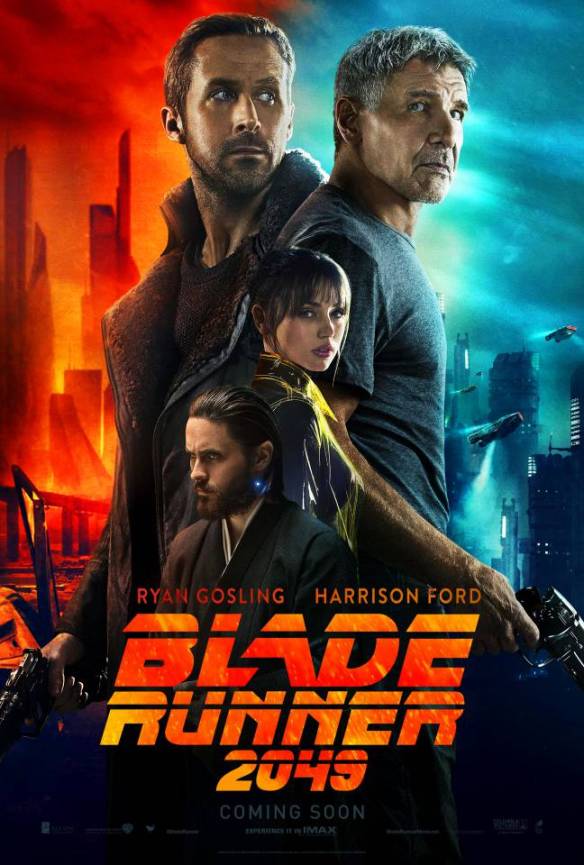
Upon hearing early reports of a planned Blade Runner sequel a couple years ago, I felt both anticipation and dread. I considered it a singular vision which didn’t necessarily need a sequel, yet could understand the desire to re-immerse oneself in the compelling world it introduced. Re-experiencing the film through its Director’s Cut and Final Cut versions in subsequent years seemed to me as satisfying as watching sequels since even the relatively minor changes had a significant impact on its meaning and the richness of the sound and production design allows for the discovery of new details with every viewing. Also, one’s subjective experience watching even the same movie can be vastly different depending on one’s age and other circumstances.
One of my earliest cinematic memories was seeing the first Star Wars film as a toddler. At around the same time I remember staying up late with my parents to watch the network television premiere of 2001: A Space Odyssey. Though I was too young to fully comprehend those films’ narratives, the spectacle and sounds definitely left an impression and established a lifelong appreciation for the sci-fi genre and it’s mind-expanding possibilities.
Flash forward to an evening sometime in early 1982. After viewing a commercial for Blade Runner I instantly knew it was a movie I had to see. In the short trailer there were glimpses of flying cars over vast cityscapes, the guy that played Han Solo in a trench coat, bizarre humanoid robots within settings as strange yet detailed as 2001: a Space Odyssey. My parents, responsible as they were, refused to give in to incessant demands to see Blade Runner and that Summer I must have been the only kid who reluctantly agreed to see “E.T.” as a compromise. I probably did enjoy it more than I expected to, but might have enjoyed it more had I not viewed it as a weak Blade Runner substitute and if I actually paid attention to the entire film.
Back then our family usually saw films at drive-in theaters and the one we went to that night had two screens, one showing E.T. and the other, to my delight and frustration, happened to be Blade Runner. Even without sound and at a distorted angle I was awestruck by the establishing shots of LA in 2019 (which I glanced over to witness just as E.T.’s ship was landing on the screen in front of us, and for the entire duration of the films my eyes would switch back and forth between screens. Even without understanding anything about the plot of Blade Runner it made the most fantastical elements of E.T. pale in comparison. Judging from the box-office receipts of its theatrical run, the majority must have thought otherwise since Blade Runner earned a relatively meager $28 million while E.T. was the breakout hit of the year with nearly $360 million.
Within a few years I’d see portions of Blade Runner on cable TV at a friend’s house and finally saw the complete film after my family got a VCR and it was one of the first videos I rented. The film served as a gateway to many other interests such as cyberpunk, film noir, electronic music, but most importantly, an appreciation of the novels of Philip K. Dick. Like a psychedelic drug, they inspired philosophical questioning regarding the nature of reality, consciousness, society and what it means to be human.
This background, which is probably not too dissimilar to other stories of obsessive fandom, outlines how one’s immersion in media is rooted not just in the work itself but how it resonates with and shapes aspects of one’s identity and personal narrative as much as other memories. There’s also a nostalgia factor involved because, similar to a souvenir or any object with sentimental value, revisiting such media can recapture a sense of the feelings and sensations associated with the initial experience and sometimes the milieu of the content as well. Nostalgia is a longing for the past, even a past one has never directly experienced, never was and/or never will be, often prompted by loneliness and disconnectedness. Because it can sometimes provide comfort and hope it’s a feeling too often exploited by the marketing industry as well as media producers such as those behind reboots and sequels. Though Blade Runner 2049 may not have been solely created to cash in on nostalgia for the original, as with most big studio sequels it’s still a factor.
The type of nostalgia evoked by Blade Runner is singular, for it envisions a (near and soon to be past) future through the lens of the early eighties combining a pastiche of styles of previous eras. The film also serves as a meditation on the importance of memory and its relation to identity and the human experience. In a sense, being a longtime fan of the film is like having nostalgia for distilled nostalgia. Also unique is the fact that it took 35 years for the sequel to get made, just a couple years shy of the year in which the original takes place. The long delay is largely due to Blade Runner being so far ahead of its time it took over a decade for it to be widely regarded as a science fiction masterwork. Also, it took an additional decade and a half to develop plans for a sequel. But perhaps now is the ideal time for a follow-up as aspects of our world become more dystopian and there’s a greater need for nostalgic escape, even through narratives predicting dystopia.
While the future world of the original Blade Runner was definitely grim, it was also oddly alluring due to it’s depiction of a chaotic globalized culture, exotic yet functional-looking technology and hybrid retro/futuristic aesthetic shaped by sources as diverse as punk rock fashion, Heavy Metal magazine, film noir and Futurism among many others. The imagery of Blade Runner 2049 expands on the original by visualizing how the future (or alternate reality) LA has evolved over the course of 30 years as well as the environmentally and socially devastating impact of trying to sustain a technocratic corporate global system for so long.
Blade Runner opens with shots of oil refineries in the city intercut with close-ups of a replicant’s eye. 2049 opens with a close-up of an eye and transitions to an overhead shot of an endless array of solar panels, indicating a post peak-oil world. Despite the use of cleaner energy, the world of 2049 is far from clean with the entirety of San Diego depicted as a massive dumping ground for Los Angeles. Scavengers survive off the scraps which are recycled into products assembled by masses of orphaned child laborers in dilapidated sweatshop factories.
The Los Angeles of Blade Runner 2049 looks (and is) even colder and more foreboding than before. Gone are the Art Deco-inspired architecture and furnishings, replaced by Brutalist architecture and fluorescent-lit utilitarian interiors (with a few exceptions such as Deckard’s residence, Stelline Corporation headquarters and the Wallace Corporation building). Aerial shots reveal a vast elevated sprawl of uniform city blocks largely consisting of dark flat rooftops with glimmers of light emanating from below, visible only in the deep but narrow chasms between.
One of the more prominant structures is the LAPD headquarters which looks like an armored watchtower, signalling its role as a hub of the future surveillance state panopticon. Though an imposing feature of the city’s skyline, it’s dwarfed by larger structures housing even more powerful institutions. Just as a massive ziggurat owned by the Tyrell Corporation dominated the cityscape of the first film, by 2049 the Wallace Corporation has bought out the Tyrell Corporation and not only claims the ziggurat but has constructed an absurdly large pyramid behind it. Protecting the entire coastline of the city is a giant sea wall, presumably to prevent mass flooding from rising sea levels.
In a referential nod to the original film, city scenes of 2049 display some of the same ads such as Atari, Coca-Cola and Pan Am, but even more distracting are product placements for Sony, one of the companies which produced the new film. Such details might work as “Easter eggs” for fans (and shareholders), but takes away from the verisimilitude of the world depicted in the film where the Wallace Corporation has such seeming dominance over the economy and society in general, it probably wouldn’t leave much room for competition large enough to afford mass advertising.
While the background characters in the city of the first film seemed rude or largely indifferent to one another, 30 years later citizens are more outwardly hostile. This could reflect increasing social tensions from economic stratification as well as hostility towards replicants because the protagonist of this film is openly identified as one. Speaking of which, Ryan Gosling turns in an excellent performance as the new Blade Runner, Officer K (aka Joe, an obvious reference to Joseph K from Kafka’s “The Trial”).
Ironically, the replicants and other forms of AI in 2049 seem a little more self-aware and human-like while the humans and social institutions have become correspondingly android-like. From the perspective of the future CEOs (and some today), both replicants and non-wealthy humans (known as “little people” in cityspeak) exist to be exploited for labor and money and then “retired” when no longer needed. Reflecting this brutal reality are the largely grey and drab color scheme of the landscapes, interiors, and fashions. Adding to the mood is the soundtrack which, while at times evoking the calmer and more subtle Vangelis music of the original, is more often louder and harsher, sometimes blending with the noisy diegetic (background) soundscape.
2049‘s screenplay is almost a meta-sequel, introducing plot elements seemingly designed to address problems and inconsistencies in the original which have been pointed out by fans and critics through the years. Numerous references to Blade Runner, while nostalgic and crowd-pleasing, are almost distracting enough to break the spell of the film (at least for those who’ve re-watched the original enough times to memorize every detail). Fortunately, just as frequently new revelations, concepts and hints at potential new directions pulls one back in. I especially appreciated the further exploration of the origins and impact of false memories and its parallels to the creation and consumption of media and the way the film expanded the scope of the story beyond the city. Also surprising were references to films partly inspired by the works of Philip K. Dick such as Ghost in the Shell, The Matrix, and Her as well as stylistic influences from more contemporary aesthetic subcultures such as glitch and vaporwave.
Like with most sequels, the main draw for fans is the chance to see familiar faces from the original and 2049 doesn’t disappoint too much. Judging from the posters, trailers, interviews, etc. it was clear Harrison Ford would make a return, but unfortunately it wasn’t until after the majority of the duration of the film had passed. Nevertheless, the reappearance of Ford’s character Deckard was memorable, found by Agent K as a disheveled hermit in an abandoned casino surrounded by copious amounts of alcohol and ancient pop culture detritus. Deckard is apparently as much of a drinker as in the first film, but now not just to block out the pain of the past and present but to escape to an idealized past. Though his involvement in the plot seemed too brief it nevertheless plays a pivotal role in resolving the central mystery of the film and providing additional metacommentary.
Ford’s performance is arguably more compelling than his work in the original, though his character’s lack of charisma in the first film could be seen as intentional. Deckard’s character arc in the film, as well as that of Ford’s last two iconic roles from the 80s he reprised, cements his status as our culture’s archetype for the deadbeat father. This seems inevitable in hindsight because for a generation of latchkey kids (many with actual deadbeat dads), stars such as Harrison Ford were virtually surrogate father figures. Thus, it makes sense that the beloved characters Ford drifted away from for so long would be written as variations of a long absent deadbeat parent in their last installments.
An interesting detail about the way Deckard was characterized in the film was how he seemed more in line with a typical baby-boomer today than the gen x-er one would be at that age 32 years from now. For example, people in their seventies today are probably more likely to be nostalgic for Elvis and Sinatra than a seventy-something person in 2049 who in our actual timeline would have more likely spent formative years listening to grunge or hiphop. A possible subtextual meaning might be that like false memories, nostalgia for media of enduring cultural value transcends lived experience. The referencing of “real” pop-culture figures within the world of the film seemed anachronistic at first, but the way it was done was interesting and worked with the themes and aesthetic (I suppose it’s preferable to having something like Beastie Boys’ “Sabotage” shoe-horned into the film like in the Star Trek reboots). Getting back to the point, in the original Blade Runner, nostalgia permeated the film through its themes, production design, costumes and soundtrack. In Blade Runner 2049, nostalgia is a subtext of repeated callbacks to the original film, Agent K’s idealized retro relationship with his AI girlfriend Joi and Deckard’s hideout within the ruins of a city once associated with fun and glamour. The simulacrum of iconic figures from the past like Elvis and Marilyn Monroe (and Ford) haunting the deserted casino like ghosts reinforces the idea of media and culture’s ability to “implant” memories and resultant nostalgia.
As for the finale, I was disappointed that it was so far from the unconventional conclusion of the showdown between Roy Batty and Deckard. One could argue it’s a reflection of the state of the world (in and of film and reality), but it’d be nice to have a little more creativity and risk-taking. Though viscerally exciting and suspenseful, it wasn’t distinguishable enough from countless modern action films to be truly memorable. More satisfying was the epilogue which paralleled the contemplative nature of the original while reconnecting to the film’s recurring themes.
In a sense, the writers and director of Blade Runner 2049 were in a catch-22 situation. Creating a film too unlike or similar to the original Blade Runner would provoke criticism from fans. What director Denis Villeneuve and co-writers Hampton Fancher and Michael Green have managed to pull off is a balancing act of a film that’s unique in many ways yet interwoven with the original; nostalgic, but not in an obvious or overly sentimental way. Both have their flaws, but while I admire the thought and craft put into the sequel, I prefer the originality, tone, texture and atmosphere of Blade Runner. Blade Runner 2049 will likely satisfy most sci-fi fans, but I’m not sure it proves a sequel was necessary or that it stands alone as a classic.
Though not given the recognition it deserved in its time, Blade Runner was a groundbreaking and visionary film upping the bar for intellectual depth, moral complexity, production design and special effects to a degree not seen since 2001: a Space Odyssey. Its influence can be spotted in countless dystopian science fiction films made since. Though it’s too early to tell how influential Blade Runner 2049 will be, it doesn’t seem to have pushed the genre forward to a similar extent (of course contemporaneous opinions can seem wildly off the mark in hindsight). Regardless, it’s an above-average science fiction film by any reasonable standard so it’s unfortunate that judging from disappointing initial box-office reports, it seems to be following in the footsteps of the first Blade Runner pretty closely in that regard. Time will tell whether it achieves a similar cult status in years to come. Perhaps in 35 years?
By Steve Johnson
Source: Bright Lights
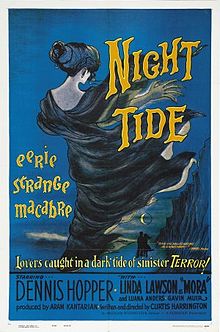
The first shot proper in Curtis Harrington’s 1961 feature film debut, Night Tide, situates main character Johnny Drake leaning over a pier in his sailor gear, slightly off-angle, so we understand that there’s something unresolved in his character, something at un-rest. The setting is Venice, California, a long way off from the Poe-like submerged city it’s named for, as are many of the film’s characters from their similar sources. A clairvoyant later calls Johnny innocent and searching, and everything about the moody composition reinforces this notion as he gazes into the reflective waters. There at the brink between land and sea, consciousness and dream, he’s Narcissus regarding himself in the pool, much like the protagonist of Harrington’s attention-getting 1946 short Fragment of Seeking.
In that earlier, experimental film, Harrington’s character — played by the director himself — pursues a robed figure after the fashion of Maya Deren’s “Meshes of the Afternoon,” only to discover that what he had taken to be a woman is instead himself, in drag. (The scenario is a gloss on such Poe tales as “William Wilson” and “The Assignation”; Harrington’s first short was an adaptation of “The Fall of the House of Usher,” a new version of which was also his final film work.) This motif of inquiring into gender and the self is revisited in film after film of Harrington’s no matter how personal or indifferent, from the exploration of the twin-gendered Venus and Mars of his next feature, Queen of Blood, through the various pursuits of his ’70s TV movies The Dead Don’t Die and How Awful About Allan, the latter climaxing in the reverse-unmasking of the lead’s veiled malefactor — whom he had assumed was a male boarder — as in fact his own sister.
This lunar pull toward some split-off aspect of the self is part allegorical, part autobiographical. In Night Tide, the division in Johnny’s object of fascination, the sideshow mermaid named Mora who believes she’s the real thing, represents our peculiarly human nature, being not entirely animal yet not entirely separate, either. In both evolutionary and individually developmental terms, she recalls the amniotic origins Johnny contemplates from his privileged perspective at the start of the picture, which viewpoint the film reiterates at other key points and in other key locations. That tension between our innocent beginnings and present “fallen” state reflects the director’s own attitude toward his ambitions and the course his career would take in the baroque and carnivalesque Hollywood where he found himself working for the next 25 years after this self-written and -financed calling card of a film.
Though Harrington’s character, and indeed the tone of his feature, is naïve, Harrington himself was not. True to the Hollywood Babylon of friend and early co-conspirator Kenneth Anger’s series of infamous industry exposés, the portrait of that town in such later Harringtons as What’s the Matter with Helen? maintains the grime on the city’s underbelly. For the novice filmmaker, Tinseltown was the Mora-like Lorelei whose song lured many a hapless romantic to his ruin. As his career lost its way from the wide-eyed optimism on display here, it bent itself to an increasing sordidness, the decadence that underlay his scenarios become less and less berobed with the illusion of glamor. By the time of his penultimate theatrical feature, the Exorcist knockoff Ruby, the putative Golden Age apostrophized throughout his work in the casting of mostly played-out Hollywood luminaries was at last seen as a nest of gangsters reduced to working for the title singer at her drive-in theater, her daughter the innocent supernatural woman of Night Tide become the actual agent of the violent deaths of which Mora, in her film, is falsely accused.
In conversation with David Del Valle on the latter’s cable interview program, The Sinister Image, Harrington described his first studio film, Games, as concerning the seeping of “European decadence” into innocent America. In that film, Night Tide‘s boardwalk attractions are literally internalized in the pinball-filled apartment and juvenile, prank-prone relationship of its socialite couple — based on Night Tide star Dennis Hopper and his Hollywood-royalty wife, Brooke Hayward — all of which turn malevolent under the influence of a French mystic played by Simone Signoret. In Night Tide this figure appears in the form of the Greek-speaking Mystery Woman (played by Marjorie Cameron, a consort of reputed Black Arts practitioner Aleister Crowley) and in Queen of Blood the vampiric cod-European extraterrestrial; in later tele-films The Dead Don’t Die it’s the zombie leader Varek, Killer Bees‘ queen-bee Madame von Bohlen, and the witchy Martine Beswick character of Devil Dog: Hound of Hell, as well as the soigné Nazi psychologist of theatrical career-closer Mata Hari.
Which is not to say that this influence need necessarily be European. The director just as easily gave it a domestic face in the form of Helen‘s radio evangelist played by Agnes Moorehead and her disturbed disciple Shelley Winters, and The Killing Kind‘s mother, Ann Sothern — symbols of Golden Age Hollywood, all, as was Bees‘ Gloria Swanson. The decadence, if any, is organic to its milieu; if it hails from any Old World to speak of, it’s a world within.
Harrington has said that all of his films are tragedies. Night Tide, at least, ends hopefully. When Ellen Sands, the land girl who vies for his affections, sees Johnny off, the implication is that she’ll be a soft place for him to land when he comes down from his guilty obsession over Mora; her offer of coffee on his way out is as Ariadne’s gift to Theseus of the thread of consciousness that would lead him out of the minotaur maze. With the more exotic love of Mora suggesting the primitive, deep and unfathomable artistic nature (she being first encountered in a subterranean jazz club and later doing an improvisational dance to a bongo beat) that Harrington would leave behind in the pursuit of bigger budgets, greater technical resources, and a wider audience, Ellen’s boardwalk merry-go-round suggests the simple, commercial (if mechanical) pleasures of an “innocent,” old-fashioned entertainment, and Night Tide the chronicle of a passage from avant-garde mother to the feature-length mainstream cinema Harrington would spend a quarter of a century courting with varying degrees of success.
We take solace in Johnny’s being escorted out by the Shore Patrol, suggesting that the questing sailor has found his feet and will one day return to the merry-go-round girl. It’s an odd early endorsement of heterosexual love and normality for a director the overwhelming bulk of whose later work describes such relations and their familial expression in grotesque terms — the undead marathon dancers of The Dead Don’t Die, the forced rape-participation of The Killing Kind, the suburban kennel that is Devil Dog‘s home and family (with its figurative “breeders”), as the ancestral-home hive of Bees. It’s no surprise, then, that the further Harrington came from the hopes of establishing the kind of career he may have envisioned, the harsher the satire became, until the disaster of the attempted Sylvia Kristel vehicle Mata Hari crumbled under the weight of its disinterest in the softcore couplings that were its generic reason for being. Afterward, it was series television for him, the likes of which — Dynasty, primarily — offered a more comfortable haven for his outright cynical — no longer conflicted — attitudes. It was as if Johnny had returned to find Ellen had given up the wait for him and gone. All that was left now was to join the amusements.

By S.C. Hickman
Source: Techno Occulture
In the 21st century, the social engineering of dread and longing have evolved into a bio-political arena of terror and a psycho-political culture of internalized domination. The globally deployed technology of the spectacle transforms to a creative panic industry, the pacification of the self and the silencing of multitudes. With no visible alternatives to universal pancapitalism there seems to be no need for payoffs for the disenchanted, no necessity to bribe the dissenting segments of the population and no incentive to grant extension of freedoms.1
Instead of peddling hope and visions of mutually shared commonwealth, authority is maintained by the production of synthetic fear and the need to secure property against some other. Deimos and Phobos, the gods of panic, angst and terror dominate the omni-directional realm of geo-psychological strategies in an asymmetric world war against invisible enemies without qualities. Market concentrations benefit neo-feudal power structures that know how to use access to media, private security and intelligence services to advance their interests. Austerity, power, and impersonal anonymity interface with a world replete with vast global migrations, desperation, and panic victims who willingly comply and give up liberties for shared security. An Orwellian world of competing agencies, wars, famines, and pestilence drive the panic cities of current criminal elements to traffic in sex, drugs, and war.
Private oligarchic networks of finance and business cartels cultivate relations to governmental entities controlling state agencies and military units. Media narratives and public relations strategies transform synthetic fear into advantages that produce windfalls of power and profit. This theater of fear is a skillful interplay of compartmentalized information units, privatized command centers, loyal officials and gatekeepers as well as professional Special Forces. Technocommercial Black-Ops programs that infiltrate both governmental and public spheres through experimental use of technics and pharmakon in collusion with DARPA and other shadow or Deep State agencies across the globe provide a base infrastructure for a 21st century society of control. Productions of artificial angst call for scenarios of counter-terrorist theater rehearsals and paramilitary actors as well as the professional staging of scapegoats and dupes. The dark networks draw on privatized intelligence units, so called “asteroids”, business entities which provide cover for compartmentalized operations.2
Space was formerly known as heaven and manned space flight from earth could be understood as mechanical equivalent to an ascent to divinity. Johannes Kepler suspected paradise to be located on the moon and Konstantin Tsiolkowsky, the Russian pioneer of modern rocket science, saw manned space flight as a freeway to the supernatural. In his novel “Gravity’s Rainbow” Thomas Pynchon contemplates the ambiguous interrelations between sex, rockets and magic.
Jack Parsons, a key figure in American rocketry, lost his reputation and security clearance in obsessive pursuit of occult rituals and sexual mumbo-jumbo before he diffused into space in a lab explosion in 1952. A crater on the dark side of the moon is named in memory of Parsons, a tribute to the shady cofounder of the famed Jet Propulsion Laboratory (JPL). The 19th century spiritualist pseudoscience of a world of ghosts and occult belief in spirits, a complex adaptation to modernity, has morphed into 20th century sciences. From social theories and “optimization” of the workplace, from operations research to scientific communication and applied psychology, many genres of academic disciplines and the influence business are rooted in the twilight zone of the netherworlds.
When Norbert Wiener, who developed his work on cybernetics from ballistics research, writes that “Communication and control belong to the essence of man’s inner life, even as they belong to his life in society” he evokes the ancient art of assessing the human personality and exploiting motivations. Developed out of clandestine mind control programs in the 1960’s, the methodical application of Personality Assessment Systems became standard operating procedure in business and intelligence. Systems of discipline and control which took shape in the 19th century on the basis of earlier procedures have mutated into new and aggressive forms, beyond simplistic theories of state and sovereignty. In the past, the science of power branched into the twin vectors of political control and control of the self.
In the 21st century the technologies of material control and subjective internalization are in a process of converging. The traditional twin operations, with which the authorities aim to win the hearts and minds, the binding maneuvers of law enforcement and the dazzling illusionist control of the imagination, are transforming into each other. Not unlike werewolves using the powers of the moon for a violent metamorphosis, contemporary agencies of power turn into shape shifters and fluctuating modes of dominance. Star Wars technology shape-shifts into applications of creative industries, into the domain of desire, imagination and mediated lunacy.
Technologies of individualization bound to controllable identities and the global machinery of homogenization are superimposing to a double-bind of contemporary power structures. The renaissance heretic Giordano Bruno anticipates these developments in his visionary treatise “De Vinculis in Genere” – a general account of bonding – on operational phantasms and the libidinal manipulation of the human spirit. The disputatious philosopher of an infinite universe, beyond his unique investigation into the imaginary and the persuasion of masses and the individual, also challenged the ontological separation between the spheres of the heavens and the sublunary world of his time.
Today, in a technological marriage of heaven and earth, there is a full spectrum military entertainment fusion of global conflict management. A strategic analysis of the enforced colonization of space and mind will certainly provide a more comprehensive understanding of the parameters of life and death on planet Earth. The extraterrestrial highway in the United States, is near the zone 51, a top secret area of the American army. In this zone “black projects” subjected to the secrecy defense are carried out. In 1994 a Congressional subcommittee revealed that up to 500,000 Americans were endangered by secret defense related tests between 1940 and 1974. They included covert experiments with radioactive materials, mustard gas, LSD, and biological agents.3
Disneyland and the global media sightings of men on the moon are exemplary for the universal power of imagination management and the spectacle. Receptiveness for the spectacle is deeply embedded in human desires for excitement, stimulation, knowledge acquisition and the construction of self esteem. Largely based on the biocybernetic exploitation of human response mechanisms that influence emotion, excitement and thrill, the technological spectacle in its play with danger and disorientation is rooted in the biology of ancient neural patterns. But its arena has been dramatically extended through technology. The machinery of the spectacle generates affect by triggering failures of orientation and control. This can be loss of physical balance, a rollercoaster ride or cognitive dissonance. The intensity of affect is directly correlated with the depth of disorientation and the more that vital human response structures are touched, the deeper the effect. Contextual parameters of relatively secure environments allow appreciating these disorientations as hedonistic experiences instead of discomfort and panic. These mechanisms trigger delight and numinous experiences, moving and enthusing audiences.
Aldous Huxley once remarked that there are two kinds of propaganda— rational propaganda in favor of action that is consonant with the enlightened self-interest of those who make it and those to whom it is addressed, and non-rational propaganda that is not consonant with anybody’s enlightened self-interest, but is dictated by, and appeals to, passion. 4
In the years and decades ahead both invasive and non-invasive technologies will enslave the uneducated masses, luring them with technologies of delight or fear to do the bidding of the Oligarchs without little or any resistance since for the most part people will willingly give up there freedoms for comfort, security, and happiness. Of course not all will give into such notions, nor condone the power of persuasion through both extrinsic propaganda and public relations, nor intrinsically through technological pharmakon or invasive forms of implants or nanobots. But these resistant anti-bodies will like any virus be hunted down and annihilated in a society that will have become a unified fascist enclave, a mindless world of automated machines both inorganic and organic. For in the end there will be no barriers between them, only the merger and enhancement of their twined potentials. This is the dark truth-condition of our future… can we stop it?

President Bill Clinton and Miramax Chief, Harvey Weinstein at Hillary Clinton’s Birthday Party at the Hudson Hotel in New York City. October 25, 2000 (Photo: Nick Elgar/ImageDirect)
By John W. Whitehead
Source: The Rutherford Institute
“All governments suffer a recurring problem: Power attracts pathological personalities. It is not that power corrupts but that it is magnetic to the corruptible.”― Frank Herbert
Power corrupts.
Worse, as 19th-century historian Lord Acton concluded, absolute power corrupts absolutely.
It doesn’t matter whether you’re talking about a politician, an entertainment mogul, a corporate CEO or a police officer: give any one person (or government agency) too much power and allow him or her or it to believe that they are entitled, untouchable and will not be held accountable for their actions, and those powers will eventually be abused.
We’re seeing this dynamic play out every day in communities across America.
A cop shoots an unarmed citizen for no credible reason and gets away with it. A president employs executive orders to sidestep the Constitution and gets away with it. A government agency spies on its citizens’ communications and gets away with it. An entertainment mogul sexually harasses aspiring actresses and gets away with it. The U.S. military bombs a civilian hospital and a school and gets away with it.
Abuse of power—and the ambition-fueled hypocrisy and deliberate disregard for misconduct that make those abuses possible—works the same whether you’re talking about sexual harassment, government corruption, or the rule of law.
For instance, 20 years ago, I took up a sexual harassment lawsuit on behalf of a young woman—a state employee—who claimed that her boss, a politically powerful man, had arranged for her to meet him in a hotel room, where he then allegedly dropped his pants, propositioned her and invited her to perform oral sex on him.
Despite the fact that this man had a well-known reputation for womanizing and this woman was merely one in a long line of women who had accused the man of groping, propositioning, and pressuring them for sexual favors in the workplace, she was denounced as white trash and subjected to a massive smear campaign by the man’s wife, friends and colleagues (including the leading women’s rights organizations of the day), while he was given lucrative book deals and paid lavish sums for speaking engagements.
William Jefferson Clinton eventually agreed to settle the case and pay Paula Jones $850,000.
Here we are 20 years later and not much has changed.
We’re still shocked by sexual harassment in the workplace, the victims of these sexual predators are still being harassed and smeared, and those who stand to gain the most by overlooking wrongdoing (all across the political spectrum) are still turning a blind eye to misconduct when it’s politically expedient to do so.
This time, it’s Hollywood producer Harvey Weinstein—longtime Clinton associate and a powerhouse when it comes to raising money for Democrats—who is being accused of decades of sexual assaults, aggressively sexual overtures and harassment.
I won’t go into the nauseating details here. You can read them for yourself at the New York Times and the New Yorker.
Suffice it to say that it’s the same old story all over again: man rises to power, man abuses power abominably, man intimidates and threatens anyone who challenges him with retaliation or worse, and man gets away with it because of a culture of compliance in which no one speaks up because they don’t want to lose their job or their money or their place among the elite.
From what I’ve read, this was Hollywood’s worst-kept secret.
In other words, everyone who was anyone knew about it. They were either complicit in allowing the abuses to take place, turning a blind eye to them, or helping to cover them up.
It’s not just happening in Hollywood, however.
And it’s not just sexual predators that we have to worry about.
For every Harvey Weinstein (or Roger Ailes or Bill Cosby or Donald Trump) who eventually gets called out for his sexual misbehavior, there are hundreds—thousands—of others in the American police state who are getting away with murder—in many cases, literally—simply because they can.
The cop who shoots the unarmed citizen first and asks questions later might get put on paid leave for a while or take a job with another police department, but that’s just a slap on the wrist. The shootings and SWAT team raids and excessive use of force will continue, because the police unions and the politicians and the courts won’t do a thing to stop it. Case in point: The Justice Department will no longer attempt to police the police when it comes to official misconduct. Instead, it plans to give police agencies more money and authority to “fight” crime.
The war hawks who are making a profit by waging endless wars abroad, killing innocent civilians in hospitals and schools, and turning the American homeland into a domestic battlefield will continue to do so because neither the president nor the politicians will dare to challenge the military industrial complex. Case in point: Rather than scaling back on America’s endless wars, President Trump—like his predecessors—has continued to expand America’s military empire and its attempts to police the globe.
The National Security Agency that carries out warrantless surveillance on Americans’ internet and phone communications will continue to do so, because the government doesn’t want to relinquish any of its ill-gotten powers. Case in point: The USA Liberty Act, proposed as a way to “fix” all that’s wrong with domestic surveillance, will instead legitimize the government’s snooping powers.
Unless something changes in the way we deal with these ongoing, egregious abuses of power, the predators of the police state will continue to wreak havoc on our freedoms, our communities, and our lives.
Police officers will continue to shoot and kill unarmed citizens. Government agents—including local police—will continue to dress and act like soldiers on a battlefield.
Bloated government agencies will continue to fleece taxpayers while eroding our liberties. Government technicians will continue to spy on our emails and phone calls. Government contractors will continue to make a killing by waging endless wars abroad.
And powerful men (and women) will continue to abuse the powers of their office by treating those around them as underlings and second-class citizens who are unworthy of dignity and respect and undeserving of the legal rights and protections that should be afforded to all Americans.
As Dacher Keltner, professor of psychology at the at the University of California, Berkeley, observed in the Harvard Business Review, “While people usually gain power through traits and actions that advance the interests of others, such as empathy, collaboration, openness, fairness, and sharing; when they start to feel powerful or enjoy a position of privilege, those qualities begin to fade. The powerful are more likely than other people to engage in rude, selfish, and unethical behavior.”
After conducting a series of experiments into the phenomenon of how power corrupts, Keltner concluded: “Just the random assignment of power, and all kinds of mischief ensues, and people will become impulsive. They eat more resources than is their fair share. They take more money. People become more unethical. They think unethical behavior is okay if they engage in it. People are more likely to stereotype. They’re more likely to stop attending to other people carefully.”
Power corrupts.
And absolute power corrupts absolutely.
However, it takes a culture of entitlement and a nation of compliant, willfully ignorant, politically divided citizens to provide the foundations of tyranny.
As researchers Joris Lammers and Adam Galinsky found, those in power not only tend to abuse that power but they also feel entitled to abuse it: “People with power that they think is justified break rules not only because they can get away with it, but also because they feel at some intuitive level that they are entitled to take what they want.”
That sense of entitlement and immunity from charges of wrongdoing dovetails with Richard Nixon’s belief that “when the President does it, that means that it is not illegal.”
For too long now, America has played politics with its principles and allowed the president and his colleagues to act in violation of the rule of law.
“We the people” are paying the price for it now.
Americans have allowed Congress, the White House and the Judiciary to wreak havoc with our freedoms. They have tolerated an oligarchy in which a powerful, elite group of wealthy donors is calling the shots. They have paid homage to patriotism while allowing the military industrial complex to spread death and destruction abroad. And they have turned a blind eye to all manner of wrongdoing when it was politically expedient.
This culture of compliance must stop.
The empowerment of petty tyrants and political gods must end.
For starters, let’s go back to the basics: the Declaration of Independence, the U.S. Constitution and the Bill of Rights.
Let’s recommit to abiding by the rule of law.
Here’s what the rule of law means in a nutshell: it means that everyone is treated the same under the law, everyone is held equally accountable to abiding by the law, and no one is given a free pass based on their politics, their connections, their wealth, their status or any other bright line test used to confer special treatment on the elite.
Let’s demand scrutiny and transparency at all levels of government, which in turn will lead to accountability.
We need to stop being victimized by these predators.
As I point out in my book Battlefield America: The War on the American People, I’m not just talking about the political predators in office, but the ones who are running the show behind the scenes—the shadow government—comprised of unelected government bureaucrats whose powers are unaffected by elections, unaltered by populist movements, and beyond the reach of the law.
There is no way to erase the scars left by the government’s greed for money and power, its disregard for human life, its corruption and graft, its pollution of the environment, its reliance on excessive force in order to ensure compliance, its covert activities, its illegal surveillance, and its blatant disdain for the rule of law.
“We the people”—men and women alike— have been victims of the police state for so long that not many Americans even remember what it is to be truly free anymore. Worse, few want to shoulder the responsibility that goes along with maintaining freedom.
Still, we must try.

By Stephen Lendman
Source: StephenLendman.org
Google transformed itself from a search engine to online censor.
Last July, the World Socialist Web Site reported “changes to its search service to make it harder for users to access what it called ‘low-quality’ information such as ‘conspiracy theories’ and ‘fake news.’ “
It’s Google’s code language for blocking what’s most important to know, what reliable sites like WSWS report daily, publishing vital information conflicting with the official narrative the corporate media feature, all rubbish all the time on vital world and national issues.
RT is the most widely viewed news operation on YouTube, owned by Google – no surprise it’s using it to censor truth-telling content, considered detrimental to the national security state because it exposes what it wants kept secret.
RT’s popularity keeps growing, why it’s considered a threat. Last month, its multi-language videos were watched over five billion times on YouTube.
Google declared war on the operation in cahoots with Washington, pulling it from its YouTube prime ad list in America without notification, a despicable action. RT’s deputy editor-in-chief Kirill Karnovich-Valua commented saying:
“RT has been Google’s premium partner since 2010 and accredited to an official status of the most watched TV news network on YouTube.”
“The fact that RT is no longer included in the Google Preferred advertising list in the US in itself does not affect RT distribution and monetization on the platform.”
“Yet, it is absolutely unacceptable that, while there were no notifications of any policy changes sent to RT, such internal info appears to have been leaked to the US media by Google.”
“This speaks to the unprecedented political pressure increasingly applied to all RT partners and relationships in a concerted effort to push our channel out of the US market entirely, and by any means possible.”
Censorship is a flagrant First Amendment violation, Russia, its officials and English-languish news operations prime targets for vilification and undermining – notably after Moscow was falsely accused of US election hacking, no evidence ever presented proving it.
RT and Sputnik News are threatened. Washington demanded a company providing services to RT America register as a foreign agent.
The FBI is investigating Sputnik, unheard of actions, perhaps prelude to preventing them from reaching a US audience.
Both are highly respected news and information services, media operations, not Russian propaganda as falsely claimed, nothing fake about their reporting – worlds apart from deplorable US media, disinformation operations.
Vilifying Russia persists on many fronts, a recklessly dangerous situation, risking direct confrontation – what’s coming if things continue on their present course.
INDIAN COUNTRY NEWS
"It is the duty of every man, as far as his ability extends, to detect and expose delusion and error"..Thomas Paine
Human in Algorithms
100% Accurate Google Sheets + KDP Book Formatting | 24hr Delivery
From the Roof Top
I See This
blog of the post capitalist transition.. Read or download the novel here + latest relevant posts
अध्ययन-अनुसन्धानको सार

