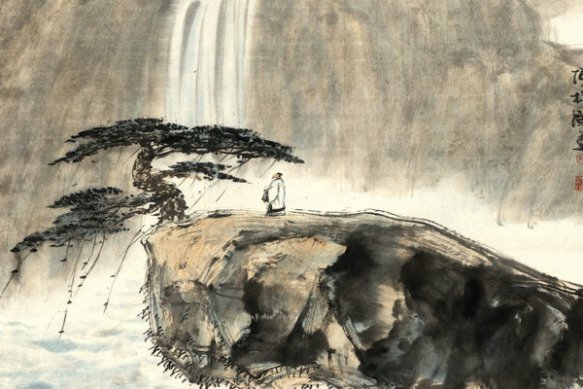
Spaciousness: How to Free Your Mind and Stop Living Reactively

By Jordan Bates

Source: High Existence

“Between stimulus and response there is a space. In that space is our power to choose our response. In our response lies our growth and our freedom.”

— Viktor Frankl

‘Spaciousness’ is a Buddhist concept that has been profoundly useful and liberating for me.

Perhaps it will prove nourishing for you as well.

Spaciousness feels like having more space in your mind. 

It feels like widening the space between stimulus and response, such that you can stop living in reaction and begin responding skillfully to reality.


David Chapman on Spacious Freedom

A couple years ago while perusing David Chapman’s remarkable work, I happened upon an intriguing post on ‘Spacious Freedom.’ [1]

Reading it, I was struck by the clarity and conciseness with which David articulated the powerfully liberating Buddhist concept of ‘spaciousness.’

The post was one of the most concentrated doses of wisdom I’ve ever absorbed, and I’d like to share its essence with you.

I’ll let David take over:

“‘Spaciousness’ is freedom from fixed meanings. Spaciousness liberates you from automatic interpretations, and from habitual responses.

Lacking spaciousness, here is the pattern of life:

  1. Something happens
  2. You perceive the event
  3. You immediately interpret it, based on some familiar framework of meaning-making
  4. An emotion arises in response to the meaning you have given
  5. The energy of the emotion demands action
  6. You do something that seems mandatory based on the emotional interpretation

This is unnecessarily limited at steps 3 and 6:

  • There may be other ways to interpret the event. And it may not be helpful to interpret it at all.
  • There may be other ways to react to the emotional energy. And it may not be helpful to react at all.

Spaciousness is an attitude: the willingness to suspend the process of meaning-making. Spaciousness is the willingness to allow unknowing, uncertainty, confusion, ambiguity, meaninglessness.

Spaciousness values astonishment, perplexity, and groundlessness. Spaciousness gives experience a quality of freshness: every situation appears unique, not merely as another instance of a familiar category.”

Spaciousness is closely related to cultivating a Beginner’s Mind: a mind that is wide open, non-rigid, non-dogmatic, ready to receive the raw, vivid reality of each moment without immediately judging, filtering, and categorizing it based on preexisting beliefs.

Non-reactive spacious awareness is freedom. The experience of gaining spaciousness is the experience of increasingly feeling that you can choose how to interpret events and choose how to respond to emotional energy, rather than being a slave to habitual patterns.

It is not easy to attain a state of wide-open spaciousness, but it is easy to begin walking the path of cultivating more spaciousness.

You can do this simply by beginning to observe yourself closely. Observe how your automatic reactions and habitual interpretations create your reality. Observe how it would be possible to create a different reality by loosening your grip on your default reactions.

A Story: Flat Tire

Let’s say a person’s car suddenly gets a flat tire.

A person deep in self-pity and resentment will reactively start telling themselves a story like: “God dammit, why does this shit always happen to me? I swear this universe just fucking hates me. Everything is out to get me. Fuck, fuck, fuck. Nothing goes my way.” 

This will reinforce their habitual response to reality—that of viewing themselves as a pitiable victim and scanning their environment for evidence to confirm this story.

A spacious, awakened, deeply peaceful person, on the other hand, might respond internally like this: “Ah, I see that this is happening now. Okay. I’ll have to change the tire and will be running a bit later than expected. This could be a fine chance to get some fresh air, appreciate the setting sun, maybe meditate a little. Perhaps this change of timing will have some happy results; we never know what things are good for, after all.”

This simple example illustrates how our state of being and mode of perception create our reality. The very same situation can be experienced as night-and-day different by two people in dramatically different states of being.

This points to the possibility of liberation; it suggests the massive quantity of suffering we can transcend by cultivating a spacious way of being.


Stop Creating “Good” and “Bad”

“… the very search for pleasure is the cause of pain.”

— Sri Nisargadatta Maharaj, I Am That

A wise woman told me that the root of all our problems is the mental process of judging some experiences as “good” and others as “bad,” some as desirable and others as undesirable.

This dichotomy becomes a torture chamber.

To cultivate spaciousness, I find it useful to practice not judging events, experiences, emotions as ‘good’ or ‘bad,’ desirable or undesirable. 

Practice seeing whatever is happening as simply ‘what is happening now,’ and trust that whatever is happening is workable, manageable, and likely contains hidden lessons or gemstones.

“Accept — then act. Whatever the present moment contains, accept it as if you had chosen it. Always work with it, not against it. Make it your friend and ally, not your enemy. This will miraculously transform your whole life.”

— Eckhart Tolle, The Power of Now

As you begin to practice this, you’ll find that it’s very difficult, as we’re heavily conditioned to dichotomize the content of our reality into that which is desirable and that which is undesirable.

When we do this, though, we suffer. A lot. If one feels anger, fear, or guilt, yet remains neutral about these things and simply experiences them, they wouldn’t be so difficult. They may even be useful; they may teach us about ourselves. There is nothing wrong with experiencing negativity; this is a universal aspect of the human experience.

But when we experience such things and immediately condemn ourselves for experiencing them, grit our teeth and resist them, and concoct a self-judging story about them that we keep replaying in our minds, we pour kerosene on the fire and make everything feel exponentially worse.

A spacious person will still experience pain in life, as this is unavoidable; but they will suffer far less by responding more skillfully to their pain. 


Stop Thinking and End Your Problems

Nothing is inherently a problem; the mind makes it so. 

This is why, 2,500 years ago, Lao Tzu wrote in the Tao Te Ching, “Stop thinking and end your problems.” 

To be sure, we need to think sometimes, but the vast majority of humanity’s mental activity is not helpful; it’s often downright insidious.

When you begin to watch closely, you increasingly notice how the mind is the source of all “problems.”

When you drop your narratives about reality and focus on the sensory data of this moment, “problems” dissolve.

The essence of meditation is to come into a state of deep presence and see clearly the traps of the monkey mind by observing its neurotic movements with openness, gentleness, non-judgment, compassion, and humor. This practice increases spaciousness.

One can do this through forms of sitting meditation, such as focus meditation: Dropping one’s mental stories about reality and simply following the breath, or repeating a mantra, or focusing on the energy of aliveness coursing through the body. The mind will doubtlessly try to pull you away; this is perfectly okay; this is how you learn to see its funny tricks; you simply smile at it then return to the breath, mantra, the aliveness of the body, or another object of focus.

Or, you can practice choiceless awareness: Simply sitting in open awareness, watching thoughts, feelings, phenomena arise but not clinging to them, not choosing one thing over another, allowing all things to drift past like leaves on the breeze. This becomes easier when you begin to see that you are not your thoughts.

One can also practice cultivating spaciousness at any time in day to day life, by observing closely how your conditioned mental-emotional system reacts to reality, conjures up over-dramatic stories about it, and gets you in trouble by ‘hooking’ you into this drama.

You can then practice dropping your stories and simply feeling the energy in your body, allowing it to be just what it is without judging it, and watching it gradually run its course and dissolve. Through this process you begin to un-learn your automatic interpretations/reactions. A lighter way of being becomes possible. 


Parting Words: Spacious Flow

“Flow with whatever may happen, and let your mind be free: Stay centered by accepting whatever you are doing. This is the ultimate.”

— Chuang Tzu

Much more could be said about spaciousness, but hopefully this introduction has been useful and curiosity-inducing for you.

Meditation—gently observing the mind and non-judgmentally feeling whatever you are feeling—is the key to unlocking ever greater degrees of spaciousness.

If you feel drawn to dive deeper into meditation, I highly recommend reading The Power of Now by Eckhart Tolle; Letting Go by David Hawkins; and taking our self-liberation course, 30 Challenges to Enlightenment. 

I’ll leave you with one of my favorite Zen stories. I have a tattoo on my arm that says “we’ll see,” a reference to this story. Ponder how the protagonist in this story embodies spaciousness:

A farmer had only one horse. One day, his horse ran away.

His neighbors said, “I’m so sorry. This is such bad news. You must be so upset.”

The man just said, “We’ll see.”

A few days later, his horse came back with twenty wild horses following. The man and his son corralled all twenty-one horses.

His neighbors said, “Congratulations! This is such good news. You must be so happy!”

The man just said, “We’ll see.”

One of the wild horses kicked the man’s only son, breaking both his legs.

His neighbors said, “I’m so sorry. This is such bad news. You must be so upset.”

The man just said, “We’ll see.”

The country went to war, and every able-bodied young man was drafted to fight. The war was terrible and killed every young man, but the farmer’s son was spared, since his broken legs prevented him from being drafted.

His neighbors said, “Congratulations! This is such good news. You must be so happy!”

The man just said, “We’ll see.”

Cheers to non-reactive spacious awareness.

Cheers to freedom.

Cheers to flow.

Cheers to peace.

Go forth and be spacious.

Saturday Matinee: Trust

“Trust” (1990) is an independent comedy written and directed by Hal Hartley about the relationship between misfits Maria (Adrienne Shelly) and Matthew (Martin Donovan) who are equally alienated in their stifling Long Island town. Equal parts stylized and realistic with a focus on the struggle to live with intelligence and integrity in a society hostile towards such traits, Trust is a quintessential Hal Hartley film.

Watch the full film on Hoopla here: https://www.hoopladigital.com/title/11374855

RFK Jr. Slams Gov’t & Big Pharma In Eye Opening Speech About Forced Vaccinations

By Arjun Walla

Source: Collective Evolution

California has very strict compulsory vaccination laws for children in school, and as a result more parents are deciding to homeschool their children. The latest information regarding vaccines in California that’s making noise is Senate Bill 276 by Senator Richard Pan. The bill eliminated nearly all vaccine medical exemptions. Under this bill, politicians, not physicians, are in charge of deciding whether or not children may receive medical exemptions, which in turn would determine whether or not they can attend school.

This bill, which was recently signed into law, represents medical tyranny that is similar to a police state. Forcing vaccinations on any segment of the population and taking away their freedom of choice is ridiculous. All of this is done under the assumption that unvaccinated children pose a danger to vaccinated children, and this is simply not true for several reasons.

Herd immunity is a largely theoretical concept, yet for decades, it has furnished one of the key underpinnings for vaccine mandates in the United States. The public health establishment borrowed the herd immunity concept from pre-vaccine observations of natural disease outbreaks. Then, without any apparent supporting science, officials applied the concept to vaccination, using it not only to justify mass vaccination but to guilt-trip anyone objecting to the nation’s increasingly onerous vaccine mandates.

In a 2014 analysis in the Oregon Law Review by New York University (NYU) legal scholars Mary Holland and Chase E. Zachary (who also has a Princeton-conferred doctorate in chemistry), the authors show that 60 years of compulsory vaccine policies “have not attained herd immunity for any childhood disease.” It is time, they suggest, to cast aside coercion in favor of voluntary choice.

This is true, in fact, there has been a history of disease outbreaks in heavily vaccinated populations. I wrote an article not long ago providing multiple studies showing this, and the studies are elaborated on and linked in that article, which you can go through here.

According to a MedAlerts search of the FDA Vaccine Adverse Event Reporting System (VAERS) database as of 2/5/19, the cumulative raw count of adverse events from measles, mumps, and rubella vaccines alone was: 93,929 adverse events, 1,810 disabilities, 6,902 hospitalizations, and 463 deaths. What is even more disturbing about these numbers is that VAERS is a voluntary and passive reporting system that has been found to only capture 1% of adverse events.

How can vaccines produce herd immunity if they’re not safe for everybody? It’s impossible.

The various forms of vaccine failure not only make herd immunity impossible to achieve, but also feed the occurrence of “vaccine-preventable illnesses” in highly or even fully vaccinated populations. There are numerous examples of this in published literature, again, some of which I link and go into greater detail about measles here.

Vaccines Aren’t Safe For Everyone

It’s no secret that vaccines are not completely safe for everyone, it’s clearly not a ‘one size fits all’ product, and that’s evident by the fact that nearly $4 billion has been paid out to families of vaccine injured children via the National Childhood Vaccine Injury Act (NCVIA). As astronomical as the monetary awards are, they’re even more alarming when you consider that only an estimated 1% of vaccine injuries are even reported to the Vaccine Adverse Events Reporting System (VAERS). If the numbers from VAERS are correct – only 1% of vaccine injuries are reported and only 1/3 of the petitions are compensated – then up to 99% of vaccine injuries go unreported and the families of the vast majority of people injured by vaccines are picking up the costs, once again, for vaccine makers’ flawed products.

This completely debunks the validity of herd immunity.

Speech From Kennedy

While California’s tragic fall into what might rightly be described as a Medical Police State has many up in arms, RFK Jr. spontaneously delivered a speech outside Gov. Newsom’s office, helping to transform the anger and grief experienced by thousands of shaken onlookers into inspiration and hope, no doubt catalyzing further what is clearly becoming this country’s next grassroots civil rights movement.

In the astoundingly powerful and uplifting speech by RFK Jr. below, one senses the historical importance of what just transpired. And that the fall of California into medical fascism also marks the beginning of a new, broad-based civil rights movement, including all sexes, races, walks of life, religions, and socioeconomic classes — as it concerns the primary, inviolable human right of bodily self-sovereignty and health freedom, and a parent’s right to make informed health choices for their children, which can have life and death consequences. [From the Youtube video description]

Another Informative Statement From Kennedy

Via Robert F. Kennedy Jr.

Merck introduced its measles vaccine in 1963, claiming the vaccine would convey lifelong immunity equivalent to a natural infection, with health officials promising that 55% vaccine coverage would produce “herd immunity” sufficient to eradicate measles by 1967.

Leading scientists of the day, including the world’s preeminent bacteriologist, Sir Graham Wilsonand Harvard Virologist John Enders, who first isolated measles, warned against introducing a vaccine unless it provided lifelong immunity. Measles, they cautioned, would rebound with increased virulence and mortality as the vaccine forced the evolution of more virulent strains and shifted outbreaks away from children—biologically evolved to handle measles—to the elderly who could die from pneumonia, and young infants now unequipped with maternal immunity.

A 1984 Johns Hopkins University modeling study predicted that Merck’s population-wide experiment would increase measles outbreaks by 2050, (when the last generation subject to natural immunity died off,) compared to the pre-vaccine era. This is exactly what has happened. Merck’s vaccine, with a growing failure rate has been incapable of abolishing the disease. Vaccine failure has left millions of adult Californians effectively unvaccinated. And 79% of people affected by measles in this year’s California outbreak were adults.

When eradication predictably didn’t materialize and measles attacked fully-vaccinated populations, Merck simply moved the goalpost saying that herd immunity required 75% vaccination, then 85%, then 95%, then 98%. And now 99%. To distract the world’s citizens from its failed vaccine, Merck started blaming “anti-vaxxers.” (The Vaccine Safety Movement)

California’s bought or brain-dead lawmakers are proposing to “fix” Merck’s vaccine failure problem by punishing 4,000 vulnerable children with medical exemptions. In an act of legislative savagery, Democratic politicians propose to forcibly vaccinate children whose doctors have told them that a vaccine could kill or severely injure them. SB276 will not fix the measles outbreak or solve the problem of vaccine failure, it will only reward a corrupt company for a defective product.

The Takeaway

The idea that politicians can force children to be vaccinated, including those deemed to be in danger of severe adverse reactions, and strip them of their rights to attend public school is insane. Freedom of choice and medical freedom should always exist, especially with regards to vaccines. If parents want to vaccinate, fine, but parents who wish to not vaccinate their children for whatever reasons should always have the freedom to do so.

Mandatory vaccination is tyrannical.

“The fight for liberty and health freedom in California is far from over. There will be legal challenges,” said RFK. Jr., “all the way up to the Supreme Court if necessary. In fact, this incident brings to the forefront a deep, dark problem in the United States that has been festering for decades: the rise of the Pharmaceutical industry’s influence on the government to mandate products that the free market would otherwise reject, due to the profound liability these products have now underwritten completely by the government via their indemnification through the National Childhood Vaccine Injury Compensation Act (NCVIA) of 1986. Now, over three decades since the inception of NVICA, that same industry is starting to use the police powers of the state to enforce these mandates.” [Taken from the Youtube description in the video posted above]

Pentagon Joins the War on Alternative Media

By Kurt Nimmo

Source: Another Day in the Empire

Fake news is so threatening to America’s national security, the Pentagon’s DARPA research agency has announced it will launch a project to repel “large-scale, automated disinformation attacks,” according to Bloomberg.

The Defense Advanced Research Projects Agency wants custom software that can unearth fakes hidden among more than 500,000 stories, photos, video and audio clips. If successful, the system after four years of trials may expand to detect malicious intent and prevent viral fake news from polarizing society.

As usual, a translation is in order. DARPA is working on a system that will prevent news and analysis contrary to the establishment narrative from rising above the mosh pit that is the lower depths of social media.

U.S. officials have been working on plans to prevent outside hackers from flooding social channels with false information ahead of the 2020 election. The drive has been hindered by Senate Majority Leader Mitch McConnell’s refusal to consider election-security legislation. Critics have labeled him #MoscowMitch, saying he left the U.S. vulnerable to meddling by Russia, prompting his retort of “modern-day McCarthyism.”

It should be obvious there isn’t any “election-security.” Even with alleged Russian interference—which has zero credibility and is remarkably evidence-free—can’t overcome the fact the election system is rigged in favor of the establishment’s handpicked “public service” careerists. Bernie Sanders knows about this and Tulsi Gabbard is learning.

No amount of “fake news” will change or even marginally impact the system. An astute eleven-year-old, after examining the evidence or lack thereof, would conclude the Russians are not hijacking elections. That job is left up to the DNC, RNC, and the corporate propaganda media.

President Donald Trump has repeatedly rejected allegations that dubious content on platforms like Facebook, Twitter and Google aided his election win. Hillary Clinton supporters claimed a flood of fake items may have helped sway the results in 2016.

Hillary Clinton followers are simply sore losers. In order to push the fallacy we live in a pluralistic democracy, the state provides the appropriate cover to effectively obfuscate the “deep fake” that is performed every election cycle.

This cover allowed Donald Trump to win the election. Trump didn’t collude with the Russians, he didn’t need to. He took advantage of the widespread discontent of the American people and promised the Make America Great Again.

Beyond Trump’s egotistical flourishes and daily tweet diatribes against enemies real and imagined, he has done little to move the MAGA agenda forward. He is little different than his predecessors—the national debt is in the stratosphere, the wars continue and expand, and the Federal Reserve scam of pumping up the stock market to make it appear all’s well while facilitating the upward shift of wealth to the elite.

But never mind that.

“Where things get especially scary is the prospect of malicious actors combining different forms of fake content into a seamless platform. Researchers can already produce convincing fake videos, generate persuasively realistic text, and deploy chatbots to interact with people. Imagine the potential persuasive impact on vulnerable people that integrating these technologies could have: an interactive deepfake of an influential person engaged in AI-directed propaganda on a bot-to-person basis,” Andrew Grotto at the Center for International Security at Stanford University told Bloomberg.

Because “vulnerable people” are supposedly at risk, the state and its agencies are prepared to implement some sort of fantastical (and likely ineffectual) AI solution to stop unacceptable content from going viral.

The target is not Russians per se, it’s millions of American citizens the state and its secret political police, the FBI, are attempting to prevent from participating in social media and the larger political discussion that is ostensibly democratic but is, in fact, a form of hippodroming, that is to say rigging the political process for a favored outcome by the fixers.

Meanwhile, the state and its Silicon Valley partners are picking off targets one by one, the latest victim being Daniel McAdams at the Ron Paul Institute. His account was permanently suspended for the crime of criticizing Sean Hannity.

“They said I would not be reinstated. My crime? I called Sean Hannity ‘retarded.’ But do a Twitter search on use of the term and you will see its use millions of times with impunity,” McAdams emailed Robert Wenzel after the suspension.

The corporate propaganda media has marginalized dozens of people and ruined careers and reputations by characterizing them as white nationalists, peddlers of fake news and conspiracy theories, and now, directly from the FBI, as national security threats, evil conspiracy-bearing domestic terrorists bent on filling every American head with the illusion of “deep fakes,” fomenting and spreading lies, misinformation, participating in Russian collusion, and keeping company with bad actors (paid agents or dupes for Russia) steering the nation into a white supremacist nightmare.

I was wrong about Hillary. I thought she’d win the election hands-down with the help of the Deep State and its media. I’m making another prediction, but I could be wrong again.

Donald Trump will be roundly defeated next November.

If Democrats take control of the House and Senate, we will witness an inquisition against those of us not on-narrative, beginning with revenge exacted on hardcore MAGA supporters. How effective this jihad is will remain to be seen.

As we have witnessed over the last few months, the state is serious about taking back the narrative and disallowing any contrary narratives put out by “bad actors,” largely libertarians like Daniel McAdams, dissidents on the “New Right,” and disillusioned former MAGAites opposed to endless war and a bankster-dominated state drifting into total authoritarian control freak mode.

EMPIRES ARE A SECRET UNTIL THEY START FALLING

By Margaret Flowers and Kevin Zeese

Source: Popular Resistance

In the past, we have written about the 2020s as a decade when the United States Empire will end. This is based on Alfred McCoy’s predictions (listen to our interview with him on Clearing the FOG). Sociologist and peace scholar John Galtung believes US Empire will fall much faster, losing world dominance by 2020. Much of what he predicted when he said this in 2016 is happening now. In particular, there is a rise in “reactionary fascism” or a desire to go back to the “good old days,” the cost of maintaining the empire is taking an increasing economic toll and other countries are starting to rebuke the US, both its requests for military assistance and its unfair economic demands.

What this means for people in the United States and around the world depends on whether we can build a mass popular movement with the clarity of vision, skills, and solidarity necessary to navigate what is and will surely be a turbulent period. There are no guarantees as to the outcome. Failure to act could result in a disastrous scenario – at best, that the US will continue to try to hold onto power by waging economic and military warfare abroad weakening the economy at home and undermining necessities such as housing, healthcare, education and the transition to a Green economy. At worst, as Galtung describes, there could be “an inevitable and final war” involving nuclear weapons.

When Empire Is In Decline

Alfred McCoy says that it is only when empires are in decline that people begin to recognize they live in an empire and start to talk about it. While discussion of empire hasn’t broken into the corporate media, it is certainly happening in the independent media. A concerted effort by a popular movement could bring it to the fore, just as Occupy changed the political dialogue about wealth inequality and the power of money. People in the US need to face some stark realities when it comes to declining US global power.

For starters, the United States does not currently have the capacity to wage a “Great Power Conflict” even though that is the goal of the national security strategy. The loss of its manufacturing base and lack of access to minerals necessary for producing weapons and electronics means the US does not have the resources to fight a great war. Much of the US’ manufacturing has been outsourced to other countries, including those targeted by US foreign policy. Resources necessary for weapons and electronics are in China, Afghanistan, the Democratic Republic of the Congo and Venezuela. It’s no surprise that the US is maintaining a military presence in Afghanistan, has increased its presence in Africa through AFRICOM and is struggling to wrest control of Venezuela.

Despite these attempts, the US is not having success. There is no military solution for the US in Afghanistan. As Moon of Alabama explains, the Taliban has taken control of more territory than it has had since the US started the war and has no reason to negotiate with the US. He advises, “The U.S. should just leave as long as it can. There will come a point when the only way out will be by helicopter from the embassy roof.”

Alexander Rubinstein writes the failures in Afghanistan can be attributed to Zalmay Khalilzad, currently the US Special Representative for Afghanistan Reconciliation. Khalilzad has led US foreign policy in Afganistan and Iraq since the presidency of George W. Bush, and before that worked with Carter’s National Security Advisor Zbigniew Brzezinski, who provided crucial support for the Mujahideen to draw the Soviet Union into a quagmire. The writing is on the wall that the US must leave Afghanistan, but that is unlikely to happen as long as people such as Khalilzad and Elliott Abrams, who has a similar ideology, are in charge.

As the US-led coup in Venezuela continues to fail due to a lack of support for it within the country, resilience to the effects of the unilateral coercive economic measures (sanctions) and exposure of attempts to create chaos and terror by paramilitary mercenaries, the US grows increasingly desperate in its tactics. There has already been a failed assassination attempt against President Maduro, a US freight company tied to the CIA has been caught smuggling weapons and the US and its Puppet Guaido have been implicated in a terrorist plot as the failed coup enters a more dangerous phase. This week, the Organization of American States voted to invoke a treaty, the Inter-American Treaty of Reciprocal Assistance (TIAR), which would allow military intervention. Mexico strongly opposed that possibility. This comes as Venezuela has strengthened troops at the Colombian border after discovering terrorist training camps on the Colombian side. With allies such as Russia and China, an attack on Venezuela would not only hurt the region but could go global.

Despite the Asian Pivot under President Obama during his first administration and Secretary of Defense Mark Esper’s comment this week that the US is directing a lot of energy toward China, analysts predict the US will fail to achieve dominance in the Asia-Pacific. China is purchasing weapons from Russia that are superior to US systems, is strengthening its military coordination with Russia through drills and is expanding its global ties through the Belt and Road Initiative. Matthew Ehret writes in Strategic Culture, “Those American military officials promoting the obsolete doctrine of Full Spectrum dominance are dancing to the tune of a song that stopped playing some time ago. Both Russia and China have changed the rules of the game on a multitude of levels….”

Protests in Hong Kong, as we described in a recent newsletter, are being used to stoke greater anti-China sentiment in the US. As often occurs, the sophisticated propaganda arm of US-backed color revolutions excites leftist activists, but each day it becomes clearer just how deep the US’ influence is. K. J. Noh provides a helpful guide – a list of seven signs a protest is not a popular progressive uprising. One sign is Hong Kong protesters are supporting a bill in the US Congress, the so-called “Hong Kong Human Rights and Democracy Act.” The bill would allow the United States to sanction Hong Kong officials.

Andre Vltchek attended a recent protest and interviewed some of the participants. He found the democracy protesters have little grasp on the oppression Hong Kongers faced under British colonization, they attack anyone who disagrees with them and they are destroying public infrastructure. One of the protest leaders, Joshua Wong, is openly meeting with figures connected to US regime change efforts, and NED-backed organizations are planning an anti-China protest in Washington, DC on September 29. Their new propaganda symbol is a Chinese flag with a Swastika on it. No surprise that was evident at the protests in Hong Kong this weekend.

The US is already at war with China with battlefronts on trade and the Asian Pacific. The propaganda around Hong Kong showing prejudice against China is part of manufacturing consent for the conflict between the US and China, which will define the 21st Century. US militarism is also escalating to involve space. This week, the US conducted its first space war game and Putin warned of a space arms race.

Our Tasks as Activists

It was good news this past week that President Trump asked John Bolton, a white supremacist neocon who disrupted any attempts at negotiation, to resign from his position as National Security Adviser. Glen Ford of Black Agenda Report writes, “Every sane person on the planet should be glad to see Bolton go.” But, even with Bolton gone, the US War Machine will rage on with bi-partisan support. Whether Trump starts to live up to his campaign rhetoric of non-intervention remains to be seen. The appointment of Michael Kozak as the new US envoy to Latin America is a bad sign.

Almost two centuries of Manifest Destiny that went beyond North America to spread US Empire across the globe will not end overnight. It will take a concerted effort to build a national consensus against the dominant ideologies of white supremacy and US exceptionalism to change the course of US foreign policy. Fundamental tasks of that effort include education, organizing and mobilizing. Below are some examples of each.

Education:

The Palestinian Great March of Return, a weekly nonviolent protest in Gaza demanding the right of return granted by the United Nations, continues and each week Israelis injure and murder unarmed Palestinians. Abby Martin and Mike Prysner of The Empire Files produced an excellent documentary about it, “Gaza Fights For Freedom,” and are touring the country to raise awareness. Listen to our interview with Abby Martin on Clearing the FOG. Find a showing near you or organize one.

The United States uses unilateral coercive measures (sanctions) that are illegal under international law to wage war on other countries. The Treasury Department currently lists 20 countries sanctioned by the US, but the US also uses threats of sanctions to wield power. Sanctions are warfare, even though they are not commonly viewed that way. They result in the suffering and death of mostly civilians. Kevin Cashman and Cavan Kharrazian explain how sanctions work, why they violate international law and how they threaten global stability.

Organizing:

Alison Bodine and Ali Yerevani encourage activists to avoid the organizing pitfall of getting caught up in debates about the internal politics of countries targeted by US imperialism. Our tasks, as citizens of imperialist countries, are to stop our governments from intervening in the affairs of other countries and demand they respect international law. We also have a task of building solidarity with civilians of other countries. It will require a global mass movement to address major issues such as the climate crisis, wealth inequality, colonization, and violence.

Citizen to citizen diplomacy is critical in building this mass movement and solidarity. Ann Wright, retired from the military and State Department, writes about the challenges of citizen to citizen diplomacy as she tours Russia. Ajamu Baraka, national organizer of Black Alliance for Peace, reminds us that war and militarism are class issues in his address to an international meeting of trade unions held in Syria.

We are strong believers in breaking out of the confines of the narrative presented by corporate media about countries outside the US. Our trips to Iran and Venezuela this year were invaluable learning experiences. We hope to visit more targeted countries. An effort that came out of these trips is the new Global Appeal for Peace, first steps toward creating an international network to complement the more than 120 non-aligned movement countries that are resolved to respect international law and sovereignty and take action to create peace and prevent the catastrophic climate crisis. Sign on to this effort at GlobalAppeal4Peace.net.

Mobilizing:

The People’s Mobilization to Stop the US War Machine and Save the Planet starts next weekend. On Saturday night, Black Alliance for Peace is sponsoring a discussion, “Race, Militarism and Black Resistance in the ‘Americas’” in the Bronx. On Sunday we will rally and march to the UN with Embassy Protectors, Roger Waters and many more. On Monday night, we have a special solidarity night at Community Church of New York. Registration is required as there will be high-level representatives of impacted countries speaking about the challenges they face. Click here to register.

Rage Against the US War Machine will take place October 11 and 12 in Washington, DC. This is the second annual event organized by March on the Pentagon. Click here for details.

We also ask you to join the Embassy Protectors Defense Committee. Sign the petition to drop the Trump administration’s charges against us for protecting the Venezuelan Embassy this spring. We are facing up to a year in prison and exorbitant fines even though it was the US State Department that violated the Vienna Convention by raiding the embassy in May. We will tour Northern California in October and are planning more tours to raise awareness that the struggle to end the US  coup and interventions in Venezuela continues.

John Galtung predicts that the fall of the US Empire could have a devastating impact on domestic cohesion in the United States. As the US loses its position of global supremacy, we have an opportunity to fundamentally reshape what we as a nation represent. We can become cooperative global citizens in a world free of oppression, violence, and poverty if we do the work of joining in international solidarity for these goals.

Freedom Rider: Hollywood Propaganda Attack on Venezuela

By Margaret Kimberly

Source: Black Agenda Report

The US is starving and killing Venezuelans in real life and, for your family’s viewing pleasure, on television screens.

“Imperialism is quite bipartisan and liberal Hollywood never saw propaganda it didn’t want to hype.”

“The military intervention of #Venezuela, put ‘on the table’ by @realDonaldTrump and his gang of fanatic supremacists, is supported by the gringo propaganda machine. Here is a fragment of their ‘cultural offerings.’”— Ernesto Villegas, Venezuela Minister of Culture

Americans are loathe to think of themselves as being propagandized.  The idea is inconsistent with notions of exceptional goodness and superiority that are constantly evoked in this country. But government propaganda does not work in a vacuum. It is bolstered by the corporate media and that includes the entertainment industry.

The latest in the story of fictitious CIA agent Jack Ryan is a case in point. The Ryan character appeared in five different feature films before moving to the small screen via Amazon Prime Video. The new season premieres in November and in this latest incarnation Ryan fights to prevent a nuclear armed Venezuela .

The upside down presentation is typical of the perversion of truth so prevalent in the United State. This country is the only one to have used nuclear weapons and still possesses more than any other. It is the United States that recently withdrew unilaterally from decades old nuclear agreements with Russia. Yet Hollywood has woven a tale of Russia, the country which wanted to keep the non-proliferation agreements, as a villain giving nuclear weapons to Venezuela.

“Government propaganda is bolstered by the entertainment industry.”

Venezuela is the victim of United States aggression in reality and now on the screen. The doctrine of “maximum pressure” has killed 40,000 Venezuelans through sanctions that have deprived that nation of food and medical care. That proof of U.S. aggression is known only to those who access independent media sources. The corporate media, even those who are allegedly liberal, parrot Donald Trump administration talking points, even if they otherwise deride the president and his team. Imperialism is quite bipartisan and liberal Hollywood never saw propaganda it didn’t want to hype.

Of course liberals who are usually overcome by Trump derangement syndrome are happy to go along with aggression schemes. Very few Democrats have expressed opposition to the anti-Venezuelan plots hatched by Trump. There is indeed foreign policy collusion but it doesn’t exist in a relationship with a foreign government. The determination to support American hegemony is an important part of the elite consensus.

That obvious truth is also disappeared and is not to be discussed in what passes for polite and “serious” company. According to myth, America is a classless, post-racial meritocracy and accepting of every political viewpoint. Of course it is anything but. The hierarchies are rigid and tenaciously defended.

“The corporate media, even those who are allegedly liberal, parrot Donald Trump administration talking points.”

Propaganda delivered via popular entertainment plays a particularly insidious role in this process. The goal is to change minds and ensure support for any act the government should choose to make. If this particular iteration of the Jack Ryan story isn’t challenged then no act or aggression will be challenged either.Media imagery is very powerful, that is why governments work so closely with corporate media to present their narratives.

Mace Neufeld  created the Jack Ryan film franchise. In 2014 he received a lifetime achievement award from the Israeli Film Festival. Curiously, the event wasn’t held in Israel at all. Instead Beverly Hills was the venue. Neufeld’s co-honoree was Arnon Milchan, a former Mossad operative who parlayed that career into producing hit films such as Twelve Years a Slave.

Israel isn’t alone in this regard. The CIA and the Pentagon both have film liaison offices . Movie credits often end with thanks to the department of defense. That always means that the plot line is approved by the military and the surveillance state.

“Movie credits often end with thanks to the department of defense.”

This grotesque lying on a mass scale cannot be ignored. The propagandists know that repetition plays a huge role in the process of indoctrination. For years Venezuela has been used as a bogeyman to convince people in this country to act against their own interests. “Socialism doesn’t work, just look at Venezuela,” is a statement made to end discussion of free health care or college education or housing or anything else that people need and want. After the 100th New York Times article which says nothing about the U.S. attack but points out that Venezuelans are hungry, the job has been done. Venezuela is now so thoroughly demonized that only a small number of people will come to its defense or even question their government’s policy against that nation.

“Venezuela is now so thoroughly demonized that only a small number of people will come to its defense.”

In 2002 and 2003 the president, the corporate media, and members of Congress all claimed that Iraq possessed chemical weapons. They wanted to make a case for war and they succeeded. Nearly 20 years later there has been no explanation or apology from the guilty parties. The same people claimed that Syria had chemical weapons and advocated for a larger war there. It isn’t hard to believe that a lie about chemicals or nukes in Venezuela could be used to do the same thing if that is what the establishment desired.

Entertainment isn’t harmless. That is why the ruling clique work together to ensure that they all stay on message. They haven’t spent millions of dollars honing the false message that Venezuela is a failed state with evil leadership for no reason. Venezuela’s culture minister, Ernesto Villegas, hits the nail squarely on the head when he describes this latest insult as “crass war propaganda masquerading as entertainment.”  If the U.S. should take military action or continue its regime change efforts, the plot will have succeeded. A few well informed people will speak out but the masses will either support an atrocity or ignore any horror that their leadership cares to visit upon the Venezuelan people. Washington and Hollywood are still working hand in hand.


Margaret Kimberley’s Freedom Rider column appears weekly in BAR, and is widely reprinted elsewhere. She maintains a frequently updated blog as well at http://freedomrider.blogspot.com . Ms. Kimberley lives in New York City, and can be reached via e-Mail at Margaret.Kimberley(at)BlackAgendaReport.com.

Comparative Political Leadership: Gandhi vs. Contemporary Leaders

By Robert J. Burrowes

On 2 October 2019, it will be the 150th anniversary of the birth of Mohandas K. Gandhi in Gujarat, India. I would like to reflect on the visionary leadership that Gandhi offered the world, briefly comparing it with some national leaders of today, and to invite you to emulate Gandhi’s leadership.

While Gandhi is best remembered for being the mastermind and leader of the decades-long nonviolent struggle to liberate colonial India from British occupation, his extraordinary political, economic, social, ecological, religious and moral leadership are virtually unknown, despite the enormous legacy he left subsequent generations who choose to learn from what he taught. This legacy is available online in the 98-volume Collected Works of Mahatma Gandhi.

While touching on Gandhi’s legacy in each of these regards, I would particularly like to highlight Gandhi’s staggering legacy in four of these fields by briefly comparing his approach to politics, economics, society and the environment with the approach of contemporary political leaders such as Jair Bolsonaro (Brazil), Xi Jinping (China), Emmanuel Macron (France), Viktor Orbán (Hungary), Narendra Modi (India), Binjamin Netanyahu (Israel), Shinzo Abe (Japan), Vladimir Putin (Russia), Mohammad bin Salman (Saudi Arabia), Boris Johnson (UK) and Donald Trump (USA).

Before doing so, let me offer a little basic background on Gandhi so that the foundational framework he was using to guide his thinking and behaviour is clear.

Gandhi in Brief

In order to develop his understanding of the human individual and human society, as well as his approach to conflict, Gandhi engaged in ongoing research throughout his life. He read avidly and widely, as well as keenly observing the behaviour of those around him in many social contexts in three different countries (India, England and South Africa). Shaped also by the influence of his mother and his Hindu religion, this led to Gandhi’s unique understanding of the human individual and his approach to the world at large.

For a fuller elaboration of the points about Gandhi discussed below and the precise references, see relevant chapters and sections on Gandhi in The Strategy of Nonviolent Defense: A Gandhian Approach.

Gandhi’s conception of the human individual and human nature

In order to understand Gandhi generally, it is imperative to comprehend his conceptions of the human individual and human nature simply because these are the foundation of his entire philosophy.

Gandhi attached enormous importance to individual responsibility. He also had a very positive view of human nature. Gandhi believed that humans could respond to ‘the call of the spirit’ and rise above selfishness and violence. Moreover, this was necessary in their quest for self-realization. Self-realization, as the Gandhian scholar Professor Arne Naess explains it, ‘involves realizing oneself as an autonomous, fully responsible person’.

In Gandhi’s view, this quest is an individual one that relies on nonviolence, self-reliance, and the search for truth. ‘To find Truth completely is to realize oneself and one’s destiny.’ But what should guide this search? According to Gandhi, it can only be the individual conscience: The ‘inner voice’ must always be ‘the final arbiter when there is a conflict of duty’. And in his view, ‘the voice of God, of Conscience, of Truth or the Inner Voice or “the still small Voice” mean one and the same thing.’

This point is centrally important, because the usual descriptions of Gandhian nonviolence stress its morality, humility and sacrifice while neglecting the fundamental norm ‘that you should follow your inner voice whatever the consequences’ and ‘even at the risk of being misunderstood’.

The point, of course, is that creation of the nonviolent society which Gandhi envisioned required the reconstruction of the personal, social, economic and political life of each individual. ‘We shall get nothing by asking; we shall have to take what we want, and we need the requisite strength for the effort.’ Consequently, the individual required increased power-from-within through the development of personal identity, self-reliance and fearlessness.

So what is fearlessness? For Gandhi, it means freedom from all external fear, including the fear of dispossession, ridicule, disease, bodily injury and death. In his view, progress toward the goal of fearlessness requires ‘determined and constant endeavour’. But why is fearlessness so important? Because a person who is fearless is unbowed by the punitive power of others and that makes them powerful agents of change.

Gandhi’s approach to society and political economy

Gandhi’s conception of society is based on a rejection of both capitalism and socialism.

In relation to capitalism, he rejected the competitive market and private property, with their emphasis on individual competitiveness and material progress and their consequent greed and exploitation of the weak. He also rejected the major institutions of capitalism, including its parliamentary system of democracy (which denied sovereignty to the people), its judicial system (which exacerbated conflict and perpetuated elite power), and its educational system (which divorced education from life and work).

In relation to socialism, he rejected its conception of conflict in terms of class war, its claim that state ownership and centralization are conducive to the common welfare, its emphasis on material progress, and its reliance on violent means.

The Gandhian vision of future society is based on a decentralized network of self-reliant and self-governing communities using property held in trust, with a weak central apparatus to perform residual functions. His vision stresses the importance of individuals being able to satisfy their personal needs through their own efforts – including ‘bread labor’ – in cooperation with others and in harmony with nature.

For Gandhi, this horizontal framework is necessary in order to liberate the exploiter and exploited alike from the shackles of exploitative structures. This is vitally important because, in his view, ‘exploitation is the essence of violence.’ Self-reliance and interdependence must be built into the structure in order to enhance the capacity for self-regeneration and self defense and to eliminate the potential for structural violence inherent in any dependency relationship.

This social vision was clearly evident in Gandhi’s ‘constructive program’, which was intended to restructure the moral, political, social and economic life of those participating in it. The constructive program was designed to satisfy the needs of each individual member of society and was centrally concerned with the needs for self-esteem, security, and justice. The program entailed many elements, some of which are outlined below in order to illustrate this point.

A crucial feature of the constructive program was the campaign for communal unity. This was intended to encourage reciprocal recognition of the identity of Hindus, Muslims, Christians, Jews and those of other religions. According to Gandhi, all people should have the same regard for other faiths as they have for their own.

The campaign to liberate women was intended to secure self esteem, security, and justice for those most systematically oppressed by India’s patriarchal society. ‘Woman has been suppressed under custom and law for which man was responsible… In a plan of life based on nonviolence, woman has as much right to shape her own destiny as man.’

The campaign for the removal of untouchability was meant to restore self-esteem, dignity, and justice to the Harijans (Gandhi’s term for those without caste) in Hindu society. Similarly, the constructive program was concerned with recognizing the needs of indigenous peoples and lepers throughout India. ‘Our country is so vast… one realizes how difficult it is to make good our claim to be one nation, unless every unit has a living consciousness of being one with every other.’

The khadi (handspun/handwoven cloth) and village industries programs were intended to make the villages largely self-reliant and Indians proud of their identity after centuries of oppression and exploitation under British imperial rule. Khadi, Gandhi argued, ‘is the symbol of unity of Indian humanity, of its economic freedom and equality.’ The struggle for economic equality was aimed at securing distributive justice for all. It meant ‘leveling down’ the rich, who owned the bulk of the nation’s wealth, while raising the living standards of ‘the semi-starved’ peasant millions.

Thus, Gandhi stressed the centrality of the individual and the importance of creating a society that satisfied individual human needs. ‘The individual is the one supreme consideration’; individuals are superior to the system they propound. In fact: ‘If the individual ceases to count, what is left of society?… No society can possibly be built on a denial of individual freedom.’

According to Gandhi then, the foundation of this nonviolent society can only be the nonviolent individual: No one need wait for anyone else before adopting the nonviolent way of life. Hesitating to act because the whole vision might not be achieved, or because others do not yet share it, is an attitude that only hinders progress.

So how is this nonviolent society to come into being? For Gandhi, the aim is not to destroy the old society now with the hope of building the new one later. In his view, it requires a complete and ongoing restructuring of the existing social order using nonviolent means. And while it might not be possible to achieve it, ‘we must bear it in mind and work unceasingly to near it’.

The political means for achieving this societal outcome entailed three essential elements: personal nonviolence as a way of life, constructive work to create new sets of political, social, economic and ecological relationships, and nonviolent resistance to direct and structural violence.

Gandhi the nonviolent conflict strategist

So what did nonviolence mean to Gandhi?

According to Gandhi: ‘Ahimsa [nonviolence] means not to hurt any living creature by thought, word or deed.’ The individual, humanity, and other life forms are one: ‘I believe in the essential unity of [humanity] and for that matter of all that lives.’

Given Gandhi’s understanding that conflict is built into structures and not into people, and that violence could not resolve conflict (although it could destroy the people in conflict and/or the issues at stake) his religious/moral belief in the sanctity of all life compelled him to seek a way to address conflict without the use of violence. Moreover, despite his original training as a lawyer in England and his subsequent practice as a lawyer in South Africa, Gandhi soon rejected the law as a means of dealing with conflict too, preferring to mediate between conflicting parties in search of a mutually acceptable outcome.

According to Gandhi, British imperialism and the Indian caste system were both examples of structures that were perpetuated, in large part, as a result of people performing particular roles within them. The essence of Gandhi’s approach was to identify approaches to conflict that preserved the people while systematically demolishing the evil structure. Moreover, because he saw conflict as a perennial condition, his discussions about future society are particularly concerned with how to manage conflict and how to create new social arrangements free of structural violence.

More importantly, according to Gandhi conflict is both positive and desirable. It is an important means to greater human unity. Professor Johan Galtung explains this point: ‘far from separating two parties, a conflict should unite them, precisely because they have their incompatibility in common.’ More fundamentally, Gandhi believed that conflict should remind antagonists of the deeper, perhaps transcendental, unity of life, because in his view humans are related by a bond that is deeper and more profound than the bonds of social relationship.

So how is conflict to be resolved? In essence, the Gandhian approach to conflict recognizes the importance of resolving all three corners of what Galtung calls the ‘conflict triangle’: the attitude, the behavior, and the goal incompatibility itself. The Gandhian method of conflict resolution is called ‘satyagraha’, which means ‘a relentless search for truth and a determination to reach truth’, it is somewhat simplistically but more widely known (and practiced) in English as ‘nonviolent action’ (or equivalent names). While the perpetrator of violence assumes knowledge of the truth and makes a life-or-death judgment on that basis, satyagraha, according to Gandhi, excludes the use of violence precisely because no one is capable of knowing the absolute truth. Satyagraha, then, was Gandhi’s attempt to evolve a theory of politics and conflict resolution that could accommodate his moral system.

It is for this reason then that ‘Satyagraha is not a set of techniques’. This is because the actions cannot be detached from the norms of nonviolence that govern attitudes and behavior. Therefore, an action or campaign that avoids the use of physical violence but that ignores the attitudinal and behavioral norms characteristic of satyagraha cannot be classified as Gandhian nonviolence. Moreover, the lack of success of many actions and campaigns is often directly attributable to a failure to apply these fundamental norms to their practice of ‘nonviolent action’ (by whatever name it is given locally). To reiterate: ‘Satyagraha is not a set of techniques’.

But Gandhi was not just committed to nonviolence; he was committed to strategy as well. Because he was a shrewd political analyst and not naive enough to believe that such qualities as truth, conviction and courage, nor factors such as numbers mobilized, would yield the necessary outcomes in conflict, he knew that strategy, too, was imperative.

Consequently, for example, he set out to develop a framework for applying nonviolence in such a way that desirable outcomes were built into the means of struggle. ‘They say “Means are after all means”. I would say “means are after all everything”. As the means so the end.’

Gandhi the ecologist

According to Karl Marx, the crisis of civilization was created by the production relations of capitalism; for Gandhi, it was created by the process of industrialization itself. This process both stimulated and was fueled by the unrestrained growth of individual wants. The remedy, according to Gandhi, lay in individuals transforming themselves and, through this transformation, founding a just social order.

He argued that social transformation, no matter how profound, would be neither adequate nor lasting if individuals themselves were not transformed. A part of this strategy was ‘the deliberate and voluntary reduction of wants’. Gandhi did not begrudge people a reasonable degree of physical well-being, but he made a clear distinction between needs and wants. ‘Earth provides enough to satisfy every [person’s] need but not for every [person’s] greed.’

But, as with everything else in Gandhi’s worldview, he did not just advocate this simple material lifestyle; he lived it, making and wearing his own khadi, and progressively reducing his personal possessions.

Contemporary Political Leaders

While contemporary national leaders obviously display a wide variety of styles, it is immediately evident that individuals such as Jair Bolsonaro (Brazil), Xi Jinping (China), Emmanuel Macron (France), Viktor Orbán (Hungary), Narendra Modi (India), Binjamin Netanyahu (Israel), Shinzo Abe (Japan), Vladimir Putin (Russia), Mohammad bin Salman (Saudi Arabia), Boris Johnson (UK) and Donald Trump (USA) might be readily identified as representative of virtually all of them.

And whatever one might say about each of these leaders, it is clear from both their words and behaviour that none of them regards the human individual and their conscience as the foundation on which their national societies or even global society should be built. On the contrary, individuals are destroyed, one way or another, so that society is not inconvenienced more than minimally by any semblance of ‘individuality’ or individual conscience.

Moreover, while in some countries there are clearly articulated doctrines about reducing inequality and, in a few cases, some effort to achieve this, there is little or no concerted effort to restructure their national societies and economies so that inequality is eliminated; on the contrary, the wealth of the few is celebrated and defended by law. None of these leaders wears a local equivalent of khadi to express their solidarity with those less privileged and model a lifestyle that all can (sustainably) share.

The oppression of certain social groups, such as women, indigenous peoples, racial and religious minorities, particular castes or classes, those of particular sexual and identity orientations or with disabilities, remains widespread, if not endemic, in each of these societies with considerably less than full effort put into redressing these forms of discrimination.

Not one of these leaders could profess an ecological worldview (and national policies that reflected a deep commitment to environmental sustainability) or the simplicity of material lifestyle that Gandhi lived (and invited others to emulate).

And not one of them could pretend that killing fellow human beings was abhorrent to them with each of these countries and their leaders content to spend vast national resources on military violence rather than even explore the possibility of adopting the strategically superior (when properly understood and implemented) strategy of nonviolent defense that Gandhi advocated. ‘I have always advised and insisted on nonviolent defence. But I recognize that it has to be learnt like violent defence. It requires a different training.’ See The Strategy of Nonviolent Defense: A Gandhian Approach or, more simply, Nonviolent Defense/Liberation Strategy.

For just a taste of the discriminatory, destructive and violent policies of contemporary political leaders, see ‘Equality Reserved: Saudi Arabia and the Convention to End All Discrimination against Women’, ‘156 Fourth World Nations suffered Genocide since 1945: The Indigenous Uyghurs Case’, ‘Weaponizing Space Is the New Bad Idea Coming From Washington D.C.’ and ‘Report Shows Corporations and Bolsonaro Teaming Up to Destroy the Amazon’. But for further evidence of the support of contemporary political leaders for violence and exploitation in all of their forms, just consult any progressive news outlet.

As an aside, it is important to acknowledge that the world has had or still does have some national leaders with at least some of Gandhi’s credentials. It also has many community leaders who display at least some of these credentials too, which is why there are so many social movements working to end violence, inequality, exploitation and ecological destruction in their many forms.

Was Gandhi realistic? Was he right?

But even if you concede that Gandhi was a visionary, you might still ask ‘Was Gandhi realistic?’ Surely it is asking too much for modern political leaders to live simply and nurture ecological sustainability, to work energetically against all forms of inequality and discrimination, and to deal with conflicts without violence, for example. Especially in a world where corporations are so powerful and drive so much of the inequality, violence and ecological destruction that takes place.

Of course, ‘Was Gandhi realistic?’ is the wrong question. With human beings now on the brink of precipitating our own extinction – see ‘Human Extinction by 2026? A Last Ditch Strategy to Fight for Human Survival’ – the more appropriate question is ‘Was Gandhi right?’

And if he was, then we should be attempting to emulate him, however imperfect our attempts may be. Moreover, we should be endeavouring to improve on his efforts because no-one could credibly suggest that Gandhi’s legacy has had the impact that India, or the world, needs.

Can we improve on Gandhi?

Of course we can. As Gandhi himself would want us to do: ‘If we are to make progress, we must not repeat history but make new history. We must add to the inheritance left by our ancestors.’

One key area in which I would improve on Gandhi is an outcome of doing decades of research to understand the fundamental cause of violence in human society: the dysfunctional parenting and teaching models we are using which inflict virtually endless ‘visible’, ‘invisible’ and ‘utterly invisible’ violence on children and adolescents. See ‘Why Violence?’, ‘Fearless Psychology and Fearful Psychology: Principles and Practice’ and ‘Do We Want School or Education?’

This cause must be addressed if we are to have any chance of eliminating the staggering and unending violence, in all of its forms, from our families, communities and societies while empowering all individuals to deal fearlessly and nonviolently with conflict.

Hence, I would encourage people to consider making ‘My Promise to Children’ which will require them to learn the art of nisteling. See ‘Nisteling: The Art of Deep Listening’.

For those who need to heal emotionally themselves in order to be able to engage with children in this way, see ‘Putting Feelings First’.

There are several vitally important reasons why a radical reorientation of our parenting and teaching models is necessary as part of any strategy to end human violence. One reason is that the emotional damage inflicted on children leaves them unconsciously terrified and virtually powerless to deal with reality; that is, to respond powerfully to (rather than retreat into delusion about) political, military, economic, social and ecological circumstances. As casual observation confirms, most individuals in industrialized societies become little more than mindlessly obedient consumers under the existing parenting and teaching models. See ‘Love Denied: The Psychology of Materialism, Violence and War’. This is as far as it can get from Gandhi’s aspiration to generate individuals who are fearless.

Moreover, at their worst, these parenting and teaching models generate vast numbers of people who are literally insane: an accurate description of most of the political leaders mentioned earlier but particularly those who pull the strings of these leaders. See ‘The Global Elite is Insane Revisited’.

Another reason that a radical reorientation of our parenting and teaching models is necessary is so that we produce a far greater number of people of conscience who can think, plan and act strategically in response to our interrelated existential crises. Too few people have these capacities. See, for example, ‘Why Activists Fail’ and ‘Nonviolent Action: Why and How it Works’. Consequently, most activism, and certainly that activism on issues vital to human survival, lacks the necessary strategic orientation, which is explained in Nonviolent Campaign Strategy.

A fourth reason that transformed parenting and teaching approaches are necessary is that it will open up a corner of the ‘conflict square’ that Gandhi (and Galtung) do not discuss: the feelings, particularly fear, that shape all conflicts (that is, the other three corners of the ‘conflict square’: attitude, behaviour and goal incompatibility) and then hold them in place. Fear and other suppressed feelings are central to any conflict and these must be heard if conflict is to be resolved completely. But, more fundamentally, conflict is much less likely to emerge (and then become ‘frozen’) if fear and other feelings are not present at the beginning. Imagine how much easier it would be to deal with any situation or conflict if the various parties involved just weren’t scared (whether of the process and/or certain possible outcomes). See ‘Challenges for Resolving Complex Conflicts’.

Anyway, separately from the above, if you share Gandhi’s understanding that the Earth cannot sustain the massive overconsumption that is now destroying our biosphere, consider participating in a project that he inspired: ‘The Flame Tree Project to Save Life on Earth’.

And consider signing the online pledge of ‘The People’s Charter to Create a Nonviolent World’.

Or, if none of the above options appeal or they seem too complicated, consider committing to:

The Earth Pledge

Out of love for the Earth and all of its creatures, and my respect for their needs, from this day onwards I pledge that:

  1. I will listen deeply to children (see explanation above)
  2. I will not travel by plane
  3. I will not travel by car
  4. I will not eat meat and fish
  5. I will only eat organically/biodynamically grown food
  6. I will minimize the amount of fresh water I use, including by minimizing my ownership and use of electronic devices
  7. I will not buy rainforest timber
  8. I will not buy or use single-use plastic, such as bags, bottles, containers, cups and straws
  9. I will not use banks, superannuation (pension) funds or insurance companies that provide any service to corporations involved in fossil fuels, nuclear power and/or weapons
  10. I will not accept employment from, or invest in, any organization that supports or participates in the exploitation of fellow human beings or profits from killing and/or destruction of the biosphere
  11. I will not get news from the corporate media (mainstream newspapers, television, radio, Google, Facebook, Twitter…)
  12. I will make the effort to learn a skill, such as food gardening or sewing, that makes me more self-reliant
  13. I will gently encourage my family and friends to consider signing this pledge.

Despite the now overwhelming odds against human survival, can we get humanity back on track? Gandhi would still be optimistic: ‘A small body of determined spirits fired by an unquenchable faith in their mission can alter the course of history.’

Are you one of those ‘determined spirits’?


Biodata: Robert J. Burrowes has a lifetime commitment to understanding and ending human violence. He has done extensive research since 1966 in an effort to understand why human beings are violent and has been a nonviolent activist since 1981. He is the author of ‘Why Violence?’ His email address is flametree@riseup.net and his website is here.