David Ray Griffin’s The Christian Gospel for Americans: A Systematic Theology

By Edward Curtin

Source: Behind the Curtain

A Review  

There are very few writers who have done more to try to open the public’s mind to the evil nature of the American empire than David Ray Griffin.  His series of books on the false flag attacks of September 11, 2001 will endure for a long time, and they will one day, when it is safe to do so, be recognized as seminal texts exposing the traitorous conspiracy of elements within the Unites States’ government to launch the endless so-called war on terror.  That many now know, and many more will, that those so-called “terrorist” attacks were carried out by terrorists in the highest reach of the U.S. government will be due to his extraordinary work.

What many do not know is that David Ray Griffin is a Christian theologian with impeccable credentials and a scholarly oeuvre of dozens of theological books. And that long before his conscience led him to devote himself to exposing the U.S. government’s lies about the September 11 attacks, he was committed to proclaiming the radical Christian gospel of a living Christ, who was executed by the Roman state for opposing its grotesque and violent empire.

The Christian Gospel for Americans is his crowning achievement, a rare marriage of spiritual contemplation and social analysis that brings to life Jesus and the Hebrew prophets for contemporary Americans.  It is an accessible systematic theology of freedom and creativity that will inspire hope in all caring souls to resist the demonic American Empire. It is an intellectual tour de force, a kaleidoscopic “constructive postmodern” example of process theology at its finest, drawing on the work of Alfred North Whitehead, John Cobb, and Henri Bergson, among others.  Rarely does such a book come along to roil the waters of religious and social complacency.

Times change.  Once in the United States of America, theologians were fêted as important social critics and considered worth heeding.  Two of the most famous in the mid-to-late twentieth century were Reinhold Niebuhr and Paul Tillich.  Both appeared on the cover of Henry Luce’s Time Magazine, and Barack Obama was later fond of referring to Niebuhr to justify his violent policies to extend the American empire.  Obama knew his audience, for Niebuhr was noted for a neo-orthodox theological perspective that encouraged “political realism,” popular among the elites who had created and extended the American empire.  He was a friend of the rich and famous ruling establishment.  His critiques of immoral government practices were always offered within the parameters of official acceptance, conservative and liberal.  He was the establishment’s theologian, lionized by the empire-touting Time magazine as the theologian who really understood politics and how God figured into the necessary realism of American foreign policy.

To his great credit, David Ray Griffin is a brave theologian who will never appear on the cover of Time magazine, for his message is more in keeping with the Biblical prophets who warned the people that their government’s behavior is an abomination in the eyes of God, and if they do not dissent and reject such policies, they will be rejecting the God they say they worship.  In true prophetic style, he connects the dots to say: look at what you are doing, slaughtering innocents everywhere as you worship your golden calf. When the Hebrew prophets “indict Israel or Judah,” he writes, “the indictments are not directed against the people in general, but against the elites who were responsible for creating and maintaining the structures of domination and exploitation.’”

The American elites surely do not wish to publicize a man who says such things; better to ignore him or have their mouthpieces call him a “conspiracy nut,” which of course they have.

Griffin’s book is rooted in the basic fact that “Christian theology is necessarily at once theological and political” since Jesus was a radical rebel leader who opposed the demonic power of the Roman Empire and was executed for that reason.  This is so fundamental, yet it has been papered over, especially since the age of Constantine in the fourth century.  Griffin says:

For one thing, the complete opposition of Jesus and his followers to the imperialism of their day has been largely hidden to readers of the gospels.  The main reason for this hiddenness is that the authors of the gospels, seeking to present the message of Jesus so as to serve the needs of the Christian movement 40 or more years after the death of Jesus, sought to make it appear that Jesus’ message was directed against, and evoked opposition from, ‘the Jews,’ rather than the Roman Empire and those who collaborated with it….This failure of later Christians to understand the beginnings of their religion has contributed to what is arguably the most fateful reversal in history: Christianity, in origin probably the most explicitly anti-imperial religious movement ever, has since the fourth century provided the religious foundation for the growth of empires even more extensive than Rome’s….He [Jesus] was crucified by the Roman Empire – not by ‘the Jews’ – because he was perceived as a threat by Roman authorities.  Given the nature of Jesus’ life and his death, American Christians today should be anti-imperialistic, rather than basking in the pleasures of Empire, as did the Roman populace two thousand years ago – ignoring the terror and poverty brought to other provinces by Roman rule.

This is the foundation upon which Griffin builds his gospel for Americans.

His theological method is liberal, while his content is conservative.  This means that to establish truth by appealing to authority is rejected as a method.  It is only evidence and reason that he relies on to establish the truth of various doctrines.  Therefore science and modern scholarship are important and must always be considered.  To claim something is true because of a deposit of divine revelation that you can read in the Bible is an old way of doing theology and Griffin rejects that method.  In fact, his understanding of revelation is an ongoing process, insight as part of the creative and spontaneous freedom of living in openness to God’s spirit.

His theology is conservative in content because it rests upon certain primary doctrines of the Christian gospel (good news) “such as God’s creation of the world, God as actively present in it, and divinely-given life after death.”

For those unfamiliar with modern theological thinking that is not bound by a particular church’s teachings and respects science, Griffin’s method might at first seem unusual.  As one trained in theology and philosophy, I can assure you it is not.  His process of reasoning accords with the best scholarship in those disciplines, but one has to take the time to enter into its postmodern worldview that positions many of the conundrums of traditional religious thinking within a new framework, one that Griffin calls postmodern naturalism where “divine influence must be understood as part of the normal cause-effect relations, not an exception to them.”

Griffin takes on many of the great issues that have perplexed inquiring minds: the problem of evil, creation, truth, human freedom, God’s so-called omnipotence, miracles, life after death, out-of-body experiences, etc. Whether you end up agreeing with all his reasoning or not, you will be challenged to assess your thinking.  I find his systematic theological analyses to be brilliant and always intriguing.

But the point of his systematic theology is to bring us to his analysis of the demonic nature of the American Empire and the need for Christians and people of all faiths to resist it.  In my opinion, his argument for the demonic as a real power in the world, and that the United States is in its grip, is true.  He says:

Can we look at the past century of our world without thinking that the human race must be under the influence of such a power?  The twentieth century was by far the bloodiest century in history, with unprecedented slaughter and genocide, and yet we have taken no steps to overcome the war-system of settling disputes.  Americans created nuclear weapons and then, when we learned how deadly they are, built thousands more, until we had the world wired to be destroyed many times over.  After we learned that a relatively modest exchange of nuclear weapons could initiate a “nuclear winter,” leading to the death of human civilization and other higher forms of life, we still did not abolish them.

He gives the historical background to the American belief in its divine mission, the idea of Manifest Destiny, and the city on the hill nonsense about America being God’s country whose mission was to spread democracy around the world.  He quotes George W. Bush saying, in his state-of-the-union address two months before laying waste to Iraq based on lies, “The liberty we prize is not America’s gift to the world; it is God’s gift to humanity.”

Melville couldn’t have said it better through the mouth of mad Ahab.  Mad Ahab, mad Bill Clinton, mad George, mad Lyndon Johnson, the list goes on and on.  Madmen all, God’s men in their minds, or perhaps just lying madmen playing with our minds, God be damned.

Griffin lays it all out – Iran 1953, Guatemala 1954, Vietnam 1954-73, Indonesia 1965, etc.  – all the blood, the massacres, the evil empire doing its nonstop handiwork across the world.

He does, however, omit a crucial element of the demonic at work here in the U.S., as if something is blocking him from recognizing it, some shadow blocking his sight.  It is a strange omission.  It is as if his vision is focused outward on all the evil the American government inflicts on the world, but here in his own house, he cannot see the demonic at work.

He nowhere mentions the American government’s assassinations of JFK, Malcolm X, MLK, and RFK, all martyrs to the unspeakable truth that this country is in the grip of evil killers who will stop at nothing to silence the voices of genuine peacemakers who have opposed the American Empire. Their deaths opened the door to hell on earth for millions of others around the world.

He correctly catalogues the long list of U. S. atrocities, false flag attacks, coup d’états, immoral and endless wars; gives dates; draws a damning picture of a country in the grip of demonic forces intent on savagely killing innocents wherever it can find them.  He shows conclusively that the United States is the Roman Empire updated and outfitted to kill millions with sophisticated weapons and to spread its imperialistic power with evil intent.

He makes an open and shut case that if one wishes to follow the Christian Gospel, one must act in opposition to this evil empire.  But he forgets that the crucifixion is also a domestic affair, and the homegrown rebels must be eliminated first.

Even the wisest of men, such as the David Ray Griffin, have their Achilles heels.

But despite that omission, or maybe because of it since it shows us how flawed we all are, The Christian Gospel for Americans is a brilliant clarion call to action.

Read it.  It will rock your world.  It is gospel.
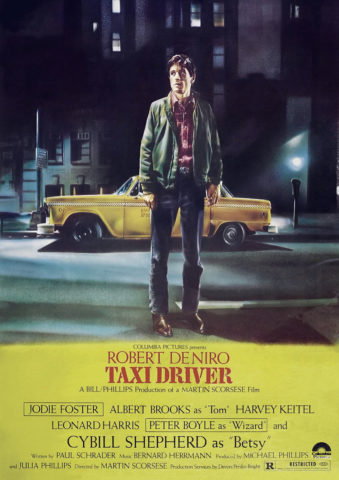
Saturday Matinee: Taxi Driver

By Roger Ebert

Source: RogerEbert.com

Are you talkin’ to me? Well, I’m the only one here. –Travis Bickle in “Taxi Driver”

It is the last line, “Well, I’m the only one here,” that never gets quoted. It is the truest line in the film. Travis Bickle exists in “Taxi Driver” as a character with a desperate need to make some kind of contact somehow–to share or mimic the effortless social interaction he sees all around him, but does not participate in.

The film can be seen as a series of his failed attempts to connect, every one of them hopelessly wrong. He asks a girl out on a date, and takes her to a porno movie. He sucks up to a political candidate, and ends by alarming him. He tries to make small talk with a Secret Service agent. He wants to befriend a child prostitute, but scares her away. He is so lonely that when he asks, “Who you talkin’ to?” he is addressing himself in a mirror.

This utter aloneness is at the center of “Taxi Driver,” one of the best and most powerful of all films, and perhaps it is why so many people connect with it even though Travis Bickle would seem to be the most alienating of movie heroes. We have all felt as alone as Travis. Most of us are better at dealing with it.

Martin Scorsese’s 1976 film (re-released in theaters and on video in 1996 in a restored color print, with a stereophonic version of the Bernard Herrmann score) is a film that does not grow dated, or over-familiar. I have seen it dozens of times. Every time I see it, it works; I am drawn into Travis’ underworld of alienation, loneliness, haplessness and anger.

It is a widely known item of cinematic lore that Paul Schrader’s screenplay for “Taxi Driver” was inspired by “The Searchers,” John Ford’s 1956 film. In both films, the heroes grow obsessed with “rescuing” women who may not, in fact, want to be rescued. They are like the proverbial Boy Scout who helps the little old lady across the street whether or not she wants to go.

“The Searchers” has Civil War veteran John Wayne devoting years of his life to the search for his young niece Debbie (Natalie Wood), who has been kidnapped by Commanches. The thought of Debbie in the arms of an Indian grinds away at him. When he finally finds her, she tells him the Indians are her people now, and runs away. Wayne then plans to kill the girl, for the crime of having become a “squaw.” But at the end, finally capturing her, he lifts her up (in a famous shot) and says, “Let’s go home, Debbie.”

The dynamic here is that Wayne has forgiven his niece, after having participated in the killing of the people who, for 15 years or so, had been her family. As the movie ends, the niece is reunited with her surviving biological family, and the last shot shows Wayne silhouetted in a doorway, drawn once again to the wide open spaces. There is, significantly, no scene showing us how the niece feels about what has happened to her.

In “Taxi Driver,” Travis Bickle also is a war veteran, horribly scarred in Vietnam. He encounters a 12-year-old prostitute named Iris (Jodie Foster), controlled by a pimp named Sport (Harvey Keitel). Sport wears an Indian headband. Travis determines to “rescue” Iris, and does so, in a bloodbath that is unsurpassed even in the films of Scorsese. A letter and clippings from the Steensmas, Iris’ parents, thank him for saving their girl. But a crucial earlier scene between Iris and Sport suggests that she was content to be with him, and the reasons why she ran away from home are not explored.

The buried message of both films is that an alienated man, unable to establish normal relationships, becomes a loner and wanderer, and assigns himself to rescue an innocent young girl from a life that offends his prejudices. In “Taxi Driver,” this central story is surrounded by many smaller ones, all building to the same theme. The story takes place during a political campaign, and Travis twice finds himself with the candidate, Palatine, in his cab. He goes through the motions of ingratiating flattery, but we, and Palatine, sense something wrong.

Shortly after that Travis tries to “free” one of Palatine’s campaign workers, a blonde he has idealized (Cybill Shepherd), from the Palatine campaign. That goes wrong with the goofy idea of a date at a porno movie. And then, after the fearsome rehearsal in the mirror, he becomes a walking arsenal and goes to assassinate Palatine. The Palatine scenes are like dress rehearsals for the ending of the film. With both Betsy and Iris, he has a friendly conversation in a coffee shop, followed by an aborted “date,” followed by attacks on the men he perceived as controlling them; he tries unsuccessfully to assassinate Palatine, and then goes gunning for Sport.

There are undercurrents in the film that you can sense without quite putting your finger on them. Travis’ implied feelings about blacks, for example, which emerge in two long shots in a taxi driver’s hangout, when he exchanges looks with a man who may be a drug dealer. His ambivalent feelings about sex (he lives in a world of pornography, but the sexual activity he observes in the city fills him with loathing). His hatred for the city, inhabited by “scum.” His preference for working at night, and the way Scorsese’s cinematographer, Michael Chapman, makes the yellow cab into a vessel by which Travis journeys the underworld, as steam escapes from vents in the streets, and the cab splashes through water from hydrants–a Stygian passage.

The film has a certain stylistic resonance with “Mean Streets” (1973), the first Scorsese film in which Keitel and De Niro worked together. In the earlier film Scorsese uses varying speeds of slow-motion to suggest a level of heightened observation on the part of his characters, and here that technique is developed even more dramatically; as the taxi drives through Manhattan’s streets, we see it in ordinary time, but Travis’ point-of-view shots are slowed down: He sees hookers and pimps on the sidewalks, and his heightened awareness is made acute through slow motion.

The technique of slow motion is familiar to audiences, who usually see it in romantic scenes, or scenes in which regret and melancholy are expressed–or sometimes in scenes where a catastrophe looms, and cannot be avoided. But Scorsese was finding a personal use for it, a way to suggest a subjective state in a POV shot. And in scenes in a cab driver’s diner, he uses closeups of observed details to show how Travis’s attention is apart from the conversation, is zeroing in on a black who might be a pimp. One of the hardest things for a director to do is to suggest a character’s interior state without using dialog; one of Scorsese’s greatest achievements in “Taxi Driver” is to take us inside Travis Bickle’s point of view.

There are other links between “Mean Streets” and “Taxi Driver” that may go unnoticed. One is the “priest’s-eye-view” often used in overhead shots, which Scorsese has said are intended to reflect the priest looking down at the implements of the Mass on the altar. We see, through Travis’ eyes, the top of a taxi dispatcher’s desk, candy on a movie counter, guns on a bed, and finally, with the camera apparently seeing through the ceiling, an overhead shot of the massacre in the red-light building. This is, if you will, the final sacrifice of the Mass. And it was in “Mean Streets” that Keitel repeatedly put his finger in the flame of a candle or a match, testing the fires of hell: here De Niro’s taxi driver holds his fist above a gas flame.

There has been much discussion about the ending, in which we see newspaper clippings about Travis’ “heroism,” and then Betsy gets into his cab and seems to give him admiration instead of her earlier disgust. Is this a fantasy scene? Did Travis survive the shoot-out? Are we experiencing his dying thoughts? Can the sequence be accepted as literally true?

I am not sure there can be an answer to these questions. The end sequence plays like music, not drama: It completes the story on an emotional, not a literal, level. We end not on carnage but on redemption, which is the goal of so many of Scorsese’s characters. They despise themselves, they live in sin, they occupy mean streets, but they want to be forgiven and admired. Whether Travis gains that status in reality or only in his mind is not the point; throughout the film, his mental state has shaped his reality, and at last, in some way, it has brought him a kind of peace.


Watch the full film for free here.

Cyber Forces Manipulate Public Opinion

By Vladimir Platov

Source: New Eastern Outlook

The influence on public opinion is one of the primary functions of the information space, presented today not only by TV, radio and print media, but also by the Internet and social networks. Therefore, it isn’t surprising that the CIA is especially focused on obtaining control of the information field and seeks ways to influence it. Thus, in the middle of the last century, the agency began a large-scale secret operation named Mockingbird on the territory of the U.S. and abroad. Most of the documents related to said operation are still classified. The purpose of Operation Mockingbird was to secure the CIA’s control over the media and the information space in America and beyond by establishing an extensive network of agents in leading publications, news outlets, radio and television all around the world.

After numerous pieces of evidence of illegal CIA activities in the media, including those executed through Operation Mockingbird, a special working group called the Church Committee (named after Senator Frank Forrester Church III, a Democrat from Idaho) was established in 1975 in the U.S. Senate. The Commission was later transformed into the Senate’s Select Committee on Intelligence.

In 1976, the Committee even prepared a separate report detailing the CIA’s interference into the U.S. and foreign media in order to misinform the public. In particular, the report notes: “The CIA currently maintains a network of several hundred foreign individuals around the world who provide intelligence for the CIA and at times attempt to influence opinion through the use of covert propaganda. These individuals provide the CIA with direct access to a large number of newspapers and periodicals, scores of press services and news agencies, radio and television stations, commercial hook publishers, and other foreign media outlets.”

After investigations and hearings held by the U.S. Congress, it was decided to forbid the CIA to continue Operation Mockingbird. In 1976, George W. Bush, appointed director of the CIA, even announced the following new policy: “Effective immediately, the CIA will not enter into any paid or contractual relationship with any full‑time or part‑time news correspondent accredited by any U.S. news service, newspaper, periodical, radio or television network or station.” However, he added that the CIA will continue to ‘value’ voluntary cooperation with journalists, which is obviously always influenced by money.

Many experts are convinced that Operation Mockingbird has not been completely terminated and is being carried out not only through traditional media, but also in the cyberspace. The operation’s main targets in its current form are all those who speak against the policy of the White House. From here arise numerous anti-Russian and xenophobic campaigns of the U.S. special services, which preserve the CIA’s traditions of working not only with journalists, but also with social networks controlled by Washington.

A large-scale research “The Global Disinformation Order 2019: Global Inventory of Organised Social Media Manipulation” was carried out recently by Oxford University. It focuses on the ways public opinion is swayed by via the Internet and social networks. In the resulting report, the researchers showed that the number of countries where attempts of organized manipulation of public opinion with the help of social networks were detected has more than doubled since 2017. The authors registered 28 such countries back then, and the number went up to 48, then 70 in 2018 and 2019 respectively. 25 countries cooperate with private Internet companies to disseminate propaganda on the Internet.  The most popular among them is Facebook, and the second most popular platform for attempts at manipulation is Twitter. At the same time, the researchers found that 56 countries, in one way or another, have organized campaigns to misinform users of social networks. The leading perpetrators are the United States and the United Kingdom.

Today many countries possess special cyber forces, whose representatives use social networks to try and influence the opinion of Internet users from certain countries, different religions and political beliefs. Special attention is paid to such efforts in the Pentagon and American security services. Only Americans (ideally those who know the language of the country being manipulated) are involved in these activities. The CIA’s website even has a detailed description of the people who can apply for such jobs. In order to further impact the public, today the FBI is even trying to recruit Russians living in the United States through social networks (in particular, Facebook), as reported by CNN.

Anti-Russian sentiment of the main direction of Operation Mockingbird is evidenced by several media outlets which are independent from Washington. The same goals are pursued today by U.S. intelligence agencies. “The U.S. State Department considers the battle against state-run media from Russia, Iran and China one of its top priorities,” said Acting U.S. Deputy Secretary of State Heather Nauert in March 2018. That is why the U.S. budget for fiscal year 2019 includes $661 million meant to finance the BBG (Broadcasting Board of Governors), which is engaged in anti-Russian propaganda. The White House project for the budget of the U.S. government in 2021 entails the allocation of $700 million for the information war ‘against Russia’s destructive influence.’

Britain is not behind the United States in waging a hybrid war. A special unit in the British cyber forces is called JTRIG, and it is this unit’s ‘specialists’ who quite often carry out propagandistic cyber operations, which have recently most often been directed against Russia. Among these are the anti-Russian fuss around Skripal poisoning, groundless accusations of Russia’s alleged involvement in the crash of the Malaysian plane MH-17 over Donetsk, and accusations of Moscow’s aggressive actions in Syria. Such work is done using both the cyberspace, as well as media which are loyal to London. The 77th brigade of these troops is working specifically on Twitter. They actively attempt to undermine the users’ faith in their own beliefs, trying to convey ‘their thoughts’ by appealing to emotions. Further promotion of the propagandistic struggle against Russia, £18 million is going to be spent by the British government on ‘counteraction’ in Eastern Europe and on strengthening the ‘independent media’ in the Western Balkans. This was reported by the press service of the British Foreign Office.

NATO also has a cyber force, which includes over 13,000 military personnel. The organization is called CCDCEO and is located in Tallinn.

Governments have long used propaganda, but digital tools have made it more complex and effective. Over the past few years, intelligence agencies have mirrored the experience of activists in using social media to disseminate information and are now actively using these methods. Additionally, interactive tools, such as data analysis software, allow for adapting cyber warfare to be more effective against certain groups of people, maximizing its impact.

The Covid-19 Dominoes Fall: The World Is Insolvent

By Charles Hugh Smith

Source: Of Two Minds

Subtract their immense debts and they have negative net worth, and therefore the market value of their stock is zero.

To understand why the financial dominoes toppled by the Covid-19 pandemic lead to global insolvency, let’s start with a household example. The point of this exercise is to distinguish between the market value of assets and net worth, which is what’s left after debts are subtracted from the market value of assets.

Let’s say the household has done very well for itself and owns assets worth $1 million: a home, a family business, 401K retirement accounts and a portfolio of stocks and other investments.

The household also has $500,000 in debts: home mortgage, auto loans, student loans and credit card balances.

The household net worth is thus $1,000,000 minus $500,000 = $500,000.

Let’s say a typical financial crisis and recession occur, and the household’s assets fall 30%. 30% of $1 million is $300,000, so the the market value of the household’s assets falls to $700,000.

Deduct the $500,000 in debts and the household’s net worth has fallen to $200,000. The point here is debts remain regardless of what happens to the market value of assets owned by the household.

Then the speculative asset bubbles re-inflate, and the household takes on more debt in the euphoric expansion of confidence to buy a larger house, expand the family business and enjoy life more.

Now the household assets are worth $2 million, but debt has risen to $1.5 million. Net worth remains at $500,000, since debt has risen along with asset values.

Alas, all bubbles pop, and the market value of the household assets decline by 30%, or $600,000. Now the household assets are worth $2,000,000 minus $600,000 or $1,400,000. The household net worth is now $1,400,000 minus $1,500,000 or negative $100,000. the household is insolvent.

On top of that, the net income of the family business plummets to near-zero in the recession, leaving insufficient income to pay all the debts the household has taken on.

This is an exact analog for the entire global economy, which pre-pandemic had assets with a market value of $350 trillion and debts of $255 trillion and thus a net worth of around $100 trillion.

The $11 trillion that has evaporated in the market value of U.S. stocks is only a taste of the losses in market value. Global stock markets has lost $30 trillion, and once yields rise despite central bank manipulations (oops, I mean intervention), $30 trillion in the market value of bonds will vanish into thin air.

The market value of junk bonds has already plummeted by trillions, and that’s not even counting the trillions lost in small business equity, shadow banking and a host of other non-tradable assets.

Then there’s the most massive asset bubble of all, real estate. Millions of properties delusional owners still think are worth $1.4 million will soon revert to a more reality-based valuation around $400,000, or perhaps even less, meaning $1 million per property will melt into air.

Once the market value of global assets falls by $100 trillion, the world is insolvent.

Everyone expecting the financial markets to magically return to January 2020 levels once the pandemic dies down is delusional. All the dominoes of crashing market valuations, crashing incomes, crashing profits and soaring defaults will take down all the fantasy-based valuations of bubblicious assets: stocks, bonds, real estate, bat guano, you name it. (Actually, bat guano will be the keeper of all the asset classes listed.)

The global financial system has already lost $100 trillion in market value, and therefore it’s already insolvent. The only question remaining is how insolvent?

Here’s a hint: companies whose shares were recently worth $500 or $300 will be worth $10 or $20 when this is over. Bonds that were supposedly “safe” will lose 50% of their market value. Real estate will be lucky to retain 40% of its current value. And so on.

As net worth crashes below zero, debts remain. The loans must still be serviced or paid off, and if the borrowers default, then the losses must be absorbed by the lenders or taxpayers, if we get a repeat of 2008 and the insolvent taxpayers are forced to bail out the insolvent financial elites.

Here’s the S&P 500. Where is the bottom? There is no bottom, but nobody dares say this. Companies with negative profits have no value other than the cash on hand and the near-zero auction value of other assets. Subtract their immense debts and they have negative net worth, and therefore the market value of their stock is zero.

Welcome to the New Communist Police State, blamed on a virus

By Scott Baker

Source: OpEdNews.com

The draconian measures being taken or certainly being talked about – food rationing?!– will end up killing more people than the virus.

How many elderly will die because their caregivers can’t get to them (bye bye meals on wheels)? How many people already on special diets won’t be able to maintain them and get sick as a result? (Me, I eat mostly fresh, unboxed/uncanned food, devoid of extra salt and sugar, instead of the cheap crap that only governments will pay for).

People will die from this too.

Think you can can substitute daily school lunches for actual school and not have the same infection rate? Forget it. It’ll slow it down for a couple of weeks at most. And in New York City, 74% of the children in public school are poor. Without school lunch they go hungry. With school lunch, and then a return to home, their parents – or parent, singular, since many come from single parent households – can’t work, they can’t staff our hospitals, clean our streets, or do any of the hundred things the Departments of Health say are necessary to contain the virus.

People will die from this too.

I’m not usually paranoid, but this seems to be a way of trapping people into a police state. Oh, and yeah, what happens to the actual police who have to enforce this regime of deprivation? Will they use force when someone wants to go for a jog? If they injure someone, who will treat them in the over-crowded hospitals? Supposedly, exercise is fine, but what if you want to go jogging or biking in a group? I am scheduled to lead a 50-person bike group around New York City the end of April. Is that against the laws now? Wait…what law? Expect court challenges…wait, what courts? They are all working remotely or not at all. Our Civil Rights are already gone but we just don’t know it yet. Where is the ACLU? They are silent. Rights for LGBT, for voting…wait, long lines at polling stations. That’s already forbidden. Ohio postponed its primary for today. A half dozen other states did as well.

And recessions kill. You can’t pay your bills. Evictions and utility shutoffs are supposedly illegal in our new communist state, but what happens when the landlord or utility can’t pay its bills? Yes I know, record profits for utilities in the last few years. But that went into buybacks. That wasn’t against the law and still isn’t. It SHOULD be but it wasn’t. And corporations are deep in debt now, and bankruptcies will follow in a week or so; it’s that close. The economy is being unraveled and government can’t, or won’t, even pass the first of dozens of mitigating bills in the New Communism. The New Communism includes tax breaks and bailouts for the largest corporations though, $850 billion worth, so the Administration has learned nothing. Worse, actually, the centerpiece of the proposal is to eliminate the payroll tax, which will save corporations many millions, might trickle down to the employee, unless the corporations pocket the extra, and won’t help those out of a job or working for tips at all. Even worse, it will gut Social Security and Medicare, already due to start running out of money in a few years, even during Trump’s next term – and yes, he will get another term unless Biden or Sanders can distinguish themselves by what they will do differently, AND we have a recession. But, getting back to Social Security and Medicare; Trump has already said he wants to rein in the costs (read: gut or eliminate the programs millions depend upon to survive). Trump wants a permanent underclass, not entitled to any entitlements, even those it earned. He wants the free-to-be-corrupt market to provide for your old age or illness, or to let you die if you don’t plan 40 years ahead, or anticipate cancer.

This is permanent. We are giving up our rights supposedly temporarily. But that’s what was said after 9/11, and we still have the Patriot Act and a permanent war footing. BTW, presidential candidate Tulsi Gabbard wants a $1,000/month guaranteed income for everyone. That would be much more in keeping with our Civil Rights and much more fair. But no one is listening to her in the MSM or debates,where she is excluded.

This is permanent. This will kill more people than the virus ever would.

So, again, more people will die from the measures to contain the virus – which will ultimately fail anyway – than from the virus itself.

Of Course Billionaires Shouldn’t Exist

By HipCrime Vocab

There’s apparently a row over whether billionaires should exist. That is, whether or not billionaires should be a thing in our society.

What a stupid question. Of course billionaires shouldn’t exist! But the reason has nothing to do with Socialism.

Rather, under a properly-functioning free-market capitalist system, billionaires shouldn’t exist. And that would have also been the opinion of the “Classical Liberals” so favored by the Right these days: Adam Smith, David Ricardo. Thomas Malthus, John Stuart Mill, and so on.

Billionaires are a sign of market failure.

Let me say that again: billionaires are a form of market failure! You cannot simultaneously be both pro-Market and pro-billionaire.

I’m amazed at how few people get this!

In a truly competitive market, excess profits would be competed away. Someone would come along and undercut outsize profits. That’s exactly how the Classical Liberals assumed free markets would work. In this, they saw markets as instruments of greater equality, not inequality, and certainly not as a way to construct a new and improved aristocracy even more powerful than the old one.

The Classical Liberals wrote in opposition to the main power centers of their day: aristocratic government and chartered monopolies like the East India Company. They didn’t see the purpose of their writings as defending privilege and power. One can dispute the end results, but that was not their goal. Quite the contrary. The idea that a single, solitary individuals would possess more wealth than the kings and pharaohs of old under a functioning free market system would have been unthinkable to them.

In their time, much of the national wealth was monopolized by a landed aristocracy who gained their wealth through disproportionate ownership of the country’s productive land. The other major source of wealth came from large joint-stock companies that were granted royal monopolies due to their political connections. Yet another source of unearned wealth came from the holders of bonds (gilts)—essentially loaning money to the state and getting the government’s tax revenues funneled to them via interest payments.

Classical English Liberals felt that competitive markets would do away with a good portion of the unearned and unproductive wealth common in Great Britain at the time. They believed that “free and open” markets would channel wealth and activity to more productive ends. That is, they would break up large pools of wealth and unproductive money. The kind of obscene fortunes that they saw in their day would no longer be possible thanks to competition, they assumed, and that British society would become more equal than it was under landed aristocracy, not less. We can dispute their logic (and I have issues with it), but I think we can safely say that this is what they believed, rightly or wrongly.

An inherent part of their conception of free markets is the possibility of failure. Unproductive or inefficient businesses would be competed away, they assumed, and the fortunes earned through such activities would disappear. But that is not the case today. Billionaires have so much money they can literally never lose it! That’s not capitalism, that’s aristocracy. I read recently that someone like Bill Gates literally cannot give away money to his pet causes fast enough to reduce his fortune even if he tried. In fact, he’s grown wealthier even while giving away billions.

The important point about [Adam] Smith’s system, on the other hand, is that it precluded steep inequalities not out of a normative concern with equality but by virtue of the design that aimed to maximize wealth. Once we put the building blocks of his system together, concentration of wealth simply cannot emerge.

In Smith, profits should be low and labor wages high, legislation in favor of the worker is “always just and equitable,” land should be distributed widely and evenly, inheritance laws should partition fortunes, taxation can be high if it is equitable, and the science of the legislator is necessary to thwart rentiers and manipulators.

Political theorists and economists have highlighted some of these points, but the counterfactual “what would the distribution of wealth be if all the building blocks were ever in place?” has not been posed. Doing so encourages us to question why steep inequality is accepted as a fact, instead of a pathology that the market economy was not supposed to generate in the first place.

Contrary to popular and academic belief, Adam Smith did not accept inequality as a necessary trade-off for a more prosperous economy (LSE Blogs)

Yet today the people who call themselves the heirs to “Classical English Liberals” emphatically defend the existence of billionaires and extreme inequality at every turn. Such people are not pro-market or pro-capitalism as they like to portray themselves; they are simply pro-wealth, or—to use a less complementary term—bootlickers. They are not defending capitalism or Markets; what they really are defending is oligarchy, power, privilege, and hierarchy. As Corey Robin opined, “The priority of conservative political argument has been the maintenance of private regimes of power,” with all the soaring rhetoric about markets and freedom being just a smokescreen and a cover for defending hierarchies and power imbalances. Their defense of billionaires is proof positive of this. This is true of presidential candidates as well.

The existence of obscene fortunes and extreme inequality are not a sign of capitalism’s success; they are a sign of capitalism’s failure.

This is pointed out by Chris Dillow:

“I don’t think anyone in this country should be a billionaire” said Labour’s Lloyd Russell-Moyle yesterday, at which the BBC’s Emma Barnett took umbrage. The exchange is curious, because from one perspective it should be conservative supporters of a free market who don’t want there to be billionaires.

I say so because in a healthy market economy there should be almost no extremely wealthy people simply because profits should be bid away by competition. In the textbook case of perfect competition there are no super-normal profits, and in the more realistic case of Schumpeterian creative destruction, high profits should be competed away quickly.

From this perspective, every billionaire is a market failure – a sign that competition has failed. The Duke of Westminster is rich because there’s a monopoly of prime land in central London. Would Ineos’ Jim Ratcliffe be so rich if pollution were properly priced, or if his firm faced more competition?

The Right’s Mega-Rich Problem (Stumbling and Mumbling)

How is this rectified? How do they square their supposed love of fair competition and free and open markets with the presence of outsize fortunes?

They don’t.

And the sad thing is how many people buy into their nonsense. Everyone seems to think that a defense of billionaires is a defense of capitalism.

It’s not. It’s the opposite.

What is a billionaire?

Billionaires are only made possible through monopolies and tollbooths. Period. And such monopolies are more possible than ever before thanks to technology.

This is argued by Matt Stoller, an expert on monopolies, in a post entitled, What Is A Billionaire?:

Most people think a billionaire is someone with a lot of money, a sort of Scrooge McDuck who goes swimming in a pool of gold coins. And why wouldn’t we? The name billionaire has the word billion contained within it, so clearly it means having a net worth of at least ten figures. And in a sense, that is technically true. But if you look at the top ranks of the Bloomberg billionaire index, you’ll notice that nearly all of the leaders are people who own a corporation with substantial amounts of market power in one or more markets.

Billionaires use market power to extract revenue the way that a tollbooth operator does.
 If you want to drive on a road, you have to pay for the privilege. It costs the tollbooth operator nothing, he/she just has a strategic chokepoint for extraction. Billionaire Warren Buffett, for instance, has such a ‘tollbooth’ strategy for investing, though he uses the term ‘moat’ because it sounds charming and quirky rather than rapacious.

Put another way, the Bloomberg billionaire index isn’t a list of the most important Scrooge McDuck’s, it’s a list of the biggest tollbooth operators in the world.

What he’s saying is that one becomes a billionaire only by short-circuiting the competitive market economy. Then their profits cannot be competed away. Only by gaming the system can one “earn” over a billion dollars. No one person is that valuable.

Stoller goes on to elucidate the operational tactics used by both Bill Gates and by his predecessor John D. Rockefeller, and finds that even though the industries are radically different, the techniques of short-circuiting and circumventing market competition are the same. Whether it’s horizontal and vertical integration, or using market influence to price out rivals, or exclusive contracts, the techniques are the same regardless of industry or time period:

In 1976 and 1980, Congress allowed the copyrighting of software. IBM had been under aggressive antitrust investigation and litigation since 1967, so when it built a personal computer, it outsourced the operating system – MS-DOS – to Gates’s company and allowed Gates to license it to other equipment makers. (Gates’s upbringing didn’t hurt; the CEO of IBM at the the time knew his mother.) Such a relationship with a vendor was a shocking change for IBM, which had traditionally made everything in-house or tightly controlled its suppliers. But IBM treated Microsoft differently, transferring large amounts of programming knowledge to the small corporation. IBM also did this with the microprocessor company Intel, which IBM protected from Japanese competition.

And yet, in 1982, the Department of Justice dropped the antitrust suit against IBM, signaling a new pro-concentration framework. Bill Baxter, Reagan’s antitrust chief, did not want to bring monopolization suits, and did not. The new fast-growing technology space of personal computers would be a monopolized industry. But it would not be monopolized by IBM, which had kept control of the computing industry since the 1950s, because IBM’s corporate structure was now skittish about the raw use of power. And it would not be monopolized by AT&T, which was kept out of the computing industry by a 1956 consent decree that lasted until 1984. Gates, in many ways, had a greenfield, an environment friendly to monopoly but one in which all the old monopolists had been cleared out by antitrust actions.

In the case of Amazon, even though it theoretically has competition, through vertical and horizontal integration it can effectively control online e-commerce to a large degree. The result is a fortune greater than that of entire nation-states controlled by a single individual. One hardly imagines that Adam Smith would approve.

I read an interesting concept, and I forget where it came from. It was that networks are natural monopolies. This explains things like Facebook, Apple, Amazon, etc. It’s entirely possible that the online world, due to features inherent in the technology, simply cannot be regulated by normal competition the way the market for goods and services can. Yet all our theories pretend that it can. It’s delusional.

Under these scenarios,’ profits’ are really a form of tribute (or perhaps plunder). In fact, we really shouldn’t even use the word ‘profits’ to describe them (just like we shouldn’t use ‘trade’ to describe global wage arbitrage).

And there are many more examples of competition being limited by deliberate legal policy. Much of Microsoft’s profits come from the fact that other people can’t copy their software—which they’ve arbitrarily labeled “piracy”—without facing legal repercussions enforced by the state and its legal system. In that sense, outsized fortunes are a consequence of laws, and not a feature inherent to technology:

…inequality is not in fact driven by technology, it is driven by our policy on technology, specifically patent and copyright monopolies. These forms of protection do not stem from the technology, they are policies created by a Congress which is disproportionately controlled by billionaires.

If the importance of these government granted monopolies is not clear, ask yourself how rich Bill Gates would be if any start-up computer manufacturer could produce millions of computers with Windows and other Microsoft software and not send the company a penny. The same story holds true with most other types of technology. The billionaires get rich from it, not because of the technology but because the government will arrest people who use it without the patent or copyright holder’s permission.

This point is central to the debate on the value of billionaires. If we could get the same or better technological progress without making some people ridiculously rich, then we certainly don’t need billionaires. But in any discussion of the merits of billionaires, it is important to understand that they got their wealth because we wrote rules that allowed it. Their immense wealth was not a natural result of the development of technology.

Farhad Manjoo promotes billionaire ideology in proposal to get rid of billionaires (Dean Baker, Real World Economic Review)

Baker has also pointed out that outsized salaries in many fields are determined by limiting competition though things like wildly expensive education and licensing requirements, which are ultimately determined by the government. Doctors and lawyers do not have compete against the wage rates in India or China thanks to the legal system, for example. Everyone else, however, is required to compete against the entire world for jobs.

On a global level, most billionaires are not the result of “hard work” or doing things beneficial for their society:

The vast majority of the world’s billionaires have not become rich through anything approaching ‘productive’ investment. Oxfam has showed that, approximately one third of global billionaire wealth comes from inheritance, whilst another third comes from ‘crony connections to government and monopoly’.

Why on Earth Shouldn’t People Be Able to Be Billionaires? (Novara Media)

And the monopolies that allow billionaires to exist are not good for the economy as a whole. In fact, they are highly detrimental, as Chris Dillow further points out:

What’s more, monopoly pricing is a form of tax – a tax which often falls upon other, smaller businesses…In this sense, not only are billionaires a symptom of an absence of a healthy competitive economy, but they are also a cause of it: their taxes on other firms restrict growth and entrepreneurship…

Tories are wrong, therefore, to portray attacks on the mega-rich as the politics of envy. It’s not. The existence of billionaires is a sign and cause of a dysfunctional economy…

In fact, logically, it is rightists who should be most concerned by the concentration of wealth. We lefties can point to it as evidence that the system is rigged. But Tories should worry that it undermines the legitimacy of the existing order not only because people don’t like inequality, but because it slows down economic growth and so encourages demands for change.

Furthermore, their existence is detrimental politically:

Controlling society’s wealth effectively gives the wealthy the right to plan economic activity. Billionaires – and the people who manage their money – determine which governments can access borrowing, which companies deserve to grow, and which ideas should be researched. This gives them an immense amount of political, as well as economic, power – allowing billionaires to provide favours to those politicians who helped them get rich in the first place.

Ultimately, the monopolisation of society’s resources by a tiny, closed-off elite means that most of society’s resources are used for dirty, unsustainable and unproductive speculation.

Why on Earth Shouldn’t People Be Able to Be Billionaires? (Novara Media)

In fact, the proliferation of billionaires in the developed world has accompanied a period of slow growth and stagnation, not rapid growth. As has been pointed out ad nauseum, yet still fails to sink in, America’s fastest period of growth came when there were fewer billionaires and tax rates ranged from 50 to 90 percent. There is no evidence that the proliferation of billionaires has benefited society as whole. And now, billionaires are attempting to buy political offices outright, making a joke of democracy.

People defending billionaires are only defending raw power, not capitalism, not democracy, and certainly not free markets.

Stoller concludes:

[Billionaires] are not people with a bunch of dollar bills stacked to the moon, they are (largely) men with a strategic position of power protected by public laws and rules. They aren’t better or smarter than anyone else, they are simply politically adept and in the right place at the right time. There’s no reason we have to enable such people to run our culture. At the end of the day, tollbooths are nothing but bottlenecks on a road on which we would otherwise travel faster and more freely.

What is a Billionaire? (Matt Stoller)

So, should there be billionaires? The answer is no. And you should believe that if you consider yourself a libertarian free marketeer or a democratic socialist. Anyone asserting anything else is just a bootlicker or a toady.

Addendum:

Here’s a good piece explaining how billionaires are basically mad kings:

…one of civilization’s great challenges stems from millionaire rhyming with billionaire. In holding them in the same linguistic corner of our minds, we conflate them, yet they’re so mathematically distinct as to be unrelated. A millionaire can, with some dedicated carelessness, lose those millions. Billionaires can be as profligate and eccentric as they wish, can acquire, without making a dent, all the homes and jets and islands and causes and thoroughbreds and Van Goghs and submarines and weird Beatles memorabilia they please. Unless they’re engaging in fraud or making extremely large and risky investments, they’re simply no match for the mathematical and economic forces—the compounding of interest, the long-term imperatives of markets—that make money beget more money. They can do pretty much whatever they want in this life, and therein lies the distinction. A millionaire enjoys a profoundly lucky economic condition. A billionaire is an existential state.

This helps explain the cosmic reverence draped over so many billionaires, their most banal notions about innovation and vision repackaged as inspirational memes, their insights on markets and customers spun into best sellers. Their extravagances are so over the top as to inspire legend more often than revolution…

The Gospel of Wealth According to Marc Benioff (Wired)

One of the most potent demonstrations that the modern-day rich are mad kings, comes form the story of Adam Neumann of WeWork. This is the impression I got from the Behind the Bastards podcast on Neumann: The Idiot Who Made, and Destoryed, WeWork (Podtail)

US Intel Agencies Played Unsettling Role in Classified and “9/11-like” Coronavirus Response Plan

Medical personnel arrive to perform COVID-19 coronavirus infection testing procedures at Glen Island Park, Friday, March 13, 2020, in New Rochelle, N.Y. (AP Photo/John Minchillo)

As coronavirus panic grips the world, concern over government overreach is growing given the involvement of US intelligence agencies in classified meetings for planning the U.S.’ coronavirus response.

By Whitney Webb

Source: Mint Press News

As the COVID-19 coronavirus crisis comes to dominate headlines, little media attention has been given to the federal government’s decision to classify top-level meetings on domestic coronavirus response and lean heavily “behind the scenes” on U.S. intelligence and the Pentagon in planning for an allegedly imminent explosion of cases.

The classification of coronavirus planning meetings was first covered by Reuters, which noted that the decision to classify was “an unusual step that has restricted information and hampered the U.S. government’s response to the contagion.” Reuters further noted that the Secretary of the Department of Health and Human Services (HHS), Alex Azar, and his chief of staff had “resisted” the classification order, which was made in mid-January by the National Security Council (NSC), led by Robert O’Brien — a longtime friend and colleague of his predecessor John Bolton.

Following this order, HHS officials with the appropriate security clearances held meetings on coronavirus response at the department’s Sensitive Compartmentalized Information Facility (SCIF), which are facilities “usually reserved for intelligence and military operations” and — in HHS’ case — for responses to “biowarfare or chemical attacks.” Several officials who spoke to Reuters noted that the classification decision prevented key experts from participating in meetings and slowed down the ability of HHS and the agencies it oversees, including the Centers for Disease Control and Prevention (CDC), to respond to the crisis by limiting participation and information sharing.

It has since been speculated that the decision was made to prevent potential leaks of information by stifling participation and that aspects of the planned response would cause controversy if made public, especially given that the decision to classify government meetings on coronavirus response negatively impacted HHS’ ability to respond to the crisis.

After the classification decision was made public, a subsequent report in Politico revealed that not only is the National Security Council managing the federal government’s overall response but that they are doing so in close coordination with the U.S. intelligence community and the U.S. military. It states specifically that “NSC officials have been coordinating behind the scenes with the intelligence and defense communities to gauge the threat and prepare for the possibility that the U.S. government will have to respond to much bigger numbers—and soon.”

Little attention was given to the fact that the response to this apparently imminent jump in cases was being coordinated largely between elements of the national security state (i.e. the NSC, Pentagon, and intelligence), as opposed to civilian agencies or those focused on public health issues, and in a classified manner.

The Politico article also noted that the intelligence community is set to play a “key role” in a pandemic situation, but did not specify what the role would specifically entail. However, it did note that intelligence agencies would “almost certainly see an opportunity to exploit the crisis” given that international “epicenters of coronavirus [are] in high-priority counterintelligence targets like China and Iran.” It further added, citing former intelligence officials, that efforts would be made to recruit new human sources in those countries.

Politico cited the official explanation for intelligence’s interest in “exploiting the crisis” as merely being aimed at determining accurate statistics of coronavirus cases in “closed societies,” i.e. nations that do not readily cooperate or share intelligence with the U.S. government. Yet, Politico fails to note that Iran has long been targeted for CIA-driven U.S. regime change, specifically under the Trump administration, and that China had been fingered as the top threat to U.S. global hegemony by military officials well before the coronavirus outbreak.


A potential  “9/11-like” response

The decision to classify government coronavirus preparations in mid-January, followed by the decision to coordinate the domestic response with the military and with intelligence deserves considerable scrutiny, particularly given that at least one federal agency, Customs and Border Patrol (CBP), will be given broad, sweeping powers and will work closely with unspecified intelligence “partners” as part of its response to a pandemics like COVID-19.

The CBP’s pandemic response document, obtained by The Nation, reveals that the CBP’s pandemic directive “allows the agency to actively surveil and detain individuals suspected of carrying the illness indefinitely.” The Nation further notes that the plan was drafted during the George W. Bush administration, but is the agency’s most recent pandemic response plan and remains in effect.

Though only CBP’s pandemic response plan has now been made public, those of other agencies are likely to be similar, particularly on their emphasis on surveillance, given past precedent following the September 11 attacks and other times of national panic. Notably, several recent media reports have likened coronavirus to 9/11 and broached the possibility of a “9/11-like” response to coronavirus, suggestions that should concern critics of the post-9/11 “Patriot Act” and other controversial laws, executive orders and policies that followed.

While the plans of the federal government remain classified, recent reports have revealed that the military and intelligence communities — now working with the NSC to develop the government’s coronavirus response — have anticipated a massive explosion in cases for weeks. U.S. military intelligence came to the conclusion over a month ago that coronavirus cases would reach “pandemic proportions” domestically by the end of March. That military intelligence agency, known as the National Center for Medical Intelligence (NCMI), coordinates closely with the National Security Agency (NSA) to conduct “medical SIGINT [signals intelligence].”

The coming government response, the agencies largely responsible for crafting it and its classified nature deserve public scrutiny now, particularly given the federal government’s tendency to not let “a serious crisis to go to waste,” as former President Obama’s then-chief of staff Rahm Emanuel infamously said during the 2008 financial crisis. Indeed, during a time of panic — over a pandemic and over a simultaneous major economic downturn — concern over government overreach is warranted, particularly now given the involvement of intelligence agencies and the classification of planning for an explosion of domestic cases that the government believes is only weeks away.