Jeff Bezos Embodies the Cruel Autocracy of Neoliberal Capitalism

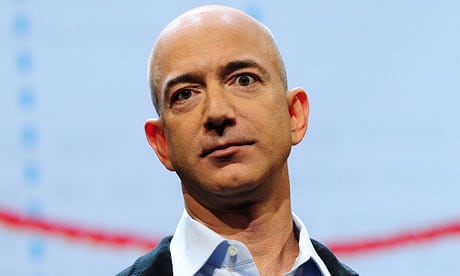
Amazon CEO and richest-man-in-the-world Jeff Bezos wants you to work as much as he does—for one millionth of the pay

By Branko Marcetic

Source: In These Times

“Is Jeff Bezos a horrible boss and is that good?” That was the question posed by Forbes magazine in 2013, a sentiment that helps explain why Amazon’s founder and CEO is detested by the Left for his oligarchic ambitions, while simultaneously admired by America’s capitalist class for his business success. Ironically, Bezos is also loathed by former President Donald Trump, while celebrated by many liberals for so-called resistance.

But with Bezos and his $115 billion fortune laying claim to the title of richest man on Earth, and with Amazon playing an increasingly influential role in public life, it is worth asking: What does Jeff Bezos stand for?

A gifted child born to a teen mom, Bezos grew up not knowing his biological father, who was once one of the top-rated unicyclists in Albuquerque, N.M. Instead, Bezos was raised by the man his mother soon married: Miguel Bezos, who had fled Cuba and the Communist revolution, which had shuttered the elite private Jesuit school he attended, as well as his family’s lumberyard.

Journalists have speculated whether Bezos’ near-pathological competitiveness is a product of his early abandonment, similar to that of fellow tech overlord Steve Jobs. No doubt equally formative was Bezos’ adoptive father, who told Brad Stone, author of The Everything Store: Jeff Bezos and the Age of Amazon, that their home life was ​“permeated” by complaints about totalitarian governments of both the Right and the Left.

Bezos envisioned the concept of an ​“everything store” while working for a Wall Street hedge fund in the 1990s. He opened Amazon in 1994 as an online bookshop, a pragmatic starting point. Bezos gave the company his own $10,000 cash injection, took out interest-free loans, and received $245,000 from his parents and family trust.

Many of Amazon’s controversial labor practices can be traced to these early years as a plucky start-up. Amazon’s small team ran on tireless ambition to live up to the company’s customer-focused promise — key to its eventual market domination. Stone reports that, to meet Bezos’ ​“get big fast” directive, employees devoted themselves completely, working long, unusual, frenzied hours. One early warehouse worker who biked to work simply forgot about his improperly parked car, eventually discovering it had been ticketed, towed and sold at auction.

Such a relentless pace is one thing for a small group of true believers but is quite another when applied to low-wage workers just making ends meet. By 2011, Amazon’s workplace culture became known through a series of headline-grabbing reports that have come to define its public image: badly paid, ceaselessly surveilled, overworked workers, struggling to maintain a breakneck pace.

Bezos created a culture in which everyone from the lowest peon to the highest-ranking executive is expected to match his own devotion, an approach that resulted in spectacular levels of staff turnover by the early 2000s. A declared enemy of ​“social cohesion,” Bezos pushed his underlings to reject compromise and instead fiercely debate and criticize colleagues when they disagreed. One former employee described it as ​“purposeful Darwinism.” Known for withering put-downs — ​“Are you lazy or just incompetent?” ​“Did I take my stupid pills today?”—Bezos also isn’t above pulling out his phone or, in some cases, simply leaving the room when an employee fails to impress.

The flipside of Bezos’ intellect is a cold, clinical approach to human relations. Bezos described himself as a ​“professional dater” during his Wall Street days, trying to improve what he called his ​“women flow” — a riff on the Wall Street term ​“deal flow.”

“He was not warm,” one person who knew Bezos during his Wall Street days told the East Bay Express in 2014. ​“It was like he could be a Martian for all I knew.”

Bezos’ pitiless leadership style bled out beyond the Amazon boardroom as he used the company’s growing market share to bully book publishers into his terms. The company launched the ​“Gazelle Project”—as in, go after publishers ​“the way a cheetah would pursue a sickly gazelle” — allowing Amazon to undercut its competition at the cost of little to no profit for smaller publishers.

As Amazon inched closer to Bezos’ original vision, it began lobbying efforts in 2000 and became more transparently political by 2011, spending millions to defeat an internet sales tax and playing hardball with state governments, threatening to shutter Amazon facilities if its wishes went unfulfilled. In 2013, Amazon began lobbying Congress to cut corporate taxes.

The same year, Bezos bought the Washington Post, invested in Business Insider and donated to the publisher of the libertarian magazine Reason. Though Bezos argues his purchase of the Post was motivated by ​“a love affair [with] the printed word” and a desire to support American democracy, others suspect Bezos’ interest in media is related to bad press following a scathing Lehman Brothers report in 2000, which sent Amazon’s stock price tumbling.

Leading up to the Post purchase, Bezos was increasingly displaying what early Amazon investor Nick Hanauer called his ​“libertarian politics.” In addition to spending $100,000 in 2010 on a campaign to defeat a proposed Washington state tax on high-income earners, Bezos put hundreds of thousands of dollars toward boosting charter schools and other neoliberal education reforms.

Bezos’ political involvement reached a new apogee in 2019 during the re-election bid of Seattle’s socialist city councilwoman, Kshama Sawant, who called Bezos ​“our enemy” and tried to pass a head tax to fund housing for those displaced by Amazon’s Seattle footprint. Amazon spent $1.5 million against Sawant and other progressive candidates, a record at the local level, with more than a dozen of the company’s executives contributing to Sawant’s opponent. (Sawant won re-election anyway.)

As for Bezos’ endgame? A Trekkie since childhood, he has long dreamed of funding space exploration, a mission pursued by other superrich moguls (such as Elon Musk) in the face of the climate emergency. Opening the doors of his secretive Blue Origin aerospace company to journalists for the first time in 2016, Bezos told the New York Times he envisioned a future of ​“millions of people living and working in space,” exploiting the natural resources of surrounding planets and rezoning Earth ​“as light industrial and residential.”

Ironically, as Bezos pours the wealth he wrung out of exhausted, low-wage Amazon workers into space exploration, Amazon is busy hastening the very planetary collapse Bezos claims he’s trying to prevent — by silencing workers who speak out against Amazon’s assistance to oil and gas companies.

Let’s imagine, however, that Bezos, who accumulates $9 million an hour, lived in a world with Bernie Sanders’ 8% wealth tax (just on fortunes over $10 billion). A single year would see $9 billion flow from Bezos’ treasure trove into government coffers, more than enough to cover the 10-year cost of Elizabeth Warren’s universal child care plan ($1.7 billion) and maintain safe drinking water under Sanders’ plan ($6 billion).

Bezos’ career is a testament to the cruel autocracy and senseless misallocation of resources that our neoliberal capitalist system enables. But his opulence also reveals that the wealth exists to build a fairer and more equitable society — if redistributed. Bezos may loathe social cohesion, but in a world organized around democracy rather than the whims of space-billionaires, it’s something we may well be able to achieve.

What’s Changed and What Hasn’t in a Tumultuous Year

By Charles Hugh Smith

Source: Of Two Minds

Inequality is America’s Monster Id, and we’re continuing to fuel its future rampage daily.

What’s changed and what hasn’t in the past year? What hasn’t changed is easy:

1. Wealth / income inequality is still increasing. (see chart #1 below)

2. Wages / labor’s share of the economy is still plummeting as financial speculation’s share has soared. (see chart #2 below)

What’s changed is also obvious:

1. Money velocity has cratered. (see chart #3 below)

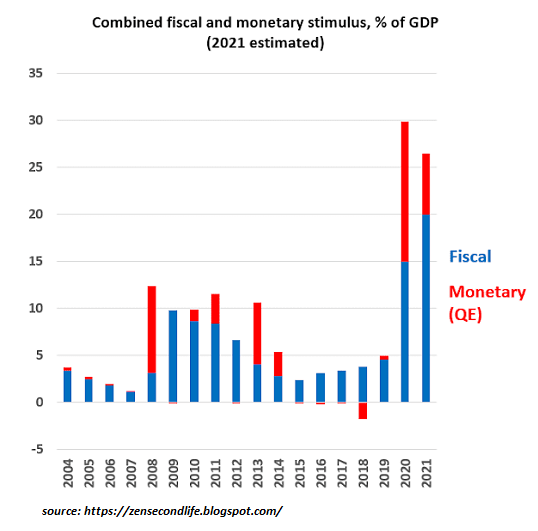
2. Federal borrowing / spending has skyrocketed, pushing federal debt to unprecedented levels. (see chart #4 below)

3. Speculation has reached the society-wide mania level. This is evidenced by record margin debt levels, record levels of financial assets compared to GDP and many other indicators. (see chart #5 below)

Interestingly, every one of historian Peter Turchin’s 3-point Political Stress Index is now checked. Recall that these are core drivers of consequential social disorder, the kind that leads to empires collapsing, the overthrow of ruling elites, social revolutions, etc.

1. Stagnating real wages (i.e. adjusted for real-world inflation): check

2. Overproduction of parasitic elites: double-triple check

3. Deterioration of central state finances: check

But what about social changes? This is an interesting topic because social changes are less easily tracked (few even ask relevant questions and compile the data). Social trends are often more difficult to discern, as surveys may not track actual changes in behavior: people may give answers they reckon are expected or acceptable.

Here are four long-term trends that may have been accelerated by the pandemic:

1. The residents of overcrowded tourist destinations are sick of tourists and are demanding limits that protect increasingly fragile environments and resident quality of life.

Here’s a typical observation of a resident in Hawaii now that tourists are coming back:

Sunday I saw a group of 30 spring break tourists littering the beach with red cups and bottles of alcohol and trash. They had a table full of booze on the beach and were happily leaving their trash everywhere. No masks and no cares for Hawaii. When they left, instead of using the beach access they all climbed over the fence into someone’s yard because it saved them a minute of walking.

No I don’t miss tourists.

This is a global phenomenon. The absence of tourists has awakened a powerful sense that the profits (which flow into elite hands, not local economies) have taken precedence over the protection of what makes the destination worth visiting.

2. Work from home is here to stay. The benefits are too personal and powerful. Corporations demanding a return to long commutes and central offices will find their most productive employees are giving them “take this job and shove it” notices as they find positions with companies that understand that you can’t turn back the clock or ignore the benefits of flexible schedules.

3. Consumer behaviors have changed and are continuing to change. This is not just an expansion of home delivery; it’s a re-appraisal of big-ticket spending on concerts, entertainment, sports events and many other sectors that depend solely on free-spending consumers who ignore the recent doubling or tripling of prices.

4. Perceptions of the wealthy are changing. I touched on this topic in The Coming War on Wealth and the Wealthy (1/5/21) and The Coming Revolt of the Middle Class (1/27/21). Inequality is America’s Monster Id, and we’re continuing to fuel its future rampage daily.

Is the American Dream Still Alive? (Infographic)

Source: Strategic Culture Foundation

The post-WWII United States was at the peak of its soft power. One of its pillars was the American Dream. Every American could expect that his children would be better off – better off in every respect: healthier, longer-lived, better educated, happier, richer – than he was. Seventy years later, this dream seems to be blown to bits.

What “Normal” Are We Returning To? The Depression Nobody Dares Acknowledge

By Charles Hugh Smith

Source: Of Two Minds

Perhaps we need an honest national dialog about declining expectations, rising inequality, social depression and the failure of the status quo.

Even as the chirpy happy-talk of a return to normal floods the airwaves, what nobody dares acknowledge is that “normal” for a rising number of Americans is the social depression of downward mobility and social defeat.

Downward mobility is not a new trend–it’s simply accelerating. As this RAND Corporation report documents, ( Trends in Income From 1975 to 2018) $50 trillion in earnings has been transferred to the Financial Aristocracy from the bottom 90% of American households over the past 45 years.

Time magazine’s article on the report is remarkably direct: The Top 1% of Americans Have Taken $50 Trillion From the Bottom 90% — And That’s Made the U.S. Less Secure.

“The $50 trillion transfer of wealth the RAND report documents has occurred entirely within the American economy, not between it and its trading partners. No, this upward redistribution of income, wealth, and power wasn’t inevitable; it was a choice–a direct result of the trickle-down policies we chose to implement since 1975.

We chose to cut taxes on billionaires and to deregulate the financial industry. We chose to allow CEOs to manipulate share prices through stock buybacks, and to lavishly reward themselves with the proceeds. We chose to permit giant corporations, through mergers and acquisitions, to accumulate the vast monopoly power necessary to dictate both prices charged and wages paid. We chose to erode the minimum wage and the overtime threshold and the bargaining power of labor. For four decades, we chose to elect political leaders who put the material interests of the rich and powerful above those of the American people.”

I’ve been digging into downward mobility and social depression for years: Are You Really Middle Class?

The reality is that the middle class has been reduced to the sliver just below the top 5%–if we use the standards of the prosperous 1960s as a baseline.

The downward mobility isn’t just financial–it’s a decline in political power, control of one’s work and ownership of income-producing assets. This article reminds us of what the middle class once represented: What Middle Class? How bourgeois America is getting recast as a proletariat.

This reappraisal of the American Dream is also triggering a reappraisal of the middle class in the decades of widespread prosperity: The Myth of the Middle Class: Have Most Americans Always Been Poor?

Downward mobility excels in creating and distributing what I term social defeat: In my lexicon, social defeat is the spectrum of anxiety, insecurity, chronic stress, fear and powerlessness that accompanies declining financial security and social status.

Downward mobility and social defeat lead to social depression. Here are the conditions that characterize social depression:

1. High expectations of endlessly rising prosperity instilled as a birthright no longer align with economy reality.

2. Part-time and unemployed people are marginalized, not just financially but socially.

3. Widening income/wealth disparity as those in the top 10% pull away from the bottom 90%.

4. A systemic decline in social/economic mobility as it becomes increasingly difficult to move from dependence on the state or one’s parents to financial independence.

5. A widening disconnect between higher education and employment: a college/university degree no longer guarantees a stable, good-paying job.

6. A failure in the Status Quo institutions and mainstream media to recognize social depression as a reality.

7. A systemic failure of imagination within state and private-sector institutions on how to address social depression issues.

8. The abandonment of middle class aspirations: young people no longer aspire to (or cannot afford) consumerist status symbols such as luxury autos or conventional homeownership.

9. A generational abandonment of marriage, families and independent households as these are no longer affordable to those with part-time or unstable employment.

10. A loss of hope in the young generations as a result of the above conditions.

The rising tide of collective anger arising from social depression is visible in many places: road rage, violent street clashes between groups seething for a fight, the destruction of friendships for holding “incorrect” ideological views, and so on.

A coarsening of the entire social order is increasingly visible: The Age of Rudeness.

Depressive thoughts (and the emotions they generate) tend to be self-reinforcing, and this is why it’s so difficult to break out of depression once in its grip.

One part of the healing process is to expose the sources of anger that we are repressing. As psychiatrist Karen Horney explained in her 1950 masterwork, Neurosis and Human Growth: The Struggle Towards Self-Realization, anger at ourselves sometimes arises from our failure to live up to the many “shoulds” we’ve internalized, and the idealized track we’ve laid out for ourselves and our lives.

The article The American Dream Is Killing Us does a good job of explaining how our failure to obtain the expected rewards of “doing all the right things” (getting a college degree, working hard, etc.) breeds resentment and despair.

Since we did the “right things,” the system “should” deliver the financial rewards and security we expected. This systemic failure to deliver the promised rewards is eroding the social contract and social cohesion. Fewer and fewer people have a stake in the system.

We are increasingly angry at the system, but we reserve some anger for ourselves, because the mass-media trumpets how well the economy is doing and how some people are doing extremely well. Naturally, we wonder, why them and not us? The failure is thus internalized.

One response to this sense that the system no longer works as advertised is to seek the relative comfort of echo chambers–places we can go to hear confirmation that this systemic stagnation is the opposing ideological camp’s fault.

Part of the American Exceptionalism we hear so much about is a can-do optimism: set your mind to it and everything is possible.

The failure to prosper as anticipated is generating a range of negative emotions that are “un-American”: complaining that you didn’t get a high-paying secure job despite having a college degree (or advanced degree) sounds like sour-grapes: the message is you didn’t work hard enough, you didn’t get the right diploma, etc.

It can’t be the system that’s failed, right? I discuss this in my book Why Our Status Quo Failed and Is Beyond Reform: the top 10% who are benefiting mightily dominate politics and the media, and their assumption is: the system is working great for me, so it must be working great for everyone. This implicit narrative carries an implicit accusation that any failure is the fault of the individual, not the system.

The inability to express our despair and anger generates depression. Some people will redouble their efforts, others will seek to lay the blame on “the other” (some external group) and others will give up. What few people will do is look at the sources of systemic injustice and inequality.

Perhaps we need an honest national dialog about declining expectations, rising inequality and the failure of the status quo that avoids polarization and the internalization trap (i.e. it’s your own fault you’re not well-off).

We need to value honesty above fake happy-talk. Once we can speak honestly, there will be a foundation for optimism.

On Capitalism and the Machine

By Megan Sherman

Source: Global Research

In 1935, reflecting on the creed of productivity which prevailed in modern technological societies, Bertrand Russell, philosopher, pacifist and devout humanist wrote that:

I think that there is far too much work done in the world, that immense harm is caused by the belief that work is virtuous, and that what needs to be preached in modern industrial countries is quite different from what always has been preached.”

‘In Praise of Idleness and other essays’ is a collection of striking power and originality. Whereas the receieved wisdom of his era held that virtue consisted in yielding to work, monotony and routine, Russell maintained it was not the sole end of life, that beyond work, people needed leisure and pleasure in order to fully live, that what was sought to truly advance society and fortify the human condition was the “organized diminution of work.”

Through the 1920s and 30s Fordism advocated the exact opposite and the cult of productivity began to exert a strong hold on economic and social organization in Europe, the USA and Soviet Union. In the story Brave New World, Aldous Huxley envisioned a society of tyrannical collectivism which raised hell on Earth. In this dehumanizing, nihilistic oblivion, Henry Ford was worshipped as a deity and the fundamentalism of mass production crept in to all spheres of life, rigidly classifying people whose whole lives were planned out on a callow basis of crude economic worth. It was a study in how powerful forces of sublimation and repression incarnate in the edifice of the modern world mutilate our most vital, human instincts and wrench us from our roots.

Huxley’s main belief was that technological ‘progress’ had empowered the worst bureaucrats to assimilate citizens in to a sophisticated machine of repression and control which blocked and frustrated their freedom. Although, as Russell observes, in truth “with modern technique it would be possible to distribute leisure justly without injury to civilization“, the owners of the means of production in the capitalist economy absorb modern technique in to their arsenal against collective liberation. It is not in their interests to free us from bonds.

Of the proprietary class, Russell says:

their desire for comfortable idleness is historically the source of the whole gospel of work. The last thing they have ever wished is that others should follow their example. “

That is to say that freedom and unfreedom aren’t opposites. The affluence and freedom of the proprietors actively depends on the subjugation of workers who create value.

Throughout his life Bertrand Russell was keenly involved with communities of students, activists and workers who organized against imperialism and the war machine. His belief that people could work less and live more was part of his belief that the economic system could be harnessed to more altruistic ends, justified more reasonably, attuned to satisfy people’s needs and fit to unleash their inherent creative power, instead of conforming to bourgeois imperatives.

Lately Professor Stephen Hawking has weighed in on the question of modern social organization and proffered the view that people need not be scared of machines, but ought to be wary of the systems and people who wield them. Why be scared of the unknown power of machines when what we know about the people who own them is far, far scarier?

Hawking said:

If machines produce everything we need, the outcome will depend on how things are distributed. Everyone can enjoy a life of luxurious leisure if the machine-produced wealth is shared, or most people can end up miserably poor if the machine-owners successfully lobby against wealth redistribution. So far, the trend seems to be toward the second option, with technology driving ever-increasing inequality.”

Hawking’s view is much like Russell’s and would be called post-scarcity economics. The crux of this view is that competition for resources is not a necessary feature of an economy, that material abundance may be universal instead of there being a socially imposed monopoly of access, regulated by money and work. Like trickle-down theory, scarcity economics is not necessarily based in reality. It goes without saying that obviously we need to find a way reach this economy and mode of production in accordance with environmental protection, which models after the Industrial Revolution got disastrously wrong.

The challenge of the future is to make machines our allies and not our jailers.

Saturday Matinee: Sorry We Missed You

“Sorry We Missed You”: Ken Loach Exposes the Holes in the Gig Economy

By Chuck Collins

Source: CounterPunch

Director Ken Loach has done it again.  “Sorry We Missed You” is a family drama infused with a searing look at life in the “gig economy” with a frayed social safety net. Like his previous film, “I, Daniel Blake,” this movie is about working class people maintaining their dignity and humanity in the face of government austerity, privatization, and corporate greed.

“Sorry We Missed You” was just released in the U.S. through affiliated independent theaters, such as our Boston-area Coolidge Corner.  A portion of the ticket price through virtual screenings support these theaters.

In the context of a pandemic, “Sorry” connects us to the frontline workers delivering packages and caring for the elderly and disabled — workers who are grossly underpaid while being at greatest risk.

Set in Newcastle, UK, the film takes its name from the package delivery slip that Ricky, the father in a family of four, leaves when no one is home to sign for a package.

Like most workers in the U.S. and UK, Ricky and his spouse Abbie are still struggling to get out of debt a decade after the 2008 economic meltdown. Abbie works as a home care nurse, hopping buses between visits to up to eight patients a day. Ricky takes a job as a driver with a package delivery service. Both work hard and with integrity. Abbie says she cares for her patients “how she’d like people to treat her own mother.”

Like workers at Uber, DoorDash, and other similar delivery services, Ricky’s employment status is in the limbo between employee and independent contractor.  Maloney, the boss man who manages the package distribution facility, makes it clear: Ricky isn’t an employee, but a “franchisee,” a self-employed delivery driver. This status requires him to take on all the risks, including purchasing a van, leasing a delivery scanner, and toiling unlimited hours. The scanner serves as the symbol of the surveillance economy that enables the company to monitor Ricky’s every turn. Yet the company also fines him for late deliveries and, when robbers smash Ricky’s delivery scanner, they assess him a £1,000 charge.

Ricky and Abbie attempt to mind their two children, Seb and Lisa Jane, often via phone and text. The children absorb the stresses of their parents, who work 12 to 16 hour days to survive.

Director Loach balances a family story while dramatizing the structural forces that drive the gig economy and pit workers against each other. When one delivery driver struggles with family issues, the boss Maloney offers his route up to other drivers. Breaching the thin whisper of solidarity between the drivers, Ricky takes the other driver’s more lucrative route. Meanwhile, one of Abbie’s nursing patients shares photos and stories from her struggles as a labor union activist, a reminder of the past solidarity that existed among workers. “What happened to the eight-hour day?” she asks.

Maloney celebrates his own tough-guy unwillingness to bend to meet Ricky’s need for an emergency day off, saying the “shareholders of the trucking depot should build a [expletive] statue of me here.”  Maloney also blames the customers, saying to Ricky, “do any of them ask you how you are? They just want their package delivered on time for as cheap as possible.” We have met the enemy, and it is in part the consumer who expects to pay less and get it now, with no understanding of the social costs of convenience.

In the midst of the Covid-19 pandemic, we are more dependent than ever on those who drive the delivery trucks, who bring the packages, who stock the shelves, and attend to those in need.

“Sorry We Missed You” dramatizes why we need a system where all workers have universal health insurance, living wages, and paid family leave. And we need stronger protections against employers who restructure their enterprises to extract more wealth, while shifting costs on to workers and the rest of us.

Watch the full film on Kanopy.

The Pandemic Is Accelerating Trends That Are Disrupting the Foundations of the Economy

By Charles Hugh Smith

Source: Of Two Minds

The problem is the economy that’s left has no means of creating tens of millions of jobs to replace those lost as the 1959 economic model collapses.

Fundamentally, the economy of 2019 was not very different from the economy of 1959: people went shopping at retail stores, were educated at sprawling college campuses, went to work downtown, drove to the doctor’s office or hospital, caught a flight at the airport, and so on.

The daily routine of the vast majority of the workforce was no different from 1959. In 2019, the commutes were longer, white-collar workers stared at screens rather than typewriters, factory workers tended robots and so on, but the fundamentals of everyday life and the nature of work were pretty much the same.

Beneath the surface, the fundamental change in the economy was financialization, the commodification of everything into a financial asset or income stream that could then be leveraged, bundled and sold globally at an immense profit by Wall Street financiers.

This layer of speculative asset-income mining had no relation to the actual work being done; it existed in its own derealized realm.

For decades, these two realmsthe structure of everyday life (to borrow Braudel’s apt term) and the abstract, derealized but oh so profitable realm of financialization–co-existed in an uneasy state of loosely bound systems.

If you squinted hard enough and repeated the mantras often enough, you could persuade yourself there was still some connection between the everyday-life economy and the realm of financialization.

The two realms have now disconnected, and the real-world economy has been ripped from its moorings, as patterns of work and every-day life that stretch back 70 years to the emergence of the postwar era unravel and dissolve.

The trends that are currently fatally disrupting retail, education, office work and healthcare have been in place for years. When I wrote my 2013 book about the digitized future of higher education in a low-cost union of high-touch and low-touch learning, The Nearly Free University, all these trends were already clearly visible to those willing to look beyond the models embedded in the economy for decades or even centuries.

Visionaries like Peter Drucker foresaw the complete disruption of the education and healthcare sectors as far back as 1994. Post-Capitalist Society.

The problem with this disruption is it eliminates tens of millions of jobs–not just the low-paying jobs in retail and dining-out, but high-paying jobs in university administration, healthcare, and other core service sectors.

The last real-world connection between everyday life and financialization was the over-supply of everything that could be financialized: the way to reap the big profits was expand whatever could be leveraged and sold. So retail and commercial space ballooned, colleges proliferated, cafes sprang up on every corner, etc.

Meanwhile, financialization’s unquenchable thirst for higher profits stripped everything of the redundancy and buffers required to stabilize the system in times of crisis. So hospitals no longer kept inventory because by the logic of financialization, all that mattered was maximizing the return on capital–nothing else could possibly matter in the derealized realm of speculative profiteering.

Now healthcare finds itself trapped between the pincers of financialization’s stripmining and the collapse of retail in-person demand–the financial foundation of the entire system. Under the relentless pressure of financialization’s stripmining and profteering, healthcare only survives if it can bill somebody somewhere a staggering amount for everything from office visits to procedures to hospital stays to medications.

Once that avalanche of billing dries up, the entire sector implodes: a sector that accounts for almost 20% of the U.S. economy.

Higher education is also imploding, and for the same reason: its output no longer justified its enormous cost structure. The same can be said of overbuilt retail and commercial space: the financial justification for sky-high rents have imploded and will never come back. The over-supply is so monumental and the collapse of demand so permanent, the gigantic pyramid of debt and speculative excess piled on all these excesses is collapsing.

A bailout by the Federal Reserve won’t change the fundamentals of the collapse of financialization; all the Fed can do is reserve scarce lifeboat seats for its billionaire banker-financier pals. (Warren, you know Bill, have you met Jamie, Jeff, Tim and the rest of the Zillionaire Rat-Pack?)

Despite the record highs in the stock market–the ultimate expression of financialization disconnected from the real-world economy–financialization is also imploding. Financialization still claimed a connection to the real world of income streams and the value of the collateral underlying all the speculative profiteering: the high rents paid by the restaurants on the ground floor and the businesses for office space above justified the high value of the collateral, the commercial building.

Foundational swaths of the real-world economy have been swept away, and so the collateral is largely worthless. Lots of people want their employer to start paying for business-class airline seats again so they can jet around the country on somebody else’s dime, staying in pricey hotels and attending conferences, but these activities no longer have any financial justification.

The economy of 1959 is finally expiring. The enormous time and money sinks of transporting humans hither and yon no longer have any financial justification.

The problem is the economy that’s left has no means of creating tens of millions of jobs to replace those lost as the 1959 economic model collapses. We all know that automation is replacing human labor, but the real change is the collapse of the financial justification for the enormously costly systems we now depend on to generate jobs: healthcare, retail, tourism, dining out, education, working downtown, and all the professions dependent on managing all this complexity.

While the elimination of low-skill jobs–a longstanding trend–is attracting attention, the implosion of the 1959 economic model and financialization will soon sweep away millions of high-paying professional jobs that no longer have any financial justification.

As the 1959 economy implodes, so does the tax system based on payroll taxes and property taxes. This article sketches out the perverse incentives for employers to invest in automation rather than hire workers: Covid-19 Is Dividing the American Worker (WSJ.com)

There are alternatives, but they require accepting the implosion of both the 1959 economic model and its evil offspring, financialization.

I sketched out an alternative way of organizing work, everyday life and finance in my book A Radically Beneficial World. There are alternative ways of organizing civilization other than the insanely wasteful and exploitive system we now inhabit.

Costs Are Spiraling Out of Control

By Charles Hugh Smith

Source: Of Two Minds

And how do we pay for these spiraling out of control costs? By borrowing more, of course.

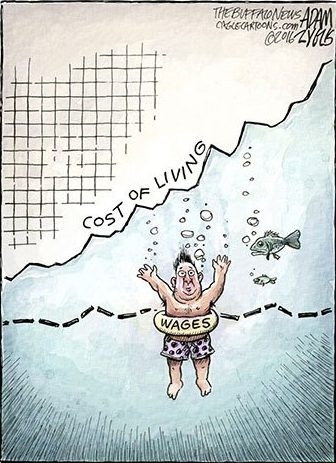
If we had to choose one “big picture” reason why the vast majority of households are losing ground, it would be: the costs of essentials are spiraling out of control. I’ve often covered the dynamics of stagnating income for the bottom 90%, and real-world inflation, i.e. a decline in purchasing power.

But neither of these dynamics fully describes the relentless upward spiral of the cost basis of our economy, that is, the cost of big-ticket essentials: housing, education and healthcare.

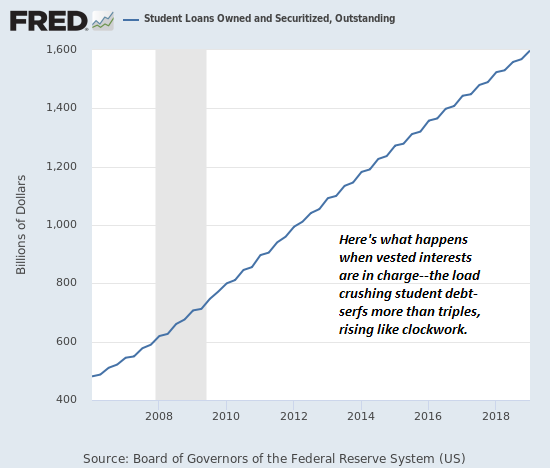
The costs of education are spiraling out of control, stripping households of income as an entire generation is transformed into debt-serfs by student loan debt. The soaring costs of healthcare are a core driver of higher costs in the education complex (and government in general), and to cover these higher costs, counties raise property taxes, which add additional cost burdens to households and enterprises as rents rise.

Rising rents push the cost structure of almost every enterprise and agency higher.

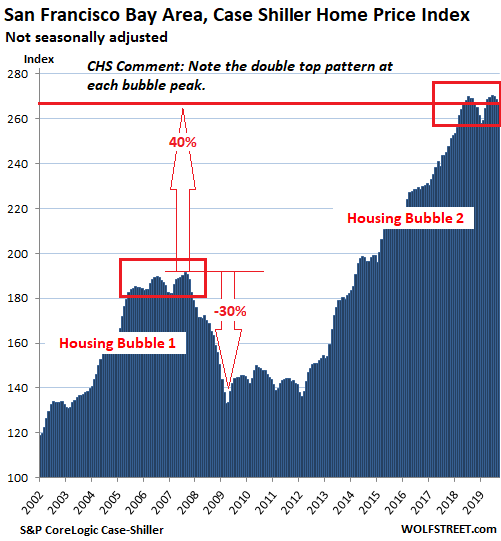
Then there’s the asset inflation created by central bank ZIRP (zero interest rate policy) which has inflated a second echo-bubble in housing that has pushed home ownership out of reach of many, adding demand for rental housing that has pushed rents into the stratosphere in Left and Right Coast cities.

The increasing dominance of monopolies and cartels has eliminated competition in sector after sector. Monopolies and cartels skim immense profits even as the value, quality and quantity of their products and services decline: The U.S. Only Pretends to Have Free Markets From plane tickets to cellphone bills, monopoly power costs American consumers billions of dollars a year.

Thanks to their political influence, monopolies and cartels have legalized looting, raising prices and evading anti-trust regulations because they can pay whatever it takes in our pay-to-play political system.

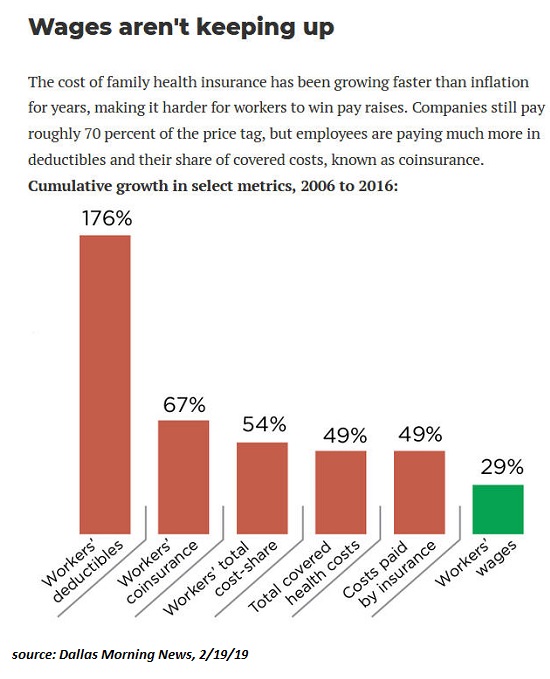
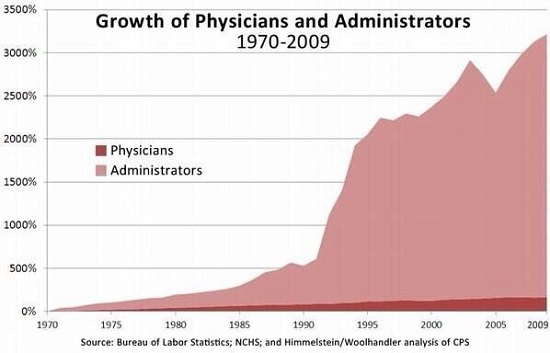
Let’s look at a few charts that illustrate the relentless rise in costs:

Do you reckon these two charts are connected–soaring costs and ballooning administrative payrolls?

Student loan debt is soaring above $1.5 trillion, guaranteeing profits to lenders and debt-serfdom to the students exiting with degrees that are in over-supply, i.e. possessing little scarcity value in an over-credentialed economy:

The echo housing bubbles in many locales exceed the nosebleed valuations of the previous bubble:

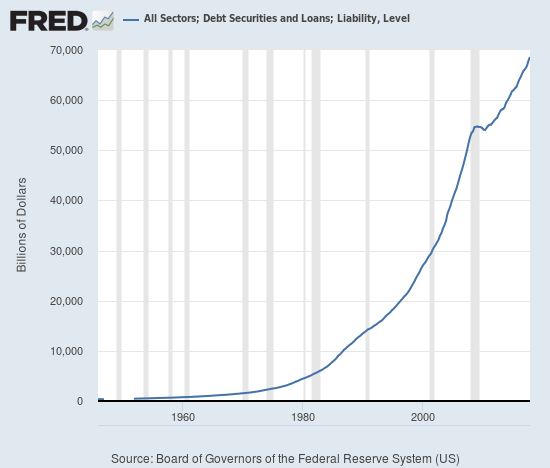
And how do we pay for these spiraling out of control costs? By borrowing more, of course:

Even at low rates of interest, the cost of servicing skyrocketing debt increases, leaving less net income to support additional borrowing.

What will it take to radically reduce the cost basis of our economy? A fundamental re-ordering that breaks up all the cartels and monopolies that push prices higher even as they deliver lower quality goods and services would be a good start.