After the Crash

Dispatches From a Long Recovery (Est. 10/2024)

After the Crash

Report: Whites More Likely To Be Named CEOs Than Equally Sociopathic Black Candidates

americanpsycho8

Editor’s Note: Good satire always has a firm basis in truth.

Source: The Onion

ALEXANDRIA, VA—Shedding light on the striking lack of diversity within the highest ranks of corporate America, a report from the Executive Leadership Council released Tuesday reveals that white individuals are far more likely to be named CEOs than equally sociopathic black candidates.

Despite widespread evidence that minority executives are just as misanthropic and unprincipled as their Caucasian peers, the study found that less than 1 percent of Fortune 500 companies have black chief executives, demonstrating that the upper levels of the business world frequently remain inaccessible to even the most morally bankrupt of African-Americans.

“Our data shows that when white megalomaniacs and black megalomaniacs contend for the highest corporate positions in the U.S., the latter are routinely passed over,” said the report’s lead author, Sandra Norwood, pointing to dozens of recent instances in which African-American individuals who had proven track records of undermining their colleagues’, employees’, and shareholders’ interests in order to further their own selfish ambitions were not even offered an interview for a company’s top seat. “Vindictive, unscrupulous blacks simply aren’t granted these leadership opportunities, despite possessing the same willingness to maximize short-term profit by eliminating health insurance benefits for part-time employees or commit accounting fraud in order to inflate the value of their personal stock options.”

“These are heartless sadists who have put in countless hours of backstabbing and forsaken all ethical constraints in order to bolster their own power, and yet time and time again they are denied a place at the top of the corporate ladder simply because of the color of their skin,” she continued.

According to the report, even when companies were presented with numerous highly qualified minority candidates with no moral compass and a history of increasing earnings by knowingly rushing an unsafe product to market or outsourcing thousands of manufacturing jobs to overseas sweatshops, the top-tier positions still tended to be awarded almost exclusively to deceitful, empathy-devoid whites.

In fact, the study found that, when presented with identical résumés of potential CEOs who had hid billions of dollars of revenue in offshore tax havens and poached several engineers from a rival business in order to illegally gain confidential trade secrets—one labeled with a common Caucasian name and the other with a traditionally African-American name—boards of directors were far more likely to select the applicant with the white-sounding name. Such findings suggest that many at the highest corporate level still hold inherent biases against amoral, power-hungry egotists of color.

“Even in 2015, many corporate boards will automatically discount a black candidate even if they have demonstrated that they are fully capable of using aggressive intimidation tactics to prevent their company’s workers from forming a labor union,” Norwood said. “Board members often are more comfortable working with lying, underhanded double-crossers who are similar to themselves. Therefore, the individual that they ultimately promote to CEO tends to come from the same cultural background that turned them into destructive, unrepentant monsters.”

According to sources, the dearth of black CEOs within corporate America has prompted a number of companies to institute personnel outreach programs to identify and cultivate malevolent young African-Americans who they believe have the potential to one day violate insider trading laws and initiate spurious patent lawsuits against smaller competitors in order to overwhelm them with legal fees and force them out of the industry.

However, after years of confronting the “glass ceiling” that prevents them from advancing as far as their white peers, many blindly ambitious blacks told reporters they are skeptical that these programs will have a meaningful impact on African-Americans who aspire to become CEOs so that they can immediately downsize as many low-level personnel as necessary to hit profit targets that trigger lucrative personal bonuses.

“When you’re black, you have to be twice as ruthless and deceptive just to reach the senior level, but then you can pretty much forget about ever having a shot at the corner office,” said William Coleman, the sole African-American vice president at a prominent Wall Street financial services group, who says he has yet to be recognized for allocating the risk of his firm’s portfolio of unstable derivatives investments entirely onto the municipal worker pension funds it administers. “My company just elected a white external candidate for our CEO role even after I successfully shifted the blame for a botched merger onto a fellow senior manager before personally firing him and claiming his successes as my own. It’s like they refuse to see how deeply predatory and full of hatred I am.”

“My race shouldn’t be a factor when I’ve proven that I’m a borderline psychopath who will step over anybody in my way to sate my fanatical lust for power,” he continued. “When it comes to succeeding in the business world, that’s all that should matter.”


Related Video:


Mutiny of the Soul

The-Prison-of-the-Mind-by-Blacksmiley-via-ArtCorgi

By Charles Eisenstein

Source: Reality Sandwich

Depression, anxiety, and fatigue are an essential part of a process of metamorphosis that is unfolding on the planet today, and highly significant for the light they shed on the transition from an old world to a new.

When a growing fatigue or depression becomes serious, and we get a diagnosis of Epstein-Barr or Chronic Fatigue Syndrome or hypothyroid or low serotonin, we typically feel relief and alarm. Alarm: something is wrong with me. Relief: at least I know I’m not imagining things; now that I have a diagnosis, I can be cured, and life can go back to normal. But of course, a cure for these conditions is elusive.

The notion of a cure starts with the question, “What has gone wrong?” But there is another, radically different way of seeing fatigue and depression that starts by asking, “What is the body, in its perfect wisdom, responding to?” When would it be the wisest choice for someone to be unable to summon the energy to fully participate in life?

The answer is staring us in the face. When our soul-body is saying No to life, through fatigue or depression, the first thing to ask is, “Is life as I am living it the right life for me right now?” When the soul-body is saying No to participation in the world, the first thing to ask is, “Does the world as it is presented me merit my full participation?”

What if there is something so fundamentally wrong with the world, the lives, and the way of being offered us, that withdrawal is the only sane response? Withdrawal, followed by a reentry into a world, a life, and a way of being wholly different from the one left behind?

The unspoken goal of modern life seems to be to live as long and as comfortably as possible, to minimize risk and to maximize security. We see this priority in the educational system, which tries to train us to be “competitive” so that we can “make a living”. We see it in the medical system, where the goal of prolonging life trumps any consideration of whether, sometimes, the time has come to die. We see it in our economic system, which assumes that all people are motivated by “rational self-interest”, defined in terms of money, associated with security and survival. (And have you ever thought about the phrase “the cost of living”?) We are supposed to be practical, not idealistic; we are supposed to put work before play. Ask someone why she stays in a job she hates, and as often as not the answer is, “For the health insurance.” In other words, we stay in jobs that leave us feeling dead in order to gain the assurance of staying alive. When we choose health insurance over passion, we are choosing survival over life.

On a deep level, which I call the soul level, we want none of that. We recognize that we are here on earth to enact a sacred purpose, and that most of the jobs on offer are beneath our dignity as human beings. But we might be too afraid to leave our jobs, our planned-out lives, our health insurance, or whatever other security and comfort we have received in exchange for our divine gifts. Deep down, we recognize this security and comfort as slaves’ wages, and we yearn to be free.

So, the soul rebels. Afraid to make the conscious choice to step away from a slave’s life, we make the choice unconsciously instead. We can no longer muster the energy to go through the motions. We enact this withdrawal from life through a variety of means. We might summon the Epstein-Barr virus into our bodies, or mononucleosis, or some other vector of chronic fatigue. We might shut down our thyroid or adrenal glands. We might shut down our production of serotonin in the brain. Other people take a different route, incinerating the excess life energy in the fires of addiction. Either way, we are in some way refusing to participate. We are shying away from ignoble complicity in a world gone wrong. We are refusing to contribute our divine gifts to the aggrandizement of that world.

That is why the conventional approach of fixing the problem so that we can return to normal life will not work. It might work temporarily, but the body will find other ways to resist. Raise serotonin levels with SSRIs, and the brain will prune some receptor sites, thinking in its wisdom, “Hey, I’m not supposed to feel good about the life I am living right now.” In the end, there is always suicide, a common endpoint of the pharmaceutical regimes that seek to make us happy with something inimical to our very purpose and being. You can only force yourself to abide in wrongness so long. When the soul’s rebellion is suppressed too long, it can explode outward in bloody revolution. Significantly, all of the school shootings in the last decade have involved people on anti-depression medication. All of them! For a jaw-dropping glimpse of the results of the pharmaceutical regime of control, scroll down this compilation of suicide/homicide cases involving SSRIs. I am not using “jaw-dropping” as a figure of speech. My jaw literally dropped open.

Back in the 1970s, dissidents in the Soviet Union were often hospitalized in mental institutions and given drugs similar to the ones used to treat depression today. The reasoning was that you had to be insane to be unhappy in the Socialist Workers’ Utopia. When the people treating depression receive status and prestige from the very system that their patients are unhappy with, they are unlikely to affirm the basic validity of the patient’s withdrawal from life. “The system has to be sound — after all, it validates my professional status — therefore the problem must be with you.”

Unfortunately, “holistic” approaches are no different, as long as they deny the wisdom of the body’s rebellion. When they do seem to work, usually that is because they coincide with some other shift. When someone goes out and gets help, or makes a radical switch of modalities, it works as a ritual communication to the unconscious mind of a genuine life change. Rituals have the power to make conscious decisions real to the unconscious. They can be part of taking back one’s power.

I have met countless people of great compassion and sensitivity, people who would describe themselves as “conscious” or “spiritual”, who have battled with CFS, depression, thyroid deficiency, and so on. These are people who have come to a transition point in their lives where they become physically incapable of living the old life in the old world. That is because, in fact, the world presented to us as normal and acceptable is anything but. It is a monstrosity. Ours is a planet in pain. If you need me to convince you of that, if you are unaware of the destruction of forests, oceans, wetlands, cultures, soil, health, beauty, dignity, and spirit that underlies the System we live in, then I have nothing to say to you. I only am speaking to you if you do believe that there is something deeply wrong with the way we are living on this planet.

A related syndrome comprises various “attention deficit” and anxiety “disorders” (forgive me, I cannot write down these words without the ironic quotation marks) which reflect an unconscious knowledge that something is wrong around here. Anxiety, like all emotions, has a proper function. Suppose you left a pot on the stove and you know you forgot something, you just can’t remember what. You cannot rest at ease. Something is bothering you, something is wrong. Subliminally you smell smoke. You obsess: did I leave the water running? Did I forget to pay the mortgage? The anxiety keeps you awake and alert; it doesn’t let you rest; it keeps your mind churning, worrying. This is good. This is what saves your life. Eventually you realize — the house is on fire! — and anxiety turns into panic, and action.

So if you suffer from anxiety, maybe you don’t have a “disorder” at all — maybe the house is on fire. Anxiety is simply the emotion corresponding to “Something is dangerously wrong and I don’t know what it is.” That is only a disorder if there is in fact nothing dangerously wrong. “Nothing is wrong, just you” is the message that any therapy gives when it tries to fix you. I disagree with that message. The problem is not with you. You have very good reason to be anxious. Anxiety keeps part of your attention away from your tasks of polishing the silverware as the house burns down, of playing the violin as the Titanic sinks. Unfortunately, the wrongness you are tapping into might be beyond the cognizance of the psychiatrists who treat you, who then conclude that the problem must be your brain.

Similarly, Attention Deficit Disorder, ADHD, and my favorite, Oppositional Defiant Disorder (ODD) are only disorders if we believe that the things presented for our attention are worth paying attention to. We cannot admit, without calling into question the whole edifice of our school system, that it may be completely healthy for a ten-year-old boy to not sit still for six hours in a classroom learning about long division and Vasco de Gama. Perhaps the current generation of children, that some call the Indigos, simply have a lower tolerance for school’s agenda of conformity, obedience, external motivation, right-and-wrong answers, the quantification of performance, rules and bells, report cards and grades and your permanent record. So we try to enforce their attention with stimulants, and subdue their heroic intuitive rebellion against the spirit-wrecking machine.

As I write about the “wrongness” against which we all rebel, I can hear some readers asking, “What about the metaphysical principle that it’s ‘all good’?” Just relax, I am told, nothing is wrong, all is part of the divine plan. You only perceive it as wrong because of your limited human perspective. All of this is only here for our own development. War: it gives people wonderful opportunities to make heroic choices and burn off bad karma. Life is wonderful, Charles, why do you have to make it wrong?

I am sorry, but usually such reasoning is just a sop to the conscience. If it is all good, then that is only because we perceive and experience it as terribly wrong. The perception of iniquity moves us to right it.

Nonetheless, it would be ignorant and fruitless to pass judgment upon those who do not see anything wrong, who, oblivious to the facts of destruction, think everything is basically fine. There is a natural awakening process, in which first we proceed full speed ahead participating in the world, believing in it, seeking to contribute to the Ascent of Humanity. Eventually, we encounter something that is undeniably wrong, perhaps a flagrant injustice or a serious health problem or a tragedy near at hand. Our first response is to think this is an isolated problem, remediable with some effort, within a system that is basically sound. But when we try to fix it, we discover deeper and deeper levels of wrongness. The rot spreads; we see that no injustice, no horror can stand in isolation. We see that the disappeared dissidents in South America, the child laborers in Pakistan, the clearcut forests of the Amazon, are all intimately linked together in a grotesque tapestry that includes every aspect of modern life. We realize that the problems are too big to fix. We are called to live in an entirely different way, starting with our most fundamental values and priorities.

All of us go through this process, repeatedly, in various realms of our lives; all parts of the process are right and necessary. The phase of full participation is a growth phase in which we develop gifts that will be applied very differently later. The phase of trying to fix, to endure, to soldier on with a life that isn’t working is a maturation phase that develops qualities of patience and determination and strength. The phase of discovering the all-encompassing nature of the problem is usually a phase of despair, but it need not be. Properly, it is a phase of rest, of stillness, of withdrawal, of preparation for a push. The push is a birth-push. Crises in our lives converge and propel us into a new life, a new being that we hardly imagine could exist, except that we’d heard rumors of it, echoes, and maybe even caught a glimpse of it here and there, been granted through grace a brief preview.

If you are in the midst of this process, you need not suffer if you cooperate with it. I can offer you two things. First is self-trust. Trust your own urge to withdraw even when a million messages are telling you, “The world is fine, what’s wrong with you? Get with the program.” Trust your innate belief that you are here on earth for something magnificent, even when a thousand disappointments have told you you are ordinary. Trust your idealism, buried in your eternal child’s heart, that says that a far more beautiful world than this is possible. Trust your impatience that says “good enough” is not good enough. Do not label your noble refusal to participate as laziness and do not medicalize it as an illness. Your heroic body has merely made a few sacrifices to serve your growth.

The second thing I can offer you is a map. The journey I have described is not always linear, and you may find yourself from time to time revisiting earlier territory. When you find the right life, when you find the right expression of your gifts, you will receive an unmistakable signal. You will feel excited and alive. Many people have preceded you on this journey, and many more will follow in times to come. Because the old world is falling apart, and the crises that initiate the journey are converging upon us. Soon many people will follow the paths we have pioneered. Each journey is unique, but all share the same basic dynamics I have described. When you have passed through it, and understood the necessity and rightness of each of its phases, you will be prepared to midwife others through it as well. Your condition, all the years of it, has prepared you for this. It has prepared you to ease the passage of those who will follow. Everything you have gone through, every bit of the despair, has been necessary to forge you into a healer and a guide. The need is great. The time is coming soon.

Breaking: Moguls Fear AI Apocalypse

Matrix-Machines-Best-Movie-AI

By Jacob Silverman

Source: The Baffler

A funny thing happened on the way to the Singularity. In the past few months, some of the tech industry’s most prominent figures (Elon Musk, Bill Gates), as well as at least one associated guru (Stephen Hawking), have publicly worried about the consequences of out-of-control artificial intelligence. They fear nothing less than the annihilation of humanity. Heady stuff, dude.

These pronouncements come meme-ready—apocalyptic, pithy, trading on familiar Skynet references—grade-A ore for the viral mill. The bearers of these messages seem utterly serious, evincing not an inkling of skepticism. “I think we should be very careful about artificial intelligence,” Elon Musk said. “If I had to guess at what our biggest existential threat is, it’s probably that.”

“The development of full artificial intelligence could spell the end of the human race,” said Stephen Hawking, whose speech happens to be aided by a comparatively primitive artificial intelligence.

Gates recently completed the troika, sounding a more circumspect, but still troubled, position. During a Reddit AMA, he wrote: “I agree with Elon Musk and some others on this and don’t understand why some people are not concerned.”

It’s easy to see why these men expressed these fears. For one thing, someone asked them. This is no small distinction. Most people are not, in their daily lives, asked whether they think super-smart computers are going to take over the world and end humanity as we know it. And if they are asked, the questioner is usually not rapt with attention, lingering on every word as if it were gospel.

This may sound pedantic, but the point is that it’s pretty fucking flattering—to one’s ego, to every nerd fantasy one has ever pondered about the end of days—to be asked these questions, knowing that the answer will be immediately converted (perhaps, by a machine!) into headlines shared all over the world. Musk, a particularly skilled player of media hype for vaporous ideas like his Hyperloop, must have been aware of these conditions when he took up the question at an MIT student event in October.

Another reason Silicon Valley has begun spinning up its doomsday machine is that the tech industry, despite its agnostic leanings, has long searched for a kind of theological mantle that it can drape over itself. Hence the popularity of Arthur C. Clarke’s maxim: “Any sufficiently advanced technology is indistinguishable from magic.” Any sufficiently advanced religion needs its eschatological prophecies, and the fear of AI is fundamentally a self-serving one. It implies that the industry’s visionaries might create something so advanced that even they might not be able to control it. It places them at the center of the mechanical universe, where their invention—not God’s, not ExxonMobil’s—threatens the human species.

But AI is also seen as a risk worth taking. Rollo Carpenter, the creator of Cleverbot, an app that learns from its conversations with human beings, told the BBC, “I believe we will remain in charge of the technology for a decently long time and the potential of it to solve many of the world problems will be realised.”

There’s a clever justification embedded in here, the notion that we have to clear the runway for technologies that might solve our problems, but that might also, Icarus-like, become too bold, and lead to disaster. Carpenter’s remarks are, like all of the other ones shared here, conveniently devoid of any concerns about what technologies of automation are already doing to people and economic structures now. For that’s really the fear here, albeit in a far amplified form: that machines will develop capabilities, including a sense of self-direction, that render human beings useless. We will become superfluous machines—which is the same thing as being dead.

For many participants in today’s technologized marketplace, though, this is already the case. They have been replaced by object-character recognition software, which can read documents faster than they can; or by a warehouse robot, which can carry more packages; or by an Uber driver, who doesn’t need a dispatcher and will soon be replaced by a more efficient model—that is, a self-driving car. The people who find themselves here, among the disrupted, have been cast aside by the same forces of technological change that people like Gates and Musk treat as immutable.

Of course, if you really worry about what a business school professor might call AI’s “negative externalities,” then there all kinds of things you can do—like industry conclaves, mitigation studies, campaigns to open-source and regulate AI technologies. But then you might risk deducing that many of the concerns we express regarding AI—a lack of control, environmental devastation, a mindless growth for the sake of growth, the rending of social and cultural fabric in service of a disinterested higher authority ravenous for ever-more information and power—are currently happening.

Take a look out the window at Miami’s flooded downtown, the e-waste landfills of Ghana, or the fetid dormitories of Foxconn. To misappropriate the prophecy of another technological sage: the post-human dystopia is already here; it’s just not evenly distributed yet.

Jacob Silverman’s book, Terms of Service: Social Media and the Price of Constant Connection, will be published in March.

Does Work Undermine our Freedom?

1365203033_2628_auschwitz

By John Danaher

Source: Philosophical Disquisitions

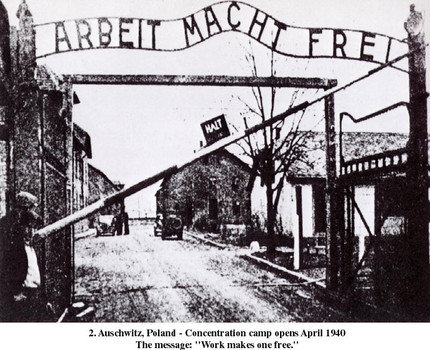
Work is a dominant feature of contemporary life. Most of us spend most of our time working. Or if not actually working then preparing for, recovering from, and commuting to work. Work is the focal point, something around which all else is organised. We either work to live, or live to work. I am fortunate in that I generally enjoy my work. I get paid to read, write and teach for a living. I can’t imagine doing anything else. But others are less fortunate. For them, work is drudgery, a necessary means to a more desirable end. They would prefer not to work, or to spend much less time doing so. But they don’t have that option. Society, law and economic necessity all conspire to make work a near-essential requirement. Would it be better if this were not the case?

In recent months, I have explored a number of affirmative answers to this question. Back in July 2014, I looked at Joe Levine’s argument for the right not to work. This argument rested on a particular reading of the requirements of Rawlsian egalitarianism. In brief, Levine felt that Rawlsian neutrality with respect to an individual’s conception of the good life required some recognition of a right to opt out of paid labour. Then, in October 2014, I offered my own general overview of the anti-work literature, dividing the arguments up into two categories: intrinsic badness arguments (which claimed that there was something intrinsically bad about work) and opportunity cost arguments (which claimed that even if work was okay, non-work was better).

In this post, I want to explore one more anti-work argument. This one comes from an article by Julia Maskivker entitled “Employment as a Limitation on Self-Ownership”. Although this argument retreads some of the territory covered in previous posts, I think it also offers some novel insights, and I want to go over them. I do so in several parts. First, I offer a brief overview of Maskivker’s central anti-work argument. As we’ll see, this argument has two contentious premises, each based on three claims about freedom and justice. I then spend the next three sections looking at Maskivker’s defence of those three claims. I will then focus on some criticisms of her argument, before concluding with a general review.

1. Maskivker’s Anti-Work Argument
I’ll actually start with a mild criticism. Although I see much of value in Maskivker’s article, and although I learned a lot from it, I can’t honestly say that I enjoyed reading it. Large parts of it felt disorganised, needlessly convoluted, and occasionally repetitious. Although she introduced a central normative claim early on — viz. a claim about the need for effective control self-ownership — later parts of her argument seemed to stray from the strict requirements of that concept. This left me somewhat confused as to what her central argument really was. So what follows is very much my own interpretation of things and should be read with that caveat in mind.

Anyway, let’s start by clarifying what it is we are arguing against. In the past, I have lamented the fact that definitions of work are highly problematic. They are often value-laden, and prone to the sins of under and over-inclusiveness. I’m not sure that there can ever be a perfect definition of work, one that precisely captures all the phenomena of interest to those making the anti-work critique. Nevertheless, we need something more concrete, and Maskivker duly provides. She defines work as paid labour. That is, labour that is undertaken for the purposes of remuneration. This definition is simple and covers what is central to her own argument. My only complaint is that it may need to be expanded to cover forms of labour that are not directly remunerated but are undertaken in the hope of eventually being remunerated (e.g. work of entrepreneurs in the early stages of a business, or the work of unpaid interns). But this is just a quibble.

With that definition in place, we can proceed to Maskivker’s anti-work argument itself. That argument is all about the freedom-undermining effect of work. Although this argument is initially framed in terms of a particular conception of freedom as effective control self-ownership (something I previously covered when looking at the work of Karl Widerquist), I believe it ends up appealing to a much broader and more ecumenical understanding of freedom. As follows:

  • (1) If a phenomenon undermines our freedom, then it is fundamentally unjust and we should seek to minimise or constrain it.
  • (2) A phenomenon undermines our freedom if: (a) it limits our ability to choose how to make use of our time; (b) it limits our ability to be the authors of our own lives; and/or (c) it involves exploitative/coercive offers.
  • (3) Work, in modern society, (a) limits our ability to choose how to make use of our time; (b) limits our ability to be the authors of our own lives; and c) involves an exploitative/coercive offer.
  • (4) Therefore, work undermines our freedom.
  • (5) Therefore, work is fundamentally unjust and should be minimised or constrained.

You could alter this, as Maskivker seems to wish to do, by turning it into an argument for a right not to work. Though I will discuss this general idea later on, I’m avoiding that construal of the argument for the simple reason that it requires additional explanation. Specifically, it requires some explanation of what it would mean to have a right not to work, and some answer to the question as to why it is felt that we do not currently have a right not to work (after all, we can choose not to work, can’t we?). I think time would be better spent focusing specifically on the freedom-undermining effect of work and its injustice, rather than on the precise social remedy to this problem.

What about the rest of the argument. Well, premise (1) is a foundational normative assumption, resting on the value of freedom in a liberal society. We won’t question it here. Premise (2) is crucial because it provides more detail on the nature of freedom. Although Maskivker may argue that the three freedom-undermining conditions mentioned in that premise are all part of the what she means by effective control self-ownership, I think it better not to take that view. Why? Because I think some of the conditions appeal to other concepts of freedom that are popular among other political theorists, and it would be better not to limit the argument to any particular conception. Moving on, premise (3) is the specific claim about the freedom-undermining effect of work. Obviously, this too is crucial to Maskivker’s overall case. The two conclusions then follow.

Let’s go through the two central premises in more detail. Let’s do so in an alternating structure. That is to say, by looking at the defence of condition (a) in premise (2) and premise (3); then at the defence of condition (b) in premise (2) and premise (3); and finally at the defence of condition (c) in premise (2) and premise (3).

2. Freedom, Time and the 24/7 Workplace
Condition (a) is all about the need for an ability to choose how to use our time. Maskivker defends this requirement by starting out with a Lockean conception of freedom, one that is often beloved by libertarians. The Lockean conception holds that individuals are free in the sense that they have self-ownership. That is to say: they have ownership rights over their own bodies, and the fruits of their labour. This fundamental right of self-ownership in turn implies a bundle of other rights (e.g. the right to transfer the fruits of one’s labour to another). Any system of political authority must respect this fundamental right and its necessary implications.

The problem for Maskivker is that many fans of self-ownership limit themselves to a formal, rather than an effective, conception of that right. In other words, they simply hold, in the abstract, that individuals have this right of self-ownership and that they should not be interfered with when exercising it. They don’t think seriously about what it would take to ensure that everybody was really able to effectively enjoy this right. If they did this, they would realise that there are a number of social and evolutionary imbalances and injustices in the ability of individuals to exercise self-ownership. They would realise that, in order to effectively enjoy the right, individuals will also need access to resources.

Now, to be fair, some writers do recognise this. And they highlight the need for things like adequate education and healthcare in order for the right to self-ownership to be effective. Maskivker agrees with their approach. The originality of her contribution comes in its insistence on the importance of time as an essential resource for self-ownership. Time is, in many ways, the ultimate resource. Time is necessary for everything we do. Everything takes time. Other skills and abilities that we may have, only really have value when we have the time to exercise them. Furthermore, time is a peculiarly non-manipulable resource. There is a limited amount of time in which we get to act out our lives. This makes it all the more important for people to have access to time.

You can probably see where this is going. The problem with work is that it robs us of time. We need jobs in order to live, and they take up most of our time. Some people argue that the modern realities of work are particularly insidious in this regard. Jonathan Crary, in his slightly dystopian and alarmist work, 24/7: Late Capitalism and the Ends of Sleep, notes how work has colonised our every waking hour and how it threatens to colonise our sleep too. We are encouraged to make our time more productive, but also to be available to our workplaces at more times of the day, through email or social media. Indeed, the slow death of the regular 9-to-5 workday has, if anything, encouraged work to monopolise more of time. We have flexible working hours and our work may be more outcome-driven, but the marketplaces are open 24/7 and they demand more outcomes from us. The result is an infiltration of work into every hour of the day.

Some people may not resent this. They may feel that they are living the kind of life they wish to live, that their work is enjoyable, and that it gives them a sense of purpose. But others will feel differently. They will feel that work takes away valuable opportunities to truly express themselves as they wish.

In sum, access to time and the time-limiting nature of work, is one thing to think about when designing a scheme of distributive justice. An ability to opt out of work, or to have much less of it one’s lives may be necessary if we are to have a just society.

3. Freedom and Authorship of One’s Life
There is a related argument to made here about the ability to choose one’s time. It can be connected to Maskivker’s account of effective self-ownership, but it can also be separated from it. That’s what condition (b) is about. It appeals to a distinctive notion of freedom as being the ability to exercise true authorship over one’s life. This is a slightly more metaphysical ideal of freedom, one that joins up with the debate about free will and responsibility.

To understand the idea, we need to think more about the individual who truly enjoys their work. As I suggested at the end of the previous section, you could argue that there is nothing unjust about the current realities of work for such an individual. Granting them more free time, won’t really help them to exercise more effective self-ownership. They are getting what they want from life. Take me for example. I have already said that I enjoy my work, and I have been able to (I think) select a career that best suits my talents and abilities. I’m pretty sure I’m employing the scarce resource of time in a way that allows me to maximise my potential. I’m pretty sure there is nothing fundamentally unjust or freedom-undermining about my predicament.

Nevertheless, Maskivker wants to argue that there is something fundamentally unjust about my predicament. My freedom is not being respected in the way that it should. Despite all my claims about how much I enjoy my work, the reality is that I have to work. I have no real say in the matter. She uses an analogy between starving and fasting to make her point. When a person is starving or fasting, the physical results are often the same: their bodies are being deprived of essential nutrients. But there is something morally distinct about the two cases. The person who fasts has control over what is happening to their body. The person who is starving does not. The person who chooses to fast has authorship over their lives; the person who is starving is having their story written by someone else.

When it comes to our work, there is a sense in which we are all starving not fasting. We may enjoy it, embrace it and endorse it, but at the end of the day we have to do it. That’s true even in societies with generous welfare provisions, as most of those welfare provisions are conditional upon us either looking for work (and proving that we are doing so), or being in some state of unavoidable disability or deprivation. We are not provided us with an “easy out”, or with the freedom we need to become the true authors of our lives. (Maskivker notes that the introduction of a universal basic income could be a game-changer in this regard).

As I said, in appealing to this notion of self-authorship, Maskivker is touching upon a more metaphysical ideal of freedom. Within the debate about free will, there are those that argue that the ability to do otherwise is essential for having free will. But there are also those (e.g. Harry Frankfurt and John Fischer) who argue that it is not. They sometimes say that being free and responsible simply requires the reflexive self-endorsement of one’s actions and attitudes. The ability to do otherwise is irrelevant. So what Maskivker is arguing is somewhat contentious, at least when considered in light of these other theories of freedom. She claims that her theory better captures the normative ideal of freedom. But there is much more to be said about this issue.

4. Freedom and the Absence of Coercive Offers
The final condition of freedom — condition c) — is probably the most straightforward. It has its origins in the classic liberal accounts of freedom as non-interference by coercion. It is introduced by Maskivker in an attempt to address a possible weakness in the argument thus far. Someone could argue that the mere absence of acceptable alternatives to work is not enough to imply that it undermines our freedom, or that it creates a fundamental injustice.

An analogy might help to make the point. Suppose you are crossing the desert. You have run out of water and are unlikely to make it out alive. As you are literally on your last legs, you come across a man who is selling water from a small stand. He is, however, selling it at an obscene price. It will cost you everything you have to get one litre of water (which will be just enough to make it out). Because of your desperate situation, you hand over everything you have. Was your choice to hand over everything free? Was it just for the man to sell the water at that price? Many would argue “no” because you had no acceptable alternative.

But now consider a variation on this scenario. Suppose that this time the man is selling water at a very low price, well below the typical market rate. It will cost you less than one dollar to get a litre of water. You gratefully hand over the money. Was your choice free this time? Remember, you are still in a desperate state. All that has changed is the price. Nevertheless, there is something less disturbing about this example. Your choice seems more “free”, and the whole scenario seems more just.

The problem with the first case is that the man is exploiting your unfortunate situation. He knows you have no other choice and he wants to take you for everything that you’ve got. The second scenario lacks this feature. In that case, he doesn’t undermine your freedom, or violate some fundamental principle of justice, because he doesn’t exploit your misfortune.

How does this apply to Maskivker’s anti-work argument? Very simply. She claims that work, in the modern world, involves an exploitative bargain. There is no particular agent behind this exploitation. Rather, it is the broader society, with its embrace of the work ethic and its commitment to the necessity of work, that renders the decision to work exploitative:

Demanding fulltime work in exchange for a decent livelihood is comparable to demanding an exorbitant price for a bottle of water in the absence of competition. It leaves the individual vulnerable to the powerful party (society) in the face of the great loss to be suffered if the “offer” as stipulated is not taken (if one opts not to work while not independently wealthy)

(Maskivker 2010)

5. But isn’t the abolition of work impossible?
Thus ends the defence of Maskivker’s central argument. As you can see, her claim is that the modern realities of work are such that they undermine our freedom and create a fundamental injustice in our society. This is because (conjunctively or disjunctively) work monopolises our time and limits our effective self-ownership; the absence of a viable alternative to work prevents us from being the true authors of our live; and/or society is presenting us with an exploitative bargain “you better be working or looking for work or else…”. You may be persuaded on each of these points. You may agree that a full (positive?) right not to work would be nice. But you may think that it is naive and unrealistic. You may think that it is impossible to really avoid a life of work. Maskivker closes by considering two versions of this “impossibility” objection.

The first, which we might call the “strict impossibility” objection, works something like this:

  • (6) We all have basic needs (food, clothing, shelter etc); without these things we would die.
  • (7) We have to work in order to secure these basic needs.
  • (8) Therefore, we have to work.

Maskivker has a very simply reply to this version of the objection. She holds that premise (7) is false. Not all activities that are conducive to our survival are inevitable. At one point in time, we had to take the furs and hides of animals in order to stay warm enough to survive. We no longer have to do this. The connection between survival and procuring the furs and hides of animals has been severed. The same could happen to the connection between work and our basic needs. Indeed, it is arguable that we no longer need to work all that much to secure our basic needs. There are many labour saving devices in manufacturing and agriculture (and there are soon to be more) that obviate the need for work. And yet the social demand for work has, for some reason, not diminished. Surely this doesn’t have to be the case? Surely we could allow more machines to secure our basic needs?

The second impossibility objection, which we might call the “collective action” objection, is probably more serious. It holds that while a right not to work might be all well and good, the reality is that if everyone exercised that right, society would not be able to support its implementation. After all, somebody has to pay for the system. Maskivker’s responses to this objection are, in my opinion, somewhat problematic.

She makes one basic point. She says that the existence of a right is not contingent upon whether it may be impossible to recognise it in certain social contexts, or whether universal exercise of that right would lead to negative outcomes. She uses two analogies to support this point. First, she asks us to suppose that there is a universal right to healthcare. She then asks us to imagine that we live in a society in which there is some terrible natural disaster, which places huge strains on the healthcare system. The strains are such that the available resources will not be sufficient to save everyone. Maskivker argues that the universal right to healthcare still exists in this society. The limitations imposed by the natural disaster do not take away people’s rights. Second, she asks us to consider the right not to have children. She then points out that if everyone exercised the right not to have children, it would lead to a bad outcome: humanity would go extinct. Nevertheless, she argues, that this does not mean that the right not to have children does not exist.

In some ways, I accept Maskivker’s point. I agree that a right may exist in the abstract even if its implementation creates problems. But I don’t think that really addresses the collective action objection, and I don’t think her analogies work that well. With regards to the right to healthcare in the disasterzone, I’m inclined to think that the limitations of the available resources would compromise or limit the right to healthcare. And with regards to the right not to have children, I think there is something fundamentally different about the problems that arise when we collectively head towards our own extinction and the problems that might arise if everyone stopped working. In the former case, no individuals would be harmed by the collective exercise of the right: the future generations who would have existed, do not exist and cannot be harmed. But in the latter case, there are individuals who might be harmed. For example, if doctors and nurses stopped working, their patients would be harmed. So I’m not sure that Maskivker has really grappled with the collective action objection. I think she tries to sidestep it, but in a manner that will be unpersuasive to its proponents.

6. Conclusion
That brings me to the end of this post. To briefly sum up, Maskivker presents an anti-work argument that focuses on the ways in which work undermines our freedom. She argues that this happens in three ways. First, work robs us of time, which is an essential resource if we are to have effective self-ownership. Second, work prevents us from being the true authors of our lives because there is no acceptable alternative to work (even in societies with social welfare). And third, because work involves an exploitative bargain: we must work, or else.

I think there is much of value in Maskivker’s article. I like how she focuses on time as a resource, one which should be included in any scheme of distributive justice. I also like how she integrates the anti-work critique with certain aspects of the mainstream literature on freedom, self-control and justice. Nevertheless, I fear she dodges the collective action objection to the anti-work position. This is where I think that technology, and in particular a deeper awareness of the drive toward automation and technological unemployment could be a useful addition to the anti-work critique. But that’s an argument for another day.

Is the Web Destroying the Cultural Economy?

Internet-devices-globe-world-connected

By Charles Hugh Smith

Source: Of Two Minds

Are we entering a cultural Dark Age, where the talented cannot earn a living creating culture?

Longtime correspondent G.F.B. recently sent me this 13-minute Interview with Andrew Keen. This is my first exposure to Keen, and his view that the democratization of the Web is great for politics but a disaster for what he calls the Cultural Economy— the relatively small but important slice of the economy that pays creators and artists to make culture: music, literature, art and serious journalism.

The title of Keen’s 2007 book encapsulates his dire perspective: The Cult of the Amateur: How blogs, MySpace, YouTube, and the rest of today’s user-generated media are destroying our economy, our culture, and our values.

(His 2012 book had a similar theme: Digital Vertigo: How Today’s Online Social Revolution Is Dividing, Diminishing, and Disorienting Us)

(Author Scott Timberg makes some of the same points in his new book Culture Crash: The Killing of the Creative Class (via Cheryl A.)

Keen touches on a great many ideas and themes in this brief interview, but his core point is this: by enabling everyone to express themselves on an essentially equal footing, the Web has undermined legitimate journalism and buried the talented few in an avalanche of mediocrity–in his words, talent is “lost in a sea of garbage.”

By eliminating the middleman who added value by sorting the wheat from the chaff–the film studio, the music labels, the publishers–the Web has created a cultural landscape where “soft, ordinary” content such as cute cat videos garner the most “likes” and clicks–the digital world’s metric for popularity and thus value in the marketplace.

Keen tossed off one of his most interesting ideas as an aside: that the break-up of community and the resulting loss of identity has generated a universal drive to establish an identity via self-expression: everybody feels they can compose a song, write a novel or make a movie.

Keen is at his most provocative (to the democratized ideal of the amateur making it big) when he declares the vast majority of people are talentless: talent is by definition scarce. We can’t all be equally talented, nor can anyone generate culturally valuable content without mastering their craft over thousands of hours of practice.

Keen unapologetically calls the previous arrangement an “industrial meritocracy.” He feels this hierarchical meritocracy is being destroyed and there is nothing to replace it.  This will result in a cultural Dark Age where the talented cannot earn a living creating culture. The only avenue left for creators of content that can be copied and distributed digitally (music, digital art, writing) is to find wealthy patrons to support their work.

One of G.F.B.’s points in our conversation was the Web’s “level playing field” is an artificial construct, much like the playing field in a stadium. But outside the stadium, the geography is anything but level.  Put other way, global corporations have great advantages in the supposedly “level playing field” of the Web.

Keen mentions that what will remain scarce in this tsunami of digital content is access to the artist, live performances and art that cannot be digitized, such as sculpture and paintings. As I have discussed in previous Musings, musicians who perform constantly can make a living in this environment, because their free music on the web builds an audience for their live performances.  But not every band performs enough to make a go of this model.

In Keen’s  view, it is now essentially impossible for bands, artists and writers to create a “brand” that will generate an income. Only those creators who entered the digital age with an established brand can leverage their recognition into an income.

As a completely marginal creator of content who never rose within the industrial meritocracy lauded by Keen, I  think Keen makes some excellent points but overstates his case for a cultural Dark Age.

As G.F.B. pointed out in our conversation on this topic, a new class of curators is arising within the Web, people who sift through the vast outpouring of content and select the best or most interesting (in their view). Those curators who succeed are adding value just as the industrial middlemen did in the pre-digital model. In some small way, I think Of Two Minds performs a bit of this curation.

It seems to me that the digital age requires every creator of content to not only be perseverant but to focus a great deal of time and energy on marketing their content–precisely what the industrial media and cultural industrial-model companies once did for their talent.

There is no longer enough money in creating content to pay an office full of people to issue press releases and arrange book tours.  In the publishing world, promotion is increasingly up to the authors; as Keen noted, only those authors with brands that were established in the pre-digital age can sell enough content to support industrial-type promotion.

We can bemoan this, or we can grasp the nettle and realize that  it is no longer enough to practice one’s craft for the fabled 10,000 hours–one must also invest another 10,000 hours in promoting and marketing one’s content/cultural creations.  That dual process (creation and marketing) is so arduous, so impoverishing, so demanding, only the driven few can sustain it long enough to claw their way through the mountains of mediocrity.

Making a living at cultural content was always brutally Darwinian; perhaps all that’s changed is the nature of the Darwinian selection process.

Education and the “Progressive” Corporate State

anti_public_education_propaganda_by_8manderz8-d5xz1cj

By Kevin Carson

Source: Center for a Stateless Society

Speaking in Knoxville, Tennessee on January 9 US president Barack Obama unveiled an initiative to provide two years of community college tuition-free, nationwide, to anyone meeting attendance and grade requirements. The idea, inspired by a similar program in Tennessee, aims to make two years of college as universal as high school is now. Obama’s proposal is in keeping, in more ways than one, with traditions going back to the origins of the American corporate state 150 years ago.

Since the mid-19th century, a few hundred large industrial corporations and banks have dominated the American economy. And the American state, functionally, has been closely intertwined with the interests of those corporations. One of its functions is to subsidize the corporate bottom line and artificially prop up the rate of profit by socializing provision of a growing share of inputs — among them the cost of reproducing and training human labor power.

The first statewide public school systems were introduced in New England to meet mill owners’ need for a workforce that was docile, obedient and educated to minimal standards; a function supplemented by education in “100% Americanism” at the turn of the 20th century, and a home economics curriculum in the ’20s and ’30s aimed at processing students into good mass consumers.

As recounted by New Left historian David Noble in America by Design, federal government aid to land grant colleges coincided with the national railroad and industrial corporations’ growing need for trained mechanical and industrial engineers. This trajectory carries through the GI Bill and to Obama’s latest proposal.

These institutional developments were accompanied by the rise of a meritocratic legitimizing ideology which replaced earlier American notions of equality and autonomy. Rather than genuine equality based on widespread economic empowerment and self-employment, the new meritocratic ideology treated step hierarchies of wealth, skill and managerial authority as both normal and necessary, but relied on the ideal of universal education to justify the ideology as “democratic.” With the widespread availability of secondary, higher and technical education, the theory goes, the individual’s rise in the managerial-technical hierarchy is limited only by their own willingness to learn and work. This peculiar American religion combines the existence of deep structural inequalities in wealth and power with the moralistic assumption that everyone gets exactly what they deserve.

The official White House happy talk, predictably, takes the corporate state’s assumptions for granted: “In our growing global economy, Americans need to have more knowledge and more skills to compete — by 2020, an estimated 35 percent of job openings will require at least a bachelor’s degree, and 30 percent will require some college or an associate’s degree.” That it’s the place of the “growing global economy” and the corporate HR departments in it to set the “required” qualifications for labor, and the place of the state’s education system to process people to those standards, goes without saying.

Never mind that globalization, concentration of economic power in the hands of a few giant, capital-intensive corporations, and a wage system that separates labor from both ownership and control of work, are none of them natural or inevitable processes. They all result from the deliberate policies of a state in league with capital.

The real irony is that the system of power Obama’s proposal is designed to serve is doomed to extinction. The revolution in cheap small-scale machine tools means an end to the material rationale for the wage system, and to corporate control of production. Coupled with the rise of open-source or pirated textbooks, free online lectures and syllabi and DIY learning networks, it also means an end to control over access to employment by the unholy alliance of big universities and human resources departments. In an economy where a few months’ wages can purchase a garage factory full of open-source tools and the economy is dominated by commons-based peer production and craft production in self-managed shops, credentialing will be largely stackable and ad hoc, negotiated informally to suit the needs of the groups of people working together.

The days of the educational Cult of Moloch and its human sacrifices are numbered.

Related post: Schools are Becoming Privatized Prisons


Time and the Technological World

321e730d017aeaf2228d3217ae9abd77

Source: The Hipcrime Vocab

Check out this fascinating summary of  How We Got to Now: Six Innovations That Made the Modern World. This particular summary looks at the part of the book that documents how our perception of time has changed, and how that has affected the modern world.

The book talks about something called the “Hummingbird Effect,” which describes the way in which various inventions and technical discoveries change the world in unexpected ways. Some of you may recall James’ Burke’s excellent TV show Connections on BBC/PBS (These used to be available on YouTube, but JamesBurkeWeb appears to have disappeared. Still, some episodes can still be found) which covered the same ground:

Johnson points out that, much like the evolution of bees gave flowers their colors and the evolution of pollen altered the design of the hummingbird’s wings, the most remarkable thing about innovations is the way they precipitate unanticipated changes that reverberate far and wide beyond the field or discipline or problem at the epicenter of the particular innovation. Pointing to the Gutenberg press — itself already an example of the combinatorial nature of creative breakthroughs — Johnson writes:

    “Johannes Gutenberg’s printing press created a surge in demand for spectacles, as the new practice of reading made Europeans across the continent suddenly realize that they were farsighted; the market demand for spectacles encouraged a growing number of people to produce and experiment with lenses, which led to the invention of the microscope, which shortly thereafter enabled us to perceive that our bodies were made up of microscopic cells. You wouldn’t think that printing technology would have anything to do with the expansion of our vision down to the cellular scale, just as you wouldn’t have thought that the evolution of pollen would alter the design of a hummingbird’s wing. But that is the way change happens.”

It starts with Galileo’s observation that a pendulum always swings to-and-fro in a regular amount of time.

“But machines that could keep a reliable beat didn’t exist in Galileo’s age; the metronome wouldn’t be invented for another few centuries. So watching the altar lamp sway back and forth with such regularity planted the seed of an idea in Galileo’s young mind. As is so often the case, however, it would take decades before the seed would blossom into something useful.”

The ability to accurately measure time was a departure from before when:

    “Instead of fifteen minutes, time was described as how long it would take to milk the cow or nail soles to a new pair of shoes. Instead of being paid by the hour, craftsmen were conventionally paid by the piece produced — what was commonly called “taken-work” — and their daily schedules were almost comically unregulated.”

Once the regimentation of the clock was introduced, many things followed from that due to the Hummingbird Effect:

Over the century that followed, the pendulum clock, a hundred times more accurate than any preceding technology, became a staple of European life and forever changed our relationship with time. But the hummingbird’s wings continued to flap — accurate timekeeping became the imperceptible heartbeat beneath all technology of the Industrial Revolution, from scheduling the division of labor in factories to keeping steam-powered locomotives running on time. It was the invisible hand of the clock that first moved the market — a move toward unanticipated innovations in other fields. Without clocks, Johnson argues, the Industrial Revolution may have never taken off — or “at the very least, have taken much longer to reach escape velocity.” He explains:

    “Accurate clocks, thanks to their unrivaled ability to determine longitude at sea, greatly reduced the risks of global shipping networks, which gave the first industrialists a constant supply of raw materials and access to overseas markets. In the late 1600s and early 1700s, the most reliable watches in the world were manufactured in England, which created a pool of expertise with fine-tool manufacture that would prove to be incredibly handy when the demands of industrial innovation arrived, just as the glassmaking expertise producing spectacles opened the door for telescopes and microscopes. The watchmakers were the advance guard of what would become industrial engineering.”

Not mentioned is the introduction of public schools, designed to take farmers used to “cow milking time” and “discipline” them into a workforce able to sit still and obey and punch a clock, a system we are still living with today. Those of us who cannot or will not conform to this ruthless discipline are severely punished:

And yet, as with most innovations, the industrialization of time came with a dark side — one Bertrand Russell so eloquently lamented in the 1920s when he asked: “What will be the good of the conquest of leisure and health, if no one remembers how to use them?” Johnson writes:

    “The natural rhythms of tasks and leisure had to be forcibly replaced with an abstract grid. When you spend your whole life inside that grid, it seems like second nature, but when you are experiencing it for the first time, as the laborers of industrial England did in the second half of the eighteenth century, it arrives as a shock to the system. Timepieces were not just tools to help you coordinate the day’s events, but something more ominous: the “deadly statistical clock,” in Dickens’s Hard Times, “which measured every second with a beat like a rap upon a coffin lid.”

[…]

    “To be a Romantic at the turn of the nineteenth century was in part to break from the growing tyranny of clock time: to sleep late, ramble aimlessly through the city, refuse to live by the “statistical clocks” that governed economic life… The time discipline of the pendulum clock took the informal flow of experience and nailed it to a mathematical grid. If time is a river, the pendulum clock turned it into a canal of evenly spaced locks, engineered for the rhythms of industry.

And as clocks became ever more precise and ubiquitous, things flowed from that – more regimentation, more standardization (village clocks used to be set by the sun’s position, but this introduced inaccuracies in railroad timetables – thus two inventions, one steam-powered and one not, are bound up together), and entirely new scientific discoveries which led to new inventions such as the computers that now rule over our lives:

Johnson goes on to trace the hummingbird flutterings to the emergence of pocket watches, the democratization of time through the implementation of Standard Time, and the invention of the first quartz clock in 1928, which boasted the unprecedented accuracy of losing or gaining only one thousandth of a second per day…But the most groundbreaking effect of the quartz clock — the most unpredictable manifestation of the hummingbird effect in the story of time — was that it gave rise to modern computing and the Information Age. Johnson writes:

    “Computer chips are masters of time discipline… Instead of thousands of operations per minute, the microprocessor is executing billions of calculations per second, while shuffling information in and out of other microchips on the circuit board. Those operations are all coordinated by a master clock, now almost without exception made of quartz… A modern computer is the assemblage of many different technologies and modes of knowledge: the symbolic logic of programming languages, the electrical engineering of the circuit board, the visual language of interface design. But without the microsecond accuracy of a quartz clock, modern computers would be useless.”

And once the computer is invented – note that it becomes the new mega-metaphor taking over from the steam engine – the brain as “neural network” that can be simulated, the economy as a perfect “information processing machine” via the price mechanism and humans as “rational utility maximizers”of Neoliberal economics, and recasting the analog world as binary one of ones and zeros – art, music, literature, etc. that can be simulated through sufficiently complex algorithms. All this flows from our view of the world, which in turn is dictated by our technology.

The Hummingbird Effect: How Galileo Invented Time and Gave Rise to the Modern Tyranny of the Clock (Brain Pickings)

More at the link. It’s worth noting that this entire thesis was laid out by Lewis Mumford as far back in the 1930’s in Technics and Society, and this book looks like it covers much the same ground.

Mumford’s these is that the Industrial Revolution did not spring forth fully-formed from nowhere, but came forth from changes in the human perception of the world and man’s relationship to nature that had been occurring for centuries beforehand. He called this the Eotechnic period, and points out that it needs to be understood to see how the modern world emerged. He classified the subsequent periods as Paleotechnic (centered around the stream engine, iron and coal), and the Neotechnic (centered around electricity and the scientific method). He stressed how much our perception of the natural world and human nature dictate the nature of our science and social organization.

Several intellectual revolutions had to take place in order to get us to the Industrial Revolution. One, as noted above and emphasized by Mumford, was the accurate measurement of time. Another was the increasing control over motive forces exemplified by the windmill and watermill. Another was individual perception, as indicated by the use of perspective in painting. Another was the increasing standardization, political centralization and bureaucracy. Another was the discovery of the New World of which the ancients had no knowledge or precedent. Another was the increasing use of the abstraction of money for trade. But perhaps the biggest one of all was recasting the natural world as a machine that could be analyzed and understood. These changes were all formative to the Industrial Revolution, which could not have come about without them.

Mumford writes extensively about the Medieval period, and how that period increasingly used technology to control the environment but in a genuinely humane way, one designed to enhance human needs and desires rather than control or eliminate them. Think of the medieval clock-making guild as opposed to the deskilled factory worker for example. The decentralized and localized nature of the Medieval period is what allowed technology to be used in this way.

But, beginning in the seventeenth century with the rise of the nation-state and the consolation of Europe’s kingdoms into large, centralized states with standards and bureaucracy (much of it due to the emergence of gunpowder and artillery, against which castles and mounted knights were useless), all that began to to change. Technology became increasingly tyrannical, and man was more and more forced into the “logic of the machine.” Consider the armies that emerged identical uniforms, identical weapons with interchangeable parts and drilled, regimented training designed to turn men into interchangeable parts themselves. Military training was the precursor to the disciplined workforce of the Industrial Revolution, which is why the connection between business and military discipline remains to this day (corporations today are run on the top-down hierarchical military model). Since battles were won by sheer numbers of “citizens” with rifles rather than an aristocratic warrior class who owned horses, the social relations changed, and the common man emerged with more importance. Population growth equaled national strength in the new order. Man’s rationality became celebrated, all other values were discounted. Productivity and technological “progress” became goals in the themselves rather than means to an end. Pursuit of growth and profit became all-consuming, human needs be damned.

In contrast to the Medieval period, today’s technology is dehumanizing, submitting man to centralized control, and seeing him as nothing more than a machine. Mumford envisioned a society where human values could once again take center stage instead of the productivist logic of “the myth of the machine” Thus Mumford was not anti-technology; rather he wanted a world in which technology served profoundly different values than in our present time. The brutal regulation of time, rather than the human time of being in the world – the difference between chronos and kairos, or the subjective and the objective – is one of the best illustrations of this difference. Just because we can measure time down to the nanosecond does not mean we have to be enslaved to it. That is a social choice, as Mumford would quickly remind us.


The Calling: How Cronyism Worsens Income Inequality (and Freed Markets Reduce It)

cronyism-out-of-control

By Steven Horwitz

Source: Future of Freedom Foundation

I recently gave an introductory Public Choice talk sponsored by Students for Liberty at the University of Ottawa. The next speaker was my friend Anne Rathbone Bradley, who was Skyping in from Washington. Anne gave a terrific talk about cronyism and rent-seeking that nicely complemented many of the points I’d made. But one of the side issues she raised really stuck with me, and I want to expand on it.

Anne connected cronyism (I hesitate to call it “crony capitalism”), rent-seeking, and income inequality in a way I hadn’t quite thought about before. The key to the connection is to realize some important truths about the political process.

The first truth is that cronyism is no accident. It is no accident that the U.S. economy has increasingly become one in which your connections to political power matter more for your ability to increase your wealth than does producing a product or service that consumers wish to buy. We are becoming what Ayn Rand deftly termed an “aristocracy of pull.”

The ability of some to get wealthier through political connections does trouble many on the political left, but they often argue that with better elected officials, or more ethical businesspeople, or limits on campaign contributions, we could dramatically reduce this sort of cronyism. What their argument misses is that as long as government gives out goodies, private-sector actors will find ways to get their hands on them. If you really want to take the money out of politics, you need to make it harder for politicians to hand out money.

For libertarians, the state is always little more than a dispenser of privileges to special interests. This is not an accident of who is elected or who is wealthy. Government privileges provide an easy path to profit for those who can capture them — and with none of the hard work of actually competing in the market. This is why many people, including those in the private sector, like the state.

The second important truth is that these political privileges are much more likely to be captured by those who already have financial and political power. Despite the fantasy believed by so many that government regulation and other interventions are all about constraining the rich and powerful in the name of the masses, in fact a great deal of government regulation is driven by the desires of those same rich and powerful to become more so. The more power we give to government, the more power we are giving to those with the money and connections to access political power. In other words, expanding the state gives more power and privilege to the powerful and privileged.

The last truth is that when private-sector actors seek to use political privileges to enhance their profits, they often do so by blocking smaller competitors’ access to the market, or by raising their costs of competing. When Walmart supports a higher minimum wage, it thereby favors raising the costs for their small mom-and-pop rivals. When taxicab companies defend their monopoly privileges, they intend to shut firms like Uber and Lyft out of the market altogether. When entrenched hairdressers demand that hair braiders be licensed, the established practitioners mean to raise their competitors’ costs or shut them out altogether.

When we put all three of these truths together, we get a story about the way in which those who already have wealth and power can and do make use of the state to block the upward mobility of their poorer, less-powerful potential competitors. Small-business owners, Uber and Lyft drivers, and African-American women who want to open hair-braiding businesses are trying to grab on to the bottom rungs of the income ladder and work their way up. These are the very people — start-up entrepreneurs and the working poor — that those critical of the market claim to care about.

In a world where government has all of these powers to intervene in markets, rent-seeking and cronyism are inevitable. Regulation will ensure that those who know the right people can tilt the regulatory playing field in their favor. The result will be a worsening of the income inequality that concerns so many. The rich will get richer through rent-seeking and cronyism, and they will do so at the expense of the poor and relatively powerless. If rent-seeking and cronyism worsen income inequality, and the source of rent-seeking and cronyism is the state’s ability to intervene, then a pretty good case can be made that freed markets will give us a world with less income inequality than the status quo.

Libertarians are right to point out that inequalities of income are not inherently bad. If the existing pattern of incomes were the result of a truly freed market (like in the famous, if simplified, Wilt Chamberlain example in Robert Nozick’s Anarchy, State, and Utopia), there would be no reason for worry. This is especially true because in a freed market, dynamic change would ensure that the same people do not occupy the same rungs on the ladder from year to year.

However, if inequalities are instead the result of a mixed economy in which those who already have wealth and power can enhance it at the expense of those with less — not to mention the consumers who lose out on the benefits of greater competition and lower prices, then libertarians are right to object and look for solutions. Of course, asking for more state action to combat state-driven inequalities is unlikely to work and very likely to make matters worse.

Thus, we can ground our arguments against government intervention in the market in our desire to reduce inequalities that are not the result of voluntary exchanges that benefit both parties.

Finally, this whole argument gives libertarians another reason to love the sharing economy of Uber, Lyft, AirBnB, and the rest. Not only are such companies providing important competition for established firms and thereby lowering prices and bringing better services and more options to consumers, they are also part of the fight against the unearned privileges of the rich and powerful and the fight against politically driven, and therefore unjustified, increases in income inequality.

Classical liberalism needs to reassert its long-standing commitment to progressive goals, even as it rejects the means preferred by most so-called progressives today. We have an opportunity to bring new allies to our cause by recognizing the interrelationships among rent-seeking, cronyism, the sharing economy, small businesspeople, and income inequality. Let’s not overlook it.

Lara Trace Hentz

INDIAN COUNTRY NEWS

In Saner Thought

"It is the duty of every man, as far as his ability extends, to detect and expose delusion and error"..Thomas Paine

ZEDJournAI

Human in Algorithms

Rooster Crows

From the Roof Top

Aisle C

I See This

The Free

blog of the post capitalist transition.. Read or download the novel here + latest relevant posts

अध्ययन-अनुसन्धान(Essential Knowledge of the Overall Subject)

अध्ययन-अनुसन्धानको सार