
Make Way for the Killer Robots: The Government Is Expanding Its Power to Kill

By John & Nisha Whitehead

Source: The Rutherford Institute

“Crush! Kill! Destroy!”—The Robot, Lost in Space

The purpose of a good government is to protect the lives and liberties of its people.

Unfortunately, we have gone so far in the opposite direction from the ideals of a good government that it’s hard to see how this trainwreck can be redeemed.

It gets worse by the day.

For instance, despite an outcry by civil liberties groups and concerned citizens alike, in an 8-3 vote on Nov. 29, 2022, the San Francisco Board of Supervisors approved a proposal to allow police to arm robots with deadly weapons for use in emergency situations.

This is how the slippery slope begins.

According to the San Francisco Police Department’s draft policy, “Robots will only be used as a deadly force option when risk of loss of life to members of the public or officers is imminent and outweighs any other force option available to SFPD.”

Yet as investigative journalist Sam Biddle points out, this is “what nearly every security agency says when it asks the public to trust it with an alarming new power: We’ll only use it in emergencies—but we get to decide what’s an emergency.”

last-minute amendment to the SFPD policy limits the decision-making authority for deploying robots as a deadly force option to high-ranking officers, and only after using alternative force or de-escalation tactics, or concluding they would not be able to subdue the suspect through those alternative means.

In other words, police now have the power to kill with immunity using remote-controlled robots.

These robots, often acquired by local police departments through federal grants and military surplus programs, signal a tipping point in the final shift from a Mayberry style of community policing to a technologically-driven version of law enforcement dominated by artificial intelligence, surveillance, and militarization.

It’s only a matter of time before these killer robots intended for use as a last resort become as common as SWAT teams.

Frequently justified as vital tools necessary to combat terrorism and deal with rare but extremely dangerous criminal situations, such as those involving hostages, SWAT teams—which first appeared on the scene in California in the 1960s—have now become intrinsic parts of local law enforcement operations, thanks in large part to substantial federal assistance and the Pentagon’s military surplus recycling program, which allows the transfer of military equipment, weapons and training to local police for free or at sharp discounts.

Consider this: In 1980, there were roughly 3,000 SWAT team-style raids in the U.S. By 2014, that number had grown to more than 80,000 SWAT team raids per year.

Given the widespread use of these SWAT teams and the eagerness with which police agencies have embraced them, it’s likely those raids number upwards of 120,000 by now.

There are few communities without a SWAT team today.

No longer reserved exclusively for deadly situations, SWAT teams are now increasingly deployed for relatively routine police matters, with some SWAT teams being sent out as much as five times a day. In the state of Maryland alone, 92 percent of 8200 SWAT missions were used to execute search or arrest warrants.

For example, police in both Baltimore and Dallas have used SWAT teams to bust up poker games. A Connecticut SWAT team swarmed a bar suspected of serving alcohol to underage individuals. In Arizona, a SWAT team was used to break up an alleged cockfighting ring. An Atlanta SWAT team raided a music studio, allegedly out of a concern that it might have been involved in illegal music piracy.

A Minnesota SWAT team raided the wrong house in the middle of the night, handcuffed the three young children, held the mother on the floor at gunpoint, shot the family dog, and then “forced the handcuffed children to sit next to the carcass of their dead pet and bloody pet for more than an hour” while they searched the home.

A California SWAT team drove an armored Lenco Bearcat into Roger Serrato’s yard, surrounded his home with paramilitary troops wearing face masks, threw a fire-starting flashbang grenade into the house, then when Serrato appeared at a window, unarmed and wearing only his shorts, held him at bay with rifles. Serrato died of asphyxiation from being trapped in the flame-filled house. Incredibly, the father of four had done nothing wrong. The SWAT team had misidentified him as someone involved in a shooting.

These incidents are just the tip of the iceberg.

Nationwide, SWAT teams have been employed to address an astonishingly trivial array of nonviolent criminal activity or mere community nuisances: angry dogs, domestic disputes, improper paperwork filed by an orchid farmer, and misdemeanor marijuana possession, to give a brief sampling.

If these raids are becoming increasingly common and widespread, you can chalk it up to the “make-work” philosophy, by which police justify the acquisition of sophisticated military equipment and weapons and then rationalize their frequent use.

Mind you, SWAT teams originated as specialized units that were supposed to be dedicated to defusing extremely sensitive, dangerous situations (that language is almost identical to the language being used to rationalize adding armed robots to local police agencies). They were never meant to be used for routine police work such as serving a warrant.

As the role of paramilitary forces has expanded, however, to include involvement in nondescript police work targeting nonviolent suspects, the mere presence of SWAT units has actually injected a level of danger and violence into police-citizen interactions that was not present as long as these interactions were handled by traditional civilian officers. 

Indeed, a study by Princeton University concludes that militarizing police and SWAT teams “provide no detectable benefits in terms of officer safety or violent crime reduction.” The study, the first systematic analysis on the use and consequences of militarized force, reveals that “police militarization neither reduces rates of violent crime nor changes the number of officers assaulted or killed.”

In other words, warrior cops aren’t making us or themselves any safer.

Americans are now eight times more likely to die in a police confrontation than they are to be killed by a terrorist.

The problem, as one reporter rightly concluded, is “not that life has gotten that much more dangerous, it’s that authorities have chosen to respond to even innocent situations as if they were in a warzone.”

Now add killer robots into that scenario.

How long before these armed, militarized robots, authorized to use lethal force against American citizens, become as commonplace as SWAT teams and just as deadly?

Likewise, how long before mistakes are made, technology gets hacked or goes haywire, robots are deployed based on false or erroneous information, and innocent individuals get killed in the line of fire?

And who will shoulder the blame and the liability for rogue killer robots? Given the government’s track record when it comes to sidestepping accountability for official misconduct through the use of qualified immunity, it’s completely feasible that they’d get a free pass here, too.

In the absence of any federal regulations or guidelines to protect Americans against what could eventually become autonomous robotic SWAT teams equipped with artificial intelligence, surveillance and lethal weapons, “we the people” are left defenseless.

We’re gaining ground fast on the kind of autonomous, robotic assassins that Terminator envisioned would be deployed by 2029.

If these killer robots follow the same trajectory as militarized weapons, which, having been deployed to local police agencies as part of the Pentagon’s 1033 recycling program, are turning America into a battlefield, it’s just a matter of time before they become the first line of defense in interactions between police and members of the public.

Some within the robotics industry have warned against weaponizing general-purpose robots, which could be used “to invade civil rights or to threaten, harm, or intimidate others.”

Yet it may already be too late for that.

As Sam Biddle writes for The Intercept, “As with any high-tech toy, the temptation to use advanced technology may surpass whatever institutional guardrails the police have in place.”

There are thousands of police robots across the country, and those numbers are growing exponentially. It won’t take much in the way of weaponry and programming to convert these robots to killer robots, and it’s coming.

The first time police used a robot as a lethal weapon was in 2016, when it was deployed with an explosive device to kill a sniper who had shot and killed five police officers.

This scenario has been repeatedly trotted out by police forces eager to add killer robots to their arsenal of deadly weapons. Yet as Paul Scharre, author of Army Of None: Autonomous Weapons And The Future Of War, recognizes, presenting a scenario in which the only two options are to use a robot for deadly force or put law enforcement officers at risk sets up a false choice that rules out any consideration of non-lethal options.

As Biddle concludes:

“Once a technology is feasible and permitted, it tends to linger. Just as drones, mine-proof trucks, and Stingray devices drifted from Middle Eastern battlefields to American towns, critics of … police’s claims that lethal robots would only be used in one-in-a-million public emergencies isn’t borne out by history. The recent past is littered with instances of technologies originally intended for warfare mustered instead against, say, constitutionally protected speech, as happened frequently during the George Floyd protests.”

This gradual dismantling of cultural, legal and political resistance to what was once considered unthinkable is what Liz O’Sullivan, a member of the International Committee for Robot Arms Control, refers to as “a well-executed playbook to normalize militarization.”

It’s the boiling frog analogy all over again, and yet there’s more at play than just militarization or suppressing dissent.

There’s a philosophical underpinning to this debate over killer robots that we can’t afford to overlook, and that is the government’s expansion of its power to kill the citizenry.

Although the government was established to protect the inalienable rights to life, liberty and the pursuit of happiness of the American people, the Deep State has been working hard to strip us of any claims to life and liberty, while trying to persuade us that happiness can be found in vapid pursuits, entertainment spectacles and political circuses.

Having claimed the power to kill through the use of militarized police who shoot first and ask questions later, SWAT team raids, no-knock raids, capital punishment, targeted drone attacks, grisly secret experiments on prisoners and unsuspecting communities, weapons of mass destruction, endless wars, etc., the government has come to view “we the people” as collateral damage in its pursuit of absolute power.

As I make clear in my book Battlefield America: The War on the American People and in its fictional counterpart The Erik Blair Diaries, we are at a dangerous crossroads.

Not only are our lives in danger. Our very humanity is at stake.
This Is of Course Insane

By Charles Hugh Smith

Source: Of Two Minds

Greed is a powerful motivation to be an ardent believer in the central banking cult.

The ideal cult convinces its followers that it isn’t a cult, it’s simply the natural order of things. In current terms, this normalizes insane behaviors and beliefs. Sacrificing youth to appease the gods isn’t a cult; it’s simply the natural order of things. If we don’t sacrifice youth, bad things will happen, so we have to follow the natural order of things.

Despite the lofty claims made by our rational mind, we want to hear and obey the voices of the gods. This non-rational desire is the root of cults and episodes of mass hysteria, i.e. the madness of crowds.

Humanity is in the grip of the secular cult of central banking. The cult’s seers and prophets periodically emerge with arcane signs and readings, offering divinations to guide the followers.

The motivation to believe the cult is the natural order of things is powerful: greed. Those who heed the oracles of the cult enrich themselves, unbelievers impoverish themselves.

Rationalists outside the cult discern the structure of the cult and its core beliefs. The cult creates credit and “money” out of thin air and distributes it to the few extremely wealthy to further expand their wealth. These few do not improve productivity or the well-being of the many; they use the cult’s gifts to exploit the cult’s rigged casino of speculation to maximize their private gains.

In other words, the cult benefits the few at the expense of the many while proclaiming it benefits everyone. This is of course insane. The cult’s core beliefs are: 1) enriching the already-rich magically trickles down benefits to the masses, and 2) this vast enrichment of the already-wealthy is cost-free. The economy prospers with no downside or consequences other than the glorious expansion of wealth at the top and the trickle-down of sweet goodness to the masses.

This is of course insane. The costs are borne by the masses and by the socio-economic system, which is now in thrall to a cult that has made the economy dependent on an ever-expanding credit bubble which feeds an ever-expanding asset bubble, which then enables a further expansion of credit which then fuels ever-higher assets prices.

And so on, forever, because the cult and its ever-expanding bubble are the natural order of things. If we don’t sacrifice the many to benefit the few, the sun will stop rising and the Earth will be cast into endless shadow.

This is of course insane, but greed is a powerful motivation to be an ardent believer in the central banking cult. Expanding credit based on the expanding collateral of asset bubbles, each feeding the other, is held up not as insane but as a financial perpetual-motion machine, overseen and managed by the seers and prophets of the central bank cult. Followers heeding the cult’s oracles become rich, non-believers and skeptics become impoverished.

Alas, cults and bubbles both come to an inglorious end. What seemed self-evidently true for the ages is revealed as a brief moment of self-serving delusion, supported by the immense powers of greed and the madness of crowds.

Do you hear the voices of the gods? Yes, yes, oh yes.

Crisis Update – FTX, High Connections And Dark Pools

By Moneycircus

Source: The Wall Will Fall

Crypto is finally interesting with the collapse of FTX exposing a political network.
These were no seaside Millennials building sand-castles with other people’s money.
The justly-named Sam Bankman-Fried was the second biggest donor in the midterms.

The firm crashed last week when depositors tried to withdraw $6 billion.
As the money’s been used to fund derivative bets, it may have a knock-on effect.
This is no simple Ponzi or trading fraud as the press is pretending.

The setup is spooky from its connections, timings and complexity, to the firms’ logos.
It bears an uncanny resemblance to the upscale Theranos viral testing fraud.
A crypto pioneer warns of an intelligence sex trafficking ring and promptly drowns.

Individual parts of the story, while suggestive of corruption or wrongdoing, do not tell of the sheer extent of collusion, or the span of this network. For that you need a lofty perspective.

To begin in a spirit of caution, let’s start with a post on one of the Reddit crypto threads: “So much of this FTX meltdown has been connected to various braindead conspiracy theory bullshit at this point. I don’t like the WEF, but this is neither surprising nor consequential to me and I’m highly suspicious of anyone who is suddenly shouting, I knew it! This goes all the way to the top!”

The individual, one g_squidman, says there is no reason to assume Ukrainian officials were siphoning aid money into black money markets; that FTX being located in a tax haven is a “Panama Papers type of conspiracy”; that the crisis serves as a pretext to destroy crypto; that the media lionized FTX out of nowhere; or that its connection to top financial watchdogs might mean it was somehow a deep state project.

“There’s no global deepstate that appointed FTX with the responsibility to make you eat bugs.”

There you have the classic conflation of issues intended to ridicule anyone asking questions. Often there’s a mention of the Moon landings, though not this time.

It was just one greedy billionaire stealing other people’s money — nothing to see. That is what the state corporate media said about Jeffrey Epstein: that it was just one greedy billionaire feeding his sex addiction.

Behind the screen

However this Reditor’s tone of the “only adult in the room” betrays a poor appreciation for how the media or politics works. Neither grants easy access. It is rationed — that is the source of its power. You do not gain publicity or political connections overnight as did Sam Bankman-Fried. By the way, I will hereinafter call him Sam, for the SBF acronym is too reminiscent of Saudi Arabia’s MBS, who has genuine wealth and power.

Look at his family connections plastered across Twitter. Did Sam’s sudden prominence generate those connections or is it the other way around — those connections were behind his rise?

We have watched for three years as events and personages emerge, as from behind a screen, taking their place in ongoing events, like an actor opening the next scene. Much of this cast enriches a narrative or an operation that’s already underway, and they advance rather than hinder its objectives.

As somone once said, if events were random, wouldn’t the little guy win just once in a while?

It does go to show how tiny a world it is — money going to Ukraine’s government, which employs FTX, a new broker loudly promoted by the corporate media and the World Economic Forum, that same broker donating to the Democratic Party and that funds research to bash Ivermectin and promote pandemics; a broker launched by two recent graduates, whose parents work with key government regulators — but it’s not a world that you or I could enter with ease. [1]

People follow celebrities so closely that they mistake them for friends: those on the screen slap each other on the back and share coffee; we imagine ourselves joining in.

Likewise followers of the crypto space — in which Sam is a celebrity if only for his notoriety — can fall for the illusion. His trademark tousled hair and cargo shorts add to the familiarity. Yet that should be a warning (not proof, of course) that he was cast for the role.

Every time a tech entrepreneur dons a black tennis shirt it seems they’re trying to sell something — because they are! They are the sales jocks pushed to the front. The world stage has only just seen the back of tousled Boris Johnson. Tousled Trudeau is still smarming his charm.

The team

To cut to the chase, Mark Wetjen has been FTX head of policy and regulatory strategy since Nov 2021. He served as Commodity Futures Trading Commissioner under President Barack Obama from 2011. He was deputy to the Gary Gensler, until the latter became Securities and Exchange Commisioner.

If the penny hasn’t dropped: how could the government not have known that FTX was a fraud for at least a year?

Sam met Gensler at the SEC several times over regulatory issues — perhaps linked to FTX’s acquisition of U.S.-based crypto lender BlockFi, which already had the regulatory approval, to see if this could be extended as an umbrella to cover FTX.

No evidence has emerged that Gensler did anything wrong — actually he has a reputation for slow-walking a regulatory framework that would encourage the crypto industry.

The U.S. is inconsistent in its regulation of crypto exchanges, banning in particular those it considers anonymous. While authorities do not recognize crypto as legal tender, they regard it as a value transaction and thus subject to tax.

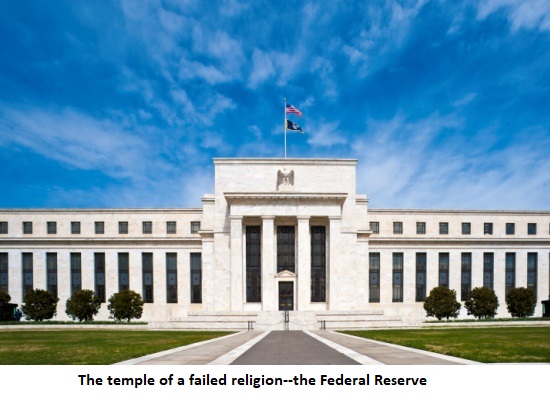
Then, in early 2022, Sam met the chairman of the Federal Reserve.

A FOIA request shows that around midday on Feb 1, 2022, Federal Reserve Chairman Jerome Powell was scheduled to meet with: Sam Bankman-Fried, CEO and founder, Brett Harrison, president, Ryne Miller, general counsel, and Mark Wetjen, head of policy and regulatory strategy, FTX US and Zach Dexter, CEO, FTX US Derivatives. [2]

The World Economic Forum (WEF) helped promote FTX. Sam was a speaker at Davos last year, on a panel with Google financial chief Ruth Porat and Bill Winters, CEO of the London-based financial giant Standard Chartered. The WEF has since deleted a web page that listed FTX as a partner. [3]

Sam’s aunt Linda Fried is a Columbia University epidemiologist. The WEF funded her study into brain aging in 2012 and she sits on the WEF’s Council for Human Enhancement. Her husband is an expert in AIDS.

Brother Gabriel works for Sen Chuck Schumer and runs an organisation, Guarding Against Pandemics. FTX funded a trial that dismissed Ivermectin as a pandemic treatment. Sam’s foundation also gave $5 m to ProPublica to investigate “biosecurity and public health preparedness.”

Their mother, Barbara, runs Mind The Gap, that uses statistical models to calculate how Democratic donors can have the “greatest marginal impact.” It was launched two weeks after then Sen Joe Biden announced his presidential run. FTX head of ventures Amy Wu used to worked for the Clinton Foundation. Sam himself was the biggest donor to the Democratic Party in 2021-22 after George Soros.

Father, Joseph Bankman, is a Stanford University law professor who has advised Sen Elizabeth Warren on the drafting of legislation.

This past April Sam sat on a panel with President Bill Clinton and former British prime minister Tony Blair at an event in the Bahamas.

Trade organizations the Chamber of Progress and the Association of Digital Asset Markets on which FTX representatives sat, have deleted references.

The attempt is underway to rewrite history.

Nobody wants to admit

Gary Gensler’s relationship goes deeper. Gensler was, and still is, an economics professor at MIT where his boss was the father of Caroline Ellison, head of FTX sister company Alameda. U.S. Representative Tom Emmer is questioning his relationship with Sam’s parents. Gensler was finance chair for Hillary Clinton’s presidential campaign.

Comment from the investment world: the New York Post quotes an investor close to FTX as saying, “This is like a Madoff situation… almost everyone in tech and Hollywood invested in this thing, Now no one wants to admit to it.”

But the most predictable response comes from The New York Times. It published 2,200 words without mentioning Sam’s funding the Democratic Party as its second biggest donor, or anything about SEC head Gensler or his connections with the parents of Sam and Caroline Ellison, nothing about the WEF or the political associations of other employees, nor, of course, about Ukraine.

The NYT spoke to Sam, but got little new information. It rehashed the story of the crypto trading company Alameda, founded in 2017, FTX in 2019 as a place to store crypto purchases, and a cryptocurrency token FTT to trade on the platform.

Alameda took loans to invest in other ventures but when the market slid and creditors recalled their loans, Alameda used customer deposits at FTX to cover its debts. CoinDesk revealed that Alameda had a large amount of FTT, sparking a collapse in the price of the token. [4]

Yet these two companies, FTX and Alameda, have more than 70 subsidiaries and may have invested in 160 other companies.

The deputy head of crypto for Ukraine, Alex Bornyakov, deputy minister of digital transformation, denied the country had converted any U.S. aid on FTX, though it had used the platform to convert crypto donations into fiat money. [5]

Is there any other way to say, this goes right to the top?

Pushy saviours

The investment firm Sequoia Capital, which has lost money on its FTX investment, had an article on its website: “Sam Bankman-Fried has a Saviour Complex — and Maybe You Should Too.”

Though it’s since removed the article, the choice of words is telling, for there’s a lot of saviour complex around, from Greta Thunberg, King Charles and Bono, to Bill Gates, Klaus Schwab, Al Gore and Yuval Harari.

Perhaps the latter is currently the most prominent. An article from March fact checks Yuval Harari and shows where his key themes fall apart.

It turns out he makes claims for genes that are simply not true: the idea that you can edit health or cognitive abilites completely ignores the environmental variables that play a parallel role.

He says under-the-skin surveillance will monitor our emotions but this is physiognomical nonsense; people vary hugely in their emotional responses.

His claim that scientists perceive the universe as a flow of data — meaning that AI machines will inevitably rule us — is likewise bunk. Scientists do not hold such a view.

Why, therefore is Harari pushing this? It aligns with the commercial interest of Silicon Valley and tech companies in a way that Shoshana Zuboff, who coined the phrase surveillance capitalism, does not. [6]

The clue is that Harari’s book is being forced on all generations as if it were public information messaging, aka, propaganda.

“In October of 2021, Harari released Volume 2 of the graphic adaptation of Sapiens. Coming up next are a Sapiens children’s book, Sapiens Live, an immersive experience, and a multi-season TV show inspired by Sapiens. Our Populist Prophet is relentless in his search for new followers—and with them new heights of fame and influence.”

Darshana Narayanan writes that he is a science populist. He is worse than that. Harari, whether he knows it or not, is a marketing man for the surveillance capitalists of Silicon Valley. There is nothing organic about Yuval Harari.

One last daquiri

Which brings us back to Sam.

As FTX sank with the sun last Friday its executives claimed that hackers had stolen the last remaining $600-900 million.

At least half of it was reportedly transferred to a company that Sam held privately. Yet it’s far from clear that any amount of money can get him off the hook, as the boats return to the shore laden with marlin.

The question is whether Sam used his parents’ political ties to launch his own financial vehicle, or whether he was manipulated — the fall guy in an operation he could not fathom, for it was deep.

Could it be that Sam and his squeeze, Caroline Ellison, were just the Harry Potter cast that was put in place to deceive the Millenial crypto speculators? The world is a polluted pool where only the poisoned thrive.

The private equity manager Alex Krainer has drawn comparisons between the FTX affair and that of Theranos and privileged-brat founder Elizabeth Holmes who is currently being sentenced for fraud. [7]

The difference seems to be that Theranos blood test was supposed to be ready for the pandemic. The board was stacked with deep state perennials: Kissinger, Shultz, Perry, Nunn. When Holmes’ fraud was exposed, the PCR test had to be coopted instead. Its inventor Kary Mullis died conveniently and the German “virologist” Christian Drosten declared PCR a test for Covid.

While we have told the bald facts of political connection we cannot finish our poolside daquiri without one additional, speculative shot.

Two weeks ago a 29 year-old crypto pioneer, the co-founder of stablecoin platform MakerDAO, was discovered drowned off the beach in Puerto Rico.

Nikolai Mushegian, raised in Kansas by immigrants from Russia, was found hours after his final Tweet on Oct 28, 2022:

“CIA and Mossad and pedo elite are running some kind of sex trafficking entrapment blackmail ring out of Puerto Rico and caribbean islands. They are going to frame me with a laptop planted by my ex gf who was a spy. They will torture me to death.” [8]

Feel free to explore the similarity of the FBI’s publication of pedo symbols with the FTX and Alameda logos.

And recall Sam’s meeting with two compromised former national leaders in the photograph at the top of this newsletter.

Tie it in with the U.S. southern border policy that is allowing gangs to traffick unaccompanied children, which the administration flies by plane, often at night, to cities across the U.S..

Finally, ask if the financing of such an operation could be allowed to happen through traceable financial accounts.

But maybe the $32 billion company really did emerge from the daydream of two star crossed lovers on a tropical beach, an intense experience — and over too soon.

***

[1] FTX funded study — Ivermectin trial was exposed as fruadulent

[2] FOIA, Feb 2022 — Federal Reserve meeting (PDF)

[3] Wayback Machine — WEF page celebrating ties to FTX

[4] NYT, Nov 14, 2022 — How Sam Bankman-Fried’s Crypto Empire Collapsed

[5] CoinDesk, Nov 14, 2022 — Ukrainian Official Refutes FTX-Ukraine Money Laundering Rumors

[6] Darshana Narayanan, Current Affairs, Mar 2022 — The Dangerous Populist Science of Yuval Noah Harari

[7] Alex Krainer , Nov 12, 2022 — The FTX, Theranos fraud template

[8] Daily Mail, Nov 10, 202 — ‘Paranoid’ crypto millionaire drowns in Puerto Rico after tweeting that CIA and Mossad were after him

Punching Down: How the “anti-disinformation” movement worked with Big Tech to protect Big Pharma

By Paul D. Thacker

Source: The Disinformation Chonicle

The COVID-19 pandemic saw the greatest acceleration of online censorship in the short history of the internet. In response, the field dedicated to upholding human rights online—the digital rights movement—remained near silent to this massive government and corporate over-reach. Worse, digital rights activists sometimes even collaborated with censors in the name of protecting the public from “disinformation.”

I’ve spent more than 20 years in digital rights, freedom of expression and open technology communities, and co-founded an organisation dedicated to these ideas: EngageMedia. Over the 17 years I ran Engage Media, we built a team that stretched across 10 countries, from India to Australia—one of the biggest digital rights organisations in the Asia-Pacific, hosting hundreds of workshops and large events, and leading multiple international networks. In short, I’m not a newbie or outsider in this field.

But during the pandemic, I watched the digital rights movement lose its voice as champions of online freedom of expression. Instead, they began to echo the positions of governments and companies with far from stellar records on human rights and corporate integrity. This recasting of governments and corporations as allies, rather than institutions to be held to account, has perverted the mission of digital rights and harmed public health.

The Digital Rights Movement

Digital Rights is an umbrella term that captures multiple concepts from “internet freedom” to “open technology” to “digital public policy.” Over the past several decades, it has become a major force in advocating for online rights and freedoms. Hundreds of universities, institutes, and non-profit organizations work in this arena on every corner of the planet. Whilst I know of no exact calculations, funding for the field is surely in the hundreds of millions of dollars annually—sourced from a mix of liberal foundations, governments, and Big Tech itself.

Core to this fundamentally left-leaning field was anti-censorship and a libertarian ethos. If the movement has a founding document, it is the 1996 Declaration of the Independence of Cyberspace, which begins:

Governments of the Industrial World, you weary giants of flesh and steel, I come from Cyberspace, the new home of Mind. On behalf of the future, I ask you of the past to leave us alone. You are not welcome among us. You have no sovereignty where we gather.

We have no elected government, nor are we likely to have one, so I address you with no greater authority than that with which liberty itself always speaks. I declare the global social space we are building to be naturally independent of the tyrannies you seek to impose on us. You have no moral right to rule us nor do you possess any methods of enforcement we have true reason to fear.

Left-libertarianism and techno-utopianism dominated Internet culture in the 90s and 2000s, yet withered rapidly in the Trump era, as it was unable to move quickly enough to address issues of online discrimination and harassment. In response, a new wing took root that was less hippy, more helicopter parent.

Internet parentalism, with its emphasis on safety over freedom, addressed concerns about the dark side of the Internet, but it did so with top-down regulation and control. And just as the former left-libertarianism created an imperfect system, so has the current left-parentalism. This became quite clear during the pandemic. During COVID, general skepticism of authority was replaced by respect for authority. Once suspect governments and businesses were now to be shielded from critique.

Content moderation is key to the new left-parentalism, and the pandemic radically accelerated and solidified a new digital authoritarianism. It is worth revisiting Hillary Clinton’s seminal 2010 “internet freedom” speech, to see how far thinking has shifted:

Now, all societies recognise that free expression has its limits. We do not tolerate those who incite others to violence… And hate speech that targets individuals on the basis of their race, religion, ethnicity, gender, or sexual orientation is reprehensible… But these challenges must not become an excuse for governments to systematically violate the rights and privacy of those who use the internet for peaceful political purposes.

How different content moderation is today, where comments deemed “offensive” might be censored. In those days liberals even thought about balancing safety and freedom when dealing with terrorists, yet this was not the case with COVID. With Musk now taking over Twitter, the Internet-parentalism wing may be on its back-foot but it has made headway in altering culture, so much so that supporting the left-libertarian approach (or the 2010 Clintonian position) is now considered “right-wing.”

New Zealand Prime minister Jacinda Arden personifies the progressive authoritarian shift. In her recent UN speech she compared “disinformation” to “weapons of war,” expressing a deep frustration with those who stray from the “consensus” and emphasising strong government control for “disinformation.” The Arden approach is now the default setting in the digital rights field where government and corporate censorship have replaced debate and persuasion as the answer to “wrong” ideas. For example, Ardern gave the opening speech at the 2022 RightsCon, the biggest digital rights conference on the calendar (EngageMedia co-hosted the 2015 edition).

That government determines truth to protect citizens is a boom to authoritarians everywhere – from the Philippines, to Ethiopia, to Russia—while also limiting government and corporate accountability. To be clear, both Clinton’s and Ardern’s policy served the needs of power. The difference is that Clinton was largely in step with the previous 200 years of liberal theory, while Arden returns society to levels of government authority and control that people have struggled to overcome for centuries.

Growth and change of “anti-disinformation”

Disinformation was already an established sector prior to the pandemic. But it focused on top level malfeasance: for example, Myanmar military social media accounts promoting violence against the Rohingya or former Philippine President Duterte’s use of bots to attack dissidents. Advocacy took a mostly Clintonian approach to counter such state power—minimising overt censorship, while educating the public and notifying Big Tech of egregious incidents of disinformation (mostly by government).

The Trump election and Cambridge Analytica scandal changed these rules as many blamed social media greed and wilful ignorance for the election loss. Claims of Russian disinformation compounded these problems. Big Tech’s alleged lack of action put it at odds with its core, liberal constituencies. Anger and disillusionment allowed the speech control wing of the digital rights movement to ascend, shifting the movement’s mission from watching the powerful to policing the fringe.

Newer disinformation initiatives also sought to rebuild trust in Big Media, legacy organisations whose legitimacy crumbled for a variety of reasons: from supporting the Iraq war, to failing to predict Trump and Brexit. To recapture authority, elites made themselves the adults who discern the truth, as the rest of society cannot be trusted make competent decisions.

Anti-disinformation amid the pandemic

I went into the pandemic with a wide variety of doubts, but was among the majority in supporting government restrictions, though never on access to information. Banning discussion of a possible lab accident at the pandemic’s beginning triggered me to reevaluate. My own Australian government and the former CDC Director Robert Redfield both considered the lab-leak a plausible reason for how the pandemic started. Meanwhile, leading anti-disinformation organisations labelled it a conspiracy theory, and suggested that journalists not amplify it.

After the lab leak theory became mainstream, I saw no reconsideration of facts among the anti-disinformation and digital rights sectors, as any straying meant being called far-right. Unfortunately, silence only shields the powerful, and civil liberties and human rights groups went AWOL on their duties, or even swapped sides. Witness the ACLU advocating for the violation of bodily autonomy and in favour of widespread vaccine mandates.

The digital rights field seem oblivious to how much information is now controlled. Despite all the changes during COVID, the 2022 iteration of RightsCon had no sessions on the pandemic and disinformation. The digital rights community has also ignored news of the White House directing Twitter to deplatform journalists, and of Harvard and Stanford Professors suing the White House for social media related free speech violations.

Other few key examples of how pandemic censorship protected the powerful:

Questioning of lockdowns was once banned, yet it is now widely acknowledged that lockdowns resulted in serious harm including delays in childhood learning, lack of early treatment for serious illness, a rise in domestic abuse, as well as inflation and a massive transfer of wealth to the rich.

Across the board social media sought to disallow information that is “inconsistent with health authorities’ guidance”. But authorities are not all-knowing and this policy blew away previously held norms around open scientific debate and went against the crowd-sourcing ethos of progressives.


Why the conformity?

Some level of conformity is to be expected; however, it reached uncanny levels during the pandemic. Public relations campaigns hid how information controls have worked, as many aren’t even aware of policies and repeated “fact check” failures. PR campaigns also succeeded in associating those seeking to limit pandemic controls as being right-wing and therefore selfish, or worse, racist and misogynist—even as vaccine hesitancy was highest among communities of colour.

Second, the “anti-disinformation” and digital rights field maintains rigorous class solidarity and is overwhelmingly upper-middle and middle class. The upper and middle classes have a higher trust in institutions because they run those institutions and those institutions have worked for them. The field is also the ultimate laptop class, along with others working in tech. Work from home and other lockdown policies benefited them, even as it harmed others.

Third, digital rights melted into the “follow the science” movement. Populism dented the prestige of the expert and professional managerial class, while COVID energized their authority with “science” and gave them back power. Questioning “the science” and acknowledging mistakes means re-diminishing that power.

Finally, Big Tech has compromised the field with tens of millions of dollars (possibly hundreds) annually, yet this funding bias is rarely discussed. Imagine if Shell, BP, and ExxonMobil were core funders of the climate change movement. Added to this financial influence is a revolving door between Big Tech and those meant to hold it to account

Moving forward

Allegations of “disinformation” have become a tool to delegitimize opposition to orthodoxy and power, and have been weaponised to shield government and Big Pharma from scrutiny. Just as criticism of the automobile industry in the 60s and 70s led to improved car safety, today’s public fora must hold the powerful to account.

By aligning with Big Tech and Big Pharma, the “anti-disinformation” and digital rights sectors have neglected their responsibilities, and have come to serve power rather than people, contributing to a broader chilling effect.

To improve digital rights, we must:

  • Ensure funders, non-profits, journalists, and media organisations more clearly stand up for free speech and invite dissenting views;
  • Remain courageous while suffering the slings and arrows of nasty online criticism. And support those who speak out;
  • Highlight bullying that closes down conversation and benefits institutional interests;
  • Generate greater public awareness of government and corporate manipulation on social media;
  • Refuse Big Tech and Big Pharma funding for work that is meant to keep these same industries accountable;
  • Create more watchers to watch the “anti-disinformation” watchers;
  • Develop alternative media platforms so the conversation can’t be so easily controlled;
  • ·Ensure regulation that protects free speech;
  • Break up Big Tech and Big Media to limit government and corporate control of public discourse and increase diversity of opinion.

Pandemic information controls and restrictions on free speech had real world consequences that contributed to poorer, not better, public health outcomes. By neglecting to address corporate and government pandemic censorship, the digital rights movement failed in its core mission of securing online freedom of expression.

Saturday Matinee: Guidance

Guidance

By Benjamin Franz

Source: Film Threat

This year I have started to explore a more cultural take on my favorite genre by experiencing China’s take on science fiction. Cixin Liu wrote a phenomenal trilogy, The Three-Body Problem, which will be adapted by David Benioff and DB Weis for Netflix in 2023. RF Kuang’s The Poppy War is a scary exploration of the Poppy Wars and the Boxer Rebellion. And now I’m here to tell you about director Neysan Sobhani’s wondrous Guidance. Set in the late 21st century, ten years after the ‘Great War,’ the film, written by Sobhani, Anders R. Fransson, and Wang Pei Yu, explores the sloppy, dishonest interpersonal relationships of people and how technology can throw a monkey wrench into an otherwise good relationship.

Three months after a bomb scare at the lab Su Jie (Francisco Chen) works, Mai Xi Zuan (Harry Song) is taking his girlfriend, Han Miao (Jia Sun), on an extended weekend to the heritage resort/museum. During the bomb scare, Han Miao was stuck in Su Jie’s safe room for six hours. What we see transpire during those six hours is Su Jie’s attempts to seduce Han Miao. She has purposefully left Mai Xi Zuan in the dark about it, but the secret is slowly creating a rift between these two young people.

Containing a built-in lie detector, the app prevents both of them from being less than fully honest.”

And then they take the pill for NIS, an AI interface Su Jie has been developing. Eventually, NIS will permit humans to have all manner of apps, but for the first few weeks, they start with an app Su Jie’s departed father was working on during the Great War. This app, Guidance, is intended to improve people and help them develop into more empathic, honest human beings. Or at least that’s the sales pitch. As we learn through a cross-cutting interview with Su Jie, it may have been initially intended as a weapon used to dig secrets out of captives.

Guidance explores all these topics through the weekend getaway of Mai Xi Zuan and Han Miao. Containing a built-in lie detector, the app prevents both of them from being less than fully honest. This scenario presents so many questions about the direction of Artificial Intelligence. Can a weapon be rehabilitated? How does complete honesty impact a relationship? Given the human impulse to subvert such candor and honesty, it should come as no surprise both main characters attempt to alter the app’s parameters.

While a slow and atmospheric exploration of Han Miao and Mai Xi Zuan’s relationship, Sobhani’s film does what great science fiction always does: deepen our understanding of each other through science and technology. Guidance is a stellar production, and I encourage you to seek it out if you wish to dip your proverbial toe into another culture’s sci-fi offerings. This is a fascinating extrapolation of China’s current endeavor to lead the world in Artificial Intelligence research. Equal parts relationship drama, science fiction, and mystery, the film leaves you stunned by its conclusion. This is a once-in-a-lifetime, truly great film, and I’m very interested to know what the filmmakers will do next.

Watch Guidance on Hoopla here: https://www.hoopladigital.com/title/15044793

Biotech Giants Using GMOs to Build Food Tyranny

By Colin Todhunter

Source: Off-Guardian

The article below was written the day before India’s state-run biotech regulator, the Genetic Engineering Appraisal Committee (GEAC), approved genetically modified (GM) mustard for commercial cultivation. This decision was taken on 26 October 2022.

The regulatory clearance for GM mustard means the crop is fit for environmental release. However, the Supreme Court has yet to rule on the matter and government stated a while back that it would wait until that ruling is in.

What follows provides insight into the deceptions and scientific fraud that underpin this decision as well as the consequences for food and agriculture.

We are currently seeing rising food prices due to a combination of an engineered food crisis for geopolitical reasons, financial speculation by hedge funds, pension funds and investment banks and profiteeringby global grain trade conglomerates like Cargill, Louis Dreyfus, ADM and Bunge.

In addition, agri firms like Bayer, Syngenta (ChemChina) and Corteva cynically regard current circumstances as an opportunity to promote their agenda and seek commercialisation of unregulated and improperly tested genetically engineered (GE) technologies.

These companies have long promoted the false narrative that their hybrid seeds and their GE seeds, along with their agrichemicals, are essential for feeding a growing global population. This agenda is orchestrated by vested interests and career scientists – many of whom long ago sold their objectivity for biotech money – lobby groups and disgraced politiciansand journalists.

Meanwhile, in an attempt to deflect and sway opinion, these industry shills also try to depict their critics as being Luddites and ideologically driven and for depriving the poor of (GE) food and farmers of technology.

This type of bombast disintegrates when confronted with the evidence of a failing GE project.

As well as this kind of emotional blackmail, prominent lobbyists like Mark Lynas– unable or unwilling to acknowledge that genuine food security and food sovereignty can be achieved withoutproprietary products – trot out other baseless and absurd claims that industry critics are Kremlin stooges, while displaying their ignorance of geopolitics.

Indeed, who would you turn to for an analysis of current US-Russia relations? An advocate for GE foods and pesticides who makes inaccurate claims from his perch at the Gates Foundation-funded Cornell Alliance for Science. Or a renowned academic like Professor Michael Hudson whose specialist field covers geopolitics.

But it would not be the first time that an industry activist like Lynas has ventured beyond his field of claimed expertise to try to score points.

However, dirty tricks and smears are par for the course because the agri biotech emperor has been shown to have no clothes time and again – GE is a failing, often detrimental technology in search of a problem. And if the problem does not exist, the reality of food insecurity will be twisted to serve the industry agenda, and regulatory bodies and institutions supposedly set up to serve the public interest will be placed under intense pressure or subverted.

The performance of GE crops has been a hotly contested issue and, as highlighted in a 2018 piece by PC Kesavan and MS Swaminathan in the journal Current Science, there is sufficiently strong evidence to question their efficacy and the devastating impacts on the environment, human health and food security, not least in places like Latin America.

new report by Friends of the Earth (FoE) Europe shows that big global biotech corporations like Bayer and Corteva, which together already control 40% of the global commercial seed market, are now trying to cement complete dominance. Industry watchdog GMWatch notes these companies are seeking to increase their control over the future of food and farming by extensively patenting plants and developing a new generation of genetically modified organisms (GMOs).

These companies are moving to patent plant genetic information that can occur naturally or as a result of genetic modification. They claim all plants with those genetic traits as their “invention”. Such patents on plants would restrict farmers’ access to seeds and impede breeders from developing new plants as both would have to ask for consent and pay fees to the biotech companies.

Corteva has applied for some 1,430 patents on new GMOs, while Bayer has applications for 119 patents.

Mute Schimpf, food campaigner at Friends of the Earth Europe, says:

Big biotech’s strategy is to apply for wide patents that would also cover plants which naturally present the same genetic characteristics as the GMOs they engineered. They will be lining their pockets from farmers and plant breeders, who in turn will have a restricted access to what they can grow and work with.”

For instance, GMWatch notes that Corteva holds a patent for a process modifying the genome of a cell using the CRISPR technique and claims the intellectual property rights to any cells, seeds and plants that include the same genetic information, whether in broccoli, maize, soy, rice, wheat, cotton, barley or sunflower.

The agri biotech sector is engaged in a corporate hijack of agriculture while attempting to portray itself as being involved in some kind of service to humanity.

And this is a global endeavour, which is also currently being played out in India.

GM MUSTARD

recent report on the Down to Earth website stated that the Genetic Engineering Appraisal Committee (GEAC), India’s apex regulatory body, might approve the commercial cultivation of GM mustard. In response, concerned citizens have written to the government, objecting to the potential approval of unsafe, unneeded and unwanted GMOs.

The decision whether to allow the commercialisation of what would be the first GE food crop in India has been dragging on for years. COVID delayed the process, but a decision on GM mustard now appears to be close.

However, serious conflicts of interest, sleight of hand and regulatory delinquency – not to mention outright fraud – could mean the decision coming down in favour of commercialisation.

The bottom line is government collusion with global agribusiness, which is trying to hide in the background, despite much talk of Professor Pental and his team at Delhi University being independent developers of GM mustard (DMH 11).

GM mustard presents an opportunity to make various herbicide tolerant (HT) mustard hybrids using India’s best germ plasm, which would be an irresistible money spinner for the seed and chemical manufacturers.

In 2016, campaigner Aruna Rodrigues petitioned India’s Supreme Court seeking a moratorium on the release of any GMOs into the environment pending a comprehensive, transparent and rigorous biosafety protocol in the public domain conducted by agencies of independent expert bodies, the results of which are made public.

In her writ, Rodrigues stated:

In 2002, Proagro Seed Company (now Bayer), applied for commercial approval for exactly the same construct that Prof Pental and his team are now promoting as HT Mustard DMH 11. The reason today matches Bayer’s claim then of 20% better yield increase (than conventional mustard). Bayer was turned down because the ICAR [Indian Council of Agricultural Research] said that their field trials did not give evidence of superior yield.”

The petition says that 14 years later invalid field trials and unremittingly fraudulent data now supposedly provide evidence of a superior yield of 25%.

Rodrigues continues:

HT DMH 11 is the same Bayer HT GMO construct – a herbicide tolerant GMO of three alien genes. It employs, like the Bayer construct, pollen sterilisation technology BARNASE, with the fertility restorer gene BARSTAR (B & B system) (modified from the original genes sourced from a soil bacterium) and the herbicidal bar gene in each GMO parental line. The employment of the B & B system is to facilitate the making of hybrids as mustard is largely a self-pollinating crop (but outcrosses at rates of up to 20%). There is no trait for yield. HT DMH 11 is straightforwardly an herbicide tolerant (HT) crop, though this aspect has been consistently marginalised by the developers over the last several years.”

In order to produce a hybrid, two parent lines had to be genetically modified. Barnase and barstar technology was used in the parent lines. And the outcome is three GMOs: the two parents and the offspring, DMH 11, which will be ideal for working with glufosinate (Bayer’s ‘Liberty’ and ‘Basta’).

According to Rodrigues:

… the plan is that the official route for the first-time release of a HT crop and a food crop will be through HT DMH 11 and/or its two HT parental lines by stealth. Since the claimed YIELD superiority of HT DMH 11 through the B & B system over non-GMO varieties and hybrids is quite simply NOT TRUE…”

In her numerous affidavits submitted to India’s Supreme Court, Rodrigues has set out in some detail why GE crops are a threat to human health and the environment and are unsuitable for India. She briefly communicated some of her concerns in a 2020 interview titled GMO Issue Reaches Boiling Point in India: Interview with Aruna Rodrigues.

Moreover, various high-level reports have advised against introducing GM food crops to India: The ‘Jairam Ramesh Report’ of February 2010, imposing an indefinite moratorium on Bt Brinjal; The ‘Sopory Committee Report’ (August 2012); The ‘Parliamentary Standing Committee’ (PSC) Report on GM crops (August 2012); and The ‘Technical Expert Committee (TEC) Final Report’ (June-July 2013).

These reports conclude that GM crops are unsuitable for India and that existing biosafety and regulatory procedures are inadequate. Appointed by the Supreme Court, the TEC was scathing about the regulatory system prevailing in India, highlighting its inadequacies and inherent serious conflicts of interest. The TEC recommended a 10-year moratorium on commercial release of GM crops. The PSC also arrived at similar conclusions.

According to eminent lawyer Prashant Bhushan, these official reports attest to just how negligent India’s regulators are and to a serious lack of expertise on GM issues within official circles.

Aruna Rodrigues long ago noted the abysmal state of GMO regulatory oversight in the country and the need for the precautionary principle to be applied without delay. But not much has changed and the regulatory position basically remains the same.

Rodrigues asserts that the two parent lines and the hybrid DMH-11 require full independent testing, which has not occurred. And it has not occurred because of a conflict of interest and regulatory delinquency.

Rodrigues notes:

India is suddenly faced with the deregulation of GMOs. This is disastrous and alarming, without ethics and a scientific rationale.”

GM mustard is said to out-yield India’s best cultivars by 25-30%. The choice of the correct ‘comparators’ is an absolute requirement for the testing of any GMO to establish whether it is required in the first place. But Rodrigues argues that the choice of deliberately poor ‘comparators’ is at the heart of the fraud.

In the absence of adequate and proper testing and sufficient data, no statistically valid conclusions of mean seed yield (MSY) of DMH 11 could be drawn anyhow. Yet they were drawn by both the regulators and developers who furthermore self-conducted and supervised the trials. Without valid data to justify it, DMH 11 was allowed in pre-commercial large scale field trials in 2014-15.

For an adequate basis for a comparative assessment of MSY, Rodrigues argues it was absolutely necessary for the comparison to include the cross (hybrid) between the non-modified parental lines (nearest isogenic line), at the very start of the risk assessment process and throughout the subsequent stages of field testing, in addition to other recommended ‘comparators’. None of this was done.

Deliberately poor non-GMO mustard varieties were chosen to promote prospects for DMH 11 as a superior yielding GMO hybrid, which then passed through ‘the system’ and was allowed by the regulators, a classic non-sequitur by both the regulators and Dr Pental.

The fraud continued, according to Rodrigues, by actively fudging yield data of DMH 11 by 15.2% to show higher MSY. In her various Supreme Court petitions, she has offered a good deal of evidence to show how it was done.

Rodrigues says:

It matters not a jot if HT DMH 11 is not approved. What does matter is that its two HT (GMO) parental lines are: HT Varuna-barnase and HT EH 2-barstar will be used ‘for introgressing the bar-barnase and bar- barstar genes into new set of parental line to develop next generation of hybrids with higher yields” (according to the developer and regulator).”

She says this extraordinary admission confirms that the route to any number of ‘versions’ of HT mustard DMH 11 is invested in these two GMOs as parents – India will have hundreds of low-yielding HT mustard hybrids, using India’s best mustard cultivars at great harm to farmers and contaminating the country’s seeds and mustard germ plasm irreversibly.

In effect, according to Rodrigues, India faces a three-in-one regulatory jugglery in a brazen display of collusion to fraud the nation by regulatory institutions of governance.

Moreover, HT mustard DMH 11 will make no impact on the domestic production of mustard oil, which was a major reason why it was being pushed in the first place. The argument was that GM mustard would increase productivity and this would help reduce imports of edible oils.

Until the mid-1990s, India was virtually self-sufficient in edible oils. Then import tariffs were reduced, leading to an influx of cheap (subsidised) edible oil imports that domestic farmers could not compete with. This effectively devastated the home-grown edible oils sector and served the interests of palm oil growers and US grain and agriculture commodity company Cargill.

It came as little surprise that in 2013 India’s then Agriculture Minister Sharad Pawar accused US companies of derailing the nation’s oil seeds production programme.

Whether in India, Europe or elsewhere, the industry’s agenda is to use GE technology to secure intellectual property rights over all seeds (and chemical inputs) and thus gain total control over food and farming. And given what has been set out here – they seek to achieve this by all means necessary.

LIFE… IN REVERSAL

By Kingsley L. Dennis

Source: Waking Times

‘We must distinguish between real change and fictitious change. The change that comes from without, from externally imposed training and discipline, is fictitious…Real change comes from within, by conscious work intentionally performed by the being himself.’ ~J.G. Bennett 

It is increasingly difficult in these times to speak of ‘non-verifiable’ or unprovable matters, especially concerns of the spirit-consciousness, for too many people are inculcated with fixed beliefs and thinking patterns. This is itself a sign of social conditioning and of a certain ‘management of mind.’ We should not be surprised that this situation is rife throughout our societies and cultures and is becoming increasingly predominant. Social norms are persuading many people to prefer safety and security rather than the potential discomfort that comes from gaining new realizations and understanding.

An ex-officer of the Soviet secret police who defected to the West (Gregory Klimov), revealed that in the fields of Soviet psychological warfare (and social psychology) they utilized the principles of psychoanalysis. In this, they saw the phenomena of evil as a ‘complicated, complex social illness.’ The psychoanalysts within the KGB equated evil with illness, especially an illness of the human psyche. This perspective places demonic actors and events as ‘objective realities;’ i.e., as various forms of illness of ‘psyche and soul.’ As the Russian anthroposophist G.A. Bondarev writes: ‘The devils represents an involved and complex process of degeneracy or retrogression that in the main consists of three parts: sexual deviation, psychic illnesses and some physical deformities of the organism.

The number of humans already afflicted with this degeneration is legion.’1 Bondarev goes on to say that, based on certain social-psychological testing, the greatest degeneracy exists within the so-called elite of the world (as much as 75%). What this points to, concludes Bondarev, is a drastic decline of the human spirit. What it also tells us is that the phenomenon of ‘evil’ does not necessarily need to be personified or projected into certain personages as it represents an illness of the human psyche. We can recognize its presence operating within psychic imbalance and internal disconnect and detachment. And I would concur with Bondarev’s conclusion in that such psychic dis-ease represents an inner disconnect with the transcendental impulse. This disconnect, or splintering, from a sacred source has now come to signify the nature of the reversal that epitomizes much of contemporary life.

It is within this reversal that we see much of the negating, or counter-evolutionary, forces within humanity. And these forces have been dominating much of our everyday lives and continue to do so. I would suggest that it is our individual responsibility to recognize these forces, attempt to comprehend them, and to transform them into impulses that can work for humankind’s evolvement. In this, we need to come to grips with the presence and activity of those aspects that signify a psychic illness, or dis-ease, within life. Such aspects are a feature of existence as much as positive, developmental forces. They all act within the playground of attraction, repulsion, and the expression of energy. The Rosicrucians recognized these forces when they referred to the Deus Inversus – or the ‘Reversed God.’ This nature of reversal works on humanity through the spheres of imbalance and disharmony to counteract civilizational development. The Austrian mystic Rudolf Steiner was aware of the future impact of such forces when he stated that: ‘It is essential that the forces which manifest as evil if they appear at the wrong place must be taken in hand…in such a way that humanity can achieve something with these forces of evil that will be beneficial for the future of the whole of world evolution.’2 In this regard, it is important that the individual becomes aware of the metaphysical realm that lies beyond the threshold of normal, or every day, consciousness.

If we remain unawares to our own forces of spirit-consciousness, then we are more susceptible to the manipulations of such counter-developmental forces. Those readers familiar with my writings will know that I have attempted to draw attention to certain aspects of our consensus reality in order to gain greater clarity about how we may respond to the situation in a constructive way. I stand by what was written in the Gnostic Gospel of Philip: ‘For so long as the root of wickedness is hidden, it is strong. But when it is recognized, it is dissolved. When it is revealed, it perishes.’ Recognition, through heightened awareness and perception, brings more choice into play. The individual needs to be conscious of certain facts before they can manifest the correct intention and focus of will. What is needed is a culture of revelation – of ‘uncovering’ – rather than of cover up. It is through revelation that insight into the metaphysical foundation of life can be sustained within our increasingly materialistic societies. This access to metaphysical realities can never be wholly eradicated. Yet just a cursory glance at modern life indicates that there are attempts to deepen peoples’ immersion into deteriorating forms of dissonance and distraction. This can be seen as a form of reality deceit.

Reality Deceit

The great deceit that is coming upon us is the unveiling of a so-called ‘utopia’ based on the isolation of the human spirit-consciousness. This fake promise is wrapped up in tech-salvationist terms, heralding a false ideal future. The real dis-ease of the human condition is to be in a state of estrangement. That is, estranged and alienated from any metaphysical influence or nourishment. It is not that the metaphysical background to life must necessarily be obvious to us, or tangible in our daily lives – only that we are cognizant of its existence and continual influence. Yet once this sense of recognition (the act of aware cognition) is dissolved, a barren soulless life is the result. And yet, in most circumstances, people will not be cognizant of this loss – this lack of the transcendental impulse in their lives – for they will be entrained into a reality consisting of a physical-digital mesh that keeps them attached to their lower nature and desires. This deceit consists of a most heinous form of enslavement, for it shall both be a willing one as well as an ignorant one. The splintering of the human being from its metaphysical connection shall go almost unnoticed, and the transfer into a reality of limited consciousness will have been enacted quite skillfully. This sly route to a human condition of alienation, procured through the guise of technological advancement and progress, will be a coup against the creative spirit. And this shall be the reversal of the human reality – the reality deceit.

The almost imperceptible dangers are that we have been slipping into a reversed reality, constructed through a realm of fantasy and make-believe, which now fuels the crass and superficial culture industries that dominate modern life. Any notion of Higher Reality has been twisted into an artificial lesser reality that attempts to hinder, as far as is possible, the developmental impulse from penetrating. This arrangement has culminated in dissociating humankind not only from its natural, organic, carbon-based environment, but also from an inherent contact with its origin – Source consciousness. This increasing disembodiment is reflected in such forms as the techno-digital ecosystem, extended reality (the Metaverse), computerization (including algorithms), and artificial intelligence. For many people today, their digital devices have become their instruments of salvation. But this salvation, this divine deliverance, belongs to the Deus Inversus – and we should choose our gods carefully. We should be careful too, not to be pulled into the encroaching banalization of life. And we should be on the look-out for signs and signals.

If anyone wishes to see how ‘signals’ can operate within the reality deceit, then watch all the episodes in the recent Westworld TV series (2016-2022). In Season Four, the machinic android ‘hosts’ have taken control of the world using a bioengineered virus that infects humans over the course of a generation, turning them docile and susceptible to AI and ‘host’ control. Storylines and narratives are created in order to give people their roles and characters in life, which they passively follow believing them to be their own life stories. Humankind is managed through these manufactured ‘storylines’ (a.k.a. socio-cultural narratives) that are transmitted directly to the minds and lives of humans through a series of radio-sonic transmission signals via the global technological infrastructure…But then again, this is just a fantasy story after all.

The course of external events that inform our political, economic, and cultural systems are not arbitrary, coincidental or natural. The modern human has been subtly manipulated into disconnecting from, and even shunning, the guidance of higher impulses. We are being told that the human being alone is the sole and dominant driving force for the future. And by this, we are propelled ever further into the personality construct with the human ego at the wheel. We are standing at the threshold of adopting a glorified materialistic view of life and the world. The spell of this disease is working to over-materialize materialism in a very deliberate and nefarious way. There may be some discomfort in the unfoldment of awareness, yet this is part of the transmutation of the dis-ease.

Life ‘in reversal’ is working hard and fast on this intensifying of materialism. This deepening materialism not only denies the expansion of consciousness but is actively working to stagnate it. At the same time, we are moving through an impulse of increasing individual awareness against the backdrop of this over-materialization. Yet it is an awareness through the few, and not the many (yet). By recognizing that certain forces within the world are using processes of mass suggestion to introduce a simplification – or ‘dumbing down’ – of human consciousness, we can gain greater awareness over our condition and predicament. And in this awareness, we can gain a natural resistance and protection, as recognition allows a discernment to be made. It is this discernment to step away from the negating energies and frequencies of toxicity that can help a person to attune to a resonance of perceptive consciousness. By choosing where we place ourselves – our focus and attention – we can either take a step forward or stay where we are and stagnate. As always, the choice remains with us.

THE ELITES WHO ARE JUST SO OVER HUMANITY

The depth of anti-humanist sentiment related by Douglas Rushkoff in his latest book, Survival of the Richest, is harrowing and illuminating.

By Chris Barsanti

Source: PopMatters

Some things can be horrifying even if unsurprising. One such moment is the opening anecdote in Douglas Rushkoff’s Survival of the Richest: Escape Fantasies of the Tech Billionaires. In 2017, Rushkoff was paid an exorbitant fee to travel to a remote high-end resort where (he thought) he would do his usual thing: Talk about the future to investment bankers looking for a way to game the next trend.

What happened was far stranger. Rather than give a speech, Rushkoff sat at a conference room table with five fantastically rich guys from “the upper echelon of the tech investing and hedge fund world” and tried to answer their questions about how they could survive the impending apocalypse.

The scene is comical, in a Dr. Strangelove way. Assuming the world is racing toward an inevitable societal collapse they called “the Event”, the men thought it best to talk survival tactics with a self-described “Marxist media theorist” and professor at Queens/CUNY. Rather than acting like masters of the universe, they were nervous about being caught out when the Event came. They worried whether New Zealand or Alaska was the right location for their doomsday bunker; could their security guards keep the hungry mobs at bay; if an all-robot staff could be better. Rushkoff explains what seemed to lie behind these unnamed One Percenter preppers’ anxieties:

Taking their cue from Tesla founder Elon Musk colonizing Mars, Palantir’s Peter Thiel reversing the aging process, or artificial intelligence developers Sam Altman and Ray Kurzweil uploading their minds into supercomputers, they were preparing for a digital future that had less to do with making the world a better place than it did with transcending the human condition altogether. Their extreme wealth and privilege served only to make them obsessed with insulating themselves from the very real and present danger of climate change, rising sea levels, mass migrations, global pandemics, nativist panic, and resource depletion. For them, the future of technology is about only one thing: escape from the rest of us.– Douglass Rushkoff

Rushkoff calls this thinking “the Mindset”. He defines it as an “atheistic and materialistic scientism” that launders a desire for control and conquest through quasi-religious adherence to digital code and the power of the market. Expanding on his original article from 2018 (Medium)—which ironically led to his being swamped by requests from disaster-related industries to get in touch with the anonymous five they thought needed their services—Rushkoff spends the rest of Survival of the Richest explaining where the Mindset came from, how dangerous it is, and what he thinks should replace it.

Nothing that Rushkoff writes in this clipped, angry book should surprise most readers. Nobody who has spent any time tracking the pronouncements and feuds of the more futurist-minded tech elites would think many had a high opinion of or interest in improving the daily lot of carbon-based life forms. Though predictable and at times a bit too broadly defined, the depth of anti-humanist sentiment related by Rushkoff is still harrowing and illuminating.

The phenomenon of powerful men thinking themselves separate from the great unwashed and unbound by common morality is as old as human history. Although this of-the-moment book contains little context dating back more than three decades, Rushkoff does not try to claim everything about the Mindset is new. He points instead to how illogical power fantasies have merged with an Ayn Randian cult of the solitary hero and been nurtured by the Web’s seductive capacity for self-aggrandizing mythmaking. Given how much he may have contributed to those seductions, he is the right messenger.

Among the first public intellectuals to grapple seriously with the digital revolution as it washed over society in the 1990s, Rushkoff remains a go-to expert for Internet prognostication. Unlike many tech evangelizers, though, he later had second thoughts. Some of the more revealing sections in Survival of the Richest come from when the author turns his focus on himself.

Readers of a mindset will likely feel a certain wistfulness as Rushkoff writes about the early punk years of cyberspace. Just as underground music was bursting into the mainstream and indie bands were making real money, outlaw hackers were suddenly at the forefront of a technological revolution. In 1994, Rushkoff published two books: The GenX Reader, a heady anthology of alt-cultural tropes (part of the Slacker screenplay, Dan Clowes and Peter Bagge comics) that could already see the commodification of generational rebellion to come; and Cyberia, a quasi-utopian paean about the psychedelia-inspired confluence of programmers, Deadheads, libertarians, Wiccans, and ravers who seemed to be leading the nascent Web towards a consciousness- and freedom-expanding future. The 1996 “Declaration of Independence of Cyberspace,” announced ironically enough at the first ever World Economic Forum in Davos, proclaimed a borderless world where governments had no sovereignty.

Rushkoff looks back now with clearer eyes:

Deregulation sounded good at the time. We were just ravers and cyberpunks, paranoid about the government arresting us for drugs … We didn’t realize that banishing the government from the internet would create a free zone for corporate colonization. We hadn’t yet discovered that government and business balance each other out—a bit like fungus and bacteria. Get rid of one, and the other runs rampant.

In Rushkoff’s cultural history, the experimental tribal ethos of the Web’s heady early days was co-opted by business interests who saw a new frontier to monetize; less Mondo 2000, more AOL CD-ROMs. Online libertarianism seemed to evolve from a confederacy of rule-breaking rebels and pioneers to anger-prone grumps so dissatisfied with their fellow man that they started planning unintentionally funny “seasteading” ocean communities, taking their toys and leaving. Wealthy futurists imagine uploading themselves onto a cloud server, revealing a depressingly simplistic view of human consciousness and a grand view of themselves as transcendent immortals. As technology and behavioral science became more finely tooled at predicting consumer behavior, it also exacerbates hate and loneliness, assisting the all-too-easy COVID-19 pandemic pivot to increasingly tech-mediated relationships.

For the Mindset’s “tech titans and billionaire inventors”, per Rushkoff, there is no problem that technology cannot solve. And the problems are often human in form. Suppose that were true, and the world was spiraling towards a collapse (which the online tools superpowered by elites could be accelerating). In that case, the believers might wonder, why not use technology to scarper off to their Bond villain bunkers?

Rushkoff’s critique expands from what he calls this amoral “sociopathic” attitude toward the state of capitalism. Combining the digital-communitarian ethos of Cory Doctorow with the acerbic skepticism of Naomi Klein, Rushkoff does not trust that a more enlightened kind of capitalism can save the world. His argument against eternal economic growth has merit. But Rushkoff is on firmer ground when defining technological-sociological phenomena like the Mindset. That is not to say there is no case for a more sustainable economy, but Rushkoff breezes too quickly past the challenges resulting from that massive transition. Being necessary does not make a thing easy.

As with many jeremiads of this kind, Survival of the Richest loses some of its impact when delivering suggestions for how to push back (don’t give in to the inevitability of doom, buy local, fight for anti-monopoly laws). That is partly because it is difficult for them to seem equal to the magnitude of the problem. But for Rushkoff, the smallness of the solutions is part of the point: “We can still be individuals; we just need to define our sense of self a bit differently than the algorithms do.”