After the Crash

Dispatches From a Long Recovery (Est. 10/2024)

After the Crash

Saturday Matinee: Rollerball (1975)

The Science Fiction of Rollerball Is Nothing Compared to the Facts of Real Life Control

By Rich Monetti

Source: Omni

If you’ve never seen Rollerball, stop what you’re doing and dial up the DVD for this 1975 Science Fiction Movie classic. Set in the year 2024, this dystopia puts Bread and Circuses on a violent whirlwind that’s engineered to keep the world’s corporate overlords out of the crosshairs. As such, revolving door heroes are amply provided and give the population cause to question the saccharin surroundings they live in. That is until each warrior meets their predetermined end and complacency has no other choice but to comply. Great Science Fiction but real control is so much easier.

Nonetheless, the backdrop of this dark world takes place after the “Corporate Wars” have bankrupted the world’s nations. In the void left behind, the corporations employ and govern. This leaves the public free of concerning themselves with important decisions, which are better left to “the few” in this standout among dystopian movies.

The Privileged Few

They also enjoy the privilege – even at the expense of Jonathan E. (James Caan). In the hero class of distraction, E. lost his wife to an executive who wanted her for himself.  Paid off to leave him, the accompanying villa in Rome was no match for the rugged, introspect of the world renowned figure.

In this, we are given the vehicle to dig into underbelly as we digest the glory of the game and all its bloodletting. Obviously discontented, Jonathan questions the tradeoff between the material preeminence his position affords and freedom. One of his hanger’s on who serves among the privilege Jonathan reaps doesn’t have such depth and toes the line the system forges like the mindless drone she is. “But comfort is freedom,” reasons Ella.

Enough of the citizenry bought off with nice things, the oversight does not even consider those who may reap much less, because this set up is sure to have losers on a far greater scale. This all sends E. off to determine how people have been so effectively siphoned off as sheep.

Information is Power

Expectedly, the information is scarce – or better yet – properly edited. Summaries of important works are readily available, and in case 24-7 of the game on telescreen gives way to inquiry, the overlords will reset any doubt in the comfort of your own easy chair.  “What do you want books for?,” Jonathan’s teammate, Moon Pie asks  “Look Johnny, if you wanna learn somethin’, just get a Corporate Teacher to come and teach it to ya’.

Jonathan defers and goes to Geneva to visit a computerized archive.  The prospects are quickly eradicated as the librarian is little help, and the system even less. Leaving E at a loss, the willing agent reveals that “the whole of the 13th Century is gone.”

All still escapes Ella with Jonathan coming to a crossroad. “Why don’t you do what the executives want – especially since you’ll be paid handsomely,” she doesn’t get it.

Specifically, they want him to retire. His survival defies the preset odds and disturbs the complacency. Or in chilling John Houseman-speak, the game was created to demonstrate “the futility of individuality.”

Real Control is much Easier

Your mind is officially blown. But a simple look at voter turnout or the tune out that hundreds of TV stations afford us and control takes on the form of despondency. Most significantly, a two party system in which the same elites support both sides, and the important decisions gives the many the illusion of choice.

Even so with the two party gaming clearly at our disposal, we are still sold on the stark differences, and coalesce into our corners over less substantial issues. So while we all don’t like American jobs shipped overseas of elite born trade policy, hate money in politics, the never ending improprieties of the big banks and inefficient delivery of healthcare, we are unable to find crossover or a leader able to unite across party lines.

Instead, our only common place involves a shared sense that the other side is mired in stupidity. This even as we see enough smarts among them that they are also able to navigate survival against such a stacked deck. Blinded by the many fictional divides, who really needs to pick up spilled guts or dislodged eyeballs when the powerlessness our elites have created is so much easier to clean up.

All the News That’s Fit to Print

Of course, the chance to narrow the divides can be a function of the availability of information. In the Science Fiction of Rollerball, this is diminished by keeping information controlled by offering tidbits or official accounts. But secrets only give rise to the desire to seek out what you’re not supposed to know.

It’s far more efficient to let people think they have a free press, and now with the internet and cable news, sources that rise to the top are the ones providing fictitious entertainment in place of facts.

In addition, the unseen hand of Google elevating disinformation now rivals the wall between advertising and content, which doesn’t really exist, and has always acted as editors to protect the elite.

Of course, we do have our distractions, and the cult-like mass following of the NFL can’t help but be seen as a parallel to Rollerball. The circus though is subtle and smarter than 2024.

Whoever has the most Toys

Putting aside violence on the decline, a no one left standing approach has been replaced with parity where everyone has a chance to win. Far more effective for viewership, and the Sunday, Monday, Thursday cascade plays right into the American consumerism that one ups Rollerball’s ability to feign comfort for the masses.  Or why give people stuff to keep them complacent when you can make them ever in pursuit of the next gadget that is sure to bring unending happiness.

As Brad Pitt says in Fight Club, “the things you own, they ending up owning you.” For example, when Apple outsources production to a Chinese factory where nets keep workers from jumping out the windows, stock options go a long way to allaying the guilt and getting you that Lexus you can’t do without.

But who knows, Rollerball might have emerged because people figured out how to beat the system, and the powerful went back to the basics that the Romans perfected.  Maybe, we should be content, and let the elites have their ball so they go don’t go home and take it with them.  You know, before they return with something worse, and we’re left rolling over dead instead of despondent.


Watch the full film here.

(To switch off subtitles, click the “cc” button on the bottom left corner of the video window.)

Godzilla Amazon: The Amount of Power in Jeff Bezos’ Hands Should Frighten All Americans

Amazon very effectively uses technology and data to sidestep traditional restrictions on monopoly power.

By Matt Stoller

Source: AlterNet

To understand the depth and breadth of Jeff Bezos’ ambitions for the company he built, type www.relentless.com into your browser. The domain Bezos registered in 1994 will redirect to Amazon, the company aptly, and ambitiously, nicknamed The Everything Store. He tells his shareholders that the company will act like an aggressive startup — that at Amazon, it is always Day One.

Like Google and Facebook, Amazon uses technology and data to sidestep traditional restrictions on monopoly power. Our lives are increasingly organized by the platforms these companies run, platforms which now mediate the way we communicate and engage in commerce with each other. We are living in a world organized by tech monopolists, a change in power relationships that no one voted for but has been imposed upon us nonetheless.

Now, Bezos is attempting to add more power to his empire with the surprise announcement that the company will pay $13.7 billion for Whole Foods Market. Amazon will now have a store footprint in neighborhoods across America.

Our communities and the way we engage in commerce will change. Imagine walking into a Whole Foods store and seeing different prices depending on whether you are a member of Amazon Prime — or seeing different prices depending on any other way that you interact with Amazon.

This isn’t implausible. It is what the company does when it opens up stores. For instance, Amazon is creating a chain of physical book stores to take the place of the book stores the company destroyed. In these stores, there are no price tags at all: You scan the items with your phone and have a price delivered to you, personalized by Amazon. Why wouldn’t Amazon extend this to Whole Foods? “Our goal with Amazon Prime, make no mistake,” says Amazon CEO Jeff Bezos, “is to make sure that if you are not a Prime member, you are being irresponsible.”

This statement and the amount of power in Bezos’ hands should frighten all Americans. Bezos meant that Amazon will soon be so good for consumers that it would just be folly not to be a member. But what he unwittingly implied is that as a citizen, you will have no choice but to interact with his institution to buy and sell key goods that everyone needs — on his terms.

Jeff Bezos, in other words, has a vision. To be everywhere, to be the platform for everything for every consumer. So when Bezos calls you irresponsible for not tithing to Amazon, America has a big political problem.

Amazon’s takeover of Whole Foods means that it can target and eliminate regional competitors one by one as it did with its online competitors. When Diapers.com emerged as a competitor to Amazon, Amazon simply sold diapers below cost until the company capitulated and sold itself to Bezos. There’s no reason to assume Amazon wouldn’t bring the same predatory pricing strategy to bear in every city in America. Why wouldn’t it? Even though predatory pricing is illegal, the government hasn’t enforced those laws for decades. Whole Foods tends to source from local farms as part of a commitment to localism; these farms will now be negotiating with a much bigger entity that is committed to a ruthless model of efficiency.

There are so many ways that Amazon can use its power that it’s simply impossible to figure out what it will do. Amazon probably doesn’t even know yet; it will discover and test them, relentlessly. Maybe you will get first in line, or last in line, for the most popular toy during the Christmas period, or maybe the restaurant you own will get access to the freshest yet limited batch strawberries you need based on whether you are giving better deals to Prime members.

Or here’s a more creative possibility. Amazon is excluding Amazon Prime video from Apple TV so that Prime members will buy its streaming device instead of Apple’s. As the smartphone market commodifies and transforms, Bezos could simply use his combined physical and online footprint to keep you from even seeing prices at his stores unless you are using Amazon-approved electronic devices. If Amazon were just one of many stores that would be one thing. But Amazon is quickly becoming the dominant way to buy and sell.

And this, make no mistake, is what is happening. Upon the announcement of the acquisition, Target’s stock price dropped by 10 percent and Walmart’s by 5 percent. Amazon’s rose by more than the price it is paying for Whole Foods. Wall Street sees the writing on the wall. There is only one force that can stop Amazon from organizing and regulating basically all American retail commerce — our democratic institutions and our political system. We the people.

Bezos knows Amazon is a political enterprise at this point. The day before he announced his company’s attempt to buy this supermarket chain, he released a request on Twitter to have people offer ideas for where he can direct charity money. That is the kind of public relations undertaken by political leaders. And Amazon put out an ad for a Ph.D. economist-cum-lobbyist “to educate regulators and policy makers about the fundamentally procompetitive focus of Amazon’s businesses.” And he has put political fixers, like Ivanka Trump’s lawyer and ex-Clinton administration officer Jamie Gorelick, on his board of directors. He also bought The Washington Post.

The public should speak out in opposition to this merger. More than that, the government should take this opportunity to reject the entire pro-finance pro-concentration philosophy that has taken hold in this country since the Reagan era. It is no accident that Whole Foods founder John Mackey was forced to surrender his life’s work because financiers looking for a quick buck bought up a large bloc of shares in his company and pressured him to sell the company to Amazon. The day before the announcement of the sale, he called these hedge funds “Ringwraiths,” after the evil characters in “Lord of the Rings.” Bezos might be the most powerful empire-builder in the land, but he had help.

This merger should frighten all of us. But it should also embolden anyone who believes that America should not be in thrall to monopolists like Bezos. For them, today, as Jeff Bezos might put it, is Day One.

Matt Stoller is fellow at the Open Markets program, where he is researching the history of the relationship between concentrated financial power and the Democratic party in the 20th century.

The West’s War on Free Speech

By Tony Cartalucci

Source: Land Destroyer

With a name like the “National Democratic Institute” (NDI) one might expect the US State Department-funded, corporate-financier chaired front to be the premier proponent of freedom and democracy worldwide. And although it poses as such, it does precisely the opposite. It uses principles like free speech, democracy, press freedom, and human rights as a facade behind which it carries out a politically motivated agenda on behalf of the special interests that fund and direct its activities.

In a recent Tweet, NDI linked to a New York Times article titled, “In Europe’s Election Season, Tech Vies to Fight Fake News.” It claimed in the Tweet that the article featured:

A look at some of the projects aiming to use automated algorithms to identify and combat fake news. 

The article itself though, reveals nothing short of a global effort by US tech-giants Google and Facebook, in collaboration with the Western media, to censor any and all media that fails to align with Western-dominated narratives.

The article itself claims:

The French electorate heads to the polls in the second round of presidential elections on May 7, followed by votes in Britain and Germany in the coming months. Computer scientists, tech giants and start-ups are using sophisticated algorithms and reams of online data to quickly — and automatically — spot fake news faster than traditional fact-checking groups can. 

The goal, experts say, is to expand these digital tools across Europe, so the region can counter the fake news that caused so much confusion and anger during the United States presidential election in November, when outright false reports routinely spread like wildfire on Facebook and Twitter.

The article then explains that once “fake news” is spotted, it is expunged from the Internet. It reports that:

After criticism of its role in spreading false reports during the United States elections, Facebook introduced a fact-checking tool ahead of the Dutch elections in March and the first round of the French presidential election on April 23. It also removed 30,000 accounts in France that had shared fake news, a small fraction of the approximately 33 million Facebook users in the country.

Were foreign government-linked tech companies purging tens of thousands of accounts ahead of elections in say, Thailand or Russia, it is very likely organizations like NDI and media platforms like the New York Times would cry foul, depicting it as censorship.

In determining what is and isn’t “fake news,” the New York Times offers some clues (emphasis added):

Using a database of verified articles and their artificial intelligence expertise, rival groups — a combination of college teams, independent programmers and groups from existing tech companies — already have been able to accurately predict the veracity of certain claims almost 90 percent of the time, Mr. Pomerleau said. He hopes that figure will rise to the mid-90s before his challenge ends in June.

In other words, “fake news” is determined by comparing it directly to narratives presented by establishment media platforms like the New York Times, the BBC, CNN, MSNBC, Fox News, and others who have notorious track records of serial deception, false reporting, and even war propagandizing.

Nowhere does the New York Times explain how these “verified articles” have been determined to be factually accurate, and instead, it appears that all these algorithms are doing is ensuring all media falls in line with Western narratives.

If media in question coincides with Western-dominated media platforms, it is given a pass – if not, it is slated for expunging as described elsewhere in the New York Times’ piece.

Thus, the National Democratic Institute, who claims on its website to “support and strengthen democratic institutions worldwide through citizen participation, openness and accountability in government,” finds itself promoting what is essentially a worldwide agenda of malicious censorship, manipulating the perception of the globe’s citizenry, not supporting or strengthening it’s participation in any sort of honest political process.

To answer the question as to what the NDI is referring to when it claims other nations are “censoring” free speech and press freedoms, it involves defending local fronts funded by the NDI and its parent organization, the National Endowment for Democracy (NED) who merely repeat Western propaganda in local languages and with local spins. When foreign nations attempt to deal with these instances of “fake news,” US fronts like NDI and NED depict it as censorship.

While the West poses as the premier champion of free speech, citizen participation, openness, and accountability, the New York Times article reveals an unfolding plan to utterly crush any narrative that deviates from Western media talking points, thus controlling citizen perception, not encouraging “participation,” and ensuring that the West alone determines what is “opened” and held “accountable.”

No worse scenario can be referenced in human history or even among human fiction than plans to determine for the world through automatic algorithms and artificial intelligence almost in real time what is heard and read and what isn’t. It is even beyond the scope and scale of George Orwell’s cautionary dystopian “1984” novel.

In a truly free society, an educated citizenry is capable of deciding for itself what is “fake news” and what isn’t. Because of the rise of alternatives to the West’s monopoly over global information, many people are doing just that – determining that Western narratives are in fact deceptions. At no other point in modern history has the Western media faced as many alternatives, and as much skepticism on this scale, as well as an ebbing of trust domestically and abroad. It is no surprise then, to find the West resorting to outright censorship, even if it cushions mention of it with terms like “fake news.”

Luddism and Economic Ideology

ludd1

Source: the HipCrime Vocab

Smithsonian Magazine has a very good feature on the Luddites, well worth a read. There are many elements you just don’t read in many economic histories; for example, the 40-hour work week was not brought down from the mountaintop by Moses and inscribed in stone tablets, despite what you may have heard elsewhere:

At the turn of 1800, the textile industry in the United Kingdom was an economic juggernaut that employed the vast majority of workers in the North. Working from home, weavers produced stockings using frames, while cotton-spinners created yarn. “Croppers” would take large sheets of woven wool fabric and trim the rough surface off, making it smooth to the touch.

These workers had great control over when and how they worked—and plenty of leisure. “The year was chequered with holidays, wakes, and fairs; it was not one dull round of labor,” as the stocking-maker William Gardiner noted gaily at the time. Indeed, some “seldom worked more than three days a week.” Not only was the weekend a holiday, but they took Monday off too, celebrating it as a drunken “St. Monday.”

Croppers in particular were a force to be reckoned with. They were well-off—their pay was three times that of stocking-makers—and their work required them to pass heavy cropping tools across the wool, making them muscular, brawny men who were fiercely independent. In the textile world, the croppers were, as one observer noted at the time, “notoriously the least manageable of any persons employed.”

The introduction of machinery in cloth manufacture did not make these people’s lives better. In fact, it made them a lot worse:

“They [the merchant class] were obsessed with keeping their factories going, so they were introducing machines wherever they might help,” says Jenny Uglow, a historian and author of In These Times: Living in Britain Through Napoleon’s Wars, 1793-1815.

The workers were livid. Factory work was miserable, with brutal 14-hour days that left workers—as one doctor noted—“stunted, enfeebled, and depraved.” Stocking-weavers were particularly incensed at the move toward cut-ups. It produced stockings of such low quality that they were “pregnant with the seeds of its own destruction,” as one hosier put it: Pretty soon people wouldn’t buy any stockings if they were this shoddy. Poverty rose as wages plummeted.

Yes, you read that right- the introduction of “labor-saving” technology made the amount these people worked increase dramatically. It also made their work much, much more unpleasant. It transferred control to a smaller circle of wealthy people and took it away from the workers themselves. It made the rich richer, increased poverty, and tore society apart.

But more technology is always good, right?

And since history is written by the victors, “Luddite” is a term now inextricably wound up with the knee-jerk rejection of new technology. But the Luddites weren’t opposed to new technology at all! What they were fighting against was the economic conditions that took away their autonomy and turned them into mendicants in their own country:

The workers tried bargaining. They weren’t opposed to machinery, they said, if the profits from increased productivity were shared. The croppers suggested taxing cloth to make a fund for those unemployed by machines. Others argued that industrialists should introduce machinery more gradually, to allow workers more time to adapt to new trades.

The plight of the unemployed workers even attracted the attention of Charlotte Brontë, who wrote them into her novel Shirley. “The throes of a sort of moral earthquake,” she noted, “were felt heaving under the hills of the northern counties.”

[…]

At heart, the fight was not really about technology. The Luddites were happy to use machinery—indeed, weavers had used smaller frames for decades. What galled them was the new logic of industrial capitalism, where the productivity gains from new technology enriched only the machines’ owners and weren’t shared with the workers.

In fact, the Luddites actually spared the machines that were used by employers who treated workers fairly. Funny how you never hear that in most popular descriptions of the Luddite revolt:

The Luddites were often careful to spare employers who they felt dealt fairly. During one attack, Luddites broke into a house and destroyed four frames—but left two intact after determining that their owner hadn’t lowered wages for his weavers. (Some masters began posting signs on their machines, hoping to avoid destruction: “This Frame Is Making Full Fashioned Work, at the Full Price.”)

Unlike today, labor actually fought back against these attempts to destroy their way of life:

As a form of economic protest, machine-breaking wasn’t new. There were probably 35 examples of it in the previous 100 years, as the author Kirkpatrick Sale found in his seminal history Rebels Against the Future. But the Luddites, well-organized and tactical, brought a ruthless efficiency to the technique: Barely a few days went by without another attack, and they were soon breaking at least 175 machines per month. Within months they had destroyed probably 800, worth £25,000—the equivalent of $1.97 million, today.

Rather than the “natural course” of free-market economics, once again it was government intervention, including brutal state violence, that made modern capitalism possible:

Parliament was now fully awakened, and began a ferocious crackdown. In March 1812, politicians passed a law that handed out the death penalty for anyone “destroying or injuring any Stocking or Lace Frames, or other Machines or Engines used in the Framework knitted Manufactory.” Meanwhile, London flooded the Luddite counties with 14,000 soldiers.

By winter of 1812, the government was winning. Informants and sleuthing finally tracked down the identities of a few dozen Luddites. Over a span of 15 months, 24 Luddites were hanged publicly, often after hasty trials, including a 16-year-old who cried out to his mother on the gallows, “thinking that she had the power to save him.” Another two dozen were sent to prison and 51 were sentenced to be shipped off to Australia.

But wait, isn’t capitalism all about “freedom and liberty?” Freedom and liberty for some, I guess.

The problem, then as now, was not technology itself, but the economic relations that it unfolded against. What I found most interesting is that even back then, the emerging pseudoscience of economics was used to justify the harsh treatment of the workers and the bottomless greed of capitalists, in particular the “sacred text” of modern Neoclassical economics, Adam Smith’s The Wealth of Nations:

For the Luddites, “there was the concept of a ‘fair profit,’” says Adrian Randall, the author of Before the Luddites. In the past, the master would take a fair profit, but now he adds, “the industrial capitalist is someone who is seeking more and more of their share of the profit that they’re making.” Workers thought wages should be protected with minimum-wage laws. Industrialists didn’t: They’d been reading up on laissez-faire economic theory in Adam Smith’s The Wealth of Nations, published a few decades earlier.

“The writings of Dr. Adam Smith have altered the opinion, of the polished part of society,” as the author of a minimum wage proposal at the time noted. Now, the wealthy believed that attempting to regulate wages “would be as absurd as an attempt to regulate the winds.”

It seems as though nothing’s really changed. Using economic “science” to justify social inequality and private ownership goes back to the very beginnings of the Market.

When Robots Take All of Our Jobs, Remember the Luddites (Smithsonian Magazine). Smithsonian wrote about this before, see also: What the Luddites Really Fought Against

As the above history shows, there is nothing “natural” or normal about extreme busyness and brutally long working hours. It is entirely an artificial creation:

A nice post at the HBR blog…describes how being busy is now celebrated as a symbol of high status. This is not natural. Marshall Sahlins has shown that in hunter-gather societies (which were the human condition for nine-tenths of our existence) people typically worked for only around 20 hours a week. In pre-industrial societies, work was task-oriented; people did as much as necessary and then stopped. Max Weber wrote:

“Man does not “by nature” wish to earn more and more money, but simply to live as he is accustomed to live and to earn as much as is necessary for that purpose. Wherever modern capitalism has begun its work of increasing the productivity of human labour by increasing its intensity, it has encountered the immensely stubborn resistance of this leading trait of pre-capitalistic labour. (The Protestant Ethic and the Spirit of Capitalism, p24”

The backward-bending supply curve of labour was normal.

E.P. Thompson has described how pre-industrial working hours were irregular, with Mondays usually taken as holidays. He, and writers such as Sidney Pollard and Stephen Marglin, have shown how the working day as we know it was imposed by ruthless discipline, reinforced by Christian moralists. (There’s a clue in the title of Weber’s book). Marglin quotes Andrew Ure, author of The Philosophy of Manufacturers in 1835:

The main difficulty [faced by Richard Arkwright] did not, to my apprehension, lie so much in the invention of a proper mechanism for drawing out and twisting cotton into a continuous thread, as in…training human beings to renounce their desultory habits of work and to identify themselves with the unvarying regularity of the complex automation. To devise and administer a successful code of factory discipline, suited to the necessities of factory diligence, was the Herculean enterprise, the noble achievement of Arkwright…It required, in fact, a man of a Napoleon nerve and ambition to subdue the refractory tempers of workpeople accustomed to irregular paroxysms of diligence.”

Today, though, such external discipline is no longer so necessary because many of us – more so in the UK and US than elsewhere – have internalized the capitalist imperative that we work long hours, …Which just vindicates a point made by Bertrand Russell back in 1932:

“The conception of duty, speaking historically, has been a means used by the holders of power to induce others to live for the interests of their masters rather than for their own.”

Against busyness (Stumbling and Mumbling)

Honestly, the five-day workweek is outmoded and ridiculous. It’s more of a babysitting operation for adults than anything else. It’s a silly as arguing that we need over two decades of formal education in order to do our jobs.

I was reminded of this over the holidays. In the U.S. we get virtually no time off from our jobs, unlike most other countries (East Asia might be an exception). But Christmas/New Year’s is a rare exception, and we have several four-day weeks in a row (without pay for some of us, of course). Those weeks are so much more pleasant, and I would even say productive, than the rest of the year. Every year at this time I think to myself, “Why isn’t every week a four-day workweek?” Some places do have such an arrangement, but they justify it by four long, ten-hour days. I don’t know about you, but towards the end of ten hours in a row of “work” I doubt anyone’s accomplishing much of anything. Is 32 hours a week really not enough to keep society functioning in the twenty-first century?

Not only that, but many people use whatever little vacation they do have in order to take the whole time period at the end of the year off. This is typical in Europe, but rarer here. In any case, while going to work I noticed that there was hardly any traffic. The roads were empty. There were plenty of seats on the bus. The streets and sidewalks were empty. There was no waiting in the restaurants and cafes. There was plenty of room for everything. There was a laid-back feeling everywhere. It was so pleasant. I couldn’t help but think to myself, “why isn’t every week like this?” If more people could stay home and work less, it very well could be. Instead we’re trapped on a treadmill. Working less would actually pay dividends in terms of reduced traffic, less crowding, less pollution, and better health outcomes due to less stress and more time to exercise.

There’s also a simple logic problem at work here. If we say the 40-hour week is inviolable and set-in-stone for the rest of time, and we do not wish to increase the problem of unemployment, then literally no labor-saving technology will ever save labor! We might as well dispense with the creation of any labor-saving technology, since by the above logic, it cannot save labor. You could equivocate and say that it frees us from doing “lower” level work and allows us to do “higher” level work, as when ditch diggers become factory workers, or something. That may have been a valid argument a hundred years ago, but in an age when most of us are low-paid service workers or useless paper-pushers, it’s pretty hard to make that case with any seriousness anymore.

***

I often refer to economics as a religion, with its practitioners as priests. So it’s interesting to read that in other contexts. This is from Chris Dillow’s blog, where the above passage about work was taken:

The social power, i.e. the multiplied productive force”, wrote Marx, appears to people “not as their own united power but as an alien force existing outside them, of the origin and end of which they are ignorant, which they thus cannot control.”

I was reminded of this by a fine passage in The Econocracy in which the authors show that “the economy” in the sense we now know it is a relatively recent invention and that economists claim to be experts capable of understanding this alien force:

“As increasing areas of political and social life are colonized by economic language and logic, the vast majority of citizens face the struggle of making informed democratic choices in a language they have never been taught. (p19)”

This leads to the sort of alienation which Marx described. This is summed up by respondents to a You Gov survey cited by Earle, Moran and Ward-Perkins, who said; “Economics is out of my hands so there is no point discussing it.”

In one important sense such an attitude is absurd. Every time you decide what to buy, or how much to save, or what job to do or how long to work, economics is in your hands and you are making an economic decision.

This suggests to me two different conceptions of what economics is. In one conception – that of Earle, Moran and Ward-Perkins – economists claim to be a priestly elite who understand “the economy”. As Alasdair MacIntyre said, such a claim functions as a demand for power and wealth:

“Civil servants and managers alike [he might have added economists-CD] justify themselves and their claims to authority, power and money by invoking their own competence as scientific managers (After Virtue, p 86).”

There is, though, a second conception of what economists should do. Rather than exploit alienation for their own advantage, we should help people mitigate it…

Economists in an alienated society (Stumbling and Mumbling)

This makes a point I often refer to – this depiction of “The Economy” as some of “natural” force that we have no control over, subject to its own inexorable logic. We saw above how the writings of Adam Smith provided the ideological justification for the wealthy merchants to screw over the workers. It cemented the perception that the economy was just a natural force with its own internal logic that could no more be regulated than could the wind or the tides. And over the course of several hundred years, we have intentionally designed our politcal institutions such that government cannot “interfere” in the “natural workings” of the economy. Doing so would only make all of us worse off, or so goes the argument.

There is a telling passage in this column by Noah Smith:

…Even now, when economic models have become far more complex than anything in [Milton] Friedman’s time, economists still go back to Friedman’s theory as a mental touchstone — a fundamental intuition that guides the way they make their models. My first macroeconomics professor believed in it deeply and instinctively, and would even bring it up in department seminars.

Unfortunately, intuition based on incorrect theories can lead us astray. Economists have known for a while that this theory doesn’t fit the facts. When people get a windfall, they tend to spend some of it immediately. So economists have tried to patch up Friedman’s theory, using a couple of plausible fixes….

Milton Friedman’s Cherished Theory Is Laid to Rest (Bloomberg)

Yes, you read that right, economists knew for a long time that a particular theory did not accord with the observed facts, but they didn’t discard it because it was necessary for the complex mathematical models that they use to supposedly describe reality. Rather, instead of discarding it, they tried to “patch it up,” because it told them what they wanted to hear. Note how his economics professor “believed deeply” in the theory, much as how people believe in the Good Book.

Nice “science” you got there.

That methodology ought to tell you everything you need to know about economic “science.” One wonders how many other approaches economists take that such thinking applies to.

Friedman was, of course, the author of “Capitalism and Freedom,” which as we saw above, is quite an ironic title. Friedman’s skill was coming up with ideas that the rich wanted hear, and then coming up with the requisite economic “logic” to justify them, from deregulation, to privatization, to globalization, to the elimination of minimum wages and suppression of unions. His most famous idea was that the sole purpose of a firm is to make money for its shareholders, and all other responsibilities were ‘unethical.’ The resulting “libertarian” economics was promoted tirelessly, including a series on PBS, by wealthy organizations and right-wing think-tanks with bottomless funding, as it still is today (along with its even more extreme cousin, “Austrian” economics). One thing the Luddites did not have to contend with was the power of the media to shape society, one reason why such revolts would be unthinkable today (along with the panopticon police states constructed by capitalist regimes beginning with Great Britain— “freedom” indeed!).

Smith himself has written about what he calls 101-ism:

We all know basically what 101ism says. Markets are efficient. Firms are competitive. Partial-equilibrium supply and demand describes most things. Demand curves slope down and supply curves slope up. Only one curve shifts at a time. No curve is particularly inelastic or elastic; all are somewhere in the middle (straight lines with slopes of 1 and -1 on a blackboard). Etc.

Note that 101 classes don’t necessarily teach that these things are true! I would guess that most do not. Almost all 101 classes teach about elasticity, and give examples with perfectly elastic and perfectly inelastic supply and demand curves. Most teach about market failures and monopolies. Most at least mention general equilibrium.

But for some reason, people seem to come away from 101 classes thinking that the cases that are the easiest to draw on the board are – God only knows why – the benchmark cases.

101ism (Noahpinion)

But the best criticism I’ve read lately is from James Kwak who has written an entire book on the subject: Economism: Bad Economics and the Rise of Inequality. He’s written several posts on the topic, but this post is a good introduction to the concept. Basically, he argues that modern economics allows policies that benefit the rich at the expense of the rest of society to masquerade as objective “scientific” truths thanks to the misapplication of economic ideology. As we saw above ,that goes back to very beginnings of “free market” economics in the nineteenth century:

In policy debates and public relations campaigns…what you are … likely to hear is that a minimum wage must increase unemployment—because that’s what the model says. This conviction that the world must behave the way it does on the blackboard is what I call economism. This style of thinking is influential because it is clear and logical, reducing complex issues to simple, pseudo-mathematical axioms. But it is not simply an innocent mistake made by inattentive undergraduates. Economism is Economics 101 transformed into an ideology—an ideology that is particularly persuasive because it poses as a neutral means of understanding the world.

In the case of low-skilled labor, it’s clear who benefits from a low minimum wage: the restaurant and hotel industries. In their PR campaigns, however, these corporations can hardly come out and say they like their labor as cheap as possible. Instead, armed with the logic of supply and demand, they argue that raising the minimum wage will only increase unemployment and poverty. Similarly, megabanks argue that regulating derivatives will starve the real economy of capital; multinational manufacturing companies argue that new trade agreements will benefit everyone; and the wealthy argue that lower taxes will increase savings and investment, unleashing economic growth.

In each case, economism allows a private interest to pretend that its preferred policies will really benefit society as a whole.The usual result is to increase inequality or to legitimize the widening gulf between rich and poor in contemporary society.

Economics 101, Economism, and Our New Gilded Age (The Baseline Scenario)

All of the above reinforces a couple of points I often like to make:

1.) Capitalism was a creation of government from day one. There is nothing “natural” or “free” about markets.

2.) It is sustained by a particular ideology which poses as a science but is anything but.

These is no fundamental reason we need to work 40 hours a week. There is no reason we have to go into debt just to get a job. There is no benefit to the extreme wealth inequality; it’s not due to any sort of “merit.” And on and on. Economic “logic” is destroying society along with the natural world and preventing any adaptive response to these crises. But its power over the hearts and minds of society seems to be unassailable, at least until it all falls apart.

Saturday Matinee: Obsolete

Source: Truthstream Media

The Future Doesn’t Need Us… Or So We’ve Been Told. With the rise of technology and the real-time pressures of an online, global economy, humans will have to be very clever – and very careful – not to be left behind by the future. From the perspective of those in charge, human labor is losing its value, and people are becoming a liability. This documentary reveals the real motivation behind the secretive effort to reduce the population and bring resource use into strict, centralized control. Could it be that the biggest threat we face isn’t just automation and robots destroying jobs, but the larger sense that humans could become obsolete altogether? *Please watch and share!* Link to film: http://amzn.to/2f69Ocr

Saturday Matinee: Summer Wars

“Summer Wars” (2009) is a sci-fi anime directed by Mamoru Hosoda (The Girl Who Leapt Through Time) and animated by Madhouse studio. The film’s plot follows Kenji Koiso, an eleventh-grade math prodigy who, while visiting his friend Natsuki’s great-grandmother, is falsely implicated in the hacking of a virtual world by a rogue AI called Love Machine. With the help of his community, Kenji must undo the damage and prevent the AI’s spread into the real world.

Watch the full film here.

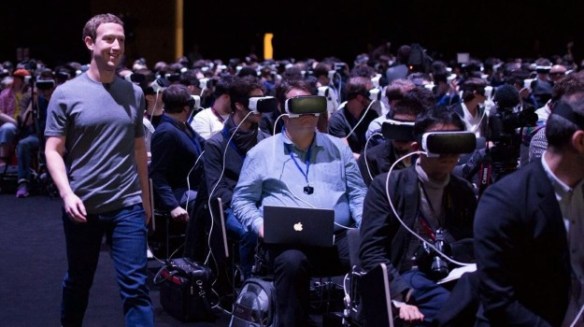
Algorithmic Control and the Revolution of Desire

zuckerberg_VR_people-625x350

By Alfie Brown

Source: ROAR Magazine

Last year, Stanford University published a study confirming what many of us may long have suspected: that your computer can predict what you want with more accuracy than your spouse or your friends. Your digital footprint betrays the truth not only about what you “like” but about what you really like — or so the argument goes. But what if our digital footprints, besides revealing our desires, are also responsible for the very construction of these desires? If that were the case, we would need to display a far deeper level of suspicion towards the complex patterns of corporate and state control found in contemporary cyberspace.

There is little doubt that innovations in mobile technologies are part of emerging methodologies of social control. In particular, games and applications that make use of the Google Maps back-end system — including Uber, Grindr, Pokémon Go and hundreds of others — which should be seen as one of the most important technological developments of the last decade or so, are particularly complicit in these new regulatory practices. Putting the well-publicized data collection issue aside, such applications have two powerful ideological functions. First, they construct the new “geographical contours” of the city, regulating the paths we take and mapping the city in the service of both corporate interest and the prevention of uprisings. Second, and more unconsciously, they enact what Jean-Francois Lyotard once called the “desirevolution” — an evolution and revolution of desire, in which that what we want is itself now determined by the digital paths we tread.

The Psycho-Geographical Contours of the City 

In 1981, the French theorist Guy Debord famously wrote of the “psycho-geographical contours” of the city that govern the routes we take, even when we may feel we are wandering freely around the physical space. At that time, it was Debord’s topic — architecture — that was the dominant force in re-organizing our routes through the city. Today, however, that role is increasingly taken up by the mobile phone. It is Uber that dictates the path of your taxi, Maps that dictates the route of your walks and drives, and Pokémon Go that (for a summer at least) determined where the next crowd would gather.

Other similar map-based application programing interfaces, or APIs, dictate our jogging routes (MapMyRun), our recreational hikes (LiveTrekker) and our tourist activities (TripAdvisor Guides). Pokémon Go attracted some publicity because it accidentally and humorously gathered crowds in weird places, but this should only alert us to its potential ability to gather crowds in the right places (to serve corporate interest) or to prevent the gathering of crowds in the wrong ones (to prevent organized uprisings, for instance). Such applications should be seen as a testing phase in the project of Google and its affiliated corporations as they work out how best to regulate the movements of large populations via their phones. Pokémon Go players were the early cyborgs, complete with hiccups and malfunctions — a beta version of Google’s future human. These future humans will go where instructed.

On a smaller scale, this point can be seen in concrete terms with a case study of London. A recent Transport for London talk discussed the possibility of “gamifying” commuting. In order to facilitate this possibility, Transport for London have made the internet API and data streams used to monitor all London Transport vehicles open source and open access, in the hope that developers will build London-focused apps based around the public transport system, thus maximizing profit. One idea is that if a particular tube station is at risk of becoming clogged up due to other delays, TfL could give “in-game rewards” for people willing to use alternative routes and thus smooth out the jam.

While traffic jam prevention may not seem like evidence that we have arrived in the dystopia of total corporate and state control, it does actually reveal the dangerous potentiality in such technologies. It shows that the UK is not as far away from the “social credit” game system recently implemented in Beijing to rate each citizen’s trustworthiness and give them rewards for their dedication to the Chinese state. While the UK media reacted with shock to these innovations in Chinese app development, a closer look at the electronic structures of mapping and controlling our own movements shows that a similar framework is already in its development phase in London too. In the “smart city” of the future, it won’t just be traffic jams that are smoothed out. Any inefficient misuse or any occupation of public space deemed dangerous by the authorities can be specifically targeted.

The Corporate Surveillance State

When it comes to these developments in technology, state and corporate forces work more closely with each other than ever before — and much more closely than they are willing to admit. Srećko Horvat has pointed out the short distance between the creators of Pokémon Go and Hillary Clinton, despite her odd and unsolicited recent public claim that she didn’t know who made the game. Likewise, Julian Assange’s strangely under-discussed 2014 book When Google Met WikiLeaks showed the shocking proximity of Google chief Eric Schmidt and the Washington state apparatus. In terms of surveillance and the use of big data, it has become impossible to sustain the distinction between state control and the production of wealth, since the two have become so irrevocably intertwined. As such, old arguments that “it’s all just about money” need to be treated with greater suspicion, since major firms today are so closely tied to the state. Various aspects of state organization should likewise be considered equally suspect because of their corporate underpinnings.

Of course, when it comes to the mapping applications that promise to help us access the best quality objects of our desire with the greatest efficiency and the least cost, these tempting forces of joint corporate and state control are entered into willingly by participants. As such, they require something else in order to function in the all-consuming way that they do. Far from simply channeling and transforming our movements, they also need to channel and even transform our desires.

We are now firmly within the world of the electronic object, where the mediation of everything from lovers and friends to meals and activities via our mobile phones and computers makes it virtually impossible to separate physical from electronic objectivity. Whilst the electronic Pokémon or the “in-game rewards” offered by many applications may not yet have the physicality of a lover who can be accessed via Tinder, or a burger that can be located via JustEat, the burger and the lover certainly have the electronic objectivity of the Pokémon. We can therefore see a transformation in the objects of desire taking place by and through our devices, so that we are confronted not only with a change in how we get what we want, but with a change in what we want in the first place.

Italo Calvino once wrote of the “amorous relationship” that “erases the lines between our bodies and sopa de frijoles, huachinango a la vera cruzana, and enchiladas.” While in such a moment food and lover become one in a kind of orgy of physical consumption, in the same novel Calvino warned of a time “when the olfactory alphabet, which made them so many words in a precious lexicon, is forgotten,” and in which “perfumes will be left speechless, inarticulate, illegible.”

It is this world that we find ourselves desiring in, where an orgy of electronic objects with no olfactory physicality blurs the distinction between lovers, meals and “in-game” rewards. The purpose of this shift, of course, is to increase the power of technological corporations by giving them a new sort of control over the way we relate to our objects of desire. If the boundaries between the way we search, desire and acquire our burgers, lovers and Pikachus are dissolving, it is not so much the old point that everything has become a commodity, but a new point that this kind of substitutional electronic objectivity endows corporate and state technologists with unprecedented power to distribute and redistribute the objects of the desire around the “smart city.”

Data Centralization in China and the West

There is, moreover, a significant centralization of power underpinning these developments. Like the social credit idea, the Chinese phenomenon of WeChat — developed in 2011 by Tencent, one of the largest internet and mobile media companies in the world — has received concerned media coverage in the West. WeChat is the first truly successful “SuperApp,” the basic premise of which is that all applications like WhatsApp, Facebook, Instagram, OpenRice, Tinder, TripAdvisor and many more, are rolled into one cohesive application. All for our convenience, of course.

As a result, however, there is now a new level of cohesion between the data-collection and movement monitoring going on in the mobile phone as a whole, where all data is now directly collected in a single place. More than half of the 1.1 billion WeChat users access the app over 10 times per day, and many users simply leave it on continuously, using it to map, shop, date and play. This means that the app sets a new precedent for continually monitoring the movements of a whole nation of citizens. WeChat’s incredibly strange “heat map” feature actually lets users — and authorities — see where crowds are forming. The claim is that this has nothing to do with crowd control: the objective is simply to help us access the least crowded shopping malls, doing nothing more than helping us get what we want.

WeChat is already the most popular social media application in China, but it will soon have huge significance worldwide, with an international version now available and many replica “SuperApps” in production. What the Western media finds to be so concerning about WeChat is once again something that already exists here in the West, at least in beta form, without us knowing it. WeChat actually offers us a glimpse into an Orwellian future in which companies and governments can track every movement we make. While in China the blocking of Google means that WeChat uses Baidu Maps as its API, the international version of WeChat simply taps into Google Maps, showing just how deeply integrated these corporate technologies already are.

What emerges from Western media coverage of these developments is the continued insistence on an apparent division between the public and the private sphere in the United States and Europe. When it comes to digital surveillance and the monitoring of movement, the situation is almost certainly better in the West than it is in China at this moment. Yet from an analysis of recent developments in China we learn not only that we need to be attentive to similar dangers here in the West, but also that there are powerful ideological mechanisms at play to obscure these developments by presenting China and the US as fundamentally opposed to one another. Whilst in China the links between the new SuperApps and the state are commonly accepted, in the US the illusion of privacy remains paramount. Although data is often shared between different corporations and between the public and the private sectors, this fact is generally obscured. The continued expressions of shock at the more openly centralized state control visible in China serve only to further consolidate the impression that these things are not happening in the US and Europe.

Furthermore, WeChat reveals more than the dangers of mass data collection and new levels of technological surveillance. It also embodies the power of the phone over the objects of desire. Since one single app can successfully market us food, lovers, holidays, events, blogs and even charities, the connections between such “objects” become more important than the differences. While the structural similarities between Grindr, Pokémon Go and OpenRice become apparent via analysis of both their surfaces and back systems, WeChat makes the connections plain to see. The various forms and objects of each individual’s desire no longer represent discreet and separable elements of a subject’s life. Instead we enter a fully cohesive libidinal economy in which we are increasingly regulated and mapped via the organization of what and how we desire.

The Desirevolution

So what do we do when faced with this revolution — a technological revolution that is not overthrowing any existing power structures but rather transforming the world in the service of private corporations and the state? Often, the response of those concerned by such developments is to express hostility or distrust towards technology itself. Yet to break this corporate organization of desire, we need not nostalgically yearn for a desire that is free of politics and technology, for no such desire is possible. On the contrary, what we need is to recognize that desire is necessarily and always controlled by both politics and technology.

This awareness would be the first step towards ensuring that the centralized corporate and state organization of desire malfunctions — and, ultimately, it would be the first step towards its potential reprogramming. The corporate desirevolution depends on our blindness to the politics of its technologies, asking us to experience our desires as spontaneous yearning and our mobile phone and its powerful apps as just tools for our convenience, helping us get what we want in the easiest way possible. We need to recognize that this is far from the case. The principal concern of those who own the apps — perhaps even more powerful than data collection — is to transform desire itself. At the very least, we can make visible the complicity of such technologies in producing the perfect conformist modern citizen.

The United States of Work

Employers exercise vast control over our lives, even when we’re not on the job. How did our bosses gain power that the government itself doesn’t hold?

By Miya Tokumitsu

Source: New Republic

Work no longer works. “You need to acquire more skills,” we tell young job seekers whose résumés at 22 are already longer than their parents’ were at 32. “Work will give you meaning,” we encourage people to tell themselves, so that they put in 60 hours or more per week on the job, removing them from other sources of meaning, such as daydreaming or social life. “Work will give you satisfaction,” we insist, even though it requires abiding by employers’ rules, and the unwritten rules of the market, for most of our waking hours. At the very least, work is supposed to be a means to earning an income. But if it’s possible to work full time and still live in poverty, what’s the point?

Even before the global financial crisis of 2008, it had become clear that if waged work is supposed to provide a measure of well-being and social structure, it has failed on its own terms. Real household wages in the United States have remained stagnant since the 1970s, even as the costs of university degrees and other credentials rise. Young people find an employment landscape defined by unpaid internships, temporary work, and low pay. The glut of degree-holding young workers has pushed many of them into the semi- or unskilled labor force, making prospects even narrower for non–degree holders. Entry-level wages for high school graduates have in fact fallen. According to a study by the Federal Reserve Bank of New York, these lost earnings will depress this generation’s wages for their entire working lives. Meanwhile, those at the very top—many of whom derive their wealth not from work, but from returns on capital—vacuum up an ever-greater share of prosperity.

Against this bleak landscape, a growing body of scholarship aims to overturn our culture’s deepest assumptions about how work confers wealth, meaning, and care throughout society. In Private Government: How Employers Rule Our Lives (and Why We Don’t Talk About It), Elizabeth Anderson, a professor of philosophy at the University of Michigan, explores how the discipline of work has itself become a form of tyranny, documenting the expansive power that firms now wield over their employees in everything from how they dress to what they tweet. James Livingston, a historian at Rutgers, goes one step further in No More Work: Why Full Employment Is a Bad Idea. Instead of insisting on jobs for all or proposing that we hold employers to higher standards, Livingston argues, we should just scrap work altogether.

Livingston’s vision is the more radical of the two; his book is a wide-ranging polemic that frequently delivers the refrain “Fuck work.” But in original ways, both books make a powerful claim: that our lives today are ruled, above all, by work. We can try to convince ourselves that we are free, but as long as we must submit to the increasing authority of our employers and the labor market, we are not. We therefore fancy that we want to work, that work grounds our character, that markets encompass the possible. We are unable to imagine what a full life could be, much less to live one. Even more radically, both books highlight the dramatic and alarming changes that work has undergone over the past century—insisting that, in often unseen ways, the changing nature of work threatens the fundamental ideals of democracy: equality and freedom.

Anderson’s most provocative argument is that large companies, the institutions that employ most workers, amount to a de facto form of government, exerting massive and intrusive power in our daily lives. Unlike the state, these private governments are able to wield power with little oversight, because the executives and boards of directors that rule them are accountable to no one but themselves. Although they exercise their power to varying degrees and through both direct and “soft” means, employers can dictate how we dress and style our hair, when we eat, when (and if) we may use the toilet, with whom we may partner and under what arrangements. Employers may subject our bodies to drug tests; monitor our speech both on and off the job; require us to answer questionnaires about our exercise habits, off-hours alcohol consumption, and childbearing intentions; and rifle through our belongings. If the state held such sweeping powers, Anderson argues, we would probably not consider ourselves free men and women.

Employees, meanwhile, have few ways to fight back. Yes, they may leave the company, but doing so usually necessitates being unemployed or migrating to another company and working under similar rules. Workers may organize, but unions have been so decimated in recent years that their clout is greatly diminished. What’s more, employers are swift to fire anyone they suspect of speaking to their colleagues about organizing, and most workers lack the time and resources to mount a legal challenge to wrongful termination.

It wasn’t supposed to be this way. As corporations have worked methodically to amass sweeping powers over their employees, they have held aloft the beguiling principle of individual freedom, claiming that only unregulated markets can guarantee personal liberty. Instead, operating under relatively few regulations themselves, these companies have succeeded at imposing all manner of regulation on their employees. That is to say, they use the language of individual liberty to claim that corporations require freedom to treat workers as they like.

Anderson sets out to discredit such arguments by tracing them back to their historical origins. The notion that personal freedom is rooted in free markets, for instance, originated with the Levellers in seventeenth-century England, when working conditions differed substantially from today’s. The Levellers believed that a market society was essential to liberate individuals from the remnants of feudal hierarchies; their vision of utopia was a world in which men could meet and interact on terms of equality and dignity. Their ideas echoed through the writing and politics of later figures like John Locke, Adam Smith, Thomas Paine, and Abraham Lincoln, all of whom believed that open markets could provide the essential infrastructure for individuals to shape their own destiny.

An anti-statist streak runs through several of these thinkers, particularly the Levellers and Paine, who viewed markets as the bulwark against state oppression. Paine and Smith, however, would hardly qualify as hard-line contemporary libertarians. Smith believed that public education was essential to a fair market society, and Paine proposed a system of social insurance that included old-age pensions as well as survivor and disability benefits. Their hope was not for a world of win-or-die competition, but one in which open markets would allow individuals to make the fullest use of their talents, free from state monopolies and meddlesome bosses.

For Anderson, the latter point is essential; the notion of lifelong employment under a boss was anathema to these earlier visions of personal freedom. Writing in the 1770s, Smith assumes that independent actors in his market society will be self-employed, and uses butchers and bakers as his exemplars; his “pin factory,” meant to illustrate division of labor, employs only ten people. These thinkers could not envision a world in which most workers spend most of their lives performing wage labor under a single employer. In an address before the Wisconsin State Agricultural Society in 1859, Lincoln stated, “The prudent, penniless beginner in the world labors for wages awhile, saves a surplus with which to buy tools or land for himself, then labors on his own account another while, and at length hires another new beginner to help him.” In other words, even well into the nineteenth century, defenders of an unregulated market society viewed wage labor as a temporary stage on the way to becoming a proprietor.

Lincoln’s scenario does not reflect the way most people work today. Yet the “small business owner” endures as an American stock character, conjured by politicians to push through deregulatory measures that benefit large corporations. In reality, thanks to a lack of guaranteed, nationalized health care and threadbare welfare benefits, setting up a small business is simply too risky a venture for many Americans, who must rely on their employers for health insurance and income. These conditions render long-term employment more palatable than a precarious existence of freelance gigs, which further gives companies license to oppress their employees.

The modern relationship between employer and employee began with the rise of large-scale companies in the nineteenth century. Although employment contracts date back to the Middle Ages, preindustrial arrangements bore little resemblance to the documents we know today. Like modern employees, journeymen and apprentices often served their employers for years, but masters performed the same or similar work in proximity to their subordinates. As a result, Anderson points out, working conditions—the speed required of workers and the hazards to which they might be exposed—were kept in check by what the masters were willing to tolerate for themselves.

The Industrial Revolution brought radical changes, as companies grew ever larger and management structures more complex. “Employers no longer did the same kind of work as employees, if they worked at all,” Anderson observes. “Mental labor was separated from manual labor, which was radically deskilled.” Companies multiplied rapidly in size. Labor contracts now bonded workers to massive organizations in which discipline, briefs, and decrees flowed downward, but whose leaders were unreachable by ordinary workers. Today, fast food workers or bank tellers would be hard-pressed to petition their CEOs at McDonald’s or Wells Fargo in person.

Despite this, we often speak of employment contracts as agreements between equals, as if we are living in Adam Smith’s eighteenth-century dream world. In a still-influential paper from 1937 titled “The Nature of the Firm,” the economist and Nobel laureate Ronald Coase established himself as an early observer and theorist of corporate concerns. He described the employment contract not as a document that handed the employer unaccountable powers, but as one that circumscribed those powers. In signing a contract, the employee “agrees to obey the directions of an entrepreneur within certain limits,” he emphasized. But such characterizations, as Anderson notes, do not reflect reality; most workers agree to employment without any negotiation or even communication about their employer’s power or its limits. The exceptions to this rule are few and notable: top professional athletes, celebrity entertainers, superstar academics, and the (increasingly small) groups of workers who are able to bargain collectively.

Yet because employment contracts create the illusion that workers and companies have arrived at a mutually satisfying agreement, the increasingly onerous restrictions placed on modern employees are often presented as “best practices” and “industry standards,” framing all sorts of behaviors and outcomes as things that ought to be intrinsically desired by workers themselves. Who, after all, would not want to work on something in the “best” way? Beyond employment contracts, companies also rely on social pressure to foster obedience: If everyone in the office regularly stays until seven o’clock every night, who would risk departing at five, even if it’s technically allowed? Such social prods exist alongside more rigid behavioral codes that dictate everything from how visible an employee’s tattoo can be to when and how long workers can break for lunch.

Many workers, in fact, have little sense of the legal scope of their employer’s power. Most would be shocked to discover that they could be fired for being too attractive, declining to attend a political rally favored by their employer, or finding out that their daughter was raped by a friend of the boss—all real-life examples cited by Anderson. Indeed, it is only after dismissal for such reasons that many workers learn of the sweeping breadth of at-will employment, the contractual norm that allows American employers to fire workers without warning and without cause, except for reasons explicitly deemed illegal.

In reality, the employment landscape is even more dire than Anderson outlines. The rise of staffing or “temp” agencies, for example, undercuts the very idea of a direct relationship between worker and employer. In The Temp Economy: From Kelly Girls to Permatemps in Postwar America, sociologist Erin Hatton notes that millions of workers now labor under subcontracting arrangements, which give employers even greater latitude to abuse employees. For years, Walmart—America’s largest retailer—used a subcontracting firm to hire hundreds of cleaners, many from Eastern Europe, who worked for months on end without overtime pay or a single day off. After federal agents raided dozens of Walmarts and arrested the cleaners as illegal immigrants, company executives used the subcontracting agreement to shirk responsibility for their exploitation of the cleaners, claiming they had no knowledge of their immigration status or conditions.

By any reasonable standard, much “temp” work is not even temporary. Employees sometimes work for years in a single workplace, even through promotions, without ever being granted official status as an employee. Similarly, “gig economy” platforms like Uber designate their workers as contractors rather than employees, a distinction that exempts the company from paying them minimum wage and overtime. Many “permatemps” and contractors perform the same work as employees, yet lack even the paltry protections and benefits awarded to full-time workers.

A weak job market, paired with the increasing precarity of work, means that more and more workers are forced to make their living by stringing together freelance assignments or winning fixed-term contracts, subjecting those workers to even more rules and restrictions. On top of their actual jobs, contractors and temp workers must do the additional work of appearing affable and employable not just on the job, but during their ongoing efforts to secure their next gig. Constantly pitching, writing up applications, and personal branding on social media requires a level of self-censorship, lest a controversial tweet or compromising Facebook photo sink their job prospects. Forced to anticipate the wishes not of a specific employer, but of all potential future employers, many opt out of participating in social media or practicing politics in any visible capacity. Their public personas are shaped not by their own beliefs and desires, but by the demands of the labor market.


For Livingston, it’s not just employers but work itself that is the problem. We toil because we must, but also because our culture has trained us to see work as the greatest enactment of our dignity and personal character. Livingston challenges us to turn away from such outmoded ideas, rooted in Protestant ideals. Like Anderson, he sweeps through centuries of labor theory with impressive efficiency, from Marx and Hegel to Freud and Lincoln, whose 1859 speech he also quotes. Livingston centers on these thinkers because they all found the connection between work and virtue troubling. Hegel believed that work causes individuals to defer their desires, nurturing a “slave morality.” Marx proposed that “real freedom came after work.” And Freud understood the Protestant work ethic as “the symptom of repression, perhaps even regression.”

Nor is it practical, Livingston argues, to exalt work: There are simply not enough jobs to keep most adults employed at a living wage, given the rise of automation and increases in productivity. Besides, the relation between income and work is arbitrary. Cooking dinner for your family is unpaid work, while cooking dinner for strangers usually comes with a paycheck. There’s nothing inherently different in the labor involved—only in the compensation. Anderson argues that work impedes individual freedom; Livingston points out that it rarely pays enough. As technological advances continue to weaken the demand for human labor, wages will inevitably be driven down even further. Instead of idealizing work and making it the linchpin of social organization, Livingston suggests, why not just get rid of it?

Livingston belongs to a cadre of thinkers, including Kathi Weeks, Nick Srnicek, and Alex Williams, who believe that we should strive for a “postwork” society in one form or another. Strands of this idea go back at least as far as Keynes’s 1930 essay on “Economic Possibilities for our Grandchildren.” Not only would work be eliminated or vastly reduced by technology, Keynes predicted, but we would also be unburdened spiritually. Devotion to work was, he deemed, one of many “pseudo-moral principles” that “exalted some of the most distasteful of human qualities into the position of the highest virtues.”

Since people in this new world would no longer have to earn a salary, they would, Livingston envisions, receive some kind of universal basic income. UBI is a slippery concept, adaptable to both the socialist left and libertarian right, but it essentially entails distributing a living wage to every member of society. In most conceptualizations, the income is indeed basic—no cases of Dom Pérignon—and would cover the essentials like rent and groceries. Individuals would then be free to choose whether and how much they want to work to supplement the UBI. Leftist proponents tend to advocate pairing UBI with a strong welfare state to provide nationalized health care, tuition-free education, and other services. Some libertarians view UBI as a way to pare down the welfare state, arguing that it’s better simply to give people money to buy food and health care directly, rather than forcing them to engage with food stamp and Medicaid bureaucracies.

According to Livingston, we are finally on the verge of this postwork society because of automation. Robots are now advanced enough to take over complex jobs in areas like agriculture and mining, eliminating the need for humans to perform dangerous or tedious tasks. In practice, however, automation is a double-edged sword, with the capacity to oppress as well as unburden. Machines often accelerate the rate at which humans can work, taxing rather than liberating them. Conveyor belts eliminated the need for workers to pass unfinished products along to their colleagues—but as Charlie Chaplin and Lucille Ball so hilariously demonstrated, the belts also increased the pace at which those same workers needed to turn wrenches and wrap chocolates. In retail and customer service, a main function of automation has been not to eliminate work, but to eliminate waged work, transferring much of the labor onto consumers, who must now weigh and code their own vegetables at the supermarket, check out their own library books, and tag their own luggage at the airport.

At the same time, it may be harder to automate some jobs that require a human touch, such as floristry or hairstyling. The same goes for the delicate work of caring for the young, sick, elderly, or otherwise vulnerable. In today’s economy, the demand for such labor is rising rapidly: “Nine of the twelve fastest-growing fields,” The New York Times reported earlier this year, “are different ways of saying ‘nurse.’” These jobs also happen to be low-paying, emotionally and physically grueling, dirty, hazardous, and shouldered largely by women and immigrants. Regardless of whether employment is virtuous or not, our immediate goal should perhaps be to distribute the burdens of caregiving, since such work is essential to the functioning of society and benefits us all.


A truly work-free world is one that would entail a revolution from our present social organizations. We could no longer conceive of welfare as a last resort—as the “safety net” metaphor implies—but would be forced to treat it as an unremarkable and universal fact of life. This alone would require us to support a massive redistribution of wealth, and to reclaim our political institutions from the big-money interests that are allergic to such changes. Tall orders indeed—but as Srnicek and Williams remind us in their book, Inventing the Future: Postcapitalism and a World Without Work, neoliberals pulled off just such a revolution in the postwar years. Thanks to their efforts, free-market liberalism replaced Keynesianism as the political and economic common sense all around the world.

Another possible solution to the current miseries of unemployment and worker exploitation is the one Livingston rejects in his title: full employment. For anti-work partisans, full employment takes us in the wrong direction, and UBI corrects the course. But the two are not mutually exclusive. In fact, rather than creating new jobs, full employment could require us to reduce our work hours drastically and spread them throughout the workforce—a scheme that could radically de-center waged work in our lives. A dual strategy of pursuing full employment while also demanding universal benefits—including health care, childcare, and affordable housing—would maximize workers’ bargaining power to ensure that they, and not just owners of capital, actually get to enjoy the bounty of labor-saving technology.

Nevertheless, Livingston’s critiques of full employment are worth heeding. As with automation, it can all go wrong if we use the banner of full employment to create pointless roles—what David Graeber has termed “bullshit jobs,” in which workers sit in some soul-sucking basement office for eight hours a day—or harmful jobs, like building nuclear weapons. If we do not have a deliberate politics rooted in universal social justice, then full employment, a basic income, and automation will not liberate us from the degradations of work.

Both Livingston and Anderson reveal how much of our own power we’ve already ceded in making waged work the conduit for our ideals of liberty and morality. The scale and coordination of the institutions we’re up against in the fight for our emancipation is, as Anderson demonstrates, staggering. Employers hold the means to our well-being, and they have the law on their side. Individual efforts to achieve a better “work-life balance” for ourselves and our families miss the wider issue we face as waged employees. Livingston demonstrates the scale at which we should be thinking: Our demands should be revolutionary, our imaginations wide. Standing amid the wreckage of last year’s presidential election, what other choice do we have?


Miya Tokumitsu is a lecturer of art history at the University of Melbourne and a contributing editor at Jacobin. She is the author of Do What You Love.  And Other Lies about Success and Happiness.

Lara Trace Hentz

INDIAN COUNTRY NEWS

In Saner Thought

"It is the duty of every man, as far as his ability extends, to detect and expose delusion and error"..Thomas Paine

ZEDJournAI

Human in Algorithms

Rooster Crows

From the Roof Top

Aisle C

I See This

The Free

blog of the post capitalist transition.. Read or download the novel here + latest relevant posts

अध्ययन-अनुसन्धान(Essential Knowledge of the Overall Subject)

अध्ययन-अनुसन्धानको सार