Democrats Use Capitol Incident To Suppress Political Dissent

Source: Moon of Alabama

When watching this Jimmy Dore Show about the Capitol incident one can clearly see that some of the police were reluctant to intervene against the surprise visitors. Some even took selfies with them. The police may have been overwhelmed and decided that more fighting would have been counterproductive. Or, maybe, they let it happen on purpose?

The LIHOP theory is often applied to the 9/11 incident in 2001. The FBI and others knew that terrorist from the Middle East were about to use air planes to attack within the U.S. but it was decided to let that happen and to use the event for political gain. That political gain came in form of the Patriot Act which gave the government more power to spy on its citizens, and in form of the war of terror on the Middle East.

Even weeks before Wednesday’s event there had been lots of open source chatter about a big protest in Washington and plans to take on the Capitol. Like in in 455, when the Vandals sacked Rome, there was little done by the local authorities to prevent that. The actors in both incidents have by the way remarkable similarities.

If we consider that ‘Vandals’ storming the Capitol was known to be upcoming and that the vandals actually managed to do it, we have to look for potential aims of those who might have allowed it to happen.

Two are sticking out. The ‘Domestic terrorism’ issues and the mass destruction of communication channels used by Trump and the political right.

Joe Biden gave a hint when he (falsely) called the Capitol incident an act of ‘domestic terrorism’:

President-elect Joe Biden characterized the mob that stormed the U.S. Capitol on Wednesday as domestic terrorists, referring to the violence as “one of the darkest days in the history of our nation.”

Mr. Biden has said he plans to make a priority of passing a law against domestic terrorism, and he has been urged to create a White House post overseeing the fight against ideologically inspired violent extremists and increasing funding to combat them.Federal law defines domestic terrorism as dangerous and illegal acts intended to coerce a population or influence the government. While it can be charged in some states, no generic federal crime exists. Domestic terrorism spans extremist ideologies, but it has been predominantly a far-right phenomenon in recent decades, according to researchers.

In 2019 Adam Schiff, the unhinged Russia basher who has falsely claimed that he had evidence of a Trump collusion with Russia, introduced a ‘domestic terrorism’ bill that will now likely be taken up.

The Hill reported at that time:

Rep. Adam Schiff (D-Calif.), the chairman of the House Intelligence Committee, introduced legislation Friday that would make domestic terrorism a federal crime.The Confronting the Threat of Domestic Terrorism Act would create a federal criminal statute that would cover domestic acts of terror committed by those without links to foreign organizations.

“The attack in El Paso by a white supremacist is only the most recent in a disturbing and growing trend of domestic terrorism, fueled by racism and hatred. The Confronting the Threat of Domestic Terrorism Act would for the first time create a domestic terrorism crime, and thus provide prosecutors with new tools to combat these devastating crimes,” Schiff said in a statement.

The actual bill Schiff introduce is quite generic and covers a wide range of actions as well as attempts to take such actions or conspiring to do them:

Whoever, in a circumstance described in subsection (b), and with the intent to intimidate or coerce a civilian population, influence the policy of a government by intimidation or coercion, or affect the conduct of a government by mass destruction, assassination, or kidnapping—

(A) knowingly kills, kidnaps, maims, commits an assault resulting in serious bodily injury, or assaults with a dangerous weapon any person within the United States; or

(B) creates a substantial risk of serious bodily injury to any other person by knowingly destroying or damaging any structure, conveyance, or other real or personal property within the United States or by attempting or conspiring to destroy or damage any structure, conveyance, or other real or personal property within the United States,

in violation of the laws of any State, or the United States, shall be punished under section 2332b(c).

Any prosecutor will be able to use the wording of the law to indict someone who has been talking about bashing a road sign for ‘domestic terrorism’.

Such a law will of course not only be used against the ‘white supremacists’ who Schiff claims to dislike but, as ACLU pointed out, primarily against the left and minorities:

People of color and other marginalized communities have long been targeted under domestic terrorism authorities for unfair and discriminatory surveillance, investigations, and prosecutions. Law enforcement agencies’ use of these authorities undermines and has violated equal protection, due process, and First Amendment rights. Law enforcement agencies already have all the authorities they need to address white supremacist violence effectively. We therefore urge you instead to require agencies to provide meaningful public data on their use of resources and failure to prioritize white supremacist violence.The ACLU strongly urges you to oppose H.R. 4192, Confronting the Threat of Domestic Terrorism Act because it is unnecessary and would serve to target the very communities that Congress is seeking to protect.

The Capitol attack does not justify such new laws or more spying.

As a second consequence of the Capitol incident the tech monopoly companies, which are largely aligned with the corporate Democrats, took coordinated action to disrupt the communication between Trump and his political followers as well as within the general political right.

The company Trump used for mass emailing to his followers has stopped its service for Trump. Twitter, Facebook, Instagram, SnapChat and Shopify have all banned Trump. Apple and Google took steps against the Parlor app which is mostly used by people on the right. It wasn’t only Trump who was banned:

Ben Collins @oneunderscore__ – 21:19 UTC · Jan 8, 2021
BREAKING: Twitter is taking dramatic action on remaining QAnon accounts for breaking their “Coordinated Harmful Activity” rules, some of whom heavily promoted Wednesday’s storming of the Capitol.
Mike Flynn, Sidney Powell, 8kun’s Ron Watkins banned.
Twitter’s statement below:

Thousands of Twitter accounts, mostly not prominent ones, were culled over night.

The banning of Trump has nothing to do with the actual content of Trump’s or others’ communications:

Byron York @ByronYork – 23:53 UTC · Jan 8, 2021
Twitter has permanently banned President Trump, and they did it on the basis of two unobjectionable tweets. Example: Twitter says Trump’s ‘I won’t go to inauguration’ tweet will ‘inspire’ violence. https://blog.twitter.com/en_us/topics/c…

The was an organized and likely long planned campaign initiated by the incoming Biden administration. Trump’s tweets and followers were probably the biggest traffic generators Twitter and Facebook ever had. They would not have killed off that profitable source of revenues if the incoming administration had not threatened them with new regulations.

Michael Tracey condemned this campaign in a series of tweets:

Twitter’s stated rationale for banning Sidney Powell, Mike Flynn, and others — “behavior that has the potential to lead to offline harm” — is extraordinarily creepy and could be used against virtually anyone if the powers-that-be decided it was politically necessary

Purging the sitting President from his primary communications platform is absolute authoritarian lunacy

It was obvious within about 10 minutes on Wednesday that this “crisis” would be exploited to drastically ramp up censorship and suppress political speech

None of this is about “safety,” it’s about purposely inflating a threat in order to assert political and cultural dominance

If we’re accepting this new “incitement” doctrine there are thousands of activists who could be purged/criminalized for “inciting” an enormous wave of violent riots over the summer. But thankfully there’s a thing called “protected speech,” although it’s quickly being shredded

The most extreme, coordinated corporate censorship offensive in modern history and liberals/leftists are in a mindless celebratory stupor. Pathetic shills

Corporate liberals and leftists have been absolutely obsessed with purging the internet of political undesirables since 2016, and this “crisis” is the perfect opportunity to finally fulfill their deepest authoritarian wish

The new corporate authoritarian liberal-left monoculture is going to be absolutely ruthless — and in 12 days it is merging with the state. This only the beginning

Must just be a total coincidence that YouTube also happened to terminate Steve Bannon. Definitely not a coordinated political revenge campaign by the tech oligarchs as they wait for a Democratic administration to come in

Notice that the threat of “violence” Twitter says justifies their political purge never applies to traditional forms of state violence — Trump’s tweets announcing bombings or assassinations were never seen as necessitating some disciplinary intervention in the name of “safety”

Make no mistake. Both actions that follow from the ludicrous Capitol ‘sacking’, Biden’s ‘domestic terrorism’ act and the systematic eradication of communication channels for people with certain opinions, will primarily be used against the left.

When President Biden starts his first war all significant protest against it will be declared to be ‘domestic terrorism’. All communication against it will be ‘inciting’ and therefore banned. We know this because it has always been like this.
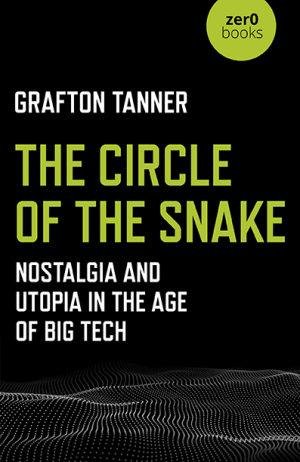
Big Tech, Nostalgia, and Control: Grafton Tanner’s ‘The Circle of the Snake’

By Michael Grasso

Source: We Are the Mutants

The Circle of the Snake: Nostalgia and Utopia in the Age of Big Tech
By Grafton Tanner
Zero Books, 2020

I’m sure many members of Generation X have taken a moment to look around the pop culture landscape over the past decade and a half and had a sudden moment of realization: there are certainly a whole lot of people trying to sell me things using the media of my youth. Ultimately, this is nothing new. I remember when every pop culture moment, from sitcoms to TV commercials, seemed to be using the Baby Boomers’ favorite songs to sell them cars and sneakers. But in 2020, the dominance of these re-treaded properties is even more nakedly cynical, whether its the endless sequels of the Star Wars and Marvel cinematic universes, or the easy-to-consume, signifier-filled pastiches of the worlds of Stranger Things and Ready Player One. The cultural marketplace, as dominated by bloated media and tech empires, no longer sees any need to admit the novel, the fresh, the unusual.

Both the “why” and the “how” of this cultural and technological tendency are explored by author Grafton Tanner in his new book, The Circle of the Snake: Nostalgia and Utopia in the Age of Big Tech. (Disclosure: Tanner is an occasional contributor to We Are The Mutants.) Tanner explores not only the pop culture properties that utilize nostalgia in an effort to assuage the anxieties of contemporary life in the aftermath of the 2008 financial rupture; he also explains how tech companies use the feedback from algorithmic analysis to keep consumers locked into a never-ending cycle—an ouroboros—of digital satisfaction of their subconscious desires for an older, more secure time. This nostalgic digital utopia, in turn, keeps consumers constantly “on,” working through endless “quests” that approximate proactivity but in the end keep people locked into pointless and unproductive cycles of feedback, emotional satisfaction, and control. “Recommender systems and predictive analytics—the very tools that allow our contemporary media to function—zero in on quick reactions, such as a flash of anger or a swell of nostalgia,” says Tanner in his Introduction. “These reactions are noted by algorithms, which then make recommendations based on them… The result is a nostalgic feedback loop wherein old ideas travel round.”

Tanner examines how the Big Tech tendency towards technolibertarianism and monopoly over the past 20 years has created the material conditions for this self-reinforcing system of psychic feedback. With an increasing belief in culture as disposable and “just for fun,” the material and political implications of this system of control are obfuscated. The way that these cultural narratives award Big Tech further and deeper power over all of us is merely part of the game. And we are enlisted as active players, not merely passive viewers, as in the era of television’s height. The online world, Tanner notes, demands a keen eye for analysis and a deep capacity for paying attention. The technolibertarian and neoliberal alike view our tech-suffused world—everyone is plugged in, 24/7—as a kind of utopia-in-waiting, or indeed a permanent utopia, where the idealized past can be endlessly revisited and basked in, while the present never changes from its current state of cultural and political stasis. This virtual plaza of commerce, emotional satisfaction, the illusion of proactivity, and control and surveillance describe the boundaries of Big Tech’s dominance of both our material and psychic space at the beginning of the 2020s.

The interview below was conducted in November and December 2020 via email and has been lightly edited for clarity.

***

GRASSO: Given the topic of your first book for Zero, Babbling Corpse: Vaporwave and the Commodification of Ghosts, the topic for The Circle of the Snake seems like a natural outgrowth. But from reading the book it also seems like there were a lot of specific events and observations about the world of Online and Big Tech over the past few years that led to the book’s development. What are the origins of The Circle of the Snake, and what kinds of specific cultural developments led you to propose and write the book?

TANNER: I can pinpoint the exact moment I knew I was going to write a book on Big Tech. I was living in a kind of exile in 2016, in this small town in Georgia, trying to piece my life back together after a series of false starts after college. I was sitting in a Barnes & Noble reading the 2016 Tech Issue of The Atlantic, and there was a story by Bianca Bosker about former Google employee Tristan Harris, who left the Valley and started an advocacy group called Time Well Spent because he thought Big Tech was eroding mental health. He was on a mission to fix Big Tech by making it work for us, not against us. But the piece didn’t make me feel better about tech. In fact, it was terrifying: here is an ex-Valley technocrat, mournful that he had invented habit-forming technology with severe public side effects, asking us to not only forgive him, but believe in him to create newer, better tech. I was incensed.

Shortly thereafter, we learned that Cambridge Analytica sharpened their psychographic modeling techniques by harvesting Facebook data from millions of users without their permission, all to aid in the election of Donald Trump. There was suddenly this huge backlash against Big Tech. I was supportive of it, but I also understood it came a little too late. Tech critics had been sounding the alarm for years and years. It took the election of a fascist for the left to wake up to the tech nightmare, only to realize the ones promising to end the nightmare were former technocrats themselves.

And yet, as many were loudly critiquing Big Tech for its role in throwing elections, spreading fascism, and worsening mental health, the culture industry was churning out politically retrograde nostalgia-bait. Was it really that the techlash had made everyone even more nostalgic for the pre-digital past? Or was there some kind of connection between nostalgia and Big Tech? These were the questions I had in mind when I started writing.

GRASSO: I think one of the things I like best about the book is your fusion of theory, philosophy, and epistemology with the material and economic realities of 21st century Big Tech and Big Media. Throughout the book you explore concepts such as surveillance, sublimity, nostalgia (of course), and virtuality with concrete examples from the online plaza. Essentially, if I’m not mistaken, you’re saying that the people who created the feedback loops that keep us hooked on technology and the internet and mine our data for still more ways to sell to us have themselves studied their philosophy, economic history, and techniques of mass psychology and persuasion with great attention?

TANNER: Persuasion techniques, yes, but I wouldn’t go so far as to say the technocrats have studied much else beyond their limited worldview, which is scientistic. Yes, technocrats like James Williams and Tristan Harris like to cite philosophers, but they usually do it to support their self-help solutions to the attention economy. Wake up with a little philosophy, they say, because reading Socrates is better for the mind than scrolling through Twitter. It’s a very neckbeard way of thinking about cultural consumption.

Make no mistake: these technocrats are uninterested in anything other than making a lot of money. If that means learning psychological techniques of persuasion with Stanford psychologist B.J. Fogg, then so be it. They weren’t and aren’t trying to make the world a better place or something. Like the banks before the Great Recession, the technocrats are out to make a quick buck by any means necessary, and they would have kept on doing what they were doing if the bubble hadn’t burst. People were disgruntled with Facebook for years before Cambridge Analytica, and tech critique was already a robust genre by 2016. But it took a kind of implosion, a Great Recession-style reckoning with Big Tech, to change the public opinion. Honestly, the technocrats would probably benefit from studying a little history and philosophy, instead of cloistering themselves in the ideological fortress of STEM.

GRASSO: I think one of the “oh shit” moments in the text for me was finding out that the Black Mirror special choose-your-own-adventure episode “Bandersnatch,” which I quite liked mostly for its material and inspirational signifiers (early ’80s computing, references to Philip K. Dick) was also used to mine viewers’ data in a delightfully dark real-life Dickean stroke. It’s not merely that nostalgia offers us a safe place from the dangerous present, but that those who create these nostalgic visions are working hand-in-hand with the very media empires that make us crave the past: another ouroboros.

TANNER: “Bandersnatch” not only exploits viewers’ nostalgia for its own gain, but it further normalizes the feeling of being controlled. Everyone today knows we’re being controlled from afar: by Twitter, Instagram, Amazon, insurance companies, think tanks, banks, and so forth. We are part of this giant social experiment called consumer capitalism. The purpose is to find out what we’ll buy. But we aren’t being controlled by future gamers or, as much as Elon Musk would like to believe, programmers in this computer simulation we call life. “Bandersnatch” is a work of fiction masquerading a horrible fact—that Netflix is the one controlling us, that we are not as in control as we think. The irony, of course, is that we relinquish our control via the technology we use every day, but we ultimately have very little choice in the matter. Students use devices at school, and jobs often require employees to have smartphones. We aren’t puppets, but we’re by no means totally free either.

GRASSO: So that leads me to asking you about your critique of specific media franchises: Stranger Things and the endless array of sequels and especially reboots we’ve seen since the end of the aughts. You very cannily explore Stranger Things‘ reliance on physical signifiers of commodities and objects that are no longer extant but remind us of the shackles of our technology-laden present (the old landline telephone, the shopping mall) as a key to its appeal to both Gen-Xers who were there and Zoomers who weren’t. Likewise the cinematic reboot is a way to cheaply create product and content that will connect with multiple generations. This element of “spot the Easter egg, aren’t you smart?” for older generations melds with the offer of a trip to a now-alien time for younger generations. These franchises seem to simultaneously reward passive immersion in nostalgia with an illusion of proactivity.

TANNER: Well, the spot-the-Easter-egg activities are very often nostalgic exercises themselves. Viewers are invited to find the nostalgic signifiers, even if they don’t know what they are. That’s the brilliance of Easter egg marketing for advertisers: you might not know what the hidden clue means, but you know it’s a clue and so you make note of it. Of course, the “real” fans will be able to cite all the references, but regular viewers can sometimes recognize a clue, like a corded phone or a VCR or a reference to an older movie, when they see it.

Easter egg marketing is the advertising tactic of choice in the prosumer age. It turns watching into a game. And it’s very heuristic. The films with the most Easter eggs inspire the most “count them all” YouTube videos or Buzzfeed listicles. The problem here isn’t that movies and series reference a bunch of older media; the problem is that Easter eggs reference certain things and leave others out, thus establishing these unnecessary pop culture canons. I don’t care that the Halloween franchise makes reference to itself. It’s an extended universe at this point—of course it’s going to do that. What I find questionable is its constant updating in an attempt to recapture the magic of the original film. I’m always signaling my love of Halloween III: Season of the Witch, but that film is too wacky to be included in the Halloween universe, because the franchise is desperately trying to give us the original again, as if it were the first time, without all the messy parts of the sequels. The Halloween filmmakers want to keep the bloodline of the first film pure, which means anything standing in the way must be excised.

GRASSO: You mark the period between 9/11 and the financial crisis of 2008 (and its aftermath) as the final foreclosure of any alternative to our current future and one of the dividing lines between an idealized past depicted in our nostalgic media and the forever Now. Unsurprisingly, so many of the elements of online life we now recognize as irredeemably toxic (social media, ranking and rating apps, tentpole cinematic universes full of identical sequels) began around the end of the Bush years as well.

TANNER: One of these days, I’m going to write a history-critique of the 2000s. I find the decade fascinating. It was probably the nadir of contemporary culture. Mark Fisher called it “the worst period for (popular) culture since the 1950s.”

It’s true: there was no breaking point at which contemporary nostalgia ramped up. It was a gradual shift between 9/11 and the Great Recession. Directly after 9/11, the U.S. was reeling from shock. Before nostalgia set in later in the decade, there was a feeling of futurelessness, as Robert Jay Lifton wrote—a feeling that there can be no future after 9/11, that the fear of another terrorist attack foreclosed the future altogether, that if people could fly planes into buildings on a regular weekday morning, then anything horrific is possible. During these years, we saw the birth of cinematic universes with the Star Wars prequels and the first megabudget superhero films. Of course, there were Batman, Superman, and Star Wars films before the twenty-first century, but it was after 9/11 that we saw the avalanche of these movies, several of which could not have been made without post-9/11 Pentagon support, with its bloated influence and near-endless supply of capital. You cannot downplay the reach these films have. They’re seen all over the world. And they aren’t just pro-military propaganda, they are engines of nostalgia.

After the Great Recession, nostalgia calcified. People were moving back in with their parents, revisiting old memories to soothe the anxiety of joblessness. Financial recessions are progressive only for the bankers, if they’re bailed out. For workers, they’re regressive. They set people back and invite the sufferers to hide away from it all. There is nothing wrong with this reaction. We cannot blame people who were hit by the Recession for their nostalgia. But we can blame the ones who caused it. And austerity measures only increase the desire to escape into nostalgic feelings. In short, financial meltdowns are crises that affect the future because they erase the plausibility of surviving the present.

GRASSO: You state that nostalgia is not only an emotion used to track us and to trigger specific emotional responses (which themselves are often assuaged by consumption), but also, possibly most importantly, to control us. And that control is not only physical/material but also social/aesthetic, limiting our options to wander away from the digital plaza. How do nostalgia and nostalgic media help this attempt by the market to quantify, objectify, and commodify us, the consumer?

TANNER: Content creators—a sickening term that reduces art and culture to commodities—understand the value of nostalgia. Consumer scientists have known for years that nostalgia sells. If anger draws your attention to the screen, then nostalgia triggers you to buy what will soothe the anger. That’s the cycle we’re dealing with in the present century.

And the worse things get, the more that nostalgia will naturally rise to the surface for many people. It’s not that media companies force-feed nostalgia to us. Many people are already feeling the emotion. It’s inescapable because nostalgia is a modern condition. Corporations merely go the extra mile by locking nostalgia into these feedback loops. The more you feed nostalgia into the cultural industry, the more of it you will consume because entire companies depend on you to want it. We live in a world of disruption, and every modern displacement is accompanied by nostalgia. Corporate capital knows this and depends on it.

GRASSO: Two of the specific technologies you talk about, Instagram and virtual reality, have undergone mutations in their appeals to our desire to escape the modern world. Instagram started off as a fairly disposable nostalgic evocation of the Polaroid camera aesthetic and has become a playground for big-money influencers and exhibitionists; virtual reality has evolved into just another facet of the internet’s control apparatus, despite its conceptual origins in early ’80s cyberpunk and its promised potential to give people the ability to create their own worlds. Why do these technologies seem to always mutate in the direction of greater commercialization and/or control, despite their initial apparent harmlessness or revolutionary promise?

TANNER: In the case of Instagram, its nostalgia factor was mainly due to the horrible photo quality of early smartphone cameras. With some Wi-Fi, a phone, and an app, you could take photos anywhere and upload them on the spot, which was enticing enough for many people to do just that, but you couldn’t deny the photo quality was very poor. So one way to deal with this poor quality was to saturate photos in a kind of analog haze, which could be done by applying one of several different stock filters. I can’t emphasize this enough: so much of our nostalgic appetite in the early 2010s was whetted by the inability to take and post a decent looking digital photo.

Whether it’s Instagram or virtual reality, digital technology is never totally harmless. It’s like when Tristan Harris and the Center for Humane Tech guys tell us we can have our digital cake and eat it too. You can’t have “humane tech” because tech is driven by the profit motive, which itself is often powered by another force: the military. Have you seen this new recruiting ad for the Marine Corps? It’s basically telling young people that joining the military will be an escape from the overwhelming anxieties of the digital age. The scariest thing about the ad is that it conceals the long relationship between tech and the military. Which is to say, the “tech” presented in the ad couldn’t exist without the military-industrial complex. At this point, any new, possibly revolutionary digital technology will either be bought out by a Big Tech monopoly or put to use on the battlefield.

GRASSO: As far as solutions and escapes from this predicament go, you talk a little bit about the ineffectual attempts of former technocrats to try to ameliorate our enslavement to the internet and social media with apps that limit time on websites or “safety labels,” and find them all wholly wanting. Likewise, you mention attempts to make nostalgia something constructive, playful, reflective (in the schema of Svetlana Boym). And yet the very structure of the internet and Big Media as it stands now denies all alternatives to the current control stasis. What does a constructivist nostalgia look like? Where could it exist in the cracks of the current marketplace? Is there a place for nostalgia as a political instrument of the left outside of the usual avenue of Left Melancholy?

TANNER: I’m currently writing a history of nostalgia, out fall 2021 with Repeater Books, called The Hours Have Lost Their Clock: A Recent History of Nostalgia. In it, I put forth a theory of radical nostalgia, drawing on the work of Alastair Bonnett and Svetlana Boym. Radical nostalgia is the third “R” beyond reflective and restorative nostalgia, which Boym coined. She was right about nostalgia, but over the first two decades of the present century, restorative nostalgia ballooned while the reflective strains were edged to the margins. But there needs to be this third form, radical nostalgia, because the melancholic disposition of reflective nostalgia just hasn’t been working for the left and the restorative tint has proven to be destructive.

Radical nostalgia is the act of looking back to those moments when collective action stood up to capital. It yearns for the social movements of the past. It aches for them. It isn’t interested in “getting back there,” in restoring what’s been lost, but in learning from those who came before: the struggle for indigenous rights, the staunch anti-capitalism of Martin Luther King Jr., Stonewall, the Battle of Seattle. When Richard Branson signals his support for LGBTQ+ communities, that isn’t radical nostalgia. There’s nothing radical about it; it’s mere nostalgia. Radical nostalgia looks to these and other movements to continue the fight for a more egalitarian future. It is inherently anti-fascist.

Radical nostalgia takes the action step of restorative and the aching heart of reflective nostalgia and fuses them together. It knows that the past isn’t perfect, which means what we yearn for shouldn’t be either. Restorative nostalgia is too clean, too high-definition. Reflective nostalgia kicks the can around, although reflectors might recognize the problems of the past long before the restorers do. But radical nostalgia knows that everything is imbued with horror, the past especially. Many revolutionary movements of the past suffered from machismo and intolerance, even in their own collectives. Radical nostalgia knows this and endeavors to leave it in the past. Some things must remain buried.

And radical nostalgia is one perspective we can take to resist the utopian thinking of tech. At this point, Big Tech is about the only entity that circulates visions of the future, but those visions are falling out of favor thanks to the techlash. Get ready, because they will absolutely be replaced with a different utopian vision: the humane tech movement. We’re going to be dealing with the technocrats for years. It’s going to seem like we should trust Tristan Harris and the Center for Humane Tech guys. They’re going to be pushing their vision of the future for years to come. But they are the new boss, same as the old. Only collective action, informed by the decolonial and anti-fascist movements of history, can resist what’s coming in the next decade and beyond.

On Capitalism and the Machine

By Megan Sherman

Source: Global Research

In 1935, reflecting on the creed of productivity which prevailed in modern technological societies, Bertrand Russell, philosopher, pacifist and devout humanist wrote that:

I think that there is far too much work done in the world, that immense harm is caused by the belief that work is virtuous, and that what needs to be preached in modern industrial countries is quite different from what always has been preached.”

‘In Praise of Idleness and other essays’ is a collection of striking power and originality. Whereas the receieved wisdom of his era held that virtue consisted in yielding to work, monotony and routine, Russell maintained it was not the sole end of life, that beyond work, people needed leisure and pleasure in order to fully live, that what was sought to truly advance society and fortify the human condition was the “organized diminution of work.”

Through the 1920s and 30s Fordism advocated the exact opposite and the cult of productivity began to exert a strong hold on economic and social organization in Europe, the USA and Soviet Union. In the story Brave New World, Aldous Huxley envisioned a society of tyrannical collectivism which raised hell on Earth. In this dehumanizing, nihilistic oblivion, Henry Ford was worshipped as a deity and the fundamentalism of mass production crept in to all spheres of life, rigidly classifying people whose whole lives were planned out on a callow basis of crude economic worth. It was a study in how powerful forces of sublimation and repression incarnate in the edifice of the modern world mutilate our most vital, human instincts and wrench us from our roots.

Huxley’s main belief was that technological ‘progress’ had empowered the worst bureaucrats to assimilate citizens in to a sophisticated machine of repression and control which blocked and frustrated their freedom. Although, as Russell observes, in truth “with modern technique it would be possible to distribute leisure justly without injury to civilization“, the owners of the means of production in the capitalist economy absorb modern technique in to their arsenal against collective liberation. It is not in their interests to free us from bonds.

Of the proprietary class, Russell says:

their desire for comfortable idleness is historically the source of the whole gospel of work. The last thing they have ever wished is that others should follow their example. “

That is to say that freedom and unfreedom aren’t opposites. The affluence and freedom of the proprietors actively depends on the subjugation of workers who create value.

Throughout his life Bertrand Russell was keenly involved with communities of students, activists and workers who organized against imperialism and the war machine. His belief that people could work less and live more was part of his belief that the economic system could be harnessed to more altruistic ends, justified more reasonably, attuned to satisfy people’s needs and fit to unleash their inherent creative power, instead of conforming to bourgeois imperatives.

Lately Professor Stephen Hawking has weighed in on the question of modern social organization and proffered the view that people need not be scared of machines, but ought to be wary of the systems and people who wield them. Why be scared of the unknown power of machines when what we know about the people who own them is far, far scarier?

Hawking said:

If machines produce everything we need, the outcome will depend on how things are distributed. Everyone can enjoy a life of luxurious leisure if the machine-produced wealth is shared, or most people can end up miserably poor if the machine-owners successfully lobby against wealth redistribution. So far, the trend seems to be toward the second option, with technology driving ever-increasing inequality.”

Hawking’s view is much like Russell’s and would be called post-scarcity economics. The crux of this view is that competition for resources is not a necessary feature of an economy, that material abundance may be universal instead of there being a socially imposed monopoly of access, regulated by money and work. Like trickle-down theory, scarcity economics is not necessarily based in reality. It goes without saying that obviously we need to find a way reach this economy and mode of production in accordance with environmental protection, which models after the Industrial Revolution got disastrously wrong.

The challenge of the future is to make machines our allies and not our jailers.

Warp Speed Ahead: COVID-19 Vaccines Pave the Way for a New Frontier in Surveillance

By John W. Whitehead

Source: The Rutherford Institute

Man’s conquest of Nature, if the dreams of some scientific planners are realized, means the rule of a few hundreds of men over billions upon billions of men.” —C. S. Lewis, The Abolition of Man

Like it or not, the COVID-19 pandemic with its veiled threat of forced vaccinations, contact tracing, and genetically encoded vaccines is propelling humanity at warp speed into a whole new frontier—a surveillance matrix—the likes of which we’ve only previously encountered in science fiction.

Those who eye these developments with lingering mistrust have good reason to be leery: the government has long had a tendency to unleash untold horrors upon the world in the name of global conquest, the acquisition of greater wealth, scientific experimentation, and technological advances, all packaged in the guise of the greater good.

Indeed, “we the people” have been treated like lab rats by government agencies for decades now: caged, branded, experimented upon without our knowledge or consent, and then conveniently discarded and left to suffer from the after-effects.

You don’t have to dig very deep or go very back in the nation’s history to uncover numerous cases in which the government deliberately conducted secret experiments on an unsuspecting populacemaking healthy people sick by spraying them with chemicals, injecting them with infectious diseases and exposing them to airborne toxins.

Now this same government—which has taken every bit of technology sold to us as being in our best interests (GPS devices, surveillance, nonlethal weapons, etc.) and used it against us, to track, control and trap us—wants us to fall in line as it prepares to roll out COVID-19 vaccines that owe a great debt to the Pentagon’s Defense Advanced Research Projects Agency for its past work on how to weaponize and defend against infectious diseases.

The Trump Administration by way of the National Institute of Health awarded $22.8 million to seven corporations to develop artificial intelligence (AI), machine learning, etc., with smart phone apps, wearable devices and software “that can identify and trace contacts of infected individuals, keep track of verified COVID-19 test results, and monitor the health status of infected and potentially infected individuals.”

This is all part of Operation Warp Speed, which President Trump has likened to the Manhattan Project, a covert government effort spearheaded by the military to engineer and build the world’s first atomic bomb.

There is every reason to tread cautiously.

There is a sinister world beyond that which we perceive, one in which power players jockey for control over the one commodity that is a necessary ingredient for total domination: you.

By you, I mean you the individual in all your singular humanness.

Remaining singularly human and retaining your individuality and dominion over yourself—mind, body and soul—in the face of corporate and government technologies that aim to invade, intrude, monitor, manipulate and control us may be one of the greatest challenges before us.

These COVID-19 vaccines, which rely on messenger RNA technology that influences everything from viruses to memory, are merely the tipping point.

The groundwork being laid with these vaccines is a prologue to what will become the police state’s conquest of a new, relatively uncharted, frontier: inner space, specifically, the inner workings (genetic, biological, biometric, mental, emotional) of the human race.

If you were unnerved by the rapid deterioration of privacy under the Surveillance State, prepare to be terrified by the surveillance matrix that will be ushered in on the heels of the government’s rollout of this COVID-19 vaccine.

The term “matrix” was introduced into our cultural lexicon by the 1999 film The Matrix in which Neo, a computer programmer/hacker, awakens to the reality that humans have been enslaved by artificial intelligence and are being harvested for their bio-electrical energy.

Hardwired to a neuro-interactive simulation of reality called the “Matrix,” humans are kept inactive and docile while robotic androids gather the electricity their bodies generate. In order for the machines who run the Matrix to maintain control, they impose what appears to be a perfect world for humans to keep them distracted, content, and submissive.

Here’s the thing: Neo’s Matrix is not so far removed from our own technologically-hardwired worlds in which we’re increasingly beholden to corporate giants such as Google for powering so much of our lives. As journalist Ben Thompson explains:

Google+ is about unifying all of Google’s services under a single log-in which can be tracked across the Internet on every site that serves Google ads, uses Google sign-in, or utilizes Google analytics. Every feature of Google+—or of YouTube, or Maps, or Gmail, or any other service—is a flytrap meant to ensure you are logged in and being logged by Google at all times.

Everything we do is increasingly dependent on and, ultimately, controlled by our internet-connected, electronic devices. For example, in 2007, there were an estimated 10 million sensor devices connecting human utilized electronic devices (cell phones, laptops, etc.) to the Internet. By 2013, it had increased to 3.5 billion. By 2030, it is estimated to reach 100 trillion.

Much, if not all, of our electronic devices will be connected to Google, a neural network that approximates a massive global brain.

Google’s resources, beyond anything the world has ever seen, includes the huge data sets that result from one billion people using Google every single day and the Google knowledge graph “which consists of 800 million concepts and billions of relationships between them.”

The end goal? The creation of a new “human” species, so to speak, and the NSA, the Pentagon and the “Matrix” of surveillance agencies are part of the plan. As William Binney, one of the highest-level whistleblowers to ever emerge from the NSA, said, “The ultimate goal of the NSA is total population control.”

Mind you, this isn’t population control in the classic sense. It’s more about controlling the population through singularity, a marriage of sorts between machine and human beings in which artificial intelligence and the human brain will merge to form a superhuman mind.

“Google will know the answer to your question before you have asked it,” predicts transhumanist scientist Ray Kurzweil. “It will have read every email you’ve ever written, every document, every idle thought you’ve ever tapped into a search-engine box. It will know you better than your intimate partner does. Better, perhaps, than even yourself.”

The term “singularity”—that is, computers simulating human life itself—was coined years ago by mathematical geniuses Stanislaw Ulam and John von Neumann. “The ever accelerating progress of technology,” warned von Neumann, “gives the appearance of approaching some essential singularity in the history of the race beyond which human affairs, as we know them, could not continue.”

The plan is to develop a computer network that will exhibit intelligent behavior equivalent to or indistinguishable from that of human beings by 2029. And this goal is to have computers that will be “a billion times more powerful than all of the human brains on earth.”

Neuralink, a brain-computer chip interface (BCI), paves the way for AI control of the human brain, at which point the disconnect between humans and AI-controlled computers will become blurred and human minds and computers will essentially become one and the same. “In the most severe scenario, hacking a Neuralink-like device could turn ‘hosts’ into programmable drone armies capable of doing anything their ‘master’ wanted,” writes Jason Lau for Forbes.

Advances in neuroscience indicate that future behavior can be predicted based upon activity in certain portions of the brain, potentially creating a nightmare scenario in which government officials select certain segments of the population for more invasive surveillance or quarantine based solely upon their brain chemistry.

Case in point: researchers at the Mind Research Center scanned the brains of thousands of prison inmates in order to track their brain chemistry and their behavior after release. In one experiment, researchers determined that inmates with lower levels of activity in the area of the brain associated with error processing allegedly had a higher likelihood of committing a crime within four years of being released from prison. While researchers have cautioned against using the results of their research as a method of predicting future crime, it will undoubtedly become a focus of study for government officials.

There’s no limit to what can be accomplished—for good or ill—using brain-computer interfaces.

Researchers at Duke University Medical Center have created a brain-to-brain interface between lab rats, which allows them to transfer information directly between brains. In one particular experiment, researchers trained a rat to perform a task where it would hit a lever when lit. The trained rat then had its brain connected to an untrained rat’s brain via electrodes. The untrained rat was then able to learn the trained rat’s behavior via electrical stimulation. This even worked over great distances using the Internet, with a lab rat in North Carolina guiding the actions of a lab rat in Brazil.

Clearly, we are rapidly moving into the “posthuman era,” one in which humans will become a new type of being. “Technological devices,” writes journalist Marcelo Gleiser, “will be implanted in our heads and bodies, or used peripherally, like Google Glass, extending our senses and cognitive abilities.”

Transhumanism—the fusing of machines and people—is here to stay and will continue to grow.

In fact, as science and technology continue to advance, the ability to control humans will only increase. In 2014, for example, it was revealed that scientists have discovered how to deactivate that part of our brains that controls whether we are conscious or not. When researchers at George Washington University sent high frequency electrical signals to the claustrum—that thin sheet of neurons running between the left and right sides of the brain—their patients lost consciousness. Indeed, one patient started speaking more slowly until she became silent and still. When she regained consciousness, she had no memory of the event.

Add to this the fact that increasingly humans will be implanted with microchips for such benign purposes as tracking children or as medical devices to assist with our health. Such devices “point to an uber-surveillance society that is Big Brother on the inside looking out,” warns Dr. Katina Michael. “Governments or large corporations would have the ability to track people’s actions and movements, categorize them into different socio-economic, political, racial, or consumer groups and ultimately even control them.”

As I make clear in my book Battlefield America: The War on the American People, control is the issue.

In fact, Facebook and the Department of Defense are working to manipulate our behavior. In a 2012 study, Facebook tracked the emotional states of over 600,000 of its users. The goal of the study was to see if the emotions of users could be manipulated based upon whether they were fed positive or negative information in their news feeds. The conclusion of the study was that “emotional states can be transferred to others via emotional contagion, leading people to experience the same emotions without their awareness.”

All of this indicates a new path forward for large corporations and government entities that want to achieve absolute social control. Instead of relying solely on marauding SWAT teams and full-fledged surveillance apparatuses, they will work to manipulate our emotions to keep us in lock step with the American police state.

Now add this warp speed-deployed vaccine to that mix, with all of the associated unknown and fearsome possibilities for altering or controlling human epigenetics, and you start to see the perils inherent in blindly adopting emerging technologies without any restrictions in place to guard against technological tyranny and abuse.

It’s one thing for the starship Enterprise to boldly go where no man has gone before, but even Mr. Spock recognized the dangers of a world dominated by AI. “Computers make excellent and efficient servants,” he observed in “The Ultimate Computer” episode of Star Trek, “but I have no wish to serve under them.”

The Threat of Authoritarianism in the U.S. is Very Real, and Has Nothing To Do With Trump

The COVID-driven centralization of economic power and information control in the hands of a few corporate monopolies poses enduring threats to political freedom.

By Glenn Greenwald

Source: The Unz Review

Asserting that Donald Trump is a fascist-like dictator threatening the previously sturdy foundations of U.S. democracy has been a virtual requirement over the last four years to obtain entrance to cable news Green Rooms, sinecures as mainstream newspaper columnists, and popularity in faculty lounges. Yet it has proven to be a preposterous farce.

In 2020 alone, Trump had two perfectly crafted opportunities to seize authoritarian power — a global health pandemic and sprawling protests and sustained riots throughout American cities — and yet did virtually nothing to exploit those opportunities. Actual would-be despots such as Hungary’s Viktor Orbán quickly seized on the virus to declare martial law, while even prior U.S. presidents, to say nothing of foreign tyrants, have used the pretext of much less civil unrest than what we saw this summer to deploy the military in the streets to pacify their own citizenry.

But early in the pandemic, Trump was criticized, especially by Democrats, for failing to assert the draconian powers he had, such as commandeering the means of industrial production under the Defense Production Act of 1950, invoked by Truman to force industry to produce materials needed for the Korean War. In March, The Washington Post reported that “Governors, Democrats in Congress and some Senate Republicans have been urging Trump for at least a week to invoke the act, and his potential 2020 opponent, Joe Biden, came out in favor of it, too,” yet “Trump [gave] a variety of reasons for not doing so.” Rejecting demands to exploit a public health pandemic to assert extraordinary powers is not exactly what one expects from a striving dictator.

A similar dynamic prevailed during the sustained protests and riots that erupted after the killing of George Floyd. While conservatives such as Sen. Tom Cotton (R-AK), in his controversial New York Times op-ed, urged the mass deployment of the military to quell the protesters, and while Trump threatened to deploy them if governors failed to pacify the riots, Trump failed to order anything more than a few isolated, symbolic gestures such as having troops use tear gas to clear out protesters from Lafayette Park for his now-notorious walk to a church, provoking harsh criticism from the right, including Fox News, for failing to use more aggressive force to restore order.

Virtually every prediction expressed by those who pushed this doomsday narrative of Trump as a rising dictator — usually with great profit for themselves — never materialized. While Trump radically escalated bombing campaigns he inherited from Bush and Obama, he started no new wars. When his policies were declared by courts to be unconstitutional, he either revised them to comport with judicial requirements (as in the case of his “Muslim ban”) or withdrew them (as in the case of diverting Pentagon funds to build his wall). No journalists were jailed for criticizing or reporting negatively on Trump, let alone killed, as was endlessly predicted and sometimes even implied. Bashing Trump was far more likely to yield best-selling books, social media stardom and new contracts as cable news “analysts” than interment in gulags or state reprisals. There were no Proud Boy insurrections or right-wing militias waging civil war in U.S. cities. Boastful and bizarre tweets aside, Trump’s administration was far more a continuation of the U.S. political tradition than a radical departure from it.

The hysterical Trump-as-despot script was all melodrama, a ploy for profits and ratings, and, most of all, a potent instrument to distract from the neoliberal ideology that gave rise to Trump in the first place by causing so much wreckage. Positing Trump as a grand aberration from U.S. politics and as the prime author of America’s woes — rather than what he was: a perfectly predictable extension of U.S politics and a symptom of preexisting pathologies — enabled those who have so much blood and economic destruction on their hands not only to evade responsibility for what they did, but to rehabilitate themselves as the guardians of freedom and prosperity and, ultimately, catapult themselves back into power. As of January 20, that is exactly where they will reside.

The Trump administration was by no means free of authoritarianism: his Justice Department prosecuted journalists’ sources; his White House often refused basic transparency; War on Terror and immigration detentions continued without due process. But that is largely because, as I wrote in a Washington Post op-ed in late 2016, the U.S. Government itself is authoritarian after decades of bipartisan expansion of executive powers justified by a posture of endless war. With rare exception, the lawless and power-abusing acts over the last four years were ones that inhere in the U.S. Government and long preceded Trump, not ones invented by him. To the extent Trump was an authoritarian, he was one in the way that all U.S. presidents have been since the War on Terror began and, more accurately, since the start of the Cold War and advent of the permanent national security state.

The single most revealing episode exposing this narrative fraud was when journalists and political careerists, including former Obama aides, erupted in outrage on social media upon seeing a photo of immigrant children in cages at the border — only to discover that the photo was not from a Trump concentration camp but an Obama-era detention facility (they were unaccompanied children, not ones separated from their families, but “kids in cages” are “kids in cages” from a moral perspective). And tellingly, the single most actually authoritarian Trump-era event is one that has been largely ignored by the U.S. media: namely, the decision to prosecute Julian Assange under espionage laws (but that, too, is an extension of the unprecedented war on journalism unleashed by the Obama DOJ).

The last gasp for those clinging to the Trump-as-dictator fantasy (which was really hope masquerading as concern, since putting yourself on the front lines, bravely fighting domestic fascism, is more exciting and self-glorifying, not to mention more profitable, than the dreary, mediocre work of railing against an ordinary and largely weak one-term president) was the hysterical warning that Trump was mounting a coup in order to stay in office. Trump’s terrifying “coup” consisted of a series of failed court challenges based on claims of widespread voter fraud — virtually inevitable with new COVID-based voting rules never previously used — and lame attempts to persuade state officials to overturn certified vote totals. There was never a moment when it appeared even remotely plausible that it would succeed, let alone that he could secure the backing of the institutions he would need to do so, particularly senior military leaders.

Whether Trump secretly harbored despotic ambitions is both unknowable and irrelevant. If he did, he never exhibited the slightest ability to carry them out or orchestrate a sustained commitment to executing a democracy-subverting plot. And the most powerful U.S. institutions — the intelligence community and military brass, Silicon Valley, Wall Street, and the corporate media — opposed and subverted him from the start. In sum, U.S. democracy, in whatever form it existed when Trump ascended to the presidency, will endure more or less unchanged once he leaves office on January 20, 2021.

Whether the U.S. was a democracy in any meaningful sense prior to Trump had been the subject of substantial scholarly debate. A much-discussed 2014 study concluded that economic power has become so concentrated in the hands of such a small number of U.S. corporate giants and mega-billionaires, and that this concentration in economic power has ushered in virtually unchallengeable political power in their hands and virtually none in anyone else’s, that the U.S. more resembles oligarchy than anything else:

The central point that emerges from our research is that economic elites and organized groups representing business interests have substantial independent impacts on U.S. government policy, while mass-based interest groups and average citizens have little or no independent influence. Our results provide substantial support for theories of Economic-Elite Domination and for theories of Biased Pluralism, but not for theories of Majoritarian Electoral Democracy or Majoritarian Pluralism.

The U.S. Founders most certainly did not envision or desire absolute economic egalitarianism, but many, probably most, feared — long before lobbyists and candidate dependence on corporate SuperPACs — that economic inequality could become so severe, wealth concentrated in the hands of so few, that it would contaminate the political realm, where those vast wealth disparities would be replicated, rendering political rights and legal equality illusory.

But the premises of pre-Trump debates over how grave a problem this is have been rendered utterly obsolete by the new realities of the COVID era. A combination of sustained lockdowns, massive state-mandated transfers of wealth to corporate elites in the name of legislative “COVID relief,” and a radically increased dependence on online activities has rendered corporate behemoths close to unchallengeable in terms of both economic and political power.

The lockdowns from the pandemic have ushered in a collapse of small businesses across the U.S. that has only further fortified the power of corporate giants. “Billionaires increased their wealth by more than a quarter (27.5%) at the height of the crisis from April to July, just as millions of people around the world lost their jobs or were struggling to get by on government schemes,” reported The Guardian in September. A study from July told part of the story:

The combined wealth of the world’s super-rich reached a new peak during the coronavirus pandemic, according to a study published by the consulting firm PwC and the Swiss bank UBC on Wednesday. The more than 2,000 billionaires around the world managed to amass fortunes totalling around $10.2 trillion (€8.69 trillion) by July, surpassing the previous record of $8.9 trillion reached in 2017.

Meanwhile, though exact numbers are unknown, “roughly one in five small businesses have closed,” AP notes, adding: “restaurants, bars, beauty shops and other retailers that involve face-to-face contact have been hardest hit at a time when Americans are trying to keep distance from one another.”

Employees are now almost completely at the mercy of a handful of corporate giants which are thriving, far more trans-national than with any allegiance to the U.S. A Brookings Institution study this week — entitled “Amazon and Walmart have raked in billions in additional profits during the pandemic, and shared almost none of it with their workers” — found that “the COVID-19 pandemic has generated record profits for America’s biggest companies, as well as immense wealth for their founders and largest shareholders—but next to nothing for workers.”

These COVID “winners” are not the Randian victors in free market capitalism. Quite the contrary, they are the recipients of enormous amounts of largesse from the U.S. Government, which they control through armies of lobbyists and donations and which therefore constantly intervenes in the market for their benefit. This is not free market capitalism rewarding innovative titans, but rather crony capitalism that is abusing the power of the state to crush small competitors, lavish corporate giants with ever more wealth and power, and turn millions of Americans into vassals whose best case scenario is working multiple jobs at low hourly wages with no benefits, few rights, and even fewer options.

Those must disgusted by this outcome should not be socialists but capitalists: this is a classic merger of state and corporate power —- also known as a hallmark of fascism in its most formal expression — that abuses state interference in markets to consolidate and centralize authority in a small handful of actors in order to disempower everyone else. Those trends were already quite visible prior to Trump and the onset of the pandemic, but have accelerated beyond anyone’s dreams in the wake of mass lockdowns, shutdowns, prolonged isolation and corporate welfare thinly disguised as legislative “relief.”


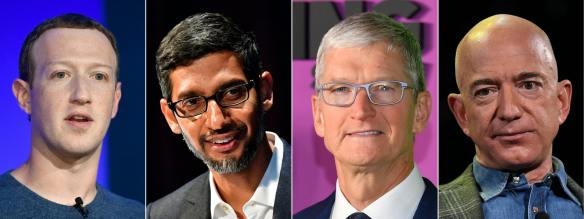
What makes this most menacing of all is that the primary beneficiaries of these rapid changes are Silicon Valley giants, at least three of which — Facebook, Google, and Amazon — are now classic monopolies. That the wealth of their primary owners and executives — Mark Zuckerberg, Jeff Bezos, Sundar Pichai — has skyrocketed during the pandemic is well-covered, but far more significant is the unprecedented power these companies exert over the dissemination of information and conduct of political debates, to say nothing of the immense data they possess about our lives by virtue of online surveillance.

Stay-at-home orders, lockdowns and social isolation have meant that we rely on Silicon Valley companies to conduct basic life functions more than ever before. We order online from Amazon rather than shop; we conduct meetings online rather than meet in offices; we use Google constantly to navigate and communicate; we rely on social media more than ever to receive information about the world. And exactly as a weakened population’s dependence on them has increased to unprecedented levels, their wealth and power has reached all new heights, as has their willingness to control and censor information and debate.

That Facebook, Google and Twitter are exerting more and more control over our political expression is hardly contestable. What is most remarkable, and alarming, is that they are not so much grabbing these powers as having them foisted on them, by a public — composed primarily of corporate media outlets and U.S. establishment liberals — who believe that the primary problem of social media is not excessive censorship but insufficient censorship. As Sen. Ed Markey (D-MA) told Mark Zuckerberg when four Silicon Valley CEOs appeared before the Senate in October: “The issue is not that the companies before us today is that they’re taking too many posts down. The issue is that they’re leaving too many dangerous posts up.”

https://twitter.com/CalebHowe/status/1321490281896812545

As I told the online program Rising this week when asked what the worst media failings of 2020 are, I continue to view the brute censorship by Facebook of incriminating reporting about Joe Biden in the weeks before the election as one of the most significant, and menacing, political events of the last several years. That this censorship was announced by a Facebook corporate spokesman who had spent his career previously as a Democratic Party apparatchik provided the perfect symbolic expression of this evolving danger.

These tech companies are more powerful than ever, not only because of their newly amassed wealth at a time when the population is suffering, but also because they overwhelmingly supported the Democratic Party candidate about to assume the presidency. Predictably, they are being rewarded with numerous key positions in his transition team and the same will ultimately be true of the new administration.

The Biden/Harris administration clearly intends to do a great deal for Silicon Valley, and Silicon Valley is well-positioned to do a great deal for them in return, starting with their immense power over the flow of information and debate.

The dominant strain of U.S. neoliberalism — the ruling coalition that has now consolidated power again — is authoritarianism. They view those who oppose them and reject their pieties not as adversaries to be engaged but as enemies, domestic terrorists, bigots, extremists and violence-inciters to be fired, censored, and silenced. And they have on their side — beyond the bulk of the corporate media, and the intelligence community, and Wall Street — an unprecedentedly powerful consortium of tech monopolies willing and able to exert greater control over a population that has rarely, if ever, been so divided, drained, deprived and anemic.

All of these authoritarian powers will, ironically, be invoked and justified in the name of stopping authoritarianism — not from those who wield power but from the movement that was just removed from power. Those who spent four years shrieking to great profit about the dangers of lurking “fascism” will — without realizing the irony — now use this merger of state and corporate power to consolidate their own authority, control the contours of permissible debate, and silence those who challenge them even further. Those most vocally screaming about growing authoritarianism in the U.S. over the last four years were very right in their core warning, but very wrong about the real source of that danger.

The New Normal: One Step Closer to Dystopia. New Covid Outbreaks, People are “Living in Extreme Fear”

By Timothy Alexander Guzman

Source: Silent Crow News

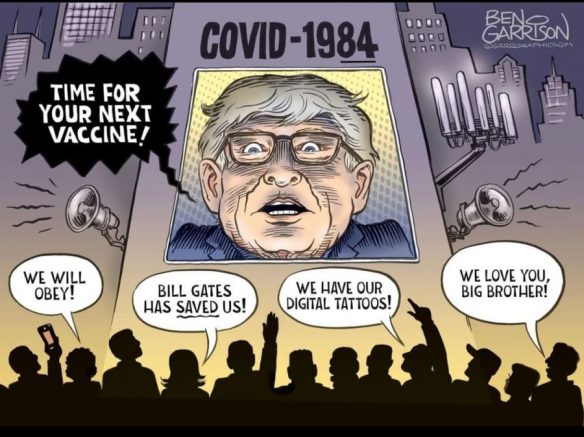
On September 11th, 2001, terrorist attacks took place on the World Trade Center and the Pentagon allegedly orchestrated by Al Qaeda led by Osama bin Laden, and subsequently blamed it on Saddam Hussein and the Baath Party and then the war on Iraq began.  The Middle East became the prime target of increased Western and Israeli conflicts and interventions. Guantanamo bay, Cuba became a torture center. Surveillance of the Muslims became normalized, then so did surveillance of the entire world. That was phase 1 of Western-led global tyranny, now on to phase 2, with a new disease, the Corona Virus aka Covid-19, appeared on the world stage.  Medical bureaucrats from the Centers for Disease Control (CDC) including the longtime medical bureaucrat-in-charge, Dr. Anthony Fauci and Big Tech billionaire nerd, Bill Gates along with the rest of the establishment view everyone as a potential carrier a danger, therefore, they must vaccinate everyone to fight this new disease with an emphasis on treating the situation as a national security threat so Operation Warp Speed was announced.  At the same time, the U.S. government and its allies are fighting continuous wars that they themselves start on the rest of the world and on top of everything else, the world’s global economy is on the brink of the Greatest Depression along with a collapsing global reserve currency, the U.S. dollar.

Just imagine this sometime in the near future, you wake up one morning, you brush your teeth and then you turn on the television and on the screen is the ’emergency broadcast system’ flashing in red, alerting people about new Covid infection rates spiking in your area and it’s declared a red zone. With a disarmed populace in place who has no rights to self-defense, military personnel in hazmat suits wearing masks will be making door to door visits with mandated vaccines in hand, and if you resist, well, you can paint a picture for yourself. The streets are empty and businesses you once visited are now permanently closed making it increasingly difficult to get your basic necessities. Public and private schools are open on the condition that each child is fully vaccinated under government mandates regardless of the health risks associated with the vaccines and in many cases if a child is not vaccinated, the school nurse will do it for you without your permission.  Those who have jobs will have no choice but to get vaccinated or they lose that weekly paycheck they depend for their food and other expenses.  Then you look outside your window and you see the same breadlines in government-approved centers with people wearing facemasks, patiently waiting for their next meal as long as they have their vaccination card in hand.  Crime is out of control with no police protection because a couple of years earlier, major cities and towns across the U.S. decided to defund the police.  They now have social workers and civilian patrols resembling the actions of the Nazi’s who had the useful idiots known as the brown shirts safeguarding the streets from a spread of a disease that cannot be controlled by whatever ridiculous mandates they impose, making sure that the people have facemasks and their government issued vaccination cards readily available for inspection. The internet is also heavily regulated. Depression and suicides increasing by the day, yet, no resistance by the population, just slaves under a medical dictatorship that makes Nazi Germany look like a walk in the park.  That is a dystopian future.

That same old ‘New World Order conspiracy theory that many people laughed about is now unfolding before our eyes. For decades the people were warned, yet they are still blinded by the mainstream media’s fear mongering nonsense and blatant lies that it becomes comical at times. Yet, people are living in extreme fear.  Across the globe, new Covid-19 outbreaks are rising due to false positives detected by the unreliable RT-PCR tests. Countries around the world are waking up to this fact including Portugal who according to the Off-Guardian.org reported that “an appeals court in Portugal has ruled that the PCR process is not a reliable test for Sars-Cov-2, and therefore any enforced quarantine based on those test results is unlawful.” Why? Well the article summed up what the study had found:

Most notably this study by Jaafar et al., which found that – when running PCR tests with 35 cycles or more – the accuracy dropped to 3%, meaning up to 97% of positive results could be false positives. 

The ruling goes on to conclude that, based on the science they read, any PCR test using over 25 cycles is totally unreliable. Governments and private labs have been very tight-lipped about the exact number of cycles they run when PCR testing, but it is known to sometimes be as high as 45. Even fearmonger-in-chief Anthony Fauci has publicly stated anything over 35 is totally unusable

It is well-known that high-risk groups with already life-threatening ailments are the ones at risk, even if there was a severe flu season in effect, they will still be at risk regardless.  Covid-19 lockdowns and mandatory facemasks and the possibility of forced vaccinations in various U.S. states and a number of countries is becoming part of everyday life, the “new normal” it seems.  The Hill reported that government-issued vaccine cards will be distributed to everyone in the US population ‘Details emerging on vaccine cards that will accompany inoculations.”  The report said that the federal government will hand-out cards with your name on them which will list what vaccines you have received and which ones will be due, “Everyone will be issued a written card that they can put in their wallet that will tell them what they had and when their next dose is due,” Kelly Moore, associate director of the Immunization Action Coalition, said Wednesday, according to CNN. “Let’s do the simple, easy thing first. Everyone’s going to get that.” Then clinics and hospitals will send your vaccine report to the federal agencies-in-charge which will basically track and trace individuals of all ages:

Moore added that clinics providing vaccinations will also report what vaccine is administered to state immunization registries. Numerous clinics will also give patients the option to provide their phone numbers so they can be sent a reminder to take their second dose of the vaccine 

The world we once new is dramatically changing, a coerced society that’s is constantly living on the edge of fear, facing lockdowns every few months when Covid-19 cases spike while the establishment continues its early stages of total global control over society. They already control the people through mandated facemasks and lockdowns while Big Pharma is pushing a handful of vaccines so that people can travel, buy food, or for their children to attend school under the “new normal” rules once they get their vaccines.  People are acquiescent to authority, accepting the establishment’s recommendations as law as they walk around confused with facemasks, avoiding people at length. One time I was walking down one of the main avenues while I was in New York City as a woman was trying to avoid a group of young girls without facemasks, she immediately hoped into traffic to avoid them and right behind her was a city bus narrowly missing her by an inch, this woman was obviously so fearful of contracting Covid-19, she almost got herself killed by an incoming city bus, and to be honest with you, I closed my eyes because I thought she was history.  This is the state of the world of paranoia and fear we are living in. There are even people who have not even been outside their homes since the World Health Organization declared Covid-19 an international pandemic. Fights are breaking out everywhere between those who refuse facemasks versus the slaves who listen to Dr. Anthony Fauci and the rest of the medical establishment who claim that wearing facemasks is about protecting yourself and respecting others, so people are policing themselves and “snitching” on each other, a dream come true for those who rule.

Normalcy in society has completely changed for the worst. People are less human today because of what the establishment has pushed upon us with their absurd ideas to control the population to prevent an over-exaggerated disease from spreading.  Yet, suicides, depression and loneliness is killing more people by the day because of these unnecessary lockdowns.  The people are on the edge of insanity. The normal life already seems like a long time ago as new trends became normalized over the years before the corona virus ever existed like humans having relationships with sex robots and life-sized dolls.  Humans having sex with robots and dolls and in some cases, even marrying them seems pretty bizarre to me. I am pretty sure that both men and some women are purchasing sex robots and dolls at a higher-rate since the pandemic begun although a handful of people have been interested in this new phenomenon has been introduced to the public. In ‘The Age of Sex Robots: The pros and cons in this emerging sexual age’ by David W. Wahl, PhD in Psychology Today wrote:

Sex robots are here. It’s not just a gimmick of science fiction. Granted, the artificially intelligent sex robots of such films as “Ex Machina” and “AI” are not here yet, but it’s only a matter of time. Most sex robots now are little more than slightly animated sex dolls. Perhaps the most advanced sex robot that we know of is “Samantha.” A creation of Synthea Amatus, Samantha is designed to be capable of enjoying sex. 

But Samantha is not all about sex. She can also talk about science and philosophy. She can even tell jokes (although hopefully not while you are having sex with her). Consent is even an issue with Samantha. If you are too rough with her or she doesn’t like your behaviors, she is programmed to go into “dummy mode” and completely shut down. Currently, robotic partners can go for prices in excess of $10,000

That is incredible and frightening. What if they created another doll was created down the road where “dummy mode” can turn into violent mode, but that will probably take another generation or so. I hope most people won’t fall for these types of futuristic relationships, but the point I am trying to make here is that this is where humanity is headed and this is not normal but it falls into the hands of the establishment technically speaking since in a way can reduce population growth.

What has society morphed into?

Now a Great Reset is upon us and make no mistake, it is real despite what The New York Times has falsely claimed that it does not in an absurd article they published titled ‘The Baseless Great Reset’ Conspiracy Theory Rises Again’, it’s real and we need to ask ourselves, will we except this insane idea? The World Economic Forum (WEF) is pushing ‘The Great Reset’ agenda since last May with calls to rebuild the global economy, social engineer society and enforce environmental sustainability rules and regulations to improve capitalism for basically major corporations, bankers and the ruling establishment. The corporate-technological alliance will be controlled by a powerful consortium of the pharmaceutical, financial, communications, defense industries and other major corporations with the government enforcing their dirty deeds with help from the mainstream-media continuing their propaganda. The Great Reset is being promoted by the United Kingdom’s very own, Prince Charles and WEF’s founder and executive chairman, Klaus Schwab who reminds me of Dr. Evil from Austin Powers who is also a former member of the steering committee of the Bilderberg Group which is behind the many changes the ruling establishment has envisioned for society. Life for humanity seems like it will never be the same. The Great Reset is a plan to foment corporate control over the entire economic and social landscape. They want control of the world’s natural resources and to expand their world government’s surveillance grid to unprecedented levels that fascist dictators from the past including Adolf Hitler, Benito Mussolini, Francisco Franco and Chile’s Augusto Pinochet could have only dreamed about.

What is happening to society has been predicted for a long time by many, including one of the most famous names in science fiction, George Orwell, the 1984 author who wrote and predicted a future dystopian police state. Orwell’s dire predictions of what we face in the near future was an early warning to all of humanity. However, I believe that many people are not simply going to accept this way of life as the new normal, some will, but many will refuse to obey such absurd demands from the establishment and this is the start of a revolution, a revolution of the mind and the establishment is afraid of that.  The masses will rise and will demand its freedoms it once had. People around the world already disobey lockdowns, face mask mandates, oppose continuous wars, oppose government tyranny and every other human rights abuses they face.  We are not, and I repeat, we are not at the point of no return, there is hope.

This lockdown madness will destroy people’s livelihoods and in some cases, will kill more people than the disease itself.  How far can the establishment push us?  We are at a time where we need to make a critical decision that will change our lives forever because a group of powerful and politically connected people who are government bureaucrats, or people who are closely associated with Big Pharma, Big Oil, Big Tech, the Military-Industrial Complex, bankers, Wall street, the elite families and so on, you know, the ones we have been warning about called the establishment or the ruling elite for some time are trying to change the structure of society, to control human nature. The year 2020 has been turbulent to say the least, 2021 will be chaotic and that is guaranteed. What is happening now is what George Orwell’s 1984 warned us about more than 70 years ago.  At this point in time, it will be up to all of us to resist, because that’s what it will take, and when that happens, people like George Orwell will finally rest in peace without rolling in his grave knowing that the world’s human spirit is alive and well, after all, that’s what he ultimately hoped for.


Big Brother in Disguise: The Rise of a New, Technological World Order

By John Whitehead

Source: The Rutherford Institute

“You had to live—did live, from habit that became instinct—in the assumption that every sound you made was overheard, and, except in darkness, every movement scrutinized.”—George Orwell, 1984

It had the potential for disaster.

Early in the morning of Monday, December 15, 2020, Google suffered a major worldwide outage in which all of its internet-connected services crashed, including Nest, Google Calendar, Gmail, Docs, Hangouts, Maps, Meet and YouTube.

The outage only lasted an hour, but it was a chilling reminder of how reliant the world has become on internet-connected technologies to do everything from unlocking doors and turning up the heat to accessing work files, sending emails and making phone calls.

A year earlier, a Google outage resulted in Nest users being unable to access their Nest thermostats, Nest smart locks, and Nest cameras. As Fast Company reports, “This essentially meant that because of a cloud storage outage, people were prevented from getting inside their homes, using their AC, and monitoring their babies.”

Welcome to the Matrix.

Twenty-some years after the Wachowskis’ iconic film, The Matrix, introduced us to a futuristic world in which humans exist in a computer-simulated non-reality powered by authoritarian machines—a world where the choice between existing in a denial-ridden virtual dream-state or facing up to the harsh, difficult realities of life comes down to a blue pill or a red pill—we stand at the precipice of a technologically-dominated matrix of our own making.

We are living the prequel to The Matrix with each passing day, falling further under the spell of technologically-driven virtual communities, virtual realities and virtual conveniences managed by artificially intelligent machines that are on a fast track to replacing human beings and eventually dominating every aspect of our lives.

Science fiction has become fact.

In The Matrix, computer programmer Thomas Anderson a.k.a. hacker Neo is wakened from a virtual slumber by Morpheus, a freedom fighter seeking to liberate humanity from a lifelong hibernation state imposed by hyper-advanced artificial intelligence machines that rely on humans as an organic power source. With their minds plugged into a perfectly crafted virtual reality, few humans ever realize they are living in an artificial dream world.

Neo is given a choice: to take the red pill, wake up and join the resistance, or take the blue pill, remain asleep and serve as fodder for the powers-that-be.

Most people opt for the blue pill.

In our case, the blue pill—a one-way ticket to a life sentence in an electronic concentration camp—has been honey-coated to hide the bitter aftertaste, sold to us in the name of expediency and delivered by way of blazingly fast Internet, cell phone signals that never drop a call, thermostats that keep us at the perfect temperature without our having to raise a finger, and entertainment that can be simultaneously streamed to our TVs, tablets and cell phones.

Yet we are not merely in thrall with these technologies that were intended to make our lives easier. We have become enslaved by them.

Look around you. Everywhere you turn, people are so addicted to their internet-connected screen devices—smart phones, tablets, computers, televisions—that they can go for hours at a time submerged in a virtual world where human interaction is filtered through the medium of technology.

This is not freedom.

This is not even progress.

This is technological tyranny and iron-fisted control delivered by way of the surveillance state, corporate giants such as Google and Facebook, and government spy agencies such as the National Security Agency.

So consumed are we with availing ourselves of all the latest technologies that we have spared barely a thought for the ramifications of our heedless, headlong stumble towards a world in which our abject reliance on internet-connected gadgets and gizmos is grooming us for a future in which freedom is an illusion.

Yet it’s not just freedom that hangs in the balance. Humanity itself is on the line.

If ever Americans find themselves in bondage to technological tyrants, we will have only ourselves to blame for having forged the chains through our own lassitude, laziness and abject reliance on internet-connected gadgets and gizmos that render us wholly irrelevant.

Indeed, we’re fast approaching Philip K. Dick’s vision of the future as depicted in the film Minority Report. There, police agencies apprehend criminals before they can commit a crime, driverless cars populate the highways, and a person’s biometrics are constantly scanned and used to track their movements, target them for advertising, and keep them under perpetual surveillance.

Cue the dawning of the Age of the Internet of Things (IoT), in which internet-connected “things” monitor your home, your health and your habits in order to keep your pantry stocked, your utilities regulated and your life under control and relatively worry-free.

The key word here, however, is control.

In the not-too-distant future, “just about every device you have — and even products like chairs, that you don’t normally expect to see technology in — will be connected and talking to each other.”

By the end of 2018, “there were an estimated 22 billion internet of things connected devices in use around the world… Forecasts suggest that by 2030 around 50 billion of these IoT devices will be in use around the world, creating a massive web of interconnected devices spanning everything from smartphones to kitchen appliances.”

As the technologies powering these devices have become increasingly sophisticated, they have also become increasingly widespread, encompassing everything from toothbrushes and lightbulbs to cars, smart meters and medical equipment.

It is estimated that 127 new IoT devices are connected to the web every second.

This “connected” industry has become the next big societal transformation, right up there with the Industrial Revolution, a watershed moment in technology and culture.

Between driverless cars that completely lacking a steering wheel, accelerator, or brake pedal, and smart pills embedded with computer chips, sensors, cameras and robots, we are poised to outpace the imaginations of science fiction writers such as Philip K. Dick and Isaac Asimov. (By the way, there is no such thing as a driverless car. Someone or something will be driving, but it won’t be you.)

These Internet-connected techno gadgets include smart light bulbs that discourage burglars by making your house look occupied, smart thermostats that regulate the temperature of your home based on your activities, and smart doorbells that let you see who is at your front door without leaving the comfort of your couch.

Nest, Google’s suite of smart home products, has been at the forefront of the “connected” industry, with such technologically savvy conveniences as a smart lock that tells your thermostat who is home, what temperatures they like, and when your home is unoccupied; a home phone service system that interacts with your connected devices to “learn when you come and go” and alert you if your kids don’t come home; and a sleep system that will monitor when you fall asleep, when you wake up, and keep the house noises and temperature in a sleep-conducive state.

The aim of these internet-connected devices, as Nest proclaims, is to make “your house a more thoughtful and conscious home.” For example, your car can signal ahead that you’re on your way home, while Hue lights can flash on and off to get your attention if Nest Protect senses something’s wrong. Your coffeemaker, relying on data from fitness and sleep sensors, will brew a stronger pot of coffee for you if you’ve had a restless night.

Yet given the speed and trajectory at which these technologies are developing, it won’t be long before these devices are operating entirely independent of their human creators, which poses a whole new set of worries. As technology expert Nicholas Carr notes, “As soon as you allow robots, or software programs, to act freely in the world, they’re going to run up against ethically fraught situations and face hard choices that can’t be resolved through statistical models. That will be true of self-driving cars, self-flying drones, and battlefield robots, just as it’s already true, on a lesser scale, with automated vacuum cleaners and lawnmowers.”

For instance, just as the robotic vacuum, Roomba, “makes no distinction between a dust bunny and an insect,” weaponized drones—poised to take to the skies en masse this year—will be incapable of distinguishing between a fleeing criminal and someone merely jogging down a street. For that matter, how do you defend yourself against a robotic cop—such as the Atlas android being developed by the Pentagon—that has been programmed to respond to any perceived threat with violence?

Moreover, it’s not just our homes and personal devices that are being reordered and reimagined in this connected age: it’s our workplaces, our health systems, our government, our bodies and our innermost thoughts that are being plugged into a matrix over which we have no real control.

Indeed, it is expected that by 2030, we will all experience The Internet of Senses (IoS), enabled by Artificial Intelligence (AI), Virtual Reality (VR), Augmented Reality (AR), 5G, and automation. The Internet of Senses relies on connected technology interacting with our senses of sight, sound, taste, smell, and touch by way of the brain as the user interface. As journalist Susan Fourtane explains:

Many predict that by 2030, the lines between thinking and doing will blur. Fifty-nine percent of consumers believe that we will be able to see map routes on VR glasses by simply thinking of a destination… By 2030, technology is set to respond to our thoughts, and even share them with others… Using the brain as an interface could mean the end of keyboards, mice, game controllers, and ultimately user interfaces for any digital device. The user needs to only think about the commands, and they will just happen. Smartphones could even function without touch screens.

In other words, the IoS will rely on technology being able to access and act on your thoughts.

Fourtane outlines several trends related to the IoS that are expected to become a reality by 2030:

1: Thoughts become action: using the brain as the interface, for example, users will be able to see map routes on VR glasses by simply thinking of a destination.

2: Sounds will become an extension of the devised virtual reality: users could mimic anyone’s voice realistically enough to fool even family members.

3: Real food will become secondary to imagined tastes. A sensory device for your mouth could digitally enhance anything you eat, so that any food can taste like your favorite treat.

4: Smells will become a projection of this virtual reality so that virtual visits, to forests or the countryside for instance, would include experiencing all the natural smells of those places.

5: Total touch: Smartphones with screens will convey the shape and texture of the digital icons and buttons they are pressing.

6: Merged reality: VR game worlds will become indistinguishable from physical reality by 2030.

Unfortunately, in our race to the future, we have failed to consider what such dependence on technology might mean for our humanity, not to mention our freedoms.

Ingestible or implantable chips are a good example of how unprepared we are, morally and otherwise, to navigate this uncharted terrain. Hailed as revolutionary for their ability to access, analyze and manipulate your body from the inside, these smart pills can remind you to take your medication, search for cancer, and even send an alert to your doctor warning of an impending heart attack.

Sure, the technology could save lives, but is that all we need to know?

Have we done our due diligence in asking all the questions that need to be asked before unleashing such awesome technology on an unsuspecting populace?

For example, asks Washington Post reporter Ariana Eunjung Cha:

What kind of warnings should users receive about the risks of implanting chip technology inside a body, for instance? How will patients be assured that the technology won’t be used to compel them to take medications they don’t really want to take? Could law enforcement obtain data that would reveal which individuals abuse drugs or sell them on the black market? Could what started as a voluntary experiment be turned into a compulsory government identification program that could erode civil liberties?

Let me put it another way.

If you were shocked by Edward Snowden’s revelations about how NSA agents have used surveillance to spy on Americans’ phone calls, emails and text messages, can you imagine what unscrupulous government agents could do with access to your internet-connected car, home and medications? Imagine what a SWAT team could do with the ability to access, monitor and control your internet-connected home—locking you in, turning off the lights, activating alarms, etc.

While President Trump signed the Internet of Things Cybersecurity Improvement Act into law on Dec. 4, 2020, in order to establish a baseline for security protection for the billions of IoT devices flooding homes and businesses, the law does little to protect the American people against corporate and governmental surveillance.

In fact, the public response to concerns about government surveillance has amounted to a collective shrug.

After all, who cares if the government can track your whereabouts on your GPS-enabled device so long as it helps you find the fastest route from Point A to Point B? Who cares if the NSA is listening in on your phone calls and downloading your emails so long as you can get your phone calls and emails on the go and get lightning fast Internet on the fly? Who cares if the government can monitor your activities in your home by tapping into your internet-connected devices—thermostat, water, lights—so long as you can control those things with the flick of a finger, whether you’re across the house or across the country?

Control is the key here.

As I make clear in my book Battlefield America: The War on the American People, total control over every aspect of our lives, right down to our inner thoughts, is the objective of any totalitarian regime.

George Orwell understood this.

Orwell’s masterpiece, 1984, portrays a global society of total control in which people are not allowed to have thoughts that in any way disagree with the corporate state. There is no personal freedom, and advanced technology has become the driving force behind a surveillance-driven society. Snitches and cameras are everywhere. And people are subject to the Thought Police, who deal with anyone guilty of thought crimes. The government, or “Party,” is headed by Big Brother, who appears on posters everywhere with the words: “Big Brother is watching you.”

Make no mistake: the Internet of Things and its twin, the Internet of Senses, is just Big Brother in disguise.

Big Media: Selling the Narrative and Crushing Dissent for Fun and Profit

By Charles Hugh Smith

Source: Of Two Minds

The profit-maximizing Big Tech / Big Media Totalitarian regime hasn’t just strangled free speech and civil liberties; it’s also strangled democracy.

The U.S. has entered an extremely dangerous time, and the danger has nothing to do with the Covid virus. Indeed, the danger long preceded the pandemic, which has served to highlight how far down the road to ruin we have come.

The danger we are ill-prepared to deal with is the consolidation of the private-sector media and its unification of content into one Approved Narrative which is for sale to the highest bidders. This is the perfection of for-profit Totalitarianism in which dissent is crushed, dissenters punished and billions of dollars are reaped in managing the data and content flow of the one Approved Narrative.

So don’t post content containing the words (censored), (censored) or (censored), or you’ll be banned, shadow-banned, demonetized, demonized and marginalized. Your voice will be erased from public access via the Big Media platforms and you will effectively be disappeared but without any visible mess or evidence–or recourse in the courts.

That’s the competitive advantage of for-profit Totalitarianism–no legal recourse against the suppression of free speech and dissent. And if you’re shadow-banned as I was, you won’t even know just how severely your free speech has been suppressed because the Big Tech platforms are black boxesno one outside the profit-maximizing corporation knows what its algorithms and filters actually do or exactly what happens to the disappeared / shadow-banned.

Shadow-banning is an invisible toxin to free speech: if you’re shadow-banned, you won’t even know that the audience for your posts, tweets, etc. has plummeted to near-zero and others can no longer retweet your content. You only see your post is online as usual, because this is the whole point of shadow-banning: you assume your speech is still free even as its been strangled to death by Big Tech black box platforms.

Since Andy Grove’s dictum only the paranoid survive is my Prime Directive, I’ve paid a bit more to have access to server traffic data. So I can pinpoint precisely when I was shadow-banned: my overall traffic fell off a cliff and the number of readers visiting from links on Big Tech platforms fell from thousands to near-zero.

The new consolidated Big Media Totalitarians play an interesting game of circular sources: in the traditional, now-obsolete / suppressed form of journalism, a reporter would be required to identify a minimum of three different sources for the story, and make at least a desultory effort to present two sides of the issue.

That model is out the window in the USSA’s Big Media Totalitarian regime. Now reporters only have to use a completely bogus, fabricated source in another Big Media story. Just being in another Big Media platform / publication is now “proof” that the source is legitimate.

In other words, investigative journalism is nothing but a Potemkin Village of circular sources conjured out of thin air by Big Media. Here’s an example from my own experience of being shadow-banned.

1. A completely bogus organization pops up out of nowhere and doesn’t bother identifying its owners, managers or sources.

2. This complete travesty of a mockery of a sham fabrication then issues a list of websites which it claims, with zero evidence, are stooges / outlets of Russian propaganda.

3. With zero investigation of this slanderous, evidence-free “source,” the venerable Washington Post (owned by Jeff Bezos) publishes an evidence-free hit piece glorifying this fabrication on Page One.

4. The other Big Media giants then amplify the bogus slander because it came from a “legitimate source,” the Washington Post.

Do you understand how circular sourcing works now? Once a flagrantly bogus bit of propaganda is embraced by one Big Media giant as part of the Approved Narrative, then every other Big Media / Big Tech corporation promotes the fabrication as “real news” even as it is obviously the acme of “fake news”, a complete fabrication.

The fake “source” was called PropOrNot, and the list included dozens of well-respected independent websites, all slandered with a completely fake accusation for one reason: each site had published some content that cast a skeptical eye on the crowning of Hillary Clinton in 2016 and the crushing of Bernie Sanders’ campaign by Big Media’s Approved Narrative.

As long as you post videos of kittens and kids dancing, you’re OK because your content (owned and controlled by the platform you posted it on–read the terms of Service) is free to the platforms and they use your content to “engage” users which generates billions in profits.

But if you question the Approved Narrative, you put a big day-glo target on your back. Now if you’re a multi-millionaire, you know, a top 0.1% per-center, you can afford to keep posting dissenting views even after you’ve been demonetized and your income falls to near-zero.

The rest of us aren’t quite so privileged. This is another of the toxic elements in Big Media / Big Tech’s consolidated control of what was once known as free speech: They don’t have to ban your content outright, which might cause a few ripples of tame protest; all they have to do is starve you into submission by strangling your source of income.

Thanks to watertight terms of service, even a multi-millionaire is legally powerless against the USSA’s Big Media Totalitarian regime. By posting content, you already gave away all your rights. So you can go solo and post content on some obscure corner of the web that no one knows exist, but that’s the functional equivalent of being banned and demonetized.

So go right ahead and enter a sound-proof box and scream your head off; nobody can hear you. Welcome to the totally privately owned, legally untouchable Big Tech / Big Media Totalitarian regime that will let you know what’s in the Approved Narrative because that’s all you’re allowed to see.

Gordon Long and I cover these topics and many more in our latest video Buying the Narrative (35:41) Since I’d like the video to actually be viewed more than 11 times, I avoided using the terms (censored), (censored) or (censored), and that’s the final fatal poison delivered by our profit-maximizing Big Tech / Big Media Totalitarian regime: self censorship. You know what you can’t say, so don’t say it. Stick with the kitten videos and you’ll be just fine.

You’ll be just fine but you no longer live in a functioning democracy. The profit-maximizing Big Tech / Big Media Totalitarian regime hasn’t just strangled free speech and civil liberties; it’s also strangled democracy.

It’s all fun and games until the pendulum of Totalitarian Consolidation and its Approved Narrative reaches an extreme (like, say, right now) and the pendulum swings back to an equal extreme at the other end of the spectrum. Keep in mind that hubris and money are no match for history: the more powerful you claim to be, the greater your fall. The way of the Tao is reversal.

Welcome to the U.S.S.A.’s Banquet of Consequences (December 8, 2020)