
RUDOLF STEINER: DWELLER ON THE THRESHOLD

By Gary Lachman

Source: Waking Times

The most enigmatic figure to emerge from the “occult revival” of the early twentieth century was also the most successful, the Austrian “spiritual scientist” Rudolf Steiner (1861-1925). Although many of his contemporaries were outwardly more eccentric – think of Madame Blavatsky, Gurdjieff or Aleister Crowley – it’s precisely Steiner’s sobriety that is so striking, making him seem somewhat out of place in the often flamboyant world of the esoteric.

We generally associate ideas of the occult, higher consciousness and spiritual worlds with exotic, extraordinary characters with something of the trickster about them; Blavatsky, Gurdjieff and Crowley would certainly fall into this category. Steiner was precisely the opposite. Standing at the lectern with his pince-nez in hand, he projected an image of irreproachable rectitude. Steiner was earnestness incarnate, his one gesture of bohemian extravagance the flowing bow ties he was fond of wearing, a remnant of his early student days. Where Blavatsky, Gurdjieff and Crowley each took pains to present a formidable self-image, there was something simple and peasant-like about Steiner. Combined with this wholesomeness was an encyclopedic erudition. If we were to use an archetype to describe Steiner, it would have to be that of “the Professor” – or more precisely, “the Doctor,” as he was known by those around him. Commenting on her magnum opus, The Secret Doctrine, Madame Blavatsky once remarked that she “wrote, wrote, wrote” like the Wandering Jew “walks, walks, walks.” Steiner too wrote a great deal, but his main mode of disseminating his ideas was lecturing, and in the years between 1900 and 1925, he lectured, lectured, lectured, delivering more than 6,000 talks across Europe.

In a dry and often pedantic style, Steiner informed his audience of the results of his spiritual research, his “supersensible” readings of the occult history of the world made available to him through what is called “the Akashic Record.” In matter-of-facts terms, he introduced them to his teaching, Anthroposophy, telling them along the way about ancient Atlantis, life after death, astral and etheric bodies, the true meaning of Christianity and much, much more. Yet this humble, self-effacing character became one of the most influential, and simultaneously vilified, forces in the spiritual and cultural life of early twentieth century Europe, and his ideas are still relevant today.

Steiner’s efforts to lead “the Spiritual in the human being to the Spiritual in the Universe” have produced remarkably concrete results. Since his death, more than 1,000 schools around the world work with Steiner’s pedagogical principles, not to mention the many special-needs schools, working along lines developed by Steiner a century ago. There are also the hundreds of “bio-dynamic” farms, employing Steiner’s agricultural insights, developed decades in advance of our interest in ecology and organic foods. The practical application of Steiner’s ideas had also informed very successful avenues in holistic healing, the arts, architecture, economics, religion and other areas.

Given these achievements in the “real world,” which certainly exceed those of other esoteric teachers, why isn’t Steiner better known? You would reasonably expect the average educated person to have some idea of who, say, Jung is, or Krishnamurti, or the Dalai Lama; possibly even Blavatsky, Gurdjieff or Crowley. But Steiner? He remains something of a mystery, a name associated with a handful of different disciplines and endeavours, but not solidly linked to any one thing. He remains, as one of his most eloquent apologists, the Inkling Owen Barfield, called him “the best kept secret of the twentieth century.” It’s certainly time that he was better known.

Rudolf Steiner was born on 27 February 1861, in the small rural town of Kraljevec in what was then Hungary but is today part of Croatia. His father was a telegraph operator for the Southern Austrian Railway, and Steiner spent his first years amidst magnificent scenery: mountain ranges and green plains were his playgrounds. Steiner felt that it was significant that he grew up in a part of Europe where East meets West, as it was also significant that childhood had an equal measure of natural beauty and modern technology – at the time, both the railways and the telegraph were relatively new innovations.

In Knowledge of the Higher Worlds and its Attainment (1905), Steiner relates that a crucial experience on the path of higher consciousness is an encounter with the Guardian of the Threshold, a spiritual being embodying one’s unredeemed karma. Well before his career as an esoteric teacher, Steiner was himself a dweller on several thresholds, having one foot in the mysteries of nature, the other in the methodology of science. It was this combination of mystic visionary and disciplined thinker that gave Steiner’s later career its peculiar character.

When Steiner was eight, his father was transferred to Neudörfl, near the border with Lower Austria. An argument with the local teacher led his father to educate the boy himself, and this meant that he spent a great deal of time on his own at the railway station where his father worked. Young Steiner was deeply introverted; as he admits in his Autobiography (1925), he had great difficulty relating to the outer world. He also had an inquisitive mind and was obsessed with many questions the adults he knew seemed unable to answer. This subjectivity might have taken a morbid turn were it not for his discovery of mathematics. When Steiner came upon a book of geometry, it was a revelation. “That one can work out forms which are seen purely inwardly, independent of the outer senses, gave me a feeling of deep contentment. I found consolation for the loneliness caused by the many unanswered questions. To be able to grasp something purely spiritual brought me an inner joy. I know that through geometry I first experienced happiness.”1

Steiner’s joy upon discovering geometry may strike us as odd, yet the experience was essential in getting him through an early crisis. What impressed Steiner so greatly about geometry was that it seemed to offer proof that within the mind there existed a kind of “soul space,” an inner equivalent of the external space of the natural world. The soul space was “the setting for spiritual beings and events.” Thoughts for the young Steiner were not “mere pictures we form of things”; they were rather the “revelations of a spiritual world seen on the stage of the soul.” Geometry, Steiner believed, although produced by the human mind, had an objective reality independent of it, and for him this meant that the soul space in which it was revealed was also real.2

Rather precocious stuff, perhaps, but Steiner’s early years included an event that made him question the outer world’s monopoly on reality.

A Paranormal Encounter

One day at the railway station, he had a paranormal experience, an early manifestation of his psychic abilities. Sitting in the waiting room, he saw a strange woman enter; although he didn’t know her, he felt she resembled other members of his family. Standing in the middle of the room, the woman spoke to the boy. “Try to help me as much as you can – now as well as in later life,” she said. Then she walked into the stove and disappeared. Steiner decided not to tell his parents, afraid that they would scold him for lying. But he noticed that his father was sad, and he later discovered that a female relative who lived in the neighbouring town had committed suicide at the same time that he had had his vision.

This early experience marks for Steiner the beginning of a life-long involvement with the dead. Much of his later esoteric teaching involves accounts of the soul’s experiences in the afterlife and of the machinery of karma and reincarnation, the balancing of the spiritual books that casts the departed back into the stream of life in order to complete their tasks. While other boys of his age were fantasising about the Austrian equivalent of cowboys and Indians, Steiner was preoccupied with the reality of the spirit worlds and the soul’s encounter with the beings that inhabit them.

Later, as a young man, Steiner would on two occasions have unusual opportunities to verify some of his ideas about the meaning of death. Twice he would come into intimate contact with families in which the father was a recluse who would die soon after Steiner made their acquaintance. Yet on both occasions, although never actually meeting the man, Steiner formed a profound intuitive relation with the deceased, so deep and insightful in fact that he was asked by both families to give the funeral orations. Later still, during his years as an esoteric teacher, Steiner informed his followers that one means of helping the dead in their spiritual journeys was to read to them from his writings.

When Steiner was eighteen, his father was transferred once again, this time to Inzersdorf. His new location had the advantage of being close to Vienna, and it was decided that Steiner would study at the Technical School there. Although he had leanings toward literature and philosophy, he chose instead to work towards becoming a science teacher.

One day on the train to Vienna, he met a man who would have a profound influence on his life. Felix Koguzki was a herb-gatherer who travelled to Vienna regularly to sell his wares. It’s not known how they fell into conversation, but the teenaged Steiner soon discovered that this simple, uneducated man had strange experiences like his own, and a deep, personal knowledge of the other worlds. He was the first person with whom he could speak about his spiritual visions, and their talks boosted Steiner’s confidence; more than likely, they also convinced him that he wasn’t crazy.

Meeting a Master

Around the same time, Steiner had an encounter with another individual whose name has not come down to us. Steiner refers to him only as “the Master.” The French writer Edouard Schuré, author of the bestselling The Great Initiates (1889), and later a friend and follower of Steiner, remarked that the Master was “one of those potent personalities who are on Earth to fulfil a mission under the mask of some homely occupation.” Steiner had by this time read widely in philosophy, specifically the German Idealists, and had worked his way through Hegel, Schelling and several others, absorbing Kant’s Critique of Pure Reason during his history class, which bored him. Steiner was obsessed, then and later, with refuting scientific materialism, and this became the impulse that drove his philosophical studies.

Although he doesn’t mention this episode in his Autobiography, in a lecture given in Berlin in 1913, Steiner spoke of the experience. Speaking in the third person, he told his audience: “from that time onward a soul-life began to develop in the boy which made him entirely conscious of worlds from which not only external trees or mountain speak to the human soul, but also the Beings who live behind them…”3

What little we know of the Master is that he pointed out some passages in the work of Johann Gottlieb Fichte, one of Kant’s most important followers, which helped Steiner in his quest. Fichte’s work focused on the centrality of the human ego, the “I,” the locus of consciousness and the self that scientific materialism argued was mere illusion. Steiner’s spiritual experiences convinced him that this was palpably false and the “I,” rather than being an illusion, was a concrete, irreducible reality. For the next twenty years, until Steiner’s re-invention as a spiritual leader, his work would focus on developing a methodical epistemology proving this fact.

Introduction to Goethe

The single most important influence on his ideas, however, was the work of Johann Wolfgang von Goethe. Goethe is best known for his drama Faust (1808-1832), which takes a cautionary tale about a pact with the Devil and transforms it into an archetype of Western consciousness. Although he’s never enjoyed the same reputation among English speakers, Goethe is one of the Olympians of Western literature, sharing the top shelf with Plato, Dante and Shakespeare (Jung too thought Goethe a key figure, even to the extent of sometimes believing he was an illegitimate descendent of the great man.) Often regarded as the last true Renaissance man, Goethe was not just a giant of literature but also a statesman, traveller, and most important for Steiner, a scientist, making important contributions to botany, anatomy, mineralogy, and optics. Through his literature tutor Karl Schröer, who opened his mind to Goethe’s importance, Steiner was offered what must have seemed the chance of a lifetime. At twenty-two, he was head-hunted as the editor of Goethe’s scientific writings for a major edition of the polymath’s work.

For an unknown rural scholar to be offered such a position might seem unusual, but the general consensus on Goethe’s scientific musings at this point was that they were useless as science and dreary as literature; in truth, no one else wanted the job of editing them. Aside from his early success in proving that the human upper jaw contained the intermaxillary bone found in other mammals – Goethe was, in a different way, an evolutionist long before Darwin – most scientists found Goethe’s attempts to disprove Newton’s theory of colour, or to demonstrate the existence of what he called the Urpflanze, the archetypal plant from which others emerged, muddleheaded if not insane.

Yet for Steiner, Goethe’s science was the prototype for what would become his own phenomenology of the spirit worlds. Instead of the conventional scientist’s cold, dispassionate eye regarding the world as mere matter, passive to his intrusions, Goethe called instead for “objective imagination,” an active participation in the reality under scrutiny. The subjectivity of the scientist – his state of consciousness – was vastly more important than the increasingly hair-splitting exactitude provided by his instruments. This “objective imagination” became for Steiner the basis for his own “supersensible cognition.”

Encountering Nietzsche

Steiner’s work on Goethe opened many doors. One led to Weimar, Goethe’s city, where he was asked to work on the Goethe Archive, another prestigious task. Although Steiner found few congenial colleagues, the work had other compensations. He was introduced to the city’s literary and cultural life and made many acquaintances. One in particular led to a momentous meeting. Elizabeth Forster Nietzsche, sister of the ill-fated philosopher, approached Steiner to work with her in establishing a Nietzsche Archive. This led to Elizabeth introducing Steiner to her brother, who had been insane from syphilis for several years. Elizabeth had taken to dressing the defenceless Friedrich in a toga, and positioning him by the window, where his blank stare and unkempt appearance provided the impression of a great prophet. Steiner, aware of Nietzsche’s madness, was nevertheless impressed – not with the figure before him, but with its spiritual aura. He saw Nietzsche’s soul “hovering over his head, infinitely beautiful in its spiritual sight…” It was a soul that “brought from former lives on Earth golden riches of great spirituality…”4

If mention of Nietzsche’s “soul” brimming with “golden riches of great spirituality” suggests to readers familiar with the author of Beyond Good and Evil and The Antichrist that Steiner was as ignorant of Nietzsche’s philosophy as his sister Elizabeth notoriously was, they should have a look at Steiner’s book Friedrich Nietzsche: Fighter for Freedom (1895), a remarkable perceptive study which at times even reads like Nietzsche. Throughout his career, Steiner had an uncanny knack for entering into and defending the ideas of thinkers with whom he had profound disagreements – like the staunch materialist Ernst Haeckel – a critical sympathy that often led to much misunderstanding.

When his work at Weimar was ending, rather than embark on academic career (Steiner had received his doctorate in philosophy during his stay and could easily have found a comfortable niche somewhere), he decided instead to move to Berlin, home of Germany’s nascent avant-garde. He had by this time published what many believe to be his most important book, The Philosophy of Freedom (1894), an exhilarating, if often difficult work of epistemology which Steiner believed established beyond doubt the reality of the human “I.” Others, like the influential philosopher Eduard von Hartmann, author of the once immensely popular The Philosophy of the Unconscious, were less convinced and suggested he had muddled the question. Steiner, however, was undaunted and believed he had a mission to disseminate his ideas. He also needed to find work. Although his followers tend to see Steiner’s life as the undeviating unfolding of a pre-ordained destiny – and Steiner himself, we must admit, contributes to this belief – like the rest of us, he was looking for his place in the world and the means to get on in it. He was also filled – rightly so – with the conviction of his own genius. The literary and cultural world of Berlin might offer opportunities not available elsewhere.

Steiner, however, made the thoroughly impractical decision of buying a moribund periodical, The Magazine for Literature. His previous brief catastrophic experience in Vienna as an editor of a political magazine seemingly forgotten, Steiner proceeded to run the already failing Magazine for Literature into the ground, alienating its readers with his persistent exhortations regarding the spiritual life. In the age of Strindberg, Wilde, Ibsen, Wedekind, and Shaw, Steiner’s idealism seemed a stale leftover from a forgotten time.

Yet, although he bemoaned the burden destiny had placed on him, Steiner seems to have enjoyed hobnobbing with bohemians: his acquaintances include poets, playwrights, novelists and political activists. In fact, his reputation among the demi-monde caused academics to cancel their subscriptions, and Steiner earned the unique distinction of being the one esoteric teacher – as far as I know – to have a periodical banned in Czarist Russia, because its editor was known to socialise with anarchists.

It was also in Berlin that Steiner married his first wife, although one gets the impression that the relationship with Anna Eunicke was little more than platonic. Anna had been Steiner’s landlady in Weimar, and when he moved to Berlin she followed him. There he moved in with her again, and, almost as an afterthought, married her in 1899 in a civil ceremony. (It was in the Eunicke household in Weimar that Steiner had had one of his experiences with the death of a reclusive father.) Anna, not particularly well-educated or cultured, was apparently very happy to have Herr Doctor Steiner under her roof; Steiner, for his part, thus avoided the “misery of living alone,” as well as that of the cheap lodgings and bad food he had endured up till then. Anna was ten years older than Rudolf, and their relationship raises the question of Steiner’s sexuality, of which there is no mention in the entire 406 pages of his Autobiography. I do have it on the authority of one Steiner scholar, Christopher Bamford, that the Doctor was indeed celibate.

Berlin & Theosophy

But it was in Berlin that Steiner’s real career began. For a time he seemed willing to speak to any group who would listen to him. He lectured on history and other subjects at the Workingman’s College, surreptitiously slipping large doses of Idealism to budding Marxist materialists. He also lectured to the Giordano Bruno Society and The Coming Day, a quasi-Nietzschean cultural group. He managed, however, to alienate all of this (as well as Anna Eunicke, whom he soon left) when he accepted a request to lecture to the Berlin Theosophical Society. For years, Steiner had tried to express his insights into the spiritual worlds under the cover of philosopher. Now, at the turn of the century and the age of forty, he decided to forgo the camouflage and speak directly of his experiences.

Steiner quickly rose to prominence among the Theosophists and was soon made head of the society’s branch. One member of his audience was particularly struck. Marie von Sivers, who became Steiner’s second wife in 1914, was a Baltic Russian actress. She asked if it weren’t time for a new spiritual movement to arise in Europe. More to the point, didn’t Steiner think he should lead it? Steiner did, but he insisted that any such movement would be firmly based on Western esoteric sources. Steiner had recently passed through a spiritual crisis which convinced him that the “Christ event” was the single most important incident in human history. He had no time for “Eastern wisdom” or mystic Mahatmas. He more or less adopted the cosmic evolutionary framework of Madame Blavatsky’s Secret Doctrine and informed it with large helpings of German Idealist philosophy and Christian mysticism, developing a peculiarly idiosyncratic neo-Rosicrucian system of esoteric thought, aided by his own readings of the Akashic Record. In light of this it’s difficult to ignore the occult historian James Webb’s remark that Steiner joined the Theosophical Society in order to take it over.

His relationship to the society was rocky, and in 1913 he and its head, the ex-Fabian Annie Besant, came to rhetorical blows over C.W. Leadbeater’s advocacy of the Indian boy Krishnamurti as the second coming of Christ. Steiner was disgusted at the idea, and even more so at Leadbeater’s known paedophilic predilections. He demanded Besant’s resignation; she retaliated by ex-communicating him. Steiner left with much of his flock – by this time several thousand – and started his own group, the Anthroposophical Society. As opposed to Theosophy, which spoke of the wisdom of the gods, anthroposophy was concerned with the wisdom of the human being.

Building a New Movement & the Goetheanum

Practically the first thing Steiner did was to build a temple for his new movement. Land was secured in Dornach, Switzerland, and during WWI Steiner gathered a community of followers from several different countries to construct the Goetheanum, a weirdly beautiful fusion of art nouveau and Expressionist architecture that Steiner himself designed. His lecturing was curtailed by the fighting, but his greatest popularity came with the war’s end. Steiner’s plan to reconstruct Europe, The Threefold Commonwealth (1922), sold some 80,000 copies in its first edition, and audiences for his public appearances were now in the thousands; on one occasion the crowds outside a Berlin auditorium were so great they stopped traffic.

This period, however, also saw the start of the anti-Steiner campaign that would plague him henceforth. Practically everybody hated him: Catholics, Protestants, Marxists, proto-Nazis, not to mention other esotericists. There were at least two attempts on his life, and the number of occult attacks fomented by the “black brotherhoods” is unknown. One clear victory from this time was the establishment of the first Steiner school in Stuttgart in 1919. Based on pedagogical principles developed over decades of tutoring – in Vienna he had cured a retarded hydrocephalic boy to the extent that child grew up to earn a medical degree – Steiner’s educational ideas earned him deserved renown, and an international reputation among experts that continues today.

Steiner endured vilification in the press and disruption at his lectures with equanimity, but one victim of the attacks was, many believe, the Goetheanum, which burned to the ground on New Year’s Eve 1922. Arson by right-wing proto-Nazis is the common assumption, although an electrical fault remains a possibility. In any case, a decade’s effort, not to mention an architectural wonder, was lost overnight: the building was made of the same wood as that used in making violins and burned fiercely. Steiner took the tragedy as a sign that some changes in the society were necessary. His original occult teachings, based on the idea of an evolution of consciousness and the ability to achieve “supersensible thinking,” were, he felt, obscured by the success of subsequent initiatives.

Steiner education, the Christian Community (a religious group using Steiner’s ideas), the Threefold Movement for social change, eurythmy – a form of what he called “visible speech” – and newer developments like bio-dynamic farming and anthroposophical medicine were taking centre stage. Steiner had attracted many younger followers after the war, eager to rebuild society, and these clashed with his older, more esoterically inclined devotees. Bickering within the Anthroposophical Society, whose numbers had swollen in the post-war years, threatened to undo much that had been achieved. On the first anniversary of the Goetheanum’s destruction, Steiner announced plans for a second temple; it stands today in Dornach, defiantly made of concrete. He also told his followers that he was reconstructing the society as well. Although he had not previously even been a member of the society, remaining only its spiritual guide and adviser, he now declared himself president of the newly formed General Anthroposophical Society which, although most successful in Germany, today has branches around the world.

Ahriman & Coming World Inferno

Steiner’s last years were spent in sowing as many seeds as possible for future work; they were also darkened by his belief in a coming world conflagration, when the archangel Michael, overseer of the current stage of human consciousness, would face off against the power of Ahriman, a spiritual being who seeks to prevent humanity’s development. Steiner spoke ominously of the incarnation of Ahriman, an Antichrist-like figure, whose display of miraculous powers would precede a catastrophic “war of all against all.” Steiner believed this unavoidable destiny would take some time to unfold – Ahriman is scheduled to arrive in the 3000s – yet many of his followers suspect that in recent years the process has been speeded up. Steiner himself had grave doubts about the growing pace of technological development, warning his followers that materialist science gains its great power through unwittingly releasing Ahrimanic entities. In his last communications, Steiner called on his followers to develop their consciousness in order to rise above nature to the same extent that technology sank below it. He also gave series of lectures about karma and its work in human history.

Steiner died on 30 March 1925. He had been ill for at least a year with an undisclosed stomach ailment, although there is some speculation he had been poisoned. He continued lecturing until it was physically impossible for him to do so, and his followers were astounded when, on the evening of his last scheduled lecture, they found a note saying that it had to be cancelled because of the Doctor’s health. Nothing like this had ever happened before. The Doctor, they believed, was invulnerable.

The exact nature of Steiner’s illness remains unknown, but it is clear that his inability to refuse help to those who came to him was a key factor. Along with his public and private lectures, and his practical work as a teacher, architect, and agriculturalist, Steiner made himself available to any who needed his counsel. For many years, he had practically no free time, and wherever he went his hotel room saw a constant stream of visitors including, on one occasion, Franz Kafka. Some asked about their astral bodies; others their diet or their marriages; Kafka asked about his writing. Steiner advised them all, giving little bits of himself to thousands. He was, as the Russian novelist Andrei Biely, a follower, once remarked, “a giant of the power of kindness.”5 It’s not hard to see how such solicitude would eventually wear anyone down.

In the end, it’s difficult to give an exact assessment of a man whose work combines cogent criticisms of Kant with accounts of life in Atlantis. But this “mild, gentle, good, kindly man,” whose achievement in “humanitarian terms is remarkable and enduring,” as the psychiatrist Anthony Storr wrote of Steiner in his study of gurus, Feet of Clay, remains, for devotees and non-initiate alike, something of an enigma.

Social Media’s Threat to Free Speech is Real

By Peter Van Buren

Source: We Meant Well

The interplay between the First Amendment and corporations like Twitter, Google, Amazon, Apple and Facebook is the most significant challenge to free speech in our lifetimes. Pretending a corporation with the reach to influence elections is just another place that sells stuff is to pretend the role of debate in a free society is outdated.

From the day the Founders wrote the 1A until very recently no entity existed that could censor at scale other than the government. It was difficult for one company, never mind one man, to silence an idea or promote a false story in America, never mind the entire world. That was the stuff of Bond villains.

The arrival of global technology controlled by mega-corporations like Twitter brought first the ability the control speech and soon after the willingness. The rules are their rules, so we see the permanent banning of a president for whom some 70 million Americans voted from tweeting to his 88 million followers (ironically the courts earlier claimed it was unconstitutional for the president to block those who wanted to follow him.) Meanwhile the same censors allowed the Iranian and Chinese governments (along with the president’s critics) to speak freely. For these companies violence in one form is a threat to democracy while similar violence is valorized under a different color flag.

The year 2020 also saw the arrival of a new tactic by global media, sending a story down the memory hole to influence an election. The contents of Hunter Biden’s laptop, which strongly suggest illegal behavior on his part and unethical behavior by his father the president, were purposefully and effectively kept from the majority of voters. It was no longer for a voter to agree or disagree, it was now know and judge yourself or remain ignorant and just vote anyway.

Try an experiment. Google “Peter Van Buren” with the quotes. Most of you will see on the first page of results articles I wrote four years ago for outlets like The Nation and Salon. Almost none of you will see the scores of columns I wrote for The American Conservative over the past four years. Google buries them.

The ability of a handful of people nobody voted for to control the mass of public discourse has never been clearer. It represents a stunning centralization of power. It is this power which negates the argument of “why not start your own web forum.” Someone did until Amazon withdrew its server support, and Apple and Google banned the Parler app.

The same thing happened to The Daily Stormer, driven offline through a coordinated effort by tech companies, and 8Chan, deplatformed by Cloudflare. Amazon partner GoDaddy deplatformed the world’s largest gun forum AR15. Tech giants have also killed off local newspapers and other forums by gobbling up ad revenues. The companies are not, in @jack’s words, “one small part of the larger public conversation.”

The tech companies’ logic in destroying Parler was particularly evil – either start censoring like we do (“moderation”) or we shut you down. Parler allowing ideas and people banned by the others is what brought its demise. Amazon, et al, brought their power to censor to another company. The tech companies also said while Section 230 says we are not publishers, we just provide the platform, if Parler did not exercise editorial control to tech’s satisfaction it was finished. Even if Parler comes back online it will live only at the pleasure of the powerful.

Since democracy was created it has required a public forum, from the Acropolis to the town square on down. That place exists today, for better or worse, across global media. It is this seriousness of the threat to free speech that requires us to move beyond platitudes like “it’s not a violation of free speech, just a breach of the terms of service!” People once said “I’d like to help you vote ladies, but the Constitution specifically refers to men, my hands are tied.” That’s the side of history some are standing on.

This new reality must be the starting point, not the end point of discussions on the First Amendment and global media. Facebook, et al, have evolved into something new which can reach beyond their own corporate borders, beyond the idea of a company that just sells soap or cereal. Never mind being beyond the vision of the Founders when they wrote the 1A, it is hard to imagine Thomas Jefferson endorsing having a college dropout determine what the president can say to millions of Americans. The magic game play of words – it’s a company so it does not matter – is no longer enough to save us from drowning.

Tech companies currently work in casual consultation with one another, taking turns being the first to ban something so the others can follow. The next step is when a decision by one company ripples instantly across to the others, and then down to their contractors and supplies as a requirement to continue business. The decision by AirBnB to ban users for their political stance could cross platforms automatically so that same person could not fly, use a credit card, etc., essentially a non-person unable to participate in society beyond taking a walk. And why not fully automate the task, destroying people who use a certain hashtag, or like an offending tweet? Perhaps create a youth organization called Twitter Jugend to watch over media 24/7 and report dangerous ideas? A nation of high school hall monitors.

Consider linkages to the surveillance technology we idolize when it helps arrest the “right” people. So with the Capitol riots we fetishize how cell phone data was used to place people on site, coupled with facial recognition run against images pulled off social media. Throw in the calls from the media for people to turn in friends and neighbors to the FBI, alongside amateur efforts across Twitter and even Bumble to “out” participants. The goal was to jail people if possible, but most loyalists seemed equally satisfied if they could cause someone to lose their job. Tech is blithely providing these tools to users it approves of, knowing full well how they will be used. Orwellian? Orwell was an amateur.

There are legal arguments to extend limited 1A protections to social media. Section 230 could be amended. However, given Democrats benefit disproportionately from corporate censorship and current Democratic control of the government, no legislative solution appears likely. Those people care far more for the rights of some of its citizens (trans people seem popular now, it used to be disabled folks) then the most basic right for all the people.

They rely on the fact it is professional suicide today to defend all speech on principle. It is easy in divided America to claim the struggle against fascism (racism, misogyny, white supremacy, whatever) overrules the old norms. And they think they can control the beast.

But imagine someone’s views, which today match @jack and Zuck’s, change. Imagine Zuck finds religion and uses all of his resources to ban legal abortion. Consider a change of technology which allows a different company, run by someone who thinks like the MyPillow Guy, replacing Google in dictating what you can read. As one former ACLU director explained “Speech restrictions are like poison gas. They seem like they’re a great weapon when you’ve got your target in sight. But then the wind shifts.”

The election of 2020, when they hid the story of Hunter Biden’s laptop from voters, and the election’s aftermath, when they banned the president and other conservative voices, was the coming-of-age moment, the proof of concept for media giants that they could operate behind the illusion of democracy.

Hope rests with the Supreme Court expanding the First Amendment to social media, as it did when it grew the 1A to cover all levels of government, down to the hometown mayor, even though the Constitution specifically only mentions Congress. The Court has long acknowledged the flexibility of the 1A in general, expanding it over the years to acts of “speech” as disparate as nudity and advertising. But don’t expect much change any time soon. Landmark decisions on speech, like those on other civil rights, tend to be more evolutionary in line with society’s changes than revolutionary.

It is sad that many of the same people who quoted that “First they came for…” poem over Trump’s Muslim Ban are now gleefully supporting social media’s censorship of conservative voices. The funny part is both Trump and Twitter claim what they did was for peoples safety. One day people will wake up and realize it doesn’t matter who is doing the censoring, the government or Amazon. It’s all just censoring.

What a sad little argument “But you violated the terms of service nyah nyah!” is going to be then.

YouTube Financially Deplatforms Swath Of Indie Media Accounts

By Caitlin Johnstone

Source: CaitlinJohnstone.com

The Google-owned video sharing platform YouTube has demonetized numerous independent media accounts, a jarring escalation in the steadily intensifying campaign against alternative news outlets online.

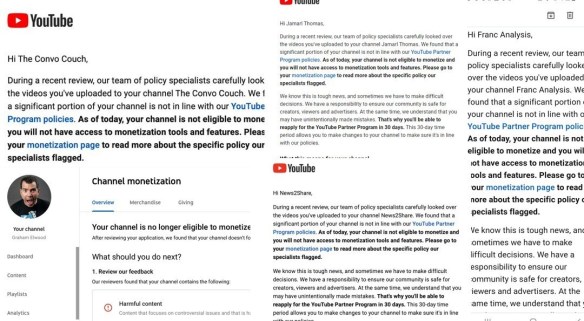
Progressive commentators Graham ElwoodThe Progressive SoapboxThe Convo CouchFranc AnalysisHannah Reloaded and Cyberdemon531 have all received notifications from YouTube that their videos are no longer permitted to earn money through the platform’s various monetization features, as has Ford Fischer, a respected freelancer who films US political demonstrations. No explanation has been offered for this decision beyond the vague claim that “your channel is not in line with our YouTube Partner Program policies” due to “harmful content”.

Like all large online platforms, YouTube’s appeals process is notoriously opaque and unaccountable. These accounts could remain demonetized for months, or forever, without any clear explanation at all. Ford Fischer, who has been in this situation before, said on Twitter that his account was left demonetized for seven months before YouTube reversed its decision.

“Last time you demonetized my channel, I spoke out for seven months. I didn’t delete a single piece of content. You admitted you were wrong. I forgive you. Please don’t do this again,” Fischer tweeted.

“No superchats, no ad revenue, no YouTube premium money,” tweeted Elwood, who also said “I have a call with my lawyers later today.”

“You guys have destroyed my channel without legit explanation as to why,” tweeted Jamarl Thomas of Progressive Soapbox. “No videos are given – and frankly there is literally zero ‘harmful’ content on my channel. This is a radically bad error that needs to be corrected.”

The Convo Couch’s Jonathan Mayorca tweeted the notification he received from YouTube which gave the reason as “Harmful content: Content that focuses on controversial issues and that is harmful to viewers,” saying no specific video or subject was named. Nobody receiving these notifications appears to have any idea what is meant by “harmful” or “controversial” or why YouTube is mentioning them in the same breath as though these two things are connected or synonymous in some way.

YouTube has been providing template responses saying “We recommend making the needed changes to your content and reapply in 30 days” while refusing to specify what the “needed changes” even are.

Speaking for myself, I can say with absolute certainty that I would not be able to create content at anywhere near the pace I do were I not making enough money from it to do it full time. Life is far too demanding with far too much else going on for me to be able to maintain anything like daily output; being financially deplatformed and having to get another job would force me down to an essay a week in my spare time, if that. Anyone who works in independent media full time knows this, and so do the powerful people who are steadily ratcheting up the campaign to silence anyone who hasn’t passed through the gatekeepers of the plutocratic media.

Financial deplatforming is censorship. People were given an opportunity to devote themselves to the vocation of creating media outside the gatekeeping apparatus of billionaire news institutions, which is arguably the single most important vocation anyone can give themselves to in our world right now, and they built their lives around their ability to do this. Now it’s being ripped away from them; their literal jobs are being taken away. They were offered a reason to think they’d be able to make a living doing very important work, and then they were sucker punched with what amounts to political censorship.

This has been a continually escalating trend for years. The general population is herded onto huge monopolistic social media platforms offering democratization of information where your voice can be heard, and then those platforms proceed to censor an increasing amount of political speech in increasing coordination with the US government.

https://twitter.com/FordFischer/status/1357055942446223360

If the democratization of information online is successfully reversed and the mass media gatekeepers are again the sole authorities on what’s real and true, people will be locked into forming their ideas on how to think, act and vote based on what they are told by the same plutocratic media institutions which have been deceiving them into every war and manipulating them into accepting the status quo for generations.

If the door is locked to the possibility of a grassroots information rebellion against the narrative hegemony of our rulers, we will remain doomed to continue along the same ecocidal, omnicidal trajectory these bastards have us on until it reaches its inevitable conclusion. This must be resisted.

“At First I Thought it Was a Joke”: Academic Media Censorship Conference Censored by YouTube

The entire video record of the conference — estimated at around 24 hours of material — was mysteriously disappeared from YouTube say conference organizers.

By Alan Macleod

Source: Mint Press News

An academic critical media literacy conference warning of the dangers of media censorship has, ironically, been censored by YouTube. The Critical Media Literacy Conference of the Americas 2020 took place without incident online over two days in October and featured a number of esteemed speakers and panels discussing issues concerning modern media studies.

Weeks later, however, the entire video record of the conference — estimated at around 24 hours of material — disappeared from YouTube. Organizer Nolan Higdon of California State University East Bay, began receiving worried messages from other academics, some of which were shared with MintPress, who had been using the material in their classrooms, noting that it had all mysteriously disappeared.

“At first I thought it was a joke,” said Mickey Huff of Diablo Valley College, California. “My initial reaction was ‘that’s absurd;’ there must have been a mistake or an accident or it must have got swept under somehow. There is no violation, there was no reasoning, there was no warning, there was not an explanation, there was no nothing. The entire channel was just gone,” he told MintPress. Huff is also the director of Project Censored, an organization that sponsored the event.

Higdon suspected that it was the content critical of big tech monopolies like Google, YouTube, Facebook, and Twitter that was the reason why the channel was deleted. “Each video was a different panel and every panel had different people from the other ones, so it is not like there was one theme or person or copyrighted content in all of our videos; this seems to be an attack on the conference, not on a singular video,” he said.


“This wasn’t a keg party with Parler users”

The organizers were careful to avoid copyright infringement, with the large majority of their videos in lecture format, essentially a recorded Zoom call. Speakers included some of the best-known names in media studies, with the event sponsored by institutions like Stanford University and UCLA. “This wasn’t a keg party with Parler users: it was an academic conference,” Huff said.

These are pioneering figures in critical media literacy scholarship. It’s mind numbing that all of this was just disappeared from YouTube. The irony is writ large…This is part of a potentially algorithmic way of getting rid of more radical positions that criticize establishment media systems, including journalism.”

Higdon too, suspected YouTube’s action was politicized: “This is the same year we saw big tech trying to influence Prop 22 here in California, so I am not too surprised that they would be aggressive with folks like us who are critical of media corporations.”

Organizers say they attempted to contact YouTube but did not receive a reply.

MintPress spoke to representatives from Google, YouTube’s parent company, who strenuously denied that they would ever remove content from their platforms purely because it was critical of the company, noting that there is a wealth of videos on the website that challenge or attack them.After looking into the matter, Google said they could find only one video and reinstated it (although the video does not appear on the conference’s channel). As for the hours of other footage, that remains an enigma to them, with no record of its existence. Thus, it appears that there will be no closure or a definitive answer to this mystery.


Algorithms take aim

Media literacy, big tech power, and censorship are hot topics right now. In the wake of the dramatic storming of the Capitol Building earlier this month, a host of companies, including Google, Facebook, YouTube, Twitter, and Instagram, took actions against Donald Trump, limiting his and his supporters’ ability to communicate online. Perhaps most notably, however, Google, Apple, and Amazon Web Services launched a coordinated assault on “free speech app” Parler, a service popular with the far-right for its lax laws on racism. Together, the three effectively took the service offline around the world.

More recently, the Wall Street Bets subreddit, responsible for intentionally sinking a multi-billion dollar hedge fund, has endured retaliation, its communications channels cut by messaging app Discord, amid calls to immediately criminalize their behavior.

While the pros and cons of such decisions can, and have been, debated, the bigger question of should privately-owned companies be allowed to have the power to regulate who can and cannot speak online, has largely been downplayed.

“On the one hand I understand they have the right to deplatform people,” Huff told MintPress. “On a broader level though, I don’t think they should have achieved this kind of power over our communication systems in the first place, and these should be publicly run platforms regulated the same way our government regulates and enforces the First Amendment.”

Higdon was equally worried about the power amassed by the tech giants. “By empowering these tech companies to decide what is and is not appropriate, they are going to look out for their vested interests, and people who are critical of their business model and practices are going to be targets,” he said, predicting that,

These lefties right now who are advocating for censorship…the outcome of this is going to be on them.”

If history is any judge, he will be proven correct. In the wake of the 2016 election and the allegations that Russian disinformation swung the result in Trump’s favor, social media companies changed their algorithms to help halt the spread of fake news. The main result, however, was a throttling of traffic to high-quality alternative news sites and the promotion of corporate media like CNN and Fox News. Overnight, Consortium News’ Google traffic fell by 47%, Common Dreams’ by 37%, Democracy Now! By 36% and The Intercept by 19%. MintPress suffered similar, unrecoverable losses.

Likewise, Facebook CEO Mark Zuckerberg personally approved the deliberate choking of alternative media, admitting that his company deranked Mother Jones because of its left-wing persuasion (despite Facebook’s assurances that it was doing no such thing). Other, more radical outlets have suffered even greater reductions in traffic.


Anti-social media

Whatever decisions big tech companies make reverberate throughout society. 35, 24, and 17% of Americans get their news from Facebook, YouTube, and Twitter, respectively, with similar numbers worldwide. This enormous user base makes them by far the greatest and most influential news platforms on the planet, with the ability to highlight stories, bury others, and even swing elections. Huff was extremely worried about the power of these new media monopolies.

“We can’t get away from the fact that Google, Facebook, YouTube, Twitter, the whole corporate Alphabet soup of this big tech dystopia have gobbled up the public sphere. This is where people can go to congregate and share their information and it is also where invisible forces decide which voices get heard and which do not. Let’s also not forget that all of this tech was initially funded with taxpayer money.”

Worse still, although we now live in an online world, the public is hopelessly ill-equipped to navigate its waters, displaying a shocking lack of awareness and understanding of how they can be manipulated.

A 2016 study from Stanford University found that two-thirds of college-aged “digital natives” — people who grew up using the Internet — mistook native advertising for a genuine news story, even with the words “sponsored content” displayed prominently. “Overall, young people’s ability to reason about the information on the Internet can be summed up in one word: bleak,” the study concluded, leading to calls for more critical media literacy education in schools. “Since we are not teaching people how to use these technologies, or how these technologies use them, they are more susceptible to propaganda and to disinformation. And ironically our conference was designed to combat exactly that problem,” Huff added.

Perhaps more worrying of all is the increasingly close connections between Silicon Valley and the National Security State. “What Lockheed Martin was to the twentieth century…technology and cyber-security companies will be to the twenty-first,” wrote Google executives Eric Schmidt and Jared Cohen. Late last year, the CIA signed a partnership deal worth tens of billions of dollars with Microsoft, Google, Oracle, IBM, and Amazon Web Services. Meanwhile, Facebook has partnered with the NATO cutout organization the Atlantic Council to help them curate the world’s news feeds. Reddit has also hired Atlantic Council official Jessica Ashooh as its director of policy.

The Atlantic Council’s board of directors includes eight former CIA chiefs, multiple U.S. Army Generals, and high statespeople like Henry Kissinger and Condoleezza Rice, meaning that any decisions big tech companies make are only one step removed from the U.S. government. “This is actually [state] censorship by proxy,” Higdon warned.

“These companies, we know thanks to Edward Snowden and others, have contracts with the Federal government. There is a revolving door between particularly the Democratic Party and big tech, and there are also various loans and government protections given to this industry. So this is not some independent set of entities making this decision.”

“If 1984’s protagonist Winston Smith were a real character today he’d be a fact checker at Facebook or a content curator at YouTube, relegating to the dustbins of history whatever programmers are told to or whatever keywords our conference triggered,” Huff added.

Big tech has repeatedly acted at the behest of the U.S. government to silence its international opponents, suspending the accounts of foreign leaders like Venezuela’s Nicolas Maduro or Iran’s Ayatollah Khamenei or deranking foreign media outlets like RT and TeleSUR.

It is in this light that the deletion of the Critical Media Literacy Conference of the Americas can be seen; not as a deliberate decision by an angry Google employee intent on revenge, but as the result of a powerful and Byzantine algorithm designed by Silicon Valley executives who are intimately intertwined with both the government and the corporate world. There is little oversight of their power or recourse to their decisions, given their enormous influence over public life today.

Huff was particularly sardonic about the whole affair:

There are layers of irony here that are certainly not lost on us. But I don’t know if the public at large is realizing the attack that is happening against the very people that are the intellectual bulwark against such institutional censorship. I’m not trying to make us out to be martyrs here, but my point is that I think it has a particular irony when the very public intellectuals who try to educate the public about how these systems work are silenced,” he said.

Another Mega Group Spy Scandal? Samanage, Sabotage, and the SolarWinds Hack

By Whitney Webb

Source: The Unz Review

The devastating hack on SolarWinds was quickly pinned on Russia by US intelligence. A more likely culprit, Samanage, a company whose software was integrated into SolarWinds’ software just as the “back door” was inserted, is deeply tied to Israeli intelligence and intelligence-linked families such as the Maxwells.

In mid-December of 2020, a massive hack compromised the networks of numerous US federal agencies, major corporations, the top five accounting firms in the country, and the military, among others. Despite most US media attention now focusing on election-related chaos, the fallout from the hack continues to make headlines day after day.

The hack, which affected Texas-based software provider SolarWinds, was blamed on Russia on January 5 by the US government’s Cyber Unified Coordination Group. Their statement asserted that the attackers were “likely Russian in origin,” but they failed to provide evidence to back up that claim.

Since then, numerous developments in the official investigation have been reported, but no actual evidence pointing to Russia has yet to be released. Rather, mainstream media outlets began reporting the intelligence community’s “likely” conclusion as fact right away, with the New York Times subsequently reporting that US investigators were examining a product used by SolarWinds that was sold by a Czech Republic–based company, as the possible entry point for the “Russian hackers.” Interest in that company, however, comes from the fact that the attackers most likely had access to the systems of a contractor or subsidiary of SolarWinds. This, combined with the evidence-free report from US intelligence on “likely” Russian involvement, is said to be the reason investigators are focusing on the Czech company, though any of SolarWinds’ contractors/subsidiaries could have been the entry point.

Such narratives clearly echo those that became prominent in the wake of the 2016 election, when now-debunked claims were made that Russian hackers were responsible for leaked emails published by WikiLeaks. Parallels are obvious when one considers that SolarWinds quickly brought on the discredited firm CrowdStrike to aid them in securing their networks and investigating the hack. CrowdStrike had also been brought on by the DNC after the 2016 WikiLeaks publication, and subsequently it was central in developing the false declarations regarding the involvement of “Russian hackers” in that event.

There are also other parallels. As Russiagate played out, it became apparent that there was collusion between the Trump campaign and a foreign power, but the nation was Israel, not Russia. Indeed, many of the reports that came out of Russiagate revealed collusion with Israel, yet those instances received little coverage and generated little media outrage. This has led some to suggest that Russiagate may have been a cover for what was in fact Israelgate.

Similarly, in the case of the SolarWinds hack, there is the odd case and timing of SolarWinds’ acquisition of a company called Samanage in 2019. As this report will explore, Samanage’s deep ties to Israeli intelligence, venture-capital firms connected to both intelligence and Isabel Maxwell, as well as Samange’s integration with the Orion software at the time of the back door’s insertion warrant investigation every bit as much as SolarWinds’ Czech-based contractor.

Orion’s Fall

In the month since the hack, evidence has emerged detailing the extent of the damage, with the Justice Department quietly announcing, the same day as the Capitol riots (January 6), that their email system had been breached in the hack—a “major incident” according to the department. This terminology means that the attack “is likely to result in demonstrable harm to the national security interests, foreign relations, or the economy of the United States or to the public confidence, civil liberties, or public health and safety of the American people,” per NextGov.

The Justice Department was the fourth US government agency to publicly acknowledge a breach in connection to the hack, with the others being the Departments of Commerce and Energy and the Treasury. Yet, while only four agencies have publicly acknowledged fallout from the hack, SolarWinds software is also used by the Department of Defense, the State Department, NASA, the NSA, and the Executive Office. Given that the Cyber Unified Coordination Group stated that “fewer than ten” US government agencies had been affected, it’s likely that some of these agencies were compromised, and some press reports have asserted that the State Department and Pentagon were affected.

In addition to government agencies, SolarWinds Orion software was in use by the top ten US telecommunications corporations, the top five US accounting firms, the New York Power Authority, and numerous US government contractors such as Booz Allen Hamilton, General Dynamics, and the Federal Reserve. Other notable SolarWinds clients include the Bill & Melinda Gates Foundation, Microsoft, Credit Suisse, and several mainstream news outlets including the Economist and the New York Times.

Based on what is officially known so far, the hackers appeared to have been highly sophisticated, with FireEye, the cybersecurity company that first discovered the implanted code used to conduct the hack, stating that the hackers “routinely removed their tools, including the backdoors, once legitimate remote access was achieved—implying a high degree of technical sophistication and attention to operational security.” In addition, top security experts have noted that the hack was “very very carefully orchestrated,” leading to a consensus that the hack was state sponsored.

FireEye stated that they first identified the compromise of SolarWinds after the version of the Orion software they were using contained a back door that was used to gain access to its “red team” suite of hacking tools. Not long after the disclosure of the SolarWinds hack, on December 31, the hackers were able to partially access Microsoft’s source code, raising concerns that the act was preparation for future and equally devastating attacks.

FireEye’s account can be taken with a grain of salt, however, as the CIA is one of FireEye’s clients, and FireEye was launched with funding from the CIA’s venture capital arm In-Q-tel. It is also worth being skeptical of the “free tool” FireEye has made available in the hack’s aftermath for “spotting and keeping suspected Russians out of systems.”

In addition, Microsoft, another key source in the SolarWinds story, is a military contractor with close ties to Israel’s intelligence apparatus, especially Unit 8200, and their reports of events also deserve scrutiny. Notably, it was Unit 8200 alumnus and executive at Israeli cybersecurity firm Cycode, Ronen Slavin, who told Reuters in a widely quoted article that he “was worried by the possibility that the SolarWinds hackers were poring over Microsoft’s source code as prelude to a much more ambitious offensive.” “To me the biggest question is, ‘Was this recon for the next big operation?’” Slavin stated.

Also odd about the actors involved in the response to the hack is the decision to bring on not only the discredited firm CrowdStrike but also the new consultancy firm of Chris Krebs and Alex Stamos, former chief information security officer of Facebook and Yahoo, to investigate the hack. Chris Krebs is the former head of the Department of Homeland Security’s Cybersecurity and Infrastructure Security Agency (CISA) and was previously a top Microsoft executive. Krebs was fired by Donald Trump after repeatedly and publicly challenging Trump on the issue of election fraud in the 2020 election.

As head of CISA, Krebs gave access to networks of critical infrastructure throughout the US, with a focus on the health-care industry, to the CTI League, a suspicious outfit of anonymous volunteers working “for free” and led by a former Unit 8200 officer. “We have brought in the expertise of Chris Krebs and Alex Stamos to assist in this review and provide best-in-class guidance on our journey to evolve into an industry leading secure software development company,” a SolarWinds spokesperson said in an email cited by Reuters.

It is also worth noting that the SolarWinds hack did benefit a few actors aside from the attackers themselves. For instance, Israeli cybersecurity firms CheckPoint and CyberArk, which have close ties to Israeli intelligence Unit 8200, have seen their stocks soar in the weeks since the SolarWinds compromise was announced. Notably, in 2017, CyberArk was the company that “discovered” one of the main tactics used in an attack, a form of SAML token manipulation called GoldenSAML. CyberArk does not specify how they discovered this method of attack and, at the time they announced the tactic’s existence, released a free tool to identify systems vulnerable to GoldenSAML manipulation.

In addition, the other main mode of attack, a back door program nicknamed Sunburst, was found by Kaspersky researchers to be similar to a piece of malware called Kazuar that was also first discovered by another Unit 8200-linked company, Palo Alto Networks, also in 2017. The similarities only suggest that those who developed the Sunburst backdoor may have been inspired by Kazuar and “they may have common members between them or a shared software developer building their malware.” Kaspersky stressed that Sunburst and Kazuar are not likely to be one and the same. It is worth noting, as an aside, that Unit 8200 is known to have previously hacked Kaspersky and attempted to insert a back door into their products, per Kaspersky employees.

Crowdstrike claimed that this finding confirmed “the attribution at least to Russian intelligence,” only because an allegedly Russian hacking group is believed to have used Kazuar before. No technical evidence linking Russia to the SolarWinds hacking has yet been presented.

Samanage and Sabotage

The implanted code used to execute the hack was directly injected into the source code of SolarWinds Orion. Then, the modified and bugged version of the software was “compiled, signed and delivered through the existing software patch release management system,” per reports. This has led US investigators and observers to conclude that the perpetrators had direct access to SolarWinds code as they had “a high degree of familiarity with the software.” While the way the attackers gained access to Orion’s code base has yet to be determined, one possibility being pursued by investigators is that the attackers were working with employee(s) of a SolarWinds contractor or subsidiary.

US investigators have been focusing on offices of SolarWinds that are based abroad, suggesting that—in addition to the above—the attackers were likely working for SolarWinds or were given access by someone working for the company. That investigation has focused on offices in eastern Europe, allegedly because “Russian intelligence operatives are deeply rooted” in those countries.

It is worth pointing out, however, that Israeli intelligence is similarly “deeply rooted” in eastern European states both before and after the fall of the Soviet Union, ties well illustrated by Israeli superspy and media tycoon Robert Maxwell’s frequent and close associations with Eastern European and Russian intelligence agencies as well as the leaders of many of those countries. Israeli intelligence operatives like Maxwell also had cozy ties with Russian organized crime. For instance, Maxwell enabled the access of the Russian organized crime network headed by Semion Mogilevich into the US financial system and was also Mogilevich’s business partner. In addition, the cross-pollination between Israeli and Russian organized crime networks (networks which also share ties to their respective intelligence agencies) and such links should be considered if the cybercriminals due prove to be Russian in origin, as US intelligence has claimed.

Though some contractors and subsidiaries of SolarWinds are now being investigated, one that has yet to be investigated, but should be, is Samanage. Samanage, acquired by SolarWinds in 2019, not only gained automatic access to Orion just as the malicious code was first inserted, but it has deep ties to Israeli intelligence and a web of venture-capital firms associated with numerous Israeli espionage scandals that have targeted the US government. Israel is deemed by the NSA to be one of the top spy threats facing US government agencies and Israel’s list of espionage scandals in the US is arguably the longest, and includes the Jonathan Pollard and PROMIS software scandals of the 1980s to the Larry Franklin/AIPAC espionage scandal in 2009.

Though much reporting has since been done on the recent compromise of SolarWinds Orion software, little attention has been paid to Samanage. Samanage offers what it describes as “an IT Service Desk solution.” It was acquired by SolarWinds so Samanage’s products could be added to SolarWinds’ IT Operations Management portfolio. Though US reporting and SolarWinds press releases state that Samanage is based in Cary, North Carolina, implying that it is an American company, Samanage is actually an Israeli firm. It was founded in 2007 by Doron Gordon, who previously worked for several years at MAMRAM, the Israeli military’s central computing unit.

Samanage was SolarWinds’ first acquisition of an Israeli company, and, at the time, Israeli media reported that SolarWinds was expected to set up its first development center in Israel. It appears, however, that SolarWinds, rather than setting up a new center, merely began using Samanage’s research and development center located in Netanya, Israel.

Several months after the acquisition was announced, in November 2019, Samanage, renamed SolarWinds Service Desk, became listed as a standard feature of SolarWinds Orion software, whereas the integration of Samanage and Orion had previously been optional since the acquisition’s announcement in April of that year. This means that complete integration was likely made standard in either October or November. It has since been reported that the perpetrators of the recent hack gained access to the networks of US federal agencies and major corporations at around the same time. Samanage’s automatic integration into Orion was a major modification made to the now-compromised software during that period.

Samanage appears to have had access to Orion following the announcement of the acquisition in April 2019. Integration first began with Orion version 2019.4, the earliest version believed to contain the malicious code that enabled the hack. In addition, the integrated Samanage component of Orion was responsible for “ensuring the appropriate teams are quickly notified when critical events or performance issues [with Orion] are detected,” which was meant to allow “service agents to react faster and resolve issues before . . . employees are impacted.”

In other words, the Samanage component that was integrated into Orion at the same time the compromise took place was also responsible for Orion’s alert system for critical events or performance issues. The code that was inserted into Orion by hackers in late 2019 nevertheless went undetected by this Samanage-made component for over a year, giving the “hackers” access to millions of devices critical to both US government and corporate networks. Furthermore, it is this Samanage-produced component of the affected Orion software that advises end users to exempt the software from antivirus scans and group policy object (GPO) restrictions by providing a warning that Orion may not work properly unless those exemptions are granted.

Samanage, Salesforce, and the World Economic Forum

Around the time of Samange’s acquisition by SolarWinds, it was reported that one of Samanage’s top backers was the company Salesforce, with Salesforce being both a major investor in Samanage as well as a partner of the company.

Salesforce is run by Marc Benioff, a billionaire who got his start at the tech giant Oracle. Oracle was originally created as a CIA spin-off and has deep ties to Israel’s government and the outgoing Trump administration. Salesforce also has a large presence in Israel, with much of its global research and development based there. Salesforce also recently partnered with the Unit 8200-linked Israeli firm Diagnostic Robotics to “predictively” diagnose COVID-19 cases using Artificial Intelligence.

Aside from leading Salesforce, Benioff is a member of the Vatican’s Council for Inclusive Capitalism alongside Lynn Forester de Rothschild, a close associate of Jeffrey Epstein and the Clintons, and members of the Lauder family, who have deep ties to the Mega Group and Israeli politics.

Benioff is also a prominent member of the board of trustees of the World Economic Forum and the inaugural chair of the WEF’s Centre for the Fourth Industrial Revolution (C4IR), making him one of the most critical players in the unfolding of the WEF-backed Great Reset. Other WEF leaders, including the organization’s founder Klaus Schwab, have openly discussed how massive cyberattacks such as befell SolarWinds will soon result in “even more significant economic and social implications than COVID-19.”

Last year, the WEF’s Centre for Cybersecurity, of which Salesforce is part, simulated a “digital pandemic” cyberattack in an exercise entitled Cyber Polygon. Cyber Polygon’s speakers in 2020 included former UK Prime Minister Tony Blair, the Prime Minister of Russia Mikhail Mishustin, WEF founder Klaus Schwab, and IBM executive Wendi Whitmore, who previously held top posts at both Crowdstrike and a FireEye subsidiary. Notably, just months before the COVID-19 crisis, the WEF had held Event 201, which simulated a global coronavirus pandemic that crippled the world’s economy.

In addition to Samanage’s ties to WEF big shots such as Marc Benioff, the other main investors behind Samanage’s rise have ties to major Israeli espionage scandals, including the Jonathan Pollard affair and the PROMIS software scandal. There are also ties to one of the WEF’s founding “technology pioneers,” Isabel Maxwell (the daughter of Robert Maxwell and sister of Ghislaine), who has long-standing ties to Israel’s intelligence apparatus and the country’s hi-tech sector.

The Bronfmans, the Maxwells, and Viola Ventures

At the time of its acquisition by SolarWinds, Samanage’s top investor was Viola Ventures, a major Israeli venture-capital firm. Viola’s investment in Samanage, until its acquisition, was managed by Ronen Nir, who was also on Samanage’s board before it became part of SolarWinds.

Prior to working at Viola, Ronen Nir was a vice president at Verint, formerly Converse Infosys. Verint, whose other alumni have gone on to found Israeli intelligence-front companies such as Cybereason. Verint has a history of aggressively spying on US government facilities, including the White House, and created the backdoors into all US telecommunications systems and major tech companies, including Microsoft, Google and Facebook, on behalf of the US’ NSA.

In addition to his background at Verint, Ronen Nir is an Israeli spy, having served for thirteen years in an elite IDF intelligence unit, and he remains a lieutenant colonel on reserve duty. His biography also notes that he worked for two years at the Israeli embassy in Washington, DC, which is fitting given his background in espionage and the major role that Israeli embassy has played in several major espionage scandals.

As an aside, Nir has stated that “thought leader” Henry Kissinger is his “favorite historical character.” Notably, Kissinger was instrumental in allowing Robert Maxwell, Israeli superspy and father of Ghislaine and Isabel Maxwell, to sell software with a back door for Israeli intelligence to US national laboratories, where it was used to spy on the US nuclear program. Kissinger had told Maxwell to connect with Senator John Tower in order to gain access to US national laboratories, which directly enabled this action, part of the larger PROMIS software scandal.

In addition, Viola’s stake was managed through a firm known as Carmel Ventures, which is part of the Viola Group. At the time, Carmel Ventures was advised by Isabel Maxwell, whose father had previously been directly involved in the operation of the front company used to sell bugged software to US national laboratories. As noted in a previous article at Unlimited Hangout, Isabel “inherited” her father’s circle of Israeli government and intelligence contacts after his death and has been instrumental in building the “bridge” between Israel’s intelligence and military-linked hi-tech sector to Silicon Valley.

Isabel also has ties to the Viola Group itself through Jonathan Kolber, a general partner at Viola. Kolber previously cofounded and led the Bronfman family’s private-equity fund, Claridge Israel (based in Israel). Kolber then led Koor Industries, which he had acquired alongside the Bronfmans via Claridge. Kolber is closely associated with Stephen Bronfman, the son of Charles Bronfman who created Claridge and also cofounded the Mega Group with Leslie Wexner in the early 1990s.

Kolber, like Isabel Maxwell, is a founding director of the Peres Center for Peace and Innovation. Maxwell, who used to chair the center’s board, stepped down following the Epstein scandal, though it’s not exactly clear when. Other directors of the center include Tamir Pardo, former head of Mossad. Kolber’s area of expertise, like that of Isabel Maxwell, is “structuring complex, cross-border and cross industry business and financial transactions,” that is, arranging acquisitions and partnerships of Israeli firms by US companies. Incidentally, this is also a major focus of the Peres Center.

Other connections to Isabel Maxwell, aside from her espionage ties, are worth noting, given that she is a “technology pioneer” of the World Economic Forum. As previously mentioned, Salesforce—a major investor in Samanage—is deeply involved with the WEF and its Great Reset.

The links of Israeli intelligence and Salesforce to Samanage, and thus to SolarWinds, is particularly relevant given the WEF’s “prediction” of a coming “pandemic” of cyberattacks and the early hints from former Unit 8200 officers that the SolarWinds hack is just the beginning. It is also worth mentioning the Israeli government’s considerable ties to the WEF over the years, particularly last year when it joined the Benioff-chaired C4IR and participated in the October 2020 WEF panel entitled “The Great Reset: Harnessing the Fourth Industrial Revolution.”

Start Up Nation Central, an organization aimed at integrating Israeli start-ups with US firms set up by Netanyahu’s longtime economic adviser Eugene Kandel and American Zionist billionaire Paul Singer, have asserted that Israel will serve a “key role” globally in the 4th Industrial Revolution following the implementation of the Great Reset.

Gemini, the BIRD Foundation, and Jonathan Pollard

In addition to Viola, another of Samange’s leading investors is Gemini Israel Ventures. Gemini is one of Israel’s oldest venture-capital firms, dating back to the Israeli government’s 1993 Yozma program.

The first firm created by Yozma, Gemini was put under the control of Ed Mlavsky, who Israel’s government had chosen specifically for this position. As previously reported by Unlimited Hangout, Mlavsky was then serving as the executive director of the Israel-US Binational Industrial Research and Development (BIRD) Foundation, where “he was responsible for investments of $100 million in more than 300 joint projects between US and Israeli high-tech companies.”

A few years before Gemini was created, while Mlavsky still headed BIRD, the foundation became embroiled in one of the worst espionage scandals in US history, the Jonathan Pollard affair.

In the indictment of US citizen Pollard for espionage on Israel’s behalf, it was noted that Pollard delivered the documents he stole to agents of Israel at two locations, one of which was an apartment owned by Harold Katz, the then legal counsel of the BIRD Foundation and an adviser to Israel’s military, which oversaw Israel’s scientific intelligence-gathering agency, Lekem. US officials told the New York Times at the time that they believed Katz “has detailed knowledge about the [Pollard] spy ring and could implicate senior Israeli officials.”

Subsequent reporting by journalist Claudia Wright pointed the finger at the Mlavsky-run BIRD Foundation as one of the ways Israeli intelligence funneled money to Pollard before his capture by US authorities.

One of the first companies Gemini invested in was CommTouch (now Cyren), which was founded by ex-IDF officers and later led by Isabel Maxwell. Under Maxwell’s leadership, CommTouch developed close ties to Microsoft, partially due to Maxwell’s relationship with its cofounder Bill Gates.

A Coming “Hack” of Microsoft?

If the SolarWinds hack is as serious as has been reported, it’s difficult to understand why a company like Samanage would not be looked into as part of a legitimate investigation into the attack. The timing of Samanage employees gaining access to the Orion software and the company’s investors including Israeli spies and those with ties to past espionage scandals where Israel used back doors to spy on the US and beyond raises obvious red flags. Yet, any meaningful investigation of the incident is unlikely to take place, especially given the considerable involvement of discredited firms like CrowdStrike, CIA fronts like FireEye and a consultancy firm led by former Silicon Valley executives with their own government/intelligence ties.

There is also the added fact that both of the main methods used in the attack were analogous or bore similarities to hacking tools that were both discovered by Unit 8200-linked companies in 2017. Unit 8200-founded cybersecurity firms are among the few “winners” from the SolarWinds hack, as their stocks have skyrocketed and demand for their services has increased globally.

While some may argue that Unit 8200 alumni are not necessarily connected to the Israeli intelligence apparatus, numerous reports have pointed out the admitted fusion of Israeli military intelligence with Israel’s hi-tech sector and its tech-focused venture capital networks, with Israeli military and intelligence officials themselves noting that the line between the private cybersecurity sector and Israel’s intelligence apparatus is so blurred, it’s difficult to know where one begins and the other ends. There is also the Israeli government policy, formally launched in 2012, whereby Israel’s intelligence and military intelligence agencies began outsourcing “activities that were previously managed in-house, with a focus on software and cyber technologies.”

Samanage certainly appears to be such a company, not only because it was founded by a former IDF officer in the military’s central computing unit, but because its main investors include spies on “reserve duty” and venture capital firms linked to the Pollard scandal as well as the Bronfman and Maxwell families, both of whom have been tied to espionage and sexual blackmail scandals over the years.

Yet, as the Epstein scandal has recently indicated, major espionage scandals involving Israel receive little coverage and investigations into these events rarely lead anywhere. PROMIS was covered up largely thanks to Bill Barr during his first term as Attorney General and even the Pollard affair has all been swept under the rug with Donald Trump allowing Pollard to move to Israel and, more recently, pardoning the Israeli spy who recruited Pollard during his final day as President. Also under Trump, there was the discovery of “stingray” surveillance devices placed by Israel’s government throughout Washington DC, including next to the White House, which were quickly memory holed and oddly not investigated by authorities. Israel had previously wiretapped the White House’s phone lines during the Clinton years.

Another cover up is likely in the case of SolarWinds, particularly if the entry point was in fact Samanage. Though a cover up would certainly be more of the same, the SolarWinds case is different as major tech companies and cybersecurity firms with ties to US and Israeli intelligence now insist that Microsoft is soon to be targeted in what would clearly be a much more devastating event than SolarWinds due to the ubiquity of Microsoft’s products.

On Tuesday, CIA-linked firm FireEye, which apparently has a leadership role in investigating the hack, claimed that the perpetrators are still gathering data from US government agencies and that “the hackers are moving into Microsoft 365 cloud applications from physical, on-premises servers,” meaning that changes to fix Orion’s vulnerabilities will not necessarily deny hacker access to previously compromised systems as they allegedly maintain access to those systems via Microsoft cloud applications. In addition to Microsoft’s own claims that some of its source code was accessed by the hackers, this builds the narrative that Microsoft products are poised to be targeted in the next high-profile hack.

Microsoft’s cloud security infrastructure, set to be the next target of the SolarWinds hackers, was largely developed and later managed by Assaf Rappaport, a former Unit 8200 officer who was most recently the head of Microsoft’s Research and Development and Security teams at its massive Israel branch. Rappaport left Microsoft right before the COVID-19 crisis began last year to found a new cybersecurity company called Wiz.

Microsoft, like some of Samanage’s main backers, is part of the World Economic Forum and is an enthusiastic supporter of and participant in the Great Reset agenda, so much so that Microsoft CEO Satya Nadella wrote the foreword to Klaus Schwab’s book “Shaping the Fourth Industrial Revolution.” With the WEF simulating a cyber “pandemic” and both the WEF and Israel’s head of Israel’s National Cyber Directorate warning of an imminent “cyber winter”, SolarWinds does indeed appear to be just the beginning, though perhaps a scripted one to create the foundation for something much more severe. A cyberattack on Microsoft products globally would certainly upend most of the global economy and likely have economic effects more severe than the COVID-19 crisis, just as the WEF has been warning. Yet, if such a hack does occur, it will inevitably serve the aims of the Great Reset to “reset” and then rebuild electronic infrastructure.

IN 1917 RUDOLF STEINER FORESAW A VACCINE THAT WOULD ‘DRIVE ALL INCLINATION TOWARD SPIRITUALITY OUT OF PEOPLE’S SOULS’

By Dylan Charles

Source: Waking Times

If you’ve felt at all like you’re in a spiritual war right now, you’re not alone.

Many of the world’s greatest scholars, philosophers and ascetics understood the world to be multi-dimensional and co-inhabited by non-physical beings both good and evil, always at war with us and each other.

It’s not something that can be rightly explained with language or science. One must cultivate such sensitivity that the existence of spiritual beings can be directly experienced.

Rudolf Steiner was an Austrian philosopher, educator, and spiritualist, and over the course of his life he published numerous books and papers on the science of spirituality. He viewed the human body as a spiritual vessel, open to occupation by other entities.

To be conscious of these forces was to have the power to reject their negative influence. To remain unconscious of them was to be a leaf in their wind, and spiritual cultivation was the key to developing conscious awareness of them.

“The spirits of darkness are now among us. We have to be on guard so that we may realize what is happening when we encounter them and gain a real idea of where they are to be found. The most dangerous thing you can do in the immediate future will be to give yourself up unconsciously to the influences which are definitely present.” ~ Rudolf Steiner

If people express the natural human inclination toward spiritual growth, they free themselves from fear and anxiety, and effectively develop a sort of immunity to the influences of negative entities. If not, our vibration attracts hostile spirits and we fall unconsciously unto their influence.

“There are beings in the spiritual realms for whom anxiety and fear emanating from human beings offer welcome food. When humans have no anxiety and fear, then these creatures starve… If fear and anxiety radiates from people and they break out in panic, then these creatures find welcome nutrition and they become more and more powerful. These beings are hostile towards humanity.

Everything that feeds on negative feelings, on anxiety, fear and superstition, despair or doubt, are in reality hostile forces in supersensible worlds, launching cruel attacks on human beings, while they are being fed. Therefore, it is above all necessary to begin with that the person who enters the spiritual world overcomes fear, feelings of helplessness, despair and anxiety. But these are exactly the feelings that belong to contemporary culture and materialism; because it estranges people from the spiritual world, it is especially suited to evoke hopelessness and fear of the unknown in people, thereby calling up the above mentioned hostile forces against them.” ~Rudolf Steiner

With such profound global fear, anxiety, and panic over the present pandemic, many are exposing their own spiritual sicknesses and acquiescing to any recommended behavior or intervention that might alleviate these emotions. Along with this is the push to vaccinate 7 billion healthy people.

Nearly 100 years ago, in a series of 14 essays published under the title, The Fall of the Spirits of Darkness, Steiner issued a warning to future generations about a possible measure of mass control, quite similar to the  visions presented by Orwell and Huxley. Steiner foresaw a future when vaccines could steal our spiritual nature.

First, some background:

“In these fourteen lectures, given at the end of 1917 following four years of war in Europe, Steiner speaks on the complex spiritual forces behind the World War I, humanity’s attempts to build theoretically perfect social orders, and the many divisions and disruptions that would continue on Earth into our own time. Humanity in general was asleep to the fact that fallen spirits, cast from the spiritual worlds, had become intensely active on Earth. This manifested mainly in human thinking and perception of the surrounding world. ” [Source]

The fall into such  destructive slumber would be marked by an age of materialism and centralization of power, during which the influences of ‘spirits of darkness’ would inspire humans to devise new technologies and new means of oppression. Steiner comments:

“I have told you that the spirits of darkness are going to inspire their human hosts, in whom they will be dwelling, to find a vaccine that will drive all inclination toward spirituality out of people’s souls when they are still very young, and this will happen in a roundabout way through the living body. Today, bodies are vaccinated against one thing and another; in future, children will be vaccinated with a substance which it will certainly be possible to produce, and this will make them immune, so that they do not develop foolish inclinations connected with spiritual life – ‘foolish’ here, or course, in the eyes of materialists. . . .

“. . . a way will finally be found to vaccinate bodies so that these bodies will not allow the inclination toward spiritual ideas to develop and all their lives people will believe only in the physical world they perceive with the senses. Out of impulses which the medical profession gained from presumption – oh, I beg your pardon, from the consumption [tuberculosis] they themselves suffered – people are now vaccinated against consumption, and in the same way they will be vaccinated against any inclination toward spirituality. This is merely to give you a particularly striking example of many things which will come in the near and more distant future in this field – the aim being to bring confusion into the impulses which want to stream down to earth after the victory of the [Michaelic] spirits of light [in 1879].” ~Rudolf Steiner

Steiner was talking only about vaccines here. His comment does not consider the compounded effects on human spirituality of the many myriad influences we have in our world today, all of which work against spiritual connection on their own right.

Again, if you’ve felt at all like you’re in a spiritual war, you’re not alone.

Destroying The Web Of Life: The Destruction Of Earth’s Biodiversity Is Accelerating

By Robert J. Burrowes

In August 2010, the secretary-general of the UN Convention on Biological Diversity, Ahmed Djoghlaf, warned that ‘We are losing biodiversity at an unprecedented rate.’ According to the UN Environment Program, ‘the Earth is in the midst of a mass extinction of life’ with scientists estimating that ‘150-200 species of plant, insect, bird and mammal become extinct every 24 hours’ which is nearly 1,000 times the ‘natural’ or ‘background’ rate. Moreover, it ‘is greater than anything the world has experienced since the vanishing of the dinosaurs nearly 65m years ago.’ See ‘Protect nature for world economic security, warns UN biodiversity chief’.

Two months later, at the tenth meeting of the Conference of the Parties to the Convention on Biological Diversity, held from 18 to 29 October 2010, in Nagoya, Aichi Prefecture in Japan, a revised and updated Strategic Plan for Biodiversity, including the Aichi Biodiversity Targets, for the 2011-2020 period was adopted. See ‘Strategic Plan for Biodiversity 2011-2020, including Aichi Biodiversity Targets’.

You can read the 20 Aichi Biodiversity Targets on the Convention’s website. They were ambitious but represented a realistic assessment of what needed to be achieved by 2020 if national governments were to achieve the longer term goal of ‘Living in Harmony with Nature’ by 2050. The 2050 Vision for Biodiversity required ‘a significant shift away from “business as usual” across a broad range of human activities.’ See ‘Global Biodiversity Outlook 5’.

So how have we done in the past ten years?

In 2015, distinguished conservationists Professor Gerardo Ceballos, Anne H. Ehrlich and Professor Paul R. Ehrlich published their book titled The Annihilation of Nature: Human Extinction of Birds and Mammals which tells the story of humanity’s ‘massive and escalating assault on all living things on this planet’ precipitating what is now Earth’s sixth great mass extinction: ‘a time of darkness for our planet’s birds and mammals’.

Noting that the roots of this destruction ‘run deep through time’ with human hunting and other activities responsible for pushing populations of animals to extinction long before the agricultural revolution (which began about 10,000 years ago), they observe that the current collective assault on animals, plants and microbes has reached a level so horrendous that ‘any alarm call we might sound will be too faint to match the tragedy that is unfolding’. But while the decimation of life that is currently underway is being caused by Homo sapiens, the consequences of this decimation will also have impact on humanity itself because the life-forms being annihilated are ‘working parts of life-support systems on which civilization depends’.

Despite the impressive statistics that record the demise of life on Earth and the fundamental threat this extinction crisis poses, Cebellos and the Ehrlichs are well aware that the public and politicians generally are not reacting emotionally to this crisis as do those who are ‘deeply familiar with the impoverishment of nature’. They hope we can relate to the fate of the last Spix’s macaw, a male that searched fruitlessly for a mate until it disappeared from the savannah of northeastern Brazil in 2000.

And did you know that even the iconic African lion may be facing extinction in the wild? In 2015, as a result of decades of hunting, disease and habitat loss, only 23,000 lions remained in Africa’s vast savannahs: less than 10% of what roamed there in 1950. There are fewer lions today.

But separately from species extinctions, Earth continues to experience ‘a huge episode of population declines and extirpations, which will have negative cascading consequences on ecosystem functioning and services vital to sustaining civilization’. In a 2017 report, Professor Ceballos and his coauthors describe what they label ‘a “biological annihilation” to highlight the current magnitude of Earth’s ongoing sixth major extinction event.’ Moreover, local population extinctions ‘are orders of magnitude more frequent than species extinctions. Population extinctions, however, are a prelude to species extinctions, so Earth’s sixth mass extinction episode has proceeded further than most assume.’ See ‘Biological annihilation via the ongoing sixth mass extinction signaled by vertebrate population losses and declines’.

Beyond even this, however, many additional species are now trapped in a feedback loop that will inevitably precipitate their extinction as well because of the way in which ‘co-extinctions’, ‘localized extinctions’ and ‘extinction cascades’ work once initiated and as has already occurred in almost all ecosystem contexts. See the (so far) six-part series ‘Our Vanishing World’.

Have you seen a flock of birds of any size recently? A butterfly?

What Is Driving the Sixth Mass Extinction?

Homo sapiens. And the key tool is always destruction of habitat, whether on land or in the ocean.

Of course, particular human behaviours have a huge impact. Fighting wars (or even just wasting resources to manufacture weapons and other military infrastructure) is one (particularly given that the perpetual war in which the US is engaged is to secure resources and markets), destroying the climate is another and deploying 5G is yet another. But there are many other destructive human behaviours too.

Consider the forests. Just last year, 6.5 million hectares of pristine forest were cut or burnt down for purposes such as clearing land to establish cattle farms so that many people can eat cheap hamburgers, mining (much of it illegal) for a variety of minerals (such as gold, silver, copper, coltan, cassiterite and diamonds) and logging to produce woodchips so that some people can buy cheap paper (including cheap toilet paper). See ‘Our Vanishing World: Rainforests’.

One outcome of this destruction is that 40,000 tropical tree species are now threatened with extinction. In addition, rainforest destruction is also the primary cause of species extinctions globally given the number of species that live in rainforests. See ‘Global Assessment Report on Biodiversity and Ecosystem Services’.

Another outcome is that ‘the precious Amazon is teetering on the edge of functional destruction and, with it, so are we’. See ‘Amazon Tipping Point: Last Chance for Action’.

And in relation to another major habitat that is being destroyed, consider the world’s oceans. In summary, the oceans are warming, acidifying and deoxygenating; being contaminated with nuclear radiation, by offshore oil and gas drilling as well as oil spills; being damaged by deep sea mining; being polluted by industrial (including chemical) and farming wastes while being damaged in a myriad other ways and being overfished.

In short: the oceans are under siege on a vast range of fronts and are effectively ‘dying’. For a comprehensive 18-point summary, see ‘Our Vanishing World: Oceans’.

If you like, you can read comprehensive summaries of the fate of Earth’s birds and insects too. See ‘Our Vanishing World: Birds’ and ‘Our Vanishing World: Insects’.

What Is the State of Play in Early 2021?

In a report published by the Intergovernmental Science-Policy Platform on Biodiversity and Ecosystem Services (IPBES) in May 2020, the authors observe that ‘Nature is declining globally at rates unprecedented in human history – and the rate of species extinctions is accelerating, with grave impacts on people around the world now likely.’ With a total estimated number of animal and plant species on Earth of 8 million (of which 5.5 million are insect species), an accelerating daily extinction rate combined with an ongoing decline in ecosystem health, the report concludes that 1,000,000 species of life on Earth are threatened with extinction. See ‘Nature’s Dangerous Decline “Unprecedented”; Species Extinction Rates “Accelerating”’ and ‘A million threatened species? Thirteen questions and answers’.

And the latest edition of the Convention on Biological Diversity’s flagship publication ‘Global Biodiversity Outlook 5’ was published on 18 August 2020. It reports that ‘Humanity stands at a crossroads with regard to the legacy it leaves to future generations. Biodiversity is declining at an unprecedented rate, and the pressures driving this decline are intensifying. None of the Aichi Biodiversity Targets will be fully met.’

But this is an understatement, to put it politely.

In their commentary on this predicament in November 2020, scholars Ruchi Shroff and Carla Ramos Cortés note that ‘Despite wide-spread international calls to curb the sixth mass extinction, no single goal of the Convention of Biological Diversity’s Aichi Biodiversity Targets, for the second consecutive decade, have been met. In some cases, biodiversity loss has been made worse as no action has been taken to curb pesticide use, pollution, fossil fuels and plastics.’ See ‘The Biodiversity Paradigm: Building Resilience for Human and Environmental Health’.

But the destruction is far worse than suggested by this. Given, as already noted above, the ongoing destruction of rainforests and oceans, not to mention other habitats ranging from wetlands to deserts, the annihilation of life on Earth continues to accelerate with no indicators signaling that this destruction is being slowed in any way.

Therefore, destruction of biodiversity remains one of the four primary paths to human extinction (along with nuclear war, the deployment of 5G and the climate catastrophe).

Is It too Late to Do Anything?

It might be. As mentioned above: Because many species are now trapped in a feedback loop that will inevitably precipitate their extinction because of the way in which ‘co-extinctions’, ‘localized extinctions’ and ‘extinction cascades’ work once initiated, many further extinctions are now inevitable.

However, we can take action to save those individuals and species not yet trapped in a feedback loop and that might yet be saved. But if you wait for governments or corporations to act responsibly, you will wait in vain as the last 20 years has demonstrated.

So you have some powerful options to consider. The first, and most important, is to consider the ways in which you can reduce your own consumption. The planetary environment is only being destroyed so that governments and corporations can respond to consumer demand. Everything from military spending and war to the extraction and burning of fossil fuels are fundamentally driven by what you buy. And each and every item that you buy has a negative environmental impact. There are no exceptions.

If you reduce your own consumption and increase your self-reliance, you will reduce the burden that extraction, transport, manufacture and distribution of resources imposes on the natural environment resulting in the destruction of habitat and the annihilation of biodiversity.

One option to consider is ‘The Flame Tree Project to Save Life on Earth’ which outlines a graduated series of steps for reducing consumption and increasing self-reliance.

If you want to better understand why so many human beings are addicted to endless consumption, see ‘Love Denied: The Psychology of Materialism, Violence and War’. There is more detail on the origins of this behaviour in ‘Why Violence?’ and ‘Fearless Psychology and Fearful Psychology: Principles and Practice’.

If you are inclined to campaign to defend biodiversity in one context or another, whether by campaigning to end war, halt the climate catastrophe, stop the deployment of 5G or end wildlife trafficking for example, consider doing so strategically. See ‘Nonviolent Campaign Strategy’.

You might also consider signing the online pledge of ‘The People’s Charter to Create a Nonviolent World’.

Or, if the options above seem too complicated, consider committing to:

The Earth Pledge

Out of love for the Earth and all of its creatures, and my respect for their needs, from this day onwards I pledge that:

  1. I will listen deeply to children. See ‘Nisteling: The Art of Deep Listening’.
  2. I will not travel by plane
  3. I will not travel by car
  4. I will not eat meat and fish
  5. I will only eat organically/biodynamically grown food
  6. I will minimize the amount of fresh water I use, including by minimizing my ownership and use of electronic devices
  7. I will not own or use a mobile (cell) phone
  8. I will not buy rainforest timber
  9. I will not buy or use single-use plastic, such as bags, bottles, containers, cups and straws
  10. I will not use banks, superannuation (pension) funds or insurance companies that provide any service to corporations involved in fossil fuels, nuclear power and/or weapons
  11. I will not accept employment from, or invest in, any organization that supports or participates in the exploitation of fellow human beings or profits from killing and/or destruction of the biosphere
  12. I will not get news from the corporate media (mainstream newspapers, television, radio, Google, Facebook, Twitter…)
  13. I will make the effort to learn a skill, such as food gardening or sewing, that makes me more self-reliant
  14. I will gently encourage my family and friends to consider signing this pledge.

Conclusion

One species – Homo sapiens – is annihilating life on Earth, driving at least 200 species to extinction each day. In the time it took you to read this article, another species of life on Earth vanished into the fossil record.

This annihilation of life is driven by our over-consumption. As Mahatma Gandhi, already wearing his own homespun cloth, noted more than 100 years ago: ‘Earth provides enough for every person’s need but not for every person’s greed.’

Of course, many people around the world are not responsible for over-consuming; they live life on its margins, with barely enough to eat let alone thrive. And this reflects inequities built into a global economic system that prioritizes profit for the few, not resources for living for all.

So that means that the burden for reducing consumption must fall on those in industrialized societies who benefit from the maldistribution of planetary resources.

Ralph Waldo Emerson once noted that ‘The end of the human race will be that it will eventually die of civilization.’

If we are to prove him wrong, we do not have much time left.

This is because Homo Sapiens is a part of the web of life. And we are ruthlessly destroying that web.


Biodata: Robert J. Burrowes has a lifetime commitment to understanding and ending human violence. He has done extensive research since 1966 in an effort to understand why human beings are violent and has been a nonviolent activist since 1981. He is the author of ‘Why Violence?’ His email address is flametree@riseup.net and his website is here.

Twitter’s ban on Trump will only deepen the US tribal divide

By Jonathan Cook

Source: Jonathan Cook Blog

Anyone who believes locking President Donald Trump out of his social media accounts will serve as the first step on the path to healing the political divide in the United States is likely to be in for a bitter disappointment.

The flaws in this reasoning need to be peeled away, like the layers of an onion.

Twitter’s decision to permanently ban Trump for, among other things, “incitement of violence” effectively cuts him off from 88 million followers. Facebook has said it will deny Trump access to his account till at least the end of his presidential term.

The act of barring an elected president, even an outgoing one, from the digital equivalent of the public square is bound to be every bit as polarising as allowing him to continue tweeting.

These moves threaten to widen the tribal divide between the Democratic and Republican parties into a chasm, and open up a damaging rift among liberals and the left on the limits of political speech.

Claims of ‘stolen’ election

The proximate cause of Facebook and Twitter’s decision is his encouragement of a protest march on Washington DC last week by his supporters that rapidly turned violent as several thousand stormed the Capitol building, the seat of the US government.

Five people are reported to have died, including a police officer struck on the head with a fire extinguisher and a woman who was shot dead inside the building, apparently by a security guard.

The protesters – and much of the Republican party – believe that Trump’s Democratic opponent, Joe Biden, “stole” November’s presidential election. The storming of the Capitol occurred on the day electoral college votes were being counted, marking the moment when Biden’s win became irreversible.

Since the November election, Trump has cultivated his supporters’ political grievances by implying in regular tweets that the election was “rigged”, that he supposedly won by a “landslide”, and that Biden is an illegitimate president.

The social networks’ immediate fear appears to be that, should he be allowed to continue, there could be a repetition of the turmoil at the Capitol when the inauguration – the formal transfer of power from Trump to Biden – takes place next week.

No simple solutions

Whatever we – or the tech giants who now dominate our lives – might hope, there are no simple solutions to the problems caused by extreme political speech.

To many, banning Trump from Twitter – his main megaphone – sounds like a proportionate response to his incitement and his narcissistic behaviour. It appears to accord with a much-cited restriction on free speech: no one should be allowed to shout “Fire!” in a crowded theatre.

But that comparison serves only to blur important distinctions between ordinary speech and political speech.

The prohibition on shouting “Fire!” reflects a broad social consensus that giving voice to a falsehood of this kind – a lie that can be easily verified as such and one that has indisputably harmful outcomes – is a bad thing.

There is a clear way to calculate the benefits and losses of allowing this type of speech. It is certain to cause a stampede that risks injury and death – and at no gain, apart from possibly to the instigator’s ego.

It is also easy to determine how we should respond to someone who shouts “Fire!” in a crowded theatre. They should be prosecuted according to the law.

Who gets to decide

Banning political speech, by contrast, is a more complicated affair because there is rarely consensus on the legitimacy of such censorship, and – as we shall see – any gains are likely to be outweighed by the losses.

Trump’s ban is just the latest instance in a growing wave of exclusions by Twitter and Facebook of users who espouse political views outside the mainstream, whether on the right or the left. In addition, the tech giants have been tinkering with their algorithms to make it harder to find such content – in what amounts to a kind of pre-censorship.

But the critical issue in a democracy is: who gets to decide if political speech is unreasonable when it falls short of breaching hate and incitement laws?

Few of us want state institutions – the permanent bureaucracy, or the intelligence and security services – wielding that kind of power over our ability to comment and converse. These institutions, which lie at the heart of government and need to be scrutinised as fully as possible, have a vested interest in silencing critics.

There are equally good grounds to object to giving ruling parties the power to censor, precisely because government officials from one side of the political aisle have a strong incentive to gag their opponents. Incitement and protection of public order are perfect pretexts for authoritarianism.

And leaving the democratic majority with the power to arbitrate over political speech has major drawbacks too. In a liberal democracy, the right to criticise the majority and their representatives is an essential freedom, one designed to curb the majority’s tyrranical impulses and ensure minorities are protected.

‘Terms of service’

In this case, however, the ones deciding which users get to speak and which are banned are the globe-spanning tech corporations, the wealthiest companies in human history.

Facebook and Twitter have justified banning Trump, and anyone else, on the grounds that he violated vague business “terms of service” – the small print on agreement forms we all sign before being allowed access to their platforms.

But barring users from the chief means of communication in a modern, digitised world cannot be defended simply on commercial or business grounds, especially when those firms have been allowed to develop their respective monopolies by our governments.

Social media is now at the heart of many people’s political lives. It is how we share and clarify political views, organise political actions, and more generally shape the information universe.

The fact that western societies have agreed to let private hands control what should be essential public utilities – turning them into vastly profitable industries – is a political decision in itself.

Political pressures

Unlike governments, which have to submit to intermittent elections, tech giants are accountable chiefly to their billionaire owners and shareholders – a tiny wealth elite whose interests are tied to greater wealth accumulation, not the public good.

But in addition to these economic imperatives, the tech companies are also increasingly subjected to direct and indirect political pressures.

Sometimes that occurs out in the open, when Facebook executives get hauled before congressional committees to explain their actions. And doubtless pressure is being exerted too out of sight, behind closed doors.

Facebook, Twitter, Google and Apple all want their respective, highly profitable tech monopolies to continue, and currying favour with the party in power – or the one coming into power – is the best strategy for avoiding greater regulation.

Either way, it means that, in their role as gatekeepers to the global, digital public square, the tech giants exercise overtly political powers. They regulate an outsourced public utility, but are not subject to normal democratic oversight or accountability because their relationship with the state is veiled.

Censorship backfires

Banning Trump from social media, whatever the intention, will inevitably look like an act of political suppression to his supporters, to potential supporters and even to some critics who worry about the precedent being set.

In fact, to many it will smack of vengeful retaliation by the “elites”.

Consider these two issues. They may not seem relevant to some opponents but we can be sure they will fuel his supporters’ mounting sense of righteous indignation and grievance.

First, both the department of justice and the federal trade commission under Trump have opened anti-trust investigations of the major tech corporations to break up their monopolies. Last month the Trump administration initiated two anti-trust lawsuits – the first of their kind – specifically against Facebook.

Second, these tech giants have chosen to act against Trump now, just as Biden prepares to replace him in the White House. Silicon Valley was a generous funder of Biden’s election campaign and quickly won for itself positions in the incoming administration. The new president will decide whether to continue the anti-trust actions or drop them.

Whether these matters are connected or not, whether they are “fake news” or not, is beside the point. The decision by Facebook and Twitter to bar Trump from its platforms can easily be spun in his supporters’ minds as an opportunistic reprisal against Trump for his efforts to limit the excesses of these overweening tech empires.

This is a perfect illustration of why curbs on political speech – even of the most irresponsible kind – invariably backfire. Censorship of major politicians will always be contested and are likely to generate opposition and stoke resentment.

Banning Trump won’t end conspiracy theories on the American right. It will intensify them, reinforce them, embolden them.

Obnoxious symptom

So in the cost-beneft calculus, censoring Trump is almost certain to further polarise an already deeply divided American society, amplify genuine grievances and conspiracy theories alike, sow greater distrust towards political elites, further fracture an already broken political system and ultimately rationalise political violence.

The solution is not to crack down on political speech, even extreme and irresponsible speech, if it does not break the law. Trump is not the cause of US political woes, he is one obnoxious symptom.

The solution is to address the real causes, and tackle the only too justified resentments that fuelled Trump’s rise and will sustain him and the US right in defeat. Banning Trump – just like labelling his supporters “a basket of deplorables” – will prove entirely counter-productive.

Fixing a broken system

Meaningful reform will be no simple task. The US political system looks fundamentally broken – and has been for a long time.

It will require a much more transparent electoral system. Big donor money will have to be removed from Congressional and presidential races. Powerful lobbies will need to be ousted from Washington, where they now act as the primary authors of Congressional legislation promoting their own narrow interests.

The old and new media monopolies – the latter our new public square – will have to be broken up. New, publicly funded and publicly accountable media models must be developed that reflect a greater pluralism of views.

In these ways, the public can be encouraged to become more democratically engaged, active participants in their national and local politics rather than alienated onlookers or simple-minded cheerleaders. Politicians can be held truly accountable for their decisions, with an expectation that they serve the public interest, not the interests of the most powerful corporations.

The outcome of such reforms, as surveys of the American public’s preferences regularly show, would be much greater social and economic equality. Joblessness, home evictions and loss of medical cover would not stalk so many millions of Americans as they do now, during a pandemic. In this environment, the wider appeal of a demagogue like Trump would evaporate.

If this all sounds like pie-in-the-sky idealism, that in itself should serve as a wake-up call, highlighting just how far the US political system is from the liberal democracy it claims to be.