
Déjà Vu All Over Again

The Matrix, resurrected

By John Semley

Source: The Baffler

MIDWAY THROUGH 1999’S THE MATRIX, Keanu Reeves’s hacker-cum-cyberpunk-messiah Neo sees a black cat shivering in a doorway. Then, he sees it again. “Woah,” he utters, in that trademark, flat Keanu Reeves way. “Déjà vu . . . ” The phenomenon, Trinity (Carrie-Anne Moss) tells him, means big trouble. In the titular world-scale digital simulation in which the bulk of the film unfolds, déjà vu signals a computer glitch: a case of the simulation tweaking its code in real time.

One can’t help but be reminded of this idea watching The Matrix Resurrections, a long-gap sequel to the original sci-fi trilogy, which ended with Reeves’s Neo striking a détente between the machine overlords that enslaved mankind within a counterfeit reality and the fleshy human resistors who opposed them. The new film opens as the original does, following a heavily-armed SWAT team as they swarm a seedy motel room where a leather-clad hacker is plonking away at a computer terminal. The scene expands to introduce a new character, Bugs (Jessica Henwick), who notes to her compatriot that this familiar scene is a training module, designed to hone the skills of the digital heavies who patrol the parameters of the matrix. Or rather, a version of it that exists within the original matrix. It’s sixty years after the events of the last film, and nearly twenty years after its release. Things have gotten deeper—if only slightly.

The simulation now includes a popular video game trilogy—called, of course, The Matrix—that re-stages the events of the original films. Neo, too, is back, in his guise as Thomas Anderson. This time he’s not a computer programmer but a video game designer, whose “great ambition was to make a game indistinguishable from reality.” He’s the chief architect of the Matrix game trilogy, which has just seen a sequel green-lit within the fiction of both the matrix and The Matrix. (Matrix Resurrections was itself promoted with a tie-in video game demo, The Matrix Awakens.) Like William James’s image of our world resting on an infinite regress of rocks, it seems like it’s matrixes all the way down.

The planned game sequel prompts much hand-wringing. Characters bat ideas back and forth in an open-concept office, trying to get to the heart of what made the original Matrix work. Resurrections abounds with this sort of dorky meta-humor. There are jokes about the game design firm’s parent company being Warner Bros. (the actual film’s producer) and jokes about déjà vu. A fourth-wave coffee shop is called “Simulatte.” That kind of thing. It’s the sort of stuff that elicits barking, staccato guffaws from in-the-know audience members that quickly fade into barely bemused titters. It’s meant to be cute, but it’s mostly annoying.

Still, the film is not without its charms. Some of the early action scenes crack along reliably, playing with inversions of gravity and time, like a fleeter Christopher Nolan flick. And the notion of revisiting the world of the matrix is not without appeal. After all, the original film forecasted a world of digital disenfranchisement that is now, under the auspices of our current Silicon Valley overlords, regarded as aspirational. (In a telling touch, Resurrections moves the action from an implied Chicago to the Bay Area, explicitly marked by familiar landmarks and San Francisco PD cruisers.) And with its image of two pills representing diverging ideological bents, The Matrix provided a ready-made vocabulary that has been embraced in our real world, where everyone is redpilledblackpilledDanpilled, or Tedpilled. But Resurrections never manages to meaningfully intervene in the very conditions it seems to be diagnosing—and which the series had already diagnosed, decades ago. Like postmodernity itself, the state of digital dependency dramatized by The Matrix cannot be alleviated. It can only be mediated, with increasing levels of irony and winking self-awareness.

To wit: Resurrections is not about digitization, or the metaphysics of reality, or the broken promise of the cyberpunk genre. It is about movie reboots. Here, Neo must be liberated again, literally remaking his quest from the original film, with the obstacles re-skinned and old foes appearing in new guises (Jonathan Groff, playing the meddling computer program Smith, is a hunkier, paler imitation of the menacing Hugo Weaving). Characters snipe about how humanity is merely reframing the same handful of archetypal themes and ideas. “We’re still telling the same stories we’ve always told,” says one game designer, sounding like he’s been watching too many Jordan Peterson YouTubes. “Just with different names, different faces.” This may well be true. But it also feels like a cop-out. Especially because the original Matrix, as imagined by sororal duo Lilly and Lana Wachowski, felt genuinely inventive. It blended Terminator-styled dystopian sci-fi with Hong Kong wire-fu action and state-of-the-art special effects, all draped in the industrial liveries of a turn-of-the-millennium goth club. It may not have been wholly new. But it was thrilling remix. It spoke to the ennui of America at the “end of history.” It captured the soul-deadening, Dilbert-esque daily doldrums explored in films like Fight Club and Office Space. It also played straight to the anxiety around “Y2K” and the mounting cultural panic that home computers and toaster ovens might break down or turn against their owners. The Matrix felt like it was speaking to its time. Now, movies seem to chatter only among themselves.

There’s plenty of precedent here, of course: Ready Player Onethe recent Space Jam sequel; and the new Spider-Man movie, which draws together two decades worth of sticky narrative threads spun across three distinct franchises. Corporate wheeling-and-dealing is increasingly allegorized onscreen, to the point that many blockbusters are now about their own production. Within ten years, we’ll see Aaron Sorkin hoisting an Oscar overhead, rewarded by his peers for helming a chatty drama about the backroom legal finagling that saw a Star Wars-branded lightsaber licensed to the movie Free Guy. Hollywood is already lodged in the post-postmodern rabbit hole, with little to show for it. The culture is glitching, looping, stuck in some long, static interregnum, like a radio drifting between channels. If a new Matrix movie felt grimly inevitable in such a climate, it also had great potential.

And I suppose it’s nice that director Lana Wachowski (going solo this time) returned to wield some control over a story that would otherwise be expropriated however-which-way by the studio. But she has only a passing interest in the new convolutions of the simulation itself. Wachowski is more invested in revisiting Neo and Trinity’s wrenching, realities-spanning romance. Rather than the heady ideas at play in the premise—which have been by-and-large replaced by geeky in-jokes—she wants to explore (again) the profound power of love as some supernatural force. At its worst, the Wachowski worldview recalls that classic Simpsons joke: the secret ingredient is always capital-l Love.

This strain of touchy-feely sci-fi certainly has its admirers, and I sometimes count myself among them. But I find the Wachowskis’ sappiness (however earnest) more tolerable when enlivened by their stylistic and technical inventiveness. The rote, underdog rhythms of Speed Racer (2008) only work because they unfold within an aesthetic landscape that splits the difference between La Chinoise and Paper MarioThe Matrix’s heavy hooey about fate and choice and freeing one’s mind is leavened because, well, the movie is entertaining as hell. But now, the ideas are stale (2003’s The Matrix Reloaded already introduced the concept of its story being a remake), and the action settles into tedium: graceful bullet-time ballets are replaced by crunchy, John Wick-style fights and repetitive CGI set pieces that see Neo stopping hails of bullets with his hands, over and over and over again.

Perhaps there’s something modestly clever in the major meta-gesture of this newest Matrix—in its idea of the matrix reproducing its own destruction in the form of an interactive video game. After all, the notion that the very systems that delude us offer self-contained safe spaces for relieving those delusions is apt. Like capital, the matrix survives by evolving quicker than the forces that oppose it. If we take this message seriously, then the goodly thing to do is to ignore The Matrix Resurrections and all corporatized entertainments. To put down Twitter and TikTok and smooch our spouses; build a snowman with the kiddies; clink some beers with a gaggle of good buddies.

That we should all invest not in our virtual existences, but the fleshy, loving, contingent relationships of real life, is a perfectly decent message. That the Wachowskis have been repeating this tired line for two decades speaks despairingly to the conditions of our own, present-day dystopia. Resurrections is suspended between cyberpunk trappings that were already shopworn circa 1999 and the intellectual prison of high-concept meta-mongering. It is a movie of the interregnum, one that could have been auto-generated by it. In this way, The Matrix does manage to speak to the times. Again.

Corporate Power: Who Owns the World?

By Dr. Joseph Mercola

Source: The Herland Report

Who Owns the World? A handful of mega corporations — private investment companies — dominate every aspect of our lives; everything we eat, drink, wear or use in one way or another.

These investment firms are so enormous, they control the money flow worldwide.

While there appear to be hundreds of competing brands on the market, like Russian nesting dolls, larger parent companies own multiple smaller brands. In reality, all packaged food brands, for example, are owned by a dozen or so larger parent companies. (Feature photo: A rare photo of The Federal Reserve Board of Governors)

These parent companies, in turn, are owned by shareholders, and the largest shareholders are the same in all of them: Vanguard and Blackrock, writes Dr. Joseph Mercola, osteopathic physician, best-selling author and recipient of multiple awards in the field of natural health.

No matter what industry you look at, the top shareholders, and therefore decision makers, are the same: Vanguard, Blackrock, State Street and/or Berkshire Hathaway. In virtually every major company, you find these names among the top 10 institutional investors.

These major investment firms are in turn owned by their own set of shareholders. One of the most amazing things about this scheme is that the institutional investors also own each other.

They’re all shareholders in each other’s companies. At the very top are Vanguard and Blackrock. Blackrock’s largest shareholder is Vanguard, which does not disclose the identity of its shareholders due to its unique structure.

To understand what’s really going on, watch Tim Gielen’s hour-long documentary, “MONOPOLY: Who Owns the World?”

Who Owns the World? Until recently, it appeared economic competition had been driving the rise and fall of small and large companies across the U.S. Supposedly, PepsiCo is Coca Cola’s competitor, Apple and Android vie for your loyalty and drug companies battle for your health care dollars. However, all of that turns out to be an illusion.

Since the mid-1970s, two corporations — Vanguard and Blackrock — have gobbled up most companies in the world, effectively destroying the competitive market on which America’s strength has rested, leaving only false appearances behind.

Indeed, the global economy may be the greatest illusionary trick ever pulled over the eyes of people around the world. To understand what’s really going on, watch Tim Gielen’s hour-long documentary, “MONOPOLY: Who Owns the World?” above.

Corporate Domination

Who Owns the World? As noted by Gielen, who narrates the film, a handful of mega corporations — private investment companies — dominate every aspect of our lives; everything we eat, drink, wear or use in one way or another. These investment firms are so enormous, they control the money flow worldwide. So, how does this scheme work?

While there appear to be hundreds of competing brands on the market, like Russian nesting dolls, larger parent companies own multiple smaller brands. In reality, all packaged food brands, for example, are owned by a dozen or so larger parent companies.

Pepsi Co. owns a long list of food, beverage and snack brands, as does Coca-Cola, Nestle, General Mills, Kellogg’s, Unilever, Mars, Kraft Heinz, Mondelez, Danone and Associated British Foods. Together, these parent companies monopolize the packaged food industry, as virtually every food brand available belongs to one of them.

These companies are publicly traded and are run by boards, where the largest shareholders have power over the decision making. This is where it gets interesting, because when you look up who the largest shareholders are, you find yet another monopoly.

While the topmost shareholders can change from time to time, based on shares bought and sold, two companies are consistently listed among the top institutional holders of these parent companies: The Vanguard Group Inc. and Blackrock Inc.

Pepsi and Coca-Cola — An Example

Who Owns the World? For example, while there are more than 3,000 shareholders in Pepsi Co., Vanguard and Blackrock’s holdings account for nearly one-third of all shares. Of the top 10 shareholders in Pepsi Co., the top three, Vanguard, Blackrock and State Street Corporation, own more shares than the remaining seven.

Now, let’s look at Coca-Cola Co., Pepsi’s top competitor. Who owns Coke? As with Pepsi, the majority of the company shares are held by institutional investors, which number 3,155 (as of the making of the documentary).

As shown in the film, three of the top four institutional shareholders of Coca-Cola are identical with that of Pepsi: Vanguard, Blackrock and State Street Corporation. The No. 1 shareholder of Coca-Cola is Berkshire Hathaway Inc.

These four — Vanguard, Blackrock, State Street and Berkshire Hathaway — are the four largest investment firms on the planet. “So, Pepsi and Coca-Cola are anything but competitors,” Gielen says. And the same goes for the other packaged food companies. All are owned by the same small group of institutional shareholders.

Big Tech Monopoly

Who Owns the World? The monopoly of these investment firms isn’t relegated to the packaged food industry. You find them dominating virtually all other industries as well. Take Big Tech, for example. Among the top 10 largest tech companies we find Apple, Samsung, Alphabet (parent company of Google), Microsoft, Huawei, Dell, IBM and Sony.

Here, we find the same Russian nesting doll setup. For example, Facebook owns Whatsapp and Instagram. Alphabet owns Google and all Google-related businesses, including YouTube and Gmail.

It’s also the biggest developer of Android, the main competitor to Apple. Microsoft owns Windows and Xbox. In all, four parent companies produce the software used by virtually all computers, tablets and smartphones in the world. Who, then, owns them? Here’s a sampling:

  • Facebook — More than 80% of Facebook shares are held by institutional investors, and the top institutional holders are the same as those found in the food industry: Vanguard and Blackrock being the top two, as of the end of March 2021. State Street Corporation is the fifth biggest shareholder
  • Apple — The top four institutional investors are Vanguard, Blackrock, Berkshire Hathaway and State Street Corporation
  • Microsoft — The top three institutional shareholders are Vanguard, Blackrock and State Street Corporation

You can continue going through the list of tech brands — companies that build computers, smart phones, electronics and household appliances — and you’ll repeatedly find Vanguard, Blackrock, Berkshire Hathaway and State Street Corporation among the top shareholders.

Who Owns the World? A famous David Rockefeller quote, the dream of a global political and economic structure – one world.

Same Small Group Owns Everything Else Too

Who Owns the World? The same ownership trend exists in all other industries. Gielen offers yet another example to prove this statement is not an exaggeration:

“Let’s say we want to plan a vacation. On our computer or smart phone, we look for a cheap flight to the sun through websites like Skyscanner and Expedia, both of which are owned by the same group of institutional investors [Vanguard, Blackrock and State Street Corporation].

We fly with one of the many airlines [American Airlines, Air France, KLM, United Airlines, Delta and Transavia] of which the majority of the shares are often owned by the same investors …

The airline we fly [on] is in most cases a Boeing or an Airbus. Again, we see the same [institutional shareholders]. We look for a hotel or an apartment through Bookings.com or AirBnB.com. Once we arrive at our destination, we go out to dinner and we write a review on Trip Advisor. The same investors are at the basis of every aspect of our journey.

And their power goes even much further, because even the kerosene that fuels the plane comes from one of their many oil companies and refineries. Just like the steel that the plane is made of comes from one of their many mining companies.

This small club of investment companies, banks and mutual funds, are also the largest shareholders in the primary industries, where our raw materials come from.”

The same goes for the agricultural industry that the global food industry depends on, and any other major industry. These institutional investors own Bayer, the world’s largest seed producer; they own the largest textile manufacturers and many of the largest clothing companies.

They own the oil refineries, the largest solar panel producers and the automobile, aircraft and arms industries. They own all the major tobacco companies, and all the major drug companies and scientific institutes too. They also own the big department stores and the online marketplaces like eBay, Amazon and AliExpress.

They even own the payment methods we use, from credit card companies to digital payment platforms, as well as insurance companies, banks, construction companies, telephone companies, restaurant chains, personal care brands and cosmetic brands.

No matter what industry you look at, the top shareholders, and therefore decision makers, are the same: Vanguard, Blackrock, State Street and/or Berkshire Hathaway. In virtually every major company, you find these names among the top 10 institutional investors.

Who Owns the Investment Firms of the World?

Who Owns the World? Diving deeper, we find that these major investment firms are in turn owned by their own set of shareholders. One of the most amazing things about this scheme is that the institutional investors — and there are many more than the primary four we’ve focused on here — also own each other. They’re all shareholders in each other’s companies.At the top of the pyramid — the largest Russian doll of all — we find Vanguard and Blackrock.

“Together, they form an immense network that we can compare to a pyramid,” Gielen says. Smaller institutional investors, such as Citibank, ING and T. Rowe Price, are owned by larger investment firms such as Northern Trust, Capital Group, 3G Capital and KKR.

Those investors in turn are owned by even larger investment firms, like Goldman Sachs and Wellington Market, which are owned by larger firms yet, such as Berkshire Hathaway and State Street. At the top of the pyramid — the largest Russian doll of all — we find Vanguard and Blackrock.

“The power of these two companies is something we can barely imagine,” Gielen says. “Not only are they the largest institutional investors of every major company on earth, they also own the other institutional investors of those companies, giving them a complete monopoly.”

Gielen cites data from Bloomberg, showing that by 2028, Vanguard and BlackRock are expected to collectively manage $20 trillion-worth of investments. In the process, they will own almost everything on planet Earth.

BlackRock — The Fourth Branch of Government

Who Owns the World? Bloomberg has also referred to BlackRock as the “fourth branch of government,” due to its close relationship with the central banks. BlackRock actually lends money to the central bank, the federal reserve, and is their principal adviser.

Dozens of BlackRock employees have held senior positions in the White House under the Bush, Obama and Biden administrations. BlackRock also developed the computer system that the central banks use.

While Larry Fink is the figurehead of BlackRock, being its founder, chairman and chief executive officer, he’s not the sole decision maker, as BlackRock too is owned by shareholders. Here we find yet another curiosity, as the largest shareholder of BlackRock is Vanguard.

Who Owns the World? “This is where it gets dark,” Gielen says. Vanguard has a unique structure that blocks us from seeing who the actual shareholders are. “The elite who own Vanguard don’t want anyone to know they are the owners of the most powerful company on earth.” Still, if you dig deep enough, you can find clues as to who these owners are.

The owners of the wealthiest, most powerful company on Earth can be expected to be among the wealthiest individuals on earth. In 2016, Oxfam reported that the combined wealth of the richest 1% in the world was equal to the wealth of the remaining 99%. In 2018, it was reported that the world’s richest people get 82% of all the money earned around the world in 2017.

In reality, we can assume that the owners of Vanguard are among the 0.001% richest people on the planet. According to Forbes, there were 2,075 billionaires in the world as of March 2020. Gielen cites Oxfam data showing that two-thirds of billionaires obtained their fortunes via inheritance, monopoly and/or cronyism.

“This means that Vanguard is in the hands of the richest families on earth,” Gielen says. Among them we find the Rothschilds, the DuPont family, the Rockefellers, the Bush family and the Morgan family, just to name a few.

Many belong to royal bloodlines and are the founders of our central banking system, the United Nations and just about every industry on the planet.

Gielen goes even further in his documentary, so I highly recommend watching it in its entirety. I’ve only summarized a small piece of the whole film here.

A Financial Coup D’etat

Speaking of the central bankers, I recently interviewed finance guru Catherine Austin Fitts, and she believes it’s the central bankers that are at the heart of the global takeover we’re currently seeing. She also believes they are the ones pressuring private companies to implement the clearly illegal COVID jab mandates. Their control is so great, few companies have the ability to take a stand against them.

“I think [the central bankers] are really depending on the smart grid and creepy technology to help them go to the last steps of financial control, which is what I think they’re pushing for,” she said.

“What we’ve seen is a tremendous effort to bankrupt the population and the governments so that it’s much easier for the central bankers to take control. That’s what I’ve been writing about since 1998, that this is a financial coup d’etat.

Now the financial coup d’etat is being consolidated, where the central bankers just serve jurisdiction over the treasury and the tax money. And if they can get the [vaccine] passports in with the CBDC [central bank digital currency], then it will be able to take taxes out of our accounts and take our assets. So, this is a real coup d’etat.”

When Everything Is Artifice and PR, Collapse Beckons

By Charles Hugh Smith

Source: Of Two Minds

The notion that consequence can be as easily managed as PR is the ultimate artifice and the ultimate delusion.

The consequences of the drip-drip-drip of moral decay is difficult to discern in day-to-day life. It’s easy to dismiss the ubiquity of artifice, PR, spin, corruption, racketeering, fraud, collusion and narrative manipulation (a.k.a. propaganda) as nothing more than human nature, but this dismissal of moral decay is nothing more than rationalizing the rot to protect insiders from the sobering reality that the entire system is unraveling and heading for its final reckoning: collapse.

We’ve become so accustomed to the excesses of marketing that we’ve lost the ability to recognize the difference between “science” that’s been carefully designed to reach a pre-planned conclusion and science that accepts the outcome, even if it harms well-funded interests.

The vast expanses of ignorance greatly aid this artifice. Even though high school physics, chemistry and biology are sufficient to tease apart the vast majority of rigged experiments, trials and studies, few Americans have the interest or fortitude to read Phase III trial results, etc. critically, and so the corporate media can trumpet bogus results without fear of exposure: all the statistical tricks and gimmicks are passed off as “science” to the distracted and gullible.

And if someone dares to examine the results critically, then those benefiting from the ignorance make the results “secret” until the year 2929. And that’s the entire game in a nutshell: maximizing private gain from artifice, PR, spin, corruption, racketeering, fraud, collusion and narrative manipulation, all masked by an putrid spew of virtue-signaling and PR.

Every institution that was once trustworthy has been debauched to maximize private gain: higher education, science, medicine, national defense–the list includes virtually every sector and industry in America. Nothing can be trusted because somebody behind the scenes is spinning the story and data to mask their self-interest, their immense gains and the carefully contrived structure of diverting investigation and eliminating transparency, competition and accountability.

Our technocratic obsession denies the existence of the moral universe, reducing the world to techno-gimmicks (electric air taxis for everyone!), techno-fantasies (fusion reactors on every corner!) and techno-distractions (which billionaire will be the first on Mars?), as if a nation and society hurtling toward moral, social, civic and economic collapse can be saved by some “innovation” that beneath the surface is nothing more than another profiteering monopoly or cartel.

Many people fear collapse, but quality, service and reliability have already collapsed. The washing machine that two generations ago was designed and built to last 25 years now breaks down after a few years–so sorry, the motherboard failed. That will cost you almost as much as new washer, and so the manufacturer, bank and retailer win because the weary, clueless consumer will do the easy thing and buy a new, expensive appliance on credit. The “old” appliance (brand-new by previous standards) is hauled off to the landfill, the ultimate destination of everything in our Landfill Economy of poorly made junk.

Service would be hauled to the landfill as well if it was tangible. Alas, it is simply maddening, as nothing works and Kafkaesque bureaucracies have so much power that they are immune to transparency, competition and accountability. their websites don’t work, they botch the most basic transactions and they perpetuate incorrect information, but too bad–there is no recourse.

Big Tech is equally impervious to transparency, competition and accountability. Your “crime” is never explained, and there is no recourse, for the Machine has no judiciary or human contact: you query the Machine knowing full well that you will never extract anything remotely fair or just from its algorithmic monstrosity.

Technology doesn’t extinguish moral decay or eliminate the stench of self-serving artifice, PR, spin, corruption, racketeering, fraud, collusion and narrative manipulation. Technology only enhances the potential for profiteering under the tissue-thin guise of “innovation,” “technological advance” and the threadbare delusions of a populace that has watched too many contrived narratives in which technology saves the day.

The moral buffers have already thinned; there is nothing left to tap. There is nothing left in what actually matters: social cohesion, moral legitimacy, civic virtue–all stripped, depleted, gone.

Drones and robots won’t save us from collapse. Neither will fusion reactors, electric air taxis, billionaires in space, missions to Mars, algae-based meat or any of the other thousand “innovations” those profiting from moral rot promote in the hopes that the banquet of consequences being served can be swept away by more gimmicks, more artifice, more delusions, more fantasies, more PR, more spin and more narrative control.

Collapse can’t be gimmicked away. The notion that consequence can be as easily managed as PR is the ultimate artifice and the ultimate delusion.

The Metaverse Is Big Brother in Disguise: Freedom Meted Out by Technological Tyrants

By By John W. Whitehead & Nisha Whitehead

Source: The Rutherford Institute

The term metaverse, like the term meritocracy, was coined in a sci fi dystopia novel written as cautionary tale. Then techies took metaverse, and technocrats took meritocracy, and enthusiastically adopted what was meant to inspire horror.”—Antonio García Martínez

Welcome to the Matrix (i.e. the metaverse), where reality is virtual, freedom is only as free as one’s technological overlords allow, and artificial intelligence is slowly rendering humanity unnecessary, inferior and obsolete.

Mark Zuckerberg, the CEO of Facebook, sees this digital universe—the metaverse—as the next step in our evolutionary transformation from a human-driven society to a technological one.

Yet while Zuckerberg’s vision for this digital frontier has been met with a certain degree of skepticism, the truth—as journalist Antonio García Martínez concludes—is that we’re already living in the metaverse.

The metaverse is, in turn, a dystopian meritocracy, where freedom is a conditional construct based on one’s worthiness and compliance.

In a meritocracy, rights are privileges, afforded to those who have earned them. There can be no tolerance for independence or individuality in a meritocracy, where political correctness is formalized, legalized and institutionalized. Likewise, there can be no true freedom when the ability to express oneself, move about, engage in commerce and function in society is predicated on the extent to which you’re willing to “fit in.”

We are almost at that stage now.

Consider that in our present virtue-signaling world where fascism disguises itself as tolerance, the only way to enjoy even a semblance of freedom is by opting to voluntarily censor yourself, comply, conform and march in lockstep with whatever prevailing views dominate.

Fail to do so—by daring to espouse “dangerous” ideas or support unpopular political movements—and you will find yourself shut out of commerce, employment, and society: Facebook will ban you, Twitter will shut you down, Instagram will de-platform you, and your employer will issue ultimatums that force you to choose between your so-called freedoms and economic survival.

This is exactly how Corporate America plans to groom us for a world in which “we the people” are unthinking, unresistant, slavishly obedient automatons in bondage to a Deep State policed by computer algorithms.

Science fiction has become fact.

Twenty-some years after the Wachowskis’ iconic film, The Matrix, introduced us to a futuristic world in which humans exist in a computer-simulated non-reality powered by authoritarian machines—a world where the choice between existing in a denial-ridden virtual dream-state or facing up to the harsh, difficult realities of life comes down to a blue pill or a red pill—we stand at the precipice of a technologically-dominated matrix of our own making.

We are living the prequel to The Matrix with each passing day, falling further under the spell of technologically-driven virtual communities, virtual realities and virtual conveniences managed by artificially intelligent machines that are on a fast track to replacing human beings and eventually dominating every aspect of our lives.

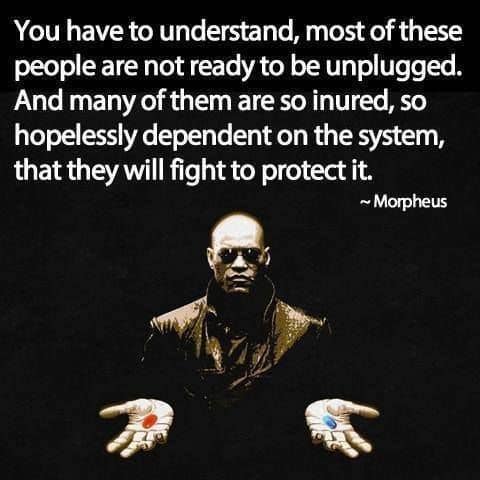
In The Matrixcomputer programmer Thomas Anderson a.k.a. hacker Neo is wakened from a virtual slumber by Morpheus, a freedom fighter seeking to liberate humanity from a lifelong hibernation state imposed by hyper-advanced artificial intelligence machines that rely on humans as an organic power source. With their minds plugged into a perfectly crafted virtual reality, few humans ever realize they are living in an artificial dream world.

Neo is given a choice: to take the red pill, wake up and join the resistance, or take the blue pill, remain asleep and serve as fodder for the powers-that-be.

Most people opt for the blue pill.

In our case, the blue pill—a one-way ticket to a life sentence in an electronic concentration camp—has been honey-coated to hide the bitter aftertaste, sold to us in the name of expediency and delivered by way of blazingly fast Internet, cell phone signals that never drop a call, thermostats that keep us at the perfect temperature without our having to raise a finger, and entertainment that can be simultaneously streamed to our TVs, tablets and cell phones.

Yet we are not merely in thrall with these technologies that were intended to make our lives easier. We have become enslaved by them.

Look around you. Everywhere you turn, people are so addicted to their internet-connected screen devices—smart phones, tablets, computers, televisions—that they can go for hours at a time submerged in a virtual world where human interaction is filtered through the medium of technology.

This is not freedom. This is not even progress.

This is technological tyranny and iron-fisted control delivered by way of the surveillance state, corporate giants such as Google and Facebook, and government spy agencies such as the National Security Agency.

So consumed are we with availing ourselves of all the latest technologies that we have spared barely a thought for the ramifications of our heedless, headlong stumble towards a world in which our abject reliance on internet-connected gadgets and gizmos is grooming us for a future in which freedom is an illusion.

Yet it’s not just freedom that hangs in the balance. Humanity itself is on the line.

If ever Americans find themselves in bondage to technological tyrants, we will have only ourselves to blame for having forged the chains through our own lassitude, laziness and abject reliance on internet-connected gadgets and gizmos that render us wholly irrelevant.

Indeed, we’re fast approaching Philip K. Dick’s vision of the future as depicted in the film Minority Report. There, police agencies apprehend criminals before they can commit a crime, driverless cars populate the highways, and a person’s biometrics are constantly scanned and used to track their movements, target them for advertising, and keep them under perpetual surveillance.

Cue the dawning of the Age of the Internet of Things (IoT), in which internet-connected “things” monitor your home, your health and your habits in order to keep your pantry stocked, your utilities regulated and your life under control and relatively worry-free.

The key word here, however, is control.

In the not-too-distant future, “just about every device you have—and even products like chairs, that you don’t normally expect to see technology in—will be connected and talking to each other.”

By the end of 2018, “there were an estimated 22 billion internet of things connected devices in use around the world… Forecasts suggest that by 2030 around 50 billion of these IoT devices will be in use around the world, creating a massive web of interconnected devices spanning everything from smartphones to kitchen appliances.”

As the technologies powering these devices have become increasingly sophisticated, they have also become increasingly widespread, encompassing everything from toothbrushes and lightbulbs to cars, smart meters and medical equipment.

It is estimated that 127 new IoT devices are connected to the web every second.

This “connected” industry has become the next big societal transformation, right up there with the Industrial Revolution, a watershed moment in technology and culture.

Between driverless cars that completely lacking a steering wheel, accelerator, or brake pedal, and smart pills embedded with computer chips, sensors, cameras and robots, we are poised to outpace the imaginations of science fiction writers such as Philip K. Dick and Isaac Asimov. (By the way, there is no such thing as a driverless car. Someone or something will be driving, but it won’t be you.)

These Internet-connected techno gadgets include smart light bulbs that discourage burglars by making your house look occupied, smart thermostats that regulate the temperature of your home based on your activities, and smart doorbells that let you see who is at your front door without leaving the comfort of your couch.

Nest, Google’s suite of smart home products, has been at the forefront of the “connected” industry, with such technologically savvy conveniences as a smart lock that tells your thermostat who is home, what temperatures they like, and when your home is unoccupied; a home phone service system that interacts with your connected devices to “learn when you come and go” and alert you if your kids don’t come home; and a sleep system that will monitor when you fall asleep, when you wake up, and keep the house noises and temperature in a sleep-conducive state.

The aim of these internet-connected devices, as Nest proclaims, is to make “your house a more thoughtful and conscious home.” For example, your car can signal ahead that you’re on your way home, while Hue lights can flash on and off to get your attention if Nest Protect senses something’s wrong. Your coffeemaker, relying on data from fitness and sleep sensors, will brew a stronger pot of coffee for you if you’ve had a restless night.

Yet given the speed and trajectory at which these technologies are developing, it won’t be long before these devices are operating entirely independent of their human creators, which poses a whole new set of worries. As technology expert Nicholas Carr notes, “As soon as you allow robots, or software programs, to act freely in the world, they’re going to run up against ethically fraught situations and face hard choices that can’t be resolved through statistical models. That will be true of self-driving cars, self-flying drones, and battlefield robots, just as it’s already true, on a lesser scale, with automated vacuum cleaners and lawnmowers.”

For instance, just as the robotic vacuum, Roomba, “makes no distinction between a dust bunny and an insect,” weaponized drones will be incapable of distinguishing between a fleeing criminal and someone merely jogging down a street. For that matter, how do you defend yourself against a robotic cop—such as the Atlas android being developed by the Pentagon—that has been programmed to respond to any perceived threat with violence?

Moreover, it’s not just our homes and personal devices that are being reordered and reimagined in this connected age: it’s our workplaces, our health systems, our government, our bodies and our innermost thoughts that are being plugged into a matrix over which we have no real control.

It is expected that by 2030, we will all experience The Internet of Senses (IoS), enabled by Artificial Intelligence (AI), Virtual Reality (VR), Augmented Reality (AR), 5G, and automation. The Internet of Senses relies on connected technology interacting with our senses of sight, sound, taste, smell, and touch by way of the brain as the user interface. As journalist Susan Fourtane explains:

Many predict that by 2030, the lines between thinking and doing will blur. Fifty-nine percent of consumers believe that we will be able to see map routes on VR glasses by simply thinking of a destination… By 2030, technology is set to respond to our thoughts, and even share them with others… Using the brain as an interface could mean the end of keyboards, mice, game controllers, and ultimately user interfaces for any digital device. The user needs to only think about the commands, and they will just happen. Smartphones could even function without touch screens.

In other words, the IoS will rely on technology being able to access and act on your thoughts.

Fourtane outlines several trends related to the IoS that are expected to become a reality by 2030:

1: Thoughts become action: using the brain as the interface, for example, users will be able to see map routes on VR glasses by simply thinking of a destination.

2: Sounds will become an extension of the devised virtual reality: users could mimic anyone’s voice realistically enough to fool even family members.

3: Real food will become secondary to imagined tastes. A sensory device for your mouth could digitally enhance anything you eat, so that any food can taste like your favorite treat.

4: Smells will become a projection of this virtual reality so that virtual visits, to forests or the countryside for instance, would include experiencing all the natural smells of those places.

5: Total touch: Smartphones with screens will convey the shape and texture of the digital icons and buttons they are pressing.

6: Merged reality: VR game worlds will become indistinguishable from physical reality by 2030.

This is the metaverse, wrapped up in the siren-song of convenience and sold to us as the secret to success, entertainment and happiness.

It’s a false promise, a wicked trap to snare us, with a single objective: total control.

George Orwell understood this.

Orwell’s masterpiece, 1984, portrays a global society of total control in which people are not allowed to have thoughts that in any way disagree with the corporate state. There is no personal freedom, and advanced technology has become the driving force behind a surveillance-driven society. Snitches and cameras are everywhere. And people are subject to the Thought Police, who deal with anyone guilty of thought crimes. The government, or “Party,” is headed by Big Brother, who appears on posters everywhere with the words: “Big Brother is watching you.”

As I make clear in my book Battlefield America: The War on the American People and in its fictional counterpart The Erik Blair Diaries, total control over every aspect of our lives, right down to our inner thoughts, is the objective of any totalitarian regime.

The Metaverse is just Big Brother in disguise.

In a Dark Wood

By James Kunstler

Source: Kunstler.com

Behold the photo (above) showing President “Joe Biden” getting his booster shot of the Covid-19 “vaccine,” with the news media clustered to the left of what is apparently a stage-set built in a larger chamber. Do you possibly ask yourself: why bother to build a set for this event in or under the White House somewhere — including even fake daylit windows — when there are any number of actual rooms in the White House perfectly suited to holding this grand event in real daylight? What is going on here?

And, by the way, how do we know that “JB” is getting an actual mRNA booster?  Or is it just 10 CCs of saline solution? Is not the syringe, after all, just another prop in the show? The video of this event was broadcast on cable TV channels and corporate media websites everywhere. None of them commented on the strange artificiality of the staging. And so, the mystery abides….

It only reinforces the creeping suspicion that absolutely everything about the “Joe Biden” regime is fake. And malevolently so. How else could it be that so many bad things are happening at the same time in this country if there was not some faction seeking to destroy it?

For instance, the vaccine mandates for medical personnel. In upstate New York, WNYT-TV reported yesterday that 200 employees of Albany Med, a large, regional teaching hospital, are placed on seven day’s unpaid leave prior to getting fired for refusing the vaccine. Andrew Cuomo’s replacement, new Governor Kathy Hochul, has blocked unemployment benefits for fired nurses and technicians if they persist in evading the vax. Doctors are included in the mix, too.

Of course, large numbers of health care workers getting kicked out of their jobs will only make it more difficult to care for patients — with Covid or any other health problem — so how does this policy help anyone? (Unless you consider that, with fewer staff on-duty, fewer Covid in-patients will be subjected to the medical malpractice of being placed on ventilators and treated with the killer drug Remdesivir.) Not only has effective early treatment with other drugs been banned from the official medical standards-of-practice across the USA, but mere talk about it has been banned, notably by Google’s YouTube app.

This coercion of health care workers is going on all over the country, of course, not just in New York state. These nurses and techs have been working around Covid patients for going on two years, and many of them have gotten the disease, with symptoms or without, conferring natural immunity. So, what is the point of forcing the vaxes on them? It is also a fact that vaccinated people are susceptible to catching the disease, and that, in any case, the vaccinated carry heavier viral loads than the un-vaxed, making them more efficient spreaders. It is also a fact that mass vaccination in the midst of a pandemic promotes the mutation of new variant viruses that increasingly are not affected by the vaccines.

Thursday night, CNN ran a segment with its house doctor, Sanjay Gupta, hectoring one Andrea Babinski, a La Crosse, Wisconsin, nurse who is quitting her job at Gundersen Hospital there rather than take the vax shot. Dr. Gupta, acting all perplexed, asked her why. Ms. Babinski said she was concerned about blood-clotting. Dr. Gupta dismissed her concern, saying, “If you’ve got a clotting disorder, you should get the vaccine.” Really…?

After the segment, Dr. Gupta and Anderson Cooper shook their heads in amused puzzlement over the nurse’s obdurate foolishness. They are apparently uninformed that the spike protein produced by the vaccine is known to bind onto the endothelial lining of blood vessels and promote blood clots, leading to a range of lethal events such as myocardial infarction and cerebral hemorrhage — heart attack and stroke — plus a broad array of organ damage and neurological disorders.

The Medicare Tracking System states that 48,465 people have died within 14 days of receiving a vax shot. Many had co-morbidities, of course, so not all the deaths can be directly attributed to the vaccines, but the public health authorities are averse to autopsies that might establish the truth of the matter. Anyway, the CDC has ruled recently that they will only count people more than 14 days out from a shot as being considered officially vaccinated — so none of those aforementioned deaths would have counted as vaccinated persons under the rule. Do you see how they are gaming the statistics to keep Americans as misinformed as possible?

Despite all the efforts to bamboozle the public, the “Joe Biden” regime has about run out the string on Covid paranoia, and wrung all of the political usefulness out of it. Going forward, it will only backfire on them. Do they think that wrecking hospital services while depriving thousands of health care workers of their incomes is a winning strategy? These are existential threats to US citizens.

Everything else under “Joe Biden’s” watch looks like a pyromaniac seeking to burn down the country. Over 10,000 Haitian interlopers have been surreptitiously dispersed from Del Rio, Texas, to nether regions of the USA. The government made no effort to vaccinate them — what does that tell you? Over 100,000 more invading opportunists from all over the world are reportedly heading to the southern border. A month after the fall of Afghanistan, and after this week’s hearings in both the House and the Senate, still nobody knows who gave the insane order to surrender Bagram Air Force Base outside Kabul. The Democrats’ dishonest “infrastructure” bill is wilting in Congress. Food and energy prices are rising fast, with shortages on the horizon. The capital markets are wobbling. And Special Counsel John Durham is back on the scene with more actions against Hillary Clinton’s favorite law firm, Perkins Coie, facilitators of the seditious RussiaGate campaign. Put it all together and you have a mechanism that looks like a “Joe Biden” toaster.

Off in a far corner of the News-O-Sphere, someone affecting to be John McAfee dwells on a Telegram channel labeled “OfficialMcAfee.” John McAfee, for those who don’t know, was the wealthy inventor of antivirus computer software who found himself at odds with the US government, went rogue, and supposedly committed suicide in Spain last June. Now, he has apparently turned up on this social media app in a series of videos and cryptic info drops. Whether he is actually still alive, or perhaps recorded these videos before taking his life, is not known. But he had threatened to release terabytes of digital evidence against his antagonists, including video of sexual misconduct among well-known political figures connected to the late Jeffrey Epstein, as well as incriminating documents from the DNC and the Hillary Clinton campaign files from 2016. Those info dumps have commenced and the figure who appears to be John McAfee in the Telegram videos says that the dumps will contain incrementally more shocking material for weeks to come.

All of this activity is obviously weird to an extreme never before seen in national affairs prior to the deep fake era — to the degree that reality is almost impossible to establish for now. We are a people lost in a dark wood. When you are lost, the first thing you must do is stop your useless, self-defeating locomotion, hunker down in place, and carefully assess what’s around you. Even if everything else is murky and perplexing, one thing is known: there is a way out of these dark woods. Remain calm and alert and it will reveal itself.

Smart Dust: A Tiny Part of What They’ve Got Planned For You

By Mickey Z.

Source: Dissident Voice

Thanks to corporate media, anything outside the accepted parameters of debate (e.g. CNN vs. Fox, NY Times vs. Wall Street Journal) is considered beyond the pale. Thus, when I wish to introduce you to what the transhumanists in charge have planned for you, by default, I sound like a fringe weirdo in a tinfoil hat. This highly efficient system keeps the rabble in line by encouraging each of us to do the enforcing of such censorship. We willingly limit our own access to information — in the name of “justice” or “science,” of course.

With that in mind, I offer you a 2-minute video on “smart dust” in the hope you have enough attention span and open-mindedness to focus that long:

Keep in mind that the above video is already five years old. In tech years, that might as well be a century. As far back as 2013, MIT was talking about “How Smart Dust Could Spy On Your Brain.” Smart dust (or “neural dust”) is already here, already in use, and will soon be a daily part of your life — whether you ask for it or not. Are you okay with that?

Smart Dust is comprised of “many small wireless microelectromechanical systems (MEMS). MEMS are tiny devices that have cameras, sensors, and communication mechanisms to transmit the data to be stored and processed further. They generally range from 20 micrometers up to a millimeter in size. They are usually connected to a computer network wirelessly and are distributed over a specific area to accomplish tasks, usually sensing through RFID (radio-frequency identification) technology.”

You can probably see what they’ve been given the nickname of “dust.” In fact, they can even be distributed via tiny, unmanned aircraft that would serve as crop dusters of sorts. Without being detected, they’d spray the virtually invisible motes over a large area and collect information that way. They are so small, you’d never know they were there — perhaps gathering info on you. How small? The prototype smart dust currently measures 0.8 millimeters x 3 millimeters x 1 millimeter can be only 1 cubic millimeter or less in size — possibly as small as 100 microns per side. 

Some of you, I’m certain, are already embracing this sci-fi kind of idea as yet another fine example of  “science.” Before you get too misty-eyed about such “progress,” please allow me to remind you that smart dust was developed by (surprise, surprise) the U.S. military. More specifically, it is the brainchild of the notorious DARPA — Defense Advanced Research Projects Agency. These are the same folks who brought you mind-control weapons, cyborg insects, synthetic blood, mechanical elephants, programmable shape-shifting matter, and so much more.

So, go back and re-read the details above and recognize how easily smart dust could be weaponized. Even better, accept the reality that step one (as always) was weaponizing smart dust. And now, digest the fact that those well-intentioned and good-hearted souls in the military want to implant smart dust inside you… for your own good, of course.

“Neural dust represents a radical departure from the traditional approach of using radio waves for wireless communication with implanted devices,” said Doug Weber, a DARPA program manager. “The soft tissues of our body consist mostly of saltwater. Sound waves pass freely through these tissues and can be focused with pinpoint accuracy at nerve targets deep inside our body, while radio waves cannot. Indeed, this is why sonar is used to image objects in the ocean, while radar is used to detect objects in the air. By using ultrasound to communicate with the neural dust, the sensors can be made smaller and placed deeper inside the body, by needle injection or other non-surgical approaches.”

I’ve already told you about the Internet of Bodies. And I’ve also already told you about the Pentagon’s openly-discussed plan to insert microchips inside us to “protect” us. With smart dust, they could just let the technology waft down from the sky and have you unknowingly inhale it. Why is no one talking about this? I ask you to re-visit my opening paragraph for that answer. To even talk about smart dust is to be dismissed as a “conspiracy theorist.” Once again, those in power have trained the public to do the policing for them. Somewhere, Goebbels is drooling.

All of the above has become easier to employ thanks to the pandemic. To explain that, we need to meet Klaus Schwab — the founder and Executive Chairman of the World Economic Forum (WEF), and author of a book called The Fourth Industrial Revolution. Here’s how the WEF explains this concept

The First Industrial Revolution used water and steam power to mechanize production. The Second used electric power to create mass production. The Third used electronics and information technology to automate production. Now a Fourth Industrial Revolution is building on the Third, the digital revolution that has been occurring since the middle of the last century. It is characterized by a fusion of technologies that is blurring the lines between the physical, digital, and biological spheres.

To repeat: “a fusion of technologies that is blurring the lines between the physical, digital, and biological spheres.” This is transhumanism. It’s an ideology that proposes that technology can and must “enhance” the human mind and body and they are already working to “prove” this theory. Men like Schwab believe we must connect the physical, digital, and biological domains via steps like “implantable technologies such as smart tattoos, smart dust, smart pills, and other implantable smart functionalities.” They want to turn your heartbeat into your digital ID. Schwab and his ilk also support work going on in areas like designing human genomes, and simulating, monitoring, or even influencing brain activity, both in medical and non-medical applications. (P.S. Elon Musk is also currently setting up a company that links brains and computers.) Click here to watch Schwab telling Charlie Rose about his plans to edit your genes. 

Most people would’ve probably cast a wary side-eye at such suggestions — until Covid-19. For 18 months, the powers-that-be have successfully scared the population into believing anything they decree. They’ve also coerced and manipulated billions into allowing novel nanotechnology to be injected into them without a second thought. Never mind thinking, the masses are lining up to serve as unpaid PR people for the experimental jab.

With such widespread and enthusiastic compliance, there seems to be little to stand in the way of Schwab, the World Economic Forum, DARPA, Big Pharma, and the transhumanist agenda. They are counting on you going along without asking too many questions. But there’s the catch. You still can demand and reclaim autonomy over your mind and body. For starters, all you need to do is a little self-loving homework to see what they have planned for you and then… just say no. Unless, of course, you’d prefer having your consciousness uploaded to the cloud

Biden Gives “Five Eyes” What It Always Wanted: Access To Everyone’s Social Media

By MassPrivate

For years, Americans have largely ignored corporate social media surveillance. But all of that is about to change, thanks to President Biden.
No one has taken the White House’s plan to turn Big Tech into a quasi-Five Eyes censorship program seriously despite repeated warnings from journalists and news websites
Journalist Caitlin Johnstone warned, the White House is pushing for Facebook and Microsoft to censor any social media stories the Feds don’t like.

“After Press Secretary Jen Psaki admitted on Thursday that the administration has given Facebook a list of accounts to ban for spreading misinformation about the Covid vaccine, she has now doubled down saying that people who circulate such materials online should be banned from not just one but all social media platforms.”

The Feds want Big Tech to ban stories and people they do not approve of from social media.  

“You shouldn’t be banned from one platform and not others for providing misinformation out there,” Psaki told the press on Friday.

Reuters revealed some of America’s biggest tech companies will let “Five Eyes” and the U.N. decide whose stories the “Global Internet Forum to Counter Terrorism” should censor.

“Until now, the Global Internet Forum to Counter Terrorism’s (GIFCT) database has focused on videos and images from terrorist groups on a United Nations list and so has largely consisted of content from Islamist extremist organizations such as Islamic State, al Qaeda and the Taliban.”

Big Tech’s GIFCT is essentially a Five Eyes censorship program, masquerading as a Big Tech social media forum to stop terrorism and extremism. 

“Over the next few months, the group will add attacker manifestos — often shared by sympathizers after white supremacist violence — and other publications and links flagged by U.N. initiative Tech Against Terrorism. It will use lists from intelligence-sharing group Five Eyes, adding URLs and PDFs from more groups, including the Proud Boys, the Three Percenters and neo-Nazis.”

Twitter and YouTube are also helping Five Eyes spy on the world’s social media.

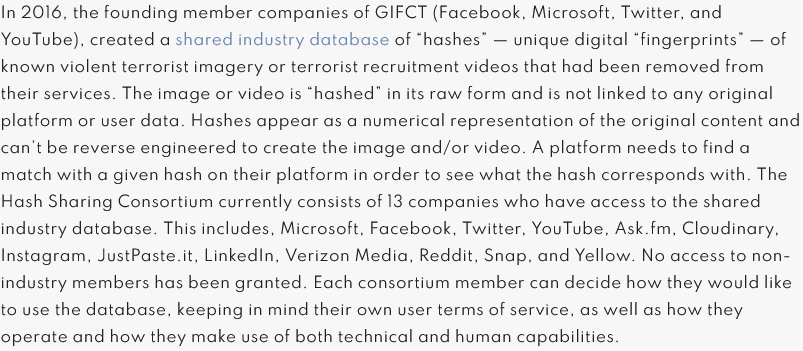
“The firms, which include Twitter and YouTube, share “hashes,” unique numerical representations of original pieces of content that have been removed from their services. Other platforms use these to identify the same content on their own sites in order to review or remove it.”

Other companies that have access to the GIFCT database are Reddit, Snapchat, Instagram, Verizon Media, LinkedIn, Dropbox, Mailchimp and Airbnb.

Three years ago the mass media warned us about Five Eyes demanding that tech companies give them backdoors to users’ encrypted data, and now they finally got their wish.

The dangers of Big Tech giving URLs, PDFs and personal information to a global intelligence agency will allow governments to secretly track and ID people and organizations they deem a threat.

Radio New Zealand said if one government has access to this information, then other government’s will request it as part of doing business with another country. 

New Zealand’s Privacy Commissioner also warned that there is nothing stopping governments’ from abusing their access to people’s social media posts. And that is the real danger of letting Big Tech, Five Eyes and the U.N. decide who is a terrorist or extremist.

“Even then you don’t solve the technical challenge of allowing access for legitimate purposes while maintaining a secure network, and people in the tech industry tell me this is impossible” Privacy Commissioner John Edwards said.

The GIFCT claims to “bring together the technology industry, government, civil society, and academia to foster collaboration and information-sharing to counter terrorist and violent extremist activity online.” But what it does not tell you is how they decide to brand someone a terrorist or extremist.

GIFCT admits that Big Tech has been secretly compiling a database of “hashes” or unique digital fingerprints of suspected terrorist/extremist social media posts since 2016.

Big Tech also uses their in-house “Content Incident Protocol” (CIP) to justify sharing hashes of an extremist’s video, and other related content with Big Tech companies, Five Eyes and the U.N.

If the GIFCT’s secret social media database and CIP sounds familiar, that’s because it is. 

The United States Postal Service and Fusion Centers across the country have been secretly spying on Americans social media for years.

Earlier this week, PayPal announced that they are working with the Anti-Defamation League (ADL) to investigate how extremist and hate movements in the United States take advantage of financial platforms to fund their criminal activities.

PayPal is basically setting up its own version of GIFCT to justify monitoring people’s transactions under the terrorist/extremist umbrella. As the article mentioned, PayPal and the ADL will “uncover and disrupt the financial flows of anti-government and white supremacist organizations” on their own!

“The information collected through the initiatives will be shared with other firms in the financial industry, law enforcement and policymakers, PayPal said.”

It is only a matter of time before GIFCT censorship will be used to monitor and stop protests that corporations and the White House disapprove of.

As Caitlin Johnstone so eloquently put it:

  • They said we need internet censorship because of Russia.
  • They said we need internet censorship because of COVID.
  • They said we need internet censorship because of election security.
  • They said we need internet censorship because of the Capitol riot.
  • They said we need internet censorship because of domestic extremism.
  • Pretty sure they just want internet censorship.

Using the GIFCT to allow corporations and Five Eyes to ban and censor whoever they want, put’s everyone’s freedom at risk.

The War on Free Speech Continues

Government and social media move to block platforms for those promoting “misinformation”

By Philip Giraldi

Source: The Unz Review

The Biden Administration’s effort to withdraw nearly all US troops from Afghanistan and Iraq before the end of the year is commendable and it is hoped that a departure from Syria will follow soon thereafter, but one must nevertheless be concerned that the overseas moves are being made to concentrate government resources on the domestic war that has already begun. I am, of course, referring to the ongoing efforts being made to extirpate “extremists” among American citizens who have been further identified as largely consisting of “white supremacists.”

As part of the new war, ideas or even demonstrable facts that are considered to be undesirable are being targeted by the government working together with internet resources, most particularly the social media, to attack critics. It is being argued that the alleged provision of “misinformation” is doing actual harm to the country and the American people. Recently, much of the focus has been on the COVID virus, in support of the government’s intention to have all Americans vaccinated and, increasingly, again compelled to be masked when inside buildings that are accessible to the public. These efforts are being supported by media including Facebook, which features pop-ups directing the reader to a “safe” site whenever a piece appears that challenges the government orthodoxy on the spread of the virus.

One might reasonably argue that there is a national public health crisis that is part of a global problem which requires coordinated government intervention, but the actual statistics that reveal the existing low levels of infection and death in most states would not support that contention. And one might also observe that the growing problem involving the regulation of speech and even ideas by government working in cooperation with large corporations is potentially more serious than COVID or any other virus.

If the United States government and its corporate partners were in an honest way trying to protect the American people one might at least be sympathetic regarding the efforts being made, but both government and businesses have proven to be serial liars and purveyors of egregious untruths to serve their own agendas. Recently, the White House spokesman Jen Psaki suggested that those spreading false information about COVID vaccinations might well be banned from spreading such lies on social media. The implication was that the government could compile lists of such “extremists” and use its regulatory authority to compel companies on the internet to censor individuals and groups in compliance with orders coming from the White House. The justification would be that government in this case gets a pass on limiting free speech and association due to a national health crisis.

Psaki has undoubtedly discovered a certain benevolence in big government which few Americans have noted before. Foreigners, however, being on the receiving end of wars resulting from the stream of lies emanating from Washington might well have a different viewpoint. President Bill Clinton relied on a false narrative to go to war in the Balkans and then used unprovoked attacks on Sudan and Afghanistan to draw attention away from an affair he was having with an intern. George W. Bush and his pack of neocon scoundrels, most of whom are still holding prestigious positions, used what was known to be fake information to justify destroying Afghanistan and Iraq. Barack Obama lied to overthrow the governments in Libya and Ukraine while also attempting to do the same in Syria.

All lies, all the time, and now we Americans are supposed to believe that the Biden Administration is seeking to benefit us? Online one wag quipped that “The party that believes that men can get pregnant now wants to control ‘misinformation’ on the internet?” Never forget that policies that compel all Americans to behave in certain ways, no matter how innocent in appearance, can also be used and expanded upon to mandate something more sinister.

And what about the social media companies? Facebook has long had a censorship group headed by a former Israeli government official. CEO Mark Zuckerberg has admitted to Congress that Facebook suppresses nearly all so-called “hate speech” automatically using computer algorithms that rely on word associations to determine what is allowed on the site. Pieces that are considered borderline are allowed only limited exposure, having their distribution among contacts automatically restricted and disabling sharing. Google search uses similar algorithms to make sure that sites and individuals that it does not approve of do not appear among search results. It also uses software to actually “re-direct” users away from sites that it does not approve.

And now PayPal, owned by online auction service eBay and an essential tool for small public interest groups’ support, has now announced that it will henceforth be working with the Anti-Defamation League (ADL) to “fight hate” by cutting off financing of extremist groups. But its definition of “hate,” criticized as highly subjective and inclined to condemn groups disliked by ADL for political reasons, has prompted legitimate concerns about where this all is going. ADL has often been criticized for finding hate virtually everywhere, particularly among conservative white groups. RT cites a recent example of such fervor “in response to an article published in Canada’s National Post, which was denounced by the ADL because its author mentioned that one of the 32 US lawmakers supporting a tax reform belonged to a Jewish fraternity.” In short, any discussion of Israel or of the behavior of Jewish individuals and groups in anything but a positive context will be considered “hate” by ADL and PayPal.

Indeed, PayPal and ADL issued a self-serving statement last week which said “PayPal and ADL will focus on further uncovering and disrupting the financial pipelines that support extremist and hate movements,” adding that they would also go after “actors and networks spreading and profiting from all forms of hate and bigotry against any community.”

The joint venture will also include the “launch[ing] of a research effort” to determine how “extremist and hate movements throughout the US are attempting to leverage financial platforms to fund criminal activity.” The negative information collected will be shared with police, financial services, and the government, presumably to create an environment where such groups will be marginalized and shut out of the public space completely, to include possibly having their supporters arrested, charged and convicted.

The growing collusion between big government and large public-accessible online information and opinion services is not a good thing. It permits those well-funded and politically connected organizations to work together to limit what the public is allowed to know. Its zeal to eliminate “misinformation” is misplaced, replacing dissident voices that have limited access to a wider audience with massive agenda driven public-private organizations that will essentially determine what is acceptable and what is not. If allowed to continue, it will be the death of free speech in this country as everything that disagrees with the approved narrative will be labeled “hateful” or “extremist,” eventually to include criminal penalties for those who disagree. It is not too much to suggest that we are witnessing the first steps in the creation of a totalitarian de facto one-party state. Perhaps that is the intention.