Decoding the Orlando Shooting, Cui Bono? Who Benefits?

problem-reaction-solution1

By Mark Taliano

Source: GlobalResearch.ca

The shooting in Orlando, Florida, is not about homosexuals, or Muslims, or assault rifles.

It is about waging aggressive warfare overseas, empowering the domestic police state, and electing a warmongering President.

Dr. Graeme McQueen, founding member of the Centre for Peace Studies at McMaster University, Canada and author of The 2001 Anthrax Deception, argues that the prime suspects in any such case should be intelligence agencies.

We don’t have to go far to see the hand of intelligence agencies in this catastrophe. The shooter himself was an employee of G4S, described by journalist Alex Emmons as “a giant, often controversial global contracting corporation that provides mercenary forces, prison guards and security services.”

Additionally, the shooter’s father is said to be a CIA asset.

Given that Intelligence agencies are well-positioned to engineer synthetic terror threats, author Naomi Wolf argues that it is “crazy” not to question new events, since “spectacles” drive “outcomes”.  Further, she observes that propagandizing the public includes films (i.e. “Zero Dark Thirty”) – arguing that the Pentagon must have “signed off” on it —which indirectly seek to “normalize” intelligence operations such as torture and mass surveillance.

Intelligence operatives know that synthetic terror events shock and anesthetize the public; that they make people susceptible to manipulation; and that they lay the groundwork for the terror event to be easily politicized.

Naomi Klein describes the same dynamic in The Shock Doctrine.  When people are shocked by a real or man-made event, they can be easily manipulated to support wars, or neoliberal market schemes, or any number of toxic agendas.

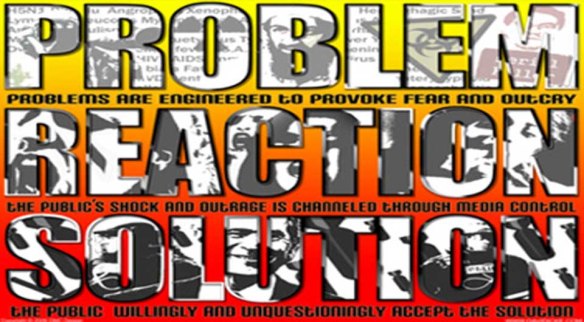
A simple formula underpins these operations:  problem, reaction, solution.

The problem from the perspective of criminal warmongers is that the public doesn’t want war or a police state.  The intended reaction of the operation is that the synthetic terror event will induce people to seek protection from the state, coupled with aggressive war to bomb the threat out of existence. The solution, or intended result, is already occurring.  Engineered fear and racism have set the stage for the public to be manipulated to accept a covert agenda that it would otherwise reject.

Cui Bono?  Who benefits? The police state apparatus, War Inc., and a warmongering Presidential agenda all benefit.

The manipulation of the public is further enabled by an amendment to the National Defense Authorization Act (NDAA) which negates the Smith-Mundt Act (SMA) of 1984 which prohibits government agencies from propagandizing domestic populations.

Susan Posel explains in “How the NDAA Allows US Gov to Use Propaganda Against Americans”:

“SMA  defines the prohibition of domestic access to influence information through a variety of means, from broadcast to publishing of books, media, and online sources by restricting the State Department.”

The Broadcasting Board of Governors was created from SMA. This agency claims to “inform, engage, and connect people around the world in support of ‘freedom and democracy’. They omit that their specialty is making sure propaganda is added to the informational flow we all depend on.”

Instead of succumbing to the shock of terror events, instead of allowing our “reptilian minds” to overrule rational decision-making processes, we need to decode the Orlando shooting, and other terror events, within the “problem, reaction, solution” framework, and be conscious of how they are being manipulated and politicized to suit covert agendas that do not serve the public interest. The “therapy” for the shock will allow us to subordinate our “reptilian” mindsets, and to act rationally.  A rational mindset will reject the racism, hatred, and warmongering which are intended off-shoots of these terror events.


Related Podcast:

Radio WhoWhatWhy – Russ Baker: Don’t Rush to Judgment in Orlando Shooting

Related Video:

Modern Fictions – How the Sacred Manifests in Chaos, Superheroes and Outer Spaces

3124315-chaoswar00302

By Kingsley L. Davis

Source: Reality Sandwich

The virtual topographies of our millennial world are rife with angels and aliens, with digital avatars and mystic Gaian minds, with utopian longings and gnostic science fictions, and with dark forebodings of apocalypse and demonic enchantment
Erik Davis

…All our so-called consciousness is a more or less fantastic commentary on an unknown, perhaps unknowable, but felt text…
Frederick Nietzsche

Science fiction is always more important than science
Timothy Leary

Everything that can be said has already been said, or something to that effect. It is not original to make the statement that originality no longer exists as it’s all been done before. Yet, as Marshall McLuhan famously said, ‘the medium is the message.’ So it may not be the message we are concerned with here but rather the medium of its passing. And the adage goes that everything exists according to ‘time and place.’ When the ‘sacred speaks’ – so to speak – it does so through the ways and means of the times. This could apply to prophets, oracles, and channelling as well as pop culture and its modern fictions. The sacred, the sublime, has always walked amongst the profane. The signs are everywhere, blended into the sidewalks, pulp fictions, and the kitsch ‘n’ kool of the art world. For iconic sci-fi writer Philip K. Dick, most of the sublime things of his world were disguised as trash that seamlessly slipped into the background of a dysfunctional world reality. As modern society slipstreamed into a post-modern smorgasbord of chaos, clutter, poetically burnt outbursts, and beatific revelations, a new landscape of the sacred was scattered across the bedrock. The seeming trash of the everyday mundane clashed with the incoming cosmic, and a new urge for the transcendental found its way into so many popular cultural forms that it would take an encyclopaedic mobius-strip to recite it all. For my purposes here I will only all-so-briefly take a hop and skip around some of the budding flora that displayed a burgeoning sacred urge to blur the boundaries and reach for the sublime connection.

However paradoxical it may sound, one of the mediums for the sacred virus to spread came through the channel of chaos. Chaos, contrary to what we may think of it as being an anarchic and senseless cacophony, is actually a canvas for patterns to play out on. As the later emergence of the chaos sciences showed, there was a theory behind chaos – a method behind its apparent madness. Chaos, as we soon learned, did not operate in isolation. As the famous ‘butterfly effect’ was apt at promoting, a minimal disturbance in one part of the world (e.g., a butterfly flapping its wings) could result in a climate effect in another part (a tornado was often cited!). Everything thus existed in patterns, and not in arbitrary, random molluscs and mole-hills. The Santa Fe Institute (founded in 1984) quickly became a prominent centre for the research into complex systems, otherwise known as chaos science. Yet the emergence of chaos science had been actualized earlier through many different cultural forms of recognizing ‘chaos’ as a precursor to states of consciousness. Many forms/functions that emerge as aspects of the human condition are first seeded in popular culture ahead of their wider actualization. After all, the basis of the sacred refers to actualized aspects of human consciousness. And what the sacred art shows us is that its presence in our reality-matrix is determined by our capacity of consciousness to receive and acknowledge it. Chaos, as well as being patterns embedded in physical, computational, biological, and social systems, is also patterns of our minds. In fact, it can be said that chaos is part of the order of the cosmos.


Chaos & the Cosmic

“Tis an ill wind that blows no minds” – Principia Discordia

The signs for magic, chaos, and transcendental byways were popping up almost everywhere on the western landscape in the post-war, post-modern years. Enochian magic, Golden Dawn rituals, and meta-computing of the self were seeding a growing experimentalism of the human mind. In the US especially, a blend of anarchic cultural subversions were manifesting that played upon known semi-mystical memes. One of these was the text of the Principia Discordia that emerged in the nineteen-sixties as a ‘sacred text’ of Discordianism. Written by Malaclypse the Younger (Greg Hill) and Omar Khayyam Ravenhurst (Kerry Thornley) it proclaimed “All hail Discordia!” in a mixture of goddess worship with the notion of order and disorder as balancing illusions. The fifth commandment of Principia Discordia states, ‘V – A Discordian is Prohibited of Believing What he Reads.’ In mode with a rising tide of memes dealing with truth-through-contradiction the Principia Discordia also went on to claim that,

All statements are true in some sense, false in some sense, meaningless in some sense, true and false in some sense, true and meaningless in some sense, false and meaningless in some sense, and true and false and meaningless in some sense.

Discordia came to influence the writings of maverick author-philosopher Robert Anton Wilson, who popularised it further in his books, especially in ‘The Illuminatus! Trilogy.’ These utterances were echoed by the writer William S. Burroughs who, besides experimenting in cut-up narrative techniques, proclaimed a Discordian-esque ‘Nothing is absolutely true – Everything is permissible.’ Burrough’s infamous outburst was a culmination of religious history (the Assassins of Hassan-i Sabbah) with anarchic chaos from his spirit-possessed universe.

Around this time literate and literary magicians were cropping up everywhere, writing tracts on magic for a modern reader. Many of these literary figures were connected to the Golden Dawn system of magic. Yet another emerging stream was that of chaos magic which originated in United Kingdom in the late seventies. This broader magical path was liberal enough to combine forms of neoshamanism, eastern philosophy, quantum science, visionary art, and later computer technology. This experimental perspective on magic was part of a wider trend in experimenting with known forms for new avenues of stimulating and awakening consciousness. These ‘chaotic’ paths were attempting to destabilize our conditioning patterns and our resultant consensus reality. They were all aimed at waking up the usually-slumbering human mind. As the seminal work Waking Up (1986) by Charles Tart showed, humanity was largely intoxicated with a ‘consensus trance’ that kept us from recognizing sigils of the sacred. In more recent years the metaphors and memes of being trapped within a waking dream, or of dreams within dreams, have been explored in such popular films as ‘The Truman Show’ (1998); the ‘Matrix Trilogy’ (1999-2003); and Inception (2010). Part of the myth we find ourselves popularising is the mythology that we are in some sort of constructed reality – a gnostic-inspired simulacrum of truth.

Gnostic ideas are being gnawed over, processed, and consumed in ever more popular forms of culture. There’s an odd wave of mystical-spiritual impulses now radiating through popular culture that encourages us to throw ourselves into new world-spaces, fantastic realms, and mythological fictions and factions. These are new mash-ups of the counterculture now being packaged and presented as part of mainstream culture. And in recent years the most extraordinary success in this area has been the incredible, phenomenal rise of the modern superhero.


Superheroes & the Super-Self

Ever since Nietzsche first declared that ‘God is dead’ we have been reeling and dealing from our encroaching mortality – and trying to avoid this by seeking new technologies and cultural expressions of immortality. This collective experience on the possible ‘death of god’ is like a shock hammer-blow that propels us against the loss of sacred meaning and sublime mystery. Whether we admit it or not we fear the sense of absence, where nothing exists to which we can lend our communal assent. We don’t wish to struggle fragmented and bewildered, abashed by creative forms of indulgence. We cannot be left behind, losing our vital contact with the imaginal, the numinous, or the magical. We cannot be left untransformed in our vacant spaces as a paranormal pop culture washes over us. No – we need our superheroes, our possibilities, our potentials. We need to find a cultural expression for the human psyche; for our psychic currents and transmissions and sacred communication – our superheroes must live on!

Perhaps through the loss of our gods we have had to become our own multiple gods, as we realized a need to fill a vacuum left by myth. With the loss of the godly connection a different psychic wave was released upon the world to coincide with a rising arc of human consciousness. According to Jung, the gods gradually became our disease – ‘The gods have become diseases…who unwittingly let loose psychic epidemics on the world.’[1] These diseases have now morphed into mutations that make us into a hybrid human-god, with superhuman capacities, yet shunned by the world for being heretical against the natural order. We have the X-Men walking amongst us, a mutant subspecies of humans. The natural order is evo-mythological – it is sacred, beyond human, and connects us with evolutionary currents. In the absence of our ancient myths we have ingested the sacred alchemical root and through pop-culture morphed this transformation into the new wave of superheroes – myth lives anew in spandex. Maybe it is a cliché because it is true; we wish to find the personal superhero within each of us – the journey of the individual, unfolding within the great cosmic drama. This myth – this journey – has largely been taken from us through scientific rationalism and an industrial modernity. Yet now, by becoming more than oneself, we serve the larger story arc.

Our popular subcultures are gradually becoming the norm.  It is not only a question of whether more people are interested or not, but rather that these ideas are more widely available now thanks to popular culture. As William Irwin Thompson notes – ‘We Americans, who are so intent on creating a culture of technological materialism, cannot take in esoteric lore directly; it has to find another way in, and so comic books, science fiction, and movies are the back door.’ [2] Popular culture has been the back door for most of us, and not just for the Americans. But now perhaps the door frames are merging into the background and disappearing altogether. The waking life and the dream are becoming part of the same movie plot, as in Richard Linklater’s film version of Philip K. Dick’s A Scanner Darkly (2006). We are more and more waking up into our own movie – our very own Truman Show – where ideas are seeded directly into our environments in order to catalyze our awakening. Like the ancient Eastern tales told us, we have been asleep in a distant land and now we are receiving messages – signals – flashing like neon signs through our popular culture. This marks our juncture, our crisis point, between moving toward waking up or falling back into archaic, catastrophic and catatonic slumber. Again, Thompson reminds us that we ‘intuitively sense our evolutionary crisis and are expressing the catastrophe bifurcation through art – primarily through science fiction.’[3]

Our ultra high-definition visual culture is acting like a portal for the otherworld to enter. The psychedelic experiences that were once fringe and condemned are being re-played out through modern fictions that blend Gnostic tropes, mythological memes, and multidimensional portholes. Transcendental states of consciousness, ratified by the far explorations of new science, are adding to the mix of a new 21st century mythology that as of yet remains unnamed. Perhaps we are emerging toward the birth of new sacred gods. These are the gods of mutations, of neurological and biological adaptations. And they are emerging first in our pop-culture as our superheroes and psychic mutants. In this initiation into a psychically enhanced future we will need more than ever to learn how to distinguish the demonic from the spiritual. Hence the current barrage of cultural tropes in our films, TV series, and fiction that show angels vs. devils, humans vs. vampires, and the whole gamut of the good vs. the bad that has crawled from the forest floor to enter into the quest for the holy grail. All the while the Fisher King sits immobilized, feasting on an orgy of massively multiplayer online role-playing games (MMORPG). In this way the gods will never be forgotten as they merge with a super-augmented mutant humanity in spandex. As psychologist James Hillman says,

Remember: what the Greeks said their Gods asked for above all else, and perhaps only, was not blood; it was not to be forgotten, that is, to be kept in mind, recollected as psychological facts… [The God’s] reality can never fade as long as they are remembered, that is, kept in mind. That’s how they survive. [4]

The real gods, as we knew all along and yet had forgotten, reside within our psyche – they are kept in mind. And yet they can only become real for us – to re-mind us – when dashing about on the stage and streets in front of our very eyes. We need the sacred to slap our faces in spandex gloves before we begin to blink a waking eye.

As Jeffrey J. Kripal writes in his Mutants and Mystics, we have entered the stage of ‘Realization’ whereby we begin to recognize that the events around us in popular culture are not only real but are participatory. That is, our sacred and supernatural fictions appear for us and require our engaged reading of them in order for them to read us. Kripal says that,

In some fundamental way that we do not yet understand, they are us, projected into the objective world of events and things, usually through some story, symbol, or sign. Realization is the insight that we are caught in such a story. Realization is the insight that we are being written.[5]

The latest revival in the superheroes genre is significant in how it takes the mutant trope further and projects it forward as a form of evolutionary mysticism. Our new heroes are displaying to us our latent capacities and powers that are yet to unfold. We are witness to the first wave of mutant evolutionary pioneers. The summit of human evolution is far in the distance, and yet its early stages are manifesting through the Marvel and DC Universes where god-like potentials await us. Through such characters as Spider-Man, Iron Man, Captain America, Wolverine, and Doctor Strange, Marvel mesmerizes paranormal subliminals into popular cultural consciousness. And DC does the same with Superman, Batman, Wonder Woman, Green Lantern, Flash, and Green Arrow. Then as gangs they come together as the Guardians of the Galaxy, the Fantastic Four, the X-Men (Marvel), or as the Justice League (DC). They are now our teachers, our guides, our mutant futures that are beyond human. As Kripal recognized, the mutants have become practicing mystics.

We are seemingly living more and more in a mutational and metaphysical universe; and with the arrival of augmented reality our boundaries of interaction with the physical world around us will blur. And yet this suggests a return to the sacred perspective whereby the tangible and intangible worlds become an integral part of our holistic reality-matrix. And we are already well on our way as our outer and inner spaces explode into new blistering supernova.


Outer Spaces – Inner Spaces

Humankind has always been a child of the stars. Our early civilizations mapped the heavens before they mapped the terrain under their feet. The abode of the gods was amongst the glitterballs of the night sky, and their chariots blazed across the incandescent cosmic canvas. So it was no surprise then when the UFOs started to dart across our urban skies and come crashing down disguised as government weather balloons. Recent popular culture has nurtured a fascination with outer spaces and our galactic cousins from the Golden Age of science fiction of the nineteen thirties, forties, and fifties to the new wave of the sixties and seventies. The concerns of our outer space relations shifted from how to make contact with our space cousins to the entropic death of the universe. And then the environmental trope entered our outer spaces, as if a subliminal projection from our very own inner spaces. The sacred inner space of humankind was now tethering with the galactic outer spaces concerned with our future place in the universe. The growing number of alleged UFO abductees that emerged in the latter part of the twentieth century began to relay messages of extraterrestrial concern for our planetary well-being.

John. E Mack, an American professor of psychiatry at Harvard Medical School, in his later years became a leading authority on the spiritual or transformational effects of the alien abduction experience. Mack came to view the alien abduction phenomenon as acting as a catalyst to ‘shatter the boundaries of the psyche and to open consciousness to a wider sense of existence and connection in the universe.’[6] For more than a decade Mack rigorously studied the alien abduction phenomenon and interviewed hundreds of people (whom Mack referred to as ‘experiencers’). What initially started out as an exercise in studying mental illness soon turned into an in-depth inquiry into personal and spiritual transformation. Mack eventually came to see the alien abduction phenomenon as one of the most powerful agents for spiritual growth, personal transformation, and expanded awareness – in other words, as a trigger for a sacred experience. Despite the external anxiety produced by the experience, it was clear to both Mack and his set of experiencers that a profound communion was being established between humankind and other realities. Further, that this interaction was catalyzing a shift in human consciousness toward collapsing the old models of materialistic duality and opening up a connection not only ‘beyond the Earth’ but with other dimensional realities. Mack notes that ‘the process of psychospiritual opening that the abduction phenomenon provokes may bring experiencers to a still deeper level of consciousness where the oneness or interconnectedness of creation becomes a compelling reality.’[7]

This interconnectedness became a channel for the experiencers (abductees) to receive an impressive range of information; such as healing knowledge, spiritual truths, science, technology, and ecology. A major part of the information was apparently concerning the status of the Earth and humanity’s relationship with its environment. Many of the experiencers referred to their own abduction phenomenon as participating in a trans-dimensional or interspecies relationship. The transformative effects of these unusual encounters were often remarkable. Mack’s experiencers talked about an expansion of psychic or intuitive abilities; a heightened reverence for nature; the feeling of having a special mission on Earth; the collapse of space/time perception; an understanding of multi-dimensions of reality and the existence of multi-verses;  a feeling of connection with all of creation; and a whole range of related transpersonal experiences. Significant from these accounts is that, according to the experiencers, the abduction phenomenon is sometimes accompanied by a sense of moving into, or connecting with, other realities or dimensions. The sacred space and outer space were becoming one and the same. Or to put it another way, the contact initiated from those ‘out there’ was having a catalyzing effect to trigger an awakening in the inner spaces way ‘down here.’ It made sense then that our human future was going to include space migration. And according to our galactic cousins, it may even be a necessity if we continued to mess up our planetary home as if it were nothing but a playground to scoff around in.

Inner space junkie Timothy Leary was already riding that space-me-outta-here ticket with his S.M.I.2L.E. philosophy. Leary’s S.M.I.2L.E. stood for Space Migration, Increased Intelligence, and Life Extension. Basically, these were all the tropes from the post-humanism melange added on to the sci-fi dream of humanity living off-planet. We also have now the commercial race to establish a new branch of space tourism, with Virgin Galactic being one of the visible and vocal frontrunners. SpaceX, another private enterprise, is banking its dollars on helping to colonize Mars. There’s no lack of vision, it’s now down to the know-how and the technological leg-up. Now that the space cat is out the bag (excuse the pun), it’s only going to be a matter of time before the picture we have of ‘being human’ will incorporate the starry, cold vistas of outer space. From the earliest sacred expressions in the cave art of our ancestors to the ideas of space migration, they all show two fundamental urges within the human being: i) I am human, I am here (recognition); and ii) Where is the heavenly connection? (contact). Human dreams have encompassed living on Mars, leaving and migrating beyond the solar system, and of contact with ‘Higher Intelligence.’ Gene Roddenberry, creator of Star Trek, managed to combine both contact and communication through his receiving of channelled information. It has been documented that Roddenberry was introduced to an entity called ‘Tom’ who represented the Council of Nine, through the channel medium Phyllis Schlemmer. Roddenberry was allegedly receiving information for a film script to be written that would help prepare the public for extraterrestrial contact. The alleged film never got made, yet we might wonder what ideas made their way into Star Trek (including Star Trek: Deep Space Nine). It appears that there are those ‘out there’ who are concerned for our proper preparation for the sacred communion. And the archetypes are now flooding through our popular culture like an evangelical tsunami.

The mythic archetypes from Joseph Campbell’s The Hero with a Thousand Faces filled out the roles in George Lucas’s epic Star Wars universe. The good, the bad, and the hairy all took their cue and played along with the hero’s journey for an updated mythological rendering. Whilst the rise of industrial modernity and the secularization of culture may have contributed to an eroding of our myth-consciousness and a demotion of mystery, a new vital force has emerged that is shifting our planetary pranic energy. There may be those who bemoan that our current civilization does not have a mythic centre, yet they’re missing the point. And this point is that there is no exact point anymore. As hermetic lore states, the center is everywhere and the circumference nowhere. The earlier gods retreated back on their sky chariots until we finally arrived at the point where we asked ourselves where all the gods went. The new sacred guides are now secreted in our popular texts that penetrate the outer and inner worlds. These post-historic mythic guides are first to be found within us – within our collective species psyche that gets projected out onto our celluloid and digital-scapes. These re-modelled chameleon mythic memes are telling us that we are not here alone, nor are we here for ourselves alone. The future is both arriving, is here now, and has already been.

We have such films as Back to the Future, Primer, Looper, Terminator, Interstellar, and all the rest to attest to our obsession with shifting our timely perspectives. Everything is now malleable, according to our new quantum sciences, and our sacred revival is knocking down linear walls of rigidity. Just when you thought that you were safe in stable comfort zones, the paranormal is getting ready to redress itself as the new normal. A Gnostic-like awareness of being embedded in a reality-construct will become ever greater as our technologies increasingly broker and interface our physical experience. There are a plentiful array of fictions and films that ply us with plots on technologically-driven machine gnosis. Perhaps they are trying to signal that we are entering the sacred space of hybrid awareness. The film Transcendence (2014), for example, showed humanity edging toward sacred sentience as a means for solving the world’s global problems. As Vaclev Havel stated in one of his addresses – ‘Transcendence is the only real alternative to extinction’ (July 4th, 1994). Yet we are not on our way out, despite what the fear-mongering mainstream media may be trying to ram down our throats. Nor are we heading toward a techno-machine Overlord future with us as the slaves. Because the sacred works in multiple streams and never hedges all bets on a one-trick pony.

The game changer coming onto the scene is the participatory mind of human consciousness. The coming space migration is a reflection of our expanding inner spaces. We are toying with these memes in our popular culture now ahead of their coming actualization. What our fictions are dealing with are the blueprints before we’re ready to go the full hog. And that’s why we’re in a period of incredible experimentation – we are juggling with a new type of energy coming into our cultural realities. And this new pranic force is getting expressed in a myriad of multiple forms; be it creatively, chaotically, commercially, or crazily. It’s a cacophony of exuberance and experimentation trying to find its harmonic resonance. We are gaming, bopping, and trailblazing our way into a re-identification with a sacred energy. There’s a strong sense of the sacred filtering through our modern cultural memes, and it’s not all as chaotic as it seems.


References

1 Sabini, Meredith (ed) (2008) C.G. JUNG on Nature, Technology & Modern Life, Berkeley, CA, North Atlantic Books, p98

2 Thompson, William Irwin (1998) Coming Into Being: Artifacts and Texts in the Evolution of Consciousness. New York, St. Martin’s Griffin, p218

3 Thompson, William Irwin (1998) Coming Into Being: Artifacts and Texts in the Evolution of Consciousness. New York, St. Martin’s Griffin, p223

4 Cited in Hollis, James (1995) Tracking the Gods: The Place of Myth in Modern Life. Toronto, Canada, Inner City Books, p147

5 Kripal, Jeffrey J (2011) Mutants & Mystics: Science Fiction, Superhero Comics, and the Paranormal. Chicago The University of Chicago Press, p217-18

6 Mack, John, E. (1999) Passport to the Cosmos: Human Transformation & Alien Encounters. New York: Crown Publishers, p218

7 Mack, John, E. (1999) Passport to the Cosmos: Human Transformation & Alien Encounters, New York, Crown Publishers, p136

US Law Enforcement Knew Florida Shooter BEFORE Shooting

Mateen-NYPD

Did radicalization by NYPD make Omar Mateen a trigger-happy homophobe?

Recent Bloodbath Looks Almost Identical to FBI-Staged Entrapment Cases in 2015.

By Tony Cartalucci

Source: Land Destroyer

A horrific mass shooting unfolded in Florida claiming the lives of at least 52 with scores more injured. The British Independent would report in its article, “Omar Mateen: Orlando gay club gunman identified by police,” that:

Police have identified the gunman in the mass shooting at a gay club in Florida as 29-year-old Omar Mateen, an American citizen whose parents are from Afghanistan. 

Authorities in Orlando said they were investigating the shooting as an act of terrorism, as the death toll rose to 50 with a further 53 wounded.

At face value – it appears to be another senseless tragedy perpetrated by a “terrorist” inspired by militant groups the US claims to have been fighting for now nearly two decades. However the Independent reports another fact further down in the body of its article, claiming that:

ABC News reported he had been on police’s “radar”, though not subject to an investigation.

If this sounds like a familiar narrative, that’s because virtually every high-profile “terrorist attack” carried out in North America and Europe in recent years has been done so by suspects long under investigation by US, Canadian, and European law enforcement and intelligence agencies.

CNN’s article, “50 killed in Florida nightclub, shooter pledged ISIS allegiance,” would further elaborate on Mateen’s background, stating: 

Two officials tell CNN that the FBI had investigated Mateen at some point for possibly having ties to or sympathizing with Islamic extremism. A law enforcement official said there were two cases opened involving Mateen but the probes didn’t result in enough evidence to charge him with anything.

In the past two weeks Mateen legally purchased a Glock pistol, found at the shooting scene, from a St. Lucie County area gun store, a law enforcement official said.

What CNN fails to mention is the long history the FBI has of taking “sympathizers” through a series of steps to acquire “enough evidence,” including posing as terrorists and providing suspects with weapons and plans for attacks precisely like the one that just unfolded in Florida.

To understand the implications of yet another high-profile terror attack involving a suspect already known to law enforcement agencies, one must examine previous examples of admittedly set up attacks “foiled” at the last moment by the FBI, as well as attacks that have been carried out by individuals tracked for years and even arrested multiple times by Western police and intelligence agencies only to be let go time and time again until finally carrying out “the big one.”

ISIS Inspired? Or FBI Inspired? FBI Set Up Multiple Attacks in 2015 Almost Exactly Like the Florida Shooting

A terror suspect armed to the teeth storming a public place and killing scores is actually a very familiar script. The FBI wrote several such scripts in 2015 alone, including entrapping and arresting a mentally-ill suspect after providing him with an arsenal of deadly weapons almost identical to the arsenal recently employed in Flordia.

The Intercept would report in its article, “Another “Terror” Arrest; Another Mentally Ill Man, Armed by the FBI,” that:

U.S. law enforcement officials announced another terror arrest on Monday, after arming a mentally ill man and then charging him with having guns. 

ABC News quoted a “senior federal official briefed on the arrest” as saying: “This is a very bad person arrested before he could do very bad things.” 

But in a sting reminiscent of so many others conducted by the FBI since 9/11, Alexander Ciccolo, 23, “aka Ali Al Amriki,” was apparently a mentally ill man who was doing nothing more than ranting about violent jihad and talking (admittedly in frightening ways) about launching attacks—until he met an FBI informant. At that point, he started making shopping lists for weapons.

The Intercept would also reference the FBI’s affidavit (.pdf), stating (emphasis added):

According to the affidavit, Ciccolo first talked to the FBI informant about attacking two bars and a police station. Later, he spoke of attacking a college campus with a homemade pressure-cooker bomb like the one used in the Boston Marathon terror attack; he also talked about using guns and a lot of ammo. Ciccolo, according to the affidavit, then “ordered the firearms from a confidential human source (“CHS”) working with the FBI.”

The list of weapons provided to the mentally-ill suspect by the FBI informant is shocking. Revealed in the official FBI affidavit (.pdf), the weapons included a 9mm Glock 17, a 10mm Glock 20, a .223 Colt AR-15 rifle, (referred to by the media as an “assault rifle”), and a 556 Sig Arms SG550 rifle (also often referred to as an assault rifle). Also included in the affidavit is the same hysterical rhetoric encouraged by FBI informants now evident in the recent actions of terror suspect Omar Mateen in Florida.

FBI_ShoppingList_for_Terrorists

Image: The FBI literally handed these weapons to a mentally-ill man who was contemplating attacking bars, police stations, and university campuses. Two of the four weapons were Glocks, a weapon used by Mateen in the recent Florida shooting. Both the 2015 patsy and Mateen also appeared to have been in possession of improvised explosive devices.

The FBI literally provided a mentally-ill man they helped plan a terrorist attack together with, an arsenal of deadly weapons – arresting him just before he committed his crime. The only factor that prevented the 2015 entrapment of Ciccolo from becoming a live Florida shooting-style attack was the fact that the FBI arrested Ciccolo before he carried out his planned attack – while those following Mateen did not arrest him.

The role of the FBI in Mateen obtaining his weapons will never be known since Mateen is now – conveniently – dead. Even if he purchased them “legally” at a gun store, it should be noted that in other FBI entrapment cases, suspects were encouraged to purchase weapons themselves, with the FBI arresting them only after they left gun stores with their newly acquired arsenal.

Image: Another patsy set up by the FBI in 2015 was allowed to purchase two semi-automatic rifles at a gun store before being arrested upon leaving with the weapons.

Image: Another patsy set up by the FBI in 2015 was allowed to purchase two semi-automatic rifles at a gun store before being arrested upon leaving with the weapons.

NBC Cincinnati affiliate WLWT5 would report in their 2015 article, “FBI: Cincinnati man bought rifles, planned to attack U.S. Capitol,” that (emphasis added):

Agents said that on Tuesday and Wednesday Cornell met with the informant the final time to plan their trip to D.C. to execute their plan. He purchased two Armalite M-15 5.56 mm semi-automatic rifles Wednesday morning, along with 600 rounds of ammunition, and was arrested. 

Cornell bought the rifles at the Point Blank gun store on Harrison Avenue in Colerain Township. He passed a background check and paid $1,900 in cash, $700 for each rifle and about $400 for the ammunition. 

The gun store owner, John Dean, said FBI agents notified him that Cornell was going to come in to buy the guns about 10 minutes before he entered the store. 

Dean said the agents told him to allow the purchase and agents would stop Cornell after he left the store.

What if agents didn’t stop him after he left the store? He had two semi-automatic rifles and 800 rounds of ammunition – more than enough to carry out a Florida shooting-style attack. Some may be immediately tempted to conclude that the FBI would never allow an attack they played a role in planning to go “live.” However, they would be wrong.

A Notorious FBI-Staged Attack that Went Live

The FBI in fact was presiding over the terrorists who carried out the 1993 World Trade Center bombing. The role of the FBI leading up to the deadly attack would most likely have gone unreported had an FBI informant not taped his conversations with FBI agents after growing suspicious during the uncover operation. The New York Times in their article, “Tapes Depict Proposal to Thwart Bomb Used in Trade Center Blast,” reported:

Law-enforcement officials were told that terrorists were building a bomb that was eventually used to blow up the World Trade Center, and they planned to thwart the plotters by secretly substituting harmless powder for the explosives, an informer said after the blast.

The informer was to have helped the plotters build the bomb and supply the fake powder, but the plan was called off by an F.B.I. supervisor who had other ideas about how the informer, Emad A. Salem, should be used, the informer said.

The account, which is given in the transcript of hundreds of hours of tape recordings Mr. Salem secretly made of his talks with law-enforcement agents, portrays the authorities as in a far better position than previously known to foil the Feb. 26 bombing of New York City’s tallest towers. The explosion left six people dead, more than 1,000 injured and damages in excess of half a billion dollars.

The FBI and other US, Canadian, and European law enforcement and intelligence agencies “accidentally” failing to stop terror suspects they have long-known about and have even arrested multiple times has since become endemic. In recent years, virtually every suspect has either been known by such agencies beforehand, or has been involved in a history of crime and terrorism before carrying out their final acts of grand terrorism.

Such was the case in the various French attacks. Many from the network that carried out the French attacks were then directly involved in the Belgium attacks. To explain away the fact that virtually all the suspects had been within European security agencies’ grasp for years but were still able to carry out their deadly attacks – the Western media has attempted to cite a lack of resources.

In reality, what is playing out is an engineered strategy of tension using both the threat of terrorism and actual terrorism to create hysteria, fear, division, and ultimately obedience and capitulation across Western populations.

It should be remembered that Al Qaeda itself began as a US-Saudi joint venture to fight proxy warfare against the Soviet Union in Afghanistan where conventional Western forces could not go. It should also be pointed out that since then, Al Qaeda and its more recent affiliate, the self-proclaimed “Islamic State,” have enjoyed logistical support from the US and NATO for years in proxy wars ranging from Libya to Syria to Iraq and the frontiers of Iran, southern Russia, and western China.

More recently it has been admitted even within the Western press that the “Islamic State” is being resupplied and reinforced from NATO territory itself, with the UK Telegraph admitting in its article, “US-backed Syrian opposition forces surround Isil in key city and cut off main supply route,” that:

…Syrian opposition forces have completely surrounded the Islamic State-held stronghold of Manbij and cut off the group’s main route to the outside world….. 

The loss of Manbij will be a huge loss to the group. It had been a waypoint on an Isil supply line between the Turkish border and the extremist group’s de facto capital, Raqqa. 

Again, we see that while the US claims to fight the “Islamic State,” its NATO partner Turkey is quite literally the source of the terrorist organization’s fighting capacity, with US forces permanently stationed in Turkey for decades and Turkey having been a NATO member since the 1950s. Despite open acknowledgments that the “Islamic State” is operating out of Turkey, the US has used the presence of the terrorist organization inside Syria as a pretext for intervening in the war directly.

Were the US truly interested in stopping the “Islamic State,” it and its allies in Ankara would be easily able to wield maximum force within Turkey’s territory to cut the group off before it even reached Syrian territory.  That both Washington and Ankara are feigning an inexplicable inability to do this, and insist instead that the war must be fought inside Syria exposes the cynical nature with which the West uses – not fights – terrorism to further its geopolitical and domestic political agendas.

As special interests attempt to leverage this latest terrorist attack – all of these actual facts must be kept in mind to ground us to a reality Western politicians and media outlets will attempt to detach us from in the coming days and weeks.


Related Link: Zero Hedge Orlando Shooting Updates

Lifting the Veil of Psychopathic Intrusion in Everyday Life

what-people-think-psychopaths-are-streetdemocracy

By Nozomi Hayase

Source: Dissident Voice

In recent years, the conception of the psychopath has gained a new upsurge of interest. Popular culture’s sensational image of Hannibal Lecter in the movie Silence of the Lambs and notorious killers like Ted Bundy have long cultivated public fascination. Now, awareness is spreading beyond these portrayals of outlandish criminals. More people are beginning to recognize the existence of socialized psychopaths who are not so outwardly violent.

Psychopaths walk among us, quietly blending into society. They could be corporate CEOs who exploit their workers, politicians who lie to get elected or Don Juan-like womanizers who inspire love to play with others hearts. Roughly 1-2 % of individuals in overall society are estimated to have been affected by this pervasive personality disorder (Neumann & Hare, 2008), yet some suggest these numbers are conservative and that many go unnoticed (Kantor, 2006).

The difficulty of accurately identifying psychopaths partly lies in a significant ambiguity among mental health professionals. Psychopathy expert, Robert D. Hare (1996) described the pivotal shift that occurred in 1980 with the publication of the third edition of the American Psychiatric Association’s Diagnostic and Statistical Manual of Mental Disorders (DSM-3), concerning the diagnosis of psychopathy. He noted how in this standard classification of mental disorder that has become the clinician’s bible, psychopathy was renamed antisocial personality disorder (ASPD), and defined by “persistent violations of social norms, including lying, stealing, truancy, inconsistent work behavior and traffic arrests” (para. 5).

Hare (1996) explained how this change was made based on the reasoning that affective and interpersonal traits that play a primary role in understanding psychopathy were difficult to measure. As a result, this diagnostic criteria of ASPD that mainly refer to criminal and outwardly observable antisocial behaviors, stripped off personality traits that are critical factors inherent in psychopathy. The trend of omitting the traits unique to this pathology has not been overturned to this day in the latest version of diagnostic manual DSM-5.

Along with this blurring of diagnosis, the very nucleus of this psychiatric disorder seems to have contributed to creating this lack of clarity. In his seminal work The Mask of Sanity, first published in 1941, psychiatrist Hervey M. Cleckley articulated how, among other personality traits such as their superficial charm, emotional poverty and egocentricity, the essential characteristic of psychopathy lies in its deceitful nature; hiding their lack of internal structure in a façade of normalcy.

Without knowing what to look for, even for professionals it is extremely hard to detect the psychopathic individual. This is made even more difficult when the very characteristics involve deception. All this has unleashed this dangerous population with few restraints, bringing great risk to the public. Their ability to fake and hide makes their exploitation invisible to the public eye. Oftentimes, people do not recognize abuse in a relationship until much of the damage is done. There are even cases where those who suffered harm do not realize they are victims.

Now, with the Internet and social media, a new level of education is happening. Through YouTube channels and online forums, those who experienced significant pain inflicted by these deranged individuals are coming together to gain validation that is desperately needed, yet often lacking in formal therapy. They are spouses, friends and co-workers, whose life had been ruined financially, mentally or emotionally. Those who had close encounters with these unknown members of society have seen the true face of psychopathy. With this sharing of first hand experience and witnesses outside lab experiments, the mystery of psychopathy is slowly being unveiled.

Hollowness as Elusive Core

In Without Conscience, Hare (1993) describes a psychopath as “a self-centered, callous, and remorseless person profoundly lacking in empathy and the ability to form warm emotional relationships with others, a person who functions without the restraints of conscience” (p. 2). The elusive core of this pathology is an absence of empathy. This sets those affected apart from the rest. People equipped with the ability to put themselves into another’s shoes often take this attribute for granted and don’t recognize the crucial role this seemingly innate aspect of human nature plays in forming a sense of one’s own self.

Humans are social beings. We exist in relation and develop identity through making connections with others at an emotional level. For instance, mother’s validation and proper attuning to her baby’s needs is crucial for infants to cultivate their sense of reality.

Psychopaths do not bond in the same way most people do and have not secured healthy attachment to caregivers. Because of this lack of attachment, argued by Hare (1993) as being a symptom of psychopathy, they cannot develop their identity based upon concrete reality.

Empathy unlocks the door into the world of a larger humanity, allowing one to experience higher emotions of joy, love and compassion. As the foundation of their identity is divorced from an empathic ground, psychopaths are emotionally held down in a “pre-socialized world”, lacking the full range of emotions (Meloy, 1988).

There is nothing inside to hold their identity together. As described in a T.S. Eliot’s poem, they are “hollow men… stuffed men -leaning together, headpiece filled with straw” (1934/1951, p. 56). Out of this vacuousness at the center of their personality, a head grows with an intelligence that is cunning and clever and primarily serves narrow selfish interests.

The being personified in this entity is enslaved by an internal void. They are a nobody and are driven to fill an insatiable hunger at any cost. Hare (1993) describes how they are “social predators who charm, manipulate, and ruthlessly plow their way through life, leaving a broad trail of broken hearts, shattered expectations, and empty wallets” (p. xi). Like going out on a hunt, they trespass people’s boundaries, dragging those who enter their proximity into their dark hole of nothingness. Anyone can become a target and once trapped, they are often sucked dry if not completely destroyed.

Idealization, Prelude to Seduction

The psychopath’s predation follows certain destructive relationship patterns that they repeat throughout their life. Regardless of differences in background, the victims all share similar cycles of abuse. Claudia Moscovici (2010) on her blog Psychopathyawareness describes these patterns in three stages; idealization, devaluation and then discard.

The first stage of a psychopathic relationship is idealization. This is a powerful and seductive period when psychopaths allure their potential victims. With superficial charm, this cunning and manipulative population enchants their targets. They put their new love interest on a pedestal, saying whatever the person wants to hear, transfixing whoever has become the unfortunate prey. It could be a whirlwind romance or promising partnership. Showered with flattery and adulation, targets often feel they are finally getting the appreciation they deserve in life.

In Snakes in Suits: When Psychopaths Go to Work, Hare and leading organizational psychologist Paul Babiak (2006) described this period as an assessment phase, where psychopaths examine their targets’ value and utility. They outlined the four main messages that psychopaths convey to their targets to create an instant connection, which they call the “psychopathic bond”. These are: 1) “I like who you are”; 2) “I am just like you”; 3) “Your secrets are safe with me”; 4) “I am the perfect friend, lover, partner for you” (p. 74-78).

If you are chosen, you will be adored and made to feel special. In their idealizing gaze, you are a center of the universe and can do no wrong. This newly acquainted friend or lover taps into fears, insecurity and deep wishes and morphs themselves into becoming anything their victim wants them to be.

Their seemingly caring gestures appear very genuine and many mistake this as empathy. Later, targets would reflect back on that exciting beginning and feel that they had been fooled. Hare describes how, unlike other mental disorders, psychopaths are rational and that “their behavior is the result of choice, freely exercised” (1993, p. 22). Although it is true that some of the deviants are calculative and indeed plot all the way through, at the same time, as Hare suggests, it is often done more instinctively and is not necessarily planned out. Their love-bombing during this phase rather appears to be an effect of their pathology, caused by impaired emotional processing.

Narcissistic Mirror and Erosion of Identity

So, why do they idealize? The idealization is a part of their pathological makeup. Psychopaths are truly outsiders. Without being a part of the world informed by empathy, they live in isolation and develop a sense of self that is divergent from the majority of society. Researchers point to the psychopath as having a “narcissistic and grossly inflated view of their self-worth and importance” (Hare, 1993 p. 38), a “grandiose self-structure” and a “psychopathology of narcissism” (Meloy, 2001, p. 11).

Although psychopathy is different from the other severe personality dysfunction recognized in the psychiatric community as Narcissistic Personality Disorder (NPD), its core of empathy deficit encompasses some of the features exhibited by NPD. Like those who suffer from excessive narcissism, they are trapped in mirrors of self-absorption and can’t recognize others as having their own autonomous thoughts and feelings. Through not being grounded in a consensual reality, they lack objectivity in their assessment of their own selves. For them, reality is constructed not based on who they really are, but who they want and believe themselves to be.

Being cut off from emotional reality, they are dead inside and can’t harvest their own energy. So they become parasites and feed off others’ emotional reactions. When they idealize their partners, they are unconsciously wanting to establish a connection to a source of creativity, that which gives emotional sustenance. Through weaving a fantasy and duping the other into their web of deception, they extract the life forces of the victim.

For psychopaths, relationship is the stage on which they enact their grandiose fantasy. Others are seen as an extension of themselves, as props that can be used. Anyone who comes their way is screened for their ability to perform a role that serves their plot. Their chosen targets become an object of desire and are pursued with great passion. With beam-like attention, they turn the spotlight on the victims. Through mirroring the victims’ positive qualities, predators disarm their prey and bring them under the luminary light of their narcissistic mirror. In this, the victim’s identity is eroded, yet with constant flattery and attention, they feel pumped up and elated.

This internal casting process can be seen as the psychopath launching a parallel persona upon their targets’ identity and then using it as a mask to create a rapport with their target. Yet, this mirroring is not consciously carried out. It is an automatic reflex that happens when they see something they want in others. Also, in some cases, in others’ positive attributes, these self-absorbed individuals see an idealized image of themselves. Like the Greek myth of Narcissus who falls in love with his own reflection in the water and then pines away, this is the effect of psychopaths seeing themselves in another’s reflection that is created by victims favorably responding to idealization and then trying to claim that image for themselves.

This mirroring starts to fade after the psychopaths successfully attach themselves to their hosts and is then replaced with mind games. Without being able to feel genuine emotions, the psychopath from a young age studied human behavior and learned how to effectively create a favorable response. They will slowly start to use this acquired skill of clever manipulation to keep their victims inside their delusional bubble and maintain control.

Devaluation and the Broken Mirror

What comes next is devaluation, marked as a betrayal with broken promises. This is when psychopaths who had always seen their partners in a positive light will begin to criticize and withdraw their attention. They slowly tear down the pedestal they once put victims up on and engage in subtle ridicule and condescension. Confused, the targets often internalize these criticisms and start becoming convinced that they are not as perfect as the psychopaths initially made them feel and that they have faults just like everyone else.

So, why does this devaluation happen? Many who have been taken for a ride wonder why this person who once seemed to love them so much, changes all of sudden. After psychopaths absorb their targets’ good traits, they cannot truly make them their own. There is nothing that can fill their bottomless pit and soon the void starts to grow again. When the initial thrill and excitement of a new target wears off, they get bored. This is the point where those who have been taken in by the charm start to see the mask slipping.

While victims begin to have a glimpse of the hollow man behind the mask of the manufactured persona, in the eyes of the psychopath, the victim ceases to be the perfect mirror that reflects back their delusions of grandeur. This happens because those who were made to be reflections in their mirror are living human beings. When victims start to act autonomously, as every human being is meant to do, these malignantly narcissistic individuals experience their self-image fluctuating and their mirror of absorption beginning to shatter.

In a sense, psychopaths are like bullets that have been fired by a gun they themselves barely understand. Distortion in the mirror that occurs during this devaluation process is experienced by them as an attack on their very existence. When they start to realize their idealized partner is fallible, they experience injury and believe that what pulled the trigger is coming from outside them. The love of life that they once declared quickly becomes malformed or damaged goods and the victim can even be seen as an object of hatred and contempt. The idealized self-image projected onto their partners now disappears from the mirror and they have to look for it elsewhere. Thus, rinse and repeat. They start chasing a new object of ‘affection’ and begin the idealization phase all over again.

Discarded

Little does the victim know, but the person they had fallen for is now gone. The psychopath has already abandoned their masks. At this point, if the target remains useful to them, they would be kept around, but otherwise, the psychopath moves on, as if the previous victim never existed. The duration of each stage leading up to the final discard depends on how fast the targets catch on to their ploy or whether they cease to be useful.

After being cast aside, the victims might feel they were handled dishonestly. They realize that their partners were fraudulent and that what they thought was love or true friendship was an illusion. Those who were wronged ask themselves if their partners really cared about them at all. When the psychopath’s mask is finally blown off and one begins to glimpse the monster behind that mask, one is flooded with questions that may never be answered.

It is important not to forget that these are ‘hollow men’. They suffer from shallow emotions and don’t have the same capacity for feeling as most people do. Hare (1993) describes their apparent lack of emotional depth, noting how they “seem to know the dictionary meanings of words but fail to comprehend or appreciate their emotional value or significance” (p. 128). They are “like a color-blind person who sees the world in shades of gray but who has learned to function in a colored world” (p. 129). Without having vital emotional understanding, they mimic experiences they can’t really understand through simulating emotions and parroting words that others use.

Without this understanding, those with empathy assume the other has a similar orientation and they fill in the blanks by projecting good attributes and interpreting words of those who lack feeling for others according to how they themselves use language. As the relationship unfolds beyond the initial stage, the differences eventually begin to emerge and the shallow consciousness behind the beautiful words starts to unravel.

As they are not tied to others by empathy, psychopaths have little connection to their own history and are uprooted from the shared narrative of humanity. They live in the present moment and are driven by immediate needs and instinctual desires. Just like the hollowness of their soul, their words are empty, rarely matching actions. They promise eternal devotion and love to describe their transient and fleeting desires of the here and now. For them there is no future; there is no past. There is nothing lasting that deeply connects them with other human fellows. They try on one personality and then drop it when it becomes inconvenient and move on to the next as needed.

The Anesthetized Heart

Who are these empty souls, masquerading as friends, lovers and good Samaritans, whose self-gratifying deeds in the end always leave their victims bewildered? The beast inside this small minority of society seizes everything that moves. They conquer the other, turning constantly evolving images of their targets into frozen snapshots of abstraction, which they then possess. In extreme cases, this is seen in the example of serial killers cutting up victims’ dead bodies and sleeping with them. Although the degree might be different, this deadening force that works within is the same. Psychopaths try to wipe out victims’ identity, so to make them a clean slate that can more perfectly mirror their grandiose self. Through lies and re-framing events, they attack their target’s memory, making them doubt their own sense of self. What awaits one toward the end of the relationship, if one does not disentangle themselves in time, can even be a total annihilation of the self.

The horror displayed by psychopathy and this moral bankruptcy often provokes an image of evil. In People of the Lie: The Hope for Healing Human Evil, psychiatrist and author Scott Peck (1983) defined evil as a reversal of the word ‘live’, and portrayed it as something that crushes life. They have what psychologist James Hillman (1992) characterized as an “anesthetized heart, the heart that has no reaction to what it faces, thereby turning the variegated sensuous face of the world into monotony, sameness, oneness” (p. 64).

Empathy is the foundation of conscience. It is to think with the heart and to feel with others. As the psychopath is delinked from the heart; from that which ties all living beings together, they are in a kind of darkness, where the light of conscience cannot reach. They lack insight about the situations they are in. They can intellectually understand what they are doing, but they cannot be fully conscious of their own actions and their devastating effects.

This state of numbness blinds them to the beast within that is devouring their victims. It makes them become deaf to the cries of those who are slowly dying. After the initial honeymoon phase, when their partners don’t defer to the psychopath’s version of reality and question this pretend world, they rush out and punish the victims. When victims strike back, psychopaths often fail to see how those abused are trying to defend themselves and instead twist reality. They deflect, misconstrue conversations to fit a narrative where they are constantly aggrieved and injured, making the victims look like the perpetrators.

No amount of love is enough for them. In the effort to communicate with these disordered individuals, words bounce back off their hardened hearts and become echos that the psychopath cannot hear. They rationalize and make one feel what they can’t feel about themselves, transmitting these emotions like poison. Victims are called too sensitive, crazy or imagining things and are further dragged into the predator’s one-sided reality.

Recovery and Path Back to the Self

How can those who are captured in a toxic web escape this snare and stop the bleeding that has been feeding this beast? These hungry carnivores sink their claws into their prey through the innate human trait of empathy and exploit our trusting nature. Most people relate to others in dialogue, giving a space for another’s perspective to enter in the interaction. Psychopaths on the other hand, not abiding by empathy, live in solipsism and operate in a monologue. While victims are trying to understand their perspective, these emotional vampires move quickly to direct the narrative, giving no chance for their targets to participate in the unfolding story as a co-creator. Through being nitpicky and accusative, they make victims back off from asserting their needs and make them walk on eggshells.

In relationship with these deadly individuals, what remains unconscious, both the dark and bright parts of oneself become vulnerable for manipulation. During idealization, the psychopath, like a puppeteer, attaches invisible heartstrings to their targets. They promise to fill a void, play on one’s vanity, mirroring back desires and enamoring victims with their own reflected beauty. Victims would not know until much later how this idealization was conditioning them to act in a certain way. What happens is a transfer of authority, where without realizing it, victims slowly begin to seek for approval from this pretend friend or partner.

When the devaluation phase sets in, if victims begin to become aware of what is happening and try to fortify their boundaries, they are often so deep in the fantasy and the fog of confusion becomes so thick that they cannot even see the path from which they came. They often suppress their emotions and take the blame in confrontational situations, so as not to ruin this idealized image.

Master manipulators know their prey, their insecurities and desires and know very well which buttons to push to get what they want. Chosen targets become like rats in a maze that leads to a shadow of one’s former self. As long as one performs according to the master’s plot, they will be rewarded, yet when one derails from their story, they are punished. Many desperately try to mend the broken mirror that once reflected their idealized self and focus on fixing what they have been brainwashed to believe as their ‘issues’.

For those who have been abducted into psychopaths’ illusory world, the path back to the self lies within. Recovery from the terror of the anesthetized heart calls for fully reclaiming one’s own empathy. This first requires one to have empathy for oneself; to claim all that was disowned within. Through accepting one’s own emotions without judgment no matter what they are, one can make a more conscious relationship with them and recognize how these emotions have been used as a tool for control. One can then break this hypnotic spell and take back the power to define one’s own reality.

Larger Social Implications

The relationship with a psychopath is like nothing experienced before. Until it is lived on a personal level, it is difficult to understand the depth of its destruction. This is a kind of psychological warfare being quietly waged upon victims. Psychopaths build up their targets and then knock them down under the rug. In the aftermath, victims may come to realize that they have been in a battle for their own life and that what is at stake is something even larger. This psychopathic invasion into one’s life is an infiltration of our deeper humanity. So, what is the agenda behind this dark force and where is it taking us?

Those with imperiled empathy are haunted by an eternal emptiness. They are thirsty, yet they can’t drink from the water of life. All they see are frozen images on the surface. This internal vacuum can turn into a monstrous desire for power that boils below consciousness. Philosopher Friedrich Nietzsche (1920) once signified this force when he urged his readers to make themselves “superior to humanity in power, in loftiness of soul, —contempt” (p. 38). This fighter for human freedom revealed to us the fall of human nature in his call for the will to power. He asked:

What is good? —Whatever augments the feeling of power, the will to power, power itself, in man. What is evil? —Whatever that springs from weakness. What is happiness? —The feeling that power increases—that resistance is overcome. (p. 42-43)

In praise of independence, psychopaths condemn human emotions such as attachment and jealousy as weakness and deny attributes like compassion and cooperation. They hijack and pull the development of the individual into becoming a reflection of their dry and deserted soul.

The encounter with psychopaths brings forth the fundamental question of evil; how can humanity confront what has become so terrifying in the world? Austrian philosopher Rudolf Steiner (1943/1977) once elucidated how the role of evil is to educate us to freedom and love:

Love would be impossible for man and freedom would be impossible for man without the possibility of sailing down into the abyss. A man unable of his own free decision to choose good or evil, would be a being only led on a leading string to a good which must be attained of necessity and who had no power to choose the good of his own fully purified will, by the love which springs from freedom. (p. 206)

We are born into the cradle of nature and unconsciously carried by affects and desires that stem from deep obligation to one another. Governed by this internal law of empathy, emotions that arise from a communal ground such as the sense of guilt or shame or simply feelings for the other, naturally regulate self-interests and restrain actions in consideration of others’ needs.

Unless we are ripped away from this protective world of empathy, how will we become aware of it and understand its true value? Psychopaths make us fight against ourselves. Their assault on empathy awakens us to the force that denies and breaks the bond of brotherhood. It gives us an opportunity to find the strength within to resist this will to power. By being pushed to the edge, we are asked to uphold out of free will all that makes us human.

When one fights this battle consciously, one can see this ‘evil’ for what it truly is. Hare (1993) shared a view held by some investigators that “behind Cleckley’s ‘mask of sanity’ lies not insanity but a young child of nine or ten” (p. 169). Like poet Rainer Maria Rilke’s myth of dragons being transformed into princesses at the last moment, perhaps these frightening members of society are a part of our own humanity that is “waiting to see us just once being beautiful and courageous” (1992, P. 85).

When we find courage to turn to what has become so dark, we find ourselves anew in those who are forgotten or condemned –within the shadows of man. We become survivors and begin to understand the true meaning of this battle.

One day, a stranger knocked at the door and opened our eyes to a side of humanity that we didn’t know existed. Darkness had a gift. It let us see the light that shines from within. With this light, mankind may find its true path toward evolution, becoming a species that can truly love. This is our salvation, where lies the potential for redemption of ourselves and the world.


Nozomi Hayase, Ph.D., is a writer who has been covering issues of freedom of speech, transparency, and decentralized movements. Her work is featured in many publications. Find her on twitter @nozomimagine Read other articles by Nozomi.

A Universal Basic Income Is The Bipartisan Solution To Poverty We’ve Been Waiting For

 Molly Crabapple Basic Income Banner

What if the government simply paid everyone enough so that no one was poor? It’s an insane idea that’s gaining an unlikely alliance of supporters.

By Ben Schiller

Source: FastCoexist.com

There’s a simple way to end poverty: the government just gives everyone enough money, so nobody is poor. No ifs, buts, conditions, or tests. Everyone gets the minimum they need to survive, even if they already have plenty.

This, in essence, is “universal minimum income” or “guaranteed basic income”—where, instead of multiple income assistance programs, we have just one: a single payment to all citizens, regardless of background, gender, or race. It’s a policy idea that sounds crazy at first, but actually begins to make sense when you consider some recent trends.

The first is that work isn’t what it used to be. Many people now struggle through a 50-hour week and still don’t have enough to live on. There are many reasons for this—including the heartlessness of employers and the weakness of unions—but it’s a fact. Work no longer pays. The wages of most American workers have stagnated or declined since the 1970s. About 25% of workers (including 40% of those in restaurants and food service) now need public assistance to top up what they earn.

The second: it’s likely to get worse. Robots already do many menial tasks. In the future, they’ll do more sophisticated jobs as well. A study last year from Carl Frey and Michael Osborne at Oxford University found that 47% of jobs are at risk of computerization over the next two decades. That includes positions in transport and logistics, office and administration, sales and construction, and even law, financial services and medicine. Of course, it’s possible that people who lose their jobs will find others. But it’s also feasible we’re approaching an era when there will simply be less to do.

The third is that traditional welfare is both not what it used to be and not very efficient. The value of welfare for families with children is now well below what it was in the 1990s, for example. The move towards means-testing, workfare—which was signed into law by Bill Clinton in 1996—and other forms of conditionality have killed the universal benefit. And not just in the U.S. It’s now rare anywhere in the world that people get a check without having to do something in return. Whatever the rights and wrongs of this, that makes the income assistance system more complicated and expensive to manage. Up to up to 10% of the income assistance budget now goes to administrating its distribution.

For these reasons and others, the idea of a basic income for everyone is becoming increasingly popular. There has been a flurry of reports and papers about it recently, and, unusually, the idea has advocates across the political spectrum.

The libertarian right likes basic income because it hates bureaucracy and thinks people should be responsible for themselves. Rather than giving out food stamps and health care (which are in-kind services), it thinks people should get cash, because cash is fungible and you do what you like with it.

The left likes basic income because it thinks society is unequal and basic income is redistributive. It evens up the playing field for people who haven’t had good opportunities in life by establishing a floor under the poorest. The “precariat” goes from being perpetually insecure to knowing it has something to live on. That, in turn, should raise well-being and produce more productive citizens.

The technology elite, like Netscape’s Marc Andreessen, also likes the idea. “As a VC, I like the fact that a lot of the political establishment is ignoring or dismissing this idea,” Albert Wenger, of Union Square Ventures, told a TED audience recently, “because what we see in startups is that the most powerful innovative ideas are ones truly dismissed by the incumbents.” A minimum income would allow us to “embrace automation rather than be afraid of it” and let more of us participate in the era of “digital abundance,” he says.

The exact details of basic income still need to be worked out, but it might work something like this: Instead of welfare payments, subsidies for health care, and tax credits for the working poor, we would take that money and use it to cover a single payment that would give someone the chance to live reasonably. Switzerland recently held an (unsuccessful) is planning to hold a referendum on a basic income this year, though no date is set. The proposed amount is $2,800 per month.

But would it actually work? The evidence from actual experiments is limited, though it’s more positive than not. A pilot in the 1970s in Manitoba, Canada, showed that a “Mincome” not only ended poverty but also reduced hospital visits and raised high-school completion rates. There seemed to be a community-affirming effect, which showed itself in people making use of free public services more responsibly.

Meanwhile, there were eight “negative income tax” trials in the U.S. in the ’70s, where people received payments and the government clawed back most of it in taxes based on your other income. The results for those trials was more mixed. They reduced poverty, but people also worked slightly less than normal. To some, this is the major drawback of basic income: it could make people lazier than they would otherwise be. That would certainly be a problem, though it’s questionable whether, in the future, there will be as much employment anyway. The age of robots and artificial intelligence seems likely to hollow out many jobs, perhaps changing how we view notions of laziness and productivity altogether.

Experiments outside the U.S. have been more encouraging. One in Namibia cut poverty from 76% to 37%, increased non-subsidized incomes, raised education and health standards, and cut crime levels. Another involving 6,000 people in India paid people $7 month—about a third of subsistence levels. It, too, proved successful.

“The important thing is to create a floor on which people can start building some security. If the economic situation allows, you can gradually increase the income to where it meets subsistence,” says Guy Standing, a professor of development studies at the School of Oriental and African Studies, in London, who was involved with the pilot. “Even that modest amount had incredible effects on people’s savings, economic status, health, in children going to school, in the acquisition of items like school shoes, so people felt in control of their lives. The amount of work people were doing increased as well.”

Given the gridlock in Congress, it’s unlikely we’ll see basic income here for a while. Though the idea has supporters in both left and right-leaning think-tanks, it’s doubtful actual politicians could agree to redesign much of the federal government if they can’t agree on much else. But the idea could take off in poorer countries that have more of a blank slate and suffer from less polarization. Perhaps we’ll re-import the concept one day once the developing world has perfected it?

Keep Fear Alive

DHSFEAR3

The bald-eagle boondoggle of the terror wars

By Kade Crockford

Source: The Baffler

“If you’re submitting budget proposals for a law enforcement agency, for an intelligence agency, you’re not going to submit the proposal that ‘We won the war on terror and everything’s great,’ cuz the first thing that’s gonna happen is your budget’s gonna be cut in half. You know, it’s my opposite of Jesse Jackson’s ‘Keep Hope Alive’—it’s ‘Keep Fear Alive.’ Keep it alive.”

—Thomas Fuentes, former assistant director, FBI Office of International Operations

Can we imagine a free and peaceful country? A civil society that recognizes rights and security as complementary forces, rather than polar opposites? Terrorist attacks frighten us, as they are designed to. But when terrorism strikes the United States, we’re never urged to ponder the most enduring fallout from any such attack: our own government’s prosecution of the Terror Wars.

This failure generates all sorts of accompanying moral confusion. We cast ourselves as good, but our actions show that we are not. We rack up a numbing litany of decidedly uncivil abuses of basic human rights: global kidnapping and torture operations, gulags in which teenagers have grown into adulthood under “indefinite detention,” the overthrow of the Iraqi and Libyan governments, borderless execution-by-drone campaigns, discriminatory domestic police practices, dragnet surveillance, and countless other acts of state impunity.

The way we process the potential cognitive dissonance between our professed ideals and our actual behavior under the banner of freedom’s supposed defense is simply to ignore things as they really are. They hate us for our freedom, screech the bald-eagle memes, and so we must solemnly fight on. But what, beneath the official rhetoric of permanent fear, explains the collective inability of the national security overlords to imagine a future of peace?

Incentives, for one thing. In a perverse but now familiar pattern, what we have come to call “intelligence failures” produce zero humility, and no promise of future remedies, among those charged with guarding us. Instead, a new array of national security demands circulate, which are always rapidly met. In America, the gray-haired representatives of the permanent security state say their number one responsibility is to protect us, but when they fail to do so, they go on television and growl. To take but one recent example, former defense secretary Donald Rumsfeld appeared before the morally bankrupt pundit panel on MSNBC’s Morning Joe to explain that intractable ethnic, tribal, and religious conflict has riven the Middle East for more than a century—the United States, and the West at large, were mere hapless bystanders in this long-running saga of civilizational decay. This sniveling performance came, mind you, just days after Politico reported that, while choreographing the run-up to the 2003 invasion of Iraq, Rumsfeld had quietly buried a report from the Joint Chiefs of Staff indicating that military intelligence officials had almost no persuasive evidence that Saddam Hussein was maintaining a serious WMD program. Even after being forced to resign in embarrassment over the botched Iraq invasion a decade ago, Rumsfeld continues to cast himself as an earnestly outmanned casualty of Oriental cunning and backbiting while an indulgent clutch of cable talking heads nods just as earnestly along.

And the same refrain echoes throughout the echelons of the national security state. Self-assured and aloof as the affluenza boy, the FBI, CIA, and NSA fuck up, and then immediately apply for a frenzied transfer of ever more money, power, and data in order to do more of what they’re already doing. Nearly fifteen years after the “Global War on Terror” began, the national security state is a trillion-dollar business. And with the latest, greatest, worst-ever terrorist threat always on the horizon, business is sure to keep booming.

The paradox produces a deep-state ouroboros: Successful terrorist attacks against the West do not provoke accountability reviews or congressional investigations designed to truly understand or correct the errors of the secret state. On the contrary, arrogant spies and fearful politicians exploit the attacks to cement and expand their authority. This permits them, in turn, to continue encroaching on the liberties they profess to defend. We hear solemn pledges to collect yet more information, to develop “back doors” to decrypt private communications, to keep better track of Muslims on visas, send more weapons to unnamed “rebel groups,” drop more cluster bombs. Habeas corpus, due process, equal protection, freedom of speech, and human rights be damned. And nearly all the leaders in both major political parties play along, like obliging extras on a Morning Joe panel. The only real disagreement between Republican and Democratic politicians on the national stage is how quickly we should dispose of our civil liberties. Do we torch the Bill of Rights à la Donald Trump and Dick Cheney, or apply a scalpel, Obama-style?

Safety Last

Both Democrats and Republicans justify Terror War abuses by telling the public, either directly or indirectly, that our national security hangs in the balance. But national security is not the same as public safety. And more: the things the government has done in the name of preserving national security—from invading Iraq to putting every man named Mohammed on a special list—actually undermine our public safety.

That’s because, as David Talbot demonstrates in The Devil’s Chessboard, his revelatory Allen Dulles biography and devastating portrait of a CIA run amok, national security centers on “national interests,” which translates, in the brand of Cold War realpolitik that Dulles pioneered, into the preferred policy agendas of powerful corporations.

Public safety, on the other hand, is concerned with whether you live or die, and how. Any serious effort at public safety requires a harm-reduction approach acknowledging straight out that no government program can foreclose the possibility of terroristic violence. The national security apparatus, by contrast, grows powerful in direct proportion to the perceived strength of the terrorist (or in yesterday’s language, the Communist) threat—and requires that you fear this threat so hysterically that you release your grip on reason. Reason tells you government cannot protect us from every bad thing that happens. But the endlessly repeated national security meme pretends otherwise, though the world consistently proves it wrong.

When it comes to state action, the most important distinction between what’s good for public safety (i.e., your health) and what’s good for national security (i.e., the health of the empire, markets, and prominent corporations) resides in the concept of the criminal predicate. This means, simply, that an agent of the government must have some reasonable cause to believe you are involved with a crime before launching an investigation into your life. When the criminal predicate forms the basis for state action, police and spies are required to focus on people they have reason to believe are up to no good. Without the criminal predicate, police and spies are free to monitor whomever they want. Police action that bypasses criminal predicates focuses on threats to people and communities that threaten power—regardless of whether those threats to power are fully legal and legitimate.

Nearly fifteen years after the “Global War on Terror” began, the national security state is a trillion-dollar business.

We can see the results of this neglect everywhere the national security state has set up shop. Across the United States right now, government actors and private contractors paid with public funds are monitoring the activities of dissidents organizing to end police brutality and the war on drugs, Israeli apartheid and colonization in Palestine, U.S. wars in the Middle East, and Big Oil’s assault on our physical environment. In the name of fighting terrorism, Congress created the Department of Homeland Security, which gave state and local law enforcement billions of dollars to integrate police departments into the national intelligence architecture. As a result, we now have nearly a million cops acting as surrogates for the FBI. But as countless studies have shown, the “fusion centers” and intelligence operations that have metastasized under post-9/11 authorities do nothing to avert the terror threat. Instead, they’ve targeted dissidents for surveillance, obsessive documentation, and even covert infiltration. When government actors charged with protecting us use their substantial power and resources to track and disrupt Black Lives Matter and Earth First! activists, they are not securing our liberties; they’re putting them in mortal peril.

Things weren’t always like this. Once upon a time, America’s power structure was stripped naked. When the nation saw the grotesque security cancer that had besieged the body politic in the decades after World War II (just as Harry Truman had warned it would) the country’s elected leadership reasserted control, placing handcuffs on the wrists of the security agencies. This democratic counterattack on the national security state not only erected a set of explicit protocols to shield Americans from unconstitutional domestic political policing, but also advanced public safety.

Mission Creeps

As late as the 1970s, the FBI was still universally thought to be a reputable organization in mainstream America. The dominant narrative held that J. Edgar Hoover’s capable agents, who had to meet his strict height, weight, and dress code requirements, were clean-cut, straight-laced men who followed the rules. Of course, anyone involved with the social movements of that age—anti-war, Communist, Black Power, American Indian, Puerto Rican Independence—knew a very different FBI, but they had no evidence to prove what they could see and feel all around them. And since this was the madcap 1970s, the disparity between the FBI’s glossy reputation as honest crusaders and its actual dirty fixation on criminalizing the exercise of domestic liberties drove a Pennsylvania college physics professor and anti-war activist named William Davidon to take an extraordinary action. On the night of the Muhammad Ali vs. Joe Frazier fight of March 8, 1971, Davidon and some friends broke into an FBI office in Media, Pennsylvania. They stole every paper file they could get their hands on. In communiqués to the press, to which they attached some of the most explosive of the Hoover files, they called themselves the Citizens’ Commission to Investigate the FBI.

Not one of the costly post-9/11 surveillance programs based on suspicionless, warrantless monitoring stopped Tsarnaev from blowing up the marathon.

When Davidon and his merry band of robbers broke into the FBI office, they blew the lid off of decades of secret—and sometimes deadly—police activity that targeted Black and Brown liberation organizers in the name of fighting the Soviet red menace. According to Noam Chomsky, the Citizens’ Commission concluded that the vast majority of the files at the FBI’s Media, Pennsylvania, office concerned political spying rather than criminal matters. Of the investigative files, only 16 percent dealt with crimes. The rest described FBI surveillance of political organizations and activists—overwhelmingly of the left-leaning variety—and Vietnam War draft resisters. As Chomsky wrote, “in the case of a secret terrorist organization such as the FBI,” it was impossible to know whether these Pennsylvania figures were representative of the FBI’s national mandate. But for Bill Davidon and millions of Americans—including many in Congress who were none too pleased with the disclosures—these files shattered Hoover’s image as a just-the-facts G-man. They proved that the FBI was not a decent organization dedicated to upholding the rule of law and protecting the United States from foreign communist threats, but rather a domestic political police primarily concerned with preserving the racist, sexist, imperialist status quo.

In a cascade of subsequent transparency efforts, journalists, activists, and members of Congress all probed the darker areas of the national security state, uncovering assassination plots against foreign leaders, dragnet surveillance programs, and political espionage targeting American dissidents under the secret counterintelligence program known as COINTELPRO. Not since the birth of the U.S. deep state, with the 1947 passage of the National Security Act, had the activities of the CIA, FBI, or NSA been so publicly or thoroughly examined and contested.

Subsequent reforms included the implementation of new attorney general’s guidelines for domestic investigations, which, for the first time in U.S. history, required FBI agents to suspect someone of a crime before investigating them. Under the 1976 Levi guidelines, named for their author, Nixon attorney general Edward Levi, the FBI could open a full domestic security investigation against someone only if its agents had “specific and articulable facts giving reason to believe that an individual or group is or may be engaged in activities which involve the use of force or violence.” The criminal predicate was now engraved in the foundations of the American security state—and the Levi rules prompted a democratic revolution in law enforcement and intelligence circles. It would take decades and three thousand dead Americans for the spies to win back their old Hoover-era sense of indomitable mission—and their investigative MO of boundless impunity.

False Flags

In the years following the 9/11 attacks, the Bush administration began Hoovering up our private records in powerful, secret dragnets. When we finally learned about the warrantless wiretapping program in 2005, it was a national scandal. But just as important, and much less discussed, was the abolition of Levi’s assertion of the criminal predicate. So-called domestic terrorism investigations would be treated principally as intelligence or espionage cases—not criminal ones. This shift has had profound, if almost universally ignored, implications.

Michael German, an FBI agent for sixteen years working undercover in white supremacist organizations to identify and arrest terrorists, saw firsthand what the undoing of the 1970s intelligence reforms meant for the FBI. And German argues, persuasively, that the eradication of the criminal predicate didn’t just put Americans at risk of COINTELPRO 2.0. It also threatened public safety. The First and Fourth Amendments, which protect, respectively, our rights to speech and association and our right to privacy, don’t just create the conditions for political freedom; they also help law enforcement focus, laser-like, on people who have the intent, the means, and the plans to harm the rest of us.

Think of it like this, German told me: You’re an FBI agent tasked with infiltrating a radical organization that promotes violence as a means of achieving its political goals—the Ku Klux Klan, for example. KKK members say horrible and disgusting things. But saying disgusting things isn’t against the law; nor, as numerous studies have shown, is it a reliable predictor of whether the speaker will commit an act of political violence. When surrounded by white supremacists constantly spouting hate speech, a law enforcement officer has to block it out. If he investigates people based on their rhetoric, his investigations will lead nowhere. After all, almost no white supremacist seriously intending to carry out a terrorist attack is all that likely to broadcast that intent in public. (Besides, have you noticed how many Americans routinely say disgusting things?)

Today, more than a decade after it shrugged off the Levi guidelines, the FBI conducts mass surveillance directed at the domestic population. But dragnet surveillance, however much it protects “national security,” doesn’t increase public safety, as two blue-ribbon presidential studies have in recent years concluded. Indeed, the Boston bombings, the Paris attacks, and the San Bernardino and Planned Parenthood shootings have all made the same basic point in the cold language of death. The national security state has an eye on everyone, including the people FBI director James Comey refers to as “the bad guys.” But despite its seeming omniscience, the Bureau does not stop those people from killing the rest of us in places where we are vulnerable.

The curious case of Boston Marathon bomber Tamerlan Tsarnaev demonstrates the strange consequences of sidelining criminal investigations for national security needs. In 2011, about eighteen months before the bombings, Tsarnaev’s best friend and two other men were murdered in a grisly suburban scene in Waltham, Massachusetts—their throats slashed, marijuana sprinkled on their mutilated corpses. These murders were never solved. But days after the marathon bombings, law enforcement leaked that they had forensic and cellphone location evidence tying Tamerlan Tsarnaev to those unsolved crimes. Not one of the costly post-9/11 surveillance programs based on suspicionless, warrantless monitoring stopped Tsarnaev from blowing up the marathon. But if the police leaks were correct in assigning him responsibility for the 2011 murders, plain old detective work likely would have.

If security agencies truly want to stop terrorism, they should eliminate all domestic monitoring that targets people who are not suspected of crimes. This would allow agents to redirect space and resources now devoted to targeting Muslims and dissidents into serious investigations of people actually known to be dangerous. It’s the only reasonable answer to the befuddling question: Why is it that so many of these terrorists succeed in killing people even though their names are on government lists of dangerous men?

After the terrorist attacks in November, the French government obtained greater emergency powers in the name of protecting a fearful public. Besides using those powers to round up hundreds of Muslims without evidence or judicial oversight, French authorities also put at least twenty-four climate activists on house arrest ahead of the Paris Climate Change Conference—an approach to squashing dissent that didn’t exactly scream liberté, and had nothing to do with political violence. As with the Boston Marathon and countless other attacks on Western targets, the men who attacked the Bataclan were known to intelligence agencies. In May 2015, months before the attacks in Paris, French authorities gained sweeping new surveillance powers authorizing them to monitor the private communications of suspected terrorists without judicial approval. The expanded surveillance didn’t protect the people of Paris. In France, as in the United States, the devolution of democratic law enforcement practice has opened up space that’s filled with political spying and methods of dragnet monitoring that enable social and political control. This is not only a boondoggle for unaccountable administrators of mass surveillance; it also obstructs the kind of painstaking detective work that might have prevented the attacks on the Bataclan and the marathon.

Our imperial government won’t ever admit this, but we must recognize that the best method for stopping terrorism before it strikes is to stop engaging in it on a grand scale. Terrorist attacks are the price we pay for maintaining a global empire—for killing a million Iraqis in a war based on lies, for which we have never apologized or made reparations, and for continuing to flood the Middle East with weapons. No biometrics program, no database, no algorithm, no airport security system will protect us from ourselves.

The Truth About the Pledge of Allegiance: Indoctrination & Obedience

Pledge of Allegiance - indoctrination control

By Aaron and Melissa Dykes

Source: HumansAreFree.com

A look into the origins of the pledge of allegiance – mandatory regurgitation for school children – reveals that it was actually created by a magazine in 1892 in order to sell flags to schools, and the pledge was created by Francis Bellamy to create a reason for schools to buy the flags.

In turn, this social ritual creates cohesion and unity in the mind of the public with the federal government.

Until it was changed in the 1940s, the salute was actually a military salute wherein children then “hailed” the flag in a fashion very similar to what was done in Nazi Germany.

American children were instead trained to put their hand over their hearts… and the phrase “under God” wasn’t added until 1954 in the Eisenhower Administration – controlled from the shadows by Secretary of State John Foster Dulles and his brother Allen.

The 20th Century was the era of collectivism. During the same general time period that communism, fascism and national socialism swept over the land, America quietly transformed into a nation dominated by central government, and swarmed with agencies under the executive branch.


In the midst of cities and technology, traditions of independence and self-reliance were replaced by collectivism – where the greater good took precedence over the needs and rights of the individual. Social Security and other programs put everyone on the State farm.

How Schools Train Kids to Be Good Little Statists

Related Videos:

Govt-Hollywood Complex to Sell “Patriotic” Martial Law Lockdown in New Boston Bombing Films

qefgtrhy

By Berie Suarez

Source: Truth and Art TV

A massive wave of government propaganda is coming and the method of transmission will be Hollywood. Hollywood is one of the most important brainwashing tools to keep the masses ignorant of reality and government corruption. And as we’ve seen in the past, it is designed to reinforce numerous government lies the masses are supposed to believe. Whenever Hollywood releases a film endorsing a government narrative it usually represents the final phase of a false flag, staged event narrative being sold.

Remember what former CIA director William Casey said. Until EVERYTHING that everyone believes is a lie, the control system feels they are not done lying to you yet.

When it comes to propaganda Hollywood operates under a different set of rules as they have the liberty to fictionally represent a story under the guise of “entertainment” without having to be accurate about what really happened. A close look at this issue reveals how powerful and effective the Hollywood-Government complex is at cementing massive government lies in the psyche of the general public.

So it shouldn’t surprise us that it is being reported that Hollywood producers are in race to put out not one but two films about the Boston bombing hoax staged in April of 2013 featuring numerous crisis actors. One film “Patriots Day” will serve to not only reinforce the Boston bombing staged event but to glorify “lockdown” and deceive viewers into worshiping police and psychologically re-accepting that lockdown was necessary to catch the “bad guys”, thus serving to authenticate future lockdowns as necessary as well. Another film being scheduled for release this year “Boston Strong” is also based on the Boston bombing false flag event and the concept of heroism. Both films appear to correlate “strength” with obedience to lockdown as well as “patriotism” and obedience to lockdown, and both are psychological operations on the general public being likely secretly funded by the state.

So without any shame, the storyline behind Patriots Day admits the idea is to sell the manhunt against the Tsarnaev accused patsy brothers itself and the lockdown of Watertown which ensued. The lockdown itself seems to be the focus of the emotion and heroism in these movies more so than the overall false flag narrative which has been debunked and exposed on many levels.

The story of course, is told by lucky Ed Davis, the commissioner that just so happened to get a phone call right at the time of the pressure cooker detonation, and like lucky Larry Silverstein on 9/11 he wasn’t blown up. Davis was just as “lucky” as all those “Craft International” operatives clearly seen all over the place with suspicious backpacks and communicating suspiciously before during and after the explosion.

Commissioner Davis, who was right there are the marathon finish line and walked away to take a phone call moments before the blast occurred, played an integral role working with the FBI, Watertown Police Department, Boston Police Department, Massachusetts State Police and local first responders to track, identify and apprehend the suspected bombers. Their tactics included the use of sophisticated identity technology (they actually discovered the murderers acting differently than the crowd) and giving the historic order to put the city of Boston on lockdown as they rushed to catch the suspects.

The story is envisioned as an intense thriller, spanning the five-day search up to the infamous siege where Dzhokhar Tsarnaev was pulled from a boat in Watertown. Three lost their lives at the Marathon blast site, 264 were injured, and a police officer was killed and several injured in the shootout that ended in the death of Tsarnaev’s older brother, Tamerlan. The younger mass murderer is currently on trial. Victims were eulogized in a touching ceremony at Fenway Park, something that most certainly will be part of each of those feature films, including an unforgettable exhortation of defiance by Red Sox slugger David Ortiz.

This is a clever attempt to appeal to everyone’s emotional and “patriotic” feelings, 9/11 Bush Jr style, while selling them that martial law lockdown is somehow “patriotic” because it helped catch the bad guys.

“There is nothing more compelling than a real story populated by real heroes,” said CBS Films President Terry Press. “The team that we have assembled for this project is determined to give audiences a very personal look at what occurred during the days when the eyes of the world were on the city of Boston and how a group of contemporary patriots faced this crisis.”

Anyone who cares about truth, freedom, and morality should be outraged by this in-your-face propaganda. This also serves as a warning of things to come. Very likely they are rushing these two films because something is coming and they need to condition the masses for a major lockdown.

I’m calling for readers to help take a stand against “lockdown” now before it’s too late. I’m currently in the process of researching how to properly draft a petition that can be used broadly across the U.S. to demand that lockdown is criminalized as illegal, not to mention it’s an ineffective and unproven tactic for catching law breakers. If anyone wants to help and contribute to the process please do or by all means carry out the idea yourself.

This entire effort by the Hollywood-Government complex to expedite the production of these two films which will glorify lockdown should concern everyone. Ask yourself: Why are they moving so fast to glorify lockdown? And why now? I’m sure we’ll soon find out.