Forgiveness Is Overrated

REUTERS/Tony Gentile

By Caitlin Johnstone

Source: CaitlinJohnstone.com

Journalist David Sirota has just published an excellent op-ed titled “America’s new aristocracy lives in an accountability-free zone”, which begins with the observation that “Enron executives were among the last politically connected criminals to face any serious consequences for institutionalized fraud.” Sirota goes on to remind readers how there was never any attempt by either mainstream political party to bring accountability to anyone responsible for monstrous offenses ranging from the disastrous invasion of Iraq to the ecocidal manipulations of fossil fuel plutocrats to the Wall Street plundering which led to the 2008 global financial crisis.

Sirota’s argument is solid: there is an aristocratic class which has successfully neutered all the institutional mechanisms which were meant to protect the powerless from the powerful. The government is bought and owned by the plutocrats and so is the media, as the continued forgiveness of unforgivable transgressions which those institutions have been bestowing upon the aristocracy clearly reflects. This means that the only thing left protecting the populace from the powerful is the populace itself.

https://twitter.com/davidsirota/status/1048202031159103488

A couple of years back I read a Shaun King article titled “Stop asking black victims of white violence if they forgive their victimizers”, about a bizarre trend in which the black survivors of police shootings and racially motivated terrorism were consistently finding themselves barraged with questions about forgiveness. King wrote about how “before her son, Philando, had even been buried, his body riddled with bullets from a Minnesota police officer, Valerie Castile was asked live on CNN if she forgave the man who shot him,” which is a truly demented thing to ask someone in such a situation. Why would a newscaster bring up forgiveness when a horrific injustice has just been inflicted and no measures of any kind have even been taken to rectify it?

In response to the latest wave of sex scandals in the Roman Catholic Church, “masses of forgiveness” were held in August as a way to help the faithful in “healing” their distrust of the institution which has upheld itself as the highest moral authority in the world for two thousand years. “I beg forgiveness for these sins and for the scandal and betrayal felt by so many others in God’s family,” said Pope Francis at a Marian shrine in Ireland in response to the degradation and abuse inflicted upon the people of that nation by trusted Church officials.

The concept of forgiveness is a recurring theme in any abusive relationship, and necessarily so, because without extensive value being placed upon that concept there wouldn’t be a relationship. You wouldn’t have a battered wife, you’d have a story about how a woman’s boyfriend hit her one time and she grabbed all her stuff and split. You wouldn’t have a brainwashed and exploited cult member, you’d have a story about how someone met a group of people and left when things got weird. You wouldn’t have a major world religion consistently embroiled in horrifying scandals, you’d have people dismissing that religion and placing their energy and attention elsewhere. You wouldn’t have a society that constantly allows itself to be manipulated into consenting to abuse and exploitation by an aristocratic class, you’d have a people’s uprising in which the vastly outnumbered elites are shrugged off and replaced with a system which benefits humanity.

https://twitter.com/AbhinavAgarwal/status/1034500454066077697

Forgiveness is overrated. There are only two types of people who consistently promulgate the importance of forgiveness: abusers and their codependents. The abuse can range from pedophilia and battery to war and ecocide, and the codependency can range from a wife saying she fell down the stairs again to a newscaster demanding to know when the mother of a son just gunned down by police will forgive his murderer, but the formula remains the same in each instance.

Anyone who goes around around telling everyone else how important it is to forgive is either an abuser or one of their brainwashed Stockholm syndrome victims. Forgiveness is something you do for yourself, for your own benefit, when you are ready and only for freeing yourself from energetic entanglements. Those who have truly learned the value of authentic forgiveness don’t run around telling other people to forgive those who have wronged them, because they understand that you don’t need anyone else’s help or permission to forgive somebody, and you don’t even need anyone to change necessarily. If you really want to forgive someone so that you can move on and stop thinking about it, you can do so as long as they’re not doing the bad thing to you anymore. They don’t have to repent or admit to their wrongdoing or whatever; you can forgive them for being the thing they are just like you can forgive a man-eating bear for being a man-eating bear. If it would really benefit your inner peace and undo some mental chatter, you can zoom out and see that a human being’s behavior is patterned like the veins in a leaf, and that patterning rarely changes. You unknowingly walked into that person’s path as innocently as if you’d accidentally walked in front of a bus. Forgiving someone can just be letting go of the idea that they will change, or that they would’ve done anything different or would do anything different given the chance.

Once you’ve seen that though, you don’t let them back in your life, and you certainly don’t let them go on running the world. Man-eating bear be man-eating bear, man. You don’t let a man-eating bear hang around long enough to eat another one of your children, and you don’t let a neocon hang around long enough to destroy another middle-eastern country. You know what they do, you’ve seen what they are, and you don’t let them do it anymore. Being lulled into a state of inertia with hypnotic entreaties about forgiveness and how we’re all kinda fucked up and we all make mistakes and we’re all the same is just another psychologically abusive manipulation performed by the abusers and their codependents. Some people in the highest echelons of power right now have facilitated the most extraordinary barbaric crimes on a scale that even the worst serial killer in his most horrifying fantasies could barely bring himself to imagine. Our greatest mistake as a species right now is forgiving them.

One major way that sociopaths differ from normal people is that they don’t think about things in terms of feeling bad or feeling good about doing something, they just think about the consequences. If you don’t feel guilt, you don’t worry about feeling guilty. It literally doesn’t factor into your decision-making process. “Oh, I won’t do that again because I sure do feel bad about that million people I helped kill” is not a thought that ever goes through their head. If the consequences of Iraq were a buttload of profit and a regular spot on CNN with absolutely no downside whatsoever, no uncomfortable trip to the Hague, no endless prison sentence, no stripping of wealth, status and power, then of course they want to do it again and again and again and again and again. They will do it until they are stopped.

So America’s new aristocracy must be stopped, and the only way they can be stopped is to be held to account, right here, on earth, as soon as humanly possible. Allowing them to go on for even one more day is acknowledging that there are no consequences for evil, and when there are no consequences for evil, evil will reign.

And that’s where we are right now. Evil reigns, but it’s a simple matter of restoring justice to the earth by the people taking their power back and standing in judgement of these pricks and making sure they do not do this again. Passing judgement on someone is an idea that makes good people feel uneasy, and that’s deliberate. From the Pope down, we’ve been anesthetized with this mind-virus that in order to be good people we just put our head down, work hard, die poor, and let God do the judging. How convenient for power is that story? A little too convenient. Sold to us by the same people who rape children and sit on a throne of stolen riches.

I don’t buy it anymore, and neither should you.


Boycott Facebook, Twitter, and Google. Here’s Why

By Eric Zuesse

Source: Strategic Culture Foundation

NATO — the neoconservatives, the marketeers for firms such as Lockheed Martin and BAE — has taken over the social-media giants and much of online international ‘news’-reporting, including that of virtually all independent news-sites and blogs.

Facebook, Twitter, and Google, in recent days, delivered what might be the death-blows.

NATO’s main PR agency, think-tank, and lobbying organization, is ‘non-profit’ — a legal tax-dodge that’s financed by donations from those weapons-making firms and their supporting firms and their ‘non-profits’, so that the taxes that it doesn’t pay will need to be paid instead by the general public. Billionaires know how to avoid taxes, and they hire politicians who write the laws with all the ‘right’ loopholes for them — and only for the very richest — to use. This PR agency is called “The Atlantic Council,” and it was set up in 1961, the exact same year that U.S. President Dwight Eisenhower left office warning that “the military-industrial complex” might take control of the U.S. Well, it did so, with The Atlantic Council’s help; and, now, it is finally lowering the boom against democracy itself — at least among the U.S. and its allied nations (the governments whose weapons-manufacturing firms are in, and sell to, NATO governments). The aim is to drive up the percentage of government-expenditures there that go to pay those firms, and so to reduce the percentages that go to pay everything else. The aim, in short, is the permanent-warfare-economy. After all, firms such as Lockheed Martin and BAE sell only to allied governments. They have virtually no consumers except those governments. So: their (and their ‘charities’) basic message is ‘austerity’ — except on ‘defense’ or realistically called “aggression.” This is national ‘defense’ such as against Iraq in 2003, and against Libya in 2011 — it is instead sheer aggression. George Orwell predicted “Newspeak” — well, here it is. It’s today’s norm, so normal that the public think it’s just natural, and conservatives and even many liberals think it’s the way that ‘a free market’ ought to be.

Here was Facebook’s announcement, on October 11th:

——

newsroom.fb.com

11 October 2018

Removing Additional Inauthentic Activity from Facebook

Today, we’re removing 559 Pages and 251 accounts that have consistently broken our rules against spam and coordinated inauthentic behavior. Given the activity we’ve seen — and its timing ahead of the US midterm elections — we wanted to give some details about the types of behavior that led to this action. Many were using fake accounts or multiple accounts with the same names and posted massive amounts of content across a network of Groups and Pages to drive traffic to their websites. Many used the same techniques to make their content appear more popular on Facebook than it really was. Others were ad farms using Facebook to mislead people into thinking that they were forums for legitimate political debate.

——

Those 559 and 251 weren’t identified; none of them were. Facebook wants them to need to scream in order for them to be able to be noticed at all by the public. The announcement didn’t even say by what criteria they were measuring ‘Inauthentic Activity’ versus ‘legitimate political debate’. Their announcement did say “we look at these actors’ behavior – such as whether they’re using fake accounts or repeatedly posting spam – rather than their content when deciding which of these accounts, Pages or Groups to remove,” but unless they make public what the actual algorithms are by means of which they remove sites, no one should trust them, at all, because they can remove whatever NATO or The Atlantic Council (neither of which their announcement even mentioned) want them to remove.

The background for this act by the war-economy’s billionaires had already been reported at Mint Press on May 18th“Facebook Partners With Hawkish Atlantic Council, a NATO Lobby Group, to ‘Protect Democracy’”, where Elliott Gabriel opened:

Facebook is hoping that a new alliance with the Atlantic Council — a leading geopolitical strategy think-tank seen as a de facto PR agency for the U.S. government and NATO military alliance – will not only solve its “fake news” and “disinformation” controversy, but will also help the social media monolith play “a positive role” in ensuring democracy on a global level.

The new partnership will effectively ensure that Atlantic Council will serve as Facebook’s “eyes and ears,” according to a company press statement. With its leadership comprised of retired military officers, former policymakers, and top figures from the U.S. National Security State and Western business elites, the Atlantic Council’s role policing the social network should be viewed as a virtual takeover of Facebook by the imperialist state and the council’s extensive list of ultra-wealthy and corporate donors.

Then, on October 12th, Mint Press’s Whitney Webb bannered “Facebook Purges US-Based Independent Media For Political Disinformation”, and reported that,

Notably, Facebook’s statement on the mass purge of pages was co-authored by Facebook Head of Cybersecurity Nathaniel Gleicher, who is a former White House National Security Council director of cybersecurity policy.

Twitter also banned many of the pages targeted for deletion by Facebook on Thursday, suggesting a coordinated censorship effort between the two most popular social media platforms.

Many of the pages banned had millions of likes, such as the Free Thought Project (3.1 million likes), Antimedia (2.1 million), Cop Block (1.7 million), and Police the Police (1.9 million). Several of the pages that were deleted on Thursday had been targeted by Facebook in recent months, both through new censorship algorithms and Facebook’s controversial team of “fact checkers.”

For instance, the Free Thought Project had been flagged earlier this year as “fake news” by Facebook “fact checking” partner organizations, including  the Associated Press (AP) and Snopes. In one case, a story published by the Free Thought Project was flagged as “false” by the AP. That story, which detailed the documented case of Senator Jeff Merkley (D-OR) being forcibly removed from a DHS migrant detention center that had once been a Walmart, was marked false because the AP asserted that the article made the claim that Walmart was housing immigrants for DHS. However, the article does not make the claim, instead accurately noting that the facility used to be a Walmart.

Censorship algorithms had also greatly affected traffic to the recently deleted pages for much of the past year. In the case of Antimedia, its traffic dropped from around 150,000 page views per day in early June to around 12,000 by the end of that month. As a reference, in June of last year, Antimedia’s traffic stood at nearly 300,000 views per day.

Also on October 12th, heavy dot com bannered “‘Facebook Purge’: List of Some Deleted Accounts on Left & Right” and listed a few dozen sites that the article’s writer had seen online screaming about having been removed.

Meanwhile, in UK’s very mainstream Daily Mail (the second-largest-circulation of all UK’s newspapers), columnist Michael Burleigh headlined on October 13th “Putin’s taking over Libya by stealth in order to point a new weapon at the West — millions of desperate migrants” and he opened:

So bloody and extensive is President Putin’s record of aggression, not least in Syria and Ukraine, that an incursion into the empty deserts of North Africa might hardly seem worth noting.

Yet the discovery that Russia is moving troops and missiles into war-torn Libya has rightly caused alarms to sound throughout the capitals of Europe.

It is a step of huge significance, and one with potentially disastrous results for Western nations.

The discovery that Vladimir Putin, above, and his government is moving troops and missiles into war-torn Libya has rightly caused alarm. Russia – this time in the form of Rosneft, the huge oil company controlled by Putin’s sinister crony Igor Sechin – is interested in a slice of Libya’s vast oil reserves, the largest in Africa

Libya has both oil and Mediterranean ports, and Russia is hungry for both.

But was it Russia that in 2011 had invaded and destroyed Libya, or was it U.S., UK, and France, who invaded and destroyed Libya — a country that like Iraq, Syria, Yemen and others which The West has destroyed, had never threatened nor invaded any of them?

Burleigh continued:

– cause enough for concern, perhaps. Yet the real fear for European governments is this: Libya, with its porous southern borders, has become the main jumping-off point for the hundreds of thousands of African migrants now seeking to cross the Mediterranean to the shores of the EU and, in particular, Italy.

So, his own country, UK, had helped with the bombing of Libya that had caused all those ‘migrants’ (actually refugees) into Europe, but now he’s trying to blame Putin for it, as if Russia and not UK, U.S., and France were the cause of it. Doesn’t that “mislead people”?

But is the Daily Mail being strangled by Facebook, Twitter, and Google; or is it instead being done to the small-fry political sites, which aren’t owned and controlled by the aristocracies of the U.S., UK, France, and their allied aristocracies — all the aristocracies that are in NATO and promoted by The Atlantic Council?

Here is yet more from Elliott Gabriel’s excellent news-report at Mint Press on May 18th, providing background to the present purges and censorships:

The announcement, made last Thursday in a Facebook Newsroom post, explained that the social network’s security, policy and product teams will coordinate their work with the Atlantic Council’s Digital Forensic Research Lab (DFRLab) to analyze “real-time insights and updates on emerging threats and disinformation campaigns from around the world.”

DFRLab employees include pro-war media activist Eliot Higgins (of Bellingcat fame) and Ben Nimmo — a senior fellow for information defense at the Atlantic Council, who earned infamy for his groundless accusations that actual Twitter users are Russian trolls.

Read more on Facebook

Continuing, Facebook global politics and government outreach director Katie Harbath explained:

“This will help increase the number of ‘eyes and ears’ we have working to spot potential abuse on our service — enabling us to more effectively identify gaps in our systems, preempt obstacles, and ensure that Facebook plays a positive role during elections all around the world.”

“We know that tackling these problems effectively also requires the right policies and regulatory structures, so that governments and companies can help prevent abuse while also ensuring that people have a voice during elections. The Atlantic Council’s network of leaders is uniquely situated to help all of us think through the challenges we will face in the near- and long-term.”

“The think-tank’s Digital Research Unit Monitoring Missions will also be tapped by the social network during elections and “other highly sensitive moments” to allow Facebook the ability to zero in on key locales and monitor alleged misinformation and foreign interference.”

Who is the Atlantic Council?

Hillary Clinton at the 2013 Atlantic Council Distinguished Leadership Awards (Photo: Atlantic Council)

The Atlantic Council was recently in the news for receiving a donation of $900,000 from the U.S. State Department for a “Peace Process Support Network” program to “promote non-violent conflict resolution” in support of Venezuela’s scattered opposition, with which the council enjoys very close ties. The council also advocates the arming of extremist militants in Syria (a “National Stabilization Force”) and a hard-line policy toward Russia.

Established in 1961 by former U.S. Secretaries of State Dean Acheson and Christian Herter, the Atlantic Council of the United States was originally conceived as a means to drum up support for the Cold War-era NATO alliance, which had formed in 1949 as the basis of the Euro-Atlantic security architecture during the post-WWII competition with the Soviet Union. Dozens of similar Atlantic Councils were eventually established throughout the NATO and Partnership for Peace states.

The council is a part of the Atlantic Treaty Association, a NATO offshoot that claims to unite “political leaders, academics, military officials, journalists and diplomats in an effort to further the values set forth in the North Atlantic Treaty, namely: democracy, freedom, liberty, peace, security, and the rule of law.”

In general, groups such as the Atlantic Council are meant to secure the legitimacy of U.S. policies and neoliberal economics in the eyes of world audiences and academia, whether they live in the “advanced democracies” (the imperialist center) or “developing democracies” (the post-colonial and economically exploited nations).

Mint Press — a real news-operation, instead of the fake-news operations that are being boosted by Facebook, Twitter, and Google — apparently hasn’t yet been removed by Facebook, but the permanent-war-economy is only just starting to lower the boom. And, who knows what’s next, in American ‘democracy’, now?

The way to boycott Facebook, Twitter, and Google, is to NOT respond to their ads, but instead to blacklist their advertisers and all media that rely upon those giant social-media sites. There are competitors, and those need to be aggressively favored by anyone who doesn’t want to be mentally strangulated by these three giant corporations.

These media-giants want to strangle the public; so, the public needs to strangle them first.

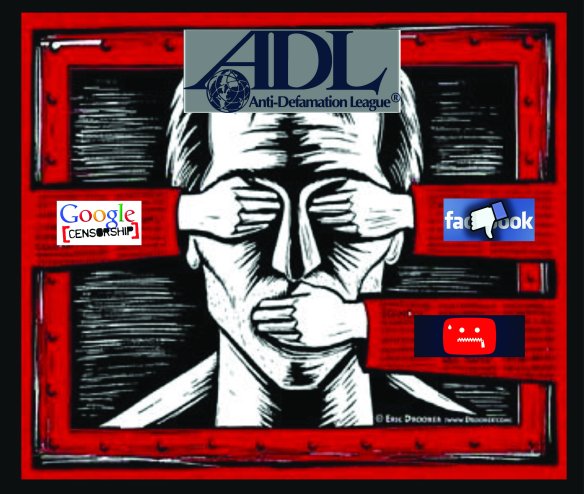
Anti-Defamation League, Facebook, Google & Youtube Appoint Themselves As Official Internet Censor

By Richard Enos

Source: Collective Evolution

If you are reading this, that means that articles that speak against the activities of the Anti-Defamation League are not being automatically scrubbed from the internet.

Yet.

In a foreboding sign that the free expression of opinion on the internet is too much of a threat to the powerful elite of our society, the Anti-Defamation League is leading the charge in turning their own subjective opinions on ‘hate speech’ into the absolute rule of Internet law. As this Cnet article reports,

FacebookTwitterGoogle and Microsoft, among others, are joining with the ADL to form a Cyberhate Problem-Solving Lab, the companies and the civil rights group said Tuesday. They’ll exchange ideas and develop strategies to try to curb hate speech and abuse on the companies’ various platforms and across the internet.

“These companies have an added responsibility to do everything within their power to stop hate from flourishing on their watch,” ADL CEO Jonathan Greenblatt said in a statement. “We look forward to tackling this pressing challenge together.”

Wow. A Cyberhate Problem-Solving Lab. What heroes of selfless service to humanity.

Like Monika Bickert, Facebook’s head of global policy, who said in a statement that “some of the best minds in engineering will work alongside the ADL to help us rise to the occasion.” What occasion? The threat of the power that the proliferation of free speech on the internet is giving to individual human beings fighting for truth and justice.

Who Died And Made Them King?

It is disconcerting to me that we are moving into a time where a once free and neutral internet has suddenly come more and more under the control of powerful dictatorial forces. Yes, dictatorial. The ADL is marching into the internet cyberscape with the sense of entitlement to DICTATE what should and shouldn’t be said by the rest of us. Doesn’t this mimic that actions of a certain dictator from the past that the ADL would claim to have been zealously opposed to? (I won’t name names for fear of triggering some sophisticated ADL-Google-keyword-cyber-censoring mechanism).

The obvious fact is that the cabal of organizations that will be sitting down at the Cyberhate Problem-Solving Lab will likely make little mention of the impact of cyber-bullying and online hate speech on human individuals. They will be more prone to focus on how to continue hiding crimes against humanity perpetrated by the global elite since time immemorial, crimes like massive fraud, slavery, pedophilia, torture, and murder. And why would these organizations be motivated to hide these crimes? Because they are now controlled by the very global elite who are perpetrating them in the first place.

The War On Hate

The whole narrative of a group that self-identifies as having the authority ‘to curb hate speech and abuse’ on the internet is deeply flawed and even hypocritical. And employing tactics in the same mold as the failed wars on drugs, cancer, and terrorism further gives them away. These are nothing more than tactics of obfuscation of what is really going on.

Human growth is not advanced by attempts to stifle, destroy, or eradicate darkness. As I discussed in my article ‘Let’s Discard The ‘Right’ To Be Insulted By Free Speech,’ we do not evolve by stopping people from expressing any hatred or other negative emotions that are deep inside them, we evolve by allowing people to express themselves freely and becoming immune to their ‘offensive’ remarks by learning not to take them personally.

Hate speech in itself cannot demean the object of hatred, it only reveals the unhealed emotions of its source. And the more we allow these unhealed emotions a chance to be let out, the more space we create for personal and collective healing.

In that regard, attempts to actually do something positive about human hatred through censorship is at best naive, and in most cases like this one, it turns out to be a vehicle of domination for those who would wish to maintain and expand control over information and the self-expression of individuals.

The Need To Move Off These Platforms

The ADL aside, internet corporations like Facebook that continue to delve more deeply into censorship are playing a bit of a risky game. Perhaps many of them feel that they are ‘too big to fail,’ in the sense that they believe they are too essential to the lives of most people to suddenly get abandoned en masse. Perhaps, for now, that is true. But I’m not sure that they should really be messing with an Awakening Community that is growing larger by the heartbeat.

Conjuring Up the Next Depression

By Chris Hedges

Source: TruthDig

During the financial crisis of 2008, the world’s central banks, including the Federal Reserve, injected trillions of dollars of fabricated money into the global financial system. This fabricated money has created a worldwide debt of $325 trillion, more than three times global GDP. The fabricated money was hoarded by banks and corporations, loaned by banks at predatory interest rates, used to service interest on unpayable debt or spent buying back stock, providing millions in compensation for elites. The fabricated money was not invested in the real economy. Products were not manufactured and sold. Workers were not reinstated into the middle class with sustainable incomes, benefits and pensions. Infrastructure projects were not undertaken. The fabricated money reinflated massive financial bubbles built on debt and papered over a fatally diseased financial system destined for collapse.

What will trigger the next crash? The $13.2 trillion in unsustainable U.S. household debt? The $1.5 trillion in unsustainable student debt? The billions Wall Street has invested in a fracking industry that has spent $280 billion more than it generated from its operations? Who knows. What is certain is that a global financial crash, one that will dwarf the meltdown of 2008, is inevitable. And this time, with interest rates near zero, the elites have no escape plan. The financial structure will disintegrate. The global economy will go into a death spiral. The rage of a betrayed and impoverished population will, I fear, further empower right-wing demagogues who promise vengeance on the global elites, moral renewal, a nativist revival heralding a return to a mythical golden age when immigrants, women and people of color knew their place, and a Christianized fascism.

The 2008 financial crisis, as the economist Nomi Prins points out, “converted central banks into a new class of power brokers.” They looted national treasuries and amassed trillions in wealth to become politically and economically omnipotent. In her book “Collusion: How Central Bankers Rigged the World,” she writes that central bankers and the world’s largest financial institutions fraudulently manipulate global markets and use fabricated, or as she writes, “fake money,” to inflate asset bubbles for short-term profit as they drive us toward “a dangerous financial precipice.”

“Before the crisis, they were just asleep at the wheel, in particular, the Federal Reserve of the United States, which is supposed to be the main regulator of the major banks in the United States,” Prins said when we met in New York. “It did a horrible job of doing that, which is why we had the financial crisis. It became a deregulator instead of a regulator. In the wake of the financial crisis, the solution to fixing the crisis and saving the economy from a great depression or recession, whatever the terminology that was used at any given time, was to fabricate trillions and trillions of dollars out of an electronic ether.”

The Federal Reserve handed over an estimated $29 trillion of this fabricated money to American banks, according to researchers at the University of MissouriTwenty-nine trillion dollars! We could have provided free college tuition to every student or universal health care, repaired our crumbling infrastructure, transitioned to clean energy, forgiven student debt, raised wages, bailed out underwater homeowners, formed public banks to invest at low interest rates in our communities, provided a guaranteed minimum income for everyone and organized a massive jobs program for the unemployed and underemployed. Sixteen million children would not go to bed hungry. The mentally ill and the homeless—an estimated 553,742 Americans are homeless every night—would not be left on the streets or locked away in our prisons. The economy would revive. Instead, $29 trillion in fabricated money was handed to financial gangsters who are about to make most of it evaporate and plunge us into a depression that will rival that of the global crash of 1929.

Kevin Zeese and Margaret Flowers write on the website Popular Resistance, “One-sixth of this could provide a $12,000 annual basic income, which would cost $3.8 trillion annually, doubling Social Security payments to $22,000 annually, which would cost $662 billion, a $10,000 bonus for all U.S. public school teachers, which would cost $11 billion, free college for all high school graduates, which would cost $318 billion, and universal preschool, which would cost $38 billion. National improved Medicare for all would actually save the nation trillions of dollars over a decade.”

An emergency clause in the Federal Reserve Act of 1913 allows the Fed to provide liquidity to a distressed banking system. But the Federal Reserve did not stop with the creation of a few hundred billion dollars. It flooded the financial markets with absurd levels of fabricated money. This had the effect of making the economy appear as if it had revived. And for the oligarchs, who had access to this fabricated money while we did not, it did.

The Fed cut interest rates to near zero. Some central banks in Europe instituted negative interest rates, meaning they would pay borrowers to take loans. The Fed, in a clever bit of accounting, even permitted distressed banks to use these no-interest loans to buy U.S. Treasury bonds. The banks gave the bonds back to the Fed and received a quarter of a percent of interest from the Fed. In short, the banks were loaned money at virtually no interest by the Fed and then were paid interest by the Fed on the money they borrowed. The Fed also bought up worthless mortgage assets and other toxic assets from the banks. Since Fed authorities could fabricate as much money as they wanted, it did not matter how they spent it.

“It’s like going to someone’s old garage sale and saying, ‘I want that bicycle with no wheels. I’ll pay you 100 grand for it. Why? Because it’s not my money,’ ” Prins said.

“These people have rigged the system,” she said of the bankers. “There is money fabricated at the top. It is used to pump up financial assets, including stock. It has to come from somewhere. Because money is cheap there’s more borrowing at the corporate level. There’s more money borrowed at the government level.”

“Where do you go to repay it?” she asked. “You go into the nation. You go into the economy. You extract money from the foundational economy, from social programs. You impose austerity.”

Given the staggering amount of fabricated money that has to be repaid, the banks need to build greater and greater pools of debt. This is why when you are late in paying your credit card the interest rate jumps to 28 percent. This is why if you declare bankruptcy you are still responsible for paying off your student loan, even as 1 million people a year default on student loans, with 40 percent of all borrowers expected to default on student loans by 2023. This is why wages are stagnant or have declined while costs, from health care and pharmaceutical products to bank fees and basic utilities, are skyrocketing. The enforced debt peonage grows to feed the beast until, as with the subprime mortgage crisis, the predatory system fails because of massive defaults. There will come a day, for example, as with all financial bubbles, when the wildly optimistic projected profits of industries such as fracking will no longer be an effective excuse to keep pumping money into failing businesses burdened by debt they cannot repay.

“The 60 biggest exploration and production firms are not generating enough cash from their operations to cover their operating and capital expenses,” Bethany McLean writes of the fracking industry in an articletitled “The Next Financial Crisis Lurks Underground” that appeared in The New York Times. “In aggregate, from mid-2012 to mid-2017, they had negative free cash flow of $9 billion per quarter.”

The global financial system is a ticking time bomb. The question is not if it will explode but when it will explode. And once it does, the inability of the global speculators to use fabricated money with zero interest to paper over the debacle will trigger massive unemployment, high prices for imports and basic services, and a devaluation in which the dollar will become nearly worthless as it is abandoned as the world’s reserve currency. This manufactured financial tsunami will transform the United States, already a failed democracy, into an authoritarian police state. Life will become very cheap, especially for the vulnerable—undocumented workers, Muslims, poor people of color, girls and women, anti-capitalist and anti-imperialist critics branded as agents of  foreign powers—who will be demonized and persecuted for the collapse. The elites, in a desperate bid to cling to their unchecked power and obscene wealth, will disembowel what is left of the United States.

Your Life Is Not Limited To One Path

By Joe Martino

Source: Collective Evolution

It is no secret that life can sometimes feel like a limited paved road laid out before us that we feel the need to stick to. Look at how we are brought up. Most of the time we come into the world and begin gaining our perceptions from those closest to us –our parents. As time goes on we find ourselves in school. Throughout that time we also begin watching what others do around us, what we see on TV and in movies.

What is happening is we are observing and creating an idea of how life should be; the best way to play the game. But what is ‘best?’

How many times have we heard “That’s not the best decision” or “That’s not the best decision for the whole family.” When you look at either statement you realize that “best” is subjective. What the “best” is to one person may not be the “best” to another. Even further, both of the perceptions of “best” are created from whatever belief systems each have created in their own lives. This is the key factor to realize.

We Get Trapped in Belief Systems

In either case, both scenarios have one thing in common, a belief system of what the “best” choice or decision is. When we create a belief system like this, we limit how we view things. We no longer feel what is “best,” but instead we analyze and define “best” based on a story; often a story from the past, based on entirely different times than the present moment.

Let’s take the example of a child coming out of high school today.  9 times out of 10, that child will be told, and may even believe, that the “best” decision they can make for their life is to continue their education at university or college. It does not matter that they do not know what they want to study, or that the education system will potentially cost them $100,000+, many will state that is best -and even have pride about it.

Next, they would be told to get a job so they can buy a house, as owning and buying a house is a smart decision. Should this child begin their life based on these belief systems, more often than not they will take this idea of what is “BEST” throughout the rest of their life. They will judge their decisions by this, express emotions based on this, develop self-esteem based on this and so forth. From then on, every decision they make will be based on this belief system handed down and taught to them.

Even getting specific, what to study in school, what type of job to get, what type of car to buy, how to spend and save money, what type of house to buy and so on. What is really happening with all of this? We are defining the ideal life or what’s “best” and then we limit our life to a small scope of how things should be.

The Deep Truth

Here is the absolute truth, ready? None of it has any real truth to it. It’s just all a belief system. Perception, ideas! But we often live by this and it becomes so real in our minds that we become stuck thinking this is the way to do it. Then when depression and anxiety follow, as we may believe we are stuck, we forget to look back on the belief system that is often caging us and our reality into a small tight space we often don’t deeply resonate with.

Look at our world. We often all chase the same thing, the same stuff because that is what we have been sold as the ideal life. Each area of the world has its own version of this. Who’s life are you really living? Whose dreams are you chasing and carrying out? We take on these beliefs and we begin to sacrifice ourselves, our health, and our soul desires so we can carry out someone else’s idea of “best” that we grabbed onto.

Back to the child from the example above. Now they have grown into a young man or woman and are in a job they don’t truly like. But it pays the bills and lives up to the idea of “best” that has been given to them. Most of the time, people around them will all reinforce that their decisions are the “best” because they have all been sold on the same belief system. “You have to make sacrifices, you have to work really hard to have a good life!” is what we are told. But who says what is “good?” Even when that grown up child is expressing their sadness or frustration for the reality they are in, we continue to reinforce it to protect the idea of ‘the best.’

We take this entirely expansive creative individual playing in an expansive playground called Earth and we confine them to this tiny little narrow path of what the “best” is. Instead of spending their life being able to make any choice they choose, they stay limited to what they have been sold as the “best” even if they don’t truly love it.

Even Deeper

Then you have the even deeper part, we then look upon and judge others when they make “the wrong decisions.” Look at how we view those who change their minds about what they want to play with all the time. What do we say about those people? “They need to make up their mind and get their life on track.” What track? There is a track? Says who? “They didn’t make a smart decision with their money or their house so they are going to pay for it later.” Who says some decisions are better than others? Is it not an experience either way?

You are the creator of your life and reality. You can choose to play and create whatever type of life you choose. And guess what? If you make a decision and start creating a particular life then you realize you want to create something new, you are free to do this!

No matter what story we tell ourselves like: “it’s too late, I can’t change this now, it’s too costly” etc. know that these are all egoic illusions. You are never limited to whatever life you have created even if you have been doing it for 30 years. Remember to ask yourself: the life you are chasing, the goals you have set, who’s goals are they really? Where did you first hear of them? Are they from your heart? Or are they what you have been sold?

Look inside yourself at what YOU TRULY want and how you wish to express yourself and create. Start there, and create from that space. You will see very quickly that you can create anything you choose.

Remember, there is no right or wrong path here. It’s about looking back on what we choose, where we are at and saying “Is this where I want to be? Am I feeling peace? Expressing my deepest self? Am I inspired about where I am at?” and if you aren’t, you create a new path and see how that feels. Follow how you FEEL, not what you seek as right or wrong. Our life reflects our state of consciousness.

What We Threw Away

By Patrick Armstrong

Source: Strategic Culture Foundation

Forty years ago I was quite impressed by the books of Jean François Revel in which he argued that The West was pretty much doomed because it was messy and indecisive. On the other hand, the communist world was decisive, centrally controlled, had a goal in mind and was patient and cunning in achieving that goal (the communisation of the planet, of course). They pushed on all fronts, where the West woke up and pulled itself together enough to push back, the communists recoiled, but the advance continued elsewhere. And so, bit by bit, the world became redder. These were, as I recall, the principal arguments of The Totalitarian Temptation (1977) and How Democracies Perish (1983). And there were plenty of other people bemoaning the fact that the inchoate Western democracies were frittering away valuable time.

And then, suddenly, the Warsaw Pact and the USSR fall apart and essentially took communism into the grave with them. The West was left standing. Still argumentative, inchoate, indecisive and all the rest of it but – and this is my point – still existing when the other was dead. And come to think of it, we’d outlasted that other stainless-steel perfection of centrally directed will and power, Nazi Germany. And there had been plenty of people in the 1930s who thought that, between communism and nazism, the West was doomed. This set me to thinking that Revel and the others had missed something in their analysis.

We outlived them. We survived, they didn’t. And that what I wondered about – there must be something in the West’s way of doing things that led to survival and something in the nazi or communist systems that led to death. I thought some more and the analogy that occurred to me is that there are many kinds of trees. Big ones, little ones, in-between sized ones. Some live in the wet, others in the dry, others half drowned by the sea and so on. There is in fact, a tree, or several trees, for almost any conceivable environmental condition. And therefore, there will always be trees. Why? Because instead of one Perfect Tree, there is a multitude of different trees. And of fishes, beetles, birds and so on. Nature is pluralistic: many many solutions for every imaginable situation and the ability to change to meet new challenges. Arnold Toynbee called this “challenge and response”; a society responds to a challenge: a good response and it survives to meet the next challenge, a bad response and it fades away.

Could this be the clue? Nazism and communism had One Big Answer for every question. That answer worked for a time until it met some questions it couldn’t answer and down it went. To grossly oversimplify things: the nazis loved force and they went to war with everybody, but you can’t win against everybody else, although you may do well for a while; a hammer and a sickle do not really mentally equip you for life in the later twentieth century; “a road to a blind alley” as Putin called it. Grossly simplified to be sure. If you prefer, ideological societies can only function inside the ontological assumptions of that ideology. But no ideology is any more than a small subset of boundless reality.

So what do we (or, sadly I have to ask, did we) have in the West? I think the three fundamental freedoms in the West are free speech, free politics and free enterprise. Looking at these through the lens of pluralism, they are pluralism of thought, pluralism of power and pluralism of action. Remember that the question I was trying to answer was why did the West survive? I wasn’t asking who’s better, more ideal, more moral; just why is one still around and the other two not? To me the answer was the same thing that allows us to be certain there will still be trees and beetles around in the future – pluralism: lots of different trees and beetles.

Take free speech or pluralism of thought. Everybody’s different, everybody has different ideas, insights, points of view. Let’s assume that, for some issue, mine is the winning idea today. But tomorrow you may have a better solution for the problem that appears tomorrow. If I suppressed you (“no man no problem”, as Stalin used to say) or otherwise prohibited your irrelevant (today) but relevant (tomorrow) idea, we would be in trouble tomorrow and less likely to survive until the next day. So, since we don’t know what tomorrow’s problems are, it’s best to let everybody think his thoughts because who can say whose ideas will be winners tomorrow? The same argument can be made for the other two pluralisms/freedoms. And so, by practising pluralism of thought, power and action, a society improves its chances of survival. That’s all: survival. But that was the question I asked myself in the first place.

So, to my mind, that was the great secret that communism’s fall had revealed – social or national survivability is best assured by pluralism of thought, power and action. So, in all humility, we should have understood that and proclaimed it. And, of course, the essence of pluralism is that you are free to be, and should be, yourself. All nations should be themselves: Russians should be Russian, Hungarians Hungarian and so on. Who can say who will have the next good idea? Who is so wise that he can direct his neighbour’s life? That to me was what should have been done and, had that been the message the West had preached, I think we’d all be better off today.

What instead? We had the fatuous proclaiming of “values”: we had ’em and they didn’t. All over the West stuffed shirts got up in parliaments to boast of “our values”. How we got them no one knew. Did God hand them out to some people but not to others? Russians, too lazy or shiftless or something, having missed the ceremony? Had they mysteriously grown in some national soil over long time? A relict of ancient Saxon customs that only their descendants could inherit? The product of centuries of learning? And what is a “value” anyway? A practical guide to action or a virtue that you either have or don’t? Was it something innate or something learned? Could they get these values? Could they be taught? But, whatever, we had ’em and they didn’t; we were virtuous, they weren’t. And there was another tiresome thing about this, especially when, as it often was, the values were given the adjective “European”. Franco, Hitler, Marx, Engels, Mussolini, Robespierre, Napoleon, Quisling and all the rest of them were Europeans. Every single one of them based his ideas and political views on sources deeply rooted in European thought and experience. And, for certain, had it not been for the Soviets and the Anglosphere, the “European values” Eurocrats and their flunkeys would have been boasting about today would have involved a lot more leather, jackboots and stiff-armed salutes. The whole enterprise resembled something from the movie Idiocracy: “Brawndo has what plants crave because plants crave what Brawndo has“. It was weirdly fascinating to watch.

Our “values” and our “virtue” entitled us to rule the world. We were licensed to do just about anything because we had “what plants crave”. And so triumphalist arrogance and complacent ignorance combined with the West’s monopoly of exportable brutal power. And so it went. An unexamined conceit, frighteningly widespread, became the justification, and cover, for less noble actions.

But some responses to challenges are not so successful and we must ask what has become of our boasted “values” today? Well, we’re still free to speak our minds. Not of course if it’s hate speech or fake news; who could defend that? And not, certainly, to offend anyone’s safe space. And you’d probably better not say anything in Russian. Political freedom? Not entirely gone I suppose, in those little corners not already bought up by lobbyists. And it would certainly be wrong to question anything said or done by “those brave men and women who put their life on the line for our safety”. Free enterprise of course still flourishes. In whatever tiny spaces a few gigantic and well-connected corporations have not yet got to.

Altogether, we can’t be very happy with the state of pluralism in the West. And if I’m correct that pluralism is the key to survival, how much longer do we have?

So who did win the Cold War in the end?

Why We’re Blind to the System Destroying Us

By Jonathan Cook

Source: Information Clearing House

I rarely use this blog to tell readers what they should believe. Rather I try to indicate why it might be wise to distrust, at least without very good evidence, what those in power tell us we should believe.

We have well-known sayings about power: “Knowledge is power”, and “Power tends to corrupt, while absolute power tends to corrupt absolutely.” These aphorisms resonate because they say something true about how we experience the world. People who have power – even very limited power they hold on licence from someone else – tend to abuse it, sometimes subtly and unconsciously, and sometimes overtly and wilfully.

If we are reasonably self-aware, we can sense the tendency in ourselves to exploit to our advantage whatever power we enjoy, whether it is in our dealings with a spouse, our children, a friend, an employee, or just by the general use of our status to get ahead.

This isn’t usually done maliciously or even consciously. By definition, the hardest thing to recognise are our own psychological, emotional and mental blind spots – and the biggest, at least for those born with class, gender or race privileges, is realising that these too are forms of power.

Nonetheless, these are all minor forms of power compared to the power wielded collectively by the structures that dominate our societies: the financial sector, the corporations, the media, the political class, and the security services.

But strangely most of us are much readier to concede the corrupting influence of the relatively small power of individuals than we are the rottenness of vastly more powerful institutions and structures. We blame the school teacher or the politician for abusing his or her power, while showing a reluctance to do the same about either the education or political systems in which they have to operate.

Similarly, we are happier identifying the excessive personal power of a Rupert Murdoch than we are the immense power of the corporate empire behind him and on which his personal wealth and success depend.

And beyond this, we struggle most of all to detect the structural and ideological framework underpinning or cohering all these discrete examples of power.

Narrative control

It is relatively easy to understand that your line manager is abusing his power, because he has so little of it. His power is visible to you because it relates only to you and the small group of people around you.

It is a little harder, but not too difficult, to identify the abusive policies of your firm – the low pay, cuts in overtime, attacks on union representation.

It is more difficult to see the corrupt power of large institutions, aside occasionally from the corruption of senior figures within those institutions, such as a Robert Maxwell or a Richard Nixon.

But it is all but impossible to appreciate the corrupt nature of the entire system. And the reason is right there in those aphorisms: absolute power depends on absolute control over knowledge, which in turn necessitates absolute corruption. If that were not the case, we wouldn’t be dealing with serious power – as should be obvious, if we pause to think about it.

Real power in our societies derives from that which is necessarily hard to see – structures, ideology and narratives – not individuals. Any Murdoch or Trump can be felled, though being loyal acolytes of the power-system they rarely are, should they threaten the necessary maintenance of power by these interconnected institutions, these structures.

The current neoliberal elite who effectively rule the planet have reached as close to absolute power as any elite in human history. And because they have near-absolute power, they have a near-absolute control of the official narratives about our societies and our “enemies”, those who stand in their way to global domination.

No questions about Skripals

One needs only to look at the narrative about the two men, caught on CCTV cameras, who have recently been accused by our political and media class of using a chemical agent to try to murder Sergei Skripal and his daughter Yulia back in March.

I don’t claim to know whether Alexander Petrov and Ruslan Boshirov work for the Russian security services, or whether they were dispatched by Vladimir Putin on a mission to Salisbury to kill the Skripals.

What is clear, however, is that the British intelligence services have been feeding the British corporate media a self-serving, drip-drip narrative from the outset – and that the media have shown precisely no interest at any point in testing any part of this narrative or even questioning it. They have been entirely passive, which means their readers – us – have been entirely passive too.

That there are questions about the narrative to be raised is obvious if you turn away from the compliant corporate media and seek out the views of an independent-minded, one-time insider such as Craig Murray.

A former British ambassador, Murray is asking questions that may prove to be pertinent or not. But at this stage, when all we have to rely on is what the intelligence services are selectively providing, these kinds of doubts should be driving the inquiries of any serious journalist covering the story. But as is so often the case, not only are these questions not being raised or investigated, but anyone like Murray who thinks critically – who assumes that the powerful will seek to promote their interests and avoid accountability – is instantly dismissed as a conspiracy theorist or in Putin’s pocket.

That is no meaningful kind of critique. Many of the questions that have been raised – like why there are so many gaps in the CCTV record of the movements of both the Skripals and the two assumed assassins – could be answered if there was an interest in doing so. The evasion and the smears simply suggest that power intends to remain unaccountable, that it is keeping itself concealed, that the narrative is more important than the truth.

And that is reason enough to move from questioning the narrative to distrusting it.

Ripples on a lake

Journalists typically have a passive relationship to power, in stark contrast to their image as tenacious watchdog. But more fundamental than control over narrative is the ideology that guides these narratives.  Ideology ensures the power-system is invisible not only to us, those who are abused and exploited by it, but also to those who benefit from it.

It is precisely because power resides in structures and ideology, rather than individuals, that it is so hard to see. And the power-structures themselves are made yet more difficult to identify because the narratives created about our societies are designed to conceal those structures and ideology – where real power resides – by focusing instead on individuals.

That is why our newspapers and TV shows are full of stories about personalities – celebrities, royalty, criminals, politicians. They are made visible so that we do not notice the ideological structures we live inside that are supposed to remain invisible.

News and entertainment are the ripples on a lake, not the lake itself. But the ripples could not exist without the lake that forms and shapes them.

Up against the screen

If this sounds like hyperbole, let’s stand back from our particular ideological system – neoliberalism – and consider earlier ideological systems in the hope that they offer some perspective. At the moment, we are like someone standing right up against an IMAX screen, so close that we cannot see that there is a screen or even guess that there is a complete picture. All we see are moving colours and pixels. Maybe we can briefly infer a mouth, the wheel of a vehicle, a gun.

Before neoliberalism there were other systems of rule. There was, for example, feudalism that appropriated a communal resource – land – exclusively for an aristocracy. It exploited the masses by forcing them to toil on the land for a pittance to generate the wealth that supported castles, a clergy, manor houses, art collections and armies. For several centuries the power of this tiny elite went largely unquestioned.

But then a class of entrepreneurs emerged, challenging the landed artistocracy with a new means of industrialised production. They built factories and took advantage of scales of economy that slightly widened the circle of privilege, creating a middle class. That elite, and the middle-class that enjoyed crumbs from their master’s table, lived off the exploitation of children in work houses and the labour of a new urban poor in slum housing.

These eras were systematically corrupt, enabling the elites of those times to extend and entrench their power. Each elite produced justifications to placate the masses who were being exploited, to brainwash them into believing the system existed as part of a natural order or even for their benefit. The aristocracy relied on a divine right of kings, the capitalist class on the guiding hand of the free market and bogus claims of equality of opportunity.

In another hundred years, if we still exist as a species, our system will look no less corrupt – probably more so – than its predecessors.

Neoliberalism, late-stage capitalism, plutocratic rule by corporations – whatever you wish to call it – has allowed a tiny elite to stash away more wealth and accrue more power than any feudal monarch could ever have dreamt of. And because of the global reach of this elite, its corruption is more endemic, more complete, more destructive than any ever known to mankind.

A foreign policy elite can destroy the world several times over with nuclear weapons. A globalised corporate elite is filling the oceans with the debris from our consumption, chopping down the forest-lungs of our planet for palm-oil plantations so we can satisfy our craving for biscuits and cake. And our media and intelligence services are jointly crafting a narrative of bogeymen and James Bond villains – both in Hollywood movies, and in our news programmes – to make us fearful and pliable.

Assumptions of inevitability

Most of us abuse our own small-power thoughtlessly, even self-righteously. We tell ourselves that we gave the kids a “good spanking” because they were naughty, rather than because we established with them early on a power relationship that confusingly taught them that the use of force and coercion came with a parental stamp of approval.

Those in greater power – from minions in the media to executives of major corporations – are no different. They are as incapable of questioning the ideology and the narrative – how inevitable and “right” our neoliberal system is – as the rest of us. But they play a vital part in maintaining and entrenching that system nonetheless.

David Cromwell and David Edwards of Media Lens have provided two analogies – in the context of the media – that help explain how it is possible for individuals and groups to assist and enforce systems of power without having any conscious intention to do so, and without being aware that they are contributing to something harmful. Without, in short, being aware that they are conspiring in the system.

The first:

When a shoal of fish instantly changes direction, it looks for all the world as though the movement was synchronised by some guiding hand. Journalists – all trained and selected for obedience by media all seeking to maximise profits within state-capitalist society – tend to respond to events in the same way.

The second:

Place a square wooden framework on a flat surface and pour into it a stream of ball bearings, marbles, or other round objects. Some of the balls may bounce out, but many will form a layer within the wooden framework; others will then find a place atop this first layer. In this way, the flow of ball bearings steadily builds new layers that inevitably produce a pyramid-style shape. This experiment is used to demonstrate how near-perfect crystalline structures such as snowflakes arise in nature without conscious design.

The system – whether feudalism, capitalism, neoliberalism – emerges out of the real-world circumstances of those seeking power most ruthlessly. In a time when the key resource was land, a class emerged justifying why it should have exclusive rights to control that land and the labour needed to make it productive. When industrial processes developed, a class emerged demanding that it had proprietary rights to those processes and to the labour needed to make them productive.

Our place in the pyramid

In these situations, we need to draw on something like Darwin’s evolutionary “survival of the fittest” principle. Those few who are most hungry for power, those with least empathy, will rise to the top of the pyramid, finding themselves best-placed to exploit the people below. They will rationalise this exploitation as a divine right, or as evidence of their inherently superior skills, or as proof of the efficiency of the market.

And below them, like the layers of ball bearings, will be those who can help them maintain and expand their power: those who have the skills, education and socialisation to increase profits and sell brands.

All of this should be obvious, even non-controversial. It fits what we experience of our small-power lives. Does bigger power operate differently? After all, if those at the top of the power-pyramid were not hungry for power, even psychopathic in its pursuit, if they were caring and humane, worried primarily about the wellbeing of their workforce and the planet, they would be social workers and environmental activists, not CEOs of media empires and arms manufacturers.

And yet, base your political thinking on what should be truisms, articulate a worldview that distrusts those with the most power because they are the most capable of – and committed to – misusing it, and you will be derided. You will be called a conspiracy theorist, dismissed as deluded. You will be accused of wearing a tinfoil hat, of sour grapes, of being anti-American, a social warrior, paranoid, an Israel-hater or anti-semitic, pro-Putin, pro-Assad, a Marxist.

None of this should surprise us either. Because power – not just the people in the system, but the system itself – will use whatever tools it has to protect itself. It is easier to deride critics as unhinged, especially when you control the media, the politicians and the education system, than it is to provide a counter-argument.

In fact, it is vital to prevent any argument or real debate from taking place. Because the moment we think about the arguments, weigh them, use our critical faculties, there is a real danger that the scales will fall from our eyes. There is a real threat that we will move back from the screen, and see the whole picture.

Can we see the complete picture of the Skripal poisoning in Salisbury; or the US election that led to Trump being declared president; or the revolution in Ukraine; or the causes and trajectory of fighting in Syria, and before it Libya and Iraq; or the campaign to discredit Jeremy Corbyn as leader of the Labour party; or the true implications of the banking crisis a decade ago?

Profit, not ethics

Just as a feudal elite was driven not by ethics but by the pursuit of power and wealth through the control of land; just as early capitalists were driven not by ethics but by the pursuit of power and wealth through the control of mechanisation; so neoliberalism is driven not by ethics but the pursuit of power and wealth through the control of the planet.

The only truth we can know is that the western power-elite is determined to finish the task of making its power fully global, expanding it from near-absolute to absolute. It cares nothing for you or your grand-children. It is a cold-calculating system, not a friend or neighbour. It lives for the instant gratification of wealth accumulation, not concern about the planet’s fate tomorrow.

And because of that it is structurally bound to undermine or discredit anyone, any group, any state that stands in the way of achieving its absolute dominion.

If that is not the thought we hold uppermost in our minds as we listen to a politician, read a newspaper, watch a film or TV show, absorb an ad, or engage on social media, then we are sleepwalking into a future the most powerful, the most ruthless, the least caring have designed for us.

Step back, and take a look at the whole screen. And decide whether this is really the future you wish for your grand-children.


Gandhi’s Despair and the Struggle for Truth and Love

By Robert J. Burrowes

‘When I despair, I remember that all through history the ways of truth and love have always won. There have been tyrants, and murderers, and for a time they can seem invincible, but in the end they always fall. Think of it – always.’ M.K. Gandhi

As we remember Gandhi Jayanti on 2 October, the Mahatma’s 149th birthday and the International Day of Nonviolence, there is plenty of room for despair.

Never before has the Earth and its many inhabitants been under siege as they are now, more than 100 years after Gandhi started warning us of the predicament in which we are embroiled and presenting his strategy for addressing it before it spiraled out of control.

Whether it is the threat of nuclear war, the ongoing wars in many parts of the world and particularly the Middle East, the multiple and synergistic threats to the global environment or the ongoing climate catastrophe, the Earth is under assault on all fronts and its precious lifeforms (human and otherwise) are being killed outright in vast numbers and driven to extinction at the rate of 200 species daily. And the evidence is rapidly accumulating that humans themselves will be extinct by 2026 as well. See ‘Human Extinction by 2026? A Last Ditch Strategy to Fight for Human Survival’.

Moreover, unlike the tyrants to which Gandhi was referring, the current ‘tyrant’ is a global elite that has acquired extraordinary power to kill and destroy as they pursue their insane compulsion to accumulate and control resources at the expense of life. See ‘The Global Elite is Insane Revisited’.

So are we to give up in despair? To quit without a fight? Or even delude ourselves that nothing needs to be done? Obviously, these were not ways that Gandhi would contemplate because, as noted in his words cited above: ‘the ways of truth and love have always won’. Although, as Gandhi did not bother to add: we must struggle, relentlessly, to ensure that truth and love prevail.

And, fortunately, there are many people around the world who agree with him.

Tackling the pervasive violence in our world requires a comprehensive strategy involving many campaigns focused on a wide range of peace, justice and environmental issues, and substantial mobilization. There is no single or simple path. Let me tell you about some of the people engaged in this effort and the nature of their commitment, together with what connects their involvement.

Remarkable activist and progressive journalist Abby Martin, based in the USA, was formerly creator and presenter of the investigative news program ‘Breaking the Set’ and is now creator and presenter of its successor program ‘The Empire Files’. With the support of her fine team, Abby researches and presents reports from ‘inside history’s biggest empire… recording a world shaped by war & inequality’ so that the truth is exposed for all to see. Abby, who is also an artist, interviews a wide range of people from ‘ordinary’ activists to progressive intellectuals to political leaders to penetrate the veil of obscurity cast by the global elite’s corporate media. You can watch Abby’s terrific programs, providing insight into how our incredibly violent world works, on her website ‘The Empire Files’. You can also read about the latest attack on her work and how you can help in the article ‘US Sanctions Shut Down “The Empire Files” with Abby Martin’. Keep fighting Abby! We are with you all the way.

Ina Curic in Romania writes illustrated children’s books designed to teach children a variety of lessons for living an empowered, socially and environmentally conscious life. Her book Queen Rain, King Wind: The Practice of Heart Gardening was published in May and Anagrania’s Challenge: Turning Conflict into Opportunity has just been published. Anagrania’s Challenge is a beautifully created story that offers clear and simple guidance on three subjects vital to our shared future on Earth: what we need to be ourselves, what we need to be healthy, and that acceptance of uniqueness and creatively dealing with conflict are essential if we are to live together and celebrate the benefits and advantages of our differences. If you are looking for children’s books that promote nonviolent living and conflict resolution, you will have trouble finding better books than those by Ina. You can read about Ina, as well as how to obtain her books, on her website Imagine Creatively.

Pakistani Canadian Dr. Mahboob A. Khawaja is a scholar who writes searing critiques of international relations exposing the deep conflicts driving global events. Two of his recent articles are ‘World Affairs and Insanity as Entertainment: Are We at the End of Human Morality?’ and ‘Mankind Must Know: The UNO and Global Leaders are a Menace to Peace and Problem-Solving’.

Moreover, in support of his son Momin, a computer science graduate and IT entrepreneur, who has been unjustly imprisoned since 2004 on terrorism charges (and facing a sentence of life plus 24 years), Mahboob has created a website to raise awareness of Momin’s struggle for justice and freedom, and organized a petition for those who wish to express their support for him.

Edith Rubinstein in Belgium is definitely an ‘activist senior’. Now 86 and in a center of recuperation following a severe depression and bout of unconsciousness earlier this year, Edith still has her computer and continues her work as an activist. ‘Because I am an activist since a very long time, a feminist, a woman in Black, and I translated free Ecofeminism from Maria Mies and Vandana Shiva…. Since many years, I have translated alternative articles and finally it made me sick.’ In fact, Edith admits, ‘I am completely “abnormal”. Somebody who feels bad to live in a world where hundreds of thousand people are killed or die … because they have nothing to eat anymore and nobody seems to care…. I feel very bad to live in this kind of world. Yes, terrible what is happening in the Congo! But unfortunately it is not the only case. And I am very scandalized by the behavior of the Western World!!!!’

Zakia Haddouch in Morocco continues to report the extraordinarily difficult circumstances of people in that country as she and other activists continue their various struggles to bring some semblance of justice to Moroccan affairs. One prominent issue is the ongoing debate in relation to ‘the forced military service (for both young female and male subjects and I don’t say citizens). It was lately decreed by the king.’ Another struggle is taking place in the wake of the death of Mohcine Fikri on 28 October 2016, who was crushed to death in a rubbish truck trying to recover merchandise confiscated by a policeman. Following this event, Hirak (literally ‘The Movement’) was born and it quickly mobilized widespread support for its vigorous protests. While most of Hirak’s concerns are about local issues, it draws upon a national repertory of nonviolent actions fueled by the experiences of activists around the country. Between October 2016 and May 2017, and faced with social unrest of an unprecedented vitality which increasingly challenged him personally, Mohamed VI remained silent. However, when Hirak leader Nasser Zefzazi – who has never failed to stress nonviolence and advocate self-restraint – interrupted a sermon on 26 May 2017 in which an imam claimed the social movement was tantamount to a ‘fratricidal struggle or even civil war within Islam’, the government took this pretext to clamp down on Hirak. Many activists were jailed – over 200 so far – and demonstrations are now systematically broken up. Zefzazi was among those arrested (on 29 May 2017) and, along with other members of Hirak, subsequently jailed for 20 years. The repression has nipped in the bud any hopes for resolving the crisis quickly. But this doesn’t mean that Zakia and other activists have been intimidated into silence or inaction.

Daniel Dalai reports modestly about his visionary initiative Earthgardens in Guatemala. Earthgardens provides opportunities for girls to realize and practice their inherent leadership potential, particularly as part of Eco-Teams in preserving natural biodiversity. ‘More and more 3rd world governments are proving to be a colossal waste of money as corrupt politicians get rich without addressing local needs. The Sembradores’ model of Girl Power is gaining acceptance as people realize girls are more efficient, more concerned, and less corruptible in solving the simple problems of local needs. Clean water, cheap electricity, food production, and tourist development are urgent needs in many parts of the globe. You may become a volunteer working with children or an Eco-Team assessor in Latin America or Africa.’ Please contact Kate Teggins <earthgardens@outlook.com> The beautiful Earthgardens website has just been updated and the stunning photos alone will tell you much about what these remarkable girls are doing. See Earthgardens.

Young Nigerian Idowu Jawando has been reflecting deeply on the shocking state of our world and his own role in fixing that. ‘Over here in Lagos civilization advances steadily with all its domination and exploitation, squeezing the juice out of all of us. But yet here and there, traces of a smile, the fragrance of love releases its perfume… things seem bearable for a while. The big question on my mind is this: Can civilization be deconstructed? A part of me thinks: Yes of course, it is the actions of individuals that create this world, these same individuals also have the power to take everything down. But how about the police, the armies, the nuclear weapons and what-have you? Things are the way they are because of force. And most especially the threat of starvation too. It forces us into activities and relationships not of our choosing. Civilization uses and discards the people, over and over, squeezing them like lemons.

‘Will the global leaders who are driven to this insane struggle for power and profit suddenly grow a compassionate nature, one that has no doubt been lost a long time ago? You and I know they won’t. With all the disasters that go on, we still see them stripping the earth bare of its life, still forcing people into precarious situations. We find ourselves at a quandary. I personally find myself in a very stifling situation, but I try my best not to let it define, instead I study it as one would study a dangerous toy….

‘Indeed I have found that tenderness impacts strength and courage in others, this is something I have seen in my own existence. But can one be tender to an oppressor? I guess if there was a mass refusal of this world and all its mechanisms, there will be a lot of headway. Such a situation in my own thinking, won’t be one of making demands to any government, but collectively and individually deciding how we want to live our beautiful mortal lives and what we want the world around us to reflect: the ugliness of mindless profit-seeking or co-creative play with earthly life.

‘Many just go through life unquestioningly, accepting the state of things as normal; as well, the walls that prevent us from truly connecting with one another, is one major obstacle. The education, religious systems only encourage people to be followers, never masters of themselves…. I will keep thinking about this. I realize it might take my whole life and then more, to tackle the evils of the world. But it would please me if I am moving inch by inch and encouraging others to do the same. The torch of freedom must never be extinguished. But must pass from generation to generation.’

Each of the inspiring individuals mentioned above is a signatory of The Peoples Charter to Create a Nonviolent World. If you feel inclined to join this worldwide movement to end violence in all of its manifestations, you are welcome to sign the Charter pledge too.

Like those individuals mentioned above, signatories of the Nonviolence Charter come from a diverse range of backgrounds. They live all over the world (in 105 countries). They represent a wide range of genders, races, religions, classes and abilities. And they work on a phenomenal variety of issues with an increasing number recognizing the need to work on ending violence against children. As Gandhi noted:

‘If we are to reach real peace in this world and if we are to carry on a real war against war, we shall have to begin with children.’

This requires us to understand the cause of violence, including violence against children – see Why Violence?’ and Fearless Psychology and Fearful Psychology: Principles and Practice – and to consider making ‘My Promise to Children’. In some cases, it means undertaking the personal healing necessary to nurture children powerfully. See ‘Putting Feelings First’.

Recognizing, as Gandhi put it, that ‘Earth provides enough to satisfy every [person’s] needs, but not every [person’s] greed’, others are tackling the full range of environmental and climate challenges by participating in The Flame Tree Project to Save Life on Earth.

And given the elite insanity that drives violence in many contexts, still other signatories are engaged in nonviolent struggles – see Nonviolent Campaign Strategy – or national liberation struggles – see Nonviolent Defense/Liberation Strategy – to tackle violence in these contexts.

So if you are inclined to ponder the meaning of Gandhi’s life, you just need to picture a man dressed simply in khadi, walking to the sea to collect salt in defiance of the law of the British occupying power.

The Reverend Martin Luther King Jr. once noted: ‘The enemy is violence.’ But for Gandhi: ‘The enemy is fear.’

This is because it is fear that drives violence but also fear that prevents us responding strategically and nonviolently to the violence in our world. As Gandhi observed: ‘You may never know what results come of your actions, but if you do nothing there will be no results.’

So as humans are beckoned to extinction within the next few years, Gandhi would remind us that ‘The future depends on what we do in the present.’

What will you do?


Biodata: Robert J. Burrowes has a lifetime commitment to understanding and ending human violence. He has done extensive research since 1966 in an effort to understand why human beings are violent and has been a nonviolent activist since 1981. He is the author of ‘Why Violence?’ http://tinyurl.com/whyviolence His email address is flametree@riseup.net and his website is here. http://robertjburrowes.wordpress.com

Robert J. Burrowes
P.O. Box 68
Daylesford, Victoria 3460
Australia

Email: flametree@riseup.net

Websites:
Nonviolence Charter
Flame Tree Project to Save Life on Earth
‘Why Violence?’
Feelings First
Nonviolent Campaign Strategy
Nonviolent Defense/Liberation Strategy
Anita: Songs of Nonviolence
Robert Burrowes
Global Nonviolence Network