“I must create a system or be enslaved by another Man’s.” ~William Blake
Becoming free is creating your own virtuous system despite being outflanked by unvirtuous systems controlled by unvirtuous men. It is cultivating a healthy way of living despite the unhealthy ways of unhealthy men. It’s becoming so “absolutely free that your very existence is an act of rebellion” (Albert Camus). Then it’s building “a new model that makes the existing model obsolete” (Buckminster Fuller).
But first, we must ask ourselves what we are freeing ourselves for before asking ourselves what we are freeing ourselves from. The answer to that question, what are we freeing ourselves for, will be the foundation of our freedom, the cornerstone of our virtue, the building blocks of a healthier way of being human in the world.
Understand: we must be critical and highly skeptical of any “answer” that should arise from asking this most vital of questions. For if our “answer” is deemed invalid/unhealthy by the dictates of universal law (what’s healthy and what’s not), then it should be discarded as invalid/unhealthy for any humans who are attempting to be virtuous and healthy. Also, every “answer” should remain flexible and adaptable lest it become stagnant, rigid, dogmatic, tyrannical, or stuck in its ways.
A virtuous system follows the Golden Rule and the Nonaggression Principle:
“Beware of the good and the just! They like to crucify those who invent their own virtue for themselves.” ~Nietzsche
As human beings there is no way around the fact that we are social creatures. We need each other to survive in a hostile (entropic) universe. Therefore, the golden rule is paramount.
It is imperative that whatever we are freeing ourselves for does not overreach or impede the health and welfare of others. A truly virtuous system never forces its virtue onto others. The moment a so-called virtuous system forces its virtue or values onto others, it ceases to be virtuous. There’s no way around this absolute fact. Any attempt to “get around it” is a violation of the golden rule and therefore unvirtuous.
Likewise, it is vital that whatever we are freeing ourselves for does not violate the nonaggression principle (See caveat). A truly virtuous system is never directly violent. It is only ever violent in self-defense. The moment a so-called virtuous system becomes directly violent it ceases to be virtuous. The only moral exception to this fact is when violence is necessary to defend against direct violence –and, even then, only as a last resort. Any attempt to use violence to force others into compliance is a violation of the nonaggression principle and therefore unvirtuous.
Caveat: Being social animals in an environment with finite resources is highly complicated. To the extent that our virtuous system indirectly pollutes the environment it gets a pass for somewhat violating the nonaggression principle. The tragedy of the commons is a very real and sometimes unavoidable paradox. But, and here’s the rub, to the extent that our virtuous system directly pollutes the environment it is in direct violation of the nonaggression principle and therefore can no longer be considered virtuous.
A healthy system is sustainable, moral, and eco-conscious:
“A thing is right when it tends to preserve the integrity, stability, and beauty of the biotic community. It is wrong when it tends otherwise.” ~ Aldo Leopold
How do we know the current system (society) is unsustainable, immoral and even ecocidal, and thus unfit for healthy and virtuous people? It’s self-evident…
1.) Our society pollutes the air it needs to breathe.
2.) Our society pollutes the water it needs to drink.
3.) Our society pollutes the food it needs to eat.
4.) Our society creates unhealthy individuals it needs to evolve with.
Any system that forces its people to breathe polluted air, drink polluted water, eat polluted food and then continues to do all the things that causes that pollution is a profoundly sick society. Krishnamurti’s quote is a powerful reminder of this vital fact: “It’s no measure of health to be well-adjusted to a profoundly sick society.”
The solution is to create a system that is sustainable, moral, and eco-conscious; to create a healthy system that makes the unhealthy system obsolete.
The problem is that the unhealthy system overreaches. It overreaches with its pollution and it overreaches with its power. So almost any attempt at creating a healthier system will have to be covert and strategically defensive. Both in its attempt to create a healthy system and in its attempt to thwart the encroaching unhealthy system. It will have to be clandestine and stealthy on the one hand, and creative and daring on the other hand.
This will probably result in pockets of horizontal democracy on the group level: sustainable communes, ecovillages, and various types of anarchist groups. While on the individual level it will probably result in plenty of free-range humans, ninjaneers, eco-warriors, and various types of sustainable hermits.
The bottom line: Discovering a healthy and virtuous answer to the question ‘what are we freeing ourselves for?’ is no easy feat. It’s not for the faint of heart. It will take counterintuitive reasoning. It will require you to think outside of whatever box you’ve been conditioned to think inside of for most of your life. It will force you to unwash the brainwash. It will involve reprogramming your programming. It will demand that you question the profoundly sick society you were born into.
Most of all, it will require audacious courage in the face of comfortable cowardice. As Ralph Waldo Emerson said:
“A man is to carry himself in the presence of all opposition…I ought to go upright and vital and speak the rude truth in all ways…Your goodness must have some edge to it — else it is none.”
But, in the end, it will have been worth it. For you will have discovered moral virtue. You will have discovered provident health. You will have discovered authentic freedom. And your conscience will have finally been cleared.
The US State Department has issued a statement accusing the Syrian government of having carried out a false flag chemical weapons attack in northwestern Aleppo with the intent to blame it on the jihadist factions in the region, citing “credible info” that the public has not been permitted to see. Never mind the known fact that there are actual, literal Al Qaeda affiliates who have admitted to using chemical weapons in Aleppo, and who are known to have used chemical weapons throughout Syria even by the State Department’s own admission: the Official Narrative is that only the Syrian government uses chemical weapons, so the chemical weapons usage must necessarily be a false flag staged by Syrian president Bashar al-Assad.
Except they didn’t use the words “false flag”. Despite the accusation being the exact definition of the thing that a false flag attack is, you won’t see the US government using that term, nor will you ever see it used in this instance by any of the authorized mainstream narrative-framing institutions like CNN or Fox News. This is because the term “false flag” is reserved solely for mention when referring to crazy, kooky Kremlin propaganda, as in the insane, unhinged, tinfoil hat belief that terrorists in Syria might possibly have some kind of motive to stage a false flag chemical attack in order to get the US, UK and France to act as their air force in a retaliatory strike against the Syrian government. That kind of false flag would be completely inconceivable to any right-minded empire loyalist, and is forbidden to even think about.
At the same time we are seeing a push from the mass media to advance a narrative that the Yellow Vests protests in France are due to Russian influence, with Iraq-raping neocon Max Boot publishing a column today in the Washington Post that is based entirely around the talking point that two trending Russian topics on social media have been “giletsjaune” and “France,” and Bloombergputting out an article blatantly titled “Pro-Russia Social Media Takes Aim at Macron as Yellow Vests Rage”. Their entire theory is that since there are people in Russia talking about a major event that everyone else in the world is also talking about, the protests against Macron’s unpopular centrist policies are therefore the result of a conspiracy seeded by Russia.
But you’ll never hear this theory about a Russian conspiracy referred to as a “conspiracy theory” by the mainstream press. The theory that Russian elites have conspired to infiltrate the highest levels of the US government has been given serious treatment at the top echelons of media and political influence, despite its lacking any discernible evidence whatsoever, but when they talk about these alleged conspiracies they always make a point of using the word “collusion” instead. There is no actual difference between the words collude and conspire when used in this way, but the former is used because a deliberate effort has been made to stigmatize the word “conspiracy” while the word “collude” remains effectively neutral in the public eye.
But the fact of the matter is that conspiracy theories have gone mainstream, and there is no legitimate reason to call the authorized, power-manufactured conspiracy theories by a different name than the grassroots narratives like those about 9/11 or the JFK assassination. Indeed, due to the nature of populist folk narratives there is a lot more publicly available evidence contradicting the official 9/11 and JFK assassination stories than there is for the establishment Russia conspiracy theories, because those narratives often boil down to nothing more than secretive intelligence agencies saying “This is true because we said so.” Since grassroots conspiracy theories are unable to rely on empty assertions from authority, they tend to be built upon information that is publicly available.
Some people get annoyed with me for using the term conspiracy theory at all, but I insist that the phrase is itself intrinsically neutral: a theory about a conspiracy. The problem is not the phrase, it is the stigma that has been attached to that phrase by establishment media and establishment politicians; shifting to a different phrase to describe theories about conspiracies would only ensure that that phrase becomes stigmatized in the exact same way by the same sort of campaign. This would only ensure the survival of the tactic of regurgitating a pre-stigmatized label in the war of ideas instead of advancing actual arguments. The fact of the matter is that powerful people do indeed conspire, those conspiracies do indeed need to be talked about, and the largest promulgators of conspiracy theories are not Infowars or RT, but mainstream media and the US State Department.
Those who dismiss an idea by calling it a “conspiracy theory” without providing further argumentation are simply admitting to you that they have no argument, and it is right to point this out when they do it, because something being a conspiracy theory doesn’t mean it’s not grounded in facts. Some conspiracy theories are good and are backed by solid evidence, some are stupid and are circulated for intellectually dishonest reasons. Once upon a time you would be called a conspiracy theorist for saying the west is arming terrorists in Syria or the DNC is conspiring to ensure the primary victory of Hillary Clinton; those things are now conspiracy facts, as history has vindicated the solid theories which predicted them. Other conspiracy theories are promulgated by dim-witted partisan loyalists for no other reason than dim-witted partisan loyalty, like the aforementioned Russiagate conspiracy theory, or the QAnon conspiracy theory which claims Donald Trump is leading a rebellion against the Deep State as cryptically reported by an anonymous user on 8chan.
Other conspiracy theories are subscribed to simply because they help people escape the cognitive dissonance of conflicting beliefs. For example, a strong believer in capitalism who sees the undeniable signs that a plutocratic class has control of their government, but who cannot accept that this plutocratic takeover was facilitated by a rampant capitalist system which ensures that the greediest sociopaths rise to the top, may avoid cognitive dissonance by explaining the existence of the corrupt dominator class with conspiracy theories about Jews or pedovore cults. A liberal who cannot accept that neoliberal empire loyalists like Macron have failed to “make centrism cool” as Max Boot predicted will avoid cognitive dissonance by explaining the failures of the Church of the Status Quo with conspiracy theories about Russian social media campaigns.
To defeat populism, America needs its own Macron–a charismatic leader who can make centrism cool. My take: https://t.co/AAF1YwTnqb
Conspiracy theories, in reality, are nothing more than people’s attempts to explain what is going on in their world. Why Trump got elected. Why things stay shitty despite our perfectly rational attempts to change them. Why voting doesn’t seem to make much difference in the actual behaviors of one’s government. Why we keep marching into stupid wars, Orwellian dystopia and climate collapse despite having every incentive not to. Why the wealthiest of the wealthy keep getting wealthier while everyone else gets poorer and poorer. Some attempts to explain these things will come from a well-informed and intellectually honest place, and some will come from a myopic and intellectually dishonest place. Their individual merits can only be assessed on a case-by-case basis.
And in my opinion the conspiracy theories coming from the world’s most powerful institutions are the most dishonest by far. I saw a recent post by the WikiLeaks Twitter account which referred to the corporate media as “the narrative business pretending to be in the news business,” which is in my opinion a perfect way to phrase it. The real currency of the world is not gold, nor is it bureaucratic fiat, nor even raw military force; it’s narrative control. The ability to control the stories people tell about what’s going on in their world means the ability to control how they think, how they vote, how they behave, and how they all agree money and power itself operates within our society. Since society is made of narrative, controlling the narrative is controlling that society.
Conspiracy theories are a way for those in power to manipulate the narrative without actually giving the public any hard facts and evidence, and the world’s most powerful institutions are increasingly relying on conspiracy theories because they don’t have facts and evidence on their side. And why would they? The same power establishment which deceived the world into destroying Iraq is obviously far too depraved to be able to justify its global hegemony with factual evidence. All they have is narrative control, and they’re starting to lose even that.
Google CEO Sundar Pichai denied allegations that the company was engaged in political censorship Monday at a hearing before the Senate Judiciary Committee.
Throughout the hearing, Republicans repeatedly claimed that the company was censoring search results to the detriment of right-wing viewpoints, while Democrats either denied the company’s censorship or justified it.
The fundamental reality—completely ignored at the hearing—is that the real targets of censorship by Silicon Valley, working with the US intelligence agencies and with the consent of both political parties, are left-wing, anti-war and socialist political organizations.
In August 2017, Google announced that it would implement changes to its search algorithm to promote “authoritative” news sources to the detriment of what it called “alternative” viewpoints. This action led to a massive decline in search rankings and traffic to left-wing, anti-war and progressive websites.
The campaign to implement this censorship regime was spearheaded by the Democratic Party, which, based on claims of Russian “meddling” in the 2016 election, sought to pressure the technology giants to block and suppress left-wing opposition, which it branded as “extremist viewpoints.”
The narrative of both parties is strikingly at odds with reality. Compared to April 2017, the far-right Breitbart.com had its search traffic increase by 25 percent. By contrast, search results for the World Socialist Web Site are down by 76 percent over the same period, and other left-wing sites remain down by 50 percent or more.
At the hearing, Pichai made one of Google’s most explicit denials to date that it was carrying out political censorship.
“I lead this company without political bias and work to ensure that our products continue to operate that way,” Pichai declared. “To do otherwise would go against our core principles and our business interests. We are a company that provides platforms for diverse perspectives and opinions,” he said.
He added, “It’s not possible for any employee or groups of employees to manipulate our search results.”
In fact, the changes implemented in 2017 by the company were intended to empower “search evaluators” to impact Google search results. These individuals, whose input was added to Google’s more impartial PageRank algorithm, were told to respond negatively to pages displaying “alternative” viewpoints unless users explicitly specified they were looking for such views.
While some political organizations aligned with the Democratic Party were affected by Google’s actions, they either ignored or supported the censorship regime. The far right, meanwhile, made opposition to censorship a rallying cry.
US President Donald Trump, setting the tone for substantial sections of the Republican Party, has prominently accused Google of censoring search results. Republican members of Congress repeatedly held hearings accusing the company of suppressing right-wing and conservative political views.
“Google has long faced criticism for manipulating search results to censor conservatives,” Representative Lamar Smith declared at Monday’s hearing.
The Democrats, for their part, used Pichai’s testimony to alternately deny and justify the company’s censorship. In his remarks, committee chairman Jerrold Nadler declared that “no credible evidence supports this right-wing conspiracy theory.” In effect, Nadler and the other Democrats used the Republicans’ accusations about Google’s ‘liberal’ bias as a straw man, arguing, by extension, that all claims that Google is manipulating search results are a “conspiracy theory.”
Nadler then proceeded to justify Google’s censorship, which he had just denied. “Even if Google were deliberately discriminating against conservative viewpoints, just as Fox News and Sinclair broadcasting and conservative talk radio hosts like Rush Limbaugh discriminate against liberal points of view, that would be its right as a private company to do so, and not to be questioned by government.”
This, too, is a straw-man. In carrying out their censorship of left-wing views, Google and the other technology giants are acting at the instigation of the US intelligence agencies and leading political figures, serving as the state’s accomplice in violating the Constitution.
Responding to the Republicans’ claims, The Washington Post wrote in an editorial, “Members of the conservative majority on the House Judiciary Committee spent much of their time hammering Mr. Pichai with baseless accusations that Google rigs its search results to censor conservative content. Black-box algorithms will inevitably prioritize some content over other content, and to the extent companies can be transparent about how their systems work, they should be. But a single-minded and mindless focus on a nonexistent left-wing conspiracy within Google has had the paradoxical effect of discouraging companies from properly policing their platforms, as they hesitate to remove content that should be removed for fear of unfounded criticism.”
In other words, the Post is concerned that the Republican’s grandstanding about what they allege to be a bias against right-wing viewpoints might undermine the plans by the US intelligence agencies to intensify their censorship of left-wing opposition.
As working class-opposition throughout Europe and around the world continues to mount, the American political establishment is ramping up demands for censorship. Responding to the Yellow Vest demonstrations against social inequality in France, the New York Times wrote an editorial warning that “the power of social media to quickly mobilize mass anger, without any mechanism for dialogue or restraint, is a danger to which a liberal democracy cannot succumb.”
The clear implication is that a growing international upsurge of the working class will be met with even further repression and censorship.
Hallucination (huh-loo-suh–ney-shuh n) : a sensory experience of something that does not exist outside the mind, caused by various physical and mental disorders, or by reaction to certain toxic substances, and usually manifested as visual or auditory images.
Psychiatry has built an entire infrastructure around the definition of normal.
In my training, I learned clinical, diagnostic terms like “magical thinking” to pedantically dismiss any flourishes of wonderment, “delusions of reference” to coldly malign any experience of meaning or synchronicity, and even “grandiosity” if you might deign to think too much of yourself.
When human behavior is medicalized, the foundation of a shared belief system is set up. Some behaviors are unacceptable, some are not. And conforming to these expectations – even through force and involuntary submission, retention, and medication – is essential to reinforcing what is considered normal. Those who are not performing their expected part in the machinery of this system are deemed less or non-functional (the quantification of which, psychiatry assigns a numerical value based on the Global Assessment of Functioning metric scale). But what if it is, as Krishnamurti warned, “no measure of health to be well-adapted to a profoundly sick society”? What if being “functional” requires buying into an entire matrix of illusions, many of which require a total divorce from one’s own soul?
Mental Illness as an indicator of sensitivity
It’s my belief that those who are mentally ill are the canaries in this coal mine. Whose bodies, minds, and spirits are exquisitely sensitive to all that is off, amiss, misaligned, and divergent from truth. What if these illnesses are a special invitation to wake up, to embody, and to move through a dark night, a tight passage, shedding one more artificial skin, revealing a layer closer to an unfettered experience of being, of freedom, and of joy. A sometimes loud reminder to stop eating chemical food, stop participating in the poisoning of this planet, stop working just to work, and start making room for whatever it takes to awaken.
In this case, those hallucinating are those who still believe, despite all of the evidence to the contrary, that we are, as my favorite philosopher, Alan Watts says, flesh robots on a dead rock, spinning out in the middle of nowhere. That the natural world is an indifferent backdrop subject to random forces that we must shield ourselves from. Those who still believe, despite the grossly exposed limitations of the model, that Newtonian physics – linear cause and effect, what you get out is what you put in, push-pull hydraulics – reigns over subtler, nonlinear quantum processes. Quantum physics introduces all manner of uncomfortable concepts to those firmly fixated on the delusional belief that there is an objective, quantifiable, measurable reality of known variables that predictably govern a non-sentient universe.
What if this is a collectively held delusion? Those who have had mystical experiences know that it is but an illusion that our selfness is between our ears and behind our eyes, and that the natural world needs to be managed and controlled. We know that we emerge from the complexity of beingness on this planet and that there is no objective good and bad, and perhaps no objective anything at all.
Alan Watts, puts it this way:
I wonder what you mean when you use the word I.
I’ve been very interested in this problem for a long, long time. And I’ve come to the conclusion that what most civilized people mean by that word is a hallucination—that is to say a false sense of personal identity that is at complete variance with the facts of nature.
And as a result of having a false sense of identity, we act in a way that is inappropriate to our natural environment. And when that inappropriate way of action is magnified by a very powerful technology, we swiftly begin to see the results of a profound discord between man and nature.
As is well known, we are now in the process of destroying our environment as a result of an attempt to conquer it and master it. And we have not realized therefore that our environment is not something other than ourselves.
In assuming that it is, we have made a great mistake and are now paying the price for it.
Resolving the hallucinations of the dominant narrative
The thing is, that a hallucination that becomes aware of itself, dissolves, if it is, indeed a hallucination. In the case of the dominant belief system – the most collectively shared hallucination – this is called awakening and it has everything to do with generating an awareness of the story that we have been telling ourselves.
We have been telling ourselves that we control our lives – or we wouldn’t experience anxiety.
We have been telling ourselves that we are supposed to simply feel ok with what is happening on this planet – or we wouldn’t feel depressed.
We have been telling ourselves that the world is unsafe – or we wouldn’t feel paranoid.
We have been telling ourselves to stay in line, punch the clock, and behave – or we wouldn’t get manic.
So what if we simply turn the light on and wake up to the story and recognize it as such.
Here’s how to wake up and dissolve the illusion:
1. Feel better
Information, in and of itself, changes nothing. We have to experience the truth, viscerally, for our bodies, minds, and spirits to shift and open. In order to generate the conditions of a reunion with the natural world, and a felt sense of having emerged from it, it becomes critical to experience the environment as an inextricable part of oneself. This means that nature is rendered sacred again. The human organism is seen as a miracle before which your consciousness bows. In this light, the only proper comportment is to strip away chemicals and the participation in a chemical free lifestyle, eat whole organic food, and begin the process of healing from many years of desecration. It is my belief that these simple behaviors – being in nature, cleaning up your consumerism, your eating, and beginning to detox – not only result in feeling better but in feeling apart, feeling held, and feeling a deep sense of ok-ness that stands in sharp contrast to the feeling of discord generated by the modern lifestyle.
2. Know better
Once you feel better, you are ready to learn about why. This is a good time to explore the wisdom of our forefathers and mothers, of indigenous cultures, and of modern visionaries. If you’re attracted to science as a means of narrating our shared perceptions, then begin to enjoy a growing body of science that tells a totally different story about the natural world, healing, and the wonder of this planet. Continue to look at the places where you may still be asleep, delusional, or hallucinating!
Part of this process is claiming radical responsibility for your journey, your decisions, and your experience. If you can reclaim all of the energy you are putting towards blaming, resenting, hating, and otherwise feeling victimized, you will be amazed at the experience of empowerment that results. Deeper change, reflexive self-examination, and compassion towards others comes from this shift in perspective.
3. Do better
Once you feel better and you know better, then you are ready to live differently – to do better. But here’s the surprising news. There’s no pilgrimage required, no major planning or strategy, no big decisions. Doing better, in an awakened state, involves simply caring for yourself – kneeling at the altar of your body and getting clear enough to see the programs of fear and control when they creep back into your consciousness. Getting clear involves pausing, every day.
This is how you keep the “I” illusion at bay. You resist the temptation to do, fix, better yourself and your life circumstances endlessly. You let it be. You say yes, I accept. And you work with the flow. You give to others even when you feel most in need. In short, you burn your stories and you have faith. Watts says,
“To have faith is like when you trust yourself to the water. You don’t grab hold of the water when you swim, because if you do you will become stiff and tight in the water, and sink. You have to relax, and the attitude of faith is the very opposite of clinging, and holding on. In other words, a person who is fanatic in matters of religion, and clings to certain ideas about the nature of God and the universe becomes a person who has no faith at all. Instead they are holding tight. But the attitude of faith is to let go, and become open to truth, whatever it might turn out to be.”
Call it living in the Matrix, call it hallucinating, call it Biopolitic, or Maya, if you live life according to what mainstream media, government, and appointed authorities say is, there will come a time when you crack. Freak out. Or choose to opt out. Or when you simply leave the premises. You’ll be labeled with ADHD, Generalized Anxiety, Major Depression, Schizophrenia, or Bipolar Disorder. You will be told you are the sick one, that something is wrong with your inbuilt hardware. The figurative bone will be pointed at you and the collective will support your containment, restraint, and oppression to keep the infrastructure of the illusion intact.
But the mortar is cracking. Too many of us who have felt the truth that is spirituality. To be infused with spirit. To feel your own soul. To stop and inspire, breathe, and understand that without the entire ecosystem of beingness on this planet, you yourself are nothing. And once you have felt the fearlessness of this faith, you can never be controlled again, and you are finally free.
Transcript:
I wonder what you mean when you use the word I.
I’ve been very interested in this problem for a long, long time. And I’ve come to the conclusion that what most civilized people mean by that word is a hallucination—that is to say a false sense of personal identity that is at complete variance with the facts of nature.
And as a result of having a false sense of identity, we act in a way that is inappropriate to our natural environment. And when that inappropriate way of action is magnified by a very powerful technology, we swiftly begin to see the results of a profound discord between man and nature.
As is well known, we are now in the process of destroying our environment as a result of an attempt to conquer it and master it. And we have not realized therefore that our environment is not something other than ourselves.
In assuming that it is, we have made a great mistake and are now paying the price for it.
But most people would agree with the lines of the poet who said “I, a stranger and afraid. In a world I never made” because we have the strong sensation that our own being inside our skin is extremely different from the world outside our skin, that while there may be intelligence inside human skins, and while there may be values and loving feelings, outside the skin is a world of mechanical process which does not give a damn about any individual and which is basically unintelligent, being gyrations of blind force, and so far as the merely biological world is concerned, gyrations of libido, which is Freud’s word for “blind lust.”
It should be obvious that the human being goes with the rest of the universe even though we say in popular speech “I came into this world.”
Now, it is not true that you came into this world. You came out of it in the same way as a flower comes out of a plant or a fruit comes out of a tree. And as an apple tree apples, the solar system in which we live, and therefore the galaxy in which we live, and therefore the system of galaxies in which we live, that system peoples. And therefore, people are an expression of its energy and of its nature.
If people are intelligent—and I suppose we have to grant that if—then the energy which people express must also be intelligent because one does not gather figs from thistles and grapes from thorns. But it does not occur, you see, to the ordinary civilized person to regard himself or herself as an expression of the whole universe. It should be obvious that we cannot exist except in an environment of earth, air, water, and solar temperature, that all these things go with us and are as important to us, albeit outside our skins, as our internal organs, heart, stomach, brain, and so forth.
Now, if then we cannot describe the behavior of organisms without at the same time describing the behavior of their environments, we should realize that we have a new entity of description—not the individual organism alone, but what would now be called a field of behavior, which we must call rather clumsily the “organism environment.” You go with your environment in the same way as your head goes with the rest of your body. You do not find in nature faces arriving in the world sui generis; they go with a body.
But also, bodies do not arrive in a world which would be, for example, a plane, ball of scrubbed rock floating without an atmosphere far away from a star. That will not grow bodies. There is no soil for bodies. There is no complexity of environment which is body-producing.
So, bodies go with a very complicated natural environment. And if the head goes with the body, and the body goes with the environment, the body is as much an integral part of the environment as the head is part of the body.
It is deceptive of course because the human being is not rooted to the ground like a tree. A human being moves about and therefore can shift from one environment to another. But these shifts are superficial. The basic environment of the planet remains a constant. And if the human being leaves the planet, he has to take with him a canned version of the planetary environment.
Now, we are not really aware of this. Upon taking thought and due consideration, it does occur to us, yes, indeed, we do need that environment. But in the ordinary way, we don’t feel it, that is to say we don’t have a vivid sensation of belonging to our environment in the same way that we have a vivid sensation of being an ego inside a bag of skin located mostly in the skull about halfway between the ears and a little way behind the eyes. And it issues in these disastrous results of the ego which, according to 19th century common sense, feels that it is a fluke in nature, and that if it does not fight nature, it will not be able to maintain its status as intelligent fluke.
So, the geneticists are now saying, and many others are now saying, that man must take the course of his evolution into his own hands. He can no longer trust the wiggly, random, and unintelligible processes of nature to develop him any further, but he must interfere with his own intelligence, and through genetic alterations, breed the kind of people who will be viable for human society and that sort of thing.
Now, this I submit is a ghastly error because human intelligence has a very serious limitation. That limitation is that it is a scanning system of conscious attention which is linear—that is to say it examines the world in lines rather as he would pass the beam of a flashlight across a room (or a spotlight).
That’s why our education takes so long. It takes so long because we have to scan miles of lines of print. And we regard that, you see, as basic information.
Now, the universe does not come at us in lines. It comes at us in a multi-dimensional continuum in which everything is happening all together everywhere at once. And it comes at us much too quickly to be translated into lines of print or of other information however fast they may be scanned. And that is our limitation so far as the intellectual life and the scientific life is concerned.
The computer will greatly speed up linear scanning, but it’s still linear scanning. And so long as we are stuck with that form of wisdom, we cannot deal with more than a few variables at once.
Now, what do I mean by that? What is a variable? A variable is any one linear process. Let’s take music. When you play a Bach fugue, and there are four parts to it, you have four variables. You have four moving lines, and you can take care of that with two hands. An organist using two feet can put in two more variables and have six going. And you may realize, if you’ve ever tried to play the organ, that it’s quite difficult to make six independent motions go at once. The average person cannot do that without training. The average person cannot deal with more than three variables at once without using a pencil.
Now, when we study physics, we are dealing with processes in which there are millions of variables. This, however, we handle by statistics in the same way as insurance companies use actuarial tables to predict when most people will die. If the average age of death is 65, however, this prediction does not apply to any given individual. Any given individual will live through plus or minus 65 years. And the range of difference may be very wide indeed of course. But this is alright. The 65 guess is alright when you’re doing large-scale gambling. And that’s the way the physicists works in predicting the behavior of nuclear wavicles.
But the practical problems of human life deal with variables in the hundreds of thousands. Here, statistical methods are very poor. And thinking it out by linear consideration is impossible.
With that equipment then we are proposing to interfere with our genes. And with that equipment also, be it said, we are trying to solve our political, economic, and social problems. And naturally, everybody has the sense of total frustration. And the individual fears “Well, what on earth can I do?”
We do not seem to know a way of calling upon our brains because our brains can handle an enormous number of variables that are not accessible to the process of conscious attention. Your brain is now handling your total nervous system, to be more accurate, your blood chemistry, the secretions from your glands, the behavior of millions of cells. It is doing all that without thinking about it—that is to say without translating the processes it is handling into consciously reviewed words, symbols, or numbers.
Now, when I use the word “thinking,” I mean precisely that process, translating what is going on in nature into words, symbols or numbers—of course, both words and numbers are kinds of symbols.
Symbols bear the same relation to the real world that money bears to wealth. You cannot quench anybody’s thirst with the word “water,” just as you cannot eat a dollar bill and derive nutrition from it.
But using symbols and using conscious intelligence—scanning—has proved very useful to us. It has given us such technology as we have.
But at the same time, it has proved too much of a good thing. At the same time, we’ve become so fascinated with it that we confuse the world as it is with the world as it is thought about, talked about, and figured about—that is to say with the world as it is described. And the difference between these two is vast.
And when we are not aware of ourselves except in a symbolic way, we are not related to ourselves at all. We are like people eating menus instead of dinners. And that’s why we all feel psychologically frustrated.
So then we get back to the question of what do we mean by I?
Well, first of all, obviously, we mean our symbol of ourselves. Now, our ourselves in this case is the whole psychophysical organism, conscious and unconscious, plus its environment. That’s your real self.
Your real self, in other words, is the universe as centered on your organism. That’s you.
Let me just clarify that a little for one reason. What you do is also a doing of your environment. Your behavior is its behavior as much as its behavior is your behavior; it’s mutual. We could say it is transactional. You are not a puppet which your environment pushes around, nor is the environment a puppet which you push around. They go together, they act together.
In the same way, for example, if I have a wheel, one side of it going down is the same as the other side of it going up. When you handle the steering wheel of a car, are you pulling it or are you pushing it? No, you’re doing both, aren’t you? When you pull it down this side, you are pushing it up that side. It’s all one.
So, there’s a push-pull between organism and environment. We are only rarely aware of this as when in curious alterations of consciousness, which we call “mystical experience,” “cosmic consciousness,” an individual gets the feeling that everything that is happening is his own doing, or the opposite of that feeling that he isn’t doing anything, but that all his doings, his decisions, and so forth, are happenings of nature.
You can feel it either way. You can describe it in these two completely opposite ways, but you’re talking about the same experience. You’re talking about experiencing your own activity and the activity of nature as one single process. And you can describe it as if you were omnipotent like God or as if it were completely deterministic and you hardly existed at all.
But remember, both points of view are right. And we’ll see where that gets us.
But we don’t feel that, do we, ordinarily? What we feel instead is an identification of ourselves with our idea of ourselves, or I would rather say, with our “image” of ourselves. And that’s the person or the ego.
You play a role, you identify with that role. I play a role. It’s called Alan Watts. And I know very well that that’s a big act. I can play some other roles besides Alan Watts if necessary. But I find this one is better for making a living.
But I assure you, it’s a mask, and I don’t take it seriously. The idea of my being a kind of messiah or guru or savior of the world just breaks me up because I know me. It’s very difficult to be holy in the ordinary sense.
So, I know I’m not that. But most of us are taught to think that we are whom we are called. And when you’re a little child, and you begin to learn a role, and your parents and your peers approve of your being that, they know who you are. You’re predictable, so you can be controlled.
But when you act out of role, and you imitate some other child’s behavior, everybody points the finger and says, “You’re not being true to yourself.” “Johnny, that’s not you. That’s Peter.” And so you learn to stay Peter or to stay Johnny.
But of course, you’re not either… because this is just the image of you. It’s as much of you as you can get into your conscious attention which is precious little.
Your image of yourself contains no information about how you structure your nervous system. It contains no information about your blood chemistry. It contains almost no information about the subtle influences of society upon your behavior. It does not include the basic assumptions of your culture, which are all taken for granted and unconscious. You can’t find them out unless you study other cultures to see how their basic assumptions differ.
It includes all kinds of illusions that you’re completely unaware of as, for example, that time is real and that there is such a thing as a past which is pure hokum. But nevertheless, all these things are unconscious in us and they are not included in our image of ourselves, nor of course included in our image of ourselves. Is there any information about our inseparable relationships with the whole natural universe?
So, this is a very impoverished image. When you ask a person, “What did you do yesterday?” they’ll give you a historical account of a certain number of events in which they participated and a certain number of things which they saw, used, or were clobbered by. But realize at once that this history leaves out most of what happened.
I, in trying to describe what happens to me this evening, will never be able to describe it because there are so many people here that if I were to talk about everyone whom I’ve seen, what they were wearing, what color their hair was, what sort of expressions they had on their faces, I would have to talk through doomsday.
So, instead of this rich physical experience—which is very rich indeed—I have to attenuate it in memory in description to saying, “Oh, I met a lot of people in Philadelphia. There were men, and there were women. Lots of them were young, and some of them were old.” It’s a most utterly impoverished account of what went on.
So, therefore, in thinking of ourselves in this way, what I did yesterday, what I did the day before, in terms of this stringy, mangy account, all I have is a caricature of myself. And you know the caricaturist doesn’t draw you all in; he just put certain salient features whereby people will recognize you. It’s all a skeleton.
So, we are, as it were, conceiving ourselves as a bunch of skeletons. And they’ve got no flesh on them, just a bunch of bones. And no wonder we all feel inadequate!
We’re all looking for something—to the future to bring us the goodie that we know we ought to have. There’s a golden goodie at the end of the line somewhere. There’s a good time coming be it ever so far away, that one far-off divine event which all creation moves… we hope.
And therefore, we say of something that’s no good, it has no future. I would say it has no present, but everybody says it has no future.
Now, here we are, as it were, psychically starved and always therefore looking—seeking, seeking, seeking. And this confused seeking is going on everywhere. We don’t know what we want. Nobody knows what they want. We say, yes, we think of what we want in vague terms—pleasure, money, wealth, love, fulfillment, personal development. But we don’t know what we mean by all that.
If a person really sits down to figure out, write a long essay, 20 pages, on your idea of heaven, it’ll be a sorry production.
You could see it already in medieval art whether it be depictions of heaven and hell. Hell is always much better than heaven—although it’s uncomfortable. It’s a sadomasochistic orgy. Wowie! Hell is really rip-roaring. Whereas all the saints in heaven are sitting very, very smug and demure like they were in church.
And you’ll see also the multitudes of the saved. Instead of this writhing wormy thing, you can see all their heads which the artist has drawn to abbreviate them, just the tops of their heads in masses. They look like cobblestone street flattened out.
So, what has happened then is this, that our eye is an illusion. It’s an image. And it is no more our self than an idol is the godhead.
But we say, “It can’t be so because I feel I really exist. It isn’t just an idea in my head. It’s a feeling. I feel me!” Well, what is it that you feel when you feel I?
Well, what is it that you feel when you feel I, I’ll tell you.
What do you do when somebody says, “Pay attention”? What is the difference between looking at something and taking a hard look at it, or between hearing something and listening intently? What’s the difference? What’s the difference between waiting while something goes on and enduring it?
Why, the difference is this.
When you pay attention instead of just looking, you screw up your face. You frown and stare. That is a muscular activity around here. When you will, you grit your teeth or clench your fists. When you endure or control yourself, you pull yourself together physically, and therefore, you get uptight. You hold your breath. You do all kinds of muscular things to control the functioning of your nervous system. And none of them have the slightest effect on the proper operation of the nervous system.
If you stare at things, you will rather fuzz the image than see them clearly. If you listen intently by concentrating on muscles around the ears, you will be so much attending to muscles here that you won’t hear things properly. And you may get singing in the ears. If you tighten up with your body to pull yourself together, all you do is constrict yourself.
I remember in school, I sat next to a boy who had great difficulty in learning to read. And what they always say to children is, “Try! If you can’t do something, you must try!” So the boy tries. And what has he done? When he’s trying to get out words, he grunts and groans as if he were lifting weights. And the teacher is impressed. The boy is really trying and gives him a B for effort.
It has nothing to do with it.
Now, we all make this muscular straining with the thought that it’s achieving psychological results, the sort of psychological results it’s intended to achieve. Now all this amounts to is this. You’re taking off in a jet plane, you’re a mile down the runway. The thing isn’t up in the air yet, you get nervous, so you start pulling at your seatbelt. That’s what it is now.
Now, that is a chronic feeling. We have it in us all the time. And it corresponds to the word I. That’s what you feel when you say I. You feel that chronic tension. When an organ is working properly, you don’t feel it.
If you see your eye, you’ve got cataract. If you hear your ears, you’ve got singing in your ears. You’re getting in the way of hearing. When you are fully functioning, you are unaware of the organ.
When you’re thinking clearly, your brain isn’t getting in your way. Actually, of course, you are seeing your eyes in the sense that everything you see out in front of you is a condition in the optic nerves at the back of the skull. That’s where you’re aware of all this. But you’re not aware of the eye as the eye. I’m talking about the optical eye.
So, when we are aware of the ego I, we are aware of this chronic tension inside ourselves. And that’s not us. It’s a futile tension. So when we get the illusion, the image of ourselves, married to a futile tension, you’ve got an illusion married to a futility. And then, you wonder “why I can’t do anything, why I feel, in the face of all the problems of the world, impotent, and why I somehow cannot manage to transform I.”
Now, here we get to the real problem. We’re always telling each other that we should be different. I’m not going to tell you that tonight. Why not? Because I know you can’t be. I’m not going to. That may sound depressing, but I’ll show you it isn’t. It’s very heartening.
Everybody you see who is at all sensitive and awake to their own problems and human problems is trying to change themselves. We know we can’t change the world unless we change ourselves. If we’re all individually selfish, we’re going to be collectively selfish. If we don’t really love people, and only pretend to, somehow we’ve got to find a way to love. After all, it’s said in the Bible, “Thou shalt love the Lord, thy God, and your neighbor as yourself.” You must love. Yeah, we all agree. Sure! But we don’t.
In fact, one psychologist very smartly asked a patient, “With whom are you in love against?” And this particularly becomes appalling when we enter into the realm of higher things, by which I mean spiritual development.
Everybody these days is interested in spiritual development—and wisely because we want to change our consciousness. Many people are well aware that this egocentric consciousness is a hallucination. And that they presume it’s the function of religion to change it because that’s what the Zen Buddhists and yogis and all these people in the Orient are doing, they are changing their state of consciousness to get something called satori or mystical experience or nirvana or moksha or what-have-you.
And everybody around here is really enthused about that because you don’t get that in church. I mean, there has been Christian mystics, but the church has been very quiet about them.
In the average church, all you get is talk. There’s no meditation, no spiritual discipline. They tell God what to do interminably as if He didn’t know. And then, they tell the people what to do as if they could or even wanted to. And then, they sing religious nursery rhymes.
And then, to cap it all, the Roman Catholic Church, which did at least have an unintelligible service, which was real mysterious and suggested vast magic going on, they wouldn’t put the thing into bad English. They took away incense, and they took away… they became a bunch of Protestants. The thing was just terrible!
So now, all these Catholics are at loose ends. As Claire Boothe Luce put it—not to be a pun, but she said, “It’s no longer possible to practice contemplative prayer at mass” because you’re being advised, exhorted, edified all the time. That becomes a bore. Think of God listening to all those prayers. I mean, talking about grieving the Holy Spirit. It’s just awful! People have no consideration for God at all.
But in pursuing these spiritual disciplines—yoga and Zen and so forth, and also psychotherapy—there comes up a big difficulty. And the big difficulty is this: I want to find a method whereby I can change my consciousness, therefore to improve myself. But the self that needs to be improved is the one that is doing the improving. And so I’m rather stuck.
I find out the reason that I think I believe say in God is that I sure hope that, somehow, God will rescue me. In other words, I want to hang on to my own existence. I feel rather shaky about doing that for myself, but I just hope there’s a god who’ll take care of it. Or if I could be loving, I would have a better opinion of myself. I’d feel better about it. “I could face myself,” as people say, “if I were more loving.”
So, the unloving me, somehow, by some gimmickry, has to turn itself into a loving me. And this is just like trying to lift yourself off the ground with your own bootstraps. It can’t be done!
And that’s why religion, in practice, mainly produces hypocrisy and guilt because of the constant failure of these enterprises.
People go and study Zen. They come back and say, “Wow! Getting rid of your ego is a superhuman task.” I assure you, it’s going to be very, very difficult to get rid of your ego. You’re going to have to sit for a long time and you’re going to get the sorest legs. It’s hard work! All you wretched kids who think you’re getting rid of your ego or something or another, easy yoga, you don’t know what you’re in for.
When it really comes down to the nitty-gritty, you know, the biggest ego trip going is getting rid of your ego.
And the joke of it all is our ego doesn’t exist! There’s nothing to get rid of. It’s an illusion as I tried to explain. But you still want to ask how to stop the illusion. Well, who’s asking?
In the ordinary sense in which you use the word I, how can I stop identifying myself with the wrong me? But the answer is simply you can’t.
Now, the Christians put this in their way when they say that mystical experience is a gift of divine grace. Man, as such, cannot achieve this experience. It is a gift of God. And if God doesn’t give it to you, there’s no way of getting it. Now, that is solidly true. You can’t do anything about it because you don’t exist.
Well, you say, “That’s pretty depressing news.” But the whole point is it isn’t depressing news. It is the joyous news. There’s a Zen poem which puts it like this. Talking about it, it means the mystical experience, Satori, the realization that you are the eternal energy of the universe like Jesus did. It like this:
“You cannot catch hold of it, nor can you get rid of it. In not being able to get it, you get it! When you speak, it’s silent. When you’re silent, it speaks.”
Now, in not being able to get it, you get it, because this whole feeling, what Krishnamurti is trying to explain to people, for example, when he says, “Why do you ask for a method? There is no method. All methods are simply gimmicks for strengthening your ego.”
So, how do we not do that? He says, “You’re still asking for a method.” There is no method. If you really understand what your I is, you will see there is no method.
Is it just so sad? But it’s not. This is the gospel, the good news, because if you cannot achieve it, if you cannot transform yourself, that means that the main obstacle to mystical vision has collapsed. That was you.
What happens? You can’t do anything about it. You’re at your wit’s end. What would you do? Commit suicide. But supposing you just put that off for a little while, wait and see what happens.
You can’t control your thoughts, you can’t control your feelings because there is no controller. You are your thoughts and your feelings. They’re running along, running along, running along. Just sit and watch them. There they go!
You’re still breathing, aren’t you? Still growing your hair? Still seeing and hearing? Are you doing that? I mean is breathing something that you do? Do you see, I mean do you organize the operations of your eyes? You know exactly how to work those rods and cones in the retina? Do you do that? It’s a happening. It happens.
So, you couldn’t feel all this happening. Your breathing is happening. Your thinking is happening. Your feeling is happening—your hearing, your seeing. The clouds are happening across the sky. The sky is happening blue. The Sun is happening shining.
There it is, all that’s happening. And may I introduce to you… this is yourself.
This begins to be a vision of who you really are. And that’s the way you function. You function by happening, that is to say, by spontaneous occurrence.
And this is not a state of affairs that you should realize. I cannot possibly preach it to you because the minute you start thinking, “I should understand that,” this is the stupid notion again of “I should bring it about” when there is no you to bring it about. So that’s why I’m not preaching. You can only preach to egos. All I can do is to talk about what is. It amuses me to talk about what is because it’s wonderful. I love it. And therefore, I like to talk. If I get paid for it, then I make my living. And sensible people get paid for doing what they enjoy doing.
So, you see, the whole approach here is not to convert you, not to improve you, but for you to discover that if you really knew the way you are, things would be sane. But you see, you can’t do that. You can’t make that discovery because you’re in your own way, so long as you think “I’m I,” so long as that hallucination blocks it.
And the hallucination disappears only in the realization of its own futility, when at last you see you can’t do it. You cannot make yourself over. You cannot really control your own mind.
See, when we try to control the mind, a lot of yoga teachers try to get you to control your own mind mainly to prove to you that you can’t do it. There’s nothing, you know, a fool who persists in his folly will become wise. So what they do is they speed up the folly.
And so, you get concentrating. And you can have a certain amount of superficial and initial success by a process commonly called self-hypnosis. You can think you’re making progress, and a good teacher will let you go along that way for a while until he really throws you with one. Why are you concentrating?
See, Buddhism works this way. The Buddha said, “If you suffer, you suffer because you desire, and your desires are either unattainable. You’re always being disappointed or something. So cut out desire.” So, those disciples went away, and they stamped on desire, jumped on desire, cut the throat of desire, and threw out desire. But then they came back and Buddha said, “But you are still desiring not to desire.” Now they want to know how to get rid of that.
So when you see that that’s nonsense, there naturally comes over you a quietness. And seeing that you cannot control your mind, you realize there is no controller. What you took to be the thinker of thoughts is just one of the thoughts. What you took to be the feeler of the feelings, which was that chronic muscular strain, was just one of the feelings. What you took to be the experience of experience is just by the experience.
So, there isn’t any thinker of thoughts, feeler of feelings. We get into that bind because we have a grammatical rule that verbs have to have subjects. And the funny thing about that is that verbs are processes and subjects are nouns which is supposed to be things. How does a noun start a verb? How does a thing put a process into action? Obviously, it can’t.
But we always insist that there is this subject called the “knower.” And without a knower, there can’t be knowing. Well, that’s just a grammatical rule. It isn’t a rule of nature. In nature, there’s just knowing like you’re feeling it.
I have to say you are feeling it as if you were somehow different from the feeling. When I say, “I am feeling,” what I mean is there is feeling here. When I say you are feeling, I mean there is feeling there. I have to say even “there is feeling.” What a cumbersome language we have. Chinese is easier. You don’t have to put all that in. And you say things twice as fast in Chinese as you can in any other language.
Well, anyway, when you come to see that you can do nothing, that the play of thought, of feeling, et cetera, just goes on by itself as a happening, then you are in a state which we will call meditation. And slowly, without being pushed, your thoughts will come to silence—that is to say all the verbal symbolic chatter going on in the skull.
Don’t try and get rid of it because that will again produce the illusion that there’s a controller. It goes on, it goes on, it goes on. Finally, it gets tired of itself and bored and stops. And so then there’s a silence. And this is a deeper level of meditation.
And in that silence, you suddenly begin to see the world as it is. You don’t see any past. You don’t see any future. You don’t see any difference between yourself and the rest of it. That’s just an idea. You can’t put your hand on the difference between myself and you. You can’t blow it. You can’t bounce it. You can’t pull it. It’s just an idea. You can’t find any material body because material body is an idea; so is spiritual body. This is somebody’s philosophical notions.
So, reality isn’t material. That’s an idea. Reality isn’t spiritual. That’s an idea. Reality is {claps}.
So, we find, if I’ve got to put it back into words, that we live in an eternal now. You’ve got all the time in the world because you’ve got all the time there is which is now.
And you are this universe. You feel the strange feeling when—ideas don’t define the differences. You feel that other people’s doings are your doings. And that makes it very difficult to blame other people. If you’re not sophisticated theologically, you may of course run screaming in the streets and say that you’re God.
In a way, that’s what happened to Jesus because he wasn’t sophisticated theologically. He only had Old Testament biblical theology behind him. If he’d had Hindu theology, he could have put it more subtly. But it was only that rather primitive theology of the Old Testament. And that was a conception of God as a monarchical boss. And you can’t go around and say, “I’m the boss’ son.” If you’re going to say, “I’m God,” you must allow it for everyone else too.
But this was a heretical idea from the point of view of Hebrew theology. So what they did with Jesus was they pedestalized him. That means “kicked him upstairs,” so that he wouldn’t be able to influence anyone else. And only you may be God. That stopped the gospel cold right at the beginning. It couldn’t spread.
Well, anyway, this is therefore to say that the transformation of human consciousness through meditation is frustrated. So long as we think of it in terms of something that I, myself, can bring about by some kind of wangle, by some sort of gimmick.
Because you see, that leads to endless games of spiritual one-upmanship and of guru competitions. “My guru is more effective than your guru. My yoga is faster than your yoga. I’m more aware of myself than you are. I’m humbler than you are. I’m sorrier for my sins than you are. I love you more than you love me.” There is interminable goings-on about which people fight and wonder whether they are a little bit more evolved than somebody else and so on. All that can just fall away.
And then, we get this strange feeling that we have never had in our lives except occasionally by accident. Some people get a glimpse that we are no longer this poor little stranger and afraid in the world it never made, but that you are this universe and you are creating it at every month.
Because, you see, it starts now. It didn’t begin in the past. There was no past. So if the universe began in the past, when that happened, it was now, see? But it’s still now.
And the universe is still beginning now and it’s trailing off like the wake of a ship from now. When the wake of the ship fades out, so does the past. You can look back there to explain things, but the explanation disappears. You’ll never find it there. Things are not explained by the past. They’re explained by what happens now that creates the past. It begins here.
That’s the birth of responsibility because, otherwise, you can always look over your shoulder and say, “Well, I’m the way I am because my mother dropped me. And she dropped me because she was neurotic because her mother dropped her” and away we go back to Adam and Eve or to a disappearing monkey or something. We’ll never get at it.
But in this way, you’re faced with… you’re doing all this. And that’s an extraordinary thought.
So, cheer up! You can’t blame anyone else for the kind of world you’re in. And if you know, you’ll see that I, in the sense of the person, the front, the ego, it really doesn’t exist, then it won’t go to your head too badly if you wake up and discover that you’re God.
“I didn’t realize you were still doing your show!”
“Why can’t I see your posts anymore?”
“I’ve had to re-follow you several times on Facebook.”
These are but a few of the various comments and complaints about my Facebook page that I’ve fielded the past two years. With growing regularity and intensity, the cheery blue “F” has fucked over radical journalists like me, emboldened by the Russiagate and fake news narratives that brand any dissident or alternative media as our generation’s folk devils. While recent crackdowns have been far more pointed and Orwellian than before, censorship and Facebook go way back.
In 2012, The Guardian reported on Facebook’s arbitrary and ridiculous nudity and violence guidelines which allow images of crushed limbs but – dear god spare us the image of a woman breastfeeding. Still, people stayed – and Facebook grew. In 2014, Facebook admitted to mind control games via positive or negative emotional content tests on unknowing and unwilling platform users. Still, people stayed – and Facebook grew. Following the 2016 election, Facebook responded to the Harpie shrieks from the corporate Democrats by setting up a so-called “fake news” task force to weed out those dastardly commies (or socialists or anarchists or leftists or libertarians or dissidents or…). And since then, I’ve watched my reach on Facebook drain like water in a bathtub – hard to notice at first and then a spastic swirl while people bicker about how to plug the drain.
And still, we stayed – and the censorship tightened. Roughly a year ago, my show Act Out! reported on both the censorship we were experiencing but also the cramped filter bubbling that Facebook employs in order to keep the undesirables out of everyone’s news feed. Still, I stayed – and the censorship tightened. 2017 into 2018 saw more and more activist organizers, particularly black and brown, thrown into Facebook jail for questioning systemic violence and demanding better. In August, puss bag ass hat in a human suit Alex Jones was banned from Facebook – YouTube, Apple and Twitter followed suit shortly thereafter. Some folks celebrated. Some others of us skipped the party because we could feel what was coming.
On October 11th of this year, Facebook purged more than 800 pages including The Anti-Media, Police the Police, Free Thought Project and many other social justice and alternative media pages. Their explanation rested on the painfully flimsy foundation of “inauthentic behavior.” Meanwhile, their fake-news checking team is stacked with the likes of the Atlantic Council and the Weekly Standard, neocon junk organizations that peddle such drivel as “The Character Assassination of Brett Kavanaugh.” Soon after, on the Monday before the Midterm elections, Facebook blocked another 115 accounts citing once again, “inauthentic behavior.” Then, in mid November, a massive New York Times piece chronicled Facebook’s long road to not only save its image amid rising authoritarian behavior, but “to discredit activist protesters, in part by linking them to the liberal financier George Soros.” (I consistently find myself waiting for those Soros and Putin checks in the mail that just never appear.)
What this all proves is what was already clear two years ago: Facebook is afraid of dissenting voices – and they have the power to drain the social media presence of this rising tide of leftist ire. We can’t plug this drain. The drain (and the entire bathtub) is in the hands of a private corporation that has intertwined itself with the government in a perverse partnership based on silencing dissent and streamlining a Stepford-like online experience. Russia’s bad, nipples are hidden, Santa is white, go back to sleep. Put simply, if we are interested in uncovering truth, building networks, fighting for justice and freedom, we have to make a shift.
I understand why people stay – I understand why I stayed. More than a quarter of humanity uses Facebook; it’s been deemed too big to delete. People go there for connection – to see kids growing, to see what people are cooking, to reassure themselves that an ex’s new partner is ugly. People go there to build their brands. I’ve personally built followings for two bands, several organizations and one TV show on the platform. But I can no longer get through. I, and journalists like me, can not break through that aforementioned perverse partnership.
It follows that the “news” people get on Facebook, a main source for news, will never be the news from the front lines of our fights. It will never be the news from the most marginalized and oppressed folks. It will never be the news that hits straight at the heart of this crooked, corrupt system. It will be sanitized, whitewashed, twisted propaganda that serves and protects the owners of corporate media – the very same corporations that depend on our oppression, distraction and apathy. It will be infotainment and whatever makes you feel good about you. Because that means you’ll keep coming back. And as you go back, you’ll expose yourself entirely to the blue and white algorithm. Indeed, outside of Orwellian censorship, Facebook also excels at spying on us.
Already back in 2008, alternative media reported on the surveillance power of Facebook. Ten years later and after his historic NSA leaks, Edward Snowden reminded us that “Facebook is a surveillance company rebranded as ‘social media.’” It seems a hyperbolic visual but the dystopian picture of a constantly surveilled human being scrolling through banal content curated by a state-sponsored corporation is very real.
Since the October purge, calls from the left regarding alternatives have been loud but splintered. Many suggest that we go back to the days of analog organizing – phone calls, knocking on doors, in-person meetings. As an organizer, I was unaware that we had ever stopped doing that. Truly, face-to-face organizing remains the most effective tool for us social beings. At the same time, to cast off the advancements of technological networking would be to walk away from an internet designed to be a place of collaboration and sharing. We shouldn’t and don’t have to do that.
What we need is an open source, non-surveillance platform. And right now, that platform is Minds. Before you ask, I’m not being paid to write that. My relationship with Minds consists of my account there and an interview with Minds co-founder Bill Ottman on my show.
Fashioned as an alternative to the closed and creepy Facebook behemoth, Minds advertises itself as “an open source and decentralized social network for Internet freedom.” Minds prides itself on being hands-off with regards to any content that falls in line with what’s permitted by law, which has elicited critiques from some on the left who say Minds is a safe haven for fascists and right-wing extremists. Yet, Ottman has himself stated openly that he wants ideas on content moderation and ways to make Minds a better place for social network users as well as radical content creators.
What a few fellow journos and I are calling #MindsShift is an important step in not only moving away from our gagged existence on Facebook, but in building a social network that can serve up the real news folks are now aching for. To be clear, we aren’t advocating that you delete your Facebook account – unless you want to. For many, Facebook is still an important tool and our goal is to add to the outreach toolkit, not suppress it.
We have set January 1st, 2019 as the ultimate date for this #MindsShift. Several outlets with a combined reach of millions of users will be making the move – and asking their readerships/viewerships to move with them. Along with fellow journalists, I am working with Minds to brainstorm new user-friendly functions and ways to make this #MindsShift a loud and powerful move. We ask that you, the reader, add to the conversation by joining the #MindsShift and spreading the word to your friends and family. (Join Minds via this link) We have created the #MindsShift open group on Minds.com so that you can join and offer up suggestions and ideas to make this platform a new home for radical and progressive media.
Now is the time to defend the remnants of the Information Revolution. In the streets and online, we need to hear and uplift voices for radical and progressive change. Take off the corporate gag, close the social media surveillance blinds, and shift.
In 2015, psychotherapist Traci Ruble started a “community listening project” in San Francisco dubbed “Sidewalk Talk.” The project sends trained volunteers to meet strangers on the street and listen to them discuss their problems and concerns. In a promotional video, Ruble is shown with her fellow volunteers, asking people if they’d like to sit for a talk. “You want to be listened to? It feels good!” Sidewalk Talk has apparently caught on and is now in 29 cities across the country.
Are there large numbers of Americans so bereft of friends and confidants that they have only strangers in the street to confide in? There apparently are. New studies are showing that Americans are increasingly lonely, isolated, and unhappy. Unmoored from one another and from a (fading) sense of community. More and more of our fellow citizens are going through life alone. This has devastating consequences for individual health and portends a troubled future for the American experiment.
According to a recent Cigna study involving 20,000 adults, loneliness in America has reached “epidemic proportions.” “Most Americans,” the report states, “are now considered lonely.” When asked how often they feel like no one knows them well, 54 percent responded that they sometimes or always feel that way. Nearly half of respondents report feeling sometimes or always alone. The numbers are even more disturbing when broken down:
“We also see that roughly one in four respondents rarely/never feel as though there are people who really understand them (27%), that they belong to a group of friends (27%), can find companionship when they want it (24%), or again feel as though they have a lot in common with others (25%).” Only 53 percent of American have daily “meaningful in-person social interactions,” according to Cigna.
Loneliness and social isolation, both “actual and perceived,” have direct consequences on one’s health, according to a 2015 study published in the journal Perspectives on Psychological Science. The effects of loneliness on mortality are the equivalent of smoking 15 cigarettes a day, which makes prolonged loneliness a bigger individual health risk than obesity.
Loneliness is also connected, perhaps not surprisingly, to mental disorders. According to the National Institute of Mental Health , nearly one in five adults have a mental health condition. Mental health issues are now one of the fastest growing causes of long-term absences from work. More disturbing still is the connection between loneliness and suicide, which recently hit a 30-year high in America. Even the opioid crisis, a main contributor to the country’s declining life expectancy, has been connected to the loneliness epidemic. These deaths are increasingly classified by researchers and the media as “deaths of despair.”
The World Happiness Report 2017, compiled by a group of independent experts for the United Nations, recently delivered even more bad news for Americans. The introduction to the report (written by John F. Helliwell, Richard Layard, and Jeffrey Sachs) states “Happiness is increasingly considered the proper measure of social progress and the goal of public policy.”
The top countries on the list rank highly on six key factors, the report explains: “healthy years of life expectancy, social support (as measured by having someone to count on in times of trouble), trust (as measured by a perceived absence of corruption in government and business), perceived freedom to make life decisions, and generosity (as measured by recent donations).” Norway, Denmark, Iceland, and Switzerland are the happiest nations. The US, on the other hand, finished in 19th place. Rising levels of corruption and “declining social support” are listed among the primary reasons for America’s dismal placing.
While the phenomena of decreasing happiness and increasing loneliness are finally getting notice, much of the blame is often placed on recent developments in the country’s history, including the rise of neoliberalism (understandable) and the election of Donald Trump as president (equally understandable). However, historical roots and recent developments alike seem to constitute important elements of the country’s failure to develop a meaningful sense of community and attachment among its citizenry.
American culture is often described – rightly – as highly individualistic. Despite the Puritans and their quest for ” a city upon a hill,” as John Winthrop so memorably put it, the first immigrants to the New World often arrived seeking material, not spiritual, prosperity. “Even in the sixteenth century,” writes historian Leo Marx, “the American countryside was the object of something like a calculated real estate promotion.” This was a “business civilization,” as historian Morris Berman refers to it (something Calvin Coolidge echoed during the 1920s when he said, “The business of America is business”).
The peerless observer Alexis de Tocqueville saw this during his travels through the country in 1831. While de Tocqueville admired much of the American character, he understood the downside of the relentless individualism that permeated every aspect of social and cultural life: “They owe nothing to any man, they expect nothing from any man; they acquire the habits of always considering themselves as standing alone, and they apt to imagine that their whole destiny is in their hands.”
Americans proved to be relentless seekers; first moving beyond the Royal Proclamation line that the British issued to separate their colonies from Indian lands; and then, finally, fulfilling “Manifest Destiny” and closing the frontier in the 19th century. The existence of the frontier in American life nurtured a “dominant individualism,” according to historian Frederick Jackson Turner – one that failed to disappear with the frontier itself.
War, however, proved to be a force for increasing civic mindedness, and it provided a boon for voluntary associations – trends that no doubt helped combat the social isolation which certainly accompanied the settling of the country. According to historian Theda Skocpol, the five largest civic associations of the late 19th and early 20th centuries formed between 1864 and 1868.
Robert Putnam found similar evidence for an increase in civic mindedness among the generation shaped by World War II. In the seminal book Bowling Alone: The Collapse and Revival of American Community, Putnam calls the generation that fought the war the “long civic generation,” also known as the “Greatest Generation.” According to the Cigna study, they’re the generation least affected by the epidemic of loneliness. On the other hand, Generation Z (those born between 1995 and 2010) reported the highest levels of loneliness. The civic connectedness and civic mindedness of the Greatest Generation simply did not last. “The [generational] changes are probably part of a larger societal shift toward individual and material values and away from communal values,” Putnam writes in Bowling Alone.
There’s evidence to support his assertion. In Bowling Alone, Putnam cites a Roper study from 1972 that asked adults to identify essential elements of “the good life.” Approximately 38 percent chose “a lot of money,” but an equal percentage chose “a job that contributes to the welfare of society.” By 1996, the percentage of people who chose making a lot of money had risen to 63 percent. According to current research, 71 percent of millennials place a similar emphasis on making money.
But much like other Americans, outcomes for the wealthy compare poorly to those of their peers in other countries. For example, according to a 2007 study in the Journal of the American Psychological Association, the “richest, healthiest Americans” are as a sick as the poorest citizens in Britain. What’s the reason? The study’s author, Sir Michael Marmot of University College London Medical School, gives two reasons: Americans worker longer hours, are more stressed than their counterparts in other wealthy democracies, and Americans are apparently more likely to feel “friendless and isolated.”
This pervading sense of loneliness and disconnection, while felt particularly by the young, cuts across class, gender and race, according to Cigna. The rise of social media is sometimes blamed for an increase in feelings of loneliness and isolation, but its use did not figure as a major cause of loneliness in the study.
For much of the past century, some American artists and intellectuals have pointed fingers at the country’s culture – or what passes for culture – as being at the root of societal anomie. In 1950, playwright and novelist Thornton Wilder stated that a lack of a codification of ideals was making American life difficult to process. Americans, he said, were always on the move – a “very un-European” manner of life.
Famed sociologist Philip Slater delivered perhaps one of the most pointed critiques of American life in his 1970 book, The Pursuit of Loneliness. He declared the human desire for engagement, community, and yes, dependence, were frustrated at every turn by American life. “Americans have created a society in which they are automatic nobodies,” he writes, “since no one has any stable place or enduring connection.”
And it hasn’t only been liberals who have echoed such criticisms. Michael Hendrix writes in the National Review, “Americans conceive of themselves as individuals isolated from others in such a way that it becomes an imperative for them to form their own meaning for their own lives.” Clearly, many Americans aren’t forming a meaning for their own lives, at least not alone. The dismal statistics tell us as much. But as we have seen – with some exceptions – this is a problem as old as America itself. A country where individuals are adrift and leading lives without meaningful, connective and nourishing attachments is a country with a grim future indeed. And the problem is now accelerating, as levels of loneliness and disconnection rise among the millennials and Generation Z.
How will the country solve its most vexing problems when Americans are no longer capable of holding onto even the most elementary attachments to one another and their surrounding communities? We might find out, too late, that a society of atomized individuals is no society at all.
Have you heard the expression ‘climate change’? That lovely expression that suggests a holiday in a place with a more pleasant climate.
Unfortunately, only the rarest individual has the capacity to see through the elite-promulgated delusion that generated this benign expression and its twin notions that 1.5 degrees celsius (above the preindustrial level) is an acceptable upper limit for an increase in global temperature and that the timeframe for extinction-threatening outcomes of this ‘climate change’ is the ‘end of the century’.
If you believe that this 1.5 degree increase is achievable or even viable for sustaining life on Earth and that the ‘end of the century’ is our timeframe then you are the victim of your own fear, which is suppressing your capacity to seek out, analyze and comprehend the evidence that is readily available and to then behave powerfully in response to it. For an explanation, see ‘Why Violence?’ and ‘Fearless Psychology and Fearful Psychology: Principles and Practice’.
Therefore, your fear, rather than the climate catastrophe and other critical assaults on Earth’s biosphere, is the real problem.
The most casual perusal of the evidence in relation to what is happening to Earth’s biosphere – as distinct from the propaganda that is endlessly promulgated in the global elite’s corporate media – clearly indicates that the cataclysmic assault on our biosphere in a wide range of synergistic ways is now driving the sixth mass extinction event in Earth’s history and that, as a direct result of our relentless and rampaging destruction of habitat, it will take down humanity with it. Well within 10 years. See ‘Human Extinction by 2026? A Last Ditch Strategy to Fight for Human Survival’.
Now if your fear hasn’t already been triggered so that you ceased reading this article, let me offer the barest outline of the nature and extent of the assault on Earth’s biosphere and why the climate catastrophe is only one part of it which nonetheless needs to be seriously, rather than tokenistically, addressed, as is usually suggested whether by most climate lobby groups or, of course, elite-controlled governments and the IPCC.
But before ranging beyond the climate to highlight other threats to the biosphere, did you know that governments and corporations around the world are currently planning or have under construction 1,380 new coal plants? That’s right. 1,380 new coal plants. In 59 countries. See ‘NGOs Release List of World’s Top Coal Plant Developers’ and ‘2018 Coal Plant Developers List’.
So if we are deluding ourselves about coal, what about oil? Can we expect a dramatic reduction in oil use to compensate for the substantial increase in coal use? Well, according to the just-released report of the International Energy Agency (IEA), while there is some projected improvement in fuel economy for cars and a projected increase in the number of electric vehicles, cars only account for about one-quarter of the world’s oil consumption and there is no projected reduction in the oil used to fuel freight trucks, ships and airplanes; for heating; and to make plastics and other petrochemicals. ‘As a result, the agency expects global oil demand to keep rising through 2040.’
So, given that we are led to believe that there is supposed to be some sort of international consensus to limit the global temperature increase to 1.5 (which is far too high in any case) above the preindustrial level, why is this happening? Well, in relation to coal: ‘Powerful companies, backed by powerful governments, often in the form of subsidies, are in a rush to grow their markets before it is too late. Banks still profit from it. Big national electricity grids were designed for it.’ See ‘The World Needs to Quit Coal. Why Is It So Hard?’
This report is presented in one of the global elite’s primary propaganda outlets as follows: ‘A major scientific report issued by 13 federal agencies on [23 November 2018] presents the starkest warnings to date of the consequences of climate change for the United States, predicting that if significant steps are not taken to rein in global warming, the damage will knock as much as 10 percent off the size of the American economy by century’s end.’ See ‘U.S. Climate Report Warns of Damaged Environment and Shrinking Economy’.
At this point I must confess that despite my substantial knowledge of human psychology and widespread human insanity (and the fear that drives it), certainly afflicting the global elite, sometimes even I am impressed with the level of delusion that elites can propagate and have so many believe. See ‘The Global Elite is Insane Revisited’.
Still, as Joseph Goebbels, Nazi Minister of Propaganda and Public Enlightenment under Adolf Hitler once noted:
‘If you tell a lie big enough and keep repeating it, people will eventually come to believe it. The lie can be maintained only for such time as the State can shield the people from the political, economic and/or military consequences of the lie. It thus becomes vitally important for the State to use all of its powers to repress dissent, for the truth is the mortal enemy of the lie, and thus by extension, the truth is the greatest enemy of the State.’
What Goebbels didn’t know is that someone must be terrified – as we terrorize our children – so that they can be so victimized by propaganda as adults.
Anyway, apart from our destruction of Earth’s climate by burning coal and oil, not to mention gas, elites use geoengineering to wage war on Earth’s climate, environment and ultimately us. For the latest update on the geoengineering assault on Earth’s biosphere, listen to Dane Wigington’s latest superb ‘Geoengineering Watch Global Alert News, #172’ and read, watch and listen to the vast documentary record available on the Geoengineering Watch website which remind us how climate engineering is annihilating plants, toxifying soils and water, and destroying the ozone layer among many other outcomes. For a video explaining the role of geoengineering in the latest wildfires in California, see ‘Climate Engineering Total Desperation, Engineering Catastrophic Wildfires To Temporarily Cool Earth’.
All of the above is happening despite the existing temperature increase (about one degree) triggering the now-endless succession of deadly wildfires, droughts, cold snaps, floods, heat waves and catastrophic hurricanes (often in parts of the world where the corporate media can ignore them), as well as the out-of-control methane releases into the atmosphere that are occurring. See ‘7,000 underground gas bubbles poised to “explode” in Arctic’ and ‘Release of Arctic Methane “May Be Apocalyptic,” Study Warns’.
So do you think we are even trying? Or are we tinkering around the edges of this accelerating catastrophe and deluding ourselves that we are doing enough?
But this is far from the end of it. There are other critical threats to Earth’s biosphere that horribly complicate the nature and extent of this catastrophe. What are these threats?
Well, to leave aside a series of threats only marginally less drastic, here are some of the key ones, all of which seriously degrade (or destroy outright) vital components of the interrelated ecosystems (‘the web of life’) that make life on Earth possible.
Rainforests
We are currently destroying the world’s rainforests, mainly by logging them for timber and burning them down to make way for cattle ranches or palm oil plantations. In an extensive academic study, more than 150 joint authors of a report advised that ‘most of the world’s >40,000 tropical tree species now qualify as globally threatened’. See ‘Estimating the global conservation status of more than 15,000 Amazonian tree species’.
We are destroying the Earth’s oceans by dumping into them everything ranging from excess carbon dioxide and vast amounts of synthetic poisons to plastic and the radioactive contamination from Fukushima. The oceans absorb carbon dioxide as one manifestation of the climate catastrophe and, among other outcomes, this accelerates ocean acidification, adversely impacting coral reefs and the species that depend on these reefs.
But not all of our destruction is as visible as our vanishing rainforests and contaminated oceans. Have you considered the Earth’s soil recently? Apart from depleting it, for example, by washing it away (sometimes in dramatic mudslides but usually unobtrusively) because we have logged the rainforest that held it in place, we also dump vast quantities of both inorganic and organic pollutants into it as well. Some of the main toxic substances in waste are inorganic constituents such as heavy metals, including cadmium, chromium, lead, mercury, nickel and zinc. Mining and smelting activities and the spreading of metal-laden sewage sludge are the two main culprits responsible for the pollution of soils with heavy metals. See ‘Soil-net’.
Far more common, however, is our destruction of the soil with organic based pollutants associated with industrial chemicals. Thousands of synthetic chemicals reach the soil by direct or indirect means, often in the form of fertilizers, pesticides, herbicides and other poisons that destroy the soil, by reducing the nutrients and killing the microbes, in which we grow our food (which many people actually eat, at great cost to their health). See, for example, ‘Glyphosate effects on soil rhizosphere-associated bacterial communities’.
Using genetically modified organisms, and the chemical poisons on which they rely, exacerbate this problem terribly. But two other outcomes of the use of such poisons are that the depleted soil can no longer sequester carbon and the poisons also kill many of the beneficial insects, such as bees, that play a part in plant pollination and growth.
And, of course, military contamination and destruction of soil is prodigious ranging from the radioactive contamination of vast areas to the extensive and multifaceted chemical contamination that occurs at military bases.
Partly related to military violence but also a product of using nuclear power, humans generate vast amounts of waste from exploitation of the nuclear fuel cycle. This ranges from the pollution generated by mining uranium to the radioactive waste generated by producing nuclear power or firing a nuclear weapon. But it also includes the nuclear waste generated by accidents such as that at Chernobyl and Fukushima.
Like destroying the rainforests and oceans, destroying the soil is an ongoing investment in future extinctions. And so is our overconsumption and contamination of the Earth’s finite fresh water supply.
Fresh Water
Whether wetland, river, creek, lake or acquifer, Earth’s fresh water is under siege. Given corporate negligence, this includes all of the chemical poisons and heavy metals used in corporate farming and mining operations, as well as, in many cases around the world where rubbish removal is poorly organized, the sewage and all other forms of ‘domestic’ waste discharged from households. Contamination of the world’s creeks, rivers, lakes and wetlands is now so advanced that many are no longer able to fully support marine life. For one summary of the problem, see ‘Pollution in Our Waterways is Harming People and Animals – How Can You Stop This!’
Beyond this, however, Earth’s groundwater supplies (located in many underground acquifers such as the Ogallala Aquifer in the United States) are also being progressively contaminated by gasoline, oil and chemicals from leaking storage tanks; bacteria, viruses and household chemicals from faulty septic systems; hazardous wastes from abandoned and uncontrolled hazardous waste sites (of which there are over 20,000 in the USA alone); leaks from landfill items such as car battery acid, paint and household cleaners; and the pesticides, herbicides and other poisons used on farms and home gardens. See ‘Groundwater contamination’.
By the way, if you didn’t know it, our purchase and use of all of those hitech products – cars, computers, mobile phones, televisions… – coupled with our consumption of intensively-farmed animal products, all of which are produced using huge quantities of fresh, clean water, is rapidly depleting and degrading the remaining fresh water on Earth, as well as savagely exploiting the people from whose countries we take the strategic minerals and water necessary for such production. See, for example, ‘500 Years is Long Enough! Human Depravity in the Congo’.
War
In addition to the above (and many other biosphere-destroying activities not mentioned), relying on our ignorance and fearful complicity, elites have a budget of hundreds of billions of dollars annually – see the US budget for war in ‘Costs of Post-9/11 U.S. Wars to 2019: $5.9 Trillion’ – to kill huge numbers of our fellow human beings but also to destroy vast areas of Earth’s biosphere through war and other military violence. See, for example, the Toxic Remnants of War Project and the film ‘Scarred Lands & Wounded Lives’.
Unfortunately, too few activists have the awareness and courage to acknowledge the role that war plays in destroying the climate and environment, and include anti-war efforts in their campaigns. Campaigns that will fail dismally, and spectacularly, if the threatened nuclear war should eventuate. See ‘The War to End War 100 Years On: An Evaluation and Reorientation of our Resistance to War’.
So severe is this assault on the biosphere that recent research warns that the ‘alarming loss of insects will likely take down humanity before global warming hits maximum velocity…. The worldwide loss of insects is simply staggering with some reports of 75% up to 90%, happening much faster than the paleoclimate record rate of the past five major extinction events’. Without insects ‘burrowing, forming new soil, aerating soil, pollinating food crops…’ and providing food for many bird species, the biosphere simply collapses. See ‘Insect Decimation Upstages Global Warming’.
So what can we do?
If you are genuinely powerful, you can stop lobbying governments to tinker with their policies, for example, in the direction of renewable energy (which, alone, cannot solve the multiplicity of ecological crises).
Governments are not the problem. And they simply do as elites direct them in any case. (If you believe that voters decide governments and their policies, and that lobbying them is effective, then your fear is deluding you again.)
The real problem is you and me. We have swallowed one of the ‘big lies’ that Joseph Goebbels talked about: we have believed and acted on the capitalist imperative to endlessly overconsume so that economic growth can rise perpetually in our finite world: a planet that has ecological limits.
But, as I noted above, the big lie only works because our fear makes us believe delusion. Why? Because we were terrorized as a child into accepting material goods as a substitute for our capacity to be our unique and powerful Self. See ‘Love Denied: The Psychology of Materialism, Violence and War’.
The monstrous assault on Earth’s biosphere, that goes far beyond the climate catastrophe, is the outcome of each of us consuming more than we need and then fearfully deluding ourselves that it is necessary (or that the harm it caused was too little to matter or justified by some other consideration). Well, you can delude yourself as much as you like but it is still just that: a fearful delusion.
And the point is simply that you can choose differently and powerfully, if you have the courage. For a start, you can forego all air travel. You can travel without owning your own car. You can eat well without consuming meat or fish (and eating biodynamically/organically grown vegetarian/vegan food instead). In essence: If the demand for planet-destroying products is reduced, corporations will not produce them (and destroy the Earth in doing so). This is how the law of supply and demand works under capitalism.
Beyond these simple but vital measures, you can consider many other powerful options, particularly including (accelerated) participation in the fifteen-year strategy outlined in ‘The Flame Tree Project to Save Life on Earth’ which provides a simple plan for people to systematically reduce their consumption, by at least 80%, involving both energy and resources of every kind – water, household energy, transport fuels, metals, meat, paper and plastic – while dramatically expanding their individual and community self-reliance in 16 areas, so that all environmental concerns are effectively addressed.
The Flame Tree Project was inspired by Mohandas K. Gandhi who identified the environmental crisis decades before it became an issue in the West, and who lived his own life in extraordinary simplicity and self-reliance, symbolized by his daily spinning of khadi. ‘Earth provides enough for every person’s need but not for every person’s greed.’ He also invited us to powerfully follow our conscience, reminding us that ‘Hesitating to act because others do not yet see the way only hinders progress.’
But, critically important though he believed personal action to be, Gandhi was also an extraordinary political strategist and he knew that we needed to do more than transform our own personal lives. We need to provide opportunities that compel others to consider doing the same.
Sound strategy is vital given the insanity driving elite behaviour (such as planning/building 1,380 new coal plants). As mentioned above, see ‘The Global Elite is Insane Revisited’.
If your fear makes it difficult to do things such as those suggested above, consider healing as explained in ‘Putting Feelings First’.
If you want your children to be able to respond powerfully in the face of the biosphere’s progressive collapse, consider making ‘My Promise to Children’.
The bottom line is this. You can systematically and rapidly reduce your personal consumption and, one way or another, mobilize others or nonviolently compel them to do the same. Or you can let your fear delude you that the ongoing destruction of Earth’s biosphere is somehow unrelated to your personal choices about consumption and the choices of those around you.
Extinction beckons. The choice is yours.
Biodata: Robert J. Burrowes has a lifetime commitment to understanding and ending human violence. He has done extensive research since 1966 in an effort to understand why human beings are violent and has been a nonviolent activist since 1981. He is the author of ‘Why Violence?’ http://tinyurl.com/whyviolence His email address is flametree@riseup.net and his website is here. http://robertjburrowes.wordpress.com
Robert J. Burrowes
P.O. Box 68
Daylesford, Victoria 3460
Australia
Our entire economy is characterized by cartel rentier skims, central-bank goosed asset bubbles and stagnating earned income for the bottom 90%.
Despite the rah-rah about the “ownership society” and the best economy ever, the sobering reality is very few Americans are able to get ahead, i.e. build real financial security via meaningful, secure assets which can be passed on to their children.
As I’ve often discussed here, only the top 10% of American households are getting ahead in both income and wealth, and most of the gains of these 12 million households are concentrated in the top 1% (1.2 million households). (see wealth chart below).
Why are so few Americans able to get ahead? there are three core reasons:
1. Earnings (wages and salaries) have not kept up with the rising cost of living.
2. The gains have flowed to capital, which is mostly owned by the top 10%, rather than to labor ((wages and salaries).
3. Our financialized economy incentivizes cartels and other rentier skims, i.e. structures that raise costs but don’t provide any additional value for the additional costs.
It’s instructive to compare today’s household with households a few generations ago. As recently as the early 1970s, 45 years ago, it was still possible for a single fulltime-earner to support the household and buy a home, which in 1973 cost around $30,000 (median house price, as per the St. Louis FRED database).
As recently as 20 years ago, in 1998, the median house price in the U.S. was about $150,000— still within reach of many two-earner households, even those with average jobs.
As the chart below shows, real median household income has only recently exceeded the 1998 level— and only by a meager $1,000 annually. If we use real-world inflation rather than the under-estimated official inflation, real income has plummeted by 10% or more in the past 20 years.
This reality is reflected in a new study of wages in Silicon Valley, which we might assume would keep up due to the higher value of the region’s output. The study found the wages of the bottom 90% declined when adjusted for inflation by as much as 14% over the past 20 years:
“The just-released report showed that wages for 90 percent of Silicon Valley workers (all levels of workers except for the top 10 percent)are lower now than they were 20 years ago, after adjusting for inflation. That’s in stark contrast to the 74 percent increase in overall per capita economic output in the Valley from 2001 to 2017.”
Meanwhile, the median house price has more than doubled to $325,000 while median household income has stagnated. Please note this price is not adjusted for inflation, like the median income chart. But if we take nominal household income in 1998 (around $40,000 annually) and compare it to nominal household income now in 2018 (around $60,000), that’s a 50% increase–far below the more than doubling of house prices.
To raise stagnant incomes, the Federal Reserve and other central banks have attempted to generate a wealth effect by boosting the valuations of risk-on assets such as stocks, bonds and commercial real estate. But the Fed et al. overlooked the fact that the vast majority of these assets are owned by the top 10%–and as noted above, the ownership of the top 10% is concentrated in the top 1% and .1%.
As a result, the vast majority of the wealth effect capital gains have flowed to the top 1%:
Lastly, the cartel structure of the U.S. economy has raised costs while providing no additional value. One example is higher education, a cartel that issues diplomas with diminishing economic value that now cost a fortune, a reality reflected in this chart of student loan debt, which simply didn’t exist a generation ago:
Our entire economy is characterized by cartel rentier skims, central-bank goosed asset bubbles and stagnating earned income for the bottom 90%. Given these realities, the bottom 90% are left with few pathways to get ahead in terms of financial security and building secure family wealth.



 By Eleanor Goldfield


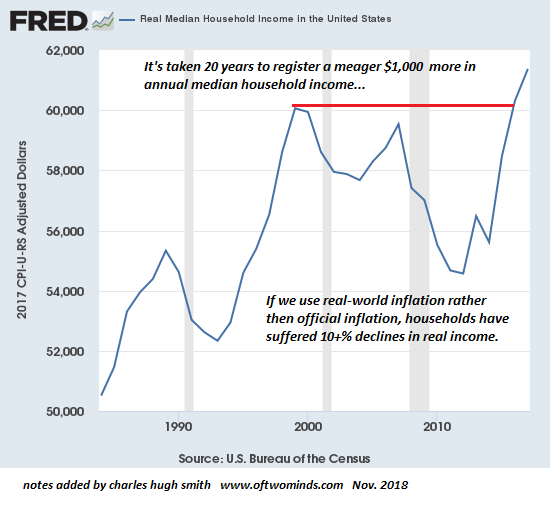


 After the Crash