
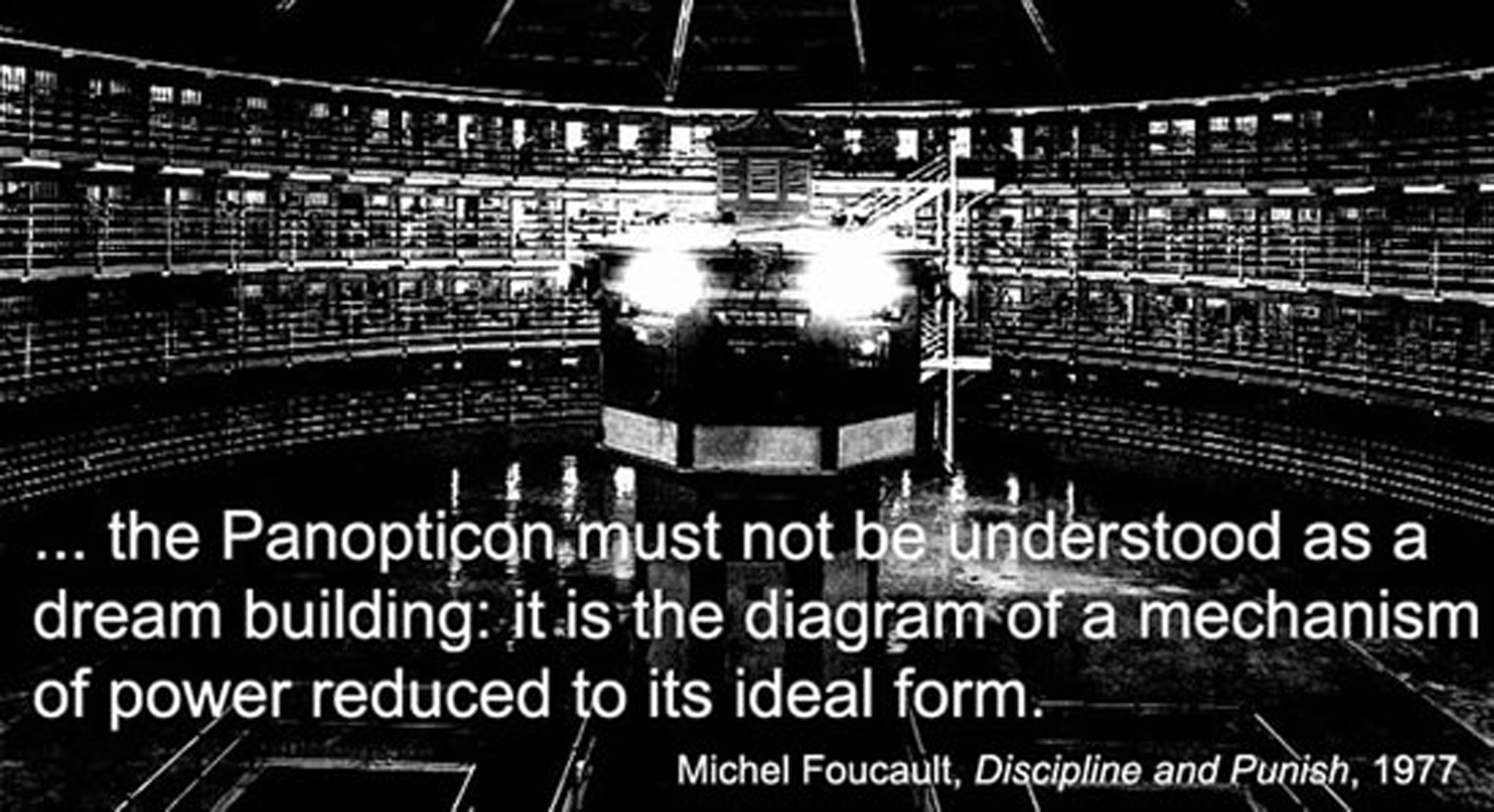
DATAcide: The Total Annihilation of Life as We Know It

panopticon-image

By Douglas Haddow

Source: Adbusters

“So tell me, why did you leave your last job?” he asks.

The first thing I remember about the internet was the noise. That screeching howl of static blips signifying that you were, at last, online. I first heard it in the summer of ’93. We were huddled around my friend’s brand new Macintosh, palms sweaty, one of us on lookout for his mom, the others transfixed as our Webcrawler search bore fruit. An image came chugging down, inch by inch. You could hear the modem wince as it loaded, and like a hammer banging out raw pixels from the darkness beyond the screen, a grainy, low-res jpeg came into view. It was a woman and a horse.

Since then, I’ve had a complicated relationship with the internet. We all have. The noise is gone now, and its reach has grown from a network of isolated weirdos into a silent and invisible membrane that connects everything we do and say.

“I needed a bigger challenge,” I say. This is a lie.

The brewpub we’re in has freshly painted white walls and a polished concrete floor, 20 ft ceilings and dangling lightbulbs. It could double as a minimalist porn set, or perhaps a rendition chamber. Concrete is easy to clean. The table we’re at is long and communal. Whenever someone’s smartphone vibrates we all feel it through the wood, and we’re feeling it every second minute — a look of misery slicing across my face when I realize it’s not mine.

“Tell me about your ideal process,” the guy sitting down the table from us says. My eyes strain sideways. He looks to be about thirty; we all do. Like a young Jeff Bezos, his skin is the color of fresh milk. He’s dressed like a Stasi agent trying to blend in at a disco. Textbook Zuckercore: a collared blue-green plaid shirt unbuttoned with a subdued grey-on-grey graphic tee, blue jeans and sneakers. Functional sneakers. Tech sneakers. This is a tech bar. Frequented by tech people who do tech things. The park down the street is now a tech park. That’s where the tech types gather to broadcast their whimsy and play inclusive non-sports like Quidditch, which, I’m told, is something actual people actually do. It’s a nerd paradise where the only problems that exist are the ones that you’re inspired to solve. And I want in on it, because I want to believe.

“I’m a big fan of social,” I blurt out as an aside. He replies with a calm and ministerial nod. Nobody says “social media” anymore, it’s just “social” now.

My atoms are sitting here drinking a beer, being interviewed for a position at a firm that specializes in online brand management systems. Which is a euphemism for a human centipede of marketers selling marketing to marketers for marketing. The firm is worth a billion dollars. You’ve never heard of it. It’s the type of place where they force you to play ping-pong if you come in looking depressed. Meet the new boss, same as the old boss, except this one is very concerned that you see him as a positive force in the universe.

I’m here, bringing the cold beer to my dry lips and bobbing my head in my best impersonation of someone who doesn’t feel ill when he hears the words “key metrics,” “familiarity,” “control groups” and “variant groups.” It’s the dawn of the new creative economy, and I can dig it. I’m here, but I’m also spread across the internet in a series of containers. I’m in Facebook, I’m in Instagram, I’m in Google, I’m in Twitter and a thousand other places I never knew existed. Depending how my body is disposed of, it will either become dirt or atmosphere. But the digital atoms will live forever, or at least until civilization is incinerated by whatever means we choose to off ourselves.

“What about this position interests you?” he asks.

When the TechCrunchers preach the gospel of disruption, it’s from an industrial perspective that sees life on Earth as a series of business models to be upended. Disrupt or die is the motto, but they never mention the disruptees — the travel agents, the cab drivers, the bellhops. The journalists. The meat in the box before the box is crushed by the anvil of innovation.

“People have ideas about things but it’s a bunch of things. Sign up flow for example, high level things, but sometimes I think — let’s table this for now and put together some idea maps. I feel so empowered because we’re aligned,” someone else says. I look around but can’t trace the source.

It’s hard to focus on his questions when all the conversations occurring parallel to ours combine in a cacophony of sameness, as if we’re all Tedtalking a mantra of ancient buzzwords: Engagement. Intuitive. Connection. User base. Revolutionary. It’s like coke talk gone sour, not words that are meant to say things, but stale semiotics that signify you belong. This is the the new language of business. This is where Wall Street goes to find itself.

“I traded in my suit for khakis and sunglasses,” one of them says. But he’s wearing neither. “That’s the best decision you’ve ever made bro,” his colleague replies.

These are the most boring people on the planet. And it’s their world now, we’re just supplying the data for it. The game is simple: dump venture capital into a concept, get the eyeballs, take the data and profit. But the implications of this crude scheme are profound. Beyond all the hype, something weird is happening.

I can’t eat without instagramming my food. I can’t shit without playing Candy Crush. I can’t even remember who half the people are on my Facebook feed, but I’ll still mindlessly scroll through their tedious status updates and wince at their tacky wedding photos. Out of these aimless swipes, clicks and likes, a new world is being born. A world where everything we do, no matter how inane, is tracked, recorded, sorted and analyzed. Yahoo CEO Marissa Mayer has said the whole process is “like watching the planet develop a nervous system.” And through this system, every human action has become a potential source of profit for our data lords, a signal for them to identify and exploit.

“We are about to enter a world that is half digital and half physical, and without properly noticing, we’ve become half bits and half atoms. These bits are now an integral part of our identity, and we don’t own them,” says Hannes Grassegger.

Grassegger is a German economics journalist who was raised in front of his mom’s Macintosh, and later, on a Commodore 64 he got for his sixth birthday. He recently wrote “Das Kapital bin ich” (I am Capital), a book that has been criticized by the European left for being too capitalist, and by the right for being the communist manifesto of the digital era. In it he tries to answer a deceptively simple question: if our data is the oil of the 21st century, then why aren’t we all sheikhs?

“We’ve all been sharing. But the smart ones have been collecting — and they’ve packed us into their clouds,” he says. “Privacy. Transparency. Surveillance. Security gap. I don’t want to hear about it. These are sloppy downplayings of a radical new condition: We don’t own ourselves any more. We are digital serfs.”

Like Grassegger, and like everybody else, I was lured into this radical new condition with the feel-good promises of connection, friendship and self-expression. Apps, sites and services that allowed us to share what we loved, and do what we wanted. For Grassegger, these platforms were merely fresh lots ready to be ploughed, and in turn they kept the harvest: our feelings, thoughts, experiences and emotions, encoded in letters and numbers. Now they’re putting it all to work, exploiting these assets with algorithms and sentiment analysis, and our virtual souls are toiling even while we sleep.

His solution to this dilemma is practical and pragmatic, siding with a lesser evil of establishing a personalized free data market, which would allow us to exploit our information before others do it for us, arguing that “We must carry into the new space those rights and freedoms we eked out in the physical world centuries ago. The ownership over ourselves and the freedom to employ this property for our own benefit. Only this will help us leave behind our self-imposed digital immaturity.”

“KRRAAAAASHH!”

A waitress lets a pint glass slip from her hand and shatter on the floor, but no one bothers to look over; they’re too engaged. Then I notice something eerie about the vibe in this place. There’s no sneering, no sarcasm, and no self-deprecation. Everyone is just sort of floating along in an earnest tranquility. As if each anecdote about “that cool loft I found on Airbnb” contained some deep spiritual significance beyond my grasp.

My interrogator goes for a piss and I load up Facebook in the interim, hoping to find a shard of inspiration in my feed that will provide a topical talking point. Instead I find a listicle. A curiosity gap headline. An ad. A solicitation. Another ad. Another listicle. Oh dear, someone has lost their phone. And finally, an ad in the form of a listicle. Or is it a listicle in the form of an ad?

We were told to surf the web, but in the end, the web serf’d us. Yet there’s a worse fate than digital serfdom, as Snowden’s ongoing NSA revelations suggest. This isn’t simply about the commodification of all human kinesis, it’s the psychological colonialism that makes the commodification possible.

The nature of this bad trip was hinted at in June when we learned that Facebook manipulated the emotional states of nearly 700,000 of its users. Half of those chosen for the study were fed positivity, the others, despair. “The results show emotional contagion,” the Facebook scientists told us, meaning that they had discovered that alternating between positive and negative stimulus does indeed affect our behaviour. Or perhaps rediscovered. There’s a precedent for this. We’ve been here before.

Burrhus Frederic Skinner, known simply as B.F. to his BFFs, is best known as the psychologist with the painfully large forehead who tried to convince the world that free will was an illusion. But he wasn’t always so dire. He was once a young man with hopes and dreams who wrote poems and sonnets and wanted to become a stream-of-consciousness novelist like his idol, Marcel Proust. He failed miserably and it led him to conclude that he wasn’t capable of writing anything of interest because he had nothing to say. Frustrated and bitter, he resolved that literature was irrelevant and it should be destroyed, and that psychology was the true art form of the 20th century. So he went to Harvard and developed the concept of operant conditioning by putting a rat in a cage and manipulating its behaviour by alternating positive and negative stimulus. Now we’re the rats in the cage, only we don’t know where the cage ends and where it begins.

“What’s your five year vision for social?” he asks.

There’s a right way and a wrong way to answer this question. The wrong way is to be critical and cast scepticism on the internet’s role in our lives. For instance, you could draw a parallel between Facebook’s probing of emotional contagion and the Pentagon’s ongoing research into how to quash dissent and manage social unrest. Or you could mention how the Internet of Things will inevitably consolidate corporate power over our personal liberty unless we implement strict regulations on what part of ourselves can and cannot be quantified. But if you did that, you’d upset the prevailing good vibes and come off like a sickly paranoiac in desperate need of some likes.

The right way is to turn off, buy in and cash out. Reinforce the grand narrative and talk about how social is going to bring people together, not just online, but in the real world. How it will augment our interactions and make us more open. How in five years you’ll be able to meet your true love through an algorithm that correlates your iTunes activity to your medical history and how that algorithm will be worth a billion fucking dollars. And it’s through that magical cloud of squandered human potential that Skinner emerges once again and starts poking his finger into your brain.

After establishing himself as a household name, Skinner was finally able to live out his dream of writing a novel. That novel was Walden Two, a story about a utopian commune where people live a creative and harmonious life in accordance to the principles of radical behaviourism. In contrast to 1984 and Brave New World, it was meant to be a positive portrayal of a technologically-enabled utopian ideal. In it he writes, “The majority of people don’t want to plan. They want to be free of the responsibility of planning. What they ask for is merely some assurance that they will be decently provided for. The rest is a day-to-day enjoyment of life.”

In the late 60s, Walden Two directly inspired a series of attempts to create real world versions of the fictional community it described. These were just a few of the thousands of communes that were being established across America at that time. Some thrived, but the majority fell apart within a couple short years. They failed for a number of reasons: latrines overflowed, the tofu supply ran out, the livestock starved to death and so forth. But what many of them had in common was a cascading systems failure of their foundational hypothesis — that social change could be achieved through self-transformation and the problems of power could be solved simply by ignoring them. There was always a Machiavellian in the transformational mist, though, and a refusal to acknowledge outright how power creates invisible structures that undermine the potential for cooperative action ultimately led to their implosion. It’s in this stale pub, with its complimentary WiFi and overpriced organic popcorn, that those invisible power structures continue to thrive.

“There has to be incentive. There has to be. You can’t force people to use it,” a woman in the corner mutters. She’s among a cluster of people who for some reason are all carrying the same cheap, ugly backpack. Her hand gestures become more aggressive as the conversation progresses and she looks to be caught in a moment midway between panic and ecstasy. Her expression would make the perfect emoji for the inertia of our time. It looks sort of like this: (&’Z)

“Our notions of digital utopianism are deeply rooted in a communal wing of American counter-culture from the 1960s. That group of people have had an enormous impact on how we do technology. Many of the leading figures in technology come from that wing, Steve Jobs would be one,” says Fred Turner, a communications professor at Stanford University who researches and writes about how counterculture and technology interact.

“Their ideas of what a person is and what a community should be has suffused our idealized understanding of what a virtual community can be and what a digital citizen should be. That group believed that what you had to do to save the world was to build communities of consciousness — places where you would step outside mainstream America and turn away from politics and democracy, turn away from the state, and turn instead to people like yourself and to sharing your feelings, your ideas and your information, as a way of making a new world.”

There’s a fault line that runs underneath the recycling bins of America’s abandoned hippy communes all the way to my cracked iPhone 5 screen. And if there is one man who epitomizes the breadth of this fault, it’s Stewart Brand.

In 1968, Brand published the Whole Earth Catalog, an internet before the internet that provided a directory of products for sustainable, alternative and creative lifestyles, and helped connect those who pursued them. When the Whole Earth Catalog went out of business in 1971, Brand threw a “demise party” wherein the audience got to choose who would receive the magazine’s remaining twenty grand. They chose to give it to Fred Moore, an activist moonlighting as a dishwasher, who would go on to found the Homebrew Computer Club — the birthplace of Apple and the PC. In the 80s Brand launched The Whole Earth ’Lectronic Link, one of the world’s first virtual communities. Following its success, he started the Global Business Network — a think tank to shape the future of the world. They’ve worked on “navigating social uncertainty” with corporations like Shell Oil & AT&T, among others. In 2000, GBN was bought by Monitor Group, a consultancy firm that made headlines in 2011 by earning millions of dollars from the Libyan Government to manage and enhance the global profile of Muammar Gaddafi.

Brand’s most enduring legacy will likely come from coining the phrase “information wants to be free,” which serves as the business model for the Actually Existing Internet and the Big Data dream.

Looking around the brewpub, listening to the chatter, and staring into the bright blue eyes of my would-be employer, you can almost hear the words of Google CEO Eric Schmidt echo against the minimalist decor: “We know where you are. We know where you’ve been. We can more or less guess what you’re thinking about.”

In San Francisco, my fellow disruptees have taken to the streets and kicked off a proper bricks & bottle backlash against this sort of dictator-grade hubris that has come to define the Internet of Kings. Crude graffiti reading “DIE TECHIE SCUM” is scrawled on the sidewalk next to Googlebus blockades. TECH = DEATH signs are held up at protests. Tires are slashed, windows are smashed and #techhatecrimes is a hashtag that is being passed around Silicon Valley without a hint of irony.

Just down the street from where I’m sitting, a more passive form of protest has manifested in the form of a new café that promises an escape from the incessant blips and bleeps of the internet and its accoutrements.The tables there are also long and communal, but they’re wrapped inside an aluminum metal mesh designed to interrupt and restrain wireless signals and WiFi.

We are not going to escape this crisis by putting ourselves in a cage. There is no opt-out anymore. You can draw the blinds, deadlock your door, smash your smartphone, and only carry cash, but you’ll still get caught up in their all-seeing algorithmic gaze. They’ve datafied your car, your city and even your snail mail. This is not a conspiracy, it’s the status quo, and we’ve been too busy displacing our anxiety into their tidy little containers to realize what’s going on.

“Do you have any questions for me?” he finally asks, abruptly. My beer is empty, I’m thirsty for another, and the interview hasn’t gone well. I’ve failed to put on a brave face and the only questions that I have concern how much money I’m going to make. Will it be enough to pay for my escalating rent now that the datarazzi have moved into the neighborhood? Or will I have to drive an Über in my spare time to make ends meet?

The internet is a failed utopia. And we’re all trapped inside of it. But I’m not willing to give up on it yet. It’s where I first discovered punk rock and anarchism. Where I learned about the I Ching and Albert Camus while downloading “Holiday in Cambodia” at 15kbps. It’s where I first perved out on the photos of a girl I would eventually fall in love with. It’s home to me, you and everybody we know.

No, the appropriate question to ask is: “What is the purpose of my life?”

I’ve seen the best minds of my generation sucked dry by the economics of the infinite scroll. Amidst the innovation fatigue inherent to a world with more phones than people, we’ve experienced a spectacular failure of the imagination and turned the internet, likely the only thing between us and a very dark future, into little more than a glorified counting machine.

Am I data, or am I human? The truth is somewhere in between. Next time you click I AGREE on some purposefully confusing terms and conditions form, pause for a moment to interrogate the power that lies behind the code. The dream of the internet may have proven difficult to maintain, but the solution is not to dream less, but to dream harder.

The Downing of Malaysia Flight 17: Sinister Pretext for War with Russia

0

By Mike Whitney

Source: Counterpunch

“There is no innocent explanation for the sudden disappearance of MH17 from the media and political spotlight. The plane’s black box has been held in Britain for examination for weeks, and US and Russian spy satellites and military radar were intensively scanning east Ukraine at the time of the crash. The claim that Washington does not have detailed knowledge of the circumstances of the crash and the various forces involved is not credible.”

– Niles Williamson, “Why have the media and Obama administration gone silent on MH17?”, World Socialist Web Site

http://www.wsws.org/en/articles/2014/08/18/ukmh-a18.html

See: 11 minute you tube “MH17 – We know with 99% certainty who shot down MH17

The Obama administration has failed to produce any hard evidence that pro-Russia separatists were responsible for the downing of Malaysia Flight 17.  The administration’s theory– that the jetliner was downed by a surface-to-air missile launched from rebel territory in east Ukraine– is not supported by radar data, satellite imagery, eyewitness testimony or forensic evidence.  In fact, there is no factual basis for the hypothesis at all. It’s merely politically-motivated speculation that’s been repeated endlessly in the media to shape public opinion. The preponderance of evidence suggests a different scenario altogether, that is, that MH17 was shot down by Ukrainian fighters in an effort to frame the pro-Russia separatists and demonize Russia by implication.  This is precisely why the MH17 story has vanished from all the major media for the last three weeks. It’s because the bloody fingerprints point to Obama’s puppet-government in Kiev.

So what are the facts?

Fact Number 1: There were eyewitnesses.

According to the Oxford dictionary, an eyewitness is “A person who has personally seen something happen and can give a first-hand description of it.”  This is why eyewitness testimony is so important in criminal investigations, because what people actually see matters. In a capital case, eyewitness testimony can be just as damning as the bloody fingerprints on a murder weapon. In contrast, theories are of little or no importance at all. The administration’s missile theory is just obfuscating blabber intended to pacify the public with a soothing explanation that is entirely divorced from the facts. Eyewitness accounts help to cut through government bullsh** and uncover what really happened.

So, what did happen to MH17? Check out this blurb from a report by the BBC:

 ”The inhabitants of the nearby villages are certain they saw military aircraft in the sky shortly before the catastrophe. According to them, it was actually the jet fighters that brought down the Boeing.

Eyewitness number one: “There were two explosions in the air. And this is how it broke apart, (Waves her hands to show the plane exploding) And there was another aircraft, a military one, beside it. Everyone saw it….

Yes, yes, It was flying under it, because it could be seen.  It was flying underneath…below the civilian plane.”

Many people saw what happened. Many people saw the Ukrainian fighter rise in a shark-on-seal type motion. Many people saw the explosion. Are these credible witnesses? Are they lying? Do they have a political agenda?

We don’t know, but we do know what they said. They said they saw a fighter (probably a Ukrainian SU 25) stalking MH17 just before it blew up.  That’s significant and it should have a bearing on the investigation.

Fact Number 2: Russia picked up the Ukrainian fighters on their radar.

According to Russian military analysts:

“Russian monitoring systems registered Ukrainian airforce jet, probably an SU 25 fighter, climbing and approaching the Malaysia aircraft. The SU 25 was between 3 to 5 kilometers away from the Malaysian plane. The fighter is capable of reaching an altitude of 10,000 meters for short periods of time. It’s standard armaments include R-60 air-to-air missiles which are capable of locking and destroying targets within a range of 12 kilometers and which are guaranteed to hit their target from a distance of 5 kilometers.

What was a military aircraft doing on a route intended for civilian planes flying at the same time and same altitude of a passenger plane? We would like an answer to this question? …

To corroborate this evidence we have a picture taken at the regional air traffic control center at Rostov….Ukrainian military officials claimed there were no Ukrainian military aircraft in that area of the crash that day. As you can see, that is not true”   (“MH17 Fully Exposed”, The Corbett report; Check minute 34:17 on https://www.youtube.com/watch?v=gWlAARb0fN4video

Repeat:   “Ukrainian military officials claimed there were no Ukrainian military aircraft in that area of the crash that day. As you can see, that is not true.”

Kiev lied. Not only was one of their fighters in the vicinity, but the warplane  also had the capacity to take down a jetliner.

Let’s be clear about how important this information is: We now have hard evidence (Russian radar data and eyewitness testimony) that a Ukrainian fighter was in the vicinity of Malaysia Flight 17 when it was shot down. Thus, the Ukrainian fighter very well may have played a role in the downing of  MH17.  This is a possibility that cannot be excluded if one is basing their judgments on the facts alone.

Then there the story of Carlos who worked at  Kiev’s Air Traffic Control at Borispol but who mysteriously vanished immediately after the crash. Carlos’s twitter feeds on the day of the incident have become something of a legend on the internet, so we would like to narrow our focus to just a few of his communiques.

Carlos tweets on day of MH17 crash:

“Kiev Authorities, trying to make looks like an attack by pro-Russian”…

“warning! It can be a downing, Malaysia Airlines B777 in ukraine, 280 passengers”…

(Military?) “has taken control of ATC in Kiev”….

“The Malaysia Airlines B777 plane disappeared from the radar, there was no communication of any anomaly, confirmed”….

“Plane shot down, shot down, shot down, no accident”….

“Before They remove my phone or they break my head, shot down by Kiev”…

“The B777 plane flew escorted by Ukraine jet fighter until 2 minutes before disappearing from the radar”…

“If Kiev authorities want to tell the truth, It´s gathered, 2 jet fighters flew very close minutes before, wasn’t downed by a fighter”….

“Malaysia Airlines B777 plane just disappeared and Kiev military authority informed us of the downing, How they knew?”…

“all this is gathered in radars, to the unbelieving, shot down by kiev, here we know it and military air traffic control also”…

“military control now officially [say] the plane was shot down by missile”….(“FINAL – Spanish Air Controller @ Kiev Borispol Airport: Ukraine Military Shot Down Boeing #MH17“,  Rebel’s Blog)

Shortly after posting the news on Twitter, the Military took over the tower, the SBU seized the Air traffic Control recordings, and Carlos disappeared never to be seen again.  At the very least, Carlos’s postings lend support to our thesis that one or two SU 25 fighters were in the vicinity of the Boeing 777 at the time of the incident, which is to say they were in a position to shoot it down.

So why have Obama, Kerry and the entire western media excluded the SU 25s from their analysis?  And why are they withholding the satellite and radar data (that everyone knows they have) of the area at the time of the crash?     According to the World Socialist Web Site: “The US Air Force’s Defense Support Program utilizes satellites with infrared sensors to detect missile launches anywhere on the planet, and US radar posts in Europe would have tracked the missile as it shot through the sky.”

Indeed, the US does have the capability to track  missiles launches anywhere on the planet, so where is the data to support their theory that a missile took down MH17?  Where is the satellite imagery? Where is the radar data?  What is it Obama doesn’t want the American people to know?

German pilot and airlines expert, Peter Haisenko,  thinks that Malaysia Flight 17 was not blown up by a  missile, but shot down by the type of double-barreled 30-mm guns used on Ukrainian SU-25 fighter planes.  Haisenko presented his theory in an article which appeared on the Global Research website titled “Revelations of German Pilot: Shocking Analysis of the “Shooting Down” of Malaysian MH17. “Aircraft Was Not Hit by a Missile”. Here’s an excerpt from the article:

“The facts speak clear and loud and are beyond the realm of speculation: The cockpit shows traces of shelling! You can see the entry and exit holes. The edge of a portion of the holes is bent inwards. These are the smaller holes, round and clean, showing the entry points most likely that of a 30 millimeter caliber projectile….”  (“Revelations of German Pilot: Shocking Analysis of the “Shooting Down” of Malaysian MH17. “Aircraft Was Not Hit by a Missile””, Global Research)

Haisenko notes that the munitions used on Ukrainian fighters–anti-tank incendiary and splinter-explosive shells–are capable of taking down a jetliner and that the dense pattern of metal penetrated by multiple projectiles is consistent with the firing pattern of a 30-mm gun.

Also, Michael Bociurkiw, who was one of the first international inspectors from the Organization for Security and Cooperation in Europe (OSCE) to reach the crash site and who spent more than a week examining the ruins– appears to be convinced that MH17 was downed by machinegun fire consistent with the myriad bullet-holes visible on the fuselage.  Here’s what he told on CBC World News:

“There have been two or three pieces of fuselage that have been really pock-marked. It almost looks like machine gun fire; very, very strong machine gun fire that has left these unique marks that we haven’t seen anywhere else.

We’ve also been asked if we’ve seen any signs of a missile?

Well, no we haven’t. That’s the answer.”

(“Malaysia Airlines MH17: Michael Bociurkiw talks about being first at the crash site,” CBC News. Note: The above quote is from the video)

Now, admittedly, the observations of Haisenko and Bociurkiw could mean nothing, after all, they are just opinions. But for the sake of argument, let’s compare what they have to say to the comments made by Obama and Kerry.

Here’s Obama on the day after the crash:

“Here is what we know so far. Evidence indicates that the plane was shot down by a surface-to-air missile that was launched from an area that is controlled by Russian-backed separatists inside of Ukraine.

We also know that this is not the first time a plane has been shot down in eastern Ukraine. Over the last several weeks Russian- backed separatists have shot down a Ukrainian transport plane and a Ukrainian helicopter, and they claimed responsibility for shooting down a Ukrainian fighter jet.

Moreover, we know that these separatists have received a steady flow of support from Russia.

This includes arms and training. It includes heavy weapons. And it includes anti-aircraft weapons.

Now, here’s what’s happened now. This was a global tragedy. An Asian airliner was destroyed in European skies, filled with citizens from many countries. So there has to be a credible international investigation into what happened. The U.N. Security Council has endorsed this investigation, and we will hold all its members, including Russia, to their word…

Now, the United States stands ready to provide any assistance that is necessary…..

Let’s summarize Obama’s allegations:

1–MH17 was shot down in east Ukraine.

2–The separatists have shot down planes in east Ukraine before.

3–Therefore the separatists shot down MH17

Do you find that argument persuasive, dear reader? Keep in mind, Obama has never veered from his original position on the issue nor has he ever addressed the eyewitness reports or the technical data provided by Moscow. When all the media repeat the government’s version of events word-for-word, the facts don’t matter. In other words, Obama hasn’t changed his story, because he doesn’t have to. He knows the dissembling media will assist him in the cover up. Which it has.

Now let’s take a look at what Kerry had to say two days after the crash when he visited all five Sunday talk shows to blast Putin and blame the rebels for downing MH17. According to the Guardian:

 ”Kerry said all the evidence surrounding the downed Malaysia Airlines flight MH17 points towards pro-Russia separatists in eastern Ukraine…..

“We have enormous input about this that points fingers,” Kerry told CNN’s State of the Union. “It is pretty clear that this was a system from Russia, transferred to separatists. We know with confidence that the Ukrainians did not have such a system anywhere near the vicinity at that point of time.”…

Kerry said social media reports and US surveillance put the missile system in question in the vicinity of the crash before the tragedy.

“We know because we observed it by imagery that at the moment of the shootdown we detected a launch from that area,” he said. “Our trajectory shows that it went to the aircraft.” (“MH17 crash: Kerry lays out evidence of pro-Russia separatists’ responsibility“, Guardian)

Needless to say, Kerry has never provided any proof of the satellite “imagery” he referred to on the day of the interview. The administration’s case still depends on the discredited information it picked up on social media and on its own politically-motivated theory. It’s worth noting, that the administration used its shaky claims to great effect by convincing leaders of the European Union to impose more economic sanctions on Russia before any of the facts were known and without any legal process in place for Russia to defend itself.  The sanctions, of course, are still in effect today even though the administrations hysterical accusations have come under increasing scrutiny.

Russian Foreign Minister Sergei Lavrov has repeatedly called for a transparent and thorough international investigation, but Washington seems more eager to sweep the whole matter under the rug. Moscow is particularly interested in recovering the Air Traffic Control tapes which were seized by Kiev’s security services immediately following the crash. It’s imperative that these tapes be handed over to international inspectors to analyze communications between the cockpit and the tower. There’s no doubt that Kiev would hand over the recordings if Washington simply demanded that they do so. But Obama has issued no such order. Why is that?

Keep in mind, that the ATC recordings could be much more valuable than the black boxes because they record both sides of every communication on every frequency used by that facility (including frequencies used for communication with other ground facilities and/or agencies), and also on every land line in use at that facility.”

What does that mean? It means that ATC recorders also include communications between ATC operators and, lets say, government or military authorities. They would also have recorded the communications between ATC and any fighters that may have been in the vicinity of Flight 17. In other words, if MH17 was in fact shot down by a SU 25, there’s a good chance the communications would show up in the ATC tapes.

Is this why Obama hasn’t demanded that Kiev surrender the recordings, because he doesn’t really want the truth to come out? Now take a look at this out from the World Socialist Web Site:

“After a month during which Washington has failed to release evidence to support its charges against Putin, it is clear that the political offensive of the NATO governments and the media frenzy against Putin were based on lies.

If pro-Russian separatists had fired a ground-to-air missile, as the US government claims, the Air Force would have imagery in their possession confirming it beyond a shadow of a doubt…..

On August 9, the Malaysian New Straits Times published an article charging the Kiev regime with shooting down MH17. It stated that evidence from the crash site indicated that the plane was shot down by a Ukrainian fighter with a missile followed by heavy machine gun fire.

While it is too early to say conclusively how MH17 was shot down, the preponderance of the evidence points directly at the Ukrainian regime and, behind them, the American government and the European powers. They created the conditions for the destruction of MH17, backing the fascist-led coup in Kiev this February that brought the current pro-Western regime to power.”

(“Why have the media and Obama administration gone silent on MH17?“, Niles Williamson, World Socialist Web Site)

The media has played a pivotal role in this tragedy, deliberately misleading the American people on critical details related to the case in order to shape their coverage in a way that best serves the interests of the government.  The MSM doesn’t care about identifying the criminals who killed 298 passengers. Their job is to demonize Putin and create a pretext for waging war on Russia.   And that’s exactly what they’re doing.

MIKE WHITNEY lives in Washington state. He is a contributor to Hopeless: Barack Obama and the Politics of Illusion (AK Press). Hopeless is also available in a Kindle edition. He can be reached at fergiewhitney@msn.com.


A Lie That Serves the Rich — the truth about the American economy

american-economy-tiago-hoisel-wallpaper-wallchan-h-n-ibackgroundz.com

By Paul Craig Roberts, John Titus, and Dave Kranzler

Source: PaulCraigRoberts.org

The labor force participation rate has declined from 66.5% in 2007 prior to the last downturn to 62.7% today. This decline in the participation rate is difficult to reconcile with the alleged economic recovery that began in June 2009 and supposedly continues today. Normally a recovery from recession results in a rise in the labor force participation rate.

The Obama regime, economists, and the financial presstitutes have explained this decline in the participation rate as the result of retirements by the baby boomers, those 55 and older. In this five to six minute video, John Titus shows that in actual fact the government’s own employment data show that baby boomers have been entering the work force at record rates and are responsible for raising the labor force participation rate above where it would otherwise be. http://www.tubechop.com/watch/3544087

It is not retirees who are pushing down the participation rate, but those in the 16-19 age group whose participation rate has fallen by 10.4%, those in the 22-14 age group whose participation rate has fallen by 5.4%, and those in the 24-54 age group whose participation rate is down 2.5%.

The offshoring of US manufacturing and tradable professional service jobs has resulted in an economy that can only create new jobs in lowly paid, increasingly part-time nontradable domestic service jobs, such as waitresses, bartenders, retail clerks, and ambulatory health care workers. These are not jobs that can support an independent existence. However, these jobs can supplement retirement incomes that have been hurt by many years of the Federal Reserve’s policy of zero or negative interest rates. Those who were counting on interest earnings on their savings to supplement their retirement and Social Security incomes have reentered the labor force in order to fill the gaps in their budgets created by the Fed’s policy. Unlike the young who lack savings and retirement incomes, the baby boomers’ economic lives are not totally dependent on the lowly-paid, part-time, no-benefits domestic service jobs.

Lies are told in order to make the system look acceptable so that the status quo can be continued. Offshoring America’s jobs benefits the wealthy. The lower labor costs raise corporate profits, and shareholders’ capital gains and performance bonuses of corporate executives rise with the profits. The wealthy are benefitting from the fact that the US economy no longer can create enough livable jobs to keep up with the growth in the working age population.

The clear hard fact is that the US economy is being run for the sole benefit of a few rich people.

8 Simple Steps to Forgive Even the Unforgivable


Cats And Dogs Hugging

By Christina Sarich

Source: Yoga for the New World

Are you feeling resentment? Pain? Anguish? Perhaps even fury? It doesn’t matter if your emotions are directed at the general idiocy of a government that seems bought-out by an elitist class, or a close friend or family member. It doesn’t matter if you are raging at a complete stranger on the road, in a moment that dissipates fairly quickly, or if you are dealing with years of abuse or emotional torment. Forgiveness is a spiritual act that requires us to see things differently than we do now.

It doesn’t seem to be so when we are thinking of the wrong another has done to us, or the hurt they’ve so carelessly lavished, but forgiveness can free us from even the most unforgivable acts. Many of us hold onto our anger in hopes that this emotion will somehow anchor in some Universal Justice – as if our teeth gritting, and brow furrowing can somehow balance the teetering scales of righteousness in the world.

Sadly, the act or words of another that we keep running in our minds is like emotional cement, keeping us stuck and unable to move into peace. Our unforgiveness often doesn’t even affect the ‘other’ as much as it does us. There is a Tibetan Buddhist story about two monks who encounter each other many years after being released from prison where they had been horribly tortured by their captors. “Have you forgiven them?” asks the first. “I will never forgive them! Never!” replies the second. “Well, I guess they still have you in prison, don’t they?” the first says.

Many mistakenly believe that forgiveness somehow absolves another from their wrong-doing. That in forgiving, we helplessly accept, give up, surrender to defeat – that we are helpless. The exact opposite is true. When we face a terrible wrong, and look within to see how we can prevent the same incident from happening again, then we are truly on the correct spiritual path.

Dr. Fred Luskin is the Director of the Stanford University Forgiveness Projects. He has led the largest research project to date to study the effects of forgiveness on hurt individuals. He has dealt with people suffering from a huge range of things needing to be forgiven – from a romantic break up to the murder of a child. He believes that there are specific steps one can take to reduce the stress that comes with holding onto hurt, and make the progress of forgiveness as easy as possible. I tend to agree. Forgiveness usually takes a little time, but it needn’t consume your life for years. You can start with these eight steps to move your heart into the right place, and begin to forgive:

  1. We are often afraid to truly articulate just how much we have been wronged, but we must. In cases that are more obvious – such as losing a family member in a war-torn country to the hands of an unfeeling mercenary – it is easier to explain how angry and sad we are, but in other cases, such as with long-term familial abuse, we may have even come to think the behaviors we were subjected to were ‘normal,’ and only later do we realize how much pain and hurt we stuffed down over the years in order to function within our family unit. When that pain is realized, it is helpful to articulate it to a counselor or a few close friends. Keeping those emotions locked inside does not permit the process of forgiveness to begin.
  1. Forgiveness is a personal journey. You do it for yourself, not for the person you think needs to be forgiven, or anyone else. Once you make a commitment to do whatever it takes to let go of the pain and feel better – and do it for you, then forgiveness starts to become an easier endeavor. When you feel better about yourself, after all, you will find it more difficult to hold grudges against others. When needed practice self-care and self-love. If you are still involved with the person or people who you are trying to forgive, you can simply explain to them that you need time to care for yourself. If this is not appropriate due to the ongoing behavior of another, then simply practice uncompromising self-love and distance yourself from the other person until your feelings of anger and hatred dissipate. Reconciliation may be possible in the future.
  1. While reconciliation is at times possible, sometimes it just isn’t. If someone is emotionally unstable, and will likely continue to act in hurtful or harmful ways, we don’t need to be physically or emotionally near them to forgive them. What you’re after is internal peace. Forgiveness can be defined as the peace and understanding that comes from dropping the blame for whoever has hurt you – changing your never-ending story of grievance, and realizing that they were possibly playing a role in the grand play of life – called maya – to help you learn more about yourself. It doesn’t mean that murdering your child is right, or that stealing, cheating, emotional abuse, or other ‘wrongs’ are ‘right.’ It simply means that you choose to see that person’s pain as the impetus for their own actions, and not as a personal affront to you. Maya Angelou once said, “You can’t forgive without loving. And I don’t mean sentimentality. I don’t mean mush. I mean having enough courage to stand up and say, ‘I forgive, I’m done with it.’” If someone has been narcissistic, selfish, hateful, or jealous, you can forgive them for your own peace of mind, and allow them to learn from the Universal lessons, which are surely coming their way, to help them forgive those who hurt them also. While you don’t have to reconcile with others who are not ready to do this spiritual work for themselves, you do have to reconcile your own emotions.
  1. Believe it or not your hurt is coming from what you feel now, not what happened ten minutes ago, an hour ago, days ago, or even ten years ago. That old adage about time healing all wounds is true, but this is because we tend to get caught in karmic cycles that cause us to mentally recycle pain instead of letting it go. In the book Karma and Reincarnation Transcending Your Past, Transforming Your Future, Elizabeth Clare Prophet and Patricia R. Spadaro explain that while “karma means accountability and payback, reincarnation is simply another word for opportunity.” Karmic retribution is not punishment, but the benevolent Universe’s way of allowing us free will. It does mean, however, that what we do unto others, will be done unto us, somehow, at some time, in some way. The Sioux holy man, Black Elk, has explained that even nature comes full circle, and Voltaire espoused the fact that “it is not more surprising to be born twice, than once; everything in nature is resurrection. The cycles of karma and reincarnation can help us to understand family patterns, community patterns, and even wider societal patterns that need undoing. When we stay stuck in thoughts of the pain another has caused us, we miss the opportunity of this incarnation. After talking about a hurt with another person, and expressing it fully, it is time to start letting it go, and looking at the patterns which we created it. This is the true gift of being ‘hurt’ be another – it is really a chance to see how we have hurt ourselves.

I had the feeling that I was a historical fragment, an excerpt for which the preceding and succeeding text was missing . . . I could well imagine that I might have lived in former centuries and there encountered questions I was not yet able to answer; that I had to be born again because I had not fulfilled the task that was given to me. ~ Carl Jung

  1. Stop your fight or flight response. When we start to ruminate about what another has done to us, our hypothalamus gets in gear, engaging both the sympathetic nervous system and the adrenal-cortical system. When the effect of these two systems goes ‘online’ the fight or flight response begins – this means we are in moderate to full-blown fear mode. We are afraid this will happen to us again. We are feeling the incident as if it were happening right now, no matter now long ago it occurred. Our heart rates and blood pressure rise. We might even sweat a little. Our bodies are flooded with 30 different stress hormones and it can make ‘forgiving’ very difficult. By instead practicing a simple, calming mantra meditation, a few yoga asanas, yoga nidra, nadi shodhana, or going for a short walk outdoors, we can reverse this fight-or-flight response, and deal with the fear behind our pain from a more level emotional state.
  1. Give up your expectations of others – Dr. Luskin calls this ‘recognizing the unenforceable rules.’ In other words, you can’t expect to get from others, what they have no ability or desire to give you. While we can practice love without expectation, we also should be aware that others aren’t always capable of loving back. If your inner child is still bemoaning the inability of an emotionally shutdown father to be affectionate and caring, or you expect a selfish boss to behave differently, then you are setting yourself up for more pain, and often. Realize that what you seek from others – kindness, love, affection, support – will come from those willing and able to give it, and the more you offer it to yourself, the more likely these individuals will come into your orbit. Just let the others, who are not ready to act as evolved, be. No resentment – that’s just where they are at in their cycle or karma and reincarnation.
  1. Know that a life well lived is your best revenge – as long as you stay hurt and angry, you are feeding the ego of the person who felt the need to hurt you. You give that person power over you – you are still in ‘prison’ like the two monks said. Find personal power in the good things in your life. Robert Emmons and Michael McCullough are two of the leading American investigators of gratitude. They describe gratitude as personality strength—the ability to be keenly aware of the good things that happen to you and never take them for granted. Grateful individuals express their thanks and appreciation to others in a heartfelt way, not just to be polite. If you possess a high level of gratitude, you often feel an emotional sense of wonder, thankfulness and appreciation for life itself. Start a gratitude journal, or simply practice a few moments of quiet contemplation realizing all you do have now, instead of getting stuck on your hurt feelings. Counting your blessings is not only good for your health, but it helps to dissipate sadness, anger, and frustration.
  1. Change your ‘story’ – Instead of telling a story to yourself and others about how you were done wrong, decide to rewrite the script. You can, instead of being a victim, decide to use the experience as a way to heal others, and practice one of the most profound spiritual practices ever taught. Imagine the ripples that the pebbles of forgiveness could send out into the world. I give the example of a man named Robert Rule to explain exactly how profound changing your story can be:

“Gary Leon Ridgway is better known as the infamous Green River Killer. In 2003, he confessed to the murders of 48 women. In 2011, Ridgway was convicted of the murder of Rebecca Marrero, bringing the victim count up to 49. By his own confession, he may have murdered as many as 60 women. Ridgway especially despised prostitutes and targeted them for his killings. At Ridgway’s 2003 sentencing, the families of the victims had the opportunity to speak out and address Ridgway directly. Understandably, many were angry and lashed out at Ridgway for the unimaginable grief he had put them through. As Ridgway stonily listened to the family members express their grief and anger, one person came up and said something unexpected. When the time came for Robert Rule, the father of teenage victim Linda Jane Rule, to speak, Ridgway finally showed a glimpse of remorse. Rule’s words to Ridgway were: “Mr. Ridgway . . . there are people here that hate you. I’m not one of them. You’ve made it difficult to live up to what I believe, and that is what God says to do, and that’s to forgive. You are forgiven, sir.” These words brought Ridgway to tears.”

About the Author

Christina Sarich is a musician, yogi, humanitarian and freelance writer who channels many hours of studying Lao Tzu, Paramahansa Yogananda, Rob Brezny, Miles Davis, and Tom Robbins into interesting tidbits to help you Wake up Your Sleepy Little Head, and *See the Big Picture*. Her blog is Yoga for the New World . Her latest book is Pharma Sutra: Healing The Body And Mind Through The Art Of Yoga. Please reprint this article with attribution bio and all links in tact.

Into the black hole: an interview with comics author Grant Morrison

index

‘Annihilator,’ antiheroes, and the creation of modern myths

By Adi Robertson

Source: The Verge

More than almost anyone, Grant Morrison has plumbed the weirdness that lies at the heart of comics. Since the 1980s, he’s helped redefine the superhero genre, producing surreal, fourth-wall-breaking titles like Animal Man and Doom Patrol, as well as popular iterations of Batman and Superman and the DC Universe-wide Final Crisis storyline. The Invisibles, one of his best-known works, slowly unfurled from a straightforward story about a team of countercultural rebels into a mind-bending deconstruction of reality itself. His nonfiction book Supergods analyzed superheroes as mythological archetypes that we create and rework to express the basic elements of being human.

Morrison’s career is too long to neatly summarize, but one of its central themes is the highly permeable boundary between fiction and reality. His upcoming six-issue series, Annihilator, is no exception. Drawn by artist Frazer Irving, it’s about a screenwriter named Ray Spass struggling to write a sci-fi blockbuster about a rebel named Max Nomax, who has been exiled to the penumbra of a black hole for committing “the ultimate crime.” Soon, he’s writing not for a studio but for Nomax himself, who is simultaneously a fictional character, the ur-template for Byronic antiheroes throughout history, and a real man who gives Ray seven days to write him a past.

Devil deals and black-hole prisons notwithstanding, Annihilator doesn’t have the otherworldly trippiness of some of Morrison’s best-known work. In some places, it’s a take that to Hollywood banality; in others, it’s an attempt to distill fictional characters down to their most basic essence. With the first issue out tomorrow, we talked to Morrison about myth-making, originality, and the dark undercurrents of modern fiction.

Interview has been condensed and edited for clarity.

Annihilator feels less packed with surreality than some of the things that I remember you for. It seems more traditionally designed and plotted.

You’re absolutely right. It was deliberately designed to seem more like a Hollywood thing, and that’s why it was the perfect project for Legendary, who are a Hollywood movie studio. So when they came to me and we talked about doing comics with Bob Schreck and Thomas Tull, this was the idea I thought was most appropriate for Legendary, because it was about filmmaking, it was about Hollywood, it was about the movies. So yeah, I mean, it’s a lot more real than some of the stuff that I write. But also it, as you’ll see, it goes into pretty bizarre areas. But I find that the mundane and the fantastic are pretty closely linked anyway, so I kind of enjoy doing both.

Ray Spass reminds me a little of the Stephen King prototype, the down-and-out writer.

The thing about Ray is that he’s not entirely down and out, he obviously has a little bit of money because he buys quite a nice house at the beginning of the book. But I think morally he’s down and out, and creatively he’s down and out. But he was based very much on a bunch of different people that I actually met in Los Angeles and found quite fascinating. People who’d live and work in Los Angeles on a pretty regular basis. So I was kind of basing it on my observations of people in the town.

You’ve talked about how Annihilator is sort of all about Los Angeles.

Absolutely. As I’ve said, obviously you start to cover similar ground, but I find the place fascinating. I’ve got a house there, and I’ve spent a lot of time there and I have a lot of friends there, and while there’s a certain softness and glamor and glitter to Los Angeles, I think what’s really interesting is what’s underneath. It’s a very dark place, and it has connections to this strange occult stuff, the whole Church of Satan and Anton LaVey, which I’ve mentioned before, or the Jack Parsons Jet Lab connection, or the Manson family, of the Doors and the Snake and the underground caverns that they used to talk about. And I think it’s got a very strange undercurrent that I find quite fascinating, because it’s completely at odds with the way most people think of Hollywood, probably.

And it’s a town of devil deals, it’s a town of people selling their souls for fame or success or money, so I think it’s got a very strange atmosphere. I tried to capture that, with Frazer [Irvine’s] help, in Annihilator.

It’s an incredibly dark comic.

At the same time, hopefully what we tried to do with it was make it funny, because I think if you’re trying to confront the dark in that sense, I think it has to at least be leavened with humanity’s great gift, which is a sense of humor. So hopefully it’ll at least give you a few laughs as well.

There were a couple of bits that were really fantastic. I loved the “cure for death” page, because it totally captured something being fantastic and then going to the next page and saying, “Wow, that’s also really overwrought and dramatic. But still great.”

That was like, the period at the end of that sentence, which sounded so full of bravado, and then you turn the page and have the sense of everything as a vast, black hole that doesn’t go away.

How do you approach creating an archetype like Max Nomax, compared to just using an actual existing character? You’re reinterpreting both, but how do you deal with them differently?

I was trying to do Ray Spass as a contemporary screenwriter who’s working in Hollywood right now,

and right now, Hollywood, as you know, is pretty obsessed with superheroic characters or, as you see, pretty archetypal characters. It’s easy to understand what Batman represents, for instance. So I was, I wanted to show that he was doing that kind of movie, that he was trying to create a hero for the 21st century, in these fraught and fretful times we live in.

So then I got to thinking about characters like Batman, and Hamlet, and that kind of high-cheekboned, Byronic, antihero character that’s kind of haunted all of our literature and so many of our movies and books and TV shows, and it was really just about going back. Because ultimately I thought that all tracks back to Milton’s Satan to be honest. So I kind of was telling a story about a devil, through the medium of science fiction. And I think the character came to me through these different angles, and then I thought about the different portrayals of that character in popular culture, so we connected them to Fantomas, you know, the early 20th-century surrealist hero who was kind of a pulp fiction character, or to characters like Diabolik from the 1970s Italian comic books, or Criminale, who was another, a character who dressed in a skull suit and went around robbing people and shooting things.

They were very dark antiheroes, and I was kind of trying to track the lineage of those guys right back to the original, and build up Nomax from basically Milton’s Satan via lots of these other portrayals of the ultimate rebel antihero poet dissident character that we’ve been haunted by.

What’s the difference to you between something like this, an archetype of something classic, and just a cliche?

Who knows? I think it just depends on how you deploy them. Perhaps it can easily shift into cliché — I mean, as long as I don’t feel it’s a cliché, then I’m fine with it. But I think if other people start to see that, then yeah, obviously it becomes embarrassing. So hopefully Nomax won’t be a cliché. We’ve tried to give him a personality that’s pretty strong and pretty direct, and again quite funny; he’s got a certain take on things. So I think the only way to do it is to be aware of its origins, and kind of the ubiquity of these figures, but at the same time give them enough personality that… Max Nomax is very different from the other iterations of the dark man I’ve mentioned, so hopefully he has his own personality as well.

The female characters that I’ve seen so far tend to be love interests and prostitutes. I’m wondering if that’s something that’s going to change?

It’s actually about that; there’s a character who comes in in Issue 3 who’s really central to the entire thing, and it’s kind of about the attitude of men to women in Hollywood. Again it’s something that you’ll see unfold, but actually part of the story is about the way men treat women. About how the screen treats women.

How do you do that without just replicating it? How do you depict that without it just being another part of Hollywood — talking about how men treat women but just treating them the same way?

By making the character strong, and by giving her things to do, which aren’t necessarily the traditional things that happen in stories like these. And that’s honestly what it’s all about, as you’ll see, I think. The female character who enters this story is very important to how it plays out.

Do you think these themes and myths are all something that are already set, and we’re just going back to a monomyth? Or are we still developing new archetypes, and new myths, and new ideas?

I honestly.. from having observed it, I think we keep going back to what are basically six human default personalities. We have these different characters: there’s the comedian, there’s the lover, there’s the stern judge, there’s the critic… I think people have always developed gods and ideas like that around these basic default states of the actual human personality. I think it’s just part of how we’re made up. It’s almost like the periodic table of being human. And I think no matter how modern these characters look, I’m not entirely convinced…

I think certain things like the atom bomb created a new archetype, and we saw how that appeared in fiction, and in pop culture. So yeah, there’s probably the potential for new technologies and new ideas to create their own archetypes, but I honestly think the human personality hasn’t changed much over our entire span of time. I know I live in the 21st century, so I have no idea what people felt like in the 1300s!

But that’s kind of my take on it, right or wrong, I kind of think we do go back to the same well often, because I think these are the characteristics we recognize in ourselves and others as being kind of universal.

Are there types that you wish you’d been able to write so far that you haven’t? Or that you’re interested in?

I guess as a writer you’re often drawn to characters like Nomax the rebel, because a lot of writers like to self-imagine themselves as rebels against society when in fact most of the time we’re just part of society. I’ve kind of tried to write about characters that I felt at least some connection with, but I think through my life I’ve always written about people who are slightly at right angles to society, and maybe that’s just… maybe I need to write more about kings and queens and dukes.

You were talking about Annihilator and darkness and this being a place that we are culturally right now. Do you think there’s something that follows that, something that we’re going to be moving into?

It’s hard to say, because we seem to be very enamored by darkness. Things just keep coming out like True Detective, which came out earlier in the year and was really talking about darkness and nihilism, and that obviously was inspired by a lot of the same books I read when I was working on Annihilator. But that was a great show and it really seemed timely and important and modern. I think whether it’s created by the media — because really as we know, most people are living better lives now than they have at any time in history, most people are safer, especially in the Western world, the child mortality rate has gone down, the chance of dying has lessened — so we actually live in a much better world, but our entertainment seems really very interested in the dark areas of experience. It goes all the way from the zombies to the obsession with war and violence that we have. I don’t know if it’s just because we’re so comfortable we can afford to play with these things, or if there is just something wrong with humanity.

Besides True Detective, what are you looking at right now in terms of contemporary artists, authors, etc.?

Not an awful lot of stuff. I tend to just lock myself away and work. But again a lot of stuff kind of relates to what I’m doing. I picked up a book quite recently called Luminarium by Alex Shakar, an author, and it just seemed to be talking about the same stuff that I’m talking about in Annihilator. It’s all about the abyss at the center of our lives that we try to forget about and we make stories about and we orbit around. So I’m just… I’ve been reading a lot of that, and then nihilism, like Raymond Brassier, the nihilist philosopher, and Thomas Ligotti, because I really wanted to get down into the dark areas of human experience.

If it doesn’t sound too grandiose, what kind of stuff do you think people are going to be mining your work for, and everybody else’s work for, in 40 years? The way that we’re looking back at things from the mid-20th century and reinterpreting them?

I don’t know. I think honestly it will just be more Batman. I think a lot of us will be forgotten in 40 years. I really don’t expect — my work is talking about the world I’m in, with the people that I live in the world with right now, so I never think about the future. I honestly think I’ll be forgotten in two generations, and what will be there is Sherlock Holmes and all the stuff that we’re kind of fascinated with, unless people break out of their nervous fear of the future and start to innovate again. Right now it seems like everybody’d kind of rather look backwards than forwards, because forwards seems a bit scary.

Mind control: Orwell, Huxley, and today’s reality

orwell-huxley

We are able to see the architecture – the structural patterns – of each kind of mind-control regime. This can help us recognize precursors – signs that such a future is coming our way.

by Richard K. Moore

Source: News Beacon Ireland

Dystopian predictions

In 1984, George Orwell paints a picture of a dark, gray world. People are afraid to say anything contrary to the official party line, and surveillance is universal. Even thinking contrary to the party is a crime, and thoughtcrimes may be treated by radical psychological intervention. Information is closely controlled by the party media, and the historical record is routinely edited, so as to conform to the latest party statements.

By contrast, in Brave New World, Aldous Huxley paints a colorful, superficially pleasant world. Personal freedom of all kinds is encouraged, even to the point of being a cultural imperative. In the book a young boy is referred to a therapist, because he doesn’t want to play sex games with a girl classmate. An adult character is considered aberrant, because he is drawn toward a monogamous relationship. Drugs and distractions are readily available for mood enhancement.

Central to Huxley’s world is the abolition of the family. Sex never results in pregnancy, and embryos are grown in a production process, based on selected seed material. As part of the production process, an embryo can be fed or starved, at various stages of its development, so as to create classes of people (alphas, betas, etc) with differing levels of intelligence and skills. Quotas are set, regarding how many people of each class are going to be needed, and should therefore be produced.

Various kinds of conditioning are then used on infants in order to get them to accept their class, along with its prerogatives and restrictions, as being best for them. Children are raised on a communal basis, with no concept of parents, siblings, or family. From embryo to adulthood, the state has fine-tuned control over the development of the person, and of their thinking. In the resulting society, people behave as they were programmed to behave, and can’t imagine things being any different.

In Orwell’s world, wrong-thought (thoughtcrime) is detected and suppressed. In Huxley’s world, wrong-thought is unlikely to arise. Orwell’s world suppresses the individual; Huxley’s world manufactures the individual. In both cases, mind control – control over what people are able to think – is the strategy of the regime, as its means of social control generally. Orwell explores a brute-force approach to mind control, while Huxley explores a scientific approach.

The novels are useful because they each take one of these basic approaches to mind control, and follow its consequences to the end. If you really want to suppress what people think, you’d need to do A, B, and C. If you really want to program people, you’ve got to start when they’re born and do X, Y, and Z. We are able to see the architecture – the structural patterns – of each kind of mind-control regime. This can help us recognize precursors – signs that such a future is coming our way.

Echoes of Orwell

Consider the world of mainstream journalists, in particular TV news anchors. There we have a world with echoes of 1984, where what is said must conform to the party line. Any thoughtcrime – such as an anchor commenting onscreen that he doesn’t buy the official story of 9/11, or he thinks Russia isn’t an aggressor – would be quickly punished by the equivalent of death – expulsion from the world of journalism.

Thus is maintained the Matrix, the story we are told about US benevolence, the existence of democracy, the sacredness of market forces, and all the rest. With control of major media in just a few hands, the party line can be always maintained, and current (or past) events can be interpreted within that framework. To do otherwise, for a news anchor, would be literally unthinkable. Huxley’s Ministry of Truth is at work in our world, but it is invisible, hiding away in the boardrooms of media conglomerates, and behind the doors of the White House press office.

The same kind thoughtcrime regime is operating in other arenas as well, where socially-sensitive topics are concerned. The peer-review process, and the editorial boards of the relevant journals, ensure that thoughtcrimes are suppressed, when it comes to concerns regarding genetic manipulation, pesticides, fracking, pharmaceuticals, radiation levels, etc. Again, the Ministry of Truth is invisible, residing high up in the chain of corporate boardrooms.

Even though our society doesn’t resemble Orwell’s dystopia, his mind control methods are operating in very critical places, where the population’s ‘information’ is generated. And of course we do have universal surveillance, courtesy of the NSA, omnipresent CATV cameras, and cell-phone tracking. Big Brother is with us, but he stays behind the scenes, he sees all, and he decides what stories we will be told about the world by the mainstream media.

Echoes of Huxley

Huxley wrote a review of 1984, where he talked about the two different future visions. He suggested that we might go through some kind of dark period, reminiscent of 1984, but he thinks such a regime would be unstable and transitional. He goes on to say that the scientific approach to mind control, based on programming people’s belief systems, would be the more sensible choice for a modern totalitarian society.

US Government research into scientific mind control began at least in the 1960’s, and has been ongoing. The first approach – the CIA’s Operation Mind Control – was heavy handed, reminiscent of 1984. This research involved giving people psychotropic drugs, along with post-hypnotic suggestions. Quite a bit could be (and has been) accomplished with these kinds of methods, along the lines of The Manchurian Candidate, but it didn’t provide a general solution: two much work was required to program people on an individual basis.

Research then shifted to cult creation. If people can be herded into cults of various kinds, cult dynamics themselves would serve the programming function. This provides a more wholesale approach to mind control, than the individual methods tried earlier. The CIA has never publicly claimed credit for this later research, but the experiments were very successful, including Reverend Jim Jones and the People’s Temple, and David Koresh and Waco.

In this kind of research, the first step is to identify a natural cult leader, who has already shown some success in gathering followers. Then the cult is given support of various kinds. Covert agents are sent in to join the cult, not only to observe and report, but also to provide organizational skills. Funds are channeled to the cult, and local police are warned off, so that the cult can grow unhampered.

In this way, researchers have been able to study how a skilled cult leader operates, how people are drawn into a cult, how loyalty is maintained, and how people can be pushed into extreme beliefs and actions. When everything had been learned that could be learned from a cult, the cult’s leader and members were then killed, so as to hide the evidence of what had really been going on in the experiment.

Cults and their uses

One of the first large-scale deployments of cult technology, informed by this research, was the creation of the Jihad movement by the CIA. The immediate purpose was to destabilize the Soviet regime, by tying it down in a quagmire in Afghanistan. This operation was quite successful. Since then, the Jihad cult movement – aka Taliban, Al Qaeda, Kosovo Liberation Army, ISIS, etc. – has proven to be an extremely useful tool for the purpose of destabilizing regimes, in pursuit of US geopolitical objectives. These destabilization operations in turn provide an excuse for direct US intervention, as we’ve seen recently in Libya and Iraq, and as we may soon see in Syria.

Cults generally have certain characteristics. There is usually a charismatic leader, who is able to inspire belief and loyalty in cult members. There is always a defining core belief system, that sets cult members off from outsiders, and which provides a strong sense of identity and purpose for members. There is typically an alleged ‘outside threat’ to the cult, which draws members together. There are actions and sacrifices required of members, which serve to bind them more tightly to the cult.  There are packaged arguments, that cult members are taught to employ, to repel attempts undermine the core belief system. These programming methods are very powerful, and typically intense deprogramming is needed to ply members away from a cult, once they have been thoroughly indoctrinated.

The society described in Brave New World is in fact a cult-based society. Each of the classes (alpha, beta, etc.) is a cult, and the programming begins at birth. No charismatic leader is needed, when so much control over programming is available. Each cult has its own core belief system, along with packaged arguments to maintain those beliefs. The required actions and sacrifices are simply the lifestyle which has been designed for each class. Such a society would tend to be stable, particularly since deprogramming efforts would be absent from the scene.

It is notable that Huxley’s world is not about a single cult, a uniform society, but rather about multiple cults. This makes for greater stability. Cult members have not only a model of what-to-be, they also have models of what-not-to-be. Each cult is more clearly defined, and drawn more into itself, by the existence of other cults. Being glad you’re not a beta is one of the reasons to be glad you are an alpha.

We see this same multi-cult dynamic operating in the US, in the divisiveness between liberals and conservatives. Liberals are kept in the fold by stories of conservative folly, and conservatives are kept in the fold by stories of liberal folly. In a propaganda-only system of control, there would be one party line for everyone. In this multi-cult system, there are two party lines, which we might characterize as CNN vs. FOX.

While the two party lines have many differences, in order to keep the two cults separated, they in fact share basic essentials in common. They both sustain the myth that state policy is a response to public sentiment, and they blame the other cult for providing support for the ‘bad’ policies. In fact US policy is made outside of government, by financial elites, and the state aims to control public sentiment, not respond to it. In this way we can see CNN and FOX as collaborators, sharing the common goal of hiding this fundamental truth from the people. The Democratic and Republican parties collaborate toward this same goal, using Congress as a stage, where they carry on a theater of divisiveness, providing the appearance of a democratic decision-making process.

The Barack Obama phenomenon provides an excellent example of cult tactics in action. Obama himself is obviously a natural cult leader, articulate and charismatic. He came onto the scene offering an inspiring core belief in deep reform, “The ground of politics has changed; Yes we Can!”. The dramatic effect was intense, as if we were witnessing the Second Coming. Campaign volunteers became the core of the budding Obama cult, and they were given lots of work to do, binding their identity to Obama and his professed mission. The McCain campaign was orchestrated to look like a dangerous threat by a rival cult, binding Obama supporters even more tightly.

The success of this mind-control operation was truly amazing. Obama in fact proceeded to carry on and expand everything Bush had been doing; the ground of politics hadn’t changed at all. But the cult binding was so strong that his support continued, by the very people who had hated Bush because of the same policies. Packaged arguments were put forward, to keep people in the cult, blaming Obama’s performance on Republican opposition – the standard divisiveness tactic. Even today there remain legions of Obama loyalists. Once bound to a cult, leaving becomes psychologically difficult.

Another example of mind control by means of cults is provided by global-warming hysteria. Al Gore played the role, at least temporarily, of cult leader, when he presented the core belief in CO2-caused climate crisis in his scientifically fraudulent, but very popular film,  An Inconvenient Truth. The growth of the cult was ensured by the fact that it then became a thoughtcrime in mainstream media and climate journals to question these core beliefs. Cult members are given things to do and sacrifices to make, like riding a bicycle and buying a Prius. They are given a packaged argument, that contrary views are nothing but the propaganda of an outside-threat: the evil petroleum industry.

This kind of mind control operation is much more effective than propaganda on its own. It’s not just that cult members believe in CO2-caused climate crisis, they believe they are fighting a battle against an enemy. They have been fully immunized against counter arguments to their core beliefs, and their only concern is to ‘save the planet’ by supporting anything that looks like it will reduce carbon emissions. Thus they are being led willingly down the garden path to a micro-managed society, as outlined in Agenda 21.

The ‘conspiracy theory’ meme

State control of public schools and mainstream media goes a long way towards programming people’s minds. But it is not enough, particularly in the era of the Internet. There are many sources available that thoroughly debunk mainstream propaganda, and by using those sources a large number of people have escaped, at least in part, from the mind-control regime. In Orwell’s world, the Internet would be banned. In our world, which is developing more along Huxley’s lines, other ways have been found to limit the ability of the Internet to undermine the mainstream narratives.

The ‘conspiracy theory’ meme was launched by the CIA in the wake of the JFK assassination. The official story was so full of holes that more and more people were beginning to doubt it. While the Warren Commission was busy writing its cover-up document, the public began to learn about the existence of ‘conspiracy theorists’. These are people, the story goes, who suffer from paranoid delusions, and sane people should pay no attention to anything they say. If someone even looks at any of those ideas, their own mental stability comes into question.

This mind-control tactic was very effective in marginalizing research into the truth behind the JFK assassination. Anyone who presented evidence contrary to the official story was automatically seen as ‘conspiracy theorist’. By scoffing at such evidence, without looking at it, you could demonstrate that you were mentally balanced. Thus logic and reasoning are banished from the scenario. Either you believe the official story, or your mental health is called into question.

Since then, the conspiracy-theory meme has been carefully nurtured and expanded by the mainstream party lines. This mind-control campaign has been very successful in immunizing the majority of the population against the revelations available on the Internet. Any story not appearing in the mainstream media must by definition be a conspiracy theory, and anything that sounds like a conspiracy theory should be scoffed at and ignored.

Thus for the majority of the population we have a tightly controlled, two-tier, mind-control regime. The thoughtcrime dynamic governs what the media says, and the conspiracy-theory dynamic immunizes people against other views. For the majority, the party line (either CNN or FOX) is ‘truth’, as in Orwell’s world, but without the need for Big Brother’s extreme methods.

By these mind-control methods, a bubble has been created, in which the majority does their thinking. Inside the bubble are the two party-line narratives, and outside the bubble the real world proceeds, invisible to those inside the bubble. It’s a very effective system. The more outrageous the real actions of the state, the more quickly the majority rejects revelations of those actions, as being outrageous conspiracy theories.

In some cases the FOX party line includes accurate revelations which would be thoughtcrimes in the CNN world. In such cases, the CNN world responds by classifying those revelations as  ‘right wing’ conspiracy theories. Unlike a propaganda-only system, where state crimes are always hidden, this multi-cult system enables the state to document its own crimes on conservative media, and know that the information will be disbelieved by the liberal cult. This system allows the truth to be hidden from some, through the act of revealing it to others. Very clever.

Mind control outside the bubble

While the majority may be inside the bubble, there is a large and growing number of people who don’t have faith in any mainstream party line, and who are open to considering the various ideas they find from Internet sources. The phrase ‘waking up’ is frequently used to describe the process of escaping from the bubble. More and more people are ‘waking up’ to the reality of false-flag events, routine government lies, the deep corruption of politics and the media, and the sociopathic central bankers who exercise the reins of power from behind the scenes.

However, the Internet is not being ignored by the state, and mind-control operations are underway there as well – designed for those who have ‘woken up’. Such operations are not aimed at moving people back into the bubble, rather they embrace the ‘awake’ ideas, aikido style, and then seek to direct the energy of the ‘awoken’ in ways that serve the state and its objectives.

An example of one of these outside-the-bubble mind-control operations, of the cult variety, is provided by the Zeitgeist Movement – which claims to be the “largest grassroots movement in the world with chapters in over 60 countries”. Peter Joseph is the charismatic leader of this cult, and he offers his set of core beliefs, backed up by persuasive evidence and arguments, in Zeitgeist: The Movie.

For those who are ‘awake’, the film is very powerful. It presents the essential truths about the world, without pulling punches, in a dramatic and compelling way. The film has gone through several versions over time, and the very first version went viral on the Internet as soon as it was released. To the ‘awoken’, it was a film of liberation, with the potential to wake everyone up and transform the world.

After the film was released, and after it gained a massive and enthusiastic audience, the Zeitgeist Movement was launched. Fans of the film flocked to join the movement, eager to ‘spread the gospel of truth’, and help ‘wake up the world’. They were joining an urgently-needed messianic cause, and this bound them to the movement, in the way cults always bind members. Peter Joseph was seen as a prophet figure, the articulator of the gospel, and the one who could lead the way to liberation – and this is more or less the textbook definition of a cult leader.

What these eager cult members fail to realize is that the very thing that attracts them to the movement also guarantees that the movement could never succeed in ‘waking up the world’. The core beliefs that are so liberating to the members are all seen as outrageous conspiracy theories inside the mainstream bubble. While members think they are pursuing a messianic cause, they are in fact a choir singing to itself, with Peter Joseph setting the tune.

The real purpose behind the cult is revealed in a press release on the movement website, entitled, ‘The Zeitgeist Movement defined: realizing a new train of thought’. Here Joseph expands the gospel, going beyond ‘revealing the truth’, and venturing into envisioning the transformed world that the movement aims to help create. Here are three key points from Prophet Joseph’s vision, with emphasis added:

2): The Scientific Worldview: The essay explores how the development of the scientific method has altered human perception and the critical importance of its recognition and larger order application, specifically with respect to the social system.
(5): The Case for Human Unity: This essay explores the reasoning for a unified global society along with tracing the source of national divisions and propensities for conflict. A relevant point is made regarding the advancement of technological warfare and how the dangers of keeping biased economic boundaries as we have could lead to rapid destruction as time moves forward.
(9): Market Efficiency vs Technical Efficiency: This essay argues the difference between true scientific (or technical) efficiency and the business practice of “market efficiency,” showing how the latter actually works against true economic optimization.

This is a prescription for a micro-managed global technocracy, under the control of a one-world government. Both the social system and the economic system are to be ‘scientifically optimized’ – which in fact means a world organized along whatever lines are set down by some technocratic bureaucracy, under the control of an enthroned global elite. In other words, Prophet Joseph is creating an enthusiastic constituency in support of the central bankers’ long-desired New World Order.

The Zeitgeist cult is an aikido masterstroke. It begins with the revelation that ‘evil bankers’ run the world, blending with the energy of the ‘awoken’, and then shifts that energy in a direction that serves the interests of those same ‘evil bankers’. Again, I must say very clever, very clever indeed.

Zeitgeist is only one example of a mind-control operation aimed at those who have achieved one degree or another of ‘awakening’. Numerous movements have been created, characterized by well-designed websites that tell some version of the truth, drawing in audiences with some specific focus of concerns, and which lead those audiences into useless or counter-productive activities.

In Huxley’s world, we see a scientifically designed society, tightly controlled by a full-spectrum mind-control regime, based on conditioning and cult dynamics. In today’s world, we see cult dynamics being used in a variety of mind-control operations, with cults customized for various constituencies both inside and outside the mainstream bubble. Huxley’s world has achieved stabilization by such means; in our world those means are being used to facilitate a transition – to a brave new world order that is likely to resemble Huxley’s in many of its essential features.

The demise of the family?

If the state can achieve full control over the raising of children, without parental interference, then quite obviously that would give the state the power to achieve a full-spectrum mind-control regime. Not only could the state design the society’s culture, it could tune that culture over time, by updating the conditioning process. If full-spectrum mind-control is the goal, then eliminating the family becomes a primary intermediate objective.

If eliminating the family is indeed an objective of the New World Order project, then it is by no means an easy objective to achieve. One would be hard-pressed to imagine an institution that would be more fiercely defended than the family, or to imagine a more painful experience than being separated from ones children or parents. Any campaign to achieve that objective would need to fly under false colors, not advertised as a campaign to eliminate the family, but rather as a campaign aimed at protecting the rights and welfare of the child.

It is in this light, I suggest, that we consider the many revelations that have emerged in recent years regarding child sexual abuse, and the existence of pedophile rings. In many of these cases we learn that the abusive activity have been going on for many, many years, as we see in the case of pedophile priests. Why is it that these longstanding activities have only recently been ‘discovered’?

If there is to be a strong campaign for the ‘rights and welfare of children’, there needs to be first a strong impression that their rights and welfare need protecting. Exposés of child sexual abuse serve that purpose very well. When you see a police drama, where abused children are rescued by noble cops from drug-addicted parents, you are are getting images of a benevolent state, and a social milieu that requires intervention. It becomes a template that can be expanded on as time goes on. And of course there are the interminable ads, where a neglected child sits alone at home (black and white film for effect), fearful and hungry, and you can donate $3 to some child-protection agency.

I don’t recall the link, but I came across a webpage from a UN agency, promoting the virtues of children raised ‘alternatively’. These are children raised as a group, sans parents, reminiscent of Huxley’s scenario. Supposedly these children were ‘more creative’, and showed other positive signs. How very nice. Another good-intention-stone along the garden path to the demise of the family.

Last year, 2013, in both Ireland and New Zealand, constitutional amendments were adopted, declaring that the rights and welfare of the child are paramount, trumping any rights that might be claimed by a child’s parents. In Ireland, a court challenge was immediately launched, based on the fact that the government had illegally campaigned for the referendum that approved the amendment, when by law the government should have been neutral. The challenge was, not surprisingly, rejected by the courts. There is no specific formula in these amendments as to what defines the rights and welfare of children, leaving it up to the discretion of the state, as to when intervention in the family might be appropriate.

As economic conditions worsen, under the screws of austerity, privatization, and eliminated social services, it will become a struggle for an increasing number of parents to feed, clothe, and house their families. It would be all too easy for the state to mandate a ‘minimum level of acceptable conditions’, and take children wholesale into care, based on ‘economic profiling’. That’s just one possible scenario, but it’s the kind of scenario it seems we are being prepared for.

Getting Inside the Mind of Mainstream Media

Is this the next step of the information war?

By Bernie Suarez

Source: TruthandArtTV.com

Mainstream media lies, deceit, and propaganda are being dramatically exposed in real-time at an alarming rate. Anyone following alternative media knows what I’m talking about. Is it me or does it seem like the MH17 false flag happened years ago? We can see that false flags that are quickly exposed and blown wide open end up dropping to the bottom of mainstream media news. We’re seeing the pattern over and over again, so isn’t it time we sharpen our skills and start predicting the mainstream media lies and propaganda before it happens? For those of us fully awakened, we have to be scratching our heads wondering, what else. What can we do to change and turbo-boost this information war for the better? What creative thing can we do to throw a monkey wrench into the globalist plans? Is it even possible? Let’s examine some ideas.

In all my writings I assert that we have an information and survival battle that is best described as ‘humanity versus the globalists’ or the ‘humanity versus the new world order’ (or other names such as the Illuminati or global elite). We can also call it humanity against the control system. Call it what you want, but understand that if you are not part of the control system, you are part of humanity. Humanity is everyone. We are human, we are on earth and we are not trying to control anyone. We are the pure expression of the species on earth innocently going about our daily lives trying to survive and make the most of it. The globalist control system however, lives and operates for a very different reason. The depth of this truth is gripping when you fully understand it. Imagine for a minute, there is actually a species amongst us who wishes to control you, inflict suffering on you and wishes to diminish or even eliminate your existence.

Many Libertarians and freedom lovers can appreciate this reality. It’s been said, there are two kinds of people on earth; those who want to control you and those who simply want to be left alone. This simple view of life is a very accurate portrayal of reality. Never before have we seen this manifest itself so clearly as it is now. Do you realize that the mainstream media globalist mouthpiece can just as easily encourage humanity, call for peace, reward truth, and honor integrity and what is right? They could do this every day if they wanted to. Even the thought of this seems to all of us as a pipe dream. Instead they (the mass media) take orders from their CFR/CIA masters, they lie, deceive, spread propaganda to promote more wars and condone war crimes in the name of a certain flag or political agenda. And yes, they do this every single day, meaning someone is brainstorming every day on new ways to enslave humanity and keep it oppressed. Think about this. Anyone who runs a website, like I do, knows how much work goes into generating new content every day. It takes work and resources.

These decisions (and the work required) are then being carried out every single day at mainstream media. In real-time the controlled media system gives the final stamp of approval on one lie after another. They say, so what if this next story will pave the road for more wars; So what if this next story is not true and perpetuates an idea that will justify mass murder and war crimes. The soldiers of the western mainstream media lying machine march on into a new day with new ideas on how to sabotage humanity and create more fear and hate. Try to picture their thought process as they implement their lies daily. Let’s get inside their mind for a second.

Is it possible for the rest of humanity to truly grasp the mindset behind this deliberate disinformation system which single-handedly is keeping humanity in slavery? Or is this too far-out of a concept for us to grasp? What if we could actually predict mainstream media narratives before they happen and post them online in a proper predictive forum? Will the so called truth/freedom movement or alternative media ever get to this point? Can we give it a shot?

Last week (from the time of this article) I correctly predicted that the mainstream media would spin the fatal shooting of Michael Brown in Ferguson Missouri as a racial shooting rather than a police state brutality shooting, and I was 100 percent correct. Here’s the thing, I have no background as a psychic or fortune teller. The mainstream media predictably played the race card, so I thought, what if we could do this more often? Naturally we often don’t have a way of predicting what new narrative they are going to spin on the American public (who saw MH370 or MH70 coming?) but we do have a few tools to consider:

a. When a story actually exposes the new world order gangsters, we can observe that the government-media complex often create a new story (or simply shift the attention to) elsewhere to get the attention off of the story that exposes their agenda. Identifying this classic diversion technique can become an effective tool if we focus on what is being said. Many truth seekers are already familiar with this tactic.

b. When something unusual happens (like the downing of MH17) which is related to a crime, we can expect the early formation of accusations and engineered evidence. The accusations will point to the next enemy that the United States wants to bring down, or a small group of villains usually if not always created by the U.S. government and it’s allies. These two scenarios alone account for almost every false mainstream media narrative thrown at the American people over the last 14 plus years (if not 100+ years). Many of us committed to truth and awakening are very familiar with the now common term ‘false flag’ operation. Thankfully over the last few years people all around the world have seen so many false flag examples that the term is known to most people now.

c. The third scenario or tool used by mainstream media is the ‘Wag the dog’ scenario where they suggest ‘preview-like’ accusations that are setting the stage for a future false flag or a future implementation of an agenda. Often they employ CIA “experts” who are invited to all the mainstream media channels to offer their “expert” intelligence advice.

These “experts” are quietly playing a vital role in the (now LEGAL) propaganda being spread by mainstream media and government. Notably, no one is challenging these “experts” and grilling them to expose their link back to CIA or even demonstrate to the world that they in fact are NOT experts at all. Just because someone writes a book doesn’t automatically make them an expert. Yet the status of “author” has been used by the CIA’s mainstream media as the mark of unquestioned “expertise” in almost every issue we can think of.

I’ve written about this specific issue before and many Americans especially conservatives, don’t realize how they are being bamboozled daily by so called “experts” which are nothing more than CIA operatives. These same Americans refuse to connect the dots and realize that CIA took over mainstream media news since at least the late 1940’s (Operation Mockingbird). They fail to realize that mass media was one of the most important things the control system felt it needed to control in order for them to have control of the people.

So while one segment of Americans live in a dream state, not putting thought into these easily verified mechanisms of control and the entities behind it, the other segment, those of us awake and watchful to the new world order plans, have a decent challenge in front of us based on what we know. What if we could predict each narrative the mainstream media puts out, before it actually happens? Yes, this is already happening, but what if we can find a way to make this more known, more glamorized, and more marketable in such a way that we can get inside the mind of mainstream media? What if you could call out a narrative, perhaps wage money on it and make a living guessing right? Would a ‘mainstream media lies prediction’ casino get everyone’s attention? (Pun intended) Okay, perhaps this is not realistic but you get the point. Truth seekers could still come up with a unique, entertaining and convincing platform for predicting mainstream media lies before they are generated.

In the end we’re reminded that we are caught in a dangerous and now predictable information war. The U.S./global government is now trying to exterminate the lives of billions of people world wide and launch World War 3 against Russia. They want to control all the resources on the planet by geoengineering every aspect of life to convert it into profit. From Ebola to GMO’s to chemtrails and engineered drought, they want it all. They also need we-the-people divided and they will do whatever it takes to divide us. (eg… Travon Martin, Ferguson, Bundy Ranch)

Until they get it all, we can expect more synthetic sectarian gangs to be created. The creation of these gangs will always be a secret and a mystery, but the agenda and the chase to terminate them won’t. Whether its Al Qaeda, ISIS or whoever the next group they will create, the process will always be the same- problem, reaction, solution. The solution will always be more war, more murders, more secret prisons and more illegal invasions. OMG, we get it! The script has played itself out too many times and humanity as a whole is primed to get inside the mind of mainstream media because we can.

The CIA/CFR and it’s mainstream media have likely run out of scenarios to fool humanity with. Let’s see this as an opportunity and instead of celebrating victory too soon, let’s see if we can come up with a new idea that involves the embarrassingly easy prediction of mainstream media news. Just an idea I wanted to share with other truth seekers. Do not put limitations on what we (humanity) are capable of. The predictions can be based on not only what we know about what really happened but most importantly based on what we know about how they think and about what their final goals are. It’s the manifestation of true information war. Let’s use all forms of media to play with them.

Finally, I assert that grasping the meaning of life comes from understanding the reality that surrounds us. This reality of the mainstream media and it’s overall goals, intentions, and agenda is as powerful a platform for anyone to focus on and get inside their mind. That is, get inside the mind of the control system if you want to call it that, and correctly predict every move they make in such a way that it waters down the intent of their stories and de-legitimizes everything they say.

I admit it, to some degree all of this is already happening. The information war rages on and as many people realize, truth is winning! Let’s remember, they are not mysterious, their script is limited, they lack creativity, and their agenda is against nature and humanity. That alone gives us an edge over them. Remember, no one ever “wakes up” to the mainstream media narratives but people regularly “wake up” to their lies. This is a function of human nature and everyone should realize that. We (truth seekers of humanity) have nature on our side! At this point in history we have all the weapons of human intuition, awareness, creativity, intelligence and survival instinct we need to get inside the mind of mainstream media predictable lying machine. The question is, can we shift our thinking to view this as a useful and effective paradigm? I can see it that way, is anyone with me?