After the Crash

Dispatches From a Long Recovery (Est. 10/2024)

After the Crash

The Role of Dystopian Fiction in a Dystopian World

images

By Luther Blissett and J. F. Sebastian of Arkesoul

A few years ago, Neal Stephenson wrote a widely-shared article called Innovation Starvation for the World Policy Institute. He began the piece lamenting our inability to fulfill the hopes and dreams of mid-20th century mainstream American society. Looking back at the majority of sci-fi visions of the era, it’s clear many thought we’d be living in a utopian golden age and exploring other planets by now. In reality, the speed of technological innovation has seemingly declined compared to the first half of the 20th century which saw the creation of cars, airplanes, electronic computers, etc. Stephenson also mentions the Deepwater Horizon oil spill and Fukushima disasters as examples of how we’ve collectively lost our ability to “execute on the big stuff”.

Stephenson’s explanation for this predicament is two-fold; outdated bureaucratic structures which discourage risk-taking and innovation, and the failure of cultural creatives to provide “big visions” which dispute the notion that we have all the technology we’ll ever need. While there’s much to be said about archaic, inefficient (and corrupt) bureaucracies, there’s also a compelling argument invoked over the cultural importance of storytelling and art and how best to utilize it. One of the solutions offered by Stephenson, in this regard, is Project Hieroglyph which he describes as “an effort to produce an anthology of new SF that will be in some ways a conscious throwback to the practical techno-optimism of the Golden Age.”

While Project Hieroglyph may be a noble endeavor, one could argue that it’s based on a flawed premise. The role of science fiction has never been just about supplying grand visions for a better future, but to make sense of the present. There seems to be an assumption that the optimistic Golden Age had a causal relationship with a perceived technological golden age when it may have simply been a reflection of it— just as dystopian sci-fi reflects and strongly resonates with the world today. Stephenson may be correct in his view that much SF today is written in a “generally darker, more skeptical and ambiguous tone”, but this more nuanced perspective does not necessarily signify the belief that “we have all the technology we’ll ever need”. Rather, it reflects decades of collective experience and knowledge of unforeseen and cumulative effects of technologies. Nor does such fiction focus only on destructive effects of technology, as large a component of the narrative it may be simply because it makes for better drama and the subtext is often intended as a critique rather than celebration. For example, the archetypal hacker protagonists of technocratic cyberpunk dystopias employ technology for more positive ends (though some question whether good SF, as in speculative fiction, needs to involve new technology at all).

A particularly positive function for dystopian sci-fi is its use as rhetorical shorthand. It’s increasingly common in public discourse on major issues of the day to invoke dystopian references. Disastrous social effects of peak oil or post-collapse are often characterized as Mad Max scenarios. Various negative aspects of genetic modification and pharmaceutical development conjure Brave New World. Anxiety over out-of-control AI and resultant devaluing of human life brings to mind films as varied as Blade Runner, The Matrix and Terminator films. The expanding police/surveillance state is reminiscent of 1984 and numerous classics which have followed in its footsteps including V for Vendetta and Brazil. General fears of duplicitous, psychopathic power elites and social manipulation have elevated They Live from relatively obscure b-movie to cult classic. The entry of the term “zombie apocalypse” into the popular lexicon may in part stem from fear (and uncomfortable recognition) of images of viral social disintegration and martial law-enforced containment efforts depicted throughout various media. The burgeoning omnipotence of multinational corporations and hackers in Mr. Robot may have been the stuff of cyberpunk dystopias such as Neuromancer and Max Headroom 30 years ago, yet, it still has much to contribute to the public discourse as contemporary drama. Such visions may not prevent (or have not prevented) the scenarios they warn us of but have provided a vocabulary and framework for understanding such problems, and who’s to say how much worse it could be had such cautionary memes never existed?

The prophetic nature of storytelling, inasmuch as it derives from the minds of authors, artists and commentators that coexist with tensions and contexts particular to their epochs, resonate with the oughts, ifs, and whats inherent to our daily lives. As it were, the cautionary element of narrative is a natural product of the human mind, and the premium of what involves sharing our mental reserves to the world. To creatively dwelve and concoct problems and solutions from experience, is an axiom analogous to that of the categorical imperative—purely, and in abstract terms of what rationality involves. Yet, often times, we find material that is in favor of cultural malaise; of all things pathological in our society, such as censorship, conformity, bureaucracy, authoritarianism, militarism, and capital marketing; things which underpin issues that, if left untouched, can engulf the real brilliance of our spirit.

Stephenson fails to see this point. SF, as any form of intelligent culture, denounces and opposes systems of oppression, and even shows us the how, when, and why—the frameworks, the makings of apparent utopias into dystopias. Dystopian storytelling can serve the efforts of downtrodden creators with utopian ideals as effectively as utopian stories can reframe a societal trajectory led by beneficiaries of real world dystopia (though it may be experienced as utopia for a privileged few). SF does not only conjure visions of better futures. They lend us vocabularies and syntaxes to understand, and impede the fallenness of a confused, and ever increasingly isolated humanity. They are languages that pervade our interiorities, and that allow the exterior to change.

At the core, SF is prophecy through reasoned extrapolation and artistic intuition. This is what SF stands for when properly aligned with the subjectivities of the oppressed, and not with the voices of oppression: true testaments of a space and a time; visions of the future that carefully partake in not committing the mistakes of the past; and tools for our personal and collective flourishing.

Skynet Ascendant

t2skynetbdcap1

By Cory Doctorow

Source: Locus Online

As I’ve written here before, science fiction is terrible at predicting the future, but it’s great at predicting the present. SF writers imagine all the futures they can, and these futures are processed by a huge, dynamic system consisting of editors, booksellers, and readers. The futures that attain popular and commercial success tell us what fears and aspirations for technology and society are bubbling in our collective imaginations.

When you read an era’s popular SF, you don’t learn much about the future, but you sure learn a lot about the past. Fright and hope are the inner and outer boundaries of our imagination, and the stories that appeal to either are the parameters of an era’s political reality.

Pay close attention to the impossibilities. When we find ourselves fascinated by faster than light travel, consciousness uploading, or the silly business from The Matrix of AIs using human beings as batteries, there’s something there that’s chiming with our lived experience of technology and social change.

Postwar SF featured mass-scale, state-level projects, a kind of science fictional New Deal. Americans and their imperial rivals built cities in space, hung skyhooks in orbit, even made Dyson Spheres that treated all the Solar System’s matter as the raw material for the a new, human-optimized megaplanet/space-station that would harvest every photon put out by our sun and put it to work for the human race.

Meanwhile, the people buying these books were living in an era of rapid economic growth, and even more importantly, the fruits of that economic growth were distributed to the middle class as well as to society’s richest. This was thanks to nearly unprecedented policies that protected tenants at the expense of landlords, workers at the expense of employers, and buy­ers at the expense of sellers. How those policies came to be enacted is a question of great interest today, even as most of them have been sunsetted by successive governments across the developed world.

Thomas Piketty’s data-driven economics bestseller Capital in the Twenty-First Century argues that the vast capital destruction of the two World Wars (and the chaos of the interwar years) weakened the grip of the wealthy on the governments of the world’s developed states. The arguments in favor of workplace safety laws, taxes on capital gains, and other policies that undermined the wealthy and benefited the middle class were not new. What was new was the political possibility of these ideas.

As developed nations’ middle classes grew, so did their material wealth, political influence, and expectations that governments would build am­bitious projects like interstate highways and massive civil engineering projects. These were politically popular – because lawmakers could use them to secure pork for their voters – and also lucrative for government contractors, making ‘‘Big Government’’ a rare point of agreement between the rich and middle-income earners.

(A note on poor people: Piketty’s data suggests that the share of the national wealth controlled by the bottom 50% has not changed much for several centuries – eras of prosperity are mostly about redistributing from the top 10-20% to the next 30-40%)

Piketty hypothesizes that the returns on investment are usually greater than the rate of growth in an economy. The best way to get rich is to start with a bunch of money that you turn over to professional managers to invest for you – all things being equal, this will make you richer than you could get by inventing something everyone uses and loves. For example, Piketty contrasts Bill Gates’s fortunes as the founder of Microsoft, once the most profitable company in the world, with Gates’s fortunes as an investor after his retirement from the business. Gates-the-founder made a lot less by creating one of the most successful and profitable products in history than he did when he gave up making stuff and started owning stuff for a living.

By the early 1980s, the share of wealth controlled by the top decile tipped over to the point where they could make their political will felt again – again, Piketty supports this with data showing that nations elect seriously investor-friendly/worker-unfriendly governments when investors gain control over a critical percentage of the national wealth. Leaders like Reagan, Thatcher, Pinochet, and Mulroney enacted legislative reforms that reversed the post-war trend, dis­mantling the rules that had given skilled workers an edge over their employers – and the investors the employers served.

The greed-is-good era was also the cyberpunk era of literary globalized corporate dystopias. Even though Neuromancer and Mirrorshades predated the anti-WTO protests by a decade and a half, they painted similar pictures. Educated, skilled people – people who comprised the mass of SF buyers – became a semi-disposable under­class in world where the hyperrich had literally ascended to the heavens, living in orbital luxury hotels and harvesting wealth from the bulk of humanity like whales straining krill.

Seen in this light, the vicious literary feuds between the cyberpunks and the old guard of space-colonizing stellar engineer writers can be seen as a struggle over our political imagination. If we crank the state’s dials all the way over the right, favoring the industrialist ‘‘job creators’’ to the exclusion of others, will we find our way to the stars by way of trickle-down, or will the overclass graft their way into a decadent New Old Rome, where reality TV and hedge fund raids consume the attention and work we once devoted to exploring our solar system?

Today, wealth disparity consumes the popular imagination and political debates. The front-running science fictional impossibility of the unequal age is rampant artificial intelligence. There were a lot of SF movies produced in the mid-eighties, but few retain the currency of the Termina­tor and its humanity-annihilating AI, Skynet. Everyone seems to thrum when that chord is plucked – even the NSA named one of its illegal mass surveillance programs SKYNET.

It’s been nearly 15 years since the Matrix movies debuted, but the Red Pill/Blue Pill business still gets a lot of play, and young adults who were small children when Neo fought the AIs know exactly what we mean when we talk about the Matrix.

Stephen Hawking, Elon Musk, and other luminaries have issued pan­icked warnings about the coming age of humanity-hating computerized overlords. We dote on the party tricks of modern AIs, sending half-admiring/half-dreading laurels to the Watson team when it manages to win at Jeopardy or randomwalk its way into a new recipe.

The fear of AIs is way out of proportion to their performance. The Big Data-trawling systems that are supposed to find terrorists or figure out what ads to show you have been a consistent flop. Facebook’s new growth model is sending a lot of Web traffic to businesses whose Facebook followers are increasing, waiting for them to shift their major commercial strategies over to Facebook marketing, then turning off the traffic and demanding recurr­ing payments to send it back – a far cry from using all the facts of your life to figure out that you’re about to buy a car before even you know it.

Google’s self-driving cars can only operate on roads that humans have mapped by hand, manually marking every piece of street-furniture. The NSA can’t point to a single terrorist plot that mass-surveillance has disrupted. Ad personalization sucks so hard you can hear it from orbit.

We don’t need artificial intelligences that think like us, after all. We have a lot of human cognition lying around, going spare – so much that we have to create listicles and other cognitive busy-work to absorb it. An AI that thinks like a human is a redundant vanity project – a thinking version of the ornithopter, a useless mechanical novelty that flies like a bird.

We need machines that don’t fly like birds. We need AI that thinks unlike humans. For example, we need AIs that can be vigilant for bomb-parts on airport X-rays. Humans literally can’t do this. If you spend all day looking for bomb-parts but finding water bottles, your brain will rewire your neurons to look for water bottles. You can’t get good at something you never do.

What does the fear of futuristic AI tell us about the parameters of our present-day fears and hopes?

I think it’s corporations.

We haven’t made Skynet, but we have made these autonomous, transhuman, transnational technolo­gies whose bodies are distributed throughout our physical and economic reality. The Internet of Things version of the razorblade business model (sell cheap handles, use them to lock people into buying expensive blades) means that the products we buy treat us as adversaries, checking to see if we’re breaking the business logic of their makers and self-destructing if they sense tampering.

Corporations run on a form of code – financial regulation and accounting practices – and the modern version of this code literally prohibits corporations from treating human beings with empathy. The principle of fiduciary duty to inves­tors means that where there is a chance to make an investor richer while making a worker or customer miserable, management is obliged to side with the investor, so long as the misery doesn’t backfire so much that it harms the investor’s quarterly return.

We humans are the inconvenient gut-flora of the corporation. They aren’t hostile to us. They aren’t sympathetic to us. Just as every human carries a hundred times more non-human cells in her gut than she has in the rest of her body, every corpora­tion is made up of many separate living creatures that it relies upon for its survival, but which are fundamentally interchangeable and disposable for its purposes. Just as you view stray gut-flora that attacks you as a pathogen and fight it off with anti­biotics, corporations attack their human adversaries with an impersonal viciousness that is all the more terrifying for its lack of any emotional heat.

The age of automation gave us stories like Chap­lan’s Modern Times, and the age of multinational hedge-fund capitalism made The Matrix into an enduring parable. We’ve gone from being cogs to being a reproductive agar within which new cor­porations can breed. As Mitt Romney reminded us, ‘‘Corporations are people.’’

Fear of the Walking Dead: The American Police State Takes Aim

cdc_zombie_attacks

By John W. Whitehead

Source: The Rutherford Institute

“Fear is a primitive impulse, brainless as hunger, and because the aim of horror fiction is the production of the deepest kinds of fears, the genre tends to reinforce some remarkably uncivilized ideas about self-protection. In the current crop of zombie stories, the prevailing value for the beleaguered survivors is a sort of siege mentality, a vigilance so constant and unremitting that it’s indistinguishable from the purest paranoia.”— Terrence Rafferty, New York Times

The zombies are back. They are hungry. And they are lurking around every corner.

In Kansas, Governor Sam Brownback has declared October “Zombie Preparedness Month” in an effort to help the public prepare for a possible zombie outbreak.

In New York, researchers at Cornell University have concluded that the best place to hide from the walking dead is the northern Rocky Mountains region.

And in Washington, DC, the Centers for Disease Control and Prevention have put together a zombie apocalypse preparation kit “that details everything you would need to have on hand in the event the living dead showed up at your front door.”

The undead are also wreaking havoc at gun shows, battling corsets in forthcoming movie blockbusters such as Pride and Prejudice and Zombies, running for their lives in 5K charity races, and even putting government agents through their paces in mock military drills arranged by the Dept. of Defense (DOD) and the Center for Disease Control (CDC).

The zombie narrative, popularized by the hit television series The Walking Dead, in which a small group of Americans attempt to survive in a zombie-ridden, post-apocalyptic world where they’re not only fighting off flesh-eating ghouls but cannibalistic humans, plays to our fears and paranoia.

Yet as journalist Syreeta McFadden points out, while dystopian stories used to reflect our anxieties, now they reflect our reality, mirroring how we as a nation view the world around us, how we as citizens view each other, and most of all how our government views us.

Fear the Walking Dead—AMC’s new spinoff of its popular Walking Dead series—drives this point home by dialing back the clock to when the zombie outbreak first appears and setting viewers down in the midst of societal unrest not unlike our own experiences of the past year (“a bunch of weird incidents, police protests, riots, and … rapid social entropy”). Then, as Forbes reports, “the military showed up and we fast-forwarded into an ad hoc police state with no glimpse at what was happening in the world around our main cast of hapless survivors.”

Forbes found Fear’s quick shift into a police state to be far-fetched, but anyone who has been paying attention in recent years knows that the groundwork has already been laid for the government—i.e., the military—to intervene and lock down the nation in the event of a national disaster.

Recognizing this, the Atlantic notes: “The villains of [Fear the Walking Dead] aren’t the zombies, who rarely appear, but the U.S. military, who sweep into an L.A. suburb to quarantine the survivors. Zombies are, after all, a recognizable threat—but Fear plumbs drama and horror from the betrayal by institutions designed to keep people safe.”

We’ve been so hounded in recent years with dire warnings about terrorist attacks, Ebola pandemics, economic collapse, environmental disasters, and militarized police that it’s no wonder millions of Americans have turned to zombie fiction as a way to “envision how we and our own would thrive if everything went to hell and we lost all our societal supports.” As Time magazine reporter James Poniewozik phrases it, the “apocalyptic drama lets us face the end of the world once a week and live.”

Here’s the curious thing, however: while zombies may be the personification of our darkest fears, they embody the government’s paranoia about the citizenry as potential threats that need to be monitored, tracked, surveilled, sequestered, deterred, vanquished and rendered impotent.

Why else would the government feel the need to monitor our communications, track our movements, criminalize our every action, treat us like suspects, and strip us of any means of defense while equipping its own personnel with an amazing arsenal of weapons?

For years now, the government has been carrying out military training drills with zombies as the enemy. In 2011, the DOD created a 31-page instruction manual for how to protect America from a terrorist attack carried out by zombie forces. In 2012, the CDC released a guide for surviving a zombie plague. That was followed by training drills for members of the military, police officers and first responders.

As journalist Andrea Peyser reports:

Coinciding with Halloween 2012, a five-day national conference was put on by the HALO Corp. in San Diego for more than 1,000 first responders, military personnel and law enforcement types. It included workshops produced by a Hollywood-affiliated firm in…overcoming a zombie invasion. Actors were made up to look like flesh-chomping monsters. The Department of Homeland Security even paid the $1,000 entry fees for an unknown number of participants…

“Zombie disaster” drills were held in October 2012 and ’13 at California’s Sutter Roseville Medical Center. The exercises allowed medical center staff “to test response to a deadly infectious disease, a mass-casualty event, terrorism event and security procedures”…

[In October 2014], REI outdoor-gear stores in Soho and around the country are to hold free classes in zombie preparedness, which the stores have been providing for about three years.

The zombie exercises appear to be kitschy and fun—government agents running around trying to put down a zombie rebellion—but what if the zombies in the exercises are us, the citizenry, viewed by those in power as mindless, voracious, zombie hordes?

Consider this: the government started playing around with the idea of using zombies as stand-ins for enemy combatants in its training drills right around the time the Army War College issued its 2008 report, warning that an economic crisis in the U.S. could lead to massive civil unrest that would require the military to intervene and restore order.

That same year, it was revealed that the government had amassed more than 8 million names of Americans considered a threat to national security, to be used “by the military in the event of a national catastrophe, a suspension of the Constitution or the imposition of martial law.” The program’s name, Main Core, refers to the fact that it contains “copies of the ‘main core’ or essence of each item of intelligence information on Americans produced by the FBI and the other agencies of the U.S. intelligence community.”

Also in 2008, the Pentagon launched the Minerva Initiative, a $75 million military-driven research project focused on studying social behavior in order to determine how best to cope with mass civil disobedience or uprisings. The Minerva Initiative has funded projects such as “Who Does Not Become a Terrorist, and Why?” which “conflates peaceful activists with ‘supporters of political violence’ who are different from terrorists only in that they do not embark on ‘armed militancy’ themselves.”

In 2009, the Dept. of Homeland Security issued its reports on Rightwing and Leftwing Extremism, in which the terms “extremist” and “terrorist” were used interchangeably to describe citizens who were disgruntled or anti-government.

Meanwhile, a government campaign was underway to spy on Americans’ mail, email and cell phone communications. News reports indicate that the U.S. Postal Service has handled more than 150,000 requests by federal and state law enforcement agencies to monitor Americans’ mail, in addition to photographing every piece of mail sent through the postal system.

Fast forward a few years more and you have local police being transformed into extensions of the military, taught to view members of their community as suspects, trained to shoot first and ask questions later, and equipped with all of the technology and weaponry of a soldier on a battlefield.

Most recently, the Obama administration hired a domestic terrorism czar whose job is to focus on anti-government American “extremists” who have been designated a greater threat to America than ISIS or al Qaeda. As part of the government’s so-called war on right-wing extremism, the Obama administration has agreed to partner with the United Nations to take part in its Strong Cities Network program, which will train local police agencies across America in how to identify, fight and prevent extremism.

In other words, those who believe in and exercise their rights under the Constitution (namely, the right to speak freely, worship freely, associate with like-minded individuals who share their political views, criticize the government, own a weapon, demand a warrant before being questioned or searched, or any other activity viewed as potentially anti-government, racist, bigoted, anarchic or sovereign), have just been promoted to the top of the government’s terrorism watch list.

Noticing a pattern yet?

“We the people” or, more appropriately, “we the zombies” are the enemy in the eyes of the government.

So when presented with the Defense Department’s battle plan for defeating an army of the walking dead, you might find yourself tempted to giggle over the fact that a taxpayer-funded government bureaucrat actually took the time to research and write about vegetarian zombies, evil magic zombies, chicken zombies, space zombies, bio-engineered weaponized zombies, radiation zombies, symbiant-induced zombies, and pathogenic zombies.

However, in an age of extreme government paranoia, this is no laughing matter.

The DOD’s strategy for dealing with a zombie uprising, outlined in “CONOP 8888,” is for all intents and purposes a training manual for the government in how to put down a citizen uprising or at least an uprising of individuals “infected” with dangerous ideas about freedom.

Rest assured that the tactics and difficulties outlined in the “fictional training scenario” are all too real, beginning with martial law.

As the DOD training manual states: “zombies [read: “activists”] are horribly dangerous to all human life and zombie infections have the potential to seriously undermine national security and economic activities that sustain our way of life. Therefore having a population that is not composed of zombies or at risk from their malign influence is vital to U.S. and Allied national interests.”

So how does the military plan to put down a zombie (a.k.a. disgruntled citizen) uprising?

The strategy manual outlines five phases necessary for a counter-offensive: shape, deter, seize initiative, dominate, stabilize and restore civil authority. Here are a few details:

Phase 0 (Shape): Conduct general zombie awareness training. Monitor increased threats

(i.e., surveillance). Carry out military drills. Synchronize contingency plans between federal and state agencies. Anticipate and prepare for a breakdown in law and order.

Phase 1 (Deter): Recognize that zombies cannot be deterred or reasoned with. Carry out training drills to discourage other countries from developing or deploying attack zombies and publicly reinforce the government’s ability to combat a zombie threat. Initiate intelligence sharing between federal and state agencies. Assist the Dept. of Homeland Security in identifying or discouraging immigrants from areas where zombie-related diseases originate.

Phase 2 (Seize initiative): Recall all military personal to their duty stations. Fortify all military outposts. Deploy air and ground forces for at least 35 days. Carry out confidence-building measures with nuclear-armed peers such as Russia and China to ensure they do not misinterpret the government’s zombie countermeasures as preparations for war. Establish quarantine zones. Distribute explosion-resistant protective equipment. Place the military on red alert. Begin limited scale military operations to combat zombie threats. Carry out combat operations against zombie populations within the United States that were “previously” U.S. citizens.

Phase 3 (Dominate): Lock down all military bases for 30 days. Shelter all essential government personnel for at least 40 days. Equip all government agents with military protective gear. Issue orders for military to kill all non-human life on sight. Initiate bomber and missile strikes against targeted sources of zombie infection, including the infrastructure. Burn all zombie corpses. Deploy military to lock down the beaches and waterways.

Phase 4 (Stabilize): Send out recon teams to check for remaining threats and survey the status of basic services (water, power, sewage infrastructure, air, and lines of communication). Execute a counter-zombie ISR plan to ID holdout pockets of zombie resistance. Use all military resources to target any remaining regions of zombie holdouts and influence. Continue all actions from the Dominate phase.

Phase 5 (Restore civil authority): Deploy military personnel to assist any surviving civil authorities in disaster zones. Reconstitute combat capabilities at various military bases. Prepare to redeploy military forces to attack surviving zombie holdouts. Restore basic services in disaster areas.

Notice the similarities?

Surveillance. Military drills. Awareness training. Militarized police forces. Martial law.

As I point out in my book, Battlefield America: The War on the American People, if there is any lesson to be learned, it is simply this: whether the threat to national security comes in the form of actual terrorists, imaginary zombies or disgruntled American citizens infected with dangerous ideas about freedom, the government’s response to such threats remains the same: detect, deter and annihilate.

To return to AMC’s Fear the Walking Dead: it’s the police state “tasked with protecting the vulnerable” that poses some of the gravest threats to the citizenry.

From the Atlantic:

When the military arrives, mowing down hostile “walkers” with ease, setting up camp to screen out any further infection, the moment is presented with an ironic note of triumph. The main character, Travis Manawa (Cliff Curtis), tells his group they can rest easy—help has finally arrived… As the soldiers begin hauling anyone spiking a fever away to quarantine zones, Travis insists their intentions are noble while the rest of his family begins to realize the military doesn’t really have a plan except to crush any potential threat. Are you a zombie? They’ll shoot you in the head. Do you look sick? You’re probably about to be a zombie. Do you have a problem with their approach? Then they have a problem with you, too.

One of the show’s most brilliant touches has been the characterization of the soldiers themselves, not as impassive robots hell-bent on enforcing martial law, but as worryingly recognizable guys around town. Whenever Travis pleads with his local commander to address community fears and complaints, he might as well be talking to an ornery bowling buddy. The soldiers are tetchy and irritable rather than monstrous, clearly overwhelmed by the impossible situation they face, and granted authority through the guns in their hands and little else. In a pivotal scene, one of them tries to cajole Travis into firing a killshot at a distant zombie through a sniper scope, even though he knows Travis believes there might be a cure. The soldiers insist the zombies are dead beyond salvation—an unfortunate truth on the show, but also a sad reflection of just how dehumanized the enemy can become in the midst of war.

The latest episode, “Cobalt,” revealed the military’s endgame: With the zombie situation deteriorating, they plan to flee and wipe out everyone they leave behind, at this point motivated only by the need to survive, rather than to protect. Countering that is the family unit that has forged new bonds in the crisis. These organically loyal communities, the writers Robert Kirkman and David Erickson argue, are the only kind that can survive in such a world… More than anything, Fear the Walking Dead is a drama about occupation, the breakdown of society, and the ease with which seemingly decent people can decide that might makes right. Like any dystopian fiction, it’s easy to dismiss as fantasy, but remove the zombies and Fear could be taking place in dozens of real-world locations… This is happening here, Kirkman and Erickson are saying, but it could happen anywhere.


 

Why America Will Never Hear the Entire Benghazi Story

ct-benghazi-hillary-clinton-20151022

By Larry Hancock

Source: WhoWhatWhy.org

The underlying story of Benghazi is one that cannot and will not be talked about in any open session of Congress. This means that Thursday’s hearing featuring former Secretary of State Hillary Clinton was nothing but an exercise in futility.

It is the story of a covert CIA operation that was operating from a separate facility in the Benghazi compound that was simply known as the “Annex.” Some two dozen CIA case officers, analysts, translators and special staff were a part of this operation and its security was provided by CIA Global Response Staff (GRS), who had entered the country under diplomatic cover.

The CIA’s mission included arms interdiction — attempting to stop the flow of Soviet-era weapons to Central Africa — and very possibly the organization of Libyan arms shipments to vetted insurgent groups on the ground in Syria.

There is also evidence that the mission was working in concert with military personnel from the Joint Special Operations Group Trans-Sahara. At the time of the attack, an unarmed American surveillance drone was in flight over the territory east of Benghazi and Trans-Sahara military personnel were stationed in the Libyan capital of Tripoli.

In contrast, the State Department’s special diplomatic mission facility, classified as “temporary,” was minimally staffed with a rotating series of State Department officers sent to and from Tripoli.

US Ambassador Christopher Stevens had not been in Benghazi for a year. When he arrived for a short stay in September 2012, only a single diplomatic officer was present there, and that officer rotated back to Tripoli upon the ambassador’s arrival. Stevens was accompanied by a communications officer and a handful of Diplomatic Service Security staff. The security personnel provided protection for the ambassador during his travels and meetings in the city. His presence was intended to be extremely low key, but it was exposed in the local media shortly after his arrival.

Fruitless, Meaningless, Pointless Questioning

Asking Clinton to justify maintaining the State Department temporary mission in the face of a worsening security situation is fruitless, given its actual function as a clandestine national security mission cover.

Questioning Clinton about that role would be as meaningless as questioning senior CIA personnel about operational information. Such missions cannot be publicly acknowledged or discussed, and revealing anything about them is strictly prohibited.

The same national security laws constraining State Department and CIA personnel also prevent lawmakers, other than those on select intelligence committees, from being briefed on such missions. And even those privileged individuals could not raise related questions in public — or even in closed sessions that include committee members or staff without the appropriate clearances.

In addition, querying Clinton about her involvement in the immediate response to the attacks is also pointless. The Secretary of State has no legal or operational role in a military response to a diplomatic facility attack. Only National Command Authority (president/secretary of defense) can order a foreign military intervention. The State Department does have Foreign Emergency Support Teams (FEST), composed of personnel from multiple agencies and maintained on alert to respond to crisis. But the FEST teams have no military elements and are dispatched only in the aftermath of a crisis, when the security situation allows. Following an attack their role is damage assessment and recovery.

Earlier investigations have already documented that President Obama ordered a military response immediately upon word reaching Washington. They showed as well that the AFRICOM commander responded to that order right away, directing deployment of the closest military quick reaction units — units which were on station in Spain, training in Eastern Europe, or back in the United States.

There were no armed American aircraft or naval units close enough to respond during the attack, those assets were in operation in Afghanistan, Iraq and around the Horn of Africa in Somalia and Yemen.

Maintaining a Covert Profile

As for the well-equipped paramilitary operatives at the CIA station, according to their own statements, they were initially held back by the CIA station chief — as they had been in other incidents. And the station chief was, in turn, acting under his directive to let local militia groups respond. That practice was intended to maintain the station’s covert profile. Unfortunately, it was not consistent with providing any real time defense for the State Department compound.

Given all of the above, it is clear why the hearing quickly turned into a game of “pin the tail on the donkey.” As Democrats have claimed all along — and some Republicans have recently admitted — the committee’s work is mostly about beating up a political adversary and not at all about advancing the security of American diplomats abroad.


Larry Hancock conducts investigative and historical research in the areas of intelligence and national security. He has studied Benghazi in regard to both its covert aspects and the issues it raises for diplomatic security. That work is published in Shadow Warfare, A History of America’s Undeclared Wars (Counterpoint, 2014) and his most recently published book, Surprise Attack, from Pearl Harbor to 9/11 to Benghazi (Counterpoint, Sept. 2015).

Marrying robots, killing with drones, and making empty selfies

by Edward Curtin

Source: Intrepid Report

Today everything has become a spectacle, including writing. My title probably caught your eye, as it was intended. But now I would like to tell you a personal story about a man whose brilliant work foreshadowed and dissected the issues of my title before it existed. In this he was prophetic, and it is why his work is so important. He always insisted that true artists were able to uncover society’s conflicts before they emerged consciously. Though a psychologist by profession, he was in this sense an artist as well.

His name, Rollo May, has disappeared from public discourse in this era of biological psychology and psychiatry. This great American thinker and writer was the man who introduced existential psychology to the United States. And though he died twenty-one years ago, his prescient voice begs to be heard in our current conditions.

From his first important book in 1950—The Meaning of Anxiety—he examined key underlying issues that have plagued this country ever since: the worship of technology as a death cult; the loss of a genuine sense of self; sex obsessions leading to lovelessness and impotence; and violence yoked to a lack of compassion.

In book after book, he reiterated one of his central themes: that full passionate life is only possible when one refuses to block off from consciousness the frightful emotions of anxiety, guilt, and despair. In this, his life’s work ran against the grain of the emerging zeitgeist of happy pills, mood stabilizers, and the happiness industry. “After despair,” he wrote, “the one thing left is possibility.” For possibility (Latin, posse, to be able) means power, and true power only comes to those who dare to be weak and freely embrace their personal destinies and the truth of their political and cultural conditions. I think it is not an exaggeration to say that we are presently living in an era of despair, and to embrace that reality is a hard but necessary pill to swallow. May is a wonderful guide.

While topical, in many ways his message is timeless as well. But I would like to tell you about some things I learned from him years ago that speak to our current condition. And it seems fitting that I should begin these thoughts on a day when a prominent, mainstream website has published an article arguing that humans should be able to marry robots and the day of those blissful conjugal ties is in our not too distant future. So I will proceed with those lovely words ringing in my mind: “I now pronounce you robot and wife.”

It was during the closing years of the Cold War when he and I sat down for a long conversation about his thought. Cold War rhetoric and nuclear saber rattling dominated the news and a strong anti-nuclear movement was astir. I had been deeply impressed with May’s paradoxical thinking ever since I had read his award-winning Love and Will in 1969, a year in which I had been forced out of a college teaching position for “heretical” thinking and opposition to the Vietnam war. In his work, which was not openly political, I nevertheless found a voice of deep wisdom and prophetic power. He seemed to be unearthing hidden springs of the madness sweeping the country, and in so doing also addressing the future, and, of course, me. I was feeling particularly vulnerable, yet paradoxically intensely strong, as I had recently declared myself a conscientious objector from war and the Marine Corps. It was a time like today when death and destruction were in the air, and, as Yeats puts it: “Things fall apart; the center cannot hold/Mere anarchy is loosed upon the world/The blood-dimmed tide is loosed, and everywhere/The ceremony of innocence is drowned/The best lack all conviction, while the worst/Are full of passionate intensity.”

The first thing I noticed about May the day we met was that he seemed painfully vulnerable, as though he had so opened himself to existence that the slightest breeze could blow him away. Yet when he began talking I sensed a fierceness, as well, as I recalled a favorite quote of his from Beethoven: “I will seize fate by the throat.”

So I asked him, “In reading your works one of the things that strikes me is the vitality you draw from an awareness of death. Most people would call this morbid and depressing, and yet it seems to bring you joy. I wonder how this began for you?”

“Well,” he answered without hesitation but in his ruminative way, “I’ve had some long bouts with killing illnesses. I had tuberculosis for five or six years. I had malaria fever when I was in Greece. And I’ve had several other bouts with death. If most people would call the consciousness of death depressive, I think they are the ones who have the—what I would call—masochistic or neurotic viewpoint. All through human history mortality has been faced directly and out of it, and this especially true for the ancient Greeks, they got the sense of the value of life from the fact that we are mortal. Now our age is afraid of death and we repress it and we think the only wise thing is to think about living, which strikes me as itself very sick. It’s because we’ve wedded ourselves to technology, and technology is really a study of death. You say ‘vitality.’ You can’t speak of technology as having vitality. Vitality is the human beings contribution and he ought to use technology to make his life richer. But we have become identified with it.”

Presto! Back to the present/future! As if on cue, a refutation of May’s dismissal of machines having life walks in my door. I see the mailman deliver our mail, so I get up and fetch it. An invitation has arrived for a public lecture at the college where I teach—a lecture by the futurist Ray Kurzweil, the man of “Singularity” fame, the prognosticator of the day he says is coming when artificial intelligence will surpass human intelligence and human biology will disappear into the machine. Ray has a plan to never die, so he takes 130 plus supplements a day to keep himself alive until he is able to upload his consciousness onto a hard drive and become one with the machine for a happy immortality as bits of information. Sounds like a great hereafter. And Ray has a backup plan in case the pills don’t do the trick and keep him going until he impregnates the machine; he’ll be fresh frozen at the Alcor Life Extension Foundation where he expects to be defrosted like a frozen burrito in no more than fifty years.

May said to me, “I’m very much against the quantitative views of human life. You could live exceptionally as Pascal did and die in your middle forties. As Kierkegaard did also. The length of life I don’t think is relevant. The idea that we are going to prolong life for two hundred years seems to me to be the most misplaced goal in the whole technological, crazy scheme.”

It looks like Rollo had a point: the worship of technology as a death cult. He could see it then, and today it is carrying us to our doom unless we change course. “More and more,” he wrote, “the question is being asked whether society as a whole is psychotic, and the pause after the question is a sign that the answer could be yes as well as no.” There was, he then felt, a fear of psychosis on a very broad scale, and at the heart of this fear is a loss of faith in the reality of the self, as well as a widespread feeling that one can never be sure anything is real. This sense of unreality has increased exponentially since then, and the issue of self-identity has become a hall of mirrors in our reality-media funhouse. “As in a Kafka novel, everything is waiting for us, but we ourselves do not appear.” But what does appear today, as then, but in a slightly different guise, and grows larger and larger as people’s faith in themselves grows smaller and smaller and their sense of impotence increases, is the possibility of nuclear warfare and world destruction—a new cold war started by the United States by encircling Russia and setting Ukraine ablaze. The ultimate technological death cult is, of course, nuclear weapons .

May made the connections. Like the great sociologist C. Wright Mills, he knew that our destinies are personal and social, and to deny one is to deny the other. By being existential he meant understanding the individual, not as an atomized self, but as a person-in-the world. Mills called it the sociological imagination; May preferred the term paradoxical. But they were on the same page. One’s sense of self—self-identity—is rooted social and historical conditions.

Starting with Man’s Search for Himself in the 1950s and continuing until his death in 1994, May repeatedly explored the reasons why there was an increasing loss of a genuine sense of self resulting in widespread identity confusion and a growing apathy linked to a lack of compassion. He clearly described the anxiety and loneliness that ate at so many people who “not only do not know what they want; they often do not have any clear idea of what they feel.” Feeling only empty and bored and lacking a real sense of self, they conform to hollow cultural values and mores while consuming the goods and services that a consumer culture offers to fill them up. Consuming, they are consumed. This powerless dependency, rooted in a lack of self-identity and the need to be liked, leads to painful anxiety, despair, and powerlessness resulting in acquiescence to social ills. This is today’s selfie/media culture in a nutshell, what Christopher Lasch once called the culture of narcissism.

I obviously couldn’t ask him when we talked, but I can imagine his response to today’s trends of people marrying robots, selfie photos, Facebook, avatars and second lives in cyberspace, the growth of pornography, sex with machines, the sexual saturation of culture, electronic warfare, drone killings, etc.—a bemused laugh and a comment suggesting the tragedy of it all. In Love and Will he wrote that “the contemporary paradoxes in sex and love have one thing in common, namely the banalization of sex and love. By anesthetizing feeling in order to perform better, by employing sex as a tool to prove prowess and identity, by using sensuality to hide sensitivity, we have emasculated sex and left it vapid and empty. The banalization of sex is well-aided and abetted by our mass communication. . . . They oversimplify love and sex, treating the topic like a combination and learning to play tennis and buying life insurance. In this process, we have robbed sex of its power by sidestepping eros (the creative life force); and we have ended by dehumanizing both.” He predicted that this technical approach to sex would lead to sex obsessions, lovelessness, and increased sexual impotence. And here we are—Viagra, big butts, enhanced this and enhanced that—all in the service of sexual satisfaction produced by the cult of technique and devoid of passion.

“Shooting” yourself with a phone camera, sex with a robot or a machine, and killing with drones—this is life today. We have become separated from our humanity by our machines. We worship our images and in so doing can’t grasp the death and destruction caused by our drones and foreign wars. Others don’t exist in this solipsistic culture. May saw it coming and explained why. He saw that violence was yoked to a lack of compassion and that this lack of compassion (to suffer with others) was connected to our flight from death and emotions we consider negative. He saw this form of thinking as an effort to control life that was self-defeating and could only lead to more violence.

“Paradoxical thinking,” he told me, “seems to me to be the only kind that gets to the root of human existence. I don’t think analytical thinking does. It leaves out too much. You remember Heraclitus. I think he’s quite right that we always think in terms of positive/negative. We think like electricity, thus both the negative and positive pole and the oscillation back and forth, and human thinking is a play with opposites.”

Since he has written so much about the breakdown of our traditional myths and symbols, I asked him if there was any one word or symbol that he thought encompassed the body of his work.

After a long pause, he said, “No, I think that’s impossible for any person who writes to say. I think you could say it much better than I could because we’re so much in it. All I know is that I think paradoxically.” And without pause or any word from me, he continued. “Well, if you wanted to push me, I would say that what I think is the basic, well, the basic symbol of my life, I would say that it is compassion. That’s what matters most to me. I grew up in a rather difficult family, quite difficult. I did not have a good childhood. I was quite lonely as a child. And I did suffer a good deal.”

Out of this childhood pain, he learned early to be a therapist for his family, and felt that these experiences gave him an acute sensitivity to others’ feelings. In his memoir Paulus, about his friend, Paul Tillich, the great Protestant theologian, he wrote words that could equally apply to himself: “Someone has to mediate, to make a connection through his own life between opposites.” For out of his wounds, May has created a powerful body of writings, and out of a torn self, a paradox of wholeness.

For us today, in the era of apathy, depression, and indifference to the suffering and deaths of “others” everywhere, May’s work begs to be resurrected. He urges us to care again, and to let our care and compassion lead us to act to stop the violence that we are taught to ignore. Don’t look away, I can hear him say, face fully all dimensions of the human experience, the negative and positive; remember that despair and joy are linked to the possibility of freedom; reject the cult of death that hides within technological obsessiveness; and remember that love brings the intimation of our mortality but also our greatest joys and passions.

And if he were still sitting across from me—and you—today, he’d probably also say with a grin, “Above all, don’t marry a robot.”

Edward Curtin is a sociologist and writer who teaches at Massachusetts College of Liberal Arts and has published widely.

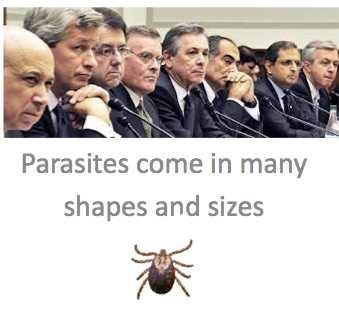
Financial Predators and Parasites Want to Live, Regardless of the Cost

Bankers-and-Tick1

By Charles Hugh Smith

Source: Of Two Minds

Reform is impossible in a system optimized for centralized power and financial predators and parasites.

The problem with optimizing private gain by any means available is you also optimize financial predators and parasites. The problem with optimizing a system for centralized power (i.e. the federal government and Federal Reserve) is that you also optimize regulatory capture, influence-peddling and the unholy marriage of wealth and power.

Optimization is a key principle of all technologies. Though the political class claims perfection is possible (with just a few more regulations and laws, heh), engineers understand every system is a series of trade-offs. If you want to optimize one output, everything else in the system is rendered secondary.

The master narrative of the status quo is that maximizing private gain by any means available is good because to get rich is glorious: the goal of getting rich motivates entrepreneurs to do wonderful things that benefit humanity while they amass vast fortunes.

This is the happy propaganda story, and we all know the few outliers who are endlessly trotted out to “prove” its truth: Steve Jobs, the Larrys (Ellison and Page) Bill Gates, et al. Nice, but the handful who fulfill the propaganda version of optimizing private gain by any means available only succeeded because there were no powerful vested interests in their way.

What our system actually optimizes is the assembly of vested interests that buy protection of their racket from the state. These vested interests include wealthy individuals, corporations, cartels and public unions.

Want to earn a 1,000% return on your investment? It’s very difficult to do so by producing a good or service. By any measure, the easiest, lowest-risk way to earn a 1,000% return on your investment is to buy political protection with lobbying and campaign contributions.

What we’ve done is optimize financial predation and parasitism. We’ve created enormous incentives for too big to fail/jail banks, financiers manipulating dark pools and high-frequency trading that add nothing to the real economy, public unions guaranteeing their members unbeatable pensions and benefits while taxpayers foot the bill, politicos who enter office with ambition and few financial means who leave office with great wealth, cartels that buy protection from competition from the centralized state and corporations that rewrite the tax code in their favor with campaign contributions.

Now that we’ve created vast menageries of insatiably greedy financial predators and parasites, we’ve created monsters who want to live regardless of the cost to the nation. Parasites prefer not to kill their host, but their ability to fine-tune the process of sucking as much money out of the system as possible without bringing it down is not as well-developed as their greed.

The Global Financial Meltdown of 2008 proved this. The financial parasites and their parasitic partners in the halls of federal power were blind to the risks of collapse their insatiable greed were generating; they continued sucking the maximum private gain out of the system until the moment it collapsed in a heap.

Predators don’t worry about maintaining the flock of sheep or the schools of little fish. They will dive into the swirling school of frantic fish and consume every last one. Financial predators are the same: financial predators will sell a subprime auto loan to every last debt-serf in the flock, until the ecosystem of prey collapses and there are no marks left for their cons.

This is why our system is well and truly doomed: we have optimized the system for vast menageries of insatiably greedy financial predators and parasites, and now that they exist and have gained power, they want to live and prosper regardless of the cost to the decimated prey and the nation. By optimizing centralized power, we have optimized the protection of financial predators and parasites by the all-powerful central state and bank.

Reform is impossible in a system optimized for centralized power and financial predators and parasites. The predators and parasites will gorge themselves until the system collapses.


The true value of money

index

Economics needs a revolution.

By David Orrell

Source: Adbusters

This sentiment has been expressed by people from the physicist turned hedge-fund manager Jean-Philippe Bouchaud (in a 2008 paper), to the Bank of England’s Andrew Haldane (in a 2014 foreword for Manchester’s student-run Post-Crash Economics), to activist groups such as Kick It Over. So what would such a revolution look like?

Perhaps the archetypal model for a scientific revolution is the quantum revolution that shocked the world at the turn of the last century. In the space of a few short years, almost everything that was known about the nature of matter was overturned. The Newtonian view of the world as a predictable machine crumbled with it.

Except, that is, in economics – which continues to base its models on quasi-Newtonian economic laws.

A peculiar feature of orthodox economics is that money is treated as an inert medium of exchange, with no special properties of its own. As a result, money is largely excluded from macroeconomic models, which is one reason the financial crisis of 2007/8 was not predicted (it involved money). In many respects, when viewed through the lens of quantum physics, money behaves a lot like matter – and acknowledging that behavior promises to do to economics what quanta did for physics.

The main insight of quantum physics is that matter is composed of entities which behave in some ways as waves and in other ways as particles. This novel insight countered the Newtonian view that billiard ball-like atoms behaved independently of each other. A beam of light, for example, is an electromagnetic wave but it is also a stream of particles known as photons. At a quantum level, matter is fundamentally dualistic: neither the particle nor the wave description is complete by itself.

The same can be said of money, which turns out to have quantum properties of its own. Money is strange stuff, when you think about it – but because it has been around for millennia we rarely do. Consider for example a U.S. dollar bill. On the one hand it represents a number – in this case the number one. On the other hand it is a physical thing which can be possessed, exchanged and above all valued (even lusted after, if there are enough of them). It therefore lives partly in the abstract world of numbers and mathematics and partly in the real world of things, people and value.

The same is true of any money object that we use for payment. Here “object” could refer either to a physical object – such as a coin – or a virtual object, such as 1.2107 bitcoin (BTC) sent from a phone. What makes such objects special is that they have a fixed, defined value in currency units.

While seeing money objects as things with a fixed monetary value might appear trivial, it turns out to have complex and contradictory properties that feed into the economy as a whole. In particular, they combine two aspects, abstract number and real world value, which are as different as waves and particles.

For example numbers are subject to mathematical laws – such as compound interest – and can grow without limits, while in the real world natural processes tend to be subject to bounds. In 1850 an American lawyer did the math and calculated that five English pennies invested at 5 percent compound interest since 0 AD would have accumulated to 32 billion spheres of pure gold, each equal in size to the Earth. This is a useful exercise for anyone who thinks that gross domestic product (GDP) can grow forever.

Numbers can be negative, as in debts, but (as the English physicist-turned-economist Frederick Soddy pointed out) there is no such thing as a negative number of objects. You might be underwater on your mortgage but you can’t own a negative house. Throughout history the frightening ability of negative debt to grow without bounds has been responsible for forcing people into economic slavery.

Numbers are hard and precise, like the particle aspect of matter. Real-world concepts such as value are diffuse and fuzzy, like the wave aspect of matter. By combining these two aspects in a single package, money objects are our contribution to the quantum universe.

The dualistic nature of money explains its frequently paradoxical behavior. In the early 2000s, cheap credit in the United States meant that even low-income people could afford their own homes. Some cashed in and sold their houses at the top of the market. For them the money was real – they could go to the bank and withdraw dollar bills. But when the credit crunch kicked in most of the new money disappeared into the ether, as if it had never existed. Money seemed to be both real and unreal at the same time – a sensation familiar to anyone who has studied quantum physics.

Just as quantum physics overturned Newtonian physics, so a reexamination of money promises to disrupt economics. The reason that critics are calling for fundamental change is that neoclassical economics has failed to provide answers to problems such as wealth inequality, financial crises and environmental degradation – which is unsurprising if it treats money as nothing more than an inert, Newtonian medium of exchange. The tendency of money to clump and accumulate with a small group of creditors, or for financial markets to be inherently unstable, or for GDP growth to be valued over the environment, becomes clearer when we acknowledge the vital, active role of money and the tension and discrepancy between numbers and the real world that drives it.

Of course, one should not underestimate the resistance of economists to adopting new ideas, however the worldwide student movement calling for change is unlikely to go away. Economics is primed for a quantum revolution of its own.

— David Orrell is a mathematician and author. His latest book, Truth or Beauty: Science and The Quest for Order, explores the role of aesthetics in science. He is currently working on a book about money.

Politicians Exploit School Shooting While Ignoring Bombing Victims

Ron_Paul_0723

By Ron Paul

Source: Ron Paul Institute

Following the recent Oregon school shooting, many politicians rushed to the microphones to call for new gun control laws. President Obama even called on gun control supporters to “politicize” the shooting, while some members of Congress worked to establish a special commission on gun violence.

The reaction to the shooting stands in stark contrast to the reaction to the US military’s bombing of an Afghanistan hospital run by the international humanitarian (and Nobel Peace Prize winning) group Doctors Without Borders.

Our Nobel Peace Prize winning president did apologize to his fellow Nobel laureate for the bombing. However, President Obama has not “politicized” this tragedy by using it to justify ending military involvement in Afghanistan. No one in Congress is pushing for a special commission to examine the human costs of US militarism, and the mainstream media has largely ignored Doctors Without Borders’ accusation that the bombing constitutes a war crime.

The reason for the different reactions to these two events is that politicians prefer to focus on events they can “politicize” to increase government power. In contrast, politicians ignore incidents that raise uncomfortable questions about US foreign policy.

If the political and media elites were really interested in preventing future mass shootings, they would repeal the federal “gun-free” schools law, for example. By letting shooters know that their intended victims are defenseless, the gun-free schools law turns schoolchildren into easy targets.

Even some who oppose gun control are using the shooting to justify expanding federal power instead of trying to repeal unconstitutional laws. Some opponents of new gun control laws say Congress should expand the federal role in identifying, tracking, and treating those with “mental health problems.” This ignores the fact that many shooters were using psychotropic drugs prescribed by a mental health professional when they committed the horrible acts. Furthermore, creating a system to identify and track anyone with a “mental health problem” could deny respect for individuals’ Second Amendment and other rights because they perhaps once sought counseling for depression while going through a divorce or coping with a loved one’s passing.

While our political and media elites are eager to debate how much liberty people must sacrifice for safety, they are desperate to avoid debating the morality of our foreign policy. To admit that the US military sometimes commits immoral acts is to admit that the US government is not an unalloyed force for good. Even many proponents of our recent wars support using the US military for “humanitarian” purposes. Thus they are as reluctant as the neoconservatives to question the fundamental goodness of US foreign policy.

Anyone who raises constitutional or moral objections to the US use of drones, bombs, indefinite detention, and torture risks being attacked as anti-American and soft on terrorism. The smear of “terrorist apologist” is also hurled at those who dare suggest that it is our interventionist foreign policy, not a hatred of freedom, that causes people in other countries to dislike the United States. Which is a more logical explanation for why someone would resent America — a family member killed in a drone attack launched by the US military or rage over our abundance of liberty?

The disparate reactions to the Oregon school shooting and the Afghanistan hospital bombing shows the political class is unwilling and unable to acknowledge that the US government cannot run the world, run our lives, or run the economy. Clearly, politicians will never stop expanding government and give us back our lost liberties unless and until the people demand it.

Lara Trace Hentz

INDIAN COUNTRY NEWS

In Saner Thought

"It is the duty of every man, as far as his ability extends, to detect and expose delusion and error"..Thomas Paine

ZEDJournAI

Human in Algorithms

Rooster Crows

From the Roof Top

Aisle C

I See This

The Free

blog of the post capitalist transition.. Read or download the novel here + latest relevant posts

अध्ययन-अनुसन्धान(Essential Knowledge of the Overall Subject)

अध्ययन-अनुसन्धानको सार